<?xml version="1.0" encoding="ISO-8859-1"?><article xmlns:mml="http://www.w3.org/1998/Math/MathML" xmlns:xlink="http://www.w3.org/1999/xlink" xmlns:xsi="http://www.w3.org/2001/XMLSchema-instance">
<front>
<journal-meta>
<journal-id>1027-152X</journal-id>
<journal-title><![CDATA[Revista Chapingo. Serie horticultura]]></journal-title>
<abbrev-journal-title><![CDATA[Rev. Chapingo Ser.Hortic]]></abbrev-journal-title>
<issn>1027-152X</issn>
<publisher>
<publisher-name><![CDATA[Universidad Autónoma Chapingo]]></publisher-name>
</publisher>
</journal-meta>
<article-meta>
<article-id>S1027-152X2015000100001</article-id>
<article-id pub-id-type="doi">10.5154/r.rchsh.2014.01.002</article-id>
<title-group>
<article-title xml:lang="en"><![CDATA[Energy consumption in the management of avocado orchards in Michoacán, Mexico]]></article-title>
<article-title xml:lang="es"><![CDATA[Consumo de energía en el manejo de huertas de aguacate en Michoacán, México]]></article-title>
</title-group>
<contrib-group>
<contrib contrib-type="author">
<name>
<surname><![CDATA[Anaya]]></surname>
<given-names><![CDATA[Carlos A.]]></given-names>
</name>
<xref ref-type="aff" rid="A01"/>
</contrib>
<contrib contrib-type="author">
<name>
<surname><![CDATA[Burgos]]></surname>
<given-names><![CDATA[Ana Laura]]></given-names>
</name>
<xref ref-type="aff" rid="A01"/>
</contrib>
</contrib-group>
<aff id="A01">
<institution><![CDATA[,Universidad Nacional Autónoma de México Centro de Investigaciones en Geografía Ambiental ]]></institution>
<addr-line><![CDATA[Morelia Michoacán]]></addr-line>
<country>México</country>
</aff>
<pub-date pub-type="pub">
<day>00</day>
<month>04</month>
<year>2015</year>
</pub-date>
<pub-date pub-type="epub">
<day>00</day>
<month>04</month>
<year>2015</year>
</pub-date>
<volume>21</volume>
<numero>1</numero>
<fpage>5</fpage>
<lpage>20</lpage>
<copyright-statement/>
<copyright-year/>
<self-uri xlink:href="http://www.scielo.org.mx/scielo.php?script=sci_arttext&amp;pid=S1027-152X2015000100001&amp;lng=en&amp;nrm=iso"></self-uri><self-uri xlink:href="http://www.scielo.org.mx/scielo.php?script=sci_abstract&amp;pid=S1027-152X2015000100001&amp;lng=en&amp;nrm=iso"></self-uri><self-uri xlink:href="http://www.scielo.org.mx/scielo.php?script=sci_pdf&amp;pid=S1027-152X2015000100001&amp;lng=en&amp;nrm=iso"></self-uri><abstract abstract-type="short" xml:lang="en"><p><![CDATA[Efficient fossil energy consumption in agricultural systems is a prerequisite for sustainable agricultural production. Fossil energy consumption (EC) in avocado orchard production in Michoacán, Mexico was analyzed. Process analysis was used to estimate both direct and indirect energy required for the various agricultural operations. Data on fuel and inputs used in production were obtained from structured questionnaires completed by 455 growers. Average annual EC was 28,880 MJ&#8729;ha-1, but the data ranged between 5,330 and 76,531 MJ&#8729;ha-1, indicating the co-existence of a great diversity of farming systems. EC in agricultural operations decreased in the following order: fertilization (54.4 %), pest control (39.9 %), weed control (5.6 %) and irrigation (0.2 %). EC in fertilization was positively associated with the economic resources of the growers; and according to recognized fertilization standards, nitrogen fertilizer was applied excessively in 64 % of the orchards. EC in pest control was in the high range reported for fruit-tree crops and, on average, it was 41 % higher in exporting orchards than in those that produce only for the domestic market. EC in avocado production can be significantly reduced by improving fertilization and pest control practices, especially among large- and medium-sized growers.]]></p></abstract>
<abstract abstract-type="short" xml:lang="es"><p><![CDATA[El consumo eficiente de energía fósil, en los sistemas agrícolas, es prerrequisito de sostenibilidad de la producción. Se analizó el consumo de energía fósil (CE) en la producción de aguacate en huertas de Michoacán, México. La energía directa e indirecta consumida en varias operaciones agronómicas fue estimada mediante análisis de procesos. Se obtuvieron datos de combustibles e insumos usados en la producción a través de cuestionarios realizados a 455 productores. El promedio anual del CE fue 28,880 MJ&#8729;ha-1, pero los valores variaron entre 5,330 y 76,531MJ&#8729;ha-1, indicando la coexistencia de gran diversidad de modos de producción. El CE en las operaciones agronómicas decreció en el siguiente orden: fertilización (54.4 %), control de plagas (39.9 %), control de hierbas (5.6 %) y riego (0.2 %). El CE en la fertilización fue positivamente asociado con los recursos económicos de los productores; y de acuerdo con estándares de fertilización reconocidos, pudo haber un exceso en la fertilización con nitrógeno en 64 % de las huertas. El CE en el control de plagas estuvo entre los valores más altos reportados en cultivos de árboles frutales y, en promedio, fue 41 % mayor en huertas de exportación que en aquellas que producen sólo para mercado nacional. El CE en la producción de aguacate puede reducirse significativamente mejorando las prácticas de fertilización y control de plagas, especialmente entre los productores grandes y medianos.]]></p></abstract>
<kwd-group>
<kwd lng="en"><![CDATA[Persea americana Mill.]]></kwd>
<kwd lng="en"><![CDATA[crop management]]></kwd>
<kwd lng="en"><![CDATA[energy use]]></kwd>
<kwd lng="en"><![CDATA[environmental indicators]]></kwd>
<kwd lng="en"><![CDATA[fertilization]]></kwd>
<kwd lng="en"><![CDATA[pest control]]></kwd>
<kwd lng="es"><![CDATA[Persea americana Mill.]]></kwd>
<kwd lng="es"><![CDATA[indicadores ambientales]]></kwd>
<kwd lng="es"><![CDATA[manejo agrícola]]></kwd>
<kwd lng="es"><![CDATA[fertilización]]></kwd>
<kwd lng="es"><![CDATA[control de plagas]]></kwd>
<kwd lng="es"><![CDATA[uso de energía]]></kwd>
</kwd-group>
</article-meta>
</front><body><![CDATA[  	    <p align="center"><font face="verdana" size="4"><b>Energy consumption in the management of avocado orchards in Michoac&aacute;n, Mexico</b></font></p>  	    <p align="center"><font face="verdana" size="2">&nbsp;</font></p>  	    <p align="center"><font face="verdana" size="3"><b>Consumo de energ&iacute;a en el manejo de huertas de aguacate en Michoac&aacute;n, M&eacute;xico</b></font></p>  	    <p align="center"><font face="verdana" size="2">&nbsp;</font></p>  	    <p align="center"><font face="verdana" size="2"><b>Carlos A. Anaya*; Ana Laura Burgos</b></font></p>  	    <p align="justify"><font face="verdana" size="2">&nbsp;</font></p>  	    <p align="justify"><font face="verdana" size="2"><i>Centro de Investigaciones en Geograf&iacute;a Ambiental, Universidad Nacional Aut&oacute;noma de M&eacute;xico. Antigua Carretera a P&aacute;tzcuaro 8701, colonia Ex&#45;Hacienda de San Jos&eacute; de la Huerta, Morelia, Michoac&aacute;n, C.P. 58190, M&Eacute;XICO.</i> Correo&#45;e: <a href="mailto:carlosanaya.m@gmail.com">carlosanaya.m@gmail.com</a>, tel.: (443) 322 27 77 ext. 42557 <i>(*Autor para correspondencia).</i></font></p>  	    <p align="justify"><font face="verdana" size="2">&nbsp;</font></p>  	    <p align="justify"><font face="verdana" size="2">Received: January 20, 2014.    ]]></body>
<body><![CDATA[<br> 	Accepted: February 2, 2015.</font></p>  	    <p align="justify"><font face="verdana" size="2">&nbsp;</font></p>  	    <p align="justify"><font face="verdana" size="2"><b>Abstract</b></font></p>  	    <p align="justify"><font face="verdana" size="2">Efficient fossil energy consumption in agricultural systems is a prerequisite for sustainable agricultural production. Fossil energy consumption (EC) in avocado orchard production in Michoac&aacute;n, Mexico was analyzed. Process analysis was used to estimate both direct and indirect energy required for the various agricultural operations. Data on fuel and inputs used in production were obtained from structured questionnaires completed by 455 growers. Average annual EC was 28,880 MJ&#8729;ha<sup>&#45;1</sup>, but the data ranged between 5,330 and 76,531 MJ&#8729;ha<sup>&#45;1</sup>, indicating the co&#45;existence of a great diversity of farming systems. EC in agricultural operations decreased in the following order: fertilization (54.4 %), pest control (39.9 %), weed control (5.6 %) and irrigation (0.2 %). EC in fertilization was positively associated with the economic resources of the growers; and according to recognized fertilization standards, nitrogen fertilizer was applied excessively in 64 % of the orchards. EC in pest control was in the high range reported for fruit&#45;tree crops and, on average, it was 41 % higher in exporting orchards than in those that produce only for the domestic market. EC in avocado production can be significantly reduced by improving fertilization and pest control practices, especially among large&#45; and medium&#45;sized growers.</font></p> 	    <p align="justify"><font face="verdana" size="2"><b>Keywords:</b> <i>Persea americana</i> Mill., crop management, energy use, environmental indicators, fertilization, pest control.</font></p>     <p align="justify"><font face="verdana" size="2">&nbsp;</font></p>  	    <p align="justify"><font face="verdana" size="2"><b>Resumen</b></font></p>  	    <p align="justify"><font face="verdana" size="2">El consumo eficiente de energ&iacute;a f&oacute;sil, en los sistemas agr&iacute;colas, es prerrequisito de sostenibilidad de la producci&oacute;n. Se analiz&oacute; el consumo de energ&iacute;a f&oacute;sil (CE) en la producci&oacute;n de aguacate en huertas de Michoac&aacute;n, M&eacute;xico. La energ&iacute;a directa e indirecta consumida en varias operaciones agron&oacute;micas fue estimada mediante an&aacute;lisis de procesos. Se obtuvieron datos de combustibles e insumos usados en la producci&oacute;n a trav&eacute;s de cuestionarios realizados a 455 productores. El promedio anual del CE fue 28,880 MJ&#8729;ha<sup>&#45;1</sup>, pero los valores variaron entre 5,330 y 76,531MJ&#8729;ha<sup>&#45;1</sup>, indicando la coexistencia de gran diversidad de modos de producci&oacute;n. El CE en las operaciones agron&oacute;micas decreci&oacute; en el siguiente orden: fertilizaci&oacute;n (54.4 %), control de plagas (39.9 %), control de hierbas (5.6 %) y riego (0.2 %). El CE en la fertilizaci&oacute;n fue positivamente asociado con los recursos econ&oacute;micos de los productores; y de acuerdo con est&aacute;ndares de fertilizaci&oacute;n reconocidos, pudo haber un exceso en la fertilizaci&oacute;n con nitr&oacute;geno en 64 % de las huertas. El CE en el control de plagas estuvo entre los valores m&aacute;s altos reportados en cultivos de &aacute;rboles frutales y, en promedio, fue 41 % mayor en huertas de exportaci&oacute;n que en aquellas que producen s&oacute;lo para mercado nacional. El CE en la producci&oacute;n de aguacate puede reducirse significativamente mejorando las pr&aacute;cticas de fertilizaci&oacute;n y control de plagas, especialmente entre los productores grandes y medianos.</font></p> 	    <p align="justify"><font face="verdana" size="2"><b>Palabras clave:</b> <i>Persea americana</i> Mill., indicadores ambientales, manejo agr&iacute;cola, fertilizaci&oacute;n, control de plagas, uso de energ&iacute;a.</font></p>     <p align="justify"><font face="verdana" size="2">&nbsp;</font></p>  	    ]]></body>
<body><![CDATA[<p align="justify"><font face="verdana" size="2"><b>INTRODUCTION</b></font></p>  	    <p align="justify"><font face="verdana" size="2">The cultivation of avocado (<i>Persea americana</i> Mill.) has shown marked growth in Mexico over the past two decades, as a result of the North American Free Trade Agreement and its growing acceptance in Japan and Europe (Ech&aacute;nove Huacuja, 2008). This expansion has been evident in the state of Michoac&aacute;n, ranked as the world leader in avocado production with a cultivated area of 153,000 ha and total production of 1.1 million Mg&#8729;year<sup>&#45;1</sup> (Morales&#45;Manilla &amp; Cuevas&#45;Garc&iacute;a, 2011; Secretar&iacute;a de Agricultura, Ganader&iacute;a, Desarrollo Rural, Pesca y Alimentaci&oacute;n &#91;SAGARPA&#93;, 2013). Similarly, the number of avocado growers in the state has increased dramatically, from 16,150 registered producers in 2007 (Comisi&oacute;n Michoacana del Aguacate &#91;COMA&#93;, 2007) to 22,000 estimated for 2012. The market entry of new producers with different degrees of knowledge about growing avocado, occupying new lands with climate and soil not optimal for this purpose, has created a patchwork of orchards with different biophysical conditions and modes of agricultural management. While the expansion of the avocado industry has undoubtedly boosted the regional economy and created jobs, its effects on the environment have created concern in government agencies, producer associations, academic circles, the media and the general public (Barsimantov &amp; Navia Antezana, 2012; Ch&aacute;vez&#45;Le&oacute;n et al., 2012).</font></p>  	    <p align="justify"><font face="verdana" size="2">In the field of sustainable agriculture, an indicative component of a production system's environmental and economic performance is its fossil fuel energy consumption (EC) (Dalgaard, Halberg, &amp; Porter, 2001; Pimentel, Berardi, &amp; Fast, 1983). EC is directly associated with the use of agricultural inputs, production costs and greenhouse gas (GHG) emissions (Lal, 2004; Pimentel, Hepperly, Hanson, Douds, &amp; Seidel, 2005; West &amp; Marland, 2002). Determining EC involves standardizing and synthesizing information, which requires knowing the set of practices used in the production of an agricultural product, and the energy associated with them, including both direct energy sources (diesel fuel, gasoline and electricity), and indirect sources (i.e. use of agricultural inputs whose production and marketing required the consumption of fossil energy) (Dalgaard et al., 2001). EC analysis identifies practices with significant energy use, makes comparisons between different management modes to choose those strategies with greater efficiency, and establishes trends and variations in EC over time on different levels of agricultural organization (Jones, 1989). Because of the potential for assessing farming practices in terms of energy efficiency and reduced GHG emissions, EC quantifications have been made for different crops worldwide, including fruit&#45;tree crops such as citrus production (Ozkan, Akcaoz, &amp; Karadeniz, 2004), apples (Reganold, Glover, Andrews, &amp; Hinman, 2001), and pear (Liu, Langer, H&oslash;gh&#45;Jensen, &amp; Egelyng, 2010). In these crops it has been observed, for example, that the activity requiring the most fossil energy is fertilization, followed by pest and disease control, and that EC may vary among management systems (e.g. conventional, organic and integrated).</font></p>  	    <p align="justify"><font face="verdana" size="2">As in other cases, knowledge of EC in avocado growing provides elements to assess its sustainability and provide notice of the need to incorporate energy conservation practices. The aim of this study was to analyze the patterns of fossil EC in the management of avocado orchards in Michoac&aacute;n. Therefore, we sought to identify the most energy&#45;demanding agricultural operations and the main factors explaining EC variability among orchards at the regional level. The analysis was guided by two working hypotheses: (1) given the great heterogeneity of avocado producers and biophysical production conditions in Michoac&aacute;n, it is to be expected that EC will vary widely and that this is influenced by the socio&#45;economic characteristics of the producers and the biophysical aspects of the orchards, and (2) the agricultural activity with the highest EC in avocado orchard management will be fertilization as has been observed in other fruit&#45;tree crops; however, given the increasing incidence of pests, diseases, and export demands, phytosanitary control is also expected to have high EC.</font></p>  	    <p align="justify"><font face="verdana" size="2">&nbsp;</font></p>  	    <p align="justify"><font face="verdana" size="2"><b>MATERIALS AND METHODS</b></font></p>  	    <p align="justify"><font face="verdana" size="2"><b>Study area    <br></b>    <br> 	The study was conducted in the avocado&#45;producing region of Michoac&aacute;n, Mexico, encompassing a transverse strip between the counties of Cotija to the west and Tuxpan to the east, between 1,400 and 2,200 m above sea level, along the 19&ordm; N parallel and between the 100&ordm; to 103&ordm; W meridians (<a href="#f1">Figure 1</a>). This area has a temperate sub&#45;humid C(w2) climate, and tropical sub&#45;humid ((A)C(w1) and (A)C(w2)) climates, with annual rainfall ranging between 800 to 1,700 mm concentrated between May and October, and monthly high and low temperatures of 27 and 12 &ordm;C, respectively (Guti&eacute;rrez&#45; Contreras, Lara&#45;Ch&aacute;vez, Guill&eacute;n&#45;Andrade, &amp; Ch&aacute;vez&#45; B&aacute;rcenas, 2010).</font></p>  	    <p align="center"><font face="verdana" size="2"><a name="f1"></a></font></p>  	    ]]></body>
<body><![CDATA[<p align="center"><font face="verdana" size="2"><img src="/img/revistas/rcsh/v21n1/a1f1.jpg"></font></p>  	    <p align="justify"><font face="verdana" size="2">&nbsp;</font></p>  	    <p align="justify"><font face="verdana" size="2"><b>Data collection on orchard management</b></font></p> 	    <p align="justify"><font face="verdana" size="2">Data collection was done through direct surveys. These involved applying a structured questionnaire to a random sample of growers who perform agricultural operations in orchards older than eight years of age, excluding those related to harvesting and packing which are carried out by the packing industry or local merchants (Salazar&#45;Garc&iacute;a, Zamora&#45;Cuevas, &amp; Vega&#45;L&oacute;pez, 2005). Sampling was performed in the jurisdictions of nine of the 15 Local Plant Health Boards (known by the Spanish acronym JLSV) in Michoac&aacute;n. The JLSV are auxiliary bodies of the Secretariat of Agriculture, Livestock, Rural Development, Fisheries and Food (known by the Spanish acronym SAGARPA) in Mexico. Their function is to regulate the output of fruit production and oversee the application of health standards in all orchards. The JLSV participants in this study were: the Gral. Francisco J. M&uacute;jica JLSV, which serves the counties of Cotija, Tangamandapio, Tocumbo and Ting&uuml;indin; the Oriente JLSV, which operates in six counties adjacent to the State of Mexico and the JLSV of the counties of Tac&aacute;mbaro, Ario de Rosales, Uruapan, San Juan Nuevo, Tanc&iacute;taro, Perib&aacute;n and Los Reyes. These JLSV were selected because of their location along the avocado&#45;growing strip (<a href="#f1">Figure 1</a>), which allowed capturing the production methods that exist in different climatic, geographic and social contexts. It should be noted that the JLSV were instrumental in this work since they facilitated the formal approach to the growers for the application of the surveys. The questionnaire included 78 questions designed to elicit detailed information about the agricultural practices of fertilization, pest control, weed control and irrigation, including the scheduling of these practices (i.e. frequency and dates on which they are performed) and the type and quantity of inputs used in them. Questions on the characteristics of the orchard and its production, such as locality&#45;level location, dominant relief, infrastructure, equipment, cultivated varieties, density, plantation age, average yield and sales market, were also included. No questions were asked concerning the climatic characteristics of precipitation and temperature at the orchard location, because they were obtained through the generation of isohyets and isotherms in GIS (ESRI, Inc., 2008), using for this purpose the database of the national network of meteorological stations contained in the Software ERIC III (Instituto Mexicano de Tecnolog&iacute;a del Agua &#91;IMTA&#93;, 2013). In the case of growers with more than one orchard, the questionnaire asked them to provide management information only about their largest orchard. Before applying the questionnaire, it was piloted and validated with growers belonging to the Local Avocado Growers Association of Uruapan, Michoac&aacute;n (known by the Spanish acronym AALPAUM). A total of 520 surveys were applied between June 2010 and November 2011. After review, 65 surveys were removed from the sample due to inconsistencies or incomplete answers, so only 455 were included in the analysis, representing 4 % of the approximately 11,000 registered producers (COMA, 2007). The sample covered a wide range of production conditions (<a href="/img/revistas/rcsh/v21n1/a1t1.jpg" target="_blank">Table 1</a>).</font></p>     <p align="justify"><font face="verdana" size="2">&nbsp;</font></p>  	    <p align="justify"><font face="verdana" size="2">    <br> 	<b>Calculation of energy consumption</b></font></p> 	    <p align="justify"><font face="verdana" size="2">Energy costs were expressed in Joules per unit area, assuming an annual production cycle (J&#8729;ha&#45;1&#8729;year&#45;1). No units relating to the energy prices involved in orchard management were used, because the interest of the study was in energy consumption, not the costs thereof. This allowed the comparative analysis of EC with other horticultural crops reported by studies in different countries. The study was restricted to fossil EC of direct and indirect sources, excluding solar energy and human labor. The calculation was performed using the process analysis method based on the determination of the physical flows of materials, in accordance with the following equation (H&uuml;lsbergen et al., 2001):    <br>     </font></p>     <p align="center"><font face="verdana" size="2"><img src="/img/revistas/rcsh/v21n1/a1e1.jpg"></font></p>  	    ]]></body>
<body><![CDATA[<p align="justify"><font face="verdana" size="2">    <br> 	where: <i>EC</i> is fossil energy consumption, <i>C<sub>i</sub></i> is the amount used of input <i>i</i>, and <i>E<sub>i</sub></i> is the energy equivalent of the agricultural input <i>i</i>. <i>E<sub>i</sub></i> is not constant for the same input, because it depends on the place of origin of the product, the technology used in its manufacture and the calculation method (H&uuml;lsbergen et al., 2001). Some energy equivalents had to be adapted to local conditions (Pimentel et al., 1983), using the conversion coefficients listed in <a href="/img/revistas/rcsh/v21n1/a1t2.jpg" target="_blank">Table 2</a>. For example, for the energy equivalents of Mexican diesel fuel and gasoline, with combustion values of 37.7 and 31.2 MJ&#8729;liter<sup>&#45;1</sup>, 5 MJ&#8729;liter<sup>&#45;1</sup> were added for extraction (Dalgaard et al., 2001). For pesticides, a generic equivalent derived from the average of the equivalents for insecticides and fungicides reported by West and Marland (2002) was selected. This was because the data obtained from the questionnaires referred to mixtures of pesticides sprayed per unit area. A dose of 3 kg of pesticide per m<sup>3</sup> of mixture was assumed, as this is the average dose used for the control of 11 of the most common species of pests and diseases in the avocado&#45;growing region (Servicio Nacional de Sanidad, Inocuidad y Calidad Agroalimentaria &#91;SENASICA&#93;, 2009). In the case of mineral mixtures used for pest control (Bordeaux mixture and lime sulfur), the energy equivalent took into account formulas used by producers (Marroqu&iacute;n&#45;Pimentel, 1999) and the energy equivalent of the minerals that compose them (<a href="/img/revistas/rcsh/v21n1/a1t2.jpg" target="_blank">Table 2</a>). In the case of manure, the energy equivalent was 0.35 MJ&#8729;kg<sup>&#45;1</sup>, which only considered the use of fossil energy in its transport from source to destination (Pimentel et al., 1983), which was an average distance of 250 km, transported by a 15&#45;Mg truck, and energy consumption for transportation of 1.4 MJ&#8729;Mg<sup>&#45;1</sup>&#8729;km<sup>&#45;1</sup> (B&ouml;rjesson, 1996). For Supermagro, a liquid compost commonly used by organic producers, the equivalent used (0.3 MJ&#8729;liter<sup>&#45;1</sup>) included the inputs for its preparation (Larios&#45;Guzm&aacute;n, Villase&ntilde;or&#45;Ram&iacute;rez, Vidales&#45;Fern&aacute;ndez, &amp; S&aacute;enz&#45;Reyes, 2005). The phosphate rock equivalent was 2.1 MJ&#8729;kg<sup>&#45;1</sup>, which corresponds to the energy used in the mining and grinding of the rock (Wells, 2001). Finally, the 4.2 MJ&#8729;m<sup>&#45;3</sup> equivalent used for irrigation was estimated for the energy expenditure incurred operating micro&#45;sprinklers driven by an electric pumping system.</font></p>  	    <p align="justify"><font face="verdana" size="2">&nbsp;</font></p>  	    <p align="justify"><font face="verdana" size="2">    <br> 	<b>Statistical analyzes</b></font></p> 	    <p align="justify"><font face="verdana" size="2">The total energy consumption (EC<sub>t</sub>) of each production unit was calculated from the sum of the EC in the farming activities of fertilization (EC<sub>fert</sub>), pest and disease control (EC<sub>pd</sub>), weed control (EC<sub>weed</sub>) and irrigation (EC<sub>irrig</sub>). To analyze the variation in EC<sub>t</sub> in the sample of producers (n = 455), its coefficient of variation was determined and its frequency distribution was described by a histogram and testing of fit to normal and gamma distributions. To assess whether EC<sub>t</sub> has an influence on avocado yields (i.e. productivity; Mg&#8729;ha<sup>&#45;1</sup>&#8729;year<sup>&#45;1</sup>), a regression analysis between the two variables was performed. To find the explanatory factors of EC in the production units, we carried out Pearson's correlation analysis and stepwise regression analysis between EC<sub>t</sub> and the EC of particular agricultural activities with a set of seven variables, including climatic characteristics at the orchard's location (i.e. mean annual precipitation and temperature), structural characteristics (i.e. orchard age and planting density), characteristics of the producer's economic capability (i.e. total cultivated area and own equipment), and destination sales point (i.e. domestic and export markets). In the regression analyzes only explanatory variables that previously correlated significantly with EC were included (Zar, 1999). According to Spearman's rank correlation coefficient, total cultivated area and equipment availability had a positively significant correlation (r = 0.66, t<sub>(453)</sub> = 18.8, <i>P</i> &lt; 0.0001); therefore, only total cultivated area as an explanatory variable associated with the producer's economic capability was used. The effect of the binary marketing variable was only assessed on EC<sub>t</sub>, for which the Student's <i>t&#45;</i> test was used. Statistical analyzes were performed with STATISTICA 7 software (StatSoft Inc., 2004).</font></p>     <p align="justify"><font face="verdana" size="2">&nbsp;</font></p>  	    <p align="justify"><font face="verdana" size="2"><b>RESULTS</b></font></p> 	    <p align="justify"><font face="verdana" size="2">The EC<sub>t</sub> in the management of avocado orchards had a high coefficient of variation, 41 %. Its values ranged from 5,330 to 76,531 MJ&#8729;ha<sup>&#45;1</sup>&#8729;year<sup>&#45;1</sup>, averaging (&plusmn; 1 e.e.) 28,880 &plusmn; 560 MJ&#8729;ha<sup>&#45;1</sup>&#8729;year<sup>&#45;1</sup> (<a href="/img/revistas/rcsh/v21n1/a1t3.jpg" target="_blank">Table 3</a>). The frequency distribution of the EC<sub>t</sub> values constructed with 13 classes did not fit normal distribution (X<sup>2</sup> = 22.7, <i>P</i> = 0.0009), but it did with gamma distributi on (X<sup>2</sup> = 5.04; <i>P</i> = 0.54). This distribution showed a positive bias (0.6 &plusmn; 0.11), with a relatively higher number of below&#45;average values (<a href="#f2">Figure 2</a>). Of the total data, 56 % showed EC<sub>t</sub> of between 20,000 and 40,000 MJ&#8729;ha&#8729;year<sup>&#45;1</sup>, and 28 and 16 % had values higher and lower than this range, respectively.</font></p>     <p align="center"><font face="verdana" size="2"><a name="f2"></a></font></p>  	    ]]></body>
<body><![CDATA[<p align="center"><font face="verdana" size="2"><img src="/img/revistas/rcsh/v21n1/a1f2.jpg"></font></p>  	    <p align="justify"><font face="verdana" size="2">Avocado yield per orchard ranged from 4 to 30 Mg&#8729;ha<sup>&#45;1</sup>&#8729;year<sup>&#45;1</sup>, averaging 12 &plusmn; 0.26 Mg&#8729;ha<sup>&#45;1</sup>&#8729;year<sup>&#45;1</sup>. Regression analysis showed that EC<sub>t</sub> explained 7 % of this variation (r<sup>2</sup> = 0.07, <i>P</i> &lt; 0.001).</font></p>  	    <p align="justify"><font face="verdana" size="2">Regarding the explanatory variables of EC<sub>t</sub> variability, it was found that it correlated positively with four of the five analyzed variables (<a href="/img/revistas/rcsh/v21n1/a1t4.jpg" target="_blank">Table 4</a>), with the following order of importance: total cultivated area, annual precipitation, orchard age and planting density. However, multiple regression analysis showed that together these four variables explained only 15.5 % of the variation in EC<sub>t</sub> (r<sup>2</sup><sub>multiple</sub> = 0.15; f <sub>(3,442</sub>) = 26; <i>P</i> &lt;0.001). On the other hand, EC<sub>t</sub> was significantly higher in orchards producing avocado for export sales rather than for the domestic market (t = 5.3; fd = 453; <i>P</i> &lt; 0.0001). This difference was primarily attributable to EC<sub>pd</sub>, which was 41.8 % higher in orchards with export production (<a href="#f3">Figure 3</a>).</font></p>  	    <p align="center"><font face="verdana" size="2"><a name="f3"></a></font></p>  	    <p align="center"><font face="verdana" size="2"><img src="/img/revistas/rcsh/v21n1/a1f3.jpg"></font></p>  	    <p align="justify"><font face="verdana" size="2">The analysis of EC<sub>t</sub> by agricultural operation showed that EC<sub>fert</sub> was the most energy&#45;demanding activity, representing on average 54.4 % of EC<sub>t</sub> with absolute consumption of 15,665 &plusmn; 378 MJ&#8729;ha&#8729;year<sup>&#45;1</sup> (<a href="/img/revistas/rcsh/v21n1/a1t3.jpg" target="_blank">Table 3</a>). For its part, EC<sub>pd</sub> was the second highest with 11,535 &plusmn; 343 MJ&#8729;ha<sup>&#45;1</sup>&#8729;year<sup>&#45;1</sup>, corresponding to 39.9 % of EC<sub>t</sub>, whereas EC<sub>weed</sub> and EC<sub>irrig</sub> accounted for 5.6 and 0.2 % of EC<sub>t</sub>, respectively. When ECEC<sub>irrig</sub> was calculated, only for the group of orchards with irrigation, it had an average value of 399 &plusmn; 36 MJ&#8729;ha<sup>&#45;1</sup>&#8729;year<sup>&#45;1</sup>, with high variation (CV = 74 %).</font></p>  	    <p align="justify"><font face="verdana" size="2">According to the correlation and regression analyses, the EC of the individual agricultural operations was influenced differentially by the independent variables studied. EC<sub>fert</sub> positively correlated with total cultivated area, planting density and to a lesser degree with orchard age and temperature (<a href="/img/revistas/rcsh/v21n1/a1t4.jpg" target="_blank">Table 4</a>). These four variables together explained 20.5 % of the variation in EC<sub>fert</sub> (r<sup>2</sup><sub>multiple</sub> = 0.205; f<sub>(3,442)</sub> = 38; <i>P</i> &lt; 0.001). EC<sub>pd</sub> positively correlated with precipitation, orchard age and to a lesser degree with total cultivated area (<a href="/img/revistas/rcsh/v21n1/a1t4.jpg" target="_blank">Table 4</a>). However, these variables only explained 12.7 % of data variation (r<sup>2</sup><sub>multiple</sub> = 0.127; f<sub>(3,442)</sub>= 32; <i>P</i> &lt; 0.001). EC<sub>weed</sub> positively correlated with total cultivated area, planting density and precipitation, which explained 13.5 % of its variation (r<sup>2</sup><sub>multiple</sub> = 0.135; f<sub>(3,435)</sub> = 23; <i>P</i> &lt; 0.001).</font></p>  	    <p align="justify"><font face="verdana" size="2">&nbsp;</font></p>  	    <p align="justify"><font face="verdana" size="2"><b>DISCUSSION</b></font></p>  	    <p align="justify"><font face="verdana" size="2">As expected, EC<sub>t</sub> in avocado production showed high variation among orchards. This variation indicates that there is a wide variety of avocado farming systems in Michoac&aacute;n. The EC<sub>t</sub> fit to gamma distribution and the positive bias of this distribution show that EC<sub>t</sub> is distributed asymmetrically with a concentration of cases at lower values. This distribution may be related to the dominance of small producers in the sample (<a href="/img/revistas/rcsh/v21n1/a1t1.jpg" target="_blank">Table 1</a>), since they showed a tendency to lower EC<sub>t</sub>, according to regression analysis. As in our sample, in the universe of Michoac&aacute;n avocado growers, small producers numerically dominate (72 %) over medium&#45;sized (18 %) and large ones (10 %) (COMA, 2007), so the observed pattern may be representative of the crop's production statewide.</font></p>  	    ]]></body>
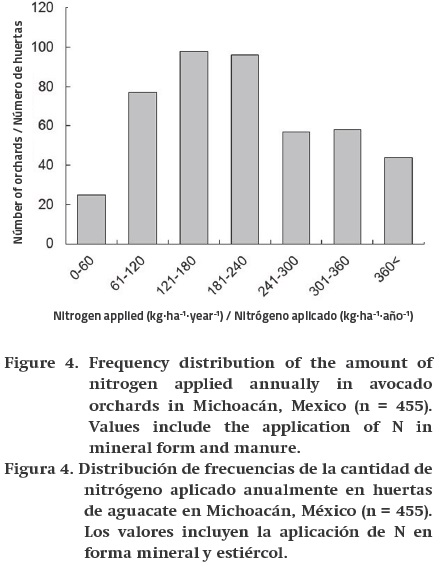
<body><![CDATA[<p align="justify"><font face="verdana" size="2">The average productivity of the orchards (12 Mg&#8729;ha<sup>&#45;1</sup>) was slightly higher than the average reported for the avocado&#45;growing region of Michoac&aacute;n (10 Mg&#8729;ha<sup>&#45;1</sup>) (Ech&aacute;nove Huacuja, 2008). The positive relationship between EC<sub>t</sub> and yields indicates that energy use promotes productivity. However, this positive effect of energy use was at the low end of the spatial scale of this study, as indicated by the coefficient of determination of this relationship. Other factors influencing productivity at the scale of the present study include climate, soil type and topography (Guti&eacute;rrez&#45;Contreras et al., 2010; Salazar&#45;Garc&iacute;a et al., 2005).</font></p>  	    <p align="justify"><font face="verdana" size="2">This study generated the first EC data for avocado production available in the literature. Comparison of EC<sub>t</sub> in avocado with those reported in 11 fruit&#45;tree crops in various parts of the world (<a href="/img/revistas/rcsh/v21n1/a1t5.jpg" target="_blank">Table 5</a>) shows that the average EC<sub>t</sub> for avocado production is among the lowest values reported, slightly above EC<sub>t</sub> reported in the production of apricots and cherries in Turkey (Demircan, Ekinci, Keener, Akbolat, &amp; Ekinci, 2006; Gezer, Acaro&#287;lu, &amp; Hacisefero&#287;ullari, 2003) and similar to that determined for the production of kiwi in Iran (Mohammadi, Rafiee, Mohtasebi, &amp; Rafiee, 2010). This suggests that avocado production in Michoac&aacute;n involves moderate energy consumption. However, this comparison at EC<sub>t</sub> level should be taken with caution due mainly to the disparity of energy consumption sources considered in each study. For example, human labor and energy consumption for producing machinery are not taken into account in this study, unlike other studies.</font></p>  	    <p align="justify"><font face="verdana" size="2">As expected, the analysis of EC by farming operation showed that fertilization and pest management are the most energy&#45;demanding activities in avocado production. These activities have also been considered as the most important in the context of fossil EC in other fruit&#45;tree crops worldwide (<a href="/img/revistas/rcsh/v21n1/a1t5.jpg" target="_blank">Table 5</a>).</font></p>  	    <p align="justify"><font face="verdana" size="2">Regarding EC<sub>fert</sub>, its average in avocado falls in the middle range for fruit&#45;tree crops, with a value similar to thatf of pear fertilization in China (Liu et al., 2010) (<a href="/img/revistas/rcsh/v21n1/a1t5.jpg" target="_blank">Table 5</a>). However, in relative terms, EC<sub>fert</sub> in avocado accounted for the highest value (54.4 % of EC<sub>t</sub>), along with that used in tangerine production in Iran (61 %; Mohammadshirazi, Akram, Rafiee, Mousavi Avval, &amp; Bagheri Kalhor, 2012). To explore whether this high relative value of EC<sub>fert</sub> reflects disproportionate energy consumption due to improper fertilization, nitrogen (N) application was reviewed using the data collected. This element is a good indicator of the fertilization practice because it is applied annually, owing to its great influence on crop growth (Lahav &amp; Kadman, 1980). While the N fertilization dose in avocado depends on several factors, including the availability of this nutrient in the soil and the age of the trees, experimental studies have determined that N rates between 55 and 180 kg&#8729;ha<sup>&#45;1</sup>&#8729;year<sup>&#45;1</sup> are suitable for productions of 10 to 12 Mg&#8729;ha<sup>&#45;1</sup>&#8729;year<sup>&#45;1</sup> in a wide variety of soils and conditions (Embleton &amp; Jones, 1965; Lahav, 1995; Lahav &amp; Kadman, 1980; Loupassaki, 1995; Lovatt, 2001). In this study, the average application of N in chemical form was 158 kg&#8729;ha<sup>&#45;1</sup>&#8729;year<sup>&#45;1</sup>; however, manure is also applied annually. By including the N contained in this source, which has an N content of 5.6 kg per wet ton of manure (Pimentel et al., 1983), the average N application was 211 kg&#8729;ha<sup>&#45;1</sup>&#8729;year<sup>&#45;1</sup>, putting 64 % of the orchards at doses above the recommended maximum of 180 kg&#8729;ha<sup>&#45;1</sup> (<a href="#f4">Figure 4</a>). Excess N addition in avocado orchards is a problem also reported in the USA (Embleton &amp; Jones, 1965; Kiggundu, Migliaccio, Schaffer, Li, &amp; Crane, 2012; Yates, Meyer, &amp; Arpaia, 1992) and Michoac&aacute;n (Tapia&#45;Vargas, Larios&#45;Guzm&aacute;m, Contreras, Vidales&#45;Fern&aacute;ndez, &amp; Barradas, 2012). In the present study, the positive correlation between EC<sub>fert</sub> and total cultivated area indicates that fertilizer application tends to be higher among large producers. This pattern may be associated with their greater economic capability, which can incline them towards over&#45;fertilization, either due to lack of knowledge or carelessness in their pursuit of higher yields. In this context, large producers can significantly reduce energy consumption without affecting production by improving fertilization efficiency. Greater efficiency in adding fertilizer is not only desirable in the context of efficient use of energy, but also in the sense that excessive fertilizer use is associated with environmental problems arising from leachates entering water bodies.</font></p>  	    <p align="center"><font face="verdana" size="2"><a name="f4"></a></font></p>  	    <p align="center"><font face="verdana" size="2"><img src="/img/revistas/rcsh/v21n1/a1f4.jpg"></font></p>  	    <p align="justify"><font face="verdana" size="2">With regard to EC in the use of pesticides, avocado growing stands out for its high absolute and relative values ( 39 % of EC<sub>t</sub>) compared to other fruit&#45;tree crops presented in <a href="/img/revistas/rcsh/v21n1/a1t5.jpg" target="_blank">Table 5</a>, except apple growing with traditional management in the USA and tangerine growing in Iran, which emphasizes the importance of phytosanitary control in avocado production. This observation may be associated with the difficulty in carrying out phytosanitary control in avocado since it is affected by more than 15 diseases and pests, including some of great economic importance such as thrips (Thysanoptera), avocado scab (<i>Sphaceloma perseae</i> Jenk), seed borers (<i>Conotrachelus aguacatae</i> Barber, <i>Stenoma catenifer</i> Walsingham and <i>Heilipus lauri</i> Boheman) and stem borers (<i>Copturus aguacatae</i> Kissinger) which are catalogued as quarantine pests (Hoddle, 2004; Hoddle, Jetter, &amp; Morse, 2003; Pegg et al., 2002). Among the factors that explain the variation in EC<sub>pd</sub> in Michoac&aacute;n avocado orchards, the sales market stands out, as EC<sub>pd</sub> is 41 % higher in production for the export market. This may be because the general pest management protocol in export orchards is stricter than in those aimed at the domestic market, since they have to regularly undergo health certification processes in order to export their production (Peterson &amp; Orden, 2008). These effects of the international market on farming costs and management systems are the focus of current debate given the large&#45;scale opening up of global markets and the different business management capacities of countries (Pretty et al., 2010). Regardless of the type oforchard, phytosanitary control in Michoac&aacute;n does not include widespread pest monitoring and biological control; by contrast, it is commonly done through the spraying of chemical pesticides and mineral fungicides, scheduling four to 12 preventative applications per year (data not shown). This practice results in higher energy consumption and economic costs, along with negative environmental impacts through the release of large amounts of toxic substances into the environment (Mangiafico et al., 2009; Ch&aacute;vez&#45;Le&oacute;n et al., 2012). The dissemination of better pest management practices, with a consequent reduction in energy consumption, should include various courses of action, such as improved knowledge of pest dynamics under different climatic conditions, increased farmer training in alternative integrated pest management practices and implementation of these practices in a coordinated manner at different levels, from the plot to the region, as well as international issues of trade and regulatory agreements.</font></p>  	    <p align="justify"><font face="verdana" size="2">&nbsp;</font></p>  	    <p align="justify"><font face="verdana" size="2"><b>CONCLUSIONS</b></font></p>  	    <p align="justify"><font face="verdana" size="2">Fossil EC in avocado production in Michoac&aacute;n exhibits wide variation among orchards, which reflects the great diversity in forms of production. Compared with other fruit&#45;tree crops in the world, EC in avocado is moderate. However, at the level of farming activity, concerns are raised in relation to EC in fertilization and phytosanitary control. EC in fertilization is high among medium&#45; and large&#45;scale farmers, who in a significant proportion may be using fertilizers excessively. EC in phytosanitary control of avocado is high compared to other fruit&#45;tree crops, and it was higher in orchards with export production than in those that sell to the domestic market, which shows the direct influence of the market on management and EC in avocado production in Michoac&aacute;n. EC in Michoac&aacute;n avocado production can be significantly reduced by adopting better fertilization and pest control practices, especially among medium&#45;and large&#45;scale producers.</font></p>  	    ]]></body>
<body><![CDATA[<p align="justify"><font face="verdana" size="2">&nbsp;</font></p>  	    <p align="justify"><font face="verdana" size="2"><b>ACKNOWLEDGMENTS</b></font></p>  	    <p align="justify"><font face="verdana" size="2">This manuscript is a product of the "Ecological impact of avocado cultivation in the State of Michoac&aacute;n" project, funded by COFUPRO &#45; Michoac&aacute;n Unit between 2010 and 2012. The authors thank the AALPAUM and the JLSV of Uruapan, Michoac&aacute;n and the Local Avocado Plant Health Boards of Ario de Rosales, F. J. M&uacute;gica, Los Reyes, Nuevo San Juan, Oriente, Perib&aacute;n, Tac&aacute;mbaro and Tanc&iacute;taro for their collaboration in this work. Iv&aacute;n Solorio and Dorian Anguiano conducted field interviews, and Gabriela Cuevas prepared the spatial analysis of climatic variables and <a href="#f1">Figure 1</a>. Marta Astier and Yair Merl&iacute;n provided support in the selection and estimation of energy equivalents. The manuscript benefited substantially from suggestions made by Ann Grant, Adri&aacute;n Ghilardi, editor Juan Enrique Rodr&iacute;guez P&eacute;rez and an anonymous reviewer.</font></p>  	    <p align="justify"><font face="verdana" size="2">&nbsp;</font></p>  	    <p align="justify"><font face="verdana" size="2"><b>REFERENCES</b></font></p>  	    <!-- ref --><p align="justify"><font face="verdana" size="2">Barsimantov, J. &amp; Navia Antezana, J. (2012). Forest cover change and land tenure change in Mexico's avocado region: Is community forestry related to reduced deforestation for high value crops? <i>Applied Geography,</i> 32(2), 844&#45;853. doi: 10.1016/j.apgeog.2011.09.001.    &nbsp;&nbsp;&nbsp;&nbsp;&nbsp;&nbsp;&nbsp;&nbsp;[&#160;<a href="javascript:void(0);" onclick="javascript: window.open('/scielo.php?script=sci_nlinks&ref=6685660&pid=S1027-152X201500010000100001&lng=','','width=640,height=500,resizable=yes,scrollbars=1,menubar=yes,');">Links</a>&#160;]<!-- end-ref --></font></p>  	    <!-- ref --><p align="justify"><font face="verdana" size="2">B&ouml;rjesson, P. I. I. (1996). Energy analysis ofbiomass production and transportation. <i>Biomass and Bioenergy,</i> 11(4), 305-318. doi: 10.1016/0961&#45;9534(96)00024&#45;4.    &nbsp;&nbsp;&nbsp;&nbsp;&nbsp;&nbsp;&nbsp;&nbsp;[&#160;<a href="javascript:void(0);" onclick="javascript: window.open('/scielo.php?script=sci_nlinks&ref=6685662&pid=S1027-152X201500010000100002&lng=','','width=640,height=500,resizable=yes,scrollbars=1,menubar=yes,');">Links</a>&#160;]<!-- end-ref --></font></p>  	    <!-- ref --><p align="justify"><font face="verdana" size="2">Castillo&#45;Hern&aacute;ndez, P., Mendoza&#45;Dom&iacute;nguez, A., &amp; Caballero&#45;Mata, P. (2012). An&aacute;lisis de las propiedades fisicoqu&iacute;micas de gasolina y diesel mexicanos reformulados con Etanol. Ingenier&iacute;a, investigaci&oacute;n y tecnolog&iacute;a, 13(3), 293&#45;306. Recuperado de <a href="http://www.revistas.unam.mx/index.php/ingenieria/article/view/32227/29645" target="_blank">http://www.revistas.unam.mx/index.php/ingenieria/article/view/32227/29645</a>.    &nbsp;&nbsp;&nbsp;&nbsp;&nbsp;&nbsp;&nbsp;&nbsp;[&#160;<a href="javascript:void(0);" onclick="javascript: window.open('/scielo.php?script=sci_nlinks&ref=6685664&pid=S1027-152X201500010000100003&lng=','','width=640,height=500,resizable=yes,scrollbars=1,menubar=yes,');">Links</a>&#160;]<!-- end-ref --></font></p>  	    <!-- ref --><p align="justify"><font face="verdana" size="2">Ch&aacute;vez&#45;Le&oacute;n, G., Tapia Vargas, L. M., Bravo Espinoza, M., S&aacute;enz Reyes, J. T., Mu&ntilde;oz Flores, H. J., Vidales Fern&aacute;ndez, I., Larios Guzm&aacute;n, A., Renter&iacute;a &Aacute;nima, J. B., Villase&ntilde;or Ram&iacute;rez, F. J., Sanch&eacute;z P&eacute;rez, J. L., Alcantar Rocillo, J. J., &amp; Mendoza Cant&uacute;, M. (2012). <i>Impacto del Cambio de Uso del Suelo Forestal a Huertas de Aguacate.</i> Instituto Nacional de Investigaciones Agr&iacute;colas, Forestales y Pecuarias. INIFAP, Uruapan, M&eacute;xico. 102 p.    &nbsp;&nbsp;&nbsp;&nbsp;&nbsp;&nbsp;&nbsp;&nbsp;[&#160;<a href="javascript:void(0);" onclick="javascript: window.open('/scielo.php?script=sci_nlinks&ref=6685666&pid=S1027-152X201500010000100004&lng=','','width=640,height=500,resizable=yes,scrollbars=1,menubar=yes,');">Links</a>&#160;]<!-- end-ref --></font></p>  	    <!-- ref --><p align="justify"><font face="verdana" size="2">Comisi&oacute;n Michoacana del Aguacate (COMA). (2007). Censo aguacatero del 2005, con actualizaci&oacute;n al 2007. Comisi&oacute;n Michoacana del Aguacate. Morelia, M&eacute;xico.    &nbsp;&nbsp;&nbsp;&nbsp;&nbsp;&nbsp;&nbsp;&nbsp;[&#160;<a href="javascript:void(0);" onclick="javascript: window.open('/scielo.php?script=sci_nlinks&ref=6685668&pid=S1027-152X201500010000100005&lng=','','width=640,height=500,resizable=yes,scrollbars=1,menubar=yes,');">Links</a>&#160;]<!-- end-ref --></font></p>  	    <!-- ref --><p align="justify"><font face="verdana" size="2">Dalgaard, T., Halberg, N., &amp; Porter, J. R. (2001). A model for fossil energy use in Danish agriculture used to compare organic and conventional farming. <i>Agriculture, Ecosystems &amp; Environment,</i> 87(1), 51&#45;65. doi: 10.1016/S0167&#45;8809(00)00297&#45;8.    &nbsp;&nbsp;&nbsp;&nbsp;&nbsp;&nbsp;&nbsp;&nbsp;[&#160;<a href="javascript:void(0);" onclick="javascript: window.open('/scielo.php?script=sci_nlinks&ref=6685670&pid=S1027-152X201500010000100006&lng=','','width=640,height=500,resizable=yes,scrollbars=1,menubar=yes,');">Links</a>&#160;]<!-- end-ref --></font></p>  	    <!-- ref --><p align="justify"><font face="verdana" size="2">Demircan, V., Ekinci, K., Keener, H. M., Akbolat, D., &amp; Ekinci, C. (2006). Energy and economic analysis of sweet cherry production in Turkey: a case study from Isparta province. <i>Energy Conversion and Management,</i> 47(13), 1761&#45;1769. doi: 10.1016/j.enconman.2005.10.003.    &nbsp;&nbsp;&nbsp;&nbsp;&nbsp;&nbsp;&nbsp;&nbsp;[&#160;<a href="javascript:void(0);" onclick="javascript: window.open('/scielo.php?script=sci_nlinks&ref=6685672&pid=S1027-152X201500010000100007&lng=','','width=640,height=500,resizable=yes,scrollbars=1,menubar=yes,');">Links</a>&#160;]<!-- end-ref --></font></p>  	    <p align="justify"><font face="verdana" size="2">Ech&aacute;nove Huacuja, F. (2008). <i>Abriendo fronteras: el auge exportador del aguacate mexicano a Estados Unidos.</i> Paper presented at the Anales de Geograf&iacute;a de la Universidad Complutense. Recuperado de <a href="http://www.ambientalex.info/revistas/281aug928.pdf" target="_blank">http://www.ambientalex.info/revistas/281aug928.pdf</a>.</font></p>  	    ]]></body>
<body><![CDATA[<p align="justify"><font face="verdana" size="2">Embleton, T. W. &amp; Jones, W. W. (1965). <i>Avocado nutrition in California.</i> Paper presented at the Proceedings of the Florida State Horticultural Society. Recuperado de <a href="http://fshs.org/proceedings-o/1964-vol-77/401-405%20%28EMBLETON%29.pdf" target="_blank">http://fshs.org/proceedings&#45;o/1964&#45;vol&#45;77/401&#45;405%20%28EMBLETON%29.pdf</a>.</font></p>  	    <!-- ref --><p align="justify"><font face="verdana" size="2">ESRI, Inc. (2008). ArcGIS. V.9.3.: Autor.    &nbsp;&nbsp;&nbsp;&nbsp;&nbsp;&nbsp;&nbsp;&nbsp;[&#160;<a href="javascript:void(0);" onclick="javascript: window.open('/scielo.php?script=sci_nlinks&ref=6685676&pid=S1027-152X201500010000100008&lng=','','width=640,height=500,resizable=yes,scrollbars=1,menubar=yes,');">Links</a>&#160;]<!-- end-ref --></font></p>  	    <!-- ref --><p align="justify"><font face="verdana" size="2">Gezer, I., Acaro&#287;lu, M., &amp; Hacisefero&#287;ullari, H. (2003). Use of energy and labour in apricot agriculture in Turkey. <i>Biomass and Bioenergy,</i> 24(3), 215&#45;219. doi: 10.1016/ S0961&#45;9534(02)00116&#45;2.    &nbsp;&nbsp;&nbsp;&nbsp;&nbsp;&nbsp;&nbsp;&nbsp;[&#160;<a href="javascript:void(0);" onclick="javascript: window.open('/scielo.php?script=sci_nlinks&ref=6685678&pid=S1027-152X201500010000100009&lng=','','width=640,height=500,resizable=yes,scrollbars=1,menubar=yes,');">Links</a>&#160;]<!-- end-ref --></font></p>  	    <!-- ref --><p align="justify"><font face="verdana" size="2">Guti&eacute;rrez&#45;Contreras, M., Lara&#45;Ch&aacute;vez, M. B. N., Guill&eacute;n&#45;Andrade, H., &amp; Ch&aacute;vez&#45;B&aacute;rcenas, A. T. (2010). Agroecolog&iacute;a de la franja aguacatera en Michoac&aacute;n, M&eacute;xico. <i>Interciencia,</i> 35(9), 647&#45;653. Recuperado de <a href="http://www.redalyc.org/pdf/339/33914212003.pdf" target="_blank">http://www.redalyc.org/pdf/339/33914212003.pdf</a>.    &nbsp;&nbsp;&nbsp;&nbsp;&nbsp;&nbsp;&nbsp;&nbsp;[&#160;<a href="javascript:void(0);" onclick="javascript: window.open('/scielo.php?script=sci_nlinks&ref=6685680&pid=S1027-152X201500010000100010&lng=','','width=640,height=500,resizable=yes,scrollbars=1,menubar=yes,');">Links</a>&#160;]<!-- end-ref --></font></p>  	    <!-- ref --><p align="justify"><font face="verdana" size="2">Hoddle, M. S. (2004). Invasions of leaf feeding arthropods: why are so many new pests attacking California&#45;grown avocados. <i>California Avocado Society Yearbook,</i> 87, 65&#45;81. <a href="http://www.avocadosource.com/CAS_Yearbooks/CAS_87_2004-2005/CAS_2004-05_V87_PG_065-081.pdf" target="_blank">http://www.avocadosource.com/CAS_Yearbooks/CAS_87_2004&#45;2005/CAS_2004&#45;05_V87_PG_065&#45;081.pdf</a>.    &nbsp;&nbsp;&nbsp;&nbsp;&nbsp;&nbsp;&nbsp;&nbsp;[&#160;<a href="javascript:void(0);" onclick="javascript: window.open('/scielo.php?script=sci_nlinks&ref=6685682&pid=S1027-152X201500010000100011&lng=','','width=640,height=500,resizable=yes,scrollbars=1,menubar=yes,');">Links</a>&#160;]<!-- end-ref --></font></p>  	    <!-- ref --><p align="justify"><font face="verdana" size="2">Hoddle, M. S., Jetter, K. M., &amp; Morse, J. G. (2003). The economic impact of <i>Scirtothripsperseae</i> Nakahara (Thysanoptera: Thripidae) on California avocado production. <i>Crop</i> <i>Protection,</i> 22(3), 485&#45;493. doi: 10.1016/S0261&#45;2194 (02)00199&#45;0.    &nbsp;&nbsp;&nbsp;&nbsp;&nbsp;&nbsp;&nbsp;&nbsp;[&#160;<a href="javascript:void(0);" onclick="javascript: window.open('/scielo.php?script=sci_nlinks&ref=6685684&pid=S1027-152X201500010000100012&lng=','','width=640,height=500,resizable=yes,scrollbars=1,menubar=yes,');">Links</a>&#160;]<!-- end-ref --></font></p>  	    <!-- ref --><p align="justify"><font face="verdana" size="2">H&uuml;lsbergen, K. J., Feil, B., Biermann, S., Rathke, G. W., Kalk, W. D., &amp; Diepenbrock, W. (2001). A method of energy balancing in crop production and its application in a long&#45;term fertilizer trial. <i>Agriculture, Ecosystems &amp; Environment,</i> 86(3), 303&#45;321. doi: 10.1016/S0167&#45;8809(00)00286&#45;3.    &nbsp;&nbsp;&nbsp;&nbsp;&nbsp;&nbsp;&nbsp;&nbsp;[&#160;<a href="javascript:void(0);" onclick="javascript: window.open('/scielo.php?script=sci_nlinks&ref=6685686&pid=S1027-152X201500010000100013&lng=','','width=640,height=500,resizable=yes,scrollbars=1,menubar=yes,');">Links</a>&#160;]<!-- end-ref --></font></p>  	    <!-- ref --><p align="justify"><font face="verdana" size="2">Instituto Mexicano de Tecnolog&iacute;a del Agua (IMTA). (2013). Software ERIC III. Versi&oacute;n 3.2. M&eacute;xico: Autor. Jones, M. R. (1989). Analysis of the use of energy in agriculture&#151;approaches and problems. <i>Agricultural</i> <i>Systems,</i> 29(4), 339&#45;355. doi: 10.1016/0308&#45;521X(89) 90096&#45;6.    &nbsp;&nbsp;&nbsp;&nbsp;&nbsp;&nbsp;&nbsp;&nbsp;[&#160;<a href="javascript:void(0);" onclick="javascript: window.open('/scielo.php?script=sci_nlinks&ref=6685688&pid=S1027-152X201500010000100014&lng=','','width=640,height=500,resizable=yes,scrollbars=1,menubar=yes,');">Links</a>&#160;]<!-- end-ref --></font></p>  	    <!-- ref --><p align="justify"><font face="verdana" size="2">Kiggundu, N., Migliaccio, K. W., Schaffer, B., Li, Y., &amp; Crane, J. H. (2012). Water savings, nutrient leaching, and fruit yield in a young avocado orchard as affected by irrigation and nutrient management. <i>Irrigation</i> <i>Science,</i> 30(4), 275&#45;286. doi: 10.1007/s00271&#45;011&#45;0280&#45;6.    &nbsp;&nbsp;&nbsp;&nbsp;&nbsp;&nbsp;&nbsp;&nbsp;[&#160;<a href="javascript:void(0);" onclick="javascript: window.open('/scielo.php?script=sci_nlinks&ref=6685690&pid=S1027-152X201500010000100015&lng=','','width=640,height=500,resizable=yes,scrollbars=1,menubar=yes,');">Links</a>&#160;]<!-- end-ref --></font></p>  	    <!-- ref --><p align="justify"><font face="verdana" size="2">Lahav, E. (1995). <i>Avocado nutrition&#45;A review.</i> Paper presented at the Proceedings of The World Avocado Congress III. Recuperado de <a href="http://www.avocadosource.com/WAC3/wac3_p143.pdf" target="_blank">http://www.avocadosource.com/WAC3/wac3_p143.pdf</a>.    &nbsp;&nbsp;&nbsp;&nbsp;&nbsp;&nbsp;&nbsp;&nbsp;[&#160;<a href="javascript:void(0);" onclick="javascript: window.open('/scielo.php?script=sci_nlinks&ref=6685692&pid=S1027-152X201500010000100016&lng=','','width=640,height=500,resizable=yes,scrollbars=1,menubar=yes,');">Links</a>&#160;]<!-- end-ref --></font></p>  	    <!-- ref --><p align="justify"><font face="verdana" size="2">Lahav, E., &amp; Kadman, A. (1980). <i>Avocado fertilisation:</i> International Potash Institute. Recuperado de <a href="http://www.avocadosource.com/journals/specialindustryreports/lahavemmanuel1980.pdf" target="_blank">http://www.avocadosource.com/journals/specialindustryreports/lahavemmanuel1980.pdf</a>.    &nbsp;&nbsp;&nbsp;&nbsp;&nbsp;&nbsp;&nbsp;&nbsp;[&#160;<a href="javascript:void(0);" onclick="javascript: window.open('/scielo.php?script=sci_nlinks&ref=6685694&pid=S1027-152X201500010000100017&lng=','','width=640,height=500,resizable=yes,scrollbars=1,menubar=yes,');">Links</a>&#160;]<!-- end-ref --></font></p>  	    <!-- ref --><p align="justify"><font face="verdana" size="2">Lal, R. (2004). Carbon emission from farm operations. <i>Environment international,</i> 30(7), 981&#45;990. doi: 10.1016/j.envint.2004.03.005.    &nbsp;&nbsp;&nbsp;&nbsp;&nbsp;&nbsp;&nbsp;&nbsp;[&#160;<a href="javascript:void(0);" onclick="javascript: window.open('/scielo.php?script=sci_nlinks&ref=6685696&pid=S1027-152X201500010000100018&lng=','','width=640,height=500,resizable=yes,scrollbars=1,menubar=yes,');">Links</a>&#160;]<!-- end-ref --></font></p>  	    <!-- ref --><p align="justify"><font face="verdana" size="2">Larios&#45;Guzm&aacute;n, A., Villase&ntilde;or&#45;Ram&iacute;rez, F. J., Vidales&#45;Fern&aacute;ndez, I., &amp; S&aacute;enz&#45;Reyes, J. T. (2005). Producci&oacute;n org&aacute;nica. <i>Bolet&iacute;n El Aguacatero</i> (42), 14&#45;19. Recuperado de <a href="http://www.aproam.com/boletines/a42.html" target="_blank">http://www.aproam.com/boletines/a42.html</a>.    &nbsp;&nbsp;&nbsp;&nbsp;&nbsp;&nbsp;&nbsp;&nbsp;[&#160;<a href="javascript:void(0);" onclick="javascript: window.open('/scielo.php?script=sci_nlinks&ref=6685698&pid=S1027-152X201500010000100019&lng=','','width=640,height=500,resizable=yes,scrollbars=1,menubar=yes,');">Links</a>&#160;]<!-- end-ref --></font></p>  	    <!-- ref --><p align="justify"><font face="verdana" size="2">Liu, Y., Langer, V., H0gh&#45;Jensen, H., &amp; Egelyng, H. (2010). Energy use in organic, green and conventional pear producing systems&#151;cases from China. <i>Journal of Sustainable Agriculture,</i> 34(6), 630&#45;646. doi: 10.1080/10440046.2010.493386.    &nbsp;&nbsp;&nbsp;&nbsp;&nbsp;&nbsp;&nbsp;&nbsp;[&#160;<a href="javascript:void(0);" onclick="javascript: window.open('/scielo.php?script=sci_nlinks&ref=6685700&pid=S1027-152X201500010000100020&lng=','','width=640,height=500,resizable=yes,scrollbars=1,menubar=yes,');">Links</a>&#160;]<!-- end-ref --></font></p>  	    <!-- ref --><p align="justify"><font face="verdana" size="2">Loupassaki, M. H. (1995). <i>The effect of nitrogen fertiliser on the growth, yield and mineral contents of leaves of the avocado cv. Fuerte.</i> Paper presented at the Program and Book of Abstracts. World Avocado Congress III. Tel&#45;Aviv, Israel. Recuperado de <a href="http://www.avocadosource.com/WAC3/wac3_p168.pdf" target="_blank">http://www.avocadosource.com/WAC3/wac3_p168.pdf</a>.    &nbsp;&nbsp;&nbsp;&nbsp;&nbsp;&nbsp;&nbsp;&nbsp;[&#160;<a href="javascript:void(0);" onclick="javascript: window.open('/scielo.php?script=sci_nlinks&ref=6685702&pid=S1027-152X201500010000100021&lng=','','width=640,height=500,resizable=yes,scrollbars=1,menubar=yes,');">Links</a>&#160;]<!-- end-ref --></font></p>  	    <!-- ref --><p align="justify"><font face="verdana" size="2">Lovatt, C. J. (2001). Properly Timed Soil&#45;applied Nitrogen Fertilizer Increases Yield and Fruit Size of 'Hass' Avocado. <i>Journal of the American Society for Horticultural Science,</i> 126(5), 555&#45;559. Recuperado de <a href="http://journal.ashspublications.org/content/126/5/555.full.pdf+html" target="_blank">http://journal.ashspublications.org/content/126/5/555.full.pdf+html</a>.    &nbsp;&nbsp;&nbsp;&nbsp;&nbsp;&nbsp;&nbsp;&nbsp;[&#160;<a href="javascript:void(0);" onclick="javascript: window.open('/scielo.php?script=sci_nlinks&ref=6685704&pid=S1027-152X201500010000100022&lng=','','width=640,height=500,resizable=yes,scrollbars=1,menubar=yes,');">Links</a>&#160;]<!-- end-ref --></font></p>  	    <!-- ref --><p align="justify"><font face="verdana" size="2">Mangiafico, S. S., Newman, J., Merhaut, D. J., Gan, J., Faber, B., &amp; Wu, L. (2009). Nutrients and pesticides in stormwater runoff and soil water in production nurseries and citrus and avocado groves in California. <i>HortTechnology,</i> 19(2), 360&#45;367. Recuperado de <a href="http://horttech.ashspublications.org/content/19/2/360.full.pdf+html" target="_blank">http://horttech.ashspublications.org/content/19/2/360.full.pdf+html</a>.    &nbsp;&nbsp;&nbsp;&nbsp;&nbsp;&nbsp;&nbsp;&nbsp;[&#160;<a href="javascript:void(0);" onclick="javascript: window.open('/scielo.php?script=sci_nlinks&ref=6685706&pid=S1027-152X201500010000100023&lng=','','width=640,height=500,resizable=yes,scrollbars=1,menubar=yes,');">Links</a>&#160;]<!-- end-ref --></font></p>  	    <!-- ref --><p align="justify"><font face="verdana" size="2">Marroqu&iacute;n&#45;Pimentel, F. J. (1999). Factores que favorecen la incidencia de ro&ntilde;a <i>(Sphaceloma perseae</i> Jenk.) en el cultivo del aguacate (<i>Persea americana</i> Mill.) 'Hass', en tres regiones agroclim&aacute;ticas de Michoac&aacute;n. M&eacute;xico. <i>Revista Chapingo. Serie Horticultura,</i> 5, 309&#45;312. Recuperado de <a href="http://209.143.153.251/WAC4/WAC4_p309.pdf" target="_blank">http://209.143.153.251/WAC4/WAC4_p309.pdf</a>.    &nbsp;&nbsp;&nbsp;&nbsp;&nbsp;&nbsp;&nbsp;&nbsp;[&#160;<a href="javascript:void(0);" onclick="javascript: window.open('/scielo.php?script=sci_nlinks&ref=6685708&pid=S1027-152X201500010000100024&lng=','','width=640,height=500,resizable=yes,scrollbars=1,menubar=yes,');">Links</a>&#160;]<!-- end-ref --></font></p>  	    <!-- ref --><p align="justify"><font face="verdana" size="2">Mohammadi, A., Rafiee, S., Mohtasebi, S. S., &amp; Rafiee, H. (2010). Energy inputs&#45;yield relationship and cost analysis of kiwifruit production in Iran. <i>Renewable energy,</i> 35(5), 1071&#45;1075. doi: 10.1016/j.renene.2009.09.004.    &nbsp;&nbsp;&nbsp;&nbsp;&nbsp;&nbsp;&nbsp;&nbsp;[&#160;<a href="javascript:void(0);" onclick="javascript: window.open('/scielo.php?script=sci_nlinks&ref=6685710&pid=S1027-152X201500010000100025&lng=','','width=640,height=500,resizable=yes,scrollbars=1,menubar=yes,');">Links</a>&#160;]<!-- end-ref --></font></p>  	    <!-- ref --><p align="justify"><font face="verdana" size="2">Mohammadshirazi, A., Akram, A., Rafiee, S., Mousavi Avval, S. H., &amp; Bagheri Kalhor, E. (2012). An analysis of energy use and relation between energy inputs and yield in tangerine production. <i>Renewable and Sustainable Energy Reviews,</i> 16(7), 4515&#45;4521. doi: 10.1016/j.rser.2012.04.047.    &nbsp;&nbsp;&nbsp;&nbsp;&nbsp;&nbsp;&nbsp;&nbsp;[&#160;<a href="javascript:void(0);" onclick="javascript: window.open('/scielo.php?script=sci_nlinks&ref=6685712&pid=S1027-152X201500010000100026&lng=','','width=640,height=500,resizable=yes,scrollbars=1,menubar=yes,');">Links</a>&#160;]<!-- end-ref --></font></p>  	    <!-- ref --><p align="justify"><font face="verdana" size="2">Morales&#45;Manilla, L. M. y Cuevas&#45;Garc&iacute;a, G. (2011). Inventarios 1974 &#45; 2007, y evaluaci&oacute;n del impacto ambiental regional del cultivo del aguacate en el estado de Michoac&aacute;n. <i>Informe Final. Centro de Investigaciones en Geograf&iacute;a Ambiental, UNAM. Morelia, Mich.</i> 138 pp. Recuperado de <a href="http://lae.ciga.unam.mx/aguacate/sub1/index.php" target="_blank">http://lae.ciga.unam.mx/aguacate/sub1/index.php</a>.    &nbsp;&nbsp;&nbsp;&nbsp;&nbsp;&nbsp;&nbsp;&nbsp;[&#160;<a href="javascript:void(0);" onclick="javascript: window.open('/scielo.php?script=sci_nlinks&ref=6685714&pid=S1027-152X201500010000100027&lng=','','width=640,height=500,resizable=yes,scrollbars=1,menubar=yes,');">Links</a>&#160;]<!-- end-ref --></font></p>  	    <!-- ref --><p align="justify"><font face="verdana" size="2">Mrini, M., Senhaji, F., &amp; Pimentel, D. (2001). Energy analysis of sugarcane production in Morocco. Environment, Development and Sustainability, 3(2), 109&#45;126. doi: 10.1023/A:1011695731580.    &nbsp;&nbsp;&nbsp;&nbsp;&nbsp;&nbsp;&nbsp;&nbsp;[&#160;<a href="javascript:void(0);" onclick="javascript: window.open('/scielo.php?script=sci_nlinks&ref=6685716&pid=S1027-152X201500010000100028&lng=','','width=640,height=500,resizable=yes,scrollbars=1,menubar=yes,');">Links</a>&#160;]<!-- end-ref --></font></p>  	    <!-- ref --><p align="justify"><font face="verdana" size="2">Ozkan, B., Akcaoz, H., &amp; Karadeniz, F. (2004). Energy requirement and economic analysis of citrus production in Turkey. <i>Energy Conversion and Management,</i> 45(11), 1821&#45;1830. doi: 10.1016/j.enconman.2003.10.002.    &nbsp;&nbsp;&nbsp;&nbsp;&nbsp;&nbsp;&nbsp;&nbsp;[&#160;<a href="javascript:void(0);" onclick="javascript: window.open('/scielo.php?script=sci_nlinks&ref=6685718&pid=S1027-152X201500010000100029&lng=','','width=640,height=500,resizable=yes,scrollbars=1,menubar=yes,');">Links</a>&#160;]<!-- end-ref --></font></p>  	    <!-- ref --><p align="justify"><font face="verdana" size="2">Pegg, K. G., Coates, L. M., Korsten, L., Harding, R. M., Whiley, A. W., Schaffer, B., &amp; Wolstenholme, B. N. (2002). Foliar, fruit and soilborne diseases. <i>The avocado: botany, production and uses,</i> 299&#45;338.    &nbsp;&nbsp;&nbsp;&nbsp;&nbsp;&nbsp;&nbsp;&nbsp;[&#160;<a href="javascript:void(0);" onclick="javascript: window.open('/scielo.php?script=sci_nlinks&ref=6685720&pid=S1027-152X201500010000100030&lng=','','width=640,height=500,resizable=yes,scrollbars=1,menubar=yes,');">Links</a>&#160;]<!-- end-ref --></font></p>  	    <!-- ref --><p align="justify"><font face="verdana" size="2">Peterson, E. B. &amp; Orden, D. (2008). Avocado pests and avocado trade. <i>American Journal of Agricultural Economics,</i> 90(2), 321&#45;335. Recuperado de <a href="http://www.gii.ncr.vt.edu/docs/AJAE%20Final%20Avocado%20Pests%20and%20%20Avocado%20Trade.pdf" target="_blank">http://www.gii.ncr.vt.edu/docs/AJAE%20Final%20Avocado%20Pests%20and%20 Avocado%20Trade.pdf</a>.    &nbsp;&nbsp;&nbsp;&nbsp;&nbsp;&nbsp;&nbsp;&nbsp;[&#160;<a href="javascript:void(0);" onclick="javascript: window.open('/scielo.php?script=sci_nlinks&ref=6685722&pid=S1027-152X201500010000100031&lng=','','width=640,height=500,resizable=yes,scrollbars=1,menubar=yes,');">Links</a>&#160;]<!-- end-ref --></font></p>  	    <!-- ref --><p align="justify"><font face="verdana" size="2">Pimentel, D. (1980). Energy inputs for the production, formulation, packaging, and transport of various pesticides. Handbook of energy utilization in agriculture. Boca Raton: CRC, 45&#45;48.    &nbsp;&nbsp;&nbsp;&nbsp;&nbsp;&nbsp;&nbsp;&nbsp;[&#160;<a href="javascript:void(0);" onclick="javascript: window.open('/scielo.php?script=sci_nlinks&ref=6685724&pid=S1027-152X201500010000100032&lng=','','width=640,height=500,resizable=yes,scrollbars=1,menubar=yes,');">Links</a>&#160;]<!-- end-ref --></font></p>  	    <!-- ref --><p align="justify"><font face="verdana" size="2">Pimentel, D., Berardi, G., &amp; Fast, S. (1983). Energy efficiency of farming systems: organic and conventional agriculture. <i>Agriculture, Ecosystems &amp; Environment,</i> 9(4), 359&#45;372. doi: 10.1016/0167&#45;8809(83)90021&#45;X.    &nbsp;&nbsp;&nbsp;&nbsp;&nbsp;&nbsp;&nbsp;&nbsp;[&#160;<a href="javascript:void(0);" onclick="javascript: window.open('/scielo.php?script=sci_nlinks&ref=6685726&pid=S1027-152X201500010000100033&lng=','','width=640,height=500,resizable=yes,scrollbars=1,menubar=yes,');">Links</a>&#160;]<!-- end-ref --></font></p>  	    <!-- ref --><p align="justify"><font face="verdana" size="2">Pimentel, D., Hepperly, P., Hanson, J., Douds, D., &amp; Seidel, R. (2005). Environmental, energetic, and economic comparisons of organic and conventional farming systems. <i>BioScience,</i> 55(7), 573&#45;582. doi: 10.1641/0006&#45;3568(2005)055&#91;0573:E</font>&nbsp;&nbsp;&nbsp;&nbsp;&nbsp;&nbsp;&nbsp;&nbsp;[&#160;<a href="javascript:void(0);" onclick="javascript: window.open('/scielo.php?script=sci_nlinks&ref=6685728&pid=S1027-152X201500010000100034&lng=','','width=640,height=500,resizable=yes,scrollbars=1,menubar=yes,');">Links</a>&#160;]<!-- end-ref --><!-- ref --><p align="justify"><font face="verdana" size="2">Pretty, J., Sutherland, W. J., Ashby, J., Auburn, J., Baulcombe, D., Bell, M., . . . Burke, J. (2010). The top 100 questions of importance to the future of global agriculture. <i>International journal of agricultural sustainability,</i> 8(4), 219&#45;236. doi: 10.3763/ ijas.2010.0534.    &nbsp;&nbsp;&nbsp;&nbsp;&nbsp;&nbsp;&nbsp;&nbsp;[&#160;<a href="javascript:void(0);" onclick="javascript: window.open('/scielo.php?script=sci_nlinks&ref=6685729&pid=S1027-152X201500010000100035&lng=','','width=640,height=500,resizable=yes,scrollbars=1,menubar=yes,');">Links</a>&#160;]<!-- end-ref --></font></p>  	    <!-- ref --><p align="justify"><font face="verdana" size="2">Reganold, J. P., Glover, J. D., Andrews, P. K., &amp; Hinman, H. R. (2001). Sustainability of three apple production systems. <i>Nature,</i> 410(6831), 926&#45;930. doi: 10.1038/35073574.    &nbsp;&nbsp;&nbsp;&nbsp;&nbsp;&nbsp;&nbsp;&nbsp;[&#160;<a href="javascript:void(0);" onclick="javascript: window.open('/scielo.php?script=sci_nlinks&ref=6685731&pid=S1027-152X201500010000100036&lng=','','width=640,height=500,resizable=yes,scrollbars=1,menubar=yes,');">Links</a>&#160;]<!-- end-ref --></font></p>  	    <!-- ref --><p align="justify"><font face="verdana" size="2">Salazar&#45;Garc&iacute;a, S., Zamora&#45;Cuevas, L., &amp; Vega&#45;L&oacute;pez, R. J. (2005). Actualizaci&oacute;n sobre la industria del aguacate en Michoac&aacute;n, M&eacute;xico. <i>California Avocado Society, Yearbook,</i> 87, 31&#45;44. Recuperado de <a href="http://avocadosource.com/CAS_Yearbooks/CAS_87_2004-2005/CAS_2004-05_V87_PG_045-054.pdf" target="_blank">http://avocadosource.com/CAS_Yearbooks/CAS_87_2004&#45;2005/CAS_2004&#45;05_V87_PG_045&#45;054.pdf</a>.    &nbsp;&nbsp;&nbsp;&nbsp;&nbsp;&nbsp;&nbsp;&nbsp;[&#160;<a href="javascript:void(0);" onclick="javascript: window.open('/scielo.php?script=sci_nlinks&ref=6685733&pid=S1027-152X201500010000100037&lng=','','width=640,height=500,resizable=yes,scrollbars=1,menubar=yes,');">Links</a>&#160;]<!-- end-ref --></font></p>  	    ]]></body>
<body><![CDATA[<!-- ref --><p align="justify"><font face="verdana" size="2">Secretar&iacute;a de Agricultura, Ganader&iacute;a, Desarrollo Rural, Pesca y Alimentaci&oacute;n (SAGARPA). (2013). Atlas Agroalimentario 2013. D.F. M&eacute;xico. 200 p. Consultado en <a href="http://www.siap.gob.mx/atlas2013/index.html" target="_blank">http://www.siap.gob.mx/atlas2013/index.html</a>.    &nbsp;&nbsp;&nbsp;&nbsp;&nbsp;&nbsp;&nbsp;&nbsp;[&#160;<a href="javascript:void(0);" onclick="javascript: window.open('/scielo.php?script=sci_nlinks&ref=6685735&pid=S1027-152X201500010000100038&lng=','','width=640,height=500,resizable=yes,scrollbars=1,menubar=yes,');">Links</a>&#160;]<!-- end-ref --></font></p>  	    <!-- ref --><p align="justify"><font face="verdana" size="2">Servicio Nacional de Sanidad, Inocuidad y Calidad Agroalimentaria (SENASICA). (2009). Listado de Plaguicidas Autorizados para Uso en Aguacate. D. F., M&eacute;xico. 20 p. Consultado en <a href="http://www.senasica.gob.mx/?id=4099" target="_blank">http://www.senasica.gob.mx/?id=4099</a>.    &nbsp;&nbsp;&nbsp;&nbsp;&nbsp;&nbsp;&nbsp;&nbsp;[&#160;<a href="javascript:void(0);" onclick="javascript: window.open('/scielo.php?script=sci_nlinks&ref=6685737&pid=S1027-152X201500010000100039&lng=','','width=640,height=500,resizable=yes,scrollbars=1,menubar=yes,');">Links</a>&#160;]<!-- end-ref --></font></p>  	    <!-- ref --><p align="justify"><font face="verdana" size="2">StatSoft, Inc. (2004). software STATISTICA 7: Autor.    &nbsp;&nbsp;&nbsp;&nbsp;&nbsp;&nbsp;&nbsp;&nbsp;[&#160;<a href="javascript:void(0);" onclick="javascript: window.open('/scielo.php?script=sci_nlinks&ref=6685739&pid=S1027-152X201500010000100040&lng=','','width=640,height=500,resizable=yes,scrollbars=1,menubar=yes,');">Links</a>&#160;]<!-- end-ref --></font></p>  	    <!-- ref --><p align="justify"><font face="verdana" size="2">Strapatsa, A. V., Nanos, G. D., &amp; Tsatsarelis, C. A. (2006). Energy flow for integrated apple production in Greece. Agriculture, Ecosystems &amp; Environment, 116(3), 176&#45;180. doi: 10.1016/j.agee.2006.02.003.    &nbsp;&nbsp;&nbsp;&nbsp;&nbsp;&nbsp;&nbsp;&nbsp;[&#160;<a href="javascript:void(0);" onclick="javascript: window.open('/scielo.php?script=sci_nlinks&ref=6685741&pid=S1027-152X201500010000100041&lng=','','width=640,height=500,resizable=yes,scrollbars=1,menubar=yes,');">Links</a>&#160;]<!-- end-ref --></font></p>  	    <!-- ref --><p align="justify"><font face="verdana" size="2">Tapia&#45;Vargas, L. M., Larios&#45;Guzm&aacute;m, A., Contreras, J. A., Vidales&#45;Fern&aacute;ndez, I., &amp; Barradas, V. L. (2012). Lixiviaci&oacute;n de nitratos y condici&oacute;n nutrimental en dos sistemas de manejo de riego y nutricional de aguacate <i>(Persea americana</i> Mill.). <i>Revista internacional de contaminaci&oacute;n ambiental,</i> 28(3), 251-258. Recuperado de <a href="http://www.journals.unam.mx/index.php/rica/article/view/32537" target="_blank">http://www.journals.unam.mx/index.php/rica/article/view/32537</a>.    &nbsp;&nbsp;&nbsp;&nbsp;&nbsp;&nbsp;&nbsp;&nbsp;[&#160;<a href="javascript:void(0);" onclick="javascript: window.open('/scielo.php?script=sci_nlinks&ref=6685743&pid=S1027-152X201500010000100042&lng=','','width=640,height=500,resizable=yes,scrollbars=1,menubar=yes,');">Links</a>&#160;]<!-- end-ref --></font></p>  	    ]]></body>
<body><![CDATA[<!-- ref --><p align="justify"><font face="verdana" size="2">Wells, C. M. (2001). Total energy indicators of agricultural sustainability: dairy farming case study: Ministry of Agriculture and Forestry. Recuperado de <a href="http://maxa.maf.govt.nz/mafnet/publications/techpapers/techpaper0103-dairy-farming-case-study.pdf" target="_blank">http://maxa.maf.govt.nz/mafnet/publications/techpapers/techpaper0103&#45;dairy&#45;farming&#45;case&#45;study.pdf</a>.    &nbsp;&nbsp;&nbsp;&nbsp;&nbsp;&nbsp;&nbsp;&nbsp;[&#160;<a href="javascript:void(0);" onclick="javascript: window.open('/scielo.php?script=sci_nlinks&ref=6685745&pid=S1027-152X201500010000100043&lng=','','width=640,height=500,resizable=yes,scrollbars=1,menubar=yes,');">Links</a>&#160;]<!-- end-ref --></font></p>  	    <!-- ref --><p align="justify"><font face="verdana" size="2">West, T. O. &amp; Marland, G. (2002). A synthesis of carbon sequestration, carbon emissions, and net carbon flux in agriculture: comparing tillage practices in the United States. <i>Agriculture, Ecosystems &amp; Environment,</i> 91(1), 217&#45;232. doi: 10.1016/S0167&#45;8809(01)00233&#45;X.    &nbsp;&nbsp;&nbsp;&nbsp;&nbsp;&nbsp;&nbsp;&nbsp;[&#160;<a href="javascript:void(0);" onclick="javascript: window.open('/scielo.php?script=sci_nlinks&ref=6685747&pid=S1027-152X201500010000100044&lng=','','width=640,height=500,resizable=yes,scrollbars=1,menubar=yes,');">Links</a>&#160;]<!-- end-ref --></font></p>  	    <!-- ref --><p align="justify"><font face="verdana" size="2">Yates, M. V., Meyer, J. L., &amp; Arpaia, M. L. (1992). Using less fertilizer more often can reduce nitrate leaching. <i>California Agriculture, 3,</i> 19&#45;21. Recuperado de <a href="https://ucanr.edu/repositoryfiles/ca4603p19-69613.pdf" target="_blank">https://ucanr.edu/repositoryfiles/ca4603p19&#45;69613.pdf</a>.    &nbsp;&nbsp;&nbsp;&nbsp;&nbsp;&nbsp;&nbsp;&nbsp;[&#160;<a href="javascript:void(0);" onclick="javascript: window.open('/scielo.php?script=sci_nlinks&ref=6685749&pid=S1027-152X201500010000100045&lng=','','width=640,height=500,resizable=yes,scrollbars=1,menubar=yes,');">Links</a>&#160;]<!-- end-ref --></font></p>  	    <!-- ref --><p align="justify"><font face="verdana" size="2">Zar, J. H. (1999). <i>Biostatistical analysis.</i> New Jersey, USA: Pearson Education India.    &nbsp;&nbsp;&nbsp;&nbsp;&nbsp;&nbsp;&nbsp;&nbsp;[&#160;<a href="javascript:void(0);" onclick="javascript: window.open('/scielo.php?script=sci_nlinks&ref=6685751&pid=S1027-152X201500010000100046&lng=','','width=640,height=500,resizable=yes,scrollbars=1,menubar=yes,');">Links</a>&#160;]<!-- end-ref --></font></p>      ]]></body><back>
<ref-list>
<ref id="B1">
<nlm-citation citation-type="journal">
<person-group person-group-type="author">
<name>
<surname><![CDATA[Barsimantov]]></surname>
<given-names><![CDATA[J.]]></given-names>
</name>
<name>
<surname><![CDATA[Navia Antezana]]></surname>
<given-names><![CDATA[J.]]></given-names>
</name>
</person-group>
<article-title xml:lang="en"><![CDATA[Forest cover change and land tenure change in Mexico's avocado region: Is community forestry related to reduced deforestation for high value crops?]]></article-title>
<source><![CDATA[Applied Geography]]></source>
<year>2012</year>
<volume>32</volume>
<numero>2</numero>
<issue>2</issue>
<page-range>844-853</page-range></nlm-citation>
</ref>
<ref id="B2">
<nlm-citation citation-type="journal">
<person-group person-group-type="author">
<name>
<surname><![CDATA[Börjesson]]></surname>
<given-names><![CDATA[P. I. I.]]></given-names>
</name>
</person-group>
<article-title xml:lang="en"><![CDATA[Energy analysis ofbiomass production and transportation]]></article-title>
<source><![CDATA[Biomass and Bioenergy]]></source>
<year>1996</year>
<volume>11</volume>
<numero>4</numero>
<issue>4</issue>
<page-range>305-318</page-range></nlm-citation>
</ref>
<ref id="B3">
<nlm-citation citation-type="journal">
<person-group person-group-type="author">
<name>
<surname><![CDATA[Castillo-Hernández]]></surname>
<given-names><![CDATA[P.]]></given-names>
</name>
<name>
<surname><![CDATA[Mendoza-Domínguez]]></surname>
<given-names><![CDATA[A.]]></given-names>
</name>
<name>
<surname><![CDATA[Caballero-Mata]]></surname>
<given-names><![CDATA[P.]]></given-names>
</name>
</person-group>
<article-title xml:lang="es"><![CDATA[Análisis de las propiedades fisicoquímicas de gasolina y diesel mexicanos reformulados con Etanol]]></article-title>
<source><![CDATA[Ingeniería, investigación y tecnología]]></source>
<year>2012</year>
<volume>13</volume>
<numero>3</numero>
<issue>3</issue>
<page-range>293-306</page-range></nlm-citation>
</ref>
<ref id="B4">
<nlm-citation citation-type="book">
<person-group person-group-type="author">
<name>
<surname><![CDATA[Chávez-León]]></surname>
<given-names><![CDATA[G.]]></given-names>
</name>
<name>
<surname><![CDATA[Tapia Vargas]]></surname>
<given-names><![CDATA[L. M.]]></given-names>
</name>
<name>
<surname><![CDATA[Bravo Espinoza]]></surname>
<given-names><![CDATA[M.]]></given-names>
</name>
<name>
<surname><![CDATA[Sáenz Reyes]]></surname>
<given-names><![CDATA[J. T.]]></given-names>
</name>
<name>
<surname><![CDATA[Muñoz Flores]]></surname>
<given-names><![CDATA[H. J.]]></given-names>
</name>
<name>
<surname><![CDATA[Vidales Fernández]]></surname>
<given-names><![CDATA[I.]]></given-names>
</name>
<name>
<surname><![CDATA[Larios Guzmán]]></surname>
<given-names><![CDATA[A.]]></given-names>
</name>
<name>
<surname><![CDATA[Rentería Ánima]]></surname>
<given-names><![CDATA[J. B.]]></given-names>
</name>
<name>
<surname><![CDATA[Villaseñor Ramírez]]></surname>
<given-names><![CDATA[F. J.]]></given-names>
</name>
<name>
<surname><![CDATA[Sanchéz Pérez]]></surname>
<given-names><![CDATA[J. L.]]></given-names>
</name>
<name>
<surname><![CDATA[Alcantar Rocillo]]></surname>
<given-names><![CDATA[J. J.]]></given-names>
</name>
<name>
<surname><![CDATA[Mendoza Cantú]]></surname>
<given-names><![CDATA[M.]]></given-names>
</name>
</person-group>
<source><![CDATA[Impacto del Cambio de Uso del Suelo Forestal a Huertas de Aguacate]]></source>
<year>2012</year>
<page-range>102</page-range><publisher-loc><![CDATA[Uruapan ]]></publisher-loc>
<publisher-name><![CDATA[Instituto Nacional de Investigaciones Agrícolas, Forestales y Pecuarias. INIFAP]]></publisher-name>
</nlm-citation>
</ref>
<ref id="B5">
<nlm-citation citation-type="book">
<collab>Comisión Michoacana del Aguacate</collab>
<source><![CDATA[Censo aguacatero del 2005, con actualización al 2007]]></source>
<year>2007</year>
<publisher-loc><![CDATA[Morelia ]]></publisher-loc>
<publisher-name><![CDATA[Comisión Michoacana del Aguacate]]></publisher-name>
</nlm-citation>
</ref>
<ref id="B6">
<nlm-citation citation-type="journal">
<person-group person-group-type="author">
<name>
<surname><![CDATA[Dalgaard]]></surname>
<given-names><![CDATA[T.]]></given-names>
</name>
<name>
<surname><![CDATA[Halberg]]></surname>
<given-names><![CDATA[N.]]></given-names>
</name>
<name>
<surname><![CDATA[Porter]]></surname>
<given-names><![CDATA[J. R.]]></given-names>
</name>
</person-group>
<article-title xml:lang="en"><![CDATA[A model for fossil energy use in Danish agriculture used to compare organic and conventional farming]]></article-title>
<source><![CDATA[Agriculture, Ecosystems & Environment]]></source>
<year>2001</year>
<volume>87</volume>
<numero>1</numero>
<issue>1</issue>
<page-range>51-65</page-range></nlm-citation>
</ref>
<ref id="B7">
<nlm-citation citation-type="journal">
<person-group person-group-type="author">
<name>
<surname><![CDATA[Demircan]]></surname>
<given-names><![CDATA[V.]]></given-names>
</name>
<name>
<surname><![CDATA[Ekinci]]></surname>
<given-names><![CDATA[K.]]></given-names>
</name>
<name>
<surname><![CDATA[Keener]]></surname>
<given-names><![CDATA[H. M.]]></given-names>
</name>
<name>
<surname><![CDATA[Akbolat]]></surname>
<given-names><![CDATA[D.]]></given-names>
</name>
<name>
<surname><![CDATA[Ekinci]]></surname>
<given-names><![CDATA[C.]]></given-names>
</name>
</person-group>
<article-title xml:lang="en"><![CDATA[Energy and economic analysis of sweet cherry production in Turkey: a case study from Isparta province]]></article-title>
<source><![CDATA[Energy Conversion and Management]]></source>
<year>2006</year>
<volume>47</volume>
<numero>13</numero>
<issue>13</issue>
<page-range>1761-1769</page-range></nlm-citation>
</ref>
<ref id="B8">
<nlm-citation citation-type="">
<collab>ESRI, Inc.</collab>
<source><![CDATA[ArcGIS. V.9.3]]></source>
<year>2008</year>
</nlm-citation>
</ref>
<ref id="B9">
<nlm-citation citation-type="journal">
<person-group person-group-type="author">
<name>
<surname><![CDATA[Gezer]]></surname>
<given-names><![CDATA[I.]]></given-names>
</name>
<name>
<surname><![CDATA[Acaro&#287;lu]]></surname>
<given-names><![CDATA[M.]]></given-names>
</name>
<name>
<surname><![CDATA[Hacisefero&#287;ullari]]></surname>
<given-names><![CDATA[H.]]></given-names>
</name>
</person-group>
<article-title xml:lang="en"><![CDATA[Use of energy and labour in apricot agriculture in Turkey]]></article-title>
<source><![CDATA[Biomass and Bioenergy]]></source>
<year>2003</year>
<volume>24</volume>
<numero>3</numero>
<issue>3</issue>
<page-range>215-219</page-range></nlm-citation>
</ref>
<ref id="B10">
<nlm-citation citation-type="journal">
<person-group person-group-type="author">
<name>
<surname><![CDATA[Gutiérrez-Contreras]]></surname>
<given-names><![CDATA[M.]]></given-names>
</name>
<name>
<surname><![CDATA[Lara-Chávez]]></surname>
<given-names><![CDATA[M. B. N.]]></given-names>
</name>
<name>
<surname><![CDATA[Guillén-Andrade]]></surname>
<given-names><![CDATA[H.]]></given-names>
</name>
<name>
<surname><![CDATA[Chávez-Bárcenas]]></surname>
<given-names><![CDATA[A. T.]]></given-names>
</name>
</person-group>
<article-title xml:lang="es"><![CDATA[Agroecología de la franja aguacatera en Michoacán, México]]></article-title>
<source><![CDATA[Interciencia]]></source>
<year>2010</year>
<volume>35</volume>
<numero>9</numero>
<issue>9</issue>
<page-range>647-653</page-range></nlm-citation>
</ref>
<ref id="B11">
<nlm-citation citation-type="journal">
<person-group person-group-type="author">
<name>
<surname><![CDATA[Hoddle]]></surname>
<given-names><![CDATA[M. S.]]></given-names>
</name>
</person-group>
<article-title xml:lang="en"><![CDATA[Invasions of leaf feeding arthropods: why are so many new pests attacking California-grown avocados]]></article-title>
<source><![CDATA[California Avocado Society Yearbook]]></source>
<year>2004</year>
<volume>87</volume>
<page-range>65-81</page-range></nlm-citation>
</ref>
<ref id="B12">
<nlm-citation citation-type="journal">
<person-group person-group-type="author">
<name>
<surname><![CDATA[Hoddle]]></surname>
<given-names><![CDATA[M. S.]]></given-names>
</name>
<name>
<surname><![CDATA[Jetter]]></surname>
<given-names><![CDATA[K. M.]]></given-names>
</name>
<name>
<surname><![CDATA[Morse]]></surname>
<given-names><![CDATA[J. G.]]></given-names>
</name>
</person-group>
<article-title xml:lang="en"><![CDATA[The economic impact of Scirtothripsperseae Nakahara (Thysanoptera: Thripidae) on California avocado production]]></article-title>
<source><![CDATA[Crop Protection]]></source>
<year>2003</year>
<volume>22</volume>
<numero>3</numero>
<issue>3</issue>
<page-range>485-493</page-range></nlm-citation>
</ref>
<ref id="B13">
<nlm-citation citation-type="journal">
<person-group person-group-type="author">
<name>
<surname><![CDATA[Hülsbergen]]></surname>
<given-names><![CDATA[K. J.]]></given-names>
</name>
<name>
<surname><![CDATA[Feil]]></surname>
<given-names><![CDATA[B.]]></given-names>
</name>
<name>
<surname><![CDATA[Biermann]]></surname>
<given-names><![CDATA[S.]]></given-names>
</name>
<name>
<surname><![CDATA[Rathke]]></surname>
<given-names><![CDATA[G. W.]]></given-names>
</name>
<name>
<surname><![CDATA[Kalk]]></surname>
<given-names><![CDATA[W. D.]]></given-names>
</name>
<name>
<surname><![CDATA[Diepenbrock]]></surname>
<given-names><![CDATA[W.]]></given-names>
</name>
</person-group>
<article-title xml:lang="en"><![CDATA[A method of energy balancing in crop production and its application in a long-term fertilizer trial]]></article-title>
<source><![CDATA[Agriculture, Ecosystems & Environment]]></source>
<year>2001</year>
<volume>86</volume>
<numero>3</numero>
<issue>3</issue>
<page-range>303-321</page-range></nlm-citation>
</ref>
<ref id="B14">
<nlm-citation citation-type="journal">
<collab>Instituto Mexicano de Tecnología del Agua</collab>
<article-title xml:lang="en"><![CDATA[Software ERIC III. Versión 3.2. México: Autor. Jones, M. R. (1989). Analysis of the use of energy in agriculture-approaches and problems]]></article-title>
<source><![CDATA[Agricultural Systems]]></source>
<year>2013</year>
<volume>29</volume>
<numero>4</numero>
<issue>4</issue>
<page-range>339-355</page-range></nlm-citation>
</ref>
<ref id="B15">
<nlm-citation citation-type="journal">
<person-group person-group-type="author">
<name>
<surname><![CDATA[Kiggundu]]></surname>
<given-names><![CDATA[N.]]></given-names>
</name>
<name>
<surname><![CDATA[Migliaccio]]></surname>
<given-names><![CDATA[K. W.]]></given-names>
</name>
<name>
<surname><![CDATA[Schaffer]]></surname>
<given-names><![CDATA[B.]]></given-names>
</name>
<name>
<surname><![CDATA[Li]]></surname>
<given-names><![CDATA[Y.]]></given-names>
</name>
<name>
<surname><![CDATA[Crane]]></surname>
<given-names><![CDATA[J. H.]]></given-names>
</name>
</person-group>
<article-title xml:lang="en"><![CDATA[Water savings, nutrient leaching, and fruit yield in a young avocado orchard as affected by irrigation and nutrient management]]></article-title>
<source><![CDATA[Irrigation Science]]></source>
<year>2012</year>
<volume>30</volume>
<numero>4</numero>
<issue>4</issue>
<page-range>275-286</page-range></nlm-citation>
</ref>
<ref id="B16">
<nlm-citation citation-type="">
<person-group person-group-type="author">
<name>
<surname><![CDATA[Lahav]]></surname>
<given-names><![CDATA[E.]]></given-names>
</name>
</person-group>
<article-title xml:lang="en"><![CDATA[Avocado nutrition-A review]]></article-title>
<source><![CDATA[Proceedings of The World Avocado Congress III]]></source>
<year>1995</year>
</nlm-citation>
</ref>
<ref id="B17">
<nlm-citation citation-type="book">
<person-group person-group-type="author">
<name>
<surname><![CDATA[Lahav]]></surname>
<given-names><![CDATA[E.]]></given-names>
</name>
<name>
<surname><![CDATA[Kadman]]></surname>
<given-names><![CDATA[A.]]></given-names>
</name>
</person-group>
<source><![CDATA[Avocado fertilisation]]></source>
<year>1980</year>
<publisher-name><![CDATA[International Potash Institute]]></publisher-name>
</nlm-citation>
</ref>
<ref id="B18">
<nlm-citation citation-type="journal">
<person-group person-group-type="author">
<name>
<surname><![CDATA[Lal]]></surname>
<given-names><![CDATA[R.]]></given-names>
</name>
</person-group>
<article-title xml:lang="en"><![CDATA[Carbon emission from farm operations]]></article-title>
<source><![CDATA[Environment international]]></source>
<year>2004</year>
<volume>30</volume>
<numero>7</numero>
<issue>7</issue>
<page-range>981-990</page-range></nlm-citation>
</ref>
<ref id="B19">
<nlm-citation citation-type="journal">
<person-group person-group-type="author">
<name>
<surname><![CDATA[Larios-Guzmán]]></surname>
<given-names><![CDATA[A.]]></given-names>
</name>
<name>
<surname><![CDATA[Villaseñor-Ramírez]]></surname>
<given-names><![CDATA[F. J.]]></given-names>
</name>
<name>
<surname><![CDATA[Vidales-Fernández]]></surname>
<given-names><![CDATA[I.]]></given-names>
</name>
<name>
<surname><![CDATA[Sáenz-Reyes]]></surname>
<given-names><![CDATA[J. T.]]></given-names>
</name>
</person-group>
<article-title xml:lang="es"><![CDATA[Producción orgánica]]></article-title>
<source><![CDATA[Boletín El Aguacatero]]></source>
<year>2005</year>
<numero>42</numero>
<issue>42</issue>
<page-range>14-19</page-range></nlm-citation>
</ref>
<ref id="B20">
<nlm-citation citation-type="journal">
<person-group person-group-type="author">
<name>
<surname><![CDATA[Liu]]></surname>
<given-names><![CDATA[Y.]]></given-names>
</name>
<name>
<surname><![CDATA[Langer]]></surname>
<given-names><![CDATA[V.]]></given-names>
</name>
<name>
<surname><![CDATA[H0gh-Jensen]]></surname>
<given-names><![CDATA[H.]]></given-names>
</name>
<name>
<surname><![CDATA[Egelyng]]></surname>
<given-names><![CDATA[H.]]></given-names>
</name>
</person-group>
<article-title xml:lang="en"><![CDATA[Energy use in organic, green and conventional pear producing systems-cases from China]]></article-title>
<source><![CDATA[Journal of Sustainable Agriculture]]></source>
<year>2010</year>
<volume>34</volume>
<numero>6</numero>
<issue>6</issue>
<page-range>630-646</page-range></nlm-citation>
</ref>
<ref id="B21">
<nlm-citation citation-type="">
<person-group person-group-type="author">
<name>
<surname><![CDATA[Loupassaki]]></surname>
<given-names><![CDATA[M. H.]]></given-names>
</name>
</person-group>
<article-title xml:lang="en"><![CDATA[The effect of nitrogen fertiliser on the growth, yield and mineral contents of leaves of the avocado cv. Fuerte]]></article-title>
<source><![CDATA[Program and Book of Abstracts. World Avocado Congress III]]></source>
<year>1995</year>
<publisher-loc><![CDATA[Tel-Aviv ]]></publisher-loc>
</nlm-citation>
</ref>
<ref id="B22">
<nlm-citation citation-type="journal">
<person-group person-group-type="author">
<name>
<surname><![CDATA[Lovatt]]></surname>
<given-names><![CDATA[C. J.]]></given-names>
</name>
</person-group>
<article-title xml:lang="en"><![CDATA[Properly Timed Soil-applied Nitrogen Fertilizer Increases Yield and Fruit Size of 'Hass' Avocado]]></article-title>
<source><![CDATA[Journal of the American Society for Horticultural Science]]></source>
<year>2001</year>
<volume>126</volume>
<numero>5</numero>
<issue>5</issue>
<page-range>555-559</page-range></nlm-citation>
</ref>
<ref id="B23">
<nlm-citation citation-type="journal">
<person-group person-group-type="author">
<name>
<surname><![CDATA[Mangiafico]]></surname>
<given-names><![CDATA[S. S.]]></given-names>
</name>
<name>
<surname><![CDATA[Newman]]></surname>
<given-names><![CDATA[J.]]></given-names>
</name>
<name>
<surname><![CDATA[Merhaut]]></surname>
<given-names><![CDATA[D. J.]]></given-names>
</name>
<name>
<surname><![CDATA[Gan]]></surname>
<given-names><![CDATA[J.]]></given-names>
</name>
<name>
<surname><![CDATA[Faber]]></surname>
<given-names><![CDATA[B.]]></given-names>
</name>
<name>
<surname><![CDATA[Wu]]></surname>
<given-names><![CDATA[L.]]></given-names>
</name>
</person-group>
<article-title xml:lang="en"><![CDATA[Nutrients and pesticides in stormwater runoff and soil water in production nurseries and citrus and avocado groves in California]]></article-title>
<source><![CDATA[HortTechnology]]></source>
<year>2009</year>
<volume>19</volume>
<numero>2</numero>
<issue>2</issue>
<page-range>360-367</page-range></nlm-citation>
</ref>
<ref id="B24">
<nlm-citation citation-type="journal">
<person-group person-group-type="author">
<name>
<surname><![CDATA[Marroquín-Pimentel]]></surname>
<given-names><![CDATA[F. J.]]></given-names>
</name>
</person-group>
<article-title xml:lang="es"><![CDATA[Factores que favorecen la incidencia de roña (Sphaceloma perseae Jenk.) en el cultivo del aguacate (Persea americana Mill.) 'Hass', en tres regiones agroclimáticas de Michoacán. México]]></article-title>
<source><![CDATA[Revista Chapingo. Serie Horticultura]]></source>
<year>1999</year>
<volume>5</volume>
<page-range>309-312</page-range></nlm-citation>
</ref>
<ref id="B25">
<nlm-citation citation-type="journal">
<person-group person-group-type="author">
<name>
<surname><![CDATA[Mohammadi]]></surname>
<given-names><![CDATA[A.]]></given-names>
</name>
<name>
<surname><![CDATA[Rafiee]]></surname>
<given-names><![CDATA[S.]]></given-names>
</name>
<name>
<surname><![CDATA[Mohtasebi]]></surname>
<given-names><![CDATA[S. S.]]></given-names>
</name>
<name>
<surname><![CDATA[Rafiee]]></surname>
<given-names><![CDATA[H.]]></given-names>
</name>
</person-group>
<article-title xml:lang="en"><![CDATA[Energy inputs-yield relationship and cost analysis of kiwifruit production in Iran]]></article-title>
<source><![CDATA[Renewable energy]]></source>
<year>2010</year>
<volume>35</volume>
<numero>5</numero>
<issue>5</issue>
<page-range>1071-1075</page-range></nlm-citation>
</ref>
<ref id="B26">
<nlm-citation citation-type="journal">
<person-group person-group-type="author">
<name>
<surname><![CDATA[Mohammadshirazi]]></surname>
<given-names><![CDATA[A.]]></given-names>
</name>
<name>
<surname><![CDATA[Akram]]></surname>
<given-names><![CDATA[A.]]></given-names>
</name>
<name>
<surname><![CDATA[Rafiee]]></surname>
<given-names><![CDATA[S.]]></given-names>
</name>
<name>
<surname><![CDATA[Mousavi Avval]]></surname>
<given-names><![CDATA[S. H.]]></given-names>
</name>
<name>
<surname><![CDATA[Bagheri Kalhor]]></surname>
<given-names><![CDATA[E.]]></given-names>
</name>
</person-group>
<article-title xml:lang="en"><![CDATA[An analysis of energy use and relation between energy inputs and yield in tangerine production]]></article-title>
<source><![CDATA[Renewable and Sustainable Energy Reviews]]></source>
<year>2012</year>
<volume>16</volume>
<numero>7</numero>
<issue>7</issue>
<page-range>4515-4521</page-range></nlm-citation>
</ref>
<ref id="B27">
<nlm-citation citation-type="book">
<person-group person-group-type="author">
<name>
<surname><![CDATA[Morales-Manilla]]></surname>
<given-names><![CDATA[L. M.]]></given-names>
</name>
<name>
<surname><![CDATA[Cuevas-García]]></surname>
<given-names><![CDATA[G.]]></given-names>
</name>
</person-group>
<source><![CDATA[Inventarios 1974 - 2007, y evaluación del impacto ambiental regional del cultivo del aguacate en el estado de Michoacán. Informe Final]]></source>
<year>2011</year>
<page-range>138</page-range><publisher-loc><![CDATA[Morelia^eMich. Mich.]]></publisher-loc>
<publisher-name><![CDATA[Centro de Investigaciones en Geografía Ambiental, UNAM]]></publisher-name>
</nlm-citation>
</ref>
<ref id="B28">
<nlm-citation citation-type="journal">
<person-group person-group-type="author">
<name>
<surname><![CDATA[Mrini]]></surname>
<given-names><![CDATA[M.]]></given-names>
</name>
<name>
<surname><![CDATA[Senhaji]]></surname>
<given-names><![CDATA[F.]]></given-names>
</name>
<name>
<surname><![CDATA[Pimentel]]></surname>
<given-names><![CDATA[D.]]></given-names>
</name>
</person-group>
<article-title xml:lang="en"><![CDATA[Energy analysis of sugarcane production in Morocco]]></article-title>
<source><![CDATA[Environment, Development and Sustainability]]></source>
<year>2001</year>
<volume>3</volume>
<numero>2</numero>
<issue>2</issue>
<page-range>109-126</page-range></nlm-citation>
</ref>
<ref id="B29">
<nlm-citation citation-type="journal">
<person-group person-group-type="author">
<name>
<surname><![CDATA[Ozkan]]></surname>
<given-names><![CDATA[B.]]></given-names>
</name>
<name>
<surname><![CDATA[Akcaoz]]></surname>
<given-names><![CDATA[H.]]></given-names>
</name>
<name>
<surname><![CDATA[Karadeniz]]></surname>
<given-names><![CDATA[F.]]></given-names>
</name>
</person-group>
<article-title xml:lang="en"><![CDATA[Energy requirement and economic analysis of citrus production in Turkey]]></article-title>
<source><![CDATA[Energy Conversion and Management]]></source>
<year>2004</year>
<volume>45</volume>
<numero>11</numero>
<issue>11</issue>
<page-range>1821-1830</page-range></nlm-citation>
</ref>
<ref id="B30">
<nlm-citation citation-type="">
<person-group person-group-type="author">
<name>
<surname><![CDATA[Pegg]]></surname>
<given-names><![CDATA[K. G.]]></given-names>
</name>
<name>
<surname><![CDATA[Coates]]></surname>
<given-names><![CDATA[L. M.]]></given-names>
</name>
<name>
<surname><![CDATA[Korsten]]></surname>
<given-names><![CDATA[L.]]></given-names>
</name>
<name>
<surname><![CDATA[Harding]]></surname>
<given-names><![CDATA[R. M.]]></given-names>
</name>
<name>
<surname><![CDATA[Whiley]]></surname>
<given-names><![CDATA[A. W.]]></given-names>
</name>
<name>
<surname><![CDATA[Schaffer]]></surname>
<given-names><![CDATA[B.]]></given-names>
</name>
<name>
<surname><![CDATA[Wolstenholme]]></surname>
<given-names><![CDATA[B. N.]]></given-names>
</name>
</person-group>
<article-title xml:lang="en"><![CDATA[Foliar, fruit and soilborne diseases]]></article-title>
<source><![CDATA[The avocado: botany, production and uses]]></source>
<year>2002</year>
<page-range>299-338</page-range></nlm-citation>
</ref>
<ref id="B31">
<nlm-citation citation-type="journal">
<person-group person-group-type="author">
<name>
<surname><![CDATA[Peterson]]></surname>
<given-names><![CDATA[E. B.]]></given-names>
</name>
<name>
<surname><![CDATA[Orden]]></surname>
<given-names><![CDATA[D.]]></given-names>
</name>
</person-group>
<article-title xml:lang="en"><![CDATA[Avocado pests and avocado trade]]></article-title>
<source><![CDATA[American Journal of Agricultural Economics]]></source>
<year>2008</year>
<volume>90</volume>
<numero>2</numero>
<issue>2</issue>
<page-range>321-335</page-range></nlm-citation>
</ref>
<ref id="B32">
<nlm-citation citation-type="book">
<person-group person-group-type="author">
<name>
<surname><![CDATA[Pimentel]]></surname>
<given-names><![CDATA[D.]]></given-names>
</name>
</person-group>
<article-title xml:lang="en"><![CDATA[Energy inputs for the production, formulation, packaging, and transport of various pesticides]]></article-title>
<source><![CDATA[Handbook of energy utilization in agriculture]]></source>
<year>1980</year>
<page-range>45-48</page-range><publisher-loc><![CDATA[Boca Raton ]]></publisher-loc>
<publisher-name><![CDATA[CRC]]></publisher-name>
</nlm-citation>
</ref>
<ref id="B33">
<nlm-citation citation-type="journal">
<person-group person-group-type="author">
<name>
<surname><![CDATA[Pimentel]]></surname>
<given-names><![CDATA[D.]]></given-names>
</name>
<name>
<surname><![CDATA[Berardi]]></surname>
<given-names><![CDATA[G.]]></given-names>
</name>
<name>
<surname><![CDATA[Fast]]></surname>
<given-names><![CDATA[S.]]></given-names>
</name>
</person-group>
<article-title xml:lang="en"><![CDATA[Energy efficiency of farming systems: organic and conventional agriculture]]></article-title>
<source><![CDATA[Agriculture, Ecosystems & Environment]]></source>
<year>1983</year>
<volume>9</volume>
<numero>4</numero>
<issue>4</issue>
<page-range>359-372</page-range></nlm-citation>
</ref>
<ref id="B34">
<nlm-citation citation-type="journal">
<person-group person-group-type="author">
<name>
<surname><![CDATA[Pimentel]]></surname>
<given-names><![CDATA[D.]]></given-names>
</name>
<name>
<surname><![CDATA[Hepperly]]></surname>
<given-names><![CDATA[P.]]></given-names>
</name>
<name>
<surname><![CDATA[Hanson]]></surname>
<given-names><![CDATA[J.]]></given-names>
</name>
<name>
<surname><![CDATA[Douds]]></surname>
<given-names><![CDATA[D.]]></given-names>
</name>
<name>
<surname><![CDATA[Seidel]]></surname>
<given-names><![CDATA[R.]]></given-names>
</name>
</person-group>
<article-title xml:lang="en"><![CDATA[Environmental, energetic, and economic comparisons of organic and conventional farming systems]]></article-title>
<source><![CDATA[BioScience]]></source>
<year>2005</year>
<volume>55</volume>
<numero>7</numero>
<issue>7</issue>
<page-range>573-582</page-range></nlm-citation>
</ref>
<ref id="B35">
<nlm-citation citation-type="journal">
<person-group person-group-type="author">
<name>
<surname><![CDATA[Pretty]]></surname>
<given-names><![CDATA[J.]]></given-names>
</name>
<name>
<surname><![CDATA[Sutherland]]></surname>
<given-names><![CDATA[W. J.]]></given-names>
</name>
<name>
<surname><![CDATA[Ashby]]></surname>
<given-names><![CDATA[J.]]></given-names>
</name>
<name>
<surname><![CDATA[Auburn]]></surname>
<given-names><![CDATA[J.]]></given-names>
</name>
<name>
<surname><![CDATA[Baulcombe]]></surname>
<given-names><![CDATA[D.]]></given-names>
</name>
<name>
<surname><![CDATA[Bell]]></surname>
<given-names><![CDATA[M.]]></given-names>
</name>
<name>
<surname><![CDATA[Burke]]></surname>
<given-names><![CDATA[J.]]></given-names>
</name>
</person-group>
<article-title xml:lang="en"><![CDATA[The top 100 questions of importance to the future of global agriculture]]></article-title>
<source><![CDATA[International journal of agricultural sustainability]]></source>
<year>2010</year>
<volume>8</volume>
<numero>4</numero>
<issue>4</issue>
<page-range>219-236</page-range></nlm-citation>
</ref>
<ref id="B36">
<nlm-citation citation-type="journal">
<person-group person-group-type="author">
<name>
<surname><![CDATA[Reganold]]></surname>
<given-names><![CDATA[J. P.]]></given-names>
</name>
<name>
<surname><![CDATA[Glover]]></surname>
<given-names><![CDATA[J. D.]]></given-names>
</name>
<name>
<surname><![CDATA[Andrews]]></surname>
<given-names><![CDATA[P. K.]]></given-names>
</name>
<name>
<surname><![CDATA[Hinman]]></surname>
<given-names><![CDATA[H. R.]]></given-names>
</name>
</person-group>
<article-title xml:lang="en"><![CDATA[Sustainability of three apple production systems]]></article-title>
<source><![CDATA[Nature]]></source>
<year>2001</year>
<volume>410</volume>
<numero>6831</numero>
<issue>6831</issue>
<page-range>926-930</page-range></nlm-citation>
</ref>
<ref id="B37">
<nlm-citation citation-type="journal">
<person-group person-group-type="author">
<name>
<surname><![CDATA[Salazar-García]]></surname>
<given-names><![CDATA[S.]]></given-names>
</name>
<name>
<surname><![CDATA[Zamora-Cuevas]]></surname>
<given-names><![CDATA[L.]]></given-names>
</name>
<name>
<surname><![CDATA[Vega-López]]></surname>
<given-names><![CDATA[R. J.]]></given-names>
</name>
</person-group>
<article-title xml:lang="es"><![CDATA[Actualización sobre la industria del aguacate en Michoacán, México]]></article-title>
<source><![CDATA[California Avocado Society, Yearbook]]></source>
<year>2005</year>
<volume>87</volume>
<page-range>31-44</page-range></nlm-citation>
</ref>
<ref id="B38">
<nlm-citation citation-type="">
<collab>Secretaría de Agricultura, Ganadería, Desarrollo Rural, Pesca y Alimentación</collab>
<source><![CDATA[Atlas Agroalimentario 2013]]></source>
<year>2013</year>
<page-range>200</page-range><publisher-loc><![CDATA[México^eD.F. D.F.]]></publisher-loc>
</nlm-citation>
</ref>
<ref id="B39">
<nlm-citation citation-type="">
<collab>Servicio Nacional de Sanidad, Inocuidad y Calidad Agroalimentaria</collab>
<source><![CDATA[Listado de Plaguicidas Autorizados para Uso en Aguacate]]></source>
<year>2009</year>
<page-range>20</page-range><publisher-loc><![CDATA[México^eD. F. D. F.]]></publisher-loc>
</nlm-citation>
</ref>
<ref id="B40">
<nlm-citation citation-type="">
<collab>StatSoft, Inc.</collab>
<source><![CDATA[software STATISTICA 7]]></source>
<year>2004</year>
</nlm-citation>
</ref>
<ref id="B41">
<nlm-citation citation-type="journal">
<person-group person-group-type="author">
<name>
<surname><![CDATA[Strapatsa]]></surname>
<given-names><![CDATA[A. V.]]></given-names>
</name>
<name>
<surname><![CDATA[Nanos]]></surname>
<given-names><![CDATA[G. D.]]></given-names>
</name>
<name>
<surname><![CDATA[Tsatsarelis]]></surname>
<given-names><![CDATA[C. A.]]></given-names>
</name>
</person-group>
<article-title xml:lang="en"><![CDATA[Energy flow for integrated apple production in Greece]]></article-title>
<source><![CDATA[Agriculture, Ecosystems & Environment]]></source>
<year>2006</year>
<volume>116</volume>
<numero>3</numero>
<issue>3</issue>
<page-range>176-180</page-range></nlm-citation>
</ref>
<ref id="B42">
<nlm-citation citation-type="journal">
<person-group person-group-type="author">
<name>
<surname><![CDATA[Tapia-Vargas]]></surname>
<given-names><![CDATA[L. M.]]></given-names>
</name>
<name>
<surname><![CDATA[Larios-Guzmám]]></surname>
<given-names><![CDATA[A.]]></given-names>
</name>
<name>
<surname><![CDATA[Contreras]]></surname>
<given-names><![CDATA[J. A.]]></given-names>
</name>
<name>
<surname><![CDATA[Vidales-Fernández]]></surname>
<given-names><![CDATA[I.]]></given-names>
</name>
<name>
<surname><![CDATA[Barradas]]></surname>
<given-names><![CDATA[V. L.]]></given-names>
</name>
</person-group>
<article-title xml:lang="es"><![CDATA[Lixiviación de nitratos y condición nutrimental en dos sistemas de manejo de riego y nutricional de aguacate (Persea americana Mill.)]]></article-title>
<source><![CDATA[Revista internacional de contaminación ambiental]]></source>
<year>2012</year>
<volume>28</volume>
<numero>3</numero>
<issue>3</issue>
<page-range>251-258</page-range></nlm-citation>
</ref>
<ref id="B43">
<nlm-citation citation-type="book">
<person-group person-group-type="author">
<name>
<surname><![CDATA[Wells]]></surname>
<given-names><![CDATA[C. M.]]></given-names>
</name>
</person-group>
<source><![CDATA[Total energy indicators of agricultural sustainability: dairy farming case study]]></source>
<year>2001</year>
<publisher-name><![CDATA[Ministry of Agriculture and Forestry]]></publisher-name>
</nlm-citation>
</ref>
<ref id="B44">
<nlm-citation citation-type="journal">
<person-group person-group-type="author">
<name>
<surname><![CDATA[West]]></surname>
<given-names><![CDATA[T. O.]]></given-names>
</name>
<name>
<surname><![CDATA[Marland]]></surname>
<given-names><![CDATA[G.]]></given-names>
</name>
</person-group>
<article-title xml:lang="en"><![CDATA[A synthesis of carbon sequestration, carbon emissions, and net carbon flux in agriculture: comparing tillage practices in the United States]]></article-title>
<source><![CDATA[Agriculture, Ecosystems & Environment]]></source>
<year>2002</year>
<volume>91</volume>
<numero>1</numero>
<issue>1</issue>
<page-range>217-232</page-range></nlm-citation>
</ref>
<ref id="B45">
<nlm-citation citation-type="journal">
<person-group person-group-type="author">
<name>
<surname><![CDATA[Yates]]></surname>
<given-names><![CDATA[M. V.]]></given-names>
</name>
<name>
<surname><![CDATA[Meyer]]></surname>
<given-names><![CDATA[J. L.]]></given-names>
</name>
<name>
<surname><![CDATA[Arpaia]]></surname>
<given-names><![CDATA[M. L.]]></given-names>
</name>
</person-group>
<article-title xml:lang="en"><![CDATA[Using less fertilizer more often can reduce nitrate leaching]]></article-title>
<source><![CDATA[California Agriculture]]></source>
<year>1992</year>
<volume>3</volume>
<page-range>19-21</page-range></nlm-citation>
</ref>
<ref id="B46">
<nlm-citation citation-type="book">
<person-group person-group-type="author">
<name>
<surname><![CDATA[Zar]]></surname>
<given-names><![CDATA[J. H.]]></given-names>
</name>
</person-group>
<source><![CDATA[Biostatistical analysis]]></source>
<year>1999</year>
<publisher-loc><![CDATA[^eNew Jersey New Jersey]]></publisher-loc>
<publisher-name><![CDATA[Pearson Education India]]></publisher-name>
</nlm-citation>
</ref>
</ref-list>
</back>
</article>