<?xml version="1.0" encoding="ISO-8859-1"?><article xmlns:mml="http://www.w3.org/1998/Math/MathML" xmlns:xlink="http://www.w3.org/1999/xlink" xmlns:xsi="http://www.w3.org/2001/XMLSchema-instance">
<front>
<journal-meta>
<journal-id>1026-8774</journal-id>
<journal-title><![CDATA[Revista mexicana de ciencias geológicas]]></journal-title>
<abbrev-journal-title><![CDATA[Rev. mex. cienc. geol]]></abbrev-journal-title>
<issn>1026-8774</issn>
<publisher>
<publisher-name><![CDATA[Universidad Nacional Autónoma de México, Instituto de Geología]]></publisher-name>
</publisher>
</journal-meta>
<article-meta>
<article-id>S1026-87742011000300016</article-id>
<title-group>
<article-title xml:lang="en"><![CDATA[Biostratigraphy and paleoecology of the Qom Formation in Chenar area (northwestern Kashan), Iran]]></article-title>
<article-title xml:lang="es"><![CDATA[Bioestratigrafía y paleoecología de la Formación Qom en el área de Chenar (noroeste de Kashan), Irán]]></article-title>
</title-group>
<contrib-group>
<contrib contrib-type="author">
<name>
<surname><![CDATA[Behforouzi]]></surname>
<given-names><![CDATA[Elham]]></given-names>
</name>
<xref ref-type="aff" rid="A01"/>
</contrib>
<contrib contrib-type="author">
<name>
<surname><![CDATA[Safari]]></surname>
<given-names><![CDATA[Amrollah]]></given-names>
</name>
<xref ref-type="aff" rid="A01"/>
</contrib>
</contrib-group>
<aff id="A01">
<institution><![CDATA[,University of Isfahan Faculty of Sciences Department of Geology]]></institution>
<addr-line><![CDATA[ ]]></addr-line>
</aff>
<pub-date pub-type="pub">
<day>00</day>
<month>12</month>
<year>2011</year>
</pub-date>
<pub-date pub-type="epub">
<day>00</day>
<month>12</month>
<year>2011</year>
</pub-date>
<volume>28</volume>
<numero>3</numero>
<fpage>55</fpage>
<lpage>565</lpage>
<copyright-statement/>
<copyright-year/>
<self-uri xlink:href="http://www.scielo.org.mx/scielo.php?script=sci_arttext&amp;pid=S1026-87742011000300016&amp;lng=en&amp;nrm=iso"></self-uri><self-uri xlink:href="http://www.scielo.org.mx/scielo.php?script=sci_abstract&amp;pid=S1026-87742011000300016&amp;lng=en&amp;nrm=iso"></self-uri><self-uri xlink:href="http://www.scielo.org.mx/scielo.php?script=sci_pdf&amp;pid=S1026-87742011000300016&amp;lng=en&amp;nrm=iso"></self-uri><abstract abstract-type="short" xml:lang="en"><p><![CDATA[A study of large benthic foraminifera from the 147 m-thick Qom Formation in the Chenar area (northwestern Kashan) is reported. One hundred and twelve thin sections were prepared and the distribution of benthic foraminifera was analyzed to reconstruct paleoenvironmental conditions. Study of these sections led to the identification of 28 genera and 38 species. On the basis of the recognized foraminifera, the section is comparable to Lepidocyclina- Operculina- Ditrupa Assemblage zone, and the age of the Qom Formation in the studied section is assigned to the Oligocene. Evidence of sea level changes is observed from bottom to top of the studied section. On the basis of large benthic foraminifera assemblages and microfacies features, three major depositional environments (inner shelf, middle shelf and outer shelf) were defined. The inner shelf facies is characterized by wackstone-packstone, dominated by miliolid and small perforate foraminifera. The middle shelf facies is represented by packstone-grainstone with diverse assemblage of large perforate benthic foraminifera. Outer shelf facies is dominated by large perforate benthic foraminifera as well as planktic foraminifera. The distribution of the Oligocene large benthic foraminifera in the studied area indicates that shallow marine carbonate sediments of the Qom Formation were deposited in a photic zone of tropical to subtropical environments. Finally, the correlation between the study area and some other sections of Central Iran indicates that sedimentation of the Qom Formation is continuedfrom Late Rupelian to Chattian in northwest and Late Rupelian to Aquitanian in southeast direction.]]></p></abstract>
<abstract abstract-type="short" xml:lang="es"><p><![CDATA[Se reporta el estudio de foraminíferos bentónicos grandes de la Formación Qom, con 147 m de espesor, en el area de Chenar (noroeste de Kashan). Ciento doce secciones delgadas fueronpreparadasy la distribución de foraminíferos bentónicosfue analizada para reconstruir las condiciones paleoamebietales. El estudio de esas secciones llevó a la identificación de 28 géneros y 38 especies. Con base en los foraminíferos identificados, la sección es atribuible a la zona de Lepidocyclina- Operculina- Ditrupa y la edad de la Formación Qom en la sección estudiada es asignable al Oligoceno. Evidencias de cambios del nivel del mar pueden ser observados desde la base y hacia a cima de la sección estudiada. Con base en los ensambles de foraminíferos bentónicos grandes y en las características de las microfacies, tres ambientes de depósito fueron definidos (plataforma interna, media y externa). Las facies de plataforma interna se caracterizan por wackstone-packstone, dominada por miliólidos y pequeños foraminíferos perforados. La plataforma media está representada por packstone-grainstone, con diversos ensambles de foraminíferos bentónicos grandes perforados. Las facies de plataforma externa están dominadas porforaminíferos bentónicos perforados grandes, así como por foraminíferos planctónicos. La distribución de los foraminíferos bentónicos grandes del Oligoceno indica que los sedimentos marinos carbonatados someros de la Formación Qom fueron depositados en la zona fótica de un ambiente tropical a sub-tropical. Finalmente, la correlación entre el área estudiada y otras secciones de Irán Central indica que la sedimentación de la Formación Qom fue continua en dirección noroeste desde el Rupeliano Tardío al Chattiano, y lo fue en dirección sureste del Rupeliano Tardío al Aquitaniano.]]></p></abstract>
<kwd-group>
<kwd lng="en"><![CDATA[biostratigraphy]]></kwd>
<kwd lng="en"><![CDATA[benthic foraminifera]]></kwd>
<kwd lng="en"><![CDATA[Qom Formation]]></kwd>
<kwd lng="en"><![CDATA[Oligocene]]></kwd>
<kwd lng="en"><![CDATA[Aquitanian]]></kwd>
<kwd lng="en"><![CDATA[Iran]]></kwd>
<kwd lng="es"><![CDATA[bioestratigrafía]]></kwd>
<kwd lng="es"><![CDATA[foraminíferos bentónicos]]></kwd>
<kwd lng="es"><![CDATA[Formación Qom]]></kwd>
<kwd lng="es"><![CDATA[Oligoceno]]></kwd>
<kwd lng="es"><![CDATA[Aquitaniano]]></kwd>
<kwd lng="es"><![CDATA[Irán]]></kwd>
</kwd-group>
</article-meta>
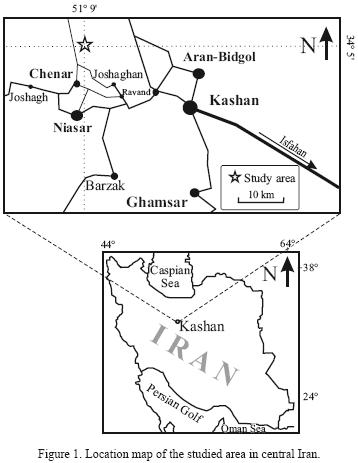
</front><body><![CDATA[ <p align="center"><font face="verdana" size="4"><b>Biostratigraphy and paleoecology of the Qom Formation in Chenar area (northwestern Kashan), Iran </b></font></p>     <p align="center"><font face="verdana" size="2">&nbsp;</font></p>     <p align="center"><font face="verdana" size="3"><b>Bioestratigraf&iacute;a y paleoecolog&iacute;a de la Formaci&oacute;n Qom en el &aacute;rea de Chenar (noroeste de Kashan), Ir&aacute;n</b></font></p>     <p align="center"><font face="verdana" size="2">&nbsp;</font></p>     <p align="center"><font face="verdana" size="2"><b>Elham Behforouzi<sup>*</sup> and Amrollah Safari</b></font></p>     <p align="justify"><font face="verdana" size="2">&nbsp;</font></p>     <p align="justify"><font face="verdana" size="2"><i>Department of Geology, Faculty of Sciences, University of Isfahan, Isfahan, Iran, 81746&#150;73441. </i>*<a href="mailto:elibehforouzi@yahoo.com">elibehforouzi@yahoo.com</a>.</font></p>     <p align="justify"><font face="verdana" size="2">&nbsp;</font></p>     <p align="justify"><font face="verdana" size="2">Manuscript received: December 18, 2010    <br>   Corrected manuscript received: June 16, 2011    ]]></body>
<body><![CDATA[<br>   Manuscript accepted: June 26, 2011</font></p>     <p align="justify"><font face="verdana" size="2">&nbsp;</font></p>     <p align="justify"><font size="2" face="verdana"><b>ABSTRACT</b></font></p>     <p align="justify"><font size="2" face="verdana"><i>A study of large benthic foraminifera from the 147 m&#150;thick Qom Formation in the Chenar area (northwestern Kashan) is reported. One hundred and twelve thin sections were prepared and the distribution of benthic foraminifera was analyzed to reconstruct paleoenvironmental conditions. Study of these sections led to the identification of 28 genera and 38 species. On the basis of the recognized foraminifera, the section is comparable to Lepidocyclina&#150; Operculina&#150; Ditrupa Assemblage zone, and the age of the Qom Formation in the studied section is assigned to the Oligocene.</i></font></p>     <p align="justify"><font face="verdana" size="2"><i>Evidence of sea level changes is observed from bottom to top of the studied section. On the basis of large benthic foraminifera assemblages and microfacies features, three major depositional environments (inner shelf, middle shelf and outer shelf) were defined. The inner shelf facies is characterized by wackstone&#150;packstone, dominated by miliolid and small perforate foraminifera. The middle shelf facies is represented by packstone&#150;grainstone with diverse assemblage of large perforate benthic foraminifera. Outer shelf facies is dominated by large perforate benthic foraminifera as well as planktic foraminifera. The distribution of the Oligocene large benthic foraminifera in the studied area indicates that shallow marine carbonate sediments of the Qom Formation were deposited in a photic zone of tropical to subtropical environments. Finally, the correlation between the study area and some other sections of Central Iran indicates that sedimentation of the Qom Formation is continuedfrom Late Rupelian to Chattian in northwest and Late Rupelian to Aquitanian in southeast direction.</i></font></p>     <p align="justify"><font face="verdana" size="2"><b>Key words:</b><i> biostratigraphy, benthic foraminifera, Qom Formation, Oligocene. Aquitanian, Iran.</i></font></p>     <p align="justify"><font face="verdana" size="2">&nbsp;</font></p>     <p align="justify"><font face="verdana" size="2"><b>RESUMEN</b></font></p>     <p align="justify"><font face="verdana" size="2"><i>Se reporta el estudio de foramin&iacute;feros bent&oacute;nicos grandes de la Formaci&oacute;n Qom, con 147 m de espesor, en el area de Chenar (noroeste de Kashan). Ciento doce secciones delgadas fueronpreparadasy la distribuci&oacute;n de foramin&iacute;feros bent&oacute;nicosfue analizada para reconstruir las condiciones paleoamebietales. El estudio de esas secciones llev&oacute; a la identificaci&oacute;n de 28 g&eacute;neros y 38 especies. Con base en los foramin&iacute;feros identificados, la secci&oacute;n es atribuible a la zona de Lepidocyclina&#150; Operculina&#150; Ditrupa y la edad de la Formaci&oacute;n Qom en la secci&oacute;n estudiada es asignable al Oligoceno.</i></font></p>     <p align="justify"><font face="verdana" size="2"><i>Evidencias de cambios del nivel del mar pueden ser observados desde la base y hacia a cima de la secci&oacute;n estudiada. Con base en los ensambles de foramin&iacute;feros bent&oacute;nicos grandes y en las caracter&iacute;sticas de las microfacies, tres ambientes de dep&oacute;sito fueron definidos (plataforma interna, media y externa). Las facies de plataforma interna se caracterizan por wackstone&#150;packstone, dominada por mili&oacute;lidos y </i><i>peque&ntilde;os foramin&iacute;feros perforados. La plataforma media est&aacute; representada por packstone&#150;grainstone, con diversos ensambles de foramin&iacute;feros bent&oacute;nicos grandes perforados. Las facies de plataforma externa est&aacute;n dominadas porforamin&iacute;feros bent&oacute;nicos perforados grandes, as&iacute; como por foramin&iacute;feros planct&oacute;nicos. La distribuci&oacute;n de los foramin&iacute;feros bent&oacute;nicos grandes del Oligoceno indica que los sedimentos marinos carbonatados someros de la Formaci&oacute;n Qom fueron depositados en la zona f&oacute;tica de un ambiente tropical a sub&#150;tropical. Finalmente, la correlaci&oacute;n entre el &aacute;rea estudiada y otras secciones de Ir&aacute;n Central indica que la sedimentaci&oacute;n de la Formaci&oacute;n Qom fue continua en direcci&oacute;n noroeste desde el Rupeliano Tard&iacute;o al Chattiano, y lo fue en direcci&oacute;n sureste del Rupeliano Tard&iacute;o al Aquitaniano.</i></font></p>     ]]></body>
<body><![CDATA[<p align="justify"><font face="verdana" size="2"><b>Palabras clave:</b><i> bioestratigraf&iacute;a, foramin&iacute;feros bent&oacute;nicos, Formaci&oacute;n Qom, Oligoceno, Aquitaniano, Ir&aacute;n.</i></font></p>     <p align="justify"><font face="verdana" size="2">&nbsp;</font></p>     <p align="justify"><font face="verdana" size="2"><b>INTRODUCTION</b></font></p>     <p align="justify"><font face="verdana" size="2">In this study, the foraminifera assemblage in the stratigraphic section located at Chenar village, 50 km northwest of Kashan, is described. The study area exposes Cenozoic sediments and is located at 51&deg;09'02"E longitude and 34&deg;05'37"N latitude (<a href="#f1">Figure 1</a>).</font></p>     <p align="center"><font face="verdana" size="2"><a name="f1"></a></font></p>     <p align="center"><font face="verdana" size="2"><img src="/img/revistas/rmcg/v28n3/a16f1.jpg"></font></p>     <p align="justify"><font face="verdana" size="2">Due to the high evolution rate, abundance, widespread distribution and abrupt extinction of species, benthic foraminifera are considered an important tool for the study of the biostratigraphy and evolution of genera and species, relative depth or paleoenvironmental reconstruction (Vaziri&#150;Moghaddam <i>et al.,</i> 2010). Considering the distribution of foraminifera and analyzing some factors like light, temperature, nutrient supply, substrate, hydrodynamic energy, depth, water locomotion and symbiosis, the paleoenvironment could be reconstructed. There are some similarities between the benthic foraminifera assemblages of Qom Formation and Asmari Formation and due to lack of a formal proposed biozonation in the Qom Formation, the biozonation offered by Wynd (1965) and Laursen <i>et al.</i> (2009) for the Asmari Formation were used in this investigation.</font></p>     <p align="justify"><font face="verdana" size="2">Geological investigation of the Qom Formation in Central Iran started with the work of Tietze (1875). Subsequent workers such as Stahl (1911), Riben (1935), Furon and Marie (1939), Furon (1941), Furrer and Soder (1955), Gansser (1955), Dozy (1944, 1955), Abaie <i>et al.</i> (1964) and Bozorgnia (1966) reported on the marine sediments of the Qom Formation. A few foraminiferal species were illustrated by Furon and Marie (1939), Furon (1941), Furrer and Soder (1955), Abaie <i>et al.</i> (1964) and Bozorgnia (1966). Rahimzade (1994) collected the names of most researchers, part of whose work covered the Qom Formation.</font></p>     <p align="justify"><font face="verdana" size="2">Furrer and Soder (1955) divided the Qom Formation into six members; Abaie <i>et al.</i> (1964) increased the number of members to ten. Abaie <i>et al.</i> (1964) noted that two members, c&#150;1 and c&#150;3, were the main objectives in exploration wells, due to fracture development enhancing porosity/permeability and hydrocarbon shows. Bozorgnia (1966) proposed and introduction ten members for the Qom Formation and distinguished several local basins of deposition in Central Iran, on the basis of its lithological characters. Rahaghi (1973, 1976, and 1980) suggested Oligo&#150;Miocene age for the Qom Formation. Okhravi and Amini (1998) reconstructed palaeoenvironment of the f&#150;member of the Qom Formation based on microfacies analysis. Based on echinoderms and microfosils, Khaksar and Maghfouri&#150;Moghaddam (2007) proposed Middle to Late Oligocene age for the Qom Formation. Aalaeobiogeographic reconstruction of the Qom Formation was proposed by Reuter <i>et al.,</i> 2007.</font></p>     <p align="justify"><font face="verdana" size="2">&nbsp;</font></p>     ]]></body>
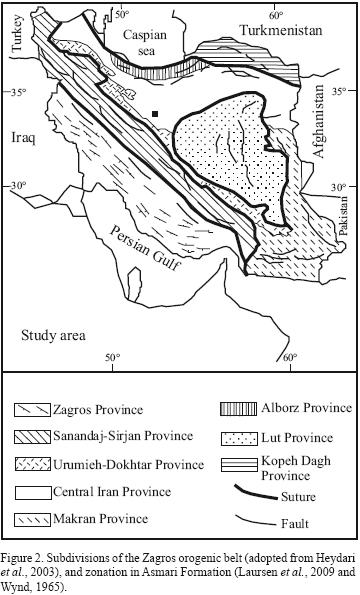
<body><![CDATA[<p align="justify"><font face="verdana" size="2"><b>METHODS AND STUDY AREA</b></font></p>     <p align="justify"><font face="verdana" size="2">Field work was concentrated on an outcrop of the Qom Formation, located 10 km to the north of Chenar village. A 147 m thick section was measured in detail, and a total of 112 specimens were sampled during the detailed field investigation. Samples were taken from the carbonate and marly layers almost every meter according to facies variation. Thin sections were provided for harder litologies whilst softer litologies were disaggregated and the foraminifera picked and analyzed. Disaggregated samples were wet sieved through a 151 Lim. Thin sections were studied under the microscope for the analysis of benthic foraminifera. Taxonomic classification was based on Loeblich and Tappan (1988), Adams and Bourgeois (1967) and Adams (1969).</font></p>     <p align="justify"><font face="verdana" size="2">&nbsp;</font></p>     <p align="justify"><font size="2" face="verdana"><b>GEOLOGICAL SETTING</b></font></p>     <p align="justify"><font size="2" face="verdana">On the basis of the sedimentary sequence, magmatism, metamorphism, structural setting and intensity of deformation, Iranian plateau has been subdivided into eight continental fragments, including, Zagros, Sanandaj&#150;Sirjan, Urumieh&#150;Doktar, Central Iran, Alborz, Kopeh&#150;Dagh, Lut and Makran (Heydari <i>et al.</i>, 2003). The study area is located in the Central Iran basin (<a href="#f2">Figure 2</a>).</font></p>     <p align="center"><font face="verdana" size="2"><a name="f2"></a></font></p>     <p align="center"><font face="verdana" size="2"><img src="/img/revistas/rmcg/v28n3/a16f2.jpg"></font></p>     <p align="justify"><font face="verdana" size="2">During the Early Paleogene, the Tethyan seaway was a wide ocean that connected the two major oceanic realms, the Atlantic and the Pacific (Schustr and Wielandt, 1999). The subduction and final collision of the African&#150;Arabian plate around Eocene&#150;Oligocene boundary was accompanied by the vanishing of the Tethyan seaway, the disconnection of the Atlantic and the Pacific Ocean and the birth of the Indian Ocean and the Mediterranean. As a consequence, Central&#150;Iranian paleogeography changed dramatically by the development of a volcanic arc which separated a fore arc from a back arc basin during Eocene times. Marine sedimentation of the Qom Formation began during the Oligocene and continued to the end of the Early Miocene in the Esfahan&#150;Sirjan fore arc and in the Qom back arc basin (Schustr and Wielandt, 1999).</font></p>     <p align="justify"><font face="verdana" size="2">&nbsp;</font></p>     <p align="justify"><font size="2" face="verdana"><b>BIOSTRATIGRAPHY OF FORAMINIFERA</b></font></p>     ]]></body>
<body><![CDATA[<p align="justify"><font size="2" face="verdana">Larger benthic foraminifera are widely distributed in the Tertiary carbonate platform of the Qom Formation. They developed complicated internal structures which can be identified when they are randomly thin sectioned. These organisms can provide complete and detailed evidence for biostratigraphic analysis of the shelf limestone because of rapid diversification, abrupt extinction and abundance (Beavingtone&#150;Penny and Racey, 2004).</font></p>     <p align="justify"><font face="verdana" size="2">The sedimentary deposits of the study area yielded abundant larger benthic foraminifera, therefore, biostratigraphic zonation is based on these organisms. So far, a formal biostratigraphic framework has not yet been established for the Qom Formation. However, based on foraminiferal similarities a general agreement exists to correlate the Qom Formation (Cental Iran Basin) with its coeval counterpart in the Zagros basin in southwest Iran (Asmari Formation) (St&ouml;cklin 1952; Bozorgnia 1966 and Kashfi 1988). Therefore, biozonations established for the Qom Formation in this work are largely based on the biozonations of Wynd (1965) and Laursen <i>et al.</i> (2009), which was used for the Asmari Formation that comprises an Oligocene to Early Miocene carbonate sequence (<a href="/img/revistas/rmcg/v28n3/a16t1.jpg" target="_blank">Table 1</a>).</font></p>     <p align="justify"><font face="verdana" size="2">From base to top a two foraminifera assemblages were recognized in the studied section (<a href="/img/revistas/rmcg/v28n3/a16f3.jpg" target="_blank">Figure 3</a>):</font></p>     <p align="justify"><font face="verdana" size="2">Assemblage 1: Is characterized by the presence of <i>Lepidocyclina</i> sp., <i>Eulepidina</i> sp., <i>Eulepidina dilatata, Eulepidina elephantina, Nephrolepidina</i> cf. <i>marginata, Nephrolepidina</i> cf. <i>tournoueri, Nephrolepidina</i> sp., <i>Operculina complanata, Operculina</i> sp., <i>Sphaerogypsina globulusa, Haplophragmium slingri, Planorbulina</i> sp., <i>Neorotalia viennoti, Neorotalia</i> sp., <i>Valvulinid</i> sp., <i>Amphistegina</i> sp., <i>Amphistegina lessonii, Elphidium</i> sp., <i>Bigenerina</i> sp., <i>Textularia</i> sp., <i>Discorbis</i> sp., <i>Quinqueloculina</i> sp., <i>Triluculina trigouenula, Globorotalia</i> cf. <i>nana, Globorotalia siakensis</i> (<a href="/img/revistas/rmcg/v28n3/a16f4.jpg" target="_blank">Figures 4</a> and <a href="/img/revistas/rmcg/v28n3/a16f5.jpg" target="_blank">5</a>). This assemblage corresponds to the <i>"Lepidocyclina&#150;Operculina&#150;Ditrupa</i> assemblage zone". Assemblage zone of Wynd (1965) and Laursen <i>et al.</i> (2009) applied for the Asmari Formation. This assemblage is attributed to the Oligocene and is correlated with the lower part of the Asmari Formation.</font></p>     <p align="justify"><font face="verdana" size="2">Assemblage 2: <i>Lepidocyclina&#150;Operculina&#150;Ditrupa</i> assemblage zone. The assemblage has this associated fauna: <i>Planorbulina</i> sp., <i>Eulepidina dilatata, Haplophragmium slingri, Rotalia viennoti,</i> and algae. This zone ranges from the Rupelian into the Chattian (Laursen <i>et al.,</i> 2009).</font></p>     <p align="justify"><font face="verdana" size="2">&nbsp;</font></p>     <p align="justify"><font size="2" face="verdana"><b>PALEOECOLOGY</b></font></p>     <p align="justify"><font size="2" face="verdana">In this section, an attempt to investigate factors that influence the benthic foraminifera distribution in the Qom Formation is presented. In this regards, environmental agents such as nutrient supply, light, temperature, water locomotion, substrate, salinity, hydrodynamic energy, depth and symbiosis are very significant. In terms of the paleoecology, paleoecological constraints porposed by Hallok and Glenn (1986) include three families observed in studied section (Nummulitidea, Amphisteginidea and Peneroplidea).</font></p>     <p align="justify"><font size="2" face="verdana"><b>Nutrient supply</b></font></p>     <p align="justify"><font size="2" face="verdana">Large benthic foraminifera are highly adapted to stable, oligotrophic and nutrient&#150;deficient conditions, but they cannot respond competitively when nutrient resources become abundant (Hallock, 1985). Inorganic, "biolimiting" nutrients enter shallow&#150;water communities principally by turnover or upwelling of deeper waters, by run&#150;off from land or by advection from areas of upwelling or runoff (Hallock and Schlager, 1986).</font></p>     ]]></body>
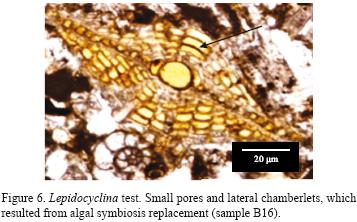
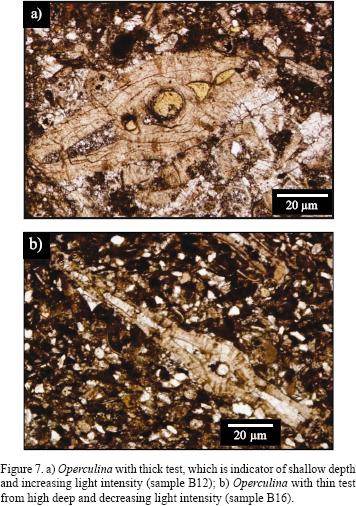
<body><![CDATA[<p align="justify"><font face="verdana" size="2">Large symbiont&#150;bearing benthic foraminifera are compatible to nutrient deficiency conditions and in such situation, the algal symbiont uses organic waste substances of the host and CO<sub>2</sub> originated from host respiration for photosynthesis (Beavingtone&#150;Penney and Racey, 2004). And so, the produced substances supplies nutrient for the host.</font></p>     <p align="justify"><font face="verdana" size="2">In the studied section, semi&#150;restricted lagoon environments inferred by the presence of perforate and imperforate foraminifera indicate mesotrophic to eutrophotic conditions and shallow to deep marine environments point to mesotrophic to oligotrophic conditions. Show that <i>Lepidocyclina</i> harboured endosymbiontic algae to provide sufficient light for the photosynthesis of the symbionts (Chaproniere, 1975). Numerous chambers of twenty tests of <i>Nephrolepidina</i> cf. <i>tournouer</i> indicated in sample (B16) (<a href="#f6">Figure 6</a>).</font></p>     <p align="center"><font face="verdana" size="2"><a name="f6"></a></font></p>     <p align="center"><font face="verdana" size="2"><img src="/img/revistas/rmcg/v28n3/a16f6.jpg"></font></p>     <p align="justify"><font face="verdana" size="2"><b>Light</b></font></p>     <p align="justify"><font face="verdana" size="2">The abundance of robust and thick tests of <i>Operculina</i> in the study area reflects increasing light intensity (<a href="#f7">Figure 7</a>). Light intensity and hydrodynamic force control test morphology through symbiotic interactions. In shallow, well&#150;lit waters the calcification rate in foraminiferal test is enhanced by photosynthetic symbionts, in order to prevent photoinhibition of symbiotic algae within the test or test damage in turbulent water (Beavingtone&#150;Penney and Racey, 2004).</font></p>     <p align="center"><font face="verdana" size="2"><a name="f7"></a></font></p>     <p align="center"><font face="verdana" size="2"><img src="/img/revistas/rmcg/v28n3/a16f7.jpg"></font></p>     <p align="justify"><font face="verdana" size="2">Larger foraminifera are sensitive to changes in environmental factors including light intensity and hydrodynamic force along depth gradients which are mirrored by changes in test shape and size of symbiont&#150;bearing foraminifera (Beavingtone&#150;Penney and Racey, 2004). The shallow dwelling microperforated hyaline foraminifera produce small, robust and ovate tests and increase calcification rate which brings about a thick wall structure to prevent photoinhibition of the endosymbiont within the test in highly illuminated shallow waters, or test damages in mobile substrates, while hyaline foraminifera from greater depths shifts to larger, thinner and more transparent test to thrive in strongly reduced light intensity (Beavingtone&#150;Penney and Racey, 2004). On the basis of the dependence of carbonate production to light penetration, three different groups of benthic organisms could be considered.</font></p>     <p align="justify"><font face="verdana" size="2">Red algae and some hyaline benthic foraminifera such as <i>Heterostegina, Operculina</i> and <i>Lepidocyclina</i> identified in the Qom Formation samples are indicators of dysphotic zones. Bassi <i>et al.</i> (2007) divided the photic zone into upper and lower parts; in this classification, <i>Neorotalia</i> live in the upper part of the upper photic zone, and <i>Heterostegina, Operculina</i> and <i>Lepidocyclina</i> are dominant in the lower part of the upper photic zone, whilst in the lower photic zone <i>Lepidocyclina</i> is developed.</font></p>     ]]></body>
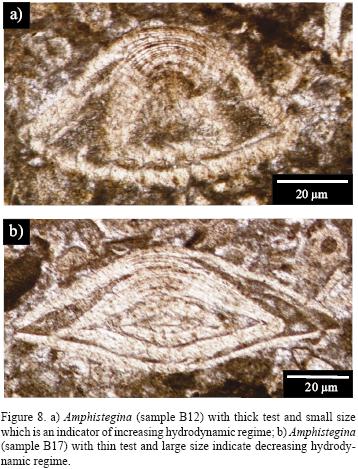
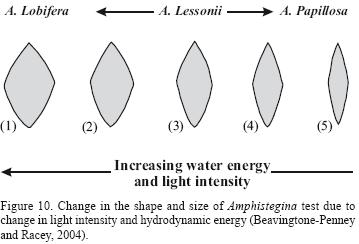
<body><![CDATA[<p align="justify"><font face="verdana" size="2">Light&#150;independent biota includes bryozoans, mollusks, crinoids, brachiopods and sponges that are widespread in studied section (sample B12). Organisms that compose the light&#150;dependent biota identified include green algae, reef&#150;builder corals and miliolids constituting indicators of photic zone.</font></p>     <p align="justify"><font face="verdana" size="2">Several large foraminifers that host algal symbionts present a more evolved skeletal structure than those without symbiont. This process is also seen in <i>Lepidocyclina</i> (<a href="/img/revistas/rmcg/v28n3/a16f4.jpg" target="_blank">Figure 4</a>). Large benthic foraminifers host unicellular eukaryotic algal symbionts that are dependent on light and nutrient and are therefore restricted to euphotic zone (Romero <i>et al.</i>, 2002). Symbiont&#150;bearing large foraminifera are restricted to warm water of tropical realms where water temperature is higher than 14&#150;18 &deg;C in the coldest months of the year (Renema, 2006).</font></p>     <p align="justify"><font face="verdana" size="2"><b>Water motion</b></font></p>     <p align="justify"><font face="verdana" size="2">This factor influences the test shape (diameter/thickness ratio). Generally, light intensity and water motion promotes the formation of secondary layers in foraminiferal tests. On the contrary, when the light intensity and the hydrodynamics are weak the growth rate decreases. In the studied area, <i>Amphistegina</i> from lagoon environment with high energy and intense light are thicker than those of deeper environments with lower energy (Beavingtone&#150;Penney and Racey, 2004) (<a href="#f8">Figure 8</a>).</font></p>     <p align="center"><font face="verdana" size="2"><a name="f8"></a></font></p>     <p align="center"><font face="verdana" size="2"><img src="/img/revistas/rmcg/v28n3/a16f8.jpg"></font></p>     <p align="justify"><font face="verdana" size="2"><b>Substrate nature</b></font></p>     <p align="justify"><font face="verdana" size="2">Substrate nature also depends on water turbulence. Foraminifera which live on a coarse grain substrate have thicker tests and are fusiform. <i>Amphistegina</i> also prefer hard substrates with high energy (<a href="#f8">Figure 8</a>), while <i>Operculina</i> live on soft and muddy substrates and have thin shells (<a href="#f8">Figure 8</a>).</font></p>     <p align="justify"><font face="verdana" size="2"><b>Salinity</b></font></p>     <p align="justify"><font face="verdana" size="2">High salinity plays a preventative role in growth and evolution of large foraminifera, but medium degree of salinity is not so effective. In semi&#150;restricted lagoon environment, because of the connection with open marine environments and low percent of salinity, perforate and imperforate foraminifers can be observed together (<a href="/img/revistas/rmcg/v28n3/a16f9.jpg" target="_blank">Figure 9a</a>), whereas, considering normal salinity in shallow parts of open marine of the studied section, only perforate foraminifers have been found (<a href="/img/revistas/rmcg/v28n3/a16f9.jpg" target="_blank">Figure 9b</a>). The presence of stenohaline organisms (echinoid and bryozoan) is an indicator of marine normal salinity (<a href="/img/revistas/rmcg/v28n3/a16f9.jpg" target="_blank">Figure 9c, 9d</a>).</font></p>     ]]></body>
<body><![CDATA[<p align="justify"><font face="verdana" size="2"><b>Hydrodynamic energy and depth</b></font></p>     <p align="justify"><font face="verdana" size="2">The occurrence of benthic organisms reflects their compatibility in high or low energy environments (Flugel, 2004). For instance, in shallow environments within the photic zone, with increasing water motion, benthic foreminifers shape changes. It means that high energy causes the test to be thick (increasing in carbonate production) and decreases its growth rate and eventually reduces their test size (Beavingtone&#150;Penney and Racey, 2004). Haynes (1965) stated that the shape of large foraminifera changes under the influence of hydrodynamic conditions and its symbiotic relationship with algae. The author expressed that species with free life (non&#150;epizoan) and spherical species are indicators of reef environment cleaned by flows, while fragile thin tests with maximum surface/volume ratio could be found in calm environments with low light. Generally, foraminifers in compatibility with high energy, creates lamellar and thick tests like <i>Amphistegina.</i> The elongated <i>Operculina</i> with thin test found in this work is an indicator of deep environments (Beavingtone&#150;Penney and Racey, 2004). In this research, a comparison is shown between thick <i>Amphistegina</i> with lamellar tests in high energy lagoon environment and elongated <i>Amphistegina</i> that is indicator of low energy environment (<a href="#f10">Figures 10</a> and <a href="/img/revistas/rmcg/v28n3/a16f11.jpg" target="_blank">11</a>).</font></p>     <p align="center"><font face="verdana" size="2"><a name="f10"></a></font></p>     <p align="center"><font face="verdana" size="2"><img src="/img/revistas/rmcg/v28n3/a16f10.jpg"></font></p>     <p align="justify"><font face="verdana" size="2">&nbsp;</font></p>     <p align="justify"><font size="2" face="verdana"><b>CONCLUSION</b></font></p>     <p align="justify"><font size="2" face="verdana">On the basis of the foraminifera recognized in the studied section, the Qom Formation is comparable to the <i>Lepidocyclina&#150;Operculina&#150;Ditrupa</i> Assemblage Zone. The age of the Qom Formation in the studied section is Oligocene.</font></p>     <p align="justify"><font face="verdana" size="2">The carbonate rocks of the study area contain a photozoan association composed predominantly of large benthic foraminifera and coralline red algae in association with corals, heterotrophs. This photozoan assemblage indicates oligotrophic conditions. Moreover, the abundance and association of large benthic foraminifera with coralline red algae are referred to as foralgal facies developed in shallow, warm water environments of the photic zone where oligotrophic condition was prevalent.</font></p>     <p align="justify"><font face="verdana" size="2">Based on the paleoecology and lithology, three distinct depositional setting can be recognized: inner shelf, middle shelf and outer shelf.</font></p>     <p align="justify"><font face="verdana" size="2">Inner shelf facies contain abundant imperforate tests of foraminifera. Middle shelf facies are characterized by abundant large perforate foraminifer tests. Toward the basin, planktic foraminifera and large foraminifers with perforate tests occur contemporaneously. Basin (outer shelf) facies is marked by high planktic foraminifera contents embedded in wackstone.</font></p>     ]]></body>
<body><![CDATA[<p align="justify"><font face="verdana" size="2">&nbsp;</font></p>     <p align="justify"><font face="verdana" size="2"><b>ACKNOWLEDGMENTS</b></font></p>     <p align="justify"><font face="verdana" size="2">In particular, we would like to express our most sincere gratitude to Prof. Dr. Francisco Vega for his helpful advice and guidance. The authors wish to thank the reviewers for their helpful and constructive comments. We also thank Dr. Hossein Vaziri&#150;Moghaddam, Dr. Ali Bahrami, Dr. Akbar Ghazi&#150;Fard and Dr. Mohammad Ali Makki&#150;Zade for his support and thoughtful comments. We also would like to thank the University of Isfahan for providing financial support. Also we thank the Revista Mexicana de Ciencias Geol&oacute;gicas reviewers for their constructive comments.</font></p>     <p align="justify"><font face="verdana" size="2">&nbsp;</font></p>     <p align="justify"><font size="2" face="verdana"><b>REFERENCES</b></font></p>     <!-- ref --><p align="justify"><font size="2" face="verdana">Abaie, I., Ansari, H.J., Badakhshan, A., Jaafari, A., 1964, History and development of the Alborz and Sarajeh fields of Central Iran: Bulletin of Iranian Petroleum Institute 15, 561&#150;574.    &nbsp;&nbsp;&nbsp;&nbsp;&nbsp;&nbsp;&nbsp;&nbsp;[&#160;<a href="javascript:void(0);" onclick="javascript: window.open('/scielo.php?script=sci_nlinks&ref=8063355&pid=S1026-8774201100030001600001&lng=','','width=640,height=500,resizable=yes,scrollbars=1,menubar=yes,');">Links</a>&#160;]<!-- end-ref --></font></p>     <!-- ref --><p align="justify"><font face="verdana" size="2">Adams, T.D., 1969, The Asmari Formation of Lurestan and Khuzestan Proviences: National Iranian Oil Company Report 1151 , unpublished.    &nbsp;&nbsp;&nbsp;&nbsp;&nbsp;&nbsp;&nbsp;&nbsp;[&#160;<a href="javascript:void(0);" onclick="javascript: window.open('/scielo.php?script=sci_nlinks&ref=8063357&pid=S1026-8774201100030001600002&lng=','','width=640,height=500,resizable=yes,scrollbars=1,menubar=yes,');">Links</a>&#160;]<!-- end-ref --></font></p>     <!-- ref --><p align="justify"><font face="verdana" size="2">Adams, T.D., Bourgeois, F., 1967, Asmari biostratigraphy: Iranian Oil Operating Companies, Geological and Exploration Division, Report 1074.    &nbsp;&nbsp;&nbsp;&nbsp;&nbsp;&nbsp;&nbsp;&nbsp;[&#160;<a href="javascript:void(0);" onclick="javascript: window.open('/scielo.php?script=sci_nlinks&ref=8063359&pid=S1026-8774201100030001600003&lng=','','width=640,height=500,resizable=yes,scrollbars=1,menubar=yes,');">Links</a>&#160;]<!-- end-ref --></font></p>     <!-- ref --><p align="justify"><font face="verdana" size="2">Bassi, D., Hottinger, L. Nebelsick, H., 2007, Larger Foraminifera from the Upper Oligocene of the Venetian area, northeast Italy: Palaeontology, 5(4), 845&#150;868.    &nbsp;&nbsp;&nbsp;&nbsp;&nbsp;&nbsp;&nbsp;&nbsp;[&#160;<a href="javascript:void(0);" onclick="javascript: window.open('/scielo.php?script=sci_nlinks&ref=8063361&pid=S1026-8774201100030001600004&lng=','','width=640,height=500,resizable=yes,scrollbars=1,menubar=yes,');">Links</a>&#160;]<!-- end-ref --></font></p>     <!-- ref --><p align="justify"><font face="verdana" size="2">Beavingtone&#150;Penney, S.J., Racey, A., 2004, Ecology of extant nummulitids and other larger benthic foraminifera. applications in Paleoenvironmental analysis: Earth Science Review, 67(3&#150;4), 219&#150;265.    &nbsp;&nbsp;&nbsp;&nbsp;&nbsp;&nbsp;&nbsp;&nbsp;[&#160;<a href="javascript:void(0);" onclick="javascript: window.open('/scielo.php?script=sci_nlinks&ref=8063363&pid=S1026-8774201100030001600005&lng=','','width=640,height=500,resizable=yes,scrollbars=1,menubar=yes,');">Links</a>&#160;]<!-- end-ref --></font></p>     <!-- ref --><p align="justify"><font face="verdana" size="2">Bozorgnia, F., 1966, Qom Formation stratigraphy of the Central basin of Iran and its intercontinental position: Bull. Iran Pet. Inst., 24, 69&#150;76.    &nbsp;&nbsp;&nbsp;&nbsp;&nbsp;&nbsp;&nbsp;&nbsp;[&#160;<a href="javascript:void(0);" onclick="javascript: window.open('/scielo.php?script=sci_nlinks&ref=8063365&pid=S1026-8774201100030001600006&lng=','','width=640,height=500,resizable=yes,scrollbars=1,menubar=yes,');">Links</a>&#160;]<!-- end-ref --></font></p>     <!-- ref --><p align="justify"><font face="verdana" size="2">Chaproniere, G.C.H., 1975, Paleoecology of Oligocene&#150;Miocene larger Foraminiferida: Australia: Alcheringa, 1, 37&#150;58.    &nbsp;&nbsp;&nbsp;&nbsp;&nbsp;&nbsp;&nbsp;&nbsp;[&#160;<a href="javascript:void(0);" onclick="javascript: window.open('/scielo.php?script=sci_nlinks&ref=8063367&pid=S1026-8774201100030001600007&lng=','','width=640,height=500,resizable=yes,scrollbars=1,menubar=yes,');">Links</a>&#160;]<!-- end-ref --></font></p>     <!-- ref --><p align="justify"><font face="verdana" size="2">Dozy, J.J., 1944, Comments on geological report no.1 by Thiebaud (on the Qum&#150;Saveh area): Geological Report 308.    &nbsp;&nbsp;&nbsp;&nbsp;&nbsp;&nbsp;&nbsp;&nbsp;[&#160;<a href="javascript:void(0);" onclick="javascript: window.open('/scielo.php?script=sci_nlinks&ref=8063369&pid=S1026-8774201100030001600008&lng=','','width=640,height=500,resizable=yes,scrollbars=1,menubar=yes,');">Links</a>&#160;]<!-- end-ref --> </font></p>     <!-- ref --><p align="justify"><font face="verdana" size="2">Dozy, J.J., 1955, A Sketch of past Cretaceous volcanism in Central Iran: Leidsche, Geologische Mededeelingen 20, 48&#150;57.    &nbsp;&nbsp;&nbsp;&nbsp;&nbsp;&nbsp;&nbsp;&nbsp;[&#160;<a href="javascript:void(0);" onclick="javascript: window.open('/scielo.php?script=sci_nlinks&ref=8063371&pid=S1026-8774201100030001600009&lng=','','width=640,height=500,resizable=yes,scrollbars=1,menubar=yes,');">Links</a>&#160;]<!-- end-ref --></font></p>     <!-- ref --><p align="justify"><font face="verdana" size="2">Flugel. E., 2004, Microfacies of Carbonate Rocks, Analysis, Interpretation and Application: Berlin, Springer&#150;Verlag, Berlin, 976 pp.    &nbsp;&nbsp;&nbsp;&nbsp;&nbsp;&nbsp;&nbsp;&nbsp;[&#160;<a href="javascript:void(0);" onclick="javascript: window.open('/scielo.php?script=sci_nlinks&ref=8063373&pid=S1026-8774201100030001600010&lng=','','width=640,height=500,resizable=yes,scrollbars=1,menubar=yes,');">Links</a>&#160;]<!-- end-ref --></font></p>     <!-- ref --><p align="justify"><font face="verdana" size="2">Furon, R., 1941, Geologie du plateau Iranien (Perse&#150;Afghanistan&#150;Beloutchistan): M&eacute;moires du Mus&eacute;um National d'Histoire Naturelle, Nouvelle Serie, Paris 7 (2), 177&#150;414.    &nbsp;&nbsp;&nbsp;&nbsp;&nbsp;&nbsp;&nbsp;&nbsp;[&#160;<a href="javascript:void(0);" onclick="javascript: window.open('/scielo.php?script=sci_nlinks&ref=8063375&pid=S1026-8774201100030001600011&lng=','','width=640,height=500,resizable=yes,scrollbars=1,menubar=yes,');">Links</a>&#160;]<!-- end-ref --></font></p>     <!-- ref --><p align="justify"><font face="verdana" size="2">Furon, R., Marie, P., 1939, Sur la microfaune des marnes aquitaniennes Lepidocyclines de Qoum (in Persian): Compte Rendu Sommaire des S&eacute;ances de la Soci&eacute;t&eacute; G&eacute;ologique de France, 79&#150;80.    &nbsp;&nbsp;&nbsp;&nbsp;&nbsp;&nbsp;&nbsp;&nbsp;[&#160;<a href="javascript:void(0);" onclick="javascript: window.open('/scielo.php?script=sci_nlinks&ref=8063377&pid=S1026-8774201100030001600012&lng=','','width=640,height=500,resizable=yes,scrollbars=1,menubar=yes,');">Links</a>&#160;]<!-- end-ref --></font></p>     <!-- ref --><p align="justify"><font face="verdana" size="2">Furrer, M.A., Soder, P.A., 1955. The Oligo&#150;Miocene marine formation in the Qom region (Central Iran): Proceedings of the 4th World Petroleum Congress, Rome, Section I/A/5, 267&#150;277.    &nbsp;&nbsp;&nbsp;&nbsp;&nbsp;&nbsp;&nbsp;&nbsp;[&#160;<a href="javascript:void(0);" onclick="javascript: window.open('/scielo.php?script=sci_nlinks&ref=8063379&pid=S1026-8774201100030001600013&lng=','','width=640,height=500,resizable=yes,scrollbars=1,menubar=yes,');">Links</a>&#160;]<!-- end-ref --></font></p>     <!-- ref --><p align="justify"><font face="verdana" size="2">Gansser, A. , 1955. New aspects of the geology in Central Iran, <i>in</i> Proceedings of the 4th World Petroleum Congress, Rome, Section I/A/5, 279&#150;300.    &nbsp;&nbsp;&nbsp;&nbsp;&nbsp;&nbsp;&nbsp;&nbsp;[&#160;<a href="javascript:void(0);" onclick="javascript: window.open('/scielo.php?script=sci_nlinks&ref=8063381&pid=S1026-8774201100030001600014&lng=','','width=640,height=500,resizable=yes,scrollbars=1,menubar=yes,');">Links</a>&#160;]<!-- end-ref --></font></p>     <!-- ref --><p align="justify"><font face="verdana" size="2">Hallock, P., 1985, Why are larger foraminifera large?: Paleobiology 11, p.195&#150;208.    &nbsp;&nbsp;&nbsp;&nbsp;&nbsp;&nbsp;&nbsp;&nbsp;[&#160;<a href="javascript:void(0);" onclick="javascript: window.open('/scielo.php?script=sci_nlinks&ref=8063383&pid=S1026-8774201100030001600015&lng=','','width=640,height=500,resizable=yes,scrollbars=1,menubar=yes,');">Links</a>&#160;]<!-- end-ref --></font></p>     <!-- ref --><p align="justify"><font face="verdana" size="2">Hallock, P., Glenn, E.C., 1986, Larger foraminifera: a tool for paleoenvironmental analysis of Cenozoic depositional facies: Palaios, 1(1), 55&#150;64.    &nbsp;&nbsp;&nbsp;&nbsp;&nbsp;&nbsp;&nbsp;&nbsp;[&#160;<a href="javascript:void(0);" onclick="javascript: window.open('/scielo.php?script=sci_nlinks&ref=8063385&pid=S1026-8774201100030001600016&lng=','','width=640,height=500,resizable=yes,scrollbars=1,menubar=yes,');">Links</a>&#160;]<!-- end-ref --></font></p>     <!-- ref --><p align="justify"><font face="verdana" size="2">Hallock, P., Schlager, W., 1986, Nutrient excess and the demise of coral reefs and carbonate platforms: Palaios 1, 389&#150;398.    &nbsp;&nbsp;&nbsp;&nbsp;&nbsp;&nbsp;&nbsp;&nbsp;[&#160;<a href="javascript:void(0);" onclick="javascript: window.open('/scielo.php?script=sci_nlinks&ref=8063387&pid=S1026-8774201100030001600017&lng=','','width=640,height=500,resizable=yes,scrollbars=1,menubar=yes,');">Links</a>&#160;]<!-- end-ref --></font></p>     <!-- ref --><p align="justify"><font face="verdana" size="2">Haynes, J.R., 1965, Symbiosis wall structure and habitate in foraminifera: Special Publication&#150;Cushman Foundation for Foraminiferal: Research, 16, 40&#150;43.    &nbsp;&nbsp;&nbsp;&nbsp;&nbsp;&nbsp;&nbsp;&nbsp;[&#160;<a href="javascript:void(0);" onclick="javascript: window.open('/scielo.php?script=sci_nlinks&ref=8063389&pid=S1026-8774201100030001600018&lng=','','width=640,height=500,resizable=yes,scrollbars=1,menubar=yes,');">Links</a>&#160;]<!-- end-ref --></font></p>     <!-- ref --><p align="justify"><font face="verdana" size="2">Heydari, E., Hassanzadeh, J., Wade, W.J., Ghazi, A.M., 2003, Permian&#150;Triassic boundary interval in the Abadeh section of Iran with implications for mass extinction, Part 1&#150;Sedimentology: Paleogeography, Paleoclimatology, Paleoecology, 193(3), 405&#150;423.    &nbsp;&nbsp;&nbsp;&nbsp;&nbsp;&nbsp;&nbsp;&nbsp;[&#160;<a href="javascript:void(0);" onclick="javascript: window.open('/scielo.php?script=sci_nlinks&ref=8063391&pid=S1026-8774201100030001600019&lng=','','width=640,height=500,resizable=yes,scrollbars=1,menubar=yes,');">Links</a>&#160;]<!-- end-ref --></font></p>     <!-- ref --><p align="justify"><font face="verdana" size="2">Kashfi, M.S., 1988, Evidence for non&#150;collision geology in the Middle East: Journal of Petroleum Geology 11 (4), 443&#150;460.    &nbsp;&nbsp;&nbsp;&nbsp;&nbsp;&nbsp;&nbsp;&nbsp;[&#160;<a href="javascript:void(0);" onclick="javascript: window.open('/scielo.php?script=sci_nlinks&ref=8063393&pid=S1026-8774201100030001600020&lng=','','width=640,height=500,resizable=yes,scrollbars=1,menubar=yes,');">Links</a>&#160;]<!-- end-ref --></font></p>     <!-- ref --><p align="justify"><font face="verdana" size="2">Khaksar, K., Maghfouri&#150;Moghadam, I., 2007, Paleontological study of the echinoderms in the Qom Formation (Central Iran): Islamic Azad University, Earth Sci. Res. 11(1), 57&#150;79.    &nbsp;&nbsp;&nbsp;&nbsp;&nbsp;&nbsp;&nbsp;&nbsp;[&#160;<a href="javascript:void(0);" onclick="javascript: window.open('/scielo.php?script=sci_nlinks&ref=8063395&pid=S1026-8774201100030001600021&lng=','','width=640,height=500,resizable=yes,scrollbars=1,menubar=yes,');">Links</a>&#160;]<!-- end-ref --></font></p>     <!-- ref --><p align="justify"><font face="verdana" size="2">Laursen, G.V., Monibi, S., Allan, T.L., Pickard, N.A., Hosseiney, A., Vincent, B., Hamon, Y., Van&#150;Buchem, F.S.P., Moallemi, A., Druillion, G., 2009, The Asmari Formation revisited: changed stratigraphic allocation and new biozonation: Shiraz, First International Petroleum Conference &amp; Exhibition, European Association of Geoscientists and Engineers.    &nbsp;&nbsp;&nbsp;&nbsp;&nbsp;&nbsp;&nbsp;&nbsp;[&#160;<a href="javascript:void(0);" onclick="javascript: window.open('/scielo.php?script=sci_nlinks&ref=8063397&pid=S1026-8774201100030001600022&lng=','','width=640,height=500,resizable=yes,scrollbars=1,menubar=yes,');">Links</a>&#160;]<!-- end-ref --></font></p>     <!-- ref --><p align="justify"><font face="verdana" size="2">Loeblich, A.R., Tappan, J.H., 1988, Foraminiferal Genera and their Classification. Van Nostrand Reinhold. 2 vols. pls. 847. New York, 869 p.    &nbsp;&nbsp;&nbsp;&nbsp;&nbsp;&nbsp;&nbsp;&nbsp;[&#160;<a href="javascript:void(0);" onclick="javascript: window.open('/scielo.php?script=sci_nlinks&ref=8063399&pid=S1026-8774201100030001600023&lng=','','width=640,height=500,resizable=yes,scrollbars=1,menubar=yes,');">Links</a>&#160;]<!-- end-ref --></font></p>     <!-- ref --><p align="justify"><font face="verdana" size="2">Okhravi, R., Amini, A., 1998, An example of mixed carbonate&#150;pyroclastic sedimentation (Miocene, Central Basin Iran): Sedimentary Geology, 118, 37&#150;57.    &nbsp;&nbsp;&nbsp;&nbsp;&nbsp;&nbsp;&nbsp;&nbsp;[&#160;<a href="javascript:void(0);" onclick="javascript: window.open('/scielo.php?script=sci_nlinks&ref=8063401&pid=S1026-8774201100030001600024&lng=','','width=640,height=500,resizable=yes,scrollbars=1,menubar=yes,');">Links</a>&#160;]<!-- end-ref --></font></p>     <!-- ref --><p align="justify"><font face="verdana" size="2">Rahaghi, A., 1973, &Eacute;tude de quelques grands foraminif&egrave;res de la Formation de Qum (Iran Central): Revue de Micropaleontologie, 16, 23&#150;38.    &nbsp;&nbsp;&nbsp;&nbsp;&nbsp;&nbsp;&nbsp;&nbsp;[&#160;<a href="javascript:void(0);" onclick="javascript: window.open('/scielo.php?script=sci_nlinks&ref=8063403&pid=S1026-8774201100030001600025&lng=','','width=640,height=500,resizable=yes,scrollbars=1,menubar=yes,');">Links</a>&#160;]<!-- end-ref --></font></p>     <!-- ref --><p align="justify"><font face="verdana" size="2">Rahaghi, A., 1976, Contribution a l'&Eacute; tude de quelques grands foraminif&egrave;res de l'Iran: Soci&eacute;t&eacute; National Iranienne des P&eacute;troles Laboratoire de Micropal&eacute;ontologie, Publication 6, 1&#150;79.    &nbsp;&nbsp;&nbsp;&nbsp;&nbsp;&nbsp;&nbsp;&nbsp;[&#160;<a href="javascript:void(0);" onclick="javascript: window.open('/scielo.php?script=sci_nlinks&ref=8063405&pid=S1026-8774201100030001600026&lng=','','width=640,height=500,resizable=yes,scrollbars=1,menubar=yes,');">Links</a>&#160;]<!-- end-ref --></font></p>     <!-- ref --><p align="justify"><font face="verdana" size="2">Rahaghi, A., 1980, Tertiary faunal Assemblage of Qum&#150;Kashan, Sabzewar and Jahrum area: National Iranian Oil Company, Geological Laboratories, Publication 8.    &nbsp;&nbsp;&nbsp;&nbsp;&nbsp;&nbsp;&nbsp;&nbsp;[&#160;<a href="javascript:void(0);" onclick="javascript: window.open('/scielo.php?script=sci_nlinks&ref=8063407&pid=S1026-8774201100030001600027&lng=','','width=640,height=500,resizable=yes,scrollbars=1,menubar=yes,');">Links</a>&#160;]<!-- end-ref --></font></p>     <!-- ref --><p align="justify"><font face="verdana" size="2">Rahimzade, F., 1994, Treatise on the Geology of Iran: Oligocene&#150;Miocene, Pliocene (in Persian): Ministry of Mines and Metals, Geological Survey of Iran,12.    &nbsp;&nbsp;&nbsp;&nbsp;&nbsp;&nbsp;&nbsp;&nbsp;[&#160;<a href="javascript:void(0);" onclick="javascript: window.open('/scielo.php?script=sci_nlinks&ref=8063409&pid=S1026-8774201100030001600028&lng=','','width=640,height=500,resizable=yes,scrollbars=1,menubar=yes,');">Links</a>&#160;]<!-- end-ref --></font></p>     <!-- ref --><p align="justify"><font face="verdana" size="2">Renema, W., 2006, Large benthic foraminifera from the deep photic zone of a mixed siliciclastic&#150;carbonate shelf of East Kalimantan: Indonesia, Marine Micropaleontology, 58, 73&#150;82.    &nbsp;&nbsp;&nbsp;&nbsp;&nbsp;&nbsp;&nbsp;&nbsp;[&#160;<a href="javascript:void(0);" onclick="javascript: window.open('/scielo.php?script=sci_nlinks&ref=8063411&pid=S1026-8774201100030001600029&lng=','','width=640,height=500,resizable=yes,scrollbars=1,menubar=yes,');">Links</a>&#160;]<!-- end-ref --></font></p>     <!-- ref --><p align="justify"><font face="verdana" size="2">Reuter, M., Pillar, W.E., Harzhauser, M., Mandic, O., Berning, B., Rogl, F., Kroh, A., Aubry, M.P., Wielandt, U., Hamedani, A., 2007, The Oligo&#150;Miocene Qom Formation (Iran): evidence for and early Burdigalian restriction of Tethyan Seaway and clouser of its Iranian getways: International Journal of Earth Sciences, 98, 627&#150;650.    &nbsp;&nbsp;&nbsp;&nbsp;&nbsp;&nbsp;&nbsp;&nbsp;[&#160;<a href="javascript:void(0);" onclick="javascript: window.open('/scielo.php?script=sci_nlinks&ref=8063413&pid=S1026-8774201100030001600030&lng=','','width=640,height=500,resizable=yes,scrollbars=1,menubar=yes,');">Links</a>&#160;]<!-- end-ref --></font></p>     <!-- ref --><p align="justify"><font face="verdana" size="2">Riben, H., 1935. Contribution a la g&eacute;ologie de l'Azerbeidjan Persan: Bulletin de la Soci&eacute;t&eacute; Neuchateloise des Sciences Naturelles, 59 (1934), 20&#150;144.    &nbsp;&nbsp;&nbsp;&nbsp;&nbsp;&nbsp;&nbsp;&nbsp;[&#160;<a href="javascript:void(0);" onclick="javascript: window.open('/scielo.php?script=sci_nlinks&ref=8063415&pid=S1026-8774201100030001600031&lng=','','width=640,height=500,resizable=yes,scrollbars=1,menubar=yes,');">Links</a>&#160;]<!-- end-ref --></font></p>     <!-- ref --><p align="justify"><font face="verdana" size="2">Romero, J., Caus, E., Rossel, J., 2002, A Model for the Palaeoenvironmental distribution of larger foraminifera based on Late Middel Eocene deposits on the margine of the south Pyrenean Basine (SE Spain): Palaeogeography, Palaeoeclimatology, Palaeoecology, 179, 43&#150;56.    &nbsp;&nbsp;&nbsp;&nbsp;&nbsp;&nbsp;&nbsp;&nbsp;[&#160;<a href="javascript:void(0);" onclick="javascript: window.open('/scielo.php?script=sci_nlinks&ref=8063417&pid=S1026-8774201100030001600032&lng=','','width=640,height=500,resizable=yes,scrollbars=1,menubar=yes,');">Links</a>&#160;]<!-- end-ref --></font></p>     <!-- ref --><p align="justify"><font face="verdana" size="2">Schustr, F., Wielandt, U., 1999, Oligocene and Early Miocene coral faunas from Iran: palaeoecology and palaeobiogeography: International Journal of Earth Sciences, 88, 571&#150;581.    &nbsp;&nbsp;&nbsp;&nbsp;&nbsp;&nbsp;&nbsp;&nbsp;[&#160;<a href="javascript:void(0);" onclick="javascript: window.open('/scielo.php?script=sci_nlinks&ref=8063419&pid=S1026-8774201100030001600033&lng=','','width=640,height=500,resizable=yes,scrollbars=1,menubar=yes,');">Links</a>&#160;]<!-- end-ref --></font></p>     <!-- ref --><p align="justify"><font face="verdana" size="2">Stahl, A.F., 1911, Persien, <i>in</i> Handbuch der Regionalen Geologie: Heidelberg (Winter), Hft. 8, 5(6), 46 pp.    &nbsp;&nbsp;&nbsp;&nbsp;&nbsp;&nbsp;&nbsp;&nbsp;[&#160;<a href="javascript:void(0);" onclick="javascript: window.open('/scielo.php?script=sci_nlinks&ref=8063421&pid=S1026-8774201100030001600034&lng=','','width=640,height=500,resizable=yes,scrollbars=1,menubar=yes,');">Links</a>&#160;]<!-- end-ref --></font></p>     <!-- ref --><p align="justify"><font face="verdana" size="2">Stocklin, J., 1952, Stratigraphical investigation in the Qom&#150;Arak&#150;Gulpaigan Delidjan area: National Iranian Of Oil Company, Report 95.    &nbsp;&nbsp;&nbsp;&nbsp;&nbsp;&nbsp;&nbsp;&nbsp;[&#160;<a href="javascript:void(0);" onclick="javascript: window.open('/scielo.php?script=sci_nlinks&ref=8063423&pid=S1026-8774201100030001600035&lng=','','width=640,height=500,resizable=yes,scrollbars=1,menubar=yes,');">Links</a>&#160;]<!-- end-ref --></font></p>     <!-- ref --><p align="justify"><font face="verdana" size="2">Tietze, E., 1875, Ein Ausflug nach dem Siahkuh (Schwarzer Berg) in Persien. Mitteilungen der Geographischen Geographischen Gesellschaft Wien 18 (8), 257&#150;267.    &nbsp;&nbsp;&nbsp;&nbsp;&nbsp;&nbsp;&nbsp;&nbsp;[&#160;<a href="javascript:void(0);" onclick="javascript: window.open('/scielo.php?script=sci_nlinks&ref=8063425&pid=S1026-8774201100030001600036&lng=','','width=640,height=500,resizable=yes,scrollbars=1,menubar=yes,');">Links</a>&#160;]<!-- end-ref --></font></p>     <!-- ref --><p align="justify"><font face="verdana" size="2">Vaziri Moghaddam, H., Kimiagari, M., Taheri, A., 2010, Principles of Foraminifera: Isfahan, Isfahan, 366 p.    &nbsp;&nbsp;&nbsp;&nbsp;&nbsp;&nbsp;&nbsp;&nbsp;[&#160;<a href="javascript:void(0);" onclick="javascript: window.open('/scielo.php?script=sci_nlinks&ref=8063427&pid=S1026-8774201100030001600037&lng=','','width=640,height=500,resizable=yes,scrollbars=1,menubar=yes,');">Links</a>&#160;]<!-- end-ref --></font></p>     <!-- ref --><p align="justify"><font face="verdana" size="2">Wynd, J., 1965, Biofacies of Iranian oil consortium agreement area: Iranian Oil Offshore Company, Report 1082, unpublished.    &nbsp;&nbsp;&nbsp;&nbsp;&nbsp;&nbsp;&nbsp;&nbsp;[&#160;<a href="javascript:void(0);" onclick="javascript: window.open('/scielo.php?script=sci_nlinks&ref=8063429&pid=S1026-8774201100030001600038&lng=','','width=640,height=500,resizable=yes,scrollbars=1,menubar=yes,');">Links</a>&#160;]<!-- end-ref --></font></p>      ]]></body><back>
<ref-list>
<ref id="B1">
<nlm-citation citation-type="journal">
<person-group person-group-type="author">
<name>
<surname><![CDATA[Abaie]]></surname>
<given-names><![CDATA[I.]]></given-names>
</name>
<name>
<surname><![CDATA[Ansari]]></surname>
<given-names><![CDATA[H.J.]]></given-names>
</name>
<name>
<surname><![CDATA[Badakhshan]]></surname>
<given-names><![CDATA[A.]]></given-names>
</name>
<name>
<surname><![CDATA[Jaafari]]></surname>
<given-names><![CDATA[A.]]></given-names>
</name>
</person-group>
<article-title xml:lang="en"><![CDATA[History and development of the Alborz and Sarajeh fields of Central Iran]]></article-title>
<source><![CDATA[Bulletin of Iranian Petroleum Institute]]></source>
<year>1964</year>
<volume>15</volume>
<page-range>561-574</page-range></nlm-citation>
</ref>
<ref id="B2">
<nlm-citation citation-type="">
<person-group person-group-type="author">
<name>
<surname><![CDATA[Adams]]></surname>
<given-names><![CDATA[T.D.]]></given-names>
</name>
</person-group>
<source><![CDATA[The Asmari Formation of Lurestan and Khuzestan Proviences]]></source>
<year>1969</year>
</nlm-citation>
</ref>
<ref id="B3">
<nlm-citation citation-type="book">
<person-group person-group-type="author">
<name>
<surname><![CDATA[Adams]]></surname>
<given-names><![CDATA[T.D.]]></given-names>
</name>
<name>
<surname><![CDATA[Bourgeois]]></surname>
<given-names><![CDATA[F.]]></given-names>
</name>
</person-group>
<source><![CDATA[Asmari biostratigraphy]]></source>
<year>1967</year>
<publisher-name><![CDATA[Iranian Oil Operating Companies, Geological and Exploration Division]]></publisher-name>
</nlm-citation>
</ref>
<ref id="B4">
<nlm-citation citation-type="journal">
<person-group person-group-type="author">
<name>
<surname><![CDATA[Bassi]]></surname>
<given-names><![CDATA[D.]]></given-names>
</name>
<name>
<surname><![CDATA[Hottinger]]></surname>
<given-names><![CDATA[L. Nebelsick, H.]]></given-names>
</name>
</person-group>
<article-title xml:lang="en"><![CDATA[Larger Foraminifera from the Upper Oligocene of the Venetian area, northeast Italy]]></article-title>
<source><![CDATA[Palaeontology]]></source>
<year>2007</year>
<volume>5</volume>
<numero>4</numero>
<issue>4</issue>
<page-range>845-868</page-range></nlm-citation>
</ref>
<ref id="B5">
<nlm-citation citation-type="journal">
<person-group person-group-type="author">
<name>
<surname><![CDATA[Beavingtone-Penney]]></surname>
<given-names><![CDATA[S.J.]]></given-names>
</name>
<name>
<surname><![CDATA[Racey]]></surname>
<given-names><![CDATA[A.]]></given-names>
</name>
</person-group>
<article-title xml:lang="en"><![CDATA[Ecology of extant nummulitids and other larger benthic foraminifera. applications in Paleoenvironmental analysis]]></article-title>
<source><![CDATA[Earth Science Review]]></source>
<year>2004</year>
<volume>67</volume>
<numero>3-4</numero>
<issue>3-4</issue>
<page-range>219-265</page-range></nlm-citation>
</ref>
<ref id="B6">
<nlm-citation citation-type="journal">
<person-group person-group-type="author">
<name>
<surname><![CDATA[Bozorgnia]]></surname>
<given-names><![CDATA[F.]]></given-names>
</name>
</person-group>
<article-title xml:lang="en"><![CDATA[Qom Formation stratigraphy of the Central basin of Iran and its intercontinental position]]></article-title>
<source><![CDATA[Bull. Iran Pet. Inst.]]></source>
<year>1966</year>
<volume>24</volume>
<page-range>69-76</page-range></nlm-citation>
</ref>
<ref id="B7">
<nlm-citation citation-type="journal">
<person-group person-group-type="author">
<name>
<surname><![CDATA[Chaproniere]]></surname>
<given-names><![CDATA[G.C.H.]]></given-names>
</name>
</person-group>
<article-title xml:lang="en"><![CDATA[Paleoecology of Oligocene-Miocene larger Foraminiferida: Australia]]></article-title>
<source><![CDATA[Alcheringa]]></source>
<year>1975</year>
<volume>1</volume>
<page-range>37-58</page-range></nlm-citation>
</ref>
<ref id="B8">
<nlm-citation citation-type="">
<person-group person-group-type="author">
<name>
<surname><![CDATA[Dozy]]></surname>
<given-names><![CDATA[J.J.]]></given-names>
</name>
</person-group>
<article-title xml:lang="en"><![CDATA[Comments on geological report no.1 by Thiebaud (on the Qum-Saveh area)]]></article-title>
<source><![CDATA[Geological Report 308]]></source>
<year>1944</year>
</nlm-citation>
</ref>
<ref id="B9">
<nlm-citation citation-type="journal">
<person-group person-group-type="author">
<name>
<surname><![CDATA[Dozy]]></surname>
<given-names><![CDATA[J.J.]]></given-names>
</name>
</person-group>
<article-title xml:lang="en"><![CDATA[A Sketch of past Cretaceous volcanism in Central Iran]]></article-title>
<source><![CDATA[Leidsche, Geologische Mededeelingen]]></source>
<year>1955</year>
<volume>20</volume>
<page-range>48-57</page-range></nlm-citation>
</ref>
<ref id="B10">
<nlm-citation citation-type="book">
<person-group person-group-type="author">
<name>
<surname><![CDATA[Flugel]]></surname>
<given-names><![CDATA[E.]]></given-names>
</name>
</person-group>
<source><![CDATA[Microfacies of Carbonate Rocks, Analysis, Interpretation and Application]]></source>
<year>2004</year>
<page-range>976</page-range><publisher-loc><![CDATA[Berlin ]]></publisher-loc>
<publisher-name><![CDATA[Springer-Verlag]]></publisher-name>
</nlm-citation>
</ref>
<ref id="B11">
<nlm-citation citation-type="journal">
<person-group person-group-type="author">
<name>
<surname><![CDATA[Furon]]></surname>
<given-names><![CDATA[R.]]></given-names>
</name>
</person-group>
<article-title xml:lang="fr"><![CDATA[Geologie du plateau Iranien (Perse-Afghanistan-Beloutchistan)]]></article-title>
<source><![CDATA[Mémoires du Muséum National d'Histoire Naturelle, Nouvelle Serie]]></source>
<year>1941</year>
<volume>7</volume>
<numero>2</numero>
<issue>2</issue>
<page-range>177-414</page-range><publisher-loc><![CDATA[Paris ]]></publisher-loc>
</nlm-citation>
</ref>
<ref id="B12">
<nlm-citation citation-type="book">
<person-group person-group-type="author">
<name>
<surname><![CDATA[Furon]]></surname>
<given-names><![CDATA[R.]]></given-names>
</name>
<name>
<surname><![CDATA[Marie]]></surname>
<given-names><![CDATA[P.]]></given-names>
</name>
</person-group>
<source><![CDATA[Sur la microfaune des marnes aquitaniennes Lepidocyclines de Qoum (in Persian)]]></source>
<year>1939</year>
<page-range>79-80</page-range><publisher-name><![CDATA[Compte Rendu Sommaire des Séances de la Société Géologique de France]]></publisher-name>
</nlm-citation>
</ref>
<ref id="B13">
<nlm-citation citation-type="">
<person-group person-group-type="author">
<name>
<surname><![CDATA[Furrer]]></surname>
<given-names><![CDATA[M.A.]]></given-names>
</name>
<name>
<surname><![CDATA[Soder]]></surname>
<given-names><![CDATA[P.A.]]></given-names>
</name>
</person-group>
<article-title xml:lang="en"><![CDATA[The Oligo-Miocene marine formation in the Qom region (Central Iran)]]></article-title>
<source><![CDATA[Proceedings of the 4th World Petroleum Congress]]></source>
<year>1955</year>
<page-range>267-277</page-range><publisher-loc><![CDATA[Rome ]]></publisher-loc>
</nlm-citation>
</ref>
<ref id="B14">
<nlm-citation citation-type="">
<person-group person-group-type="author">
<name>
<surname><![CDATA[Gansser]]></surname>
<given-names><![CDATA[A.]]></given-names>
</name>
</person-group>
<article-title xml:lang="en"><![CDATA[New aspects of the geology in Central Iran]]></article-title>
<source><![CDATA[Proceedings of the 4th World Petroleum Congress]]></source>
<year>1955</year>
<page-range>279-300</page-range><publisher-loc><![CDATA[Rome ]]></publisher-loc>
</nlm-citation>
</ref>
<ref id="B15">
<nlm-citation citation-type="journal">
<person-group person-group-type="author">
<name>
<surname><![CDATA[Hallock]]></surname>
<given-names><![CDATA[P.]]></given-names>
</name>
</person-group>
<article-title xml:lang="en"><![CDATA[Why are larger foraminifera large?]]></article-title>
<source><![CDATA[Paleobiology]]></source>
<year>1985</year>
<volume>11</volume>
<page-range>195-208</page-range></nlm-citation>
</ref>
<ref id="B16">
<nlm-citation citation-type="journal">
<person-group person-group-type="author">
<name>
<surname><![CDATA[Hallock]]></surname>
<given-names><![CDATA[P.]]></given-names>
</name>
<name>
<surname><![CDATA[Glenn]]></surname>
<given-names><![CDATA[E.C.]]></given-names>
</name>
</person-group>
<article-title xml:lang="en"><![CDATA[Larger foraminifera: a tool for paleoenvironmental analysis of Cenozoic depositional facies]]></article-title>
<source><![CDATA[Palaios]]></source>
<year>1986</year>
<volume>1</volume>
<numero>1</numero>
<issue>1</issue>
<page-range>55-64</page-range></nlm-citation>
</ref>
<ref id="B17">
<nlm-citation citation-type="journal">
<person-group person-group-type="author">
<name>
<surname><![CDATA[Hallock]]></surname>
<given-names><![CDATA[P.]]></given-names>
</name>
<name>
<surname><![CDATA[Schlager]]></surname>
<given-names><![CDATA[W.]]></given-names>
</name>
</person-group>
<article-title xml:lang="en"><![CDATA[Nutrient excess and the demise of coral reefs and carbonate platforms]]></article-title>
<source><![CDATA[Palaios]]></source>
<year>1986</year>
<volume>1</volume>
<page-range>389-398</page-range></nlm-citation>
</ref>
<ref id="B18">
<nlm-citation citation-type="journal">
<person-group person-group-type="author">
<name>
<surname><![CDATA[Haynes]]></surname>
<given-names><![CDATA[J.R.]]></given-names>
</name>
</person-group>
<article-title xml:lang="en"><![CDATA[Symbiosis wall structure and habitate in foraminifera: Special Publication-Cushman Foundation for Foraminiferal]]></article-title>
<source><![CDATA[Research]]></source>
<year>1965</year>
<volume>16</volume>
<page-range>40-43</page-range></nlm-citation>
</ref>
<ref id="B19">
<nlm-citation citation-type="journal">
<person-group person-group-type="author">
<name>
<surname><![CDATA[Heydari]]></surname>
<given-names><![CDATA[E.]]></given-names>
</name>
<name>
<surname><![CDATA[Hassanzadeh]]></surname>
<given-names><![CDATA[J.]]></given-names>
</name>
<name>
<surname><![CDATA[Wade]]></surname>
<given-names><![CDATA[W.J.]]></given-names>
</name>
<name>
<surname><![CDATA[Ghazi]]></surname>
<given-names><![CDATA[A.M.]]></given-names>
</name>
</person-group>
<article-title xml:lang="en"><![CDATA[Permian-Triassic boundary interval in the Abadeh section of Iran with implications for mass extinction, Part 1-Sedimentology]]></article-title>
<source><![CDATA[Paleogeography, Paleoclimatology, Paleoecology]]></source>
<year>2003</year>
<volume>193</volume>
<numero>3</numero>
<issue>3</issue>
<page-range>405-423</page-range></nlm-citation>
</ref>
<ref id="B20">
<nlm-citation citation-type="journal">
<person-group person-group-type="author">
<name>
<surname><![CDATA[Kashfi]]></surname>
<given-names><![CDATA[M.S.]]></given-names>
</name>
</person-group>
<article-title xml:lang="en"><![CDATA[Evidence for non-collision geology in the Middle East]]></article-title>
<source><![CDATA[Journal of Petroleum Geology]]></source>
<year>1988</year>
<volume>11</volume>
<numero>4</numero>
<issue>4</issue>
<page-range>443-460</page-range></nlm-citation>
</ref>
<ref id="B21">
<nlm-citation citation-type="journal">
<person-group person-group-type="author">
<name>
<surname><![CDATA[Khaksar]]></surname>
<given-names><![CDATA[K.]]></given-names>
</name>
<name>
<surname><![CDATA[Maghfouri-Moghadam]]></surname>
<given-names><![CDATA[I.]]></given-names>
</name>
</person-group>
<article-title xml:lang="en"><![CDATA[Paleontological study of the echinoderms in the Qom Formation (Central Iran)]]></article-title>
<source><![CDATA[Earth Sci. Res.]]></source>
<year>2007</year>
<volume>11</volume>
<numero>1</numero>
<issue>1</issue>
<page-range>57-79</page-range></nlm-citation>
</ref>
<ref id="B22">
<nlm-citation citation-type="confpro">
<person-group person-group-type="author">
<name>
<surname><![CDATA[Laursen]]></surname>
<given-names><![CDATA[G.V.]]></given-names>
</name>
<name>
<surname><![CDATA[Monibi]]></surname>
<given-names><![CDATA[S.]]></given-names>
</name>
<name>
<surname><![CDATA[Allan]]></surname>
<given-names><![CDATA[T.L.]]></given-names>
</name>
<name>
<surname><![CDATA[Pickard]]></surname>
<given-names><![CDATA[N.A.]]></given-names>
</name>
<name>
<surname><![CDATA[Hosseiney]]></surname>
<given-names><![CDATA[A.]]></given-names>
</name>
<name>
<surname><![CDATA[Vincent]]></surname>
<given-names><![CDATA[B.]]></given-names>
</name>
<name>
<surname><![CDATA[Hamon]]></surname>
<given-names><![CDATA[Y.]]></given-names>
</name>
<name>
<surname><![CDATA[Van-Buchem]]></surname>
<given-names><![CDATA[F.S.P.]]></given-names>
</name>
<name>
<surname><![CDATA[Moallemi]]></surname>
<given-names><![CDATA[A.]]></given-names>
</name>
<name>
<surname><![CDATA[Druillion]]></surname>
<given-names><![CDATA[G.]]></given-names>
</name>
</person-group>
<article-title xml:lang="en"><![CDATA[The Asmari Formation revisited: changed stratigraphic allocation and new biozonation]]></article-title>
<source><![CDATA[]]></source>
<year>2009</year>
<conf-name><![CDATA[First International Petroleum Conference & Exhibition]]></conf-name>
<conf-loc> </conf-loc>
<publisher-name><![CDATA[European Association of Geoscientists and Engineers]]></publisher-name>
</nlm-citation>
</ref>
<ref id="B23">
<nlm-citation citation-type="book">
<person-group person-group-type="author">
<name>
<surname><![CDATA[Loeblich]]></surname>
<given-names><![CDATA[A.R.]]></given-names>
</name>
<name>
<surname><![CDATA[Tappan]]></surname>
<given-names><![CDATA[J.H.]]></given-names>
</name>
</person-group>
<source><![CDATA[Foraminiferal Genera and their Classification]]></source>
<year>1988</year>
<volume>2</volume>
<page-range>869</page-range><publisher-loc><![CDATA[New York ]]></publisher-loc>
<publisher-name><![CDATA[Van Nostrand Reinhold]]></publisher-name>
</nlm-citation>
</ref>
<ref id="B24">
<nlm-citation citation-type="journal">
<person-group person-group-type="author">
<name>
<surname><![CDATA[Okhravi]]></surname>
<given-names><![CDATA[R.]]></given-names>
</name>
<name>
<surname><![CDATA[Amini]]></surname>
<given-names><![CDATA[A.]]></given-names>
</name>
</person-group>
<article-title xml:lang="en"><![CDATA[An example of mixed carbonate-pyroclastic sedimentation (Miocene, Central Basin Iran)]]></article-title>
<source><![CDATA[Sedimentary Geology]]></source>
<year>1998</year>
<volume>118</volume>
<page-range>37-57</page-range></nlm-citation>
</ref>
<ref id="B25">
<nlm-citation citation-type="journal">
<person-group person-group-type="author">
<name>
<surname><![CDATA[Rahaghi]]></surname>
<given-names><![CDATA[A.]]></given-names>
</name>
</person-group>
<article-title xml:lang="fr"><![CDATA[Étude de quelques grands foraminifères de la Formation de Qum (Iran Central)]]></article-title>
<source><![CDATA[Revue de Micropaleontologie]]></source>
<year>1973</year>
<volume>16</volume>
<page-range>23-38</page-range></nlm-citation>
</ref>
<ref id="B26">
<nlm-citation citation-type="book">
<person-group person-group-type="author">
<name>
<surname><![CDATA[Rahaghi]]></surname>
<given-names><![CDATA[A.]]></given-names>
</name>
</person-group>
<source><![CDATA[Contribution a l'É tude de quelques grands foraminifères de l'Iran]]></source>
<year>1976</year>
<page-range>1-79</page-range><publisher-name><![CDATA[Société National Iranienne des Pétroles Laboratoire de Micropaléontologie]]></publisher-name>
</nlm-citation>
</ref>
<ref id="B27">
<nlm-citation citation-type="book">
<person-group person-group-type="author">
<name>
<surname><![CDATA[Rahaghi]]></surname>
<given-names><![CDATA[A.]]></given-names>
</name>
</person-group>
<source><![CDATA[Tertiary faunal Assemblage of Qum-Kashan, Sabzewar and Jahrum area]]></source>
<year>1980</year>
<publisher-name><![CDATA[National Iranian Oil Company, Geological Laboratories]]></publisher-name>
</nlm-citation>
</ref>
<ref id="B28">
<nlm-citation citation-type="book">
<person-group person-group-type="author">
<name>
<surname><![CDATA[Rahimzade]]></surname>
<given-names><![CDATA[F.]]></given-names>
</name>
</person-group>
<source><![CDATA[Treatise on the Geology of Iran: Oligocene-Miocene, Pliocene (in Persian)]]></source>
<year>1994</year>
<page-range>12</page-range><publisher-name><![CDATA[Ministry of Mines and Metals, Geological Survey of Iran]]></publisher-name>
</nlm-citation>
</ref>
<ref id="B29">
<nlm-citation citation-type="journal">
<person-group person-group-type="author">
<name>
<surname><![CDATA[Renema]]></surname>
<given-names><![CDATA[W.]]></given-names>
</name>
</person-group>
<article-title xml:lang="en"><![CDATA[Large benthic foraminifera from the deep photic zone of a mixed siliciclastic-carbonate shelf of East Kalimantan]]></article-title>
<source><![CDATA[Indonesia, Marine Micropaleontology]]></source>
<year>2006</year>
<volume>58</volume>
<page-range>73-82</page-range></nlm-citation>
</ref>
<ref id="B30">
<nlm-citation citation-type="journal">
<person-group person-group-type="author">
<name>
<surname><![CDATA[Reuter]]></surname>
<given-names><![CDATA[M.]]></given-names>
</name>
<name>
<surname><![CDATA[Pillar]]></surname>
<given-names><![CDATA[W.E.]]></given-names>
</name>
<name>
<surname><![CDATA[Harzhauser]]></surname>
<given-names><![CDATA[M.]]></given-names>
</name>
<name>
<surname><![CDATA[Mandic]]></surname>
<given-names><![CDATA[O.]]></given-names>
</name>
<name>
<surname><![CDATA[Berning]]></surname>
<given-names><![CDATA[B.]]></given-names>
</name>
<name>
<surname><![CDATA[Rogl]]></surname>
<given-names><![CDATA[F.]]></given-names>
</name>
<name>
<surname><![CDATA[Kroh]]></surname>
<given-names><![CDATA[A.]]></given-names>
</name>
<name>
<surname><![CDATA[Aubry]]></surname>
<given-names><![CDATA[M.P.]]></given-names>
</name>
<name>
<surname><![CDATA[Wielandt]]></surname>
<given-names><![CDATA[U.]]></given-names>
</name>
<name>
<surname><![CDATA[Hamedani]]></surname>
<given-names><![CDATA[A.]]></given-names>
</name>
</person-group>
<article-title xml:lang="en"><![CDATA[The Oligo-Miocene Qom Formation (Iran): evidence for and early Burdigalian restriction of Tethyan Seaway and clouser of its Iranian getways]]></article-title>
<source><![CDATA[International Journal of Earth Sciences]]></source>
<year>2007</year>
<volume>98</volume>
<page-range>627-650</page-range></nlm-citation>
</ref>
<ref id="B31">
<nlm-citation citation-type="journal">
<person-group person-group-type="author">
<name>
<surname><![CDATA[Riben]]></surname>
<given-names><![CDATA[H.]]></given-names>
</name>
</person-group>
<article-title xml:lang="fr"><![CDATA[Contribution a la géologie de l'Azerbeidjan Persan]]></article-title>
<source><![CDATA[Bulletin de la Société Neuchateloise des Sciences Naturelles]]></source>
<year>1935</year>
<volume>59</volume>
<numero>1934</numero>
<issue>1934</issue>
<page-range>20-144</page-range></nlm-citation>
</ref>
<ref id="B32">
<nlm-citation citation-type="journal">
<person-group person-group-type="author">
<name>
<surname><![CDATA[Romero]]></surname>
<given-names><![CDATA[J.]]></given-names>
</name>
<name>
<surname><![CDATA[Caus]]></surname>
<given-names><![CDATA[E.]]></given-names>
</name>
<name>
<surname><![CDATA[Rossel]]></surname>
<given-names><![CDATA[J.]]></given-names>
</name>
</person-group>
<article-title xml:lang="en"><![CDATA[A Model for the Palaeoenvironmental distribution of larger foraminifera based on Late Middel Eocene deposits on the margine of the south Pyrenean Basine (SE Spain)]]></article-title>
<source><![CDATA[Palaeogeography, Palaeoeclimatology, Palaeoecology]]></source>
<year>2002</year>
<volume>179</volume>
<page-range>43-56</page-range></nlm-citation>
</ref>
<ref id="B33">
<nlm-citation citation-type="journal">
<person-group person-group-type="author">
<name>
<surname><![CDATA[Schustr]]></surname>
<given-names><![CDATA[F.]]></given-names>
</name>
<name>
<surname><![CDATA[Wielandt]]></surname>
<given-names><![CDATA[U.]]></given-names>
</name>
</person-group>
<article-title xml:lang="en"><![CDATA[Oligocene and Early Miocene coral faunas from Iran: palaeoecology and palaeobiogeography]]></article-title>
<source><![CDATA[International Journal of Earth Sciences]]></source>
<year>1999</year>
<volume>88</volume>
<page-range>571-581</page-range></nlm-citation>
</ref>
<ref id="B34">
<nlm-citation citation-type="">
<person-group person-group-type="author">
<name>
<surname><![CDATA[Stahl]]></surname>
<given-names><![CDATA[A.F.]]></given-names>
</name>
</person-group>
<source><![CDATA[Persien, in Handbuch der Regionalen Geologie]]></source>
<year>1911</year>
<page-range>46</page-range><publisher-loc><![CDATA[Heidelberg ]]></publisher-loc>
</nlm-citation>
</ref>
<ref id="B35">
<nlm-citation citation-type="book">
<person-group person-group-type="author">
<name>
<surname><![CDATA[Stocklin]]></surname>
<given-names><![CDATA[J.]]></given-names>
</name>
</person-group>
<source><![CDATA[Stratigraphical investigation in the Qom-Arak-Gulpaigan Delidjan area]]></source>
<year>1952</year>
<publisher-name><![CDATA[National Iranian Of Oil Company]]></publisher-name>
</nlm-citation>
</ref>
<ref id="B36">
<nlm-citation citation-type="journal">
<person-group person-group-type="author">
<name>
<surname><![CDATA[Tietze]]></surname>
<given-names><![CDATA[E.]]></given-names>
</name>
</person-group>
<article-title xml:lang="de"><![CDATA[Ein Ausflug nach dem Siahkuh (Schwarzer Berg) in Persien]]></article-title>
<source><![CDATA[Mitteilungen der Geographischen Geographischen Gesellschaft Wien]]></source>
<year>1875</year>
<volume>18</volume>
<numero>8</numero>
<issue>8</issue>
<page-range>257-267</page-range></nlm-citation>
</ref>
<ref id="B37">
<nlm-citation citation-type="book">
<person-group person-group-type="author">
<name>
<surname><![CDATA[Vaziri Moghaddam]]></surname>
<given-names><![CDATA[H.]]></given-names>
</name>
<name>
<surname><![CDATA[Kimiagari]]></surname>
<given-names><![CDATA[M.]]></given-names>
</name>
<name>
<surname><![CDATA[Taheri]]></surname>
<given-names><![CDATA[A.]]></given-names>
</name>
</person-group>
<source><![CDATA[Principles of Foraminifera]]></source>
<year>2010</year>
<page-range>366</page-range><publisher-loc><![CDATA[Isfahan ]]></publisher-loc>
<publisher-name><![CDATA[Isfahan]]></publisher-name>
</nlm-citation>
</ref>
<ref id="B38">
<nlm-citation citation-type="book">
<person-group person-group-type="author">
<name>
<surname><![CDATA[Wynd]]></surname>
<given-names><![CDATA[J.]]></given-names>
</name>
</person-group>
<source><![CDATA[Biofacies of Iranian oil consortium agreement area]]></source>
<year>1965</year>
<publisher-name><![CDATA[Iranian Oil Offshore Company]]></publisher-name>
</nlm-citation>
</ref>
</ref-list>
</back>
</article>