<?xml version="1.0" encoding="ISO-8859-1"?><article xmlns:mml="http://www.w3.org/1998/Math/MathML" xmlns:xlink="http://www.w3.org/1999/xlink" xmlns:xsi="http://www.w3.org/2001/XMLSchema-instance">
<front>
<journal-meta>
<journal-id>1026-8774</journal-id>
<journal-title><![CDATA[Revista mexicana de ciencias geológicas]]></journal-title>
<abbrev-journal-title><![CDATA[Rev. mex. cienc. geol]]></abbrev-journal-title>
<issn>1026-8774</issn>
<publisher>
<publisher-name><![CDATA[Universidad Nacional Autónoma de México, Instituto de Geología]]></publisher-name>
</publisher>
</journal-meta>
<article-meta>
<article-id>S1026-87742011000100004</article-id>
<title-group>
<article-title xml:lang="en"><![CDATA[Modern foraminifera from coastal settings in northern Argentina: implications for the paleoenvironmental interpretation of Mid Holocene littoral deposits]]></article-title>
<article-title xml:lang="es"><![CDATA[Foraminíferos modernos de ambientes costeros en el norte de Argentina: implicaciones para la interpretación paleoambiental de depósitos litorales de Holoceno medio]]></article-title>
</title-group>
<contrib-group>
<contrib contrib-type="author">
<name>
<surname><![CDATA[Laprida]]></surname>
<given-names><![CDATA[Cecilia]]></given-names>
</name>
<xref ref-type="aff" rid="A01"/>
</contrib>
<contrib contrib-type="author">
<name>
<surname><![CDATA[Chandler]]></surname>
<given-names><![CDATA[Damián Diego Enrique]]></given-names>
</name>
<xref ref-type="aff" rid="A02"/>
</contrib>
<contrib contrib-type="author">
<name>
<surname><![CDATA[Ramón Mercau]]></surname>
<given-names><![CDATA[Josefina]]></given-names>
</name>
<xref ref-type="aff" rid="A01"/>
</contrib>
<contrib contrib-type="author">
<name>
<surname><![CDATA[López]]></surname>
<given-names><![CDATA[Rubén Alvaro]]></given-names>
</name>
<xref ref-type="aff" rid="A01"/>
</contrib>
<contrib contrib-type="author">
<name>
<surname><![CDATA[Marcomini]]></surname>
<given-names><![CDATA[Silvia]]></given-names>
</name>
<xref ref-type="aff" rid="A01"/>
</contrib>
</contrib-group>
<aff id="A01">
<institution><![CDATA[,Universidad de Buenos Aires Facultad de Ciencias Exactas y Naturales Departamento de Ciencias Geológicas]]></institution>
<addr-line><![CDATA[ ]]></addr-line>
<country>Argentina</country>
</aff>
<aff id="A02">
<institution><![CDATA[,Consejo Nacional de Investigaciones Científicas y Técnicas  ]]></institution>
<addr-line><![CDATA[ ]]></addr-line>
<country>Argentina</country>
</aff>
<pub-date pub-type="pub">
<day>00</day>
<month>04</month>
<year>2011</year>
</pub-date>
<pub-date pub-type="epub">
<day>00</day>
<month>04</month>
<year>2011</year>
</pub-date>
<volume>28</volume>
<numero>1</numero>
<fpage>45</fpage>
<lpage>64</lpage>
<copyright-statement/>
<copyright-year/>
<self-uri xlink:href="http://www.scielo.org.mx/scielo.php?script=sci_arttext&amp;pid=S1026-87742011000100004&amp;lng=en&amp;nrm=iso"></self-uri><self-uri xlink:href="http://www.scielo.org.mx/scielo.php?script=sci_abstract&amp;pid=S1026-87742011000100004&amp;lng=en&amp;nrm=iso"></self-uri><self-uri xlink:href="http://www.scielo.org.mx/scielo.php?script=sci_pdf&amp;pid=S1026-87742011000100004&amp;lng=en&amp;nrm=iso"></self-uri><abstract abstract-type="short" xml:lang="en"><p><![CDATA[In Buenos Aires coasts, sedimentary processes were particularly active during the Quaternary owing to eustatic fluctuations in sea level. As a result, during the late Quaternary transgressions, marine and marginal marine sediments were deposited in the coastal plain. In order to interpret these Holocene littoral sequences, we analyzed the distribution, diversity, species composition and taphonomic features of total benthic foraminifera assemblages from modern littoral settings, from the top of the dune to the lower shoreface, in two close but geomorphologically different transects located in the Atlantic coast of Northern Buenos Aires Province (Argentina, South America). Total benthic foraminiferal assemblages from subtidal and supratidal environments are distinguishable in terms of composition, diversity and taphonomic features. In upper shoreface, foreshore, backshore and foredune environments, assemblages are clearly dominated by three species: Buccella peruviana, Ammonia beccarii and Elphidium discoidale (the BAE group). This feature is the result of taphonomic processes that favor the selective preservation of such species. The study of taphonomic modifications of shells in modern assemblages allows a better discrimination between subenvironments than the analysis of taxonomic composition. Although Holocene assemblages have no strict counterparts between total modern assemblages, taxonomic composition and taphonomic modification of shells allow us to infer that the Holocene sequence was deposited between the upper shoreface and the backshore.]]></p></abstract>
<abstract abstract-type="short" xml:lang="es"><p><![CDATA[En las costas de la provincia de Buenos Aires, los procesos sedimentarios fueron especialmente activos durante el Cuaternario, debido a las fluctuaciones eustáticas en el nivel del mar. Como resultado, durante las transgresiones del Cuaternario tardío se depositaron en la planicie costera sedimentos marinos y marino-marginales. Con el objetivo de interpretar estas secuencias litorales holocenas, se analizó la distribución, diversidad, composición específica y características tafonómicas de las asociaciones totales de foraminíferos bentónicos en ambientes litorales actuales, desde el tope de la duna hasta la playa, en dos transectas cercanas pero geomorfológicamente diferentes, ubicadas en las costas atlánticas del norte de la Provincia de Buenos Aires (Argentina, Sudamérica). Las asociaciones totales de ambientes submareales y supramareales son diferenciables en términos de composición específica, diversidad y características tafonómicas. En los ambientes de playa distal, playa frontal, cara de playa y duna, las asociaciones están dominadas por tres especies: Buccella peruviana, Ammonia beccarii y Elphidium discoidale (grupo BAE). Esta dominancia es el resultado de procesos tafonómicos que favorecen la preservación selectiva de dichas especies. Las características tafonómicas de las asociaciones modernas permiten una mejor discriminación de los subambientes que la composición taxonómica. Si bien las asociaciones holocenas no poseen homólogos estrictos entre las asociaciones totales de ambientes actuales, la composición taxonómica y los rasgos tafonómicos de las asociaciones permiten inferir que la sucesión holocena se depositó entre la parte superior de la anteplaya y la playa distal.]]></p></abstract>
<kwd-group>
<kwd lng="en"><![CDATA[benthic foraminifera]]></kwd>
<kwd lng="en"><![CDATA[modern beaches]]></kwd>
<kwd lng="en"><![CDATA[paleoenvironmental reconstruction]]></kwd>
<kwd lng="en"><![CDATA[Holocene]]></kwd>
<kwd lng="en"><![CDATA[Argentina]]></kwd>
<kwd lng="es"><![CDATA[foraminíferos bentónicos]]></kwd>
<kwd lng="es"><![CDATA[playas actuales]]></kwd>
<kwd lng="es"><![CDATA[reconstrucción paleoambiental]]></kwd>
<kwd lng="es"><![CDATA[Holoceno]]></kwd>
<kwd lng="es"><![CDATA[Argentina]]></kwd>
</kwd-group>
</article-meta>
</front><body><![CDATA[  	    <p align="center"><font face="verdana" size="4"><b>Modern foraminifera from coastal settings in northern Argentina: implications for the paleoenvironmental interpretation of Mid Holocene littoral deposits</b></font></p> 	    <p align="center"><font face="verdana" size="2">&nbsp;</font></p> 	    <p align="center"><font face="verdana" size="3"><b>Foramin&iacute;feros modernos de ambientes costeros en el norte de Argentina: implicaciones para la interpretaci&oacute;n paleoambiental de dep&oacute;sitos litorales de Holoceno medio</b></font></p> 	    <p align="center"><font face="verdana" size="2">&nbsp;</font></p> 	    <p align="center"><font face="verdana" size="2"><b>Cecilia Laprida<sup>1,*</sup>, Dami&aacute;n Diego Enrique Chandler<sup>1,2</sup>, Josefina Ram&oacute;n Mercau<sup>1</sup>, Rub&eacute;n Alvaro L&oacute;pez<sup>1</sup> y Silvia Marcomini<sup>1</sup></b></font></p> 	    <p align="center"><font face="verdana" size="2">&nbsp;</font></p> 	    <p align="justify"><font face="verdana" size="2"><sup><i>1</i></sup><i> Departamento de Ciencias Geol&oacute;gicas, Facultad de Ciencias Exactas y Naturales, Universidad de Buenos Aires, Argentina.</i></font></p> 	    <p align="justify"><font face="verdana" size="2"><i><sup>2</sup> Consejo Nacional de Investigaciones Cient&iacute;ficas y T&eacute;cnicas, Rivadavia 1917, Ciudad Aut&oacute;noma de Buenos Aires, Argentina</i>, *<a href="mailto:chechu@gl.fcen.uba.ar">chechu@gl.fcen.uba.ar</a></font></p> 	    <p align="justify"><font face="verdana" size="2">&nbsp;</font></p> 	    ]]></body>
<body><![CDATA[<p align="justify"><font face="verdana" size="2">Manuscript received: March 17, 2009    <br>     Corrected manuscript received: July 3, 2010    <br>     Manuscript accepted: September 9, 2010</font></p> 	    <p align="justify"><font face="verdana" size="2">&nbsp;</font></p> 	    <p align="justify"><font face="verdana" size="2"><b>ABSTRACT</b></font></p> 	    <p align="justify"><font face="verdana" size="2"><i>In Buenos Aires coasts, sedimentary processes were particularly active during the Quaternary owing to eustatic fluctuations in sea level. As a result, during the late Quaternary transgressions, marine and marginal marine sediments were deposited in the coastal plain. In order to interpret these Holocene littoral sequences, we analyzed the distribution, diversity, species composition and taphonomic features of total benthic foraminifera assemblages from modern littoral settings, from the top of the dune to the lower shoreface, in two close but geomorphologically different transects located in the Atlantic coast of Northern Buenos Aires Province (Argentina, South America). Total benthic foraminiferal assemblages from subtidal and supratidal environments are distinguishable in terms of composition, diversity and taphonomic features. In upper shoreface, foreshore, backshore and foredune environments, assemblages are clearly dominated by three species: Buccella peruviana, Ammonia beccarii and Elphidium discoidale (the BAE group). This feature is the result of taphonomic processes that favor the selective preservation of such species. The study of taphonomic modifications of shells in modern assemblages allows a better discrimination between subenvironments than the analysis of taxonomic composition. Although Holocene assemblages have no strict counterparts between total modern assemblages, taxonomic composition and taphonomic modification of shells allow us to infer that the Holocene sequence was deposited between the upper shoreface and the backshore.</i></font></p> 	    <p align="justify"><font face="verdana" size="2"><b>Key words:</b> <i>benthic foraminifera, modern beaches, paleoenvironmental reconstruction, Holocene, Argentina.</i></font></p> 	    <p align="justify"><font face="verdana" size="2">&nbsp;</font></p> 	    <p align="justify"><font face="verdana" size="2"><b>RESUMEN</b></font></p> 	    <p align="justify"><font face="verdana" size="2"><i>En las costas de la provincia de Buenos Aires, los procesos sedimentarios fueron especialmente activos durante el Cuaternario, debido a las fluctuaciones eust&aacute;ticas en el nivel del mar. Como resultado, durante las transgresiones del Cuaternario tard&iacute;o se depositaron en la planicie costera sedimentos marinos y marino&#150;marginales. Con el objetivo de interpretar estas secuencias litorales holocenas, se analiz&oacute; la distribuci&oacute;n, diversidad, composici&oacute;n espec&iacute;fica y caracter&iacute;sticas tafon&oacute;micas de las asociaciones totales de foramin&iacute;feros bent&oacute;nicos en ambientes litorales actuales, desde el tope de la duna hasta la playa, en dos transectas cercanas pero geomorfol&oacute;gicamente diferentes, ubicadas en las costas atl&aacute;nticas del norte de la Provincia de Buenos Aires (Argentina, Sudam&eacute;rica). Las asociaciones totales de ambientes submareales y supramareales son diferenciables en t&eacute;rminos de composici&oacute;n espec&iacute;fica, diversidad y caracter&iacute;sticas tafon&oacute;micas. En los ambientes de playa distal, playa frontal, cara de playa y duna, las asociaciones est&aacute;n dominadas por tres especies: Buccella peruviana, Ammonia beccarii y Elphidium discoidale (grupo BAE). Esta dominancia es el resultado de procesos tafon&oacute;micos que favorecen la preservaci&oacute;n selectiva de dichas especies. Las caracter&iacute;sticas tafon&oacute;micas de las asociaciones modernas permiten una mejor discriminaci&oacute;n de los subambientes que la composici&oacute;n taxon&oacute;mica. Si bien las asociaciones holocenas no poseen hom&oacute;logos estrictos entre las asociaciones totales de ambientes actuales, la composici&oacute;n taxon&oacute;mica y los rasgos tafon&oacute;micos de las asociaciones permiten inferir que la sucesi&oacute;n holocena se deposit&oacute; entre la parte superior de la anteplaya y la playa distal.</i></font></p> 	    ]]></body>
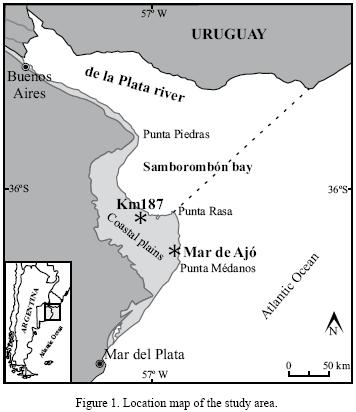
<body><![CDATA[<p align="justify"><font face="verdana" size="2"><b>Palabras clave:</b> <i>foramin&iacute;feros bent&oacute;nicos, playas actuales, reconstrucci&oacute;n paleoambiental, Holoceno, Argentina.</i></font></p> 	    <p align="justify"><font face="verdana" size="2">&nbsp;</font></p> 	    <p align="justify"><font face="verdana" size="2"><b>INTRODUCTION</b></font></p> 	    <p align="justify"><font face="verdana" size="2">In the low&#150;relief northern Buenos Aires coasts (Argentina, southwestern South Atlantic), sedimentary processes were particularly active during the Quaternary owing to eustatic fluctuations in sea level. As a result, marine and marginal marine sediments were deposited in the coastal plain especially during the late Quaternary transgressions. In the coastal plain of the low, gently sloping Samboromb&oacute;n Bay area, the Holocene transgression is well preserved. There, the postglacial sea reached its maximum level at +4&#150;6 m above sea level (asl) at around 6000 year BP, and middle to late Holocene coastal sedimentation was particularly effective. The area comprises prograding and regressive marine sequences deposited in shallow environments corresponding to barrier islands, salt marshes and beaches (Codignotto and Aguirre, 1993; Aguirre and Whatley, 1995). In central Samboromb&oacute;n Bay, Holocene barrier island complexes are represented mainly by sandy and shelly deposits up to +4.5&#150;5 m asl. These barrier island complexes include barrier islands and beach ridges, and constitute the Cerro de la Gloria Member of the Las Escobas Formation. Detailed sedimentological and paleoecological analyses have led some authors to postulate that the Cerro de la Gloria Member was deposited in a shallow infralittoral to intertidal high&#150;energy, soft&#150;bottom environment (Spalletti <i>et al</i>., 1987; Codignotto and Aguirre, 1993). Even when it is clear that these deposits were originated under a combination of waves, coastal currents and tides (Codignotto and Aguirre, 1993), the identity of the driving process and its precise location within the beach are still doubtful. Did the deposits form as shoals or longshore bars? Did they form as beach berms originated by swash during moderate (non&#150;storm) wave conditions in intertidal settings? Were they originated in the emerged beach during extraordinary stormy conditions?</font></p> 	    <p align="justify"><font face="verdana" size="2">The objective of this study is to provide further insight into the origin of the Holocene shelly beach ridges present in central Samboromb&oacute;n Bay, northern Buenos Aires coastal margin, by considering micropaleontological and taphonomic data, namely the species composition and preservation state of benthic foraminifer fossil assemblages. The foraminifera have the potential to be used as proxies of environmental factors and therefore are useful in paleoenvironmental reconstructions including Holocene coastal sand bodies (Rine <i>et al</i>., 1991; Murray&#150;Wallace <i>et al</i>., 1999; Hippensteel and Martin, 1999). However, their proxy value depends on the extent to which their modern ecological relationships can be extrapolated to interpret the fossil record in a particular area (Diz and Frances, 2009). The occurrence of benthic foraminifera in Holocene marine sediments of the northern Buenos Aires coastal plain is relatively well documented (Laprida, 1997, 1999; Laprida and Bertels&#150;Psotka, 2003), but modern littoral assemblages have received little attention. The most detailed studies published to date are those of Boltovskoy (1970, 1976), which deal with distribution of littoral foraminifera in Agentina, Ururguay and Southern Brazil, but the author fails to take quantitative analysis of the microfauna into account.</font></p> 	    <p align="justify"><font face="verdana" size="2">Accurate application of foraminifera to resolve paleoenvironmental problems requires a taphonomic evaluation of fossil assemblages (Barbieri, 1996; Goldstein and Watkins, 1999) since biostratinomic/taphonomic data reflect conditions of depositional environments, representing a valuable additional source of information on coastal dynamics (Brandt, 1989; Laprida and Bertels&#150;Psotka, 2003). Taphonomic signatures (sensu F&uuml;rsich and Oschmann, 1993) may vary in a predictable fashion along an environmental gradient (<i>e.g</i>., shallow to deep water) and hence taphonomic data can be powerful tools in paleoenvironmental studies especially when sedimentologic data are lacking or dubious.</font></p> 	    <p align="justify"><font face="verdana" size="2">In this study we characterize total (live + dead) assemblages recovered from superficial sediments of selected environments of northern Buenos Aires Atlantic littoral from both a taxonomic and a taphonomic point of view, and we compare them with fossil assemblages recovered from a mid&#150;Holocene shelly beach ridge belonging to the Cerro de la Gloria Member of Las Escobas Formation, southern Samboromb&oacute;n Bay. Total populations present a more homogeneous spatial distribution compared to living ones as a consequence of lateral and vertical mixing of tests by biostratinomic processes (Scott and Medioli, 1980; Scott <i>et al</i>., 2001), and hence they are more adequate to compare with fossil assemblages. Consequently, the present study provides insight not only into the present distribution of total littoral foraminiferal assemblages of northeastern Buenos Aires Province but also into the origin and evolution of mid&#150;Holocene beach ridges of the bonaerensian coastal plain.</font></p> 	    <p align="justify"><font face="verdana" size="2">&nbsp;</font></p> 	    <p align="justify"><font face="verdana" size="2"><b>STUDY AREA</b></font></p> 	    <p align="justify"><font face="verdana" size="2">The study area is located along the Atlantic Ocean, in the eastern coastal plain of northeastern Buenos Aires province, Argentina (<a href="#f1">Figure 1</a>). This coastal area is an accresive coast characterized by superficial mid&#150;Holocene marine sediments overlying Pliocene to late Pleistocene "pampean sediments" (Fidalgo <i>et al</i>., 1975). In the Samboromb&oacute;n Bay area, mid&#150;Holocene sediments are represented by the Las Escobas Formation (Fidago <i>et al</i>., 1975), which includes two members: Cerro de la Gloria and Canal 18. The Cerro de la Gloria Member comprises a well&#150;stratified succession of white, fine to coarse&#150;grained shelly gravels and light brown, fine&#150;grained siliciclastic sands (Spalletti <i>et al</i>., 1987). The gravel fraction is mainly composed of unarticulated and broken bivalve shells. Calcareous microfossils, especially benthic foraminifera and ostracods, are abundant in both the shelly gravel and siliciclastic sand beds (Laprida, 1997; Laprida and Bertels&#150;Psotka, 2003). These deposits were interpreted as beach ridges and barrier islands related to high energy coastal environments (Tonni and Fidalgo, 1978; Bertels&#150;Psotka and Laprida, 1998). To the south, between Punta Rasa and Punta M&eacute;danos, mid&#150;Holocene coastal marine sediments are represented by the Mar de Aj&oacute; Member of the Pozo N&deg; 17 Formation (Parker, 1979).</font></p> 	    ]]></body>
<body><![CDATA[<p align="center"><font face="verdana" size="2"><a name="f1"></a></font></p> 	    <p align="center"><font face="verdana" size="2"><img src="/img/revistas/rmcg/v28n1/a4f1.jpg"></font></p> 	    <p align="justify"><font face="verdana" size="2">The modern littoral area adjacent to the Holocene deposits corresponds to tidal flats in the northern Samboromb&oacute;n Bay area &#150;between Punta Piedras and Punta Rasa&#150; and to sandy beaches of the Argentine Sea, south of Punta Rasa. Buenos Aires coasts between Punta Rasa and Punta M&eacute;danos (<a href="#f1">Figure 1</a>) are exposed to wave action, and they are storm and wave dominated. It is an open coast, straight, with North&#150;South shoreline orientation. Prevailing directions of incident waves are from the S and SSE, producing a northward littoral drift current. The tidal regime is semidiurnal with diurnal inequalities with mean amplitude ranging from 1.37 m (spring tides) to 0.78 m (neap tides) (Servicio de Hidrograf&iacute;a Naval, 2001). Extreme values range from 0 to 2.40 m for high tides and from 0.40 to 1.60 m for low tides (Perillo, 1979). When occurring jointly with spring tides, storms reach the dune base and cause erosional escarpments. The beach varies in width from 40 to 140 m and has a mean slope of 2&deg;. The beach corresponds to the intermediate type with bars and channels (Sunamura, 1988), where stable and non stable (seasonal) berms were observed. Swash bars are frequently observed at the foreshore, and range from 15 to 25 m in width and 0.25 to 0.50 m in height. Two breaker lines can be distinguished next to the shore, between 40 and 100 m and between 140 and 160 m from the mean tide line, respectively. The mean wave height is 0.70 m, while the maximum wave height is 2 m. The mean wave period is 8.4 seconds (Speroni <i>et al</i>., 1999).</font></p> 	    <p align="justify"><font face="verdana" size="2">&nbsp;</font></p> 	    <p align="justify"><font face="verdana" size="2"><b>MATERIALS AND METHODS</b></font></p> 	    <p align="justify"><font face="verdana" size="2">For modern foraminiferal analysis, twenty six superficial sediment samples were collected from two different littoral localities of Mar de Aj&oacute;, Municipality of La Costa (<a href="#f1">Figure 1</a>), during (austral) summer of 2002 and 2007. Samples were taken along measured west&#150;east transects perpendicular to the coastline and spaced about 2 km, at 36&deg;43'44.1"S &#150; 56 &deg;40'24.4"W (Southern transect, 12 samples) and at 36&deg;42'37.4"S &#150; 56&deg;40'30.7"W (Northern transect, 14 samples). Transects were defined from the top of the dune in the foredune to the lower shoreface at around &#150;10 m depth. Samples were collected manually while walking and wading along the intertidal zone and the backshore. A Van Veen grab sampler was used to recover sediments at the sediment/water interface in subtidal settings. From each sample, only the uppermost layer of the sediment (about 5&#150;10 cm, according to Denne and Sen Gupta, 1989) was scraped off and kept in alcohol 70 %. A solution of 2 ppm Rose Bengal in ethanol was used for staining live specimens.</font></p> 	    <p align="justify"><font face="verdana" size="2">The northern transect (<a href="/img/revistas/rmcg/v28n1/a4t1.jpg" target="_blank">Table 1</a>) lacks seasonal berms, but a stable berm approximately 30 m in width and 0.25 m in height is observed. The beach width varies between 90 and 140 m and the average grain size is medium to fine sand, while in the intertidal sector the average is medium to coarse sand. In the southern transect (<a href="/img/revistas/rmcg/v28n1/a4t1.jpg" target="_blank">Table 1</a>) no stable or seasonal berms are observed. The beach width varies between 55 and 65 m and the average grain size is medium to fine sand.</font></p> 	    <p align="justify"><font face="verdana" size="2">For Holocene foraminiferal analysis, twenty nine sediments samples were collected from an outcrop, an artificial quarry of 3.90 m located at the left margin of the provincial Route N&deg; 11, in the milestone numbered km 187 (Profile KM187). The outcrop belongs to the Cerro de la Gloria Member of Las Escobas Formation (Fidalgo <i>et al</i>., 1975).Twenty nine samples of 500 g were taken from each identified bed (<a href="#f2">Figure 2</a>) irrespective of its grain size, geometry and internal structure. KM187 profile comprises a well stratified succession of bioclastic deposits with subordinated light brown siliciclastic sands, which are well defined by sharp changes in grain size. Bioclasts are mainly composed of unarticulated and fragmented shells of bivalves and pebbles of caliche. Subhorizontal stratification is dominant in shelly gravels, whereas hummocky and trough stratification are also present, the latter as isolated sets intercalated in the subhorizontal stratificated facies.</font></p> 	    <p align="center"><font face="verdana" size="2"><a name="f2"></a></font></p> 	    <p align="center"><font face="verdana" size="2"><img src="/img/revistas/rmcg/v28n1/a4f2.jpg"></font></p> 	    ]]></body>
<body><![CDATA[<p align="justify"><font face="verdana" size="2">Modern and fossil sediment samples were wet washed in the laboratory through a 0.075 mm sieve. Foraminifers were separated from the sand&#150;sized fraction under a stereomicroscope. On the basis of previous experience (Laprida, 1997, 1999; Laprida and Bertels Psotka, 2003), aprox. 7 g of dry sediment for each sample were analyzed or approximately 300 individuals were picked, whichever came first. According to Phleger (1960), Buzas (1990) and Scott <i>et al</i>. (2001), this amount provides sufficient accuracy for most quantitative examinations. Generic assignment of taxa follows Loeblich and Tappan (1988), while species identification follows Boltovskoy (1954a, 1954b, 1957, 1958), Boltovskoy <i>et al</i>. (1980) and Laprida (1997, 1999). Taphonomic modification of tests in both modern and fossil assemblages were observed in order to obtain additional (paleo)environmental information. In order to avoid so&#150;called observer error (Rothfus, 2004), taphonomic observations were done by the same operator, using a stereomicroscope at 100x magnification. Taphonomic modifications were determined for each specimen observed. According to type and degree of taphonomic modification, five categories were defined: a) Well preserved shells, lacking at the most the last (more fragile) chambers; b) partially or totally recrystallized shells; c) "black" shells with chamber fillings and/or with a polished coating in shades of black and dark brown; d) abraded and scratched shells; and e) broken and sometimes fractured shells. Fragmented shells denote shells with less than 50% of its original shell material preserved. Abraded shells include eroded shells with polished morphological features and intensely eroded, completely abraded shells. Both abrasion (physical agents) and dissolution (chemical/biological processes) can create similar taphonomic signatures, and distinguishing between them is usually not possible. Therefore, abrasion and fragmentation were established by tallying breaks independent of their origin (physical, chemical and/or biological).</font></p> 	    <p align="justify"><font face="verdana" size="2">Abundance of tests of modern and fossil assemblages was calculated from the extrapolation of the number of individuals picked out of each sample to 10 g of dry, untreated sediment. Multivariate statistical analyses were applied to both sets of samples using PAST software (version 1.71) (Hammer <i>et al</i>., 2001) in order to identify patterns and correlations among the different parameters measured (species composition, taphonomical modifications of tests, water depth and grain size). Rare species that occur at &lt;1% of the whole assemblage were excluded from the statistical analysis. Sample KM187&#150;1, which only yielded two individuals of <i>Buccella peruviana</i> (D'Orbigny, 1839a), was excluded from the database because of its little reliability. An unconstrained cluster analysis based on the unweighted pair&#150;group average algorithm and the Bray&#150;Curtis similarity index was performed on the taxonomic composition (species relative contribution) of modern and fossil assemblages considered jointly. Likewise, an unconstrained cluster analysis based on the unweighted pair&#150;group average algorithm and the Euclidean distance similarity index was performed on the taphonomic signatures of the whole set of samples. Clusters were defined by the branches cut by a line drawn perpendicularly to the mid&#150;length of the longest distance between successive nodes of the dendogram. When a node fell very close to this line, it was redrawn so as to include both groups, since in view of our objectives and the nature of this investigation underestimation due to the loss of information was deemed worse than overestimation due to acceptance of a somewhat feeble but, in our understanding, meaningful grouping. A total of six linear discriminant analysis (LDA) were performed on both sets of recent samples, in order to evaluate whether subtidal and supratidal beach samples, and northern and southern transect samples, could be distinguished from each other with respect to their species composition, taphonomic signatures and grain size. A leave&#150;one&#150;out validation was performed on each analysis by excluding each sample in turn from the calculation of the discriminant function and classifying with the resulting algorithm. Finally, the correlation between grain size, preservational state and species composition in each transect was assessed by means of the Mantel test in order to evaluate the possibility that both sites were undergoing different processes. The species composition similarity matrices were computed with the Bray&#150;Curtis index, while the others were calculated using the Euclidean distance as a similarity index. Since three Mantel tests were performed on each set of samples, a Bonferroni correction was applied to the significance level, so that the <i>p</i>&#150;value of each test was compared with an adjusted alpha &#945;<sub>ad</sub> = &#945; / 3 = 0.017. PAST software was also used to calculate ecological parameters such as species number (S) and Shannon&#150;Weaver diversity index (H) in both modern and fossil assemblages.</font></p> 	    <p align="justify"><font face="verdana" size="2">Samples were named according to: NST (Northern Submerged Transect) for submerged (subtidal) sites of the Northern transect; NET (Northern Emerged Transect) for emerged (intertidal and supratidal) sites of the Northern transect; SST (Southern Submerged Transect) for submerged (subtidal) sites of the Southern transect; SET (Southern Emerged Transect) for emerged (intertidal and supratidal) sites of Southern transect; and KM187 for KM187 profile. Ordinals indicate relative position in each transect and stratigraphical level in the Mid&#150;Holocene profile.</font></p> 	    <p align="justify"><font face="verdana" size="2">&nbsp;</font></p> 	    <p align="justify"><font face="verdana" size="2"><b>RESULTS</b></font></p> 	    <p align="justify"><font face="verdana" size="2"><b>Foraminifera from modern environments</b></font></p> 	    <p align="justify"><font face="verdana" size="2">All samples bore benthic foraminifera, even those of the foredune (base and top of the dune). A total of 78 foraminifer species and 13 genera left in open nomenclature were identified, of which only 13 species showed a relative abundance higher than 1% (<a href="/img/revistas/rmcg/v28n1/a4t2.jpg" target="_blank">Table 2</a>). The number of tests in 10 g of sediment varied from about 95 to 3,559, the number of species in each sample varied from 5 to 38 (<a href="/img/revistas/rmcg/v28n1/a4t3.jpg" target="_blank">Table 3</a>), and the Shannon&#150;Weaver diversity index, H(S), varied between 2.67 and 0.85. Assemblages in the Northern transect tend to be more diverse and abundant than in the Southern transect. As Boltovskoy (1970) stated previously for littoral settings, very few living specimens were present and it was impossible to use them for statistical analysis. Thus, the following study is based on total (live + dead) assemblages. Hyaline calcareous species are dominant. Even though the majority of tests are moderately well preserved, some showed different types and degrees of alteration. In some samples several unidentifiable quinqueloculinid miliolids were mostly broken or fragmented, and hence were lumped in <i>Quinqueloculina spp.</i></font></p> 	    <p align="justify"><font face="verdana" size="2">Modern littoral samples are dominated by a few prolific species of benthic foraminifera, particularly <i>Buccella peruviana, Quinqueloculina seminula</i> (Linn&eacute;, 1758),<i> Ammonia beccarii</i> (D'Orbigny, 1839a), <i>Discorbis williamsoni </i>(Chapman and Parr, in Parr, 1932), and <i>Elphidium discoidale</i> (D'Orbigny, 1839a). Species that are less common, but are nevertheless consistent elements of the fauna, include <i>Quinqueloculina patagonica </i>D'Orbigny, 1839b, <i>Textularia gramen</i> D'Orbigny, 1846, <i>Elphidium gunteri</i> Cole, 1931, <i>Quinqueloculina milleti</i> (Wiesner, 1912),<i> Quinqueloculina </i>sp. cf. <i>Q. implexa</i> Terquem, in Terquem and Terquem, 1886, <i>Trochammina ochracea</i> (Williamson, 1858), <i>Miliolinella subrotunda</i> (Montagu, 1803) and <i>Cibicidoides </i>sp. cf. <i>C. fletcheri</i> (Galloway and Wissler, 1927). <i>Bolivina striatula</i> Cushman, 1922 is locally abundant in the Southern transect in samples adjacent to the shore and confined to subtidal settings.</font></p> 	    <p align="justify"><font face="verdana" size="2"><a href="/img/revistas/rmcg/v28n1/a4t3.jpg" target="_blank">Table 3</a> shows the data obtained for the Norhern transect. The benthic foraminiferal number (specimens/10 g dry sediment), species number and the Shannon&#150;Weaver diversity index H(S) are related with water depth and decrease onshore. Lower number of specimens, species and diversity occur at the backshore and the foredune. Considering the total number of species and the total assemblages identified in the Northern transect, only <i>Buccella peruviana, Ammonia becarii</i> and <i>Elphidium discoidale</i> (the BAE group) can be considered as widely distributed along the transect, with <i>Buccella peruviana</i> being by far the dominant species (relative contribution between 63&#150;36 %). The only exception is a lower shoreface samples below &#150;7.5 m where <i>Quinqueloculina seminula</i> dominates, accounting for 21&#150;35 % of the assemblages. <i>Discorbis williamsoni</i> is distributed in all subtidal samples but it is virtually absent in supratidal samples. <i>Ammonia beccarii </i>and<i> Elphidium discoidale</i>, which are also distributed throughout, become dominant only in the upper shoreface and in the backshore and foredune, where the BAE group represents more than 50 % of assemblages. Species such as <i>Trochammina ochracea, Quinqueloculina milletti </i>and <i>Quinqueloculina</i> sp. cf <i>Q. implexa </i>are locally abundant in water depth greater than &#150;7m but they can be categorized as sporadic, and they do not represent more than 12 % of each assemblage.</font></p> 	    <p align="justify"><font face="verdana" size="2">The following species are classified as accessory species: <i>Quinqueloculina patagonica, Quinqueloculina milletti, Elphidium gunteri, Cibicidoides</i> sp. cf. <i>C. fletcheri </i>and<i> Miliolinella subrotunda</i>. Other species occur in relative abundance lower than 1% of the assemblage and are considered to be rare or accidental species.</font></p> 	    ]]></body>
<body><![CDATA[<p align="justify"><font face="verdana" size="2">Taphonomic modifications of shells in subtidal settings are directly related with water depth (<a href="/img/revistas/rmcg/v28n1/a4f3.jpg" target="_blank">Figure 3a</a>). Well preserved tests represent more than 70 % of assemblages in the lower shoreface, and vary between 62&#150;42 % in the upper shoreface. Fragmented tests vary between 30&#150;18 % in the lower shoreface and increase to 36&#150;54 % in the upper shoreface. In the foreshore, fragmented shells prevail (51&#150;56 %) and abrasion and recrystalization are low (2&#150;6 %). In the backshore, well preserved tests vary between 38&#150;58 %, and fragmentation is intense (26&#150;50 %). Abraded and recrystalized shells are relatively more abundant in the backshore, especially in the base of the dune, where up to 9 % of the shells are recrystalized, and at the top of the dune, where abraded tests account for 12 % of the assemblage. The number of tests left in open nomenclature due to taphonomic modification varies between 8 % and 27 %.</font></p> 	    <p align="justify"><font face="verdana" size="2"><a href="/img/revistas/rmcg/v28n1/a4t2.jpg" target="_blank">Tables 2</a> and <a href="/img/revistas/rmcg/v28n1/a4t4.jpg" target="_blank">4</a> shows the data concerning the Southern transect. Highest species number, abundance and diversity are found in the shoreface and decrease in the foreshore, and are lowest in the backshore and the foredune. Considering the total number of species and the total assemblages identified in the Southern transect, only <i>Buccella peruviana, Quinqueloculina seminula, Ammonia becarii</i> and <i>Elphidium discoidale </i>can be considered as widely distributed throughout the transect.<i> Buccella peruviana</i> is by far the dominant species in supratidal settings (relative contribution per sample &gt;36 %) and in almost all subtidal areas. <i>Ammonia beccarii, Bolivina striatula, Quinqueloculina seminula, </i>and<i> Textularia gramen</i> can be locally abundant in subtidal settings. <i>D. williamsoni</i> is distributed in all subtidal samples but it is absent in samples from the backshore. In the foreshore and the backshore, the species of the BAE group represents more than 70 % of assemblages.</font></p> 	    <p align="justify"><font face="verdana" size="2">The following species are classified as accessory: <i>Quinqueloculina patagonica, Elphidium gunteri, Elphidium galvestonense</i> Kornfeld, 1931, <i>Cibicidoides</i> sp. cf. <i>C. fletcheri, Cribrorotalia meridionalis</i> (Cushman and Kellett, 1929), <i>Pyrgo ringens</i> (Lamarck, 1804), and <i>Miliolinella subrotunda</i>. Other species occur in relative abundance lower than 1 % of the assemblage and are considered to be rare or accidental species.</font></p> 	    <p align="justify"><font face="verdana" size="2">Taphomomic modifications are directly related with water depth in subtidal settings (<a href="/img/revistas/rmcg/v28n1/a4f3.jpg" target="_blank">Figure 3b</a>). Well preserved tests represent more than 70 % of assemblages in the lower shoreface, and vary between 60&#150;44 % in the upper shoreface. Fragmented tests vary between 29&#150;15 % in the lower shoreface and clearly increase onshore. In the upper shoreface, fragmented tests represent 39&#150;55 %, and in the foreshore, fragmented shells attain 63&#150;41 % and abraded shells increase to 8&#150;10 %. In the backshore, well preserved tests vary between 22&#150;38 %, but fragmentation is intense (40&#150;43 %). Abraded and recrystalized shells are present almost exclusively in the emerged beach and are relatively abundant in the backshore, and especially in the foredune, where they attain 17 %. The number of test left in open nomenclature due to taphonomic modification is highest in the intertidal zone (40 %) and decreases offshore, whereas in the foreshore and backshore tends to be rather constant (~18 %).</font></p> 	    <p align="justify"><font face="verdana" size="2"><b>Foraminifera from Holocene environments</b></font></p> 	    <p align="justify"><font face="verdana" size="2"><a href="/img/revistas/rmcg/v28n1/a4t2.jpg" target="_blank">Tables 2</a> and <a href="/img/revistas/rmcg/v28n1/a4t5.jpg" target="_blank">5</a> show data obtained from the KM187 profile, where a total of 7,340 individuals were picked out. Species number in each sample varies between 5 and 13, the Shannon&#150;Weaver diversity index varies between 0.73 and 1.48, and absolute abundance varies between 2 (in the topmost sample) and 485 specimens in 10 g dry sediment. <i>Only Buccella peruviana, Ammonia becarii </i>and<i> Elphidium discoidale</i> can be considered as widely distributed in all samples. In fact, the BAE group represents near 95 % of the assemblage in some samples. <i>Buccella peruviana</i> is by far the dominant species (48 % of the whole assemblage). <i>Elphidium discoidale</i> represents 24 % and <i>Ammonia beccarii</i> 21 % of the total assemblage, and only <i>Elphidium gunteri</i> can be considered as an accessory species. All other species occur in relative abundance lower than 1 % of each assemblage and are considered to be rare or accidental species.</font></p> 	    <p align="justify"><font face="verdana" size="2">Assemblages from KM187 are moderately well to poorly preserved. In the base (KM187&#150;29/22), the majority of shells are well preserved (<a href="#f4">Figure 4</a>), while in the middle of the section (KM187&#150;21/12) shells with chamber fillings and/or dark polished coatings tend to increase upward (KM187&#150;11/9) and finally constitute more than 70 % of the assemblages. In the topmost samples (KM187&#150;8/1), well preserved shells and shells with chamber fillings and/or dark polished coatings are equally represented, while fragmented shells tend to increase and abraded shells to decrease upward. Remarkably, taphonomic condition of assemblages does not seem to be related with lithology (<a href="#f2">Figure 2</a>).</font></p> 	    <p align="center"><font face="verdana" size="2"><a name="f4"></a></font></p> 	    <p align="center"><font face="verdana" size="2"><img src="/img/revistas/rmcg/v28n1/a4f4.jpg"></font></p> 	    <p align="justify"><font face="verdana" size="2"><b>Statistical analyses</b></font></p> 	    ]]></body>
<body><![CDATA[<p align="justify"><font face="verdana" size="2">The cluster analysis performed on the whole set of samples with regard to species composition (cofenetic correlation coefficient: 0.8568) yielded a dendogram (<a href="#f5">Figure 5</a>) where five clusters and one independent entity &#150;namely a sample that doesn't group with any others (Herrera&#150;Moreno, 2000)&#150; were recognized. The largest grouping (Cluster 5, <a href="/img/revistas/rmcg/v28n1/a4t6.jpg" target="_blank">Table 6</a>) comprises all assemblages from the KM187 profile, with the exception of sample KM187&#150;2, consistent with the overwhelming dominance of the BAE group. Sample KM187&#150;2 differs because the dominance of <i>Buccella peruviana</i> is even more marked, accounting for 70% of the assemblage, which links this sample with modern assemblages from the backshore to the lower shoreface (Cluster 4, <a href="/img/revistas/rmcg/v28n1/a4t6.jpg" target="_blank">Table 6</a>). There, <i>B. peruviana</i> is at least four times as abundant as <i>A. beccarii</i>, which in turn is over twice as abundant as <i>E. discoidale</i>. The remaining clusters comprise submerged samples in which other species are as abundant as, or even more than <i>B. peruviana, A. beccarii </i>or E. discoidale. The lower shoreface from the northern transect is characterized by the dominance of <i>Quinqueloculina seminula</i>; by contrast, in the remaining submerged samples from this transect (Cluster 4), this species becomes 10 times less abundant. <i>Quinqueloculina seminula</i> is also relevant as an accompanying species in Cluster 6, made up of two of the lower shoreface samples from the southern transect dominated by <i>A. beccarii</i>, and in the sample SST&#150;5, an independent entity (Cluster 2). Sample SST&#150;5 stands alone on account of being the only one where <i>B. peruviana</i> is co&#150;dominant and where Textularia gramen makes up 25 % of the foraminiferal fauna. Finally, Cluster 3 groups the two shallowest samples of the upper shoreface from the southern transect &#150;SST 6 and SST 7&#150;, where <i>B. peruviana</i> becomes again dominant and is accompanied by <i>E. discoidale, T. gramen</i>, and <i>Discorbis williamsoni</i>.</font></p> 	    <p align="center"><font face="verdana" size="2"><a name="f5"></a></font></p> 	    <p align="center"><font face="verdana" size="2"><img src="/img/revistas/rmcg/v28n1/a4f5.jpg"></font></p> 	    <p align="justify"><font face="verdana" size="2">The cluster analysis performed on the whole set with regard to taphonomic modifications (cofenetic correlation coefficient: 0.8611) (<a href="#f6">Figure 6</a>) led to the recognition of six clusters and two independent entities (<a href="/img/revistas/rmcg/v28n1/a4t7.jpg" target="_blank">Table 7</a>). Most samples from the base of KM187 are grouped in Cluster 1, characterized by yielding the greatest amount of well&#150;preserved tests (almost 50 % in average) of the whole set of Holocene samples. In Cluster 2, which includes several samples mostly from the top and middle layers of KM187, filled or coated shells are nearly twice more abundant in average than in Cluster 1. The four remaining samples of the profile consist of almost 70 % of filled or coated shells and are grouped in Cluster 3. Samples from modern environments, which lack filled or coated shells, fall entirely apart from Holocene ones and are grouped in account of their position along the foreshore and the upper shoreface. Some of the lower shoreface samples fall together in Cluster 4, which shows the highest proportion of well preserved tests (75 % on average) of the complete set. Cluster 7 comprises most of the upper shoreface of the northern transect and some foreshore samples, all of which present a relatively high amount of fragmented shells. Finally, most emerged and uppermost shoreface samples are grouped in Cluster 8 where 50 % of tests are fragmented. Samples SET&#150;1 and SET&#150;4 are independent entities; the former, located at the base of the foreshore, because of the high proportion of broken shells &#150;the highest in the whole set&#150;; and the latter, located at the base of the foredune, because of the relatively high proportion of recrystallized and abraded tests.</font></p> 	    <p align="center"><font face="verdana" size="2"><a name="f6"></a></font></p> 	    <p align="center"><font face="verdana" size="2"><img src="/img/revistas/rmcg/v28n1/a4f6.jpg"></font></p> 	    <p align="justify"><font face="verdana" size="2">Cluster analysis suggests that there are some meaningful differences among samples from different locations, which led us to perform a series of linear discriminant analyses on the modern dataset in order to evaluate the consistence of these differences. The results are shown in <a href="#t8">Tables 8</a> and <a href="#t9">9</a>. The test successfully discriminates samples from both transects: however, it doesn't perform as well in distinguishing supralittoral from sublittoral samples, except with regard to taxonomic composition. Additionally, the correlation between grain size, preservation state and species composition was assessed by means of the Mantel test. The results (<a href="#t9">Table 9</a>) show that species composition is marginally but significantly correlated with taphonomic signature in both sites, whereas species composition and taphonomic signature are significantly correlated with grain size only in the northern transect.</font></p> 	    <p align="center"><font face="verdana" size="2"><a name="t8"></a></font></p> 	    <p align="center"><font face="verdana" size="2"><img src="/img/revistas/rmcg/v28n1/a4t8.jpg"></font></p> 	    <p align="center"><font face="verdana" size="2"><a name="t9"></a></font></p> 	    ]]></body>
<body><![CDATA[<p align="center"><font face="verdana" size="2"><img src="/img/revistas/rmcg/v28n1/a4t9.jpg"></font></p> 	    <p align="justify"><font face="verdana" size="2">&nbsp;</font></p> 	    <p align="justify"><font face="verdana" size="2"><b>DISCUSION</b></font></p> 	    <p align="justify"><font face="verdana" size="2"><b>Littoral foraminifera from modern beaches</b></font></p> 	    <p align="justify"><font face="verdana" size="2">The benthic foraminifera from coastal settings of northern Buenos Aires Atlantic coast are moderately diverse. Shannon&#150;Wiener index values obtained in this study are consistent with those typical of marginal marine environments, according to Murray (2006). The number of benthic foraminifera in subtidal settings is similar to those obtained from the inner shelf elsewhere (Murray, 2006; Mendes <i>et al</i>., 2004). A few samples have a modest contribution of miliolids with porcelaneous walls, as Murray (2006) pointed out for the whole southwestern South Atlantic. Agglutinated shells tend to be destroyed differentially even in subtidal settings (Denne and Sen Gupta, 1989; Murray, 2006; Barbieri, 1996), and as a consequence, hyaline calcareous shells dominate the whole modern benthic assemblage.</font></p> 	    <p align="justify"><font face="verdana" size="2">Species recorded in northern Buenos Aires littoral follow the large regional trend of the littoral benthic foraminifera from the Southwest South Atlantic, but clearly differ from the inner shelf (&gt;40 m depth) assemblages defined by Boltovskoy and Totah (1985) in terms of taxonomic composition, dominance and diversity. All identified species dwell in southern Brazil and Uruguay neighboring littoral areas (Closs, 1963; Closs and Barberena, 1962; Closs and Lopes&#150;Madeira, 1968; Boltovskoy, 1970). Among the dominant species, <i>Buccella peruviana</i> is the most constant and common foraminifera in the South Atlantic littoral area and dominates throughout the whole Argentine shelf (Boltovskoy, 1970). <i>Ammonia beccarii, Quinqueloculina seminula</i> and <i>Discorbis williamsoni</i> are widely distributed all along <i>Argentine littoral</i> and inner shelf (Boltovskoy 1970; Boltovskoy and Wright, 1976; Boltovskoy <i>et al</i>., 1980). <i>Elphidium discoidale</i> is typically an eurytopic, nearshore species inhabiting South American warm waters north of 41&deg;S (Boltovskoy, 1970; Hippensteel and Martin, 1999).</font></p> 	    <p align="justify"><font face="verdana" size="2">Living foraminifera usually show a pronouncedly patchy geographic distribution in shallow waters (Schaffer, 1971; Boltovskoy and Wright, 1976). Consequently, detailed taxonomic composition of modern total assemblages is frequently determined by local (small scale) environmental parameters. Strong dominance of <i>Ammonia beccarii </i>and Bolivina striatula in the lower shoreface of the southern transect seems to be related to muddy substrates, since these species prefer organic&#150;rich, fine&#150;grained sediments (Alve and Murray, 1999). Abundance and taxonomic composition of total littoral assemblages reflect biological preferences of species but also taphonomic processes operating in the coastal areas (Barbieri, 1996; Murray and Alve, 1999). This could account for the fact that, although our findings confirm the general taxonomic composition consigned by Boltoskoy (1970), small, fragile and/or scarce and rare species have not been found in our littoral samples. Most inner continental shelf assemblages are parauthochtonous (Callender <i>et al</i>., 1992), and potential taphonomic modifications observed are transport of tests from the position of life to be deposited elsewhere, damage of tests and, finally, total destruction of tests (Murray, 2006). This is evident in the backshore and foredune where the number of specimens and diversity of assemblages are strongly reduced as a consequence of biostratinomic processes (mainly shell destruction related with storm waves, winds and subaerial exposure) due to preferential preservation/destruction of more resistant/fragile species.</font></p> 	    <p align="justify"><font face="verdana" size="2">The Mantel Test indicates that in the Northern transect, taphonomic signatures and taxonomic composition of total assemblages are highly correlated to grain size, and hence, with sedimentary processes in the littoral. In turn taphonomic signatures of assemblages are correlated to taxonomic composition, indicating that taphonomic (mainly biostratinomic) processes are crucial in defining the specific composition of assemblages in the northern transect. Total abundance and diversity confirm this hypothesis since they are related to water depth in subtidal settings and with position from the shoreline in the backshore. However, these relationships are not as straightforward in the Southern transect, where only taphonomic modifications are related with water depth and position from the shoreline. For the Southern transect, the Mantel test does not show any significant correlation of the taphonomic signatures or taxonomic composition with grain size, although taphonomic signatures and taxonomic composition show a weak (marginal) correlation. A plausible explanation would be that taphonomic processes other than purely biostratinomics are crucial in defining the specific compositions of assemblages in the southern transect, since variations in shell preservation are not linked only with bathymetrically&#150;dependent environmental variables (Loubere <i>et al</i>., 1993; Murray and Alve, 1999). However, additional environmental data is needed to identify which processes are operating in the generation of death (and hence total) assemblages in the Southern transect.</font></p> 	    <p align="justify"><font face="verdana" size="2">Although location of samples can be a major factor affecting faunal trends even in a small scale, relative abundance, abundance and taphonomic modification of shells seem to be rather similar in both transects. Cluster analyses suggest that there are some meaningful differences in species composition among modern samples from similar depths, especially in subtidal settings. In fact, taxonomic composition does not allow bathymetrical classification of samples when all samples are considered together. This lends weight to Boltovskoy's (1970) statement that foraminiferal assemblages between the intertidal zone and &#150;15 m depth "are very similar" (sic.). However, there are some bathymetric tendencies in taxonomic composition especially in the lower shoreface (<a href="/img/revistas/rmcg/v28n1/a4t6.jpg" target="_blank">Table 6</a>). There,<i> Buccella peruviana</i> represents "only" 20&#150;26 % of assemblages and <i>Quinqueloculina seminula</i> represents between 10&#150;39 %. In the upper shoreface, the BAE group increases its dominance, and upper shoreface, foreshore, backshore and foredune assemblages are rather similar in terms of taxonomic composition due to the outstanding dominance of <i>Buccella peruviana</i>. There is no doubt that biological and taphonomical processes determine the benthic foraminiferal assemblages in the lower shoreface, but taphonomic processes dominate not only in the emerged beach, but also in upper shoreface settings. In terms of wave energy, emerged beach is only influenced by storm waves and winds, and sediments can be periodically remobilized. Shells derived from shoreface settings accumulate on backshore and foredune (Murray, 2006), and ultimately they return to the foreshore and upper shoreface by offshore transport of sand during episodes of coastal erosion (Albertzart and Wilkinson, 1990). This coastal dynamic strengthens the argument that supratidal and upper shoreface assemblages are taxonomically similar due to taphonomic processes operating in the beach.</font></p> 	    <p align="justify"><font face="verdana" size="2">Some species show patchy distribution, a major factor in distinguishing between transects as assessed by linear discriminant analysis (LDA) performed on taxonomic composition. <i>Trochammina ochracea, Quinqueloculina milletti, Bolivina striatula, </i>and<i> Textularia gramen</i> are locally abundant in submerged sites, probably related to local environmental parameters. A similar patchy distribution of foraminifera off Argentine coasts was cited by Boltovskoy and Lena (1969). Additionally, LDA also distinguished successfully between sublittoral and supralittoral assemblages. In other words, even when taxonomic composition of modern assemblages differ in both transects, subtidal and supratidal assemblages could be easily discriminated. This point is particularly relevant because it implies that modern benthic foraminiferal assemblages from sandy beaches of northern Buenos Aires Province are potentially an adequate general baseline to discriminate Quaternary beach subenvironments if both taxonomic and taphonomic features are considered together.</font></p> 	    ]]></body>
<body><![CDATA[<p align="justify"><font face="verdana" size="2">As noted above, LDA distinguished very well between northern and southern transect, which suggests that biological and sedimentological processes operating on both sites differ, especially in subtidal settings. Particular environmental conditions, expressed as different geomorphological features and granulometric tendencies between northern and southern transects may be at least in part responsible for patchy distribution of species. Conversely, foredune, backshore, and upper shoreface assemblages tend to group when taxonomic composition is considered. Since, in the emerged beach, taphonomic processes largely dominate over biological ones, it can be suggested that taphonomic processes are crucial in defining the taxonomic composition of modern total assemblages from the upper shoreface to the foredune, while biological processes, which are determined by local environmental parameters in the submerged beach, are responsible for determining taxonomic composition of modern total assemblages in the lower shoreface.</font></p> 	    <p align="justify"><font face="verdana" size="2">Taphonomic signatures are not uniformly distributed along the bathymetric gradient. Notably, taphonomic modifications allow the recognition between lower shoreface, upper shoreface and foreshore/backshore/foredune assemblages, indicating that taphonomic processes are mainly determined by water depth, and depend mainly on water energy, aerial exposure, and beach dynamics, thus showing high potential to be used in paleoenvironmental analyses.</font></p> 	    <p align="justify"><font face="verdana" size="2">Morphological features of the species involved can explain their selective preservation in the different subsettings. The BAE group dominates from the upper shoreface to the foredune. <i>Elphidium discoidale</i> has a very heavy, strong, biconvex planospiral shell, while <i>Buccella peruviana </i>and<i> Ammonia beccarii</i> have strong, biconvex, trochospiral shell. According to Peebles and Lewis (1991), large tests are more resistant to abrasion than smaller tests. These species are hence preferentially preserved in the sediments of the foreshore and the foredune. Beaches in the northeast of Buenos Aires Province are exposed to strong wave action, and they are storm and wave dominated, thus it is not surprising that this three large species dominate total assemblages especially at high energy settings, where fragile species are preferentially removed and/or destroyed. In the lower shoreface, fragile species such as <i>Quinqueloculina seminula, Discorbis williamsoni </i>and<i> Textularia gramen</i> are moderately well represented, but they are selectively destroyed in high energy and supratidal settings. In the upper shoreface and in the emerged beach these species represent in average less than 4 % of total assemblages, whereas in subtidal settings they can attain more than 10 %. Hyaline shells are less susceptible to dissolution than arenaceous shells (Peebles and Lewis, 1991), and according to Corliss and Honjo (1981), hyaline trochospiral taxa are more resistant to dissolution than porcelanaceous species such as <i>Quinqueloculina seminula</i>. Textularia gramen has a biserial test with agglutinated wall with relative coarse grains, traversed by canaliculi that may open as perforations or be closed externally by a thin agglutinated layer (Loeblich and Tappan, 1988). In turn, thin&#150;walled foraminifera with a high density of pores are more susceptible to dissolution (Corliss and Honjo, 1981). <i>Discorbis williamsoni</i> has a small test with calcareous, thin wall coarsely perforated in the umbilical side, with prominent umbilical flaps and chamberlets beneath the flaps.</font></p> 	    <p align="justify"><font face="verdana" size="2"><b>Comparison between Holocene and modern assemblages</b></font></p> 	    <p align="justify"><font face="verdana" size="2">Taxonomic lists are rather similar between Holocene and supratidal modern assemblages, but they differ with respect to diversity, numerical dominance of taxa and taphonomic modifications. In general, diversity is strongly reduced in Holocene samples, where only the three species of the BAE group occur consistently and abundantly. The BAE group is also common in present day habitats and they are especially abundant in the emerged beach, but they tend to be comparatively less dominant. Additionally, some key species locally important in defining groups of modern total assemblages are virtually absent from the Holocene samples. For example, <i>Discorbis williamsoni</i> is nearly absent from both emerged beach and Holocene samples, while in subtidal settings it usually represents more than 3 % in average (<a href="/img/revistas/rmcg/v28n1/a4t6.jpg" target="_blank">Table 6</a>).<i> Quinqueloculina seminula</i> is well represented in subtidal settings of both transects (&gt;10 % average, <a href="/img/revistas/rmcg/v28n1/a4t6.jpg" target="_blank">Table 6</a>), but it is nearly absent from Holocene and supratidal beach samples. These species, which can be locally important constituents of the benthic assemblages in subtidal settings, are fragile enough to be destroyed by biostratinomic and/or fossildiagenetic processes that take place in the emerged beach. To sum up, the dominance of the BAE group and the absence of <i>Discorbis williamsoni </i>and<i> Quinqueloculina seminula </i>in Holocene assemblages seem to indicate that KM187 section represents deposition in a backshore, wave&#150;dominated setting. Resemblance between Holocene and emerged modern&#150;beach total assemblages seems to reflect the operation of some common taphonomic processes. In KM187 sediments, the increase of abraded and recrystalized shells and the concomitant diminution of well preserved tests towards the top of the profile indicate the transition of an upper foreshore to backshore environments. Taxonomic composition and taphonomic signatures of Holocene assemblages seem to indicate that the Holocene beaches of the southern Samboromb&oacute;n Bay were storm and wave dominated. Fossil assemblages seem to be in fact strongly affected by taphonomic processes related to waves, tides and wind, which have destroyed preferentially little and/or fragile species. Strong specimens were displaced and concentrated upshore by storm surges, which carried to the upper beach a taphonomically and taxonomically distinctive assemblage, the BAE group, moderately to poorly preserved, and strongly dominated by<i> Buccella peruviana</i>. Moreover, from the cluster analysis, it is clear that the Holocene samples are more similar to each other than are assemblages from modern environments (both subtidal and supratidal). This seems to indicate that taphonomic processes have been particularly intense during the Mid Holocene regression, and they strongly influenced not only the preservational states of shells, but also determined the taxonomic composition and diversity of fossil assemblages.</font></p> 	    <p align="justify"><font face="verdana" size="2">Although there are some similarities between the taxonomic composition of Holocene and modern assemblages from emerged beaches, they are not strong enough to draw a perfect parallel between Holocene and modern beaches. As Holocene assemblages are overwhelmingly dominated by the BAE group, taphonomic analysis is a more efficient tool than taxonomic composition to analyze paleoenvironmental evolution in Holocene samples. Additionally, Holocene and modern assemblages are not lumped when taphonomic modification of tests is considered, indicating that taphonomic processes prevailing in the Holocene and modern environments are quite different. The main difference between them is the presence of dark shells with chamber fillings and/or with polished coatings in Holocene sediments. Dark shells reflect diagenetic modifications occurred probably in reducing, dysaerobic environments (Martin, 1999) such as salt marsh and swamps. Thus, these shells are allochthonous, and they were probably eroded from Late Pleistocene&#150;Early Holocene? dark deposits such as those described by N&aacute;bel (1987) from the adjacent shelf. A similar taphonomic modification has been observed previously in within&#150;habitat time&#150;averaged assemblages from the type section of the Cerro de la Gloria Member of Las Escobas Formation (Laprida and Bertels&#150;Psotka, 2003). In the base, shells with chamber fillings and/or with polished coatings represent in average 28 % of the assemblage (Cluster 1,<a href="/img/revistas/rmcg/v28n1/a4t7.jpg" target="_blank">Table 7</a>), while in the upper part they account for more than 47 % (Clusters 2 and 3, <a href="/img/revistas/rmcg/v28n1/a4t7.jpg" target="_blank">Table 7</a>). The reduction in the rate of sea level rise during the Mid Holocene allowed onshore transport processes to dominate the littoral system along a low gradient inner shelf such as the bonaerensian (Taylor and Stone, 1996). In this context, the preservational states of shells from the top of the KM187 section may indicate that erosion of relictic coastal sediment was more intense, probably due to the relative fall in sea level. Thus, taphonomic signatures of both modern and Holocene assemblages indicate that the source material and coastal dynamics of modern and Holocene beaches are noticeably different. Sediment sources of Holocene beaches of the southern Samboromb&oacute;n (proto)Bay included Late Pleistocene&#150;Early Holocene coastal and marginal marine environments strongly subjected to reworking during the Mid&#150;late Holocene sea level fall. Grain size distribution of Holocene beach ridges suggest that they were built under conditions that are not operative today. For example, Holocene beach deposits are significantly more shell rich than modern beaches, and we can conclude that either shell abundance was higher or sand supply was lower during the Mid&#150;to&#150;Late Holocene than today.</font></p> 	    <p align="justify"><font face="verdana" size="2">&nbsp;</font></p> 	    <p align="justify"><font face="verdana" size="2"><b>CONCLUSION</b></font></p> 	    <p align="justify"><font face="verdana" size="2">Even when modern beaches from Northern Buenos Aires Province are heterogeneous in terms of geomorphology and taxonomic composition of benthic foraminiferal assemblages, discrimination between subtidal and supratidal modern assemblages is accurate enough to use them in paleoenvironmental reconstruction of Holocene littoral environments when taxonomic and taphonomic data are considered together. Abundance and taxonomic composition of total littoral assemblages reflect biological preferences of species but also taphonomic processes operating in littoral environments. Biological and taphonomical processes determine the benthic foraminiferal assemblages in the lower shoreface, but taphonomic processes largely dominate not only in the emerged beach, but also in upper shoreface settings. As a consequence, supratidal and upper shoreface assemblages are taxonomically similar due to taphonomic processes operating in the beach. Small and fragile species are differentially destroyed, thus strong shells such as those of <i>Buccella peruviana, Ammonia beccarii </i>and<i> Elphidium discoidale</i> become dominant in upper shoreface and backshore facies. Taphonomic modifications of test are not uniformly distributed along the bathymetric gradient, which allows the recognition of lower shoreface, upper shoreface and foreshore/backshore/foredune assemblages, indicating that taphonomic processes are mainly determined by water depth, and depend mainly on water energy, aerial exposure, and beach dynamics, thus showing high potential to be used in paleoenvironmental analyses.</font></p> 	    <p align="justify"><font face="verdana" size="2">Taxonomic composition and taphonomic signatures of Holocene assemblages do not have strict homologous between modern samples, indicating that Holocene beach dynamics were radically different from those operating in the present. However, based on taxonomic composition and some taphonomic signatures, we can assert that the KM187 succession was deposited in upper shoreface&#150;backshore environments, probably related to storm surges in a wave&#150;dominated coast. In addition, taphonomic analysis shows that sediment sources of Holocene beaches of the southern Samboromb&oacute;n (proto)bay included Late Pleistocene&#150;Early Holocene coastal and marginal marine environments strongly subjected to reworking during the Mid&#150;to&#150;Late Holocene sea level fall.</font></p> 	    ]]></body>
<body><![CDATA[<p align="justify"><font face="verdana" size="2">&nbsp;</font></p> 	    <p align="justify"><font face="verdana" size="2"><b>REFERENCES</b></font></p> 	    <!-- ref --><p align="justify"><font face="verdana" size="2">Aguirre, M.L., Whatley, R.C., 1995, Late Quaternary marginal marine deposits and palaeoenvironments from northeastern Buenos Aires Province, Argentina: A review: Quaternary Science Reviews, 14(3), 223&#150;254.    &nbsp;&nbsp;&nbsp;&nbsp;&nbsp;&nbsp;&nbsp;&nbsp;[&#160;<a href="javascript:void(0);" onclick="javascript: window.open('/scielo.php?script=sci_nlinks&ref=8057185&pid=S1026-8774201100010000400001&lng=','','width=640,height=500,resizable=yes,scrollbars=1,menubar=yes,');">Links</a>&#160;]<!-- end-ref --></font></p> 	    <!-- ref --><p align="justify"><font face="verdana" size="2">Albertzart, L.S., Wilkinson, B.H., 1990, Barrier Backbeach Shell Assemblages from the Central Texas Gulf Coast: PALAIOS, 5(4), 346&#150;355.    &nbsp;&nbsp;&nbsp;&nbsp;&nbsp;&nbsp;&nbsp;&nbsp;[&#160;<a href="javascript:void(0);" onclick="javascript: window.open('/scielo.php?script=sci_nlinks&ref=8057187&pid=S1026-8774201100010000400002&lng=','','width=640,height=500,resizable=yes,scrollbars=1,menubar=yes,');">Links</a>&#160;]<!-- end-ref --></font></p> 	    <!-- ref --><p align="justify"><font face="verdana" size="2">Alve, E., Murray J.W., 1999, Marginal marine environments of the Skagerrak and Kattegat: a baseline study of living (stained) benthic foraminiferal ecology: Palaeogeography, Palaeoclimatology, Palaeoecology, 146(1), 171&#150;193.    &nbsp;&nbsp;&nbsp;&nbsp;&nbsp;&nbsp;&nbsp;&nbsp;[&#160;<a href="javascript:void(0);" onclick="javascript: window.open('/scielo.php?script=sci_nlinks&ref=8057189&pid=S1026-8774201100010000400003&lng=','','width=640,height=500,resizable=yes,scrollbars=1,menubar=yes,');">Links</a>&#160;]<!-- end-ref --></font></p> 	    <!-- ref --><p align="justify"><font face="verdana" size="2">Barbieri, R., 1996, Syndepositional taphonomic bias in foraminifera from fossil intertidal deposits, Colorado Delta (Baja California, Mexico): Journal of Foraminiferal Research, 26(4), 331&#150;341.    &nbsp;&nbsp;&nbsp;&nbsp;&nbsp;&nbsp;&nbsp;&nbsp;[&#160;<a href="javascript:void(0);" onclick="javascript: window.open('/scielo.php?script=sci_nlinks&ref=8057191&pid=S1026-8774201100010000400004&lng=','','width=640,height=500,resizable=yes,scrollbars=1,menubar=yes,');">Links</a>&#160;]<!-- end-ref --></font></p> 	    ]]></body>
<body><![CDATA[<!-- ref --><p align="justify"><font face="verdana" size="2">Bertels&#150;Psotka, A., Laprida, C., 1998, Ostracodos (Arthropoda, Crustacea) del Miembro Cerro de la Gloria, Formaci&oacute;n Las Escobas (Holoceno), provincia de Buenos Aires, Rep&uacute;blica Argentina: Revista Espa&ntilde;ola de Micropaleontolog&iacute;a, 30(1), 103&#150;128.    &nbsp;&nbsp;&nbsp;&nbsp;&nbsp;&nbsp;&nbsp;&nbsp;[&#160;<a href="javascript:void(0);" onclick="javascript: window.open('/scielo.php?script=sci_nlinks&ref=8057193&pid=S1026-8774201100010000400005&lng=','','width=640,height=500,resizable=yes,scrollbars=1,menubar=yes,');">Links</a>&#160;]<!-- end-ref --></font></p> 	    <!-- ref --><p align="justify"><font face="verdana" size="2">Boltovskoy, E., 1954a, Foramin&iacute;feros del golfo San Jorge: Revista del Instituto Nacional de Investigaci&oacute;n de las Ciencias Naturales y Museo Argentino de Ciencias Naturales "Bernardino Rivadavia", 3(3), 85&#150;246.    &nbsp;&nbsp;&nbsp;&nbsp;&nbsp;&nbsp;&nbsp;&nbsp;[&#160;<a href="javascript:void(0);" onclick="javascript: window.open('/scielo.php?script=sci_nlinks&ref=8057195&pid=S1026-8774201100010000400006&lng=','','width=640,height=500,resizable=yes,scrollbars=1,menubar=yes,');">Links</a>&#160;]<!-- end-ref --></font></p> 	    <!-- ref --><p align="justify"><font face="verdana" size="2">Boltovskoy, E., 1954b, Foramin&iacute;feros de la bah&iacute;a San Blas: Revista del Instituto Nacional de Investigaci&oacute;n de las Ciencias Naturales y Museo Argentino de Ciencias Naturales "Bernardino Rivadavia", 3(4), 247&#150;300.    &nbsp;&nbsp;&nbsp;&nbsp;&nbsp;&nbsp;&nbsp;&nbsp;[&#160;<a href="javascript:void(0);" onclick="javascript: window.open('/scielo.php?script=sci_nlinks&ref=8057197&pid=S1026-8774201100010000400007&lng=','','width=640,height=500,resizable=yes,scrollbars=1,menubar=yes,');">Links</a>&#160;]<!-- end-ref --></font></p> 	    <!-- ref --><p align="justify"><font face="verdana" size="2">Boltovskoy, E., 1957, Los foramin&iacute;feros del estuario del R&iacute;o de la Plata y su zona de influencia: Revista del Instituto Nacional de Ciencias Naturales, Geolog&iacute;a, 6(1), 1&#150;76.    &nbsp;&nbsp;&nbsp;&nbsp;&nbsp;&nbsp;&nbsp;&nbsp;[&#160;<a href="javascript:void(0);" onclick="javascript: window.open('/scielo.php?script=sci_nlinks&ref=8057199&pid=S1026-8774201100010000400008&lng=','','width=640,height=500,resizable=yes,scrollbars=1,menubar=yes,');">Links</a>&#160;]<!-- end-ref --></font></p> 	    <!-- ref --><p align="justify"><font face="verdana" size="2">Boltovskoy, E., 1958, The foraminifera fauna of the R&iacute;o de la Plata and its relation to the Caribbean area: Cushman Foundation of Foraminiferal Research, Contribution 9(1), 17&#150;21.    &nbsp;&nbsp;&nbsp;&nbsp;&nbsp;&nbsp;&nbsp;&nbsp;[&#160;<a href="javascript:void(0);" onclick="javascript: window.open('/scielo.php?script=sci_nlinks&ref=8057201&pid=S1026-8774201100010000400009&lng=','','width=640,height=500,resizable=yes,scrollbars=1,menubar=yes,');">Links</a>&#160;]<!-- end-ref --></font></p> 	    ]]></body>
<body><![CDATA[<!-- ref --><p align="justify"><font face="verdana" size="2">Boltovskoy, E., 1970, Distribution of the marine littoral Foraminifera in Argentina, Uruguay and Southern Brazil: Marine Biology, 6(4), 335&#150;344.    &nbsp;&nbsp;&nbsp;&nbsp;&nbsp;&nbsp;&nbsp;&nbsp;[&#160;<a href="javascript:void(0);" onclick="javascript: window.open('/scielo.php?script=sci_nlinks&ref=8057203&pid=S1026-8774201100010000400010&lng=','','width=640,height=500,resizable=yes,scrollbars=1,menubar=yes,');">Links</a>&#160;]<!-- end-ref --></font></p> 	    <!-- ref --><p align="justify"><font face="verdana" size="2">Boltovskoy, E., 1976, Distribution of Recent foraminifera of the South American Region, in Hedley, R.H., Adams, C.G. (eds.), Foraminifera 2: London, Academic Press, 171&#150;236.    &nbsp;&nbsp;&nbsp;&nbsp;&nbsp;&nbsp;&nbsp;&nbsp;[&#160;<a href="javascript:void(0);" onclick="javascript: window.open('/scielo.php?script=sci_nlinks&ref=8057205&pid=S1026-8774201100010000400011&lng=','','width=640,height=500,resizable=yes,scrollbars=1,menubar=yes,');">Links</a>&#160;]<!-- end-ref --></font></p> 	    <!-- ref --><p align="justify"><font face="verdana" size="2">Boltovskoy, E., Lena, H., 1969, Seasonal occurrences, standing crop and production in benthic foraminifera of Puerto Deseado: Cushman Foundation for Foraminiferal Research, Contribution 20(3), 87&#150;95.    &nbsp;&nbsp;&nbsp;&nbsp;&nbsp;&nbsp;&nbsp;&nbsp;[&#160;<a href="javascript:void(0);" onclick="javascript: window.open('/scielo.php?script=sci_nlinks&ref=8057207&pid=S1026-8774201100010000400012&lng=','','width=640,height=500,resizable=yes,scrollbars=1,menubar=yes,');">Links</a>&#160;]<!-- end-ref --></font></p> 	    <!-- ref --><p align="justify"><font face="verdana" size="2">Boltovskoy, E., Totah, V., 1985, Diversity, similarity and dominance in benthic foraminiferal fauna along one transect of the Argentine shelf: Revue de Micropal&eacute;ontologie, 28(1), 23&#150;31.    &nbsp;&nbsp;&nbsp;&nbsp;&nbsp;&nbsp;&nbsp;&nbsp;[&#160;<a href="javascript:void(0);" onclick="javascript: window.open('/scielo.php?script=sci_nlinks&ref=8057209&pid=S1026-8774201100010000400013&lng=','','width=640,height=500,resizable=yes,scrollbars=1,menubar=yes,');">Links</a>&#160;]<!-- end-ref --></font></p> 	    <!-- ref --><p align="justify"><font face="verdana" size="2">Boltovskoy, E., Wright, R., 1976, Recent Foraminifera: The Hague, Netherlands, Dr. W. Junk b.v. Publishers, 515 pp.    &nbsp;&nbsp;&nbsp;&nbsp;&nbsp;&nbsp;&nbsp;&nbsp;[&#160;<a href="javascript:void(0);" onclick="javascript: window.open('/scielo.php?script=sci_nlinks&ref=8057211&pid=S1026-8774201100010000400014&lng=','','width=640,height=500,resizable=yes,scrollbars=1,menubar=yes,');">Links</a>&#160;]<!-- end-ref --></font></p> 	    ]]></body>
<body><![CDATA[<!-- ref --><p align="justify"><font face="verdana" size="2">Boltovskoy, E., Giusani, G., Watanabe, S., Wright, R., 1980, Atlas of benthic shelf Foraminifera of the Southwest Atlantic: The Hague, Netherlands, Dr. Junk b.v. Publishers, 147 pp.    &nbsp;&nbsp;&nbsp;&nbsp;&nbsp;&nbsp;&nbsp;&nbsp;[&#160;<a href="javascript:void(0);" onclick="javascript: window.open('/scielo.php?script=sci_nlinks&ref=8057213&pid=S1026-8774201100010000400015&lng=','','width=640,height=500,resizable=yes,scrollbars=1,menubar=yes,');">Links</a>&#160;]<!-- end-ref --></font></p> 	    <!-- ref --><p align="justify"><font face="verdana" size="2">Brandt, D.S., 1989, Taphonomic Grades as a Classification for Fossiliferous Assemblages and Implications for Paleoecology: Palaios, 4(4), 303&#150;309.    &nbsp;&nbsp;&nbsp;&nbsp;&nbsp;&nbsp;&nbsp;&nbsp;[&#160;<a href="javascript:void(0);" onclick="javascript: window.open('/scielo.php?script=sci_nlinks&ref=8057215&pid=S1026-8774201100010000400016&lng=','','width=640,height=500,resizable=yes,scrollbars=1,menubar=yes,');">Links</a>&#160;]<!-- end-ref --></font></p> 	    <!-- ref --><p align="justify"><font face="verdana" size="2">Buzas, M.A., 1990, Another look at confidence limits for species proportion: Journal of Paleontology, 64(5), 842&#150;843.    &nbsp;&nbsp;&nbsp;&nbsp;&nbsp;&nbsp;&nbsp;&nbsp;[&#160;<a href="javascript:void(0);" onclick="javascript: window.open('/scielo.php?script=sci_nlinks&ref=8057217&pid=S1026-8774201100010000400017&lng=','','width=640,height=500,resizable=yes,scrollbars=1,menubar=yes,');">Links</a>&#160;]<!-- end-ref --></font></p> 	    <!-- ref --><p align="justify"><font face="verdana" size="2">Callender, W.R., Powell, E.N., Staff, G.M., Davies, D.J., 1992, Distinguishing autochthony, parautochthony and allochthony using taphofacies analysis: Can cold seep assemblages be discriminated from assemblages of the nearshore and continental shelf?: Palaios, 7(4), 409&#150;421.    &nbsp;&nbsp;&nbsp;&nbsp;&nbsp;&nbsp;&nbsp;&nbsp;[&#160;<a href="javascript:void(0);" onclick="javascript: window.open('/scielo.php?script=sci_nlinks&ref=8057219&pid=S1026-8774201100010000400018&lng=','','width=640,height=500,resizable=yes,scrollbars=1,menubar=yes,');">Links</a>&#160;]<!-- end-ref --></font></p> 	    <!-- ref --><p align="justify"><font face="verdana" size="2">Closs, D., 1963, Foraminiferos e tecamebas da Lagoa dos Patos (RGS): Porto Alegre, Brasil, Universidade Federal do Rio Grande do Sul, Escola de Geologia do Porto Alegre, Boletim 11, 1&#150;130.    &nbsp;&nbsp;&nbsp;&nbsp;&nbsp;&nbsp;&nbsp;&nbsp;[&#160;<a href="javascript:void(0);" onclick="javascript: window.open('/scielo.php?script=sci_nlinks&ref=8057221&pid=S1026-8774201100010000400019&lng=','','width=640,height=500,resizable=yes,scrollbars=1,menubar=yes,');">Links</a>&#160;]<!-- end-ref --></font></p> 	    ]]></body>
<body><![CDATA[<!-- ref --><p align="justify"><font face="verdana" size="2">Closs, D., Barberena, M.C., 1962, Foraminiferos Recentes das praias do litoral sul brasileiro. 1. Arroio Chu&iacute; (R.G.S.) &#150; Ararangu&aacute; (S.C.): Porto Alegre, Brasil, Universidade Federal do Rio Grande do Sul, Instituto de Ci&ecirc;ncias Naturais, Boletim 16, 7&#150;55.    &nbsp;&nbsp;&nbsp;&nbsp;&nbsp;&nbsp;&nbsp;&nbsp;[&#160;<a href="javascript:void(0);" onclick="javascript: window.open('/scielo.php?script=sci_nlinks&ref=8057223&pid=S1026-8774201100010000400020&lng=','','width=640,height=500,resizable=yes,scrollbars=1,menubar=yes,');">Links</a>&#160;]<!-- end-ref --></font></p> 	    <!-- ref --><p align="justify"><font face="verdana" size="2">Closs, D., Lopes&#150;Madeira, M.L., 1968, Seasonal variations of brackish foraminiferida in the Los Patos lagoon, southern Brazil: S&atilde;o Paulo, Brasil, Universidade Federal do Rio Grande do Sul, Escola de Geologia, Publica&ccedil;&atilde;o Especial 1, 1&#150;151.    &nbsp;&nbsp;&nbsp;&nbsp;&nbsp;&nbsp;&nbsp;&nbsp;[&#160;<a href="javascript:void(0);" onclick="javascript: window.open('/scielo.php?script=sci_nlinks&ref=8057225&pid=S1026-8774201100010000400021&lng=','','width=640,height=500,resizable=yes,scrollbars=1,menubar=yes,');">Links</a>&#160;]<!-- end-ref --></font></p> 	    <!-- ref --><p align="justify"><font face="verdana" size="2">Codignotto, J.O., Aguirre, M., 1993, Coastal evolution, changes in sea level and molluscan fauna in northeastern Argentina during the Late Quaternary: Marine Geology, 110(1&#150;2), 163&#150;175.    &nbsp;&nbsp;&nbsp;&nbsp;&nbsp;&nbsp;&nbsp;&nbsp;[&#160;<a href="javascript:void(0);" onclick="javascript: window.open('/scielo.php?script=sci_nlinks&ref=8057227&pid=S1026-8774201100010000400022&lng=','','width=640,height=500,resizable=yes,scrollbars=1,menubar=yes,');">Links</a>&#160;]<!-- end-ref --></font></p> 	    <!-- ref --><p align="justify"><font face="verdana" size="2">Cole, W.S., 1931, The Pliocene and Pleistocene foraminifera of Florida: Florida, U.S.A., Florida State Geological Survey, Bulletin 6, 79 pp.    &nbsp;&nbsp;&nbsp;&nbsp;&nbsp;&nbsp;&nbsp;&nbsp;[&#160;<a href="javascript:void(0);" onclick="javascript: window.open('/scielo.php?script=sci_nlinks&ref=8057229&pid=S1026-8774201100010000400023&lng=','','width=640,height=500,resizable=yes,scrollbars=1,menubar=yes,');">Links</a>&#160;]<!-- end-ref --></font></p> 	    <!-- ref --><p align="justify"><font face="verdana" size="2">Corliss, B H., Honjo, S., 1981, Dissolution of Deep&#150;Sea Benthonic Foraminifera: Micropaleontology, 27(4), 356&#150;378.    &nbsp;&nbsp;&nbsp;&nbsp;&nbsp;&nbsp;&nbsp;&nbsp;[&#160;<a href="javascript:void(0);" onclick="javascript: window.open('/scielo.php?script=sci_nlinks&ref=8057231&pid=S1026-8774201100010000400024&lng=','','width=640,height=500,resizable=yes,scrollbars=1,menubar=yes,');">Links</a>&#160;]<!-- end-ref --></font></p> 	    ]]></body>
<body><![CDATA[<!-- ref --><p align="justify"><font face="verdana" size="2">Cushman, J.A., 1922, Shallow&#150;water foraminifera of the Tortugas Region: Washington, Carnegie Institution, Department of Marine Biology, papers 17, 1&#150;85.    &nbsp;&nbsp;&nbsp;&nbsp;&nbsp;&nbsp;&nbsp;&nbsp;[&#160;<a href="javascript:void(0);" onclick="javascript: window.open('/scielo.php?script=sci_nlinks&ref=8057233&pid=S1026-8774201100010000400025&lng=','','width=640,height=500,resizable=yes,scrollbars=1,menubar=yes,');">Links</a>&#160;]<!-- end-ref --></font></p> 	    <!-- ref --><p align="justify"><font face="verdana" size="2">Cushman, J.A., Kellett, B., 1929, Recent foraminifera from west coast of South America: U.S. National Museum Proceeding, 75(25), 11.    &nbsp;&nbsp;&nbsp;&nbsp;&nbsp;&nbsp;&nbsp;&nbsp;[&#160;<a href="javascript:void(0);" onclick="javascript: window.open('/scielo.php?script=sci_nlinks&ref=8057235&pid=S1026-8774201100010000400026&lng=','','width=640,height=500,resizable=yes,scrollbars=1,menubar=yes,');">Links</a>&#160;]<!-- end-ref --></font></p> 	    <!-- ref --><p align="justify"><font face="verdana" size="2">Denne, R.A., Sen Gupta, B.K., 1989, Effects of taphonomy and habitat on the record of benthic foraminifera in Modern sediments: PALAIOS, 4(5), 414&#150;423.    &nbsp;&nbsp;&nbsp;&nbsp;&nbsp;&nbsp;&nbsp;&nbsp;[&#160;<a href="javascript:void(0);" onclick="javascript: window.open('/scielo.php?script=sci_nlinks&ref=8057237&pid=S1026-8774201100010000400027&lng=','','width=640,height=500,resizable=yes,scrollbars=1,menubar=yes,');">Links</a>&#160;]<!-- end-ref --></font></p> 	    <!-- ref --><p align="justify"><font face="verdana" size="2">Diz, P., Franc&eacute;s, G., 2009, Postmortem processes affecting benthic foraminiferal assemblages in the R&iacute;a de Vigo, Spain: implications for paleoenvironmental studies: Journal of Foraminiferal Research, 39(3), 166&#150;179.    &nbsp;&nbsp;&nbsp;&nbsp;&nbsp;&nbsp;&nbsp;&nbsp;[&#160;<a href="javascript:void(0);" onclick="javascript: window.open('/scielo.php?script=sci_nlinks&ref=8057239&pid=S1026-8774201100010000400028&lng=','','width=640,height=500,resizable=yes,scrollbars=1,menubar=yes,');">Links</a>&#160;]<!-- end-ref --></font></p> 	    <!-- ref --><p align="justify"><font face="verdana" size="2">D'Orbigny, A., 1839a, Foraminif&eacute;res, in de la Sagra, R. (ed.), Histoire physique, politique et naturelle de l'Ille de Cuba: Paris, Arthus Bertrand, 224 pp.    &nbsp;&nbsp;&nbsp;&nbsp;&nbsp;&nbsp;&nbsp;&nbsp;[&#160;<a href="javascript:void(0);" onclick="javascript: window.open('/scielo.php?script=sci_nlinks&ref=8057241&pid=S1026-8774201100010000400029&lng=','','width=640,height=500,resizable=yes,scrollbars=1,menubar=yes,');">Links</a>&#160;]<!-- end-ref --></font></p> 	    ]]></body>
<body><![CDATA[<!-- ref --><p align="justify"><font face="verdana" size="2">D'Orbigny, A., 1839b, Voyage dans l'Am&eacute;rique m&eacute;ridionale, Foraminif&egrave;res: Strasbourg, P. Bertrand, 5, 1&#150;86.    &nbsp;&nbsp;&nbsp;&nbsp;&nbsp;&nbsp;&nbsp;&nbsp;[&#160;<a href="javascript:void(0);" onclick="javascript: window.open('/scielo.php?script=sci_nlinks&ref=8057243&pid=S1026-8774201100010000400030&lng=','','width=640,height=500,resizable=yes,scrollbars=1,menubar=yes,');">Links</a>&#160;]<!-- end-ref --></font></p> 	    <!-- ref --><p align="justify"><font face="verdana" size="2">D'Orbigny, A., 1846, Foraminif&eacute;res f&oacute;siles du bassin Tertiare de Vienne (Austriche): Paris, Gide et Compagnie, 312 pp.    &nbsp;&nbsp;&nbsp;&nbsp;&nbsp;&nbsp;&nbsp;&nbsp;[&#160;<a href="javascript:void(0);" onclick="javascript: window.open('/scielo.php?script=sci_nlinks&ref=8057245&pid=S1026-8774201100010000400031&lng=','','width=640,height=500,resizable=yes,scrollbars=1,menubar=yes,');">Links</a>&#160;]<!-- end-ref --></font></p> 	    <!-- ref --><p align="justify"><font face="verdana" size="2">Fidalgo, F., de Francesco, F.O., Pascual, R., 1975, Geolog&iacute;a superficial de la llanura bonaerense, in 6&deg; Congreso Geol&oacute;gico Argentino, Bah&iacute;a Blanca, Buenos Aires, Argentina: Argentina, Asociaci&oacute;n Geol&oacute;gica Argentina, Relatorio, 103&#150;138.    &nbsp;&nbsp;&nbsp;&nbsp;&nbsp;&nbsp;&nbsp;&nbsp;[&#160;<a href="javascript:void(0);" onclick="javascript: window.open('/scielo.php?script=sci_nlinks&ref=8057247&pid=S1026-8774201100010000400032&lng=','','width=640,height=500,resizable=yes,scrollbars=1,menubar=yes,');">Links</a>&#160;]<!-- end-ref --></font></p> 	    <!-- ref --><p align="justify"><font face="verdana" size="2">F&uuml;rsich, F.T., Oschmann, W., 1993, Shell beds as tools in basin analysis: the Jurassic of Kachchh, western India: Journal of the Geological Society, 150(1), 169&#150;185.    &nbsp;&nbsp;&nbsp;&nbsp;&nbsp;&nbsp;&nbsp;&nbsp;[&#160;<a href="javascript:void(0);" onclick="javascript: window.open('/scielo.php?script=sci_nlinks&ref=8057249&pid=S1026-8774201100010000400033&lng=','','width=640,height=500,resizable=yes,scrollbars=1,menubar=yes,');">Links</a>&#160;]<!-- end-ref --></font></p> 	    <!-- ref --><p align="justify"><font face="verdana" size="2">Galloway, J.J., Wissler, S.G., 1927, Pleistocene foraminifera from the Lomita Quarry, Palos Verdes Hills, California: Journal of Paleontology, 1(1), 35&#150;87.    &nbsp;&nbsp;&nbsp;&nbsp;&nbsp;&nbsp;&nbsp;&nbsp;[&#160;<a href="javascript:void(0);" onclick="javascript: window.open('/scielo.php?script=sci_nlinks&ref=8057251&pid=S1026-8774201100010000400034&lng=','','width=640,height=500,resizable=yes,scrollbars=1,menubar=yes,');">Links</a>&#160;]<!-- end-ref --></font></p> 	    ]]></body>
<body><![CDATA[<!-- ref --><p align="justify"><font face="verdana" size="2">Goldstein, S.T., Watkins, G.T., 1999, Taphonomy of salt marsh foraminifera: an example from coastal Georgia: Palaeogeography, Palaeoclimatology, Palaeoecology, 149(1), 103&#150;114.    &nbsp;&nbsp;&nbsp;&nbsp;&nbsp;&nbsp;&nbsp;&nbsp;[&#160;<a href="javascript:void(0);" onclick="javascript: window.open('/scielo.php?script=sci_nlinks&ref=8057253&pid=S1026-8774201100010000400035&lng=','','width=640,height=500,resizable=yes,scrollbars=1,menubar=yes,');">Links</a>&#160;]<!-- end-ref --></font></p> 	    <!-- ref --><p align="justify"><font face="verdana" size="2">Hammer, &Oslash;., Harper, D.A.T., Ryan P.D., 2001, PAST: Paleontological Statistics Software Package for Education and Data Analysis: Palaeontologia Electronica, 4(1), 1&#150;9.    &nbsp;&nbsp;&nbsp;&nbsp;&nbsp;&nbsp;&nbsp;&nbsp;[&#160;<a href="javascript:void(0);" onclick="javascript: window.open('/scielo.php?script=sci_nlinks&ref=8057255&pid=S1026-8774201100010000400036&lng=','','width=640,height=500,resizable=yes,scrollbars=1,menubar=yes,');">Links</a>&#160;]<!-- end-ref --></font></p> 	    <!-- ref --><p align="justify"><font face="verdana" size="2">Herrera&#150;Moreno, A., 2000, La clasificaci&oacute;n num&eacute;rica y su aplicaci&oacute;n en la ecolog&iacute;a: Rep&uacute;blica Dominicana, Instituto Tecnol&oacute;gico de Santo Domingo, 88 pp.    &nbsp;&nbsp;&nbsp;&nbsp;&nbsp;&nbsp;&nbsp;&nbsp;[&#160;<a href="javascript:void(0);" onclick="javascript: window.open('/scielo.php?script=sci_nlinks&ref=8057257&pid=S1026-8774201100010000400037&lng=','','width=640,height=500,resizable=yes,scrollbars=1,menubar=yes,');">Links</a>&#160;]<!-- end-ref --></font></p> 	    <!-- ref --><p align="justify"><font face="verdana" size="2">Hippensteel, S.P., Martin, R.E., 1999, Foraminifera as an indicator of overwash deposits, Barrier Island sediment supply, and Barrier Island evolution: Folly Beach, South Carolina: Palaeogeography, Palaeoclimatology, Palaeoecology, 149(1), 115&#150;125.    &nbsp;&nbsp;&nbsp;&nbsp;&nbsp;&nbsp;&nbsp;&nbsp;[&#160;<a href="javascript:void(0);" onclick="javascript: window.open('/scielo.php?script=sci_nlinks&ref=8057259&pid=S1026-8774201100010000400038&lng=','','width=640,height=500,resizable=yes,scrollbars=1,menubar=yes,');">Links</a>&#160;]<!-- end-ref --></font></p> 	    <!-- ref --><p align="justify"><font face="verdana" size="2">Kornfeld, M.M., 1931, Recent littoral Foraminifera from Texas and Louisiana: Stanford, California, U.S.A., Stanford University, Department of Geology, Contributions 1(3), 77&#150;101.    &nbsp;&nbsp;&nbsp;&nbsp;&nbsp;&nbsp;&nbsp;&nbsp;[&#160;<a href="javascript:void(0);" onclick="javascript: window.open('/scielo.php?script=sci_nlinks&ref=8057261&pid=S1026-8774201100010000400039&lng=','','width=640,height=500,resizable=yes,scrollbars=1,menubar=yes,');">Links</a>&#160;]<!-- end-ref --></font></p> 	    ]]></body>
<body><![CDATA[<!-- ref --><p align="justify"><font face="verdana" size="2">Lamarck, J.B., 1804, Suite des M&eacute;moires sur les fossils des &eacute;nvirons de Paris: Paris, France, Mus&eacute;um National d'Histoire Naturelle, Annales 5(a), 179&#150;188.    &nbsp;&nbsp;&nbsp;&nbsp;&nbsp;&nbsp;&nbsp;&nbsp;[&#160;<a href="javascript:void(0);" onclick="javascript: window.open('/scielo.php?script=sci_nlinks&ref=8057263&pid=S1026-8774201100010000400040&lng=','','width=640,height=500,resizable=yes,scrollbars=1,menubar=yes,');">Links</a>&#160;]<!-- end-ref --></font></p> 	    <!-- ref --><p align="justify"><font face="verdana" size="2">Laprida, C., 1997, Micropaleontolog&iacute;a (Ostr&aacute;codos y Foramin&iacute;feros) y paleoecolog&iacute;a del Cuaternario Tard&iacute;o del Nordeste de la provincia de Buenos Aires, Rep&uacute;blica Argentina: Buenos Aires, Argentina, Universidad de Buenos Aires, doctoral thesis, 555 pp.    &nbsp;&nbsp;&nbsp;&nbsp;&nbsp;&nbsp;&nbsp;&nbsp;[&#160;<a href="javascript:void(0);" onclick="javascript: window.open('/scielo.php?script=sci_nlinks&ref=8057265&pid=S1026-8774201100010000400041&lng=','','width=640,height=500,resizable=yes,scrollbars=1,menubar=yes,');">Links</a>&#160;]<!-- end-ref --></font></p> 	    <!-- ref --><p align="justify"><font face="verdana" size="2">Laprida, C., 1999, Micropaleontological assemblages (Foraminiferida and Ostracoda) from Late Quaternary marginal marine environments (Destacamento R&iacute;o Salado Formation), Salado Basin, Argentina: Revue de Pal&eacute;obiologie, 17(2), 461&#150;478.    &nbsp;&nbsp;&nbsp;&nbsp;&nbsp;&nbsp;&nbsp;&nbsp;[&#160;<a href="javascript:void(0);" onclick="javascript: window.open('/scielo.php?script=sci_nlinks&ref=8057267&pid=S1026-8774201100010000400042&lng=','','width=640,height=500,resizable=yes,scrollbars=1,menubar=yes,');">Links</a>&#160;]<!-- end-ref --></font></p> 	    <!-- ref --><p align="justify"><font face="verdana" size="2">Laprida, C., Bertels&#150;Psotka, A., 2003, Benthic foraminifera and paleoecology of a Holocene shelly concentration, Salado Basin, Argentina: GEOBIOS, 36(5), 559&#150;572.    &nbsp;&nbsp;&nbsp;&nbsp;&nbsp;&nbsp;&nbsp;&nbsp;[&#160;<a href="javascript:void(0);" onclick="javascript: window.open('/scielo.php?script=sci_nlinks&ref=8057269&pid=S1026-8774201100010000400043&lng=','','width=640,height=500,resizable=yes,scrollbars=1,menubar=yes,');">Links</a>&#160;]<!-- end-ref --></font></p> 	    <!-- ref --><p align="justify"><font face="verdana" size="2">Linn&eacute;, C., 1758, Systema Naturae per regna tria naturae: secundum classes, ordines, genera, species, cum characteribus, diferentiis, synonimis, locis: Stockholm, Holmiae (Laurentii Salvii), 10th edition, 1, 823 pp.    &nbsp;&nbsp;&nbsp;&nbsp;&nbsp;&nbsp;&nbsp;&nbsp;[&#160;<a href="javascript:void(0);" onclick="javascript: window.open('/scielo.php?script=sci_nlinks&ref=8057271&pid=S1026-8774201100010000400044&lng=','','width=640,height=500,resizable=yes,scrollbars=1,menubar=yes,');">Links</a>&#160;]<!-- end-ref --></font></p> 	    ]]></body>
<body><![CDATA[<!-- ref --><p align="justify"><font face="verdana" size="2">Loeblich, A., Tappan, H., 1988, Foraminiferal Genera and Their Classifications: New York, Van Nostrand Reinhold Company, 970 pp.    &nbsp;&nbsp;&nbsp;&nbsp;&nbsp;&nbsp;&nbsp;&nbsp;[&#160;<a href="javascript:void(0);" onclick="javascript: window.open('/scielo.php?script=sci_nlinks&ref=8057273&pid=S1026-8774201100010000400045&lng=','','width=640,height=500,resizable=yes,scrollbars=1,menubar=yes,');">Links</a>&#160;]<!-- end-ref --></font></p> 	    <!-- ref --><p align="justify"><font face="verdana" size="2">Loubere, P., Gary, A., Lagoe, M., 1993, Generation of the benthic foraminiferal assemblage: theory and preliminary data: Marine Micropaleontology, 20(3&#150;4), 165&#150;181.    &nbsp;&nbsp;&nbsp;&nbsp;&nbsp;&nbsp;&nbsp;&nbsp;[&#160;<a href="javascript:void(0);" onclick="javascript: window.open('/scielo.php?script=sci_nlinks&ref=8057275&pid=S1026-8774201100010000400046&lng=','','width=640,height=500,resizable=yes,scrollbars=1,menubar=yes,');">Links</a>&#160;]<!-- end-ref --></font></p> 	    <!-- ref --><p align="justify"><font face="verdana" size="2">Martin, R.E., 1999, Taphonomy. A Process Approach: Cambridge, Cambridge University Press, 508 pp.    &nbsp;&nbsp;&nbsp;&nbsp;&nbsp;&nbsp;&nbsp;&nbsp;[&#160;<a href="javascript:void(0);" onclick="javascript: window.open('/scielo.php?script=sci_nlinks&ref=8057277&pid=S1026-8774201100010000400047&lng=','','width=640,height=500,resizable=yes,scrollbars=1,menubar=yes,');">Links</a>&#160;]<!-- end-ref --></font></p> 	    <!-- ref --><p align="justify"><font face="verdana" size="2">Mendes, I., Gonz&aacute;lez, R., Dias, J.M.A., Lobo, F., Martins, V., 2004, Factors influencing recent benthic foraminifera distribution on the Guadiana shelf (Southwestern Iberia): Marine Micropaleontology, 51(1&#150;2), 171&#150;192.    &nbsp;&nbsp;&nbsp;&nbsp;&nbsp;&nbsp;&nbsp;&nbsp;[&#160;<a href="javascript:void(0);" onclick="javascript: window.open('/scielo.php?script=sci_nlinks&ref=8057279&pid=S1026-8774201100010000400048&lng=','','width=640,height=500,resizable=yes,scrollbars=1,menubar=yes,');">Links</a>&#160;]<!-- end-ref --></font></p> 	    <!-- ref --><p align="justify"><font face="verdana" size="2">Montagu, G., 1803, Testacea Britannica, or Natural History of British shells, marine, land and fresh&#150;water, including most minute: Romsey, Great Britain, J.S. Hollis, 606 pp.    &nbsp;&nbsp;&nbsp;&nbsp;&nbsp;&nbsp;&nbsp;&nbsp;[&#160;<a href="javascript:void(0);" onclick="javascript: window.open('/scielo.php?script=sci_nlinks&ref=8057281&pid=S1026-8774201100010000400049&lng=','','width=640,height=500,resizable=yes,scrollbars=1,menubar=yes,');">Links</a>&#160;]<!-- end-ref --></font></p> 	    ]]></body>
<body><![CDATA[<!-- ref --><p align="justify"><font face="verdana" size="2">Murray, J. W., 2006, Ecology and Palaeoecology of Benthic Foraminifera: Cambridge University Press, Cambridge, 426 pp.    &nbsp;&nbsp;&nbsp;&nbsp;&nbsp;&nbsp;&nbsp;&nbsp;[&#160;<a href="javascript:void(0);" onclick="javascript: window.open('/scielo.php?script=sci_nlinks&ref=8057283&pid=S1026-8774201100010000400050&lng=','','width=640,height=500,resizable=yes,scrollbars=1,menubar=yes,');">Links</a>&#160;]<!-- end-ref --></font></p> 	    <!-- ref --><p align="justify"><font face="verdana" size="2">Murray, J.W., Alve, E., 1999, Taphonomic experiments on marginal marine foraminiferal assemblages: how much ecological information is preserved?: Palaeogeography, Palaeoclimatology, Palaeoecology, 149(1), 183&#150;197.    &nbsp;&nbsp;&nbsp;&nbsp;&nbsp;&nbsp;&nbsp;&nbsp;[&#160;<a href="javascript:void(0);" onclick="javascript: window.open('/scielo.php?script=sci_nlinks&ref=8057285&pid=S1026-8774201100010000400051&lng=','','width=640,height=500,resizable=yes,scrollbars=1,menubar=yes,');">Links</a>&#160;]<!-- end-ref --></font></p> 	    <!-- ref --><p align="justify"><font face="verdana" size="2">Murray&#150;Wallace, C.V., Belperio, A.P., Bouman, R.P., Cann, J.H., Price, D.M., 1999, Facies architecture of a last interglacial barrier: a model for Quaternary barrier development from the Coorong to Mount Gambier Coastal Plain, Southeastern Australia: Marine Geology, 158(1), 177&#150;195.    &nbsp;&nbsp;&nbsp;&nbsp;&nbsp;&nbsp;&nbsp;&nbsp;[&#160;<a href="javascript:void(0);" onclick="javascript: window.open('/scielo.php?script=sci_nlinks&ref=8057287&pid=S1026-8774201100010000400052&lng=','','width=640,height=500,resizable=yes,scrollbars=1,menubar=yes,');">Links</a>&#160;]<!-- end-ref --></font></p> 	    <!-- ref --><p align="justify"><font face="verdana" size="2">N&aacute;bel, P., 1987, Estudio paleomagn&eacute;tico y sedimentol&oacute;gico de sedimentos de plataforma, provincia de Buenos Aires: Revista de la Asociaci&oacute;n Geol&oacute;gica Argentina, 42(3&#150;4), 377&#150;387.    &nbsp;&nbsp;&nbsp;&nbsp;&nbsp;&nbsp;&nbsp;&nbsp;[&#160;<a href="javascript:void(0);" onclick="javascript: window.open('/scielo.php?script=sci_nlinks&ref=8057289&pid=S1026-8774201100010000400053&lng=','','width=640,height=500,resizable=yes,scrollbars=1,menubar=yes,');">Links</a>&#160;]<!-- end-ref --></font></p> 	    <!-- ref --><p align="justify"><font face="verdana" size="2">Parker, G., 1979, Geolog&iacute;a de la Planicie costera entre Pinamar y Mar de Aj&oacute;, Provincia de Buenos Aires: Revista Asociaci&oacute;n Geol&oacute;gica Argentina, 34(2), 83&#150;167.    &nbsp;&nbsp;&nbsp;&nbsp;&nbsp;&nbsp;&nbsp;&nbsp;[&#160;<a href="javascript:void(0);" onclick="javascript: window.open('/scielo.php?script=sci_nlinks&ref=8057291&pid=S1026-8774201100010000400054&lng=','','width=640,height=500,resizable=yes,scrollbars=1,menubar=yes,');">Links</a>&#160;]<!-- end-ref --></font></p> 	    ]]></body>
<body><![CDATA[<!-- ref --><p align="justify"><font face="verdana" size="2">Parr, W.J., 1932, Victorian and South Australian shallow&#150;water foraminifera. Part II: Proceedings of the Royal Society of Victoria, 44(1), p. 226.    &nbsp;&nbsp;&nbsp;&nbsp;&nbsp;&nbsp;&nbsp;&nbsp;[&#160;<a href="javascript:void(0);" onclick="javascript: window.open('/scielo.php?script=sci_nlinks&ref=8057293&pid=S1026-8774201100010000400055&lng=','','width=640,height=500,resizable=yes,scrollbars=1,menubar=yes,');">Links</a>&#160;]<!-- end-ref --></font></p> 	    <!-- ref --><p align="justify"><font face="verdana" size="2">Peebles, M.W., Lewis, R.D., 1991, Surface textures of benthic foraminifera from San Salvador, Bahamas: Journal of Foraminiferal Research, 21(4), 285&#150;292.    &nbsp;&nbsp;&nbsp;&nbsp;&nbsp;&nbsp;&nbsp;&nbsp;[&#160;<a href="javascript:void(0);" onclick="javascript: window.open('/scielo.php?script=sci_nlinks&ref=8057295&pid=S1026-8774201100010000400056&lng=','','width=640,height=500,resizable=yes,scrollbars=1,menubar=yes,');">Links</a>&#160;]<!-- end-ref --></font></p> 	    <!-- ref --><p align="justify"><font face="verdana" size="2">Perillo, G.M., 1979, C&aacute;lculo del volumen de sedimentos de la playa frontal en el &aacute;rea de Punta M&eacute;danos, Provincia de Buenos Aires: Acta Oceanogr&aacute;fica Argentina, 2(2), 31&#150;55.    &nbsp;&nbsp;&nbsp;&nbsp;&nbsp;&nbsp;&nbsp;&nbsp;[&#160;<a href="javascript:void(0);" onclick="javascript: window.open('/scielo.php?script=sci_nlinks&ref=8057297&pid=S1026-8774201100010000400057&lng=','','width=640,height=500,resizable=yes,scrollbars=1,menubar=yes,');">Links</a>&#160;]<!-- end-ref --></font></p> 	    <!-- ref --><p align="justify"><font face="verdana" size="2">Phleger, F.B., 1960, Ecology and distribution of Recent Foraminifera: John Hopkins Press, Baltimore, 297 pp.    &nbsp;&nbsp;&nbsp;&nbsp;&nbsp;&nbsp;&nbsp;&nbsp;[&#160;<a href="javascript:void(0);" onclick="javascript: window.open('/scielo.php?script=sci_nlinks&ref=8057299&pid=S1026-8774201100010000400058&lng=','','width=640,height=500,resizable=yes,scrollbars=1,menubar=yes,');">Links</a>&#160;]<!-- end-ref --></font></p> 	    <!-- ref --><p align="justify"><font face="verdana" size="2">Rine, J.M., Tillman, R.W., Culver, S.J., Swift, D.J.P., 1991, Generation of the Late Holocene sand ridges on the middle continental shelf of New Jersey, U.S.A. &#150;Evidence for formation in a middle shelf setting based on comparison with a nearshore ridge, in Swift, D.J.P., Oertel, G., Tillman, R.W. (eds.), Shelf Sand and Sandstone Bodies: Origin, Facies and Distribution: New York, International Association of Sedimentologists, Special Publication 1(14), 359&#150;423.    &nbsp;&nbsp;&nbsp;&nbsp;&nbsp;&nbsp;&nbsp;&nbsp;[&#160;<a href="javascript:void(0);" onclick="javascript: window.open('/scielo.php?script=sci_nlinks&ref=8057301&pid=S1026-8774201100010000400059&lng=','','width=640,height=500,resizable=yes,scrollbars=1,menubar=yes,');">Links</a>&#160;]<!-- end-ref --></font></p> 	    ]]></body>
<body><![CDATA[<!-- ref --><p align="justify"><font face="verdana" size="2">Rothfus, T.A., 2004, How Many Taphonomists Spoil the Data? Multiple Operators in Taphofacies Studies: Palaios, 19(5), 514&#150;519.    &nbsp;&nbsp;&nbsp;&nbsp;&nbsp;&nbsp;&nbsp;&nbsp;[&#160;<a href="javascript:void(0);" onclick="javascript: window.open('/scielo.php?script=sci_nlinks&ref=8057303&pid=S1026-8774201100010000400060&lng=','','width=640,height=500,resizable=yes,scrollbars=1,menubar=yes,');">Links</a>&#160;]<!-- end-ref --></font></p> 	    <!-- ref --><p align="justify"><font face="verdana" size="2">Schafer, C.T., 1971, Sampling and spatial distribution of benthonic foraminifera: Limnology and Oceanography, 16(6), 944&#150;951.    &nbsp;&nbsp;&nbsp;&nbsp;&nbsp;&nbsp;&nbsp;&nbsp;[&#160;<a href="javascript:void(0);" onclick="javascript: window.open('/scielo.php?script=sci_nlinks&ref=8057305&pid=S1026-8774201100010000400061&lng=','','width=640,height=500,resizable=yes,scrollbars=1,menubar=yes,');">Links</a>&#160;]<!-- end-ref --></font></p> 	    <!-- ref --><p align="justify"><font face="verdana" size="2">Scott, D.B., Medioli, F.S., 1980, Living vs. total foraminiferal populations: their relative usefulness in paleoecology: Journal of Paleontology, 54(4), 814&#150;831.    &nbsp;&nbsp;&nbsp;&nbsp;&nbsp;&nbsp;&nbsp;&nbsp;[&#160;<a href="javascript:void(0);" onclick="javascript: window.open('/scielo.php?script=sci_nlinks&ref=8057307&pid=S1026-8774201100010000400062&lng=','','width=640,height=500,resizable=yes,scrollbars=1,menubar=yes,');">Links</a>&#160;]<!-- end-ref --></font></p> 	    <!-- ref --><p align="justify"><font face="verdana" size="2">Scott, D.B., Medioli, F.S., Schafer, C.T., 2001, Monitoring of Coastal environments using Foraminifera and Thecamoebian indicators: United Kingdom, Cambridge University Press, 176 pp.    &nbsp;&nbsp;&nbsp;&nbsp;&nbsp;&nbsp;&nbsp;&nbsp;[&#160;<a href="javascript:void(0);" onclick="javascript: window.open('/scielo.php?script=sci_nlinks&ref=8057309&pid=S1026-8774201100010000400063&lng=','','width=640,height=500,resizable=yes,scrollbars=1,menubar=yes,');">Links</a>&#160;]<!-- end-ref --></font></p> 	    <!-- ref --><p align="justify"><font face="verdana" size="2">Servicio de Hidrograf&iacute;a Naval, 2001, Tablas de Marea. Costa Argentina, incluyendo Ant&aacute;rtida Argentina y principales puertos de Brasil, Uruguay y Chile: Buenos Aires, Argentina, Servicio de Hidrograf&iacute;a Naval, Publicaci&oacute;n N&aacute;utica H&#150;610.    &nbsp;&nbsp;&nbsp;&nbsp;&nbsp;&nbsp;&nbsp;&nbsp;[&#160;<a href="javascript:void(0);" onclick="javascript: window.open('/scielo.php?script=sci_nlinks&ref=8057311&pid=S1026-8774201100010000400064&lng=','','width=640,height=500,resizable=yes,scrollbars=1,menubar=yes,');">Links</a>&#160;]<!-- end-ref --></font></p> 	    ]]></body>
<body><![CDATA[<!-- ref --><p align="justify"><font face="verdana" size="2">Spalletti, L., Mattheos, S., Poir&eacute;, D., 1987, Sedimentology of the Holocene littoral ridges at Samboromb&oacute;m Bay (central Buenos Aires Province, Argentina), in Rabassa, J. (ed.), Quaternary of South America and Antarctic Peninsula: Rotterdam, A. A. Balkema, 5, 111&#150;132.    &nbsp;&nbsp;&nbsp;&nbsp;&nbsp;&nbsp;&nbsp;&nbsp;[&#160;<a href="javascript:void(0);" onclick="javascript: window.open('/scielo.php?script=sci_nlinks&ref=8057313&pid=S1026-8774201100010000400065&lng=','','width=640,height=500,resizable=yes,scrollbars=1,menubar=yes,');">Links</a>&#160;]<!-- end-ref --></font></p> 	    <!-- ref --><p align="justify"><font face="verdana" size="2">Speroni, J.O., Dragani, W.C., Mazzio, C.A., 1999, Observaciones costeras en Mar de Aj&oacute;, Pcia. de Buenos Aires, descripci&oacute;n del ambiente litoral: Buenos Aires, Argentina, Servicio de Hidrograf&iacute;a Naval, Reporte T&eacute;cnico 102/99, 19 pp.    &nbsp;&nbsp;&nbsp;&nbsp;&nbsp;&nbsp;&nbsp;&nbsp;[&#160;<a href="javascript:void(0);" onclick="javascript: window.open('/scielo.php?script=sci_nlinks&ref=8057315&pid=S1026-8774201100010000400066&lng=','','width=640,height=500,resizable=yes,scrollbars=1,menubar=yes,');">Links</a>&#160;]<!-- end-ref --></font></p> 	    <!-- ref --><p align="justify"><font face="verdana" size="2">Sunamura, T., 1988, Beach morphologies and their change, in Horikawa, K. (ed.), Nearshore Dynamics and Coastal Processes: Tokyo, University of Tokyo, 136&#150;157.    &nbsp;&nbsp;&nbsp;&nbsp;&nbsp;&nbsp;&nbsp;&nbsp;[&#160;<a href="javascript:void(0);" onclick="javascript: window.open('/scielo.php?script=sci_nlinks&ref=8057317&pid=S1026-8774201100010000400067&lng=','','width=640,height=500,resizable=yes,scrollbars=1,menubar=yes,');">Links</a>&#160;]<!-- end-ref --></font></p> 	    <!-- ref --><p align="justify"><font face="verdana" size="2">Taylor, M., Stone, G.W., 1996, Beach&#150; Ridges: A Review: Journal of Coastal Research, 12(3), 612&#150;621.    &nbsp;&nbsp;&nbsp;&nbsp;&nbsp;&nbsp;&nbsp;&nbsp;[&#160;<a href="javascript:void(0);" onclick="javascript: window.open('/scielo.php?script=sci_nlinks&ref=8057319&pid=S1026-8774201100010000400068&lng=','','width=640,height=500,resizable=yes,scrollbars=1,menubar=yes,');">Links</a>&#160;]<!-- end-ref --></font></p> 	    <!-- ref --><p align="justify"><font face="verdana" size="2">Terquem, O., Terquem, E., 1886, Foraminif&egrave;res et ostracodes de l'Islande et du Sud de la Norv&egrave;ge: Bulletin de la Soci&eacute;t&eacute; Zoologique de France, 11, 328&#150;339.    &nbsp;&nbsp;&nbsp;&nbsp;&nbsp;&nbsp;&nbsp;&nbsp;[&#160;<a href="javascript:void(0);" onclick="javascript: window.open('/scielo.php?script=sci_nlinks&ref=8057321&pid=S1026-8774201100010000400069&lng=','','width=640,height=500,resizable=yes,scrollbars=1,menubar=yes,');">Links</a>&#160;]<!-- end-ref --></font></p> 	    ]]></body>
<body><![CDATA[<!-- ref --><p align="justify"><font face="verdana" size="2">Tonni, E.P., Fidalgo, F., 1978, Consideraciones sobre los cambios clim&aacute;ticos durante el Pleistoceno Tard&iacute;o&#150;Reciente en la provincia de Buenos Aires. Aspectos ecol&oacute;gicos y zoogeogr&aacute;ficos relacionados: Ameghiniana, 15(1&#150;2), 235&#150;253.    &nbsp;&nbsp;&nbsp;&nbsp;&nbsp;&nbsp;&nbsp;&nbsp;[&#160;<a href="javascript:void(0);" onclick="javascript: window.open('/scielo.php?script=sci_nlinks&ref=8057323&pid=S1026-8774201100010000400070&lng=','','width=640,height=500,resizable=yes,scrollbars=1,menubar=yes,');">Links</a>&#160;]<!-- end-ref --></font></p> 	    <!-- ref --><p align="justify"><font face="verdana" size="2">Wiesner, H., 1912, Z&uuml;r Systematik adriatischer Nubecularien, Spiroloculinen, Miliolinen und Biloculinen: Archiv f&uuml;r Protistenkunde, 25(2), 201&#150;239.    &nbsp;&nbsp;&nbsp;&nbsp;&nbsp;&nbsp;&nbsp;&nbsp;[&#160;<a href="javascript:void(0);" onclick="javascript: window.open('/scielo.php?script=sci_nlinks&ref=8057325&pid=S1026-8774201100010000400071&lng=','','width=640,height=500,resizable=yes,scrollbars=1,menubar=yes,');">Links</a>&#160;]<!-- end-ref --></font></p> 	    <!-- ref --><p align="justify"><font face="verdana" size="2">Williamson, W.C., 1858, On the Recent foraminifera of Great Britain: London, The Ray Society, 108 pp.    &nbsp;&nbsp;&nbsp;&nbsp;&nbsp;&nbsp;&nbsp;&nbsp;[&#160;<a href="javascript:void(0);" onclick="javascript: window.open('/scielo.php?script=sci_nlinks&ref=8057327&pid=S1026-8774201100010000400072&lng=','','width=640,height=500,resizable=yes,scrollbars=1,menubar=yes,');">Links</a>&#160;]<!-- end-ref --></font></p>      ]]></body><back>
<ref-list>
<ref id="B1">
<nlm-citation citation-type="journal">
<person-group person-group-type="author">
<name>
<surname><![CDATA[Aguirre]]></surname>
<given-names><![CDATA[M.L]]></given-names>
</name>
<name>
<surname><![CDATA[Whatley]]></surname>
<given-names><![CDATA[R.C]]></given-names>
</name>
</person-group>
<article-title xml:lang="en"><![CDATA[Late Quaternary marginal marine deposits and palaeoenvironments from northeastern Buenos Aires Province, Argentina]]></article-title>
<source><![CDATA[A review: Quaternary Science Reviews]]></source>
<year>1995</year>
<volume>14</volume>
<numero>3</numero>
<issue>3</issue>
<page-range>223-254</page-range></nlm-citation>
</ref>
<ref id="B2">
<nlm-citation citation-type="journal">
<person-group person-group-type="author">
<name>
<surname><![CDATA[Albertzart]]></surname>
<given-names><![CDATA[L.S]]></given-names>
</name>
<name>
<surname><![CDATA[Wilkinson]]></surname>
<given-names><![CDATA[B.H]]></given-names>
</name>
</person-group>
<article-title xml:lang="en"><![CDATA[Barrier Backbeach Shell Assemblages from the Central Texas Gulf Coast]]></article-title>
<source><![CDATA[PALAIOS]]></source>
<year>1990</year>
<volume>5</volume>
<numero>4</numero>
<issue>4</issue>
<page-range>346-355</page-range></nlm-citation>
</ref>
<ref id="B3">
<nlm-citation citation-type="journal">
<person-group person-group-type="author">
<name>
<surname><![CDATA[Alve]]></surname>
<given-names><![CDATA[E]]></given-names>
</name>
<name>
<surname><![CDATA[Murray]]></surname>
<given-names><![CDATA[J.W]]></given-names>
</name>
</person-group>
<article-title xml:lang="en"><![CDATA[Marginal marine environments of the Skagerrak and Kattegat]]></article-title>
<source><![CDATA[a baseline study of living (stained) benthic foraminiferal ecology: Palaeogeography]]></source>
<year>1999</year>
<volume>Palaeoclimatology, Palaeoecology, 146</volume>
<numero>1</numero>
<issue>1</issue>
<page-range>171-193</page-range></nlm-citation>
</ref>
<ref id="B4">
<nlm-citation citation-type="journal">
<person-group person-group-type="author">
<name>
<surname><![CDATA[Barbieri]]></surname>
<given-names><![CDATA[R]]></given-names>
</name>
</person-group>
<article-title xml:lang="en"><![CDATA[Syndepositional taphonomic bias in foraminifera from fossil intertidal deposits, Colorado Delta (Baja California, Mexico)]]></article-title>
<source><![CDATA[Journal of Foraminiferal Research]]></source>
<year>1996</year>
<volume>26</volume>
<numero>4</numero>
<issue>4</issue>
<page-range>331-341</page-range></nlm-citation>
</ref>
<ref id="B5">
<nlm-citation citation-type="journal">
<person-group person-group-type="author">
<name>
<surname><![CDATA[Bertels-Psotka]]></surname>
<given-names><![CDATA[A]]></given-names>
</name>
<name>
<surname><![CDATA[Laprida]]></surname>
<given-names><![CDATA[C]]></given-names>
</name>
</person-group>
<article-title xml:lang="en"><![CDATA[Ostracodos (Arthropoda, Crustacea) del Miembro Cerro de la Gloria, Formación Las Escobas (Holoceno), provincia de Buenos Aires, República Argentina]]></article-title>
<source><![CDATA[Revista Española de Micropaleontología]]></source>
<year>1998</year>
<volume>30</volume>
<numero>1</numero>
<issue>1</issue>
<page-range>103-128</page-range></nlm-citation>
</ref>
<ref id="B6">
<nlm-citation citation-type="journal">
<person-group person-group-type="author">
<name>
<surname><![CDATA[Boltovskoy]]></surname>
<given-names><![CDATA[E]]></given-names>
</name>
</person-group>
<article-title xml:lang="es"><![CDATA[Foraminíferos del golfo San Jorge]]></article-title>
<source><![CDATA[Revista del Instituto Nacional de Investigación de las Ciencias Naturales y Museo Argentino de Ciencias Naturales "Bernardino Rivadavia"]]></source>
<year>1954</year>
<volume>3</volume>
<numero>3</numero>
<issue>3</issue>
<page-range>85-246</page-range></nlm-citation>
</ref>
<ref id="B7">
<nlm-citation citation-type="journal">
<person-group person-group-type="author">
<name>
<surname><![CDATA[Boltovskoy]]></surname>
<given-names><![CDATA[E]]></given-names>
</name>
</person-group>
<article-title xml:lang="es"><![CDATA[Foraminíferos de la bahía San Blas]]></article-title>
<source><![CDATA[Revista del Instituto Nacional de Investigación de las Ciencias Naturales y Museo Argentino de Ciencias Naturales "Bernardino Rivadavia"]]></source>
<year>1954</year>
<volume>3</volume>
<numero>4</numero>
<issue>4</issue>
<page-range>247-300</page-range></nlm-citation>
</ref>
<ref id="B8">
<nlm-citation citation-type="journal">
<person-group person-group-type="author">
<name>
<surname><![CDATA[Boltovskoy]]></surname>
<given-names><![CDATA[E]]></given-names>
</name>
</person-group>
<article-title xml:lang="es"><![CDATA[Los foraminíferos del estuario del Río de la Plata y su zona de influencia]]></article-title>
<source><![CDATA[Revista del Instituto Nacional de Ciencias Naturales]]></source>
<year>1957</year>
<volume>Geología, 6</volume>
<numero>1</numero>
<issue>1</issue>
<page-range>1-76</page-range></nlm-citation>
</ref>
<ref id="B9">
<nlm-citation citation-type="journal">
<person-group person-group-type="author">
<name>
<surname><![CDATA[Boltovskoy]]></surname>
<given-names><![CDATA[E]]></given-names>
</name>
</person-group>
<article-title xml:lang="en"><![CDATA[The foraminifera fauna of the Río de la Plata and its relation to the Caribbean area]]></article-title>
<source><![CDATA[Cushman Foundation of Foraminiferal Research, Contribution]]></source>
<year>1958</year>
<volume>9</volume>
<numero>1</numero>
<issue>1</issue>
<page-range>17-21</page-range></nlm-citation>
</ref>
<ref id="B10">
<nlm-citation citation-type="journal">
<person-group person-group-type="author">
<name>
<surname><![CDATA[Boltovskoy]]></surname>
<given-names><![CDATA[E]]></given-names>
</name>
</person-group>
<article-title xml:lang="en"><![CDATA[Distribution of the marine littoral Foraminifera in Argentina, Uruguay and Southern Brazil]]></article-title>
<source><![CDATA[Marine Biology]]></source>
<year>1970</year>
<volume>6</volume>
<numero>4</numero>
<issue>4</issue>
<page-range>335-344</page-range></nlm-citation>
</ref>
<ref id="B11">
<nlm-citation citation-type="book">
<person-group person-group-type="author">
<name>
<surname><![CDATA[Boltovskoy]]></surname>
<given-names><![CDATA[E]]></given-names>
</name>
</person-group>
<article-title xml:lang="en"><![CDATA[Distribution of Recent foraminifera of the South American Region]]></article-title>
<person-group person-group-type="editor">
<name>
<surname><![CDATA[Hedley]]></surname>
<given-names><![CDATA[R.H]]></given-names>
</name>
<name>
<surname><![CDATA[Adams]]></surname>
<given-names><![CDATA[C.G]]></given-names>
</name>
</person-group>
<source><![CDATA[Foraminifera 2]]></source>
<year>1976</year>
<page-range>171-236</page-range><publisher-loc><![CDATA[London ]]></publisher-loc>
<publisher-name><![CDATA[Academic Press]]></publisher-name>
</nlm-citation>
</ref>
<ref id="B12">
<nlm-citation citation-type="journal">
<person-group person-group-type="author">
<name>
<surname><![CDATA[Boltovskoy]]></surname>
<given-names><![CDATA[E]]></given-names>
</name>
<name>
<surname><![CDATA[Lena]]></surname>
<given-names><![CDATA[H]]></given-names>
</name>
</person-group>
<article-title xml:lang="en"><![CDATA[Seasonal occurrences, standing crop and production in benthic foraminifera of Puerto Deseado]]></article-title>
<source><![CDATA[Cushman Foundation for Foraminiferal Research, Contribution]]></source>
<year>1969</year>
<volume>20</volume>
<numero>3</numero>
<issue>3</issue>
<page-range>87-95</page-range></nlm-citation>
</ref>
<ref id="B13">
<nlm-citation citation-type="journal">
<person-group person-group-type="author">
<name>
<surname><![CDATA[Boltovskoy]]></surname>
<given-names><![CDATA[E]]></given-names>
</name>
<name>
<surname><![CDATA[Totah]]></surname>
<given-names><![CDATA[V]]></given-names>
</name>
</person-group>
<article-title xml:lang="en"><![CDATA[Diversity, similarity and dominance in benthic foraminiferal fauna along one transect of the Argentine shelf]]></article-title>
<source><![CDATA[Revue de Micropaléontologie]]></source>
<year>1985</year>
<volume>28</volume>
<numero>1</numero>
<issue>1</issue>
<page-range>23-31</page-range></nlm-citation>
</ref>
<ref id="B14">
<nlm-citation citation-type="book">
<person-group person-group-type="author">
<name>
<surname><![CDATA[Boltovskoy]]></surname>
<given-names><![CDATA[E]]></given-names>
</name>
<name>
<surname><![CDATA[Wright]]></surname>
<given-names><![CDATA[R]]></given-names>
</name>
</person-group>
<source><![CDATA[Recent Foraminifera]]></source>
<year>1976</year>
<page-range>515</page-range><publisher-loc><![CDATA[The Hague ]]></publisher-loc>
<publisher-name><![CDATA[Dr. W. Junk b.v. Publishers]]></publisher-name>
</nlm-citation>
</ref>
<ref id="B15">
<nlm-citation citation-type="book">
<person-group person-group-type="author">
<name>
<surname><![CDATA[Boltovskoy]]></surname>
<given-names><![CDATA[E]]></given-names>
</name>
<name>
<surname><![CDATA[Giusani]]></surname>
<given-names><![CDATA[G]]></given-names>
</name>
<name>
<surname><![CDATA[Watanabe]]></surname>
<given-names><![CDATA[S]]></given-names>
</name>
<name>
<surname><![CDATA[Wright]]></surname>
<given-names><![CDATA[R]]></given-names>
</name>
</person-group>
<source><![CDATA[Atlas of benthic shelf Foraminifera of the Southwest Atlantic: The Hague]]></source>
<year>1980</year>
<page-range>147</page-range><publisher-name><![CDATA[Dr. Junk b.v. Publishers]]></publisher-name>
</nlm-citation>
</ref>
<ref id="B16">
<nlm-citation citation-type="journal">
<person-group person-group-type="author">
<name>
<surname><![CDATA[Brandt]]></surname>
<given-names><![CDATA[D.S]]></given-names>
</name>
</person-group>
<article-title xml:lang="en"><![CDATA[Taphonomic Grades as a Classification for Fossiliferous Assemblages and Implications for Paleoecology]]></article-title>
<source><![CDATA[Palaios]]></source>
<year>1989</year>
<volume>4</volume>
<numero>4</numero>
<issue>4</issue>
<page-range>303-309</page-range></nlm-citation>
</ref>
<ref id="B17">
<nlm-citation citation-type="journal">
<person-group person-group-type="author">
<name>
<surname><![CDATA[Buzas]]></surname>
<given-names><![CDATA[M.A]]></given-names>
</name>
</person-group>
<article-title xml:lang="en"><![CDATA[Another look at confidence limits for species proportion]]></article-title>
<source><![CDATA[Journal of Paleontology]]></source>
<year>1990</year>
<volume>64</volume>
<numero>5</numero>
<issue>5</issue>
<page-range>842-843</page-range></nlm-citation>
</ref>
<ref id="B18">
<nlm-citation citation-type="journal">
<person-group person-group-type="author">
<name>
<surname><![CDATA[Callender]]></surname>
<given-names><![CDATA[W.R]]></given-names>
</name>
<name>
<surname><![CDATA[Powell]]></surname>
<given-names><![CDATA[E.N]]></given-names>
</name>
<name>
<surname><![CDATA[Staff]]></surname>
<given-names><![CDATA[G.M]]></given-names>
</name>
<name>
<surname><![CDATA[Davies]]></surname>
<given-names><![CDATA[D.J]]></given-names>
</name>
</person-group>
<article-title xml:lang="en"><![CDATA[Distinguishing autochthony, parautochthony and allochthony using taphofacies analysis: Can cold seep assemblages be discriminated from assemblages of the nearshore and continental shelf?]]></article-title>
<source><![CDATA[Palaios]]></source>
<year>1992</year>
<volume>7</volume>
<numero>4</numero>
<issue>4</issue>
<page-range>409-421</page-range></nlm-citation>
</ref>
<ref id="B19">
<nlm-citation citation-type="journal">
<person-group person-group-type="author">
<name>
<surname><![CDATA[Closs]]></surname>
<given-names><![CDATA[D]]></given-names>
</name>
</person-group>
<article-title xml:lang="es"><![CDATA[Foraminiferos e tecamebas da Lagoa dos Patos (RGS)]]></article-title>
<source><![CDATA[Universidade Federal do Rio Grande do Sul, Escola de Geologia do Porto Alegre, Boletim]]></source>
<year>1963</year>
<volume>11</volume>
<page-range>1-130</page-range></nlm-citation>
</ref>
<ref id="B20">
<nlm-citation citation-type="journal">
<person-group person-group-type="author">
<name>
<surname><![CDATA[Closs]]></surname>
<given-names><![CDATA[D]]></given-names>
</name>
<name>
<surname><![CDATA[Barberena]]></surname>
<given-names><![CDATA[M.C]]></given-names>
</name>
</person-group>
<article-title xml:lang="es"><![CDATA[Foraminiferos Recentes das praias do litoral sul brasileiro. 1. Arroio Chuí (R.G.S.) - Araranguá (S.C.)]]></article-title>
<source><![CDATA[Universidade Federal do Rio Grande do Sul, Instituto de Ciências Naturais, Boletim]]></source>
<year>1962</year>
<volume>16</volume>
<page-range>7-55</page-range></nlm-citation>
</ref>
<ref id="B21">
<nlm-citation citation-type="book">
<person-group person-group-type="author">
<name>
<surname><![CDATA[Closs]]></surname>
<given-names><![CDATA[D]]></given-names>
</name>
<name>
<surname><![CDATA[Lopes-Madeira]]></surname>
<given-names><![CDATA[M.L]]></given-names>
</name>
</person-group>
<source><![CDATA[Seasonal variations of brackish foraminiferida in the Los Patos lagoon, southern Brazil: São Paulo, Brasil]]></source>
<year>1968</year>
<page-range>1-151</page-range><publisher-name><![CDATA[Universidade Federal do Rio Grande do Sul, Escola de Geologia]]></publisher-name>
</nlm-citation>
</ref>
<ref id="B22">
<nlm-citation citation-type="journal">
<person-group person-group-type="author">
<name>
<surname><![CDATA[Codignotto]]></surname>
<given-names><![CDATA[J.O]]></given-names>
</name>
<name>
<surname><![CDATA[Aguirre]]></surname>
<given-names><![CDATA[M]]></given-names>
</name>
</person-group>
<article-title xml:lang="en"><![CDATA[Coastal evolution, changes in sea level and molluscan fauna in northeastern Argentina during the Late Quaternary]]></article-title>
<source><![CDATA[Marine Geology]]></source>
<year>1993</year>
<volume>110</volume>
<numero>1-2</numero>
<issue>1-2</issue>
<page-range>163-175</page-range></nlm-citation>
</ref>
<ref id="B23">
<nlm-citation citation-type="journal">
<person-group person-group-type="author">
<name>
<surname><![CDATA[Cole]]></surname>
<given-names><![CDATA[W.S]]></given-names>
</name>
</person-group>
<article-title xml:lang="en"><![CDATA[The Pliocene and Pleistocene foraminifera of Florida]]></article-title>
<source><![CDATA[Florida State Geological Survey, Bulletin]]></source>
<year>1931</year>
<volume>6</volume>
<page-range>79</page-range></nlm-citation>
</ref>
<ref id="B24">
<nlm-citation citation-type="journal">
<person-group person-group-type="author">
<name>
<surname><![CDATA[Corliss]]></surname>
<given-names><![CDATA[B H]]></given-names>
</name>
<name>
<surname><![CDATA[Honjo]]></surname>
<given-names><![CDATA[S]]></given-names>
</name>
</person-group>
<article-title xml:lang="en"><![CDATA[Dissolution of Deep-Sea Benthonic Foraminifera]]></article-title>
<source><![CDATA[Micropaleontology]]></source>
<year>1981</year>
<volume>27</volume>
<numero>4</numero>
<issue>4</issue>
<page-range>356-378</page-range></nlm-citation>
</ref>
<ref id="B25">
<nlm-citation citation-type="book">
<person-group person-group-type="author">
<name>
<surname><![CDATA[Cushman]]></surname>
<given-names><![CDATA[J.A]]></given-names>
</name>
</person-group>
<source><![CDATA[Shallow-water foraminifera of the Tortugas Region]]></source>
<year>1922</year>
<page-range>1-85</page-range><publisher-loc><![CDATA[Washington ]]></publisher-loc>
<publisher-name><![CDATA[Carnegie Institution, Department of Marine Biology]]></publisher-name>
</nlm-citation>
</ref>
<ref id="B26">
<nlm-citation citation-type="journal">
<person-group person-group-type="author">
<name>
<surname><![CDATA[Cushman]]></surname>
<given-names><![CDATA[J.A]]></given-names>
</name>
<name>
<surname><![CDATA[Kellett]]></surname>
<given-names><![CDATA[B]]></given-names>
</name>
</person-group>
<article-title xml:lang="en"><![CDATA[Recent foraminifera from west coast of South America]]></article-title>
<source><![CDATA[U.S. National Museum Proceeding]]></source>
<year>1929</year>
<volume>75</volume>
<numero>25</numero>
<issue>25</issue>
<page-range>11</page-range></nlm-citation>
</ref>
<ref id="B27">
<nlm-citation citation-type="journal">
<person-group person-group-type="author">
<name>
<surname><![CDATA[Denne]]></surname>
<given-names><![CDATA[R.A]]></given-names>
</name>
<name>
<surname><![CDATA[Sen Gupta]]></surname>
<given-names><![CDATA[B.K]]></given-names>
</name>
</person-group>
<article-title xml:lang="en"><![CDATA[Effects of taphonomy and habitat on the record of benthic foraminifera in Modern sediments]]></article-title>
<source><![CDATA[PALAIOS]]></source>
<year>1989</year>
<volume>4</volume>
<numero>5</numero>
<issue>5</issue>
<page-range>414-423</page-range></nlm-citation>
</ref>
<ref id="B28">
<nlm-citation citation-type="journal">
<person-group person-group-type="author">
<name>
<surname><![CDATA[Diz]]></surname>
<given-names><![CDATA[P]]></given-names>
</name>
<name>
<surname><![CDATA[Francés]]></surname>
<given-names><![CDATA[G]]></given-names>
</name>
</person-group>
<article-title xml:lang="en"><![CDATA[Postmortem processes affecting benthic foraminiferal assemblages in the Ría de Vigo, Spain]]></article-title>
<source><![CDATA[implications for paleoenvironmental studies: Journal of Foraminiferal Research]]></source>
<year>2009</year>
<volume>39</volume>
<numero>3</numero>
<issue>3</issue>
<page-range>166-179</page-range></nlm-citation>
</ref>
<ref id="B29">
<nlm-citation citation-type="book">
<person-group person-group-type="author">
<name>
<surname><![CDATA[D'Orbigny]]></surname>
<given-names><![CDATA[A]]></given-names>
</name>
</person-group>
<article-title xml:lang="es"><![CDATA[Foraminiféres]]></article-title>
<person-group person-group-type="editor">
<name>
<surname><![CDATA[de la Sagra]]></surname>
<given-names><![CDATA[R]]></given-names>
</name>
</person-group>
<source><![CDATA[Histoire physique, politique et naturelle de l'Ille de Cuba]]></source>
<year>1839</year>
<page-range>224</page-range><publisher-loc><![CDATA[Paris ]]></publisher-loc>
<publisher-name><![CDATA[Arthus Bertrand]]></publisher-name>
</nlm-citation>
</ref>
<ref id="B30">
<nlm-citation citation-type="journal">
<person-group person-group-type="author">
<name>
<surname><![CDATA[D'Orbigny]]></surname>
<given-names><![CDATA[A]]></given-names>
</name>
</person-group>
<article-title xml:lang="fr"><![CDATA[Voyage dans l'Amérique méridionale, Foraminifères]]></article-title>
<source><![CDATA[Strasbourg]]></source>
<year>1839</year>
<month>b</month>
<volume>5</volume>
<page-range>1-86</page-range></nlm-citation>
</ref>
<ref id="B31">
<nlm-citation citation-type="book">
<person-group person-group-type="author">
<name>
<surname><![CDATA[D'Orbigny]]></surname>
<given-names><![CDATA[A]]></given-names>
</name>
</person-group>
<source><![CDATA[Foraminiféres fósiles du bassin Tertiare de Vienne (Austriche)]]></source>
<year>1846</year>
<page-range>312</page-range><publisher-loc><![CDATA[Paris ]]></publisher-loc>
<publisher-name><![CDATA[Gide et Compagnie]]></publisher-name>
</nlm-citation>
</ref>
<ref id="B32">
<nlm-citation citation-type="confpro">
<person-group person-group-type="author">
<name>
<surname><![CDATA[Fidalgo]]></surname>
<given-names><![CDATA[F]]></given-names>
</name>
<name>
<surname><![CDATA[de Francesco]]></surname>
<given-names><![CDATA[F.O]]></given-names>
</name>
<name>
<surname><![CDATA[Pascual]]></surname>
<given-names><![CDATA[R]]></given-names>
</name>
</person-group>
<source><![CDATA[Geología superficial de la llanura bonaerense]]></source>
<year>1975</year>
<conf-name><![CDATA[6 Congreso Geológico Argentino]]></conf-name>
<conf-loc>Buenos Aires </conf-loc>
<page-range>103-138</page-range></nlm-citation>
</ref>
<ref id="B33">
<nlm-citation citation-type="journal">
<person-group person-group-type="author">
<name>
<surname><![CDATA[Fürsich]]></surname>
<given-names><![CDATA[F.T]]></given-names>
</name>
<name>
<surname><![CDATA[Oschmann]]></surname>
<given-names><![CDATA[W]]></given-names>
</name>
</person-group>
<article-title xml:lang="en"><![CDATA[Shell beds as tools in basin analysis: the Jurassic of Kachchh, western India]]></article-title>
<source><![CDATA[Journal of the Geological Society]]></source>
<year>1993</year>
<volume>150</volume>
<numero>1</numero>
<issue>1</issue>
<page-range>169-185</page-range></nlm-citation>
</ref>
<ref id="B34">
<nlm-citation citation-type="journal">
<person-group person-group-type="author">
<name>
<surname><![CDATA[Galloway]]></surname>
<given-names><![CDATA[J.J]]></given-names>
</name>
<name>
<surname><![CDATA[Wissler]]></surname>
<given-names><![CDATA[S.G]]></given-names>
</name>
</person-group>
<article-title xml:lang="en"><![CDATA[Pleistocene foraminifera from the Lomita Quarry, Palos Verdes Hills, California]]></article-title>
<source><![CDATA[Journal of Paleontology]]></source>
<year>1927</year>
<volume>1</volume>
<numero>1</numero>
<issue>1</issue>
<page-range>35-87</page-range></nlm-citation>
</ref>
<ref id="B35">
<nlm-citation citation-type="journal">
<person-group person-group-type="author">
<name>
<surname><![CDATA[Goldstein]]></surname>
<given-names><![CDATA[S.T]]></given-names>
</name>
<name>
<surname><![CDATA[Watkins]]></surname>
<given-names><![CDATA[G.T]]></given-names>
</name>
</person-group>
<article-title xml:lang="en"><![CDATA[Taphonomy of salt marsh foraminifera: an example from coastal Georgia]]></article-title>
<source><![CDATA[Palaeogeography]]></source>
<year>1999</year>
<volume>149</volume>
<numero>1</numero>
<issue>1</issue>
<page-range>103-114</page-range></nlm-citation>
</ref>
<ref id="B36">
<nlm-citation citation-type="journal">
<person-group person-group-type="author">
<name>
<surname><![CDATA[Hammer]]></surname>
<given-names><![CDATA[Ø]]></given-names>
</name>
<name>
<surname><![CDATA[Harper]]></surname>
<given-names><![CDATA[D.A.T]]></given-names>
</name>
<name>
<surname><![CDATA[Ryan]]></surname>
<given-names><![CDATA[P.D]]></given-names>
</name>
</person-group>
<article-title xml:lang="en"><![CDATA[PAST: Paleontological Statistics Software Package for Education and Data Analysis:]]></article-title>
<source><![CDATA[Palaeontologia Electronica]]></source>
<year>2001</year>
<volume>4</volume>
<numero>1</numero>
<issue>1</issue>
<page-range>1-9</page-range></nlm-citation>
</ref>
<ref id="B37">
<nlm-citation citation-type="book">
<person-group person-group-type="author">
<name>
<surname><![CDATA[Herrera-Moreno]]></surname>
<given-names><![CDATA[A]]></given-names>
</name>
</person-group>
<source><![CDATA[La clasificación numérica y su aplicación en la ecología]]></source>
<year>2000</year>
<page-range>88</page-range><publisher-name><![CDATA[Instituto Tecnológico de Santo Domingo]]></publisher-name>
</nlm-citation>
</ref>
<ref id="B38">
<nlm-citation citation-type="journal">
<person-group person-group-type="author">
<name>
<surname><![CDATA[Hippensteel]]></surname>
<given-names><![CDATA[S.P]]></given-names>
</name>
<name>
<surname><![CDATA[Martin]]></surname>
<given-names><![CDATA[R.E]]></given-names>
</name>
</person-group>
<article-title xml:lang="en"><![CDATA[Foraminifera as an indicator of overwash deposits, Barrier Island sediment supply, and Barrier Island evolution: Folly Beach, South Carolina]]></article-title>
<source><![CDATA[Palaeogeography, Palaeoclimatology, Palaeoecology]]></source>
<year>1999</year>
<volume>149</volume>
<numero>1</numero>
<issue>1</issue>
<page-range>115-125</page-range></nlm-citation>
</ref>
<ref id="B39">
<nlm-citation citation-type="journal">
<person-group person-group-type="author">
<name>
<surname><![CDATA[Kornfeld]]></surname>
<given-names><![CDATA[M.M]]></given-names>
</name>
</person-group>
<article-title xml:lang="en"><![CDATA[Recent littoral Foraminifera from Texas and Louisiana]]></article-title>
<source><![CDATA[Stanford University, Department of Geology, Contributions]]></source>
<year>1931</year>
<volume>1</volume>
<numero>3</numero>
<issue>3</issue>
<page-range>77-101</page-range></nlm-citation>
</ref>
<ref id="B40">
<nlm-citation citation-type="journal">
<person-group person-group-type="author">
<name>
<surname><![CDATA[Lamarck]]></surname>
<given-names><![CDATA[J.B]]></given-names>
</name>
</person-group>
<article-title xml:lang="fr"><![CDATA[Suite des Mémoires sur les fossils des énvirons de Paris]]></article-title>
<source><![CDATA[Muséum National d'Histoire Naturelle, Annales]]></source>
<year>1804</year>
<volume>5</volume>
<page-range>179-188</page-range></nlm-citation>
</ref>
<ref id="B41">
<nlm-citation citation-type="">
<person-group person-group-type="author">
<name>
<surname><![CDATA[Laprida]]></surname>
<given-names><![CDATA[C]]></given-names>
</name>
</person-group>
<source><![CDATA[Micropaleontología (Ostrácodos y Foraminíferos) y paleoecología del Cuaternario Tardío del Nordeste de la provincia de Buenos Aires, República Argentina]]></source>
<year>1997</year>
<page-range>555</page-range></nlm-citation>
</ref>
<ref id="B42">
<nlm-citation citation-type="journal">
<person-group person-group-type="author">
<name>
<surname><![CDATA[Laprida]]></surname>
<given-names><![CDATA[C]]></given-names>
</name>
</person-group>
<article-title xml:lang="en"><![CDATA[Micropaleontological assemblages (Foraminiferida and Ostracoda) from Late Quaternary marginal marine environments (Destacamento Río Salado Formation), Salado Basin, Argentina]]></article-title>
<source><![CDATA[Revue de Paléobiologie]]></source>
<year>1999</year>
<volume>17</volume>
<numero>2</numero>
<issue>2</issue>
<page-range>461-478</page-range></nlm-citation>
</ref>
<ref id="B43">
<nlm-citation citation-type="journal">
<person-group person-group-type="author">
<name>
<surname><![CDATA[Laprida]]></surname>
<given-names><![CDATA[C]]></given-names>
</name>
<name>
<surname><![CDATA[Bertels-Psotka]]></surname>
<given-names><![CDATA[A]]></given-names>
</name>
</person-group>
<article-title xml:lang="en"><![CDATA[Benthic foraminifera and paleoecology of a Holocene shelly concentration, Salado Basin, Argentina]]></article-title>
<source><![CDATA[GEOBIOS]]></source>
<year>2003</year>
<volume>36</volume>
<numero>5</numero>
<issue>5</issue>
<page-range>559-572</page-range></nlm-citation>
</ref>
<ref id="B44">
<nlm-citation citation-type="book">
<person-group person-group-type="author">
<name>
<surname><![CDATA[Linné]]></surname>
<given-names><![CDATA[C]]></given-names>
</name>
</person-group>
<source><![CDATA[Systema Naturae per regna tria naturae: secundum classes, ordines, genera, species, cum characteribus, diferentiis, synonimis, locis]]></source>
<year>1758</year>
<edition>10th</edition>
<page-range>823</page-range><publisher-loc><![CDATA[Stockholm ]]></publisher-loc>
<publisher-name><![CDATA[Holmiae (Laurentii Salvii)]]></publisher-name>
</nlm-citation>
</ref>
<ref id="B45">
<nlm-citation citation-type="book">
<person-group person-group-type="author">
<name>
<surname><![CDATA[Loeblich]]></surname>
<given-names><![CDATA[A]]></given-names>
</name>
<name>
<surname><![CDATA[Tappan]]></surname>
<given-names><![CDATA[H]]></given-names>
</name>
</person-group>
<source><![CDATA[Foraminiferal Genera and Their Classifications]]></source>
<year>1988</year>
<page-range>970</page-range><publisher-loc><![CDATA[New York ]]></publisher-loc>
<publisher-name><![CDATA[Van Nostrand Reinhold Company]]></publisher-name>
</nlm-citation>
</ref>
<ref id="B46">
<nlm-citation citation-type="journal">
<person-group person-group-type="author">
<name>
<surname><![CDATA[Loubere]]></surname>
<given-names><![CDATA[P]]></given-names>
</name>
<name>
<surname><![CDATA[Gary]]></surname>
<given-names><![CDATA[A]]></given-names>
</name>
<name>
<surname><![CDATA[Lagoe]]></surname>
<given-names><![CDATA[M]]></given-names>
</name>
</person-group>
<article-title xml:lang="en"><![CDATA[Generation of the benthic foraminiferal assemblage: theory and preliminary data]]></article-title>
<source><![CDATA[Marine Micropaleontology]]></source>
<year>1993</year>
<volume>20</volume>
<numero>3-4</numero>
<issue>3-4</issue>
<page-range>165-181</page-range></nlm-citation>
</ref>
<ref id="B47">
<nlm-citation citation-type="book">
<person-group person-group-type="author">
<name>
<surname><![CDATA[Martin]]></surname>
<given-names><![CDATA[R.E]]></given-names>
</name>
</person-group>
<source><![CDATA[Taphonomy. A Process Approach]]></source>
<year>1999</year>
<page-range>508</page-range><publisher-loc><![CDATA[Cambridge ]]></publisher-loc>
<publisher-name><![CDATA[Cambridge University Press]]></publisher-name>
</nlm-citation>
</ref>
<ref id="B48">
<nlm-citation citation-type="journal">
<person-group person-group-type="author">
<name>
<surname><![CDATA[Mendes]]></surname>
<given-names><![CDATA[I]]></given-names>
</name>
<name>
<surname><![CDATA[González]]></surname>
<given-names><![CDATA[R]]></given-names>
</name>
<name>
<surname><![CDATA[Dias]]></surname>
<given-names><![CDATA[J.M.A]]></given-names>
</name>
<name>
<surname><![CDATA[Lobo]]></surname>
<given-names><![CDATA[F]]></given-names>
</name>
<name>
<surname><![CDATA[Martins]]></surname>
<given-names><![CDATA[V]]></given-names>
</name>
</person-group>
<article-title xml:lang="en"><![CDATA[Factors influencing recent benthic foraminifera distribution on the Guadiana shelf (Southwestern Iberia)]]></article-title>
<source><![CDATA[Marine Micropaleontology]]></source>
<year>2004</year>
<volume>51</volume>
<numero>1-2</numero>
<issue>1-2</issue>
<page-range>171-192</page-range></nlm-citation>
</ref>
<ref id="B49">
<nlm-citation citation-type="book">
<person-group person-group-type="author">
<name>
<surname><![CDATA[Montagu]]></surname>
<given-names><![CDATA[G]]></given-names>
</name>
</person-group>
<source><![CDATA[Testacea Britannica, or Natural History of British shells, marine, land and fresh-water, including most minute]]></source>
<year>1803</year>
<page-range>606</page-range><publisher-loc><![CDATA[Romsey ]]></publisher-loc>
<publisher-name><![CDATA[J.S. Hollis]]></publisher-name>
</nlm-citation>
</ref>
<ref id="B50">
<nlm-citation citation-type="book">
<person-group person-group-type="author">
<name>
<surname><![CDATA[Murray]]></surname>
<given-names><![CDATA[J. W]]></given-names>
</name>
</person-group>
<source><![CDATA[Ecology and Palaeoecology of Benthic Foraminifera]]></source>
<year>2006</year>
<page-range>426</page-range><publisher-loc><![CDATA[Cambridge ]]></publisher-loc>
<publisher-name><![CDATA[Cambridge University Press]]></publisher-name>
</nlm-citation>
</ref>
<ref id="B51">
<nlm-citation citation-type="journal">
<person-group person-group-type="author">
<name>
<surname><![CDATA[Murray]]></surname>
<given-names><![CDATA[J.W]]></given-names>
</name>
<name>
<surname><![CDATA[Alve]]></surname>
<given-names><![CDATA[E]]></given-names>
</name>
</person-group>
<article-title xml:lang="en"><![CDATA[Taphonomic experiments on marginal marine foraminiferal assemblages: how much ecological information is preserved?]]></article-title>
<source><![CDATA[Palaeogeography, Palaeoclimatology, Palaeoecology]]></source>
<year>1999</year>
<volume>149</volume>
<numero>1</numero>
<issue>1</issue>
<page-range>183-197</page-range></nlm-citation>
</ref>
<ref id="B52">
<nlm-citation citation-type="journal">
<person-group person-group-type="author">
<name>
<surname><![CDATA[Murray-Wallace]]></surname>
<given-names><![CDATA[C.V]]></given-names>
</name>
<name>
<surname><![CDATA[Belperio]]></surname>
<given-names><![CDATA[A.P]]></given-names>
</name>
<name>
<surname><![CDATA[Bouman]]></surname>
<given-names><![CDATA[R.P]]></given-names>
</name>
<name>
<surname><![CDATA[Cann]]></surname>
<given-names><![CDATA[J.H]]></given-names>
</name>
<name>
<surname><![CDATA[Price]]></surname>
<given-names><![CDATA[D.M]]></given-names>
</name>
</person-group>
<article-title xml:lang="en"><![CDATA[Facies architecture of a last interglacial barrier: a model for Quaternary barrier development from the Coorong to Mount Gambier Coastal Plain, Southeastern Australia]]></article-title>
<source><![CDATA[Marine Geology]]></source>
<year>1999</year>
<volume>158</volume>
<numero>1</numero>
<issue>1</issue>
<page-range>177-195</page-range></nlm-citation>
</ref>
<ref id="B53">
<nlm-citation citation-type="journal">
<person-group person-group-type="author">
<name>
<surname><![CDATA[Nábel]]></surname>
<given-names><![CDATA[P]]></given-names>
</name>
</person-group>
<article-title xml:lang="es"><![CDATA[Estudio paleomagnético y sedimentológico de sedimentos de plataforma, provincia de Buenos Aires]]></article-title>
<source><![CDATA[Revista de la Asociación Geológica Argentina]]></source>
<year>1987</year>
<volume>42</volume>
<numero>3-4</numero>
<issue>3-4</issue>
<page-range>377-387</page-range></nlm-citation>
</ref>
<ref id="B54">
<nlm-citation citation-type="journal">
<person-group person-group-type="author">
<name>
<surname><![CDATA[Parker]]></surname>
<given-names><![CDATA[G]]></given-names>
</name>
</person-group>
<article-title xml:lang="es"><![CDATA[Geología de la Planicie costera entre Pinamar y Mar de Ajó, Provincia de Buenos Aires]]></article-title>
<source><![CDATA[Revista Asociación Geológica Argentina]]></source>
<year>1979</year>
<volume>34</volume>
<numero>2</numero>
<issue>2</issue>
<page-range>83-167</page-range></nlm-citation>
</ref>
<ref id="B55">
<nlm-citation citation-type="journal">
<person-group person-group-type="author">
<name>
<surname><![CDATA[Parr]]></surname>
<given-names><![CDATA[W.J]]></given-names>
</name>
</person-group>
<article-title xml:lang="en"><![CDATA[Victorian and South Australian shallow-water foraminifera. Part II]]></article-title>
<source><![CDATA[Proceedings of the Royal Society of Victoria]]></source>
<year>1932</year>
<volume>44</volume>
<numero>1</numero>
<issue>1</issue>
<page-range>226</page-range></nlm-citation>
</ref>
<ref id="B56">
<nlm-citation citation-type="journal">
<person-group person-group-type="author">
<name>
<surname><![CDATA[Peebles]]></surname>
<given-names><![CDATA[M.W]]></given-names>
</name>
<name>
<surname><![CDATA[Lewis]]></surname>
<given-names><![CDATA[R.D]]></given-names>
</name>
</person-group>
<article-title xml:lang="en"><![CDATA[Surface textures of benthic foraminifera from San Salvador, Bahamas]]></article-title>
<source><![CDATA[Journal of Foraminiferal Research]]></source>
<year>1991</year>
<volume>21</volume>
<numero>4</numero>
<issue>4</issue>
<page-range>285-292</page-range></nlm-citation>
</ref>
<ref id="B57">
<nlm-citation citation-type="journal">
<person-group person-group-type="author">
<name>
<surname><![CDATA[Perillo]]></surname>
<given-names><![CDATA[G.M]]></given-names>
</name>
</person-group>
<article-title xml:lang="es"><![CDATA[Cálculo del volumen de sedimentos de la playa frontal en el área de Punta Médanos, Provincia de Buenos Aires]]></article-title>
<source><![CDATA[Acta Oceanográfica Argentina]]></source>
<year>1979</year>
<volume>2</volume>
<numero>2</numero>
<issue>2</issue>
<page-range>31-55</page-range></nlm-citation>
</ref>
<ref id="B58">
<nlm-citation citation-type="book">
<person-group person-group-type="author">
<name>
<surname><![CDATA[Phleger]]></surname>
<given-names><![CDATA[F.B]]></given-names>
</name>
</person-group>
<source><![CDATA[Ecology and distribution of Recent Foraminifera]]></source>
<year>1960</year>
<page-range>297</page-range><publisher-loc><![CDATA[Baltimore ]]></publisher-loc>
<publisher-name><![CDATA[John Hopkins Press]]></publisher-name>
</nlm-citation>
</ref>
<ref id="B59">
<nlm-citation citation-type="book">
<person-group person-group-type="author">
<name>
<surname><![CDATA[Rine]]></surname>
<given-names><![CDATA[J.M]]></given-names>
</name>
<name>
<surname><![CDATA[Tillman]]></surname>
<given-names><![CDATA[R.W]]></given-names>
</name>
<name>
<surname><![CDATA[Culver]]></surname>
<given-names><![CDATA[S.J]]></given-names>
</name>
<name>
<surname><![CDATA[Swift]]></surname>
<given-names><![CDATA[D.J.P]]></given-names>
</name>
</person-group>
<article-title xml:lang="en"><![CDATA[Generation of the Late Holocene sand ridges on the middle continental shelf of New Jersey, U.S.A. -Evidence for formation in a middle shelf setting based on comparison with a nearshore ridge]]></article-title>
<person-group person-group-type="editor">
<name>
<surname><![CDATA[Swift]]></surname>
<given-names><![CDATA[D.J.P]]></given-names>
</name>
<name>
<surname><![CDATA[Oertel]]></surname>
<given-names><![CDATA[G]]></given-names>
</name>
<name>
<surname><![CDATA[Tillman]]></surname>
<given-names><![CDATA[R.W]]></given-names>
</name>
</person-group>
<source><![CDATA[Shelf Sand and Sandstone Bodies: Origin, Facies and Distribution]]></source>
<year>1991</year>
<page-range>359-423</page-range><publisher-loc><![CDATA[New York ]]></publisher-loc>
<publisher-name><![CDATA[International Association of Sedimentologists]]></publisher-name>
</nlm-citation>
</ref>
<ref id="B60">
<nlm-citation citation-type="journal">
<person-group person-group-type="author">
<name>
<surname><![CDATA[Rothfus]]></surname>
<given-names><![CDATA[T.A]]></given-names>
</name>
</person-group>
<article-title xml:lang="en"><![CDATA[How Many Taphonomists Spoil the Data? Multiple Operators in Taphofacies Studies]]></article-title>
<source><![CDATA[Palaios]]></source>
<year>2004</year>
<volume>19</volume>
<numero>5</numero>
<issue>5</issue>
<page-range>514-519</page-range></nlm-citation>
</ref>
<ref id="B61">
<nlm-citation citation-type="journal">
<person-group person-group-type="author">
<name>
<surname><![CDATA[Schafer]]></surname>
<given-names><![CDATA[C.T]]></given-names>
</name>
</person-group>
<article-title xml:lang="en"><![CDATA[Sampling and spatial distribution of benthonic foraminifera]]></article-title>
<source><![CDATA[Limnology and Oceanography]]></source>
<year>1971</year>
<volume>16</volume>
<numero>6</numero>
<issue>6</issue>
<page-range>944-951</page-range></nlm-citation>
</ref>
<ref id="B62">
<nlm-citation citation-type="journal">
<person-group person-group-type="author">
<name>
<surname><![CDATA[Scott]]></surname>
<given-names><![CDATA[D.B]]></given-names>
</name>
<name>
<surname><![CDATA[Medioli]]></surname>
<given-names><![CDATA[F.S]]></given-names>
</name>
</person-group>
<article-title xml:lang="en"><![CDATA[Living vs. total foraminiferal populations: their relative usefulness in paleoecology]]></article-title>
<source><![CDATA[Journal of Paleontology]]></source>
<year>1980</year>
<volume>54</volume>
<numero>4</numero>
<issue>4</issue>
<page-range>814-831</page-range></nlm-citation>
</ref>
<ref id="B63">
<nlm-citation citation-type="book">
<person-group person-group-type="author">
<name>
<surname><![CDATA[Scott]]></surname>
<given-names><![CDATA[D.B]]></given-names>
</name>
<name>
<surname><![CDATA[Medioli]]></surname>
<given-names><![CDATA[F.S]]></given-names>
</name>
<name>
<surname><![CDATA[Schafer]]></surname>
<given-names><![CDATA[C.T]]></given-names>
</name>
</person-group>
<source><![CDATA[Monitoring of Coastal environments using Foraminifera and Thecamoebian indicators]]></source>
<year>2001</year>
<page-range>176</page-range><publisher-name><![CDATA[Cambridge University Press]]></publisher-name>
</nlm-citation>
</ref>
<ref id="B64">
<nlm-citation citation-type="book">
<collab>Servicio de Hidrografía Naval</collab>
<source><![CDATA[Tablas de Marea. Costa Argentina, incluyendo Antártida Argentina y principales puertos de Brasil, Uruguay y Chile]]></source>
<year>2001</year>
<publisher-loc><![CDATA[Buenos Aires ]]></publisher-loc>
<publisher-name><![CDATA[Servicio de Hidrografía Naval]]></publisher-name>
</nlm-citation>
</ref>
<ref id="B65">
<nlm-citation citation-type="book">
<person-group person-group-type="author">
<name>
<surname><![CDATA[Spalletti]]></surname>
<given-names><![CDATA[L]]></given-names>
</name>
<name>
<surname><![CDATA[Mattheos]]></surname>
<given-names><![CDATA[S]]></given-names>
</name>
<name>
<surname><![CDATA[Poiré]]></surname>
<given-names><![CDATA[D]]></given-names>
</name>
</person-group>
<article-title xml:lang="es"><![CDATA[Sedimentology of the Holocene littoral ridges at Samborombóm Bay (central Buenos Aires Province, Argentina)]]></article-title>
<person-group person-group-type="editor">
<name>
<surname><![CDATA[Rabassa]]></surname>
<given-names><![CDATA[J]]></given-names>
</name>
</person-group>
<source><![CDATA[Quaternary of South America and Antarctic Peninsula]]></source>
<year>1987</year>
<page-range>111-132</page-range><publisher-loc><![CDATA[Rotterdam ]]></publisher-loc>
<publisher-name><![CDATA[A. A. Balkema]]></publisher-name>
</nlm-citation>
</ref>
<ref id="B66">
<nlm-citation citation-type="book">
<person-group person-group-type="author">
<name>
<surname><![CDATA[Speroni]]></surname>
<given-names><![CDATA[J.O]]></given-names>
</name>
<name>
<surname><![CDATA[Dragani]]></surname>
<given-names><![CDATA[W.C]]></given-names>
</name>
<name>
<surname><![CDATA[Mazzio]]></surname>
<given-names><![CDATA[C.A]]></given-names>
</name>
</person-group>
<source><![CDATA[Observaciones costeras en Mar de Ajó, Pcia. de Buenos Aires, descripción del ambiente litoral]]></source>
<year>1999</year>
<page-range>19</page-range><publisher-loc><![CDATA[Buenos Aires ]]></publisher-loc>
<publisher-name><![CDATA[Servicio de Hidrografía Naval]]></publisher-name>
</nlm-citation>
</ref>
<ref id="B67">
<nlm-citation citation-type="book">
<person-group person-group-type="author">
<name>
<surname><![CDATA[Sunamura]]></surname>
<given-names><![CDATA[T]]></given-names>
</name>
</person-group>
<article-title xml:lang="en"><![CDATA[Beach morphologies and their change]]></article-title>
<person-group person-group-type="editor">
<name>
<surname><![CDATA[Horikawa]]></surname>
<given-names><![CDATA[K]]></given-names>
</name>
</person-group>
<source><![CDATA[Nearshore Dynamics and Coastal Processes]]></source>
<year>1988</year>
<page-range>136-157</page-range><publisher-loc><![CDATA[Tokyo ]]></publisher-loc>
<publisher-name><![CDATA[University of Tokyo]]></publisher-name>
</nlm-citation>
</ref>
<ref id="B68">
<nlm-citation citation-type="journal">
<person-group person-group-type="author">
<name>
<surname><![CDATA[Taylor]]></surname>
<given-names><![CDATA[M]]></given-names>
</name>
<name>
<surname><![CDATA[Stone]]></surname>
<given-names><![CDATA[G.W]]></given-names>
</name>
</person-group>
<article-title xml:lang="en"><![CDATA[Beach- Ridges: A Review]]></article-title>
<source><![CDATA[Journal of Coastal Research]]></source>
<year>1996</year>
<volume>12</volume>
<numero>3</numero>
<issue>3</issue>
<page-range>612-621</page-range></nlm-citation>
</ref>
<ref id="B69">
<nlm-citation citation-type="journal">
<person-group person-group-type="author">
<name>
<surname><![CDATA[Terquem]]></surname>
<given-names><![CDATA[O]]></given-names>
</name>
<name>
<surname><![CDATA[Terquem]]></surname>
<given-names><![CDATA[E]]></given-names>
</name>
</person-group>
<article-title xml:lang="fr"><![CDATA[Foraminifères et ostracodes de l'Islande et du Sud de la Norvège]]></article-title>
<source><![CDATA[Bulletin de la Société Zoologique de France]]></source>
<year>1886</year>
<volume>11</volume>
<page-range>328-339</page-range></nlm-citation>
</ref>
<ref id="B70">
<nlm-citation citation-type="journal">
<person-group person-group-type="author">
<name>
<surname><![CDATA[Tonni]]></surname>
<given-names><![CDATA[E.P]]></given-names>
</name>
<name>
<surname><![CDATA[Fidalgo]]></surname>
<given-names><![CDATA[F]]></given-names>
</name>
</person-group>
<article-title xml:lang="es"><![CDATA[Consideraciones sobre los cambios climáticos durante el Pleistoceno Tardío-Reciente en la provincia de Buenos Aires. Aspectos ecológicos y zoogeográficos relacionados]]></article-title>
<source><![CDATA[Ameghiniana]]></source>
<year>1978</year>
<volume>15</volume>
<numero>1-2</numero>
<issue>1-2</issue>
<page-range>235-253</page-range></nlm-citation>
</ref>
<ref id="B71">
<nlm-citation citation-type="journal">
<person-group person-group-type="author">
<name>
<surname><![CDATA[Wiesner]]></surname>
<given-names><![CDATA[H]]></given-names>
</name>
</person-group>
<article-title xml:lang="de"><![CDATA[Zür Systematik adriatischer Nubecularien, Spiroloculinen, Miliolinen und Biloculinen]]></article-title>
<source><![CDATA[Archiv für Protistenkunde]]></source>
<year>1912</year>
<volume>25</volume>
<numero>2</numero>
<issue>2</issue>
<page-range>201-239</page-range></nlm-citation>
</ref>
<ref id="B72">
<nlm-citation citation-type="book">
<person-group person-group-type="author">
<name>
<surname><![CDATA[Williamson]]></surname>
<given-names><![CDATA[W.C]]></given-names>
</name>
</person-group>
<source><![CDATA[On the Recent foraminifera of Great Britain]]></source>
<year>1858</year>
<page-range>108</page-range><publisher-loc><![CDATA[London ]]></publisher-loc>
<publisher-name><![CDATA[The Ray Society]]></publisher-name>
</nlm-citation>
</ref>
</ref-list>
</back>
</article>
