<?xml version="1.0" encoding="ISO-8859-1"?><article xmlns:mml="http://www.w3.org/1998/Math/MathML" xmlns:xlink="http://www.w3.org/1999/xlink" xmlns:xsi="http://www.w3.org/2001/XMLSchema-instance">
<front>
<journal-meta>
<journal-id>1026-8774</journal-id>
<journal-title><![CDATA[Revista mexicana de ciencias geológicas]]></journal-title>
<abbrev-journal-title><![CDATA[Rev. mex. cienc. geol]]></abbrev-journal-title>
<issn>1026-8774</issn>
<publisher>
<publisher-name><![CDATA[Universidad Nacional Autónoma de México, Instituto de Geología]]></publisher-name>
</publisher>
</journal-meta>
<article-meta>
<article-id>S1026-87742010000300005</article-id>
<title-group>
<article-title xml:lang="en"><![CDATA[Radiocarbon date on megafauna from the late Pleistocene-early Holocene of Córdoba province, Argentina: Stratigraphic and paleoclimatic significance]]></article-title>
<article-title xml:lang="es"><![CDATA[Fechamiento por radiocarbono de megafauna del Peistoceno tardío-Holoceno temprano de la provincia de Córdoba, Argentina: significado estratigráfico y paleoclimático]]></article-title>
</title-group>
<contrib-group>
<contrib contrib-type="author">
<name>
<surname><![CDATA[Cruz]]></surname>
<given-names><![CDATA[Laura Edith]]></given-names>
</name>
<xref ref-type="aff" rid="A01"/>
</contrib>
<contrib contrib-type="author">
<name>
<surname><![CDATA[Bargo]]></surname>
<given-names><![CDATA[María Susana]]></given-names>
</name>
<xref ref-type="aff" rid="A02"/>
</contrib>
<contrib contrib-type="author">
<name>
<surname><![CDATA[Tonni]]></surname>
<given-names><![CDATA[Eduardo Pedro]]></given-names>
</name>
<xref ref-type="aff" rid="A02"/>
</contrib>
<contrib contrib-type="author">
<name>
<surname><![CDATA[Figini]]></surname>
<given-names><![CDATA[Aníbal Juan]]></given-names>
</name>
</contrib>
</contrib-group>
<aff id="A01">
<institution><![CDATA[,Consejo Nacional de Investigaciones Científicas y Técnicas Sección Paleontología Vertebrados Museo Argentino de Ciencias Naturales Bernardino Rivadavia Angel Gallardo]]></institution>
<addr-line><![CDATA[Buenos Aires ]]></addr-line>
<country>Argentina</country>
</aff>
<aff id="A02">
<institution><![CDATA[,División Paleontología Vertebrados Museo de La Plata ]]></institution>
<addr-line><![CDATA[La Plata ]]></addr-line>
<country>Argentina</country>
</aff>
<pub-date pub-type="pub">
<day>00</day>
<month>12</month>
<year>2010</year>
</pub-date>
<pub-date pub-type="epub">
<day>00</day>
<month>12</month>
<year>2010</year>
</pub-date>
<volume>27</volume>
<numero>3</numero>
<fpage>470</fpage>
<lpage>476</lpage>
<copyright-statement/>
<copyright-year/>
<self-uri xlink:href="http://www.scielo.org.mx/scielo.php?script=sci_arttext&amp;pid=S1026-87742010000300005&amp;lng=en&amp;nrm=iso"></self-uri><self-uri xlink:href="http://www.scielo.org.mx/scielo.php?script=sci_abstract&amp;pid=S1026-87742010000300005&amp;lng=en&amp;nrm=iso"></self-uri><self-uri xlink:href="http://www.scielo.org.mx/scielo.php?script=sci_pdf&amp;pid=S1026-87742010000300005&amp;lng=en&amp;nrm=iso"></self-uri><abstract abstract-type="short" xml:lang="en"><p><![CDATA[A radiocarbon date (7550 ± 60 yr 14C BP) was obtained from bone collagen of an extinct ground sloth (Scelidotherium leptocephalum) from the locality of Río Cuarto (Córdoba province, Argentina). The fossil remains were recovered from the La Invernada Formation (late Pleistocene- Holocene). The date presented in this paper is the first radiocarbon date obtainedfrom megafauna in Córdoba province, Argentina. It supports the temporal assignation of the La Invernada Formation to the late Pleistocene-early Holocene, and it will allow correlation of these sediments with climatic events that took place during this time. Moreover, it is the youngest radiocarbon date from megamammals recorded in central Argentina.]]></p></abstract>
<abstract abstract-type="short" xml:lang="es"><p><![CDATA[Se presenta el primer fechamiento por radiocarbono (7550 ± 60 yr 14C AP) para la provincia de Córdoba, obtenido a partir de colagéno presente en huesos de Scelidotherium leptocephalum, un perezoso terrestre extinto. Los materiales fósiles fueron exhumados de sedimentos asignados a la Formación La Invernada, en el Departamento de Río Cuarto, provincia de Córdoba, Argentina. Lafecha aquí presentada soporta la asignación temporal de la Formación La Invernada al Pleistoceno tardío-Holoceno temprano y permite la correlación de estos sedimentos con los eventos climáticos que tuvieron lugar durante ese periodo. Asimismo, es uno de los fechamientos por radiocarbono más jóvenes de megamamíferos de Argentina.]]></p></abstract>
<kwd-group>
<kwd lng="en"><![CDATA[geochronology]]></kwd>
<kwd lng="en"><![CDATA[radiocarbon date]]></kwd>
<kwd lng="en"><![CDATA[Scelidotherium]]></kwd>
<kwd lng="en"><![CDATA[ground sloth]]></kwd>
<kwd lng="en"><![CDATA[late Pleistocene-early Holocene]]></kwd>
<kwd lng="en"><![CDATA[Córdoba]]></kwd>
<kwd lng="en"><![CDATA[Argentina]]></kwd>
<kwd lng="es"><![CDATA[geocronología]]></kwd>
<kwd lng="es"><![CDATA[fechado radiocarbónico]]></kwd>
<kwd lng="es"><![CDATA[Scelidotherium]]></kwd>
<kwd lng="es"><![CDATA[perezoso terrestre]]></kwd>
<kwd lng="es"><![CDATA[Pleistoceno tardío-Holoceno temprano]]></kwd>
<kwd lng="es"><![CDATA[Córdoba]]></kwd>
<kwd lng="es"><![CDATA[Argentina]]></kwd>
</kwd-group>
</article-meta>
</front><body><![CDATA[ <p align="center"><font face="verdana" size="4"><b>Radiocarbon date on megafauna from the late Pleistocene&#150;early Holocene of C&oacute;rdoba province, Argentina: Stratigraphic and paleoclimatic significance</b></font></p>     <p align="center"><font face="verdana" size="2">&nbsp;</font></p>     <p align="center"><font face="verdana" size="3"><b>Fechamiento por radiocarbono de megafauna del Peistoceno tard&iacute;o&#150;Holoceno temprano de la provincia de C&oacute;rdoba, Argentina: significado estratigr&aacute;fico y paleoclim&aacute;tico</b></font></p>     <p align="center"><font face="verdana" size="2">&nbsp;</font></p>     <p align="center"><font face="verdana" size="2"><b>Laura Edith Cruz<sup>1</sup>*, Mar&iacute;a Susana Bargo<sup>2</sup>, Eduardo Pedro Tonni<sup>2</sup>, and An&iacute;bal Juan Figini<sup>&dagger;</sup></b></font></p>     <p align="justify"><font face="verdana" size="2">&nbsp;</font></p>     <p align="justify"><font face="verdana" size="2"><i><sup>1</sup> CONICET, Secci&oacute;n Paleontolog&iacute;a Vertebrados, Museo Argentino de Ciencias Naturales Bernardino Rivadavia Angel Gallardo 470, C1405DJR, Buenos Aires, Argentina. <i>*Correo electr&oacute;nica: </i></i><a href="mailto:cruzlaurae@gmail.com">cruzlaurae@gmail.com</a></font></p>     <p align="justify"><font face="verdana" size="2"><i><sup>2 </sup>CIC, Divisi&oacute;n Paleontolog&iacute;a Vertebrados, Museo de La Plata, Paseo del Bosque s/n, B1900FWA, La Plata, Argentina. </i></font></p>     <p align="justify"><font face="verdana" size="2">&nbsp;</font></p>     <p align="justify"><font face="verdana" size="2">Manuscript received: April 23, 2010.    ]]></body>
<body><![CDATA[<br> Corrected manuscript received: July 26, 2010.    <br> Manuscript accepted: August 9, 2010.</font></p>     <p align="justify"><font face="verdana" size="2">&nbsp;</font></p>     <p align="justify"><font face="verdana" size="2"><b>ABSTRACT</b></font></p>     <p align="justify"><font face="verdana" size="2"><i>A radiocarbon date (7550 &plusmn; 60 yr <sup>14</sup>C BP) was obtained from bone collagen of an extinct ground sloth (Scelidotherium leptocephalum) from the locality of R&iacute;o Cuarto (C&oacute;rdoba province, Argentina). The fossil remains were recovered from the La Invernada Formation (late Pleistocene&#150; Holocene). The date presented in this paper is the first radiocarbon date obtainedfrom megafauna in C&oacute;rdoba province, Argentina. It supports the temporal assignation of the La Invernada Formation to the late Pleistocene&#150;early Holocene, and it will allow correlation of these sediments with climatic events that took place during this time. Moreover, it is the youngest radiocarbon date from megamammals recorded in central Argentina.</i></font></p>     <p align="justify"><font face="verdana" size="2"><b>Key words:</b> <i>geochronology, radiocarbon date, Scelidotherium, ground sloth, late Pleistocene&#150;early Holocene, C&oacute;rdoba, Argentina.</i></font></p>     <p align="justify"><font face="verdana" size="2">&nbsp;</font></p>     <p align="justify"><font face="verdana" size="2"><b>RESUMEN</b></font></p>     <p align="justify"><font face="verdana" size="2"><i>Se presenta el primer fechamiento por radiocarbono (7550 &plusmn; 60 yr <sup>14</sup>C AP) para la provincia de C&oacute;rdoba, obtenido a partir de colag&eacute;no presente en huesos de Scelidotherium leptocephalum, un perezoso terrestre extinto. Los materiales f&oacute;siles fueron exhumados de sedimentos asignados a la Formaci&oacute;n La Invernada, en el Departamento de R&iacute;o Cuarto, provincia de C&oacute;rdoba, Argentina. Lafecha aqu&iacute; presentada soporta la asignaci&oacute;n temporal de la Formaci&oacute;n La Invernada al Pleistoceno tard&iacute;o&#150;Holoceno temprano y permite la correlaci&oacute;n de estos sedimentos con los eventos clim&aacute;ticos que tuvieron lugar durante ese periodo. Asimismo, es uno de los fechamientos por radiocarbono m&aacute;s j&oacute;venes de megamam&iacute;feros de Argentina.</i></font></p>     <p align="justify"><font face="verdana" size="2"><b>Palabras clave:</b> <i>geocronolog&iacute;a, fechado radiocarb&oacute;nico, Scelidotherium, perezoso terrestre, Pleistoceno tard&iacute;o&#150;Holoceno temprano, C&oacute;rdoba, Argentina.</i></font></p>     ]]></body>
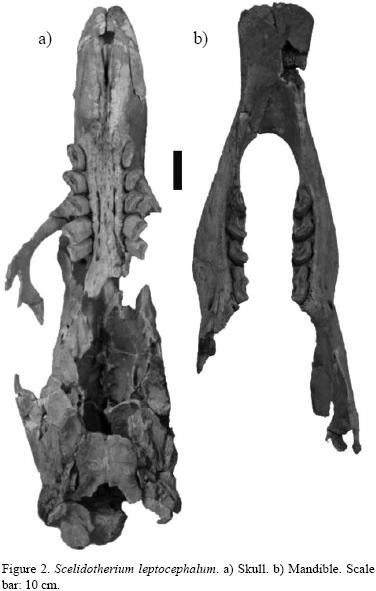
<body><![CDATA[<p align="justify"><font face="verdana" size="2">&nbsp;</font></p>     <p align="justify"><font face="verdana" size="2"><b>INTRODUCTION</b></font></p>     <p align="justify"><font face="verdana" size="2">The Quaternary sediments of R&iacute;o Cuarto area (C&oacute;rdoba province, Argentina, <a href="#f1">Figure 1</a>) are part of the loess deposits of South America, which extend from 23&deg;S to 38&deg;S (Z&aacute;rate, 2003). These sediments have been extensively studied by several authors due to their palaeosoil development which results from the pedogenesis of loessoid sediments (Cant&uacute; <i>et al., </i>2004; Kemp <i>et al., </i>2006; and references therein). Particularly, the sediments of R&iacute;o Cuarto area are primarily aeolian sediments (silt and sandy silt), and secondarily fluvial sediments, which were defined and characterized by Cant&uacute; (1992, 1998). This author named, from oldest to youngest, the following units: "Pampiano Formation", Chocancharava Formation, La Invernada Formation, Las Lajas Formation and Laguna Oscura Formation, and assigned them to the late Pleistocene &#150; Holocene. This paper will only refer to the first three units, which are associated with the late Pleistocene&#150;early Holocene period. See <a href="/img/revistas/rmcg/v27n3/a5t1.jpg" target="_blank">Table 1</a>, modified of Carignano (1999), for the correlation of this unit with others of the Buenos Aires and C&oacute;rdoba provinces.</font></p>     <p align="center"><font face="verdana" size="2"><a name="f1"></a></font></p>     <p align="center"><font face="verdana" size="2"><img src="/img/revistas/rmcg/v27n3/a5f1.jpg"></font></p>     <p align="justify"><font face="verdana" size="2">The "Pampiano Formation" is composed of two types of sediments: (1) alluvial, integrated with brown reddish silt and very fine sandy silt, with several levels containing iron and silica nodules, and (2) aeolian, composed of reddish brown to yellowish brown silt, with a high content of dispersed calcium carbonate and levels of calcretes. The Chocancharava Formation is composed of alluvial materials, including clasts of basement rocks, mainly of granitic origin, that are supported in a sandy matrix and cemented by calcium carbonate. Finally, the La Invernada Formation is composed of aeolian sediments comprising yellowish brown very fine sandy silt without visible structure (Cant&uacute;, 1998).</font></p>     <p align="justify"><font face="verdana" size="2">The La Invernada Formation has been studied not only by its palaeosoil development, age and mammals assemblages, but also because it includes structures that have been interpreted either as craters produced by impacts of meteors (Schultz and Lianza, 1992; Schultz <i>et al. </i>1994), or as great systems of deflation/accumulation landforms (Cione <i>et al. </i>2002 and references therein; see also Bland <i>et al. </i>2002). At the base of these structures, described by Schultz and Lianza (1992), some fossils remains (osteoderms of a Mylodontidae ground sloth housed at the Museo de La Plata, Argentina; MLP 99&#150;XI&#150;2&#150;1) have been discovered, which supports that these structures do not correspond to craters (Cione <i>et al. </i>2002). However, Schultz <i>et al. </i>(2004) suggest that two different impact glasses from the area of R&iacute;o Cuarto yield two different dates, the younger at about 3 &#150; 6 ka.</font></p>     <p align="justify"><font face="verdana" size="2">The vertebrate fossil remains recovered from the units throughout the area of R&iacute;o Cuarto are scarce, and thus they provide little stratigraphic information. Moreover, no absolute age has been obtained previously from bone collagen in C&oacute;rdoba province. Although there are some radiocarbon dates from the area of R&iacute;o Cuarto, they have been obtained from calcium carbonate (see Cant&uacute;, 1998). This fact contrasts strongly with the chronological information available for Buenos Aires province, which is the basis of the biostratigraphic profile that is currently in use in Argentina (Cione and Tonni, 1999, 2001, 2005). In this context, other dates from bone collagen are available from Buenos Aires province, but these are slightly younger than 10 ka (Politis and Messineo, 2008), except for a date reported by Rosello <i>et al. </i>(1999), which was questioned by Cione <i>et al. </i>(2001).</font></p>     <p align="justify"><font face="verdana" size="2">The aim of this contribution is to present the results of the first radiocarbon date from bone collagen of a ground sloth <i>Scelidotherium leptocephalum </i>Owen, 1840 (Xenartha, Tardigrada, Mylodontidae) (<a href="#f2">Figure 2</a>) from the La Invernada Formation, C&oacute;rdoba province, Argentina.</font></p>     <p align="center"><font face="verdana" size="2"><a name="f2"></a></font></p>     ]]></body>
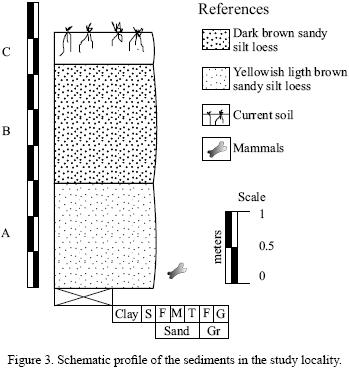
<body><![CDATA[<p align="center"><font face="verdana" size="2"><img src="/img/revistas/rmcg/v27n3/a5f2.jpg"></font></p>     <p align="justify"><font face="verdana" size="2">&nbsp;</font></p>     <p align="justify"><font face="verdana" size="2"><b>GEOGRAPHIC LOCATION AND GEOLOGY</b></font></p>     <p align="justify"><font face="verdana" size="2">The fossil remains were found at Elena locality, R&iacute;o Cuarto Department, C&oacute;rdoba province (<a href="#f1">Figure 1</a>). The site is located in a natural open crevasse corresponding to a rural road, about 2.5 km from National Highway N&deg; 36, where sandy silts containing the ground sloth remains are exposed. <a href="#f3">Figure 3</a> provides a schematic profile of this site. The sediments of level A are composed of yellowish brown sandy silt loess, that is referred to the La Invernada Formation. The level B is referred to the Laguna Oscura Formation.</font></p>     <p align="center"><font face="verdana" size="2"><a name="f3"></a></font></p>     <p align="center"><font face="verdana" size="2"><img src="/img/revistas/rmcg/v27n3/a5f3.jpg"></font></p>     <p align="justify"><font face="verdana" size="2">Cant&uacute; (1992, 1998) described La Invernada Formation as composed of silty and sandy silt loess, overlain by the Las Tapias paleosoil. This formation was partially correlated by Cant&uacute; (1992, 1998) with the Last Glacial Maximum (LGM). Evidence of this climatic event is also found in the neighbouring provinces of San Luis, Buenos Aires, and Santa F&eacute; (Carignano, 1999 and references therein). Later results of thermoluminiscence (TL) obtained by Cant&uacute; <i>et al. </i>(2004) for the La Invernada Formation showed an age between 85700 &plusmn; 11500 and 12800 &plusmn; 1500 yrs. BP. Until now, these were the only dates for these sediments. The upper limit of this formation was coincident with a climatic amelioration period (Hypsithermal) (Cant&uacute; 1992, 1998 p. 109: <i>"Edad: de acuerdo con la correlaci&oacute;n existente entre el clima interpluvial y las glaciaciones, en este caso con el &uacute;ltimo stadial de la glaciaci&oacute;n Wisconsin o M&aacute;ximo glacial, Cant&uacute; (1992) llega a establecer que estos materiales comenzaron a depositarse al inicio de la denominada Glaciaci&oacute;n Vallecito I (Wayne, 1984), 18000 a 20000 a. A.P., culminando tal vez a principio del Holoceno (9500 a 8200 B.P.) cuando se establece un mejoramiento generalizado del clima (Optimum Climaticum)").</i></font></p>     <p align="justify"><font face="verdana" size="2">The Las Tapias paleosoil was referred to the Hypsithermal (7&#150;5 ky BP) by Cant&uacute; (1992, 1998) and Cant&uacute; <i>et al. </i>(2004), and correlated with other paleosoils identified in several locations in C&oacute;rdoba province by Carignano (1999). Additional information about its composition and age has been recently provided by Cant&uacute; <i>et al. </i>(2004). In this work, about the paleosoils of southern C&oacute;rdoba Province, the authors were able to make a correlation between the studied paleosoils and climatic events.</font></p>     <p align="justify"><font face="verdana" size="2">Additionally, the alternation of soils with fluvio&#150;aeolian and loess sediments is a typical feature of the late Quaternary deposits in the Pampean Region. Mondo (1999) analyzed climatic evolution in the "Pampean Sand Sea", and explained that the stratigraphic column is an excellent record for palaeoclimatic reconstruction. In this context, Carignano (1999) correlated the different stratigraphic units of C&oacute;rdoba with Oxygen Isotope Stages and glacier fluctuations in South America, so he correlated the Chocancharava Formation with the OIS 5, OIS 4 and OIS 3 in part, the El Cerrito Paleosoil with the upper OIS 3 and lower OIS2, the La Invernada Formation with OIS 2 and upper OIS 1 and the Las Tapias Paleosoil with OIS 1 (see <a href="/img/revistas/rmcg/v27n3/a5t1.jpg" target="_blank">Table 1</a>).</font></p>     <p align="justify"><font face="verdana" size="2">&nbsp;</font></p>     ]]></body>
<body><![CDATA[<p align="justify"><font face="verdana" size="2"><b>MATERIAL AND METHODS</b></font></p>     <p align="justify"><font face="verdana" size="2">The fossil specimen under study here is an almost complete, partially articulated skeleton of <i>Scelidotherium leptocephalum. </i>This form of preservation suggests a burial event that prevented the action of scavengers and dispersion of the remains. Some ribs and fragments of the post&#150;cranial skeleton were selected for dating. The specimen is housed in the Department of Geology at the Universidad Nacional de R&iacute;o Cuarto (UNRC PV 001, see <a href="#f2">Figure 2</a>). It is interesting to note that a number of other fossil mammals <i>(i.e. </i>glyptodonts and other ground sloths) have been found in equivalent levels of the Chocancharava and the La Invernada formations at other localities in the same province (Cruz, 2003, 2007).</font></p>     <p align="justify"><font face="verdana" size="2">The radiocarbon date was obtained at the Laboratorio de Tritio y Radiocarbono (LATYR, CONICET&#150;UNLP). Age calculations on the Libby half&#150;life of <sup>14</sup>C before 1950 are reported to be 5568 yr. Reliable <sup>14</sup>C dating using fossil bones (Hedges and Van Klinken, 1992) should be based on samples with an adequate collagen fraction. The bones of <i>Scelidotherium leptocephalum </i>analyzed here are well preserved and they have 4% collagen content. The original carbon of the bone collagen was extracted following the method of Longin (1971). Carbonates were eliminated with HCl. Collagen was extracted as gelatin treated with water acidified (pH = 3) and heated to 90&deg; for several hours. Impurity was eliminated by centrifugation. The gelatin obtained contains 1.34% N, and the relation C/N = 2.985.</font></p>     <p align="justify"><font face="verdana" size="2">The gelatin was oxidized by quantitative combustion and transformed in benzene and measurement was made by liquid scintillation counting of synthesized benzene (see Huarte and Figini, 1988). Conventional age values were calculated at the &plusmn; 1&#963; level for overall analytical confidence, in compliance with the definition given by Stuiver and Polach (1977). To transform the <sup>14</sup>C years to calibrated years, the SHCAL04 software was used (see McCormac <i>et al., </i>2004).</font></p>     <p align="justify"><font face="verdana" size="2">&nbsp;</font></p>     <p align="justify"><font face="verdana" size="2"><b>RESULTS AND DISCUSSION</b></font></p>     <p align="justify"><font face="verdana" size="2">The radiocarbon date obtained for <i>Scelidotherium leptocephalum </i>(LP&#150;1407) is 7550 &plusmn; 60 yr <sup>14</sup>C BP; this supports the temporal assignation proposed by Cant&uacute; (1998) and Cant&uacute; <i>et al. </i>(2004) for the La Invernada Formation, that is late Pleistocene (about the LGM) to early Holocene. The range for the calibrated years with a probability of 68% (&plusmn; 1o sigma) is 8335 &#150; 8394 cal yr BP.</font></p>     <p align="justify"><font face="verdana" size="2">According to Cione and Tonni (1999, 2001, 2005), the middle Pleistocene to early Holocene in the pampean region of Argentina, are represented by the stages/ages Bonaerian and Lujanian.</font></p>     <p align="justify"><font face="verdana" size="2">Cruz (2003, 2007) concluded that the sediments of the La Invernada Formation and the upper and middle part of Chocancharava Formation may correspond to the Lujanian (late Pleistocene&#150;early Holocene), whilst the lower part of the latter formation may correspond to the Bonaerian (middle Pleistocene). This proposal is partially corroborated by Cant&uacute; <i>et al. </i>(2004) who reported new thermoluminiscence dates on sediments of the La Invernada and Las Oscuras formations. The dates of La Invernada Formation (85700 &plusmn; 11500 and 12800 &plusmn; 1500 yrs BP) are older than those previously proposed by Cant&uacute; (1998) on the basis of radiocarbon dates on carbonates, and permitted with the new date to extend this formation from 85700 to 7500 yrs BP.</font></p>     <p align="justify"><font face="verdana" size="2">In Buenos Aires province, radiocarbon dates were taken from extinct fauna from aeolian sediments (see Tonni <i>et al. </i>1999 and references therein). The date reported in this contribution coincides with those dates, and with the temporal assignment (i.e., Lujanian) of the upper part of the Chocancharava Formation and the La Invernada Formation.</font></p>     ]]></body>
<body><![CDATA[<p align="justify"><font face="verdana" size="2">The great extent and relative young age of these aeolian sediments allow their correlation with climatic events that took place during the late Pleistocene and early Holocene, namely increase in aridity and decrease in temperature. Between 13 and 11 ka, the Antarctic Cold Reversal (ACR), and the Younger Dryas (YD) occurred; these events clearly mark a pause (reversal) in the deglaciation process (Blunder <i>et al. </i>1998). Later, at approximately 8000 years BP, a new cold event occurred (see Alley <i>et al., </i>2003).</font></p>     <p align="justify"><font face="verdana" size="2">Correlations of the stratigraphic sections of the Pampean Sand Sea, with local and global climatic changes had been postulated by Iriondo (1999) and Cant&uacute; <i>et al. </i>(2004). The large sandy plains covering the Pampean Region originated during the LGM and were partially reworked later during desertic and semidesertic episodes of the late Pleistocene (ACR and YD) and the early Holocene. The humid climatic phases marked by paleosoils are intercalated with the aeolian beds (Iriondo, 1999), and the soils of the late Pleistocene and Holocene of R&iacute;o Cuarto respond to global climatic changes (Cant&uacute; <i>et al., </i>2004). These paleosoils may be correlated with those exposed in Buenos Aires province (Tonni <i>et al., </i>2001, see <a href="/img/revistas/rmcg/v27n3/a5t1.jpg" target="_blank">Table 1</a>).</font></p>     <p align="justify"><font face="verdana" size="2">To sum up, the vast exposures of aeolian sediments of C&oacute;rdoba, San Luis, Santa Fe, and Buenos Aires provinces can be correlated with the climatic events of the late Pleistocene and early Holocene, including biogeographic changes in the mammalian fauna and the extinction process verified <i>ca. </i>8 ka BP (Cione <i>et al., </i>2009). The date here published support the idea proposed by Borrero (2008) and Politis and Messineo (2008) that the megafauna and humans have coexisted, although it is necessary more information for evaluate these hypothesis.</font></p>     <p align="justify"><font face="verdana" size="2">&nbsp;</font></p>     <p align="justify"><font face="verdana" size="2"><b>ACKNOWLEDGMENTS</b></font></p>     <p align="justify"><font face="verdana" size="2">The authors gratefully acknowledge the invaluable help and discussions of Mario Cant&uacute; and Fernando Ca&ntilde;as; Juan J. Moly was very helpful with the preparation of the material, and Alejandro Kramarz (Museo Argentino de Ciencias Naturales), Marcelo Reguero and Lucas Pomi (Museo de La Plata) are thanked for their help with the collections under their care. Finally, we are grateful to Eduardo Jim&eacute;nez Hidalgo and an anonymous reviewer, whose critical reviews improved the manuscript. The Agencia Nacional de Promoci&oacute;n Cient&iacute;fica y Tecnol&oacute;gica PICT 38171 (E. P. Tonni), the Comisi&oacute;n de Investigaciones Cient&iacute;ficas (CIC) de la Provincia de Buenos Aires, CONICET, and the Universidad Nacional de La Plata provided financial support.</font></p>     <p align="justify"><font face="verdana" size="2">&nbsp;</font></p>     <p align="justify"><font face="verdana" size="2"><b>REFERENCES</b></font></p>     <!-- ref --><p align="justify"><font face="verdana" size="2">Alley, R.B., Marotzke, J., Nordhaus, W.D., Overpeck, J.T., Peteet, D.M., Pielke, R.A., Pierrehumbert, R.T., Rhines, P.B., Stocker, T.F., Talley, L.D., Wallace, J.M., 2003, Abrupt climate change: Science, 299, 2005&#150;2010.    &nbsp;&nbsp;&nbsp;&nbsp;&nbsp;&nbsp;&nbsp;&nbsp;[&#160;<a href="javascript:void(0);" onclick="javascript: window.open('/scielo.php?script=sci_nlinks&ref=8053633&pid=S1026-8774201000030000500001&lng=','','width=640,height=500,resizable=yes,scrollbars=1,menubar=yes,');">Links</a>&#160;]<!-- end-ref --></font></p>     ]]></body>
<body><![CDATA[<!-- ref --><p align="justify"><font face="verdana" size="2">Bland, P.A., Souza Filho, C.R. de, Jull, A.J.T., Kelley, S.P., Hough, R.M., Artemieva, N.A., Pierazzo, E., Conoglio, J., Pinotti, L., Evers, V., Kearsley, A.T., 2002, A possible tektite strewn field in the argentinian pampa: Science, 296, 1109&#150;1111.    &nbsp;&nbsp;&nbsp;&nbsp;&nbsp;&nbsp;&nbsp;&nbsp;[&#160;<a href="javascript:void(0);" onclick="javascript: window.open('/scielo.php?script=sci_nlinks&ref=8053635&pid=S1026-8774201000030000500002&lng=','','width=640,height=500,resizable=yes,scrollbars=1,menubar=yes,');">Links</a>&#160;]<!-- end-ref --></font></p>     <!-- ref --><p align="justify"><font face="verdana" size="2">Blunier, T., Chappellaz, J., Schwander, J., D&auml;llenbach, A., Stauffer, B., Stocker, T.F., Raynaud, D., Jouzel, J., Clausen, H.B., Hammer, C.V., Johnsen, S.J., 1998, Asynchrony ofAntarctic and Greenland climate during the last glacial period: Nature, 394, 739&#150;743.    &nbsp;&nbsp;&nbsp;&nbsp;&nbsp;&nbsp;&nbsp;&nbsp;[&#160;<a href="javascript:void(0);" onclick="javascript: window.open('/scielo.php?script=sci_nlinks&ref=8053637&pid=S1026-8774201000030000500003&lng=','','width=640,height=500,resizable=yes,scrollbars=1,menubar=yes,');">Links</a>&#160;]<!-- end-ref --></font></p>     <!-- ref --><p align="justify"><font face="verdana" size="2">Borrero, L.A., 2008. Extinction of Pleistocene megamammals in South America: The lost evidence: Quaternary International 185, 69&#150;74.    &nbsp;&nbsp;&nbsp;&nbsp;&nbsp;&nbsp;&nbsp;&nbsp;[&#160;<a href="javascript:void(0);" onclick="javascript: window.open('/scielo.php?script=sci_nlinks&ref=8053639&pid=S1026-8774201000030000500004&lng=','','width=640,height=500,resizable=yes,scrollbars=1,menubar=yes,');">Links</a>&#160;]<!-- end-ref --></font></p>     <!-- ref --><p align="justify"><font face="verdana" size="2">Cant&uacute;, M.P., 1992, Provincia de C&oacute;rdoba, <i>in </i>Iriondo, M. (ed.) El Holoceno de la Argentina: Argentina, Cadinqua I, 1&#150;16.    &nbsp;&nbsp;&nbsp;&nbsp;&nbsp;&nbsp;&nbsp;&nbsp;[&#160;<a href="javascript:void(0);" onclick="javascript: window.open('/scielo.php?script=sci_nlinks&ref=8053641&pid=S1026-8774201000030000500005&lng=','','width=640,height=500,resizable=yes,scrollbars=1,menubar=yes,');">Links</a>&#160;]<!-- end-ref --></font></p>     <!-- ref --><p align="justify"><font face="verdana" size="2">Cant&uacute;, M.P., 1998, Estudio geocient&iacute;fico para la evaluaci&oacute;n ambiental y la ordenaci&oacute;n territorial de una cuenca pedemontana. Caso: Cuenca del Arroyo La Colacha, Dpto. R&iacute;o Cuarto, provincia de C&oacute;rdoba: R&iacute;o Cuarto, C&oacute;rdoba, Argentina, Universidad Nacional de R&iacute;o Cuarto, tesis doctoral, 376 p.    &nbsp;&nbsp;&nbsp;&nbsp;&nbsp;&nbsp;&nbsp;&nbsp;[&#160;<a href="javascript:void(0);" onclick="javascript: window.open('/scielo.php?script=sci_nlinks&ref=8053643&pid=S1026-8774201000030000500006&lng=','','width=640,height=500,resizable=yes,scrollbars=1,menubar=yes,');">Links</a>&#160;]<!-- end-ref --></font></p>     ]]></body>
<body><![CDATA[<!-- ref --><p align="justify"><font face="verdana" size="2">Cant&uacute;, M.P., Schiavo, H.F., Musso, T.B., Becker, A.R., 2004, Paleosuelos del Pleistoceno superior&#150;Holoceno del sur de la provincia de C&oacute;rdoba, Argentina: (cd&#150;rom), Actas del XIX Congreso Internacional de las Ciencias del Suelo, 11 p.    &nbsp;&nbsp;&nbsp;&nbsp;&nbsp;&nbsp;&nbsp;&nbsp;[&#160;<a href="javascript:void(0);" onclick="javascript: window.open('/scielo.php?script=sci_nlinks&ref=8053645&pid=S1026-8774201000030000500007&lng=','','width=640,height=500,resizable=yes,scrollbars=1,menubar=yes,');">Links</a>&#160;]<!-- end-ref --></font></p>     <!-- ref --><p align="justify"><font face="verdana" size="2">Carignano, C.A., 1999, Late Pleistocene to recent climate change in C&oacute;rdoba province, Argentina: geomorphological evidence: Quaternary International, 57/58, 117&#150;134.    &nbsp;&nbsp;&nbsp;&nbsp;&nbsp;&nbsp;&nbsp;&nbsp;[&#160;<a href="javascript:void(0);" onclick="javascript: window.open('/scielo.php?script=sci_nlinks&ref=8053647&pid=S1026-8774201000030000500008&lng=','','width=640,height=500,resizable=yes,scrollbars=1,menubar=yes,');">Links</a>&#160;]<!-- end-ref --></font></p>     <!-- ref --><p align="justify"><font face="verdana" size="2">Cione, A.L., Tonni, E.P., 1999, Biostratigraphy and chronological scale of upper&#150;most Cenozoic in the Pampean Area, Argentina, <i>in </i>E.P. Tonni y L.A. Cione (eds.), Quaternary Vertebrate Paleontology in South America, Quaternary of South America and Antarctic Peninsula,12, 23&#150;52.    &nbsp;&nbsp;&nbsp;&nbsp;&nbsp;&nbsp;&nbsp;&nbsp;[&#160;<a href="javascript:void(0);" onclick="javascript: window.open('/scielo.php?script=sci_nlinks&ref=8053649&pid=S1026-8774201000030000500009&lng=','','width=640,height=500,resizable=yes,scrollbars=1,menubar=yes,');">Links</a>&#160;]<!-- end-ref --></font></p>     <!-- ref --><p align="justify"><font face="verdana" size="2">Cione, A.L., Tonni, E.P., 2001, Correlation of Pliocene to Holocene southern South American and European mammal&#150;bearing units, Bolettino della Societ&aacute; Paleontologica Italiana, 40, 167&#150;174.    &nbsp;&nbsp;&nbsp;&nbsp;&nbsp;&nbsp;&nbsp;&nbsp;[&#160;<a href="javascript:void(0);" onclick="javascript: window.open('/scielo.php?script=sci_nlinks&ref=8053651&pid=S1026-8774201000030000500010&lng=','','width=640,height=500,resizable=yes,scrollbars=1,menubar=yes,');">Links</a>&#160;]<!-- end-ref --></font></p>     <!-- ref --><p align="justify"><font face="verdana" size="2">Cione, A.L., Tonni, E.P., 2005, Bioestratigraf&iacute;a basada en mam&iacute;feros del Cenozoico superior de la provincia de Buenos Aires, Argentina, <i>en </i>Geolog&iacute;a y recursos minerales de la provincia de Buenos Aires del XVI Congreso Geol&oacute;gico Argentino, La Plata, Buenos Aires, Argentina, de Barrio, R.E., Etcheverry, R.O., Caball&eacute;, M.F., Llambias, E. (eds.), XI, 183&#150;200.    &nbsp;&nbsp;&nbsp;&nbsp;&nbsp;&nbsp;&nbsp;&nbsp;[&#160;<a href="javascript:void(0);" onclick="javascript: window.open('/scielo.php?script=sci_nlinks&ref=8053653&pid=S1026-8774201000030000500011&lng=','','width=640,height=500,resizable=yes,scrollbars=1,menubar=yes,');">Links</a>&#160;]<!-- end-ref --></font></p>     ]]></body>
<body><![CDATA[<!-- ref --><p align="justify"><font face="verdana" size="2">Cione, A.L., Figini, A.J., Tonni, E.P., 2001, Did the megafauna range to 4300 BP in South America?: Radiocarbon, 43, 69&#150;75.    &nbsp;&nbsp;&nbsp;&nbsp;&nbsp;&nbsp;&nbsp;&nbsp;[&#160;<a href="javascript:void(0);" onclick="javascript: window.open('/scielo.php?script=sci_nlinks&ref=8053655&pid=S1026-8774201000030000500012&lng=','','width=640,height=500,resizable=yes,scrollbars=1,menubar=yes,');">Links</a>&#160;]<!-- end-ref --></font></p>     <!-- ref --><p align="justify"><font face="verdana" size="2">Cione, A.L., Tonni, E.P., San Crist&oacute;bal, J., Hern&aacute;ndez, P., Ben&iacute;tez, A., Bordignon, F., Per&iacute;, J., 2002, Putative meteoritic craters in R&iacute;o Cuarto, Central Argentina interpreted as aeolian landforms, Earth, Moon, and Planets, 91, 9&#150;24.    &nbsp;&nbsp;&nbsp;&nbsp;&nbsp;&nbsp;&nbsp;&nbsp;[&#160;<a href="javascript:void(0);" onclick="javascript: window.open('/scielo.php?script=sci_nlinks&ref=8053657&pid=S1026-8774201000030000500013&lng=','','width=640,height=500,resizable=yes,scrollbars=1,menubar=yes,');">Links</a>&#160;]<!-- end-ref --></font></p>     <!-- ref --><p align="justify"><font face="verdana" size="2">Cione, A.L., Tonni, E.P., Soibelzon, L.H., 2009, Did humans cause the late Pleistocene&#150;early Holocene mammalian extinctions in South America in a context shrinking open areas?, <i>in </i>Haynes, G. (ed.), American megafaunal extinctions at the end of the Pleistocene: U.S.A., Springer Publishers, Vertebrate Paleobiology and Paleontology Series, 125&#150;144.    &nbsp;&nbsp;&nbsp;&nbsp;&nbsp;&nbsp;&nbsp;&nbsp;[&#160;<a href="javascript:void(0);" onclick="javascript: window.open('/scielo.php?script=sci_nlinks&ref=8053659&pid=S1026-8774201000030000500014&lng=','','width=640,height=500,resizable=yes,scrollbars=1,menubar=yes,');">Links</a>&#160;]<!-- end-ref --></font></p>     <!-- ref --><p align="justify"><font face="verdana" size="2">Cruz, L.E., 2003, Mam&iacute;feros del Pleistoceno tard&iacute;o&#150;Holoceno temprano del &aacute;rea septentrional del Dto. R&iacute;o Cuarto, provincia de C&oacute;rdoba. Geocronolog&iacute;a y Paleoambientes, R&iacute;o Cuarto, C&oacute;rdoba, Argentina, Universidad Nacional de R&iacute;o Cuarto, Trabajo Final de Licenciatura, 64 pp.    &nbsp;&nbsp;&nbsp;&nbsp;&nbsp;&nbsp;&nbsp;&nbsp;[&#160;<a href="javascript:void(0);" onclick="javascript: window.open('/scielo.php?script=sci_nlinks&ref=8053661&pid=S1026-8774201000030000500015&lng=','','width=640,height=500,resizable=yes,scrollbars=1,menubar=yes,');">Links</a>&#160;]<!-- end-ref --></font></p>     <!-- ref --><p align="justify"><font face="verdana" size="2">Cruz, L.E., 2007, Xenarthra (Mammalia) del Pleistoceno tard&iacute;o&#150;Holoceno temprano del Departamento R&iacute;o Cuarto, provincia de C&oacute;rdoba, Argentina. Aspectos bioestratigr&aacute;ficos: Ameghiniana, 44(4), 751&#150;759.    &nbsp;&nbsp;&nbsp;&nbsp;&nbsp;&nbsp;&nbsp;&nbsp;[&#160;<a href="javascript:void(0);" onclick="javascript: window.open('/scielo.php?script=sci_nlinks&ref=8053663&pid=S1026-8774201000030000500016&lng=','','width=640,height=500,resizable=yes,scrollbars=1,menubar=yes,');">Links</a>&#160;]<!-- end-ref --></font></p>     ]]></body>
<body><![CDATA[<!-- ref --><p align="justify"><font face="verdana" size="2">Hedges, R.E.M., Van Klinken, G.J., 1992, A review of current approach in the pretreatment of bone for radiocarbon dating by AMS: Radiocarbon, 34 (3), 279&#150;91.    &nbsp;&nbsp;&nbsp;&nbsp;&nbsp;&nbsp;&nbsp;&nbsp;[&#160;<a href="javascript:void(0);" onclick="javascript: window.open('/scielo.php?script=sci_nlinks&ref=8053665&pid=S1026-8774201000030000500017&lng=','','width=640,height=500,resizable=yes,scrollbars=1,menubar=yes,');">Links</a>&#160;]<!-- end-ref --></font></p>     <!-- ref --><p align="justify"><font face="verdana" size="2">Huarte, R., Figini, A.J., 1988, La Plata Radiocarbon Laboratory Liquid Scintillation Counting and inter&#150;laboratory check samples: Radiocarbon, 30, 347&#150;350.    &nbsp;&nbsp;&nbsp;&nbsp;&nbsp;&nbsp;&nbsp;&nbsp;[&#160;<a href="javascript:void(0);" onclick="javascript: window.open('/scielo.php?script=sci_nlinks&ref=8053667&pid=S1026-8774201000030000500018&lng=','','width=640,height=500,resizable=yes,scrollbars=1,menubar=yes,');">Links</a>&#160;]<!-- end-ref --></font></p>     <!-- ref --><p align="justify"><font face="verdana" size="2">Iriondo, M., 1999, Climatic changes in the South American plains: records of a continent&#150;scale oscillation: Quaternary International, 57/58, 93&#150;112.    &nbsp;&nbsp;&nbsp;&nbsp;&nbsp;&nbsp;&nbsp;&nbsp;[&#160;<a href="javascript:void(0);" onclick="javascript: window.open('/scielo.php?script=sci_nlinks&ref=8053669&pid=S1026-8774201000030000500019&lng=','','width=640,height=500,resizable=yes,scrollbars=1,menubar=yes,');">Links</a>&#160;]<!-- end-ref --></font></p>     <!-- ref --><p align="justify"><font face="verdana" size="2">Kemp, R.A., Z&aacute;rate, M., Toms, P., King, M., Sanabria, J., Arguello, G., 2006, Late Quaternary paleosoils, stratigraphy and landscape evolution in the Northern Pampa, Argentina: Quaternary Research, 66, 119&#150;132.    &nbsp;&nbsp;&nbsp;&nbsp;&nbsp;&nbsp;&nbsp;&nbsp;[&#160;<a href="javascript:void(0);" onclick="javascript: window.open('/scielo.php?script=sci_nlinks&ref=8053671&pid=S1026-8774201000030000500020&lng=','','width=640,height=500,resizable=yes,scrollbars=1,menubar=yes,');">Links</a>&#160;]<!-- end-ref --></font></p>     <!-- ref --><p align="justify"><font face="verdana" size="2">Longin, R., 1971, New method of collagen extraction for radiocarbon dating: Nature, 130, 241&#150;2.    &nbsp;&nbsp;&nbsp;&nbsp;&nbsp;&nbsp;&nbsp;&nbsp;[&#160;<a href="javascript:void(0);" onclick="javascript: window.open('/scielo.php?script=sci_nlinks&ref=8053673&pid=S1026-8774201000030000500021&lng=','','width=640,height=500,resizable=yes,scrollbars=1,menubar=yes,');">Links</a>&#160;]<!-- end-ref --> </font></p>     ]]></body>
<body><![CDATA[<!-- ref --><p align="justify"><font face="verdana" size="2">McCormac, F.G., Hogg, A.G., Blackwell, P.G., Buck, C.E., Higham, T.F.G., Reimer, P.J., 2004, SHCAL04 Southern Hemisphere Calibration 0 &#150; 11.0 cal. Kyr BP: Radiocarbon, 46, 1087&#150;1092.    &nbsp;&nbsp;&nbsp;&nbsp;&nbsp;&nbsp;&nbsp;&nbsp;[&#160;<a href="javascript:void(0);" onclick="javascript: window.open('/scielo.php?script=sci_nlinks&ref=8053675&pid=S1026-8774201000030000500022&lng=','','width=640,height=500,resizable=yes,scrollbars=1,menubar=yes,');">Links</a>&#160;]<!-- end-ref --> </font></p>     <!-- ref --><p align="justify"><font face="verdana" size="2">Owen, R. 1840, Fossil Mammalia (4) <i>in </i>Darwin, C. (ed.), Zoology of the voyage of H. M. S. Beagle: Londres, Smith, Elther y Co, 1:81&#150;111.    &nbsp;&nbsp;&nbsp;&nbsp;&nbsp;&nbsp;&nbsp;&nbsp;[&#160;<a href="javascript:void(0);" onclick="javascript: window.open('/scielo.php?script=sci_nlinks&ref=8053677&pid=S1026-8774201000030000500023&lng=','','width=640,height=500,resizable=yes,scrollbars=1,menubar=yes,');">Links</a>&#160;]<!-- end-ref --></font></p>     <!-- ref --><p align="justify"><font face="verdana" size="2">Politis, G.G., Menisseo, P.G., 2008, The Campo Laborde site: new evidence for the Holocene survival of Pleistocene megafauna in the Argentine Pampas: Quaternary International, 191(1), 98&#150;114.    &nbsp;&nbsp;&nbsp;&nbsp;&nbsp;&nbsp;&nbsp;&nbsp;[&#160;<a href="javascript:void(0);" onclick="javascript: window.open('/scielo.php?script=sci_nlinks&ref=8053679&pid=S1026-8774201000030000500024&lng=','','width=640,height=500,resizable=yes,scrollbars=1,menubar=yes,');">Links</a>&#160;]<!-- end-ref --></font></p>     <!-- ref --><p align="justify"><font face="verdana" size="2">Rossello, E.A., Bor&#150;Ming, J., Liu, T.K., Petrocelli, J.L., 1999, New 4300 yr <sup>14</sup>C age of glyptodonts at Luj&aacute;n river (Buenos Aires, Argentina) and its implications, Actas del Segundo Simposio Sudamericano de Geolog&iacute;a Isot&oacute;pica, 1,105&#150;110.    &nbsp;&nbsp;&nbsp;&nbsp;&nbsp;&nbsp;&nbsp;&nbsp;[&#160;<a href="javascript:void(0);" onclick="javascript: window.open('/scielo.php?script=sci_nlinks&ref=8053681&pid=S1026-8774201000030000500025&lng=','','width=640,height=500,resizable=yes,scrollbars=1,menubar=yes,');">Links</a>&#160;]<!-- end-ref --></font></p>     <!-- ref --><p align="justify"><font face="verdana" size="2">Schultz, P.H., Lianza, R., 1992, Recent grazing impacts on the earth record in the R&iacute;o Cuarto crater field, Argentina: Nature, 355, 234&#150;237.    &nbsp;&nbsp;&nbsp;&nbsp;&nbsp;&nbsp;&nbsp;&nbsp;[&#160;<a href="javascript:void(0);" onclick="javascript: window.open('/scielo.php?script=sci_nlinks&ref=8053683&pid=S1026-8774201000030000500026&lng=','','width=640,height=500,resizable=yes,scrollbars=1,menubar=yes,');">Links</a>&#160;]<!-- end-ref --></font></p>     ]]></body>
<body><![CDATA[<!-- ref --><p align="justify"><font face="verdana" size="2">Schultz, P.H., Koerbel, C., Bunch, T., Grant, J., Collins, W., 1994, Ground truth for oblique impact processes: new insight from the R&iacute;o Cuarto, Argentina, crater field: Geology, 22, 889&#150;892.    &nbsp;&nbsp;&nbsp;&nbsp;&nbsp;&nbsp;&nbsp;&nbsp;[&#160;<a href="javascript:void(0);" onclick="javascript: window.open('/scielo.php?script=sci_nlinks&ref=8053685&pid=S1026-8774201000030000500027&lng=','','width=640,height=500,resizable=yes,scrollbars=1,menubar=yes,');">Links</a>&#160;]<!-- end-ref --></font></p>     <!-- ref --><p align="justify"><font face="verdana" size="2">Schultz, P.H., Z&aacute;rate, M., Hames, B., Koeberl, C., Bunch, T., Storzer, D., Renne, P., Wittke, J., 2004, The Quaternary impact record from the Pampas, Argentina: Earth and Planetary Science Letters, 219, 221&#150;238.    &nbsp;&nbsp;&nbsp;&nbsp;&nbsp;&nbsp;&nbsp;&nbsp;[&#160;<a href="javascript:void(0);" onclick="javascript: window.open('/scielo.php?script=sci_nlinks&ref=8053687&pid=S1026-8774201000030000500028&lng=','','width=640,height=500,resizable=yes,scrollbars=1,menubar=yes,');">Links</a>&#160;]<!-- end-ref --></font></p>     <!-- ref --><p align="justify"><font face="verdana" size="2">Stuiver, M., Polach, H.A., 1977, Discussion: Reporting of <sup>14</sup>C data: Radiocarbon, 19 (3), 355&#150;363.    &nbsp;&nbsp;&nbsp;&nbsp;&nbsp;&nbsp;&nbsp;&nbsp;[&#160;<a href="javascript:void(0);" onclick="javascript: window.open('/scielo.php?script=sci_nlinks&ref=8053689&pid=S1026-8774201000030000500029&lng=','','width=640,height=500,resizable=yes,scrollbars=1,menubar=yes,');">Links</a>&#160;]<!-- end-ref --></font></p>     <!-- ref --><p align="justify"><font face="verdana" size="2">Tonni, E.P., Cione, A.L., Figini, A.J., 1999, Predominance of arid climates indicated by mammals in the pampas of Argentina during the Late Pleistocene and Holocene: Paleogeography, Palaeoclimatology, Palaeoecology, 147, 257&#150;281.    &nbsp;&nbsp;&nbsp;&nbsp;&nbsp;&nbsp;&nbsp;&nbsp;[&#160;<a href="javascript:void(0);" onclick="javascript: window.open('/scielo.php?script=sci_nlinks&ref=8053691&pid=S1026-8774201000030000500030&lng=','','width=640,height=500,resizable=yes,scrollbars=1,menubar=yes,');">Links</a>&#160;]<!-- end-ref --></font></p>     <!-- ref --><p align="justify"><font face="verdana" size="2">Tonni, E.P., Cione, A.L., Figini, A.J., 2001, Chronology of Holocene pedogenetic events in the pampean area of Argentina: Current Research in the Pleistocene, 18, 124&#150;127.    &nbsp;&nbsp;&nbsp;&nbsp;&nbsp;&nbsp;&nbsp;&nbsp;[&#160;<a href="javascript:void(0);" onclick="javascript: window.open('/scielo.php?script=sci_nlinks&ref=8053693&pid=S1026-8774201000030000500031&lng=','','width=640,height=500,resizable=yes,scrollbars=1,menubar=yes,');">Links</a>&#160;]<!-- end-ref --></font></p>     ]]></body>
<body><![CDATA[<!-- ref --><p align="justify"><font face="verdana" size="2">Wayne, W. J. , 1984, Relative dating techniques to distinguish late Pleistocene&#150;Holocene continental sediments: Chemical Geology, 44(1&#150;3), 337&#150;348.    &nbsp;&nbsp;&nbsp;&nbsp;&nbsp;&nbsp;&nbsp;&nbsp;[&#160;<a href="javascript:void(0);" onclick="javascript: window.open('/scielo.php?script=sci_nlinks&ref=8053695&pid=S1026-8774201000030000500032&lng=','','width=640,height=500,resizable=yes,scrollbars=1,menubar=yes,');">Links</a>&#160;]<!-- end-ref --></font></p>     <!-- ref --><p align="justify"><font face="verdana" size="2">Z&aacute;rate, M.A., 2003, Loess of southern South America: Quaternary Science Reviews, 22, 1987&#150;2006.    &nbsp;&nbsp;&nbsp;&nbsp;&nbsp;&nbsp;&nbsp;&nbsp;[&#160;<a href="javascript:void(0);" onclick="javascript: window.open('/scielo.php?script=sci_nlinks&ref=8053697&pid=S1026-8774201000030000500033&lng=','','width=640,height=500,resizable=yes,scrollbars=1,menubar=yes,');">Links</a>&#160;]<!-- end-ref --></font></p>     <!-- ref --><p align="justify"><font face="verdana" size="2">Z&aacute;rate, M.A., 2005, El Cenozoico tard&iacute;o Continental de la provincia de Buenos Aires <i>en </i>Geolog&iacute;a y recursos minerales de la provincia de Buenos Aires, XVI Congreso Geol&oacute;gico Argentino, La Plata, Buenos Aires, Argentina, de Barrio, R.E., Etcheverry, R.O., Caball&eacute;, M.F., Llambias, E. (eds.), IX: 139&#150;158.    &nbsp;&nbsp;&nbsp;&nbsp;&nbsp;&nbsp;&nbsp;&nbsp;[&#160;<a href="javascript:void(0);" onclick="javascript: window.open('/scielo.php?script=sci_nlinks&ref=8053699&pid=S1026-8774201000030000500034&lng=','','width=640,height=500,resizable=yes,scrollbars=1,menubar=yes,');">Links</a>&#160;]<!-- end-ref --></font></p>      ]]></body><back>
<ref-list>
<ref id="B1">
<nlm-citation citation-type="journal">
<person-group person-group-type="author">
<name>
<surname><![CDATA[Alley]]></surname>
<given-names><![CDATA[R.B]]></given-names>
</name>
<name>
<surname><![CDATA[Marotzke]]></surname>
<given-names><![CDATA[J]]></given-names>
</name>
<name>
<surname><![CDATA[Nordhaus]]></surname>
<given-names><![CDATA[W.D]]></given-names>
</name>
<name>
<surname><![CDATA[Overpeck]]></surname>
<given-names><![CDATA[J.T]]></given-names>
</name>
<name>
<surname><![CDATA[Peteet]]></surname>
<given-names><![CDATA[D.M]]></given-names>
</name>
<name>
<surname><![CDATA[Pielke]]></surname>
<given-names><![CDATA[R.A]]></given-names>
</name>
<name>
<surname><![CDATA[Pierrehumbert]]></surname>
<given-names><![CDATA[R.T]]></given-names>
</name>
<name>
<surname><![CDATA[Rhines]]></surname>
<given-names><![CDATA[P.B]]></given-names>
</name>
<name>
<surname><![CDATA[Stocker]]></surname>
<given-names><![CDATA[T.F]]></given-names>
</name>
<name>
<surname><![CDATA[Talley]]></surname>
<given-names><![CDATA[L.D]]></given-names>
</name>
<name>
<surname><![CDATA[Wallace]]></surname>
<given-names><![CDATA[J.M]]></given-names>
</name>
</person-group>
<article-title xml:lang="en"><![CDATA[Abrupt climate change]]></article-title>
<source><![CDATA[Science]]></source>
<year>2003</year>
<volume>299</volume>
<page-range>2005-2010</page-range></nlm-citation>
</ref>
<ref id="B2">
<nlm-citation citation-type="journal">
<person-group person-group-type="author">
<name>
<surname><![CDATA[Bland]]></surname>
<given-names><![CDATA[P.A]]></given-names>
</name>
<name>
<surname><![CDATA[Souza Filho]]></surname>
<given-names><![CDATA[C.R. de]]></given-names>
</name>
<name>
<surname><![CDATA[Jull]]></surname>
<given-names><![CDATA[A.J.T.]]></given-names>
</name>
<name>
<surname><![CDATA[Kelley]]></surname>
<given-names><![CDATA[S.P]]></given-names>
</name>
<name>
<surname><![CDATA[Hough]]></surname>
<given-names><![CDATA[R.M]]></given-names>
</name>
<name>
<surname><![CDATA[Artemieva]]></surname>
<given-names><![CDATA[N.A]]></given-names>
</name>
<name>
<surname><![CDATA[Pierazzo]]></surname>
<given-names><![CDATA[E]]></given-names>
</name>
<name>
<surname><![CDATA[Conoglio]]></surname>
<given-names><![CDATA[J]]></given-names>
</name>
<name>
<surname><![CDATA[Pinotti]]></surname>
<given-names><![CDATA[L]]></given-names>
</name>
<name>
<surname><![CDATA[Evers]]></surname>
<given-names><![CDATA[V]]></given-names>
</name>
<name>
<surname><![CDATA[Kearsley]]></surname>
<given-names><![CDATA[A.T]]></given-names>
</name>
</person-group>
<article-title xml:lang="en"><![CDATA[A possible tektite strewn field in the argentinian pampa]]></article-title>
<source><![CDATA[Science]]></source>
<year>2002</year>
<volume>296</volume>
<page-range>1109-1111</page-range></nlm-citation>
</ref>
<ref id="B3">
<nlm-citation citation-type="journal">
<person-group person-group-type="author">
<name>
<surname><![CDATA[Blunier]]></surname>
<given-names><![CDATA[T]]></given-names>
</name>
<name>
<surname><![CDATA[Chappellaz]]></surname>
<given-names><![CDATA[J]]></given-names>
</name>
<name>
<surname><![CDATA[Schwander]]></surname>
<given-names><![CDATA[J]]></given-names>
</name>
<name>
<surname><![CDATA[Dällenbach]]></surname>
<given-names><![CDATA[A]]></given-names>
</name>
<name>
<surname><![CDATA[Stauffer]]></surname>
<given-names><![CDATA[B]]></given-names>
</name>
<name>
<surname><![CDATA[Stocker]]></surname>
<given-names><![CDATA[T.F]]></given-names>
</name>
<name>
<surname><![CDATA[Raynaud]]></surname>
<given-names><![CDATA[D]]></given-names>
</name>
<name>
<surname><![CDATA[Jouzel]]></surname>
<given-names><![CDATA[J]]></given-names>
</name>
<name>
<surname><![CDATA[Clausen]]></surname>
<given-names><![CDATA[H.B]]></given-names>
</name>
<name>
<surname><![CDATA[Hammer]]></surname>
<given-names><![CDATA[C.V]]></given-names>
</name>
<name>
<surname><![CDATA[Johnsen]]></surname>
<given-names><![CDATA[S.J]]></given-names>
</name>
</person-group>
<article-title xml:lang="en"><![CDATA[Asynchrony ofAntarctic and Greenland climate during the last glacial period]]></article-title>
<source><![CDATA[Nature]]></source>
<year>1998</year>
<volume>394</volume>
<page-range>739-743</page-range></nlm-citation>
</ref>
<ref id="B4">
<nlm-citation citation-type="journal">
<person-group person-group-type="author">
<name>
<surname><![CDATA[Borrero]]></surname>
<given-names><![CDATA[L.A.]]></given-names>
</name>
</person-group>
<article-title xml:lang="en"><![CDATA[Extinction of Pleistocene megamammals in South America: The lost evidence]]></article-title>
<source><![CDATA[Quaternary International]]></source>
<year>2008</year>
<volume>185</volume>
<page-range>69-74</page-range></nlm-citation>
</ref>
<ref id="B5">
<nlm-citation citation-type="book">
<person-group person-group-type="author">
<name>
<surname><![CDATA[Cantú]]></surname>
<given-names><![CDATA[M.P]]></given-names>
</name>
</person-group>
<article-title xml:lang="es"><![CDATA[Provincia de Córdoba]]></article-title>
<person-group person-group-type="editor">
<name>
<surname><![CDATA[Iriondo]]></surname>
<given-names><![CDATA[M.]]></given-names>
</name>
</person-group>
<source><![CDATA[El Holoceno de la Argentina]]></source>
<year>1992</year>
<page-range>1-16</page-range><publisher-loc><![CDATA[Argentina ]]></publisher-loc>
<publisher-name><![CDATA[Cadinqua I]]></publisher-name>
</nlm-citation>
</ref>
<ref id="B6">
<nlm-citation citation-type="">
<person-group person-group-type="author">
<name>
<surname><![CDATA[Cantú]]></surname>
<given-names><![CDATA[M.P.]]></given-names>
</name>
</person-group>
<source><![CDATA[Estudio geocientífico para la evaluación ambiental y la ordenación territorial de una cuenca pedemontana. Caso: Cuenca del Arroyo La Colacha, Dpto. Río Cuarto, provincia de Córdoba]]></source>
<year>1998</year>
<page-range>376</page-range></nlm-citation>
</ref>
<ref id="B7">
<nlm-citation citation-type="confpro">
<person-group person-group-type="author">
<name>
<surname><![CDATA[Cantú]]></surname>
<given-names><![CDATA[M.P.]]></given-names>
</name>
<name>
<surname><![CDATA[Schiavo]]></surname>
<given-names><![CDATA[H.F.]]></given-names>
</name>
<name>
<surname><![CDATA[Musso]]></surname>
<given-names><![CDATA[T.B.]]></given-names>
</name>
<name>
<surname><![CDATA[Becker]]></surname>
<given-names><![CDATA[A.R.]]></given-names>
</name>
</person-group>
<article-title xml:lang="es"><![CDATA[Paleosuelos del Pleistoceno superior-Holoceno del sur de la provincia de Córdoba, Argentina]]></article-title>
<source><![CDATA[]]></source>
<year>2004</year>
<conf-name><![CDATA[ Actas del XIX Congreso Internacional de las Ciencias del Suelo]]></conf-name>
<conf-loc> </conf-loc>
<page-range>11</page-range></nlm-citation>
</ref>
<ref id="B8">
<nlm-citation citation-type="journal">
<person-group person-group-type="author">
<name>
<surname><![CDATA[Carignano]]></surname>
<given-names><![CDATA[C.A]]></given-names>
</name>
</person-group>
<article-title xml:lang="en"><![CDATA[Late Pleistocene to recent climate change in Córdoba province, Argentina: geomorphological evidence]]></article-title>
<source><![CDATA[Quaternary International]]></source>
<year>1999</year>
<volume>57/58</volume>
<page-range>117-134</page-range></nlm-citation>
</ref>
<ref id="B9">
<nlm-citation citation-type="">
<person-group person-group-type="author">
<name>
<surname><![CDATA[Cione]]></surname>
<given-names><![CDATA[A.L.]]></given-names>
</name>
<name>
<surname><![CDATA[Tonni]]></surname>
<given-names><![CDATA[E.P.]]></given-names>
</name>
</person-group>
<article-title xml:lang="en"><![CDATA[Biostratigraphy and chronological scale of upper-most Cenozoic in the Pampean Area, Argentina]]></article-title>
<person-group person-group-type="editor">
<name>
<surname><![CDATA[Tonni]]></surname>
<given-names><![CDATA[E.P.]]></given-names>
</name>
<name>
<surname><![CDATA[Cione]]></surname>
<given-names><![CDATA[L.A.]]></given-names>
</name>
</person-group>
<source><![CDATA[Quaternary Vertebrate Paleontology in South America, Quaternary of South America and Antarctic Peninsula]]></source>
<year>1999</year>
<page-range>23-52</page-range></nlm-citation>
</ref>
<ref id="B10">
<nlm-citation citation-type="journal">
<person-group person-group-type="author">
<name>
<surname><![CDATA[Cione]]></surname>
<given-names><![CDATA[A.L]]></given-names>
</name>
<name>
<surname><![CDATA[Tonni]]></surname>
<given-names><![CDATA[E.P]]></given-names>
</name>
</person-group>
<article-title xml:lang="en"><![CDATA[Correlation of Pliocene to Holocene southern South American and European mammal-bearing units]]></article-title>
<source><![CDATA[Bolettino della Societá Paleontologica Italiana]]></source>
<year>2001</year>
<volume>40</volume>
<page-range>167-174</page-range></nlm-citation>
</ref>
<ref id="B11">
<nlm-citation citation-type="confpro">
<person-group person-group-type="author">
<name>
<surname><![CDATA[Cione]]></surname>
<given-names><![CDATA[A.L.]]></given-names>
</name>
<name>
<surname><![CDATA[Tonni]]></surname>
<given-names><![CDATA[E.P.]]></given-names>
</name>
</person-group>
<article-title xml:lang="es"><![CDATA[Bioestratigrafía basada en mamíferos del Cenozoico superior de la provincia de Buenos Aires, Argentina]]></article-title>
<person-group person-group-type="editor">
<name>
<surname><![CDATA[de Barrio]]></surname>
<given-names><![CDATA[R.E.]]></given-names>
</name>
<name>
<surname><![CDATA[Etcheverry]]></surname>
<given-names><![CDATA[R.O.]]></given-names>
</name>
<name>
<surname><![CDATA[Caballé]]></surname>
<given-names><![CDATA[M.F.]]></given-names>
</name>
<name>
<surname><![CDATA[Llambias]]></surname>
<given-names><![CDATA[E.]]></given-names>
</name>
</person-group>
<source><![CDATA[]]></source>
<year>2005</year>
<conf-name><![CDATA[ Geología y recursos minerales de la provincia de Buenos Aires del XVI Congreso Geológico Argentino]]></conf-name>
<conf-loc>La Plata Buenos Aires</conf-loc>
<page-range>183-200</page-range></nlm-citation>
</ref>
<ref id="B12">
<nlm-citation citation-type="journal">
<person-group person-group-type="author">
<name>
<surname><![CDATA[Cione]]></surname>
<given-names><![CDATA[A.L]]></given-names>
</name>
<name>
<surname><![CDATA[Figini]]></surname>
<given-names><![CDATA[A.J]]></given-names>
</name>
<name>
<surname><![CDATA[Tonni]]></surname>
<given-names><![CDATA[E.P]]></given-names>
</name>
</person-group>
<article-title xml:lang="en"><![CDATA[Did the megafauna range to 4300 BP in South America?]]></article-title>
<source><![CDATA[Radiocarbon]]></source>
<year>2001</year>
<volume>43</volume>
<page-range>69-75</page-range></nlm-citation>
</ref>
<ref id="B13">
<nlm-citation citation-type="journal">
<person-group person-group-type="author">
<name>
<surname><![CDATA[Cione]]></surname>
<given-names><![CDATA[A.L]]></given-names>
</name>
<name>
<surname><![CDATA[Tonni]]></surname>
<given-names><![CDATA[E.P]]></given-names>
</name>
<name>
<surname><![CDATA[San Cristóbal]]></surname>
<given-names><![CDATA[J]]></given-names>
</name>
<name>
<surname><![CDATA[Hernández]]></surname>
<given-names><![CDATA[P]]></given-names>
</name>
<name>
<surname><![CDATA[Benítez]]></surname>
<given-names><![CDATA[A]]></given-names>
</name>
<name>
<surname><![CDATA[Bordignon]]></surname>
<given-names><![CDATA[F]]></given-names>
</name>
<name>
<surname><![CDATA[Perí]]></surname>
<given-names><![CDATA[J]]></given-names>
</name>
</person-group>
<article-title xml:lang="en"><![CDATA[Putative meteoritic craters in Río Cuarto, Central Argentina interpreted as aeolian landforms]]></article-title>
<source><![CDATA[Earth]]></source>
<year>2002</year>
<volume>Moon</volume>
<page-range>and Planets, 91, 9-24</page-range></nlm-citation>
</ref>
<ref id="B14">
<nlm-citation citation-type="book">
<person-group person-group-type="author">
<name>
<surname><![CDATA[Cione]]></surname>
<given-names><![CDATA[A.L]]></given-names>
</name>
<name>
<surname><![CDATA[Tonni]]></surname>
<given-names><![CDATA[E.P]]></given-names>
</name>
<name>
<surname><![CDATA[Soibelzon]]></surname>
<given-names><![CDATA[L.H]]></given-names>
</name>
</person-group>
<article-title xml:lang="en"><![CDATA[Did humans cause the late Pleistocene-early Holocene mammalian extinctions in South America in a context shrinking open areas?]]></article-title>
<person-group person-group-type="editor">
<name>
<surname><![CDATA[Haynes]]></surname>
<given-names><![CDATA[G.]]></given-names>
</name>
</person-group>
<source><![CDATA[American megafaunal extinctions at the end of the Pleistocene]]></source>
<year>2009</year>
<page-range>125-144</page-range><publisher-name><![CDATA[Springer Publishers]]></publisher-name>
</nlm-citation>
</ref>
<ref id="B15">
<nlm-citation citation-type="">
<person-group person-group-type="author">
<name>
<surname><![CDATA[Cruz]]></surname>
<given-names><![CDATA[L.E.]]></given-names>
</name>
</person-group>
<source><![CDATA[Mamíferos del Pleistoceno tardío-Holoceno temprano del área septentrional del Dto. Río Cuarto, provincia de Córdoba. Geocronología y Paleoambientes, Río Cuarto, Córdoba, Argentina]]></source>
<year>2003</year>
<page-range>64</page-range></nlm-citation>
</ref>
<ref id="B16">
<nlm-citation citation-type="journal">
<person-group person-group-type="author">
<name>
<surname><![CDATA[Cruz]]></surname>
<given-names><![CDATA[L.E]]></given-names>
</name>
</person-group>
<article-title xml:lang="es"><![CDATA[Xenarthra (Mammalia) del Pleistoceno tardío-Holoceno temprano del Departamento Río Cuarto, provincia de Córdoba, Argentina. Aspectos bioestratigráficos]]></article-title>
<source><![CDATA[Ameghiniana]]></source>
<year>2007</year>
<volume>44</volume>
<numero>4</numero>
<issue>4</issue>
<page-range>751-759</page-range></nlm-citation>
</ref>
<ref id="B17">
<nlm-citation citation-type="journal">
<person-group person-group-type="author">
<name>
<surname><![CDATA[Hedges]]></surname>
<given-names><![CDATA[R.E.M]]></given-names>
</name>
<name>
<surname><![CDATA[Van Klinken]]></surname>
<given-names><![CDATA[G.J]]></given-names>
</name>
</person-group>
<article-title xml:lang="en"><![CDATA[A review of current approach in the pretreatment of bone for radiocarbon dating by AMS]]></article-title>
<source><![CDATA[Radiocarbon]]></source>
<year>1992</year>
<volume>34</volume>
<numero>3</numero>
<issue>3</issue>
<page-range>279-91</page-range></nlm-citation>
</ref>
<ref id="B18">
<nlm-citation citation-type="journal">
<person-group person-group-type="author">
<name>
<surname><![CDATA[Huarte]]></surname>
<given-names><![CDATA[R]]></given-names>
</name>
<name>
<surname><![CDATA[Figini]]></surname>
<given-names><![CDATA[A.J]]></given-names>
</name>
</person-group>
<article-title xml:lang="en"><![CDATA[La Plata Radiocarbon Laboratory Liquid Scintillation Counting and inter-laboratory check samples]]></article-title>
<source><![CDATA[Radiocarbon]]></source>
<year>1988</year>
<volume>30</volume>
<page-range>347-350</page-range></nlm-citation>
</ref>
<ref id="B19">
<nlm-citation citation-type="journal">
<person-group person-group-type="author">
<name>
<surname><![CDATA[Iriondo]]></surname>
<given-names><![CDATA[M]]></given-names>
</name>
</person-group>
<article-title xml:lang="en"><![CDATA[Climatic changes in the South American plains: records of a continent-scale oscillation]]></article-title>
<source><![CDATA[Quaternary International]]></source>
<year>1999</year>
<volume>57/58</volume>
<page-range>93-112</page-range></nlm-citation>
</ref>
<ref id="B20">
<nlm-citation citation-type="journal">
<person-group person-group-type="author">
<name>
<surname><![CDATA[Kemp]]></surname>
<given-names><![CDATA[R.A]]></given-names>
</name>
<name>
<surname><![CDATA[Zárate]]></surname>
<given-names><![CDATA[M]]></given-names>
</name>
<name>
<surname><![CDATA[Toms]]></surname>
<given-names><![CDATA[P]]></given-names>
</name>
<name>
<surname><![CDATA[King]]></surname>
<given-names><![CDATA[M]]></given-names>
</name>
<name>
<surname><![CDATA[Sanabria]]></surname>
<given-names><![CDATA[J]]></given-names>
</name>
<name>
<surname><![CDATA[Arguello]]></surname>
<given-names><![CDATA[G]]></given-names>
</name>
</person-group>
<article-title xml:lang="en"><![CDATA[Late Quaternary paleosoils, stratigraphy and landscape evolution in the Northern Pampa, Argentina]]></article-title>
<source><![CDATA[Quaternary Research]]></source>
<year>2006</year>
<volume>66</volume>
<page-range>119-132</page-range></nlm-citation>
</ref>
<ref id="B21">
<nlm-citation citation-type="journal">
<person-group person-group-type="author">
<name>
<surname><![CDATA[Longin]]></surname>
<given-names><![CDATA[R]]></given-names>
</name>
</person-group>
<article-title xml:lang="en"><![CDATA[New method of collagen extraction for radiocarbon dating]]></article-title>
<source><![CDATA[Nature]]></source>
<year>1971</year>
<volume>130</volume>
<page-range>241-2</page-range></nlm-citation>
</ref>
<ref id="B22">
<nlm-citation citation-type="journal">
<person-group person-group-type="author">
<name>
<surname><![CDATA[McCormac]]></surname>
<given-names><![CDATA[F.G]]></given-names>
</name>
<name>
<surname><![CDATA[Hogg]]></surname>
<given-names><![CDATA[A.G]]></given-names>
</name>
<name>
<surname><![CDATA[Blackwell]]></surname>
<given-names><![CDATA[P.G]]></given-names>
</name>
<name>
<surname><![CDATA[Buck]]></surname>
<given-names><![CDATA[C.E]]></given-names>
</name>
<name>
<surname><![CDATA[Higham]]></surname>
<given-names><![CDATA[T.F.G]]></given-names>
</name>
<name>
<surname><![CDATA[Reimer]]></surname>
<given-names><![CDATA[P.J]]></given-names>
</name>
</person-group>
<article-title xml:lang="en"><![CDATA[SHCAL04 Southern Hemisphere Calibration 0 - 11.0 cal. Kyr BP]]></article-title>
<source><![CDATA[Radiocarbon]]></source>
<year>2004</year>
<volume>46</volume>
<page-range>1087-1092</page-range></nlm-citation>
</ref>
<ref id="B23">
<nlm-citation citation-type="book">
<person-group person-group-type="author">
<name>
<surname><![CDATA[Owen]]></surname>
<given-names><![CDATA[R.]]></given-names>
</name>
</person-group>
<article-title xml:lang="en"><![CDATA[Fossil Mammalia (4)]]></article-title>
<person-group person-group-type="editor">
<name>
<surname><![CDATA[Darwin]]></surname>
<given-names><![CDATA[C.]]></given-names>
</name>
</person-group>
<source><![CDATA[Zoology of the voyage of H. M. S. Beagle]]></source>
<year>1840</year>
<page-range>81-111</page-range><publisher-loc><![CDATA[Londres ]]></publisher-loc>
<publisher-name><![CDATA[Smith, Elther y Co]]></publisher-name>
</nlm-citation>
</ref>
<ref id="B24">
<nlm-citation citation-type="journal">
<person-group person-group-type="author">
<name>
<surname><![CDATA[Politis]]></surname>
<given-names><![CDATA[G.G]]></given-names>
</name>
<name>
<surname><![CDATA[Menisseo]]></surname>
<given-names><![CDATA[P.G]]></given-names>
</name>
</person-group>
<article-title xml:lang="en"><![CDATA[The Campo Laborde site]]></article-title>
<source><![CDATA[new evidence for the Holocene survival of Pleistocene megafauna in the Argentine Pampas: Quaternary International]]></source>
<year>2008</year>
<volume>191</volume>
<numero>1</numero>
<issue>1</issue>
<page-range>98-114</page-range></nlm-citation>
</ref>
<ref id="B25">
<nlm-citation citation-type="confpro">
<person-group person-group-type="author">
<name>
<surname><![CDATA[Rossello]]></surname>
<given-names><![CDATA[E.A.]]></given-names>
</name>
<name>
<surname><![CDATA[Bor-Ming]]></surname>
<given-names><![CDATA[J.]]></given-names>
</name>
<name>
<surname><![CDATA[Liu]]></surname>
<given-names><![CDATA[T.K.]]></given-names>
</name>
<name>
<surname><![CDATA[Petrocelli]]></surname>
<given-names><![CDATA[J.L.]]></given-names>
</name>
</person-group>
<article-title xml:lang="en"><![CDATA[New 4300 yr 14C age of glyptodonts at Luján river (Buenos Aires, Argentina) and its implications]]></article-title>
<source><![CDATA[]]></source>
<year>1999</year>
<conf-name><![CDATA[ Actas del Segundo Simposio Sudamericano de Geología Isotópica]]></conf-name>
<conf-loc> </conf-loc>
<page-range>105-110</page-range></nlm-citation>
</ref>
<ref id="B26">
<nlm-citation citation-type="journal">
<person-group person-group-type="author">
<name>
<surname><![CDATA[Schultz]]></surname>
<given-names><![CDATA[P.H]]></given-names>
</name>
<name>
<surname><![CDATA[Lianza]]></surname>
<given-names><![CDATA[R]]></given-names>
</name>
</person-group>
<article-title xml:lang="en"><![CDATA[Recent grazing impacts on the earth record in the Río Cuarto crater field, Argentina]]></article-title>
<source><![CDATA[Nature]]></source>
<year>1992</year>
<volume>355</volume>
<page-range>234-237</page-range></nlm-citation>
</ref>
<ref id="B27">
<nlm-citation citation-type="journal">
<person-group person-group-type="author">
<name>
<surname><![CDATA[Schultz]]></surname>
<given-names><![CDATA[P.H]]></given-names>
</name>
<name>
<surname><![CDATA[Koerbel]]></surname>
<given-names><![CDATA[C]]></given-names>
</name>
<name>
<surname><![CDATA[Bunch]]></surname>
<given-names><![CDATA[T]]></given-names>
</name>
<name>
<surname><![CDATA[Grant]]></surname>
<given-names><![CDATA[J]]></given-names>
</name>
<name>
<surname><![CDATA[Collins]]></surname>
<given-names><![CDATA[W]]></given-names>
</name>
</person-group>
<article-title xml:lang="en"><![CDATA[Ground truth for oblique impact processes: new insight from the Río Cuarto, Argentina, crater field]]></article-title>
<source><![CDATA[Geology]]></source>
<year>1994</year>
<volume>22</volume>
<page-range>889-892</page-range></nlm-citation>
</ref>
<ref id="B28">
<nlm-citation citation-type="journal">
<person-group person-group-type="author">
<name>
<surname><![CDATA[Schultz]]></surname>
<given-names><![CDATA[P.H]]></given-names>
</name>
<name>
<surname><![CDATA[Zárate]]></surname>
<given-names><![CDATA[M]]></given-names>
</name>
<name>
<surname><![CDATA[Hames]]></surname>
<given-names><![CDATA[B]]></given-names>
</name>
<name>
<surname><![CDATA[Koeberl]]></surname>
<given-names><![CDATA[C]]></given-names>
</name>
<name>
<surname><![CDATA[Bunch]]></surname>
<given-names><![CDATA[T]]></given-names>
</name>
<name>
<surname><![CDATA[Storzer]]></surname>
<given-names><![CDATA[D]]></given-names>
</name>
<name>
<surname><![CDATA[Renne]]></surname>
<given-names><![CDATA[P]]></given-names>
</name>
<name>
<surname><![CDATA[Wittke]]></surname>
<given-names><![CDATA[J]]></given-names>
</name>
</person-group>
<article-title xml:lang="en"><![CDATA[The Quaternary impact record from the Pampas, Argentina]]></article-title>
<source><![CDATA[Earth and Planetary Science Letters]]></source>
<year>2004</year>
<volume>219</volume>
<page-range>221-238</page-range></nlm-citation>
</ref>
<ref id="B29">
<nlm-citation citation-type="journal">
<person-group person-group-type="author">
<name>
<surname><![CDATA[Stuiver]]></surname>
<given-names><![CDATA[M]]></given-names>
</name>
<name>
<surname><![CDATA[Polach]]></surname>
<given-names><![CDATA[H.A]]></given-names>
</name>
</person-group>
<article-title xml:lang="en"><![CDATA[Discussion: Reporting of 14C data]]></article-title>
<source><![CDATA[Radiocarbon]]></source>
<year>1977</year>
<volume>19</volume>
<numero>3</numero>
<issue>3</issue>
<page-range>355-363</page-range></nlm-citation>
</ref>
<ref id="B30">
<nlm-citation citation-type="journal">
<person-group person-group-type="author">
<name>
<surname><![CDATA[Tonni]]></surname>
<given-names><![CDATA[E.P]]></given-names>
</name>
<name>
<surname><![CDATA[Cione]]></surname>
<given-names><![CDATA[A.L]]></given-names>
</name>
<name>
<surname><![CDATA[Figini]]></surname>
<given-names><![CDATA[A.J]]></given-names>
</name>
</person-group>
<article-title xml:lang="en"><![CDATA[Predominance of arid climates indicated by mammals in the pampas of Argentina during the Late Pleistocene and Holocene]]></article-title>
<source><![CDATA[Paleogeography]]></source>
<year>1999</year>
<volume>Palaeoclimatology</volume>
<page-range>Palaeoecology, 147, 257-281</page-range></nlm-citation>
</ref>
<ref id="B31">
<nlm-citation citation-type="journal">
<person-group person-group-type="author">
<name>
<surname><![CDATA[Tonni]]></surname>
<given-names><![CDATA[E.P]]></given-names>
</name>
<name>
<surname><![CDATA[Cione]]></surname>
<given-names><![CDATA[A.L]]></given-names>
</name>
<name>
<surname><![CDATA[Figini]]></surname>
<given-names><![CDATA[A.J]]></given-names>
</name>
</person-group>
<article-title xml:lang="en"><![CDATA[Chronology of Holocene pedogenetic events in the pampean area of Argentina]]></article-title>
<source><![CDATA[Current Research in the Pleistocene]]></source>
<year>2001</year>
<volume>18</volume>
<page-range>124-127</page-range></nlm-citation>
</ref>
<ref id="B32">
<nlm-citation citation-type="journal">
<person-group person-group-type="author">
<name>
<surname><![CDATA[Wayne]]></surname>
<given-names><![CDATA[W. J.]]></given-names>
</name>
</person-group>
<article-title xml:lang="en"><![CDATA[Relative dating techniques to distinguish late Pleistocene-Holocene continental sediments]]></article-title>
<source><![CDATA[Chemical Geology]]></source>
<year>1984</year>
<volume>44</volume>
<numero>1-3</numero>
<issue>1-3</issue>
<page-range>337-348</page-range></nlm-citation>
</ref>
<ref id="B33">
<nlm-citation citation-type="journal">
<person-group person-group-type="author">
<name>
<surname><![CDATA[Zárate]]></surname>
<given-names><![CDATA[M.A]]></given-names>
</name>
</person-group>
<article-title xml:lang="en"><![CDATA[Loess of southern South America]]></article-title>
<source><![CDATA[Quaternary Science Reviews]]></source>
<year>2003</year>
<volume>22</volume>
<page-range>1987-2006</page-range></nlm-citation>
</ref>
<ref id="B34">
<nlm-citation citation-type="confpro">
<person-group person-group-type="author">
<name>
<surname><![CDATA[Zárate]]></surname>
<given-names><![CDATA[M.A.]]></given-names>
</name>
</person-group>
<article-title xml:lang="es"><![CDATA[El Cenozoico tardío Continental de la provincia de Buenos Aires en Geología y recursos minerales de la provincia de Buenos Aires]]></article-title>
<person-group person-group-type="editor">
<name>
<surname><![CDATA[de Barrio]]></surname>
<given-names><![CDATA[R.E.]]></given-names>
</name>
<name>
<surname><![CDATA[Etcheverry]]></surname>
<given-names><![CDATA[R.O.]]></given-names>
</name>
<name>
<surname><![CDATA[Caballé]]></surname>
<given-names><![CDATA[M.F.]]></given-names>
</name>
<name>
<surname><![CDATA[Llambias]]></surname>
<given-names><![CDATA[E.]]></given-names>
</name>
</person-group>
<source><![CDATA[]]></source>
<year>2005</year>
<conf-name><![CDATA[XVI Congreso Geológico Argentino]]></conf-name>
<conf-loc>La Plata Buenos Aires</conf-loc>
<page-range>139-158</page-range></nlm-citation>
</ref>
</ref-list>
</back>
</article>