<?xml version="1.0" encoding="ISO-8859-1"?><article xmlns:mml="http://www.w3.org/1998/Math/MathML" xmlns:xlink="http://www.w3.org/1999/xlink" xmlns:xsi="http://www.w3.org/2001/XMLSchema-instance">
<front>
<journal-meta>
<journal-id>1026-8774</journal-id>
<journal-title><![CDATA[Revista mexicana de ciencias geológicas]]></journal-title>
<abbrev-journal-title><![CDATA[Rev. mex. cienc. geol]]></abbrev-journal-title>
<issn>1026-8774</issn>
<publisher>
<publisher-name><![CDATA[Universidad Nacional Autónoma de México, Instituto de Geología]]></publisher-name>
</publisher>
</journal-meta>
<article-meta>
<article-id>S1026-87742007000200003</article-id>
<title-group>
<article-title xml:lang="en"><![CDATA[Geochemistry of Neoproterozoic shales of the Rabanpalli Formation, Bhima Basin, Northern Karnataka, southern India: implications for provenance and paleoredox conditions]]></article-title>
<article-title xml:lang="es"><![CDATA[Geoquímica de pizarras neoproterozoicas de la Formación Rabanpalli, cuenca Bhima, Karnataka norte, sur de la India: implicaciones para la proveniencia y las condiciones de paleoredox]]></article-title>
</title-group>
<contrib-group>
<contrib contrib-type="author">
<name>
<surname><![CDATA[Nagarajan]]></surname>
<given-names><![CDATA[Ramasamy]]></given-names>
</name>
<xref ref-type="aff" rid="A02"/>
</contrib>
<contrib contrib-type="author">
<name>
<surname><![CDATA[Madhavaraju]]></surname>
<given-names><![CDATA[Jayagopal]]></given-names>
</name>
<xref ref-type="aff" rid="A03"/>
</contrib>
<contrib contrib-type="author">
<name>
<surname><![CDATA[Nagendra]]></surname>
<given-names><![CDATA[Raghavendra]]></given-names>
</name>
<xref ref-type="aff" rid="A01"/>
</contrib>
<contrib contrib-type="author">
<name>
<surname><![CDATA[Armstrong-Altrin]]></surname>
<given-names><![CDATA[John Selvamony]]></given-names>
</name>
<xref ref-type="aff" rid="A04"/>
</contrib>
<contrib contrib-type="author">
<name>
<surname><![CDATA[Moutte]]></surname>
<given-names><![CDATA[Jacques]]></given-names>
</name>
<xref ref-type="aff" rid="A05"/>
</contrib>
</contrib-group>
<aff id="A01">
<institution><![CDATA[,Anna University Department of Geology ]]></institution>
<addr-line><![CDATA[ ]]></addr-line>
<country>India</country>
</aff>
<aff id="A02">
<institution><![CDATA[,Deemed University School of Civil Engineering ]]></institution>
<addr-line><![CDATA[Thirumalaisamudram Tanjavur]]></addr-line>
<country>India</country>
</aff>
<aff id="A03">
<institution><![CDATA[,Universidad Nacional Autónoma de México Instituto de Geología Estacion Regional del Noroeste]]></institution>
<addr-line><![CDATA[Hermosillo Sonora]]></addr-line>
<country>Mexico</country>
</aff>
<aff id="A04">
<institution><![CDATA[,Universidad Autónoma del Estado de Hidalgo Centro de Investigaciones en Ciencias de la Tierra ]]></institution>
<addr-line><![CDATA[Pachuca Hidalgo]]></addr-line>
<country>Mexico</country>
</aff>
<aff id="A05">
<institution><![CDATA[,Ecole des Mines Centre SpiNC ]]></institution>
<addr-line><![CDATA[Sant-Etienne ]]></addr-line>
<country>France</country>
</aff>
<pub-date pub-type="pub">
<day>00</day>
<month>08</month>
<year>2007</year>
</pub-date>
<pub-date pub-type="epub">
<day>00</day>
<month>08</month>
<year>2007</year>
</pub-date>
<volume>24</volume>
<numero>2</numero>
<fpage>150</fpage>
<lpage>160</lpage>
<copyright-statement/>
<copyright-year/>
<self-uri xlink:href="http://www.scielo.org.mx/scielo.php?script=sci_arttext&amp;pid=S1026-87742007000200003&amp;lng=en&amp;nrm=iso"></self-uri><self-uri xlink:href="http://www.scielo.org.mx/scielo.php?script=sci_abstract&amp;pid=S1026-87742007000200003&amp;lng=en&amp;nrm=iso"></self-uri><self-uri xlink:href="http://www.scielo.org.mx/scielo.php?script=sci_pdf&amp;pid=S1026-87742007000200003&amp;lng=en&amp;nrm=iso"></self-uri><abstract abstract-type="short" xml:lang="en"><p><![CDATA[The Rabanpalli Formation exhibits two types of shales, viz. grey and calcareous shales. These shales (grey and calcareous) have been analysed for major, trace, and rare earth elements to find out their source rocks characteristics and paleo-oxygenation conditions. The grey shales have higher concentration of SiO2, Al2O3, Fe2O3, K2O, Zr, Th, U, V, Cr, La, Ce, and Y than calcareous shales, whereas calcareous shales are enriched in CaO, Mn, Sr, Ba, Cu, and Zn, which indicate that the carbonate phase minerals are higher in calcareous shales. The positive correlation of K2O with other elements, and abundance of Al2O3, Ba, Th, and Rb suggest that these elements are primarily controlled by the dominant clay minerals. La/Sc, Th/Sc, Th/Co, Th/Cr, and Cr/Th ratios of shales were compared with those of sediments derived from felsic and basic rocks (fine fraction), upper continental crust (UCC) and post-Archean Australian average shale (PAAS) ratios, which reveal that these ratios are within the range of felsic rocks. The La/Sc vs. Th/Co plot also suggests the felsic nature of the source rocks. The shales show slightly light rare earth element (LREE) enriched and flat heavy rare earth element (HREE) patterns with negative Eu anomaly, and are similar to the granitoids from Dharwar Craton, which suggest that the Archean Dharwar Craton contributed the sediments to the Bhima basin. The geochemical parameters such as U, authigenic U, U/Th, V/Cr, Ni/Co, and Cu/Zn ratios indicate that these shales were deposited under oxic environment.]]></p></abstract>
<abstract abstract-type="short" xml:lang="es"><p><![CDATA[La Formación Rabanpalli incluye dos tipos de pizarras: grises y calcáreas. Esas pizarras fueron analizadas por elementos mayores y traza para establecer las características de las rocas fuente y las condiciones de paleo-oxigenación. Las pizarras grises tienen concentraciones más altas de SiO2, Al2O3, Fe2O3, K2O, Zr, Th, U, V, Cr, La, Ce, e Y que las pizarras calcáreas, mientras que las pizarras calcáreas están enriquecidas en CaO, Mn, Sr, Ba, Cu y Zn, lo cual indica una mayor abundancia de fases carbonatadas en las pizarras calcáreas. La correlación positiva de K2O con otros elementos y la abundancia de Al2O3, Ba, Th y Rb sugieren que esos elementos están principalmente controlados por los minerales arcillosos dominantes. Las comparación de las relaciones La/Sc, Th/Sc, Th/Co, Th/Cr y Cr/Th de las pizarras con las relaciones que exhiben los sedimentos derivados de rocas básicas y félsicas (fracción fina), la corteza continental superior y la lutita australiana postarqueana (post-Archean Australian average shale, PAAS) reveló que esas relaciones se encuentran en el rango de las rocas félsicas. Un gráfico de La/Sc vs. Th/Co también sugiere una naturaleza félsica para las rocas fuente. Las pizarras presentan patrones ligeramente enriquecidos en tierras raras ligeras y un patrón plano para las tierras raras pesadas, así como anomalías negativas de Eu; estos patrones son similares a los granitoides del cratón Dharwar sugiriendo que este cratón arqueano aportó los sedimentos a la cuenca Bhima. Parámetros geoquímicos como U, U autígeno, y las relaciones U/Th, V/Cr, Ni/Co y Cu/Zn indican que las pizarras fueron depositadas en un ambiente oxidante.]]></p></abstract>
<kwd-group>
<kwd lng="en"><![CDATA[geochemistry]]></kwd>
<kwd lng="en"><![CDATA[shale]]></kwd>
<kwd lng="en"><![CDATA[provenance]]></kwd>
<kwd lng="en"><![CDATA[paleo-oxygenation conditions]]></kwd>
<kwd lng="en"><![CDATA[Rabanpalli Formation]]></kwd>
<kwd lng="en"><![CDATA[Bhima Basin]]></kwd>
<kwd lng="en"><![CDATA[India]]></kwd>
<kwd lng="es"><![CDATA[geoquímica]]></kwd>
<kwd lng="es"><![CDATA[pizarra]]></kwd>
<kwd lng="es"><![CDATA[proveniencia]]></kwd>
<kwd lng="es"><![CDATA[condiciones de paleo-oxigenación]]></kwd>
<kwd lng="es"><![CDATA[Formación Rabanpalli]]></kwd>
<kwd lng="es"><![CDATA[Cuenca Bhima]]></kwd>
<kwd lng="es"><![CDATA[India]]></kwd>
</kwd-group>
</article-meta>
</front><body><![CDATA[ <p align="center"><font face="verdana" size="4"><b>Geochemistry of Neoproterozoic shales of the Rabanpalli Formation, Bhima Basin, Northern Karnataka, southern India: implications for provenance and paleoredox conditions</b></font></p>     <p align="center"><font face="verdana" size="2">&nbsp;</font></p>     <p align="center"><font face="verdana" size="3"><b>Geoqu&iacute;mica de pizarras neoproterozoicas de la Formaci&oacute;n Rabanpalli, cuenca Bhima, Karnataka norte, sur de la India: implicaciones para la proveniencia y las condiciones de paleoredox </b></font></p>     <p align="justify"><font face="verdana" size="2">&nbsp;</font></p>     <p align="center"><font face="verdana" size="2"><b>Ramasamy Nagarajan<sup>1,2</sup>, Jayagopal Madhavaraju<sup>3,*</sup>, Raghavendra Nagendra<sup>1</sup>, John Selvamony Armstrong&#150;Altrin<sup>4</sup>, and Jacques Moutte<sup>5</sup></b></font></p> 				    <p align="justify"><font face="verdana" size="2">&nbsp;</font></p> 				    <p align="justify"><font face="verdana" size="2"><i><sup>1 </sup>Department of Geology, Anna University, Chennai 600025, India.</i></font></p> 				    <p align="justify"><font face="verdana" size="2"><i><sup>2 </sup>Present address: School of Civil Engineering, SASTRA, Deemed University, Thirumalaisamudram, Tanjavur, India.</i></font></p> 				    <p align="justify"><font face="verdana" size="2"><i><sup>3 </sup>Estacion Regional del Noroeste, Instituto de Geolog&iacute;a, Universidad Nacional Aut&oacute;noma de M&eacute;xico, Apartado postal 1039, 83000 Hermosillo, Sonora, Mexico. * <a href="mailto:mj@geologia.unam.mx">mj@geologia.unam.mx</a></i></font></p> 				    <p align="justify"><font face="verdana" size="2"><i><sup>4 </sup>Centro de Investigaciones en Ciencias de la Tierra, Universidad Aut&oacute;noma del Estado de Hidalgo, Ciudad Universitaria, Carretera Pachuca&#150;Tulancingo km. 4.5, 42184 Pachuca, Hidalgo, Mexico.</i></font></p> 				    ]]></body>
<body><![CDATA[<p align="justify"><font face="verdana" size="2"><i><sup>5 </sup>Centre SpiNC, Ecole des Mines, 158 cours Fauriel, F 42023, Sant&#150;Etienne, France. </i></font></p> 				    <p align="justify"><font face="verdana" size="2">&nbsp;</font></p> 				    <p align="justify"><font face="verdana" size="2">Manuscript received: January 26, 2006    <br> 			    Corrected manuscript received: September 14, 2006    <br> 			    Manuscript accepted: March 12, 2007</font></p> 				 			 				    <p align="justify"><font face="verdana" size="2">&nbsp;</font></p> 				    <p align="justify"><font face="verdana" size="2"><b>ABSTRACT</b></font></p> 				    <p align="justify"><font face="verdana" size="2">The Rabanpalli Formation exhibits two types of shales, viz. grey and calcareous shales. These shales (grey and calcareous) have been analysed for major, trace, and rare earth elements to find out their source rocks characteristics and paleo&#150;oxygenation conditions. The grey shales have higher concentration of SiO<sub>2</sub>, Al<sub>2</sub>O<sub>3</sub>, Fe<sub>2</sub>O<sub>3</sub>, K<sub>2</sub>O, Zr, Th, U, V, Cr, La, Ce, and Y than calcareous shales, whereas calcareous shales are enriched in CaO, Mn, Sr, Ba, Cu, and Zn, which indicate that the carbonate phase minerals are higher in calcareous shales. The positive correlation of K<sub>2</sub>O with other elements, and abundance of Al<sub>2</sub>O<sub>3</sub>, Ba, Th, and Rb suggest that these elements are primarily controlled by the dominant clay minerals. La/Sc, Th/Sc, Th/Co, Th/Cr, and Cr/Th ratios of shales were compared with those of sediments derived from felsic and basic rocks (fine fraction), upper continental crust (UCC) and post&#150;Archean Australian average shale (PAAS) ratios, which reveal that these ratios are within the range of felsic rocks. The La/Sc <i><i>vs.</i></i> Th/Co plot also suggests the felsic nature of the source rocks. The shales show slightly light rare earth element (LREE) enriched and flat heavy rare earth element (HREE) patterns with negative Eu anomaly, and are similar to the granitoids from Dharwar Craton, which suggest that the Archean Dharwar Craton contributed the sediments to the Bhima basin. The geochemical parameters such as U, authigenic U, U/Th, V/Cr, Ni/Co, and Cu/Zn ratios indicate that these shales were deposited under oxic environment.</font></p> 				    <p align="justify"><font face="verdana" size="2"><b>Key words:</b> geochemistry, shale, provenance, paleo&#150;oxygenation conditions, Rabanpalli Formation, Bhima Basin, India.</font></p> 				    <p align="justify"><font face="verdana" size="2">&nbsp;</font></p> 				    ]]></body>
<body><![CDATA[<p align="justify"><font face="verdana" size="2"><b>RESUMEN</b></font></p> 				    <p align="justify"><font face="verdana" size="2">La Formaci&oacute;n Rabanpalli incluye dos tipos de pizarras: grises y calc&aacute;reas. Esas pizarras fueron analizadas por elementos mayores y traza para establecer las caracter&iacute;sticas de las rocas fuente y las condiciones de paleo&#150;oxigenaci&oacute;n. Las pizarras grises tienen concentraciones m&aacute;s altas de SiO<sub>2</sub>, Al<sub>2</sub>O<sub>3</sub>, Fe<sub>2</sub>O<sub>3</sub>, K<sub>2</sub>O, Zr, Th, U, V, Cr, La, Ce, e Y que las pizarras calc&aacute;reas, mientras que las pizarras calc&aacute;reas est&aacute;n enriquecidas en CaO, Mn, Sr, Ba, Cu y Zn, lo cual indica una mayor abundancia de fases carbonatadas en las pizarras calc&aacute;reas. La correlaci&oacute;n positiva de K<sub>2</sub>O con otros elementos y la abundancia de Al<sub>2</sub>O<sub>3</sub>, Ba, Th y Rb sugieren que esos elementos est&aacute;n principalmente controlados por los minerales arcillosos dominantes. Las comparaci&oacute;n de las relaciones La/Sc, Th/Sc, Th/Co, Th/Cr y Cr/Th de las pizarras con las relaciones que exhiben los sedimentos derivados de rocas b&aacute;sicas y f&eacute;lsicas (fracci&oacute;n fina), la corteza continental superior y la lutita australiana postarqueana (post&#150;Archean Australian average shale, PAAS) revel&oacute; que esas relaciones se encuentran en el rango de las rocas f&eacute;lsicas. Un gr&aacute;fico de La/Sc <i>vs.</i> Th/Co tambi&eacute;n sugiere una naturaleza f&eacute;lsica para las rocas fuente. Las pizarras presentan patrones ligeramente enriquecidos en tierras raras ligeras y un patr&oacute;n plano para las tierras raras pesadas, as&iacute; como anomal&iacute;as negativas de Eu; estos patrones son similares a los granitoides del crat&oacute;n Dharwar sugiriendo que este crat&oacute;n arqueano aport&oacute; los sedimentos a la cuenca Bhima. Par&aacute;metros geoqu&iacute;micos como U, U aut&iacute;geno, y las relaciones U/Th, V/Cr, Ni/Co y Cu/Zn indican que las pizarras fueron depositadas en un ambiente oxidante.</font></p> 				    <p align="justify"><font face="verdana" size="2"><b>Palabras clave:</b> geoqu&iacute;mica, pizarra, proveniencia, condiciones de paleo&#150;oxigenaci&oacute;n, Formaci&oacute;n Rabanpalli, Cuenca Bhima, India.</font></p> 				    <p align="justify"><font face="verdana" size="2">&nbsp;</font></p> 				    <p align="justify"><font face="verdana" size="2"><b>INTRODUCTION</b></font></p> 				    <p align="justify"><font face="verdana" size="2">Shales represent the most abundant type of sediments in sedimentary basins worldwide (Pettijohn, 1975) and are considered to represent the average crustal composition of the provenance much better than any other detrital sedimentary rocks (McCulloch and Wasserburg, 1978). Proterozoic shales have been studied in various parts of the world in order to understand the composition of the upper continental crust (Taylor and McLennan, 1985; Condie and Wronkiewicz, 1990; Manikyamba <i>et al.</i>, 1997; Panahi and Young, 1997). Some researchers emphasized that major element geochemistry of the sedimentary rocks are more useful in discriminating the tectonic setting (Bhatia, 1983; Roser and Korsch, 1986). However, Armstrong&#150;Altrin and Verma (2005) have warned against an indiscriminate use of discrimination diagrams for provenance studies using major element geochemistry.</font></p> 				    <p align="justify"><font face="verdana" size="2">The trace elements such as La, Y, Sc, Cr, Th, Zr, Hf, Nb, and particularly TiO<sub>2</sub> among other major elements are best suited for provenance and tectonic setting determination studies, because of their relatively low mobility during sedimentary processes (McLennan <i>et al.</i>, 1983). In addition, the relative distribution of the immobile elements that differ in concentration in felsic and basic rocks such as La and Th (enriched in felsic rocks) and Sc, Cr, and Co (enriched in basic rocks relative to felsic rocks) has been used to infer the relative contribution of felsic and basic sources in shales from different tectonic environments (Wronkiewicz and Condie, 1990). Similarly, geochemical parameters have been used by various authors to understand the paleo&#150;oxygenation condition of ancient sediments (Calvert and Pedersen, 1993; Jones and Manning, 1994; Nath <i>et al.</i>, 1997; Madhavaraju and Ramasamy, 1999; Cullers, 2002; Armstrong&#150;Altrin <i>et al.</i>, 2003; Dobrzinski <i>et al.</i>, 2004). The purpose of the present study is to identify the source rock characteristics as well as the paleo&#150;oxygenation conditions by using major, trace, and rare earth elements geochemistry of the Rabanpalli Formation exposed in the Bhima basin, southern India.</font></p> 				    <p align="justify"><font face="verdana" size="2">&nbsp;</font></p> 				    <p align="justify"><font face="verdana" size="2"><b>GEOLOGY AND STRATIGRAPHY</b></font></p> 				    <p align="justify"><font face="verdana" size="2">Bhima basin is an S&#150;shaped Neoproterozoic, epicratonic, extensional basin (<a href="/img/revistas/rmcg/v24n2/a3f1.jpg" target="_blank">Figure 1</a>), which formed due to gravity faulting. The epicratonic Mesoproterozoic Kaladgi sugergroup and Neoproterozoic Bhima Group overlie the Archean granite&#150;greenstone basement in Karnataka, southern India. The Archean granite&#150;greenstone terrain mainly consists of TTG (tonalite&#150;tronjhemite&#150;gneiss) popularly known as Peninsular gneisses (Dharwar greenstone belts). The cratonization of the Archean province occurred ~ 2.5 Ga ago accompanied by the emplacement of K&#150;rich granitoids (Closepet granite; Jayananda <i>et al.</i>, 1995). The Mesoproterozoic sedimentary rocks of Kaladgi supergroup and Neoproterozoic Bhima Group were deposited on the eroded edges of the Dharwar Craton (Senthil Kumar and Srinivasan, 2002). The sedimentary rocks of Bhima basin and the granitoids have been affected by intense faulting. Major faults across the basin define the structural boundaries of the different sectors (Kale and Peshwa, 1995). They are (1) East&#150;West trending Tirth, Gogi and Mogalavadikavagu faults, and (2) NW&#150;SE trending Wadi fault. Due to the effect of the E&#150;W trend faults, the limestone of the middle part of the basin directly rests on granites.</font></p> 				    ]]></body>
<body><![CDATA[<p align="justify"><font face="verdana" size="2">King (1872) coined the term Bhima Series and he divided the sedimentary rocks into Muddebihal Sandstones and Talikote Limestone. Mahadevan (1947) proposed a new three fold classification: 1) Lower Bhima Series, 2) Middle Bhima Series, and 3) Upper Bhima Series. The Lower Bhima Series includes the basal conglomerate&#150;sandstones and shales. The Middle Bhima Series is dominantly made up of limestones. The Upper Bhima Series includes sandstones, shales, and limestones. Janardhana Rao <i>et al.</i> (1975) assigned the Group status to the Neoproterozoic sedimentary rocks of Bhima basin. They classified the Bhima Group into five distinct formations: 1) Rabanpalli Formation, 2) Shahabad Formation, 3) Halkal Shale, 4) Katamadevarhalli Formation, and 5) Harwal Shale. Mishra <i>et al.</i> (1987) subdivided the Bhima Group into Sedam Subgroup (Rabanpalli and Shahabad Formations) and Andola Subgroup (Halkal Shale, Katamadevarhalli Formation, and Harwal&#150;Gogi Shale). They identified the sedimentation break between Sedam and Andola Subroup, and interpreted as paraconformity. Later, Malur and Nagendra (1994) introduced a new name for Shahabad Formation as Kurkunta Formation. The classification proposed by Janardhana Rao <i>et al.</i> (1975) and Malur and Nagendra (1994) has been followed in this study. </font></p> 				    <p align="justify"><font face="verdana" size="2">The sedimentary rocks are trending in the NE&#150;SW direction, and exhibit a total thickness of about 300 m (Misra <i>et al.</i>, 1987). These sedimentary rocks mainly comprise an alternating sequence of clastic and carbonate rocks (Janardhana Rao <i>et al.</i> 1975; Misra <i>et al.</i>, 1987; Kale, 1990; Kale <i>et al.</i>, 1990). In the clastic rocks, fine&#150;grained sediments dominate over the coarse clastics. The Rabanpalli Formation has been considered as the oldest sedimentary rocks in the Bhima basin that deposited over the Archean basement. Harwal shale is the youngest formation of the Bhima Group, which is overlain by Deccan Trap with intra&#150;trappean sediments. The Rabanpalli Formation is placed under the lower series of Bhima Basin. Quartz arenites, arkoses, siltstones, and shale are the dominant members of this Formation. The exposures of this formation are seen all along the southern boundary of the Bhima basin. Except the conglomerate member, all the other members of the Rabanpalli Formation are well exposed toward the north of Rabanpalli village. The conglomerate grades upward to coarse to fine&#150;grained sandstones, siltstone, and shale. The calcareous and grey shales occur as discontinuous outcrops throughout the southern boundary of the Bhima basin. The calcareous shales are best&#150;exposed member of the Rabanpalli Formation. These shales are fissile and very friable in nature. Toward the top, they become compact and slabby.</font></p> 				    <p align="justify"><font face="verdana" size="2">&nbsp;</font></p> 				    <p align="justify"><font face="verdana" size="2"><b>MATERIALS AND METHODS</b></font></p> 				    <p align="justify"><font face="verdana" size="2">The calcareous and grey shales of the Rabanpalli Formation were collected from the outcrop sections. The collected samples were washed thoroughly in distilled water to remove the contamination. The samples were digested in a solution of HNO<sub>3</sub> + HF. The digested samples (ten calcareous and three grey shales) were analyzed for major and trace elements by Inductively Coupled Plasma&#150;Atomic Emission Spectrometry (ICP&#150;AES&#150;Jobin&#150;Yvon Jy138 Ultrace). Replicate analyses of samples indicate that errors for major elements are better than 1%, whereas the precision for trace elements varies between 3 and 5%.</font></p> 				    <p align="justify"><font face="verdana" size="2">Seven representative shale samples (five calcareous and two grey shales) were analyzed for rare earth elements. 0.2 g were digested with 4 ml HNO<sub>3</sub> and 1 ml of HClO<sub>4</sub> for 24 hours in a tightly closed Teflon vessel on a hot plate at temperature &lt;150&deg;C, and then digested with a mixture of 4 ml of HF and 1 ml of HClO<sub>4</sub>. Later, the solution was evaporated to dryness, and extracted with 10 ml of 1% HNO<sub>3</sub>. The digested samples were measured for rare earth elements by Inductively Coupled Plasma&#150;Mass Spectrometry (ICP&#150;MS, Plasma QUAD 3). The geochemical standard SPL &#150; 29 was used for calibration. The precision of REE analyses are better than 5%. The REE data were normalized relative to the chondrite values (Taylor and McLennan, 1985).</font></p> 				    <p align="justify"><font face="verdana" size="2">&nbsp;</font></p> 				    <p align="justify"><font face="verdana" size="2"><b>RESULTS</b></font></p> 				    <p align="justify"><font face="verdana" size="2"><b>Major elements</b></font></p> 				    <p align="justify"><font face="verdana" size="2">The major element data are given in <a href="/img/revistas/rmcg/v24n2/a3t1.jpg" target="_blank">Table 1</a>. The calcareous shales show low content of SiO<sub>2</sub> whereas grey shales show high content of SiO<sub>2</sub>. The calcareous shales show large variations in Al<sub>2</sub>O<sub>3</sub> content (~4.84&#150;12.4%) whereas grey shales show small variations (~8.39&#150;12.10%). The distribution of Al<sub>2</sub>O<sub>3</sub> is reverse to that of SiO<sub>2</sub>. Aluminium concentration is a reasonably good measure of detrital flux, the positive correlations of K<sub>2</sub>O, TiO<sub>2</sub>, and Na<sub>2</sub>O, with Al<sub>2</sub>O<sub>3</sub> (statistically significant at a very strict significance level of 0.001; linear correlation coefficient r = 0.81, 0.89, and 0.76, respectively, number of samples n = 13) indicate that these elements are associated entirely with detrital phases. Many elements have clear positive linear correlation coefficients with K<sub>2</sub>O (<i><i>e.g.</i></i>, r = 0.81 for Al<sub>2</sub>O<sub>3</sub>; 0.82 for Th; 0.88 for Rb) suggesting that the absolute abundances of these elements are primarily controlled by illite. </font></p> 				    ]]></body>
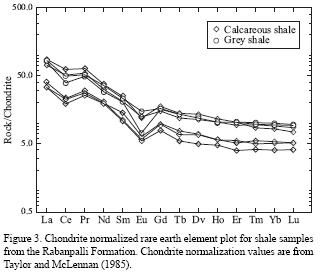
<body><![CDATA[<p align="justify"><font face="verdana" size="2">The K<sub>2</sub>O/Al<sub>2</sub>O<sub>3</sub> ratio of sediments can be used as an indicator of the original composition of ancient sediments. The K<sub>2</sub>O/Al<sub>2</sub>O<sub>3</sub> ratios for clay minerals and feldspars are different (0.0 to 0.3, 0.3 to 0.9, respectively; Cox <i>et al.</i>, 1995). The average K<sub>2</sub>O/Al<sub>2</sub>O<sub>3</sub> ratio for calcareous shales vary from 0.21 to 0.30 (the mean with one standard deviation value being 0.24 &plusmn; 0.03; n = 10), and for grey shales it varies from 0.14 to 0.24 (0.20 &plusmn; 0.05; n = 3). In most of the samples, the K<sub>2</sub>O/Al<sub>2</sub>O<sub>3</sub> ratios are close to the upper limit of the clay mineral range, which suggest that the illite is the dominant clay mineral in these shales. </font></p> 				    <p align="justify"><font face="verdana" size="2">Titanium is mainly concentrated in phyllosilicates (Condie <i>et al.</i>, 1992) and is relatively immobile compared to other elements during various sedimentary processes and may strongly represent the source rocks (McLennan <i>et al.</i>, 1993). The calcareous and grey shales of Bhima basin show lower TiO<sub>2</sub> values than the post&#150;Archean Australian average shale (PAAS; Taylor and McLennan, 1985), which suggests more evolved (felsic) material in the source rocks. Most of the samples have low P<sub>2</sub>O<sub>5</sub> contents. The depletion of P<sub>2</sub>O<sub>5</sub> may be explained by the lesser amount of accessory phases such as apatite and monazite compared to PAAS.</font></p> 				    <p align="justify"><font face="verdana" size="2"><b>Trace elements</b></font></p> 				    <p align="justify"><font face="verdana" size="2">All the trace elements were normalized using PAAS values (Taylor and McLennan, 1985) and are plotted in a multielement diagram (<a href="/img/revistas/rmcg/v24n2/a3f2.jpg" target="_blank">Figure 2</a>). PAAS normalized patterns of trace elements of shales show a moderate depletion of Ni, Cr, V, Sr, Rb, Zr, and Sc whereas Co, Nb, and U contents are enriched with respect to those of PAAS. Grey shales have higher abundances in Co, Ba, Y, Hf, and U than PAAS. The calcareous shales are enriched in Sr (~147&#150;252 ppm), whereas a marked depletion is noticed in the grey shales (~ 58&#150;85 ppm; <a href="/img/revistas/rmcg/v24n2/a3f2.jpg" target="_blank">Figure 2</a>). The high Sr content in calcareous shales indicates that Sr may be associated with calcite minerals. Similarly, calcareous shales have higher content of Ba (~212&#150;6,718 ppm) than grey shales (~941&#150;2,250 ppm) as well as to PAAS. Ba enrichment in sedimentary rocks can be considered as an indicator of detrital flux. The calcareous and grey shales were deposited in a shallow marine environment and hence may be enriched by adsorbed Ba. The high content of Ba concentration in Rabanpalli shales indicates the presence of barite crystals of syn&#150;sedimentary origin (Jayaprakash, 1985). Some trace elements such as Cr, Sc, Ni, and V are positively correlated with Al<sub>2</sub>O<sub>3</sub> (r = 0.89, r = 0.93, r = 0.68, r = 0.97, respectively), which suggest that these elements may be bound in clay minerals and concentrated during weathering (<i>e.g.</i>, Fedo <i>et al.</i>, 1996). </font></p> 				    <p align="justify"><font face="verdana" size="2"><b>Rare earth elements</b></font></p> 				    <p align="justify"><font face="verdana" size="2">The concentrations of rare earth elements (REE) are listed in <a href="/img/revistas/rmcg/v24n2/a3t2.jpg" target="_blank">Table 2</a>. In &Sigma;REE content, large variations are observed between calcareous (58.75 to 151.10) and grey shales (117.39 to 133.14). The bulk REE normally reside in the fine fraction (silt or clay) and it has also been inferred that trivalent REE readily accommodated in most clay minerals enriched with alumina and ferric iron (Cullers <i>et al.</i>, 1987, 1988). In a chondrite&#150;normalized REE plot (<a href="#f3">Figure 3</a>), the shale samples from the Rabanpalli Formation show slightly LREE enriched and flat HREE pattern with negative Eu anomaly. The calcareous and grey shales show less fractionation of REE (La<sub>N</sub>/Yb<sub>N</sub> = 6.26 to 10.20 and 8.05 to 8.53, respectively). These ratios are slightly lower than the PAAS &#91;(La/Yb)<sub>PAAS</sub> = 9.5, Taylor and McLennan, 1985&#93;, except C122.</font></p> 				    <p align="center"><font face="verdana" size="2"><a name="f3"></a></font></p> 				    <p align="center"><font face="verdana" size="2"><img src="/img/revistas/rmcg/v24n2/a3f3.jpg"></font></p> 				    <p align="justify"><font face="verdana" size="2">&nbsp;</font></p> 				    <p align="justify"><font face="verdana" size="2"><b>DISCUSSION</b></font></p> 				    ]]></body>
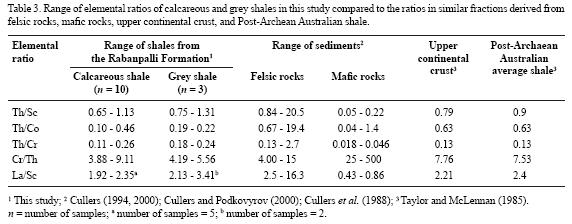
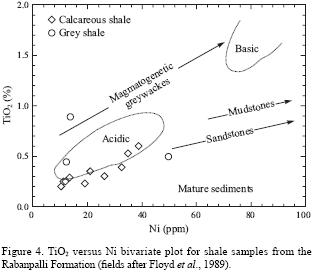
<body><![CDATA[<p align="justify"><font face="verdana" size="2"><b>Provenance</b></font></p> 				    <p align="justify"><font face="verdana" size="2">The geochemical signatures of clastic sediments have been used to find out the provenance characteristics (Taylor and McLennan, 1985; Condie <i>et al.</i>, 1992; Cullers, 1995; Madhavaraju and Ramasamy, 2002; Armstrong&#150;Altrin <i>et al.</i>, 2004). Al<sub>2</sub>O<sub>3</sub>/TiO<sub>2</sub> ratios of most clastic rocks are essentially used to infer the source rock compositions, because the Al<sub>2</sub>O<sub>3</sub>/TiO<sub>2</sub> ratio increases from 3 to 8 for mafic igneous rocks, from 8 to 21 for intermediate rocks, and from 21 to 70 for felsic igneous rocks (Hayashi <i>et al.</i>, 1997). In the calcareous shales, the Al<sub>2</sub>O<sub>3</sub>/TiO<sub>2</sub> ratio ranges from 19.40 to 24.25 and in grey shales it varies between 13.60 and 23.34. The Al<sub>2</sub>O<sub>3</sub>/TiO<sub>2</sub> ratio is essentially identical and range between 15 and 25 for shales and sandstones of Precambrian age reported from Egypt (Willies <i>et al.</i>, 1988). Thus, the Al<sub>2</sub>O<sub>3</sub>/TiO<sub>2</sub> ratio of this study suggests that intermediate to felsic granitoid rocks must be the probable source rocks for the shales of the Rabanpalli Formation. This interpretation is further supported by the TiO<sub>2</sub> <i><i>vs.</i></i> Ni bivariate plot (<a href="#f4">Figure 4</a>; Floyd <i>et al.</i>, 1989), which also indicate that these shales were mainly derived from felsic source rocks. </font></p> 				    <p align="center"><font face="verdana" size="2"><a name="f4"></a></font></p> 				    <p align="center"><font face="verdana" size="2"><img src="/img/revistas/rmcg/v24n2/a3f4.jpg"></font></p> 				    <p align="justify"><font face="verdana" size="2">The abundance of Cr and Ni in siliciclastic sediments are considered as a useful indicator in provenance studies. Chromium and Ni concentrations are low in the calcareous and grey shales (<a href="/img/revistas/rmcg/v24n2/a3t1.jpg" target="_blank">Table 1</a>). According to Wrafter and Graham (1989) a low concentration of Cr indicates a felsic provenance, and high contents of Cr and Ni are mainly found in sediments derived from ultramafic rocks (Armstrong&#150;Altrin <i>et al.</i>, 2004). The Cr/Ni ratios are low in both grey (~1.16&#150;5.16) and calcareous (~1.28&#150;2.77) shales. However, the Th/Cr ratio in both grey (~0.18&#150;0.24) and calcareous shales (~0.12&#150;0.26) is higher than in PAAS (Th/Cr = 0.13; Taylor and McLennan, 1985).</font></p> 				    <p align="justify"><font face="verdana" size="2">Ratios such as La/Sc, Th/Sc, Th/Co, and Th/Cr are significantly different in felsic and basic rocks and may allow constraints on the average provenance composition (Wronkiewicz and Condie, 1990; Cox <i>et al.</i>, 1995; Cullers, 1995). Th/Sc, Th/Co, Th/Cr, Cr/Th, and La/Sc ratios of shales from this study are compared with those of sediments derived from felsic and basic rocks (fine fraction) as well as to upper continentale crust (UCC) and PAAS values (<a href="#t3">Table 3</a>). This comparison also suggests that these ratios are within the range of felsic rocks. In addition, the La/Th and Th/Sc ratios are fairly constant in sedimentary rocks (2.4 and 0.9, respectively; Taylor and McLennan, 1985). The La/Th and Th/Sc ratios of the shales in the present study are more or less close to PAAS (<a href="/img/revistas/rmcg/v24n2/a3t1.jpg" target="_blank">Table 1</a>), which suggest a felsic nature of the source rocks. Furthermore, the Th/Co <i>vs.</i> La/Sc plot (<a href="#f5">Figure 5</a>; Cullers, 2002) also suggests that the shales of the Rabanpalli Formation were derived from felsic source rocks.</font></p> 				    <p align="center"><font face="verdana" size="2"><a name="f5"></a></font></p> 				    <p align="center"><font face="verdana" size="2"><img src="/img/revistas/rmcg/v24n2/a3f5.jpg"></font></p> 				    <p align="center"><font face="verdana" size="2"><a name="t3"></a></font></p> 				    <p align="center"><font face="verdana" size="2"><img src="/img/revistas/rmcg/v24n2/a3t3.jpg"></font></p> 				    ]]></body>
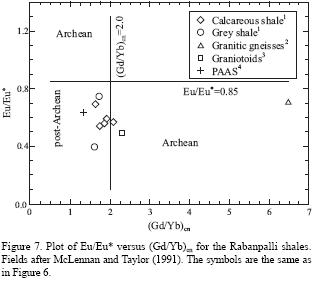
<body><![CDATA[<p align="justify"><font face="verdana" size="2">The REE pattern and europium anomaly in the sedimentary rocks will provide important clues regarding the source rock characteristics (Taylor and McLennan, 1985). Higher LREE/HREE ratios and negative Eu anomalies are generally found in felsic rocks, whereas the mafic rocks exhibit lower LREE/HREE ratios and no or small Eu anomalies (Cullers, 1994). The positive Eu anomalies are generally found in Precambrian rocks &#91;tonalite&#150;tronjhemite&#150;gneiss (TTG), granodiorite, and quartz diorite&#93;. The TTG rocks exhibit very high LREE/HREE ratios and no or small positive Eu anomalies, and the positive anomaly resulted from hornblende&#150;melt equilibria (Cullers and Graf, 1984). The Rabanpalli shales show slightly LREE enriched and flat HREE patterns with negative Eu anomalies (<a href="#f3">Figure 3</a>). However, the Rabanpalli shales show high LREE/HREE ratios (6.49 &plusmn; 0.66, n = 7) and negative europium anomaly (avg. 0.93, n = 4), which suggest that these sedimentary rocks were mainly derived from the felsic source rocks. The (Gd/Yb)<sub>N</sub> ratios (1.79 &plusmn; 0.17, n = 7) of Rabanpalli shales are less than 2, which suggest that these shales were derived from the less HREE depleted source rocks. </font></p> 				    <p align="justify"><font face="verdana" size="2">The paleocurrent current data of Akhtar (1977) suggest that the Archean Dharwar Craton, exposed in an area adjoining this basin, was the source rocks for the Bhima Group. Hence, the REE data of this study are compared with granitic gneisses (tonalitic and granitic gneisses, average of 22 samples from Dharwar Craton; Jayaram <i>et al.</i>, 1983) and granitoids (granites and granodiorites, average of 11 samples from Dharwar Craton; Jayananda <i>et al.</i>, 2000) to find out the source rocks (<a href="#f6">Figure 6</a>). The REE patterns and Eu anomaly of the Rabanpalli shales are similar to granitoids from Dharwar Craton, which suggests that these shales were predominantly derived from the Archean Dharwar Craton. This interpretation is further supported by the Eu/Eu* <i>vs.</i> (Gd/Yb)<sub>N</sub> plot (<a href="#f7">Figure 7</a>). The (Gd/Yb)<sub>N</sub> ratio also document the nature of source rocks and the composition of the continental crust (Taylor and McLennan, 1985). Archean crust generally has higher (Gd/Yb)<sub>N</sub> ratio, recording typically values above 2.0 in sedimentary rocks, whereas the Post&#150;Archean rocks have (Gd/Yb)<sub>N</sub> values commonly between 1.0 and 2.0 (McLennan, 1989; McLennan and Taylor, 1991). In a Eu/Eu* <i>vs.</i> (Gd/Yb)<sub>N</sub> plot (<a href="#f7">Figure 7</a>), samples fall below the (Gd/Yb)<sub>N</sub> = 2.0 boundary, except one sample, which fall above this line. All samples fall below the Eu/Eu* = 0.85 line. The Eu/Eu* and (Gd/Yb)<sub>N</sub> ratios of the Rabanpalli shales fall more or less near to granitoids from the Dharwar Craton, which suggest that the Archean rocks from Dharwar Craton could be the source rocks for Rabanpalli Formation. The HREE depletion &#91;(Gd/Yb)<sub>N</sub> &gt; 2.0&#93; is common in the Archean rocks and is essentially absent in the post&#150;Archean rocks (Taylor and McLennan, 1985). The (Gd/Yb)<sub>N</sub> <i>vs.</i> Eu/Eu* plot suggests that the Rabanpalli shales fall between PAAS and granitoids, and have REE patterns (<a href="#f3">Figure 3</a>) somewhat similar to PAAS. It suggests that intracrustal differentiation processes occurred on a local scale in the Archean crust of Dharwar Craton (<i>e.g.</i>, Gibbs <i>et al.</i>, 1986; Taylor <i>et al.</i>, 1986; McLennan, 1989). </font></p> 				    <p align="center"><font face="verdana" size="2"><a name="f6"></a></font></p> 				    <p align="center"><font face="verdana" size="2"><img src="/img/revistas/rmcg/v24n2/a3f6.jpg"></font></p> 				    <p align="center"><font face="verdana" size="2"><a name="f7"></a></font></p> 				    <p align="center"><font face="verdana" size="2"><img src="/img/revistas/rmcg/v24n2/a3f7.jpg"></font></p> 				    <p align="justify"><font face="verdana" size="2"><b>Paleo&#150;oxygenation condition</b></font></p> 				    <p align="justify"><font face="verdana" size="2">The oxidation of uranium exerts a strong control on the marine geochemistry (Barnes and Cochran, 1990). In oxic conditions, uranium is present in high concentrations as uranyl tricarbonate species, whereas in reducing condition U(VI) will be converted into U(IV) species, which can be easily removed from the seawater and precipitated onto particle surfaces (Barnes and Cochran, 1990; Nath <i>et al.</i>, 1997). Calcareous and grey shales show moderate to high content of U (~2.85&#150;5.61, ~4.53&#150;6.79, respectively). Low contents of U are generally found in sediments deposited in oxygenated conditions in marine environment (Somayajulu <i>et al.</i>, 1994; Madhavaraju and Ramasamy, 1999), whereas high U contents are found in sediments from the oxygen minimum zone (Barnes and Cochran, 1990; Klinkhammer and Palmer, 1991; Sarkar <i>et al.</i>, 1993; Somayajulu <i>et al.</i>, 1994; Nath <i>et al.</i>, 1997). </font></p> 				    <p align="justify"><font face="verdana" size="2">The Late Archean granitoids, <i>i.e.</i>, the basement rocks of Bhima basin, exhibit high content of U (3&#150;21 ppm with an average of 8 ppm; Senthil Kumar and Srinivasan, 2002). These granitoids have been altered as result of hydrothermal activity, which leached out uranium from the accessory minerals and concentrated them along the fault zones (Senthil Kumar and Srinivasan, 2002). The observed moderate to high content of U in both calcareous and grey shales are mainly due to enrichment of U in the source rocks, which contributed more U to these shales. Furthermore, the calcareous and grey shales do not show significant variation in U content. The ratio of uranium to thorium may be used as a redox indicator with U/Th ratio being higher in organic rich mudstones (Jones and Manning, 1994). U/Th ratios below 1.25 suggest oxic conditions of deposition, whereas values above 1.25 indicate suboxic and anoxic conditions (Nath <i>et al.</i>, 1997). In the Arabian Sea, sediments below the oxygen minimum zone (OMZ) show high U/Th (&gt;1.25) ratios, whereas the sediments above the OMZ exhibit low U/Th (&lt;1.25) ratios. The calcareous and grey shales of this study show low U/Th ratios (~0.40&#150;1.13, ~0.40&#150;0.61, respectively), which indicate that these shales were deposited in an oxic environment.</font></p> 				    <p align="justify"><font face="verdana" size="2">The authigenic uranium content is also considered as an index of bottom water condition in ancient sedimentary sequences (Wignall and Myers, 1988). The authigenic uranium content is calculated as: (authigenic U) = (total U) &#150; Th/3. Values of authigenic U below 5 are thought to represent oxic depositional conditions, while values above 5 are indicative of suboxic and anoxic conditions. In this study, authigenic U contents are low in both calcareous (~0.98&#150;2.55 ppm) and grey shales(~ 1.09&#150;2.97 ppm). If the observed high content of U in these shales resulted from uranium mobilization (removed from seawater and precipitated on particles surfaces) then it should also be reflected in the U/Th ratios and authigenic uranium contents. Thus, the observed low U/Th ratio and low authigenic U content in calcareous and grey shales indicate that these shales were deposited in an oxic environment.</font></p> 				    ]]></body>
<body><![CDATA[<p align="justify"><font face="verdana" size="2">The V/Cr ratio has been used as an index of paleo&#150;oxygenation in many studies (Ernst, 1970; Bjorlykke, 1974; Dill, 1986; Dill <i>et al.</i>, 1988). Cr is mainly incorporated in the detrital fraction of sediments and it may substitute for Al in the clay structure (Bjorlykke, 1974). Vanadium may be bound to organic matter by the incorporation of V4+ into porphyrins, and is generally found in sediments deposited in reducing environments (Shaw <i>et al.</i>, 1990). Ratios above 2 indicate anoxic conditions, whereas values below 2 suggest more oxidizing conditions (Jones and Manning, 1994). In the present study, the V/Cr ratios of all samples (calcareous and grey shales) varies between 0.77 and 1.31, which imply that these shales were deposited in an oxic depositional environment. </font></p> 				    <p align="justify"><font face="verdana" size="2">Dypvik (1984) and Dill (1986) used the Ni/Co ratio as a redox indicator. Jones and Manning (1994) suggested that Ni/Co ratios below 5 indicate oxic environments, whereas ratios above 5 suggest suboxic and anoxic environments. The calcareous and grey shales show low Ni/Co ratio (~0.32&#150;1.30, ~0.15&#150;1.00, respectively), which suggest that these sediments were deposited in a well oxygenated environment. In addition, the Cu/Zn ratio is also used as a redox parameter (Hallberg, 1976). According to Hallberg (1976) high Cu/Zn ratios indicate reducing depositional conditions, while low Cu/Zn ratios suggest oxidizing conditions. Thus, the low Cu/Zn ratios for calcareous (~0.09&#150;0.89) and grey shales (~0.19&#150;0.62) indicate that the Rapanpalli shales were deposited under well oxidizing conditions.</font></p> 				    <p align="justify"><font face="verdana" size="2">&nbsp;</font></p> 				    <p align="justify"><font face="verdana" size="2"><b>CONCLUSIONS</b></font></p> 				    <p align="justify"><font face="verdana" size="2">The Proterozoic shales of the Rabanpalli Formation show considerable variations in major, trace, and rare earth elements. Higher concentration of SiO<sub>2</sub>, Al<sub>2</sub>O<sub>3</sub>, Fe<sub>2</sub>O<sub>3</sub>, K<sub>2</sub>O, Zr, Th, U, V, Cr, La, Ce, and Y are observed in the grey shales than the calcareous shales, whereas the calcareous shales are enriched with CaO, Mn, Sr, Ba, Cu, and Zn contents. The REE pattern, as well as other geochemical parameters like La/Sc, Th/Sc, Th/Co, Th/Cr, and Cr/Th ratios, and La/Sc <i>vs.</i> Th/Co plot suggests that these sediments were mainly derived from felsic source rocks. The REE patterns and Eu anomaly indicate that a derivation of these sedimentary rocks from the Archean Dharwar Craton, which was exposed during the Proterozoic time. The geochemical parameters like U, authigenic U, U/Th, V/Cr, Ni/Co, and Cu/Zn ratios strongly imply that these shales were deposited in an oxic environment.</font></p> 				    <p align="justify"><font face="verdana" size="2">&nbsp;</font></p> 				    <p align="justify"><font face="verdana" size="2"><b>ACKNOWLEDGEMENTS</b></font></p> 				    <p align="justify"><font face="verdana" size="2">The manuscript has been greatly improved from critical reviews by Prof. R.L. Cullers, Dr. Nagender Nath, and Prof. Rasheed. Our special thanks to Prof. S.P. Verma for his innovative ideas and useful suggestions. The first author (RN) wishes to express his gratefulness to Prof. S.P. Mohan, Head of the Department of Geology, University of Madras, for providing certain laboratory facilities, and expresses his sincere thanks to Prof. L. Elango, Department of Geology, Anna University for his constant encouragement during this study. JSA wishes to express his gratefulness to SEP&#150;PROMEP (Programa de Mejoramiento del Profesorado; Grant No: UAEHGO&#150;PTC&#150;280), SNI&#150;CONACYT (Consejo Nacional de Ciencia y Tecnolog&iacute;a), and PAI (Programa Anual de Investigaci&oacute;n; Grant No: 69B), Mexico, for financial assistance.</font></p> 				    <p align="justify"><font face="verdana" size="2">&nbsp;</font></p> 				    <p align="justify"><font face="verdana" size="2"><b>REFERENCES</b></font></p> 				    ]]></body>
<body><![CDATA[<!-- ref --><p align="justify"><font face="verdana" size="2">Akhtar, K., 1977, Depositional environments, dispersal pattern and paleogeography of the clastic sequences in the Bhima Basin: Indian Mineralogist, 18, 65&#150;72.</font>&nbsp;&nbsp;&nbsp;&nbsp;&nbsp;&nbsp;&nbsp;&nbsp;[&#160;<a href="javascript:void(0);" onclick="javascript: window.open('/scielo.php?script=sci_nlinks&ref=8016748&pid=S1026-8774200700020000300001&lng=','','width=640,height=500,resizable=yes,scrollbars=1,menubar=yes,');">Links</a>&#160;]<!-- end-ref --> 				    <!-- ref --><p align="justify"><font face="verdana" size="2">Armstrong&#150;Altrin, J.S., Verma, S.P., 2005, Critical evaluation of six tectonic setting discrimination diagrams using geochemical data of Neogene sediments from known tectonic settings: Sedimentary Geology, 177(1&#150;2), 115&#150;129.</font>&nbsp;&nbsp;&nbsp;&nbsp;&nbsp;&nbsp;&nbsp;&nbsp;[&#160;<a href="javascript:void(0);" onclick="javascript: window.open('/scielo.php?script=sci_nlinks&ref=8016750&pid=S1026-8774200700020000300002&lng=','','width=640,height=500,resizable=yes,scrollbars=1,menubar=yes,');">Links</a>&#160;]<!-- end-ref --> 				    <!-- ref --><p align="justify"><font face="verdana" size="2">Armstrong&#150;Altrin, J.S., Verma, S.P., Madhavaraju, J., Lee, Y.I., Ramasamy, S., 2003, Geochemistry of Late Miocene Kudankulam Limestones, South India: International Geology Review, 45(1), 16&#150;26.</font>&nbsp;&nbsp;&nbsp;&nbsp;&nbsp;&nbsp;&nbsp;&nbsp;[&#160;<a href="javascript:void(0);" onclick="javascript: window.open('/scielo.php?script=sci_nlinks&ref=8016752&pid=S1026-8774200700020000300003&lng=','','width=640,height=500,resizable=yes,scrollbars=1,menubar=yes,');">Links</a>&#160;]<!-- end-ref --> 				    <!-- ref --><p align="justify"><font face="verdana" size="2">Armstrong&#150;Altrin, J.S., Lee, Y.I., Verma, S.P., Ramasamy, S., 2004, Geochemistry of sandstones from the upper Miocene Kudankulam Formation, southern India: Implications for provenance, weathering, and tectonic setting: Journal of Sedimentary Research, 74(2), 285&#150;297. </font>&nbsp;&nbsp;&nbsp;&nbsp;&nbsp;&nbsp;&nbsp;&nbsp;[&#160;<a href="javascript:void(0);" onclick="javascript: window.open('/scielo.php?script=sci_nlinks&ref=8016754&pid=S1026-8774200700020000300004&lng=','','width=640,height=500,resizable=yes,scrollbars=1,menubar=yes,');">Links</a>&#160;]<!-- end-ref --> 				    <!-- ref --><p align="justify"><font face="verdana" size="2">Barnes, U.C., Cochran, J.R., 1990, Uranium removal in oceanic sediments and the oceanic U balance: Earth and Planetary Science Letters, 97(1&#150;2), 94&#150;101.</font>&nbsp;&nbsp;&nbsp;&nbsp;&nbsp;&nbsp;&nbsp;&nbsp;[&#160;<a href="javascript:void(0);" onclick="javascript: window.open('/scielo.php?script=sci_nlinks&ref=8016756&pid=S1026-8774200700020000300005&lng=','','width=640,height=500,resizable=yes,scrollbars=1,menubar=yes,');">Links</a>&#160;]<!-- end-ref --> 				    ]]></body>
<body><![CDATA[<!-- ref --><p align="justify"><font face="verdana" size="2">Bhatia, M.R., 1983, Plate tectonics and geochemical composition of sandstones: Journal of Geology, 91, 611&#150;627.</font>&nbsp;&nbsp;&nbsp;&nbsp;&nbsp;&nbsp;&nbsp;&nbsp;[&#160;<a href="javascript:void(0);" onclick="javascript: window.open('/scielo.php?script=sci_nlinks&ref=8016758&pid=S1026-8774200700020000300006&lng=','','width=640,height=500,resizable=yes,scrollbars=1,menubar=yes,');">Links</a>&#160;]<!-- end-ref --> 				    <!-- ref --><p align="justify"><font face="verdana" size="2">Bjorlykke, K., 1974, Geochemical and mineralogical influence of Ordovician island arcs on epicontinental clastic sedimentation: a study of Lower Palaeozoic sedimentation in the Oslo region, Norway: Sedimentology, 21(2), 251&#150;272.</font>&nbsp;&nbsp;&nbsp;&nbsp;&nbsp;&nbsp;&nbsp;&nbsp;[&#160;<a href="javascript:void(0);" onclick="javascript: window.open('/scielo.php?script=sci_nlinks&ref=8016760&pid=S1026-8774200700020000300007&lng=','','width=640,height=500,resizable=yes,scrollbars=1,menubar=yes,');">Links</a>&#160;]<!-- end-ref --> 				    <!-- ref --><p align="justify"><font face="verdana" size="2">Calvert, S.E., Pedersen, T.F., 1993, Geochemistry of Recent oxic and anoxic marine sediments, implications for the geological records: Marine Geology, 113(1&#150;2), 67&#150;88.</font>&nbsp;&nbsp;&nbsp;&nbsp;&nbsp;&nbsp;&nbsp;&nbsp;[&#160;<a href="javascript:void(0);" onclick="javascript: window.open('/scielo.php?script=sci_nlinks&ref=8016762&pid=S1026-8774200700020000300008&lng=','','width=640,height=500,resizable=yes,scrollbars=1,menubar=yes,');">Links</a>&#160;]<!-- end-ref --> 				    <!-- ref --><p align="justify"><font face="verdana" size="2">Condie, K.C., Wronkiewicz, D.J., 1990, A new look at the Archean&#150;Proterozoic boundary: Sediments and the tectonic setting constraint, <i>in</i> Naqvi, S.M. (ed.), Precambrian Continental Crust and its Economic Resources: Elsevier, Amsterdam, 61&#150;84.</font>&nbsp;&nbsp;&nbsp;&nbsp;&nbsp;&nbsp;&nbsp;&nbsp;[&#160;<a href="javascript:void(0);" onclick="javascript: window.open('/scielo.php?script=sci_nlinks&ref=8016764&pid=S1026-8774200700020000300009&lng=','','width=640,height=500,resizable=yes,scrollbars=1,menubar=yes,');">Links</a>&#160;]<!-- end-ref --> 				    <!-- ref --><p align="justify"><font face="verdana" size="2">Condie, K.C., Boryta, M.D., Liu, J., Quian, X., 1992, The origin of khondalites: geochemical evidence from the Archean to Early Proterozoic granulitic belt in the North China Craton: Precambrian Research, 59(3&#150;4), 207&#150;223.</font>&nbsp;&nbsp;&nbsp;&nbsp;&nbsp;&nbsp;&nbsp;&nbsp;[&#160;<a href="javascript:void(0);" onclick="javascript: window.open('/scielo.php?script=sci_nlinks&ref=8016766&pid=S1026-8774200700020000300010&lng=','','width=640,height=500,resizable=yes,scrollbars=1,menubar=yes,');">Links</a>&#160;]<!-- end-ref --> 				    ]]></body>
<body><![CDATA[<!-- ref --><p align="justify"><font face="verdana" size="2">Cox, R., Lowe, D.R., Cullers, R.L., 1995, The influence of sediment recycling and basement composition on evolution of mudrock chemistry in the southwestern United States: Geochimica et Cosmochimica Acta, 59(14), 2919&#150;2940.</font>&nbsp;&nbsp;&nbsp;&nbsp;&nbsp;&nbsp;&nbsp;&nbsp;[&#160;<a href="javascript:void(0);" onclick="javascript: window.open('/scielo.php?script=sci_nlinks&ref=8016768&pid=S1026-8774200700020000300011&lng=','','width=640,height=500,resizable=yes,scrollbars=1,menubar=yes,');">Links</a>&#160;]<!-- end-ref --> 				    <!-- ref --><p align="justify"><font face="verdana" size="2">Cullers, R.L., 1994, The controls on the major and trace element variation of shales, siltstones and sandstones of Pennsylvanian &#150; Permian age from uplifted continental blocks in Colorado to platform sediment in Kansas, USA: Geochimica et Cosmochimica Acta, 58(22), 4955&#150;4972.</font>&nbsp;&nbsp;&nbsp;&nbsp;&nbsp;&nbsp;&nbsp;&nbsp;[&#160;<a href="javascript:void(0);" onclick="javascript: window.open('/scielo.php?script=sci_nlinks&ref=8016770&pid=S1026-8774200700020000300012&lng=','','width=640,height=500,resizable=yes,scrollbars=1,menubar=yes,');">Links</a>&#160;]<!-- end-ref --> 				    <!-- ref --><p align="justify"><font face="verdana" size="2">Cullers, R.L., 1995, The controls on the major and trace element evolution of shales, siltstones and sandstones of Ordovician to Tertiary age in the Wet Mountain region, Colorado, U.S.A: Chemical Geology, 123(1&#150;4), 107&#150;131.</font>&nbsp;&nbsp;&nbsp;&nbsp;&nbsp;&nbsp;&nbsp;&nbsp;[&#160;<a href="javascript:void(0);" onclick="javascript: window.open('/scielo.php?script=sci_nlinks&ref=8016772&pid=S1026-8774200700020000300013&lng=','','width=640,height=500,resizable=yes,scrollbars=1,menubar=yes,');">Links</a>&#160;]<!-- end-ref --> 				    <!-- ref --><p align="justify"><font face="verdana" size="2">Cullers, R.L., 2000, The geochemistry of shales, siltstones and sandstones of Pennsylvanian&#150;Permian age, Colorado, U.S.A.: implications for provenance and metamorphic studies: Lithos, 51, 305&#150;327.</font>&nbsp;&nbsp;&nbsp;&nbsp;&nbsp;&nbsp;&nbsp;&nbsp;[&#160;<a href="javascript:void(0);" onclick="javascript: window.open('/scielo.php?script=sci_nlinks&ref=8016774&pid=S1026-8774200700020000300014&lng=','','width=640,height=500,resizable=yes,scrollbars=1,menubar=yes,');">Links</a>&#160;]<!-- end-ref --> 				    <!-- ref --><p align="justify"><font face="verdana" size="2">Cullers, R.L., 2002, Implications of elemental concentrations for provenance, redox conditions, and metamorphic studies of shales and limestones near Pueblo, CO, USA: Chemical Geology, 191(4), 305&#150;327.</font>&nbsp;&nbsp;&nbsp;&nbsp;&nbsp;&nbsp;&nbsp;&nbsp;[&#160;<a href="javascript:void(0);" onclick="javascript: window.open('/scielo.php?script=sci_nlinks&ref=8016776&pid=S1026-8774200700020000300015&lng=','','width=640,height=500,resizable=yes,scrollbars=1,menubar=yes,');">Links</a>&#160;]<!-- end-ref --> 				    ]]></body>
<body><![CDATA[<!-- ref --><p align="justify"><font face="verdana" size="2">Cullers, R.L., Graf, J., 1984, Rare earth element in igneous rocks of the continental crust: intermediate and silicic rocks, ore petrogenesis, <i>in</i> Henderson, P. (ed.), Rare earth geochemistry: Elsevier, 275&#150;316.</font>&nbsp;&nbsp;&nbsp;&nbsp;&nbsp;&nbsp;&nbsp;&nbsp;[&#160;<a href="javascript:void(0);" onclick="javascript: window.open('/scielo.php?script=sci_nlinks&ref=8016778&pid=S1026-8774200700020000300016&lng=','','width=640,height=500,resizable=yes,scrollbars=1,menubar=yes,');">Links</a>&#160;]<!-- end-ref --> 				    <!-- ref --><p align="justify"><font face="verdana" size="2">Cullers, R.L., Podkovyrov, V.N., 2000, Geochemistry of the Mesoproterozoic Lakhanda shales in southeastern Yakutia, Russia: implications for mineralogical and provenance control, and recycling. Precambrian Research, 104(1&#150;2), 77&#150;93. </font>&nbsp;&nbsp;&nbsp;&nbsp;&nbsp;&nbsp;&nbsp;&nbsp;[&#160;<a href="javascript:void(0);" onclick="javascript: window.open('/scielo.php?script=sci_nlinks&ref=8016780&pid=S1026-8774200700020000300017&lng=','','width=640,height=500,resizable=yes,scrollbars=1,menubar=yes,');">Links</a>&#160;]<!-- end-ref --> 				    <!-- ref --><p align="justify"><font face="verdana" size="2">Cullers, R.L., Barrett, T., Carlson, R., Robinson, B., 1987, Rare earth element and mineralogic changes in Holocene soil and stream sediment: a case study in the Wet Mountains, Colorado, USA: Chemical Geology, 63(3&#150;4), 275&#150;297.</font>&nbsp;&nbsp;&nbsp;&nbsp;&nbsp;&nbsp;&nbsp;&nbsp;[&#160;<a href="javascript:void(0);" onclick="javascript: window.open('/scielo.php?script=sci_nlinks&ref=8016782&pid=S1026-8774200700020000300018&lng=','','width=640,height=500,resizable=yes,scrollbars=1,menubar=yes,');">Links</a>&#160;]<!-- end-ref --> 				    <!-- ref --><p align="justify"><font face="verdana" size="2">Cullers, R.L., Basu, A., Suttner, L., 1988, Geochemical signature of provenance in sand&#150;size material in soils and stream sediments near the Tobacco Root batholith, Montana, USA: Chemical Geology, 70(4), 335&#150;348.</font>&nbsp;&nbsp;&nbsp;&nbsp;&nbsp;&nbsp;&nbsp;&nbsp;[&#160;<a href="javascript:void(0);" onclick="javascript: window.open('/scielo.php?script=sci_nlinks&ref=8016784&pid=S1026-8774200700020000300019&lng=','','width=640,height=500,resizable=yes,scrollbars=1,menubar=yes,');">Links</a>&#160;]<!-- end-ref --> 				    <!-- ref --><p align="justify"><font face="verdana" size="2">Dill, H., 1986, Metallogenesis of early Paleozoic graptolite shales from the Graefenthal Horst (northern Bavaria&#150;Federal Republic of Germany): Economic Geology, 81, 889&#150;903.</font>&nbsp;&nbsp;&nbsp;&nbsp;&nbsp;&nbsp;&nbsp;&nbsp;[&#160;<a href="javascript:void(0);" onclick="javascript: window.open('/scielo.php?script=sci_nlinks&ref=8016786&pid=S1026-8774200700020000300020&lng=','','width=640,height=500,resizable=yes,scrollbars=1,menubar=yes,');">Links</a>&#160;]<!-- end-ref --> 				    ]]></body>
<body><![CDATA[<!-- ref --><p align="justify"><font face="verdana" size="2">Dill, H., Teshner, M., Wehner, H., 1988, Petrography, inorganic and organic geochemistry of Lower Permian Carboniferous fan sequences (Brandschiefer Series) FRG: constraints to their palaeogeography and assessment of their source rock potential: Chemical Geology, 67(3&#150;4), 307&#150;325.</font>&nbsp;&nbsp;&nbsp;&nbsp;&nbsp;&nbsp;&nbsp;&nbsp;[&#160;<a href="javascript:void(0);" onclick="javascript: window.open('/scielo.php?script=sci_nlinks&ref=8016788&pid=S1026-8774200700020000300021&lng=','','width=640,height=500,resizable=yes,scrollbars=1,menubar=yes,');">Links</a>&#160;]<!-- end-ref --> 				    <!-- ref --><p align="justify"><font face="verdana" size="2">Dobrzinski, N., Bahlburg, H., Strauss, H., Zhang, Q.R., 2004, Geochemical climate proxies applied to the Neoproterozoic glacial succession on the Yangtze Platform, South China, <i>in</i> Jenkins, G. <i>et al.</i> (eds.), The extreme Proterozoic: Geology, Geochemistry and Climate: American Geophysical Union Monograph Series, 146, 13&#150;32.</font>&nbsp;&nbsp;&nbsp;&nbsp;&nbsp;&nbsp;&nbsp;&nbsp;[&#160;<a href="javascript:void(0);" onclick="javascript: window.open('/scielo.php?script=sci_nlinks&ref=8016790&pid=S1026-8774200700020000300022&lng=','','width=640,height=500,resizable=yes,scrollbars=1,menubar=yes,');">Links</a>&#160;]<!-- end-ref --> 				    <!-- ref --><p align="justify"><font face="verdana" size="2">Dypvik, H., 1984, Geochemical compositions and depositional conditions of Upper Jurassic and Lower Cretaceous Yorkshire clays, England: Geological Magazine, 121(5), 489&#150;504.</font>&nbsp;&nbsp;&nbsp;&nbsp;&nbsp;&nbsp;&nbsp;&nbsp;[&#160;<a href="javascript:void(0);" onclick="javascript: window.open('/scielo.php?script=sci_nlinks&ref=8016792&pid=S1026-8774200700020000300023&lng=','','width=640,height=500,resizable=yes,scrollbars=1,menubar=yes,');">Links</a>&#160;]<!-- end-ref --> 				    <!-- ref --><p align="justify"><font face="verdana" size="2">Ernst, T.W., 1970, Geochemical facies analysis, Elsevier, Amsterdam, 152 p.</font>&nbsp;&nbsp;&nbsp;&nbsp;&nbsp;&nbsp;&nbsp;&nbsp;[&#160;<a href="javascript:void(0);" onclick="javascript: window.open('/scielo.php?script=sci_nlinks&ref=8016794&pid=S1026-8774200700020000300024&lng=','','width=640,height=500,resizable=yes,scrollbars=1,menubar=yes,');">Links</a>&#160;]<!-- end-ref --> 				    <!-- ref --><p align="justify"><font face="verdana" size="2">Fedo, C.M., Eriksson, K., Krogstad, E.J., 1996, Geochemistry of shale from the Archean (~ 3.0 Ga) Buhwa Greenstone belt, Zimbabwe: Implications for provenance and source area weathering: Geochimica et Cosmochimica Acta, 60(10), 1751&#150;1763.</font>&nbsp;&nbsp;&nbsp;&nbsp;&nbsp;&nbsp;&nbsp;&nbsp;[&#160;<a href="javascript:void(0);" onclick="javascript: window.open('/scielo.php?script=sci_nlinks&ref=8016796&pid=S1026-8774200700020000300025&lng=','','width=640,height=500,resizable=yes,scrollbars=1,menubar=yes,');">Links</a>&#160;]<!-- end-ref --> 				    ]]></body>
<body><![CDATA[<!-- ref --><p align="justify"><font face="verdana" size="2">Floyd, P.A., Winchester, J.A., Park, R.G., 1989, Geochemistry and tectonic setting of Lewisian clastic metasediments from the Early Proterozoic Loch Maree Group of Gairloch, N.W. Scotland: Precambrian Research, 45(1&#150;3), 203&#150;214.</font>&nbsp;&nbsp;&nbsp;&nbsp;&nbsp;&nbsp;&nbsp;&nbsp;[&#160;<a href="javascript:void(0);" onclick="javascript: window.open('/scielo.php?script=sci_nlinks&ref=8016798&pid=S1026-8774200700020000300026&lng=','','width=640,height=500,resizable=yes,scrollbars=1,menubar=yes,');">Links</a>&#160;]<!-- end-ref --> 				    <!-- ref --><p align="justify"><font face="verdana" size="2">Gibbs, A.K., Montgomery, D.W., O'Day, P.A., Ersler, E.A., 1986, The Archean&#150;Proterozoic transition: evidence from geochemistry of metasedimentary rocks of Guyana and Montana: Geochimica et Cosmochimica Acta, 50, 2125&#150;2141. </font>&nbsp;&nbsp;&nbsp;&nbsp;&nbsp;&nbsp;&nbsp;&nbsp;[&#160;<a href="javascript:void(0);" onclick="javascript: window.open('/scielo.php?script=sci_nlinks&ref=8016800&pid=S1026-8774200700020000300027&lng=','','width=640,height=500,resizable=yes,scrollbars=1,menubar=yes,');">Links</a>&#160;]<!-- end-ref --> 				    <!-- ref --><p align="justify"><font face="verdana" size="2">Hallberg, R.O., 1976, A geochemical method for investigation of palaeoredox conditions in sediments: Ambio, Special Report, 4, 139&#150;147.</font>&nbsp;&nbsp;&nbsp;&nbsp;&nbsp;&nbsp;&nbsp;&nbsp;[&#160;<a href="javascript:void(0);" onclick="javascript: window.open('/scielo.php?script=sci_nlinks&ref=8016802&pid=S1026-8774200700020000300028&lng=','','width=640,height=500,resizable=yes,scrollbars=1,menubar=yes,');">Links</a>&#160;]<!-- end-ref --> 				    <!-- ref --><p align="justify"><font face="verdana" size="2">Hayashi, K., Fujisawa, H., Holland, H., Ohmoto, H., 1997, Geochemistry of ~1.9 Ga sedimentary rocks from northeastern Labrador, Canada: Geochimica et Cosmochimica Acta, 61(19), 4115&#150;4137.</font>&nbsp;&nbsp;&nbsp;&nbsp;&nbsp;&nbsp;&nbsp;&nbsp;[&#160;<a href="javascript:void(0);" onclick="javascript: window.open('/scielo.php?script=sci_nlinks&ref=8016804&pid=S1026-8774200700020000300029&lng=','','width=640,height=500,resizable=yes,scrollbars=1,menubar=yes,');">Links</a>&#160;]<!-- end-ref --> 				    <!-- ref --><p align="justify"><font face="verdana" size="2">Janardhana Rao, L.H., Srinivasarao, C., Ramakrishnan, T.L., 1975, Reclassification of the rocks of Bhima basin, Gulburga district, Mysore state: Geological Survey of India, Miscellaneous Publications, 23(1), 177&#150;184.</font>&nbsp;&nbsp;&nbsp;&nbsp;&nbsp;&nbsp;&nbsp;&nbsp;[&#160;<a href="javascript:void(0);" onclick="javascript: window.open('/scielo.php?script=sci_nlinks&ref=8016806&pid=S1026-8774200700020000300030&lng=','','width=640,height=500,resizable=yes,scrollbars=1,menubar=yes,');">Links</a>&#160;]<!-- end-ref --> 				    ]]></body>
<body><![CDATA[<!-- ref --><p align="justify"><font face="verdana" size="2">Jayananda, M., Martin, H., Peucat, J.J., Mahabaleswar, B., 1995, Late Archaean crust&#150;mantle interactions: geochemistry of LRR&#150;enriched mantle derived magmas. Example of the Clospet batholith, southern India: Contribution to Mineralogy and Petrology, 119(2&#150;3), 314&#150;329.</font>&nbsp;&nbsp;&nbsp;&nbsp;&nbsp;&nbsp;&nbsp;&nbsp;[&#160;<a href="javascript:void(0);" onclick="javascript: window.open('/scielo.php?script=sci_nlinks&ref=8016808&pid=S1026-8774200700020000300031&lng=','','width=640,height=500,resizable=yes,scrollbars=1,menubar=yes,');">Links</a>&#160;]<!-- end-ref --> 				    <!-- ref --><p align="justify"><font face="verdana" size="2">Jayananda, M., Moyen, J.F., Martin, H., Peucat. J.J., Auvray, B., Mahabaleswar, B., 2000, Late Archaean (2550&#150;2520 Ma) juvenile magmatism in the Eastern Dharwar craton, Southern India: constraints from geochronology, Nd&#150;Sr isotopes and whole rock geochemistry: Precambrian Research, 99(3&#150;4), 225&#150;254.</font>&nbsp;&nbsp;&nbsp;&nbsp;&nbsp;&nbsp;&nbsp;&nbsp;[&#160;<a href="javascript:void(0);" onclick="javascript: window.open('/scielo.php?script=sci_nlinks&ref=8016810&pid=S1026-8774200700020000300032&lng=','','width=640,height=500,resizable=yes,scrollbars=1,menubar=yes,');">Links</a>&#160;]<!-- end-ref --> 				    <!-- ref --><p align="justify"><font face="verdana" size="2">Jayaprakash, A.V., 1985, A note on the occurrence of Barytes in Bhima Basin, Gulburga district, Karnataka: Indian Minerals, 39(4), 60.</font>&nbsp;&nbsp;&nbsp;&nbsp;&nbsp;&nbsp;&nbsp;&nbsp;[&#160;<a href="javascript:void(0);" onclick="javascript: window.open('/scielo.php?script=sci_nlinks&ref=8016812&pid=S1026-8774200700020000300033&lng=','','width=640,height=500,resizable=yes,scrollbars=1,menubar=yes,');">Links</a>&#160;]<!-- end-ref --> 				    <!-- ref --><p align="justify"><font face="verdana" size="2">Jayaram, S., Venkatasubramaniam, V.S., Radhakrishna, B.P., 1983, Geochronology and trace element distribution in some tonalitic and granitic gneisses of the Dharwar craton. Proceedings of the Indo&#150;US Workshop, Hyderabad, <i>in</i> Naqvi, S.M., Rogers, J.J.W. (eds.), Precambrian of south India: Memoir Geological Society of India, 8, 377&#150;389.</font>&nbsp;&nbsp;&nbsp;&nbsp;&nbsp;&nbsp;&nbsp;&nbsp;[&#160;<a href="javascript:void(0);" onclick="javascript: window.open('/scielo.php?script=sci_nlinks&ref=8016814&pid=S1026-8774200700020000300034&lng=','','width=640,height=500,resizable=yes,scrollbars=1,menubar=yes,');">Links</a>&#160;]<!-- end-ref --> 				    <!-- ref --><p align="justify"><font face="verdana" size="2">Jones, B., Manning, D.C., 1994, Comparison of geochemical indices used for the interpretation of paleo&#150;redox conditions in Ancient mudstones: Chemical Geology, 111(1&#150;4), 111&#150;129.</font>&nbsp;&nbsp;&nbsp;&nbsp;&nbsp;&nbsp;&nbsp;&nbsp;[&#160;<a href="javascript:void(0);" onclick="javascript: window.open('/scielo.php?script=sci_nlinks&ref=8016816&pid=S1026-8774200700020000300035&lng=','','width=640,height=500,resizable=yes,scrollbars=1,menubar=yes,');">Links</a>&#160;]<!-- end-ref --> 				    ]]></body>
<body><![CDATA[<!-- ref --><p align="justify"><font face="verdana" size="2">Kale, V.S., 1990, Problems of the Purana Basins, <i>in</i> Tandon, S.K., Gupta, K.R. (eds.): Challenging areas in Earth Sciences for the Nineties: Memoir Geological Society of India, 18, 77&#150;93.</font>&nbsp;&nbsp;&nbsp;&nbsp;&nbsp;&nbsp;&nbsp;&nbsp;[&#160;<a href="javascript:void(0);" onclick="javascript: window.open('/scielo.php?script=sci_nlinks&ref=8016818&pid=S1026-8774200700020000300036&lng=','','width=640,height=500,resizable=yes,scrollbars=1,menubar=yes,');">Links</a>&#160;]<!-- end-ref --> 				    <!-- ref --><p align="justify"><font face="verdana" size="2">Kale, V.S., Peshwa, V.V., 1995, The Bhima Basin: Field Guide, Geological Society of India, 142p.</font>&nbsp;&nbsp;&nbsp;&nbsp;&nbsp;&nbsp;&nbsp;&nbsp;[&#160;<a href="javascript:void(0);" onclick="javascript: window.open('/scielo.php?script=sci_nlinks&ref=8016820&pid=S1026-8774200700020000300037&lng=','','width=640,height=500,resizable=yes,scrollbars=1,menubar=yes,');">Links</a>&#160;]<!-- end-ref --> 				    <!-- ref --><p align="justify"><font face="verdana" size="2">Kale, V.S., Mudholkar, A.V., Phansalkar, V.G., Peshwa, V.V., 1990, Stratigraphy of the Bhima Group: Journal of the Paleontological Society of India, 35, 91&#150;103.</font>&nbsp;&nbsp;&nbsp;&nbsp;&nbsp;&nbsp;&nbsp;&nbsp;[&#160;<a href="javascript:void(0);" onclick="javascript: window.open('/scielo.php?script=sci_nlinks&ref=8016822&pid=S1026-8774200700020000300038&lng=','','width=640,height=500,resizable=yes,scrollbars=1,menubar=yes,');">Links</a>&#160;]<!-- end-ref --> 				    <!-- ref --><p align="justify"><font face="verdana" size="2">King, W., 1872, The Kudapah and Karnaul Formations in the Madras Presidency: Memoir Geological Survey of India, 8, 1&#150;346.</font>&nbsp;&nbsp;&nbsp;&nbsp;&nbsp;&nbsp;&nbsp;&nbsp;[&#160;<a href="javascript:void(0);" onclick="javascript: window.open('/scielo.php?script=sci_nlinks&ref=8016824&pid=S1026-8774200700020000300039&lng=','','width=640,height=500,resizable=yes,scrollbars=1,menubar=yes,');">Links</a>&#160;]<!-- end-ref --> 				    <!-- ref --><p align="justify"><font face="verdana" size="2">Klinkhammer, G.P., Palmer, M.R., 1991, Uranium in the oceans: where it goes and why?: Geochimica et Cosmochimica Acta, 55(7), 1799&#150;1806.</font>&nbsp;&nbsp;&nbsp;&nbsp;&nbsp;&nbsp;&nbsp;&nbsp;[&#160;<a href="javascript:void(0);" onclick="javascript: window.open('/scielo.php?script=sci_nlinks&ref=8016826&pid=S1026-8774200700020000300040&lng=','','width=640,height=500,resizable=yes,scrollbars=1,menubar=yes,');">Links</a>&#160;]<!-- end-ref --> 				    ]]></body>
<body><![CDATA[<!-- ref --><p align="justify"><font face="verdana" size="2">Madhavaraju, J., Ramasamy, S., 1999, Rare earth elements in limestones of Kallankurichchi Formation of Ariyalur Group, Tiruchirapalli Cretaceous, Tamil Nadu: Journal of the Geological Society of India, 54, 291&#150;301.</font>&nbsp;&nbsp;&nbsp;&nbsp;&nbsp;&nbsp;&nbsp;&nbsp;[&#160;<a href="javascript:void(0);" onclick="javascript: window.open('/scielo.php?script=sci_nlinks&ref=8016828&pid=S1026-8774200700020000300041&lng=','','width=640,height=500,resizable=yes,scrollbars=1,menubar=yes,');">Links</a>&#160;]<!-- end-ref --> 				    <!-- ref --><p align="justify"><font face="verdana" size="2">Madhavaraju, J., Ramasamy, S., 2002, Petrography and geochemistry of Late Maastrichtian &#150; Early Paleocene sediments of Tiruchirapalli Cretaceous, Tamil Nadu &#150; Paleoweathering and provenance implications: Journal of the Geological Society of India, 59, 133&#150;142.</font>&nbsp;&nbsp;&nbsp;&nbsp;&nbsp;&nbsp;&nbsp;&nbsp;[&#160;<a href="javascript:void(0);" onclick="javascript: window.open('/scielo.php?script=sci_nlinks&ref=8016830&pid=S1026-8774200700020000300042&lng=','','width=640,height=500,resizable=yes,scrollbars=1,menubar=yes,');">Links</a>&#160;]<!-- end-ref --> 				    <!-- ref --><p align="justify"><font face="verdana" size="2">Mahadevan, C., 1947, The Bhima Series and other rocks of Gulburga District: Journal of Hyderabad Geological Survey, 5, 1&#150;60.</font>&nbsp;&nbsp;&nbsp;&nbsp;&nbsp;&nbsp;&nbsp;&nbsp;[&#160;<a href="javascript:void(0);" onclick="javascript: window.open('/scielo.php?script=sci_nlinks&ref=8016832&pid=S1026-8774200700020000300043&lng=','','width=640,height=500,resizable=yes,scrollbars=1,menubar=yes,');">Links</a>&#160;]<!-- end-ref --> 				    <!-- ref --><p align="justify"><font face="verdana" size="2">Malur, M.N., Nagendra, R., 1994, Lithostratigraphy of the Bhima Basin (central part), Karnataka, Southern India: Journal of the Paleontological Society of India, 39, 55&#150;60.</font>&nbsp;&nbsp;&nbsp;&nbsp;&nbsp;&nbsp;&nbsp;&nbsp;[&#160;<a href="javascript:void(0);" onclick="javascript: window.open('/scielo.php?script=sci_nlinks&ref=8016834&pid=S1026-8774200700020000300044&lng=','','width=640,height=500,resizable=yes,scrollbars=1,menubar=yes,');">Links</a>&#160;]<!-- end-ref --> 				    <!-- ref --><p align="justify"><font face="verdana" size="2">Manikyamba, C., Naqvi, S.M., Moeen, S., Gnaneshwar Rao, T., Balaram, V., Ramesh, S.L., Reddy, G.L.N., 1997, Geochemical heterogeneities of metagraywackes from the Sandur schist belt: implications for active plate margin processes: Precambrian Research, 84(3&#150;4), 117&#150;138.</font>&nbsp;&nbsp;&nbsp;&nbsp;&nbsp;&nbsp;&nbsp;&nbsp;[&#160;<a href="javascript:void(0);" onclick="javascript: window.open('/scielo.php?script=sci_nlinks&ref=8016836&pid=S1026-8774200700020000300045&lng=','','width=640,height=500,resizable=yes,scrollbars=1,menubar=yes,');">Links</a>&#160;]<!-- end-ref --> 				    ]]></body>
<body><![CDATA[<!-- ref --><p align="justify"><font face="verdana" size="2">McCulloch, M.T., Wasserburg, G.J., 1978, Sm&#150;Nd and Rb&#150;Sr chronology of continental crust formation: Science, 200, 1003&#150;1011.</font>&nbsp;&nbsp;&nbsp;&nbsp;&nbsp;&nbsp;&nbsp;&nbsp;[&#160;<a href="javascript:void(0);" onclick="javascript: window.open('/scielo.php?script=sci_nlinks&ref=8016838&pid=S1026-8774200700020000300046&lng=','','width=640,height=500,resizable=yes,scrollbars=1,menubar=yes,');">Links</a>&#160;]<!-- end-ref --> 				    <!-- ref --><p align="justify"><font face="verdana" size="2">McLennan, S.M., 1989, Rare earth elements in sedimentary rocks; influence of provenance and sedimentary processes, <i>in</i> Lipin, B.R., McKay, G.A. (eds.), Geochemistry and Mineralogy of Rare Earth Elements: Reviews in Mineralogy, 21, 169&#150;200.</font>&nbsp;&nbsp;&nbsp;&nbsp;&nbsp;&nbsp;&nbsp;&nbsp;[&#160;<a href="javascript:void(0);" onclick="javascript: window.open('/scielo.php?script=sci_nlinks&ref=8016840&pid=S1026-8774200700020000300047&lng=','','width=640,height=500,resizable=yes,scrollbars=1,menubar=yes,');">Links</a>&#160;]<!-- end-ref --> 				    <!-- ref --><p align="justify"><font face="verdana" size="2">McLennan, S.M., Taylor, S.R., 1991, Sedimentary rocks and crustal evolution: tectonic setting and secular trends: Journal of Geology, 99, 1&#150;21.</font>&nbsp;&nbsp;&nbsp;&nbsp;&nbsp;&nbsp;&nbsp;&nbsp;[&#160;<a href="javascript:void(0);" onclick="javascript: window.open('/scielo.php?script=sci_nlinks&ref=8016842&pid=S1026-8774200700020000300048&lng=','','width=640,height=500,resizable=yes,scrollbars=1,menubar=yes,');">Links</a>&#160;]<!-- end-ref --> 				    <!-- ref --><p align="justify"><font face="verdana" size="2">McLennan, S.M., Taylor, S.R., Eriksson, K.A., 1983, Geochemistry of Archaean shales from the Pilbara Supergroup, Western Australia: Geochimica et Cosmochimica Acta, 47(7), 1211&#150;1222.</font>&nbsp;&nbsp;&nbsp;&nbsp;&nbsp;&nbsp;&nbsp;&nbsp;[&#160;<a href="javascript:void(0);" onclick="javascript: window.open('/scielo.php?script=sci_nlinks&ref=8016844&pid=S1026-8774200700020000300049&lng=','','width=640,height=500,resizable=yes,scrollbars=1,menubar=yes,');">Links</a>&#160;]<!-- end-ref --> 				    <!-- ref --><p align="justify"><font face="verdana" size="2">McLennan, S.M., Hemming, S., McDaniel, D.K., Hanson, G.N., 1993, Geochemical approaches to sedimentation, provenance, and tectonics, <i>in</i> Johnson, M.J., Basu, A. (eds.), Processes Controlling the Composition of Clastic Sediments: Geological Society of America, Special Paper, 284, 21&#150;40. </font>&nbsp;&nbsp;&nbsp;&nbsp;&nbsp;&nbsp;&nbsp;&nbsp;[&#160;<a href="javascript:void(0);" onclick="javascript: window.open('/scielo.php?script=sci_nlinks&ref=8016846&pid=S1026-8774200700020000300050&lng=','','width=640,height=500,resizable=yes,scrollbars=1,menubar=yes,');">Links</a>&#160;]<!-- end-ref --> 				    ]]></body>
<body><![CDATA[<!-- ref --><p align="justify"><font face="verdana" size="2">Misra, R.N., Jayaprakash, A.V., Hans, S.K., Sundaram, V., 1987, Bhima Group of Upper Proterozoic &#150; A Stratigraphic puzzle: Memoir Geological Society of India, 6, 227&#150;237.</font>&nbsp;&nbsp;&nbsp;&nbsp;&nbsp;&nbsp;&nbsp;&nbsp;[&#160;<a href="javascript:void(0);" onclick="javascript: window.open('/scielo.php?script=sci_nlinks&ref=8016848&pid=S1026-8774200700020000300051&lng=','','width=640,height=500,resizable=yes,scrollbars=1,menubar=yes,');">Links</a>&#160;]<!-- end-ref --> 				    <!-- ref --><p align="justify"><font face="verdana" size="2">Nath, B.N., Bau, M., Ramalingeswara Rao, B., Rao, Ch.M., 1997, Trace and rare earth elemental variation in Arabian Sea sediments through a transect across the oxygen minimum zone: Geochimica et Cosmochimica Acta, 61(12), 2375&#150;2388.</font>&nbsp;&nbsp;&nbsp;&nbsp;&nbsp;&nbsp;&nbsp;&nbsp;[&#160;<a href="javascript:void(0);" onclick="javascript: window.open('/scielo.php?script=sci_nlinks&ref=8016850&pid=S1026-8774200700020000300052&lng=','','width=640,height=500,resizable=yes,scrollbars=1,menubar=yes,');">Links</a>&#160;]<!-- end-ref --> 				    <!-- ref --><p align="justify"><font face="verdana" size="2">Panahi, A., Young, G.M., 1997, A geochemical investigation into the provenance of the Neoproterozoic Port Askaig Tillite, Dalradian Supergroup, western Scotland: Precambrian Research, 85(1&#150;2), 81&#150;96.</font>&nbsp;&nbsp;&nbsp;&nbsp;&nbsp;&nbsp;&nbsp;&nbsp;[&#160;<a href="javascript:void(0);" onclick="javascript: window.open('/scielo.php?script=sci_nlinks&ref=8016852&pid=S1026-8774200700020000300053&lng=','','width=640,height=500,resizable=yes,scrollbars=1,menubar=yes,');">Links</a>&#160;]<!-- end-ref --> 				    <!-- ref --><p align="justify"><font face="verdana" size="2">Pettijohn, F.J., 1975, Sedimentary Rocks. 3<sup>rd</sup> Edition, Harper and Row, Publishers, 628 p.</font>&nbsp;&nbsp;&nbsp;&nbsp;&nbsp;&nbsp;&nbsp;&nbsp;[&#160;<a href="javascript:void(0);" onclick="javascript: window.open('/scielo.php?script=sci_nlinks&ref=8016854&pid=S1026-8774200700020000300054&lng=','','width=640,height=500,resizable=yes,scrollbars=1,menubar=yes,');">Links</a>&#160;]<!-- end-ref --> 				    <!-- ref --><p align="justify"><font face="verdana" size="2">Roser, B.P. and Korsch, R.J., 1986, Determination of tectonic setting of sandstone&#150;mudstone suites using SiO<sub>2</sub> content and K<sub>2</sub>O/Na<sub>2</sub>O ratio: Journal of Geology, 94(5), 635&#150;650.</font>&nbsp;&nbsp;&nbsp;&nbsp;&nbsp;&nbsp;&nbsp;&nbsp;[&#160;<a href="javascript:void(0);" onclick="javascript: window.open('/scielo.php?script=sci_nlinks&ref=8016856&pid=S1026-8774200700020000300055&lng=','','width=640,height=500,resizable=yes,scrollbars=1,menubar=yes,');">Links</a>&#160;]<!-- end-ref --> 				    ]]></body>
<body><![CDATA[<!-- ref --><p align="justify"><font face="verdana" size="2">Sarkar, A., Battacharya, S.K., Sarin, M.M., 1993, Geochemical evidence for anoxic deep water in the Arabian Sea during the last glaciation: Geochimica et Cosmochimica Acta, 57(5), 1009&#150;1016.</font>&nbsp;&nbsp;&nbsp;&nbsp;&nbsp;&nbsp;&nbsp;&nbsp;[&#160;<a href="javascript:void(0);" onclick="javascript: window.open('/scielo.php?script=sci_nlinks&ref=8016858&pid=S1026-8774200700020000300056&lng=','','width=640,height=500,resizable=yes,scrollbars=1,menubar=yes,');">Links</a>&#160;]<!-- end-ref --> 				    <!-- ref --><p align="justify"><font face="verdana" size="2">Senthil kumar, P., Srinivasan, R., 2002, Fertility of Late Archean basement granite in the vicinity of U&#150;mineralised Neoproterozoic Bhima basin, peninsular India: Current Science, 82(5), 571&#150;576.</font>&nbsp;&nbsp;&nbsp;&nbsp;&nbsp;&nbsp;&nbsp;&nbsp;[&#160;<a href="javascript:void(0);" onclick="javascript: window.open('/scielo.php?script=sci_nlinks&ref=8016860&pid=S1026-8774200700020000300057&lng=','','width=640,height=500,resizable=yes,scrollbars=1,menubar=yes,');">Links</a>&#160;]<!-- end-ref --> 				    <!-- ref --><p align="justify"><font face="verdana" size="2">Shaw, T.J., Geiskes, J.M., Jahnke, R.A., 1990, Early diag&eacute;nesis in differing depositional environments: the response of transition metals in pore water: Geochimica et Cosmochimica Acta, 54(5), 1233&#150;1246.</font>&nbsp;&nbsp;&nbsp;&nbsp;&nbsp;&nbsp;&nbsp;&nbsp;[&#160;<a href="javascript:void(0);" onclick="javascript: window.open('/scielo.php?script=sci_nlinks&ref=8016862&pid=S1026-8774200700020000300058&lng=','','width=640,height=500,resizable=yes,scrollbars=1,menubar=yes,');">Links</a>&#160;]<!-- end-ref --> 				    <!-- ref --><p align="justify"><font face="verdana" size="2">Somayajulu, B.L.K., Yadav, D.N., Sarin, M.M., 1994, Recent sedimentary records from the Arabian Sea: Proceedings of the Indian Academy of Sciences, 103(2), 315&#150;327.</font>&nbsp;&nbsp;&nbsp;&nbsp;&nbsp;&nbsp;&nbsp;&nbsp;[&#160;<a href="javascript:void(0);" onclick="javascript: window.open('/scielo.php?script=sci_nlinks&ref=8016864&pid=S1026-8774200700020000300059&lng=','','width=640,height=500,resizable=yes,scrollbars=1,menubar=yes,');">Links</a>&#160;]<!-- end-ref --> 				    <!-- ref --><p align="justify"><font face="verdana" size="2">Taylor, S.R., McLennan, S., 1985, The Continental Crust: Its Composition and Evolution: Blackwell, Oxford, 312 p.</font>&nbsp;&nbsp;&nbsp;&nbsp;&nbsp;&nbsp;&nbsp;&nbsp;[&#160;<a href="javascript:void(0);" onclick="javascript: window.open('/scielo.php?script=sci_nlinks&ref=8016866&pid=S1026-8774200700020000300060&lng=','','width=640,height=500,resizable=yes,scrollbars=1,menubar=yes,');">Links</a>&#160;]<!-- end-ref --> 				    ]]></body>
<body><![CDATA[<!-- ref --><p align="justify"><font face="verdana" size="2">Taylor, S.R., Rudnick, R.L., McLennan, S.M., Eriksson, K.A., 1986, Rare earth element patterns in Archean high&#150;grade metasediments and their tectonic significance: Geochimica et Cosmochimica Acta, 50, 2267&#150;2279.</font>&nbsp;&nbsp;&nbsp;&nbsp;&nbsp;&nbsp;&nbsp;&nbsp;[&#160;<a href="javascript:void(0);" onclick="javascript: window.open('/scielo.php?script=sci_nlinks&ref=8016868&pid=S1026-8774200700020000300061&lng=','','width=640,height=500,resizable=yes,scrollbars=1,menubar=yes,');">Links</a>&#160;]<!-- end-ref --> 				    <!-- ref --><p align="justify"><font face="verdana" size="2">Verma, S.P., 2005, Estad&iacute;stica B&aacute;sica para el Manejo de Datos Experimentales: Aplicaci&oacute;n en la Geoqu&iacute;mica (Geoquimiometr&iacute;a): M&eacute;xico, D.F., Universidad Nacional Aut&oacute;noma de M&eacute;xico, 186 p. </font>&nbsp;&nbsp;&nbsp;&nbsp;&nbsp;&nbsp;&nbsp;&nbsp;[&#160;<a href="javascript:void(0);" onclick="javascript: window.open('/scielo.php?script=sci_nlinks&ref=8016870&pid=S1026-8774200700020000300062&lng=','','width=640,height=500,resizable=yes,scrollbars=1,menubar=yes,');">Links</a>&#160;]<!-- end-ref --> 				    <!-- ref --><p align="justify"><font face="verdana" size="2">Wignall, P.B., Myers, K.J., 1988, Interpreting the benthic oxygen levels in mudrocks, a new approach: Geology, 16, 452&#150;455.</font>&nbsp;&nbsp;&nbsp;&nbsp;&nbsp;&nbsp;&nbsp;&nbsp;[&#160;<a href="javascript:void(0);" onclick="javascript: window.open('/scielo.php?script=sci_nlinks&ref=8016872&pid=S1026-8774200700020000300063&lng=','','width=640,height=500,resizable=yes,scrollbars=1,menubar=yes,');">Links</a>&#160;]<!-- end-ref --> 				    <!-- ref --><p align="justify"><font face="verdana" size="2">Willies, K.M., Stern, R.J., Clauer, N., 1988, Age and geochemistry of late Precambrian sediments of the Hammamat series from the northeastern desert of Egypt: Precambrian Research, 42(1&#150;2), 173&#150;187.</font>&nbsp;&nbsp;&nbsp;&nbsp;&nbsp;&nbsp;&nbsp;&nbsp;[&#160;<a href="javascript:void(0);" onclick="javascript: window.open('/scielo.php?script=sci_nlinks&ref=8016874&pid=S1026-8774200700020000300064&lng=','','width=640,height=500,resizable=yes,scrollbars=1,menubar=yes,');">Links</a>&#160;]<!-- end-ref --> 				    <!-- ref --><p align="justify"><font face="verdana" size="2">Wrafter, J.P., Graham, J.R., 1989, Ophiolitic detritus in the Ordovician sediments of South Mayo Ireland: Journal of the Geological Society, London, 146, 213&#150;215.</font>&nbsp;&nbsp;&nbsp;&nbsp;&nbsp;&nbsp;&nbsp;&nbsp;[&#160;<a href="javascript:void(0);" onclick="javascript: window.open('/scielo.php?script=sci_nlinks&ref=8016876&pid=S1026-8774200700020000300065&lng=','','width=640,height=500,resizable=yes,scrollbars=1,menubar=yes,');">Links</a>&#160;]<!-- end-ref --> 				    ]]></body>
<body><![CDATA[<!-- ref --><p align="justify"><font face="verdana" size="2">Wronkiewicz, D.J., Condie, K.C., 1990, Geochemistry and mineralogy of sediments from the Ventersdorp and Transvaal Supergroups, South Africa: Cratonic evolution during the early Proterozoic: Geochimica et Cosmochimica Acta, 54(2), 343&#150;354. </font>&nbsp;&nbsp;&nbsp;&nbsp;&nbsp;&nbsp;&nbsp;&nbsp;[&#160;<a href="javascript:void(0);" onclick="javascript: window.open('/scielo.php?script=sci_nlinks&ref=8016878&pid=S1026-8774200700020000300066&lng=','','width=640,height=500,resizable=yes,scrollbars=1,menubar=yes,');">Links</a>&#160;]<!-- end-ref --> ]]></body><back>
<ref-list>
<ref id="B1">
<nlm-citation citation-type="journal">
<person-group person-group-type="author">
<name>
<surname><![CDATA[Akhtar]]></surname>
<given-names><![CDATA[K]]></given-names>
</name>
</person-group>
<article-title xml:lang="en"><![CDATA[Depositional environments, dispersal pattern and paleogeography of the clastic sequences in the Bhima Basin]]></article-title>
<source><![CDATA[Indian Mineralogist]]></source>
<year>1977</year>
<volume>18</volume>
<page-range>65-72</page-range></nlm-citation>
</ref>
<ref id="B2">
<nlm-citation citation-type="journal">
<person-group person-group-type="author">
<name>
<surname><![CDATA[Armstrong-Altrin]]></surname>
<given-names><![CDATA[J.S]]></given-names>
</name>
<name>
<surname><![CDATA[Verma]]></surname>
<given-names><![CDATA[S.P]]></given-names>
</name>
</person-group>
<article-title xml:lang="en"><![CDATA[Critical evaluation of six tectonic setting discrimination diagrams using geochemical data of Neogene sediments from known tectonic settings]]></article-title>
<source><![CDATA[Sedimentary Geology]]></source>
<year>2005</year>
<volume>177</volume>
<numero>1-2</numero>
<issue>1-2</issue>
<page-range>115-129</page-range></nlm-citation>
</ref>
<ref id="B3">
<nlm-citation citation-type="journal">
<person-group person-group-type="author">
<name>
<surname><![CDATA[Armstrong-Altrin]]></surname>
<given-names><![CDATA[J.S]]></given-names>
</name>
<name>
<surname><![CDATA[Verma]]></surname>
<given-names><![CDATA[S.P]]></given-names>
</name>
<name>
<surname><![CDATA[Madhavaraju]]></surname>
<given-names><![CDATA[J]]></given-names>
</name>
<name>
<surname><![CDATA[Lee]]></surname>
<given-names><![CDATA[Y.I]]></given-names>
</name>
<name>
<surname><![CDATA[Ramasamy]]></surname>
<given-names><![CDATA[S]]></given-names>
</name>
</person-group>
<article-title xml:lang="en"><![CDATA[Geochemistry of Late Miocene Kudankulam Limestones, South India]]></article-title>
<source><![CDATA[International Geology Review]]></source>
<year>2003</year>
<volume>45</volume>
<numero>1</numero>
<issue>1</issue>
<page-range>16-26</page-range></nlm-citation>
</ref>
<ref id="B4">
<nlm-citation citation-type="journal">
<person-group person-group-type="author">
<name>
<surname><![CDATA[Armstrong-Altrin]]></surname>
<given-names><![CDATA[J.S]]></given-names>
</name>
<name>
<surname><![CDATA[Lee]]></surname>
<given-names><![CDATA[Y.I]]></given-names>
</name>
<name>
<surname><![CDATA[Verma]]></surname>
<given-names><![CDATA[S.P]]></given-names>
</name>
<name>
<surname><![CDATA[Ramasamy]]></surname>
<given-names><![CDATA[S]]></given-names>
</name>
</person-group>
<article-title xml:lang="en"><![CDATA[Geochemistry of sandstones from the upper Miocene Kudankulam Formation, southern India: Implications for provenance, weathering, and tectonic setting]]></article-title>
<source><![CDATA[Journal of Sedimentary Research]]></source>
<year>2004</year>
<volume>74</volume>
<numero>2</numero>
<issue>2</issue>
<page-range>285-297</page-range></nlm-citation>
</ref>
<ref id="B5">
<nlm-citation citation-type="journal">
<person-group person-group-type="author">
<name>
<surname><![CDATA[Barnes]]></surname>
<given-names><![CDATA[U.C]]></given-names>
</name>
<name>
<surname><![CDATA[Cochran]]></surname>
<given-names><![CDATA[J.R]]></given-names>
</name>
</person-group>
<article-title xml:lang="en"><![CDATA[Uranium removal in oceanic sediments and the oceanic U balance]]></article-title>
<source><![CDATA[Earth and Planetary Science Letters]]></source>
<year>1990</year>
<volume>97</volume>
<numero>1-2</numero>
<issue>1-2</issue>
<page-range>94-101</page-range></nlm-citation>
</ref>
<ref id="B6">
<nlm-citation citation-type="journal">
<person-group person-group-type="author">
<name>
<surname><![CDATA[Bhatia]]></surname>
<given-names><![CDATA[M.R]]></given-names>
</name>
</person-group>
<article-title xml:lang="en"><![CDATA[Plate tectonics and geochemical composition of sandstones]]></article-title>
<source><![CDATA[Journal of Geology]]></source>
<year>1983</year>
<volume>91</volume>
<page-range>611-627</page-range></nlm-citation>
</ref>
<ref id="B7">
<nlm-citation citation-type="journal">
<person-group person-group-type="author">
<name>
<surname><![CDATA[Bjorlykke]]></surname>
<given-names><![CDATA[K]]></given-names>
</name>
</person-group>
<article-title xml:lang="en"><![CDATA[Geochemical and mineralogical influence of Ordovician island arcs on epicontinental clastic sedimentation: a study of Lower Palaeozoic sedimentation in the Oslo region, Norway]]></article-title>
<source><![CDATA[Sedimentology]]></source>
<year>1974</year>
<volume>21</volume>
<numero>2</numero>
<issue>2</issue>
<page-range>251-272</page-range></nlm-citation>
</ref>
<ref id="B8">
<nlm-citation citation-type="journal">
<person-group person-group-type="author">
<name>
<surname><![CDATA[Calvert]]></surname>
<given-names><![CDATA[S.E]]></given-names>
</name>
<name>
<surname><![CDATA[Pedersen]]></surname>
<given-names><![CDATA[T.F]]></given-names>
</name>
</person-group>
<article-title xml:lang="en"><![CDATA[Geochemistry of Recent oxic and anoxic marine sediments, implications for the geological records]]></article-title>
<source><![CDATA[Marine Geology]]></source>
<year>1993</year>
<volume>113</volume>
<numero>1-2</numero>
<issue>1-2</issue>
<page-range>67-88</page-range></nlm-citation>
</ref>
<ref id="B9">
<nlm-citation citation-type="book">
<person-group person-group-type="author">
<name>
<surname><![CDATA[Condie]]></surname>
<given-names><![CDATA[K.C.]]></given-names>
</name>
<name>
<surname><![CDATA[Wronkiewicz]]></surname>
<given-names><![CDATA[D.J.]]></given-names>
</name>
</person-group>
<article-title xml:lang="en"><![CDATA[A new look at the Archean-Proterozoic boundary: Sediments and the tectonic setting constraint]]></article-title>
<person-group person-group-type="editor">
<name>
<surname><![CDATA[Naqvi]]></surname>
<given-names><![CDATA[S.M.]]></given-names>
</name>
</person-group>
<source><![CDATA[Precambrian Continental Crust and its Economic Resources]]></source>
<year>1990</year>
<page-range>61-84</page-range><publisher-loc><![CDATA[^eAmsterdam Amsterdam]]></publisher-loc>
<publisher-name><![CDATA[Elsevier]]></publisher-name>
</nlm-citation>
</ref>
<ref id="B10">
<nlm-citation citation-type="journal">
<person-group person-group-type="author">
<name>
<surname><![CDATA[Condie]]></surname>
<given-names><![CDATA[K.C]]></given-names>
</name>
<name>
<surname><![CDATA[Boryta]]></surname>
<given-names><![CDATA[M.D]]></given-names>
</name>
<name>
<surname><![CDATA[Liu]]></surname>
<given-names><![CDATA[J]]></given-names>
</name>
<name>
<surname><![CDATA[Quian]]></surname>
<given-names><![CDATA[X]]></given-names>
</name>
</person-group>
<article-title xml:lang="en"><![CDATA[The origin of khondalites: geochemical evidence from the Archean to Early Proterozoic granulitic belt in the North China Craton]]></article-title>
<source><![CDATA[Precambrian Research]]></source>
<year>1992</year>
<volume>59</volume>
<numero>3-4</numero>
<issue>3-4</issue>
<page-range>207-223</page-range></nlm-citation>
</ref>
<ref id="B11">
<nlm-citation citation-type="journal">
<person-group person-group-type="author">
<name>
<surname><![CDATA[Cox]]></surname>
<given-names><![CDATA[R]]></given-names>
</name>
<name>
<surname><![CDATA[Lowe]]></surname>
<given-names><![CDATA[D.R]]></given-names>
</name>
<name>
<surname><![CDATA[Cullers]]></surname>
<given-names><![CDATA[R.L]]></given-names>
</name>
</person-group>
<article-title xml:lang="en"><![CDATA[The influence of sediment recycling and basement composition on evolution of mudrock chemistry in the southwestern United States]]></article-title>
<source><![CDATA[Geochimica et Cosmochimica Acta]]></source>
<year>1995</year>
<volume>59</volume>
<numero>14</numero>
<issue>14</issue>
<page-range>2919-2940</page-range></nlm-citation>
</ref>
<ref id="B12">
<nlm-citation citation-type="journal">
<person-group person-group-type="author">
<name>
<surname><![CDATA[Cullers]]></surname>
<given-names><![CDATA[R.L]]></given-names>
</name>
</person-group>
<article-title xml:lang="en"><![CDATA[The controls on the major and trace element variation of shales, siltstones and sandstones of Pennsylvanian - Permian age from uplifted continental blocks in Colorado to platform sediment in Kansas, USA]]></article-title>
<source><![CDATA[Geochimica et Cosmochimica Acta]]></source>
<year>1994</year>
<volume>58</volume>
<numero>22</numero>
<issue>22</issue>
<page-range>4955-4972</page-range></nlm-citation>
</ref>
<ref id="B13">
<nlm-citation citation-type="journal">
<person-group person-group-type="author">
<name>
<surname><![CDATA[Cullers]]></surname>
<given-names><![CDATA[R.L]]></given-names>
</name>
</person-group>
<article-title xml:lang="en"><![CDATA[The controls on the major and trace element evolution of shales, siltstones and sandstones of Ordovician to Tertiary age in the Wet Mountain region, Colorado, U.S.A]]></article-title>
<source><![CDATA[Chemical Geology]]></source>
<year>1995</year>
<volume>123</volume>
<numero>1-4</numero>
<issue>1-4</issue>
<page-range>107-131</page-range></nlm-citation>
</ref>
<ref id="B14">
<nlm-citation citation-type="journal">
<person-group person-group-type="author">
<name>
<surname><![CDATA[Cullers]]></surname>
<given-names><![CDATA[R.L]]></given-names>
</name>
</person-group>
<article-title xml:lang="en"><![CDATA[The geochemistry of shales, siltstones and sandstones of Pennsylvanian-Permian age, Colorado, U.S.A.: implications for provenance and metamorphic studies]]></article-title>
<source><![CDATA[Lithos]]></source>
<year>2000</year>
<volume>51</volume>
<page-range>305-327</page-range></nlm-citation>
</ref>
<ref id="B15">
<nlm-citation citation-type="journal">
<person-group person-group-type="author">
<name>
<surname><![CDATA[Cullers]]></surname>
<given-names><![CDATA[R.L]]></given-names>
</name>
</person-group>
<article-title xml:lang="en"><![CDATA[Implications of elemental concentrations for provenance, redox conditions, and metamorphic studies of shales and limestones near Pueblo, CO, USA]]></article-title>
<source><![CDATA[Chemical Geology]]></source>
<year>2002</year>
<volume>191</volume>
<numero>4</numero>
<issue>4</issue>
<page-range>305-327</page-range></nlm-citation>
</ref>
<ref id="B16">
<nlm-citation citation-type="book">
<person-group person-group-type="author">
<name>
<surname><![CDATA[Cullers]]></surname>
<given-names><![CDATA[R.L.]]></given-names>
</name>
<name>
<surname><![CDATA[Graf]]></surname>
<given-names><![CDATA[J]]></given-names>
</name>
</person-group>
<article-title xml:lang="en"><![CDATA[Rare earth element in igneous rocks of the continental crust: intermediate and silicic rocks, ore petrogenesis]]></article-title>
<person-group person-group-type="editor">
<name>
<surname><![CDATA[Henderson]]></surname>
<given-names><![CDATA[P]]></given-names>
</name>
</person-group>
<source><![CDATA[Rare earth geochemistry]]></source>
<year>1984</year>
<page-range>275-316</page-range><publisher-name><![CDATA[Elsevier]]></publisher-name>
</nlm-citation>
</ref>
<ref id="B17">
<nlm-citation citation-type="journal">
<person-group person-group-type="author">
<name>
<surname><![CDATA[Cullers]]></surname>
<given-names><![CDATA[R.L]]></given-names>
</name>
<name>
<surname><![CDATA[Podkovyrov]]></surname>
<given-names><![CDATA[V.N]]></given-names>
</name>
</person-group>
<article-title xml:lang="en"><![CDATA[Geochemistry of the Mesoproterozoic Lakhanda shales in southeastern Yakutia, Russia: implications for mineralogical and provenance control, and recycling]]></article-title>
<source><![CDATA[Precambrian Research]]></source>
<year>2000</year>
<volume>104</volume>
<numero>1-2</numero>
<issue>1-2</issue>
<page-range>77-93</page-range></nlm-citation>
</ref>
<ref id="B18">
<nlm-citation citation-type="journal">
<person-group person-group-type="author">
<name>
<surname><![CDATA[Cullers]]></surname>
<given-names><![CDATA[R.L]]></given-names>
</name>
<name>
<surname><![CDATA[Barrett]]></surname>
<given-names><![CDATA[T]]></given-names>
</name>
<name>
<surname><![CDATA[Carlson]]></surname>
<given-names><![CDATA[R]]></given-names>
</name>
<name>
<surname><![CDATA[Robinson]]></surname>
<given-names><![CDATA[B]]></given-names>
</name>
</person-group>
<article-title xml:lang="en"><![CDATA[Rare earth element and mineralogic changes in Holocene soil and stream sediment: a case study in the Wet Mountains, Colorado, USA]]></article-title>
<source><![CDATA[Chemical Geology]]></source>
<year>1987</year>
<volume>63</volume>
<numero>3-4</numero>
<issue>3-4</issue>
<page-range>275-297</page-range></nlm-citation>
</ref>
<ref id="B19">
<nlm-citation citation-type="journal">
<person-group person-group-type="author">
<name>
<surname><![CDATA[Cullers]]></surname>
<given-names><![CDATA[R.L]]></given-names>
</name>
<name>
<surname><![CDATA[Basu]]></surname>
<given-names><![CDATA[A]]></given-names>
</name>
<name>
<surname><![CDATA[Suttner]]></surname>
<given-names><![CDATA[L]]></given-names>
</name>
</person-group>
<article-title xml:lang="en"><![CDATA[Geochemical signature of provenance in sand-size material in soils and stream sediments near the Tobacco Root batholith, Montana, USA]]></article-title>
<source><![CDATA[Chemical Geology]]></source>
<year>1988</year>
<volume>70</volume>
<numero>4</numero>
<issue>4</issue>
<page-range>335-348</page-range></nlm-citation>
</ref>
<ref id="B20">
<nlm-citation citation-type="journal">
<person-group person-group-type="author">
<name>
<surname><![CDATA[Dill]]></surname>
<given-names><![CDATA[H]]></given-names>
</name>
</person-group>
<article-title xml:lang="en"><![CDATA[Metallogenesis of early Paleozoic graptolite shales from the Graefenthal Horst (northern Bavaria-Federal Republic of Germany)]]></article-title>
<source><![CDATA[Economic Geology]]></source>
<year>1986</year>
<volume>81</volume>
<page-range>889-903</page-range></nlm-citation>
</ref>
<ref id="B21">
<nlm-citation citation-type="journal">
<person-group person-group-type="author">
<name>
<surname><![CDATA[Dill]]></surname>
<given-names><![CDATA[H]]></given-names>
</name>
<name>
<surname><![CDATA[Teshner]]></surname>
<given-names><![CDATA[M]]></given-names>
</name>
<name>
<surname><![CDATA[Wehner]]></surname>
<given-names><![CDATA[H]]></given-names>
</name>
</person-group>
<article-title xml:lang="en"><![CDATA[Petrography, inorganic and organic geochemistry of Lower Permian Carboniferous fan sequences (Brandschiefer Series) FRG: constraints to their palaeogeography and assessment of their source rock potential]]></article-title>
<source><![CDATA[Chemical Geology]]></source>
<year>1988</year>
<volume>67</volume>
<numero>3-4</numero>
<issue>3-4</issue>
<page-range>307-325</page-range></nlm-citation>
</ref>
<ref id="B22">
<nlm-citation citation-type="">
<person-group person-group-type="author">
<name>
<surname><![CDATA[Dobrzinski]]></surname>
<given-names><![CDATA[N]]></given-names>
</name>
<name>
<surname><![CDATA[Bahlburg]]></surname>
<given-names><![CDATA[H]]></given-names>
</name>
<name>
<surname><![CDATA[Strauss]]></surname>
<given-names><![CDATA[H]]></given-names>
</name>
<name>
<surname><![CDATA[Zhang]]></surname>
<given-names><![CDATA[Q.R.]]></given-names>
</name>
</person-group>
<article-title xml:lang="en"><![CDATA[Geochemical climate proxies applied to the Neoproterozoic glacial succession on the Yangtze Platform, South China]]></article-title>
<person-group person-group-type="editor">
<name>
<surname><![CDATA[Jenkins]]></surname>
<given-names><![CDATA[G]]></given-names>
</name>
</person-group>
<source><![CDATA[The extreme Proterozoic: Geology, Geochemistry and Climate]]></source>
<year>2004</year>
<volume>146</volume>
<page-range>13-32</page-range></nlm-citation>
</ref>
<ref id="B23">
<nlm-citation citation-type="journal">
<person-group person-group-type="author">
<name>
<surname><![CDATA[Dypvik]]></surname>
<given-names><![CDATA[H]]></given-names>
</name>
</person-group>
<article-title xml:lang="en"><![CDATA[Geochemical compositions and depositional conditions of Upper Jurassic and Lower Cretaceous Yorkshire clays, England]]></article-title>
<source><![CDATA[Geological Magazine]]></source>
<year>1984</year>
<volume>121</volume>
<numero>5</numero>
<issue>5</issue>
<page-range>489-504</page-range></nlm-citation>
</ref>
<ref id="B24">
<nlm-citation citation-type="book">
<person-group person-group-type="author">
<name>
<surname><![CDATA[Ernst]]></surname>
<given-names><![CDATA[T.W.]]></given-names>
</name>
</person-group>
<source><![CDATA[Geochemical facies analysis]]></source>
<year>1970</year>
<page-range>152</page-range><publisher-loc><![CDATA[^eAmsterdam Amsterdam]]></publisher-loc>
<publisher-name><![CDATA[Elsevier]]></publisher-name>
</nlm-citation>
</ref>
<ref id="B25">
<nlm-citation citation-type="journal">
<person-group person-group-type="author">
<name>
<surname><![CDATA[Fedo]]></surname>
<given-names><![CDATA[C.M]]></given-names>
</name>
<name>
<surname><![CDATA[Eriksson]]></surname>
<given-names><![CDATA[K]]></given-names>
</name>
<name>
<surname><![CDATA[Krogstad]]></surname>
<given-names><![CDATA[E.J]]></given-names>
</name>
</person-group>
<article-title xml:lang="en"><![CDATA[Geochemistry of shale from the Archean (~ 3.0 Ga) Buhwa Greenstone belt, Zimbabwe: Implications for provenance and source area weathering]]></article-title>
<source><![CDATA[Geochimica et Cosmochimica Acta]]></source>
<year>1996</year>
<volume>60</volume>
<numero>10</numero>
<issue>10</issue>
<page-range>1751-1763</page-range></nlm-citation>
</ref>
<ref id="B26">
<nlm-citation citation-type="journal">
<person-group person-group-type="author">
<name>
<surname><![CDATA[Floyd]]></surname>
<given-names><![CDATA[P.A]]></given-names>
</name>
<name>
<surname><![CDATA[Winchester]]></surname>
<given-names><![CDATA[J.A]]></given-names>
</name>
<name>
<surname><![CDATA[Park]]></surname>
<given-names><![CDATA[R.G]]></given-names>
</name>
</person-group>
<article-title xml:lang="en"><![CDATA[Geochemistry and tectonic setting of Lewisian clastic metasediments from the Early Proterozoic Loch Maree Group of Gairloch, N.W. Scotland]]></article-title>
<source><![CDATA[Precambrian Research]]></source>
<year>1989</year>
<volume>45</volume>
<numero>1-3</numero>
<issue>1-3</issue>
<page-range>203-214</page-range></nlm-citation>
</ref>
<ref id="B27">
<nlm-citation citation-type="journal">
<person-group person-group-type="author">
<name>
<surname><![CDATA[Gibbs]]></surname>
<given-names><![CDATA[A.K]]></given-names>
</name>
<name>
<surname><![CDATA[Montgomery]]></surname>
<given-names><![CDATA[D.W]]></given-names>
</name>
<name>
<surname><![CDATA[O'Day]]></surname>
<given-names><![CDATA[P.A]]></given-names>
</name>
<name>
<surname><![CDATA[Ersler]]></surname>
<given-names><![CDATA[E.A]]></given-names>
</name>
</person-group>
<article-title xml:lang="en"><![CDATA[The Archean-Proterozoic transition: evidence from geochemistry of metasedimentary rocks of Guyana and Montana]]></article-title>
<source><![CDATA[Geochimica et Cosmochimica Acta]]></source>
<year>1986</year>
<volume>50</volume>
<page-range>2125-2141</page-range></nlm-citation>
</ref>
<ref id="B28">
<nlm-citation citation-type="journal">
<person-group person-group-type="author">
<name>
<surname><![CDATA[Hallberg]]></surname>
<given-names><![CDATA[R.O.]]></given-names>
</name>
</person-group>
<article-title xml:lang="en"><![CDATA[A geochemical method for investigation of palaeoredox conditions in sediments]]></article-title>
<source><![CDATA[Ambio]]></source>
<year>1976</year>
<volume>4</volume>
<page-range>139-147</page-range></nlm-citation>
</ref>
<ref id="B29">
<nlm-citation citation-type="journal">
<person-group person-group-type="author">
<name>
<surname><![CDATA[Hayashi]]></surname>
<given-names><![CDATA[K]]></given-names>
</name>
<name>
<surname><![CDATA[Fujisawa]]></surname>
<given-names><![CDATA[H]]></given-names>
</name>
<name>
<surname><![CDATA[Holland]]></surname>
<given-names><![CDATA[H]]></given-names>
</name>
<name>
<surname><![CDATA[Ohmoto]]></surname>
<given-names><![CDATA[H]]></given-names>
</name>
</person-group>
<article-title xml:lang="en"><![CDATA[Geochemistry of ~1.9 Ga sedimentary rocks from northeastern Labrador, Canada]]></article-title>
<source><![CDATA[Geochimica et Cosmochimica Acta]]></source>
<year>1997</year>
<volume>61</volume>
<numero>19</numero>
<issue>19</issue>
<page-range>4115-4137</page-range></nlm-citation>
</ref>
<ref id="B30">
<nlm-citation citation-type="journal">
<person-group person-group-type="author">
<name>
<surname><![CDATA[Janardhana Rao]]></surname>
<given-names><![CDATA[L.H]]></given-names>
</name>
<name>
<surname><![CDATA[Srinivasarao]]></surname>
<given-names><![CDATA[C]]></given-names>
</name>
<name>
<surname><![CDATA[Ramakrishnan]]></surname>
<given-names><![CDATA[T.L]]></given-names>
</name>
</person-group>
<article-title xml:lang="en"><![CDATA[Reclassification of the rocks of Bhima basin, Gulburga district, Mysore state]]></article-title>
<source><![CDATA[Geological Survey of India]]></source>
<year>1975</year>
<volume>Miscellaneous Publications, 23</volume>
<numero>1</numero>
<issue>1</issue>
<page-range>177-184</page-range></nlm-citation>
</ref>
<ref id="B31">
<nlm-citation citation-type="journal">
<person-group person-group-type="author">
<name>
<surname><![CDATA[Jayananda]]></surname>
<given-names><![CDATA[M]]></given-names>
</name>
<name>
<surname><![CDATA[Martin]]></surname>
<given-names><![CDATA[H]]></given-names>
</name>
<name>
<surname><![CDATA[Peucat]]></surname>
<given-names><![CDATA[J.J]]></given-names>
</name>
<name>
<surname><![CDATA[Mahabaleswar]]></surname>
<given-names><![CDATA[B]]></given-names>
</name>
</person-group>
<article-title xml:lang="en"><![CDATA[Late Archaean crust-mantle interactions: geochemistry of LRR-enriched mantle derived magmas. Example of the Clospet batholith, southern India]]></article-title>
<source><![CDATA[Contribution to Mineralogy and Petrology]]></source>
<year>1995</year>
<volume>119</volume>
<numero>2-3</numero>
<issue>2-3</issue>
<page-range>314-329</page-range></nlm-citation>
</ref>
<ref id="B32">
<nlm-citation citation-type="journal">
<person-group person-group-type="author">
<name>
<surname><![CDATA[Jayananda]]></surname>
<given-names><![CDATA[M]]></given-names>
</name>
<name>
<surname><![CDATA[Moyen]]></surname>
<given-names><![CDATA[J.F]]></given-names>
</name>
<name>
<surname><![CDATA[Martin]]></surname>
<given-names><![CDATA[H]]></given-names>
</name>
<name>
<surname><![CDATA[Peucat]]></surname>
<given-names><![CDATA[J.J.]]></given-names>
</name>
<name>
<surname><![CDATA[Auvray]]></surname>
<given-names><![CDATA[B]]></given-names>
</name>
<name>
<surname><![CDATA[Mahabaleswar]]></surname>
<given-names><![CDATA[B]]></given-names>
</name>
</person-group>
<article-title xml:lang="en"><![CDATA[Late Archaean (2550-2520 Ma) juvenile magmatism in the Eastern Dharwar craton, Southern India: constraints from geochronology, Nd-Sr isotopes and whole rock geochemistry]]></article-title>
<source><![CDATA[Precambrian Research]]></source>
<year>2000</year>
<volume>99</volume><volume>3-4</volume>
<page-range>225-254</page-range></nlm-citation>
</ref>
<ref id="B33">
<nlm-citation citation-type="journal">
<person-group person-group-type="author">
<name>
<surname><![CDATA[Jayaprakash]]></surname>
<given-names><![CDATA[A.V]]></given-names>
</name>
</person-group>
<article-title xml:lang="en"><![CDATA[A note on the occurrence of Barytes in Bhima Basin, Gulburga district, Karnataka]]></article-title>
<source><![CDATA[Indian Minerals]]></source>
<year>1985</year>
<volume>39</volume>
<numero>4</numero>
<issue>4</issue>
<page-range>60</page-range></nlm-citation>
</ref>
<ref id="B34">
<nlm-citation citation-type="journal">
<person-group person-group-type="author">
<name>
<surname><![CDATA[Naqvi]]></surname>
<given-names><![CDATA[S.M.]]></given-names>
</name>
<name>
<surname><![CDATA[Rogers]]></surname>
<given-names><![CDATA[J.J.W.]]></given-names>
</name>
</person-group>
<article-title xml:lang="en"><![CDATA[Precambrian of south India]]></article-title>
<person-group person-group-type="editor">
<name>
<surname><![CDATA[Jayaram]]></surname>
<given-names><![CDATA[S]]></given-names>
</name>
<name>
<surname><![CDATA[Venkatasubramaniam]]></surname>
<given-names><![CDATA[V.S.]]></given-names>
</name>
<name>
<surname><![CDATA[Radhakrishna]]></surname>
<given-names><![CDATA[B.P.]]></given-names>
</name>
</person-group>
<source><![CDATA[Memoir Geological Society of IndiaGeochronology and trace element distribution in some tonalitic and granitic gneisses of the Dharwar craton]]></source>
<year>1983</year>
<volume>8</volume>
<conf-name><![CDATA[ Proceedings of the Indo-US Workshop, Hyderabad]]></conf-name>
<conf-loc> </conf-loc>
<page-range>377-389</page-range></nlm-citation>
</ref>
<ref id="B35">
<nlm-citation citation-type="journal">
<person-group person-group-type="author">
<name>
<surname><![CDATA[Jones]]></surname>
<given-names><![CDATA[B]]></given-names>
</name>
<name>
<surname><![CDATA[Manning]]></surname>
<given-names><![CDATA[D.C]]></given-names>
</name>
</person-group>
<article-title xml:lang="en"><![CDATA[Comparison of geochemical indices used for the interpretation of paleo-redox conditions in Ancient mudstones]]></article-title>
<source><![CDATA[Chemical Geology]]></source>
<year>1994</year>
<volume>111</volume>
<numero>1-4</numero>
<issue>1-4</issue>
<page-range>111-129</page-range></nlm-citation>
</ref>
<ref id="B36">
<nlm-citation citation-type="journal">
<person-group person-group-type="author">
<name>
<surname><![CDATA[Kale]]></surname>
<given-names><![CDATA[V.S.]]></given-names>
</name>
</person-group>
<article-title xml:lang="en"><![CDATA[Problems of the Purana Basins]]></article-title>
<person-group person-group-type="editor">
<name>
<surname><![CDATA[Tandon]]></surname>
<given-names><![CDATA[S.K.]]></given-names>
</name>
<name>
<surname><![CDATA[Gupta]]></surname>
<given-names><![CDATA[K.R.]]></given-names>
</name>
</person-group>
<source><![CDATA[Memoir Geological Society of IndiaChallenging areas in Earth Sciences for the Nineties]]></source>
<year>1990</year>
<volume>18</volume>
<page-range>77-93</page-range></nlm-citation>
</ref>
<ref id="B37">
<nlm-citation citation-type="book">
<person-group person-group-type="author">
<name>
<surname><![CDATA[Kale]]></surname>
<given-names><![CDATA[V.S.]]></given-names>
</name>
<name>
<surname><![CDATA[Peshwa]]></surname>
<given-names><![CDATA[V.V.]]></given-names>
</name>
</person-group>
<source><![CDATA[The Bhima Basin: Field Guide]]></source>
<year>1995</year>
<page-range>142</page-range><publisher-name><![CDATA[Geological Society of India]]></publisher-name>
</nlm-citation>
</ref>
<ref id="B38">
<nlm-citation citation-type="journal">
<person-group person-group-type="author">
<name>
<surname><![CDATA[Kale]]></surname>
<given-names><![CDATA[V.S]]></given-names>
</name>
<name>
<surname><![CDATA[Mudholkar]]></surname>
<given-names><![CDATA[A.V]]></given-names>
</name>
<name>
<surname><![CDATA[Phansalkar]]></surname>
<given-names><![CDATA[V.G]]></given-names>
</name>
<name>
<surname><![CDATA[Peshwa]]></surname>
<given-names><![CDATA[V.V]]></given-names>
</name>
</person-group>
<article-title xml:lang="en"><![CDATA[Stratigraphy of the Bhima Group]]></article-title>
<source><![CDATA[Journal of the Paleontological Society of India]]></source>
<year>1990</year>
<volume>35</volume>
<page-range>91-103</page-range></nlm-citation>
</ref>
<ref id="B39">
<nlm-citation citation-type="journal">
<person-group person-group-type="author">
<name>
<surname><![CDATA[King]]></surname>
<given-names><![CDATA[W]]></given-names>
</name>
</person-group>
<article-title xml:lang="en"><![CDATA[The Kudapah and Karnaul Formations in the Madras Presidency]]></article-title>
<source><![CDATA[Memoir Geological Survey of India]]></source>
<year>1872</year>
<volume>8</volume>
<page-range>1-346</page-range></nlm-citation>
</ref>
<ref id="B40">
<nlm-citation citation-type="journal">
<person-group person-group-type="author">
<name>
<surname><![CDATA[Klinkhammer]]></surname>
<given-names><![CDATA[G.P]]></given-names>
</name>
<name>
<surname><![CDATA[Palmer]]></surname>
<given-names><![CDATA[M.R]]></given-names>
</name>
</person-group>
<article-title xml:lang="en"><![CDATA[Uranium in the oceans: where it goes and why?]]></article-title>
<source><![CDATA[Geochimica et Cosmochimica Acta]]></source>
<year>1991</year>
<volume>55</volume>
<numero>7</numero>
<issue>7</issue>
<page-range>1799-1806</page-range></nlm-citation>
</ref>
<ref id="B41">
<nlm-citation citation-type="journal">
<person-group person-group-type="author">
<name>
<surname><![CDATA[Madhavaraju]]></surname>
<given-names><![CDATA[J]]></given-names>
</name>
<name>
<surname><![CDATA[Ramasamy]]></surname>
<given-names><![CDATA[S]]></given-names>
</name>
</person-group>
<article-title xml:lang="en"><![CDATA[Rare earth elements in limestones of Kallankurichchi Formation of Ariyalur Group, Tiruchirapalli Cretaceous, Tamil Nadu]]></article-title>
<source><![CDATA[Journal of the Geological Society of India]]></source>
<year>1999</year>
<volume>54</volume>
<page-range>291-301</page-range></nlm-citation>
</ref>
<ref id="B42">
<nlm-citation citation-type="journal">
<person-group person-group-type="author">
<name>
<surname><![CDATA[Madhavaraju]]></surname>
<given-names><![CDATA[J]]></given-names>
</name>
<name>
<surname><![CDATA[Ramasamy]]></surname>
<given-names><![CDATA[S]]></given-names>
</name>
</person-group>
<article-title xml:lang="en"><![CDATA[Petrography and geochemistry of Late Maastrichtian - Early Paleocene sediments of Tiruchirapalli Cretaceous, Tamil Nadu - Paleoweathering and provenance implications]]></article-title>
<source><![CDATA[Journal of the Geological Society of India]]></source>
<year>2002</year>
<volume>59</volume>
<page-range>133-142</page-range></nlm-citation>
</ref>
<ref id="B43">
<nlm-citation citation-type="journal">
<person-group person-group-type="author">
<name>
<surname><![CDATA[Mahadevan]]></surname>
<given-names><![CDATA[C]]></given-names>
</name>
</person-group>
<article-title xml:lang="en"><![CDATA[The Bhima Series and other rocks of Gulburga District]]></article-title>
<source><![CDATA[Journal of Hyderabad Geological Survey]]></source>
<year>1947</year>
<volume>5</volume>
<page-range>1-60</page-range></nlm-citation>
</ref>
<ref id="B44">
<nlm-citation citation-type="journal">
<person-group person-group-type="author">
<name>
<surname><![CDATA[Malur]]></surname>
<given-names><![CDATA[M.N]]></given-names>
</name>
<name>
<surname><![CDATA[Nagendra]]></surname>
<given-names><![CDATA[R]]></given-names>
</name>
</person-group>
<article-title xml:lang="en"><![CDATA[Lithostratigraphy of the Bhima Basin (central part), Karnataka, Southern India]]></article-title>
<source><![CDATA[Journal of the Paleontological Society of India]]></source>
<year>1994</year>
<volume>39</volume>
<page-range>55-60</page-range></nlm-citation>
</ref>
<ref id="B45">
<nlm-citation citation-type="journal">
<person-group person-group-type="author">
<name>
<surname><![CDATA[Manikyamba]]></surname>
<given-names><![CDATA[C]]></given-names>
</name>
<name>
<surname><![CDATA[Naqvi]]></surname>
<given-names><![CDATA[S.M.]]></given-names>
</name>
<name>
<surname><![CDATA[Moeen]]></surname>
<given-names><![CDATA[S]]></given-names>
</name>
<name>
<surname><![CDATA[Gnaneshwar Rao]]></surname>
<given-names><![CDATA[T]]></given-names>
</name>
<name>
<surname><![CDATA[Balaram]]></surname>
<given-names><![CDATA[V]]></given-names>
</name>
<name>
<surname><![CDATA[Ramesh]]></surname>
<given-names><![CDATA[S.L.]]></given-names>
</name>
<name>
<surname><![CDATA[Reddy]]></surname>
<given-names><![CDATA[G.L.N.]]></given-names>
</name>
</person-group>
<article-title xml:lang="en"><![CDATA[Geochemical heterogeneities of metagraywackes from the Sandur schist belt: implications for active plate margin processes]]></article-title>
<source><![CDATA[Precambrian Research]]></source>
<year>1997</year>
<volume>84</volume>
<page-range>3-4</page-range><page-range>117-138</page-range></nlm-citation>
</ref>
<ref id="B46">
<nlm-citation citation-type="journal">
<person-group person-group-type="author">
<name>
<surname><![CDATA[McCulloch]]></surname>
<given-names><![CDATA[M.T]]></given-names>
</name>
<name>
<surname><![CDATA[Wasserburg]]></surname>
<given-names><![CDATA[G.J]]></given-names>
</name>
</person-group>
<article-title xml:lang="en"><![CDATA[Sm-Nd and Rb-Sr chronology of continental crust formation]]></article-title>
<source><![CDATA[Science]]></source>
<year>1978</year>
<volume>200</volume>
<page-range>1003-1011</page-range></nlm-citation>
</ref>
<ref id="B47">
<nlm-citation citation-type="journal">
<person-group person-group-type="author">
<name>
<surname><![CDATA[McLennan]]></surname>
<given-names><![CDATA[S.M.]]></given-names>
</name>
</person-group>
<article-title xml:lang="en"><![CDATA[Rare earth elements in sedimentary rocks: influence of provenance and sedimentary processes]]></article-title>
<person-group person-group-type="editor">
<name>
<surname><![CDATA[Lipin]]></surname>
<given-names><![CDATA[B.R.]]></given-names>
</name>
<name>
<surname><![CDATA[McKay]]></surname>
<given-names><![CDATA[G.A.]]></given-names>
</name>
</person-group>
<source><![CDATA[Reviews in MineralogyGeochemistry and Mineralogy of Rare Earth Elements]]></source>
<year>1989</year>
<volume>21</volume>
<page-range>169-200</page-range></nlm-citation>
</ref>
<ref id="B48">
<nlm-citation citation-type="journal">
<person-group person-group-type="author">
<name>
<surname><![CDATA[McLennan]]></surname>
<given-names><![CDATA[S.M]]></given-names>
</name>
<name>
<surname><![CDATA[Taylor]]></surname>
<given-names><![CDATA[S.R]]></given-names>
</name>
</person-group>
<article-title xml:lang="en"><![CDATA[Sedimentary rocks and crustal evolution: tectonic setting and secular trends]]></article-title>
<source><![CDATA[Journal of Geology]]></source>
<year>1991</year>
<volume>99</volume>
<page-range>1-21</page-range></nlm-citation>
</ref>
<ref id="B49">
<nlm-citation citation-type="journal">
<person-group person-group-type="author">
<name>
<surname><![CDATA[McLennan]]></surname>
<given-names><![CDATA[S.M]]></given-names>
</name>
<name>
<surname><![CDATA[Taylor]]></surname>
<given-names><![CDATA[S.R]]></given-names>
</name>
<name>
<surname><![CDATA[Eriksson]]></surname>
<given-names><![CDATA[K.A]]></given-names>
</name>
</person-group>
<article-title xml:lang="en"><![CDATA[Geochemistry of Archaean shales from the Pilbara Supergroup, Western Australia]]></article-title>
<source><![CDATA[Geochimica et Cosmochimica Acta]]></source>
<year>1983</year>
<volume>47</volume>
<numero>7</numero>
<issue>7</issue>
<page-range>1211-1222</page-range></nlm-citation>
</ref>
<ref id="B50">
<nlm-citation citation-type="book">
<person-group person-group-type="author">
<name>
<surname><![CDATA[McLennan]]></surname>
<given-names><![CDATA[S.M.]]></given-names>
</name>
<name>
<surname><![CDATA[Hemming]]></surname>
</name>
<name>
<surname><![CDATA[McDaniel]]></surname>
<given-names><![CDATA[D.K.]]></given-names>
</name>
<name>
<surname><![CDATA[Hanson]]></surname>
<given-names><![CDATA[G.N.]]></given-names>
</name>
</person-group>
<article-title xml:lang="en"><![CDATA[Geochemical approaches to sedimentation, provenance, and tectonics]]></article-title>
<person-group person-group-type="editor">
<name>
<surname><![CDATA[Johnson]]></surname>
<given-names><![CDATA[M.J.]]></given-names>
</name>
<name>
<surname><![CDATA[Basu]]></surname>
<given-names><![CDATA[A]]></given-names>
</name>
</person-group>
<source><![CDATA[Processes Controlling the Composition of Clastic Sediments]]></source>
<year>1993</year>
<volume>284</volume>
<page-range>21-40</page-range><publisher-name><![CDATA[Geological Society of America]]></publisher-name>
</nlm-citation>
</ref>
<ref id="B51">
<nlm-citation citation-type="journal">
<person-group person-group-type="author">
<name>
<surname><![CDATA[Misra]]></surname>
<given-names><![CDATA[R.N]]></given-names>
</name>
<name>
<surname><![CDATA[Jayaprakash]]></surname>
<given-names><![CDATA[A.V]]></given-names>
</name>
<name>
<surname><![CDATA[Hans]]></surname>
<given-names><![CDATA[S.K]]></given-names>
</name>
<name>
<surname><![CDATA[Sundaram]]></surname>
<given-names><![CDATA[V]]></given-names>
</name>
</person-group>
<article-title xml:lang="en"><![CDATA[Bhima Group of Upper Proterozoic - A Stratigraphic puzzle]]></article-title>
<source><![CDATA[Memoir Geological Society of India]]></source>
<year>1987</year>
<volume>6</volume>
<page-range>227-237</page-range></nlm-citation>
</ref>
<ref id="B52">
<nlm-citation citation-type="journal">
<person-group person-group-type="author">
<name>
<surname><![CDATA[Nath]]></surname>
<given-names><![CDATA[B.N]]></given-names>
</name>
<name>
<surname><![CDATA[Bau]]></surname>
<given-names><![CDATA[M]]></given-names>
</name>
<name>
<surname><![CDATA[Ramalingeswara Rao]]></surname>
<given-names><![CDATA[B]]></given-names>
</name>
<name>
<surname><![CDATA[Rao]]></surname>
<given-names><![CDATA[Ch.M]]></given-names>
</name>
</person-group>
<article-title xml:lang="en"><![CDATA[Trace and rare earth elemental variation in Arabian Sea sediments through a transect across the oxygen minimum zone]]></article-title>
<source><![CDATA[Geochimica et Cosmochimica Acta]]></source>
<year>1997</year>
<volume>61</volume>
<numero>12</numero>
<issue>12</issue>
<page-range>2375-2388</page-range></nlm-citation>
</ref>
<ref id="B53">
<nlm-citation citation-type="journal">
<person-group person-group-type="author">
<name>
<surname><![CDATA[anahi]]></surname>
<given-names><![CDATA[A]]></given-names>
</name>
<name>
<surname><![CDATA[Young]]></surname>
<given-names><![CDATA[G.M]]></given-names>
</name>
</person-group>
<article-title xml:lang="en"><![CDATA[A geochemical investigation into the provenance of the Neoproterozoic Port Askaig Tillite, Dalradian Supergroup, western Scotland]]></article-title>
<source><![CDATA[Precambrian Research]]></source>
<year>1997</year>
<volume>85</volume>
<numero>1-2</numero>
<issue>1-2</issue>
<page-range>81-96</page-range></nlm-citation>
</ref>
<ref id="B54">
<nlm-citation citation-type="book">
<person-group person-group-type="author">
<name>
<surname><![CDATA[Pettijohn]]></surname>
<given-names><![CDATA[F.J.]]></given-names>
</name>
</person-group>
<source><![CDATA[Sedimentary Rocks]]></source>
<year>1975</year>
<edition>3</edition>
<page-range>628</page-range><publisher-name><![CDATA[Harper and Row, Publishers]]></publisher-name>
</nlm-citation>
</ref>
<ref id="B55">
<nlm-citation citation-type="journal">
<person-group person-group-type="author">
<name>
<surname><![CDATA[Roser]]></surname>
<given-names><![CDATA[B.P.]]></given-names>
</name>
<name>
<surname><![CDATA[Korsch]]></surname>
<given-names><![CDATA[R.J.]]></given-names>
</name>
</person-group>
<article-title xml:lang="en"><![CDATA[Determination of tectonic setting of sandstone-mudstone suites using SiO2 content and K2O/Na2O ratio]]></article-title>
<source><![CDATA[Journal of Geology]]></source>
<year>1986</year>
<volume>94</volume>
<numero>5</numero>
<issue>5</issue>
<page-range>635-650</page-range></nlm-citation>
</ref>
<ref id="B56">
<nlm-citation citation-type="journal">
<person-group person-group-type="author">
<name>
<surname><![CDATA[Sarkar]]></surname>
<given-names><![CDATA[A]]></given-names>
</name>
<name>
<surname><![CDATA[Battacharya]]></surname>
<given-names><![CDATA[S.K]]></given-names>
</name>
<name>
<surname><![CDATA[Sarin]]></surname>
<given-names><![CDATA[M.M]]></given-names>
</name>
</person-group>
<article-title xml:lang="en"><![CDATA[Geochemical evidence for anoxic deep water in the Arabian Sea during the last glaciation]]></article-title>
<source><![CDATA[Geochimica et Cosmochimica Acta]]></source>
<year>1993</year>
<volume>57</volume>
<numero>5</numero>
<issue>5</issue>
<page-range>1009-1016</page-range></nlm-citation>
</ref>
<ref id="B57">
<nlm-citation citation-type="journal">
<person-group person-group-type="author">
<name>
<surname><![CDATA[Senthil kumar]]></surname>
<given-names><![CDATA[P]]></given-names>
</name>
<name>
<surname><![CDATA[Srinivasan]]></surname>
<given-names><![CDATA[R]]></given-names>
</name>
</person-group>
<article-title xml:lang="en"><![CDATA[Fertility of Late Archean basement granite in the vicinity of U-mineralised Neoproterozoic Bhima basin, peninsular India]]></article-title>
<source><![CDATA[Current Science]]></source>
<year>2002</year>
<volume>82</volume>
<numero>5</numero>
<issue>5</issue>
<page-range>571-576</page-range></nlm-citation>
</ref>
<ref id="B58">
<nlm-citation citation-type="journal">
<person-group person-group-type="author">
<name>
<surname><![CDATA[Shaw]]></surname>
<given-names><![CDATA[T.J]]></given-names>
</name>
<name>
<surname><![CDATA[Geiskes]]></surname>
<given-names><![CDATA[J.M]]></given-names>
</name>
<name>
<surname><![CDATA[Jahnke]]></surname>
<given-names><![CDATA[R.A]]></given-names>
</name>
</person-group>
<article-title xml:lang="en"><![CDATA[Early diagénesis in differing depositional environments: the response of transition metals in pore water]]></article-title>
<source><![CDATA[Geochimica et Cosmochimica Acta]]></source>
<year>1990</year>
<volume>54</volume>
<numero>5</numero>
<issue>5</issue>
<page-range>1233-1246</page-range></nlm-citation>
</ref>
<ref id="B59">
<nlm-citation citation-type="journal">
<person-group person-group-type="author">
<name>
<surname><![CDATA[Somayajulu]]></surname>
<given-names><![CDATA[B.L.K]]></given-names>
</name>
<name>
<surname><![CDATA[Yadav]]></surname>
<given-names><![CDATA[D.N]]></given-names>
</name>
<name>
<surname><![CDATA[Sarin]]></surname>
<given-names><![CDATA[M.M]]></given-names>
</name>
</person-group>
<article-title xml:lang="en"><![CDATA[Recent sedimentary records from the Arabian Sea]]></article-title>
<source><![CDATA[Proceedings of the Indian Academy of Sciences]]></source>
<year>1994</year>
<volume>103</volume>
<numero>2</numero>
<issue>2</issue>
<page-range>315-327</page-range></nlm-citation>
</ref>
<ref id="B60">
<nlm-citation citation-type="book">
<person-group person-group-type="author">
<name>
<surname><![CDATA[Taylor]]></surname>
<given-names><![CDATA[S.R.]]></given-names>
</name>
<name>
<surname><![CDATA[McLennan]]></surname>
<given-names><![CDATA[S]]></given-names>
</name>
</person-group>
<source><![CDATA[The Continental Crust: Its Composition and Evolution]]></source>
<year>1985</year>
<page-range>312</page-range><publisher-loc><![CDATA[^eOxford Oxford]]></publisher-loc>
<publisher-name><![CDATA[Blackwell]]></publisher-name>
</nlm-citation>
</ref>
<ref id="B61">
<nlm-citation citation-type="journal">
<person-group person-group-type="author">
<name>
<surname><![CDATA[Taylor]]></surname>
<given-names><![CDATA[S.R]]></given-names>
</name>
<name>
<surname><![CDATA[Rudnick]]></surname>
<given-names><![CDATA[R.L]]></given-names>
</name>
<name>
<surname><![CDATA[McLennan]]></surname>
<given-names><![CDATA[S.M]]></given-names>
</name>
<name>
<surname><![CDATA[Eriksson]]></surname>
<given-names><![CDATA[K.A]]></given-names>
</name>
</person-group>
<article-title xml:lang="en"><![CDATA[Rare earth element patterns in Archean high-grade metasediments and their tectonic significance]]></article-title>
<source><![CDATA[Geochimica et Cosmochimica Acta]]></source>
<year>1986</year>
<volume>50</volume>
<page-range>2267-2279</page-range></nlm-citation>
</ref>
<ref id="B62">
<nlm-citation citation-type="book">
<person-group person-group-type="author">
<name>
<surname><![CDATA[Verma]]></surname>
<given-names><![CDATA[S.P.]]></given-names>
</name>
</person-group>
<source><![CDATA[Estadística Básica para el Manejo de Datos Experimentales: Aplicación en la Geoquímica (Geoquimiometría)]]></source>
<year>2005</year>
<page-range>186</page-range><publisher-loc><![CDATA[^eD.F. D.F.]]></publisher-loc>
<publisher-name><![CDATA[Universidad Nacional Autónoma de México]]></publisher-name>
</nlm-citation>
</ref>
<ref id="B63">
<nlm-citation citation-type="journal">
<person-group person-group-type="author">
<name>
<surname><![CDATA[Wignall]]></surname>
<given-names><![CDATA[P.B]]></given-names>
</name>
<name>
<surname><![CDATA[Myers]]></surname>
<given-names><![CDATA[K.J]]></given-names>
</name>
</person-group>
<article-title xml:lang="en"><![CDATA[Interpreting the benthic oxygen levels in mudrocks, a new approach]]></article-title>
<source><![CDATA[Geology]]></source>
<year>1988</year>
<volume>16</volume>
<page-range>452-455</page-range></nlm-citation>
</ref>
<ref id="B64">
<nlm-citation citation-type="journal">
<person-group person-group-type="author">
<name>
<surname><![CDATA[Willies]]></surname>
<given-names><![CDATA[K.M]]></given-names>
</name>
<name>
<surname><![CDATA[Stern]]></surname>
<given-names><![CDATA[R.J]]></given-names>
</name>
<name>
<surname><![CDATA[Clauer]]></surname>
<given-names><![CDATA[N]]></given-names>
</name>
</person-group>
<article-title xml:lang="en"><![CDATA[Age and geochemistry of late Precambrian sediments of the Hammamat series from the northeastern desert of Egypt]]></article-title>
<source><![CDATA[Precambrian Research]]></source>
<year>1988</year>
<volume>42</volume>
<numero>1-2</numero>
<issue>1-2</issue>
<page-range>173-187</page-range></nlm-citation>
</ref>
<ref id="B65">
<nlm-citation citation-type="journal">
<person-group person-group-type="author">
<name>
<surname><![CDATA[Wrafter]]></surname>
<given-names><![CDATA[J.P]]></given-names>
</name>
<name>
<surname><![CDATA[Graham]]></surname>
<given-names><![CDATA[J.R]]></given-names>
</name>
</person-group>
<article-title xml:lang="en"><![CDATA[Ophiolitic detritus in the Ordovician sediments of South Mayo Ireland]]></article-title>
<source><![CDATA[Journal of the Geological Society]]></source>
<year>1989</year>
<page-range>146, 213-215</page-range><publisher-loc><![CDATA[London ]]></publisher-loc>
</nlm-citation>
</ref>
<ref id="B66">
<nlm-citation citation-type="journal">
<person-group person-group-type="author">
<name>
<surname><![CDATA[Wronkiewicz]]></surname>
<given-names><![CDATA[D.J.]]></given-names>
</name>
<name>
<surname><![CDATA[Condie]]></surname>
<given-names><![CDATA[K.C.]]></given-names>
</name>
</person-group>
<article-title xml:lang="en"><![CDATA[Geochemistry and mineralogy of sediments from the Ventersdorp and Transvaal Supergroups, South Africa: Cratonic evolution during the early Proterozoic]]></article-title>
<source><![CDATA[Geochimica et Cosmochimica Acta]]></source>
<year>1990</year>
<volume>54</volume>
<numero>2</numero>
<issue>2</issue>
<page-range>343-354</page-range></nlm-citation>
</ref>
</ref-list>
</back>
</article>