<?xml version="1.0" encoding="ISO-8859-1"?><article xmlns:mml="http://www.w3.org/1998/Math/MathML" xmlns:xlink="http://www.w3.org/1999/xlink" xmlns:xsi="http://www.w3.org/2001/XMLSchema-instance">
<front>
<journal-meta>
<journal-id>0188-8897</journal-id>
<journal-title><![CDATA[Hidrobiológica]]></journal-title>
<abbrev-journal-title><![CDATA[Hidrobiológica]]></abbrev-journal-title>
<issn>0188-8897</issn>
<publisher>
<publisher-name><![CDATA[Universidad Autónoma Metropolitana, División de Ciencias Biológicas y de la Salud]]></publisher-name>
</publisher>
</journal-meta>
<article-meta>
<article-id>S0188-88972007000100001</article-id>
<title-group>
<article-title xml:lang="en"><![CDATA[Plankton rotifers from a tropical lake: differences in distribution and migration patterns in two mixing events, with similar abiotic conditions]]></article-title>
<article-title xml:lang="es"><![CDATA[Rotíferos planctónicos de un lago tropical: diferencias en la distribución y migración entre dos eventos de mezcla con condiciones abióticas similares]]></article-title>
</title-group>
<contrib-group>
<contrib contrib-type="author">
<name>
<surname><![CDATA[Zanatta]]></surname>
<given-names><![CDATA[Sandra A.]]></given-names>
</name>
<xref ref-type="aff" rid="A01"/>
</contrib>
<contrib contrib-type="author">
<name>
<surname><![CDATA[Torres-Orozco B.]]></surname>
<given-names><![CDATA[Roberto]]></given-names>
</name>
<xref ref-type="aff" rid="A01"/>
</contrib>
<contrib contrib-type="author">
<name>
<surname><![CDATA[Zavala-Hurtado]]></surname>
<given-names><![CDATA[J. Alejandro]]></given-names>
</name>
<xref ref-type="aff" rid="A02"/>
</contrib>
<contrib contrib-type="author">
<name>
<surname><![CDATA[Pérez-Hernández]]></surname>
<given-names><![CDATA[Marco A.]]></given-names>
</name>
<xref ref-type="aff" rid="A02"/>
</contrib>
</contrib-group>
<aff id="A01">
<institution><![CDATA[,Universidad Autónoma Metropolitana Departamento de Hidrobiología ]]></institution>
<addr-line><![CDATA[Iztapalapa Distrito Federal]]></addr-line>
<country>México</country>
</aff>
<aff id="A02">
<institution><![CDATA[,Universidad Autónoma Metropolitana Departamento de Biología ]]></institution>
<addr-line><![CDATA[Iztapalapa Distrito Federal]]></addr-line>
<country>México</country>
</aff>
<pub-date pub-type="pub">
<day>00</day>
<month>00</month>
<year>2007</year>
</pub-date>
<pub-date pub-type="epub">
<day>00</day>
<month>00</month>
<year>2007</year>
</pub-date>
<volume>17</volume>
<numero>1</numero>
<fpage>1</fpage>
<lpage>10</lpage>
<copyright-statement/>
<copyright-year/>
<self-uri xlink:href="http://www.scielo.org.mx/scielo.php?script=sci_arttext&amp;pid=S0188-88972007000100001&amp;lng=en&amp;nrm=iso"></self-uri><self-uri xlink:href="http://www.scielo.org.mx/scielo.php?script=sci_abstract&amp;pid=S0188-88972007000100001&amp;lng=en&amp;nrm=iso"></self-uri><self-uri xlink:href="http://www.scielo.org.mx/scielo.php?script=sci_pdf&amp;pid=S0188-88972007000100001&amp;lng=en&amp;nrm=iso"></self-uri><abstract abstract-type="short" xml:lang="en"><p><![CDATA[Vertical distribution of plankton rotifers is not random. Although the causes of this behavior are still under debate, it has been suggested, mainly from the study of stratified environments, that abiotic parameters play an important role in determining the presence and position of a species in the water column. We compared the composition and vertical distribution of planktonic rotifers in a tropical monomictic lake in Mexico during the mixing period of two years in which abiotic conditions were similar. We recorded 28 rotifer species. Total average densities ranged from 238±39 ind l-1 to 517±97 ind l-1. The similarity of rotifer assemblages between the two compared dates was 46.4%. Our Results showed that temperature and dissolved oxygen in the upper 13 meters and pH upper 8 meters, respectively, were homogeneous in the two dates. Nevertheless, the rotifer assemblages showed important differences in: a) the absolute population densities, b) the dominance ranking of species in the community, c) the preferential position of a specific species in the water column, d) the relationship between such preference and the studied abiotic factors and, e) the types and amplitudes of species' migrations. Given the resemblance of the abiotic factors in the analyzed years, we suggest that changes in rotifers distribution and abundance would involve biological factors, such as food availability, competition and predation.]]></p></abstract>
<abstract abstract-type="short" xml:lang="es"><p><![CDATA[La distribución vertical de los rotíferos planctónicos no es aleatoria. Aunque las causas de este comportamiento todavía se debaten, se ha sugerido, principalmente a partir de estudios efectuados en ambientes estratificados, que los factores abióticos tienen un papel preponderante en la determinación de la presencia y la ubicación de una especie particular en la columna de agua. Se comparó la composición y distribución vertical de los rotíferos planctónicos de un lago monomíctico tropical de México durante el período de mezcla de dos años distintos en los que las condiciones abióticas fueron similares. Se registraron 28 especies de rotíferos. Su densidad promedio conjunta fluctuó entre 238±39 ind l-1 y 517±97 ind l-1. La similitud de la comunidad de rotíferos en las fechas comparadas fue de 46.4%. Los resultados mostraron que la temperatura y el oxígeno disuelto en los 13 m superiores y el pH en los 8 m superiores de la columna de agua no difirieron significativamente en las fechas comparadas. No obstante, la comunidad de rotíferos mostró importantes diferencias en: a) las densidades absolutas de las poblaciones, b) el orden de dominancia de las especies en la comunidad, c) la ubicación preferencial de las especies en la columna de agua, d) la relación entre tal preferencia y los factores abióticos analizados y e) los tipos y amplitudes de migración de las especies. Dada la semejanza de los factores abióticos en las fechas analizadas, se sugiere que los cambios observados en la distribución y abundancia de los rotíferos podría, más bien, involucrar factores biológicos, como la disponibilidad de alimento, la competencia y la depredación.]]></p></abstract>
<kwd-group>
<kwd lng="en"><![CDATA[abiotic factors]]></kwd>
<kwd lng="en"><![CDATA[diel vertical migration]]></kwd>
<kwd lng="en"><![CDATA[distribution and abundance]]></kwd>
<kwd lng="en"><![CDATA[freshwater zooplankton]]></kwd>
<kwd lng="en"><![CDATA[Mexico]]></kwd>
<kwd lng="es"><![CDATA[Factores abióticos]]></kwd>
<kwd lng="es"><![CDATA[migración vertical diaria]]></kwd>
<kwd lng="es"><![CDATA[distribución y abundancia]]></kwd>
<kwd lng="es"><![CDATA[zooplankton dulceacuícola]]></kwd>
<kwd lng="es"><![CDATA[México]]></kwd>
</kwd-group>
</article-meta>
</front><body><![CDATA[  	    <p align="justify"><font face="verdana" size="4">Art&iacute;culos</font></p>      <p>&nbsp;</p>  	    <p align="center"><font face="verdana" size="4"><b>Plankton rotifers from a tropical lake: differences in distribution and migration patterns in two mixing events, with similar abiotic conditions</b></font></p>  	    <p>&nbsp;</p>  	    <p align="center"><font face="verdana" size="3"><b>Rot&iacute;feros planct&oacute;nicos de un lago tropical: diferencias en la distribuci&oacute;n y migraci&oacute;n entre dos eventos de mezcla con condiciones abi&oacute;ticas similares</b></font></p>  	    <p>&nbsp;</p>  	    <p align="center"><font face="verdana" size="2"><b>Sandra A. Zanatta<sup>1</sup>, Roberto Torres&#45;Orozco B.<sup>1</sup>, J. Alejandro Zavala&#45;Hurtado<sup>2</sup> and Marco A. P&eacute;rez&#45;Hern&aacute;ndez<sup>2</sup></b></font></p>  	    <p>&nbsp;</p>  	    <p align="justify"><font face="verdana" size="2"><i><sup>1</sup> Departamentos de Hidrobiolog&iacute;a Universidad Aut&oacute;noma Metropolitana &#45; Iztapalapa. Apartado Postal 55&#45;535, C.P. 09340, M&eacute;xico, D.F.</i> E&#45;mail <a href="mailto:rotor@xanum.uam.mx">rotor@xanum.uam.mx</a></font></p> 	    ]]></body>
<body><![CDATA[<p align="justify"><font face="verdana" size="2"><i><sup>2</sup> Departamentos de Biolog&iacute;a. Universidad Aut&oacute;noma Metropolitana &#45; Iztapalapa. Apartado Postal 55&#45;535, C.P. 09340, M&eacute;xico, D.F.</i></font></p>      <p>&nbsp;</p>  	    <p align="justify"><font face="verdana" size="2">Recibido: 05 de diciembre de 2005    <br> 	Aceptado: 29 de agosto de 2006</font></p>  	    <p>&nbsp;</p>  	    <p align="justify"><font face="verdana" size="2"><b>Abstract</b></font></p>  	    <p align="justify"><font face="verdana" size="2">Vertical distribution of plankton rotifers is not random. Although the causes of this behavior are still under debate, it has been suggested, mainly from the study of stratified environments, that abiotic parameters play an important role in determining the presence and position of a species in the water column. We compared the composition and vertical distribution of planktonic rotifers in a tropical monomictic lake in Mexico during the mixing period of two years in which abiotic conditions were similar. We recorded 28 rotifer species. Total average densities ranged from 238&plusmn;39 ind l<sup>&#45;1</sup> to 517&plusmn;97 ind l<sup>&#45;1</sup>. The similarity of rotifer assemblages between the two compared dates was 46.4%. Our Results showed that temperature and dissolved oxygen in the upper 13 meters and pH upper 8 meters, respectively, were homogeneous in the two dates. Nevertheless, the rotifer assemblages showed important differences in: a) the absolute population densities, b) the dominance ranking of species in the community, c) the preferential position of a specific species in the water column, d) the relationship between such preference and the studied abiotic factors and, e) the types and amplitudes of species' migrations. Given the resemblance of the abiotic factors in the analyzed years, we suggest that changes in rotifers distribution and abundance would involve biological factors, such as food availability, competition and predation. .</font></p>  	    <p align="justify"><font face="verdana" size="2"><b>Key words:</b> abiotic factors, diel vertical migration, distribution and abundance, freshwater zooplankton, Mexico.</font></p>  	    <p>&nbsp;</p>  	    <p align="justify"><font face="verdana" size="2"><b>Resumen</b></font></p>  	    ]]></body>
<body><![CDATA[<p align="justify"><font face="verdana" size="2">La distribuci&oacute;n vertical de los rot&iacute;feros planct&oacute;nicos no es aleatoria. Aunque las causas de este comportamiento todav&iacute;a se debaten, se ha sugerido, principalmente a partir de estudios efectuados en ambientes estratificados, que los factores abi&oacute;ticos tienen un papel preponderante en la determinaci&oacute;n de la presencia y la ubicaci&oacute;n de una especie particular en la columna de agua. Se compar&oacute; la composici&oacute;n y distribuci&oacute;n vertical de los rot&iacute;feros planct&oacute;nicos de un lago monom&iacute;ctico tropical de M&eacute;xico durante el per&iacute;odo de mezcla de dos a&ntilde;os distintos en los que las condiciones abi&oacute;ticas fueron similares. Se registraron 28 especies de rot&iacute;feros. Su densidad promedio conjunta fluctu&oacute; entre 238&plusmn;39 ind l<sup>&#45;1</sup> y 517&plusmn;97 ind l<sup>&#45;1</sup>. La similitud de la comunidad de rot&iacute;feros en las fechas comparadas fue de 46.4%. Los resultados mostraron que la temperatura y el ox&iacute;geno disuelto en los 13 m superiores y el pH en los 8 m superiores de la columna de agua no difirieron significativamente en las fechas comparadas. No obstante, la comunidad de rot&iacute;feros mostr&oacute; importantes diferencias en: a) las densidades absolutas de las poblaciones, b) el orden de dominancia de las especies en la comunidad, c) la ubicaci&oacute;n preferencial de las especies en la columna de agua, d) la relaci&oacute;n entre tal preferencia y los factores abi&oacute;ticos analizados y e) los tipos y amplitudes de migraci&oacute;n de las especies. Dada la semejanza de los factores abi&oacute;ticos en las fechas analizadas, se sugiere que los cambios observados en la distribuci&oacute;n y abundancia de los rot&iacute;feros podr&iacute;a, m&aacute;s bien, involucrar factores biol&oacute;gicos, como la disponibilidad de alimento, la competencia y la depredaci&oacute;n.</font></p>  	    <p align="justify"><font face="verdana" size="2"><b>Palabras clave:</b> Factores abi&oacute;ticos, migraci&oacute;n vertical diaria, distribuci&oacute;n y abundancia, zooplankton dulceacu&iacute;cola, M&eacute;xico.</font></p>  	    <p>&nbsp;</p>  	    <p align="justify"><font face="verdana" size="2"><b>Introduction</b></font></p>  	    <p align="justify"><font face="verdana" size="2">Most vertical distribution patterns of zooplankton species result from a daily active migration process. Nowadays, it is known that although migration can be produced by a multiplicity of factors, this behavior would be optimized by natural selection. This would be reflected in each population's fitness and in the entire dynamics of lake ecosystems (Lampert &amp; Sommer, 1997).</font></p>  	    <p align="justify"><font face="verdana" size="2">Given the ecological importance of plankton rotifers and the scarcity of information on their communities in Mexican freshwaters, this study aims to describe some community parameters (composition, density, frequency and dominance), as well as the vertical distribution patterns and migration dynamics of the most important rotifer species in a Mexican lake.</font></p>  	    <p align="justify"><font face="verdana" size="2">Since rotifer communities comprise dynamic interacting populations, species assemblages may differ both temporally and spatially. Although it is recognized that species distribution of the planktonic rotifers is not random (Ruttner&#45;Kolisko, 1974; Armengol <i>et al</i>., 1998), the causes of these patterns are still under debate (Huntley, 1985). In several studies that have explored the relationship of plankton rotifers with abiotic, environmental parameters (e.g., temperature, pH, Secchi disk transparency and dissolved oxygen) it has been suggested that these parameters act as key factors in determining the composition (May, 1983; Matveeva, 1986; Berzins &amp; Pejler, 1987, 1989a, 1989b; Mikschi, 1989) and vertical distribution (Ruttner&#45;Kolisko, 1980; Armengol <i>et al</i>., 1993; Armengol &amp; Miracle, 1999; Esparcia <i>et al</i>., 2001) of rotifer assemblages.</font></p>  	    <p align="justify"><font face="verdana" size="2">To explore the above&#45;mentioned idea, we also analyzed the community structure and vertical distribution of the plankton rotifers of a lake in two different periods with very similar abiotic conditions. To make this inter&#45;date comparison we chose two dates within turnover periods of the lake for two important reasons. First, because most abiotic parameters are more homogeneous throughout the water column during mixing (Wetzel, 2001; Kalff, 2002) and, second, because the majority of the studies that have found close relationships between abiotic factors and rotifer distribution patterns have been performed in stratified environments, which could lead us to understandable but questionable cause&#45;effect assumptions.</font></p>  	    <p align="justify"><font face="verdana" size="2">In this study, we compared the patterns of abundance and vertical distribution of plankton rotifers of a tropical lake, derived from the analysis of two diel cycles carried out in different years. In addition, we explored the relationships among these patterns and some abiotic factors. Our study was performed under the hypothesis that if factors like temperature, dissolved oxygen and pH, are actually controlling rotifer populations behavior; when these factors do not differ significantly between two sampling times, the structure and behavior of the rotifer assemblages should not differ as well.</font></p>  	    <p>&nbsp;</p>  	    ]]></body>
<body><![CDATA[<p align="justify"><font face="verdana" size="2"><b>Materials and methods</b></font></p>  	    <p align="justify"><font face="verdana" size="2">Laguna Escondida is a warm tropical, monomictic lake located in South&#45;eastern Mexico (18&deg; 35' N; 95&deg; 06' W, 130 m asl), in the middle of the Los Tuxtlas Region, at the Mexican State of Veracruz. The climate is warm and humid, with mean annual temperature of 27&deg;C, and although it rains throughout the year, it is possible to distinguish a rainy season, from June to February, and a dry period from March to May (Torres&#45;Orozco <i>et al</i>., 1994). The lake is surrounded by the remnants of a tropical rain forest; it has an area of 18.23 ha and a maximum depth of 32.5 m, with annual narrow water&#45;level variations. It circulates regularly between January and March and remains stratified the rest of the year. During mixing, the water column becomes homothermic at 20&#45;21 &deg;C or differs only by 1&deg;C from surface to the bottom. In contrast, during the stratification period, a vertical temperature gradient of 6&#45;7&deg;C is established. Even under homothermic conditions, both the depth of the lake and constant input of allochthonous organic matter allow a clinogradic profile of dissolved oxygen to persist; thus, hypolimnetic anoxia is common during the hottest and rainiest part of the year, from August to October (Torres&#45;Orozco <i>et al</i>., 1996).</font></p>  	    <p align="justify"><font face="verdana" size="2">We have been sampling with some regularity the plankton of this lake since 1993; so, to make the comparison that led us to test our working hypothesis, we chose the two available dates with the higher resemblance in vertical distribution of the water column abiotic factors during the mixing period of the lake. These dates were January 26&#45;27, 1996 and February 2&#45;3, 2003.</font></p>  	    <p align="justify"><font face="verdana" size="2">In both dates, a 24&#45;hour sampling program was carried out at the center of the lake at a depth of 17.5 m, and samples were collected at three&#45;hr intervals, between 15:00 hrs in the first day and 12:00 hrs the following day. The sampling depths were 0.25, 1.0, 1.5, 2.0, 3.0, 5.0, 8.0, 12.0 and 16.0 m in 1996, and 0.25, 1.5, 3.0, 5.0, 8.0, 12.0 and 17.0 m in 2003. Water samples were taken with a 3.0 l van Dorn bottle for the determination of temperature (digital thermometer Cole Parmer 90201&#45;10, &#45;40 to 120&deg;C &plusmn;0.2 &deg;C), pH (pH meter Corning M103) and dissolved oxygen (Winkler method). Secchi disk transparency was also measured. Plankton samples were collected with a Schindler&#45;Patalas type trap with 30.85 l of capacity, provided with a 54&#45;&micro;m mesh net, and preserved in 4% buffered formaldehide.</font></p>  	    <p align="justify"><font face="verdana" size="2">Subsamples of previously concentrated plankton samples were placed in a 1.0 ml Sedgwick&#45;Rafter plankton&#45;counting cell (50 x 20 x 1 mm) and rotifers were counted with an optic microscope at &times;100 magnification. The whole volume of three cells was counted in all cases.</font></p>  	    <p align="justify"><font face="verdana" size="2">A Mann&#45;Whitney non&#45;parametric test was used in order to evaluate the inter&#45;annual differences in the mean values of temperature, dissolved oxygen and pH at different depths in the water column. Olmstead and Tukey association diagrams (Steel &amp; Torrie, 1988) were used to identify the dominant species in the rotifer community, based on the frequency and abundance of each species. We analyzed individually each 24&#45;hr cycle.</font></p>  	    <p align="justify"><font face="verdana" size="2">To assess the statistical differences in depth distribution of the dominant rotifer populations along the diel cycle (i.e. if the individuals of each species congregate in certain depths at different hours of the day), a log&#45;likelihood ratio (<i>G</i>) test on contingency tables (Sokal &amp; Rohlf, 1995) was performed.</font></p>  	    <p align="justify"><font face="verdana" size="2">The patterns of diel vertical migration were established from the shifts in the mean residence depth (MRD) of each dominant population. This was estimated by</font></p>  	    <p align="center"><font face="verdana" size="2">MRD = &#x03a3;(n<sub>i</sub> <sup>&times;</sup> d<sub>i</sub>) / &#x03a3;n<sub>i</sub></font></p>  	    <p align="justify"><font face="verdana" size="2">where <b>n<sub>i</sub></b> is the number of individuals at depth <b>i</b>, and <b>d<sub>i</sub></b> is the depth of the i&#45;th sample (Armengol &amp; Miracle, 2000).</font></p>  	    ]]></body>
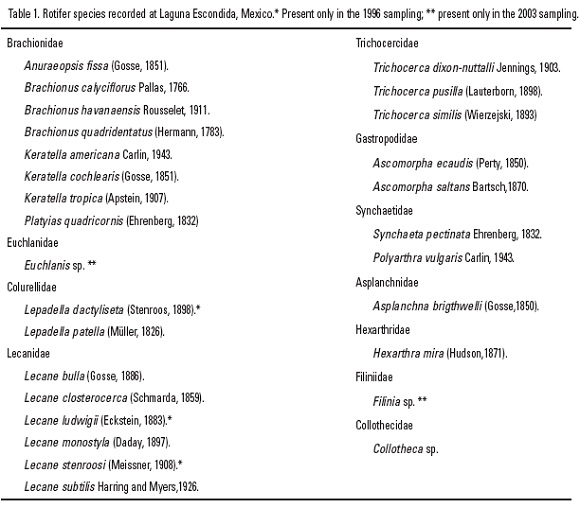
<body><![CDATA[<p align="justify"><font face="verdana" size="2">The two migration patterns showed by each species were compared using Mann&#45;Whitney non&#45;parametric tests. Finally, the migration amplitude of species was settled as the extreme magnitude of its daily MRD variations.</font></p>  	    <p>&nbsp;</p>  	    <p align="justify"><font face="verdana" size="2"><b>Results</b></font></p>  	    <p align="justify"><font face="verdana" size="2">The water temperature and DO in the upper 13 m during 1996 and 2003 did not differ significantly (<i>t</i>&#45;test); this was true also for pH in the upper 8 m. Below these depths all these parameters differed significantly (p &lt; 0.004, p&lt; 0.005, and p&lt; 0.004, respectively; <a href="/img/revistas/hbio/v17n1/a1f1.jpg" target="_blank">Fig. 1</a>). The main difference between both years was related to the location of oxygen drops, which varied from 8.4 to 6.0 mg O<sub>2</sub> l<sup>&#45;1</sup> (between 4.0 and 8.0 m) in 1996 and from 5.5 to 3.5 mg O<sub>2</sub> l<sup>&#45;1</sup> (between 12 and 13 m) in 2003. The depth of Secchi disk transparency was 1.2 m in both years.</font></p>      <p align="justify"><font face="verdana" size="2">Rotifers constituted &gt;70% of total zooplankton species during both years; 26 and 25 rotifer species were detected in 1996 and 2003, respectively. We recorded a total of 28 species (23 common to both dates) from 15 genera and 11 families. Brachionidae, with four genera and eight species, was the best represented family, and the most diverse genus was <i>Lecane</i> (<a href="#c1">Table 1</a>).</font></p>  	    <p align="center"><font face="verdana" size="2"><a name="c1"></a></font></p>  	    <p align="center"><font face="verdana" size="2"><img src="/img/revistas/hbio/v17n1/a1c1.jpg"></font></p>  	    <p align="justify"><font face="verdana" size="2">In 1996, 11 species were the most frequent and abundant; in order of importance were <i>Keratella tropica</i>, <i>Trichocerca pusilla, Polyarthra vulgaris</i>, <i>Ascomorpha saltans</i>, <i>Keratella americana</i>, <i>Brachionus calyciflorus</i>, <i>Collotheca</i> sp., <i>Ascomorpha ecaudis</i>, <i>Hexarthra mira</i>, <i>Trichocerca similis</i> and <i>Synchaeta pectinata</i>. On the other hand, in 2003, only eight species were dominant: <i>B. calyciflorus</i>, <i>A. ecaudis</i>, <i>A. saltans</i>, <i>S. pectinata, K. tropica, P. vulgaris, K. americana</i> and <i>T. pusilla.</i> Thus, seven of the 11 dominant species in 1996 maintained their dominance also in 2003 (<a href="/img/revistas/hbio/v17n1/a1f2.jpg" target="_blank">Fig. 2</a>). The rest of the community included <i>Anuraeopsis fissa</i>, <i>Asplanchna brigthwelli</i>, <i>Brachionus quadridentatus</i>, <i>Lecane closterocerca</i>, <i>Trichocerca dixon&#45;nuttalli</i>, and other 12 species with very low densities and frequencies (<a href="/img/revistas/hbio/v17n1/a1f2.jpg" target="_blank">Fig. 2</a>).</font></p>  	    <p align="justify"><font face="verdana" size="2">The average rotifer densities varied significantly (p &lt; 0.001): from 238.09&plusmn;39.21 ind l<sup>&#45;1</sup> in 1996 to 517.50&plusmn;97.39 ind l<sup>&#45;1</sup> in 2003. Although species composition was similar in both years, important differences were observed in their dominance ranking (<a href="/img/revistas/hbio/v17n1/a1f2.jpg" target="_blank">Fig. 2</a>). In 1996, <i>Keratella tropica</i> was the most abundant and frequent species. With an average density of 104.50&plusmn;165.09 ind l<sup>&#45;1</sup>, it contributed 42.9 % to the total density, whereas <i>B</i>. <i>calyciflorus</i> only contributed 3.6%. In 2003, <i>B. calyciflorus</i> became more abundant (324.70&plusmn;379.73 ind l<sup>&#45;1</sup>, on the average), comprising 63% of the total rotifer density, with <i>K. tropica</i> contributing only 4.6% to the total. The Morisita similarity index (Krebs, 1989) showed a resemblance value among the two years of 46.4%.</font></p>  	    <p align="justify"><font face="verdana" size="2">A <i>G</i> test showed that the vertical distributions of most of these species along the diel cycle were different (p&lt;0.025) because of a real aggregation of species populations in certain depths as a function of the time of the day (<a href="/img/revistas/hbio/v17n1/a1f3.jpg" target="_blank">Fig. 3</a>). Exceptions to this were <i>K. americana</i>, <i>T. pusilla</i> and <i>P. vulgaris</i>, in 2003, whose vertical gradient in the water column showed to be independent of the time of the day (p&gt; 0.1). The observed changes in the vertical distribution of the dominant species through the diel cycle suggest the existence of migratory behavior in most cases. This is more clearly depicted in the MRD plots (<a href="../../../../../img/revistas/hbio/v17n1/a1f4.jpg" target="_blank">Fig. 4</a>).</font></p>  	     ]]></body>
<body><![CDATA[<p align="justify"><font face="verdana" size="2">When MRD's were compared (Mann&#45;Whitney test), important differences were noted for <i>Keratella tropica</i> (p&lt; 0.001), <i>K. americana</i> (p&lt;0.001), <i>Hexarthra mira</i> (p&lt;0.001) and <i>Trichocerca pusilla</i> (p&lt;0.016). In 1996, the preferred position of <i>K. tropica</i> in the water colum was from 5.0 to 7.5 m, while in 2003 this depth ranged between 2.07 and 3.86 m<i>. K. americana</i> was found mainly between 5&#45;8 m depth in 1996, and between 10&#45;16 m in 2003. <i>H. mira</i> was located at ca. 8.0 m depth in the first year but below the 16.0 m depth in the second. For <i>T. pusilla</i> these depths ranged between 2.2 and 4.7 in 1996 and from 2.6 to 6.1 m in 2003. It is worth pointing out that densities of the last three species were notably lower in 2003.</font></p>  	    <p align="justify"><font face="verdana" size="2"><i>Hexarthra mira</i> had the highest migration amplitude, 6.42 m, in 1996 and <i>Polyarthra vulgaris</i> the lowest, 1.72 m, in 2003. Except for <i>K. americana</i> and <i>H. mira</i>, migration amplitudes were similar for all species in both cycles (<a href="#c2">Table 2</a>).</font></p>  	    <p align="center"><font face="verdana" size="2"><a name="c2"></a></font></p>  	    <p align="center"><font face="verdana" size="2"><img src="/img/revistas/hbio/v17n1/a1c2.jpg"></font></p>  	    <p>&nbsp;</p>  	    <p align="justify"><font face="verdana" size="2"><b>Discussion</b></font></p>  	    <p align="justify"><font face="verdana" size="2">Most of the studies that relate the distribution patterns of plankton rotifers with abiotic factors have been carried out in stratified environments (e. gr. Armengol <i>et al</i>., 1998; Armengol &amp; Miracle, 1999; Bai&atilde;o &amp; Boavida, 2000; Esparcia <i>et al</i>., 2001). Under these hydrological conditions, close correlations between such factors and rotifer populations have been recognized. In the above mentioned studies it is concluded that in correspondence to water stratification there are rotifer assemblages characteristic of each main strata. Under this scenario, it is clear that the position of a species within a stratum would show a strong correlation with the prevailing abiotic factors. Nevertheless, the existence of such correlations does not necessarily imply a cause&#45;effect relationship because very different factors could actually be involved in the control of rotifer populations.</font></p>  	    <p align="justify"><font face="verdana" size="2">Temperature and oxygen are among the most important environmental factors acknowledged to explain the space&#45;time fluctuations of rotifer populations (Bogaert &amp; Dumont, 1989; Mikschi, 1989). However, in addition to direct effects of temperature and oxygen, the effects of these variables on rotifer fluctuations could be mediated via other biotic and abiotic factors.</font></p>  	    <p align="justify"><font face="verdana" size="2">Although seven years elapsed between the two sampling dates, when comparing the vertical distribution of temperature, oxygen and pH no significant differences were observed in the uppermost 10 meters of the water column. Secchi disk transparency was also the same in both periods. Given that our Results show that most of the dominant rotifer populations had their abundance peaks and vertical movements within this part of the water column, the observed differences in rotifer vertical distributions could hardly be attributed to the influence of these factors.</font></p>  	    <p align="justify"><font face="verdana" size="2">In both years, the lake was practically homothermic and differences of only 1 to 1.3 &deg;C were detected in the 18&#45;m water column. Additionally, oxygen levels were always far from anoxia and compatible with the physiological requirements of the rotifer species. The oxygen content in 2003, generally lower and with a more pronounced drop than that in 1996, could be attributed to increased input of allochthonous organic matter due to a heavy rain that occurred the day before the sampling date. Under such conditions, the organic matter can deplete oxygen concentrations quickly, but at the same time, it constitutes an important food source for certain rotifer populations. Therefore, probably, rotifer species in such situations did not respond to changes in oxygen levels but to food availability.</font></p>  	    ]]></body>
<body><![CDATA[<p align="justify"><font face="verdana" size="2">In both years, species composition of rotifers was similar, just as in other lakes (Miracle &amp; Armengol, 1995; Armengol <i>et al</i>., 1998), but the order of dominance and overall densities of species did change. For example, the dominant species in 1996, <i>K. tropica</i>, was replaced by <i>B. calyciflorus</i> in 2003, and overall densities of the dominant species in 2003 were twice higher than in 1996.</font></p>  	    <p align="justify"><font face="verdana" size="2">Since the absence of thermal stratification reduces the influence of abiotic processes on spatial distribution, the degree of vertical aggregation in homothermic environments may be better explained by biotic factors such as food availability (Johnsen &amp; Jakobsen, 1987; Bini <i>et al.</i>, 2001). Furthermore, this factor could also partially explain differences in composition and abundance of rotifer assemblages (May, 1983; Bai&atilde;o &amp; Boavida, 2000). The replacement of <i>K. tropica</i> by <i>B. calyciflorus</i> as the most dominant species in 2003 seems to agree with this idea. It is known that <i>B. calyciflorus</i> has the highest rate of population increase among metazoans (r= 2 per day, under laboratory conditions; Benett &amp; Boraas, 1989), and also that this rate is strongly dependent on a high food supply (Sarma <i>et al</i>., 1996, 1999). Thus, the increase in density of this and other abundant species in 2003 may be due to higher food availability.</font></p>  	    <p align="justify"><font face="verdana" size="2">Furthermore, it is known that the structure of zooplankton communities is strongly regulated by biotic interactions, such as predation and competition (DeMott &amp; Kerfoot, 1982; DeMott, 1989; Leibold, 1990; Jos&eacute; De Paggi, 1995; Lampert and Sommer, 1997). Moreover, habitat segregation would be an important mechanism that allows the coexistence of potential competitors (Schoener, 1974; Leibold, 1990, 1991). In Laguna Escondida <i>A. ecaudis</i> and <i>S. pectinata</i>, that are of similar size and share the same feeding strategy (both are raptors that suck out the cytoplasm of their preys: Nogrady <i>et al</i>., 1993; Ruttner&#45;Kolisko, 1974), showed DVM patterns suggesting they would avoid interspecific competition by means of space&#45;time segregation (<a href="../../../../../img/revistas/hbio/v17n1/a1f4.jpg" target="_blank">Fig. 4</a>).</font></p>  	    <p align="justify"><font face="verdana" size="2">The rotifers of Laguna Escondida share the water column with crustacean zooplankters like the copepods <i>Thermocyclops inversus</i> Kiefer, 1936, and <i>Tropocyclops prasinus</i> (Fischer, 1860), and the cladocerans <i>Moina micrura</i> Kurz, 1874, and <i>Daphnia parvula</i> Fordice,1901, which also migrate (Torres&#45;Orozco &amp; Estrada&#45;Hern&aacute;ndez, 1997). Therefore, interference or exploitative competition between rotifers and some of these species would be expected. Regarding predation, the lake is inhabited by important populations of poecillid fishes of the genera <i>Xiphophorus</i>, <i>Poecilia</i>, <i>Heterandria</i> and <i>Priapella</i>, as well as some species of <i>Astyanax</i> and <i>Cichlasoma</i> (Torres&#45;Orozco &amp; Estrada&#45;Hern&aacute;ndez, 1997) that, indeed, can prey on rotifers. Thus, the presence of these predators could also play a significant role in the rotifers' population dynamics.</font></p>  	    <p align="justify"><font face="verdana" size="2">The three basic types of migration, i.e., nocturnal or "normal" migration, twilight migration, and reversed migration (Hutchinson, 1967), were recognized in the diel vertical movements of dominant rotifers (<a href="../../../../../img/revistas/hbio/v17n1/a1f4.jpg" target="_blank">Fig. 4</a>; <a href="#c2">Table 2</a>). Nevertheless, some species showed important differences in their migration patterns. Thus, <i>Ascomorpha ecaudis</i> changed its migratory movements from a normal type in 1996 to a reversed type in 2003. Although less clearly, <i>A. saltans</i> showed also a shift but in this case from a reversed type in 1996 to the normal type in 2003. Even though the migration patterns of some species were not easily assignable to a certain type, in most cases they appeared to be of the reversed type. In <i>Synchaeta pectinata</i>, the reversed type of migration was clear and consistent in both years (<a href="../../../../../img/revistas/hbio/v17n1/a1f4.jpg" target="_blank">Fig. 4</a>).</font></p>  	    <p align="justify"><font face="verdana" size="2">In the preferential position (i. e. MRD's) of rotifers along the water column, three different species categories could be recognized: a) species with relatively small vertical movements in the upper water column (e.g. <i>B. calyciflorus</i>, <i>P. vulgaris</i> and <i>T. pusilla</i>), b) species with noticeable movements between the middle and upper portions of the water column (e.g.: <i>Ascomorpha ecaudis</i>, <i>A. saltans</i> and <i>S. pectinata</i>) and, c) species with variable vertical displacements associated to deeper waters (e.g.: <i>H. mira</i> and <i>K. americana</i>, mainly in 2003). However, our Results show that each species' habitat is a dynamic feature that may change with time. Examples are <i>H. mira</i> and <i>K. americana</i>, whose preferential positions moved to higher depths in 2003, or of <i>T. pusilla</i> and <i>K. tropica</i> that, although remaining in the same category, changed significantly their MRD in the two studied years. It is noteworthy that in contrast with Armengol and Miracle (2000), who found <i>H. mira</i> in the well&#45;oxygenated surface waters of a Spanish lake, we in 2003 found this species inhabiting water layers close to the bottom, where oxygen levels were the lowest recorded (3.2 &plusmn; 0.57 mg l<sup>&#45;1</sup>).</font></p>  	    <p align="justify"><font face="verdana" size="2">The migration amplitudes observed for some species also differed from those reported in other lakes. Armengol and Miracle (2000), for example, found relatively low values for <i>A. saltans</i>, <i>H. mira</i> and <i>S. pectinata</i> (2.0, 2.5 and 1.3 m, respectively), whereas we observed notably higher values for these species (see <a href="#c2">Table 2</a>). In addition, for <i>S. pectinata</i> they reported a normal migration type while, in our study, it was a clearly reversed one.</font></p>  	    <p align="justify"><font face="verdana" size="2">In summary, when comparing rotifer assemblages from different years with similar abiotic conditions, important differences became discernible in: a) the absolute population densities, b) the species dominance ranking, c) the preferential position of specific species in the water column, d) the relationship between such preference and the abiotic factors and, e) the types and amplitudes of their migrations. So, our working hypothesis was not supported by our data. The behavioral plasticity observed herein could be better explained with arguments of biological nature, but there are required further research efforts to unveil the actual role of biological interactions in the structuring of rotifer communities.</font></p>  	    <p>&nbsp;</p>  	    <p align="justify"><font face="verdana" size="2"><b>Acknowledgements</b></font></p>  	    ]]></body>
<body><![CDATA[<p align="justify"><font face="verdana" size="2">The staff of Estaci&oacute;n de Biolog&iacute;a Tropical "Los Tuxtlas", of the Universidad Nacional Aut&oacute;noma de M&eacute;xico, gave us all kinds of support for our work in Laguna Escondida. This study was supported with funds provided by the Divisi&oacute;n de Ciencias Biol&oacute;gicas y de la Salud of the Universidad Aut&oacute;noma Metropolitana &#45; Iztapalapa. We thank the assistance of Isa&iacute;as Salgado&#45;Ugarte in the statistical analyses and of Anselmo Galindo Molina in the revision of the English text, as well as our laboratory colleagues and students for their help in the field work.</font></p>  	    <p>&nbsp;</p>  	    <p align="justify"><font face="verdana" size="2"><b>References</b></font></p>  	    <!-- ref --><p align="justify"><font face="verdana" size="2">ARMENGOL, X., ESPARCIA, A. &amp; M. R. MIRACLE. 1998. Rotifer vertical distribution in a strongly stratified lake: a multivariate analysis. <i>Hydrobiologia</i> 387/388: 161&#45;170.    &nbsp;&nbsp;&nbsp;&nbsp;&nbsp;&nbsp;&nbsp;&nbsp;[&#160;<a href="javascript:void(0);" onclick="javascript: window.open('/scielo.php?script=sci_nlinks&ref=4063099&pid=S0188-8897200700010000100001&lng=','','width=640,height=500,resizable=yes,scrollbars=1,menubar=yes,');">Links</a>&#160;]<!-- end-ref --></font></p>  	    <!-- ref --><p align="justify"><font face="verdana" size="2">ARMENGOL, X., ESPARCIA, A., VICENTE, E. &amp; M. R. MIRACLE. 1993. Vertical distribution of planktonic rotifers in a karstic meromictic lake. <i>Hydrobiologia</i> 255/256: 381&#45;388.    &nbsp;&nbsp;&nbsp;&nbsp;&nbsp;&nbsp;&nbsp;&nbsp;[&#160;<a href="javascript:void(0);" onclick="javascript: window.open('/scielo.php?script=sci_nlinks&ref=4063101&pid=S0188-8897200700010000100002&lng=','','width=640,height=500,resizable=yes,scrollbars=1,menubar=yes,');">Links</a>&#160;]<!-- end-ref --></font></p>  	    <!-- ref --><p align="justify"><font face="verdana" size="2">ARMENGOL, X. &amp; M. R. MIRACLE. 1999. Zooplankton communities in doline lakes and pools, in relation to some bathymetric parameters and physical and chemical variables. <i>Journal of Plankton Research</i> 21: 2245&#45;2261.    &nbsp;&nbsp;&nbsp;&nbsp;&nbsp;&nbsp;&nbsp;&nbsp;[&#160;<a href="javascript:void(0);" onclick="javascript: window.open('/scielo.php?script=sci_nlinks&ref=4063103&pid=S0188-8897200700010000100003&lng=','','width=640,height=500,resizable=yes,scrollbars=1,menubar=yes,');">Links</a>&#160;]<!-- end-ref --></font></p>  	    <!-- ref --><p align="justify"><font face="verdana" size="2">ARMENGOL, X. &amp; M. R. MIRACLE. 2000. Diel vertical movements of zooplankton in lake La Cruz (Cuenca Spain). <i>Journal of Plankton Research</i> 22: 1683&#45;1703.    &nbsp;&nbsp;&nbsp;&nbsp;&nbsp;&nbsp;&nbsp;&nbsp;[&#160;<a href="javascript:void(0);" onclick="javascript: window.open('/scielo.php?script=sci_nlinks&ref=4063105&pid=S0188-8897200700010000100004&lng=','','width=640,height=500,resizable=yes,scrollbars=1,menubar=yes,');">Links</a>&#160;]<!-- end-ref --></font></p>  	    <!-- ref --><p align="justify"><font face="verdana" size="2">BAI&Atilde;O, C. &amp; M. J. BOAVIDA. 2000. Environmental factors determining the structure of rotifer communities in a river&#45;shed reservoir. <i>Aquatic Ecology</i> 34: 369&#45;377.    &nbsp;&nbsp;&nbsp;&nbsp;&nbsp;&nbsp;&nbsp;&nbsp;[&#160;<a href="javascript:void(0);" onclick="javascript: window.open('/scielo.php?script=sci_nlinks&ref=4063107&pid=S0188-8897200700010000100005&lng=','','width=640,height=500,resizable=yes,scrollbars=1,menubar=yes,');">Links</a>&#160;]<!-- end-ref --></font></p>  	    <!-- ref --><p align="justify"><font face="verdana" size="2">BENNETT, W. N. &amp; M. E. BORAAS. 1989. A demographic profile of the fastest growing metazoan: a strain of <i>Brachionus calyciflorus</i> (Rotifera). <i>Oikos</i> 55: 365&#45;369.    &nbsp;&nbsp;&nbsp;&nbsp;&nbsp;&nbsp;&nbsp;&nbsp;[&#160;<a href="javascript:void(0);" onclick="javascript: window.open('/scielo.php?script=sci_nlinks&ref=4063109&pid=S0188-8897200700010000100006&lng=','','width=640,height=500,resizable=yes,scrollbars=1,menubar=yes,');">Links</a>&#160;]<!-- end-ref --></font></p>  	    <!-- ref --><p align="justify"><font face="verdana" size="2">BERZINS, B. &amp; B. PEJLER. 1987. Rotifer occurrence in relation to pH. <i>Hydrobiologia</i> 147: 107&#45;116.    &nbsp;&nbsp;&nbsp;&nbsp;&nbsp;&nbsp;&nbsp;&nbsp;[&#160;<a href="javascript:void(0);" onclick="javascript: window.open('/scielo.php?script=sci_nlinks&ref=4063111&pid=S0188-8897200700010000100007&lng=','','width=640,height=500,resizable=yes,scrollbars=1,menubar=yes,');">Links</a>&#160;]<!-- end-ref --></font></p>  	    <!-- ref --><p align="justify"><font face="verdana" size="2">BERZINS, B. &amp; B. PEJLER. 1989A. Rotifer occurrence in relation to temperature. <i>Hydrobiologia</i> 175: 223&#45;231.    &nbsp;&nbsp;&nbsp;&nbsp;&nbsp;&nbsp;&nbsp;&nbsp;[&#160;<a href="javascript:void(0);" onclick="javascript: window.open('/scielo.php?script=sci_nlinks&ref=4063113&pid=S0188-8897200700010000100008&lng=','','width=640,height=500,resizable=yes,scrollbars=1,menubar=yes,');">Links</a>&#160;]<!-- end-ref --></font></p>  	    <!-- ref --><p align="justify"><font face="verdana" size="2">BERZINS, B. &amp; B. PEJLER. 1989B. Rotifer occurrence in relation to oxygen content. <i>Hydrobiologia</i> 183: 165&#45;172.    &nbsp;&nbsp;&nbsp;&nbsp;&nbsp;&nbsp;&nbsp;&nbsp;[&#160;<a href="javascript:void(0);" onclick="javascript: window.open('/scielo.php?script=sci_nlinks&ref=4063115&pid=S0188-8897200700010000100009&lng=','','width=640,height=500,resizable=yes,scrollbars=1,menubar=yes,');">Links</a>&#160;]<!-- end-ref --></font></p>  	    <!-- ref --><p align="justify"><font face="verdana" size="2">BINI, L. M., BONECKER, C. C. &amp; F. A. LANSAC&#45;T&Ocirc;HA. 2001. Vertical distribution of rotifers on the Upper Paran&aacute; River floodplain: the role of thermal stratification and chlorophyll&#45;<i>a</i>. <i>Studies on Neotropical Fauna and Environment</i> 36: 241&#45;246.    &nbsp;&nbsp;&nbsp;&nbsp;&nbsp;&nbsp;&nbsp;&nbsp;[&#160;<a href="javascript:void(0);" onclick="javascript: window.open('/scielo.php?script=sci_nlinks&ref=4063117&pid=S0188-8897200700010000100010&lng=','','width=640,height=500,resizable=yes,scrollbars=1,menubar=yes,');">Links</a>&#160;]<!-- end-ref --></font></p>  	    <!-- ref --><p align="justify"><font face="verdana" size="2">BOGAERT, G. &amp; H. J. DUMONT. 1989. Community structure and co&#45;existence of rotifers of an artificial crater lake. <i>Hydrobiologia</i> 186/187: 167&#45;179.    &nbsp;&nbsp;&nbsp;&nbsp;&nbsp;&nbsp;&nbsp;&nbsp;[&#160;<a href="javascript:void(0);" onclick="javascript: window.open('/scielo.php?script=sci_nlinks&ref=4063119&pid=S0188-8897200700010000100011&lng=','','width=640,height=500,resizable=yes,scrollbars=1,menubar=yes,');">Links</a>&#160;]<!-- end-ref --></font></p>  	    <!-- ref --><p align="justify"><font face="verdana" size="2">DEMOTT, W. R. 1989. The role of competition in zooplankton succession. In Summer, U. (ed.), <i>Plankton Ecology, Succession in Plankton Communities</i>. Springer&#45;Verlag, Heidelberg, pp. 195&#45;252.    &nbsp;&nbsp;&nbsp;&nbsp;&nbsp;&nbsp;&nbsp;&nbsp;[&#160;<a href="javascript:void(0);" onclick="javascript: window.open('/scielo.php?script=sci_nlinks&ref=4063121&pid=S0188-8897200700010000100012&lng=','','width=640,height=500,resizable=yes,scrollbars=1,menubar=yes,');">Links</a>&#160;]<!-- end-ref --></font></p>  	    <!-- ref --><p align="justify"><font face="verdana" size="2">DEMOTT, W. R. &amp; W. C. KERFOOT. 1982. Competition among cladocerans: nature of the interaction between <i>Bosmina</i> and <i>Daphnia</i>. <i>Ecology</i> 63: 1947&#45;1966.    &nbsp;&nbsp;&nbsp;&nbsp;&nbsp;&nbsp;&nbsp;&nbsp;[&#160;<a href="javascript:void(0);" onclick="javascript: window.open('/scielo.php?script=sci_nlinks&ref=4063123&pid=S0188-8897200700010000100013&lng=','','width=640,height=500,resizable=yes,scrollbars=1,menubar=yes,');">Links</a>&#160;]<!-- end-ref --></font></p>  	    <!-- ref --><p align="justify"><font face="verdana" size="2">ESPARCIA, A., ARMENGOL, X. &amp; M. R. MIRACLE. 2001. Relaci&oacute;n de la distribuci&oacute;n de los rot&iacute;feros con la de los principales factores f&iacute;sicos y qu&iacute;micos en la laguna de la Cruz. <i>Limn&eacute;tica</i> 20: 305&#45;320.    &nbsp;&nbsp;&nbsp;&nbsp;&nbsp;&nbsp;&nbsp;&nbsp;[&#160;<a href="javascript:void(0);" onclick="javascript: window.open('/scielo.php?script=sci_nlinks&ref=4063125&pid=S0188-8897200700010000100014&lng=','','width=640,height=500,resizable=yes,scrollbars=1,menubar=yes,');">Links</a>&#160;]<!-- end-ref --></font></p>  	    <!-- ref --><p align="justify"><font face="verdana" size="2">HUNTLEY, M. 1985. Experimental approaches to the study of vertical migration of zooplankton. In Rankin, M. A. (Comp.) <i>Migration: Mechanism and Adaptive Significance</i>. Contributions in Marine Science (Suppl.) 27.    &nbsp;&nbsp;&nbsp;&nbsp;&nbsp;&nbsp;&nbsp;&nbsp;[&#160;<a href="javascript:void(0);" onclick="javascript: window.open('/scielo.php?script=sci_nlinks&ref=4063127&pid=S0188-8897200700010000100015&lng=','','width=640,height=500,resizable=yes,scrollbars=1,menubar=yes,');">Links</a>&#160;]<!-- end-ref --></font></p>  	    <!-- ref --><p align="justify"><font face="verdana" size="2">HUTCHINSON, G. E. 1967. <i>A Treatise on Limnology, Introduction to the Lake Biology and the Limnoplankton</i>. Vol. 2. Wiley, New York. 1114 p.    &nbsp;&nbsp;&nbsp;&nbsp;&nbsp;&nbsp;&nbsp;&nbsp;[&#160;<a href="javascript:void(0);" onclick="javascript: window.open('/scielo.php?script=sci_nlinks&ref=4063129&pid=S0188-8897200700010000100016&lng=','','width=640,height=500,resizable=yes,scrollbars=1,menubar=yes,');">Links</a>&#160;]<!-- end-ref --></font></p>  	    <!-- ref --><p align="justify"><font face="verdana" size="2">JOHNSEN, G. H. &amp; P. J. JAKOBSEN. 1987. The effect of food limitation on vertical migration in <i>Daphnia longispina</i>. <i>Limnology and Oceanography</i> 32(4): 873&#45;880.    &nbsp;&nbsp;&nbsp;&nbsp;&nbsp;&nbsp;&nbsp;&nbsp;[&#160;<a href="javascript:void(0);" onclick="javascript: window.open('/scielo.php?script=sci_nlinks&ref=4063131&pid=S0188-8897200700010000100017&lng=','','width=640,height=500,resizable=yes,scrollbars=1,menubar=yes,');">Links</a>&#160;]<!-- end-ref --></font></p>  	    <!-- ref --><p align="justify"><font face="verdana" size="2">JOS&Eacute; DE PAGGI, S. 1995. Vertical distribution and diel migration of rotifers in a Paran&aacute; river floodplain lake. <i>Hydrobiologia</i> 310: 87&#45;94.    &nbsp;&nbsp;&nbsp;&nbsp;&nbsp;&nbsp;&nbsp;&nbsp;[&#160;<a href="javascript:void(0);" onclick="javascript: window.open('/scielo.php?script=sci_nlinks&ref=4063133&pid=S0188-8897200700010000100018&lng=','','width=640,height=500,resizable=yes,scrollbars=1,menubar=yes,');">Links</a>&#160;]<!-- end-ref --></font></p>  	    <!-- ref --><p align="justify"><font face="verdana" size="2">KALFF, J. 2002. <i>Limnology</i>. Prentice&#45;Hall, New Jersey. 592 p.    &nbsp;&nbsp;&nbsp;&nbsp;&nbsp;&nbsp;&nbsp;&nbsp;[&#160;<a href="javascript:void(0);" onclick="javascript: window.open('/scielo.php?script=sci_nlinks&ref=4063135&pid=S0188-8897200700010000100019&lng=','','width=640,height=500,resizable=yes,scrollbars=1,menubar=yes,');">Links</a>&#160;]<!-- end-ref --></font></p>  	    <!-- ref --><p align="justify"><font face="verdana" size="2">KREBS, C. J. 1989. <i>Ecological Methodology</i>. Harper and Row, New York. 654 p.    &nbsp;&nbsp;&nbsp;&nbsp;&nbsp;&nbsp;&nbsp;&nbsp;[&#160;<a href="javascript:void(0);" onclick="javascript: window.open('/scielo.php?script=sci_nlinks&ref=4063137&pid=S0188-8897200700010000100020&lng=','','width=640,height=500,resizable=yes,scrollbars=1,menubar=yes,');">Links</a>&#160;]<!-- end-ref --></font></p>  	    <!-- ref --><p align="justify"><font face="verdana" size="2">LAMPERT, W. &amp; U. SOMMER. 1997. <i>Limnoecology, The Ecology of Lakes and Streams</i>. Oxford University Press, Oxford. 382 p.    &nbsp;&nbsp;&nbsp;&nbsp;&nbsp;&nbsp;&nbsp;&nbsp;[&#160;<a href="javascript:void(0);" onclick="javascript: window.open('/scielo.php?script=sci_nlinks&ref=4063139&pid=S0188-8897200700010000100021&lng=','','width=640,height=500,resizable=yes,scrollbars=1,menubar=yes,');">Links</a>&#160;]<!-- end-ref --></font></p>  	    <!-- ref --><p align="justify"><font face="verdana" size="2">LEIBOLD, M. A. 1990. Resources and predators can affect the distribution of zooplankton. <i>Limnology and Oceanography</i> 35(4): 938&#45;944.    &nbsp;&nbsp;&nbsp;&nbsp;&nbsp;&nbsp;&nbsp;&nbsp;[&#160;<a href="javascript:void(0);" onclick="javascript: window.open('/scielo.php?script=sci_nlinks&ref=4063141&pid=S0188-8897200700010000100022&lng=','','width=640,height=500,resizable=yes,scrollbars=1,menubar=yes,');">Links</a>&#160;]<!-- end-ref --></font></p>  	    <!-- ref --><p align="justify"><font face="verdana" size="2">LEIBOLD, M. A. 1991. Trophic interactions and habitat segregation between competing <i>Daphnia</i> species. <i>Oecologia</i> 86: 510&#45;520.    &nbsp;&nbsp;&nbsp;&nbsp;&nbsp;&nbsp;&nbsp;&nbsp;[&#160;<a href="javascript:void(0);" onclick="javascript: window.open('/scielo.php?script=sci_nlinks&ref=4063143&pid=S0188-8897200700010000100023&lng=','','width=640,height=500,resizable=yes,scrollbars=1,menubar=yes,');">Links</a>&#160;]<!-- end-ref --></font></p>  	    <!-- ref --><p align="justify"><font face="verdana" size="2">MATVEEVA, L. K. 1986. Pelagic rotifers of Lake Glubokoe from 1897 to 1984. <i>Hydrobiologia</i> 141: 45&#45;54.    &nbsp;&nbsp;&nbsp;&nbsp;&nbsp;&nbsp;&nbsp;&nbsp;[&#160;<a href="javascript:void(0);" onclick="javascript: window.open('/scielo.php?script=sci_nlinks&ref=4063145&pid=S0188-8897200700010000100024&lng=','','width=640,height=500,resizable=yes,scrollbars=1,menubar=yes,');">Links</a>&#160;]<!-- end-ref --></font></p>  	    <!-- ref --><p align="justify"><font face="verdana" size="2">MAY, L.1983. Rotifer occurrence in relation to water temperature in Loch Leven Scotland. <i>Hydrobiologia</i> 104: 311&#45;315.    &nbsp;&nbsp;&nbsp;&nbsp;&nbsp;&nbsp;&nbsp;&nbsp;[&#160;<a href="javascript:void(0);" onclick="javascript: window.open('/scielo.php?script=sci_nlinks&ref=4063147&pid=S0188-8897200700010000100025&lng=','','width=640,height=500,resizable=yes,scrollbars=1,menubar=yes,');">Links</a>&#160;]<!-- end-ref --></font></p>  	    <!-- ref --><p align="justify"><font face="verdana" size="2">MIKSCHI, E. 1989. Rotifer distribution in relation to temperature and oxygen content. <i>Hydrobiologia</i> 186/187 (Developments in Hydrobiology 52): 209&#45;214.    &nbsp;&nbsp;&nbsp;&nbsp;&nbsp;&nbsp;&nbsp;&nbsp;[&#160;<a href="javascript:void(0);" onclick="javascript: window.open('/scielo.php?script=sci_nlinks&ref=4063149&pid=S0188-8897200700010000100026&lng=','','width=640,height=500,resizable=yes,scrollbars=1,menubar=yes,');">Links</a>&#160;]<!-- end-ref --></font></p>  	    <!-- ref --><p align="justify"><font face="verdana" size="2">MIRACLE, M. R. &amp; X. ARMENGOL. 1995. Population dynamicof oxyclinal species in lake Arcas&#45;2 (Spain). <i>Hydrobiologia</i> 313/314: 291&#45;301.    &nbsp;&nbsp;&nbsp;&nbsp;&nbsp;&nbsp;&nbsp;&nbsp;[&#160;<a href="javascript:void(0);" onclick="javascript: window.open('/scielo.php?script=sci_nlinks&ref=4063151&pid=S0188-8897200700010000100027&lng=','','width=640,height=500,resizable=yes,scrollbars=1,menubar=yes,');">Links</a>&#160;]<!-- end-ref --></font></p>  	    <!-- ref --><p align="justify"><font face="verdana" size="2">NOGRADY, T., WALLACE, R. L. &amp; T. W. SNELL. 1993. Rotifera, Biology, ecology and systematics. In Nogrady, T. (ed.), <i>Guides to the Identification of the Microinvertebrates of the Continental Waters of the World.</i> Vol. 1. SPB Academic Publishing vb., The Hague. 277 p.    &nbsp;&nbsp;&nbsp;&nbsp;&nbsp;&nbsp;&nbsp;&nbsp;[&#160;<a href="javascript:void(0);" onclick="javascript: window.open('/scielo.php?script=sci_nlinks&ref=4063153&pid=S0188-8897200700010000100028&lng=','','width=640,height=500,resizable=yes,scrollbars=1,menubar=yes,');">Links</a>&#160;]<!-- end-ref --></font></p>  	    <!-- ref --><p align="justify"><font face="verdana" size="2">RUTTNER&#45;KOLISKO, A. 1974. <i>Planktonic Rotifers, Biology and Taxonomy</i>. E. Schweizerbart'sche Verlagsbuchhandlung, Stuttgart. 146 p.    &nbsp;&nbsp;&nbsp;&nbsp;&nbsp;&nbsp;&nbsp;&nbsp;[&#160;<a href="javascript:void(0);" onclick="javascript: window.open('/scielo.php?script=sci_nlinks&ref=4063155&pid=S0188-8897200700010000100029&lng=','','width=640,height=500,resizable=yes,scrollbars=1,menubar=yes,');">Links</a>&#160;]<!-- end-ref --></font></p>  	    <!-- ref --><p align="justify"><font face="verdana" size="2">RUTTNER&#45;KOLISKO, A.1980. The abundance and distribution of <i>Filinia terminalis</i> in various types of lakes to temperature, oxygen and food. <i>Hydrobiologia</i> 73 (Developments in Hydrobiology 1): 169&#45;175.    &nbsp;&nbsp;&nbsp;&nbsp;&nbsp;&nbsp;&nbsp;&nbsp;[&#160;<a href="javascript:void(0);" onclick="javascript: window.open('/scielo.php?script=sci_nlinks&ref=4063157&pid=S0188-8897200700010000100030&lng=','','width=640,height=500,resizable=yes,scrollbars=1,menubar=yes,');">Links</a>&#160;]<!-- end-ref --></font></p>  	    <!-- ref --><p align="justify"><font face="verdana" size="2">SARMA, S. S. S., FERN&Aacute;NDEZ&#45;ARAIZA, M. A. &amp; S. NANDINI. 1999. Competition between <i>Brachionus calyciflorus</i> Pallas and <i>Brachionus patulus</i> (M&uuml;ller) (Rotifera) in relation to algal food concentration and initial population density. <i>Aquatic Ecology</i> 33: 339&#45;345.    &nbsp;&nbsp;&nbsp;&nbsp;&nbsp;&nbsp;&nbsp;&nbsp;[&#160;<a href="javascript:void(0);" onclick="javascript: window.open('/scielo.php?script=sci_nlinks&ref=4063159&pid=S0188-8897200700010000100031&lng=','','width=640,height=500,resizable=yes,scrollbars=1,menubar=yes,');">Links</a>&#160;]<!-- end-ref --></font></p>  	    <!-- ref --><p align="justify"><font face="verdana" size="2">SARMA, S. S. S., IYER, N. &amp; H. J. DUMONT.1996. Competitive interactions between herbivorous rotifers: importance of food concentration and initial population density. <i>Hydrobiologia</i> 331: 1&#45;7.    &nbsp;&nbsp;&nbsp;&nbsp;&nbsp;&nbsp;&nbsp;&nbsp;[&#160;<a href="javascript:void(0);" onclick="javascript: window.open('/scielo.php?script=sci_nlinks&ref=4063161&pid=S0188-8897200700010000100032&lng=','','width=640,height=500,resizable=yes,scrollbars=1,menubar=yes,');">Links</a>&#160;]<!-- end-ref --></font></p>  	    <!-- ref --><p align="justify"><font face="verdana" size="2">SCHOENER, T. 1974. Resource partitioning in ecological communities. <i>Science</i> 185: 27&#45;39.    &nbsp;&nbsp;&nbsp;&nbsp;&nbsp;&nbsp;&nbsp;&nbsp;[&#160;<a href="javascript:void(0);" onclick="javascript: window.open('/scielo.php?script=sci_nlinks&ref=4063163&pid=S0188-8897200700010000100033&lng=','','width=640,height=500,resizable=yes,scrollbars=1,menubar=yes,');">Links</a>&#160;]<!-- end-ref --></font></p>  	    <!-- ref --><p align="justify"><font face="verdana" size="2">SOKAL, R. R. &amp; F. J. ROHLF. 1995. <i>Biometry</i>. W.H. Freeman, New York.    &nbsp;&nbsp;&nbsp;&nbsp;&nbsp;&nbsp;&nbsp;&nbsp;[&#160;<a href="javascript:void(0);" onclick="javascript: window.open('/scielo.php?script=sci_nlinks&ref=4063165&pid=S0188-8897200700010000100034&lng=','','width=640,height=500,resizable=yes,scrollbars=1,menubar=yes,');">Links</a>&#160;]<!-- end-ref --></font></p>  	    <!-- ref --><p align="justify"><font face="verdana" size="2">STEEL, R. G. D. &amp; J. H. TORRIE. 1988. <i>Bioestad&iacute;stica, Principios y Procedimientos</i>. McGraw&#45;Hill/ Interamericana, M&eacute;xico. 622 p.    &nbsp;&nbsp;&nbsp;&nbsp;&nbsp;&nbsp;&nbsp;&nbsp;[&#160;<a href="javascript:void(0);" onclick="javascript: window.open('/scielo.php?script=sci_nlinks&ref=4063167&pid=S0188-8897200700010000100035&lng=','','width=640,height=500,resizable=yes,scrollbars=1,menubar=yes,');">Links</a>&#160;]<!-- end-ref --></font></p>  	    <!-- ref --><p align="justify"><font face="verdana" size="2">TORRES&#45;OROZCO, R., JIM&Eacute;NEZ&#45;SIERRA, C. &amp; A. P&Eacute;REZ&#45;ROJAS. 1996. Some limnological features of three lakes from Mexican Neotropics. <i>Hydrobiologia</i> 341: 91&#45;99.    &nbsp;&nbsp;&nbsp;&nbsp;&nbsp;&nbsp;&nbsp;&nbsp;[&#160;<a href="javascript:void(0);" onclick="javascript: window.open('/scielo.php?script=sci_nlinks&ref=4063169&pid=S0188-8897200700010000100036&lng=','','width=640,height=500,resizable=yes,scrollbars=1,menubar=yes,');">Links</a>&#160;]<!-- end-ref --></font></p>  	    <!-- ref --><p align="justify"><font face="verdana" size="2">TORRES&#45;OROZCO, R., JIM&Eacute;NEZ&#45;SIERRA, C. &amp; J. L. BUEN&#45;ABAD. 1994. Caracterizaci&oacute;n limnol&oacute;gica de dos cuerpos de agua tropicales de Veracruz, M&eacute;xico. <i>Anales del Instituto de Ciencias del Mar y Limnolog&iacute;a. Universidad Nacional Aut&oacute;noma de M&eacute;xico</i> 21: 107&#45;117.    &nbsp;&nbsp;&nbsp;&nbsp;&nbsp;&nbsp;&nbsp;&nbsp;[&#160;<a href="javascript:void(0);" onclick="javascript: window.open('/scielo.php?script=sci_nlinks&ref=4063171&pid=S0188-8897200700010000100037&lng=','','width=640,height=500,resizable=yes,scrollbars=1,menubar=yes,');">Links</a>&#160;]<!-- end-ref --></font></p>  	    <!-- ref --><p align="justify"><font face="verdana" size="2">TORRES&#45;OROZCO, R. &amp; M. ESTRADA&#45;HERN&Aacute;NDEZ. 1997. Patrones de migraci&oacute;n vertical en el plancton de un lago tropical. <i>Hidrobiol&oacute;gica</i> 7: 33&#45;40.    &nbsp;&nbsp;&nbsp;&nbsp;&nbsp;&nbsp;&nbsp;&nbsp;[&#160;<a href="javascript:void(0);" onclick="javascript: window.open('/scielo.php?script=sci_nlinks&ref=4063173&pid=S0188-8897200700010000100038&lng=','','width=640,height=500,resizable=yes,scrollbars=1,menubar=yes,');">Links</a>&#160;]<!-- end-ref --></font></p>  	    <!-- ref --><p align="justify"><font face="verdana" size="2">WETZEL, R. G. 2001. <i>Limnology, Lake and River Ecosystems</i>. Academic Press, San Diego. 1006 p.    &nbsp;&nbsp;&nbsp;&nbsp;&nbsp;&nbsp;&nbsp;&nbsp;[&#160;<a href="javascript:void(0);" onclick="javascript: window.open('/scielo.php?script=sci_nlinks&ref=4063175&pid=S0188-8897200700010000100039&lng=','','width=640,height=500,resizable=yes,scrollbars=1,menubar=yes,');">Links</a>&#160;]<!-- end-ref --></font></p>      ]]></body><back>
<ref-list>
<ref id="B1">
<nlm-citation citation-type="journal">
<person-group person-group-type="author">
<name>
<surname><![CDATA[ARMENGOL]]></surname>
<given-names><![CDATA[X.]]></given-names>
</name>
<name>
<surname><![CDATA[ESPARCIA]]></surname>
<given-names><![CDATA[A.]]></given-names>
</name>
<name>
<surname><![CDATA[M.]]></surname>
<given-names><![CDATA[R. MIRACLE]]></given-names>
</name>
</person-group>
<article-title xml:lang="en"><![CDATA[Rotifer vertical distribution in a strongly stratified lake: a multivariate analysis]]></article-title>
<source><![CDATA[Hydrobiologia]]></source>
<year>1998</year>
<volume>387</volume><volume>388</volume>
<page-range>161-170</page-range></nlm-citation>
</ref>
<ref id="B2">
<nlm-citation citation-type="journal">
<person-group person-group-type="author">
<name>
<surname><![CDATA[ARMENGOL]]></surname>
<given-names><![CDATA[X.]]></given-names>
</name>
<name>
<surname><![CDATA[ESPARCIA]]></surname>
<given-names><![CDATA[A.]]></given-names>
</name>
<name>
<surname><![CDATA[VICENTE]]></surname>
<given-names><![CDATA[E.]]></given-names>
</name>
<name>
<surname><![CDATA[MIRACLE]]></surname>
<given-names><![CDATA[M. R.]]></given-names>
</name>
</person-group>
<article-title xml:lang="en"><![CDATA[Vertical distribution of planktonic rotifers in a karstic meromictic lake]]></article-title>
<source><![CDATA[Hydrobiologia]]></source>
<year>1993</year>
<volume>255</volume><volume>256</volume>
<page-range>381-388</page-range></nlm-citation>
</ref>
<ref id="B3">
<nlm-citation citation-type="journal">
<person-group person-group-type="author">
<name>
<surname><![CDATA[ARMENGOL]]></surname>
<given-names><![CDATA[X.]]></given-names>
</name>
<name>
<surname><![CDATA[MIRACLE]]></surname>
<given-names><![CDATA[M. R.]]></given-names>
</name>
</person-group>
<article-title xml:lang="en"><![CDATA[Zooplankton communities in doline lakes and pools, in relation to some bathymetric parameters and physical and chemical variables]]></article-title>
<source><![CDATA[Journal of Plankton Research]]></source>
<year>1999</year>
<volume>21</volume>
<page-range>2245-2261</page-range></nlm-citation>
</ref>
<ref id="B4">
<nlm-citation citation-type="journal">
<person-group person-group-type="author">
<name>
<surname><![CDATA[ARMENGOL]]></surname>
<given-names><![CDATA[X.]]></given-names>
</name>
<name>
<surname><![CDATA[MIRACLE]]></surname>
<given-names><![CDATA[M. R.]]></given-names>
</name>
</person-group>
<article-title xml:lang="en"><![CDATA[Diel vertical movements of zooplankton in lake La Cruz (Cuenca Spain)]]></article-title>
<source><![CDATA[Journal of Plankton Research]]></source>
<year>2000</year>
<volume>22</volume>
<page-range>1683-1703</page-range></nlm-citation>
</ref>
<ref id="B5">
<nlm-citation citation-type="journal">
<person-group person-group-type="author">
<name>
<surname><![CDATA[BAIÃO]]></surname>
<given-names><![CDATA[C.]]></given-names>
</name>
<name>
<surname><![CDATA[BOAVIDA]]></surname>
<given-names><![CDATA[M. J.]]></given-names>
</name>
</person-group>
<article-title xml:lang="en"><![CDATA[Environmental factors determining the structure of rotifer communities in a river-shed reservoir]]></article-title>
<source><![CDATA[Aquatic Ecology]]></source>
<year>2000</year>
<volume>34</volume>
<page-range>369-377</page-range></nlm-citation>
</ref>
<ref id="B6">
<nlm-citation citation-type="journal">
<person-group person-group-type="author">
<name>
<surname><![CDATA[BENNETT]]></surname>
<given-names><![CDATA[W. N.]]></given-names>
</name>
<name>
<surname><![CDATA[BORAAS]]></surname>
<given-names><![CDATA[M. E.]]></given-names>
</name>
</person-group>
<article-title xml:lang="en"><![CDATA[A demographic profile of the fastest growing metazoan: a strain of Brachionus calyciflorus (Rotifera)]]></article-title>
<source><![CDATA[Oikos]]></source>
<year>1989</year>
<volume>55</volume>
<page-range>365-369</page-range></nlm-citation>
</ref>
<ref id="B7">
<nlm-citation citation-type="journal">
<person-group person-group-type="author">
<name>
<surname><![CDATA[BERZINS]]></surname>
<given-names><![CDATA[B.]]></given-names>
</name>
<name>
<surname><![CDATA[PEJLER]]></surname>
<given-names><![CDATA[B.]]></given-names>
</name>
</person-group>
<article-title xml:lang="en"><![CDATA[Rotifer occurrence in relation to pH]]></article-title>
<source><![CDATA[Hydrobiologia]]></source>
<year>1987</year>
<volume>147</volume>
<page-range>107-116</page-range></nlm-citation>
</ref>
<ref id="B8">
<nlm-citation citation-type="journal">
<person-group person-group-type="author">
<name>
<surname><![CDATA[BERZINS]]></surname>
<given-names><![CDATA[B.]]></given-names>
</name>
<name>
<surname><![CDATA[PEJLER]]></surname>
<given-names><![CDATA[B.]]></given-names>
</name>
</person-group>
<article-title xml:lang="en"><![CDATA[Rotifer occurrence in relation to temperature]]></article-title>
<source><![CDATA[Hydrobiologia]]></source>
<year>1989</year>
<volume>175</volume>
<page-range>223-231</page-range></nlm-citation>
</ref>
<ref id="B9">
<nlm-citation citation-type="journal">
<person-group person-group-type="author">
<name>
<surname><![CDATA[BERZINS]]></surname>
<given-names><![CDATA[B.]]></given-names>
</name>
<name>
<surname><![CDATA[PEJLER]]></surname>
<given-names><![CDATA[B.]]></given-names>
</name>
</person-group>
<article-title xml:lang="en"><![CDATA[Rotifer occurrence in relation to oxygen content]]></article-title>
<source><![CDATA[Hydrobiologia]]></source>
<year>1989</year>
<volume>183</volume>
<page-range>165-172</page-range></nlm-citation>
</ref>
<ref id="B10">
<nlm-citation citation-type="journal">
<person-group person-group-type="author">
<name>
<surname><![CDATA[BINI]]></surname>
<given-names><![CDATA[L. M.]]></given-names>
</name>
<name>
<surname><![CDATA[BONECKER]]></surname>
<given-names><![CDATA[C. C.]]></given-names>
</name>
<name>
<surname><![CDATA[LANSAC-TÔHA]]></surname>
<given-names><![CDATA[F. A.]]></given-names>
</name>
</person-group>
<article-title xml:lang="en"><![CDATA[Vertical distribution of rotifers on the Upper Paraná River floodplain: the role of thermal stratification and chlorophyll-a]]></article-title>
<source><![CDATA[Studies on Neotropical Fauna and Environment]]></source>
<year>2001</year>
<volume>36</volume>
<page-range>241-246</page-range></nlm-citation>
</ref>
<ref id="B11">
<nlm-citation citation-type="journal">
<person-group person-group-type="author">
<name>
<surname><![CDATA[BOGAERT]]></surname>
<given-names><![CDATA[G.]]></given-names>
</name>
<name>
<surname><![CDATA[DUMONT]]></surname>
<given-names><![CDATA[H. J.]]></given-names>
</name>
</person-group>
<article-title xml:lang="en"><![CDATA[Community structure and co-existence of rotifers of an artificial crater lake]]></article-title>
<source><![CDATA[Hydrobiologia]]></source>
<year>1989</year>
<volume>186</volume><volume>187</volume>
<page-range>167-179</page-range></nlm-citation>
</ref>
<ref id="B12">
<nlm-citation citation-type="book">
<person-group person-group-type="author">
<name>
<surname><![CDATA[DEMOTT]]></surname>
<given-names><![CDATA[W. R]]></given-names>
</name>
</person-group>
<article-title xml:lang="en"><![CDATA[The role of competition in zooplankton succession]]></article-title>
<person-group person-group-type="editor">
<name>
<surname><![CDATA[Summer]]></surname>
<given-names><![CDATA[U.]]></given-names>
</name>
</person-group>
<source><![CDATA[Plankton Ecology, Succession in Plankton Communities]]></source>
<year>1989</year>
<page-range>195-252</page-range><publisher-loc><![CDATA[Heidelberg ]]></publisher-loc>
<publisher-name><![CDATA[Springer-Verlag]]></publisher-name>
</nlm-citation>
</ref>
<ref id="B13">
<nlm-citation citation-type="journal">
<person-group person-group-type="author">
<name>
<surname><![CDATA[DEMOTT]]></surname>
<given-names><![CDATA[W. R.]]></given-names>
</name>
<name>
<surname><![CDATA[KERFOOT]]></surname>
<given-names><![CDATA[W. C.]]></given-names>
</name>
</person-group>
<article-title xml:lang="en"><![CDATA[Competition among cladocerans: nature of the interaction between Bosmina and Daphnia]]></article-title>
<source><![CDATA[Ecology]]></source>
<year>1982</year>
<volume>63</volume>
<page-range>1947-1966</page-range></nlm-citation>
</ref>
<ref id="B14">
<nlm-citation citation-type="journal">
<person-group person-group-type="author">
<name>
<surname><![CDATA[ESPARCIA]]></surname>
<given-names><![CDATA[A.]]></given-names>
</name>
<name>
<surname><![CDATA[ARMENGOL]]></surname>
<given-names><![CDATA[X.]]></given-names>
</name>
<name>
<surname><![CDATA[MIRACLE]]></surname>
<given-names><![CDATA[M. R.]]></given-names>
</name>
</person-group>
<article-title xml:lang="es"><![CDATA[Relación de la distribución de los rotíferos con la de los principales factores físicos y químicos en la laguna de la Cruz]]></article-title>
<source><![CDATA[Limnética]]></source>
<year>2001</year>
<volume>20</volume>
<page-range>305-320</page-range></nlm-citation>
</ref>
<ref id="B15">
<nlm-citation citation-type="">
<person-group person-group-type="author">
<name>
<surname><![CDATA[HUNTLEY]]></surname>
<given-names><![CDATA[M.]]></given-names>
</name>
</person-group>
<article-title xml:lang="en"><![CDATA[Experimental approaches to the study of vertical migration of zooplankton]]></article-title>
<person-group person-group-type="editor">
<name>
<surname><![CDATA[Rankin]]></surname>
<given-names><![CDATA[M. A.]]></given-names>
</name>
</person-group>
<source><![CDATA[Migration: Mechanism and Adaptive Significance]]></source>
<year>1985</year>
</nlm-citation>
</ref>
<ref id="B16">
<nlm-citation citation-type="">
<person-group person-group-type="author">
<name>
<surname><![CDATA[HUTCHINSON]]></surname>
<given-names><![CDATA[G. E.]]></given-names>
</name>
</person-group>
<source><![CDATA[A Treatise on Limnology, Introduction to the Lake Biology and the Limnoplankton]]></source>
<year>1967</year>
<volume>2</volume>
<page-range>1114</page-range><publisher-loc><![CDATA[Wiley^eNew York New York]]></publisher-loc>
</nlm-citation>
</ref>
<ref id="B17">
<nlm-citation citation-type="journal">
<person-group person-group-type="author">
<name>
<surname><![CDATA[JOHNSEN]]></surname>
<given-names><![CDATA[G. H.]]></given-names>
</name>
<name>
<surname><![CDATA[JAKOBSEN]]></surname>
<given-names><![CDATA[P. J.]]></given-names>
</name>
</person-group>
<article-title xml:lang="en"><![CDATA[The effect of food limitation on vertical migration in Daphnia longispina]]></article-title>
<source><![CDATA[Limnology and Oceanography]]></source>
<year>1987</year>
<volume>32</volume>
<numero>4</numero>
<issue>4</issue>
<page-range>873-880</page-range></nlm-citation>
</ref>
<ref id="B18">
<nlm-citation citation-type="journal">
<person-group person-group-type="author">
<name>
<surname><![CDATA[JOSÉ DE PAGGI]]></surname>
<given-names><![CDATA[S.]]></given-names>
</name>
</person-group>
<article-title xml:lang="en"><![CDATA[Vertical distribution and diel migration of rotifers in a Paraná river floodplain lake]]></article-title>
<source><![CDATA[Hydrobiologia]]></source>
<year>1995</year>
<volume>310</volume>
<page-range>87-94</page-range></nlm-citation>
</ref>
<ref id="B19">
<nlm-citation citation-type="book">
<person-group person-group-type="author">
<name>
<surname><![CDATA[KALFF]]></surname>
<given-names><![CDATA[J.]]></given-names>
</name>
</person-group>
<source><![CDATA[]]></source>
<year>2002</year>
<page-range>592</page-range><publisher-loc><![CDATA[Prentice-Hall^eNew Jersey New Jersey]]></publisher-loc>
<publisher-name><![CDATA[Limnology]]></publisher-name>
</nlm-citation>
</ref>
<ref id="B20">
<nlm-citation citation-type="book">
<person-group person-group-type="author">
<name>
<surname><![CDATA[KREBS]]></surname>
<given-names><![CDATA[C. J]]></given-names>
</name>
</person-group>
<source><![CDATA[Ecological Methodology]]></source>
<year>1989</year>
<page-range>654</page-range><publisher-loc><![CDATA[New York ]]></publisher-loc>
<publisher-name><![CDATA[Harper and Row]]></publisher-name>
</nlm-citation>
</ref>
<ref id="B21">
<nlm-citation citation-type="book">
<person-group person-group-type="author">
<name>
<surname><![CDATA[LAMPERT]]></surname>
<given-names><![CDATA[W.]]></given-names>
</name>
<name>
<surname><![CDATA[SOMMER]]></surname>
<given-names><![CDATA[U.]]></given-names>
</name>
</person-group>
<source><![CDATA[Limnoecology, The Ecology of Lakes and Streams]]></source>
<year>1997</year>
<page-range>382</page-range><publisher-loc><![CDATA[Oxford ]]></publisher-loc>
<publisher-name><![CDATA[Oxford University]]></publisher-name>
</nlm-citation>
</ref>
<ref id="B22">
<nlm-citation citation-type="journal">
<person-group person-group-type="author">
<name>
<surname><![CDATA[LEIBOLD]]></surname>
<given-names><![CDATA[M. A]]></given-names>
</name>
</person-group>
<article-title xml:lang="en"><![CDATA[Resources and predators can affect the distribution of zooplankton]]></article-title>
<source><![CDATA[Limnology and Oceanography]]></source>
<year>1990</year>
<volume>35</volume>
<numero>4</numero>
<issue>4</issue>
<page-range>938-944</page-range></nlm-citation>
</ref>
<ref id="B23">
<nlm-citation citation-type="journal">
<person-group person-group-type="author">
<name>
<surname><![CDATA[LEIBOLD]]></surname>
<given-names><![CDATA[M. A.]]></given-names>
</name>
</person-group>
<article-title xml:lang="en"><![CDATA[Trophic interactions and habitat segregation between competing Daphnia species]]></article-title>
<source><![CDATA[Oecologia]]></source>
<year>1991</year>
<volume>86</volume>
<page-range>510-520</page-range></nlm-citation>
</ref>
<ref id="B24">
<nlm-citation citation-type="journal">
<person-group person-group-type="author">
<name>
<surname><![CDATA[MATVEEVA]]></surname>
<given-names><![CDATA[L. K.]]></given-names>
</name>
</person-group>
<article-title xml:lang="en"><![CDATA[Pelagic rotifers of Lake Glubokoe from 1897 to 1984]]></article-title>
<source><![CDATA[Hydrobiologia]]></source>
<year>1986</year>
<volume>141</volume>
<page-range>45-54</page-range></nlm-citation>
</ref>
<ref id="B25">
<nlm-citation citation-type="journal">
<person-group person-group-type="author">
<name>
<surname><![CDATA[MAY]]></surname>
<given-names><![CDATA[L.]]></given-names>
</name>
</person-group>
<article-title xml:lang="en"><![CDATA[Rotifer occurrence in relation to water temperature in Loch Leven Scotland]]></article-title>
<source><![CDATA[Hydrobiologia]]></source>
<year>1983</year>
<volume>104</volume>
<page-range>311-315</page-range></nlm-citation>
</ref>
<ref id="B26">
<nlm-citation citation-type="journal">
<person-group person-group-type="author">
<name>
<surname><![CDATA[MIKSCHI]]></surname>
<given-names><![CDATA[E.]]></given-names>
</name>
</person-group>
<article-title xml:lang="en"><![CDATA[Rotifer distribution in relation to temperature and oxygen content]]></article-title>
<source><![CDATA[Hydrobiologia]]></source>
<year>1989</year>
<volume>186</volume><volume>187</volume>
<page-range>209-214</page-range></nlm-citation>
</ref>
<ref id="B27">
<nlm-citation citation-type="journal">
<person-group person-group-type="author">
<name>
<surname><![CDATA[MIRACLE]]></surname>
<given-names><![CDATA[M. R.]]></given-names>
</name>
<name>
<surname><![CDATA[ARMENGOL]]></surname>
<given-names><![CDATA[X.]]></given-names>
</name>
</person-group>
<article-title xml:lang="en"><![CDATA[Population dynamicof oxyclinal species in lake Arcas-2 (Spain)]]></article-title>
<source><![CDATA[Hydrobiologia]]></source>
<year>1995</year>
<volume>313</volume><volume>314</volume>
<page-range>291-301</page-range></nlm-citation>
</ref>
<ref id="B28">
<nlm-citation citation-type="book">
<person-group person-group-type="author">
<name>
<surname><![CDATA[NOGRADY]]></surname>
<given-names><![CDATA[T.]]></given-names>
</name>
<name>
<surname><![CDATA[WALLACE]]></surname>
<given-names><![CDATA[R. L.]]></given-names>
</name>
<name>
<surname><![CDATA[SNELL]]></surname>
<given-names><![CDATA[T. W.]]></given-names>
</name>
</person-group>
<article-title xml:lang="en"><![CDATA[Rotifera, Biology, ecology and systematics]]></article-title>
<person-group person-group-type="editor">
<name>
<surname><![CDATA[Nogrady]]></surname>
<given-names><![CDATA[T.]]></given-names>
</name>
</person-group>
<source><![CDATA[Guides to the Identification of the Microinvertebrates of the Continental Waters of the World]]></source>
<year>1993</year>
<volume>1</volume>
<page-range>277</page-range><publisher-loc><![CDATA[The Hague ]]></publisher-loc>
<publisher-name><![CDATA[SPB Academic]]></publisher-name>
</nlm-citation>
</ref>
<ref id="B29">
<nlm-citation citation-type="">
<person-group person-group-type="author">
<name>
<surname><![CDATA[RUTTNER-KOLISKO]]></surname>
<given-names><![CDATA[A.]]></given-names>
</name>
</person-group>
<source><![CDATA[Planktonic Rotifers, Biology and Taxonomy. E. Schweizerbart'sche Verlagsbuchhandlung]]></source>
<year>1974</year>
<page-range>146</page-range><publisher-loc><![CDATA[Stuttgart ]]></publisher-loc>
</nlm-citation>
</ref>
<ref id="B30">
<nlm-citation citation-type="journal">
<person-group person-group-type="author">
<name>
<surname><![CDATA[RUTTNER-KOLISKO]]></surname>
<given-names><![CDATA[A.]]></given-names>
</name>
</person-group>
<article-title xml:lang="en"><![CDATA[The abundance and distribution of Filinia terminalis in various types of lakes to temperature, oxygen and food]]></article-title>
<source><![CDATA[Hydrobiologia]]></source>
<year>1980</year>
<volume>73</volume>
<page-range>169-175</page-range></nlm-citation>
</ref>
<ref id="B31">
<nlm-citation citation-type="journal">
<person-group person-group-type="author">
<name>
<surname><![CDATA[SARMA]]></surname>
<given-names><![CDATA[S. S. S.]]></given-names>
</name>
<name>
<surname><![CDATA[FERNÁNDEZ-ARAIZA]]></surname>
<given-names><![CDATA[M. A.]]></given-names>
</name>
<name>
<surname><![CDATA[NANDINI]]></surname>
<given-names><![CDATA[S.]]></given-names>
</name>
</person-group>
<article-title xml:lang="en"><![CDATA[Competition between Brachionus calyciflorus Pallas and Brachionus patulus (Müller) (Rotifera) in relation to algal food concentration and initial population density]]></article-title>
<source><![CDATA[Aquatic Ecology]]></source>
<year>1999</year>
<volume>33</volume>
<page-range>339-345</page-range></nlm-citation>
</ref>
<ref id="B32">
<nlm-citation citation-type="journal">
<person-group person-group-type="author">
<name>
<surname><![CDATA[SARMA]]></surname>
<given-names><![CDATA[S. S. S.]]></given-names>
</name>
<name>
<surname><![CDATA[IYER]]></surname>
<given-names><![CDATA[N.]]></given-names>
</name>
<name>
<surname><![CDATA[DUMONT]]></surname>
<given-names><![CDATA[H. J.]]></given-names>
</name>
</person-group>
<article-title xml:lang="en"><![CDATA[Competitive interactions between herbivorous rotifers: importance of food concentration and initial population density]]></article-title>
<source><![CDATA[Hydrobiologia]]></source>
<year>1996</year>
<volume>331</volume>
<page-range>1-7</page-range></nlm-citation>
</ref>
<ref id="B33">
<nlm-citation citation-type="journal">
<person-group person-group-type="author">
<name>
<surname><![CDATA[SCHOENER]]></surname>
<given-names><![CDATA[T.]]></given-names>
</name>
</person-group>
<article-title xml:lang="en"><![CDATA[Resource partitioning in ecological communities]]></article-title>
<source><![CDATA[Science]]></source>
<year>1974</year>
<volume>185</volume>
<page-range>27-39</page-range></nlm-citation>
</ref>
<ref id="B34">
<nlm-citation citation-type="book">
<person-group person-group-type="author">
<name>
<surname><![CDATA[SOKAL]]></surname>
<given-names><![CDATA[R. R.]]></given-names>
</name>
<name>
<surname><![CDATA[ROHLF]]></surname>
<given-names><![CDATA[F. J.]]></given-names>
</name>
</person-group>
<source><![CDATA[Biometry]]></source>
<year>1995</year>
<publisher-loc><![CDATA[New York ]]></publisher-loc>
<publisher-name><![CDATA[W.H. Freeman]]></publisher-name>
</nlm-citation>
</ref>
<ref id="B35">
<nlm-citation citation-type="book">
<person-group person-group-type="author">
<name>
<surname><![CDATA[STEEL]]></surname>
<given-names><![CDATA[R. G. D.]]></given-names>
</name>
<name>
<surname><![CDATA[TORRIE]]></surname>
<given-names><![CDATA[J. H.]]></given-names>
</name>
</person-group>
<source><![CDATA[Bioestadística, Principios y Procedimientos]]></source>
<year>1988</year>
<page-range>622</page-range><publisher-loc><![CDATA[México ]]></publisher-loc>
<publisher-name><![CDATA[McGraw-HillInteramericana]]></publisher-name>
</nlm-citation>
</ref>
<ref id="B36">
<nlm-citation citation-type="journal">
<person-group person-group-type="author">
<name>
<surname><![CDATA[TORRES-OROZCO]]></surname>
<given-names><![CDATA[R.]]></given-names>
</name>
<name>
<surname><![CDATA[JIMÉNEZ-SIERRA]]></surname>
<given-names><![CDATA[C.]]></given-names>
</name>
<name>
<surname><![CDATA[PÉREZ-ROJAS]]></surname>
<given-names><![CDATA[A.]]></given-names>
</name>
</person-group>
<article-title xml:lang="en"><![CDATA[Some limnological features of three lakes from Mexican Neotropics]]></article-title>
<source><![CDATA[Hydrobiologia]]></source>
<year>1996</year>
<volume>341</volume>
<page-range>91-99</page-range></nlm-citation>
</ref>
<ref id="B37">
<nlm-citation citation-type="journal">
<person-group person-group-type="author">
<name>
<surname><![CDATA[TORRES-OROZCO]]></surname>
<given-names><![CDATA[R.]]></given-names>
</name>
<name>
<surname><![CDATA[JIMÉNEZ-SIERRA]]></surname>
<given-names><![CDATA[C.]]></given-names>
</name>
<name>
<surname><![CDATA[BUEN-ABAD]]></surname>
<given-names><![CDATA[J. L.]]></given-names>
</name>
</person-group>
<article-title xml:lang="es"><![CDATA[Caracterización limnológica de dos cuerpos de agua tropicales de Veracruz, México]]></article-title>
<source><![CDATA[Anales del Instituto de Ciencias del Mar y Limnología. Universidad Nacional Autónoma de México]]></source>
<year>1994</year>
<volume>21</volume>
<page-range>107-117</page-range></nlm-citation>
</ref>
<ref id="B38">
<nlm-citation citation-type="journal">
<person-group person-group-type="author">
<name>
<surname><![CDATA[TORRES-OROZCO]]></surname>
<given-names><![CDATA[R.]]></given-names>
</name>
<name>
<surname><![CDATA[ESTRADA-HERNÁNDEZ]]></surname>
<given-names><![CDATA[M.]]></given-names>
</name>
</person-group>
<article-title xml:lang="es"><![CDATA[Patrones de migración vertical en el plancton de un lago tropical]]></article-title>
<source><![CDATA[Hidrobiológica]]></source>
<year>1997</year>
<volume>7</volume>
<page-range>33-40</page-range></nlm-citation>
</ref>
<ref id="B39">
<nlm-citation citation-type="book">
<person-group person-group-type="author">
<name>
<surname><![CDATA[WETZEL]]></surname>
<given-names><![CDATA[R. G.]]></given-names>
</name>
</person-group>
<source><![CDATA[Limnology, Lake and River Ecosystems]]></source>
<year>2001</year>
<page-range>1006</page-range><publisher-loc><![CDATA[San Diego ]]></publisher-loc>
<publisher-name><![CDATA[Academic]]></publisher-name>
</nlm-citation>
</ref>
</ref-list>
</back>
</article>
