<?xml version="1.0" encoding="ISO-8859-1"?><article xmlns:mml="http://www.w3.org/1998/Math/MathML" xmlns:xlink="http://www.w3.org/1999/xlink" xmlns:xsi="http://www.w3.org/2001/XMLSchema-instance">
<front>
<journal-meta>
<journal-id>0188-4999</journal-id>
<journal-title><![CDATA[Revista internacional de contaminación ambiental]]></journal-title>
<abbrev-journal-title><![CDATA[Rev. Int. Contam. Ambient]]></abbrev-journal-title>
<issn>0188-4999</issn>
<publisher>
<publisher-name><![CDATA[Universidad Nacional Autónoma de México, Instituto de Ciencias de la Atmósfera y Cambio Climático]]></publisher-name>
</publisher>
</journal-meta>
<article-meta>
<article-id>S0188-49992015000200004</article-id>
<title-group>
<article-title xml:lang="en"><![CDATA[Evaluation of the oxidative potential of urban PM and its relation to in vitro induced DNA damage: a spatial and temporal comparison]]></article-title>
<article-title xml:lang="es"><![CDATA[Evaluación del potencial oxidativo de partículas atmosféricas (PM) y su relación con el daño inducido in vitro en el ADN: una comparación espacial y temporal]]></article-title>
</title-group>
<contrib-group>
<contrib contrib-type="author">
<name>
<surname><![CDATA[Quintana-Belmares]]></surname>
<given-names><![CDATA[Raúl Ornar]]></given-names>
</name>
<xref ref-type="aff" rid="A01"/>
</contrib>
<contrib contrib-type="author">
<name>
<surname><![CDATA[Alfaro-Moreno]]></surname>
<given-names><![CDATA[Ernesto]]></given-names>
</name>
<xref ref-type="aff" rid="A01"/>
</contrib>
<contrib contrib-type="author">
<name>
<surname><![CDATA[García-Cuéllar]]></surname>
<given-names><![CDATA[Claudia María]]></given-names>
</name>
<xref ref-type="aff" rid="A01"/>
</contrib>
<contrib contrib-type="author">
<name>
<surname><![CDATA[Gómez-Vidales]]></surname>
<given-names><![CDATA[Virginia]]></given-names>
</name>
<xref ref-type="aff" rid="A03"/>
</contrib>
<contrib contrib-type="author">
<name>
<surname><![CDATA[Vázquez-López]]></surname>
<given-names><![CDATA[Inés]]></given-names>
</name>
<xref ref-type="aff" rid="A01"/>
</contrib>
<contrib contrib-type="author">
<name>
<surname><![CDATA[Salmón-Salazar]]></surname>
<given-names><![CDATA[Manuel de Jesús]]></given-names>
</name>
<xref ref-type="aff" rid="A03"/>
</contrib>
<contrib contrib-type="author">
<name>
<surname><![CDATA[Rosas-Pérez]]></surname>
<given-names><![CDATA[Irma]]></given-names>
</name>
<xref ref-type="aff" rid="A02"/>
</contrib>
<contrib contrib-type="author">
<name>
<surname><![CDATA[Osornio-Vargas]]></surname>
<given-names><![CDATA[Álvaro Román]]></given-names>
</name>
<xref ref-type="aff" rid="A04"/>
</contrib>
</contrib-group>
<aff id="A01">
<institution><![CDATA[,Instituto Nacional de Cancerología Subdirección de Investigación Básica Laboratorio de Toxicología Ambiental]]></institution>
<addr-line><![CDATA[México Distrito Federal]]></addr-line>
<country>México</country>
</aff>
<aff id="A02">
<institution><![CDATA[,Universidad Nacional Autónoma de México Centro de Ciencias de la Atmósfera ]]></institution>
<addr-line><![CDATA[México Distrito Federal]]></addr-line>
<country>México</country>
</aff>
<aff id="A03">
<institution><![CDATA[,Universidad Nacional Autónoma de México Instituto de Química ]]></institution>
<addr-line><![CDATA[México Distrito Federal]]></addr-line>
<country>México</country>
</aff>
<aff id="A04">
<institution><![CDATA[,University of Alberta Department of Paediatrics ]]></institution>
<addr-line><![CDATA[Edmonton Alberta]]></addr-line>
<country>Canadá</country>
</aff>
<pub-date pub-type="pub">
<day>00</day>
<month>00</month>
<year>2015</year>
</pub-date>
<pub-date pub-type="epub">
<day>00</day>
<month>00</month>
<year>2015</year>
</pub-date>
<volume>31</volume>
<numero>2</numero>
<fpage>145</fpage>
<lpage>154</lpage>
<copyright-statement/>
<copyright-year/>
<self-uri xlink:href="http://www.scielo.org.mx/scielo.php?script=sci_arttext&amp;pid=S0188-49992015000200004&amp;lng=en&amp;nrm=iso"></self-uri><self-uri xlink:href="http://www.scielo.org.mx/scielo.php?script=sci_abstract&amp;pid=S0188-49992015000200004&amp;lng=en&amp;nrm=iso"></self-uri><self-uri xlink:href="http://www.scielo.org.mx/scielo.php?script=sci_pdf&amp;pid=S0188-49992015000200004&amp;lng=en&amp;nrm=iso"></self-uri><abstract abstract-type="short" xml:lang="en"><p><![CDATA[Some toxic effects of particulate matter (PM) are related to the oxidative potential (OP) of the particles. The electron paramagnetic resonance (EPR) technique was used to evaluate the intensity of paramagnetic species (PS) and EPR plus spin trapping, to evaluate the OP of PM. We evaluated, in parallel, the DNA degradation potential of PM10 and PM25 collected from three regions of Mexico City in 1991 and 2003. Each region had different sources of pollution: industrial, commercial or residential. Both techniques evaluated Fenton-type reactions in the presence and absence of de-feroxamine (DFO). PM10 samples from the industrial region presented similar high OP, independently of sampling year. PM10 and PM25 collected in the commercial and residential regions in 2003 had similarly low OP. The OP induced by PM10 from the industrial region was completely inhibited by DFO, and DFO partially inhibited the OP induced by PM10 from other regions. PM25 OP was not inhibited by DFO. PM from the industrial region was the most potent inductor of DNA degradation, while PM from residential region was the least potent, correlating with the OP. DFO inhibited the degradation of DNA induced by PM. The OP of PM collected in the industrial and residential region correlated with the DNA degradation. The region, size and year of PM collection are linked to observed OP variations and DNA degradation induced by PM.]]></p></abstract>
<abstract abstract-type="short" xml:lang="es"><p><![CDATA[Algunos de los efectos tóxicos atribuibles a las partículas atmosféricas (PM) están relacionados con su potencial oxidante (OP). La resonancia paramagnética electrónica (EPR) es una técnica que se utilizó para evaluar la intensidad de las especies paramagnéticas (PS), y la EPR más un atrapador de espín, para evaluar el OP de las PM. Se evaluó en paralelo el potencial de degradación de ADN por PM10 y PM25 muestreadas en tres regiones de la Ciudad de México en 1991 y 2003. Cada región tenía diferentes fuentes de contaminación: industrial, comercial o residencial. Ambas técnicas fueron evaluadas en reacciones de tipo Fenton en presencia y ausencia de deferoxamina (DFO). Las PM10 de la región industrial presentan alto OP, independiente del año de muestreo. Las PM10 y PM2.5 muestreadas en las regiones comercial y residencial durante 2003 tuvieron bajo OP. El OP inducido por las PM10 de la región industrial fue completamente inhibido por la DFO, el OP inducido por las PM10 procedentes de las otras dos regiones fue inhibido parcialmente. El OP de las PM2.5 no fue inhibido por la DFO. Las PM10 de la región industrial fueron el inductor más potente de la degradación del ADN, mientras que las PM10 de la región residencial fueron las menos potentes, lo que se correlaciona con el OP. La DFO inhibe la degradación del ADN inducida por las PM. El OP de las PM de la región industrial y residencial se correlaciona con la degradación del ADN. La región, el tamaño y el año de muestreo parecen estar vinculados a las variaciones del OP y a la degradación del ADN inducido por las PM.]]></p></abstract>
<kwd-group>
<kwd lng="en"><![CDATA[PM10]]></kwd>
<kwd lng="en"><![CDATA[PM2.5]]></kwd>
<kwd lng="en"><![CDATA[electron paramagnetic resonance]]></kwd>
<kwd lng="en"><![CDATA[oxidative potential]]></kwd>
<kwd lng="en"><![CDATA[DNA damage]]></kwd>
<kwd lng="es"><![CDATA[PM10]]></kwd>
<kwd lng="es"><![CDATA[PM2.5]]></kwd>
<kwd lng="es"><![CDATA[resonancia paramagnética electrónica]]></kwd>
<kwd lng="es"><![CDATA[potencial oxidativo]]></kwd>
<kwd lng="es"><![CDATA[daño ADN]]></kwd>
</kwd-group>
</article-meta>
</front><body><![CDATA[  	    <p align="center"><font face="verdana" size="4"><b>Evaluation of the oxidative potential of urban PM and its relation to <i>in vitro</i> induced DNA damage: a spatial and temporal comparison</b></font></p>  	    <p align="center"><font face="verdana" size="2">&nbsp;</font></p>  	    <p align="center"><font face="verdana" size="3"><b>Evaluaci&oacute;n del potencial oxidativo de part&iacute;culas atmosf&eacute;ricas (PM) y su relaci&oacute;n con el da&ntilde;o inducido in vitro en el ADN: una comparaci&oacute;n espacial y temporal</b></font></p>  	    <p align="center"><font face="verdana" size="2">&nbsp;</font></p>  	    <p align="center"><font face="verdana" size="2"><b>Ra&uacute;l Ornar Quintana&#45;Belmares<sup>1,2</sup>*, Ernesto Alfaro&#45;Moreno<sup>1</sup>, Claudia Mar&iacute;a Garc&iacute;a&#45;Cu&eacute;llar<sup>1</sup>, Virginia G&oacute;mez&#45;Vidales<sup>3</sup>, In&eacute;s V&aacute;zquez&#45;L&oacute;pez<sup>1</sup>, Manuel de Jes&uacute;s Salm&oacute;n&#45;Salazar<sup>3</sup>, Irma Rosas&#45;P&eacute;rez<sup>2</sup> and &Aacute;lvaro Rom&aacute;n Osornio&#45;Vargas<sup>4</sup></b></font></p>  	    <p align="center"><font face="verdana" size="2">&nbsp;</font></p>  	    <p align="justify"><font face="verdana" size="2"><sup><i>1</i></sup><i>&nbsp;Laboratorio de Toxicolog&iacute;a Ambiental, Subdirecci&oacute;n de Investigaci&oacute;n B&aacute;sica, Instituto Nacional de Cancerologia. Av. San Fernando 22, Col. Secci&oacute;n XVI, Del. Tlalpan, C.P. 14080, M&eacute;xico D.F., M&eacute;xico </i>*Autor para correspondencia: <a href="mailto:qbro@hotmail.com" target="_blank">qbro@hotmail.com</a></font></p>  	    <p align="justify"><font face="verdana" size="2"><i><sup>2</sup> Centro de Ciencias de la Atm&oacute;sfera, Universidad Nacional Aut&oacute;noma de M&eacute;xico. Circuito de la Investigaci&oacute;n s/n, Ciudad Universitaria, Coyoac&aacute;n, C.P. 04510, M&eacute;xico D.F., M&eacute;xico</i></font></p>  	    <p align="justify"><font face="verdana" size="2"><i><sup>3</sup> Instituto de Qu&iacute;mica, Universidad Nacional Aut&oacute;noma de M&eacute;xico. Circuito de Exterior s/n, Ciudad Universitaria, Coyoac&aacute;n, C.P. 04510, M&eacute;xico D.F., M&eacute;xico</i></font></p>  	    ]]></body>
<body><![CDATA[<p align="justify"><font face="verdana" size="2"><i><sup>4</sup> Department of Paediatrics, University of Alberta, Edmonton, AB Canada. 3&#45;591 Edmonton Clinic Health Academy, 11405 87<sup>th</sup> Avenue. Edmonton T6G 1C9, Canada</i></font></p>  	    <p align="justify"><font face="verdana" size="2">&nbsp;</font></p>  	    <p align="justify"><font face="verdana" size="2"><i>Recibido abril 2014;    <br> 	aceptado noviembre 2014</i></font></p>  	    <p align="justify"><font face="verdana" size="2">&nbsp;</font></p>  	    <p align="justify"><font face="verdana" size="2"><b>ABSTRACT</b></font></p>  	    <p align="justify"><font face="verdana" size="2">Some toxic effects of particulate matter (PM) are related to the oxidative potential (OP) of the particles. The electron paramagnetic resonance (EPR) technique was used to evaluate the intensity of paramagnetic species (PS) and EPR plus spin trapping, to evaluate the OP of PM. We evaluated, in parallel, the DNA degradation potential of PM<sub>10</sub> and PM<sub>25</sub> collected from three regions of Mexico City in 1991 and 2003. Each region had different sources of pollution: industrial, commercial or residential. Both techniques evaluated Fenton&#45;type reactions in the presence and absence of de&#45;feroxamine (DFO). PM<sub>10</sub> samples from the industrial region presented similar high OP, independently of sampling year. PM<sub>10</sub> and PM<sub>25</sub> collected in the commercial and residential regions in 2003 had similarly low OP. The OP induced by PM<sub>10</sub> from the industrial region was completely inhibited by DFO, and DFO partially inhibited the OP induced by PM<sub>10</sub> from other regions. PM<sub>25</sub> OP was not inhibited by DFO. PM from the industrial region was the most potent inductor of DNA degradation, while PM from residential region was the least potent, correlating with the OP. DFO inhibited the degradation of DNA induced by PM. The OP of PM collected in the industrial and residential region correlated with the DNA degradation. The region, size and year of PM collection are linked to observed OP variations and DNA degradation induced by PM.</font></p>  	    <p align="justify"><font face="verdana" size="2"><b>Key words</b>: PM<sub>10</sub>, PM<sub>2.5</sub>, electron paramagnetic resonance, oxidative potential, DNA damage.</font></p>  	    <p align="justify"><font face="verdana" size="2">&nbsp;</font></p>  	    <p align="justify"><font face="verdana" size="2"><b>RESUMEN</b></font></p>  	    ]]></body>
<body><![CDATA[<p align="justify"><font face="verdana" size="2">Algunos de los efectos t&oacute;xicos atribuibles a las part&iacute;culas atmosf&eacute;ricas (PM) est&aacute;n relacionados con su potencial oxidante (OP). La resonancia paramagn&eacute;tica electr&oacute;nica (EPR) es una t&eacute;cnica que se utiliz&oacute; para evaluar la intensidad de las especies paramagn&eacute;ticas (PS), y la EPR m&aacute;s un atrapador de esp&iacute;n, para evaluar el OP de las PM. Se evalu&oacute; en paralelo el potencial de degradaci&oacute;n de ADN por PM<sub>10</sub> y PM<sub>25</sub> muestreadas en tres regiones de la Ciudad de M&eacute;xico en 1991 y 2003. Cada regi&oacute;n ten&iacute;a diferentes fuentes de contaminaci&oacute;n: industrial, comercial o residencial. Ambas t&eacute;cnicas fueron evaluadas en reacciones de tipo Fenton en presencia y ausencia de deferoxamina (DFO). Las PM<sub>10</sub> de la regi&oacute;n industrial presentan alto OP, independiente del a&ntilde;o de muestreo. Las PM10 y PM2.5 muestreadas en las regiones comercial y residencial durante 2003 tuvieron bajo OP. El OP inducido por las PM<sub>10</sub> de la regi&oacute;n industrial fue completamente inhibido por la DFO, el OP inducido por las PM<sub>10</sub> procedentes de las otras dos regiones fue inhibido parcialmente. El OP de las PM2.5 no fue inhibido por la DFO. Las PM10 de la regi&oacute;n industrial fueron el inductor m&aacute;s potente de la degradaci&oacute;n del ADN, mientras que las PM10 de la regi&oacute;n residencial fueron las menos potentes, lo que se correlaciona con el OP. La DFO inhibe la degradaci&oacute;n del ADN inducida por las PM. El OP de las PM de la regi&oacute;n industrial y residencial se correlaciona con la degradaci&oacute;n del ADN. La regi&oacute;n, el tama&ntilde;o y el a&ntilde;o de muestreo parecen estar vinculados a las variaciones del OP y a la degradaci&oacute;n del ADN inducido por las PM.</font></p>  	    <p align="justify"><font face="verdana" size="2"><b>Palabras clave</b>: PM<sub>10</sub>, PM<sub>2.5</sub>, resonancia paramagn&eacute;tica electr&oacute;nica, potencial oxidativo, da&ntilde;o ADN.</font></p>  	    <p align="justify"><font face="verdana" size="2">&nbsp;</font></p>  	    <p align="justify"><font face="verdana" size="2"><b>INTRODUCTION</b></font></p>  	    <p align="justify"><font face="verdana" size="2">It has been widely demonstrated that particulate matter (PM) is linked to biological effects such as lung inflammation, blood clotting, and various cardiovascular effects (Alfaro&#45;Moreno <i>et al.</i> 2007). Some of these effects (such as endothelial dysfunction) have been related to the ability of the particles to induce oxidative stress (Montiel&#45;D&aacute;valos <i>et al.</i> 2010). Several studies indicate that different physical and chemical properties of the particles are related to the intensity of the biological effects (Veranth <i>et al.</i> 2006, Rosas&#45;P&eacute;rez <i>et al.</i> 2007, Mugica <i>et al.</i> 2009). Differences in composition seem to be critical, it has also been shown that PM collected in different cities and even in different locations within the same city, show different toxic potentials (Alfaro&#45;Moreno <i>et al.</i> 2002, Gerlofs&#45;Nijland <i>et al.</i> 2009, Osornio&#45;Vargas <i>et al.</i> 2011).</font></p>  	    <p align="justify"><font face="verdana" size="2">The toxicological evaluation of PM is a time&#45;consuming effort. Considering the wide range of PM composition and size to which humans can be exposed, there is a need to predict potential toxic effects of PM. For this purpose, electron paramagnetic resonance (EPR) has been used to evaluate the oxidative potential (OP) of PM (Valavanidis <i>et al.</i> 2005b). Source&#45;related variations in chemical components and composition may lead to different oxidative characteristics (Briede <i>et al.</i> 2005). Therefore, PM generated by different sources may have a different pattern of oxidative potential. The relationship between the oxidative potential's ability to induce an effect at a biological level and the oxidation of biomolecules can help to predict toxicity. EPR can be employed as an alternative method of predicting the toxic potential of PM in a quick, sensitive and reliable way.</font></p>  	    <p align="justify"><font face="verdana" size="2">We have already mentioned that PM represents a complex mixture and some components, such as metals, can cause inflammatory processes and increased reactive oxygen species (ROS), related to Fenton reactions (Osornio&#45;Vargas <i>et al.</i> 2011).</font></p>  	    <p align="justify"><font face="verdana" size="2">It has been shown that different biological processes induced by the particles of Mexico City are associated with PM chemical composition (Alfaro&#45;Moreno <i>et al.</i> 2002). One of these effects is DNA damage and is suggested that DNA degradation occurs as a result of metal content, and the generation of ROS involving the Fenton reaction (Lloyd 1997, Lloyd and Phillips 1999).</font></p>  	    <p align="justify"><font face="verdana" size="2">Naked DNA and the chelating Deferoxamine (DFO) have been used as a simplified method for evaluating the participation of metals present in PM and the induction of DNA damage (Garcia&#45;Cuellar <i>et al.</i> 2002).</font></p>  	    <p align="justify"><font face="verdana" size="2">Oxidative stress has been identified as a key factor in causing biological effects induced by PM. Although, it is known that cells exposed to PM show a dramatic increase in oxidative activity (Soukup <i>et al.</i> 2000, Becker <i>et al.</i> 2005), the intrinsic oxidative potential of PM is not well understood. Furthermore, it has been shown that PM with a high oxidative potential is more toxic (Wessels <i>et al.</i> 2010). In the present study, we evaluated the signal intensity of paramagnetic species and the oxidative potential of urban PM from Mexico City collected in different regions and years using EPR.</font></p>  	    ]]></body>
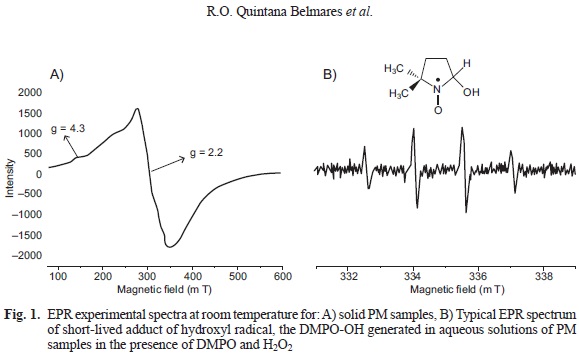
<body><![CDATA[<p align="justify"><font face="verdana" size="2">&nbsp;</font></p>  	    <p align="justify"><font face="verdana" size="2"><b>MATERIALS AND METHODS</b></font></p>  	    <p align="justify"><font face="verdana" size="2"><b>PM<sub>10</sub> and PM<sub>2</sub>.<sub>5</sub> sampling</b></font></p>  	    <p align="justify"><font face="verdana" size="2">Particulate matter with an aerodynamic diameter &lt;10 um (PM<sub>10</sub>) was obtained from industrial (IR), commercial (CR), and residential (RR) regions of Mexico City using a high&#45;volume sampler (GMW model 1200 VFC HV PM10; Sierra Andersen, Smyrna, GA, USA) for particles with an aerodynamic diameter &lt; 10 um (PM<sub>10</sub>). In 1991, 24 h PM<sub>10</sub> samples were collected using fiberglass filters (type A/E glass 61638; Gelman Sciences, Ann Arbor, MI, USA; 1.13 m<sup>3</sup>/min), three days per week during each week of the year. PM was recovered from the membranes after dry sonication for 45 min and subsequently smoothly swept with a brush into an endotoxin&#45;free flask. All PM samples were pooled by region and stored dry in endotoxin&#45;free glass vials, which were kept in a dryer at 4 &deg;C until use (Alfaro&#45;Moreno <i>et al.</i> 2002). In 2003, PM10 and particulate matter with an aerodynamic diameter g &lt; 2.5 um (PM<sub>25</sub>) were collected using the same instrument, but we introduced a modification involving the use of cellulose nitrate membranes with a nominal pore size of 3 um. Membranes were cut from rolls (11302&#45;131, Sartorius, Goettingen, Germany) and modified to preserve the airflow rate and particle size sampling performance, as previously described (Alfaro&#45;Moreno <i>et al.</i> 2009).</font></p>  	    <p align="justify"><font face="verdana" size="2"><b>Determination of the relative intensity of paramagnetic species in the PM</b></font></p>  	    <p align="justify"><font face="verdana" size="2">To evaluate the linearity of the method, we evaluated the relative intensity of the paramagnetic species using PM<sub>10</sub> (1, 2, 3, 4 and 5 mg) samples from 2003 with an EPR spectrometer (Jeol JES TE&#45;300, Tokyo, Japan) under the following experimental conditions: center field 335 mT; microwave frequency 9.4 GHz; microwave power 1 mW; sweep width +/&#45; 4 mT; sweep time 2 min; modulation width 0.16 mT; amplitude 63; time constant 0.3 s and accumulation 1 <b>(<a href="#f1">Fig. 1a</a>).</b></font></p> 	    <p align="center"><a name="f1"></a></p> 	    <p align="center"><img src="/img/revistas/rica/v31n2/a4f1.jpg"></p>  	    <p align="justify"><font face="verdana" size="2">The relative intensity was obtained in relation to a standard curve of Tempol by double integration of each spectrum (Shinji <i>et al.</i> 2004, Dos Santos <i>et al.</i> 2009), using Esprit 382 series V 1.916 Jeol software. The results show the signal intensity and are expressed in arbitrary units.</font></p>  	    <p align="justify"><font face="verdana" size="2"><b>Relative intensity in the solid PM</b></font></p>  	    ]]></body>
<body><![CDATA[<p align="justify"><font face="verdana" size="2">To determine the relative intensity of paramagnetic species in the solid PM samples, 3 mg of each sample was weighted and evaluated under the conditions previously described. Two independent measurements were taken for each PM sample. The final intensity was calculated based on the standard curve described above.</font></p>  	    <p align="justify"><font face="verdana" size="2"><b>Evaluation of the oxidative potential of PM</b></font></p>  	    <p align="justify"><font face="verdana" size="2">The production of the hydroxyl radical (&#8226;OH) by PM<sub>10</sub> and PM<sub>25</sub> was evaluated in the presence of H<sub>2</sub>O<sub>2</sub>. For this purpose, a suspension of PM was prepared (3 mg/mL). A total of l00 &#956;L of the suspension was mixed with 200 uL of 5,5&#45;Dimethyl&#45;l&#45;Pyr&#45;roline N&#45;oxide (DMPO) (final concentration 0.1 M, Dojindo, Rockville, MD), for use as a spin trap, and 100 uL of H<sub>2</sub>O<sub>2</sub> (final concentration 0.125 M, Fluka&#45;Aldrich, St. Louis, MO). The mixture was incubated for 15 min at 37 &deg;C with continuous shaking. The sample was filtered (0.2 um; Ministar&#45;RC Syringe, Sartorius, Goettingen Germany) and transferred to a quartz flat cell for the EPR measurements. The formation of hydroxyl radical (&#8226;OH) was detected as a well&#45;characterized 1:2:2:1 pattern of DMPO&#45;OH adduct (<b><a href="#f1">Fig. 1b</a></b>; Rinalducci <i>et al.</i> 2004) with aN=aH= 1.49 mT, g = 2.0056 under the following experimental parameters: center field = 335 mT, microwave frequency = 9.4 GHz, microwave power = 1 mW, sweep width +/&#45; 5 mT, sweep time 0.5 min, modulation width 0.04 mT, amplitude 100, time constant 0.1 s and accumulation 3. A mixture of DMPO (0.1 M in water), phosphate buffered saline (PBS) and H<sub>2</sub>O<sub>2</sub> (0.125 M in PBS) was used as a blank (Knaapen <i>et al.</i> 2000, Shi <i>et al.</i> 2003).</font></p>  	    <p align="justify"><font face="verdana" size="2"><b>Inhibition of the oxidative potential of PM</b></font></p>  	    <p align="justify"><font face="verdana" size="2">Under the same experimental conditions described above we added DFO to the samples as an iron&#45;copper chelating agent. A total of 100 uL of the PM suspension was mixed with 100 uL of DFO (final concentration 2.5 mM in water). The samples were incubated for 3 h with continuous shaking.</font></p>  	    <p align="justify"><font face="verdana" size="2"><b>Evaluation of DNA degradation</b></font></p>  	    <p align="justify"><font face="verdana" size="2">The degradation of "naked" DNA was evaluated in DNA isolated from Balb/c 3T3 cells with a commercial kit (DNA isolation kit for cells and tissues; Boehringer, Mannheim, Germany) as previously described (Garcia&#45;Cuellar <i>et al.</i> 2002). A total of 400 ng of isolated DNA was exposed to 40, 80 or 160 &#956;g/mL of PM<sub>10</sub> in the presence of 1 mM H<sub>2</sub>O<sub>2</sub> (Fenton&#45;type reaction). To inhibit the DNA degradation related to transition metals 1 mM of DFO was added. DNA exposed to CuSO<sub>4</sub> as well as H<sub>2</sub>O<sub>2</sub> was used as a positive control for a Fenton&#45;type reaction. DNA was exposed to the particles for 24 h with constant shaking. The samples were evaluated by electrophoretic mobility (H5 Horizontal Gel Electrophoresis Apparatus; GIBCO&#45;BRL Gaithersburg, MD) in 1.5 % agarose gels at 100 V for 3 hours, then stained with ethidium bromide (1.2 mg/mL) and photographed under UV light using a Kodak Gel logic 200 imaging system (New Haven, CT). All gels included DNA size markers and the following DNA degradation positive and negative controls: 1) <i>l/Hind</i> III (1 ug), 2) 400 ng of DNA alone, 3) 400 ng of DNA with 1 mM H<sub>2</sub>O<sub>2</sub>, 4) a "Fenton&#45;type reaction" control using 400 ng of DNA plus 5 mM CuSO<sub>4</sub> with 1 mM H<sub>2</sub>O<sub>2</sub>, and 5) 400 ng of DNA plus 1 mM of DFO and 1 mM H<sub>2</sub>O<sub>2</sub>.</font></p>  	    <p align="justify"><font face="verdana" size="2"><b>Statistical analysis</b></font></p>  	    <p align="justify"><font face="verdana" size="2">A linear regression analysis was performed for the spin intensity <i>vs.</i> PM mass. The slope and Rvalue were calculated for each curve. These curves were used to calculate the intensity of spin in all evaluated samples. The data obtained for the different regions, years and sizes of PM were analyzed using an ANOVA followed by a Bonferroni test (Stata 7.0, Windows XP, College Station, TX). Differences were considered significant when p &lt; 0.05.</font></p>  	    <p align="justify"><font face="verdana" size="2">&nbsp;</font></p>  	    ]]></body>
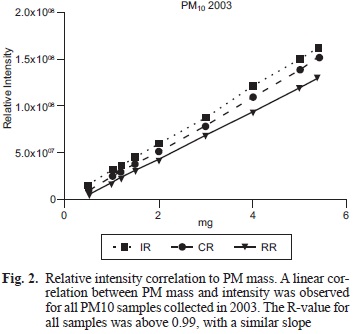
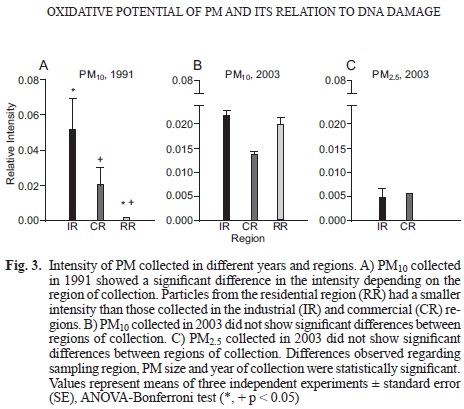
<body><![CDATA[<p align="justify"><font face="verdana" size="2"><b>RESULTS</b></font></p>  	    <p align="justify"><font face="verdana" size="2"><b>Determination of the intensity of paramagnetic species (spin) in PM</b></font></p>  	    <p align="justify"><font face="verdana" size="2">Dry PM samples showed an pseudoisotropic broad signal (g= 2.2 and AH= 68 mT) indicating a high concentration ofparamagnetic species (PS), potentially explained by the presence of previously identified levels ofFe+<sup>3</sup>, Cu+<sup>2</sup> and VO<sub>2</sub><sup>+</sup> in the PM samples <b>(<a href="#f1">Fig. 1a</a>).</b> These metals are found in all three regions in different proportions, though the IR was found to have the highest concentrations of metals' related signal. The intensity evaluation of paramagnetic species in PMi<sub>0</sub> from 2003 showed a linear correlation between PM mass and intensity under the conditions used for the measurement. When testing the PM from different regions the correlations yielded similar slopes and R&#45;values above 0.99 for all samples <b>(<a href="#f2">Fig. 2</a>).</b></font></p> 	    <p align="center"><a name="f2"></a></p> 	    <p align="center"><img src="/img/revistas/rica/v31n2/a4f2.jpg"></p>  	    <p align="justify"><font face="verdana" size="2"><b>PS intensity of PM from different years and regions</b></font></p>  	    <p align="justify"><font face="verdana" size="2">PM&#45;related PS intensity varied depending on the sampling region, the PM size and the year of collection (p &lt; 0.05). PM10 collected in the IR during 1991 presented the highest intensity, followed by samples from the CR (p &gt; 0.05) and the RR (p &lt; 0.05; <b><a href="#f3">Fig. 3a</a></b>). PM<sub>10</sub> collected during 2003 did not yield significant differences among the sampling sites <b>(<a href="#f3">Fig. 3b</a>).</b> Nevertheless, a reduction in spin intensity was observed in the IR upon comparison of samples from 1991 and 2003 (p = 0.07). In the IR and the CR, PM<sub>25</sub> had lower PS intensities than PM<sub>10</sub> samples, ~ 20 % of the PM<sub>10</sub> value (<b><a href="#f3">Fig. 3c</a></b>).</font></p> 	    <p align="center"><a name="f3"></a></p> 	    <p align="center"><img src="/img/revistas/rica/v31n2/a4f3.jpg"></p>  	    <p align="justify"><font face="verdana" size="2"><b>Oxidative potential of PM by EPR</b></font></p>  	    ]]></body>
<body><![CDATA[<p align="justify"><font face="verdana" size="2">PM suspensions in the presence of H<sub>2</sub>O<sub>2</sub> produced a characteristic 1:2:2:1 DMPO&#45;OH adduct pattern (hfcc aN=aH =1.49 mT, g=2.0056; <b><a href="#f1">Fig. 1b</a></b>), indicative of hydroxyl radical (&#8226;OH) generation (Rinalducci <i>et al.</i> 2004) and indicative of OP. The OP of PM10 collected during 1991 was similar for the IR and the CR and slightly lower for the RR (<b><a href="/img/revistas/rica/v31n2/a4f4.jpg" target="_blank">Fig. 4a</a>;</b> p &gt; 0.05). In contrast, the PM<sub>10</sub> collected in the IR during 2003 demonstrated a higher oxidative potential than those collected in the CR and RR (p &lt; 0.05; <b><a href="/img/revistas/rica/v31n2/a4f4.jpg" target="_blank">Fig. 4b</a></b>). The OP of the PM<sub>10</sub> from the IR was significantly higher in the samples collected in 2003 compared to the samples collected in 1991 (p = 0.012). PM10 and PM2.5 from 2003 did not yield significant differences in the OP (p &gt; 0.05; <b><a href="/img/revistas/rica/v31n2/a4f4.jpg" target="_blank">Fig. 4</a></b>).</font></p>  	    <p align="justify"><font face="verdana" size="2"><b>Inhibition of PM oxidative potential by DFO</b></font></p>  	    <p align="justify"><font face="verdana" size="2">The OP induced by PM<sub>10</sub> from the IR in 1991 and 2003 was strongly inhibited by the presence of DFO (p &lt; 0.05; <b><a href="/img/revistas/rica/v31n2/a4f4.jpg" target="_blank">Fig. 4a</a></b> and <b><a href="/img/revistas/rica/v31n2/a4f4.jpg" target="_blank">b</a></b>). In the case of the PM<sub>10</sub> collected in the CR and RR, no significant reductions in the OP were observed. The OP of PM2.5 was not inhibited by DFO <b>(<a href="/img/revistas/rica/v31n2/a4f4.jpg" target="_blank">Fig. 4c</a>).</b></font></p>  	    <p align="justify"><font face="verdana" size="2"><b>DNA degradation</b></font></p>  	    <p align="justify"><font face="verdana" size="2">All samples of PM were capable of inducing DNA degradation under the experimental conditions <b>(<a href="/img/revistas/rica/v31n2/a4f5.jpg" target="_blank">Fig. 5</a>).</b> In the case of the PM<sub>10</sub> collected in 1991, the particles from the industrial and the commercial regions were stronger inducers of DNA degradation than those collected in the residential region <b>(<a href="/img/revistas/rica/v31n2/a4f5.jpg" target="_blank">Fig. 5a</a>).</b> PM<sub>10</sub> samples from 2003 presented a different pattern; those collected in the CR seemed to induce weaker responses than those from the IR and RR <b>(<a href="/img/revistas/rica/v31n2/a4f5.jpg" target="_blank">Fig. 5b</a>).</b> In the case of PM2.5, similar effects were observed independent of the region <b>(<a href="/img/revistas/rica/v31n2/a4f5.jpg" target="_blank">Fig. 5c</a>).</b> In all cases, DNA degradation was completely inhibited by the presence of DFO.</font></p>  	    <p align="justify"><font face="verdana" size="2">&nbsp;</font></p>  	    <p align="justify"><font face="verdana" size="2"><b>DISCUSSION</b></font></p>  	    <p align="justify"><font face="verdana" size="2">In the present study, we observed that the intensity of the paramagnetic species and oxidative potential of urban PM collected in Mexico City varied by year and site of collection. These parameters correlate with the ability of the PM to induce DNA degradation <i>in vitro.</i></font></p>  	    <p align="justify"><font face="verdana" size="2">The broad signal induced by the PM dry samples is the result of the dipolar coupling of a high concentration of paramagnetic species, including metals such as Fe+<sup>3</sup>, Cu+<sup>2</sup> and VO2+ (Valavanidis <i>et al.</i> 2005a). In the center field, we observed an isotropic fine signal with &#916;H = 0.4 mT and g = 2.0026 that was attributable to stable organic species that could be semiquinones (data not shown). Regarding the intensity of the paramagnetic species, we observed that the PM from the IR of Mexico City collected in 1991 had a higher content of this intensity than that observed by PM from the RR. In contrast, the PM collected during 2003 did not differ depending on the sampling region. When comparing PM from both years (1991 vs. 2003) a significant reduction in the paramagnetic species content was observed for the PM from 2003 of the IR (p &lt; 0.05), whereas the PM from the RR showed an increase (p &lt; 0.05). The paramagnetic species in PM from the CR remained similar in both years of sampling. It has been reported that the concentration of different components in PM from Mexico City varied depending on the year of collection (Vega <i>et al.</i> 2004, Bae <i>et al.</i> 2010). The rapid growth of both, population and vehicle fleet (about 2 million units) during the period 1991&#45;2003 has increased the production of organic compounds, PM10 and PM2.5 in Mexico City. Besides the growth of the industry, because about 70 % of non&#45;metallic mineral industries, primary metals industry, food and beverage production, are important sources of PM (SMA&#45;GDF 2008). For example, the content of total carbon and elemental carbon increased from 1997 to 2002, and these changes were related to increases in traffic, as well as industrial and commercial activities (Vega <i>et al.</i> 2011).</font></p>  	    <p align="justify"><font face="verdana" size="2">Previous evaluation of metal content by inductively coupled plasma&#45;atomic emission (ICP&#45;AES) and carbon content (TOR) in the PM<sub>10</sub> from 1991 and 2003 revealed a higher concentration of metals and carbon in samples collected in 2003 (Alfaro&#45;Moreno <i>et al.</i> 2009). Particles from 1991 had a gradient of metal content in which IR&gt;CR&gt;RR, while samples from 2003 had the pattern IR&gt;RR&gt;CR. In 1991, we observed that the carbon content had a pattern of IR=CR&gt;RR, while in 2003, the pattern observed was IR&gt;CR&gt;RR (Vega <i>et al.</i> 2011).</font></p>  	    ]]></body>
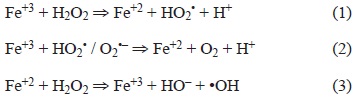
<body><![CDATA[<p align="justify"><font face="verdana" size="2">When the oxidative potential of PM was evaluated, we observed that the samples collected in 1991 did not show significant differences among regions, while the PM collected in 2003 demonstrated that the PM from the IR region had a larger OP than that of the other two regions. If we compare the samples from 1991 and 2003, it is notable that the PM<sub>10</sub> from the IR showed a significant increase in oxidative potential in 2003, while the PM from the other two regions did not significantly vary between the different years. These differences in oxidative potential could be related to the two following phenomena: 1) changes in the content of metals, mainly Fe and Cu, or 2) the oxidation of the sample due to storage time. This oxidation could increase the signal intensity in dry samples but still contribute to the OP, as with the less oxidized species. The second hypothesis could be supported by the observation that the amount of paramagnetic species is larger in the 1991 samples than in the 2003 samples. It makes sense that iron would be a significant contributor to the intensity of paramagnetic species, considering that Fe<sup>2+</sup> is an inducer of the Fenton reaction (Granados&#45;Oliveros <i>et al.</i> 2013), but Fe<sup>3+</sup> could also participate. The nature of the reactions for the generation of hydroxyl radicals by ferric and ferrous salts in the presence of hydrogen peroxide has been studied (Yamazaki and Piette 1990), and it is accepted that the &laquo;OH free radical could be generated from ferric salt according to the mechanism proposed by Croft <i>et al.</i> (1992).</font></p>  	    <p align="center"><img src="/img/revistas/rica/v31n2/a4e1.jpg"></p>  	    <p align="justify"><font face="verdana" size="2">Fe<sup>2+</sup> is not a paramagnetic species, in contrast to Fe<sup>3</sup>+ (Valavanidis <i>et al.</i> 2009, Gilch <i>et al.</i> 2010). Given this, it is likely that the formation of the hydroxyl radicals detected comes from both oxidation states of Fe. In addition to Fe, Cu+<sup>2</sup> is a good promoter of Fenton&#45;like reactions (Valenzuela <i>et al.</i> 2008) and has shown an even higher rate of oxidizing ability than Fe (Strlic <i>et al.</i> 2003).</font></p>  	    <p align="justify"><font face="verdana" size="2">The roles of Fe<sup>2</sup>+ and Fe<sup>3</sup>+ were highlighted by the suppression of the oxidative potential when DFO was added to the PM&#45;DMPO suspension, considering that DFO is primarily an iron chelator (Valgimigli <i>et al.</i> 2001, Karlsson <i>et al.</i> 2005, Shi <i>et al.</i> 2006).</font></p>  	    <p align="justify"><font face="verdana" size="2">Various authors have shown the relationship between the oxidative potential of PM and biological effects by measuring lipid peroxidation (Shi <i>et al.</i> 2006), DNA damage (Garc&iacute;a&#45;Cu&eacute;llar <i>et al.</i> 2002, S&aacute;nchez&#45;P&eacute;rez <i>et al.</i> 2009, Wei <i>et al.</i> 2009) and cellular death (Chirino <i>et al.</i> 2010). In the present study, we observed that the intensity of DNA degradation by the Fenton&#45;type reaction correlated with the oxidative potential. Interestingly, we observed that the addition of DFO to the mixture of DNA and PM abolished the degradation of DNA, while the oxidative potential was still measured with EPR. However, metal synergisms exist and the participation of organics has been described as key issues in PM induced biological effects (Cooper <i>et al.</i> 2009). Due to the design of this study, no full effect of the organic fraction can be explained, as is in the case of PM<sub>25</sub>. Thus, this result could be explained by differences in resolution between the two methods used (i.e., DNA electrophoresis did not detect minor DNA alterations; S&aacute;nchez&#45;P&eacute;rez <i>et al.</i> 2009).</font></p>  	    <p align="justify"><font face="verdana" size="2">It has been shown that the OP of PM, as measured by EPR analysis (&#8226;OH radicals), correlates with DNA damage (Shi <i>et al.</i> 2006). The present study supports this previous observation. The reason for this correlation appears to be the high presence of metals. Considering that Fe<sup>3</sup>+ and Cu<sup>2</sup>+ are capable of inducing a Fenton&#45;type reaction (Veranth <i>et al.</i> 2006, Gilch <i>et al.</i> 2010), it seems logical to conclude that the oxidative potential of PM, which can be inhibited by DFO, is mainly related to the predominant transition metals. Wessels <i>et al.</i> (2010) have suggested that increases in PS could be related to larger OP. As has been previously discussed, this correlation depends on the chemical species.</font></p>  	    <p align="justify"><font face="verdana" size="2">&nbsp;</font></p>  	    <p align="justify"><font face="verdana" size="2"><b>CONCLUSION</b></font></p>  	    <p align="justify"><font face="verdana" size="2">In conclusion, the evaluation of paramagnetic species and oxidative potential by means of EPR provides information supporting the understanding of the damage induced by the oxidative potential of PM. In some cases, the evaluation of the oxidative potential of PM could help to predict potential toxicity of these materials. However, PM is a complex mixture composed of different transition metals, organic and biological compounds that interact and can produce additive or synergistic effects. But for this study, metals are the most important sources of OP in PM samples. The EPR spin trapping technique allows us to directly monitor the formation of the 'OH free radical and to conduct DNA degradation analysis. Together, these approaches can be used as primary methods for evaluating the toxicity potential of PM.</font></p>  	    <p align="justify"><font face="verdana" size="2">&nbsp;</font></p>  	    ]]></body>
<body><![CDATA[<p align="justify"><font face="verdana" size="2"><b>ACKNOWLEDGMENTS</b></font></p>  	    <p align="justify"><font face="verdana" size="2">This study was partially supported by the CONACyT (project 106057). We would like to thank MSc. Yazm&iacute;n Segura for her technical support during the 2003 PM sampling, Dr. Yesennia S&aacute;nchez&#45;P&eacute;rez, MSc. Eva Salinas Cort&eacute;s and MSc. Leticia Mart&iacute;nez Romero for technical advice in standardizing the DNA degradation assay.</font></p>  	    <p align="justify"><font face="verdana" size="2">&nbsp;</font></p>  	    <p align="justify"><font face="verdana" size="2"><b>REFERENCES</b></font></p>  	    <!-- ref --><p align="justify"><font face="verdana" size="2">Alfaro&#45;Moreno E., Mart&iacute;nez L., Garc&iacute;a&#45;Cu&eacute;llar C., Bonner J.C., Murray J.C., Rosas I., Ponce de Le&oacute;n&#45;Rosales S. and Osornio&#45;Vargas A.R. (2002). Biologic effects induced in vitro by PM<sub>10</sub> from three different zones of Mexico City. Environ. Health. Perspect. 110, 715&#45;720.    &nbsp;&nbsp;&nbsp;&nbsp;&nbsp;&nbsp;&nbsp;&nbsp;[&#160;<a href="javascript:void(0);" onclick="javascript: window.open('/scielo.php?script=sci_nlinks&ref=7235486&pid=S0188-4999201500020000400001&lng=','','width=640,height=500,resizable=yes,scrollbars=1,menubar=yes,');">Links</a>&#160;]<!-- end-ref --></font></p>  	    <!-- ref --><p align="justify"><font face="verdana" size="2">Alfaro&#45;Moreno E., Ponce&#45;de&#45;Le&oacute;n S., Osornio&#45;Vargas A.R., Garc&iacute;a&#45;Cu&eacute;llar C., Mart&iacute;nez L. and Rosas I. (2007). Potential toxic effects associated to metals and endotoxin present in PM<sub>10</sub>: an ancillary study using multivariate analysis. Inhal. Toxicol. 19, 49&#45;53.    &nbsp;&nbsp;&nbsp;&nbsp;&nbsp;&nbsp;&nbsp;&nbsp;[&#160;<a href="javascript:void(0);" onclick="javascript: window.open('/scielo.php?script=sci_nlinks&ref=7235488&pid=S0188-4999201500020000400002&lng=','','width=640,height=500,resizable=yes,scrollbars=1,menubar=yes,');">Links</a>&#160;]<!-- end-ref --></font></p>  	    <!-- ref --><p align="justify"><font face="verdana" size="2">Alfaro&#45;Moreno E., Torres V., Miranda J., Mart&iacute;nez L., Garc&iacute;a&#45;Cu&eacute;llar C., Nawrot T.S., Vanaudenaerde B., Hoet P., Ram&iacute;rez&#45;L&oacute;pez P., Rosas I., Nemery B. and Osornio&#45;Vargas A.R. (2009). Induction of IL&#45;6 and inhibition of IL&#45;8 secretion in the human airway cell line Calu&#45;3 by urban PM collected with a modified method of PM sampling. Environ. Res. 109, 528&#45;535.    &nbsp;&nbsp;&nbsp;&nbsp;&nbsp;&nbsp;&nbsp;&nbsp;[&#160;<a href="javascript:void(0);" onclick="javascript: window.open('/scielo.php?script=sci_nlinks&ref=7235490&pid=S0188-4999201500020000400003&lng=','','width=640,height=500,resizable=yes,scrollbars=1,menubar=yes,');">Links</a>&#160;]<!-- end-ref --></font></p>  	    ]]></body>
<body><![CDATA[<!-- ref --><p align="justify"><font face="verdana" size="2">Bae S., Pan X.C., Kim S.Y., Park K., Kim Y.H., Kim H. and Hong Y.C. (2010). Exposures to PM and polycyclic aromatic hydrocarbons and oxidative stress in schoolchildren. Environ. Health Perspect. 118, 579&#45;583.    &nbsp;&nbsp;&nbsp;&nbsp;&nbsp;&nbsp;&nbsp;&nbsp;[&#160;<a href="javascript:void(0);" onclick="javascript: window.open('/scielo.php?script=sci_nlinks&ref=7235492&pid=S0188-4999201500020000400004&lng=','','width=640,height=500,resizable=yes,scrollbars=1,menubar=yes,');">Links</a>&#160;]<!-- end-ref --></font></p>  	    <!-- ref --><p align="justify"><font face="verdana" size="2">Becker S., Dailey L.A., Soukup J.M., Grambow S.C., Devlin R.B. and Huang Y.C. (2005). Seasonal variations in air pollution particle&#45;induced inflammatory mediator release and oxidative stress. Environ. Health Perspect. 113, 1032&#45;1038.    &nbsp;&nbsp;&nbsp;&nbsp;&nbsp;&nbsp;&nbsp;&nbsp;[&#160;<a href="javascript:void(0);" onclick="javascript: window.open('/scielo.php?script=sci_nlinks&ref=7235494&pid=S0188-4999201500020000400005&lng=','','width=640,height=500,resizable=yes,scrollbars=1,menubar=yes,');">Links</a>&#160;]<!-- end-ref --></font></p>  	    <!-- ref --><p align="justify"><font face="verdana" size="2">Briede J.J., De Kok T.M., Hogervorst J.G., Moonen E.J., Op Den Camp C.L. and Kleinjanst J.C. (2005). Development and application of an electron spin resonance spectrometry method for the determination of oxygen free radical formation by PM. Environ. Sci. Technol. 39, 8420&#45;8426.    &nbsp;&nbsp;&nbsp;&nbsp;&nbsp;&nbsp;&nbsp;&nbsp;[&#160;<a href="javascript:void(0);" onclick="javascript: window.open('/scielo.php?script=sci_nlinks&ref=7235496&pid=S0188-4999201500020000400006&lng=','','width=640,height=500,resizable=yes,scrollbars=1,menubar=yes,');">Links</a>&#160;]<!-- end-ref --></font></p>  	    <!-- ref --><p align="justify"><font face="verdana" size="2">Chirino Y.I., S&aacute;nchez&#45;P&eacute;rez Y., Osornio&#45;Vargas A.R., Morales&#45;B&aacute;rcenas R., Guti&eacute;rrez&#45;Ru&iacute;z M.C., Segura&#45;Garc&iacute;a Y., Rosas I., Pedraza&#45;Chaverri J. and Garc&iacute;a&#45;Cu&eacute;llar C.M. (2010). PM<sub>10</sub> impairs the antioxidant defense system and exacerbates oxidative stress driven cell death. Toxicol. Lett. 193, 209&#45;216.    &nbsp;&nbsp;&nbsp;&nbsp;&nbsp;&nbsp;&nbsp;&nbsp;[&#160;<a href="javascript:void(0);" onclick="javascript: window.open('/scielo.php?script=sci_nlinks&ref=7235498&pid=S0188-4999201500020000400007&lng=','','width=640,height=500,resizable=yes,scrollbars=1,menubar=yes,');">Links</a>&#160;]<!-- end-ref --></font></p>  	    <!-- ref --><p align="justify"><font face="verdana" size="2">Cooper N.L., Bidwell J.R. and Kumar A. (2009). Toxicity of copper, lead, and zinc mixtures to <i>Ceriodaphnia dubia</i> and <i>Daphnia carinata.</i> Ecotoxicol. Environ. Saf. 72, 1523&#45;1528.    &nbsp;&nbsp;&nbsp;&nbsp;&nbsp;&nbsp;&nbsp;&nbsp;[&#160;<a href="javascript:void(0);" onclick="javascript: window.open('/scielo.php?script=sci_nlinks&ref=7235500&pid=S0188-4999201500020000400008&lng=','','width=640,height=500,resizable=yes,scrollbars=1,menubar=yes,');">Links</a>&#160;]<!-- end-ref --></font></p>  	    ]]></body>
<body><![CDATA[<!-- ref --><p align="justify"><font face="verdana" size="2">Croft S., Gilbert B.C., Lindsay&#45;Smith J.R. and Whitwood A.C. (1992). An E.S.R. Investigation of the reactive intermediate generated in the reaction between Fe<sup>+2</sup> and H<sub>2</sub>O<sub>2</sub> in aqueous solution. Direct evidence for the formation of the hydroxyl radical. Free Radic Res. Commun. 17, 21&#45;39.    &nbsp;&nbsp;&nbsp;&nbsp;&nbsp;&nbsp;&nbsp;&nbsp;[&#160;<a href="javascript:void(0);" onclick="javascript: window.open('/scielo.php?script=sci_nlinks&ref=7235502&pid=S0188-4999201500020000400009&lng=','','width=640,height=500,resizable=yes,scrollbars=1,menubar=yes,');">Links</a>&#160;]<!-- end-ref --></font></p>  	    <!-- ref --><p align="justify"><font face="verdana" size="2">Dos Santos A.B., Siqueira S., Da Silva B., &Aacute;vila Santos L., Schmidtc M. and Baffad O. (2009). An&#45;tioxidant properties of plant extracts: an EPR and DFT comparative study of the reaction with DPPH, TEMPOL and spin trap DMPO. J. Braz. Chem. Soc. 20, 1483&#45;1492.    &nbsp;&nbsp;&nbsp;&nbsp;&nbsp;&nbsp;&nbsp;&nbsp;[&#160;<a href="javascript:void(0);" onclick="javascript: window.open('/scielo.php?script=sci_nlinks&ref=7235504&pid=S0188-4999201500020000400010&lng=','','width=640,height=500,resizable=yes,scrollbars=1,menubar=yes,');">Links</a>&#160;]<!-- end-ref --></font></p>  	    <!-- ref --><p align="justify"><font face="verdana" size="2">Garc&iacute;a&#45;Cu&eacute;llar C., Alfaro&#45;Moreno E., Mart&iacute;nez&#45;Romero F., Ponce&#45;de&#45;Le&oacute;n Rosales S., Rosas I., P&eacute;rez&#45;C&aacute;rdenas E. and Osornio&#45;Vargas A.R. (2002). DNA damage induced by PM10 from different zones of Mexico City. Ann. Occup. Hyg. 46, 425&#45;428.    &nbsp;&nbsp;&nbsp;&nbsp;&nbsp;&nbsp;&nbsp;&nbsp;[&#160;<a href="javascript:void(0);" onclick="javascript: window.open('/scielo.php?script=sci_nlinks&ref=7235506&pid=S0188-4999201500020000400011&lng=','','width=640,height=500,resizable=yes,scrollbars=1,menubar=yes,');">Links</a>&#160;]<!-- end-ref --></font></p>  	    <!-- ref --><p align="justify"><font face="verdana" size="2">Gerlofs&#45;Nijland M.E., Rummelhard M., Boere A.J., Lese&#45;man D.L., Duffin R., Schins R.P., Borm P.J., Sillanpaa M., Salonen R.O. and Cassee F.R. (2009). Particle induced toxicity in relation to transition metal and polycyclic aromatic hydrocarbon contents. Environ. Sci. Technol. 43, 4729&#45;4736.    &nbsp;&nbsp;&nbsp;&nbsp;&nbsp;&nbsp;&nbsp;&nbsp;[&#160;<a href="javascript:void(0);" onclick="javascript: window.open('/scielo.php?script=sci_nlinks&ref=7235508&pid=S0188-4999201500020000400012&lng=','','width=640,height=500,resizable=yes,scrollbars=1,menubar=yes,');">Links</a>&#160;]<!-- end-ref --></font></p>  	    <!-- ref --><p align="justify"><font face="verdana" size="2">Gilch S., Meyer O. and Schmidt I. (2010). Electron paramagnetic studies of the copper and iron containing soluble ammonia monooxygenase from Nitrosomonas europaea. Biometals 23, 613&#45;622.    &nbsp;&nbsp;&nbsp;&nbsp;&nbsp;&nbsp;&nbsp;&nbsp;[&#160;<a href="javascript:void(0);" onclick="javascript: window.open('/scielo.php?script=sci_nlinks&ref=7235510&pid=S0188-4999201500020000400013&lng=','','width=640,height=500,resizable=yes,scrollbars=1,menubar=yes,');">Links</a>&#160;]<!-- end-ref --></font></p>  	    ]]></body>
<body><![CDATA[<!-- ref --><p align="justify"><font face="verdana" size="2">Granados&#45;Oliveros G., G&oacute;mez&#45;Vidales V., Nieto&#45;Camacho A., Morales&#45;Serna J.A., C&aacute;rdenas J. and Salm&oacute;n M. (2013). Photoproduction of H<sub>2</sub>O<sub>2</sub> and hydroxyl radicals catalysed by natural and super acid&#45;modified montmo&#45;rillonite and its oxidative role in the peroxidation of lipids. RSC Adv. 3, 937&#45;944.    &nbsp;&nbsp;&nbsp;&nbsp;&nbsp;&nbsp;&nbsp;&nbsp;[&#160;<a href="javascript:void(0);" onclick="javascript: window.open('/scielo.php?script=sci_nlinks&ref=7235512&pid=S0188-4999201500020000400014&lng=','','width=640,height=500,resizable=yes,scrollbars=1,menubar=yes,');">Links</a>&#160;]<!-- end-ref --></font></p>  	    <!-- ref --><p align="justify"><font face="verdana" size="2">Karlsson H.L., Nilsson L. and Moller L. (2005). Subway particles are more genotoxic than street particles and induce oxidative stress in cultured human lung cells. Chem. Res. Toxicol. 18, 19&#45;23.    &nbsp;&nbsp;&nbsp;&nbsp;&nbsp;&nbsp;&nbsp;&nbsp;[&#160;<a href="javascript:void(0);" onclick="javascript: window.open('/scielo.php?script=sci_nlinks&ref=7235514&pid=S0188-4999201500020000400015&lng=','','width=640,height=500,resizable=yes,scrollbars=1,menubar=yes,');">Links</a>&#160;]<!-- end-ref --></font></p>  	    <!-- ref --><p align="justify"><font face="verdana" size="2">Knaapen A.M., Schins R.P., Steinfartz Y., Ho D., Dunemann L. and Borm P.J. (2000). Ambient PM induces oxidative DNA damage in lung epithelial cells. Inhal. Toxicol. 12, 125&#45;131.    &nbsp;&nbsp;&nbsp;&nbsp;&nbsp;&nbsp;&nbsp;&nbsp;[&#160;<a href="javascript:void(0);" onclick="javascript: window.open('/scielo.php?script=sci_nlinks&ref=7235516&pid=S0188-4999201500020000400016&lng=','','width=640,height=500,resizable=yes,scrollbars=1,menubar=yes,');">Links</a>&#160;]<!-- end-ref --></font></p>  	    <!-- ref --><p align="justify"><font face="verdana" size="2">Lloyd D.R., Phillips D.H. and Carmichael P.L. (1997). Generation of putative intrastrand cross&#45;links and strand breaks in DNA by transition metal Ion&#45;mediated oxygen radical attack. Chem. Res. Toxicol. 10, 393&#45;400.    &nbsp;&nbsp;&nbsp;&nbsp;&nbsp;&nbsp;&nbsp;&nbsp;[&#160;<a href="javascript:void(0);" onclick="javascript: window.open('/scielo.php?script=sci_nlinks&ref=7235518&pid=S0188-4999201500020000400017&lng=','','width=640,height=500,resizable=yes,scrollbars=1,menubar=yes,');">Links</a>&#160;]<!-- end-ref --></font></p>  	    <!-- ref --><p align="justify"><font face="verdana" size="2">Lloyd D.R. and Phillips D.H. (1999). Oxidative DNA damage mediated by copper(II), iron(II) and nickel(II) Fen&#45;ton reactions: evidence for site&#45;specific mechanisms in the formation of double&#45;strand breaks, 8&#45;hydroxy&#45;deoxyguanosine and putative intrastrand cross&#45;links. Mutat. Res. 424, 23&#45;36</font>&nbsp;&nbsp;&nbsp;&nbsp;&nbsp;&nbsp;&nbsp;&nbsp;[&#160;<a href="javascript:void(0);" onclick="javascript: window.open('/scielo.php?script=sci_nlinks&ref=7235520&pid=S0188-4999201500020000400018&lng=','','width=640,height=500,resizable=yes,scrollbars=1,menubar=yes,');">Links</a>&#160;]<!-- end-ref --><!-- ref --><p align="justify"><font face="verdana" size="2">Montiel&#45;D&aacute;valos A., Ibarra&#45;S&aacute;nchez M.J., Ventura&#45;Gallegos J.L., Alfaro&#45;Moreno E. and L&oacute;pez&#45;Marure R. (2010). Oxidative stress and apoptosis are induced in human endothelial cells exposed to urban PM. Toxicol. In Vitro. 24, 135&#45;141.    &nbsp;&nbsp;&nbsp;&nbsp;&nbsp;&nbsp;&nbsp;&nbsp;[&#160;<a href="javascript:void(0);" onclick="javascript: window.open('/scielo.php?script=sci_nlinks&ref=7235521&pid=S0188-4999201500020000400019&lng=','','width=640,height=500,resizable=yes,scrollbars=1,menubar=yes,');">Links</a>&#160;]<!-- end-ref --></font></p>  	    <!-- ref --><p align="justify"><font face="verdana" size="2">Mugica V, Ort&iacute;z E., Molina L., De Vizcaya&#45;Ru&iacute;z A., Nebot A., Quintana R., Aguilar J., and Alc&aacute;ntara E. (2009). PM composition and source reconciliation in Mexico City. Atmos. Environ. 43, 5068&#45;5074.    &nbsp;&nbsp;&nbsp;&nbsp;&nbsp;&nbsp;&nbsp;&nbsp;[&#160;<a href="javascript:void(0);" onclick="javascript: window.open('/scielo.php?script=sci_nlinks&ref=7235523&pid=S0188-4999201500020000400020&lng=','','width=640,height=500,resizable=yes,scrollbars=1,menubar=yes,');">Links</a>&#160;]<!-- end-ref --></font></p>  	    <!-- ref --><p align="justify"><font face="verdana" size="2">Osornio&#45;Vargas A.R., Serrano J., Rojas&#45;Bracho L., Miranda J., Garc&iacute;a&#45;Cu&eacute;llar C., Reyna M.A., Flores G., Zuk M., Quintero M., V&aacute;zquez I., S&aacute;nchez&#45;P&eacute;rez Y., L&oacute;pez T. and Rosas I. (2011). <i>In vitro</i> biological effects of airborne PM2.5 and PM10 from a semi&#45;desert city on the Mexico&#45;US border. Chemosphere 83, 618&#45;626.    &nbsp;&nbsp;&nbsp;&nbsp;&nbsp;&nbsp;&nbsp;&nbsp;[&#160;<a href="javascript:void(0);" onclick="javascript: window.open('/scielo.php?script=sci_nlinks&ref=7235525&pid=S0188-4999201500020000400021&lng=','','width=640,height=500,resizable=yes,scrollbars=1,menubar=yes,');">Links</a>&#160;]<!-- end-ref --></font></p>  	    <!-- ref --><p align="justify"><font face="verdana" size="2">Rinalducci S., Pedersen J.Z. and Zolla L. (2004). Formation of radicals from singlet oxygen produced during photoinhibition of isolated light&#45;harvesting proteins of photosystem II. Biochim. Biophys. Acta. 1608, 63&#45;73.    &nbsp;&nbsp;&nbsp;&nbsp;&nbsp;&nbsp;&nbsp;&nbsp;[&#160;<a href="javascript:void(0);" onclick="javascript: window.open('/scielo.php?script=sci_nlinks&ref=7235527&pid=S0188-4999201500020000400022&lng=','','width=640,height=500,resizable=yes,scrollbars=1,menubar=yes,');">Links</a>&#160;]<!-- end-ref --></font></p>  	    <!-- ref --><p align="justify"><font face="verdana" size="2">Rosas&#45;P&eacute;rez I., Serrano J., Alfaro&#45;Moreno E., Baumgardner D., Garc&iacute;a&#45;Cu&eacute;llar C., Miranda Mart&iacute;n Del Campo J., Raga G.B., Castillejos M., Col&iacute;n R.D. and Osornio Vargas A.R. (2007). Relations between PM<sub>10</sub> composition and cell toxicity: a multivariate and graphical approach. Chemosphere 67, 1218&#45;1228.    &nbsp;&nbsp;&nbsp;&nbsp;&nbsp;&nbsp;&nbsp;&nbsp;[&#160;<a href="javascript:void(0);" onclick="javascript: window.open('/scielo.php?script=sci_nlinks&ref=7235529&pid=S0188-4999201500020000400023&lng=','','width=640,height=500,resizable=yes,scrollbars=1,menubar=yes,');">Links</a>&#160;]<!-- end-ref --></font></p>  	    <!-- ref --><p align="justify"><font face="verdana" size="2">S&aacute;nchez&#45;P&eacute;rez Y., Chirino Y.I., Osornio&#45;Vargas A.R., Morales&#45;Barcenas R., Guti&eacute;rrez&#45;Ru&iacute;z C., V&aacute;zquez&#45;L&oacute;pez I. and Garc&iacute;a&#45;Cu&eacute;llar C.M. (2009). DNA damage response of A549 cells treated with PM (PM<sub>10</sub>) of urban air pollutants. Cancer Lett. 278, 192&#45;200.    &nbsp;&nbsp;&nbsp;&nbsp;&nbsp;&nbsp;&nbsp;&nbsp;[&#160;<a href="javascript:void(0);" onclick="javascript: window.open('/scielo.php?script=sci_nlinks&ref=7235531&pid=S0188-4999201500020000400024&lng=','','width=640,height=500,resizable=yes,scrollbars=1,menubar=yes,');">Links</a>&#160;]<!-- end-ref --></font></p>  	    <!-- ref --><p align="justify"><font face="verdana" size="2">Shi T., Duffin R., Borm P.J., Li H., Weishaupt C. and Schins R.P. (2006). Hydroxyl&#45;radical&#45;dependent DNA damage by ambient PM from contrasting sampling locations. Environ. Res. 101, 18&#45;24.    &nbsp;&nbsp;&nbsp;&nbsp;&nbsp;&nbsp;&nbsp;&nbsp;[&#160;<a href="javascript:void(0);" onclick="javascript: window.open('/scielo.php?script=sci_nlinks&ref=7235533&pid=S0188-4999201500020000400025&lng=','','width=640,height=500,resizable=yes,scrollbars=1,menubar=yes,');">Links</a>&#160;]<!-- end-ref --></font></p>  	    <!-- ref --><p align="justify"><font face="verdana" size="2">Shi T., Knaapen A.M., Begerow J., Birmili W., Borm P.J. and Schins R.P. (2003). Temporal variation of hydroxyl radical generation and 8&#45;hydroxy&#45;2'&#45;deoxyguanosine formation by coarse and fine PM. Occup. Environ. Med. 60, 315&#45;321.    &nbsp;&nbsp;&nbsp;&nbsp;&nbsp;&nbsp;&nbsp;&nbsp;[&#160;<a href="javascript:void(0);" onclick="javascript: window.open('/scielo.php?script=sci_nlinks&ref=7235535&pid=S0188-4999201500020000400026&lng=','','width=640,height=500,resizable=yes,scrollbars=1,menubar=yes,');">Links</a>&#160;]<!-- end-ref --></font></p>  	    <!-- ref --><p align="justify"><font face="verdana" size="2">Shinji A., Kazuyoshi K., Koichiro T., Masumi O., Toyoshi H., Hitoshi H. and Masanori Y. (2004). The reaction rate of edaravone (3&#45;Methyl&#45;1&#45;Phenyl&#45;2&#45;Pirazolin&#45;5&#45;one&#45;(MCI&#45;186) with hydroxyl radical. Chem. Pharm. Bull. 52, 186&#45;191.    &nbsp;&nbsp;&nbsp;&nbsp;&nbsp;&nbsp;&nbsp;&nbsp;[&#160;<a href="javascript:void(0);" onclick="javascript: window.open('/scielo.php?script=sci_nlinks&ref=7235537&pid=S0188-4999201500020000400027&lng=','','width=640,height=500,resizable=yes,scrollbars=1,menubar=yes,');">Links</a>&#160;]<!-- end-ref --></font></p>  	    <!-- ref --><p align="justify"><font face="verdana" size="2">SMA&#45;GDF (2008). Inventario de emisiones ZMVM 2006. Secretar&iacute;a del Medio Ambiente del Distrito Federal. Inventario. M&eacute;xico D.F. 158 pp.    &nbsp;&nbsp;&nbsp;&nbsp;&nbsp;&nbsp;&nbsp;&nbsp;[&#160;<a href="javascript:void(0);" onclick="javascript: window.open('/scielo.php?script=sci_nlinks&ref=7235539&pid=S0188-4999201500020000400028&lng=','','width=640,height=500,resizable=yes,scrollbars=1,menubar=yes,');">Links</a>&#160;]<!-- end-ref --></font></p>  	    <!-- ref --><p align="justify"><font face="verdana" size="2">Soukup J.M., Ghio A.J. and Becker S. (2000). Soluble components of Utah Valley particulate pollution alter alveolar macrophage function <i>in vivo</i> and <i>in vitro.</i> Inhal. Toxicol. 12, 401&#45;414.    &nbsp;&nbsp;&nbsp;&nbsp;&nbsp;&nbsp;&nbsp;&nbsp;[&#160;<a href="javascript:void(0);" onclick="javascript: window.open('/scielo.php?script=sci_nlinks&ref=7235541&pid=S0188-4999201500020000400029&lng=','','width=640,height=500,resizable=yes,scrollbars=1,menubar=yes,');">Links</a>&#160;]<!-- end-ref --></font></p>  	    <!-- ref --><p align="justify"><font face="verdana" size="2">Strlic M., Kolar J., Selih VS., Kocar D. and Pihlar D. (2003). A comparative study of several transition metals in Fenton&#45;like reaction systems at Circum&#45;neutral pH. Acta Chim. Slov. 50, 619&#45;632.    &nbsp;&nbsp;&nbsp;&nbsp;&nbsp;&nbsp;&nbsp;&nbsp;[&#160;<a href="javascript:void(0);" onclick="javascript: window.open('/scielo.php?script=sci_nlinks&ref=7235543&pid=S0188-4999201500020000400030&lng=','','width=640,height=500,resizable=yes,scrollbars=1,menubar=yes,');">Links</a>&#160;]<!-- end-ref --></font></p>  	    <!-- ref --><p align="justify"><font face="verdana" size="2">Valavanidis A., Fiotakis T. K., Bakeas E., and Vlahogianni T. (2005a). Electron paramagnetic resonance study of the generation of reactive oxygen species catalyzed by transition metals and quinoid redox cycling by inhal&#45;able ambient particulate matter. Redox Rep. 10, 37&#45;51.    &nbsp;&nbsp;&nbsp;&nbsp;&nbsp;&nbsp;&nbsp;&nbsp;[&#160;<a href="javascript:void(0);" onclick="javascript: window.open('/scielo.php?script=sci_nlinks&ref=7235545&pid=S0188-4999201500020000400031&lng=','','width=640,height=500,resizable=yes,scrollbars=1,menubar=yes,');">Links</a>&#160;]<!-- end-ref --></font></p>  	    <!-- ref --><p align="justify"><font face="verdana" size="2">Valavanidis A., Vlahoyianni T. and Fiotakis K. (2005b). Comparative study of the formation of oxidative damage marker 8&#45;hydroxy&#45;2'&#45;deoxyguanosine (8&#45;OHdG) adduct from the nucleoside 2'&#45;deoxyguanosine by transition metals and suspensions of PM in relation to metal content and redox reactivity. Free Radic Res. 39, 1071&#45;1081.    &nbsp;&nbsp;&nbsp;&nbsp;&nbsp;&nbsp;&nbsp;&nbsp;[&#160;<a href="javascript:void(0);" onclick="javascript: window.open('/scielo.php?script=sci_nlinks&ref=7235547&pid=S0188-4999201500020000400032&lng=','','width=640,height=500,resizable=yes,scrollbars=1,menubar=yes,');">Links</a>&#160;]<!-- end-ref --></font></p>  	    <!-- ref --><p align="justify"><font face="verdana" size="2">Valavanidis A., Loridas S., Vlahogianni T. and Fiotakis K. (2009). Influence of ozone on traffic&#45;related PM on the generation of hydroxyl radicals through a heterogeneous synergistic effect. J. Hazard Matter. 162, 886&#45;892.    &nbsp;&nbsp;&nbsp;&nbsp;&nbsp;&nbsp;&nbsp;&nbsp;[&#160;<a href="javascript:void(0);" onclick="javascript: window.open('/scielo.php?script=sci_nlinks&ref=7235549&pid=S0188-4999201500020000400033&lng=','','width=640,height=500,resizable=yes,scrollbars=1,menubar=yes,');">Links</a>&#160;]<!-- end-ref --></font></p>  	    <!-- ref --><p align="justify"><font face="verdana" size="2">Valenzuela R., Contreras D., Oviedo C., Freer J. and Rodr&iacute;guez J. (2008). Copper catechol&#45;driven Fenton reactions and their potential role in wood degradation. Int. Biodeterior. Biodegradation. 61, 345&#45;350.    &nbsp;&nbsp;&nbsp;&nbsp;&nbsp;&nbsp;&nbsp;&nbsp;[&#160;<a href="javascript:void(0);" onclick="javascript: window.open('/scielo.php?script=sci_nlinks&ref=7235551&pid=S0188-4999201500020000400034&lng=','','width=640,height=500,resizable=yes,scrollbars=1,menubar=yes,');">Links</a>&#160;]<!-- end-ref --></font></p>  	    <!-- ref --><p align="justify"><font face="verdana" size="2">Valgimigli L., Pedulli G.F. and Paolini M. (2001). Measurement of oxidative stress by EPR radical&#45;probe technique. Free Radic Biol. Med. 31, 708&#45;716.    &nbsp;&nbsp;&nbsp;&nbsp;&nbsp;&nbsp;&nbsp;&nbsp;[&#160;<a href="javascript:void(0);" onclick="javascript: window.open('/scielo.php?script=sci_nlinks&ref=7235553&pid=S0188-4999201500020000400035&lng=','','width=640,height=500,resizable=yes,scrollbars=1,menubar=yes,');">Links</a>&#160;]<!-- end-ref --></font></p>  	    <!-- ref --><p align="justify"><font face="verdana" size="2">Vega E., Reyes E., Ruiz H., Garc&iacute;a J., S&aacute;nchez G., Mart&iacute;nez&#45;Villa G., Gonz&aacute;lez U., Chow J.C. and Watson J.G. (2004). Analysis of PM<sub>25</sub> and PM<sub>10</sub> in the atmosphere of Mexico City during 2000&#45;2002. J. Air Waste Manag. Assoc. 54, 786&#45;798.    &nbsp;&nbsp;&nbsp;&nbsp;&nbsp;&nbsp;&nbsp;&nbsp;[&#160;<a href="javascript:void(0);" onclick="javascript: window.open('/scielo.php?script=sci_nlinks&ref=7235555&pid=S0188-4999201500020000400036&lng=','','width=640,height=500,resizable=yes,scrollbars=1,menubar=yes,');">Links</a>&#160;]<!-- end-ref --></font></p>  	    <!-- ref --><p align="justify"><font face="verdana" size="2">Vega E., Ru&iacute;z H., Escalona S., Cervantes A., L&oacute;pez&#45;Veneroni D., Gonz&aacute;lez&#45;&Aacute;valos E. and S&aacute;nchez&#45;Reyna G. (2011). Chemical composition of fine particles in Mexico City during 2003&#45;2004. Atmos. Pollut. Res. 2, 477&#45;483.    &nbsp;&nbsp;&nbsp;&nbsp;&nbsp;&nbsp;&nbsp;&nbsp;[&#160;<a href="javascript:void(0);" onclick="javascript: window.open('/scielo.php?script=sci_nlinks&ref=7235557&pid=S0188-4999201500020000400037&lng=','','width=640,height=500,resizable=yes,scrollbars=1,menubar=yes,');">Links</a>&#160;]<!-- end-ref --></font></p>  	    <!-- ref --><p align="justify"><font face="verdana" size="2">Veranth J.M., Moss T.A., Chow J.C., Labban R., Nichols W.K., Walton J.C., Watson J.G. and Yost G.S. (2006). Correlation of in vitro cytokine responses with the chemical composition of soil&#45;derived PM. Environ. Health Perspect. 114, 341&#45;349.    &nbsp;&nbsp;&nbsp;&nbsp;&nbsp;&nbsp;&nbsp;&nbsp;[&#160;<a href="javascript:void(0);" onclick="javascript: window.open('/scielo.php?script=sci_nlinks&ref=7235559&pid=S0188-4999201500020000400038&lng=','','width=640,height=500,resizable=yes,scrollbars=1,menubar=yes,');">Links</a>&#160;]<!-- end-ref --></font></p>  	    <!-- ref --><p align="justify"><font face="verdana" size="2">Wei Y., Han I.K., Shao M., Hu M., Zhang O.J. and Tang X. (2009). PM<sub>25</sub> constituents and oxidative DNA damage in humans. Environ. Sci. Technol. 43, 4757&#45;4762.    &nbsp;&nbsp;&nbsp;&nbsp;&nbsp;&nbsp;&nbsp;&nbsp;[&#160;<a href="javascript:void(0);" onclick="javascript: window.open('/scielo.php?script=sci_nlinks&ref=7235561&pid=S0188-4999201500020000400039&lng=','','width=640,height=500,resizable=yes,scrollbars=1,menubar=yes,');">Links</a>&#160;]<!-- end-ref --></font></p>  	    <!-- ref --><p align="justify"><font face="verdana" size="2">Wessels A., Birmili W., Albrecht C., Hellack B., Jermann E., Wick G., Harrison R.M. and Schins R.P. (2010). Oxidant generation and toxicity of size&#45;fractionated ambient particles in human lung epithelial cells. Environ. Sci. Technol. 44, 3539&#45;3545.    &nbsp;&nbsp;&nbsp;&nbsp;&nbsp;&nbsp;&nbsp;&nbsp;[&#160;<a href="javascript:void(0);" onclick="javascript: window.open('/scielo.php?script=sci_nlinks&ref=7235563&pid=S0188-4999201500020000400040&lng=','','width=640,height=500,resizable=yes,scrollbars=1,menubar=yes,');">Links</a>&#160;]<!-- end-ref --></font></p>  	    <!-- ref --><p align="justify"><font face="verdana" size="2">Yamazaki I. and Piette L.H. (1990). Stoichiometric measurements of the Fenton reaction, possible non&#45;OH oxidizing intermediate by spin&#45;trapping. Free Radic Biol. Med. 9, 42.    &nbsp;&nbsp;&nbsp;&nbsp;&nbsp;&nbsp;&nbsp;&nbsp;[&#160;<a href="javascript:void(0);" onclick="javascript: window.open('/scielo.php?script=sci_nlinks&ref=7235565&pid=S0188-4999201500020000400041&lng=','','width=640,height=500,resizable=yes,scrollbars=1,menubar=yes,');">Links</a>&#160;]<!-- end-ref --></font></p>      ]]></body><back>
<ref-list>
<ref id="B1">
<nlm-citation citation-type="journal">
<person-group person-group-type="author">
<name>
<surname><![CDATA[Alfaro-Moreno]]></surname>
<given-names><![CDATA[E.]]></given-names>
</name>
<name>
<surname><![CDATA[Martínez]]></surname>
<given-names><![CDATA[L.]]></given-names>
</name>
<name>
<surname><![CDATA[García-Cuéllar]]></surname>
<given-names><![CDATA[C.]]></given-names>
</name>
<name>
<surname><![CDATA[Bonner]]></surname>
<given-names><![CDATA[J.C.]]></given-names>
</name>
<name>
<surname><![CDATA[Murray]]></surname>
<given-names><![CDATA[J.C.]]></given-names>
</name>
<name>
<surname><![CDATA[Rosas]]></surname>
<given-names><![CDATA[I.]]></given-names>
</name>
<name>
<surname><![CDATA[Ponce de León-Rosales]]></surname>
<given-names><![CDATA[S.]]></given-names>
</name>
<name>
<surname><![CDATA[Osornio-Vargas]]></surname>
<given-names><![CDATA[A.R.]]></given-names>
</name>
</person-group>
<article-title xml:lang="en"><![CDATA[Biologic effects induced in vitro by PM10 from three different zones of Mexico City]]></article-title>
<source><![CDATA[Environ. Health. Perspect]]></source>
<year>2002</year>
<volume>110</volume>
<page-range>715-720</page-range></nlm-citation>
</ref>
<ref id="B2">
<nlm-citation citation-type="journal">
<person-group person-group-type="author">
<name>
<surname><![CDATA[Alfaro-Moreno]]></surname>
<given-names><![CDATA[E.]]></given-names>
</name>
<name>
<surname><![CDATA[Ponce-de-León]]></surname>
<given-names><![CDATA[S.]]></given-names>
</name>
<name>
<surname><![CDATA[Osornio-Vargas]]></surname>
<given-names><![CDATA[A.R.]]></given-names>
</name>
<name>
<surname><![CDATA[García-Cuéllar]]></surname>
<given-names><![CDATA[C.]]></given-names>
</name>
<name>
<surname><![CDATA[Martínez]]></surname>
<given-names><![CDATA[L.]]></given-names>
</name>
<name>
<surname><![CDATA[Rosas]]></surname>
<given-names><![CDATA[I.]]></given-names>
</name>
</person-group>
<article-title xml:lang="en"><![CDATA[Potential toxic effects associated to metals and endotoxin present in PM10: an ancillary study using multivariate analysis]]></article-title>
<source><![CDATA[Inhal. Toxicol]]></source>
<year>2007</year>
<volume>19</volume>
<page-range>49-53</page-range></nlm-citation>
</ref>
<ref id="B3">
<nlm-citation citation-type="journal">
<person-group person-group-type="author">
<name>
<surname><![CDATA[Alfaro-Moreno]]></surname>
<given-names><![CDATA[E.]]></given-names>
</name>
<name>
<surname><![CDATA[Torres]]></surname>
<given-names><![CDATA[V.]]></given-names>
</name>
<name>
<surname><![CDATA[Miranda]]></surname>
<given-names><![CDATA[J.]]></given-names>
</name>
<name>
<surname><![CDATA[Martínez]]></surname>
<given-names><![CDATA[L.]]></given-names>
</name>
<name>
<surname><![CDATA[García-Cuéllar]]></surname>
<given-names><![CDATA[C.]]></given-names>
</name>
<name>
<surname><![CDATA[Nawrot]]></surname>
<given-names><![CDATA[T.S.]]></given-names>
</name>
<name>
<surname><![CDATA[Vanaudenaerde]]></surname>
<given-names><![CDATA[B.]]></given-names>
</name>
<name>
<surname><![CDATA[Hoet]]></surname>
<given-names><![CDATA[P.]]></given-names>
</name>
<name>
<surname><![CDATA[Ramírez-López]]></surname>
<given-names><![CDATA[P.]]></given-names>
</name>
<name>
<surname><![CDATA[Rosas]]></surname>
<given-names><![CDATA[I.]]></given-names>
</name>
<name>
<surname><![CDATA[Nemery]]></surname>
<given-names><![CDATA[B.]]></given-names>
</name>
<name>
<surname><![CDATA[Osornio-Vargas]]></surname>
<given-names><![CDATA[A.R.]]></given-names>
</name>
</person-group>
<article-title xml:lang="en"><![CDATA[Induction of IL-6 and inhibition of IL-8 secretion in the human airway cell line Calu-3 by urban PM collected with a modified method of PM sampling]]></article-title>
<source><![CDATA[Environ. Res]]></source>
<year>2009</year>
<volume>109</volume>
<page-range>528-535</page-range></nlm-citation>
</ref>
<ref id="B4">
<nlm-citation citation-type="journal">
<person-group person-group-type="author">
<name>
<surname><![CDATA[Bae]]></surname>
<given-names><![CDATA[S.]]></given-names>
</name>
<name>
<surname><![CDATA[Pan]]></surname>
<given-names><![CDATA[X.C.]]></given-names>
</name>
<name>
<surname><![CDATA[Kim]]></surname>
<given-names><![CDATA[S.Y.]]></given-names>
</name>
<name>
<surname><![CDATA[Park]]></surname>
<given-names><![CDATA[K.]]></given-names>
</name>
<name>
<surname><![CDATA[Kim]]></surname>
<given-names><![CDATA[Y.H.]]></given-names>
</name>
<name>
<surname><![CDATA[Kim]]></surname>
<given-names><![CDATA[H.]]></given-names>
</name>
<name>
<surname><![CDATA[Hong]]></surname>
<given-names><![CDATA[Y.C.]]></given-names>
</name>
</person-group>
<article-title xml:lang="en"><![CDATA[Exposures to PM and polycyclic aromatic hydrocarbons and oxidative stress in schoolchildren]]></article-title>
<source><![CDATA[Environ. Health Perspect]]></source>
<year>2010</year>
<volume>118</volume>
<page-range>579-583</page-range></nlm-citation>
</ref>
<ref id="B5">
<nlm-citation citation-type="journal">
<person-group person-group-type="author">
<name>
<surname><![CDATA[Becker]]></surname>
<given-names><![CDATA[S.]]></given-names>
</name>
<name>
<surname><![CDATA[Dailey]]></surname>
<given-names><![CDATA[L.A.]]></given-names>
</name>
<name>
<surname><![CDATA[Soukup]]></surname>
<given-names><![CDATA[J.M.]]></given-names>
</name>
<name>
<surname><![CDATA[Grambow]]></surname>
<given-names><![CDATA[S.C.]]></given-names>
</name>
<name>
<surname><![CDATA[Devlin]]></surname>
<given-names><![CDATA[R.B.]]></given-names>
</name>
<name>
<surname><![CDATA[Huang]]></surname>
<given-names><![CDATA[Y.C.]]></given-names>
</name>
</person-group>
<article-title xml:lang="en"><![CDATA[Seasonal variations in air pollution particle-induced inflammatory mediator release and oxidative stress]]></article-title>
<source><![CDATA[Environ. Health Perspect]]></source>
<year>2005</year>
<volume>113</volume>
<page-range>1032-1038</page-range></nlm-citation>
</ref>
<ref id="B6">
<nlm-citation citation-type="journal">
<person-group person-group-type="author">
<name>
<surname><![CDATA[Briede]]></surname>
<given-names><![CDATA[J.J.]]></given-names>
</name>
<name>
<surname><![CDATA[De Kok]]></surname>
<given-names><![CDATA[T.M.]]></given-names>
</name>
<name>
<surname><![CDATA[Hogervorst]]></surname>
<given-names><![CDATA[J.G.]]></given-names>
</name>
<name>
<surname><![CDATA[Moonen]]></surname>
<given-names><![CDATA[E.J.]]></given-names>
</name>
<name>
<surname><![CDATA[Op Den Camp]]></surname>
<given-names><![CDATA[C.L.]]></given-names>
</name>
<name>
<surname><![CDATA[Kleinjanst]]></surname>
<given-names><![CDATA[J.C.]]></given-names>
</name>
</person-group>
<article-title xml:lang="en"><![CDATA[Development and application of an electron spin resonance spectrometry method for the determination of oxygen free radical formation by PM]]></article-title>
<source><![CDATA[Environ. Sci. Technol]]></source>
<year>2005</year>
<volume>39</volume>
<page-range>8420-8426</page-range></nlm-citation>
</ref>
<ref id="B7">
<nlm-citation citation-type="journal">
<person-group person-group-type="author">
<name>
<surname><![CDATA[Chirino]]></surname>
<given-names><![CDATA[Y.I.]]></given-names>
</name>
<name>
<surname><![CDATA[Sánchez-Pérez]]></surname>
<given-names><![CDATA[Y.]]></given-names>
</name>
<name>
<surname><![CDATA[Osornio-Vargas]]></surname>
<given-names><![CDATA[A.R.]]></given-names>
</name>
<name>
<surname><![CDATA[Morales-Bárcenas]]></surname>
<given-names><![CDATA[R.]]></given-names>
</name>
<name>
<surname><![CDATA[Gutiérrez-Ruíz]]></surname>
<given-names><![CDATA[M.C.]]></given-names>
</name>
<name>
<surname><![CDATA[Segura-García]]></surname>
<given-names><![CDATA[Y.]]></given-names>
</name>
<name>
<surname><![CDATA[Rosas]]></surname>
<given-names><![CDATA[I.]]></given-names>
</name>
<name>
<surname><![CDATA[Pedraza-Chaverri]]></surname>
<given-names><![CDATA[J.]]></given-names>
</name>
<name>
<surname><![CDATA[García-Cuéllar]]></surname>
<given-names><![CDATA[C.M.]]></given-names>
</name>
</person-group>
<article-title xml:lang="en"><![CDATA[PM10 impairs the antioxidant defense system and exacerbates oxidative stress driven cell death]]></article-title>
<source><![CDATA[Toxicol. Lett]]></source>
<year>2010</year>
<volume>193</volume>
<page-range>209-216</page-range></nlm-citation>
</ref>
<ref id="B8">
<nlm-citation citation-type="journal">
<person-group person-group-type="author">
<name>
<surname><![CDATA[Cooper]]></surname>
<given-names><![CDATA[N.L.]]></given-names>
</name>
<name>
<surname><![CDATA[Bidwell]]></surname>
<given-names><![CDATA[J.R.]]></given-names>
</name>
<name>
<surname><![CDATA[Kumar]]></surname>
<given-names><![CDATA[A.]]></given-names>
</name>
</person-group>
<article-title xml:lang="en"><![CDATA[Toxicity of copper, lead, and zinc mixtures to Ceriodaphnia dubia and Daphnia carinata]]></article-title>
<source><![CDATA[Ecotoxicol. Environ. Saf]]></source>
<year>2009</year>
<volume>72</volume>
<page-range>1523-1528</page-range></nlm-citation>
</ref>
<ref id="B9">
<nlm-citation citation-type="journal">
<person-group person-group-type="author">
<name>
<surname><![CDATA[Croft]]></surname>
<given-names><![CDATA[S.]]></given-names>
</name>
<name>
<surname><![CDATA[Gilbert]]></surname>
<given-names><![CDATA[B.C.]]></given-names>
</name>
<name>
<surname><![CDATA[Lindsay-Smith]]></surname>
<given-names><![CDATA[J.R.]]></given-names>
</name>
<name>
<surname><![CDATA[Whitwood]]></surname>
<given-names><![CDATA[A.C.]]></given-names>
</name>
</person-group>
<article-title xml:lang="en"><![CDATA[An E.S.R. Investigation of the reactive intermediate generated in the reaction between Fe+2 and H2O2 in aqueous solution. Direct evidence for the formation of the hydroxyl radical]]></article-title>
<source><![CDATA[Free Radic Res. Commun]]></source>
<year>1992</year>
<volume>17</volume>
<page-range>21-39</page-range></nlm-citation>
</ref>
<ref id="B10">
<nlm-citation citation-type="journal">
<person-group person-group-type="author">
<name>
<surname><![CDATA[Dos Santos]]></surname>
<given-names><![CDATA[A.B.]]></given-names>
</name>
<name>
<surname><![CDATA[Siqueira]]></surname>
<given-names><![CDATA[S.]]></given-names>
</name>
<name>
<surname><![CDATA[Da Silva]]></surname>
<given-names><![CDATA[B.]]></given-names>
</name>
<name>
<surname><![CDATA[Ávila Santos]]></surname>
<given-names><![CDATA[L.]]></given-names>
</name>
<name>
<surname><![CDATA[Schmidtc]]></surname>
<given-names><![CDATA[M.]]></given-names>
</name>
<name>
<surname><![CDATA[Baffad]]></surname>
<given-names><![CDATA[O.]]></given-names>
</name>
</person-group>
<article-title xml:lang="en"><![CDATA[An-tioxidant properties of plant extracts: an EPR and DFT comparative study of the reaction with DPPH, TEMPOL and spin trap DMPO]]></article-title>
<source><![CDATA[J. Braz. Chem. Soc]]></source>
<year>2009</year>
<volume>20</volume>
<page-range>1483-1492</page-range></nlm-citation>
</ref>
<ref id="B11">
<nlm-citation citation-type="journal">
<person-group person-group-type="author">
<name>
<surname><![CDATA[García-Cuéllar]]></surname>
<given-names><![CDATA[C.]]></given-names>
</name>
<name>
<surname><![CDATA[Alfaro-Moreno]]></surname>
<given-names><![CDATA[E.]]></given-names>
</name>
<name>
<surname><![CDATA[Martínez-Romero]]></surname>
<given-names><![CDATA[F.]]></given-names>
</name>
<name>
<surname><![CDATA[Ponce-de-León Rosales]]></surname>
<given-names><![CDATA[S.]]></given-names>
</name>
<name>
<surname><![CDATA[Rosas]]></surname>
<given-names><![CDATA[I.]]></given-names>
</name>
<name>
<surname><![CDATA[Pérez-Cárdenas]]></surname>
<given-names><![CDATA[E.]]></given-names>
</name>
<name>
<surname><![CDATA[Osornio-Vargas]]></surname>
<given-names><![CDATA[A.R.]]></given-names>
</name>
</person-group>
<article-title xml:lang="en"><![CDATA[DNA damage induced by PM10 from different zones of Mexico City]]></article-title>
<source><![CDATA[Ann. Occup. Hyg]]></source>
<year>2002</year>
<volume>46</volume>
<page-range>425-428</page-range></nlm-citation>
</ref>
<ref id="B12">
<nlm-citation citation-type="journal">
<person-group person-group-type="author">
<name>
<surname><![CDATA[Gerlofs-Nijland]]></surname>
<given-names><![CDATA[M.E.]]></given-names>
</name>
<name>
<surname><![CDATA[Rummelhard]]></surname>
<given-names><![CDATA[M.]]></given-names>
</name>
<name>
<surname><![CDATA[Boere]]></surname>
<given-names><![CDATA[A.J.]]></given-names>
</name>
<name>
<surname><![CDATA[Lese-man]]></surname>
<given-names><![CDATA[D.L.]]></given-names>
</name>
<name>
<surname><![CDATA[Duffin]]></surname>
<given-names><![CDATA[R.]]></given-names>
</name>
<name>
<surname><![CDATA[Schins]]></surname>
<given-names><![CDATA[R.P.]]></given-names>
</name>
<name>
<surname><![CDATA[Borm]]></surname>
<given-names><![CDATA[P.J.]]></given-names>
</name>
<name>
<surname><![CDATA[Sillanpaa]]></surname>
<given-names><![CDATA[M.]]></given-names>
</name>
<name>
<surname><![CDATA[Salonen]]></surname>
<given-names><![CDATA[R.O.]]></given-names>
</name>
<name>
<surname><![CDATA[Cassee]]></surname>
<given-names><![CDATA[F.R.]]></given-names>
</name>
</person-group>
<article-title xml:lang="en"><![CDATA[Particle induced toxicity in relation to transition metal and polycyclic aromatic hydrocarbon contents]]></article-title>
<source><![CDATA[Environ. Sci. Technol]]></source>
<year>2009</year>
<volume>43</volume>
<page-range>4729-4736</page-range></nlm-citation>
</ref>
<ref id="B13">
<nlm-citation citation-type="journal">
<person-group person-group-type="author">
<name>
<surname><![CDATA[Gilch]]></surname>
<given-names><![CDATA[S.]]></given-names>
</name>
<name>
<surname><![CDATA[Meyer]]></surname>
<given-names><![CDATA[O.]]></given-names>
</name>
<name>
<surname><![CDATA[Schmidt]]></surname>
<given-names><![CDATA[I.]]></given-names>
</name>
</person-group>
<article-title xml:lang="en"><![CDATA[Electron paramagnetic studies of the copper and iron containing soluble ammonia monooxygenase from Nitrosomonas europaea]]></article-title>
<source><![CDATA[Biometals]]></source>
<year>2010</year>
<volume>23</volume>
<page-range>613-622</page-range></nlm-citation>
</ref>
<ref id="B14">
<nlm-citation citation-type="journal">
<person-group person-group-type="author">
<name>
<surname><![CDATA[Granados-Oliveros]]></surname>
<given-names><![CDATA[G.]]></given-names>
</name>
<name>
<surname><![CDATA[Gómez-Vidales]]></surname>
<given-names><![CDATA[V.]]></given-names>
</name>
<name>
<surname><![CDATA[Nieto-Camacho]]></surname>
<given-names><![CDATA[A.]]></given-names>
</name>
<name>
<surname><![CDATA[Morales-Serna]]></surname>
<given-names><![CDATA[J.A.]]></given-names>
</name>
<name>
<surname><![CDATA[Cárdenas]]></surname>
<given-names><![CDATA[J.]]></given-names>
</name>
<name>
<surname><![CDATA[Salmón]]></surname>
<given-names><![CDATA[M.]]></given-names>
</name>
</person-group>
<article-title xml:lang="en"><![CDATA[Photoproduction of H2O2 and hydroxyl radicals catalysed by natural and super acid-modified montmo-rillonite and its oxidative role in the peroxidation of lipids]]></article-title>
<source><![CDATA[RSC Adv]]></source>
<year>2013</year>
<volume>3</volume>
<page-range>937-944</page-range></nlm-citation>
</ref>
<ref id="B15">
<nlm-citation citation-type="journal">
<person-group person-group-type="author">
<name>
<surname><![CDATA[Karlsson]]></surname>
<given-names><![CDATA[H.L.]]></given-names>
</name>
<name>
<surname><![CDATA[Nilsson]]></surname>
<given-names><![CDATA[L.]]></given-names>
</name>
<name>
<surname><![CDATA[Moller]]></surname>
<given-names><![CDATA[L.]]></given-names>
</name>
</person-group>
<article-title xml:lang="en"><![CDATA[Subway particles are more genotoxic than street particles and induce oxidative stress in cultured human lung cells]]></article-title>
<source><![CDATA[Chem. Res. Toxicol]]></source>
<year>2005</year>
<volume>18</volume>
<page-range>19-23</page-range></nlm-citation>
</ref>
<ref id="B16">
<nlm-citation citation-type="journal">
<person-group person-group-type="author">
<name>
<surname><![CDATA[Knaapen]]></surname>
<given-names><![CDATA[A.M.]]></given-names>
</name>
<name>
<surname><![CDATA[Schins]]></surname>
<given-names><![CDATA[R.P.]]></given-names>
</name>
<name>
<surname><![CDATA[Steinfartz]]></surname>
<given-names><![CDATA[Y.]]></given-names>
</name>
<name>
<surname><![CDATA[Ho]]></surname>
<given-names><![CDATA[D.]]></given-names>
</name>
<name>
<surname><![CDATA[Dunemann]]></surname>
<given-names><![CDATA[L.]]></given-names>
</name>
<name>
<surname><![CDATA[Borm]]></surname>
<given-names><![CDATA[P.J.]]></given-names>
</name>
</person-group>
<article-title xml:lang="en"><![CDATA[Ambient PM induces oxidative DNA damage in lung epithelial cells]]></article-title>
<source><![CDATA[Inhal. Toxicol]]></source>
<year>2000</year>
<volume>12</volume>
<page-range>125-131</page-range></nlm-citation>
</ref>
<ref id="B17">
<nlm-citation citation-type="journal">
<person-group person-group-type="author">
<name>
<surname><![CDATA[Lloyd]]></surname>
<given-names><![CDATA[D.R.]]></given-names>
</name>
<name>
<surname><![CDATA[Phillips]]></surname>
<given-names><![CDATA[D.H.]]></given-names>
</name>
<name>
<surname><![CDATA[Carmichael]]></surname>
<given-names><![CDATA[P.L.]]></given-names>
</name>
</person-group>
<article-title xml:lang="en"><![CDATA[Generation of putative intrastrand cross-links and strand breaks in DNA by transition metal Ion-mediated oxygen radical attack]]></article-title>
<source><![CDATA[Chem. Res. Toxicol]]></source>
<year>1997</year>
<volume>10</volume>
<page-range>393-400</page-range></nlm-citation>
</ref>
<ref id="B18">
<nlm-citation citation-type="journal">
<person-group person-group-type="author">
<name>
<surname><![CDATA[Lloyd]]></surname>
<given-names><![CDATA[D.R.]]></given-names>
</name>
<name>
<surname><![CDATA[Phillips]]></surname>
<given-names><![CDATA[D.H.]]></given-names>
</name>
</person-group>
<article-title xml:lang="en"><![CDATA[Oxidative DNA damage mediated by copper(II), iron(II) and nickel(II) Fen-ton reactions: evidence for site-specific mechanisms in the formation of double-strand breaks, 8-hydroxy-deoxyguanosine and putative intrastrand cross-links]]></article-title>
<source><![CDATA[Mutat. Res.]]></source>
<year>1999</year>
<volume>424</volume>
<page-range>23-36</page-range></nlm-citation>
</ref>
<ref id="B19">
<nlm-citation citation-type="journal">
<person-group person-group-type="author">
<name>
<surname><![CDATA[Montiel-Dávalos]]></surname>
<given-names><![CDATA[A.]]></given-names>
</name>
<name>
<surname><![CDATA[Ibarra-Sánchez]]></surname>
<given-names><![CDATA[M.J.]]></given-names>
</name>
<name>
<surname><![CDATA[Ventura-Gallegos]]></surname>
<given-names><![CDATA[J.L.]]></given-names>
</name>
<name>
<surname><![CDATA[Alfaro-Moreno]]></surname>
<given-names><![CDATA[E.]]></given-names>
</name>
<name>
<surname><![CDATA[López-Marure]]></surname>
<given-names><![CDATA[R.]]></given-names>
</name>
</person-group>
<article-title xml:lang="en"><![CDATA[Oxidative stress and apoptosis are induced in human endothelial cells exposed to urban PM]]></article-title>
<source><![CDATA[Toxicol. In Vitro]]></source>
<year>2010</year>
<volume>24</volume>
<page-range>135-141</page-range></nlm-citation>
</ref>
<ref id="B20">
<nlm-citation citation-type="journal">
<person-group person-group-type="author">
<name>
<surname><![CDATA[Mugica]]></surname>
<given-names><![CDATA[V]]></given-names>
</name>
<name>
<surname><![CDATA[Ortíz]]></surname>
<given-names><![CDATA[E.]]></given-names>
</name>
<name>
<surname><![CDATA[Molina]]></surname>
<given-names><![CDATA[L.]]></given-names>
</name>
<name>
<surname><![CDATA[De Vizcaya-Ruíz]]></surname>
<given-names><![CDATA[A.]]></given-names>
</name>
<name>
<surname><![CDATA[Nebot]]></surname>
<given-names><![CDATA[A.]]></given-names>
</name>
<name>
<surname><![CDATA[Quintana]]></surname>
<given-names><![CDATA[R.]]></given-names>
</name>
<name>
<surname><![CDATA[Aguilar]]></surname>
<given-names><![CDATA[J.]]></given-names>
</name>
<name>
<surname><![CDATA[Alcántara]]></surname>
<given-names><![CDATA[E.]]></given-names>
</name>
</person-group>
<article-title xml:lang="en"><![CDATA[PM composition and source reconciliation in Mexico City]]></article-title>
<source><![CDATA[Atmos. Environ]]></source>
<year>2009</year>
<volume>43</volume>
<page-range>5068-5074</page-range></nlm-citation>
</ref>
<ref id="B21">
<nlm-citation citation-type="journal">
<person-group person-group-type="author">
<name>
<surname><![CDATA[Osornio-Vargas]]></surname>
<given-names><![CDATA[A.R.]]></given-names>
</name>
<name>
<surname><![CDATA[Serrano]]></surname>
<given-names><![CDATA[J.]]></given-names>
</name>
<name>
<surname><![CDATA[Rojas-Bracho]]></surname>
<given-names><![CDATA[L.]]></given-names>
</name>
<name>
<surname><![CDATA[Miranda]]></surname>
<given-names><![CDATA[J.]]></given-names>
</name>
<name>
<surname><![CDATA[García-Cuéllar]]></surname>
<given-names><![CDATA[C.]]></given-names>
</name>
<name>
<surname><![CDATA[Reyna]]></surname>
<given-names><![CDATA[M.A.]]></given-names>
</name>
<name>
<surname><![CDATA[Flores]]></surname>
<given-names><![CDATA[G.]]></given-names>
</name>
<name>
<surname><![CDATA[Zuk]]></surname>
<given-names><![CDATA[M.]]></given-names>
</name>
<name>
<surname><![CDATA[Quintero]]></surname>
<given-names><![CDATA[M.]]></given-names>
</name>
<name>
<surname><![CDATA[Vázquez]]></surname>
<given-names><![CDATA[I.]]></given-names>
</name>
<name>
<surname><![CDATA[Sánchez-Pérez]]></surname>
<given-names><![CDATA[Y.]]></given-names>
</name>
<name>
<surname><![CDATA[López]]></surname>
<given-names><![CDATA[T.]]></given-names>
</name>
<name>
<surname><![CDATA[Rosas]]></surname>
<given-names><![CDATA[I.]]></given-names>
</name>
</person-group>
<article-title xml:lang="en"><![CDATA[In vitro biological effects of airborne PM2.5 and PM10 from a semi-desert city on the Mexico-US border]]></article-title>
<source><![CDATA[Chemosphere]]></source>
<year>2011</year>
<volume>83</volume>
<page-range>618-626</page-range></nlm-citation>
</ref>
<ref id="B22">
<nlm-citation citation-type="journal">
<person-group person-group-type="author">
<name>
<surname><![CDATA[Rinalducci]]></surname>
<given-names><![CDATA[S.]]></given-names>
</name>
<name>
<surname><![CDATA[Pedersen]]></surname>
<given-names><![CDATA[J.Z.]]></given-names>
</name>
<name>
<surname><![CDATA[Zolla]]></surname>
<given-names><![CDATA[L.]]></given-names>
</name>
</person-group>
<article-title xml:lang="en"><![CDATA[Formation of radicals from singlet oxygen produced during photoinhibition of isolated light-harvesting proteins of photosystem II]]></article-title>
<source><![CDATA[Biochim. Biophys. Acta]]></source>
<year>2004</year>
<volume>1608</volume>
<page-range>63-73</page-range></nlm-citation>
</ref>
<ref id="B23">
<nlm-citation citation-type="journal">
<person-group person-group-type="author">
<name>
<surname><![CDATA[Rosas-Pérez]]></surname>
<given-names><![CDATA[I.]]></given-names>
</name>
<name>
<surname><![CDATA[Serrano]]></surname>
<given-names><![CDATA[J.]]></given-names>
</name>
<name>
<surname><![CDATA[Alfaro-Moreno]]></surname>
<given-names><![CDATA[E.]]></given-names>
</name>
<name>
<surname><![CDATA[Baumgardner]]></surname>
<given-names><![CDATA[D.]]></given-names>
</name>
<name>
<surname><![CDATA[García-Cuéllar]]></surname>
<given-names><![CDATA[C.]]></given-names>
</name>
<name>
<surname><![CDATA[Miranda Martín Del Campo]]></surname>
<given-names><![CDATA[J.]]></given-names>
</name>
<name>
<surname><![CDATA[Raga]]></surname>
<given-names><![CDATA[G.B.]]></given-names>
</name>
<name>
<surname><![CDATA[Castillejos]]></surname>
<given-names><![CDATA[M.]]></given-names>
</name>
<name>
<surname><![CDATA[Colín]]></surname>
<given-names><![CDATA[R.D.]]></given-names>
</name>
<name>
<surname><![CDATA[Osornio Vargas]]></surname>
<given-names><![CDATA[A.R.]]></given-names>
</name>
</person-group>
<article-title xml:lang="en"><![CDATA[Relations between PM10 composition and cell toxicity: a multivariate and graphical approach]]></article-title>
<source><![CDATA[Chemosphere]]></source>
<year>2007</year>
<volume>67</volume>
<page-range>1218-1228</page-range></nlm-citation>
</ref>
<ref id="B24">
<nlm-citation citation-type="journal">
<person-group person-group-type="author">
<name>
<surname><![CDATA[Sánchez-Pérez]]></surname>
<given-names><![CDATA[Y.]]></given-names>
</name>
<name>
<surname><![CDATA[Chirino]]></surname>
<given-names><![CDATA[Y.I.]]></given-names>
</name>
<name>
<surname><![CDATA[Osornio-Vargas]]></surname>
<given-names><![CDATA[A.R.]]></given-names>
</name>
<name>
<surname><![CDATA[Morales-Barcenas]]></surname>
<given-names><![CDATA[R.]]></given-names>
</name>
<name>
<surname><![CDATA[Gutiérrez-Ruíz]]></surname>
<given-names><![CDATA[C.]]></given-names>
</name>
<name>
<surname><![CDATA[Vázquez-López]]></surname>
<given-names><![CDATA[I.]]></given-names>
</name>
<name>
<surname><![CDATA[García-Cuéllar]]></surname>
<given-names><![CDATA[C.M.]]></given-names>
</name>
</person-group>
<article-title xml:lang="en"><![CDATA[DNA damage response of A549 cells treated with PM (PM10) of urban air pollutants]]></article-title>
<source><![CDATA[Cancer Lett]]></source>
<year>2009</year>
<volume>278</volume>
<page-range>192-200</page-range></nlm-citation>
</ref>
<ref id="B25">
<nlm-citation citation-type="journal">
<person-group person-group-type="author">
<name>
<surname><![CDATA[Shi]]></surname>
<given-names><![CDATA[T.]]></given-names>
</name>
<name>
<surname><![CDATA[Duffin]]></surname>
<given-names><![CDATA[R.]]></given-names>
</name>
<name>
<surname><![CDATA[Borm]]></surname>
<given-names><![CDATA[P.J.]]></given-names>
</name>
<name>
<surname><![CDATA[Li]]></surname>
<given-names><![CDATA[H.]]></given-names>
</name>
<name>
<surname><![CDATA[Weishaupt]]></surname>
<given-names><![CDATA[C.]]></given-names>
</name>
<name>
<surname><![CDATA[Schins]]></surname>
<given-names><![CDATA[R.P.]]></given-names>
</name>
</person-group>
<article-title xml:lang="en"><![CDATA[Hydroxyl-radical-dependent DNA damage by ambient PM from contrasting sampling locations]]></article-title>
<source><![CDATA[Environ. Res]]></source>
<year>2006</year>
<volume>101</volume>
<page-range>18-24</page-range></nlm-citation>
</ref>
<ref id="B26">
<nlm-citation citation-type="journal">
<person-group person-group-type="author">
<name>
<surname><![CDATA[Shi]]></surname>
<given-names><![CDATA[T.]]></given-names>
</name>
<name>
<surname><![CDATA[Knaapen]]></surname>
<given-names><![CDATA[A.M.]]></given-names>
</name>
<name>
<surname><![CDATA[Begerow]]></surname>
<given-names><![CDATA[J.]]></given-names>
</name>
<name>
<surname><![CDATA[Birmili]]></surname>
<given-names><![CDATA[W.]]></given-names>
</name>
<name>
<surname><![CDATA[Borm]]></surname>
<given-names><![CDATA[P.J.]]></given-names>
</name>
<name>
<surname><![CDATA[Schins]]></surname>
<given-names><![CDATA[R.P.]]></given-names>
</name>
</person-group>
<article-title xml:lang="en"><![CDATA[Temporal variation of hydroxyl radical generation and 8-hydroxy-2'-deoxyguanosine formation by coarse and fine PM]]></article-title>
<source><![CDATA[Occup. Environ. Med]]></source>
<year>2003</year>
<volume>60</volume>
<page-range>315-321</page-range></nlm-citation>
</ref>
<ref id="B27">
<nlm-citation citation-type="journal">
<person-group person-group-type="author">
<name>
<surname><![CDATA[Shinji]]></surname>
<given-names><![CDATA[A.]]></given-names>
</name>
<name>
<surname><![CDATA[Kazuyoshi]]></surname>
<given-names><![CDATA[K.]]></given-names>
</name>
<name>
<surname><![CDATA[Koichiro]]></surname>
<given-names><![CDATA[T.]]></given-names>
</name>
<name>
<surname><![CDATA[Masumi]]></surname>
<given-names><![CDATA[O.]]></given-names>
</name>
<name>
<surname><![CDATA[Toyoshi]]></surname>
<given-names><![CDATA[H.]]></given-names>
</name>
<name>
<surname><![CDATA[Hitoshi]]></surname>
<given-names><![CDATA[H.]]></given-names>
</name>
<name>
<surname><![CDATA[Masanori]]></surname>
<given-names><![CDATA[Y.]]></given-names>
</name>
</person-group>
<article-title xml:lang="en"><![CDATA[The reaction rate of edaravone (3-Methyl-1-Phenyl-2-Pirazolin-5-one-(MCI-186) with hydroxyl radical]]></article-title>
<source><![CDATA[Chem. Pharm. Bull]]></source>
<year>2004</year>
<volume>52</volume>
<page-range>186-191</page-range></nlm-citation>
</ref>
<ref id="B28">
<nlm-citation citation-type="book">
<collab>GDF^dSMA</collab>
<source><![CDATA[Inventario de emisiones ZMVM 2006]]></source>
<year>2008</year>
<page-range>158</page-range><publisher-loc><![CDATA[México^eD.F. D.F.]]></publisher-loc>
<publisher-name><![CDATA[Secretaría del Medio Ambiente del Distrito Federal]]></publisher-name>
</nlm-citation>
</ref>
<ref id="B29">
<nlm-citation citation-type="journal">
<person-group person-group-type="author">
<name>
<surname><![CDATA[Soukup]]></surname>
<given-names><![CDATA[J.M.]]></given-names>
</name>
<name>
<surname><![CDATA[Ghio]]></surname>
<given-names><![CDATA[A.J.]]></given-names>
</name>
<name>
<surname><![CDATA[Becker]]></surname>
<given-names><![CDATA[S.]]></given-names>
</name>
</person-group>
<article-title xml:lang="en"><![CDATA[Soluble components of Utah Valley particulate pollution alter alveolar macrophage function in vivo and in vitro]]></article-title>
<source><![CDATA[Inhal. Toxicol]]></source>
<year>2000</year>
<volume>12</volume>
<page-range>401-414</page-range></nlm-citation>
</ref>
<ref id="B30">
<nlm-citation citation-type="journal">
<person-group person-group-type="author">
<name>
<surname><![CDATA[Strlic]]></surname>
<given-names><![CDATA[M.]]></given-names>
</name>
<name>
<surname><![CDATA[Kolar]]></surname>
<given-names><![CDATA[J.]]></given-names>
</name>
<name>
<surname><![CDATA[Selih]]></surname>
<given-names><![CDATA[VS.]]></given-names>
</name>
<name>
<surname><![CDATA[Kocar]]></surname>
<given-names><![CDATA[D.]]></given-names>
</name>
<name>
<surname><![CDATA[Pihlar]]></surname>
<given-names><![CDATA[D.]]></given-names>
</name>
</person-group>
<article-title xml:lang="en"><![CDATA[A comparative study of several transition metals in Fenton-like reaction systems at Circum-neutral pH]]></article-title>
<source><![CDATA[Acta Chim. Slov]]></source>
<year>2003</year>
<volume>50</volume>
<page-range>619-632</page-range></nlm-citation>
</ref>
<ref id="B31">
<nlm-citation citation-type="journal">
<person-group person-group-type="author">
<name>
<surname><![CDATA[Valavanidis]]></surname>
<given-names><![CDATA[A.]]></given-names>
</name>
<name>
<surname><![CDATA[Fiotakis]]></surname>
<given-names><![CDATA[T. K.]]></given-names>
</name>
<name>
<surname><![CDATA[Bakeas]]></surname>
<given-names><![CDATA[E.]]></given-names>
</name>
<name>
<surname><![CDATA[Vlahogianni]]></surname>
<given-names><![CDATA[T.]]></given-names>
</name>
</person-group>
<article-title xml:lang="en"><![CDATA[Electron paramagnetic resonance study of the generation of reactive oxygen species catalyzed by transition metals and quinoid redox cycling by inhal-able ambient particulate matter]]></article-title>
<source><![CDATA[Redox Rep]]></source>
<year>2005</year>
<volume>10</volume>
<page-range>37-51</page-range></nlm-citation>
</ref>
<ref id="B32">
<nlm-citation citation-type="journal">
<person-group person-group-type="author">
<name>
<surname><![CDATA[Valavanidis]]></surname>
<given-names><![CDATA[A.]]></given-names>
</name>
<name>
<surname><![CDATA[Vlahoyianni]]></surname>
<given-names><![CDATA[T.]]></given-names>
</name>
<name>
<surname><![CDATA[Fiotakis]]></surname>
<given-names><![CDATA[K.]]></given-names>
</name>
</person-group>
<article-title xml:lang="en"><![CDATA[Comparative study of the formation of oxidative damage marker 8-hydroxy-2'-deoxyguanosine (8-OHdG) adduct from the nucleoside 2'-deoxyguanosine by transition metals and suspensions of PM in relation to metal content and redox reactivity]]></article-title>
<source><![CDATA[Free Radic Res.]]></source>
<year>2005</year>
<volume>39</volume>
<page-range>1071-1081</page-range></nlm-citation>
</ref>
<ref id="B33">
<nlm-citation citation-type="journal">
<person-group person-group-type="author">
<name>
<surname><![CDATA[Valavanidis]]></surname>
<given-names><![CDATA[A.]]></given-names>
</name>
<name>
<surname><![CDATA[Loridas]]></surname>
<given-names><![CDATA[S.]]></given-names>
</name>
<name>
<surname><![CDATA[Vlahogianni]]></surname>
<given-names><![CDATA[T.]]></given-names>
</name>
<name>
<surname><![CDATA[Fiotakis]]></surname>
<given-names><![CDATA[K.]]></given-names>
</name>
</person-group>
<article-title xml:lang="en"><![CDATA[Influence of ozone on traffic-related PM on the generation of hydroxyl radicals through a heterogeneous synergistic effect]]></article-title>
<source><![CDATA[J. Hazard Matter]]></source>
<year>2009</year>
<volume>162</volume>
<page-range>886-892</page-range></nlm-citation>
</ref>
<ref id="B34">
<nlm-citation citation-type="journal">
<person-group person-group-type="author">
<name>
<surname><![CDATA[Valenzuela]]></surname>
<given-names><![CDATA[R.]]></given-names>
</name>
<name>
<surname><![CDATA[Contreras]]></surname>
<given-names><![CDATA[D.]]></given-names>
</name>
<name>
<surname><![CDATA[Oviedo]]></surname>
<given-names><![CDATA[C.]]></given-names>
</name>
<name>
<surname><![CDATA[Freer]]></surname>
<given-names><![CDATA[J.]]></given-names>
</name>
<name>
<surname><![CDATA[Rodríguez]]></surname>
<given-names><![CDATA[J.]]></given-names>
</name>
</person-group>
<article-title xml:lang="en"><![CDATA[Copper catechol-driven Fenton reactions and their potential role in wood degradation]]></article-title>
<source><![CDATA[Int. Biodeterior. Biodegradation]]></source>
<year>2008</year>
<volume>61</volume>
<page-range>345-350</page-range></nlm-citation>
</ref>
<ref id="B35">
<nlm-citation citation-type="journal">
<person-group person-group-type="author">
<name>
<surname><![CDATA[Valgimigli]]></surname>
<given-names><![CDATA[L.]]></given-names>
</name>
<name>
<surname><![CDATA[Pedulli]]></surname>
<given-names><![CDATA[G.F.]]></given-names>
</name>
<name>
<surname><![CDATA[Paolini]]></surname>
<given-names><![CDATA[M.]]></given-names>
</name>
</person-group>
<article-title xml:lang="en"><![CDATA[Measurement of oxidative stress by EPR radical-probe technique]]></article-title>
<source><![CDATA[Free Radic Biol. Med]]></source>
<year>2001</year>
<volume>31</volume>
<page-range>708-716</page-range></nlm-citation>
</ref>
<ref id="B36">
<nlm-citation citation-type="journal">
<person-group person-group-type="author">
<name>
<surname><![CDATA[Vega]]></surname>
<given-names><![CDATA[E.]]></given-names>
</name>
<name>
<surname><![CDATA[Reyes]]></surname>
<given-names><![CDATA[E.]]></given-names>
</name>
<name>
<surname><![CDATA[Ruiz]]></surname>
<given-names><![CDATA[H.]]></given-names>
</name>
<name>
<surname><![CDATA[García]]></surname>
<given-names><![CDATA[J.]]></given-names>
</name>
<name>
<surname><![CDATA[Sánchez]]></surname>
<given-names><![CDATA[G.]]></given-names>
</name>
<name>
<surname><![CDATA[Martínez-Villa]]></surname>
<given-names><![CDATA[G.]]></given-names>
</name>
<name>
<surname><![CDATA[González]]></surname>
<given-names><![CDATA[U.]]></given-names>
</name>
<name>
<surname><![CDATA[Chow]]></surname>
<given-names><![CDATA[J.C.]]></given-names>
</name>
<name>
<surname><![CDATA[Watson]]></surname>
<given-names><![CDATA[J.G.]]></given-names>
</name>
</person-group>
<article-title xml:lang="en"><![CDATA[Analysis of PM25 and PM10 in the atmosphere of Mexico City during 2000-2002]]></article-title>
<source><![CDATA[J. Air Waste Manag. Assoc]]></source>
<year>2004</year>
<volume>54</volume>
<page-range>786-798</page-range></nlm-citation>
</ref>
<ref id="B37">
<nlm-citation citation-type="journal">
<person-group person-group-type="author">
<name>
<surname><![CDATA[Vega]]></surname>
<given-names><![CDATA[E.]]></given-names>
</name>
<name>
<surname><![CDATA[Ruíz]]></surname>
<given-names><![CDATA[H.]]></given-names>
</name>
<name>
<surname><![CDATA[Escalona]]></surname>
<given-names><![CDATA[S.]]></given-names>
</name>
<name>
<surname><![CDATA[Cervantes]]></surname>
<given-names><![CDATA[A.]]></given-names>
</name>
<name>
<surname><![CDATA[López-Veneroni]]></surname>
<given-names><![CDATA[D.]]></given-names>
</name>
<name>
<surname><![CDATA[González-Ávalos]]></surname>
<given-names><![CDATA[E.]]></given-names>
</name>
<name>
<surname><![CDATA[Sánchez-Reyna]]></surname>
<given-names><![CDATA[G.]]></given-names>
</name>
</person-group>
<article-title xml:lang="en"><![CDATA[Chemical composition of fine particles in Mexico City during 2003-2004]]></article-title>
<source><![CDATA[Atmos. Pollut. Res]]></source>
<year>2011</year>
<volume>2</volume>
<page-range>477-483</page-range></nlm-citation>
</ref>
<ref id="B38">
<nlm-citation citation-type="journal">
<person-group person-group-type="author">
<name>
<surname><![CDATA[Veranth]]></surname>
<given-names><![CDATA[J.M.]]></given-names>
</name>
<name>
<surname><![CDATA[Moss]]></surname>
<given-names><![CDATA[T.A.]]></given-names>
</name>
<name>
<surname><![CDATA[Chow]]></surname>
<given-names><![CDATA[J.C.]]></given-names>
</name>
<name>
<surname><![CDATA[Labban]]></surname>
<given-names><![CDATA[R.]]></given-names>
</name>
<name>
<surname><![CDATA[Nichols]]></surname>
<given-names><![CDATA[W.K.]]></given-names>
</name>
<name>
<surname><![CDATA[Walton]]></surname>
<given-names><![CDATA[J.C.]]></given-names>
</name>
<name>
<surname><![CDATA[Watson]]></surname>
<given-names><![CDATA[J.G.]]></given-names>
</name>
<name>
<surname><![CDATA[Yost]]></surname>
<given-names><![CDATA[G.S.]]></given-names>
</name>
</person-group>
<article-title xml:lang="en"><![CDATA[Correlation of in vitro cytokine responses with the chemical composition of soil-derived PM]]></article-title>
<source><![CDATA[Environ. Health Perspect]]></source>
<year>2006</year>
<volume>114</volume>
<page-range>341-349</page-range></nlm-citation>
</ref>
<ref id="B39">
<nlm-citation citation-type="journal">
<person-group person-group-type="author">
<name>
<surname><![CDATA[Wei]]></surname>
<given-names><![CDATA[Y.]]></given-names>
</name>
<name>
<surname><![CDATA[Han]]></surname>
<given-names><![CDATA[I.K.]]></given-names>
</name>
<name>
<surname><![CDATA[Shao]]></surname>
<given-names><![CDATA[M.]]></given-names>
</name>
<name>
<surname><![CDATA[Hu]]></surname>
<given-names><![CDATA[M.]]></given-names>
</name>
<name>
<surname><![CDATA[Zhang]]></surname>
<given-names><![CDATA[O.J.]]></given-names>
</name>
<name>
<surname><![CDATA[Tang]]></surname>
<given-names><![CDATA[X.]]></given-names>
</name>
</person-group>
<article-title xml:lang="en"><![CDATA[PM25 constituents and oxidative DNA damage in humans]]></article-title>
<source><![CDATA[Environ. Sci. Technol]]></source>
<year>2009</year>
<volume>43</volume>
<page-range>4757-4762</page-range></nlm-citation>
</ref>
<ref id="B40">
<nlm-citation citation-type="journal">
<person-group person-group-type="author">
<name>
<surname><![CDATA[Wessels]]></surname>
<given-names><![CDATA[A.]]></given-names>
</name>
<name>
<surname><![CDATA[Birmili]]></surname>
<given-names><![CDATA[W.]]></given-names>
</name>
<name>
<surname><![CDATA[Albrecht]]></surname>
<given-names><![CDATA[C.]]></given-names>
</name>
<name>
<surname><![CDATA[Hellack]]></surname>
<given-names><![CDATA[B.]]></given-names>
</name>
<name>
<surname><![CDATA[Jermann]]></surname>
<given-names><![CDATA[E.]]></given-names>
</name>
<name>
<surname><![CDATA[Wick]]></surname>
<given-names><![CDATA[G.]]></given-names>
</name>
<name>
<surname><![CDATA[Harrison]]></surname>
<given-names><![CDATA[R.M.]]></given-names>
</name>
<name>
<surname><![CDATA[Schins]]></surname>
<given-names><![CDATA[R.P.]]></given-names>
</name>
</person-group>
<article-title xml:lang="en"><![CDATA[Oxidant generation and toxicity of size-fractionated ambient particles in human lung epithelial cells]]></article-title>
<source><![CDATA[Environ. Sci. Technol]]></source>
<year>2010</year>
<volume>44</volume>
<page-range>3539-3545</page-range></nlm-citation>
</ref>
<ref id="B41">
<nlm-citation citation-type="journal">
<person-group person-group-type="author">
<name>
<surname><![CDATA[Yamazaki]]></surname>
<given-names><![CDATA[I.]]></given-names>
</name>
<name>
<surname><![CDATA[Piette]]></surname>
<given-names><![CDATA[L.H.]]></given-names>
</name>
</person-group>
<article-title xml:lang="en"><![CDATA[Stoichiometric measurements of the Fenton reaction, possible non-OH oxidizing intermediate by spin-trapping]]></article-title>
<source><![CDATA[Free Radic Biol. Med.]]></source>
<year>1990</year>
<volume>9</volume>
<page-range>42</page-range></nlm-citation>
</ref>
</ref-list>
</back>
</article>