<?xml version="1.0" encoding="ISO-8859-1"?><article xmlns:mml="http://www.w3.org/1998/Math/MathML" xmlns:xlink="http://www.w3.org/1999/xlink" xmlns:xsi="http://www.w3.org/2001/XMLSchema-instance">
<front>
<journal-meta>
<journal-id>0188-4999</journal-id>
<journal-title><![CDATA[Revista internacional de contaminación ambiental]]></journal-title>
<abbrev-journal-title><![CDATA[Rev. Int. Contam. Ambient]]></abbrev-journal-title>
<issn>0188-4999</issn>
<publisher>
<publisher-name><![CDATA[Universidad Nacional Autónoma de México, Instituto de Ciencias de la Atmósfera y Cambio Climático]]></publisher-name>
</publisher>
</journal-meta>
<article-meta>
<article-id>S0188-49992011000300003</article-id>
<title-group>
<article-title xml:lang="en"><![CDATA[Metal content and elemental composition of particles in cohesive sediments of the Lerma River, México]]></article-title>
<article-title xml:lang="es"><![CDATA[Contenido de metales y composición elemental de partículas en sedimentos cohesivos del río Lerma, México]]></article-title>
</title-group>
<contrib-group>
<contrib contrib-type="author">
<name>
<surname><![CDATA[ZARAZÚA]]></surname>
<given-names><![CDATA[Graciela]]></given-names>
</name>
<xref ref-type="aff" rid="A01"/>
</contrib>
<contrib contrib-type="author">
<name>
<surname><![CDATA[TEJEDA]]></surname>
<given-names><![CDATA[Samuel]]></given-names>
</name>
<xref ref-type="aff" rid="A01"/>
</contrib>
<contrib contrib-type="author">
<name>
<surname><![CDATA[ÁVILA-PÉREZ]]></surname>
<given-names><![CDATA[Pedro]]></given-names>
</name>
<xref ref-type="aff" rid="A01"/>
</contrib>
<contrib contrib-type="author">
<name>
<surname><![CDATA[CARAPIA]]></surname>
<given-names><![CDATA[Leticia]]></given-names>
</name>
<xref ref-type="aff" rid="A01"/>
</contrib>
<contrib contrib-type="author">
<name>
<surname><![CDATA[CARREÑO]]></surname>
<given-names><![CDATA[Carmen]]></given-names>
</name>
<xref ref-type="aff" rid="A01"/>
</contrib>
<contrib contrib-type="author">
<name>
<surname><![CDATA[BALCÁZAR]]></surname>
<given-names><![CDATA[Miguel]]></given-names>
</name>
<xref ref-type="aff" rid="A01"/>
</contrib>
</contrib-group>
<aff id="A01">
<institution><![CDATA[,Instituto Nacional de Investigaciones Nucleares Gerencia de Ciencias Ambientales ]]></institution>
<addr-line><![CDATA[México D.F.]]></addr-line>
<country>México</country>
</aff>
<pub-date pub-type="pub">
<day>00</day>
<month>08</month>
<year>2011</year>
</pub-date>
<pub-date pub-type="epub">
<day>00</day>
<month>08</month>
<year>2011</year>
</pub-date>
<volume>27</volume>
<numero>3</numero>
<fpage>181</fpage>
<lpage>190</lpage>
<copyright-statement/>
<copyright-year/>
<self-uri xlink:href="http://www.scielo.org.mx/scielo.php?script=sci_arttext&amp;pid=S0188-49992011000300003&amp;lng=en&amp;nrm=iso"></self-uri><self-uri xlink:href="http://www.scielo.org.mx/scielo.php?script=sci_abstract&amp;pid=S0188-49992011000300003&amp;lng=en&amp;nrm=iso"></self-uri><self-uri xlink:href="http://www.scielo.org.mx/scielo.php?script=sci_pdf&amp;pid=S0188-49992011000300003&amp;lng=en&amp;nrm=iso"></self-uri><abstract abstract-type="short" xml:lang="en"><p><![CDATA[The concentration of Cr, Mn, Fe, Cu, Zn and Pb, enrichment factors and the elemental composition, morphology and relative abundance of particles were evaluated in cohesive sediments of the upper course of the Lerma River, México. The heavy metal concentration in the cohesive sediments decreased in the following sequence: Fe > Mn > Zn > Cr > Cu > Pb. The results of enrichment factors show that Fe and Mn are conservative, Cu, Cr and Pb are lightly enriched and Zn is moderately enriched. Generally, the particle groups decrease in the follow sequence: aluminosilicate > silica > iron > sulfur > metals > calcium carbonate > calcium/phosphorus > manganese. The Fe and Mn concentrations in cohesive sediments are produced principally by natural contributions, whereas Cr, Cu, Zn and Pb concentrations are produced mainly by anthropic contributions.]]></p></abstract>
<abstract abstract-type="short" xml:lang="es"><p><![CDATA[En el presente trabajo se evaluó la concentración de los metales Cr, Mn, Fe, Cu, Zn y Pb, los factores de enriquecimiento y la composición elemental, morfología y abundancia relativa de las partículas presentes en los sedimentos cohesivos del curso alto del río Lerma (CARL), México. La concentración de los metales analizados presentó el siguiente comportamiento: Fe > Mn > Zn > Cr > Cu > Pb. Los resultados de los factores de enriquecimiento indican que, en estos sedimentos, Fe y Mn pueden considerarse como conservadores, Cu, Cr y Pb ligeramente enriquecidos y Zn moderadamente enriquecido. En general los grupos de partículas analizadas presentan la siguiente tendencia: aluminosilicatos > silicio > hierro > azufre > metales > carbonatos de calcio > calcio/fósforo > manganeso. La presencia de Fe y Mn en los sedimentos cohesivos del CARL se debe mayormente a contribuciones naturales, mientras que el origen del Cr, Cu, Zn y Pb es principalmente antrópico.]]></p></abstract>
<kwd-group>
<kwd lng="en"><![CDATA[heavy metals]]></kwd>
<kwd lng="en"><![CDATA[X-ray fluorescence]]></kwd>
<kwd lng="en"><![CDATA[scanning electronic microscopy]]></kwd>
<kwd lng="en"><![CDATA[river sediments]]></kwd>
<kwd lng="es"><![CDATA[metales pesados]]></kwd>
<kwd lng="es"><![CDATA[fluorescencia de rayos X]]></kwd>
<kwd lng="es"><![CDATA[microscopía electrónica de barrido]]></kwd>
<kwd lng="es"><![CDATA[sedimentos de río]]></kwd>
</kwd-group>
</article-meta>
</front><body><![CDATA[ <p align="justify"><font face="verdana" size="4">Art&iacute;culos</font></p>     <p align="center"><font face="verdana" size="2">&nbsp;</font></p>     <p align="center"><font face="verdana" size="4"><b>Metal content and elemental composition of particles in cohesive sediments of the Lerma River, M&eacute;xico</b></font></p>     <p align="center"><font face="verdana" size="2">&nbsp;</font></p>     <p align="center"><font face="verdana" size="3"><b>Contenido de metales y composici&oacute;n elemental de part&iacute;culas en sedimentos cohesivos del r&iacute;o Lerma, M&eacute;xico</b></font></p>     <p align="center"><font face="verdana" size="2">&nbsp;</font></p>     <p align="center"><font face="verdana" size="2"><b>Graciela ZARAZ&Uacute;A, Samuel TEJEDA, Pedro &Aacute;VILA&#150;P&Eacute;REZ, Leticia CARAPIA, Carmen CARRE&Ntilde;O and Miguel BALC&Aacute;ZAR</b></font></p>     <p align="justify"><font face="verdana" size="2">&nbsp;</font></p>     <p align="justify"><font face="verdana" size="2"><i>Instituto Nacional de Investigaciones Nucleares, Gerencia de Ciencias Ambientales, Apartado Postal 18&#150;1027, M&eacute;xico D.F., C.P. 11801, M&eacute;xico. e&#150;mail:</i> <a href="mailto:graciela.zarazua@inin.gob.mx">graciela.zarazua@inin.gob.mx</a></font></p>     <p align="justify"><font face="verdana" size="2">&nbsp;</font></p>     ]]></body>
<body><![CDATA[<p align="justify"><font face="verdana" size="2">Recibido junio 2009    <br> Aceptado mayo 2011</font></p>     <p align="justify"><font face="verdana" size="2">&nbsp;</font></p>     <p align="justify"><font face="verdana" size="2"><b>ABSTRACT</b></font></p>     <p align="justify"><font face="verdana" size="2">The concentration of Cr, Mn, Fe, Cu, Zn and Pb, enrichment factors and the elemental composition, morphology and relative abundance of particles were evaluated in cohesive sediments of the upper course of the Lerma River, M&eacute;xico. The heavy metal concentration in the cohesive sediments decreased in the following sequence: Fe &gt; Mn &gt; Zn &gt; Cr &gt; Cu &gt; Pb. The results of enrichment factors show that Fe and Mn are conservative, Cu, Cr and Pb are lightly enriched and Zn is moderately enriched. Generally, the particle groups decrease in the follow sequence: aluminosilicate &gt; silica &gt; iron &gt; sulfur &gt; metals &gt; calcium carbonate &gt; calcium/phosphorus &gt; manganese. The Fe and Mn concentrations in cohesive sediments are produced principally by natural contributions, whereas Cr, Cu, Zn and Pb concentrations are produced mainly by anthropic contributions.</font></p>     <p align="justify"><font face="verdana" size="2"><b>Keys words:</b> heavy metals, X&#150;ray fluorescence, scanning electronic microscopy, river sediments.</font></p>     <p align="justify"><font face="verdana" size="2">&nbsp;</font></p>     <p align="justify"><font face="verdana" size="2"><b>RESUMEN</b></font></p>     <p align="justify"><font face="verdana" size="2">En el presente trabajo se evalu&oacute; la concentraci&oacute;n de los metales Cr, Mn, Fe, Cu, Zn y Pb, los factores de enriquecimiento y la composici&oacute;n elemental, morfolog&iacute;a y abundancia relativa de las part&iacute;culas presentes en los sedimentos cohesivos del curso alto del r&iacute;o Lerma (CARL), M&eacute;xico. La concentraci&oacute;n de los metales analizados present&oacute; el siguiente comportamiento: Fe &gt; Mn &gt; Zn &gt; Cr &gt; Cu &gt; Pb. Los resultados de los factores de enriquecimiento indican que, en estos sedimentos, Fe y Mn pueden considerarse como conservadores, Cu, Cr y Pb ligeramente enriquecidos y Zn moderadamente enriquecido. En general los grupos de part&iacute;culas analizadas presentan la siguiente tendencia: aluminosilicatos &gt; silicio &gt; hierro &gt; azufre &gt; metales &gt; carbonatos de calcio &gt; calcio/f&oacute;sforo &gt; manganeso. La presencia de Fe y Mn en los sedimentos cohesivos del CARL se debe mayormente a contribuciones naturales, mientras que el origen del Cr, Cu, Zn y Pb es principalmente antr&oacute;pico.</font></p>     <p align="justify"><font face="verdana" size="2"><b>Palabras clave:</b> metales pesados, fluorescencia de rayos X, microscop&iacute;a electr&oacute;nica de barrido, sedimentos de r&iacute;o.</font></p>     ]]></body>
<body><![CDATA[<p align="justify"><font face="verdana" size="2">&nbsp;</font></p>     <p align="justify"><font face="verdana" size="2"><b>INTRODUCTION</b></font></p>     <p align="justify"><font face="verdana" size="2">The determination of trace metals in recently deposited sediments is a useful tool in the assessment of the status of environmental pollution as the cohesive sediments are potentially good indicators of the quality of overlaying waters (Berrow 1991). Once trace elements are discharged into body waters, they rapidly become associated with particles and are incorporated in bottom sediments (F&ouml;rstner and Wittmann 1979, Hansen <i>et al</i>. 1995). The trace metals associated with sediments are not essentially sheltered permanently, and under changing conditions, pH, dissolved oxygen, oxidation&#150;reduction potential, etc., they may be released to the water column by various processes of remobilization (Vaithiyanathan <i>et al</i>. 1993, Buffle and De Vitre 1994). Thus, in the aquatic system, cohesive sediments can be a carrier and a possible source of metals (F&ouml;rstner and Wittmann 1979, Droppo and Jaskot 1995, Hansen <i>et al</i>. 1995).</font></p>     <p align="justify"><font face="verdana" size="2">The upper course of the Lerma River (UCLR) (<b><a href="/img/revistas/rica/v27n3/a3f1.jpg" target="_blank">Fig.1</a></b>) giving rise to the Upper Basin of the Lerma River is located in the State of M&eacute;xico, comprising approximately 50 km from the Almoloya lagoons to 9 km downstream from the J. A. Alzate Dam (GEM 2000). This area is the lifeline of the Toluca city, the capital of the State of M&eacute;xico, with approximately 1.5 million inhabitants living in the metropolitan zone.</font></p>     <p align="justify"><font face="verdana" size="2">The Lerma River originates from the Lerma lagoons near Almoloya del R&iacute;o, on a plateau more than 2600 meters above sea level, and 24 km southeast of Toluca city. The river flows northwestward through the State of M&eacute;xico. This water body is not navigable by water craft, but it is critical to regional agricultural irrigation and it is also receptor of residual waters from 30 towns, 10 industrial zones, 12 industrial parks and 4 water treatment plants of the municipal water supply in the Toluca metropolitan zone (GEM 2000). The present research focuses on the determination and relative abundance of trace metals (Cr, Mn, Fe, Cu, Zn and Pb) in the superficial cohesive sediments of the UCLR. The results are very important in order to identify the origin of metals and the main point sources of pollution of the Lerma River.</font></p>     <p align="justify"><font face="verdana" size="2">&nbsp;</font></p>     <p align="justify"><font face="verdana" size="2"><b>MATERIALS AND METHODS</b></font></p>     <p align="justify"><font face="verdana" size="2"><b>Experimental</b></font></p>     <p align="justify"><font face="verdana" size="2">Eight sampling sites were selected along the UCLR considering the impact of anthropogenic wastewaters and its tributaries, based on the monitoring network of the Comisi&oacute;n Nacional del Agua (National Water Commission) (<b><a href="/img/revistas/rica/v27n3/a3f1.jpg" target="_blank">Fig. 1</a></b>). Four sampling campaigns were carried out every three months during one hydrological cycle, two sampling campaigns in the dry season, February and May, another one during the rainy season in August and finally, at the end of the rainy season, in November.</font></p>     <p align="justify"><font face="verdana" size="2">Bottom river bed sediments were sampled by a Ponar dredge. Three sediment samples were obtained on each site in the banks and in the center of the river, less than 15 cm of depth. Approximately a 5 kg sample (each) was placed inside a polyethylene bag and was transported at 4 &deg;C to the laboratory for processing (&Aacute;vila&#150;Perez <i>et al</i>. 1999).</font></p>     ]]></body>
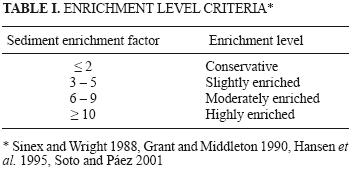
<body><![CDATA[<p align="justify"><font face="verdana" size="2"><b>X&#150;ray fluorescence analysis</b></font></p>     <p align="justify"><font face="verdana" size="2">Each sample was carefully mixed and dried at room temperature for 120 hours. Clay/silt sediment fraction was separated by wet sieving (63 &micro;m, 300 mesh). Subsamples of the clay/silt sediment fraction (1 g) were homogenized and 1 cm diameter pellets were prepared for elemental analysis (Vaithiyanathan <i>et al</i>. 1993, Dekov <i>et al</i>. 1997, 1998). The solid samples (pellets) were analyzed in triplicate by means of an Ital Structures X&#150;ray Fluorescence Spectrometer TX 2000 with a Si(Li) detector and a resolution of 140 eV (Mn&#150;K&#945;). The analysis was carried out using energy dispersive mode (EDXRF), molybdenum tube (40 kV &#150; 30 mA) and an acquisition time of 1000 seconds.</font></p>     <p align="justify"><font face="verdana" size="2">The analysis of the spectra was performed using the EDXRF32&reg; program; the quantification of the metals was carried out using the Compton correction method with external standard, Soil&#150;5 (SL&#150;5, Certified Reference Material IAEA). The certified standard Lake Sediment SL&#150;1 (Certified Reference Material IAEA) was processed and analyzed, under the same conditions as the samples for internal quality assurance.</font></p>     <p align="justify"><font face="verdana" size="2">Sediment enrichment factors (SEF) were also investigated. This factor estimates the enrichment of Cr, Mn, Fe, Cu, Zn and Pb by cultural effects using equation 1. Aluminum is commonly chosen as a "conservative" element. However, this element has a high detection limit by EDXRF. For convenience, rubidium was selected as conservative element (Dekov <i>et al</i>. 1998, Enguix <i>et al</i>. 2000, Vasallo <i>et al</i>. 2001). Values of sediments coming from igneous rocks were considered as reference values (Turekian and Wedepohl 1961, Salomons and F&ouml;rstner 1984).</font></p>     <p align="center"><font face="verdana" size="2"><img src="/img/revistas/rica/v27n3/a3e1.jpg"></font></p>     <p align="justify"><font face="verdana" size="2">Where, SEF: sediment enrichment factor; M<sub>s</sub>: concentration of metal "x" in the sample; Rb<sub>s</sub>: concentration of conservative reference element (Rb) in the sample; M<sub>o</sub>: concentration of metal "x" in sediments coming from igneous rocks and Rb<sub>o</sub>: concentration of conservative reference element (Rb) in sediments coming from igneous rocks.</font></p>     <p align="justify"><font face="verdana" size="2">In order to know the enrichment level by metals, several criteria were considered, as it appears in <b><a href="#t1">table I</a></b>. (Sinex and Wright 1988, Grant and Middleton 1990, Hansen <i>et al</i>. 1995, Soto and P&aacute;ez 2001).</font></p>     <p align="center"><font face="verdana" size="2"><a name="t1"></a></font></p>     <p align="center"><font face="verdana" size="2"><img src="/img/revistas/rica/v27n3/a3t1.jpg"></font></p>     <p align="justify"><font face="verdana" size="2"><b>Scanning electron microscopy analysis</b></font></p>     ]]></body>
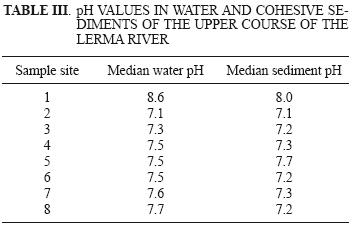
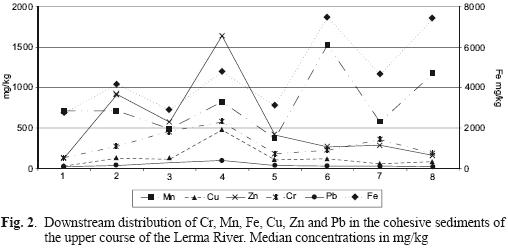
<body><![CDATA[<p align="justify"><font face="verdana" size="2">In order to obtain an homogenous and uniform sample for its analysis by SEM, an aliquot of 0.5 g of each solid sediment sample was mixed with 20 mL of water; it was later filtered using a 0.45 &micro;m Millipore system, then the filter was dried at room temperature. 1 cm<sup>2</sup> was cut out and mounted on an aluminium holder stage with carbon tape for observation and analysis; the sample was then coated with gold by sputtering for 40 s at 25 &micro;A.</font></p>     <p align="justify"><font face="verdana" size="2">A Philips scanning electron microscope (SEM) XL&#150;30 was used to observe 1 mm<sup>2</sup> areas of the surface on each of the samples at a magnification between 500x and 10 000x and 25 kV acceleration voltage; in addition a coupled EDAX probe was used for elemental chemical analysis by energy dispersive X&#150;ray spectrometry (EDS) at a resolution of 140 eV. A random analysis of 100 particles was carried out at 1500 cps and counting times of 60 seconds. The DX&#150;4i (ZAF) software was used to determine the elemental chemical content as a percentage in weight for the corresponding oxide forms, except for sulfur and phosphorus, which were determined as element. Finally the relative abundance of the particles was estimated on the basis of the Dekov <i>et al</i>. (1997) criteria, classifying the data into eight groups (<b><a href="/img/revistas/rica/v27n3/a3t2.jpg" target="_blank">Table II</a></b>) (&Aacute;vila&#150;P&eacute;rez <i>et al</i>. 2007, Zaraz&uacute;a 2008).</font></p>     <p align="justify"><font face="verdana" size="2">&nbsp;</font></p>     <p align="justify"><font face="verdana" size="2"><b>RESULTS AND DISCUSSION</b></font></p>     <p align="justify"><font face="verdana" size="2">Maximum, minimum and medians of the analyzed metals in the cohesive sediments are given in <b><a href="#t3">table III</a></b>. Fe and Mn are elements considered as terrigenous, which showed concentrations ranging from 19 443 to 84 771 mg/kg and from 278 to 2020 mg/kg, respectively.</font></p>     <p align="center"><font face="verdana" size="2"><a name="t3"></a></font></p>     <p align="center"><font face="verdana" size="2"><img src="/img/revistas/rica/v27n3/a3t3.jpg"></font></p>     <p align="justify"><font face="verdana" size="2">Concentrations of Cr, Cu, Zn and Pb, considered as toxic metals in aquatic environments, varied between 13 and 3384 mg/kg, Zn being the highest and Pb the lowest.</font></p>     <p align="justify"><font face="verdana" size="2"><b><a href="#f2">Figure 2</a></b> shows the distribution of Cr, Mn, Fe, Cu, Zn and Pb in cohesive sediments along the different sampling sites. Statistical differences (&#945; &le; 0.05) in the metal concentrations, between samples taken among the course river (spatial variation) were observed. However, it was not observed, between samples taken in the different sampling periods (seasonal variation).</font></p>     <p align="center"><font face="verdana" size="2"><a name="f2"></a></font></p>     ]]></body>
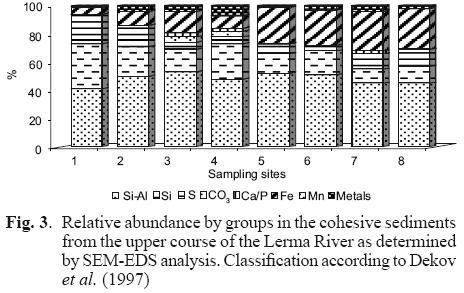
<body><![CDATA[<p align="center"><font face="verdana" size="2"><img src="/img/revistas/rica/v27n3/a3f2.jpg"></font></p>     <p align="justify"><font face="verdana" size="2">This spatial variation is due to changes in the contributions of the different discharges and the hydrological conditions in the sampling sites. The first section of the river, where sites 2 to 5 are dominated by industrial discharges and the average annual flow are between 2.2 and 5.4 m<sup>3</sup>/s presents important sedimentation zones, while the second section, sites 6 to 8, where the mainly contributions are coming from rivers and the average annual flow are between 4.5 and 10.5 m<sup>3</sup>/s (Hinojosa 2006). The pH seems not to play an important role in this behavior since values in both water and sediment were similar, close to neutrality (<a href="#t3"><b>Table III</b></a>) (F&ouml;rstner and Wittmann 1979, GEM 2000, Tejeda 2006).</font></p>     <p align="justify"><font face="verdana" size="2">The concentrations of Fe and Mn show significant statistical differences (&#945; &le; 0.05) among all sites. The highest concentrations can be observed toward the end of the section of the river, sites 6 to 8. This increase can be due to fluvial dragging of soil and sediments from the tributaries Zolotepec, Ocoyoacac, Xonacatl&aacute;n, Santa Catarina, Verdiguel and San Lorenzo. This would lead to believe that the observed concentrations of iron and manganese in the surveyed area are mainly due to natural causes (Dekov <i>et al</i>. 1998).</font></p>     <p align="justify"><font face="verdana" size="2">In general the highest concentrations of Cu, Zn, Cr and Pb were found at sites 3 and 4, which receive the greatest industrial and urban runoffs, including wastewaters from thirty towns, ten industrial zones, twelve industrial parks and four water treatment plants (&Aacute;vila&#150;P&eacute;rez <i>et al</i>. 1999, GEM 2000). This fact clearly shows the presence of anthropic sources of these contaminants, domestic sewage and industrial effluents, in the surrounding area of the sampling sites, causing the Cu, Zn, Cr and Pb accumulation in the sediments (Hansen <i>et al</i>. 1995, Ant&oacute;n and D&iacute;az&#150;Delgado 2002).</font></p>     <p align="justify"><font face="verdana" size="2">In addition, the concentration of these metals in site 4 presented significantly higher values (&#945; &le; 0.05), which could be related to the presence in this site of aquatic hyacinth (Eichhornia crassipes). The aquatic hyacinth may work as a physical barrier, producing the reduction in the water flow and favoring the sedimentation processes; thus, this site can be considered as the main zone of Cu, Zn, Cr and Pb accumulation.</font></p>     <p align="justify"><font face="verdana" size="2">Cu, Zn, Cr and Pb presented similar behavioural trend with location (positive correlation r &ge; 0.7, &#945; &le; 0.05); Fe and Mn also had a significant positive correlation (r = 0.9, &#945; &le; 0.05). The significant and separate correlations between: a) iron and manganese and b) copper, zinc, chromium and lead in the cohesive sediments show that they were associated to material of different origin, probably parental and anthropic material, respectively.</font></p>     <p align="justify"><font face="verdana" size="2"><a href="/img/revistas/rica/v27n3/a3t4.jpg" target="_blank"><b>Table IV</b></a> shows the reference or guide values for river sediments given by the U.S. Army Corps of Engineers (USACE 1976) and Ontario Ministry of the Environment (OME 1976). For both reference values, in the Lerma River sediments Cr exceeds them by up to ten times, followed by Fe &asymp; Cu &gt; Zn &gt; Mn &gt; Pb. Considering the criteria for the aquatic life protection (OME 1976), only Cr could cause severe effects and Cu, Zn, Fe and Mn slight effects on the aquatic biota.</font></p>     <p align="justify"><font face="verdana" size="2"><a href="/img/revistas/rica/v27n3/a3t5.jpg" target="_blank"><b>Table V</b></a> shows the cohesive sediment enrichment factors for Cr, Mn, Fe, Cu, Zn and Pb.</font></p>     <p align="justify"><font face="verdana" size="2">Applying the criteria of Soto and P&aacute;ez (2001) (<a href="#t1"><b>Table I</b></a>), sediments can be considered conservative (SEF &le; 2) for Mn and Fe; slightly enriched (SEF= 3&#150;5) for Cr, Cu and Pb and moderately enriched (SEF= 6&#150;9) for Zn. These results support that the main source of Fe and Mn is natural or terrigenous and for the other metals is mainly anthropic.</font></p>     <p align="justify"><font face="verdana" size="2">The predominant groups in all sites are aluminosilicates (49 %) and silica (19 %) (<a href="#f3">Fig. 3</a>). In general, the particle groups in the cohesive sediments of the UCLR are present in the following order: aluminosilicates &gt; silica &gt; iron &gt; sulfur &gt; metals &gt; calcium carbonates &gt; calcium/phosphorus &gt; manganese. The metals group was the highest in site 4 (9 %); this analysis by SEM&#150;EDS concurs with the analytical results obtained by EDXRF.</font></p>     ]]></body>
<body><![CDATA[<p align="center"><font face="verdana" size="2"><a name="f3"></a></font></p>     <p align="center"><font face="verdana" size="2"><img src="/img/revistas/rica/v27n3/a3f3.jpg"></font></p>     <p align="justify"><font face="verdana" size="2">Grain size analysis of the UCRL sediments indicates that the clay/silt fraction (&lt; 63 &micro;m) is as large as 28 %. The aluminosilicates belong to the groups of quartz, feldspars, kaolinites and amphiboles (Tejeda 2006). These groups of particles were observed by scanning electron microscopy (<b><a href="/img/revistas/rica/v27n3/a3f4.jpg" target="_blank">Figs. 4</a></b> and <b><a href="/img/revistas/rica/v27n3/a3f5.jpg" target="_blank">5</a></b>) and their analysis showed content of O, Al, Si, Ca, Na, Fe, Mg, K and Ti, among others.</font></p>     <p align="justify"><font face="verdana" size="2">In site 1, Almoloya lagoon, the groups that displayed the highest relative abundance were aluminosilicates (41 %), silicon (32 %) and sulfur (21 %). The particles of the Almoloya lagoon showed the highest sulfur abundance relative to those of the other seven sampling sites (<a href="#f3"><b>Fig. 3</b></a>). This difference is caused by the abundance of phytoplankton and aquatic plants in the area, which contribute with significant amounts of iron sulphides of biological origin (<b><a href="/img/revistas/rica/v27n3/a3f6.jpg" target="_blank">Fig. 6</a></b>) (Dekov <i>et al</i>. 1997, Sullivan <i>et al</i>. 2001, Huerta 2005, Laluraj and Nair 2006).</font></p>     <p align="justify"><font face="verdana" size="2">Scanning electron microscopy analysis shows that in all sampling sites, particles with a high metal content (&gt;40 %) of Ag, Al, Bi, Cu, Hg, Pb, Sn, Zn and Zr were observed (<b><a href="/img/revistas/rica/v27n3/a3f7.jpg" target="_blank">Fig. 7</a></b>). In all the sites, particles rich in Cr, Fe and Ni, with similar composition to steel (ASTM 2001), were also observed (<b><a href="/img/revistas/rica/v27n3/a3f8.jpg" target="_blank">Fig.8</a></b>). Although elements as Ag, Al, Ni, Hg, etc., were detected by SEM in sediment particles, their concentration were below to the detection limit by XRF. The presence of elements of typically anthropic origin in the intermediate sites of the testing zone is probably due to industrial and urban discharges from the surrounding area (Fuhrer <i>et al</i>. 1996, Vasallo <i>et al</i>. 2001, Casper <i>et al</i>. 2004, Tejeda 2006).</font></p>     <p align="justify"><font face="verdana" size="2">Particles of the Fe group were associated with Ti&#150;O (<b><a href="/img/revistas/rica/v27n3/a3f9.jpg" target="_blank">Fig. 9</a></b>) and O (<b><a href="/img/revistas/rica/v27n3/a3f10.jpg" target="_blank">Fig. 10</a></b>). Fe&#150;TiO particles were more abundant in the sites 5&#150;8 of the river. This behavior must be due to the discharges of the tributary rivers of the second section of the river, which introduce iron particles associated to Ti and O coming from the soils of the surrounding area (Dekov <i>et al</i>. 1997, Huerta 2005).</font></p>     <p align="justify"><font face="verdana" size="2">&nbsp;</font></p>     <p align="justify"><font face="verdana" size="2"><b>CONCLUSIONS</b></font></p>     <p align="justify"><font face="verdana" size="2">The heavy metal concentration in the cohesive sediments decreased in the following sequence: Fe &gt; Mn &gt; Zn &gt; Cr &gt; Cu &gt; Pb.</font></p>     <p align="justify"><font face="verdana" size="2">With the exception of lead, metal concentrations in sediments exceeded the guide or reference values given by USACE and MOE for dredged sediments.</font></p>     ]]></body>
<body><![CDATA[<p align="justify"><font face="verdana" size="2">Bed sediments in the upper course of the Lerma River can be considered enriched with Cr, Cu, Zn and Pb.</font></p>     <p align="justify"><font face="verdana" size="2">Iron and manganese present in the cohesive sediments of the upper course of the Lerma River come mainly from natural sources, while chromium, copper, zinc and lead are associated with anthropic contributions (domestic sewage and industrial effluents).</font></p>     <p align="justify"><font face="verdana" size="2">Sampling site 6, was the mainy accumulation zone for Mn and Fe, influenced by tributary rivers whereas sampling site 4, was the mainy accumulation zone for the other metals, corresponding to the main industrial area.</font></p>     <p align="justify"><font face="verdana" size="2">The particle groups in the cohesive sediments of the upper course of the Lerma River were present in the following order: aluminosilicates &gt; silica &gt; iron &gt; sulfur &gt; metals &gt; calcium carbonates &gt; calcium/phosphorus &gt; manganese.</font></p>     <p align="justify"><font face="verdana" size="2">It is important to work continuously in studies that contribute to the control and regulation of the sources of pollution. In the near future, research on speciation could be useful in the evaluation of risk when sediments are applied to agricultural soils.</font></p>     <p align="justify"><font face="verdana" size="2">&nbsp;</font></p>     <p align="justify"><font face="verdana" size="2"><b>ACKNOWLEDGEMENTS</b></font></p>     <p align="justify"><font face="verdana" size="2">Authors thank Fernanda Astivia Segura and Tech. Sergio Arredondo Huitr&oacute;n, who assisted them in the sampling work.</font></p>     <p align="justify"><font face="verdana" size="2">&nbsp;</font></p>     <p align="justify"><font face="verdana" size="2"><b>REFERENCES</b></font></p>     ]]></body>
<body><![CDATA[<!-- ref --><p align="justify"><font face="verdana" size="2">Ant&oacute;n D. and D&iacute;az&#150;Delgado C. (2002). <i>Sequ&iacute;a en un mundo de agua</i>. Piriguaz&uacute;, San Jos&eacute;, Costa Rica. 420 pp.    &nbsp;&nbsp;&nbsp;&nbsp;&nbsp;&nbsp;&nbsp;&nbsp;[&#160;<a href="javascript:void(0);" onclick="javascript: window.open('/scielo.php?script=sci_nlinks&ref=7205791&pid=S0188-4999201100030000300001&lng=','','width=640,height=500,resizable=yes,scrollbars=1,menubar=yes,');">Links</a>&#160;]<!-- end-ref --></font></p> 	    <!-- ref --><p align="justify"><font face="verdana" size="2">ASTM. (2001). ASTM A666&#150;03. Standard specification for annealed or cold&#150;worked austenitic stainless steel sheet, strip, plate and flat bar. American Society for Testing and Materials. Handbook. West Conshohocken, PA. 10.1520/A0666&#150;03.    &nbsp;&nbsp;&nbsp;&nbsp;&nbsp;&nbsp;&nbsp;&nbsp;[&#160;<a href="javascript:void(0);" onclick="javascript: window.open('/scielo.php?script=sci_nlinks&ref=7205793&pid=S0188-4999201100030000300002&lng=','','width=640,height=500,resizable=yes,scrollbars=1,menubar=yes,');">Links</a>&#160;]<!-- end-ref --></font></p> 	    <!-- ref --><p align="justify"><font face="verdana" size="2">&Aacute;vila&#150;P&eacute;rez P., Balc&aacute;zar M., Zaraz&uacute;a&#150;Ortega G., Barcel&oacute;&#150;Quintal I. and D&iacute;az&#150;Delgado C. (1999). Heavy metal concentrations in water and bottom sediments of a Mexican reservoir. Sci. Total Environ. 234,185&#150;196.    &nbsp;&nbsp;&nbsp;&nbsp;&nbsp;&nbsp;&nbsp;&nbsp;[&#160;<a href="javascript:void(0);" onclick="javascript: window.open('/scielo.php?script=sci_nlinks&ref=7205795&pid=S0188-4999201100030000300003&lng=','','width=640,height=500,resizable=yes,scrollbars=1,menubar=yes,');">Links</a>&#160;]<!-- end-ref --></font></p> 	    <!-- ref --><p align="justify"><font face="verdana" size="2">&Aacute;vila&#150;P&eacute;rez P., Zaraz&uacute;a G., Carapia&#150;Morales L., Tejeda S., D&iacute;az&#150;Delgado C. and Barcel&oacute;&#150;Quintal I. (2007). Evaluation of heavy metals and elemental composition of particles in suspended matter of the Upper Course of the Lerma River. J. Radioanal. Nucl. Chem. 273, 625&#150;633.    &nbsp;&nbsp;&nbsp;&nbsp;&nbsp;&nbsp;&nbsp;&nbsp;[&#160;<a href="javascript:void(0);" onclick="javascript: window.open('/scielo.php?script=sci_nlinks&ref=7205797&pid=S0188-4999201100030000300004&lng=','','width=640,height=500,resizable=yes,scrollbars=1,menubar=yes,');">Links</a>&#160;]<!-- end-ref --></font></p> 	    <!-- ref --><p align="justify"><font face="verdana" size="2">Buffle J. and De Vitre R. (1994). <i>Chemical and biological regulation of aquatics systems</i>. Lewis Publishers, Boca Raton, Florida, 385 pp.    &nbsp;&nbsp;&nbsp;&nbsp;&nbsp;&nbsp;&nbsp;&nbsp;[&#160;<a href="javascript:void(0);" onclick="javascript: window.open('/scielo.php?script=sci_nlinks&ref=7205799&pid=S0188-4999201100030000300005&lng=','','width=640,height=500,resizable=yes,scrollbars=1,menubar=yes,');">Links</a>&#160;]<!-- end-ref --></font></p> 	    ]]></body>
<body><![CDATA[<!-- ref --><p align="justify"><font face="verdana" size="2">Berrow S.D. (1991). Heavy metals in sediments and shellfish from Cork Harbour, Ireland. Mar. Pollut. Bull. 22, 467&#150;469.    &nbsp;&nbsp;&nbsp;&nbsp;&nbsp;&nbsp;&nbsp;&nbsp;[&#160;<a href="javascript:void(0);" onclick="javascript: window.open('/scielo.php?script=sci_nlinks&ref=7205801&pid=S0188-4999201100030000300006&lng=','','width=640,height=500,resizable=yes,scrollbars=1,menubar=yes,');">Links</a>&#160;]<!-- end-ref --></font></p> 	    <!-- ref --><p align="justify"><font face="verdana" size="2">S., Mehra A., Farago M. and Gill R. (2004). Contamination of surface soils, river water and sediments by trace metals from copper processing industry in the Churnet River Valley, Staffordshire, UK. Environ. Geochem. Health. 26, 59&#150;67.    &nbsp;&nbsp;&nbsp;&nbsp;&nbsp;&nbsp;&nbsp;&nbsp;[&#160;<a href="javascript:void(0);" onclick="javascript: window.open('/scielo.php?script=sci_nlinks&ref=7205803&pid=S0188-4999201100030000300007&lng=','','width=640,height=500,resizable=yes,scrollbars=1,menubar=yes,');">Links</a>&#160;]<!-- end-ref --></font></p> 	    <!-- ref --><p align="justify"><font face="verdana" size="2">Dekov V.M., Komy Z., Ara&uacute;jo F., Van Put A. and Van Grieken R. (1997). Chemical composition of sediments, suspended matter, river water and ground water of the Nile (Aswan&#150;Sohag traverse). Sci. Total Environ. 201, 195&#150;210.    &nbsp;&nbsp;&nbsp;&nbsp;&nbsp;&nbsp;&nbsp;&nbsp;[&#160;<a href="javascript:void(0);" onclick="javascript: window.open('/scielo.php?script=sci_nlinks&ref=7205805&pid=S0188-4999201100030000300008&lng=','','width=640,height=500,resizable=yes,scrollbars=1,menubar=yes,');">Links</a>&#160;]<!-- end-ref --></font></p> 	    <!-- ref --><p align="justify"><font face="verdana" size="2">Dekov K. M., Ara&uacute;jo F., Van Grieken R. and Subramanian V. (1998). Chemical composition of sediments and suspended matter from the Cauvery and Brahmaputra rivers (India). Sci. Total Environ. 212, 89&#150;105.    &nbsp;&nbsp;&nbsp;&nbsp;&nbsp;&nbsp;&nbsp;&nbsp;[&#160;<a href="javascript:void(0);" onclick="javascript: window.open('/scielo.php?script=sci_nlinks&ref=7205807&pid=S0188-4999201100030000300009&lng=','','width=640,height=500,resizable=yes,scrollbars=1,menubar=yes,');">Links</a>&#160;]<!-- end-ref --></font></p> 	    <!-- ref --><p align="justify"><font face="verdana" size="2">Droppo I. and Jaskot C. (1995). Impact of river transport characteristics on contaminant sampling error and design. Environ. Sci. Technol. 29, 161&#150;170.    &nbsp;&nbsp;&nbsp;&nbsp;&nbsp;&nbsp;&nbsp;&nbsp;[&#160;<a href="javascript:void(0);" onclick="javascript: window.open('/scielo.php?script=sci_nlinks&ref=7205809&pid=S0188-4999201100030000300010&lng=','','width=640,height=500,resizable=yes,scrollbars=1,menubar=yes,');">Links</a>&#160;]<!-- end-ref --></font></p> 	    ]]></body>
<body><![CDATA[<!-- ref --><p align="justify"><font face="verdana" size="2">Enguix A., Ternero M., Jim&eacute;nez J., Fern&aacute;ndez J. and Barrag&aacute;n F. (2000). Assessment of metals in sediments in a tributary of Guadalquivir River (Spain), heavy metal partitioning and relation between the water and sediment system. Water Air Soil Pollut. 121, 11&#150;29.    &nbsp;&nbsp;&nbsp;&nbsp;&nbsp;&nbsp;&nbsp;&nbsp;[&#160;<a href="javascript:void(0);" onclick="javascript: window.open('/scielo.php?script=sci_nlinks&ref=7205811&pid=S0188-4999201100030000300011&lng=','','width=640,height=500,resizable=yes,scrollbars=1,menubar=yes,');">Links</a>&#160;]<!-- end-ref --></font></p> 	    <!-- ref --><p align="justify"><font face="verdana" size="2">F&ouml;rstner U. and Wittmann G. (1979). <i>Metal pollution in the aquatic environment</i>. Springer Verlag, New York, USA. 486 pp.    &nbsp;&nbsp;&nbsp;&nbsp;&nbsp;&nbsp;&nbsp;&nbsp;[&#160;<a href="javascript:void(0);" onclick="javascript: window.open('/scielo.php?script=sci_nlinks&ref=7205813&pid=S0188-4999201100030000300012&lng=','','width=640,height=500,resizable=yes,scrollbars=1,menubar=yes,');">Links</a>&#160;]<!-- end-ref --></font></p> 	    <!-- ref --><p align="justify"><font face="verdana" size="2">Fuhrer G., Mc Kenzie S., Rinella J. and Skach K. (1997). Effect of geology and human activities on the distribution of trace metals in water, sediment and aquatic biota, Yakima River Basin, Washington (1987&#150;1991). In: River quality: dynamics and restoration. (A. Laenen and D. Dunnette, Ed). CRC Press, Boca Raton. pp. 187&#150;204.    &nbsp;&nbsp;&nbsp;&nbsp;&nbsp;&nbsp;&nbsp;&nbsp;[&#160;<a href="javascript:void(0);" onclick="javascript: window.open('/scielo.php?script=sci_nlinks&ref=7205815&pid=S0188-4999201100030000300013&lng=','','width=640,height=500,resizable=yes,scrollbars=1,menubar=yes,');">Links</a>&#160;]<!-- end-ref --></font></p> 	    <!-- ref --><p align="justify"><font face="verdana" size="2">GEM (2000). <i>Atlas ecol&oacute;gico de la cuenca hidrogr&aacute;fica del r&iacute;o Lerma</i>. Tomo V: Industrial. Comisi&oacute;n Coordinadora para la Recuperaci&oacute;n Ecol&oacute;gica de la Cuenca del R&iacute;o Lerma. Gobierno del Estado de M&eacute;xico, Toluca, 353 pp.    &nbsp;&nbsp;&nbsp;&nbsp;&nbsp;&nbsp;&nbsp;&nbsp;[&#160;<a href="javascript:void(0);" onclick="javascript: window.open('/scielo.php?script=sci_nlinks&ref=7205817&pid=S0188-4999201100030000300014&lng=','','width=640,height=500,resizable=yes,scrollbars=1,menubar=yes,');">Links</a>&#160;]<!-- end-ref --></font></p> 	    <!-- ref --><p align="justify"><font face="verdana" size="2">Grant A. and Middleton R. (1990). An assessment of metal contamination of sediments in the Humber estuary, U K. Estuar. Coast. Shelf. Sci. 31, 71&#150;85.    &nbsp;&nbsp;&nbsp;&nbsp;&nbsp;&nbsp;&nbsp;&nbsp;[&#160;<a href="javascript:void(0);" onclick="javascript: window.open('/scielo.php?script=sci_nlinks&ref=7205819&pid=S0188-4999201100030000300015&lng=','','width=640,height=500,resizable=yes,scrollbars=1,menubar=yes,');">Links</a>&#160;]<!-- end-ref --></font></p> 	    ]]></body>
<body><![CDATA[<!-- ref --><p align="justify"><font face="verdana" size="2">Hansen A., Le&oacute;n A. and Bravo L. (1995). Fuentes de contaminaci&oacute;n y enriquecimiento de metales en sedimentos de la Cuenca Lerma &#150; Chapala. Ing. Hidr&aacute;ul. M&eacute;x. 10, 55&#150;69.    &nbsp;&nbsp;&nbsp;&nbsp;&nbsp;&nbsp;&nbsp;&nbsp;[&#160;<a href="javascript:void(0);" onclick="javascript: window.open('/scielo.php?script=sci_nlinks&ref=7205821&pid=S0188-4999201100030000300016&lng=','','width=640,height=500,resizable=yes,scrollbars=1,menubar=yes,');">Links</a>&#160;]<!-- end-ref --></font></p> 	    <!-- ref --><p align="justify"><font face="verdana" size="2">Hinojosa&#150;Pe&ntilde;a A. (2006). Dise&ntilde;o de una red estrat&eacute;gica de monitoreo para el Curso Alto del R&iacute;o Lerma y su utilizaci&oacute;n en el estudios espacial y temporal de los par&aacute;metros f&iacute;sico&#150;qu&iacute;micos. Tesis de Maestr&iacute;a. Centro Interamericano de Recursos de Agua. Facultad de Ingenier&iacute;a. Universidad Aut&oacute;noma del Estado de M&eacute;xico. Toluca, Estado de M&eacute;xico.    &nbsp;&nbsp;&nbsp;&nbsp;&nbsp;&nbsp;&nbsp;&nbsp;[&#160;<a href="javascript:void(0);" onclick="javascript: window.open('/scielo.php?script=sci_nlinks&ref=7205823&pid=S0188-4999201100030000300017&lng=','','width=640,height=500,resizable=yes,scrollbars=1,menubar=yes,');">Links</a>&#160;]<!-- end-ref --></font></p> 	    <!-- ref --><p align="justify"><font face="verdana" size="2">Huerta M. (2005). <i>Geoqu&iacute;mica de sedimentos</i>. Instituto de Investigaciones Oceanol&oacute;gicas. Universidad Aut&oacute;noma de Baja California. 180 p.    &nbsp;&nbsp;&nbsp;&nbsp;&nbsp;&nbsp;&nbsp;&nbsp;[&#160;<a href="javascript:void(0);" onclick="javascript: window.open('/scielo.php?script=sci_nlinks&ref=7205825&pid=S0188-4999201100030000300018&lng=','','width=640,height=500,resizable=yes,scrollbars=1,menubar=yes,');">Links</a>&#160;]<!-- end-ref --></font></p> 	    <!-- ref --><p align="justify"><font face="verdana" size="2">Laluraj C.M. and Nair S.M. (2006). Geochemical index of trace metals in the suerficial sediments from the western continental shelf of India, Arabian Sea. Environ. Geochem. Health 28, 509&#150;518.    &nbsp;&nbsp;&nbsp;&nbsp;&nbsp;&nbsp;&nbsp;&nbsp;[&#160;<a href="javascript:void(0);" onclick="javascript: window.open('/scielo.php?script=sci_nlinks&ref=7205827&pid=S0188-4999201100030000300019&lng=','','width=640,height=500,resizable=yes,scrollbars=1,menubar=yes,');">Links</a>&#160;]<!-- end-ref --></font></p> 	    <!-- ref --><p align="justify"><font face="verdana" size="2">OME (1976). Evaluating construction activities impacting on water resources part III A. Handbook for dredging and dredged material disposal in Ontario. Legislation policies, sediment classification and disposal options. Ontario Ministry of the Environment and Energy. Guideline. Toronto, Canada. 49 pp.    &nbsp;&nbsp;&nbsp;&nbsp;&nbsp;&nbsp;&nbsp;&nbsp;[&#160;<a href="javascript:void(0);" onclick="javascript: window.open('/scielo.php?script=sci_nlinks&ref=7205829&pid=S0188-4999201100030000300020&lng=','','width=640,height=500,resizable=yes,scrollbars=1,menubar=yes,');">Links</a>&#160;]<!-- end-ref --></font></p> 	    ]]></body>
<body><![CDATA[<!-- ref --><p align="justify"><font face="verdana" size="2">Salomons W. and F&ouml;rstner U. (1984). <i>Metals in the hydrocycle</i>. Springer Verlag, Berlin. 348 pp.    &nbsp;&nbsp;&nbsp;&nbsp;&nbsp;&nbsp;&nbsp;&nbsp;[&#160;<a href="javascript:void(0);" onclick="javascript: window.open('/scielo.php?script=sci_nlinks&ref=7205831&pid=S0188-4999201100030000300021&lng=','','width=640,height=500,resizable=yes,scrollbars=1,menubar=yes,');">Links</a>&#160;]<!-- end-ref --></font></p> 	    <!-- ref --><p align="justify"><font face="verdana" size="2">Sinex S. and Wright D. (1988). Distribution of trace metals in the sediments and biota of Chesapeake Bay. Mar. Pollut. Bull. 19, 425&#150;431.    &nbsp;&nbsp;&nbsp;&nbsp;&nbsp;&nbsp;&nbsp;&nbsp;[&#160;<a href="javascript:void(0);" onclick="javascript: window.open('/scielo.php?script=sci_nlinks&ref=7205833&pid=S0188-4999201100030000300022&lng=','','width=640,height=500,resizable=yes,scrollbars=1,menubar=yes,');">Links</a>&#160;]<!-- end-ref --></font></p> 	    <!-- ref --><p align="justify"><font face="verdana" size="2">Soto M. and P&aacute;ez F. (2001). Cd, Cu, Pb and Zn in lagoonal sediments from Mazatl&aacute;n Harbor (SE Gulf of California): bioavailibility and geochemical fractioning. B. Environ. Contam. Toxicol. 66, 350&#150;356.    &nbsp;&nbsp;&nbsp;&nbsp;&nbsp;&nbsp;&nbsp;&nbsp;[&#160;<a href="javascript:void(0);" onclick="javascript: window.open('/scielo.php?script=sci_nlinks&ref=7205835&pid=S0188-4999201100030000300023&lng=','','width=640,height=500,resizable=yes,scrollbars=1,menubar=yes,');">Links</a>&#160;]<!-- end-ref --></font></p> 	    <!-- ref --><p align="justify"><font face="verdana" size="2">Sullivan B. E., Prahl F. G., Small L. F. and Covert P. A. (2001). Seasonality of phytoplankton production in the Columbia River: a natural or anthropogenic pattern? Geochim. Cosmochim. Ac. 65, 1125&#150;1139.    &nbsp;&nbsp;&nbsp;&nbsp;&nbsp;&nbsp;&nbsp;&nbsp;[&#160;<a href="javascript:void(0);" onclick="javascript: window.open('/scielo.php?script=sci_nlinks&ref=7205837&pid=S0188-4999201100030000300024&lng=','','width=640,height=500,resizable=yes,scrollbars=1,menubar=yes,');">Links</a>&#160;]<!-- end-ref --></font></p> 	    <!-- ref --><p align="justify"><font face="verdana" size="2">Tejeda S. (2006). Distribuci&oacute;n espacial y temporal de los metales Ti, Mn, Fe, Cu, Zn y Pb en el sedimento del Curso Alto del R&iacute;o Lerma. Tesis de Maestr&iacute;a. Facultad de Qu&iacute;mica. Universidad Aut&oacute;noma del Estado de M&eacute;xico. Toluca, Estado de M&eacute;xico.    &nbsp;&nbsp;&nbsp;&nbsp;&nbsp;&nbsp;&nbsp;&nbsp;[&#160;<a href="javascript:void(0);" onclick="javascript: window.open('/scielo.php?script=sci_nlinks&ref=7205839&pid=S0188-4999201100030000300025&lng=','','width=640,height=500,resizable=yes,scrollbars=1,menubar=yes,');">Links</a>&#160;]<!-- end-ref --></font></p> 	    ]]></body>
<body><![CDATA[<!-- ref --><p align="justify"><font face="verdana" size="2">Turekian K. and Wedepohl K. (1961). Distribution of the elements in some major units of the earth&acute;s crust. Bull. Geol. Soc. Am. 72, 175&#150;192.    &nbsp;&nbsp;&nbsp;&nbsp;&nbsp;&nbsp;&nbsp;&nbsp;[&#160;<a href="javascript:void(0);" onclick="javascript: window.open('/scielo.php?script=sci_nlinks&ref=7205841&pid=S0188-4999201100030000300026&lng=','','width=640,height=500,resizable=yes,scrollbars=1,menubar=yes,');">Links</a>&#160;]<!-- end-ref --></font></p> 	    <!-- ref --><p align="justify"><font face="verdana" size="2">USACE (1976). Ecological evaluation of proposed discharge of dredged or fill material into navigable waters. United States Army Corps of Engineers. Interim guidance. Vicksburg, Mississippi. 89 pp.    &nbsp;&nbsp;&nbsp;&nbsp;&nbsp;&nbsp;&nbsp;&nbsp;[&#160;<a href="javascript:void(0);" onclick="javascript: window.open('/scielo.php?script=sci_nlinks&ref=7205843&pid=S0188-4999201100030000300027&lng=','','width=640,height=500,resizable=yes,scrollbars=1,menubar=yes,');">Links</a>&#160;]<!-- end-ref --></font></p> 	    <!-- ref --><p align="justify"><font face="verdana" size="2">Vaithiyanathan P., Ramanathan A. and Subramanian V. (1993). Transport and distribution of heavy metals in Cauvery River. Water Air Soil Pollut. 71, 13&#150;28.    &nbsp;&nbsp;&nbsp;&nbsp;&nbsp;&nbsp;&nbsp;&nbsp;[&#160;<a href="javascript:void(0);" onclick="javascript: window.open('/scielo.php?script=sci_nlinks&ref=7205845&pid=S0188-4999201100030000300028&lng=','','width=640,height=500,resizable=yes,scrollbars=1,menubar=yes,');">Links</a>&#160;]<!-- end-ref --></font></p> 	    <!-- ref --><p align="justify"><font face="verdana" size="2">Vasallo L., Flores L., Lazcano L., Hern&aacute;ndez G., Solorio G., Maples M., Gir&oacute;n P., Gardu&ntilde;o C. (2001). El gabro de Arperos y su aportaci&oacute;n de Cr&#150;Ni a la subcuenca del r&iacute;o Silao, Guanajuato, M&eacute;xico. Ing. Hidr&aacute;ul. M&eacute;x. 16, 63&#150;71.    &nbsp;&nbsp;&nbsp;&nbsp;&nbsp;&nbsp;&nbsp;&nbsp;[&#160;<a href="javascript:void(0);" onclick="javascript: window.open('/scielo.php?script=sci_nlinks&ref=7205847&pid=S0188-4999201100030000300029&lng=','','width=640,height=500,resizable=yes,scrollbars=1,menubar=yes,');">Links</a>&#160;]<!-- end-ref --></font></p> 	    <!-- ref --><p align="justify"><font face="verdana" size="2">Zaraz&uacute;a G. (2008) Evaluaci&oacute;n de las contribuciones naturales y antropog&eacute;nicas de los metales pesados Cr, Mn, Fe, Cu, Zn y Pb y su distribuci&oacute;n en el agua y sedimento en el Curso Alto del R&iacute;o Lerma. Tesis de Doctorado. Centro Interamericano de Recursos del Agua, Facultad de Ingenier&iacute;a, Universidad Aut&oacute;noma del Estado de M&eacute;xico. Toluca, Estado de M&eacute;xico.    &nbsp;&nbsp;&nbsp;&nbsp;&nbsp;&nbsp;&nbsp;&nbsp;[&#160;<a href="javascript:void(0);" onclick="javascript: window.open('/scielo.php?script=sci_nlinks&ref=7205849&pid=S0188-4999201100030000300030&lng=','','width=640,height=500,resizable=yes,scrollbars=1,menubar=yes,');">Links</a>&#160;]<!-- end-ref --></font></p>     ]]></body>
<body><![CDATA[ ]]></body><back>
<ref-list>
<ref id="B1">
<nlm-citation citation-type="">
<person-group person-group-type="author">
<name>
<surname><![CDATA[Antón]]></surname>
<given-names><![CDATA[D.]]></given-names>
</name>
<name>
<surname><![CDATA[Díaz-Delgado]]></surname>
<given-names><![CDATA[C.]]></given-names>
</name>
</person-group>
<source><![CDATA[Sequía en un mundo de agua]]></source>
<year>2002</year>
<page-range>420</page-range><publisher-loc><![CDATA[Piriguazú^eSan José San José]]></publisher-loc>
</nlm-citation>
</ref>
<ref id="B2">
<nlm-citation citation-type="">
<collab>ASTM</collab>
<article-title xml:lang="en"><![CDATA[ASTM A666-03. Standard specification for annealed or cold-worked austenitic stainless steel sheet, strip, plate and flat bar]]></article-title>
<collab>American Society for Testing and Materials</collab>
<source><![CDATA[Handbook]]></source>
<year>2001</year>
<publisher-loc><![CDATA[West Conshohocken^ePA PA]]></publisher-loc>
</nlm-citation>
</ref>
<ref id="B3">
<nlm-citation citation-type="journal">
<person-group person-group-type="author">
<name>
<surname><![CDATA[Ávila-Pérez]]></surname>
<given-names><![CDATA[P.]]></given-names>
</name>
<name>
<surname><![CDATA[Balcázar]]></surname>
<given-names><![CDATA[M.]]></given-names>
</name>
<name>
<surname><![CDATA[Zarazúa-Ortega]]></surname>
<given-names><![CDATA[G.]]></given-names>
</name>
<name>
<surname><![CDATA[Barceló-Quintal]]></surname>
<given-names><![CDATA[I.]]></given-names>
</name>
<name>
<surname><![CDATA[Díaz-Delgado]]></surname>
<given-names><![CDATA[C.]]></given-names>
</name>
</person-group>
<article-title xml:lang="en"><![CDATA[Heavy metal concentrations in water and bottom sediments of a Mexican reservoir]]></article-title>
<source><![CDATA[Sci. Total Environ]]></source>
<year>1999</year>
<volume>234</volume>
<page-range>185-196</page-range></nlm-citation>
</ref>
<ref id="B4">
<nlm-citation citation-type="journal">
<person-group person-group-type="author">
<name>
<surname><![CDATA[Ávila-Pérez]]></surname>
<given-names><![CDATA[P.]]></given-names>
</name>
<name>
<surname><![CDATA[Zarazúa]]></surname>
<given-names><![CDATA[G.]]></given-names>
</name>
<name>
<surname><![CDATA[Carapia-Morales]]></surname>
<given-names><![CDATA[L.]]></given-names>
</name>
<name>
<surname><![CDATA[Tejeda]]></surname>
<given-names><![CDATA[S.]]></given-names>
</name>
<name>
<surname><![CDATA[Díaz-Delgado]]></surname>
<given-names><![CDATA[C.]]></given-names>
</name>
<name>
<surname><![CDATA[Barceló-Quintal]]></surname>
<given-names><![CDATA[I.]]></given-names>
</name>
</person-group>
<article-title xml:lang="en"><![CDATA[Evaluation of heavy metals and elemental composition of particles in suspended matter of the Upper Course of the Lerma River]]></article-title>
<source><![CDATA[J. Radioanal. Nucl. Chem.]]></source>
<year>2007</year>
<volume>273</volume>
<page-range>625-633</page-range></nlm-citation>
</ref>
<ref id="B5">
<nlm-citation citation-type="book">
<person-group person-group-type="author">
<name>
<surname><![CDATA[Buffle]]></surname>
<given-names><![CDATA[J.]]></given-names>
</name>
<name>
<surname><![CDATA[De Vitre]]></surname>
<given-names><![CDATA[R.]]></given-names>
</name>
</person-group>
<source><![CDATA[Chemical and biological regulation of aquatics systems]]></source>
<year>1994</year>
<page-range>385</page-range><publisher-loc><![CDATA[Boca Raton^eFlorida Florida]]></publisher-loc>
<publisher-name><![CDATA[Lewis Publishers]]></publisher-name>
</nlm-citation>
</ref>
<ref id="B6">
<nlm-citation citation-type="journal">
<person-group person-group-type="author">
<name>
<surname><![CDATA[Berrow]]></surname>
<given-names><![CDATA[S.D]]></given-names>
</name>
</person-group>
<article-title xml:lang="en"><![CDATA[Heavy metals in sediments and shellfish from Cork Harbour, Ireland]]></article-title>
<source><![CDATA[Mar. Pollut. Bull]]></source>
<year>1991</year>
<volume>22</volume>
<page-range>467-469</page-range></nlm-citation>
</ref>
<ref id="B7">
<nlm-citation citation-type="journal">
<person-group person-group-type="author">
<name>
<surname><![CDATA[Mehra]]></surname>
<given-names><![CDATA[A.]]></given-names>
</name>
<name>
<surname><![CDATA[Farago]]></surname>
<given-names><![CDATA[M.]]></given-names>
</name>
<name>
<surname><![CDATA[Gill]]></surname>
<given-names><![CDATA[R.]]></given-names>
</name>
</person-group>
<article-title xml:lang="en"><![CDATA[Contamination of surface soils, river water and sediments by trace metals from copper processing industry in the Churnet River Valley, Staffordshire, UK]]></article-title>
<source><![CDATA[Environ. Geochem. Health]]></source>
<year>2004</year>
<volume>26</volume>
<page-range>59-67</page-range></nlm-citation>
</ref>
<ref id="B8">
<nlm-citation citation-type="journal">
<person-group person-group-type="author">
<name>
<surname><![CDATA[Dekov]]></surname>
<given-names><![CDATA[V.M]]></given-names>
</name>
<name>
<surname><![CDATA[Komy]]></surname>
<given-names><![CDATA[Z]]></given-names>
</name>
<name>
<surname><![CDATA[Araújo]]></surname>
<given-names><![CDATA[F]]></given-names>
</name>
<name>
<surname><![CDATA[Van Put]]></surname>
<given-names><![CDATA[A]]></given-names>
</name>
<name>
<surname><![CDATA[Van Grieken]]></surname>
<given-names><![CDATA[R]]></given-names>
</name>
</person-group>
<article-title xml:lang="en"><![CDATA[Chemical composition of sediments, suspended matter, river water and ground water of the Nile (Aswan-Sohag traverse)]]></article-title>
<source><![CDATA[Sci. Total Environ]]></source>
<year>1997</year>
<volume>201</volume>
<page-range>195-210</page-range></nlm-citation>
</ref>
<ref id="B9">
<nlm-citation citation-type="journal">
<person-group person-group-type="author">
<name>
<surname><![CDATA[Dekov]]></surname>
<given-names><![CDATA[K. M]]></given-names>
</name>
<name>
<surname><![CDATA[Araújo]]></surname>
<given-names><![CDATA[F]]></given-names>
</name>
<name>
<surname><![CDATA[Van Grieken]]></surname>
<given-names><![CDATA[R]]></given-names>
</name>
<name>
<surname><![CDATA[Subramanian]]></surname>
<given-names><![CDATA[V]]></given-names>
</name>
</person-group>
<article-title xml:lang="en"><![CDATA[Chemical composition of sediments and suspended matter from the Cauvery and Brahmaputra rivers (India)]]></article-title>
<source><![CDATA[Sci. Total Environ]]></source>
<year>1998</year>
<volume>212</volume>
<page-range>89-105</page-range></nlm-citation>
</ref>
<ref id="B10">
<nlm-citation citation-type="journal">
<person-group person-group-type="author">
<name>
<surname><![CDATA[Droppo]]></surname>
<given-names><![CDATA[I]]></given-names>
</name>
<name>
<surname><![CDATA[Jaskot]]></surname>
<given-names><![CDATA[C]]></given-names>
</name>
</person-group>
<article-title xml:lang="en"><![CDATA[Impact of river transport characteristics on contaminant sampling error and design]]></article-title>
<source><![CDATA[Environ. Sci. Technol]]></source>
<year>1995</year>
<volume>29</volume>
<page-range>161-170</page-range></nlm-citation>
</ref>
<ref id="B11">
<nlm-citation citation-type="journal">
<person-group person-group-type="author">
<name>
<surname><![CDATA[Enguix]]></surname>
<given-names><![CDATA[A]]></given-names>
</name>
<name>
<surname><![CDATA[Ternero]]></surname>
<given-names><![CDATA[M]]></given-names>
</name>
<name>
<surname><![CDATA[Jiménez]]></surname>
<given-names><![CDATA[J]]></given-names>
</name>
<name>
<surname><![CDATA[Fernández]]></surname>
<given-names><![CDATA[J]]></given-names>
</name>
<name>
<surname><![CDATA[Barragán]]></surname>
<given-names><![CDATA[F]]></given-names>
</name>
</person-group>
<article-title xml:lang="en"><![CDATA[Assessment of metals in sediments in a tributary of Guadalquivir River (Spain), heavy metal partitioning and relation between the water and sediment system]]></article-title>
<source><![CDATA[Water Air Soil Pollut]]></source>
<year>2000</year>
<volume>121</volume>
<page-range>11-29</page-range></nlm-citation>
</ref>
<ref id="B12">
<nlm-citation citation-type="book">
<person-group person-group-type="author">
<name>
<surname><![CDATA[Förstner]]></surname>
<given-names><![CDATA[U.]]></given-names>
</name>
<name>
<surname><![CDATA[Wittmann]]></surname>
<given-names><![CDATA[G.]]></given-names>
</name>
</person-group>
<source><![CDATA[Metal pollution in the aquatic environment]]></source>
<year>1979</year>
<page-range>486</page-range><publisher-loc><![CDATA[New York ]]></publisher-loc>
<publisher-name><![CDATA[Springer Verlag]]></publisher-name>
</nlm-citation>
</ref>
<ref id="B13">
<nlm-citation citation-type="book">
<person-group person-group-type="author">
<name>
<surname><![CDATA[Fuhrer]]></surname>
<given-names><![CDATA[G.]]></given-names>
</name>
<name>
<surname><![CDATA[Mc Kenzie]]></surname>
<given-names><![CDATA[S.]]></given-names>
</name>
<name>
<surname><![CDATA[Rinella]]></surname>
<given-names><![CDATA[J.]]></given-names>
</name>
<name>
<surname><![CDATA[Skach]]></surname>
<given-names><![CDATA[K.]]></given-names>
</name>
</person-group>
<article-title xml:lang="en"><![CDATA[Effect of geology and human activities on the distribution of trace metals in water, sediment and aquatic biota, Yakima River Basin, Washington (1987-1991)]]></article-title>
<person-group person-group-type="editor">
<name>
<surname><![CDATA[Laenen]]></surname>
<given-names><![CDATA[A.]]></given-names>
</name>
<name>
<surname><![CDATA[Dunnette]]></surname>
<given-names><![CDATA[D.]]></given-names>
</name>
</person-group>
<source><![CDATA[River quality: dynamics and restoration]]></source>
<year>1997</year>
<page-range>187-204</page-range><publisher-loc><![CDATA[Boca Raton ]]></publisher-loc>
<publisher-name><![CDATA[CRC Press]]></publisher-name>
</nlm-citation>
</ref>
<ref id="B14">
<nlm-citation citation-type="book">
<collab>GEM</collab>
<source><![CDATA[Atlas ecológico de la cuenca hidrográfica del río Lerma]]></source>
<year>2000</year>
<volume>V: Industrial</volume>
<page-range>353</page-range><publisher-loc><![CDATA[Toluca ]]></publisher-loc>
<publisher-name><![CDATA[Comisión Coordinadora para la Recuperación Ecológica de la Cuenca del Río Lerma. Gobierno del Estado de México]]></publisher-name>
</nlm-citation>
</ref>
<ref id="B15">
<nlm-citation citation-type="journal">
<person-group person-group-type="author">
<name>
<surname><![CDATA[Grant]]></surname>
<given-names><![CDATA[A]]></given-names>
</name>
<name>
<surname><![CDATA[Middleton]]></surname>
<given-names><![CDATA[R]]></given-names>
</name>
</person-group>
<article-title xml:lang="en"><![CDATA[An assessment of metal contamination of sediments in the Humber estuary, U K]]></article-title>
<source><![CDATA[Estuar. Coast. Shelf. Sci]]></source>
<year>1990</year>
<volume>31</volume>
<page-range>71-85</page-range></nlm-citation>
</ref>
<ref id="B16">
<nlm-citation citation-type="journal">
<person-group person-group-type="author">
<name>
<surname><![CDATA[Hansen]]></surname>
<given-names><![CDATA[A]]></given-names>
</name>
<name>
<surname><![CDATA[León]]></surname>
<given-names><![CDATA[A]]></given-names>
</name>
<name>
<surname><![CDATA[Bravo]]></surname>
<given-names><![CDATA[L]]></given-names>
</name>
</person-group>
<article-title xml:lang="es"><![CDATA[Fuentes de contaminación y enriquecimiento de metales en sedimentos de la Cuenca Lerma - Chapala]]></article-title>
<source><![CDATA[Ing. Hidrául. Méx]]></source>
<year>1995</year>
<volume>10</volume>
<page-range>55-69</page-range></nlm-citation>
</ref>
<ref id="B17">
<nlm-citation citation-type="">
<person-group person-group-type="author">
<name>
<surname><![CDATA[Hinojosa-Peña]]></surname>
<given-names><![CDATA[A.]]></given-names>
</name>
</person-group>
<source><![CDATA[Diseño de una red estratégica de monitoreo para el Curso Alto del Río Lerma y su utilización en el estudios espacial y temporal de los parámetros físico-químicos]]></source>
<year>2006</year>
</nlm-citation>
</ref>
<ref id="B18">
<nlm-citation citation-type="book">
<person-group person-group-type="author">
<name>
<surname><![CDATA[Huerta]]></surname>
<given-names><![CDATA[M.]]></given-names>
</name>
</person-group>
<source><![CDATA[Geoquímica de sedimentos]]></source>
<year>2005</year>
<page-range>180</page-range><publisher-name><![CDATA[Instituto de Investigaciones Oceanológicas. Universidad Autónoma de Baja California]]></publisher-name>
</nlm-citation>
</ref>
<ref id="B19">
<nlm-citation citation-type="journal">
<person-group person-group-type="author">
<name>
<surname><![CDATA[Laluraj]]></surname>
<given-names><![CDATA[C.M]]></given-names>
</name>
<name>
<surname><![CDATA[Nair]]></surname>
<given-names><![CDATA[S.M]]></given-names>
</name>
</person-group>
<article-title xml:lang="en"><![CDATA[Geochemical index of trace metals in the suerficial sediments from the western continental shelf of India, Arabian Sea]]></article-title>
<source><![CDATA[Environ. Geochem]]></source>
<year>2006</year>
<volume>Health 28</volume>
<page-range>509-518</page-range></nlm-citation>
</ref>
<ref id="B20">
<nlm-citation citation-type="book">
<collab>OME</collab>
<source><![CDATA[Evaluating construction activities impacting on water resources part III A. Handbook for dredging and dredged material disposal in Ontario]]></source>
<year>1976</year>
<page-range>49</page-range><publisher-loc><![CDATA[Toronto ]]></publisher-loc>
<publisher-name><![CDATA[Legislation policies, sediment classification and disposal options. Ontario Ministry of the Environment and Energy]]></publisher-name>
</nlm-citation>
</ref>
<ref id="B21">
<nlm-citation citation-type="book">
<person-group person-group-type="author">
<name>
<surname><![CDATA[Salomons]]></surname>
<given-names><![CDATA[W.]]></given-names>
</name>
<name>
<surname><![CDATA[Förstner]]></surname>
<given-names><![CDATA[U.]]></given-names>
</name>
</person-group>
<source><![CDATA[Metals in the hydrocycle]]></source>
<year>1984</year>
<page-range>348</page-range><publisher-loc><![CDATA[Berlin ]]></publisher-loc>
<publisher-name><![CDATA[Springer Verlag]]></publisher-name>
</nlm-citation>
</ref>
<ref id="B22">
<nlm-citation citation-type="journal">
<person-group person-group-type="author">
<name>
<surname><![CDATA[Sinex]]></surname>
<given-names><![CDATA[S]]></given-names>
</name>
<name>
<surname><![CDATA[Wright]]></surname>
<given-names><![CDATA[D]]></given-names>
</name>
</person-group>
<article-title xml:lang="en"><![CDATA[Distribution of trace metals in the sediments and biota of Chesapeake Bay]]></article-title>
<source><![CDATA[Mar. Pollut. Bull]]></source>
<year>1988</year>
<volume>19</volume>
<page-range>425-431</page-range></nlm-citation>
</ref>
<ref id="B23">
<nlm-citation citation-type="journal">
<person-group person-group-type="author">
<name>
<surname><![CDATA[Soto]]></surname>
<given-names><![CDATA[M]]></given-names>
</name>
<name>
<surname><![CDATA[Páez]]></surname>
<given-names><![CDATA[F]]></given-names>
</name>
</person-group>
<article-title xml:lang="en"><![CDATA[Cd, Cu, Pb and Zn in lagoonal sediments from Mazatlán Harbor (SE Gulf of California): bioavailibility and geochemical fractioning]]></article-title>
<source><![CDATA[B. Environ. Contam. Toxicol]]></source>
<year>2001</year>
<volume>66</volume>
<page-range>350-356</page-range></nlm-citation>
</ref>
<ref id="B24">
<nlm-citation citation-type="journal">
<person-group person-group-type="author">
<name>
<surname><![CDATA[Sullivan]]></surname>
<given-names><![CDATA[B. E]]></given-names>
</name>
<name>
<surname><![CDATA[Prahl]]></surname>
<given-names><![CDATA[F. G]]></given-names>
</name>
<name>
<surname><![CDATA[Small]]></surname>
<given-names><![CDATA[L. F]]></given-names>
</name>
<name>
<surname><![CDATA[Covert]]></surname>
<given-names><![CDATA[P. A]]></given-names>
</name>
</person-group>
<article-title xml:lang="en"><![CDATA[Seasonality of phytoplankton production in the Columbia River: a natural or anthropogenic pattern?]]></article-title>
<source><![CDATA[Geochim. Cosmochim. Ac]]></source>
<year>2001</year>
<volume>65</volume>
<page-range>1125-1139</page-range></nlm-citation>
</ref>
<ref id="B25">
<nlm-citation citation-type="">
<person-group person-group-type="author">
<name>
<surname><![CDATA[Tejeda]]></surname>
<given-names><![CDATA[S.]]></given-names>
</name>
</person-group>
<source><![CDATA[Distribución espacial y temporal de los metales Ti, Mn, Fe, Cu, Zn y Pb en el sedimento del Curso Alto del Río Lerma]]></source>
<year>2006</year>
</nlm-citation>
</ref>
<ref id="B26">
<nlm-citation citation-type="journal">
<person-group person-group-type="author">
<name>
<surname><![CDATA[Turekian]]></surname>
<given-names><![CDATA[K]]></given-names>
</name>
<name>
<surname><![CDATA[Wedepohl]]></surname>
<given-names><![CDATA[K]]></given-names>
</name>
</person-group>
<article-title xml:lang="en"><![CDATA[Distribution of the elements in some major units of the earth´s crust]]></article-title>
<source><![CDATA[Bull. Geol. Soc. Am]]></source>
<year>1961</year>
<volume>72</volume>
<page-range>175-192</page-range></nlm-citation>
</ref>
<ref id="B27">
<nlm-citation citation-type="book">
<collab>USACE</collab>
<source><![CDATA[Ecological evaluation of proposed discharge of dredged or fill material into navigable waters]]></source>
<year>1976</year>
<page-range>89</page-range><publisher-loc><![CDATA[Vicksburg^eMississippi Mississippi]]></publisher-loc>
<publisher-name><![CDATA[United States Army Corps of Engineers. Interim guidance]]></publisher-name>
</nlm-citation>
</ref>
<ref id="B28">
<nlm-citation citation-type="journal">
<person-group person-group-type="author">
<name>
<surname><![CDATA[Vaithiyanathan]]></surname>
<given-names><![CDATA[P]]></given-names>
</name>
<name>
<surname><![CDATA[Ramanathan]]></surname>
<given-names><![CDATA[A]]></given-names>
</name>
<name>
<surname><![CDATA[Subramanian]]></surname>
<given-names><![CDATA[V]]></given-names>
</name>
</person-group>
<article-title xml:lang="en"><![CDATA[Transport and distribution of heavy metals in Cauvery River]]></article-title>
<source><![CDATA[Water Air Soil Pollut]]></source>
<year>1993</year>
<volume>71</volume>
<page-range>13-28</page-range></nlm-citation>
</ref>
<ref id="B29">
<nlm-citation citation-type="journal">
<person-group person-group-type="author">
<name>
<surname><![CDATA[Vasallo]]></surname>
<given-names><![CDATA[L]]></given-names>
</name>
<name>
<surname><![CDATA[Flores]]></surname>
<given-names><![CDATA[L]]></given-names>
</name>
<name>
<surname><![CDATA[Lazcano]]></surname>
<given-names><![CDATA[L]]></given-names>
</name>
<name>
<surname><![CDATA[Hernández]]></surname>
<given-names><![CDATA[G]]></given-names>
</name>
<name>
<surname><![CDATA[Solorio]]></surname>
<given-names><![CDATA[G]]></given-names>
</name>
<name>
<surname><![CDATA[Maples]]></surname>
<given-names><![CDATA[M]]></given-names>
</name>
<name>
<surname><![CDATA[Girón]]></surname>
<given-names><![CDATA[P]]></given-names>
</name>
<name>
<surname><![CDATA[Garduño]]></surname>
<given-names><![CDATA[C]]></given-names>
</name>
</person-group>
<article-title xml:lang="es"><![CDATA[El gabro de Arperos y su aportación de Cr-Ni a la subcuenca del río Silao, Guanajuato, México]]></article-title>
<source><![CDATA[Ing. Hidrául. Méx]]></source>
<year>2001</year>
<volume>16</volume>
<page-range>63-71</page-range></nlm-citation>
</ref>
<ref id="B30">
<nlm-citation citation-type="">
<person-group person-group-type="author">
<name>
<surname><![CDATA[Zarazúa]]></surname>
<given-names><![CDATA[G.]]></given-names>
</name>
</person-group>
<source><![CDATA[Evaluación de las contribuciones naturales y antropogénicas de los metales pesados Cr, Mn, Fe, Cu, Zn y Pb y su distribución en el agua y sedimento en el Curso Alto del Río Lerma]]></source>
<year>2008</year>
</nlm-citation>
</ref>
</ref-list>
</back>
</article>