<?xml version="1.0" encoding="ISO-8859-1"?><article xmlns:mml="http://www.w3.org/1998/Math/MathML" xmlns:xlink="http://www.w3.org/1999/xlink" xmlns:xsi="http://www.w3.org/2001/XMLSchema-instance">
<front>
<journal-meta>
<journal-id>0188-4999</journal-id>
<journal-title><![CDATA[Revista internacional de contaminación ambiental]]></journal-title>
<abbrev-journal-title><![CDATA[Rev. Int. Contam. Ambient]]></abbrev-journal-title>
<issn>0188-4999</issn>
<publisher>
<publisher-name><![CDATA[Universidad Nacional Autónoma de México, Instituto de Ciencias de la Atmósfera y Cambio Climático]]></publisher-name>
</publisher>
</journal-meta>
<article-meta>
<article-id>S0188-49992007000200002</article-id>
<title-group>
<article-title xml:lang="en"><![CDATA[Ranking tail-pipe vehicle emissions from reformulated gasolines by Electre method]]></article-title>
<article-title xml:lang="es"><![CDATA[Ordenamiento de emisiones de gasolina por el método Electre]]></article-title>
</title-group>
<contrib-group>
<contrib contrib-type="author">
<name>
<surname><![CDATA[JAIMES-LOPEZ]]></surname>
<given-names><![CDATA[J. Luis]]></given-names>
</name>
<xref ref-type="aff" rid="A01"/>
</contrib>
<contrib contrib-type="author">
<name>
<surname><![CDATA[SANDOVAL-FERNÁNDEZ]]></surname>
<given-names><![CDATA[Julio]]></given-names>
</name>
<xref ref-type="aff" rid="A02"/>
</contrib>
<contrib contrib-type="author">
<name>
<surname><![CDATA[GONZÁLEZ-ORTÍZ]]></surname>
<given-names><![CDATA[Emmanuel]]></given-names>
</name>
<xref ref-type="aff" rid="A01"/>
</contrib>
<contrib contrib-type="author">
<name>
<surname><![CDATA[ZAMBRANO-GARCÍA]]></surname>
<given-names><![CDATA[Ángel]]></given-names>
</name>
<xref ref-type="aff" rid="A01"/>
</contrib>
<contrib contrib-type="author">
<name>
<surname><![CDATA[LLANOS-PLATA]]></surname>
<given-names><![CDATA[Martín]]></given-names>
</name>
<xref ref-type="aff" rid="A03"/>
</contrib>
<contrib contrib-type="author">
<name>
<surname><![CDATA[GONZÁLEZ-MACÍAS]]></surname>
<given-names><![CDATA[Uriel]]></given-names>
</name>
<xref ref-type="aff" rid="A01"/>
</contrib>
</contrib-group>
<aff id="A01">
<institution><![CDATA[,Instituto Mexicano del Petróleo Dirección Ejecutiva de Investigación y Posgrado ]]></institution>
<addr-line><![CDATA[México City ]]></addr-line>
<country>México</country>
</aff>
<aff id="A02">
<institution><![CDATA[,Instituto Politécnico Nacional  ]]></institution>
<addr-line><![CDATA[ ]]></addr-line>
</aff>
<aff id="A03">
<institution><![CDATA[,General Motors de México  ]]></institution>
<addr-line><![CDATA[Toluca Edo. de México]]></addr-line>
</aff>
<pub-date pub-type="pub">
<day>00</day>
<month>06</month>
<year>2007</year>
</pub-date>
<pub-date pub-type="epub">
<day>00</day>
<month>06</month>
<year>2007</year>
</pub-date>
<volume>23</volume>
<numero>2</numero>
<fpage>59</fpage>
<lpage>67</lpage>
<copyright-statement/>
<copyright-year/>
<self-uri xlink:href="http://www.scielo.org.mx/scielo.php?script=sci_arttext&amp;pid=S0188-49992007000200002&amp;lng=en&amp;nrm=iso"></self-uri><self-uri xlink:href="http://www.scielo.org.mx/scielo.php?script=sci_abstract&amp;pid=S0188-49992007000200002&amp;lng=en&amp;nrm=iso"></self-uri><self-uri xlink:href="http://www.scielo.org.mx/scielo.php?script=sci_pdf&amp;pid=S0188-49992007000200002&amp;lng=en&amp;nrm=iso"></self-uri><abstract abstract-type="short" xml:lang="en"><p><![CDATA[Even though gasoline reformulation has contributed in abating the high levels of some tropospheric pollutants in México City Metropolitan Area (MCMA), such as lead and sulfur dioxide, it is still being explored as practical alternative to alleviate other local air pollution problems, such as the high ozone levels. Because gasoline is a complex mixture of chemical compounds, the number of alternative reformulated gasoline fuels (RGF) to be tested is potentially very high. Thus, rapid and inexpensive methods are required to make such testing less costly. We report our experience while using a common ranking technique (Electre method) to select a subset of reformulated gasoline fuels (RGF) with low potential to form gaseous toxics and O3-forming compounds in vehicle tail-pipe emissions, so that further studies might focus on the most promising of them. Ten RGF differing in contents of sulfur, aromatics, olefins and oxygenated compounds were subjected to chassis dynamometer tests in two vehicles representing different engine technologies: Tier 1, as representative of the currently dominant technology in MCMA, and Euro 4 which will soon enter the local market. Emissions sampling was done at constant volume (CVS) using the Urban Cycle driving test, a standardized Mexican chassis dynamometer test that simulates the slow driving conditions at MCMA. All comparisons were based on the contents of regulated gaseous pollutants (THC, CO, CO2 and NOx), CH4 and VOC (HC and aldehydes and ketones) in the tail-pipe emissions. In tests with the local unleaded gasoline (n = 9), which was used as experimental reference (RF), the Tier 1 vehicle had significantly higher emissions of most measured pollutants than Euro 4. For selecting the fuels with lower emissions of toxics and O3 forming compounds, the emission data were normalized (0-100) and weighed by two external factors (w1, for O3 forming potential, and w2 for toxicity of each compound) and then subjected to Electre analysis. The best fuel options for data representing the average emissions from the two vehicle technologies were: F11 > F6 > F1 > F7 > F8 > F12, for w1; and F6 > F11 > F1> F5 > F8 > F12, for w2. Thus, by both weighing criteria, the Electre method selected F11, F6 and F1 as the best gasoline options. The ranks of the remaining fuels depended upon weighing. F11 was formulated with low concentrations of aromatics, olefins, benzene and sulfur, whereas F6 had the highest Reid vapor pressure (RVP) and 370 ppm sulfur. According to these results, the MCMA's air quality may be improved by substituting the currently used gasoline, which ranked as the last option, by another such as F11, F6 or F1.]]></p></abstract>
<abstract abstract-type="short" xml:lang="es"><p><![CDATA[Mediante reformulación de las gasolinas se han podido disminuir contaminantes atmosféricos como el plomo y el azufre en la Zona Metropolitana de la Ciudad de México (ZMCM), por lo que la reformulación continúa siendo una alternativa práctica para abatir otros importantes contaminantes locales como el ozono. Pero dado que la gasolina es una mezcla compleja de componentes químicos, el número de mezclas alternativas a valorar antes de introducir una nueva gasolina en el mercado es muy alto. Esto plantea la necesidad de contar con métodos rápidos y de bajo costo para evaluar las alternativas. Aquí se reporta la aplicación de una técnica de jerarquización (método Electre) para preseleccionar un grupo de gasolinas reformuladas con bajo potencial de formación de compuestos gaseosos tóxicos y de precursores de ozono en las emisiones vehiculares de escape, para enfocar estudios más detallados en ese grupo. Se evaluaron diez gasolinas preparadas con diferentes cantidades de azufre, compuestos aromáticos, olefinas y compuestos oxigenados. Para ello se utilizaron dos vehículos con diferente tecnología: un Tier 1, que actualmente es la tecnología dominante en la ZMCM, y un Euro 4, que pronto entrará al mercado local. Las pruebas vehiculares se hicieron en un dinamómetro de chasis utilizando la prueba de manejo estandarizada conocida como Mex Urban, que simula las condiciones de manejo lento "típicas" de la ZMCM. Las muestras de emisiones de escape se obtuvieron con un muestreador a volumen constante (CVS). Las comparaciones entre combustibles y vehículos se basaron en los contenidos de contaminantes gaseosos regulados (hidrocarburos totales, THC; monóxido de carbono, CO; bióxido de carbono, CO2, y óxidos de nitrógeno, NOx); metano, CH4 y compuestos orgánicos volátiles (COV, HC y aldehídos) presentes en las emisiones de escape. Como referencia experimental se utilizó la gasolina sin plomo que se vende actualmente en la Ciudad de México. En las pruebas con esta última gasolina, el vehículo Tier 1 tuvo emisiones más altas de la mayoría de los contaminantes que el Euro 4. Para seleccionar los combustibles con las emisiones más bajas de compuestos tóxicos y precursores de ozono, los datos de la emisión fueron normalizados (0-100) y ponderados por dos factores externos (w1, para el potencial de formación de ozono y w2 para la toxicidad de cada componente) y posteriormente analizados mediante el método Electre. Las mejores opciones de gasolina reformulada (F, fuel) obtenidas con las emisiones promedio de los dos tipos de vehículo fueron: F11 > F6 > F1 > F7 > F8 > F12, con w1; y F6 > F11 > F1> F5 > F8 > F12, con w2. Con los dos criterios de ponderación, el método Electre seleccionó a las gasolinas F11, F6 y F1 como las mejores opciones. El ordenamiento de los demás combustibles dependió también, de los factores de ponderación. La gasolina F11 fue formulada con las menores concentraciones de aromáticos, olefinas, benceno y azufre; mientras que la F6 tuvo la más alta presión de vapor Reid (PVR) y 370 ppm de azufre. De acuerdo a estos resultados, la calidad del aire de la Ciudad de México podría mejorarse sustituyendo la gasolina usada actualmente, la cual quedó clasificada como la última opción, por alguna otra como las F11, F6 o F1, aunque se requieren todavía estudios de mayor detalle.]]></p></abstract>
<kwd-group>
<kwd lng="en"><![CDATA[CVS tests]]></kwd>
<kwd lng="en"><![CDATA[fuel reformulation]]></kwd>
<kwd lng="en"><![CDATA[air quality]]></kwd>
<kwd lng="en"><![CDATA[Electre method]]></kwd>
<kwd lng="es"><![CDATA[Pruebas CVS]]></kwd>
<kwd lng="es"><![CDATA[combustibles reformulados]]></kwd>
<kwd lng="es"><![CDATA[calidad del aire]]></kwd>
<kwd lng="es"><![CDATA[método Electre]]></kwd>
</kwd-group>
</article-meta>
</front><body><![CDATA[ <p align="center"><font face="verdana" size="4"><b>Ranking tail&#150;pipe vehicle emissions from reformulated gasolines by Electre method</b></font></p>     <p align="center"><font face="verdana" size="2">&nbsp;</font></p>     <p align="center"><font face="verdana" size="3"><b>Ordenamiento de emisiones de gasolina por el m&eacute;todo Electre</b></font></p>     <p align="center"><font face="verdana" size="2">&nbsp;</font></p>     <p align="center"><font face="verdana" size="2"><b>J. Luis JAIMES&#150;LOPEZ<sup>1</sup>*, Julio SANDOVAL&#150;FERN&Aacute;NDEZ<sup>2</sup>, Emmanuel GONZ&Aacute;LEZ&#150;ORT&Iacute;Z<sup>1</sup>, &Aacute;ngel ZAMBRANO&#150;GARC&Iacute;A<sup>1</sup>, Mart&iacute;n LLANOS&#150;PLATA<sup>3</sup> and Uriel GONZ&Aacute;LEZ&#150;MAC&Iacute;AS<sup>1</sup></b></font></p>     <p align="justify"><font face="verdana" size="2">&nbsp;</font></p>     <p align="justify"><font face="verdana" size="2"><sup>1</sup>&nbsp;<i>Direcci&oacute;n Ejecutiva de Investigaci&oacute;n y Posgrado, Instituto Mexicano del Petr&oacute;leo, Eje Central L&aacute;zaro C&aacute;rdenas Norte No. 152, Col. San Bartolo Atepehuacan, CP 07730, M&eacute;xico City, M&eacute;xico. Tel. (55) 9175&#150;6756, Fax: (55) 9175&#150;6599,</i> e&#150;mail: <a href="mailto:jjaimes@imp.mx">jjaimes@imp.mx</a></font></p>     <p align="justify"><font face="verdana" size="2"><sup>2</sup>&nbsp;<i>Instituto Polit&eacute;cnico Nacional. ESIQIE&#150;SEPI. U.P. Adolfo L&oacute;pez Mateos, Edif. 8, 2o. piso.</i></font></p>     <p align="justify"><font face="verdana" size="2"><sup>3</sup>&nbsp;<i>General Motors de M&eacute;xico, S. de R.L. de C.V. , Industria Miner&iacute;a No. 700, Col. Zona Industrial, Toluca, Edo. de M&eacute;xico, C.P. 50000.</i></font></p>     <p align="justify"><font face="verdana" size="2">&nbsp;</font></p>     ]]></body>
<body><![CDATA[<p align="justify"><font face="verdana" size="2"><b>* Corresponding author:</b>    <br>     <i>Tel.: (55) 7195&#150;6756;     <br> fax: (55) 3003&#150;6935. </i>    <br> E&#150;mail address: <a href="mailto:jjaimes@imp.mx">jjaimes@imp.mx</a></font></p>     <p align="justify"><font face="verdana" size="2">&nbsp;</font></p>     <p align="justify"><font face="verdana" size="2">Recibido enero 2007    <br>   Aceptado junio 2007</font></p>     <p align="justify"><font face="verdana" size="2">&nbsp;</font></p>     <p align="justify"><font face="verdana" size="2"><b>ABSTRACT</b></font></p>     <p align="justify"><font face="verdana" size="2">Even though gasoline reformulation has contributed in abating the high levels of some tropospheric pollutants in M&eacute;xico City Metropolitan Area (MCMA), such as lead and sulfur dioxide, it is still being explored as practical alternative to alleviate other local air pollution problems, such as the high ozone levels. Because gasoline is a complex mixture of chemical compounds, the number of alternative reformulated gasoline fuels (RGF) to be tested is potentially very high. Thus, rapid and inexpensive methods are required to make such testing less costly. We report our experience while using a common ranking technique (Electre method) to select a subset of reformulated gasoline fuels (RGF) with low potential to form gaseous toxics and O<sub>3</sub>&#150;forming compounds in vehicle tail&#150;pipe emissions, so that further studies might focus on the most promising of them. Ten RGF differing in contents of sulfur, aromatics, olefins and oxygenated compounds were subjected to chassis dynamometer tests in two vehicles representing different engine technologies: Tier 1, as representative of the currently dominant technology in MCMA, and Euro 4 which will soon enter the local market. Emissions sampling was done at constant volume (CVS) using the Urban Cycle driving test, a standardized Mexican chassis dynamometer test that simulates the slow driving conditions at MCMA. All comparisons were based on the contents of regulated gaseous pollutants (THC, CO, CO<sub>2</sub> and NO<sub>x</sub>), CH<sub>4</sub> and VOC (HC and aldehydes and ketones) in the tail&#150;pipe emissions. In tests with the local unleaded gasoline (n = 9), which was used as experimental reference (RF), the Tier 1 vehicle had significantly higher emissions of most measured pollutants than Euro 4. For selecting the fuels with lower emissions of toxics and O<sub>3</sub> forming compounds, the emission data were normalized (0&#150;100) and weighed by two external factors (w1, for O<sub>3</sub> forming potential, and w2 for toxicity of each compound) and then subjected to Electre analysis. The best fuel options for data representing the average emissions from the two vehicle technologies were: F11 &gt; F6 &gt; F1 &gt; F7 &gt; F8 &gt; F12, for w1; and F6 &gt; F11 &gt; F1&gt; F5 &gt; F8 &gt; F12, for w2. Thus, by both weighing criteria, the Electre method selected F11, F6 and F1 as the best gasoline options. The ranks of the remaining fuels depended upon weighing. F11 was formulated with low concentrations of aromatics, olefins, benzene and sulfur, whereas F6 had the highest Reid vapor pressure (RVP) and 370 ppm sulfur. According to these results, the MCMA's air quality may be improved by substituting the currently used gasoline, which ranked as the last option, by another such as F11, F6 or F1.</font></p>     ]]></body>
<body><![CDATA[<p align="justify"><font face="verdana" size="2"><b>Key words: </b>CVS tests, fuel reformulation, air quality, Electre method.</font></p>     <p align="justify"><font face="verdana" size="2">&nbsp;</font></p>     <p align="justify"><font face="verdana" size="2"><b>RESUMEN</b></font></p>     <p align="justify"><font face="verdana" size="2">Mediante reformulaci&oacute;n de las gasolinas se han podido disminuir contaminantes atmosf&eacute;ricos como el plomo y el azufre en la Zona Metropolitana de la Ciudad de M&eacute;xico (ZMCM), por lo que la reformulaci&oacute;n contin&uacute;a siendo una alternativa pr&aacute;ctica para abatir otros importantes contaminantes locales como el ozono. Pero dado que la gasolina es una mezcla compleja de componentes qu&iacute;micos, el n&uacute;mero de mezclas alternativas a valorar antes de introducir una nueva gasolina en el mercado es muy alto. Esto plantea la necesidad de contar con m&eacute;todos r&aacute;pidos y de bajo costo para evaluar las alternativas. Aqu&iacute; se reporta la aplicaci&oacute;n de una t&eacute;cnica de jerarquizaci&oacute;n (m&eacute;todo Electre) para preseleccionar un grupo de gasolinas reformuladas con bajo potencial de formaci&oacute;n de compuestos gaseosos t&oacute;xicos y de precursores de ozono en las emisiones vehiculares de escape, para enfocar estudios m&aacute;s detallados en ese grupo. Se evaluaron diez gasolinas preparadas con diferentes cantidades de azufre, compuestos arom&aacute;ticos, olefinas y compuestos oxigenados. Para ello se utilizaron dos veh&iacute;culos con diferente tecnolog&iacute;a: un Tier 1, que actualmente es la tecnolog&iacute;a dominante en la ZMCM, y un Euro 4, que pronto entrar&aacute; al mercado local. Las pruebas vehiculares se hicieron en un dinam&oacute;metro de chasis utilizando la prueba de manejo estandarizada conocida como Mex Urban, que simula las condiciones de manejo lento "t&iacute;picas" de la ZMCM. Las muestras de emisiones de escape se obtuvieron con un muestreador a volumen constante (CVS). Las comparaciones entre combustibles y veh&iacute;culos se basaron en los contenidos de contaminantes gaseosos regulados (hidrocarburos totales, THC; mon&oacute;xido de carbono, CO; bi&oacute;xido de carbono, CO<sub>2</sub>, y &oacute;xidos de nitr&oacute;geno, NO<sub>x</sub>); metano, CH<sub>4</sub> y compuestos org&aacute;nicos vol&aacute;tiles (COV, HC y aldeh&iacute;dos) presentes en las emisiones de escape. Como referencia experimental se utiliz&oacute; la gasolina sin plomo que se vende actualmente en la Ciudad de M&eacute;xico. En las pruebas con esta &uacute;ltima gasolina, el veh&iacute;culo Tier 1 tuvo emisiones m&aacute;s altas de la mayor&iacute;a de los contaminantes que el Euro 4. Para seleccionar los combustibles con las emisiones m&aacute;s bajas de compuestos t&oacute;xicos y precursores de ozono, los datos de la emisi&oacute;n fueron normalizados (0&#150;100) y ponderados por dos factores externos (w1, para el potencial de formaci&oacute;n de ozono y w2 para la toxicidad de cada componente) y posteriormente analizados mediante el m&eacute;todo Electre. Las mejores opciones de gasolina reformulada (F, fuel) obtenidas con las emisiones promedio de los dos tipos de veh&iacute;culo fueron: F11 &gt; F6 &gt; F1 &gt; F7 &gt; F8 &gt; F12, con w1; y F6 &gt; F11 &gt; F1&gt; F5 &gt; F8 &gt; F12, con w2. Con los dos criterios de ponderaci&oacute;n, el m&eacute;todo Electre seleccion&oacute; a las gasolinas F11, F6 y F1 como las mejores opciones. El ordenamiento de los dem&aacute;s combustibles dependi&oacute; tambi&eacute;n, de los factores de ponderaci&oacute;n. La gasolina F11 fue formulada con las menores concentraciones de arom&aacute;ticos, olefinas, benceno y azufre; mientras que la F6 tuvo la m&aacute;s alta presi&oacute;n de vapor Reid (PVR) y 370 ppm de azufre. De acuerdo a estos resultados, la calidad del aire de la Ciudad de M&eacute;xico podr&iacute;a mejorarse sustituyendo la gasolina usada actualmente, la cual qued&oacute; clasificada como la &uacute;ltima opci&oacute;n, por alguna otra como las F11, F6 o F1, aunque se requieren todav&iacute;a estudios de mayor detalle.</font></p>     <p align="justify"><font face="verdana" size="2"><b>Palabras clave: </b>Pruebas CVS, combustibles reformulados, calidad del aire, m&eacute;todo Electre.</font></p>     <p align="justify"><font face="verdana" size="2">&nbsp;</font></p>     <p align="justify"><font face="verdana" size="2"><b>INTRODUCTION</b></font></p>     <p align="justify"><font face="verdana" size="2">Improving the quality of human life through and industrial development still involves a  heavy use of petroleum energy, which implies emision of environmental pollutants. For instance, a petroleum&#150;based transportation is a well&#150;known source of air pollution. Although unwanted vehicle exhaust emissions have been lowered by improvements in engine technology and fuel quality, some highly populated regions, such as M&eacute;xico City Metropolitan Area (MCMA), will remain affected by elevated levels of toxic compounds in the air; e.g., nitrogen oxides (NO<sub>x</sub>), carbon monoxide (CO) and hydrocarbons. These primary pollutants are also precursors of secondary, photochemical pollutants such as ozone (O<sub>3</sub>), which continues to be a critical air pollutant in the MCMA. As further improvements in the air quality of the MCMA are desirable, it is expected that local regulations limiting vehicle exhaust and industrial emissions will be increasingly stringent.</font></p>     <p align="justify"><font face="verdana" size="2">Air quality can be substantially improved via fuel reformulation since both evaporative and exhaust vehicle emissions are largely determined by the fuel chemical composition. For instance, lowering the olefin content in gasoline reduces the amount of total hydrocarbons (THC) and CO in the exhaust emissions, though some other toxics such as 1,3&#150;butadiene, formaldehyde and acetaldehyde may increase (Schuetzle <i>et al. </i>1994). New fuel formulations focus mainly on lowering sulfur, aromatics and olefins to reduce direct emissions from these pollutants. Some studies report decreased THC and NO<sub>x</sub> exhaust emissions by reducing sulfur levels in the fuel (Koehl <i>et al. </i>1989 and Bensen <i>et al. </i>1997), or decreased emissions of benzene, toluene, nitrophenols and peroxyacetyl nitrates by reducing aromatic contents (Whitten 1999, Graskow <i>et al. </i>1998, Auto Oil 1993 and Marshal and Owen 1995). Decreases in HC, CO, and 1,3 butadiene tail&#150;pipe emissions can be also achieved by increasing the contents of oxygenated compounds in the fuels; unfortunately, such benefit is counteracted by increased emissions of formaldehyde (Ragazzi <i>et al. </i>1999), but this latter effect is minimal for new vehicles equipped with oxygen sensors. Increased RVP increases evaporative HC emissions (Koehl <i>et al. </i>1989). Thus, a careful prior assessment of toxic emissions is required before releasing a new reformulated fuel to avoid or minimize potential adverse effects in air quality. For such purpose, controlled laboratory experiments are usually conducted as primary source of information.</font></p>     <p align="justify"><font face="verdana" size="2">This CVS study compared the vehicle tail&#150;pipe emissions from 10 reformulated fuels and the regular unleaded gasoline currently in use in the MCMA. Two vehicles with different engine technology (Tier 1 and Euro 4) were used as an emission source. A rapid ranking method (Electre) commonly used in decision making was used to preselect a promising set of alternative reformulated fuels that would better reduce the vehicle tail&#150;pipe emissions of toxic and O<sub>3</sub> forming compounds in the MCMA.</font></p>     ]]></body>
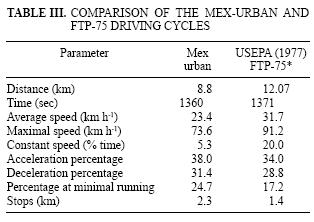
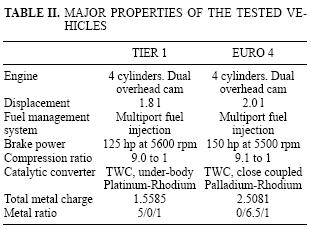
<body><![CDATA[<p align="justify"><font face="verdana" size="2">&nbsp;</font></p>     <p align="justify"><font face="verdana" size="2"><b>MATERIALS AND METHODS</b></font></p>     <p align="justify"><font face="verdana" size="2">Ten reformulated gasoline fuels differing in contents of sulfur, oxygenated compounds (MTBE), aromatics, olefins and vapor pressure <b>(<a href="/img/revistas/rica/v23n2/a2t1.jpg" target="_blank">Table I</a>) </b>were compared by their tail&#150;pipe vehicle emissions in CVS tests. The unleaded gasoline most used in M&eacute;xico City served as experimental reference fuel (RF). Originally 13 RFG were prepared, but F4, F9 and F10 were excluded from the final analysis because of measuring problems. All reformulated fuels were prepared from a single gasoline stock provided by the Miguel Hidalgo petroleum refinery (Tula, Hidalgo State, Mexico).</font></p>     <p align="justify"><font face="verdana" size="2">Two vehicles (Tier 1 and Euro 4) were used to test each gasoline. Tier 1 represents the vehicle technology currently in use in Mexico, whereas the Euro 4 cars are programmed to enter the Mexican market in 2008. The main properties of these vehicles are summarized in <b><a href="#t2">table II</a>. </b>Euro 4 is basically a car with higher displacement, power and total metal charge compared to Tier 1. Each fuel/vehicle couple was tested within two consecutive days: a reformulated fuel in day one and RF in day two. All tests were conducted between December 2001 and April 2002.</font></p>     <p align="center"><font face="verdana" size="2"><a name="t2"></a></font></p>     <p align="center"><font face="verdana" size="2"><img src="/img/revistas/rica/v23n2/a2t2.jpg"></font></p>     <p align="justify"><font face="verdana" size="2">As the fuels are intended for use in the MCMA, the Mex Urban driving test that reproduces the typically slow driving conditions in M&eacute;xico City (D&iacute;az&#150;Guti&eacute;rrez 2002) was used to generate the emissions. <b><a href="#t3">Table III</a> </b>compares Mex Urban parameters against the FTP&#150;75 driving cycle (USEPA 1977). FTP&#150;75 includes a greater distance (27 %), average speed (26 %), maximal speed (19 %) and constant speed (73.5 %); whereas the Mex Urban has higher acceleration (11.8 %), deceleration (9 %), minimal running (43 %) and stops (64 %). All tests were conducted on a 48 inches Horiba chassis dynamometer (Model LDV&#150;48&#150;86&#150;125HP; Road Load Power, AC). Vehicles were previously conditioned according to the NMX&#150;AA&#150;11 &#150;1993 SCFI standard method, which is used to evaluate gaseous exhaust emissions from new gasoline cars in plant (SCFI 993).</font></p>     <p align="center"><font face="verdana" size="2"><a name="t3"></a></font></p>     <p align="center"><font face="verdana" size="2"><img src="/img/revistas/rica/v23n2/a2t3.jpg"></font></p>     <p align="justify"><font face="verdana" size="2">Emissions of regulated pollutants were measured for each test (THC, Horiba, model: FIA&#150;236; CO, Horiba, Model: AIA&#150;210; NO<sub>x</sub>, Horiba, Model: CLA&#150;220; CO<sub>2</sub>, Horiba, Model: AIA&#150;220 and methane, Horiba, Model: GFA&#150;220). Hydrocarbons (C1&#150;C9) and aldehydes and ketones were measured for samples collected in Tedlar bags by gas chro&#150;matography coupled to ionization flame detector (Agilent technologies, model 6890), using method TO&#150;14 (USEPA 1999a). Carbonyls were trapped with cartridges containing dinitrophenyl hydrazine and quantified by high performance liquid chroma&#150;tography (HPLC, Agilent technologies, model 6890) according to method TO&#150;11A (USEPA 1999b).</font></p>     ]]></body>
<body><![CDATA[<p align="justify"><font face="verdana" size="2">The vehicle technology tail&#150;pipe emissions when using the reference fuel were compared by t&#150;tests for unpaired samples (n = 9). In contrast, vehicle emission comparisons for the reformulated fuels were done by t&#150;tests for paired samples because each fuel&#150;vehicle combination had only one replicate.</font></p>     <p align="justify"><font face="verdana" size="2">Fuels were ordered by the Electre method, a ranking technique that compares decision alternatives using concordance and disconcordance concepts (Roy 1991). In this case, the pollutants emitted during each CVS test were used as criteria, whereas the fuel types were considered as alternatives. Prior to ranking, the measured amounts of each pollutant were normalized. Normalization proceeded by column (compound), assigning the maximum value (100) to that fuel showing the lowest emission rate. The remaining column values were obtained by linear interpolation. Each value was then weighed by an external factor (w1) representing a compound's potential to form O<sub>3</sub>, according to Carter (1994). A second weighing factor (w2) expressed the potential toxicity of each compound (Yin and Pratt 2001). The data matrices weighed by w1 and w2 were separately submitted to Electre analysis. The basic concepts underlying Electre calculations can be summarized as follows:</font></p>     <p align="justify"><font face="verdana" size="2">Concordance is defined as:</font></p>     <p align="justify"><font face="verdana" size="2"><img src="/img/revistas/rica/v23n2/a2s1.jpg"></font></p>     <p align="justify"><font face="verdana" size="2">Where:</font></p>     <p align="justify"><font face="verdana" size="2"><i>C<sub>a/b</sub> = </i>concordance between alternative <i>a </i>and alternative <i>b</i></font></p>     <p align="justify"><font face="verdana" size="2">w<sub>j</sub> = external weighing factor for each criteria (pollutant)</font></p>     <p align="justify"><font face="verdana" size="2">u<sub>aj</sub> =   value of alternative <i>a </i>for each criteria</font></p>     <p align="justify"><font face="verdana" size="2">u<sub>bj</sub> =   value of alternative <i>b </i>for each criteria</font></p>     <p align="justify"><font face="verdana" size="2">Disconcordance is defined as:</font></p>     ]]></body>
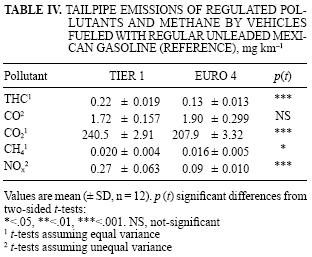
<body><![CDATA[<p align="justify"><font face="verdana" size="2"><i>D<sub>a/b</sub> = </i>(Maximum opposition difference between alternatives <i>a </i>and <i>b) / </i>d&nbsp; &nbsp; &nbsp; &nbsp; &nbsp; &nbsp; &nbsp;(2)</font></p>     <p align="justify"><font face="verdana" size="2">Where: </font></p>     <p align="justify"><font face="verdana" size="2"><i>D<sub>a/b</sub> = </i>disconcordance of alternative <i>a </i>respect to alternative <i>b </i></font></p>     <p align="justify"><font face="verdana" size="2">d = maximum opposition value</font></p>     <p align="justify"><font face="verdana" size="2">&nbsp;</font></p>     <p align="justify"><font face="verdana" size="2"><b>RESULTS AND DISCUSSION</b></font></p>     <p align="justify"><font face="verdana" size="2"><b>Vehicle emissions comparisons</b></font></p>     <p align="justify"><font face="verdana" size="2">In tests with the regular gasoline currently in use in the MCMA (RF), the Tier 1 vehicle had higher emissions of most measured pollutants than the Euro 4 <b>(<a href="#t4">Tables IV</a> </b>and <b><a href="#t5">V</a>). </b>Tier 1 emitted on average 15.5 % more total regulated gaseous pollutants (THC, CO, CO<sub>2</sub> and NO<sub>x</sub>) than Euro 4 <b>(<a href="#t4">Table IV</a>). </b>These technology differences were higher and more variable for the low abundance chemical compounds; e.g., Tier 1 produced on average 200 % more NO<sub>x </sub>(<i>p &lt; </i>.001) and 69 % more THC (<i>p &lt; </i>.001) than Euro 4. Tier 1 also emitted CH<sub>4</sub> at slightly higher rates than Euro 4 <i>(p &lt; </i>.05). Euro 4 tended to emit higher levels of CO, but such difference was no statistically significant. <b><a href="#t5">Table V</a> </b>summarizes VOC and total carbon emissions. Tier 1 had also significantly higher emissions of most measured VOC than Euro 4: formaldehyde (262 %, <i>p &lt; </i>.001, t&#150;test), acetaldehyde (98 %, p &lt; .001), acetone (34 %, p &lt; .05), methyl ethyl ketone (142 %, p &lt; .001), olefins (65 %<i>, p &lt; </i>.01), naphtenes (229 %,<i> p &lt; </i>.05) and total C (75 %<i>, p &lt; </i>.001). No significant differences between vehicles were detected for emissions of aromatics, paraffins and isoparafins.</font></p>     <p align="center"><font face="verdana" size="2"><a name="t4"></a></font></p>     <p align="center"><font face="verdana" size="2"><img src="/img/revistas/rica/v23n2/a2t4.jpg"></font></p>     ]]></body>
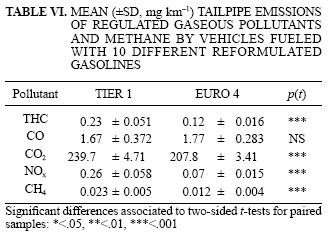
<body><![CDATA[<p align="center"><font face="verdana" size="2"><a name="t5"></a></font></p>     <p align="center"><font face="verdana" size="2"><img src="/img/revistas/rica/v23n2/a2t5.jpg"></font></p>     <p align="justify"><font face="verdana" size="2">The vehicle emissions comparisons based on reformulated fuels were in general consistent with those observed for the reference fuel <b>(<a href="#t6">Table VI</a> </b>and <b><a href="#t7">Table VII</a>). </b>Tier 1 emitted most regulated pollutants at higher rates than Euro 4: THC (95 %, <i>p &lt; </i>.001), CO<sub>2</sub> (15%,<i> p &lt; </i>.001), NO<sub>x</sub> (253%,<i> p &lt; </i>.001). However, Euro 4 emitted 92% more CH<sub>4</sub> than Tier 1 <i>(p &lt; </i>.001) and had slightly higher CO emissions, but this later difference was not statistically significant. In terms of VOC, Tier 1 had a higher mean production of formaldehyde (242 <i>%, p &lt; </i>.001), acetaldehyde (85 %, <i>p &lt; </i>.01), acetone (56 %,<i> p &lt;</i>.05), methyl ethyl ketone (164 %, <i>p &lt; </i>.001), aldehydes and ketones (128 %, <i>p &lt; </i>.001) and olefins (47 %,<i> p&lt; </i>.01). No significant differences were detected for aromatics, paraffins, isoparaffins, naphtenes and 1,3 butadiene emissions. Euro 4, however, emitted benzene at higher rates than Tier 1 (77 %,<i> p &lt; .</i>01).</font></p>     <p align="center"><font face="verdana" size="2"><a name="t6"></a></font></p>     <p align="center"><font face="verdana" size="2"><img src="/img/revistas/rica/v23n2/a2t6.jpg"></font></p>     <p align="center"><font face="verdana" size="2"><a name="t7"></a></font></p>     <p align="center"><font face="verdana" size="2"><img src="/img/revistas/rica/v23n2/a2t7.jpg"></font></p>     <p align="justify"><font face="verdana" size="2">As indicated by simple correlation tests, the fuel composition related to tail&#150;pipe emissions depended upon vehicle type. For Tier 1, increasing aromatics in the gasoline resulted in higher emissions of THC <i>(r = </i>.73, <i>p = </i>.01), aldehyde and cetones <i>(r = </i>.67, <i>p = </i>.02) and total aromatics <i>(r = </i>.78, <i>p = </i>.01), but it decreased the paraffin emissions slightly <i>(r = </i>&#150;.59, <i>p = </i>.06). In contrast, for Euro 4, adding aromatics to the gasoline decreased the emissions of THC <i>(r = </i>&#150;.63, p = .04), but increased benzene <i>(r = </i>.75, p = .01) and total VOC <i>(r = </i>.76, <i>p = </i>.01). The olefin content appeared associated to several compound increases and decreases in the tail&#150;pipe emissions: for Tier 1, increases were observed for CO <i>(r = </i>.68, <i>p = </i>.02), naphtenes <i>(r = </i>.73, <i>p = </i>.01), benzene <i>(r = </i>.82, <i>p &lt; </i>.01) and total VOC <i>(r = </i>.83, p =&lt; .01), and decreases were observed for formaldehyde <i>(r = </i>&#150;.58, p = .06), acetone <i>(r = </i>&#150;.71, p = .02), methyl ethyl ketone <i>(r = </i>&#150;.66,<i>p = </i>.03) and isoparaffins <i>(r = </i>&#150;.80, p &lt; .02). For Euro 4, the olefin gasoline content produced higher emissions of CH<sub>4</sub> <i>(r = </i>.70, <i>p = </i>.02) and decreased emissions of 1,3 butadiene <i>(r = </i>&#150;.64, <i>p = </i>.03). The used contents of MTBE in the reformulated fuels did not correlate with to any observed change in pollutants emission. Sulfur contents only increased the emission of acetone in Euro 4.</font></p>     <p align="justify"><font face="verdana" size="2">According to these results, the introduction of Euro 4 vehicles in the MCMA could be expected to have a positive impact on the local air quality, as it would lower considerably the concentrations of NO<sub>x </sub>and THC, and to a lower extent CO<sub>2</sub> and most measured VOC, in the local air. The better performance of this vehicle can be partially explained by its improved capacity to control the air&#150;fuel ratio precisely and the close coupled three way catalysts (TWC) technology for better light off catalyst performance that means lower THC emissions. Additionally, the Euro 4 vehicle uses Palladium&#150;Rhodium catalytic converter with higher metal contents than Tier 2 vehicles generally focused in controlling emissions of NO<sub>x</sub>.</font></p>     <p align="justify">&nbsp;</p>     ]]></body>
<body><![CDATA[<p align="justify"><font size="2" face="verdana"><b>Fuel comparisons</b></font></p>     <p align="justify"><font face="verdana" size="2"><b><a href="/img/revistas/rica/v23n2/a2t8.jpg" target="_blank">Table VIII</a> </b>and <b><a href="/img/revistas/rica/v23n2/a2t9.jpg" target="_blank">table IX</a> </b>show the normalized emission data used for Electre analyses. The RGF preference rankings generated by Electre are shown in <b><a href="/img/revistas/rica/v23n2/a2t10.jpg" target="_blank">table X</a></b>. Although fuel ranks depended on vehicle engine technology and weighing criterion, RF and F2 ranked consistently as the worst options in all cases; i.e., they had the highest potential to increase toxics and O<sub>3</sub> forming compounds in exhaust vehicle emissions. This may be due to the comparatively high contents of aromatics, olefins and benzene in the composition of RF and F2.</font></p>     <p align="justify"><font face="verdana" size="2">Ranking by the average emissions from both vehicles, the best options by both weighting criteria were F11, F6 and F1, i.e., they had the lowest potential production of the studied unwanted compounds. In general, these fuels were formulated with relatively low contents of aromatics, olefins, benzene and sulfur. In particular, F11 contained the lowest olefins content, the second lowest content of sulfur (215 ppm), a low Reid's vapor pressure, and relatively low contents of benzene and aromatics . F11 produced the lowest emissions of aldehydes and ketones, olefins and methane, and it also produced low emission of benzene in Euro 4 <b>(<a href="/img/revistas/rica/v23n2/a2t8.jpg" target="_blank">Table VIII</a>). </b>Tier 1 was not as efficient in burning up F1; however, this fuel also had low emissions of naphtenes, 1,3 butadiene and regulated gaseous pollutants <b>(<a href="/img/revistas/rica/v23n2/a2t8.jpg" target="_blank">Table VIII</a>). </b>F6 produced the lowest amounts of aromatics, naphtenes and NO<sub>x </sub>in Tier 1, and it had the lowest production of benzene in Euro 4. F1 was the lowest producer of NO<sub>x</sub> and CH<sub>4</sub>, and it was a rather low producer of aromatics, including benzene, in Euro 4. This fuel was not as efficient in Tier 1, but it had relatively low production of aldehydes, NO<sub>x</sub> and other regulated pollutants.</font></p>     <p align="justify"><font face="verdana" size="2">Other RGF, such as F12 and F13, did well both for Tier 1 and Euro 4. In particular, F12 had the lowest production of both O<sub>3</sub>&#150;forming and toxic compounds in Tier 1, and it was a low producer of toxics in Euro 4. F13 produced low amounts of O<sub>3</sub> precursors in both cars. However, F12 would not be recommendable for use in MCMA because of its high sulfur concentration, and the environmental problems and negative effects of this pollutant on the performance catalytic emission controls (Carter 1994).</font></p>     <p align="justify"><font face="verdana" size="2">Thus, the Electre method was able to distinguish which fuels would potentially improve the air quality in the MCMA by considerabely lowering the concentration of O<sub>3</sub> precursors and toxics in the local air. However, these results are not yet conclusive as the raw data set was limited by budgetary restrictions. They however allowed us to select a subset of promising fuels for further detailed studies.</font></p>     <p align="justify"><font face="verdana" size="2">&nbsp;</font></p>     <p align="justify"><font face="verdana" size="2"><b>CONCLUSIONS</b></font></p>     <p align="justify"><font face="verdana" size="2">According to the results, the Tier 1 vehicle emitted a higher volume of THC, NO<sub>x</sub>, CO<sub>2</sub> and CH<sub>4</sub> than the Euro 4. Some technological differences, such as a more efficient catalytic converter and two oxygen sensors, make the Euro 4 a vehicle with lower tail&#150;pipe emissions. Three reformulated gasoline fuels (F11, F6 and F1) had the lowest emissions of both O<sub>3</sub>&#150;forming and toxic compounds. Thus, these fuels are candidates for further studies as they are promising alternatives for improving the local air quality, the best to consider for incorporation into the local market. Fuel F11 was ranked in the first place for both technologies (Euro 4 and Tier 1). This fuel contains the lowest concentration of aromatics, olefins and benzene and it is a good alternative fuel and could be used in the M&eacute;xico City metropolitan area.</font></p>     <p align="justify"><font face="verdana" size="2">&nbsp;</font></p>     <p align="justify"><font face="verdana" size="2"><b>REFERENCES</b></font></p>     ]]></body>
<body><![CDATA[<!-- ref --><p align="justify"><font face="verdana" size="2">Auto Oil Air Quality Improvement Program, Phase 1, (1993). Final Report. Society of Automotive Engineers.</font>&nbsp;&nbsp;&nbsp;&nbsp;&nbsp;&nbsp;&nbsp;&nbsp;[&#160;<a href="javascript:void(0);" onclick="javascript: window.open('/scielo.php?script=sci_nlinks&ref=7188304&pid=S0188-4999200700020000200001&lng=','','width=640,height=500,resizable=yes,scrollbars=1,menubar=yes,');">Links</a>&#160;]<!-- end-ref --><!-- ref --><p align="justify"><font face="verdana" size="2">Bensen J.D., Burns V., Gorse R.A., Hochhausser A.M., Koehl W.J., Painter L.J. and Reuter R.M. (1997). Effects of Gasoline Sulfur Level on Mass Exhaust Emission&#150;Auto Oil Quality Improvement Research Program. Report: 912323. USEPA.</font>&nbsp;&nbsp;&nbsp;&nbsp;&nbsp;&nbsp;&nbsp;&nbsp;[&#160;<a href="javascript:void(0);" onclick="javascript: window.open('/scielo.php?script=sci_nlinks&ref=7188305&pid=S0188-4999200700020000200002&lng=','','width=640,height=500,resizable=yes,scrollbars=1,menubar=yes,');">Links</a>&#160;]<!-- end-ref --><!-- ref --><p align="justify"><font face="verdana" size="2">Carter P.L.W. (1994). Development of ozone reactivity scales for volatile organic compound. J. Air &amp; Waste Manage. Assoc. 44, 881&#150;899.</font>&nbsp;&nbsp;&nbsp;&nbsp;&nbsp;&nbsp;&nbsp;&nbsp;[&#160;<a href="javascript:void(0);" onclick="javascript: window.open('/scielo.php?script=sci_nlinks&ref=7188306&pid=S0188-4999200700020000200003&lng=','','width=640,height=500,resizable=yes,scrollbars=1,menubar=yes,');">Links</a>&#160;]<!-- end-ref --><!-- ref --><p align="justify"><font face="verdana" size="2">D&iacute;az&#150;Guti&eacute;rrez L. (2002). Estimaci&oacute;n de factores de emisi&oacute;n para veh&iacute;culos automotores de gasolina. Tesis de Maestr&iacute;a. M&eacute;xico. Instituto Polit&eacute;cnico Nacional, 135 p.</font>&nbsp;&nbsp;&nbsp;&nbsp;&nbsp;&nbsp;&nbsp;&nbsp;[&#160;<a href="javascript:void(0);" onclick="javascript: window.open('/scielo.php?script=sci_nlinks&ref=7188307&pid=S0188-4999200700020000200004&lng=','','width=640,height=500,resizable=yes,scrollbars=1,menubar=yes,');">Links</a>&#160;]<!-- end-ref --><!-- ref --><p align="justify"><font face="verdana" size="2">Graskow B.R., Kittelson D.B., Abdul&#150;Khalek C.S., Ahmadi M.R. and Morris J.E. (1998). Characterization of exhaust particulate emissions from a spark ignition engine. Paper No. 980528. Society of Automotive Engineers.</font>&nbsp;&nbsp;&nbsp;&nbsp;&nbsp;&nbsp;&nbsp;&nbsp;[&#160;<a href="javascript:void(0);" onclick="javascript: window.open('/scielo.php?script=sci_nlinks&ref=7188308&pid=S0188-4999200700020000200005&lng=','','width=640,height=500,resizable=yes,scrollbars=1,menubar=yes,');">Links</a>&#160;]<!-- end-ref --><!-- ref --><p align="justify"><font face="verdana" size="2">Koehl W.J., Gorse R.A., Knepper J.C., Rapp L.A., Bensen J.D., Hochhausser A.M., Leppard W.R., Reuter R.M., Burns V.R., Painter L.J. and Rutherford J.A. (1989). Effect of Gasoline Sulfur Level on Exhaust Mass and Speciated Emission: The Question of Linearity&#150;Auto/Oil Air Quality Improvement Program. Report: 932727. USEPA.</font>&nbsp;&nbsp;&nbsp;&nbsp;&nbsp;&nbsp;&nbsp;&nbsp;[&#160;<a href="javascript:void(0);" onclick="javascript: window.open('/scielo.php?script=sci_nlinks&ref=7188309&pid=S0188-4999200700020000200006&lng=','','width=640,height=500,resizable=yes,scrollbars=1,menubar=yes,');">Links</a>&#160;]<!-- end-ref --><!-- ref --><p align="justify"><font face="verdana" size="2">Marshal E.L. and Owen K. (Eds.) (1995). Motor gasoline. The Society of Chemical Industry, Oxford.</font>&nbsp;&nbsp;&nbsp;&nbsp;&nbsp;&nbsp;&nbsp;&nbsp;[&#160;<a href="javascript:void(0);" onclick="javascript: window.open('/scielo.php?script=sci_nlinks&ref=7188310&pid=S0188-4999200700020000200007&lng=','','width=640,height=500,resizable=yes,scrollbars=1,menubar=yes,');">Links</a>&#160;]<!-- end-ref --><!-- ref --><p align="justify"><font face="verdana" size="2">Ragazzi R.A., Nelson K. and Gallagher G. (1999). The Impact of a 10 % ethanol blended fuel on the exhaust emissions of TIER 0 and TIER 1, Light Duty Gasoline Vehicles Emissions at 35&deg;F. 9<sup>th</sup>Coordinating Research Council. On&#150;Road Vehicle Emissions Workshop, San Diego, California, April 19&#150;21.</font>&nbsp;&nbsp;&nbsp;&nbsp;&nbsp;&nbsp;&nbsp;&nbsp;[&#160;<a href="javascript:void(0);" onclick="javascript: window.open('/scielo.php?script=sci_nlinks&ref=7188311&pid=S0188-4999200700020000200008&lng=','','width=640,height=500,resizable=yes,scrollbars=1,menubar=yes,');">Links</a>&#160;]<!-- end-ref --><!-- ref --><p align="justify"><font face="verdana" size="2">Roy B. (1991). The outranking approach and the foundation of ELECTRE methods. Theory and Decision, 31, 49&#150;73</font>&nbsp;&nbsp;&nbsp;&nbsp;&nbsp;&nbsp;&nbsp;&nbsp;[&#160;<a href="javascript:void(0);" onclick="javascript: window.open('/scielo.php?script=sci_nlinks&ref=7188312&pid=S0188-4999200700020000200009&lng=','','width=640,height=500,resizable=yes,scrollbars=1,menubar=yes,');">Links</a>&#160;]<!-- end-ref --><!-- ref --><p align="justify"><font face="verdana" size="2">Schuetzle D., Siegl W.O., Jensen T.E., Dearth M.A., Kaiser E.W., Gorse R., Krecher W. and Kulik E. (1994). The Relationship Between Gasoline Composition and Vehicle Hydrocarbon Emissions: A Review of Current Studies and Future Research Needs. Environ, Health Perspect, 102, Supplement 4.</font>&nbsp;&nbsp;&nbsp;&nbsp;&nbsp;&nbsp;&nbsp;&nbsp;[&#160;<a href="javascript:void(0);" onclick="javascript: window.open('/scielo.php?script=sci_nlinks&ref=7188313&pid=S0188-4999200700020000200010&lng=','','width=640,height=500,resizable=yes,scrollbars=1,menubar=yes,');">Links</a>&#160;]<!-- end-ref --><!-- ref --><p align="justify"><font face="verdana" size="2">SCFI (1993). NMX&#150;AA&#150;11&#150;1993SCFI. Norma mexicana. M&eacute;todo de prueba para la evaluaci&oacute;n de emisiones de gases del escape de los veh&iacute;culos automotores nuevos en planta que usan gasolina como combustible. Secretar&iacute;a de Comercio y Fomento Industrial, M&eacute;xico.</font>&nbsp;&nbsp;&nbsp;&nbsp;&nbsp;&nbsp;&nbsp;&nbsp;[&#160;<a href="javascript:void(0);" onclick="javascript: window.open('/scielo.php?script=sci_nlinks&ref=7188314&pid=S0188-4999200700020000200011&lng=','','width=640,height=500,resizable=yes,scrollbars=1,menubar=yes,');">Links</a>&#160;]<!-- end-ref --><!-- ref --><p align="justify"><font face="verdana" size="2">USEPA (1977). FTP&#150;75, Driving cycle. Federal test Procedure. Title 40. Protection of environment.</font>&nbsp;&nbsp;&nbsp;&nbsp;&nbsp;&nbsp;&nbsp;&nbsp;[&#160;<a href="javascript:void(0);" onclick="javascript: window.open('/scielo.php?script=sci_nlinks&ref=7188315&pid=S0188-4999200700020000200012&lng=','','width=640,height=500,resizable=yes,scrollbars=1,menubar=yes,');">Links</a>&#160;]<!-- end-ref --><!-- ref --><p align="justify"><font face="verdana" size="2">USEPA (1999a). Compendium of Methods for the Determination of Toxics Organics Compounds in Ambient Air. Method TO&#150;14&#150;Determination of Volatile Organic Compounds (VOCs) in Air Collected In Specially&#150;Prepared Canisters and Analyzed by Gas Chromatography/Mass Spectrometry (GC/MS). 2nd ed. United States Environmental Protection Agency.</font>&nbsp;&nbsp;&nbsp;&nbsp;&nbsp;&nbsp;&nbsp;&nbsp;[&#160;<a href="javascript:void(0);" onclick="javascript: window.open('/scielo.php?script=sci_nlinks&ref=7188316&pid=S0188-4999200700020000200013&lng=','','width=640,height=500,resizable=yes,scrollbars=1,menubar=yes,');">Links</a>&#160;]<!-- end-ref --><!-- ref --><p align="justify"><font face="verdana" size="2">USEPA (1999b). Compendium of Methods for the Determination of Toxics Organics Compounds in Ambient Air. Compendium Method TO&#150;11A&#150;Determination of Formaldehyde in Ambient Air Using Adsorbent Cartridge Followed by High Liquid Chromatography (HPLC). 2nd ed. United States Environmental Protection Agency.</font>&nbsp;&nbsp;&nbsp;&nbsp;&nbsp;&nbsp;&nbsp;&nbsp;[&#160;<a href="javascript:void(0);" onclick="javascript: window.open('/scielo.php?script=sci_nlinks&ref=7188317&pid=S0188-4999200700020000200014&lng=','','width=640,height=500,resizable=yes,scrollbars=1,menubar=yes,');">Links</a>&#160;]<!-- end-ref --><!-- ref --><p align="justify"><font face="verdana" size="2">Whitten G. (1999). Potential Extra Air Quality Benefits from Oxygenate That Are Not Required to Meet Reformulates Specification. 9<sup>th</sup>Coordinating Research Council. On&#150;Road Vehicle Emissions Workshop, San Diego, California, April 19&#150;21.</font>&nbsp;&nbsp;&nbsp;&nbsp;&nbsp;&nbsp;&nbsp;&nbsp;[&#160;<a href="javascript:void(0);" onclick="javascript: window.open('/scielo.php?script=sci_nlinks&ref=7188318&pid=S0188-4999200700020000200015&lng=','','width=640,height=500,resizable=yes,scrollbars=1,menubar=yes,');">Links</a>&#160;]<!-- end-ref --><!-- ref --><p align="justify"><font face="verdana" size="2">Yin W.C. and Pratt G.C. (2001). Analysis of air toxics emission inventory: Inhalation toxicity&#150;based ranking. J. Air &amp; Waste Manage. Assoc. 51. 1129&#150;1141.</font>&nbsp;&nbsp;&nbsp;&nbsp;&nbsp;&nbsp;&nbsp;&nbsp;[&#160;<a href="javascript:void(0);" onclick="javascript: window.open('/scielo.php?script=sci_nlinks&ref=7188319&pid=S0188-4999200700020000200016&lng=','','width=640,height=500,resizable=yes,scrollbars=1,menubar=yes,');">Links</a>&#160;]<!-- end-ref --> ]]></body><back>
<ref-list>
<ref id="B1">
<nlm-citation citation-type="book">
<collab>Auto Oil Air Quality Improvement Program</collab>
<source><![CDATA[Final Report]]></source>
<year>1993</year>
<publisher-name><![CDATA[Society of Automotive Engineers]]></publisher-name>
</nlm-citation>
</ref>
<ref id="B2">
<nlm-citation citation-type="book">
<person-group person-group-type="author">
<name>
<surname><![CDATA[Bensen]]></surname>
<given-names><![CDATA[J.D.]]></given-names>
</name>
<name>
<surname><![CDATA[Burns]]></surname>
<given-names><![CDATA[V]]></given-names>
</name>
<name>
<surname><![CDATA[Gorse]]></surname>
<given-names><![CDATA[R.A.]]></given-names>
</name>
<name>
<surname><![CDATA[Hochhausser]]></surname>
<given-names><![CDATA[A.M.]]></given-names>
</name>
<name>
<surname><![CDATA[Koehl]]></surname>
<given-names><![CDATA[W.J.]]></given-names>
</name>
<name>
<surname><![CDATA[Painter]]></surname>
<given-names><![CDATA[L.J.]]></given-names>
</name>
<name>
<surname><![CDATA[Reuter]]></surname>
<given-names><![CDATA[R.M.]]></given-names>
</name>
</person-group>
<source><![CDATA[Effects of Gasoline Sulfur Level on Mass Exhaust Emission-Auto Oil Quality Improvement Research Program]]></source>
<year>1997</year>
<publisher-name><![CDATA[USEPA]]></publisher-name>
</nlm-citation>
</ref>
<ref id="B3">
<nlm-citation citation-type="journal">
<person-group person-group-type="author">
<name>
<surname><![CDATA[Carter]]></surname>
<given-names><![CDATA[P.L.W.]]></given-names>
</name>
</person-group>
<article-title xml:lang="en"><![CDATA[Development of ozone reactivity scales for volatile organic compound]]></article-title>
<source><![CDATA[J. Air & Waste Manage. Assoc.]]></source>
<year>1994</year>
<numero>44</numero>
<issue>44</issue>
<page-range>881-899</page-range></nlm-citation>
</ref>
<ref id="B4">
<nlm-citation citation-type="">
<person-group person-group-type="author">
<name>
<surname><![CDATA[Díaz-Gutiérrez]]></surname>
<given-names><![CDATA[L]]></given-names>
</name>
</person-group>
<source><![CDATA[Estimación de factores de emisión para vehículos automotores de gasolina]]></source>
<year>2002</year>
<page-range>135</page-range></nlm-citation>
</ref>
<ref id="B5">
<nlm-citation citation-type="book">
<person-group person-group-type="author">
<name>
<surname><![CDATA[Graskow]]></surname>
<given-names><![CDATA[B.R.]]></given-names>
</name>
<name>
<surname><![CDATA[Kittelson]]></surname>
<given-names><![CDATA[D.B.]]></given-names>
</name>
<name>
<surname><![CDATA[Abdul-Khalek]]></surname>
<given-names><![CDATA[C.S.]]></given-names>
</name>
<name>
<surname><![CDATA[Ahmadi]]></surname>
<given-names><![CDATA[M.R.]]></given-names>
</name>
<name>
<surname><![CDATA[Morris]]></surname>
<given-names><![CDATA[J.E.]]></given-names>
</name>
</person-group>
<source><![CDATA[Characterization of exhaust particulate emissions from a spark ignition engine]]></source>
<year>1998</year>
<publisher-name><![CDATA[Society of Automotive Engineers]]></publisher-name>
</nlm-citation>
</ref>
<ref id="B6">
<nlm-citation citation-type="book">
<person-group person-group-type="author">
<name>
<surname><![CDATA[Koehl]]></surname>
<given-names><![CDATA[W.J.]]></given-names>
</name>
<name>
<surname><![CDATA[Gorse]]></surname>
<given-names><![CDATA[R.A.]]></given-names>
</name>
<name>
<surname><![CDATA[Knepper]]></surname>
<given-names><![CDATA[J.C.]]></given-names>
</name>
<name>
<surname><![CDATA[Rapp]]></surname>
<given-names><![CDATA[L.A.]]></given-names>
</name>
<name>
<surname><![CDATA[Bensen]]></surname>
<given-names><![CDATA[J.D.]]></given-names>
</name>
<name>
<surname><![CDATA[Hochhausser]]></surname>
<given-names><![CDATA[A.M.]]></given-names>
</name>
<name>
<surname><![CDATA[Leppard]]></surname>
<given-names><![CDATA[W.R.]]></given-names>
</name>
<name>
<surname><![CDATA[Reuter]]></surname>
<given-names><![CDATA[R.M.]]></given-names>
</name>
<name>
<surname><![CDATA[Burns]]></surname>
<given-names><![CDATA[V.R.]]></given-names>
</name>
<name>
<surname><![CDATA[Painter]]></surname>
<given-names><![CDATA[L.J.]]></given-names>
</name>
<name>
<surname><![CDATA[Rutherford]]></surname>
<given-names><![CDATA[J.A.]]></given-names>
</name>
</person-group>
<source><![CDATA[Effect of Gasoline Sulfur Level on Exhaust Mass and Speciated Emission: The Question of Linearity-Auto/Oil Air Quality Improvement Program]]></source>
<year>1989</year>
<publisher-name><![CDATA[USEPA]]></publisher-name>
</nlm-citation>
</ref>
<ref id="B7">
<nlm-citation citation-type="book">
<person-group person-group-type="author">
<name>
<surname><![CDATA[Marshal]]></surname>
<given-names><![CDATA[E.L.]]></given-names>
</name>
<name>
<surname><![CDATA[Owen]]></surname>
<given-names><![CDATA[K]]></given-names>
</name>
</person-group>
<source><![CDATA[Motor gasoline]]></source>
<year>1995</year>
<publisher-loc><![CDATA[Oxford ]]></publisher-loc>
<publisher-name><![CDATA[The Society of Chemical Industry]]></publisher-name>
</nlm-citation>
</ref>
<ref id="B8">
<nlm-citation citation-type="confpro">
<person-group person-group-type="author">
<name>
<surname><![CDATA[Ragazzi]]></surname>
<given-names><![CDATA[R.A.]]></given-names>
</name>
<name>
<surname><![CDATA[Nelson]]></surname>
<given-names><![CDATA[K]]></given-names>
</name>
<name>
<surname><![CDATA[Gallagher]]></surname>
<given-names><![CDATA[G]]></given-names>
</name>
</person-group>
<source><![CDATA[The Impact of a 10 % ethanol blended fuel on the exhaust emissions of TIER 0 and TIER 1, Light Duty Gasoline Vehicles Emissions at 35°F]]></source>
<year>1999</year>
<conf-name><![CDATA[ 9thCoordinating Research Council. On-Road Vehicle Emissions Workshop]]></conf-name>
<conf-loc>San Diego California</conf-loc>
<page-range>19-21</page-range></nlm-citation>
</ref>
<ref id="B9">
<nlm-citation citation-type="journal">
<person-group person-group-type="author">
<name>
<surname><![CDATA[Roy]]></surname>
<given-names><![CDATA[B]]></given-names>
</name>
</person-group>
<article-title xml:lang="en"><![CDATA[The outranking approach and the foundation of ELECTRE methods]]></article-title>
<source><![CDATA[Theory and Decision]]></source>
<year>1991</year>
<numero>31</numero>
<issue>31</issue>
<page-range>49-73</page-range></nlm-citation>
</ref>
<ref id="B10">
<nlm-citation citation-type="journal">
<person-group person-group-type="author">
<name>
<surname><![CDATA[Schuetzle]]></surname>
<given-names><![CDATA[D]]></given-names>
</name>
<name>
<surname><![CDATA[Siegl]]></surname>
<given-names><![CDATA[W.O.]]></given-names>
</name>
<name>
<surname><![CDATA[Jensen]]></surname>
<given-names><![CDATA[T.E.]]></given-names>
</name>
<name>
<surname><![CDATA[Dearth]]></surname>
<given-names><![CDATA[M.A.]]></given-names>
</name>
<name>
<surname><![CDATA[Kaiser]]></surname>
<given-names><![CDATA[E.W.]]></given-names>
</name>
<name>
<surname><![CDATA[Gorse]]></surname>
<given-names><![CDATA[R]]></given-names>
</name>
<name>
<surname><![CDATA[Krecher]]></surname>
<given-names><![CDATA[W]]></given-names>
</name>
<name>
<surname><![CDATA[Kulik]]></surname>
<given-names><![CDATA[E]]></given-names>
</name>
</person-group>
<article-title xml:lang="en"><![CDATA[The Relationship Between Gasoline Composition and Vehicle Hydrocarbon Emissions: A Review of Current Studies and Future Research Needs]]></article-title>
<source><![CDATA[Environ, Health Perspect]]></source>
<year>1994</year>
<numero>102^s4</numero>
<issue>102^s4</issue>
<supplement>4</supplement>
</nlm-citation>
</ref>
<ref id="B11">
<nlm-citation citation-type="book">
<collab>SCFI</collab>
<source><![CDATA[NMX-AA-11-1993SCFI. Norma mexicana: Método de prueba para la evaluación de emisiones de gases del escape de los vehículos automotores nuevos en planta que usan gasolina como combustible]]></source>
<year>1993</year>
<publisher-name><![CDATA[Secretaría de Comercio y Fomento Industrial]]></publisher-name>
</nlm-citation>
</ref>
<ref id="B12">
<nlm-citation citation-type="book">
<collab>USEPA</collab>
<source><![CDATA[FTP-75, Driving cycle: Federal test Procedure. Title 40]]></source>
<year>1977</year>
<publisher-name><![CDATA[Protection of environment]]></publisher-name>
</nlm-citation>
</ref>
<ref id="B13">
<nlm-citation citation-type="book">
<collab>USEPA</collab>
<source><![CDATA[Compendium of Methods for the Determination of Toxics Organics Compounds in Ambient Air: Method TO-14-Determination of Volatile Organic Compounds (VOCs) in Air Collected In Specially-Prepared Canisters and Analyzed by Gas Chromatography/Mass Spectrometry (GC/MS)]]></source>
<year>1999</year>
<month>a</month>
<edition>2</edition>
<publisher-name><![CDATA[United States Environmental Protection Agency]]></publisher-name>
</nlm-citation>
</ref>
<ref id="B14">
<nlm-citation citation-type="book">
<collab>USEPA</collab>
<source><![CDATA[Compendium of Methods for the Determination of Toxics Organics Compounds in Ambient Air: Compendium Method TO-11A-Determination of Formaldehyde in Ambient Air Using Adsorbent Cartridge Followed by High Liquid Chromatography (HPLC)]]></source>
<year>1999</year>
<month>b</month>
<edition>2</edition>
<publisher-name><![CDATA[United States Environmental Protection Agency]]></publisher-name>
</nlm-citation>
</ref>
<ref id="B15">
<nlm-citation citation-type="confpro">
<person-group person-group-type="author">
<name>
<surname><![CDATA[Whitten]]></surname>
<given-names><![CDATA[G]]></given-names>
</name>
</person-group>
<source><![CDATA[Potential Extra Air Quality Benefits from Oxygenate That Are Not Required to Meet Reformulates Specification]]></source>
<year>1999</year>
<conf-name><![CDATA[ 9thCoordinating Research Council. On-Road Vehicle Emissions Workshop]]></conf-name>
<conf-loc>San Diego California</conf-loc>
<page-range>19-21</page-range></nlm-citation>
</ref>
<ref id="B16">
<nlm-citation citation-type="journal">
<person-group person-group-type="author">
<name>
<surname><![CDATA[Yin]]></surname>
<given-names><![CDATA[W.C.]]></given-names>
</name>
<name>
<surname><![CDATA[Pratt]]></surname>
<given-names><![CDATA[G.C.]]></given-names>
</name>
</person-group>
<article-title xml:lang="en"><![CDATA[Analysis of air toxics emission inventory: Inhalation toxicity-based ranking]]></article-title>
<source><![CDATA[J. Air & Waste Manage. Assoc.]]></source>
<year>2001</year>
<numero>51</numero>
<issue>51</issue>
<page-range>1129-1141</page-range></nlm-citation>
</ref>
</ref-list>
</back>
</article>