Crossing the Border: Mobility as a Resource in the Tijuana/San Diego and Tecún Umán/Tapachula Regions*
Amalia E. Campos Delgado**, Olga Odgers Ortiz***
**Master's in Sociocultural Studies, El Colegio de la Frontera Norte, Universidad Autónoma de Baja California. E-mail: amalia.cd@gmail.com.
***Professor-Researcher, Social Studies Department, El Colegio de la Frontera Norte. E-mail: odgers@colef.mx
]]> Recibido el 8 de diciembre de 2011
Abstract
This paper suggests that transborder mobility is crucial to the way individuals relate to space and the meanings that they construct about it. Based on ethnographic work carried out in the Tijuana/San Diego and Tecún Umán/Tapachula border regions, an analysis is conducted of the relationship between the border region and the spatial mobility of its inhabitants. We conclude that there are at least four possible ways of constructing mobility in border contexts.
Keywords: border, border region, mobility, Tijuana, Tecún Umán.
Resumen
En este artículo proponemos que la movilidad transfronteriza es un elemento fundamental en la manera en que los sujetos se relacionan con el espacio y construyen sus referentes a este respecto. A partir del trabajo etnográfico realizado en las regiones fronterizas Tijuana/San Diego y Tecún Umán/ Tapachula, se analiza la relación entre el espacio fronterizo y la movilidad espacial de sus habitantes. Concluimos que existen al menos cuatro posibles formas de construcción de la movilidad en contextos fronterizos.
]]> Palabras clave: frontera, espacio fronterizo, movilidad, Tijuana, Tecún Umán.
Introduction. Border regions: the limits at the center and vice versa
The boundaries are symbols of identity par excellence. Traditionally, when seen from a distance, these social constructions have inspired the dichotomous thinking that divides the world into oneself and others, inside and outside, alter and ego. However, the opposites evoked by the notion of border become diluted when one moves further from the "centers" and closer to the "limits". In addition to the conceptions of the border as a dividing line, those of the border as a meeting and interaction point have arisen, without replacing them (Foucher, 1991; Vila, 2001; Donnan and Wilson, 2001; Odgers, 2001; Newman, 2006). Thus, for example, on the border between Mexico and the United States, the English/Spanish opposition has been weakened by the emergence of Spanglish, and the dollar/peso distinction -although it has not disappeared- has been lessened by the omnipresent currency exchange offices. In short, the exclusive interpretations of national identities have given way to new border identity references.
Thus, a social scientist located in these liminal spaces has no choice but to make a radical change and regard borders not as limits but as centers, axes around which countless interactions and complex relations revolve, marked indeed by oppositions, contrasts and asymmetries, but also by convergences, synthesis, "hybridizations" and "translocations" (García Canclini, 1990; Alvarez, 1997; Anthias, 2001).
Once again, it should be stressed that the processes of "hybridization" and convergence operate alongside, without substituting the reality of contrasts, tensions and barriers. Therefore, borders become sociologically relevant objects insofar as they simultaneously constitute convergences and oppositions around which the border's inhabitants organize their actions.
Nonetheless, mobility as a resource is a key element for understanding the way in which these paradoxical realities emerge (Bauman, 2001; Sheller & Urry, 2006; Cresswell, 2006). The border can be a bridge, a wall, or both at once, depending on a person's ability to cross it. These characteristics allow border regions to expose the contradictions between the flows and barriers of the modern world: border mobility was not produced by a weakening of the borders, but rather in spite of their reinforcement. The ability to travel back and forth acquires value specifically because the border effectively separates two different realities. The reinforcement of border control exacerbates the contrasts between either side and this increased difference lends meaning to the crossing and confers simbolic value on mobility. However, if the ability to "be mobile" is a crucial resource in border regions, how does the possibility -or impossibility- of moving back and forth make the border a resource and resignify the region through the social practices and relations linked to mobility?
As a result of the above, this work aims to study the practices linked to movement in the space developed by the border inhabitants of two different and distant regions -San Diego/Tijuana and Tapachula/Tecún Umán-to observe how mobility becomes a territorial resource.
Our analysis is based on the ethnographic work carried out, at different stages, in each of these regions. In addition, it was decided to focus the analysis on the experience of those who observe the border from the South -from Tijuana and Tecún Umán instead of San Diego and Tapachula- principally because they express most clearly the diversity of resources for/or obstacles to mobility in the border regions. Thus in each case, semi-guided interviews1 were carried out to form a non-random sample based on the snowball technique. In this regard, the empirical material provides us with the meaningful characteristics of the processes of building mobility as a resource -which allow a qualitative analysis of the relation to mobility, but does not constitute a representative sample of the movement patterns of border inhabitants because it does not seek to undertake a statistical analysis of the forms of displacement. Consequently, the analysis does not focus on identifying the more or less recurrent mobility patterns, but rather on constructing a typology of the forms of mobility. This typology allows an observation of the mobility strategies developed by individuals to organize their everyday activities and build their life projects based on the territorial resources available in the region. In order to diversify the perspectives analyzed in each city, men and women of different ages were interviewed only a few of whom possessed documents allowing them to cross the border legally.2
To present the results obtained, this document was divided into four sections. The first of these begins by explaining the way in which this work has conceptualized the notions of mobility and border region. This is followed by a brief presentation of the main characteristics of the border regions studied in this work. The third section presents a typology of the ways of constructing mobility in border contexts, based on an analysis of the ethnographic material obtained in each of the cities studied in this research project. The paper ends with a conclusion that proposes a number of research questions derived from this work.
]]>The border region as center of mobility
"The task is thus to produce a nonessentialist theory of social space."
(Natter & Jones, 1997: 146)
Discussing mobility in a border zone where it is assumed that "anti-movement"is the prevailing notion requires a two-fold approach. The first -macro- is established by each nation determining which person possesses the "right of movement" (Cresswell, 2006). The second -micro- is determined by the relationship between actors on either side of the border and the creation of codes based on their everyday activities. Thus, border anti-mobility becomes blurred when faced with the local reality. As stated by Alejandro Grimson,
"la gente se traslada, desplaza y trastoca significados, autonomizando los vínculos entre cultura, identificación y territorio. Por otro lado, símbolos, textos, músicas y objetos viajan aunque las personas y los grupos permanezcan inmóviles, cuestionando por otra vía aquella supuesta imbricación" (2003:15).3
However, since this article seeks to portray the subject's perspective, the notion of interaction as a hinge axis of the border region must be introduced. In other words, we are not interested in observing the border region per se, but rather in examining what the inhabitants make of them. Thus, the border becomes a living space and not merely a geographical location. We therefore take up Natter and Jones's perspective by considering that "in contrast to a category of space as a self-present social essence, it is more useful to start with a conception of space that, like the subject, is a lack to be filled, contested, and reconfigured through contingent and partially determined social relations, practices, and meanings" (Natter & Jones, 1997:149).
Thus, the "paradigm of mobilities" highlights the fact that all places are united by fine networks, and that these connections stretch beyond each location in such a way that none can be an "island" (Sheller & Urry, 2006:209). Here, we takeup Cresswell's statement that mobility is not merely a function in abstract space but a meaningful geographic phenomenon, charged with energy. As a result, as a social product, mobility adopts characteristics that vary throughout space in time, with visible effects on people, places, objects and the relationships between them (Cresswell, 2001:16).
]]> Precisely, as stated by Alicia Lindón: "la espacialidad no sólo ha quedado subordinada a la temporalidad sino que también se ha asociado muy estrechamente al movimiento"4 (2000:189). The border's way of life is anchored in an imaginary of movement, although the space is symbolically charged with the allusion of the border as an impassable barrier. As will be discussed in the following section, "border mobility" is a compulsory reference in the imaginary of locals and foreigners, even though many residents do not have access to the legal documents enabling this movement. At the same time, the risk of essentializing the notion of space is that it assumes that space itself determines the connections and interactions, whereas in fact it is individuals who construct, reconfigure, determine and lend meaning to the space through everyday interactions. From this perspective, the border region is a space marked by a geopolitical limit, but it is the interactions of its inhabitants and the mobility of the persons passing through that limit that structure and hierarchize it. The border region is not a reality independent from the everyday actions of its inhabitants or from the constant action of the countries to control mobility.Thus, the geopolitical division acquires a different meaning for the inhabitants of the border regions than for the persons located outside. Borders can have a relative underlying cultural unity that is not consistent with the Nation-State in which they are located, and the reason for this is in the border interactions themselves. In short, they "are zones of cultural production, spaces of meaning-making and meaning-breaking" (Donnan & Wilson, 2001:64).
Therefore, for the study of mobility in border regions, we do not assume the border's impact as a reality outside individuals and the construction of their identity references, on the contrary, on the basis of a constructivist and relational perspective (Odgers, 2001), this paper considers that these identity references are constructed by the everyday interactions that occur in, on, around and through the border.
There are several areas in which the inhabitants of the region generate meanings about the space. In the ethnographic material obtained in the regions studied, the border inhabitants themselves describe the region's singularity: "The border is like a place where a large river flows into the sea. There you can find sea fish and river fish. Only here fresh and salt water are mixed and all kinds of fish together" (Ernesto,5 Chula Vista, California, 1996). But probably the most illustrative register entails the way of existing and interacting within this singular space, as Araceli explains: "The people who live here will tell you that it's a whole other world... you can find the best -and the worst- of two worlds. Being a border resident means learning how to use the potential of both sides... and how to make problems affect you as little as possible" (Araceli, Chula Vista, California, 1996).
Being a border resident therefore means learning to live in English and in Spanish, in pesos and in dollars, here and there. In other words: being a border resident means learning to move through "two worlds" that converge, it means learning to move back and forth. However, learning to be mobile can have a high price, and the pitfalls to avoid are not the same for everyone. This difference in access to mobility separates and hierarchizes the inhabitants on either side of the border. More specifically, possessing or lacking the various resources that allow a person to move back and forth in the border region (mainly legal documents but also social networks, linguistic knowledge, etc.) distinguishes and separates individuals based on their access to specific activities (shopping or traveling, working or studying on the Northern side). Thus, for example, having several citizenships confers a different status from those who are only able to cross as a tourist or who cross illegally.
Indeed, if the border can cease to be an obstacle and become a resource only through mobility, it should be stressed that access to mobility is a resource that is unevenly distributed among border residents, whether in Tijuana/San Diego, in Tecún Umán/Tapachula or at many other international borders. Thus, inequalities are intensified by the possession (or lack) of the migratory documents, linguistic knowledge or social networks that permit crossings. By developing mechanisms that control mobility, borders consolidate inequality, reinforce power relationships and materialize hierarchies (Odgers, 2007).
Regarding mobility in these "bordered" contexts and the constant construction of meanings about it, is crucial to observe that "this set of changes thus produces novel and 'flickering' combinations of presence and absence of peoples, enemies and friends. New mobilities are bringing into being new surprising combinations of presence and absence as the new century chaotically unfolds" (Sheller & Urry, 2006:222). Thus, more than dividing the North from the South, the border separates the persons who are able to construct themselves through mobility from those whose only horizon is an (almost) impassable wall.
Observation points: the South of the North and the South of the South
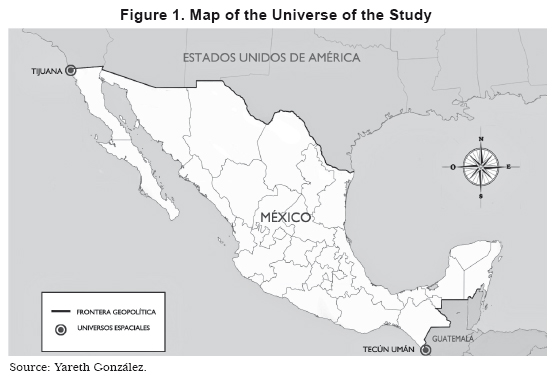
With the aim of observing how border inhabitants rely on mobility to resignify the border territory via social practices and relationships, two very dissimilar border regions were selected as the universe of the study: the Tijuana/San Diego region, in which the first and third world converge, and the Tecún Umán/Tapachula region6, where one of the most marginalized Mexican states converges with an even poorer nation (figure 1).
]]>
As will be described later, these two observation contexts have several important similarities: asymmetrical relationships, the progressive reinforcement of border control, the violation of the human rights of those who move back and forth or those who wish to do so; but also some notable differences, in addition to the economic dissimilarity. Below are several significant elements in each of these regions, which serve to contextualize this analysis.
The Mexico-United States Border Region
The border between Mexico and the United States is commonly presented as the line of over 3 000 km that unites and separates the two countries, the First and Third worlds, the Hispanic and the Anglo worlds and so on. However, beyond this first interpretation, the interest elicited by this border region stems from the fascination produced by the many hybrid cultural expressions, which show the contrasts and the creativity with which the inhabitants find ways to fuse the disparate elements of their context.
Probably as a result of these cultural expressions, as Pablo Vila points out (2001), in the recent literature -principally from the United States-discussion has focused primarily on the hybrid nature of the region, underestimating the conflict-ridden nature of the territorial limit. This environment of interacting, searching and using opportunities highlights the eloquence of border relationships, perceiving them as economic and interpersonal interactions that are based on (yet go beyond) the geopolitical border. Depending on their intensity, these interactions can be essential to maintaining the social, cultural and economic links of the majority of the inhabitants on either side of the border (Ojeda, 2009:11; Bustamante, 1989:8). Indeed, whereas within the United States "the figure of the border 'crosser' takes precedence over that of the border 'fortifier'" (Vila, 2001:13), from the Mexican perspective the idea of the border as an obstacle -and the progressive reinforcement of border control- still prevails.
From either observation point, various authors have detailed the traits that define this region both as a contact point (a space of symbolical and cultural production), and in its violent, divisive and contrasting nature. However, from our perspective it is precisely this apparently paradoxical conjunction that characterizes the region. Indeed, the border gives support, hierarchy and structure to the intense but asymmetrical relationships that exist across this geopolitical limit.
From a historical perspective, three main stages can be defined for a study of this region.7 The first, which corresponds to the period of greatest expansion by the United States and the establishment of the current border limits, began in 1846 and ended around 1853 with the signing of the treaty of La Mesilla. This stage, despite occurring in the distant past, even so distant from the present acquires great symbolic importance in border relationships, in particular the Chicano movement, which made this the touchstone that legitimizes Hispanic (i.e. Mexican-Latino) presence in the region.
The second stage corresponds to the period when the migratory flows were formed and consolidated, as well as the emergence of the first structures of border control. Within this stage there were several noteworthy periods, such as the construction of the railroad in the United States and the subsequent demand for labor, and the establishment of the Bracero Program, crucial to understanding the creation of contemporary migratory flows (Durand, 1994). Finally, the third stage is characterized by the stiffening of border control mechanisms, during the last two decades of the 20th century. Alhough the building of the control infrastructure began gradually, the enactment in 1986 of the law known as Simpson-Rodino (irca) was undoubtedly a watershed, which gave a new direction to migratory policy towards a program of exceptional migratory regularization and an attempt to achieve complete control over border crossings. Within this stage two specific periods had a major impact on the region. The first was marked by the beginning of the Guardian Operation in 1994 and the subsequent displacement of migratory flows towards more dangerous zones. The second was the response to the attacks of 11 September 2001 and the United States' creation of the Department of Homeland Security, which made the management of the border region a national security issue, thereby promoting a criminalizing view of "border crossers" as potential enemies of the nation.
]]> The historical transformations of the border region are even more evident in parts of the border with the most interactions. In particular, the Tijuana/San Diego region witnesses all kinds of legal and illegal flows (in both directions) across the border. In 2007 alone, "a total of 20 million private vehicles, 738 000 freight trucks, 145 000 passenger buses and 9.1 million persons on foot" crossed the border legally (Garza, 2008) from South to North, in addition to an indeterminate number of crossings from North to South.This intense flow is extremely heterogeneous and comprises both persons from distant regions from Mexico or other countries, and border residents who in the course of their everyday activities such as work, studies and shopping need to cross this international border (Ruiz, 1996). The persons crossing may be citizens of Mexico or the United States, may have both citizenships or another nationality (Berestein, 2008)8 and may also live to the North or South of the border, irrespective of their nationality.
The intensity of the flow across the border should not conceal the difficulties these crossings may imply, or the impact that control mechanisms have on them. For example, among the consequences of the reinforcement of the security measures implemented in the aftermath of 11 September 2001 was an increase in the cost -both economic and human- of border mobility: the waiting time necessary to cross legally by the main Tijuana/San Diego port of entry, the fees applied by the "coyotes" to cross the border without migratory documents, and the danger of crossing without these documents, reflected in the number of deaths recorded in the region.
Similarly, the decrease in safety to the south of the border reduced the number of people traveling from the north, who used to travel to Tijuana for a variety of reasons such as tourism, inexpensive medical treatment -particularly dentistry- and visiting relatives and friends.
These two cities are thus linked by flows that are diverse but vulnerable, expensive and exposed to variations in the central government's policies, international market pressures or the multiplying effects of globalization on the financial markets. The creation of a border culture, well represented by Spanglish or the slogans "rock en tu idioma" and "salsa tonight", must be understood alongside the cost for its inhabitants -which varies greatly- of maintaining lasting links.
The Mexico-Guatemala border region
The border region between Mexico and Guatemala is notable for its sharp economic inequality coupled with a relative cultural similarity. Naturally, this is the result of the historical process of forming geopolitical limits, which comply with logics unrelated to local sociocultural processes.
We can divide the constitution process of the border between Mexico and its southern neighbor into three periods. The first, from March 1821 to February 1823, was marked by the enactment in Mexico of the Iguala Plan and the Casa Mata Plan, respectively. In January 1822 the Iguala Plan annexed the General Captaincy of Guatemala -the Province of Guatemala, Chiapas, Comayagua, San Salvador, the province of Nicaragua and Costa Rica- to the Mexican Empire. However, six months after the approval of the Casa Mata Plan (the consequent overthrow of the Empire of Iturbide and the establishment of the Mexican Republic), Guatemala asserted its absolute independence from Spain and Mexico (Luján, 1998:121). This declaration of independence maintained the current Mexican state of Chiapas within Guatemala's territory. The second period extended from October 1824 to January 1842, and was characterized by conflicts between Mexico and Guatemala due to the annexation of the province of Chiapas and the territory of Soconusco; this period ended with the establishment of the border south of the territories at stake (Taracena, 1997:324-325). The third period corresponds to the phase of negotiations in 1873 that resulted in the signing of the official agreement on the limits between both countries in 1897. Following a failed support attempt by the government of the United States, the then president of Guatemala, General Justo Rufino Barrios, decided to resume direct negotiations with its northern neighbor. The Uriarte-Vallarte Convention, signed on 7 December 1877 in Mexico City, established the procedures whereby each country designed a group of six engineers who would determine how to establish the border. As a result of disagreements between the two commissions, the definitive drawing of the geopolitical division continued until 1897 (Luján, 1998:193-195).
Currently, the border that Mexico shares with Guatemala has ten admission points for pedestrian and vehicle crossings, "two in the state of Tabasco: El Martillo and El Ceibo; and the remaining eight in the state of Chiapas: Frontera Corozal, Carmen Xhan, Ciudad Cuauhtémoc-Las Champas, Mazapa de Madero, Unión Juárez, Talismán, Suchiate ii and Ciudad Hidalgo" (EMIF Guamex, 2009:23). However, in addition to these crossing points there are hundreds more that pass through the rivers and mountains.
]]> According to figures from the Encuesta sobre Migración en la Frontera Guatemala-Mexico (2005), the two towns in which the greatest movement of labor and trade across the border is recorded are (on the Guatemalan side) Tecún Umán and El Carmen, and (on the Mexican side) Ciudad Hidalgo and Talismán. The survey states that 54% of the flows from north to south represent stays of less than 24 hours that mainly use the Local Pass and work in Mexico in industry or services. The remaining 46% are stays of over a day on Mexican soil and mainly correspond to labor contracts in the agricultural sector in the region adjacent to the city of Tapachula, Chiapas.The city of Tecún Umán is the municipal seat of Ayutla in the Department of San Marcos. The municipality has a total of 21 000 residents, a figure that rises to approximately 30 000 if the "floating" or transit population is included. In 2004 the population pyramid of Tecún Umán consisted of a mainly young population.
Tecún Umán and its nickname -La Tijuanita de Guatemala- comprise two realities that are divergent yet undeniably present in the city. On the one hand, "Tecum Umam" -a prince and the head of the K'iche' army who fought against the Spanish conquistador Pedro de Alvarado- symbolizes the indigenous races, roots, strength and the struggle to defend what belongs to one. On the other hand, it represents the heterogeneity, the border relations, the many failed crossing attempts, and the knowledge that, as in Tijuana: "Seek and you will find".
The city of Tecún Umán is one of the cities with the greatest economic and infrastructure investment throughout the department of Ayutla. Over the course of the past four years, the city has experienced changes, mainly of two kinds. The first is that the passage of Hurricane Stan through the city in 2005 destroyed the railway lines on the Ciudad Hidalgo-Tonalá route, and consequently the city is no longer the main meeting point of Central American migrants seeking to cross Mexico. The second source of change is the "new image of Tecún" being projected within the department. More specifically, buildings in the city center and the main square were renovated, and as a result, these spaces with which Tecún residents no longer felt identified have become meaningful spaces for them.
In 2009, the river Suchiate on the Mexican side was clearly delimited by a containment wall, while on the Guatemalan side its construction had barely begun. The containment of the river Suchiate is a matter of high priority for both cities because as the border line is guided by the flow of the river, this implies that without the proper delimitation, the flood plain will cover the national territory in the event of an increase in water levels. As on the border between Tijuana and San Diego, the landscape of this region is marked by the border control infrastructure, and by the infrastructure which enables the crossings, whether legal or undocumented.
Although the border port of entry between Ciudad Hidalgo and Tecún Umán is not the one that records the most "legal" crossings on the Mexico-Guatemala border, it is the setting for the most illegal ones. For Tecún residents, "rafts"9 are an ideal means of transportation to cross the "natural border" of the Suchiate River, carrying large quantities of merchandise on the return journey. The Mexican side, on the other hand, has put in place a trade infrastructure "on the other side of the river" in such a manner that its southern neighbors need not cross further to acquire products such as eggs, rice, beans, beer, oil, bottled drinks, etc.
Upon reaching the Guatemalan side, the border residents meet the other part of the mobility structure, the "tricycle riders",10 who are able to carry half the merchandise transported in the tires on each journey, for a fee of five Quetzales. Recently -and linked to the Mexican reinforcement of the border, or to "a few people taking advantage of the lapse in concentration"- according to different opinions, the river zone has become "dangerous", and in 2009 there were already reports of newly-unloaded merchandise being stolen and attacks on pedestrians.
Between both border regions the control infrastructure has increased over the course of the last decade. In both cases there is a noticeable difference in the infrastructure built in the North and the South. Thus, on the Tecún Umán/Ciudad Hidalgo border, which runs along the "Dr. Rodolfo Robles" international bridge, the differences involved the materials used, their finishings, the maintenance of the bridge's asphalt surface, the building -on the Mexican side- of a roof that protects pedestrians from the sun, and fewer customs officials than on the ones on the Guatemalan side. The Mexican government recently installed a 2.5 meter iron fence to ensure "enhanced control" of entries. In addition to this, a three-storey building is being built which will illustrate the contrasts between both customs points, since the Guatemalan counterpart is simply a one-storey building with two offices.
As in the Tijuana/San Diego region, the population that travels across the Tecún Umán/Tapachula border is composed in varying proportions of crossers who travel daily and within the region and of travelers for whom it is one stage in a long journey. Another similarity is that southern border inhabitants have developed strategies to make this border a resource; as we will see later, also on this border, mobility determines the rhythm and expectations of the inhabitants' lives.
]]> Ways of life, ways of moving back and forth
As mentioned in the initial section of this document, the analysis focuses on the manner in which the ability to travel back and forth determines the possibility of making the border a resource and not merely a barrier. As Creswell stated, "mobility becomes meaningful within systems of domination and resistance, inclusion and exclusion, and is embedded with relations of systematically asymmetrical power relations" (2001:9).
In response to this, the analysis is based on the idea that spatial mobility makes territories more fluid despite the limits that separate them. Consequently, the short cuts devised by individuals reduce the spatiotemporal tensions in daily life, making everyday space-time more fluid (Juan, 2000:143). Nonetheless, merging mobility in space into a conception of fluidity and linear relations is a complex task, as "because of their liminal and frequently contested nature, borders tend to be characterized by identities which are shifting and multiple, in ways which are framed by the specific state configurations which encompass them and within which people must attribute meaning to their experience of border life" (Wilson & Donnan, 1998:13).
Precisely as a result of this complexity, this analysis required creation a typology of the "forms of border mobility" based on the field material gathered. Like any typology, it is an abstraction rather than a classification of concrete cases.
Because it is centered on the logic of mobility -as opposed to concrete individual experiences-, these categories can be represented by persons experiencing very different concrete realities (socioeconomic or educational levels, age, etc.). Moreover, several of these forms of mobility possibly coexist in reality, and for analytic reasons they will be separated into independent categories.
In general, four different mobility patterns in and with the border land can be identified: 1) circular movement, 2) transnational localism/in situ mobility, 3) south-bound movement and 4) crossing the border as an obstacle. Each of these forms will be explained below and illustrated with extracts from interviews.
Circular mobility
Circular mobility across the border, with its starting and return point in the border city. In addition to this characteristic, within this identity construction the type of crossing and its intensity must be considered, as well as its "warmness or coldness" (Iglesias, 2004:147). For some persons, the crossing is made for trade-related reasons: "My mother has a small eatery, and it varies: she goes once or twice or even three times a week to buy products on the other side, and she crosses using the raft or the bridge. It depends: if she doesn't need much merchandise then she'll take a tricycle and use the bridge, [...] even though that means she has to pay more and make more journeys every week" (Valeria, Tecún Umán, 2010). Many other cross for work-related reasons: "We started work at 6:30 [am] and left at 4:30 [pm], my uncle lived near my house and would pick me up at 4-4:30 and we'd start queuing" (Andrea, Tijuana, 2009). Others cross because of their family: "His wife lived on the other side, and we'd cross over on Sundays so that my daughter could see her Dad, because she couldn't otherwise. The boy couldn't go, he didn't like to cross over the river, gets very nervous and would rather stay at home" (Yasmín, Tecún Umán, 2009).
Unlike on the Northern border, in the South these forms of mobility can be documented or undocumented, or combine both strategies: crossing without documents through the Tijuana/San Diego region is too expensive to do so on a daily basis. However, it is possible to cross clandestinely for work reasons, entering with tourist documents and then taking up employment activities.
]]> To consolidate the work-related border movement, the individuals must know the cracks in the "other side's" control infrastructure and devise strategies to avoid it. Thus, for example, on the Northern border, many border workers without working visas know that the "correct" answer to the question "Where are you going?" -irrespective of the time of crossing- is "shopping".All the people who cross at that time go to do the same thing, there are 300 or 700 of them queuing on foot and you know them, because every day at the same time, if you go at 7, or 6, the same people are there, the same cars, you recognize the cars in the queue. And the border cops, that's another deal, you have to be careful in the lines. Everyone has their own strategies; my uncle would take the right lane, then the left one, then the Otay one, so one weekend we'd take the right one, the next weekend the left one and then the Otay one. My Mum didn't, she uses the same lane every day, because the border cops take turns, so one day you'd get one and then you wouldn't get him again for a month, so they don't identify you so well. My Mum is careful with that: she'll style her hair differently, or wear different earrings or a new blouse the next day; you have to be careful with all of that, because if you always look the same then the border cops will recognize you. We learn their faces, we already recognize them, and they know us too (Andrea, Tijuana, 2009).
On the southern border, despite the official discourse and the measures implemented by the Mexican government -"la creación de unidades policiacas mixtas [compuestas por Policía Fronteriza de Chiapas, la Policía Federal Preventiva y agentes de Migración] y la revisión del estatus migratorio de los habitantes de la zona"11 (Villafuerte and García, 2007:27)- the trade and labor relationship between the inhabitants of the region follows a different logic. This is borne out by the trucks of Mexican contractors, which arrive on Mondays and Tuesdays at around 5:00 a.m. in Tecún Umán's main square to recruit workers, mainly for the banana and coffee plantations. Having hired enough Guatemalans, they travel to the El Carmen/Talismán border point, through which they cross without any problem.
This suggests that the border way of life is anchored in an imaginary of movement, despite the border being "impassable" (Campos Delgado, 2010a:94). Border mobility is a compulsory reference in the border imaginary, even though many of the persons living in that space do not have the possibility of circular mobility.
Transnational localism or in situ mobility
Transnational localism or in situ mobility is consolidated in the border city using the resources provided by the city or acquired on the other side of the border. Consequently, it is maintained by the mobility inside the city, neither to the south or north, but using resources from within it, which includes resources obtained from the other side of the border. Thus, for example, for Tijuana residents without the possibility of crossing the border legally, the city's heterogeneity is one of its main assets: "I try to find other possibilities here in Tijuana; generally as the city attracts many tourists and foreigners, many people from outside, you will find people who bring things from over there, that might interest you" (Karina, Tijuana, 2009). The inhabitants of the southern border unable to cross legally resort to hiring an intermediary who can cross legally, reinforcing the "ant trade" market and the practice of acquiring resources: "we don't cross, we don't have a card, but there's a girl here who does regularly cross and brings things from there, from Tapachula, from the shops, and she shows them to us, and if we like them then she sells them to us in installments, clothes and shoes and creams and perfumes and hair accessories, that's basically what she brings" (Yasmín, Tecún Umán, 2009).
The south-bound movement
]]> The south-bound movement, which however perceives the south as a barrier that can be passed using administration. For the border population, this kind of mobility results from lacking options to cross legally or having a negative family experience related to border crossings. That is, like circular mobility, the border is impassable, omnipresent, natural, administrative, desirable yet at the same time is resembles a "border zone".12Juan, a second-generation Tijuana resident, comments on this: "My mobility has always been towards the south or the sides, but I don't have mobility to the north, so if I want to travel north I can't because I don't have a visa. I feel trapped because I only know three points of the compass: south, east and west, that has become my space, but the north is right there and it's absurd to be able to see it but not be able to cross over to it" (Jaime, Tijuana, 2009). Valeria, a young Tecún resident, states: "I've never really had the intention of traveling to the other side, not even as a trip, and even less to work; my Mom didn't have any papers so they sent her back here, she didn't get any further than Tapachula; that's why I think that it's better to look for something here, where they can't send you back if you don't have the papers, in Shela, in Mazatenango, in Guatemala" (Valeria, Tecún Umán, 2010). Thus in both interviews mobility to the south -outside the border city- is perceived as a resource when faced with the inability to cross to the northern side. This life space is truncated, severed by the border; though both respondents know how to obtain "papers" -and the theoretical possibility of reopening the space by administrative means- there is also the awareness that, at least at this moment in their lives, there is no possibility of crossing.
Border crossing as an obstacle
Border crossing as an obstacle that perceives the border as a barrier that "is tough to cross" and therefore crossing it has a collective cost, both tangible and symbolical. More specifically, in this conception of mobility in and around the Tijuana border region references are made to the border patrol, bloodshed, representations of crosses in the fence and the many migrants who did not manage to cross. For the Tecún residents, the Mexican side represents robberies, extortions, rapes, beatings and badly-paid work: "You only cross this border if you are brave enough to do so" (Daniel, Tecún Umán, 2010). As Creswell states, "some mobilities are acts of freedom, transgression and resistance in the face of state power which seeks to limit movement, police boundaries and inscribe order in space" (2001:21). In other words, in the collective imaginary of the residents of both border cities "it is tough to cross"; here there is a clear image of the border as an open wound. However, the cost of the crossing does not necessarily refer to the direct first-person experience; instead it is even accompanied by empathy with the feelings and sufferings of those persons who crossed at the cost of their own lives (Campos Delgado, 2010b).
Conclusions
There is no production of space or sense of space without movement, and this inevitably involves power relationships, power games, transgression and concession. The constitution of the border region for the residents is based on two key elements: the first is the border itself as an imposition, a constant reminder of the division and power on the other side, and the second is the movement, their conception of the border, not as an inanimate element with which they coexist but rather something that acquires meaning insofar as there is interaction with and through it.
The strategies implemented by the "southern" border inhabitants represent the realities of the constant crossing of two "superimposed" borders (Hartshorne, 1936), with delimitation processes that ingrain the feelings of rupture, dispossession and abandon, both on the United States-Mexico and Mexico-Guatemala borders. Though both border regions appear to be structurally disparate, at a local level much of their development and economic mobility is sustained with their neighbors "on the other side". In official terms, the borders of the countries to the North -United States and Mexico- are being reinforced and installed with modern technology. However, based on the accounts quoted above, it is clear that on a micro level there is a different reality, in which customs officials know the locals' crossing strategies and motivations, but authorize them because of their temporary nature.
Thus, there is a double discourse, the first at a macro level, which asserts that the reinforcement of the border aims to limit the crossing of migrants whose stay may be permanent; and the second, on a practical, micro level, in which the customs officials authorize the "temporary" crossing of workers. The answers of one informant illustrate this: "Look, you can cross and you can't, I crossed four times this week to get to my work, but I was lucky that I only had to show my visa once this week, just imagine, I only showed it on Monday, because sometimes they check it, they look at it, and say, 'That's fine, go through,' so they don't pass it through the detector, so imagine, I only showed it once this week. You have to be careful how many times a week you show it" (Andrea, Tijuana, 2009). Consequently, the concept of crossing is permeated by legal references, by the control officials themselves, reaffirming the conception of the border as opportunity and barrier, cooperation and competition.
]]> Only a year ago, the Tijuana inhabitants began to be wary of the border when a silver-colored fence was built alongside the epic laminated rust-red one, which directed the residents' attention to the surveillance cameras, the lighting and the new paths for the border patrols. "The cameras are 'the other eyes of the border cops', they're the obsession with surveillance. Instead of actually watching there's the threat that you're being watched, that they've got an eye on you, even when nobody's there, the cameras stay on, the lamps are still on, so are the movement sensors; they're threats that you're being watched even when you ignore them" (Jaime, Tijuana, 2009).In official terms, the Mexican government now perceives the southern border as an "enormous red light" that gives access to all the persons who wish to enter as tourists, students and investors, and denies entry to those who wish to enter the United States (Villafuerte and García, 2007:30). The border reinforcement has turned a large part of the region into a "border zone" with migratory patrols -some established and others emergent- that increase as one move away from the geopolitical line. In other words, the border region has a certain ambiguity. Although it is geopolitically established when it comes to crossings, the notions of legality and illegality are somewhat challenged by daily practices, the shared past, but also by the "need" for inexpensive labor -domestic employees, day laborers, dancers-from the Mexican side.
Both borders are connected, we cannot speak of the southern border without mentioning the northern one, and the migrants kidnapped as they pass through Chiapas, who pay a ransom to the country's northern municipalities. The connection appears even in music, as it is not strange to hear "northern" corridos on public transport in Tecún Umán, enthusiastically accompanied by the drivers. The imaginary of Tecún inhabitants is beginning to absorb codes imported from the Mexican north and its relationship with the southern states of the United States. On the other hand, without doubt the Mexican control infrastructure -the generation of a "border zone"- is designed as yet another filter for the persons attempting to reach the United States.
Thus, the development of border control infrastructure -on the northern and southern borders- is accompanied by the transformation of daily interactions and strategies for traveling back and forth. As borders move towards a technology-based control model, the segregation between those authorized to travel and those who merely encounter obstacles is exacerbated. Mobility strategies constantly require greater effort and a higher cost. For this reason, the image of the mobile border inhabitant acquires increasing value. In short, and at least in this regard, it appears that the reinforcement of the border actually encourages mobility.
Bibliography
Alvarez, Robert (1997), "The Mexican-Us Border: The Making of an Anthropology of Borderlands", Annual Review of Anthropology, vol. 24, pp. 447-470. [ Links ]
Anthias, F. (2001), "New Hybridities, Old Concepts: the Limits of 'Culture'", Ethnic and Racial Studies, vol. 24, núm. 4, pp. 619-641. [ Links ]
]]>Arriola, Aura Marina (1995), Tapachula, "la perla del Soconusco", ciudad estratégica para la redefinición de las fronteras, Guatemala, FLACSO. [ Links ]
Bauman, Zygmunt (2001), "Identity in the Globalizing World", Social Anthropology, vol. 9, núm. 2, pp. 121-129. [ Links ]
Berestein, Leslie (2008), The Union Tibune [http://legacy.signonsandiego.com/news/mexico/tijuana/20080311-9999-1n11cross.html] [ Links ].
Bustamante, Jorge A. (1989), "Frontera México-Estados Unidos: reflexiones para un marco teórico", Frontera Norte, vol. I, núm. 1, pp. 7-24. [ Links ]
Campos Delgado, Amalia E. (2010a), Planeando el futuro: Imaginarios de frontera y sus expresiones en la construcción de los proyectos de vida de l@S jóvenes de Tijuana, México y Tecún Umán, Guatemala, MA thesis in Sociocultural Studies, México, El Colegio de la Frontera Norte. [ Links ]
]]>----------, (2010b), "La línea '...está ahí, es algo que se ve, pero que también se siente': imaginarios de frontera de las juventudes 'al sur'", Revista LiminaR. Estudios sociales y humanísticos, vol. VIII, núm. 2, pp. 46-70. [ Links ]
Cresswell, Tim (2001), "Mobilities-An Introduction" & "The production of Mobilities", in Scott McCracken (ed.), New Formations: Dosier: "Mobilities", núm. 43, pp. 9-10 and 1- 25. [ Links ]
----------, (2006), "The Right to Mobility: the Production of Mobility in the Courtroom", Antipode, vol. 38, núm. 4, pp. 735-754. [ Links ]
Donnan, Hastings & Thomas M. Wilson (2001), Borders, Frontiers of Identity, Nation and State, Oxford/New York, Berg. [ Links ]
Durand, Jorge (1994), Más allá de la línea. Patrones migratorios entre México y Estados Unidos, México, Conaculta. [ Links ]
]]>Encuesta sobre Migración en la Frontera Guatemala-México (2005). México/El Colegio de la Frontera Norte/Secretaría de Gobernación/Secretaría de Trabajo y Previsión Social/Secretaría de Relaciones Exteriores. [ Links ]
Foucher, Michel (1991), Fronts et frontiéres. Un tour du monde géopolitique, Paris, Fayard. [ Links ]
García Canclini, Néstor (1990), Culturas híbridas. Estrategias para entrar y salir de la modernidad, México, Grijalbo. [ Links ]
Garza, Antonio (2008), "Tercer Punto de Cruce Fronterizo entre San Diego y Tijuana en 2014", in Comunicados de prensa de la Embajada de Estados Unidos en México [http://www.usembassy-mexico.gov/boletines/sp081208_BorderCrossing.html] [ Links ].
Grimson, Alejandro (2003), "Disputa sobre las fronteras", in D. Johnson and S. Michaelsen (comp.), Teoría de Frontera: los límites de la política cultural, Spain, Gedisa. [ Links ]
]]>Hartshorne, Richard (1936), "Suggestions on the Terminology of Political Boundaries", Annals of the Association of American Geographers, vol. 26, núm. 1, pp. 56-57. [ Links ]
Iglesias, Norma (2004), "En pocas palabras: Representaciones discursivas de la frontera México-Estados Unidos", Aztlán: A Journal of Chicano Studies, vol. 29, núm. 1, pp. 145-153. [ Links ]
Juan, Salvador (2000), "Las tensiones espacio-temporales de la vida cotidiana", in A. Lindón (coord.), La vida cotidiana y su espacio-temporalidad, Barcelona, Anthropos, El Colegio Mexiquense, Centro Regional de Investigaciones Multidisciplinarias (UNAM), pp. 123-146. [ Links ]
Lacoste, Yves (1993), Dictionnaire de géopolitique, Paris, Flammarion. [ Links ]
Lindón, Alicia (2000), "La espacialidad como fuente de las innovaciones de la vida cotidiana. Hacia modos de vida cuasi fijos en el espacio", in A. Lindón (coord.), La vida cotidiana y su espacio-temporalidad, Barcelona, Anthropos, El Colegio Mexiquense, Centro Regional de Investigaciones Multidisciplinarias (UNAM), pp. 187-209. [ Links ]
]]>Luján Muñoz, Jorge (1998), Breve historia contemporánea de Guatemala, México, Fondo de Cultura Económica. [ Links ]
Natter, Wolfgang & John Paul Jones III (1997), "Identity, Space, and other Uncertainties" in G. Benko. & U. Strohmayer (eds.), Space and Social Theory, Interpreting Modernity and Postmodernity, Oxford UK/Malden USA, Blackwell. [ Links ]
Newman, David (2006), "The Lines that Continue to Separate Us: Borders in our 'Borderless' World", Progress in Human Geography, vol. 30, núm. 2, pp. 143-161. [ Links ]
Odgers, Olga (2001), Identités Fonteniéres. Immigrés mexicains aux États-Unis, Paris, L'Harmattan. [ Links ]
----------, (2007), "Dix années á franchir les frontiéres: la frontiére Tijuana/San Diego vue en perspective", Hommes y migrations, núm. 1270, pp. 114-123. [ Links ]
]]>Ojeda, Norma (2009), "Reflexiones acerca de las familias transfronterizas y las familias transnacionales entre México y Estados Unidos", Frontera Norte, vol. 21, núm. 42, pp. 7-30. [ Links ]
Ruiz, Olivia (1996), "El ir y venir: la relación transfronteriza", in R. E. Ruiz and O. Ruiz, Reflexiones sobre la identidad de los pueblos, Tijuana, El Colegio de la Frontera Norte. [ Links ]
Secretaría de Gobernación et al. (2009), Encuesta sobre Migración en la Frontera Norte de México 2006, México, Secretaría de Gobernación, Consejo Nacional de Población, Instituto Nacional de Migración, Secretaría de Relaciones Exteriores, Secretaría del Trabajo y Previsión Social, El Colegio de la Frontera Norte. [ Links ]
Sheller, Mimi & John Urry (2006), "The new mobilities paradigm", Environment and Planning, vol. 38, pp. 207-226. [ Links ]
Strauss, Claudia (2006), "The imaginary", Anthropological Theory, vol. 6, núm. 3, pp. 322-344. [ Links ]
]]>Taracena, Arturo (1997), Invención criolla, sueño ladino, pesadilla indígena: Los Altos de Guatemala: de región a estado, 1740-1850, Guatemala, CIRMA. [ Links ]
Vila, Pablo (2001), "Versión estadounidense de la teoría de frontera: una crítica desde la etnografía", Papeles de población, núm. 30, pp. 11-30. [ Links ]
Villafuerte Solís, Daniel & María del Carmen García Aguilar (2007), "La doble mirada de la migración en la frontera sur de México: asunto de seguridad nacional y palanca del desarrollo", Revista LiminaR. Estudios sociales y humanísticos, yr. 5, vol. 2, pp. 26-46. [ Links ]
Wilson, Thomas M. & Hastings Donnan (1998), "Nation, State and Identity at International Borders", in T. M. Wilson & H. Donnan (eds.), Border Identities -Nation and State at International Frontiers, United Kingdom, Cambridge University Press, pp. 1-30. [ Links ]
]]> *For the completion of this work, we had the support of several individuals and institutions. We would like to thank the inhabitants of the Tijuana/San Diego and Tapachula/Tecún Umán border region, who agreed to be interviewed and share their experiences with us. We are also grateful to Carolina Rivera, Pablo Vila, Alain Basail and David Piñera for their comments, as well as the two anonymous assessors from Estudios Fronterizos, who also contributed to improving this work.
1 The work is centered around the interviews carried out in Tijuana and Tecún Umán between 2009 and 2010, and was complemented with interviews carried out at an earlier date, within the framework of previous research projects, as well as complementary interviews carried out in the North of these border regions.
2 All of the interviews were recorded, transcribed and codified using the qualitative data analysis program Atlas-Ti.
3 "People move displacing and disrupting meanings, giving autonomy to the links between culture, identification and territory. On the other hand, symbols, texts, music and objects travel despite the persons and groups that remain immobile, questioning this alleged overlapping" (Grimson, 2003:15).
4 "Spatiality has not only remained subordinate to temporality but has also become closely associated with movement".
5 The interviews were conducted in Spanish and are quoted the literal translation. With the aim of maintaining the anonymity of the interviewees, pseudonyms were used in each case. However, the place and date of each interview is indicated.
6 As a result of its immediacy and trade exchanges, this region could be conceptualized as Tecún Umán/Ciudad Hidalgo, however we choose to follow the proposal of Aura Arriola (1995), who considers Tapachula the Mexican border town where international trade, labor and cultural relations converge. Thus, in this work the border region is considered to be composed of Tecún Umán and Tapachula, though Tecún Umán and Ciudad Hidalgo is the crossing point.
7 Though regional historiography has divided the periods in a more detailed manner, for the objectives of this work it was sufficient to establish these minimal cut-off points.
8 In 2007, just over half of the crossings through the entry port at San Ysidro, California, were made by Mexican citizens. US Customs and Border Protection, quoted by Leslie Berestein (11th March 2008), The Union Tribune [http://legacy.signonsandiego.com/news/mexico/tijuana/20080311-9999-1n11cross.html].
9 Tubular rubber ring, part of the tire of trucks. These are used as a means of transport in the form of boats, by joining two of these and placing two wooden planks over the top. They are pushed forward using a long pole that works as a lever in the sand. In the rainy season the cost is 10 Quetzales per journey per person.
]]> 10 The term to designate the "drivers" of the city's most common means of transport, the tricycle, on which wooden planks serve as seats.11 "The creation of mixed police units [composed by Chiapas Border Police, Federal Preventive Police and Migration officials] and the revision of the migratory status of the region's inhabitants".
12 The "Border Zone" is a concept that refers to an increase in control infrastructure as one moves further "North", in other words, the control infrastructure is not designed to contain the inhabitants adjacent to it but rather those who try to go beyond its permitted limits and practices (Campos Delgado, 2010b:60).
]]>