<?xml version="1.0" encoding="ISO-8859-1"?><article xmlns:mml="http://www.w3.org/1998/Math/MathML" xmlns:xlink="http://www.w3.org/1999/xlink" xmlns:xsi="http://www.w3.org/2001/XMLSchema-instance">
<front>
<journal-meta>
<journal-id>0187-6236</journal-id>
<journal-title><![CDATA[Atmósfera]]></journal-title>
<abbrev-journal-title><![CDATA[Atmósfera]]></abbrev-journal-title>
<issn>0187-6236</issn>
<publisher>
<publisher-name><![CDATA[Universidad Nacional Autónoma de México, Instituto de Ciencias de la Atmósfera y Cambio Climático]]></publisher-name>
</publisher>
</journal-meta>
<article-meta>
<article-id>S0187-62362011000400005</article-id>
<title-group>
<article-title xml:lang="en"><![CDATA[Verification of an algorithm (DWSR 2500C) for hail detection]]></article-title>
</title-group>
<contrib-group>
<contrib contrib-type="author">
<name>
<surname><![CDATA[PARASCHIVESCU]]></surname>
<given-names><![CDATA[M.]]></given-names>
</name>
<xref ref-type="aff" rid="A01"/>
</contrib>
<contrib contrib-type="author">
<name>
<surname><![CDATA[STEFAN]]></surname>
<given-names><![CDATA[S.]]></given-names>
</name>
<xref ref-type="aff" rid="A02"/>
</contrib>
<contrib contrib-type="author">
<name>
<surname><![CDATA[BOGDAN]]></surname>
<given-names><![CDATA[M.]]></given-names>
</name>
<xref ref-type="aff" rid="A03"/>
</contrib>
</contrib-group>
<aff id="A01">
<institution><![CDATA[,National Meteorological Administration  ]]></institution>
<addr-line><![CDATA[Bucharest ]]></addr-line>
<country>Romania</country>
</aff>
<aff id="A02">
<institution><![CDATA[,University of Bucharest Faculty of Physics ]]></institution>
<addr-line><![CDATA[Bucharest ]]></addr-line>
<country>Romania</country>
</aff>
<aff id="A03">
<institution><![CDATA[,National Meteorological Administration  ]]></institution>
<addr-line><![CDATA[Bucharest ]]></addr-line>
<country>Romania</country>
</aff>
<pub-date pub-type="pub">
<day>01</day>
<month>10</month>
<year>2011</year>
</pub-date>
<pub-date pub-type="epub">
<day>01</day>
<month>10</month>
<year>2011</year>
</pub-date>
<volume>24</volume>
<numero>4</numero>
<fpage>417</fpage>
<lpage>433</lpage>
<copyright-statement/>
<copyright-year/>
<self-uri xlink:href="http://www.scielo.org.mx/scielo.php?script=sci_arttext&amp;pid=S0187-62362011000400005&amp;lng=en&amp;nrm=iso"></self-uri><self-uri xlink:href="http://www.scielo.org.mx/scielo.php?script=sci_abstract&amp;pid=S0187-62362011000400005&amp;lng=en&amp;nrm=iso"></self-uri><self-uri xlink:href="http://www.scielo.org.mx/scielo.php?script=sci_pdf&amp;pid=S0187-62362011000400005&amp;lng=en&amp;nrm=iso"></self-uri><abstract abstract-type="short" xml:lang="es"><p><![CDATA[El objetivo de este trabajo es determinar los criterios de advertencia y pronóstico en tiempo real para eventos de granizo utilizando los productos altura de reflectividad máxima (Hmax), agua líquida integrada verticalmente (VIL), probabilidad de ocurrencia de granizo (HailP) y reflectividad de radar (PPIZ). Adicionalmente, se buscaron criterios para estimar el tamaño de las partículas de granizo. El estudio se basa en los datos proporcionados por el radar climatológico de banda C de Bucarest y en los datos de observaciones del período 2001-2008. Para cada evento de granizo reportado por una estación se determinaron los siguientes productos del radar (por sus siglas en inglés): HailP, Hmax, PPIZ y VIL. Se analizaron 320 casos en los que se determinó granizo por 20 estaciones en el área de Muntenia, Rumania. Un resultado relacionado es que en los casos cuando la isoterma de 0 °C está entre 3000 y 4000 m, la frecuencia de eventos certificados con granizo en el suelo es de 50%. Otra conclusión es que si la reflexividad máxima aparece entre 7000 y 8000 m hay una posibilidad del 20% de que haya eventos de granizo. Se calcularon HailP, Hmax, PPIZ y VIL para las localidades exactas donde se reportó granizo y para una área de 5 km alrededor de dichas localidades. El análisis realizado mostró que ambos conjuntos de datos pueden utilizarse con confianza. Se realizó una comparación, para el año 2008, entre los valores de HailP del sondeo vertical de Bucarest y los extraídos del modelo Aladin utilizando los parámetros requeridos. Los resultados muestran una sobreestimación de la probabilidad de ocurrencia de granizo (HailP) cuando se utiliza el modelo Aladin.]]></p></abstract>
<abstract abstract-type="short" xml:lang="en"><p><![CDATA[The aim of this paper is to determine the real-time forecast and warning critera for hail events, using height of maximum reflectivity (Hmax), vertically integrated liquid water (VIL), hail occurrence probability (HailP) and reflectivity radar products (PPIZ). In addition, criteria were sought for use in estimating the size of hail stones. The study is based on data supplied by the Bucharest C-band weather radar along with observation data during the 2001-2008 period. The following radar products: HailP, Hmax, (PPIZ) and VIL, have been determined for each hail event reported by the weather station. A number of 320 cases have been analyzed when hail was determined for 20 weather stations in Muntenia area, Romania. One related result is that in situations when the 0 °C isotherm is between 3000 and 4000 m, the frequency of hail events certified on the ground is 50%. Another conclusion is that if the maximum reflectivity appears at heights between 7000 and 8000 m, there is an approximately 20% chance of hail events. The HailP, Hmax, Reflectivity and VIL were computed both for the exact locations where hail was reported and for an area of 5 km around those locations. The performed analysis showed that both obtained data sets can be used with confidence. A comparison was performed regarding the year 2008 between the values of HailP from the Bucharest vertical sounding and those extracted from the Aladin model, using its requested parameters. The results show an overestimate of the hail occurrence probability (HailP) when the Aladin model was used.]]></p></abstract>
<kwd-group>
<kwd lng="en"><![CDATA[hail]]></kwd>
<kwd lng="en"><![CDATA[size of hail]]></kwd>
<kwd lng="en"><![CDATA[radar products]]></kwd>
<kwd lng="en"><![CDATA[C-band weather radar]]></kwd>
<kwd lng="en"><![CDATA[Aladin model]]></kwd>
</kwd-group>
</article-meta>
</front><body><![CDATA[ <p align="center"><font face="verdana" size="4"><b>Verification of an algorithm (DWSR 2500C) for hail detection</b></font></p> 	    <p align="center"><font face="verdana" size="2">&nbsp;</font></p> 	    <p align="center"><font face="verdana" size="2"><b>M. PARASCHIVESCU    <br> 	</b><i>National Meteorological Administration, Sos. Bucuresti&#45;Ploiesti 97, 013686 Bucharest, Romania</i> <i>Corresponding author</i><i>: E&#45;mail:</i> <a href="mailto:mihneap@gmail.com"> mihneap@gmail.com</a></font></p> 	    <p align="center"><font face="verdana" size="2">&nbsp;</font></p> 	    <p align="center"><font face="verdana" size="2"><b> S. STEFAN    <br> 	</b><i>University of Bucharest, Faculty of Physics, P. O. BoxMG&#45;11, Magurele, Bucharest, Romania</i></font></p> 	    <p align="center"><font face="verdana" size="2">&nbsp;</font></p> 	    <p align="center"><font face="verdana" size="2"><b>M. BOGDAN    <br>     </b><i>National Meteorological Administration, Sos. Bucuresti&#45;Ploiesti 97, 013686, Bucharest, Romania</i></font></p> 	    ]]></body>
<body><![CDATA[<p align="center"><font face="verdana" size="2">&nbsp;</font></p> 	    <p align="center"><font face="verdana" size="2">Received July 13, 2010; accepted March 23, 2011</font></p> 	    <p align="center"><font face="verdana" size="2">&nbsp;</font></p> 	    <p align="justify"><font face="verdana" size="2"><b>RESUMEN</b></font></p>  	    <p align="justify"><font face="verdana" size="2">El objetivo de este trabajo es determinar los criterios de advertencia y pron&oacute;stico en tiempo real para eventos de granizo utilizando los productos altura de reflectividad m&aacute;xima <i>(H<sub>max</sub>),</i> agua l&iacute;quida integrada verticalmente (VIL), probabilidad de ocurrencia de granizo (HailP) y reflectividad de radar (PPIZ). Adicionalmente, se buscaron criterios para estimar el tama&ntilde;o de las part&iacute;culas de granizo. El estudio se basa en los datos proporcionados por el radar climatol&oacute;gico de banda C de Bucarest y en los datos de observaciones del per&iacute;odo 2001&#45;2008. Para cada evento de granizo reportado por una estaci&oacute;n se determinaron los siguientes productos del radar (por sus siglas en ingl&eacute;s): HailP, <i>H<sub>max</sub>,</i> PPIZ y VIL. Se analizaron 320 casos en los que se determin&oacute; granizo por 20 estaciones en el &aacute;rea de Muntenia, Rumania. Un resultado relacionado es que en los casos cuando la isoterma de 0 &deg;C est&aacute; entre 3000 y 4000 m, la frecuencia de eventos certificados con granizo en el suelo es de 50%. Otra conclusi&oacute;n es que si la reflexividad m&aacute;xima aparece entre 7000 y 8000 m hay una posibilidad del 20% de que haya eventos de granizo. Se calcularon HailP, <i>H<sub>max</sub>,</i> PPIZ y VIL para las localidades exactas donde se report&oacute; granizo y para una &aacute;rea de 5 km alrededor de dichas localidades. El an&aacute;lisis realizado mostr&oacute; que ambos conjuntos de datos pueden utilizarse con confianza. Se realiz&oacute; una comparaci&oacute;n, para el a&ntilde;o 2008, entre los valores de HailP del sondeo vertical de Bucarest y los extra&iacute;dos del modelo Aladin utilizando los par&aacute;metros requeridos. Los resultados muestran una sobreestimaci&oacute;n de la probabilidad de ocurrencia de granizo (HailP) cuando se utiliza el modelo Aladin.</font></p> 	    <p align="justify"><font face="verdana" size="2">&nbsp;</font></p> 	    <p align="justify"><font face="verdana" size="2"><b>ABSTRACT</b></font></p>  	    <p align="justify"><font face="verdana" size="2">The aim of this paper is to determine the real&#45;time forecast and warning critera for hail events, using height of maximum reflectivity <i>(H<sub>max</sub>),</i> vertically integrated liquid water (VIL), hail occurrence probability (HailP) and reflectivity radar products (PPIZ). In addition, criteria were sought for use in estimating the size of hail stones. The study is based on data supplied by the Bucharest C&#45;band weather radar along with observation data during the 2001&#45;2008 period. The following radar products: HailP, <i>H<sub>max</sub>,</i> (PPIZ) and VIL, have been determined for each hail event reported by the weather station. A number of 320 cases have been analyzed when hail was determined for 20 weather stations in Muntenia area, Romania. One related result is that in situations when the 0 &deg;C isotherm is between 3000 and 4000 m, the frequency of hail events certified on the ground is 50%. Another conclusion is that if the maximum reflectivity appears at heights between 7000 and 8000 m, there is an approximately 20% chance of hail events. The HailP, <i>H<sub>max</sub>,</i> Reflectivity and VIL were computed both for the exact locations where hail was reported and for an area of 5 km around those locations. The performed analysis showed that both obtained data sets can be used with confidence. A comparison was performed regarding the year 2008 between the values of HailP from the Bucharest vertical sounding and those extracted from the Aladin model, using its requested parameters. The results show an overestimate of the hail occurrence probability (HailP) when the Aladin model was used.</font></p>  	    <p align="justify"><font face="verdana" size="2"><b>Keywords:</b> hail, size of hail, radar products, C&#45;band weather radar, Aladin model.</font></p> 	    <p align="justify"><font face="verdana" size="2">&nbsp;</font></p> 	    ]]></body>
<body><![CDATA[<p align="justify"><font face="verdana" size="2"><b>1. Introduction</b></font></p>  	    <p align="justify"><font face="verdana" size="2">Hail events are among the most severe weather phenomena, with disastrous effects, especially in agriculture. Therefore, their study and forecast are being of major preoccupation in Romania, with crucially important economical effects. The Romanian Doppler radar network of the National Meteorological Administration (NMA) is a part of the integrated meteorological system (SIMIN), unique in Europe (Ioana etal., 2004). Romanian National Doppler Weather Radar Network consists of eight radars ( five radars&#45; S band and three&#45; C band). For this study a C band radar was used whose type of volume coverage pattern varies between 0.5&#45;22&deg;. Radar products resolution is 1 x 1km.</font></p>  	    <p align="justify"><font face="verdana" size="2">At the National Administration of Meteorology, Bucharest, Romania, research concentrated on convection mechanism and on the hail occurence conditions (Antonescu, 2006), as well as on the peculiarities distribution of the hail events over the Romanian territory (Pop, 1964).</font></p>  	    <p align="justify"><font face="verdana" size="2">Currently, a tool for the detection and display of severe weather phenomena related to convective systems, like wind gusts and summer hail (S&aacute;nchez <i>et al.</i>, 1995) uses radar reflectivity and Doppler winds which are the primary source of information, complemented with other observations and data from numerical weather prediction (NWP) models (Holleman <i>et al.</i>, 2000).</font></p>  	    <p align="justify"><font face="verdana" size="2">The main purpose of radar&#45;based remote sensing of hailstorms is the identification of the dynamical structure of hail cells and the assessment of storm cell propagation modes (Lemon, 1978). Radars provide near&#45;ground information of hailfalls and much research has been done, both to identify hail in thunderstorms and quantify intensities of hailfall (Hohl, 2001). An overview of radar&#45;based identification of meteorological targets and operating principles of different types of radars is given in Rinehart (1978) and Atlas <i>etal.</i> (1990). Doppler radars provide additional information on the phase, comparing the change in phases of the transmitted and received signals to determine the Doppler frequency shift (motion of particle towards or away from the radar).</font></p>  	    <p align="justify"><font face="verdana" size="2">An enhanced hail detection algorithm has been developed at the National Severe Storms Laboratory (NSSL, USA) and replaces now the original algorithm (Kessinger <i>et al.,</i> 1995; Witt <i>et al.,</i> 1998). The new algorithm estimates the probability of hail (any size), probability of severe&#45;size hail (diameter &gt; 19 mm), and maximum expected hail size for each detected storm cell. The detection of hail of any size is based on the criterion proposed by Waldvogel and Grimm (1979). The probability of hail is derived from the difference between the maximum height at which a reflectivity of 45 dBZ is observed (HZ45) and the height of the freezing level (HT0) (Mather <i>et al.,</i> 1976). When the height difference is larger than 1.4 km, a positive indication of hail exists. The probability of hail increases with the height difference (Foote and Knight, 1979).</font></p>  	    <p align="justify"><font face="verdana" size="2">A preliminary condition for the development of hail is a strong updraft that supports growing hailstones (Edwards and Thompson, 1997). Updraft velocities are mainly influenced by the convective available potential energy (CAPE): the greater the CAPE, the higher the potential for large hail to develop in a thunderstorm (Emanuel, 1994).</font></p>  	    <p align="justify"><font face="verdana" size="2">The microphysical processes responsible for hail development are not yet completely understood. Ice particles may form in a cloud if the temperature drops below zero. At temperatures below 0 &deg;C, the coexistence of supercooled water drops and ice particles is an important factor for the development of hail stones (Klaassen, 1988). Three different mechanisms are responsible for the growth of ice particles: The first mechanism is the collision and aggregation of ice particles. The second mechanism is the deposition, i.e. water vapor diffusion to the ice particles. The last mechanism is the riming, i.e. the collection and freezing of water droplets colliding with ice particles (Delobbe <i>etal.,</i> 2003).</font></p>  	    <p align="justify"><font face="verdana" size="2">The hail forecast cannot be elaborated using only a statistical model that provides solely mathematical probabilities (Thomson, 1998). More complex related knowledge is required, namely knowing the current meteorological situation, obtaining additional information from other radar products (Billet <i>et al.,</i> 1997), as well as knowing the geographic and climatic peculiarities of the area in question (Bordei Ion, 2008). Moreover, none of the products VIL, CAPE, melting level or various combinations of them should be used specifically as an instrument for forecasting hail occurrences until local or regional detection methods have been adapted to the various regions of the country (Lemon, 1998).</font></p>  	    <p align="justify"><font face="verdana" size="2">The present paper reports criteria for estimating hail events using radar products: height of the maximum reflectivity <i>(H<sub>mia</sub>),</i> vertically integrated liquid water (VIL), hail probability (HailP), radar reflectivity (PPIZ), 0 &deg;C isotherm height and hail stones sizes. In Section 2 we describe the radar products used in the study. Section 3 presents the database and the methods. Results obtained during the eight years over which the hail events and the hail stones size have been analyzed are presented and discussed in Section 4. The main hail forecasting criteria are finally summarized in the Conclusions section.</font></p> 	    ]]></body>
<body><![CDATA[<p align="justify"><font face="verdana" size="2">&nbsp;</font></p> 	    <p align="justify"><font face="verdana" size="2"><b>2. Description of the used radar products</b></font></p>  	    <p align="justify"><font face="verdana" size="2">The vertically integrated liquid water (VIL) is an indicator of the severity of a storm cell which was introduced by Greene and Clark (1972). Reflectivity values can be converted to liquid water contents using a semi&#45;empirical relationship similar to the Z&#45;R relationship used for the conversion of reflectivities to precipitation rates (Boudevillain and Andrieu, 2003).</font></p>  	    <p align="justify"><font face="verdana" size="2">The upper and lower limits of the altitude against the mean sea level (msl) can be defined by the user, so that VIL can be computed for a certain layer of the atmosphere (Greene and Clark, 1972). The computed liquid water amount assumes that the drops of water within the cloud fall on the surface (Amburn and Wolf, 1997).</font></p>  	    <p align="justify"><font face="verdana" size="2">The first step in the calculation of VIL is to convert all refectivities to liquid water content <i>(M)</i> using the semi&#45;empirical relation between <i>M</i> in g/m<sup>3</sup> and Z in mm<sup>6</sup>/m<sup>3</sup>(Roeseler and Wood, 1997):</font></p> 	    <p align="center"><font face="verdana" size="2"><img src="/img/revistas/atm/v24n4/a5e1.jpg"></font></p> 	    <p align="justify"><font face="verdana" size="2">Subsequently, the obtained liquid water content at each location is integrated vertically:</font></p> 	    <p align="center"><font face="verdana" size="2"><img src="/img/revistas/atm/v24n4/a3e2.jpg"></font></p> 	    <p align="justify"><font face="verdana" size="2">where the VIL is expressed in kg/m<sup>2</sup> or in mm of potential rainfall and the height in km (Holleman, 2001).</font></p>  	    <p align="justify"><font face="verdana" size="2">Discrimnating between thunderstorms with and without hail using VIL only is however not straightforward since there is a large variability in the VIL threshold associated with the presence of hail.</font></p>  	    ]]></body>
<body><![CDATA[<p align="justify"><font face="verdana" size="2">The relationship between PPIZ and the rain intensity <i>(R)</i> is given by the Marshall&#45;Palmer distribution: Z = <i>aR<sup>b</sup></i> (Pruppacher and Klett, 1997). The values of the parameters used by WSR&#45;98D in the case of convective precipitation are: <i>a =</i> 300 and <i>b =</i> 1.4. The liquid water content (W) is computed through the following Z&#45;W relationship: W = <i>A</i> x <i>Z<sup>b</sup>.</i> The parameters values for VIL are: <i>A = 3.44 x</i> 10~<sup>6</sup> and <i>b =</i> 0.57 (Doppler Radar Meteorological Observations, 2006).</font></p>  	    <p align="justify"><font face="verdana" size="2">One of the most common products is the radar reflectivity PPIZ (Auer, 1994). In a simple description, radar reflectivity represents a measure of the energy reflected by targets and received by the weather radar. If there are no targets in the atmosphere, no fraction of the energy amount is reflected back (absence of radar echo). The higher the value of the <i>Z</i> (dBZ) reflectivity, the greater the amount of energy reflected and received by the radar (Auer, 1994).</font></p>  	    <p align="justify"><font face="verdana" size="2">The HailP product (Mervin <i>et al.,</i> 1987) uses VIL measurements as determined by the radar. The user must also insert the local atmospheric vertical sounding data (height of the 0 &deg;C isotherm, wind speed at 500 hPa and mean relative moisture between 0 and 500 hPa) (Petrocchi, 1982). Results obtained in the operational practice clearly show that this radar product is a very useful tool(Lenning etal., 1998).</font></p>  	    <p align="justify"><font face="verdana" size="2">The hail probability is calculated from the following equation:</font></p>  	    <p align="center"><font face="verdana" size="2"><img src="/img/revistas/atm/v24n4/a3e3.jpg"></font></p>  	    <p align="justify"><font face="verdana" size="2">Where Prob it is the hail probability (%); MaxVIL is maximum value for the VIL (kg/m<sup>2</sup>); MLTLVL is the height of the 0 &deg;C isotherm (m); U500 is wind speed at 500hPa (m/s); RH relative moisture between 0 and 500 hPa (%).</font></p>  	    <p align="justify"><font face="verdana" size="2">Another product, <i>H<sub>max</sub></i> (highest maximum intensity) provides an estimate of the hight of the maximum intensity observed above each point on the surface for the selected moment (Ananova <i>et al.,</i> 2007). This product can be used to assess the development stage of convective clouds (Tuomi <i>et al.,</i> 2008). It can also be used to identify and localize the freezing level in stratiform precipitations where the maximum reflectivity coincides with the melting level ("bright band") (Klaassen, 1988; Balakrishan <i>et al.,</i> 1989). Associated with <i>H<sub>max</sub> is C<sub>max</sub></i> &#45;the column maxima product that provides an estimates of the maximum echo observed above each point on the ground for the selected moment.</font></p> 	    <p align="justify"><font face="verdana" size="2">&nbsp;</font></p> 	    <p align="justify"><font face="verdana" size="2"><b>3. Data and methods</b></font></p>  	    <p align="justify"><font face="verdana" size="2">A study of the hail events observed between 2001 and 2008, in the area covered by the Bucharest C radar (Muntenia region) which is 150 km in radius, is presented. Noteworthy, the radar data acquired from distances of up to 150 km are comparable to data supplied by rain gauges, since the errors induced by the Earth's curvature are not very important. It is generally considered that the reliable distance is about 100 km around the radar.</font></p>  	    ]]></body>
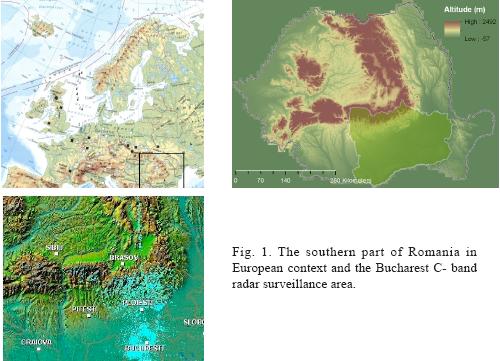
<body><![CDATA[<p align="justify"><font face="verdana" size="2">All hail events occurred during each year between 2001 and 2008 have been taken into account, irrespective of the place where those events have been noticed (320 cases in 142 localities). The 2001 &#45;2008 period was built from observational data recorded. For all observed cases, the Reflectivity, VIL, H<sub>max</sub> and HailP products have been constructed; for the latter one there were used in addition the upper air data concerning moisture, 500 hPa wind speed and height of the 0 &deg;C isotherm, from the database of the Aerology laboratory within the National Meteorological Administration.</font></p>  	    <p align="justify"><font face="verdana" size="2">In order to construct these products, second level radar data have been used, i.e. raw data that were corrected through processing after the acquisition. Corrections referred to the bright band and to the square of the distance from radar to target (Klaassen, 1988).</font></p>  	    <p align="justify"><font face="verdana" size="2">The present article considered that: (i) the reference time for the hail occurrence is the beginning moment, and the duration of the phenomenon is the one stated by the warning and (ii) the analyzed radar data have a 10&#45;min step, being those extracted from the raw data volume within the time interval of &plusmn; 20 minutes centered on the occurrence moment, as stated by the warning. It is well known that there are differences between the spatial resolution of the radar data (approximately 1 km) and the precision (sometimes of 1 or even 2 arcminutes, i.e. approximately 4 km) with which the weather stations are localized. It is also a fact that, because of the evolution and motion of the convective cells, hail may occur between two successive observations. Given these two evidences, the values of HailP, VIL and <i>H<sub>max</sub></i> have been analyzed for a reference station and within a circular area of 5 km in radius around it.</font></p>  	    <p align="justify"><font face="verdana" size="2">Regarding the data extracted from the Aladin model (<a href="http://www.cnrm.meteo.fr/aladin/" target="_blank">http://www.cnrm.meteo.fr/aladin/</a>), the parameters have been computed from the location where hail fell on the ground. In other words, the geographic coordinates were determined for each location where hail occurred and the Aladin model was used to produce, for those coordinates, the upper air moisture data (computed as a weighted average between the ground and the 500hPa levels, respectively), the wind speed at 500 hPa and the height of the 0 &deg;C isotherm.</font></p>  	    <p align="justify"><font face="verdana" size="2">There are limitations both concerning the radar observation and the warning message issued by the observer. The most frequent errors occur from the lack of precision in determining, from the warning message, the starting moment of hail falling and its duration. Many messages are incomplete regarding the items "phenomenon duration" and "beginning moment". The same can be said about the estimation of hail stone sizes. Due to the high technical performance of the existing sensing technology, no significant errors can be attributable to the equipment operation. Precision improvement in this last respect would require a measurement every 3 or 5 minutes at most (NOAA, 1991). With an observation every 10 minutes, there will be enough cases when the various stages of the hail process are placed between two successive samplings.</font></p> 	    <p align="justify"><font face="verdana" size="2">&nbsp;</font></p> 	    <p align="justify"><font face="verdana" size="2"><b>4. Results</b></font></p>  	    <p align="justify"><font face="verdana" size="2">Each case of hail occurrence at the weather stations within the area covered by the C band radar was considered (<a href="#f1">Fig. 1</a>). Also, as seen in <a href="#t1">Table I</a>, the frequency of the hail events is particularly variable. Moreover, it can be observed that the year 2001 yielded the highest number of hail events.</font></p> 	    <p align="center"><font face="verdana" size="2"><a name="f1"></a></font></p> 	    <p align="center"><font face="verdana" size="2"><img src="/img/revistas/atm/v24n4/a5f1.jpg"></font></p> 	    ]]></body>
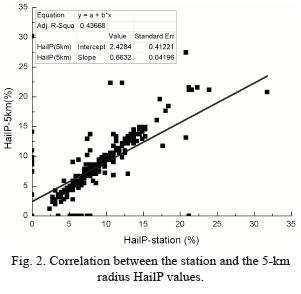
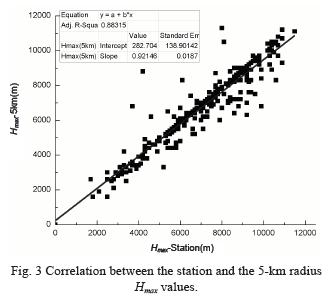
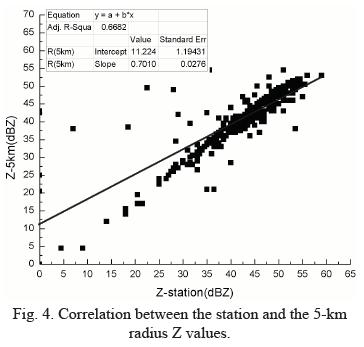
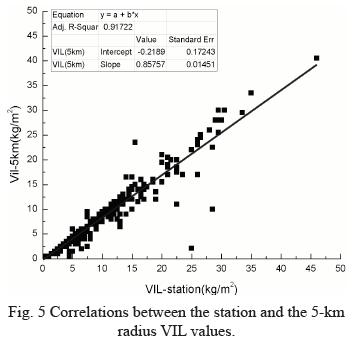
<body><![CDATA[<p align="center"><font face="verdana" size="2"><a name="t1"></a></font></p> 	    <p align="center"><font face="verdana" size="2"><img src="/img/revistas/atm/v24n4/a5t1.jpg"></font></p> 	    <p align="justify"><font face="verdana" size="2">The HailP, <i>H<sub>max</sub>,</i> VIL and Z radar products were computed for all the hail events observed at the 142 weather stations in order to determine criteria usable to estimate the hail events and the size of the hail stones. The radar products were also determined for a circular area of 5 km in radius around the considered hydrological stations, rain gauges and weather stations, for the situations when hail occurs between the stations and is not reported by the observers.</font></p> 	    <p align="justify"><font face="verdana" size="2">&nbsp;</font></p> 	    <p align="justify"><font face="verdana" size="2"><b>4.1 Correlation between values of products at the station and those within the 5 km&#45;area</b></font></p>  	    <p align="justify"><font face="verdana" size="2"><a href="#f2">Figures 2</a>, <a href="#f3">3</a>, <a href="#f4">4</a> and <a href="#f5">5</a> render the correlation between the HailP, <i>H<sub>max</sub>, Z</i> and VIL products, obtained for all the stations within the analyzed period and for the 5 km&#45;area around the stations. As regards the VIL product, the correlation coefficient for the station and the 5 km&#45;radius values exceeds 90%. The poorest correlation was obtained for the HailP product (44%).</font></p> 	    <p align="center"><font face="verdana" size="2"><a name="f2"></a></font></p> 	    <p align="center"><font face="verdana" size="2"><img src="/img/revistas/atm/v24n4/a5f2.jpg"></font></p> 	    <p align="center"><font face="verdana" size="2"><a name="f3"></a></font></p> 	    <p align="center"><font face="verdana" size="2"><img src="/img/revistas/atm/v24n4/a5f3.jpg"></font></p> 	    ]]></body>
<body><![CDATA[<p align="center"><font face="verdana" size="2"><a name="f4"></a></font></p> 	    <p align="center"><font face="verdana" size="2"><img src="/img/revistas/atm/v24n4/a5f4.jpg"></font></p> 	    <p align="center"><font face="verdana" size="2"><a name="f5"></a></font></p> 	    <p align="center"><font face="verdana" size="2"><img src="/img/revistas/atm/v24n4/a5f5.jpg"></font></p> 	    <p align="justify"><font face="verdana" size="2">The good correlation between the radar product values at the stations and within the surrounding areas, respectively, allows forecasting hail occurrence in those areas, by taking into account the radar product values, especially VIL.</font></p> 	    <p align="justify"><font face="verdana" size="2">&nbsp;</font></p> 	    <p align="justify"><font face="verdana" size="2"><b>4.2 Correlation between radar products and hail falling on the ground</b></font></p>  	    <p align="justify"><font face="verdana" size="2">The distribution of the hail events observed at the station and in the 5km&#45;area allowed us to infer criteria for estimating the chances of hail events through the values of radar products.</font></p>  	    <p align="justify"><font face="verdana" size="2">For the obtained HailP, <i>H<sub>max</sub></i> and VIL radar products, for both the stations and their surrounding areas and also for the height of the 0 &deg;C isotherm, the percent of the hail events was determined (<a href="#f6">Figs. 6</a>, <a href="#f7">7</a>, <a href="#f8">8</a> and <a href="#f9">9</a>). In the case of the HailP product, the most numerous cases of hail falling on the ground were reported in the 5&#45;10% probability interval. Figure 6 allows extracting a criterion for estimating the hail events, although the frequency of hail certified on the ground was very small. For values of the <i>H<sub>max</sub></i> (m), i.e. the height where the reflectivity is maximum, ranging from 7000 to 8000 m, the maximum observed value was 19%. The distribution of the hail events following the height of the maximum reflectivity is Gaussian, translated towards high values by 1000 m (<a href="#f7">Fig. 7</a>).</font></p> 	    <p align="center"><font face="verdana" size="2"><a name="f6"></a></font></p> 	    ]]></body>
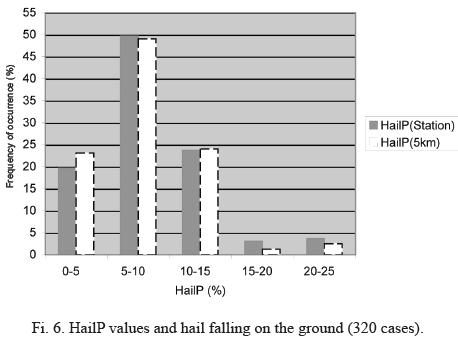
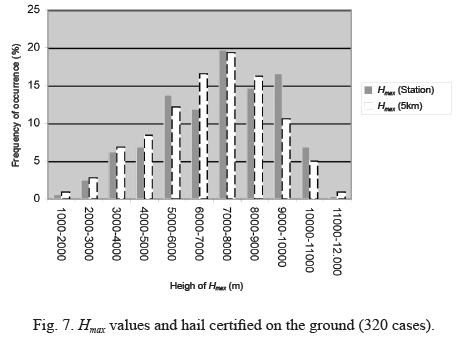
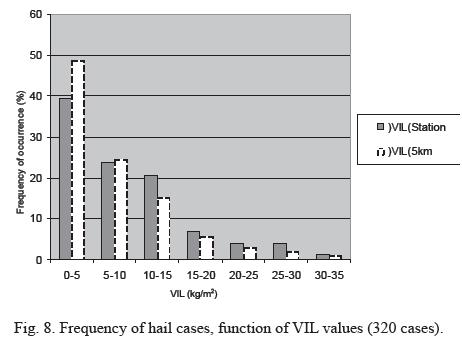
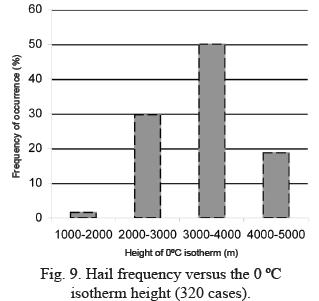
<body><![CDATA[<p align="center"><font face="verdana" size="2"><img src="/img/revistas/atm/v24n4/a5f6.jpg"></font></p> 	    <p align="center"><font face="verdana" size="2"><a name="f7"></a></font></p> 	    <p align="center"><font face="verdana" size="2"><img src="/img/revistas/atm/v24n4/a5f7.jpg"></font></p> 	    <p align="center"><font face="verdana" size="2"><a name="f8"></a></font></p> 	    <p align="center"><font face="verdana" size="2"><img src="/img/revistas/atm/v24n4/a5f8.jpg"></font></p> 	    <p align="center"><font face="verdana" size="2"><a name="f9"></a></font></p> 	    <p align="center"><font face="verdana" size="2"><img src="/img/revistas/atm/v24n4/a5f9.jpg"></font></p> 	    <p align="justify"><font face="verdana" size="2">Another criterion may be materialized through VIL. The highest percent of observed hail occurrences is 40 at the stations and 48 for the areas surrounding them for the VIL values in the range 0&#45;5 kg/m<sup>2</sup>. The percentage decrease of the hail events is exponential when the interval of the VIL values increases (<a href="#f8">Fig. 8</a>).</font></p>  	    <p align="justify"><font face="verdana" size="2">As regards the height of the 0 &deg;C isotherm, the importance of the 3000&#45;4000 m interval is noticeable, with a 50% of the observed hail events (<a href="#f9">Fig. 9</a>). </font></p>  	    <p align="center"><font face="verdana" size="2">&nbsp;</font></p>  	    ]]></body>
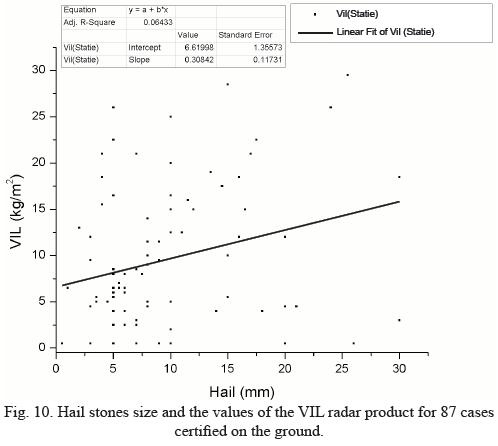
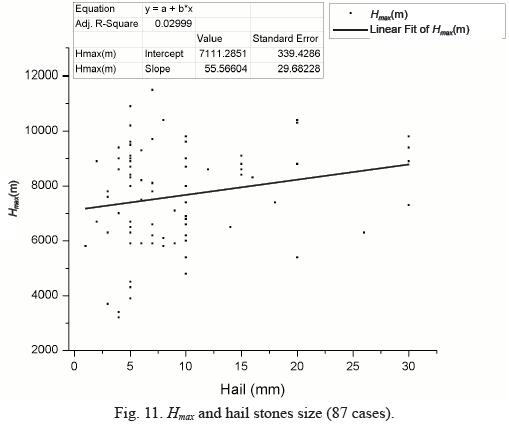
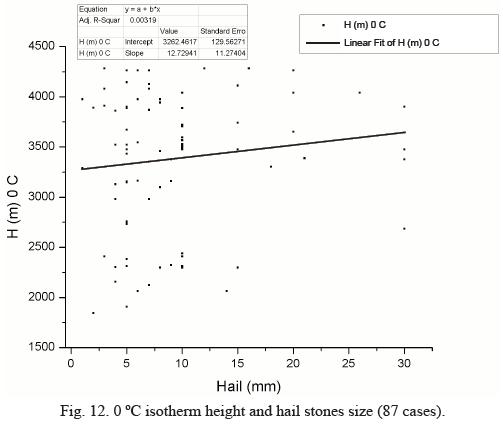
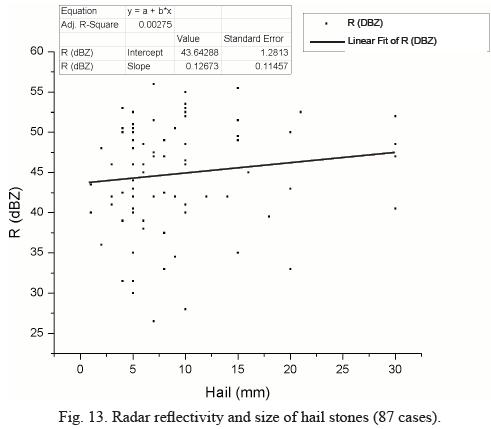
<body><![CDATA[<p align="justify"><font face="verdana" size="2"><b>4.3 Determination of criteria regarding hail stones sizes</b></font></p>  	    <p align="justify"><font face="verdana" size="2">In many cases with hail observed at the weather stations, the size of the hail stones reachs even 5 cm in diameter. For the forecasters it is interesting to know if the use of the radar products can estimate not only if hail should fall or not, but also the size it may have. <a href="#f10">Figs. 10</a>, <a href="#f11">11</a>, <a href="#f12">12</a> and <a href="#f13">13</a> show the connection between the sizes of the hail stones and the radar products to which the 0 &deg;C isotherm height is added. The study was based on 87 cases of hail certified on the ground.</font></p> 	    <p align="center"><font face="verdana" size="2"><a name="f10"></a></font></p> 	    <p align="center"><font face="verdana" size="2"><img src="/img/revistas/atm/v24n4/a5f10.jpg"></font></p> 	    <p align="center"><font face="verdana" size="2"><a name="f11"></a></font></p> 	    <p align="center"><font face="verdana" size="2"><img src="/img/revistas/atm/v24n4/a5f11.jpg"></font></p> 	    <p align="center"><font face="verdana" size="2"><a name="f12"></a></font></p> 	    <p align="center"><font face="verdana" size="2"><img src="/img/revistas/atm/v24n4/a5f12.jpg"></font></p> 	    <p align="center"><font face="verdana" size="2"><a name="f13"></a></font></p> 	    <p align="center"><font face="verdana" size="2"><img src="/img/revistas/atm/v24n4/a5f13.jpg"></font></p> 	    ]]></body>
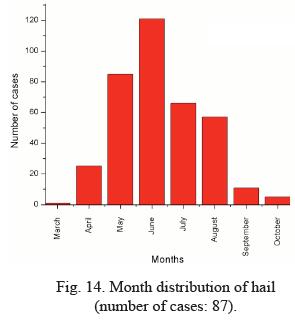
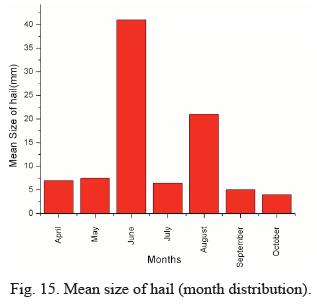
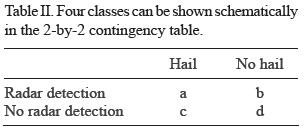
<body><![CDATA[<p align="justify"><font face="verdana" size="2">Unfortunately, the correlation between the size of the hail stones and the radar product is very poor (i. e. for VIL, <i>R =</i> 0.064). This proves that one single product is unable to estimate the hail stones size although it does show the total water amount. Radar reflectivity is the most important related parameter (<a href="#f13">Fig. 13</a>). The monthly distribution of hail is illustrated in Figure 14 and mean size of hail is illustrated in <a href="#f15">Figure 15</a>. Figures <a href="#f14">14</a> and <a href="#f15">15</a> show that in June occurs most of the cases of hail and the average size of the hail stones increases in June, too.</font></p> 	    <p align="center"><font face="verdana" size="2"><a name="f14"></a></font></p> 	    <p align="center"><font face="verdana" size="2"><img src="/img/revistas/atm/v24n4/a5f14.jpg"></font></p> 	    <p align="center"><font face="verdana" size="2"><a name="f15"></a></font></p> 	    <p align="center"><font face="verdana" size="2"><img src="/img/revistas/atm/v24n4/a5f15.jpg"></font></p> 	    <p align="justify"><font face="verdana" size="2">In the verification process, i.e., the comparison between the outcomes of the hail detection method and the verification data, the hail events will be classified using a 2&#45;by&#45;2 contingency table (<a href="#t2">Table II</a>). Hail detected by a radar&#45;based method which is confirmed by the verification data will be classifed as a hit (H), hail detected by a radar&#45;based method which is not confirmed by verification data as a false alarm (F), hail observations or reports in the verification data that are not detected by the radar&#45;based method as a miss (M), and no event at all as a non&#45;event (N). These four classes can be shown schematically in the 2&#45;by&#45;2 contingency table:</font></p> 	    <p align="center"><font face="verdana" size="2"><a name="t2" id="t2"></a></font></p> 	    <p align="center"><font face="verdana" size="2"><img src="/img/revistas/atm/v24n4/a5t2.jpg"></font></p> 	    <p align="justify"><font face="verdana" size="2">The Probability of Detection (POD), the False Alarm Ratio (FAR), the Critical Success Index (CSI), and the bias are defined as:</font></p>  	    <p align="justify"><font face="verdana" size="2">The probability of detection and the false alarm ratio always have to be used together to characterize the result of a verification, where the method with a high POD and a low FAR is preferred, while the critical success index characterizes the verification result in a single number, where the method with the highest CSI is preferred. The bias is the ratio between the number of detections or forecasts and the number of actual occurrences. A method that detects or predicts events with a too high (low) frequency has a bias greater (smaller) than one, and a method with a bias of one has no bias. The POD, FAR, and/or CSI are often used to characterize the performance of hail detection methods. A more elaborate discussion on the behavior of these and other verification scores can be found elsewhere (Doswell <i>etal.,</i> 1990; Kok, 2000).</font></p>  	    ]]></body>
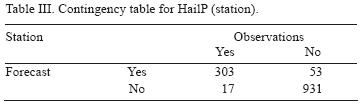
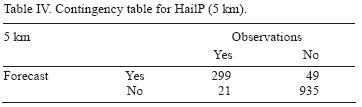
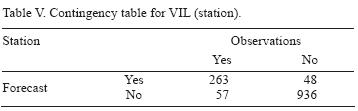
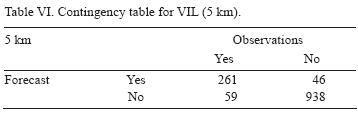
<body><![CDATA[<p align="justify"><font face="verdana" size="2">The following data were obtained for HailP (<a href="#t3">Table III</a> and <a href="#t4">Table IV</a>): POD = 0.9468(st); POD = 0.9469(5 km); FAR = 0.1501(st); FAR= 0.1408(5 km); Bias = 1.11(st); Bias =1.08(5 km); CSI = 0.8123(st); CSI = 0.8102(5 km).</font></p>  	    <p align="justify"><font face="verdana" size="2">The following data were obtained for VIL (<a href="#t5">Table V</a> and <a href="#t6">Table VI</a>): POD = 0.8218(st); POD = 0.8156(5 km); FAR = 0.1543(st); FAR = 0.1498 (5 km); Bias = 0.9718 (st); Bias = 0.9593 (5 km); CSI = 0.7146(st); CSI = 0.7131(5 km).</font></p> 	    <p align="center"><font face="verdana" size="2"><a name="t3" id="t3"></a></font></p> 	    <p align="center"><font face="verdana" size="2"><img src="/img/revistas/atm/v24n4/a5t3.jpg"></font></p> 	    <p align="center"><font face="verdana" size="2"><a name="t4" id="t4"></a></font></p> 	    <p align="center"><font face="verdana" size="2"><img src="/img/revistas/atm/v24n4/a5t4.jpg"></font></p> 	    <p align="center"><font face="verdana" size="2"><a name="t5" id="t5"></a></font></p> 	    <p align="center"><font face="verdana" size="2"><img src="/img/revistas/atm/v24n4/a5t5.jpg"></font></p> 	    <p align="center"><font face="verdana" size="2"><a name="t6" id="t6"></a></font></p> 	    <p align="center"><font face="verdana" size="2"><img src="/img/revistas/atm/v24n4/a5t6.jpg"></font></p> 	    ]]></body>
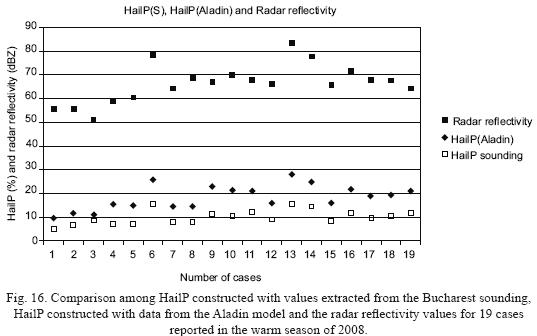
<body><![CDATA[<p>&nbsp;</p> 	    <p><font face="verdana" size="2"><b>4.4 HailP computed from radiosounding data sampled at Bucharest and from the Aladin model</b></font></p> 	    <p align="justify"><font face="verdana" size="2">The probability that hail forms and falls on the ground, HailP, was computed in two ways, using data from the Aladin model and data from the Bucharest vertical sounding, for the occurrences of the 2008 summer (19 cases). Such intercomparison allows validating the HailP product (<a href="#f16">Fig. 16</a>).</font></p> 	    <p align="center"><font face="verdana" size="2"><a name="f16"></a></font></p> 	    <p align="center"><font face="verdana" size="2"><img src="/img/revistas/atm/v24n4/a5f16.jpg"></font></p> 	    <p align="justify"><font face="verdana" size="2">A rather good correlation is noticed in principle between the two ways of computing the hail probability (HailP). However, the scarcity of the number of cases (19) for which the comparison was performed must not be disregarded. It can also be noticed that the radar reflectivity values are those that drive the behaviour of the HailP product, irrespective of how this one is computed.</font></p>  	    <p align="center"><font face="verdana" size="2">&nbsp;</font></p>  	    <p align="justify"><font face="verdana" size="2"><b>5. Conclusions</b></font></p>  	    <p align="justify"><font face="verdana" size="2">The study spans over an 8&#45;year period and the total number of situations with hail certified on the ground is 320 cases. Results and conclusions are therefore preliminary and the study will further be elaborated thoroughly, as the data series becomes longer.</font></p>  	    <p align="justify"><font face="verdana" size="2">Results obtained both at the station and in the 5 km&#45;area allow the use with a fair amount of certitude of the values for HailP, <i>H<sub>max</sub>,</i> VIL and Reflectivity for forecasting hail occurrence in any of the two areas.</font></p>  	    ]]></body>
<body><![CDATA[<p align="justify"><font face="verdana" size="2"><i>For H<sub>max</sub></i> values ranging from 7000 to 8000 m, there are around 20% hail events (at the stations), whereas for <i>H<sub>max</sub></i> ranging from 6000 to 9000 m, there are 46.23% events (at the stations) and 52.18% (in the 5 km&#45;area).</font></p>  	    <p align="justify"><font face="verdana" size="2">For values of the height of the 0 &deg;C isotherm ranging within 3000&#45;4000 m, there are 50% hail events certified on the ground.</font></p>  	    <p align="justify"><font face="verdana" size="2">A 5% threshold for HailP can be considered as a cautious threshold by the forecaster. HailP values ranging in the interval 5&#45;15% cover 73.43% of the total hail events. VIL values ranging within 0&#45;5kg/m<sup>2</sup> certify a 39.55% hail presence on the ground. For higher values of the VIL product, a percentage decrease of the hail events is noticed.</font></p>  	    <p align="justify"><font face="verdana" size="2">Regarding the comparison between the HailP values obtained by using the necessary parameters both from the Bucharest vertical sounding and those extracted from the Aladin model, a good correlation is observed, in principle, between the two ways of computing the hail probability. However, further research will be completed in order to performe this comparison on an increased number of cases.</font></p> 	    <p align="justify"><font face="verdana" size="2">&nbsp;</font></p> 	    <p align="justify"><font face="verdana" size="2"><b>References</b></font></p>  	    <!-- ref --><p align="justify"><font face="verdana" size="2">Aladin, 2008. Aire Limitee Adaptation Dynamique Developpement InterNational: <a href="http://www.cnrm.meteo.fr/aladin/" target="_blank">http://www.cnrm.meteo.fr/aladin/</a>, 03.10.2008.    &nbsp;&nbsp;&nbsp;&nbsp;&nbsp;&nbsp;&nbsp;&nbsp;[&#160;<a href="javascript:void(0);" onclick="javascript: window.open('/scielo.php?script=sci_nlinks&ref=1283550&pid=S0187-6236201100040000500001&lng=','','width=640,height=500,resizable=yes,scrollbars=1,menubar=yes,');">Links</a>&#160;]<!-- end-ref --></font></p>  	    <!-- ref --><p align="justify"><font face="verdana" size="2">Amburn S. A. and P. L. Wolf, 1997. VIL density as a hail indicator. <i>Weather Forecast.</i> <b>12</b>, 473&#45;478.    &nbsp;&nbsp;&nbsp;&nbsp;&nbsp;&nbsp;&nbsp;&nbsp;[&#160;<a href="javascript:void(0);" onclick="javascript: window.open('/scielo.php?script=sci_nlinks&ref=1283552&pid=S0187-6236201100040000500002&lng=','','width=640,height=500,resizable=yes,scrollbars=1,menubar=yes,');">Links</a>&#160;]<!-- end-ref --></font></p>  	    ]]></body>
<body><![CDATA[<!-- ref --><p align="justify"><font face="verdana" size="2">Ananova L. G., V. P. Gorbatenko and I. A. Lukovskaya, 2007. Radar characteristics of convective clouds during squalls in the southeastern part of western Siberia. <i>Russ. Meteorol. Hydrol.</i> <b>32</b>, 449&#45;452.    &nbsp;&nbsp;&nbsp;&nbsp;&nbsp;&nbsp;&nbsp;&nbsp;[&#160;<a href="javascript:void(0);" onclick="javascript: window.open('/scielo.php?script=sci_nlinks&ref=1283554&pid=S0187-6236201100040000500003&lng=','','width=640,height=500,resizable=yes,scrollbars=1,menubar=yes,');">Links</a>&#160;]<!-- end-ref --></font></p>  	    <!-- ref --><p align="justify"><font face="verdana" size="2">Antonescu B., C. Oprea, A.Tanase and A. Stan&#45;Sion, 2006. A forecasting and monitoring method for convective events in Romania. Proceedings of the Fourth European Conference on Radar in Meteorology and Hidrology, Barcelona, Spain, 18&#45;22.    &nbsp;&nbsp;&nbsp;&nbsp;&nbsp;&nbsp;&nbsp;&nbsp;[&#160;<a href="javascript:void(0);" onclick="javascript: window.open('/scielo.php?script=sci_nlinks&ref=1283556&pid=S0187-6236201100040000500004&lng=','','width=640,height=500,resizable=yes,scrollbars=1,menubar=yes,');">Links</a>&#160;]<!-- end-ref --></font></p>  	    <!-- ref --><p align="justify"><font face="verdana" size="2">Atlas D., D. Rosenfeld and D. Short, 1990. The estimation of convective rainfall by area integrals 1. The theoretical and empirical basis. <i>J. Geophys. Res.</i> <b>95</b>(D3), 2153&#45;2160.    &nbsp;&nbsp;&nbsp;&nbsp;&nbsp;&nbsp;&nbsp;&nbsp;[&#160;<a href="javascript:void(0);" onclick="javascript: window.open('/scielo.php?script=sci_nlinks&ref=1283558&pid=S0187-6236201100040000500005&lng=','','width=640,height=500,resizable=yes,scrollbars=1,menubar=yes,');">Links</a>&#160;]<!-- end-ref --></font></p>  	    <!-- ref --><p align="justify"><font face="verdana" size="2">Auer Jr., A. H., 1994. Hail recognition through the combined use of radar reflectivity and cloud&#45;top temperatures. <i>Mon. Wea. Rev.</i> <b>122</b>, 2218&#45;2221.    &nbsp;&nbsp;&nbsp;&nbsp;&nbsp;&nbsp;&nbsp;&nbsp;[&#160;<a href="javascript:void(0);" onclick="javascript: window.open('/scielo.php?script=sci_nlinks&ref=1283560&pid=S0187-6236201100040000500006&lng=','','width=640,height=500,resizable=yes,scrollbars=1,menubar=yes,');">Links</a>&#160;]<!-- end-ref --></font></p>  	    <!-- ref --><p align="justify"><font face="verdana" size="2">Balakrishan N. and D. S. Zrnic, 1989. Estimation of rain and hail rates in mixed phase precipitation. <i>J. </i><i>Atmos. Sci.</i> <b>47</b>, 565&#45;583.    &nbsp;&nbsp;&nbsp;&nbsp;&nbsp;&nbsp;&nbsp;&nbsp;[&#160;<a href="javascript:void(0);" onclick="javascript: window.open('/scielo.php?script=sci_nlinks&ref=1283562&pid=S0187-6236201100040000500007&lng=','','width=640,height=500,resizable=yes,scrollbars=1,menubar=yes,');">Links</a>&#160;]<!-- end-ref --></font></p>  	    ]]></body>
<body><![CDATA[<!-- ref --><p align="justify"><font face="verdana" size="2">Billet J., M. DeLisi and B. G. Smith, 1997. Use of regression techniques to predict hail size and the probability of large hail. <i>Weather Forecast.</i> <b>12</b>, 154&#45;164.    &nbsp;&nbsp;&nbsp;&nbsp;&nbsp;&nbsp;&nbsp;&nbsp;[&#160;<a href="javascript:void(0);" onclick="javascript: window.open('/scielo.php?script=sci_nlinks&ref=1283564&pid=S0187-6236201100040000500008&lng=','','width=640,height=500,resizable=yes,scrollbars=1,menubar=yes,');">Links</a>&#160;]<!-- end-ref --></font></p>  	    <!-- ref --><p align="justify"><font face="verdana" size="2">Bordei Ion N., 2008. Meteoclimate phenomena induced by the Carpathians mountains configurations in the Romanian Plain (in Romanian), Romanian Academy, 238 pp.    &nbsp;&nbsp;&nbsp;&nbsp;&nbsp;&nbsp;&nbsp;&nbsp;[&#160;<a href="javascript:void(0);" onclick="javascript: window.open('/scielo.php?script=sci_nlinks&ref=1283566&pid=S0187-6236201100040000500009&lng=','','width=640,height=500,resizable=yes,scrollbars=1,menubar=yes,');">Links</a>&#160;]<!-- end-ref --></font></p>  	    <!-- ref --><p align="justify"><font face="verdana" size="2">Boudevillain B. and H. Andrieu, 2003. Assessment of Vertically Integrated Liquid (VIL) water content radar measurement. <i>J. Atmos. Oceanic Technol.</i> <b>12</b>, 404&#45;409.    &nbsp;&nbsp;&nbsp;&nbsp;&nbsp;&nbsp;&nbsp;&nbsp;[&#160;<a href="javascript:void(0);" onclick="javascript: window.open('/scielo.php?script=sci_nlinks&ref=1283568&pid=S0187-6236201100040000500010&lng=','','width=640,height=500,resizable=yes,scrollbars=1,menubar=yes,');">Links</a>&#160;]<!-- end-ref --></font></p>  	    <!-- ref --><p align="justify"><font face="verdana" size="2">Delobbe L., D. Dehenauw, K. Hamid and J. Nem&eacute;ghaire, 2003. Hail detection using radar observations: case studies in the summer 2002. Scientific report N. 29. Royal Meteorological Institute of Belgium, Brussels.    &nbsp;&nbsp;&nbsp;&nbsp;&nbsp;&nbsp;&nbsp;&nbsp;[&#160;<a href="javascript:void(0);" onclick="javascript: window.open('/scielo.php?script=sci_nlinks&ref=1283570&pid=S0187-6236201100040000500011&lng=','','width=640,height=500,resizable=yes,scrollbars=1,menubar=yes,');">Links</a>&#160;]<!-- end-ref --></font></p>  	    <!-- ref --><p align="justify"><font face="verdana" size="2">Edwards R. and R. L. Thompson, 1997. Nationwide comparisons of hail size with WSR&#45;88D vertically integrated liquid water and derived thermodynamic sounding data. <i>Weather Forecast.</i> <b>13</b>,277&#45;285.    &nbsp;&nbsp;&nbsp;&nbsp;&nbsp;&nbsp;&nbsp;&nbsp;[&#160;<a href="javascript:void(0);" onclick="javascript: window.open('/scielo.php?script=sci_nlinks&ref=1283572&pid=S0187-6236201100040000500012&lng=','','width=640,height=500,resizable=yes,scrollbars=1,menubar=yes,');">Links</a>&#160;]<!-- end-ref --></font></p>  	    ]]></body>
<body><![CDATA[<!-- ref --><p align="justify"><font face="verdana" size="2">Emanuel, K.A., 1994. Atmospheric convection, Oxford University press, 230&#45;270.    &nbsp;&nbsp;&nbsp;&nbsp;&nbsp;&nbsp;&nbsp;&nbsp;[&#160;<a href="javascript:void(0);" onclick="javascript: window.open('/scielo.php?script=sci_nlinks&ref=1283574&pid=S0187-6236201100040000500013&lng=','','width=640,height=500,resizable=yes,scrollbars=1,menubar=yes,');">Links</a>&#160;]<!-- end-ref --></font></p>  	    <!-- ref --><p align="justify"><font face="verdana" size="2">Foote G. B. and C. A. Knight, 1979. Results of a randomized hail suppression experiment in northeast Colorado. Part I: Design and conduct of the experiment. <i>J. Appl.Meteor.</i> <b>18</b>, 1526&#45;1537.    &nbsp;&nbsp;&nbsp;&nbsp;&nbsp;&nbsp;&nbsp;&nbsp;[&#160;<a href="javascript:void(0);" onclick="javascript: window.open('/scielo.php?script=sci_nlinks&ref=1283576&pid=S0187-6236201100040000500014&lng=','','width=640,height=500,resizable=yes,scrollbars=1,menubar=yes,');">Links</a>&#160;]<!-- end-ref --></font></p>  	    <!-- ref --><p align="justify"><font face="verdana" size="2">Greene D. R. and R. A. Clark, 1972. Vertically integrated liquid water &#45;Anew analysis tool. <i>Mon. Wea. Rev.</i> <b>100</b>, 548&#45;552.    &nbsp;&nbsp;&nbsp;&nbsp;&nbsp;&nbsp;&nbsp;&nbsp;[&#160;<a href="javascript:void(0);" onclick="javascript: window.open('/scielo.php?script=sci_nlinks&ref=1283578&pid=S0187-6236201100040000500015&lng=','','width=640,height=500,resizable=yes,scrollbars=1,menubar=yes,');">Links</a>&#160;]<!-- end-ref --></font></p>  	    <!-- ref --><p align="justify"><font face="verdana" size="2">Hohl, R., H. H. Schiesser, and D. Aller, 2001. Hailfall: The relationship between hail kinetic energy and hail damage to buildings. Atmosferic Research. Submitted October 2001.    &nbsp;&nbsp;&nbsp;&nbsp;&nbsp;&nbsp;&nbsp;&nbsp;[&#160;<a href="javascript:void(0);" onclick="javascript: window.open('/scielo.php?script=sci_nlinks&ref=1283580&pid=S0187-6236201100040000500016&lng=','','width=640,height=500,resizable=yes,scrollbars=1,menubar=yes,');">Links</a>&#160;]<!-- end-ref --></font></p>  	    <!-- ref --><p align="justify"><font face="verdana" size="2">Holleman I., H. R. A. Wessels, J. R. A. Onvlee and S. J. M. Barlag, 2000. Development of a Hail&#45;Detection&#45;Product. <i>Phys. Chem. Earth (B)</i> <b>25</b>, 1293&#45;1297.    &nbsp;&nbsp;&nbsp;&nbsp;&nbsp;&nbsp;&nbsp;&nbsp;[&#160;<a href="javascript:void(0);" onclick="javascript: window.open('/scielo.php?script=sci_nlinks&ref=1283582&pid=S0187-6236201100040000500017&lng=','','width=640,height=500,resizable=yes,scrollbars=1,menubar=yes,');">Links</a>&#160;]<!-- end-ref --></font></p>  	    ]]></body>
<body><![CDATA[<!-- ref --><p align="justify"><font face="verdana" size="2">Holleman I., 2001. Hail detection using single&#45;polarization radar. Royal Netherlands Meteorological Institute (KNMI), De Bilt, The Netherlands. Scientific Report, KNMI WR&#45;2001&#45;01, 70 pp.    &nbsp;&nbsp;&nbsp;&nbsp;&nbsp;&nbsp;&nbsp;&nbsp;[&#160;<a href="javascript:void(0);" onclick="javascript: window.open('/scielo.php?script=sci_nlinks&ref=1283584&pid=S0187-6236201100040000500018&lng=','','width=640,height=500,resizable=yes,scrollbars=1,menubar=yes,');">Links</a>&#160;]<!-- end-ref --></font></p>  	    <!-- ref --><p align="justify"><font face="verdana" size="2">Ioana M., V. Ivanovici, E. Cordoneanu, D. Banciu, A. Apostu and B. Ford, 2004. SIMIN&#45; the integrated system for meteorological surveillance, forecast and alert in Romania. 20th International Conference on Interactive Information and Processing Sysems (IIPS) for Meteorology, Oceanography and Hydrology.    &nbsp;&nbsp;&nbsp;&nbsp;&nbsp;&nbsp;&nbsp;&nbsp;[&#160;<a href="javascript:void(0);" onclick="javascript: window.open('/scielo.php?script=sci_nlinks&ref=1283586&pid=S0187-6236201100040000500019&lng=','','width=640,height=500,resizable=yes,scrollbars=1,menubar=yes,');">Links</a>&#160;]<!-- end-ref --></font></p>  	    <!-- ref --><p align="justify"><font face="verdana" size="2">Kessinger C. J., E. A. Brandes and J. W. Smith, 1995. A comparison of the nexrad and nssl hail detection algorithms. 27th Conference on Radar Meteorology, AMS,Vail, CO, USA, 603&#45;605.    &nbsp;&nbsp;&nbsp;&nbsp;&nbsp;&nbsp;&nbsp;&nbsp;[&#160;<a href="javascript:void(0);" onclick="javascript: window.open('/scielo.php?script=sci_nlinks&ref=1283588&pid=S0187-6236201100040000500020&lng=','','width=640,height=500,resizable=yes,scrollbars=1,menubar=yes,');">Links</a>&#160;]<!-- end-ref --></font></p>  	    <!-- ref --><p align="justify"><font face="verdana" size="2">Klaassen W., 1988. Radar observations and simulation of the melting layer of precipitation. <i>J. Atmos. Sci.</i> <b>45</b>, 3741&#45;3753.    &nbsp;&nbsp;&nbsp;&nbsp;&nbsp;&nbsp;&nbsp;&nbsp;[&#160;<a href="javascript:void(0);" onclick="javascript: window.open('/scielo.php?script=sci_nlinks&ref=1283590&pid=S0187-6236201100040000500021&lng=','','width=640,height=500,resizable=yes,scrollbars=1,menubar=yes,');">Links</a>&#160;]<!-- end-ref --></font></p>  	    <!-- ref --><p align="justify"><font face="verdana" size="2">Lemon L. R.,1978. On the use of storm structure for hail identification. Preprints, 18th Conference on Radar Meteorology, Atlanta, GA, Amer. Meteor. Soc. 203&#45;206.    &nbsp;&nbsp;&nbsp;&nbsp;&nbsp;&nbsp;&nbsp;&nbsp;[&#160;<a href="javascript:void(0);" onclick="javascript: window.open('/scielo.php?script=sci_nlinks&ref=1283592&pid=S0187-6236201100040000500022&lng=','','width=640,height=500,resizable=yes,scrollbars=1,menubar=yes,');">Links</a>&#160;]<!-- end-ref --></font></p>  	    ]]></body>
<body><![CDATA[<!-- ref --><p align="justify"><font face="verdana" size="2">Lemon L. R., 1998. The radar "Three&#45;Body Scatter Spike": An operational large&#45;hail signature. <i>Weather Forecast.</i> <b>13</b>, 327&#45;340.    &nbsp;&nbsp;&nbsp;&nbsp;&nbsp;&nbsp;&nbsp;&nbsp;[&#160;<a href="javascript:void(0);" onclick="javascript: window.open('/scielo.php?script=sci_nlinks&ref=1283594&pid=S0187-6236201100040000500023&lng=','','width=640,height=500,resizable=yes,scrollbars=1,menubar=yes,');">Links</a>&#160;]<!-- end-ref --></font></p>  	    <!-- ref --><p align="justify"><font face="verdana" size="2">Lenning E. and H. E. Fuelberg, 1998. An evaluation of WSR&#45;88D severe hail algorithms along the Northeastern Gulf Coast. <i>Weather Forecast.</i> 13, 1029&#45;1045.    &nbsp;&nbsp;&nbsp;&nbsp;&nbsp;&nbsp;&nbsp;&nbsp;[&#160;<a href="javascript:void(0);" onclick="javascript: window.open('/scielo.php?script=sci_nlinks&ref=1283596&pid=S0187-6236201100040000500024&lng=','','width=640,height=500,resizable=yes,scrollbars=1,menubar=yes,');">Links</a>&#160;]<!-- end-ref --></font></p>  	    <!-- ref --><p align="justify"><font face="verdana" size="2">Mather G. K., D. Treddenick and R. Parsons, 1976. An observed relationship between the height of the 45 dBz contours in storm profiles and surface hail reports, <i>J. Appl. Meteor.</i> <b>15</b>, 1336&#45;1340.    &nbsp;&nbsp;&nbsp;&nbsp;&nbsp;&nbsp;&nbsp;&nbsp;[&#160;<a href="javascript:void(0);" onclick="javascript: window.open('/scielo.php?script=sci_nlinks&ref=1283598&pid=S0187-6236201100040000500025&lng=','','width=640,height=500,resizable=yes,scrollbars=1,menubar=yes,');">Links</a>&#160;]<!-- end-ref --></font></p>  	    <!-- ref --><p align="justify"><font face="verdana" size="2">Mervin H., F. Hey and P. R.Waylen, 1987. Probabilities of daily hail and thunder occurrences, <i>J. Appl. Meteor.</i> <b>26</b>, 1014&#45;1020.    &nbsp;&nbsp;&nbsp;&nbsp;&nbsp;&nbsp;&nbsp;&nbsp;[&#160;<a href="javascript:void(0);" onclick="javascript: window.open('/scielo.php?script=sci_nlinks&ref=1283600&pid=S0187-6236201100040000500026&lng=','','width=640,height=500,resizable=yes,scrollbars=1,menubar=yes,');">Links</a>&#160;]<!-- end-ref --></font></p>  	    <!-- ref --><p align="justify"><font face="verdana" size="2">NOAA, 1991. Doppler Radar Meteorological Observations. Federal Meteorological Handbook no. 11, National Oceanic and Atmospheric Administration. Washington D. C., 125 pp.    &nbsp;&nbsp;&nbsp;&nbsp;&nbsp;&nbsp;&nbsp;&nbsp;[&#160;<a href="javascript:void(0);" onclick="javascript: window.open('/scielo.php?script=sci_nlinks&ref=1283602&pid=S0187-6236201100040000500027&lng=','','width=640,height=500,resizable=yes,scrollbars=1,menubar=yes,');">Links</a>&#160;]<!-- end-ref --></font></p>  	    ]]></body>
<body><![CDATA[<!-- ref --><p align="justify"><font face="verdana" size="2">Pop Gh., 1964. <i>Climatology</i> (In Romanian), Didactic and Pedagogical Printing House, Bucharest, 114&#45;122.    &nbsp;&nbsp;&nbsp;&nbsp;&nbsp;&nbsp;&nbsp;&nbsp;[&#160;<a href="javascript:void(0);" onclick="javascript: window.open('/scielo.php?script=sci_nlinks&ref=1283604&pid=S0187-6236201100040000500028&lng=','','width=640,height=500,resizable=yes,scrollbars=1,menubar=yes,');">Links</a>&#160;]<!-- end-ref --></font></p>  	    <!-- ref --><p align="justify"><font face="verdana" size="2">Pruppacher H. R. and J. D. Klett, 1997. <i>Microstructure of atmospheric clouds and precipitation.</i> Kluwer Academic Publishers, Netherlands 954 pp.    &nbsp;&nbsp;&nbsp;&nbsp;&nbsp;&nbsp;&nbsp;&nbsp;[&#160;<a href="javascript:void(0);" onclick="javascript: window.open('/scielo.php?script=sci_nlinks&ref=1283606&pid=S0187-6236201100040000500029&lng=','','width=640,height=500,resizable=yes,scrollbars=1,menubar=yes,');">Links</a>&#160;]<!-- end-ref --></font></p>  	    <!-- ref --><p align="justify"><font face="verdana" size="2">Rinehart R. E., 1978. On the use of ground return targets for radar reflectivity factor calibration checks. <i>J. Appl. Meteor.</i> <b>17</b>, 1342&#45;1350.    &nbsp;&nbsp;&nbsp;&nbsp;&nbsp;&nbsp;&nbsp;&nbsp;[&#160;<a href="javascript:void(0);" onclick="javascript: window.open('/scielo.php?script=sci_nlinks&ref=1283608&pid=S0187-6236201100040000500030&lng=','','width=640,height=500,resizable=yes,scrollbars=1,menubar=yes,');">Links</a>&#160;]<!-- end-ref --></font></p>  	    <!-- ref --><p align="justify"><font face="verdana" size="2">Roeseler C. A. and L. Wood, 1997. VIL density and associated hail size along the northwest Gulf coast. Preprints, 28th Conference on Radar Meteorology. American Meteorological Society. Austin, TX, 434&#45;435.    &nbsp;&nbsp;&nbsp;&nbsp;&nbsp;&nbsp;&nbsp;&nbsp;[&#160;<a href="javascript:void(0);" onclick="javascript: window.open('/scielo.php?script=sci_nlinks&ref=1283610&pid=S0187-6236201100040000500031&lng=','','width=640,height=500,resizable=yes,scrollbars=1,menubar=yes,');">Links</a>&#160;]<!-- end-ref --></font></p>  	    <!-- ref --><p align="justify"><font face="verdana" size="2">S&aacute;nchez J. L., R. Fraile, J. L. de la Madrid, M. T. de la Fuente, P. Rodr&iacute;guez and A. Castro, 1995. Crop damage: The hail size factor. <i>J. Appl. Meteor.</i> <b>35</b>, 1535&#45;1541.    &nbsp;&nbsp;&nbsp;&nbsp;&nbsp;&nbsp;&nbsp;&nbsp;[&#160;<a href="javascript:void(0);" onclick="javascript: window.open('/scielo.php?script=sci_nlinks&ref=1283612&pid=S0187-6236201100040000500032&lng=','','width=640,height=500,resizable=yes,scrollbars=1,menubar=yes,');">Links</a>&#160;]<!-- end-ref --></font></p>  	    ]]></body>
<body><![CDATA[<!-- ref --><p align="justify"><font face="verdana" size="2">Tuomi T. J. and A. M&auml;kel&auml;, 2008. Flash cells in thunderstorms. In: <i>Lightning: principles, instruments and applications.</i> (H. D. Betz, U. Scumann and P. Laroche, Eds.). Springer, Netherlands, 508&#45;520.    &nbsp;&nbsp;&nbsp;&nbsp;&nbsp;&nbsp;&nbsp;&nbsp;[&#160;<a href="javascript:void(0);" onclick="javascript: window.open('/scielo.php?script=sci_nlinks&ref=1283614&pid=S0187-6236201100040000500033&lng=','','width=640,height=500,resizable=yes,scrollbars=1,menubar=yes,');">Links</a>&#160;]<!-- end-ref --></font></p>  	    <!-- ref --><p align="justify"><font face="verdana" size="2">Waldvogel Federer A. B. and P. Grimm, 1979. Criteria for the detection of hail cells. <i>J. Appl. Meteor.<b>18</b>,</i> 1521&#45;1525.    &nbsp;&nbsp;&nbsp;&nbsp;&nbsp;&nbsp;&nbsp;&nbsp;[&#160;<a href="javascript:void(0);" onclick="javascript: window.open('/scielo.php?script=sci_nlinks&ref=1283616&pid=S0187-6236201100040000500034&lng=','','width=640,height=500,resizable=yes,scrollbars=1,menubar=yes,');">Links</a>&#160;]<!-- end-ref --></font></p>  	    <!-- ref --><p align="justify"><font face="verdana" size="2">Witt A., M. D. Eilts, G. J. Stumpf, J. T. Johnson, E. De Wayne Mitchell and K. W. Thomas, 1998. An enhanced hail detection algorithm for the WSR&#45;88D. <i>Weather Forecast.</i> <b>13</b>, 286&#45;303.    &nbsp;&nbsp;&nbsp;&nbsp;&nbsp;&nbsp;&nbsp;&nbsp;[&#160;<a href="javascript:void(0);" onclick="javascript: window.open('/scielo.php?script=sci_nlinks&ref=1283618&pid=S0187-6236201100040000500035&lng=','','width=640,height=500,resizable=yes,scrollbars=1,menubar=yes,');">Links</a>&#160;]<!-- end-ref --></font></p>      ]]></body><back>
<ref-list>
<ref id="B1">
<nlm-citation citation-type="">
<person-group person-group-type="author">
<name>
<surname><![CDATA[Aladin]]></surname>
</name>
</person-group>
<source><![CDATA[Aire Limitee Adaptation Dynamique Developpement InterNational]]></source>
<year>2008</year>
</nlm-citation>
</ref>
<ref id="B2">
<nlm-citation citation-type="journal">
<person-group person-group-type="author">
<name>
<surname><![CDATA[Amburn]]></surname>
<given-names><![CDATA[S. A.]]></given-names>
</name>
<name>
<surname><![CDATA[Wolf]]></surname>
<given-names><![CDATA[P. L.]]></given-names>
</name>
</person-group>
<article-title xml:lang="en"><![CDATA[VIL density as a hail indicator]]></article-title>
<source><![CDATA[Weather Forecast]]></source>
<year>1997</year>
<volume>12</volume>
<page-range>473-478</page-range></nlm-citation>
</ref>
<ref id="B3">
<nlm-citation citation-type="journal">
<person-group person-group-type="author">
<name>
<surname><![CDATA[Ananova]]></surname>
<given-names><![CDATA[L. G.]]></given-names>
</name>
<name>
<surname><![CDATA[Gorbatenko]]></surname>
<given-names><![CDATA[V. P.]]></given-names>
</name>
<name>
<surname><![CDATA[Lukovskaya]]></surname>
<given-names><![CDATA[I. A.]]></given-names>
</name>
</person-group>
<source><![CDATA[Russ. Meteorol. Hydrol.]]></source>
<year>2007</year>
<volume>32</volume>
<page-range>449-452</page-range></nlm-citation>
</ref>
<ref id="B4">
<nlm-citation citation-type="confpro">
<person-group person-group-type="author">
<name>
<surname><![CDATA[Antonescu]]></surname>
<given-names><![CDATA[B.]]></given-names>
</name>
<name>
<surname><![CDATA[Oprea]]></surname>
<given-names><![CDATA[C.]]></given-names>
</name>
<name>
<surname><![CDATA[Tanase]]></surname>
<given-names><![CDATA[A.]]></given-names>
</name>
<name>
<surname><![CDATA[Stan-Sion]]></surname>
<given-names><![CDATA[A.]]></given-names>
</name>
</person-group>
<source><![CDATA[A forecasting and monitoring method for convective events in Romania]]></source>
<year>2006</year>
<conf-name><![CDATA[Fourth European Conference on Radar in Meteorology and Hidrology]]></conf-name>
<conf-loc>Barcelona </conf-loc>
<page-range>18-22</page-range></nlm-citation>
</ref>
<ref id="B5">
<nlm-citation citation-type="journal">
<person-group person-group-type="author">
<name>
<surname><![CDATA[Atlas]]></surname>
<given-names><![CDATA[D.]]></given-names>
</name>
<name>
<surname><![CDATA[Rosenfeld]]></surname>
<given-names><![CDATA[D.]]></given-names>
</name>
<name>
<surname><![CDATA[Short]]></surname>
<given-names><![CDATA[D.]]></given-names>
</name>
</person-group>
<article-title xml:lang="en"><![CDATA[The estimation of convective rainfall by area integrals 1. The theoretical and empirical basis]]></article-title>
<source><![CDATA[J. Geophys. Res.]]></source>
<year>1990</year>
<volume>95</volume>
<page-range>2153-2160</page-range></nlm-citation>
</ref>
<ref id="B6">
<nlm-citation citation-type="journal">
<person-group person-group-type="author">
<name>
<surname><![CDATA[Auer]]></surname>
<given-names><![CDATA[A. H.]]></given-names>
</name>
</person-group>
<article-title xml:lang="en"><![CDATA[Hail recognition through the combined use of radar reflectivity and cloud-top temperatures]]></article-title>
<source><![CDATA[Mon. Wea. Rev.]]></source>
<year>1994</year>
<volume>122</volume>
<page-range>2218-2221</page-range></nlm-citation>
</ref>
<ref id="B7">
<nlm-citation citation-type="journal">
<person-group person-group-type="author">
<name>
<surname><![CDATA[Balakrishan]]></surname>
<given-names><![CDATA[N.]]></given-names>
</name>
<name>
<surname><![CDATA[Zrnic]]></surname>
<given-names><![CDATA[D. S.]]></given-names>
</name>
</person-group>
<article-title xml:lang="en"><![CDATA[Estimation of rain and hail rates in mixed phase precipitation]]></article-title>
<source><![CDATA[J. Atmos. Sci.]]></source>
<year>1989</year>
<volume>47</volume>
<page-range>565-583</page-range></nlm-citation>
</ref>
<ref id="B8">
<nlm-citation citation-type="journal">
<person-group person-group-type="author">
<name>
<surname><![CDATA[Billet]]></surname>
<given-names><![CDATA[J.]]></given-names>
</name>
<name>
<surname><![CDATA[DeLisi]]></surname>
<given-names><![CDATA[M.]]></given-names>
</name>
<name>
<surname><![CDATA[Smith]]></surname>
<given-names><![CDATA[B. G.]]></given-names>
</name>
</person-group>
<article-title xml:lang="en"><![CDATA[Use of regression techniques to predict hail size and the probability of large hail]]></article-title>
<source><![CDATA[Weather Forecast]]></source>
<year>1997</year>
<volume>12</volume>
<page-range>154-164</page-range></nlm-citation>
</ref>
<ref id="B9">
<nlm-citation citation-type="book">
<person-group person-group-type="author">
<name>
<surname><![CDATA[Bordei Ion]]></surname>
<given-names><![CDATA[N.]]></given-names>
</name>
</person-group>
<source><![CDATA[Meteoclimate phenomena induced by the Carpathians mountains configurations in the Romanian Plain]]></source>
<year>2008</year>
<page-range>238</page-range><publisher-name><![CDATA[Romanian Academy]]></publisher-name>
</nlm-citation>
</ref>
<ref id="B10">
<nlm-citation citation-type="journal">
<person-group person-group-type="author">
<name>
<surname><![CDATA[Boudevillain]]></surname>
<given-names><![CDATA[B.]]></given-names>
</name>
<name>
<surname><![CDATA[Andrieu]]></surname>
<given-names><![CDATA[H.]]></given-names>
</name>
</person-group>
<article-title xml:lang="en"><![CDATA[Assessment of Vertically Integrated Liquid (VIL) water content radar measurement]]></article-title>
<source><![CDATA[J. Atmos. Oceanic Technol.]]></source>
<year>2003</year>
<volume>12</volume>
<page-range>404-409</page-range></nlm-citation>
</ref>
<ref id="B11">
<nlm-citation citation-type="book">
<person-group person-group-type="author">
<name>
<surname><![CDATA[Delobbe]]></surname>
<given-names><![CDATA[L.]]></given-names>
</name>
<name>
<surname><![CDATA[Dehenauw]]></surname>
<given-names><![CDATA[D.]]></given-names>
</name>
<name>
<surname><![CDATA[Hamid]]></surname>
<given-names><![CDATA[K.]]></given-names>
</name>
<name>
<surname><![CDATA[Neméghaire]]></surname>
<given-names><![CDATA[J.]]></given-names>
</name>
</person-group>
<source><![CDATA[Hail detection using radar observations: case studies in the summer 2002]]></source>
<year>2003</year>
<publisher-loc><![CDATA[Brussels ]]></publisher-loc>
<publisher-name><![CDATA[Royal Meteorological Institute of Belgium]]></publisher-name>
</nlm-citation>
</ref>
<ref id="B12">
<nlm-citation citation-type="journal">
<person-group person-group-type="author">
<name>
<surname><![CDATA[Edwards]]></surname>
<given-names><![CDATA[R.]]></given-names>
</name>
<name>
<surname><![CDATA[Thompson]]></surname>
<given-names><![CDATA[R. L.]]></given-names>
</name>
</person-group>
<article-title xml:lang="en"><![CDATA[Nationwide comparisons of hail size with WSR-88D vertically integrated liquid water and derived thermodynamic sounding data]]></article-title>
<source><![CDATA[Weather Forecast]]></source>
<year>1997</year>
<volume>13</volume>
<page-range>277-285</page-range></nlm-citation>
</ref>
<ref id="B13">
<nlm-citation citation-type="book">
<person-group person-group-type="author">
<name>
<surname><![CDATA[Emanuel]]></surname>
<given-names><![CDATA[K.A.]]></given-names>
</name>
</person-group>
<source><![CDATA[Atmospheric convection]]></source>
<year>1994</year>
<page-range>230-270</page-range><publisher-name><![CDATA[Oxford University press]]></publisher-name>
</nlm-citation>
</ref>
<ref id="B14">
<nlm-citation citation-type="journal">
<person-group person-group-type="author">
<name>
<surname><![CDATA[Foote]]></surname>
<given-names><![CDATA[G. B.]]></given-names>
</name>
<name>
<surname><![CDATA[Knight]]></surname>
<given-names><![CDATA[C. A.]]></given-names>
</name>
</person-group>
<article-title xml:lang="en"><![CDATA[Results of a randomized hail suppression experiment in northeast Colorado. Part I: Design and conduct of the experiment]]></article-title>
<source><![CDATA[J. Appl.Meteor.]]></source>
<year>1979</year>
<volume>18</volume>
<page-range>1526-1537</page-range></nlm-citation>
</ref>
<ref id="B15">
<nlm-citation citation-type="journal">
<person-group person-group-type="author">
<name>
<surname><![CDATA[Greene]]></surname>
<given-names><![CDATA[D. R.]]></given-names>
</name>
<name>
<surname><![CDATA[Clark]]></surname>
<given-names><![CDATA[R. A.]]></given-names>
</name>
</person-group>
<article-title xml:lang="en"><![CDATA[Vertically integrated liquid water -Anew analysis tool]]></article-title>
<source><![CDATA[Mon. Wea. Rev.]]></source>
<year>1972</year>
<volume>100</volume>
<page-range>548-552</page-range></nlm-citation>
</ref>
<ref id="B16">
<nlm-citation citation-type="book">
<person-group person-group-type="author">
<name>
<surname><![CDATA[Hohl]]></surname>
<given-names><![CDATA[R.]]></given-names>
</name>
<name>
<surname><![CDATA[Schiesser]]></surname>
<given-names><![CDATA[H. H.]]></given-names>
</name>
<name>
<surname><![CDATA[Aller]]></surname>
<given-names><![CDATA[D.]]></given-names>
</name>
</person-group>
<source><![CDATA[Hailfall: The relationship between hail kinetic energy and hail damage to buildings]]></source>
<year>2001</year>
<publisher-name><![CDATA[Atmosferic Research]]></publisher-name>
</nlm-citation>
</ref>
<ref id="B17">
<nlm-citation citation-type="journal">
<person-group person-group-type="author">
<name>
<surname><![CDATA[Holleman]]></surname>
<given-names><![CDATA[I.]]></given-names>
</name>
<name>
<surname><![CDATA[Wessels]]></surname>
<given-names><![CDATA[H. R. A.]]></given-names>
</name>
<name>
<surname><![CDATA[Onvlee]]></surname>
<given-names><![CDATA[J. R. A.]]></given-names>
</name>
<name>
<surname><![CDATA[Barlag]]></surname>
<given-names><![CDATA[S. J. M.]]></given-names>
</name>
</person-group>
<article-title xml:lang="en"><![CDATA[Development of a Hail-Detection-Product]]></article-title>
<source><![CDATA[Phys. Chem. Earth]]></source>
<year>2000</year>
<volume>25</volume>
<page-range>1293-1297</page-range></nlm-citation>
</ref>
<ref id="B18">
<nlm-citation citation-type="book">
<person-group person-group-type="author">
<name>
<surname><![CDATA[Holleman]]></surname>
<given-names><![CDATA[I.]]></given-names>
</name>
</person-group>
<source><![CDATA[Hail detection using single-polarization radar]]></source>
<year>2001</year>
<page-range>70</page-range><publisher-name><![CDATA[Royal Netherlands Meteorological Institute]]></publisher-name>
</nlm-citation>
</ref>
<ref id="B19">
<nlm-citation citation-type="confpro">
<person-group person-group-type="author">
<name>
<surname><![CDATA[Ioana]]></surname>
<given-names><![CDATA[M.]]></given-names>
</name>
<name>
<surname><![CDATA[Ivanovici]]></surname>
<given-names><![CDATA[V.]]></given-names>
</name>
<name>
<surname><![CDATA[Cordoneanu]]></surname>
<given-names><![CDATA[E.]]></given-names>
</name>
<name>
<surname><![CDATA[Banciu]]></surname>
<given-names><![CDATA[D.]]></given-names>
</name>
<name>
<surname><![CDATA[Apostu]]></surname>
<given-names><![CDATA[A.]]></given-names>
</name>
<name>
<surname><![CDATA[Ford]]></surname>
<given-names><![CDATA[B.]]></given-names>
</name>
</person-group>
<source><![CDATA[SIMIN- the integrated system for meteorological surveillance, forecast and alert in Romania]]></source>
<year>2004</year>
<conf-name><![CDATA[20 International Conference on Interactive Information and Processing Sysems (IIPS) for Meteorology, Oceanography and Hydrology]]></conf-name>
<conf-loc> </conf-loc>
</nlm-citation>
</ref>
<ref id="B20">
<nlm-citation citation-type="confpro">
<person-group person-group-type="author">
<name>
<surname><![CDATA[Kessinger]]></surname>
<given-names><![CDATA[C. J.]]></given-names>
</name>
<name>
<surname><![CDATA[Brandes]]></surname>
<given-names><![CDATA[E. A.]]></given-names>
</name>
<name>
<surname><![CDATA[Smith]]></surname>
<given-names><![CDATA[J. W.]]></given-names>
</name>
</person-group>
<source><![CDATA[A comparison of the nexrad and nssl hail detection algorithms]]></source>
<year>1995</year>
<conf-name><![CDATA[27 Conference on Radar Meteorology]]></conf-name>
<conf-loc>CO CO</conf-loc>
<page-range>603-605</page-range></nlm-citation>
</ref>
<ref id="B21">
<nlm-citation citation-type="journal">
<person-group person-group-type="author">
<name>
<surname><![CDATA[Klaassen]]></surname>
<given-names><![CDATA[W.]]></given-names>
</name>
</person-group>
<article-title xml:lang="en"><![CDATA[Radar observations and simulation of the melting layer of precipitation]]></article-title>
<source><![CDATA[J. Atmos. Sci.]]></source>
<year>1988</year>
<volume>45</volume>
<page-range>3741-3753</page-range></nlm-citation>
</ref>
<ref id="B22">
<nlm-citation citation-type="journal">
<person-group person-group-type="author">
<name>
<surname><![CDATA[Lemon]]></surname>
<given-names><![CDATA[L. R.]]></given-names>
</name>
</person-group>
<source><![CDATA[Amer. Meteor. Soc.On the use of storm structure for hail identification]]></source>
<year>1978</year>
<conf-name><![CDATA[18 Conference on Radar Meteorology]]></conf-name>
<conf-loc>Atlanta GA</conf-loc>
<page-range>203-206</page-range></nlm-citation>
</ref>
<ref id="B23">
<nlm-citation citation-type="journal">
<person-group person-group-type="author">
<name>
<surname><![CDATA[Lemon]]></surname>
<given-names><![CDATA[L. R.]]></given-names>
</name>
</person-group>
<article-title xml:lang="en"><![CDATA[The radar "Three-Body Scatter Spike": An operational large-hail signature]]></article-title>
<source><![CDATA[Weather Forecast]]></source>
<year>1998</year>
<volume>13</volume>
<page-range>327-340</page-range></nlm-citation>
</ref>
<ref id="B24">
<nlm-citation citation-type="journal">
<person-group person-group-type="author">
<name>
<surname><![CDATA[Lenning]]></surname>
<given-names><![CDATA[E.]]></given-names>
</name>
<name>
<surname><![CDATA[Fuelberg]]></surname>
<given-names><![CDATA[H. E.]]></given-names>
</name>
</person-group>
<article-title xml:lang="en"><![CDATA[An evaluation of WSR-88D severe hail algorithms along the Northeastern Gulf Coast]]></article-title>
<source><![CDATA[Weather Forecast]]></source>
<year>1998</year>
<volume>13</volume>
<page-range>1029-1045</page-range></nlm-citation>
</ref>
<ref id="B25">
<nlm-citation citation-type="journal">
<person-group person-group-type="author">
<name>
<surname><![CDATA[Mather]]></surname>
<given-names><![CDATA[G. K.]]></given-names>
</name>
<name>
<surname><![CDATA[Treddenick]]></surname>
<given-names><![CDATA[D.]]></given-names>
</name>
<name>
<surname><![CDATA[Parsons]]></surname>
<given-names><![CDATA[R.]]></given-names>
</name>
</person-group>
<article-title xml:lang="en"><![CDATA[An observed relationship between the height of the 45 dBz contours in storm profiles and surface hail reports]]></article-title>
<source><![CDATA[J. Appl. Meteor.]]></source>
<year>1976</year>
<volume>15</volume>
<page-range>1336-1340</page-range></nlm-citation>
</ref>
<ref id="B26">
<nlm-citation citation-type="journal">
<person-group person-group-type="author">
<name>
<surname><![CDATA[Mervin]]></surname>
<given-names><![CDATA[H.]]></given-names>
</name>
<name>
<surname><![CDATA[Hey]]></surname>
<given-names><![CDATA[F.]]></given-names>
</name>
<name>
<surname><![CDATA[Waylen]]></surname>
<given-names><![CDATA[P. R.]]></given-names>
</name>
</person-group>
<article-title xml:lang="en"><![CDATA[Probabilities of daily hail and thunder occurrences]]></article-title>
<source><![CDATA[J. Appl. Meteor.]]></source>
<year>1987</year>
<volume>26</volume>
<page-range>1014-1020</page-range></nlm-citation>
</ref>
<ref id="B27">
<nlm-citation citation-type="book">
<collab>NOAA</collab>
<source><![CDATA[Doppler Radar Meteorological Observations]]></source>
<year>1991</year>
<volume>11</volume>
<page-range>125</page-range><publisher-loc><![CDATA[Washington^eD. C. D. C.]]></publisher-loc>
<publisher-name><![CDATA[National Oceanic and Atmospheric Administration]]></publisher-name>
</nlm-citation>
</ref>
<ref id="B28">
<nlm-citation citation-type="book">
<person-group person-group-type="author">
<name>
<surname><![CDATA[Pop]]></surname>
<given-names><![CDATA[Gh.]]></given-names>
</name>
</person-group>
<source><![CDATA[Climatology]]></source>
<year>1964</year>
<page-range>114-122</page-range><publisher-loc><![CDATA[Bucharest ]]></publisher-loc>
<publisher-name><![CDATA[Didactic and Pedagogical Printing House]]></publisher-name>
</nlm-citation>
</ref>
<ref id="B29">
<nlm-citation citation-type="book">
<person-group person-group-type="author">
<name>
<surname><![CDATA[Pruppacher]]></surname>
<given-names><![CDATA[H. R.]]></given-names>
</name>
<name>
<surname><![CDATA[Klett]]></surname>
<given-names><![CDATA[J. D.]]></given-names>
</name>
</person-group>
<source><![CDATA[Microstructure of atmospheric clouds and precipitation]]></source>
<year>1997</year>
<page-range>954</page-range><publisher-name><![CDATA[Kluwer Academic Publishers]]></publisher-name>
</nlm-citation>
</ref>
<ref id="B30">
<nlm-citation citation-type="journal">
<person-group person-group-type="author">
<name>
<surname><![CDATA[Rinehart]]></surname>
<given-names><![CDATA[R. E.]]></given-names>
</name>
</person-group>
<article-title xml:lang="en"><![CDATA[On the use of ground return targets for radar reflectivity factor calibration checks]]></article-title>
<source><![CDATA[J. Appl. Meteor.]]></source>
<year>1978</year>
<volume>17</volume>
<page-range>1342-1350</page-range></nlm-citation>
</ref>
<ref id="B31">
<nlm-citation citation-type="confpro">
<person-group person-group-type="author">
<name>
<surname><![CDATA[Roeseler]]></surname>
<given-names><![CDATA[C. A.]]></given-names>
</name>
<name>
<surname><![CDATA[Wood]]></surname>
<given-names><![CDATA[L.]]></given-names>
</name>
</person-group>
<source><![CDATA[VIL density and associated hail size along the northwest Gulf coast]]></source>
<year>1997</year>
<conf-name><![CDATA[28 Conference on Radar Meteorology. American Meteorological Society]]></conf-name>
<conf-loc>Austin TX</conf-loc>
<page-range>434-435</page-range></nlm-citation>
</ref>
<ref id="B32">
<nlm-citation citation-type="journal">
<person-group person-group-type="author">
<name>
<surname><![CDATA[Sánchez]]></surname>
<given-names><![CDATA[J. L.]]></given-names>
</name>
<name>
<surname><![CDATA[Fraile]]></surname>
<given-names><![CDATA[R.]]></given-names>
</name>
<name>
<surname><![CDATA[Madrid]]></surname>
<given-names><![CDATA[J. L. de la]]></given-names>
</name>
<name>
<surname><![CDATA[Fuente]]></surname>
<given-names><![CDATA[M. T. de la]]></given-names>
</name>
<name>
<surname><![CDATA[Rodríguez]]></surname>
<given-names><![CDATA[P.]]></given-names>
</name>
<name>
<surname><![CDATA[Castro]]></surname>
<given-names><![CDATA[A.]]></given-names>
</name>
</person-group>
<article-title xml:lang="en"><![CDATA[Crop damage: The hail size factor]]></article-title>
<source><![CDATA[J. Appl. Meteor.]]></source>
<year>1995</year>
<volume>35</volume>
<page-range>1535-1541</page-range></nlm-citation>
</ref>
<ref id="B33">
<nlm-citation citation-type="book">
<person-group person-group-type="author">
<name>
<surname><![CDATA[Tuomi]]></surname>
<given-names><![CDATA[T. J.]]></given-names>
</name>
<name>
<surname><![CDATA[Mäkelä]]></surname>
<given-names><![CDATA[A.]]></given-names>
</name>
</person-group>
<article-title xml:lang="en"><![CDATA[Flash cells in thunderstorms]]></article-title>
<person-group person-group-type="editor">
<name>
<surname><![CDATA[Betz]]></surname>
<given-names><![CDATA[H. D.]]></given-names>
</name>
<name>
<surname><![CDATA[Scumann]]></surname>
<given-names><![CDATA[U.]]></given-names>
</name>
<name>
<surname><![CDATA[Laroche]]></surname>
<given-names><![CDATA[P.]]></given-names>
</name>
</person-group>
<source><![CDATA[Lightning: principles, instruments and applications]]></source>
<year>2008</year>
<page-range>508-520</page-range><publisher-name><![CDATA[Springer]]></publisher-name>
</nlm-citation>
</ref>
<ref id="B34">
<nlm-citation citation-type="journal">
<person-group person-group-type="author">
<name>
<surname><![CDATA[Waldvogel Federer]]></surname>
<given-names><![CDATA[A. B.]]></given-names>
</name>
<name>
<surname><![CDATA[Grimm]]></surname>
<given-names><![CDATA[P.]]></given-names>
</name>
</person-group>
<article-title xml:lang="en"><![CDATA[Criteria for the detection of hail cells]]></article-title>
<source><![CDATA[J. Appl. Meteor.]]></source>
<year>1979</year>
<volume>18</volume>
<page-range>1521-1525</page-range></nlm-citation>
</ref>
<ref id="B35">
<nlm-citation citation-type="journal">
<person-group person-group-type="author">
<name>
<surname><![CDATA[Witt]]></surname>
<given-names><![CDATA[A.]]></given-names>
</name>
<name>
<surname><![CDATA[Eilts]]></surname>
<given-names><![CDATA[M. D.]]></given-names>
</name>
<name>
<surname><![CDATA[Stumpf]]></surname>
<given-names><![CDATA[G. J.]]></given-names>
</name>
<name>
<surname><![CDATA[Johnson]]></surname>
<given-names><![CDATA[J. T.]]></given-names>
</name>
<name>
<surname><![CDATA[Wayne Mitchell]]></surname>
<given-names><![CDATA[E. De]]></given-names>
</name>
<name>
<surname><![CDATA[Thomas]]></surname>
<given-names><![CDATA[K. W.]]></given-names>
</name>
</person-group>
<article-title xml:lang="en"><![CDATA[An enhanced hail detection algorithm for the WSR-88D]]></article-title>
<source><![CDATA[Weather Forecast]]></source>
<year>1998</year>
<volume>13</volume>
<page-range>286-303</page-range></nlm-citation>
</ref>
</ref-list>
</back>
</article>