<?xml version="1.0" encoding="ISO-8859-1"?><article xmlns:mml="http://www.w3.org/1998/Math/MathML" xmlns:xlink="http://www.w3.org/1999/xlink" xmlns:xsi="http://www.w3.org/2001/XMLSchema-instance">
<front>
<journal-meta>
<journal-id>0036-3634</journal-id>
<journal-title><![CDATA[Salud Pública de México]]></journal-title>
<abbrev-journal-title><![CDATA[Salud pública Méx]]></abbrev-journal-title>
<issn>0036-3634</issn>
<publisher>
<publisher-name><![CDATA[Instituto Nacional de Salud Pública]]></publisher-name>
</publisher>
</journal-meta>
<article-meta>
<article-id>S0036-36342009001000015</article-id>
<title-group>
<article-title xml:lang="en"><![CDATA[Sugar-sweetened beverages consumption and BMI in Mexican adolescents: Mexican National Health and Nutrition Survey 2006]]></article-title>
<article-title xml:lang="es"><![CDATA[Consumo de bebidas azucaradas y su relación con el IMC en adolescentes mexicanos: Encuesta Nacional de Salud y Nutrición 2006]]></article-title>
</title-group>
<contrib-group>
<contrib contrib-type="author">
<name>
<surname><![CDATA[Jiménez-Aguilar]]></surname>
<given-names><![CDATA[Alejandra]]></given-names>
</name>
<xref ref-type="aff" rid="A01"/>
</contrib>
<contrib contrib-type="author">
<name>
<surname><![CDATA[Flores]]></surname>
<given-names><![CDATA[Mario]]></given-names>
</name>
<xref ref-type="aff" rid="A01"/>
</contrib>
<contrib contrib-type="author">
<name>
<surname><![CDATA[Shamah-Levy]]></surname>
<given-names><![CDATA[Teresa]]></given-names>
</name>
<xref ref-type="aff" rid="A01"/>
</contrib>
</contrib-group>
<aff id="A01">
<institution><![CDATA[,Instituto Nacional de Salud Pública Centro de Investigación en Nutrición y Salud ]]></institution>
<addr-line><![CDATA[Cuernavaca Morelos]]></addr-line>
<country>México</country>
</aff>
<pub-date pub-type="pub">
<day>00</day>
<month>00</month>
<year>2009</year>
</pub-date>
<pub-date pub-type="epub">
<day>00</day>
<month>00</month>
<year>2009</year>
</pub-date>
<volume>51</volume>
<fpage>S604</fpage>
<lpage>S612</lpage>
<copyright-statement/>
<copyright-year/>
<self-uri xlink:href="http://www.scielo.org.mx/scielo.php?script=sci_arttext&amp;pid=S0036-36342009001000015&amp;lng=en&amp;nrm=iso"></self-uri><self-uri xlink:href="http://www.scielo.org.mx/scielo.php?script=sci_abstract&amp;pid=S0036-36342009001000015&amp;lng=en&amp;nrm=iso"></self-uri><self-uri xlink:href="http://www.scielo.org.mx/scielo.php?script=sci_pdf&amp;pid=S0036-36342009001000015&amp;lng=en&amp;nrm=iso"></self-uri><abstract abstract-type="short" xml:lang="en"><p><![CDATA[OBJECTIVE: To evaluate the association between the consumption of sugar-sweetened beverages (SSBs) and body mass index (BMI) in Mexican adolescents. MATERIAL AND METHODS: We analyzed the data of 10 689 adolescents (ages 10 to 19 years old) who participated in the Mexican National Health and Nutrition Survey 2006 (ENSANUT 2006). Consumption of SSBs (i.e. sodas, fruit beverages and sugar beverages) was evaluated by means of a semi-quantitative food frequency questionnaire. BMI was calculated (kg/m²). RESULTS: Mean age was 13.8 &plusmn; 2.7 years. Fifty percent were females. Mean BMI was 21.7 &plusmn; 4.5. Thirty percent of adolescents were overweight or obese. Ninety percent of adolescents consumed at least one SSB during the 7 days before the interview. The median consumption of SSBs was 0.89 portion per day. Multiple-linear regression analysis showed that for each portion of sodas consumed, a 0.17-point increase in BMI was observed in boys after adjusting for confounders (95% CI; 0.02-0.32, p 0.03). Positive interactions of SSB consumption with age and time watching TV were observed in boys. CONCLUSIONS: Consumption of sodas was positively associated with BMI in Mexican boys.]]></p></abstract>
<abstract abstract-type="short" xml:lang="es"><p><![CDATA[OBJETIVO: Examinar la asociación entre el consumo de bebidas refrescantes azucaradas (BRA) y el índice de masa corporal (IMC) en adolescentes mexicanos. MATERIAL Y MÉTODOS: Se analizaron datos de 10 689 adolescentes (10 a 19 años de edad) de la Encuesta Nacional de Salud y Nutrición 2006 (ENSANUT 2006). El consumo de bebidas refrescantes azucaradas (BRA: refrescos, bebidas de fruta y bebidas endulzadas) se evaluó con un cuestionario semicuantitativo de frecuencia de consumo de alimentos. Se calculó el índice de masa corporal (kg/m²). RESULTADOS: La media de edad fue de 13.8 &plusmn; 2.7 años. El 50.4% fueron mujeres. La media de IMC fue de 21.7 &plusmn; 4.5. Un 30% de los adolescentes presentó sobrepeso u obesidad. El 90% de los adolescentes consumieron al menos una BRA en los 7 días previos a la encuesta, con una mediana de 0.89 porciones/día. El análisis de regresión lineal mostró que por cada porción consumida de refrescos, el IMC en los adolescentes varones aumentó 0.17 unidades, después de ajustar por variables confusoras (IC 95%: 0.02, 0.32, p= 0.03). Se observaron interacciones entre el consumo de BRA con la edad y el tiempo viendo televisión en los varones adolescentes. CONCLUSIONES: El consumo de refrescos se asoció positivamente con el IMC en varones adolescentes mexicanos.]]></p></abstract>
<kwd-group>
<kwd lng="en"><![CDATA[beverages]]></kwd>
<kwd lng="en"><![CDATA[body mass index]]></kwd>
<kwd lng="en"><![CDATA[overweight]]></kwd>
<kwd lng="en"><![CDATA[obesity]]></kwd>
<kwd lng="en"><![CDATA[adolescents]]></kwd>
<kwd lng="en"><![CDATA[Mexico]]></kwd>
<kwd lng="es"><![CDATA[bebidas]]></kwd>
<kwd lng="es"><![CDATA[índice de masa corporal]]></kwd>
<kwd lng="es"><![CDATA[sobrepeso]]></kwd>
<kwd lng="es"><![CDATA[obesidad]]></kwd>
<kwd lng="es"><![CDATA[adolescentes]]></kwd>
<kwd lng="es"><![CDATA[México]]></kwd>
</kwd-group>
</article-meta>
</front><body><![CDATA[ <p align="right"><font size="2" face="Verdana"><b>ORIGINAL ARTICLES</b></font></p>     <p>&nbsp;</p>     <p><font size="4" face="verdana"><b>Sugar&#45;sweetened beverages    consumption and BMI in Mexican adolescents. Mexican National Health and Nutrition    Survey 2006</b></font></p>     <p>&nbsp;</p>     <p><font size="3" face="verdana"><b>Consumo de bebidas azucaradas y    su relaci&oacute;n con el IMC en adolescentes mexicanos. Encuesta    Nacional de Salud y Nutrici&oacute;n 2006</b></font></p>     <p>&nbsp;</p>     <p>&nbsp;</p>     <p><font size="2" face="Verdana"><b>Alejandra Jim&eacute;nez&#45;Aguilar, MSc; Mario    Flores, MD, MSc; Teresa Shamah&#45;Levy, MSc</b></font></p>     <p><font size="2" face="Verdana">Centro de Investigaci&oacute;n en Nutrici&oacute;n    y Salud, Instituto Nacional de Salud P&uacute;blica. Cuernavaca, Morelos, M&eacute;xico</font></p>      <p>&nbsp;</p>     ]]></body>
<body><![CDATA[<p>&nbsp;</p> <hr size="1" noshade>     <p><font size="2" face="VERDANA"><b>ABSTRACT</b></font></p>     <p><font size="2" face="Verdana"><B>OBJECTIVE:</b> To evaluate the association between    the consumption of sugar&#45;sweetened beverages (SSBs) and body mass index (BMI)    in Mexican adolescents.    <br>   <B>MATERIAL AND METHODS: </B> We analyzed the data of 10 689 adolescents (ages    10 to 19 years old) who participated in the Mexican National Health and Nutrition    Survey 2006 (ENSANUT 2006). Consumption of SSBs (i.e. sodas, fruit beverages    and sugar beverages) was evaluated by means of a semi&#45;quantitative food frequency    questionnaire. BMI was calculated (kg/m<SUP>2</SUP>).    <br>   <B>RESULTS: </B> Mean age was 13.8 &plusmn; 2.7 years. Fifty percent were females.    Mean BMI was 21.7 &plusmn; 4.5. Thirty percent of adolescents were overweight or obese.    Ninety percent of adolescents consumed at least one SSB during the 7 days before    the interview. The median consumption of SSBs was 0.89 portion per day. Multiple&#45;linear    regression analysis showed that for each portion of sodas consumed, a 0.17&#45;point    increase in BMI was observed in boys after adjusting for confounders (95% <I>CI</I>;    0.02&#45;0.32, <I>p</I> 0.03). Positive interactions of SSB consumption with age    and time watching TV were observed in boys.    <br>   <B>CONCLUSIONS:</B> Consumption of sodas was positively associated with BMI    in Mexican boys.</font></p>     <p><font size="2" face="Verdana"><b>Key words:</b> beverages; body mass index; overweight;    obesity; adolescents; Mexico</font></p> <hr size="1" noshade>     <p><font size="2" face="VERDANA"><b>RESUMEN</b></font></p>     <p><font size="2" face="Verdana"><B>OBJETIVO:</b> Examinar la asociaci&oacute;n    entre el consumo de bebidas refrescantes azucaradas (BRA) y el &iacute;ndice    de masa corporal (IMC) en adolescentes mexicanos.    <br>   <B>MATERIAL Y M&Eacute;TODOS:</B> Se analizaron datos de 10 689 adolescentes    (10 a 19 a&ntilde;os de edad) de la Encuesta Nacional de Salud y Nutrici&oacute;n    2006 (ENSANUT 2006). El consumo de bebidas refrescantes azucaradas (BRA: refrescos,    bebidas de fruta y bebidas endulzadas) se evalu&oacute; con un cuestionario    semicuantitativo de frecuencia de consumo de alimentos. Se calcul&oacute; el    &iacute;ndice de masa corporal (kg/m<SUP>2</SUP>).    ]]></body>
<body><![CDATA[<br>   <B>RESULTADOS:</B> La media de edad fue de 13.8 &plusmn; 2.7 a&ntilde;os. El 50.4%    fueron mujeres. La media de IMC fue de 21.7 &plusmn; 4.5. Un 30% de los adolescentes    present&oacute; sobrepeso u obesidad. El 90% de los adolescentes consumieron    al menos una BRA en los 7 d&iacute;as previos a la encuesta, con una mediana    de 0.89 porciones/d&iacute;a. El an&aacute;lisis de regresi&oacute;n lineal    mostr&oacute; que por cada porci&oacute;n consumida de refrescos, el IMC en    los adolescentes varones aument&oacute; 0.17 unidades, despu&eacute;s de ajustar    por variables confusoras (<I>IC</I> 95%: 0.02, 0.32, <I>p</I>= 0.03). Se observaron    interacciones entre el consumo de BRA con la edad y el tiempo viendo televisi&oacute;n    en los varones adolescentes.    <br>   <B>CONCLUSIONES:</B> El consumo de refrescos se asoci&oacute; positivamente    con el IMC en varones adolescentes mexicanos.</font></p>     <p><font size="2" face="Verdana"><b>Palabras clave:</b> bebidas; &iacute;ndice    de masa corporal; sobrepeso; obesidad; adolescentes; M&eacute;xico</font></p> <hr size="1" noshade>     <p>&nbsp;</p>     <p>&nbsp;</p>     <p><font size="2" face="Verdana">The prevalence of overweight and obesity have    dramatically increased in Mexico.<SUP>1</SUP> The most recent Mexican National    Health and Nutrition Survey (ENSANUT 2006) found that one out of three adolescents    is overweight or obese.<SUP>2</SUP>At the same time an increase in consumption    of sugar&#45;sweetened beverages (SSBs) &#150;such as sodas, fruit beverages and sweet&#45;flavored    drinks&#150; has been observed. Mexico is the second largest consumer of soft drinks,    after the US.<SUP>3</SUP> According to data from National Income&#45;Expenditure    Surveys (NIES) household expenditure on soft drinks has risen by 37.2% between    1986 and 1998.<SUP>1</SUP> At present, beverages contribute a fifth of all calories    consumed by Mexicans. Because of this increase, recent Mexican guidelines suggest    that energy from beverages must not exceed 10% of the recommendations of total    energy.<SUP>4</sup></font></p>     <p><font size="2" face="Verdana">Recent evidence has shown that a high consumption    of SSBs was associated with body weight gain and obesity in different populations.<SUP>5</SUP>    In Mexico, there is scarce information about this problem.</font></p>     <p><font size="2" face="Verdana"> The objective of the present study is to    examine the association between consumption of SSBs and body mass index (BMI)    in Mexican adolescents using data from the ENSANUT 2006.</font></p>     <p>&nbsp;</p>     <p><font size="3" face="Verdana"><b>Material and Methods</b></font></p>     ]]></body>
<body><![CDATA[<p><font size="2" face="Verdana">This is a cross&#45;sectional, observational study    based on data of adolescents who participated in the 2006 Mexican National Health    and Nutrition Survey (ENSANUT 2006). The methods for this survey have been described    in detail elsewhere.<SUP>2</sup></font></p>     <p><font size="2" face="Verdana"> Briefly, the ENSANUT 2006 was a probabilistic    survey with a complex, stratified sampling design, carried out between October    2005 and May 2006. The ENSANUT 2006 is representative of four regions (north,    center, south and Mexico City)<a name="tx01"></a><a href="#nt01"><sup>*</sup></a> and of rural (&lt; 2 500 population) and urban    (<u>&gt;</u> 2 500 population) areas in the Mexican Republic. It obtained information  from 48 304 households.<a name="tx02"></a><a href="#nt02"><SUP>‡</sup></a></font></p>     <p><font size="2" face="Verdana"> For determining sample size it was considered    that the minimum interest prevalence should have an accuracy of 8.1%. It was    also considered that state estimators obtained through the survey should have    a 25% maximum relative error, a 95% confidence interval, a 20% non response    rate, and a design effect of 1.7, determining a sample size of at least 1 476    households by state. A subsample corresponding to a third of the whole sample    was selected for dietary information.<SUP>2</sup></font></p>     <p><font size="2" face="Verdana"> The study sample was limited to adolescents    (boys and girls 10 to 19 years old) who had dietary data. Prior to the interview,    informed consent was obtained from the family head and from the adolescent.    Protocol was reviewed and approved by the Ethics, Bio&#45;safety and Research Committees    at the National Institute of Public Health (INSP).</font></p>     <p><font size="2" face="Verdana"><I>Dietary information. </i>Trained personnel conducted    an adapted version of the food&#45;frequency semi&#45;quantitative questionnaire (FFSQ),    for its application in digital format; found in the Procedure Handbook for Nutrition    Projects, published by the INSP.<SUP>6</SUP> The questionnaire included 101    food and beverage items classified into 14 groups. Data were entered into HP    Compaq nx 6120 and Dell Latitude D510 laptop computers. Personnel from the INSP    developed and validated the electronic questionnaires for input of data into    the Fox Pro program version 7.</font></p>     <p><font size="2" face="Verdana"><I>Non beverages energy.</i> Dietitians converted    the reported consumptions into grams or ml of food and beverages items. Energy    from sources other than SSBs was then calculated using a comprehensive database    compiled from diverse sources.<a name="tx03"></a><a href="#nt03"><sup>**</sup></a> For data    cleanup, observations with an energy intake less than 500 kcal or more than    7000 kcal were eliminated. <SUP>7</sup></font></p>     <p><font size="2" face="Verdana"><I>Consumption of sugar&#45;sweetened beverages.</i>    The standard portion of beverages was a 240 ml glass. The FFSQ collected information    about the consumption of sodas, fruit drinks, sugar beverages and diet beverages.    Participants were asked for the numbers of days (never, one, two to four, five    to six, and seven days), times a day (one, two to three, four to five, and six    times per day), and total of glasses consumed for each beverage during a seven&#45;day    period before the interview. We obtained the total consumption of each beverage    from the number of servings per day. The consumption of diet beverages was categorized    as low or high intake with respect to the median of its distribution. </font></p>     <p><font size="2" face="Verdana"><I>Body mass index.</i> Standardized interviewers<SUP>8,9    </SUP>took measurements of weight with a portable electronic scale (Tanita)    with a precision of 100 g. Height was obtained with a Dynatop stadiometer, with    a capacity of 2 meters and an accuracy of 1 mm.</font></p>     <p><font size="2" face="Verdana"><I>Body mass index was calculated as the weight    in kilograms divided by the height in meters squared.</i> BMI data were considered    valid when they were between 10 and 58 units.<SUP>2</SUP> The classification    of overweight and obesity was done in accordance with age and sex&#45;specific BMI    cut points recommended by the International Obesity Task Force (IOTF).<SUP>2,10</SUP>    The 15<SUP>th</SUP> percentile of NCHS' weight&#45;for&#45;age z&#45;scores was used to    identify individuals with low weight.<SUP>11</sup></font></p>     <p><font size="2" face="Verdana"><I>Socieconomic status. </i>An indicator of socioeconomic    status (SES) was constructed using a principal components analysis.<SUP>12,13</SUP>    It included variables related to housing conditions (such as flooring and roofing    materials), home appliances (including refrigerators, stoves, washing machines,    TV sets, radios, videoplayers, telephones, and computers) and number of rooms    (other than bathrooms, kitchens and corridors). The first component accounted    for 46% of the total variance. The standardized factor was divided into tertiles.</font></p>     ]]></body>
<body><![CDATA[<p><font size="2" face="Verdana"><I>TV viewing.</i> To estimate TV viewing time,    we used the Mexican students questionnaire (CAINM) developed following the format    of the Youth Activity Questionnaire (YAQ). The CAINM was previously validated    among adolescents in Mexico City and the results show that the questionnaire    was valid (adjusted r= 0.51, disattenuated r= 0.69, <I>p</I>&lt; 0.05) and that    it had an acceptable reproducibility (r= 0.53, <I>p</I>&lt; 0.05) to estimate    TV&#45;viewing time.<SUP>14 </SUP>The questionnaire was administered directly to    the adolescents. It asked about the number of hours a week they spent watching    TV, including weekends. The total number of hours per week spent watching TV    was estimated. This variable was divided into categories in accordance with    criteria by the American Academy of Pediatrics.<SUP>15</sup></font></p>     <p><font size="2" face="Verdana"><I>Sex and age.</i> Sex and age was obtained by    the survey team.</font></p>     <p><font size="2" face="Verdana"><I>Presence of menarche. </i>Presence of menarche    was obtained by interviews and used as an indicator of sexual maturation in    girls.<SUP>16</sup></font></p>     <p><font size="2" face="Verdana"><I>Data Analysis.</i> Descriptive statistics (medians,    25th and 75th percentiles) of servings per day of SSBs were obtained. Median    intakes of SSBs across biological and socioeconomic categories were compared.    Differences between categories were obtained by median regressions. </font></p>     <p><font size="2" face="Verdana">To assess the relationship between consumption    of SSBs and BMI, linear regression models were developed. After examination    of multi&#45;collinearity, beverages as servings consumed per day were included    simultaneously as independent variables (sodas, fruit drinks and sugar beverages).    The variable SSBs as a group was tested in another model.</font></p>     <p><font size="2" face="Verdana"> We sequentially adjusted for sets of variables    that might confound the association between SSBs and BMI: non&#45;beverage energy,    diet drinks, region (urban or rural), age, SES, and time watching TV. Models    were stratified by sex, and for female adolescents presence of menarche was    included.</font></p>     <p><font size="2" face="Verdana"> Two&#45;way interaction terms were tested in    the linear regression models for consumption of SSBs and age, and for TV&#45;viewing    and menarche. </font></p>     <p><font size="2" face="Verdana"> Sampling weights (expansion factors) were    calculated as the inverse of the selection probability for each individual,    accordingly to the sampling scheme used.<SUP>2</SUP> All calculations were weighted    by expansion factors and adjusted for sampling (clustering) effects using the    SVY STATA 9.0 module (Stata Corporation, TX, USA)<a name="tx04"></a><a href="#nt04"><sup>***</sup></a> for complex surveys. A statistically significant level of 0.05 was used.</font></p>     <p>&nbsp;</p>     <p><font size="3" face="Verdana"><b>Results</b></font></p>     ]]></body>
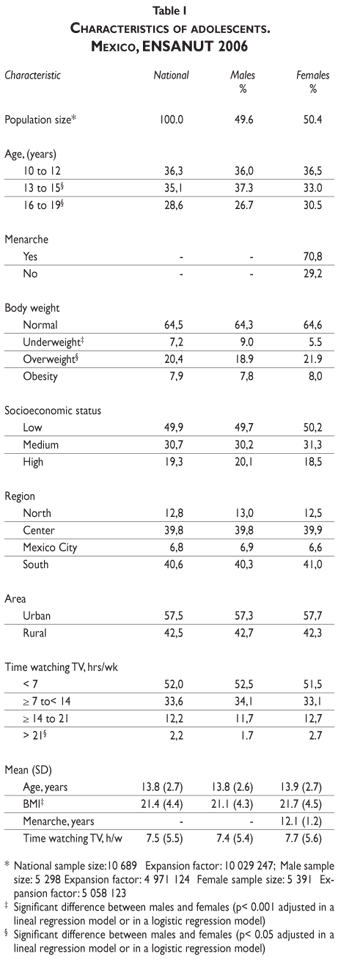
<body><![CDATA[<p><font size="2" face="Verdana">A total of 10 884 observations met the inclusion    criteria, but 195 were eliminated due to implausible energy intake values. Thus,    we analyzed data from 10 689 individuals, representative of up to 10 million    adolescents in Mexico.</font></p>     <p><font size="2" face="Verdana"> The comparison between subjects included and    excluded from analysis showed no significant differences with respect to age,    sex or BMI (<I>p</I> &gt; 0.05).</font></p>     <p><font size="2" face="Verdana">  Fifty percent of the subjects were female    adolescents. The mean age was 13.8 &plusmn; 2.7 years. More than 30% of the male adolescents    were in the group of 13 to 15 years, and nearly 30% of the females were in the    oldest age group (16 to 19 years). Mean BMI was 21.4 &plusmn; 4.4. On average, female    adolescents had a higher BMI and a higher prevalence of overweight in relation    to males (<I>p</I>&lt; 0.05). The greater proportion of adolescents had a low    SES (49.9%). Adolescents were concentrated in the center (39.8%) and southern    (40.6%) regions of the country. The greater proportion of adolescents lived    in urban areas (57.5%). The average time watching TV was 7.5 &plusmn; 5.5 h/w. Fifty&#45;two    percent of adolescents watched TV less than seven hours a week. A higher proportion    of female adolescents watched TV for more than 21 hours a week as compared to    males (<I>p</I>&lt; 0.05).The average age at menarche was 12.1 &plusmn; 1.2 years and    70.8% of the females already had it (<a href="#tab01">Table I</a>).</font></p>     <p><a name="tab01"></a></p>     <p>&nbsp;</p>     <p align="center"><img src="/img/revistas/spm/v51s4/a15tab01.gif"></p>     <p>&nbsp;</p>     <p><font size="2" face="Verdana">  During the seven days prior to the survey,    77.2% of the adolescents consumed sodas, 39.7% consumed fruit beverages and    27.7% consumed sugar beverages. Ninety percent consumed one or more SSBs. On    average, a somewhat higher percentage of male adolescents consumed sodas (79%)    compared to females (75.5%) (<I>p</I>&lt; 0.01). Moreover, approximately 91%    of males and 89% of females (<I>p</I>&lt; 0.05) consumed one or more SSBs (data    not shown).</font></p>     <p><font size="2" face="Verdana">  At the national level, the daily median consumption    of SSBs was 0.89 (percentile 25: 0.43, p75: 1.96). Median SSB consumption was    higher for male adolescents than for females (<I>p</I>&lt; 0.001). Median SSB    consumption was higher among older adolescents (13 to 19 years) compared to    the youngest adolescents (10 to 12 years). In general, overweight adolescents    consumed more SSBs compared to adolescents who had a normal weight. The consumption    of SSBs was positively associated with SES. A higher consumption of SSBs was    observed in the northern region and in urban areas (<I>p</I>&lt; 0.05). Adolescents    who already had menarche consumed, on average, more SSBs than those who had    not yet had it (<I>p</I>&lt; 0.05). Adolescents who watched less than 7 hrs    of TV per week consumed less SSBs (<I>p&lt;</I> 0.05) (<a href="#tab02">Table   II</a>).</font></p>     <p><a name="tab02"></a></p>     ]]></body>
<body><![CDATA[<p>&nbsp;</p>     <p align="center"><img src="/img/revistas/spm/v51s4/a15tab02.gif"></p>     <p>&nbsp;</p>     <p><font size="2" face="Verdana">  For male adolescents, the unadjusted analysis    showed that consumption of sodas was positively associated with BMI. For each    serving of soda consumed, BMI increased 0.54 units (95% CI: 0.39&#45;0.70, <I>p</I>&lt;    0.001), whereas consumption of fruit drinks and sugar beverages were not significantly    associated with BMI. It was noted that before adjusting for non&#45;beverage energy    the coefficient related to the consumption of soft drinks decreased (</font><font>&#946;</font><font size="2" face="verdana"><I>=</I>    0.16, 95% CI: 0.01&#45;0.31, <I>p</I>= 0.04), while after adjustment for non&#45;beverage    energy the coefficient increased slightly (</font><font>&#946;</font><font size="2" face="verdana">= 0.17, 95% CI: 0.02&#45;0.32, <I>p</I>=    0.03). None showed significant associations between consumption of fruit drinks    and sugar beverages with BMI before or after adjusting for non&#45;beverage energy.    After adjusting for non&#45;beverage energy, the consumption of all SSBs were not    significantly associated with BMI in male adolescents (</font><font>&#946;</font><font size="2" face="verdana">= 0.06, 95% CI: &#45;0.04&#45;0.17,  <I>p</I>= 0.25) (<a href="#tab03">Table III</a>).</font></p>     <p><a name="tab03"></a></p>     <p>&nbsp;</p>     <p align="center"><img src="/img/revistas/spm/v51s4/a15tab03.gif"></p>     <p>&nbsp;</p>     <p><font size="2" face="Verdana">  In female adolescents, the unadjusted model    showed that for every serving of soda consumed, BMI increased 0.19 units (95%    CI: 0.03&#45;0.35, <I>p</I>= 0.03). For fruit drinks and sugar beverages, no significant    associations were observed. The adjusted analysis showed that before and after    adjusting for non beverages energy, no drink studied, including the set of SSBs    was significantly associated with BMI in females (<a href="#tab03">Table III</a>).</font></p>     <p><font size="2" face="Verdana">  <a href="#fig01">Figure 1</a> presents the adjusted mean BMI for    male adolescents derived from the regression models that included interaction    terms between the consumption of SSBs and age, and between the consumption of    SSBs and TV&#45;viewing time. In panel A, it is observed that in each age group,    males with a higher consumption of SSBs had a higher BMI compared to those with    a lower consumption of SSBs (<I>p</I>&lt; 0.05).</font></p>     ]]></body>
<body><![CDATA[<p><a name="fig01"></a></p>     <p>&nbsp;</p>     <p align="center"><img src="/img/revistas/spm/v51s4/a15fig01.gif"></p>     <p>&nbsp;</p>     <p><font size="2" face="Verdana">  In panel B, it is observed that in the category    of 7 hrs of TV per week, there were no significant differences between male    adolescents with a lower consumption of SSBs compared to males with a higher    consumption of SSBs (<I>p</I> &gt; 0.05), while in the categories of more than    7 hrs of TV per week it was observed that males with a greater consumption of    SSBs had a higher BMI compared to those with a lower consumption of SSBs (<I>p</I>&lt;    0.05) (<a href="#fig01">Figure 1</a>).</font></p>     <p><font size="2" face="Verdana">  <a href="#fig02">Figure 2</a> presents the adjusted mean BMI for    girls resulting from the regression models that included interaction terms between    the consumption of SSBs and age, and between the consumption of SSBs and TV&#45;viewing    time. In panel A, it is observed for the group of female adolescents 10 to 12    years old that the BMI was higher in those who had a higher consumption of SSBs    compared to those who had a lower consumption of SSBs (<I>p</I>&lt; 0.05). The    oldest females (16 to 19 years) who had a higher intake had a BMI lower than    those who had a lower consumption of SSBs (<I>p</I>&lt; 0.05). In panel B, it    is observed in the categories of more than 7 hrs of TV per week that the females    who had a greater consumption of SSBs had a lower BMI with respect to those    who had a lower consumption of SSBs, but the differences were not significant    (<I>p</I> &gt; 0.05) (<a href="#fig02">Figure 2</a>).</font></p>     <p><a name="fig02"></a></p>     <p>&nbsp;</p>     <p align="center"><img src="/img/revistas/spm/v51s4/a15fig02.gif"></p>     <p>&nbsp;</p>     ]]></body>
<body><![CDATA[<p><font size="2" face="Verdana">  Through a regression model that included the    interaction term between consumption of SSBs and the presence of menarche (interaction    term: </font><font>&#946;</font><font size="2" face="verdana">= &#45;0.24, 95% CI: &#45;0.46 &#45;0.01, <I>p</I>= 0.04) it was noted that female    adolescents who had already presented menarche and had a higher consumption    of SSBs had a lower BMI (22.7, <I>SE</I>= 0.03) with respect to those who had    a lower intake of SSBs (22.9, <I>SE=</I> 0.03) (<I>p</I>&lt; 0.05). Female adolescents    who had not yet presented menarche and who had a higher consumption of SSBs    had a higher BMI (19.3, <I>SE</I>= 0.04) than those who had a lower intake of    SSBs (19.1, <I>SE</I>= 0.03) (<I>p</I>&lt; 0.05) (data not shown).</font></p>     <p>&nbsp;</p>     <p><font size="3" face="Verdana"><b>Discussion</b></font></p>     <p><font size="2" face="Verdana">We analyzed the relationship between consumption    of sugar&#45;sweetened beverages (SSBs) and BMI in a sample of adolescents who participated    in a nationally representative Mexican survey (ENSANUT 2006). </font></p>     <p><font size="2" face="Verdana"> The results showed that consumption of sodas    were positively associated with BMI for male adolescents, after adjusting for    potential confounders. Moreover, positive interactions of SSB consumption with    age and TV&#45;viewing time were observed in males. Giammattei <I>et al</I>. showed    a similar interaction between SSB consumption with TV&#45;viewing time, finding    a significant positive association in adolescents between BMI with hours of    television watched per evening and daily soft drink consumption (<I>p</I>&lt;    0.05).<SUP>17</sup></font></p>     <p><font size="2" face="Verdana">Among female adolescents, no significant associations    were found. This finding is consistent with previous studies, which have shown    more consistent associations in males compared to females. However, the results    are quite diverse.<SUP>18,19</sup></font></p>     <p><font size="2" face="Verdana"> It is important to mention that the results    in female adolescents with respect to age group show a different direction than    expected; we observed that in the oldest group of females (16 to 19 years),    those who had a higher intake had a lower BMI compared with those females who    had a lower consumption of SSBs (<I>p</I>&lt; 0.05). This situation could be    due to reverse causation, since it is possible that the oldest group of females    has a greater concern about body weight than the youngest group. Thus, female    adolescents 16 to 19 years with a greater BMI tended to consume less SSBs than    those 16 to 19 years who had a lower BMI.</font></p>     <p><font size="2" face="Verdana">  In general terms, the prevalence of overweight    and obesity, consumption of different types of beverages, as well as the effect    of the consumption of SSBs on BMI found in our study coincide with other studies.    For example, Berkey <I>et al.</I> found that for male adolescents who increased    their soda intake by <u>&gt;</u> 2 servings per day from the previous year gained    weight (0.14 increase in BMI).<SUP>19</SUP> Ludwig <I>et al</I>. found at baseline    consumption of SSBs that in the fully adjusted model, BMI increased by 0.18    for each serving consumed per day (95% CI: 0.09&#45;0.27; <I>p</I>= 0.02).<SUP>8    </SUP>Phillips <I>et al</I>. found that subjects in the third and fourth quartiles    of percentage of calories from soda had BMI <SUB>Z</SUB> scores of 0.17 units    higher, on average, than those of subjects in the fist quartile (<I>p&lt;</I>    0.001).<SUP>20 </SUP>In another study conducted among Mexican adolescents (10    to 19 years), the association between the consumption of SSBs and BMI was greater    than that observed in this study. Denova <I>et al.</I> found that for each additional    SSBs serving consumed daily, adolescents BMI increased by 0.33 (<I>p</I>&lt;    0.001).<SUP>21</sup></font></p>     <p><font size="2" face="Verdana">The review by Malik<SUP>5</SUP> has confirmed    the notion about a positive association between consumption of SSBs and weight    gain in different populations. The biological plausibility of how the consumption    of SSBs can influence body weight is still unknown. It has been suggested that    the consumption of energy through liquid food tends to generate a lower sense    of satiety as compared to the intake of solid foods, resulting in a higher consumption    of food in subsequent meals and, therefore, a larger total energy consumption.<SUP>22    </SUP>However, in our study we controlled for non&#45;beverage energy intake and    this did not affect the results. In one study among obese adolescents that compared    satiety after consuming the same amount of energy through liquid foods versus    solid foods, no difference in satiety was observed.<SUP>23 </SUP>Among other    assumptions, it has been proposed that the sugars contained in the SSBs could    prove addictive. A study in rats showed that after withdrawal of a sugar&#45;rich    diet, the animals showed qualitatively clear signs of dependence on sugars,    similar to those presented in morphine and nicotine addiction, including teeth    chattering and anxiety.<SUP>24 </SUP>On the other hand, it is possible that    consumption of SSBs is only one component of a feeding pattern that favors body    weight gain, or perhaps a reflection of an "obesogenic" lifestyle.    A relationship was tested in an intervention study aimed to reduce the consumption    of SSBs by American adolescents, and a significant reduction of body weight    was observed among overweight and obese adolescents regardless of lifestyle    variables.<SUP>25</sup></font></p>     <p><font size="2" face="Verdana"> The interpretation of our results should    consider certain limitations. The most important limitation deals with the cross&#45;sectional    nature of our study, which does not allow for making causal inferences between    consumption of SSBs and increased BMI. However, our results coincide with previous    longitudinal studies that suggest a cause&#45;effect association (that is, consumption    of SSBs precedes and has a positive association with weight gain). Thus, one    could rule out the idea of a reverse causality for male adolescents (being overweight    or obese promotes the intake of SSBs).</font></p>     ]]></body>
<body><![CDATA[<p><font size="2" face="Verdana"> Another limitation is related to the use    of a FFSQ, which was not specifically designed for accurately measuring beverage    intake. Moreover, the portion size was standardized as 240 ml, and it could    be that the children were consuming larger portion sizes. If this were the case,    our study could be underestimating beverage consumption in this population.    The overall result would be an overestimation of the actual effect associated    with the consumption of one portion of SSBs.</font></p>     <p><font size="2" face="Verdana"> Some of the strengths of the present study    consist of the use of a large, nationally representative sample of Mexican adolescents,    as well as the use of standardized personnel and methods. Additionally, the    subjects and interviewers were blinded to the hypothesis of the study. Finally,    we controlled in the multivariate analyses for potential confounders.</font></p>     <p><font size="2" face="Verdana"> In conclusion, there was a positive association    between the consumption of sodas and BMI in a nationally representative sample    of Mexican adolescents. However this association was observed in males only.    While it is necessary to conduct further studies on the subject with longitudinal    design, it is also important to take immediate actions in this regard, such    as encouraging the decrease in consumption of SSBs, as well as promoting the    consumption of plain water for preventing and controlling the epidemic of overweight    and obesity in Mexico. The Secretary of Health has recently undertaken an effort    in this regard when designing the "recommendations for beverages' consumption    for a healthy lifestyle for the mexican population".</font></p>     <p><font size="2" face="Verdana"><b>Acknowledgments</b></font></p>     <p><font size="2" face="Verdana">We would like to acknowledge Dr. Bernardo Hern&aacute;ndez    for his advice in writing the manuscript and Alfonso Mendoza for database management.</font></p>     <p>&nbsp;</p>     <p><font size="3" face="Verdana"><b>References</b></font></p>     <!-- ref --><p><font size="2" face="Verdana">1. Rivera J, Barquera S, Campirano F, Campos    I, Safdie M, Tovar V. Epidemiological and nutritional transition in Mexico:    rapid increase of non&#45;communicable chronic diseases and obesity. Public Health    Nutrition 2002;5:113&#45;122.    &nbsp;&nbsp;&nbsp;&nbsp;&nbsp;&nbsp;&nbsp;&nbsp;[&#160;<a href="javascript:void(0);" onclick="javascript: window.open('/scielo.php?script=sci_nlinks&ref=9294908&pid=S0036-3634200900100001500001&lng=','','width=640,height=500,resizable=yes,scrollbars=1,menubar=yes,');">Links</a>&#160;]<!-- end-ref --></font></p>     <!-- ref --><p><font size="2" face="Verdana">2. Fern&aacute;ndez O, Rivera J, Shamah T, Villalpando    S, Hern&aacute;ndez M, Sep&uacute;lveda J. Encuesta Nacional de Salud y Nutrici&oacute;n    2006. Cuernavaca, Mexico: Instituto Nacional de Salud P&uacute;blica, 2006.    &nbsp;&nbsp;&nbsp;&nbsp;&nbsp;&nbsp;&nbsp;&nbsp;[&#160;<a href="javascript:void(0);" onclick="javascript: window.open('/scielo.php?script=sci_nlinks&ref=9294910&pid=S0036-3634200900100001500002&lng=','','width=640,height=500,resizable=yes,scrollbars=1,menubar=yes,');">Links</a>&#160;]<!-- end-ref --></font></p>     <!-- ref --><p><FONT size="2" FACE="Verdana">3. G&oacute;mez A. Cada a&ntilde;o, 152 litros    de refresco por mexicano. La prensa. Organizaci&oacute;n Editorial Mexicana.    2008 June. &#91;Consulted 2008 November 21st.&#93;. Available at: <a href="http://www.oem.com.mx/laprensa/notas/n752335.htm" target="_blank">http://www.oem.com.mx/laprensa/notas/n752335.htm</a>.    &nbsp;&nbsp;&nbsp;&nbsp;&nbsp;&nbsp;&nbsp;&nbsp;[&#160;<a href="javascript:void(0);" onclick="javascript: window.open('/scielo.php?script=sci_nlinks&ref=9294912&pid=S0036-3634200900100001500003&lng=','','width=640,height=500,resizable=yes,scrollbars=1,menubar=yes,');">Links</a>&#160;]<!-- end-ref --></font></p>     <!-- ref --><p><font size="2" face="Verdana">4. Rivera JA, Mu&ntilde;oz O, Rosas M, Aguilar    CA, Popkin BM, Willett WC. Consumo de bebidas para una vida saludable: recomendaciones    para la poblaci&oacute;n mexicana. Salud Publica Mex 2008; 50:173&#45;195.    &nbsp;&nbsp;&nbsp;&nbsp;&nbsp;&nbsp;&nbsp;&nbsp;[&#160;<a href="javascript:void(0);" onclick="javascript: window.open('/scielo.php?script=sci_nlinks&ref=9294914&pid=S0036-3634200900100001500004&lng=','','width=640,height=500,resizable=yes,scrollbars=1,menubar=yes,');">Links</a>&#160;]<!-- end-ref --></font></p>     <!-- ref --><p><font size="2" face="Verdana">5. Malik VS, Schulze MB, Hu FB. Intake of sugar&#45;sweetened    beverages and weight gain: a systematic review. Am J Clin Nutr 2006;84:274&#45;288.    &nbsp;&nbsp;&nbsp;&nbsp;&nbsp;&nbsp;&nbsp;&nbsp;[&#160;<a href="javascript:void(0);" onclick="javascript: window.open('/scielo.php?script=sci_nlinks&ref=9294916&pid=S0036-3634200900100001500005&lng=','','width=640,height=500,resizable=yes,scrollbars=1,menubar=yes,');">Links</a>&#160;]<!-- end-ref --></font></p>     <!-- ref --><p><font size="2" face="Verdana">6. Ram&iacute;rez I, Mundo V, Rodr&iacute;guez    S, Vizuet I, Hern&aacute;ndez N, Jim&eacute;nez A. Encuestas diet&eacute;ticas.    In: Manual de procedimientos para proyectos de nutrici&oacute;n. Cuernavaca,    Mexico: Instituto Nacional de Salud P&uacute;blica, 2006; 27&#45;108.    &nbsp;&nbsp;&nbsp;&nbsp;&nbsp;&nbsp;&nbsp;&nbsp;[&#160;<a href="javascript:void(0);" onclick="javascript: window.open('/scielo.php?script=sci_nlinks&ref=9294918&pid=S0036-3634200900100001500006&lng=','','width=640,height=500,resizable=yes,scrollbars=1,menubar=yes,');">Links</a>&#160;]<!-- end-ref --></font></p>     <!-- ref --><p><font size="2" face="Verdana">7. Ludwig DS, Peterson KE, Gortmaaker S. Relation    between consumption of sugar&#45;sweetened drinks and childhood obesity: a prospective,    observational analysis. Lancet 2001;357:505&#45;508.    &nbsp;&nbsp;&nbsp;&nbsp;&nbsp;&nbsp;&nbsp;&nbsp;[&#160;<a href="javascript:void(0);" onclick="javascript: window.open('/scielo.php?script=sci_nlinks&ref=9294920&pid=S0036-3634200900100001500007&lng=','','width=640,height=500,resizable=yes,scrollbars=1,menubar=yes,');">Links</a>&#160;]<!-- end-ref --></font></p>     <!-- ref --><p><font size="2" face="Verdana">8. Lohman TG, Roche AF, Martorell R. Anthropometric    standardization reference manual. Champaign (IL): Human Kinetics Books, 1998.    &nbsp;&nbsp;&nbsp;&nbsp;&nbsp;&nbsp;&nbsp;&nbsp;[&#160;<a href="javascript:void(0);" onclick="javascript: window.open('/scielo.php?script=sci_nlinks&ref=9294922&pid=S0036-3634200900100001500008&lng=','','width=640,height=500,resizable=yes,scrollbars=1,menubar=yes,');">Links</a>&#160;]<!-- end-ref --></font></p>     <!-- ref --><p><font size="2" face="Verdana">9. Habicht JP. Standarization of anthopometric    methods in the field. PAHO Bull 1974;76:375&#45;384.    &nbsp;&nbsp;&nbsp;&nbsp;&nbsp;&nbsp;&nbsp;&nbsp;[&#160;<a href="javascript:void(0);" onclick="javascript: window.open('/scielo.php?script=sci_nlinks&ref=9294924&pid=S0036-3634200900100001500009&lng=','','width=640,height=500,resizable=yes,scrollbars=1,menubar=yes,');">Links</a>&#160;]<!-- end-ref --></font></p>     <!-- ref --><p><font size="2" face="Verdana">10. Cole T J, Bellizzi MC, Flegal KM, Dietz WH.    Establishing a Standard definition for child overweight and obesity worldwide:    international survey. BMJ 2000;320:1240.    &nbsp;&nbsp;&nbsp;&nbsp;&nbsp;&nbsp;&nbsp;&nbsp;[&#160;<a href="javascript:void(0);" onclick="javascript: window.open('/scielo.php?script=sci_nlinks&ref=9294926&pid=S0036-3634200900100001500010&lng=','','width=640,height=500,resizable=yes,scrollbars=1,menubar=yes,');">Links</a>&#160;]<!-- end-ref --></font></p>     <!-- ref --><p><font size="2" face="Verdana">11. Must A, Dallal G, Dietz W. Reference data    for obesity: 85th and 95th percentiles of body mass index (wt/ht2) and triceps    skin fold thickness. Am J Clin Nutr 1991;53:839&#45;846.    &nbsp;&nbsp;&nbsp;&nbsp;&nbsp;&nbsp;&nbsp;&nbsp;[&#160;<a href="javascript:void(0);" onclick="javascript: window.open('/scielo.php?script=sci_nlinks&ref=9294928&pid=S0036-3634200900100001500011&lng=','','width=640,height=500,resizable=yes,scrollbars=1,menubar=yes,');">Links</a>&#160;]<!-- end-ref --></font></p>     <!-- ref --><p><font size="2" face="Verdana">12. Reyment R, J&ouml;reskog K. Applied factor    analysis in the natural sciences. Cambridge, UK: Cambridge University Press,    1996: 371.    &nbsp;&nbsp;&nbsp;&nbsp;&nbsp;&nbsp;&nbsp;&nbsp;[&#160;<a href="javascript:void(0);" onclick="javascript: window.open('/scielo.php?script=sci_nlinks&ref=9294930&pid=S0036-3634200900100001500012&lng=','','width=640,height=500,resizable=yes,scrollbars=1,menubar=yes,');">Links</a>&#160;]<!-- end-ref --></font></p>     <!-- ref --><p><font size="2" face="Verdana">13. Hair JF, Anderson R, Tatham R, Black W. Multivariate    data analysis with readings. 3rd ed. New York (NY): Macmillan Publishing Company,    1992: 223&#45;253.    &nbsp;&nbsp;&nbsp;&nbsp;&nbsp;&nbsp;&nbsp;&nbsp;[&#160;<a href="javascript:void(0);" onclick="javascript: window.open('/scielo.php?script=sci_nlinks&ref=9294932&pid=S0036-3634200900100001500013&lng=','','width=640,height=500,resizable=yes,scrollbars=1,menubar=yes,');">Links</a>&#160;]<!-- end-ref --></font></p>     <!-- ref --><p><font size="2" face="Verdana">14. Hern&aacute;ndez B, Gortmaker S, Laird N,    Colditz G, Parra&#45;Cabrera S, Peterson K. Validez y reproducibilidad de un cuestionario    de actividad e inactividad f&iacute;sica para escolares de la ciudad de M&eacute;xico.    Salud Publica Mex 2000;42:315&#45;323.    &nbsp;&nbsp;&nbsp;&nbsp;&nbsp;&nbsp;&nbsp;&nbsp;[&#160;<a href="javascript:void(0);" onclick="javascript: window.open('/scielo.php?script=sci_nlinks&ref=9294934&pid=S0036-3634200900100001500014&lng=','','width=640,height=500,resizable=yes,scrollbars=1,menubar=yes,');">Links</a>&#160;]<!-- end-ref --></font></p>     <!-- ref --><p><font size="2" face="Verdana">15. American Academy of Pediatrics. Committee    on Public Education Pediatrics. Pediatrics 2001;108:1222&#45;1225.    &nbsp;&nbsp;&nbsp;&nbsp;&nbsp;&nbsp;&nbsp;&nbsp;[&#160;<a href="javascript:void(0);" onclick="javascript: window.open('/scielo.php?script=sci_nlinks&ref=9294936&pid=S0036-3634200900100001500015&lng=','','width=640,height=500,resizable=yes,scrollbars=1,menubar=yes,');">Links</a>&#160;]<!-- end-ref --></font></p>     <!-- ref --><p><font size="2" face="Verdana">16. World Health Organization. El estado f&iacute;sico:    uso e interpretaci&oacute;n de la antropometr&iacute;a. Informe de un Comit&eacute;    de Expertos de la OMS. Geneva: WHO, 1995.    &nbsp;&nbsp;&nbsp;&nbsp;&nbsp;&nbsp;&nbsp;&nbsp;[&#160;<a href="javascript:void(0);" onclick="javascript: window.open('/scielo.php?script=sci_nlinks&ref=9294938&pid=S0036-3634200900100001500016&lng=','','width=640,height=500,resizable=yes,scrollbars=1,menubar=yes,');">Links</a>&#160;]<!-- end-ref --></font></p>     <!-- ref --><p><font size="2" face="Verdana">17 Giammattei J, Blix G, Marshak HH, Wollitzer    AO, Pettitt DJ. Television watching and soft drink consumption: associations    with obesity in 11&#45; to 13&#45; year&#45;old schoolchildren. Arch Pediatr Adolesc Med    2003;157:882&#45;886.    &nbsp;&nbsp;&nbsp;&nbsp;&nbsp;&nbsp;&nbsp;&nbsp;[&#160;<a href="javascript:void(0);" onclick="javascript: window.open('/scielo.php?script=sci_nlinks&ref=9294940&pid=S0036-3634200900100001500017&lng=','','width=640,height=500,resizable=yes,scrollbars=1,menubar=yes,');">Links</a>&#160;]<!-- end-ref --></font></p>     <!-- ref --><p><font size="2" face="Verdana">18. Gillis LJ, Bar&#45;Or O. Food away from home,    sugar&#45;sweetened drink consumption and juvenile obesity. J Am Coll Nutr 2003;22:539&#45;545.    &nbsp;&nbsp;&nbsp;&nbsp;&nbsp;&nbsp;&nbsp;&nbsp;[&#160;<a href="javascript:void(0);" onclick="javascript: window.open('/scielo.php?script=sci_nlinks&ref=9294942&pid=S0036-3634200900100001500018&lng=','','width=640,height=500,resizable=yes,scrollbars=1,menubar=yes,');">Links</a>&#160;]<!-- end-ref --></font></p>     <!-- ref --><p><font size="2" face="Verdana">19. Berkey CS, Rockett HR, Field AE, Gillman    MW, Coditz GA. Sugar added beverage and adolescent weight change. Obes Res 2004;12:778&#45;788.    &nbsp;&nbsp;&nbsp;&nbsp;&nbsp;&nbsp;&nbsp;&nbsp;[&#160;<a href="javascript:void(0);" onclick="javascript: window.open('/scielo.php?script=sci_nlinks&ref=9294944&pid=S0036-3634200900100001500019&lng=','','width=640,height=500,resizable=yes,scrollbars=1,menubar=yes,');">Links</a>&#160;]<!-- end-ref --></font></p>     <!-- ref --><p><FONT size="2" FACE="Verdana">20. Phillips SM, Bandini LG, Naumova EN, Cyr    H, Colclough S, Dietz WH, <I>et al</I>. Energy&#45;dense snack food intake in adolescents:    longitudinal relationship to weight and fatness. Obes Res 2004; 12:461&#45;472.    &nbsp;&nbsp;&nbsp;&nbsp;&nbsp;&nbsp;&nbsp;&nbsp;[&#160;<a href="javascript:void(0);" onclick="javascript: window.open('/scielo.php?script=sci_nlinks&ref=9294946&pid=S0036-3634200900100001500020&lng=','','width=640,height=500,resizable=yes,scrollbars=1,menubar=yes,');">Links</a>&#160;]<!-- end-ref --></font></p>     <!-- ref --><p><FONT size="2" FACE="Verdana"> 21. Denova E, Jim&eacute;nez A, Halley E, Huitr&oacute;n    G, Talavera JO, Pineda D, <I>et al</I>. Association between Sweetened Beverage    Consumption and Body Mass Index, Proportion of Body Fat and Body Fat Distribution    in Mexican Adolescents. Ann Nutr Metab 2008;53:245&#45;251.    &nbsp;&nbsp;&nbsp;&nbsp;&nbsp;&nbsp;&nbsp;&nbsp;[&#160;<a href="javascript:void(0);" onclick="javascript: window.open('/scielo.php?script=sci_nlinks&ref=9294948&pid=S0036-3634200900100001500021&lng=','','width=640,height=500,resizable=yes,scrollbars=1,menubar=yes,');">Links</a>&#160;]<!-- end-ref --></font></p>     <!-- ref --><p><font size="2" face="Verdana">22. Mattes RD. Dietary compensation by humans    for supplemental energy provided as ethanol or carbohydrate in fluids. Physiol    Behav 1996;59:179&#45;187.    &nbsp;&nbsp;&nbsp;&nbsp;&nbsp;&nbsp;&nbsp;&nbsp;[&#160;<a href="javascript:void(0);" onclick="javascript: window.open('/scielo.php?script=sci_nlinks&ref=9294950&pid=S0036-3634200900100001500022&lng=','','width=640,height=500,resizable=yes,scrollbars=1,menubar=yes,');">Links</a>&#160;]<!-- end-ref --></font></p>     <!-- ref --><p><font size="2" face="Verdana">23. Almiron E, Flores SY, Drewnowski A. No difference    in satiety or in subsequent energy intakes between a beverage and a solid food.    Physiol Behav 2004;82:671&#45;677.    &nbsp;&nbsp;&nbsp;&nbsp;&nbsp;&nbsp;&nbsp;&nbsp;[&#160;<a href="javascript:void(0);" onclick="javascript: window.open('/scielo.php?script=sci_nlinks&ref=9294952&pid=S0036-3634200900100001500023&lng=','','width=640,height=500,resizable=yes,scrollbars=1,menubar=yes,');">Links</a>&#160;]<!-- end-ref --></font></p>     <!-- ref --><p><FONT size="2" FACE="Verdana">24. Colantuoni C, Rada P, McCarthy J, Petten    C, Avena NM, Chadeayne A, <I>et al</I>. Evidence that intermittent, excessive    sugar intake cause endogenous opiate dependence. Obes Res 2002; 10:478&#45;488.    &nbsp;&nbsp;&nbsp;&nbsp;&nbsp;&nbsp;&nbsp;&nbsp;[&#160;<a href="javascript:void(0);" onclick="javascript: window.open('/scielo.php?script=sci_nlinks&ref=9294954&pid=S0036-3634200900100001500024&lng=','','width=640,height=500,resizable=yes,scrollbars=1,menubar=yes,');">Links</a>&#160;]<!-- end-ref --></font></p>     <!-- ref --><p><font size="2" face="Verdana">25. Ebbeling CB, Feldman HA, Osganian SK, Chomitz    VR, Ellenbogen SJ, Ludwig DS. Effects of decreasing sugar&#45;sweetened beverage    consumption on body weight in adolescents: a randomized, controlled pilot study.    Pediatrics 2006;117:673&#45;680.    &nbsp;&nbsp;&nbsp;&nbsp;&nbsp;&nbsp;&nbsp;&nbsp;[&#160;<a href="javascript:void(0);" onclick="javascript: window.open('/scielo.php?script=sci_nlinks&ref=9294956&pid=S0036-3634200900100001500025&lng=','','width=640,height=500,resizable=yes,scrollbars=1,menubar=yes,');">Links</a>&#160;]<!-- end-ref --></font></p>     <p>&nbsp;</p>     <p>&nbsp;</p>     <p><FONT size="2" FACE="Verdana">Received on: April 11, 2008    ]]></body>
<body><![CDATA[<br>   Accepted on: February 25, 2009</font></p>     <p>&nbsp;</p>     <p>&nbsp;</p>     <p><font size="2" face="Verdana">Address       reprint requests to: Dr. Mario Flores. Instituto Nacional de Salud       P&uacute;blica. Av. Universidad 655, col. Santa Mar&iacute;a Ahuacatitl&aacute;n. 62100 Cuernavaca, Morelos, M&eacute;xico. E&#45;mail: <a href="mailto:mflores@correo.insp.mx">mflores@correo.insp.mx</a>    <br> <a name="nt01"></a><a href="#tx01">*</a> The regions were established according to the definition by INEGI (National Institute of Statistics, Geography and Informatics): north (Baja California, Baja California Sur, Coahuila, Chihuahua, Durango, Nuevo Leon, Sonora and Tamaulipas), center (Aguascalientes, Colima, Guanajuato, Jalisco, Mexico (excluding urbanized municipalities and localities adjacent to Mexico City), Michoacan, Morelos, Nayarit, Queretaro, San Luis Potosi, Sinaloa, and Zacatecas), Mexico City (including the Federal District and urbanized municipalities in the State of Mexico), and south (Campeche, Chiapas, Guerrero, Hidalgo, Oaxaca, Puebla, Quintana Roo, Tabasco, Tlaxcala, Veracruz and Yucatan).    <br> <a name="nt02"></a><a href="#tx02">&#135;</a> A household unit was defined as all persons who usually sleep in the same house and benefit from a common income, whether or not they are connected by kinship.    <br> <a name="nt03"></a><a href="#tx03">**</a> Safdie    M, Barquera S, Porcayo M, Rodr&iacute;guez S, Ram&iacute;rez C, Rivera J, et    al. Bases de datos del valor nutritivo de los alimentos. Compilaci&oacute;n     del Instituto Nacional de Salud P&uacute;blica, 2004. (Unpublished document).    <br>   <a name="nt04"></a><a href="#tx04">***</a> Stata Corp. Intercooled Stata 9.2 College  Station Texas, USA, 2006.</font></p>      ]]></body><back>
<ref-list>
<ref id="B1">
<label>1</label><nlm-citation citation-type="journal">
<person-group person-group-type="author">
<name>
<surname><![CDATA[Rivera]]></surname>
<given-names><![CDATA[J]]></given-names>
</name>
<name>
<surname><![CDATA[Barquera]]></surname>
<given-names><![CDATA[S]]></given-names>
</name>
<name>
<surname><![CDATA[Campirano]]></surname>
<given-names><![CDATA[F]]></given-names>
</name>
<name>
<surname><![CDATA[Campos]]></surname>
<given-names><![CDATA[I]]></given-names>
</name>
<name>
<surname><![CDATA[Safdie]]></surname>
<given-names><![CDATA[M]]></given-names>
</name>
<name>
<surname><![CDATA[Tovar]]></surname>
<given-names><![CDATA[V]]></given-names>
</name>
</person-group>
<article-title xml:lang="en"><![CDATA[Epidemiological and nutritional transition in Mexico: rapid increase of non-communicable chronic diseases and obesity]]></article-title>
<source><![CDATA[Public Health Nutrition]]></source>
<year>2002</year>
<volume>5</volume>
<page-range>113-122</page-range></nlm-citation>
</ref>
<ref id="B2">
<label>2</label><nlm-citation citation-type="book">
<person-group person-group-type="author">
<name>
<surname><![CDATA[Fernández]]></surname>
<given-names><![CDATA[O]]></given-names>
</name>
<name>
<surname><![CDATA[Rivera]]></surname>
<given-names><![CDATA[J]]></given-names>
</name>
<name>
<surname><![CDATA[Shamah]]></surname>
<given-names><![CDATA[T]]></given-names>
</name>
<name>
<surname><![CDATA[Villalpando]]></surname>
<given-names><![CDATA[S]]></given-names>
</name>
<name>
<surname><![CDATA[Hernández]]></surname>
<given-names><![CDATA[M]]></given-names>
</name>
<name>
<surname><![CDATA[Sepúlveda]]></surname>
<given-names><![CDATA[J]]></given-names>
</name>
</person-group>
<source><![CDATA[Encuesta Nacional de Salud y Nutrición 2006]]></source>
<year>2006</year>
<publisher-loc><![CDATA[Cuernavaca ]]></publisher-loc>
<publisher-name><![CDATA[Instituto Nacional de Salud Pública]]></publisher-name>
</nlm-citation>
</ref>
<ref id="B3">
<label>3</label><nlm-citation citation-type="book">
<person-group person-group-type="author">
<name>
<surname><![CDATA[Gómez]]></surname>
<given-names><![CDATA[A]]></given-names>
</name>
</person-group>
<source><![CDATA[Cada año, 152 litros de refresco por mexicano: La prensa]]></source>
<year>2008</year>
<month> J</month>
<day>un</day>
<publisher-name><![CDATA[Organización Editorial Mexicana]]></publisher-name>
</nlm-citation>
</ref>
<ref id="B4">
<label>4</label><nlm-citation citation-type="journal">
<person-group person-group-type="author">
<name>
<surname><![CDATA[Rivera]]></surname>
<given-names><![CDATA[JA]]></given-names>
</name>
<name>
<surname><![CDATA[Muñoz]]></surname>
<given-names><![CDATA[O]]></given-names>
</name>
<name>
<surname><![CDATA[Rosas]]></surname>
<given-names><![CDATA[M]]></given-names>
</name>
<name>
<surname><![CDATA[Aguilar]]></surname>
<given-names><![CDATA[CA]]></given-names>
</name>
<name>
<surname><![CDATA[Popkin]]></surname>
<given-names><![CDATA[BM]]></given-names>
</name>
<name>
<surname><![CDATA[Willett]]></surname>
<given-names><![CDATA[WC]]></given-names>
</name>
</person-group>
<article-title xml:lang="es"><![CDATA[Consumo de bebidas para una vida saludable: recomendaciones para la población mexicana]]></article-title>
<source><![CDATA[Salud Publica Mex]]></source>
<year>2008</year>
<volume>50</volume>
<page-range>173-195</page-range></nlm-citation>
</ref>
<ref id="B5">
<label>5</label><nlm-citation citation-type="journal">
<person-group person-group-type="author">
<name>
<surname><![CDATA[Malik]]></surname>
<given-names><![CDATA[VS]]></given-names>
</name>
<name>
<surname><![CDATA[Schulze]]></surname>
<given-names><![CDATA[MB]]></given-names>
</name>
<name>
<surname><![CDATA[Hu]]></surname>
<given-names><![CDATA[FB]]></given-names>
</name>
</person-group>
<article-title xml:lang="en"><![CDATA[Intake of sugar-sweetened beverages and weight gain: a systematic review]]></article-title>
<source><![CDATA[Am J Clin Nutr]]></source>
<year>2006</year>
<volume>84</volume>
<page-range>274-288</page-range></nlm-citation>
</ref>
<ref id="B6">
<label>6</label><nlm-citation citation-type="book">
<person-group person-group-type="author">
<name>
<surname><![CDATA[Ramírez]]></surname>
<given-names><![CDATA[I]]></given-names>
</name>
<name>
<surname><![CDATA[Mundo]]></surname>
<given-names><![CDATA[V]]></given-names>
</name>
<name>
<surname><![CDATA[Rodríguez]]></surname>
<given-names><![CDATA[S]]></given-names>
</name>
<name>
<surname><![CDATA[Vizuet]]></surname>
<given-names><![CDATA[I]]></given-names>
</name>
<name>
<surname><![CDATA[Hernández]]></surname>
<given-names><![CDATA[N]]></given-names>
</name>
<name>
<surname><![CDATA[Jiménez]]></surname>
<given-names><![CDATA[A]]></given-names>
</name>
</person-group>
<article-title xml:lang="es"><![CDATA[Encuestas dietéticas]]></article-title>
<source><![CDATA[Manual de procedimientos para proyectos de nutrición]]></source>
<year>2006</year>
<page-range>27-108</page-range><publisher-loc><![CDATA[Cuernavaca ]]></publisher-loc>
<publisher-name><![CDATA[Instituto Nacional de Salud Pública]]></publisher-name>
</nlm-citation>
</ref>
<ref id="B7">
<label>7</label><nlm-citation citation-type="journal">
<person-group person-group-type="author">
<name>
<surname><![CDATA[Ludwig]]></surname>
<given-names><![CDATA[DS]]></given-names>
</name>
<name>
<surname><![CDATA[Peterson]]></surname>
<given-names><![CDATA[KE]]></given-names>
</name>
<name>
<surname><![CDATA[Gortmaaker]]></surname>
<given-names><![CDATA[S]]></given-names>
</name>
</person-group>
<article-title xml:lang="en"><![CDATA[Relation between consumption of sugar-sweetened drinks and childhood obesity: a prospective, observational analysis]]></article-title>
<source><![CDATA[Lancet]]></source>
<year>2001</year>
<volume>357</volume>
<page-range>505-508</page-range></nlm-citation>
</ref>
<ref id="B8">
<label>8</label><nlm-citation citation-type="book">
<person-group person-group-type="author">
<name>
<surname><![CDATA[Lohman]]></surname>
<given-names><![CDATA[TG]]></given-names>
</name>
<name>
<surname><![CDATA[Roche]]></surname>
<given-names><![CDATA[AF]]></given-names>
</name>
<name>
<surname><![CDATA[Martorell]]></surname>
<given-names><![CDATA[R]]></given-names>
</name>
</person-group>
<source><![CDATA[Anthropometric standardization reference manual]]></source>
<year>1998</year>
<publisher-loc><![CDATA[Champaign^eIL IL]]></publisher-loc>
<publisher-name><![CDATA[Human Kinetics Books]]></publisher-name>
</nlm-citation>
</ref>
<ref id="B9">
<label>9</label><nlm-citation citation-type="journal">
<person-group person-group-type="author">
<name>
<surname><![CDATA[Habicht]]></surname>
<given-names><![CDATA[JP]]></given-names>
</name>
</person-group>
<article-title xml:lang="en"><![CDATA[Standarization of anthopometric methods in the field]]></article-title>
<source><![CDATA[PAHO Bull]]></source>
<year>1974</year>
<volume>76</volume>
<page-range>375-384</page-range></nlm-citation>
</ref>
<ref id="B10">
<label>10</label><nlm-citation citation-type="journal">
<person-group person-group-type="author">
<name>
<surname><![CDATA[Cole]]></surname>
<given-names><![CDATA[T J]]></given-names>
</name>
<name>
<surname><![CDATA[Bellizzi]]></surname>
<given-names><![CDATA[MC]]></given-names>
</name>
<name>
<surname><![CDATA[Flegal]]></surname>
<given-names><![CDATA[KM]]></given-names>
</name>
<name>
<surname><![CDATA[Dietz]]></surname>
<given-names><![CDATA[WH]]></given-names>
</name>
</person-group>
<article-title xml:lang="en"><![CDATA[Establishing a Standard definition for child overweight and obesity worldwide: international survey]]></article-title>
<source><![CDATA[BMJ]]></source>
<year>2000</year>
<volume>320</volume>
<page-range>1240</page-range></nlm-citation>
</ref>
<ref id="B11">
<label>11</label><nlm-citation citation-type="journal">
<person-group person-group-type="author">
<name>
<surname><![CDATA[Must]]></surname>
<given-names><![CDATA[A]]></given-names>
</name>
<name>
<surname><![CDATA[Dallal]]></surname>
<given-names><![CDATA[G]]></given-names>
</name>
<name>
<surname><![CDATA[Dietz]]></surname>
<given-names><![CDATA[W]]></given-names>
</name>
</person-group>
<article-title xml:lang="en"><![CDATA[Reference data for obesity: 85th and 95th percentiles of body mass index (wt/ht2) and triceps skin fold thickness]]></article-title>
<source><![CDATA[Am J Clin Nutr]]></source>
<year>1991</year>
<volume>53</volume>
<page-range>839-846</page-range></nlm-citation>
</ref>
<ref id="B12">
<label>12</label><nlm-citation citation-type="book">
<person-group person-group-type="author">
<name>
<surname><![CDATA[Reyment]]></surname>
<given-names><![CDATA[R]]></given-names>
</name>
<name>
<surname><![CDATA[Jöreskog]]></surname>
<given-names><![CDATA[K]]></given-names>
</name>
</person-group>
<source><![CDATA[Applied factor analysis in the natural sciences]]></source>
<year>1996</year>
<page-range>371</page-range><publisher-loc><![CDATA[Cambridge ]]></publisher-loc>
<publisher-name><![CDATA[Cambridge University Press]]></publisher-name>
</nlm-citation>
</ref>
<ref id="B13">
<label>13</label><nlm-citation citation-type="book">
<person-group person-group-type="author">
<name>
<surname><![CDATA[Hair]]></surname>
<given-names><![CDATA[JF]]></given-names>
</name>
<name>
<surname><![CDATA[Anderson]]></surname>
<given-names><![CDATA[R]]></given-names>
</name>
<name>
<surname><![CDATA[Tatham]]></surname>
<given-names><![CDATA[R]]></given-names>
</name>
<name>
<surname><![CDATA[Black]]></surname>
<given-names><![CDATA[W]]></given-names>
</name>
</person-group>
<source><![CDATA[Multivariate data analysis with readings]]></source>
<year>1992</year>
<edition>3</edition>
<page-range>223-253</page-range><publisher-loc><![CDATA[New York^eNY NY]]></publisher-loc>
<publisher-name><![CDATA[Macmillan Publishing Company]]></publisher-name>
</nlm-citation>
</ref>
<ref id="B14">
<label>14</label><nlm-citation citation-type="journal">
<person-group person-group-type="author">
<name>
<surname><![CDATA[Hernández]]></surname>
<given-names><![CDATA[B]]></given-names>
</name>
<name>
<surname><![CDATA[Gortmaker]]></surname>
<given-names><![CDATA[S]]></given-names>
</name>
<name>
<surname><![CDATA[Laird]]></surname>
<given-names><![CDATA[N]]></given-names>
</name>
<name>
<surname><![CDATA[Colditz]]></surname>
<given-names><![CDATA[G]]></given-names>
</name>
<name>
<surname><![CDATA[Parra-Cabrera]]></surname>
<given-names><![CDATA[S]]></given-names>
</name>
<name>
<surname><![CDATA[Peterson]]></surname>
<given-names><![CDATA[K]]></given-names>
</name>
</person-group>
<article-title xml:lang="es"><![CDATA[Validez y reproducibilidad de un cuestionario de actividad e inactividad física para escolares de la ciudad de México]]></article-title>
<source><![CDATA[Salud Publica Mex]]></source>
<year>2000</year>
<volume>42</volume>
<page-range>315-323</page-range></nlm-citation>
</ref>
<ref id="B15">
<label>15</label><nlm-citation citation-type="journal">
<collab>American Academy of Pediatrics</collab>
<article-title xml:lang="en"><![CDATA[Committee on Public Education Pediatrics]]></article-title>
<source><![CDATA[Pediatrics]]></source>
<year>2001</year>
<volume>108</volume>
<page-range>1222-1225</page-range></nlm-citation>
</ref>
<ref id="B16">
<label>16</label><nlm-citation citation-type="book">
<collab>World Health Organization</collab>
<source><![CDATA[El estado físico: uso e interpretación de la antropometría: Informe de un Comité de Expertos de la OMS]]></source>
<year>1995</year>
<publisher-loc><![CDATA[Geneva ]]></publisher-loc>
<publisher-name><![CDATA[WHO]]></publisher-name>
</nlm-citation>
</ref>
<ref id="B17">
<label>17</label><nlm-citation citation-type="journal">
<person-group person-group-type="author">
<name>
<surname><![CDATA[Giammattei]]></surname>
<given-names><![CDATA[J]]></given-names>
</name>
<name>
<surname><![CDATA[Blix]]></surname>
<given-names><![CDATA[G]]></given-names>
</name>
<name>
<surname><![CDATA[Marshak]]></surname>
<given-names><![CDATA[HH]]></given-names>
</name>
<name>
<surname><![CDATA[Wollitzer]]></surname>
<given-names><![CDATA[AO]]></given-names>
</name>
<name>
<surname><![CDATA[Pettitt]]></surname>
<given-names><![CDATA[DJ]]></given-names>
</name>
</person-group>
<article-title xml:lang="en"><![CDATA[Television watching and soft drink consumption: associations with obesity in 11- to 13- year-old schoolchildren]]></article-title>
<source><![CDATA[Arch Pediatr Adolesc Med]]></source>
<year>2003</year>
<volume>157</volume>
<page-range>882-886</page-range></nlm-citation>
</ref>
<ref id="B18">
<label>18</label><nlm-citation citation-type="journal">
<person-group person-group-type="author">
<name>
<surname><![CDATA[Gillis]]></surname>
<given-names><![CDATA[LJ]]></given-names>
</name>
<name>
<surname><![CDATA[Bar-Or]]></surname>
<given-names><![CDATA[O]]></given-names>
</name>
</person-group>
<article-title xml:lang="en"><![CDATA[Food away from home, sugar-sweetened drink consumption and juvenile obesity]]></article-title>
<source><![CDATA[J Am Coll Nutr]]></source>
<year>2003</year>
<volume>22</volume>
<page-range>539-545</page-range></nlm-citation>
</ref>
<ref id="B19">
<label>19</label><nlm-citation citation-type="journal">
<person-group person-group-type="author">
<name>
<surname><![CDATA[Berkey]]></surname>
<given-names><![CDATA[CS]]></given-names>
</name>
<name>
<surname><![CDATA[Rockett]]></surname>
<given-names><![CDATA[HR]]></given-names>
</name>
<name>
<surname><![CDATA[Field]]></surname>
<given-names><![CDATA[AE]]></given-names>
</name>
<name>
<surname><![CDATA[Gillman]]></surname>
<given-names><![CDATA[MW]]></given-names>
</name>
<name>
<surname><![CDATA[Coditz]]></surname>
<given-names><![CDATA[GA]]></given-names>
</name>
</person-group>
<article-title xml:lang="en"><![CDATA[Sugar added beverage and adolescent weight change]]></article-title>
<source><![CDATA[Obes Res]]></source>
<year>2004</year>
<volume>12</volume>
<page-range>778-788</page-range></nlm-citation>
</ref>
<ref id="B20">
<label>20</label><nlm-citation citation-type="journal">
<person-group person-group-type="author">
<name>
<surname><![CDATA[Phillips]]></surname>
<given-names><![CDATA[SM]]></given-names>
</name>
<name>
<surname><![CDATA[Bandini]]></surname>
<given-names><![CDATA[LG]]></given-names>
</name>
<name>
<surname><![CDATA[Naumova]]></surname>
<given-names><![CDATA[EN]]></given-names>
</name>
<name>
<surname><![CDATA[Cyr]]></surname>
<given-names><![CDATA[H]]></given-names>
</name>
<name>
<surname><![CDATA[Colclough]]></surname>
<given-names><![CDATA[S]]></given-names>
</name>
<name>
<surname><![CDATA[Dietz]]></surname>
<given-names><![CDATA[WH]]></given-names>
</name>
</person-group>
<article-title xml:lang="en"><![CDATA[Energy-dense snack food intake in adolescents: longitudinal relationship to weight and fatness]]></article-title>
<source><![CDATA[Obes Res]]></source>
<year>2004</year>
<volume>12</volume>
<page-range>461-472</page-range></nlm-citation>
</ref>
<ref id="B21">
<label>21</label><nlm-citation citation-type="journal">
<person-group person-group-type="author">
<name>
<surname><![CDATA[Denova]]></surname>
<given-names><![CDATA[E]]></given-names>
</name>
<name>
<surname><![CDATA[Jiménez]]></surname>
<given-names><![CDATA[A]]></given-names>
</name>
<name>
<surname><![CDATA[Halley]]></surname>
<given-names><![CDATA[E]]></given-names>
</name>
<name>
<surname><![CDATA[Huitrón]]></surname>
<given-names><![CDATA[G]]></given-names>
</name>
<name>
<surname><![CDATA[Talavera]]></surname>
<given-names><![CDATA[JO]]></given-names>
</name>
<name>
<surname><![CDATA[Pineda]]></surname>
<given-names><![CDATA[D]]></given-names>
</name>
</person-group>
<article-title xml:lang="en"><![CDATA[Association between Sweetened Beverage Consumption and Body Mass Index, Proportion of Body Fat and Body Fat Distribution in Mexican Adolescents]]></article-title>
<source><![CDATA[Ann Nutr Metab]]></source>
<year>2008</year>
<volume>53</volume>
<page-range>245-251</page-range></nlm-citation>
</ref>
<ref id="B22">
<label>22</label><nlm-citation citation-type="journal">
<person-group person-group-type="author">
<name>
<surname><![CDATA[Mattes]]></surname>
<given-names><![CDATA[RD]]></given-names>
</name>
</person-group>
<article-title xml:lang="en"><![CDATA[Dietary compensation by humans for supplemental energy provided as ethanol or carbohydrate in fluids]]></article-title>
<source><![CDATA[Physiol Behav]]></source>
<year>1996</year>
<volume>59</volume>
<page-range>179-187</page-range></nlm-citation>
</ref>
<ref id="B23">
<label>23</label><nlm-citation citation-type="journal">
<person-group person-group-type="author">
<name>
<surname><![CDATA[Almiron]]></surname>
<given-names><![CDATA[E]]></given-names>
</name>
<name>
<surname><![CDATA[Flores]]></surname>
<given-names><![CDATA[SY]]></given-names>
</name>
<name>
<surname><![CDATA[Drewnowski]]></surname>
<given-names><![CDATA[A]]></given-names>
</name>
</person-group>
<article-title xml:lang="en"><![CDATA[No difference in satiety or in subsequent energy intakes between a beverage and a solid food]]></article-title>
<source><![CDATA[Physiol Behav]]></source>
<year>2004</year>
<volume>82</volume>
<page-range>671-677</page-range></nlm-citation>
</ref>
<ref id="B24">
<label>24</label><nlm-citation citation-type="journal">
<person-group person-group-type="author">
<name>
<surname><![CDATA[Colantuoni]]></surname>
<given-names><![CDATA[C]]></given-names>
</name>
<name>
<surname><![CDATA[Rada]]></surname>
<given-names><![CDATA[P]]></given-names>
</name>
<name>
<surname><![CDATA[McCarthy]]></surname>
<given-names><![CDATA[J]]></given-names>
</name>
<name>
<surname><![CDATA[Petten]]></surname>
<given-names><![CDATA[C]]></given-names>
</name>
<name>
<surname><![CDATA[Avena]]></surname>
<given-names><![CDATA[NM]]></given-names>
</name>
<name>
<surname><![CDATA[Chadeayne]]></surname>
<given-names><![CDATA[A]]></given-names>
</name>
</person-group>
<article-title xml:lang="en"><![CDATA[Evidence that intermittent, excessive sugar intake cause endogenous opiate dependence]]></article-title>
<source><![CDATA[Obes Res]]></source>
<year>2002</year>
<volume>10</volume>
<page-range>478-488</page-range></nlm-citation>
</ref>
<ref id="B25">
<label>25</label><nlm-citation citation-type="journal">
<person-group person-group-type="author">
<name>
<surname><![CDATA[Ebbeling]]></surname>
<given-names><![CDATA[CB]]></given-names>
</name>
<name>
<surname><![CDATA[Feldman]]></surname>
<given-names><![CDATA[HA]]></given-names>
</name>
<name>
<surname><![CDATA[Osganian]]></surname>
<given-names><![CDATA[SK]]></given-names>
</name>
<name>
<surname><![CDATA[Chomitz]]></surname>
<given-names><![CDATA[VR]]></given-names>
</name>
<name>
<surname><![CDATA[Ellenbogen]]></surname>
<given-names><![CDATA[SJ]]></given-names>
</name>
<name>
<surname><![CDATA[Ludwig]]></surname>
<given-names><![CDATA[DS]]></given-names>
</name>
</person-group>
<article-title xml:lang="en"><![CDATA[Effects of decreasing sugar-sweetened beverage consumption on body weight in adolescents: a randomized, controlled pilot study]]></article-title>
<source><![CDATA[Pediatrics]]></source>
<year>2006</year>
<volume>117</volume>
<page-range>673-680</page-range></nlm-citation>
</ref>
</ref-list>
</back>
</article>
