<?xml version="1.0" encoding="ISO-8859-1"?><article xmlns:mml="http://www.w3.org/1998/Math/MathML" xmlns:xlink="http://www.w3.org/1999/xlink" xmlns:xsi="http://www.w3.org/2001/XMLSchema-instance">
<front>
<journal-meta>
<journal-id>0036-3634</journal-id>
<journal-title><![CDATA[Salud Pública de México]]></journal-title>
<abbrev-journal-title><![CDATA[Salud pública Méx]]></abbrev-journal-title>
<issn>0036-3634</issn>
<publisher>
<publisher-name><![CDATA[Instituto Nacional de Salud Pública]]></publisher-name>
</publisher>
</journal-meta>
<article-meta>
<article-id>S0036-36342003001000007</article-id>
<title-group>
<article-title xml:lang="en"><![CDATA[Vitamins A, and C and folate status in Mexican children under 12 years and women 12-49 years: a probabilistic national survey]]></article-title>
<article-title xml:lang="es"><![CDATA[Estado de las vitaminas A y C, y folato en niños menores de 12 años de edad y mujeres de entre 12 a 49 años de edad: una encuesta probabilística nacional]]></article-title>
</title-group>
<contrib-group>
<contrib contrib-type="author">
<name>
<surname><![CDATA[Villalpando]]></surname>
<given-names><![CDATA[Salvador]]></given-names>
</name>
<xref ref-type="aff" rid="A01"/>
</contrib>
<contrib contrib-type="author">
<name>
<surname><![CDATA[Montalvo-Velarde]]></surname>
<given-names><![CDATA[Irene]]></given-names>
</name>
<xref ref-type="aff" rid="A02"/>
</contrib>
<contrib contrib-type="author">
<name>
<surname><![CDATA[Zambrano]]></surname>
<given-names><![CDATA[Norma]]></given-names>
</name>
<xref ref-type="aff" rid="A01"/>
</contrib>
<contrib contrib-type="author">
<name>
<surname><![CDATA[García-Guerra]]></surname>
<given-names><![CDATA[Armando]]></given-names>
</name>
<xref ref-type="aff" rid="A01"/>
</contrib>
<contrib contrib-type="author">
<name>
<surname><![CDATA[Ramírez-Silva]]></surname>
<given-names><![CDATA[Claudia Ivonne]]></given-names>
</name>
<xref ref-type="aff" rid="A01"/>
</contrib>
<contrib contrib-type="author">
<name>
<surname><![CDATA[Shamah-Levy]]></surname>
<given-names><![CDATA[Teresa]]></given-names>
</name>
<xref ref-type="aff" rid="A01"/>
</contrib>
<contrib contrib-type="author">
<name>
<surname><![CDATA[Rivera]]></surname>
<given-names><![CDATA[Juan A]]></given-names>
</name>
<xref ref-type="aff" rid="A01"/>
</contrib>
</contrib-group>
<aff id="A01">
<institution><![CDATA[,Instituto Nacional de Salud Pública Centro de Investigación en Nutrición y Salud ]]></institution>
<addr-line><![CDATA[Cuernavaca Morelos]]></addr-line>
<country>México</country>
</aff>
<aff id="A02">
<institution><![CDATA[,Instituto Mexicano del Seguro Social Centro Médico Nacional Siglo XXI Unidad de Investigación en Nutrición]]></institution>
<addr-line><![CDATA[Ciudad de México ]]></addr-line>
<country>México</country>
</aff>
<pub-date pub-type="pub">
<day>00</day>
<month>00</month>
<year>2003</year>
</pub-date>
<pub-date pub-type="epub">
<day>00</day>
<month>00</month>
<year>2003</year>
</pub-date>
<volume>45</volume>
<fpage>508</fpage>
<lpage>519</lpage>
<copyright-statement/>
<copyright-year/>
<self-uri xlink:href="http://www.scielo.org.mx/scielo.php?script=sci_arttext&amp;pid=S0036-36342003001000007&amp;lng=en&amp;nrm=iso"></self-uri><self-uri xlink:href="http://www.scielo.org.mx/scielo.php?script=sci_abstract&amp;pid=S0036-36342003001000007&amp;lng=en&amp;nrm=iso"></self-uri><self-uri xlink:href="http://www.scielo.org.mx/scielo.php?script=sci_pdf&amp;pid=S0036-36342003001000007&amp;lng=en&amp;nrm=iso"></self-uri><abstract abstract-type="short" xml:lang="en"><p><![CDATA[OBJECTIVE: To describe the epidemiology of Vitamin A and C and folic acid deficiencies and their association with sociodemographic and dietary factors in a national probabilistic sample of Mexican women and children. MATERIAL AND METHODS: This is a probabilistic sample from the National Nutrition Survey 1999 (ENN-99) including 1 966 children and 920 women. Vitamins A and C were measured in serum by high-performance liquid chromatography, and folic acid in total blood by a microbiological method. Determinants for such deficiencies were explored by multiple regression models. RESULTS: Vitamin A deficiency (retinol <10 µg/dl) was rare in both children and women. But subclinical deficiency (retinol >10 and <20 µg/dl) was present in 25% of children. The likelihood of subclinical deficiency of vitamin A was less in older children (OR=0.98, p=0.01) and in women with higher body mass index (OR=0.93, p=0.01). About 30% of children <2 years of age and 40% of women were vitamin C deficient. The likelihood of vitamin C deficiency was less in children and women as socioeconomic level increased (OR=0.69, p=0.03, and OR=0.80, p=0.04), and higher in older women (OR=1.02, p=0.05). The prevalence of folate deficiency varied in children (2.3 to 11.2), in women it was 5%. Folate deficiency was less in children of higher socioeconomic level (OR=0.62, p=0.01 ), and in those eating more vegetables (OR= 0.22, p=0.01). CONCLUSIONS: The high prevalence of subclinical deficiency of vitamin A in children is indicative of risk of further deterioration under adverse circumstances. Vitamin C deficiency in both children and women implies in addition diminished ability for iron absorption.]]></p></abstract>
<abstract abstract-type="short" xml:lang="es"><p><![CDATA[OBJETIVO: Describir la epidemiología de las deficiencias de las vitaminas A y C y del ácido fólico, y analizar su asociación con factores sociodemográficos y dietéticos en una muestra probabilística nacional de mujeres y niños mexicanos. Informar acerca del estado nutricio de estas vitaminas en una muestra probabilística nacional en México. MATERIAL Y MÉTODOS: Esta muestra probabilística de la Encuesta Nacional de Nutrición 1999 incluyó 1 966 niños y 920 mujeres. Las concentraciones séricas de las vitaminas A y C fueron medidas por cromatografía líquida de alta resolución HPLC (por sus siglas en inglés) y las de ácido fólico en sangre total por un método microbiológico. Se exploraron los posibles determinantes de la deficiencia de tales nutrimentos mediante modelos de regresión logística. RESULTADOS: La deficiencia de vitamina A (retinol <10 µg/dl) fue rara, tanto en niños como en mujeres. El 25% de los niños de 1 a 8 años de edad tuvieron deficiencia subclínica (retinol >10 <20 µg/dl). El riesgo de tener deficiencia subclínica de vitamina A fue menor en los niños de mayor edad (OR=0.98, p=0.01) y en mujeres con mayor índice de masa corporal (OR=0.93, p=0.01). El 30% de los niños <2 años de edad y 40% de las mujeres tuvieron deficiencia de vitamina C. El riesgo de esta deficiencia fue menor en niños y mujeres de nivel socioeconómico alto (OR=0.69, p=0.03, y OR=0.80, p=0.04), y mayor en mujeres de mayor edad (OR=1.02, p=0.05). En los niños la prevalencia de deficiencia de ácido fólico varió entre 2.3 y 11.2%, en las mujeres de 5%. El riesgo de tener deficiencia de folatos fue menor en niños con nivel socioeconómico alto (OR=0.66, p=0.04), y menor en aquellos que consumían más vegetales (OR= 0.22, p=0.01). CONCLUSIONES: La alta prevalencia en México de deficiencia subclínica de vitamina A en niños y de vitamina C tanto en niños como en mujeres reclama acciones programáticas para reducirlas.]]></p></abstract>
<kwd-group>
<kwd lng="en"><![CDATA[vitamin A deficiency]]></kwd>
<kwd lng="en"><![CDATA[vitamin C deficiency]]></kwd>
<kwd lng="en"><![CDATA[folic acid deficiency]]></kwd>
<kwd lng="en"><![CDATA[preschoolers]]></kwd>
<kwd lng="en"><![CDATA[school-age children]]></kwd>
<kwd lng="en"><![CDATA[women of childbearing age]]></kwd>
<kwd lng="en"><![CDATA[Mexico]]></kwd>
<kwd lng="es"><![CDATA[deficiencia de vitamina A]]></kwd>
<kwd lng="es"><![CDATA[deficiencia de vitamina C]]></kwd>
<kwd lng="es"><![CDATA[deficiencia de ácido fólico]]></kwd>
<kwd lng="es"><![CDATA[prescolares]]></kwd>
<kwd lng="es"><![CDATA[escolares]]></kwd>
<kwd lng="es"><![CDATA[mujeres en edad reproductiva]]></kwd>
<kwd lng="es"><![CDATA[México]]></kwd>
</kwd-group>
</article-meta>
</front><body><![CDATA[ <p align="right"><font size="2" face="Verdana"><b>ORIGINAL ARTICLE</b></font></p>     <p>&nbsp;</p>     <p><font size="4" face="Verdana"><b>Vitamins A, and C and folate status in Mexican    children under 12 years and women 12-49 years: a probabilistic national survey    </b></font></p>     <p>&nbsp;</p>     <p><font size="3" face="Verdana"><b>Estado de las vitaminas A y C, y folato en    ni&ntilde;os menores de 12 a&ntilde;os de edad y mujeres de entre 12 a 49 a&ntilde;os    de edad. Una encuesta probabil&iacute;stica nacional</b></font></p>     <p>&nbsp;</p>     <p>&nbsp;</p>     <p><font size="2" face="Verdana"><b>Salvador Villalpando, MD, PhD<SUP>I</SUP>;    Irene Montalvo-Velarde, Chem<SUP>II</SUP>; Norma Zambrano, Chem<SUP>I</SUP>;    Armando Garc&iacute;a-Guerra, MSc<SUP>I</SUP>; Claudia Ivonne Ram&iacute;rez-Silva,    BSc<SUP>I</SUP>; Teresa Shamah-Levy, MSc<SUP>I</SUP>; Juan A Rivera, MS, PhD<SUP>I</SUP></b></font></p>     <p><font size="2" face="Verdana"><sup>I</sup>Centro de Investigaci&oacute;n en    Nutrici&oacute;n y Salud, Instituto Nacional de Salud P&uacute;blica. Cuernavaca,    Morelos, M&eacute;xico    <br>   <sup>II</sup>Unidad de Investigaci&oacute;n en Nutrici&oacute;n, Centro M&eacute;dico    Nacional Siglo XXI, Instituto Mexicano del Seguro Social, Ciudad de M&eacute;xico,    M&eacute;xico</font></p>     ]]></body>
<body><![CDATA[<p>&nbsp;</p>     <p>&nbsp;</p> <hr size="1" noshade>     <p><font size="2" face="Verdana"><b>ABSTRACT</b></font></p>     <p><font size="2" face="Verdana"><B>OBJECTIVE:</B> To describe the epidemiology    of Vitamin A and C and folic acid deficiencies and their association with sociodemographic    and dietary factors in a national probabilistic sample of Mexican women and    children.    <br>   <B>MATERIAL AND METHODS:</B> This is a probabilistic sample from the National    Nutrition Survey 1999 (ENN-99) including 1 966 children and 920 women. Vitamins    A and C were measured in serum by high-performance liquid chromatography, and    folic acid in total blood by a microbiological method. Determinants for such    deficiencies were explored by multiple regression models. <B>    <br>   </B><B>RESULTS:</B> Vitamin A deficiency (retinol &lt;10 &#181;g/dl) was rare    in both children and women. But subclinical deficiency (retinol &gt;10 and &lt;20    &#181;g/dl) was present in 25% of children. The likelihood of subclinical deficiency    of vitamin A was less in older children (OR=0.98, <I>p</I>=0.01) and in women    with higher body mass index (OR=0.93, <I>p</I>=0.01). About 30% of children    &lt;2 years of age and 40% of women were vitamin C deficient. The likelihood    of vitamin C deficiency was less in children and women as socioeconomic level    increased (OR=0.69, <I>p</I>=0.03, and OR=0.80, <I>p</I>=0.04), and higher in    older women (OR=1.02, <I>p</I>=0.05). The prevalence of folate deficiency varied    in children (2.3 to 11.2), in women it was 5%. Folate deficiency was less in    children of higher socioeconomic level (OR=0.62, <I>p</I>=0.01 ), and in those    eating more vegetables (OR= 0.22, <I>p</I>=0.01).    <br>   <B>CONCLUSIONS:</B> The high prevalence of subclinical deficiency of vitamin    A in children is indicative of risk of further deterioration under adverse circumstances.    Vitamin C deficiency in both children and women implies in addition diminished    ability for iron absorption. The English version of this paper is available    too at: <a href="http://www.insp.mx/salud/index.html">http://www.insp.mx/salud/index.html</a></font></p>     <p><font size="2" face="Verdana"><b>Key words:</b> vitamin A deficiency; vitamin    C deficiency; folic acid deficiency; preschoolers; school-age children; women    of childbearing age; Mexico</font></p> <hr size="1" noshade>     <p><font size="2" face="Verdana"><b>RESUMEN</b></font></p>     <p><font size="2" face="Verdana"><B>OBJETIVO:</B> Describir la epidemiolog&iacute;a    de las deficiencias de las vitaminas A y C y del &aacute;cido f&oacute;lico,    y analizar su asociaci&oacute;n con factores sociodemogr&aacute;ficos y diet&eacute;ticos    en una muestra probabil&iacute;stica nacional de mujeres y ni&ntilde;os mexicanos.    Informar acerca del estado nutricio de estas vitaminas en una muestra probabil&iacute;stica    nacional en M&eacute;xico. <B>    ]]></body>
<body><![CDATA[<br>   </B><B>MATERIAL Y M&Eacute;TODOS:</B> Esta muestra probabil&iacute;stica de    la Encuesta Nacional de Nutrici&oacute;n 1999 incluy&oacute; 1 966 ni&ntilde;os    y 920 mujeres. Las concentraciones s&eacute;ricas de las vitaminas A y C fueron    medidas por cromatograf&iacute;a l&iacute;quida de alta resoluci&oacute;n HPLC    (por sus siglas en ingl&eacute;s) y las de &aacute;cido f&oacute;lico en sangre    total por un m&eacute;todo microbiol&oacute;gico. Se exploraron los posibles    determinantes de la deficiencia de tales nutrimentos mediante modelos de regresi&oacute;n    log&iacute;stica. <B>    <br>   </B><B>RESULTADOS:</B> La deficiencia de vitamina A (retinol &lt;10 &#181;g/dl)    fue rara, tanto en ni&ntilde;os como en mujeres. El 25% de los ni&ntilde;os    de 1 a 8 a&ntilde;os de edad tuvieron deficiencia subcl&iacute;nica (retinol    &gt;10 &lt;20 &#181;g/dl). El riesgo de tener deficiencia subcl&iacute;nica    de vitamina A fue menor en los ni&ntilde;os de mayor edad (OR=0.98, <I>p</I>=0.01)    y en mujeres con mayor &iacute;ndice de masa corporal (OR=0.93, <I>p</I>=0.01).    El 30% de los ni&ntilde;os &lt;2 a&ntilde;os de edad y 40% de las mujeres tuvieron    deficiencia de vitamina C. El riesgo de esta deficiencia fue menor en ni&ntilde;os    y mujeres de nivel socioecon&oacute;mico alto (OR=0.69, <I>p</I>=0.03, y OR=0.80,    <I>p</I>=0.04), y mayor en mujeres de mayor edad (OR=1.02, <I>p</I>=0.05). En    los ni&ntilde;os la prevalencia de deficiencia de &aacute;cido f&oacute;lico    vari&oacute; entre 2.3 y 11.2%, en las mujeres de 5%. El riesgo de tener deficiencia    de folatos fue menor en ni&ntilde;os con nivel socioecon&oacute;mico alto (OR=0.66,    <I>p</I>=0.04), y menor en aquellos que consum&iacute;an m&aacute;s vegetales    (OR= 0.22, <I>p</I>=0.01). <B>    <br>   </B><B>CONCLUSIONES:</B> La alta prevalencia en M&eacute;xico de deficiencia    subcl&iacute;nica de vitamina A en ni&ntilde;os y de vitamina C tanto en ni&ntilde;os    como en mujeres reclama acciones program&aacute;ticas para reducirlas. El texto    completo en ingl&eacute;s de este art&iacute;culo tambi&eacute;n est&aacute;    disponible en: <a href="http://www.insp.mx/salud/index.html">http://www.insp.mx/salud/index.html</a></font></p>     <p><font size="2" face="Verdana"><b>Palabras clave:</b> deficiencia de vitamina    A; deficiencia de vitamina C; deficiencia de &aacute;cido f&oacute;lico; prescolares;    escolares; mujeres en edad reproductiva; M&eacute;xico</font></p> <hr size="1" noshade>     <p>&nbsp;</p>     <p>&nbsp;</p>     <p><font size="2" face="Verdana">Chronic undernourishment is responsible for millions    of deaths by increasing mortality rates. Those who do not die have a diminished    ability to lead a secure and productive life because of morbidity and debilitation.<SUP>1</SUP>    </font></p>     <p><font size="2" face="Verdana"> Endemic hunger, the energy and nutrient losses    associated with high incidence of acute infections occurring perennially or    as series of assaults, are included in the pathogenesis of chronic undernourishment.    It is mainly manifested during childhood and adulthood as growth retardation    and poor mental, physical and social performance. Micronutrient deficiencies    are frequently involved as direct or indirect causal factors of malnutrition.    It has been demonstrated that vitamin A and folate deficiencies have deleterious    effects on the growth of animals<SUP>2</SUP> and humans.<SUP>3,4</SUP> </font></p>     <p><font size="2" face="Verdana"> Anemia can also be present when the nutritional    status of folate, vitamins B12 and A is inadequate.<SUP>5, 6</SUP> In addition    to the classic manifestations of overt vitamin deficiencies, other pathologies    have recently been discovered to be associated with mild vitamin deficiencies.    Folate deficiency is related to congenital defects in the closure of the neural    tube,<SUP>7</SUP> vitamin A deficiency increases the mortality risk associated    with diarrhea and measles,<SUP>2 </SUP>and vitamin C deficiency has been implicated    with premature membrane rupture during pregnancy as well as with prematurity.<SUP>8,9</SUP>    Many of these vitamins play a crucial role in preventing chronic diseases in    adult life because of their antioxidant capacity.<SUP>10</SUP> </font></p>     <p><font size="2" face="Verdana"> Good epidemiological data about the prevalence    of stunting in Mexico is available<SUP>11,12 </SUP>and the newest has been published    recently.<SUP>13</SUP> The nutritional status of micronutrients in Mexican populations    is contained in just a few studies, frequently not representative country- or    region-wide.<SUP>14,15</SUP> Comprehensive information about microminerals is    published elsewhere within this issue. Information about the prevalence of micronutrient    deficiencies is of prime importance for the design and implementation of public    health nutrition programs in a country such as Mexico, in need of efficacious    interventions to correct nutrition deficiencies that interfere with the potential    development of human resources. </font></p>     ]]></body>
<body><![CDATA[<p><font size="2" face="Verdana"> This investigation aims to describe the prevalence    and distribution of deficiencies of vitamins A and C, and folate, based on determinations    in blood of such micronutrients obtained from a probabilistic sample of Mexican    children &lt;12 years of age and of women 12 to 49 years of age. </font></p>     <p>&nbsp;</p>     <p><font size="3" face="Verdana"><b>Material and Methods </b></font></p>     <p><font size="2" face="Verdana">Data were extracted from the database of the    National Nutrition Survey, carried out in 1999 (ENN-99). The methodology of    this probabilistic survey was published in detail elsewhere.<SUP>13</SUP> Briefly,    the sampling procedure included a randomized selection of households based on    the master household frame provided by Instituto Nacional de Estad&iacute;stica,    Geograf&iacute;a e Inform&aacute;tica (INEGI). Blood samples were obtained in    subsamples of preschool children (&lt;5 years of age) and school-age children    (6 to 11 years of age) and women of child-bearing age (12-49) constituting 6.6%    of the 21 000 households originally selected. </font></p>     <p><font size="2" face="Verdana"> After prevalence was calculated, an expansion    factor was applied to represent the original population. The expansion factors    were calculated based on the characteristics of the Mexican population in 1995    from census data published by Instituto Nacional de Estad&iacute;stica Geograf&iacute;a    e Inform&aacute;tica. </font></p>     <p><font size="2" face="Verdana"> For the present analysis, data from children    of both sexes &lt;12 years of age and women aged 12-49 years were used, including    information about their serum concentrations of retinol (vitamin A), ascorbic    acid (vitamin C) in serum, and folate in total blood. In addition, the following    sociodemographic information was analyzed: birth date, gender, maternal education,    socioeconomic level, ethnic origin, consumption of dietary supplements, being    recipients of any food assistance program, and dietary intake. Maternal education    was stratified into the following categories based on completed education cycles:    no schooling, primary school (6 years), secondary school (9 years) and high    school or higher (&gt;12 years). </font></p>     <p><font size="2" face="Verdana"> Socioeconomic level was continuous variable,    using a scale based on a principal component analysis of household possessions    and characteristics. Ethnic origin was categorized as indigenous for subjects    belonging to families in which at least one woman 12-49 years spoke a native    language. Dietary supplements included vitamin and/or mineral preparation, or    enriched food provided within a formal public nutrition intervention. Food assistance    was considered as present when the family or the study subject was a beneficiary    of any program providing food &quot;in kind&quot; or at subsidized prices. </font></p>     <p><font size="2" face="Verdana"> Chronological age of children was divided into    1-year intervals. Women were categorized as pregnant or nonpregnant, relying    on self-reports. Subjects were categorized as rural if they lived in a community    of &lt;2,500 inhabitants; all others were categorized as urban. The country    was divided arbitrarily into four geographic regions: the North region included    the states of Baja California, Baja California Sur, Coahuila, Chihuahua, Durango,    Nuevo Le&oacute;n, Sonora and Tamaulipas. The Center included the states of    Aguascalientes, Colima, Guanajuato, Jalisco, M&eacute;xico, Michoac&aacute;n,    Morelos, Nayarit, Quer&eacute;taro, San Luis Potos&iacute;, Sinaloa and Zacatecas.    The metropolitan region of Mexico City included the Federal District but not    nearby urban areas. The South region included the states of Campeche, Chiapas,    Guerrero, Hidalgo, Oaxaca, Puebla, Quintana Roo, Tabasco, Tlaxcala, Veracruz    and Yucat&aacute;n. </font></p>     <p><font size="2" face="Verdana"><b>Blood sample collection, preparation and preservation    </b> </font></p>     <p><font size="2" face="Verdana">Blood samples were drawn from a vein in the forearm,    in glass tubes specially prepared for microminerals (Vacutainer, purple cap    tubes, Beckton Dickinson, Inc., Franklin Lakes, NJ, USA). Serum was immediately    separated within the household premises using a portable centrifuge EBA8 (Hettich,    Tuttlingen, Germany) and transferred into several color-coded cryovials, according    to the vitamins to be determined, and preserved in liquid nitrogen protected    from light until delivery to a central laboratory. Samples intended for ascorbic    acid determination were combined with 0.1 ml of 0.1 M metaphosphoric acid before    freezing. Also, whole blood samples for folate determinations were collected    on filter paper. Blood samples were collected from November 1998 to March 1999,    which in Mexico is a single season (winter). </font></p>     ]]></body>
<body><![CDATA[<p><font size="2" face="Verdana"><I>Methods for micronutrient determinations.</I>    Retinol (vitamin A), and ascorbic acid (vitamin C) were determined in serum    samples. Folate was determined in total blood after elution from embedded filter    paper. </font></p>     <p><font size="2" face="Verdana"><I>Vitamin A (retinol).</I> Serum retinol was    extracted with 100% pure ethanol; the ethanol was evaporated under a nitrogen    flux and redissolved in 100 ml of 10% ethanol. Determinations were performed    by high-performance liquid chromatography (HPLC)<SUP>16</SUP> in a Waters instrument    (Waters Co., Milford, MA, USA), using a 3.9 x 150 mm column Nova-Pak C18 ODS    (Waters Co.), with a mobile phase of CH<SUB>3</SUB>OH, 100% with a flux velocity    of 1.5 ml/min, at a wavelength of 325 nm. Overall interassay variation coefficient    was 6.6%, intraassay variation coefficient ranged 2.0 to 2.4% when determining    a QC serum certified to have a concentration of 24.1 &#181;g/dl of retinol.    Certified NIST 968C-SRM human serum level I (81.4-86.8 &#181;g/dl) gave a measurement    in our laboratory of 86.7 &plusmn; 1.7, and serum level II (47.2-49.6 &#181;g/dl)    was 50.0 &plusmn; 1.3. </font></p>     <p><font size="2" face="Verdana"> Cut-off values of retinol used to classify vitamin    A status were those of the International vitamin A Consultative Group (IVACG)    and used in NHANES of the USA: normal, &gt;20 &#181;g/dl; subclinical deficiency,    10-20 &#181;g/dl; and deficiency, &lt;10 &#181;g/dl.<SUP> 17</SUP> </font></p>     <p><font size="2" face="Verdana"><I>Folate.</I> Hemoglobin Folate (HF) values    were measured using dried blood spots on filter paper by the method described    and validated by O'Broin <I>et al</I>.<SUP>18-20 </SUP>In short, blood spots    were collected on filter paper sheet No. 903 (S&amp;S, Inc., New York, NY, USA).    Filter paper sheets were allowed to dry in a light-protected environment. Once    the sheets were completely dry, they were wrapped in absorbent paper and stored    in zippered plastic bags, containing two desiccant sachets, at 4&ordm;C until    storage in the central lab at -20&ordm;C. Dried spots were extracted by sonication    in phosphate/ascorbic acid buffer. Eluates were assayed for folate in whole    blood by a microbiological method using <I>Lactobacillus caseii</I> as the sensitive    organism<SUP>21 </SUP>and for Hb content by a colorimetric method. HF values    were calculated by dividing the whole blood-folate concentration by the sample    hemoglobin concentration and then multiplied by blood hemoglobiin concentrations.<SUP>18    </SUP>In a validation procedure carried out by the authors of the method, HF    values correlated well with the erythrocyte folate concentrations of normal    Americans measured by conventional methods (<I>r</I><SUP>2</SUP>= 0.99; <I>n</I>=    11 887).<SUP>18 </SUP>Equivalence between true measurements of folate in erythrocytes    and HF was assessed in our laboratory by regressing values measured simultaneously    in the same sample of Mexican women (unpublished data). The resulting equation    was: </font></p>     <p align="center"><font size="2" face="Verdana">Hemoglobin folate = -1.31+ 0.415    Folate in erythrocytes</font></p>     <p><font size="2" face="Verdana"> Overall interassay variation coefficient was    11.6%, when determining a QC serum certified to have a concentration of 25.0    &#181;g/dl of folate. Certified NIST 1846 infant formula (80.0 &#181;g/dl) gave    a measurement in our laboratory of 81.8 &plusmn; 9.5 &#181;g/dl </font></p>     <p><font size="2" face="Verdana"> We used the cut-off values for folate in erythrocytes    published in the guidelines for the interpretation of folate concentrations<SUP>22    </SUP>and they are as follow: normal: &gt;160 &#181;g/dl, depletion 140-160    &#181;g/dl, deficiency: &lt;140 &#181;g/dl. </font></p>     <p><font size="2" face="Verdana"><I>Vitamin C .</I> Vitamin C (ascorbic acid)    was determined in the supernatant of serum precipitated with metaphosphoric    acid, then spun down at 1000 g for 15 min.<SUP>23</SUP> Supernatant was injected    without further purification directly into the HPLC instrument (Waters Co.).    The HPLC was equipped with a Decade electrochemical sensor (Antec Leyden, Leyden,    Deutchland). Overall interassay variation coefficient was 3.7%, intraassay variation    coefficient ranged 1.8 to 2.1% when determining a QC serum certified to have    a concentration of 0.45 mg/dl of ascorbic acid. Certified NIST 1846 infant formula    (0.22 mg/dl) gave a measurement in our laboratory of 0.205 &plusmn; 0.004 &#181;g/dl.    </font></p>     <p><font size="2" face="Verdana"> Cut-off values of ascorbic acid concentrations    were defined as indicative of normality, &gt;0.3 mg/dl; moderate risk for deficiency,    0.3-0.2 mg/dl; and high risk for deficiency, &lt;0.2 mg/dl, as recommended by    Sauberlich.<SUP>24</SUP> </font></p>     <p><font size="2" face="Verdana"><I>Assessment of dietary intake.</I> The micronutrient    intake of children was assessed by 24-h recall applied to the mother. The dietary    intake of women aged 12-48 years was assessed by the same method applying the    questionnaire directly to the subjects. The nutrient value of foods was calculated    by multiplying the portion size in grams of a given food by the nutrient content    per gram of that food. Food composition data were obtained by combining micronutrient    information from seven published food composition tables<SUP>25-30</SUP> and    from the unpublished composition table: Informaci&oacute;n Nutricional de Marinela    (Marinela Company, M&eacute;xico D.F). The pooling process was performed at    Instituto Nacional de Salud P&uacute;blica, Cuernavaca, Morelos, Mexico. </font></p>     ]]></body>
<body><![CDATA[<p><font size="2" face="Verdana"><I>Data analysis.</I> Description of variables    was made by central tendency and dispersion statistics. The prevalence of each    micronutrient is presented as rates and confidence intervals. Actual sample    size for any category presented here was expanded after prevalences were calculated    using a population factor. </font></p>     <p><font size="2" face="Verdana"> Also, logistic regression models which controlled    for the clustered design of the study were constructed in order to identify    potential predictors of the nutritional status for each vitamin. Status for    individual vitamins were coded as normal or abnormal according to the following    cut-off values: retinol &lt;20 ug/dl, vitamin C &lt;0.2 mg/dl and folate &lt;65    ug/dl), and introduced into the models as dependent variable. Age, gender, socioeconomic    level, ethnic status, participating in food assistance programs, and the daily    intake of the following food groups: cereals, animal food, legumes, and vegetables,    were introduced as independent variables. Food intake was expressed as 100 gram    portions per day. Food assistance programs included in the questionnaire were    Fidelist and Liconsa, distributors of tortillas and milk at subsidized prices,    and DIF, distributor of free food baskets. PROGRESA was not included because    at the time of the survey distribution of fortified food was just starting.    Because of the great co-linearity between socioeconomic level, maternal education    and height we choose to introduce socioeconomic level into the model, and not    maternal education, height or height/age. There is difficulty in explaining    the association of nutritional status of micronutrients and dietary variables,    because the latter are associated with socioeconomic level (SEL). Controlling    for SEL when examining associations with diet may represent overcontrolling.    Thus, to avoid it we constructed two additional restricted models in which only    socioeconomic variables or dietary variables were alternately introduced as    independent variables. </font></p>     <p><font size="2" face="Verdana"> Data analysis was performed using statistal    analysis software (Stata 7.0 for Windows v. 7, College Station, Texas, USA,    2000; SPSS for Windows, v 10.0, Chicago, USA, 1999). </font></p>     <p>&nbsp;</p>     <p><font size="3" face="Verdana"><b>Results</b> </font></p>     <p><font size="2" face="Verdana">Data for 1 966 children and 920 women were obtained;    however, the sample size varies for each nutrient because of sample losses or    erroneous results. Description of the sample is summarized in <a href="#tab01">Table    I</a>. The global response rate of ENN-99 was 92%. The subsample obtained for    serum micronutrient determinations represents approximately 10% of the global    sample for ENN-99; it has the statistical power to be representative at the    national level and for urban and rural strata (see the methodology article in    this issue). Although we present data related to geographic regions and to certain    age intervals, they must be interpreted with caution because of limited sample    size. </font></p>     <p><a name="tab01"></a></p>     <p>&nbsp;</p>     <p align="center"><img src="/img/revistas/spm/v45s4/a07tab01.gif"></p>     <p>&nbsp;</p>     ]]></body>
<body><![CDATA[<p><font size="2" face="Verdana"><b>Children under 12 years of age </b></font></p>     <p><font size="2" face="Verdana"><I>Vitamin A (retinol) status.</I> The prevalence    of vitamin A deficiency in children was very low. It was mostly seen in rural    children &lt;2 years. Slightly more than 25% of the children &lt;8 years of    age had subclinical vitamin A deficiency; this prevalence declined abruptly    by 50% from 9 years of age and up. There was no significant difference between    rural and urban children (<a href="#tab01">Tables I</a> and <a href="#tab02">II</a>).    The highest prevalence of mild vitamin A deficiency occurred in the North (22.5%)    and center (26.5%) regions, and the lowest occurred in the Mexico City region.    </font></p>     <p><a name="tab02"></a></p>     <p>&nbsp;</p>     <p align="center"><img src="/img/revistas/spm/v45s4/a07tab02.gif"></p>     <p>&nbsp;</p>     <p><font size="2" face="Verdana"> The likelihood of having subclinical deficiency    of vitamin A was less in the older children (OR=0.98, <I>p</I>=0.01 ). No effect    of indigenous ethnicity, being beneficiary of food assistance programmes or    the intakes of cereal, meat or legumes was noted (<a href="#tab03">Table III</a>).    </font></p>     <p><a name="tab03"></a></p>     <p>&nbsp;</p>     <p align="center"><img src="/img/revistas/spm/v45s4/a07tab03.gif"></p>     ]]></body>
<body><![CDATA[<p>&nbsp;</p>     <p><font size="2" face="Verdana"><I>Vitamin C (ascorbic acid) status.</I> About    one third of infants &lt;2 years of age had serum concentrations of vitamin    C indicative of high risk of deficiency. This prevalence lessened progressively,    but it reappeared at 11 years of age in both rural and urban children. The summed    prevalence of moderate and high risk for deficiency of vitamin C yielded an    overall prevalence above 25% (<a href="#tab02">Tables II</a> and <a href="#tab04">IV</a>).    The North and South regions had the highest combined prevalence of high and    moderate vitamin C deficiency (26.8 and 25.8%, respectively) while the lowest    was found in the Mexico City region (12.2%). </font></p>     <p><a name="tab04"></a></p>     <p>&nbsp;</p>     <p align="center"><img src="/img/revistas/spm/v45s4/a07tab04.gif"></p>     <p>&nbsp;</p>     <p><font size="2" face="Verdana"> The likelihood of having vitamin C deficiency    was less in the children as socioeconomic status increased (OR=0.69, <I>p</I>=0.03).    Age, ethnicity, being a beneficiary of food assistance programmes or the intakes    of any food group were not significantly associated (<a href="#tab03">Table    III</a>). </font></p>     <p><font size="2" face="Verdana"><I>Folate status.</I> The prevalence of folate    concentrations in total blood compatible with severe deficiency was higher in    both urban and rural children &lt;4 years of age compared to other age groups.    The prevalence varied between 2.8 and 13%. In older children the prevalence    of severe folate deficiency varied from 2.3 to 6.3% with no significant difference    between rural and urban. The sum of prevalences of mild and severe folate deficiency    did not exceed 15% in any age group at the national level (<a href="#tab02">Tables    II</a> and <a href="#tab04">IV</a>). The North and South regions had the highest    prevalence of severe folate deficiency (14.3 and 8.5%, respectively). The lowest    prevalence was seen in the Center and Mexico City regions. </font></p>     <p><font size="2" face="Verdana"> The likelihood of having folate deficiency was    less in the higher SEL (OR=0.62, <I>p</I>=0.01 ), and in those eating more vegetables    (OR= 0.22, <I>p</I>=0.01). No association was noted with other socioeconomic    or dietary variables introduced into the model (<a href="#tab03">Table III</a>).    </font></p>     <p><font size="2" face="Verdana"><b>Women 12-49 years of age </b></font></p>     ]]></body>
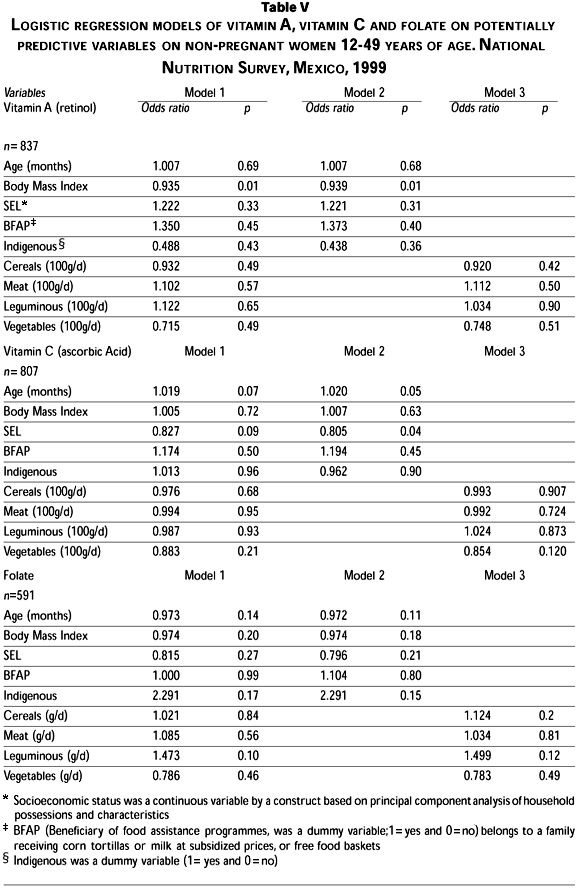
<body><![CDATA[<p><font size="2" face="Verdana"><I>Vitamin A (retinol) status.</I> The prevalence    of retinol levels indicative of severe deficiency was marginal (0.4%), and found    only in the center. The prevalence of vitamin A depletion (serum concentrations    of retinol &lt;10 and &gt;20 mg/dl) was also low (4.3%), with no differences    between rural and urban women and among regions (<a href="#tab02">Tables II</a>    and <a href="#tab04">IV</a>). </font></p>     <p><font size="2" face="Verdana"> The likelihood of having subclinical deficiency    of vitamin A was lower in women with higher BMI (OR=0.93, <I>p</I>=0.01). No    association with age, SEL, being beneficiary of food assistance programmes,    ethnicity or the intakes of any food group in particular was noted (<a href="#tab05">Table    V</a>). </font></p>     <p><a name="tab05"></a></p>     <p>&nbsp;</p>     <p align="center"><img src="/img/revistas/spm/v45s4/a07tab05.gif"></p>     <p>&nbsp;</p>     <p><font size="2" face="Verdana"><I>Vitamin C (ascorbic acid) status</I>. The    prevalence of serum vitamin C levels indicative of high risk for deficiency    was near 40% nationwide with no differences between rural and urban women. The    highest prevalence was observed in the North and South regions. Milder deficiencies    were less prevalent, i.e., 11% across groups (<a href="#tab02">Tables II</a>    and <a href="#tab04">IV</a>). </font></p>     <p><font size="2" face="Verdana"> The likelihood of having vitamin C deficiency    was higher in women (OR=1.02, <I>p</I>=0.05), and lower in those of higher SEL    (OR=0.80, <I>p</I>=0.04). No significant association occurred with other social    and dietary data introduced into the model (<a href="#tab05">Table V</a>). </font></p>     <p><font size="2" face="Verdana"><I>Folate status</I>. Overt hemoglobin folate    deficiency was approximately 5% at the national level with no significant difference    between urban and rural women (4.5 and 6.8%, respectively). Overt folate deficiency    was more prevalent in the North and South regions than in the Center and Mexico    City regions. </font></p>     <p><font size="2" face="Verdana"> The likelihood of having folate deficiency was    not associated with either socioeconomic or dietary variables included in the    model. </font></p>     ]]></body>
<body><![CDATA[<p>&nbsp;</p>     <p><font size="3" face="Verdana"><b>Discussion </b></font></p>     <p><font size="2" face="Verdana">We present evidence here that the prevalence    of vitamin A and folate deficiencies are of moderate concern from a public health    standpoint in Mexico, while the vitamin C deficiency had an unexpectedly high    prevalence in both children and women. </font></p>     <p><font size="2" face="Verdana"> Although the prevalence of severe vitamin A    deficiency (&lt;10 mg/dl) was practically nonexistent in both women and children,    the prevalence of subclinical deficiency (&gt;10.0&lt;20 mg/dl) affected almost    one-fourth of children &lt;8 years of age. Women were not often affected. Considering    that even in well-nourished pairs, the serum retinol levels of the newborn are    about 50% lower than the maternal concentrations, this reflects limited body    stores of the offspring.<SUP>31,32</SUP> Vitamin A depletion in the children    who were subjects in ENN-99 might be caused by inadequate dietary intake of    the vitamin. Breast milk is the initial source of vitamin A for the newborn    to build up adequate body stores, but its vitamin A content is dependent on    maternal status.<SUP>33</SUP> Based on the low prevalence of subclinical deficiency    of vitamin A in women of childbearing age, it is unlikely that insufficiency    of vitamin A in breast milk content played an important role in the high prevalence    of subclinical deficiency of vitamin A of young children in this sample. Among    other dietary insufficiencies relative to older children are the low consumption    of fruits and vegetables found in the ENN-99. In support of this hypothesis,    we found that subclinical deficiency of vitamin A was higher in the lower SEL.    This suggests that children with lower accessibility to high quality diets (including    foods rich in vitamin A: eggs, milk, fruits and vegetables), are at higher risk    of being deficient. The inverse association between vitamin A deficiency and    age is also suggestive that a more diverse diet is acquired over time, with    a denser intake of vitamin A. The lack of association between dietary intakes    and vitamin A deficiency might be due to the lack of precision of a single 24-h    recall; there is a need for 6 recalls obtaining a precision of &plusmn; 20%.<SUP>    34</SUP> It is noteworthy that the public health programs administered by the    Mexican health authorities include the administration of an oral macro dose    of vitamin A, twice yearly, to children &lt;2 years of age who live in depressed    socioeconomic areas. This might contribute to the low prevalence of vitamin    A deficiency in small children; however, the effectiveness of such a program    has not been evaluated yet. Other nutrition interventions, as is the case of    supplements provided by the Programa de Educaci&oacute;n Salud y Alimentaci&oacute;n    (Progresa) to preschoolers living in extreme poverty, has already shown some    improvement in their vitamin A status.<SUP> 35</SUP> Although the prevalence    of severe vitamin A deficiency was nonexistent in children, the prevalence of    subclinical forms of the deficiency is of some concern from a public health    point of view. This is because even subclinical deficiencies of vitamin A are    associated with increased morbidity and mortality.<SUP>2</SUP> Also, because    this vitamin A-depleted population will become deficient in the eventuality    of harsh conditions such as natural disasters or economic hardship. The above    factors call for a stronger public nutrition intervention with a focus on children    &lt;8 years of age. </font></p>     <p><font size="2" face="Verdana"> The high prevalence of vitamin C deficiency    was unexpected, but consistent with the data on dietary intake collected in    ENN-99. Fruits and vegetables ranked very low in the list of foods most frequently    eaten: oranges ranked 5<SUP>th</SUP>, guava 9<SUP>th</SUP>, broccoli 10<SUP>th</SUP>    and bananas 11<SUP>th</SUP>, with an average daily intake &lt;5 g for any of    those foods. In children, the serum concentration of ascorbic acid was directly    associated with the intake of vitamin C, supporting this notion (data not shown).    Socioeconomic status was also a determinant of vitamin C deficiency, suggesting    that fruits and vegetables are either not affordable by the lowest socioeconomic    groups or are not culturally included in their normal diet. In any case, such    a high prevalence of vitamin C deficiency is unacceptable because of its important    role as a facilitator of iron absorption<SUP>36</SUP> as well as in the synthesis    of collagen.<SUP>8</SUP> In a country where corn is the main staple, iron absorption    is extremely depressed by its high content of phytate, resulting in a high prevalence    of iron deficiency anemia. A better intake of ascorbic acid in the diet could    neutralize the negative effects of phytate. In a recent publication, a positive    association between ferritin concentrations and the dietary intake of ascorbic    acid after controlling for age was reported in non-pregnant Mexican women aged    16-44 years.<SUP>37</SUP> Premature rupture of membranes is frequent in pregnant    women who are vitamin C deficient,<SUP>9 </SUP>resulting in a shorter gestation    and low birth weight. Thus, increasing the dietary intake or supplementation    with vitamin C for women at risk may help alleviate the problem of premature    rupture of membranes and the high prevalence of iron deficiency anemia. </font></p>     <p><font size="2" face="Verdana"> The low prevalence of folate deficiency among    women of childbearing age subjects to ENN-99 seems to be in contradiction with    the high and growing prevalence of neural tube defects in Mexico.<SUP>38</SUP>    Such a low prevalence may not reflect the true folate status of these women;    the basis for such speculation is the high prevalence of iron deficiency. Iron    deficiency may mask folate deficiency. Studies in humans<SUP>39, 40</SUP> with    iron deficiency anemia have shown that the folate content in erythrocytes and    other indicators of folate status are normal, and evolve to abnormally low once    iron deficiency is corrected. Further, the average daily intake of folic acid    found in ENN-99 was 215 &#181;g,<SUP>13</SUP> almost half the recommended intake.    In such an assessment the losses due to food preparation were not considered.    It is frequent in Mexico that vegetables are intensely boiled or fried before    eating them.<SUP>41</SUP> In a separate analysis of this database, P&eacute;rez-Exp&oacute;sito    <I>et al</I><SUP>42 </SUP>found that 16% of the cases of anemia in women of    childbearing age were not explained by iron deficiency, most of which were associated    with low hemoglobin folate levels. Recently, B12 and serum folate determinations    were performed by Dr L. Allen (UC-Davis, CA, unpublished data), in serum samples    from ENN-99 and found a prevalence of B12 deficiency in almost 7% (&lt;80 pg/ml)    and of serum folate of 50% (&lt;3 ng/ml) in childbearing-age women. The latter    results support the notion that B12 deficiency plays a minor role in the pathogenesis    of neural tube defects in Mexico. Secondly, the high prevalence of serum folate    deficiency along with normal levels of hemoglobin folate is highly suggestive    of a hidden folate deficiency,<SUP>40</SUP> possibly associated to the documented    high prevalence of iron deficiency (refer to article in this issue on minerals).    The method used to collect and preserve the samples for the determination of    folate in total blood is novel and very convenient for epidemiological studies    under adverse field conditions. Blood is collected in filter paper and conserved    at 4 &ordm;C, avoiding the meticulous procedures needed to process and preserve    blood samples that are routinely used, i.e. dilute the blood sample with metaphosphoric    acid and maintain it preserved from light at –40 &ordm;C, which is difficult    under most fieldwork conditions. Validation for this procedure has been extensively    documented.<SUP>18-20</SUP> Further studies are necessary to elucidate whether    the correction of iron deficiency reveals folate deficiency. In Mexico public    health nutrition programs directed at combating iron deficiency anemia have    included adequate amounts of folic acid in their micronutrient formulation,    so an epidemic of folate deficiency is unlikely unmasked by the correction of    iron deficiency. </font></p>     <p><font size="2" face="Verdana"> In summary, the high prevalence of subclinical    deficiency of vitamin A in children and vitamin C deficiency in both children    and women of childbearing age in Mexico is of high interest for public nutrition    and require programmatic implementations in order to correct them. Such an action    may contribute to reducing the rate of acute infections in children and a decrease    of low birth weight babies, also resulting in the improvement of the iron status    of the general population. It is crucial to elucidate whether the prevalence    of folic acid deficiency is spuriously low, masked by the high prevalence of    iron deficiency. Further studies such as clinical trials are in order to identify    the putatively masked folate deficiency. </font></p>     <p>&nbsp;</p>     <p><font size="3" face="Verdana"><b>References </b></font></p>     <!-- ref --><p><font size="2" face="Verdana">1. Svedberg P. Poverty and undernutrition. New    York: Oxford University Press, 2000. </font>&nbsp;&nbsp;&nbsp;&nbsp;&nbsp;&nbsp;&nbsp;&nbsp;[&#160;<a href="javascript:void(0);" onclick="javascript: window.open('/scielo.php?script=sci_nlinks&ref=9186566&pid=S0036-3634200300100000700001&lng=','','width=640,height=500,resizable=yes,scrollbars=1,menubar=yes,');">Links</a>&#160;]<!-- end-ref --><!-- ref --><p><font size="2" face="Verdana">2. West KP. Dietary vitamin-A deficiency: Effects    on growth infection, and mortality. Food Nutr Bull 1991;19:119-131. </font>&nbsp;&nbsp;&nbsp;&nbsp;&nbsp;&nbsp;&nbsp;&nbsp;[&#160;<a href="javascript:void(0);" onclick="javascript: window.open('/scielo.php?script=sci_nlinks&ref=9186567&pid=S0036-3634200300100000700002&lng=','','width=640,height=500,resizable=yes,scrollbars=1,menubar=yes,');">Links</a>&#160;]<!-- end-ref --><!-- ref --><p><font size="2" face="Verdana">3. Hadi H, Stoltfus RJ, Moulton LH, Dibley MJ,    West KP. Respiratory infections reduce the growth response to vitamin A supplementation    in a randomized controlled trial. Int J Epidemiol 1999;28:874-881 </font>&nbsp;&nbsp;&nbsp;&nbsp;&nbsp;&nbsp;&nbsp;&nbsp;[&#160;<a href="javascript:void(0);" onclick="javascript: window.open('/scielo.php?script=sci_nlinks&ref=9186568&pid=S0036-3634200300100000700003&lng=','','width=640,height=500,resizable=yes,scrollbars=1,menubar=yes,');">Links</a>&#160;]<!-- end-ref --><!-- ref --><p><font size="2" face="Verdana">4. Sedgh G, Herrera MG, Nestel P, elAmin A, Fawzi    WW. Dietary vitamin A intake and nondietary factors are associated with reversal    stunting in children. J Nutr 2000;130:2520-2526. </font>&nbsp;&nbsp;&nbsp;&nbsp;&nbsp;&nbsp;&nbsp;&nbsp;[&#160;<a href="javascript:void(0);" onclick="javascript: window.open('/scielo.php?script=sci_nlinks&ref=9186569&pid=S0036-3634200300100000700004&lng=','','width=640,height=500,resizable=yes,scrollbars=1,menubar=yes,');">Links</a>&#160;]<!-- end-ref --><!-- ref --><p><font size="2" face="Verdana">5. Lindembaum J, Allen RH. Clinical spectrum    and diagnosis of folate deficiency. In: Folate in health and disease. Bailey    LB, Ed. New York: Marcel Dekker 1995;43-74. </font>&nbsp;&nbsp;&nbsp;&nbsp;&nbsp;&nbsp;&nbsp;&nbsp;[&#160;<a href="javascript:void(0);" onclick="javascript: window.open('/scielo.php?script=sci_nlinks&ref=9186570&pid=S0036-3634200300100000700005&lng=','','width=640,height=500,resizable=yes,scrollbars=1,menubar=yes,');">Links</a>&#160;]<!-- end-ref --><!-- ref --><p><font size="2" face="Verdana">6. Blomhoff HK, Smeland EB. Role of retinoids    in normal hematopoiesis and the immune system. In: Vitamin A in health and disease.    Blomhoff R, Ed. New York: Marcel Dekker,1994:451-484. </font>&nbsp;&nbsp;&nbsp;&nbsp;&nbsp;&nbsp;&nbsp;&nbsp;[&#160;<a href="javascript:void(0);" onclick="javascript: window.open('/scielo.php?script=sci_nlinks&ref=9186571&pid=S0036-3634200300100000700006&lng=','','width=640,height=500,resizable=yes,scrollbars=1,menubar=yes,');">Links</a>&#160;]<!-- end-ref --><!-- ref --><p><font size="2" face="Verdana">7. Daly LE, Kirke PN, Mohillo A, Weir DG, Scott    JM. Folate levels and neural tube defects. Implications for prevention. JAMA    1995;274: 1698-1702. </font>&nbsp;&nbsp;&nbsp;&nbsp;&nbsp;&nbsp;&nbsp;&nbsp;[&#160;<a href="javascript:void(0);" onclick="javascript: window.open('/scielo.php?script=sci_nlinks&ref=9186572&pid=S0036-3634200300100000700007&lng=','','width=640,height=500,resizable=yes,scrollbars=1,menubar=yes,');">Links</a>&#160;]<!-- end-ref --><!-- ref --><p><font size="2" face="Verdana">8. Casanueva E, Maga&ntilde;a L, Pfeffer E, B&aacute;ez    A. Incidence of premature rupture of membranes in pregnant women with low leukocyte    levels of vitamin C. Eur J Clin Nutr 1991;45:401-405. </font>&nbsp;&nbsp;&nbsp;&nbsp;&nbsp;&nbsp;&nbsp;&nbsp;[&#160;<a href="javascript:void(0);" onclick="javascript: window.open('/scielo.php?script=sci_nlinks&ref=9186573&pid=S0036-3634200300100000700008&lng=','','width=640,height=500,resizable=yes,scrollbars=1,menubar=yes,');">Links</a>&#160;]<!-- end-ref --><!-- ref --><p><font size="2" face="Verdana">9. Casanueva E, Avila H, Polo E, Tejero E, Narcia    ML, Pfeffer F. Vitamin C status, cervico-vaginal infection and premature rupture    of amniotic membranes. Arch Med Res 1995;26:S149-S152. </font>&nbsp;&nbsp;&nbsp;&nbsp;&nbsp;&nbsp;&nbsp;&nbsp;[&#160;<a href="javascript:void(0);" onclick="javascript: window.open('/scielo.php?script=sci_nlinks&ref=9186574&pid=S0036-3634200300100000700009&lng=','','width=640,height=500,resizable=yes,scrollbars=1,menubar=yes,');">Links</a>&#160;]<!-- end-ref --><!-- ref --><p><font size="2" face="Verdana">10. Blumberg JB. Considerations of the scientific    substantiation for antioxidant vitamins and beta-carotene in disease prevention.    Am J Clin Nutr 1995;62:1521-1526. </font>&nbsp;&nbsp;&nbsp;&nbsp;&nbsp;&nbsp;&nbsp;&nbsp;[&#160;<a href="javascript:void(0);" onclick="javascript: window.open('/scielo.php?script=sci_nlinks&ref=9186575&pid=S0036-3634200300100000700010&lng=','','width=640,height=500,resizable=yes,scrollbars=1,menubar=yes,');">Links</a>&#160;]<!-- end-ref --><!-- ref --><p><font size="2" face="Verdana">11. Sep&uacute;lveda-Amor J, Lezana MA, Tapia-Conyer,    Valdespino JL, Madrigal H, Kumate J. Estado nutricional de preescolares y mujeres    en M&eacute;xico: resultados de una encuesta probabil&iacute;stica nacional.    Gac Med Mex 1990;126:207-224. </font>&nbsp;&nbsp;&nbsp;&nbsp;&nbsp;&nbsp;&nbsp;&nbsp;[&#160;<a href="javascript:void(0);" onclick="javascript: window.open('/scielo.php?script=sci_nlinks&ref=9186576&pid=S0036-3634200300100000700011&lng=','','width=640,height=500,resizable=yes,scrollbars=1,menubar=yes,');">Links</a>&#160;]<!-- end-ref --><!-- ref --><p><font size="2" face="Verdana">12. Segundo Censo Nacional de talla. En ni&ntilde;os    de primer grado de primaria. Informe t&eacute;cnico ejecutivo. M&eacute;xico,    DF: Sistema Nacional para el desarrollo integral de la familia, 1996. </font>&nbsp;&nbsp;&nbsp;&nbsp;&nbsp;&nbsp;&nbsp;&nbsp;[&#160;<a href="javascript:void(0);" onclick="javascript: window.open('/scielo.php?script=sci_nlinks&ref=9186577&pid=S0036-3634200300100000700012&lng=','','width=640,height=500,resizable=yes,scrollbars=1,menubar=yes,');">Links</a>&#160;]<!-- end-ref --><!-- ref --><p><font size="2" face="Verdana">13. Rivera J, Shamah T, Villalpando S, Gonz&aacute;lez    T, Hern&aacute;ndez B, Sep&uacute;lveda J, ed. Encuesta Nacional de Nutrici&oacute;n    1999. Estado Nutricio de Ni&ntilde;os y Mujeres en M&eacute;xico. Cuernavaca,    Morelos, M&eacute;xico. Instituto Nacional de Salud P&uacute;blica, 2001. </font>&nbsp;&nbsp;&nbsp;&nbsp;&nbsp;&nbsp;&nbsp;&nbsp;[&#160;<a href="javascript:void(0);" onclick="javascript: window.open('/scielo.php?script=sci_nlinks&ref=9186578&pid=S0036-3634200300100000700013&lng=','','width=640,height=500,resizable=yes,scrollbars=1,menubar=yes,');">Links</a>&#160;]<!-- end-ref --><!-- ref --><p><font size="2" face="Verdana">14. Rivera J, Bourges H, Arroyo P, Casanueva    E, Ch&aacute;vez A, Halhalali A <I>et al.</I> 1. Deficiencia de micronutrimentos.    En: De la Fuente JR, Sep&uacute;lveda J comp. Diez problemas relevantes de salud    p&uacute;blica en M&eacute;xico M&eacute;xico, DF: Fondo de Cultura Econ&oacute;mica,1999:15-57.    </font>&nbsp;&nbsp;&nbsp;&nbsp;&nbsp;&nbsp;&nbsp;&nbsp;[&#160;<a href="javascript:void(0);" onclick="javascript: window.open('/scielo.php?script=sci_nlinks&ref=9186579&pid=S0036-3634200300100000700014&lng=','','width=640,height=500,resizable=yes,scrollbars=1,menubar=yes,');">Links</a>&#160;]<!-- end-ref --><!-- ref --><p><font size="2" face="Verdana">15. Rosado JL, Bourges H, Saint-Martin B. Deficiencias    de vitaminas y minerales en M&eacute;xico. Una revisi&oacute;n cr&iacute;tica    del estado de la informaci&oacute;n. II. Deficiencia de vitaminas, Salud Publica    Mex 1995;37:452-461. </font>&nbsp;&nbsp;&nbsp;&nbsp;&nbsp;&nbsp;&nbsp;&nbsp;[&#160;<a href="javascript:void(0);" onclick="javascript: window.open('/scielo.php?script=sci_nlinks&ref=9186580&pid=S0036-3634200300100000700015&lng=','','width=640,height=500,resizable=yes,scrollbars=1,menubar=yes,');">Links</a>&#160;]<!-- end-ref --><!-- ref --><p><font size="2" face="Verdana">16. Sowell AL, Huff DL, Yeager PR, Caudill SP,    Gunther EW. Retinol, tocopherol, lutein, cryptoxanthine, lycopene, carotene    and four retinyl-esters in serum, determined simultaneously by reverse-phase    HPLC with length detection. Clin Chem 1994;40:411-416. </font>&nbsp;&nbsp;&nbsp;&nbsp;&nbsp;&nbsp;&nbsp;&nbsp;[&#160;<a href="javascript:void(0);" onclick="javascript: window.open('/scielo.php?script=sci_nlinks&ref=9186581&pid=S0036-3634200300100000700016&lng=','','width=640,height=500,resizable=yes,scrollbars=1,menubar=yes,');">Links</a>&#160;]<!-- end-ref --><!-- ref --><p><font size="2" face="Verdana">17. Pilch SM. Assessment of the vitamin A nutritional    status of the US population based on data collected in the Health and Nutrition    Examination Surveys. Bethesda, (MD): Life Science Research Office, Federation    of American Biological Societies,1985. </font>&nbsp;&nbsp;&nbsp;&nbsp;&nbsp;&nbsp;&nbsp;&nbsp;[&#160;<a href="javascript:void(0);" onclick="javascript: window.open('/scielo.php?script=sci_nlinks&ref=9186582&pid=S0036-3634200300100000700017&lng=','','width=640,height=500,resizable=yes,scrollbars=1,menubar=yes,');">Links</a>&#160;]<!-- end-ref --><!-- ref --><p><font size="2" face="Verdana">18. O'Broin SD, Gunther EW. Screening of folate    status with the use of dried blood spots on filter paper. Am J Clin Nutr 1999;70:359-367.    </font>&nbsp;&nbsp;&nbsp;&nbsp;&nbsp;&nbsp;&nbsp;&nbsp;[&#160;<a href="javascript:void(0);" onclick="javascript: window.open('/scielo.php?script=sci_nlinks&ref=9186583&pid=S0036-3634200300100000700018&lng=','','width=640,height=500,resizable=yes,scrollbars=1,menubar=yes,');">Links</a>&#160;]<!-- end-ref --><!-- ref --><p><font size="2" face="Verdana">19 . O'Broin SD, Kelleher BP, Davoren A, Gunter    E. Field-study screening of blood folate concentrations: Specimen stability    and finger-stick sampling. Am J Clin Nutr 1997;66:1398-1405. </font>&nbsp;&nbsp;&nbsp;&nbsp;&nbsp;&nbsp;&nbsp;&nbsp;[&#160;<a href="javascript:void(0);" onclick="javascript: window.open('/scielo.php?script=sci_nlinks&ref=9186584&pid=S0036-3634200300100000700019&lng=','','width=640,height=500,resizable=yes,scrollbars=1,menubar=yes,');">Links</a>&#160;]<!-- end-ref --><!-- ref --><p><font size="2" face="Verdana">20. O'Broin SD, Kelleher BP, Gunter E. Evaluation    of factor influencing precision in the analysis of samples taken from blood    spots on filter paper. Clin Lab Haematol 1995;17:185-188. </font>&nbsp;&nbsp;&nbsp;&nbsp;&nbsp;&nbsp;&nbsp;&nbsp;[&#160;<a href="javascript:void(0);" onclick="javascript: window.open('/scielo.php?script=sci_nlinks&ref=9186585&pid=S0036-3634200300100000700020&lng=','','width=640,height=500,resizable=yes,scrollbars=1,menubar=yes,');">Links</a>&#160;]<!-- end-ref --><!-- ref --><p><font size="2" face="Verdana">21. O'Broin SD, Kelleher B. Microbiological assay    on microtitre plates of folate in serum and red cells. J Clin Pathol 1992;45:344-347.    </font>&nbsp;&nbsp;&nbsp;&nbsp;&nbsp;&nbsp;&nbsp;&nbsp;[&#160;<a href="javascript:void(0);" onclick="javascript: window.open('/scielo.php?script=sci_nlinks&ref=9186586&pid=S0036-3634200300100000700021&lng=','','width=640,height=500,resizable=yes,scrollbars=1,menubar=yes,');">Links</a>&#160;]<!-- end-ref --><!-- ref --><p><font size="2" face="Verdana">22. Wagner C. Folic acid. In: Brown M, Ed. Present    knowledge in nutrition. B 5<SUP>th</SUP> ed. The Nutrition Foundation, Inc (Pub);    Washington, DC, 1984:33. </font>&nbsp;&nbsp;&nbsp;&nbsp;&nbsp;&nbsp;&nbsp;&nbsp;[&#160;<a href="javascript:void(0);" onclick="javascript: window.open('/scielo.php?script=sci_nlinks&ref=9186587&pid=S0036-3634200300100000700022&lng=','','width=640,height=500,resizable=yes,scrollbars=1,menubar=yes,');">Links</a>&#160;]<!-- end-ref --><!-- ref --><p><font size="2" face="Verdana">23. Herman HH, Wimalasena K, Fowler LC, Near    CA, May SW. Demonstration of the ascorbate dependence of membrane bound dopamine    B-monoxigenase in adrenal chromaphin granule ghosts. J Biol Chem 1988;263:666-672.    </font>&nbsp;&nbsp;&nbsp;&nbsp;&nbsp;&nbsp;&nbsp;&nbsp;[&#160;<a href="javascript:void(0);" onclick="javascript: window.open('/scielo.php?script=sci_nlinks&ref=9186588&pid=S0036-3634200300100000700023&lng=','','width=640,height=500,resizable=yes,scrollbars=1,menubar=yes,');">Links</a>&#160;]<!-- end-ref --><!-- ref --><p><font size="2" face="Verdana">24. Sauberlich HE. Ascorbic acid (vitamin C).    In: Labb&eacute; RF, Ed. Symposium on laboratory assessment of nutritional status.    Clin Lab Med 1981;673-684</font>&nbsp;&nbsp;&nbsp;&nbsp;&nbsp;&nbsp;&nbsp;&nbsp;[&#160;<a href="javascript:void(0);" onclick="javascript: window.open('/scielo.php?script=sci_nlinks&ref=9186589&pid=S0036-3634200300100000700024&lng=','','width=640,height=500,resizable=yes,scrollbars=1,menubar=yes,');">Links</a>&#160;]<!-- end-ref --><!-- ref --><p><font size="2" face="Verdana"> 25. Morales J, Babinsky V, Bourges H, Camacho    ME. Tablas de composici&oacute;n de alimentos mexicanos del Instituto Nacional    de Ciencias M&eacute;dicas y Nutrici&oacute;n &quot;Salvador Zubir&aacute;n&quot;.    M&eacute;xico, DF: INCMN Salvador Zubir&aacute;n, 2000. </font>&nbsp;&nbsp;&nbsp;&nbsp;&nbsp;&nbsp;&nbsp;&nbsp;[&#160;<a href="javascript:void(0);" onclick="javascript: window.open('/scielo.php?script=sci_nlinks&ref=9186590&pid=S0036-3634200300100000700025&lng=','','width=640,height=500,resizable=yes,scrollbars=1,menubar=yes,');">Links</a>&#160;]<!-- end-ref --><!-- ref --><p><font size="2" face="Verdana">26. Mu&ntilde;oz M, Ch&aacute;vez A, P&eacute;rez-Gil    F, Rold&aacute;n JA, Hern&aacute;ndez S, Ledesma JA. Tablas de valor nutritivo    de los alimentos de mayor consumo en M&eacute;xico. M&eacute;xico, DF: Editorial    Pax,1996. </font>&nbsp;&nbsp;&nbsp;&nbsp;&nbsp;&nbsp;&nbsp;&nbsp;[&#160;<a href="javascript:void(0);" onclick="javascript: window.open('/scielo.php?script=sci_nlinks&ref=9186591&pid=S0036-3634200300100000700026&lng=','','width=640,height=500,resizable=yes,scrollbars=1,menubar=yes,');">Links</a>&#160;]<!-- end-ref --><!-- ref --><p><font size="2" face="Verdana">27. US Department of Agriculture, Agricultural    Research Service. USDA Nutrient Database for Standard Reference, Release 13.    Washington, DC: Nutrient Data Laboratory, 1999. </font>&nbsp;&nbsp;&nbsp;&nbsp;&nbsp;&nbsp;&nbsp;&nbsp;[&#160;<a href="javascript:void(0);" onclick="javascript: window.open('/scielo.php?script=sci_nlinks&ref=9186592&pid=S0036-3634200300100000700027&lng=','','width=640,height=500,resizable=yes,scrollbars=1,menubar=yes,');">Links</a>&#160;]<!-- end-ref --><!-- ref --><p><font size="2" face="Verdana">28. Food Composition and Nutrition Tables. Der    zusament setzung der Lebensmittel, N&auml;hrwert – Tabellen/on behalf    of the Bundesministerium f&uuml;r Ern&auml;hrung, Land wirts shaft und Forsten,    Bonn, ed. Scherz H, Senser F, Comp. Stuttgart: Medpharm Scientific and CRC Press,    London, 2000. </font>&nbsp;&nbsp;&nbsp;&nbsp;&nbsp;&nbsp;&nbsp;&nbsp;[&#160;<a href="javascript:void(0);" onclick="javascript: window.open('/scielo.php?script=sci_nlinks&ref=9186593&pid=S0036-3634200300100000700028&lng=','','width=640,height=500,resizable=yes,scrollbars=1,menubar=yes,');">Links</a>&#160;]<!-- end-ref --><!-- ref --><p><font size="2" face="Verdana">29. Instituto de Nutrici&oacute;n de Centroam&eacute;rica    y Panam&aacute;. Tabla de composici&oacute;n de alimentos. Guatemala: INCAP,    1994. </font>&nbsp;&nbsp;&nbsp;&nbsp;&nbsp;&nbsp;&nbsp;&nbsp;[&#160;<a href="javascript:void(0);" onclick="javascript: window.open('/scielo.php?script=sci_nlinks&ref=9186594&pid=S0036-3634200300100000700029&lng=','','width=640,height=500,resizable=yes,scrollbars=1,menubar=yes,');">Links</a>&#160;]<!-- end-ref --><!-- ref --><p><font size="2" face="Verdana">30. Anonimous. World Food Dietary Assessment    System. V 2.0. Berkeley: University of California, 1997. </font>&nbsp;&nbsp;&nbsp;&nbsp;&nbsp;&nbsp;&nbsp;&nbsp;[&#160;<a href="javascript:void(0);" onclick="javascript: window.open('/scielo.php?script=sci_nlinks&ref=9186595&pid=S0036-3634200300100000700030&lng=','','width=640,height=500,resizable=yes,scrollbars=1,menubar=yes,');">Links</a>&#160;]<!-- end-ref --><!-- ref --><p><font size="2" face="Verdana">31. Yeum KJ, Ferland G, Patry J, Russell RM.    Relationship of plasma carotenoids, retinol and tocopherols in mothers and newborn    infants. J Am Coll Nutr 1998;17:442-447. </font>&nbsp;&nbsp;&nbsp;&nbsp;&nbsp;&nbsp;&nbsp;&nbsp;[&#160;<a href="javascript:void(0);" onclick="javascript: window.open('/scielo.php?script=sci_nlinks&ref=9186596&pid=S0036-3634200300100000700031&lng=','','width=640,height=500,resizable=yes,scrollbars=1,menubar=yes,');">Links</a>&#160;]<!-- end-ref --><!-- ref --><p><font size="2" face="Verdana">32. Ramalho RA, dos Anjos LA, Flores H. Nutritional    status of vitamin A in mother/newborn pairs from 2 hospital nurseries in Rio    de Janeiro, Brazil. Arch Latinoam Nutr 1999;49:318-321. </font>&nbsp;&nbsp;&nbsp;&nbsp;&nbsp;&nbsp;&nbsp;&nbsp;[&#160;<a href="javascript:void(0);" onclick="javascript: window.open('/scielo.php?script=sci_nlinks&ref=9186597&pid=S0036-3634200300100000700032&lng=','','width=640,height=500,resizable=yes,scrollbars=1,menubar=yes,');">Links</a>&#160;]<!-- end-ref --><!-- ref --><p><font size="2" face="Verdana">33. Stoltzfus RJ, Hakimi M, Rasmussen KM, Dawiesah    S, Habicht JP, Dibley MJ. High-dose vitamin A supplementation for breastfeeding    Indonesian mothers: Effects on the vitamin A status of mother and infant. J    Nutr 1993;123:666-675. </font>&nbsp;&nbsp;&nbsp;&nbsp;&nbsp;&nbsp;&nbsp;&nbsp;[&#160;<a href="javascript:void(0);" onclick="javascript: window.open('/scielo.php?script=sci_nlinks&ref=9186598&pid=S0036-3634200300100000700033&lng=','','width=640,height=500,resizable=yes,scrollbars=1,menubar=yes,');">Links</a>&#160;]<!-- end-ref --><!-- ref --><p><font size="2" face="Verdana">34. Persson V, Winkist A, Hartini NS, Greiner    T, Hakimi M, Stenlund H. Variability in nutrient intakes among pregnant women    in Indonesia: Implications for the design of epidemiological studies using the    24-h recall method. J Nutr 2001;131:325-330. </font>&nbsp;&nbsp;&nbsp;&nbsp;&nbsp;&nbsp;&nbsp;&nbsp;[&#160;<a href="javascript:void(0);" onclick="javascript: window.open('/scielo.php?script=sci_nlinks&ref=9186599&pid=S0036-3634200300100000700034&lng=','','width=640,height=500,resizable=yes,scrollbars=1,menubar=yes,');">Links</a>&#160;]<!-- end-ref --><!-- ref --><p><font size="2" face="Verdana">35. Rivera JA, Rodr&iacute;guez G, Shamah T,    Rosado JL, Casanueva E <I>et al</I>. Implementation, monitoring, and evaluation    of the nutrition component of the Mexican Social Programme (Progresa). Food    Nutr Bull 2000;21:35-42. </font>&nbsp;&nbsp;&nbsp;&nbsp;&nbsp;&nbsp;&nbsp;&nbsp;[&#160;<a href="javascript:void(0);" onclick="javascript: window.open('/scielo.php?script=sci_nlinks&ref=9186600&pid=S0036-3634200300100000700035&lng=','','width=640,height=500,resizable=yes,scrollbars=1,menubar=yes,');">Links</a>&#160;]<!-- end-ref --><!-- ref --><p><font size="2" face="Verdana">36. Sandstrom B. Micronutrient interactions:    Effects on absorption and bioavailability. Br J Nutr 2001;85(Suppl 2):S181-S185.    </font>&nbsp;&nbsp;&nbsp;&nbsp;&nbsp;&nbsp;&nbsp;&nbsp;[&#160;<a href="javascript:void(0);" onclick="javascript: window.open('/scielo.php?script=sci_nlinks&ref=9186601&pid=S0036-3634200300100000700036&lng=','','width=640,height=500,resizable=yes,scrollbars=1,menubar=yes,');">Links</a>&#160;]<!-- end-ref --><!-- ref --><p><font size="2" face="Verdana">37. Backstrand JR, Allen LH, Black AK, De Mata    M, Pelto GH. Diet and iron status of nonpregnant women in rural Central Mexico.    Am J Clin Nutr 2002;76:156-164. </font>&nbsp;&nbsp;&nbsp;&nbsp;&nbsp;&nbsp;&nbsp;&nbsp;[&#160;<a href="javascript:void(0);" onclick="javascript: window.open('/scielo.php?script=sci_nlinks&ref=9186602&pid=S0036-3634200300100000700037&lng=','','width=640,height=500,resizable=yes,scrollbars=1,menubar=yes,');">Links</a>&#160;]<!-- end-ref --><!-- ref --><p><font size="2" face="Verdana">38. Leck I. Causation of neural tube defects:    Clues from epidemiology. Br Med Bull 1974;30:158-163. </font>&nbsp;&nbsp;&nbsp;&nbsp;&nbsp;&nbsp;&nbsp;&nbsp;[&#160;<a href="javascript:void(0);" onclick="javascript: window.open('/scielo.php?script=sci_nlinks&ref=9186603&pid=S0036-3634200300100000700038&lng=','','width=640,height=500,resizable=yes,scrollbars=1,menubar=yes,');">Links</a>&#160;]<!-- end-ref --><!-- ref --><p><font size="2" face="Verdana">39. Das K, Herbert V, Colman N, Longo DL. Unmasking    covert folate deficiency in iron deficient subjects with neutrophil hypersegmentation:    uD suppression test on lymphocytes and bone marrow. Br J Haemat 1978;39:357-375.    </font>&nbsp;&nbsp;&nbsp;&nbsp;&nbsp;&nbsp;&nbsp;&nbsp;[&#160;<a href="javascript:void(0);" onclick="javascript: window.open('/scielo.php?script=sci_nlinks&ref=9186604&pid=S0036-3634200300100000700039&lng=','','width=640,height=500,resizable=yes,scrollbars=1,menubar=yes,');">Links</a>&#160;]<!-- end-ref --><!-- ref --><p><font size="2" face="Verdana">40. Omer A, Finlayson NDC, Shearman DJC, Samson    RR, Girdwood RH. Plasma and erythrocite folate in iron deficiency and folate    deficiency. Blood 1970;35:821-828. </font>&nbsp;&nbsp;&nbsp;&nbsp;&nbsp;&nbsp;&nbsp;&nbsp;[&#160;<a href="javascript:void(0);" onclick="javascript: window.open('/scielo.php?script=sci_nlinks&ref=9186605&pid=S0036-3634200300100000700040&lng=','','width=640,height=500,resizable=yes,scrollbars=1,menubar=yes,');">Links</a>&#160;]<!-- end-ref --><!-- ref --><p><font size="2" face="Verdana">41. Villalpando S, Latulippe ME, Rosas G, Irurita    MJ, Picciano MF, O'Connor DL. Low milk folate but not milk iron concentrations    may contribute to the observed growth faltering among infants in a rural farming    community in San Mateo, Capulhuac, Mexico. Am J Clin Nutr 2003. Accepted for    publication. </font>&nbsp;&nbsp;&nbsp;&nbsp;&nbsp;&nbsp;&nbsp;&nbsp;[&#160;<a href="javascript:void(0);" onclick="javascript: window.open('/scielo.php?script=sci_nlinks&ref=9186606&pid=S0036-3634200300100000700041&lng=','','width=640,height=500,resizable=yes,scrollbars=1,menubar=yes,');">Links</a>&#160;]<!-- end-ref --><!-- ref --><p><font size="2" face="Verdana">42. P&eacute;rez-Exp&oacute;sito AB. Anemia y    deficiencia de micronutrimentos en mujeres mexicanas de 12 a 49 a&ntilde;os    de edad (Tesis de maestr&iacute;a). Madrid, Espa&ntilde;a: Instituto de Salud    P&uacute;blica Carlos III, 2001. </font>&nbsp;&nbsp;&nbsp;&nbsp;&nbsp;&nbsp;&nbsp;&nbsp;[&#160;<a href="javascript:void(0);" onclick="javascript: window.open('/scielo.php?script=sci_nlinks&ref=9186607&pid=S0036-3634200300100000700042&lng=','','width=640,height=500,resizable=yes,scrollbars=1,menubar=yes,');">Links</a>&#160;]<!-- end-ref --><p>&nbsp;</p>     <p>&nbsp;</p>     <p><font size="2" face="Verdana">Address reprint requests to    <br>   Dr. Salvador Villalpando    <br>   Instituto Nacional de Salud P&uacute;blica    <br>   Avenida Universidad 655    <br>   colonia Santa Mar&iacute;a Ahuacatitl&aacute;n    <br>   62508 Cuernavaca, Morelos, M&eacute;xico    <br>   E-mail: <a href="mailto:svillalp@insp.mx">svillalp@insp.mx</a></font></p>     ]]></body>
<body><![CDATA[<p><font size="2" face="Verdana"><B>Received on:</B> August 20, 2002     <br>   <B>Accepted on:</B> October 1, 2003 </font></p>      ]]></body><back>
<ref-list>
<ref id="B1">
<label>1</label><nlm-citation citation-type="book">
<person-group person-group-type="author">
<name>
<surname><![CDATA[Svedberg]]></surname>
<given-names><![CDATA[P.]]></given-names>
</name>
</person-group>
<source><![CDATA[Poverty and undernutrition]]></source>
<year>2000</year>
<publisher-loc><![CDATA[New York ]]></publisher-loc>
<publisher-name><![CDATA[Oxford University Press]]></publisher-name>
</nlm-citation>
</ref>
<ref id="B2">
<label>2</label><nlm-citation citation-type="journal">
<person-group person-group-type="author">
<name>
<surname><![CDATA[West]]></surname>
<given-names><![CDATA[KP]]></given-names>
</name>
</person-group>
<article-title xml:lang="en"><![CDATA[Dietary vitamin-A deficiency: Effects on growth infection, and mortality]]></article-title>
<source><![CDATA[Food Nutr Bull]]></source>
<year>1991</year>
<volume>19</volume>
<page-range>119-131</page-range></nlm-citation>
</ref>
<ref id="B3">
<label>3</label><nlm-citation citation-type="journal">
<person-group person-group-type="author">
<name>
<surname><![CDATA[Hadi]]></surname>
<given-names><![CDATA[H]]></given-names>
</name>
<name>
<surname><![CDATA[Stoltfus]]></surname>
<given-names><![CDATA[RJ]]></given-names>
</name>
<name>
<surname><![CDATA[Moulton]]></surname>
<given-names><![CDATA[LH]]></given-names>
</name>
<name>
<surname><![CDATA[Dibley]]></surname>
<given-names><![CDATA[MJ]]></given-names>
</name>
<name>
<surname><![CDATA[West]]></surname>
<given-names><![CDATA[KP]]></given-names>
</name>
</person-group>
<article-title xml:lang="en"><![CDATA[Respiratory infections reduce the growth response to vitamin A supplementation in a randomized controlled trial]]></article-title>
<source><![CDATA[Int J Epidemiol]]></source>
<year>1999</year>
<volume>28</volume>
<page-range>874-881</page-range></nlm-citation>
</ref>
<ref id="B4">
<label>4</label><nlm-citation citation-type="journal">
<person-group person-group-type="author">
<name>
<surname><![CDATA[Sedgh]]></surname>
<given-names><![CDATA[G]]></given-names>
</name>
<name>
<surname><![CDATA[Herrera]]></surname>
<given-names><![CDATA[MG]]></given-names>
</name>
<name>
<surname><![CDATA[Nestel]]></surname>
<given-names><![CDATA[P]]></given-names>
</name>
<name>
<surname><![CDATA[elAmin]]></surname>
<given-names><![CDATA[A]]></given-names>
</name>
<name>
<surname><![CDATA[Fawzi]]></surname>
<given-names><![CDATA[WW]]></given-names>
</name>
</person-group>
<article-title xml:lang="en"><![CDATA[Dietary vitamin A intake and nondietary factors are associated with reversal stunting in children]]></article-title>
<source><![CDATA[J Nutr]]></source>
<year>2000</year>
<volume>130</volume>
<page-range>2520-2526</page-range></nlm-citation>
</ref>
<ref id="B5">
<label>5</label><nlm-citation citation-type="book">
<person-group person-group-type="author">
<name>
<surname><![CDATA[Lindembaum]]></surname>
<given-names><![CDATA[J]]></given-names>
</name>
<name>
<surname><![CDATA[Allen]]></surname>
<given-names><![CDATA[RH]]></given-names>
</name>
</person-group>
<article-title xml:lang="en"><![CDATA[Clinical spectrum and diagnosis of folate deficiency]]></article-title>
<person-group person-group-type="editor">
<name>
<surname><![CDATA[Bailey]]></surname>
<given-names><![CDATA[LB]]></given-names>
</name>
</person-group>
<source><![CDATA[Folate in health and disease]]></source>
<year>1995</year>
<page-range>43-74</page-range><publisher-loc><![CDATA[New York ]]></publisher-loc>
<publisher-name><![CDATA[Marcel Dekker]]></publisher-name>
</nlm-citation>
</ref>
<ref id="B6">
<label>6</label><nlm-citation citation-type="book">
<person-group person-group-type="author">
<name>
<surname><![CDATA[Blomhoff]]></surname>
<given-names><![CDATA[HK]]></given-names>
</name>
<name>
<surname><![CDATA[Smeland]]></surname>
<given-names><![CDATA[EB]]></given-names>
</name>
</person-group>
<article-title xml:lang="en"><![CDATA[Role of retinoids in normal hematopoiesis and the immune system]]></article-title>
<person-group person-group-type="editor">
<name>
<surname><![CDATA[Blomhoff]]></surname>
<given-names><![CDATA[R]]></given-names>
</name>
</person-group>
<source><![CDATA[Vitamin A in health and disease]]></source>
<year>1994</year>
<page-range>451-484</page-range><publisher-loc><![CDATA[New York ]]></publisher-loc>
<publisher-name><![CDATA[Marcel Dekker]]></publisher-name>
</nlm-citation>
</ref>
<ref id="B7">
<label>7</label><nlm-citation citation-type="journal">
<person-group person-group-type="author">
<name>
<surname><![CDATA[Daly]]></surname>
<given-names><![CDATA[LE]]></given-names>
</name>
<name>
<surname><![CDATA[Kirke]]></surname>
<given-names><![CDATA[PN]]></given-names>
</name>
<name>
<surname><![CDATA[Mohillo]]></surname>
<given-names><![CDATA[A]]></given-names>
</name>
<name>
<surname><![CDATA[Weir]]></surname>
<given-names><![CDATA[DG]]></given-names>
</name>
<name>
<surname><![CDATA[Scott]]></surname>
<given-names><![CDATA[JM.]]></given-names>
</name>
</person-group>
<article-title xml:lang="en"><![CDATA[Implications for prevention]]></article-title>
<source><![CDATA[JAMA]]></source>
<year>1995</year>
<volume>274</volume>
<page-range>1698-1702</page-range></nlm-citation>
</ref>
<ref id="B8">
<label>8</label><nlm-citation citation-type="journal">
<person-group person-group-type="author">
<name>
<surname><![CDATA[Casanueva]]></surname>
<given-names><![CDATA[E]]></given-names>
</name>
<name>
<surname><![CDATA[Magaña]]></surname>
<given-names><![CDATA[L]]></given-names>
</name>
<name>
<surname><![CDATA[Pfeffer]]></surname>
<given-names><![CDATA[E]]></given-names>
</name>
<name>
<surname><![CDATA[Báez]]></surname>
<given-names><![CDATA[A]]></given-names>
</name>
</person-group>
<article-title xml:lang="en"><![CDATA[Incidence of premature rupture of membranes in pregnant women with low leukocyte levels of vitamin C]]></article-title>
<source><![CDATA[Eur J Clin Nutr]]></source>
<year>1991</year>
<volume>45</volume>
<page-range>401-405</page-range></nlm-citation>
</ref>
<ref id="B9">
<label>9</label><nlm-citation citation-type="journal">
<person-group person-group-type="author">
<name>
<surname><![CDATA[Casanueva]]></surname>
<given-names><![CDATA[E]]></given-names>
</name>
<name>
<surname><![CDATA[Avila]]></surname>
<given-names><![CDATA[H]]></given-names>
</name>
<name>
<surname><![CDATA[Polo]]></surname>
<given-names><![CDATA[E]]></given-names>
</name>
<name>
<surname><![CDATA[Tejero]]></surname>
<given-names><![CDATA[E]]></given-names>
</name>
<name>
<surname><![CDATA[Narcia]]></surname>
<given-names><![CDATA[ML]]></given-names>
</name>
<name>
<surname><![CDATA[Pfeffer]]></surname>
<given-names><![CDATA[F]]></given-names>
</name>
</person-group>
<article-title xml:lang="en"><![CDATA[Vitamin C status, cervico-vaginal infection and premature rupture of amniotic membranes]]></article-title>
<source><![CDATA[Arch Med Res]]></source>
<year>1995</year>
<volume>26</volume>
<page-range>S149-S152</page-range></nlm-citation>
</ref>
<ref id="B10">
<label>10</label><nlm-citation citation-type="journal">
<person-group person-group-type="author">
<name>
<surname><![CDATA[Blumberg]]></surname>
<given-names><![CDATA[JB]]></given-names>
</name>
</person-group>
<article-title xml:lang="en"><![CDATA[Considerations of the scientific substantiation for antioxidant vitamins and beta-carotene in disease prevention]]></article-title>
<source><![CDATA[Am J Clin Nutr]]></source>
<year>1995</year>
<volume>62</volume>
<page-range>1521-1526</page-range></nlm-citation>
</ref>
<ref id="B11">
<label>11</label><nlm-citation citation-type="journal">
<person-group person-group-type="author">
<name>
<surname><![CDATA[Sepúlveda-Amor]]></surname>
<given-names><![CDATA[J]]></given-names>
</name>
<name>
<surname><![CDATA[Lezana]]></surname>
<given-names><![CDATA[MA]]></given-names>
</name>
<name>
<surname><![CDATA[Tapia-Conyer,]]></surname>
<given-names><![CDATA[Valdespino JL]]></given-names>
</name>
<name>
<surname><![CDATA[Madrigal]]></surname>
<given-names><![CDATA[H]]></given-names>
</name>
<name>
<surname><![CDATA[Kumate]]></surname>
<given-names><![CDATA[J]]></given-names>
</name>
</person-group>
<article-title xml:lang="en"><![CDATA[Estado nutricional de preescolares y mujeres en México: resultados de una encuesta probabilística nacional]]></article-title>
<source><![CDATA[Gac Med Mex]]></source>
<year>1990</year>
<volume>126</volume>
<page-range>207-224</page-range></nlm-citation>
</ref>
<ref id="B12">
<label>12</label><nlm-citation citation-type="book">
<collab>Segundo Censo Nacional de talla</collab>
<source><![CDATA[En niños de primer grado de primaria: Informe técnico ejecutivo]]></source>
<year>1996</year>
<publisher-loc><![CDATA[México^eDF DF]]></publisher-loc>
<publisher-name><![CDATA[Sistema Nacional para el desarrollo integral de la familia]]></publisher-name>
</nlm-citation>
</ref>
<ref id="B13">
<label>13</label><nlm-citation citation-type="book">
<person-group person-group-type="author">
<name>
<surname><![CDATA[Rivera]]></surname>
<given-names><![CDATA[J]]></given-names>
</name>
<name>
<surname><![CDATA[Shamah]]></surname>
<given-names><![CDATA[T]]></given-names>
</name>
<name>
<surname><![CDATA[Villalpando]]></surname>
<given-names><![CDATA[S]]></given-names>
</name>
<name>
<surname><![CDATA[González]]></surname>
<given-names><![CDATA[T]]></given-names>
</name>
<name>
<surname><![CDATA[Hernández]]></surname>
<given-names><![CDATA[B]]></given-names>
</name>
<name>
<surname><![CDATA[Sepúlveda]]></surname>
<given-names><![CDATA[J]]></given-names>
</name>
</person-group>
<source><![CDATA[Encuesta Nacional de Nutrición 1999: Estado Nutricio de Niños y Mujeres en México]]></source>
<year>2001</year>
<publisher-loc><![CDATA[Cuernavaca^eMorelos Morelos]]></publisher-loc>
<publisher-name><![CDATA[Instituto Nacional de Salud Pública]]></publisher-name>
</nlm-citation>
</ref>
<ref id="B14">
<label>14</label><nlm-citation citation-type="book">
<person-group person-group-type="author">
<name>
<surname><![CDATA[Rivera]]></surname>
<given-names><![CDATA[J]]></given-names>
</name>
<name>
<surname><![CDATA[Bourges]]></surname>
<given-names><![CDATA[H]]></given-names>
</name>
<name>
<surname><![CDATA[Arroyo]]></surname>
<given-names><![CDATA[P]]></given-names>
</name>
<name>
<surname><![CDATA[Casanueva]]></surname>
<given-names><![CDATA[E]]></given-names>
</name>
<name>
<surname><![CDATA[Chávez]]></surname>
<given-names><![CDATA[A]]></given-names>
</name>
<name>
<surname><![CDATA[Halhalali]]></surname>
<given-names><![CDATA[A]]></given-names>
</name>
</person-group>
<article-title xml:lang="es"><![CDATA[1. Deficiencia de micronutrimentos]]></article-title>
<person-group person-group-type="editor">
<name>
<surname><![CDATA[JR]]></surname>
<given-names><![CDATA[De la Fuente]]></given-names>
</name>
<name>
<surname><![CDATA[Sepúlveda]]></surname>
<given-names><![CDATA[J]]></given-names>
</name>
</person-group>
<source><![CDATA[Diez problemas relevantes de salud pública en México]]></source>
<year>1999</year>
<page-range>15-57</page-range><publisher-loc><![CDATA[México^eDF DF]]></publisher-loc>
<publisher-name><![CDATA[Fondo de Cultura Económica]]></publisher-name>
</nlm-citation>
</ref>
<ref id="B15">
<label>15</label><nlm-citation citation-type="journal">
<person-group person-group-type="author">
<name>
<surname><![CDATA[Rosado]]></surname>
<given-names><![CDATA[JL]]></given-names>
</name>
<name>
<surname><![CDATA[Bourges]]></surname>
<given-names><![CDATA[H]]></given-names>
</name>
<name>
<surname><![CDATA[Saint-Martin]]></surname>
<given-names><![CDATA[B.]]></given-names>
</name>
</person-group>
<article-title xml:lang="es"><![CDATA[Una revisión crítica del estado de la información]]></article-title>
<source><![CDATA[II. Deficiencia de vitaminas. Salud Publica Mex]]></source>
<year>1995</year>
<volume>37</volume>
<page-range>452-461</page-range></nlm-citation>
</ref>
<ref id="B16">
<label>16</label><nlm-citation citation-type="journal">
<person-group person-group-type="author">
<name>
<surname><![CDATA[Sowell]]></surname>
<given-names><![CDATA[AL]]></given-names>
</name>
<name>
<surname><![CDATA[Huff]]></surname>
<given-names><![CDATA[DL]]></given-names>
</name>
<name>
<surname><![CDATA[Yeager]]></surname>
<given-names><![CDATA[PR]]></given-names>
</name>
<name>
<surname><![CDATA[Caudill]]></surname>
<given-names><![CDATA[SP]]></given-names>
</name>
<name>
<surname><![CDATA[Gunther]]></surname>
<given-names><![CDATA[EW]]></given-names>
</name>
</person-group>
<article-title xml:lang="es"><![CDATA[Retinol, tocopherol, lutein, cryptoxanthine, lycopene, carotene and four retinyl-esters in serum, determined simultaneously by reverse-phase HPLC with length detection]]></article-title>
<source><![CDATA[Clin Chem]]></source>
<year>1994</year>
<volume>40</volume>
<page-range>411-416</page-range></nlm-citation>
</ref>
<ref id="B17">
<label>17</label><nlm-citation citation-type="book">
<person-group person-group-type="author">
<name>
<surname><![CDATA[Pilch]]></surname>
<given-names><![CDATA[SM]]></given-names>
</name>
</person-group>
<source><![CDATA[Assessment of the vitamin A nutritional status of the US population based on data collected in the Health and Nutrition Examination Surveys]]></source>
<year>1985</year>
<publisher-loc><![CDATA[Bethesda^eMD MD]]></publisher-loc>
<publisher-name><![CDATA[Life Science Research OfficeFederation of American Biological Societies]]></publisher-name>
</nlm-citation>
</ref>
<ref id="B18">
<label>18</label><nlm-citation citation-type="journal">
<person-group person-group-type="author">
<name>
<surname><![CDATA[O'Broin]]></surname>
<given-names><![CDATA[SD]]></given-names>
</name>
<name>
<surname><![CDATA[Gunther]]></surname>
<given-names><![CDATA[EW]]></given-names>
</name>
</person-group>
<article-title xml:lang="en"><![CDATA[Screening of folate status with the use of dried blood spots on filter paper]]></article-title>
<source><![CDATA[Am J Clin Nutr]]></source>
<year>1999</year>
<volume>70</volume>
<page-range>359-367</page-range></nlm-citation>
</ref>
<ref id="B19">
<label>19</label><nlm-citation citation-type="journal">
<person-group person-group-type="author">
<name>
<surname><![CDATA[O'Broin]]></surname>
<given-names><![CDATA[SD]]></given-names>
</name>
<name>
<surname><![CDATA[Kelleher]]></surname>
<given-names><![CDATA[BP]]></given-names>
</name>
<name>
<surname><![CDATA[Davoren]]></surname>
<given-names><![CDATA[A]]></given-names>
</name>
<name>
<surname><![CDATA[Gunter]]></surname>
<given-names><![CDATA[E]]></given-names>
</name>
</person-group>
<article-title xml:lang="en"><![CDATA[Field-study screening of blood folate concentrations: Specimen stability and finger-stick sampling]]></article-title>
<source><![CDATA[Am J Clin Nutr]]></source>
<year>1997</year>
<volume>66</volume>
<page-range>1398-1405</page-range></nlm-citation>
</ref>
<ref id="B20">
<label>20</label><nlm-citation citation-type="journal">
<person-group person-group-type="author">
<name>
<surname><![CDATA[O'Broin]]></surname>
<given-names><![CDATA[SD]]></given-names>
</name>
<name>
<surname><![CDATA[Kelleher]]></surname>
<given-names><![CDATA[BP]]></given-names>
</name>
<name>
<surname><![CDATA[Gunter]]></surname>
<given-names><![CDATA[E]]></given-names>
</name>
</person-group>
<article-title xml:lang="en"><![CDATA[Evaluation of factor influencing precision in the analysis of samples taken from blood spots on filter paper]]></article-title>
<source><![CDATA[Clin Lab Haematol]]></source>
<year>1995</year>
<volume>17</volume>
<page-range>185-188</page-range></nlm-citation>
</ref>
<ref id="B21">
<label>21</label><nlm-citation citation-type="journal">
<person-group person-group-type="author">
<name>
<surname><![CDATA[O'Broin]]></surname>
<given-names><![CDATA[SD]]></given-names>
</name>
<name>
<surname><![CDATA[Kelleher]]></surname>
<given-names><![CDATA[B]]></given-names>
</name>
</person-group>
<article-title xml:lang="en"><![CDATA[Microbiological assay on microtitre plates of folate in serum and red cells]]></article-title>
<source><![CDATA[J Clin Pathol]]></source>
<year>1992</year>
<volume>45</volume>
<page-range>344-347</page-range></nlm-citation>
</ref>
<ref id="B22">
<label>22</label><nlm-citation citation-type="book">
<person-group person-group-type="author">
<name>
<surname><![CDATA[Wagner]]></surname>
<given-names><![CDATA[C.]]></given-names>
</name>
</person-group>
<article-title xml:lang="en"><![CDATA[Folic acid]]></article-title>
<person-group person-group-type="editor">
<name>
<surname><![CDATA[Brown]]></surname>
<given-names><![CDATA[M]]></given-names>
</name>
</person-group>
<source><![CDATA[Present knowledge in nutrition]]></source>
<year></year>
<edition>5</edition>
<page-range>1984:33</page-range><publisher-loc><![CDATA[Washington^eDC DC]]></publisher-loc>
<publisher-name><![CDATA[The Nutrition Foundation]]></publisher-name>
</nlm-citation>
</ref>
<ref id="B23">
<label>23</label><nlm-citation citation-type="journal">
<person-group person-group-type="author">
<name>
<surname><![CDATA[Herman]]></surname>
<given-names><![CDATA[HH]]></given-names>
</name>
<name>
<surname><![CDATA[Wimalasena]]></surname>
<given-names><![CDATA[K]]></given-names>
</name>
<name>
<surname><![CDATA[Fowler]]></surname>
<given-names><![CDATA[LC]]></given-names>
</name>
<name>
<surname><![CDATA[Near]]></surname>
<given-names><![CDATA[CA]]></given-names>
</name>
<name>
<surname><![CDATA[May]]></surname>
<given-names><![CDATA[SW]]></given-names>
</name>
</person-group>
<article-title xml:lang="en"><![CDATA[Demonstration of the ascorbate dependence of membrane bound dopamine B-monoxigenase in adrenal chromaphin granule ghosts]]></article-title>
<source><![CDATA[J Biol Chem]]></source>
<year>1988</year>
<volume>263</volume>
<page-range>666-672</page-range></nlm-citation>
</ref>
<ref id="B24">
<label>24</label><nlm-citation citation-type="journal">
<person-group person-group-type="author">
<name>
<surname><![CDATA[Sauberlich]]></surname>
<given-names><![CDATA[HE]]></given-names>
</name>
</person-group>
<article-title xml:lang="en"><![CDATA[Ascorbic acid (vitamin C)]]></article-title>
<person-group person-group-type="editor">
<name>
<surname><![CDATA[Labbé]]></surname>
<given-names><![CDATA[RF]]></given-names>
</name>
</person-group>
<source><![CDATA[Clin Lab MedSymposium on laboratory assessment of nutritional status]]></source>
<year>1981</year>
<page-range>673-684</page-range></nlm-citation>
</ref>
<ref id="B25">
<label>25</label><nlm-citation citation-type="book">
<person-group person-group-type="author">
<name>
<surname><![CDATA[Morales]]></surname>
<given-names><![CDATA[J]]></given-names>
</name>
<name>
<surname><![CDATA[Babinsky]]></surname>
<given-names><![CDATA[V]]></given-names>
</name>
<name>
<surname><![CDATA[Bourges]]></surname>
<given-names><![CDATA[H]]></given-names>
</name>
<name>
<surname><![CDATA[Camacho]]></surname>
<given-names><![CDATA[ME]]></given-names>
</name>
</person-group>
<source><![CDATA[Tablas de composición de alimentos mexicanos del Instituto Nacional de Ciencias Médicas y Nutrición "Salvador Zubirán"]]></source>
<year>2000</year>
<publisher-loc><![CDATA[México^eDF DF]]></publisher-loc>
<publisher-name><![CDATA[INCMN Salvador Zubirán]]></publisher-name>
</nlm-citation>
</ref>
<ref id="B26">
<label>26</label><nlm-citation citation-type="">
<person-group person-group-type="author">
<name>
<surname><![CDATA[Muñoz]]></surname>
<given-names><![CDATA[M]]></given-names>
</name>
<name>
<surname><![CDATA[Chávez]]></surname>
<given-names><![CDATA[A]]></given-names>
</name>
<name>
<surname><![CDATA[Pérez-Gil]]></surname>
<given-names><![CDATA[F]]></given-names>
</name>
<name>
<surname><![CDATA[Roldán]]></surname>
<given-names><![CDATA[JA]]></given-names>
</name>
<name>
<surname><![CDATA[Hernández]]></surname>
<given-names><![CDATA[S]]></given-names>
</name>
<name>
<surname><![CDATA[Ledesma]]></surname>
<given-names><![CDATA[JA]]></given-names>
</name>
</person-group>
<source><![CDATA[Tablas de valor nutritivo de los alimentos de mayor consumo en México]]></source>
<year>1996</year>
<publisher-loc><![CDATA[México^eDF DF]]></publisher-loc>
</nlm-citation>
</ref>
<ref id="B27">
<label>27</label><nlm-citation citation-type="book">
<collab>US Department of Agriculture^dAgricultural Research Service</collab>
<source><![CDATA[USDA Nutrient Database for Standard Reference]]></source>
<year>1999</year>
<publisher-loc><![CDATA[Washington^eDC DC]]></publisher-loc>
<publisher-name><![CDATA[Nutrient Data Laboratory]]></publisher-name>
</nlm-citation>
</ref>
<ref id="B28">
<label>28</label><nlm-citation citation-type="book">
<person-group person-group-type="author">
<name>
<surname><![CDATA[Scherz]]></surname>
<given-names><![CDATA[H]]></given-names>
</name>
<name>
<surname><![CDATA[Senser]]></surname>
<given-names><![CDATA[F]]></given-names>
</name>
</person-group>
<source><![CDATA[Food Composition and Nutrition Tables. Der zusament setzung der Lebensmittel, Nährwert - Tabellen/on behalf of the Bundesministerium für Ernährung, Land wirts shaft und Forsten]]></source>
<year>2000</year>
<publisher-loc><![CDATA[London ]]></publisher-loc>
<publisher-name><![CDATA[Medpharm ScientificCRC Press]]></publisher-name>
</nlm-citation>
</ref>
<ref id="B29">
<label>29</label><nlm-citation citation-type="book">
<collab>Instituto de Nutrición de Centroamérica y Panamá</collab>
<source><![CDATA[Tabla de composición de alimentos]]></source>
<year>1994</year>
<publisher-loc><![CDATA[Guatemala ]]></publisher-loc>
<publisher-name><![CDATA[INCAP]]></publisher-name>
</nlm-citation>
</ref>
<ref id="B30">
<label>30</label><nlm-citation citation-type="book">
<source><![CDATA[World Food Dietary Assessment System]]></source>
<year>1997</year>
<publisher-loc><![CDATA[Berkeley ]]></publisher-loc>
<publisher-name><![CDATA[University of California]]></publisher-name>
</nlm-citation>
</ref>
<ref id="B31">
<label>31</label><nlm-citation citation-type="journal">
<person-group person-group-type="author">
<name>
<surname><![CDATA[Yeum]]></surname>
<given-names><![CDATA[KJ]]></given-names>
</name>
<name>
<surname><![CDATA[Ferland]]></surname>
<given-names><![CDATA[G]]></given-names>
</name>
<name>
<surname><![CDATA[Patry]]></surname>
<given-names><![CDATA[J]]></given-names>
</name>
<name>
<surname><![CDATA[Russell]]></surname>
<given-names><![CDATA[RM]]></given-names>
</name>
</person-group>
<article-title xml:lang="en"><![CDATA[Relationship of plasma carotenoids, retinol and tocopherols in mothers and newborn infants]]></article-title>
<source><![CDATA[J Am Coll Nutr]]></source>
<year>1998</year>
<volume>17</volume>
<page-range>442-447</page-range></nlm-citation>
</ref>
<ref id="B32">
<label>32</label><nlm-citation citation-type="journal">
<person-group person-group-type="author">
<name>
<surname><![CDATA[Ramalho]]></surname>
<given-names><![CDATA[RA]]></given-names>
</name>
<name>
<surname><![CDATA[Anjos]]></surname>
<given-names><![CDATA[LA]]></given-names>
</name>
<name>
<surname><![CDATA[Flores]]></surname>
<given-names><![CDATA[H]]></given-names>
</name>
</person-group>
<article-title xml:lang="en"><![CDATA[Nutritional status of vitamin A in mother/newborn pairs from 2 hospital nurseries in Rio de Janeiro, Brazil]]></article-title>
<source><![CDATA[Arch Latinoam Nutr]]></source>
<year>1999</year>
<volume>49</volume>
<page-range>318-321</page-range></nlm-citation>
</ref>
<ref id="B33">
<label>33</label><nlm-citation citation-type="journal">
<person-group person-group-type="author">
<name>
<surname><![CDATA[Stoltzfus]]></surname>
<given-names><![CDATA[RJ]]></given-names>
</name>
<name>
<surname><![CDATA[Hakimi]]></surname>
<given-names><![CDATA[M]]></given-names>
</name>
<name>
<surname><![CDATA[Rasmussen]]></surname>
<given-names><![CDATA[KM]]></given-names>
</name>
<name>
<surname><![CDATA[Dawiesah]]></surname>
<given-names><![CDATA[S]]></given-names>
</name>
<name>
<surname><![CDATA[Habicht]]></surname>
<given-names><![CDATA[JP]]></given-names>
</name>
<name>
<surname><![CDATA[Dibley]]></surname>
<given-names><![CDATA[MJ]]></given-names>
</name>
</person-group>
<article-title xml:lang="en"><![CDATA[High-dose vitamin A supplementation for breastfeeding Indonesian mothers: Effects on the vitamin A status of mother and infant]]></article-title>
<source><![CDATA[J Nutr]]></source>
<year>1993</year>
<volume>123</volume>
<page-range>666-675</page-range></nlm-citation>
</ref>
<ref id="B34">
<label>34</label><nlm-citation citation-type="journal">
<person-group person-group-type="author">
<name>
<surname><![CDATA[Persson]]></surname>
<given-names><![CDATA[V]]></given-names>
</name>
<name>
<surname><![CDATA[Winkist]]></surname>
<given-names><![CDATA[A]]></given-names>
</name>
<name>
<surname><![CDATA[Hartini]]></surname>
<given-names><![CDATA[NS]]></given-names>
</name>
<name>
<surname><![CDATA[Greiner]]></surname>
<given-names><![CDATA[T]]></given-names>
</name>
<name>
<surname><![CDATA[Hakimi]]></surname>
<given-names><![CDATA[M]]></given-names>
</name>
<name>
<surname><![CDATA[Stenlund]]></surname>
<given-names><![CDATA[H]]></given-names>
</name>
</person-group>
<article-title xml:lang="en"><![CDATA[Variability in nutrient intakes among pregnant women in Indonesia: Implications for the design of epidemiological studies using the 24-h recall method]]></article-title>
<source><![CDATA[J Nutr]]></source>
<year>2001</year>
<volume>131</volume>
<page-range>325-330</page-range></nlm-citation>
</ref>
<ref id="B35">
<label>35</label><nlm-citation citation-type="journal">
<person-group person-group-type="author">
<name>
<surname><![CDATA[Rivera]]></surname>
<given-names><![CDATA[JA]]></given-names>
</name>
<name>
<surname><![CDATA[Rodríguez]]></surname>
<given-names><![CDATA[G]]></given-names>
</name>
<name>
<surname><![CDATA[Shamah]]></surname>
<given-names><![CDATA[T]]></given-names>
</name>
<name>
<surname><![CDATA[Rosado]]></surname>
<given-names><![CDATA[JL]]></given-names>
</name>
<name>
<surname><![CDATA[Casanueva]]></surname>
<given-names><![CDATA[E]]></given-names>
</name>
</person-group>
<article-title xml:lang="en"><![CDATA[Implementation, monitoring, and evaluation of the nutrition component of the Mexican Social Programme (Progresa)]]></article-title>
<source><![CDATA[Food Nutr Bull]]></source>
<year>2000</year>
<volume>21</volume>
<page-range>35-42</page-range></nlm-citation>
</ref>
<ref id="B36">
<label>36</label><nlm-citation citation-type="journal">
<person-group person-group-type="author">
<name>
<surname><![CDATA[Sandstrom]]></surname>
<given-names><![CDATA[B]]></given-names>
</name>
</person-group>
<article-title xml:lang="en"><![CDATA[Micronutrient interactions: Effects on absorption and bioavailability]]></article-title>
<source><![CDATA[Br J Nutr]]></source>
<year>2001</year>
<numero>85^s2</numero>
<issue>85^s2</issue>
<supplement>2</supplement>
<page-range>S181-S185</page-range></nlm-citation>
</ref>
<ref id="B37">
<label>37</label><nlm-citation citation-type="journal">
<person-group person-group-type="author">
<name>
<surname><![CDATA[Backstrand]]></surname>
<given-names><![CDATA[JR]]></given-names>
</name>
<name>
<surname><![CDATA[Allen]]></surname>
<given-names><![CDATA[LH]]></given-names>
</name>
<name>
<surname><![CDATA[Black]]></surname>
<given-names><![CDATA[AK]]></given-names>
</name>
<name>
<surname><![CDATA[De Mata]]></surname>
<given-names><![CDATA[M]]></given-names>
</name>
<name>
<surname><![CDATA[Pelto]]></surname>
<given-names><![CDATA[GH]]></given-names>
</name>
</person-group>
<article-title xml:lang="en"><![CDATA[Diet and iron status of nonpregnant women in rural Central Mexico]]></article-title>
<source><![CDATA[Am J Clin Nutr]]></source>
<year>2002</year>
<volume>76</volume>
<page-range>156-164</page-range></nlm-citation>
</ref>
<ref id="B38">
<label>38</label><nlm-citation citation-type="journal">
<person-group person-group-type="author">
<name>
<surname><![CDATA[Leck]]></surname>
<given-names><![CDATA[I]]></given-names>
</name>
</person-group>
<article-title xml:lang="en"><![CDATA[Causation of neural tube defects: Clues from epidemiology]]></article-title>
<source><![CDATA[Br Med Bull]]></source>
<year>1974</year>
<volume>30</volume>
<page-range>158-163</page-range></nlm-citation>
</ref>
<ref id="B39">
<label>39</label><nlm-citation citation-type="journal">
<person-group person-group-type="author">
<name>
<surname><![CDATA[Das]]></surname>
<given-names><![CDATA[K]]></given-names>
</name>
<name>
<surname><![CDATA[Herbert]]></surname>
<given-names><![CDATA[V]]></given-names>
</name>
<name>
<surname><![CDATA[Colman]]></surname>
<given-names><![CDATA[N]]></given-names>
</name>
<name>
<surname><![CDATA[Longo]]></surname>
<given-names><![CDATA[DL]]></given-names>
</name>
</person-group>
<article-title xml:lang="en"><![CDATA[Unmasking covert folate deficiency in iron deficient subjects with neutrophil hypersegmentation: uD suppression test on lymphocytes and bone marrow]]></article-title>
<source><![CDATA[Br J Haemat]]></source>
<year>1978</year>
<volume>39</volume>
<page-range>357-375</page-range></nlm-citation>
</ref>
<ref id="B40">
<label>40</label><nlm-citation citation-type="journal">
<person-group person-group-type="author">
<name>
<surname><![CDATA[Omer]]></surname>
<given-names><![CDATA[A]]></given-names>
</name>
<name>
<surname><![CDATA[Finlayson]]></surname>
<given-names><![CDATA[NDC]]></given-names>
</name>
<name>
<surname><![CDATA[Shearman]]></surname>
<given-names><![CDATA[DJC]]></given-names>
</name>
<name>
<surname><![CDATA[Samson]]></surname>
<given-names><![CDATA[RR]]></given-names>
</name>
<name>
<surname><![CDATA[Girdwood]]></surname>
<given-names><![CDATA[RH]]></given-names>
</name>
</person-group>
<article-title xml:lang="en"><![CDATA[Plasma and erythrocite folate in iron deficiency and folate deficiency]]></article-title>
<source><![CDATA[Blood]]></source>
<year>1970</year>
<volume>35</volume>
<page-range>821-828</page-range></nlm-citation>
</ref>
<ref id="B41">
<label>41</label><nlm-citation citation-type="journal">
<person-group person-group-type="author">
<name>
<surname><![CDATA[Villalpando]]></surname>
<given-names><![CDATA[S]]></given-names>
</name>
<name>
<surname><![CDATA[Latulippe]]></surname>
<given-names><![CDATA[ME]]></given-names>
</name>
<name>
<surname><![CDATA[Rosas]]></surname>
<given-names><![CDATA[G]]></given-names>
</name>
<name>
<surname><![CDATA[Irurita]]></surname>
<given-names><![CDATA[MJ]]></given-names>
</name>
<name>
<surname><![CDATA[Picciano]]></surname>
<given-names><![CDATA[MF]]></given-names>
</name>
<name>
<surname><![CDATA[O'Connor]]></surname>
<given-names><![CDATA[DL]]></given-names>
</name>
</person-group>
<article-title xml:lang="en"><![CDATA[Low milk folate but not milk iron concentrations may contribute to the observed growth faltering among infants in a rural farming community in San Mateo, Capulhuac, Mexico]]></article-title>
<source><![CDATA[Am J Clin Nutr]]></source>
<year>2003</year>
</nlm-citation>
</ref>
<ref id="B42">
<label>42</label><nlm-citation citation-type="">
<person-group person-group-type="author">
<name>
<surname><![CDATA[Pérez-Expósito]]></surname>
<given-names><![CDATA[AB]]></given-names>
</name>
</person-group>
<source><![CDATA[Anemia y deficiencia de micronutrimentos en mujeres mexicanas de 12 a 49 años de edad]]></source>
<year></year>
</nlm-citation>
</ref>
</ref-list>
</back>
</article>