<?xml version="1.0" encoding="ISO-8859-1"?><article xmlns:mml="http://www.w3.org/1998/Math/MathML" xmlns:xlink="http://www.w3.org/1999/xlink" xmlns:xsi="http://www.w3.org/2001/XMLSchema-instance">
<front>
<journal-meta>
<journal-id>0036-3634</journal-id>
<journal-title><![CDATA[Salud Pública de México]]></journal-title>
<abbrev-journal-title><![CDATA[Salud pública Méx]]></abbrev-journal-title>
<issn>0036-3634</issn>
<publisher>
<publisher-name><![CDATA[Instituto Nacional de Salud Pública]]></publisher-name>
</publisher>
</journal-meta>
<article-meta>
<article-id>S0036-36342001000600004</article-id>
<title-group>
<article-title xml:lang="en"><![CDATA[Characteristics of Mexican women admitted to emergency care units: alcohol consumption and related problems]]></article-title>
<article-title xml:lang="es"><![CDATA[Características de mujeres mexicanas que asisten a servicios de urgencias: consumo de alcohol y problemas relacionados]]></article-title>
</title-group>
<contrib-group>
<contrib contrib-type="author">
<name>
<surname><![CDATA[Romero]]></surname>
<given-names><![CDATA[Martha]]></given-names>
</name>
<xref ref-type="aff" rid="A01"/>
</contrib>
<contrib contrib-type="author">
<name>
<surname><![CDATA[Mondragón]]></surname>
<given-names><![CDATA[Liliana]]></given-names>
</name>
<xref ref-type="aff" rid="A01"/>
</contrib>
<contrib contrib-type="author">
<name>
<surname><![CDATA[Cherpitel]]></surname>
<given-names><![CDATA[Cheryl]]></given-names>
</name>
<xref ref-type="aff" rid="A02"/>
</contrib>
<contrib contrib-type="author">
<name>
<surname><![CDATA[Medina-Mora]]></surname>
<given-names><![CDATA[Ma. Elena]]></given-names>
</name>
<xref ref-type="aff" rid="A01"/>
</contrib>
<contrib contrib-type="author">
<name>
<surname><![CDATA[Borges]]></surname>
<given-names><![CDATA[Guilherme]]></given-names>
</name>
<xref ref-type="aff" rid="A01"/>
<xref ref-type="aff" rid="A03"/>
</contrib>
</contrib-group>
<aff id="A01">
<institution><![CDATA[,Instituto Nacional de Psiquiatría Ramón de la Fuente Dirección de Investigaciones Epidemiológicas y Sociales ]]></institution>
<addr-line><![CDATA[México D.F.]]></addr-line>
<country>México</country>
</aff>
<aff id="A02">
<institution><![CDATA[,Alcohol Research Group Centro de Investigación en Alcohol ]]></institution>
<addr-line><![CDATA[Berkeley California]]></addr-line>
<country>Estados Unidos de América</country>
</aff>
<aff id="A03">
<institution><![CDATA[,Universidad Autónoma Metropolitana-Xochimilco  ]]></institution>
<addr-line><![CDATA[México D.F.]]></addr-line>
<country>México</country>
</aff>
<pub-date pub-type="pub">
<day>00</day>
<month>12</month>
<year>2001</year>
</pub-date>
<pub-date pub-type="epub">
<day>00</day>
<month>12</month>
<year>2001</year>
</pub-date>
<volume>43</volume>
<numero>6</numero>
<fpage>537</fpage>
<lpage>543</lpage>
<copyright-statement/>
<copyright-year/>
<self-uri xlink:href="http://www.scielo.org.mx/scielo.php?script=sci_arttext&amp;pid=S0036-36342001000600004&amp;lng=en&amp;nrm=iso"></self-uri><self-uri xlink:href="http://www.scielo.org.mx/scielo.php?script=sci_abstract&amp;pid=S0036-36342001000600004&amp;lng=en&amp;nrm=iso"></self-uri><self-uri xlink:href="http://www.scielo.org.mx/scielo.php?script=sci_pdf&amp;pid=S0036-36342001000600004&amp;lng=en&amp;nrm=iso"></self-uri><abstract abstract-type="short" xml:lang="en"><p><![CDATA[Objective. This article describes the demographic characteristics and psychological differences in a sample of female heavy and non-heavy drinkers who attended three emergency services of the Mexican city of Pachuca, Hidalgo. Material and Methods. A sample of patients seen at emergency services (ES) patients over the age of 18 was selected using ES admission forms. Twenty-five-minute, face-to-face interviews were conducted by a group of trained interviewers. Patients answered various questionnaires and scales to measure alcohol consumption and to provide information on variables that have proved to be related to female drinking. Results. Thirty-six women (5.2%) out of 717 of the total number of women were found to be heavy drinkers according to the TWEAK scale. This group of women had 2.3 times the risk of becoming depressed, 2.87 times the risk of taking other drugs, 1.95 times the likelihood of having been sexually abused and 1.57 times the risk of displaying suicidal ideation. Conclusions. Data from this small analysis confirm international findings that problem drinking among females throughout the life cycle is linked to depression. As regards the screening instruments employed, it is necessary to conduct more in-depth research to enrich their contents and increase their reliability and validity when used among female populations. In this study, the TWEAK proved to be extremely useful for studies in emergency services. The English version of this paper is available too at: <A HREF="http://www.insp.mx/salud/index.html">http://www.insp.mx/salud/index.html </A>]]></p></abstract>
<abstract abstract-type="short" xml:lang="es"><p><![CDATA[Objetivo. El presente artículo de investigación describe las características demográficas y las diferencias psicológicas en una muestra de mujeres con consumo alto y consumo no-alto de alcohol, que asistieron a tres servicios de urgencias localizados en la ciudad mexicana de Pachuca, Hidalgo. Material y métodos. Una muestra de las pacientes mayores de 18 años que asistieron al servicio de urgencias fue seleccionada utilizando las formas de admisión. Se hicieron entrevistas cara a cara de 25 minutos de duración por un grupo de entrevistadores capacitados. Las pacientes contestaron diferentes instrumentos para medir el consumo de alcohol y escalas de otras variables que se sabe pueden relacionarse con el consumo femenino de alcohol. Resultados. Treinta y seis mujeres (5.2%) de un total de 717 fueron calificadas como bebedoras con consumo alto de alcohol de acuerdo con la escala de TWEAK. Presentaron 2.3 veces mayor riesgo de estar deprimidas, 2.87 de consumir otras drogas, 1.95 de haber sido víctimas de abuso sexual y 1.57 de presentar ideación suicida. Conclusiones. Los resultados de la investigación confirman que el consumo de alcohol en las mujeres a lo largo del ciclo vital está ligado a la depresión. En relación con los instrumentos de tamizaje utilizados, es necesario conducir mayor número de investigaciones en profundidad para enriquecer sus contenidos y aumentar su confiabilidad y validez al utilizarlos con poblaciones femeninas. En este estudio, el TWEAK probó ser de gran utilidad para su uso en los estudios de los servicios de emergencia. El texto completo en inglés de este artículo también está disponible en: <A HREF="http://www.insp.mx/salud/index.html">http://www.insp.mx/salud/index.html </A>]]></p></abstract>
<kwd-group>
<kwd lng="en"><![CDATA[alcohol]]></kwd>
<kwd lng="en"><![CDATA[drinking]]></kwd>
<kwd lng="en"><![CDATA[women]]></kwd>
<kwd lng="en"><![CDATA[emergency medical services]]></kwd>
<kwd lng="en"><![CDATA[Mexico]]></kwd>
<kwd lng="es"><![CDATA[consumo de bebidas alcohólicas]]></kwd>
<kwd lng="es"><![CDATA[mujeres]]></kwd>
<kwd lng="es"><![CDATA[servicios médicos de urgencia]]></kwd>
<kwd lng="es"><![CDATA[México]]></kwd>
</kwd-group>
</article-meta>
</front><body><![CDATA[ <p><b><font size="2"><a name="top"></a>ART&Iacute;CULO ORIGINAL</font></b></p>     <p>&nbsp;</p>     <p align="center"><font size=5><b>Characteristics of Mexican women admitted    to emergency care units. Alcohol consumption and related problems</b></font></p>     <P align="center">&nbsp;     <P align="center">Martha Romero, PhD,<SUP>(<a href="#back">1</a>)</SUP> Liliana    Mondrag&oacute;n, Psych,<SUP>(<a href="#back">1</a>)</SUP> Cheryl Cherpitel,    PhD,<SUP>(<a href="#back1">2</a>) </SUP>Ma. Elena Medina-Mora, PhD,<SUP>(<a href="#back">1</a>)</SUP>    Guilherme Borges, ScD.<SUP>(<a href="#back">1</a>,<a href="#back2">3</a>)</SUP>      <P>     <P>&nbsp;     <P>&nbsp;     <P>Romero M, Mondrag&oacute;n L, Cherpitel C, Medina-Mora E, Borges G.    <br>   Characteristics of Mexican women admitted to emergency care units. Alcohol consumption    and related problems.    ]]></body>
<body><![CDATA[<br>   Salud Publica Mex 2001;43:537-543.    <br>   <b>The English version of this paper is available too at: <a href="http://www.insp.mx/salud/index.html">http://www.insp.mx/salud/index.html</a>    </b>     <P>      <P><b>Abstract    <br>   </b><B>Objective</B>. This article describes the demographic characteristics    and psychological differences in a sample of female heavy and non-heavy drinkers    who attended three emergency services of the Mexican city of Pachuca, Hidalgo.    <B>Material and Methods.</B> A sample of patients seen at emergency services    (ES) patients over the age of 18 was selected using ES admission forms. Twenty-five-minute,    face-to-face interviews were conducted by a group of trained interviewers. Patients    answered various questionnaires and scales to measure alcohol consumption and    to provide information on variables that have proved to be related to female    drinking. <B>Results</B>. Thirty-six women (5.2%) out of 717 of the total number    of women were found to be heavy drinkers according to the TWEAK scale. This    group of women had 2.3 times the risk of becoming depressed, 2.87 times the    risk of taking other drugs, 1.95 times the likelihood of having been sexually    abused and 1.57 times the risk of displaying suicidal ideation. <B>Conclusions.</B>    Data from this small analysis confirm international findings that problem drinking    among females throughout the life cycle is linked to depression. As regards    the screening instruments employed, it is necessary to conduct more in-depth    research to enrich their contents and increase their reliability and validity    when used among female populations. In this study, the TWEAK proved to be extremely    useful for studies in emergency services. The English version of this paper    is available too at: <a href="http://www.insp.mx/salud/index.html">http://www.insp.mx/salud/index.html    <br>   </a>Key words: alcohol, drinking; women; emergency medical services; Mexico     <P>&nbsp;     <P>Romero M, Mondrag&oacute;n L, Cherpitel C, Medina-Mora E, Borges G.    <br>   Caracter&iacute;sticas de mujeres mexicanas que asisten a servicios de urgencias.    Consumo de alcohol y problemas relacionados.    <br>   Salud Publica Mex 2001;43:537-543.    ]]></body>
<body><![CDATA[<br>   <b>El texto completo en ingl&eacute;s de este art&iacute;culo tambi&eacute;n    est&aacute; disponible en: <a href="http://www.insp.mx/salud/index.html">http://www.insp.mx/salud/index.html</a>    </b>     <P>      <P><b>Resumen    <br>   </b><B>Objetivo</B>. El presente art&iacute;culo de investigaci&oacute;n describe    las caracter&iacute;sticas demogr&aacute;ficas y las diferencias psicol&oacute;gicas    en una muestra de mujeres con consumo alto y consumo no-alto de alcohol, que    asistieron a tres servicios de urgencias localizados en la ciudad mexicana de    Pachuca, Hidalgo. <B>Material y m&eacute;todos</B>. Una muestra de las pacientes    mayores de 18 a&ntilde;os que asistieron al servicio de urgencias fue seleccionada    utilizando las formas de admisi&oacute;n. Se hicieron entrevistas cara a cara    de 25 minutos de duraci&oacute;n por un grupo de entrevistadores capacitados.    Las pacientes contestaron diferentes instrumentos para medir el consumo de alcohol    y escalas de otras variables que se sabe pueden relacionarse con el consumo    femenino de alcohol. <B>Resultados</B>. Treinta y seis mujeres (5.2%) de un    total de 717 fueron calificadas como bebedoras con consumo alto de alcohol de    acuerdo con la escala de TWEAK. Presentaron 2.3 veces mayor riesgo de estar    deprimidas, 2.87 de consumir otras drogas, 1.95 de haber sido v&iacute;ctimas    de abuso sexual y 1.57 de presentar ideaci&oacute;n suicida. <B>Conclusiones</B>.    Los resultados de la investigaci&oacute;n confirman que el consumo de alcohol    en las mujeres a lo largo del ciclo vital est&aacute; ligado a la depresi&oacute;n.    En relaci&oacute;n con los instrumentos de tamizaje utilizados, es necesario    conducir mayor n&uacute;mero de investigaciones en profundidad para enriquecer    sus contenidos y aumentar su confiabilidad y validez al utilizarlos con poblaciones    femeninas. En este estudio, el TWEAK prob&oacute; ser de gran utilidad para    su uso en los estudios de los servicios de emergencia. El texto completo en    ingl&eacute;s de este art&iacute;culo tambi&eacute;n est&aacute; disponible    en: <a href="http://www.insp.mx/salud/index.html">http://www.insp.mx/salud/index.html    <br>   </a>Palabras clave: consumo de bebidas alcoh&oacute;licas; mujeres; servicios    m&eacute;dicos de urgencia; M&eacute;xico      <P>     <P>&nbsp;     <P>&nbsp;     <P><font size="6"><b>R</b></font>esearch on women's health has led to an increased    interest in women's lives and living conditions. Alcohol research has assessed    the role of alcohol consumption and inebriation in women's health and life changes    resulting from it. The age of onset of alcohol consumption in women has decreased,    meaning that there is a larger proportion of adult women who began to drink    alcohol in their youth.<SUP>1</SUP> Early detection of women who abuse alcohol<SUP>2    </SUP>poses an additional problem.      <P>     International studies on women's health show that  female alcohol abuse is associated with depression  throughout life. Evidence supporting the link between alcohol abuse and depression in women is found in epidemiological as well  as clinical sources.<SUP>3,4</SUP>     ]]></body>
<body><![CDATA[<P>     Regarding marital status, it has been found that never-married, divorced, and separated women generally have  the highest rates of heavy drinking and drinking-related problems, while married women  have intermediate rates and widows have the lowest  rates.<SUP>5-7</SUP>     <P>     When compared with men, women with drinking problems are also more likely to be depressed, have low  self-esteem, alcohol-related physical problems, marital discord or divorce, husbands with alcohol problems, a history  of sexual abuse, and to abuse alcohol in response to life  crises.<SUP>8</SUP>     <P>     In this respect, little is known in Mexico about  gender differences of alcoholism<B>;</B> in other words; what  makes women who drink moderately different from those whose consumption is risky? and how do these differences  become manifest in women living in semi-urban communities where cultural norms concerning drinking are more rigid?     <P>     In studies carried out in emergency services, it is commonly found that women only constitute a  small proportion of the sample studied, or that statistical analyses by gender are not feasible due to the  small size of the sample. In fact, women who abuse alcohol do have features in common with male alcohol users, and may undergo  alcohol-related problems requiring emergency care.     <P>     The purpose of this study was to explore  and describe demographic and psychological differences  (depression, self-esteem, suicidal ideation, sexual abuse and drug use) in a sample of female heavy and non-heavy drinkers  who attended an emergency service in the City of Pachuca, Hidalgo, Mexico.     <P>     <P>&nbsp;     <P align="center"><font size="4">Material and Methods </font>     <P>The study was conducted from October 1996 to August 1997. A probability sample of emergency  room<B> </B>patients over age 18 was selected from the Emergency Service (ES) admission registry. Patients were selected from each of the three  main hospital emergency services in Pachuca, Hidalgo, and were representative  of all types of ESs available in that city: Secretar&iacute;a de Salud (SSA), Instituto Mexicano del Seguro Social (IMSS), and Instituto de Seguridad y Servicios  Sociales de los Trabajadores del Estado (ISSSTE).     <P>     Previous informed consent interviews were conducted immediately after a patient had been selected. Of 1624  patients sampled in Pachuca during a four-month period (1996-1997), 93% (n=1 511) agreed to participate. The  non-interview rate did not significantly differ across the ES sample. Those not interviewed were likely to be older than  those interviewed, but there were no differences by gender. Of those who were  not interviewed, 5% refused to participate, 1% left the hospital prior to completing the interview, and  another 1% were unable to be interviewed due to  their medical condition. Further details on the study methods have been published  previously.<SUP>9</SUP>     ]]></body>
<body><![CDATA[<P>     A twenty-five minute long face-to-face interview was conducted by a staff of interviewers trained and supervised  by the authors, in their respective locations. Sociodemographic data were obtained and, patients were asked about  the injury or illness that prompted them to seek emergency care. We used several screening instruments for detecting  problem drinking among women:     <blockquote>       <p>&#149; CAGE.<SUP>10,</SUP><a name="top1"></a><a href="#back">*</a> </p>       <p>&#149; Brief MAST <SUP>11</SUP> is a 10-item subset of the original 25<font face="Symbol" size="2">¾</font>item      MAST (Michigan Alcoholism Screening Test.<SUP>12</SUP> </p>       <p>&#149; AUDIT (Alcohol Use Disorder Identification Test).<SUP>13</SUP> </p>       <p>&#149; TWEAK<SUP>14 </SUP>is an acronym for Tolerance (number of drinks to      feel high; number of drinks one can stand), Worry about drinking, Eye-opener      (morning drinking), Amnesia (blackouts), and Cut down on drinking (K/C). </p>       <p>&#149; Having five or more drinks on one occasion. </p> </blockquote>     <P>     <P>     All but the TWEAK scale were developed for  male alcoholics (such as the CAGE) or for a group of both male  and female patients in primary care settings (such as the AUDIT). The TWEAK is the only instrument developed  specifically for women.     <P>     We also used a diagnostic instrument based on ICD-10 and DSM-IV criteria for both alcohol dependence and  harmful drinking/abuse from the Alcohol section of the CIDI (Composite International Diagnostic Interview)  core.<SUP>15</SUP>     ]]></body>
<body><![CDATA[<P>     Other scales were applied to obtain information on a number of variables that have been found in several studies  to be related to female drinking:     <P>     <P><I>Suicidal Ideation Scale</I>. Includes four closed items, as  follows: Have you experienced the feeling that life is  worthless? Have you been in a situation where you wished you didn't exist anymore? Have you thought it would be better to  die? Have you ever tried to kill yourself? Women who gave affirmative answers to at least one item were regarded as  suicidal ideation cases. This scale has been used in various studies conducted on the Mexican  population.<SUP>16</SUP> The results of a factor analysis completed by using three of these items yielded one factor that accounted for 70.1% of variance.  The internal consistency of the scales was good, as evidenced  by a Cronbach&#180;s alpha value of 0.78.     <P><I>Depression Scale.</I> This instrument, consisting of twenty items from the  CES-D,<SUP>17</SUP> assesses depressive symptoms. In  this section, behaviors and feelings of depression present one week before application were  registered.<SUP>18</SUP> For case status definition, we used the mean plus one standard deviation (X= 11.46, SD:10.7). Patients above this level were  considered cases of depression.     <P><I>Alcohol Use</I>. Refers to a person's drinking pattern during the past twelve months. A number of drinking pattern  categories applicable to the general population were defined using information gathered through self-reports on the  usual frequency of drinking and on the usual quantity of alcohol consumed.     <P> After this procedure was completed, a modified drinking pattern was designed    on the basis of the recommendations given by the World Health Organization,    to define what should be considered as heavy drinking in women,<a name="top2"></a><a href="#back">**</a>    The final drinking pattern was defined as follows:      <P><I>Abstainers.</I> Drinks less than once a year or has never drunk.     <P><I>Low quantity infrequent drinker</I>. Drinks from once a year to once a month and never drinks more than four drinks on  any occasion.      <P><I>High quantity infrequent drinker</I>. Drinks from once a year to once a month. During the past year, drank five or more  drinks on one or more occasions.     <P><I>Low quantity frequent drinker</I>. Drinks two or three times a month to once or twice a week, three or four times a month  or daily, but never drinks more than four drinks per occasion.     ]]></body>
<body><![CDATA[<P><I>High quantity frequent drinker</I>. Drinks two or three times a month or daily, and drinks from five to nine drinks per  occasion.      <P><I>Frequent heavy drinker</I>. Drinks from three to four times a month or daily, consuming ten or more drinks per occasion.     <P><I>Drug use</I>. The use of drugs such as amphetamines, stimulants, marihuana, cocaine/crack, hallucinogens, inhalants,  and medical drugs without a prescription during the last 12 months was explored in this section.     <P><I>Sexual abuse</I>. This section includes three questions: 1)  Have you ever been sexually abused? Possible answers  included: &quot;no,&quot; &quot;yes, as a child,&quot; &quot;yes, as a teenager,&quot; and &quot;yes, as an adult,&quot; while the aggressor might have been a relative,  a friend, a friend of the family, or a stranger. The remaining questions were: 2) How often were you abused? and 3)  How did the abuse affect you?     <P><I>Marital violence</I>. Different scales specially designed for the study were used to identify women who had been subject  to domestic violence.     <P><I>Self-esteem</I>. The scale developed by  Rosenberg<SUP>19</SUP> was used to approach this issue. This instrument consists of two  dimensions that measure positive and negative aspects of self-esteem. The version used for this study consists of 10  Likert-scale items proposed by Rosenberg, where 1=total agreement and 4=total disagreement. According to these possible  answers, the higher the score, the higher the respondent's self-esteem.     <P>     <P>     Following Gudmunsdottir,<SUP>20 </SUP>four additional items designed by Knupfer and  Room<SUP>21</SUP> were added as well as Room's six-item control  scale.<SUP>22</SUP> All ten items have the same answer options as those on Rosenberg's scale.     <P><B>     </B>We present basic descriptive frequencies of alcohol consumption for the total sample and cross-tabulations of  alcohol consumption patterns according to the results from the TWEAK scale (see below), for  the main reason for admission and sociodemographic  variables. Chi-square tests and Fisher exact tests were used for this part of the analysis.  We also performed a series of univariate and multiple logistic regression analyses modeling the TWEAK positive status  and several potential risk factors. Prevalence odds ratios and 95% confidence intervals are reported in this part of the  analysis.     <P>     ]]></body>
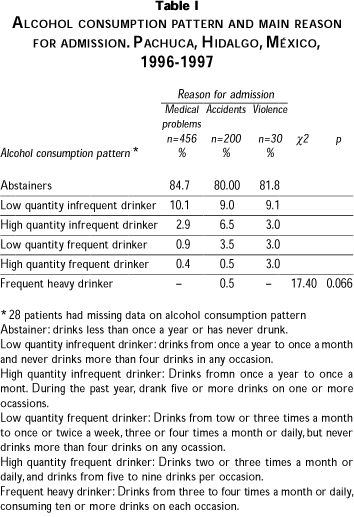
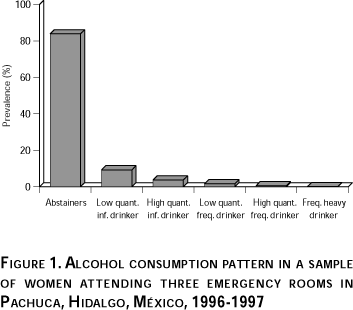
<body><![CDATA[<P>&nbsp;     <P align="center"><font size="4">Results </font>     <P>The sample consisted of 1,624 patients admitted to the emergency services of    the three hospitals. One thousand 511, 47% (n=717) of the patients were women,    who agreed to take part in the study. The distribution of the female group according    to their drinking pattern shows that a high percentage of women described themselves    as abstainers (83.9%) (<a href="#figura1">Figure 1</a>). Regarding the reason    for their admission, differences were found in relation to their consumption    patterns (<font face="Symbol">c</font><SUP>2</SUP>=17.4, <I>p</I>=0.066). About    0.4% of the women admitted due to medical problems had moderate/high consumption,    while 1.0% and 3.0% of women admitted as a result of accidents and violence    displayed these consumption levels, respectively (<a href="#tabela1">Table I</a>).      <P align="center"><a name="figura1"></a>     <P align="center">&nbsp;     <P align="center"><img src="/img/revistas/spm/v43n6/7529f1.gif">      <P align="center"><a name="tabela1"></a>     <P align="center">&nbsp;     <P align="center"><img src="/img/revistas/spm/v43n6/7529t1.gif">      <P align="center">&nbsp;     ]]></body>
<body><![CDATA[<P>     We inspected several of our screening instruments to find out which one performed best for women. Similar to  the CAGE and the 10-item brief MAST, the TWEAK identified most known alcoholics, but it showed a higher sensitivity  and specificity than the CAGE and B-MAST in detecting alcoholism/heavy drinking women in the emergency  services. Different cut-off values are recommended for screening  different populations. Based on previous reports of this  sample, a cut-off point=2 was selected as the most reliable value for distinguishing female heavy drinkers from  low-risk female drinkers.<SUP>23-25</SUP> Although only 5.2% of the women in our sample of ES attendees (n=36) were found to be  TWEAK positive, this percentage was higher than those obtained using other instruments (1.0% for the BMAST, 1.2% for  the Trauma Scale, 1.4% for the AUDIT, 2.9% for the CAGE, or 2.0% for the CIDI).     <P> Most of TWEAK-positive women were aged between 30 and 49 years (55.5%). As    for their marital status, women who lived on their own but had had a partner    ever (living with a partner, separated, divorced, and widowed) were, as a whole,    the TWEAK-positive group. The same was observed for the group with higher educational    attainment (37.1%) (<a href="#tabela2">Table II</a>).      <P align="center"><a name="tabela2"></a>     <P align="center">&nbsp;     <P align="center"><img src="/img/revistas/spm/v43n6/7529t2.gif">      <P align="center">&nbsp;     <P> As shown in <a href="#tabela3">Table III</a>, 28.5% of TWEAK-positive women    displayed depressive symptoms, while only 14.7% of TWEAK-negative women did,    a difference that was statistically significant (<I>p</I>=0.02). Also, TWEAK-positive    women had higher prevalence of suicidal ideation (25.7%), though statistical    differences were not found. In relation to sexual abuse, 7.1% of the women who    were TWEAK-positive reported having been sexually abused. Nevertheless, as in    the other variables, these differences were not significant. In relation to    other drug use, 8.3% of TWEAK-positive women used drugs, compared with 3.1%    of TWEAK-negative women (<font face="Symbol">c</font><SUP>2</SUP>=2.93, <I>p</I>=0.087).      <P align="center"><a name="tabela3"></a>     <P align="center">&nbsp;     <P align="center"><img src="/img/revistas/spm/v43n6/7529t3.gif">      ]]></body>
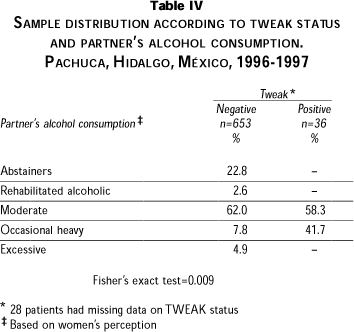
<body><![CDATA[<P align="center">&nbsp;     <P> Results of a univariate logistic regression model are also shown in <a href="#tabela3">Table    III</a>. It was found that TWEAK positive women had 2.31 times the risk of having    depression, 2.87 times the risk of taking other drugs and were 1.95 times as    likely to have been sexually abused (<a href="#tabela3">Table III</a>). Women    with low levels of self-esteem were less likely to be TWEAK-positive (<I>odds    ratio </I>[OR]= 0.66). A multiple logistic regression model was constructed    using TWEAK as the dependent variable and all the risk factors in <a href="#tabela3">Table    III</a>, plus age, as the independent variables. Compared to the results in    <a href="#tabela3">Table III</a>, the estimates were lower for depression (OR=2.2),    suicidal ideation (OR=1.1), sexual abuse (OR=1.4), and drug use (1.8), but increased    slightly for self-esteem (OR=0.6) (data not shown). As expected, confidence    intervals were wider and included the null value for depression.      <P> As seen in <a href="#tabela4">Table IV</a>, TWEAK-positive women are more    likely to have a moderate- or heavy-drinking partner rather than to share their    lives with someone who abstains from alcohol (Fisher exact test=0.009).      <P align="center"><a name="tabela4"></a>     <P align="center">&nbsp;     <P align="center"><img src="/img/revistas/spm/v43n6/7529t4.gif">      <P align="center">&nbsp;     <P>     None of the thirty-six women who drink heavily was admitted to the emergency room as a result of  domestic violence. Finally, ten out of the thirty-six TWEAK positive women fulfilled DSM-IV criteria for alcohol abuse and  alcohol dependence.     <P>     <P>&nbsp;     ]]></body>
<body><![CDATA[<P align="center"><font size="4">Discussion </font>     <P>The analyses of alcohol use among women admitted to emergency services in Pachuca, Hidalgo, seem to support  some findings reported in the international literature.     <P>     Although the National Surveys on Addictions  <SUP>26,27</SUP> show a general upward trend in female alcohol use, the  data presented here indicate that cultural aspects might influence changes in women's drinking pattern, which might also  be explained by the growth of the urban population.     <P>     Abstinence in women in Pachuca is higher than that found in the National Household Surveys (89% vs 66%).  In these women traditions are extremely important.      <P> Local studies conducted in Mexico<a name="top3"></a><a href="#back">***</a>    have shown that in present-day Mexico, norms are more related to approving who    may drink than to promoting moderation. It is believed that females should not    drink. Occasional inebriation among males is considered normal, whereas females    are not supposed to drink. Both males and females, young and old persons support    these double standards. The importance of these beliefs is reflected in the    high percentage of women who do not drink and have never gotten drunk.      <P>     As regards the screening instruments employed, it is necessary to conduct more in-depth research to enrich  their contents and increase their reliability and validity when used among female populations. In this study, the  TWEAK proved to be extremely useful for studies in emergency services.     <P>     On the other hand, according to  Gomberg,<SUP>3</SUP> problem drinking among females is linked to depression  throughout the life cycle. Data from this brief analysis  confirm international findings. However, further studies are necessary to  know which women began drinking earliest, since it is also mentioned that female problem drinkers who report  preexisting depression differ from primary problem drinkers in the following aspects: They have a family history less positive  to problem drinking; a shorter history of problem drinking, and a more favorable prognosis. Also,  cross-screening (depression-alcohol) seems to be useful for early detection of problem drinking.     <P>     Results related to self-esteem are worth mentioning, since they differ from what has been reported in the  international literature. In this study, high-risk female drinkers obtained higher scores in self-esteem (20%), compared  with women with negative TWEAK (14.2%). Could alcohol use be regarded as a form of self-assurance, independence,  and greater autonomy? or is it the effect of denial, a characteristic symptom of people with abuse or addiction problems?  This aspect must be studied in depth through qualitative methodology.     <P>     In this study we only included few questions regarding sexual abuse and asked little about emotional and  physical abuse in childhood. The correlation between alcohol abuse and sexual abuse might have  been higher. Langeland and Hartgers<SUP>28</SUP> suggest some methodological issues for improving results. These include the method used  (questionnaires tend to obtain lower rates than interviews), the number of  questions and their contents, how specific the definition  of abuse is and the age of the aggressor and the victim at the time of the occurrence. In the future, more specific scales  could be included.     <P>     Traditionally, women of all ages are responsible  for controlling their men's drinking while at the same  time controlling their own. Nevertheless, it has been pointed out that the most significant relationship  in the lives of chemically dependent women is often with an addictive  partner.<SUP>29</SUP> The strong consenting relationship between a  couple's drinking together with the stress of life with &quot;a significant other,&quot; and having to combine extremely diverse  expectations in addition to coping with several daily problems  including their own consumption<SUP>30</SUP> have also been  considered as important factors. Research findings related to the role of drinking in the couple seem to confirm international findings.     ]]></body>
<body><![CDATA[<P>     Finally, for better results, it is suggested that only women should interview women, since  Pollner<SUP>31 </SUP>suggests that gender may play an important role in mental health interviews. Male and female respondents interviewed by  women report more symptoms of depression, substance abuse and behavior disorders than respondents interviewed by men.     <P>     Two limitations of this study are worth mentioning. First, it is a cross-sectional survey and it is not possible to  draw any firm causal statement about the relation between our variables. Second, we found only a small prevalence of  heavy-drinkers (TWEAK-positive) women and our results lack high statistical power, as evidence by our wide  confidence intervals. Future research should include at least retrospective information about the variables and a sufficient  number of women who are heavy drinkers.     <P>     <P>     <P>     <P>&nbsp;     <P align="center"><font size="4">References </font>     <P>     <!-- ref --><P>1. Secretar&iacute;a de Salud/Consejo Nacional contra las Adicciones. El consumo de drogas en M&eacute;xico. Diagn&oacute;stico, tendencias, acciones. M&eacute;xico, D.F.: SSA/Conadic, 1999.    &nbsp;&nbsp;&nbsp;&nbsp;&nbsp;&nbsp;&nbsp;&nbsp;[&#160;<a href="javascript:void(0);" onclick="javascript: window.open('/scielo.php?script=sci_nlinks&ref=9146594&pid=S0036-3634200100060000400001&lng=','','width=640,height=500,resizable=yes,scrollbars=1,menubar=yes,');">Links</a>&#160;]<!-- end-ref --><!-- ref --><P>2. Campillo C, D&iacute;az R, Romero M, Cerrud J, Villatoro J. Mexico City chapter. En: Babor, T, Grant M, ed. Project on identification and management of  alcohol-related problems. Report on Phase II. A randomized clinical trial of brief intervention in primary health care. Ginebra: World Health Organization, 1992.    &nbsp;&nbsp;&nbsp;&nbsp;&nbsp;&nbsp;&nbsp;&nbsp;[&#160;<a href="javascript:void(0);" onclick="javascript: window.open('/scielo.php?script=sci_nlinks&ref=9146595&pid=S0036-3634200100060000400002&lng=','','width=640,height=500,resizable=yes,scrollbars=1,menubar=yes,');">Links</a>&#160;]<!-- end-ref --><!-- ref --><P>3. Gomberg-Lisansky E. Risk factors for drinking over a woman's life span. Alcohol Health Res World 1994;18(3):220-227.    &nbsp;&nbsp;&nbsp;&nbsp;&nbsp;&nbsp;&nbsp;&nbsp;[&#160;<a href="javascript:void(0);" onclick="javascript: window.open('/scielo.php?script=sci_nlinks&ref=9146596&pid=S0036-3634200100060000400003&lng=','','width=640,height=500,resizable=yes,scrollbars=1,menubar=yes,');">Links</a>&#160;]<!-- end-ref --><!-- ref --><P>4. Wilsnack Sh, Wilsnack R, Hiller-Sturmhofel S. How women drink. Epidemiology of women's drinking and problem drinking. Alcohol Health Res World  1994;18(3):173-181.    &nbsp;&nbsp;&nbsp;&nbsp;&nbsp;&nbsp;&nbsp;&nbsp;[&#160;<a href="javascript:void(0);" onclick="javascript: window.open('/scielo.php?script=sci_nlinks&ref=9146597&pid=S0036-3634200100060000400004&lng=','','width=640,height=500,resizable=yes,scrollbars=1,menubar=yes,');">Links</a>&#160;]<!-- end-ref --><!-- ref --><P>5. Glass-Crome IB. Gender-related issues in alcohol problems research- A special need group. En: Tabakoff &amp; Hoffmann, ed. Biological aspects of alcoholism.  Implications for prevention, treatment and policy. Seattle (WA): Hogrefe &amp; Huber Pub, 1995:163-176.    &nbsp;&nbsp;&nbsp;&nbsp;&nbsp;&nbsp;&nbsp;&nbsp;[&#160;<a href="javascript:void(0);" onclick="javascript: window.open('/scielo.php?script=sci_nlinks&ref=9146598&pid=S0036-3634200100060000400005&lng=','','width=640,height=500,resizable=yes,scrollbars=1,menubar=yes,');">Links</a>&#160;]<!-- end-ref --><!-- ref --><P>6. Anderson P. Alcohol and risk of physical harm. Cancer of the female breast. En: Holder H, Edwards G, ed. Alcohol and public policy. Evidence and issues. Oxford  (UK): Oxford University Press, 1995:82-103.    &nbsp;&nbsp;&nbsp;&nbsp;&nbsp;&nbsp;&nbsp;&nbsp;[&#160;<a href="javascript:void(0);" onclick="javascript: window.open('/scielo.php?script=sci_nlinks&ref=9146599&pid=S0036-3634200100060000400006&lng=','','width=640,height=500,resizable=yes,scrollbars=1,menubar=yes,');">Links</a>&#160;]<!-- end-ref --><!-- ref --><P>7. Romero M, Villatoro J, Medina-Mora M. Alcohol consumption among Mexican women: Implications of a syncretic culture. 24th Annual Alcohol  Epidemiology Symposium, 1998; Florence, Italy.    &nbsp;&nbsp;&nbsp;&nbsp;&nbsp;&nbsp;&nbsp;&nbsp;[&#160;<a href="javascript:void(0);" onclick="javascript: window.open('/scielo.php?script=sci_nlinks&ref=9146600&pid=S0036-3634200100060000400007&lng=','','width=640,height=500,resizable=yes,scrollbars=1,menubar=yes,');">Links</a>&#160;]<!-- end-ref --><!-- ref --><P>8. McCaul M, Furst J. Alcoholism treatment in the United States. Alcohol Health Res World 1994;18(4):253-260.    &nbsp;&nbsp;&nbsp;&nbsp;&nbsp;&nbsp;&nbsp;&nbsp;[&#160;<a href="javascript:void(0);" onclick="javascript: window.open('/scielo.php?script=sci_nlinks&ref=9146601&pid=S0036-3634200100060000400008&lng=','','width=640,height=500,resizable=yes,scrollbars=1,menubar=yes,');">Links</a>&#160;]<!-- end-ref --><!-- ref --><P>9. Borges C, Medina-Mora ME, Cherpitel C, Casanova L, Mondrag&oacute;n L, Romero M. Consumo de bebidas alcoh&oacute;licas en pacientes de los servicios de urgencias de  la ciudad de Pachuca, Hidalgo. Salud Publica Mex 1999;41(1):3-11.    &nbsp;&nbsp;&nbsp;&nbsp;&nbsp;&nbsp;&nbsp;&nbsp;[&#160;<a href="javascript:void(0);" onclick="javascript: window.open('/scielo.php?script=sci_nlinks&ref=9146602&pid=S0036-3634200100060000400009&lng=','','width=640,height=500,resizable=yes,scrollbars=1,menubar=yes,');">Links</a>&#160;]<!-- end-ref --><!-- ref --><P>10. Ewing JA. Detecting alcoholism: The CAGE questionnaire. JAMA 1984;252:1905-1907.    &nbsp;&nbsp;&nbsp;&nbsp;&nbsp;&nbsp;&nbsp;&nbsp;[&#160;<a href="javascript:void(0);" onclick="javascript: window.open('/scielo.php?script=sci_nlinks&ref=9146603&pid=S0036-3634200100060000400010&lng=','','width=640,height=500,resizable=yes,scrollbars=1,menubar=yes,');">Links</a>&#160;]<!-- end-ref --><!-- ref --><P>11. Gibbs LE. Validity and reliability of the Michigan Alcoholism Screening Test: A review. Drug Alcohol Depend 1983;12:279-285.    &nbsp;&nbsp;&nbsp;&nbsp;&nbsp;&nbsp;&nbsp;&nbsp;[&#160;<a href="javascript:void(0);" onclick="javascript: window.open('/scielo.php?script=sci_nlinks&ref=9146604&pid=S0036-3634200100060000400011&lng=','','width=640,height=500,resizable=yes,scrollbars=1,menubar=yes,');">Links</a>&#160;]<!-- end-ref --><!-- ref --><P>12. Selzer M. The Michigan Alcoholism Screening Test: The quest for a new diagnostic instrument. Am J Psychiatry 1971;127:1653-1658.    &nbsp;&nbsp;&nbsp;&nbsp;&nbsp;&nbsp;&nbsp;&nbsp;[&#160;<a href="javascript:void(0);" onclick="javascript: window.open('/scielo.php?script=sci_nlinks&ref=9146605&pid=S0036-3634200100060000400012&lng=','','width=640,height=500,resizable=yes,scrollbars=1,menubar=yes,');">Links</a>&#160;]<!-- end-ref --><!-- ref --><P>13. Babor Th, De La Fuente Jr, Saunders J, Grant M. AUDIT: The alcohol use disorders identification test. Ginebra: World Health Organization, 1989.    &nbsp;&nbsp;&nbsp;&nbsp;&nbsp;&nbsp;&nbsp;&nbsp;[&#160;<a href="javascript:void(0);" onclick="javascript: window.open('/scielo.php?script=sci_nlinks&ref=9146606&pid=S0036-3634200100060000400013&lng=','','width=640,height=500,resizable=yes,scrollbars=1,menubar=yes,');">Links</a>&#160;]<!-- end-ref --><!-- ref --><P>14. Russell M, Martier S, Sokol R, Mudar P, Bottoms S, Jacobson S  <I>et al</I>. Screening for pregnancy risk-drinking. Alcohol Clin Exp Res 1994;18: 1156-1161.    &nbsp;&nbsp;&nbsp;&nbsp;&nbsp;&nbsp;&nbsp;&nbsp;[&#160;<a href="javascript:void(0);" onclick="javascript: window.open('/scielo.php?script=sci_nlinks&ref=9146607&pid=S0036-3634200100060000400014&lng=','','width=640,height=500,resizable=yes,scrollbars=1,menubar=yes,');">Links</a>&#160;]<!-- end-ref --><!-- ref --><P>15. World Health Organization. CIDI core (Composite International Diagnostic Interview) Authorized Core Version 1.1. Ginebra: World Health Organization, 1993.    &nbsp;&nbsp;&nbsp;&nbsp;&nbsp;&nbsp;&nbsp;&nbsp;[&#160;<a href="javascript:void(0);" onclick="javascript: window.open('/scielo.php?script=sci_nlinks&ref=9146608&pid=S0036-3634200100060000400015&lng=','','width=640,height=500,resizable=yes,scrollbars=1,menubar=yes,');">Links</a>&#160;]<!-- end-ref --><!-- ref --><P>16. Gonz&aacute;lez-Forteza C, Andrade P. La relaci&oacute;n de los hijos con sus progenitores y sus recursos de apoyo: correlaci&oacute;n con la sintomatolog&iacute;a  depresiva y la ideaci&oacute;n suicida en los adolescentes mexicanos. Salud  Mental 1995;18(4):41-48.    &nbsp;&nbsp;&nbsp;&nbsp;&nbsp;&nbsp;&nbsp;&nbsp;[&#160;<a href="javascript:void(0);" onclick="javascript: window.open('/scielo.php?script=sci_nlinks&ref=9146609&pid=S0036-3634200100060000400016&lng=','','width=640,height=500,resizable=yes,scrollbars=1,menubar=yes,');">Links</a>&#160;]<!-- end-ref --><!-- ref --><P>17. Radloff L The CES-D Scale: A self-report depression scale for research in the general population. Appl Psychol Meas 1977;1:385-401.    &nbsp;&nbsp;&nbsp;&nbsp;&nbsp;&nbsp;&nbsp;&nbsp;[&#160;<a href="javascript:void(0);" onclick="javascript: window.open('/scielo.php?script=sci_nlinks&ref=9146610&pid=S0036-3634200100060000400017&lng=','','width=640,height=500,resizable=yes,scrollbars=1,menubar=yes,');">Links</a>&#160;]<!-- end-ref --><!-- ref --><P>18. Gonz&aacute;lez-Forteza C. Factores protectores y de riesgo de depresi&oacute;n e intentos de suicidio en adolescentes. Tesis de doctorado. M&eacute;xico, D.F.: Universidad  Nacional Aut&oacute;noma de M&eacute;xico, Facultad de Psicolog&iacute;a, 1996.    &nbsp;&nbsp;&nbsp;&nbsp;&nbsp;&nbsp;&nbsp;&nbsp;[&#160;<a href="javascript:void(0);" onclick="javascript: window.open('/scielo.php?script=sci_nlinks&ref=9146611&pid=S0036-3634200100060000400018&lng=','','width=640,height=500,resizable=yes,scrollbars=1,menubar=yes,');">Links</a>&#160;]<!-- end-ref --><!-- ref --><P>19. Rosenberg M. The Rosenberg Self-Esteem Scale. Maryland (MD): The Morris    Rosenberg Foundation c/o Dept of Sociology, University of Maryland, 2000. Disponible    en: <a href="http://www.bsos.umd.edu/socy/rosenberg.htm">http://www.bsos.umd.edu/socy/rosenberg.htm</a>.    &nbsp;&nbsp;&nbsp;&nbsp;&nbsp;&nbsp;&nbsp;&nbsp;[&#160;<a href="javascript:void(0);" onclick="javascript: window.open('/scielo.php?script=sci_nlinks&ref=9146612&pid=S0036-3634200100060000400019&lng=','','width=640,height=500,resizable=yes,scrollbars=1,menubar=yes,');">Links</a>&#160;]<!-- end-ref --><!-- ref --><P>20. Gudmundsdottir A. Women seeking treatment, alcohol abuse and psychological problems. 20th Annual Alcohol Epidemiology Symposium; 1994;  R&uuml;schlikon, Switzerland.    &nbsp;&nbsp;&nbsp;&nbsp;&nbsp;&nbsp;&nbsp;&nbsp;[&#160;<a href="javascript:void(0);" onclick="javascript: window.open('/scielo.php?script=sci_nlinks&ref=9146613&pid=S0036-3634200100060000400020&lng=','','width=640,height=500,resizable=yes,scrollbars=1,menubar=yes,');">Links</a>&#160;]<!-- end-ref --><!-- ref --><P>21. Knufer G, Room R. Abstainers in a metropolitan community. Quart J Stud Alc 1969;31(1):108-131.    &nbsp;&nbsp;&nbsp;&nbsp;&nbsp;&nbsp;&nbsp;&nbsp;[&#160;<a href="javascript:void(0);" onclick="javascript: window.open('/scielo.php?script=sci_nlinks&ref=9146614&pid=S0036-3634200100060000400021&lng=','','width=640,height=500,resizable=yes,scrollbars=1,menubar=yes,');">Links</a>&#160;]<!-- end-ref --><!-- ref --><P>22. Kaskutas LA. An analysis of &quot;Women for sobriety&quot;. Doctoral dissertation. San Francisco (CA): University of California, Berkeley, 1992.    &nbsp;&nbsp;&nbsp;&nbsp;&nbsp;&nbsp;&nbsp;&nbsp;[&#160;<a href="javascript:void(0);" onclick="javascript: window.open('/scielo.php?script=sci_nlinks&ref=9146615&pid=S0036-3634200100060000400022&lng=','','width=640,height=500,resizable=yes,scrollbars=1,menubar=yes,');">Links</a>&#160;]<!-- end-ref --><!-- ref --><P>23. Cherpitel Ch, Borges G. Comparison of cut-off point for screening instruments for alcohol problems between Mexican American and Mexican patients in the  ER. Subst Use Misuse 200;35(10)1419-1430.    &nbsp;&nbsp;&nbsp;&nbsp;&nbsp;&nbsp;&nbsp;&nbsp;[&#160;<a href="javascript:void(0);" onclick="javascript: window.open('/scielo.php?script=sci_nlinks&ref=9146616&pid=S0036-3634200100060000400023&lng=','','width=640,height=500,resizable=yes,scrollbars=1,menubar=yes,');">Links</a>&#160;]<!-- end-ref --><!-- ref --><P>24. Cherpitel Ch, Borges G. Performance of screening instruments for alcohol problems in the ER: A comparison of Mexican Americans and Mexicans in Mexico.  Am J Drug Alcohol Abuse 2000;26(4):683-702.    &nbsp;&nbsp;&nbsp;&nbsp;&nbsp;&nbsp;&nbsp;&nbsp;[&#160;<a href="javascript:void(0);" onclick="javascript: window.open('/scielo.php?script=sci_nlinks&ref=9146617&pid=S0036-3634200100060000400024&lng=','','width=640,height=500,resizable=yes,scrollbars=1,menubar=yes,');">Links</a>&#160;]<!-- end-ref --><!-- ref --><P>25. Bradley K, Boy-Wickizer J, Powell S, Burnman M. Alcohol screening questionnaires in women. A critical review. JAMA 1998;280(2):166-171.    &nbsp;&nbsp;&nbsp;&nbsp;&nbsp;&nbsp;&nbsp;&nbsp;[&#160;<a href="javascript:void(0);" onclick="javascript: window.open('/scielo.php?script=sci_nlinks&ref=9146618&pid=S0036-3634200100060000400025&lng=','','width=640,height=500,resizable=yes,scrollbars=1,menubar=yes,');">Links</a>&#160;]<!-- end-ref --><!-- ref --><P>26. Secretar&iacute;a de Salud. Encuesta Nacional de Adicciones 1990. M&eacute;xico, D.F.: SSA, 1990.    &nbsp;&nbsp;&nbsp;&nbsp;&nbsp;&nbsp;&nbsp;&nbsp;[&#160;<a href="javascript:void(0);" onclick="javascript: window.open('/scielo.php?script=sci_nlinks&ref=9146619&pid=S0036-3634200100060000400026&lng=','','width=640,height=500,resizable=yes,scrollbars=1,menubar=yes,');">Links</a>&#160;]<!-- end-ref --><!-- ref --><P>27. Secretar&iacute;a de Salud. Encuesta Nacional de Adicciones 1993. M&eacute;xico, D.F.: SSA, 1993.    &nbsp;&nbsp;&nbsp;&nbsp;&nbsp;&nbsp;&nbsp;&nbsp;[&#160;<a href="javascript:void(0);" onclick="javascript: window.open('/scielo.php?script=sci_nlinks&ref=9146620&pid=S0036-3634200100060000400027&lng=','','width=640,height=500,resizable=yes,scrollbars=1,menubar=yes,');">Links</a>&#160;]<!-- end-ref --><!-- ref --><P>28. Langeland W, Hartgers Ch. Child sexual and physical abuse and alcoholism: A review. J Stud Alcohol 1998; 59(May): 336-348.    &nbsp;&nbsp;&nbsp;&nbsp;&nbsp;&nbsp;&nbsp;&nbsp;[&#160;<a href="javascript:void(0);" onclick="javascript: window.open('/scielo.php?script=sci_nlinks&ref=9146621&pid=S0036-3634200100060000400028&lng=','','width=640,height=500,resizable=yes,scrollbars=1,menubar=yes,');">Links</a>&#160;]<!-- end-ref --><!-- ref --><P>29. Kauffman E, Morrison D., Neson-Zlupko L The role of women's therapy groups in the treatment of chemical dependence. Am J Orthpsychiat 1995;65(3):355-363.    &nbsp;&nbsp;&nbsp;&nbsp;&nbsp;&nbsp;&nbsp;&nbsp;[&#160;<a href="javascript:void(0);" onclick="javascript: window.open('/scielo.php?script=sci_nlinks&ref=9146622&pid=S0036-3634200100060000400029&lng=','','width=640,height=500,resizable=yes,scrollbars=1,menubar=yes,');">Links</a>&#160;]<!-- end-ref --><!-- ref --><P>30. Gudmunsdottir A. Social and emotional problems of women in alcoholism treatment. Paper presented at the 25th Annual Alcohol Epidemiology Symposium;  1999 May 30-June 4; Montreal, Canad&aacute;.    &nbsp;&nbsp;&nbsp;&nbsp;&nbsp;&nbsp;&nbsp;&nbsp;[&#160;<a href="javascript:void(0);" onclick="javascript: window.open('/scielo.php?script=sci_nlinks&ref=9146623&pid=S0036-3634200100060000400030&lng=','','width=640,height=500,resizable=yes,scrollbars=1,menubar=yes,');">Links</a>&#160;]<!-- end-ref --><!-- ref --><P>31. Pollner M. The effects of interviewer gender in mental health interviews. J Nervous Mental Dis 1998;186(6):369-373.    &nbsp;&nbsp;&nbsp;&nbsp;&nbsp;&nbsp;&nbsp;&nbsp;[&#160;<a href="javascript:void(0);" onclick="javascript: window.open('/scielo.php?script=sci_nlinks&ref=9146624&pid=S0036-3634200100060000400031&lng=','','width=640,height=500,resizable=yes,scrollbars=1,menubar=yes,');">Links</a>&#160;]<!-- end-ref --><P>     ]]></body>
<body><![CDATA[<P>&nbsp;     <P>&nbsp;     <P><a name="back"></a><a href="#top1">*</a> C: cut-down    <br>   A: annoyed     <br>   G: guilty     <br>   E: eye-opened      <P><a href="#top2">**</a> The intake of 5 or more drinks per occasion is considered    heavy drinking. Each standard drink contains 12 grs. of pure alcohol (Babor    &amp; Grant 1992).      <P>     <P><a href="#top3">***</a> Medina-Mora ME. El abuso de alcohol: antecedentes y    consecuencias: evaluaci&oacute;n de un modelo de intervenci&oacute;n. Resultados    de la Fase I, February 199<B>7.</B>      <P>     ]]></body>
<body><![CDATA[<P>This study was supported by the National Council on Science and Technology, the Ministry of Health No. MO148H9602, the Mexican Institute of Psychiatry No.  4271 and a grant from the National Institute on Alcohol Abuse and Alcoholism R21 AA11503.     <P>     <P>(<a href="#top">1</a>) Direcci&oacute;n de Investigaciones Epidemiol&oacute;gicas    y Sociales, Instituto Nacional de Psiquiatr&iacute;a Ram&oacute;n de la Fuente.    M&eacute;xico, D.F., M&eacute;xico.      <P><a name="back1"></a>(<a href="#top">2</a>) Centro de Investigaci&oacute;n en    Alcohol. Alcohol Research Group, Berkeley, California, Estados Unidos de Am&eacute;rica.      <P><a name="back2"></a>(<a href="#top">3</a>) Universidad Aut&oacute;noma Metropolitana-Xochimilco,    M&eacute;xico, D.F., M&eacute;xico.      <P>     <P>&nbsp;     <P align="center"><B>Received on:</B> September 13, 2000 &#149; <B>Accepted on</B>:    June 15, 2001    <br>   Address reprint requests to: Dra. Martha Romero M. Instituto Nacional de Psiquiatr&iacute;a,    Direcci&oacute;n de Investigaciones Epidemiol&oacute;gicas y Sociales.    <br>   Calzada M&eacute;xico-Xochimilco 101, colonia San Lorenzo Huipulco, Tlalpan,    14370 M&eacute;xico, D.F., M&eacute;xico.    ]]></body>
<body><![CDATA[<br>   E-mail: <a href="mailto:romerom@imp.edu.mx">romerom@imp.edu.mx</a>       ]]></body><back>
<ref-list>
<ref id="B1">
<label>1</label><nlm-citation citation-type="book">
<collab>Secretaría de Salud^dConsejo Nacional contra las Adicciones</collab>
<source><![CDATA[El consumo de drogas en México: Diagnóstico, tendencias, acciones]]></source>
<year>1999</year>
<publisher-loc><![CDATA[México^eD.F. D.F.]]></publisher-loc>
<publisher-name><![CDATA[SSAConadic]]></publisher-name>
</nlm-citation>
</ref>
<ref id="B2">
<label>2</label><nlm-citation citation-type="book">
<person-group person-group-type="author">
<name>
<surname><![CDATA[Campillo]]></surname>
<given-names><![CDATA[C]]></given-names>
</name>
<name>
<surname><![CDATA[Díaz]]></surname>
<given-names><![CDATA[R]]></given-names>
</name>
<name>
<surname><![CDATA[Romero]]></surname>
<given-names><![CDATA[M]]></given-names>
</name>
<name>
<surname><![CDATA[Cerrud]]></surname>
<given-names><![CDATA[J]]></given-names>
</name>
<name>
<surname><![CDATA[Villatoro]]></surname>
<given-names><![CDATA[J]]></given-names>
</name>
</person-group>
<article-title xml:lang="es"><![CDATA[Mexico City chapter]]></article-title>
<person-group person-group-type="editor">
<name>
<surname><![CDATA[Babor]]></surname>
<given-names><![CDATA[T]]></given-names>
</name>
<name>
<surname><![CDATA[Grant]]></surname>
<given-names><![CDATA[M]]></given-names>
</name>
</person-group>
<source><![CDATA[Project on identification and management of alcohol-related problems: Report on Phase II. A randomized clinical trial of brief intervention in primary health care]]></source>
<year>1992</year>
<publisher-loc><![CDATA[Ginebra ]]></publisher-loc>
<publisher-name><![CDATA[World Health Organization]]></publisher-name>
</nlm-citation>
</ref>
<ref id="B3">
<label>3</label><nlm-citation citation-type="journal">
<person-group person-group-type="author">
<name>
<surname><![CDATA[Gomberg-Lisansky]]></surname>
<given-names><![CDATA[E]]></given-names>
</name>
</person-group>
<article-title xml:lang="en"><![CDATA[Risk factors for drinking over a woman's life span]]></article-title>
<source><![CDATA[Alcohol Health Res World]]></source>
<year>1994</year>
<volume>18</volume>
<numero>3</numero>
<issue>3</issue>
<page-range>220-227</page-range></nlm-citation>
</ref>
<ref id="B4">
<label>4</label><nlm-citation citation-type="journal">
<person-group person-group-type="author">
<name>
<surname><![CDATA[Wilsnack]]></surname>
<given-names><![CDATA[Sh]]></given-names>
</name>
<name>
<surname><![CDATA[Wilsnack]]></surname>
<given-names><![CDATA[R]]></given-names>
</name>
<name>
<surname><![CDATA[Hiller-Sturmhofel]]></surname>
<given-names><![CDATA[S]]></given-names>
</name>
</person-group>
<article-title xml:lang="en"><![CDATA[How women drink: Epidemiology of women's drinking and problem drinking]]></article-title>
<source><![CDATA[Alcohol Health Res World]]></source>
<year>1994</year>
<volume>18</volume>
<numero>3</numero>
<issue>3</issue>
<page-range>173-181</page-range></nlm-citation>
</ref>
<ref id="B5">
<label>5</label><nlm-citation citation-type="book">
<person-group person-group-type="author">
<name>
<surname><![CDATA[Glass-Crome]]></surname>
<given-names><![CDATA[IB]]></given-names>
</name>
</person-group>
<article-title xml:lang="en"><![CDATA[Gender-related issues in alcohol problems research- A special need group]]></article-title>
<person-group person-group-type="editor">
<name>
<surname><![CDATA[Tabakoff]]></surname>
</name>
<name>
<surname><![CDATA[Hoffmann]]></surname>
</name>
</person-group>
<source><![CDATA[Biological aspects of alcoholism: Implications for prevention, treatment and policy]]></source>
<year>1995</year>
<page-range>163-176</page-range><publisher-loc><![CDATA[Seattle^eWA WA]]></publisher-loc>
<publisher-name><![CDATA[Hogrefe & Huber Pub]]></publisher-name>
</nlm-citation>
</ref>
<ref id="B6">
<label>6</label><nlm-citation citation-type="book">
<person-group person-group-type="author">
<name>
<surname><![CDATA[Anderson]]></surname>
<given-names><![CDATA[P]]></given-names>
</name>
</person-group>
<article-title xml:lang="en"><![CDATA[Alcohol and risk of physical harm: Cancer of the female breast]]></article-title>
<person-group person-group-type="editor">
<name>
<surname><![CDATA[Holder]]></surname>
<given-names><![CDATA[H]]></given-names>
</name>
<name>
<surname><![CDATA[Edwards]]></surname>
<given-names><![CDATA[G]]></given-names>
</name>
</person-group>
<source><![CDATA[Alcohol and public policy: Evidence and issues]]></source>
<year>1995</year>
<page-range>82-103</page-range><publisher-loc><![CDATA[Oxford^eUK UK]]></publisher-loc>
<publisher-name><![CDATA[Oxford University Press]]></publisher-name>
</nlm-citation>
</ref>
<ref id="B7">
<label>7</label><nlm-citation citation-type="confpro">
<person-group person-group-type="author">
<name>
<surname><![CDATA[Romero]]></surname>
<given-names><![CDATA[M]]></given-names>
</name>
<name>
<surname><![CDATA[Villatoro]]></surname>
<given-names><![CDATA[J]]></given-names>
</name>
<name>
<surname><![CDATA[Medina-Mora]]></surname>
<given-names><![CDATA[M]]></given-names>
</name>
</person-group>
<source><![CDATA[Alcohol consumption among Mexican women: Implications of a syncretic culture]]></source>
<year></year>
<conf-name><![CDATA[24 Annual Alcohol Epidemiology Symposium]]></conf-name>
<conf-date>1998</conf-date>
<conf-loc>Florence </conf-loc>
</nlm-citation>
</ref>
<ref id="B8">
<label>8</label><nlm-citation citation-type="journal">
<person-group person-group-type="author">
<name>
<surname><![CDATA[McCaul]]></surname>
<given-names><![CDATA[M]]></given-names>
</name>
<name>
<surname><![CDATA[Furst]]></surname>
<given-names><![CDATA[J]]></given-names>
</name>
</person-group>
<article-title xml:lang="en"><![CDATA[Alcoholism treatment in the United States]]></article-title>
<source><![CDATA[Alcohol Health Res World]]></source>
<year>1994</year>
<volume>18</volume>
<numero>4</numero>
<issue>4</issue>
<page-range>253-260</page-range></nlm-citation>
</ref>
<ref id="B9">
<label>9</label><nlm-citation citation-type="journal">
<person-group person-group-type="author">
<name>
<surname><![CDATA[Borges]]></surname>
<given-names><![CDATA[C]]></given-names>
</name>
<name>
<surname><![CDATA[Medina-Mora]]></surname>
<given-names><![CDATA[ME]]></given-names>
</name>
<name>
<surname><![CDATA[Cherpitel]]></surname>
<given-names><![CDATA[C]]></given-names>
</name>
<name>
<surname><![CDATA[Casanova]]></surname>
<given-names><![CDATA[L]]></given-names>
</name>
<name>
<surname><![CDATA[Mondragón]]></surname>
<given-names><![CDATA[L]]></given-names>
</name>
<name>
<surname><![CDATA[Romero]]></surname>
<given-names><![CDATA[M]]></given-names>
</name>
</person-group>
<article-title xml:lang="es"><![CDATA[Consumo de bebidas alcohólicas en pacientes de los servicios de urgencias de la ciudad de Pachuca, Hidalgo]]></article-title>
<source><![CDATA[Salud Publica Mex]]></source>
<year>1999</year>
<volume>41</volume>
<numero>1</numero>
<issue>1</issue>
<page-range>3-11</page-range></nlm-citation>
</ref>
<ref id="B10">
<label>10</label><nlm-citation citation-type="journal">
<person-group person-group-type="author">
<name>
<surname><![CDATA[Ewing]]></surname>
<given-names><![CDATA[JA]]></given-names>
</name>
</person-group>
<article-title xml:lang="en"><![CDATA[Detecting alcoholism: The CAGE questionnaire]]></article-title>
<source><![CDATA[JAMA]]></source>
<year>1984</year>
<volume>252</volume>
<page-range>1905-1907</page-range></nlm-citation>
</ref>
<ref id="B11">
<label>11</label><nlm-citation citation-type="journal">
<person-group person-group-type="author">
<name>
<surname><![CDATA[Gibbs]]></surname>
<given-names><![CDATA[LE]]></given-names>
</name>
</person-group>
<article-title xml:lang="en"><![CDATA[Validity and reliability of the Michigan Alcoholism Screening Test: A review]]></article-title>
<source><![CDATA[Drug Alcohol Depend]]></source>
<year>1983</year>
<volume>12</volume>
<page-range>279-285</page-range></nlm-citation>
</ref>
<ref id="B12">
<label>12</label><nlm-citation citation-type="journal">
<person-group person-group-type="author">
<name>
<surname><![CDATA[Selzer]]></surname>
<given-names><![CDATA[M]]></given-names>
</name>
</person-group>
<article-title xml:lang="en"><![CDATA[The Michigan Alcoholism Screening Test: The quest for a new diagnostic instrument]]></article-title>
<source><![CDATA[Am J Psychiatry]]></source>
<year>1971</year>
<volume>127</volume>
<page-range>1653-1658</page-range></nlm-citation>
</ref>
<ref id="B13">
<label>13</label><nlm-citation citation-type="book">
<person-group person-group-type="author">
<name>
<surname><![CDATA[Babor]]></surname>
<given-names><![CDATA[Th]]></given-names>
</name>
<name>
<surname><![CDATA[De La Fuente]]></surname>
<given-names><![CDATA[Jr]]></given-names>
</name>
<name>
<surname><![CDATA[Saunders]]></surname>
<given-names><![CDATA[J]]></given-names>
</name>
<name>
<surname><![CDATA[Grant]]></surname>
<given-names><![CDATA[M]]></given-names>
</name>
</person-group>
<source><![CDATA[AUDIT: The alcohol use disorders identification test]]></source>
<year>1989</year>
<publisher-loc><![CDATA[Ginebra ]]></publisher-loc>
<publisher-name><![CDATA[World Health Organization]]></publisher-name>
</nlm-citation>
</ref>
<ref id="B14">
<label>14</label><nlm-citation citation-type="journal">
<person-group person-group-type="author">
<name>
<surname><![CDATA[Russell]]></surname>
<given-names><![CDATA[M]]></given-names>
</name>
<name>
<surname><![CDATA[Martier]]></surname>
<given-names><![CDATA[S]]></given-names>
</name>
<name>
<surname><![CDATA[Sokol]]></surname>
<given-names><![CDATA[R]]></given-names>
</name>
<name>
<surname><![CDATA[Mudar]]></surname>
<given-names><![CDATA[P]]></given-names>
</name>
<name>
<surname><![CDATA[Bottoms]]></surname>
<given-names><![CDATA[S]]></given-names>
</name>
<name>
<surname><![CDATA[Jacobson]]></surname>
<given-names><![CDATA[S]]></given-names>
</name>
</person-group>
<article-title xml:lang="en"><![CDATA[Screening for pregnancy risk-drinking]]></article-title>
<source><![CDATA[Alcohol Clin Exp Res]]></source>
<year>1994</year>
<volume>18</volume>
<page-range>1156-1161</page-range></nlm-citation>
</ref>
<ref id="B15">
<label>15</label><nlm-citation citation-type="book">
<collab>World Health Organization</collab>
<source><![CDATA[CIDI core (Composite International Diagnostic Interview) Authorized Core Version 1.1]]></source>
<year>1993</year>
<publisher-loc><![CDATA[Ginebra ]]></publisher-loc>
<publisher-name><![CDATA[World Health Organization]]></publisher-name>
</nlm-citation>
</ref>
<ref id="B16">
<label>16</label><nlm-citation citation-type="journal">
<person-group person-group-type="author">
<name>
<surname><![CDATA[González-Forteza]]></surname>
<given-names><![CDATA[C]]></given-names>
</name>
<name>
<surname><![CDATA[Andrade]]></surname>
<given-names><![CDATA[P]]></given-names>
</name>
</person-group>
<article-title xml:lang="es"><![CDATA[La relación de los hijos con sus progenitores y sus recursos de apoyo: correlación con la sintomatología depresiva y la ideación suicida en los adolescentes mexicanos]]></article-title>
<source><![CDATA[Salud Mental]]></source>
<year>1995</year>
<volume>18</volume>
<numero>4</numero>
<issue>4</issue>
<page-range>41-48</page-range></nlm-citation>
</ref>
<ref id="B17">
<label>17</label><nlm-citation citation-type="journal">
<person-group person-group-type="author">
<name>
<surname><![CDATA[Radloff]]></surname>
<given-names><![CDATA[L]]></given-names>
</name>
</person-group>
<article-title xml:lang="en"><![CDATA[The CES-D Scale: A self-report depression scale for research in the general population]]></article-title>
<source><![CDATA[Appl Psychol Meas]]></source>
<year>1977</year>
<volume>1</volume>
<page-range>385-401</page-range></nlm-citation>
</ref>
<ref id="B18">
<label>18</label><nlm-citation citation-type="">
<person-group person-group-type="author">
<name>
<surname><![CDATA[González-Forteza]]></surname>
<given-names><![CDATA[C]]></given-names>
</name>
</person-group>
<source><![CDATA[Factores protectores y de riesgo de depresión e intentos de suicidio en adolescentes]]></source>
<year></year>
</nlm-citation>
</ref>
<ref id="B19">
<label>19</label><nlm-citation citation-type="book">
<person-group person-group-type="author">
<name>
<surname><![CDATA[Rosenberg]]></surname>
<given-names><![CDATA[M]]></given-names>
</name>
</person-group>
<source><![CDATA[The Rosenberg Self-Esteem Scale]]></source>
<year>2000</year>
<publisher-loc><![CDATA[Maryland^eMD MD]]></publisher-loc>
<publisher-name><![CDATA[The Morris Rosenberg Foundation c/o Dept of SociologyUniversity of Maryland]]></publisher-name>
</nlm-citation>
</ref>
<ref id="B20">
<label>20</label><nlm-citation citation-type="confpro">
<person-group person-group-type="author">
<name>
<surname><![CDATA[Gudmundsdottir]]></surname>
<given-names><![CDATA[A]]></given-names>
</name>
</person-group>
<source><![CDATA[Women seeking treatment, alcohol abuse and psychological problems]]></source>
<year></year>
<conf-name><![CDATA[20 Annual Alcohol Epidemiology Symposium]]></conf-name>
<conf-date>1994</conf-date>
<conf-loc>Rüschlikon </conf-loc>
</nlm-citation>
</ref>
<ref id="B21">
<label>21</label><nlm-citation citation-type="journal">
<person-group person-group-type="author">
<name>
<surname><![CDATA[Knufer]]></surname>
<given-names><![CDATA[G]]></given-names>
</name>
<name>
<surname><![CDATA[Room]]></surname>
<given-names><![CDATA[R]]></given-names>
</name>
</person-group>
<article-title xml:lang="en"><![CDATA[Abstainers in a metropolitan community]]></article-title>
<source><![CDATA[Quart J Stud Alc]]></source>
<year>1969</year>
<volume>31</volume>
<numero>1</numero>
<issue>1</issue>
<page-range>108-131</page-range></nlm-citation>
</ref>
<ref id="B22">
<label>22</label><nlm-citation citation-type="">
<person-group person-group-type="author">
<name>
<surname><![CDATA[Kaskutas]]></surname>
<given-names><![CDATA[LA]]></given-names>
</name>
</person-group>
<source><![CDATA[An analysis of "Women for sobriety"]]></source>
<year></year>
</nlm-citation>
</ref>
<ref id="B23">
<label>23</label><nlm-citation citation-type="journal">
<person-group person-group-type="author">
<name>
<surname><![CDATA[Cherpitel]]></surname>
<given-names><![CDATA[Ch]]></given-names>
</name>
<name>
<surname><![CDATA[Borges]]></surname>
<given-names><![CDATA[G]]></given-names>
</name>
</person-group>
<article-title xml:lang="en"><![CDATA[Comparison of cut-off point for screening instruments for alcohol problems between Mexican American and Mexican patients in the ER]]></article-title>
<source><![CDATA[Subst Use Misuse]]></source>
<year>200</year>
<volume>35</volume>
<numero>10</numero>
<issue>10</issue>
<page-range>1419-1430</page-range></nlm-citation>
</ref>
<ref id="B24">
<label>24</label><nlm-citation citation-type="journal">
<person-group person-group-type="author">
<name>
<surname><![CDATA[Cherpitel]]></surname>
<given-names><![CDATA[Ch]]></given-names>
</name>
<name>
<surname><![CDATA[Borges]]></surname>
<given-names><![CDATA[G]]></given-names>
</name>
</person-group>
<article-title xml:lang="en"><![CDATA[Performance of screening instruments for alcohol problems in the ER: A comparison of Mexican Americans and Mexicans in Mexico]]></article-title>
<source><![CDATA[Am J Drug Alcohol Abuse]]></source>
<year>2000</year>
<volume>26</volume>
<numero>4</numero>
<issue>4</issue>
<page-range>683-702</page-range></nlm-citation>
</ref>
<ref id="B25">
<label>25</label><nlm-citation citation-type="journal">
<person-group person-group-type="author">
<name>
<surname><![CDATA[Bradley]]></surname>
<given-names><![CDATA[K]]></given-names>
</name>
<name>
<surname><![CDATA[Boy-Wickizer]]></surname>
<given-names><![CDATA[J]]></given-names>
</name>
<name>
<surname><![CDATA[Powell]]></surname>
<given-names><![CDATA[S]]></given-names>
</name>
<name>
<surname><![CDATA[Burnman]]></surname>
<given-names><![CDATA[M]]></given-names>
</name>
</person-group>
<article-title xml:lang="en"><![CDATA[Alcohol screening questionnaires in women: A critical review]]></article-title>
<source><![CDATA[JAMA]]></source>
<year>1998</year>
<volume>280</volume>
<numero>2</numero>
<issue>2</issue>
<page-range>166-171</page-range></nlm-citation>
</ref>
<ref id="B26">
<label>26</label><nlm-citation citation-type="book">
<collab>Secretaría de Salud</collab>
<source><![CDATA[Encuesta Nacional de Adicciones 1990]]></source>
<year>1990</year>
<publisher-loc><![CDATA[México^eD. F. D. F.]]></publisher-loc>
<publisher-name><![CDATA[SSA]]></publisher-name>
</nlm-citation>
</ref>
<ref id="B27">
<label>27</label><nlm-citation citation-type="book">
<collab>Secretaría de Salud</collab>
<source><![CDATA[Encuesta Nacional de Adicciones 1993]]></source>
<year>1993</year>
<publisher-loc><![CDATA[México^eD.F. D.F.]]></publisher-loc>
<publisher-name><![CDATA[SSA]]></publisher-name>
</nlm-citation>
</ref>
<ref id="B28">
<label>28</label><nlm-citation citation-type="journal">
<person-group person-group-type="author">
<name>
<surname><![CDATA[Langeland]]></surname>
<given-names><![CDATA[W]]></given-names>
</name>
<name>
<surname><![CDATA[Hartgers]]></surname>
<given-names><![CDATA[Ch]]></given-names>
</name>
</person-group>
<article-title xml:lang="en"><![CDATA[Child sexual and physical abuse and alcoholism: A review]]></article-title>
<source><![CDATA[J Stud Alcohol]]></source>
<year>1998</year>
<volume>59</volume>
<page-range>336-348</page-range></nlm-citation>
</ref>
<ref id="B29">
<label>29</label><nlm-citation citation-type="journal">
<person-group person-group-type="author">
<name>
<surname><![CDATA[Kauffman]]></surname>
<given-names><![CDATA[E]]></given-names>
</name>
<name>
<surname><![CDATA[Morrison]]></surname>
<given-names><![CDATA[D]]></given-names>
</name>
<name>
<surname><![CDATA[Neson-Zlupko]]></surname>
<given-names><![CDATA[L]]></given-names>
</name>
</person-group>
<article-title xml:lang="en"><![CDATA[The role of women's therapy groups in the treatment of chemical dependence]]></article-title>
<source><![CDATA[Am J Orthpsychiat]]></source>
<year>1995</year>
<volume>65</volume>
<numero>3</numero>
<issue>3</issue>
<page-range>355-363</page-range></nlm-citation>
</ref>
<ref id="B30">
<label>30</label><nlm-citation citation-type="confpro">
<person-group person-group-type="author">
<name>
<surname><![CDATA[Gudmunsdottir]]></surname>
<given-names><![CDATA[A]]></given-names>
</name>
</person-group>
<source><![CDATA[Social and emotional problems of women in alcoholism treatment]]></source>
<year></year>
<conf-name><![CDATA[25 Annual Alcohol Epidemiology Symposium]]></conf-name>
<conf-date>1999 May 30-June 4</conf-date>
<conf-loc>Montreal </conf-loc>
</nlm-citation>
</ref>
<ref id="B31">
<label>31</label><nlm-citation citation-type="journal">
<person-group person-group-type="author">
<name>
<surname><![CDATA[Pollner]]></surname>
<given-names><![CDATA[M]]></given-names>
</name>
</person-group>
<article-title xml:lang="en"><![CDATA[The effects of interviewer gender in mental health interviews]]></article-title>
<source><![CDATA[J Nervous Mental Dis]]></source>
<year>1998</year>
<volume>186</volume>
<numero>6</numero>
<issue>6</issue>
<page-range>369-373</page-range></nlm-citation>
</ref>
</ref-list>
</back>
</article>