<?xml version="1.0" encoding="ISO-8859-1"?><article xmlns:mml="http://www.w3.org/1998/Math/MathML" xmlns:xlink="http://www.w3.org/1999/xlink" xmlns:xsi="http://www.w3.org/2001/XMLSchema-instance">
<front>
<journal-meta>
<journal-id>2007-4298</journal-id>
<journal-title><![CDATA[Botanical Sciences]]></journal-title>
<abbrev-journal-title><![CDATA[Bot. sci]]></abbrev-journal-title>
<issn>2007-4298</issn>
<publisher>
<publisher-name><![CDATA[Sociedad Botánica de México A.C.]]></publisher-name>
</publisher>
</journal-meta>
<article-meta>
<article-id>S2007-42982015000300018</article-id>
<article-id pub-id-type="doi">10.17129/botsci.185</article-id>
<title-group>
<article-title xml:lang="en"><![CDATA[Effect of scarification and temperature on seed germination of two Mexican species of Mimosa (Leguminosae-Mimosoideae)]]></article-title>
<article-title xml:lang="es"><![CDATA[Efecto de la escarificación y la temperatura en la germinación de semillas de dos especies mexicanas de Mimosa (Leguminosae-Mimosoideae)]]></article-title>
</title-group>
<contrib-group>
<contrib contrib-type="author">
<name>
<surname><![CDATA[Montaño-Arias]]></surname>
<given-names><![CDATA[Susana Adriana]]></given-names>
</name>
<xref ref-type="aff" rid="A01"/>
</contrib>
<contrib contrib-type="author">
<name>
<surname><![CDATA[Camargo-Ricalde]]></surname>
<given-names><![CDATA[Sara Lucía]]></given-names>
</name>
<xref ref-type="aff" rid="A01"/>
</contrib>
<contrib contrib-type="author">
<name>
<surname><![CDATA[Grether]]></surname>
<given-names><![CDATA[Rosaura]]></given-names>
</name>
<xref ref-type="aff" rid="A01"/>
</contrib>
<contrib contrib-type="author">
<name>
<surname><![CDATA[Díaz-Pontones]]></surname>
<given-names><![CDATA[David]]></given-names>
</name>
<xref ref-type="aff" rid="A02"/>
</contrib>
</contrib-group>
<aff id="A01">
<institution><![CDATA[,Universidad Autónoma Metropolitana División de Ciencias Biológicas y de la Salud Departamento de Biología]]></institution>
<addr-line><![CDATA[Iztapalapa Distrito Federal]]></addr-line>
<country>México</country>
</aff>
<aff id="A02">
<institution><![CDATA[,Universidad Autónoma Metropolitana División de Ciencias Biológicas y de la Salud Departamento de Ciencias de la Salud]]></institution>
<addr-line><![CDATA[Iztapalapa Distrito Federal]]></addr-line>
<country>México</country>
</aff>
<pub-date pub-type="pub">
<day>00</day>
<month>00</month>
<year>2015</year>
</pub-date>
<pub-date pub-type="epub">
<day>00</day>
<month>00</month>
<year>2015</year>
</pub-date>
<volume>93</volume>
<numero>3</numero>
<fpage>649</fpage>
<lpage>659</lpage>
<copyright-statement/>
<copyright-year/>
<self-uri xlink:href="http://www.scielo.org.mx/scielo.php?script=sci_arttext&amp;pid=S2007-42982015000300018&amp;lng=en&amp;nrm=iso"></self-uri><self-uri xlink:href="http://www.scielo.org.mx/scielo.php?script=sci_abstract&amp;pid=S2007-42982015000300018&amp;lng=en&amp;nrm=iso"></self-uri><self-uri xlink:href="http://www.scielo.org.mx/scielo.php?script=sci_pdf&amp;pid=S2007-42982015000300018&amp;lng=en&amp;nrm=iso"></self-uri><abstract abstract-type="short" xml:lang="en"><p><![CDATA[It has been considered that Mimosa aculeaticarpa var. aculeaticarpa and M. luisana have the potential to restore temperate and semi-arid environments, respectively. Mature seeds were collected from eight mother plants per taxon to determine the effects of scarification and temperature on seed germination of both taxa, and to define the optimum temperature for germination. To obtain a representative sample of each taxon, seeds with the same weight and size were mixed. Five replicates of 20 seeds each (100 seeds per taxon/temperature, plus the control) were established. The seeds were mechanically scarified and incubated under controlled conditions: 5 to 45 °C with 5 °C intervals, and a 12h light/12h darkness photoperiod. Results showed that scarification and temperature were significant factors in seed germination. In both taxa, germination was epigeal and phanerocotylar. The highest seed germination percentages were obtained when seeds were scarified. 88 % of seeds of M. aculeaticarpa var. aculeaticarpa germinated at 25 °C. Hundred percent of seeds of M. luisana germinated at 30 °C. The optimum temperature for germination of seeds of both taxa was established at 25 °C. Mimosa taxa differ in the germination rate: M. luisana germinated at 6.6 seeds/day and M. aculeaticarpa var. aculeaticarpa at 3.4 seeds/day. Overall results suggest that, for both taxa, an increase or decrease in temperature will not inhibit seed germination, supporting the recommendation to use these plants for reforestation, as part of environmental restoration projects in temperate and semi-arid Mexican regions.]]></p></abstract>
<abstract abstract-type="short" xml:lang="es"><p><![CDATA[Mimosa aculeaticarpa var. aculeaticarpa y M. luisana son taxa con potencial para la restauración ambiental. Se evaluaron los efectos de la escarificación y la temperatura en la germinación de semillas de ambos taxa y se definió la temperatura óptima de germinación, se colectaron semillas maduras de ocho individuos por especie. Las semillas (igual peso y tamaño) se mezclaron para obtener una muestra compuesta por taxon. Se establecieron cinco repeticiones de 20 semillas por taxon (100 semillas por taxon, por temperatura, más el control). Las semillas fueron escarificadas mecánicamente, realizando un corte en el extremo opuesto al eje del embrión e incubadas en un gradiente de 5 a 45 °C, con intervalos de 5 °C y un fotoperíodo de 12h luz/12h oscuridad. Los resultados indican que la escarificación y la temperatura son factores significativos para la germinación de las semillas. En ambos taxa, la germinación fue epígea y fanerocotilar. Los mayores porcentajes de germinación se obtuvieron cuando las semillas fueron escarificadas. Mimosa aculeaticarpa var. aculeaticarpa logró el 88 % de germinación a 25 °C; mientras que M. luisana alcanzó 100 % a 30 °C; sin embargo, para ambos taxa la temperatura óptima de germinación fue de 25 °C. La tasa de germinación difiere, en M. luisana se registraron 6.6 semillas/día; mientras que en M. aculeaticarpa var. aculeaticarpa sólo 3.4 semillas/día. Los resultados sugieren que ante un incremento o decremento en la temperatura, la germinación de las dos especies estudiadas no será inhibida; por lo tanto, se apoya la recomendación del uso de ambas especies en reforestación como parte de proyectos de restauración ambiental en regiones templadas y semiáridas de México.]]></p></abstract>
<kwd-group>
<kwd lng="en"><![CDATA[arid tropical scrub]]></kwd>
<kwd lng="en"><![CDATA[conservation]]></kwd>
<kwd lng="en"><![CDATA[restoration]]></kwd>
<kwd lng="en"><![CDATA[temperate forest]]></kwd>
<kwd lng="es"><![CDATA[bosque templado]]></kwd>
<kwd lng="es"><![CDATA[conservación]]></kwd>
<kwd lng="es"><![CDATA[matorral xerófilo]]></kwd>
<kwd lng="es"><![CDATA[restauración]]></kwd>
</kwd-group>
</article-meta>
</front><body><![CDATA[  	    <p align="justify"><font face="verdana" size="4">Fisiolog&iacute;a</font></p>  	    <p>&nbsp;</p>  	    <p align="center"><font face="verdana" size="4"><b>Effect of scarification and temperature on seed</b> <b>germination of two Mexican species of <i>Mimosa</i> (Leguminosae&#150;Mimosoideae)</b></font></p>  	    <p>&nbsp;</p>  	    <p align="center"><font face="verdana" size="3"><b>Efecto de la escarificaci&oacute;n y la temperatura en la germinaci&oacute;n de semillas de dos especies mexicanas de <i>Mimosa</i> (Leguminosae&#150;Mimosoideae)</b></font></p>  	    <p>&nbsp;</p>  	    <p align="center"><font face="verdana" size="2"><b>Susana Adriana Monta&ntilde;o&#150;Arias<sup>1, 2, 4</sup>, Sara Luc&iacute;a Camargo&#150;Ricalde<sup>2, 4</sup>, Rosaura Grether<sup>2</sup> y David D&iacute;az&#150;Pontones<sup>3</sup></b></font></p>  	    <p>&nbsp;</p>  	    <p align="justify"><font face="verdana" size="2"><sup><i>1</i></sup> <i>Doctorado en Ciencias Biol&oacute;gicas y de la Salud</i><i>.</i></font></p>  	    ]]></body>
<body><![CDATA[<p align="justify"><font face="verdana" size="2"><i><sup>2</sup> Departamento de Biolog&iacute;a.</i></font></p>  	    <p align="justify"><font face="verdana" size="2"><i><sup>3</sup> Departamento de Ciencias de la Salud, Divisi&oacute;n de Ciencias Biol&oacute;gicas y de la Salud, Universidad Aut&oacute;noma Metropolitana&#150;Iztapalapa, M&eacute;xico, D.F. M&eacute;xico.</i></font></p>  	    <p align="justify"><font face="verdana" size="2"><sup>4</sup> Corresponding authors: <a href="mailto:slcr@xanum.uam.mx">slcr@xanum.uam.mx</a>; <a href="mailto:arias_susan@hotmail.com">arias_susan@hotmail.com</a></font></p>  	    <p>&nbsp;</p>  	    <p align="justify"><font face="verdana" size="2">Received: March 19th, 2014.    <br> 	Accepted: August 6th, 2014.</font></p>  	    <p>&nbsp;</p>  	    <p align="justify"><font face="verdana" size="2"><b>Abstract</b></font></p>  	    <p align="justify"><font face="verdana" size="2">It has been considered that <i>Mimosa aculeaticarpa</i> var. <i>aculeaticarpa</i> and <i>M. luisana</i> have the potential to restore temperate and semi&#150;arid environments, respectively. Mature seeds were collected from eight mother plants per taxon to determine the effects of scarification and temperature on seed germination of both taxa, and to define the optimum temperature for germination. To obtain a representative sample of each taxon, seeds with the same weight and size were mixed. Five replicates of 20 seeds each (100 seeds per taxon/temperature, plus the control) were established. The seeds were mechanically scarified and incubated under controlled conditions: 5 to 45 &deg;C with 5 &deg;C intervals, and a 12h light/12h darkness photoperiod. Results showed that scarification and temperature were significant factors in seed germination. In both taxa, germination was epigeal and phanerocotylar. The highest seed germination percentages were obtained when seeds were scarified. 88 % of seeds of <i>M. aculeaticarpa</i> var. <i>aculeaticarpa</i> germinated at 25 &deg;C. Hundred percent of seeds of <i>M. luisana</i> germinated at 30 &deg;C. The optimum temperature for germination of seeds of both taxa was established at 25 &deg;C. <i>Mimosa</i> taxa differ in the germination rate: <i>M. luisana</i> germinated at 6.6 seeds/day and <i>M. aculeaticarpa</i> var. <i>aculeaticarpa</i> at 3.4 seeds/day. Overall results suggest that, for both taxa, an increase or decrease in temperature will not inhibit seed germination, supporting the recommendation to use these plants for reforestation, as part of environmental restoration projects in temperate and semi&#150;arid Mexican regions.</font></p>  	    <p align="justify"><font face="verdana" size="2"><b>Key words:</b> arid tropical scrub, conservation, restoration, temperate forest.</font></p>  	    ]]></body>
<body><![CDATA[<p>&nbsp;</p>  	    <p align="justify"><font face="verdana" size="2"><b>Resumen</b></font></p>  	    <p align="justify"><font face="verdana" size="2"><i>Mimosa aculeaticarpa</i> var. <i>aculeaticarpa</i> y <i>M. luisana</i> son taxa con potencial para la restauraci&oacute;n ambiental. Se evaluaron los efectos de la escarificaci&oacute;n y la temperatura en la germinaci&oacute;n de semillas de ambos taxa y se defini&oacute; la temperatura &oacute;ptima de germinaci&oacute;n, se colectaron semillas maduras de ocho individuos por especie. Las semillas (igual peso y tama&ntilde;o) se mezclaron para obtener una muestra compuesta por taxon. Se establecieron cinco repeticiones de 20 semillas por taxon (100 semillas por taxon, por temperatura, m&aacute;s el control). Las semillas fueron escarificadas mec&aacute;nicamente, realizando un corte en el extremo opuesto al eje del embri&oacute;n e incubadas en un gradiente de 5 a 45 &deg;C, con intervalos de 5 &deg;C y un fotoper&iacute;odo de 12h luz/12h oscuridad. Los resultados indican que la escarificaci&oacute;n y la temperatura son factores significativos para la germinaci&oacute;n de las semillas. En ambos taxa, la germinaci&oacute;n fue ep&iacute;gea y fanerocotilar. Los mayores porcentajes de germinaci&oacute;n se obtuvieron cuando las semillas fueron escarificadas. <i>Mimosa aculeaticarpa</i> var. <i>aculeaticarpa</i> logr&oacute; el 88 % de germinaci&oacute;n a 25 &deg;C; mientras que <i>M. luisana</i> alcanz&oacute; 100 % a 30 &deg;C; sin embargo, para ambos taxa la temperatura &oacute;ptima de germinaci&oacute;n fue de 25 &deg;C. La tasa de germinaci&oacute;n difiere, en <i>M. luisana</i> se registraron 6.6 semillas/d&iacute;a; mientras que en <i>M. aculeaticarpa</i> var. <i>aculeaticarpa</i> s&oacute;lo 3.4 semillas/d&iacute;a. Los resultados sugieren que ante un incremento o decremento en la temperatura, la germinaci&oacute;n de las dos especies estudiadas no ser&aacute; inhibida; por lo tanto, se apoya la recomendaci&oacute;n del uso de ambas especies en reforestaci&oacute;n como parte de proyectos de restauraci&oacute;n ambiental en regiones templadas y semi&aacute;ridas de M&eacute;xico.</font></p>  	    <p align="justify"><font face="verdana" size="2"><b>Palabras clave:</b> bosque templado, conservaci&oacute;n, matorral xer&oacute;filo; restauraci&oacute;n.</font></p>  	    <p>&nbsp;</p>  	    <p align="justify"><font face="verdana" size="2">In Mexico, species of <i>Mimosa</i> L. (Leguminosae&#150;Mimosoideae) have attracted attention due to their multiple uses, their ability to survive in harsh environments, to resprout after having been cut or burnt, because the genus has many ecological, economic, and cultural values (Camargo&#150;Ricalde <i>et al</i>., 2001). <i>Mimosa</i> comprises <i>ca</i>. 530 species in the world, and it is one of the three largest genera of Mimosoideae, along with <i>Acacia</i> and <i>Inga</i> (Simon <i>et al</i>., 2011). After Brazil, Mexico is the second diversification center of <i>Mimosa</i>, being the most diverse genus of the subfamily with <i>ca</i>. 110 species, 60 % endemic to the country, many of them occurring as dominant or co&#150;dominant elements in arid ecosystems, widely distributed in tropical vegetation, and few species growing in temperate forests (Grether <i>et al</i>., 1996; Camargo&#150;Ricalde <i>et al</i>., 2002). Within arid and semi&#150;arid environments, some <i>Mimosa</i> species are resource&#150;island formers, enriching the soil with organic matter and nutrients (Camargo&#150;Ricalde <i>et al</i>., 2002, 2010a), and as reservoirs of arbuscular mycorrhizal fungal spores (Camargo&#150;Ricalde and Dhillion, 2003), and nitrogen&#150;fixing bacteria (Camargo&#150;Ricalde <i>et al</i>., 2010a, b). In addition, the nurse effect is very clear between <i>Mimosa luisana</i> Brandegee and <i>Neobuxbaumia tetetzo</i> (F.A. C.Weber ex K.Schum) Backeberg, a columnar cactus endemic to Mexico (Valiente&#150;Banuet <i>et al</i>., 1991; Valiente&#150;Banuet and Ezcurra, 1991). Hence, some <i>Mimosa</i> species are considered potentially useful for ecological restoration projects (Dhillion <i>et al</i>., 2004; Moreno&#150;Calles and Casas, 2010; Pav&oacute;n <i>et al</i>., 2011).</font></p>  	    <p align="justify"><font face="verdana" size="2">&#9;As a first step, it is known that seeds of some <i>Mimosa</i> species are able to germinate in a wide range of temperatures (De Souza&#150;Ara&uacute;jo and De Castro&#150;Andrade, 1983; Camargo&#150;Ricalde <i>et al</i>., 2004; Pav&oacute;n <i>et al</i>., 2011), and that scarification increases the percentage of germination (Ferreira <i>et al</i>., 1992; Camargo&#150;Ricalde and Grether, 1998; Camargo&#150;Ricalde <i>et al</i>., 2004; Gonz&aacute;lez&#150;Casta&ntilde;eda <i>et al</i>., 2004; Silveira and Fernandes, 2006; Leal and Biondi, 2007; Chahuan and Johnson, 2008; Pav&oacute;n <i>et al</i>., 2011; Gehan&#150;Jayasuriya <i>et al</i>., 2013). However, it is not yet possible to generalize about how seeds will respond to both seed scarification and temperature fluctuation because only 5 % of the species of <i>Mimosa</i> have been studied around the world. For the Mexican <i>Mimosa</i>, seed germination has merely been studied in 13 species occurring in arid ecosystems (<i>i.e</i>. Camargo&#150;Ricalde <i>et al</i>., 2004, Pav&oacute;n <i>et al</i>., 2011) and only one from temperate forests (Mart&iacute;nez&#150;P&eacute;rez <i>et al</i>., 2006).</font></p>  	    <p align="justify"><font face="verdana" size="2">&#9;Hence, and under the assumption that species are adapted to the environments where they have evolved, arid and semi&#150;arid ecosystem species will be able to germinate at higher and more extreme temperatures than temperate ecosystem species. Therefore, the aims of this study were: (i) To determine the effects of scarification and temperature on seed germination percentage, germination rate and saturation rate; and (ii) To define the optimum temperature for seed germination, of two <i>Mimosa</i> taxa occurring in two contrasting ecosystems: <i>Mimosa aculeaticarpa</i> var. <i>aculeaticarpa</i> Ortega (temperate forest, endemic to Mexico) and <i>M. luisana</i> (arid tropical scrub, narrow endemic to Mexico).</font></p>  	    <p>&nbsp;</p>  	    <p align="justify"><font face="verdana" size="2"><b>Materials and Methods</b></font></p>  	    ]]></body>
<body><![CDATA[<p align="justify"><font face="verdana" size="2"><i>Experimental design</i>. Mature fruits of <i>M. aculeaticarpa</i> var. <i>aculeaticarpa</i> and <i>M. luisana</i> were collected during the maximum productivity season of each taxon (November and October, respectively), from eight different mother plants with similar height and foliage cover. Fruit harvesting was random, spanning the entire area of the canopy per plant.</font></p>  	    <p align="justify"><font face="verdana" size="2">&#9;<i>Mimosa aculeaticarpa</i> var. <i>aculeaticarpa</i> was collected from a temperate forest, in the Municipality of Tiripet&iacute;o, State of Michoac&aacute;n, 19&deg; 58.218' N, 101&deg; 31.664' W, at 1,950 m a.s.l., and <i>M. luisana</i> from an arid tropical scrub, in the Valley of Tehuac&aacute;n, State of Puebla, 18&deg; 15' 23.7'' N, 97&deg; 09' 03.3'' W, at 2,232 m a.s.l. Voucher specimens were deposited at the Herbario Metropolitano (UAMIZ), Universidad Aut&oacute;noma Metropolitana&#150;Iztapalapa.</font></p>  	    <p align="justify"><font face="verdana" size="2"><i>Seed characterization and treatments prior to sowing</i>. After collection, seeds were removed from the fruits. Approximately, 10,000 seeds, per species, were obtained and stored in plastic containers, at room temperature (20 &deg;C), in Mexico City. For two weeks, bruchids (Insecta, Coleoptera) emerging from the seeds were collected and fixed in FAA for identification.</font></p>  	    <p align="justify"><font face="verdana" size="2">&#9;Since seed size and weight can influence the rate of germination (Matilla, 2004; Skogen <i>et al</i>., 2010), 3,600 healthy mature seeds per taxon, were characterized. The evaluated variables were: length, width and thickness, as well as seed weight. Seed size was measured with a digital vernier caliper (Absolute Digimatic, CD&#150;6"CS), and seed weight was determined individually using an analytical balance with 10<sup>&#150;4</sup> g resolution (Adventurer, Ohaus, Melrose, USA). Healthy seeds, of both taxa, with a similar range of size and weight, were mixed to obtain a combined sample. It is important to mention that for assuring the adequate development of the whole assay, the range of seed size and weight was chosen in terms of the minimum number of seeds needed for it.</font></p>  	    <p align="justify"><font face="verdana" size="2"><i>Germination assays under laboratory conditions</i>. Legume seeds are known to have physical dormancy (Baskin, 2003; Van Assche <i>et al</i>., 2003; Venier <i>et al</i>., 2012; Gehan&#150;Jayasuriya <i>et al</i>., 2013), as <i>Mimosa</i> species (Mart&iacute;nez&#150;P&eacute;rez <i>et al</i>., 2006; Gehan&#150;Jayasuriya <i>et al</i>., 2013). Prior to any assay, all <i>Mimosa</i> seeds were washed with commercial detergent (3 g/100 ml water/3 min) (Camargo&#150;Ricalde and Grether, 1998). Seeds were mechanically scarified: the seed coat was cut at the side opposite to the embryo's axis in order to avoid damage. Germination assays took place in an incubator (Conviron T 38/Lb/AP), using trays (30 &times; 15 &times; 20 cm), with agar (3 %) as substrate. A temperature gradient with nine intervals of 5 &deg;C each (from 5 to 45 &deg;C), and a photoperiod of 12h light/12h darkness was set.</font></p>  	    <p align="justify"><font face="verdana" size="2">&#9;For every thermal treatment, five replicates of 20 scarified seeds each (100 seeds per taxon, 1,800 seeds in total), as well as five replicates of 20 unscarified seeds each as control (100 seeds per taxon, 1,800 seeds in total) were established. Seeds were considered as germinated when the radicle reached 1 mm in length (Bewley and Black, 1994). All the assays continued for 30 days.</font></p>  	    <p align="justify"><font face="verdana" size="2">&#9;To analyze the effect of temperature fluctuations in relation to the seed germination behavior of plants, diverse authors (<i>i.e</i>. Piedrahita&#150;Cardona 1997, 1998; Enr&iacute;quez&#150;Pe&ntilde;a <i>et al</i>., 2004; Weng and Hsu, 2006; Pav&oacute;n <i>et al</i>., 2011) consider the parameters listed below, which will be used, as well, for the <i>Mimosa</i> taxa studied here:</font></p>  	    <p align="justify"><font face="verdana" size="2">Total Percentage of Germination (PG).&#150; it is defined as the percentage of the total germination at the end of the assay.</font></p>  	    <p align="justify"><font face="verdana" size="2">Half Germination Rate (G<sub>50</sub>).&#150; it is the number of days, after sowing, needed to reach 50 % of germination, and it was estimated by interpolating the day before and the day after in which 50 % of the total seed germination was obtained.</font></p>  	    <p align="justify"><font face="verdana" size="2">Germination Rate (GR).&#150; it is defined as the correlation between the number of germinated seeds and the germination time: GR = &#931;(n<sub>i</sub>)/t, where ni = number of germinated seeds in one day (i), t = time from sowing until the last seed germinates.</font></p>  	    ]]></body>
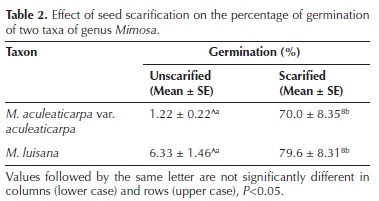
<body><![CDATA[<p align="justify"><font face="verdana" size="2">Saturation Rate (SR).&#150; it is defined as the time for germination in relation to the germination percentage: SR = &#931;(n<sub>i</sub>t<sub>i</sub>)/N, where n<sub>i</sub> = number of germinated seeds in one day (i); t<sub>i</sub> = number of days after sowing, N = total number of seeds sown.</font></p>  	    <p align="justify"><font face="verdana" size="2">Optimum Temperature (OT).&#150; it was calculated as the average of all temperatures, weighted with the total seed germination percentage, at each temperature (Olff <i>et al</i>., 1994).</font></p>  	    <p align="justify"><font face="verdana" size="2"><i>Statistical analyses</i>. Seed weight was compared between taxa using a <i>t</i>&#150;student test (<i>P</i> &lt; 0.05). Homogeneity of variance was examined for all temperature treatments (Levene's test, <i>P</i> &lt; 0.05). When homogeneity of variance was found, a one&#150;way ANOVA was used to analyze the intraspecific variation within the germination percentages and between control and scarified seeds, and a two&#150;way ANOVA to examine the interspecific variation within the germination percentages, where the taxa and the temperatures were the variables (ANOVA, <i>P</i> &lt; 0.05). A multiple comparison test was employed (Tukey's HSD, <i>P</i> &lt; 0.05) to form groups. In <i>Mimosa aculeaticarpa</i> var. <i>aculeaticarpa</i>, the homogeneity of variance of <i>SR</i> was not found; therefore, the non&#150;parametric Kruskal&#150;Wallis test was used (<i>P</i> &lt; 0.05), and medians were compared by the Mann&#150;Whitney test (<i>P</i> &lt; 0.05, Sokal and Rohlf, 1995). All analyses were performed with the NCSS Software (Hintze, 2001).</font></p>  	    <p>&nbsp;</p>  	    <p align="justify"><font face="verdana" size="2"><b>Results</b></font></p>  	    <p align="justify"><font face="verdana" size="2"><i>Seed size, weight, and production</i>. The two studied <i>Mimosa</i> taxa produce numerous seeds of variable weight and size. When comparing the weight of seeds between both taxa and within each taxon, no significant differences were showed (<i>t</i> = 0.7442, <i>P</i> &gt; 0.05). In this sense, no significant differences were found, when comparing the size between and within both taxa; though, <i>M. aculeaticarpa</i> var. <i>aculeaticarpa</i> seeds were the biggest (<a href="#t1">Table 1</a>).</font></p>  	    <p align="center"><font face="verdana" size="2"><a name="t1"></a></font></p>  	    <p align="center"><font face="verdana" size="2"><img src="/img/revistas/bs/v93n3/a18t1.jpg"></font></p>  	    <p align="justify"><font face="verdana" size="2">&#9;Not all collected seeds were healthy; many of them were infested by bruchids (Insecta, Coleoptera). The mean percentage of infestation was 11.9 % for <i>M. aculeaticarpa</i> var. <i>aculeaticarpa</i>, and 48.7 % for <i>M. luisana</i> (<a href="#t1">Table 1</a>). In the case of <i>M. aculeaticarpa</i> var. <i>aculeaticarpa</i>, two species of seed predator bruchids were identified, <i>Acanthoscelides chiricahuae</i> (Fall) and <i>A. mexicanus</i> (Sharp). <i>Mimosa luisana</i> seeds were infested by three species, two belonging to genus <i>Acanthoscelides</i> (<i>Acanthoscelides mexicanus</i> and <i>A. chiricahuae</i>) and one to genus <i>Stator</i> &#91;<i>Stator pruininus</i> (Horn)&#93;.</font></p>  	    <p align="justify"><font face="verdana" size="2"><i>Scarification effect on the total percentage of seed germination</i> (<i>PG</i>). The two <i>Mimosa</i> taxa showed both epigeal and phanerocotylar germination, which started the first day after sowing. In both taxa, germination was stimulated by scarification (<a href="/img/revistas/bs/v93n3/a18f1.jpg" target="_blank">Figures 1</a>, <a href="/img/revistas/bs/v93n3/a18f2.jpg" target="_blank">2</a> and <a href="/img/revistas/bs/v93n3/a18f3.jpg" target="_blank">3</a>; <a href="#t2">Table 2</a>). The PG of unscarified seeds was low and slow. Scarified seeds registered a significantly higher PG (<i>F</i> = 143.88, <i>P</i> &lt; 0.001; <a href="#t2">Table 2</a>). Scarified seeds of <i>M. aculeaticarpa</i> var. <i>aculeaticarpa</i> germinated 57 times faster than those of <i>M. luisana</i>. In the case of <i>Mimosa</i> <i>luisana</i>, unscarified seeds germinated five times faster than those of <i>M. aculeaticarpa</i> var. <i>aculeaticarpa</i> (<a href="/img/revistas/bs/v93n3/a18f1.jpg" target="_blank">Figures 1</a>, <a href="/img/revistas/bs/v93n3/a18f2.jpg" target="_blank">2</a> and <a href="/img/revistas/bs/v93n3/a18f3.jpg" target="_blank">3</a>). Although these data were not statistically significant, seeds of <i>Mimosa luisana</i> tended to germinate in greater numbers than those of <i>M. aculeaticarpa</i> var. <i>aculeaticarpa</i> (<a href="#t2">Table 2</a>).</font></p>  	    ]]></body>
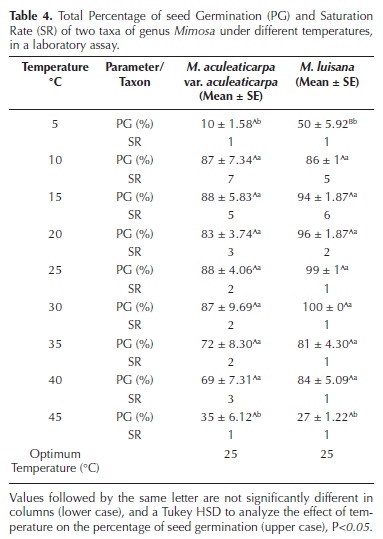
<body><![CDATA[<p align="center"><font face="verdana" size="2"><a name="t2"></a></font></p>  	    <p align="center"><font face="verdana" size="2"><img src="/img/revistas/bs/v93n3/a18t2.jpg"></font></p>  	    <p align="justify"><font face="verdana" size="2"><i>Temperature effect on total seed germination percentage</i> (<i>PG</i>). The two&#150;way ANOVA analysis showed a significant effect of the two factors, taxon and temperature, on the PG (<a href="#t3">Tables 3</a>, <a href="#t4">4</a>). The lowest germination percentage of both taxa was recorded at 5 &deg;C (<a href="/img/revistas/bs/v93n3/a18f1.jpg" target="_blank">Figures 1</a>, <a href="/img/revistas/bs/v93n3/a18f2.jpg" target="_blank">2</a> and <a href="/img/revistas/bs/v93n3/a18f3.jpg" target="_blank">3</a>), differing significantly from the other temperature ranges (<i>F</i> = 33.03 and <i>F</i> =18.63; both with <i>P</i> &lt; 0.005, respectively). The highest PG (88 %) was recorded at 25 &deg;C in <i>M. aculeaticarpa</i> var. <i>aculeaticarpa</i> (<i>F</i> = 33.03; <i>P</i> &lt; 0.005); although, 88 % of germination was also achieved at 15 &deg;C, but seeds required more days (SR = 5) to reach this percentage (<a href="#t4">Table 4</a>). In <i>M. luisana</i>, the highest percentage of germination (100 %) was reached at 30 &deg;C; whereas, at higher or lower temperatures, the PG decreased (<a href="/img/revistas/bs/v93n3/a18f2.jpg" target="_blank">Figure 2</a>; <a href="#t4">Table 4</a>).</font></p>  	    <p align="center"><font face="verdana" size="2"><a name="t3"></a></font></p>  	    <p align="center"><font face="verdana" size="2"><img src="/img/revistas/bs/v93n3/a18t3.jpg"></font></p>  	    <p align="center"><font face="verdana" size="2"><a name="t4"></a></font></p>  	    <p align="center"><font face="verdana" size="2"><img src="/img/revistas/bs/v93n3/a18t4.jpg"></font></p>  	    <p align="justify"><font face="verdana" size="2">&#9;The effect of the interaction between the two factors, taxon and temperature, on the PG was significant (<i>P</i> &lt; 0.001), indicating that the germinative response to temperature depended on the taxon. There was a decrease in the PG at extreme temperatures, 5 and 45 &deg;C (<a href="/img/revistas/bs/v93n3/a18f1.jpg" target="_blank">Figures 1</a>, <a href="/img/revistas/bs/v93n3/a18f2.jpg" target="_blank">2</a> and <a href="/img/revistas/bs/v93n3/a18f3.jpg" target="_blank">3</a>).</font></p>  	    <p align="justify"><font face="verdana" size="2">&#9;In relation to the half of seed germination (G<sub>50</sub>), the taxon factor presented an interaction with the temperature factor (<i>P</i> &lt; 0.001, <a href="#t3">Table 3</a>), indicating that seed germination response (G<sub>50</sub>) to temperature depended on the taxon. Although at 20 &deg;C, <i>M. aculeaticarpa</i> var. <i>aculeaticarpa</i> reached 50 % of seed germination on the second day after sowing, at 25 and 30 &deg;C, the 50 % of seed germination was exceeded on the second day after sowing. However, more days were needed to reach 50 % of germination at temperatures below 20 &deg;C and above 35 &deg;C. Moreover, only 35 % of seed germination was reached at 45 &deg;C. In the case of <i>M. luisana</i>, 50 % of seed germination was attained at 30 &deg;C, the first day after sowing, and this percentage was exceeded at temperatures of 25, 35, and 40 &deg;C; however, the total germination percentage decreased to less than 27 % at 45 &deg;C (<a href="/img/revistas/bs/v93n3/a18f1.jpg" target="_blank">Figures 1</a>, <a href="/img/revistas/bs/v93n3/a18f2.jpg" target="_blank">2</a> and <a href="/img/revistas/bs/v93n3/a18f3.jpg" target="_blank">3</a>).</font></p>  	    <p align="justify"><font face="verdana" size="2">&#9;Furthermore, the results showed that seeds of <i>M. aculeaticarpa</i> var. <i>aculeaticarpa</i> and <i>M. luisana</i> germinated along the gradient of temperature (5&#150;45 &deg;C). However, the optimum temperature (OT) for seed germination for both taxa was determined at 25 &deg;C (<a href="#t4">Table 4</a>).</font></p>  	    ]]></body>
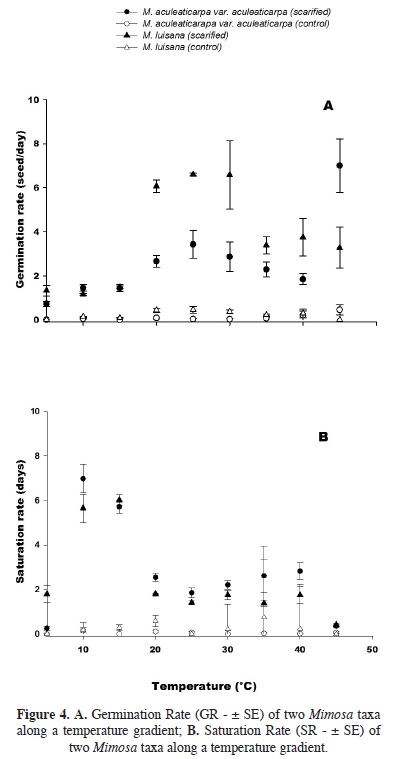
<body><![CDATA[<p align="justify"><font face="verdana" size="2"><i>Temperature effect on the germination rate</i> (<i>GR</i>). The Germination Rate (GR) was significantly affected by the taxon and the temperature factors (<i>F</i> = 9.9; <i>P</i> &lt; 0.001, <a href="#f4">Figure 4A</a>, <a href="#t3">Table 3</a>). GR increased significantly when the temperature reached 30 &deg;C. In average, three seeds of <i>M. aculeaticarpa</i> var. <i>aculeaticarpa</i> germinated/day at 25 &deg;C; whereas, six seeds of M. luisana germinated/day at the same temperature. However, the GR of seeds of both, <i>M. aculeaticarpa</i> var. <i>aculeaticarpa</i> and of <i>M. luisana</i>, decreased at temperatures above 30 and 35&deg;C, respectively. In the case of <i>M. aculeaticarpa</i> var. <i>aculeaticarpa</i>, the GR increased at 45 &deg;C; although, only 35 % of seed germination was recorded (<a href="#f4">Figure 4A</a>).</font></p>  	    <p align="center"><font face="verdana" size="2"><a name="f4"></a></font></p>  	    <p align="center"><font face="verdana" size="2"><img src="/img/revistas/bs/v93n3/a18f4.jpg"></font></p>  	    <p align="justify"><font face="verdana" size="2">&#9;Regarding the saturation rate (SR), a significant interaction between the two factors, taxon and temperature, was also observed (<i>F</i> = 4.38; <i>P</i> &lt; 0.001, <a href="#t3">Table 3</a>), indicating that the SR depended on the taxon. <i>Mimosa aculeaticarpa</i> var. <i>aculeaticarpa</i> required numerous days to reach the PG; whereas, <i>M. luisana</i> required even more days to reach it at 15 &deg;C (<a href="#f4">Figure 4B</a>).</font></p>  	    <p>&nbsp;</p>  	    <p align="justify"><font face="verdana" size="2"><b>Discussion</b></font></p>  	    <p align="justify"><font face="verdana" size="2">The overall results obtained in this study are relevant under the context of possible temperature and precipitation fluctuation. In this case, this study tries to elucidate the influence of both temperature change and seed scarification on <i>Mimosa</i> seeds germination:</font></p>  	    <p align="justify"><font face="verdana" size="2"><i>Seed size, weight and production</i>. Mature <i>Mimosa</i> seeds showed a significant size and weight variation even coming from the same mother plant. Both the small size of the seeds and their high production are intrinsic characteristics that lead to potentially more competitive plants, such as <i>Mimosa tenuiflora</i> (Willd.) Poir. (Camargo&#150;Ricalde and Grether, 1998) and <i>Mimosa pigra</i> L., which are considered as pioneer or invasive species (Creager, 1992; Lonsdale, 1999).</font></p>  	    <p align="justify"><font face="verdana" size="2">&#9;On the other hand, predation of <i>Mimosa</i> seeds by bruchids (Insecta, Coleoptera), regardless of the size, could reduce their potential germination (Font&uacute;rbel, 2002; Romero&#150;N&aacute;poles <i>et al</i>., 2005). In this study, the percentages of infested seeds were consistent with those reported by Orozco&#150;Almanza <i>et al</i>. (2003) and Camargo&#150;Ricalde <i>et al</i>. (2004), who found that the species of <i>Mimosa</i> had a high percentage of bruchid&#150;infested seeds (30&#150;75 %), reducing the number of viable seeds and, consequently, the number of seedlings for posterior recruitment.</font></p>  	    <p align="justify"><font face="verdana" size="2">&#9;In this study, seeds of <i>M. luisana</i> were infested by three different bruchid species; this <i>Mimosa</i> species had the highest percentage of parasitized seeds (48 %), as well as the highest GR; meanwhile, <i>M. aculeaticarpa</i> var. <i>aculeaticarpa</i> registered the presence of two bruchid species, which infested 11 % of the seeds, showing a lower percentage of seed germination (PG), and suggesting that the presence of more than one bruchid species per plant, may be related to a reproductive strategy (Westoby <i>et al</i>., 1992): a high percentage of bruchid&#150;infestation leads to a high GR. It is possible that in nature, bruchids act as the "natural" seed mechanical scarificators, as it happens in other plant species with a hard seed coat (Takakura, 2002).</font></p>  	    ]]></body>
<body><![CDATA[<p align="justify"><font face="verdana" size="2"><i>Effect of seed scarification on germination</i>. In general, legumes produce seeds with a waterproof coat that causes physical dormancy (Auld, 1996; Lopez <i>et al</i>., 1999; Van Klinken and Flack, 2005), which restricts seed germination under natural conditions (D'Aubeterre <i>et al</i>., 2002). According to Lonsdale (1993), Gehan&#150;Jayasuriya <i>et al</i>. (2013), and Van Klinken and Goulier (2013), seeds of <i>Mimosa</i> species present physical dormancy and, because the seed coat has one or more impermeable layers of palisade cells, a physiological dormancy is also possible (Baskin <i>et al</i>., 2000). Therefore, scarification is necessary to promote seed germination (Camargo&#150;Ricalde and Grether, 1998; Gehan&#150;Jayasuriya <i>et al</i>., 2013). Different seed scarification methods have been documented for <i>Mimosa</i> species (De Souza&#150;Ara&uacute;jo and De Castro&#150;Andrade, 1983; Camargo&#150;Ricalde and Grether, 1998; Mart&iacute;nez&#150;P&eacute;rez <i>et al</i>., 2006; Silveira and Fernandes, 2006). However, De Souza&#150;Ara&uacute;jo and De Castro&#150;Andrade (1983), Camargo&#150;Ricalde and Grether (1998), Gonz&aacute;lez&#150;Casta&ntilde;eda <i>et al</i>. (2004), Mart&iacute;nez&#150;P&eacute;rez <i>et al</i>. (2006), Chauhan and Johnson (2008), and Gehan&#150;Jayasuriya <i>et al</i>. (2013), have demonstrated that mechanical scarification is the most appropriate technique for breaking seed dormancy of <i>Mimosa</i> species, since mechanically scarified seeds are able to reach the highest germination rates (GR) in comparison to other methods that, positively, damage the embryo and seedling development (<i>i.e</i>. chemical scarification, heat shock, etc.). In this study, mechanically scarified seeds reached high germination percentages (over 70 %) for both taxa; while, unscarified seeds only achieved 0&#150;12 %. In nature, even if seed germination is low, <i>Mimosa</i> seed scarification occurs by different mechanisms such as changes in daily temperature, incomplete predation by insects as bruchids (Orozco&#150;Almanza <i>et al</i>., 2003; Camargo&#150;Ricalde <i>et al</i>., 2004), damage caused by soil microorganisms, abrasion by soil particles and fire (Baskin <i>et al</i>., 1998; Taylor, 2005), and animal ingestion (<i>i.e</i>. goats, Baraza and Valiente&#150;Banuet, 2008; Giordani, 2008).</font></p>  	    <p align="justify"><font face="verdana" size="2">&#9;However, it is important to mention that control seeds (unscarified seeds) should not be manipulated because the seed coat could be damaged, biasing the results. For instance, Mart&iacute;nez&#150;P&eacute;rez <i>et al</i>. (2006) soaked control seeds of four species, including <i>M. aculeaticarpa</i>, in water/24 h, reaching <i>ca</i>. 60 % germination; almost the same germination behavior as the treated seeds from this study. Thus, control seeds should not be manipulated in any way.</font></p>  	    <p align="justify"><font face="verdana" size="2">&#9;Different assays (<i>i.e</i>. Camargo&#150;Ricalde and Grether, 1998; Mart&iacute;nez&#150;P&eacute;rez <i>et al</i>., 2006; Leal and Biondi, 2007) confirm that <i>Mimosa</i> species have fast seed germination, which takes place within the first&#150;fourth day after sowing; however, germination rate (GR) is related to temperature. This characteristic is also intrinsic to pioneer and invasive species (Lonsdale, 1999), and an important feature for plants with ecological restoration potential such as <i>M. luisana</i> (Camargo&#150;Ricalde <i>et al</i>., 2004) and <i>Mimosa aculeaticarpa</i> Ortega var. <i>biuncifera</i> (Benth.) Barneby (Pav&oacute;n <i>et al</i>., 2011).</font></p>  	    <p align="justify"><font face="verdana" size="2"><i>Temperature effects on seed germination. Mimosa</i> is a neotropical genus (Barneby, 1991; Simon <i>et al</i>., 2011), growing in places where temperature oscillates between 0 and 35 &deg;C (Cavalcante and Perez, 1995); temperatures that are consistent with this and other studies around the world (<i>i.e</i>. Moreno&#150;Casasola, 1973; Parra, 1984; Creager, 1992; Ferreira <i>et al</i>., 1992; Camargo&#150;Ricalde and Grether, 1998; Camargo&#150;Ricalde, 2000; Ursulino&#150;Alves <i>et al</i>., 2002; Orozco&#150;Almanza <i>et al</i>., 2003; Camargo&#150;Ricalde <i>et al</i>., 2004; Rivera&#150;Aguilar <i>et al</i>., 2005; Silveira and Fernandes, 2006; Cruz&#150;Medina and Orozco&#150;Almanza, 2010), which have defined ranges and optimum seed germination temperatures of 25 <i>Mimosa</i> species. Hence, <i>Mimosa</i> seeds are able to germinate between 0 and 45 &deg;C; though, the optimum temperature (OT) registered for the two taxa studied here is 25 &deg;C.</font></p>  	    <p align="justify"><font face="verdana" size="2">&#9;In this context, it is important to note that Cavalcante and Perez (1995) suggested that tropical species can tolerate high temperatures, usually &#8805; 35 &deg;C. On the other hand, when seeds were exposed to cold temperatures (&#8804; 5 &deg;C), germination took place since <i>Mimosa</i> species did not slow their metabolic rate (Hendricks and Taylorson, 1976).</font></p>  	    <p align="justify"><font face="verdana" size="2">&#9;In general, in <i>Mimosa</i> species, temperature is not a limiting factor for seed germination, showing, as well, a fast GR, a high PG, and a fast growth (Camargo&#150;Ricalde and Grether, 1998). These characteristics may explain why <i>Mimosa</i> species may be dominant or co&#150;dominant elements within the plant communities where they occur; for instance, within arid and semi&#150;arid ecosystems (Camargo&#150;Ricalde <i>et al</i>., 2002). Since ecosystems could expand or contract in reaction to plant species tolerance to an increase or decrease in temperature, the response of seed germination to scarification and temperature fluctuation is important to determine (Parmesan and Yohe, 2003). In this case, as both taxa of <i>Mimosa</i> are able to germinate from 5 to 45 &deg;C, their populations may possibly be able to expand or contract in accompaniment with the ecosystems where they occur (<i>i.e</i>. temperate forest and arid tropical scrub).</font></p>  	    <p align="justify"><font face="verdana" size="2"><i>Effect of temperature on the germination rate (GR) and the saturation rate (SR)</i>. Both taxa registered a high GR: 3.4 seeds/day for <i>M. aculeaticarpa</i> var. <i>aculeaticarpa</i> (25 &deg;C), and 6.6 seeds/day for <i>M. luisana</i> (25&#150;30 &deg;C). Although, Carvalho and Nakagawa (2000) suggested that higher temperatures made seeds germinate faster due to an increase in water absorption speed and metabolic reactions. However, in the case of <i>M. aculeaticarpa</i> var. <i>aculeaticarpa</i>, when temperature was above 25 &deg;C, the number of germinated seeds decreased daily; although, the GR increased at 45 &deg;C. According to Baskin <i>et al</i>. (2000), this behavior may be the result of a temperature pulse that breaks the physiological dormancy.</font></p>  	    <p align="justify"><font face="verdana" size="2">&#9;Furthermore, when studying <i>Mimosa hostilis</i> (C.Mart.) Benth. (= <i>Mimosa tenuiflora</i>), De Souza&#150;Ara&uacute;jo and De Castro&#150;Andrade (1983) reported that the GR of scarified seeds showed a direct relationship with the PG, and these results are consistent with the results presented here.</font></p>  	    <p align="justify"><font face="verdana" size="2">The unscarified seeds of both <i>Mimosa</i> taxa had a GR of 0&#150;0.45 seed/day. The highest value was achieved at 45 &deg;C for <i>M. aculeaticarpa</i> var. <i>aculeaticarpa</i>, and 20&#150;25 &deg;C for <i>M. luisana</i>.</font></p>  	    <p align="justify"><font face="verdana" size="2">&#9;Regarding the SR, both <i>Mimosa</i> taxa studied required one to two days to germinate at 25 &deg;C, after sowing, reaching a high germination percentages; whereas, the number of days for seed germination increases at temperatures under 25 &deg;C, due to a decrease in seed metabolism (Amaral and Paulilo, 1992). The study carried out by Pav&oacute;n <i>et al</i>. (2011) on the germination of scarified seeds of <i>M. aculeaticarpa</i> var. <i>biuncifera</i>, confirmed the inverse relationship between GR and SR: while GR increased, SR decreased. However, this inverse relationship was not found when comparing unscarified seeds, where no significant differences were found neither among temperatures nor species.</font></p>  	    ]]></body>
<body><![CDATA[<p align="justify"><font face="verdana" size="2">&#9;Finally, if part of the success of a plant species is focused on its tolerance to the temperature factor, the overall results suggest that both <i>Mimosa</i> taxa may be able to succeed under different thermal scenarios. However, more studies are needed to understand how other climatic factors, such as different levels of precipitation and CO<sub>2</sub> concentrations, may affect the seed germination behavior of plant species.</font></p>  	    <p>&nbsp;</p>  	    <p align="justify"><font face="verdana" size="2"><b>Conclusions</b></font></p>  	    <p align="justify"><font face="verdana" size="2">Seeds of <i>Mimosa</i>, like those of other legumes, have a hard and impermeable coat. To germinate, these seeds require scarification, and mechanical scarification is the best method, as neither the embryo axis nor the seedling is damaged. A comparison between healthy seeds and those prayed by bruchids is also relevant, since these insects are considered natural controls of <i>Mimosa</i> species populations.</font></p>  	    <p align="justify"><font face="verdana" size="2">&#9;Our hypothesis was confirmed: seeds of the two <i>Mimosa</i> taxa studied germinated according to the typical temperatures to their habitats, and both taxa showed tolerance to a wide thermal scenario. Furthermore, in this study, because seeds of both <i>Mimosa</i> taxa are capable to germinate under a wide range of temperatures, their populations may possibly be able to expand or contract in accompaniment with the ecosystems where they occur.</font></p>  	    <p align="justify"><font face="verdana" size="2">&#9;Currently, both <i>Mimosa</i> taxa may be used in ecological restoration programs. As Mexican native taxa, they favor successional processes leading to the restoration of their original ecosystems, respectively. We propose that: (<i>i</i>) In temperate forests (Mexican mesic ecosystems), <i>M. aculeaticarpa</i> var. <i>aculeaticarpa</i> would restore environments where the temperature is never below 5 &deg;C or above 45 &deg;C, and (<i>ii</i>) In the arid tropical scrub (dry ecosystem), <i>M. luisana</i> seeds would germinate in a wider range of temperatures, suggesting that this narrow endemic species is a good option for the restoration of the semi&#150;arid ecosystem at the Valley of Tehuac&aacute;n&#150;Cuicatl&aacute;n, Mexico.</font></p>  	    <p>&nbsp;</p>  	    <p align="justify"><font face="verdana" size="2"><b>Acknowledgements</b></font></p>  	    <p align="justify"><font face="verdana" size="2">S. A. Monta&ntilde;o&#150;Arias wishes to thank the Consejo Nacional de Ciencia y Tecnolog&iacute;a (CONACyT)&#150;M&eacute;xico (228993/211528) for the grant to pursue a doctoral degree in the Doctorado en Ciencias Biol&oacute;gicas y de la Salud, Universidad Aut&oacute;noma Metropolitana. The authors wish to express their appreciation to Jes&uacute;s Romero&#150;N&aacute;poles, Instituto de Fitosanidad, Colegio de Postgraduados, Campus Montecillo, for determining bruchid specimens (Insecta, Coleoptera), and to Jennifer Bain, Instituto de Biolog&iacute;a, UNAM, for the technical revision of the English version. We also thank the anonymous reviewers who improved our manuscript.</font></p>  	    <p>&nbsp;</p>  	    ]]></body>
<body><![CDATA[<p align="justify"><font face="verdana" size="2"><b>Literature cited</b></font></p>  	    <!-- ref --><p align="justify"><font face="verdana" size="2">Amaral L.I.V. and Paulilo M.T.S. 1992. Efeito da luz, temperatura, regulador de crescimento e nitrato de pot&aacute;ssio na germina&#231;&atilde;o de <i>Miconia cinnamomifolia</i> Naudim. <i>Insula</i> <b>21</b>:59&#150;86.    &nbsp;&nbsp;&nbsp;&nbsp;&nbsp;&nbsp;&nbsp;&nbsp;[&#160;<a href="javascript:void(0);" onclick="javascript: window.open('/scielo.php?script=sci_nlinks&ref=1789485&pid=S2007-4298201500030001800001&lng=','','width=640,height=500,resizable=yes,scrollbars=1,menubar=yes,');">Links</a>&#160;]<!-- end-ref --></font></p>  	    <!-- ref --><p align="justify"><font face="verdana" size="2">Auld T.D. 1996. Ecology of the Fabaceae in the Sydney region: fire, ants and the soil seedbank. <i>Cunninghamia</i> <b>4</b>:531&#150;551.    &nbsp;&nbsp;&nbsp;&nbsp;&nbsp;&nbsp;&nbsp;&nbsp;[&#160;<a href="javascript:void(0);" onclick="javascript: window.open('/scielo.php?script=sci_nlinks&ref=1789487&pid=S2007-4298201500030001800002&lng=','','width=640,height=500,resizable=yes,scrollbars=1,menubar=yes,');">Links</a>&#160;]<!-- end-ref --></font></p>  	    <!-- ref --><p align="justify"><font face="verdana" size="2">Baraza E. and Valiente&#150;Banuet A. 2008. Seed dispersal by domestic goats in a semiarid thornshrub of Mexico. <i>Journal of Arid Environments</i> <b>72</b>:1973&#150;1976.    &nbsp;&nbsp;&nbsp;&nbsp;&nbsp;&nbsp;&nbsp;&nbsp;[&#160;<a href="javascript:void(0);" onclick="javascript: window.open('/scielo.php?script=sci_nlinks&ref=1789489&pid=S2007-4298201500030001800003&lng=','','width=640,height=500,resizable=yes,scrollbars=1,menubar=yes,');">Links</a>&#160;]<!-- end-ref --></font></p>  	    <!-- ref --><p align="justify"><font face="verdana" size="2">Barneby, R.C. 1991. Sensitivae Censitae. A description of the genus <i>Mimosa</i> L. (Mimosaceae) in the New World. <i>Memoirs of the New York Botanical Garden</i> <b>65</b>:1&#150;835.    &nbsp;&nbsp;&nbsp;&nbsp;&nbsp;&nbsp;&nbsp;&nbsp;[&#160;<a href="javascript:void(0);" onclick="javascript: window.open('/scielo.php?script=sci_nlinks&ref=1789491&pid=S2007-4298201500030001800004&lng=','','width=640,height=500,resizable=yes,scrollbars=1,menubar=yes,');">Links</a>&#160;]<!-- end-ref --></font></p>  	    <!-- ref --><p align="justify"><font face="verdana" size="2">Baskin C.C. 2003. Breaking physical dormancy in seeds &#150; focusing on the lens. <i>New Phytologist</i> <b>158</b>:229&#150;232.    &nbsp;&nbsp;&nbsp;&nbsp;&nbsp;&nbsp;&nbsp;&nbsp;[&#160;<a href="javascript:void(0);" onclick="javascript: window.open('/scielo.php?script=sci_nlinks&ref=1789493&pid=S2007-4298201500030001800005&lng=','','width=640,height=500,resizable=yes,scrollbars=1,menubar=yes,');">Links</a>&#160;]<!-- end-ref --></font></p>  	    <!-- ref --><p align="justify"><font face="verdana" size="2">Baskin J.M., Baskin C.C. and Li X. 2000. Taxonomy, ecology, and evolution of physical dormancy in seeds. <i>Plant Species Biology</i> <b>15</b>:139&#150;152.    &nbsp;&nbsp;&nbsp;&nbsp;&nbsp;&nbsp;&nbsp;&nbsp;[&#160;<a href="javascript:void(0);" onclick="javascript: window.open('/scielo.php?script=sci_nlinks&ref=1789495&pid=S2007-4298201500030001800006&lng=','','width=640,height=500,resizable=yes,scrollbars=1,menubar=yes,');">Links</a>&#160;]<!-- end-ref --></font></p>  	    <!-- ref --><p align="justify"><font face="verdana" size="2">Baskin J.M., Nan X. and Baskin C.C. 1998. A comparative study of seed dormancy and germination in an annual and a perennial species of <i>Senna</i> (Fabaceae). <i>Seed Science Research</i> <b>8</b>:501&#150;512.    &nbsp;&nbsp;&nbsp;&nbsp;&nbsp;&nbsp;&nbsp;&nbsp;[&#160;<a href="javascript:void(0);" onclick="javascript: window.open('/scielo.php?script=sci_nlinks&ref=1789497&pid=S2007-4298201500030001800007&lng=','','width=640,height=500,resizable=yes,scrollbars=1,menubar=yes,');">Links</a>&#160;]<!-- end-ref --></font></p>  	    <!-- ref --><p align="justify"><font face="verdana" size="2">Bewley J.D. and Black M. 1994. <i>Seeds: physiology of development and germination</i>. Springer, New York.    &nbsp;&nbsp;&nbsp;&nbsp;&nbsp;&nbsp;&nbsp;&nbsp;[&#160;<a href="javascript:void(0);" onclick="javascript: window.open('/scielo.php?script=sci_nlinks&ref=1789499&pid=S2007-4298201500030001800008&lng=','','width=640,height=500,resizable=yes,scrollbars=1,menubar=yes,');">Links</a>&#160;]<!-- end-ref --></font></p>  	    <!-- ref --><p align="justify"><font face="verdana" size="2">Camargo&#150;Ricalde S.L. and Grether R. 1998. Germinaci&oacute;n, dispersi&oacute;n y establecimiento de pl&aacute;ntulas de <i>Mimosa tenuiflora</i> (Leguminosae) en M&eacute;xico. <i>Revista de Biolog&iacute;a Tropical</i> <b>46</b>:1&#150;12.    &nbsp;&nbsp;&nbsp;&nbsp;&nbsp;&nbsp;&nbsp;&nbsp;[&#160;<a href="javascript:void(0);" onclick="javascript: window.open('/scielo.php?script=sci_nlinks&ref=1789501&pid=S2007-4298201500030001800009&lng=','','width=640,height=500,resizable=yes,scrollbars=1,menubar=yes,');">Links</a>&#160;]<!-- end-ref --></font></p>  	    <!-- ref --><p align="justify"><font face="verdana" size="2">Camargo&#150;Ricalde S.L. 2000. Descripci&oacute;n, distribuci&oacute;n, anatom&iacute;a, composici&oacute;n qu&iacute;mica y usos de <i>Mimosa tenuiflora</i> (Fabaceae&#150;Mimosoideae) en M&eacute;xico. <i>Revista de Biolog&iacute;a Tropical</i> <b>48</b>:939&#150;954.    &nbsp;&nbsp;&nbsp;&nbsp;&nbsp;&nbsp;&nbsp;&nbsp;[&#160;<a href="javascript:void(0);" onclick="javascript: window.open('/scielo.php?script=sci_nlinks&ref=1789503&pid=S2007-4298201500030001800010&lng=','','width=640,height=500,resizable=yes,scrollbars=1,menubar=yes,');">Links</a>&#160;]<!-- end-ref --></font></p>  	    <!-- ref --><p align="justify"><font face="verdana" size="2">Camargo&#150;Ricalde S.L., Grether R., Mart&iacute;nez&#150;Bernal A., Garc&iacute;a&#150;Garc&iacute;a V. and Barrios&#150;del&#150;Rosal S. 2001. Especies &uacute;tiles del g&eacute;nero <i>Mimosa</i> (Fabaceae&#150;Mimosoideae) en M&eacute;xico. <i>Bolet&iacute;n de la Sociedad Bot&aacute;nica de M&eacute;xico</i> <b>68</b>:33&#150;44.    &nbsp;&nbsp;&nbsp;&nbsp;&nbsp;&nbsp;&nbsp;&nbsp;[&#160;<a href="javascript:void(0);" onclick="javascript: window.open('/scielo.php?script=sci_nlinks&ref=1789505&pid=S2007-4298201500030001800011&lng=','','width=640,height=500,resizable=yes,scrollbars=1,menubar=yes,');">Links</a>&#160;]<!-- end-ref --></font></p>  	    <!-- ref --><p align="justify"><font face="verdana" size="2">Camargo&#150;Ricalde S.L., Dhillion S.S. and Grether R. 2002. Community structure of endemic <i>Mimosa</i> species and environmental heterogeneity in a semi&#150;arid Mexican valley. <i>Journal of Vegetation Science</i> <b>13</b>:697&#150;704.    &nbsp;&nbsp;&nbsp;&nbsp;&nbsp;&nbsp;&nbsp;&nbsp;[&#160;<a href="javascript:void(0);" onclick="javascript: window.open('/scielo.php?script=sci_nlinks&ref=1789507&pid=S2007-4298201500030001800012&lng=','','width=640,height=500,resizable=yes,scrollbars=1,menubar=yes,');">Links</a>&#160;]<!-- end-ref --></font></p>  	    <!-- ref --><p align="justify"><font face="verdana" size="2">Camargo&#150;Ricalde S.L. and Dhillion S.S. 2003. Endemic <i>Mimosa</i> species can serve as mycorrhizal "resource islands" within semiarid communities of the Tehuac&aacute;n&#150;Cuicatl&aacute;n Valley, Mexico. <i>Mycorrhiza</i> <b>13</b>:129&#150;136.    &nbsp;&nbsp;&nbsp;&nbsp;&nbsp;&nbsp;&nbsp;&nbsp;[&#160;<a href="javascript:void(0);" onclick="javascript: window.open('/scielo.php?script=sci_nlinks&ref=1789509&pid=S2007-4298201500030001800013&lng=','','width=640,height=500,resizable=yes,scrollbars=1,menubar=yes,');">Links</a>&#160;]<!-- end-ref --></font></p>  	    <!-- ref --><p align="justify"><font face="verdana" size="2">Camargo&#150;Ricalde S.L., Dhillion S.S. and Garc&iacute;a&#150;Garc&iacute;a V. 2004. Phenology, and seed production and germination of seven endemic <i>Mimosa</i> species (Fabaceae&#150; Mimosoideae) of the Tehuac&aacute;n&#150;Cuicatl&aacute;n Valley, Mexico. <i>Journal of Arid Environments</i> <b>58</b>:423&#150;437.    &nbsp;&nbsp;&nbsp;&nbsp;&nbsp;&nbsp;&nbsp;&nbsp;[&#160;<a href="javascript:void(0);" onclick="javascript: window.open('/scielo.php?script=sci_nlinks&ref=1789511&pid=S2007-4298201500030001800014&lng=','','width=640,height=500,resizable=yes,scrollbars=1,menubar=yes,');">Links</a>&#160;]<!-- end-ref --></font></p>  	    <!-- ref --><p align="justify"><font face="verdana" size="2">Camargo&#150;Ricalde S.L., Reyes&#150;Jaramillo I. and Monta&ntilde;o N.M. 2010a. Forestry insularity effect of four <i>Mimosa</i> L. species (Leguminosae&#150;Mimosoideae) on soil nutrients of a Mexican semiarid ecosystem. <i>Agroforestry Systems</i> <b>80</b>:385&#150;397.    &nbsp;&nbsp;&nbsp;&nbsp;&nbsp;&nbsp;&nbsp;&nbsp;[&#160;<a href="javascript:void(0);" onclick="javascript: window.open('/scielo.php?script=sci_nlinks&ref=1789513&pid=S2007-4298201500030001800015&lng=','','width=640,height=500,resizable=yes,scrollbars=1,menubar=yes,');">Links</a>&#160;]<!-- end-ref --></font></p>  	    <!-- ref --><p align="justify"><font face="verdana" size="2">Camargo&#150;Ricalde S.L., Monta&ntilde;o N.M., Reyes&#150;Jaramillo I., Jim&eacute;nez&#150;Gonz&aacute;lez C. and Dhillion S.S. 2010b. Effect of mycorrhizae on seedlings of six endemic <i>Mimosa</i> L. species (Leguminosae&#150;Mimosoideae) from the semi&#150;arid Tehuac&aacute;n&#150;Cuicatl&aacute;n Valley, Mexico. <i>Trees</i> <b>24</b>:67&#150;78.    &nbsp;&nbsp;&nbsp;&nbsp;&nbsp;&nbsp;&nbsp;&nbsp;[&#160;<a href="javascript:void(0);" onclick="javascript: window.open('/scielo.php?script=sci_nlinks&ref=1789515&pid=S2007-4298201500030001800016&lng=','','width=640,height=500,resizable=yes,scrollbars=1,menubar=yes,');">Links</a>&#160;]<!-- end-ref --></font></p>  	    <!-- ref --><p align="justify"><font face="verdana" size="2">Carvalho N.M. and Nakagawa J. 2000. <i>Sementes: ci&ecirc;ncia, tecnologia e produ&#231;&atilde;o</i>. 4. ed. Jaboticabal: Funep.    &nbsp;&nbsp;&nbsp;&nbsp;&nbsp;&nbsp;&nbsp;&nbsp;[&#160;<a href="javascript:void(0);" onclick="javascript: window.open('/scielo.php?script=sci_nlinks&ref=1789517&pid=S2007-4298201500030001800017&lng=','','width=640,height=500,resizable=yes,scrollbars=1,menubar=yes,');">Links</a>&#160;]<!-- end-ref --></font></p>  	    <!-- ref --><p align="justify"><font face="verdana" size="2">Cavalcante A.M. and Perez S.C.J.A. 1995. Efeitos da temperatura sobre a germina&#231;&atilde;o de sementes de <i>Leucaena leucocephala</i> (Lam.) de Wit. <i>Revista Brasileira de Sementes</i> <b>17</b>:1&#150;8.    &nbsp;&nbsp;&nbsp;&nbsp;&nbsp;&nbsp;&nbsp;&nbsp;[&#160;<a href="javascript:void(0);" onclick="javascript: window.open('/scielo.php?script=sci_nlinks&ref=1789519&pid=S2007-4298201500030001800018&lng=','','width=640,height=500,resizable=yes,scrollbars=1,menubar=yes,');">Links</a>&#160;]<!-- end-ref --></font></p>  	    <!-- ref --><p align="justify"><font face="verdana" size="2">Chauhan B.S. and Johnson D.E. 2008. Seed germination and seedling emergence of giant sensitive plant (<i>Mimosa invisa</i>). <i>Weed Science</i> <b>56</b>:244&#150;248.    &nbsp;&nbsp;&nbsp;&nbsp;&nbsp;&nbsp;&nbsp;&nbsp;[&#160;<a href="javascript:void(0);" onclick="javascript: window.open('/scielo.php?script=sci_nlinks&ref=1789521&pid=S2007-4298201500030001800019&lng=','','width=640,height=500,resizable=yes,scrollbars=1,menubar=yes,');">Links</a>&#160;]<!-- end-ref --></font></p>  	    <!-- ref --><p align="justify"><font face="verdana" size="2">Creager R.A. 1992. Seed germination, physical and chemical control of catclaw mimosa (<i>Mimosa pigra</i> var. <i>pigra</i>). <i>Weed Technology</i> <b>6</b>:884&#150;891.    &nbsp;&nbsp;&nbsp;&nbsp;&nbsp;&nbsp;&nbsp;&nbsp;[&#160;<a href="javascript:void(0);" onclick="javascript: window.open('/scielo.php?script=sci_nlinks&ref=1789523&pid=S2007-4298201500030001800020&lng=','','width=640,height=500,resizable=yes,scrollbars=1,menubar=yes,');">Links</a>&#160;]<!-- end-ref --></font></p>  	    <!-- ref --><p align="justify"><font face="verdana" size="2">Cruz&#150;Medina D. and Orozco&#150;Almanza S. 2010. Germinaci&oacute;n de ocho especies de la familia Fabaceae, bajo diferentes reg&iacute;menes de temperatura. VII Simposio Internacional sobre la flora silvestre en zonas &aacute;ridas, Universidad de Sonora, Hermosillo, Sonora, M&eacute;xico Trabajo en extenso: 197&#150;215 pp.    &nbsp;&nbsp;&nbsp;&nbsp;&nbsp;&nbsp;&nbsp;&nbsp;[&#160;<a href="javascript:void(0);" onclick="javascript: window.open('/scielo.php?script=sci_nlinks&ref=1789525&pid=S2007-4298201500030001800021&lng=','','width=640,height=500,resizable=yes,scrollbars=1,menubar=yes,');">Links</a>&#160;]<!-- end-ref --></font></p>  	    <!-- ref --><p align="justify"><font face="verdana" size="2">D'Aubeterre R., Principal J. and Garc&iacute;a J. 2002. Efecto de diferentes m&eacute;todos de escarificaci&oacute;n sobre la germinaci&oacute;n de tres especies del g&eacute;nero <i>Prosopis. Revista Cient&iacute;fica</i> <b>12</b>:575&#150;577.    &nbsp;&nbsp;&nbsp;&nbsp;&nbsp;&nbsp;&nbsp;&nbsp;[&#160;<a href="javascript:void(0);" onclick="javascript: window.open('/scielo.php?script=sci_nlinks&ref=1789527&pid=S2007-4298201500030001800022&lng=','','width=640,height=500,resizable=yes,scrollbars=1,menubar=yes,');">Links</a>&#160;]<!-- end-ref --></font></p>  	    <!-- ref --><p align="justify"><font face="verdana" size="2">De Souza&#150;Ara&uacute;jo M. and De Castro&#150;Andrade G. 1983. M&eacute;todos para superar a dorm&ecirc;ncia tegumentar em sementes de Jurema&#150; preta (<i>Mimosa hostilis</i> Benth.). <i>Boletim de Pesquisa Florestal</i> <b>6/7</b>:26&#150;32.    &nbsp;&nbsp;&nbsp;&nbsp;&nbsp;&nbsp;&nbsp;&nbsp;[&#160;<a href="javascript:void(0);" onclick="javascript: window.open('/scielo.php?script=sci_nlinks&ref=1789529&pid=S2007-4298201500030001800023&lng=','','width=640,height=500,resizable=yes,scrollbars=1,menubar=yes,');">Links</a>&#160;]<!-- end-ref --></font></p>  	    <!-- ref --><p align="justify"><font face="verdana" size="2">Dhillion S.S., Aguilar&#150;St&oslash;en M. and Camargo&#150;Ricalde S.L. 2004. Integrative ecological restoration and local involvement in the Tehuac&aacute;n&#150;Cuicatl&aacute;n Valley, Mexico. <i>Environmental Conservation</i> <b>13</b>:1&#150;3.    &nbsp;&nbsp;&nbsp;&nbsp;&nbsp;&nbsp;&nbsp;&nbsp;[&#160;<a href="javascript:void(0);" onclick="javascript: window.open('/scielo.php?script=sci_nlinks&ref=1789531&pid=S2007-4298201500030001800024&lng=','','width=640,height=500,resizable=yes,scrollbars=1,menubar=yes,');">Links</a>&#160;]<!-- end-ref --></font></p>  	    <!-- ref --><p align="justify"><font face="verdana" size="2">Enr&iacute;quez&#150;Pe&ntilde;a E., Suz&aacute;n&#150;Azpiri H. and Malda&#150;Barrera G. 2004. Viabilidad y germinaci&oacute;n de semillas de <i>Taxodium mucronatum</i> (Ten.) en el estado de Quer&eacute;taro, M&eacute;xico. <i>Agrociencia</i> <b>38</b>:357&#150;381.    &nbsp;&nbsp;&nbsp;&nbsp;&nbsp;&nbsp;&nbsp;&nbsp;[&#160;<a href="javascript:void(0);" onclick="javascript: window.open('/scielo.php?script=sci_nlinks&ref=1789533&pid=S2007-4298201500030001800025&lng=','','width=640,height=500,resizable=yes,scrollbars=1,menubar=yes,');">Links</a>&#160;]<!-- end-ref --></font></p>  	    <!-- ref --><p align="justify"><font face="verdana" size="2">Ferreira A.G., Lipp&#150;Joao K.H. and Heuser E.D. 1992. Efeitos de escarifica&#231;ao sobre a germina&#231;ao e do pH no crescimento de <i>Acacia bonariensis</i> Gill e <i>Mimosa bimucronata</i> (DC.) Kuntze. <i>Revista Brasileira de Fisiologia Vegetal</i> <b>4</b>:63&#150;65.    &nbsp;&nbsp;&nbsp;&nbsp;&nbsp;&nbsp;&nbsp;&nbsp;[&#160;<a href="javascript:void(0);" onclick="javascript: window.open('/scielo.php?script=sci_nlinks&ref=1789535&pid=S2007-4298201500030001800026&lng=','','width=640,height=500,resizable=yes,scrollbars=1,menubar=yes,');">Links</a>&#160;]<!-- end-ref --></font></p>  	    <!-- ref --><p align="justify"><font face="verdana" size="2">Font&uacute;rbel R.F. 2002. Rol de la coevoluci&oacute;n planta&#150;insecto en la evoluci&oacute;n de las flores c&iacute;clicas en las angiospermas. <i>Ciencia Abierta</i> <b>17</b>:1&#150;11.    &nbsp;&nbsp;&nbsp;&nbsp;&nbsp;&nbsp;&nbsp;&nbsp;[&#160;<a href="javascript:void(0);" onclick="javascript: window.open('/scielo.php?script=sci_nlinks&ref=1789537&pid=S2007-4298201500030001800027&lng=','','width=640,height=500,resizable=yes,scrollbars=1,menubar=yes,');">Links</a>&#160;]<!-- end-ref --></font></p>  	    <!-- ref --><p align="justify"><font face="verdana" size="2">Giordani L. 2008. The role of goats in germination and dispersal of <i>Mimosa luisana</i> Brandegee (Leguminosae&#150;Mimosoideae) seeds in the Tehuac&aacute;n&#150;Cuicatl&aacute;n valley, Puebla State, Mexico. Master Thesis, Norwegian University of life Sciences, Norway, 24 pp.    &nbsp;&nbsp;&nbsp;&nbsp;&nbsp;&nbsp;&nbsp;&nbsp;[&#160;<a href="javascript:void(0);" onclick="javascript: window.open('/scielo.php?script=sci_nlinks&ref=1789539&pid=S2007-4298201500030001800028&lng=','','width=640,height=500,resizable=yes,scrollbars=1,menubar=yes,');">Links</a>&#160;]<!-- end-ref --></font></p>  	    <!-- ref --><p align="justify"><font face="verdana" size="2">Gonz&aacute;lez&#150;Casta&ntilde;eda J., Angoa&#150;P&eacute;rez M.V., Fr&iacute;as&#150;Hern&aacute;ndez J.T., Olalde&#150;Portugal V., Flores&#150;Ancira E., Terrones&#150;Rinc&oacute;n T.R., Van Cleemput O. and Dendooven L. 2004. Germination of seeds of huisache (<i>Acacia schaffneri</i>) and catclaw (<i>Mimosa monancistra</i>) as affected by sulphuric acid and mechanical scarification and subsequent growth and survival in a greenhouse and field experiment. <i>Seed Science and Technology</i> <b>32</b>:727&#150;738.    &nbsp;&nbsp;&nbsp;&nbsp;&nbsp;&nbsp;&nbsp;&nbsp;[&#160;<a href="javascript:void(0);" onclick="javascript: window.open('/scielo.php?script=sci_nlinks&ref=1789541&pid=S2007-4298201500030001800029&lng=','','width=640,height=500,resizable=yes,scrollbars=1,menubar=yes,');">Links</a>&#160;]<!-- end-ref --></font></p>  	    <!-- ref --><p align="justify"><font face="verdana" size="2">Grether R., Camargo&#150;Ricalde S.L. and Mart&iacute;nez&#150;Bernal A. 1996. Especies del g&eacute;nero <i>Mimosa</i> (Leguminosae) presentes en M&eacute;xico. <i>Bolet&iacute;n de la Sociedad Bot&aacute;nica de M&eacute;xico</i> <b>58</b>:149&#150;152.    &nbsp;&nbsp;&nbsp;&nbsp;&nbsp;&nbsp;&nbsp;&nbsp;[&#160;<a href="javascript:void(0);" onclick="javascript: window.open('/scielo.php?script=sci_nlinks&ref=1789543&pid=S2007-4298201500030001800030&lng=','','width=640,height=500,resizable=yes,scrollbars=1,menubar=yes,');">Links</a>&#160;]<!-- end-ref --></font></p>  	    <!-- ref --><p align="justify"><font face="verdana" size="2">Hendricks S.B. and Taylorson B. 1976. Variation in germination and amino acid leakage of seeds with temperature related to membrane phase change. <i>Plant Physiology</i> <b>58</b>:7&#150;11.    &nbsp;&nbsp;&nbsp;&nbsp;&nbsp;&nbsp;&nbsp;&nbsp;[&#160;<a href="javascript:void(0);" onclick="javascript: window.open('/scielo.php?script=sci_nlinks&ref=1789545&pid=S2007-4298201500030001800031&lng=','','width=640,height=500,resizable=yes,scrollbars=1,menubar=yes,');">Links</a>&#160;]<!-- end-ref --></font></p>  	    <!-- ref --><p align="justify"><font face="verdana" size="2">Hintze J. 2001. NCSS 2001. NCSS, LLC. Kaysville, Utah, USA. <a href="http://www.ncss.com" target="_blank">www.ncss.com</a>.    &nbsp;&nbsp;&nbsp;&nbsp;&nbsp;&nbsp;&nbsp;&nbsp;[&#160;<a href="javascript:void(0);" onclick="javascript: window.open('/scielo.php?script=sci_nlinks&ref=1789547&pid=S2007-4298201500030001800032&lng=','','width=640,height=500,resizable=yes,scrollbars=1,menubar=yes,');">Links</a>&#160;]<!-- end-ref --></font></p>  	    <!-- ref --><p align="justify"><font face="verdana" size="2">Gehan&#150;Jayasuriya G.M., Wijetunga A.S.T.B., Baskin J.M. and Baskin C.C. 2013. Seed dormancy and storage behavior in tropical Fabaceae: a study of 100 species from Sri Lanka. <i>Seed Science Research</i> <b>23</b>:257&#150;269.    &nbsp;&nbsp;&nbsp;&nbsp;&nbsp;&nbsp;&nbsp;&nbsp;[&#160;<a href="javascript:void(0);" onclick="javascript: window.open('/scielo.php?script=sci_nlinks&ref=1789549&pid=S2007-4298201500030001800033&lng=','','width=640,height=500,resizable=yes,scrollbars=1,menubar=yes,');">Links</a>&#160;]<!-- end-ref --></font></p>  	    <!-- ref --><p align="justify"><font face="verdana" size="2">Leal L. and Biondi D. 2007. Comportamento germinativo de sementes de <i>Mimosa dolens</i> Vell. <i>Publicatio UEPG: Ci&ecirc;ncias Exatas e da Terra, Agr&aacute;rias e Engenharias</i> <b>13</b>:37&#150;43.    &nbsp;&nbsp;&nbsp;&nbsp;&nbsp;&nbsp;&nbsp;&nbsp;[&#160;<a href="javascript:void(0);" onclick="javascript: window.open('/scielo.php?script=sci_nlinks&ref=1789551&pid=S2007-4298201500030001800034&lng=','','width=640,height=500,resizable=yes,scrollbars=1,menubar=yes,');">Links</a>&#160;]<!-- end-ref --></font></p>  	    <!-- ref --><p align="justify"><font face="verdana" size="2">Lonsdale W. M. 1993. Losses from the seed bank of <i>Mimosa pigra</i>: soil micro&#150;organisms <i>vs</i>. temperature fluctuations. <i>Journal of Applied Ecology</i> <b>30</b>:654&#150;660.    &nbsp;&nbsp;&nbsp;&nbsp;&nbsp;&nbsp;&nbsp;&nbsp;[&#160;<a href="javascript:void(0);" onclick="javascript: window.open('/scielo.php?script=sci_nlinks&ref=1789553&pid=S2007-4298201500030001800035&lng=','','width=640,height=500,resizable=yes,scrollbars=1,menubar=yes,');">Links</a>&#160;]<!-- end-ref --></font></p>  	    <!-- ref --><p align="justify"><font face="verdana" size="2">Lonsdale W.M. 1999. Global patterns of plant invasions and the concept of invasibility. <i>Ecology</i> <b>80</b>:1522&#150;1536.    &nbsp;&nbsp;&nbsp;&nbsp;&nbsp;&nbsp;&nbsp;&nbsp;[&#160;<a href="javascript:void(0);" onclick="javascript: window.open('/scielo.php?script=sci_nlinks&ref=1789555&pid=S2007-4298201500030001800036&lng=','','width=640,height=500,resizable=yes,scrollbars=1,menubar=yes,');">Links</a>&#160;]<!-- end-ref --></font></p>  	    <!-- ref --><p align="justify"><font face="verdana" size="2">Lopez J., Devesa J.A., Ruiz T. and Ortega&#150;Olivencia A. 1999. Seed germination in <i>Genisteae</i> (Fabaceae) from South&#150;West Spain. <i>Phyton</i> <b>39</b>:107&#150;129.    &nbsp;&nbsp;&nbsp;&nbsp;&nbsp;&nbsp;&nbsp;&nbsp;[&#160;<a href="javascript:void(0);" onclick="javascript: window.open('/scielo.php?script=sci_nlinks&ref=1789557&pid=S2007-4298201500030001800037&lng=','','width=640,height=500,resizable=yes,scrollbars=1,menubar=yes,');">Links</a>&#160;]<!-- end-ref --></font></p>  	    <!-- ref --><p align="justify"><font face="verdana" size="2">Mart&iacute;nez&#150;P&eacute;rez G., Orozco&#150;Segovia A. and Martorell C. 2006. Efectividad de algunos tratamientos pre&#150;germinativos para ocho especies le&ntilde;osas de la Mixteca Alta Oaxaque&ntilde;a con caracter&iacute;sticas relevantes para la restauraci&oacute;n. <i>Bolet&iacute;n de la Sociedad Bot&aacute;nica de M&eacute;xico</i> <b>79</b>:9&#150;20.    &nbsp;&nbsp;&nbsp;&nbsp;&nbsp;&nbsp;&nbsp;&nbsp;[&#160;<a href="javascript:void(0);" onclick="javascript: window.open('/scielo.php?script=sci_nlinks&ref=1789559&pid=S2007-4298201500030001800038&lng=','','width=640,height=500,resizable=yes,scrollbars=1,menubar=yes,');">Links</a>&#160;]<!-- end-ref --></font></p>  	    <!-- ref --><p align="justify"><font face="verdana" size="2">Matilla A. 2004. Ecofisiolog&iacute;a de la germinaci&oacute;n de semillas. <i>In</i>: S&aacute;nchez A., Reigosa&#150;Roger M.J. y Pedroi&#150;Bonjoch N. <i>La ecofisiolog&iacute;a Vegetal: Una ciencia de s&iacute;ntesis</i>. pp. 901&#150;922. Thomson&#150;Paraninfo, Espa&ntilde;a.    &nbsp;&nbsp;&nbsp;&nbsp;&nbsp;&nbsp;&nbsp;&nbsp;[&#160;<a href="javascript:void(0);" onclick="javascript: window.open('/scielo.php?script=sci_nlinks&ref=1789561&pid=S2007-4298201500030001800039&lng=','','width=640,height=500,resizable=yes,scrollbars=1,menubar=yes,');">Links</a>&#160;]<!-- end-ref --></font></p>  	    <!-- ref --><p align="justify"><font face="verdana" size="2">Moreno&#150;Calles A.I. and Casas A. 2010. Agroforestry systems: restoration of semiarid zones in the Tehuac&aacute;n Valley, Central Mexico. <i>Ecological Restoration</i> <b>28</b>:361&#150;368.    &nbsp;&nbsp;&nbsp;&nbsp;&nbsp;&nbsp;&nbsp;&nbsp;[&#160;<a href="javascript:void(0);" onclick="javascript: window.open('/scielo.php?script=sci_nlinks&ref=1789563&pid=S2007-4298201500030001800040&lng=','','width=640,height=500,resizable=yes,scrollbars=1,menubar=yes,');">Links</a>&#160;]<!-- end-ref --></font></p>  	    <!-- ref --><p align="justify"><font face="verdana" size="2">Moreno&#150;Casasola P. 1973. Estudio sobre viabilidad y latencia de semillas de &aacute;rboles tropicales. Tesis de Licenciatura, Facultad de Ciencias, Universidad Nacional Aut&oacute;noma de M&eacute;xico, M&eacute;xico, D.F. 78 pp.    &nbsp;&nbsp;&nbsp;&nbsp;&nbsp;&nbsp;&nbsp;&nbsp;[&#160;<a href="javascript:void(0);" onclick="javascript: window.open('/scielo.php?script=sci_nlinks&ref=1789565&pid=S2007-4298201500030001800041&lng=','','width=640,height=500,resizable=yes,scrollbars=1,menubar=yes,');">Links</a>&#160;]<!-- end-ref --></font></p>  	    <!-- ref --><p align="justify"><font face="verdana" size="2">Olff H., Pegtel D.M., Van Groenendael J.M. and Bakker J.P. 1994. Germination strategies during grassland succession. <i>Journal of Ecology</i> <b>82</b>:69&#150;77.    &nbsp;&nbsp;&nbsp;&nbsp;&nbsp;&nbsp;&nbsp;&nbsp;[&#160;<a href="javascript:void(0);" onclick="javascript: window.open('/scielo.php?script=sci_nlinks&ref=1789567&pid=S2007-4298201500030001800042&lng=','','width=640,height=500,resizable=yes,scrollbars=1,menubar=yes,');">Links</a>&#160;]<!-- end-ref --></font></p>  	    <!-- ref --><p align="justify"><font face="verdana" size="2">Orozco&#150;Almanza M. S., Ponce de Le&oacute;n&#150;Garc&iacute;a L., Grether R. and Garc&iacute;a&#150;Moya E. 2003. Germination of four species of the genus <i>Mimosa</i> (Leguminosae) in a semi&#150;arid zone of Central Mexico. <i>Journal of Arid Environments</i> <b>55</b>:75&#150;92.    &nbsp;&nbsp;&nbsp;&nbsp;&nbsp;&nbsp;&nbsp;&nbsp;[&#160;<a href="javascript:void(0);" onclick="javascript: window.open('/scielo.php?script=sci_nlinks&ref=1789569&pid=S2007-4298201500030001800043&lng=','','width=640,height=500,resizable=yes,scrollbars=1,menubar=yes,');">Links</a>&#160;]<!-- end-ref --></font></p>  	    <!-- ref --><p align="justify"><font face="verdana" size="2">Parmesan C. and Yohe G. 2003. A globally coherent fingerprint of climate change impacts across natural systems. <i>Nature</i> <b>421</b>:37&#150;42.    &nbsp;&nbsp;&nbsp;&nbsp;&nbsp;&nbsp;&nbsp;&nbsp;[&#160;<a href="javascript:void(0);" onclick="javascript: window.open('/scielo.php?script=sci_nlinks&ref=1789571&pid=S2007-4298201500030001800044&lng=','','width=640,height=500,resizable=yes,scrollbars=1,menubar=yes,');">Links</a>&#160;]<!-- end-ref --></font></p>  	    <!-- ref --><p align="justify"><font face="verdana" size="2">Parra G.P. 1984. Estudio de la morfolog&iacute;a externa de pl&aacute;ntulas de <i>Calliandra gracilis</i>, <i>Mimosa albida</i>, <i>Mimosa arenosa</i>, <i>Mimosa camporum</i> y <i>Mimosa tenuiflora. Revista de la Facultad de Agronom&iacute;a (Maracay)</i> <b>13</b>:311&#150;350.    &nbsp;&nbsp;&nbsp;&nbsp;&nbsp;&nbsp;&nbsp;&nbsp;[&#160;<a href="javascript:void(0);" onclick="javascript: window.open('/scielo.php?script=sci_nlinks&ref=1789573&pid=S2007-4298201500030001800045&lng=','','width=640,height=500,resizable=yes,scrollbars=1,menubar=yes,');">Links</a>&#160;]<!-- end-ref --></font></p>  	    <!-- ref --><p align="justify"><font face="verdana" size="2">Pav&oacute;n N.P., Ballato&#150;Santos J. and P&eacute;rez&#150;P&eacute;rez C. 2011. Germinaci&oacute;n y establecimiento de <i>Mimosa aculeaticarpa</i> var. <i>biuncifera</i> (Fabaceae&#150;Mimosoideae). <i>Revista Mexicana de Biodiversidad</i> <b>82</b>:653&#150;661.    &nbsp;&nbsp;&nbsp;&nbsp;&nbsp;&nbsp;&nbsp;&nbsp;[&#160;<a href="javascript:void(0);" onclick="javascript: window.open('/scielo.php?script=sci_nlinks&ref=1789575&pid=S2007-4298201500030001800046&lng=','','width=640,height=500,resizable=yes,scrollbars=1,menubar=yes,');">Links</a>&#160;]<!-- end-ref --></font></p>  	    <!-- ref --><p align="justify"><font face="verdana" size="2">Piedrahita&#150;Cardona E. 1997. Germinaci&oacute;n de semillas de <i>Jacaranda copaia</i> bajo condiciones contrastantes de luz. <i>Cr&oacute;nica forestal y del medio ambiente</i> <b>12</b>:1&#150;4.    &nbsp;&nbsp;&nbsp;&nbsp;&nbsp;&nbsp;&nbsp;&nbsp;[&#160;<a href="javascript:void(0);" onclick="javascript: window.open('/scielo.php?script=sci_nlinks&ref=1789577&pid=S2007-4298201500030001800047&lng=','','width=640,height=500,resizable=yes,scrollbars=1,menubar=yes,');">Links</a>&#160;]<!-- end-ref --></font></p>  	    <!-- ref --><p align="justify"><font face="verdana" size="2">Piedrahita&#150;Cardona E. 1998. Aumento del vigor en semillas de <i>Pinus patula</i> (Schlecht. &amp; Cham.) por el efecto de osmoacondicionamiento. <i>Cr&oacute;nica forestal y del medio ambiente</i> <b>13</b>:1&#150;21.    &nbsp;&nbsp;&nbsp;&nbsp;&nbsp;&nbsp;&nbsp;&nbsp;[&#160;<a href="javascript:void(0);" onclick="javascript: window.open('/scielo.php?script=sci_nlinks&ref=1789579&pid=S2007-4298201500030001800048&lng=','','width=640,height=500,resizable=yes,scrollbars=1,menubar=yes,');">Links</a>&#160;]<!-- end-ref --></font></p>  	    <!-- ref --><p align="justify"><font face="verdana" size="2">Rivera&#150;Aguilar V., God&iacute;nez&#150;&Aacute;lvarez H., Manuell&#150;Cacheux I. and Rodr&iacute;guez&#150;Zaragoza S. 2005. Physical effects of biological soil crusts on seed germination of two desert plants under laboratory conditions. <i>Journal of Arid Environments</i> <b>63</b>:344&#150;352.    &nbsp;&nbsp;&nbsp;&nbsp;&nbsp;&nbsp;&nbsp;&nbsp;[&#160;<a href="javascript:void(0);" onclick="javascript: window.open('/scielo.php?script=sci_nlinks&ref=1789581&pid=S2007-4298201500030001800049&lng=','','width=640,height=500,resizable=yes,scrollbars=1,menubar=yes,');">Links</a>&#160;]<!-- end-ref --></font></p>  	    <!-- ref --><p align="justify"><font face="verdana" size="2">Romero&#150;N&aacute;poles J., Grether R., Camargo&#150;Ricalde S.L. and Johnson C.D. 2005. M&eacute;todo para la evaluaci&oacute;n de da&ntilde;o de semillas por br&uacute;quidos (Insecta, Coleoptera), en el campo con nuevos registros de hospederos y distribuci&oacute;n para el grupo. <i>Entomolog&iacute;a Mexicana</i> <b>4</b>:107&#150;111.    &nbsp;&nbsp;&nbsp;&nbsp;&nbsp;&nbsp;&nbsp;&nbsp;[&#160;<a href="javascript:void(0);" onclick="javascript: window.open('/scielo.php?script=sci_nlinks&ref=1789583&pid=S2007-4298201500030001800050&lng=','','width=640,height=500,resizable=yes,scrollbars=1,menubar=yes,');">Links</a>&#160;]<!-- end-ref --></font></p>  	    <!-- ref --><p align="justify"><font face="verdana" size="2">Silveira F.A.O. and Fernandes G.W. 2006. Effect of light, temperature and scarification on the germination of <i>Mimosa foliolosa</i> (Leguminosae) seeds. <i>Seed Science and Technology</i> <b>34</b>:585&#150;592.    &nbsp;&nbsp;&nbsp;&nbsp;&nbsp;&nbsp;&nbsp;&nbsp;[&#160;<a href="javascript:void(0);" onclick="javascript: window.open('/scielo.php?script=sci_nlinks&ref=1789585&pid=S2007-4298201500030001800051&lng=','','width=640,height=500,resizable=yes,scrollbars=1,menubar=yes,');">Links</a>&#160;]<!-- end-ref --></font></p>  	    <!-- ref --><p align="justify"><font face="verdana" size="2">Simon M.F., Grether R., de Queiroz L.P., S&auml;rkinen T.E., Dutra V.F. and Hughes C.E. 2011. The evolutionary history of <i>Mimosa</i> (Leguminosae): towards a phylogeny of the sensitive plants. <i>American Journal of Botany</i> <b>78</b>:1201&#150;1221.    &nbsp;&nbsp;&nbsp;&nbsp;&nbsp;&nbsp;&nbsp;&nbsp;[&#160;<a href="javascript:void(0);" onclick="javascript: window.open('/scielo.php?script=sci_nlinks&ref=1789587&pid=S2007-4298201500030001800052&lng=','','width=640,height=500,resizable=yes,scrollbars=1,menubar=yes,');">Links</a>&#160;]<!-- end-ref --></font></p>  	    <!-- ref --><p align="justify"><font face="verdana" size="2">Skogen K.A., Senack L. and Holsinger K.E. 2010. Dormancy, small seed size and low germination rates contribute to low recruitment in <i>Desmodium cuspidatum</i> (Fabaceae). <i>Journal of the Torrey Botanical Society</i> <b>137</b>:355&#150;365.    &nbsp;&nbsp;&nbsp;&nbsp;&nbsp;&nbsp;&nbsp;&nbsp;[&#160;<a href="javascript:void(0);" onclick="javascript: window.open('/scielo.php?script=sci_nlinks&ref=1789589&pid=S2007-4298201500030001800053&lng=','','width=640,height=500,resizable=yes,scrollbars=1,menubar=yes,');">Links</a>&#160;]<!-- end-ref --></font></p>  	    <!-- ref --><p align="justify"><font face="verdana" size="2">Sokal R.R. and Rohlf F.J. 1995. <i>Biometry</i>. W.H. Freeman, New York.    &nbsp;&nbsp;&nbsp;&nbsp;&nbsp;&nbsp;&nbsp;&nbsp;[&#160;<a href="javascript:void(0);" onclick="javascript: window.open('/scielo.php?script=sci_nlinks&ref=1789591&pid=S2007-4298201500030001800054&lng=','','width=640,height=500,resizable=yes,scrollbars=1,menubar=yes,');">Links</a>&#160;]<!-- end-ref --></font></p>  	    <!-- ref --><p align="justify"><font face="verdana" size="2">Takakura K. 2002. The specialist seed predator <i>Bruchidius dorsalis</i> (Cole&oacute;ptera: Bruchidae) plays a crucial role in the seed germination of its host plant, <i>Gleditsia japonica</i> (Leguminosae). <i>Functional Ecology</i> <b>16</b>:252&#150;257.    &nbsp;&nbsp;&nbsp;&nbsp;&nbsp;&nbsp;&nbsp;&nbsp;[&#160;<a href="javascript:void(0);" onclick="javascript: window.open('/scielo.php?script=sci_nlinks&ref=1789593&pid=S2007-4298201500030001800055&lng=','','width=640,height=500,resizable=yes,scrollbars=1,menubar=yes,');">Links</a>&#160;]<!-- end-ref --></font></p>  	    <!-- ref --><p align="justify"><font face="verdana" size="2">Taylor G.B. 2005. Hardseededness in Mediterranean annual pasture legumes in Australia. <i>Australian Journal of Agricultural Research</i> <b>56</b>: 645&#150;661.    &nbsp;&nbsp;&nbsp;&nbsp;&nbsp;&nbsp;&nbsp;&nbsp;[&#160;<a href="javascript:void(0);" onclick="javascript: window.open('/scielo.php?script=sci_nlinks&ref=1789595&pid=S2007-4298201500030001800056&lng=','','width=640,height=500,resizable=yes,scrollbars=1,menubar=yes,');">Links</a>&#160;]<!-- end-ref --></font></p>  	    <!-- ref --><p align="justify"><font face="verdana" size="2">Ursulino&#150;Alves E., Cesar P.R., Pereira O.A., Alc&acirc;ntara B.R. and Ara&uacute;jo D.E. 2002. Germina&#231;&atilde;o de sementes de <i>Mimosa caesalpiniaefolia</i> Benth. em diferentes substratos e temperaturas. <i>Revista Brasileira de Sementes</i> <b>24</b>:169&#150;178.    &nbsp;&nbsp;&nbsp;&nbsp;&nbsp;&nbsp;&nbsp;&nbsp;[&#160;<a href="javascript:void(0);" onclick="javascript: window.open('/scielo.php?script=sci_nlinks&ref=1789597&pid=S2007-4298201500030001800057&lng=','','width=640,height=500,resizable=yes,scrollbars=1,menubar=yes,');">Links</a>&#160;]<!-- end-ref --></font></p>  	    <!-- ref --><p align="justify"><font face="verdana" size="2">Valiente&#150;Banuet A. and Ezcurra E. 1991. Shade as a cause of the association between the cactus <i>Neobuxbaumia tetetzo</i> and the nurse shrub <i>Mimosa luisana. Journal of Ecology</i> <b>79</b>:961&#150;971.    &nbsp;&nbsp;&nbsp;&nbsp;&nbsp;&nbsp;&nbsp;&nbsp;[&#160;<a href="javascript:void(0);" onclick="javascript: window.open('/scielo.php?script=sci_nlinks&ref=1789599&pid=S2007-4298201500030001800058&lng=','','width=640,height=500,resizable=yes,scrollbars=1,menubar=yes,');">Links</a>&#160;]<!-- end-ref --></font></p>  	    <!-- ref --><p align="justify"><font face="verdana" size="2">Valiente&#150;Banuet A., Vite F. and Zavala&#150;Hurtado J.A. 1991. Interaction between the cactus <i>Neobuxbaumia tetetzo</i> and the nurse shrub <i>Mimosa luisana. Journal of Vegetation Science</i> <b>2</b>:11&#150;14.    &nbsp;&nbsp;&nbsp;&nbsp;&nbsp;&nbsp;&nbsp;&nbsp;[&#160;<a href="javascript:void(0);" onclick="javascript: window.open('/scielo.php?script=sci_nlinks&ref=1789601&pid=S2007-4298201500030001800059&lng=','','width=640,height=500,resizable=yes,scrollbars=1,menubar=yes,');">Links</a>&#160;]<!-- end-ref --></font></p>  	    <!-- ref --><p align="justify"><font face="verdana" size="2">van Assche J.A., Debucquoy K.L.A. and Rommens W.A.F. 2003. Seasonal cycles in the germination capacity of buried seeds of some Leguminosae (Fabaceae). <i>New Phytologist</i> <b>158</b>:315&#150;323.    &nbsp;&nbsp;&nbsp;&nbsp;&nbsp;&nbsp;&nbsp;&nbsp;[&#160;<a href="javascript:void(0);" onclick="javascript: window.open('/scielo.php?script=sci_nlinks&ref=1789603&pid=S2007-4298201500030001800060&lng=','','width=640,height=500,resizable=yes,scrollbars=1,menubar=yes,');">Links</a>&#160;]<!-- end-ref --></font></p>  	    <!-- ref --><p align="justify"><font face="verdana" size="2">van Klinken R.D. and Flack L. 2005. Wet heat as a mechanism for dormancy release and germination of seeds with physical dormancy. <i>Weed Science</i> <b>53</b>:663&#150;669.    &nbsp;&nbsp;&nbsp;&nbsp;&nbsp;&nbsp;&nbsp;&nbsp;[&#160;<a href="javascript:void(0);" onclick="javascript: window.open('/scielo.php?script=sci_nlinks&ref=1789605&pid=S2007-4298201500030001800061&lng=','','width=640,height=500,resizable=yes,scrollbars=1,menubar=yes,');">Links</a>&#160;]<!-- end-ref --></font></p>  	    <!-- ref --><p align="justify"><font face="verdana" size="2">van Klinken R.D. and Goulier J&#150;B. 2013. Habitat&#150;specific seed dormancy&#150;release mechanisms in four legume species. <i>Seed Science Research</i> <b>23</b>:181&#150;188.    &nbsp;&nbsp;&nbsp;&nbsp;&nbsp;&nbsp;&nbsp;&nbsp;[&#160;<a href="javascript:void(0);" onclick="javascript: window.open('/scielo.php?script=sci_nlinks&ref=1789607&pid=S2007-4298201500030001800062&lng=','','width=640,height=500,resizable=yes,scrollbars=1,menubar=yes,');">Links</a>&#160;]<!-- end-ref --></font></p>  	    <!-- ref --><p align="justify"><font face="verdana" size="2">Venier P., Funes, G. and Carrizo&#150;Garc&iacute;a C. 2012. Physical dormancy and histological features of seeds of five <i>Acacia</i> species (Fabaceae) from xerophytic forests in central Argentina. <i>Flora&#150;Morphology, Distribution, Functional Ecology of Plants</i> <b>207</b>:39&#150;46.    &nbsp;&nbsp;&nbsp;&nbsp;&nbsp;&nbsp;&nbsp;&nbsp;[&#160;<a href="javascript:void(0);" onclick="javascript: window.open('/scielo.php?script=sci_nlinks&ref=1789609&pid=S2007-4298201500030001800063&lng=','','width=640,height=500,resizable=yes,scrollbars=1,menubar=yes,');">Links</a>&#160;]<!-- end-ref --></font></p>  	    <!-- ref --><p align="justify"><font face="verdana" size="2">Weng J&#150;H. and Hsu F&#150;H. 2006. Variation of germination response to temperature in Formosan lily (<i>Lilium formosanum</i> Wall.) collected from different latitudes and elevations in Taiwan. <i>Plant Production Science</i> <b>9</b>:281&#150;286.    &nbsp;&nbsp;&nbsp;&nbsp;&nbsp;&nbsp;&nbsp;&nbsp;[&#160;<a href="javascript:void(0);" onclick="javascript: window.open('/scielo.php?script=sci_nlinks&ref=1789611&pid=S2007-4298201500030001800064&lng=','','width=640,height=500,resizable=yes,scrollbars=1,menubar=yes,');">Links</a>&#160;]<!-- end-ref --></font></p>  	    <!-- ref --><p align="justify"><font face="verdana" size="2">Westoby M., Jurado E. and Leishman M. 1992. Comparative evolutionary ecology of seed size. <i>Trends in Ecology and Evolution</i> <b>7</b>:368&#150;372.    &nbsp;&nbsp;&nbsp;&nbsp;&nbsp;&nbsp;&nbsp;&nbsp;[&#160;<a href="javascript:void(0);" onclick="javascript: window.open('/scielo.php?script=sci_nlinks&ref=1789613&pid=S2007-4298201500030001800065&lng=','','width=640,height=500,resizable=yes,scrollbars=1,menubar=yes,');">Links</a>&#160;]<!-- end-ref --></font></p>      ]]></body><back>
<ref-list>
<ref id="B1">
<nlm-citation citation-type="journal">
<person-group person-group-type="author">
<name>
<surname><![CDATA[Amaral]]></surname>
<given-names><![CDATA[L.I.V.]]></given-names>
</name>
<name>
<surname><![CDATA[Paulilo]]></surname>
<given-names><![CDATA[M.T.S.]]></given-names>
</name>
</person-group>
<article-title xml:lang="pt"><![CDATA[Efeito da luz, temperatura, regulador de crescimento e nitrato de potássio na germinação de Miconia cinnamomifolia Naudim]]></article-title>
<source><![CDATA[Insula]]></source>
<year>1992</year>
<volume>21</volume>
<page-range>59-86</page-range></nlm-citation>
</ref>
<ref id="B2">
<nlm-citation citation-type="journal">
<person-group person-group-type="author">
<name>
<surname><![CDATA[Auld]]></surname>
<given-names><![CDATA[T.D.]]></given-names>
</name>
</person-group>
<article-title xml:lang="en"><![CDATA[Ecology of the Fabaceae in the Sydney region: fire, ants and the soil seedbank]]></article-title>
<source><![CDATA[Cunninghamia]]></source>
<year>1996</year>
<volume>4</volume>
<page-range>531-551</page-range></nlm-citation>
</ref>
<ref id="B3">
<nlm-citation citation-type="journal">
<person-group person-group-type="author">
<name>
<surname><![CDATA[Baraza]]></surname>
<given-names><![CDATA[E.]]></given-names>
</name>
<name>
<surname><![CDATA[Valiente-Banuet]]></surname>
<given-names><![CDATA[A.]]></given-names>
</name>
</person-group>
<article-title xml:lang="en"><![CDATA[Seed dispersal by domestic goats in a semiarid thornshrub of Mexico]]></article-title>
<source><![CDATA[Journal of Arid Environments]]></source>
<year>2008</year>
<volume>72</volume>
<page-range>1973-1976</page-range></nlm-citation>
</ref>
<ref id="B4">
<nlm-citation citation-type="journal">
<person-group person-group-type="author">
<name>
<surname><![CDATA[Barneby]]></surname>
<given-names><![CDATA[R.C.]]></given-names>
</name>
</person-group>
<article-title xml:lang="en"><![CDATA[Sensitivae Censitae. A description of the genus Mimosa L. (Mimosaceae) in the New World]]></article-title>
<source><![CDATA[Memoirs of the New York Botanical Garden]]></source>
<year>1991</year>
<volume>65</volume>
<page-range>1-835</page-range></nlm-citation>
</ref>
<ref id="B5">
<nlm-citation citation-type="journal">
<person-group person-group-type="author">
<name>
<surname><![CDATA[Baskin]]></surname>
<given-names><![CDATA[C.C.]]></given-names>
</name>
</person-group>
<article-title xml:lang="en"><![CDATA[Breaking physical dormancy in seeds - focusing on the lens]]></article-title>
<source><![CDATA[New Phytologist]]></source>
<year>2003</year>
<volume>158</volume>
<page-range>229-232</page-range></nlm-citation>
</ref>
<ref id="B6">
<nlm-citation citation-type="journal">
<person-group person-group-type="author">
<name>
<surname><![CDATA[Baskin]]></surname>
<given-names><![CDATA[J.M.]]></given-names>
</name>
<name>
<surname><![CDATA[Baskin]]></surname>
<given-names><![CDATA[C.C.]]></given-names>
</name>
<name>
<surname><![CDATA[Li]]></surname>
<given-names><![CDATA[X.]]></given-names>
</name>
</person-group>
<article-title xml:lang="en"><![CDATA[Taxonomy, ecology, and evolution of physical dormancy in seeds]]></article-title>
<source><![CDATA[Plant Species Biology]]></source>
<year>2000</year>
<volume>15</volume>
<page-range>139-152</page-range></nlm-citation>
</ref>
<ref id="B7">
<nlm-citation citation-type="journal">
<person-group person-group-type="author">
<name>
<surname><![CDATA[Baskin]]></surname>
<given-names><![CDATA[J.M.]]></given-names>
</name>
<name>
<surname><![CDATA[Nan]]></surname>
<given-names><![CDATA[X.]]></given-names>
</name>
<name>
<surname><![CDATA[Baskin]]></surname>
<given-names><![CDATA[C.C.]]></given-names>
</name>
</person-group>
<article-title xml:lang="en"><![CDATA[A comparative study of seed dormancy and germination in an annual and a perennial species of Senna (Fabaceae)]]></article-title>
<source><![CDATA[Seed Science Research]]></source>
<year>1998</year>
<volume>8</volume>
<page-range>501-512</page-range></nlm-citation>
</ref>
<ref id="B8">
<nlm-citation citation-type="book">
<person-group person-group-type="author">
<name>
<surname><![CDATA[Bewley]]></surname>
<given-names><![CDATA[J.D.]]></given-names>
</name>
<name>
<surname><![CDATA[Black]]></surname>
<given-names><![CDATA[M.]]></given-names>
</name>
</person-group>
<source><![CDATA[Seeds: physiology of development and germination]]></source>
<year>1994</year>
<publisher-loc><![CDATA[New York ]]></publisher-loc>
<publisher-name><![CDATA[Springer]]></publisher-name>
</nlm-citation>
</ref>
<ref id="B9">
<nlm-citation citation-type="journal">
<person-group person-group-type="author">
<name>
<surname><![CDATA[Camargo-Ricalde]]></surname>
<given-names><![CDATA[S.L.]]></given-names>
</name>
<name>
<surname><![CDATA[Grether]]></surname>
<given-names><![CDATA[R.]]></given-names>
</name>
</person-group>
<article-title xml:lang="es"><![CDATA[Germinación, dispersión y establecimiento de plántulas de Mimosa tenuiflora (Leguminosae) en México]]></article-title>
<source><![CDATA[Revista de Biología Tropical]]></source>
<year>1998</year>
<volume>46</volume>
<page-range>1-12</page-range></nlm-citation>
</ref>
<ref id="B10">
<nlm-citation citation-type="journal">
<person-group person-group-type="author">
<name>
<surname><![CDATA[Camargo-Ricalde]]></surname>
<given-names><![CDATA[S.L.]]></given-names>
</name>
</person-group>
<article-title xml:lang="es"><![CDATA[Descripción, distribución, anatomía, composición química y usos de Mimosa tenuiflora (Fabaceae-Mimosoideae) en México]]></article-title>
<source><![CDATA[Revista de Biología Tropical]]></source>
<year>2000</year>
<volume>48</volume>
<page-range>939-954</page-range></nlm-citation>
</ref>
<ref id="B11">
<nlm-citation citation-type="journal">
<person-group person-group-type="author">
<name>
<surname><![CDATA[Camargo-Ricalde]]></surname>
<given-names><![CDATA[S.L.]]></given-names>
</name>
<name>
<surname><![CDATA[Grether]]></surname>
<given-names><![CDATA[R.]]></given-names>
</name>
<name>
<surname><![CDATA[Martínez-Bernal]]></surname>
<given-names><![CDATA[A.]]></given-names>
</name>
<name>
<surname><![CDATA[García-García]]></surname>
<given-names><![CDATA[V.]]></given-names>
</name>
<name>
<surname><![CDATA[Barrios-del-Rosal]]></surname>
<given-names><![CDATA[S.]]></given-names>
</name>
</person-group>
<article-title xml:lang="es"><![CDATA[Especies útiles del género Mimosa (Fabaceae-Mimosoideae) en México]]></article-title>
<source><![CDATA[Boletín de la Sociedad Botánica de México]]></source>
<year>2001</year>
<volume>68</volume>
<page-range>33-44</page-range></nlm-citation>
</ref>
<ref id="B12">
<nlm-citation citation-type="journal">
<person-group person-group-type="author">
<name>
<surname><![CDATA[Camargo-Ricalde]]></surname>
<given-names><![CDATA[S.L.]]></given-names>
</name>
<name>
<surname><![CDATA[Dhillion]]></surname>
<given-names><![CDATA[S.S.]]></given-names>
</name>
<name>
<surname><![CDATA[Grether]]></surname>
<given-names><![CDATA[R.]]></given-names>
</name>
</person-group>
<article-title xml:lang="en"><![CDATA[Community structure of endemic Mimosa species and environmental heterogeneity in a semi-arid Mexican valley]]></article-title>
<source><![CDATA[Journal of Vegetation Science]]></source>
<year>2002</year>
<volume>13</volume>
<page-range>697-704</page-range></nlm-citation>
</ref>
<ref id="B13">
<nlm-citation citation-type="journal">
<person-group person-group-type="author">
<name>
<surname><![CDATA[Camargo-Ricalde]]></surname>
<given-names><![CDATA[S.L.]]></given-names>
</name>
<name>
<surname><![CDATA[Dhillion]]></surname>
<given-names><![CDATA[S.S.]]></given-names>
</name>
</person-group>
<article-title xml:lang="en"><![CDATA[Endemic Mimosa species can serve as mycorrhizal "resource islands" within semiarid communities of the Tehuacán-Cuicatlán Valley, Mexico]]></article-title>
<source><![CDATA[Mycorrhiza]]></source>
<year>2003</year>
<volume>13</volume>
<page-range>129-136</page-range></nlm-citation>
</ref>
<ref id="B14">
<nlm-citation citation-type="journal">
<person-group person-group-type="author">
<name>
<surname><![CDATA[Camargo-Ricalde]]></surname>
<given-names><![CDATA[S.L.]]></given-names>
</name>
<name>
<surname><![CDATA[Dhillion]]></surname>
<given-names><![CDATA[S.S.]]></given-names>
</name>
<name>
<surname><![CDATA[García-García]]></surname>
<given-names><![CDATA[V.]]></given-names>
</name>
</person-group>
<article-title xml:lang="en"><![CDATA[Phenology, and seed production and germination of seven endemic Mimosa species (Fabaceae- Mimosoideae) of the Tehuacán-Cuicatlán Valley, Mexico]]></article-title>
<source><![CDATA[Journal of Arid Environments]]></source>
<year>2004</year>
<volume>58</volume>
<page-range>423-437</page-range></nlm-citation>
</ref>
<ref id="B15">
<nlm-citation citation-type="journal">
<person-group person-group-type="author">
<name>
<surname><![CDATA[Camargo-Ricalde]]></surname>
<given-names><![CDATA[S.L.]]></given-names>
</name>
<name>
<surname><![CDATA[Reyes-Jaramillo]]></surname>
<given-names><![CDATA[I.]]></given-names>
</name>
<name>
<surname><![CDATA[Montaño]]></surname>
<given-names><![CDATA[N.M.]]></given-names>
</name>
</person-group>
<article-title xml:lang="en"><![CDATA[Forestry insularity effect of four Mimosa L. species (Leguminosae-Mimosoideae) on soil nutrients of a Mexican semiarid ecosystem]]></article-title>
<source><![CDATA[Agroforestry Systems]]></source>
<year>2010</year>
<volume>80</volume>
<page-range>385-397</page-range></nlm-citation>
</ref>
<ref id="B16">
<nlm-citation citation-type="journal">
<person-group person-group-type="author">
<name>
<surname><![CDATA[Camargo-Ricalde]]></surname>
<given-names><![CDATA[S.L.]]></given-names>
</name>
<name>
<surname><![CDATA[Montaño]]></surname>
<given-names><![CDATA[N.M.]]></given-names>
</name>
<name>
<surname><![CDATA[Reyes-Jaramillo]]></surname>
<given-names><![CDATA[I.]]></given-names>
</name>
<name>
<surname><![CDATA[Jiménez-González]]></surname>
<given-names><![CDATA[C.]]></given-names>
</name>
<name>
<surname><![CDATA[Dhillion]]></surname>
<given-names><![CDATA[S.S.]]></given-names>
</name>
</person-group>
<article-title xml:lang="en"><![CDATA[Effect of mycorrhizae on seedlings of six endemic Mimosa L. species (Leguminosae-Mimosoideae) from the semi-arid Tehuacán-Cuicatlán Valley, Mexico]]></article-title>
<source><![CDATA[Trees]]></source>
<year>2010</year>
<volume>24</volume>
<page-range>67-78</page-range></nlm-citation>
</ref>
<ref id="B17">
<nlm-citation citation-type="book">
<person-group person-group-type="author">
<name>
<surname><![CDATA[Carvalho]]></surname>
<given-names><![CDATA[N.M.]]></given-names>
</name>
<name>
<surname><![CDATA[Nakagawa]]></surname>
<given-names><![CDATA[J.]]></given-names>
</name>
</person-group>
<source><![CDATA[Sementes: ciência, tecnologia e produção]]></source>
<year>2000</year>
<edition>4</edition>
<publisher-loc><![CDATA[Jaboticabal ]]></publisher-loc>
<publisher-name><![CDATA[Funep]]></publisher-name>
</nlm-citation>
</ref>
<ref id="B18">
<nlm-citation citation-type="journal">
<person-group person-group-type="author">
<name>
<surname><![CDATA[Cavalcante]]></surname>
<given-names><![CDATA[A.M.]]></given-names>
</name>
<name>
<surname><![CDATA[Perez]]></surname>
<given-names><![CDATA[S.C.J.A.]]></given-names>
</name>
</person-group>
<article-title xml:lang="pt"><![CDATA[Efeitos da temperatura sobre a germinação de sementes de Leucaena leucocephala (Lam.) de Wit.]]></article-title>
<source><![CDATA[Revista Brasileira de Sementes]]></source>
<year>1995</year>
<volume>17</volume>
<page-range>1-8</page-range></nlm-citation>
</ref>
<ref id="B19">
<nlm-citation citation-type="journal">
<person-group person-group-type="author">
<name>
<surname><![CDATA[Chauhan]]></surname>
<given-names><![CDATA[B.S.]]></given-names>
</name>
<name>
<surname><![CDATA[Johnson]]></surname>
<given-names><![CDATA[D.E.]]></given-names>
</name>
</person-group>
<article-title xml:lang="en"><![CDATA[Seed germination and seedling emergence of giant sensitive plant (Mimosa invisa)]]></article-title>
<source><![CDATA[Weed Science]]></source>
<year>2008</year>
<volume>56</volume>
<page-range>244-248</page-range></nlm-citation>
</ref>
<ref id="B20">
<nlm-citation citation-type="journal">
<person-group person-group-type="author">
<name>
<surname><![CDATA[Creager]]></surname>
<given-names><![CDATA[R.A.]]></given-names>
</name>
</person-group>
<article-title xml:lang="en"><![CDATA[Seed germination, physical and chemical control of catclaw mimosa (Mimosa pigra var. pigra)]]></article-title>
<source><![CDATA[Weed Technology]]></source>
<year>1992</year>
<volume>6</volume>
<page-range>884-891</page-range></nlm-citation>
</ref>
<ref id="B21">
<nlm-citation citation-type="book">
<person-group person-group-type="author">
<name>
<surname><![CDATA[Cruz-Medina]]></surname>
<given-names><![CDATA[D.]]></given-names>
</name>
<name>
<surname><![CDATA[Orozco-Almanza]]></surname>
<given-names><![CDATA[S.]]></given-names>
</name>
</person-group>
<article-title xml:lang="es"><![CDATA[Germinación de ocho especies de la familia Fabaceae, bajo diferentes regímenes de temperatura]]></article-title>
<source><![CDATA[VII Simposio Internacional sobre la flora silvestre en zonas áridas]]></source>
<year>2010</year>
<page-range>197-215</page-range><publisher-loc><![CDATA[Hermosillo^eSonora Sonora]]></publisher-loc>
<publisher-name><![CDATA[Universidad de Sonora]]></publisher-name>
</nlm-citation>
</ref>
<ref id="B22">
<nlm-citation citation-type="journal">
<person-group person-group-type="author">
<name>
<surname><![CDATA[D'Aubeterre]]></surname>
<given-names><![CDATA[R.]]></given-names>
</name>
<name>
<surname><![CDATA[Principal]]></surname>
<given-names><![CDATA[J.]]></given-names>
</name>
<name>
<surname><![CDATA[García]]></surname>
<given-names><![CDATA[J.]]></given-names>
</name>
</person-group>
<article-title xml:lang="es"><![CDATA[Efecto de diferentes métodos de escarificación sobre la germinación de tres especies del género Prosopis]]></article-title>
<source><![CDATA[Revista Científica]]></source>
<year>2002</year>
<volume>12</volume>
<page-range>575-577</page-range></nlm-citation>
</ref>
<ref id="B23">
<nlm-citation citation-type="journal">
<person-group person-group-type="author">
<name>
<surname><![CDATA[De Souza-Araújo]]></surname>
<given-names><![CDATA[M.]]></given-names>
</name>
<name>
<surname><![CDATA[De Castro-Andrade]]></surname>
<given-names><![CDATA[G.]]></given-names>
</name>
</person-group>
<article-title xml:lang="pt"><![CDATA[Métodos para superar a dormência tegumentar em sementes de Jurema- preta (Mimosa hostilis Benth.)]]></article-title>
<source><![CDATA[Boletim de Pesquisa Florestal]]></source>
<year>1983</year>
<numero>6/7</numero>
<issue>6/7</issue>
<page-range>26-32</page-range></nlm-citation>
</ref>
<ref id="B24">
<nlm-citation citation-type="journal">
<person-group person-group-type="author">
<name>
<surname><![CDATA[Dhillion]]></surname>
<given-names><![CDATA[S.S.]]></given-names>
</name>
<name>
<surname><![CDATA[Aguilar-Støen]]></surname>
<given-names><![CDATA[M.]]></given-names>
</name>
<name>
<surname><![CDATA[Camargo-Ricalde]]></surname>
<given-names><![CDATA[S.L.]]></given-names>
</name>
</person-group>
<article-title xml:lang="en"><![CDATA[Integrative ecological restoration and local involvement in the Tehuacán-Cuicatlán Valley, Mexico]]></article-title>
<source><![CDATA[Environmental Conservation]]></source>
<year>2004</year>
<volume>13</volume>
<page-range>1-3</page-range></nlm-citation>
</ref>
<ref id="B25">
<nlm-citation citation-type="journal">
<person-group person-group-type="author">
<name>
<surname><![CDATA[Enríquez-Peña]]></surname>
<given-names><![CDATA[E.]]></given-names>
</name>
<name>
<surname><![CDATA[Suzán-Azpiri]]></surname>
<given-names><![CDATA[H.]]></given-names>
</name>
<name>
<surname><![CDATA[Malda-Barrera]]></surname>
<given-names><![CDATA[G.]]></given-names>
</name>
</person-group>
<article-title xml:lang="es"><![CDATA[Viabilidad y germinación de semillas de Taxodium mucronatum (Ten.) en el estado de Querétaro, México]]></article-title>
<source><![CDATA[Agrociencia]]></source>
<year>2004</year>
<volume>38</volume>
<page-range>357-381</page-range></nlm-citation>
</ref>
<ref id="B26">
<nlm-citation citation-type="journal">
<person-group person-group-type="author">
<name>
<surname><![CDATA[Ferreira]]></surname>
<given-names><![CDATA[A.G.]]></given-names>
</name>
<name>
<surname><![CDATA[Lipp-Joao]]></surname>
<given-names><![CDATA[K.H.]]></given-names>
</name>
<name>
<surname><![CDATA[Heuser]]></surname>
<given-names><![CDATA[E.D.]]></given-names>
</name>
</person-group>
<article-title xml:lang="pt"><![CDATA[Efeitos de escarificaçao sobre a germinaçao e do pH no crescimento de Acacia bonariensis Gill e Mimosa bimucronata (DC.) Kuntze]]></article-title>
<source><![CDATA[Revista Brasileira de Fisiologia Vegetal]]></source>
<year>1992</year>
<volume>4</volume>
<page-range>63-65</page-range></nlm-citation>
</ref>
<ref id="B27">
<nlm-citation citation-type="journal">
<person-group person-group-type="author">
<name>
<surname><![CDATA[Fontúrbel]]></surname>
<given-names><![CDATA[R.F.]]></given-names>
</name>
</person-group>
<article-title xml:lang="es"><![CDATA[Rol de la coevolución planta-insecto en la evolución de las flores cíclicas en las angiospermas]]></article-title>
<source><![CDATA[Ciencia Abierta]]></source>
<year>2002</year>
<volume>17</volume>
<page-range>1-11</page-range></nlm-citation>
</ref>
<ref id="B28">
<nlm-citation citation-type="">
<person-group person-group-type="author">
<name>
<surname><![CDATA[Giordani]]></surname>
<given-names><![CDATA[L.]]></given-names>
</name>
</person-group>
<source><![CDATA[The role of goats in germination and dispersal of Mimosa luisana Brandegee (Leguminosae-Mimosoideae) seeds in the Tehuacán-Cuicatlán valley, Puebla State, Mexico]]></source>
<year>2008</year>
<page-range>24</page-range></nlm-citation>
</ref>
<ref id="B29">
<nlm-citation citation-type="journal">
<person-group person-group-type="author">
<name>
<surname><![CDATA[González-Castañeda]]></surname>
<given-names><![CDATA[J.]]></given-names>
</name>
<name>
<surname><![CDATA[Angoa-Pérez]]></surname>
<given-names><![CDATA[M.V.]]></given-names>
</name>
<name>
<surname><![CDATA[Frías-Hernández]]></surname>
<given-names><![CDATA[J.T.]]></given-names>
</name>
<name>
<surname><![CDATA[Olalde-Portugal]]></surname>
<given-names><![CDATA[V.]]></given-names>
</name>
<name>
<surname><![CDATA[Flores-Ancira]]></surname>
<given-names><![CDATA[E.]]></given-names>
</name>
<name>
<surname><![CDATA[Terrones-Rincón]]></surname>
<given-names><![CDATA[T.R.]]></given-names>
</name>
<name>
<surname><![CDATA[Van Cleemput]]></surname>
<given-names><![CDATA[O.]]></given-names>
</name>
<name>
<surname><![CDATA[Dendooven]]></surname>
<given-names><![CDATA[L.]]></given-names>
</name>
</person-group>
<source><![CDATA[Seed Science and TechnologyGermination of seeds of huisache (Acacia schaffneri) and catclaw (Mimosa monancistra) as affected by sulphuric acid and mechanical scarification and subsequent growth and survival in a greenhouse and field experiment]]></source>
<year>2004</year>
<volume>32</volume>
<page-range>727-738</page-range></nlm-citation>
</ref>
<ref id="B30">
<nlm-citation citation-type="journal">
<person-group person-group-type="author">
<name>
<surname><![CDATA[Grether]]></surname>
<given-names><![CDATA[R.]]></given-names>
</name>
<name>
<surname><![CDATA[Camargo-Ricalde]]></surname>
<given-names><![CDATA[S.L.]]></given-names>
</name>
<name>
<surname><![CDATA[Martínez-Bernal]]></surname>
<given-names><![CDATA[A.]]></given-names>
</name>
</person-group>
<article-title xml:lang="es"><![CDATA[Especies del género Mimosa (Leguminosae) presentes en México]]></article-title>
<source><![CDATA[Boletín de la Sociedad Botánica de México]]></source>
<year>1996</year>
<volume>58</volume>
<page-range>149-152</page-range></nlm-citation>
</ref>
<ref id="B31">
<nlm-citation citation-type="journal">
<person-group person-group-type="author">
<name>
<surname><![CDATA[Hendricks]]></surname>
<given-names><![CDATA[S.B.]]></given-names>
</name>
<name>
<surname><![CDATA[Taylorson]]></surname>
<given-names><![CDATA[B.]]></given-names>
</name>
</person-group>
<article-title xml:lang="en"><![CDATA[Variation in germination and amino acid leakage of seeds with temperature related to membrane phase change]]></article-title>
<source><![CDATA[Plant Physiology]]></source>
<year>1976</year>
<volume>58</volume>
<page-range>7-11</page-range></nlm-citation>
</ref>
<ref id="B32">
<nlm-citation citation-type="book">
<person-group person-group-type="author">
<name>
<surname><![CDATA[Hintze]]></surname>
<given-names><![CDATA[J.]]></given-names>
</name>
</person-group>
<source><![CDATA[NCSS 2001]]></source>
<year>2001</year>
<publisher-loc><![CDATA[Kaysville^eUtah Utah]]></publisher-loc>
<publisher-name><![CDATA[NCSS, LLC.]]></publisher-name>
</nlm-citation>
</ref>
<ref id="B33">
<nlm-citation citation-type="journal">
<person-group person-group-type="author">
<name>
<surname><![CDATA[Gehan-Jayasuriya]]></surname>
<given-names><![CDATA[G.M.]]></given-names>
</name>
<name>
<surname><![CDATA[Wijetunga]]></surname>
<given-names><![CDATA[A.S.T.B.]]></given-names>
</name>
<name>
<surname><![CDATA[Baskin]]></surname>
<given-names><![CDATA[J.M.]]></given-names>
</name>
<name>
<surname><![CDATA[Baskin]]></surname>
<given-names><![CDATA[C.C.]]></given-names>
</name>
</person-group>
<article-title xml:lang="en"><![CDATA[Seed dormancy and storage behavior in tropical Fabaceae: a study of 100 species from Sri Lanka]]></article-title>
<source><![CDATA[Seed Science Research]]></source>
<year>2013</year>
<volume>23</volume>
<page-range>257-269</page-range></nlm-citation>
</ref>
<ref id="B34">
<nlm-citation citation-type="journal">
<person-group person-group-type="author">
<name>
<surname><![CDATA[Leal]]></surname>
<given-names><![CDATA[L.]]></given-names>
</name>
<name>
<surname><![CDATA[Biondi]]></surname>
<given-names><![CDATA[D.]]></given-names>
</name>
</person-group>
<article-title xml:lang="pt"><![CDATA[Comportamento germinativo de sementes de Mimosa dolens Vell]]></article-title>
<source><![CDATA[Ciências Exatas e da Terra, Agrárias e Engenharias]]></source>
<year>2007</year>
<volume>13</volume>
<page-range>37-43</page-range></nlm-citation>
</ref>
<ref id="B35">
<nlm-citation citation-type="journal">
<person-group person-group-type="author">
<name>
<surname><![CDATA[Lonsdale]]></surname>
<given-names><![CDATA[W. M.]]></given-names>
</name>
</person-group>
<article-title xml:lang="en"><![CDATA[Losses from the seed bank of Mimosa pigra: soil micro-organisms vs. temperature fluctuations]]></article-title>
<source><![CDATA[Journal of Applied Ecology]]></source>
<year>1993</year>
<volume>30</volume>
<page-range>654-660</page-range></nlm-citation>
</ref>
<ref id="B36">
<nlm-citation citation-type="journal">
<person-group person-group-type="author">
<name>
<surname><![CDATA[Lonsdale]]></surname>
<given-names><![CDATA[W.M.]]></given-names>
</name>
</person-group>
<article-title xml:lang="en"><![CDATA[Global patterns of plant invasions and the concept of invasibility]]></article-title>
<source><![CDATA[Ecology]]></source>
<year>1999</year>
<volume>80</volume>
<page-range>1522-1536</page-range></nlm-citation>
</ref>
<ref id="B37">
<nlm-citation citation-type="journal">
<person-group person-group-type="author">
<name>
<surname><![CDATA[Lopez]]></surname>
<given-names><![CDATA[J.]]></given-names>
</name>
<name>
<surname><![CDATA[Devesa]]></surname>
<given-names><![CDATA[J.A.]]></given-names>
</name>
<name>
<surname><![CDATA[Ruiz]]></surname>
<given-names><![CDATA[T.]]></given-names>
</name>
<name>
<surname><![CDATA[Ortega-Olivencia]]></surname>
<given-names><![CDATA[A.]]></given-names>
</name>
</person-group>
<article-title xml:lang="en"><![CDATA[Seed germination in Genisteae (Fabaceae) from South-West Spain]]></article-title>
<source><![CDATA[Phyton]]></source>
<year>1999</year>
<volume>39</volume>
<page-range>107-129</page-range></nlm-citation>
</ref>
<ref id="B38">
<nlm-citation citation-type="journal">
<person-group person-group-type="author">
<name>
<surname><![CDATA[Martínez-Pérez]]></surname>
<given-names><![CDATA[G.]]></given-names>
</name>
<name>
<surname><![CDATA[Orozco-Segovia]]></surname>
<given-names><![CDATA[A.]]></given-names>
</name>
<name>
<surname><![CDATA[Martorell]]></surname>
<given-names><![CDATA[C.]]></given-names>
</name>
</person-group>
<article-title xml:lang="es"><![CDATA[Efectividad de algunos tratamientos pre-germinativos para ocho especies leñosas de la Mixteca Alta Oaxaqueña con características relevantes para la restauración]]></article-title>
<source><![CDATA[Boletín de la Sociedad Botánica de México]]></source>
<year>2006</year>
<volume>79</volume>
<page-range>9-20</page-range></nlm-citation>
</ref>
<ref id="B39">
<nlm-citation citation-type="book">
<person-group person-group-type="author">
<name>
<surname><![CDATA[Matilla]]></surname>
<given-names><![CDATA[A.]]></given-names>
</name>
</person-group>
<article-title xml:lang="es"><![CDATA[Ecofisiología de la germinación de semillas]]></article-title>
<person-group person-group-type="editor">
<name>
<surname><![CDATA[Sánchez]]></surname>
<given-names><![CDATA[A.]]></given-names>
</name>
<name>
<surname><![CDATA[Reigosa-Roger]]></surname>
<given-names><![CDATA[M.J.]]></given-names>
</name>
<name>
<surname><![CDATA[Pedroi-Bonjoch]]></surname>
<given-names><![CDATA[N.]]></given-names>
</name>
</person-group>
<source><![CDATA[La ecofisiología Vegetal: Una ciencia de síntesis]]></source>
<year>2004</year>
<page-range>901-922</page-range><publisher-name><![CDATA[ThomsonParaninfo]]></publisher-name>
</nlm-citation>
</ref>
<ref id="B40">
<nlm-citation citation-type="journal">
<person-group person-group-type="author">
<name>
<surname><![CDATA[Moreno-Calles]]></surname>
<given-names><![CDATA[A.I.]]></given-names>
</name>
<name>
<surname><![CDATA[Casas]]></surname>
<given-names><![CDATA[A.]]></given-names>
</name>
</person-group>
<article-title xml:lang="en"><![CDATA[Agroforestry systems: restoration of semiarid zones in the Tehuacán Valley, Central Mexico]]></article-title>
<source><![CDATA[Ecological Restoration]]></source>
<year>2010</year>
<volume>28</volume>
<page-range>361-368</page-range></nlm-citation>
</ref>
<ref id="B41">
<nlm-citation citation-type="">
<person-group person-group-type="author">
<name>
<surname><![CDATA[Moreno-Casasola]]></surname>
<given-names><![CDATA[P.]]></given-names>
</name>
</person-group>
<source><![CDATA[Estudio sobre viabilidad y latencia de semillas de árboles tropicales]]></source>
<year>1973</year>
<page-range>78</page-range></nlm-citation>
</ref>
<ref id="B42">
<nlm-citation citation-type="journal">
<person-group person-group-type="author">
<name>
<surname><![CDATA[Olff]]></surname>
<given-names><![CDATA[H.]]></given-names>
</name>
<name>
<surname><![CDATA[Pegtel]]></surname>
<given-names><![CDATA[D.M.]]></given-names>
</name>
<name>
<surname><![CDATA[Van Groenendael]]></surname>
<given-names><![CDATA[J.M.]]></given-names>
</name>
<name>
<surname><![CDATA[Bakker]]></surname>
<given-names><![CDATA[J.P.]]></given-names>
</name>
</person-group>
<article-title xml:lang="en"><![CDATA[Germination strategies during grassland succession]]></article-title>
<source><![CDATA[Journal of Ecology]]></source>
<year>1994</year>
<volume>82</volume>
<page-range>69-77</page-range></nlm-citation>
</ref>
<ref id="B43">
<nlm-citation citation-type="journal">
<person-group person-group-type="author">
<name>
<surname><![CDATA[Orozco-Almanza]]></surname>
<given-names><![CDATA[M. S.]]></given-names>
</name>
<name>
<surname><![CDATA[Ponce de León-García]]></surname>
<given-names><![CDATA[L.]]></given-names>
</name>
<name>
<surname><![CDATA[Grether]]></surname>
<given-names><![CDATA[R.]]></given-names>
</name>
<name>
<surname><![CDATA[García-Moya]]></surname>
<given-names><![CDATA[E.]]></given-names>
</name>
</person-group>
<article-title xml:lang="en"><![CDATA[Germination of four species of the genus Mimosa (Leguminosae) in a semi-arid zone of Central Mexico]]></article-title>
<source><![CDATA[Journal of Arid Environments]]></source>
<year>2003</year>
<volume>55</volume>
<page-range>75-92</page-range></nlm-citation>
</ref>
<ref id="B44">
<nlm-citation citation-type="journal">
<person-group person-group-type="author">
<name>
<surname><![CDATA[Parmesan]]></surname>
<given-names><![CDATA[C.]]></given-names>
</name>
<name>
<surname><![CDATA[Yohe]]></surname>
<given-names><![CDATA[G.]]></given-names>
</name>
</person-group>
<article-title xml:lang="en"><![CDATA[A globally coherent fingerprint of climate change impacts across natural systems]]></article-title>
<source><![CDATA[Nature]]></source>
<year>2003</year>
<volume>421</volume>
<page-range>37-42</page-range></nlm-citation>
</ref>
<ref id="B45">
<nlm-citation citation-type="journal">
<person-group person-group-type="author">
<name>
<surname><![CDATA[Parra]]></surname>
<given-names><![CDATA[G.P.]]></given-names>
</name>
</person-group>
<article-title xml:lang="es"><![CDATA[Estudio de la morfología externa de plántulas de Calliandra gracilis, Mimosa albida, Mimosa arenosa, Mimosa camporum y Mimosa tenuiflora]]></article-title>
<source><![CDATA[Revista de la Facultad de Agronomía]]></source>
<year>1984</year>
<volume>13</volume>
<page-range>311-350</page-range><publisher-loc><![CDATA[Maracay ]]></publisher-loc>
</nlm-citation>
</ref>
<ref id="B46">
<nlm-citation citation-type="journal">
<person-group person-group-type="author">
<name>
<surname><![CDATA[Pavón]]></surname>
<given-names><![CDATA[N.P.]]></given-names>
</name>
<name>
<surname><![CDATA[Ballato-Santos]]></surname>
<given-names><![CDATA[J.]]></given-names>
</name>
<name>
<surname><![CDATA[Pérez-Pérez]]></surname>
<given-names><![CDATA[C.]]></given-names>
</name>
</person-group>
<article-title xml:lang="es"><![CDATA[Germinación y establecimiento de Mimosa aculeaticarpa var. biuncifera (Fabaceae-Mimosoideae)]]></article-title>
<source><![CDATA[Revista Mexicana de Biodiversidad]]></source>
<year>2011</year>
<volume>82</volume>
<page-range>653-661</page-range></nlm-citation>
</ref>
<ref id="B47">
<nlm-citation citation-type="journal">
<person-group person-group-type="author">
<name>
<surname><![CDATA[Piedrahita-Cardona]]></surname>
<given-names><![CDATA[E.]]></given-names>
</name>
</person-group>
<article-title xml:lang="es"><![CDATA[Germinación de semillas de Jacaranda copaia bajo condiciones contrastantes de luz]]></article-title>
<source><![CDATA[Crónica forestal y del medio ambiente]]></source>
<year>1997</year>
<volume>12</volume>
<page-range>1-4</page-range></nlm-citation>
</ref>
<ref id="B48">
<nlm-citation citation-type="journal">
<person-group person-group-type="author">
<name>
<surname><![CDATA[Piedrahita-Cardona]]></surname>
<given-names><![CDATA[E.]]></given-names>
</name>
</person-group>
<article-title xml:lang="es"><![CDATA[Aumento del vigor en semillas de Pinus patula (Schlecht. & Cham.) por el efecto de osmoacondicionamiento]]></article-title>
<source><![CDATA[Crónica forestal y del medio ambiente]]></source>
<year>1998</year>
<volume>13</volume>
<page-range>1-21</page-range></nlm-citation>
</ref>
<ref id="B49">
<nlm-citation citation-type="journal">
<person-group person-group-type="author">
<name>
<surname><![CDATA[Rivera-Aguilar]]></surname>
<given-names><![CDATA[V.]]></given-names>
</name>
<name>
<surname><![CDATA[Godínez-Álvarez]]></surname>
<given-names><![CDATA[H.]]></given-names>
</name>
<name>
<surname><![CDATA[Manuell-Cacheux]]></surname>
<given-names><![CDATA[I]]></given-names>
</name>
<name>
<surname><![CDATA[Rodríguez-Zaragoza]]></surname>
<given-names><![CDATA[S.]]></given-names>
</name>
</person-group>
<article-title xml:lang="en"><![CDATA[Physical effects of biological soil crusts on seed germination of two desert plants under laboratory conditions]]></article-title>
<source><![CDATA[Journal of Arid Environments]]></source>
<year>2005</year>
<volume>63</volume>
<page-range>344-352</page-range></nlm-citation>
</ref>
<ref id="B50">
<nlm-citation citation-type="journal">
<person-group person-group-type="author">
<name>
<surname><![CDATA[Romero-Nápoles]]></surname>
<given-names><![CDATA[J.]]></given-names>
</name>
<name>
<surname><![CDATA[Grether]]></surname>
<given-names><![CDATA[R.]]></given-names>
</name>
<name>
<surname><![CDATA[Camargo-Ricalde]]></surname>
<given-names><![CDATA[S.L.]]></given-names>
</name>
<name>
<surname><![CDATA[Johnson]]></surname>
<given-names><![CDATA[C.D.]]></given-names>
</name>
</person-group>
<article-title xml:lang="es"><![CDATA[Método para la evaluación de daño de semillas por brúquidos (Insecta, Coleoptera), en el campo con nuevos registros de hospederos y distribución para el grupo]]></article-title>
<source><![CDATA[Entomología Mexicana]]></source>
<year>2005</year>
<volume>4</volume>
</nlm-citation>
</ref>
<ref id="B51">
<nlm-citation citation-type="journal">
<person-group person-group-type="author">
<name>
<surname><![CDATA[Silveira]]></surname>
<given-names><![CDATA[F.A.O.]]></given-names>
</name>
<name>
<surname><![CDATA[Fernandes]]></surname>
<given-names><![CDATA[G.W.]]></given-names>
</name>
</person-group>
<article-title xml:lang="en"><![CDATA[Effect of light, temperature and scarification on the germination of Mimosa foliolosa (Leguminosae) seeds]]></article-title>
<source><![CDATA[Seed Science and Technology]]></source>
<year>2006</year>
<volume>34</volume>
<page-range>585-592</page-range></nlm-citation>
</ref>
<ref id="B52">
<nlm-citation citation-type="journal">
<person-group person-group-type="author">
<name>
<surname><![CDATA[Simon]]></surname>
<given-names><![CDATA[M.F.]]></given-names>
</name>
<name>
<surname><![CDATA[Grether]]></surname>
<given-names><![CDATA[R.]]></given-names>
</name>
<name>
<surname><![CDATA[de Queiroz]]></surname>
<given-names><![CDATA[L.P.]]></given-names>
</name>
<name>
<surname><![CDATA[Särkinen]]></surname>
<given-names><![CDATA[T.E.]]></given-names>
</name>
<name>
<surname><![CDATA[Dutra]]></surname>
<given-names><![CDATA[V.F.]]></given-names>
</name>
<name>
<surname><![CDATA[Hughes]]></surname>
<given-names><![CDATA[C.E.]]></given-names>
</name>
</person-group>
<article-title xml:lang="en"><![CDATA[The evolutionary history of Mimosa (Leguminosae): towards a phylogeny of the sensitive plants]]></article-title>
<source><![CDATA[American Journal of Botany]]></source>
<year>2011</year>
<volume>78</volume>
<page-range>1201-1221</page-range></nlm-citation>
</ref>
<ref id="B53">
<nlm-citation citation-type="journal">
<person-group person-group-type="author">
<name>
<surname><![CDATA[Skogen]]></surname>
<given-names><![CDATA[K.A.]]></given-names>
</name>
<name>
<surname><![CDATA[Senack]]></surname>
<given-names><![CDATA[L.]]></given-names>
</name>
<name>
<surname><![CDATA[Holsinger]]></surname>
<given-names><![CDATA[K.E.]]></given-names>
</name>
</person-group>
<article-title xml:lang="en"><![CDATA[Dormancy, small seed size and low germination rates contribute to low recruitment in Desmodium cuspidatum (Fabaceae)]]></article-title>
<source><![CDATA[Journal of the Torrey Botanical Society]]></source>
<year>2010</year>
<volume>137</volume>
<page-range>355-365</page-range></nlm-citation>
</ref>
<ref id="B54">
<nlm-citation citation-type="book">
<person-group person-group-type="author">
<name>
<surname><![CDATA[Sokal]]></surname>
<given-names><![CDATA[R.R.]]></given-names>
</name>
<name>
<surname><![CDATA[Rohlf]]></surname>
<given-names><![CDATA[F.J.]]></given-names>
</name>
</person-group>
<source><![CDATA[Biometry]]></source>
<year>1995</year>
<publisher-loc><![CDATA[New York ]]></publisher-loc>
<publisher-name><![CDATA[W.H. Freeman]]></publisher-name>
</nlm-citation>
</ref>
<ref id="B55">
<nlm-citation citation-type="journal">
<person-group person-group-type="author">
<name>
<surname><![CDATA[Takakura]]></surname>
<given-names><![CDATA[K.]]></given-names>
</name>
</person-group>
<article-title xml:lang="en"><![CDATA[The specialist seed predator Bruchidius dorsalis (Coleóptera: Bruchidae) plays a crucial role in the seed germination of its host plant, Gleditsia japonica (Leguminosae)]]></article-title>
<source><![CDATA[Functional Ecology]]></source>
<year>2002</year>
<volume>16</volume>
<page-range>252-257</page-range></nlm-citation>
</ref>
<ref id="B56">
<nlm-citation citation-type="journal">
<person-group person-group-type="author">
<name>
<surname><![CDATA[Taylor]]></surname>
<given-names><![CDATA[G.B.]]></given-names>
</name>
</person-group>
<article-title xml:lang="en"><![CDATA[Hardseededness in Mediterranean annual pasture legumes in Australia]]></article-title>
<source><![CDATA[Australian Journal of Agricultural Research]]></source>
<year>2005</year>
<volume>56</volume>
<page-range>645-661</page-range></nlm-citation>
</ref>
<ref id="B57">
<nlm-citation citation-type="journal">
<person-group person-group-type="author">
<name>
<surname><![CDATA[Ursulino-Alves]]></surname>
<given-names><![CDATA[E.]]></given-names>
</name>
<name>
<surname><![CDATA[Cesar]]></surname>
<given-names><![CDATA[P.R.]]></given-names>
</name>
<name>
<surname><![CDATA[Pereira]]></surname>
<given-names><![CDATA[O.A.]]></given-names>
</name>
<name>
<surname><![CDATA[Alcântara]]></surname>
<given-names><![CDATA[B.R.]]></given-names>
</name>
<name>
<surname><![CDATA[Araújo]]></surname>
<given-names><![CDATA[D.E.]]></given-names>
</name>
</person-group>
<article-title xml:lang="pt"><![CDATA[Germinação de sementes de Mimosa caesalpiniaefolia Benth. em diferentes substratos e temperaturas]]></article-title>
<source><![CDATA[Revista Brasileira de Sementes]]></source>
<year>2002</year>
<volume>24</volume>
<page-range>169-178</page-range></nlm-citation>
</ref>
<ref id="B58">
<nlm-citation citation-type="journal">
<person-group person-group-type="author">
<name>
<surname><![CDATA[Valiente-Banuet]]></surname>
<given-names><![CDATA[A.]]></given-names>
</name>
<name>
<surname><![CDATA[Ezcurra]]></surname>
<given-names><![CDATA[E.]]></given-names>
</name>
</person-group>
<article-title xml:lang="en"><![CDATA[Shade as a cause of the association between the cactus Neobuxbaumia tetetzo and the nurse shrub Mimosa luisana]]></article-title>
<source><![CDATA[Journal of Ecology]]></source>
<year>1991</year>
<volume>79</volume>
<page-range>961-971</page-range></nlm-citation>
</ref>
<ref id="B59">
<nlm-citation citation-type="journal">
<person-group person-group-type="author">
<name>
<surname><![CDATA[Valiente-Banuet]]></surname>
<given-names><![CDATA[A.]]></given-names>
</name>
<name>
<surname><![CDATA[Vite]]></surname>
<given-names><![CDATA[F.]]></given-names>
</name>
<name>
<surname><![CDATA[Zavala-Hurtado]]></surname>
<given-names><![CDATA[J.A.]]></given-names>
</name>
</person-group>
<article-title xml:lang="en"><![CDATA[Interaction between the cactus Neobuxbaumia tetetzo and the nurse shrub Mimosa luisana]]></article-title>
<source><![CDATA[Journal of Vegetation Science]]></source>
<year>1991</year>
<volume>2</volume>
<page-range>11-14</page-range></nlm-citation>
</ref>
<ref id="B60">
<nlm-citation citation-type="journal">
<person-group person-group-type="author">
<name>
<surname><![CDATA[van Assche]]></surname>
<given-names><![CDATA[J.A.]]></given-names>
</name>
<name>
<surname><![CDATA[Debucquoy]]></surname>
<given-names><![CDATA[K.L.A.]]></given-names>
</name>
<name>
<surname><![CDATA[Rommens]]></surname>
<given-names><![CDATA[W.A.F.]]></given-names>
</name>
</person-group>
<article-title xml:lang="en"><![CDATA[Seasonal cycles in the germination capacity of buried seeds of some Leguminosae (Fabaceae)]]></article-title>
<source><![CDATA[New Phytologist]]></source>
<year>2003</year>
<volume>158</volume>
<page-range>315-323</page-range></nlm-citation>
</ref>
<ref id="B61">
<nlm-citation citation-type="journal">
<person-group person-group-type="author">
<name>
<surname><![CDATA[van Klinken]]></surname>
<given-names><![CDATA[R.D.]]></given-names>
</name>
<name>
<surname><![CDATA[Flack]]></surname>
<given-names><![CDATA[L.]]></given-names>
</name>
</person-group>
<article-title xml:lang="en"><![CDATA[Wet heat as a mechanism for dormancy release and germination of seeds with physical dormancy]]></article-title>
<source><![CDATA[Weed Science]]></source>
<year>2005</year>
<volume>53</volume>
<page-range>663-669</page-range></nlm-citation>
</ref>
<ref id="B62">
<nlm-citation citation-type="journal">
<person-group person-group-type="author">
<name>
<surname><![CDATA[van Klinken]]></surname>
<given-names><![CDATA[R.D.]]></given-names>
</name>
<name>
<surname><![CDATA[Goulier]]></surname>
<given-names><![CDATA[J-B.]]></given-names>
</name>
</person-group>
<article-title xml:lang="en"><![CDATA[Habitat-specific seed dormancy-release mechanisms in four legume species]]></article-title>
<source><![CDATA[Seed Science Research]]></source>
<year>2013</year>
<volume>23</volume>
<page-range>181-188</page-range></nlm-citation>
</ref>
<ref id="B63">
<nlm-citation citation-type="journal">
<person-group person-group-type="author">
<name>
<surname><![CDATA[Venier]]></surname>
<given-names><![CDATA[P.]]></given-names>
</name>
<name>
<surname><![CDATA[Funes]]></surname>
<given-names><![CDATA[G.]]></given-names>
</name>
<name>
<surname><![CDATA[Carrizo-García]]></surname>
<given-names><![CDATA[C.]]></given-names>
</name>
</person-group>
<article-title xml:lang="en"><![CDATA[Physical dormancy and histological features of seeds of five Acacia species (Fabaceae) from xerophytic forests in central Argentina]]></article-title>
<source><![CDATA[Flora-Morphology, Distribution, Functional Ecology of Plants]]></source>
<year>2012</year>
<volume>207</volume>
<page-range>39-46</page-range></nlm-citation>
</ref>
<ref id="B64">
<nlm-citation citation-type="journal">
<person-group person-group-type="author">
<name>
<surname><![CDATA[Weng]]></surname>
<given-names><![CDATA[J-H.]]></given-names>
</name>
<name>
<surname><![CDATA[Hsu]]></surname>
<given-names><![CDATA[F-H.]]></given-names>
</name>
</person-group>
<article-title xml:lang="en"><![CDATA[Variation of germination response to temperature in Formosan lily (Lilium formosanum Wall.) collected from different latitudes and elevations in Taiwan]]></article-title>
<source><![CDATA[Plant Production Science]]></source>
<year>2006</year>
<volume>9</volume>
<page-range>281-286</page-range></nlm-citation>
</ref>
<ref id="B65">
<nlm-citation citation-type="journal">
<person-group person-group-type="author">
<name>
<surname><![CDATA[Westoby]]></surname>
<given-names><![CDATA[M.]]></given-names>
</name>
<name>
<surname><![CDATA[Jurado]]></surname>
<given-names><![CDATA[E.]]></given-names>
</name>
<name>
<surname><![CDATA[Leishman]]></surname>
<given-names><![CDATA[M.]]></given-names>
</name>
</person-group>
<article-title xml:lang="en"><![CDATA[Comparative evolutionary ecology of seed size]]></article-title>
<source><![CDATA[Trends in Ecology and Evolution]]></source>
<year>1992</year>
<volume>7</volume>
<page-range>368-372</page-range></nlm-citation>
</ref>
</ref-list>
</back>
</article>