<?xml version="1.0" encoding="ISO-8859-1"?><article xmlns:mml="http://www.w3.org/1998/Math/MathML" xmlns:xlink="http://www.w3.org/1999/xlink" xmlns:xsi="http://www.w3.org/2001/XMLSchema-instance">
<front>
<journal-meta>
<journal-id>2007-3011</journal-id>
<journal-title><![CDATA[Concreto y cemento. Investigación y desarrollo]]></journal-title>
<abbrev-journal-title><![CDATA[Concr. cem. investig. desarro]]></abbrev-journal-title>
<issn>2007-3011</issn>
<publisher>
<publisher-name><![CDATA[Instituto Mexicano del Cemento y del Concreto A.C.]]></publisher-name>
</publisher>
</journal-meta>
<article-meta>
<article-id>S2007-30112015000200003</article-id>
<title-group>
<article-title xml:lang="en"><![CDATA[Oscillating temperature profile model for a poured earth wall]]></article-title>
</title-group>
<contrib-group>
<contrib contrib-type="author">
<name>
<surname><![CDATA[Suárez-Domínguez]]></surname>
<given-names><![CDATA[Edgardo Jonathan]]></given-names>
</name>
<xref ref-type="aff" rid="A01"/>
</contrib>
<contrib contrib-type="author">
<name>
<surname><![CDATA[Aranda-Jiménez]]></surname>
<given-names><![CDATA[Yolanda Guadalupe]]></given-names>
</name>
<xref ref-type="aff" rid="A02"/>
</contrib>
<contrib contrib-type="author">
<name>
<surname><![CDATA[Palacio-Pérez]]></surname>
<given-names><![CDATA[Arturo]]></given-names>
</name>
<xref ref-type="aff" rid="A03"/>
</contrib>
<contrib contrib-type="author">
<name>
<surname><![CDATA[Rodríguez-Valdés]]></surname>
<given-names><![CDATA[Alejandro]]></given-names>
</name>
<xref ref-type="aff" rid="A03"/>
</contrib>
<contrib contrib-type="author">
<name>
<surname><![CDATA[Izquierdo-Kulich]]></surname>
<given-names><![CDATA[Elena]]></given-names>
</name>
<xref ref-type="aff" rid="A04"/>
</contrib>
</contrib-group>
<aff id="A01">
<institution><![CDATA[,Mexican Institute of Complex Systems  ]]></institution>
<addr-line><![CDATA[Ciudad Madero Tamaulipas]]></addr-line>
</aff>
<aff id="A02">
<institution><![CDATA[,Universidad Autónoma de Tamaulipas Facultad de Arquitectura, Diseño y Urbanismo ]]></institution>
<addr-line><![CDATA[Tampico Tamaulipas]]></addr-line>
</aff>
<aff id="A03">
<institution><![CDATA[,Universidad Nacional Autónoma de México Instituto de Ingeniería ]]></institution>
<addr-line><![CDATA[México D.F.]]></addr-line>
</aff>
<aff id="A04">
<institution><![CDATA[,Universidad de la Habana Facultad de Química Departamento de Química-Física]]></institution>
<addr-line><![CDATA[La Habana ]]></addr-line>
<country>Cuba</country>
</aff>
<pub-date pub-type="pub">
<day>00</day>
<month>12</month>
<year>2015</year>
</pub-date>
<pub-date pub-type="epub">
<day>00</day>
<month>12</month>
<year>2015</year>
</pub-date>
<volume>7</volume>
<numero>1</numero>
<fpage>44</fpage>
<lpage>51</lpage>
<copyright-statement/>
<copyright-year/>
<self-uri xlink:href="http://www.scielo.org.mx/scielo.php?script=sci_arttext&amp;pid=S2007-30112015000200003&amp;lng=en&amp;nrm=iso"></self-uri><self-uri xlink:href="http://www.scielo.org.mx/scielo.php?script=sci_abstract&amp;pid=S2007-30112015000200003&amp;lng=en&amp;nrm=iso"></self-uri><self-uri xlink:href="http://www.scielo.org.mx/scielo.php?script=sci_pdf&amp;pid=S2007-30112015000200003&amp;lng=en&amp;nrm=iso"></self-uri><abstract abstract-type="short" xml:lang="en"><p><![CDATA[Currently the poured earth can be used as a sustainable solution in the construction of homes, yet their properties have not been studied in depth and its benefits have been derived only from empirical analysis. There are various material characteristics among which resistance to heat transfer is notable. In this paper a mathematical model is proposed to describe the temporal variation of temperature along a wall when it is exposed to sunlight heat. It was found that the model can be integrated with an exponential equation which includes the sine and cosine simple functions and with an external temperature equals to Tx l = T A + A (sin tw).]]></p></abstract>
<abstract abstract-type="short" xml:lang="es"><p><![CDATA[Actualmente la tierra vertida se puede utilizar como una solución sustentable en la construcción de viviendas, sin embargo, sus propiedades no se han estudiado a profundidad y sus beneficios han derivado solamente de análisis empíricos. Hay varias características de los materiales entre los que la resistencia a la transferencia de calor es notable. En este documento se propone un modelo matemático para describir la variación temporal de la temperatura a lo largo de una pared cuando se expone al calor de la luz solar. Se encontró que el modelo puede estar integrado con una ecuación exponencial que incluye las funciones simples de seno y coseno y con una temperatura exterior igual a Tx l = T A + A (sintw).]]></p></abstract>
<abstract abstract-type="short" xml:lang="pt"><p><![CDATA[Atualmente, a terra vertida pode ser usada como uma solução sustentável para a construção de casas, no entanto, as suas propriedades não foram estudadas em profundidade e os seus benefícios foram derivados apenas de análise empírica. Existem várias propriedades do material, entre as quais a resistência à transferência de calor é notável. Este documento propõe um modelo matemático para descrever a variação temporal da temperatura ao longo de uma parede, quando é exposta ao calor da luz solar. Verificou-se que o modelo pode ser integrado com uma equação exponencial que inclui funções seno e cosseno simples e uma temperatura exterior é igual a Tx l = T A + A (sintw).]]></p></abstract>
<kwd-group>
<kwd lng="en"><![CDATA[Temperature profile]]></kwd>
<kwd lng="en"><![CDATA[poured earth]]></kwd>
<kwd lng="en"><![CDATA[heat transfer]]></kwd>
<kwd lng="en"><![CDATA[oscillating model]]></kwd>
<kwd lng="es"><![CDATA[Perfil de temperatura]]></kwd>
<kwd lng="es"><![CDATA[tierra vertida]]></kwd>
<kwd lng="es"><![CDATA[transferencia de calor]]></kwd>
<kwd lng="es"><![CDATA[modelo oscilante]]></kwd>
<kwd lng="pt"><![CDATA[Perfil de temperatura]]></kwd>
<kwd lng="pt"><![CDATA[terra vertida]]></kwd>
<kwd lng="pt"><![CDATA[transferência de calor]]></kwd>
<kwd lng="pt"><![CDATA[modelo oscilante]]></kwd>
</kwd-group>
</article-meta>
</front><body><![CDATA[  	    <p align="center"><font face="verdana" size="4"><b>Oscillating temperature profile model for a poured earth wall</b></font></p>  	    <p>&nbsp;</p>  	    <p align="center"><font face="verdana" size="2"><b>Edgardo Jonathan Su&aacute;rez&#45;Dom&iacute;nguez<sup>1</sup>, Yolanda Guadalupe Aranda&#45;Jim&eacute;nez<sup>2</sup>, Arturo Palacio&#45;P&eacute;rez<sup>3</sup>, Alejandro Rodr&iacute;guez&#45;Vald&eacute;s<sup>3</sup> y Elena Izquierdo&#45;Kulich<sup>4</sup></b></font></p>  	    <p>&nbsp;</p>  	    <p align="justify"><font face="verdana" size="2"><sup><i>1</i></sup> <i>Mexican Institute of Complex Systems. Tlaxcala 111 Col. Unidad Nacional. C.P. 89260, Ciudad Madero, Tamaulipas.</i> E&#45;mail: <a href="mailto:jsd@mics.edu.mx">jsd@mics.edu.mx</a></font></p>  	    <p align="justify"><font face="verdana" size="2"><sup><i>2</i></sup> <i>Facultad de Arquitectura, Dise&ntilde;o y Urbanismo. Universidad Aut&oacute;noma de Tamaulipas. Campus Tampico&#45;Madero Circuito interior S/N. C.P. 89336&nbsp;Tampico, Tamaulipas.</i> E&#45;mail: <a href="mailto:yaranda@uat.edu.mx">yaranda@uat.edu.mx&nbsp;</a></font></p>  	    <p align="justify"><font face="verdana" size="2"><sup><i>3</i></sup> <i>Instituto de Ingenier&iacute;a. Universidad Nacional Aut&oacute;noma de M&eacute;xico. Circuito Interior S/N. Ciudad Universitaria. C.P. 04510, M&eacute;xico, D.F.</i>&nbsp;E&#45;mail: <a href="mailto:apalaciop@ii.unam.mx">apalaciop@ii.unam.mx&nbsp;</a></font></p>  	    <p align="justify"><font face="verdana" size="2"><sup><i>4</i></sup> <i>Departamento de Qu&iacute;mica&#45;F&iacute;sica. Facultad de Qu&iacute;mica. Universidad de la Habana. C.P. 10400 La Habana, Cuba.</i> E&#45;mail: <a href="mailto:elenaik@fq.uh.cu">elenaik@fq.uh.cu&nbsp;</a></font></p>  	    <p>&nbsp;</p>  	    ]]></body>
<body><![CDATA[<p align="justify"><font face="verdana" size="2">Art&iacute;culo recibido el 15 de septiembre del 2014.    <br> 	Aprobado el 27 de mayo del 2015.</font></p>  	    <p>&nbsp;</p>  	    <p align="justify"><font face="verdana" size="2"><b>Abstract</b></font></p>  	    <p align="justify"><font face="verdana" size="2">Currently the poured earth can be used as a sustainable solution in the construction of homes, yet their properties have&nbsp;not been studied in depth and its benefits have been derived only from empirical analysis. There are various material&nbsp;characteristics among which resistance to heat transfer is notable. In this paper a mathematical model is proposed to&nbsp;describe the temporal variation of temperature along a wall when it is exposed to sunlight heat. It was found that the&nbsp;model can be integrated with an exponential equation which includes the sine and cosine simple functions and with an&nbsp;external temperature equals to <i>T<sub>x</sub></i><sub>l</sub> = <i>T<sub>A</sub> + A</i> (sin<i> tw</i>).</font></p>  	    <p align="justify"><font face="verdana" size="2"><b>Keywords:</b> Temperature profile, poured earth, heat transfer, oscillating model.</font></p>  	    <p>&nbsp;</p>  	    <p align="justify"><font face="verdana" size="2"><b>Resumen</b></font></p>  	    <p align="justify"><font face="verdana" size="2">Actualmente la tierra vertida se puede utilizar como una soluci&oacute;n sustentable en la construcci&oacute;n de viviendas, sin&nbsp;embargo, sus propiedades no se han estudiado a profundidad y sus beneficios han derivado solamente de an&aacute;lisis emp&iacute;ricos. Hay varias caracter&iacute;sticas de los materiales entre los que la resistencia a la transferencia de calor es notable. En&nbsp;este documento se propone un modelo matem&aacute;tico para describir la variaci&oacute;n temporal de la temperatura a lo largo de&nbsp;una pared cuando se expone al calor de la luz solar. Se encontr&oacute; que el modelo puede estar integrado con una ecuaci&oacute;n&nbsp;exponencial que incluye las funciones simples de seno y coseno y con una temperatura exterior igual a <i>T<sub>x</sub></i><sub>l</sub> = <i>T<sub>A</sub> + A</i> (sin<i>tw</i>). </font></p>  	    <p align="justify"><font face="verdana" size="2"><b>Palabras clave:</b> Perfil de temperatura, tierra vertida, transferencia de calor, modelo oscilante.</font></p>  	    ]]></body>
<body><![CDATA[<p>&nbsp;</p>  	    <p align="justify"><font face="verdana" size="2"><b>Resumo</b></font></p>  	    <p align="justify"><font face="verdana" size="2">Atualmente, a terra vertida pode ser usada como uma solu&ccedil;&atilde;o sustent&aacute;vel para a constru&ccedil;&atilde;o de casas, no entanto, as suas&nbsp;propriedades n&atilde;o foram estudadas em profundidade e os seus benef&iacute;cios foram derivados apenas de an&aacute;lise emp&iacute;rica. Existem v&aacute;rias propriedades do material, entre as quais a resist&ecirc;ncia &agrave; transfer&ecirc;ncia de calor &eacute; not&aacute;vel. Este documento&nbsp;prop&otilde;e um modelo matem&aacute;tico para descrever a varia&ccedil;&atilde;o temporal da temperatura ao longo de uma parede, quando &eacute;&nbsp;exposta ao calor da luz solar. Verificou&#45;se que o modelo pode ser integrado com uma equa&ccedil;&atilde;o exponencial que inclui&nbsp;fun&ccedil;&otilde;es seno e cosseno simples e uma temperatura exterior &eacute; igual a <i>T<sub>x</sub></i><sub>l</sub> = <i>T<sub>A</sub> + A</i> (sin<i>tw</i>). </font></p>  	    <p align="justify"><font face="verdana" size="2"><b>Palavras chave:</b> Perfil de temperatura, terra vertida, transfer&ecirc;ncia de calor, modelo oscilante.</font></p>  	    <p>&nbsp;</p>  	    <p align="justify"><font face="verdana" size="2"><b>1. INTRODUCTION</b></font></p>  	    <p align="justify"><font face="verdana" size="2">Poured earth is a technique consisting of creates monolithic structures from earth, water and stabilizers such as cement&nbsp;(Houben and Guillard 1994). This is rarely used today but is seen as a sustainable solution (Pacheco&#45;Torgal and Jalali,&nbsp;2012), (Bui <i>et al.</i>, 2009). There are various studies that have been made to this material, mainly in the compressive&nbsp;strength and resistance when certain stabilizers are added and deformation by axial forces and effect of air and water&nbsp;on soils (Su&aacute;rez&#45;Dom&iacute;nguez <i>et al.</i>, 2013). Another property is a low coefficient of heat transfer that is directly related&nbsp;to the comfort for users within the structures built with this material, which can be exploited in several countries such&nbsp;as Spain or Egypt (Cid&#45;Falceto <i>et al.</i>, 2012; Sameh, 2014), although advantage can be taken alongside the design by&nbsp;placing doors and windows in adequate positions, as well as the earth&#45;based material used (Fernandez <i>et al.</i>, 2014;&nbsp;Dong <i>et al.</i>, 2014).</font></p>  	    <p align="justify"><font face="verdana" size="2">Although, studies on the durability of earth&#45;based material are relevant (Bahar <i>et al.</i>, 2014) there are few models that&nbsp;can actually be found to appreciate the effects of the sun on the housing, even though the importance of this knowledge&nbsp;is recognized in design (Dong, 2014), but it is increasingly recognized the possibility of using earth&#45;based materials instead of concrete (Ronsoux, 2012).</font></p>  	    <p align="justify"><font face="verdana" size="2">On the other hand, there has been the oscillatory effect and delay in heat transfer (Orosa and Oliveira, 2012) is necessary to have a model that does not depend on continuous measurements on the outside and inside of the building&nbsp;elements and allows knowing <i>a priori</i> the effects of changes in average temperature environment inside homes.</font></p>  	    <p>&nbsp;</p>  	    ]]></body>
<body><![CDATA[<p align="justify"><font face="verdana" size="2"><b>1. THEORICAL MODEL&nbsp;</b></font></p>  	    <p align="justify"><font face="verdana" size="2">Because the study temperature, by sun exposure of the walls, shows an oscillatory behavior throughout the day, the&nbsp;problem to solve is a one&#45;direction heat transport through a solid by the conduction mechanism, in which the system&nbsp;is in a non&#45;steady state and where the outside temperature has periodic oscillations. For a time value less than zero the&nbsp;temperature of the wall is equal to the outside temperature, which is considered constant. For a time greater than zero&nbsp;outside temperature varies periodically.</font></p>  	    <p align="justify"><font face="verdana" size="2">The system in question is a solid which is in an uniform temperature and equal to <i>T</i><sub>0</sub>, and which is exposed for&nbsp;a time of zero to a heat source so that for&nbsp;<i>x = y</i> the temperature is equal to <i>T<sub>f</sub></i> for any time value greater than zero. Only in an infinite time the steady&#45;state is reached and all the solid temperature is <i>T<sub>f</sub></i>. To describe the evolution of the&nbsp;temperature profile with respect to time we start with the equation for temperature change (Carslaw and Jeager, 1959):</font></p>  	    <p align="center"><font face="verdana" size="2"><img src="/img/revistas/ccid/v7n1/a3e1.jpg"></font></p>  	    <p align="justify"><font face="verdana" size="2">where <i>&#961;</i> is the density (kg.m<sup>&#45;3</sup>), <i>C<sub>p</sub></i> is the heat capacity (kcal.kg<sup>&#45;1</sup>.K<sup>&#45;1</sup>), <i>k</i> the thermal conductivity coefficient (kcal.m &#45;1 .K &#45;1 .s &#45;1), <i>U</i> is the heat transfer coefficient on the wall (Kcal.m<sup>&#45;3</sup>.K<sup>&#45;1</sup>.s<sup>&#45;1</sup>) exposed to the heat source and <i>T<sub>x,t</sub></i>&nbsp;is temperature&nbsp;at&nbsp;<i>x</i> distance in a time <i>t</i>, given by &nbsp;<i>T<sub>x</sub></i><sub>l, <i>t</i></sub> = <i>T<sub>A</sub> + A</i>sin(<i>wt</i>) and <i>T<sub>x</sub></i><sub>0</sub> = <i>T<sub>A</sub></i>.</font></p>  	    <p align="justify"><font face="verdana" size="2">For solution of Equation 1 we define <img src="/img/revistas/ccid/v7n1/a3i1.jpg"> y <img src="/img/revistas/ccid/v7n1/a3i2.jpg"> obtaining:&nbsp;</font></p>  	    <p align="center"><font face="verdana" size="2"><img src="/img/revistas/ccid/v7n1/a3e2.jpg"></font></p>  	    <p align="justify"><font face="verdana" size="2">The <i>&#945;</i> parameter is the thermal diffusivity, which represent the rate of solid thermal conductivity and the product of&nbsp;density and heath capacity. It's value depends on the chemical&#45;physical in the intrinsic characteristics of the material. <i>&#946;</i> parameter involves the heath transfer coefficient and depends on surface characteristics of solid (Bird <i>et al.</i>, 2002;&nbsp;Lide, 2011; Revuelta&#45;Acosta <i>et al.</i>, 2010).</font></p>  	    <p align="justify"><font face="verdana" size="2">To Equation 2 we make the Laplace transform with respect of time to convert our partial differential Equation to&nbsp;an ordinary differential Equation (Borrelli and Coleman, 2005):</font></p>  	    <p align="center"><font face="verdana" size="2"><img src="/img/revistas/ccid/v7n1/a3e3.jpg"></font></p>  	    ]]></body>
<body><![CDATA[<p align="justify"><font face="verdana" size="2">where <i>T<sub>x</sub></i><sub>0</sub> = <i>T<sub>A</sub></i> and <img src="/img/revistas/ccid/v7n1/a3i3.jpg"></font></p>  	    <p align="justify"><font face="verdana" size="2">Equation 3 is solved with respect to&nbsp;<i>&#967;</i> obtaining:</font></p>  	    <p align="center"><font face="verdana" size="2"><img src="/img/revistas/ccid/v7n1/a3e4.jpg"></font></p>  	    <p align="justify"><font face="verdana" size="2">In the experimental case for an infinite x the solution is finite, so that&nbsp;<i>C<sub>17</sub></i> = 0 and&nbsp;</font></p>  	    <p align="center"><font face="verdana" size="2"><img src="/img/revistas/ccid/v7n1/a3e5.jpg"></font></p>  	    <p align="justify"><font face="verdana" size="2">By the inverse Laplace transform and simplifying we obtain (Revuelta&#45;Acosta, <i>et al.</i>, 2010):</font></p>  	    <p align="center"><font face="verdana" size="2"><img src="/img/revistas/ccid/v7n1/a3e6.jpg"></font></p>  	    <p align="justify"><font face="verdana" size="2">whose solution is:</font></p>  	    <p align="center"><font face="verdana" size="2"><img src="/img/revistas/ccid/v7n1/a3e7.jpg"></font></p>  	    <p align="justify"><font face="verdana" size="2"><i>C<sub>18</sub></i> constant is determined considering the external temperature value in <i>&#967;<sub>1</sub></i>, in this way:</font></p>  	    ]]></body>
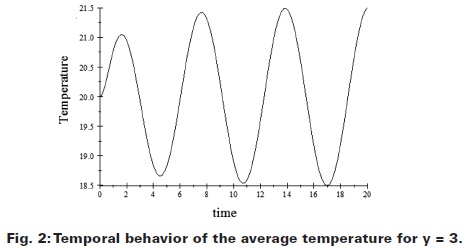
<body><![CDATA[<p align="center"><font face="verdana" size="2"><img src="/img/revistas/ccid/v7n1/a3e8.jpg"></font></p>  	    <p align="justify"><font face="verdana" size="2">Replacing (Ec. 8) in (Ec. 7) we found the predicted theorical behavior:</font></p>  	    <p align="center"><font face="verdana" size="2"><img src="/img/revistas/ccid/v7n1/a3e9.jpg"></font></p>  	    <p align="justify"><font face="verdana" size="2"><a href="/img/revistas/ccid/v7n1/a3f1.jpg" target="_blank">Figure 1</a> shows the predicted temperature behavior with respect time t and the wall thickness x, for general parameters&nbsp;values of model.</font></p>  	    <p align="center"><font face="verdana" size="2"><a href="/img/revistas/ccid/v7n1/a3t1.jpg" target="_blank">Table 1</a></font></p>  	    <p align="justify"><font face="verdana" size="2">The average of the wall temperature in time &#12296;<i>T<sub>x</sub></i>&#12297;<i><sub>t</sub></i> can be determined by:</font></p>  	    <p align="center"><font face="verdana" size="2"><img src="/img/revistas/ccid/v7n1/a3e10.jpg"></font></p>  	    <p align="justify"><font face="verdana" size="2">So that:</font></p>  	    <p align="center"><font face="verdana" size="2"><img src="/img/revistas/ccid/v7n1/a3e11.jpg"></font></p>  	    <p align="justify"><font face="verdana" size="2"><a href="#f2">Figure 2</a> shows the temperature temporal average behavior with respect to the spatial coordinate simulated in <a href="/img/revistas/ccid/v7n1/a3f1.jpg" target="_blank">figure 1</a>. It can be observed that the model achieves a periodic behavior through time. For this figure the units of temperature and&nbsp;time are arbitrary and we obtain the qualitative behavior of T and t. </font></p>  	    ]]></body>
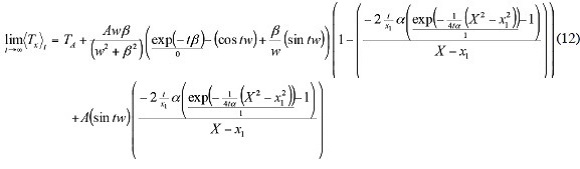
<body><![CDATA[<p align="center"><font face="verdana" size="2"><a name="f2"></a></font></p>  	    <p align="center"><font face="verdana" size="2"><img src="/img/revistas/ccid/v7n1/a3f2.jpg"></font></p>  	    <p align="justify"><font face="verdana" size="2">When time tends to infinite:</font></p>  	    <p align="center"><font face="verdana" size="2"><img src="/img/revistas/ccid/v7n1/a3e12.jpg"></font></p>  	    <p align="justify"><font face="verdana" size="2">and</font></p>  	    <p align="center"><font face="verdana" size="2"><img src="/img/revistas/ccid/v7n1/a3e13.jpg"></font></p>  	    <p align="justify"><font face="verdana" size="2">Finally&nbsp;</font></p>  	    <p align="center"><font face="verdana" size="2"><img src="/img/revistas/ccid/v7n1/a3e14.jpg"></font></p>  	    <p align="justify"><font face="verdana" size="2">Where the external temperature is given by:</font></p>  	    <p align="center"><font face="verdana" size="2"><img src="/img/revistas/ccid/v7n1/a3e15.jpg"></font></p>  	    ]]></body>
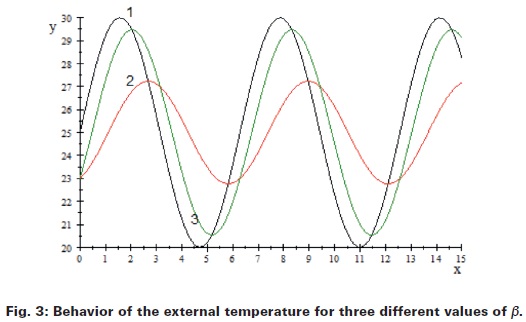
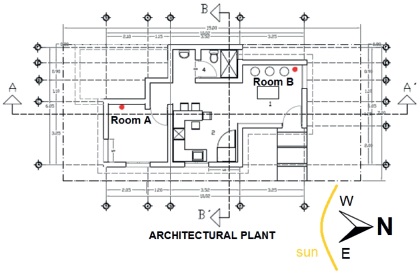
<body><![CDATA[<p>&nbsp;</p>  	    <p align="justify"><font face="verdana" size="2"><b>2. METHODOLOGY</b></font></p>  	    <p align="justify"><font face="verdana" size="2">In one room house whose walls were entirely built of poured earth the external and internal temperature was monitored&nbsp;in different areas and their temporal behavior was observed. Three times the temperature for seven days during&nbsp;the month of August was recorded, for statistically being the hottest month in the city of Tampico, Tamaulipas. The&nbsp;points in which the superficial temperature, interior and exterior, was measured, of the vertical elements were placed&nbsp;on the central and sunny side of the wall to consider experimentally unilateral heat transfer, for which a Data&#45;logger&nbsp;HobboOn set U&#45;12 Model equipment was used as an input of thermocouples. In the last page of this work it is showed&nbsp;architectural plant of the house walls used in this paper.</font></p>  	    <p align="justify"><font face="verdana" size="2">Subsequently, a mathematical model from the heat transfer in unsteady conduction of a solid state was made starting&nbsp;with the temperature change Equation and treated as described in the results of this project. </font></p>  	    <p>&nbsp;</p>  	    <p align="justify"><font face="verdana" size="2"><b>3. RESULTS&nbsp;</b></font></p>  	    <p align="justify"><font face="verdana" size="2">It can be seen the oscillatory behavior of the wall temperature that depends on beta parameter, which represents&nbsp;the relationship between the heat transfer coefficient and the heath capacity. In <a href="#f3">figure 3</a> behavior of temperature&nbsp;in the wall is observed for different values of beta where the amplitude of these oscillation decreases&nbsp;proportional to this parameter. By the other hand, as we can see in experiments, it is predicted that decrease&nbsp;of the heath transfer coefficient or the growth of the heath capacity of the material are factors that positively&nbsp;affect the comfort of homes.</font></p>  	    <p align="center"><font face="verdana" size="2"><a name="f3"></a></font></p>  	    <p align="center"><font face="verdana" size="2"><img src="/img/revistas/ccid/v7n1/a3f3.jpg"></font></p>  	    <p align="justify"><font face="verdana" size="2">For the construction of <a href="#f3">figures 3</a> and <a href="#f4">4</a>, the parameters shown on <a href="/img/revistas/ccid/v7n1/a3t2.jpg" target="_blank">Table 2</a> were considered.</font></p>  	    ]]></body>
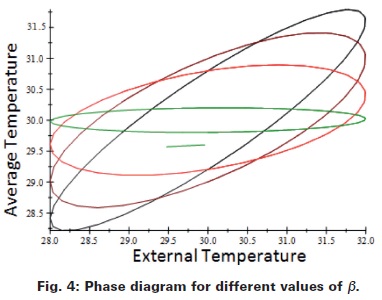
<body><![CDATA[<p align="center"><font face="verdana" size="2"><a name="f4"></a></font></p>  	    <p align="center"><font face="verdana" size="2"><img src="/img/revistas/ccid/v7n1/a3f4.jpg"></font></p>  	    <p align="justify"><font face="verdana" size="2"><a href="#f4">Figure 4</a> shows the phase diagram for the external temperature vs wall temperature for different <i>&#946;</i> values when is&nbsp;an implicit variable. It can be seen that diagram, exhibits an ellipsoidal shape, where the major axis exhibits an angle&nbsp;decline while <i>&#946;</i> decrease; which indicates a relationship between the exterior temperature and the average interior&nbsp;temperature (or the interior environment).</font></p>  	    <p align="justify"><font face="verdana" size="2">These results suggest a qualitative way to evaluate the comfort achieved with certain materials and thickness of the&nbsp;room wall. </font></p>  	    <p align="justify"><font face="verdana" size="2"><a href="/img/revistas/ccid/v7n1/a3f5.jpg" target="_blank">Figure 5</a> shows the experimental results recording along 6 days in august 2013 for two different spaces in a poured&nbsp;earth house. Great differences between exterior temperature (red line) and interior temperature (green line) of over 10 &deg;C can&nbsp;be observed. The blue line represents the interior room temperature. The main difference between room A and room&nbsp;B is the amount of sunlight they receive during the day, being greater in room A due to exposition on two walls, as in&nbsp;the slab, while in room B the sun exposure was limited to one wall and the slab. Nevertheless, on both cases similar&nbsp;interior room temperatures. The maximal average external ambient temperature of those days was 32 &deg;C. It can be&nbsp;seen a deviation of sinusoidal behavior due likely because of a real combination of radiation and convection of heat&nbsp;movement in walls and environmental air.</font></p>  	    <p align="justify"><font face="verdana" size="2">Room and sun temperature on a space, even though it has an intrinsic oscillatory behavior, also exhibits fluctuations,&nbsp;so it is not expected the theoretical behavior predicted with exactitude, but when the phase diagram is built, data points&nbsp;fall within a elliptical region. In this case, the comfort degree can be determined by the inclination of the axis of the&nbsp;ellipse with respect to the horizontal line. In <a href="/img/revistas/ccid/v7n1/a3f6.jpg" target="_blank">Figure 6</a> we show the predicted experimental behavior in two areas of a&nbsp;home. In this case it is predicted that room A has a greater comfort to the room B.</font></p>  	    <p>&nbsp;</p>  	    <p align="justify"><font face="verdana" size="2"><b>4. CONCLUSIONS</b></font></p>  	    <p align="justify"><font face="verdana" size="2">From the phenomenological Equations describing the temperature behavior in heat transport processes, a mathematical&nbsp;model that predicts the behavior of the spatial average temperature wall of a room, considering the intrinsic oscillatory&nbsp;behavior by sun was obtained. From the theoretical results it was found that the phase plane temperature of the surface&nbsp;wall vs room temperature has an elliptical shape where the angle of the axis of the ellipse relative to a coordinate axis is&nbsp;related to the ratio between the coefficient of heat transfer and the ability caloric. This result can be used to characterize&nbsp;the degree of comfort of a plane from the experimentally observed phases.</font></p>  	    <p>&nbsp;</p>  	    ]]></body>
<body><![CDATA[<p align="justify"><font face="verdana" size="2"><b>5. AKNOWLEDGMENT</b></font></p>  	    <p align="justify"><font face="verdana" size="2">This research was partially funded by the Mexican company Geo Estratos S.A de C.V. The house used in this research&nbsp;is located in the Facultad de Arquitectura, Dise&ntilde;o y Urbanismo of the Universidad Aut&oacute;noma de Tamaulipas, its construction&nbsp;was funded by the Consejo Tamaulipeco de Ciencia y Tecnolog&iacute;a (COTACYT). Authors thank the support&nbsp;of Dr. Jos&eacute; Adan Espuna&#45;M&uacute;jica in placing of temperature meters and comments made about our experimental part.</font></p>  	    <p>&nbsp;</p>  	    <p align="justify"><font face="verdana" size="2"><b>6. ANNEX</b></font></p>  	    <p align="justify"><font face="verdana" size="2">Architectural plant of the house used in this work and location of plant A and plant B. Red point indicate the temperature&nbsp;temperature sensor.</font></p>  	    <p align="center"><font face="verdana" size="2"><img src="/img/revistas/ccid/v7n1/a3i4.jpg"></font></p>  	    <p>&nbsp;</p>  	    <p align="justify"><font face="verdana" size="2"><b>REFERENCES&nbsp;</b></font></p>  	    <!-- ref --><p align="justify"><font face="verdana" size="2">Bahar, R. Benazzoug, M. Kenai, S. (2014), Durability of earth stabilized material. Key Engineering Materials, 600,&nbsp;pp. 495&#45;503. DOI:10.4028/www.scientific.net/KEM.600.495</font>&nbsp;&nbsp;&nbsp;&nbsp;&nbsp;&nbsp;&nbsp;&nbsp;[&#160;<a href="javascript:void(0);" onclick="javascript: window.open('/scielo.php?script=sci_nlinks&ref=2168706&pid=S2007-3011201500020000300001&lng=','','width=640,height=500,resizable=yes,scrollbars=1,menubar=yes,');">Links</a>&#160;]<!-- end-ref --><!-- ref --><p align="justify"><font face="verdana" size="2">Bird R. B. Stewart W. E. Lightfoot E. N. (2002), Transport Phenomena. Jonh Wiley &#38;Sons, 2 Ed. New York, E.U.A.    &nbsp;&nbsp;&nbsp;&nbsp;&nbsp;&nbsp;&nbsp;&nbsp;[&#160;<a href="javascript:void(0);" onclick="javascript: window.open('/scielo.php?script=sci_nlinks&ref=2168707&pid=S2007-3011201500020000300002&lng=','','width=640,height=500,resizable=yes,scrollbars=1,menubar=yes,');">Links</a>&#160;]<!-- end-ref --></font></p>  	    <!-- ref --><p align="justify"><font face="verdana" size="2">Borrelli R. L. Coleman C.S. (2005), Ecuaciones diferenciales: una perspectiva de modelaci&oacute;n. Editorial Oxford: M&eacute;xico.    &nbsp;&nbsp;&nbsp;&nbsp;&nbsp;&nbsp;&nbsp;&nbsp;[&#160;<a href="javascript:void(0);" onclick="javascript: window.open('/scielo.php?script=sci_nlinks&ref=2168709&pid=S2007-3011201500020000300003&lng=','','width=640,height=500,resizable=yes,scrollbars=1,menubar=yes,');">Links</a>&#160;]<!-- end-ref --></font></p>  	    <!-- ref --><p align="justify"><font face="verdana" size="2">Bui, Q. Morel, J. Venkatarama Reddy, B. and Ghayad, W. (2009), Durability of rammed earth walls exposed for 20&nbsp;years to natural weathering. <i>Building and Environment</i>, 44(5), pp. 912&#45;919. DOI:10.1016/j.buildenv.2008.07.001</font>&nbsp;&nbsp;&nbsp;&nbsp;&nbsp;&nbsp;&nbsp;&nbsp;[&#160;<a href="javascript:void(0);" onclick="javascript: window.open('/scielo.php?script=sci_nlinks&ref=2168711&pid=S2007-3011201500020000300004&lng=','','width=640,height=500,resizable=yes,scrollbars=1,menubar=yes,');">Links</a>&#160;]<!-- end-ref --><!-- ref --><p align="justify"><font face="verdana" size="2">Carslaw H. S. Jeager J. C. (1959), Conduction of Heat in Solids; Clarendon Press; Oxford.    &nbsp;&nbsp;&nbsp;&nbsp;&nbsp;&nbsp;&nbsp;&nbsp;[&#160;<a href="javascript:void(0);" onclick="javascript: window.open('/scielo.php?script=sci_nlinks&ref=2168712&pid=S2007-3011201500020000300005&lng=','','width=640,height=500,resizable=yes,scrollbars=1,menubar=yes,');">Links</a>&#160;]<!-- end-ref --></font></p>  	    <!-- ref --><p align="justify"><font face="verdana" size="2">Cid&#45;Falceto, J. Mazarr&oacute;n, F. R. Ca&ntilde;as, I. (2012), Assessment of compressed earth blocks made in Spain: International durability&nbsp;tests. <i>Construction and Building Materials</i>, 37, pp. 738&#45;745. <a href="http://dx.doi.org/10.1016/j.conbuildmat.2012.08.019" target="_blank">http://dx.doi.org/10.1016/j.conbuildmat.2012.08.019</a></font>&nbsp;&nbsp;&nbsp;&nbsp;&nbsp;&nbsp;&nbsp;&nbsp;[&#160;<a href="javascript:void(0);" onclick="javascript: window.open('/scielo.php?script=sci_nlinks&ref=2168714&pid=S2007-3011201500020000300006&lng=','','width=640,height=500,resizable=yes,scrollbars=1,menubar=yes,');">Links</a>&#160;]<!-- end-ref --><!-- ref --><p align="justify"><font face="verdana" size="2">Dong, X. Soebarto, V. Griffith, M. (2014), Achieving thermal comfort in naturally ventilated rammed earth houses. Building and Environment, 82, pp. 588&#45;598. DOI:10.1016/j.buildenv.2014.09.029</font>&nbsp;&nbsp;&nbsp;&nbsp;&nbsp;&nbsp;&nbsp;&nbsp;[&#160;<a href="javascript:void(0);" onclick="javascript: window.open('/scielo.php?script=sci_nlinks&ref=2168715&pid=S2007-3011201500020000300007&lng=','','width=640,height=500,resizable=yes,scrollbars=1,menubar=yes,');">Links</a>&#160;]<!-- end-ref --><!-- ref --><p align="justify"><font face="verdana" size="2">Fernandes, J. E. Mateus, R. Bragan&ccedil;a, L. (2014), The potential of vernacular materials to the sustainable building design. Vernacular Heritage and Earthen Architecture: Contributions for Sustainable Development &#150; Correia, Carlos &amp; Rocha&nbsp;(Eds.) Taylor &amp; Francis Group, London, ISBN 978&#45;1&#45;138&#45;00083&#45;4 &#91;Consultado el 05 de enero del 2014&#93; Disponible&nbsp;en: <a href="http://hdl.handle.net/1822/26013" target="_blank">http://hdl.handle.net/1822/26013</a></font>&nbsp;&nbsp;&nbsp;&nbsp;&nbsp;&nbsp;&nbsp;&nbsp;[&#160;<a href="javascript:void(0);" onclick="javascript: window.open('/scielo.php?script=sci_nlinks&ref=2168716&pid=S2007-3011201500020000300008&lng=','','width=640,height=500,resizable=yes,scrollbars=1,menubar=yes,');">Links</a>&#160;]<!-- end-ref --><!-- ref --><p align="justify"><font face="verdana" size="2">Houben, H. &amp; Guillard H. (1994), Earth Construction. A comprehensive guide. ITDG publishing, London, Great Britain.    &nbsp;&nbsp;&nbsp;&nbsp;&nbsp;&nbsp;&nbsp;&nbsp;[&#160;<a href="javascript:void(0);" onclick="javascript: window.open('/scielo.php?script=sci_nlinks&ref=2168717&pid=S2007-3011201500020000300009&lng=','','width=640,height=500,resizable=yes,scrollbars=1,menubar=yes,');">Links</a>&#160;]<!-- end-ref --> </font></p>  	    <!-- ref --><p align="justify"><font face="verdana" size="2">Lide D. R. (2011), <i>Handbook of Chemistry and Physics</i>. 92 edition. CRC Press. Boca Raton, ISBN 1439855110.    &nbsp;&nbsp;&nbsp;&nbsp;&nbsp;&nbsp;&nbsp;&nbsp;[&#160;<a href="javascript:void(0);" onclick="javascript: window.open('/scielo.php?script=sci_nlinks&ref=2168719&pid=S2007-3011201500020000300010&lng=','','width=640,height=500,resizable=yes,scrollbars=1,menubar=yes,');">Links</a>&#160;]<!-- end-ref --></font></p>  	    <!-- ref --><p align="justify"><font face="verdana" size="2">Orosa, J. A. &amp; Oliveira, A. C. (2012), A field study on building inertia and its effects on indoor thermal environment. Renewable Energy, 37(1), pp. 89&#45;96. DOI:10.1016/j.renene.2011.06.009</font>&nbsp;&nbsp;&nbsp;&nbsp;&nbsp;&nbsp;&nbsp;&nbsp;[&#160;<a href="javascript:void(0);" onclick="javascript: window.open('/scielo.php?script=sci_nlinks&ref=2168721&pid=S2007-3011201500020000300011&lng=','','width=640,height=500,resizable=yes,scrollbars=1,menubar=yes,');">Links</a>&#160;]<!-- end-ref --><!-- ref --><p align="justify"><font face="verdana" size="2">Pacheco&#45;Torgal, F. &amp; Jalali, S. (2012), Earth construction: Lessons from the past for future eco&#45;efficient construction. Construction and building materials, 29, pp. 512&#45;519. DOI:10.1016/j.conbuildmat.2011.10.054</font>&nbsp;&nbsp;&nbsp;&nbsp;&nbsp;&nbsp;&nbsp;&nbsp;[&#160;<a href="javascript:void(0);" onclick="javascript: window.open('/scielo.php?script=sci_nlinks&ref=2168722&pid=S2007-3011201500020000300012&lng=','','width=640,height=500,resizable=yes,scrollbars=1,menubar=yes,');">Links</a>&#160;]<!-- end-ref --><!-- ref --><p align="justify"><font face="verdana" size="2">Revuelta&#45;Acosta, J. D. Garc&iacute;a&#45;D&iacute;az, A. Soto&#45;Zarazua, G. M. and Rico&#45;Garc&iacute;a, E. (2010), Adobe as a sustainable material:&nbsp;A thermal performance. <i>Journal of Applied Sciences</i> (Faisalabad), 10(19), pp. 2211&#45;2216.    &nbsp;&nbsp;&nbsp;&nbsp;&nbsp;&nbsp;&nbsp;&nbsp;[&#160;<a href="javascript:void(0);" onclick="javascript: window.open('/scielo.php?script=sci_nlinks&ref=2168723&pid=S2007-3011201500020000300013&lng=','','width=640,height=500,resizable=yes,scrollbars=1,menubar=yes,');">Links</a>&#160;]<!-- end-ref --></font></p>  	    <!-- ref --><p align="justify"><font face="verdana" size="2">Ronsoux, L. Moevus, M. Jorand, Y. Maximilien, S. Olagnon, C. Anger, R. and Fontaine, L. Poured (2013), Earth as&nbsp;concrete. Terra 2012, Apr 2012, Lima, Peru. Theme 6: research in materials and technology for conservation and contemporary&nbsp;architecture, &lt;hal&#45;01006024&gt;&nbsp;&#91;Consultado el 7 de enero del 2014&#93; <a href="http://hal.univ&#45;grenoble&#45;alpes.fr/hal&#45;01006024/" target="_blank">http://hal.univ&#45;grenoble&#45;alpes.fr/hal&#45;01006024/</a></font>&nbsp;&nbsp;&nbsp;&nbsp;&nbsp;&nbsp;&nbsp;&nbsp;[&#160;<a href="javascript:void(0);" onclick="javascript: window.open('/scielo.php?script=sci_nlinks&ref=2168725&pid=S2007-3011201500020000300014&lng=','','width=640,height=500,resizable=yes,scrollbars=1,menubar=yes,');">Links</a>&#160;]<!-- end-ref --><!-- ref --><p align="justify"><font face="verdana" size="2">Sameh, S. H. (2014), Promoting earth architecture as a sustainable construction technique in Egypt. <i>Journal of Cleaner&nbsp;Production,</i> 65, pp. 362&#45;373. <a href="http://dx.doi.org/10.1016/j.jclepro.2013.08.046" target="_blank">http://dx.doi.org/10.1016/j.jclepro.2013.08.046</a></font>&nbsp;&nbsp;&nbsp;&nbsp;&nbsp;&nbsp;&nbsp;&nbsp;[&#160;<a href="javascript:void(0);" onclick="javascript: window.open('/scielo.php?script=sci_nlinks&ref=2168726&pid=S2007-3011201500020000300015&lng=','','width=640,height=500,resizable=yes,scrollbars=1,menubar=yes,');">Links</a>&#160;]<!-- end-ref --><!-- ref --><p align="justify"><font face="verdana" size="2">Su&aacute;rez&#45;Dom&iacute;nguez, E.J. Aranda&#45;Jim&eacute;nez, Y.G. Roux&#45;Guti&eacute;rrez, R.S. (2013), Tierra Vertida: Una descripci&oacute;n global. Arquitectura y Humanidades. &#91;Consultado el 25 de Junio del 2013&#93; Disponible en: <a href="http://www.architecthum.edu.mx/Architecthumtemp/colaboradores/dominguez.et.al/dominguez.et.al.htm" target="_blank">http://www.architecthum.edu.mx/Architecthumtemp/colaboradores/dominguez.et.al/dominguez.et.al.htm</a>    &nbsp;&nbsp;&nbsp;&nbsp;&nbsp;&nbsp;&nbsp;&nbsp;[&#160;<a href="javascript:void(0);" onclick="javascript: window.open('/scielo.php?script=sci_nlinks&ref=2168727&pid=S2007-3011201500020000300016&lng=','','width=640,height=500,resizable=yes,scrollbars=1,menubar=yes,');">Links</a>&#160;]<!-- end-ref --><br></font></p>      ]]></body><back>
<ref-list>
<ref id="B1">
<nlm-citation citation-type="journal">
<person-group person-group-type="author">
<name>
<surname><![CDATA[Bahar]]></surname>
<given-names><![CDATA[R. Benazzoug]]></given-names>
</name>
<name>
<surname><![CDATA[M. Kenai]]></surname>
<given-names><![CDATA[S.]]></given-names>
</name>
</person-group>
<article-title xml:lang="en"><![CDATA[Durability of earth stabilized material]]></article-title>
<source><![CDATA[Key Engineering Materials]]></source>
<year>2014</year>
<volume>600</volume>
<page-range>495-503</page-range></nlm-citation>
</ref>
<ref id="B2">
<nlm-citation citation-type="book">
<person-group person-group-type="author">
<name>
<surname><![CDATA[Bird]]></surname>
<given-names><![CDATA[R. B.]]></given-names>
</name>
<name>
<surname><![CDATA[Stewart]]></surname>
<given-names><![CDATA[W. E.]]></given-names>
</name>
<name>
<surname><![CDATA[Lightfoot]]></surname>
<given-names><![CDATA[E. N.]]></given-names>
</name>
</person-group>
<source><![CDATA[Transport Phenomena]]></source>
<year>2002</year>
<edition>2</edition>
<publisher-loc><![CDATA[New York ]]></publisher-loc>
<publisher-name><![CDATA[Jonh Wiley &#38;Sons]]></publisher-name>
</nlm-citation>
</ref>
<ref id="B3">
<nlm-citation citation-type="book">
<person-group person-group-type="author">
<name>
<surname><![CDATA[Borrelli]]></surname>
<given-names><![CDATA[R. L.]]></given-names>
</name>
<name>
<surname><![CDATA[Coleman]]></surname>
<given-names><![CDATA[C.S.]]></given-names>
</name>
</person-group>
<source><![CDATA[Ecuaciones diferenciales: una perspectiva de modelación]]></source>
<year>2005</year>
<publisher-name><![CDATA[Editorial Oxford]]></publisher-name>
</nlm-citation>
</ref>
<ref id="B4">
<nlm-citation citation-type="journal">
<person-group person-group-type="author">
<name>
<surname><![CDATA[Bui]]></surname>
<given-names><![CDATA[Q.]]></given-names>
</name>
<name>
<surname><![CDATA[Morel]]></surname>
<given-names><![CDATA[J.]]></given-names>
</name>
<name>
<surname><![CDATA[Venkatarama Reddy]]></surname>
<given-names><![CDATA[B.]]></given-names>
</name>
<name>
<surname><![CDATA[Ghayad]]></surname>
<given-names><![CDATA[W.]]></given-names>
</name>
</person-group>
<article-title xml:lang="en"><![CDATA[Durability of rammed earth walls exposed for 20 years to natural weathering]]></article-title>
<source><![CDATA[Building and Environment]]></source>
<year>2009</year>
<volume>44</volume>
<numero>5</numero>
<issue>5</issue>
<page-range>912-919</page-range></nlm-citation>
</ref>
<ref id="B5">
<nlm-citation citation-type="book">
<person-group person-group-type="author">
<name>
<surname><![CDATA[Carslaw]]></surname>
<given-names><![CDATA[H. S.]]></given-names>
</name>
<name>
<surname><![CDATA[Jeager]]></surname>
<given-names><![CDATA[J. C.]]></given-names>
</name>
</person-group>
<source><![CDATA[Conduction of Heat in Solids]]></source>
<year>1959</year>
<publisher-loc><![CDATA[Oxford ]]></publisher-loc>
<publisher-name><![CDATA[Clarendon Press]]></publisher-name>
</nlm-citation>
</ref>
<ref id="B6">
<nlm-citation citation-type="journal">
<person-group person-group-type="author">
<name>
<surname><![CDATA[Cid-Falceto]]></surname>
<given-names><![CDATA[J.]]></given-names>
</name>
<name>
<surname><![CDATA[Mazarrón]]></surname>
<given-names><![CDATA[F. R.]]></given-names>
</name>
<name>
<surname><![CDATA[Cañas]]></surname>
<given-names><![CDATA[I.]]></given-names>
</name>
</person-group>
<article-title xml:lang="en"><![CDATA[Assessment of compressed earth blocks made in Spain: International durability tests]]></article-title>
<source><![CDATA[Construction and Building Materials]]></source>
<year>2012</year>
<volume>37</volume>
<page-range>738-745</page-range></nlm-citation>
</ref>
<ref id="B7">
<nlm-citation citation-type="journal">
<person-group person-group-type="author">
<name>
<surname><![CDATA[Dong]]></surname>
<given-names><![CDATA[X]]></given-names>
</name>
<name>
<surname><![CDATA[Soebarto]]></surname>
<given-names><![CDATA[V.]]></given-names>
</name>
<name>
<surname><![CDATA[Griffith]]></surname>
<given-names><![CDATA[M.]]></given-names>
</name>
</person-group>
<article-title xml:lang="en"><![CDATA[Achieving thermal comfort in naturally ventilated rammed earth houses]]></article-title>
<source><![CDATA[Building and Environment]]></source>
<year>2014</year>
<volume>82</volume>
<page-range>588-598</page-range></nlm-citation>
</ref>
<ref id="B8">
<nlm-citation citation-type="book">
<person-group person-group-type="author">
<name>
<surname><![CDATA[Fernandes]]></surname>
<given-names><![CDATA[J. E.]]></given-names>
</name>
<name>
<surname><![CDATA[Mateus]]></surname>
<given-names><![CDATA[R.]]></given-names>
</name>
<name>
<surname><![CDATA[Bragança]]></surname>
<given-names><![CDATA[L.]]></given-names>
</name>
</person-group>
<article-title xml:lang="en"><![CDATA[The potential of vernacular materials to the sustainable building design]]></article-title>
<person-group person-group-type="editor">
<name>
<surname><![CDATA[Correia]]></surname>
<given-names><![CDATA[Carlos & Rocha]]></given-names>
</name>
</person-group>
<source><![CDATA[Vernacular Heritage and Earthen Architecture: Contributions for Sustainable Development]]></source>
<year>2014</year>
<publisher-loc><![CDATA[London ]]></publisher-loc>
<publisher-name><![CDATA[Taylor & Francis Group]]></publisher-name>
</nlm-citation>
</ref>
<ref id="B9">
<nlm-citation citation-type="book">
<person-group person-group-type="author">
<name>
<surname><![CDATA[Houben]]></surname>
<given-names><![CDATA[H.]]></given-names>
</name>
<name>
<surname><![CDATA[Guillard]]></surname>
<given-names><![CDATA[H.]]></given-names>
</name>
</person-group>
<source><![CDATA[Earth Construction. A comprehensive guide]]></source>
<year>1994</year>
<publisher-loc><![CDATA[London ]]></publisher-loc>
<publisher-name><![CDATA[ITDG publishing]]></publisher-name>
</nlm-citation>
</ref>
<ref id="B10">
<nlm-citation citation-type="book">
<person-group person-group-type="author">
<name>
<surname><![CDATA[Lide]]></surname>
<given-names><![CDATA[D. R.]]></given-names>
</name>
</person-group>
<source><![CDATA[Handbook of Chemistry and Physics]]></source>
<year>2011</year>
<edition>92</edition>
<publisher-loc><![CDATA[Boca Raton ]]></publisher-loc>
<publisher-name><![CDATA[CRC Press]]></publisher-name>
</nlm-citation>
</ref>
<ref id="B11">
<nlm-citation citation-type="journal">
<person-group person-group-type="author">
<name>
<surname><![CDATA[Orosa]]></surname>
<given-names><![CDATA[J. A.]]></given-names>
</name>
<name>
<surname><![CDATA[Oliveira]]></surname>
<given-names><![CDATA[A. C.]]></given-names>
</name>
</person-group>
<article-title xml:lang="en"><![CDATA[A field study on building inertia and its effects on indoor thermal environment]]></article-title>
<source><![CDATA[Renewable Energy]]></source>
<year>2012</year>
<volume>37</volume>
<numero>1</numero>
<issue>1</issue>
<page-range>89-96</page-range></nlm-citation>
</ref>
<ref id="B12">
<nlm-citation citation-type="journal">
<person-group person-group-type="author">
<name>
<surname><![CDATA[Pacheco-Torgal]]></surname>
<given-names><![CDATA[F.]]></given-names>
</name>
<name>
<surname><![CDATA[Jalali]]></surname>
<given-names><![CDATA[S.]]></given-names>
</name>
</person-group>
<article-title xml:lang="en"><![CDATA[Earth construction: Lessons from the past for future eco-efficient construction]]></article-title>
<source><![CDATA[Construction and building materials]]></source>
<year>2012</year>
<volume>29</volume>
<page-range>512-519</page-range></nlm-citation>
</ref>
<ref id="B13">
<nlm-citation citation-type="journal">
<person-group person-group-type="author">
<name>
<surname><![CDATA[Revuelta-Acosta]]></surname>
<given-names><![CDATA[J. D.]]></given-names>
</name>
<name>
<surname><![CDATA[García-Díaz]]></surname>
<given-names><![CDATA[A.]]></given-names>
</name>
<name>
<surname><![CDATA[Soto-Zarazua]]></surname>
<given-names><![CDATA[G. M.]]></given-names>
</name>
<name>
<surname><![CDATA[Rico-García]]></surname>
<given-names><![CDATA[E.]]></given-names>
</name>
</person-group>
<article-title xml:lang="en"><![CDATA[Adobe as a sustainable material: A thermal performance]]></article-title>
<source><![CDATA[Journal of Applied Sciences]]></source>
<year>2010</year>
<volume>10</volume>
<numero>19</numero>
<issue>19</issue>
<page-range>2211-2216</page-range></nlm-citation>
</ref>
<ref id="B14">
<nlm-citation citation-type="">
<person-group person-group-type="author">
<name>
<surname><![CDATA[Ronsoux]]></surname>
<given-names><![CDATA[L.]]></given-names>
</name>
<name>
<surname><![CDATA[Moevus]]></surname>
<given-names><![CDATA[M.]]></given-names>
</name>
<name>
<surname><![CDATA[Jorand]]></surname>
<given-names><![CDATA[Y.]]></given-names>
</name>
<name>
<surname><![CDATA[Maximilien]]></surname>
<given-names><![CDATA[S.]]></given-names>
</name>
<name>
<surname><![CDATA[Olagnon]]></surname>
<given-names><![CDATA[C.]]></given-names>
</name>
<name>
<surname><![CDATA[Anger]]></surname>
<given-names><![CDATA[R.]]></given-names>
</name>
<name>
<surname><![CDATA[Fontaine]]></surname>
<given-names><![CDATA[L. Poured]]></given-names>
</name>
</person-group>
<source><![CDATA[Earth as concrete. Terra 2012, Apr 2012, Lima, Peru. Theme 6: research in materials and technology for conservation and contemporary architecture, <hal-01006024&gt;]]></source>
<year>2013</year>
</nlm-citation>
</ref>
<ref id="B15">
<nlm-citation citation-type="journal">
<person-group person-group-type="author">
<name>
<surname><![CDATA[Sameh]]></surname>
<given-names><![CDATA[S. H.]]></given-names>
</name>
</person-group>
<article-title xml:lang="en"><![CDATA[Promoting earth architecture as a sustainable construction technique in Egypt]]></article-title>
<source><![CDATA[Journal of Cleaner Production]]></source>
<year>2014</year>
<volume>65</volume>
<page-range>362-373</page-range></nlm-citation>
</ref>
<ref id="B16">
<nlm-citation citation-type="">
<person-group person-group-type="author">
<name>
<surname><![CDATA[Suárez-Domínguez]]></surname>
<given-names><![CDATA[E.J.]]></given-names>
</name>
<name>
<surname><![CDATA[Aranda-Jiménez]]></surname>
<given-names><![CDATA[Y.G.]]></given-names>
</name>
<name>
<surname><![CDATA[Roux-Gutiérrez]]></surname>
<given-names><![CDATA[R.S.]]></given-names>
</name>
</person-group>
<source><![CDATA[Tierra Vertida: Una descripción global. Arquitectura y Humanidades]]></source>
<year>2013</year>
</nlm-citation>
</ref>
</ref-list>
</back>
</article>