<?xml version="1.0" encoding="ISO-8859-1"?><article xmlns:mml="http://www.w3.org/1998/Math/MathML" xmlns:xlink="http://www.w3.org/1999/xlink" xmlns:xsi="http://www.w3.org/2001/XMLSchema-instance">
<front>
<journal-meta>
<journal-id>2007-0780</journal-id>
<journal-title><![CDATA[Journal of behavior, health & social issues (México)]]></journal-title>
<abbrev-journal-title><![CDATA[J. behav. health soc. ISSUES]]></abbrev-journal-title>
<issn>2007-0780</issn>
<publisher>
<publisher-name><![CDATA[Asociación Mexicana de Comportamiento y Salud, A.C.]]></publisher-name>
</publisher>
</journal-meta>
<article-meta>
<article-id>S2007-07802013000200008</article-id>
<article-id pub-id-type="doi">10.5460/jbhsi.v5.2.42304</article-id>
<title-group>
<article-title xml:lang="en"><![CDATA[Development of an academic self concept for adolescents (ASCA) scale]]></article-title>
<article-title xml:lang="es"><![CDATA[Construcción de una escala de autoconcepto académico para adolescentes (AAPA)]]></article-title>
</title-group>
<contrib-group>
<contrib contrib-type="author">
<name>
<surname><![CDATA[Ordaz-Villegas]]></surname>
<given-names><![CDATA[Gabriela]]></given-names>
</name>
<xref ref-type="aff" rid="A01"/>
</contrib>
<contrib contrib-type="author">
<name>
<surname><![CDATA[Acle-Tomasini]]></surname>
<given-names><![CDATA[Guadalupe]]></given-names>
</name>
<xref ref-type="aff" rid="A01"/>
</contrib>
<contrib contrib-type="author">
<name>
<surname><![CDATA[Reyes-Lagunes]]></surname>
<given-names><![CDATA[Lucina Isabel]]></given-names>
</name>
<xref ref-type="aff" rid="A02"/>
</contrib>
</contrib-group>
<aff id="A01">
<institution><![CDATA[,Universidad Nacional Autónoma de México Facultad de Estudios Superiores Zaragoza ]]></institution>
<addr-line><![CDATA[ ]]></addr-line>
</aff>
<aff id="A02">
<institution><![CDATA[,Universidad Nacional Autónoma de México Facultad de Psicología Graduate Studies and Research Division]]></institution>
<addr-line><![CDATA[ ]]></addr-line>
</aff>
<pub-date pub-type="pub">
<day>00</day>
<month>00</month>
<year>2013</year>
</pub-date>
<pub-date pub-type="epub">
<day>00</day>
<month>00</month>
<year>2013</year>
</pub-date>
<volume>5</volume>
<numero>2</numero>
<fpage>117</fpage>
<lpage>130</lpage>
<copyright-statement/>
<copyright-year/>
<self-uri xlink:href="http://www.scielo.org.mx/scielo.php?script=sci_arttext&amp;pid=S2007-07802013000200008&amp;lng=en&amp;nrm=iso"></self-uri><self-uri xlink:href="http://www.scielo.org.mx/scielo.php?script=sci_abstract&amp;pid=S2007-07802013000200008&amp;lng=en&amp;nrm=iso"></self-uri><self-uri xlink:href="http://www.scielo.org.mx/scielo.php?script=sci_pdf&amp;pid=S2007-07802013000200008&amp;lng=en&amp;nrm=iso"></self-uri><abstract abstract-type="short" xml:lang="en"><p><![CDATA[Academic self-concept is the perception that a student has about his/her own academic abilities, constitutes one of the most relevant variables in the academic world, because of its influence on learning and cognitive functioning. Self-concept is a general assessment; nevertheless the current measurement instruments used for this construct are specific rather than general. Thus the purpose of this study was to construct and validate an academic self-concept scale with global dimensions, focused on teenager students. In its first stage, an open questions survey was designed to be applied with the intent of knowing the academic activities inside and outside the school. Afterwards, a closed questions survey was applied to a sampling consisting of 347 students ranging 14 to 18 years old from a public high school, east of México City. After obtaining the internal consistency and the items differentiation, a factorial analysis with orthogonal rotation was developed. The results grouped 16 items in 4 factors: self-regulation, general intellectual abilities, motivation and creativity. The scale shows 44.72% of a varying with a global Cronbach Alpha of .828. The present study contributes with an innovative scale with appropriate psychometric features, which globally assesses the academic self-concept.]]></p></abstract>
<abstract abstract-type="short" xml:lang="es"><p><![CDATA[El autoconcepto académico es la percepción que un estudiante tiene sobre sus habilidades académicas, constituye una de las variables más relevantes dentro del escenario escolar, pues incide significativamente en el funcionamiento cognoscitivo y en el aprendizaje. El autoconcepto es una valoración global, no obstante, los instrumentos actuales que evalúan este constructo no cumplen con dicha característica, miden dimensiones específicas. De aquí que el propósito del presente estudio fue construir y validar una escala de autoconcepto académico con dimensiones globales para estudiantes adolescentes. En un primer momento se desarrolló un cuestionario de preguntas abiertas con la finalidad de conocer las actividades académicas dentro y fuera de la escuela. Posteriormente se elaboró un cuestionario cerrado. Éste último se aplicó a una muestra de 347 estudiantes de entre 14 y 18 años de edad, de un bachillerato público del oriente de la Ciudad de México. Después de obtener la consistencia interna y la discriminación de reactivos, se realizó un análisis factorial con rotación ortogonal. Los resultados agruparon 16 reactivos en 4 factores: autorregulación, aptitudes intelectuales generales, motivación y creatividad. La escala explica el 44.72% de la varianza, con un alpha de Cronbach global de .828. El presente trabajo aporta una escala renovadora con propiedades psicométricas adecuadas, que evalúa de forma global el autoconcepto académico.]]></p></abstract>
<kwd-group>
<kwd lng="en"><![CDATA[Academic self-concept]]></kwd>
<kwd lng="en"><![CDATA[self-regulation]]></kwd>
<kwd lng="en"><![CDATA[motivation]]></kwd>
<kwd lng="en"><![CDATA[creativity]]></kwd>
<kwd lng="en"><![CDATA[school achievement]]></kwd>
<kwd lng="es"><![CDATA[Autoconcepto académico]]></kwd>
<kwd lng="es"><![CDATA[autorregulación]]></kwd>
<kwd lng="es"><![CDATA[motivación]]></kwd>
<kwd lng="es"><![CDATA[creatividad]]></kwd>
<kwd lng="es"><![CDATA[logro académico]]></kwd>
</kwd-group>
</article-meta>
</front><body><![CDATA[  	    <p align="justify"><font face="verdana" size="4">Art&iacute;culos de investigaci&oacute;n general</font></p>     <p align="center">&nbsp;</p>      <p align="center"><font face="verdana" size="4"><b>Development of an academic self concept for adolescents (ASCA) scale</b></font></p>     <p align="center">&nbsp;</p>  	    <p align="center"><font face="verdana" size="3"><b>Construcci&oacute;n de una escala de autoconcepto acad&eacute;mico para adolescentes (AAPA)</b></font></p>     <p align="center">&nbsp;</p>  	    <p align="center"><font face="verdana" size="2"><b>Gabriela Ordaz&#45;Villegas*, Guadalupe Acle&#45;Tomasini* y Lucina Isabel Reyes&#45;Lagunes**</b></font></p>     <p align="center">&nbsp;</p>      <p align="justify"><font face="verdana" size="2"><i>* Universidad Nacional Aut&oacute;noma de M&eacute;xico, Faculty of Higher Education (FES), Zaragoza.</i></font></p>     ]]></body>
<body><![CDATA[<p align="justify"><i><font face="verdana" size="2">** Universidad Nacional Aut&oacute;noma de M&eacute;xico, Psychology Faculty, Graduate Studies and Research Division.</font></i><font face="verdana" size="2"></font></p>     <p align="justify">&nbsp;</p>     <p align="justify"><font face="verdana" size="2"><a name="e1" id="e1"></a><a href="#e2">Corresponding author</a></font></p>     <p align="justify">&nbsp;</p>      <p align="justify"><font face="verdana" size="2">Received: July 24, 2012.     <br> </font><font face="verdana" size="2">Revised: June 17, 2013.     <br> Accepted: August 18, 2013.</font></p>     <p align="justify">&nbsp;</p>      <p align="justify"><font face="verdana" size="2"><b>Abstract</b></font></p>  	    <p align="justify"><font face="verdana" size="2">Academic self&#45;concept is the perception that a student has about his/her own academic abilities, constitutes one of the most relevant variables in the academic world, because of its influence on learning and cognitive functioning. Self&#45;concept is a general assessment; nevertheless the current measurement instruments used for this construct are specific rather than general. Thus the purpose of this study was to construct and validate an academic self&#45;concept scale with global dimensions, focused on teenager students. In its first stage, an open questions survey was designed to be applied with the intent of knowing the academic activities inside and outside the school. Afterwards, a closed questions survey was applied to a sampling consisting of 347 students ranging 14 to 18 years old from a public high school, east of M&eacute;xico City. After obtaining the internal consistency and the items differentiation, a factorial analysis with orthogonal rotation was developed. The results grouped 16 items in 4 factors: self&#45;regulation, general intellectual abilities, motivation and creativity. The scale shows 44.72&#37; of a varying with a global Cronbach Alpha of .828. The present study contributes with an innovative scale with appropriate psychometric features, which globally assesses the academic self&#45;concept.</font></p>  	    ]]></body>
<body><![CDATA[<p align="justify"><font face="verdana" size="2"><b>Key words:</b> Academic self&#45;concept, self&#45;regulation, motivation, creativity, school achievement.</font></p>  	    <p align="justify">&nbsp;</p>  	    <p align="justify"><font face="verdana" size="2"><b>Resumen</b></font></p>  	    <p align="justify"><font face="verdana" size="2">El autoconcepto acad&eacute;mico es la percepci&oacute;n que un estudiante tiene sobre sus habilidades acad&eacute;micas, constituye una de las variables m&aacute;s relevantes dentro del escenario escolar, pues incide significativamente en el funcionamiento cognoscitivo y en el aprendizaje. El autoconcepto es una valoraci&oacute;n global, no obstante, los instrumentos actuales que eval&uacute;an este constructo no cumplen con dicha caracter&iacute;stica, miden dimensiones espec&iacute;ficas. De aqu&iacute; que el prop&oacute;sito del presente estudio fue construir y validar una escala de autoconcepto acad&eacute;mico con dimensiones globales para estudiantes adolescentes. En un primer momento se desarroll&oacute; un cuestionario de preguntas abiertas con la finalidad de conocer las actividades acad&eacute;micas dentro y fuera de la escuela. Posteriormente se elabor&oacute; un cuestionario cerrado. &Eacute;ste &uacute;ltimo se aplic&oacute; a una muestra de 347 estudiantes de entre 14 y 18 a&ntilde;os de edad, de un bachillerato p&uacute;blico del oriente de la Ciudad de M&eacute;xico. Despu&eacute;s de obtener la consistencia interna y la discriminaci&oacute;n de reactivos, se realiz&oacute; un an&aacute;lisis factorial con rotaci&oacute;n ortogonal. Los resultados agruparon 16 reactivos en 4 factores: autorregulaci&oacute;n, aptitudes intelectuales generales, motivaci&oacute;n y creatividad. La escala explica el 44.72&#37; de la varianza, con un alpha de Cronbach global de .828. El presente trabajo aporta una escala renovadora con propiedades psicom&eacute;tricas adecuadas, que eval&uacute;a de forma global el autoconcepto acad&eacute;mico.</font></p>  	    <p align="justify"><font face="verdana" size="2"><b>Palabras clave:</b> Autoconcepto acad&eacute;mico, autorregulaci&oacute;n, motivaci&oacute;n, creatividad, logro acad&eacute;mico.</font></p>     <p align="justify">&nbsp;</p>      <p align="justify"><font face="verdana" size="2"><b>Introduction</b></font></p>  	    <p align="justify"><font face="verdana" size="2">Academic self&#45;concept is the perception and evaluation that a student has or does about his or her academic abilities (Marsh &amp; Rhonda, 2002). This self&#45;concept is one of the most important variables in the academic domain, due to its significant influence on appropriate cognitive functioning (Santana, Feliciano, &amp; Jim&eacute;nez, 2009). It directly affects learning processes (Vidals, 2005), academic achievement, and expectations of students (Henson &amp; Heller, 2000). Additionally, it helps to create various cognitive and self&#45;regulative strategies (Zimmerman, 2000), which reflect on academic performance (Campo&#45;Arias <i>et al,</i> 2005; Schunk, Printrich, &amp; Meece, 2008).</font></p>  	    <p align="justify"><font face="verdana" size="2">Academic self&#45;concept is multidimensional (Shavelson, Hubner, &amp; Staton, 1976). Many studies consider each academic subject area as a dimension, e.g., history, science, mathematics, spanish (Marsh, 1993; Shavelson <i>et al.,</i> 1976). However, most research focuses only on spanish and mathematics, setting other taken subjects aside (Marsh &amp; Shavelson, 1985; Plucker &amp; Stocking, 2001). This causes some problems associated with evaluation and self&#45;concept, especially when viewed in adolescents.</font></p>  	    <p align="justify"><font face="verdana" size="2">First, as individuals grow, the number of dimensions they can handle increases (Campo&#45;Arias <i>et al.,</i> 2005; Gonz&aacute;lez&#45;Pineda, N&uacute;&ntilde;ez, &amp; Valle, 2002; Marsh &amp; Shavelson, 1985); therefore, if only two dimensions are used, evaluation is not thorough. Similarly, it is important to note that each dimension of academic self&#45;concept has a different value and when dimensions are clustered together, a compensation effect among them is shown. Low self&#45;concept in a subject area is compensated for by high self&#45;concept in another one (Gonz&aacute;lez&#45;Pineda, N&uacute;&ntilde;ez, Gonz&aacute;lez&#45;Pumariega, &amp; Garc&iacute;a, 1997; Marsh, 1993; Shavelson <i>et al.,</i> 1976). In consequence, as self&#45;concept is being studied in mathematics and spanish subject areas exclusively, then not only may collected data be biased but the possibilities of discovering potentially compensated dimensions, if any, for these two subject areas are lost.</font></p>  	    ]]></body>
<body><![CDATA[<p align="justify"><font face="verdana" size="2">Bandura (1987) states that self&#45;concept is a global assessment. Nevertheless, currently a strong relation between self&#45;concept in one dimension and its specific subject area can be seen, which indicates that evaluation depends on specific situations (Shavelson <i>et al.,</i> 1976). It is clear that, on the one hand, the aim of obtaining a global assessment is not achieved and, on the other hand, the relation between self&#45;concept and academic performance cannot be very close if both constructs are to be differentiated from one another (Palacios &amp; Zabala, 2007).</font></p>     <p align="justify"><font face="verdana" size="2">In contrast, different dimensions comprising or clustered into academic self&#45;concept are expected to bear a relation to one another (Gonz&aacute;lez&#45;Pineda <i>et al.,</i> 1997); however, several research studies show little or no correlation between mathematical and spanish self&#45;concepts (Areepattamannil &amp; Freeman, 2008). Marsh and Shavelson's (1985) conclusion is that verbal self&#45;concept and mathematical self&#45;concept are different and, therefore, cannot be added to an academic self&#45;concept dimension.</font></p>  	    <p align="justify"><font face="verdana" size="2">By contrast, different empirical studies have found important divergence between students with high academic self&#45;concept and students with low academic self&#45;concept. Students with high academic self&#45;concept value their own abilities, accept challenges, take risks, try new things (Bong &amp; Skaalvik, 2003), and also create multiple cognitive strategies (Gonz&aacute;lez&#45;Pineda <i>et al.,</i> 1997). Moreover, they possess a higher motivation to complete difficult academic tasks and set higher goals (Pintrich, Roeser, &amp; De Groot, 1994). In this sense, most students with high academic performance show high academic self&#45;concept (Campo&#45;Arias <i>et al.,</i> 2005; Schunk, Printrich, &amp; Meece, 2008).</font></p>  	    <p align="justify"><font face="verdana" size="2">Students showing low academic self&#45;concept exhibit less confidence in their academic aptitudes (Amezcua &amp; Fern&aacute;ndez, 2000; Broc, 2000). They undervalue their talent, avoid situations that cause anxiety (Ommundsen, Haugen, &amp; Lund, 2005); i. e., they have less cognitive and motivational resources than students with positive self&#45;concept (N&uacute;&ntilde;ez <i>et al.,</i> 1998). And this is reflected on low academic performance (M&oacute;ller, &amp; Pohlman, 2010). Accordingly, it is suggested that the abilities regulating learning and academic performance that can be considered are: both general and specific intellectual abilities, creativity, and motivation. In other words, learning is necessary to develop aptitudes, acquire knowledge, and create strategies, as well as intention and disposition (Gonz&aacute;lez, Valle, Su&aacute;rez, &amp; Fern&aacute;ndez, 1999; L&oacute;pez, Reyes&#45;Lagunes, &amp; Uribe, 2011; Risso, Peralbo, &amp; Barca, 2010; Zacatelco &amp; Acle 2009). Consequently, it is very important to take into account the perception and evaluation that an adolescent student has or does in relation to these abilities in order to measure his or her global academic self&#45;concept.</font></p>  	    <p align="justify"><font face="verdana" size="2">Given the dilemma of the limitation of number of dimensions used to measure academic self&#45;concept and its importance in explaining and predicting behavior in academic domain and expectations about the professional future of adolescent high school students, the aim of this study was to develop and validate psychometrically an instrument measuring academic self&#45;concept through global academic dimensions, such as general intellectual abilities, specific intellectual abilities, motivation, and creativity.</font></p>     <p align="justify">&nbsp;</p>      <p align="justify"><font face="verdana" size="2"><b>Method</b></font></p>  	    <p align="justify"><font face="verdana" size="2"><i>Participants</i></font><font face="verdana" size="2"> </font></p> 	    <p align="justify"><font face="verdana" size="2">The sample was non&#45;probabilistic and consisted of 347 participants; 215 female (62&#37;) and 132 male (38&#37;) from grades 10 to 12 from a public secondary education school in Eastern Mexico City, with ages ranging from 14 to 18 years old (mean age = 16.17, <i>SD</i> = 1.084). School authorities determined group assignment.</font></p>     <p align="justify">&nbsp;</p>      ]]></body>
<body><![CDATA[<p align="justify"><font face="verdana" size="2"><i>Instrument</i></font></p>  	    <p align="justify"><font face="verdana" size="2">The purpose of the scale was to identify high or low levels of academic self&#45;concept. Therefore, the instrument was developed based on <i>a priori</i> and emerging categories (Krippendorff, 2004). <i>A priori</i> categories were selected according to the literature (Gonz&aacute;lez <i>et al.,</i> 1999; L&oacute;pez <i>et al.,</i> 2011; Risso <i>et al.,</i> 2010; Zacatelco &amp; Acle 2009) as follows: general intellectual abilities, specific intellectual abilities, motivation, and creativity. Emerging categories were obtained from an early exploratory phase, through open questions focused on activities in which adolescents engage. Subsequently, the instrument was developed and the pilot test was administered to 10 expert judges in education. The test was administered individually. Each one of the recommendations made by the judges was considered. The scale consisted of 28 items with 5&#45;point Likert&#45;type responses, ranging from "Never", marked with number 1, to "Always", marked with number 5. Additionally, an identification sheet was included to collect personal and academic data, such as academic performance measured by school grades average, etc. (<a href="/img/revistas/jbhsi/v5n2/html/v5n2a8a.html" target="_blank">Appendix A</a>).</font></p>  	    <p align="justify">&nbsp;</p>     <p align="justify"><font face="verdana" size="2"><i>Procedure</i></font></p>  	    <p align="justify"><font face="verdana" size="2">For the development of the instrument, first of all, previously established categories were used based on the literature as follows: general intellectual abilities, specific intellectual abilities, motivation, and creativity. Subsequently, by means of some open questions in the exploratory phase, one of the <i>a priori</i> categories was ruled out and a new one emerged. Motivation was ruled out and perfectionism emerged; i. e., the pilot instrument categories changed to the following: general intellectual abilities, specific intellectual abilities, creativity, and perfectionism.</font></p>  	    <p align="justify"><font face="verdana" size="2">Based on the above&#45;mentioned, an instrument was developed, and validated by 10 expert judges. All the judges are professors in different Schools of Psychology of the Universidad Nacional Aut&oacute;noma de M&eacute;xico (National Autonomous University of Mexico), with a PhD in an area of education. In order to get the instrument to measure adequately and clearly the construct, each judge was asked individually to validate the content of each item. They were requested to cross the items that were inadequate for measuring academic self&#45;concept, and also to provide input on writing clarity. A blank for comments and suggestions was included in each item. All of the 28 items put to validation were approved, some with observations that were taken into account until every one of them was covered.</font></p>  	    <p align="justify"><font face="verdana" size="2">Before administration to adolescents, an informed consent form was requested to school authorities, and teachers, as well as group participants. A brief explanation on the purpose and importance of completing the scale was provided and they were asked to agree. Group administration was used.</font></p>  	    <p align="justify"><font face="verdana" size="2">Upon administration, the following were carried out: 1) a frequency, skewness, and kurtosis analysis; 2) a differentiation analysis through a Student's t&#45;test, with a significance level of 0.5 to choose items to be kept in the procedure; 3) a factorial analysis of principal components with orthogonal rotation to measure construct validity; and lastly 4) a Cronbach's alpha and factor analysis to measure consistency.</font></p>     <p align="justify">&nbsp;</p>      <p align="justify"><font face="verdana" size="2"><b>Results</b></font></p>  	    ]]></body>
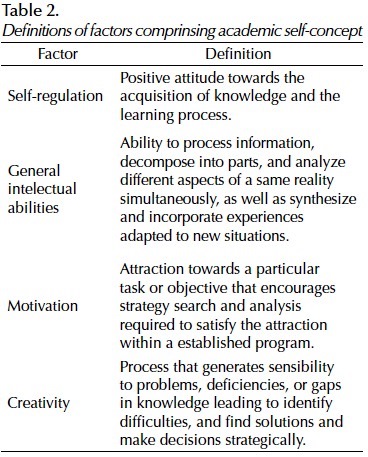
<body><![CDATA[<p align="justify"><font face="verdana" size="2">Scale item distribution showed tendency towards normality, with a mean of 96.55 and a standard deviation of 15.191 (<a href="#f1">Figure 1</a>).</font></p> 	    <p align="center"><a name="f1"></a><img src="/img/revistas/jbhsi/v5n2/a8f1.jpg"></p>     <p align="justify"><font face="verdana" size="2">In order to measure the power of item differentiation, frequency distribution was analyzed (skewness and kurtosis). Each item was submitted to a Student's t&#45;test, and directionality was obtained through cross tabulation. Based on the results from these tests, 8 items were decided to be ruled out. Based on the intercorrelation analysis using the Pearson's formula, a factorial analysis of principal components with orthogonal rotation was carried out, since correlations were moderate. With the purpose of knowing the dimensions comprising academic self&#45;concept construct, items with factor loadings of .48 or higher were selected.</font></p>  	    <p align="justify"><font face="verdana" size="2">Based on criteria, 16 items were clustered into four factors representing the 44.72&#37; of total variance, with a global Cronbach's Alpha of .828. Alphas by factors were as follows: factor 1 &#61; .683; factor 2 &#61; .621; factor 3 &#61; .651; and factor 4 &#61; .684. Factor weights and distribution of items into four factors are shown in <a href="#t1">Table 1</a>.</font></p> 	    <p align="center"><a name="t1"></a><img src="/img/revistas/jbhsi/v5n2/a8t1.jpg"></p>     <p align="justify"><font face="verdana" size="2">Based on item distribution, academic self&#45;concept construct refers to self&#45;perception and evaluation of a student on his or her self&#45;regulation, general intellectual abilities, motivation, and creativity, as defined in <a href="#t2">Table 2</a>.</font></p>     <p align="center"><a name="t2"></a><img src="/img/revistas/jbhsi/v5n2/a8t2.jpg"></p>     <p align="justify"><font face="verdana" size="2">Explained variance and cumulative variance, as well as mean and standard deviation, by factors are shown in <a href="#t3">Table 3</a>. As can be seen, self&#45;regulation is the dimension showing a higher explained variance in academic self&#45;concept.</font></p>     <p align="center"><a name="t3"></a><img src="/img/revistas/jbhsi/v5n2/a8t3.jpg"></p>     <p align="justify"><font face="verdana" size="2">Upon obtaining the factors, a correlation analysis was conducted through a Pearson product&#45;moment correlation coefficient in order to know the relation between factors comprising the academic self&#45;concept scale. Results are shown in <a href="/img/revistas/jbhsi/v5n2/a8t4.jpg" target="_blank">Table 4</a>.</font></p>      ]]></body>
<body><![CDATA[<p align="justify"><font face="verdana" size="2">As can be seen, positive correlations occur between all factors as expected, which indicates that factors originate from the same construct. Finally, in order to know the difference in academic performance between students showing high and low academic self&#45;concept, a Student's t&#45;test was conducted for independent samples. Academic performance (t &#61; &#45;4.602, p &#61; 0.000, 95&#37; CI &#91;&#45;.077, &#45;0.31&#93;) of students with low academic self&#45;concept (mean low ASC &#61; 8.43; <i>SD</i> &#61; .81) was found to differ significantly compared to that performance measurement of students with high of students with high academic self&#45;concept academic self&#45;concept being higher. (mean high ASC &#61; 8.98; <i>SD</i> = .68), the academic performance measurement of students with high academic self&#45;concept being higher.</font></p>      <p align="justify">&nbsp;</p>     <p align="justify"><font face="verdana" size="2"><b>Discussion</b></font></p>  	    <p align="justify"><font face="verdana" size="2">The factorial structure of the Academic Self&#45;Concept Scale was organized by four dimensions as follows: self&#45;regulation, general intellectual abilities, motivation, and creativity. It was interesting to observe that self&#45;regulation emerged as a new factor that was not considered when the scale was being initially developed. This factor is of the utmost importance since, on the one hand, it had the highest weight in the scale; and on the other hand, self&#45;regulated students create learning, planning, monitoring, and evaluation strategies, as well as organization and restructuration of their learning environment, i. e., students play an active role in their own learning process, which results in high academic performance that in turn reflects on a high academic self&#45;concept (Zimmerman, 2000).</font></p>  	    <p align="justify"><font face="verdana" size="2">In contrast, construct multidimensional nature is still observed across the diversity of factors obtained in the Academic Self&#45;Concept Scale as described in many studies (Marsh &amp; Shavelson, 1985; Shavelson <i>et al.,</i> 1976). Said dimensions showed a moderate and necessary relation to be considered as part of the same construct (Gonz&aacute;lez&#45;Pineda <i>et al.,</i> 1997), whereas a relative independence occurred, allowing factors to distinguish from one another (Palacios &amp; Zabala, 2007).</font></p>  	    <p align="justify"><font face="verdana" size="2">Likewise, the use of a global dimension met the objective of inclusive integration of facets determining academic self&#45;concept, thus over&#45;coming the dilemma of missing dimensions that adolescent students can handle (Campo&#45;Arias <i>et al.,</i> 2005; Gonz&aacute;lez&#45;Pineda, <i>et al.,</i> 2002; Marsh &amp; Shavelson, 1985). Also the problem involving the close relation between a specific dimension and its corresponding subject (Marsh &amp; Parker, 1984) is settled since data on a particular school subject is not required, but data on ability perception that enhance learning and high academic performance, as reflected on the dimensions and items that comprise the scale.</font></p>  	    <p align="justify"><font face="verdana" size="2">Lastly, academic performance differences between students with high academic self&#45;concept and students with low academic self&#45;concept were detected, which is in agreement with previous findings showing that most students with high academic performance exhibit high academic self&#45;concept, and in contrast, students with low academic performance show low academic self&#45;concept (Campo&#45;Arias <i>et al.,</i> 2005; Henson &amp; Heller, 2000; Schunk <i>et al.,</i> 2008).</font></p>  	    <p align="justify"><font face="verdana" size="2">Therefore, in conclusion, this study provides a culturally relevant, innovative scale with appropriate psychometric properties, which allows us to differentiate between adolescent students with high academic self&#45;concept levels from those with low academic self&#45;concept levels. Having instruments that allow us to assess academic self&#45;concept more thoroughly is of the utmost importance since this construct regulates cognitive/motivational strategies involved in learning and academic performance (Henson &amp; Heller, 2000; Zimmerman, 2000), and affects professional expectations of students (Santana <i>et al.,</i> 2009). So identifying self&#45;concept is crucial for unleashing students' potential in a critical stage for their cognitive, social and emotional development.</font></p>     <p align="justify">&nbsp;</p>      <p align="justify"><font face="verdana" size="2"><b>References</b></font></p>  	    ]]></body>
<body><![CDATA[<!-- ref --><p align="justify"><font face="verdana" size="2">Amezcua, J., &amp; Fern&aacute;ndez, E. (2000). La influencia del autoconcepto en el rendimiento acad&eacute;mico. <i>Iberpsicolog&iacute;a,</i> 5(1). Recuperado de: <a href="http://www.fedap.es/IberPsicologia/iberpsi5&#45;1/amezcua/amezcua.htm" target="_blank">http://www.fedap.es/IberPsicologia/iberpsi5&#45;1/amezcua/amezcua.htm</a>.    &nbsp;&nbsp;&nbsp;&nbsp;&nbsp;&nbsp;&nbsp;&nbsp;[&#160;<a href="javascript:void(0);" onclick="javascript: window.open('/scielo.php?script=sci_nlinks&ref=4884686&pid=S2007-0780201300020000800001&lng=','','width=640,height=500,resizable=yes,scrollbars=1,menubar=yes,');">Links</a>&#160;]<!-- end-ref --></font></p>      <!-- ref --><p align="justify"><font face="verdana" size="2">Areepattamannil, S., &amp; Freeman, J. (2008). Academic Achievement, Academic Self&#45;Concept, and Academic Motivation of Immigrant Adolescents in the Greater Toronto Area Secondary Schools. <i>Journal of Advanced Academics, 19,</i> 700&#45;743, available via: <a href="http://dx.doi.org/10.4219/jaa&#45;2008&#45;831" target="_blank">http://dx.doi.org/10.4219/jaa&#45;2008&#45;831</a>.    &nbsp;&nbsp;&nbsp;&nbsp;&nbsp;&nbsp;&nbsp;&nbsp;[&#160;<a href="javascript:void(0);" onclick="javascript: window.open('/scielo.php?script=sci_nlinks&ref=4884688&pid=S2007-0780201300020000800002&lng=','','width=640,height=500,resizable=yes,scrollbars=1,menubar=yes,');">Links</a>&#160;]<!-- end-ref --></font></p>  	    <!-- ref --><p align="justify"><font face="verdana" size="2">Bandura, A. (1987). <i>Pensamiento y acci&oacute;n.</i> Barcelona. Mart&iacute;nez Roca.    &nbsp;&nbsp;&nbsp;&nbsp;&nbsp;&nbsp;&nbsp;&nbsp;[&#160;<a href="javascript:void(0);" onclick="javascript: window.open('/scielo.php?script=sci_nlinks&ref=4884690&pid=S2007-0780201300020000800003&lng=','','width=640,height=500,resizable=yes,scrollbars=1,menubar=yes,');">Links</a>&#160;]<!-- end-ref --></font></p>  	    <!-- ref --><p align="justify"><font face="verdana" size="2">Bong, M., &amp; Skaalvik, E. (2003). Academic self&#45;concept and self&#45;efficacy: how different are they really?. <i>Educational Psychology, 15</i>(1), 1&#45;40, available via: <a href="http://dx.doi.org/10.1023/A:1021302408382" target="_blank">http://dx.doi.org/10.1023/A:1021302408382</a>.    &nbsp;&nbsp;&nbsp;&nbsp;&nbsp;&nbsp;&nbsp;&nbsp;[&#160;<a href="javascript:void(0);" onclick="javascript: window.open('/scielo.php?script=sci_nlinks&ref=4884692&pid=S2007-0780201300020000800004&lng=','','width=640,height=500,resizable=yes,scrollbars=1,menubar=yes,');">Links</a>&#160;]<!-- end-ref --></font></p>      <!-- ref --><p align="justify"><font face="verdana" size="2">Broc, M. (2000). Autoconcepto, autoestima y rendimiento acad&eacute;mico en alumnos de 4&deg; de la E.S.O. Implicaciones psicopedag&oacute;gicas en la orientaci&oacute;n y tutor&iacute;a. <i>Revista de Investigaci&oacute;n Educativa,</i> 18(1), 119&#45;146.    &nbsp;&nbsp;&nbsp;&nbsp;&nbsp;&nbsp;&nbsp;&nbsp;[&#160;<a href="javascript:void(0);" onclick="javascript: window.open('/scielo.php?script=sci_nlinks&ref=4884694&pid=S2007-0780201300020000800005&lng=','','width=640,height=500,resizable=yes,scrollbars=1,menubar=yes,');">Links</a>&#160;]<!-- end-ref --></font></p>  	    ]]></body>
<body><![CDATA[<!-- ref --><p align="justify"><font face="verdana" size="2">Campo&#45;Arias, A., Gonz&aacute;lez, S., S&aacute;nchez, Z., Rodr&iacute;guez, D., Dallos, C., &amp; D&iacute;az&#45;Mart&iacute;nez, L. (2005). Percepci&oacute;n de rendimiento acad&eacute;mico y s&iacute;ntomas depresivos en estudiantes de media vocacional de Bucaramanga, Colombia. <i>Archivos de Pediatr&iacute;a del Uruguay,</i> 76(1), 21&#45;26.    &nbsp;&nbsp;&nbsp;&nbsp;&nbsp;&nbsp;&nbsp;&nbsp;[&#160;<a href="javascript:void(0);" onclick="javascript: window.open('/scielo.php?script=sci_nlinks&ref=4884696&pid=S2007-0780201300020000800006&lng=','','width=640,height=500,resizable=yes,scrollbars=1,menubar=yes,');">Links</a>&#160;]<!-- end-ref --></font></p>  	    <!-- ref --><p align="justify"><font face="verdana" size="2">Gonz&aacute;lez, R., Valle, A., Su&aacute;rez, J. M., &amp; Fern&aacute;ndez, A. (1999). Un modelo integrador explicativo de las relaciones entre metas acad&eacute;micas, estrategias de aprendizaje y rendimiento acad&eacute;mico. <i>Revista de Investigaci&oacute;n Educativa, 17</i>(1), 47&#45;70.    &nbsp;&nbsp;&nbsp;&nbsp;&nbsp;&nbsp;&nbsp;&nbsp;[&#160;<a href="javascript:void(0);" onclick="javascript: window.open('/scielo.php?script=sci_nlinks&ref=4884698&pid=S2007-0780201300020000800007&lng=','','width=640,height=500,resizable=yes,scrollbars=1,menubar=yes,');">Links</a>&#160;]<!-- end-ref --></font></p>  	    <!-- ref --><p align="justify"><font face="verdana" size="2">Gonz&aacute;lez&#45;Pineda, J., N&uacute;&ntilde;ez, J., Gonz&aacute;lez&#45;Pumariega, S., &amp; Garc&iacute;a, M. (1997). Autoconcepto, autoestima y aprendizaje escolar. <i>Psicothema, 9</i>(2), 271&#45;289.    &nbsp;&nbsp;&nbsp;&nbsp;&nbsp;&nbsp;&nbsp;&nbsp;[&#160;<a href="javascript:void(0);" onclick="javascript: window.open('/scielo.php?script=sci_nlinks&ref=4884700&pid=S2007-0780201300020000800008&lng=','','width=640,height=500,resizable=yes,scrollbars=1,menubar=yes,');">Links</a>&#160;]<!-- end-ref --></font></p>  	    <!-- ref --><p align="justify"><font face="verdana" size="2">Gonz&aacute;lez&#45;Pineda, J., N&uacute;&ntilde;ez, J., &amp; Valle, A. (2002). Influencia de los procesos de comparaci&oacute;n interna/externa sobre la formaci&oacute;n del autoconcepto y su relaci&oacute;n con el rendimiento acad&eacute;mico. <i>Revista de Psicolog&iacute;a General y Aplicada. 45,</i> 73&#45;82.    &nbsp;&nbsp;&nbsp;&nbsp;&nbsp;&nbsp;&nbsp;&nbsp;[&#160;<a href="javascript:void(0);" onclick="javascript: window.open('/scielo.php?script=sci_nlinks&ref=4884702&pid=S2007-0780201300020000800009&lng=','','width=640,height=500,resizable=yes,scrollbars=1,menubar=yes,');">Links</a>&#160;]<!-- end-ref --></font></p>  	    <!-- ref --><p align="justify"><font face="verdana" size="2">Henson, K., &amp; Heller, B. (2000). <i>Psicolog&iacute;a educativa en la ense&ntilde;anza eficaz.</i> M&eacute;xico: Internacional Thompson Editores M&eacute;xico.    &nbsp;&nbsp;&nbsp;&nbsp;&nbsp;&nbsp;&nbsp;&nbsp;[&#160;<a href="javascript:void(0);" onclick="javascript: window.open('/scielo.php?script=sci_nlinks&ref=4884704&pid=S2007-0780201300020000800010&lng=','','width=640,height=500,resizable=yes,scrollbars=1,menubar=yes,');">Links</a>&#160;]<!-- end-ref --></font></p>  	    ]]></body>
<body><![CDATA[<!-- ref --><p align="justify"><font face="verdana" size="2">Krippendorff, K. (2004). <i>Content Analysis: An introduction to its methodology.</i> USA: Sage Publications, Inc.    &nbsp;&nbsp;&nbsp;&nbsp;&nbsp;&nbsp;&nbsp;&nbsp;[&#160;<a href="javascript:void(0);" onclick="javascript: window.open('/scielo.php?script=sci_nlinks&ref=4884706&pid=S2007-0780201300020000800011&lng=','','width=640,height=500,resizable=yes,scrollbars=1,menubar=yes,');">Links</a>&#160;]<!-- end-ref --></font></p>  	    <!-- ref --><p align="justify"><font face="verdana" size="2">L&oacute;pez, A., Reyes&#45;Lagunes, I., &amp; Uribe, J. (2011). Construcci&oacute;n y validaci&oacute;n psicom&eacute;trica de una escala de intenci&oacute;n de meta. <i>Revista Iberoamericana de Diagn&oacute;stico y Evaluaci&oacute;n Psicol&oacute;gica,</i> 31(1), 133&#45;156.    &nbsp;&nbsp;&nbsp;&nbsp;&nbsp;&nbsp;&nbsp;&nbsp;[&#160;<a href="javascript:void(0);" onclick="javascript: window.open('/scielo.php?script=sci_nlinks&ref=4884708&pid=S2007-0780201300020000800012&lng=','','width=640,height=500,resizable=yes,scrollbars=1,menubar=yes,');">Links</a>&#160;]<!-- end-ref --></font></p>  	    <!-- ref --><p align="justify"><font face="verdana" size="2">Marsh, H. (1993). The multidimensional structure of academic self&#45;concept: invariance over gender and age. <i>American Educational Research Journal,</i> 30(4), 841&#45;860, available via: <a href="http://dx.doi.org/10.3102/00028312030004841" target="_blank">http://dx.doi.org/10.3102/00028312030004841</a>.    &nbsp;&nbsp;&nbsp;&nbsp;&nbsp;&nbsp;&nbsp;&nbsp;[&#160;<a href="javascript:void(0);" onclick="javascript: window.open('/scielo.php?script=sci_nlinks&ref=4884710&pid=S2007-0780201300020000800013&lng=','','width=640,height=500,resizable=yes,scrollbars=1,menubar=yes,');">Links</a>&#160;]<!-- end-ref --></font></p>      <!-- ref --><p align="justify"><font face="verdana" size="2">Marsh, H., &amp; Parker, J. (1984). Determinants of student self&#45;concept: Is it better to be a relatively large fish in a small pond even if you don't learn to swim as well?. <i>Journal of Personality and Social Psychology, 47,</i> 213&#45;231, available via: <a href="http://dx.doi.org/10.1037/0022&#45;3514.47.1.213" target="_blank">http://dx.doi.org/10.1037/0022&#45;3514.47.1.213</a>.    &nbsp;&nbsp;&nbsp;&nbsp;&nbsp;&nbsp;&nbsp;&nbsp;[&#160;<a href="javascript:void(0);" onclick="javascript: window.open('/scielo.php?script=sci_nlinks&ref=4884712&pid=S2007-0780201300020000800014&lng=','','width=640,height=500,resizable=yes,scrollbars=1,menubar=yes,');">Links</a>&#160;]<!-- end-ref --></font></p>      <!-- ref --><p align="justify"><font face="verdana" size="2">Marsh, H., &amp; Rhonda G. (2002). The pivotal role of frames of reference in academic self&#45;concept formation: The "big fish&#45;little pond" effect. In Pajares, F. &amp; Urdan, T. (coord.). <i>Academic motivation of adolescents.</i> Inglaterra: Information Age Publishing.    &nbsp;&nbsp;&nbsp;&nbsp;&nbsp;&nbsp;&nbsp;&nbsp;[&#160;<a href="javascript:void(0);" onclick="javascript: window.open('/scielo.php?script=sci_nlinks&ref=4884714&pid=S2007-0780201300020000800015&lng=','','width=640,height=500,resizable=yes,scrollbars=1,menubar=yes,');">Links</a>&#160;]<!-- end-ref --></font></p>  	    ]]></body>
<body><![CDATA[<!-- ref --><p align="justify"><font face="verdana" size="2">Marsh, H., &amp; Shavelson, R. (1985). Self&#45;Concept: Its Multifaceted, Hierarchical Structure. <i>Educational Psychologist,</i> 20(3), 107&#45;123, available via: <a href="http://dx.doi.org/10.1207/s15326985ep2003_1" target="_blank">http://dx.doi.org/10.1207/s15326985ep2003_1</a>.    &nbsp;&nbsp;&nbsp;&nbsp;&nbsp;&nbsp;&nbsp;&nbsp;[&#160;<a href="javascript:void(0);" onclick="javascript: window.open('/scielo.php?script=sci_nlinks&ref=4884716&pid=S2007-0780201300020000800016&lng=','','width=640,height=500,resizable=yes,scrollbars=1,menubar=yes,');">Links</a>&#160;]<!-- end-ref --></font></p>      <!-- ref --><p align="justify"><font face="verdana" size="2">M&ouml;ller, J., &amp; Pohlmann, B. (2010). Achievement differences and self&#45;concept differences: Stronger associations for above or below average students?. <i>British Journal of Educational Psychology, 80,</i> 435&#45;450, available via:  <a href="http://dx.doi.org/10.1348/000709909X485234" target="_blank">http://dx.doi.org/10.1348/000709909X485234</a>.    &nbsp;&nbsp;&nbsp;&nbsp;&nbsp;&nbsp;&nbsp;&nbsp;[&#160;<a href="javascript:void(0);" onclick="javascript: window.open('/scielo.php?script=sci_nlinks&ref=4884718&pid=S2007-0780201300020000800017&lng=','','width=640,height=500,resizable=yes,scrollbars=1,menubar=yes,');">Links</a>&#160;]<!-- end-ref --></font></p>     <!-- ref --><p align="justify"><font face="verdana" size="2">N&uacute;&ntilde;ez, J., Gonz&aacute;lez&#45;Pineda, J., Garc&iacute;a, M., Gonz&aacute;lez&#45;Pumariega, S., Roces, C., &Aacute;lvarez, L., &amp; Gonz&aacute;lez, M. C. (1998). Estrategias de aprendizaje, autoconcepto y rendimiento acad&eacute;mico. <i>Psicothema,</i> 10(1), 97&#45;109.    &nbsp;&nbsp;&nbsp;&nbsp;&nbsp;&nbsp;&nbsp;&nbsp;[&#160;<a href="javascript:void(0);" onclick="javascript: window.open('/scielo.php?script=sci_nlinks&ref=4884720&pid=S2007-0780201300020000800018&lng=','','width=640,height=500,resizable=yes,scrollbars=1,menubar=yes,');">Links</a>&#160;]<!-- end-ref --></font></p>  	    <!-- ref --><p align="justify"><font face="verdana" size="2">Ommundsen, Y., Haugen, R., &amp; Lund, T. (2005). Academic Self&#45;concept, Implicit Theories of Ability, and Self&#45;regulation Strategies. <i>Scandinavian Journal of Educational Research,</i> 49(5), 461&#45;474, available via: <a href="http://dx.doi.org/10.1080/00313830500267838" target="_blank">http://dx.doi.org/10.1080/00313830500267838</a>.    &nbsp;&nbsp;&nbsp;&nbsp;&nbsp;&nbsp;&nbsp;&nbsp;[&#160;<a href="javascript:void(0);" onclick="javascript: window.open('/scielo.php?script=sci_nlinks&ref=4884722&pid=S2007-0780201300020000800019&lng=','','width=640,height=500,resizable=yes,scrollbars=1,menubar=yes,');">Links</a>&#160;]<!-- end-ref --></font></p>      <!-- ref --><p align="justify"><font face="verdana" size="2">Palacios, E.G., &amp; Zabala, A.F. (2007). Los dominios social y personal del autoconcepto. <i>Revista de Psicodid&aacute;ctica, 12,</i> 179&#45;194.    &nbsp;&nbsp;&nbsp;&nbsp;&nbsp;&nbsp;&nbsp;&nbsp;[&#160;<a href="javascript:void(0);" onclick="javascript: window.open('/scielo.php?script=sci_nlinks&ref=4884724&pid=S2007-0780201300020000800020&lng=','','width=640,height=500,resizable=yes,scrollbars=1,menubar=yes,');">Links</a>&#160;]<!-- end-ref --> </font></p>     ]]></body>
<body><![CDATA[<!-- ref --><p align="justify"><font face="verdana" size="2">Pintrich, P., Roeser, R., &amp; De Groot, E. (1994). Classroom and individual differences in early adolescents' motivation and self&#45;regulated learning. <i>Journal of Early Adolescence, 14</i>(2), 139&#45;161, available via: <a href="http://dx.doi.org/10.1177/027243169401400204" target="_blank">http://dx.doi.org/10.1177/027243169401400204</a>.    &nbsp;&nbsp;&nbsp;&nbsp;&nbsp;&nbsp;&nbsp;&nbsp;[&#160;<a href="javascript:void(0);" onclick="javascript: window.open('/scielo.php?script=sci_nlinks&ref=4884726&pid=S2007-0780201300020000800021&lng=','','width=640,height=500,resizable=yes,scrollbars=1,menubar=yes,');">Links</a>&#160;]<!-- end-ref --></font></p>      <!-- ref --><p align="justify"><font face="verdana" size="2">Plucker, J., &amp; Stocking, V. (2001). Looking outside and inside: Self&#45;concept development of gifted adolescents. <i>Exceptional Children, 67,</i> 535&#45;546.    &nbsp;&nbsp;&nbsp;&nbsp;&nbsp;&nbsp;&nbsp;&nbsp;[&#160;<a href="javascript:void(0);" onclick="javascript: window.open('/scielo.php?script=sci_nlinks&ref=4884728&pid=S2007-0780201300020000800022&lng=','','width=640,height=500,resizable=yes,scrollbars=1,menubar=yes,');">Links</a>&#160;]<!-- end-ref --></font></p>  	    <!-- ref --><p align="justify"><font face="verdana" size="2">Risso, A., Peralbo, M., &amp; Barca, A. (2010). Cambios en las variables predictoras del rendimiento escolar en ense&ntilde;anza secundaria. <i>Psicothema, 22</i>(4), 790&#45;796.    &nbsp;&nbsp;&nbsp;&nbsp;&nbsp;&nbsp;&nbsp;&nbsp;[&#160;<a href="javascript:void(0);" onclick="javascript: window.open('/scielo.php?script=sci_nlinks&ref=4884730&pid=S2007-0780201300020000800023&lng=','','width=640,height=500,resizable=yes,scrollbars=1,menubar=yes,');">Links</a>&#160;]<!-- end-ref --></font></p>  	    <!-- ref --><p align="justify"><font face="verdana" size="2">Santana, L., Feliciano, L., &amp; Jim&eacute;nez, A. (2009). La influencia del autoconcepto en el rendimiento acad&eacute;mico en estudiantes universitarios. <i>REOP, 20</i>(1), 16&#45;28.    &nbsp;&nbsp;&nbsp;&nbsp;&nbsp;&nbsp;&nbsp;&nbsp;[&#160;<a href="javascript:void(0);" onclick="javascript: window.open('/scielo.php?script=sci_nlinks&ref=4884732&pid=S2007-0780201300020000800024&lng=','','width=640,height=500,resizable=yes,scrollbars=1,menubar=yes,');">Links</a>&#160;]<!-- end-ref --></font></p>  	    <!-- ref --><p align="justify"><font face="verdana" size="2">Schunk, D., Pintrich, P., &amp; Meece, J. (2008). <i>Motivation in education: Theory,research, and application.</i> New Jersey, EU: Pearson.    &nbsp;&nbsp;&nbsp;&nbsp;&nbsp;&nbsp;&nbsp;&nbsp;[&#160;<a href="javascript:void(0);" onclick="javascript: window.open('/scielo.php?script=sci_nlinks&ref=4884734&pid=S2007-0780201300020000800025&lng=','','width=640,height=500,resizable=yes,scrollbars=1,menubar=yes,');">Links</a>&#160;]<!-- end-ref --> </font></p> 	    ]]></body>
<body><![CDATA[<!-- ref --><p align="justify"><font face="verdana" size="2">Shavelson, R., Hubner, J., &amp; Stanton, G. (1976). Validation of construct interpretations. <i>Review of educational Research, 46,</i> 407&#45;441, available via: <a href="http://dx.doi.org/10.3102/00346543046003407" target="_blank">http://dx.doi.org/10.3102/00346543046003407</a>.    &nbsp;&nbsp;&nbsp;&nbsp;&nbsp;&nbsp;&nbsp;&nbsp;[&#160;<a href="javascript:void(0);" onclick="javascript: window.open('/scielo.php?script=sci_nlinks&ref=4884736&pid=S2007-0780201300020000800026&lng=','','width=640,height=500,resizable=yes,scrollbars=1,menubar=yes,');">Links</a>&#160;]<!-- end-ref --></font></p>      <!-- ref --><p align="justify"><font face="verdana" size="2">Vidals, A. (2005). <i>Autoconcepto, locus de control y rendimiento acad&eacute;mico en estudiantes de segundo semestre de la facultad de psicolog&iacute;a</i> (Tesis de maestr&iacute;a). Universidad Nacional Aut&oacute;noma de M&eacute;xico, M&eacute;xico.    &nbsp;&nbsp;&nbsp;&nbsp;&nbsp;&nbsp;&nbsp;&nbsp;[&#160;<a href="javascript:void(0);" onclick="javascript: window.open('/scielo.php?script=sci_nlinks&ref=4884738&pid=S2007-0780201300020000800027&lng=','','width=640,height=500,resizable=yes,scrollbars=1,menubar=yes,');">Links</a>&#160;]<!-- end-ref --></font></p>  	    <!-- ref --><p align="justify"><font face="verdana" size="2">Zacatelco, F., &amp; Acle, G. (2009). Modelo de identificaci&oacute;n de la capacidad sobresaliente. <i>Revista Mexicana de Investigaci&oacute;n en Psicolog&iacute;a. 1</i> (1), 41&#45;43.    &nbsp;&nbsp;&nbsp;&nbsp;&nbsp;&nbsp;&nbsp;&nbsp;[&#160;<a href="javascript:void(0);" onclick="javascript: window.open('/scielo.php?script=sci_nlinks&ref=4884740&pid=S2007-0780201300020000800028&lng=','','width=640,height=500,resizable=yes,scrollbars=1,menubar=yes,');">Links</a>&#160;]<!-- end-ref --></font></p>  	    <!-- ref --><p align="justify"><font face="verdana" size="2">Zimmerman, B. (2000). Self&#45;efficacy: an essential motive to learn. <i>Contemporary Educational Psychology, 25,</i> 82&#45;91, available via: <a href="http://dx.doi.org/10.1006/ceps.1999.1016" target="_blank">http://dx.doi.org/10.1006/ceps.1999.1016</a>.    &nbsp;&nbsp;&nbsp;&nbsp;&nbsp;&nbsp;&nbsp;&nbsp;[&#160;<a href="javascript:void(0);" onclick="javascript: window.open('/scielo.php?script=sci_nlinks&ref=4884742&pid=S2007-0780201300020000800029&lng=','','width=640,height=500,resizable=yes,scrollbars=1,menubar=yes,');">Links</a>&#160;]<!-- end-ref --></font></p>     <p align="justify">&nbsp;</p>     <p align="justify"><font size="2" face="verdana"><b>Notes</b></font></p> 	    ]]></body>
<body><![CDATA[<p align="justify"><font face="verdana" size="2">Authors contributed to the paper in the following way; GOB: literature review, article development and statistical analysis, GAT:direction and literature review and LIRL: statistical analysis orientation.</font></p> 	    <p align="justify"><font face="verdana" size="2">Self&#45;references for authors: 2.     <br> 	</font><font face="verdana" size="2">Self&#45;references for the JBHSI: 0.</font></p>     <p align="justify">&nbsp;</p>     <p align="justify"><font face="verdana" size="2"><b><a name="e2" id="e2"></a><a href="#e1"><img src="/img/revistas/jbhsi/v5n2/flecha.jpg" alt=""></a>Correspondence:    <br> </b></font><font face="verdana" size="2"><i>Gabriela Ordaz&#45;Villegas, PhD.     <br> FES, Zaragoza campus 1,     <br> Av. Guelatao No. 66 Col. Ej&eacute;rcito de Oriente,     <br> Iztapalapa, C.P. 09230, M&eacute;xico D.F.     <br> E&#45;mail:</i> <a href="mailto:gabordaz@yahoo.com.mx">gabordaz@yahoo.com.mx</a>, <a href="mailto:ordaz.villegas@comunidad.unam.mx">ordaz.villegas@comunidad.unam.mx</a>.</font></p>     ]]></body>
<body><![CDATA[<p align="justify">&nbsp;</p>     <p align="justify"><font size="2" face="verdana"><b>About the authors:</b></font></p>     <p align="justify"><font face="verdana" size="2"><b>Name: </b>Gabriela Ordaz Villegas. <b>Degree:</b> PhD in Educational and Developmental Psychology. Faculty of Psychology, Universidad Nacional Aut&oacute;noma de M&eacute;xico. <b>Affiliation:</b> Universidad Nacional Aut&oacute;noma de M&eacute;xico, Faculty of Higher Education (FES), Zaragoza, asignature professor, Psychology. <b>Line of research:</b> Factors associated with outstanding skills, intelligence, creativity, academic self&#45;concept and academic performance. <b>Address:</b> FES, Zaragoza campus 1, Av. Guelatao No. 66 Col. Ej&eacute;rcito de Oriente, Iztapalapa, C.P. 09230, M&eacute;xico D.F. <b>E&#45;mail:</b> <a href="mailto:gabordaz@yahoo.com.mx">gabordaz@yahoo.com.mx</a>, <a href="mailto:ordaz.villegas@comunidad.unam.mx">ordaz.villegas@comunidad.unam.mx</a>.</font></p> 	    <p align="justify"><font face="verdana" size="2"><b>Name: </b>Guadalupe Acle Tomasini. <b>Degree:</b> PhD in Social Anthropology, Iberoamerican University. <b>Affiliation:</b> Universidad Nacional Aut&oacute;noma de M&eacute;xico, Faculty of Higher Education (FES), Zaragoza, tenure professor C, graduate division. <b>Line of research:</b> Resilience and factors associated with school integration of children with disabilities or outstanding abilities. Social validation of the ecological model of risk / resilience in special education. <b>Distinctions:</b> Prize of the Psychology Mexican Society 2013 in the category of Teaching. <b>Address:</b> FES, Zaragoza campus 2, Batalla 5 de mayo s/n esq. Fuerte de Loreto, Col. Ej&eacute;rcito de Oriente, Del. Iztapalapa, C.P. 01010. Tel. 55+56230708 ext. 102. <b>E&#45;mail:</b> <a href="mailto:gaclet@unam.mx">gaclet@unam.mx</a>.</font></p> 	    <p align="justify"><font face="verdana" size="2"><b>Name: </b>Lucina Isabel Reyes Lagunes. <b>Degree:</b> PhD in Social Psychology, Psychology College. Philosophy and Letters Faculty, (1966&#45;1968). <b>Post&#45;doctoral stay:</b> The University of Texas, at Austin, U.S. (1969&#45;1970). <b>Affiliation:</b> Universidad Nacional Aut&oacute;noma de M&eacute;xico, Psychology Faculty, Graduate Studies and Research Division. Emeritus professor. <b>Line of research:</b> Personality, culture, political psychology and ethno psychometric: cultural approach to psychological measurement. <b>Other Positions:</b> Member of the National Researcher's System (S.N.I.) level III. Member of the Graduate Studies Academic Committees: Medical sciences, odontological and health, and psychology. Technical Advisor in the Department of Social and Environmental Psychology. <b>Address:</b> UNAM, CU, Av. Universidad 3004, CU. Copilco. 04510. Coyoac&aacute;n. M&eacute;xico D. F. Tel: 56 22 23 23. <b>E&#45;mail:</b> <a href="mailto:lisabel@unam.mx">lisabel@unam.mx</a>.</font></p>      ]]></body><back>
<ref-list>
<ref id="B1">
<nlm-citation citation-type="journal">
<person-group person-group-type="author">
<name>
<surname><![CDATA[Amezcua]]></surname>
<given-names><![CDATA[J.]]></given-names>
</name>
<name>
<surname><![CDATA[Fernández]]></surname>
<given-names><![CDATA[E.]]></given-names>
</name>
</person-group>
<article-title xml:lang="es"><![CDATA[La influencia del autoconcepto en el rendimiento académico]]></article-title>
<source><![CDATA[Iberpsicología]]></source>
<year>2000</year>
<volume>5</volume>
<numero>1</numero>
<issue>1</issue>
</nlm-citation>
</ref>
<ref id="B2">
<nlm-citation citation-type="journal">
<person-group person-group-type="author">
<name>
<surname><![CDATA[Areepattamannil]]></surname>
<given-names><![CDATA[S.]]></given-names>
</name>
<name>
<surname><![CDATA[Freeman]]></surname>
<given-names><![CDATA[J.]]></given-names>
</name>
</person-group>
<article-title xml:lang="en"><![CDATA[Academic Achievement, Academic Self-Concept, and Academic Motivation of Immigrant Adolescents in the Greater Toronto Area Secondary Schools]]></article-title>
<source><![CDATA[Journal of Advanced Academics]]></source>
<year>2008</year>
<volume>19</volume>
<page-range>700-743</page-range></nlm-citation>
</ref>
<ref id="B3">
<nlm-citation citation-type="book">
<person-group person-group-type="author">
<name>
<surname><![CDATA[Bandura]]></surname>
<given-names><![CDATA[A.]]></given-names>
</name>
</person-group>
<source><![CDATA[Pensamiento y acción]]></source>
<year>1987</year>
<publisher-loc><![CDATA[Barcelona ]]></publisher-loc>
<publisher-name><![CDATA[Martínez Roca]]></publisher-name>
</nlm-citation>
</ref>
<ref id="B4">
<nlm-citation citation-type="journal">
<person-group person-group-type="author">
<name>
<surname><![CDATA[Bong]]></surname>
<given-names><![CDATA[M.]]></given-names>
</name>
<name>
<surname><![CDATA[Skaalvik]]></surname>
<given-names><![CDATA[E.]]></given-names>
</name>
</person-group>
<article-title xml:lang="en"><![CDATA[Academic self-concept and self-efficacy: how different are they really?]]></article-title>
<source><![CDATA[Educational Psychology]]></source>
<year>2003</year>
<volume>15</volume>
<numero>1</numero>
<issue>1</issue>
<page-range>1-40</page-range></nlm-citation>
</ref>
<ref id="B5">
<nlm-citation citation-type="journal">
<person-group person-group-type="author">
<name>
<surname><![CDATA[Broc]]></surname>
<given-names><![CDATA[M.]]></given-names>
</name>
</person-group>
<article-title xml:lang="es"><![CDATA[Autoconcepto, autoestima y rendimiento académico en alumnos de 4° de la E.S.O. Implicaciones psicopedagógicas en la orientación y tutoría]]></article-title>
<source><![CDATA[Revista de Investigación Educativa]]></source>
<year>2000</year>
<volume>18</volume>
<numero>1</numero>
<issue>1</issue>
<page-range>119-146</page-range></nlm-citation>
</ref>
<ref id="B6">
<nlm-citation citation-type="journal">
<person-group person-group-type="author">
<name>
<surname><![CDATA[Campo-Arias]]></surname>
<given-names><![CDATA[A.]]></given-names>
</name>
<name>
<surname><![CDATA[González]]></surname>
<given-names><![CDATA[S.]]></given-names>
</name>
<name>
<surname><![CDATA[Sánchez]]></surname>
<given-names><![CDATA[Z.]]></given-names>
</name>
<name>
<surname><![CDATA[Rodríguez]]></surname>
<given-names><![CDATA[D.]]></given-names>
</name>
<name>
<surname><![CDATA[Dallos]]></surname>
<given-names><![CDATA[C.]]></given-names>
</name>
<name>
<surname><![CDATA[Díaz-Martínez]]></surname>
<given-names><![CDATA[L.]]></given-names>
</name>
</person-group>
<article-title xml:lang="es"><![CDATA[Percepción de rendimiento académico y síntomas depresivos en estudiantes de media vocacional de Bucaramanga, Colombia]]></article-title>
<source><![CDATA[Archivos de Pediatría del Uruguay]]></source>
<year>2005</year>
<volume>76</volume>
<numero>1</numero>
<issue>1</issue>
<page-range>21-26</page-range></nlm-citation>
</ref>
<ref id="B7">
<nlm-citation citation-type="journal">
<person-group person-group-type="author">
<name>
<surname><![CDATA[González]]></surname>
<given-names><![CDATA[R.]]></given-names>
</name>
<name>
<surname><![CDATA[Valle]]></surname>
<given-names><![CDATA[A.]]></given-names>
</name>
<name>
<surname><![CDATA[Suárez]]></surname>
<given-names><![CDATA[J. M.]]></given-names>
</name>
<name>
<surname><![CDATA[Fernández]]></surname>
<given-names><![CDATA[A.]]></given-names>
</name>
</person-group>
<article-title xml:lang="es"><![CDATA[Un modelo integrador explicativo de las relaciones entre metas académicas, estrategias de aprendizaje y rendimiento académico]]></article-title>
<source><![CDATA[Revista de Investigación Educativa]]></source>
<year>1999</year>
<volume>17</volume>
<numero>1</numero>
<issue>1</issue>
<page-range>47-70</page-range></nlm-citation>
</ref>
<ref id="B8">
<nlm-citation citation-type="journal">
<person-group person-group-type="author">
<name>
<surname><![CDATA[González-Pineda]]></surname>
<given-names><![CDATA[J.]]></given-names>
</name>
<name>
<surname><![CDATA[Núñez]]></surname>
<given-names><![CDATA[J.]]></given-names>
</name>
<name>
<surname><![CDATA[González-Pumariega]]></surname>
<given-names><![CDATA[S.]]></given-names>
</name>
<name>
<surname><![CDATA[García]]></surname>
<given-names><![CDATA[M.]]></given-names>
</name>
</person-group>
<article-title xml:lang="es"><![CDATA[Autoconcepto, autoestima y aprendizaje escolar]]></article-title>
<source><![CDATA[Psicothema]]></source>
<year>1997</year>
<volume>9</volume>
<numero>2</numero>
<issue>2</issue>
<page-range>271-289</page-range></nlm-citation>
</ref>
<ref id="B9">
<nlm-citation citation-type="journal">
<person-group person-group-type="author">
<name>
<surname><![CDATA[González-Pineda]]></surname>
<given-names><![CDATA[J.]]></given-names>
</name>
<name>
<surname><![CDATA[Núñez]]></surname>
<given-names><![CDATA[J.]]></given-names>
</name>
<name>
<surname><![CDATA[Valle]]></surname>
<given-names><![CDATA[A.]]></given-names>
</name>
</person-group>
<article-title xml:lang="es"><![CDATA[Influencia de los procesos de comparación interna/externa sobre la formación del autoconcepto y su relación con el rendimiento académico]]></article-title>
<source><![CDATA[Revista de Psicología General y Aplicada]]></source>
<year>2002</year>
<volume>45</volume>
<page-range>73-82</page-range></nlm-citation>
</ref>
<ref id="B10">
<nlm-citation citation-type="book">
<person-group person-group-type="author">
<name>
<surname><![CDATA[Henson]]></surname>
<given-names><![CDATA[K.]]></given-names>
</name>
<name>
<surname><![CDATA[Heller]]></surname>
<given-names><![CDATA[B.]]></given-names>
</name>
</person-group>
<source><![CDATA[Psicología educativa en la enseñanza eficaz]]></source>
<year>2000</year>
<publisher-name><![CDATA[Internacional Thompson Editores México]]></publisher-name>
</nlm-citation>
</ref>
<ref id="B11">
<nlm-citation citation-type="book">
<person-group person-group-type="author">
<name>
<surname><![CDATA[Krippendorff]]></surname>
<given-names><![CDATA[K.]]></given-names>
</name>
</person-group>
<source><![CDATA[Content Analysis: An introduction to its methodology]]></source>
<year>2004</year>
<publisher-name><![CDATA[Sage Publications, Inc]]></publisher-name>
</nlm-citation>
</ref>
<ref id="B12">
<nlm-citation citation-type="journal">
<person-group person-group-type="author">
<name>
<surname><![CDATA[López]]></surname>
<given-names><![CDATA[A.]]></given-names>
</name>
<name>
<surname><![CDATA[Reyes-Lagunes]]></surname>
<given-names><![CDATA[I.]]></given-names>
</name>
<name>
<surname><![CDATA[Uribe]]></surname>
<given-names><![CDATA[J.]]></given-names>
</name>
</person-group>
<article-title xml:lang="es"><![CDATA[Construcción y validación psicométrica de una escala de intención de meta]]></article-title>
<source><![CDATA[Revista Iberoamericana de Diagnóstico y Evaluación Psicológica]]></source>
<year>2011</year>
<volume>31</volume>
<numero>1</numero>
<issue>1</issue>
<page-range>133-156</page-range></nlm-citation>
</ref>
<ref id="B13">
<nlm-citation citation-type="journal">
<person-group person-group-type="author">
<name>
<surname><![CDATA[Marsh]]></surname>
<given-names><![CDATA[H.]]></given-names>
</name>
</person-group>
<article-title xml:lang="en"><![CDATA[The multidimensional structure of academic self-concept: invariance over gender and age]]></article-title>
<source><![CDATA[American Educational Research Journal]]></source>
<year>1993</year>
<volume>30</volume>
<numero>4</numero>
<issue>4</issue>
<page-range>841-860</page-range></nlm-citation>
</ref>
<ref id="B14">
<nlm-citation citation-type="journal">
<person-group person-group-type="author">
<name>
<surname><![CDATA[Marsh]]></surname>
<given-names><![CDATA[H.]]></given-names>
</name>
<name>
<surname><![CDATA[Parker]]></surname>
<given-names><![CDATA[J.]]></given-names>
</name>
</person-group>
<article-title xml:lang="en"><![CDATA[Determinants of student self-concept: Is it better to be a relatively large fish in a small pond even if you don't learn to swim as well?]]></article-title>
<source><![CDATA[Journal of Personality and Social Psychology]]></source>
<year>1984</year>
<volume>47</volume>
<page-range>213-231</page-range></nlm-citation>
</ref>
<ref id="B15">
<nlm-citation citation-type="book">
<person-group person-group-type="author">
<name>
<surname><![CDATA[Marsh]]></surname>
<given-names><![CDATA[H.]]></given-names>
</name>
<name>
<surname><![CDATA[Rhonda]]></surname>
<given-names><![CDATA[G.]]></given-names>
</name>
</person-group>
<article-title xml:lang="en"><![CDATA[The pivotal role of frames of reference in academic self-concept formation: The "big fish-little pond" effect]]></article-title>
<person-group person-group-type="editor">
<name>
<surname><![CDATA[Pajares]]></surname>
<given-names><![CDATA[F.]]></given-names>
</name>
<name>
<surname><![CDATA[Urdan]]></surname>
<given-names><![CDATA[T.]]></given-names>
</name>
</person-group>
<source><![CDATA[Academic motivation of adolescents]]></source>
<year>2002</year>
<publisher-name><![CDATA[Information Age Publishing]]></publisher-name>
</nlm-citation>
</ref>
<ref id="B16">
<nlm-citation citation-type="journal">
<person-group person-group-type="author">
<name>
<surname><![CDATA[Marsh]]></surname>
<given-names><![CDATA[H.]]></given-names>
</name>
<name>
<surname><![CDATA[Shavelson]]></surname>
<given-names><![CDATA[R.]]></given-names>
</name>
</person-group>
<article-title xml:lang="en"><![CDATA[Self-Concept: Its Multifaceted, Hierarchical Structure]]></article-title>
<source><![CDATA[Educational Psychologist]]></source>
<year>1985</year>
<volume>20</volume>
<numero>3</numero>
<issue>3</issue>
<page-range>107-123</page-range></nlm-citation>
</ref>
<ref id="B17">
<nlm-citation citation-type="journal">
<person-group person-group-type="author">
<name>
<surname><![CDATA[Möller]]></surname>
<given-names><![CDATA[J.]]></given-names>
</name>
<name>
<surname><![CDATA[Pohlmann]]></surname>
<given-names><![CDATA[B.]]></given-names>
</name>
</person-group>
<article-title xml:lang="en"><![CDATA[Achievement differences and self-concept differences: Stronger associations for above or below average students?]]></article-title>
<source><![CDATA[British Journal of Educational Psychology]]></source>
<year>2010</year>
<volume>80</volume>
<page-range>435-450</page-range></nlm-citation>
</ref>
<ref id="B18">
<nlm-citation citation-type="journal">
<person-group person-group-type="author">
<name>
<surname><![CDATA[Núñez]]></surname>
<given-names><![CDATA[J.]]></given-names>
</name>
<name>
<surname><![CDATA[González-Pineda]]></surname>
<given-names><![CDATA[J.]]></given-names>
</name>
<name>
<surname><![CDATA[García]]></surname>
<given-names><![CDATA[M.]]></given-names>
</name>
<name>
<surname><![CDATA[González-Pumariega]]></surname>
<given-names><![CDATA[S.]]></given-names>
</name>
<name>
<surname><![CDATA[Roces]]></surname>
<given-names><![CDATA[C.]]></given-names>
</name>
<name>
<surname><![CDATA[Álvarez]]></surname>
<given-names><![CDATA[L.]]></given-names>
</name>
<name>
<surname><![CDATA[González]]></surname>
<given-names><![CDATA[M. C.]]></given-names>
</name>
</person-group>
<article-title xml:lang="es"><![CDATA[Estrategias de aprendizaje, autoconcepto y rendimiento académico]]></article-title>
<source><![CDATA[Psicothema]]></source>
<year>1998</year>
<volume>10</volume>
<numero>1</numero>
<issue>1</issue>
<page-range>97-109</page-range></nlm-citation>
</ref>
<ref id="B19">
<nlm-citation citation-type="journal">
<person-group person-group-type="author">
<name>
<surname><![CDATA[Ommundsen]]></surname>
<given-names><![CDATA[Y.]]></given-names>
</name>
<name>
<surname><![CDATA[Haugen]]></surname>
<given-names><![CDATA[R.]]></given-names>
</name>
<name>
<surname><![CDATA[Lund]]></surname>
<given-names><![CDATA[T.]]></given-names>
</name>
</person-group>
<article-title xml:lang="en"><![CDATA[Academic Self-concept, Implicit Theories of Ability, and Self-regulation Strategies]]></article-title>
<source><![CDATA[Scandinavian Journal of Educational Research]]></source>
<year>2005</year>
<volume>49</volume>
<numero>5</numero>
<issue>5</issue>
<page-range>461-474</page-range></nlm-citation>
</ref>
<ref id="B20">
<nlm-citation citation-type="journal">
<person-group person-group-type="author">
<name>
<surname><![CDATA[Palacios]]></surname>
<given-names><![CDATA[E.G.]]></given-names>
</name>
<name>
<surname><![CDATA[Zabala]]></surname>
<given-names><![CDATA[A.F.]]></given-names>
</name>
</person-group>
<article-title xml:lang="es"><![CDATA[Los dominios social y personal del autoconcepto]]></article-title>
<source><![CDATA[Revista de Psicodidáctica]]></source>
<year>2007</year>
<volume>12</volume>
<page-range>179-194</page-range></nlm-citation>
</ref>
<ref id="B21">
<nlm-citation citation-type="journal">
<person-group person-group-type="author">
<name>
<surname><![CDATA[Pintrich]]></surname>
<given-names><![CDATA[P.]]></given-names>
</name>
<name>
<surname><![CDATA[Roeser]]></surname>
<given-names><![CDATA[R.]]></given-names>
</name>
<name>
<surname><![CDATA[De Groot]]></surname>
<given-names><![CDATA[E.]]></given-names>
</name>
</person-group>
<article-title xml:lang="en"><![CDATA[Classroom and individual differences in early adolescents' motivation and self-regulated learning]]></article-title>
<source><![CDATA[Journal of Early Adolescence]]></source>
<year>1994</year>
<volume>14</volume>
<numero>2</numero>
<issue>2</issue>
<page-range>139-161</page-range></nlm-citation>
</ref>
<ref id="B22">
<nlm-citation citation-type="journal">
<person-group person-group-type="author">
<name>
<surname><![CDATA[Plucker]]></surname>
<given-names><![CDATA[J.]]></given-names>
</name>
<name>
<surname><![CDATA[Stocking]]></surname>
<given-names><![CDATA[V.]]></given-names>
</name>
</person-group>
<article-title xml:lang="en"><![CDATA[Looking outside and inside: Self-concept development of gifted adolescents]]></article-title>
<source><![CDATA[Exceptional Children]]></source>
<year>2001</year>
<volume>67</volume>
<page-range>535-546</page-range></nlm-citation>
</ref>
<ref id="B23">
<nlm-citation citation-type="journal">
<person-group person-group-type="author">
<name>
<surname><![CDATA[Risso]]></surname>
<given-names><![CDATA[A.]]></given-names>
</name>
<name>
<surname><![CDATA[Peralbo]]></surname>
<given-names><![CDATA[M.]]></given-names>
</name>
<name>
<surname><![CDATA[Barca]]></surname>
<given-names><![CDATA[A.]]></given-names>
</name>
</person-group>
<article-title xml:lang="es"><![CDATA[Cambios en las variables predictoras del rendimiento escolar en enseñanza secundaria]]></article-title>
<source><![CDATA[Psicothema]]></source>
<year>2010</year>
<volume>22</volume>
<numero>4</numero>
<issue>4</issue>
<page-range>790-796</page-range></nlm-citation>
</ref>
<ref id="B24">
<nlm-citation citation-type="journal">
<person-group person-group-type="author">
<name>
<surname><![CDATA[Santana]]></surname>
<given-names><![CDATA[L.]]></given-names>
</name>
<name>
<surname><![CDATA[Feliciano]]></surname>
<given-names><![CDATA[L.]]></given-names>
</name>
<name>
<surname><![CDATA[Jiménez]]></surname>
<given-names><![CDATA[A.]]></given-names>
</name>
</person-group>
<article-title xml:lang="es"><![CDATA[La influencia del autoconcepto en el rendimiento académico en estudiantes universitarios]]></article-title>
<source><![CDATA[REOP]]></source>
<year>2009</year>
<volume>20</volume>
<numero>1</numero>
<issue>1</issue>
<page-range>16-28</page-range></nlm-citation>
</ref>
<ref id="B25">
<nlm-citation citation-type="book">
<person-group person-group-type="author">
<name>
<surname><![CDATA[Schunk]]></surname>
<given-names><![CDATA[D.]]></given-names>
</name>
<name>
<surname><![CDATA[Pintrich]]></surname>
<given-names><![CDATA[P.]]></given-names>
</name>
<name>
<surname><![CDATA[Meece]]></surname>
<given-names><![CDATA[J.]]></given-names>
</name>
</person-group>
<source><![CDATA[Motivation in education: Theory,research, and application]]></source>
<year>2008</year>
<publisher-loc><![CDATA[New Jersey ]]></publisher-loc>
<publisher-name><![CDATA[Pearson]]></publisher-name>
</nlm-citation>
</ref>
<ref id="B26">
<nlm-citation citation-type="journal">
<person-group person-group-type="author">
<name>
<surname><![CDATA[Shavelson]]></surname>
<given-names><![CDATA[R.]]></given-names>
</name>
<name>
<surname><![CDATA[Hubner]]></surname>
<given-names><![CDATA[J.]]></given-names>
</name>
<name>
<surname><![CDATA[Stanton]]></surname>
<given-names><![CDATA[G.]]></given-names>
</name>
</person-group>
<article-title xml:lang="en"><![CDATA[Validation of construct interpretations]]></article-title>
<source><![CDATA[Review of educational Research]]></source>
<year>1976</year>
<volume>46</volume>
<page-range>407-441</page-range></nlm-citation>
</ref>
<ref id="B27">
<nlm-citation citation-type="">
<person-group person-group-type="author">
<name>
<surname><![CDATA[Vidals]]></surname>
<given-names><![CDATA[A.]]></given-names>
</name>
</person-group>
<source><![CDATA[Autoconcepto, locus de control y rendimiento académico en estudiantes de segundo semestre de la facultad de psicología]]></source>
<year>2005</year>
</nlm-citation>
</ref>
<ref id="B28">
<nlm-citation citation-type="journal">
<person-group person-group-type="author">
<name>
<surname><![CDATA[Zacatelco]]></surname>
<given-names><![CDATA[F.]]></given-names>
</name>
<name>
<surname><![CDATA[Acle]]></surname>
<given-names><![CDATA[G.]]></given-names>
</name>
</person-group>
<article-title xml:lang="es"><![CDATA[Modelo de identificación de la capacidad sobresaliente]]></article-title>
<source><![CDATA[Revista Mexicana de Investigación en Psicología]]></source>
<year>2009</year>
<volume>1</volume>
<numero>1</numero>
<issue>1</issue>
<page-range>41-43</page-range></nlm-citation>
</ref>
<ref id="B29">
<nlm-citation citation-type="journal">
<person-group person-group-type="author">
<name>
<surname><![CDATA[Zimmerman]]></surname>
<given-names><![CDATA[B.]]></given-names>
</name>
</person-group>
<article-title xml:lang="en"><![CDATA[Self-efficacy: an essential motive to learn]]></article-title>
<source><![CDATA[Contemporary Educational Psychology]]></source>
<year>2000</year>
<volume>25</volume>
<page-range>82-91</page-range></nlm-citation>
</ref>
</ref-list>
</back>
</article>