<?xml version="1.0" encoding="ISO-8859-1"?><article xmlns:mml="http://www.w3.org/1998/Math/MathML" xmlns:xlink="http://www.w3.org/1999/xlink" xmlns:xsi="http://www.w3.org/2001/XMLSchema-instance">
<front>
<journal-meta>
<journal-id>1870-3453</journal-id>
<journal-title><![CDATA[Revista mexicana de biodiversidad]]></journal-title>
<abbrev-journal-title><![CDATA[Rev. Mex. Biodiv.]]></abbrev-journal-title>
<issn>1870-3453</issn>
<publisher>
<publisher-name><![CDATA[Instituto de Biología]]></publisher-name>
</publisher>
</journal-meta>
<article-meta>
<article-id>S1870-34532014000500003</article-id>
<article-id pub-id-type="doi">10.7550/rmb.43875</article-id>
<title-group>
<article-title xml:lang="en"><![CDATA[Echinostome cercariae from Biomphalaria straminea (Mollusca: Planorbidae) in a ricefield from northeastern Argentina]]></article-title>
<article-title xml:lang="es"><![CDATA[Echinocercarias de Biomphalaria straminea (Mollusca: Planorbidae) en un campo de arroz del noreste de Argentina]]></article-title>
</title-group>
<contrib-group>
<contrib contrib-type="author">
<name>
<surname><![CDATA[Fernández]]></surname>
<given-names><![CDATA[María Virginia]]></given-names>
</name>
<xref ref-type="aff" rid="A01"/>
</contrib>
<contrib contrib-type="author">
<name>
<surname><![CDATA[Hamann]]></surname>
<given-names><![CDATA[Monika Inés]]></given-names>
</name>
<xref ref-type="aff" rid="A01"/>
</contrib>
<contrib contrib-type="author">
<name>
<surname><![CDATA[Ostrowski-de Núñez]]></surname>
<given-names><![CDATA[Margarita]]></given-names>
</name>
<xref ref-type="aff" rid="A02"/>
</contrib>
</contrib-group>
<aff id="A01">
<institution><![CDATA[,Consejo Nacional de Investigaciones Científicas y Técnicas  ]]></institution>
<addr-line><![CDATA[Corrientes ]]></addr-line>
<country>Argentina</country>
</aff>
<aff id="A02">
<institution><![CDATA[,Universidad de Buenos Aires Facultad de Ciencias Exactas y Naturales Departamento de Biodiversidad y Biología Experimental]]></institution>
<addr-line><![CDATA[Buenos Aires ]]></addr-line>
<country>Argentina</country>
</aff>
<pub-date pub-type="pub">
<day>00</day>
<month>00</month>
<year>2014</year>
</pub-date>
<pub-date pub-type="epub">
<day>00</day>
<month>00</month>
<year>2014</year>
</pub-date>
<volume>85</volume>
<numero>4</numero>
<fpage>1024</fpage>
<lpage>1031</lpage>
<copyright-statement/>
<copyright-year/>
<self-uri xlink:href="http://www.scielo.org.mx/scielo.php?script=sci_arttext&amp;pid=S1870-34532014000500003&amp;lng=en&amp;nrm=iso"></self-uri><self-uri xlink:href="http://www.scielo.org.mx/scielo.php?script=sci_abstract&amp;pid=S1870-34532014000500003&amp;lng=en&amp;nrm=iso"></self-uri><self-uri xlink:href="http://www.scielo.org.mx/scielo.php?script=sci_pdf&amp;pid=S1870-34532014000500003&amp;lng=en&amp;nrm=iso"></self-uri><abstract abstract-type="short" xml:lang="en"><p><![CDATA[The species of larval Echinostomatidae that infect Biomphalaria straminea (Dunker, 1848) in a ricefield in Corrientes province, Argentina, were studied. Examination of 5 510 snails during 2 rice cultivation cycles, from December 2010 to May 2011 and from December 2011 to April 2012, revealed the presence of 3 new species: Echinocercaria sp. XIII, Echinocercaria sp. XIV and Echinocercaria sp. XVI in 36 snails (0.65%). The most common species was Echinocercaria sp. XVI. Prevalence of 3 species during the first rice cultivation cycle was low (< 1%), whereas during the second rice cultivation cycle it was somewhat higher, with prevalence greater than 1% only in Echinocercaria sp. XVI. The species of echinocercariae in B. straminea from the agricultural habitat described in the present study are new additions to the species already reported for the genus Biomphalaria in the region.]]></p></abstract>
<abstract abstract-type="short" xml:lang="es"><p><![CDATA[Se estudiaron las especies de echinocercarias que infectan a Biomphalaria straminea (Dunker, 1848) en un campo de arroz de la provincia de Corrientes, Argentina. La prospección de 5 510 caracoles durante 2 ciclos de cultivo de arroz, desde diciembre de 2010 a mayo de 2011 y desde diciembre de 2011 a abril de 2012, reveló la presencia de 3 nuevas especies: Echinocercaria sp. XIII, Echinocercaria sp. XIV y Echinocercaria sp. XVI en 36 caracoles (0.65%). La especie más común fue Echinocercaria sp. XVI. Durante el primer ciclo de cultivo de arroz las prevalencias de las 3 especies fueron bajas (< 1%), mientras que durante el segundo ciclo de cultivo de arroz las prevalencias fueron algo mayores, con valores superiores al 1% solo en Echinocercaria sp. XVI. Las especies de echinocercarias descritas en el presente estudio parasitando a B. straminea de un ambiente agrícola, se adicionan al registro de especies para el género Biomphalaria en la región.]]></p></abstract>
<kwd-group>
<kwd lng="en"><![CDATA[Digenea]]></kwd>
<kwd lng="en"><![CDATA[freshwater snails]]></kwd>
<kwd lng="en"><![CDATA[larval stages]]></kwd>
<kwd lng="en"><![CDATA[agricultural wetlands]]></kwd>
<kwd lng="en"><![CDATA[Argentina]]></kwd>
<kwd lng="es"><![CDATA[Digenea]]></kwd>
<kwd lng="es"><![CDATA[caracoles de agua dulce]]></kwd>
<kwd lng="es"><![CDATA[estadios larvales]]></kwd>
<kwd lng="es"><![CDATA[humedales agrícolas]]></kwd>
<kwd lng="es"><![CDATA[Argentina]]></kwd>
</kwd-group>
</article-meta>
</front><body><![CDATA[ 
	    <p align="justify"><font face="verdana" size="4">Taxonom&iacute;a y sistem&aacute;tica</font></p>

	    <p align="justify"><font face="verdana" size="2">&nbsp;</font></p>

	    <p align="center"><font face="verdana" size="4"><b>Echinostome cercariae from</b> <b><i>Biomphalaria straminea</i> (Mollusca: Planorbidae) in a ricefield from northeastern Argentina</b></font></p>

	    <p align="center"><font face="verdana" size="2">&nbsp;</font></p>

	    <p align="center"><font face="verdana" size="3"><b>Echinocercarias de <i>Biomphalaria straminea</i> (Mollusca: Planorbidae) en un campo de arroz del noreste de Argentina</b></font></p>

	    <p align="center"><font face="verdana" size="2">&nbsp;</font></p>

	    <p align="center"><font face="verdana" size="2"><b>Mar&iacute;a Virginia Fern&aacute;ndez<sup>1*</sup>, Monika In&eacute;s Hamann<sup>1</sup> and Margarita Ostrowski&#45;de N&uacute;&ntilde;ez<sup>2</sup></b></font></p>

	    <p align="justify"><font face="verdana" size="2">&nbsp;</font></p>

	    <p align="justify"><font face="verdana" size="2"><sup><i>1</i></sup><i> Consejo Nacional de Investigaciones Cient&iacute;ficas y T&eacute;cnicas, Centro de Ecolog&iacute;a Aplicada del Litoral (CECOAL). Ruta 5 Km 2.5, W 3400 AMD, Corrientes, Argentina.</i></font> <font face="verdana" size="2">* <a href="mailto:%20mvirginiafernandez@yahoo.com.ar">mvirginiafernandez@yahoo.com.ar</a></font></p>

	    ]]></body>
<body><![CDATA[<p align="justify"><font face="verdana" size="2"><sup><i>2</i></sup><i> Laboratorio de Helmintolog&iacute;a, Departamento de Biodiversidad y Biolog&iacute;a Experimental, Facultad de Ciencias Exactas y Naturales, Universidad de Buenos Aires, Ciudad Universitaria, Pabell&oacute;n II, 1428 EGA Buenos Aires, Argentina.</i></font></p>

	    <p align="justify">&nbsp;</p>
	    <p align="justify"><font face="verdana" size="2">Recibido: 14 enero 2014    <br>
	Aceptado: 19 junio 2014</font></p>

	    <p align="justify"><font face="verdana" size="2">&nbsp;</font></p>

	    <p align="justify"><font face="verdana" size="2"><b>Abstract</b></font></p>

	    <p align="justify"><font face="verdana" size="2">The species of larval Echinostomatidae that infect <i>Biomphalaria straminea</i> (Dunker, 1848) in a ricefield in Corrientes province, Argentina, were studied. Examination of 5 510 snails during 2 rice cultivation cycles, from December 2010 to May 2011 and from December 2011 to April 2012, revealed the presence of 3 new species: <i>Echinocercaria</i> sp. XIII, <i>Echinocercaria</i> sp. XIV and <i>Echinocercaria</i> sp. XVI in 36 snails (0.65%). The most common species was <i>Echinocercaria</i> sp. XVI. Prevalence of 3 species during the first rice cultivation cycle was low (&lt; 1%), whereas during the second rice cultivation cycle it was somewhat higher, with prevalence greater than 1% only in <i>Echinocercaria</i> sp. XVI. The species of echinocercariae in <i>B. straminea</i> from the agricultural habitat described in the present study are new additions to the species already reported for the genus <i>Biomphalaria</i> in the region.</font></p>

	    <p align="justify"><font face="verdana" size="2"><b>Key words</b>: Digenea, freshwater snails, larval stages, agricultural wetlands, Argentina.</font></p>

	    <p align="justify"><font face="verdana" size="2">&nbsp;</font></p>

	    <p align="justify"><font face="verdana" size="2"><b>Resumen</b></font></p>

	    ]]></body>
<body><![CDATA[<p align="justify"><font face="verdana" size="2">Se estudiaron las especies de echinocercarias que infectan a <i>Biomphalaria straminea</i> (Dunker, 1848) en un campo de arroz de la provincia de Corrientes, Argentina. La prospecci&oacute;n de 5 510 caracoles durante 2 ciclos de cultivo de arroz, desde diciembre de 2010 a mayo de 2011 y desde diciembre de 2011 a abril de 2012, revel&oacute; la presencia de 3 nuevas especies: <i>Echinocercaria</i> sp. XIII, <i>Echinocercaria</i> sp. XIV y <i>Echinocercaria</i> sp. XVI en 36 caracoles (0.65%). La especie m&aacute;s com&uacute;n fue <i>Echinocercaria</i> sp. XVI. Durante el primer ciclo de cultivo de arroz las prevalencias de las 3 especies fueron bajas (&lt; 1%), mientras que durante el segundo ciclo de cultivo de arroz las prevalencias fueron algo mayores, con valores superiores al 1% solo en <i>Echinocercaria</i> sp. XVI. Las especies de echinocercarias descritas en el presente estudio parasitando a <i>B. straminea</i> de un ambiente agr&iacute;cola, se adicionan al registro de especies para el g&eacute;nero <i>Biomphalaria</i> en la regi&oacute;n.</font></p>

	    <p align="justify"><font face="verdana" size="2"><b>Palabras clave</b>: Digenea, caracoles de agua dulce, estadios larvales, humedales agr&iacute;colas, Argentina.</font></p>

	    <p align="justify"><font face="verdana" size="2">&nbsp;</font></p>

	    <p align="justify"><font face="verdana" size="2"><b>Introduction</b></font></p>

	    <p align="justify"><font face="verdana" size="2">In South America, some snail species of genus <i>Biomphalaria</i> Preston, 1910 are intermediate hosts of <i>Schistosoma mansoni</i> Sambon, 1907. In Brazil, the American country most affected by this parasite, its natural intermediate hosts are <i>B. glabrata</i> (Say, 1818), <i>B. tenagophila</i> (d'Orbigny, 1835) and <i>B. straminea</i> (Dunker, 1848)<i>,</i> in that order of importance (Bezerra et al., 2003; Thiengo and Fernandez, 2007; Lambertucci, 2010).</font></p>

	    <p align="justify"><font face="verdana" size="2">Although the presence of this parasite has not yet been reported in Argentina, the geographical range of the endemic schistosomiasis areas in Brazil has been expanding to the state of Rio Grande Do Sul, adjacent to northeastern Argentina (Graeff&#45;Teixeira et al., 1999, 2004), an area where 2 of the natural vectors in Brazil, the snails <i>B. tenagophila</i> and <i>B. straminea</i>, are common species (Rumi et al., 2008).</font></p>

	    <p align="justify"><font face="verdana" size="2">Previous studies on the fauna of larval trematodes in planorbid molluscs of genus <i>Biomphalaria</i> (<i>B. occidentalis</i> Paraense, 1981, <i>B. tenagophila</i>, <i>B. orbignyi</i> Paraense, 1975<i>, B. peregrina</i> (d'Orbigny, 1835) and <i>B. straminea</i>) have been carried out in natural environments of Corrientes province, northeastern Argentina (Ostrowski&#45;de N&uacute;&ntilde;ez et al., 1990, 1991, 1997; Hamann et al., 1991) but there is little information concerning agroecosystems such as ricefields (Rumi and Hamann, 1990; Fern&aacute;ndez et al., 2013). These latter environments, which provide favorable conditions for the development of dense populations of planorbids, are important from the health perspective due to frequent human direct contact with the water (Rumi, 1986). In turn, Corrientes province is the main rice producer of Argentina, with more than half of its cultivated area occupied by rice crops (Aacrea, 2003).</font></p>

	    <p align="justify"><font face="verdana" size="2">On the other hand, several studies have demonstrated that some species of echinostome and amphistome larvae may interfere with the natural resistance of the snail to <i>S. mansoni</i> infection (Lie et al., 1977a, b; Adema et al., 2000; Silva Garcia et al., 2010; Spatz et al., 2012). In this sense, it is essential to continue the study of trematode larval species that infect freshwater snails of genus <i>Biomphalaria</i>, especially those echinostome species that may affect the interaction between <i>S. mansoni</i> and its host before the possible introduction of <i>S. mansoni</i> in the area. Therefore, the goals of the present paper are to report and describe new species of echinostome cercariae from the freshwater molluscs <i>B. straminea</i> in a ricefield from the Corrientes, Argentina.</font></p>

	    <p align="justify"><font face="verdana" size="2">&nbsp;</font></p>

	    <p align="justify"><font face="verdana" size="2"><b>Materials and methods</b></font></p>

	    ]]></body>
<body><![CDATA[<p align="justify"><font face="verdana" size="2"><i>Study area</i>. The study site was an agricultural area of 25 ha, with 4 cultivated rice parcels connected or associated to the Paran&aacute; river basin; the area is located approximately 30 km south from Corrientes city, in Corrientes province, Argentina (27&#176;40'23.5" S; 58&#176;48'21.6" W). During the sampling months, water depth ranged between 5 and 10 cm in the cultivated parcels, and between 10 and 50 cm in the irrigation canals. Water temperature ranged between 17&#176; C and 28&#176; C in the first rice cultivation cycle and between 18&#176; C and 30.5&#176; C in the second rice cultivation cycle.</font></p>

	    <p align="justify"><font face="verdana" size="2">In the initial phase of flooding, no vegetation was observed in the irrigation canals; later on, the predominant hydrophilic vegetation consisted of <i>Sagittaria montevidensis</i> Cham. and Schlecht<i>, Ludwigia peploides</i> (Kunt) P.H. Raven<i>, Hydrocotyle ranunculoides</i> L.fil., and <i>Limnobium</i> sp. During the months of sampling several waterbird species were observed: <i>Egretta</i> <i>thula</i> (Molina, 1782), <i>Ardea alba</i> Linnaeus, 1758, <i>Nomonyx dominicus</i> (Linnaeus, 1766), <i>Jacana jacana</i> (Linnaeus, 1766), <i>Vanellus chilensis</i> (Molina, 1782), <i>Himantopus mexicanus</i> (Statius M&uuml;ller, 1776), <i>Aramus guarauna</i> (Linnaeus, 1766), <i>Mycteria americana</i> Linnaeus, 1758, <i>Tringa flavipes</i> Gmelin, 1789 and <i>Plegadis chihi</i> (Vieillot, 1817).</font></p>

	    <p align="justify"><font face="verdana" size="2"><i>Sampling and laboratory procedure</i>: snails were collected during 2 rice cultivation cycles in the flooding period, from the time of sowing to soon after harvesting of the rice, between December 2010 and May 2011, and between December 2011 and April 2012. Five samplings were carried out in each rice cultivation cycle. The samples were taken manually by 2 persons who sampled during 1 hour and a half from the cultivated parcels and irrigation canals, using simple mesh nets locally known as "copos" (25 cm frame diameter). In the laboratory the snails were kept individually in vials with 20 ml of tap water, and were observed for the emergence of cercariae. Apparently uninfected snails were dissected to check for other larval intramolluscan stages (e. g., immature infections and metacercariae). Cercariae were studied alive, with and without vital dyes. Drawings were made using a camera lucida attached to a Carl Zeiss Jena microscope. Cercariae fixed in hot 4% formalin were preserved in vials with 70% ethanol, and deposited in the Helminthological Collection of the Centro de Ecolog&iacute;a Aplicada del Litoral, Corrientes, Argentina. Photographs were taken with a Leica DFC 295 camera mounted on a Leica DM 2500 microscope. Specimens studied by scanning electron microscopy were dehydrated in an ethanol series, dried using the critical point technique, coated with gold&#45;palladium and examined with a Jeol 5800 LV Scanning Electron Microscope. Measurements of heat&#45;killed and formalin&#45;fixed specimens are expressed in micrometers (&#956;m), with range followed by the mean &#177; SD in parentheses. The "open nomenclature" recommended by Odening (1971) was adopted for new species of cercariae. For counts of the number of collar spines the criteria given by Kanev et al. (2009) was followed.</font></p>

	    <p align="justify"><font face="verdana" size="2">To determine the second intermediate hosts, 3 laboratory&#45;reared larval specimens of <i>Physalaemus albonotatus</i> (Steindachner, 1864) and 4 laboratory&#45;reared specimens of <i>Serrapinnus</i> <i>piaba</i> (L&uuml;tken, 1875), collected from an artificial tank were exposed to emerged cercariae. The amphibian larvae and fishes were maintained in small aquaria under controlled conditions until dissection, which was carried out 12&#45;69 hours post&#45;exposure (PE).</font></p>

	    <p align="justify"><font face="verdana" size="2">&nbsp;</font></p>

	    <p align="justify"><font face="verdana" size="2"><b>Results</b></font></p>

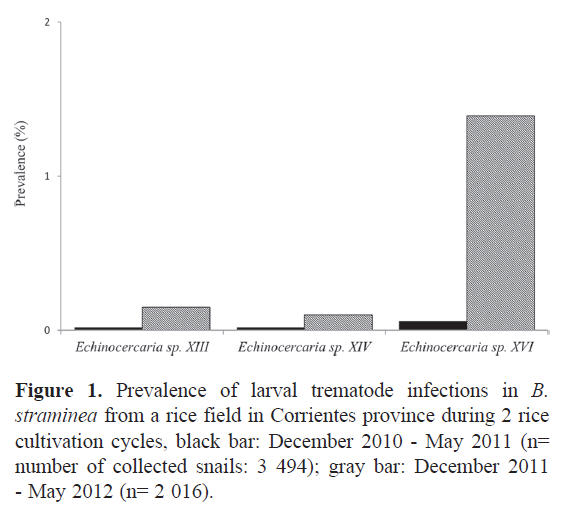
	    <p align="justify"><font face="verdana" size="2">A total of 5 510 snails were examined (2010&#45;2011: n= 3 494; 2011&#45;2012: n= 2 016), 36 of which (0.65%) were infected with echinostome species. During the first rice cultivation cycle the prevalence of infection ranged between 0.02% (<i>Echinocercaria</i> sp. XIII) and 0.06% (<i>Echinocercaria</i> sp. XVI), and during the second rice cultivation cycle the prevalence of infection ranged between 0.10% (<i>Echinocercaria</i> sp. XIV) and 1.39% (<i>Echinocercaria</i> sp. XVI) (<a href="#f1">Fig. 1</a>). The most common species was <i>Echinocercaria</i> sp. XVI. The shell size of infected snails ranged from 5.00 to 12.50 (mean= 8.12 &#177; SD= 1.58) in the first rice cultivation cycle and from 5.50 to 12.40 (8.30 &#177; 1.64) in the second rice cultivation cycle.</font></p>

	    <p align="center"><font face="verdana" size="2"><a name="f1"></a></font></p>

	    <p align="center"><font face="verdana" size="2"><img src="/img/revistas/rmbiodiv/v85n4/a3f1.jpg"></font></p>

	    <p align="justify"><font face="verdana" size="2">The tadpoles of <i>P. albonotatus</i> and fishes of <i>S. piaba</i> were exposed only to <i>Echinocercaria</i> sp. XVI because the infected snails with <i>Echinocercaria</i> sp. XIII and <i>Echinocercaria</i> sp. XIV died before that cercariae could be used for experimental infections. All the tadpoles exposed (n= 3), harbored metacercariae after 12 hours; while none of the fishes exposed (n= 4), harbored metacercariae after 24, 48 and 69 hours.</font></p>

	    ]]></body>
<body><![CDATA[<p align="justify"><font face="verdana" size="2">Family Echinostomatidae (Looss, 1899) Poche, 1926</font></p>

	    <p align="justify"><font face="verdana" size="2"><i><b>Echinocercaria</b></i> <b>sp. XIII</b> (<a href="/img/revistas/rmbiodiv/v85n4/a3f2.jpg" target="_blank">Figs. 2&#45;4</a>, <a href="#f12">12</a>, <a href="#f15" target="_blank">15</a>)</font></p>
	    <p align="center"><font face="verdana" size="2"><a name="f12" id="f12"></a></font></p>
        <p align="center"><font face="verdana" size="2"><img src="/img/revistas/rmbiodiv/v85n4/a3f12.jpg"></font></p>
        <p align="center"><font face="verdana" size="2"><a name="f15" id="f15"></a></font></p>
    <p align="center"><font face="verdana" size="2"><img src="/img/revistas/rmbiodiv/v85n4/a3f15.jpg"></font></p>
        <p align="justify"><font face="verdana" size="2">Measurements based on 20 formalin&#45;fixed specimens. Body 540&#45;780 (650&#177;79) long by 150&#45;220 (166&#177;18) wide, tegument without spines. Sensory hairs on lateral margins of body: 1 pair at level of oral sucker, and 6 pairs between pharynx and intestinal bifurcation. Head collar developed, with 53&#45;54 spines, arranged as 45&#45;46 dorsal and lateral spines in 2 rows, and 4 corner spines on each side. Oral sucker 46&#45;67 (47&#177;4) long by 41&#45;57 (47&#177;4) wide, prepharyngeal body present, 15&#45;17 (16&#177;1) long by 13&#45;16 (14&#177;1) wide, with numerous spines. Prepharynx short, pharynx muscular, 23&#45;32 (28&#177;2) long by 16&#45;18 (18&#177;1) wide. Esophagus long. Intestine bifurcates shortly anterior to ventral sucker. Ceca broad, reaching level of excretory vesicle. Ventral sucker 62&#45;73 (67&#177;3) long by 57&#45;74 (66&#177;4) wide, slightly larger than oral sucker, situated posterior to midbody. Numerous cystogenous cells with granular contents between main tubes of excretory system and body wall, and with bar and granular&#45;shaped contents between main tubes of excretory system and esophagus. Penetration gland cells not conspicuous, but 6 gland duct openings present on dorsal lip of oral sucker. Excretory system stenostomate, with main tubes dilated between pharynx and posterior border of ventral sucker, filled with small refractile granules, 3&#45;5 in diameter. Flame cells present in at least 29 pairs, probably arranged in groups of 3 flame cells, up to 18 ciliary patches in common collecting ducts. Excretory vesicle divided into 2 unequal chambers. Caudal duct of excretory system enters anterior portion of tail, bifurcates into 2 branches ending on lateral body margins. Tail 490&#45;712 (595&#177;53) long by 30&#45;58 (49&#177;6) wide, with 4 dorsoventral fin&#45;folds, 2 in the proximal end of tail and 2 in the posterior end of tail.</font></p>

	    <p align="justify"><font face="verdana" size="2">Emergence of cercariae was monitored during 4 days in 2 infected snails. At 19.6&#45;37.5&#186;C cercariae emerged during light hours, with an emergency&#45;peak between 7am and 1pm.</font></p>

	    <p align="justify"><font face="verdana" size="2"><i>Redia.</i> Body 1 780&#45;2 370 long by 325&#45;350 wide, with muscular pharynx 110&#45;152/80&#45;90 long/wide and intestinal caecum of 1 385&#45;1 500 long occupying more than &#189; redial lengths. Two pairs of appendages, 1 anterior and 1 posterior.</font></p>

	    <p align="justify"><font face="verdana" size="2"><i>Taxonomic summary</i></font></p>

	    ]]></body>
<body><![CDATA[<p align="justify"><font face="verdana" size="2"><i>Prevalence:</i> 0.02% (2010&#45;2011); 0.15% (2011&#45;2012).</font></p>

	    <p align="justify"><font face="verdana" size="2"><i>Specimen deposited:</i> accession number CECOAL 11050506.</font></p>

	    <p align="justify"><font face="verdana" size="2"><i>Remarks.</i> The collar with 2 rows of 53&#45;54 (4 corner spines), is similar to those of the genus <i>Hypoderaeum</i> Dietz, 1909. This genus has 43&#45;82 spines arranged in 2 rows in the cephalic collar with 4&#45;5 corner spines, and their adults parasitize birds, with reports mainly in Asia, and also in Europe, North America and Mexico (Yamaguti, 1971; Jones et al., 2005). The cercaria of <i>Hypoderaeum conoideum</i> (Bloch, 1782) Dietz, 1909 is similar to <i>Echinocercaria</i> sp. XIII, regarding the number and arrangement of collar spines (50&#45;54 in 2 alternating rows) and the numerous small refractile granules in the main tubes of the excretory system, but differs by its larger body size (630&#45;980/100&#45;280 in <i>Hypoderaeum conoideum</i> vs. 540&#45;780/150&#45;220 in <i>Echinocercaria</i> sp. XIII), smaller tail size (300&#45;500/50 vs. 490&#45;712/30&#45;58) and by the absence of fin&#45;folds in the tail (Yamaguti, 1975). <i>Hypoderaeum conoideum</i> uses snails of species <i>Lymnaea stagnalis</i> (Linnaeus, 1758) and <i>L.</i> (<i>Radix</i>) <i>limosa</i> (Linnaeus, 1758) as first intermediate hosts, which are distributed mainly in Europe and Asia (Yamaguti, 1971), hence the presence of this parasite in Argentina is unlikely.</font></p>

	    <p align="justify"><font face="verdana" size="2">In Argentina, Ostrowski&#45;de N&uacute;&ntilde;ez et al. (1997) described <i>Echinocercaria</i> sp. V from <i>B. orbignyi</i> in Corrientes province with more than 50 collar spines (although only 48 were figured), a prepharyngeal body with spines in rosette, similar measurements of body, tail and refractile granules in the excretory system, but differs from the present <i>Echinocercaria</i> sp. XIII in its the branched excretory canals, which contain the refractile granules. Unfortunately, the exact number of collar spines was not established. Martorelli (2003) described Cercaria Echinostoma sp. 3 from <i>B. tenagophila</i> in Timboy Stream, Corrientes province with 58 collar spines, branched excretory canals and considerably smaller
	measurements.</font></p>

	    <p align="justify"><font face="verdana" size="2">Adult digenetic trematodes with 53&#45;54 spines in the cephalic collar have not been reported for Argentina (Lunaschi et al., 2007).</font></p>

	    <p align="justify"><font face="verdana" size="2"><i>Echinocercaria</i> <b>sp. XIV</b> (<a href="/img/revistas/rmbiodiv/v85n4/a3f2.jpg" target="_blank">Figs. 5&#45;8</a>, <a href="#f12">13</a>, <a href="#f15">16</a>).</font></p>

	    <p align="justify"><font face="verdana" size="2">Measurements based on 30 formalin&#45;fixed specimens. Body 270&#45;366 (310&#177;25) long by 138&#45;222 (187&#177;22) wide, tegument without spines. Head collar well developed, with 37 spines, arranged as 29 dorsal and lateral spines in 2 rows and 4 corner spines on each side. Oral sucker subterminal, 34&#45;46 (41&#177;4) long by 32&#45;46 (39&#177;5) wide. Prepharyngeal body present, 14&#45;21 (15&#177;2) long by 18&#45;23 (22&#177;1) wide, with numerous spines forming rosette. Pharynx muscular, 18&#45;23 (21&#177;2) long by 11&#45;18 (15&#177;2) wide, esophagus long, intestine bifurcate just anterior to ventral sucker, ceca dorsal to excretory tubes, reaching level of excretory vesicle. Ventral sucker 44&#45;62 (49&#177;5) long by 46&#45;69 (52&#177;6) wide, larger than oral sucker, situated posterior to midbody. Numerous cystogenous cells with bar&#45;shaped contents, between pharynx and end of the body. At least 3 pairs of penetration glands observed in the central body between main collecting tubes and esophagus. Excretory system stenostomate, with main tubes extending from anterior wall of excretory vesicle to prepharyngeal level; main collecting tubes dilated between pharyngeal and ventral sucker levels and filled with 84&#45;112 refractile granules ranging in size between 1.5&#45;10 in diameter, the smaller ones near pharynx. Flame cells arranged in at least 8 pairs, up to 9 ciliary patches in common collecting ducts. Caudal duct of excretory system enters anterior portion of tail, bifurcates into 2 branches ending on lateral body margins. Tail 480&#45;642 (566&#177;37) long by 42&#45;60 (49&#177;5) wide, with 7 finfolds: 2 dorsal, 2 ventral, 2 very small lateral and 1 ventral small lobulated at level of 2 lateral.</font></p>

	    <p align="justify"><font face="verdana" size="2">Emergence of cercariae was monitored during 4 days in 2 infected snails. At 19.5&#45;36.7 &#186;C cercariae emerged during the night and early morning hours (0 am &#45; 8 am).</font></p>

	    <p align="justify"><font face="verdana" size="2"><i>Redia.</i> Orange&#45;brown pigmented body 1 170&#45;2 669 long by 272&#45;372 wide, with muscular pharynx 47&#45;57/41&#45;54 long/wide, and intestinal cecum 236&#45;570 long occupying less than <sup>1</sup>/<sub>3</sub> of redial length. Two pairs of appendages, 1 anterior and 1 posterior.</font></p>

	    <p align="justify"><font face="verdana" size="2"><i>Taxonomic summary</i></font></p>

	    ]]></body>
<body><![CDATA[<p align="justify"><font face="verdana" size="2"><i>Prevalence:</i> 0.02% (2010&#45;2011); 0.10% (2011&#45;2012).</font></p>

	    <p align="justify"><font face="verdana" size="2"><i>Specimen deposited:</i> accession number CECOAL 12022907.</font></p>

	    <p align="justify"><font face="verdana" size="2"><i>Remarks.</i> The only cercaria with 37 collar spines described from the area is Cercaria Echinostoma sp. 2 Martorelli, 2003 from <i>B. tenagophila</i> in Boquer&oacute;n de Franqu&iacute;a, Uruguay (adjacent to Corrientes province). It differs from <i>Echinocercaria</i> sp. XIV by its larger body (413 x 197 vs. 310 x 187), smaller tail (337 x 46 vs. 566 x 49), fewer refractile granules in main tubes of excretory system (59&#45;65 vs. 84&#45;112) and the arrangement in a single row of collar spines.</font></p>

	    <p align="justify"><font face="verdana" size="2">The present cercaria is similar to those of the genus <i>Echinostoma</i> Rudolphi, 1809 in the number of collar spines within the 31&#45;51 range, and the possession of findfolds in the tail, but differs in the arrangement of the lateral collar spines in 2 rows. Several cercariae of <i>Echinostoma</i> species with 37 spines have been cited in Brazil. <i>Echinostoma lindoense</i> Sandground and Bonne, 1940, <i>Echinostoma barbosai</i> Lie and Basch, 1966 and <i>Echinostoma paraensei</i> Lie and Basch, 1967 were reported in snails of the genera <i>Biomphalaria</i> Preston, 1910, <i>Echinostoma erraticum</i> Lutz, 1924 in snails of genera <i>Biomphalaria</i> and <i>Drepanotrema</i> Fischer and Crosse, 1880, <i>Echinostoma luisreyi </i>Maldonado, Vieira and Lanfredi, 2003 and <i>Echinostoma rodriguesi</i> in snails of the genera <i>Physa</i> Draparnaud, 1801 (Komma, 1972; Lie, 1968; Pinto and Melo, 2013). The definitive hosts of <i>E. lindoense, E. rodriguesi</i> and <i>E. erraticum</i> are birds and mammals, those of <i>E. barbosai</i> and <i>E. luisreyi</i> are birds, and those of <i>E. paraensei</i> are mammals (Pinto and Melo, 2013).</font></p>

	    <p align="justify"><font face="verdana" size="2">Two adult of <i>Echinostoma</i> species with 37 spines in the cephalic collar (<i>Echinostoma chloephagae</i> Sutton and Lunaschi, 1980; <i>Echinostoma mendax</i> Dietz, 1909) have been reported for Argentina paraziting anseriform birds (Anatidae) and 2 species, <i>Echinostoma revolutum</i> (Fr&ouml;lich, 1802) Rudolphi, 1809 and <i>Echinostoma rodriguensi</i> Hsu, Lie and Bash, 1968, paraziting rodent mammals (Lunaschi and Drago, 2007; Lunaschi et al., 2007). In Brazil adults of <i>E. mendax</i>, with an arrangement of collar spines similar to <i>Echinocercaria</i> sp. XIV (dorsal and lateral spines in 2 rows), have been described parasitizing anseriform birds of the family Anatidae (e. g., <i>Cairina moschata</i> (Linnaeus, 1758)) (Travassos et al., 1969).</font></p>

	    <p align="justify"><font face="verdana" size="2"><i><b>Echinocercaria</b></i> <b>sp. XVI</b> (<a href="#f12">Figs. 9&#45;11</a>, <a href="#f12">14</a>, <a href="#f15">17&#45;18</a>).</font></p>

	    <p align="justify"><font face="verdana" size="2">Measurements based on 20 formalin&#45;fixed specimens. Body 116&#45;227 (198) long by 92&#45;122 (110) wide. Tegument without spines, with 6 pairs of short lateral sensory setae between pharynx and ventral sucker and 1 pair at excretory vesicle level. Head collar well developed, with 31 spines arranged as 7 dorsal spines in 2 rows, 8 lateral spines and 4 corner spines on each side. Oral sucker subterminal, 25&#45;32 (29) long by 23&#45;34 (30) wide, with transparent tegumental rim. Prepharyngeal body present with 2 globular inclusions. Prepharynx short, pharynx muscular, 14&#45;18 (16) long by 11&#45;14 (12) wide. Esophagus long, intestine bifurcates just anterior to ventral sucker, ceca dorsal to excretory tubes, reaching level of excretory vesicle. Ventral sucker 21&#45;34 (30) long by 28&#45;41 (34) wide, situated posterior to midbody, with conspicuous, transparent tegumental rim. Numerous cystogenous cells with bar&#45;shaped contents, between pharynx and end of body. Penetration gland cells not conspicuous, but 4 gland duct&#45;openings visible on dorsal lip of oral sucker. Excretory system stenostomate, with main tubes extending from anterior wall of excretory vesicle to prepharyngeal level; main collecting tubes dilated between pharyngeal and ventral sucker levels and filled with 26&#45;42 (32) refractile granules, 8&#45;16 &#181;m in diameter. Flame cells difficult to see, arranged in at least 10 pairs, excretory vesicle divided into 2 unequal chambers. Caudal branch of excretory system enters anterior part of tail, where it becomes reduced to a triangular sac, with no visible pores. Tail 306&#45;448 (398) long by 30&#45;48 (42) wide, without fin&#45;folds and with 4 pairs of sensory
setae.</font></p>

	    <p align="justify"><font face="verdana" size="2">Emergence of cercariae was monitored during 2 days in 3 infected snails. At 24.6&#45;36.6&#186;C cercariae have emergency peaks between 0 am and 7 am. They penetrated in exposed tadpoles of <i>Physalaemus albonotatus</i>, and encysted in the body musculature, especially in the mouth region. Oval cysts with double wall measured 114&#45;132 (127&#177;5) long by 78&#45;90 (83&#177;5) wide at 12 hours PE. The morphology of metacercariae is very similar to that of the cercariae.</font></p>

	    <p align="justify"><font face="verdana" size="2"><i>Redia</i>. Orange&#45;brown pigmented rediae vary considerably in size of body and pharynx; larger rediae were found in low numbers in each infected snail (3&#45;5). Body 510&#45;1 650 long by 130&#45;410 wide, muscular pharynx 40&#45;210 /40&#45;175 long/wide, intestinal cecum 380&#45;1 520 long reaching end of the body in the larger rediae and more than <sup>1</sup>/<sub>2</sub> of redial length in smaller ones. Two pairs of appendages, 1 anterior and 1 posterior.</font></p>

	    <p align="justify"><font face="verdana" size="2"><i>Taxonomic summary</i></font></p>

	    ]]></body>
<body><![CDATA[<p align="justify"><font face="verdana" size="2"><i>Prevalence:</i> 0.06% (2010&#45;2011); 1.39% (2011&#45;2012).</font></p>

	    <p align="justify"><font face="verdana" size="2"><i>Specimen deposited:</i> accession number CECOAL 11022108.</font></p>

	    <p align="justify"><font face="verdana" size="2"><i>Remarks.</i> The number and arrangement of collar spines of this cercaria is similar to one of the 11 models of collar spine arrangements described for the genus <i>Echinostoma</i> by Kanev et al. (2009), but differs in the position of the first and second lateral spines, which in <i>Echinocercaria</i> sp. XVI correspond to the double row of dorsal spines. Two species of this genus with 31 collar spines parasitize birds: <i>Echinostoma anseris</i> Yamaguti, 1939 in Japan and China and <i>Echinostoma sudanense</i> Odhner, 1911 in Africa (Yamaguti, 1971; Kanev et al., 2009). In America, <i>Dietziella egregia</i> (Dietz, 1909) with 31 collar spines was reported paraziting <i>Harpiprion caerulescens</i> (Vieillot, 1817) in Brazil and paraziting <i>Plegadis chihi</i> in Argentina, both threskiornithid birds (Travassos et al., 1969; Digiani, 2000). In Argentina, <i>Echinocercaria</i> sp. II Ostrowski&#45;de N&uacute;&ntilde;ez et al. 1990 from <i>B. straminea</i> and <i>B. orbignyi,</i> and <i>Echinocercaria</i> sp. III Ostrowski&#45;de N&uacute;&ntilde;ez et al. 1991 from <i>B. occidentalis</i> in Corrientes province, are similar to this new species in the number (7) and arrangement of dorsal spines, the presence of a prepharyngeal body with 2 globular inclusions, cystogenous cells with bar&#45;shaped contents, 4 gland duct&#45;openings on the dorsal lip of the oral sucker, tail without fin&#45;folds, caudal branch of the excretory system reduced to a triangular sac, and similar emergence of cercariae, but they differ by having 27 instead of 31 spines in the head collar.</font></p>

	    <p align="justify"><font face="verdana" size="2">&nbsp;</font></p>

	    <p align="justify"><font face="verdana" size="2"><b>Discussion</b></font></p>

	    <p align="justify"><font face="verdana" size="2">The present study describes 3 echinostome cercariae parasitizing <i>B. straminea</i> in a rice field from Corrientes, Argentina, which can now be added to the 8 echinocercaria species previously reported from <i>Biomphalaria</i> spp. in this region (Ostrowski&#45;de N&uacute;&ntilde;ez et al., 1990, 1991, 1997; Martorelli, 2003).</font></p>

	    <p align="justify"><font face="verdana" size="2">The prevalence of the 3 species was low during the first rice cultivation cycle (&lt; 1%), whereas it was somewhat higher during the second cycle, with a prevalence greater than 1% only in <i>Echinocercaria</i> sp. XVI. The higher prevalence of <i>Echinocercaria</i> sp. XVI in the second rice cultivation cycle could be related to the increased presence of the definitive hosts in the environment. Low levels of prevalence have been observed in previous studies from field collections when the number of snails collected was high (Ostrowski&#45;de N&uacute;&ntilde;ez et al., 1990, 1991, 1997; Fern&aacute;ndez et al., 2013). Generally, prevalence level seems to be related with sample size: when the number of snails collected is high, the prevalence of infection is relatively low and vice versa (Ewers, 1964; Ostrowski&#45;de N&uacute;&ntilde;ez et al., 1991).</font></p>

	    <p align="justify"><font face="verdana" size="2">Agricultural wetlands such as rice fields can harbor numerous species of aquatic invertebrates and vertebrates including fishes, amphibians and birds (Czech and Parson, 2002; Elphick and Oring, 2003; Stenert et al., 2009
	Machado and Maltchik, 2010; Maltchik et al., 2011). In turn, with the increase of rice fields and other similar agricultural activities throughout the world, these agroenvironments have become important refuges for water birds (Czech and Parson, 2002), which may be reflected in the number of species recorded during samplings. Although the life cycles of the cercariae described herein are not known, birds could possibly be their definitive hosts, based on the known life cycles of similar echinocercariae. Further, the positive results of experimental infections in <i>Echinocercaria</i> sp. XVI in tadpoles but not in fish, have suggested that its second intermediate host should be amphibian larvae, which are included in the diet of several species of birds recorded in this agricultural environment. In this sense, the study of larval trematodes parasitiziting snails provides information about the biodiversity of both the parasites and their hosts, harbored in agricultural wetlands.</font></p>

	    <p align="justify"><font face="verdana" size="2">Finally, given the importance of <i>B. straminea</i> as an intermediate host of <i>S. mansoni</i> in endemic regions adjacent to northeastern Argentina, and of rice fields as environments with which humans have frequent direct contact, the study of larval trematodes in agricultural habitats of Corrientes province should be encouraged to obtain further information about larval trematode species, especially those that may affect the interaction between <i>S. mansoni</i> and its host, before the possible introduction of <i>S. mansoni</i> in the area.</font></p>

	    <p align="justify"><font face="verdana" size="2">&nbsp;</font></p>

	    ]]></body>
<body><![CDATA[<p align="justify"><font face="verdana" size="2"><b>Literature cited</b></font></p>

	    <!-- ref --><p align="justify"><font face="verdana" size="2">Aacrea (Asociaci&oacute;n Argentina de Consorcios Regionales de Experimentaci&oacute;n Agr&iacute;cola). 2003. "Agro alimentos Argentinos". Trabajo de Compilaci&oacute;n y An&aacute;lisis de Informaci&oacute;n realizado por el &aacute;rea de econom&iacute;a de Aacrea, Buenos Aires, Argentina. 271 p.    &nbsp;&nbsp;&nbsp;&nbsp;&nbsp;&nbsp;&nbsp;&nbsp;[&#160;<a href="javascript:void(0);" onclick="javascript: window.open('/scielo.php?script=sci_nlinks&ref=7644299&pid=S1870-3453201400050000300001&lng=','','width=640,height=500,resizable=yes,scrollbars=1,menubar=yes,');">Links</a>&#160;]<!-- end-ref --></font></p>

	    <!-- ref --><p align="justify"><font face="verdana" size="2">Adema, C. M., K. K. Sapp, L. A. Hertel and E. S. Loker. 2000. Inmunobiology of the relationship of echinostomes with snail intermediate hosts. <i>In</i> Echinostomes as experimental models for biological research, B. Fried and T. K. Graczyk (eds.). Kluwer Academic Publishers, Dorcrecht, Boston, London. p. 149&#45;173.    &nbsp;&nbsp;&nbsp;&nbsp;&nbsp;&nbsp;&nbsp;&nbsp;[&#160;<a href="javascript:void(0);" onclick="javascript: window.open('/scielo.php?script=sci_nlinks&ref=7644301&pid=S1870-3453201400050000300002&lng=','','width=640,height=500,resizable=yes,scrollbars=1,menubar=yes,');">Links</a>&#160;]<!-- end-ref --></font></p>

	    <!-- ref --><p align="justify"><font face="verdana" size="2">Bezerra, F. S. M., J. A. Nogueira&#45;Machado, R. L. Martins&#45;Souza, M. M. Chaves, R. F. Correa and P. M. Z. Coelho. 2003. Effect of gamma radiation on the activity of hemocytes and on the course of <i>Schistosoma mansoni</i> infection in resistant <i>Biomphalaria tenagophila</i> snails. Mem&oacute;rias do Instituto Oswaldo Cruz 98:73&#45;75.    &nbsp;&nbsp;&nbsp;&nbsp;&nbsp;&nbsp;&nbsp;&nbsp;[&#160;<a href="javascript:void(0);" onclick="javascript: window.open('/scielo.php?script=sci_nlinks&ref=7644303&pid=S1870-3453201400050000300003&lng=','','width=640,height=500,resizable=yes,scrollbars=1,menubar=yes,');">Links</a>&#160;]<!-- end-ref --></font></p>

	    <!-- ref --><p align="justify"><font face="verdana" size="2">Czech, H. A. and K. C. Parsons. 2002. Agricultural wetlands and waterbirds: a review. Waterbirds 25:56&#45;65.    &nbsp;&nbsp;&nbsp;&nbsp;&nbsp;&nbsp;&nbsp;&nbsp;[&#160;<a href="javascript:void(0);" onclick="javascript: window.open('/scielo.php?script=sci_nlinks&ref=7644305&pid=S1870-3453201400050000300004&lng=','','width=640,height=500,resizable=yes,scrollbars=1,menubar=yes,');">Links</a>&#160;]<!-- end-ref --></font></p>

	    <!-- ref --><p align="justify"><font face="verdana" size="2">Digiani, M. C. 2000. Digeneans and cestodes parasitic in the white&#45;faced ibis <i>Plegadis chihi</i> (Aves: Threskiornithidae) from Argentina. Folia Parasitologica (Praha) 47: 95&#45;204.    &nbsp;&nbsp;&nbsp;&nbsp;&nbsp;&nbsp;&nbsp;&nbsp;[&#160;<a href="javascript:void(0);" onclick="javascript: window.open('/scielo.php?script=sci_nlinks&ref=7644307&pid=S1870-3453201400050000300005&lng=','','width=640,height=500,resizable=yes,scrollbars=1,menubar=yes,');">Links</a>&#160;]<!-- end-ref --></font></p>

	    <!-- ref --><p align="justify"><font face="verdana" size="2">Elphick, C. S. and L. W. Oring. 2003. Conservation implications of flooding rice felds on winter for waterbirds. Agriculture Ecosystems Environment 94:17&#45;29.    &nbsp;&nbsp;&nbsp;&nbsp;&nbsp;&nbsp;&nbsp;&nbsp;[&#160;<a href="javascript:void(0);" onclick="javascript: window.open('/scielo.php?script=sci_nlinks&ref=7644309&pid=S1870-3453201400050000300006&lng=','','width=640,height=500,resizable=yes,scrollbars=1,menubar=yes,');">Links</a>&#160;]<!-- end-ref --></font></p>

	    <!-- ref --><p align="justify"><font face="verdana" size="2">Ewers, W. H. 1964. The influence of the density of snails on the incidence of larval trematodes. Parasitology 17:141&#45;313.    &nbsp;&nbsp;&nbsp;&nbsp;&nbsp;&nbsp;&nbsp;&nbsp;[&#160;<a href="javascript:void(0);" onclick="javascript: window.open('/scielo.php?script=sci_nlinks&ref=7644311&pid=S1870-3453201400050000300007&lng=','','width=640,height=500,resizable=yes,scrollbars=1,menubar=yes,');">Links</a>&#160;]<!-- end-ref --></font></p>

	    <!-- ref --><p align="justify"><font face="verdana" size="2">Fern&aacute;ndez, M. V., H. I. Hamann and M. Ostrowski&#45;de N&uacute;&ntilde;ez. 2013. Larval trematodes from <i>Biomphalaria straminea</i> (Mollusca, Planorbidae) in a ricefield in Corrientes Province, Argentina. Revista Mexicana de Biodiversidad 84:756&#45;764.    &nbsp;&nbsp;&nbsp;&nbsp;&nbsp;&nbsp;&nbsp;&nbsp;[&#160;<a href="javascript:void(0);" onclick="javascript: window.open('/scielo.php?script=sci_nlinks&ref=7644313&pid=S1870-3453201400050000300008&lng=','','width=640,height=500,resizable=yes,scrollbars=1,menubar=yes,');">Links</a>&#160;]<!-- end-ref --></font></p>

	    <!-- ref --><p align="justify"><font face="verdana" size="2">Graeff&#45;Teixeira, C., C. B. Anjos, V. C. Oliveira, C. E. P. Velloso, M. B. S. Fonseca, C. Valar, C. Moraes, C. Garrido and R. S. Amaral. 1999. Identification of a transmission focus of <i>Schistosoma mansoni</i> in the southernmost Brazilian state, Rio Grande do Sul, Brazil. Mem&oacute;rias do Instituto Oswaldo Cruz 94:9&#45;10.    &nbsp;&nbsp;&nbsp;&nbsp;&nbsp;&nbsp;&nbsp;&nbsp;[&#160;<a href="javascript:void(0);" onclick="javascript: window.open('/scielo.php?script=sci_nlinks&ref=7644315&pid=S1870-3453201400050000300009&lng=','','width=640,height=500,resizable=yes,scrollbars=1,menubar=yes,');">Links</a>&#160;]<!-- end-ref --></font></p>

	    <!-- ref --><p align="justify"><font face="verdana" size="2">Graeff&#45;Teixeira, C., C. Valar, C. K. de Moraes, S. Mostardeiro&#45;Salvany, C. de Ornellas&#45; Brum, R. Lucyk&#45;Maurer, R. Ben, L. B. L. F. Mardini, M. Ba&ntilde;olas&#45;Jobim, R. Santos Do Amaral. 2004. The initial epidemiological studies in the low endemicity schistosomiasis area in esteio, Rio Grande do Sul, the southernmost Brazilian State, 1997 to 2000. Mem&oacute;rias do Instituto Oswaldo Cruz 99:73&#45;78.    &nbsp;&nbsp;&nbsp;&nbsp;&nbsp;&nbsp;&nbsp;&nbsp;[&#160;<a href="javascript:void(0);" onclick="javascript: window.open('/scielo.php?script=sci_nlinks&ref=7644317&pid=S1870-3453201400050000300010&lng=','','width=640,height=500,resizable=yes,scrollbars=1,menubar=yes,');">Links</a>&#160;]<!-- end-ref --></font></p>

	    <!-- ref --><p align="justify"><font face="verdana" size="2">Hamann, M. I., A. Rumi and M. Ostrowski&#45;de N&uacute;&ntilde;ez. 1991. Potenciales vectores de esquistosomiasis y trematodes asociados en ambientes urbanos y suburbanos del Chaco, Argentina. Primeros resultados. Biolog&iacute;a Acu&aacute;tica 15:254&#45;255.    &nbsp;&nbsp;&nbsp;&nbsp;&nbsp;&nbsp;&nbsp;&nbsp;[&#160;<a href="javascript:void(0);" onclick="javascript: window.open('/scielo.php?script=sci_nlinks&ref=7644319&pid=S1870-3453201400050000300011&lng=','','width=640,height=500,resizable=yes,scrollbars=1,menubar=yes,');">Links</a>&#160;]<!-- end-ref --></font></p>

	    <!-- ref --><p align="justify"><font face="verdana" size="2">Jones, A., R. A. Bray and D. I. Gibson (eds.). 2005. Keys to the Trematoda. Vol. 2. CABI Publishing International Wallingford and The Natural History Museum, London. 768 p.    &nbsp;&nbsp;&nbsp;&nbsp;&nbsp;&nbsp;&nbsp;&nbsp;[&#160;<a href="javascript:void(0);" onclick="javascript: window.open('/scielo.php?script=sci_nlinks&ref=7644321&pid=S1870-3453201400050000300012&lng=','','width=640,height=500,resizable=yes,scrollbars=1,menubar=yes,');">Links</a>&#160;]<!-- end-ref --></font></p>

	    <!-- ref --><p align="justify"><font face="verdana" size="2">Kanev, I., B. Fried and V. Radev. 2009. Collar spine models in the genus Echinostoma (Trematoda: Echinostomatidae). Parasitology Research 105:921&#45;927.    &nbsp;&nbsp;&nbsp;&nbsp;&nbsp;&nbsp;&nbsp;&nbsp;[&#160;<a href="javascript:void(0);" onclick="javascript: window.open('/scielo.php?script=sci_nlinks&ref=7644323&pid=S1870-3453201400050000300013&lng=','','width=640,height=500,resizable=yes,scrollbars=1,menubar=yes,');">Links</a>&#160;]<!-- end-ref --></font></p>

	    <!-- ref --><p align="justify"><font face="verdana" size="2">Komma, M. D. 1972. Revalida&#231;&atilde;o da esp&eacute;cie <i>Echinostoma erraticum</i> (Lutz, 1924). Revista de Patolog&iacute;a Tropical 4:463&#45;471.    &nbsp;&nbsp;&nbsp;&nbsp;&nbsp;&nbsp;&nbsp;&nbsp;[&#160;<a href="javascript:void(0);" onclick="javascript: window.open('/scielo.php?script=sci_nlinks&ref=7644325&pid=S1870-3453201400050000300014&lng=','','width=640,height=500,resizable=yes,scrollbars=1,menubar=yes,');">Links</a>&#160;]<!-- end-ref --></font></p>

	    <!-- ref --><p align="justify"><font face="verdana" size="2">Lambertucci, J. R. 2010. Acute schistosomiasis mansoni: revisited and reconsidered. Mem&oacute;rias do Instituto Oswaldo Cruz 105:422&#45;435.    &nbsp;&nbsp;&nbsp;&nbsp;&nbsp;&nbsp;&nbsp;&nbsp;[&#160;<a href="javascript:void(0);" onclick="javascript: window.open('/scielo.php?script=sci_nlinks&ref=7644327&pid=S1870-3453201400050000300015&lng=','','width=640,height=500,resizable=yes,scrollbars=1,menubar=yes,');">Links</a>&#160;]<!-- end-ref --></font></p>

	    <!-- ref --><p align="justify"><font face="verdana" size="2">Lie, K. J. 1968. Further studies on the life history of <i>Echinostoma lindoense</i> Sandground and Bonne, 1940 (Trematoda: Echinostomatidae) with a report of its occurrence in Brazil. Journal of Parasitology 35:74&#45;77.    &nbsp;&nbsp;&nbsp;&nbsp;&nbsp;&nbsp;&nbsp;&nbsp;[&#160;<a href="javascript:void(0);" onclick="javascript: window.open('/scielo.php?script=sci_nlinks&ref=7644329&pid=S1870-3453201400050000300016&lng=','','width=640,height=500,resizable=yes,scrollbars=1,menubar=yes,');">Links</a>&#160;]<!-- end-ref --></font></p>

	    <!-- ref --><p align="justify"><font face="verdana" size="2">Lie, K. J., D. Heyneman and C. S. Richards. 1977a. Studies on resistance in snails: interference by non&#45;irradiated echinostome larvae with natural resistance to <i>Schistosoma mansoni</i> in <i>Biomphalaria glabrata</i>. Journal of Invertebrate Pathology 29:118&#45;125.    &nbsp;&nbsp;&nbsp;&nbsp;&nbsp;&nbsp;&nbsp;&nbsp;[&#160;<a href="javascript:void(0);" onclick="javascript: window.open('/scielo.php?script=sci_nlinks&ref=7644331&pid=S1870-3453201400050000300017&lng=','','width=640,height=500,resizable=yes,scrollbars=1,menubar=yes,');">Links</a>&#160;]<!-- end-ref --></font></p>

	    <!-- ref --><p align="justify"><font face="verdana" size="2">Lie, K. J., D. Heyneman and C. S. Richards. 1977b. <i>Schistosoma mansoni</i>: temporary reduction of natural resistance in <i>Biomphalaria glabrata</i> induced by irradiated miracidia of <i>Echinostoma paraensei</i>. Experimental Parasitology 43:54&#45;62</font>&nbsp;&nbsp;&nbsp;&nbsp;&nbsp;&nbsp;&nbsp;&nbsp;[&#160;<a href="javascript:void(0);" onclick="javascript: window.open('/scielo.php?script=sci_nlinks&ref=7644333&pid=S1870-3453201400050000300018&lng=','','width=640,height=500,resizable=yes,scrollbars=1,menubar=yes,');">Links</a>&#160;]<!-- end-ref --><!-- ref --><p align="justify"><font face="verdana" size="2">Lunaschi, L. I., F. Cremonte and F. B. Drago. 2007. Checklist of digenean parasites of birds from Argentina. Zootaxa 1403:1&#45;36.    &nbsp;&nbsp;&nbsp;&nbsp;&nbsp;&nbsp;&nbsp;&nbsp;[&#160;<a href="javascript:void(0);" onclick="javascript: window.open('/scielo.php?script=sci_nlinks&ref=7644334&pid=S1870-3453201400050000300019&lng=','','width=640,height=500,resizable=yes,scrollbars=1,menubar=yes,');">Links</a>&#160;]<!-- end-ref --></font></p>

	    <!-- ref --><p align="justify"><font face="verdana" size="2">Lunaschi, L. I. and F. B. Drago. 2007. Checklist of digenean parasites of wild mammals from Argentina. Zootaxa 1580:35&#45;50.    &nbsp;&nbsp;&nbsp;&nbsp;&nbsp;&nbsp;&nbsp;&nbsp;[&#160;<a href="javascript:void(0);" onclick="javascript: window.open('/scielo.php?script=sci_nlinks&ref=7644336&pid=S1870-3453201400050000300020&lng=','','width=640,height=500,resizable=yes,scrollbars=1,menubar=yes,');">Links</a>&#160;]<!-- end-ref --></font></p>

	    ]]></body>
<body><![CDATA[<!-- ref --><p align="justify"><font face="verdana" size="2">Machado, I. F. and L. Maltchik. 2010. Can management practices in rice fields contribute to amphibian conservation in southern Brazilian wetlands? Aquatic Conservation: Marine and Freshwater Ecosystems 20:39&#45;46.    &nbsp;&nbsp;&nbsp;&nbsp;&nbsp;&nbsp;&nbsp;&nbsp;[&#160;<a href="javascript:void(0);" onclick="javascript: window.open('/scielo.php?script=sci_nlinks&ref=7644338&pid=S1870-3453201400050000300021&lng=','','width=640,height=500,resizable=yes,scrollbars=1,menubar=yes,');">Links</a>&#160;]<!-- end-ref --></font></p>

	    <!-- ref --><p align="justify"><font face="verdana" size="2">Maltchik, M., A. S. Rolon, C. Stenert, I. F. Machado and O. Rocha. 2011. Can rice field channels contribute to biodiversity conservation in Southern Brazilian wetlands? Revista de Biololog&iacute;a Tropical 54:1895&#45;1914.    &nbsp;&nbsp;&nbsp;&nbsp;&nbsp;&nbsp;&nbsp;&nbsp;[&#160;<a href="javascript:void(0);" onclick="javascript: window.open('/scielo.php?script=sci_nlinks&ref=7644340&pid=S1870-3453201400050000300022&lng=','','width=640,height=500,resizable=yes,scrollbars=1,menubar=yes,');">Links</a>&#160;]<!-- end-ref --></font></p>

	    <!-- ref --><p align="justify"><font face="verdana" size="2">Martorelli, S. R. 2003. Manual de reconocimiento de cercarias con una introducci&oacute;n al conocimiento de los Digeneos. Cercarias par&aacute;sitas de <i>Biomphalaria</i> spp. en el &aacute;rea de influencia de la represa de Salto Grande. Available in electronic format htlm CD. ISBN 987&#45;43&#45; 7570&#45;1. CEPAVE. La Plata, Argentina, PIP 02714.    &nbsp;&nbsp;&nbsp;&nbsp;&nbsp;&nbsp;&nbsp;&nbsp;[&#160;<a href="javascript:void(0);" onclick="javascript: window.open('/scielo.php?script=sci_nlinks&ref=7644342&pid=S1870-3453201400050000300023&lng=','','width=640,height=500,resizable=yes,scrollbars=1,menubar=yes,');">Links</a>&#160;]<!-- end-ref --></font></p>

	    <!-- ref --><p align="justify"><font face="verdana" size="2">Odening, K. 1971. Perpektiven der Cercarienforschung. Parasitologische Schriftenreihe 21:11&#45;205.    &nbsp;&nbsp;&nbsp;&nbsp;&nbsp;&nbsp;&nbsp;&nbsp;[&#160;<a href="javascript:void(0);" onclick="javascript: window.open('/scielo.php?script=sci_nlinks&ref=7644344&pid=S1870-3453201400050000300024&lng=','','width=640,height=500,resizable=yes,scrollbars=1,menubar=yes,');">Links</a>&#160;]<!-- end-ref --></font></p>

	    <!-- ref --><p align="justify"><font face="verdana" size="2">Ostrowski&#45;de N&uacute;&ntilde;ez, M., M. I. Hamann and A. Rumi. 1990. Larval trematodes of <i>Schistosoma mansoni</i> transmiting snail: <i>Biomphalaria</i> spp. in northeatern Argentina<i>.</i> Acta Parasitol&oacute;gica Pol&oacute;nica 35:85&#45;96.    &nbsp;&nbsp;&nbsp;&nbsp;&nbsp;&nbsp;&nbsp;&nbsp;[&#160;<a href="javascript:void(0);" onclick="javascript: window.open('/scielo.php?script=sci_nlinks&ref=7644346&pid=S1870-3453201400050000300025&lng=','','width=640,height=500,resizable=yes,scrollbars=1,menubar=yes,');">Links</a>&#160;]<!-- end-ref --></font></p>

	    ]]></body>
<body><![CDATA[<!-- ref --><p align="justify"><font face="verdana" size="2">Ostrowski&#45;de N&uacute;&ntilde;ez, M., M. I. Hamann and A. Rumi. 1991. Population dynamics of planorbid snail from a lenitic biotope in northeastern Argentina. Larval trematodes of <i>Biomphalaria occidentalis</i> and analysis of their prevalence and seasonality. Acta Parasitol&oacute;gica Pol&oacute;nica 36:159&#45;166.    &nbsp;&nbsp;&nbsp;&nbsp;&nbsp;&nbsp;&nbsp;&nbsp;[&#160;<a href="javascript:void(0);" onclick="javascript: window.open('/scielo.php?script=sci_nlinks&ref=7644348&pid=S1870-3453201400050000300026&lng=','','width=640,height=500,resizable=yes,scrollbars=1,menubar=yes,');">Links</a>&#160;]<!-- end-ref --></font></p>

	    <!-- ref --><p align="justify"><font face="verdana" size="2">Ostrowski&#45;de N&uacute;&ntilde;ez, M., H. I. Hamann and A. Rumi. 1997. Estudios de trematodes larvales en <i>Biomphalaria</i> spp. (Mollusca, Planorbidae) de la localidad de San Roque, provincia de Corrientes, Argentina. Physis 54:7&#45;15.    &nbsp;&nbsp;&nbsp;&nbsp;&nbsp;&nbsp;&nbsp;&nbsp;[&#160;<a href="javascript:void(0);" onclick="javascript: window.open('/scielo.php?script=sci_nlinks&ref=7644350&pid=S1870-3453201400050000300027&lng=','','width=640,height=500,resizable=yes,scrollbars=1,menubar=yes,');">Links</a>&#160;]<!-- end-ref --></font></p>

	    <!-- ref --><p align="justify"><font face="verdana" size="2">Pinto, H. A. and A. L. Melo. 2013. A checklist of cercariae (Trematoda: Digenea) in molluscs from Brazil. Zootaxa 3666:449&#45;475.    &nbsp;&nbsp;&nbsp;&nbsp;&nbsp;&nbsp;&nbsp;&nbsp;[&#160;<a href="javascript:void(0);" onclick="javascript: window.open('/scielo.php?script=sci_nlinks&ref=7644352&pid=S1870-3453201400050000300028&lng=','','width=640,height=500,resizable=yes,scrollbars=1,menubar=yes,');">Links</a>&#160;]<!-- end-ref --></font></p>

	    <!-- ref --><p align="justify"><font face="verdana" size="2">Rumi, A. 1986. Estudio morfol&oacute;gico, taxon&oacute;mico y bio&#45;ecol&oacute;gico de los planorbidos argentinos. PhD Thesis, Facultad de Ciencias Naturales y Museo, Universidad Nacional de La Plata. La Plata, Buenos Aires, Argentina. 208 p.    &nbsp;&nbsp;&nbsp;&nbsp;&nbsp;&nbsp;&nbsp;&nbsp;[&#160;<a href="javascript:void(0);" onclick="javascript: window.open('/scielo.php?script=sci_nlinks&ref=7644354&pid=S1870-3453201400050000300029&lng=','','width=640,height=500,resizable=yes,scrollbars=1,menubar=yes,');">Links</a>&#160;]<!-- end-ref --></font></p>

	    <!-- ref --><p align="justify"><font face="verdana" size="2">Rumi, A., D. E. Guti&eacute;rrez, V. Nu&ntilde;ez and G. A. Darrigran. 2008. Malacolog&iacute;a latinoamericana. Moluscos de agua dulce de Argentina. Revista de Biolog&iacute;a Tropical 56:77&#45;111.    &nbsp;&nbsp;&nbsp;&nbsp;&nbsp;&nbsp;&nbsp;&nbsp;[&#160;<a href="javascript:void(0);" onclick="javascript: window.open('/scielo.php?script=sci_nlinks&ref=7644356&pid=S1870-3453201400050000300030&lng=','','width=640,height=500,resizable=yes,scrollbars=1,menubar=yes,');">Links</a>&#160;]<!-- end-ref --></font></p>

	    ]]></body>
<body><![CDATA[<!-- ref --><p align="justify"><font face="verdana" size="2">Rumi, A. and M. I. Hamann. 1990. Potential schistosome&#45;vector snails and asssociated trematodes in ricefields of Corrientes, Argentina. Preliminary results. Mem&oacute;rias do Instituto Oswaldo Cruz 85:321&#45;328.    &nbsp;&nbsp;&nbsp;&nbsp;&nbsp;&nbsp;&nbsp;&nbsp;[&#160;<a href="javascript:void(0);" onclick="javascript: window.open('/scielo.php?script=sci_nlinks&ref=7644358&pid=S1870-3453201400050000300031&lng=','','width=640,height=500,resizable=yes,scrollbars=1,menubar=yes,');">Links</a>&#160;]<!-- end-ref --></font></p>

	    <!-- ref --><p align="justify"><font face="verdana" size="2">Silva&#45;Garcia, J., A. Maldonado&#45;Junior, C. J. Bidau, L. R. Corr&ecirc;a, R. M. Lanfredi and P. M. Z. Coelho. 2010. The effect of early infection with <i>Echinostoma paraensei</i> on the interaction of <i>Schistosoma mansoni</i> with <i>Biomphalaria glabrata</i> and <i>Biomphalaria tenagophila.</i> Mem&oacute;rias do Instituto Oswaldo Cruz 105:499&#45;503.    &nbsp;&nbsp;&nbsp;&nbsp;&nbsp;&nbsp;&nbsp;&nbsp;[&#160;<a href="javascript:void(0);" onclick="javascript: window.open('/scielo.php?script=sci_nlinks&ref=7644360&pid=S1870-3453201400050000300032&lng=','','width=640,height=500,resizable=yes,scrollbars=1,menubar=yes,');">Links</a>&#160;]<!-- end-ref --></font></p>

	    <!-- ref --><p align="justify"><font face="verdana" size="2">Spatz, L., S. M. Gonz&aacute;lez&#45;Cappa and M. Ostrowski&#45;de N&uacute;&ntilde;ez. 2012. Susceptibility of wild populations of <i>Biomphalaria</i> spp. from neotropical South America to <i>Schistosoma mansoni</i> and interference of <i>Zygocotyle lunata.</i> Journal of Parasitology 98:1291&#45;1295.    &nbsp;&nbsp;&nbsp;&nbsp;&nbsp;&nbsp;&nbsp;&nbsp;[&#160;<a href="javascript:void(0);" onclick="javascript: window.open('/scielo.php?script=sci_nlinks&ref=7644362&pid=S1870-3453201400050000300033&lng=','','width=640,height=500,resizable=yes,scrollbars=1,menubar=yes,');">Links</a>&#160;]<!-- end-ref --></font></p>

	    <!-- ref --><p align="justify"><font face="verdana" size="2">Stenert, C., R. C. Bacca, C. C. Mostardeiro and L. Malchik. 2009. Can hydrologic management practices of rice fields contribute to macroinvertebrate conservation in southern Brazil wetlands? Hydrobiologia 635:339&#45;350.    &nbsp;&nbsp;&nbsp;&nbsp;&nbsp;&nbsp;&nbsp;&nbsp;[&#160;<a href="javascript:void(0);" onclick="javascript: window.open('/scielo.php?script=sci_nlinks&ref=7644364&pid=S1870-3453201400050000300034&lng=','','width=640,height=500,resizable=yes,scrollbars=1,menubar=yes,');">Links</a>&#160;]<!-- end-ref --></font></p>

	    <!-- ref --><p align="justify"><font face="verdana" size="2">Thiengo, S. C. and M. A. Fernandez. 2007. Moluscos. <i>In</i> Vigil&acirc;ncia e controle de moluscos de import&acirc;ncia epidemiol&oacute;gica: directrizes t&eacute;cnicas: Programa de vigil&acirc;ncia e controle da Eschistossomose (PCE), Minister&eacute;rio da Sa&uacute;de, Secretaria de vigil&acirc;ncia em sa&uacute;de, Departamento de vigil&acirc;ncia epidemiol&oacute;gica (eds.). MS, Brasilia DF, Brasil. p. 13&#45;35.    &nbsp;&nbsp;&nbsp;&nbsp;&nbsp;&nbsp;&nbsp;&nbsp;[&#160;<a href="javascript:void(0);" onclick="javascript: window.open('/scielo.php?script=sci_nlinks&ref=7644366&pid=S1870-3453201400050000300035&lng=','','width=640,height=500,resizable=yes,scrollbars=1,menubar=yes,');">Links</a>&#160;]<!-- end-ref --></font></p>

	    ]]></body>
<body><![CDATA[<!-- ref --><p align="justify"><font face="verdana" size="2">Travassos, L., J. F. Teixeira de Freitas and A. Kohn. 1969. Tremat&oacute;deos do Brasil. Mem&oacute;rias do Instituto Oswaldo Cruz 67:1&#45;188.    &nbsp;&nbsp;&nbsp;&nbsp;&nbsp;&nbsp;&nbsp;&nbsp;[&#160;<a href="javascript:void(0);" onclick="javascript: window.open('/scielo.php?script=sci_nlinks&ref=7644368&pid=S1870-3453201400050000300036&lng=','','width=640,height=500,resizable=yes,scrollbars=1,menubar=yes,');">Links</a>&#160;]<!-- end-ref --></font></p>

	    <!-- ref --><p align="justify"><font face="verdana" size="2">Yamaguti, S. 1971. Synopsis of Digenetic trematodes of vertebrates. Vol.II. Keigaku Publishing Company. Tokyo, Japan. 856 p.    &nbsp;&nbsp;&nbsp;&nbsp;&nbsp;&nbsp;&nbsp;&nbsp;[&#160;<a href="javascript:void(0);" onclick="javascript: window.open('/scielo.php?script=sci_nlinks&ref=7644370&pid=S1870-3453201400050000300037&lng=','','width=640,height=500,resizable=yes,scrollbars=1,menubar=yes,');">Links</a>&#160;]<!-- end-ref --></font></p>

	    <!-- ref --><p align="justify"><font face="verdana" size="2">Yamaguti, S. 1975. A synoptical review of life histories of digenetic trematodes of vertebrates. Keigaku Publishing Company. Tokyo, Japan. 590 p.    &nbsp;&nbsp;&nbsp;&nbsp;&nbsp;&nbsp;&nbsp;&nbsp;[&#160;<a href="javascript:void(0);" onclick="javascript: window.open('/scielo.php?script=sci_nlinks&ref=7644372&pid=S1870-3453201400050000300038&lng=','','width=640,height=500,resizable=yes,scrollbars=1,menubar=yes,');">Links</a>&#160;]<!-- end-ref --></font></p>
     ]]></body><back>
<ref-list>
<ref id="B1">
<nlm-citation citation-type="book">
<collab>Asociación Argentina de Consorcios Regionales de Experimentación Agrícola</collab>
<source><![CDATA[Agro alimentos Argentinos]]></source>
<year>2003</year>
<page-range>271</page-range><publisher-loc><![CDATA[Buenos Aires ]]></publisher-loc>
<publisher-name><![CDATA[área de economía de Aacrea]]></publisher-name>
</nlm-citation>
</ref>
<ref id="B2">
<nlm-citation citation-type="book">
<person-group person-group-type="author">
<name>
<surname><![CDATA[Adema]]></surname>
<given-names><![CDATA[C. M.]]></given-names>
</name>
<name>
<surname><![CDATA[Sapp]]></surname>
<given-names><![CDATA[K. K.]]></given-names>
</name>
<name>
<surname><![CDATA[Hertel]]></surname>
<given-names><![CDATA[L. A.]]></given-names>
</name>
<name>
<surname><![CDATA[Loker]]></surname>
<given-names><![CDATA[E. S.]]></given-names>
</name>
</person-group>
<article-title xml:lang="en"><![CDATA[Inmunobiology of the relationship of echinostomes with snail intermediate hosts]]></article-title>
<person-group person-group-type="editor">
<name>
<surname><![CDATA[Fried]]></surname>
<given-names><![CDATA[B.]]></given-names>
</name>
<name>
<surname><![CDATA[Graczyk]]></surname>
<given-names><![CDATA[T. K.]]></given-names>
</name>
</person-group>
<source><![CDATA[Echinostomes as experimental models for biological research]]></source>
<year>2000</year>
<page-range>149-173</page-range><publisher-loc><![CDATA[DorcrechtBostonLondon ]]></publisher-loc>
<publisher-name><![CDATA[Kluwer Academic Publishers]]></publisher-name>
</nlm-citation>
</ref>
<ref id="B3">
<nlm-citation citation-type="journal">
<person-group person-group-type="author">
<name>
<surname><![CDATA[Bezerra]]></surname>
<given-names><![CDATA[F. S. M.]]></given-names>
</name>
<name>
<surname><![CDATA[Nogueira-Machado]]></surname>
<given-names><![CDATA[J. A.]]></given-names>
</name>
<name>
<surname><![CDATA[Martins-Souza]]></surname>
<given-names><![CDATA[R. L.]]></given-names>
</name>
<name>
<surname><![CDATA[Chaves]]></surname>
<given-names><![CDATA[M. M.]]></given-names>
</name>
<name>
<surname><![CDATA[Correa]]></surname>
<given-names><![CDATA[R. F.]]></given-names>
</name>
<name>
<surname><![CDATA[Coelho]]></surname>
<given-names><![CDATA[P. M. Z.]]></given-names>
</name>
</person-group>
<article-title xml:lang="en"><![CDATA[Effect of gamma radiation on the activity of hemocytes and on the course of Schistosoma mansoni infection in resistant Biomphalaria tenagophila snails]]></article-title>
<source><![CDATA[Memórias do Instituto Oswaldo Cruz]]></source>
<year>2003</year>
<volume>98</volume>
<page-range>73-75</page-range></nlm-citation>
</ref>
<ref id="B4">
<nlm-citation citation-type="journal">
<person-group person-group-type="author">
<name>
<surname><![CDATA[Czech]]></surname>
<given-names><![CDATA[H. A.]]></given-names>
</name>
<name>
<surname><![CDATA[Parsons]]></surname>
<given-names><![CDATA[K. C.]]></given-names>
</name>
</person-group>
<article-title xml:lang="en"><![CDATA[Agricultural wetlands and waterbirds: a review]]></article-title>
<source><![CDATA[Waterbirds]]></source>
<year>2002</year>
<volume>25</volume>
<page-range>56-65</page-range></nlm-citation>
</ref>
<ref id="B5">
<nlm-citation citation-type="journal">
<person-group person-group-type="author">
<name>
<surname><![CDATA[Digiani]]></surname>
<given-names><![CDATA[M. C.]]></given-names>
</name>
</person-group>
<article-title xml:lang="en"><![CDATA[Digeneans and cestodes parasitic in the white-faced ibis Plegadis chihi (Aves: Threskiornithidae) from Argentina]]></article-title>
<source><![CDATA[Folia Parasitologica]]></source>
<year>2000</year>
<volume>47</volume>
<page-range>95-204</page-range><publisher-loc><![CDATA[Praha ]]></publisher-loc>
</nlm-citation>
</ref>
<ref id="B6">
<nlm-citation citation-type="journal">
<person-group person-group-type="author">
<name>
<surname><![CDATA[Elphick]]></surname>
<given-names><![CDATA[C. S.]]></given-names>
</name>
<name>
<surname><![CDATA[Oring]]></surname>
<given-names><![CDATA[L. W.]]></given-names>
</name>
</person-group>
<article-title xml:lang="en"><![CDATA[Conservation implications of flooding rice felds on winter for waterbirds]]></article-title>
<source><![CDATA[Agriculture Ecosystems Environment]]></source>
<year>2003</year>
<volume>94</volume>
<page-range>17-29</page-range></nlm-citation>
</ref>
<ref id="B7">
<nlm-citation citation-type="journal">
<person-group person-group-type="author">
<name>
<surname><![CDATA[Ewers]]></surname>
<given-names><![CDATA[W. H.]]></given-names>
</name>
</person-group>
<article-title xml:lang="en"><![CDATA[The influence of the density of snails on the incidence of larval trematodes]]></article-title>
<source><![CDATA[Parasitology]]></source>
<year>1964</year>
<volume>17</volume>
<page-range>141-313</page-range></nlm-citation>
</ref>
<ref id="B8">
<nlm-citation citation-type="journal">
<person-group person-group-type="author">
<name>
<surname><![CDATA[Fernández]]></surname>
<given-names><![CDATA[M. V.]]></given-names>
</name>
<name>
<surname><![CDATA[Hamann]]></surname>
<given-names><![CDATA[H. I.]]></given-names>
</name>
<name>
<surname><![CDATA[Ostrowski-de Núñez]]></surname>
<given-names><![CDATA[M.]]></given-names>
</name>
</person-group>
<article-title xml:lang="en"><![CDATA[Larval trematodes from Biomphalaria straminea (Mollusca, Planorbidae) in a ricefield in Corrientes Province, Argentina]]></article-title>
<source><![CDATA[Revista Mexicana de Biodiversidad]]></source>
<year>2013</year>
<volume>84</volume>
<page-range>756-764</page-range></nlm-citation>
</ref>
<ref id="B9">
<nlm-citation citation-type="journal">
<person-group person-group-type="author">
<name>
<surname><![CDATA[Graeff-Teixeira]]></surname>
<given-names><![CDATA[C.]]></given-names>
</name>
<name>
<surname><![CDATA[Anjos]]></surname>
<given-names><![CDATA[C. B.]]></given-names>
</name>
<name>
<surname><![CDATA[Oliveira]]></surname>
<given-names><![CDATA[V. C.]]></given-names>
</name>
<name>
<surname><![CDATA[Velloso]]></surname>
<given-names><![CDATA[C. E. P.]]></given-names>
</name>
<name>
<surname><![CDATA[Fonseca]]></surname>
<given-names><![CDATA[M. B. S.]]></given-names>
</name>
<name>
<surname><![CDATA[Valar]]></surname>
<given-names><![CDATA[C.]]></given-names>
</name>
<name>
<surname><![CDATA[Moraes]]></surname>
<given-names><![CDATA[C.]]></given-names>
</name>
<name>
<surname><![CDATA[Garrido]]></surname>
<given-names><![CDATA[C.]]></given-names>
</name>
<name>
<surname><![CDATA[Amaral]]></surname>
<given-names><![CDATA[R. S.]]></given-names>
</name>
</person-group>
<article-title xml:lang="en"><![CDATA[Identification of a transmission focus of Schistosoma mansoni in the southernmost Brazilian state, Rio Grande do Sul, Brazil]]></article-title>
<source><![CDATA[Memórias do Instituto Oswaldo Cruz]]></source>
<year>1999</year>
<volume>94</volume>
<page-range>9-10</page-range></nlm-citation>
</ref>
<ref id="B10">
<nlm-citation citation-type="journal">
<person-group person-group-type="author">
<name>
<surname><![CDATA[Graeff-Teixeira]]></surname>
<given-names><![CDATA[C.]]></given-names>
</name>
<name>
<surname><![CDATA[Valar]]></surname>
<given-names><![CDATA[C.]]></given-names>
</name>
<name>
<surname><![CDATA[de Moraes]]></surname>
<given-names><![CDATA[C. K.]]></given-names>
</name>
<name>
<surname><![CDATA[Mostardeiro-Salvany]]></surname>
<given-names><![CDATA[S.]]></given-names>
</name>
<name>
<surname><![CDATA[de Ornellas- Brum]]></surname>
<given-names><![CDATA[C.]]></given-names>
</name>
<name>
<surname><![CDATA[Lucyk-Maurer]]></surname>
<given-names><![CDATA[R.]]></given-names>
</name>
<name>
<surname><![CDATA[Ben]]></surname>
<given-names><![CDATA[R.]]></given-names>
</name>
<name>
<surname><![CDATA[Mardini]]></surname>
<given-names><![CDATA[L. B. L. F.]]></given-names>
</name>
<name>
<surname><![CDATA[Bañolas-Jobim]]></surname>
<given-names><![CDATA[M.]]></given-names>
</name>
<name>
<surname><![CDATA[Santos Do Amaral]]></surname>
<given-names><![CDATA[R.]]></given-names>
</name>
</person-group>
<article-title xml:lang="en"><![CDATA[The initial epidemiological studies in the low endemicity schistosomiasis area in esteio, Rio Grande do Sul, the southernmost Brazilian State, 1997 to 2000]]></article-title>
<source><![CDATA[Memórias do Instituto Oswaldo Cruz]]></source>
<year>2004</year>
<volume>99</volume>
<page-range>73-78</page-range></nlm-citation>
</ref>
<ref id="B11">
<nlm-citation citation-type="journal">
<person-group person-group-type="author">
<name>
<surname><![CDATA[Hamann]]></surname>
<given-names><![CDATA[M. I.]]></given-names>
</name>
<name>
<surname><![CDATA[Rumi]]></surname>
<given-names><![CDATA[A.]]></given-names>
</name>
<name>
<surname><![CDATA[Ostrowski-de Núñez]]></surname>
<given-names><![CDATA[M.]]></given-names>
</name>
</person-group>
<article-title xml:lang="es"><![CDATA[Potenciales vectores de esquistosomiasis y trematodes asociados en ambientes urbanos y suburbanos del Chaco, Argentina. Primeros resultados]]></article-title>
<source><![CDATA[Biología Acuática]]></source>
<year>1991</year>
<volume>15</volume>
<page-range>254-255</page-range></nlm-citation>
</ref>
<ref id="B12">
<nlm-citation citation-type="book">
<person-group person-group-type="author">
<name>
<surname><![CDATA[Jones]]></surname>
<given-names><![CDATA[A.]]></given-names>
</name>
<name>
<surname><![CDATA[Bray]]></surname>
<given-names><![CDATA[R. A.]]></given-names>
</name>
<name>
<surname><![CDATA[Gibson]]></surname>
<given-names><![CDATA[D. I.]]></given-names>
</name>
</person-group>
<source><![CDATA[Keys to the Trematoda]]></source>
<year>2005</year>
<volume>2</volume>
<page-range>768</page-range><publisher-loc><![CDATA[WallingfordLondon ]]></publisher-loc>
<publisher-name><![CDATA[CABI Publishing InternationalThe Natural History Museum]]></publisher-name>
</nlm-citation>
</ref>
<ref id="B13">
<nlm-citation citation-type="journal">
<person-group person-group-type="author">
<name>
<surname><![CDATA[Kanev]]></surname>
<given-names><![CDATA[I.]]></given-names>
</name>
<name>
<surname><![CDATA[Fried]]></surname>
<given-names><![CDATA[B.]]></given-names>
</name>
<name>
<surname><![CDATA[Radev]]></surname>
<given-names><![CDATA[V.]]></given-names>
</name>
</person-group>
<article-title xml:lang="en"><![CDATA[Collar spine models in the genus Echinostoma (Trematoda: Echinostomatidae)]]></article-title>
<source><![CDATA[Parasitology Research]]></source>
<year>2009</year>
<volume>105</volume>
<page-range>921-927</page-range></nlm-citation>
</ref>
<ref id="B14">
<nlm-citation citation-type="journal">
<person-group person-group-type="author">
<name>
<surname><![CDATA[Komma]]></surname>
<given-names><![CDATA[M. D.]]></given-names>
</name>
</person-group>
<article-title xml:lang="pt"><![CDATA[Revalidação da espécie Echinostoma erraticum (Lutz, 1924)]]></article-title>
<source><![CDATA[Revista de Patología Tropical]]></source>
<year>1972</year>
<volume>4</volume>
<page-range>463-471</page-range></nlm-citation>
</ref>
<ref id="B15">
<nlm-citation citation-type="journal">
<person-group person-group-type="author">
<name>
<surname><![CDATA[Lambertucci]]></surname>
<given-names><![CDATA[J. R.]]></given-names>
</name>
</person-group>
<article-title xml:lang="en"><![CDATA[Acute schistosomiasis mansoni: revisited and reconsidered]]></article-title>
<source><![CDATA[Memórias do Instituto Oswaldo Cruz]]></source>
<year>2010</year>
<volume>105</volume>
<page-range>422-435</page-range></nlm-citation>
</ref>
<ref id="B16">
<nlm-citation citation-type="journal">
<person-group person-group-type="author">
<name>
<surname><![CDATA[Lie]]></surname>
<given-names><![CDATA[K. J.]]></given-names>
</name>
</person-group>
<article-title xml:lang="en"><![CDATA[Further studies on the life history of Echinostoma lindoense Sandground and Bonne, 1940 (Trematoda: Echinostomatidae) with a report of its occurrence in Brazil]]></article-title>
<source><![CDATA[Journal of Parasitology]]></source>
<year>1968</year>
<volume>35</volume>
<page-range>74-77</page-range></nlm-citation>
</ref>
<ref id="B17">
<nlm-citation citation-type="journal">
<person-group person-group-type="author">
<name>
<surname><![CDATA[Lie]]></surname>
<given-names><![CDATA[K. J.]]></given-names>
</name>
<name>
<surname><![CDATA[Heyneman]]></surname>
<given-names><![CDATA[D.]]></given-names>
</name>
<name>
<surname><![CDATA[Richards]]></surname>
<given-names><![CDATA[C. S.]]></given-names>
</name>
</person-group>
<article-title xml:lang="en"><![CDATA[Studies on resistance in snails: interference by non-irradiated echinostome larvae with natural resistance to Schistosoma mansoni in Biomphalaria glabrata]]></article-title>
<source><![CDATA[Journal of Invertebrate Pathology]]></source>
<year>1977</year>
<month>a</month>
<volume>29</volume>
<page-range>118-125</page-range></nlm-citation>
</ref>
<ref id="B18">
<nlm-citation citation-type="journal">
<person-group person-group-type="author">
<name>
<surname><![CDATA[Lie]]></surname>
<given-names><![CDATA[K. J.]]></given-names>
</name>
<name>
<surname><![CDATA[Heyneman]]></surname>
<given-names><![CDATA[D.]]></given-names>
</name>
<name>
<surname><![CDATA[Richards]]></surname>
<given-names><![CDATA[C. S.]]></given-names>
</name>
</person-group>
<article-title xml:lang="en"><![CDATA[Schistosoma mansoni: temporary reduction of natural resistance in Biomphalaria glabrata induced by irradiated miracidia of Echinostoma paraensei]]></article-title>
<source><![CDATA[Experimental Parasitology]]></source>
<year>1977</year>
<month>b</month>
<volume>43</volume>
<page-range>54-62</page-range></nlm-citation>
</ref>
<ref id="B19">
<nlm-citation citation-type="journal">
<person-group person-group-type="author">
<name>
<surname><![CDATA[Lunaschi]]></surname>
<given-names><![CDATA[L. I.]]></given-names>
</name>
<name>
<surname><![CDATA[Cremonte]]></surname>
<given-names><![CDATA[F.]]></given-names>
</name>
<name>
<surname><![CDATA[Drago]]></surname>
<given-names><![CDATA[F. B.]]></given-names>
</name>
</person-group>
<article-title xml:lang="en"><![CDATA[Checklist of digenean parasites of birds from Argentina]]></article-title>
<source><![CDATA[Zootaxa]]></source>
<year>2007</year>
<volume>1403</volume>
<page-range>1-36</page-range></nlm-citation>
</ref>
<ref id="B20">
<nlm-citation citation-type="journal">
<person-group person-group-type="author">
<name>
<surname><![CDATA[Lunaschi]]></surname>
<given-names><![CDATA[L. I.]]></given-names>
</name>
<name>
<surname><![CDATA[Drago]]></surname>
<given-names><![CDATA[F. B.]]></given-names>
</name>
</person-group>
<article-title xml:lang="en"><![CDATA[Checklist of digenean parasites of wild mammals from Argentina]]></article-title>
<source><![CDATA[Zootaxa]]></source>
<year>2007</year>
<volume>1580</volume>
<page-range>35-50</page-range></nlm-citation>
</ref>
<ref id="B21">
<nlm-citation citation-type="journal">
<person-group person-group-type="author">
<name>
<surname><![CDATA[Machado]]></surname>
<given-names><![CDATA[I. F.]]></given-names>
</name>
<name>
<surname><![CDATA[Maltchik]]></surname>
<given-names><![CDATA[L.]]></given-names>
</name>
</person-group>
<article-title xml:lang="en"><![CDATA[Can management practices in rice fields contribute to amphibian conservation in southern Brazilian wetlands?]]></article-title>
<source><![CDATA[Aquatic Conservation: Marine and Freshwater Ecosystems]]></source>
<year>2010</year>
<volume>20</volume>
<page-range>39-46</page-range></nlm-citation>
</ref>
<ref id="B22">
<nlm-citation citation-type="journal">
<person-group person-group-type="author">
<name>
<surname><![CDATA[Maltchik]]></surname>
<given-names><![CDATA[M.]]></given-names>
</name>
<name>
<surname><![CDATA[Rolon]]></surname>
<given-names><![CDATA[A. S.]]></given-names>
</name>
<name>
<surname><![CDATA[Stenert]]></surname>
<given-names><![CDATA[C.]]></given-names>
</name>
<name>
<surname><![CDATA[Machado]]></surname>
<given-names><![CDATA[I. F.]]></given-names>
</name>
<name>
<surname><![CDATA[Rocha]]></surname>
<given-names><![CDATA[O.]]></given-names>
</name>
</person-group>
<article-title xml:lang="en"><![CDATA[Can rice field channels contribute to biodiversity conservation in Southern Brazilian wetlands?]]></article-title>
<source><![CDATA[Revista de Biolología Tropical]]></source>
<year>2011</year>
<volume>54</volume>
<page-range>1895-1914</page-range></nlm-citation>
</ref>
<ref id="B23">
<nlm-citation citation-type="book">
<person-group person-group-type="author">
<name>
<surname><![CDATA[Martorelli]]></surname>
<given-names><![CDATA[S. R.]]></given-names>
</name>
</person-group>
<source><![CDATA[Manual de reconocimiento de cercarias con una introducción al conocimiento de los Digeneos. Cercarias parásitas de Biomphalaria spp. en el área de influencia de la represa de Salto Grande]]></source>
<year>2003</year>
<publisher-loc><![CDATA[La Plata ]]></publisher-loc>
<publisher-name><![CDATA[CEPAVE]]></publisher-name>
</nlm-citation>
</ref>
<ref id="B24">
<nlm-citation citation-type="journal">
<person-group person-group-type="author">
<name>
<surname><![CDATA[Odening]]></surname>
<given-names><![CDATA[K.]]></given-names>
</name>
</person-group>
<article-title xml:lang="de"><![CDATA[Perpektiven der Cercarienforschung]]></article-title>
<source><![CDATA[Parasitologische Schriftenreihe]]></source>
<year>1971</year>
<volume>21</volume>
<page-range>11-205.</page-range></nlm-citation>
</ref>
<ref id="B25">
<nlm-citation citation-type="journal">
<person-group person-group-type="author">
<name>
<surname><![CDATA[Ostrowski-de Núñez]]></surname>
<given-names><![CDATA[M.]]></given-names>
</name>
<name>
<surname><![CDATA[Hamann]]></surname>
<given-names><![CDATA[M. I.]]></given-names>
</name>
<name>
<surname><![CDATA[Rumi]]></surname>
<given-names><![CDATA[A.]]></given-names>
</name>
</person-group>
<article-title xml:lang="en"><![CDATA[Larval trematodes of Schistosoma mansoni transmiting snail: Biomphalaria spp. in northeatern Argentina]]></article-title>
<source><![CDATA[Acta Parasitológica Polónica]]></source>
<year>1990</year>
<volume>35</volume>
<page-range>85-96</page-range></nlm-citation>
</ref>
<ref id="B26">
<nlm-citation citation-type="journal">
<person-group person-group-type="author">
<name>
<surname><![CDATA[Ostrowski-de Núñez]]></surname>
<given-names><![CDATA[M.]]></given-names>
</name>
<name>
<surname><![CDATA[Hamann]]></surname>
<given-names><![CDATA[M. I.]]></given-names>
</name>
<name>
<surname><![CDATA[Rumi]]></surname>
<given-names><![CDATA[A.]]></given-names>
</name>
</person-group>
<article-title xml:lang="en"><![CDATA[Population dynamics of planorbid snail from a lenitic biotope in northeastern Argentina. Larval trematodes of Biomphalaria occidentalis and analysis of their prevalence and seasonality]]></article-title>
<source><![CDATA[Acta Parasitológica Polónica]]></source>
<year>1991</year>
<volume>36</volume>
<page-range>159-166</page-range></nlm-citation>
</ref>
<ref id="B27">
<nlm-citation citation-type="journal">
<person-group person-group-type="author">
<name>
<surname><![CDATA[Ostrowski-de Núñez]]></surname>
<given-names><![CDATA[M.]]></given-names>
</name>
<name>
<surname><![CDATA[Hamann]]></surname>
<given-names><![CDATA[H. I.]]></given-names>
</name>
<name>
<surname><![CDATA[Rumi]]></surname>
<given-names><![CDATA[A.]]></given-names>
</name>
</person-group>
<article-title xml:lang="es"><![CDATA[Estudios de trematodes larvales en Biomphalaria spp. (Mollusca, Planorbidae) de la localidad de San Roque, provincia de Corrientes, Argentina]]></article-title>
<source><![CDATA[Physis]]></source>
<year>1997</year>
<volume>54</volume>
<page-range>7-15</page-range></nlm-citation>
</ref>
<ref id="B28">
<nlm-citation citation-type="journal">
<person-group person-group-type="author">
<name>
<surname><![CDATA[Pinto]]></surname>
<given-names><![CDATA[H. A.]]></given-names>
</name>
<name>
<surname><![CDATA[Melo]]></surname>
<given-names><![CDATA[A. L.]]></given-names>
</name>
</person-group>
<article-title xml:lang="en"><![CDATA[A checklist of cercariae (Trematoda: Digenea) in molluscs from Brazil]]></article-title>
<source><![CDATA[Zootaxa]]></source>
<year>2013</year>
<volume>3666</volume>
<page-range>449-475</page-range></nlm-citation>
</ref>
<ref id="B29">
<nlm-citation citation-type="">
<person-group person-group-type="author">
<name>
<surname><![CDATA[Rumi]]></surname>
<given-names><![CDATA[A.]]></given-names>
</name>
</person-group>
<source><![CDATA[Estudio morfológico, taxonómico y bio-ecológico de los planorbidos argentinos]]></source>
<year>1986</year>
<page-range>208</page-range></nlm-citation>
</ref>
<ref id="B30">
<nlm-citation citation-type="journal">
<person-group person-group-type="author">
<name>
<surname><![CDATA[Rumi]]></surname>
<given-names><![CDATA[A.]]></given-names>
</name>
<name>
<surname><![CDATA[Gutiérrez]]></surname>
<given-names><![CDATA[D. E.]]></given-names>
</name>
<name>
<surname><![CDATA[Nuñez]]></surname>
<given-names><![CDATA[V.]]></given-names>
</name>
<name>
<surname><![CDATA[Darrigran]]></surname>
<given-names><![CDATA[G. A.]]></given-names>
</name>
</person-group>
<article-title xml:lang="es"><![CDATA[Malacología latinoamericana. Moluscos de agua dulce de Argentina]]></article-title>
<source><![CDATA[Revista de Biología Tropical]]></source>
<year>2008</year>
<volume>56</volume>
<page-range>77-111</page-range></nlm-citation>
</ref>
<ref id="B31">
<nlm-citation citation-type="journal">
<person-group person-group-type="author">
<name>
<surname><![CDATA[Rumi]]></surname>
<given-names><![CDATA[A.]]></given-names>
</name>
<name>
<surname><![CDATA[Hamann]]></surname>
<given-names><![CDATA[M. I.]]></given-names>
</name>
</person-group>
<article-title xml:lang="en"><![CDATA[Potential schistosome-vector snails and asssociated trematodes in ricefields of Corrientes, Argentina. Preliminary results]]></article-title>
<source><![CDATA[Memórias do Instituto Oswaldo Cruz]]></source>
<year>1990</year>
<volume>85</volume>
<page-range>321-328</page-range></nlm-citation>
</ref>
<ref id="B32">
<nlm-citation citation-type="journal">
<person-group person-group-type="author">
<name>
<surname><![CDATA[Silva-Garcia]]></surname>
<given-names><![CDATA[J.]]></given-names>
</name>
<name>
<surname><![CDATA[Maldonado-Junior]]></surname>
<given-names><![CDATA[A.]]></given-names>
</name>
<name>
<surname><![CDATA[Bidau]]></surname>
<given-names><![CDATA[C. J.]]></given-names>
</name>
<name>
<surname><![CDATA[Corrêa]]></surname>
<given-names><![CDATA[L. R.]]></given-names>
</name>
<name>
<surname><![CDATA[Lanfredi]]></surname>
<given-names><![CDATA[R. M.]]></given-names>
</name>
<name>
<surname><![CDATA[Coelho]]></surname>
<given-names><![CDATA[P. M. Z.]]></given-names>
</name>
</person-group>
<article-title xml:lang="en"><![CDATA[The effect of early infection with Echinostoma paraensei on the interaction of Schistosoma mansoni with Biomphalaria glabrata and Biomphalaria tenagophila]]></article-title>
<source><![CDATA[Memórias do Instituto Oswaldo Cruz]]></source>
<year>2010</year>
<volume>105</volume>
<page-range>499-503</page-range></nlm-citation>
</ref>
<ref id="B33">
<nlm-citation citation-type="journal">
<person-group person-group-type="author">
<name>
<surname><![CDATA[Spatz]]></surname>
<given-names><![CDATA[L.]]></given-names>
</name>
<name>
<surname><![CDATA[González-Cappa]]></surname>
<given-names><![CDATA[S. M.]]></given-names>
</name>
<name>
<surname><![CDATA[Ostrowski-de Núñez]]></surname>
<given-names><![CDATA[M.]]></given-names>
</name>
</person-group>
<article-title xml:lang="en"><![CDATA[Susceptibility of wild populations of Biomphalaria spp. from neotropical South America to Schistosoma mansoni and interference of Zygocotyle lunata]]></article-title>
<source><![CDATA[Journal of Parasitology]]></source>
<year>2012</year>
<volume>98</volume>
<page-range>1291-1295</page-range></nlm-citation>
</ref>
<ref id="B34">
<nlm-citation citation-type="journal">
<person-group person-group-type="author">
<name>
<surname><![CDATA[Stenert]]></surname>
<given-names><![CDATA[C.]]></given-names>
</name>
<name>
<surname><![CDATA[Bacca]]></surname>
<given-names><![CDATA[R. C.]]></given-names>
</name>
<name>
<surname><![CDATA[Mostardeiro]]></surname>
<given-names><![CDATA[C. C.]]></given-names>
</name>
<name>
<surname><![CDATA[Malchik]]></surname>
<given-names><![CDATA[L.]]></given-names>
</name>
</person-group>
<article-title xml:lang="en"><![CDATA[Can hydrologic management practices of rice fields contribute to macroinvertebrate conservation in southern Brazil wetlands?]]></article-title>
<source><![CDATA[Hydrobiologia]]></source>
<year>2009</year>
<volume>635</volume>
<page-range>339-350</page-range></nlm-citation>
</ref>
<ref id="B35">
<nlm-citation citation-type="">
<person-group person-group-type="author">
<name>
<surname><![CDATA[Thiengo]]></surname>
<given-names><![CDATA[S. C.]]></given-names>
</name>
<name>
<surname><![CDATA[Fernandez]]></surname>
<given-names><![CDATA[M. A.]]></given-names>
</name>
</person-group>
<article-title xml:lang="pt"><![CDATA[Moluscos]]></article-title>
<collab>Ministerério da Saúde^dSecretaria de vigilância em saúde</collab>
<source><![CDATA[Vigilância e controle de moluscos de importância epidemiológica: directrizes técnicas: Programa de vigilância e controle da Eschistossomose (PCE)]]></source>
<year>2007</year>
<page-range>13-35</page-range><publisher-loc><![CDATA[Brasilia^eDF DF]]></publisher-loc>
</nlm-citation>
</ref>
<ref id="B36">
<nlm-citation citation-type="journal">
<person-group person-group-type="author">
<name>
<surname><![CDATA[Travassos]]></surname>
<given-names><![CDATA[L.]]></given-names>
</name>
<name>
<surname><![CDATA[Teixeira de Freitas]]></surname>
<given-names><![CDATA[J. F.]]></given-names>
</name>
<name>
<surname><![CDATA[Kohn]]></surname>
<given-names><![CDATA[A.]]></given-names>
</name>
</person-group>
<article-title xml:lang="pt"><![CDATA[Trematódeos do Brasil]]></article-title>
<source><![CDATA[Memórias do Instituto Oswaldo Cruz]]></source>
<year>1969</year>
<volume>67</volume>
<page-range>1-188</page-range></nlm-citation>
</ref>
<ref id="B37">
<nlm-citation citation-type="book">
<person-group person-group-type="author">
<name>
<surname><![CDATA[Yamaguti]]></surname>
<given-names><![CDATA[S.]]></given-names>
</name>
</person-group>
<source><![CDATA[Synopsis of Digenetic trematodes of vertebrates]]></source>
<year>1971</year>
<volume>II</volume>
<page-range>856</page-range><publisher-loc><![CDATA[Tokyo ]]></publisher-loc>
<publisher-name><![CDATA[Keigaku Publishing Company]]></publisher-name>
</nlm-citation>
</ref>
<ref id="B38">
<nlm-citation citation-type="book">
<person-group person-group-type="author">
<name>
<surname><![CDATA[Yamaguti]]></surname>
<given-names><![CDATA[S.]]></given-names>
</name>
</person-group>
<source><![CDATA[A synoptical review of life histories of digenetic trematodes of vertebrates]]></source>
<year>1975</year>
<page-range>590</page-range><publisher-loc><![CDATA[Tokyo ]]></publisher-loc>
<publisher-name><![CDATA[Keigaku Publishing Company]]></publisher-name>
</nlm-citation>
</ref>
</ref-list>
</back>
</article>
