<?xml version="1.0" encoding="ISO-8859-1"?><article xmlns:mml="http://www.w3.org/1998/Math/MathML" xmlns:xlink="http://www.w3.org/1999/xlink" xmlns:xsi="http://www.w3.org/2001/XMLSchema-instance">
<front>
<journal-meta>
<journal-id>1870-3453</journal-id>
<journal-title><![CDATA[Revista mexicana de biodiversidad]]></journal-title>
<abbrev-journal-title><![CDATA[Rev. Mex. Biodiv.]]></abbrev-journal-title>
<issn>1870-3453</issn>
<publisher>
<publisher-name><![CDATA[Instituto de Biología]]></publisher-name>
</publisher>
</journal-meta>
<article-meta>
<article-id>S1870-34532012000200019</article-id>
<title-group>
<article-title xml:lang="en"><![CDATA[Urbanizing the wild: shifts in bird communities associated to small human settlements]]></article-title>
<article-title xml:lang="es"><![CDATA[Urbanizando la naturaleza: cambios en las comunidades de aves asociadas con asentamientos humanos pequeños]]></article-title>
</title-group>
<contrib-group>
<contrib contrib-type="author">
<name>
<surname><![CDATA[MacGregor-Fors]]></surname>
<given-names><![CDATA[Ian]]></given-names>
</name>
<xref ref-type="aff" rid="A02"/>
</contrib>
<contrib contrib-type="author">
<name>
<surname><![CDATA[Schondube]]></surname>
<given-names><![CDATA[Jorge E]]></given-names>
</name>
<xref ref-type="aff" rid="A01"/>
</contrib>
</contrib-group>
<aff id="A01">
<institution><![CDATA[,Universidad Nacional Autónoma de México Centro de Investigaciones en Ecosistemas Laboratorio de Ecología Funcional]]></institution>
<addr-line><![CDATA[Morelia Michoacán]]></addr-line>
<country>México</country>
</aff>
<aff id="A02">
<institution><![CDATA[,Instituto de Ecología  ]]></institution>
<addr-line><![CDATA[Xalapa Veracruz]]></addr-line>
<country>México</country>
</aff>
<pub-date pub-type="pub">
<day>00</day>
<month>06</month>
<year>2012</year>
</pub-date>
<pub-date pub-type="epub">
<day>00</day>
<month>06</month>
<year>2012</year>
</pub-date>
<volume>83</volume>
<numero>2</numero>
<fpage>477</fpage>
<lpage>486</lpage>
<copyright-statement/>
<copyright-year/>
<self-uri xlink:href="http://www.scielo.org.mx/scielo.php?script=sci_arttext&amp;pid=S1870-34532012000200019&amp;lng=en&amp;nrm=iso"></self-uri><self-uri xlink:href="http://www.scielo.org.mx/scielo.php?script=sci_abstract&amp;pid=S1870-34532012000200019&amp;lng=en&amp;nrm=iso"></self-uri><self-uri xlink:href="http://www.scielo.org.mx/scielo.php?script=sci_pdf&amp;pid=S1870-34532012000200019&amp;lng=en&amp;nrm=iso"></self-uri><abstract abstract-type="short" xml:lang="en"><p><![CDATA[Urbanization limits the number and type of species that can colonize urban environments. As habitat change and large abundances of urban exploiter species have been related to changes in urban bird communities, we evaluated shifts in the bird communities in 2 small sized settlements, 1 with exploiter species and one without them. Our results show that bird species richness decreases when an area becomes urbanized, regardless of the presence of urban exploiters. While bird densities were low in the human settlement lacking urban exploiters, they were high in the other settlement due to the numbers of 2 urban exploiter species. Bird community evenness decreased from forests to the human settlement lacking urban exploiters, while decreased importantly in the settlement dominated by urban exploiters. The composition of bird communities was highly similar between forest conditions and the settlement lacking urban exploiters, and highly different to that from the settlement with urban exploiters. Our results thus suggest that when an area becomes urbanized, changes in habitat structure and their subsequent invasion by urban exploiter species generate a significant loss in bird species richness, favoring those species that can inhabit and exploit the new urban condition.]]></p></abstract>
<abstract abstract-type="short" xml:lang="es"><p><![CDATA[La urbanización limita el número y tipo de especies que pueden colonizar a los ambientes urbanos. Debido a que los cambios de hábitat y las elevadas abundancias de especies explotadoras de ambientes urbanos han sido relacionadas con cambios en las comunidades de aves, en este trabajo evaluamos los cambios en las comunidades de aves en dos asentamientos humanos pequeños, uno con especies explotadoras y otro sin ellas. Nuestros resultados muestran que la riqueza de especies de aves disminuye cuando un área es urbanizada, sin importar la presencia de especies explotadoras. Las densidades de aves fueron bajas en asentamientos humanos sin especies explotadoras y fueron significativamente más altas en el otro asentamiento, básicamente debido a la presencia de dos especies explotadoras. La equitatividad de las comunidades decreció de los bosques a los asentamientos humanos. La composición de las comunidades de aves fue más similar entre las condiciones de bosque y el asentamiento sin especies explotadoras, y altamente diferente en relación con el asentamiento con especies explotadoras.]]></p></abstract>
<kwd-group>
<kwd lng="en"><![CDATA[urban ecology]]></kwd>
<kwd lng="en"><![CDATA[urbanization]]></kwd>
<kwd lng="en"><![CDATA[Mexico]]></kwd>
<kwd lng="en"><![CDATA[Chamela]]></kwd>
<kwd lng="en"><![CDATA[biodiversity]]></kwd>
<kwd lng="es"><![CDATA[ecología urbana]]></kwd>
<kwd lng="es"><![CDATA[urbanización]]></kwd>
<kwd lng="es"><![CDATA[México]]></kwd>
<kwd lng="es"><![CDATA[Chamela]]></kwd>
<kwd lng="es"><![CDATA[biodiversidad]]></kwd>
</kwd-group>
</article-meta>
</front><body><![CDATA[  	    <p align="justify"><font face="verdana" size="4">Ecolog&iacute;a</font></p> 	    <p align="center"><font face="verdana" size="2">&nbsp;</font></p> 	    <p align="center"><font face="verdana" size="4"><b>Urbanizing the wild: shifts in bird communities associated to small human settlements</b></font></p> 	    <p align="center"><font face="verdana" size="2">&nbsp;</font></p> 	    <p align="center"><font face="verdana" size="3"><b>Urbanizando la naturaleza: cambios en las comunidades de aves asociadas con asentamientos humanos peque&ntilde;os</b></font></p> 	    <p align="center"><font face="verdana" size="2">&nbsp;</font></p> 	    <p align="center"><font face="verdana" size="2"><b>Ian MacGregor&#150;Fors<sup>1,2</sup> and Jorge E. Schondube<sup>1*</sup></b></font></p> 	    <p align="justify"><font face="verdana" size="2">&nbsp;</font></p> 	    <p align="justify"><font face="verdana" size="2"><sup><i>1</i></sup><i> Laboratorio de Ecolog&iacute;a Funcional, Centro de Investigaciones en Ecosistemas, Universidad Nacional Aut&oacute;noma de M&eacute;xico, Campus Morelia. Antigua Carretera a P&aacute;tzcuaro 8701, Colonia ExHacienda de San Jos&eacute; de la Huerta, 58190 Morelia, Michoac&aacute;n, M&eacute;xico.</i> *<a href="mailto:chon@oikos.unam.mx">chon@cieco.unam.mx</a>.</font></p> 	    ]]></body>
<body><![CDATA[<p align="justify"><font face="verdana" size="2"><sup><i>2</i></sup><i> Instituto de Ecolog&iacute;a, A.C. Antigua carretera a Coatepec 351, El Haya, 91070 Xalapa, Veracruz, M&eacute;xico.</i></font></p> 	    <p align="justify"><font face="verdana" size="2">&nbsp;</font></p> 	    <p align="justify"><font face="verdana" size="2">Recibido: 12 agosto 2011             <br> Aceptado: 04 enero 2012</font></p> 	    <p align="justify"><font face="verdana" size="2">&nbsp;</font></p> 	    <p align="justify"><font face="verdana" size="2"><b>Abstract</b></font></p> 	    <p align="justify"><font face="verdana" size="2">Urbanization limits the number and type of species that can colonize urban environments. As habitat change and large abundances of urban exploiter species have been related to changes in urban bird communities, we evaluated shifts in the bird communities in 2 small sized settlements, 1 with exploiter species and one without them. Our results show that bird species richness decreases when an area becomes urbanized, regardless of the presence of urban exploiters. While bird densities were low in the human settlement lacking urban exploiters, they were high in the other settlement due to the numbers of 2 urban exploiter species. Bird community evenness decreased from forests to the human settlement lacking urban exploiters, while decreased importantly in the settlement dominated by urban exploiters. The composition of bird communities was highly similar between forest conditions and the settlement lacking urban exploiters, and highly different to that from the settlement with urban exploiters. Our results thus suggest that when an area becomes urbanized, changes in habitat structure and their subsequent invasion by urban exploiter species generate a significant loss in bird species richness, favoring those species that can inhabit and exploit the new urban condition.</font></p> 	    <p align="justify"><font face="verdana" size="2"><b>Key words:</b> urban ecology, urbanization, Mexico, Chamela, biodiversity.</font></p> 	    <p align="justify"><font face="verdana" size="2">&nbsp;</font></p> 	    <p align="justify"><font face="verdana" size="2"><b>Resumen</b></font></p> 	    ]]></body>
<body><![CDATA[<p align="justify"><font face="verdana" size="2">La urbanizaci&oacute;n limita el n&uacute;mero y tipo de especies que pueden colonizar a los ambientes urbanos. Debido a que los cambios de h&aacute;bitat y las elevadas abundancias de especies explotadoras de ambientes urbanos han sido relacionadas con cambios en las comunidades de aves, en este trabajo evaluamos los cambios en las comunidades de aves en dos asentamientos humanos peque&ntilde;os, uno con especies explotadoras y otro sin ellas. Nuestros resultados muestran que la riqueza de especies de aves disminuye cuando un &aacute;rea es urbanizada, sin importar la presencia de especies explotadoras. Las densidades de aves fueron bajas en asentamientos humanos sin especies explotadoras y fueron significativamente m&aacute;s altas en el otro asentamiento, b&aacute;sicamente debido a la presencia de dos especies explotadoras. La equitatividad de las comunidades decreci&oacute; de los bosques a los asentamientos humanos. La composici&oacute;n de las comunidades de aves fue m&aacute;s similar entre las condiciones de bosque y el asentamiento sin especies explotadoras, y altamente diferente en relaci&oacute;n con el asentamiento con especies explotadoras.</font></p> 	    <p align="justify"><font face="verdana" size="2"><b>Palabras clave:</b> ecolog&iacute;a urbana, urbanizaci&oacute;n, M&eacute;xico, Chamela, biodiversidad.</font></p> 	    <p align="justify"><font face="verdana" size="2">&nbsp;</font></p> 	    <p align="justify"><font face="verdana" size="2"><b>Introduction</b></font></p> 	    <p align="justify"><font face="verdana" size="2">Urbanization and its associated effects cause dramatic environmental changes at multiple scales, including shifts in land&#150;cover, the alteration of biogeochemical cycles, climate change, and the introduction of exotic species (Acevedo et al., 1999; Andersson, 2006; Chace and Walsh, 2006; Gratani and Varone, 2007). Because urban habitats are quite different from natural ones, the establishment of urban systems limits the number and type of wildlife species that can colonize them (Marzluff et al., 2001; McKinney, 2008). While some bird species are able to invade and survive within urban environments, these areas tend to comprise poorer bird communities when compared to natural habitats. Also, these communities are commonly dominated by a few, very abundant, generalist and opportunistic species (McKinney, 2002; Faeth et al., 2005; Chace and Walsh, 2006), causing important decreases in the evenness of such communities (MacGregor&#150;For et al. 2010).</font></p> 	    <p align="justify"><font face="verdana" size="2">Shifts in bird diversity values following urbanization have been associated with various factors, including the change and homogenization of environmental attributes, the intensity of urbanization, and the establishment of opportunistic urban exploiter bird species (Emlen, 1974; Gavareski, 1976; Grussing, 1980; Beissinger and Osborne, 1982; Blair, 1996; Melles et al., 2003; Chace and Walsh, 2006). The size and shape of urban settlements can also affect the connectivity of the surrounding natural habitats (Bierwagen, 2007; MacGregor&#150;Fors et al., 2011), having an impact on the dynamics of species gains and losses at the landscape level (Marzluff, 2005).</font></p> 	    <p align="justify"><font face="verdana" size="2">Urban bird ecology studies have, in part, concentrated on the measurement of differences between types of urbanized areas (e.g., urban and rural; Yaukey, 1996; Danielson et al., 1997; Clergeau et al., 1998; Simon et al., 2007). However, the effects of small to medium&#150;sized human settlements on bird communities remain unclear. In this study, we evaluated shifts in the diversity, structure, and composition of bird communities related to small sized settlements using well&#150;preserved tropical dry forest as a reference for comparisons. The urbanization conditions included in this study comprise: 1) a small&#150;sized human settlement entirely surrounded by well&#150;preserved tropical dry forest, and 2) a larger, still small&#150;sized human settlement, surrounded by forests and abandoned agriculture plots.</font></p> 	    <p align="justify"><font face="verdana" size="2">&nbsp;</font></p> 	    <p align="justify"><font face="verdana" size="2"><b>Materials and methods</b></font></p> 	    <p align="justify"><font face="verdana" size="2"><i>Study area</i>. We conducted this study on the Pacific coast of Jalisco, western Mexico, in the region of the Chamela&#150;Cuixmala Biosphere Reserve and surrounding areas (19&deg;29' N, 105&deg;02' W; <a href="#f1">Fig. 1</a>). This region is characterized by a well&#150;defined seasonality with a marked dry season from October to June (Garc&iacute;a&#150;Oliva et al., 2002). Natural habitats within the Chamela&#150;Cuixmala Biosphere Reserve comprise tropical dry deciduous and semi&#150;deciduous forests (Noguera et al., 2002). However, land outside of the reserve zone is rapidly being transformed into croplands, cattle pastures, and urban settlements (Dur&aacute;n et al., 2002; Noguera et al., 2002).</font></p> 	    ]]></body>
<body><![CDATA[<p align="center"><font face="verdana" size="2"><a name="f1"></a></font></p> 	    <p align="center"><font face="verdana" size="2"><img src="/img/revistas/rmbiodiv/v83n2/a19f1.jpg"></font></p> 	    <p align="justify"><font face="verdana" size="2">We carried out bird surveys in 2 small human settlements within the biome of tropical dry forest along the coast. The smallest human settlement was represented by the Estaci&oacute;n de Biolog&iacute;a Chamela (referred to as Biology Station hereafter), which is located on a low hill (80&#150;100 m elevation) within well&#150;preserved continuous tropical deciduous forest of the Chamela&#150;Cuixmala Biosphere Reserve. The forest that surrounds the Biology Station is considered well&#150;preserved because it has not been modified by human productive activities, being one of the few protected old&#150;growth tropical dry forests remaining in the world (Noguera et al., 2002; Vega&#150;Rivera, 2007). The built area of the Biology Station is a peculiar urbanized area that does not fit to any of the categories proposed by Marzluff et al. (2001). Although it could be considered as an ex&#150;urban site sensu Marzluff et al. (2001) because it is completely surrounded by forest, it has higher building density, and often surpasses the human density value given to ex&#150;urban areas. The Biology Station is a highly developed small urbanized site (0.8 ha) with an average population of 10 residents, comprised of a couple of two&#150;story dormitories, administrative offices, 2 laboratories, a library/museum, a large dinning room, a laundry room, workshops, a water tower, a volleyball court, and a two lanes access paved road that leads to a central parking lot. Because this site is a human settlement that lacks urban exploiter bird species, it offers a unique opportunity to evaluate the effects of a small human settlement on bird communities within a well&#150;preserved natural habitat context.</font></p> 	    <p align="justify"><font face="verdana" size="2">We also surveyed another human settlement (i.e., Careyes) that can be classified as rural <i>sensu</i> Marzluff et al. (2001). This is a small&#150;sized settlement (7.5 ha &#150; 50 inhabitants; INEGI, 2005) comprised by medium to high&#150;income homesteads with large gardens, cobblestone streets, a medical clinic, and a soccer field. The settlement occurs in a small valley at 10&#150;20 m elevation, along the Careyes stream, and surrounded by few abandoned croplands and tropical deciduous forest on the hills to the North and South, with tropical semi&#150;deciduous forest of the Careyes stream on the eastern edge, and the Federal Highway 200 on the western edge. Both human settlements considered in this study were established between the 1960s and the 1970s (Castillo et al., 2005), and have similar urbanization intensities (~60% built cover).</font></p> 	    <p align="justify"><font face="verdana" size="2"><i>Bird surveys</i>. We surveyed resident and summer visitor bird communities during April and May 2008, from 07:00 to 10:00. Bird communities were sampled using point&#150;counts (5&#150;min, 25 m radius; following Ralph et al., 1996), recording all birds seen or heard. We used limited&#150;radius point&#150;counts for assuring that all birds recorded were actively using the surveyed area and not nearby conditions with different environmental attributes, and to maintain an identical sampled area per point count. At each one of our surveys, we recorded the distance from the observer to each one of the detected birds inside the limited&#150;radius point&#150;counts using a rangefinder (Bushnell Yardage Pro). We performed a total of 51 independent point&#150;counts. Because of its size, only one 25 m radius point&#150;count could be established within the Biology Station building area. Unfortunately, the Biology Station is unique and could not be replicated in the region. Although we could not replicate this condition, we sampled this site 20 times in different days to determine the variation of its bird community. Because the data derived from these surveys are not independent, we consider them as a single data point that robustly describes the bird community of this area in the surveyed space and time.</font></p> 	    <p align="justify"><font face="verdana" size="2">To assess if the effects related to urbanization generated by the Biology Station buildings were restricted to the building area or had a gradual effect within the well&#150;preserved forest of the biosphere reserve, we established 3 independent survey sites (replicated 7, 7 and 6 times respectively; for a total of 20 repetitions) located 200 m away from the building area in different directions (referred as F200m hereafter), plus 3 independent survey sites (replicated 7, 7 and 6 times respectively; for a total of 20 repetitions) 400 m away (referred as F400m hereafter). As the Biology Station buildings were constructed immerse in the well&#150;preserved forest, and the surrounding vegetation was not affected by their establishment, this allowed us to determine the effect of human activities (e.g., walking between buildings, talking and shouting, driving vehicles, and working in gardens and buildings) on bird communities. We also carried out 10 independent point&#150;counts at Careyes. At both forest conditions and Careyes, we located survey sites at a minimum distance of 200 m from each other to maintain survey independence (Ralph et al. 1996, Bibby 2000). For all comparisons, we used the 10 surveys for Careyes and 10 randomly chosen surveys from the Biology Station, and from both forest conditions (i.e., F200m, F400m).</font></p> 	    <p align="justify"><font face="verdana" size="2"><i>Statistical analyses</i>. To determine whether our survey effort was sufficient to record a representative sample of the bird communities in the studied conditions, we used an abundance&#150;based coverage estimator (ACE; Chao and Lee, 1992) using SPADE (Chao and Shen, 2006). To do so, we compared the mean predicted species from the ACE with the total observed species at each condition. We also compared the upper bound confidence interval of the species prediction (ACE) for all surveyed conditions with the total non&#150;aquatic summer migrant and resident species included in the bird&#150;list of the Chamela region (Arizmendi et al., 1990).</font></p> 	    <p align="justify"><font face="verdana" size="2">To contrast species richness values of both forest conditions (i.e., F200m, F400m) and both human settlements (i.e., Biology Station, Careyes), we computed the statistical expectation of bird species richness for each treatment using EstimateS (Sobs &#91;Mao Tao&#93; &plusmn; 95% confidence intervals; Colwell, 2009). Such expectation is calculated based on the repeated re&#150;sampling of all pooled samples (Gotelli and Colwell, 2001), allowing the comparison of the statistically expected species richness of the bird community recorded at each treatment with different sample size by comparing results using a same computed accumulated abundance (Moreno, 2001; Magurran, 2004).</font></p> 	    <p align="justify"><font face="verdana" size="2">To calculate bird densities, we computed individuals/ha (mean &plusmn; 95% confidence intervals) using Distance 6.0 (Thomas et al., 2010). This software calculates the probability of detection of individuals at increasing distances from the observer and estimates the number of bird individuals that exist within a surveyed area (Buckland et al., 2001). We computed bird densities for the entire bird community because Distance 6.0 estimates the number of bird individuals that exist within a surveyed area by calculating the probability of detection of individuals, and standardizing the number of detections along the concentric distances of observations (Buckland et al., 2004). This software can pool species to avoid biases resultant from differences in detection probabilities among them (Buckland et al., 2004), which could both over&#150; or under&#150;estimate due to the commonness/rarity of species and their differences in detection rates (Alldredge et al., 2007). We report the effective detection radius (EDR) and key function/series expansion (KF/SE) to describe the coverage of our surveys and the nature of the methods used by the program to calculate bird densities. To determine if species richness and bird density values were statistically different among the surveyed forest and human settlement conditions, we compared their 95% confidence intervals. If confidence intervals did not overlap, we considered the data to be statistically different with an &#945; &lt; 0.01 (following Payton et al., 2003).</font></p> 	    <p align="justify"><font face="verdana" size="2">To evaluate shifts in bird community composition among the well&#150;preserved continuous forests and human settlements, we computed an abundance based Bray&#150;Curtis cluster analysis using BiodiversityPro (McAleece, 1997), and calculated a species turnover index (&#946;<sub>sim</sub>; Lennon et al., 2001). The latter calculates the relative magnitude of species gains and losses in relation to the sample with the lowest unique species, revealing whether the low number of species is due to a shift in its species composition or simply represents a nested subset of species of the richer sample (Koleff et al., 2003; Gaston et al., 2007). Because &#946;<sub>sim</sub> is a dissimilarity index, we report similarity values (1&#150; &#946;<sub>sim</sub>).</font></p> 	    ]]></body>
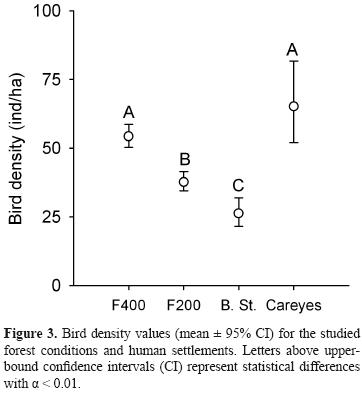
<body><![CDATA[<p align="justify"><font face="verdana" size="2">To compare the structure (dominance/evenness) of bird communities recorded at the different studied conditions, we used species rank/abundance plots (Whittaker plots; Magurran, 2004). We compared the slopes of the species rank/abundance plots using ANCOVA to contrast the dominance/evenness of the bird communities at different conditions, and to test whether the proportion of dominant and rare species differed significantly between conditions. As recommended by Magurran (2004), we log transformed the abundance data (log<sub>10</sub>). Each rank/abundance regression summarizes the abundance distribution of each studied bird community, and represents a single independent value. We also calculated the Shannon evenness measure (J'= H'/H<sub>max</sub>) to set a reference for our rank/abundance results.</font></p> 	    <p align="justify"><font face="verdana" size="2">Finally, as a way to describe the functional responses of local bird communities related to their use of urban systems, we classified the recorded bird species based on their presence using Blair's (1996) categories: <i>1)</i>, urban exploiters &#150; species found only in human settlements; <i>2)</i>, urban adapters &#150; species found in both human settlements and forest conditions, and <i>3)</i>, urban avoiders &#150; species found only in forest conditions.</font></p> 	    <p align="justify"><font face="verdana" size="2">&nbsp;</font></p> 	    <p align="justify"><font face="verdana" size="2"><b>Results</b></font></p> 	    <p align="justify"><font face="verdana" size="2">The proportion of recorded species in relation to the ACE (mean predicted value) was &gt; 73% in all cases, being highest in the Biology Station buildings (91%) and lowest in Careyes (73%). This indicates that our sampling effort was enough to record a representative sample of the local species that inhabited our study conditions at the surveyed space and time (<a href="/img/revistas/rmbiodiv/v83n2/html/a19a1.htm" target="_blank">Appendix 1</a>). Estimations of the ACE, based on our entire dataset, predicted a maximum of 121 non&#150;aquatic summer migrant and resident bird species for the studied conditions. This represents 77% of the 157 non&#150;aquatic summer migrant and resident bird species reported in the last 3 decades for the Chamela region (Arizmendi et al., 1990; J. H. Vega&#150;Rivera pers. comm.).</font></p> 	    <p align="justify"><font face="verdana" size="2">Species richness values were significantly higher in both forest conditions when compared to those from human settlements, showing no statistical differences within them (F400m: 29.3 &plusmn; 4.4 species; F200m: 25.6 &plusmn; 4.6 species). With contrastingly lower values than forests, bird species richness recorded in the Biology Station buildings (16 &plusmn; 1.9 species) did not show statistical differences in relation to the species richness from Careyes (12.9 &plusmn; 3.6; <a href="#f2">Fig. 2</a>). Bird density values also differed among the surveyed conditions. Although bird densities differed statistically between both well&#150;preserved forest conditions (F400m: 54.3 ind/ha, CI: 50.2&#150;58.6, EDR= 26 m, KF/SE= Uniform/Simple Polynomial; F200m: 37.7 ind/ha, CI: 34.3&#150;41.4, EDR= 25.6 m, KF/SE= Hazard&#150;rate/Coisine), both were significantly higher than those from the Biology Station buildings (26.22 ind/ha, CI: 21.5&#150;31.9, EDR= 26.2 m, KF/SE= Uniform/Simple Polynomial). However, bird densities recorded in Careyes (65.2 ind/ha, CI: 52.1&#150;81.7, EDR= 25 m, KF/SE= Uniform/Hermite Polynomial) were significantly higher when compared to those from the Biology Station buildings and F200m, but did not differ from those of F400m (<a href="#f3">Fig. 3</a>). Both forest communities were basically comprised by individuals of urban adapter species (76&#150;80%) and a few avoiders (20&#150;24%), while the Biology Station was solely comprised by urban adapters, and Careyes was basically comprised by urban exploiters (85%) (<a href="#f4">Fig. 4</a>).</font></p> 	    <p align="center"><font face="verdana" size="2"><a name="f2"></a></font></p> 	    <p align="center"><font face="verdana" size="2"><img src="/img/revistas/rmbiodiv/v83n2/a19f2.jpg"></font></p> 	    <p align="center"><font face="verdana" size="2"><a name="f3"></a></font></p> 	    <p align="center"><font face="verdana" size="2"><img src="/img/revistas/rmbiodiv/v83n2/a19f3.jpg"></font></p> 	    ]]></body>
<body><![CDATA[<p align="center"><font face="verdana" size="2"><a name="f4"></a></font></p> 	    <p align="center"><font face="verdana" size="2"><img src="/img/revistas/rmbiodiv/v83n2/a19f4.jpg"></font></p> 	    <p align="justify"><font face="verdana" size="2">The abundance&#150;based Bray&#150;Curtis multivariate cluster analysis revealed that both tropical dry forest conditions shared the highest proportion of bird community similarity (76% similarity). Bird communities from the 3 studied conditions within the biosphere reserve (i.e., F400m, F200m, Biology Station buildings) were more alike, clustered at 54% similarity, than those from Careyes, which showed higher similarity in relation to the Biology Station buildings (8% similarity). These results were consistent with the species turnover rates (1&#150;&#946;<sub>sim</sub>), showing that the most similar bird communities in relation to the farthest forest condition (F400m) were the Biology Station buildings (1&#150;&#946;<sub>sim</sub>= 1) and F200m (1&#150;&#946;<sub>sim</sub>= 0.86), while Careyes showed lower similarity in relation to the other studied conditions (1&#150;&#946;<sub>sim</sub>= 0.43). These results indicate that all species recorded at the Biology Station buildings were recorded in F400m. However, the bird community from Careyes only shared 43% of the comparable set of species, indicating that the decrease in species richness was not only due to species loss, but to the incorporation of new urban exploiter species.</font></p> 	    <p align="justify"><font face="verdana" size="2">Slopes from the rank/abundance plots differed among forest conditions and human settlements, revealing the existence of a gradient of levels of evenness in the studied bird communities. We found no statistical differences when compared the slopes of the 2 forest conditions (<i>F</i><sub>1,74</sub> = 0.69, <i>p=</i> 0.40). However, both forest conditions had bird communities that were more even than those from Careyes (F400m: <i>F</i><sub>1,54</sub> = 25.39, p&lt; 0.001; F200m: <i>F</i><sub>1,44</sub> = 23.91, <i>p </i>&lt; 0.001) and the Biology Station buildings (F400m: <i>F</i><sub>1,56</sub> = 6.94, <i>p=</i> 0.01; F200m: <i>F</i><sub>1,46</sub> = 6.07, <i>p=</i> 0.01). Finally, the regression lines from the rank/abundance plots for bird communities recorded in Careyes and the Biology Station buildings also showed significant differences (<i>F</i><sub>1,26 </sub>= 6.58, <i>p=</i> 0.01;<a href="#f5"> Fig. 5</a>). Similarly, Shannon evenness measures (H') were high in both forest conditions (F400m= 0.86, F200m= 0.85), lower in the Biology Station (0.83) and lowest in Careyes (0.75).</font></p> 	    <p align="center"><font face="verdana" size="2"><a name="f5"></a></font></p> 	    <p align="center"><font face="verdana" size="2"><img src="/img/revistas/rmbiodiv/v83n2/a19f5.jpg"></font></p> 	    <p align="justify"><font face="verdana" size="2">&nbsp;</font></p> 	    <p align="justify"><font face="verdana" size="2"><b>Discussion</b></font></p> 	    <p align="justify"><font face="verdana" size="2">This study provides evidence of bird communities shifts related to small&#150;sized human settlements, representing 2 early stages of urbanization, and the presence of urban exploiter species. Our results show that bird species richness decreases significantly when an area becomes urbanized, regardless of the presence&#150;absence of urban exploiter species (<a href="#f2">Fig. 2</a>). The loss of bird species richness related to urbanization has been reported in previous urban ecology studies that have evaluated the effect of larger human settlements on bird communities (see Chace and Walsh, 2006; Evans et al., 2009; MacGregor&#150;Fors et al., 2009 and references therein). These studies have shown that the impoverishment of bird communities due to urbanization is related to: <i>1)</i> shifts of in&#150;site habitat structure and composition (J&ouml;kimaki and Suhonen, 1998; Green and Baker, 2003; MacGregor&#150;Fors, 2008); <i>2)</i> human activity (Blair, 1996; Fern&aacute;ndez&#150;Juricic et al., 2001; Ortega&#150;&Aacute;lvarez and MacGregor&#150;Fors, 2009); <i>3)</i> the invasion of urban habitats by urban exploiter species (Shochat, 2004; Shochat et al., 2004; MacGregor&#150;Fors et al., 2010); <i>4)</i> greater habitat fragmentation found in urban areas (Marzluff, 2005), and <i>5)</i> potential changes in predation risk (Evans, 2004; L&oacute;pez&#150;Flores et al., 2009). However, little is known on the relative role of these factors. In our study, Careyes and the Biology Station buildings had significantly lower species richness than both forest conditions (F400m, F200m). We suggest that habitat modification per se plays a crucial role in the loss of bird species related to urbanization.</font></p> 	    <p align="justify"><font face="verdana" size="2">Bird densities responded to a gradient of human disturbance and habitat conditions among the studied conditions. When we compared bird densities considering F400m as a well&#150;preserved forest control, bird densities decreased significantly as we moved towards the Biology Station buildings (<a href="#f3">Fig. 3</a>). We believe that this is the result of human activities reducing habitat quality for forest birds and the absence of urban exploiter species in the Biology Station buildings (Reijnen and Foppen, 1994; Chace and Walsh, 2006; Evans et al., 2009; MacGregor&#150;Fors et al., 2009). Although we did not find different bird densities between Careyes and F400m, Careyes had mean bird densities that were higher than the upper&#150;bound 95% confidence intervals of F400m. This is consistent with results from previous studies that show increases in bird density with urbanization (see Chace and Walsh, 2006; Evans et al., 2009; MacGregor&#150;Fors et al., 2009, and references therein). Similarly to what has been proposed by Shochat (2004), our results suggest that when urban exploiter species are present, the quality and quantity of available resources can determine bird densities in urban areas.</font></p> 	    ]]></body>
<body><![CDATA[<p align="justify"><font face="verdana" size="2">Additionally, bird density values from Careyes showed broad 95% confidence intervals, while both forest conditions and the Biology Station building area did not, sharing highly similar ones. Our data suggest that this difference was caused by the presence and density of urban exploiter species. Some of these species tend to have clumped distributions that increase the variation in density estimations. Particularly, wide 95% confidence intervals of the density values at Careyes seem to be caused by 2 bird species: House Sparrows (<i>Passer domesticus</i>) and Barn Swallows (<i>Hirundo rustica</i>). These species, considered urban exploiters in other Mexican regions (Nocedal, 1987; Cupul&#150;Maga&ntilde;a, 1996; MacGregor&#150;Fors, 2005; MacGregor&#150;Fors et al., 2010) and different parts of the world (Blair, 1996; McKinney, 2002; Kark et al., 2007), comprised 53% of the total bird recordings in Careyes.</font></p> 	    <p align="justify"><font face="verdana" size="2">Bird communities showed to be highly even in both forest conditions. As expected for urbanized sites, the Biology Station building area and Careyes showed non&#150;even bird communities. However, the lack of evenness of the bird communities from Careyes was due to the presence and density of a few urban exploiter species (Clergeau et al., 2006; McKinney, 2006; Kark et al., 2007; MacGregor&#150;Fors et al., 2010). The bird community recorded at the Biology Station buildings was comprised entirely by tropical dry forest&#150;dwelling species that could be cataloged as urban adaptable, indicating the existence of a subset of forest species that are able to withstand dramatic changes in habitat structure and human activity levels. This is similar to the patterns reported by Staniforth (2002), where waterfowl and passerine birds associated with natural undisturbed habitats, in the absence of urban exploiter species, take advantage of the new conditions created by the development of human settlements. The existence of a subset of bird species that are able to tolerate the disturbance caused by human settlements as part of well&#150;preserved tropical dry forest bird communities in our study could be the result of an adaptation to the regime of natural disturbance experienced by this habitat that is commonly affected by hurricanes (Garc&iacute;a&#150;Oliva et al., 2002; Maass et al., 2002).</font></p> 	    <p align="justify"><font face="verdana" size="2">In sum, our results suggest that when an area becomes urbanized, changes in habitat structure generate a significant loss in bird species richness by selecting those species that can inhabit the new urban condition from the local pool of species. Also, this study gives evidence that the initial dramatic loss of bird species is not generated by the arrival of urban exploiter species in our study area. Subsequent changes in human settlement size, the reduction of natural habitats surrounding the settlement, and the location nearby roads associated to agricultural practices allow the arrival of urban exploiter species, and therefore generate changes in bird community composition and structure. Thus, understanding the negative impacts that small&#150;sized urbanized areas can have on bird communities is crucial to generate urban habitats with characteristics that make them compatible to birds and other wildlife species, following the conceptual framework of reconciliation ecology (Rosenzweig, 2003).</font></p> 	    <p align="justify"><font face="verdana" size="2">&nbsp;</font></p> 	    <p align="justify"><font face="verdana" size="2"><b>Acknowledgements</b></font></p> 	    <p align="justify"><font face="verdana" size="2">We thank Enrique Arbel&aacute;ez for assistance in the field, Katherine Renton and Carlos Mu&ntilde;&oacute;z&#150;Robles for their valuable comments on our manuscript, and the Estaci&oacute;n de Biolog&iacute;a Chamela (IBUNAM) for allowing us to carry out part of our research within the limits of the Reserva de la Biosfera Chamela&#150;Cuixmala. This project was performed as part of the "Curso te&oacute;rico&#150;pr&aacute;ctico de ecolog&iacute;a poblacional de aves" funded by the Posgrado en Ciencias Biol&oacute;gicas of the Universidad Nacional Aut&oacute;noma de M&eacute;xico. IM&#150;F, being part of the Posgrado en Ciencias Biol&oacute;gicas of the Universidad Nacional Aut&oacute;noma de M&eacute;xico, received a Ph. D. scholarship from CONACYT (175447).</font></p> 	    <p align="justify"><font face="verdana" size="2">&nbsp;</font></p> 	    <p align="justify"><font face="verdana" size="2"><b>Literature cited</b></font></p> 	    <!-- ref --><p align="justify"><font face="verdana" size="2">Acevedo, W., L. R. Richards and J. T. Buchanan. 1999. Analyzing land use change in urban environments. USGS Fact Sheet 188:99.    &nbsp;&nbsp;&nbsp;&nbsp;&nbsp;&nbsp;&nbsp;&nbsp;[&#160;<a href="javascript:void(0);" onclick="javascript: window.open('/scielo.php?script=sci_nlinks&ref=7563835&pid=S1870-3453201200020001900001&lng=','','width=640,height=500,resizable=yes,scrollbars=1,menubar=yes,');">Links</a>&#160;]<!-- end-ref --></font></p> 	    ]]></body>
<body><![CDATA[<!-- ref --><p align="justify"><font face="verdana" size="2">Alldredge, M. W., K. H. Pollok, T. R. Simons and S. A. Shriner. 2007. Multiple&#150;species analysis of point count data: A more parsimonious modeling framework. Journal of Applied Ecology 44:281&#150;290.    &nbsp;&nbsp;&nbsp;&nbsp;&nbsp;&nbsp;&nbsp;&nbsp;[&#160;<a href="javascript:void(0);" onclick="javascript: window.open('/scielo.php?script=sci_nlinks&ref=7563837&pid=S1870-3453201200020001900002&lng=','','width=640,height=500,resizable=yes,scrollbars=1,menubar=yes,');">Links</a>&#160;]<!-- end-ref --></font></p> 	    <!-- ref --><p align="justify"><font face="verdana" size="2">Andersson, E. 2006. Urban landscapes and sustainable cities. Ecology and Society 11:34.    &nbsp;&nbsp;&nbsp;&nbsp;&nbsp;&nbsp;&nbsp;&nbsp;[&#160;<a href="javascript:void(0);" onclick="javascript: window.open('/scielo.php?script=sci_nlinks&ref=7563839&pid=S1870-3453201200020001900003&lng=','','width=640,height=500,resizable=yes,scrollbars=1,menubar=yes,');">Links</a>&#160;]<!-- end-ref --></font></p> 	    <!-- ref --><p align="justify"><font face="verdana" size="2">AOU (American Ornithologist' Union). 1998. The A.O.U. check&#150;list of North American birds. American Ornithologists' Union, Washington, D. C. p. 829.    &nbsp;&nbsp;&nbsp;&nbsp;&nbsp;&nbsp;&nbsp;&nbsp;[&#160;<a href="javascript:void(0);" onclick="javascript: window.open('/scielo.php?script=sci_nlinks&ref=7563841&pid=S1870-3453201200020001900004&lng=','','width=640,height=500,resizable=yes,scrollbars=1,menubar=yes,');">Links</a>&#160;]<!-- end-ref --></font></p> 	    <!-- ref --><p align="justify"><font face="verdana" size="2">Arizmendi, M. C., H. Berlanga, L. M&aacute;rquez&#150;Valdemar, L. Navarijo and F. Ornelas. 1990. Avifauna de la regi&oacute;n de Chamela, Jalisco. Cuadernos del Instituto de Biolog&iacute;a, M&eacute;xico, D. F. p. 62.    &nbsp;&nbsp;&nbsp;&nbsp;&nbsp;&nbsp;&nbsp;&nbsp;[&#160;<a href="javascript:void(0);" onclick="javascript: window.open('/scielo.php?script=sci_nlinks&ref=7563843&pid=S1870-3453201200020001900005&lng=','','width=640,height=500,resizable=yes,scrollbars=1,menubar=yes,');">Links</a>&#160;]<!-- end-ref --></font></p> 	    <!-- ref --><p align="justify"><font face="verdana" size="2">Beissinger, S. R. and D. R. Osborne. 1982. Effects of urbanization on avian community organization. The Condor 84:75&#150;83.    &nbsp;&nbsp;&nbsp;&nbsp;&nbsp;&nbsp;&nbsp;&nbsp;[&#160;<a href="javascript:void(0);" onclick="javascript: window.open('/scielo.php?script=sci_nlinks&ref=7563845&pid=S1870-3453201200020001900006&lng=','','width=640,height=500,resizable=yes,scrollbars=1,menubar=yes,');">Links</a>&#160;]<!-- end-ref --></font></p> 	    ]]></body>
<body><![CDATA[<!-- ref --><p align="justify"><font face="verdana" size="2">Bibby, C. J., N. D. Burgess, D. A. Hill and S. Mustoe. 2000. Bird census techniques. Academic Press, London. p. 350.    &nbsp;&nbsp;&nbsp;&nbsp;&nbsp;&nbsp;&nbsp;&nbsp;[&#160;<a href="javascript:void(0);" onclick="javascript: window.open('/scielo.php?script=sci_nlinks&ref=7563847&pid=S1870-3453201200020001900007&lng=','','width=640,height=500,resizable=yes,scrollbars=1,menubar=yes,');">Links</a>&#160;]<!-- end-ref --></font></p> 	    <!-- ref --><p align="justify"><font face="verdana" size="2">Bierwagen, B. G. 2007. Connectivity in urbanizing landscapes: The importance of habitat configuration, urban area size, and dispersal. Urban Ecosystems 10:29&#150;42.    &nbsp;&nbsp;&nbsp;&nbsp;&nbsp;&nbsp;&nbsp;&nbsp;[&#160;<a href="javascript:void(0);" onclick="javascript: window.open('/scielo.php?script=sci_nlinks&ref=7563849&pid=S1870-3453201200020001900008&lng=','','width=640,height=500,resizable=yes,scrollbars=1,menubar=yes,');">Links</a>&#160;]<!-- end-ref --></font></p> 	    <!-- ref --><p align="justify"><font face="verdana" size="2">Blair, R. B. 1996. Land use and avian species diversity along an urban gradient. Ecological Applications 6:506&#150;519.    &nbsp;&nbsp;&nbsp;&nbsp;&nbsp;&nbsp;&nbsp;&nbsp;[&#160;<a href="javascript:void(0);" onclick="javascript: window.open('/scielo.php?script=sci_nlinks&ref=7563851&pid=S1870-3453201200020001900009&lng=','','width=640,height=500,resizable=yes,scrollbars=1,menubar=yes,');">Links</a>&#160;]<!-- end-ref --></font></p> 	    <!-- ref --><p align="justify"><font face="verdana" size="2">Buckland, S. T., D. R. Anderson, K. P. Burnham, J. L. Laake, D. L. Borchers and L. Thomas. 2001. Introduction to distance sampling. Oxford University Press, Oxford. p. 448.    &nbsp;&nbsp;&nbsp;&nbsp;&nbsp;&nbsp;&nbsp;&nbsp;[&#160;<a href="javascript:void(0);" onclick="javascript: window.open('/scielo.php?script=sci_nlinks&ref=7563853&pid=S1870-3453201200020001900010&lng=','','width=640,height=500,resizable=yes,scrollbars=1,menubar=yes,');">Links</a>&#160;]<!-- end-ref --></font></p> 	    <!-- ref --><p align="justify"><font face="verdana" size="2">Buckland, S. T., D. R. Anderson, K. P. Burnham, J. L. Laake, D. L. Borchers and L. Thomas. 2004. Advanced distance sampling. Oxford University Press, Oxford. p. 416.    &nbsp;&nbsp;&nbsp;&nbsp;&nbsp;&nbsp;&nbsp;&nbsp;[&#160;<a href="javascript:void(0);" onclick="javascript: window.open('/scielo.php?script=sci_nlinks&ref=7563855&pid=S1870-3453201200020001900011&lng=','','width=640,height=500,resizable=yes,scrollbars=1,menubar=yes,');">Links</a>&#160;]<!-- end-ref --></font></p> 	    ]]></body>
<body><![CDATA[<!-- ref --><p align="justify"><font face="verdana" size="2">Castillo, A., A. Maga&ntilde;a, A. Pujadas, L. Mart&iacute;nez and C. God&iacute;nez. 2005. Understanding the interaction of rural people with ecosystems: A case study in a tropical dry forest of Mexico. Ecosystems 8:630&#150;643.    &nbsp;&nbsp;&nbsp;&nbsp;&nbsp;&nbsp;&nbsp;&nbsp;[&#160;<a href="javascript:void(0);" onclick="javascript: window.open('/scielo.php?script=sci_nlinks&ref=7563857&pid=S1870-3453201200020001900012&lng=','','width=640,height=500,resizable=yes,scrollbars=1,menubar=yes,');">Links</a>&#160;]<!-- end-ref --></font></p> 	    <!-- ref --><p align="justify"><font face="verdana" size="2">Chace, J. F. and J. J. Walsh. 2006. Urban effects on native avifauna: a review. Landscape and Urban Planning 74:46&#150;69.    &nbsp;&nbsp;&nbsp;&nbsp;&nbsp;&nbsp;&nbsp;&nbsp;[&#160;<a href="javascript:void(0);" onclick="javascript: window.open('/scielo.php?script=sci_nlinks&ref=7563859&pid=S1870-3453201200020001900013&lng=','','width=640,height=500,resizable=yes,scrollbars=1,menubar=yes,');">Links</a>&#160;]<!-- end-ref --></font></p> 	    <!-- ref --><p align="justify"><font face="verdana" size="2">Chao, A. and S. M. Lee. 1992. Estimating the number of classes via sample coverage. Journal of the American Statistical Association 87:210&#150;217.    &nbsp;&nbsp;&nbsp;&nbsp;&nbsp;&nbsp;&nbsp;&nbsp;[&#160;<a href="javascript:void(0);" onclick="javascript: window.open('/scielo.php?script=sci_nlinks&ref=7563861&pid=S1870-3453201200020001900014&lng=','','width=640,height=500,resizable=yes,scrollbars=1,menubar=yes,');">Links</a>&#160;]<!-- end-ref --></font></p> 	    <!-- ref --><p align="justify"><font face="verdana" size="2">Chao, A. and T. J. Shen. 2006. Program SPADE (Species Prediction and Diversity Estimation). Version 3.1. <a href="http://chao.stat.nthu.edu.tw/softwareCE.html" target="_blank">http://chao.stat.nthu.edu.tw/softwareCE.html</a>; last access: 7.VII.2011.    &nbsp;&nbsp;&nbsp;&nbsp;&nbsp;&nbsp;&nbsp;&nbsp;[&#160;<a href="javascript:void(0);" onclick="javascript: window.open('/scielo.php?script=sci_nlinks&ref=7563863&pid=S1870-3453201200020001900015&lng=','','width=640,height=500,resizable=yes,scrollbars=1,menubar=yes,');">Links</a>&#160;]<!-- end-ref --></font></p> 	    <!-- ref --><p align="justify"><font face="verdana" size="2">Chesser, R. T., R. C. Banks, F. K. Barker, C. Cicero, J. L. Dunn, A. W. Kratter, I. J. Lovette, P. C. Ramussen, J. V. Remsen, J. D. Rising, D. F. Stotz and K. Winker. 2011. Fifty&#150;second supplement to the American ornithologists' union check&#150;list of North American birds. The Auk 128:600&#150;613.    &nbsp;&nbsp;&nbsp;&nbsp;&nbsp;&nbsp;&nbsp;&nbsp;[&#160;<a href="javascript:void(0);" onclick="javascript: window.open('/scielo.php?script=sci_nlinks&ref=7563865&pid=S1870-3453201200020001900016&lng=','','width=640,height=500,resizable=yes,scrollbars=1,menubar=yes,');">Links</a>&#160;]<!-- end-ref --></font></p> 	    ]]></body>
<body><![CDATA[<!-- ref --><p align="justify"><font face="verdana" size="2">Clergeau, P., J. Jokim&auml;ki and R. Snep. 2006. Using hierarchical levels for urban ecology. Trends in Ecology &amp; Evolution 21:660&#150;661.    &nbsp;&nbsp;&nbsp;&nbsp;&nbsp;&nbsp;&nbsp;&nbsp;[&#160;<a href="javascript:void(0);" onclick="javascript: window.open('/scielo.php?script=sci_nlinks&ref=7563867&pid=S1870-3453201200020001900017&lng=','','width=640,height=500,resizable=yes,scrollbars=1,menubar=yes,');">Links</a>&#160;]<!-- end-ref --></font></p> 	    <!-- ref --><p align="justify"><font face="verdana" size="2">Clergeau, P., J. P. L. Savard, G. Mennechez and G. Falardeau. 1998. Bird abundance and diversity along an urban&#150;rural gradient: a comparative study between two cities on different continents. The Condor 100:413&#150;425.    &nbsp;&nbsp;&nbsp;&nbsp;&nbsp;&nbsp;&nbsp;&nbsp;[&#160;<a href="javascript:void(0);" onclick="javascript: window.open('/scielo.php?script=sci_nlinks&ref=7563869&pid=S1870-3453201200020001900018&lng=','','width=640,height=500,resizable=yes,scrollbars=1,menubar=yes,');">Links</a>&#160;]<!-- end-ref --></font></p> 	    <!-- ref --><p align="justify"><font face="verdana" size="2">Colwell, R. K. 2009. EstimateS: Statistical estimation of species richness and shared species from samples. Version 8.2. <a href="http://purl.oclc.org/estimates" target="_blank">http://purl.oclc.org/estimates</a>; last access: 8.XII.2011.    &nbsp;&nbsp;&nbsp;&nbsp;&nbsp;&nbsp;&nbsp;&nbsp;[&#160;<a href="javascript:void(0);" onclick="javascript: window.open('/scielo.php?script=sci_nlinks&ref=7563871&pid=S1870-3453201200020001900019&lng=','','width=640,height=500,resizable=yes,scrollbars=1,menubar=yes,');">Links</a>&#160;]<!-- end-ref --></font></p> 	    <!-- ref --><p align="justify"><font face="verdana" size="2">Cupul&#150;Maga&ntilde;a, F. G. 1996. Incidencia de avifauna en un parque urbano de los Mochis, Sinaloa, Mexico. Ciencia ergo sum 3:193&#150;200.    &nbsp;&nbsp;&nbsp;&nbsp;&nbsp;&nbsp;&nbsp;&nbsp;[&#160;<a href="javascript:void(0);" onclick="javascript: window.open('/scielo.php?script=sci_nlinks&ref=7563873&pid=S1870-3453201200020001900020&lng=','','width=640,height=500,resizable=yes,scrollbars=1,menubar=yes,');">Links</a>&#160;]<!-- end-ref --></font></p> 	    <!-- ref --><p align="justify"><font face="verdana" size="2">Danielson, W. R., R. M. DeGraff and T. K. Fuller. 1997. Rural and suburban forest edges: Effect on egg predators and nest predation rates. Landscape and Urban Planning 38:25&#150;36.    &nbsp;&nbsp;&nbsp;&nbsp;&nbsp;&nbsp;&nbsp;&nbsp;[&#160;<a href="javascript:void(0);" onclick="javascript: window.open('/scielo.php?script=sci_nlinks&ref=7563875&pid=S1870-3453201200020001900021&lng=','','width=640,height=500,resizable=yes,scrollbars=1,menubar=yes,');">Links</a>&#160;]<!-- end-ref --></font></p> 	    ]]></body>
<body><![CDATA[<!-- ref --><p align="justify"><font face="verdana" size="2">Dur&aacute;n, E., P. Balvanera, E. Lott, G. Segura, A. P&eacute;rez&#150;Jim&eacute;nez, A. Islas and M. Franco. 2002. Estructura, composici&oacute;n y din&aacute;mica de la vegetaci&oacute;n. In Historia natural de Chamela, F. A. Noguera, J. H. Vega&#150;Rivera, A. N. Garc&iacute;a&#150;Aldrete and M. Quesada&#150;Avenda&ntilde;o (eds.). Instituto de Biolog&iacute;a, UNAM, M&eacute;xico, D. F. p. 443&#150;472.    &nbsp;&nbsp;&nbsp;&nbsp;&nbsp;&nbsp;&nbsp;&nbsp;[&#160;<a href="javascript:void(0);" onclick="javascript: window.open('/scielo.php?script=sci_nlinks&ref=7563877&pid=S1870-3453201200020001900022&lng=','','width=640,height=500,resizable=yes,scrollbars=1,menubar=yes,');">Links</a>&#160;]<!-- end-ref --></font></p> 	    <!-- ref --><p align="justify"><font face="verdana" size="2">Emlen, J. T. 1974. An urban bird community in Tucson, Arizona: Derivation, structure, regulation. The Condor 76:184&#150;197.    &nbsp;&nbsp;&nbsp;&nbsp;&nbsp;&nbsp;&nbsp;&nbsp;[&#160;<a href="javascript:void(0);" onclick="javascript: window.open('/scielo.php?script=sci_nlinks&ref=7563879&pid=S1870-3453201200020001900023&lng=','','width=640,height=500,resizable=yes,scrollbars=1,menubar=yes,');">Links</a>&#160;]<!-- end-ref --></font></p> 	    <!-- ref --><p align="justify"><font face="verdana" size="2">Evans, K. L., S. E. Newson and K. J. Gaston. 2009. Habitat influences on urban avian assemblages. Ibis 151:19&#150;39.    &nbsp;&nbsp;&nbsp;&nbsp;&nbsp;&nbsp;&nbsp;&nbsp;[&#160;<a href="javascript:void(0);" onclick="javascript: window.open('/scielo.php?script=sci_nlinks&ref=7563881&pid=S1870-3453201200020001900024&lng=','','width=640,height=500,resizable=yes,scrollbars=1,menubar=yes,');">Links</a>&#160;]<!-- end-ref --></font></p> 	    <!-- ref --><p align="justify"><font face="verdana" size="2">Evans, K. L. 2004. A review of the potential for interactions between predation and habitat change to cause population declines of farmland birds. Ibis 146:1&#150;13.    &nbsp;&nbsp;&nbsp;&nbsp;&nbsp;&nbsp;&nbsp;&nbsp;[&#160;<a href="javascript:void(0);" onclick="javascript: window.open('/scielo.php?script=sci_nlinks&ref=7563883&pid=S1870-3453201200020001900025&lng=','','width=640,height=500,resizable=yes,scrollbars=1,menubar=yes,');">Links</a>&#160;]<!-- end-ref --></font></p> 	    <!-- ref --><p align="justify"><font face="verdana" size="2">Faeth, S. H., P. S. Warren, E. Shochat and W. A. Marussich. 2005. Trophic dynamics in urban communities. Bioscience 55:399&#150;407.    &nbsp;&nbsp;&nbsp;&nbsp;&nbsp;&nbsp;&nbsp;&nbsp;[&#160;<a href="javascript:void(0);" onclick="javascript: window.open('/scielo.php?script=sci_nlinks&ref=7563885&pid=S1870-3453201200020001900026&lng=','','width=640,height=500,resizable=yes,scrollbars=1,menubar=yes,');">Links</a>&#160;]<!-- end-ref --></font></p> 	    ]]></body>
<body><![CDATA[<!-- ref --><p align="justify"><font face="verdana" size="2">Fern&aacute;ndez&#150;Juricic, E., M. D. Jimenez and E. Lucas. 2001. Bird tolerance to human disturbance in urban parks of Madrid (Spain): management implications. In Avian conservation and ecology in an urbanizing world, J. M. Marzluff, R. Bowman and R. Donnely (eds.). Kluwer Academic, Boston. p. 259&#150;273.    &nbsp;&nbsp;&nbsp;&nbsp;&nbsp;&nbsp;&nbsp;&nbsp;[&#160;<a href="javascript:void(0);" onclick="javascript: window.open('/scielo.php?script=sci_nlinks&ref=7563887&pid=S1870-3453201200020001900027&lng=','','width=640,height=500,resizable=yes,scrollbars=1,menubar=yes,');">Links</a>&#160;]<!-- end-ref --></font></p> 	    <!-- ref --><p align="justify"><font face="verdana" size="2">Garc&iacute;a&#150;Oliva, F., A. Camou and J. M. Maass. 2002. El clima de la regi&oacute;n central de la costa del Pac&iacute;fico mexicano. In Historia natural de Chamela, F. A. Noguera, J. H. Vega&#150;Rivera, A. N. Garc&iacute;a&#150;Aldrete and M. Quesada&#150;Avenda&ntilde;o (eds.). Instituto de Biolog&iacute;a, UNAM, M&eacute;xico D. F. p. 3&#150;10.    &nbsp;&nbsp;&nbsp;&nbsp;&nbsp;&nbsp;&nbsp;&nbsp;[&#160;<a href="javascript:void(0);" onclick="javascript: window.open('/scielo.php?script=sci_nlinks&ref=7563889&pid=S1870-3453201200020001900028&lng=','','width=640,height=500,resizable=yes,scrollbars=1,menubar=yes,');">Links</a>&#160;]<!-- end-ref --></font></p> 	    <!-- ref --><p align="justify"><font face="verdana" size="2">Gaston, K. J., R. G. Davies, C. D. L. Orme, V. A. Olson, G. H. Thomas, T. S. Ding, P. C. Rasmussen, J. J. Lennon, P. M. Bennett, I. P. F. Owens and T. M. Blackburn. 2007. Spatial turnover in the global avifauna. Proceedings of the Royal Society B&#150;Biological Sciences 274:1567&#150;1574.    &nbsp;&nbsp;&nbsp;&nbsp;&nbsp;&nbsp;&nbsp;&nbsp;[&#160;<a href="javascript:void(0);" onclick="javascript: window.open('/scielo.php?script=sci_nlinks&ref=7563891&pid=S1870-3453201200020001900029&lng=','','width=640,height=500,resizable=yes,scrollbars=1,menubar=yes,');">Links</a>&#160;]<!-- end-ref --></font></p> 	    <!-- ref --><p align="justify"><font face="verdana" size="2">Gavareski, C. A. 1976. Relation of park size and vegetation to urban bird populations in Seattle, Washington. The Condor 78:375&#150;382.    &nbsp;&nbsp;&nbsp;&nbsp;&nbsp;&nbsp;&nbsp;&nbsp;[&#160;<a href="javascript:void(0);" onclick="javascript: window.open('/scielo.php?script=sci_nlinks&ref=7563893&pid=S1870-3453201200020001900030&lng=','','width=640,height=500,resizable=yes,scrollbars=1,menubar=yes,');">Links</a>&#160;]<!-- end-ref --></font></p> 	    <!-- ref --><p align="justify"><font face="verdana" size="2">Gotelli, N. J. and R. K. Colwell. 2001. Quantifying biodiversity: procedures and pitfalls in the measurement and comparison of species richness. Ecology Letters 4:379&#150;391.    &nbsp;&nbsp;&nbsp;&nbsp;&nbsp;&nbsp;&nbsp;&nbsp;[&#160;<a href="javascript:void(0);" onclick="javascript: window.open('/scielo.php?script=sci_nlinks&ref=7563895&pid=S1870-3453201200020001900031&lng=','','width=640,height=500,resizable=yes,scrollbars=1,menubar=yes,');">Links</a>&#160;]<!-- end-ref --></font></p> 	    ]]></body>
<body><![CDATA[<!-- ref --><p align="justify"><font face="verdana" size="2">Gratani, L. and L. Varone. 2007. Plant crown traits and carbon sequestration capability by Platanus hybrida Brot. in Rome. Landscape and Urban Planning 81:282&#150;286.    &nbsp;&nbsp;&nbsp;&nbsp;&nbsp;&nbsp;&nbsp;&nbsp;[&#160;<a href="javascript:void(0);" onclick="javascript: window.open('/scielo.php?script=sci_nlinks&ref=7563897&pid=S1870-3453201200020001900032&lng=','','width=640,height=500,resizable=yes,scrollbars=1,menubar=yes,');">Links</a>&#160;]<!-- end-ref --></font></p> 	    <!-- ref --><p align="justify"><font face="verdana" size="2">Green, D. M. and M. G. Baker. 2003. Urbanization impacts on habitat and bird communities in a Sonoran Desert ecosystem. Landscape and Urban Planning 63:225&#150;239.    &nbsp;&nbsp;&nbsp;&nbsp;&nbsp;&nbsp;&nbsp;&nbsp;[&#160;<a href="javascript:void(0);" onclick="javascript: window.open('/scielo.php?script=sci_nlinks&ref=7563899&pid=S1870-3453201200020001900033&lng=','','width=640,height=500,resizable=yes,scrollbars=1,menubar=yes,');">Links</a>&#160;]<!-- end-ref --></font></p> 	    <!-- ref --><p align="justify"><font face="verdana" size="2">Grussing, D. 1980. How to control house sparrows. Roseville Publishing House, California. p. 52.    &nbsp;&nbsp;&nbsp;&nbsp;&nbsp;&nbsp;&nbsp;&nbsp;[&#160;<a href="javascript:void(0);" onclick="javascript: window.open('/scielo.php?script=sci_nlinks&ref=7563901&pid=S1870-3453201200020001900034&lng=','','width=640,height=500,resizable=yes,scrollbars=1,menubar=yes,');">Links</a>&#160;]<!-- end-ref --></font></p> 	    <!-- ref --><p align="justify"><font face="verdana" size="2">INEGI (Instituto Nacional de Estad&iacute;stica Geograf&iacute;a e Inform&aacute;tica). 2005. II Conteo de poblaci&oacute;n y vivienda 2005. INEGI, Aguascalientes.    &nbsp;&nbsp;&nbsp;&nbsp;&nbsp;&nbsp;&nbsp;&nbsp;[&#160;<a href="javascript:void(0);" onclick="javascript: window.open('/scielo.php?script=sci_nlinks&ref=7563903&pid=S1870-3453201200020001900035&lng=','','width=640,height=500,resizable=yes,scrollbars=1,menubar=yes,');">Links</a>&#160;]<!-- end-ref --></font></p> 	    <!-- ref --><p align="justify"><font face="verdana" size="2">Jokim&auml;ki, J. and J. Suhonen. 1998. Distribution and habitat selection of wintering birds in urban environments. Landscape and Urban Planning 39:253&#150;263.    &nbsp;&nbsp;&nbsp;&nbsp;&nbsp;&nbsp;&nbsp;&nbsp;[&#160;<a href="javascript:void(0);" onclick="javascript: window.open('/scielo.php?script=sci_nlinks&ref=7563905&pid=S1870-3453201200020001900036&lng=','','width=640,height=500,resizable=yes,scrollbars=1,menubar=yes,');">Links</a>&#160;]<!-- end-ref --></font></p> 	    ]]></body>
<body><![CDATA[<!-- ref --><p align="justify"><font face="verdana" size="2">Kark, S., A. Iwaniuk, A. Schalimtzec and E. Banker. 2007. Living in the city: Can anyone become an "urban exploiter"? Journal of Biogeography 34:638&#150;651.    &nbsp;&nbsp;&nbsp;&nbsp;&nbsp;&nbsp;&nbsp;&nbsp;[&#160;<a href="javascript:void(0);" onclick="javascript: window.open('/scielo.php?script=sci_nlinks&ref=7563907&pid=S1870-3453201200020001900037&lng=','','width=640,height=500,resizable=yes,scrollbars=1,menubar=yes,');">Links</a>&#160;]<!-- end-ref --></font></p> 	    <!-- ref --><p align="justify"><font face="verdana" size="2">Koleff, P., K. J. Gaston and J. J. Lennon. 2003. Measuring beta diversity for presence&#150;absence data. Journal of Animal Ecology 72:367&#150;382.    &nbsp;&nbsp;&nbsp;&nbsp;&nbsp;&nbsp;&nbsp;&nbsp;[&#160;<a href="javascript:void(0);" onclick="javascript: window.open('/scielo.php?script=sci_nlinks&ref=7563909&pid=S1870-3453201200020001900038&lng=','','width=640,height=500,resizable=yes,scrollbars=1,menubar=yes,');">Links</a>&#160;]<!-- end-ref --></font></p> 	    <!-- ref --><p align="justify"><font face="verdana" size="2">Lennon, J. J., P. Koleff and J. J. D. Greenwood. 2001. The geographical structure of British bird distributions: Diversity, spatial turnover and scale. Journal of Animal Ecology 70:966&#150;979.    &nbsp;&nbsp;&nbsp;&nbsp;&nbsp;&nbsp;&nbsp;&nbsp;[&#160;<a href="javascript:void(0);" onclick="javascript: window.open('/scielo.php?script=sci_nlinks&ref=7563911&pid=S1870-3453201200020001900039&lng=','','width=640,height=500,resizable=yes,scrollbars=1,menubar=yes,');">Links</a>&#160;]<!-- end-ref --></font></p> 	    <!-- ref --><p align="justify"><font face="verdana" size="2">L&oacute;pez&#150;Flores, V., I. MacGregor&#150;Fors and J. E. Schondube. 2009. Artificial nest predation along a neotropical urban gradient. Landscape and Urban Planning 92:90&#150;95.    &nbsp;&nbsp;&nbsp;&nbsp;&nbsp;&nbsp;&nbsp;&nbsp;[&#160;<a href="javascript:void(0);" onclick="javascript: window.open('/scielo.php?script=sci_nlinks&ref=7563913&pid=S1870-3453201200020001900040&lng=','','width=640,height=500,resizable=yes,scrollbars=1,menubar=yes,');">Links</a>&#160;]<!-- end-ref --></font></p> 	    <!-- ref --><p align="justify"><font face="verdana" size="2">Maass, J. M., V. Jaramillo, A. Mart&iacute;nez&#150;Yr&iacute;zar, F. Garc&iacute;a&#150;Oliva, A. P&eacute;rez&#150;Jim&eacute;nez and J. Sarukh&aacute;n. 2002. Aspectos funcionales del ecosistema de selva baja caducifolia en Chamela, Jalisco. In Historia Natural de Chamela, F. A. Noguera, J. H. Vega&#150;Rivera, A. N. Garc&iacute;a&#150;Aldrete and M. Quesada&#150;Avenda&ntilde;o (eds.). Instituto de Biolog&iacute;a, UNAM, M&eacute;xico, D. F. p. 525&#150;542.    &nbsp;&nbsp;&nbsp;&nbsp;&nbsp;&nbsp;&nbsp;&nbsp;[&#160;<a href="javascript:void(0);" onclick="javascript: window.open('/scielo.php?script=sci_nlinks&ref=7563915&pid=S1870-3453201200020001900041&lng=','','width=640,height=500,resizable=yes,scrollbars=1,menubar=yes,');">Links</a>&#160;]<!-- end-ref --></font></p> 	    ]]></body>
<body><![CDATA[<!-- ref --><p align="justify"><font face="verdana" size="2">MacGregor&#150;Fors, I., L. Morales&#150;P&eacute;rez and J. Schondube. 2011. Does size really matter? Species&#150;area relationships in human settlements. Diversity and Distributions 17:112&#150;121.    &nbsp;&nbsp;&nbsp;&nbsp;&nbsp;&nbsp;&nbsp;&nbsp;[&#160;<a href="javascript:void(0);" onclick="javascript: window.open('/scielo.php?script=sci_nlinks&ref=7563917&pid=S1870-3453201200020001900042&lng=','','width=640,height=500,resizable=yes,scrollbars=1,menubar=yes,');">Links</a>&#160;]<!-- end-ref --></font></p> 	    <!-- ref --><p align="justify"><font face="verdana" size="2">MacGregor&#150;Fors, I., L. Morales&#150;P&eacute;rez, J. Quesada and J. E. Schondube. 2010. Relationship between the presence of house sparrows (Passer domesticus) and Neotropical bird community structure and diversity. Biological Invasions 12:87&#150;96.    &nbsp;&nbsp;&nbsp;&nbsp;&nbsp;&nbsp;&nbsp;&nbsp;[&#160;<a href="javascript:void(0);" onclick="javascript: window.open('/scielo.php?script=sci_nlinks&ref=7563919&pid=S1870-3453201200020001900043&lng=','','width=640,height=500,resizable=yes,scrollbars=1,menubar=yes,');">Links</a>&#160;]<!-- end-ref --></font></p> 	    <!-- ref --><p align="justify"><font face="verdana" size="2">MacGregor&#150;Fors, I., R. Ortega&#150;&Aacute;lvarez and J. E. Schondube. 2009. On the ecological quality of urban systems: an ornithological perspective. In Urban planning in the 21st century, D. S. Graber and K. A. Birmingham (eds.). Nova Science Publishing, New York. p. 51&#150;66.    &nbsp;&nbsp;&nbsp;&nbsp;&nbsp;&nbsp;&nbsp;&nbsp;[&#160;<a href="javascript:void(0);" onclick="javascript: window.open('/scielo.php?script=sci_nlinks&ref=7563921&pid=S1870-3453201200020001900044&lng=','','width=640,height=500,resizable=yes,scrollbars=1,menubar=yes,');">Links</a>&#160;]<!-- end-ref --></font></p> 	    <!-- ref --><p align="justify"><font face="verdana" size="2">MacGregor&#150;Fors, I. 2008. Relation between habitat attributes and bird richness in a western Mexico suburb. Landscape and Urban Planning 84:92&#150;98.    &nbsp;&nbsp;&nbsp;&nbsp;&nbsp;&nbsp;&nbsp;&nbsp;[&#160;<a href="javascript:void(0);" onclick="javascript: window.open('/scielo.php?script=sci_nlinks&ref=7563923&pid=S1870-3453201200020001900045&lng=','','width=640,height=500,resizable=yes,scrollbars=1,menubar=yes,');">Links</a>&#160;]<!-- end-ref --></font></p> 	    <!-- ref --><p align="justify"><font face="verdana" size="2">MacGregor&#150;Fors, I. 2005. Listado ornitol&oacute;gico del centro universitario de ciencias biol&oacute;gicas y agropecuarias, universidad de Guadalajara, Jalisco, M&eacute;xico: un espacio suburbano. Huitzil 6:1&#150;6.    &nbsp;&nbsp;&nbsp;&nbsp;&nbsp;&nbsp;&nbsp;&nbsp;[&#160;<a href="javascript:void(0);" onclick="javascript: window.open('/scielo.php?script=sci_nlinks&ref=7563925&pid=S1870-3453201200020001900046&lng=','','width=640,height=500,resizable=yes,scrollbars=1,menubar=yes,');">Links</a>&#160;]<!-- end-ref --></font></p> 	    ]]></body>
<body><![CDATA[<!-- ref --><p align="justify"><font face="verdana" size="2">Magurran, A. E. 2004. Measuring biological diversity. Blackwell Publishing, Oxford. p. 260.    &nbsp;&nbsp;&nbsp;&nbsp;&nbsp;&nbsp;&nbsp;&nbsp;[&#160;<a href="javascript:void(0);" onclick="javascript: window.open('/scielo.php?script=sci_nlinks&ref=7563927&pid=S1870-3453201200020001900047&lng=','','width=640,height=500,resizable=yes,scrollbars=1,menubar=yes,');">Links</a>&#160;]<!-- end-ref --></font></p> 	    <!-- ref --><p align="justify"><font face="verdana" size="2">Marzluff, J. M., R. Bowman and R. Donnely. 2001. A historical perspective on urban bird research: Trends, terms, and approaches. In Avian conservation and ecology in an urbanizing world, J. M. Marzluff, R. Bowman and R. Donnely (eds.). Kluwer Academic, Boston. p. 1&#150;17.    &nbsp;&nbsp;&nbsp;&nbsp;&nbsp;&nbsp;&nbsp;&nbsp;[&#160;<a href="javascript:void(0);" onclick="javascript: window.open('/scielo.php?script=sci_nlinks&ref=7563929&pid=S1870-3453201200020001900048&lng=','','width=640,height=500,resizable=yes,scrollbars=1,menubar=yes,');">Links</a>&#160;]<!-- end-ref --></font></p> 	    <!-- ref --><p align="justify"><font face="verdana" size="2">Marzluff, J. M. 2005. Island biogeography for an urbanizing world: how extinction and colonization may determine biological diversity in human&#150;dominated landscapes. Urban Ecosystems 8:157&#150;177.    &nbsp;&nbsp;&nbsp;&nbsp;&nbsp;&nbsp;&nbsp;&nbsp;[&#160;<a href="javascript:void(0);" onclick="javascript: window.open('/scielo.php?script=sci_nlinks&ref=7563931&pid=S1870-3453201200020001900049&lng=','','width=640,height=500,resizable=yes,scrollbars=1,menubar=yes,');">Links</a>&#160;]<!-- end-ref --></font></p> 	    <!-- ref --><p align="justify"><font face="verdana" size="2">McAleece, N. 1997. BioDiversity Professional. <a href="http://www.sams.ac.uk/research/software" target="_blank">http://www.sams.ac.uk/research/software</a>; last access: 7.VII.2011.    &nbsp;&nbsp;&nbsp;&nbsp;&nbsp;&nbsp;&nbsp;&nbsp;[&#160;<a href="javascript:void(0);" onclick="javascript: window.open('/scielo.php?script=sci_nlinks&ref=7563933&pid=S1870-3453201200020001900050&lng=','','width=640,height=500,resizable=yes,scrollbars=1,menubar=yes,');">Links</a>&#160;]<!-- end-ref --></font></p> 	    <!-- ref --><p align="justify"><font face="verdana" size="2">McKinney, M. L. 2008. Effects of urbanization on species richness: A review of plants and animals. Urban Ecosystems 11:161&#150;176.    &nbsp;&nbsp;&nbsp;&nbsp;&nbsp;&nbsp;&nbsp;&nbsp;[&#160;<a href="javascript:void(0);" onclick="javascript: window.open('/scielo.php?script=sci_nlinks&ref=7563935&pid=S1870-3453201200020001900051&lng=','','width=640,height=500,resizable=yes,scrollbars=1,menubar=yes,');">Links</a>&#160;]<!-- end-ref --></font></p> 	    ]]></body>
<body><![CDATA[<!-- ref --><p align="justify"><font face="verdana" size="2">McKinney, M. L. 2006. Urbanization as a major cause of biotic homogenization. Biological Conservation 127:247&#150;260.    &nbsp;&nbsp;&nbsp;&nbsp;&nbsp;&nbsp;&nbsp;&nbsp;[&#160;<a href="javascript:void(0);" onclick="javascript: window.open('/scielo.php?script=sci_nlinks&ref=7563937&pid=S1870-3453201200020001900052&lng=','','width=640,height=500,resizable=yes,scrollbars=1,menubar=yes,');">Links</a>&#160;]<!-- end-ref --></font></p> 	    <!-- ref --><p align="justify"><font face="verdana" size="2">McKinney, M. L. 2002. Urbanization, biodiversity and conservation. Bioscience 52:883&#150;890.    &nbsp;&nbsp;&nbsp;&nbsp;&nbsp;&nbsp;&nbsp;&nbsp;[&#160;<a href="javascript:void(0);" onclick="javascript: window.open('/scielo.php?script=sci_nlinks&ref=7563939&pid=S1870-3453201200020001900053&lng=','','width=640,height=500,resizable=yes,scrollbars=1,menubar=yes,');">Links</a>&#160;]<!-- end-ref --></font></p> 	    <!-- ref --><p align="justify"><font face="verdana" size="2">Melles, S., S. Glenn and K. Martin. 2003. Urban bird diversity and landscape complexity: Species&#150;environment associations along a multiscale habitat gradient. Conservation Ecology 7:5.    &nbsp;&nbsp;&nbsp;&nbsp;&nbsp;&nbsp;&nbsp;&nbsp;[&#160;<a href="javascript:void(0);" onclick="javascript: window.open('/scielo.php?script=sci_nlinks&ref=7563941&pid=S1870-3453201200020001900054&lng=','','width=640,height=500,resizable=yes,scrollbars=1,menubar=yes,');">Links</a>&#160;]<!-- end-ref --></font></p> 	    <!-- ref --><p align="justify"><font face="verdana" size="2">Moreno, C. E. 2001. M&eacute;todos para medir la biodiversidad. M&amp;T&#150;Manuales y Tesis SEA, Zaragoza. p. 84.    &nbsp;&nbsp;&nbsp;&nbsp;&nbsp;&nbsp;&nbsp;&nbsp;[&#160;<a href="javascript:void(0);" onclick="javascript: window.open('/scielo.php?script=sci_nlinks&ref=7563943&pid=S1870-3453201200020001900055&lng=','','width=640,height=500,resizable=yes,scrollbars=1,menubar=yes,');">Links</a>&#160;]<!-- end-ref --></font></p> 	    <!-- ref --><p align="justify"><font face="verdana" size="2">Nocedal, J. 1987. Las comunidades de p&aacute;jaros y su relaci&oacute;n con la urbanizaci&oacute;n en la ciudad de M&eacute;xico. In Aportes a la ecolog&iacute;a urbana de la ciudad de M&eacute;xico, E. Rapoport and I. R. L&oacute;pez&#150;Moreno (eds.). Limusa, M&eacute;xico, D. F. p. 73&#150;109.    &nbsp;&nbsp;&nbsp;&nbsp;&nbsp;&nbsp;&nbsp;&nbsp;[&#160;<a href="javascript:void(0);" onclick="javascript: window.open('/scielo.php?script=sci_nlinks&ref=7563945&pid=S1870-3453201200020001900056&lng=','','width=640,height=500,resizable=yes,scrollbars=1,menubar=yes,');">Links</a>&#160;]<!-- end-ref --></font></p> 	    ]]></body>
<body><![CDATA[<!-- ref --><p align="justify"><font face="verdana" size="2">Noguera, F. A., J. H. Vega&#150;Rivera and A. N. Garc&iacute;a&#150;Aldrete. 2002. Introducci&oacute;n. In Historia Natural de Chamela, F. A. Noguera, J. H. Vega&#150;Rivera, A. N. Garc&iacute;a&#150;Aldrete and M. Quesada&#150;Avenda&ntilde;o (eds.). Instituto de Biolog&iacute;a, UNAM, M&eacute;xico, D. F. p. 15&#150;21.    &nbsp;&nbsp;&nbsp;&nbsp;&nbsp;&nbsp;&nbsp;&nbsp;[&#160;<a href="javascript:void(0);" onclick="javascript: window.open('/scielo.php?script=sci_nlinks&ref=7563947&pid=S1870-3453201200020001900057&lng=','','width=640,height=500,resizable=yes,scrollbars=1,menubar=yes,');">Links</a>&#160;]<!-- end-ref --></font></p> 	    <!-- ref --><p align="justify"><font face="verdana" size="2">Ortega&#150;&Aacute;lvarez, R. and I. MacGregor&#150;Fors. 2009. Living in the big city: Effects of urban land&#150;use on bird community structure, diversity, and composition. Landscape and Urban Planning 90:189&#150;195.    &nbsp;&nbsp;&nbsp;&nbsp;&nbsp;&nbsp;&nbsp;&nbsp;[&#160;<a href="javascript:void(0);" onclick="javascript: window.open('/scielo.php?script=sci_nlinks&ref=7563949&pid=S1870-3453201200020001900058&lng=','','width=640,height=500,resizable=yes,scrollbars=1,menubar=yes,');">Links</a>&#160;]<!-- end-ref --></font></p> 	    <!-- ref --><p align="justify"><font face="verdana" size="2">Payton, M. E., M. H. Greenstone and N. Schenker. 2003. Overlapping confidence intervals or standard error intervals: What do they mean in terms of statistical significance? Journal of Insect Science 3:34.    &nbsp;&nbsp;&nbsp;&nbsp;&nbsp;&nbsp;&nbsp;&nbsp;[&#160;<a href="javascript:void(0);" onclick="javascript: window.open('/scielo.php?script=sci_nlinks&ref=7563951&pid=S1870-3453201200020001900059&lng=','','width=640,height=500,resizable=yes,scrollbars=1,menubar=yes,');">Links</a>&#160;]<!-- end-ref --></font></p> 	    <!-- ref --><p align="justify"><font face="verdana" size="2">Ralph, C. J., G. R. Geupel, P. Pyle, T. E. Martin and D. F. DeSante. 1996. Handbook of field methods for monitoring landbirds. U.S. Department of Agriculture, Forest Service, Pacific Southwest Research Station. Gen. Tech. Rep. PSW&#150;GTR&#150;144, Albany. p. 41.    &nbsp;&nbsp;&nbsp;&nbsp;&nbsp;&nbsp;&nbsp;&nbsp;[&#160;<a href="javascript:void(0);" onclick="javascript: window.open('/scielo.php?script=sci_nlinks&ref=7563953&pid=S1870-3453201200020001900060&lng=','','width=640,height=500,resizable=yes,scrollbars=1,menubar=yes,');">Links</a>&#160;]<!-- end-ref --></font></p> 	    <!-- ref --><p align="justify"><font face="verdana" size="2">Reijnen, R. and R. Foppen. 1994. The effects of car traffic on breeding bird populations in Woodland. I. Evidence of reduced habitat quality for willow warblers (<i>Phylloscopus trochilus</i>) breeding close to a highway. Journal of Applied Ecology 31:85&#150;94.    &nbsp;&nbsp;&nbsp;&nbsp;&nbsp;&nbsp;&nbsp;&nbsp;[&#160;<a href="javascript:void(0);" onclick="javascript: window.open('/scielo.php?script=sci_nlinks&ref=7563955&pid=S1870-3453201200020001900061&lng=','','width=640,height=500,resizable=yes,scrollbars=1,menubar=yes,');">Links</a>&#160;]<!-- end-ref --></font></p> 	    ]]></body>
<body><![CDATA[<!-- ref --><p align="justify"><font face="verdana" size="2">Rosenzweig, M. L. 2003. Win&#150;win ecology: How the earth's species can survive in the midst of human enterprise. Oxford University Press, Oxford. p. 224.    &nbsp;&nbsp;&nbsp;&nbsp;&nbsp;&nbsp;&nbsp;&nbsp;[&#160;<a href="javascript:void(0);" onclick="javascript: window.open('/scielo.php?script=sci_nlinks&ref=7563957&pid=S1870-3453201200020001900062&lng=','','width=640,height=500,resizable=yes,scrollbars=1,menubar=yes,');">Links</a>&#160;]<!-- end-ref --></font></p> 	    <!-- ref --><p align="justify"><font face="verdana" size="2">Shochat, E. 2004. Credit or debit? Resource input changes population dynamics of city&#150;slicker birds Oikos 106:622&#150;626.    &nbsp;&nbsp;&nbsp;&nbsp;&nbsp;&nbsp;&nbsp;&nbsp;[&#160;<a href="javascript:void(0);" onclick="javascript: window.open('/scielo.php?script=sci_nlinks&ref=7563959&pid=S1870-3453201200020001900063&lng=','','width=640,height=500,resizable=yes,scrollbars=1,menubar=yes,');">Links</a>&#160;]<!-- end-ref --></font></p> 	    <!-- ref --><p align="justify"><font face="verdana" size="2">Shochat, E., S. B. Lerman, M. Katti and D. B. Lewis. 2004. Linking optimal foraging behavior to bird community structure in an urban&#150;desert landscape: field experiments with artificial food patches. American Naturalist 164:232&#150;243.    &nbsp;&nbsp;&nbsp;&nbsp;&nbsp;&nbsp;&nbsp;&nbsp;[&#160;<a href="javascript:void(0);" onclick="javascript: window.open('/scielo.php?script=sci_nlinks&ref=7563961&pid=S1870-3453201200020001900064&lng=','','width=640,height=500,resizable=yes,scrollbars=1,menubar=yes,');">Links</a>&#160;]<!-- end-ref --></font></p> 	    <!-- ref --><p align="justify"><font face="verdana" size="2">Simon, U., S. K&uuml;bler and J. B&ouml;hner. 2007. Analysis of breeding bird communities along an urban&#150;rural gradient in Berlin, Germany, by Hasse Diagram Technique Urban Ecosystems 10:17&#150;28.    &nbsp;&nbsp;&nbsp;&nbsp;&nbsp;&nbsp;&nbsp;&nbsp;[&#160;<a href="javascript:void(0);" onclick="javascript: window.open('/scielo.php?script=sci_nlinks&ref=7563963&pid=S1870-3453201200020001900065&lng=','','width=640,height=500,resizable=yes,scrollbars=1,menubar=yes,');">Links</a>&#160;]<!-- end-ref --></font></p> 	    <!-- ref --><p align="justify"><font face="verdana" size="2">Staniforth, R. J. 2002. Effects of urbanization on bird populations in the Canadian Central Actic. Arctic 55:87&#150;93.    &nbsp;&nbsp;&nbsp;&nbsp;&nbsp;&nbsp;&nbsp;&nbsp;[&#160;<a href="javascript:void(0);" onclick="javascript: window.open('/scielo.php?script=sci_nlinks&ref=7563965&pid=S1870-3453201200020001900066&lng=','','width=640,height=500,resizable=yes,scrollbars=1,menubar=yes,');">Links</a>&#160;]<!-- end-ref --></font></p> 	    ]]></body>
<body><![CDATA[<!-- ref --><p align="justify"><font face="verdana" size="2">Thomas, L., S. T. Buckland, E. A. Rexstad, J. L. Laake, S. Strindberg, S. L. Hedley, J. R. B. Bishop, T. A. Marques and K. P. Burnham. 2010. Distance software: Design and analysis of distance sampling surveys for estimating population size. Journal of Applied Ecology 47:5&#150;14.    &nbsp;&nbsp;&nbsp;&nbsp;&nbsp;&nbsp;&nbsp;&nbsp;[&#160;<a href="javascript:void(0);" onclick="javascript: window.open('/scielo.php?script=sci_nlinks&ref=7563967&pid=S1870-3453201200020001900067&lng=','','width=640,height=500,resizable=yes,scrollbars=1,menubar=yes,');">Links</a>&#160;]<!-- end-ref --></font></p> 	    <!-- ref --><p align="justify"><font face="verdana" size="2">Vega&#150;Rivera, J. H. 2007. The Biological Station of Chamela: A privileged site for research. Tropinet 18:5.    &nbsp;&nbsp;&nbsp;&nbsp;&nbsp;&nbsp;&nbsp;&nbsp;[&#160;<a href="javascript:void(0);" onclick="javascript: window.open('/scielo.php?script=sci_nlinks&ref=7563969&pid=S1870-3453201200020001900068&lng=','','width=640,height=500,resizable=yes,scrollbars=1,menubar=yes,');">Links</a>&#160;]<!-- end-ref --></font></p> 	    <!-- ref --><p align="justify"><font face="verdana" size="2">Yaukey, P. H. 1996. Patterns of avian population density, habitat use, and flocking behavior in urban and rural habitats during winter. Professional Geographer 48:70&#150;81.    &nbsp;&nbsp;&nbsp;&nbsp;&nbsp;&nbsp;&nbsp;&nbsp;[&#160;<a href="javascript:void(0);" onclick="javascript: window.open('/scielo.php?script=sci_nlinks&ref=7563971&pid=S1870-3453201200020001900069&lng=','','width=640,height=500,resizable=yes,scrollbars=1,menubar=yes,');">Links</a>&#160;]<!-- end-ref --></font></p>      ]]></body><back>
<ref-list>
<ref id="B1">
<nlm-citation citation-type="journal">
<person-group person-group-type="author">
<name>
<surname><![CDATA[Acevedo]]></surname>
<given-names><![CDATA[W.]]></given-names>
</name>
<name>
<surname><![CDATA[Richards]]></surname>
<given-names><![CDATA[L. R.]]></given-names>
</name>
<name>
<surname><![CDATA[Buchanan]]></surname>
<given-names><![CDATA[J. T.]]></given-names>
</name>
</person-group>
<article-title xml:lang="en"><![CDATA[Analyzing land use change in urban environments]]></article-title>
<source><![CDATA[USGS Fact Sheet]]></source>
<year>1999</year>
<volume>188</volume>
<page-range>99</page-range></nlm-citation>
</ref>
<ref id="B2">
<nlm-citation citation-type="journal">
<person-group person-group-type="author">
<name>
<surname><![CDATA[Alldredge]]></surname>
<given-names><![CDATA[M. W.]]></given-names>
</name>
<name>
<surname><![CDATA[Pollok]]></surname>
<given-names><![CDATA[K. H.]]></given-names>
</name>
<name>
<surname><![CDATA[Simons]]></surname>
<given-names><![CDATA[T. R.]]></given-names>
</name>
<name>
<surname><![CDATA[Shriner]]></surname>
<given-names><![CDATA[S. A.]]></given-names>
</name>
</person-group>
<article-title xml:lang="en"><![CDATA[Multiple-species analysis of point count data: A more parsimonious modeling framework]]></article-title>
<source><![CDATA[Journal of Applied Ecology]]></source>
<year>2007</year>
<volume>44</volume>
<page-range>281-290</page-range></nlm-citation>
</ref>
<ref id="B3">
<nlm-citation citation-type="journal">
<person-group person-group-type="author">
<name>
<surname><![CDATA[Andersson]]></surname>
<given-names><![CDATA[E]]></given-names>
</name>
</person-group>
<article-title xml:lang="en"><![CDATA[Urban landscapes and sustainable cities]]></article-title>
<source><![CDATA[Ecology and Society]]></source>
<year>2006</year>
<volume>11</volume>
<page-range>34</page-range></nlm-citation>
</ref>
<ref id="B4">
<nlm-citation citation-type="book">
<collab>American Ornithologist' Union</collab>
<source><![CDATA[The A.O.U. check-list of North American birds]]></source>
<year>1998</year>
<page-range>829</page-range><publisher-loc><![CDATA[Washington^eD. C. D. C.]]></publisher-loc>
<publisher-name><![CDATA[American Ornithologists' Union]]></publisher-name>
</nlm-citation>
</ref>
<ref id="B5">
<nlm-citation citation-type="">
<person-group person-group-type="author">
<name>
<surname><![CDATA[Arizmendi]]></surname>
<given-names><![CDATA[M. C.]]></given-names>
</name>
<name>
<surname><![CDATA[Berlanga]]></surname>
<given-names><![CDATA[H.]]></given-names>
</name>
<name>
<surname><![CDATA[Márquez-Valdemar]]></surname>
<given-names><![CDATA[L.]]></given-names>
</name>
<name>
<surname><![CDATA[Navarijo]]></surname>
<given-names><![CDATA[L.]]></given-names>
</name>
<name>
<surname><![CDATA[Ornelas]]></surname>
<given-names><![CDATA[F.]]></given-names>
</name>
</person-group>
<source><![CDATA[Avifauna de la región de Chamela, Jalisco]]></source>
<year>1990</year>
<page-range>62</page-range><publisher-loc><![CDATA[México^eD. F. D. F.]]></publisher-loc>
</nlm-citation>
</ref>
<ref id="B6">
<nlm-citation citation-type="journal">
<person-group person-group-type="author">
<name>
<surname><![CDATA[Beissinger]]></surname>
<given-names><![CDATA[S. R.]]></given-names>
</name>
<name>
<surname><![CDATA[Osborne]]></surname>
<given-names><![CDATA[D. R.]]></given-names>
</name>
</person-group>
<article-title xml:lang="en"><![CDATA[Effects of urbanization on avian community organization]]></article-title>
<source><![CDATA[The Condor]]></source>
<year>1982</year>
<volume>84</volume>
<page-range>75-83</page-range></nlm-citation>
</ref>
<ref id="B7">
<nlm-citation citation-type="book">
<person-group person-group-type="author">
<name>
<surname><![CDATA[Bibby]]></surname>
<given-names><![CDATA[C. J.]]></given-names>
</name>
<name>
<surname><![CDATA[Burgess]]></surname>
<given-names><![CDATA[N. D.]]></given-names>
</name>
<name>
<surname><![CDATA[Hill]]></surname>
<given-names><![CDATA[D. A.]]></given-names>
</name>
<name>
<surname><![CDATA[Mustoe]]></surname>
<given-names><![CDATA[S.]]></given-names>
</name>
</person-group>
<source><![CDATA[Bird census techniques]]></source>
<year>2000</year>
<page-range>350</page-range><publisher-loc><![CDATA[London ]]></publisher-loc>
<publisher-name><![CDATA[Academic Press]]></publisher-name>
</nlm-citation>
</ref>
<ref id="B8">
<nlm-citation citation-type="journal">
<person-group person-group-type="author">
<name>
<surname><![CDATA[Bierwagen]]></surname>
<given-names><![CDATA[B. G]]></given-names>
</name>
</person-group>
<article-title xml:lang="en"><![CDATA[Connectivity in urbanizing landscapes: The importance of habitat configuration, urban area size, and dispersal]]></article-title>
<source><![CDATA[Urban Ecosystems]]></source>
<year>2007</year>
<volume>10</volume>
<page-range>29-42</page-range></nlm-citation>
</ref>
<ref id="B9">
<nlm-citation citation-type="journal">
<person-group person-group-type="author">
<name>
<surname><![CDATA[Blair]]></surname>
<given-names><![CDATA[R. B]]></given-names>
</name>
</person-group>
<article-title xml:lang="en"><![CDATA[Land use and avian species diversity along an urban gradient]]></article-title>
<source><![CDATA[Ecological Applications]]></source>
<year>1996</year>
<volume>6</volume>
<page-range>506-519</page-range></nlm-citation>
</ref>
<ref id="B10">
<nlm-citation citation-type="book">
<person-group person-group-type="author">
<name>
<surname><![CDATA[Buckland]]></surname>
<given-names><![CDATA[S. T.]]></given-names>
</name>
<name>
<surname><![CDATA[Anderson]]></surname>
<given-names><![CDATA[D. R.]]></given-names>
</name>
<name>
<surname><![CDATA[Burnham]]></surname>
<given-names><![CDATA[K. P.]]></given-names>
</name>
<name>
<surname><![CDATA[Laake]]></surname>
<given-names><![CDATA[J. L.]]></given-names>
</name>
<name>
<surname><![CDATA[Borchers]]></surname>
<given-names><![CDATA[D. L.]]></given-names>
</name>
<name>
<surname><![CDATA[Thomas]]></surname>
<given-names><![CDATA[L.]]></given-names>
</name>
</person-group>
<source><![CDATA[Introduction to distance sampling]]></source>
<year>2001</year>
<page-range>448</page-range><publisher-loc><![CDATA[Oxford ]]></publisher-loc>
<publisher-name><![CDATA[Oxford University Press]]></publisher-name>
</nlm-citation>
</ref>
<ref id="B11">
<nlm-citation citation-type="book">
<person-group person-group-type="author">
<name>
<surname><![CDATA[Buckland]]></surname>
<given-names><![CDATA[S. T.]]></given-names>
</name>
<name>
<surname><![CDATA[Anderson]]></surname>
<given-names><![CDATA[D. R.]]></given-names>
</name>
<name>
<surname><![CDATA[Burnham]]></surname>
<given-names><![CDATA[K. P.]]></given-names>
</name>
<name>
<surname><![CDATA[Laake]]></surname>
<given-names><![CDATA[J. L.]]></given-names>
</name>
<name>
<surname><![CDATA[Borchers]]></surname>
<given-names><![CDATA[D. L.]]></given-names>
</name>
<name>
<surname><![CDATA[Thomas]]></surname>
<given-names><![CDATA[L.]]></given-names>
</name>
</person-group>
<source><![CDATA[Advanced distance sampling]]></source>
<year>2004</year>
<page-range>416</page-range><publisher-loc><![CDATA[Oxford ]]></publisher-loc>
<publisher-name><![CDATA[Oxford University Press]]></publisher-name>
</nlm-citation>
</ref>
<ref id="B12">
<nlm-citation citation-type="journal">
<person-group person-group-type="author">
<name>
<surname><![CDATA[Castillo]]></surname>
<given-names><![CDATA[A.]]></given-names>
</name>
<name>
<surname><![CDATA[Magaña]]></surname>
<given-names><![CDATA[A.]]></given-names>
</name>
<name>
<surname><![CDATA[Pujadas]]></surname>
<given-names><![CDATA[A.]]></given-names>
</name>
<name>
<surname><![CDATA[Martínez]]></surname>
<given-names><![CDATA[L.]]></given-names>
</name>
<name>
<surname><![CDATA[Godínez]]></surname>
<given-names><![CDATA[C.]]></given-names>
</name>
</person-group>
<article-title xml:lang="en"><![CDATA[Understanding the interaction of rural people with ecosystems: A case study in a tropical dry forest of Mexico]]></article-title>
<source><![CDATA[Ecosystems]]></source>
<year>2005</year>
<volume>8</volume>
<page-range>630-643</page-range></nlm-citation>
</ref>
<ref id="B13">
<nlm-citation citation-type="journal">
<person-group person-group-type="author">
<name>
<surname><![CDATA[Chace]]></surname>
<given-names><![CDATA[J. F.]]></given-names>
</name>
<name>
<surname><![CDATA[Walsh]]></surname>
<given-names><![CDATA[J. J.]]></given-names>
</name>
</person-group>
<article-title xml:lang="en"><![CDATA[Urban effects on native avifauna: a review]]></article-title>
<source><![CDATA[Landscape and Urban Planning]]></source>
<year>2006</year>
<volume>74</volume>
<page-range>46-69</page-range></nlm-citation>
</ref>
<ref id="B14">
<nlm-citation citation-type="journal">
<person-group person-group-type="author">
<name>
<surname><![CDATA[Chao]]></surname>
<given-names><![CDATA[A.]]></given-names>
</name>
<name>
<surname><![CDATA[Lee]]></surname>
<given-names><![CDATA[S. M.]]></given-names>
</name>
</person-group>
<article-title xml:lang="en"><![CDATA[Estimating the number of classes via sample coverage]]></article-title>
<source><![CDATA[Journal of the American Statistical Association]]></source>
<year>1992</year>
<volume>87</volume>
<page-range>210-217</page-range></nlm-citation>
</ref>
<ref id="B15">
<nlm-citation citation-type="">
<person-group person-group-type="author">
<name>
<surname><![CDATA[Chao]]></surname>
<given-names><![CDATA[A.]]></given-names>
</name>
<name>
<surname><![CDATA[Shen]]></surname>
<given-names><![CDATA[T. J.]]></given-names>
</name>
</person-group>
<source><![CDATA[Program SPADE (Species Prediction and Diversity Estimation). Version 3.1.]]></source>
<year>2006</year>
</nlm-citation>
</ref>
<ref id="B16">
<nlm-citation citation-type="journal">
<person-group person-group-type="author">
<name>
<surname><![CDATA[Chesser]]></surname>
<given-names><![CDATA[R. T.]]></given-names>
</name>
<name>
<surname><![CDATA[Banks]]></surname>
<given-names><![CDATA[R. C.]]></given-names>
</name>
<name>
<surname><![CDATA[Barker]]></surname>
<given-names><![CDATA[F. K.]]></given-names>
</name>
<name>
<surname><![CDATA[Cicero]]></surname>
<given-names><![CDATA[C.]]></given-names>
</name>
<name>
<surname><![CDATA[Dunn]]></surname>
<given-names><![CDATA[J. L.]]></given-names>
</name>
<name>
<surname><![CDATA[Kratter]]></surname>
<given-names><![CDATA[A. W.]]></given-names>
</name>
<name>
<surname><![CDATA[Lovette]]></surname>
<given-names><![CDATA[I. J.]]></given-names>
</name>
<name>
<surname><![CDATA[Ramussen]]></surname>
<given-names><![CDATA[P. C.]]></given-names>
</name>
<name>
<surname><![CDATA[Remsen]]></surname>
<given-names><![CDATA[J. V.]]></given-names>
</name>
<name>
<surname><![CDATA[Rising]]></surname>
<given-names><![CDATA[J. D.]]></given-names>
</name>
<name>
<surname><![CDATA[Stotz]]></surname>
<given-names><![CDATA[D. F.]]></given-names>
</name>
<name>
<surname><![CDATA[Winker]]></surname>
<given-names><![CDATA[K.]]></given-names>
</name>
</person-group>
<article-title xml:lang="en"><![CDATA[Fifty-second supplement to the American ornithologists' union check-list of North American birds]]></article-title>
<source><![CDATA[The Auk]]></source>
<year>2011</year>
<volume>128</volume>
<page-range>600-613</page-range></nlm-citation>
</ref>
<ref id="B17">
<nlm-citation citation-type="journal">
<person-group person-group-type="author">
<name>
<surname><![CDATA[Clergeau]]></surname>
<given-names><![CDATA[P.]]></given-names>
</name>
<name>
<surname><![CDATA[Jokimäki]]></surname>
<given-names><![CDATA[J.]]></given-names>
</name>
<name>
<surname><![CDATA[Snep]]></surname>
<given-names><![CDATA[R.]]></given-names>
</name>
</person-group>
<article-title xml:lang="en"><![CDATA[Using hierarchical levels for urban ecology]]></article-title>
<source><![CDATA[Trends in Ecology & Evolution]]></source>
<year>2006</year>
<volume>21</volume>
<page-range>660-661</page-range></nlm-citation>
</ref>
<ref id="B18">
<nlm-citation citation-type="journal">
<person-group person-group-type="author">
<name>
<surname><![CDATA[Clergeau]]></surname>
<given-names><![CDATA[P.]]></given-names>
</name>
<name>
<surname><![CDATA[Savard]]></surname>
<given-names><![CDATA[J. P. L.]]></given-names>
</name>
<name>
<surname><![CDATA[Mennechez]]></surname>
<given-names><![CDATA[G.]]></given-names>
</name>
<name>
<surname><![CDATA[Falardeau]]></surname>
<given-names><![CDATA[G.]]></given-names>
</name>
</person-group>
<article-title xml:lang="en"><![CDATA[Bird abundance and diversity along an urban-rural gradient: a comparative study between two cities on different continents]]></article-title>
<source><![CDATA[The Condor]]></source>
<year>1998</year>
<volume>100</volume>
<page-range>413-425</page-range></nlm-citation>
</ref>
<ref id="B19">
<nlm-citation citation-type="">
<person-group person-group-type="author">
<name>
<surname><![CDATA[Colwell]]></surname>
<given-names><![CDATA[R. K.]]></given-names>
</name>
</person-group>
<source><![CDATA[EstimateS: Statistical estimation of species richness and shared species from samples. Version 8.2]]></source>
<year>2009</year>
</nlm-citation>
</ref>
<ref id="B20">
<nlm-citation citation-type="journal">
<person-group person-group-type="author">
<name>
<surname><![CDATA[Cupul-Magaña]]></surname>
<given-names><![CDATA[F. G]]></given-names>
</name>
</person-group>
<article-title xml:lang="es"><![CDATA[Incidencia de avifauna en un parque urbano de los Mochis, Sinaloa, Mexico]]></article-title>
<source><![CDATA[Ciencia ergo sum]]></source>
<year>1996</year>
<volume>3</volume>
<page-range>193-200</page-range></nlm-citation>
</ref>
<ref id="B21">
<nlm-citation citation-type="journal">
<person-group person-group-type="author">
<name>
<surname><![CDATA[Danielson]]></surname>
<given-names><![CDATA[W. R.]]></given-names>
</name>
<name>
<surname><![CDATA[DeGraff]]></surname>
<given-names><![CDATA[R. M.]]></given-names>
</name>
<name>
<surname><![CDATA[Fuller]]></surname>
<given-names><![CDATA[T. K.]]></given-names>
</name>
</person-group>
<article-title xml:lang="en"><![CDATA[Rural and suburban forest edges: Effect on egg predators and nest predation rates]]></article-title>
<source><![CDATA[Landscape and Urban Planning]]></source>
<year>1997</year>
<volume>38</volume>
<page-range>25-36</page-range></nlm-citation>
</ref>
<ref id="B22">
<nlm-citation citation-type="book">
<person-group person-group-type="author">
<name>
<surname><![CDATA[Durán]]></surname>
<given-names><![CDATA[E.]]></given-names>
</name>
<name>
<surname><![CDATA[Balvanera]]></surname>
<given-names><![CDATA[P.]]></given-names>
</name>
<name>
<surname><![CDATA[Lott]]></surname>
<given-names><![CDATA[E.]]></given-names>
</name>
<name>
<surname><![CDATA[Segura]]></surname>
<given-names><![CDATA[G.]]></given-names>
</name>
<name>
<surname><![CDATA[Pérez-Jiménez]]></surname>
<given-names><![CDATA[A.]]></given-names>
</name>
<name>
<surname><![CDATA[Islas]]></surname>
<given-names><![CDATA[A.]]></given-names>
</name>
<name>
<surname><![CDATA[Franco]]></surname>
<given-names><![CDATA[M.]]></given-names>
</name>
</person-group>
<article-title xml:lang="en"><![CDATA[Estructura, composición y dinámica de la vegetación]]></article-title>
<person-group person-group-type="editor">
<name>
<surname><![CDATA[Noguera]]></surname>
<given-names><![CDATA[F. A.]]></given-names>
</name>
<name>
<surname><![CDATA[Vega-Rivera]]></surname>
<given-names><![CDATA[J. H.]]></given-names>
</name>
<name>
<surname><![CDATA[García-Aldrete]]></surname>
<given-names><![CDATA[A. N.]]></given-names>
</name>
<name>
<surname><![CDATA[Quesada-Avendaño]]></surname>
<given-names><![CDATA[M.]]></given-names>
</name>
</person-group>
<source><![CDATA[Historia natural de Chamela]]></source>
<year>2002</year>
<page-range>443-472</page-range><publisher-loc><![CDATA[México^eD. F. D. F.]]></publisher-loc>
<publisher-name><![CDATA[Instituto de Biología, UNAM]]></publisher-name>
</nlm-citation>
</ref>
<ref id="B23">
<nlm-citation citation-type="journal">
<person-group person-group-type="author">
<name>
<surname><![CDATA[Emlen]]></surname>
<given-names><![CDATA[J. T]]></given-names>
</name>
</person-group>
<article-title xml:lang="en"><![CDATA[An urban bird community in Tucson, Arizona: Derivation, structure, regulation]]></article-title>
<source><![CDATA[The Condor]]></source>
<year>1974</year>
<volume>76</volume>
<page-range>184-197</page-range></nlm-citation>
</ref>
<ref id="B24">
<nlm-citation citation-type="journal">
<person-group person-group-type="author">
<name>
<surname><![CDATA[Evans]]></surname>
<given-names><![CDATA[K. L.]]></given-names>
</name>
<name>
<surname><![CDATA[Newson]]></surname>
<given-names><![CDATA[S. E.]]></given-names>
</name>
<name>
<surname><![CDATA[Gaston]]></surname>
<given-names><![CDATA[K. J.]]></given-names>
</name>
</person-group>
<article-title xml:lang="en"><![CDATA[Habitat influences on urban avian assemblages]]></article-title>
<source><![CDATA[Ibis]]></source>
<year>2009</year>
<volume>151</volume>
<page-range>19-39</page-range></nlm-citation>
</ref>
<ref id="B25">
<nlm-citation citation-type="journal">
<person-group person-group-type="author">
<name>
<surname><![CDATA[Evans]]></surname>
<given-names><![CDATA[K. L]]></given-names>
</name>
</person-group>
<article-title xml:lang="en"><![CDATA[A review of the potential for interactions between predation and habitat change to cause population declines of farmland birds]]></article-title>
<source><![CDATA[Ibis]]></source>
<year>2004</year>
<volume>146</volume>
<page-range>1-13</page-range></nlm-citation>
</ref>
<ref id="B26">
<nlm-citation citation-type="journal">
<person-group person-group-type="author">
<name>
<surname><![CDATA[Faeth]]></surname>
<given-names><![CDATA[S. H.]]></given-names>
</name>
<name>
<surname><![CDATA[Warren]]></surname>
<given-names><![CDATA[P. S.]]></given-names>
</name>
<name>
<surname><![CDATA[Shochat]]></surname>
<given-names><![CDATA[E.]]></given-names>
</name>
<name>
<surname><![CDATA[Marussich]]></surname>
<given-names><![CDATA[W. A.]]></given-names>
</name>
</person-group>
<article-title xml:lang="en"><![CDATA[Trophic dynamics in urban communities]]></article-title>
<source><![CDATA[Bioscience]]></source>
<year>2005</year>
<volume>55</volume>
<page-range>399-407</page-range></nlm-citation>
</ref>
<ref id="B27">
<nlm-citation citation-type="book">
<person-group person-group-type="author">
<name>
<surname><![CDATA[Fernández-Juricic]]></surname>
<given-names><![CDATA[E.]]></given-names>
</name>
<name>
<surname><![CDATA[Jimenez]]></surname>
<given-names><![CDATA[M. D.]]></given-names>
</name>
<name>
<surname><![CDATA[Lucas]]></surname>
<given-names><![CDATA[E.]]></given-names>
</name>
</person-group>
<article-title xml:lang="en"><![CDATA[Bird tolerance to human disturbance in urban parks of Madrid (Spain): management implications]]></article-title>
<person-group person-group-type="editor">
<name>
<surname><![CDATA[Marzluff]]></surname>
<given-names><![CDATA[J. M.]]></given-names>
</name>
<name>
<surname><![CDATA[Bowman]]></surname>
<given-names><![CDATA[R.]]></given-names>
</name>
<name>
<surname><![CDATA[Donnely]]></surname>
<given-names><![CDATA[R.]]></given-names>
</name>
</person-group>
<source><![CDATA[Avian conservation and ecology in an urbanizing world]]></source>
<year>2001</year>
<page-range>259-273</page-range><publisher-loc><![CDATA[Boston ]]></publisher-loc>
<publisher-name><![CDATA[Kluwer Academic]]></publisher-name>
</nlm-citation>
</ref>
<ref id="B28">
<nlm-citation citation-type="book">
<person-group person-group-type="author">
<name>
<surname><![CDATA[García-Oliva]]></surname>
<given-names><![CDATA[F.]]></given-names>
</name>
<name>
<surname><![CDATA[Camou]]></surname>
<given-names><![CDATA[A.]]></given-names>
</name>
<name>
<surname><![CDATA[Maass]]></surname>
<given-names><![CDATA[J. M.]]></given-names>
</name>
</person-group>
<article-title xml:lang="es"><![CDATA[El clima de la región central de la costa del Pacífico mexicano]]></article-title>
<person-group person-group-type="editor">
<name>
<surname><![CDATA[Noguera]]></surname>
<given-names><![CDATA[F. A.]]></given-names>
</name>
<name>
<surname><![CDATA[Vega-Rivera]]></surname>
<given-names><![CDATA[J. H.]]></given-names>
</name>
<name>
<surname><![CDATA[García-Aldrete]]></surname>
<given-names><![CDATA[A. N.]]></given-names>
</name>
<name>
<surname><![CDATA[Quesada-Avendaño]]></surname>
<given-names><![CDATA[M.]]></given-names>
</name>
</person-group>
<source><![CDATA[Historia natural de Chamela]]></source>
<year>2002</year>
<page-range>3-10</page-range><publisher-loc><![CDATA[México^eD. F. D. F.]]></publisher-loc>
<publisher-name><![CDATA[Instituto de Biología, UNAM]]></publisher-name>
</nlm-citation>
</ref>
<ref id="B29">
<nlm-citation citation-type="journal">
<person-group person-group-type="author">
<name>
<surname><![CDATA[Gaston]]></surname>
<given-names><![CDATA[K. J.]]></given-names>
</name>
<name>
<surname><![CDATA[Davies]]></surname>
<given-names><![CDATA[R. G.]]></given-names>
</name>
<name>
<surname><![CDATA[Orme]]></surname>
<given-names><![CDATA[C. D. L.]]></given-names>
</name>
<name>
<surname><![CDATA[Olson]]></surname>
<given-names><![CDATA[V. A.]]></given-names>
</name>
<name>
<surname><![CDATA[Thomas]]></surname>
<given-names><![CDATA[G. H.]]></given-names>
</name>
<name>
<surname><![CDATA[Ding]]></surname>
<given-names><![CDATA[T. S.]]></given-names>
</name>
<name>
<surname><![CDATA[Rasmussen]]></surname>
<given-names><![CDATA[P. C.]]></given-names>
</name>
<name>
<surname><![CDATA[Lennon]]></surname>
<given-names><![CDATA[J. J.]]></given-names>
</name>
<name>
<surname><![CDATA[Bennett]]></surname>
<given-names><![CDATA[P. M.]]></given-names>
</name>
<name>
<surname><![CDATA[Owens]]></surname>
<given-names><![CDATA[I. P. F.]]></given-names>
</name>
<name>
<surname><![CDATA[Blackburn]]></surname>
<given-names><![CDATA[T. M.]]></given-names>
</name>
</person-group>
<article-title xml:lang="en"><![CDATA[Spatial turnover in the global avifauna]]></article-title>
<source><![CDATA[Proceedings of the Royal Society B-Biological Sciences]]></source>
<year>2007</year>
<volume>274</volume>
<page-range>1567-1574</page-range></nlm-citation>
</ref>
<ref id="B30">
<nlm-citation citation-type="journal">
<person-group person-group-type="author">
<name>
<surname><![CDATA[Gavareski]]></surname>
<given-names><![CDATA[C. A]]></given-names>
</name>
</person-group>
<article-title xml:lang="en"><![CDATA[Relation of park size and vegetation to urban bird populations in Seattle, Washington]]></article-title>
<source><![CDATA[The Condor]]></source>
<year>1976</year>
<volume>78</volume>
<page-range>375-382</page-range></nlm-citation>
</ref>
<ref id="B31">
<nlm-citation citation-type="journal">
<person-group person-group-type="author">
<name>
<surname><![CDATA[Gotelli]]></surname>
<given-names><![CDATA[N. J.]]></given-names>
</name>
<name>
<surname><![CDATA[Colwell]]></surname>
<given-names><![CDATA[R. K.]]></given-names>
</name>
</person-group>
<article-title xml:lang="en"><![CDATA[Quantifying biodiversity: procedures and pitfalls in the measurement and comparison of species richness]]></article-title>
<source><![CDATA[Ecology Letters]]></source>
<year>2001</year>
<volume>4</volume>
<page-range>379-391</page-range></nlm-citation>
</ref>
<ref id="B32">
<nlm-citation citation-type="journal">
<person-group person-group-type="author">
<name>
<surname><![CDATA[Gratani]]></surname>
<given-names><![CDATA[L.]]></given-names>
</name>
<name>
<surname><![CDATA[Varone]]></surname>
<given-names><![CDATA[L.]]></given-names>
</name>
</person-group>
<article-title xml:lang="en"><![CDATA[Plant crown traits and carbon sequestration capability by Platanus hybrida Brot. in Rome]]></article-title>
<source><![CDATA[Landscape and Urban Planning]]></source>
<year>2007</year>
<volume>81</volume>
<page-range>282-286</page-range></nlm-citation>
</ref>
<ref id="B33">
<nlm-citation citation-type="journal">
<person-group person-group-type="author">
<name>
<surname><![CDATA[Green]]></surname>
<given-names><![CDATA[D. M.]]></given-names>
</name>
<name>
<surname><![CDATA[Baker]]></surname>
<given-names><![CDATA[M. G.]]></given-names>
</name>
</person-group>
<article-title xml:lang="en"><![CDATA[Urbanization impacts on habitat and bird communities in a Sonoran Desert ecosystem]]></article-title>
<source><![CDATA[Landscape and Urban Planning]]></source>
<year>2003</year>
<volume>63</volume>
<page-range>225-239</page-range></nlm-citation>
</ref>
<ref id="B34">
<nlm-citation citation-type="book">
<person-group person-group-type="author">
<name>
<surname><![CDATA[Grussing]]></surname>
<given-names><![CDATA[D]]></given-names>
</name>
</person-group>
<source><![CDATA[How to control house sparrows]]></source>
<year>1980</year>
<page-range>52</page-range><publisher-loc><![CDATA[California ]]></publisher-loc>
<publisher-name><![CDATA[Roseville Publishing House]]></publisher-name>
</nlm-citation>
</ref>
<ref id="B35">
<nlm-citation citation-type="book">
<collab>Instituto Nacional de Estadística Geografía e Informática</collab>
<source><![CDATA[II Conteo de población y vivienda 2005]]></source>
<year>2005</year>
<publisher-loc><![CDATA[Aguascalientes ]]></publisher-loc>
<publisher-name><![CDATA[INEGI]]></publisher-name>
</nlm-citation>
</ref>
<ref id="B36">
<nlm-citation citation-type="journal">
<person-group person-group-type="author">
<name>
<surname><![CDATA[Jokimäki]]></surname>
<given-names><![CDATA[J.]]></given-names>
</name>
<name>
<surname><![CDATA[Suhonen]]></surname>
<given-names><![CDATA[J.]]></given-names>
</name>
</person-group>
<article-title xml:lang="en"><![CDATA[Distribution and habitat selection of wintering birds in urban environments]]></article-title>
<source><![CDATA[Landscape and Urban Planning]]></source>
<year>1998</year>
<volume>39</volume>
<page-range>253-263</page-range></nlm-citation>
</ref>
<ref id="B37">
<nlm-citation citation-type="journal">
<person-group person-group-type="author">
<name>
<surname><![CDATA[Kark]]></surname>
<given-names><![CDATA[S.]]></given-names>
</name>
<name>
<surname><![CDATA[Iwaniuk]]></surname>
<given-names><![CDATA[A.]]></given-names>
</name>
<name>
<surname><![CDATA[Schalimtzec]]></surname>
<given-names><![CDATA[A.]]></given-names>
</name>
<name>
<surname><![CDATA[Banker]]></surname>
<given-names><![CDATA[E.]]></given-names>
</name>
</person-group>
<article-title xml:lang="en"><![CDATA[Living in the city: Can anyone become an "urban exploiter"?]]></article-title>
<source><![CDATA[Journal of Biogeography]]></source>
<year>2007</year>
<volume>34</volume>
<page-range>638-651</page-range></nlm-citation>
</ref>
<ref id="B38">
<nlm-citation citation-type="journal">
<person-group person-group-type="author">
<name>
<surname><![CDATA[Koleff]]></surname>
<given-names><![CDATA[P.]]></given-names>
</name>
<name>
<surname><![CDATA[Gaston]]></surname>
<given-names><![CDATA[K. J.]]></given-names>
</name>
<name>
<surname><![CDATA[Lennon]]></surname>
<given-names><![CDATA[J. J.]]></given-names>
</name>
</person-group>
<article-title xml:lang="en"><![CDATA[Measuring beta diversity for presence-absence data]]></article-title>
<source><![CDATA[Journal of Animal Ecology]]></source>
<year>2003</year>
<volume>72</volume>
<page-range>367-382</page-range></nlm-citation>
</ref>
<ref id="B39">
<nlm-citation citation-type="journal">
<person-group person-group-type="author">
<name>
<surname><![CDATA[Lennon]]></surname>
<given-names><![CDATA[J. J.]]></given-names>
</name>
<name>
<surname><![CDATA[Koleff]]></surname>
<given-names><![CDATA[P.]]></given-names>
</name>
<name>
<surname><![CDATA[Greenwood]]></surname>
<given-names><![CDATA[J. J. D.]]></given-names>
</name>
</person-group>
<article-title xml:lang="en"><![CDATA[The geographical structure of British bird distributions: Diversity, spatial turnover and scale]]></article-title>
<source><![CDATA[Journal of Animal Ecology]]></source>
<year>2001</year>
<volume>70</volume>
<page-range>966-979</page-range></nlm-citation>
</ref>
<ref id="B40">
<nlm-citation citation-type="journal">
<person-group person-group-type="author">
<name>
<surname><![CDATA[López-Flores]]></surname>
<given-names><![CDATA[V.]]></given-names>
</name>
<name>
<surname><![CDATA[MacGregor-Fors]]></surname>
<given-names><![CDATA[I.]]></given-names>
</name>
<name>
<surname><![CDATA[Schondube]]></surname>
<given-names><![CDATA[J. E.]]></given-names>
</name>
</person-group>
<article-title xml:lang="en"><![CDATA[Artificial nest predation along a neotropical urban gradient]]></article-title>
<source><![CDATA[Landscape and Urban Planning]]></source>
<year>2009</year>
<volume>92</volume>
<page-range>90-95</page-range></nlm-citation>
</ref>
<ref id="B41">
<nlm-citation citation-type="book">
<person-group person-group-type="author">
<name>
<surname><![CDATA[Maass]]></surname>
<given-names><![CDATA[J. M.]]></given-names>
</name>
<name>
<surname><![CDATA[Jaramillo]]></surname>
<given-names><![CDATA[V.]]></given-names>
</name>
<name>
<surname><![CDATA[Martínez-Yrízar]]></surname>
<given-names><![CDATA[A.]]></given-names>
</name>
<name>
<surname><![CDATA[García-Oliva]]></surname>
<given-names><![CDATA[F.]]></given-names>
</name>
<name>
<surname><![CDATA[Pérez-Jiménez]]></surname>
<given-names><![CDATA[A.]]></given-names>
</name>
<name>
<surname><![CDATA[Sarukhán]]></surname>
<given-names><![CDATA[J.]]></given-names>
</name>
</person-group>
<article-title xml:lang="es"><![CDATA[Aspectos funcionales del ecosistema de selva baja caducifolia en Chamela, Jalisco]]></article-title>
<person-group person-group-type="editor">
<name>
<surname><![CDATA[Noguera]]></surname>
<given-names><![CDATA[F. A.]]></given-names>
</name>
<name>
<surname><![CDATA[Vega-Rivera]]></surname>
<given-names><![CDATA[J. H.]]></given-names>
</name>
<name>
<surname><![CDATA[García-Aldrete]]></surname>
<given-names><![CDATA[A. N.]]></given-names>
</name>
<name>
<surname><![CDATA[Quesada-Avendaño]]></surname>
<given-names><![CDATA[M.]]></given-names>
</name>
</person-group>
<source><![CDATA[Historia Natural de Chamela]]></source>
<year>2002</year>
<page-range>525-542</page-range><publisher-loc><![CDATA[México^eD. F. D. F.]]></publisher-loc>
<publisher-name><![CDATA[Instituto de Biología, UNAM]]></publisher-name>
</nlm-citation>
</ref>
<ref id="B42">
<nlm-citation citation-type="journal">
<person-group person-group-type="author">
<name>
<surname><![CDATA[MacGregor-Fors]]></surname>
<given-names><![CDATA[I.]]></given-names>
</name>
<name>
<surname><![CDATA[Morales-Pérez]]></surname>
<given-names><![CDATA[L.]]></given-names>
</name>
<name>
<surname><![CDATA[Schondube]]></surname>
<given-names><![CDATA[J.]]></given-names>
</name>
</person-group>
<article-title xml:lang="en"><![CDATA[Does size really matter? Species-area relationships in human settlements]]></article-title>
<source><![CDATA[Diversity and Distributions]]></source>
<year>2011</year>
<volume>17</volume>
<page-range>112-121</page-range></nlm-citation>
</ref>
<ref id="B43">
<nlm-citation citation-type="journal">
<person-group person-group-type="author">
<name>
<surname><![CDATA[MacGregor-Fors]]></surname>
<given-names><![CDATA[I.]]></given-names>
</name>
<name>
<surname><![CDATA[Morales-Pérez]]></surname>
<given-names><![CDATA[L.]]></given-names>
</name>
<name>
<surname><![CDATA[Quesada]]></surname>
<given-names><![CDATA[J.]]></given-names>
</name>
<name>
<surname><![CDATA[Schondube]]></surname>
<given-names><![CDATA[J. E.]]></given-names>
</name>
</person-group>
<article-title xml:lang="en"><![CDATA[Relationship between the presence of house sparrows (Passer domesticus) and Neotropical bird community structure and diversity]]></article-title>
<source><![CDATA[Biological Invasions]]></source>
<year>2010</year>
<volume>12</volume>
<page-range>87-96</page-range></nlm-citation>
</ref>
<ref id="B44">
<nlm-citation citation-type="book">
<person-group person-group-type="author">
<name>
<surname><![CDATA[MacGregor-Fors]]></surname>
<given-names><![CDATA[I.]]></given-names>
</name>
<name>
<surname><![CDATA[Ortega-Álvarez]]></surname>
<given-names><![CDATA[R.]]></given-names>
</name>
<name>
<surname><![CDATA[Schondube]]></surname>
<given-names><![CDATA[J. E.]]></given-names>
</name>
</person-group>
<article-title xml:lang="en"><![CDATA[On the ecological quality of urban systems: an ornithological perspective]]></article-title>
<person-group person-group-type="editor">
<name>
<surname><![CDATA[Graber]]></surname>
<given-names><![CDATA[D. S.]]></given-names>
</name>
<name>
<surname><![CDATA[Birmingham]]></surname>
<given-names><![CDATA[K. A.]]></given-names>
</name>
</person-group>
<source><![CDATA[Urban planning in the 21st century]]></source>
<year>2009</year>
<page-range>51-66</page-range><publisher-loc><![CDATA[New York ]]></publisher-loc>
<publisher-name><![CDATA[Nova Science Publishing]]></publisher-name>
</nlm-citation>
</ref>
<ref id="B45">
<nlm-citation citation-type="journal">
<person-group person-group-type="author">
<name>
<surname><![CDATA[MacGregor-Fors]]></surname>
<given-names><![CDATA[I]]></given-names>
</name>
</person-group>
<article-title xml:lang="en"><![CDATA[Relation between habitat attributes and bird richness in a western Mexico suburb]]></article-title>
<source><![CDATA[Landscape and Urban Planning]]></source>
<year>2008</year>
<volume>84</volume>
<page-range>92-98</page-range></nlm-citation>
</ref>
<ref id="B46">
<nlm-citation citation-type="journal">
<person-group person-group-type="author">
<name>
<surname><![CDATA[MacGregor-Fors]]></surname>
<given-names><![CDATA[I]]></given-names>
</name>
</person-group>
<article-title xml:lang="es"><![CDATA[Listado ornitológico del centro universitario de ciencias biológicas y agropecuarias, universidad de Guadalajara, Jalisco, México: un espacio suburbano]]></article-title>
<source><![CDATA[Huitzil]]></source>
<year>2005</year>
<volume>6</volume>
<page-range>1-6</page-range></nlm-citation>
</ref>
<ref id="B47">
<nlm-citation citation-type="book">
<person-group person-group-type="author">
<name>
<surname><![CDATA[Magurran]]></surname>
<given-names><![CDATA[A. E]]></given-names>
</name>
</person-group>
<source><![CDATA[Measuring biological diversity]]></source>
<year>2004</year>
<page-range>260</page-range><publisher-loc><![CDATA[Oxford ]]></publisher-loc>
<publisher-name><![CDATA[Blackwell Publishing]]></publisher-name>
</nlm-citation>
</ref>
<ref id="B48">
<nlm-citation citation-type="book">
<person-group person-group-type="author">
<name>
<surname><![CDATA[Marzluff]]></surname>
<given-names><![CDATA[J. M.]]></given-names>
</name>
<name>
<surname><![CDATA[Bowman]]></surname>
<given-names><![CDATA[R.]]></given-names>
</name>
<name>
<surname><![CDATA[Donnely]]></surname>
<given-names><![CDATA[R.]]></given-names>
</name>
</person-group>
<article-title xml:lang="en"><![CDATA[A historical perspective on urban bird research: Trends, terms, and approaches]]></article-title>
<person-group person-group-type="editor">
<name>
<surname><![CDATA[Marzluff]]></surname>
<given-names><![CDATA[J. M.]]></given-names>
</name>
<name>
<surname><![CDATA[Bowman]]></surname>
<given-names><![CDATA[R.]]></given-names>
</name>
<name>
<surname><![CDATA[Donnely]]></surname>
<given-names><![CDATA[R.]]></given-names>
</name>
</person-group>
<source><![CDATA[Avian conservation and ecology in an urbanizing world]]></source>
<year>2001</year>
<page-range>1-17</page-range><publisher-loc><![CDATA[Boston ]]></publisher-loc>
<publisher-name><![CDATA[Kluwer Academic]]></publisher-name>
</nlm-citation>
</ref>
<ref id="B49">
<nlm-citation citation-type="journal">
<person-group person-group-type="author">
<name>
<surname><![CDATA[Marzluff]]></surname>
<given-names><![CDATA[J. M]]></given-names>
</name>
</person-group>
<article-title xml:lang="en"><![CDATA[Island biogeography for an urbanizing world: how extinction and colonization may determine biological diversity in human-dominated landscapes]]></article-title>
<source><![CDATA[Urban Ecosystems]]></source>
<year>2005</year>
<volume>8</volume>
<page-range>157-177</page-range></nlm-citation>
</ref>
<ref id="B50">
<nlm-citation citation-type="">
<person-group person-group-type="author">
<name>
<surname><![CDATA[McAleece]]></surname>
<given-names><![CDATA[N]]></given-names>
</name>
</person-group>
<source><![CDATA[BioDiversity Professional]]></source>
<year>1997</year>
</nlm-citation>
</ref>
<ref id="B51">
<nlm-citation citation-type="journal">
<person-group person-group-type="author">
<name>
<surname><![CDATA[McKinney]]></surname>
<given-names><![CDATA[M. L]]></given-names>
</name>
</person-group>
<article-title xml:lang="en"><![CDATA[Effects of urbanization on species richness: A review of plants and animals]]></article-title>
<source><![CDATA[Urban Ecosystems]]></source>
<year>2008</year>
<volume>11</volume>
<page-range>161-176</page-range></nlm-citation>
</ref>
<ref id="B52">
<nlm-citation citation-type="journal">
<person-group person-group-type="author">
<name>
<surname><![CDATA[McKinney]]></surname>
<given-names><![CDATA[M. L]]></given-names>
</name>
</person-group>
<article-title xml:lang="en"><![CDATA[Urbanization as a major cause of biotic homogenization]]></article-title>
<source><![CDATA[Biological Conservation]]></source>
<year>2006</year>
<volume>127</volume>
<page-range>247-260</page-range></nlm-citation>
</ref>
<ref id="B53">
<nlm-citation citation-type="journal">
<person-group person-group-type="author">
<name>
<surname><![CDATA[McKinney]]></surname>
<given-names><![CDATA[M. L]]></given-names>
</name>
</person-group>
<article-title xml:lang="en"><![CDATA[Urbanization, biodiversity and conservation]]></article-title>
<source><![CDATA[Bioscience]]></source>
<year>2002</year>
<volume>52</volume>
<page-range>883-890</page-range></nlm-citation>
</ref>
<ref id="B54">
<nlm-citation citation-type="journal">
<person-group person-group-type="author">
<name>
<surname><![CDATA[Melles]]></surname>
<given-names><![CDATA[S.]]></given-names>
</name>
<name>
<surname><![CDATA[Glenn]]></surname>
<given-names><![CDATA[S.]]></given-names>
</name>
<name>
<surname><![CDATA[Martin]]></surname>
<given-names><![CDATA[K.]]></given-names>
</name>
</person-group>
<article-title xml:lang="en"><![CDATA[Urban bird diversity and landscape complexity: Species-environment associations along a multiscale habitat gradient]]></article-title>
<source><![CDATA[Conservation Ecology]]></source>
<year>2003</year>
<volume>7</volume>
<page-range>5</page-range></nlm-citation>
</ref>
<ref id="B55">
<nlm-citation citation-type="book">
<person-group person-group-type="author">
<name>
<surname><![CDATA[Moreno]]></surname>
<given-names><![CDATA[C. E]]></given-names>
</name>
</person-group>
<source><![CDATA[Métodos para medir la biodiversidad]]></source>
<year>2001</year>
<page-range>84</page-range><publisher-loc><![CDATA[Zaragoza ]]></publisher-loc>
<publisher-name><![CDATA[M & T-Manuales y Tesis SEA]]></publisher-name>
</nlm-citation>
</ref>
<ref id="B56">
<nlm-citation citation-type="book">
<person-group person-group-type="author">
<name>
<surname><![CDATA[Nocedal]]></surname>
<given-names><![CDATA[J]]></given-names>
</name>
</person-group>
<article-title xml:lang="es"><![CDATA[Las comunidades de pájaros y su relación con la urbanización en la ciudad de México]]></article-title>
<person-group person-group-type="editor">
<name>
<surname><![CDATA[Rapoport]]></surname>
<given-names><![CDATA[E.]]></given-names>
</name>
<name>
<surname><![CDATA[López-Moreno]]></surname>
<given-names><![CDATA[I. R.]]></given-names>
</name>
</person-group>
<source><![CDATA[Aportes a la ecología urbana de la ciudad de México]]></source>
<year>1987</year>
<page-range>73-109</page-range><publisher-loc><![CDATA[México^eD. F. D. F.]]></publisher-loc>
<publisher-name><![CDATA[Limusa]]></publisher-name>
</nlm-citation>
</ref>
<ref id="B57">
<nlm-citation citation-type="book">
<person-group person-group-type="author">
<name>
<surname><![CDATA[Noguera]]></surname>
<given-names><![CDATA[F. A.]]></given-names>
</name>
<name>
<surname><![CDATA[Vega-Rivera]]></surname>
<given-names><![CDATA[J. H.]]></given-names>
</name>
<name>
<surname><![CDATA[García-Aldrete]]></surname>
<given-names><![CDATA[A. N.]]></given-names>
</name>
</person-group>
<article-title xml:lang="es"><![CDATA[Introducción]]></article-title>
<person-group person-group-type="editor">
<name>
<surname><![CDATA[Noguera]]></surname>
<given-names><![CDATA[F. A.]]></given-names>
</name>
<name>
<surname><![CDATA[Vega-Rivera]]></surname>
<given-names><![CDATA[J. H.]]></given-names>
</name>
<name>
<surname><![CDATA[García-Aldrete]]></surname>
<given-names><![CDATA[A. N.]]></given-names>
</name>
<name>
<surname><![CDATA[Quesada-Avendaño]]></surname>
<given-names><![CDATA[M.]]></given-names>
</name>
</person-group>
<source><![CDATA[Historia Natural de Chamela]]></source>
<year>2002</year>
<page-range>15-21</page-range><publisher-loc><![CDATA[México^eD. F. D. F.]]></publisher-loc>
<publisher-name><![CDATA[Instituto de Biología, UNAM]]></publisher-name>
</nlm-citation>
</ref>
<ref id="B58">
<nlm-citation citation-type="journal">
<person-group person-group-type="author">
<name>
<surname><![CDATA[Ortega-Álvarez]]></surname>
<given-names><![CDATA[R.]]></given-names>
</name>
<name>
<surname><![CDATA[MacGregor-Fors]]></surname>
<given-names><![CDATA[I.]]></given-names>
</name>
</person-group>
<article-title xml:lang="en"><![CDATA[Living in the big city: Effects of urban land-use on bird community structure, diversity, and composition]]></article-title>
<source><![CDATA[Landscape and Urban Planning]]></source>
<year>2009</year>
<volume>90</volume>
<page-range>189-195</page-range></nlm-citation>
</ref>
<ref id="B59">
<nlm-citation citation-type="journal">
<person-group person-group-type="author">
<name>
<surname><![CDATA[Payton]]></surname>
<given-names><![CDATA[M. E.]]></given-names>
</name>
<name>
<surname><![CDATA[Greenstone]]></surname>
<given-names><![CDATA[M. H.]]></given-names>
</name>
<name>
<surname><![CDATA[Schenker]]></surname>
<given-names><![CDATA[N.]]></given-names>
</name>
</person-group>
<article-title xml:lang="en"><![CDATA[Overlapping confidence intervals or standard error intervals: What do they mean in terms of statistical significance]]></article-title>
<source><![CDATA[Journal of Insect Science]]></source>
<year>2003</year>
<volume>3</volume>
<page-range>34</page-range></nlm-citation>
</ref>
<ref id="B60">
<nlm-citation citation-type="book">
<person-group person-group-type="author">
<name>
<surname><![CDATA[Ralph]]></surname>
<given-names><![CDATA[C. J.]]></given-names>
</name>
<name>
<surname><![CDATA[Geupel]]></surname>
<given-names><![CDATA[G. R.]]></given-names>
</name>
<name>
<surname><![CDATA[Pyle]]></surname>
<given-names><![CDATA[P.]]></given-names>
</name>
<name>
<surname><![CDATA[Martin]]></surname>
<given-names><![CDATA[T. E.]]></given-names>
</name>
<name>
<surname><![CDATA[DeSante]]></surname>
<given-names><![CDATA[D. F.]]></given-names>
</name>
</person-group>
<source><![CDATA[Handbook of field methods for monitoring landbirds]]></source>
<year>1996</year>
<page-range>41</page-range><publisher-loc><![CDATA[Albany ]]></publisher-loc>
<publisher-name><![CDATA[U.S. Department of Agriculture, Forest Service, Pacific Southwest Research Station]]></publisher-name>
</nlm-citation>
</ref>
<ref id="B61">
<nlm-citation citation-type="journal">
<person-group person-group-type="author">
<name>
<surname><![CDATA[Reijnen]]></surname>
<given-names><![CDATA[R.]]></given-names>
</name>
<name>
<surname><![CDATA[Foppen]]></surname>
<given-names><![CDATA[R.]]></given-names>
</name>
</person-group>
<article-title xml:lang="en"><![CDATA[The effects of car traffic on breeding bird populations in Woodland. I. Evidence of reduced habitat quality for willow warblers (Phylloscopus trochilus) breeding close to a highway]]></article-title>
<source><![CDATA[Journal of Applied Ecology]]></source>
<year>1994</year>
<volume>31</volume>
<page-range>85-94</page-range></nlm-citation>
</ref>
<ref id="B62">
<nlm-citation citation-type="book">
<person-group person-group-type="author">
<name>
<surname><![CDATA[Rosenzweig]]></surname>
<given-names><![CDATA[M. L]]></given-names>
</name>
</person-group>
<source><![CDATA[Win-win ecology: How the earth's species can survive in the midst of human enterprise]]></source>
<year>2003</year>
<page-range>224</page-range><publisher-loc><![CDATA[Oxford ]]></publisher-loc>
<publisher-name><![CDATA[Oxford University Press]]></publisher-name>
</nlm-citation>
</ref>
<ref id="B63">
<nlm-citation citation-type="journal">
<person-group person-group-type="author">
<name>
<surname><![CDATA[Shochat]]></surname>
<given-names><![CDATA[E]]></given-names>
</name>
</person-group>
<article-title xml:lang="en"><![CDATA[Credit or debit? Resource input changes population dynamics of city-slicker birds]]></article-title>
<source><![CDATA[Oikos]]></source>
<year>2004</year>
<volume>106</volume>
<page-range>622-626</page-range></nlm-citation>
</ref>
<ref id="B64">
<nlm-citation citation-type="journal">
<person-group person-group-type="author">
<name>
<surname><![CDATA[Shochat]]></surname>
<given-names><![CDATA[E.]]></given-names>
</name>
<name>
<surname><![CDATA[Lerman]]></surname>
<given-names><![CDATA[S. B.]]></given-names>
</name>
<name>
<surname><![CDATA[Katti]]></surname>
<given-names><![CDATA[M.]]></given-names>
</name>
<name>
<surname><![CDATA[Lewis]]></surname>
<given-names><![CDATA[D. B.]]></given-names>
</name>
</person-group>
<article-title xml:lang="en"><![CDATA[Linking optimal foraging behavior to bird community structure in an urban-desert landscape: field experiments with artificial food patches]]></article-title>
<source><![CDATA[American Naturalist]]></source>
<year>2004</year>
<volume>164</volume>
<page-range>232-243</page-range></nlm-citation>
</ref>
<ref id="B65">
<nlm-citation citation-type="journal">
<person-group person-group-type="author">
<name>
<surname><![CDATA[Simon]]></surname>
<given-names><![CDATA[U.]]></given-names>
</name>
<name>
<surname><![CDATA[Kübler]]></surname>
<given-names><![CDATA[S.]]></given-names>
</name>
<name>
<surname><![CDATA[Böhner]]></surname>
<given-names><![CDATA[J.]]></given-names>
</name>
</person-group>
<article-title xml:lang="en"><![CDATA[Analysis of breeding bird communities along an urban-rural gradient in Berlin, Germany, by Hasse Diagram Technique]]></article-title>
<source><![CDATA[Urban Ecosystems]]></source>
<year>2007</year>
<volume>10</volume>
<page-range>17-28</page-range></nlm-citation>
</ref>
<ref id="B66">
<nlm-citation citation-type="journal">
<person-group person-group-type="author">
<name>
<surname><![CDATA[Staniforth]]></surname>
<given-names><![CDATA[R. J]]></given-names>
</name>
</person-group>
<article-title xml:lang="en"><![CDATA[Effects of urbanization on bird populations in the Canadian Central Actic]]></article-title>
<source><![CDATA[Arctic]]></source>
<year>2002</year>
<volume>55</volume>
<page-range>87-93</page-range></nlm-citation>
</ref>
<ref id="B67">
<nlm-citation citation-type="journal">
<person-group person-group-type="author">
<name>
<surname><![CDATA[Thomas]]></surname>
<given-names><![CDATA[L.]]></given-names>
</name>
<name>
<surname><![CDATA[Buckland]]></surname>
<given-names><![CDATA[S. T.]]></given-names>
</name>
<name>
<surname><![CDATA[Rexstad]]></surname>
<given-names><![CDATA[E. A.]]></given-names>
</name>
<name>
<surname><![CDATA[Laake]]></surname>
<given-names><![CDATA[J. L.]]></given-names>
</name>
<name>
<surname><![CDATA[Strindberg]]></surname>
<given-names><![CDATA[S.]]></given-names>
</name>
<name>
<surname><![CDATA[Hedley]]></surname>
<given-names><![CDATA[S. L.]]></given-names>
</name>
<name>
<surname><![CDATA[Bishop]]></surname>
<given-names><![CDATA[J. R. B.]]></given-names>
</name>
<name>
<surname><![CDATA[Marques]]></surname>
<given-names><![CDATA[T. A.]]></given-names>
</name>
<name>
<surname><![CDATA[Burnham]]></surname>
<given-names><![CDATA[K. P.]]></given-names>
</name>
</person-group>
<article-title xml:lang="en"><![CDATA[Distance software: Design and analysis of distance sampling surveys for estimating population size]]></article-title>
<source><![CDATA[Journal of Applied Ecology]]></source>
<year>2010</year>
<volume>47</volume>
<page-range>5-14</page-range></nlm-citation>
</ref>
<ref id="B68">
<nlm-citation citation-type="journal">
<person-group person-group-type="author">
<name>
<surname><![CDATA[Vega-Rivera]]></surname>
<given-names><![CDATA[J. H]]></given-names>
</name>
</person-group>
<article-title xml:lang="en"><![CDATA[The Biological Station of Chamela: A privileged site for research]]></article-title>
<source><![CDATA[Tropinet]]></source>
<year>2007</year>
<volume>18</volume>
<page-range>5</page-range></nlm-citation>
</ref>
<ref id="B69">
<nlm-citation citation-type="journal">
<person-group person-group-type="author">
<name>
<surname><![CDATA[Yaukey]]></surname>
<given-names><![CDATA[P. H]]></given-names>
</name>
</person-group>
<article-title xml:lang="en"><![CDATA[Patterns of avian population density, habitat use, and flocking behavior in urban and rural habitats during winter]]></article-title>
<source><![CDATA[Professional Geographer]]></source>
<year>1996</year>
<volume>48</volume>
<page-range>70-81</page-range></nlm-citation>
</ref>
</ref-list>
</back>
</article>