<?xml version="1.0" encoding="ISO-8859-1"?><article xmlns:mml="http://www.w3.org/1998/Math/MathML" xmlns:xlink="http://www.w3.org/1999/xlink" xmlns:xsi="http://www.w3.org/2001/XMLSchema-instance">
<front>
<journal-meta>
<journal-id>1870-3453</journal-id>
<journal-title><![CDATA[Revista mexicana de biodiversidad]]></journal-title>
<abbrev-journal-title><![CDATA[Rev. Mex. Biodiv.]]></abbrev-journal-title>
<issn>1870-3453</issn>
<publisher>
<publisher-name><![CDATA[Instituto de Biología]]></publisher-name>
</publisher>
</journal-meta>
<article-meta>
<article-id>S1870-34532012000200004</article-id>
<title-group>
<article-title xml:lang="en"><![CDATA[Salvia cacomensis (Lamiaceae), a new species from Jalisco, Mexico]]></article-title>
<article-title xml:lang="es"><![CDATA[Salvia cacomensis (Lamiaceae), una nueva especie de Jalisco, México]]></article-title>
</title-group>
<contrib-group>
<contrib contrib-type="author">
<name>
<surname><![CDATA[González-Gallegos]]></surname>
<given-names><![CDATA[Jesús Guadalupe]]></given-names>
</name>
<xref ref-type="aff" rid="A01"/>
</contrib>
<contrib contrib-type="author">
<name>
<surname><![CDATA[Morales-Arias]]></surname>
<given-names><![CDATA[José Guadalupe]]></given-names>
</name>
<xref ref-type="aff" rid="A02"/>
</contrib>
<contrib contrib-type="author">
<name>
<surname><![CDATA[Rodríguez-Hernández]]></surname>
<given-names><![CDATA[José Luis]]></given-names>
</name>
<xref ref-type="aff" rid="A02"/>
</contrib>
</contrib-group>
<aff id="A01">
<institution><![CDATA[,Universidad de Guadalajara Departamento de Botánica y Zoología Instituto de Botánica]]></institution>
<addr-line><![CDATA[Zapopan Jalisco]]></addr-line>
<country>México</country>
</aff>
<aff id="A02">
<institution><![CDATA[,Universidad de Guadalajara Instituto Manantlán de Ecología y Conservación de la Biodiversidad ]]></institution>
<addr-line><![CDATA[Autlán de Navarro Jalisco]]></addr-line>
<country>México</country>
</aff>
<pub-date pub-type="pub">
<day>00</day>
<month>06</month>
<year>2012</year>
</pub-date>
<pub-date pub-type="epub">
<day>00</day>
<month>06</month>
<year>2012</year>
</pub-date>
<volume>83</volume>
<numero>2</numero>
<fpage>341</fpage>
<lpage>346</lpage>
<copyright-statement/>
<copyright-year/>
<self-uri xlink:href="http://www.scielo.org.mx/scielo.php?script=sci_arttext&amp;pid=S1870-34532012000200004&amp;lng=en&amp;nrm=iso"></self-uri><self-uri xlink:href="http://www.scielo.org.mx/scielo.php?script=sci_abstract&amp;pid=S1870-34532012000200004&amp;lng=en&amp;nrm=iso"></self-uri><self-uri xlink:href="http://www.scielo.org.mx/scielo.php?script=sci_pdf&amp;pid=S1870-34532012000200004&amp;lng=en&amp;nrm=iso"></self-uri><abstract abstract-type="short" xml:lang="en"><p><![CDATA[A new species from a botanically little known region of Jalisco, Mexico, is described and illustrated. The morphology of Salvia cacomensis J. G. González, J. Morales et J. Rodríguez is related to that of the species of sections Briquetia Epling and Tubiflorae (Epling) Epling of subgenus Calosphace (Benth.) Benth. The new taxon is distinguished by the combination of its essentially glabrous surface, the 2-flowered verticillasters, the pink to magenta corollas, and the particular dimensions of the floral bract, the calyx and the corolla.]]></p></abstract>
<abstract abstract-type="short" xml:lang="es"><p><![CDATA[Se describe e ilustra una especie nueva procedente de una región botánicamente poco conocida de Jalisco, México. La morfología de Salvia cacomensis J. G. González, J. Morales et J. Rodríguez está relacionada con aquella de las especies de las secciones Briquetia Epling y Tubiflorae (Epling) Epling del subgénero Calosphace (Benth.) Benth. El nuevo taxón se distingue por la combinación de su superficie esencialmente glabra, sus verticilastros bifloros, el color rosa o magenta de sus corolas y las dimensiones particulares de la bráctea floral, el cáliz y la corola.]]></p></abstract>
<kwd-group>
<kwd lng="en"><![CDATA[endemic]]></kwd>
<kwd lng="en"><![CDATA[Jalisco]]></kwd>
<kwd lng="en"><![CDATA[Salvia section Briquetia]]></kwd>
<kwd lng="en"><![CDATA[S. section Tubiflorae]]></kwd>
<kwd lng="es"><![CDATA[endémica]]></kwd>
<kwd lng="es"><![CDATA[Jalisco]]></kwd>
<kwd lng="es"><![CDATA[Salvia sección Briquetia]]></kwd>
<kwd lng="es"><![CDATA[S. sección Tubiflorae]]></kwd>
</kwd-group>
</article-meta>
</front><body><![CDATA[  	    <p align="justify"><font face="verdana" size="4">Taxonom&iacute;a y sistem&aacute;tica</font></p> 	    <p align="center"><font face="verdana" size="2">&nbsp;</font></p> 	    <p align="center"><font face="verdana" size="4"><i><b>Salvia cacomensis</b></i><b> (Lamiaceae), a new species from Jalisco, Mexico</b></font></p> 	    <p align="center"><font face="verdana" size="2">&nbsp;</font></p> 	    <p align="center"><font face="verdana" size="3"><b><i>Salvia cacomensis</i> (Lamiaceae), una nueva especie de Jalisco, M&eacute;xico</b></font></p> 	    <p align="center"><font face="verdana" size="2">&nbsp;</font></p> 	    <p align="center"><font face="verdana" size="2"><b>Jes&uacute;s Guadalupe Gonz&aacute;lez&#150;Gallegos<sup>1*</sup>, Jos&eacute; Guadalupe Morales&#150;Arias<sup>2</sup> and Jos&eacute; Luis Rodr&iacute;guez&#150;Hern&aacute;ndez<sup>2</sup></b></font></p> 	    <p align="justify"><font face="verdana" size="2">&nbsp;</font></p> 	    <p align="justify"><font face="verdana" size="2"><sup><i>1</i></sup><i> Herbario Luz Mar&iacute;a Villarreal de Puga (IBUG), Instituto de Bot&aacute;nica, Departamento de Bot&aacute;nica y Zoolog&iacute;a, Universidad de Guadalajara&#150;CUCBA, km 15.5 carretera Guadalajara&#150;Nogales, Las Agujas, Nextipac, Zapopan, 45110, Jalisco, M&eacute;xico</i>.*<a href="mailto:xanergo@hotmail.com">xanergo@hotmail.com</a>.</font> </p> 	    ]]></body>
<body><![CDATA[<p align="justify"><font face="verdana" size="2"><sup><i>2</i></sup><i> Instituto Manantl&aacute;n de Ecolog&iacute;a y Conservaci&oacute;n de la Biodiversidad, Universidad de Guadalajara&#150;CUCSUR, Av. Independencia Nacional 151, 48900 Autl&aacute;n de Navarro, Jalisco, M&eacute;xico.</i></font></p> 	    <p align="justify"><font face="verdana" size="2">&nbsp;</font></p> 	    <p align="justify"><font face="verdana" size="2">Recibido: 14 junio 2011             <br>     Aceptado: 28 noviembre 2011</font></p>     <p align="justify"><font face="verdana" size="2">&nbsp;</font></p>     <p align="justify"><font face="verdana" size="2"><b>Abstract</b></font></p> 	    <p align="justify"><font face="verdana" size="2">A new species from a botanically little known region of Jalisco, Mexico, is described and illustrated. The morphology of <i>Salvia cacomensis</i> J. G. Gonz&aacute;lez, J. Morales et J. Rodr&iacute;guez is related to that of the species of sections <i>Briquetia</i> Epling and <i>Tubiflorae</i> (Epling) Epling of subgenus <i>Calosphace</i> (Benth.) Benth. The new taxon is distinguished by the combination of its essentially glabrous surface, the 2&#150;flowered verticillasters, the pink to magenta corollas, and the particular dimensions of the floral bract, the calyx and the corolla.</font></p> 	    <p align="justify"><font face="verdana" size="2"><b>Key words:</b> endemic, Jalisco, <i>Salvia</i> section <i>Briquetia</i>, S. section <i>Tubiflorae</i>.</font></p> 	    <p align="justify"><font face="verdana" size="2">&nbsp;</font></p> 	    <p align="justify"><font face="verdana" size="2"><b>Resumen</b></font></p> 	    ]]></body>
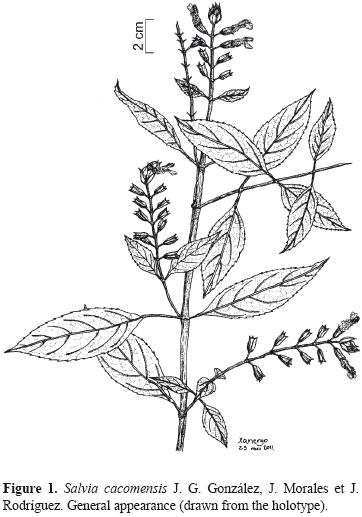
<body><![CDATA[<p align="justify"><font face="verdana" size="2">Se describe e ilustra una especie nueva procedente de una regi&oacute;n bot&aacute;nicamente poco conocida de Jalisco, M&eacute;xico. La morfolog&iacute;a de <i>Salvia cacomensis</i> J. G. Gonz&aacute;lez, J. Morales et J. Rodr&iacute;guez est&aacute; relacionada con aquella de las especies de las secciones <i>Briquetia</i> Epling y <i>Tubiflorae</i> (Epling) Epling del subg&eacute;nero <i>Calosphace</i> (Benth.) Benth. El nuevo tax&oacute;n se distingue por la combinaci&oacute;n de su superficie esencialmente glabra, sus verticilastros bifloros, el color rosa o magenta de sus corolas y las dimensiones particulares de la br&aacute;ctea floral, el c&aacute;liz y la corola.</font></p> 	    <p align="justify"><font face="verdana" size="2"><b>Palabras clave:</b> end&eacute;mica, Jalisco, <i>Salvia</i> secci&oacute;n <i>Briquetia</i>, S. secci&oacute;n <i>Tubiflorae</i>.</font></p> 	    <p align="justify"><font face="verdana" size="2">&nbsp;</font></p> 	    <p align="justify"><font face="verdana" size="2"><b>Introduction</b></font></p> 	    <p align="justify"><font face="verdana" size="2"><i>Salvia</i> L. includes at least 900 species worldwide, with main centers of diversity in SW Asia, Southern North, Central and South America (Harley et al., 2004); it is 1 of the 3 richest genera of vascular plants in Mexico with approximately 292 species in the country (Villase&ntilde;or, 2004), and at the same time one of the most poorly understood. In the last 3 decades, a new impulse in the study of Mexican sages has resulted in the description of several new taxa (Ramamoorthy, 1983, 1984a, 1984b, 1984c; Ramamoorthy and Lorence, 1987; Levin and Moran, 1989; Espejo and Ramamoorthy, 1993; Turner, 1995, 1996, Klitgaard, 2007; Turner, 2008a, 2008b, 2008c, 2009a, 2009b, 2010; Bedolla et al., 2011; Mart&iacute;nez&#150;Gordillo and Loazada&#150;P&eacute;rez, 2011; Turner, 2011). However these efforts have been insufficient, because there are still new taxa to be described and some species that need to be reevaluated.</font></p> 	    <p align="justify"><font face="verdana" size="2">While conducting floristic research, Morales and Rodr&iacute;guez discovered an interesting population of <i>Salvia</i> at Villas de Cacoma, Jalisco, Mexico, one of the least botanically explored areas of Western Mexico. We tried to identify the specimens using the publications of Epling and coworkers (1939, 1940, 1941, 1944, 1947, 1951; Epling and Mathias, 1957; Epling and J&aacute;tiva, 1966), and those papers highlighted in the last paragraph, where new taxa were recently described. We have examined, since September 2008 to September 2011, <i>Salvia</i> collections from large and relatively small Mexican herbaria, according to the number of specimens that they harbor. In small herbaria (CIIDIR, CHAPA, CREG, GUADA, HEM, HUMO, OAX, SERO, USON, UAGC, ZEA, XALU), we examined the entire collections of <i>Salvia</i> including those specimens not yet identified. In large herbaria (ENCB, IEB, MEXU, XAL), we restricted the revision to specimens collected in Jalisco, those belonging to the sections related to the <i>Salvia</i> found at Cacoma (<i>Briquetia</i> Epling and <i>Tubiflorae</i> (Epling) Epling), and non&#150;identified specimens. In both cases the specimens examined were photographed. All <i>Salvia</i> specimens from IBUG herbarium were also examined. We analyzed the type specimens of the species in sections <i>Briquetia</i> and <i>Tubiflorae</i> through a collection of digital photographs obtained from the web pages of the following herbaria: K, LD, LL, MA, MICH, MO, NY, UC, US, WU. As a result of the revision of literature and examination of herbarium specimens and photographs, the finding of Morales and Rodr&iacute;guez could not be referred to any known species of <i>Salvia</i>. Here, we describe it as a new taxon related to the sections <i>Briquetia</i> and <i>Tubiflorae</i> of subgenus <i>Calosphace</i> (Benth.) Benth.</font></p> 	    <p align="justify"><font face="verdana" size="2">&nbsp;</font></p> 	    <p align="justify"><font face="verdana" size="2"><b>Description</b></font></p> 	    <p align="justify"><font face="verdana" size="2"><b><i>Salvia cacomensis</i></b> J. G. Gonz&aacute;lez, J. Morales et J. Rodr&iacute;guez, sp. nov. (<a href="#f1">Figs. 1</a>, <a href="/img/revistas/rmbiodiv/v83n2/a4f2.jpg" target="_blank">2</a>).</font></p> 	    <p align="center"><font face="verdana" size="2"><a name="f1"></a></font></p> 	    ]]></body>
<body><![CDATA[<p align="center"><font face="verdana" size="2"><img src="/img/revistas/rmbiodiv/v83n2/a4f1.jpg"></font></p> 	    <p align="justify"><font face="verdana" size="2">Type: <b>Mexico</b>, Jalisco: munincipio de Villa de Purificaci&oacute;n, Villas de Cacoma, 19&deg;49'53" N, 104&deg;31'57" O, 1 360 m alt., 26 Aug. 2010 (fl, fr), <i>J. L. Rodr&iacute;guez, J. G. Morales and M. G. Gama 340</i> (holotype: ZEA; isotypes: IBUG, MEXU).</font></p> 	    <p align="justify"><font face="verdana" size="2"><i>S. venulosa</i>e similis sed petiolibus (0.9)1.2&#150;1.9(2.2) mm longis, floribus 2 in verticilastris, bracteis floralibus 7.5&#150;9 &times; 3.5&#150;4 mm, pedicellis 4&#150;5 mm longis, calycibus sine pilis glandularibus et 5 venis in labio superiore calycum.</font></p> 	    <p align="justify"><font face="verdana" size="2">Perennial suffrutex up to 2 m tall, erect, stems essentially glabrous. Petioles (9&#150;)1.2&#150;1.9(&#150;2.2) cm long, diffusely covered by simple multicellular hairs with dark&#150;red septa; blades elliptic&#150;lanceolate to lanceolate, 5.5&#150;8.5 cm long, (2&#150;)2.5&#150;3.5 cm wide, cuneate to short cuneate and sometimes oblique at the base, acuminate to long&#150;acuminate at the apex, margin serrate and sparsely bordered by simple multicellular hairs with dark&#150;red septa, green and glabrous above, glaucous and glabrous beneath, only with the main vein covered with simple multicellular hairs. Inflorescence (8&#150;)11&#150;18 cm long, nodes 0.5&#150;1 cm apart toward the base, 9 to 19 verticillasters at each floral axis, the verticillasters 2&#150;flowered, floral axis purplish red, glabrous. Floral bracts narrow ovate to oblanceolate, 7.5&#150;9 &times; 3.5&#150;4 mm, purplish red, caudate at the apex, attenuate and truncate at the base, the margin entire and bordered with hairs similar to those of the blade margin, the rest glabrous, foliose, veins not visible, deciduous. Pedicels 1.5&#150;2.5(&#150;3) mm long, moderately covered with simple multicellular hairs with dark&#150;red septa. Calyces 7&#150;13 mm long, 2.5&#150;3 mm wide at the throat, upper lip 3&#150;veined, margin of the throat covered with tiny conical hairs and with some simple hairs at the apex of the upper lip, the rest glabrous, purplish red throughout its surface, the lobes acute, the upper one entire. Corolla pink to magenta, covered with long flexible, simple hairs with dark&#150;red septa, these concentrated mainly on the lips; tube 15&#150;17 mm long, (3&#150;)4&#150;5 mm wide at its widest portion, ventricose, not invaginated at the base, internally naked (epapillate); upper lip 6&#150;6.5 mm long, lower one 5&#150;6(&#150;6.5) mm long, 1.4&#150;1.6(&#150;1.8) mm wide. Stamens included; filaments 1.5&#150;1.6(&#150;2.3) mm long; connective 1&#150;1.1 cm long, with an acute little tooth just after the insertion with the filament; theca 0.6&#150;1 mm long; a pair of staminodes present above and behind the insertion point of the filament to the corolla tube. Gynobasic horn 0.3&#150;0.4 mm long; style 2&#150;2.1 cm long, pilose at the apex, branches slightly exserted, the upper one longer and arcuate. Nutlets ovate, 0.8&#150;1.2 mm long, 0.5&#150;0.7 mm wide, light brown, and dark brown marbled, surface smooth and sparsely covered with whitish flexible hairs at the base on immature nutlets.</font></p> 	    <p align="justify"><font face="verdana" size="2"><i>Taxonomic summary</i></font></p> 	    <p align="justify"><font face="verdana" size="2"><i>Distribution, habitat and phenology. Salvia cacomensis</i> is, to our knowledge, an endemic species restricted to 1 locality on the Pacific slope of the Sierra de Cacoma, Jalisco, Mexico. It is locally scarce. It inhabits montane cloud forest with <i>Quercus L., Sebastiana Spreng., Ficus L., Clusia</i> L. and <i>Fuchsia</i> L., at 1 300&#150;1 400 m. It flowers and fructifies in August (&#150; September).</font></p> 	    <p align="justify"><font face="verdana" size="2"><i>Etymology</i>. The specific epithet of this taxon refers to the area that embraces its distribution, the Sierra de Cacoma, Jalisco, Mexico.</font></p> 	    <p align="justify"><font face="verdana" size="2"><i>Remarks</i>. There are 2 <i>Salvia</i> subgenus <i>Calosphace</i> sections with species morphologically similar to the new taxon: <i>Tubiflorae</i> and <i>Briquetia</i>. <i>S. cacomensis</i> fits well with every character of the species in <i>Tubiflorae</i>: shrubs or subshrubs, blades ovate, acuminate at the apex, rounded to attenuated at the base, (2&#150;)6 to 12&#150;flowered verticillasters, bracts deciduous, 3&#150;veined upper lips of the calyces or sometimes 5&#150;veined, pink to magenta corollas, epapillate corolla tubes, upper corolla lips longer than the lower ones, connectives entire or toothed and styles pilose. Among the species of <i>Tubiflorae</i>, <i>S. tubifera</i> Cav. and <i>S. venulosa</i> Epling are the morphologically closest relatives. The first one differs in having ovate, rounded at the base blades, (0.5&#150;)1&#150;3.3(&#150;7) cm long petioles, lower blade surface slightly white pubescent, 6 to 8&#150;flowered verticillasters, 3.5&#150;5(&#150;8) mm long pedicels, short glandular&#150;capitate hairs on the calyces, 24&#150;25 mm long corolla tubes, (1.8&#150;)2&#150;2.6 cm long connectives, 1.8&#150;1.9 mm long nutlets (<a href="/img/revistas/rmbiodiv/v83n2/a4t1.jpg" target="_blank">table 1</a>). The second one can be distinguished by its 5&#150;10 mm long petioles, lower blade surface with purplish reticulate prominent veins, 2&#150;6&#150;flowered verticillasters, 2&#150;3 &times; 2&#150;2.5 mm floral bracts, 4&#150;5 mm long pedicels, 5&#150;veined upper lip of the calyces and those covered with capitate glandular hairs (<a href="/img/revistas/rmbiodiv/v83n2/a4t1.jpg" target="_blank">table 1</a>). All characters in the species of <i>Briquetia</i> also matches with the characters in the new taxon: thick herbs, blades acuminate at the apex and rounded to attenuate at the base (sometimes truncate or cordate), 3&#150;veined upper lips of the calyces, dark blue corollas, corolla tubes ventricose, invaginated at the base, and internally epapillate, connectives entire or toothed, and styles pilose; excluding the color of the corolla (purple vs. magenta or pink magenta in <i>S. cacomensis</i>) and the invagination at the base of the corolla tube. However, there is a member of <i>Briquetia</i> which does not present invaginated corollas at the base, <i>S. ecuadorensis</i> Briq; and other one, which very rarely can exhibit magenta corollas, <i>S. mexicana</i> L. <i>S. cacomensis</i> differs from the rest of the species of section <i>Briquetia</i> because of its 2&#150;flowered verticillasters (vs. 3&#150;12&#150;flowered), magenta or magenta&#150;pink corollas (vs. purple ones), the length of the calyx (7&#150;13 mm vs. (7&#150;)12&#150;15 m) and corolla tube (15&#150;17 mm vs. (11&#150;)15&#150;25 mm).</font></p> 	    <p align="justify"><font face="verdana" size="2"><i>Salvia cacomensis</i> can be distinguished by the combination of its 0.5&#150;1 cm long petioles, elliptic&#150;lanceolate to lanceolate blades with short to short cuneate, sometimes oblique bases and acuminate to long&#150;acuminate apices, 2&#150;flowered verticillasters, 7.5&#150;9 mm long floral bracts, calyces without glandular capitate hairs, 3&#150;veined upper lips of the calyces, pink to magenta corollas, with the lower lip as long as the upper one and straight.</font></p> 	    <p align="justify"><font face="verdana" size="2">In the region where <i>S. cacomensis</i> inhabits (Jalisco), only 2 members of section <i>Tubiflorae</i> (S. pringlei B. L. Rob. and Greenm. and <i>S. tubifera</i>), and only 1 of section <i>Briquetia</i> (<i>S. mexicana</i>) are found. None of them share habitat with <i>S. cacomensis</i>. <i>Salvia</i> pringlei inhabits tropical lowlands, from 400&#150;920 m altitude. It can be found near the coast of Jalisco, Nayarit and Sinaloa, and in an area of the Barranca del R&iacute;o Santiago in Jalisco and Nayarit. <i>Salvia tubifera</i> has an affinity for a colder and wetter habitat. It grows in high montane cloud forests mainly from 2 400&#150;2 800 m altitude (<a href="/img/revistas/rmbiodiv/v83n2/a4t1.jpg" target="_blank">Table 1</a>). In Jalisco, this species is only known from Cerro Viejo, North of Lago de Chapala. In contrast, <i>S. mexicana</i> can occupy oak, pine&#150;oak, montane cloud and even tropical deciduous forests, from 850&#150;2 900 m altitude in a wide area of Jalisco. <i>Salvia</i> venulosa, which is the morphologically most similar species to <i>S. cacomensis</i> inhabits also cloud forests and exhibits a narrow geographical range; however, this species grows in Colombia at a distance of 3 500 km from Cacoma, Jalisco (<a href="/img/revistas/rmbiodiv/v83n2/a4t1.jpg" target="_blank">Table 1</a>).</font></p> 	    ]]></body>
<body><![CDATA[<p align="justify"><font face="verdana" size="2">As we can conclude from the above mentioned, the affinity between <i>S. cacomensis</i> with either of the 2 sections alluded is not clear. Therefore, we prefer not to assign it to either of them, and wait for new evidence and a new more natural classification than that proposed by Epling and coworkers (1939, 1940, 1941, 1944, 1947, 1951; Epling and Mathias, 1957; Epling and J&aacute;tiva, 1966).</font></p> 	    <p align="center"><font face="verdana" size="2"><b><a href="/img/revistas/rmbiodiv/v83n2/a4cl1.jpg" target="_blank">Key for <i>Salvia cacomensis</i> and closet morphologically relatives</a></b></font></p>     <p align="justify"><font face="verdana" size="2">&nbsp;</font></p> 	    <p align="justify"><font face="verdana" size="2"><b>Acknowledgments</b></font></p> 	    <p align="justify"><font face="verdana" size="2">We thank the curators and colleagues from the following herbaria, who kindly gave permission and helped us with the examination of herbarium specimens: CHAPA, CIIDIR, CREG, ENCB, GUADA, HUMO, IBUG, IEB, HEM, MEXU, OAX, SERO, UAGC, USON, XAL, XALU, and ZEA. We also thank the authorities of K, LD, LL, MA, MICH, MO, NY, UC, US, and WU, who provided online photographs of type specimens harbored in their collections through their herbaria web pages. Robin Middleton reviewed and helped to improve the writing and spelling of the document. The latin specialist, Juan Acosta Aguilar, improved our diagnoses. Economic support was provided by Consejo Nacional de Ciencia y Tecnolog&iacute;a (CONACYT) and the Universidad de Guadalajara.</font></p> 	    <p align="justify"><font face="verdana" size="2">&nbsp;</font></p> 	    <p align="justify"><font face="verdana" size="2"><b>Literature cited</b></font></p> 	    <!-- ref --><p align="justify"><font face="verdana" size="2">Bedolla&#150;Garc&iacute;a, B. Y., S. I. Lara&#150;Cabrera and S. Zamudio. 2011. Dos nuevas especies de <i>Salvia</i> (Lamiaceae) del Centro Occidente de M&eacute;xico. Acta Botanica Mexicana 95:51&#150;63.    &nbsp;&nbsp;&nbsp;&nbsp;&nbsp;&nbsp;&nbsp;&nbsp;[&#160;<a href="javascript:void(0);" onclick="javascript: window.open('/scielo.php?script=sci_nlinks&ref=7566666&pid=S1870-3453201200020000400001&lng=','','width=640,height=500,resizable=yes,scrollbars=1,menubar=yes,');">Links</a>&#160;]<!-- end-ref --></font></p> 	    <!-- ref --><p align="justify"><font face="verdana" size="2">Epling, C. 1939. A revision of <i>Salvia</i> subgenus <i>Calosphace</i>. Feddes Repertorium Specierum Novarum Regni Vegetabilis, Beihefte 110:1&#150;383.    &nbsp;&nbsp;&nbsp;&nbsp;&nbsp;&nbsp;&nbsp;&nbsp;[&#160;<a href="javascript:void(0);" onclick="javascript: window.open('/scielo.php?script=sci_nlinks&ref=7566668&pid=S1870-3453201200020000400002&lng=','','width=640,height=500,resizable=yes,scrollbars=1,menubar=yes,');">Links</a>&#160;]<!-- end-ref --></font></p> 	    <!-- ref --><p align="justify"><font face="verdana" size="2">Epling, C. 1940. Supplementary notes on American Labiatae. Bulletin of the Torrey Botanical Club 67:509&#150;534.    &nbsp;&nbsp;&nbsp;&nbsp;&nbsp;&nbsp;&nbsp;&nbsp;[&#160;<a href="javascript:void(0);" onclick="javascript: window.open('/scielo.php?script=sci_nlinks&ref=7566670&pid=S1870-3453201200020000400003&lng=','','width=640,height=500,resizable=yes,scrollbars=1,menubar=yes,');">Links</a>&#160;]<!-- end-ref --></font></p> 	    <!-- ref --><p align="justify"><font face="verdana" size="2">Epling, C. 1941. Supplementary notes on American Labiatae&#151;II. Bulletin of the Torrey Botanical Club 68:552&#150;568.    &nbsp;&nbsp;&nbsp;&nbsp;&nbsp;&nbsp;&nbsp;&nbsp;[&#160;<a href="javascript:void(0);" onclick="javascript: window.open('/scielo.php?script=sci_nlinks&ref=7566672&pid=S1870-3453201200020000400004&lng=','','width=640,height=500,resizable=yes,scrollbars=1,menubar=yes,');">Links</a>&#160;]<!-- end-ref --></font></p> 	    <!-- ref --><p align="justify"><font face="verdana" size="2">Epling, C. 1944. Supplementary notes on American Labiatae&#151;III. Bulletin of the Torrey Botanical Club 71:484&#150;497.    &nbsp;&nbsp;&nbsp;&nbsp;&nbsp;&nbsp;&nbsp;&nbsp;[&#160;<a href="javascript:void(0);" onclick="javascript: window.open('/scielo.php?script=sci_nlinks&ref=7566674&pid=S1870-3453201200020000400005&lng=','','width=640,height=500,resizable=yes,scrollbars=1,menubar=yes,');">Links</a>&#160;]<!-- end-ref --></font></p> 	    <!-- ref --><p align="justify"><font face="verdana" size="2">Epling, C. 1947. Supplementary notes on American Labiatae&#151;IV. Bulletin of the Torrey Botanical Club 74:512&#150;518.    &nbsp;&nbsp;&nbsp;&nbsp;&nbsp;&nbsp;&nbsp;&nbsp;[&#160;<a href="javascript:void(0);" onclick="javascript: window.open('/scielo.php?script=sci_nlinks&ref=7566676&pid=S1870-3453201200020000400006&lng=','','width=640,height=500,resizable=yes,scrollbars=1,menubar=yes,');">Links</a>&#160;]<!-- end-ref --></font></p> 	    <!-- ref --><p align="justify"><font face="verdana" size="2">Epling, C. 1951. Supplementary notes on American Labiatae&#151;V. Brittonia 7:129&#150;142.    &nbsp;&nbsp;&nbsp;&nbsp;&nbsp;&nbsp;&nbsp;&nbsp;[&#160;<a href="javascript:void(0);" onclick="javascript: window.open('/scielo.php?script=sci_nlinks&ref=7566678&pid=S1870-3453201200020000400007&lng=','','width=640,height=500,resizable=yes,scrollbars=1,menubar=yes,');">Links</a>&#160;]<!-- end-ref --></font></p> 	    <!-- ref --><p align="justify"><font face="verdana" size="2">Epling, C. and C. J&aacute;tiva. 1966. Supplementary notes on American Labiatae&#151;IX. Brittonia 18:255&#150;265.    &nbsp;&nbsp;&nbsp;&nbsp;&nbsp;&nbsp;&nbsp;&nbsp;[&#160;<a href="javascript:void(0);" onclick="javascript: window.open('/scielo.php?script=sci_nlinks&ref=7566680&pid=S1870-3453201200020000400008&lng=','','width=640,height=500,resizable=yes,scrollbars=1,menubar=yes,');">Links</a>&#160;]<!-- end-ref --></font></p> 	    <!-- ref --><p align="justify"><font face="verdana" size="2">Epling, C. and M. E. Mathias. 1957. Supplementary notes on American Labiatae&#151;VI. Brittonia 8:297&#150;313.    &nbsp;&nbsp;&nbsp;&nbsp;&nbsp;&nbsp;&nbsp;&nbsp;[&#160;<a href="javascript:void(0);" onclick="javascript: window.open('/scielo.php?script=sci_nlinks&ref=7566682&pid=S1870-3453201200020000400009&lng=','','width=640,height=500,resizable=yes,scrollbars=1,menubar=yes,');">Links</a>&#160;]<!-- end-ref --></font></p> 	    <!-- ref --><p align="justify"><font face="verdana" size="2">Espejo S., A. and T. P. Ramamoorthy. 1993. Revisi&oacute;n taxon&oacute;mica de <i>Salvia</i> secci&oacute;n Sigmoideae (Lamiaceae). Acta Botanica Mexicana 23:65&#150;102.    &nbsp;&nbsp;&nbsp;&nbsp;&nbsp;&nbsp;&nbsp;&nbsp;[&#160;<a href="javascript:void(0);" onclick="javascript: window.open('/scielo.php?script=sci_nlinks&ref=7566684&pid=S1870-3453201200020000400010&lng=','','width=640,height=500,resizable=yes,scrollbars=1,menubar=yes,');">Links</a>&#160;]<!-- end-ref --></font></p> 	    <!-- ref --><p align="justify"><font face="verdana" size="2">Harley, R. M., S. Atkins, A. L. Budantsev, P. D. Cantino, B. J. Conn, R. Grayer, M. M. Harley, R. de Kok, T. Krestovskaja, R. Morales, A. J. Paton, O. Ryding and Upson. 2004. Labiatae. In The Families and Genera of Vascular Plants VII. Flowering Plants. Dicotyledons. Lamiales (except Acanthaceae including Avicenniaceae), J. W. Kadereit (ed.). Springer, Berlin. p. 167&#150;275.    &nbsp;&nbsp;&nbsp;&nbsp;&nbsp;&nbsp;&nbsp;&nbsp;[&#160;<a href="javascript:void(0);" onclick="javascript: window.open('/scielo.php?script=sci_nlinks&ref=7566686&pid=S1870-3453201200020000400011&lng=','','width=640,height=500,resizable=yes,scrollbars=1,menubar=yes,');">Links</a>&#160;]<!-- end-ref --></font></p> 	    <!-- ref --><p align="justify"><font face="verdana" size="2">Klitgaard, B. B. 2007. Three new species in <i>Salvia</i> subgenus <i>Calosphace</i> (Lamiaceae) from Mesoamerica. Novon 17:206&#150;211.    &nbsp;&nbsp;&nbsp;&nbsp;&nbsp;&nbsp;&nbsp;&nbsp;[&#160;<a href="javascript:void(0);" onclick="javascript: window.open('/scielo.php?script=sci_nlinks&ref=7566688&pid=S1870-3453201200020000400012&lng=','','width=640,height=500,resizable=yes,scrollbars=1,menubar=yes,');">Links</a>&#160;]<!-- end-ref --></font></p> 	    <!-- ref --><p align="justify"><font face="verdana" size="2">Levin, G. A. and R. Moran. 1989. The vascular flora of Isla Socorro. Memoirs of the San Diego Society of Natural History 16:5&#150;71.    &nbsp;&nbsp;&nbsp;&nbsp;&nbsp;&nbsp;&nbsp;&nbsp;[&#160;<a href="javascript:void(0);" onclick="javascript: window.open('/scielo.php?script=sci_nlinks&ref=7566690&pid=S1870-3453201200020000400013&lng=','','width=640,height=500,resizable=yes,scrollbars=1,menubar=yes,');">Links</a>&#160;]<!-- end-ref --></font></p> 	    <!-- ref --><p align="justify"><font face="verdana" size="2">Mart&iacute;nez&#150;Gordillo, M. and L. Lozada&#150;P&eacute;rez. 2011. Una nueva especie de <i>Salvia</i> (Lamiaceae) de Guerrero, M&eacute;xico. Brittonia 63:211&#150;214.    &nbsp;&nbsp;&nbsp;&nbsp;&nbsp;&nbsp;&nbsp;&nbsp;[&#160;<a href="javascript:void(0);" onclick="javascript: window.open('/scielo.php?script=sci_nlinks&ref=7566692&pid=S1870-3453201200020000400014&lng=','','width=640,height=500,resizable=yes,scrollbars=1,menubar=yes,');">Links</a>&#160;]<!-- end-ref --></font></p> 	    <!-- ref --><p align="justify"><font face="verdana" size="2">Ramamoorthy, T. P. 1983. Two new species in Lamiaceae from Mexico. Anales del Instituto de Biolog&iacute;a de la Universidad Nacional Aut&oacute;noma de M&eacute;xico. Serie Bot&aacute;nica 54:157&#150;158.    &nbsp;&nbsp;&nbsp;&nbsp;&nbsp;&nbsp;&nbsp;&nbsp;[&#160;<a href="javascript:void(0);" onclick="javascript: window.open('/scielo.php?script=sci_nlinks&ref=7566694&pid=S1870-3453201200020000400015&lng=','','width=640,height=500,resizable=yes,scrollbars=1,menubar=yes,');">Links</a>&#160;]<!-- end-ref --></font></p> 	    <!-- ref --><p align="justify"><font face="verdana" size="2">Ramamoorthy, T. P. 1984a. A new species of <i>Salvia</i> (Lamiaceae) from Mexico. Brittonia 36:297&#150;299.    &nbsp;&nbsp;&nbsp;&nbsp;&nbsp;&nbsp;&nbsp;&nbsp;[&#160;<a href="javascript:void(0);" onclick="javascript: window.open('/scielo.php?script=sci_nlinks&ref=7566696&pid=S1870-3453201200020000400016&lng=','','width=640,height=500,resizable=yes,scrollbars=1,menubar=yes,');">Links</a>&#160;]<!-- end-ref --></font></p> 	    <!-- ref --><p align="justify"><font face="verdana" size="2">Ramamoorthy, T. P. 1984b. A new species of <i>Salvia</i> (Lamiaceae) from the Sierra de los Tuxtlas, Mexico. Plant Systematics and Evolution 146:141&#150;143.    &nbsp;&nbsp;&nbsp;&nbsp;&nbsp;&nbsp;&nbsp;&nbsp;[&#160;<a href="javascript:void(0);" onclick="javascript: window.open('/scielo.php?script=sci_nlinks&ref=7566698&pid=S1870-3453201200020000400017&lng=','','width=640,height=500,resizable=yes,scrollbars=1,menubar=yes,');">Links</a>&#160;]<!-- end-ref --></font></p> 	    <!-- ref --><p align="justify"><font face="verdana" size="2">Ramamoorthy, T. P. 1984c. Notes on <i>Salvia</i> (Labiatae) in Mexico with three new species. Journal of the Arnold Arboretum 65:135&#150;142.    &nbsp;&nbsp;&nbsp;&nbsp;&nbsp;&nbsp;&nbsp;&nbsp;[&#160;<a href="javascript:void(0);" onclick="javascript: window.open('/scielo.php?script=sci_nlinks&ref=7566700&pid=S1870-3453201200020000400018&lng=','','width=640,height=500,resizable=yes,scrollbars=1,menubar=yes,');">Links</a>&#160;]<!-- end-ref --></font></p> 	    <!-- ref --><p align="justify"><font face="verdana" size="2">Ramamoorthy, T. P. and D. H. Lorence. 1987. Species vicariance in the Mexican flora and description of a new species of <i>Salvia</i> (Lamiaceae). Bulletin du Mus&eacute;um National d'Histoire Naturelle. Section B, Adansonia: Botanique Phytochimie 9:167&#150;175.    &nbsp;&nbsp;&nbsp;&nbsp;&nbsp;&nbsp;&nbsp;&nbsp;[&#160;<a href="javascript:void(0);" onclick="javascript: window.open('/scielo.php?script=sci_nlinks&ref=7566702&pid=S1870-3453201200020000400019&lng=','','width=640,height=500,resizable=yes,scrollbars=1,menubar=yes,');">Links</a>&#160;]<!-- end-ref --></font></p> 	    <!-- ref --><p align="justify"><font face="verdana" size="2">Turner, B. L. 1995. <i>Salvia</i> booleana (Lamiaceae), a new species from Northeastern Mexico. Phytologia 79:289&#150;292.    &nbsp;&nbsp;&nbsp;&nbsp;&nbsp;&nbsp;&nbsp;&nbsp;[&#160;<a href="javascript:void(0);" onclick="javascript: window.open('/scielo.php?script=sci_nlinks&ref=7566704&pid=S1870-3453201200020000400020&lng=','','width=640,height=500,resizable=yes,scrollbars=1,menubar=yes,');">Links</a>&#160;]<!-- end-ref --></font></p> 	    <!-- ref --><p align="justify"><font face="verdana" size="2">Turner, B. L. 1996. A new species of <i>Salvia</i> (sect. Caducae) from Guerrero, Mexico. Phytologia 81:329&#150;332.    &nbsp;&nbsp;&nbsp;&nbsp;&nbsp;&nbsp;&nbsp;&nbsp;[&#160;<a href="javascript:void(0);" onclick="javascript: window.open('/scielo.php?script=sci_nlinks&ref=7566706&pid=S1870-3453201200020000400021&lng=','','width=640,height=500,resizable=yes,scrollbars=1,menubar=yes,');">Links</a>&#160;]<!-- end-ref --></font></p> 	    <!-- ref --><p align="justify"><font face="verdana" size="2">Turner, B. L. 2008a. <i>Salvia</i> acerifolia (Lamiaceae), a new species from Michoac&aacute;n, Mexico. Phytologia 90:138&#150;140.    &nbsp;&nbsp;&nbsp;&nbsp;&nbsp;&nbsp;&nbsp;&nbsp;[&#160;<a href="javascript:void(0);" onclick="javascript: window.open('/scielo.php?script=sci_nlinks&ref=7566708&pid=S1870-3453201200020000400022&lng=','','width=640,height=500,resizable=yes,scrollbars=1,menubar=yes,');">Links</a>&#160;]<!-- end-ref --></font></p> 	    <!-- ref --><p align="justify"><font face="verdana" size="2">Turner, B. L. 2008b. A new species of <i>Salvia</i> (Lamiaceae) from Guerrero, Mexico. Phytologia 90:141&#150;143.    &nbsp;&nbsp;&nbsp;&nbsp;&nbsp;&nbsp;&nbsp;&nbsp;[&#160;<a href="javascript:void(0);" onclick="javascript: window.open('/scielo.php?script=sci_nlinks&ref=7566710&pid=S1870-3453201200020000400023&lng=','','width=640,height=500,resizable=yes,scrollbars=1,menubar=yes,');">Links</a>&#160;]<!-- end-ref --></font></p> 	    <!-- ref --><p align="justify"><font face="verdana" size="2">Turner, B. L. 2008c. Recension of <i>Salvia</i> sect. Farinaceae (Lamiaceae). Phytologia 90:163&#150;175.    &nbsp;&nbsp;&nbsp;&nbsp;&nbsp;&nbsp;&nbsp;&nbsp;[&#160;<a href="javascript:void(0);" onclick="javascript: window.open('/scielo.php?script=sci_nlinks&ref=7566712&pid=S1870-3453201200020000400024&lng=','','width=640,height=500,resizable=yes,scrollbars=1,menubar=yes,');">Links</a>&#160;]<!-- end-ref --></font></p> 	    <!-- ref --><p align="justify"><font face="verdana" size="2">Turner, B. L. 2009a. Recension of the Mexican species of <i>Salvia</i> (Lamiaceae), section Scorodonia. Phytologia 91:256&#150;269.    &nbsp;&nbsp;&nbsp;&nbsp;&nbsp;&nbsp;&nbsp;&nbsp;[&#160;<a href="javascript:void(0);" onclick="javascript: window.open('/scielo.php?script=sci_nlinks&ref=7566714&pid=S1870-3453201200020000400025&lng=','','width=640,height=500,resizable=yes,scrollbars=1,menubar=yes,');">Links</a>&#160;]<!-- end-ref --></font></p> 	    <!-- ref --><p align="justify"><font face="verdana" size="2">Turner, B. L. 2009b. Recension of the Mexican species of section Uliginosae of <i>Salvia</i> (Lamiaceae). Phytologia 91:440&#150;465.    &nbsp;&nbsp;&nbsp;&nbsp;&nbsp;&nbsp;&nbsp;&nbsp;[&#160;<a href="javascript:void(0);" onclick="javascript: window.open('/scielo.php?script=sci_nlinks&ref=7566716&pid=S1870-3453201200020000400026&lng=','','width=640,height=500,resizable=yes,scrollbars=1,menubar=yes,');">Links</a>&#160;]<!-- end-ref --></font></p> 	    <!-- ref --><p align="justify"><font face="verdana" size="2">Turner, B. L. 2010. Recension of the Mexican species of <i>Salvia</i> (Lamiaceae), sect. Peninsularis. Phytologia 92:20&#150;26.    &nbsp;&nbsp;&nbsp;&nbsp;&nbsp;&nbsp;&nbsp;&nbsp;[&#160;<a href="javascript:void(0);" onclick="javascript: window.open('/scielo.php?script=sci_nlinks&ref=7566718&pid=S1870-3453201200020000400027&lng=','','width=640,height=500,resizable=yes,scrollbars=1,menubar=yes,');">Links</a>&#160;]<!-- end-ref --></font></p> 	    <!-- ref --><p align="justify"><font face="verdana" size="2">Turner, B. L. 2011. Recension of Mexican species of <i>Salvia</i> sect. Standleyana (Lamiaceae). Phytoneuron 23:1&#150;6.    &nbsp;&nbsp;&nbsp;&nbsp;&nbsp;&nbsp;&nbsp;&nbsp;[&#160;<a href="javascript:void(0);" onclick="javascript: window.open('/scielo.php?script=sci_nlinks&ref=7566720&pid=S1870-3453201200020000400028&lng=','','width=640,height=500,resizable=yes,scrollbars=1,menubar=yes,');">Links</a>&#160;]<!-- end-ref --></font></p> 	    <!-- ref --><p align="justify"><font face="verdana" size="2">Villase&ntilde;or, J. L. 2004. Los g&eacute;neros de plantas vasculares de la flora de M&eacute;xico. Bolet&iacute;n de la Sociedad Bot&aacute;nica de M&eacute;xico 75:105&#150;135.    &nbsp;&nbsp;&nbsp;&nbsp;&nbsp;&nbsp;&nbsp;&nbsp;[&#160;<a href="javascript:void(0);" onclick="javascript: window.open('/scielo.php?script=sci_nlinks&ref=7566722&pid=S1870-3453201200020000400029&lng=','','width=640,height=500,resizable=yes,scrollbars=1,menubar=yes,');">Links</a>&#160;]<!-- end-ref --></font></p>      ]]></body><back>
<ref-list>
<ref id="B1">
<nlm-citation citation-type="journal">
<person-group person-group-type="author">
<name>
<surname><![CDATA[Bedolla-García]]></surname>
<given-names><![CDATA[B. Y.]]></given-names>
</name>
<name>
<surname><![CDATA[Lara-Cabrera]]></surname>
<given-names><![CDATA[S. I.]]></given-names>
</name>
<name>
<surname><![CDATA[Zamudio]]></surname>
<given-names><![CDATA[S.]]></given-names>
</name>
</person-group>
<article-title xml:lang="es"><![CDATA[Dos nuevas especies de Salvia (Lamiaceae) del Centro Occidente de México]]></article-title>
<source><![CDATA[Acta Botanica Mexicana]]></source>
<year>2011</year>
<volume>95</volume>
<page-range>51-63</page-range></nlm-citation>
</ref>
<ref id="B2">
<nlm-citation citation-type="journal">
<person-group person-group-type="author">
<name>
<surname><![CDATA[Epling]]></surname>
<given-names><![CDATA[C]]></given-names>
</name>
</person-group>
<article-title xml:lang="en"><![CDATA[A revision of Salvia subgenus Calosphace]]></article-title>
<source><![CDATA[Feddes Repertorium Specierum Novarum Regni Vegetabilis, Beihefte]]></source>
<year>1939</year>
<volume>110</volume>
<page-range>1-383</page-range></nlm-citation>
</ref>
<ref id="B3">
<nlm-citation citation-type="journal">
<person-group person-group-type="author">
<name>
<surname><![CDATA[Epling]]></surname>
<given-names><![CDATA[C]]></given-names>
</name>
</person-group>
<article-title xml:lang="en"><![CDATA[Supplementary notes on American Labiatae]]></article-title>
<source><![CDATA[Bulletin of the Torrey Botanical Club]]></source>
<year>1940</year>
<volume>67</volume>
<page-range>509-534</page-range></nlm-citation>
</ref>
<ref id="B4">
<nlm-citation citation-type="journal">
<person-group person-group-type="author">
<name>
<surname><![CDATA[Epling]]></surname>
<given-names><![CDATA[C]]></given-names>
</name>
</person-group>
<article-title xml:lang="en"><![CDATA[Supplementary notes on American Labiatae-II]]></article-title>
<source><![CDATA[Bulletin of the Torrey Botanical Club]]></source>
<year>1941</year>
<volume>68</volume>
<page-range>552-568</page-range></nlm-citation>
</ref>
<ref id="B5">
<nlm-citation citation-type="journal">
<person-group person-group-type="author">
<name>
<surname><![CDATA[Epling]]></surname>
<given-names><![CDATA[C]]></given-names>
</name>
</person-group>
<article-title xml:lang="en"><![CDATA[Supplementary notes on American Labiatae-III]]></article-title>
<source><![CDATA[Bulletin of the Torrey Botanical Club]]></source>
<year>1944</year>
<volume>71</volume>
<page-range>484-497</page-range></nlm-citation>
</ref>
<ref id="B6">
<nlm-citation citation-type="journal">
<person-group person-group-type="author">
<name>
<surname><![CDATA[Epling]]></surname>
<given-names><![CDATA[C]]></given-names>
</name>
</person-group>
<article-title xml:lang="en"><![CDATA[Supplementary notes on American Labiatae-IV]]></article-title>
<source><![CDATA[Bulletin of the Torrey Botanical Club]]></source>
<year>1947</year>
<volume>74</volume>
<page-range>512-518</page-range></nlm-citation>
</ref>
<ref id="B7">
<nlm-citation citation-type="journal">
<person-group person-group-type="author">
<name>
<surname><![CDATA[Epling]]></surname>
<given-names><![CDATA[C]]></given-names>
</name>
</person-group>
<article-title xml:lang="en"><![CDATA[Supplementary notes on American Labiatae-V]]></article-title>
<source><![CDATA[Brittonia]]></source>
<year>1951</year>
<volume>7</volume>
<page-range>129-142</page-range></nlm-citation>
</ref>
<ref id="B8">
<nlm-citation citation-type="journal">
<person-group person-group-type="author">
<name>
<surname><![CDATA[Epling]]></surname>
<given-names><![CDATA[C.]]></given-names>
</name>
<name>
<surname><![CDATA[Játiva]]></surname>
<given-names><![CDATA[C.]]></given-names>
</name>
</person-group>
<article-title xml:lang="en"><![CDATA[Supplementary notes on American Labiatae-IX]]></article-title>
<source><![CDATA[Brittonia]]></source>
<year>1966</year>
<volume>18</volume>
<page-range>255-265</page-range></nlm-citation>
</ref>
<ref id="B9">
<nlm-citation citation-type="journal">
<person-group person-group-type="author">
<name>
<surname><![CDATA[Epling]]></surname>
<given-names><![CDATA[C.]]></given-names>
</name>
<name>
<surname><![CDATA[Mathias]]></surname>
<given-names><![CDATA[M. E.]]></given-names>
</name>
</person-group>
<article-title xml:lang="en"><![CDATA[Supplementary notes on American Labiatae-VI]]></article-title>
<source><![CDATA[Brittonia]]></source>
<year>1957</year>
<volume>8</volume>
<page-range>297-313</page-range></nlm-citation>
</ref>
<ref id="B10">
<nlm-citation citation-type="journal">
<person-group person-group-type="author">
<name>
<surname><![CDATA[Espejo S.]]></surname>
<given-names><![CDATA[A.]]></given-names>
</name>
<name>
<surname><![CDATA[Ramamoorthy]]></surname>
<given-names><![CDATA[T. P.]]></given-names>
</name>
</person-group>
<article-title xml:lang="es"><![CDATA[Revisión taxonómica de Salvia sección Sigmoideae (Lamiaceae)]]></article-title>
<source><![CDATA[Acta Botanica Mexicana]]></source>
<year>1993</year>
<volume>23</volume>
<page-range>65-102</page-range></nlm-citation>
</ref>
<ref id="B11">
<nlm-citation citation-type="book">
<person-group person-group-type="author">
<name>
<surname><![CDATA[Harley]]></surname>
<given-names><![CDATA[R. M.]]></given-names>
</name>
<name>
<surname><![CDATA[Atkins]]></surname>
<given-names><![CDATA[S.]]></given-names>
</name>
<name>
<surname><![CDATA[Budantsev]]></surname>
<given-names><![CDATA[A. L.]]></given-names>
</name>
<name>
<surname><![CDATA[Cantino]]></surname>
<given-names><![CDATA[P. D.]]></given-names>
</name>
<name>
<surname><![CDATA[Conn]]></surname>
<given-names><![CDATA[B. J.]]></given-names>
</name>
<name>
<surname><![CDATA[Grayer]]></surname>
<given-names><![CDATA[R.]]></given-names>
</name>
<name>
<surname><![CDATA[Harley]]></surname>
<given-names><![CDATA[M. M.]]></given-names>
</name>
<name>
<surname><![CDATA[de Kok]]></surname>
<given-names><![CDATA[R.]]></given-names>
</name>
<name>
<surname><![CDATA[Krestovskaja]]></surname>
<given-names><![CDATA[T.]]></given-names>
</name>
<name>
<surname><![CDATA[Morales]]></surname>
<given-names><![CDATA[R.]]></given-names>
</name>
<name>
<surname><![CDATA[Paton]]></surname>
<given-names><![CDATA[A. J.]]></given-names>
</name>
<name>
<surname><![CDATA[Ryding]]></surname>
<given-names><![CDATA[O.]]></given-names>
</name>
<name>
<surname><![CDATA[Upson]]></surname>
</name>
</person-group>
<article-title xml:lang="en"><![CDATA[Labiatae]]></article-title>
<person-group person-group-type="editor">
<name>
<surname><![CDATA[Kadereit]]></surname>
<given-names><![CDATA[J. W.]]></given-names>
</name>
</person-group>
<source><![CDATA[The Families and Genera of Vascular Plants VII. Flowering Plants. Dicotyledons. Lamiales (except Acanthaceae including Avicenniaceae)]]></source>
<year>2004</year>
<page-range>167-275</page-range><publisher-loc><![CDATA[Berlin ]]></publisher-loc>
<publisher-name><![CDATA[Springer]]></publisher-name>
</nlm-citation>
</ref>
<ref id="B12">
<nlm-citation citation-type="journal">
<person-group person-group-type="author">
<name>
<surname><![CDATA[Klitgaard]]></surname>
<given-names><![CDATA[B. B]]></given-names>
</name>
</person-group>
<article-title xml:lang="en"><![CDATA[Three new species in Salvia subgenus Calosphace (Lamiaceae) from Mesoamerica]]></article-title>
<source><![CDATA[Novon]]></source>
<year>2007</year>
<volume>17</volume>
<page-range>206-211</page-range></nlm-citation>
</ref>
<ref id="B13">
<nlm-citation citation-type="journal">
<person-group person-group-type="author">
<name>
<surname><![CDATA[Levin]]></surname>
<given-names><![CDATA[G. A.]]></given-names>
</name>
<name>
<surname><![CDATA[Moran]]></surname>
<given-names><![CDATA[R.]]></given-names>
</name>
</person-group>
<article-title xml:lang="en"><![CDATA[The vascular flora of Isla Socorro]]></article-title>
<source><![CDATA[Memoirs of the San Diego Society of Natural History]]></source>
<year>1989</year>
<volume>16</volume>
<page-range>5-71</page-range></nlm-citation>
</ref>
<ref id="B14">
<nlm-citation citation-type="journal">
<person-group person-group-type="author">
<name>
<surname><![CDATA[Martínez-Gordillo]]></surname>
<given-names><![CDATA[M.]]></given-names>
</name>
<name>
<surname><![CDATA[Lozada-Pérez]]></surname>
<given-names><![CDATA[L.]]></given-names>
</name>
</person-group>
<article-title xml:lang="es"><![CDATA[Una nueva especie de Salvia (Lamiaceae) de Guerrero, México]]></article-title>
<source><![CDATA[Brittonia]]></source>
<year>2011</year>
<volume>63</volume>
<page-range>211-214</page-range></nlm-citation>
</ref>
<ref id="B15">
<nlm-citation citation-type="journal">
<person-group person-group-type="author">
<name>
<surname><![CDATA[Ramamoorthy]]></surname>
<given-names><![CDATA[T. P]]></given-names>
</name>
</person-group>
<article-title xml:lang="en"><![CDATA[Two new species in Lamiaceae from Mexico]]></article-title>
<source><![CDATA[Anales del Instituto de Biología de la Universidad Nacional Autónoma de México. Serie Botánica]]></source>
<year>1983</year>
<volume>54</volume>
<page-range>157-158</page-range></nlm-citation>
</ref>
<ref id="B16">
<nlm-citation citation-type="journal">
<person-group person-group-type="author">
<name>
<surname><![CDATA[Ramamoorthy]]></surname>
<given-names><![CDATA[T. P]]></given-names>
</name>
</person-group>
<article-title xml:lang="en"><![CDATA[A new species of Salvia (Lamiaceae) from Mexico]]></article-title>
<source><![CDATA[Brittonia]]></source>
<year>1984</year>
<volume>36</volume>
<page-range>297-299</page-range></nlm-citation>
</ref>
<ref id="B17">
<nlm-citation citation-type="journal">
<person-group person-group-type="author">
<name>
<surname><![CDATA[Ramamoorthy]]></surname>
<given-names><![CDATA[T. P]]></given-names>
</name>
</person-group>
<article-title xml:lang="en"><![CDATA[A new species of Salvia (Lamiaceae) from the Sierra de los Tuxtlas, Mexico]]></article-title>
<source><![CDATA[Plant Systematics and Evolution]]></source>
<year>1984</year>
<volume>146</volume>
<page-range>141-143</page-range></nlm-citation>
</ref>
<ref id="B18">
<nlm-citation citation-type="journal">
<person-group person-group-type="author">
<name>
<surname><![CDATA[Ramamoorthy]]></surname>
<given-names><![CDATA[T. P]]></given-names>
</name>
</person-group>
<article-title xml:lang="en"><![CDATA[Notes on Salvia (Labiatae) in Mexico with three new species]]></article-title>
<source><![CDATA[Journal of the Arnold Arboretum]]></source>
<year>1984</year>
<volume>65</volume>
<page-range>135-142</page-range></nlm-citation>
</ref>
<ref id="B19">
<nlm-citation citation-type="journal">
<person-group person-group-type="author">
<name>
<surname><![CDATA[Ramamoorthy]]></surname>
<given-names><![CDATA[T. P.]]></given-names>
</name>
<name>
<surname><![CDATA[Lorence]]></surname>
<given-names><![CDATA[D. H.]]></given-names>
</name>
</person-group>
<article-title xml:lang="en"><![CDATA[Species vicariance in the Mexican flora and description of a new species of Salvia (Lamiaceae). Bulletin du Muséum National d'Histoire Naturelle]]></article-title>
<source><![CDATA[Section B, Adansonia: Botanique Phytochimie]]></source>
<year>1987</year>
<volume>9</volume>
<page-range>167-175</page-range></nlm-citation>
</ref>
<ref id="B20">
<nlm-citation citation-type="journal">
<person-group person-group-type="author">
<name>
<surname><![CDATA[Turner]]></surname>
<given-names><![CDATA[B. L]]></given-names>
</name>
</person-group>
<article-title xml:lang="en"><![CDATA[Salvia booleana (Lamiaceae), a new species from Northeastern Mexico]]></article-title>
<source><![CDATA[Phytologia]]></source>
<year>1995</year>
<volume>79</volume>
<page-range>289-292</page-range></nlm-citation>
</ref>
<ref id="B21">
<nlm-citation citation-type="journal">
<person-group person-group-type="author">
<name>
<surname><![CDATA[Turner]]></surname>
<given-names><![CDATA[B. L]]></given-names>
</name>
</person-group>
<article-title xml:lang="en"><![CDATA[A new species of Salvia (sect. Caducae) from Guerrero, Mexico]]></article-title>
<source><![CDATA[Phytologia]]></source>
<year>1996</year>
<volume>81</volume>
<page-range>329-332</page-range></nlm-citation>
</ref>
<ref id="B22">
<nlm-citation citation-type="journal">
<person-group person-group-type="author">
<name>
<surname><![CDATA[Turner]]></surname>
<given-names><![CDATA[B. L]]></given-names>
</name>
</person-group>
<article-title xml:lang="en"><![CDATA[Salvia acerifolia (Lamiaceae), a new species from Michoacán, Mexico]]></article-title>
<source><![CDATA[Phytologia]]></source>
<year>2008</year>
<volume>90</volume>
<page-range>138-140</page-range></nlm-citation>
</ref>
<ref id="B23">
<nlm-citation citation-type="journal">
<person-group person-group-type="author">
<name>
<surname><![CDATA[Turner]]></surname>
<given-names><![CDATA[B. L]]></given-names>
</name>
</person-group>
<article-title xml:lang="en"><![CDATA[A new species of Salvia (Lamiaceae) from Guerrero, Mexico]]></article-title>
<source><![CDATA[Phytologia]]></source>
<year>2008</year>
<volume>90</volume>
<page-range>141-143</page-range></nlm-citation>
</ref>
<ref id="B24">
<nlm-citation citation-type="journal">
<person-group person-group-type="author">
<name>
<surname><![CDATA[Turner]]></surname>
<given-names><![CDATA[B. L]]></given-names>
</name>
</person-group>
<article-title xml:lang="en"><![CDATA[Recension of Salvia sect. Farinaceae (Lamiaceae)]]></article-title>
<source><![CDATA[Phytologia]]></source>
<year>2008</year>
<volume>90</volume>
<page-range>163-175</page-range></nlm-citation>
</ref>
<ref id="B25">
<nlm-citation citation-type="journal">
<person-group person-group-type="author">
<name>
<surname><![CDATA[Turner]]></surname>
<given-names><![CDATA[B. L]]></given-names>
</name>
</person-group>
<article-title xml:lang="en"><![CDATA[Recension of the Mexican species of Salvia (Lamiaceae), section Scorodonia]]></article-title>
<source><![CDATA[Phytologia]]></source>
<year>2009</year>
<volume>91</volume>
<page-range>256-269</page-range></nlm-citation>
</ref>
<ref id="B26">
<nlm-citation citation-type="journal">
<person-group person-group-type="author">
<name>
<surname><![CDATA[Turner]]></surname>
<given-names><![CDATA[B. L]]></given-names>
</name>
</person-group>
<article-title xml:lang="en"><![CDATA[Recension of the Mexican species of section Uliginosae of Salvia (Lamiaceae)]]></article-title>
<source><![CDATA[Phytologia]]></source>
<year>2009</year>
<volume>91</volume>
<page-range>440-465</page-range></nlm-citation>
</ref>
<ref id="B27">
<nlm-citation citation-type="journal">
<person-group person-group-type="author">
<name>
<surname><![CDATA[Turner]]></surname>
<given-names><![CDATA[B. L]]></given-names>
</name>
</person-group>
<article-title xml:lang="en"><![CDATA[Recension of the Mexican species of Salvia (Lamiaceae), sect. Peninsularis]]></article-title>
<source><![CDATA[Phytologia]]></source>
<year>2010</year>
<volume>92</volume>
<page-range>20-26</page-range></nlm-citation>
</ref>
<ref id="B28">
<nlm-citation citation-type="journal">
<person-group person-group-type="author">
<name>
<surname><![CDATA[Turner]]></surname>
<given-names><![CDATA[B. L]]></given-names>
</name>
</person-group>
<article-title xml:lang="en"><![CDATA[Recension of Mexican species of Salvia sect. Standleyana (Lamiaceae)]]></article-title>
<source><![CDATA[Phytoneuron]]></source>
<year>2011</year>
<volume>23</volume>
<page-range>1-6</page-range></nlm-citation>
</ref>
<ref id="B29">
<nlm-citation citation-type="journal">
<person-group person-group-type="author">
<name>
<surname><![CDATA[Villaseñor]]></surname>
<given-names><![CDATA[J. L]]></given-names>
</name>
</person-group>
<article-title xml:lang="es"><![CDATA[Los géneros de plantas vasculares de la flora de México]]></article-title>
<source><![CDATA[Boletín de la Sociedad Botánica de México]]></source>
<year>2004</year>
<volume>75</volume>
<page-range>105-135</page-range></nlm-citation>
</ref>
</ref-list>
</back>
</article>