<?xml version="1.0" encoding="ISO-8859-1"?><article xmlns:mml="http://www.w3.org/1998/Math/MathML" xmlns:xlink="http://www.w3.org/1999/xlink" xmlns:xsi="http://www.w3.org/2001/XMLSchema-instance">
<front>
<journal-meta>
<journal-id>1870-0462</journal-id>
<journal-title><![CDATA[Tropical and subtropical agroecosystems]]></journal-title>
<abbrev-journal-title><![CDATA[Trop. subtrop. agroecosyt]]></abbrev-journal-title>
<issn>1870-0462</issn>
<publisher>
<publisher-name><![CDATA[Universidad Autónoma de Yucatán, Facultad de Medicina Veterinaria]]></publisher-name>
</publisher>
</journal-meta>
<article-meta>
<article-id>S1870-04622011000300024</article-id>
<title-group>
<article-title xml:lang="en"><![CDATA[Energy use pattern in vegetable production under fadama in north central Nigeria]]></article-title>
<article-title xml:lang="es"><![CDATA[Patrón de uso de energía en los sistemas hortícolas de fadama de la región centro-norte de Nigeria]]></article-title>
</title-group>
<contrib-group>
<contrib contrib-type="author">
<name>
<surname><![CDATA[Ibrahim]]></surname>
<given-names><![CDATA[H. Y.]]></given-names>
</name>
<xref ref-type="aff" rid="A01"/>
</contrib>
</contrib-group>
<aff id="A01">
<institution><![CDATA[,Nasarawa State University Faculty of Agriculture Department of Agricultural Economics and Extension]]></institution>
<addr-line><![CDATA[Keffi ]]></addr-line>
</aff>
<pub-date pub-type="pub">
<day>00</day>
<month>12</month>
<year>2011</year>
</pub-date>
<pub-date pub-type="epub">
<day>00</day>
<month>12</month>
<year>2011</year>
</pub-date>
<volume>14</volume>
<numero>3</numero>
<fpage>1019</fpage>
<lpage>1024</lpage>
<copyright-statement/>
<copyright-year/>
<self-uri xlink:href="http://www.scielo.org.mx/scielo.php?script=sci_arttext&amp;pid=S1870-04622011000300024&amp;lng=en&amp;nrm=iso"></self-uri><self-uri xlink:href="http://www.scielo.org.mx/scielo.php?script=sci_abstract&amp;pid=S1870-04622011000300024&amp;lng=en&amp;nrm=iso"></self-uri><self-uri xlink:href="http://www.scielo.org.mx/scielo.php?script=sci_pdf&amp;pid=S1870-04622011000300024&amp;lng=en&amp;nrm=iso"></self-uri><abstract abstract-type="short" xml:lang="en"><p><![CDATA[The aim of this research was to examine the energy use pattern, energy use efficiency and energy productivity for vegetable production under Fadama or the seasonally flooded or floodable plains along major savanna rivers in north central Nigeria. To achieve these objectives, the data for the production of four major vegetables produced under Fadama (Onion, Tomato, Sweet and Hot Pepper) were collected from 192 Fadama farmers. The results show that Tomato production was the most energy intensive among the four vegetables investigated. For all the vegetables, the usage of non-renewable energy inputs such as petrol and urea fertilizer was quite substantial as such, the efficiency of energy use and energy productivity were very low. The energy use efficiency were, 0.20, 0.10, 0.10 and 0.06, while the energy productivity were 0.25, 0.12, 0.13 and 0.07 for Onion, Tomato, Sweet and Hot Pepper respectively. However, to enhance the energy use efficiency and energy productivity of the system, the usage of renewable energy inputs especially organic manure should be promoted. In addition, energy efficient water pumps should be introduced into the Fadama communities.]]></p></abstract>
<abstract abstract-type="short" xml:lang="es"><p><![CDATA[El objetivo del trabajo fue evaluar el patrón de uso de la energía, la eficiencia energética y la productividad en sistemas hortícolas de producción tipo Fadama, en las planicies estacionalmente inundables cercanas a los principales ríos de la región centro-norte de Nigeria. Se empleó la información productiva de los cuatro principales vegetales producidos en el sistema Fadama (Cebolla, tomate, pimiento dulce y chile) obtenida de 192 productores. Los resultados mostraron que la producción de tomate fue la más intensiva en términos energéticos. En todos los cultivos, el uso de fuentes no renovables de energía como gasolina y fertilizante (urea) fue sustancial y por lo tanto la eficiencia de uso de energía y la productividad en términos energéticos fue baja. La eficiencia energética fue 0.20, 0.10, 0.10 y 0.06, y la productividad fue 0.25, 0.12, 0.13, 0.07 para cebolla, tomate, pimiento dulce y chile respectivamente. Para mejorar la eficiencia de uso de la energía y la productividad se recomienda el uso de fuentes de energía renovables y el uso de fertilizantes orgánicos (excretas) debe ser promovido. Se sugiere la introducción de bombas de agua más eficientes en las comunidades que emplean el sistema Fadama.]]></p></abstract>
<kwd-group>
<kwd lng="en"><![CDATA[Energy]]></kwd>
<kwd lng="en"><![CDATA[Fadama]]></kwd>
<kwd lng="en"><![CDATA[Vegetable]]></kwd>
<kwd lng="en"><![CDATA[Nigeria]]></kwd>
<kwd lng="es"><![CDATA[Energía]]></kwd>
<kwd lng="es"><![CDATA[Fadama]]></kwd>
<kwd lng="es"><![CDATA[Eficiencia]]></kwd>
<kwd lng="es"><![CDATA[Vegetales]]></kwd>
<kwd lng="es"><![CDATA[Nigeria]]></kwd>
</kwd-group>
</article-meta>
</front><body><![CDATA[  	    <p align="justify"><font face="verdana" size="4">Art&iacute;culos de investigaci&oacute;n</font></p>      <p align="justify"><font face="verdana" size="2">&nbsp;</font></p>  	    <p align="center"><font face="verdana" size="4"><b>Energy use pattern in vegetable production under fadama in north central Nigeria</b></font></p>  	    <p align="justify"><font face="verdana" size="2">&nbsp;</font></p>  	    <p align="center"><font face="verdana" size="3"><b>Patr&oacute;n de uso de energ&iacute;a en los sistemas hort&iacute;colas de fadama de la regi&oacute;n centro&#45;norte de Nigeria</b></font></p>  	    <p align="justify"><font face="verdana" size="2">&nbsp;</font></p>  	    <p align="center"><font face="verdana" size="2"><b>H. Y. Ibrahim</b></font></p>  	    <p align="justify"><font face="verdana" size="2">&nbsp;</font></p>  	    <p align="justify"><font face="verdana" size="2"><i>Department of Agricultural Economics and Extension, Faculty of Agriculture, Nasarawa State University, Keffi.</i> E&#45;Mail: <a href="mailto:Hussein464@yahoo.com">Hussein464@yahoo.com</a></font></p>  	    ]]></body>
<body><![CDATA[<p align="justify"><font face="verdana" size="2">* Corresponding author</font></p>  	    <p align="justify"><font face="verdana" size="2">&nbsp;</font></p>  	    <p align="justify"><font face="verdana" size="2">Submitted February 03, 2010    <br> 	Accepted April 15, 2011    <br> 	Revised received April 18, 2011</font></p>  	    <p align="justify"><font face="verdana" size="2">&nbsp;</font></p>  	    <p align="justify"><font face="verdana" size="2"><b>Abstract</b></font></p>  	    <p align="justify"><font face="verdana" size="2">The aim of this research was to examine the energy use pattern, energy use efficiency and energy productivity for vegetable production under <i>Fadama</i> or the seasonally flooded or floodable plains along major savanna rivers in north central Nigeria. To achieve these objectives, the data for the production of four major vegetables produced under <i>Fadama</i> (Onion, Tomato, Sweet and Hot Pepper) were collected from 192 <i>Fadama</i> farmers. The results show that Tomato production was the most energy intensive among the four vegetables investigated. For all the vegetables, the usage of non&#45;renewable energy inputs such as petrol and urea fertilizer was quite substantial as such, the efficiency of energy use and energy productivity were very low. The energy use efficiency were, 0.20, 0.10, 0.10 and 0.06, while the energy productivity were 0.25, 0.12, 0.13 and 0.07 for Onion, Tomato, Sweet and Hot Pepper respectively. However, to enhance the energy use efficiency and energy productivity of the system, the usage of renewable energy inputs especially organic manure should be promoted. In addition, energy efficient water pumps should be introduced into the <i>Fadama</i> communities.</font></p>  	    <p align="justify"><font face="verdana" size="2"><b>Key words:</b> Energy, Fadama, Vegetable, Nigeria.</font></p>  	    <p align="justify"><font face="verdana" size="2">&nbsp;</font></p>  	    ]]></body>
<body><![CDATA[<p align="justify"><font face="verdana" size="2"><b>Resumen</b></font></p>  	    <p align="justify"><font face="verdana" size="2">El objetivo del trabajo fue evaluar el patr&oacute;n de uso de la energ&iacute;a, la eficiencia energ&eacute;tica y la productividad en sistemas hort&iacute;colas de producci&oacute;n tipo Fadama, en las planicies estacionalmente inundables cercanas a los principales r&iacute;os de la regi&oacute;n centro&#45;norte de Nigeria. Se emple&oacute; la informaci&oacute;n productiva de los cuatro principales vegetales producidos en el sistema Fadama (Cebolla, tomate, pimiento dulce y chile) obtenida de 192 productores. Los resultados mostraron que la producci&oacute;n de tomate fue la m&aacute;s intensiva en t&eacute;rminos energ&eacute;ticos. En todos los cultivos, el uso de fuentes no renovables de energ&iacute;a como gasolina y fertilizante (urea) fue sustancial y por lo tanto la eficiencia de uso de energ&iacute;a y la productividad en t&eacute;rminos energ&eacute;ticos fue baja. La eficiencia energ&eacute;tica fue 0.20, 0.10, 0.10 y 0.06, y la productividad fue 0.25, 0.12, 0.13, 0.07 para cebolla, tomate, pimiento dulce y chile respectivamente. Para mejorar la eficiencia de uso de la energ&iacute;a y la productividad se recomienda el uso de fuentes de energ&iacute;a renovables y el uso de fertilizantes org&aacute;nicos (excretas) debe ser promovido. Se sugiere la introducci&oacute;n de bombas de agua m&aacute;s eficientes en las comunidades que emplean el sistema Fadama.</font></p>  	    <p align="justify"><font face="verdana" size="2"><b>Palabras clave:</b> Energ&iacute;a; Fadama; Eficiencia; Vegetales; Nigeria.</font></p>  	    <p align="justify"><font face="verdana" size="2">&nbsp;</font></p>  	    <p align="justify"><font face="verdana" size="2"><b>INTRODUCTION</b></font></p>  	    <p align="justify"><font face="verdana" size="2">Energy use in agriculture has developed in response to increasing populations, limited supply of arable land and desire for an increasing standard of living. In all societies, these factors have encouraged an increase in energy inputs to maximize, yields, minimize labour&#45;intensive practices, or both (Esengun et al., 2007). This is obviously the situation in delicate production system such as the <i>Fadama</i> production systems in Nigeria. <i>Fadama</i> is the Hausa word used for describing wet lands or the seasonally flooded or floodable plains along major savanna rivers and / or depressions on the adjacent low terraces (Kolawole and Scones, 1994). These lands are under pressure due to the competing land uses to which they are put, conflict among different users, increasing demographic pressures as well the complicated tenural arrangements obtainable in <i>Fadama</i> communities. These factors will not allow for the expansion of current <i>Fadama</i> holdings in Nigeria; hence, the only means of raising agricultural output is through the intensification of energy inputs usage which may not be sustainable in the long run. It is a common practice among the <i>Fadama</i> farmers in northern Nigeria to put their land to use twice during the dry season as well as in the rainy season. The implications of this practice is that <i>Fadama</i> lands are no longer allowed to replenish nutrients used up after a period of cropping, leading to decline in fertility of the land and reduction in crop yield (Ibrahim, 2009). This scenary makes the energy&#45;<i>Fadama</i> agriculture relationship to become more and more important, thus, the need for a study on energy analysis in vegetable production under <i>Fadama</i> in order to evaluate the efficiency and environmental impacts of <i>Fadama</i> production systems. The production of vegetables under <i>Fadama</i> is an important component of the farming systems in northern Nigeria where irrigation is practiced. This is because; it is a very lucrative economic activity due to the availability of markets in the vicinity of the production areas and in the southern Nigeria where there is high demand for them (Alamu, 1996). The major vegetables produced extensively under <i>Fadama</i> are Tomato, Onion, Sweet and Hot pepper.</font></p>  	    <p align="justify"><font face="verdana" size="2">Many researchers in various countries; (Bockari&#45;Gevao et al., 2004; Demircan et al., 2006; Canakci et al., 2005; Ozkan et al. 2004 and Hatirli et al. 2006) have studied energy use in vegetable production systems. However, publications on energy analysis especially for vegetable production under <i>Fadama</i> systems in Nigeria are hard to come by. In Nigeria like any other developing country, there is the lack of data on energy expenditure and returns in agricultural production systems (Abubakar and Ahmed, 2010).</font></p>  	    <p align="justify"><font face="verdana" size="2">To meet the growing demand of the increasing population and for exports, the productivity of agricultural inputs would require better management of food production systems. Therefore, the assessment of energy consumption for vegetable production under <i>Fadama</i> is required to understand the current situation for improved use of energy resources and for future steps to be taken in order to improve vegetable production under <i>Fadama.</i></font></p>  	    <p align="justify"><font face="verdana" size="2">&nbsp;</font></p>  	    <p align="justify"><font face="verdana" size="2"><b>MATERIALS AND METHODS</b></font></p>  	    ]]></body>
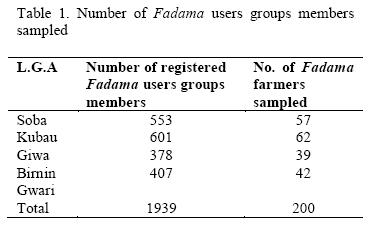
<body><![CDATA[<p align="justify"><font face="verdana" size="2">The study was conducted in Kaduna state which is located in the Northern Guinea Savanna zone of Nigeria. According to Bello (2000), it lies by the southern end of the High Plain of Nigeria, bounded by parallel 9&deg;03'N and 11&deg;32'N, and extends from the upper River Mariga on 6&deg;05'E to 8&deg;48'E on the foot slopes of the scarp of Jos Plateau. In the <i>Fadama,</i> the dark grey clay soils (vertisols) are highly valued and are for intensive agricultural activities especially during the dry season. Large areas of such <i>Fadamas</i> are used for economically valuable market gardening for growing Tomato (Solanum lycopersicum), Chillies ( Piper nigrum), Sweet pepper ( Capsicum annum), Okra (Abelmoschus esculentus), Onion ( Allium cepa) Irish potato ( Solanum tuberosum) and Sugar cane (Saccharum officinarum) using tradition "shadulf irrigation (in the flood&#45;plain\Fadama of Galma and Tubo basins).</font></p>  	    <p align="justify"><font face="verdana" size="2">&nbsp;</font></p>  	    <p align="justify"><font face="verdana" size="2"><b>Sampling technique</b></font></p>  	    <p align="justify"><font face="verdana" size="2">The population for the study included the dry season vegetable farmers that cultivate tomato, onion and pepper under <i>Fadama</i> in Kaduna state. Purposive sampling was used to select seven local government areas (LGAs) noted for intensive production of vegetables. Four local government areas were randomly sampled from the seven LGAs. From the lists of registered <i>Fadama</i> farmers in the four LGAs, a proportionality factor was used to determine the number of <i>Fadama</i> farmers sampled from each LGA (<a href="#t1">Table 1</a>). 200 farmers were selected for the study by simple random sampling. However, only 192 questionnaires were completely filled and found useful. The proportionality factor is specified as follows,</font></p>  	    <p align="justify"><font face="verdana" size="2">n = nL/NL*200 1.</font></p>  	    <p align="justify"><font face="verdana" size="2">Where:</font></p>  	    <p align="justify"><font face="verdana" size="2">n= sample size per local government</font></p>  	    <p align="justify"><font face="verdana" size="2">nL= number of <i>Fadama</i> Users Groups members per local government</font></p>  	    <p align="justify"><font face="verdana" size="2">NL= Total number of <i>Fadama</i> Users Groups members</font></p>  	    <p align="center"><font face="verdana" size="2"><a name="t1"></a><img src="/img/revistas/tsa/v14n3/a24t1.jpg"></font></p>  	    ]]></body>
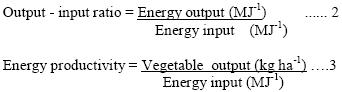
<body><![CDATA[<p align="justify"><font face="verdana" size="2">&nbsp;</font></p>  	    <p align="justify"><font face="verdana" size="2">Primary data were collected with the aid of a questionnaire administered by trained enumerators. The data collected covered farmers socio&#45;economic variables, inputs as well as outputs data.</font></p>  	    <p align="justify"><font face="verdana" size="2">&nbsp;</font></p>  	    <p align="justify"><font face="verdana" size="2"><b>Data analysis</b></font></p>  	    <p align="justify"><font face="verdana" size="2">The data collected were analyzed using descriptive statistics. The energy equivalents of inputs used and output obtained in vegetable production are illustrated in <a href="/img/revistas/tsa/v14n3/a24t2.jpg" target="_blank">Table 2</a>. The data on energy use have been taken from a number of sources, as indicated in the table. Based on the energy equivalents of the inputs and output (<a href="/img/revistas/tsa/v14n3/a24t2.jpg" target="_blank">Table 2</a>), the energy ratio (energy use efficiency) and energy productivity were calculated by using the equations 2 and 3 (Mandal et al., 2002 and Singh, 1997), in addition to describing the pattern of energy use for vegetable production under the <i>Fadama</i> production system.</font></p>  	    <p align="center"><font face="verdana" size="2"><img src="/img/revistas/tsa/v14n3/a24e1.jpg"></font></p>  	    <p align="justify"><font face="verdana" size="2">The NPK 15:15:15 brand of compound fertilizer is widely used in the study area. The fertilizer blend contains Nitrogen, Phosphorus and Potassium combined in a ratio of 15:15:15 packaged in a 50kg bag. This implies that a 50kg bag of NPK 15:15:15 fertilizer contains 7.5kg of each of the elements N, P and K. According to Singh et al. (2002), the energy equivalent of a unit (kg) of elemental N, P and K are 60.60MJ, 11.10MJ and 6.70MJ respectively. Hence, the total energy equivalent of NPK 15:15:15 in a50 kg bag was 588MJ.This is equivalent to 11.76MJ per kg of the fertilizer.</font></p>  	    <p align="justify"><font face="verdana" size="2">&nbsp;</font></p>  	    <p align="justify"><font face="verdana" size="2"><b>RESULTS</b></font></p>  	    <p align="justify"><font face="verdana" size="2"><b>Energy use in Onion production under <i>Fadama</i></b></font></p>  	    ]]></body>
<body><![CDATA[<p align="justify"><font face="verdana" size="2">The inputs used in Onion production and their energy equivalents, output energy equivalent and energy ratio are illustrated in <a href="/img/revistas/tsa/v14n3/a24t3.jpg" target="_blank">Table 3</a>. About 1.35 litres of insecticides, 95kg of NPK and 65kg of Nitrogen or Urea fertilizer were used in Onion production on a hectare basis under <i>Fadama.</i> The use of irrigation water and Petrol were 633.3 and 175 litres respectively. The total energy equivalent of inputs was calculated as 14106.25 MJ Per ha. Petrol had the highest share, of 52.47%, followed by nitrogen fertilizer (30.50%), NPK fertilizer (8.00%) and human labour (5.33%), respectively. The energy inputs of insecticides were very low relative to the other inputs used in production. The average yield of Onion was about 3616 kg ha&#45;1 and its energy equivalent was calculated to be 2892.8 MJ. Based on these values, output&#45;input energy ratio for the production of Onion under <i>Fadama</i> was 0.20, while the energy productivity was calculated as 0.25.</font></p>  	    <p align="justify"><font face="verdana" size="2">&nbsp;</font></p>  	    <p align="justify"><font face="verdana" size="2"><b>Energy use in Tomato production under <i>Fadama</i></b></font></p>  	    <p align="justify"><font face="verdana" size="2">The inputs, used in the Tomato production and their energy equivalents, as well as the energy equivalent of the yield were presented in <a href="/img/revistas/tsa/v14n3/a24t4.jpg" target="_blank">Table 4</a>. As indicated in the table, about 1.8 litres of insecticides, 192 kg of NPK and 175 kg of Nitrogen or Urea fertilizer were used in Tomato production on a hectare basis under <i>Fadama.</i> The use of human power was about 385 Man hrs. The quantity of petrol used was 167 litres. Average Tomato yield was 2625 kg ha&#45;land this is equivalent to 2122.4 MJ of energy. The total energy input was calculated as 22833.582 MJ ha&#45;1. Urea fertilizer was the dominant energy input with a share of 50.70% of the total energy inputs. This was followed by petrol (30.94%), NPK fertilizer (9.89%). Based on these values output&#45;input energy ratio for Tomato production under <i>Fadama</i> was 0.10, while the energy productivity was calculated as 0.12.</font></p>  	    <p align="justify"><font face="verdana" size="2">&nbsp;</font></p>  	    <p align="justify"><font face="verdana" size="2"><b>Energy use in Sweet pepper production under <i>Fadama</i></b></font></p>  	    <p align="justify"><font face="verdana" size="2"><a href="/img/revistas/tsa/v14n3/a24t5.jpg" target="_blank">Table 5</a> represents the values for sweet pepper production under <i>Fadama.</i> The table shows that about 3.29 litres of insecticides, 145 kg of NPK fertilizer and 97 kg of Urea fertilizer were used in pepper production per hectare. The use of human power and petrol were 325 man hrs and 211 litres ha&#45;1, respectively. The average pepper yield was 2394kg ha&#45;1. Energy equivalent of this yield was calculated as 1915.2MJ per unit area. The result shows that total energy equivalents of the inputs used in the pepper production was 18597.14MJ ha&#45;1. Petrol had the biggest share with 48.0% of total energy input used in the production. This was followed by Urea fertilizer (34.5%), NPK fertilizer (9.2%) and labour (4.01%). Output&#45;input energy ratio for sweet pepper production was 0.10. The energy productivity was calculated to be 0.13.</font></p>  	    <p align="justify"><font face="verdana" size="2">&nbsp;</font></p>  	    <p align="justify"><font face="verdana" size="2"><b>Energy use in Hot pepper production under <i>Fadama</i></b></font></p>  	    <p align="justify"><font face="verdana" size="2">As indicated in the <a href="/img/revistas/tsa/v14n3/a24t6.jpg" target="_blank">Table 6</a>, the amount of 2.5 litres of insecticides, 26.7kg of NPK fertilizer and 26.7 kg of Urea fertilizer were used in Hot pepper production on a hectare basis under <i>Fadama.</i> About 345 Man hrs of human labour and 205 litres of petrol were used respectively. Average Hot pepper yield was 856 kg ha&#45;1. This in energy equivalent equals 684.8MJ of energy. The total energy input was calculated to be 11961.458 MJ ha&#45;1. Petrol was the dominant energy input in the total with a share of 72.50%. This was followed by nitrogen or Urea fertilizer (12.50%), labour (6.63%) and water (3.64%). Based on these values, output&#45;input energy ratio for Hot pepper production was 0.06. The energy productivity was calculated to be 0.07.</font></p>  	    ]]></body>
<body><![CDATA[<p align="justify"><font face="verdana" size="2">&nbsp;</font></p>  	    <p align="justify"><font face="verdana" size="2"><b>DISCUSSION</b></font></p>  	    <p align="justify"><font face="verdana" size="2">Among the vegetables investigated, Onion had the highest energy output&#45;input ratio. The lowest ratio was for Hot pepper. Sweet pepper and tomato had an equal energy output&#45;input ratio. The higher energy output&#45;input ratio for Onion production indicated a higher yield per hectare from the other crops. Hot pepper production was inefficient in terms of input utilization and yield. The energy ratios obtained for all the vegetables are quite low compared to the 1.26 and 0.99 obtained by Ozkan et al. (2004) for green house Tomato and green house Pepper respectively. Tomato production was the most energy intensive among the four vegetables investigated. A total of 22833.58MJ ha<sup>&#45;1</sup> of energy was used Tomato production, followed by onion which consumed about 18597. MMJha<sup>&#45;1</sup> of energy.</font></p>  	    <p align="justify"><font face="verdana" size="2">The use of inputs in vegetable production under <i>Fadama</i> is not accompanied with the satisfying yield increase. This is obvious from the values of energy productivity obtained for all four vegetables studied. This is an indication that seeds or seedlings practices used and the cultural practices in the production stages were not of high quality or were not the recommended practices.</font></p>  	    <p align="justify"><font face="verdana" size="2">Petrol had the highest share among the inputs for all the vegetable except tomato. This was due to the fact that the petrol engine water pump is the only device used for irrigating <i>Fadama</i> lands. The <i>Fadama</i> farmers no longer use the traditional Shadulf system for irrigation. This suggests that less energy consuming water pumps should be used to decrease fuel consumption in <i>Fadama</i> communities. The second most important input was Urea or nitrogen fertilizer. This excessive use suggests that the nitrogen not consumed by the plant may pollute the underground water and the environment as noted by Kaplan et al. (1999). For all the vegetables, the usage of non&#45;renewable energy inputs such as petrol and urea fertilizer was quite substantial. This implies that vegetable production in the study area depends heavily on fossil fuels which in the long run, may inevitably lead to environmental problems associated with energy use such as global warming, nutrient loading and ground water pollution. Agrochemical use for pest was not at very significant levels. However, biological control has to be introduced to reduce the energy inputs from the chemicals and to protect humans and the environment.</font></p>  	    <p align="justify"><font face="verdana" size="2">&nbsp;</font></p>  	    <p align="justify"><font face="verdana" size="2"><b>CONCLUSION</b></font></p>  	    <p align="justify"><font face="verdana" size="2">The production of vegetables in the research area is highly dependent on non&#45;renewable energy inputs which may not be sustainable in the long run. As such, energy use efficiency and energy productivity for vegetables in the research area were very low. However, to enhance the efficiency and productivity of the system, the usage of renewable energy inputs especially organic manure should be promoted among <i>Fadama</i> farmers. In addition, energy efficient water pumps should be introduced into the <i>Fadama</i> communities. There is also a need to use high&#45;yielding varieties of vegetables to increase energy use efficiency and energy productivity.</font></p>  	    <p align="justify"><font face="verdana" size="2">&nbsp;</font></p>  	    <p align="justify"><font face="verdana" size="2"><b>REFERENCES</b></font></p>  	    ]]></body>
<body><![CDATA[<!-- ref --><p align="justify"><font face="verdana" size="2">Abubakar M.S. and D. Ahmed. 2010. Pattern of Energy Consumption in Millet Production for Selected Farms in Jigawa, Nigeria. Australian Journal of Basic and Applied Sciences, 4: 665&#45;672.    &nbsp;&nbsp;&nbsp;&nbsp;&nbsp;&nbsp;&nbsp;&nbsp;[&#160;<a href="javascript:void(0);" onclick="javascript: window.open('/scielo.php?script=sci_nlinks&ref=10043851&pid=S1870-0462201100030002400001&lng=','','width=640,height=500,resizable=yes,scrollbars=1,menubar=yes,');">Links</a>&#160;]<!-- end-ref --></font></p>  	    <!-- ref --><p align="justify"><font face="verdana" size="2">Alamu ,J.F.1996. Marketing of <i>Fadama</i> Produced Tomato , Pepper and Onion: A Case Study of kano and Jigawa State of Nigeria. Unpublished Ph.D Thesis Department of Agricultural Economics and Extension ABU Zaria, Nigeria.    &nbsp;&nbsp;&nbsp;&nbsp;&nbsp;&nbsp;&nbsp;&nbsp;[&#160;<a href="javascript:void(0);" onclick="javascript: window.open('/scielo.php?script=sci_nlinks&ref=10043853&pid=S1870-0462201100030002400002&lng=','','width=640,height=500,resizable=yes,scrollbars=1,menubar=yes,');">Links</a>&#160;]<!-- end-ref --></font></p>  	    <!-- ref --><p align="justify"><font face="verdana" size="2">Bello, A.L. 2000. Survey of Kaduna State. In Nigeria A people united a future assured Vol 2:249&#45;254 A.B. Mamman, J.O. Oyebanji and S.W.Petters (eds) Federal Ministry of Information: Abuja.    &nbsp;&nbsp;&nbsp;&nbsp;&nbsp;&nbsp;&nbsp;&nbsp;[&#160;<a href="javascript:void(0);" onclick="javascript: window.open('/scielo.php?script=sci_nlinks&ref=10043855&pid=S1870-0462201100030002400003&lng=','','width=640,height=500,resizable=yes,scrollbars=1,menubar=yes,');">Links</a>&#160;]<!-- end-ref --></font></p>  	    <!-- ref --><p align="justify"><font face="verdana" size="2">Bockari&#45;Gevao, S.M, W.I. Wan Ishak, Y. Azmi and 8. Jadhao, A.K. and H.N. Pandey.2004. Analysis of energy consumption in requirement for sorghum crop production in lowland rice&#45;based cropping system of Malasia. Vidhargha region Agri. Engg. Today, 28:54&#45;59.    &nbsp;&nbsp;&nbsp;&nbsp;&nbsp;&nbsp;&nbsp;&nbsp;[&#160;<a href="javascript:void(0);" onclick="javascript: window.open('/scielo.php?script=sci_nlinks&ref=10043857&pid=S1870-0462201100030002400004&lng=','','width=640,height=500,resizable=yes,scrollbars=1,menubar=yes,');">Links</a>&#160;]<!-- end-ref --></font></p>  	    <!-- ref --><p align="justify"><font face="verdana" size="2">Canakci, M., M. Topakci., I. Akinci and A. Ozmerzi. 2005. Energy use pattern of some field crops and vegetable production: case study for Antalya region, Turkey. Energy Conversion Management, 46: 655&#45;666.    &nbsp;&nbsp;&nbsp;&nbsp;&nbsp;&nbsp;&nbsp;&nbsp;[&#160;<a href="javascript:void(0);" onclick="javascript: window.open('/scielo.php?script=sci_nlinks&ref=10043859&pid=S1870-0462201100030002400005&lng=','','width=640,height=500,resizable=yes,scrollbars=1,menubar=yes,');">Links</a>&#160;]<!-- end-ref --></font></p>  	    ]]></body>
<body><![CDATA[<!-- ref --><p align="justify"><font face="verdana" size="2">Demircan, V., K. Ekinci., HM. Keener., D. Akbolat and C. Ekinci 2006. Energy and economic analysis of sweet cherry production in Turkey: A case study from Isparta province. Energy Convers Manage, 47: 1761&#45;1769.    &nbsp;&nbsp;&nbsp;&nbsp;&nbsp;&nbsp;&nbsp;&nbsp;[&#160;<a href="javascript:void(0);" onclick="javascript: window.open('/scielo.php?script=sci_nlinks&ref=10043861&pid=S1870-0462201100030002400006&lng=','','width=640,height=500,resizable=yes,scrollbars=1,menubar=yes,');">Links</a>&#160;]<!-- end-ref --></font></p>  	    <!-- ref --><p align="justify"><font face="verdana" size="2">Esengun, K., Gunduz, O. and Erdal, G. 2007. Input&#45;output energy analysis in dry apricot production of Turkey. Energy Conversion and Management, 48:592&#45;598.    &nbsp;&nbsp;&nbsp;&nbsp;&nbsp;&nbsp;&nbsp;&nbsp;[&#160;<a href="javascript:void(0);" onclick="javascript: window.open('/scielo.php?script=sci_nlinks&ref=10043863&pid=S1870-0462201100030002400007&lng=','','width=640,height=500,resizable=yes,scrollbars=1,menubar=yes,');">Links</a>&#160;]<!-- end-ref --></font></p>  	    <!-- ref --><p align="justify"><font face="verdana" size="2">Hatirli S. A., B. Ozkan and C. 2006. Fert. Energy Inputs and Crop Yield Relationships in Greenhouse Tomato Production. Renewable Energy, 31:427&#45;438.    &nbsp;&nbsp;&nbsp;&nbsp;&nbsp;&nbsp;&nbsp;&nbsp;[&#160;<a href="javascript:void(0);" onclick="javascript: window.open('/scielo.php?script=sci_nlinks&ref=10043865&pid=S1870-0462201100030002400008&lng=','','width=640,height=500,resizable=yes,scrollbars=1,menubar=yes,');">Links</a>&#160;]<!-- end-ref --></font></p>  	    <!-- ref --><p align="justify"><font face="verdana" size="2">Ibrahim, H.Y.(2009): Sustainability of vegetable production under Fadama in Kaduna state, Nigeria. Unpublished Ph.D Thesis University of llor&iacute;n, Ilor&iacute;n, Nigeria.    &nbsp;&nbsp;&nbsp;&nbsp;&nbsp;&nbsp;&nbsp;&nbsp;[&#160;<a href="javascript:void(0);" onclick="javascript: window.open('/scielo.php?script=sci_nlinks&ref=10043867&pid=S1870-0462201100030002400009&lng=','','width=640,height=500,resizable=yes,scrollbars=1,menubar=yes,');">Links</a>&#160;]<!-- end-ref --></font></p>  	    <!-- ref --><p align="justify"><font face="verdana" size="2">Kaplan M, Sonmez S, Tokmak S. 1999. The nitrate content of well waters in the Kumluca region&#45;Antalya. Turkish Journal of Agriculture &amp; Forestry, 23:9&#45;14.    &nbsp;&nbsp;&nbsp;&nbsp;&nbsp;&nbsp;&nbsp;&nbsp;[&#160;<a href="javascript:void(0);" onclick="javascript: window.open('/scielo.php?script=sci_nlinks&ref=10043869&pid=S1870-0462201100030002400010&lng=','','width=640,height=500,resizable=yes,scrollbars=1,menubar=yes,');">Links</a>&#160;]<!-- end-ref --></font></p>  	    ]]></body>
<body><![CDATA[<!-- ref --><p align="justify"><font face="verdana" size="2">Kolawole, A and Scones, I. 1994). Fadama Land Use and Sustainability in Northern Nigeria: Strategies for the Sustainable Use of Fadama Lands in Northern Nigeria. CSER/ABU Zaria and IIED .London p.29.    &nbsp;&nbsp;&nbsp;&nbsp;&nbsp;&nbsp;&nbsp;&nbsp;[&#160;<a href="javascript:void(0);" onclick="javascript: window.open('/scielo.php?script=sci_nlinks&ref=10043871&pid=S1870-0462201100030002400011&lng=','','width=640,height=500,resizable=yes,scrollbars=1,menubar=yes,');">Links</a>&#160;]<!-- end-ref --></font></p>  	    <!-- ref --><p align="justify"><font face="verdana" size="2">Mandal, K.G., Saha, K.P., Ghosh, P.K., Hati, K.M. and Bandyopadhyay, K.K. 2002. Bioenergy and economic analysis of soybean based crop production systems in central India. Biomass &amp; Bioenergy, 23:337&#45;345.    &nbsp;&nbsp;&nbsp;&nbsp;&nbsp;&nbsp;&nbsp;&nbsp;[&#160;<a href="javascript:void(0);" onclick="javascript: window.open('/scielo.php?script=sci_nlinks&ref=10043873&pid=S1870-0462201100030002400012&lng=','','width=640,height=500,resizable=yes,scrollbars=1,menubar=yes,');">Links</a>&#160;]<!-- end-ref --></font></p>  	    <!-- ref --><p align="justify"><font face="verdana" size="2">Ozkan, B., Akcaoz, H. and Fert, C. 2004. Energy input output analysis in Turkish agriculture. Renewable Energy, 29:39&#45;51.    &nbsp;&nbsp;&nbsp;&nbsp;&nbsp;&nbsp;&nbsp;&nbsp;[&#160;<a href="javascript:void(0);" onclick="javascript: window.open('/scielo.php?script=sci_nlinks&ref=10043875&pid=S1870-0462201100030002400013&lng=','','width=640,height=500,resizable=yes,scrollbars=1,menubar=yes,');">Links</a>&#160;]<!-- end-ref --></font></p>  	    <!-- ref --><p align="justify"><font face="verdana" size="2">Shrestha, D.S. 1998. Energy use efficiency indicator for agriculture,. <a href="http://www.usaskca/agriculture/caedac/PDF/mcrae.PDF" target="_blank">http://www.usaskca/agriculture/caedac/PDF/mcrae.PDF</a> ,Retrieved, 12/09/2010.    &nbsp;&nbsp;&nbsp;&nbsp;&nbsp;&nbsp;&nbsp;&nbsp;[&#160;<a href="javascript:void(0);" onclick="javascript: window.open('/scielo.php?script=sci_nlinks&ref=10043877&pid=S1870-0462201100030002400014&lng=','','width=640,height=500,resizable=yes,scrollbars=1,menubar=yes,');">Links</a>&#160;]<!-- end-ref --></font></p>  	    <!-- ref --><p align="justify"><font face="verdana" size="2">Singh, H., Mishra, D. and Nahar, N.M. 2002. Energy use pattern in production agriculture of a typical village in Arid Zone India&#45;Part I. Energy Conversion and Management, 43:2275&#45;2286.    &nbsp;&nbsp;&nbsp;&nbsp;&nbsp;&nbsp;&nbsp;&nbsp;[&#160;<a href="javascript:void(0);" onclick="javascript: window.open('/scielo.php?script=sci_nlinks&ref=10043879&pid=S1870-0462201100030002400015&lng=','','width=640,height=500,resizable=yes,scrollbars=1,menubar=yes,');">Links</a>&#160;]<!-- end-ref --></font></p>  	    ]]></body>
<body><![CDATA[<!-- ref --><p align="justify"><font face="verdana" size="2">Singh, J.M. 2002. On Farm Energy Use Pattern in Different Cropping Systems in Haryana, India. MSc. thesis, International Institute of Management University of Flensburg, Germany.    &nbsp;&nbsp;&nbsp;&nbsp;&nbsp;&nbsp;&nbsp;&nbsp;[&#160;<a href="javascript:void(0);" onclick="javascript: window.open('/scielo.php?script=sci_nlinks&ref=10043881&pid=S1870-0462201100030002400016&lng=','','width=640,height=500,resizable=yes,scrollbars=1,menubar=yes,');">Links</a>&#160;]<!-- end-ref --></font></p>  	    <!-- ref --><p align="justify"><font face="verdana" size="2">Singh, M.K., Pal, S.K., Thakur, R. and Verma,U.N. 1997. U.N. Energy input&#45;output relationship of cropping systems. Indian J. Agrie. Sci, 67:262&#45;266.    &nbsp;&nbsp;&nbsp;&nbsp;&nbsp;&nbsp;&nbsp;&nbsp;[&#160;<a href="javascript:void(0);" onclick="javascript: window.open('/scielo.php?script=sci_nlinks&ref=10043883&pid=S1870-0462201100030002400017&lng=','','width=640,height=500,resizable=yes,scrollbars=1,menubar=yes,');">Links</a>&#160;]<!-- end-ref --></font></p>  	    <!-- ref --><p align="justify"><font face="verdana" size="2">Yaldiz, O., Ozturk, H.H., Zeren, Y. and Bascetincelik, A. 1993. Energy usage in production of field crops in Turkey. 5. International Congress on Mechanization and Energy in Agriculture, Izmir, Turkey, pp. 527&#45;36.    &nbsp;&nbsp;&nbsp;&nbsp;&nbsp;&nbsp;&nbsp;&nbsp;[&#160;<a href="javascript:void(0);" onclick="javascript: window.open('/scielo.php?script=sci_nlinks&ref=10043885&pid=S1870-0462201100030002400018&lng=','','width=640,height=500,resizable=yes,scrollbars=1,menubar=yes,');">Links</a>&#160;]<!-- end-ref --></font></p>      ]]></body><back>
<ref-list>
<ref id="B1">
<nlm-citation citation-type="journal">
<person-group person-group-type="author">
<name>
<surname><![CDATA[Abubakar]]></surname>
<given-names><![CDATA[M.S.]]></given-names>
</name>
<name>
<surname><![CDATA[Ahmed]]></surname>
<given-names><![CDATA[D.]]></given-names>
</name>
</person-group>
<article-title xml:lang="en"><![CDATA[Pattern of Energy Consumption in Millet Production for Selected Farms in Jigawa, Nigeria]]></article-title>
<source><![CDATA[Australian Journal of Basic and Applied Sciences]]></source>
<year>2010</year>
<volume>4</volume>
<page-range>665-672</page-range></nlm-citation>
</ref>
<ref id="B2">
<nlm-citation citation-type="">
<person-group person-group-type="author">
<name>
<surname><![CDATA[Alamu]]></surname>
<given-names><![CDATA[J.F.]]></given-names>
</name>
</person-group>
<source><![CDATA[Marketing of Fadama Produced Tomato , Pepper and Onion: A Case Study of kano and Jigawa State of Nigeria]]></source>
<year>1996</year>
</nlm-citation>
</ref>
<ref id="B3">
<nlm-citation citation-type="book">
<person-group person-group-type="author">
<name>
<surname><![CDATA[Bello]]></surname>
<given-names><![CDATA[A.L.]]></given-names>
</name>
</person-group>
<article-title xml:lang="en"><![CDATA[Survey of Kaduna State]]></article-title>
<person-group person-group-type="editor">
<name>
<surname><![CDATA[Mamman]]></surname>
<given-names><![CDATA[A.B.]]></given-names>
</name>
<name>
<surname><![CDATA[Oyebanji]]></surname>
<given-names><![CDATA[J.O.]]></given-names>
</name>
<name>
<surname><![CDATA[Petters]]></surname>
<given-names><![CDATA[S.W.]]></given-names>
</name>
</person-group>
<source><![CDATA[Nigeria A people united a future assured]]></source>
<year>2000</year>
<volume>2</volume>
<page-range>249-254</page-range><publisher-loc><![CDATA[Abuja ]]></publisher-loc>
<publisher-name><![CDATA[Federal Ministry of Information]]></publisher-name>
</nlm-citation>
</ref>
<ref id="B4">
<nlm-citation citation-type="journal">
<person-group person-group-type="author">
<name>
<surname><![CDATA[Bockari-Gevao]]></surname>
<given-names><![CDATA[S.M]]></given-names>
</name>
<name>
<surname><![CDATA[Wan Ishak]]></surname>
<given-names><![CDATA[W.I.]]></given-names>
</name>
<name>
<surname><![CDATA[Azmi]]></surname>
<given-names><![CDATA[Y.]]></given-names>
</name>
<name>
<surname><![CDATA[8. Jadhao]]></surname>
<given-names><![CDATA[A.K.]]></given-names>
</name>
<name>
<surname><![CDATA[Pandey]]></surname>
<given-names><![CDATA[H.N.]]></given-names>
</name>
</person-group>
<article-title xml:lang="en"><![CDATA[Analysis of energy consumption in requirement for sorghum crop production in lowland rice-based cropping system of Malasia]]></article-title>
<source><![CDATA[Vidhargha region Agri. Engg. Today]]></source>
<year>2004</year>
<volume>28</volume>
<page-range>54-59</page-range></nlm-citation>
</ref>
<ref id="B5">
<nlm-citation citation-type="journal">
<person-group person-group-type="author">
<name>
<surname><![CDATA[Canakci]]></surname>
<given-names><![CDATA[M.]]></given-names>
</name>
<name>
<surname><![CDATA[Topakci]]></surname>
<given-names><![CDATA[M.]]></given-names>
</name>
<name>
<surname><![CDATA[Akinci]]></surname>
<given-names><![CDATA[I.]]></given-names>
</name>
<name>
<surname><![CDATA[Ozmerzi]]></surname>
<given-names><![CDATA[A.]]></given-names>
</name>
</person-group>
<article-title xml:lang="en"><![CDATA[Energy use pattern of some field crops and vegetable production: case study for Antalya region, Turkey]]></article-title>
<source><![CDATA[Energy Conversion Management]]></source>
<year>2005</year>
<volume>46</volume>
<page-range>655-666</page-range></nlm-citation>
</ref>
<ref id="B6">
<nlm-citation citation-type="journal">
<person-group person-group-type="author">
<name>
<surname><![CDATA[Demircan]]></surname>
<given-names><![CDATA[V.]]></given-names>
</name>
<name>
<surname><![CDATA[Ekinci]]></surname>
<given-names><![CDATA[K.]]></given-names>
</name>
<name>
<surname><![CDATA[Keener]]></surname>
<given-names><![CDATA[HM.]]></given-names>
</name>
<name>
<surname><![CDATA[Akbolat]]></surname>
<given-names><![CDATA[D.]]></given-names>
</name>
<name>
<surname><![CDATA[Ekinci]]></surname>
<given-names><![CDATA[C.]]></given-names>
</name>
</person-group>
<article-title xml:lang="en"><![CDATA[Energy and economic analysis of sweet cherry production in Turkey: A case study from Isparta province]]></article-title>
<source><![CDATA[Energy Convers Manage]]></source>
<year>2006</year>
<volume>47</volume>
<page-range>1761-1769</page-range></nlm-citation>
</ref>
<ref id="B7">
<nlm-citation citation-type="journal">
<person-group person-group-type="author">
<name>
<surname><![CDATA[Esengun]]></surname>
<given-names><![CDATA[K.]]></given-names>
</name>
<name>
<surname><![CDATA[Gunduz]]></surname>
<given-names><![CDATA[O.]]></given-names>
</name>
<name>
<surname><![CDATA[Erdal]]></surname>
<given-names><![CDATA[G.]]></given-names>
</name>
</person-group>
<article-title xml:lang="en"><![CDATA[Input-output energy analysis in dry apricot production of Turkey]]></article-title>
<source><![CDATA[Energy Conversion and Management]]></source>
<year>2007</year>
<volume>48</volume>
<page-range>592-598</page-range></nlm-citation>
</ref>
<ref id="B8">
<nlm-citation citation-type="journal">
<person-group person-group-type="author">
<name>
<surname><![CDATA[Hatirli]]></surname>
<given-names><![CDATA[S. A.]]></given-names>
</name>
<name>
<surname><![CDATA[Ozkan]]></surname>
<given-names><![CDATA[B.]]></given-names>
</name>
</person-group>
<article-title xml:lang="en"><![CDATA[Fert. Energy Inputs and Crop Yield Relationships in Greenhouse Tomato Production]]></article-title>
<source><![CDATA[Renewable Energy]]></source>
<year>2006</year>
<volume>31</volume>
<page-range>427-438</page-range></nlm-citation>
</ref>
<ref id="B9">
<nlm-citation citation-type="">
<person-group person-group-type="author">
<name>
<surname><![CDATA[Ibrahim]]></surname>
<given-names><![CDATA[H.Y.]]></given-names>
</name>
</person-group>
<source><![CDATA[Sustainability of vegetable production under Fadama in Kaduna state, Nigeria]]></source>
<year>2009</year>
</nlm-citation>
</ref>
<ref id="B10">
<nlm-citation citation-type="journal">
<person-group person-group-type="author">
<name>
<surname><![CDATA[Kaplan]]></surname>
<given-names><![CDATA[M]]></given-names>
</name>
<name>
<surname><![CDATA[Sonmez]]></surname>
<given-names><![CDATA[S]]></given-names>
</name>
<name>
<surname><![CDATA[Tokmak]]></surname>
<given-names><![CDATA[S]]></given-names>
</name>
</person-group>
<article-title xml:lang="en"><![CDATA[The nitrate content of well waters in the Kumluca region-Antalya]]></article-title>
<source><![CDATA[Turkish Journal of Agriculture & Forestry]]></source>
<year>1999</year>
<volume>23</volume>
<page-range>9-14</page-range></nlm-citation>
</ref>
<ref id="B11">
<nlm-citation citation-type="book">
<person-group person-group-type="author">
<name>
<surname><![CDATA[Kolawole]]></surname>
<given-names><![CDATA[A]]></given-names>
</name>
<name>
<surname><![CDATA[Scones]]></surname>
<given-names><![CDATA[I.]]></given-names>
</name>
</person-group>
<source><![CDATA[Fadama Land Use and Sustainability in Northern Nigeria: Strategies for the Sustainable Use of Fadama Lands in Northern Nigeria]]></source>
<year>1994</year>
<page-range>29</page-range><publisher-loc><![CDATA[London ]]></publisher-loc>
<publisher-name><![CDATA[CSER/ABU ZariaIIED]]></publisher-name>
</nlm-citation>
</ref>
<ref id="B12">
<nlm-citation citation-type="journal">
<person-group person-group-type="author">
<name>
<surname><![CDATA[Mandal]]></surname>
<given-names><![CDATA[K.G.]]></given-names>
</name>
<name>
<surname><![CDATA[Saha]]></surname>
<given-names><![CDATA[K.P.]]></given-names>
</name>
<name>
<surname><![CDATA[Ghosh]]></surname>
<given-names><![CDATA[P.K.]]></given-names>
</name>
<name>
<surname><![CDATA[Hati]]></surname>
<given-names><![CDATA[K.M.]]></given-names>
</name>
<name>
<surname><![CDATA[Bandyopadhyay]]></surname>
<given-names><![CDATA[K.K.]]></given-names>
</name>
</person-group>
<article-title xml:lang="en"><![CDATA[Bioenergy and economic analysis of soybean based crop production systems in central India]]></article-title>
<source><![CDATA[Biomass & Bioenergy]]></source>
<year>2002</year>
<volume>23</volume>
<page-range>337-345</page-range></nlm-citation>
</ref>
<ref id="B13">
<nlm-citation citation-type="journal">
<person-group person-group-type="author">
<name>
<surname><![CDATA[Ozkan]]></surname>
<given-names><![CDATA[B.]]></given-names>
</name>
<name>
<surname><![CDATA[Akcaoz]]></surname>
<given-names><![CDATA[H.]]></given-names>
</name>
<name>
<surname><![CDATA[Fert]]></surname>
<given-names><![CDATA[C.]]></given-names>
</name>
</person-group>
<article-title xml:lang="en"><![CDATA[Energy input output analysis in Turkish agriculture]]></article-title>
<source><![CDATA[Renewable Energy]]></source>
<year>2004</year>
<volume>29</volume>
<page-range>39-51</page-range></nlm-citation>
</ref>
<ref id="B14">
<nlm-citation citation-type="">
<person-group person-group-type="author">
<name>
<surname><![CDATA[Shrestha]]></surname>
<given-names><![CDATA[D.S.]]></given-names>
</name>
</person-group>
<source><![CDATA[Energy use efficiency indicator for agriculture]]></source>
<year>1998</year>
</nlm-citation>
</ref>
<ref id="B15">
<nlm-citation citation-type="journal">
<person-group person-group-type="author">
<name>
<surname><![CDATA[Singh]]></surname>
<given-names><![CDATA[H.]]></given-names>
</name>
<name>
<surname><![CDATA[Mishra]]></surname>
<given-names><![CDATA[D.]]></given-names>
</name>
<name>
<surname><![CDATA[Nahar]]></surname>
<given-names><![CDATA[N.M.]]></given-names>
</name>
</person-group>
<article-title xml:lang="en"><![CDATA[Energy use pattern in production agriculture of a typical village in Arid Zone India-Part I]]></article-title>
<source><![CDATA[Energy Conversion and Management]]></source>
<year>2002</year>
<volume>43</volume>
<page-range>2275-2286</page-range></nlm-citation>
</ref>
<ref id="B16">
<nlm-citation citation-type="">
<person-group person-group-type="author">
<name>
<surname><![CDATA[Singh]]></surname>
<given-names><![CDATA[J.M.]]></given-names>
</name>
</person-group>
<source><![CDATA[On Farm Energy Use Pattern in Different Cropping Systems in Haryana, India]]></source>
<year>2002</year>
</nlm-citation>
</ref>
<ref id="B17">
<nlm-citation citation-type="journal">
<person-group person-group-type="author">
<name>
<surname><![CDATA[Singh]]></surname>
<given-names><![CDATA[M.K.]]></given-names>
</name>
<name>
<surname><![CDATA[Pal]]></surname>
<given-names><![CDATA[S.K.]]></given-names>
</name>
<name>
<surname><![CDATA[Thakur]]></surname>
<given-names><![CDATA[R.]]></given-names>
</name>
<name>
<surname><![CDATA[Verma]]></surname>
<given-names><![CDATA[U.N.]]></given-names>
</name>
</person-group>
<article-title xml:lang="en"><![CDATA[U.N. Energy input-output relationship of cropping systems]]></article-title>
<source><![CDATA[Indian J. Agrie. Sci]]></source>
<year>1997</year>
<volume>67</volume>
<page-range>262-266</page-range></nlm-citation>
</ref>
<ref id="B18">
<nlm-citation citation-type="confpro">
<person-group person-group-type="author">
<name>
<surname><![CDATA[Yaldiz]]></surname>
<given-names><![CDATA[O.]]></given-names>
</name>
<name>
<surname><![CDATA[Ozturk]]></surname>
<given-names><![CDATA[H.H.]]></given-names>
</name>
<name>
<surname><![CDATA[Zeren]]></surname>
<given-names><![CDATA[Y.]]></given-names>
</name>
<name>
<surname><![CDATA[Bascetincelik]]></surname>
<given-names><![CDATA[A.]]></given-names>
</name>
</person-group>
<source><![CDATA[Energy usage in production of field crops in Turkey]]></source>
<year>1993</year>
<conf-name><![CDATA[5 International Congress on Mechanization and Energy in Agriculture]]></conf-name>
<conf-loc>Izmir </conf-loc>
<page-range>527-36</page-range></nlm-citation>
</ref>
</ref-list>
</back>
</article>