<?xml version="1.0" encoding="ISO-8859-1"?><article xmlns:mml="http://www.w3.org/1998/Math/MathML" xmlns:xlink="http://www.w3.org/1999/xlink" xmlns:xsi="http://www.w3.org/2001/XMLSchema-instance">
<front>
<journal-meta>
<journal-id>1870-0462</journal-id>
<journal-title><![CDATA[Tropical and subtropical agroecosystems]]></journal-title>
<abbrev-journal-title><![CDATA[Trop. subtrop. agroecosyt]]></abbrev-journal-title>
<issn>1870-0462</issn>
<publisher>
<publisher-name><![CDATA[Universidad Autónoma de Yucatán, Facultad de Medicina Veterinaria]]></publisher-name>
</publisher>
</journal-meta>
<article-meta>
<article-id>S1870-04622011000200031</article-id>
<title-group>
<article-title xml:lang="en"><![CDATA[Integrated management of parasitic plant Striga hermonthica in maize using Fusarium oxysporum (mycoherbicide) and post-emergence herbicides in the Nigerian savanna]]></article-title>
<article-title xml:lang="es"><![CDATA[Manejo integrado de la planta parásita Striga hermonthica en el maíz empleado Fusarium oxysporum (micoherbicida) y herbicidas post-emergencia en la sabana de Nigeria]]></article-title>
</title-group>
<contrib-group>
<contrib contrib-type="author">
<name>
<surname><![CDATA[Magani]]></surname>
<given-names><![CDATA[E.I.]]></given-names>
</name>
<xref ref-type="aff" rid="A01"/>
</contrib>
<contrib contrib-type="author">
<name>
<surname><![CDATA[Ibrahim]]></surname>
<given-names><![CDATA[A.]]></given-names>
</name>
<xref ref-type="aff" rid="A02"/>
</contrib>
<contrib contrib-type="author">
<name>
<surname><![CDATA[Ahom]]></surname>
<given-names><![CDATA[R. I]]></given-names>
</name>
<xref ref-type="aff" rid="A01"/>
</contrib>
</contrib-group>
<aff id="A01">
<institution><![CDATA[,University of Agriculture Department of Crop and Environmental Protection ]]></institution>
<addr-line><![CDATA[Makurdi ]]></addr-line>
<country>Nigeria</country>
</aff>
<aff id="A02">
<institution><![CDATA[,Nasarawa State University Department of Agronomy ]]></institution>
<addr-line><![CDATA[Keffi Nasarawa]]></addr-line>
<country>Nigeria</country>
</aff>
<pub-date pub-type="pub">
<day>00</day>
<month>08</month>
<year>2011</year>
</pub-date>
<pub-date pub-type="epub">
<day>00</day>
<month>08</month>
<year>2011</year>
</pub-date>
<volume>14</volume>
<numero>2</numero>
<fpage>731</fpage>
<lpage>738</lpage>
<copyright-statement/>
<copyright-year/>
<self-uri xlink:href="http://www.scielo.org.mx/scielo.php?script=sci_arttext&amp;pid=S1870-04622011000200031&amp;lng=en&amp;nrm=iso"></self-uri><self-uri xlink:href="http://www.scielo.org.mx/scielo.php?script=sci_abstract&amp;pid=S1870-04622011000200031&amp;lng=en&amp;nrm=iso"></self-uri><self-uri xlink:href="http://www.scielo.org.mx/scielo.php?script=sci_pdf&amp;pid=S1870-04622011000200031&amp;lng=en&amp;nrm=iso"></self-uri><abstract abstract-type="short" xml:lang="en"><p><![CDATA[The efficacy of a granular mycoherbicide formulation based on Fusarium oxysporum and post-emergence herbicides for the control Striga hermonthica was evaluated. Four fungal treatments were used: F. oxysporum followed by 2, 4-D, F. oxysporum followed by supplementary hoe weeding, F. oxysporum followed by Triclopyr and a control (No F. oxysporum) in two maize varieties (Across 97 TZL and farmer's local variety). The maize variety Across 97 TZL significantly delayed the emergence of Striga as compared to the farmer's local. The highest number of maize plant infected with Striga/shoot count was recorded at Makurdi and the farmer's local variety. Similarly, in the Striga control methods, the hoe-weeded check recorded significantly more Striga/shoot count when compared to all other control treatments. Highest maize grain yields were obtained in 2009; at Makurdi; Across 97 TZL and plots that received F. oxysporum followed by post-emergence application of either Triclopyr, 2,4-D each at 0.36 kg active ingredient/ha.]]></p></abstract>
<abstract abstract-type="short" xml:lang="es"><p><![CDATA[Se evaluó la eficacia de un micoherbicida granular basado en Fusarium oxysporum y herbicidas post-emergencia para el control de Striga hermonthica. Se emplearon cuatro tramientos con hongos: F. oxysporum seguido de 2, 4-D, F. oxysporum seguido de deshierbe, F. oxysporum seguido de Triclopyr y un control (No F. oxysporum). Dos variedades de maíz fueron empleadas (Across 97 TZL y una variedad local). La variedad de maíz Across 97 TZL retrasó significantivamente la emergencia de Striga en comparación con la variedad local. El mayor número de plantas de maíz infectadas con Striga se registró en Makurdi con la variedad local. De manera similar, para los métodos de control de Striga, en el deshierbe se encontró mayor cantidad de Striga en comparaicón con los otros métodos. La mayor producción de maíz se obtuvo con Across 97 TZL y en las parcelas que recivieron F. oxysporum seguido por la aplicación post-emergencia de Triclopyr o 2,4-D a razón de 0.36 kg de ingrediente activo/ha.]]></p></abstract>
<kwd-group>
<kwd lng="en"><![CDATA[Biocontrol]]></kwd>
<kwd lng="en"><![CDATA[Fusarium oxysporum]]></kwd>
<kwd lng="en"><![CDATA[herbicides]]></kwd>
<kwd lng="en"><![CDATA[Striga hermonthica]]></kwd>
<kwd lng="en"><![CDATA[maize]]></kwd>
<kwd lng="en"><![CDATA[mycoherbicide]]></kwd>
<kwd lng="es"><![CDATA[Biocontrol]]></kwd>
<kwd lng="es"><![CDATA[Fusarium oxysporum]]></kwd>
<kwd lng="es"><![CDATA[herbicidas]]></kwd>
<kwd lng="es"><![CDATA[Striga hermonthica]]></kwd>
<kwd lng="es"><![CDATA[maíz]]></kwd>
<kwd lng="es"><![CDATA[micoherbicida]]></kwd>
</kwd-group>
</article-meta>
</front><body><![CDATA[  	    <p align="justify"><font face="verdana" size="4">Art&iacute;culos de investigaci&oacute;n</font></p>  	    <p align="justify"><font face="verdana" size="2">&nbsp;</font></p>  	    <p align="center"><font face="verdana" size="4"><b>Integrated management of parasitic plant <i>Striga</i> <i>hermonthica</i> in maize using <i>Fusarium oxysporum</i> (mycoherbicide) and post&#45;emergence herbicides in the Nigerian savanna</b></font></p>  	    <p align="justify"><font face="verdana" size="2">&nbsp;</font></p>  	    <p align="center"><font face="verdana" size="3"><b>Manejo integrado de la planta par&aacute;sita <i>Striga hermonthica</i> en el ma&iacute;z empleado <i>Fusarium</i> <i>oxysporum</i> (micoherbicida) y herbicidas post&#45;emergencia en la sabana de Nigeria</b></font></p>  	    <p align="justify"><font face="verdana" size="2">&nbsp;</font></p>  	    <p align="center"><font face="verdana" size="2"><b>E.I. Magani<sup>1</sup>*, A. Ibrahim<sup>2</sup> and R. I. Ahom<sup>1</sup></b></font></p>  	    <p align="justify"><font face="verdana" size="2">&nbsp;</font></p>  	    <p align="justify"><font face="verdana" size="2"><i><sup>1 </sup>Department of Crop and Environmental Protection, University of Agriculture P.M.B 2373, Makurdi, Nigeria; *Corresponding AuthorE&#45;mail:&#45;</i> <a href="mailto:m.enochistifanus@yahoo.com">m.enochistifanus@yahoo.com</a> </font></p>  	    ]]></body>
<body><![CDATA[<p align="justify"><font face="verdana" size="2"><i><sup>2</sup> Department of Agronomy, Nasarawa State University, Keffi, Nasarawa, Nigeria.</i></font></p>  	  	  	    <p align="justify"><font face="verdana" size="2">&nbsp;</font></p>  	    <p align="justify"><font face="verdana" size="2">Submitted August 30, 2010    <br> 	Accepted December 01, 2010    <br> 	Revised received December 10, 2010</font></p>  	    <p align="justify"><font face="verdana" size="2">&nbsp;</font></p>  	    <p align="justify"><font face="verdana" size="2"><b>Abstract</b></font></p>  	    <p align="justify"><font face="verdana" size="2">The efficacy of a granular mycoherbicide formulation based on <i>Fusarium oxysporum</i> and post&#45;emergence herbicides for the control <i>Striga hermonthica</i> was evaluated. Four fungal treatments were used: <i>F. oxysporum</i> followed by 2, 4&#45;D, <i>F. oxysporum</i> followed by supplementary hoe weeding, <i>F. oxysporum</i> followed by Triclopyr and a control (No <i>F. oxysporum</i>) in two maize varieties (Across 97 TZL and farmer's local variety). The maize variety Across 97 TZL significantly delayed the emergence of <i>Striga</i> as compared to the farmer's local. The highest number of maize plant infected with <i>Striga/</i>shoot count was recorded at Makurdi and the farmer's local variety. Similarly, in the <i>Striga</i> control methods, the hoe&#45;weeded check recorded significantly more <i>Striga</i>/shoot count when compared to all other control treatments. Highest maize grain yields were obtained in 2009; at Makurdi; Across 97 TZL and plots that received <i>F. oxysporum</i> followed by post&#45;emergence application of either Triclopyr, 2,4&#45;D each at 0.36 kg active ingredient/ha.</font></p>  	    <p align="justify"><font face="verdana" size="2"><b>Keywords:</b> Biocontrol; <i>Fusarium oxysporum;</i> herbicides; <i>Striga hermonthica;</i> maize; mycoherbicide.</font></p>  	    <p align="justify"><font face="verdana" size="2">&nbsp;</font></p>  	    ]]></body>
<body><![CDATA[<p align="justify"><font face="verdana" size="2"><b>Resumen</b></font></p>  	    <p align="justify"><font face="verdana" size="2">Se evalu&oacute; la eficacia de un micoherbicida granular basado en <i>Fusarium oxysporum</i> y herbicidas post&#45;emergencia para el control de <i>Striga hermonthica</i>. Se emplearon cuatro tramientos con hongos: <i>F. oxysporum</i> seguido de 2, 4&#45;D, <i>F. oxysporum</i> seguido de deshierbe, <i>F. oxysporum</i> seguido de Triclopyr y un control (No <i>F. oxysporum</i>). Dos variedades de ma&iacute;z fueron empleadas (Across 97 TZL y una variedad local). La variedad de ma&iacute;z Across 97 TZL retras&oacute; significantivamente la emergencia de <i>Striga</i> en comparaci&oacute;n con la variedad local. El mayor n&uacute;mero de plantas de ma&iacute;z infectadas con <i>Striga</i> se registr&oacute; en Makurdi con la variedad local. De manera similar, para los m&eacute;todos de control de <i>Striga</i>, en el deshierbe se encontr&oacute; mayor cantidad de <i>Striga</i> en comparaic&oacute;n con los otros m&eacute;todos. La mayor producci&oacute;n de ma&iacute;z se obtuvo con Across 97 TZL y en las parcelas que recivieron <i>F. oxysporum</i> seguido por la aplicaci&oacute;n post&#45;emergencia de Triclopyr o 2,4&#45;D a raz&oacute;n de 0.36 kg de ingrediente activo/ha.</font></p>  	    <p align="justify"><font face="verdana" size="2"><b>Palabras clave:</b> Biocontrol; <i>Fusarium oxysporum;</i> herbicidas; <i>Striga hermonthica;</i> ma&iacute;z; micoherbicida.</font></p>  	    <p align="justify"><font face="verdana" size="2">&nbsp;</font></p>  	    <p align="justify"><font face="verdana" size="2"><b>INTRODUCTION</b></font></p>  	    <p align="justify"><font face="verdana" size="2"><i>Striga hermonthica</i> (Del.) Benth is a parasitic angiosperm of a number of economically important crops within the Poaceae family including Sorghum ( <i>Sorghum bicolor</i> (L.) Moench), maize (<i>Zea mays</i> L<i>.),</i> millet (<i>Pennisetum americanum</i> L<i>.)</i> and rice (<i>Oryza sativa (</i>L<i>.) (Stewart, 1990;</i> Johnson <i>et al</i>., 1997<i>). Striga</i> is very difficult to control and the use of a multiple integrated management approach for controlling <i>Striga</i> infestations has been commonly proposed (Carson, 1988; Parker, 1991; Thalouaran and Fer, 1993). Despite substantial research efforts, no effective means of controlling <i>Striga</i> have been achieved to date. Biological control is one option that has received attention recently. Numerous surveys for pathogens as possible biological control agents of <i>Striga</i> species demonstrate the growing interest for using alternative strategies to combat these noxious weeds (Abbasher <i>et al</i>., 1995; Ciotola <i>et al</i>., 1995; Kroschel <i>et al.,</i> 1996; Marley <i>et al.,</i> 1999). Most of these studies have focused on soil microorganisms of the genus <i>Fusarium.</i> In glasshouse experiments, <i>F. oxysporum</i> isolates have been found to be highly pathogenic against <i>S. hermonthica</i> (Kroschel <i>et al</i>., 1996; Abbasher <i>et al.,</i> 1998).</font></p>  	    <p align="justify"><font face="verdana" size="2">Yield reduction caused by <i>S. hermonthica</i> can be up to 79% even under good management (Lagoke <i>et al.,</i> 1997). One of the reasons why <i>Striga</i> has devastating impacts on the growth and yield of cereals relates to its dual mode of action. First, <i>Striga</i> plants compete effectively with host for carbon, nitrogen and other inorganic elements (Gurney <i>et al.,</i> 1995; Frost <i>et al.,</i> 1997<i>).</i> Secondly, the parasite has a so&#45;called 'phytotoxic effect' on the host plant within days of attachment (Berner <i>et al.,</i> 1995; Gurney <i>et al.,</i> 1995<i>).</i> A very small parasite biomass, with attachments of less than 4mm in size, results in a large reduction in host height, biomass and eventual grain yield (Gurney <i>et al.,</i> 1995<i>).</i></font></p>  	    <p align="justify"><font face="verdana" size="2">An integrated management approach, if properly designed, using a combination of control measures has the potential to provide a lasting solution to the <i>Striga</i> problem (Emechebe <i>et al.,</i> 1991<i>).</i> Therefore, the objective of this study was to evaluate the efficacy of a combination of granular mycoherbicide formulation of <i>F. oxysporum</i> and post&#45;emergence herbicides for the control of the parasitic plant <i>S. hermonthica</i> in maize in the Nigerian Savanna.</font></p>  	    <p align="justify"><font face="verdana" size="2">&nbsp;</font></p>  	    <p align="justify"><font face="verdana" size="2"><b>MATERIALS AND METHODS</b></font></p>  	    ]]></body>
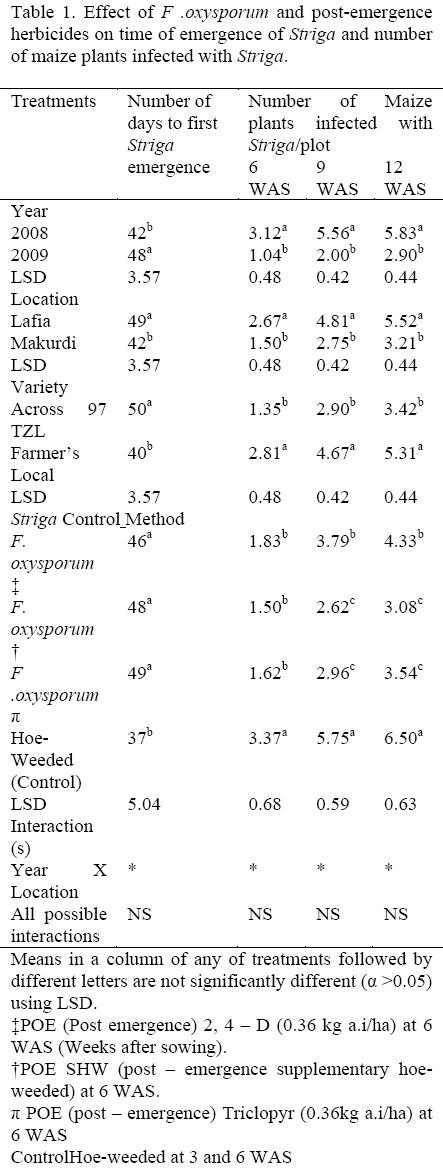
<body><![CDATA[<p align="justify"><font face="verdana" size="2"><b>Preparation of <i>Fusarium oxysporum</i></b></font></p>  	    <p align="justify"><font face="verdana" size="2">The biocontrol agent <i>F. oxysporum</i> was produced on gritted (whole grain broken into smaller pieces) maize grains in the laboratory as described by Marley <i>et al</i> (1999). <i>Fusarium oxysporum</i> (isolate PSM 197) was isolated from <i>S. hermonthica</i> stems and single spore isolates made into stock cultures. They were maintained on potato dextrose agar (PDA) amended with streptomycin (Difco&reg;) and stored in the refrigerator at 4&deg;C. Starter cultures were made when required. Mass production of inoculum was made on gritted maize grain. Gritted grain (500g) was placed in 1&#45;L flat&#45;bottomed conical flasks each containing 250ml of sterile distilled water. Flasks were shaken to ensure that the substrate was properly moistened and excess water was poured off prior to autoclaving for 1 hr at 121&deg;C (103. 5 kPa). After cooling each flask was inoculated with three 5&#45;mm diameter agar plugs of the isolate and then incubated at 28&deg; C for 7 days. During the incubation period, each flask was shaken daily to allow for full colonization of the grains by the pathogen. Colonized grains were harvested 14 days after inoculation and stored in refrigerator at 4&deg; C for use when required as the mycoherbicide.</font></p>  	    <p align="justify"><font face="verdana" size="2">&nbsp;</font></p>  	    <p align="justify"><font face="verdana" size="2"><b>Field evaluation</b></font></p>  	    <p align="justify"><font face="verdana" size="2">Two experiments were conducted in 2008 and 2009 cropping seasons at the Teaching and Research Farm of the University of Agriculture, Makurdi (07&deg; 14'N, 08 37'E) and the Model Extension village, Danka&#45;Sarki, Lafia (08&deg; 3' N and 07&deg; 31'E) in the Southern Guinea Savanna of Nigeria. The two sites were naturally and heavily infested with <i>S. hermonthica.</i></font></p>  	    <p align="justify"><font face="verdana" size="2">The two experiments were established on the 28<sup>th</sup> May and 16<sup>th</sup> June in 2008 and 2009, respectively. In each year, the two experimental sites was ploughed, harrowed and ridged at 0.75m apart. Each of the two maize varieties (Across 97 TZL and a farmer's local variety) were planted 50cm apart along the ridges. At each planting ridge, 2 g (53.33 Kg/ha) of mycoherbicide in each treatment was applied pre&#45;sowing in the planting hole. Four treatments were used as follows: <i>F. oxysporum</i> followed by 2, 4&#45;D, <i>F .oxysporum,</i> followed by supplementary hoe weeding, <i>F. oxysporum</i> followed by Triclopyr and a control (No. <i>F. oxysporum</i> but hoe&#45; weeded). The experiments were laid out in a split&#45;plot design with triplicates in the two years. The two maize varieties formed the main plot treatments, while the <i>Striga</i> fungal control methods (<i>F. oxysporum</i> either followed by 2, 4&#45;D, supplementary hoe weeding, Triclopyr at 6 weeks after sowing (WAS) and a control) formed the sub&#45;plot treatments. The gross and net plot sizes were 9 and 4.5m<sup>2</sup> (4 ridges and 2 rides each of 3m length), respectively. Spot application of fertilizer was carried out at 120Kg N/ha, 60Kg, P<sub>2</sub> 05/ha and 60Kg K<sub>2</sub> 0/ha to maize using 15&#45;15&#45;15 N&#45;P&#45;K compound fertilizer at 3 (WAS). The post&#45;emergence herbicides (2, 4&#45;D and Triclopyr) were applied at 6 weeks after sowing at 20% <i>Striga</i> infestation using a knapsack sprayer (CP<sub>3</sub>) with spray volume of 250L/ha and a yellow nozzle.</font></p>  	    <p align="justify"><font face="verdana" size="2">Observations made were: Number of days to first <i>Striga</i> emergence, number of maize plants infected by <i>Striga, Striga</i> shoots per unit area, number of capsules per <i>Striga</i> plant, crop vigour score, maize stand count, weight of 1000 grains and grain yield. The data collected were subjected to analysis of variance (ANOVA) and means were compared using Least Significant Difference (LSD) (&#945; =0.05).</font></p>  	    <p align="justify"><font face="verdana" size="2">&nbsp;</font></p>  	    <p align="justify"><font face="verdana" size="2"><b>RESULTS AND DISCUSSION</b></font></p>  	    <p align="justify"><font face="verdana" size="2">Number of days the <i>Striga</i> emergence differed significantly in the two years, two locations, among the maize varieties tested and the different <i>Striga</i> control methods (<a href="#t1">Table 1</a>). In 2009, there was a significant delay in the emergence of <i>Striga</i> (48 days after sowing, DAS) as compared to 2008 (42 DAS). At the Lafia location, there was a significant 7 day delay in the emergence of <i>Striga</i> days (49 DAS) as compared to Makurdi (42 DAS). This may be due to higher <i>Striga</i> seed bank density at the Makurdi location than that of Lafia. Maize variety Across 97 TZL significantly delayed the emergence of <i>Striga</i> by 10 DAS as compared to the farmer's local variety (<a href="#t1">Table 1</a>). Among the different <i>Striga</i> control methods, the result indicated early emergence with the hoeweeded check. This result agrees with an earlier report that pre&#45;planting inoculation with the pathogen caused between 7 and 14 days delay in the emergence of <i>S. hermonthica</i> (Marley, <i>et al.,</i> 2005). There was a significant interaction between year and location on number of days to <i>Striga</i> emergence (<a href="#t2">Table 2</a>). The 2009 X Lafia interaction delayed <i>Striga</i> emergence the most (58 DAS) when compared to earliest with 2009 X Makurdi and 2008 X Lafia interactions by 39 and 38 days, respectively.</font></p>  	    ]]></body>
<body><![CDATA[<p align="center"><font face="verdana" size="2"><a name="t1"></a></font></p>  	    <p align="center"><font face="verdana" size="2"><img src="/img/revistas/tsa/v14n2/a31t1.jpg"></font></p>  	    <p align="justify"><font face="verdana" size="2">&nbsp;</font></p>  	    <p align="center"><font face="verdana" size="2"><a name="t2"></a></font></p>  	    <p align="center"><font face="verdana" size="2"><img src="/img/revistas/tsa/v14n2/a31t2.jpg"></font></p>  	    <p align="justify"><font face="verdana" size="2">&nbsp;</font></p>  	    <p align="justify"><font face="verdana" size="2">Number of maize plants infected with <i>Striga</i> differed significantly at 6, 9 and 12 WAS with respect to year, location, and varieties. The different <i>Striga</i> control methods were different only at 9 and 12 WAS (<a href="#t1">Table 1</a>). Generally, number of maize plants infected with <i>Striga</i> was highest throughout the period of observation in 2008 than 2009. Similarly, number of maize plants infected with <i>Striga</i> was highest throughout the period of observation at Makurdi than at Lafia. The farmer's local variety recorded the highest number of maize plants infected with <i>Striga</i> during the same period of observation. In the <i>Striga</i> control methods, the hoe&#45;weeded check recorded significantly higher number of maize plants infected with <i>Striga</i> throughout the period of when compared to all other <i>Striga</i> control treatments (<a href="#t1">Table 1</a>). At 6 WAS, the least was obtained with plots that received <i>F. oxysporum</i> that was fb post&#45;emergence (POE) application of either Triclopyr or 2 4&#45;D at the rate of 0.36 kg a.i/ha or supplementary hoe&#45;weeded (SHW) at 6 WAS, but at 9 and 12WAS, it was observed with plots that received <i>F. oxysporum</i> fb POE Triclopyr at the rate of 0.36 kg a.i/ha and SHW. This work agrees with earlier report by Ciotola <i>et al</i> (2000) who had provided evidence of complete inhibition of <i>S .hermonthica</i> emergence when a chlamydospores containing powder was added to the soil at planting or when sorghum seeds coated with chlamydospores were sown. Marley <i>et al</i> (2004) also revealed that treatments of plots at sowing by spot application of 5g of <i>Fusarium</i> sp&#45; colonized grains in each planting hole equivalent to 165 kg/ha was found very effective in the control of <i>S. hermonthica.</i> There were significant interactions between year and location on number of maize plants infected with <i>Striga</i> at 6, 9 and 12 WAS (<a href="/img/revistas/tsa/v14n2/a31t3.jpg" target="_blank">Table 3</a>). The 2008 Lafia interactions throughout the period of observation recorded the highest number of maize plants infected with <i>Striga</i>, while the lowest was recorded by the 2009 X Lafia interactions.</font></p>  	    <p align="justify"><font face="verdana" size="2"><a href="/img/revistas/tsa/v14n2/a31t4.jpg" target="_blank">Table 4</a>, presents the result of <i>Striga</i> shoot count that was significantly affected at 6, 9 and 12 WAS by the different treatments. The lowest <i>Striga</i> shoot count was recorded in 2009 throughout the period of observation when compared to 2008. Makurdi location recorded lower <i>Striga</i> shoot count/4.5m<sup>2</sup> than Lafia location. However, the farmer's local maize variety gave significantly higher <i>Striga</i> shoot than those of Across 97 TZL throughout the period of observation. In the context of this paper 'resistant' refers to host cultivars that are less attacked in terms of damage and number of emerged <i>Striga</i> plants (Parker and Riches, 1993). Across 97 TZL being a resistant variety has been reported to produce lower amounts of germination stimulants in root exudates, leading to smaller numbers of attached parasites and/or to later attachment of the parasites to the host (Gurney <i>et al.,</i> 2000). Parker and Riches (1993) suggested three ways by which crop cultivars resist <i>Striga</i> attack: Mechanical barrier to the host root cells that prevent the haustoria from attaching, anti&#45;haustoria initiation factors, and low stimulant production. In the <i>Striga</i> control methods, hoe&#45;weeded check gave significantly higher <i>Striga</i> shoot, while at 9 and 12 WAS, the lowest occurred with <i>F. oxysporum</i> fb SHW and then followed by plots that received <i>F. oxysporum</i> fb POE application of Triclopyr or 2, 4&#45;D each at 0.36 kg a.i/ha (<a href="/img/revistas/tsa/v14n2/a31t4.jpg" target="_blank">Table 4</a>). This result is in accordance with previous findings in which the isolate <i>F. oxysporum</i> (Foxy 2) was able to reduce the germination of <i>S. hermonthica</i> seeds by more than 90% when the fungus was applied during the seed&#45; conditioning phase and it prevented the emergence by 98% when it was used as soil inoculum (Kroschel <i>et al.,</i> 1996). This was also the case of <i>F.nygamia</i> attacking <i>S. hermonthica</i> on sorghum and pearl millet in West Africa (Abbasher, 1994). It is assumed that the reduction in seed germination and death of the germinated seeds before they attach, due to foxy 2, led to the reduced number of emerged <i>S. hermonthica</i> as well. Thus foxy 2 exerts its effect by destruction of the seeds and prevention of emergence and subsequent reproduction. There were significant interactions between year and locations on <i>Striga</i> shoot count at 6, 9 and 12 WAS (<a href="/img/revistas/tsa/v14n2/a31t5.jpg" target="_blank">Table 5</a>).</font></p>  	    <p align="justify"><font face="verdana" size="2">The 2008 X Lafia interactions throughout the period of observation recorded the highest <i>Striga</i> shoot count, but the 2009 X Lafia interactions recorded the lowest.</font></p>  	    <p align="justify"><font face="verdana" size="2">Number of <i>Striga</i> capsules/plant differed significantly among the various treatments, except year effect (<a href="/img/revistas/tsa/v14n2/a31t4.jpg" target="_blank">Table 4</a>). Although not significant, the number of <i>Striga</i> capsules/ plant was higher in 2009 than 2008. However, location effect produced significant difference with Makurdi recording the highest number of capsules/ plant (95) as compared to Lafia (88). Similarly, the farmer's local variety recorded the highest of 114 <i>Striga</i> capsules/plant as against 69 capsules observed in the cultivar Across 97 TZL. The maize cultivar Across 97 TZL had earlier been reported to be resistant to Striga (Parker and Riches, 1993).</font></p>  	    ]]></body>
<body><![CDATA[<p align="justify"><font face="verdana" size="2">Crop vigour at 6 and 12 WAS, differed significantly at the different treatments (<a href="/img/revistas/tsa/v14n2/a31t6.jpg" target="_blank">Table 6</a>). In 2009, more vigorous maize plants were observed than in 2008 throughout the period of observation (6 and 12 WAS). Although, not significant, Makurdi recorded more vigorous maize plants than at Lafia. This may be attributed to environmental differences between the two sites and the fewer number of maize plants infected with <i>Striga</i> at Makurdi than Lafia. Throughout the period of observation, the cultivar Across 97 TZL recorded more vigorous maize plants than the farmer's local variety. The tested maize varieties and hybrids are les damaged owing to resistance to <i>Striga</i> ( Kim, 1994; Berner <i>et al.,</i> 1995 ). In the <i>Striga</i> control methods, at both periods off observation, the hoe&#45;weeded check had less vigorous maize plants as compared to all plots that received F. oxysporum fb POE application of either 2,4&#45;D, Triclopyr and SHW. There were significant interactions between year and locations on crop vigour score at 6 and 12 WAS (<a href="#t7">Table 7</a>).Throughout the period of observation more vigorous maize plants, were recorded in the 2009 X Lafia interaction, while the less vigorous plants were observed in the 2009 X Makurdi interaction. Crop stand count at harvest was significantly affected by the different treatments except in the <i>Striga</i> control methods (<a href="/img/revistas/tsa/v14n2/a31t6.jpg" target="_blank">Table 6</a>). The result indicated significantly higher crop stand count in 2009, at Makurdi, and with cultivar Across 97 TZL. However, in the <i>Striga</i> control methods, although not significant, the trend indicated higher crop stand count in all plots that received <i>F. oxysporum</i> when compared to the hoe&#45;weeded.</font></p>  	    <p align="center"><font face="verdana" size="2"><a name="t7"></a></font></p>  	    <p align="center"><font face="verdana" size="2"><img src="/img/revistas/tsa/v14n2/a31t7.jpg"></font></p>  	    <p align="justify"><font face="verdana" size="2">&nbsp;</font></p>  	    <p align="justify"><font face="verdana" size="2">Weight of 1000 grains was only significantly different with respect to year and <i>Striga</i> control methods (<a href="/img/revistas/tsa/v14n2/a31t6.jpg" target="_blank">Table 6</a>). The weight of 1000 grains in 2008 was significantly heavier than those of 2009. Although not significantly different, Makurdi location and the farmer's local variety recorded heavier grains over Lafia and Across 97 TZL variety. This can be attributed to varietal difference. However, in the <i>Striga</i> control methods, the use of <i>F. oxysporum</i> fb POE application of either SHW or Triclopyr gave significantly heavier grains as compared to hoe&#45;weeded check. This could be attributed to the fact that less <i>Striga</i> infestation/shoot count was observed in these treatments/plots with resultant less attack on maize plants and consequently better growth that gave heavier grains.</font></p>  	    <p align="justify"><font face="verdana" size="2">Maize grain yield was significantly influenced by maize varieties and the different <i>Striga</i> control methods (<a href="/img/revistas/tsa/v14n2/a31t6.jpg" target="_blank">Table 6</a>). Although not significantly different, the trend indicated that maize grain yield of 2009 and at Makurdi location were higher than that of 2008 and Lafia location. The low yield at Lafia may be attributed to presence of more seeds of the parasitic plant when compared to Makurdi. Among the tested maize varieties, Across 97 TZL recorded significantly higher maize grain yield than the farmer's local variety. It has earlier been reported that improved open pollinated (OP) maize varieties and hybrids are less damaged owing to tolerance to <i>Striga</i> and thereby produce higher grain yields than the susceptible cultivars (Berner <i>et al.,</i> 1995; Kim e<i>t al.,</i> 1997). In the <i>Striga</i> control methods, the use of <i>F. oxysporum</i> fb either POE Triclopyr or 2, 4 &#150; D each at 0.36 kg a.i/ha or SHW resulted in higher maize grain yields than the hoe&#45; weeded check. This result agrees with earlier research by Lagoke <i>et al</i> (1997) when 2, 4 &#150; D alone, mixture with diflufenican, Triclopyr resulted in higher grain yield than the control. The low yield in the hoe&#45; weeded check can be attributed to higher level of <i>Striga</i> infestation/shoot count in those plots. The use of <i>F. oxysporum</i> followed by either POE application of 2, 4 &#150; D or Triclopyr at the rate of 0.36 kg a.i/ha can be effective in suppressing the parasitic plant <i>Striga</i>.</font></p>  	    <p align="justify"><font face="verdana" size="2">&nbsp;</font></p>  	    <p align="justify"><font face="verdana" size="2"><b>CONCLUSION</b></font></p>  	    <p align="justify"><font face="verdana" size="2">Several decades of research on <i>Striga</i> control technologies have resulted in the identification of a range of technologies. Farmers themselves have developed a range of coping strategies to combat <i>Striga</i>. As none of the available technologies on its own can provide satisfactory <i>Striga</i> control in broad range of biophysical and socio&#45;economic environments, many farmers in West Africa fail to control <i>Striga</i> in cereals, despite the availability of a whole range of control techniques that have proved to be successful. Therefore, there is the need to look at other control options like the use of mycoherbicides that will be environmentally friendly. This study results demonstrate the high potentiality of using <i>F. oxysporum</i> for the control of <i>S. hermonthica</i> as pre&#45;plant (spot application) and there after followed by POE application of either 2, 4 &#150; D or Triclopyr at 6 WAS. The use of maize grits, which is readily available to propagate <i>F. oxysporum</i> makes it quite cheap for local farmer's instead of the use of potato dextrose agar.</font></p>  	    <p align="justify"><font face="verdana" size="2">&nbsp;</font></p>  	    ]]></body>
<body><![CDATA[<p align="justify"><font face="verdana" size="2"><b>REFERENCES</b></font></p>  	    <!-- ref --><p align="justify"><font face="verdana" size="2">Abbasher, A.A. 1994. Microorganisms associated with <i>Striga</i> <i>hermonthica</i> and their possibilities of their utilization of biological control agents. PLITS, 12, Weikersheim, Germany: MargrafVerlag</font>&nbsp;&nbsp;&nbsp;&nbsp;&nbsp;&nbsp;&nbsp;&nbsp;[&#160;<a href="javascript:void(0);" onclick="javascript: window.open('/scielo.php?script=sci_nlinks&ref=10037810&pid=S1870-0462201100020003100001&lng=','','width=640,height=500,resizable=yes,scrollbars=1,menubar=yes,');">Links</a>&#160;]<!-- end-ref --><!-- ref --><p align="justify"><font face="verdana" size="2">Abbasher, A.A.; Kroschel, J.; Sauerborn, J. 1995<b>.</b> Micro&#45;organisms <i>Striga hermonthica</i> in Northern Ghana with potential as biocontrol agents<i>.</i> Biocontrol Science and Technology<i>,</i> 5: 157&#45;161</font>&nbsp;&nbsp;&nbsp;&nbsp;&nbsp;&nbsp;&nbsp;&nbsp;[&#160;<a href="javascript:void(0);" onclick="javascript: window.open('/scielo.php?script=sci_nlinks&ref=10037811&pid=S1870-0462201100020003100002&lng=','','width=640,height=500,resizable=yes,scrollbars=1,menubar=yes,');">Links</a>&#160;]<!-- end-ref --><!-- ref --><p align="justify"><font face="verdana" size="2">Abbasher, A.A.; Hess, D.E.; Sauerbon, J. 1998<b>.</b> Fungal pathogens for biological control of <i>Striga</i> <i>hermonthica</i> on sorghum and pearl millet in West Africa. African Crop Science Journal<i>,</i> 6: 179&#45;188</font>&nbsp;&nbsp;&nbsp;&nbsp;&nbsp;&nbsp;&nbsp;&nbsp;[&#160;<a href="javascript:void(0);" onclick="javascript: window.open('/scielo.php?script=sci_nlinks&ref=10037812&pid=S1870-0462201100020003100003&lng=','','width=640,height=500,resizable=yes,scrollbars=1,menubar=yes,');">Links</a>&#160;]<!-- end-ref --><!-- ref --><p align="justify"><font face="verdana" size="2">Berner, D.K.; Kling, J.G.; Singh, B.B. 1995<b>.</b> <i>Striga</i> Research and control: A perspective from Africa. Plant diseases<i>,</i> 79: 652 &#150; 670</font>&nbsp;&nbsp;&nbsp;&nbsp;&nbsp;&nbsp;&nbsp;&nbsp;[&#160;<a href="javascript:void(0);" onclick="javascript: window.open('/scielo.php?script=sci_nlinks&ref=10037813&pid=S1870-0462201100020003100004&lng=','','width=640,height=500,resizable=yes,scrollbars=1,menubar=yes,');">Links</a>&#160;]<!-- end-ref --><!-- ref --><p align="justify"><font face="verdana" size="2">Carson, A. 1988<b>.</b> Development and testing of a control package of <i>Striga</i> <i>hermonthica</i> on small&#45;scale holdings in the Gambia. Tropical Pest Management<i>,</i> 34: 97 &#150; 101.    &nbsp;&nbsp;&nbsp;&nbsp;&nbsp;&nbsp;&nbsp;&nbsp;[&#160;<a href="javascript:void(0);" onclick="javascript: window.open('/scielo.php?script=sci_nlinks&ref=10037814&pid=S1870-0462201100020003100005&lng=','','width=640,height=500,resizable=yes,scrollbars=1,menubar=yes,');">Links</a>&#160;]<!-- end-ref --></font></p>  	    <!-- ref --><p align="justify"><font face="verdana" size="2">Ciotola, M.; Watson, A.K.; Hallet, S.G. 1995<b>.</b> Discovery of an Isolate of <i>Fusarium oxysporum</i> with potential to control <i>Striga</i> <i>hermonthica</i> in Africa. Weed Research<i>,</i> 35: 303&#45;309.    &nbsp;&nbsp;&nbsp;&nbsp;&nbsp;&nbsp;&nbsp;&nbsp;[&#160;<a href="javascript:void(0);" onclick="javascript: window.open('/scielo.php?script=sci_nlinks&ref=10037816&pid=S1870-0462201100020003100006&lng=','','width=640,height=500,resizable=yes,scrollbars=1,menubar=yes,');">Links</a>&#160;]<!-- end-ref --></font></p>  	    <!-- ref --><p align="justify"><font face="verdana" size="2">Ciotola, M.; Ditommaso, A.; Watson, A.K. 2000<b>.</b> Chlamydospores production, inoculation methods and Pathogenicity of <i>Fusarium oxysporum</i> M12 &#150; 4A, a biocontrol fork <i>Striga</i> <i>hermonthica.</i> Biocontrol Science and Technology<i>,</i> 10: 129&#45;145</font>&nbsp;&nbsp;&nbsp;&nbsp;&nbsp;&nbsp;&nbsp;&nbsp;[&#160;<a href="javascript:void(0);" onclick="javascript: window.open('/scielo.php?script=sci_nlinks&ref=10037818&pid=S1870-0462201100020003100007&lng=','','width=640,height=500,resizable=yes,scrollbars=1,menubar=yes,');">Links</a>&#160;]<!-- end-ref --><!-- ref --><p align="justify"><font face="verdana" size="2">Emechebe, A.M.; Lagoke, S.T.O.; Adu, J.K. 1991<b>.</b> Research Towards Integrated control of <i>Striga</i> in West and Central Africa, in <i>Progress in Food Grain Research,</i> (eds.). J. M. Menyonga, T. Bazuneh, J.Y. Yayock and I. Soumana, Burkina Faso: (OAU/STRC&#45;SAFGRAD), pp. 445&#45;463.    &nbsp;&nbsp;&nbsp;&nbsp;&nbsp;&nbsp;&nbsp;&nbsp;[&#160;<a href="javascript:void(0);" onclick="javascript: window.open('/scielo.php?script=sci_nlinks&ref=10037819&pid=S1870-0462201100020003100008&lng=','','width=640,height=500,resizable=yes,scrollbars=1,menubar=yes,');">Links</a>&#160;]<!-- end-ref --></font></p>  	    <!-- ref --><p align="justify"><font face="verdana" size="2">Emechebe, A.M.; Ellis&#45;Jones, J.; Schulz, S.; Chikoye, D.; Douthwaite, B.; Kureh, I.; Tarawali, G.; Hussaini, A.M.; Kormawa, P.; Sanni, A. 2004<b>.</b> Farmers perception of the <i>Striga</i> problem and its control in Northern Nigeria. Experimental Agriculture<i>,</i> 40: 215&#45; 232</font>&nbsp;&nbsp;&nbsp;&nbsp;&nbsp;&nbsp;&nbsp;&nbsp;[&#160;<a href="javascript:void(0);" onclick="javascript: window.open('/scielo.php?script=sci_nlinks&ref=10037821&pid=S1870-0462201100020003100009&lng=','','width=640,height=500,resizable=yes,scrollbars=1,menubar=yes,');">Links</a>&#160;]<!-- end-ref --><!-- ref --><p align="justify"><font face="verdana" size="2">Frost, D.L.; Gurney, A.L.; Press, M.C.; Scholes, J.D. 1997 .<i>Striga</i> <i>hermonthica</i> reduces photosynthesis in sorghum: the importance of stomatal limitations and a potential role of ABA?. Plant cell and Environment<i>,</i> 20: 483&#45;492</font>&nbsp;&nbsp;&nbsp;&nbsp;&nbsp;&nbsp;&nbsp;&nbsp;[&#160;<a href="javascript:void(0);" onclick="javascript: window.open('/scielo.php?script=sci_nlinks&ref=10037822&pid=S1870-0462201100020003100010&lng=','','width=640,height=500,resizable=yes,scrollbars=1,menubar=yes,');">Links</a>&#160;]<!-- end-ref --><!-- ref --><p align="justify"><font face="verdana" size="2">Gurney, A.L.; Press, M.C.; Ransom, J.K. 1995<b>.</b> The parasitic angiosperm <i>Striga</i> <i>hermonthica</i> can reduce photosynthesis of its sorghum and maize host in the field. Journal of Experimental Botany<i>,</i> 46: 1817&#45;1823</font>&nbsp;&nbsp;&nbsp;&nbsp;&nbsp;&nbsp;&nbsp;&nbsp;[&#160;<a href="javascript:void(0);" onclick="javascript: window.open('/scielo.php?script=sci_nlinks&ref=10037823&pid=S1870-0462201100020003100011&lng=','','width=640,height=500,resizable=yes,scrollbars=1,menubar=yes,');">Links</a>&#160;]<!-- end-ref --><!-- ref --><p align="justify"><font face="verdana" size="2">Gurney, A.L.; Taylor, A.; Mbwaga, A.; Scholes, J.D.; Press, M.C. 2002<b>.</b> Do maize cultivars demonstrate tolerance to the parasitic weed <i>Striga</i> <i>asiatica?</i> Weed Research, 42: 299&#45;306.    &nbsp;&nbsp;&nbsp;&nbsp;&nbsp;&nbsp;&nbsp;&nbsp;[&#160;<a href="javascript:void(0);" onclick="javascript: window.open('/scielo.php?script=sci_nlinks&ref=10037824&pid=S1870-0462201100020003100012&lng=','','width=640,height=500,resizable=yes,scrollbars=1,menubar=yes,');">Links</a>&#160;]<!-- end-ref --></font></p>  	    <!-- ref --><p align="justify"><font face="verdana" size="2">Johnson, D.; Riches, C.; Diallo, R.; Jones, M. 1997<b>.</b> <i>Striga</i> on rice in West Africa; crop host range and the potential of host resistance. Crop <i>Protection,</i> 16: 153&#45; 520</font>&nbsp;&nbsp;&nbsp;&nbsp;&nbsp;&nbsp;&nbsp;&nbsp;[&#160;<a href="javascript:void(0);" onclick="javascript: window.open('/scielo.php?script=sci_nlinks&ref=10037826&pid=S1870-0462201100020003100013&lng=','','width=640,height=500,resizable=yes,scrollbars=1,menubar=yes,');">Links</a>&#160;]<!-- end-ref --><!-- ref --><p align="justify"><font face="verdana" size="2">Kim, S.K. 1994<b>.</b> Genetics of maize tolerance to <i>Striga</i> <i>hermonthica.</i> Crop Science<i>,</i> 34:900&#45; 907.    &nbsp;&nbsp;&nbsp;&nbsp;&nbsp;&nbsp;&nbsp;&nbsp;[&#160;<a href="javascript:void(0);" onclick="javascript: window.open('/scielo.php?script=sci_nlinks&ref=10037827&pid=S1870-0462201100020003100014&lng=','','width=640,height=500,resizable=yes,scrollbars=1,menubar=yes,');">Links</a>&#160;]<!-- end-ref --></font></p>  	    ]]></body>
<body><![CDATA[<!-- ref --><p align="justify"><font face="verdana" size="2">Kim, S.; Adetimirin, V.O.; Akintunde, A.Y. 1997<b>.</b> Nitrogen effects on <i>Striga</i> <i>hermonthica</i> infestation, grain yield and agronomic traits of tolerant and susceptible maize hybrids. Crop Science<i>,</i> 37: 711&#45; 716.    &nbsp;&nbsp;&nbsp;&nbsp;&nbsp;&nbsp;&nbsp;&nbsp;[&#160;<a href="javascript:void(0);" onclick="javascript: window.open('/scielo.php?script=sci_nlinks&ref=10037829&pid=S1870-0462201100020003100015&lng=','','width=640,height=500,resizable=yes,scrollbars=1,menubar=yes,');">Links</a>&#160;]<!-- end-ref --></font></p>  	    <!-- ref --><p align="justify"><font face="verdana" size="2">Kroschel, J.; Hundt, A.; Abbasher, A.A.; Sauerborn, J. 1996<b>.</b> Pathogenicity of fungi collected in Northern Ghana to <i>Striga</i> <i>hermonthica.</i> Weed Research<i>,</i> 36: 515&#45; 520.    &nbsp;&nbsp;&nbsp;&nbsp;&nbsp;&nbsp;&nbsp;&nbsp;[&#160;<a href="javascript:void(0);" onclick="javascript: window.open('/scielo.php?script=sci_nlinks&ref=10037831&pid=S1870-0462201100020003100016&lng=','','width=640,height=500,resizable=yes,scrollbars=1,menubar=yes,');">Links</a>&#160;]<!-- end-ref --></font></p>  	    <!-- ref --><p align="justify"><font face="verdana" size="2">Lagoke, S.T.O.; Shebayan, J,Y.; Magani, I.E.; Oluronjo, P.; Olufajo, O.O.; Elemo, K.A.; Uvah. I.; Adeoti; A.A.; Chindo, P.S.; Kureh, I.; Jatau, S.; Emechebe, A.M.; Ndahi, W.B.; Kim, S.K.; Webber, G.; Singh, B.B.; Odion, C.; Avav, T. 1997<b>.</b> <i>Striga</i> problems and development of appropriate control technologies in various crops in Nigeria, in Intergrated Management of Striga for the African Farmer, (eds.). S. T.O Lagoke E.I. Vander Straten and S.S. M' Boob, Proceedings of 3rd General Workshop of Pan African <i>Striga</i> control Network (PANSCON) 18&#45; 23rd October, Harare, Zimbabwe, 157 pp. Accra, (Ghana) FAO.    &nbsp;&nbsp;&nbsp;&nbsp;&nbsp;&nbsp;&nbsp;&nbsp;[&#160;<a href="javascript:void(0);" onclick="javascript: window.open('/scielo.php?script=sci_nlinks&ref=10037833&pid=S1870-0462201100020003100017&lng=','','width=640,height=500,resizable=yes,scrollbars=1,menubar=yes,');">Links</a>&#160;]<!-- end-ref --></font></p>  	    <!-- ref --><p align="justify"><font face="verdana" size="2">Marley, P.S.; Ahmed, S.M.; Shebayan, J.A.; Lagoke, S.T.O. 1999. Isolation of <i>Fusarium oxysporum</i> with potential for biocontrol of the witch weed <i>Striga</i> <i>hermonthica</i> in the Nigerian Savanna. Biocontrol Science and Technology<i>,</i> 9: 159&#45;163.    &nbsp;&nbsp;&nbsp;&nbsp;&nbsp;&nbsp;&nbsp;&nbsp;[&#160;<a href="javascript:void(0);" onclick="javascript: window.open('/scielo.php?script=sci_nlinks&ref=10037835&pid=S1870-0462201100020003100018&lng=','','width=640,height=500,resizable=yes,scrollbars=1,menubar=yes,');">Links</a>&#160;]<!-- end-ref --></font></p>  	    <!-- ref --><p align="justify"><font face="verdana" size="2">Marley, P.S.; Toure, A.; Shebayan, J.A.; Aba, D.A.; Toure, O.A.; Diallo, G.A.; Katile, S.O. 2004<b>.</b> Variability in host plant resistance of Sorghum to <i>Striga</i> <i>hermonthica</i> in West Africa. Archives of Phytopathology and plant protection<i>,</i> 37: 29&#45;34.    &nbsp;&nbsp;&nbsp;&nbsp;&nbsp;&nbsp;&nbsp;&nbsp;[&#160;<a href="javascript:void(0);" onclick="javascript: window.open('/scielo.php?script=sci_nlinks&ref=10037837&pid=S1870-0462201100020003100019&lng=','','width=640,height=500,resizable=yes,scrollbars=1,menubar=yes,');">Links</a>&#160;]<!-- end-ref --></font></p>  	    ]]></body>
<body><![CDATA[<!-- ref --><p align="justify"><font face="verdana" size="2">Marley, P.S.; Kroschel, J.; Elzein, A. 2005<b>.</b> Host specificity of <i>Fusarium oxysporum</i> Schlect (isolate PSM 197), a potential mycoherbicide for controlling <i>Striga</i> spp. in West Africa. Weed Research<i>,</i> 45: 407&#45;412.    &nbsp;&nbsp;&nbsp;&nbsp;&nbsp;&nbsp;&nbsp;&nbsp;[&#160;<a href="javascript:void(0);" onclick="javascript: window.open('/scielo.php?script=sci_nlinks&ref=10037839&pid=S1870-0462201100020003100020&lng=','','width=640,height=500,resizable=yes,scrollbars=1,menubar=yes,');">Links</a>&#160;]<!-- end-ref --></font></p>  	    <!-- ref --><p align="justify"><font face="verdana" size="2">Parker, C. 1991<b>.</b> Protection of crops against parasitic weeds. Crop Protection<i>,</i> 10: 6&#45;22.    &nbsp;&nbsp;&nbsp;&nbsp;&nbsp;&nbsp;&nbsp;&nbsp;[&#160;<a href="javascript:void(0);" onclick="javascript: window.open('/scielo.php?script=sci_nlinks&ref=10037841&pid=S1870-0462201100020003100021&lng=','','width=640,height=500,resizable=yes,scrollbars=1,menubar=yes,');">Links</a>&#160;]<!-- end-ref --></font></p>  	    <!-- ref --><p align="justify"><font face="verdana" size="2">Parker, C.; Riches, C.R. 1993<b>.</b> Parasitic Weeds of the World<i>:</i> Biology and Control, Wallingford, Oxon, UK: CAB International, 304 pp.    &nbsp;&nbsp;&nbsp;&nbsp;&nbsp;&nbsp;&nbsp;&nbsp;[&#160;<a href="javascript:void(0);" onclick="javascript: window.open('/scielo.php?script=sci_nlinks&ref=10037843&pid=S1870-0462201100020003100022&lng=','','width=640,height=500,resizable=yes,scrollbars=1,menubar=yes,');">Links</a>&#160;]<!-- end-ref --></font></p>  	    <!-- ref --><p align="justify"><font face="verdana" size="2">Stewart, G. 1990<b>.</b> Witch weed: a parasitic weed of grain crops. <i>Outlook on Agriculture,</i> 19, 115&#45;117.    &nbsp;&nbsp;&nbsp;&nbsp;&nbsp;&nbsp;&nbsp;&nbsp;[&#160;<a href="javascript:void(0);" onclick="javascript: window.open('/scielo.php?script=sci_nlinks&ref=10037845&pid=S1870-0462201100020003100023&lng=','','width=640,height=500,resizable=yes,scrollbars=1,menubar=yes,');">Links</a>&#160;]<!-- end-ref --></font></p>  	    <!-- ref --><p align="justify"><font face="verdana" size="2">Thalouaran, T.A.; Fer, A. 1993<b>.</b> Le <i>Striga,</i> un revageur de cultures vivrieres: le point sur les connaissances recentes et sur les methods de lutte. Cahiers Agricultures<i>,</i> 2: 167&#45;182</font>&nbsp;&nbsp;&nbsp;&nbsp;&nbsp;&nbsp;&nbsp;&nbsp;[&#160;<a href="javascript:void(0);" onclick="javascript: window.open('/scielo.php?script=sci_nlinks&ref=10037847&pid=S1870-0462201100020003100024&lng=','','width=640,height=500,resizable=yes,scrollbars=1,menubar=yes,');">Links</a>&#160;]<!-- end-ref --> ]]></body><back>
<ref-list>
<ref id="B1">
<nlm-citation citation-type="book">
<person-group person-group-type="author">
<name>
<surname><![CDATA[Abbasher]]></surname>
<given-names><![CDATA[A.A.]]></given-names>
</name>
</person-group>
<source><![CDATA[Microorganisms associated with Striga hermonthica and their possibilities of their utilization of biological control agents]]></source>
<year>1994</year>
<publisher-loc><![CDATA[Weikersheim ]]></publisher-loc>
<publisher-name><![CDATA[MargrafVerlag]]></publisher-name>
</nlm-citation>
</ref>
<ref id="B2">
<nlm-citation citation-type="journal">
<person-group person-group-type="author">
<name>
<surname><![CDATA[Abbasher]]></surname>
<given-names><![CDATA[A.A.]]></given-names>
</name>
<name>
<surname><![CDATA[Kroschel]]></surname>
<given-names><![CDATA[J.]]></given-names>
</name>
<name>
<surname><![CDATA[Sauerborn]]></surname>
<given-names><![CDATA[J.]]></given-names>
</name>
</person-group>
<article-title xml:lang="en"><![CDATA[Micro-organisms Striga hermonthica in Northern Ghana with potential as biocontrol agents]]></article-title>
<source><![CDATA[Biocontrol Science and Technology]]></source>
<year>1995</year>
<volume>5</volume>
<page-range>157-16</page-range></nlm-citation>
</ref>
<ref id="B3">
<nlm-citation citation-type="journal">
<person-group person-group-type="author">
<name>
<surname><![CDATA[Abbasher]]></surname>
<given-names><![CDATA[A.A.]]></given-names>
</name>
<name>
<surname><![CDATA[Hess]]></surname>
<given-names><![CDATA[D.E.]]></given-names>
</name>
<name>
<surname><![CDATA[Sauerbon]]></surname>
<given-names><![CDATA[J.]]></given-names>
</name>
</person-group>
<article-title xml:lang="en"><![CDATA[Fungal pathogens for biological control of Striga hermonthica on sorghum and pearl millet in West Africa]]></article-title>
<source><![CDATA[African Crop Science Journal]]></source>
<year>1998</year>
<volume>6</volume>
<page-range>179-18</page-range></nlm-citation>
</ref>
<ref id="B4">
<nlm-citation citation-type="journal">
<person-group person-group-type="author">
<name>
<surname><![CDATA[Berner]]></surname>
<given-names><![CDATA[D.K.]]></given-names>
</name>
<name>
<surname><![CDATA[Kling]]></surname>
<given-names><![CDATA[J.G.]]></given-names>
</name>
<name>
<surname><![CDATA[Singh]]></surname>
<given-names><![CDATA[B.B.]]></given-names>
</name>
</person-group>
<article-title xml:lang="en"><![CDATA[Striga Research and control: A perspective from Africa]]></article-title>
<source><![CDATA[Plant diseases]]></source>
<year>1995</year>
<volume>79</volume>
<page-range>652 - 67</page-range></nlm-citation>
</ref>
<ref id="B5">
<nlm-citation citation-type="journal">
<person-group person-group-type="author">
<name>
<surname><![CDATA[Carson]]></surname>
<given-names><![CDATA[A.]]></given-names>
</name>
</person-group>
<article-title xml:lang="en"><![CDATA[Development and testing of a control package of Striga hermonthica on small-scale holdings in the Gambia]]></article-title>
<source><![CDATA[Tropical Pest Management]]></source>
<year>1988</year>
<volume>34</volume>
<page-range>97 - 101</page-range></nlm-citation>
</ref>
<ref id="B6">
<nlm-citation citation-type="journal">
<person-group person-group-type="author">
<name>
<surname><![CDATA[Ciotola]]></surname>
<given-names><![CDATA[M.; Watson, A.K.; Hallet, S.G.]]></given-names>
</name>
</person-group>
<article-title xml:lang="en"><![CDATA[Discovery of an Isolate of Fusarium oxysporum with potential to control Striga hermonthica in Africa]]></article-title>
<source><![CDATA[Weed Research]]></source>
<year>1995</year>
<volume>35</volume>
<page-range>303-309</page-range></nlm-citation>
</ref>
<ref id="B7">
<nlm-citation citation-type="journal">
<person-group person-group-type="author">
<name>
<surname><![CDATA[Ciotola]]></surname>
<given-names><![CDATA[M.]]></given-names>
</name>
<name>
<surname><![CDATA[Ditommaso]]></surname>
<given-names><![CDATA[A.]]></given-names>
</name>
<name>
<surname><![CDATA[Watson]]></surname>
<given-names><![CDATA[A.K.]]></given-names>
</name>
</person-group>
<article-title xml:lang="en"><![CDATA[Chlamydospores production, inoculation methods and Pathogenicity of Fusarium oxysporum M12 - 4A, a biocontrol fork Striga hermonthica]]></article-title>
<source><![CDATA[Biocontrol Science and Technology]]></source>
<year>2000</year>
<volume>10</volume>
<page-range>129-14</page-range></nlm-citation>
</ref>
<ref id="B8">
<nlm-citation citation-type="book">
<person-group person-group-type="author">
<name>
<surname><![CDATA[Emechebe]]></surname>
<given-names><![CDATA[A.M.]]></given-names>
</name>
<name>
<surname><![CDATA[Lagoke]]></surname>
<given-names><![CDATA[S.T.O.]]></given-names>
</name>
<name>
<surname><![CDATA[Adu]]></surname>
<given-names><![CDATA[J.K.]]></given-names>
</name>
</person-group>
<article-title xml:lang="en"><![CDATA[Research Towards Integrated control of Striga in West and Central Africa]]></article-title>
<person-group person-group-type="editor">
<name>
<surname><![CDATA[Menyonga]]></surname>
<given-names><![CDATA[J. M.]]></given-names>
</name>
<name>
<surname><![CDATA[Bazuneh]]></surname>
<given-names><![CDATA[T.]]></given-names>
</name>
<name>
<surname><![CDATA[Yayock]]></surname>
<given-names><![CDATA[J.Y.]]></given-names>
</name>
<name>
<surname><![CDATA[Soumana]]></surname>
<given-names><![CDATA[I.]]></given-names>
</name>
</person-group>
<source><![CDATA[Progress in Food Grain Research]]></source>
<year>1991</year>
<page-range>445-463</page-range><publisher-loc><![CDATA[Burkina Faso ]]></publisher-loc>
<publisher-name><![CDATA[OAU/STRC-SAFGRAD]]></publisher-name>
</nlm-citation>
</ref>
<ref id="B9">
<nlm-citation citation-type="journal">
<person-group person-group-type="author">
<name>
<surname><![CDATA[Emechebe]]></surname>
<given-names><![CDATA[A.M.]]></given-names>
</name>
<name>
<surname><![CDATA[Ellis-Jones]]></surname>
<given-names><![CDATA[J.]]></given-names>
</name>
<name>
<surname><![CDATA[Schulz]]></surname>
<given-names><![CDATA[S.]]></given-names>
</name>
<name>
<surname><![CDATA[Chikoye]]></surname>
<given-names><![CDATA[D.]]></given-names>
</name>
<name>
<surname><![CDATA[Douthwaite]]></surname>
<given-names><![CDATA[B.]]></given-names>
</name>
<name>
<surname><![CDATA[Kureh]]></surname>
<given-names><![CDATA[I.]]></given-names>
</name>
<name>
<surname><![CDATA[Tarawali]]></surname>
<given-names><![CDATA[G.]]></given-names>
</name>
<name>
<surname><![CDATA[Hussaini]]></surname>
<given-names><![CDATA[A.M.]]></given-names>
</name>
<name>
<surname><![CDATA[Kormawa]]></surname>
<given-names><![CDATA[P.]]></given-names>
</name>
<name>
<surname><![CDATA[Sanni]]></surname>
<given-names><![CDATA[A.]]></given-names>
</name>
</person-group>
<article-title xml:lang="en"><![CDATA[Farmers perception of the Striga problem and its control in Northern Nigeria]]></article-title>
<source><![CDATA[Experimental Agriculture]]></source>
<year>2004</year>
<volume>40</volume>
<page-range>215- 23</page-range></nlm-citation>
</ref>
<ref id="B10">
<nlm-citation citation-type="journal">
<person-group person-group-type="author">
<name>
<surname><![CDATA[Frost]]></surname>
<given-names><![CDATA[D.L.]]></given-names>
</name>
<name>
<surname><![CDATA[Gurney]]></surname>
<given-names><![CDATA[A.L.]]></given-names>
</name>
<name>
<surname><![CDATA[Press]]></surname>
<given-names><![CDATA[M.C.]]></given-names>
</name>
<name>
<surname><![CDATA[Scholes]]></surname>
<given-names><![CDATA[J.D.]]></given-names>
</name>
</person-group>
<article-title xml:lang="en"><![CDATA[.Striga hermonthica reduces photosynthesis in sorghum: the importance of stomatal limitations and a potential role of ABA?]]></article-title>
<source><![CDATA[Plant cell and Environment]]></source>
<year>1997</year>
<volume>20</volume>
<page-range>483-49</page-range></nlm-citation>
</ref>
<ref id="B11">
<nlm-citation citation-type="journal">
<person-group person-group-type="author">
<name>
<surname><![CDATA[Gurney]]></surname>
<given-names><![CDATA[A.L.]]></given-names>
</name>
<name>
<surname><![CDATA[Press]]></surname>
<given-names><![CDATA[M.C.]]></given-names>
</name>
<name>
<surname><![CDATA[Ransom]]></surname>
<given-names><![CDATA[J.K.]]></given-names>
</name>
</person-group>
<article-title xml:lang="en"><![CDATA[The parasitic angiosperm Striga hermonthica can reduce photosynthesis of its sorghum and maize host in the field]]></article-title>
<source><![CDATA[Journal of Experimental Botany]]></source>
<year>1995</year>
<volume>46</volume>
<page-range>1817-182</page-range></nlm-citation>
</ref>
<ref id="B12">
<nlm-citation citation-type="journal">
<person-group person-group-type="author">
<name>
<surname><![CDATA[Gurney]]></surname>
<given-names><![CDATA[A.L.]]></given-names>
</name>
<name>
<surname><![CDATA[Taylor]]></surname>
<given-names><![CDATA[A.]]></given-names>
</name>
<name>
<surname><![CDATA[Mbwaga]]></surname>
<given-names><![CDATA[A.]]></given-names>
</name>
<name>
<surname><![CDATA[Scholes]]></surname>
<given-names><![CDATA[J.D.]]></given-names>
</name>
<name>
<surname><![CDATA[Press]]></surname>
<given-names><![CDATA[M.C.]]></given-names>
</name>
</person-group>
<article-title xml:lang="en"><![CDATA[Do maize cultivars demonstrate tolerance to the parasitic weed Striga asiatica?]]></article-title>
<source><![CDATA[Weed Research]]></source>
<year>2002</year>
<volume>42</volume>
<page-range>299-306</page-range></nlm-citation>
</ref>
<ref id="B13">
<nlm-citation citation-type="journal">
<person-group person-group-type="author">
<name>
<surname><![CDATA[Johnson]]></surname>
<given-names><![CDATA[D.]]></given-names>
</name>
<name>
<surname><![CDATA[Riches]]></surname>
<given-names><![CDATA[C.]]></given-names>
</name>
<name>
<surname><![CDATA[Diallo]]></surname>
<given-names><![CDATA[R.]]></given-names>
</name>
<name>
<surname><![CDATA[Jones]]></surname>
<given-names><![CDATA[M.]]></given-names>
</name>
</person-group>
<article-title xml:lang="en"><![CDATA[Striga on rice in West Africa; crop host range and the potential of host resistance]]></article-title>
<source><![CDATA[Crop Protection]]></source>
<year>1997</year>
<volume>16</volume>
<page-range>153- 52</page-range></nlm-citation>
</ref>
<ref id="B14">
<nlm-citation citation-type="journal">
<person-group person-group-type="author">
<name>
<surname><![CDATA[Kim]]></surname>
<given-names><![CDATA[S.K.]]></given-names>
</name>
</person-group>
<article-title xml:lang="en"><![CDATA[Genetics of maize tolerance to Striga hermonthica]]></article-title>
<source><![CDATA[Crop Science]]></source>
<year>1994</year>
<volume>34</volume>
<page-range>900- 907</page-range></nlm-citation>
</ref>
<ref id="B15">
<nlm-citation citation-type="journal">
<person-group person-group-type="author">
<name>
<surname><![CDATA[Kim]]></surname>
<given-names><![CDATA[S.]]></given-names>
</name>
<name>
<surname><![CDATA[Adetimirin]]></surname>
<given-names><![CDATA[V.O.]]></given-names>
</name>
<name>
<surname><![CDATA[Akintunde]]></surname>
<given-names><![CDATA[A.Y.]]></given-names>
</name>
</person-group>
<article-title xml:lang="en"><![CDATA[Nitrogen effects on Striga hermonthica infestation, grain yield and agronomic traits of tolerant and susceptible maize hybrids]]></article-title>
<source><![CDATA[Crop Science]]></source>
<year>1997</year>
<volume>37</volume>
<page-range>711- 716</page-range></nlm-citation>
</ref>
<ref id="B16">
<nlm-citation citation-type="journal">
<person-group person-group-type="author">
<name>
<surname><![CDATA[Kroschel]]></surname>
<given-names><![CDATA[J.]]></given-names>
</name>
<name>
<surname><![CDATA[Hundt]]></surname>
<given-names><![CDATA[A.]]></given-names>
</name>
<name>
<surname><![CDATA[Abbasher]]></surname>
<given-names><![CDATA[A.A.]]></given-names>
</name>
<name>
<surname><![CDATA[Sauerborn]]></surname>
<given-names><![CDATA[J.]]></given-names>
</name>
</person-group>
<article-title xml:lang="en"><![CDATA[Pathogenicity of fungi collected in Northern Ghana to Striga hermonthica]]></article-title>
<source><![CDATA[Weed Research]]></source>
<year>1996</year>
<volume>36</volume>
<page-range>515- 520</page-range></nlm-citation>
</ref>
<ref id="B17">
<nlm-citation citation-type="book">
<person-group person-group-type="author">
<name>
<surname><![CDATA[Lagoke]]></surname>
<given-names><![CDATA[S.T.O.]]></given-names>
</name>
<name>
<surname><![CDATA[Shebayan]]></surname>
<given-names><![CDATA[J,Y.]]></given-names>
</name>
<name>
<surname><![CDATA[Magani]]></surname>
<given-names><![CDATA[I.E.]]></given-names>
</name>
<name>
<surname><![CDATA[Oluronjo]]></surname>
<given-names><![CDATA[P.]]></given-names>
</name>
<name>
<surname><![CDATA[Olufajo]]></surname>
<given-names><![CDATA[O.O.]]></given-names>
</name>
<name>
<surname><![CDATA[Elemo]]></surname>
<given-names><![CDATA[K.A.]]></given-names>
</name>
<name>
<surname><![CDATA[Uvah]]></surname>
<given-names><![CDATA[I.]]></given-names>
</name>
<name>
<surname><![CDATA[Adeoti]]></surname>
<given-names><![CDATA[A.A.]]></given-names>
</name>
<name>
<surname><![CDATA[Chindo]]></surname>
<given-names><![CDATA[P.S.]]></given-names>
</name>
<name>
<surname><![CDATA[Kureh]]></surname>
<given-names><![CDATA[I.]]></given-names>
</name>
<name>
<surname><![CDATA[Jatau]]></surname>
<given-names><![CDATA[S.]]></given-names>
</name>
<name>
<surname><![CDATA[Emechebe]]></surname>
<given-names><![CDATA[A.M.]]></given-names>
</name>
<name>
<surname><![CDATA[Ndahi]]></surname>
<given-names><![CDATA[W.B.]]></given-names>
</name>
<name>
<surname><![CDATA[Kim]]></surname>
<given-names><![CDATA[S.K.]]></given-names>
</name>
<name>
<surname><![CDATA[Webber]]></surname>
<given-names><![CDATA[G.]]></given-names>
</name>
<name>
<surname><![CDATA[Singh]]></surname>
<given-names><![CDATA[B.B.]]></given-names>
</name>
<name>
<surname><![CDATA[Odion]]></surname>
<given-names><![CDATA[C.]]></given-names>
</name>
<name>
<surname><![CDATA[Avav]]></surname>
<given-names><![CDATA[T.]]></given-names>
</name>
</person-group>
<article-title xml:lang="en"><![CDATA[Striga problems and development of appropriate control technologies in various crops in Nigeria]]></article-title>
<person-group person-group-type="editor">
<name>
<surname><![CDATA[Lagoke]]></surname>
<given-names><![CDATA[S. T.O]]></given-names>
</name>
<name>
<surname><![CDATA[Vander Straten]]></surname>
<given-names><![CDATA[E.I.]]></given-names>
</name>
<name>
<surname><![CDATA[Boob]]></surname>
<given-names><![CDATA[S.S. M']]></given-names>
</name>
</person-group>
<collab>Intergrated Management of Striga for the African Farmer</collab>
<source><![CDATA[Proceedings of 3rd General Workshop of Pan African Striga control Network (PANSCON) 18- 23rd October]]></source>
<year>1997</year>
<page-range>157</page-range><publisher-loc><![CDATA[Harare ]]></publisher-loc>
<publisher-name><![CDATA[FAO]]></publisher-name>
</nlm-citation>
</ref>
<ref id="B18">
<nlm-citation citation-type="journal">
<person-group person-group-type="author">
<name>
<surname><![CDATA[Marley]]></surname>
<given-names><![CDATA[P.S.]]></given-names>
</name>
<name>
<surname><![CDATA[Ahmed]]></surname>
<given-names><![CDATA[S.M.]]></given-names>
</name>
<name>
<surname><![CDATA[Shebayan]]></surname>
<given-names><![CDATA[J.A.]]></given-names>
</name>
<name>
<surname><![CDATA[Lagoke]]></surname>
<given-names><![CDATA[S.T.O.]]></given-names>
</name>
</person-group>
<article-title xml:lang="en"><![CDATA[Isolation of Fusarium oxysporum with potential for biocontrol of the witch weed Striga hermonthica in the Nigerian Savanna]]></article-title>
<source><![CDATA[Biocontrol Science and Technology]]></source>
<year>1999</year>
<volume>9</volume>
<page-range>159-163</page-range></nlm-citation>
</ref>
<ref id="B19">
<nlm-citation citation-type="journal">
<person-group person-group-type="author">
<name>
<surname><![CDATA[Marley]]></surname>
<given-names><![CDATA[P.S.]]></given-names>
</name>
<name>
<surname><![CDATA[Toure]]></surname>
<given-names><![CDATA[A.]]></given-names>
</name>
<name>
<surname><![CDATA[Shebayan]]></surname>
<given-names><![CDATA[J.A.]]></given-names>
</name>
<name>
<surname><![CDATA[Aba]]></surname>
<given-names><![CDATA[D.A.]]></given-names>
</name>
<name>
<surname><![CDATA[Toure]]></surname>
<given-names><![CDATA[O.A.]]></given-names>
</name>
<name>
<surname><![CDATA[Diallo]]></surname>
<given-names><![CDATA[G.A.]]></given-names>
</name>
<name>
<surname><![CDATA[Katile]]></surname>
<given-names><![CDATA[S.O.]]></given-names>
</name>
</person-group>
<article-title xml:lang="en"><![CDATA[Variability in host plant resistance of Sorghum to Striga hermonthica in West Africa]]></article-title>
<source><![CDATA[Archives of Phytopathology and plant protection]]></source>
<year>2004</year>
<volume>37</volume>
<page-range>29-34</page-range></nlm-citation>
</ref>
<ref id="B20">
<nlm-citation citation-type="journal">
<person-group person-group-type="author">
<name>
<surname><![CDATA[Marley]]></surname>
<given-names><![CDATA[P.S.]]></given-names>
</name>
<name>
<surname><![CDATA[Kroschel]]></surname>
<given-names><![CDATA[J.]]></given-names>
</name>
<name>
<surname><![CDATA[Elzein]]></surname>
<given-names><![CDATA[A.]]></given-names>
</name>
</person-group>
<article-title xml:lang="en"><![CDATA[Host specificity of Fusarium oxysporum Schlect (isolate PSM 197), a potential mycoherbicide for controlling Striga spp. in West Africa]]></article-title>
<source><![CDATA[Weed Research]]></source>
<year>2005</year>
<volume>45</volume>
<page-range>407-412</page-range></nlm-citation>
</ref>
<ref id="B21">
<nlm-citation citation-type="journal">
<person-group person-group-type="author">
<name>
<surname><![CDATA[Parker]]></surname>
<given-names><![CDATA[C.]]></given-names>
</name>
</person-group>
<article-title xml:lang="en"><![CDATA[Protection of crops against parasitic weeds]]></article-title>
<source><![CDATA[Crop Protection]]></source>
<year>1991</year>
<volume>10</volume>
<page-range>6-22</page-range></nlm-citation>
</ref>
<ref id="B22">
<nlm-citation citation-type="book">
<person-group person-group-type="author">
<name>
<surname><![CDATA[Parker]]></surname>
<given-names><![CDATA[C.]]></given-names>
</name>
<name>
<surname><![CDATA[Riches]]></surname>
<given-names><![CDATA[C.R]]></given-names>
</name>
</person-group>
<source><![CDATA[Parasitic Weeds of the World: Biology and Control]]></source>
<year>1993</year>
<page-range>304</page-range><publisher-loc><![CDATA[Wallingford^eOxon Oxon]]></publisher-loc>
<publisher-name><![CDATA[CAB International]]></publisher-name>
</nlm-citation>
</ref>
<ref id="B23">
<nlm-citation citation-type="journal">
<person-group person-group-type="author">
<name>
<surname><![CDATA[Stewart]]></surname>
<given-names><![CDATA[G]]></given-names>
</name>
</person-group>
<article-title xml:lang="en"><![CDATA[Witch weed: a parasitic weed of grain crops]]></article-title>
<source><![CDATA[Outlook on Agriculture]]></source>
<year>1990</year>
<volume>19</volume>
<page-range>115-117</page-range></nlm-citation>
</ref>
<ref id="B24">
<nlm-citation citation-type="journal">
<person-group person-group-type="author">
<name>
<surname><![CDATA[Thalouaran]]></surname>
<given-names><![CDATA[T.A.]]></given-names>
</name>
<name>
<surname><![CDATA[Fer]]></surname>
<given-names><![CDATA[A.]]></given-names>
</name>
</person-group>
<article-title xml:lang="fr"><![CDATA[Le Striga, un revageur de cultures vivrieres: le point sur les connaissances recentes et sur les methods de lutte]]></article-title>
<source><![CDATA[Cahiers Agricultures]]></source>
<year>1993</year>
<volume>2</volume>
<page-range>167-18</page-range></nlm-citation>
</ref>
</ref-list>
</back>
</article>
