<?xml version="1.0" encoding="ISO-8859-1"?><article xmlns:mml="http://www.w3.org/1998/Math/MathML" xmlns:xlink="http://www.w3.org/1999/xlink" xmlns:xsi="http://www.w3.org/2001/XMLSchema-instance">
<front>
<journal-meta>
<journal-id>1870-0462</journal-id>
<journal-title><![CDATA[Tropical and subtropical agroecosystems]]></journal-title>
<abbrev-journal-title><![CDATA[Trop. subtrop. agroecosyt]]></abbrev-journal-title>
<issn>1870-0462</issn>
<publisher>
<publisher-name><![CDATA[Universidad Autónoma de Yucatán, Facultad de Medicina Veterinaria]]></publisher-name>
</publisher>
</journal-meta>
<article-meta>
<article-id>S1870-04622011000200023</article-id>
<title-group>
<article-title xml:lang="en"><![CDATA[Effect of genotype and diet on rectal digestibility of nutrients and faecal output in cuban creole pigs]]></article-title>
<article-title xml:lang="es"><![CDATA[Efecto del genotipo y de la dieta en la digestibilidad rectal de nutrientes y salida fecal de cerdos criollo cubano]]></article-title>
</title-group>
<contrib-group>
<contrib contrib-type="author">
<name>
<surname><![CDATA[Ly]]></surname>
<given-names><![CDATA[Julio]]></given-names>
</name>
<xref ref-type="aff" rid="A01"/>
</contrib>
<contrib contrib-type="author">
<name>
<surname><![CDATA[Grageola]]></surname>
<given-names><![CDATA[Fernando]]></given-names>
</name>
<xref ref-type="aff" rid="A01"/>
</contrib>
<contrib contrib-type="author">
<name>
<surname><![CDATA[Batista]]></surname>
<given-names><![CDATA[Radelis]]></given-names>
</name>
<xref ref-type="aff" rid="A03"/>
</contrib>
<contrib contrib-type="author">
<name>
<surname><![CDATA[Lemus]]></surname>
<given-names><![CDATA[Clemente]]></given-names>
</name>
<xref ref-type="aff" rid="A02"/>
</contrib>
<contrib contrib-type="author">
<name>
<surname><![CDATA[Macías]]></surname>
<given-names><![CDATA[Manuel]]></given-names>
</name>
<xref ref-type="aff" rid="A01"/>
</contrib>
<contrib contrib-type="author">
<name>
<surname><![CDATA[Delgado]]></surname>
<given-names><![CDATA[Enrique]]></given-names>
</name>
<xref ref-type="aff" rid="A04"/>
</contrib>
<contrib contrib-type="author">
<name>
<surname><![CDATA[Santana]]></surname>
<given-names><![CDATA[Isabel]]></given-names>
</name>
<xref ref-type="aff" rid="A01"/>
</contrib>
<contrib contrib-type="author">
<name>
<surname><![CDATA[Díaz]]></surname>
<given-names><![CDATA[Consuelo]]></given-names>
</name>
<xref ref-type="aff" rid="A01"/>
</contrib>
</contrib-group>
<aff id="A01">
<institution><![CDATA[,Instituto de Investigaciones Porcinas  ]]></institution>
<addr-line><![CDATA[La Habana ]]></addr-line>
<country>Cuba</country>
</aff>
<aff id="A02">
<institution><![CDATA[,Universidad Autónoma de Nayarit Posgrado en Ciencias Biológico Agropecuarias ]]></institution>
<addr-line><![CDATA[Tepic Nayarit]]></addr-line>
<country>México</country>
</aff>
<aff id="A03">
<institution><![CDATA[,Universidad de Granma  ]]></institution>
<addr-line><![CDATA[Bayamo ]]></addr-line>
<country>Cuba</country>
</aff>
<aff id="A04">
<institution><![CDATA[,Universidad Nacional Autónoma de México  ]]></institution>
<addr-line><![CDATA[ Distrito Federal de México]]></addr-line>
<country>México</country>
</aff>
<pub-date pub-type="pub">
<day>00</day>
<month>08</month>
<year>2011</year>
</pub-date>
<pub-date pub-type="epub">
<day>00</day>
<month>08</month>
<year>2011</year>
</pub-date>
<volume>14</volume>
<numero>2</numero>
<fpage>661</fpage>
<lpage>666</lpage>
<copyright-statement/>
<copyright-year/>
<self-uri xlink:href="http://www.scielo.org.mx/scielo.php?script=sci_arttext&amp;pid=S1870-04622011000200023&amp;lng=en&amp;nrm=iso"></self-uri><self-uri xlink:href="http://www.scielo.org.mx/scielo.php?script=sci_abstract&amp;pid=S1870-04622011000200023&amp;lng=en&amp;nrm=iso"></self-uri><self-uri xlink:href="http://www.scielo.org.mx/scielo.php?script=sci_pdf&amp;pid=S1870-04622011000200023&amp;lng=en&amp;nrm=iso"></self-uri><abstract abstract-type="short" xml:lang="en"><p><![CDATA[Four Cuban Creole pigs and four improved, Cuban CC21 pigs, male individuals of 30 kg initial live weight were used according to a change over design in a 2x2 factorial arrangement to study the effect of genotype and of one diet based on cereals and grains containing either 6 or 12% crude fiber, on rectal digestibility and faecal output of materials. Feed intake was equal to 100 g DM/kgLW0.75 per day provided at 9:00 h am in a single ration. The fiber source was royal palm (Roystonea regia H.B.K. Cook) nuts introduced dried and ground including a 20% in the feed. The Cuban Creole pigs were from a genetic reservoir located in the centre of Cuba (Cabaiguán) and were not subjected to any program of genetic improvement. Differences were not observed (P>0.05) in rectal digestibility of DM, ash, organic matter, crude fiber and nitrogen between the genotypes of pigs; the averages only show numerical differences in favor of pigs CC21. In a similar way, it was found that the diet containing 12% crude fiber determined either a not significant (P>0.05) increase in rectal digestibility of crude fiber, or a non significant (P>0.05) depression in DM, organic matter and nitrogen rectal digestibility with respect to the diet without royal palm nut meal. Faecal output of fresh material was numerically greater in the Cuban Creole pigs and the diet with 12% of fiber (675 and 570 g/kg DM intake), but without significant (P>0.05) effect. It is considered that rectal digestibility of diets based on grains and cereals containing 20% royal palm nut meal could be better in Cuban Creole as well improved, exotic pigs, as compared to diets given ad libitum to this animal species fed on sugar cane molasses. Besides, dietary nitrogen digestion may be poorer when growing pigs are given 20% royal palm nut meal in the feed.]]></p></abstract>
<abstract abstract-type="short" xml:lang="es"><p><![CDATA[Se usaron cuatro cerdos Criollo Cubanos y cuatro cerdos Cubanos CC21, machos y con un peso inicial de 30 kg de acuerdo con un diseño de cambio en arreglo factorial 2x2 para estudiar el efecto del genotipo y de una dieta basada en cereales y granos conteniendo 6 o 12% de fibra cruda, en la digestibilidad rectal y salida fecal de materiales. El consumo de alimento fue igual a 100 g MS/kgPV0.75 por día, suministrado a las 9:00 h am en una sola ración. La fuente de fibra fue palmiche (fruto de palma real, Roystonea regia H.B.K. Cook) suministrado seco y molido incluida al 20% al alimento. Los cerdos Criollo Cubanos fueron de la reserva genética localizada en el centro de Cuba (Cabaiguán) y no estaban sujetos a ningún programa de mejoramiento genético. No hubo efecto significativo (P>0.05) de la interacción genotipo x dieta en ninguna medida. No se observaron diferencias (P>0.05) en la digestibilidad rectal de la MS, cenizas, materia orgánica, fibra cruda y nitrógeno entre los genotipos de cerdos; los promedios sólo muestran diferencias numéricas en favor de los cerdos CC21. De una manera similar, se halló que la dieta que contenía 12% de fibra, determinó un incremento no significativo (P>0.05) de la digestibilidad rectal de la fibra cruda o una reducción no significativa (P>0.05) de la digestibilidad rectal de la MS, materia orgánica y nitrógeno con respecto a la dieta sin harina de palmiche. La salida fecal de material fresco fue numéricamente mayor en los cerdos Criollo Cubanos y en la dieta con 12% de fibra (675 y 570 g/kg MS ingerida), pero sin efecto significativo (P>0.05). Se considera que la digestibilidad rectal de dietas basadas en granos y cereales que contengan 20% de harina de palmiche pudiera ser mayor en los cerdos Criollo Cubanos que en los mejorados, exóticos, en comparación con lo que ocurre con dietas suministrada ad libitum en animales alimentados con melaza de caña de azúcar. Además la digestión del nitrógeno dietético fue menor cuando los animales comieron dietas con 20% de harina de palmiche.]]></p></abstract>
<kwd-group>
<kwd lng="en"><![CDATA[Cuban Creole pigs]]></kwd>
<kwd lng="en"><![CDATA[Royal palm nut]]></kwd>
<kwd lng="en"><![CDATA[Rectal digestibility]]></kwd>
<kwd lng="es"><![CDATA[Cerdos Criollo Cubanos]]></kwd>
<kwd lng="es"><![CDATA[Palmiche]]></kwd>
<kwd lng="es"><![CDATA[Digestibilidad rectal]]></kwd>
</kwd-group>
</article-meta>
</front><body><![CDATA[  	    <p align="justify"><font face="verdana" size="4">Art&iacute;culos de investigaci&oacute;n</font></p>  	    <p align="justify"><font face="verdana" size="2">&nbsp;</font></p>  	    <p align="center"><font face="verdana" size="4"><b>Effect of genotype and diet on rectal digestibility of nutrients and faecal output in cuban creole pigs</b></font></p>  	    <p align="justify"><font face="verdana" size="2">&nbsp;</font></p>  	    <p align="center"><font face="verdana" size="3"><b>Efecto del genotipo y de la dieta en la digestibilidad rectal de nutrientes y salida fecal de cerdos criollo cubano</b></font></p>  	    <p align="justify"><font face="verdana" size="2">&nbsp;</font></p>  	    <p align="center"><font face="verdana" size="2"><b>Julio Ly<sup>1</sup>, Fernando Grageola<sup>2</sup>, Radelis Batista<sup>3</sup>, Clemente Lemus<sup>2</sup>*, Manuel Mac&iacute;as<sup>1</sup>, Enrique Delgado<sup>4</sup>, Isabel Santana<sup>1</sup> and Consuelo D&iacute;az<sup>1</sup></b></font></p>  	    <p align="justify"><font face="verdana" size="2">&nbsp;</font></p>  	    <p align="justify"><font face="verdana" size="2"><i><sup>1 </sup>Instituto de Investigaciones Porcinas. CP 10090, Punta Brava, La Habana, Cuba E&#45;mail:</i> <a href="mailto:jly@iip.co.cu">jly@iip.co.cu</a>.</font></p>  	    ]]></body>
<body><![CDATA[<p align="justify"><font face="verdana" size="2"><i><sup>2</sup> Universidad Aut&oacute;noma de Nayarit. Posgrado en Ciencias Biol&oacute;gico Agropecuarias. Ciudad de la Cultura. Amado Nervo. CP 63190 Tepic. Nayarit,</i> <i>M&eacute;xico. 	*Corresponding author E&#45;mail:</i> <a href="mailto:drclemus@yahoo.com.mx">drclemus@yahoo.com.mx</a></font></p>  	    <p align="justify"><font face="verdana" size="2"><i><sup>3</sup> Universidad de Granma. CP 85100 Carretera a Manzanillo km 17&frac12;. Bayamo, Cuba.</i></font></p>  	    <p align="justify"><font face="verdana" size="2"><i><sup>4</sup> Universidad Nacional Aut&oacute;noma de M&eacute;xico. Ciudad Universitaria, Delegaci&oacute;n Coyoac&aacute;n. CP 04510. Distrito Federal de M&eacute;xico. M&eacute;xico.</i> </font></p>        <p align="justify"><font face="verdana" size="2">&nbsp;</font></p>  	    <p align="justify"><font face="verdana" size="2">Submitted October 9, 2010    <br> 	Accepted January 15, 2011    <br> 	Revised received February 08, 2011</font></p>  	    <p align="justify"><font face="verdana" size="2">&nbsp;</font></p>  	    <p align="justify"><font face="verdana" size="2"><b>Abstract</b></font></p>  	    <p align="justify"><font face="verdana" size="2">Four Cuban Creole pigs and four improved, Cuban CC21 pigs, male individuals of 30 kg initial live weight were used according to a change over design in a 2x2 factorial arrangement to study the effect of genotype and of one diet based on cereals and grains containing either 6 or 12% crude fiber, on rectal digestibility and faecal output of materials. Feed intake was equal to 100 g DM/kgLW<sup>0.75</sup> per day provided at 9:00 h am in a single ration. The fiber source was royal palm <i>(Roystonea regia H.B.K. Cook)</i> nuts introduced dried and ground including a 20% in the feed. The Cuban Creole pigs were from a genetic reservoir located in the centre of Cuba (Cabaigu&aacute;n) and were not subjected to any program of genetic improvement. Differences were not observed (P&gt;0.05) in rectal digestibility of DM, ash, organic matter, crude fiber and nitrogen between the genotypes of pigs; the averages only show numerical differences in favor of pigs CC21. In a similar way, it was found that the diet containing 12% crude fiber determined either a not significant (P&gt;0.05) increase in rectal digestibility of crude fiber, or a non significant (P&gt;0.05) depression in DM, organic matter and nitrogen rectal digestibility with respect to the diet without royal palm nut meal. Faecal output of fresh material was numerically greater in the Cuban Creole pigs and the diet with 12% of fiber (675 and 570 g/kg DM intake), but without significant (P&gt;0.05) effect. It is considered that rectal digestibility of diets based on grains and cereals containing 20% royal palm nut meal could be better in Cuban Creole as well improved, exotic pigs, as compared to diets given <i>ad libitum</i> to this animal species fed on sugar cane molasses. Besides, dietary nitrogen digestion may be poorer when growing pigs are given 20% royal palm nut meal in the feed.</font></p>  	    ]]></body>
<body><![CDATA[<p align="justify"><font face="verdana" size="2"><b>Key words:</b> Cuban Creole pigs; Royal palm nut; Rectal digestibility.</font></p>  	    <p align="justify"><font face="verdana" size="2">&nbsp;</font></p>  	    <p align="justify"><font face="verdana" size="2"><b>Resumen</b></font></p>  	    <p align="justify"><font face="verdana" size="2">Se usaron cuatro cerdos Criollo Cubanos y cuatro cerdos Cubanos CC21, machos y con un peso inicial de 30 kg de acuerdo con un dise&ntilde;o de cambio en arreglo factorial 2x2 para estudiar el efecto del genotipo y de una dieta basada en cereales y granos conteniendo 6 o 12% de fibra cruda, en la digestibilidad rectal y salida fecal de materiales. El consumo de alimento fue igual a 100 g MS/kgPV<sup>0.75</sup> por d&iacute;a, suministrado a las 9:00 h am en una sola raci&oacute;n. La fuente de fibra fue palmiche (fruto de palma real, <i>Roystonea regia H.B.K. Cook)</i> suministrado seco y molido incluida al 20% al alimento. Los cerdos Criollo Cubanos fueron de la reserva gen&eacute;tica localizada en el centro de Cuba (Cabaigu&aacute;n) y no estaban sujetos a ning&uacute;n programa de mejoramiento gen&eacute;tico. No hubo efecto significativo (P&gt;0.05) de la interacci&oacute;n genotipo x dieta en ninguna medida. No se observaron diferencias (P&gt;0.05) en la digestibilidad rectal de la MS, cenizas, materia org&aacute;nica, fibra cruda y nitr&oacute;geno entre los genotipos de cerdos; los promedios s&oacute;lo muestran diferencias num&eacute;ricas en favor de los cerdos CC21. De una manera similar, se hall&oacute; que la dieta que conten&iacute;a 12% de fibra, determin&oacute; un incremento no significativo (P&gt;0.05) de la digestibilidad rectal de la fibra cruda o una reducci&oacute;n no significativa (P&gt;0.05) de la digestibilidad rectal de la MS, materia org&aacute;nica y nitr&oacute;geno con respecto a la dieta sin harina de palmiche. La salida fecal de material fresco fue num&eacute;ricamente mayor en los cerdos Criollo Cubanos y en la dieta con 12% de fibra (675 y 570 g/kg MS ingerida), pero sin efecto significativo (P&gt;0.05). Se considera que la digestibilidad rectal de dietas basadas en granos y cereales que contengan 20% de harina de palmiche pudiera ser mayor en los cerdos Criollo Cubanos que en los mejorados, ex&oacute;ticos, en comparaci&oacute;n con lo que ocurre con dietas suministrada <i>ad libitum</i> en animales alimentados con melaza de ca&ntilde;a de az&uacute;car. Adem&aacute;s la digesti&oacute;n del nitr&oacute;geno diet&eacute;tico fue menor cuando los animales comieron dietas con 20% de harina de palmiche.</font></p>  	    <p align="justify"><font face="verdana" size="2"><b>Palabras clave:</b> Cerdos Criollo Cubanos; Palmiche; Digestibilidad rectal.</font></p>  	    <p align="justify"><font face="verdana" size="2">&nbsp;</font></p>  	    <p align="justify"><font face="verdana" size="2"><b>INTRODUCTION</b></font></p>  	    <p align="justify"><font face="verdana" size="2">Royal palm <i>(Roystonea regia H.B.K. Cook)</i> nuts are usually given to pigs reared by Cuban small holders in extensive systems of pig production, and probably this practice was established in confined animals after observations made on feeding behaviour of feral pig in this country, since the introduction of this animal species several centuries ago (Diaz and Ly, 2005). In this connection, cre&oacute;le animals are those to what the main collection of royal palm nuts are currently directed to. Nevertheless, performance traits derived from growth trials conducted with pig fed on high levels of royal palm nuts are contradictory (Castro and Rodriguez, 1983: Garcia <i>et al.,</i> 2001; Abeledo <i>et al,</i> 2004).</font></p>  	    <p align="justify"><font face="verdana" size="2">Although royal palm nuts are rather popular in the country for feeding pigs, there are not strong reasons to think that, besides the economical advantage from the point of view that nuts are very cheap or even with no commercial value, these fruits are very poor in nitrogen (N) compounds. Moreover, its richness in fatty acids is counterbalanced by the high mesocarp crude fibre of nuts (Ly <i>et al,</i> 1999). On the other hand, it does not appear to be any advantage arising from feeding cre&oacute;le pigs with a fiber&#45;rich material such as royal palm nuts, since young cre&oacute;le pigs are not able to digest crude fiber with certain efficiency so as to justify this practice (Ly and Di&eacute;guez, 1995; Ly <i>et al.,</i> 1998). In any way, some factors influencing feed digestibility, could play an important role in determining an increase in royal palm nut utilization by pigs. In this connection, Ly (2000) observed an improvement in nutrient digestibility of the diet for pigs when the nuts were ground as compared with the same non ground material. On the other hand, restriction of feed could contribute to a better digestion of the diet too, as it has been found in other circumstances since the Cunninghan <i>et al.</i> (1962) and Parker and Clawson (1967) earlier observations. In this connection, dietary manipulation is important when animal excreta are directed to be recycled into the farming system, thus reducing a negative environmental impact (Kerr, 2003; Ly, 2008; Lemus <i>et al.,</i> 2010).</font></p>  	    <p align="justify"><font face="verdana" size="2">The aim of this experiment was to compare rectal nutrient digestibility of diets formulated to contain ground royal palm nut when offered to either Cuban Creole or improved young pigs, fed in restricted manner.</font></p>  	    ]]></body>
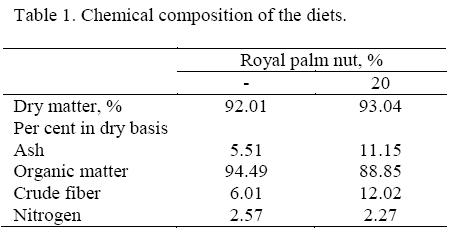
<body><![CDATA[<p align="justify"><font face="verdana" size="2">&nbsp;</font></p>  	    <p align="justify"><font face="verdana" size="2"><b>MATERIAL AND METHODS</b></font></p>  	    <p align="justify"><font face="verdana" size="2">Four Cuban Creole pigs and four improved, Cuban CC21 pigs, male individuals of 30 kg initial live weight were used according to a change over design (Gill and Magee, 1976) in a 2x2 factorial arrangement to study the effect of genotype and of one diet based on cereals and grains plus vitamins and minerals as required (NRC, 1998), containing either 6 or 12% crude fiber, on rectal digestibility and faecal output of materials. Feed intake was equal to 100 g DM/kgLW<sup>0.75</sup> per day given at 9:00 h am in single ration in form of meal. According to Gill and Magee (1976) half of the animals in both genotypes, was allotted to one diet, whereas the other half were fed the second diet, at the end of the experimental period, the animals were switched to the other diet, and sampled after an adaptation period. The source of fiber was royal palm <i>(Roystonea regia H.B.K. Cook)</i> nuts introduced dried and ground in the feed. Dry matter accounted for 97.15% in royal palm nut meal, and in dry matter, 5.90% ash, 38.71% crude fiber and 1.04% N. The chemical composition of the diets is shown in <a href="#t1">Table 1</a>.</font></p>  	    <p align="center"><font face="verdana" size="2"><a name="t1"></a></font></p>  	    <p align="center"><font face="verdana" size="2"><img src="/img/revistas/tsa/v14n2/a23t1.jpg"></font></p>  	    <p align="justify"><font face="verdana" size="2">&nbsp;</font></p>  	    <p align="justify"><font face="verdana" size="2">The Cuban Creole pigs were from a genetic reservoir located in the centre of Cuba (Cabaigu&aacute;n) and were not subjected to any program of genetic improvement. The animals were housed in individual pens provided of a trough and drinker, in a cement floored house without walls.</font></p>  	    <p align="justify"><font face="verdana" size="2">Every experimental period consisted of seven days of adaptation to the corresponding diet, then a fecal sampled was obtained directly from rectum by digital stimulus. Then the animals were transferred to the second and last type of diet and the same routine proceeded. The faeces were frozen until analysis, when all samples were thawed, the thoroughly homogeneized and DM, ash, crude fiber concentration were estimated by standardized methods (AOAC, 1990). Acid insoluble ash was determined following Van Keulen and Young (1977) recommendations. All analyses were conducted by duplicate, and the same methods were applied to faeces and feeds.</font></p>  	    <p align="justify"><font face="verdana" size="2">The data were subjected to the analysis of variance according to a change over design (Gill and Magee, 1976) in a 2x2 factorial arrangement (the effects of genotype and diet) and the statistical package from Minitab (2000) was employed for the electronic manipulation of the information.</font></p>  	    <p align="justify"><font face="verdana" size="2">&nbsp;</font></p>  	    ]]></body>
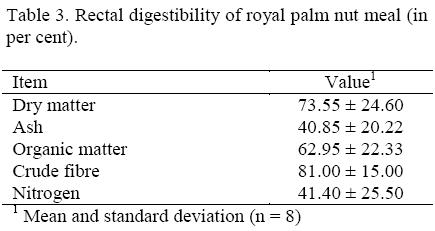
<body><![CDATA[<p align="justify"><font face="verdana" size="2"><b>RESULTS AND DISCUSSION</b></font></p>  	    <p align="justify"><font face="verdana" size="2"><b>General</b></font></p>  	    <p align="justify"><font face="verdana" size="2">There was not significant (P&gt;0.05) effect of period on any measurement, and therefore the data from both periods were pooled, then subjected to the ANOVA following to Gill and Magee (1976) and Gill (1978).</font></p>  	    <p align="justify"><font face="verdana" size="2">&nbsp;</font></p>  	    <p align="justify"><font face="verdana" size="2"><b>Rectal digestibility of nutrients</b></font></p>  	    <p align="justify"><font face="verdana" size="2">There was not significant (P&gt;0.05) effect of the genotype x diet in any measurement. It was observed that CC21 pigs were more numerical efficient in rectal digestibility of DM, ash, organic matter, crude fiber and N than cre&oacute;le pigs, but this effect was not significant (P&gt;0.05) probably due to the existing great individual variability (<a href="/img/revistas/tsa/v14n2/a23t2.jpg" target="_blank">Table 2</a>). In these four indices, values were as high as 5.5, 4.0, 7.4 and 7.7% respectively favoring CC21 pigs. In a similar manner, it was found that the diet containing 12% crude fiber determined a not significant (P&gt;0.05) increase in rectal digestibility of crude fiber, and a non significant (P&gt;0.05) depression in DM, ash, organic matter and N rectal digestibility with respect to the diet without royal palm nut meal.</font></p>  	    <p align="justify"><font face="verdana" size="2">Rectal digestibility of royal palm nut, calculated by difference, is shown in <a href="#t3">Table 3</a>. DM and organic matter digestibility means were relatively separated one from the other, perhaps as a consequence of the calculated ash digestibility. As it is known, organic matter values are calculated as the difference of 100 minus percent of ash content in feed and faeces. On the other hand, crude fiber digestibility was considerably high in this experiment, although a great variability among the eight evaluated animals (CV, 18.5%) was evident. In other previous experiments, it has been found that royal palm nuts given ground and <i>ad libitum</i> to pigs, determined a rather lower rectal crude fiber digestibility in the diet, 51.6%, but in that opportunity, the nuts accounted for 74% of the diet (Ly, 2000). When offered as 20% of diets, in a restricted manner (Ly <i>et al,</i> 2000), it has been found that crude fiber digestibility of these palm fruits was 50.7% (CV, 19.1%). The origin of these discrepancies is not apparent, but individual pattern of fibrous material digestion by the pigs should be implied in this type of response, otherwise very well known (Cunningham <i>et al.,</i> 1962). Moreover, this variability in crude fibre digestibility values was probably causing the same type of data dispersion in the case of DM and organic matter digestibility. The same assumption could be made from the point of view of rectal digestibility of the nitrogenous fraction of royal palm nut, since in other investigations, a coefficient of variability as high as 84.3% was found, whereas the mean value was 24.9% (Ly <i>et al.,</i> 2000). Overall, it should be interested to investigate the origin of this type of variability.</font></p>  	    <p align="center"><font face="verdana" size="2"><a name="t3"></a></font></p>  	    <p align="center"><font face="verdana" size="2"><img src="/img/revistas/tsa/v14n2/a23t3.jpg"></font></p>  	    <p align="justify"><font face="verdana" size="2">&nbsp;</font></p>  	    ]]></body>
<body><![CDATA[<p align="justify"><font face="verdana" size="2">Ly <i>et al.</i> (1999) found that in vitro, pepsin/pancreatin digestibility of N in samples of royal palm nut was as low as 33%, thus supporting the herein reported values for faecal digestibility of N. Therefore, it might put forward the hypothesis that very few N compounds from royal palm nuts are disappearing in the large intestine of pigs.</font></p>  	    <p align="justify"><font face="verdana" size="2">&nbsp;</font></p>  	    <p align="justify"><font face="verdana" size="2"><b>Faecal output of materials</b></font></p>  	    <p align="justify"><font face="verdana" size="2">In contrast to what was previously found with relatively selected cre&oacute;le pigs (Ly <i>et al.</i> 2000), faecal output of fresh material was numerical greater in the Cuban Creole pigs as compared to the improved, exotic individuals (675 and 570 g/kg DM intake) and in the diet with 12% crude fiber, but without any significant (P&gt;0.05) effect (<a href="/img/revistas/tsa/v14n2/a23t4.jpg" target="_blank">Table 4</a>). In this connection, a relatively decrease in DM digestibility and faecal DM concentration tend to increase faecal output of fresh material. In the current investigation, this assumption appeared to hold true in the case of royal palm nuts, which in fact determined a trend (P&lt;0.10) to decrease DM level in faeces together with inferior values for DM digestibility at the rectum site. This effect was undoubtedly linked to the high crude fibre content of royal palm nuts. In this regard, Galassi <i>et al.</i> (2007) observed a pronounced effect of dietary fibre on pig faeces output, whereas Nyachoti <i>et al.</i> (2006) found that manure output in pigs could be manipulated by the processing of feeds and enzyme supplementation. Significant differences (P&lt;0.05) in faecal pH, as it were observed in the current investigation (<a href="/img/revistas/tsa/v14n2/a23t4.jpg" target="_blank">Table 4</a>), would be related to microbial activity and changes in electrolyte status in the large intestine of the animals (Metzler&#45;Zebeti <i>et al.,</i> 2010). In this connection, Creole pigs showed lower values of pH in faecal materials, and on the other hand, the diet containing royal palm nuts, and therefore, more fibre, reduced this index too in the faeces of pigs. This same phenomenum, although not so pronounced, was previously found in cre&oacute;le and conventional individuals fed royal palm nuts (Ly <i>et al.,</i> 2000).</font></p>  	    <p align="justify"><font face="verdana" size="2">It is considered that rectal digestibility of diets based on grains and cereals, and containing 20% royal palm nut meal could be better in Cuban Creole as well improved, exotic pigs, as compared to diets given <i>ad libitum</i> to this animal species fed on sugar cane molasses. Besides, dietary N digestion may be poorer when growing pigs are given 20% royal palm nut meal in the feed.</font></p>  	    <p align="justify"><font face="verdana" size="2">&nbsp;</font></p>  	    <p align="justify"><font face="verdana" size="2"><b>ACKNOLEWGEMENTS</b></font></p>  	    <p align="justify"><font face="verdana" size="2">The authors wish to express their gratitude to Mrs. Iris P&eacute;rez and Mr. J. Cabrera, Swine Research Institute, Havana, for their skillful assistance in managing animals and overall technical cooperation during the conduction of the present investigation.</font></p>  	    <p align="justify"><font face="verdana" size="2">&nbsp;</font></p>  	    <p align="justify"><font face="verdana" size="2"><b>REFERENCES</b></font></p>  	    ]]></body>
<body><![CDATA[<!-- ref --><p align="justify"><font face="verdana" size="2">Abeledo, C, Santana, L, P&eacute;rez, I., Brache, F. 2004. Rasgos de comportamiento y caracter&iacute;sticas de la canal de cerdos Criollo y CC21 alimentados con palmiche como &uacute;nica fuente de energ&iacute;a durante la ceba. Revista Computadorizada de Producci&oacute;n Porcina. 11: 95&#45;102.    &nbsp;&nbsp;&nbsp;&nbsp;&nbsp;&nbsp;&nbsp;&nbsp;[&#160;<a href="javascript:void(0);" onclick="javascript: window.open('/scielo.php?script=sci_nlinks&ref=10036314&pid=S1870-0462201100020002300001&lng=','','width=640,height=500,resizable=yes,scrollbars=1,menubar=yes,');">Links</a>&#160;]<!-- end-ref --></font></p>  	    <!-- ref --><p align="justify"><font face="verdana" size="2">AOAC. 1990. Official Methods of Analysis. Association of Official Analytical Chemists (K. Helrick, editor). Arlington pp 1230.    &nbsp;&nbsp;&nbsp;&nbsp;&nbsp;&nbsp;&nbsp;&nbsp;[&#160;<a href="javascript:void(0);" onclick="javascript: window.open('/scielo.php?script=sci_nlinks&ref=10036316&pid=S1870-0462201100020002300002&lng=','','width=640,height=500,resizable=yes,scrollbars=1,menubar=yes,');">Links</a>&#160;]<!-- end-ref --></font></p>  	    <!-- ref --><p align="justify"><font face="verdana" size="2">Castro, M, Rodriguez, V. 1983. Niveles de palmiche en cerdos en ceba. <i>In:</i> 4ta Reuni&oacute;n de la Asociaci&oacute;n Cubana de Producci&oacute;n Animal. San Jos&eacute; de las Lajas. 2:185.    &nbsp;&nbsp;&nbsp;&nbsp;&nbsp;&nbsp;&nbsp;&nbsp;[&#160;<a href="javascript:void(0);" onclick="javascript: window.open('/scielo.php?script=sci_nlinks&ref=10036318&pid=S1870-0462201100020002300003&lng=','','width=640,height=500,resizable=yes,scrollbars=1,menubar=yes,');">Links</a>&#160;]<!-- end-ref --></font></p>  	    <!-- ref --><p align="justify"><font face="verdana" size="2">Cunningham, H.M., Friend, D.W., Nicholson, J.W.G. 1962. The effect of age, body weight, feed intake and adaptability of pigs on the digestibility and nutritive value of cellulose. Canadian Journal of Animal Science. 42: 167&#45;175.    &nbsp;&nbsp;&nbsp;&nbsp;&nbsp;&nbsp;&nbsp;&nbsp;[&#160;<a href="javascript:void(0);" onclick="javascript: window.open('/scielo.php?script=sci_nlinks&ref=10036320&pid=S1870-0462201100020002300004&lng=','','width=640,height=500,resizable=yes,scrollbars=1,menubar=yes,');">Links</a>&#160;]<!-- end-ref --></font></p>  	    <!-- ref --><p align="justify"><font face="verdana" size="2">Diaz, C, Ly, J. 2005. La asociaci&oacute;n palmas&#45;cerdos: un sistema integrado espont&aacute;neo en producci&oacute;n porcina? <i>In:</i> VII Congreso Centroamericano y del Caribe de Porcicultura. La Habana electronic version.    &nbsp;&nbsp;&nbsp;&nbsp;&nbsp;&nbsp;&nbsp;&nbsp;[&#160;<a href="javascript:void(0);" onclick="javascript: window.open('/scielo.php?script=sci_nlinks&ref=10036322&pid=S1870-0462201100020002300005&lng=','','width=640,height=500,resizable=yes,scrollbars=1,menubar=yes,');">Links</a>&#160;]<!-- end-ref --></font></p>  	    ]]></body>
<body><![CDATA[<!-- ref --><p align="justify"><font face="verdana" size="2">Galassi, G., Malagutti, L., Crovetto, G.M. 2007. Growth and slaughter performance, nitrogen balance and ammonia emission from slurry in pigs fed high fibre diets. Italian Journal of Animal Science. 6: 227&#45;239.    &nbsp;&nbsp;&nbsp;&nbsp;&nbsp;&nbsp;&nbsp;&nbsp;[&#160;<a href="javascript:void(0);" onclick="javascript: window.open('/scielo.php?script=sci_nlinks&ref=10036324&pid=S1870-0462201100020002300006&lng=','','width=640,height=500,resizable=yes,scrollbars=1,menubar=yes,');">Links</a>&#160;]<!-- end-ref --></font></p>  	    <!-- ref --><p align="justify"><font face="verdana" size="2">Garcia, A., Rosabal, M, Mart&iacute;nez, R.M. 2001. Comportamiento en la monta&ntilde;a de cerdos Criollo x CC21 alimentados con dietas de palmiche y bajas en prote&iacute;na. Revista Computadorizada de Producci&oacute;n Porcina. 8(1): 59&#45;64.    &nbsp;&nbsp;&nbsp;&nbsp;&nbsp;&nbsp;&nbsp;&nbsp;[&#160;<a href="javascript:void(0);" onclick="javascript: window.open('/scielo.php?script=sci_nlinks&ref=10036326&pid=S1870-0462201100020002300007&lng=','','width=640,height=500,resizable=yes,scrollbars=1,menubar=yes,');">Links</a>&#160;]<!-- end-ref --></font></p>  	    <!-- ref --><p align="justify"><font face="verdana" size="2">Gill, G.L. 1978. Change over design: sequence of treatments. Estimation of residual effects if treatments. In: Design and Analysis of Experiments in the Animal and Biological Sciences. Iowa State University Press. Ames, 1:179.    &nbsp;&nbsp;&nbsp;&nbsp;&nbsp;&nbsp;&nbsp;&nbsp;[&#160;<a href="javascript:void(0);" onclick="javascript: window.open('/scielo.php?script=sci_nlinks&ref=10036328&pid=S1870-0462201100020002300008&lng=','','width=640,height=500,resizable=yes,scrollbars=1,menubar=yes,');">Links</a>&#160;]<!-- end-ref --></font></p>  	    <!-- ref --><p align="justify"><font face="verdana" size="2">Gill, G.L., Magee, W.T. 1976. Balanced two period change over design from several treatments. Journal of Animal Science. 42: 775&#45;780</font>&nbsp;&nbsp;&nbsp;&nbsp;&nbsp;&nbsp;&nbsp;&nbsp;[&#160;<a href="javascript:void(0);" onclick="javascript: window.open('/scielo.php?script=sci_nlinks&ref=10036330&pid=S1870-0462201100020002300009&lng=','','width=640,height=500,resizable=yes,scrollbars=1,menubar=yes,');">Links</a>&#160;]<!-- end-ref --><!-- ref --><p align="justify"><font face="verdana" size="2">Kerr, B.J. 2003. Dietary manipulation to reduce environmental impact. <i>In:</i> 9th International Symposium of Digestive Physiology in Pigs (R.O. Ball, editor). University of Alberta. Edmonton pp 139&#45;158.    &nbsp;&nbsp;&nbsp;&nbsp;&nbsp;&nbsp;&nbsp;&nbsp;[&#160;<a href="javascript:void(0);" onclick="javascript: window.open('/scielo.php?script=sci_nlinks&ref=10036331&pid=S1870-0462201100020002300010&lng=','','width=640,height=500,resizable=yes,scrollbars=1,menubar=yes,');">Links</a>&#160;]<!-- end-ref --></font></p>  	    <!-- ref --><p align="justify"><font face="verdana" size="2">Lemus, C, Huerta, R., Grageola, F., Ram&iacute;rez, H., Diaz, C, Ly, J. 2010. Effect of body weight and sex on rectal digestibility of nutrients and feces output in Mexican Cuino pigs. Zootecnia Tropical. 28: 213&#45;219.    &nbsp;&nbsp;&nbsp;&nbsp;&nbsp;&nbsp;&nbsp;&nbsp;[&#160;<a href="javascript:void(0);" onclick="javascript: window.open('/scielo.php?script=sci_nlinks&ref=10036333&pid=S1870-0462201100020002300011&lng=','','width=640,height=500,resizable=yes,scrollbars=1,menubar=yes,');">Links</a>&#160;]<!-- end-ref --></font></p>  	    <!-- ref --><p align="justify"><font face="verdana" size="2">Ly, J. 2000. A note on the digestive indices of pigs fed <i>ad libitum</i> intact or royal palm nut. Cuban Journal of Agricultural Science. 34: 129&#45;131.    &nbsp;&nbsp;&nbsp;&nbsp;&nbsp;&nbsp;&nbsp;&nbsp;[&#160;<a href="javascript:void(0);" onclick="javascript: window.open('/scielo.php?script=sci_nlinks&ref=10036335&pid=S1870-0462201100020002300012&lng=','','width=640,height=500,resizable=yes,scrollbars=1,menubar=yes,');">Links</a>&#160;]<!-- end-ref --></font></p>  	    <!-- ref --><p align="justify"><font face="verdana" size="2">Ly, J. 2008. Studies on factors affecting faecal output in growing pigs. An approach to the effect of level of feed intake and of sex. Revista Computadorizada de Producci&oacute;n Porcina, 15: 255&#45;260.    &nbsp;&nbsp;&nbsp;&nbsp;&nbsp;&nbsp;&nbsp;&nbsp;[&#160;<a href="javascript:void(0);" onclick="javascript: window.open('/scielo.php?script=sci_nlinks&ref=10036337&pid=S1870-0462201100020002300013&lng=','','width=640,height=500,resizable=yes,scrollbars=1,menubar=yes,');">Links</a>&#160;]<!-- end-ref --></font></p>  	    <!-- ref --><p align="justify"><font face="verdana" size="2">Ly, J., Di&eacute;guez, F.J. 1995. Utilizaci&oacute;n digestiva de dietas de miel B y altos niveles de fibra en cerdos criollos y CC21. Archivos Latinoamericanos de Producci&oacute;n Animal. 3: 27&#45;36.    &nbsp;&nbsp;&nbsp;&nbsp;&nbsp;&nbsp;&nbsp;&nbsp;[&#160;<a href="javascript:void(0);" onclick="javascript: window.open('/scielo.php?script=sci_nlinks&ref=10036339&pid=S1870-0462201100020002300014&lng=','','width=640,height=500,resizable=yes,scrollbars=1,menubar=yes,');">Links</a>&#160;]<!-- end-ref --></font></p>  	    <!-- ref --><p align="justify"><font face="verdana" size="2">Ly, J., Di&eacute;guez, F.J., Mart&iacute;nez, R.M., Garc&iacute;a, A. 1998. Digestion of a diet very high in fibre in Cuban Creole pigs. Animal Feed Science and Technology. 72: 397&#45;402.    &nbsp;&nbsp;&nbsp;&nbsp;&nbsp;&nbsp;&nbsp;&nbsp;[&#160;<a href="javascript:void(0);" onclick="javascript: window.open('/scielo.php?script=sci_nlinks&ref=10036341&pid=S1870-0462201100020002300015&lng=','','width=640,height=500,resizable=yes,scrollbars=1,menubar=yes,');">Links</a>&#160;]<!-- end-ref --></font></p>  	    <!-- ref --><p align="justify"><font face="verdana" size="2">Ly, J., Gonzalvo, S., Car&oacute;n, M. 1999. Estudios de digestion <i>in vitro</i> de semillas de la palma real <i>(Roystonea regia H.B.K. Cook)</i> y el coco <i>(Cocos nuc&iacute;fera L.)</i> para cerdos. Revista de la Facultad de Ciencias Veterinarias. 40: 227&#45;232</font>&nbsp;&nbsp;&nbsp;&nbsp;&nbsp;&nbsp;&nbsp;&nbsp;[&#160;<a href="javascript:void(0);" onclick="javascript: window.open('/scielo.php?script=sci_nlinks&ref=10036343&pid=S1870-0462201100020002300016&lng=','','width=640,height=500,resizable=yes,scrollbars=1,menubar=yes,');">Links</a>&#160;]<!-- end-ref --><!-- ref --><p align="justify"><font face="verdana" size="2">Ly, J., Santana, L, Mac&iacute;as, M. 2000. Studies on the digestibility of royal palm nut in Cuban Creole pigs. Cuban Journal of Agricultural Sciences. 34:315&#45;322.    &nbsp;&nbsp;&nbsp;&nbsp;&nbsp;&nbsp;&nbsp;&nbsp;[&#160;<a href="javascript:void(0);" onclick="javascript: window.open('/scielo.php?script=sci_nlinks&ref=10036344&pid=S1870-0462201100020002300017&lng=','','width=640,height=500,resizable=yes,scrollbars=1,menubar=yes,');">Links</a>&#160;]<!-- end-ref --></font></p>  	    <!-- ref --><p align="justify"><font face="verdana" size="2">Metzler&#45;Zebeti, B.U., Hooda, S., Mosenthin, R., Ganzle, M.G., Zijlstra, R.T. 2010. Bacterial fermentation affects net mineral flux in the large intestine of pigs fed diets with viscous and fermentable nonstarch polysaccharides. Journal of Animal Science. 88: 3351&#45;3362.    &nbsp;&nbsp;&nbsp;&nbsp;&nbsp;&nbsp;&nbsp;&nbsp;[&#160;<a href="javascript:void(0);" onclick="javascript: window.open('/scielo.php?script=sci_nlinks&ref=10036346&pid=S1870-0462201100020002300018&lng=','','width=640,height=500,resizable=yes,scrollbars=1,menubar=yes,');">Links</a>&#160;]<!-- end-ref --></font></p>  	    <!-- ref --><p align="justify"><font face="verdana" size="2">Minitab. 2000. User's guide to Statistics. Statistical software version 13.31. State College (Pennnsylvania). Electronic version available in compact disc.    &nbsp;&nbsp;&nbsp;&nbsp;&nbsp;&nbsp;&nbsp;&nbsp;[&#160;<a href="javascript:void(0);" onclick="javascript: window.open('/scielo.php?script=sci_nlinks&ref=10036348&pid=S1870-0462201100020002300019&lng=','','width=640,height=500,resizable=yes,scrollbars=1,menubar=yes,');">Links</a>&#160;]<!-- end-ref --></font></p>  	    <!-- ref --><p align="justify"><font face="verdana" size="2">NRC. 1998 Nutrient Requirements of Domestic Animals. Nutrient Requirements of Swine. National Academy Press edition). Washington, pp 189. (10<sup>th</sup> revised edition). Washington. pp 189.    &nbsp;&nbsp;&nbsp;&nbsp;&nbsp;&nbsp;&nbsp;&nbsp;[&#160;<a href="javascript:void(0);" onclick="javascript: window.open('/scielo.php?script=sci_nlinks&ref=10036350&pid=S1870-0462201100020002300020&lng=','','width=640,height=500,resizable=yes,scrollbars=1,menubar=yes,');">Links</a>&#160;]<!-- end-ref --></font></p>  	    <!-- ref --><p align="justify"><font face="verdana" size="2">Nyachoti, CM., Arntfield, S.D., Guenter, W., Cenkowski, S., Opapeju, F.O. 200. Effect of micronized pea and enzyme supplementation on nutrient utilization and manure output in growing pigs. Journal of Animal Science. 84: 2150&#45;2156.    &nbsp;&nbsp;&nbsp;&nbsp;&nbsp;&nbsp;&nbsp;&nbsp;[&#160;<a href="javascript:void(0);" onclick="javascript: window.open('/scielo.php?script=sci_nlinks&ref=10036352&pid=S1870-0462201100020002300021&lng=','','width=640,height=500,resizable=yes,scrollbars=1,menubar=yes,');">Links</a>&#160;]<!-- end-ref --></font></p>  	    ]]></body>
<body><![CDATA[<!-- ref --><p align="justify"><font face="verdana" size="2">Parker, J.V., Clawson, A.J. 1967. Influence of level of total feed intake on digestibility. Journal of Animal Science. 26:485&#45;489.    &nbsp;&nbsp;&nbsp;&nbsp;&nbsp;&nbsp;&nbsp;&nbsp;[&#160;<a href="javascript:void(0);" onclick="javascript: window.open('/scielo.php?script=sci_nlinks&ref=10036354&pid=S1870-0462201100020002300022&lng=','','width=640,height=500,resizable=yes,scrollbars=1,menubar=yes,');">Links</a>&#160;]<!-- end-ref --></font></p>  	    <!-- ref --><p align="justify"><font face="verdana" size="2">Van Keulen, I, Young, S.A. 1977. Evaluation of acid insoluble ash as natural marker in ruminant digestibility studies. Journal of Animal Science. 44: 262&#45;266.    &nbsp;&nbsp;&nbsp;&nbsp;&nbsp;&nbsp;&nbsp;&nbsp;[&#160;<a href="javascript:void(0);" onclick="javascript: window.open('/scielo.php?script=sci_nlinks&ref=10036356&pid=S1870-0462201100020002300023&lng=','','width=640,height=500,resizable=yes,scrollbars=1,menubar=yes,');">Links</a>&#160;]<!-- end-ref --></font></p>      ]]></body><back>
<ref-list>
<ref id="B1">
<nlm-citation citation-type="journal">
<person-group person-group-type="author">
<name>
<surname><![CDATA[Abeledo]]></surname>
<given-names><![CDATA[C]]></given-names>
</name>
<name>
<surname><![CDATA[Santana]]></surname>
<given-names><![CDATA[L]]></given-names>
</name>
<name>
<surname><![CDATA[Pérez]]></surname>
<given-names><![CDATA[I.]]></given-names>
</name>
<name>
<surname><![CDATA[Brache]]></surname>
<given-names><![CDATA[F.]]></given-names>
</name>
</person-group>
<article-title xml:lang="es"><![CDATA[Rasgos de comportamiento y características de la canal de cerdos Criollo y CC21 alimentados con palmiche como única fuente de energía durante la ceba]]></article-title>
<source><![CDATA[Revista Computadorizada de Producción Porcina]]></source>
<year>2004</year>
<volume>11</volume>
<page-range>95-102</page-range></nlm-citation>
</ref>
<ref id="B2">
<nlm-citation citation-type="book">
<person-group person-group-type="author">
<name>
<surname><![CDATA[Helrick]]></surname>
<given-names><![CDATA[K.]]></given-names>
</name>
</person-group>
<collab>AOAC</collab>
<source><![CDATA[Official Methods of Analysis]]></source>
<year>1990</year>
<publisher-name><![CDATA[Association of Official Analytical ChemistsArlington]]></publisher-name>
</nlm-citation>
</ref>
<ref id="B3">
<nlm-citation citation-type="confpro">
<person-group person-group-type="author">
<name>
<surname><![CDATA[Castro]]></surname>
<given-names><![CDATA[M]]></given-names>
</name>
<name>
<surname><![CDATA[Rodriguez]]></surname>
<given-names><![CDATA[V.]]></given-names>
</name>
</person-group>
<article-title xml:lang="es"><![CDATA[Niveles de palmiche en cerdos en ceba]]></article-title>
<source><![CDATA[]]></source>
<year>1983</year>
<volume>2</volume>
<conf-name><![CDATA[4 Reunión de la Asociación Cubana de Producción Animal]]></conf-name>
<conf-loc>San José de las Lajas </conf-loc>
<page-range>185</page-range></nlm-citation>
</ref>
<ref id="B4">
<nlm-citation citation-type="journal">
<person-group person-group-type="author">
<name>
<surname><![CDATA[Cunningham]]></surname>
<given-names><![CDATA[H.M.]]></given-names>
</name>
<name>
<surname><![CDATA[Friend]]></surname>
<given-names><![CDATA[D.W.]]></given-names>
</name>
<name>
<surname><![CDATA[Nicholson]]></surname>
<given-names><![CDATA[J.W.G.]]></given-names>
</name>
</person-group>
<article-title xml:lang="en"><![CDATA[The effect of age, body weight, feed intake and adaptability of pigs on the digestibility and nutritive value of cellulose]]></article-title>
<source><![CDATA[Canadian Journal of Animal Science]]></source>
<year>1962</year>
<volume>42</volume>
<page-range>167-175</page-range></nlm-citation>
</ref>
<ref id="B5">
<nlm-citation citation-type="confpro">
<person-group person-group-type="author">
<name>
<surname><![CDATA[Diaz]]></surname>
<given-names><![CDATA[C]]></given-names>
</name>
<name>
<surname><![CDATA[Ly]]></surname>
<given-names><![CDATA[J.]]></given-names>
</name>
</person-group>
<article-title xml:lang="es"><![CDATA[La asociación palmas-cerdos: un sistema integrado espontáneo en producción porcina]]></article-title>
<source><![CDATA[]]></source>
<year>2005</year>
<conf-name><![CDATA[VII Congreso Centroamericano y del Caribe de Porcicultura]]></conf-name>
<conf-loc>La Habana </conf-loc>
</nlm-citation>
</ref>
<ref id="B6">
<nlm-citation citation-type="journal">
<person-group person-group-type="author">
<name>
<surname><![CDATA[Galassi]]></surname>
<given-names><![CDATA[G.]]></given-names>
</name>
<name>
<surname><![CDATA[Malagutti]]></surname>
<given-names><![CDATA[L.]]></given-names>
</name>
<name>
<surname><![CDATA[Crovetto]]></surname>
<given-names><![CDATA[G.M.]]></given-names>
</name>
</person-group>
<article-title xml:lang="en"><![CDATA[Growth and slaughter performance, nitrogen balance and ammonia emission from slurry in pigs fed high fibre diets]]></article-title>
<source><![CDATA[Italian Journal of Animal Science]]></source>
<year>2007</year>
<volume>6</volume>
<page-range>227-239</page-range></nlm-citation>
</ref>
<ref id="B7">
<nlm-citation citation-type="journal">
<person-group person-group-type="author">
<name>
<surname><![CDATA[Garcia]]></surname>
<given-names><![CDATA[A.]]></given-names>
</name>
<name>
<surname><![CDATA[Rosabal]]></surname>
<given-names><![CDATA[M]]></given-names>
</name>
<name>
<surname><![CDATA[Martínez]]></surname>
<given-names><![CDATA[R.M.]]></given-names>
</name>
</person-group>
<article-title xml:lang="es"><![CDATA[Comportamiento en la montaña de cerdos Criollo x CC21 alimentados con dietas de palmiche y bajas en proteína]]></article-title>
<source><![CDATA[Revista Computadorizada de Producción Porcina]]></source>
<year>2001</year>
<volume>8</volume>
<numero>1</numero>
<issue>1</issue>
<page-range>59-64</page-range></nlm-citation>
</ref>
<ref id="B8">
<nlm-citation citation-type="journal">
<person-group person-group-type="author">
<name>
<surname><![CDATA[Gill]]></surname>
<given-names><![CDATA[G.L.]]></given-names>
</name>
</person-group>
<article-title xml:lang="en"><![CDATA[Change over design: sequence of treatments. Estimation of residual effects if treatments. In: Design and Analysis of Experiments in the Animal and Biological Sciences. Iowa State University Press]]></article-title>
<source><![CDATA[Ames]]></source>
<year>1978</year>
<volume>1</volume>
<page-range>179</page-range></nlm-citation>
</ref>
<ref id="B9">
<nlm-citation citation-type="journal">
<person-group person-group-type="author">
<name>
<surname><![CDATA[Gill]]></surname>
<given-names><![CDATA[G.L.]]></given-names>
</name>
<name>
<surname><![CDATA[Magee]]></surname>
<given-names><![CDATA[W.T.]]></given-names>
</name>
</person-group>
<article-title xml:lang="en"><![CDATA[Balanced two period change over design from several treatments]]></article-title>
<source><![CDATA[Journal of Animal Science]]></source>
<year>1976</year>
<volume>42</volume>
<page-range>775-78</page-range></nlm-citation>
</ref>
<ref id="B10">
<nlm-citation citation-type="confpro">
<person-group person-group-type="author">
<name>
<surname><![CDATA[Kerr]]></surname>
<given-names><![CDATA[B.J.]]></given-names>
</name>
</person-group>
<article-title xml:lang="en"><![CDATA[Dietary manipulation to reduce environmental impact]]></article-title>
<person-group person-group-type="editor">
<name>
<surname><![CDATA[Ball]]></surname>
<given-names><![CDATA[R.O.]]></given-names>
</name>
</person-group>
<source><![CDATA[]]></source>
<year>2003</year>
<conf-name><![CDATA[9 International Symposium of Digestive Physiology in Pigs]]></conf-name>
<conf-loc> </conf-loc>
<page-range>139-158</page-range><publisher-loc><![CDATA[Edmonton ]]></publisher-loc>
<publisher-name><![CDATA[University of Alberta]]></publisher-name>
</nlm-citation>
</ref>
<ref id="B11">
<nlm-citation citation-type="journal">
<person-group person-group-type="author">
<name>
<surname><![CDATA[Lemus]]></surname>
<given-names><![CDATA[C]]></given-names>
</name>
<name>
<surname><![CDATA[Huerta]]></surname>
<given-names><![CDATA[R.]]></given-names>
</name>
<name>
<surname><![CDATA[Grageola]]></surname>
<given-names><![CDATA[F.]]></given-names>
</name>
<name>
<surname><![CDATA[Ramírez]]></surname>
<given-names><![CDATA[H.]]></given-names>
</name>
<name>
<surname><![CDATA[Diaz]]></surname>
<given-names><![CDATA[C]]></given-names>
</name>
<name>
<surname><![CDATA[Ly]]></surname>
<given-names><![CDATA[J.]]></given-names>
</name>
</person-group>
<article-title xml:lang="en"><![CDATA[Effect of body weight and sex on rectal digestibility of nutrients and feces output in Mexican Cuino pigs]]></article-title>
<source><![CDATA[Zootecnia Tropical]]></source>
<year>2010</year>
<volume>28</volume>
<page-range>213-219</page-range></nlm-citation>
</ref>
<ref id="B12">
<nlm-citation citation-type="journal">
<person-group person-group-type="author">
<name>
<surname><![CDATA[Ly]]></surname>
<given-names><![CDATA[J.]]></given-names>
</name>
</person-group>
<article-title xml:lang="en"><![CDATA[A note on the digestive indices of pigs fed ad libitum intact or royal palm nut]]></article-title>
<source><![CDATA[Cuban Journal of Agricultural Science]]></source>
<year>2000</year>
<volume>34</volume>
<page-range>129-131</page-range></nlm-citation>
</ref>
<ref id="B13">
<nlm-citation citation-type="journal">
<person-group person-group-type="author">
<name>
<surname><![CDATA[Ly]]></surname>
<given-names><![CDATA[J.]]></given-names>
</name>
</person-group>
<article-title xml:lang="en"><![CDATA[Studies on factors affecting faecal output in growing pigs. An approach to the effect of level of feed intake and of sex]]></article-title>
<source><![CDATA[Revista Computadorizada de Producción Porcina]]></source>
<year>2008</year>
<volume>15</volume>
<page-range>255-260</page-range></nlm-citation>
</ref>
<ref id="B14">
<nlm-citation citation-type="journal">
<person-group person-group-type="author">
<name>
<surname><![CDATA[Ly]]></surname>
<given-names><![CDATA[J.]]></given-names>
</name>
<name>
<surname><![CDATA[Diéguez]]></surname>
<given-names><![CDATA[F.J.]]></given-names>
</name>
</person-group>
<article-title xml:lang="es"><![CDATA[Utilización digestiva de dietas de miel B y altos niveles de fibra en cerdos criollos y CC21]]></article-title>
<source><![CDATA[Archivos Latinoamericanos de Producción Animal]]></source>
<year>1995</year>
<volume>3</volume>
<page-range>27-36</page-range></nlm-citation>
</ref>
<ref id="B15">
<nlm-citation citation-type="journal">
<person-group person-group-type="author">
<name>
<surname><![CDATA[Ly]]></surname>
<given-names><![CDATA[J.]]></given-names>
</name>
<name>
<surname><![CDATA[Diéguez]]></surname>
<given-names><![CDATA[F.J.]]></given-names>
</name>
<name>
<surname><![CDATA[Martínez]]></surname>
<given-names><![CDATA[R.M.]]></given-names>
</name>
<name>
<surname><![CDATA[García]]></surname>
<given-names><![CDATA[A.]]></given-names>
</name>
</person-group>
<article-title xml:lang="en"><![CDATA[Digestion of a diet very high in fibre in Cuban Creole pigs]]></article-title>
<source><![CDATA[Animal Feed Science and Technology]]></source>
<year>1998</year>
<volume>72</volume>
<page-range>397-402</page-range></nlm-citation>
</ref>
<ref id="B16">
<nlm-citation citation-type="journal">
<person-group person-group-type="author">
<name>
<surname><![CDATA[Ly]]></surname>
<given-names><![CDATA[J.]]></given-names>
</name>
<name>
<surname><![CDATA[Gonzalvo]]></surname>
<given-names><![CDATA[S.]]></given-names>
</name>
<name>
<surname><![CDATA[Carón]]></surname>
<given-names><![CDATA[M.]]></given-names>
</name>
</person-group>
<article-title xml:lang="es"><![CDATA[Estudios de digestion in vitro de semillas de la palma real (Roystonea regia H.B.K. Cook) y el coco (Cocos nucífera L.) para cerdos]]></article-title>
<source><![CDATA[Revista de la Facultad de Ciencias Veterinarias]]></source>
<year>1999</year>
<volume>40</volume>
<page-range>227-23</page-range></nlm-citation>
</ref>
<ref id="B17">
<nlm-citation citation-type="journal">
<person-group person-group-type="author">
<name>
<surname><![CDATA[Ly]]></surname>
<given-names><![CDATA[J.]]></given-names>
</name>
<name>
<surname><![CDATA[Santana]]></surname>
<given-names><![CDATA[L]]></given-names>
</name>
<name>
<surname><![CDATA[Macías]]></surname>
<given-names><![CDATA[M.]]></given-names>
</name>
</person-group>
<article-title xml:lang="en"><![CDATA[Studies on the digestibility of royal palm nut in Cuban Creole pigs]]></article-title>
<source><![CDATA[Cuban Journal of Agricultural Sciences]]></source>
<year>2000</year>
<volume>34</volume>
<page-range>315-322</page-range></nlm-citation>
</ref>
<ref id="B18">
<nlm-citation citation-type="journal">
<person-group person-group-type="author">
<name>
<surname><![CDATA[Metzler-Zebeti]]></surname>
<given-names><![CDATA[B.U.]]></given-names>
</name>
<name>
<surname><![CDATA[Hooda]]></surname>
<given-names><![CDATA[S.]]></given-names>
</name>
<name>
<surname><![CDATA[Mosenthin]]></surname>
<given-names><![CDATA[R.]]></given-names>
</name>
<name>
<surname><![CDATA[Ganzle]]></surname>
<given-names><![CDATA[M.G.]]></given-names>
</name>
<name>
<surname><![CDATA[Zijlstra]]></surname>
<given-names><![CDATA[R.T.]]></given-names>
</name>
</person-group>
<article-title xml:lang="en"><![CDATA[Bacterial fermentation affects net mineral flux in the large intestine of pigs fed diets with viscous and fermentable nonstarch polysaccharides]]></article-title>
<source><![CDATA[Journal of Animal Science]]></source>
<year>2010</year>
<volume>88</volume>
<page-range>3351-3362</page-range></nlm-citation>
</ref>
<ref id="B19">
<nlm-citation citation-type="book">
<collab>Minitab</collab>
<source><![CDATA[User's guide to Statistics. Statistical software version 13.31]]></source>
<year>2000</year>
<publisher-name><![CDATA[State College (Pennnsylvania)]]></publisher-name>
</nlm-citation>
</ref>
<ref id="B20">
<nlm-citation citation-type="">
<collab>NRC</collab>
<source><![CDATA[Nutrient Requirements of Domestic Animals. Nutrient Requirements of Swine]]></source>
<year>1998</year>
<edition>Washington</edition><edition>10</edition>
<page-range>189</page-range><page-range>189</page-range><publisher-loc><![CDATA[Washington ]]></publisher-loc>
</nlm-citation>
</ref>
<ref id="B21">
<nlm-citation citation-type="journal">
<person-group person-group-type="author">
<name>
<surname><![CDATA[Nyachoti]]></surname>
<given-names><![CDATA[CM]]></given-names>
</name>
<name>
<surname><![CDATA[Arntfield]]></surname>
<given-names><![CDATA[S.D.]]></given-names>
</name>
<name>
<surname><![CDATA[Guenter]]></surname>
<given-names><![CDATA[W.]]></given-names>
</name>
<name>
<surname><![CDATA[Cenkowski]]></surname>
<given-names><![CDATA[S.]]></given-names>
</name>
<name>
<surname><![CDATA[Opapeju]]></surname>
<given-names><![CDATA[F.O]]></given-names>
</name>
</person-group>
<article-title xml:lang="en"><![CDATA[Effect of micronized pea and enzyme supplementation on nutrient utilization and manure output in growing pigs]]></article-title>
<source><![CDATA[Journal of Animal Science]]></source>
<year></year>
<volume>84</volume>
<page-range>2150-2156</page-range></nlm-citation>
</ref>
<ref id="B22">
<nlm-citation citation-type="journal">
<person-group person-group-type="author">
<name>
<surname><![CDATA[Parker]]></surname>
<given-names><![CDATA[J.V.]]></given-names>
</name>
<name>
<surname><![CDATA[Clawson]]></surname>
<given-names><![CDATA[A.J.]]></given-names>
</name>
</person-group>
<article-title xml:lang="en"><![CDATA[Influence of level of total feed intake on digestibility]]></article-title>
<source><![CDATA[Journal of Animal Science]]></source>
<year>1967</year>
<volume>26</volume>
<page-range>485-489</page-range></nlm-citation>
</ref>
<ref id="B23">
<nlm-citation citation-type="journal">
<person-group person-group-type="author">
<name>
<surname><![CDATA[Van Keulen]]></surname>
<given-names><![CDATA[I]]></given-names>
</name>
<name>
<surname><![CDATA[Young]]></surname>
<given-names><![CDATA[S.A.]]></given-names>
</name>
</person-group>
<article-title xml:lang="en"><![CDATA[Evaluation of acid insoluble ash as natural marker in ruminant digestibility studies]]></article-title>
<source><![CDATA[Journal of Animal Science]]></source>
<year>1977</year>
<volume>44</volume>
<page-range>262-266</page-range></nlm-citation>
</ref>
</ref-list>
</back>
</article>