<?xml version="1.0" encoding="ISO-8859-1"?><article xmlns:mml="http://www.w3.org/1998/Math/MathML" xmlns:xlink="http://www.w3.org/1999/xlink" xmlns:xsi="http://www.w3.org/2001/XMLSchema-instance">
<front>
<journal-meta>
<journal-id>1405-7743</journal-id>
<journal-title><![CDATA[Ingeniería, investigación y tecnología]]></journal-title>
<abbrev-journal-title><![CDATA[Ing. invest. y tecnol.]]></abbrev-journal-title>
<issn>1405-7743</issn>
<publisher>
<publisher-name><![CDATA[Universidad Nacional Autónoma de México, Facultad de Ingeniería]]></publisher-name>
</publisher>
</journal-meta>
<article-meta>
<article-id>S1405-77432014000400008</article-id>
<title-group>
<article-title xml:lang="en"><![CDATA[Laplace Synthesis Validation through Measurements on Underground Transmission Cables]]></article-title>
<article-title xml:lang="es"><![CDATA[Validación de la Síntesis de Laplace a través de Mediciones en Sistemas de Cables Subterráneos]]></article-title>
</title-group>
<contrib-group>
<contrib contrib-type="author">
<name>
<surname><![CDATA[Uribe-Campos]]></surname>
<given-names><![CDATA[Felipe Alejandro]]></given-names>
</name>
<xref ref-type="aff" rid="A01"/>
</contrib>
</contrib-group>
<aff id="A01">
<institution><![CDATA[,Universidad de Guadalajara División de Ingenierías, Departamento de Mecánica Eléctrica]]></institution>
<addr-line><![CDATA[Guadalajara Jalisco]]></addr-line>
<country>México</country>
</aff>
<pub-date pub-type="pub">
<day>00</day>
<month>12</month>
<year>2014</year>
</pub-date>
<pub-date pub-type="epub">
<day>00</day>
<month>12</month>
<year>2014</year>
</pub-date>
<volume>15</volume>
<numero>4</numero>
<fpage>575</fpage>
<lpage>584</lpage>
<copyright-statement/>
<copyright-year/>
<self-uri xlink:href="http://www.scielo.org.mx/scielo.php?script=sci_arttext&amp;pid=S1405-77432014000400008&amp;lng=en&amp;nrm=iso"></self-uri><self-uri xlink:href="http://www.scielo.org.mx/scielo.php?script=sci_abstract&amp;pid=S1405-77432014000400008&amp;lng=en&amp;nrm=iso"></self-uri><self-uri xlink:href="http://www.scielo.org.mx/scielo.php?script=sci_pdf&amp;pid=S1405-77432014000400008&amp;lng=en&amp;nrm=iso"></self-uri><abstract abstract-type="short" xml:lang="en"><p><![CDATA[Underground cable electrical parameters Z&#978; as well as their modal propagation characteristics are highly frequency dependent which in certain cases turns its analysis difficult. To perform electromagnetic transient studies of cables the calculation of electrical parameters is essential to obtain the waves propagation solution through the multiconductor system. At the same time this requires to solve the inverse Laplace transform on a numerical form. Although the analytic Laplace transform has an indisputable accuracy, the application of its numerical version up-to-date has not been completely accepted. A complete methodology is developed in this work to guide analyst engineers or graduate students in the calculation of electromagnetic transients of underground cable systems. Finally, to help the validation of the numerical inverse Laplace transform a scaled prototype experiment is performed in the laboratory in which a transient step-response at the remote end of an energized conductor is measured.]]></p></abstract>
<abstract abstract-type="short" xml:lang="es"><p><![CDATA[Los parámetros eléctricos Z&#978; de cables subterráneos y sus características de propagación modal son altamente dependientes de la frecuencia lo que en ciertos casos dificulta su análisis. Al realizar estudios de transitorios electromagnéticos en cables el cálculo de parámetros es primordial para obtener la solución de la propagación de ondas a través del sistema multiconductor. Esto a su vez requiere resolver la transformada inversa de Laplace en forma numérica. Aunque la transformada analítica de Laplace tiene una indiscutible precisión, la aplicación de su versión numérica no ha sido, hasta la fecha, totalmente aceptada. En este trabajo se desarrolla un metodología completa para guiar al ingeniero analista o estudiantes de posgrado al cálculo de transitorios electromagnéticos en sistemas de cables subterráneos. Finalmente, para ayudar a validar la transformada numérica inversa de Laplace se desarrolla en el laboratorio un experimento escalado prototipo, en el cual se mide la respuesta transitoria a un escalón de voltaje en el extremo receptor de un cable energizado.]]></p></abstract>
<kwd-group>
<kwd lng="en"><![CDATA[transient analysis]]></kwd>
<kwd lng="en"><![CDATA[underground power cables]]></kwd>
<kwd lng="en"><![CDATA[ground return]]></kwd>
<kwd lng="en"><![CDATA[Laplace Transform]]></kwd>
<kwd lng="en"><![CDATA[laboratory measurements]]></kwd>
<kwd lng="es"><![CDATA[análisis transitorio]]></kwd>
<kwd lng="es"><![CDATA[cables de potencia subterráneos]]></kwd>
<kwd lng="es"><![CDATA[retorno por tierra]]></kwd>
<kwd lng="es"><![CDATA[transformada de Laplace]]></kwd>
<kwd lng="es"><![CDATA[mediciones en laboratorio]]></kwd>
</kwd-group>
</article-meta>
</front><body><![CDATA[  	    <p align="center"><font face="verdana" size="4"><b>Laplace Synthesis Validation through Measurements on Underground Transmission Cables</b></font></p>      <p align="center"><font face="verdana" size="2">&nbsp;</font></p>  	    <p align="center"><font face="verdana" size="3"><b>Validaci&oacute;n de la S&iacute;ntesis de Laplace a trav&eacute;s de Mediciones en Sistemas de Cables Subterr&aacute;neos</b></font></p>      <p align="center"><font face="verdana" size="2">&nbsp;</font></p>  	    <p align="center"><font face="verdana" size="2"><b>Uribe&#45;Campos Felipe Alejandro</b></font></p>  	    <p align="left"><font face="verdana" size="2">    <br></font></p>  	    <p align="left"><font face="verdana" size="2"><i>Departamento de Mec&aacute;nica El&eacute;ctrica, Divisi&oacute;n de Ingenier&iacute;as, Universidad de Guadalajara, CUCEI, Jalisco. E&#45;mail:</i> <a href="mailto:fauribe@ieee.org">fauribe@ieee.org</a></font></p>  	    <p align="left"><font face="verdana" size="2">&nbsp;</font></p>  	    ]]></body>
<body><![CDATA[<p align="left"><font face="verdana" size="2">Information on the article: received: March 2013,    <br> 	Reevaluated: June and July 2013,    <br> 	Accepted: August 2013</font></p>  	    <p align="left"><font face="verdana" size="2">&nbsp;</font></p>  	    <p align="justify"><font face="verdana" size="2"><b>Abstract</b></font></p>  	    <p align="justify"><font face="verdana" size="2">Underground cable electrical parameters <i>Z&#978;</i> as well as their modal propagation characteristics are highly frequency dependent which in certain cases turns its analysis difficult. To perform electromagnetic transient studies of cables the calculation of electrical parameters is essential to obtain the waves propagation solution through the multiconductor system. At the same time this requires to solve the inverse Laplace transform on a numerical form. Although the analytic Laplace transform has an indisputable accuracy, the application of its numerical version up&#45;to&#45;date has not been completely accepted. A complete methodology is developed in this work to guide analyst engineers or graduate students in the calculation of electromagnetic transients of underground cable systems. Finally, to help the validation of the numerical inverse Laplace transform a scaled prototype experiment is performed in the laboratory in which a transient step&#45;response at the remote end of an energized conductor is measured.</font></p>  	    <p align="justify"><font face="verdana" size="2"><b>Keywords:</b> transient analysis, underground power cables, ground return, Laplace Transform, laboratory measurements.</font></p>  	    <p align="justify"><font face="verdana" size="2">&nbsp;</font></p>  	    <p align="justify"><font face="verdana" size="2"><b>Resumen</b></font></p>  	    <p align="justify"><font face="verdana" size="2">Los par&aacute;metros el&eacute;ctricos <i>Z&#978;</i> de cables subterr&aacute;neos y sus caracter&iacute;sticas de propagaci&oacute;n modal son altamente dependientes de la frecuencia lo que en ciertos casos dificulta su an&aacute;lisis. Al realizar estudios de transitorios electromagn&eacute;ticos en cables el c&aacute;lculo de par&aacute;metros es primordial para obtener la soluci&oacute;n de la propagaci&oacute;n de ondas a trav&eacute;s del sistema multiconductor. Esto a su vez requiere resolver la transformada inversa de Laplace en forma num&eacute;rica. Aunque la transformada anal&iacute;tica de Laplace tiene una indiscutible precisi&oacute;n, la aplicaci&oacute;n de su versi&oacute;n num&eacute;rica no ha sido, hasta la fecha, totalmente aceptada. En este trabajo se desarrolla un metodolog&iacute;a completa para guiar al ingeniero analista o estudiantes de posgrado al c&aacute;lculo de transitorios electromagn&eacute;ticos en sistemas de cables subterr&aacute;neos. Finalmente, para ayudar a validar la transformada num&eacute;rica inversa de Laplace se desarrolla en el laboratorio un experimento escalado prototipo, en el cual se mide la respuesta transitoria a un escal&oacute;n de voltaje en el extremo receptor de un cable energizado.</font></p>  	    ]]></body>
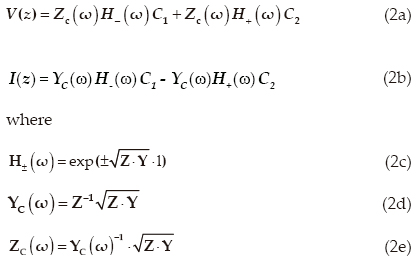
<body><![CDATA[<p align="justify"><font face="verdana" size="2"><b>Descriptores:</b> an&aacute;lisis transitorio, cables de potencia subterr&aacute;neos, retorno por tierra, transformada de Laplace, mediciones en laboratorio.</font></p>  	    <p align="justify"><font face="verdana" size="2">&nbsp;</font></p>  	    <p align="justify"><font face="verdana" size="2"><b>Introduction</b></font></p>  	    <p align="justify"><font face="verdana" size="2">An accurate calculation of electromagnetic (EM) transients on buried cable systems may take into account the Skin Effect in the ground and cable conductors, while relaxation effects on cable insulation layers (Wedepohl and Wilcox, 1973; Dommel, 1986; Marti, 1982; Marti, 1988; Uribe <i>et al</i>., 2002; Schellkunoff, 1934; Pollaczek, 1926; Uribe <i>et al</i>., 2004; Semlyen, 1985; Saad <i>et al</i>., 1996; Wedepohl, 1983). Consequently, the modal propagation functions of the cable system are highly influenced by the inductive loops formed between the power cables through the ground (Wedepohl and Wilcox, 1973). Thus, due to electromagnetic inductions phenomenon, the ground model is evaluated in this paper by means of two approaches for a qualitative comparison: the numerical solution of the exact Pollaczek&rsquo;s integral and using the classical approximate formulas previously issued by Wedepohl, Ametani and Semlyen (Wedepohl and Wilcox, 1973; Dommel, 1986; Semlyen, 1985; Saad <i>et al</i>., 1996).</font></p>  	    <p align="justify"><font face="verdana" size="2">A benchmark model for calculating the voltage transient step&#45;responses at the remote&#45;end of a buried cable system is proposed in this paper (Wedepohl and Wilcox, 1973; Dommel, 1986). The transient step&#45;response is synthesized in this paper through the Numerical Laplace Transform (NLT) (Uribe <i>et al</i>., 2002; Wedepohl, 1983).</font></p>  	    <p align="justify"><font face="verdana" size="2">Finally, the calculated responses are qualitative, validated here through a laboratory measurement performed on a scaled prototype experiment.</font></p>  	    <p align="justify"><font face="verdana" size="2">&nbsp;</font></p>  	    <p align="justify"><font face="verdana" size="2"><b>A Benchmark case for the Electromagnetic Transient Analysis of Underground Cables</b></font></p>  	    <p align="justify"><font face="verdana" size="2">The voltage and current wave propagation in underground cable transmission systems is described by (Wedepohl and Wilcox, 1973; Dommel, 1986; Marti, 1982; Marti, 1988; Uribe <i>et al</i>., 2002):</font></p>  	    <p align="center"><font face="verdana" size="2"><img src="/img/revistas/iit/v15n4/a8e1.jpg"></font></p>  	    ]]></body>
<body><![CDATA[<p align="justify"><font face="verdana" size="2">where <b><i>Z</i></b> and <b>&#978;</b> are the series&#45;impedance and the shunt&#45;admittance matrices both in per unit length, respectively. The solution of (1a) and (1b) is (Wedepohl and Wilcox, 1973; Dommel, 1986; Marti, 1982; Marti, 1988; Uribe <i>et al</i>., 2002; Schellkunoff, 1934):</font></p>  	    <p align="center"><font face="verdana" size="2"><img src="/img/revistas/iit/v15n4/a8e2.jpg"></font></p>  	    <p align="justify"><font face="verdana" size="2"><b><i>C</i><sub>1</sub></b> and <b><i>C</i><sub>2</sub></b> are the integration constant vectors determined by the boundary conditions, <b><i>H<sub>&#177;</sub></i></b> is the transmission system propagation function, <b><i>Y<sub>C</sub></i></b> and <b><i>Z<sub>C</sub></i></b> are the characteristic admittance and impedance matrices, respectively (Uribe <i>et al</i>., 2002).</font></p>  	    <p align="justify"><font face="verdana" size="2">An underground cable transmission system of length, <i>l,</i> as the one shown in <a href="/img/revistas/iit/v15n4/a8f1.jpg" target="_blank">Figure 1</a>, can be represented by a two port network. A nodal admittance representation, relates the voltage and current responses from the sending end at <i>z&nbsp;</i>&#61;&nbsp;0 to the remote end at <i>z&nbsp;</i>&#61;&nbsp;<i>l</i> (Wedepohl and Wilcox, 1973; Dommel, 1986; Marti, 1982; Marti, 1988; Uribe <i>et al</i>., 2002; Schellkunoff, 1934):</font></p>  	    <p align="center"><font face="verdana" size="2"><img src="/img/revistas/iit/v15n4/a8e3.jpg">    <br></font></p>  	    <p align="justify"><font face="verdana" size="2">where <b><i>V</i><sub>0</sub>(<i>s</i>)</b>and <b><i>I</i><sub>0</sub>(<i>s</i>)</b> are the voltage and current vectors at the sending&#45;end of the line <i>z</i>&nbsp;&#61;&nbsp;0. <b>V<i><sub>l</sub></i>(<i>s</i>)</b> and <b>I<i><sub>l</sub></i>(<i>s</i>)</b> are vectors of voltages and currents at remote&#45;end of the transmission line or, in this case, cable system <i>z</i>&nbsp;&#61;&nbsp;<i>l</i>.</font></p>  	    <p align="justify"><font face="verdana" size="2">&nbsp;</font></p>  	    <p align="justify"><font face="verdana" size="2"><b>Accurate calculation of ZY</b></font></p>  	    <p align="justify"><font face="verdana" size="2">The flat buried cable system shown in <a href="/img/revistas/iit/v15n4/a8f1.jpg" target="_blank">Figure 1a</a> formed three coupled loops between cables through the ground. In addition, each cable (as shown in <a href="/img/revistas/iit/v15n4/a8f1.jpg" target="_blank">Figure 1b</a>) formed internal and external loops between the nucleus and the sheath, respectively. The internal loop is due to the impedances of the nucleus, <i>EP</i> insulation and the internal sheath, while the external loop if due to the impedances of the external sheath, the <i>PVC</i> jacket and the ground (Wedepohl and Wilcox, 1973).    ]]></body>
<body><![CDATA[<br> </font></p>      <p align="justify"><font face="verdana" size="2">A well known expression for calculating the nucleus impedance of a cylindrical cable conductor is (Wedepohl and Wilcox, 1973):</font></p>  	    <p align="center"><font face="verdana" size="2"><img src="/img/revistas/iit/v15n4/a8e4.jpg"></font></p>  	    <p align="justify"><font face="verdana" size="2">Where <i>I</i><sub>0</sub> and <i>I</i><sub>1</sub> are the zero and first order modified Bessel functions, <i>p</i> is the skin&#45;effect layer thickness and the other variables are defined at the nomenclature.</font></p>  	    <p align="justify"><font face="verdana" size="2">The insulation impedances between two contiguous cylindrical cable conductors with radii <i>r</i><sub>ext</sub> and <i>r</i><sub>int</sub> as shown in <a href="/img/revistas/iit/v15n4/a8f1.jpg" target="_blank">Figure 1b</a> are given by (Wedepohl and Wilcox, 1973):</font></p>  	    <p align="center"><font face="verdana" size="2"><img src="/img/revistas/iit/v15n4/a8e4b.jpg"></font></p>  	    <p align="justify"><font face="verdana" size="2">The internal, external and mutual impedances of the tubular sheath conductor are given by the Schellkunoff theory for cylindrical formulae (Schellkunoff, 1934):</font></p>  	    <p align="center"><font face="verdana" size="2"><img src="/img/revistas/iit/v15n4/a8e4c.jpg"></font></p>  	    <p align="justify"><font face="verdana" size="2">where &#962;<sub>int</sub>&nbsp;&#61;&nbsp;<i>r<sub>s&#45;i</sub></i> / <i>p</i>, &#962;<sub>ext</sub>&nbsp;&#61;&nbsp;<i>r<sub>s&#45;e</sub></i> / <i>p</i> and the Wronskian is <i>W</i> &#61; <i>K</i><sub>1</sub>(&#962;<sub>int</sub>) x <i>I</i><sub>1</sub>(&#962;<sub>ext</sub>) &#150; <i>K</i><sub>1</sub>(&#962;<sub>ext</sub>) <i>I</i><sub>1</sub>(&#962;<sub>int</sub>).</font></p>  	    <p align="justify"><font face="verdana" size="2">The ground return impedances <i>Z<sub>G</sub></i>(&#969;) are calculated in this paper through two different approaches for a qualitative comparison purpose.</font></p>  	    ]]></body>
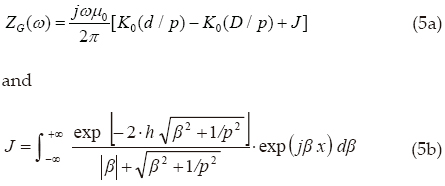
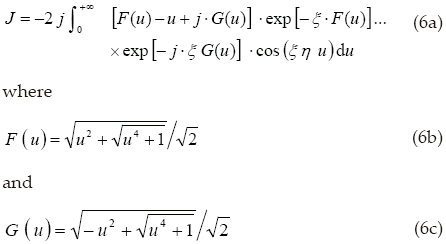
<body><![CDATA[<p align="justify"><font face="verdana" size="2">The first approach is obtained solving the Pollaczek&rsquo;s integral numerically and the second is obtained using classical closed&#45;form approximations (Dommel, 1986; Uribe <i>et al</i>., 2004).</font></p>  	    <p align="justify"><font face="verdana" size="2">First, the Pollaczek&rsquo;s integral is solved with the efficient, accurate and reliable algorithmic strategy proposed in Uribe <i>et al</i>. (2004). For comparison, the direct numerical integration is implemented here by using the adaptive Gauss&#45;Lobatto quadrature routine, <i>quadl</i>, available from Matlab<sup>&#174;</sup> v7 (Gander and Gautschi, 2000).</font></p>  	    <p align="justify"><font face="verdana" size="2">Then the closed&#45;form solutions previously issued by Wedepohl, Ametani and Semlyen are also implemented in this paper to verify their application accuracy ranges (Wedepohl and Wilcox, 1973; Dommel, 1986).</font></p>  	    <p align="justify"><font face="verdana" size="2">On assuming a <i>Quasi&#45;TEM<sub>Z</sub></i> propagation mode, the self and mutual ground&#45;return impedance <i>Z<sub>G</sub></i>(&#969;) of the cable system are given by (Wedepohl and Wilcox, 1973; Pollaczek, 1926; Uribe, 2004):</font></p>  	    <p align="center"><font face="verdana" size="2"><img src="/img/revistas/iit/v15n4/a8e5.jpg"></font></p>  	    <p align="justify"><font face="verdana" size="2">where <i>J</i> is the Pollaczek&rsquo;s integral, &#946; is the dummy variable and the other variables are listed in the nomenclature. The combination of regular and irregular oscillations due to the complex exponential factors in (5b) provokes convergence problems when applying generic quadrature routines at certain physical variable application ranges (Uribe <i>et al</i>., 2004).</font></p>  	    <p align="justify"><font face="verdana" size="2">On introducing in (5b) the variable change b&nbsp;&#61;&nbsp;<i>u</i>/&#124;<i>p</i>&#124; and the following defined dimensionless parameters, we obtain</font></p>  	    <p align="center"><font face="verdana" size="2"><img src="/img/revistas/iit/v15n4/a8e5b.jpg"></font></p>  	    <p align="justify"><font face="verdana" size="2">and after some algebraic manipulations, we have</font></p>  	    <p align="center"><font face="verdana" size="2"><img src="/img/revistas/iit/v15n4/a8e6.jpg"></font></p>  	    ]]></body>
<body><![CDATA[<p align="justify"><font face="verdana" size="2">Basically, the algorithmic strategy proposed in Uribe <i>et al</i>. (2004) is based on two aspects; a pure damping exponential truncation criterion and on a zero crossings identification procedure for harmonic oscillatory functions in (6a).</font></p>  	    <p align="justify"><font face="verdana" size="2">To implement the direct numerical integration of Pollaczek&rsquo;s integral (5b) may be transformed into:</font></p>  	    <p align="center"><font face="verdana" size="2"><img src="/img/revistas/iit/v15n4/a8e7.jpg"></font></p>  	    <p align="justify"><font face="verdana" size="2">The truncation criterion for (7a) is based on the properties of the damping exponential factor in (6a) when <i>F</i>(<i>u</i> ) &#8594;&nbsp;<i>u</i>. Thus, for the second factor in (6a) the entire range of <i>u</i> can be split&#45;up into:</font></p>  	    <p align="center"><font face="verdana" size="2"><img src="/img/revistas/iit/v15n4/a8e7b.jpg"></font></p>  	    <p align="justify"><font face="verdana" size="2">where <i>&#949; <sub>rel</sub></i> is the relative error defined in this paper as:</font></p>  	    <p align="center"><font face="verdana" size="2"><img src="/img/revistas/iit/v15n4/a8e7c.jpg"></font></p>  	    <p align="justify"><font face="verdana" size="2">with a truncation limit</font></p>  	    <p align="center"><font face="verdana" size="2"><img src="/img/revistas/iit/v15n4/a8e7d.jpg"></font></p>  	    <p align="justify"><font face="verdana" size="2">After Pollaczek&rsquo;s mathematical statement in 1926, electrical engineering researchers have looked forward for many years of closed&#45;form approximations to <i>Z<sub>G</sub></i>(<i>&#969;</i>) (Wedepohl and Wilcox, 1973; Pollaczek, 1926). Some of the most often used in EMTP applications are the ones proposed by Wedepohl, Ametani and Semlyen.</font></p>  	    ]]></body>
<body><![CDATA[<p align="justify"><font face="verdana" size="2">Wedepohl and Wilcox (1993) presented a formula for calculating the self and mutual <i>Z<sub>G</sub></i>(<i>&#969;</i>) valid for cables buried at usual depths around <i>h</i> &#8804;&nbsp;1&nbsp;m, <i>d</i>&nbsp;&#8804;&nbsp;1&nbsp;m and <i>&#124;x</i>/<i>p</i>&#124; &lt; 1/4:</font></p>  	    <p align="center"><font face="verdana" size="2"><img src="/img/revistas/iit/v15n4/a8e8.jpg"></font></p>  	    <p align="justify"><font face="verdana" size="2">where <i>&#947;</i> is the Euler constant.</font></p>  	    <p align="justify"><font face="verdana" size="2">Another important approximation is the one implemented in the cable constants routine of the EMTP program (Dommel, 1986). Basically here, Ametani replaces Pollaczek integral by the one of Carson, assuming in (5b) the following consideration (Dommel, 1986):</font></p>  	    <p align="center"><font face="verdana" size="2"><img src="/img/revistas/iit/v15n4/a8e8b.jpg"></font></p>  	    <p align="justify"><font face="verdana" size="2">Around 1982, Wedepohl conjectured a formula for calculating the self <i>Z<sub>G</sub></i> of a buried conductor. The formula is based on the complex depth penetration of the electromagnetic fields in the ground. Subsequently, in 1985 Semlyen reported the following formula (Semlyen, 1985):</font></p>  	    <p align="center"><font face="verdana" size="2"><img src="/img/revistas/iit/v15n4/a8e8c.jpg"></font></p>  	    <p align="justify"><font face="verdana" size="2">where <i>r</i><sub>PVC</sub> is the external cable radius (<a href="/img/revistas/iit/v15n4/a8f1.jpg" target="_blank">Figure 1b</a>), over the outer insulation PVC (Polyvinyl chloride) jacket.</font></p>  	    <p align="justify"><font face="verdana" size="2">In addition, Saad, Gaba and Giroux published a very interesting closed&#45;form approximation to Pollaczek integral based in the complex ground return plane and in the Cauchy&rsquo;s integral theorem solution (Saad <i>et al</i>., 1996). The derivation process of this formula is very similar to the early one employed to obtain a simplified model of the Carson&rsquo;s integral for calculating <i>Z<sub>G</sub></i> of aerial lines (Dommel, 1986):</font></p>  	    <p align="center"><font face="verdana" size="2"><img src="/img/revistas/iit/v15n4/a8e8d.jpg"></font></p>  	    ]]></body>
<body><![CDATA[<p align="justify"><font face="verdana" size="2">The self and mutual ground impedances <i>Z<sub>G</sub></i> for each of the current loops formed between the buried cable system in <a href="/img/revistas/iit/v15n4/a8f1.jpg" target="_blank">Figure 1</a>, are calculated in this paper by solving numerical Pollaczek integral and by using the above closed&#45;form approximations.</font></p>  	    <p align="justify"><font face="verdana" size="2">It can be seen in <a href="#f2">Figures 2</a> and <a href="#f3">3</a>, that in both impedance calculations the closed&#45;form approximations as well as the direct numerical quadrature of Gauss/Lobatto are in good agreement with the algorithmic solution developed by Uribe <i>et al</i>. (2004) used in this paper to establish a benchmark for calculating <i>Z<sub>G</sub></i>(<i>&#969;</i>).</font></p>  	    <p align="center"><font face="verdana" size="2"><a name="f2"></a></font></p>  	    <p align="center"><font face="verdana" size="2"><img src="/img/revistas/iit/v15n4/a8f2.jpg"></font></p>  	    <p align="center"><font face="verdana" size="2"><a name="f3"></a></font></p>  	    <p align="center"><font face="verdana" size="2"><img src="/img/revistas/iit/v15n4/a8f3.jpg"></font></p>  	    <p align="justify"><font face="verdana" size="2">However, there are practical engineering cases when the distance between cables <i>x</i> (<a href="/img/revistas/iit/v15n4/a8f1.jpg" target="_blank">Figure 1</a>) is considerably long, or when the cable trench is surrounded by soil with a very low resistivity (Dommel, 1986).</font></p>  	    <p align="justify"><font face="verdana" size="2"><a href="/img/revistas/iit/v15n4/html/a8apendice.html" target="_blank">Appendix I</a> shows the calculated mutual external loop of <i>Z<sub>G</sub></i>(<i>&#969;</i>) for the buried cable transmission system shown in <a href="/img/revistas/iit/v15n4/a8f1.jpg" target="_blank">Figure 1</a>, but with a separation distance between cables of <i>x&nbsp;</i>&#61;&nbsp;30&nbsp;m and with an homogeneous ground conductivity of &#963;<i>&nbsp;</i>&#61;&nbsp;1&nbsp;S/m.</font></p>  	    <p align="justify"><font face="verdana" size="2">The dispersive dielectric effects of each cable insulation layer (better known as relaxation effects), are introduced into the electromagnetic transient analysis by the shunt admittance matrix, based in the following relation (Dommel, 1986):</font></p>  	    <p align="center"><font face="verdana" size="2"><i>Y</i>(<i>&#969;</i>)&#61; <i>G</i> (<i>&#969;</i>) &#43; <i>J</i> &#183; <i>&#969; C</i>(<i>&#969;</i>)</font></p>  	    ]]></body>
<body><![CDATA[<p align="justify"><font face="verdana" size="2">where <i>G(&#969;)</i> is the shunt conductance which represents the Ohmic losses and <i>C</i>(<i>&#969;</i>) is the shunt capacitance which represents displacement current flowing between conductors through the specific dielectric. Assuming a concentric cable geometry, the capacitances are given by (Dommel, 1986):</font></p>  	    <p align="center"><font face="verdana" size="2"><img src="/img/revistas/iit/v15n4/a8e9.jpg"></font></p>  	    <p align="justify"><font face="verdana" size="2">where <i>&#949; <sub>r</sub></i>(<i>&#969;</i> ) &#61;&nbsp;<i>&#949; <sub>r</sub>&rsquo;</i>(<i>&#969;</i>) &#150; <i>j</i> &#183; <i>&#949; <sub>r</sub>&acute;&acute;</i>(<i>&#969;</i>) is the frequency dependent complex permittivity, which has a vector relation to the loss tangent loss factor through the electrical conductances as follows (Dommel, 1986):</font></p>  	    <p align="center"><font face="verdana" size="2"><img src="/img/revistas/iit/v15n4/a8e9c.jpg"></font></p>  	    <p align="justify"><font face="verdana" size="2">where <i><b>tan</b></i> &#948; is the insulation loss factor. Another option to evaluate the complex permittivity is to synthesize <i>&#949;<sub>r</sub></i> through a multi&#45;term order Debye or Cole&#45;Coles model (Dommel, 1986):</font></p>  	    <p align="center"><font face="verdana" size="2"><img src="/img/revistas/iit/v15n4/a8e9d.jpg"></font></p>  	    <p align="justify"><font face="verdana" size="2">where <i>&#949;</i><sub>&#8734;</sub> is the very high frequency permittivity value, <i>N</i> is the number of relaxation terms, <i>&#964; <sub>i</sub></i>, used for the fitting, &#916;<i>&#949; &nbsp;</i>&#61;&nbsp;<i>&#949; <sub>s</sub></i>&nbsp;&#150;<i>&nbsp; &#949;</i><sub>&#8734;</sub>&nbsp; and <i>&#949; <sub>s</sub></i> is the static frequency permittivity value.</font></p>  	    <p align="justify"><font face="verdana" size="2">&nbsp;</font></p>  	    <p align="justify"><font face="verdana" size="2">Modal propagation properties</font></p>  	    <p align="justify"><font face="verdana" size="2">The characteristics of wave attenuation and velocities are thus explained by The Theory of Natural Modes of Propagation by Wedepohl (Wedepohl and Wilcox, 1973; Dommel, 1986). The voltage and current wave propagation modes of the system are characterized by <i>H<sub>&#177;</sub></i>(<i>&#969;</i>) and <i>Z<sub>C</sub></i>(<i>&#969;</i>) in equiations (2c) and (2e), respectively.</font></p>  	    ]]></body>
<body><![CDATA[<p align="justify"><font face="verdana" size="2">The propagation modes of the buried cable system in <a href="/img/revistas/iit/v15n4/a8f1.jpg" target="_blank">Figure 1</a> resemble approximations of the aerial modes of Clarke (Wedepohl and Wilcox, 1973; Dommel, 1986), where two types of modes can be identified. The metallic conductor (two differential modes) and the ground return. In addition, the presence of the conductor sheaths add even more combinations of these mainly two basic types of propagation modes.</font></p>  	    <p align="justify"><font face="verdana" size="2"><a href="#f4">Figure 4</a> shows the decreasing monotonic behavior of <i>&#124;Z<sub>C</sub>&#124;</i> and <i>&#124;e</i> <sup>&#177;</sup><sup>&#8730;(</sup><i><sup>Z&#978;)x&#183;l</sup></i>&#124; which have been evaluated with two different <i>Z<sub>G</sub></i>(<i>&#969;</i>) models (Pollaczek and Wedepohl). The mode switching effect on <i>H<sub>&#177;</sub></i>(<i>&#969;</i>) has been removed by using the alternate method proposed by Wedepohl in (Wedepohl <i>et al</i>., 1996) for calculating transformation matrices tracking the order of eigenvectors and eigenvalues with their previous one corresponding frequency. The <i>Z<sub>C</sub></i> of the system directly depends on the relation between frequency dispersion conductor effects and on the insulation relaxation effects of the cable.</font></p>  	    <p align="center"><font face="verdana" size="2"><a name="f4"></a></font></p>  	    <p align="center"><font face="verdana" size="2"><img src="/img/revistas/iit/v15n4/a8f4.jpg"></font></p>  	    <p align="justify"><font face="verdana" size="2">In <a href="#f4">Figure 4a</a> the influence of the ground&#45;modes is noticeably greater for the metallic conductor loops according to the high inductive <i>Z<sub>G</sub></i>(<i>&#969;</i>) at the low frequency range as seen in <a href="#f2">Figures 2b</a> and <a href="#f3">3b</a>. It can be noticed from <a href="#f4">Figure 4b</a>, that the propagation function depends on the product of the cable parameters <b><i>Z</i></b><i><b>&#978;</b></i>. Where the influence of the high inductive <i>Z<sub>G</sub></i>(<i>&#969;</i>) is inversely related to the cable system modes. This can be corroborated from the Wedepohl model for <i>Z<sub>G</sub></i>(<i>&#969;</i>) shown in <a href="#f2">Figures 2b</a> and <a href="#f3">3b</a>, both according behavior in <a href="#f4">Figure 4b</a>.</font></p>  	    <p align="justify"><font face="verdana" size="2">&nbsp;</font></p>  	    <p align="justify"><font face="verdana" size="2">Frequency response</font></p>  	    <p align="justify"><font face="verdana" size="2">The accurate calculation of <b><i>Z</i></b><i><b>&#978;</b></i> has been performed in the evaluation of parameter matrices <b><i>A</i></b> and <b><i>B</i></b> in (Equations 3a and 3b) with the Pollaczek and Wedepohl ground&#45;return models. The nodal representation in (3a) is shown in Figure 5 where the cable system length <i>l</i>&nbsp;&#61;&nbsp;40&nbsp;km. The open&#45;circuit voltage and short&#45;circuit current frequency responses are shown in <a href="#f6">Figure 6</a>.</font></p>  	    <p align="center"><font face="verdana" size="2"><a name="f5"></a></font></p>  	    <p align="center"><font face="verdana" size="2"><img src="/img/revistas/iit/v15n4/a8f5.jpg"></font></p>  	    ]]></body>
<body><![CDATA[<p align="center"><font face="verdana" size="2"><a name="f6"></a></font></p>  	    <p align="center"><font face="verdana" size="2"><img src="/img/revistas/iit/v15n4/a8f6.jpg"></font></p>  	    <p align="justify"><font face="verdana" size="2">The network elements connected to the transmission cable system are represented by generalized admittances in the sending end with <i>Ys</i> and in the remote end with <i>&#978; <sub>R</sub></i>.</font></p>  	    <p align="justify"><font face="verdana" size="2">The voltage at the remote end, <i>V<sub>l</sub></i>, and the injected current at the sending end, <i>I<sub>s</sub></i>, are related to the boundary conditions as shown in <a href="#f5">Figure 5</a> (Uribe <i>et al</i>., 2002):</font></p>  	    <p align="center"><font face="verdana" size="2"><img src="/img/revistas/iit/v15n4/a8e10.jpg">    <br></font></p>  	    <p align="justify"><font face="verdana" size="2"><b><i>H</i>(<i>s</i>)</b> is the transfer function of the network system. Thus, the open&#45;circuit voltage responses for the cable system in <a href="#f5">Figure 5</a> are calculated in the following paper section.</font></p>  	    <p align="justify"><font face="verdana" size="2">&nbsp;</font></p>  	    <p align="justify"><font face="verdana" size="2">Numerical Laplace Inversion</font></p>  	    <p align="justify"><font face="verdana" size="2">The voltage waveform response at the remote end of the cable system in <a href="#f5">Figure 5</a> is synthesized in this paper through the inverse NLT (Wedepohl and Wilcox, 1973; Wedepohl, 1983):</font></p>  	    ]]></body>
<body><![CDATA[<p align="center"><font face="verdana" size="2"><img src="/img/revistas/iit/v15n4/a8e11.jpg"></font></p>  	    <p align="justify"><font face="verdana" size="2">The discretization of (11a) leads to the numerical solution of <b><i>Vz</i>(<i>t</i>)</b> at <i>z</i>&nbsp;&#61;&nbsp;l where <i>T&nbsp;&#61;&nbsp;m</i>&#916;<i>t</i> and &#937;<i>&nbsp;&#61;&nbsp;n</i>&#916;<i>s</i> as follows (Uribe <i>et al</i>., 2002; Wedepohl, 1983):</font></p>  	    <p align="center"><font face="verdana" size="2"><img src="/img/revistas/iit/v15n4/a8e11b.jpg"></font></p>  	    <p align="justify"><font face="verdana" size="2">where <i>N</i> is the number of time samples and <i>&#963; <sub>n</sub></i> is the data window which is used for attenuating Gibbs phenomena errors (Wedepohl, 1983). The following Vonn Hann window is applied:</font></p>  	    <p align="center"><font face="verdana" size="2"><img src="/img/revistas/iit/v15n4/a8e11c.jpg"></font></p>  	    <p align="justify"><font face="verdana" size="2">where &#937; is the frequency truncated range. The frequency domain discretization of <i>V</i><sub>&#8467;</sub>(<i>s</i>) provokes frequency leaking in the time domain. The damping Laplace factor, <i>c</i>, is thus used to quench frequency leaking errors. However, since Gibbs error is not completely eliminated by data windows, it would be amplified by the un&#45;damping function, exp(<i>cm</i>&#916;<i>t</i>), in (11b). Thus, the selection of a value for <i>c</i> is a trade off. The following criterion has been proposed by Wedepohl (1983):</font></p>  	    <p align="center"><font face="verdana" size="2"><img src="/img/revistas/iit/v15n4/a8e11d.jpg"></font></p>  	    <p align="justify"><font face="verdana" size="2">where <i>T&nbsp;&#61;&nbsp;N</i>&#916;<i>t</i> is the observation time for the transient and <i>&#949;</i> is the error level whose lower bound is determined by <i>N</i>. The discretization frequency step &#916;<i>&#969;</i> at (11b) is implicitly considered as follows:</font></p>  	    <p align="center"><font face="verdana" size="2"><img src="/img/revistas/iit/v15n4/a8e11e.jpg"></font></p>  	    <p align="justify"><font face="verdana" size="2">where <i>N</i>&#916;<i>&#969;</i>/2 is the truncation frequency for the discrete representation of <i>V</i><sub>&#8467;</sub>(<i>s</i>). Consider now from (11c):</font></p>  	    ]]></body>
<body><![CDATA[<p align="center"><font face="verdana" size="2"><img src="/img/revistas/iit/v15n4/a8e11f.jpg"></font></p>  	    <p align="justify"><font face="verdana" size="2">The left&#45;hand side of (11f) is the sampling frequency while the right hand side is twice the truncation frequency. In addition (11f) agrees with the Nyquist sampling criterion.</font></p>  	    <p align="justify"><font face="verdana" size="2">&nbsp;</font></p>  	    <p align="justify"><font face="verdana" size="2">Scaled prototype laboratory measurements</font></p>  	    <p align="justify"><font face="verdana" size="2">An initial scaled experimental setup has been implemented in this paper to perform a qualitative comparison between the obtained voltage measurements in the laboratory and the NLT methodology. A thin wire of 1.302 mm<sup>2</sup> (16 AWG) for 600V with <i>r</i>&nbsp;&#61;&nbsp;1.25&nbsp;mm, <i>h</i>&nbsp;&#61;&nbsp;0.1&nbsp;m, &#961;<sub><i>CU</i></sub>&nbsp;&#61;&nbsp;1.72&nbsp;&times;&nbsp;10<i><sup>&#45;4</sup></i> &#937; &#183; m<i>,</i> &#961;<sub><i>g</i></sub>&nbsp;&#61;&nbsp;1000&#937; &#183; m (it is assumed that the laboratory has a solid rocky soil without moisture), and a cable length of <i>l</i>&nbsp;&#61;&nbsp;35&nbsp;m has been used for the scaled test.</font></p>  	    <p align="justify"><font face="verdana" size="2">A voltage source of 5V is switched at the sending end of the cable conductor as is shown in channel&#45;1 of the oscilloscope obtained in <a href="/img/revistas/iit/v15n4/a8f7.jpg" target="_blank">Figure 7a</a>. The transient step voltage response is measured with a TDS2024 oscilloscope at the remote end of the cable as is shown in channel&#45;2 in the same figure.</font></p>  	    <p align="justify"><font face="verdana" size="2">In <a href="/img/revistas/iit/v15n4/a8f7.jpg" target="_blank">Figure 7b</a>, the comparison between both measured voltages and the synthesized Laplace voltage response is illustrated having a good agreement. However, a small attenuation between both measured and synthesized voltage responses can be noticed in this figure. It is probably that the attenuation difference between both curves is due to a mistaken measurement taken from the ground resistivity of the laboratory.</font></p>  	    <p align="justify"><font face="verdana" size="2">&nbsp;</font></p>  	    <p align="justify"><font face="verdana" size="2"><b>Conclusions</b></font></p>  	    <p align="justify"><font face="verdana" size="2">An accurate methodology for calculating <b><i>Z</i></b><i><b>&#978;</b></i> parameters for buried cable systems is developed in this paper. Ground&#45;return impedanceshave been calculated here by solving the Pollaczek integral through direct numerical integration and with an algorithmic strategy proposed by the author.</font></p>  	    ]]></body>
<body><![CDATA[<p align="justify"><font face="verdana" size="2">The influence of approximate ground&#45;return models on modal propagation functions is also discussed in this paper. The voltage transient step response on a single16AWG prototype cable is measured on a scaled setup experiment. The voltage transient step response on the cable has been also synthesized through the Numerical Laplace Transform.</font></p>  	    <p align="justify"><font face="verdana" size="2">Both, the measured and the synthesized voltage transient step&#45;responses are in good agreement. Thus, it is possible to suggest a qualitative validation for the NLT technique in power transient analysis applications.</font></p>  	    <p align="justify"><font face="verdana" size="2">&nbsp;</font></p>  	    <p align="justify"><font face="verdana" size="2"><b>Nomenclature</b></font></p>  	    <p align="justify"><font face="verdana" size="2"><img src="/img/revistas/iit/v15n4/a8n1.jpg"></font></p>  	    <p align="justify"><font face="verdana" size="2">&nbsp;</font></p>     <p align="justify"><font face="verdana" size="2"><b>References</b></font></p>     <!-- ref --><p align="justify"><font face="verdana" size="2">Dommel H.W. Electromagnetic Transients Program Reference Manual (EMTP Theory Book), Prepared for Bonneville Power Administration, P.O. Box 3621, Portland, Ore., 97208, USA, 1986.    &nbsp;&nbsp;&nbsp;&nbsp;&nbsp;&nbsp;&nbsp;&nbsp;[&#160;<a href="javascript:void(0);" onclick="javascript: window.open('/scielo.php?script=sci_nlinks&ref=4292822&pid=S1405-7743201400040000800001&lng=','','width=640,height=500,resizable=yes,scrollbars=1,menubar=yes,');">Links</a>&#160;]<!-- end-ref --></font></p>  	    <!-- ref --><p align="justify"><font face="verdana" size="2">Gander W. and Gautschi W. Adaptive Quadrature&#45;Revisited. <i>BIT</i>, volume 40, 2000: 84&#45;101.    &nbsp;&nbsp;&nbsp;&nbsp;&nbsp;&nbsp;&nbsp;&nbsp;[&#160;<a href="javascript:void(0);" onclick="javascript: window.open('/scielo.php?script=sci_nlinks&ref=4292824&pid=S1405-7743201400040000800002&lng=','','width=640,height=500,resizable=yes,scrollbars=1,menubar=yes,');">Links</a>&#160;]<!-- end-ref --></font></p>  	    <!-- ref --><p align="justify"><font face="verdana" size="2">Marti J.R. Accurate Modelling of Frequency&#45;Dependent Transmission Lines in Electromagnetic Transient Simulations. <i>IEEE Trans. on Power Apparatus and Systems</i>, volume PAS&#45;101 (issue 1), 1982: 147&#45;155.    &nbsp;&nbsp;&nbsp;&nbsp;&nbsp;&nbsp;&nbsp;&nbsp;[&#160;<a href="javascript:void(0);" onclick="javascript: window.open('/scielo.php?script=sci_nlinks&ref=4292826&pid=S1405-7743201400040000800003&lng=','','width=640,height=500,resizable=yes,scrollbars=1,menubar=yes,');">Links</a>&#160;]<!-- end-ref --></font></p>  	    <!-- ref --><p align="justify"><font face="verdana" size="2">Marti L. Simulation of Transients in Underground Cables with Frequency Dependent Modal Transformation Matrices. <i>IEEE Transactions on Power Delivery</i>, volume 3 (issue 3), 1988: 1099&#45;1110.    &nbsp;&nbsp;&nbsp;&nbsp;&nbsp;&nbsp;&nbsp;&nbsp;[&#160;<a href="javascript:void(0);" onclick="javascript: window.open('/scielo.php?script=sci_nlinks&ref=4292828&pid=S1405-7743201400040000800004&lng=','','width=640,height=500,resizable=yes,scrollbars=1,menubar=yes,');">Links</a>&#160;]<!-- end-ref --></font></p>  	    <!-- ref --><p align="justify"><font face="verdana" size="2">Pollaczek F. &Uuml;ber das Feld einer unendlich langen wechsel stromdurchflossenen Einfachleitung. <i>Electrishe Nachrichten Technik</i>, volume 3, (issue 9), 1926: 339&#45;360.    &nbsp;&nbsp;&nbsp;&nbsp;&nbsp;&nbsp;&nbsp;&nbsp;[&#160;<a href="javascript:void(0);" onclick="javascript: window.open('/scielo.php?script=sci_nlinks&ref=4292830&pid=S1405-7743201400040000800005&lng=','','width=640,height=500,resizable=yes,scrollbars=1,menubar=yes,');">Links</a>&#160;]<!-- end-ref --></font></p>  	    <!-- ref --><p align="justify"><font face="verdana" size="2">Saad O., Gaba G., Giroux M. A Closed&#45;Form Approximation for Ground Return Impedance of Underground Cables. <i>IEEE Transactions on Power Delivery,</i> volume 11 (issue 3), July 1996: 1536&#45;1545.    &nbsp;&nbsp;&nbsp;&nbsp;&nbsp;&nbsp;&nbsp;&nbsp;[&#160;<a href="javascript:void(0);" onclick="javascript: window.open('/scielo.php?script=sci_nlinks&ref=4292832&pid=S1405-7743201400040000800006&lng=','','width=640,height=500,resizable=yes,scrollbars=1,menubar=yes,');">Links</a>&#160;]<!-- end-ref --></font></p>  	    <!-- ref --><p align="justify"><font face="verdana" size="2">Semlyen A. Discussion to Overhead Line Parameters from Handbook Formulas and Computer Programs, by Dommel H.W. <i>IEEE Trans. on Power Apparatus and Systems</i>, volume PAS&#45;104, 1985: 371.    &nbsp;&nbsp;&nbsp;&nbsp;&nbsp;&nbsp;&nbsp;&nbsp;[&#160;<a href="javascript:void(0);" onclick="javascript: window.open('/scielo.php?script=sci_nlinks&ref=4292834&pid=S1405-7743201400040000800007&lng=','','width=640,height=500,resizable=yes,scrollbars=1,menubar=yes,');">Links</a>&#160;]<!-- end-ref --></font></p>  	    <!-- ref --><p align="justify"><font face="verdana" size="2">Schellkunoff S.A. The Electromagnetic Theory of Coaxial Transmission Lines and Cylindrical Shields. <i>The Bell System Technical Journal</i>, volume 13, 1934: 532&#45;539.    &nbsp;&nbsp;&nbsp;&nbsp;&nbsp;&nbsp;&nbsp;&nbsp;[&#160;<a href="javascript:void(0);" onclick="javascript: window.open('/scielo.php?script=sci_nlinks&ref=4292836&pid=S1405-7743201400040000800008&lng=','','width=640,height=500,resizable=yes,scrollbars=1,menubar=yes,');">Links</a>&#160;]<!-- end-ref --></font></p>  	    <!-- ref --><p align="justify"><font face="verdana" size="2">Uribe F.A., Naredo J.L., Moreno P., Guardado L. Electromagnetic Transients in Underground Transmission Systems Tthrough the Numerical Laplace Transform. Int. <i>Journal of Electrical Power &#38; Energy Systems</i>, volume 24 (issue 3),&nbsp; March 2002: 215&#45;221.    &nbsp;&nbsp;&nbsp;&nbsp;&nbsp;&nbsp;&nbsp;&nbsp;[&#160;<a href="javascript:void(0);" onclick="javascript: window.open('/scielo.php?script=sci_nlinks&ref=4292838&pid=S1405-7743201400040000800009&lng=','','width=640,height=500,resizable=yes,scrollbars=1,menubar=yes,');">Links</a>&#160;]<!-- end-ref --></font></p>  	    <!-- ref --><p align="justify"><font face="verdana" size="2">Uribe F.A., Naredo J., Moreno L.P., Guardado L. Algorithmic Evaluation of Underground Cable Earth Impedances. <i>IEEE Transactions on Power Delivery</i>, volume 19 (issue 1), 2004: 316&#45;322.    &nbsp;&nbsp;&nbsp;&nbsp;&nbsp;&nbsp;&nbsp;&nbsp;[&#160;<a href="javascript:void(0);" onclick="javascript: window.open('/scielo.php?script=sci_nlinks&ref=4292840&pid=S1405-7743201400040000800010&lng=','','width=640,height=500,resizable=yes,scrollbars=1,menubar=yes,');">Links</a>&#160;]<!-- end-ref --></font></p>  	    <!-- ref --><p align="justify"><font face="verdana" size="2">Wedepohl L.M. Power System Transients: Errors Incurred in the Numerical Inversion of the Laplace Transform, Proceedings of the Twenty&#45;Six Midwest Symposium on Circuits and Systems 15&#45;16 August, 1983, pp. 174&#45;178.    &nbsp;&nbsp;&nbsp;&nbsp;&nbsp;&nbsp;&nbsp;&nbsp;[&#160;<a href="javascript:void(0);" onclick="javascript: window.open('/scielo.php?script=sci_nlinks&ref=4292842&pid=S1405-7743201400040000800011&lng=','','width=640,height=500,resizable=yes,scrollbars=1,menubar=yes,');">Links</a>&#160;]<!-- end-ref --></font></p>  	    <!-- ref --><p align="justify"><font face="verdana" size="2">Wedepohl L.M., Nguyen H., Irwin G. Frequency&#45;Dependent Transformation Matrices for Untransposed Transmission Lines. <i>IEEE Trans. on Power Systems</i>, volume 11 (issue 3), &nbsp;August 1996: 1538&#45;1546.    &nbsp;&nbsp;&nbsp;&nbsp;&nbsp;&nbsp;&nbsp;&nbsp;[&#160;<a href="javascript:void(0);" onclick="javascript: window.open('/scielo.php?script=sci_nlinks&ref=4292844&pid=S1405-7743201400040000800012&lng=','','width=640,height=500,resizable=yes,scrollbars=1,menubar=yes,');">Links</a>&#160;]<!-- end-ref --></font></p>  	    <!-- ref --><p align="justify"><font face="verdana" size="2">Wedepohl L.M. and Wilcox D.J. Transient Analysis of Underground Power&#45;Transmission Ssystems. <i>Proc. IEE</i>, volume 120 (issue 2), 1973: 253&#45;260.    &nbsp;&nbsp;&nbsp;&nbsp;&nbsp;&nbsp;&nbsp;&nbsp;[&#160;<a href="javascript:void(0);" onclick="javascript: window.open('/scielo.php?script=sci_nlinks&ref=4292846&pid=S1405-7743201400040000800013&lng=','','width=640,height=500,resizable=yes,scrollbars=1,menubar=yes,');">Links</a>&#160;]<!-- end-ref --></font></p>  	    <p align="justify"><font face="verdana" size="2">&nbsp;</font></p>  	    <p align="justify"><font face="verdana" size="2"><b>Citation for this aricle:</b></font></p>         <p align="justify"><font face="verdana" size="2"><b>Chicago citation style</b>    <br>       Uribe&#45;Campos, Felipe Alejandro. Laplace Synthesis Validation Through Measurements on Underground Transmission Cables. <i>Ingenier&iacute;a Investigaci&oacute;n y Tecnolog&iacute;a</i>, XV, 04 (2014): 561&#45;584.</font></p>         <p align="justify"><font face="verdana" size="2"><b>ISO 690 citation style</b>    <br>       Uribe&#45;Campos F.A. Laplace Synthesis Validation Through Measurements on Underground Transmission Cables. <i>Ingenier&iacute;a Investigaci&oacute;n y Tecnolog&iacute;a</i>, volume XV (issue 4), October&#45;December 2014: 561&#45;584.</font></p>       	    <p align="justify"><font face="verdana" size="2">&nbsp;</font></p>         ]]></body>
<body><![CDATA[<p align="justify"><font face="verdana" size="2"><b>About the author</b></font></p>  	    <p align="justify"><font face="verdana" size="2"><i><b>Felipe Alejandro Uribe&#45;Campos.</b></i> &nbsp;Received the B. Sc. and M. Sc. degrees of Electrical Engineering, both from the State University of Guadalajara, in 1994 and 1998, respectively. During 2001 he was a visiting researcher at the University of British Columbia, B.C., Canada. In 2002 he received the Dr. Sc. degree of Electrical Engineering from the Center for Research and Advanced Studies of Mexico. The dissertation was awarded with the Arturo Rosenblueth prize. From 2003 to 2006 was a full professor with the Electrical Graduate Program at the State University of Nuevo Leon, M&eacute;xico. From May 2006. He joined the Electrical Engineering Graduate Program at the State University of Guadalajara, M&eacute;xico, where he is currently a full time researcher. Since 2004, he is a member of the National System of Researchers of Mexico. His primary interest is the electromagnetic simulation of Biological tissues for early Cancer detection and power system harmonic and transient analysis.</font></p>      ]]></body><back>
<ref-list>
<ref id="B1">
<nlm-citation citation-type="">
<person-group person-group-type="author">
<name>
<surname><![CDATA[Dommel]]></surname>
<given-names><![CDATA[H.W]]></given-names>
</name>
</person-group>
<source><![CDATA[Electromagnetic Transients Program Reference Manual (EMTP Theory Book)]]></source>
<year>1986</year>
<publisher-loc><![CDATA[Portland^eOre Ore]]></publisher-loc>
</nlm-citation>
</ref>
<ref id="B2">
<nlm-citation citation-type="journal">
<person-group person-group-type="author">
<name>
<surname><![CDATA[Gander]]></surname>
<given-names><![CDATA[W]]></given-names>
</name>
<name>
<surname><![CDATA[Gautschi]]></surname>
<given-names><![CDATA[W]]></given-names>
</name>
</person-group>
<article-title xml:lang="en"><![CDATA[Adaptive Quadrature-Revisited]]></article-title>
<source><![CDATA[BIT]]></source>
<year>2000</year>
<volume>40</volume>
<page-range>84-101</page-range></nlm-citation>
</ref>
<ref id="B3">
<nlm-citation citation-type="journal">
<person-group person-group-type="author">
<name>
<surname><![CDATA[Marti]]></surname>
<given-names><![CDATA[J.R.]]></given-names>
</name>
</person-group>
<article-title xml:lang="en"><![CDATA[Accurate Modelling of Frequency-Dependent Transmission Lines in Electromagnetic Transient Simulations]]></article-title>
<source><![CDATA[IEEE Trans. on Power Apparatus and Systems]]></source>
<year>1982</year>
<volume>PAS-101</volume>
<numero>1</numero>
<issue>1</issue>
<page-range>147-155</page-range></nlm-citation>
</ref>
<ref id="B4">
<nlm-citation citation-type="journal">
<person-group person-group-type="author">
<name>
<surname><![CDATA[Marti]]></surname>
<given-names><![CDATA[L]]></given-names>
</name>
</person-group>
<article-title xml:lang="en"><![CDATA[Simulation of Transients in Underground Cables with Frequency Dependent Modal Transformation Matrices.]]></article-title>
<source><![CDATA[IEEE Transactions on Power Delivery]]></source>
<year>1988</year>
<volume>3</volume>
<numero>3</numero>
<issue>3</issue>
<page-range>1099-1110</page-range></nlm-citation>
</ref>
<ref id="B5">
<nlm-citation citation-type="journal">
<person-group person-group-type="author">
<name>
<surname><![CDATA[Pollaczek]]></surname>
<given-names><![CDATA[F]]></given-names>
</name>
</person-group>
<article-title xml:lang="de"><![CDATA[Über das Feld einer unendlich langen wechsel stromdurchflossenen Einfachleitung]]></article-title>
<source><![CDATA[Electrishe Nachrichten Technik]]></source>
<year>1926</year>
<volume>3</volume>
<numero>9</numero>
<issue>9</issue>
<page-range>339-360</page-range></nlm-citation>
</ref>
<ref id="B6">
<nlm-citation citation-type="journal">
<person-group person-group-type="author">
<name>
<surname><![CDATA[Saad]]></surname>
<given-names><![CDATA[O]]></given-names>
</name>
<name>
<surname><![CDATA[Gaba]]></surname>
<given-names><![CDATA[G]]></given-names>
</name>
<name>
<surname><![CDATA[Giroux]]></surname>
<given-names><![CDATA[M]]></given-names>
</name>
</person-group>
<article-title xml:lang="en"><![CDATA[A Closed-Form Approximation for Ground Return Impedance of Underground Cables]]></article-title>
<source><![CDATA[IEEE Transactions on Power Delivery]]></source>
<year>1996</year>
<volume>11</volume>
<numero>3</numero>
<issue>3</issue>
<page-range>1536-1545</page-range></nlm-citation>
</ref>
<ref id="B7">
<nlm-citation citation-type="journal">
<person-group person-group-type="author">
<name>
<surname><![CDATA[Semlyen]]></surname>
<given-names><![CDATA[A]]></given-names>
</name>
</person-group>
<article-title xml:lang="en"><![CDATA[Discussion to Overhead Line Parameters from Handbook Formulas and Computer Programs]]></article-title>
<source><![CDATA[IEEE Trans. on Power Apparatus and Systems]]></source>
<year>1985</year>
<volume>PAS-104</volume>
<page-range>371</page-range></nlm-citation>
</ref>
<ref id="B8">
<nlm-citation citation-type="journal">
<person-group person-group-type="author">
<name>
<surname><![CDATA[Schellkunoff]]></surname>
<given-names><![CDATA[S.A.]]></given-names>
</name>
</person-group>
<article-title xml:lang="en"><![CDATA[The Electromagnetic Theory of Coaxial Transmission Lines and Cylindrical Shields]]></article-title>
<source><![CDATA[The Bell System Technical Journal]]></source>
<year>1934</year>
<volume>13</volume>
<page-range>532-539</page-range></nlm-citation>
</ref>
<ref id="B9">
<nlm-citation citation-type="journal">
<person-group person-group-type="author">
<name>
<surname><![CDATA[Uribe]]></surname>
<given-names><![CDATA[F.A.]]></given-names>
</name>
<name>
<surname><![CDATA[Naredo]]></surname>
<given-names><![CDATA[J.L.]]></given-names>
</name>
<name>
<surname><![CDATA[Moreno]]></surname>
<given-names><![CDATA[P]]></given-names>
</name>
<name>
<surname><![CDATA[Guardado]]></surname>
<given-names><![CDATA[L]]></given-names>
</name>
</person-group>
<article-title xml:lang="en"><![CDATA[Electromagnetic Transients in Underground Transmission Systems Tthrough the Numerical Laplace Transform]]></article-title>
<source><![CDATA[Int. Journal of Electrical Power & Energy Systems]]></source>
<year>Marc</year>
<month>h </month>
<day>20</day>
<volume>24</volume>
<numero>3</numero>
<issue>3</issue>
<page-range>215-221</page-range></nlm-citation>
</ref>
<ref id="B10">
<nlm-citation citation-type="journal">
<person-group person-group-type="author">
<name>
<surname><![CDATA[Uribe]]></surname>
<given-names><![CDATA[F.A.]]></given-names>
</name>
<name>
<surname><![CDATA[Naredo]]></surname>
<given-names><![CDATA[J]]></given-names>
</name>
<name>
<surname><![CDATA[Moreno]]></surname>
<given-names><![CDATA[L.P.]]></given-names>
</name>
<name>
<surname><![CDATA[Guardado]]></surname>
<given-names><![CDATA[L]]></given-names>
</name>
</person-group>
<article-title xml:lang="en"><![CDATA[Algorithmic Evaluation of Underground Cable Earth Impedances]]></article-title>
<source><![CDATA[IEEE Transactions on Power Delivery]]></source>
<year>2004</year>
<volume>19</volume>
<numero>1</numero>
<issue>1</issue>
<page-range>316-322</page-range></nlm-citation>
</ref>
<ref id="B11">
<nlm-citation citation-type="">
<person-group person-group-type="author">
<name>
<surname><![CDATA[Wedepohl]]></surname>
<given-names><![CDATA[L.M]]></given-names>
</name>
</person-group>
<source><![CDATA[Power System Transients: Errors Incurred in the Numerical Inversion of the Laplace Transform]]></source>
<year>1983</year>
<page-range>174-178</page-range></nlm-citation>
</ref>
<ref id="B12">
<nlm-citation citation-type="journal">
<person-group person-group-type="author">
<name>
<surname><![CDATA[Wedepohl]]></surname>
<given-names><![CDATA[L.M.]]></given-names>
</name>
<name>
<surname><![CDATA[Nguyen]]></surname>
<given-names><![CDATA[H]]></given-names>
</name>
<name>
<surname><![CDATA[Irwin]]></surname>
<given-names><![CDATA[G]]></given-names>
</name>
</person-group>
<article-title xml:lang="en"><![CDATA[Frequency-Dependent Transformation Matrices for Untransposed Transmission Lines]]></article-title>
<source><![CDATA[IEEE Trans. on Power Systems]]></source>
<year>Augu</year>
<month>st</month>
<day> 1</day>
<volume>11</volume>
<numero>3</numero>
<issue>3</issue>
<page-range>1538-1546</page-range></nlm-citation>
</ref>
<ref id="B13">
<nlm-citation citation-type="journal">
<person-group person-group-type="author">
<name>
<surname><![CDATA[Wedepohl]]></surname>
<given-names><![CDATA[L.M.]]></given-names>
</name>
<name>
<surname><![CDATA[Wilcox]]></surname>
<given-names><![CDATA[D.J.]]></given-names>
</name>
</person-group>
<article-title xml:lang="en"><![CDATA[Transient Analysis of Underground Power-Transmission Ssystems]]></article-title>
<source><![CDATA[Proc. IEE]]></source>
<year>1973</year>
<volume>120</volume>
<numero>2</numero>
<issue>2</issue>
<page-range>253-260</page-range></nlm-citation>
</ref>
</ref-list>
</back>
</article>