<?xml version="1.0" encoding="ISO-8859-1"?><article xmlns:mml="http://www.w3.org/1998/Math/MathML" xmlns:xlink="http://www.w3.org/1999/xlink" xmlns:xsi="http://www.w3.org/2001/XMLSchema-instance">
<front>
<journal-meta>
<journal-id>1405-7743</journal-id>
<journal-title><![CDATA[Ingeniería, investigación y tecnología]]></journal-title>
<abbrev-journal-title><![CDATA[Ing. invest. y tecnol.]]></abbrev-journal-title>
<issn>1405-7743</issn>
<publisher>
<publisher-name><![CDATA[Universidad Nacional Autónoma de México, Facultad de Ingeniería]]></publisher-name>
</publisher>
</journal-meta>
<article-meta>
<article-id>S1405-77432010000300007</article-id>
<title-group>
<article-title xml:lang="en"><![CDATA[Electrical Parameters Extraction of CMOS Floating-Gate Inverters]]></article-title>
<article-title xml:lang="es"><![CDATA[Extracción de parámetros eléctricos de inversores CMOS de compuerta flotante]]></article-title>
</title-group>
<contrib-group>
<contrib contrib-type="author">
<name>
<surname><![CDATA[Molinar-Solís]]></surname>
<given-names><![CDATA[J.E.]]></given-names>
</name>
<xref ref-type="aff" rid="A01"/>
</contrib>
<contrib contrib-type="author">
<name>
<surname><![CDATA[Ponce-Ponce]]></surname>
<given-names><![CDATA[V.H.]]></given-names>
</name>
<xref ref-type="aff" rid="A02"/>
</contrib>
<contrib contrib-type="author">
<name>
<surname><![CDATA[García-Lozano]]></surname>
<given-names><![CDATA[R.Z.]]></given-names>
</name>
<xref ref-type="aff" rid="A03"/>
</contrib>
<contrib contrib-type="author">
<name>
<surname><![CDATA[Díaz-Sánchez]]></surname>
<given-names><![CDATA[A.]]></given-names>
</name>
<xref ref-type="aff" rid="A04"/>
</contrib>
<contrib contrib-type="author">
<name>
<surname><![CDATA[Rocha-Pérez]]></surname>
<given-names><![CDATA[J.M.]]></given-names>
</name>
<xref ref-type="aff" rid="A05"/>
</contrib>
</contrib-group>
<aff id="A01">
<institution><![CDATA[,Universidad Autónoma del Estado de México  ]]></institution>
<addr-line><![CDATA[ ]]></addr-line>
</aff>
<aff id="A02">
<institution><![CDATA[,Instituto Politécnico Nacional Centro de Investigación en Computación ]]></institution>
<addr-line><![CDATA[ ]]></addr-line>
<country>México</country>
</aff>
<aff id="A03">
<institution><![CDATA[,Universidad Autónoma del Estado de México  ]]></institution>
<addr-line><![CDATA[ ]]></addr-line>
</aff>
<aff id="A04">
<institution><![CDATA[,Instituto Nacional de Astrofísica, Óptica y Electrónica  ]]></institution>
<addr-line><![CDATA[Tonantzintla Puebla]]></addr-line>
</aff>
<aff id="A05">
<institution><![CDATA[,Instituto Nacional de Astrofísica, Óptica y Electrónica  ]]></institution>
<addr-line><![CDATA[Tonantzintla Puebla]]></addr-line>
</aff>
<pub-date pub-type="pub">
<day>00</day>
<month>09</month>
<year>2010</year>
</pub-date>
<pub-date pub-type="epub">
<day>00</day>
<month>09</month>
<year>2010</year>
</pub-date>
<volume>11</volume>
<numero>3</numero>
<fpage>315</fpage>
<lpage>323</lpage>
<copyright-statement/>
<copyright-year/>
<self-uri xlink:href="http://www.scielo.org.mx/scielo.php?script=sci_arttext&amp;pid=S1405-77432010000300007&amp;lng=en&amp;nrm=iso"></self-uri><self-uri xlink:href="http://www.scielo.org.mx/scielo.php?script=sci_abstract&amp;pid=S1405-77432010000300007&amp;lng=en&amp;nrm=iso"></self-uri><self-uri xlink:href="http://www.scielo.org.mx/scielo.php?script=sci_pdf&amp;pid=S1405-77432010000300007&amp;lng=en&amp;nrm=iso"></self-uri><abstract abstract-type="short" xml:lang="en"><p><![CDATA[This work provides an accurate methodology for extracting the floating-gate gain factory, of CMOS floating-gate inverters with a clock-driven switch for accessing temporarilly to the floating-gate. With the methodology proposed in this paper, the &#947; factor and other parasitic capacitances coupled to the floating-gate can be easily extracted in a mismatch-free approach. This parameter plays an important role in modern analog and mixed-signal CMOS circuits, since it limits the circuit performance. Theoretical and measured values using two test cells, fabricated in a standard double poly double metal CMOS AMI-ABN process with 1.2 µm design rules, were compared. The extracted parameters can be incorporated into floating-gate PS pice macromodels for obtaining accurate electrical simulation.]]></p></abstract>
<abstract abstract-type="short" xml:lang="es"><p><![CDATA[En este trabajo se brinda una metodología precisa para la extracción del factor de ganancia &#947; de la compuerta flotante en inversores CMOS, que constan de un interruptor para acceder temporalmente a la compuerta flotante. Con la metodología propuesta, el factor &#947; y otras capacitancias parásitas acopladas a la compuerta flotante pueden ser extraídas. Estos parámetros son de mucha importancia, ya que juegan un papel importante en el desempeño de circuitos analógicos y de señal mixta. La comparación entre cálculos teóricos y simulaciones es hecha utilizando dos celdas de prueba fabricadas de tecnología AMI ABN de 1.2 µm, a través de la organización MOSIS. Los parámetros extraídos pueden ser incorporados a macromodelos en PSpice para obtener simulaciones más precisas.]]></p></abstract>
<kwd-group>
<kwd lng="en"><![CDATA[FG-inverter]]></kwd>
<kwd lng="en"><![CDATA[neuMOS]]></kwd>
<kwd lng="en"><![CDATA[floating-gate]]></kwd>
<kwd lng="es"><![CDATA[inversor de compuerta flotante]]></kwd>
<kwd lng="es"><![CDATA[NeuMOS]]></kwd>
<kwd lng="es"><![CDATA[compuerta flotante]]></kwd>
</kwd-group>
</article-meta>
</front><body><![CDATA[ <p align="center"><font face="verdana" size="4"><b>Electrical Parameters Extraction of CMOS Floating&#150;Gate Inverters</b></font></p>     <p align="center"><font face="verdana" size="2">&nbsp;</font></p>     <p align="center"><font face="verdana" size="3"><b>Extracci&oacute;n de par&aacute;metros el&eacute;ctricos de inversores CMOS de compuerta flotante</b></font></p>     <p align="center"><font face="verdana" size="2">&nbsp;</font></p>     <p align="center"><font face="verdana" size="2"><b>Molinar&#150;Sol&iacute;s J.E.<sup>1</sup>, Ponce&#150;Ponce V.H.<sup>2</sup>, R.Z. Garc&iacute;a&#150;Lozano<sup>3</sup>, D&iacute;az&#150;S&aacute;nchez A.<sup>4</sup> y Rocha&#150;P&eacute;rez J.M.<sup>5</sup></b></font></p>     <p align="center"><font face="verdana" size="2">&nbsp;</font></p>     <p align="justify"><font face="verdana" size="2"><i><sup>1</sup> Universidad Aut&oacute;noma del Estado de M&eacute;xico, E&#150;mail:</i> <a href="mailto:Jemolinars@uaemex.mx">Jemolinars@uaemex.mx</a></font></p>     <p align="justify"><font face="verdana" size="2"><i><sup>2</sup> Centro de Investigaci&oacute;n en Computaci&oacute;n, Instituto Polit&eacute;cnico Nacional, M&eacute;xico, E&#150;mail:</i> <a href="mailto:vponce@cic.ipn.mx">vponce@cic.ipn.mx</a></font></p>     <p align="justify"><font face="verdana" size="2"><i><sup>3</sup> Universidad Aut&oacute;noma del Estado de M&eacute;xico, E&#150;mail:</i> <a href="mailto:zolagarcia@yahoo.com">zolagarcia@yahoo.com</a></font></p>     <p align="justify"><font face="verdana" size="2"><i><sup>4</sup> Instituto Nacional de Astrof&iacute;sica, &Oacute;ptica y Electr&oacute;nica INAOE, Tonantzintla, Puebla, E&#150;mail:</i> <a href="mailto:adiazsan@inaoep.mx">adiazsan@inaoep.mx</a></font></p>     ]]></body>
<body><![CDATA[<p align="justify"><font face="verdana" size="2"><i><sup>5</sup> Instituto Nacional de Astrof&iacute;sica, &Oacute;ptica y Electr&oacute;nica INAOE, Tonantzintla, Puebla, E&#150;mail:</i> <a href="mailto:jmr@inaoep.mx">jmr@inaoep.mx</a></font></p>     <p align="justify"><font face="verdana" size="2">&nbsp;</font></p>     <p align="justify"><font face="verdana" size="2">Recibido: septiembre de 2008    <br> Aceptado: julio de 2009</font></p>     <p align="justify"><font face="verdana" size="2">&nbsp;</font></p>     <p align="justify"><font face="verdana" size="2"><b>Abstract</b></font></p>     <p align="justify"><font face="verdana" size="2">This work provides an accurate methodology for extracting the floating&#150;gate gain factory, of CMOS floating&#150;gate inverters with a clock&#150;driven switch for accessing temporarilly to the floating&#150;gate. With the methodology proposed in this paper, the &gamma; factor and other parasitic capacitances coupled to the floating&#150;gate can be easily extracted in a mismatch&#150;free approach. This parameter plays an important role in modern analog and mixed&#150;signal CMOS circuits, since it limits the circuit performance. Theoretical and measured values using two test cells, fabricated in a standard double poly double metal CMOS AMI&#150;ABN process with 1.2 &micro;m design rules, were compared. The extracted parameters can be incorporated into floating&#150;gate PS pice macromodels for obtaining accurate electrical simulation.</font></p>     <p align="justify"><font face="verdana" size="2"><b>Keywords: </b>FG&#150;inverter, neuMOS, floating&#150;gate.</font></p>     <p align="justify"><font face="verdana" size="2">&nbsp;</font></p>     <p align="justify"><font face="verdana" size="2"><b>Resumen</b></font></p>     ]]></body>
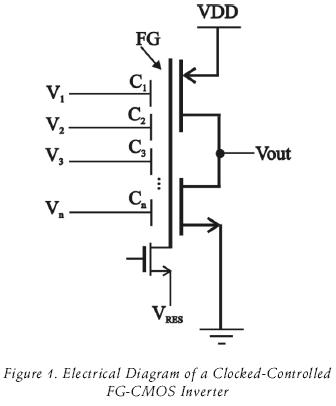
<body><![CDATA[<p align="justify"><font face="verdana" size="2"><i>En este trabajo se brinda una metodolog&iacute;a precisa para la extracci&oacute;n del factor de ganancia &gamma; de la compuerta flotante en inversores CMOS, que constan de un interruptor para acceder temporalmente a la compuerta flotante. Con la metodolog&iacute;a propuesta, el factor &gamma; y otras capacitancias par&aacute;sitas acopladas a la compuerta flotante pueden ser extra&iacute;das. Estos par&aacute;metros son de mucha importancia, ya que juegan un papel importante en el desempe&ntilde;o de circuitos anal&oacute;gicos y de se&ntilde;al mixta. La comparaci&oacute;n entre c&aacute;lculos te&oacute;ricos y simulaciones es hecha utilizando dos celdas de prueba fabricadas de tecnolog&iacute;a AMI ABN de 1.2 &micro;m, a trav&eacute;s de la organizaci&oacute;n MOSIS. Los par&aacute;metros extra&iacute;dos pueden ser incorporados a macromodelos en PSpice para obtener simulaciones m&aacute;s precisas.</i></font></p>     <p align="justify"><font face="verdana" size="2"><b>Descriptores: </b><i>inversor de compuerta flotante, NeuMOS, compuerta flotante.</i></font></p>     <p align="justify"><font face="verdana" size="2">&nbsp;</font></p>     <p align="justify"><font face="verdana" size="2"><b>Introduction</b></font></p>     <p align="justify"><font face="verdana" size="2">The CMOS floating&#150;gate inverters with multiple inputs have become a useful circuit block in modern analog and mixed&#150;signal circuit design. A CMOS floating&#150;gate inverter is a typical CMOS inverter with two or more input capacitances coupled to the floating gate (FG), which is common to both N and P channel enhancement MOSFET transistors which are connected in the drain mode. The potential induced in the FG can be controlled as a weighted linear sum, in voltage&#150;mode, of all input signals. The potential of the FG establishes the on&#150;off state of the CMOS inverter (Shibata <i>et al, </i>1992&#150;1993).</font></p>     <p align="justify"><font face="verdana" size="2">Discharging of the FG is commonly required but also, for many applications, it is desirable to pre&#150;charge the FG to a given bias voltage. Discharging and pre&#150;charging the FG can be achieved by using an analog switch that connects temporally the FG to an externally applied potential <i>(V<sub>RES</sub>). </i>By using an external voltage <i>V<sub>RES</sub> = </i>0V, the FG can be discharged and the typical UV erasing technique can be avoided (<a href="#figura1">figure 1</a>). This concept has been introduced first in (Kotani <i>et al, </i>1995&#150;1998) and was named as clocked&#150;controlled NeuMOS inverter, but it will be referred as clocked&#150;controlled FG&#150;CMOS inverter.</font></p>     <p align="center"><font face="verdana" size="2"><a name="figura1" id="figura1"></a></font></p>     <p align="center"><font face="verdana" size="2"><img src="/img/revistas/iit/v11n3/a7f1.jpg"></font></p>     <p align="justify"><font face="verdana" size="2">The FG gain factor &#947;, determines the maximum input contribution to the FG potential. For <i>n </i>capacitive inputs it is expressed as:</font></p>     <p align="center"><font face="verdana" size="2"><img src="/img/revistas/iit/v11n3/a7e1.jpg"></font></p>     ]]></body>
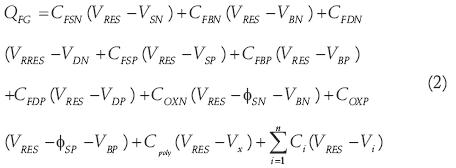
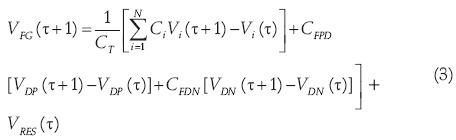
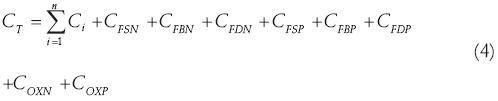
<body><![CDATA[<p align="justify"><font face="verdana" size="2">Where <i>C<sub>T</sub> </i>is the total capacitance including parasitic capacitances.   The   physical  characterization  of   the   FG gain factor &gamma;, also known as the capacitive coupling coefficient, and the parasitic capacitances coupled to the FG, is a fundamental step in the design of high performance FG&#150;CMOS based circuits, since the device behavior strongly depends on these values. The strategy followed in this work consists in comparing some features of the transient behavior in the "reset" and "evaluation" periods. One advantage of this approach is that the extraction of the above mentioned parameters can be done to the FG inverter without the use of a "dummy cell" (Mondrag&oacute;n <i>et al, </i>2000), resulting in an accurate mismatch&#150;free techniques, and whose evaluation will be demonstrated by comparing theoretical and measured results in the next sections.</font></p>     <p align="justify"><font face="verdana" size="2">&nbsp;</font></p>     <p align="justify"><font face="verdana" size="2"><b>Clock&#150;controlled FG&#150;CMOS inverter</b></font></p>     <p align="justify"><font face="verdana" size="2">Electrical charge and potential in the FG using an ideal analog switch</font></p>     <p align="justify"><font face="verdana" size="2">The electrical equivalent circuit for the FG inverter showing the control and relevant parasitic capacitances is shown in <a href="/img/revistas/iit/v11n3/a7f2.jpg" target="_blank">figure 2</a>.</font></p>     <p align="justify"><font face="verdana" size="2">According to <a href="#figura1">figure 1</a>, the total charge stored in the FG, <i>Q<sub>FG</sub> </i>is given by:</font></p>     <p align="center"><font face="verdana" size="2"><img src="/img/revistas/iit/v11n3/a7e2.jpg"></font></p>     <p align="justify"><font face="verdana" size="2">where <i>C</i><sub>i</sub>, is the capacitance between the FG and the input node <i>i, V<b><sub>i</sub> </b></i>is the <i>i</i>th input voltage, <i>V<sub>DN</sub>, V<sub>DP</sub>, V<sub>SN</sub> , V<sub>SP</sub> </i>and <i>V<sub>BN</sub> , V<sub>BP</sub> </i>are the drain, source and substrate voltages for the NMOS and PMOS transistors, respectively. From now on, the right side subscripts N and P will denote NMOS and PMOS, respectively. <i>C<sub>FDN</sub>,, C<sub>FDP</sub> </i>and <i>C<sub>FSN</sub>,, C<sub>FSP</sub> </i>are the overlap capacitances between the FG and the drain or source, respectively. <i>C<sub>FBN</sub> , </i>and <i>C<sub>FBP</sub> </i>are the overlap capacitances between the FG and the bulk along the edge of the channel, <i>C<sub>OXN</sub> </i>and <i>C<sub>OXP</sub> </i>are the gate oxide capacitances, <i>C<sub>DFPN</sub> </i>and <i>C<sub>DFPP</sub> </i>in <a href="/img/revistas/iit/v11n3/a7f2.jpg" target="_blank">figure 2</a>, are the depletion layer capacitances, which can be neglected after the channel begins to form  the floating gate (Shibata <i>et al., </i>1993). Potentials &phi;<sub></sub><i><sub>SN</sub></i> and &phi;<i><sub>SP</sub> </i>represent the surface potential of the silicon substrate. <i>C<sub>poly</sub> </i>is the parasitic capacitance between the FG (polysilicon back&#150;plate) and the below substrate layer tied to a <i>V<sub>x</sub> </i>potential. In this case, for a P<sup>&#150;</sup> substrate <i>V<sub>x</sub> = GND. </i>Potential <i>V<sub>RFS</sub> </i>is the voltage transferred to the FG through the switch. All voltages in (2) are relative to substrate.</font></p>     <p align="justify"><font face="verdana" size="2">It is assumed that no charge injection and no charge leakage occur during device operation. Then, from the charge conservation law on the FG, (2) can be simplified and rearranged to obtain an expression for the potential on the FG, <i>V<sub>FG</sub>, </i>when the initial net charge is zero, this is given by:</font></p>     <p align="center"><font face="verdana" size="2"><img src="/img/revistas/iit/v11n3/a7e3.jpg"></font></p>     ]]></body>
<body><![CDATA[<p align="justify"><font face="verdana" size="2">where the potentials at the reset period are represented by (<img src="/img/revistas/iit/v11n3/a7e4.jpg">), this is, when the reset switch is closed, and the potentials at the evaluation period represented by (<img src="/img/revistas/iit/v11n3/a7e4.jpg">+1), when the switch is open. In (3), <i>V<sub>i</sub></i>(<i><img src="/img/revistas/iit/v11n3/a7e4.jpg">+ </i>1) represents the <i>i</i>th input voltage during the evaluation period, and <i>V<sub>i</sub>(<img src="/img/revistas/iit/v11n3/a7e4.jpg">) </i>is the <i>i</i>th input voltage applied during the reset period. The remaining potentials terms, coupled to the FG do not contribute with charge in both periods, but their associated capacitances contribute to form <i>C<sub>T</sub></i>, which is defined as the sum of all capacitances coupled to the FG as follows.</font></p>     <p align="center"><font face="verdana" size="2"><img src="/img/revistas/iit/v11n3/a7e5.jpg"></font></p>     <p align="justify"><font face="verdana" size="2">&nbsp;</font></p>     <p align="justify"><font face="verdana" size="2"><b>Potential   in   the   FG   using   a real   analog   switch</b></font></p>     <p align="justify"><font face="verdana" size="2">For practical implementations, a single N&#150;channel MOSFET can be used in stead of the <i>SW </i>element as shown in <a href="/img/revistas/iit/v11n3/a7f2.jpg" target="_blank">figure 2</a>. In <a href="/img/revistas/iit/v11n3/a7f3.jpg" target="_blank">figure 3</a>, an equivalent circuit for the FG inverter using a real switch is introduced.</font></p>     <p align="justify"><font face="verdana" size="2">If the access switch transistor (SW) is ni cut off region, a simplest electrical equivalent circuit for the FG potential can be obtained (Ram&iacute;rez <i>et al</i>., 2004), <a href="/img/revistas/iit/v11n3/a7f4.jpg" target="_blank">figure 4</a>, where all the inputs are tied together and form a single input capacitor <i>C<sub>IN</sub></i>, <i>C<sub>IN</sub> </i>= <i>C<sub>1</sub></i>+...+<i>C<sub>i</sub></i>+...+<i>C<sub>n</sub></i>. Capacitance <i>C<sub>OUT</sub> </i>represents the sum of <i>C<sub>FDP</sub> </i>and <i>C<sub>FDN</sub></i>. The <i>C<sub>pi</sub> </i>capacitor is the <i>i</i>th parasitic capacitance that couples the FG to a DC voltage <i>V<sub>DCi</sub></i>.</font></p>     <p align="justify"><font face="verdana" size="2">Here, the ideal diode element models the N<sup>+</sup>/P parasitic drain&#150;bulk junction, associated to the access switch transistor (SW) in cut off and <i>R<sub>leak</sub> </i>is an approximation to the non&#150;linear leakage resistance of this junction.</font></p>     <p align="justify"><font face="verdana" size="2">The input <i>V<sub>IN</sub> </i>voltage contribution to the FG potential can be obtained through the solution of a simplified circuit (<a href="/img/revistas/iit/v11n3/a7f5.jpg" target="_blank">figure 5a</a>).</font></p>     <p align="justify"><font face="verdana" size="2">Where the capacitance <i>C<sub>T</sub>' </i>is defined as <i>C<sub>T</sub>' =C<sub>T</sub> &#150; C<sub>IN</sub></i>. By conducting a Thevenin reduction to the circuit, the clamping circuit in <a href="/img/revistas/iit/v11n3/a7f5.jpg" target="_blank">figure 5b</a> is obtained. For any period ical and continuous voltage signal applied to the circuit, <i>V<sub>IN</sub> =A<sub>IN</sub> f<sub>1</sub></i>(<i>t</i>+<i>nT</i>) with amplitude <i>A<sub>IN</sub> </i>and period <i>T</i>, such that <i>T &lt;</i>&lt; <i>R<sub>leak</sub>C<sub>T</sub></i>, <a href="/img/revistas/iit/v11n3/a7f5.jpg" target="_blank">figure 5c</a>, the FG potential due only to this input&#150;signal, <a href="/img/revistas/iit/v11n3/a7f5.jpg" target="_blank">figure 5d</a>, will be given by:</font></p>     <p align="center"><font face="verdana" size="2"><img src="/img/revistas/iit/v11n3/a7e6.jpg"></font></p>     ]]></body>
<body><![CDATA[<p align="justify"><font face="verdana" size="2">The same analysis holds for the corresponding contribution on the FG potential as a function of a periodical output signal <i>V<sub>OUT</sub>=A<sub>OUT</sub> f<sub>2</sub></i>(<i>t</i>+<i>nT</i>), coupled to the FG through <i>C<sub>OUT</sub></i>, as follows:</font></p>     <p align="center"><font face="verdana" size="2"><img src="/img/revistas/iit/v11n3/a7e7.jpg"></font></p>     <p align="justify"><font face="verdana" size="2">For    the    DC    contribution,    the    following    analytical time&#150;domain expression for the FG potential is obtained:</font></p>     <p align="center"><font face="verdana" size="2"><img src="/img/revistas/iit/v11n3/a7e8.jpg"></font></p>     <p align="justify"><font face="verdana" size="2">The global expression that models the FG potential will be obtained by summing equations (5), (6) and (7), this is:</font></p>     <p align="center"><font face="verdana" size="2"><img src="/img/revistas/iit/v11n3/a7e9.jpg"></font></p>     <p align="justify"><font face="verdana" size="2">During the evaluation period, the terms associated to DC potentials coupled to the FG, vanish for <i>t</i>&gt;&gt;<i>R<sub>leak</sub>C<sub>T</sub></i>. This means that the induced DC&#150;charge on the FG at circuit startup and the reset&#150;charge due to <i>V<sub>RES</sub></i>, will be swept out during the evaluation period, after several circuit&#150;time constants <i>R<sub>leak</sub>C<sub>T</sub></i>. Therefore, in steady&#150;state, the FG potential will be:</font></p>     <p align="center"><font face="verdana" size="2"><img src="/img/revistas/iit/v11n3/a7e10.jpg"></font></p>     <p align="justify"><font face="verdana" size="2">By   deriving  equation  (9)  with  respect   to  time,   the following expression is obtained</font></p>     <p align="center"><font face="verdana" size="2"><img src="/img/revistas/iit/v11n3/a7e11.jpg"></font></p>     ]]></body>
<body><![CDATA[<p align="justify"><font face="verdana" size="2">where, &gamma;<i>=C</i><sub><i>IN</i></sub>/C<i><sub>T </sub></i>is the FG gain factor and &gamma;<sub><i>par</i></sub><i>= C</i><sub><i>OUT</i></sub>/C<sub>T </sub>would correspond to a parasitic FG gain factor due to the feedback of the FGMOS inverter's output voltage on the FG.</font></p>     <p align="justify"><font face="verdana" size="2">In reset mode, applying a direct signal to the FG, i.e. a sawtooth, the slope of the inverter transfer characteristic associated to the circuit shown in <a href="/img/revistas/iit/v11n3/a7f6.jpg" target="_blank">figure 6a</a>, is given by:</font></p>     <p align="center"><font face="verdana" size="2"><img src="/img/revistas/iit/v11n3/a7e12.jpg"></font></p>     <p align="justify"><font face="verdana" size="2">In a similar way, as illustrated in <a href="/img/revistas/iit/v11n3/a7f7.jpg" target="_blank">figure 7a</a>, the slope of the transfer characteristic, when the circuit operates in the evaluation period, is given by</font></p>     <p align="center"><font face="verdana" size="2"><img src="/img/revistas/iit/v11n3/a7e13.jpg"></font></p>     <p align="justify"><font face="verdana" size="2">Now substituting (11) and (12) in (10), the following relation is obtained:</font></p>     <p align="center"><font face="verdana" size="2"><img src="/img/revistas/iit/v11n3/a7e14.jpg"></font></p>     <p align="justify"><font face="verdana" size="2">Where, the slopes <i>A<sub>VE</sub> </i>and <i>A<sub>VR</sub> </i>can be easily measured in order to extract the parameters &gamma; and <i>&gamma;<sub>par</sub></i></font></p>     <p align="justify"><font face="verdana" size="2">&nbsp;</font></p>     <p align="justify"><font face="verdana" size="2"><b>Extraction methodology</b></font></p>     ]]></body>
<body><![CDATA[<p align="justify"><font face="verdana" size="2">The basic idea that supports the extraction methodology consists in comparing the inverter transient response obtained in the reset period with that obtained during the evaluation period. The extraction methodology is presented next as a sequence of six steps:</font></p>     <p align="justify"><font face="verdana" size="2"><i>Step 1. </i>A measurement during the reset period of <i>A<sub>VR</sub> </i>is taken around a fixed point in <i>V<sub>IN</sub> </i>which corresponds to a low&#150;gain slope of the output characteristic <i>(V<sub>OUT</sub>), </i>(<a href="/img/revistas/iit/v11n3/a7f6.jpg" target="_blank">figure 6b</a>).</font></p>     <p align="justify"><font face="verdana" size="2"><i>Step 2. </i>A measurement during the evaluation period of <i>A<sub>VE</sub> </i>is taken around the same point of step 1, (<a href="/img/revistas/iit/v11n3/a7f7.jpg" target="_blank">figure 7b</a>).</font></p>     <p align="justify"><font face="verdana" size="2"><i>Step 3</i>. Parameter &gamma; is calculated using (13). The second term of the right side of this equation is negligible in the low&#150;gain region due to &gamma;<sub><i>par</i></sub>&lt;&gamma; and since <i>A<sub>VE</sub> </i>is small, then, &gamma; approaches to</font></p>     <p align="center"><font face="verdana" size="2"><img src="/img/revistas/iit/v11n3/a7e15.jpg"></font></p>     <p align="justify"><font face="verdana" size="2"><i>Step 4. </i>A measurement during the reset period of <i>A<sub>VR </sub></i>is taken at a fixed point <i>V<sub>IN</sub> </i>near the switching&#150;point of the inverter, which corresponds to a high&#150;gain slope of the output characteristic, (<a href="/img/revistas/iit/v11n3/a7f6.jpg" target="_blank">figure 6b</a>).</font></p>     <p align="justify"><font face="verdana" size="2"><i>Step 5</i>. A measurement in the evaluation period of <i>A<sub>VE</sub> </i>is taken at the same point of step 4, see <a href="/img/revistas/iit/v11n3/a7f7.jpg" target="_blank">figure 7b</a>.</font></p>     <p align="justify"><font face="verdana" size="2"><i>Step 6. </i>From (13), &gamma; is calculated using the values obtained in the steps 3, 4 and 5, by using</font></p>     <p align="center"><font face="verdana" size="2"><img src="/img/revistas/iit/v11n3/a7e16.jpg"></font></p>     <p align="center"><font face="verdana" size="2">&nbsp;</font></p>     ]]></body>
<body><![CDATA[<p align="justify"><font face="verdana" size="2"><b>Experimental   results</b></font></p>     <p align="justify"><font face="verdana" size="2">Two test cells were fabricated using a double&#150;poly double&#150;metal CMOS process with 1.2&micro;m design rules, available through MOSIS services (run: T2AH&#150;BJ and T48S&#150;AM). The microphotograph of each test cell is shown in <a href="/img/revistas/iit/v11n3/a7f8.jpg" target="_blank">figure 8</a>. The first test cell corresponds to the circuit introduced in <a href="/img/revistas/iit/v11n3/a7f6.jpg" target="_blank">figure 6a</a>. The schematic diagram for the second test cell is not shown, but is a six&#150;input FG&#150;CMOS inverter.</font></p>     <p align="justify"><font face="verdana" size="2">The test cells were measured using the described methodology presented in section 3. The small&#150;signal slopes were computed by using a linear&#150;fit approximation from data points obtained by means of a digital oscilloscope. <a href="/img/revistas/iit/v11n3/a7t1.jpg" target="_blank">Table 1</a>, shows the theoretical and extracted values for &gamma; and &gamma;<sub><i>par</i></sub> using a 100 kHz saw&#150;tooth signal with 5V peak&#150;to&#150;peak and a 2.5V offset. The period of this signal (<i>T</i>=10&micro;s) is smaller than the intrinsic circuit&#150;time constant which normally is in the order of seconds.</font></p>     <p align="justify"><font face="verdana" size="2">&nbsp;</font></p>     <p align="justify"><font face="verdana" size="2"><b>Discussion</b></font></p>     <p align="justify"><font face="verdana" size="2">Although the theoretical capacitance values can be calculated using the process parameters given by the foundry, the physical differences of the input capacitances can lead to an important deviation of &gamma; factor and thus affecting significantly the circuit operating point. As an example, two identical CMOS inverters were simulated through PSpice, one of them with an input capacitance deviation of 5% (<a href="/img/revistas/iit/v11n3/a7f9.jpg" target="_blank">figure 9a</a>).</font></p>     <p align="justify"><font face="verdana" size="2">The inverters outputs are shown in <a href="/img/revistas/iit/v11n3/a7f9.jpg" target="_blank">figure 9b</a>. The switching operating point (Jacob <i>et al., </i>1998) of the inverters as shown, is shifted near by 60mV with respect the input voltage V<i>in </i>, this condition is undesirable for many analog and mixed signal applications since the recent low&#150;voltage trends requires high accuracy. The methodology presented in this work focuses on CMOS floating&#150;gate circuits with a clock&#150;driven switch at the FG, and represents a good choice when the &gamma; factor must be determined experimentally for high accuracy requirements.</font></p>     <p align="justify"><font face="verdana" size="2">&nbsp;</font></p>     <p align="justify"><font face="verdana" size="2"><b>Acknowledgements</b></font></p>     <p align="justify"><font face="verdana" size="2">Mexico State Autonomous University (CU UAEM&#150;Ecatepec), Interdisciplinary Professional School of Engineering and Advanced Technologies (UPIITA&#150;IPN) and National Institute for Astrophysics, Optics and Electronics, INAOE.</font></p>     ]]></body>
<body><![CDATA[<p align="justify"><font face="verdana" size="2">&nbsp;</font></p>     <p align="justify"><font face="verdana" size="2"><b>References</b></font></p>     <!-- ref --><p align="justify"><font face="verdana" size="2">Shibata T., Ohmi T. A Functional MOS Transistor Featuring Gate&#150;Level Weighted Sum and Threshold Operations. <i>IEEE Trans. on Electron Devices</i>, 39(6): 1444&#150;1455, 1992.</font>&nbsp;&nbsp;&nbsp;&nbsp;&nbsp;&nbsp;&nbsp;&nbsp;[&#160;<a href="javascript:void(0);" onclick="javascript: window.open('/scielo.php?script=sci_nlinks&ref=4254284&pid=S1405-7743201000030000700001&lng=','','width=640,height=500,resizable=yes,scrollbars=1,menubar=yes,');">Links</a>&#160;]<!-- end-ref --><!-- ref --><p align="justify"><font face="verdana" size="2">Shibata T., Ohmi T. Neuron MOS Binary&#150;Logic Integrated Circuits &#150; Part I: Design Fundamentals and Soft&#150;Hardware&#150;Logic Circuit Implementation. <i>IEEE Trans. on Electron Devices</i>, 40(3):570&#150;576, 1993.</font>&nbsp;&nbsp;&nbsp;&nbsp;&nbsp;&nbsp;&nbsp;&nbsp;[&#160;<a href="javascript:void(0);" onclick="javascript: window.open('/scielo.php?script=sci_nlinks&ref=4254285&pid=S1405-7743201000030000700002&lng=','','width=640,height=500,resizable=yes,scrollbars=1,menubar=yes,');">Links</a>&#160;]<!-- end-ref --><!-- ref --><p align="justify"><font face="verdana" size="2">Kotani K., Shibata T., Imai M., Ohmi T. Clocked&#150; Neuron&#150;MOS Logic Circuits Employing Auto&#150;Threshold&#150;Adjustment. On: IEEE International Solid&#150;State Circuits Conference ISSCC95, 1995, pp. 320&#150;322.</font>&nbsp;&nbsp;&nbsp;&nbsp;&nbsp;&nbsp;&nbsp;&nbsp;[&#160;<a href="javascript:void(0);" onclick="javascript: window.open('/scielo.php?script=sci_nlinks&ref=4254286&pid=S1405-7743201000030000700003&lng=','','width=640,height=500,resizable=yes,scrollbars=1,menubar=yes,');">Links</a>&#160;]<!-- end-ref --><!-- ref --><p align="justify"><font face="verdana" size="2">Kotani K., Shibata T., Imai M., Ohmi T. Clock&#150;Controlled Neuron&#150;MOS Logic Gates. <i>IEEE Trans. on Circuits and Systems&#150; II: Analog and Digital Signal Processing</i>, 45(4): 518&#150;522, 1998.</font>&nbsp;&nbsp;&nbsp;&nbsp;&nbsp;&nbsp;&nbsp;&nbsp;[&#160;<a href="javascript:void(0);" onclick="javascript: window.open('/scielo.php?script=sci_nlinks&ref=4254287&pid=S1405-7743201000030000700004&lng=','','width=640,height=500,resizable=yes,scrollbars=1,menubar=yes,');">Links</a>&#160;]<!-- end-ref --><!-- ref --><p align="justify"><font face="verdana" size="2">Mondragon&#150;Torres A., Shneider M., Sanchez&#150;Sinencio E. Extraction of Electrical Parameters of Floating Gate Devices for Circuit Analysis, Simulation, and Design. On: The 2002 45th Midwest Symposium on Circuits and Systems, 2002. MWSCAS&#150;2002, Vol. 1, 2000, pp. 311&#150;314.</font>&nbsp;&nbsp;&nbsp;&nbsp;&nbsp;&nbsp;&nbsp;&nbsp;[&#160;<a href="javascript:void(0);" onclick="javascript: window.open('/scielo.php?script=sci_nlinks&ref=4254288&pid=S1405-7743201000030000700005&lng=','','width=640,height=500,resizable=yes,scrollbars=1,menubar=yes,');">Links</a>&#160;]<!-- end-ref --><!-- ref --><p align="justify"><font face="verdana" size="2">Shibata T., Ohmi T. Neuron MOS Binary&#150;Logic Integrated Circuits &#150; Part II: Simplifying Techniques of Circuit Configuration and their Practical Applications. <i>IEEE Trans. on Electron Devices</i>, 40(5):431&#150;434, 1993.</font>&nbsp;&nbsp;&nbsp;&nbsp;&nbsp;&nbsp;&nbsp;&nbsp;[&#160;<a href="javascript:void(0);" onclick="javascript: window.open('/scielo.php?script=sci_nlinks&ref=4254289&pid=S1405-7743201000030000700006&lng=','','width=640,height=500,resizable=yes,scrollbars=1,menubar=yes,');">Links</a>&#160;]<!-- end-ref --><!-- ref --><p align="justify"><font face="verdana" size="2">Ramirez&#150;Angulo J., Lopez&#150;Martin A., Gonzalez&#150;Carbajal R., Mu&ntilde;oz&#150;Chavero F. Very Low&#150;Voltage Analog Signal Processing Based on Quasi&#150;Floating Gate Transistors. <i>IEEE Journal of Solid State Circuits, </i>39(3):434&#150; 442, 2004.</font>&nbsp;&nbsp;&nbsp;&nbsp;&nbsp;&nbsp;&nbsp;&nbsp;[&#160;<a href="javascript:void(0);" onclick="javascript: window.open('/scielo.php?script=sci_nlinks&ref=4254290&pid=S1405-7743201000030000700007&lng=','','width=640,height=500,resizable=yes,scrollbars=1,menubar=yes,');">Links</a>&#160;]<!-- end-ref --><!-- ref --><p align="justify"><font face="verdana" size="2">Ramirez&#150;Angulo J., Gonz&aacute;lez&#150;Altamirano G., Choi S.C. Modeling Multiple&#150;Input Floating&#150;Gate Transistors for Analog Signal Processing. On: International Symposium On Circuits and Systems ISCAS'97, Vol. 3, 1997, pp. 2020&#150;2023.</font>&nbsp;&nbsp;&nbsp;&nbsp;&nbsp;&nbsp;&nbsp;&nbsp;[&#160;<a href="javascript:void(0);" onclick="javascript: window.open('/scielo.php?script=sci_nlinks&ref=4254291&pid=S1405-7743201000030000700008&lng=','','width=640,height=500,resizable=yes,scrollbars=1,menubar=yes,');">Links</a>&#160;]<!-- end-ref --><!-- ref --><p align="justify"><font face="verdana" size="2">Guan H., Tang Y.S. Accurate and Efficient Models for the Simulation of Neuron MOS Integrated Circuits. <i>International Journal of Electronics</i>, 87, 2000, pp. 557&#150;568.</font>&nbsp;&nbsp;&nbsp;&nbsp;&nbsp;&nbsp;&nbsp;&nbsp;[&#160;<a href="javascript:void(0);" onclick="javascript: window.open('/scielo.php?script=sci_nlinks&ref=4254292&pid=S1405-7743201000030000700009&lng=','','width=640,height=500,resizable=yes,scrollbars=1,menubar=yes,');">Links</a>&#160;]<!-- end-ref --><!-- ref --><p align="justify"><font face="verdana" size="2">Jacob&#150;Baker R., Li H.W., Boyce D.E. <i>CMOS Circuit Design, Layout and Simulation</i>. IEEE Press series on Microelectronic Systems. USA. 1998.</font>&nbsp;&nbsp;&nbsp;&nbsp;&nbsp;&nbsp;&nbsp;&nbsp;[&#160;<a href="javascript:void(0);" onclick="javascript: window.open('/scielo.php?script=sci_nlinks&ref=4254293&pid=S1405-7743201000030000700010&lng=','','width=640,height=500,resizable=yes,scrollbars=1,menubar=yes,');">Links</a>&#160;]<!-- end-ref --><p align="justify"><font face="verdana" size="2">&nbsp;</font></p>     <p align="justify"><font face="verdana" size="2"><b>About  the   authors</b></font></p>     <p align="justify"><font face="verdana" size="2"><i>Jes&uacute;s Ezequiel Molinar&#150;Solis. </i>Was born in Chihuahua, Mexico, in 1976. He received the electronics engineering degree from the Technological Institute from Ciudad Guzman (ITCG), Jalisco, in 1999. He obtained the M.Sc. and Ph.D. degrees in electrical engineering at the Center for Research and Advanced Studies (CINVESTAV&#150;IPN), Mexico City, in 2002 and 2006 respectively. He is currently working as a Titular Professor with the Mexico State Autonomous University (UAEM) at Ecatepec, Estado de Mexico, his research interests are related to analog circuits, neural networks and vision chips.</font></p>     <p align="justify"><font face="verdana" size="2"><i>Victor Hugo Ponce&#150;Ponce. </i>Received the B. Tech. degree in electronics engineering from the Superior School of Mechanical and Electrical Engineering (ESIME) of the National Polytechnic Institute (IPN) of Mexico, in 1993, and the M. of Sc. and Ph.D. degrees in electrical engineering from Center for Research and Advanced Studies (CINVESTAV&#150;IPN) at Mexico City, in1994 and 2005, respectively. He is currently working as Professor at the Computer Research Centre CIC&#150;IPN. His research interests include CMOS design circuits and vision sensors.</font></p>     <p align="justify"><font face="verdana" size="2"><i>Rodolfo Zola Garcia&#150;Lozano. </i>Was born in Mexico City, Mexico in 1973. He received the electronics engineering degree from Technologic of Advanced Studies from Ecatepec (TESE), Mexico in 1996. He obtained the Ph.D degree in Electrical Engineering at the Center of Research and Advanced Studies (CINVESTAV&#150;IPN), Mexico City, in 2005. He is currently working as a Titular Professor with the Mexico State Autonomous University (UAEM) at Ecatepec, Estado de Mexico. His research interests are related to electronics circuits and thin film devices application.</font></p>     <p align="justify"><font face="verdana" size="2"><i>Alejandro D&iacute;az&#150;S&aacute;nchez</i>. Received the B.E. from the Madero Technical Institute and the M.Sc. from the National Institute for Astrophysics, Optics and Electronics, both in M&eacute;xico, and the Ph.D. in Electrical Engineering from New Mexico State University at Las Cruces, NM. He is actually working as Full Professor at the National Institute for Astrophysics, Optics and Electronics, in Tonantzintla, Mexico. His research concerns analog and digital integrated circuits, high performance computer architectures and signal processing.</font></p>     <p align="justify"><font face="verdana" size="2"><i>Jos&eacute; Miguel Rocha&#150;P&eacute;rez. </i>Was born in Huixcolotla, Puebla, M&eacute;xico. He received the B.S. degree in electronics from the Universidad Aut&oacute;noma de Puebla, Puebla, M&eacute;xico in 1986 and the M.Sc. and Ph.D. degrees from the Instituto Nacional de Astrof&iacute;sica &Oacute;ptica y Electr&oacute;nica (INAOE), Puebla, in 1991 and 1999, respectively. He was a Visiting Researcher in the Department of Electrical Engineering, Texas A&amp;M University, College Station in 2002. Currently, he is working at INAOE in the Electronics Department and his current research interests are on the design of integrated circuits for communications.</font></p>      ]]></body><back>
<ref-list>
<ref id="B1">
<nlm-citation citation-type="journal">
<person-group person-group-type="author">
<name>
<surname><![CDATA[Shibata]]></surname>
<given-names><![CDATA[T.]]></given-names>
</name>
<name>
<surname><![CDATA[Ohmi]]></surname>
<given-names><![CDATA[T.]]></given-names>
</name>
</person-group>
<article-title xml:lang="en"><![CDATA[A Functional MOS Transistor Featuring Gate-Level Weighted Sum and Threshold Operations]]></article-title>
<source><![CDATA[IEEE Trans. on Electron Devices]]></source>
<year>1992</year>
<volume>39</volume>
<numero>6</numero>
<issue>6</issue>
<page-range>1444-1455</page-range></nlm-citation>
</ref>
<ref id="B2">
<nlm-citation citation-type="journal">
<person-group person-group-type="author">
<name>
<surname><![CDATA[Shibata]]></surname>
<given-names><![CDATA[T.]]></given-names>
</name>
<name>
<surname><![CDATA[Ohmi]]></surname>
<given-names><![CDATA[T.]]></given-names>
</name>
</person-group>
<article-title xml:lang="en"><![CDATA[Neuron MOS Binary-Logic Integrated Circuits - Part I: Design Fundamentals and Soft-Hardware-Logic Circuit Implementation]]></article-title>
<source><![CDATA[IEEE Trans. on Electron Devices]]></source>
<year>1993</year>
<volume>40</volume>
<numero>3</numero>
<issue>3</issue>
<page-range>570-576</page-range></nlm-citation>
</ref>
<ref id="B3">
<nlm-citation citation-type="confpro">
<person-group person-group-type="author">
<name>
<surname><![CDATA[Kotani]]></surname>
<given-names><![CDATA[K.]]></given-names>
</name>
<name>
<surname><![CDATA[Shibata]]></surname>
<given-names><![CDATA[T.]]></given-names>
</name>
<name>
<surname><![CDATA[Imai]]></surname>
<given-names><![CDATA[M.]]></given-names>
</name>
<name>
<surname><![CDATA[Ohmi]]></surname>
<given-names><![CDATA[T.]]></given-names>
</name>
</person-group>
<article-title xml:lang="en"><![CDATA[Clocked- Neuron-MOS Logic Circuits Employing Auto-Threshold-Adjustment]]></article-title>
<source><![CDATA[]]></source>
<year></year>
<conf-name><![CDATA[ IEEE International Solid-State Circuits Conference]]></conf-name>
<conf-date>1995</conf-date>
<conf-loc> </conf-loc>
<page-range>320-322</page-range></nlm-citation>
</ref>
<ref id="B4">
<nlm-citation citation-type="journal">
<person-group person-group-type="author">
<name>
<surname><![CDATA[Kotani]]></surname>
<given-names><![CDATA[K.]]></given-names>
</name>
<name>
<surname><![CDATA[Shibata]]></surname>
<given-names><![CDATA[T.]]></given-names>
</name>
<name>
<surname><![CDATA[Imai]]></surname>
<given-names><![CDATA[M.]]></given-names>
</name>
<name>
<surname><![CDATA[Ohmi]]></surname>
<given-names><![CDATA[T.]]></given-names>
</name>
</person-group>
<article-title xml:lang="en"><![CDATA[Clock-Controlled Neuron-MOS Logic Gates]]></article-title>
<source><![CDATA[IEEE Trans. on Circuits and Systems- II: Analog and Digital Signal Processing]]></source>
<year>1998</year>
<volume>45</volume>
<numero>4</numero>
<issue>4</issue>
<page-range>518-522</page-range></nlm-citation>
</ref>
<ref id="B5">
<nlm-citation citation-type="confpro">
<person-group person-group-type="author">
<name>
<surname><![CDATA[Mondragon-Torres]]></surname>
<given-names><![CDATA[A.]]></given-names>
</name>
<name>
<surname><![CDATA[Shneider]]></surname>
<given-names><![CDATA[M.]]></given-names>
</name>
<name>
<surname><![CDATA[Sanchez-Sinencio]]></surname>
<given-names><![CDATA[E.]]></given-names>
</name>
</person-group>
<article-title xml:lang="en"><![CDATA[Extraction of Electrical Parameters of Floating Gate Devices for Circuit Analysis, Simulation, and Design]]></article-title>
<source><![CDATA[]]></source>
<year>2000</year>
<volume>1</volume>
<conf-name><![CDATA[45th Midwest Symposium on Circuits and Systems]]></conf-name>
<conf-date>2002</conf-date>
<conf-loc> </conf-loc>
<page-range>311-314</page-range></nlm-citation>
</ref>
<ref id="B6">
<nlm-citation citation-type="journal">
<person-group person-group-type="author">
<name>
<surname><![CDATA[Shibata]]></surname>
<given-names><![CDATA[T.]]></given-names>
</name>
<name>
<surname><![CDATA[Ohmi]]></surname>
<given-names><![CDATA[T.]]></given-names>
</name>
</person-group>
<article-title xml:lang="en"><![CDATA[Neuron MOS Binary-Logic Integrated Circuits - Part II: Simplifying Techniques of Circuit Configuration and their Practical Applications]]></article-title>
<source><![CDATA[IEEE Trans. on Electron Devices]]></source>
<year>1993</year>
<volume>40</volume>
<numero>5</numero>
<issue>5</issue>
<page-range>431-434</page-range></nlm-citation>
</ref>
<ref id="B7">
<nlm-citation citation-type="journal">
<person-group person-group-type="author">
<name>
<surname><![CDATA[Ramirez-Angulo]]></surname>
<given-names><![CDATA[J.]]></given-names>
</name>
<name>
<surname><![CDATA[Lopez-Martin]]></surname>
<given-names><![CDATA[A.]]></given-names>
</name>
<name>
<surname><![CDATA[Gonzalez-Carbajal]]></surname>
<given-names><![CDATA[R.]]></given-names>
</name>
<name>
<surname><![CDATA[Muñoz-Chavero]]></surname>
<given-names><![CDATA[F.]]></given-names>
</name>
</person-group>
<article-title xml:lang="en"><![CDATA[Very Low-Voltage Analog Signal Processing Based on Quasi-Floating Gate Transistors]]></article-title>
<source><![CDATA[IEEE Journal of Solid State Circuits]]></source>
<year>2004</year>
<volume>39</volume>
<numero>3</numero>
<issue>3</issue>
<page-range>434- 442</page-range></nlm-citation>
</ref>
<ref id="B8">
<nlm-citation citation-type="confpro">
<person-group person-group-type="author">
<name>
<surname><![CDATA[Ramirez-Angulo]]></surname>
<given-names><![CDATA[J.]]></given-names>
</name>
<name>
<surname><![CDATA[González-Altamirano]]></surname>
<given-names><![CDATA[G.]]></given-names>
</name>
<name>
<surname><![CDATA[Choi]]></surname>
<given-names><![CDATA[S.C.]]></given-names>
</name>
</person-group>
<article-title xml:lang="en"><![CDATA[Modeling Multiple-Input Floating-Gate Transistors for Analog Signal Processing]]></article-title>
<source><![CDATA[]]></source>
<year>1997</year>
<volume>3</volume>
<conf-name><![CDATA[ International Symposium On Circuits and Systems]]></conf-name>
<conf-loc> </conf-loc>
<page-range>2020-2023</page-range></nlm-citation>
</ref>
<ref id="B9">
<nlm-citation citation-type="journal">
<person-group person-group-type="author">
<name>
<surname><![CDATA[Guan]]></surname>
<given-names><![CDATA[H.]]></given-names>
</name>
<name>
<surname><![CDATA[Tang]]></surname>
<given-names><![CDATA[Y.S.]]></given-names>
</name>
</person-group>
<article-title xml:lang="en"><![CDATA[Accurate and Efficient Models for the Simulation of Neuron MOS Integrated Circuits]]></article-title>
<source><![CDATA[International Journal of Electronics]]></source>
<year>2000</year>
<volume>87</volume>
<page-range>557-568</page-range></nlm-citation>
</ref>
<ref id="B10">
<nlm-citation citation-type="book">
<person-group person-group-type="author">
<name>
<surname><![CDATA[Jacob-Baker]]></surname>
<given-names><![CDATA[R.]]></given-names>
</name>
<name>
<surname><![CDATA[Li]]></surname>
<given-names><![CDATA[H.W.]]></given-names>
</name>
<name>
<surname><![CDATA[Boyce]]></surname>
<given-names><![CDATA[D.E.]]></given-names>
</name>
</person-group>
<source><![CDATA[CMOS Circuit Design, Layout and Simulation]]></source>
<year>1998</year>
<publisher-name><![CDATA[IEEE Press]]></publisher-name>
</nlm-citation>
</ref>
</ref-list>
</back>
</article>