<?xml version="1.0" encoding="ISO-8859-1"?><article xmlns:mml="http://www.w3.org/1998/Math/MathML" xmlns:xlink="http://www.w3.org/1999/xlink" xmlns:xsi="http://www.w3.org/2001/XMLSchema-instance">
<front>
<journal-meta>
<journal-id>1405-3195</journal-id>
<journal-title><![CDATA[Agrociencia]]></journal-title>
<abbrev-journal-title><![CDATA[Agrociencia]]></abbrev-journal-title>
<issn>1405-3195</issn>
<publisher>
<publisher-name><![CDATA[Colegio de Postgraduados]]></publisher-name>
</publisher>
</journal-meta>
<article-meta>
<article-id>S1405-31952015000800002</article-id>
<title-group>
<article-title xml:lang="en"><![CDATA[Season, fertilization, and yield of varieties of Pennisetum purpureum]]></article-title>
<article-title xml:lang="es"><![CDATA[Temporada, fertilización y rendimiento de variedades de Pennisetum purpureum]]></article-title>
</title-group>
<contrib-group>
<contrib contrib-type="author">
<name>
<surname><![CDATA[Ramos-Trejo]]></surname>
<given-names><![CDATA[O. Santiago]]></given-names>
</name>
<xref ref-type="aff" rid="A01"/>
</contrib>
<contrib contrib-type="author">
<name>
<surname><![CDATA[Victoria-Graniel]]></surname>
<given-names><![CDATA[C. Arturo]]></given-names>
</name>
<xref ref-type="aff" rid="A01"/>
</contrib>
<contrib contrib-type="author">
<name>
<surname><![CDATA[Sandoval-Gío]]></surname>
<given-names><![CDATA[J. José]]></given-names>
</name>
<xref ref-type="aff" rid="A01"/>
</contrib>
</contrib-group>
<aff id="A01">
<institution><![CDATA[,Instituto Tecnológico de Tizimín  ]]></institution>
<addr-line><![CDATA[Tizimín Yucatán]]></addr-line>
<country>México</country>
</aff>
<pub-date pub-type="pub">
<day>00</day>
<month>12</month>
<year>2015</year>
</pub-date>
<pub-date pub-type="epub">
<day>00</day>
<month>12</month>
<year>2015</year>
</pub-date>
<volume>49</volume>
<numero>8</numero>
<fpage>837</fpage>
<lpage>844</lpage>
<copyright-statement/>
<copyright-year/>
<self-uri xlink:href="http://www.scielo.org.mx/scielo.php?script=sci_arttext&amp;pid=S1405-31952015000800002&amp;lng=en&amp;nrm=iso"></self-uri><self-uri xlink:href="http://www.scielo.org.mx/scielo.php?script=sci_abstract&amp;pid=S1405-31952015000800002&amp;lng=en&amp;nrm=iso"></self-uri><self-uri xlink:href="http://www.scielo.org.mx/scielo.php?script=sci_pdf&amp;pid=S1405-31952015000800002&amp;lng=en&amp;nrm=iso"></self-uri><abstract abstract-type="short" xml:lang="en"><p><![CDATA[Pennisetum purpureum has an extended use as forage and further knowledge related to the seasonal influence and fertilization could improve its cultivation. The effects of dry and rainy season and application of fertilizers (200-60-00), on the yield of four varieties of P. purpureum (Taiwan, OM-22, Maralfalfa, CT-115), and a homogeneous mixture of them were evaluated. The study, with four replicates, was conducted at Instituto Nacional de Investigaciones Forestales Agrícolas y Pecuarias, Tizimín, México, and lasted 10 months. Dry matter (DM), crude protein, leaf/stem ratio, stalks per cluster, and plant height, were assessed. Mean values of DM of all treatments in rainy season were significantly different with respect of dry season (36 and 28 t ha-1). Dry matter in treatments with fertilizer was 35 t ha-21 % higher than control without fertilizer (~ 29 t ha-1). Assessment of interaction factors showed that the best mean value was for rainy season with fertilizer (~39 t DM ha-1) and in individual evaluation, Maralfalfa and OM-22, recorded the best yield (~44 t DM ha-1 fertilizers in rainy season). Dasometric measurements were inconstant for cultivars of the study. We suggest comparing these results with other indicators associated with rainfall and soil humidity for a better perspective of the cultivation of this species.]]></p></abstract>
<abstract abstract-type="short" xml:lang="es"><p><![CDATA[Pennisetum purpureum tiene uso amplio como forraje y el conocimiento mayor relacionado con la influencia estacional y fertilización podría mejorar su cultivo. Los efectos de la temporada seca y lluviosa y la aplicación de fertilizantes (200-60-00) se evaluaron en el rendimiento de cuatro variedades de P. purpureum (Taiwán, OM-22, Maralfalfa, CT-115), y una mezcla homogénea de ellas. El estudio, con cuatro repeticiones, se realizó durante 10 meses en el Instituto Nacional de Investigaciones Forestales, Agrícolas y Pecuarias, Tizimín, México. La materia seca (MS), proteína cruda, relación hoja/tallo, los tallos por macollo, y la altura de la planta fueron evaluados. Los valores promedio de MS de todos los tratamientos en temporada de lluvias fueron significativamente diferentes a los de la temporada seca (36 y 28 t ha-1). La materia seca en los tratamientos con fertilizante fue de 35 t ha-1, 21 % mayor al testigo sin fertilizante (~ 29 t ha-1). La evaluación de la interacción de los factores mostró que el valor promedio mejor fue el de la temporada de lluvia y fertilización (~39 t MS ha-1) y en la evaluación individual Maralfalfa y OM-22 mostraron rendimiento mayor (~44 t MS ha- ¹ fertilizados en temporada de lluvias). Las mediciones dasométricas no fueron constantes para los cultivares del estudio. Sugerimos comparar estos resultados con otros indicadores asociados con la lluvia y la humedad del suelo para obtener una mejor perspectiva del cultivo de esta especie.]]></p></abstract>
<kwd-group>
<kwd lng="en"><![CDATA[Chemical composition]]></kwd>
<kwd lng="en"><![CDATA[dry matter]]></kwd>
<kwd lng="en"><![CDATA[tropical forages]]></kwd>
<kwd lng="en"><![CDATA[King Napier grass]]></kwd>
<kwd lng="en"><![CDATA[yield]]></kwd>
<kwd lng="es"><![CDATA[Composición química]]></kwd>
<kwd lng="es"><![CDATA[materia seca]]></kwd>
<kwd lng="es"><![CDATA[forrajes tropicales]]></kwd>
<kwd lng="es"><![CDATA[King Napier Grass]]></kwd>
<kwd lng="es"><![CDATA[rendimiento]]></kwd>
</kwd-group>
</article-meta>
</front><body><![CDATA[  	    <p align="justify"><font face="verdana" size="4">Ciencia animal</font></p>  	    <p>&nbsp;</p>  	    <p align="center"><font face="verdana" size="4"><b>Season, fertilization, and yield of varieties of <i>Pennisetum purpureum</i></b></font></p>  	    <p>&nbsp;</p>  	    <p align="center"><font face="verdana" size="3"><b>Temporada, fertilizaci&oacute;n y rendimiento de variedades de <i>Pennisetum purpureum</i></b></font></p>  	    <p>&nbsp;</p>  	    <p align="center"><font face="verdana" size="2"><b>O. Santiago Ramos&#45;Trejo, C. Arturo Victoria&#45;Graniel, J. Jos&eacute; Sandoval&#45;G&iacute;o*</b></font></p>  	    <p>&nbsp;</p>  	    <p align="justify"><font face="verdana" size="2"><i>Instituto Tecnol&oacute;gico de Tizim&iacute;n, km 3.5, final del aeropuerto Cupul s/n. 97700. Tizim&iacute;n, Yucat&aacute;n, M&eacute;xico.</i> * Author for correspondence. (<a href="mailto:jsandoval29@hotmail.com">jsandoval29@hotmail.com</a>; <a href="mailto:jsandovalgio@gmail.com">jsandovalgio@gmail.com</a>).</font></p>  	    ]]></body>
<body><![CDATA[<p>&nbsp;</p>  	    <p align="justify"><font face="verdana" size="2">Received: November, 2014.    <br> 	Approved: August, 2015.</font></p>  	    <p>&nbsp;</p>  	    <p align="justify"><font face="verdana" size="2"><b>Abstract</b></font></p>  	    <p align="justify"><font face="verdana" size="2"><i>Pennisetum purpureum</i> has an extended use as forage and further knowledge related to the seasonal influence and fertilization could improve its cultivation. The effects of dry and rainy season and application of fertilizers (200&#45;60&#45;00), on the yield of four varieties of <i>P. purpureum</i> (Taiwan, OM&#45;22, Maralfalfa, CT&#45;115), and a homogeneous mixture of them were evaluated. The study, with four replicates, was conducted at Instituto Nacional de Investigaciones Forestales Agr&iacute;colas y Pecuarias, Tizim&iacute;n, M&eacute;xico, and lasted 10 months. Dry matter (DM), crude protein, leaf/stem ratio, stalks per cluster, and plant height, were assessed. Mean values of DM of all treatments in rainy season were significantly different with respect of dry season (36 and 28 t ha<sup>&#45;1</sup>). Dry matter in treatments with fertilizer was 35 t ha<sup>&#45;</sup>21 % higher than control without fertilizer (&#126; 29 t ha<sup>&#45;1</sup>). Assessment of interaction factors showed that the best mean value was for rainy season with fertilizer (&#126;39 t DM ha<sup>&#45;1</sup>) and in individual evaluation, Maralfalfa and OM&#45;22, recorded the best yield (&#126;44 t DM ha<sup>&#45;1</sup> fertilizers in rainy season). Dasometric measurements were inconstant for cultivars of the study. We suggest comparing these results with other indicators associated with rainfall and soil humidity for a better perspective of the cultivation of this species.</font></p>  	    <p align="justify"><font face="verdana" size="2"><b>Keywords:</b> Chemical composition, dry matter, tropical forages, King Napier grass, yield.</font></p>  	    <p>&nbsp;</p>  	    <p align="justify"><font face="verdana" size="2"><b>Resumen</b></font></p>  	    <p align="justify"><font face="verdana" size="2"><i>Pennisetum purpureum</i> tiene uso amplio como forraje y el conocimiento mayor relacionado con la influencia estacional y fertilizaci&oacute;n podr&iacute;a mejorar su cultivo. Los efectos de la temporada seca y lluviosa y la aplicaci&oacute;n de fertilizantes (200&#45;60&#45;00) se evaluaron en el rendimiento de cuatro variedades de <i>P. purpureum</i> (Taiw&aacute;n, OM&#45;22, Maralfalfa, CT&#45;115), y una mezcla homog&eacute;nea de ellas. El estudio, con cuatro repeticiones, se realiz&oacute; durante 10 meses en el Instituto Nacional de Investigaciones Forestales, Agr&iacute;colas y Pecuarias, Tizim&iacute;n, M&eacute;xico. La materia seca (MS), prote&iacute;na cruda, relaci&oacute;n hoja/tallo, los tallos por macollo, y la altura de la planta fueron evaluados. Los valores promedio de MS de todos los tratamientos en temporada de lluvias fueron significativamente diferentes a los de la temporada seca (36 y 28 t ha<sup>&#45;1</sup>). La materia seca en los tratamientos con fertilizante fue de 35 t ha<sup>&#45;1</sup>, 21 % mayor al testigo sin fertilizante (&#126; 29 t ha<sup>&#45;1</sup>). La evaluaci&oacute;n de la interacci&oacute;n de los factores mostr&oacute; que el valor promedio mejor fue el de la temporada de lluvia y fertilizaci&oacute;n (&#126;39 t MS ha<sup>&#45;1</sup>) y en la evaluaci&oacute;n individual Maralfalfa y OM&#45;22 mostraron rendimiento mayor (&#126;44 t MS ha<sup>&#45;</sup> <sup>1</sup> fertilizados en temporada de lluvias). Las mediciones dasom&eacute;tricas no fueron constantes para los cultivares del estudio. Sugerimos comparar estos resultados con otros indicadores asociados con la lluvia y la humedad del suelo para obtener una mejor perspectiva del cultivo de esta especie.</font></p>  	    ]]></body>
<body><![CDATA[<p align="justify"><font face="verdana" size="2"><b>Palabras clave:</b> Composici&oacute;n qu&iacute;mica, materia seca, forrajes tropicales, King Napier Grass, rendimiento.</font></p>  	    <p>&nbsp;</p>  	    <p align="justify"><font face="verdana" size="2"><b>INTRODUCTION</b></font></p>  	    <p align="justify"><font face="verdana" size="2">The increase of demand for foods from animal origin caused a tendency to intensify the use of land for livestock production (Montenegro and Abarca, 2002; Cino and D&iacute;az, 2010). One alternative for a substantial increase of livestock productivity is the use of forage, which in tropical countries is the most economically viable source of food for ruminants. Thus, a variety of forage options utilizing optimized grass can provide large volumes of biomass of acceptable quality in tropical livestock (Argel, 2006; S&aacute;nchez <i>et al.,</i> 2008). However, due to the fact that the forage used is generally naturalized, there are limiting factors, i.e. the marked seasonality of availability (Lamela <i>et al.,</i> 2005) and the variation of nutritional value (dos Santos <i>et al.,</i> 2001; Araya and Boschini, 2005).</font></p>  	    <p align="justify"><font face="verdana" size="2">The <i>Pennisetum</i> genus is used in the tropics (Aguado&#45;Santacruz <i>et al.,</i> 2004) and worldwide (Anderson <i>et al.,</i> 2008) mainly due to the high forage yields of developed clones from <i>P. purpureum</i> (Febles <i>et al.,</i> 2007). Araya and Boshini (2005) found high levels of dry matter (DM) from King Grass and Taiwan clones at 112 and 140 d of cutting cycles. Chac&oacute;n&#45;Hern&aacute;ndez and Vargas&#45;Rodr&iacute;guez (2010) reported reduced protein content for this crop, with harvest cycles longer than 60 d due to the diminished leaf/stem ratio. Lounglawan <i>et al.</i> (2014) stated that cutting of King Napier grass in periods from 45 to 60 d produces greater DM than cutting at 30 d.</font></p>  	    <p align="justify"><font face="verdana" size="2">Nevertheless, with the recognized efficiency of this species, there is inconclusive evidence regarding how seasonality and use of fertilization could influence the growth of <i>P. purpureum</i> in the Neotropical regions. For instance, varieties of <i>P. purpureum</i> produce divergent results of crude protein content (M&aacute;rquez <i>et al.,</i> 2007) and production of DM when used with nitrogenized fertilizers (Cerdas and Vallejos 2010; Osorio and Rodriguez, 2010; Ramos&#45;Trejo <i>et</i> <i>al.</i>, 2013). It is possible that if seasonal effects in <i>P. purpureum</i> were evaluated, data regarding the yield of the crop could be defined of a better manner.</font></p>  	    <p align="justify"><font face="verdana" size="2">Based on the above evidence, the aim of this research was to evaluate the effect of season and fertilizer doses on the yield and quality of four varieties of <i>P. purpureum</i> (both individual and associated) in the Eastern region of Yucat&aacute;n, Mexico.</font></p>  	    <p>&nbsp;</p>  	    <p align="justify"><font face="verdana" size="2"><b>MATERIALS AND METHODS</b></font></p>  	    <p align="justify"><font face="verdana" size="2">The study was carried out at the experimental site of the Instituto Nacional de Investigaciones Forestales Agr&iacute;colas y Pecuarias (INIFAP) at Tizim&iacute;n, Yucat&aacute;n, M&eacute;xico (21&deg; 04' 27" N, 89&deg; 31' 12" W), and lasted 10 months (February to December 2011).</font></p>  	    ]]></body>
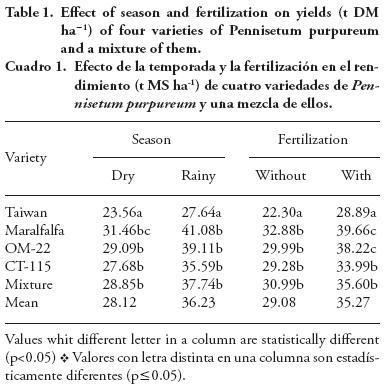
<body><![CDATA[<p align="justify"><font face="verdana" size="2">Climate of this zone is Awl climate (according to K&ouml;ppen classification) (Garc&iacute;a, 1981) with mean annual precipitation of 1200 mm, 75 % of which is concentrated between June and October. The annual mean temperature is 27 &deg;C, the warmest (maximum 39 &deg;C, minimum 21.5 &deg;C) and the coldest months (maximum 28.5 &deg;C, minimum 17.3 &deg;C) are May and December. Relative humidity varies between 68.5 % in April to 86.3 % in September. The predominant soil type in this zone is Litosol with a pH from 7 to 7.3, and with an average fertility between 1.5 and 1.9 % of organic carbon. Also, the depth of soil layer is slight with abundant rocks and lands of relatively low fertility.</font></p>  	    <p align="justify"><font face="verdana" size="2">The experimental design was completely randomized with a factorial arrangement of 5x2x2 (20 treatments) and four replications per treatment. Four varieties (first factor) of <i>P. purpureum</i> were evaluated: Taiwan, Maralfalfa, OM&#45;22, and CT&#45;115; the fifth option was a mixed scheme of the four grasses in alternate order and equal proportions. The second factor was the two seasons of the year (rain and dry). The third factor was fertilization with a dosage of 0 (control) and 200&#45;60&#45;00 (200 kg N ha<sup>&#45;1</sup> and 60 kg P ha<sup>&#45;1</sup>), divided into applications every 90 d.</font></p>  	    <p align="justify"><font face="verdana" size="2">The soil is a Cambisol (FAO) or Kancab (Mayan name) with a sandy/clay&#45;like texture, pH 6.5, and 3.5 % organic matter. The water for irrigation was salt free and as such was suitable for irrigation of grasses.</font></p>  	    <p align="justify"><font face="verdana" size="2">Sowing was done with vegetative material and 20 cm sticks with two knots in 10 cm deep furrows. In addition, the sowing arrangement was of 0.35 m between plants and 1 m between rows with an East&#45;West orientation, for better sunlight exposure. Each plot consisted of six rows of 4 m length resulting in a total of 20 m<sup>2</sup>, of which 12 m<sup>2</sup> were considered to be usable plots. The first fertilization was done on March (uniformity cut) and then, every 90 d using urea and 18&#45;46&#45;00 (18 kg N ha<sup>&#45;1</sup> and 60 kg P ha<sup>&#45;</sup> <sup>1</sup>) of diammonium phosphate. After each application of P and N, sprinkler irrigation was applied. As well as this, bimonthly weeding and extra water aspersion were carried out twice a week during the dry months. No evidences of pests or diseases were observed.</font></p>  	    <p align="justify"><font face="verdana" size="2">Cutting was total, removing almost all the foliar biomass (&gt;95 % of foliage), and this labor was performed twice in the dry season and twice in the rainy season, as recommended by Solorio and Solorio (2002). In each cut, the forage yield was quantified (t DM ha<sup>&#45;1</sup>), taking foliage samples of approximately 300 g. Later, the stalk and leaf were separated and dried at 60 &deg;C in a forced circulation evaporator, until a constant weight was achieved. Dry matter yield (t DM ha<sup>&#45;1</sup>), dry protein (DP) measured by Kjendall method, leaf/stem ratio, stalks per cluster and height of plant were the variables evaluated.</font></p>  	    <p align="justify"><font face="verdana" size="2">The dasometric measurements and the yield components at harvest were compared through an ANOVA for repeated measurements using the Statgraphics&copy; for Windows 5.1. When significant differences were noted, comparison of means Tukey's test was applied (p&le;0.05).</font></p>  	    <p>&nbsp;</p>  	    <p align="justify"><font face="verdana" size="2"><b>RESULTS AND DISCUSSION</b></font></p>  	    <p align="justify"><font face="verdana" size="2">A mean value of 36 t DM ha<sup>&#45;1</sup> corresponded to rainy season, it contrasted with the mean value of 28 t DM ha<sup>&#45;1</sup> for dry season, which was 29 % less than the first one. Also, biomass production was &#126;35 t DM ha<sup>&#45;1</sup> with application of fertilizer (200&#45;60&#45;00; 200 kg N ha<sup>&#45;1</sup> and 60 kg P ha<sup>&#45;1</sup>) (<a href="#t1">Table 1</a>). This data represents an improvement of 21 % in production per hectare, in comparison with the control without fertilizer (29 t DM ha<sup>&#45;1</sup>) (p&le;0.05).</font></p>  	    <p align="center"><font face="verdana" size="2"><a name="t1"></a></font></p>  	    ]]></body>
<body><![CDATA[<p align="center"><font face="verdana" size="2"><img src="/img/revistas/agro/v49n8/a2t1.jpg"></font></p>  	    <p align="justify"><font face="verdana" size="2">Results of this research represent a complement of those obtained by Ramos&#45;Trejo <i>et al.</i> (2013), they assessed the production of three varieties of <i>P. purpureum</i> with two different sources of N in Eastern Yucatan, Mexico, and they concluded that fertilization improved the yield of two of three varieties evaluated, but without knowing if the seasonal variation could influence the results.</font></p>  	    <p align="justify"><font face="verdana" size="2">Yield is important since in tropical crops, like <i>P. purpureum,</i> forage quality diminishes during the dry season, but it increases on the rainy season forage increases quality (Ansah <i>et al.,</i> 2010; Osorio and Rodr&iacute;guez, 2010).</font></p>  	    <p align="justify"><font face="verdana" size="2">Our results showed that N fertilizer increased DM of <i>P. purpureum</i> more than in others, studies. Thus, Cerdas and Vallejos (2010) found a lower average yield (13.5 t DM ha<sup>&#45;1</sup>) of <i>P. purpureum</i> var. Cameroon when applying between 300 kg and 450 kg of N ha<sup>&#45;1</sup> year<sup>&#45;1</sup> in the dry region of Costa Rica, whereas Far&iacute;a <i>et al.</i> (1997) reportaron a mean of 18 t DM ha<sup>&#45;1</sup> of <i>P. purpureum</i> cv. N&#45;75 Mott, fertilized with 300 kg N ha<sup>&#45;1</sup> year<sup>&#45;1</sup>, in a South American region. Ramos&#45;Trejo <i>et al.</i> (2013) presented a mean yield of 20.94 t DM ha<sup>&#45;1</sup> cut<sup>&#45;1</sup> when applying 300 kg of N (urea) ha<sup>&#45;1</sup> year<sup>&#45;1</sup> on OM&#45;22, CT&#45;115 and King Grass.</font></p>  	    <p align="justify"><font face="verdana" size="2">An explanation of the discrepancy between these and the present research could be related to different climatic conditions during the studies. Mat&iacute;as and Ritt (1988) argued that environmental temperature, as result of solar irradiance, plays an important role in the interaction of climate &#45; vegetation, as much as soil quality. Therefore, it will be necessary to evaluate the temperature and solar radiation (photosynthetic activity) effects and fertilizer amount on crops.</font></p>  	    <p align="justify"><font face="verdana" size="2">Espinosa <i>et al.</i> (2001) indicated another possible reason for the variability of results; they suggested that the differences in forage quality among varieties could be attributed to intrinsic factors. In fact, Wanjala <i>et al.</i> (2013) showed through genetic of population studies that cultivars of <i>Pennisetum</i> have a moderate genetic variability, existing information is scarce and cannot be relied upon for crop improvement. Nevertheless, under fertilization, Maralfalfa and OM&#45;22 (200&#45;60&#45;00) presented high yield (39 and 38 t DM ha<sup>&#45;1</sup>), compared with the other crops evaluated (28 to 33 t DM ha<sup>&#45;1</sup>) (p&le;0.05) (<a href="#t1">Table 1</a>). Ramos&#45;Trejo <i>et al.</i> (2013) indicated that OM&#45;22 and King Grass varieties reached the highest yield of forage when were evaluated in Eastern region of Yucat&aacute;n state.</font></p>  	    <p align="justify"><font face="verdana" size="2">For individual yield evaluation by season, Maralfalfa presented improved productive behavior (t DM ha<sup>&#45;1</sup>), in the dry season (31.46) and rainy (41.08), followed by OM&#45;22 (with 29 and 39, respectively), the Mixture (with 28 and 37, respectively), CT&#45;115 (with 27 and 35, respectively) and finally Taiwan (witj 23 and 27, respectively) (p&le;0.05) (<a href="#t1">Table 1</a>).</font></p>  	    <p align="justify"><font face="verdana" size="2">In the global assessment of interactions of factors, the best mean value of the forage production of all varieties corresponded to rainy season with nitrogen fertilization (39.34 t DM ha<sup>&#45;1</sup> cut<sup>&#45;1</sup>) (p&le;0.05) (<a href="/img/revistas/agro/v49n8/a2t2.jpg" target="_blank">Table 2</a>). This value also represented an increase of 25 % with respect to dry season (N fertilization, 31.48, t DM ha<sup>&#45;1</sup> cut<sup>&#45;</sup> <sup>1</sup>), and it is an evident increase in forage production due to season through all varieties. Likewise, in the evaluation of crops without fertilization in the rainy season, mean of yields was significantly higher (33.13 t DM ha<sup>&#45;1</sup> cut<sup>&#45;1</sup>), than the value of the dry season (25.12 t DM ha<sup>&#45;1</sup> cut<sup>&#45;1</sup>) (p&le;0.05) (<a href="/img/revistas/agro/v49n8/a2t2.jpg" target="_blank">Table 2</a>).</font></p>  	    <p align="justify"><font face="verdana" size="2">These results are congruent with the explanation of Bade <i>et al.</i> (1985); they stated that low soil humidity affects crop yield due to its effect on biochemical aspects of the plant's photosynthetic process (Sanderson <i>et al.,</i> 1997). Also, Deresz (2001) argued that in several regions approximately 70&#45;80 % of production of <i>P. purpureum</i> is concentrated in rainy season. These effects of season are attributed to scarce precipitations and temperatures of winter.</font></p>  	    <p align="justify"><font face="verdana" size="2">For the evaluation of individual interaction of the A x B x C factor, the two fertilized varieties with best response in the rainy season and application of fertilizers were Maralfafa with 44.93 t DM ha<sup>&#45;1</sup> cut<sup>&#45;1</sup> and the OM&#45;22 with 43.90 t DM ha<sup>&#45;1</sup> cut<sup>&#45;1</sup>.</font></p>  	    ]]></body>
<body><![CDATA[<p align="justify"><font face="verdana" size="2">The mean value (season x fertilizer) of the forage yield (t DM ha<sup>&#45;1</sup> cut<sup>&#45;1</sup>) was superior in the Maralfalfa variety (36.32) it was followed by OM&#45;22 (34.09), Mixture (33.63), CT&#45;115 (31.71), and Taiwan (25.61) (p&le;0.05) (<a href="/img/revistas/agro/v49n8/a2t2.jpg" target="_blank">Table 2</a>). The highest forage yield observed in this study for Maralfalfa was possibly due to the interaction of the nutritional elements applied to the crop (N and P) and the humidity conditions produced by the rainy season, without excluding genetic variation of cultivars.</font></p>  	    <p align="justify"><font face="verdana" size="2">As it was already said, the influence ofprecipitation is considered the most important climate factor in terms of growth and quality of grass. Thus, in our study, the soil analysis showed optimal evidence of N (data no shown). However, the pluvial measurements were not contemplated within the objectives of this study and for further studies we recommend keeping a record of the precipitation and soil humidity.</font></p>  	    <p align="justify"><font face="verdana" size="2">In terms of dasometry, results were variable for cultivars of the study: <i>i.e.</i> the OM&#45;22 variety presented a significantly higher leaf/stem ratio (p&le;0.05) in comparison with the other treatments (38 % in contrast to 33 %). The clone CT&#45;115 had an average of 37 stalks per cluster and was significantly better (p&le;0.05) than the other cultivars (mean of 31 stalks per cluster). Similar data for both dasometric values were found by Ramos&#45;Trejo <i>et al.</i> (2013) using OM&#45;22 and CT&#45;115 varieties, fertilized each one with two different N sources. The OM&#45;22 clone and Maralfalfa presented improved plant height (p&le;0.05) in comparison with the other treatments (233 or 214 cm).</font></p>  	    <p>&nbsp;</p>  	    <p align="justify"><font face="verdana" size="2"><b>CONCLUSIONS</b></font></p>  	    <p align="justify"><font face="verdana" size="2">In humid conditions of the eastern region of Yucat&aacute;n State, and with soil fertilized with N and P, mean values of DM of all treatments in rainy season were better than that one's of dry season. Similarly, DM in treatments with fertilizer was higher than the control without fertilizer. In assessment of interaction factors the highest mean value corresponded to treatment during raining season and fertilization and to Maralfalfa and OM&#45;22 for individual evaluation, among the other cultivars.</font></p>  	    <p>&nbsp;</p>  	    <p align="justify"><font face="verdana" size="2"><b>LITERATURE CITED</b></font></p>  	    <!-- ref --><p align="justify"><font face="verdana" size="2">Aguado&#45;Santacruz, G. A., Q. Rasc&oacute;n&#45;Cruz, J. L. Pons&#45;Hern&aacute;ndez, O. Grageda&#45;Cabrera, y E. Garc&iacute;a&#45;Moya. 2004. Manejo biotecnol&oacute;gico de gram&iacute;neas forrajeras. T&eacute;c. Pecu. M&eacute;x. 42: 261&#45;276.    &nbsp;&nbsp;&nbsp;&nbsp;&nbsp;&nbsp;&nbsp;&nbsp;[&#160;<a href="javascript:void(0);" onclick="javascript: window.open('/scielo.php?script=sci_nlinks&ref=604564&pid=S1405-3195201500080000200001&lng=','','width=640,height=500,resizable=yes,scrollbars=1,menubar=yes,');">Links</a>&#160;]<!-- end-ref --></font></p>  	    ]]></body>
<body><![CDATA[<!-- ref --><p align="justify"><font face="verdana" size="2">Anderson, W. F., B. S. Dien, S. K. Brandon, and J. D. Peterson. 2008. Assessment of Bermuda grass and bunch grasses as feed stocks for conversi&oacute;n to etanol. Appl. Biochem. Biotech. 145: 13&#45;21.    &nbsp;&nbsp;&nbsp;&nbsp;&nbsp;&nbsp;&nbsp;&nbsp;[&#160;<a href="javascript:void(0);" onclick="javascript: window.open('/scielo.php?script=sci_nlinks&ref=604566&pid=S1405-3195201500080000200002&lng=','','width=640,height=500,resizable=yes,scrollbars=1,menubar=yes,');">Links</a>&#160;]<!-- end-ref --></font></p>  	    <!-- ref --><p align="justify"><font face="verdana" size="2">Ansah, T., E. L. K. Osafo, and H. H. Hansen. 2010. Herbage yiel and chemical composition of four varieties of Napier <i>(Pennisetum purpureum)</i> grass harvested at three different days after planting. Agric. Biol. J. N. Am. 1: 923&#45;929.    &nbsp;&nbsp;&nbsp;&nbsp;&nbsp;&nbsp;&nbsp;&nbsp;[&#160;<a href="javascript:void(0);" onclick="javascript: window.open('/scielo.php?script=sci_nlinks&ref=604568&pid=S1405-3195201500080000200003&lng=','','width=640,height=500,resizable=yes,scrollbars=1,menubar=yes,');">Links</a>&#160;]<!-- end-ref --></font></p>  	    <!-- ref --><p align="justify"><font face="verdana" size="2">Araya, M., y C. Boschini. 2005. Producci&oacute;n de forraje y calidad nutricional de tres variedades de <i>Pennisetum purpureum</i> en la Meseta Central de Costa Rica. Agron. Mesoam. 16: 37&#45;43.    &nbsp;&nbsp;&nbsp;&nbsp;&nbsp;&nbsp;&nbsp;&nbsp;[&#160;<a href="javascript:void(0);" onclick="javascript: window.open('/scielo.php?script=sci_nlinks&ref=604570&pid=S1405-3195201500080000200004&lng=','','width=640,height=500,resizable=yes,scrollbars=1,menubar=yes,');">Links</a>&#160;]<!-- end-ref --></font></p>  	    <!-- ref --><p align="justify"><font face="verdana" size="2">Argel, P. J. 2006. Contribuci&oacute;n de los forrajes mejorados a la productividad ganadera en sistemas de doble prop&oacute;sito. Arch. Latinoam. Prod. Anim. 14: 65&#45;72.    &nbsp;&nbsp;&nbsp;&nbsp;&nbsp;&nbsp;&nbsp;&nbsp;[&#160;<a href="javascript:void(0);" onclick="javascript: window.open('/scielo.php?script=sci_nlinks&ref=604572&pid=S1405-3195201500080000200005&lng=','','width=640,height=500,resizable=yes,scrollbars=1,menubar=yes,');">Links</a>&#160;]<!-- end-ref --></font></p>  	    <!-- ref --><p align="justify"><font face="verdana" size="2">Bade, D. H., B. E. Conrad, and E. C. Holt. 1985. Temperature and water stress effects on growth of tropical grasses. J. Range Manage. 38: 321&#45;324.    &nbsp;&nbsp;&nbsp;&nbsp;&nbsp;&nbsp;&nbsp;&nbsp;[&#160;<a href="javascript:void(0);" onclick="javascript: window.open('/scielo.php?script=sci_nlinks&ref=604574&pid=S1405-3195201500080000200006&lng=','','width=640,height=500,resizable=yes,scrollbars=1,menubar=yes,');">Links</a>&#160;]<!-- end-ref --></font></p>  	    ]]></body>
<body><![CDATA[<!-- ref --><p align="justify"><font face="verdana" size="2">Cerdas, R., y E. Vallejos. 2010. Productividad del pasto Camer&uacute;n <i>(Pennisetum purpureum)</i> con varias dosis de nitr&oacute;geno y frecuencias de corte en la zona seca de Costa Rica. InterSedes 11: 180&#45;195.    &nbsp;&nbsp;&nbsp;&nbsp;&nbsp;&nbsp;&nbsp;&nbsp;[&#160;<a href="javascript:void(0);" onclick="javascript: window.open('/scielo.php?script=sci_nlinks&ref=604576&pid=S1405-3195201500080000200007&lng=','','width=640,height=500,resizable=yes,scrollbars=1,menubar=yes,');">Links</a>&#160;]<!-- end-ref --></font></p>  	    <!-- ref --><p align="justify"><font face="verdana" size="2">Chac&oacute;n&#45;Hern&aacute;ndez, P. A., y C. F. Vargas&#45;Rodr&iacute;guez. 2010. Consumo de <i>Pennisetum purpureum</i> CV. King Grass a tres edades de cosecha en caprinos. Agron. Mesoam. 21: 267&#45;274.    &nbsp;&nbsp;&nbsp;&nbsp;&nbsp;&nbsp;&nbsp;&nbsp;[&#160;<a href="javascript:void(0);" onclick="javascript: window.open('/scielo.php?script=sci_nlinks&ref=604578&pid=S1405-3195201500080000200008&lng=','','width=640,height=500,resizable=yes,scrollbars=1,menubar=yes,');">Links</a>&#160;]<!-- end-ref --></font></p>  	    <!-- ref --><p align="justify"><font face="verdana" size="2">Cino, D. M., y A. D&iacute;az. 2010. Leguminosas herb&aacute;ceas para la preceba bovina en pastoreo: indicadores econ&oacute;micos y financieros. Rev. Cuba. Cienc. Agric. 44: 9&#45;12.    &nbsp;&nbsp;&nbsp;&nbsp;&nbsp;&nbsp;&nbsp;&nbsp;[&#160;<a href="javascript:void(0);" onclick="javascript: window.open('/scielo.php?script=sci_nlinks&ref=604580&pid=S1405-3195201500080000200009&lng=','','width=640,height=500,resizable=yes,scrollbars=1,menubar=yes,');">Links</a>&#160;]<!-- end-ref --></font></p>  	    <!-- ref --><p align="justify"><font face="verdana" size="2">dos Santos, E. A., D. Soares da Silva, and J. Leite de Queiroz Filho. 2010. Aspectos produtivos do Capim Elefante (<i>Pennisetum purpureum,</i> Schumm.) cv. Roxo no Brejo Praibano. Rev. Bras. Zootec. 30:31&#45;36.    &nbsp;&nbsp;&nbsp;&nbsp;&nbsp;&nbsp;&nbsp;&nbsp;[&#160;<a href="javascript:void(0);" onclick="javascript: window.open('/scielo.php?script=sci_nlinks&ref=604582&pid=S1405-3195201500080000200010&lng=','','width=640,height=500,resizable=yes,scrollbars=1,menubar=yes,');">Links</a>&#160;]<!-- end-ref --></font></p>  	    <!-- ref --><p align="justify"><font face="verdana" size="2">Far&iacute;a J. R., B. Gonz&aacute;lez, y J. Far&iacute;a M&aacute;rmol. 1997. Efecto de la fertilizaci&oacute;n nitrogenada y fosfatada sobre el rendimiento total y distribuci&oacute;n en hoja, tallo y material muerto de la materia seca del pasto elefante enano (<i>Pennisetum purpureum</i> cv. Mott). Rev. Fac. Agron. LUZ 14: 417&#45;425.    &nbsp;&nbsp;&nbsp;&nbsp;&nbsp;&nbsp;&nbsp;&nbsp;[&#160;<a href="javascript:void(0);" onclick="javascript: window.open('/scielo.php?script=sci_nlinks&ref=604584&pid=S1405-3195201500080000200011&lng=','','width=640,height=500,resizable=yes,scrollbars=1,menubar=yes,');">Links</a>&#160;]<!-- end-ref --></font></p>  	    ]]></body>
<body><![CDATA[<!-- ref --><p align="justify"><font face="verdana" size="2">Espinosa, F., P. Argenti, J. L. Gil, L. Le&oacute;n, y E. Perdomo. 2001. Evaluaci&oacute;n del pasto King grass (<i>Pennisetum purpureum</i> cv. King grass) en asociaci&oacute;n con leguminosas forrajeras. Zootecnia Trop. 19: 59&#45;71.    &nbsp;&nbsp;&nbsp;&nbsp;&nbsp;&nbsp;&nbsp;&nbsp;[&#160;<a href="javascript:void(0);" onclick="javascript: window.open('/scielo.php?script=sci_nlinks&ref=604586&pid=S1405-3195201500080000200012&lng=','','width=640,height=500,resizable=yes,scrollbars=1,menubar=yes,');">Links</a>&#160;]<!-- end-ref --></font></p>  	    <!-- ref --><p align="justify"><font face="verdana" size="2">Febles, G., X. Su&aacute;rez, R. S. Herrera, y R. O. Mart&iacute;nez. 2007. Caracterizaci&oacute;n bot&aacute;nica de clones de King grass <i>(Pennisetum purpureum).</i> Empleo de descriptores morfol&oacute;gicos. Rev. Cuba. Cienc. Agric. 41: 385&#45;390.    &nbsp;&nbsp;&nbsp;&nbsp;&nbsp;&nbsp;&nbsp;&nbsp;[&#160;<a href="javascript:void(0);" onclick="javascript: window.open('/scielo.php?script=sci_nlinks&ref=604588&pid=S1405-3195201500080000200013&lng=','','width=640,height=500,resizable=yes,scrollbars=1,menubar=yes,');">Links</a>&#160;]<!-- end-ref --></font></p>  	    <!-- ref --><p align="justify"><font face="verdana" size="2">Garc&iacute;a E. 1981. Modificaciones al sistema de clasificaci&oacute;n clim&aacute;tica K&ouml;eppen para adaptarlo a las condiciones de la Rep&uacute;blica Mexicana. Offset Larios. M&eacute;xico, D.F. 246 p.    &nbsp;&nbsp;&nbsp;&nbsp;&nbsp;&nbsp;&nbsp;&nbsp;[&#160;<a href="javascript:void(0);" onclick="javascript: window.open('/scielo.php?script=sci_nlinks&ref=604590&pid=S1405-3195201500080000200014&lng=','','width=640,height=500,resizable=yes,scrollbars=1,menubar=yes,');">Links</a>&#160;]<!-- end-ref --></font></p>  	    <!-- ref --><p align="justify"><font face="verdana" size="2">Lamela, L., E. Castillo, J. Iglesias, y A. P&eacute;rez. 2005. Principales avances de la introducci&oacute;n de los sistemas silvopastoriles en las condiciones de producci&oacute;n en Cuba. Pastos y Forrajes 28: 47&#45;58.    &nbsp;&nbsp;&nbsp;&nbsp;&nbsp;&nbsp;&nbsp;&nbsp;[&#160;<a href="javascript:void(0);" onclick="javascript: window.open('/scielo.php?script=sci_nlinks&ref=604592&pid=S1405-3195201500080000200015&lng=','','width=640,height=500,resizable=yes,scrollbars=1,menubar=yes,');">Links</a>&#160;]<!-- end-ref --></font></p>  	    <!-- ref --><p align="justify"><font face="verdana" size="2">Lounglawan, P., W. Lounglawan, and W. Suksombat. 2014. Effect of cutting interval and cutting height on yield and chemical composition of King Napier grass <i>(Pennisetum purpureum x Pennisetun americanum).</i> APCBEE Procedia 8: 27&#45;31.    &nbsp;&nbsp;&nbsp;&nbsp;&nbsp;&nbsp;&nbsp;&nbsp;[&#160;<a href="javascript:void(0);" onclick="javascript: window.open('/scielo.php?script=sci_nlinks&ref=604594&pid=S1405-3195201500080000200016&lng=','','width=640,height=500,resizable=yes,scrollbars=1,menubar=yes,');">Links</a>&#160;]<!-- end-ref --></font></p>  	    ]]></body>
<body><![CDATA[<!-- ref --><p align="justify"><font face="verdana" size="2">M&aacute;rquez F., J. S&aacute;nchez, D. Urbano, y C. D&aacute;vila. 2007. Evaluaci&oacute;n de la frecuencia de corte y tipos de fertilizaci&oacute;n sobre tres genotipos de pasto elefante <i>(Pennisetum purpureum).</i> 1. Rendimiento y contenido de prote&iacute;na. Zootecnia Trop. 25: 253&#45;259.    &nbsp;&nbsp;&nbsp;&nbsp;&nbsp;&nbsp;&nbsp;&nbsp;[&#160;<a href="javascript:void(0);" onclick="javascript: window.open('/scielo.php?script=sci_nlinks&ref=604596&pid=S1405-3195201500080000200017&lng=','','width=640,height=500,resizable=yes,scrollbars=1,menubar=yes,');">Links</a>&#160;]<!-- end-ref --></font></p>  	    <!-- ref --><p align="justify"><font face="verdana" size="2">Mat&iacute;as, C., y S. Ritt. 1988. Influencia de dos zonas edafoclim&aacute;ticas diferentes en el potencial de producci&oacute;n de semilla de cinco cultivares de guinea (<i>Panicum maxicum</i> Jacq.). Pastos y Forrajes 11: 143&#45;150.    &nbsp;&nbsp;&nbsp;&nbsp;&nbsp;&nbsp;&nbsp;&nbsp;[&#160;<a href="javascript:void(0);" onclick="javascript: window.open('/scielo.php?script=sci_nlinks&ref=604598&pid=S1405-3195201500080000200018&lng=','','width=640,height=500,resizable=yes,scrollbars=1,menubar=yes,');">Links</a>&#160;]<!-- end-ref --></font></p>  	    <!-- ref --><p align="justify"><font face="verdana" size="2">Montenegro, J., y S. Abarca. 2002. Los sistemas silvopastoriles y el calentamiento global: un balance de emisiones. Agron. Costarricense 26: 17&#45;24.    &nbsp;&nbsp;&nbsp;&nbsp;&nbsp;&nbsp;&nbsp;&nbsp;[&#160;<a href="javascript:void(0);" onclick="javascript: window.open('/scielo.php?script=sci_nlinks&ref=604600&pid=S1405-3195201500080000200019&lng=','','width=640,height=500,resizable=yes,scrollbars=1,menubar=yes,');">Links</a>&#160;]<!-- end-ref --></font></p>  	    <!-- ref --><p align="justify"><font face="verdana" size="2">Osorio, W. A., y J. C. Rodr&iacute;guez. 2010. Efecto de fertilizaci&oacute;n y frecuencia de corte en la digestibilidad y contenido de fibra de <i>Pennisetum purpureum.</i> Tierra Trop. 6: 55&#45;61.    &nbsp;&nbsp;&nbsp;&nbsp;&nbsp;&nbsp;&nbsp;&nbsp;[&#160;<a href="javascript:void(0);" onclick="javascript: window.open('/scielo.php?script=sci_nlinks&ref=604602&pid=S1405-3195201500080000200020&lng=','','width=640,height=500,resizable=yes,scrollbars=1,menubar=yes,');">Links</a>&#160;]<!-- end-ref --></font></p>  	    <!-- ref --><p align="justify"><font face="verdana" size="2">Ramos&#45;Trejo, O. S., J. Canul&#45;Sol&iacute;s, y F. Duarte&#45;Vera. 2013. Producci&oacute;n de tres variedades de <i>Pennisetum purpureum</i> fertilizadas con dos diferentes fuentes nitrogenadas en Yucat&aacute;n, M&eacute;xico. Biociencias 2: 60&#45;68.    &nbsp;&nbsp;&nbsp;&nbsp;&nbsp;&nbsp;&nbsp;&nbsp;[&#160;<a href="javascript:void(0);" onclick="javascript: window.open('/scielo.php?script=sci_nlinks&ref=604604&pid=S1405-3195201500080000200021&lng=','','width=640,height=500,resizable=yes,scrollbars=1,menubar=yes,');">Links</a>&#160;]<!-- end-ref --></font></p>  	    ]]></body>
<body><![CDATA[<!-- ref --><p align="justify"><font face="verdana" size="2">S&aacute;nchez, T., E. R. &Oslash;rskov, L. Lamela, R. Pedraza, y O. L&oacute;pez. 2008. Valor nutritivo de los componentes forrajeros de una asociaci&oacute;n de gram&iacute;neas mejoradas y <i>Leucaena leucocephala.</i> Pastos y Forrajes 31: 271&#45;281.    &nbsp;&nbsp;&nbsp;&nbsp;&nbsp;&nbsp;&nbsp;&nbsp;[&#160;<a href="javascript:void(0);" onclick="javascript: window.open('/scielo.php?script=sci_nlinks&ref=604606&pid=S1405-3195201500080000200022&lng=','','width=640,height=500,resizable=yes,scrollbars=1,menubar=yes,');">Links</a>&#160;]<!-- end-ref --></font></p>  	    <!-- ref --><p align="justify"><font face="verdana" size="2">Sanderson, M. A., D. W. Stair, and M. A. Hussey. 1997. Physiological and morphological responses of perennial forages to stress. Adv. Agron. 59: 171&#45;224.    &nbsp;&nbsp;&nbsp;&nbsp;&nbsp;&nbsp;&nbsp;&nbsp;[&#160;<a href="javascript:void(0);" onclick="javascript: window.open('/scielo.php?script=sci_nlinks&ref=604608&pid=S1405-3195201500080000200023&lng=','','width=640,height=500,resizable=yes,scrollbars=1,menubar=yes,');">Links</a>&#160;]<!-- end-ref --></font></p>  	    <!-- ref --><p align="justify"><font face="verdana" size="2">Solorio, F. J., and S. B. Solorio.2002. Integrating fodder trees in to animal production system in the tropics. Trop. Subtrop. Agroecosyst. 1: 1&#45;11.    &nbsp;&nbsp;&nbsp;&nbsp;&nbsp;&nbsp;&nbsp;&nbsp;[&#160;<a href="javascript:void(0);" onclick="javascript: window.open('/scielo.php?script=sci_nlinks&ref=604610&pid=S1405-3195201500080000200024&lng=','','width=640,height=500,resizable=yes,scrollbars=1,menubar=yes,');">Links</a>&#160;]<!-- end-ref --></font></p>      ]]></body><back>
<ref-list>
<ref id="B1">
<nlm-citation citation-type="journal">
<person-group person-group-type="author">
<name>
<surname><![CDATA[Aguado-Santacruz]]></surname>
<given-names><![CDATA[G. A.]]></given-names>
</name>
<name>
<surname><![CDATA[Rascón-Cruz]]></surname>
<given-names><![CDATA[Q.]]></given-names>
</name>
<name>
<surname><![CDATA[Pons-Hernández]]></surname>
<given-names><![CDATA[J. L.]]></given-names>
</name>
<name>
<surname><![CDATA[Grageda-Cabrera]]></surname>
<given-names><![CDATA[O.]]></given-names>
</name>
<name>
<surname><![CDATA[García-Moya]]></surname>
<given-names><![CDATA[E.]]></given-names>
</name>
</person-group>
<article-title xml:lang="es"><![CDATA[Manejo biotecnológico de gramíneas forrajeras]]></article-title>
<source><![CDATA[Téc. Pecu. Méx.]]></source>
<year>2004</year>
<volume>42</volume>
<page-range>261-276</page-range></nlm-citation>
</ref>
<ref id="B2">
<nlm-citation citation-type="journal">
<person-group person-group-type="author">
<name>
<surname><![CDATA[Anderson]]></surname>
<given-names><![CDATA[W. F.]]></given-names>
</name>
<name>
<surname><![CDATA[Dien]]></surname>
<given-names><![CDATA[B. S.]]></given-names>
</name>
<name>
<surname><![CDATA[Brandon]]></surname>
<given-names><![CDATA[S. K.]]></given-names>
</name>
<name>
<surname><![CDATA[Peterson]]></surname>
<given-names><![CDATA[J. D.]]></given-names>
</name>
</person-group>
<article-title xml:lang="en"><![CDATA[Assessment of Bermuda grass and bunch grasses as feed stocks for conversión to etanol]]></article-title>
<source><![CDATA[Appl. Biochem. Biotech.]]></source>
<year>2008</year>
<volume>145</volume>
<page-range>13-21</page-range></nlm-citation>
</ref>
<ref id="B3">
<nlm-citation citation-type="journal">
<person-group person-group-type="author">
<name>
<surname><![CDATA[Ansah]]></surname>
<given-names><![CDATA[T.]]></given-names>
</name>
<name>
<surname><![CDATA[Osafo]]></surname>
<given-names><![CDATA[E. L. K.]]></given-names>
</name>
<name>
<surname><![CDATA[Hansen]]></surname>
<given-names><![CDATA[H. H.]]></given-names>
</name>
</person-group>
<article-title xml:lang="en"><![CDATA[Herbage yiel and chemical composition of four varieties of Napier (Pennisetum purpureum) grass harvested at three different days after planting]]></article-title>
<source><![CDATA[Agric. Biol. J. N. Am.]]></source>
<year>2010</year>
<volume>1</volume>
<page-range>923-929</page-range></nlm-citation>
</ref>
<ref id="B4">
<nlm-citation citation-type="journal">
<person-group person-group-type="author">
<name>
<surname><![CDATA[Araya]]></surname>
<given-names><![CDATA[M.]]></given-names>
</name>
<name>
<surname><![CDATA[Boschini]]></surname>
<given-names><![CDATA[C.]]></given-names>
</name>
</person-group>
<article-title xml:lang="es"><![CDATA[Producción de forraje y calidad nutricional de tres variedades de Pennisetum purpureum en la Meseta Central de Costa Rica]]></article-title>
<source><![CDATA[Agron. Mesoam.]]></source>
<year>2005</year>
<volume>16</volume>
<page-range>37-43</page-range></nlm-citation>
</ref>
<ref id="B5">
<nlm-citation citation-type="journal">
<person-group person-group-type="author">
<name>
<surname><![CDATA[Argel]]></surname>
<given-names><![CDATA[P. J]]></given-names>
</name>
</person-group>
<article-title xml:lang="en"><![CDATA[Contribución de los forrajes mejorados a la productividad ganadera en sistemas de doble propósito]]></article-title>
<source><![CDATA[Arch. Latinoam. Prod. Anim.]]></source>
<year>2006</year>
<volume>14</volume>
<page-range>65-72</page-range></nlm-citation>
</ref>
<ref id="B6">
<nlm-citation citation-type="journal">
<person-group person-group-type="author">
<name>
<surname><![CDATA[Bade]]></surname>
<given-names><![CDATA[D. H.]]></given-names>
</name>
<name>
<surname><![CDATA[Conrad]]></surname>
<given-names><![CDATA[B. E.]]></given-names>
</name>
<name>
<surname><![CDATA[Holt]]></surname>
<given-names><![CDATA[E. C.]]></given-names>
</name>
</person-group>
<article-title xml:lang="en"><![CDATA[Temperature and water stress effects on growth of tropical grasses]]></article-title>
<source><![CDATA[J. Range Manage.]]></source>
<year>1985</year>
<volume>38</volume>
<page-range>321-324</page-range></nlm-citation>
</ref>
<ref id="B7">
<nlm-citation citation-type="journal">
<person-group person-group-type="author">
<name>
<surname><![CDATA[Cerdas]]></surname>
<given-names><![CDATA[R.]]></given-names>
</name>
<name>
<surname><![CDATA[Vallejos]]></surname>
<given-names><![CDATA[E.]]></given-names>
</name>
</person-group>
<article-title xml:lang="es"><![CDATA[Productividad del pasto Camerún (Pennisetum purpureum) con varias dosis de nitrógeno y frecuencias de corte en la zona seca de Costa Rica]]></article-title>
<source><![CDATA[InterSedes]]></source>
<year>2010</year>
<volume>11</volume>
<page-range>180-195</page-range></nlm-citation>
</ref>
<ref id="B8">
<nlm-citation citation-type="journal">
<person-group person-group-type="author">
<name>
<surname><![CDATA[Chacón-Hernández]]></surname>
<given-names><![CDATA[P. A.]]></given-names>
</name>
<name>
<surname><![CDATA[Vargas-Rodríguez]]></surname>
<given-names><![CDATA[C. F.]]></given-names>
</name>
</person-group>
<article-title xml:lang="es"><![CDATA[Consumo de Pennisetum purpureum CV. King Grass a tres edades de cosecha en caprinos]]></article-title>
<source><![CDATA[Agron. Mesoam.]]></source>
<year>2010</year>
<volume>21</volume>
<page-range>267-274</page-range></nlm-citation>
</ref>
<ref id="B9">
<nlm-citation citation-type="journal">
<person-group person-group-type="author">
<name>
<surname><![CDATA[Cino]]></surname>
<given-names><![CDATA[D. M.]]></given-names>
</name>
<name>
<surname><![CDATA[Díaz]]></surname>
<given-names><![CDATA[A.]]></given-names>
</name>
</person-group>
<article-title xml:lang="en"><![CDATA[Leguminosas herbáceas para la preceba bovina en pastoreo: indicadores económicos y financieros]]></article-title>
<source><![CDATA[Rev. Cuba. Cienc. Agric.]]></source>
<year>2010</year>
<volume>44</volume>
<page-range>9-12</page-range></nlm-citation>
</ref>
<ref id="B10">
<nlm-citation citation-type="journal">
<person-group person-group-type="author">
<name>
<surname><![CDATA[dos Santos]]></surname>
<given-names><![CDATA[E. A.]]></given-names>
</name>
<name>
<surname><![CDATA[Soares da Silva]]></surname>
<given-names><![CDATA[D.]]></given-names>
</name>
<name>
<surname><![CDATA[Leite de Queiroz Filho]]></surname>
<given-names><![CDATA[J.]]></given-names>
</name>
</person-group>
<article-title xml:lang="pt"><![CDATA[Aspectos produtivos do Capim Elefante (Pennisetum purpureum, Schumm.) cv. Roxo no Brejo Praibano]]></article-title>
<source><![CDATA[Rev. Bras. Zootec.]]></source>
<year>2010</year>
<volume>30</volume>
<page-range>31-36</page-range></nlm-citation>
</ref>
<ref id="B11">
<nlm-citation citation-type="journal">
<person-group person-group-type="author">
<name>
<surname><![CDATA[Faría]]></surname>
<given-names><![CDATA[J. R.]]></given-names>
</name>
<name>
<surname><![CDATA[González]]></surname>
<given-names><![CDATA[B.]]></given-names>
</name>
<name>
<surname><![CDATA[Faría Mármol]]></surname>
<given-names><![CDATA[J.]]></given-names>
</name>
</person-group>
<article-title xml:lang="es"><![CDATA[Efecto de la fertilización nitrogenada y fosfatada sobre el rendimiento total y distribución en hoja, tallo y material muerto de la materia seca del pasto elefante enano (Pennisetum purpureum cv. Mott)]]></article-title>
<source><![CDATA[Rev. Fac. Agron. LUZ]]></source>
<year>1997</year>
<volume>14</volume>
<page-range>417-425</page-range></nlm-citation>
</ref>
<ref id="B12">
<nlm-citation citation-type="journal">
<person-group person-group-type="author">
<name>
<surname><![CDATA[Espinosa]]></surname>
<given-names><![CDATA[F.]]></given-names>
</name>
<name>
<surname><![CDATA[Argenti]]></surname>
<given-names><![CDATA[P.]]></given-names>
</name>
<name>
<surname><![CDATA[Gil]]></surname>
<given-names><![CDATA[J. L.]]></given-names>
</name>
<name>
<surname><![CDATA[León]]></surname>
<given-names><![CDATA[L.]]></given-names>
</name>
<name>
<surname><![CDATA[Perdomo]]></surname>
<given-names><![CDATA[E.]]></given-names>
</name>
</person-group>
<article-title xml:lang="en"><![CDATA[Evaluación del pasto King grass (Pennisetum purpureum cv. King grass) en asociación con leguminosas forrajeras]]></article-title>
<source><![CDATA[Zootecnia Trop.]]></source>
<year>2001</year>
<volume>19</volume>
<page-range>59-71</page-range></nlm-citation>
</ref>
<ref id="B13">
<nlm-citation citation-type="journal">
<person-group person-group-type="author">
<name>
<surname><![CDATA[Febles]]></surname>
<given-names><![CDATA[G.]]></given-names>
</name>
<name>
<surname><![CDATA[Suárez]]></surname>
<given-names><![CDATA[X.]]></given-names>
</name>
<name>
<surname><![CDATA[Herrera]]></surname>
<given-names><![CDATA[R. S.]]></given-names>
</name>
<name>
<surname><![CDATA[Martínez]]></surname>
<given-names><![CDATA[R. O.]]></given-names>
</name>
</person-group>
<article-title xml:lang="es"><![CDATA[Caracterización botánica de clones de King grass (Pennisetum purpureum). Empleo de descriptores morfológicos.]]></article-title>
<source><![CDATA[Rev. Cuba. Cienc. Agric.]]></source>
<year>2007</year>
<volume>41</volume>
<page-range>385-390</page-range></nlm-citation>
</ref>
<ref id="B14">
<nlm-citation citation-type="book">
<person-group person-group-type="author">
<name>
<surname><![CDATA[García]]></surname>
<given-names><![CDATA[E]]></given-names>
</name>
</person-group>
<source><![CDATA[Modificaciones al sistema de clasificación climática Köeppen para adaptarlo a las condiciones de la República Mexicana]]></source>
<year>1981</year>
<page-range>246</page-range><publisher-loc><![CDATA[México^eD.F. D.F.]]></publisher-loc>
<publisher-name><![CDATA[Offset Larios]]></publisher-name>
</nlm-citation>
</ref>
<ref id="B15">
<nlm-citation citation-type="journal">
<person-group person-group-type="author">
<name>
<surname><![CDATA[Lamela]]></surname>
<given-names><![CDATA[L.]]></given-names>
</name>
<name>
<surname><![CDATA[Castillo]]></surname>
<given-names><![CDATA[E.]]></given-names>
</name>
<name>
<surname><![CDATA[Iglesias]]></surname>
<given-names><![CDATA[J.]]></given-names>
</name>
<name>
<surname><![CDATA[Pérez]]></surname>
<given-names><![CDATA[A.]]></given-names>
</name>
</person-group>
<article-title xml:lang="es"><![CDATA[Principales avances de la introducción de los sistemas silvopastoriles en las condiciones de producción en Cuba]]></article-title>
<source><![CDATA[Pastos y Forrajes]]></source>
<year>2005</year>
<volume>28</volume>
<page-range>47-58</page-range></nlm-citation>
</ref>
<ref id="B16">
<nlm-citation citation-type="journal">
<person-group person-group-type="author">
<name>
<surname><![CDATA[Lounglawan]]></surname>
<given-names><![CDATA[P.]]></given-names>
</name>
<name>
<surname><![CDATA[Lounglawan]]></surname>
<given-names><![CDATA[W.]]></given-names>
</name>
<name>
<surname><![CDATA[Suksombat]]></surname>
<given-names><![CDATA[W.]]></given-names>
</name>
</person-group>
<article-title xml:lang="en"><![CDATA[Effect of cutting interval and cutting height on yield and chemical composition of King Napier grass (Pennisetum purpureum x Pennisetun americanum)]]></article-title>
<source><![CDATA[APCBEE Procedia]]></source>
<year>2014</year>
<volume>8</volume>
<page-range>27-31</page-range></nlm-citation>
</ref>
<ref id="B17">
<nlm-citation citation-type="journal">
<person-group person-group-type="author">
<name>
<surname><![CDATA[Márquez]]></surname>
<given-names><![CDATA[F.]]></given-names>
</name>
<name>
<surname><![CDATA[Sánchez]]></surname>
<given-names><![CDATA[J.]]></given-names>
</name>
<name>
<surname><![CDATA[Urbano]]></surname>
<given-names><![CDATA[D.]]></given-names>
</name>
<name>
<surname><![CDATA[Dávila]]></surname>
<given-names><![CDATA[C.]]></given-names>
</name>
</person-group>
<article-title xml:lang="es"><![CDATA[Evaluación de la frecuencia de corte y tipos de fertilización sobre tres genotipos de pasto elefante (Pennisetum purpureum). 1. Rendimiento y contenido de proteína.]]></article-title>
<source><![CDATA[Zootecnia Trop.]]></source>
<year>2007</year>
<volume>25</volume>
<page-range>253-259</page-range></nlm-citation>
</ref>
<ref id="B18">
<nlm-citation citation-type="journal">
<person-group person-group-type="author">
<name>
<surname><![CDATA[Matías]]></surname>
<given-names><![CDATA[C.]]></given-names>
</name>
<name>
<surname><![CDATA[Ritt]]></surname>
<given-names><![CDATA[S.]]></given-names>
</name>
</person-group>
<article-title xml:lang="es"><![CDATA[Influencia de dos zonas edafoclimáticas diferentes en el potencial de producción de semilla de cinco cultivares de guinea (Panicum maxicum Jacq.)]]></article-title>
<source><![CDATA[Pastos y Forrajes]]></source>
<year>1988</year>
<volume>11</volume>
<page-range>143-150</page-range></nlm-citation>
</ref>
<ref id="B19">
<nlm-citation citation-type="journal">
<person-group person-group-type="author">
<name>
<surname><![CDATA[Montenegro]]></surname>
<given-names><![CDATA[J.]]></given-names>
</name>
<name>
<surname><![CDATA[Abarca]]></surname>
<given-names><![CDATA[S.]]></given-names>
</name>
</person-group>
<article-title xml:lang="es"><![CDATA[Los sistemas silvopastoriles y el calentamiento global: un balance de emisiones]]></article-title>
<source><![CDATA[Agron. Costarricense]]></source>
<year>2002</year>
<volume>26</volume>
<page-range>17-24</page-range></nlm-citation>
</ref>
<ref id="B20">
<nlm-citation citation-type="journal">
<person-group person-group-type="author">
<name>
<surname><![CDATA[Osorio]]></surname>
<given-names><![CDATA[W. A.]]></given-names>
</name>
<name>
<surname><![CDATA[Rodríguez]]></surname>
<given-names><![CDATA[J. C.]]></given-names>
</name>
</person-group>
<article-title xml:lang="es"><![CDATA[Efecto de fertilización y frecuencia de corte en la digestibilidad y contenido de fibra de Pennisetum purpureum]]></article-title>
<source><![CDATA[Tierra Trop.]]></source>
<year>2010</year>
<volume>6</volume>
<page-range>55-61</page-range></nlm-citation>
</ref>
<ref id="B21">
<nlm-citation citation-type="journal">
<person-group person-group-type="author">
<name>
<surname><![CDATA[Ramos-Trejo]]></surname>
<given-names><![CDATA[O. S.]]></given-names>
</name>
<name>
<surname><![CDATA[Canul-Solís]]></surname>
<given-names><![CDATA[J.]]></given-names>
</name>
<name>
<surname><![CDATA[Duarte-Vera]]></surname>
<given-names><![CDATA[F.]]></given-names>
</name>
</person-group>
<article-title xml:lang="es"><![CDATA[Producción de tres variedades de Pennisetum purpureum fertilizadas con dos diferentes fuentes nitrogenadas en Yucatán, México]]></article-title>
<source><![CDATA[Biociencias]]></source>
<year>2013</year>
<volume>2</volume>
<page-range>60-68</page-range></nlm-citation>
</ref>
<ref id="B22">
<nlm-citation citation-type="journal">
<person-group person-group-type="author">
<name>
<surname><![CDATA[Sánchez]]></surname>
<given-names><![CDATA[T.]]></given-names>
</name>
<name>
<surname><![CDATA[Ørskov]]></surname>
<given-names><![CDATA[E. R.]]></given-names>
</name>
<name>
<surname><![CDATA[Lamela]]></surname>
<given-names><![CDATA[L.]]></given-names>
</name>
<name>
<surname><![CDATA[Pedraza]]></surname>
<given-names><![CDATA[R.]]></given-names>
</name>
<name>
<surname><![CDATA[López]]></surname>
<given-names><![CDATA[O.]]></given-names>
</name>
</person-group>
<article-title xml:lang="es"><![CDATA[Valor nutritivo de los componentes forrajeros de una asociación de gramíneas mejoradas y Leucaena leucocephala]]></article-title>
<source><![CDATA[Pastos y Forrajes]]></source>
<year>2008</year>
<volume>31</volume>
<page-range>271-281</page-range></nlm-citation>
</ref>
<ref id="B23">
<nlm-citation citation-type="journal">
<person-group person-group-type="author">
<name>
<surname><![CDATA[Sanderson]]></surname>
<given-names><![CDATA[M. A.]]></given-names>
</name>
<name>
<surname><![CDATA[Stair]]></surname>
<given-names><![CDATA[D. W.]]></given-names>
</name>
<name>
<surname><![CDATA[Hussey]]></surname>
<given-names><![CDATA[M. A.]]></given-names>
</name>
</person-group>
<article-title xml:lang="en"><![CDATA[Physiological and morphological responses of perennial forages to stress]]></article-title>
<source><![CDATA[Adv. Agron.]]></source>
<year>1997</year>
<volume>59</volume>
<page-range>171-224</page-range></nlm-citation>
</ref>
<ref id="B24">
<nlm-citation citation-type="journal">
<person-group person-group-type="author">
<name>
<surname><![CDATA[Solorio]]></surname>
<given-names><![CDATA[F. J.]]></given-names>
</name>
<name>
<surname><![CDATA[Solorio]]></surname>
<given-names><![CDATA[S. B.]]></given-names>
</name>
</person-group>
<article-title xml:lang="en"><![CDATA[Integrating fodder trees in to animal production system in the tropics]]></article-title>
<source><![CDATA[Trop. Subtrop. Agroecosyst.]]></source>
<year>2002</year>
<volume>1</volume>
<page-range>1-11</page-range></nlm-citation>
</ref>
</ref-list>
</back>
</article>