<?xml version="1.0" encoding="ISO-8859-1"?><article xmlns:mml="http://www.w3.org/1998/Math/MathML" xmlns:xlink="http://www.w3.org/1999/xlink" xmlns:xsi="http://www.w3.org/2001/XMLSchema-instance">
<front>
<journal-meta>
<journal-id>1405-3195</journal-id>
<journal-title><![CDATA[Agrociencia]]></journal-title>
<abbrev-journal-title><![CDATA[Agrociencia]]></abbrev-journal-title>
<issn>1405-3195</issn>
<publisher>
<publisher-name><![CDATA[Colegio de Postgraduados]]></publisher-name>
</publisher>
</journal-meta>
<article-meta>
<article-id>S1405-31952012000800006</article-id>
<title-group>
<article-title xml:lang="en"><![CDATA[Seedlings of cashew trees of the brazilian cerrado inoculated with arbuscular mycorrhizal fungi and phosphate-solubilizing microorganisms]]></article-title>
<article-title xml:lang="es"><![CDATA[Plántulas de anacardo del cerrado brasileño inoculadas con hongos micorrízicos arbusculares y microorganismos solubilizadores de fosfato]]></article-title>
</title-group>
<contrib-group>
<contrib contrib-type="author">
<name>
<surname><![CDATA[Cabral]]></surname>
<given-names><![CDATA[J. Silva Rodrigues]]></given-names>
</name>
<xref ref-type="aff" rid="A01"/>
</contrib>
<contrib contrib-type="author">
<name>
<surname><![CDATA[Assis]]></surname>
<given-names><![CDATA[Kerlley Cristina-de]]></given-names>
</name>
<xref ref-type="aff" rid="A02"/>
</contrib>
<contrib contrib-type="author">
<name>
<surname><![CDATA[Silva]]></surname>
<given-names><![CDATA[Fabiano Guimarães]]></given-names>
</name>
<xref ref-type="aff" rid="A01"/>
</contrib>
<contrib contrib-type="author">
<name>
<surname><![CDATA[Souchie]]></surname>
<given-names><![CDATA[Edson Luiz]]></given-names>
</name>
<xref ref-type="aff" rid="A01"/>
</contrib>
<contrib contrib-type="author">
<name>
<surname><![CDATA[Carneiro]]></surname>
<given-names><![CDATA[M. Aurélio Carbone]]></given-names>
</name>
<xref ref-type="aff" rid="A03"/>
</contrib>
</contrib-group>
<aff id="A01">
<institution><![CDATA[,Instituto Federal Goiano  ]]></institution>
<addr-line><![CDATA[Rio Verde Goiás]]></addr-line>
<country>Brasil</country>
</aff>
<aff id="A02">
<institution><![CDATA[,Embrapa Clima Temperado Rodovia  ]]></institution>
<addr-line><![CDATA[Pelotas Rio Grande do Sul]]></addr-line>
<country>Brasil</country>
</aff>
<aff id="A03">
<institution><![CDATA[,Universidade Federal de Lavras Departamento de Ciência do Solo ]]></institution>
<addr-line><![CDATA[Lavras Minas Gerais]]></addr-line>
<country>Brasil</country>
</aff>
<pub-date pub-type="pub">
<day>00</day>
<month>12</month>
<year>2012</year>
</pub-date>
<pub-date pub-type="epub">
<day>00</day>
<month>12</month>
<year>2012</year>
</pub-date>
<volume>46</volume>
<numero>8</numero>
<fpage>809</fpage>
<lpage>821</lpage>
<copyright-statement/>
<copyright-year/>
<self-uri xlink:href="http://www.scielo.org.mx/scielo.php?script=sci_arttext&amp;pid=S1405-31952012000800006&amp;lng=en&amp;nrm=iso"></self-uri><self-uri xlink:href="http://www.scielo.org.mx/scielo.php?script=sci_abstract&amp;pid=S1405-31952012000800006&amp;lng=en&amp;nrm=iso"></self-uri><self-uri xlink:href="http://www.scielo.org.mx/scielo.php?script=sci_pdf&amp;pid=S1405-31952012000800006&amp;lng=en&amp;nrm=iso"></self-uri><abstract abstract-type="short" xml:lang="en"><p><![CDATA[Soil mictobiota catties out important functions in ecosystems, since it influences growth, mineral nutrition and plant health. Phosphorus (P) is the most limiting nutrient in tropical soils and P-solubilizing microorganisms (PSMs) and the arbuscular mycorrhizal fungi (AMF) are the most important groups of the soil microbial community. The aim of this study was to evaluate the effect of inoculating PSMs and AMF on the development of cashew trees (Anacardium othonianum Rizzini) from the Brazilian Cerrado growing on different substrates. An experiment was carried out in a greenhouse and the experimental design was completely randomized with a factorial 4 × 2 arrangement of treatments: PSMs, AMF, PSMs + AMF and the control. In addition, two substrates were used: a pure one with a sandy loam texture and a mixture of clay loam and clayish textures. Twelve replicates were performed. Data were subjected to an analysis of variance, and means were compared with the Tukey test (p<0.05). The co-inoculation with PSMs and AMF resulted in greater height and shoot dry matter of seedlings compared to isolated inoculations with these organisms. Seedlings increased height and shoot fresh and dry matter when grown in a mixture of substrates (soil with clay loam and clay textures). The use of a mixture of substrates also resulted in a greater symbiotic efficiency of Glomus etunicatum.]]></p></abstract>
<abstract abstract-type="short" xml:lang="es"><p><![CDATA[La microbiota del suelo desarrolla importantes funciones en los ecosistemas, ya que influye en el crecimiento, la nutrición mineral y la salud de las plantas. El fósforo (P) es el nutrimento más limitante en los suelos tropicales, y los microorganismos solubilizadores de P (MSP) y los hongos micorrízicos arbusculares (HMA) son los grupos más importantes de la comunidad microbiana del suelo. El objetivo de este estudio fue evaluar el efecto de la inoculación de MSP y HMA en el desarrollo de árboles de anacardo (Anacardium othonianum Rizzini) de el Cerrado Brasileño con distintos sustratos. Se realizó un experimento en invernadero y el diseño experimental fue completamente aleatorio con un arreglo factorial de 4 × 2 de los tratamientos: MSP, HMA, MSP+HMA y el control. Además, se usaron dos sustratos: uno puro, con textura franco arenoso, y una mezcla de texturas franco arcillosa y arcillosa. Se realizaron 12 réplicas. Los datos se procesaron con un análisis de varianza y las medias se compararon con la prueba de Tukey (p<0.05). La coinoculación con MSP y HMA resultó en mayor altura y materia seca del vástago de las plántulas comparado con las inoculaciones aisladas con estos organismos. Las plántulas aumentaron su altura y materia húmeda y seca del vástago al cultivarse en una mezcla de sustratos (suelo con texturas franco arcillosa y arcillosa). El uso de una mezcla de sustratos también resultó en una eficiencia simbiótica mayor con Glomus etunicatum.]]></p></abstract>
<kwd-group>
<kwd lng="en"><![CDATA[Anacardium othonianum]]></kwd>
<kwd lng="en"><![CDATA[promotion of plant growth]]></kwd>
<kwd lng="en"><![CDATA[mycorrhiza]]></kwd>
<kwd lng="es"><![CDATA[Anacardium othonianum]]></kwd>
<kwd lng="es"><![CDATA[fomento de crecimiento vegetal]]></kwd>
<kwd lng="es"><![CDATA[micorrizas]]></kwd>
</kwd-group>
</article-meta>
</front><body><![CDATA[ <p align="justify"><font face="verdana" size="4">Recursos naturales renovables</font></p>     <p align="justify"><font face="verdana" size="4">&nbsp;</font></p>     <p align="center"><font face="verdana" size="4"><b>Seedlings of cashew trees of the brazilian cerrado inoculated with arbuscular mycorrhizal fungi and phosphate&#150;solubilizing microorganisms</b></font></p>     <p align="center"><font face="verdana" size="2">&nbsp;</font></p>     <p align="center"><font face="verdana" size="3"><b>Pl&aacute;ntulas de anacardo del cerrado brasile&ntilde;o inoculadas con hongos micorr&iacute;zicos arbusculares y microorganismos solubilizadores de fosfato</b></font></p>     <p align="center"><font face="verdana" size="2">&nbsp;</font></p>     <p align="center"><font face="verdana" size="2"><b>J. Silva Rodrigues&#150;Cabral<sup>1*</sup>, Kerlley Cristina&#150;de Assis<sup>2</sup>, Fabiano Guimar&atilde;es&#150;Silva<sup>1</sup>, Edson Luiz&#150;Souchie<sup>1</sup>, M. Aur&eacute;lio Carbone&#150;Carneiro<sup>3</sup></b></font></p>     <p align="justify"><font face="verdana" size="2">&nbsp;</font></p>     <p align="justify"><font face="verdana" size="2"><i><sup>1</sup> IF Goiano &#150; C&acirc;mpus Rio Verde. Rod. Sul Goiana Km 01, Cx. Postai 66. 75.901&#150;970. Rio Verde &#150; Goi&aacute;s, Brasil. *Author for correspondence:</i> (<a href="mailto:jsrcabral@gmail.com">jsrcabral@gmail.com</a>). </font></p>     <p align="justify"><font face="verdana" size="2"><i><sup>2</sup> Embrapa Clima Temperado Rodovia BR 392, Km 78, Cx. Postal 403. 96.010&#150;971. Pelotas &#150; Rio Grande do Sul, Brasil. </i></font></p>     ]]></body>
<body><![CDATA[<p align="justify"><font face="verdana" size="2"><i><sup>3</sup> Universidade Federal de Lavras, DCS / Laborat&oacute;rio de Microbiologia do Solo, 37200&#150;000, Lavras &#150; Minas Gerais, Brasil.</i></font></p>     <p align="justify"><font face="verdana" size="2">&nbsp;</font></p>     <p align="justify"><font face="verdana" size="2">Received: September, 2011.     <br> Approved: September, 2012.</font></p>     <p align="justify"><font face="verdana" size="2">&nbsp;</font></p>     <p align="justify"><font face="verdana" size="2"><b>Abstract</b></font></p>     <p align="justify"><font face="verdana" size="2">Soil mictobiota catties out important functions in ecosystems, since it influences growth, mineral nutrition and plant health. Phosphorus (P) is the most limiting nutrient in tropical soils and P&#150;solubilizing microorganisms (PSMs) and the arbuscular mycorrhizal fungi (AMF) are the most important groups of the soil microbial community. The aim of this study was to evaluate the effect of inoculating PSMs and AMF on the development of cashew trees (<i>Anacardium othonianum </i>Rizzini) from the Brazilian Cerrado growing on different substrates. An experiment was carried out in a greenhouse and the experimental design was completely randomized with a factorial 4 &times;  2 arrangement of treatments: PSMs, AMF, PSMs + AMF and the control. In addition, two substrates were used: a pure one with a sandy loam texture and a mixture of clay loam and clayish textures. Twelve replicates were performed. Data were subjected to an analysis of variance, and means were compared with the Tukey test (p<u>&lt;</u>0.05). The co&#150;inoculation with PSMs and AMF resulted in greater height and shoot dry matter of seedlings compared to isolated inoculations with these organisms. Seedlings increased height and shoot fresh and dry matter when grown in a mixture of substrates (soil with clay loam and clay textures). The use of a mixture of substrates also resulted in a greater symbiotic efficiency of <i>Glomus etunicatum.</i></font></p>     <p align="justify"><font face="verdana" size="2"><b>Keywords: </b><i>Anacardium othonianum, </i>promotion of plant growth, mycorrhiza.</font></p>     <p align="justify"><font face="verdana" size="2">&nbsp;</font></p>     <p align="justify"><font face="verdana" size="2"><b>Resumen</b></font></p>     ]]></body>
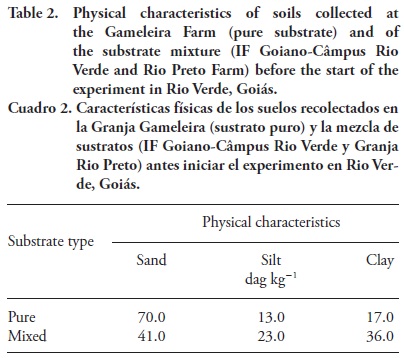
<body><![CDATA[<p align="justify"><font face="verdana" size="2">La microbiota del suelo desarrolla importantes funciones en los ecosistemas, ya que influye en el crecimiento, la nutrici&oacute;n mineral y la salud de las plantas. El f&oacute;sforo (P) es el nutrimento m&aacute;s limitante en los suelos tropicales, y los microorganismos solubilizadores de P (MSP) y los hongos micorr&iacute;zicos arbusculares (HMA) son los grupos m&aacute;s importantes de la comunidad microbiana del suelo. El objetivo de este estudio fue evaluar el efecto de la inoculaci&oacute;n de MSP y HMA en el desarrollo de &aacute;rboles de anacardo (<i>Anacardium othonianum </i>Rizzini) de el Cerrado Brasile&ntilde;o con distintos sustratos. Se realiz&oacute; un experimento en invernadero y el dise&ntilde;o experimental fue completamente aleatorio con un arreglo factorial de 4 &times; 2 de los tratamientos: MSP, HMA, MSP+HMA y el control. Adem&aacute;s, se usaron dos sustratos: uno puro, con textura franco arenoso, y una mezcla de texturas franco arcillosa y arcillosa. Se realizaron 12 r&eacute;plicas. Los datos se procesaron con un an&aacute;lisis de varianza y las medias se compararon con la prueba de Tukey (p<u>&lt;</u>0.05). La coinoculaci&oacute;n con MSP y HMA result&oacute; en mayor altura y materia seca del v&aacute;stago de las pl&aacute;ntulas comparado con las inoculaciones aisladas con estos organismos. Las pl&aacute;ntulas aumentaron su altura y materia h&uacute;meda y seca del v&aacute;stago al cultivarse en una mezcla de sustratos (suelo con texturas franco arcillosa y arcillosa). El uso de una mezcla de sustratos tambi&eacute;n result&oacute; en una eficiencia simbi&oacute;tica mayor con <i>Glomus etunicatum.</i></font></p>     <p align="justify"><font face="verdana" size="2"><b>Palabras clave: </b><i>Anacardium othonianum, </i>fomento de crecimiento vegetal, micorrizas.</font></p>     <p align="justify"><font face="verdana" size="2">&nbsp;</font></p>     <p align="justify"><font face="verdana" size="2"><b>INTRODUCTION</b></font></p>     <p align="justify"><font face="verdana" size="2">Inorganic P&#150;solubilizing microorganisms (PSMs) play an important role in supplying phosphorus (P) to plants while the solubilizing action is mainly associated with the production of organic acids (Whitelaw, 1999). Inoculation with PSMs either in combination with other beneficial soil microorganisms or by itself may enhance plant development (Silva Filho and Vidor, 2001; Narloch <i>et al., </i>2002; Souchie <i>et al., </i>2006). In the soil, PSMs contribute to an increased P concentration in solution, which can be absorbed directly by roots or hyphae of symbiotic arbuscular mycorrhizal fungi (AMF; Moreira and Siqueira, 2006). Likewise, P&#150;solubilizing bacteria may play an important role in interactions between roots and AMF acting as mycorrhiza helper bacteria (Fester <i>et al., </i>1999). Similarly, there are fungal species that can also enhance plant growth through phosphate solubilization (Soares <i>et al., </i>2010).</font></p>     <p align="justify"><font face="verdana" size="2">Arbuscular mycorrhizal fungi are recognized by the various positive effects on plant growth, namely, better uptake of nutrients, particularly P, increased volume of exploited soil and higher tolerance to biotic and abiotic factors (Locatelli and Lovato, 2002). The use of these microorganisms may benefit the seedling development of tree species in nurseries, maximizing their ability for establishment in the field (Souchie <i>et al., </i>2005).</font></p>     <p align="justify"><font face="verdana" size="2">The genus <i>Anacardium </i>is composed of 10 species of tropical trees and shrubs, in particular, <i>Anacardium othonianum </i>Rizzini, the cashew tree of the Cerrado, is distinguished from other species due to its tree scale and its economic importance, because of this is the principal cashew species of the Midwest region of Brazil (Vieira <i>et al., </i>2006). The trees of this species reach heights between 3 and 6 m, with boles measuring 1&#150;2 m in height and 20&#150;40 cm in diameter. The fruit is an achene that develops into a pseudofruit, which has several forms and colors, ranging from yellow to red. Therefore, this double fruit is a characteristic of this genus and consists of the combination of the fruit (nut) and the pseudofruit (Correa <i>et al., </i>2008). This species is found in Brazilian Campo Sujo and Cerradao, and it is a productive species whose seeds germinate easily. Flowering occurs between June and October, with a yield of 200&#150;600 fruits per plant. Its development under environments associated with concretionary soils with high slopes denotes its high potential for the exploration, preservation and management of large areas of the Cerrado (Vieira <i>et al, </i>2006).</font></p>     <p align="justify"><font face="verdana" size="2">Among the factors that influence the production of seedlings of some species, the type of substrate is important because it directly reflects the quality of the final product. An ideal growth substrate should present homogeneity, low density, good porosity, suitable field capacity and cation exchange as well as be free of pests, pathogens and weeds. In a nursery, substrates must exhibit resistance to the development of pests and diseases, be operational at any time, be abundant and affordable and present good adhesion among particles or adherence to roots. A single material that meets all of these requirements is difficult to find. Therefore, a mixture of two or more materials is preferred to obtain a suitable substrate of good quality (Santos <i>et al., </i>2000; Cunha <i>et al, </i>2005; Lacerda <i>et al., </i>2006).</font></p>     <p align="justify"><font face="verdana" size="2">Selection of materials to produce a substrate should take into consideration the species to be grown, the production conditions (irrigation system, type of fertilization and container size), the availability and price of the material as well as technical issues related to their use. Substrates influence on the architecture of root systems, nutritional status of plants and translocation of water in the soil&#150;plant&#150;atmosphere system (Santos <i>et al., </i>2000). The most important physical aspect of a substrate is a porous structure for storing and supplying water to plant roots and, at the same time, providing adequate aeration. In addition, the most important chemical characteristics are pH and total concentration of soluble salts because they influence the supply of fertilizers (Santos <i>et al., </i>2000; Lacerda <i>et al., </i>2006; Pacheco <i>et al. </i>, 2006).</font></p>     <p align="justify"><font face="verdana" size="2">The objective of this study was to evaluate the effect of inoculation of cashew trees of the Cerrado <i>(Anacardium othonianum </i>Rizzini) with PSMs and AMF grown on two different substrates.</font></p>     ]]></body>
<body><![CDATA[<p align="justify"><font face="verdana" size="2">&nbsp;</font></p>     <p align="justify"><font face="verdana" size="2"><b>MATERIALS AND METHODS</b></font></p>     <p align="justify"><font face="verdana" size="2">The experiment was carried out in greenhouse, at the Instituto Federal Goiano (IF Goiano&#150;Campus Rio Verde) using plastic pots with a capacity of 300 cm<sup>3</sup>. Seeds of cashew trees of the Cerrado were obtained from ripe fruits collected at the Gameleira Farm in the municipality of Montes Claros de Goi&aacute;s, Goi&aacute;s, Brazil.</font></p>     <p align="justify"><font face="verdana" size="2">Two types of non&#150;sterile substrates were used; a pure substrate with sandy loam texture (Quartz&#150;Sand Neosol) collected between 10 and 40 cm of depth at the Gameleira Farm; and a mixture 1:1 (v:v) of a red Argisol (clay loam texture), collected at the Rio Preto Farm, and a dystrophic red Latosol(clay texture), collected at the same depth in an area of the IF Goiano&#150;Campus Rio Verde. Substrates were not fertilized, and no lime was applied.</font></p>     <p align="justify"><font face="verdana" size="2">Analyses of chemical and physical characteristics of the soils were performed at the Laboratory of Soil Analyses at the Universidade Federal de Lavras according to the Embrapa methodology (Empresa Brasileira de Pesquisa Agropecuaria, 1997; <a href="/img/revistas/agro/v46n8/a6t1.jpg" target="_blank">Tables 1</a> and <a href="#t2">2</a>).</font></p>     <p align="center"><font face="verdana" size="2"><a name="t2"></a></font></p>     <p align="center"><font face="verdana" size="2"><img src="/img/revistas/agro/v46n8/a6t2.jpg"></font></p>     <p align="justify"><font face="verdana" size="2">Five isolates of PSMs were utilized: three of them were P&#150;solubilizing bacteria (PSB) and two were P&#150;solubilizing fungi (PSF) obtained from the rhizosphere of wheat, sunflower, murici <i>(Byrsonima verbascifolia), </i>rice <i>(Oryzasativa) </i>and guapeva <i>(Pouteria gardineriana). </i>Wheat, rice and sunflower were cultivated for 20 d in a distroferric Red Latosol of medium texture, collected at a depth of 10 to 40 cm in a region of the IF Goiano&#150;Campus Rio Verde. To isolate PSMs from tree species (murici and guapeva), three samples were collected from the rhizosphere soil of each tree in areas of the Cerrado preserved in Montes Claros de Goi&aacute;s.</font></p>     <p align="justify"><font face="verdana" size="2">To obtain PFMs, 10 g sample of rhizosphere soil were mixed with 90 mL of a saline solution (0.85 %), followed by successive dilutions until obtaining a 10<sup>&#150;5</sup> final dilution. Aliquots (200 mL) from each dilution were transferred to sterilized petri dishes, followed by the addition of GL medium (2 g yeast extract, 10 g glucose and 15 g agar) at 45 &deg;C containing CaHPO<sub>4</sub> (10 %), formed by the addition of CaCl<sub>2</sub> (10 %) and K<sub>2</sub>HPO<sub>4</sub> (10 %) according to the method of Sylvester&#150;Bradley <i>et al. </i>(1982). The appearance of a transparent halo in contrast to opaque medium around a colony of PSB or PSF isolates was indicative of phosphate solubilization. To confirm the P&#150;solubilizing capacity, a sample of fungal and bacterial colonies that showed a clear halo around their colonies was removed using a platinum loop to replicate it in another petri dish containing solid GL medium. Colonies were considered to be positive when, after purification, they were able to solubilize CaHPO<sub>4</sub> present in the medium (Barroso and Oliveira, 2001). To standardize the five isolates of PSMs, each was grown in a separate 125 mL Erlenmeyer flask containing liquid GL medium and incubated at 28 &deg;C for 72 h. For direct counting of colony forming units (CFU), successive dilutions were performed until reaching a final dilution of 10<sup>&#150;5</sup>. Then, three replicates of dilutions 10<sup>&#150;4</sup> and 10<sup>&#150;5</sup> were plated and incubated at 28 &deg;C for 72 h. The inoculum was standardized to 10<sup>8</sup> CFU mL<sup>&#150;1</sup> and mixed (1:1; v:v) at the time of seed inoculation.</font></p>     <p align="justify"><font face="verdana" size="2">The mycorrhizal inoculum was formed with <i>Glomus etunicatum </i>acquired from the Laborat&oacute;rio de Solos&#150;UFG/</font><font face="verdana" size="2">Campus Jatai. At sowing time the tubes that received AMF were inoculated in the planting orifice with 3.3 g of AMF inoculum (10 spores mL<sup>&#150;1</sup> of soil). For the inoculation with PSMs, seedlings were inoculated with 1 mL of liquid inoculant mixture (10<sup>8</sup> CFU mL<sup>&#150;1</sup>) at the base of each seedling 62 d after emergence (DAE). During the experiment, seedlings were watered twice a day.</font></p>     ]]></body>
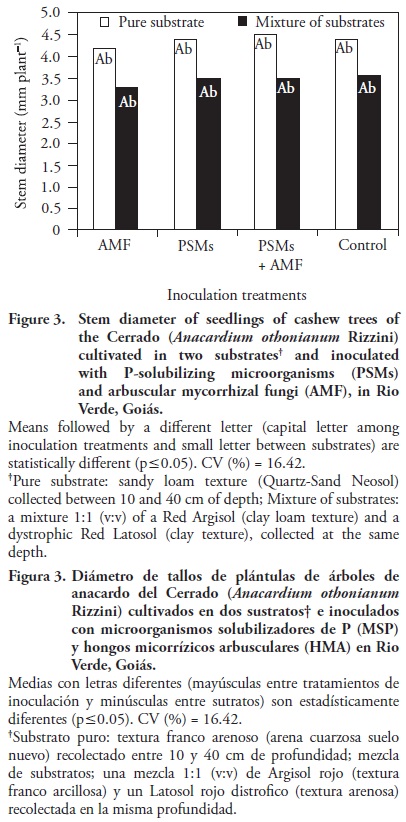
<body><![CDATA[<p align="justify"><font face="verdana" size="2">The seedlings were harvested at 120 DAE, and the stem diameter, shoot height, fresh and dry matter of shoots and roots, root volume, percentage of colonization by AMF, P available in the substrate and shoot N, P, K, Ca, Mg, S, Na, Cu, Fe, Mn, Z, Co, Mo and B were evaluated.</font></p>     <p align="justify"><font face="verdana" size="2">For the determination of root colonization, fractions of approximately 1 g of roots were separated and preserved in a 50 % ethanol alcohol solution. Afterwards, to evaluate the colonization by AMF, the roots were cleared and stained according to the method of Phillips and Hayman (1970), and the percentage of root colonization was measured with an optical microscope at a 200 x magnification (McGonigle <i>et al., </i>1990).</font></p>     <p align="justify"><font face="verdana" size="2">The experimental design was completely randomized with a 4 x 2 factorial arrangement of treatments: 1) inoculation (PSMs; AMF; PSMs + AMF; control no inoculation); 2) substrates (pure substrate; a substrate mixture). There were 12 replicates per treatments. Data were subjected to an analysis of variance, and means were compared with the Tukey test (p&lt;0.05) using SISVAR (Ferreira, 2008).</font></p>     <p align="justify"><font face="verdana" size="2">&nbsp;</font></p>     <p align="justify"><font face="verdana" size="2"><b>RESULTS AND DISCUSSION</b></font></p>     <p align="justify"><font face="verdana" size="2">Height and shoot fresh and dry matter in the substrate mixture were higher compared with the pure substrate (<a href="#t3">Table 3</a>). Co&#150;inoculation with PSMs and AMF resulted in greater increases in those variables compared with the control only in the mixed substrates group.</font></p>     <p align="center"><font face="verdana" size="2"><a name="t3"></a></font></p>     <p align="center"><font face="verdana" size="2"><img src="/img/revistas/agro/v46n8/a6t3.jpg"></font></p>     <p align="justify"><font face="verdana" size="2">The fact that seedlings showed better development in the mixture of substrates (loamy clay texture with clay texture) might be explained by its lower natural fertility (<a href="/img/revistas/agro/v46n8/a6t1.jpg" target="_blank">Table 1</a>) compared to the pure substrate. Because this tree species generally adapts to low soil fertility (Cardoso Filho <i>et al., </i>2008) the increased presence of nutrients might not stimulate plant growth, similar to a plant species subjected to a genetic improvement process. The mixture of substrates presented greater clay content (<a href="#t2">Table 2</a>) that enhanced the retention of water available to plants, which might have reduced the effect of water stress.</font></p>     <p align="justify"><font face="verdana" size="2">The co&#150;inoculation of PSMs and AMF resulted in an increased growth possibly due to synergism between these microbial groups. In this sense, PSMs possibly solubilize P adsorbed to clay colloids, while AMF increase the absorption and translocation to the seedlings. Tarafdar and Marschner (1995); and Niranjan <i>et al., </i>(2007) show an increased benefit of combined inoculation with these organisms compared to a single inoculation.</font></p>     ]]></body>
<body><![CDATA[<p align="justify"><font face="verdana" size="2">Caldeira <i>et al. </i>(2003) evaluated <i>Glomus clarum </i>and <i>G. macrocarpum </i>separately inoculated in leguminous trees and report an increase in the dry weight of shoots and roots. Likewise, the inoculation with <i>Gigaspora margarita </i>and <i>G. clarum </i>subject to low P levels (50 and 100 mg kg<sup>&#150;1</sup>) resulted in an increased plant height, stem diameter and number of leaves of <i>Jaracatia spinosa </i>seedlings (Silva <i>et al., </i>2009). According to Santos <i>et al. </i>(2008), red mimosa seedlings inoculated with <i>Glomus etunicatum </i>and rhizobia showed higher height and dry shoot matter content, compared with seedlings inoculated only with <i>G. etunicatum. </i>Similarly, co&#150;inoculation with a mixture of AMF (G. <i>margarita, G. etunicatum </i>and <i>Scutellospora nigra</i>) and <i>Rhizobium </i>directly contributed to the biological fixation of N and nodulation of <i>Leucaena </i>seedlings, maximizing seedling formation (Araujo <i>etal., </i>2001). In addition, co&#150;inoculation of indigenous AMF <i>(Glomus macrocarpum, G. etunicatum </i>and <i>Entrophospora colombiana) </i>and <i>Rhizobium </i>in <i>Acacia mangium </i>Willd resulted in greater dry matter production and N content in shoots (Schiavo and Martins, 2003). According to Tristao <i>et al. </i>(2006), the development of coffee seedlings in conventional substrate (soil + manure) inoculated with <i>G. margarita </i>caused greater growth and biomass production.</font></p>     <p align="justify"><font face="verdana" size="2">The soil mixture also increased root fresh matter and root volume (<a href="/img/revistas/agro/v46n8/a6f1.jpg" target="_blank">Figures 1A</a> and <a href="#f2">2</a>). No differences were detected between substrates when comparing root dry matter (<a href="/img/revistas/agro/v46n8/a6f1.jpg" target="_blank">Figure 1B</a>). In contrast, seedlings presented a greater stem diameter with the pure substrate (<a href="#f3">Figure 3</a>).</font></p>     <p align="center"><font face="verdana" size="2"><a name="f2"></a></font></p>     <p align="center"><font face="verdana" size="2"><img src="/img/revistas/agro/v46n8/a6f2.jpg"></font></p>     <p align="center"><font face="verdana" size="2"><a name="f3"></a></font></p>     <p align="center"><font face="verdana" size="2"><img src="/img/revistas/agro/v46n8/a6f3.jpg"></font></p>     <p align="justify"><font face="verdana" size="2">The method used for assessing root colonization by AMF showed root fragments with good color and clarity from seedlings of cashew trees of the Cerrado grown in the pure substrate. However, similar coloration did not occur with root fragments of seedlings grown in the mixture because these were more pigmented and ligneous. The production of phenolic compounds, which increase the pigmentation of roots, is a common response of Cerrado plants during growth and development. These compounds resist the process of clarification with KOH (Detmann <i>et al., </i>2008), requiring additional methods to clarify the roots for the assessment of mycorrhizal colonization.</font></p>     <p align="justify"><font face="verdana" size="2">In the pure substrate, treatments with PSMs + AMF and the control produced higher percentages of mycorrhizal colonization, (16.61 and 20.71 %), while the treatment with PSMs had the lowest value, 5&#150;17 % (<a href="#t4">Table 4</a>). The control treatment did not significantly differ from the treatments with AMF and PSMs + AMF. This result indicates that there was no response from seedlings to the inoculation with <i>G. etunicatum </i>and that the colonization detected in the control was due to the presence of AMF propagules in the substrate because it was not sterilized&#150; Despite indigenous AMF species have not been identified in the substrate used for the control treatment, some AMF species were present and responsible for this plant mycorrhization result.</font></p>     <p align="center"><font face="verdana" size="2"><a name="t4"></a></font></p>     <p align="center"><font face="verdana" size="2"><img src="/img/revistas/agro/v46n8/a6t4.jpg"></font></p>     ]]></body>
<body><![CDATA[<p align="justify"><font face="verdana" size="2">Regarding symbiotic efficiency (<i>i.e.</i> the difference in percentage of shoot dry matter production between mycorrhizal and non&#150;mycorrhizal plants), the highest values were observed in treatments with AMF, while the inoculation had a negative effect on treatments with PSMs and PSMs + AMF in the pure substrate&#150; For the mixture of substrates, the greatest result was obtained with the PSMs + AMF (<a href="#t5">Table 5</a>).</font></p>     <p align="center"><font face="verdana" size="2"><a name="t5"></a></font></p>     <p align="center"><font face="verdana" size="2"><img src="/img/revistas/agro/v46n8/a6t5.jpg"></font></p>     <p align="justify"><font face="verdana" size="2">The co&#150;inoculation with PSMs + AMF resulted in a higher fresh root and shoot matter ratio in the pure substrate, while the highest values corresponded to the treatments only with AMF and the control&#150; In the mixture, the highest ratio was obtained with the AMF treatment and the lowest with PSMs and PSMs + AMF (<a href="#t6">Table 6</a>).</font></p>     <p align="center"><font face="verdana" size="2"><a name="t6"></a></font></p>     <p align="center"><font face="verdana" size="2"><img src="/img/revistas/agro/v46n8/a6t6.jpg"></font></p>     <p align="justify"><font face="verdana" size="2">The highest values of fresh root matter and dry shoot matter corresponded to treatments with PSMs and PSMs + AMF in the pure substrate. Similarly, with substrates mixture, the AMF treatment showed the highest value.</font></p>     <p align="justify"><font face="verdana" size="2">At the end of the study, the substrates mixture showed higher content of available P (3.4 mg dm<sup>&#150;3</sup>) compared with the pure substrate (0.5 mg dm<sup>&#150;3</sup>). This outcome might be explained by the higher content of Ca and Fe in the pure substrate (<a href="/img/revistas/agro/v46n8/a6t1.jpg" target="_blank">Table 1</a>). This characteristic favored the phosphate complexation reactions and resulted in lower availability of P in the soil solution.</font></p>     <p align="justify"><font face="verdana" size="2">No effects of the inoculation treatments were observed in the N content in the shoots grown in pure substrate (<a href="/img/revistas/agro/v46n8/a6t7.jpg" target="_blank">Table 7</a>). However, for the mixture of substrates, a higher N content was observed in shoots inoculated with AMF compared with the control. Chu <i>et al. </i>(2001) and Weber <i>et al. </i>(2004) also report higher N contents in shoots of early dwarf cashew and soursop (<i>Annona muricata </i>L.) when inoculated with AMF. No difference was observed between the inoculation treatments and control in the levels of P, K, Ca, Mg, S, Na, Cu, Fe, Mn, Zn, Co, Mo and B in shoots of seedlings grown in the mixture of substrates (<a href="/img/revistas/agro/v46n8/a6t7.jpg" target="_blank">Table 7</a>). Similarly, in the pure substrate there was no difference between the inoculation treatments regarding the levels of most of the nutrients in shoots. Cashew trees of the Cerrado, until the present, have not undergone any type of genetic improvement; therefore, it was more difficult to detect the effect of microbial inoculation treatments. Silva <i>et al., </i>(2003) point out the benefits of inoculation with AMF on the nutrition and growth of <i>Eucalyptus, </i>one of the few genetically improved tree species.</font></p>     <p align="justify"><font face="verdana" size="2">&nbsp;</font></p>     ]]></body>
<body><![CDATA[<p align="justify"><font face="verdana" size="2"><b>CONCLUSIONS</b></font></p>     <p align="justify"><font face="verdana" size="2">The co&#150;inoculation with PSMs + AMF resulted in an increased height and shoot dry matter content of seedlings of cashew trees of the Cerrado compared to the control. Seedlings of cashew trees of the Cerrado demonstrated better performance if grown in a mixture of substrates (soil with loamy clay texture and clay). However, there was no preference when inoculating with <i>Glomus etunicatum </i>in seedlings grown in pure substrate. It seems that the mixture of soil substrates resulted in a greater symbiotic efficiency of <i>Glomus etunicatum.</i></font></p>     <p align="justify"><font face="verdana" size="2">&nbsp;</font></p>     <p align="justify"><font face="verdana" size="2"><b>LITERATURE CITED</b></font></p>     <!-- ref --><p align="justify"><font face="verdana" size="2">Ara&uacute;jo, A. S. F., H. A. Burity, and M. do C. C. P. Lyra. 2001. Influ&ecirc;ncia de diferentes n&iacute;veis de nitrog&ecirc;nio e f&oacute;sforo em Leucena inoculada com <i>Rhizobium </i>e fungo micorr&iacute;zico arbuscular. Ecossistema 26: 35&#150;38.    &nbsp;&nbsp;&nbsp;&nbsp;&nbsp;&nbsp;&nbsp;&nbsp;[&#160;<a href="javascript:void(0);" onclick="javascript: window.open('/scielo.php?script=sci_nlinks&ref=572329&pid=S1405-3195201200080000600001&lng=','','width=640,height=500,resizable=yes,scrollbars=1,menubar=yes,');">Links</a>&#160;]<!-- end-ref --></font></p>     <!-- ref --><p align="justify"><font face="verdana" size="2">Barroso, C. B., and L. A. Oliveira. 2001. Ocorr&ecirc;ncias de bacterias solubilizadoras de fosfato de c&aacute;lcio nas ra&iacute;zes de plantas na Amaz&ocirc;nia Brasileira. Rev. Bras. Ci&ecirc;nc. Solo 25: 575&#150;581.    &nbsp;&nbsp;&nbsp;&nbsp;&nbsp;&nbsp;&nbsp;&nbsp;[&#160;<a href="javascript:void(0);" onclick="javascript: window.open('/scielo.php?script=sci_nlinks&ref=572331&pid=S1405-3195201200080000600002&lng=','','width=640,height=500,resizable=yes,scrollbars=1,menubar=yes,');">Links</a>&#160;]<!-- end-ref --></font></p>     <!-- ref --><p align="justify"><font face="verdana" size="2">Caldeira, M. V. W., E. M. R. da. Silva, A. A. Franco, and L. F. Watzlawick. 2003. Influ&ecirc;ncia de fungos micorr&iacute;zicos arbusculares sobre o crescimento de tr&ecirc;s leguminosas arb&oacute;reas. Rev. Acad. Ci&ecirc;nc. Agrar. Ambient. 1: 27&#150;32.    &nbsp;&nbsp;&nbsp;&nbsp;&nbsp;&nbsp;&nbsp;&nbsp;[&#160;<a href="javascript:void(0);" onclick="javascript: window.open('/scielo.php?script=sci_nlinks&ref=572333&pid=S1405-3195201200080000600003&lng=','','width=640,height=500,resizable=yes,scrollbars=1,menubar=yes,');">Links</a>&#160;]<!-- end-ref --></font></p>     ]]></body>
<body><![CDATA[<!-- ref --><p align="justify"><font face="verdana" size="2">Cardoso Filho, J. A., E. E. P. de. Lemos, T. M. C. dos. Santos, L. C. Caetano, and M. A. Nogueira. 2008. Mycorrhizal dependency of mangaba tree under increasing phosphorus levels. Pes. Agrop. Bras. 43: 887&#150;892.    &nbsp;&nbsp;&nbsp;&nbsp;&nbsp;&nbsp;&nbsp;&nbsp;[&#160;<a href="javascript:void(0);" onclick="javascript: window.open('/scielo.php?script=sci_nlinks&ref=572335&pid=S1405-3195201200080000600004&lng=','','width=640,height=500,resizable=yes,scrollbars=1,menubar=yes,');">Links</a>&#160;]<!-- end-ref --></font></p>     <!-- ref --><p align="justify"><font face="verdana" size="2">Chu, E. Y., M. de R. F. Moller, and J. G. de. Carvalho. 2001. Efeitos da inocula&ccedil;&atilde;o micorr&iacute;zica em mudas de gravioleira em solo fumigado e n&atilde;o fumigado. Pes. Agrop. Bras. 36: 671&#150;680.    &nbsp;&nbsp;&nbsp;&nbsp;&nbsp;&nbsp;&nbsp;&nbsp;[&#160;<a href="javascript:void(0);" onclick="javascript: window.open('/scielo.php?script=sci_nlinks&ref=572337&pid=S1405-3195201200080000600005&lng=','','width=640,height=500,resizable=yes,scrollbars=1,menubar=yes,');">Links</a>&#160;]<!-- end-ref --></font></p>     <!-- ref --><p align="justify"><font face="verdana" size="2">Correa, G. de C., R. V. Naves, M. R. da. Rocha, L. J. Chaves, and J. D. Borges. 2008. Determina&ccedil;&otilde;es f&iacute;sicas em frutos e sementes de Baru (<i>Dipteryx alta </i>Vog.), Cajuzinho (<i>Anacardium othonianum </i>Rizz.) e Pequi (<i>Caryocar brasiliense </i>Camb.), visando melhoramento gen&eacute;tico. Biosc. J. 24: 4247.    &nbsp;&nbsp;&nbsp;&nbsp;&nbsp;&nbsp;&nbsp;&nbsp;[&#160;<a href="javascript:void(0);" onclick="javascript: window.open('/scielo.php?script=sci_nlinks&ref=572339&pid=S1405-3195201200080000600006&lng=','','width=640,height=500,resizable=yes,scrollbars=1,menubar=yes,');">Links</a>&#160;]<!-- end-ref --></font></p>     <!-- ref --><p align="justify"><font face="verdana" size="2">Cunha, A. O., L. A. de. Andrade, R de L. A. Bruno, J. A. L. da. Silva, and V. C. de. Souza. 2005. Efeito de substratos e das dimens&otilde;es dos recipientes na qualidade das mudas de <i>Tabebuia impetiginosa </i>(Mart. Ex D. C.) Standl. Rev. &Aacute;rvore 29: 507&#150;516.    &nbsp;&nbsp;&nbsp;&nbsp;&nbsp;&nbsp;&nbsp;&nbsp;[&#160;<a href="javascript:void(0);" onclick="javascript: window.open('/scielo.php?script=sci_nlinks&ref=572341&pid=S1405-3195201200080000600007&lng=','','width=640,height=500,resizable=yes,scrollbars=1,menubar=yes,');">Links</a>&#160;]<!-- end-ref --></font></p>     <!-- ref --><p align="justify"><font face="verdana" size="2">Detmann, K. da S. C., Delgado, V. P. A. Rebello, T. de S. Leite, A. A. Azevedo, M. C. M., Kasuya, and A. M. de Almeida. 2008. Compara&ccedil;&atilde;o de m&eacute;todos para a observa&ccedil;&atilde;o de fungos micorr&iacute;zicos arbusculares e endof&iacute;ticos do tipo <i>Dark septate </i>em esp&eacute;cies nativas do Cerrado. Rev. Bras. Ci&ecirc;nc. Solo 32: 1883&#150;1890.    &nbsp;&nbsp;&nbsp;&nbsp;&nbsp;&nbsp;&nbsp;&nbsp;[&#160;<a href="javascript:void(0);" onclick="javascript: window.open('/scielo.php?script=sci_nlinks&ref=572343&pid=S1405-3195201200080000600008&lng=','','width=640,height=500,resizable=yes,scrollbars=1,menubar=yes,');">Links</a>&#160;]<!-- end-ref --></font></p>     ]]></body>
<body><![CDATA[<!-- ref --><p align="justify"><font face="verdana" size="2">Empresa Brasileira de Pesquisa Agropecuaria. 1997. Manual de M&eacute;todos de An&aacute;lises de Solo. Embrapa. Rio de Janeiro. 212 p.    &nbsp;&nbsp;&nbsp;&nbsp;&nbsp;&nbsp;&nbsp;&nbsp;[&#160;<a href="javascript:void(0);" onclick="javascript: window.open('/scielo.php?script=sci_nlinks&ref=572345&pid=S1405-3195201200080000600009&lng=','','width=640,height=500,resizable=yes,scrollbars=1,menubar=yes,');">Links</a>&#160;]<!-- end-ref --></font></p>     <!-- ref --><p align="justify"><font face="verdana" size="2">Ferreira, D. F. 2008. SISVAR: um programa para an&aacute;lises e ensino de estat&iacute;stica. Rev. Symposium 6: 36&#150;41.    &nbsp;&nbsp;&nbsp;&nbsp;&nbsp;&nbsp;&nbsp;&nbsp;[&#160;<a href="javascript:void(0);" onclick="javascript: window.open('/scielo.php?script=sci_nlinks&ref=572347&pid=S1405-3195201200080000600010&lng=','','width=640,height=500,resizable=yes,scrollbars=1,menubar=yes,');">Links</a>&#160;]<!-- end-ref --></font></p>     <!-- ref --><p align="justify"><font face="verdana" size="2">Fester, T., W. Maier, and D. Strack. 1999. Accumulation of secondary compounds in barley and wheat roots in response to inoculation with an arbuscular mycorrhizal fungus and co&#150;inoculation with rhizosphere bacteria. Mycorrhiza 8: 241&#150;246.    &nbsp;&nbsp;&nbsp;&nbsp;&nbsp;&nbsp;&nbsp;&nbsp;[&#160;<a href="javascript:void(0);" onclick="javascript: window.open('/scielo.php?script=sci_nlinks&ref=572349&pid=S1405-3195201200080000600011&lng=','','width=640,height=500,resizable=yes,scrollbars=1,menubar=yes,');">Links</a>&#160;]<!-- end-ref --></font></p>     <!-- ref --><p align="justify"><font face="verdana" size="2">Lacerda, M. R. B., M. A. A. Passos, J. J. V. Rodrigues, and L. P. Barreto. 2006. Caracter&iacute;sticas f&iacute;sicas e qu&iacute;micas de substratos &agrave; base de p&oacute; de coco e res&iacute;duo de sisal para produ&ccedil;&atilde;o de mudas de sabi&aacute; <i>(Mimosa caesalpiniaefolia </i>Benth). Rev. &Aacute;rvore 30: 163&#150;170.    &nbsp;&nbsp;&nbsp;&nbsp;&nbsp;&nbsp;&nbsp;&nbsp;[&#160;<a href="javascript:void(0);" onclick="javascript: window.open('/scielo.php?script=sci_nlinks&ref=572351&pid=S1405-3195201200080000600012&lng=','','width=640,height=500,resizable=yes,scrollbars=1,menubar=yes,');">Links</a>&#160;]<!-- end-ref --></font></p>     <!-- ref --><p align="justify"><font face="verdana" size="2">Locatelli, L. M., and P. E. Lovato. 2002. Inocula&ccedil;&atilde;o micorr&iacute;zica e aclimatiza&ccedil;&atilde;o de dois porta&#150;enxertos de macieira micropropagados. Pes. Agrop. Bras. 37: 177&#150;184.    &nbsp;&nbsp;&nbsp;&nbsp;&nbsp;&nbsp;&nbsp;&nbsp;[&#160;<a href="javascript:void(0);" onclick="javascript: window.open('/scielo.php?script=sci_nlinks&ref=572353&pid=S1405-3195201200080000600013&lng=','','width=640,height=500,resizable=yes,scrollbars=1,menubar=yes,');">Links</a>&#160;]<!-- end-ref --></font></p>     ]]></body>
<body><![CDATA[<!-- ref --><p align="justify"><font face="verdana" size="2">Mc Gonigle, T. P., M. H. Miller, D. G. Evans, G. L. Farchild, J. A. Swan. 1990. A new method which gives an objective measure of colonization of roots by vesicular&#150;arbuscular mycorrhizal fungi. New Phytol. 115: 495&#150;501.    &nbsp;&nbsp;&nbsp;&nbsp;&nbsp;&nbsp;&nbsp;&nbsp;[&#160;<a href="javascript:void(0);" onclick="javascript: window.open('/scielo.php?script=sci_nlinks&ref=572355&pid=S1405-3195201200080000600014&lng=','','width=640,height=500,resizable=yes,scrollbars=1,menubar=yes,');">Links</a>&#160;]<!-- end-ref --></font></p>     <!-- ref --><p align="justify"><font face="verdana" size="2">Moreira, F. M. S., and J. O. Siqueira. Microbiologia e Bioqu&iacute;mica do Solo. UFLA. Lavras. 2006. 729 p.    &nbsp;&nbsp;&nbsp;&nbsp;&nbsp;&nbsp;&nbsp;&nbsp;[&#160;<a href="javascript:void(0);" onclick="javascript: window.open('/scielo.php?script=sci_nlinks&ref=572357&pid=S1405-3195201200080000600015&lng=','','width=640,height=500,resizable=yes,scrollbars=1,menubar=yes,');">Links</a>&#160;]<!-- end-ref --></font></p>     <!-- ref --><p align="justify"><font face="verdana" size="2">Narloch, C., V. L. de. Oliveira, J. T. dos. Anjos, and G. N. Silva Filho. 2002. Respostas da cultura do rabanete &agrave; inocula&ccedil;&atilde;o de fungos solubilizadores de fosfatos. Pes. Agrop. Bras. 37: 841&#150;845.    &nbsp;&nbsp;&nbsp;&nbsp;&nbsp;&nbsp;&nbsp;&nbsp;[&#160;<a href="javascript:void(0);" onclick="javascript: window.open('/scielo.php?script=sci_nlinks&ref=572359&pid=S1405-3195201200080000600016&lng=','','width=640,height=500,resizable=yes,scrollbars=1,menubar=yes,');">Links</a>&#160;]<!-- end-ref --></font></p>     <!-- ref --><p align="justify"><font face="verdana" size="2">Niranjan, R., V. Mohan, and V. M. Rao. 2007. Effect of indole acetic acid on the synergistic interactions of <i>Bradyrhizobium </i>and <i>Glomus fasciculatum </i>on growth, nodulation, and nitrogen fixation of <i>Dalbergia sissoo </i>Roxb. Arid Land Res. Manag. 21: 329&#150;342.    &nbsp;&nbsp;&nbsp;&nbsp;&nbsp;&nbsp;&nbsp;&nbsp;[&#160;<a href="javascript:void(0);" onclick="javascript: window.open('/scielo.php?script=sci_nlinks&ref=572361&pid=S1405-3195201200080000600017&lng=','','width=640,height=500,resizable=yes,scrollbars=1,menubar=yes,');">Links</a>&#160;]<!-- end-ref --></font></p>     <!-- ref --><p align="justify"><font face="verdana" size="2">Pacheco, M. V., V. P. Matos, R. L. C. Ferreira, A. L. P. Feliciano, K. M. S. Pinto. 2006. Efeito de temperaturas e substratos na germina&ccedil;&atilde;o de sementes de <i>Myracrodruon urundeuva </i>Fr. All. (Anacardiaceae). Rev. &Aacute;rvore 30: 359&#150;367.    &nbsp;&nbsp;&nbsp;&nbsp;&nbsp;&nbsp;&nbsp;&nbsp;[&#160;<a href="javascript:void(0);" onclick="javascript: window.open('/scielo.php?script=sci_nlinks&ref=572363&pid=S1405-3195201200080000600018&lng=','','width=640,height=500,resizable=yes,scrollbars=1,menubar=yes,');">Links</a>&#160;]<!-- end-ref --></font></p>     ]]></body>
<body><![CDATA[<!-- ref --><p align="justify"><font face="verdana" size="2">Phillips, J. M., and D. S. Hayman. 1970. Improved procedures for clearing roots and staining parasitic and vesicular&#150;arbuscular mycorrhizal fungi for rapid assessment of infection. Trans. British. Mycol. Soc. 55: 158&#150;161.    &nbsp;&nbsp;&nbsp;&nbsp;&nbsp;&nbsp;&nbsp;&nbsp;[&#160;<a href="javascript:void(0);" onclick="javascript: window.open('/scielo.php?script=sci_nlinks&ref=572365&pid=S1405-3195201200080000600019&lng=','','width=640,height=500,resizable=yes,scrollbars=1,menubar=yes,');">Links</a>&#160;]<!-- end-ref --></font></p>     <!-- ref --><p align="justify"><font face="verdana" size="2">Santos, C. B. dos., S. J. Longhi, J. M. Hoppe, and F. A. Moscovich. 2000. Efeito do volume de tubetes e tipos de substratos na qualidade de mudas de <i>Cryptomeria japonica </i>(L. F.) D. Don. Ci&ecirc;ncia Forestal 10: 1&#150;15.    &nbsp;&nbsp;&nbsp;&nbsp;&nbsp;&nbsp;&nbsp;&nbsp;[&#160;<a href="javascript:void(0);" onclick="javascript: window.open('/scielo.php?script=sci_nlinks&ref=572367&pid=S1405-3195201200080000600020&lng=','','width=640,height=500,resizable=yes,scrollbars=1,menubar=yes,');">Links</a>&#160;]<!-- end-ref --></font></p>     <!-- ref --><p align="justify"><font face="verdana" size="2">Santos, D. R. dos., M da C. S. Costa, J. R. P. de. Miranda, and R. V. dos. Santos. 2008. Micorriza e riz&oacute;bio no crescimento e nutri&ccedil;&atilde;o em N e P de mudas de Angico&#150;vermelho. Rev. Caatinga 21: 76&#150;82.    &nbsp;&nbsp;&nbsp;&nbsp;&nbsp;&nbsp;&nbsp;&nbsp;[&#160;<a href="javascript:void(0);" onclick="javascript: window.open('/scielo.php?script=sci_nlinks&ref=572369&pid=S1405-3195201200080000600021&lng=','','width=640,height=500,resizable=yes,scrollbars=1,menubar=yes,');">Links</a>&#160;]<!-- end-ref --> </font></p>     <!-- ref --><p align="justify"><font face="verdana" size="2">Schiavo, J. A., and M. A. Martins. 2003. Produ&ccedil;&atilde;o de mudas de ac&aacute;cia colonizadas com micorrizas e riz&oacute;bio em diferentes recipientes. Pes. Agrop. Bras. 38: 173&#150;178.    &nbsp;&nbsp;&nbsp;&nbsp;&nbsp;&nbsp;&nbsp;&nbsp;[&#160;<a href="javascript:void(0);" onclick="javascript: window.open('/scielo.php?script=sci_nlinks&ref=572371&pid=S1405-3195201200080000600022&lng=','','width=640,height=500,resizable=yes,scrollbars=1,menubar=yes,');">Links</a>&#160;]<!-- end-ref --> </font></p>     <!-- ref --><p align="justify"><font face="verdana" size="2">Silva, A. P. D., T. L. Garcia, O. Machineski, P. V. Truber, and E. L. Balota. 2009. Resposta do <i>Jaracatia spinosa </i>&agrave; inocula&ccedil;&atilde;o de fungos micorr&iacute;zicos arbusculares em diferentes n&iacute;veis de f&oacute;sforo. Synergismus Scyentifica 4:1&#150;3.    &nbsp;&nbsp;&nbsp;&nbsp;&nbsp;&nbsp;&nbsp;&nbsp;[&#160;<a href="javascript:void(0);" onclick="javascript: window.open('/scielo.php?script=sci_nlinks&ref=572373&pid=S1405-3195201200080000600023&lng=','','width=640,height=500,resizable=yes,scrollbars=1,menubar=yes,');">Links</a>&#160;]<!-- end-ref --></font></p>     ]]></body>
<body><![CDATA[<!-- ref --><p align="justify"><font face="verdana" size="2">Silva Filho, G. N., and C. Vidor. 2001. Atividade de microrganismos solubilizadores de fosfatos na presen&ccedil;a de nitrog&ecirc;nio, ferro, c&aacute;lcio e pot&aacute;ssio. Pes. Agrop. Bras. 36: 1495&#150;1508.    &nbsp;&nbsp;&nbsp;&nbsp;&nbsp;&nbsp;&nbsp;&nbsp;[&#160;<a href="javascript:void(0);" onclick="javascript: window.open('/scielo.php?script=sci_nlinks&ref=572375&pid=S1405-3195201200080000600024&lng=','','width=640,height=500,resizable=yes,scrollbars=1,menubar=yes,');">Links</a>&#160;]<!-- end-ref --></font></p>     <!-- ref --><p align="justify"><font face="verdana" size="2">Silva, R. F. da., Z. I. Antoniolli, R. Andreazza, and S. J. Longhi. 2003. Fungos ectomicorr&iacute;zicos na produ&ccedil;&atilde;o de mudas de <i>Eucalyptusgrandis </i>Hill ex Maiden. Bios. J. 19: 9&#150;17.    &nbsp;&nbsp;&nbsp;&nbsp;&nbsp;&nbsp;&nbsp;&nbsp;[&#160;<a href="javascript:void(0);" onclick="javascript: window.open('/scielo.php?script=sci_nlinks&ref=572377&pid=S1405-3195201200080000600025&lng=','','width=640,height=500,resizable=yes,scrollbars=1,menubar=yes,');">Links</a>&#160;]<!-- end-ref --></font></p>     <!-- ref --><p align="justify"><font face="verdana" size="2">Soares, A. C. F., A. da S. Sousa, M. da S. Garrido, and F. S. Lima. 2010. Isolados de estreptomicetos no crescimento e nutricao de mudas de tomateiro. Pes. Agrop. Trop. 40: 447&#150;453.    &nbsp;&nbsp;&nbsp;&nbsp;&nbsp;&nbsp;&nbsp;&nbsp;[&#160;<a href="javascript:void(0);" onclick="javascript: window.open('/scielo.php?script=sci_nlinks&ref=572379&pid=S1405-3195201200080000600026&lng=','','width=640,height=500,resizable=yes,scrollbars=1,menubar=yes,');">Links</a>&#160;]<!-- end-ref --></font></p>     <!-- ref --><p align="justify"><font face="verdana" size="2">Souchie, E. L., E. F. C. Campello, O. J. Saggin&#150;J&uacute;nior, and E. M. R. da. Silva. 2005. Mudas de esp&eacute;cies arb&oacute;reas inoculadas com bact&eacute;rias solubilizadoras de fosfato e fungos micorr&iacute;zicos arbusculares. Floresta 35: 329&#150;334.    &nbsp;&nbsp;&nbsp;&nbsp;&nbsp;&nbsp;&nbsp;&nbsp;[&#160;<a href="javascript:void(0);" onclick="javascript: window.open('/scielo.php?script=sci_nlinks&ref=572381&pid=S1405-3195201200080000600027&lng=','','width=640,height=500,resizable=yes,scrollbars=1,menubar=yes,');">Links</a>&#160;]<!-- end-ref --></font></p>     <!-- ref --><p align="justify"><font face="verdana" size="2">Souchie, E. L., R. Azc&oacute;n, J. M. Barea, O. J. Saggin&#150;J&uacute;nior, and E. M. R. Silva. 2006. Phosphate solubilization and synergism between P&#150;solubilizing and arbuscular mycorrhizal fungi. Pes. Agrop. Bras. 41: 1405&#150;1411.    &nbsp;&nbsp;&nbsp;&nbsp;&nbsp;&nbsp;&nbsp;&nbsp;[&#160;<a href="javascript:void(0);" onclick="javascript: window.open('/scielo.php?script=sci_nlinks&ref=572383&pid=S1405-3195201200080000600028&lng=','','width=640,height=500,resizable=yes,scrollbars=1,menubar=yes,');">Links</a>&#160;]<!-- end-ref --></font></p>     ]]></body>
<body><![CDATA[<!-- ref --><p align="justify"><font face="verdana" size="2">Sylvester&#150;Bradley, R., N. Asakawa, S. La Torraca, F. M. M. Magalhaes, L. A. Oliveira, R. M. Pereira. 1982. Levantamento quantitativo de microrganismos solubilizadores de fosfatos na rizosfera de gram&iacute;neas e leguminosas forrageiras na Amazonia. Acta Amaz. 12: 15&#150;22.    &nbsp;&nbsp;&nbsp;&nbsp;&nbsp;&nbsp;&nbsp;&nbsp;[&#160;<a href="javascript:void(0);" onclick="javascript: window.open('/scielo.php?script=sci_nlinks&ref=572385&pid=S1405-3195201200080000600029&lng=','','width=640,height=500,resizable=yes,scrollbars=1,menubar=yes,');">Links</a>&#160;]<!-- end-ref --></font></p>     <!-- ref --><p align="justify"><font face="verdana" size="2">Tarafdar, J. C., and H. Marschner. 1995. Dual inoculation with Aspergillus fumigatus and Glomus mosseae enhances biomass production and nutrient uptake in wheat (Triticum aestivum L.) supplied with organic phosphorus as Naphytate. Plant Soil 73: 97&#150;102.    &nbsp;&nbsp;&nbsp;&nbsp;&nbsp;&nbsp;&nbsp;&nbsp;[&#160;<a href="javascript:void(0);" onclick="javascript: window.open('/scielo.php?script=sci_nlinks&ref=572387&pid=S1405-3195201200080000600030&lng=','','width=640,height=500,resizable=yes,scrollbars=1,menubar=yes,');">Links</a>&#160;]<!-- end-ref --></font></p>     <!-- ref --><p align="justify"><font face="verdana" size="2">Trist&atilde;o, F. S. M., S. A. L. de. Andrade, and A. P. D. da. Silveira. 2006. Fungos micorr&iacute;zicos arbusculares na forma&ccedil;&atilde;o de mudas de cafeeiro, em substratos org&acirc;nicos comerciais. Bragantia 65: 649&#150;658.    &nbsp;&nbsp;&nbsp;&nbsp;&nbsp;&nbsp;&nbsp;&nbsp;[&#160;<a href="javascript:void(0);" onclick="javascript: window.open('/scielo.php?script=sci_nlinks&ref=572389&pid=S1405-3195201200080000600031&lng=','','width=640,height=500,resizable=yes,scrollbars=1,menubar=yes,');">Links</a>&#160;]<!-- end-ref --> </font></p>     <!-- ref --><p align="justify"><font face="verdana" size="2">Vieira, R. F., T. S. A. Costa, D. B. Silva, F. R. Ferreira, and S. M. Sano. 2006. Frutas nativas da regi&atilde;o Centro&#150;Oeste. Embrapa Recursos Gen&eacute;ticos e Biotecnologia. Bras&iacute;lia. 320 p.    &nbsp;&nbsp;&nbsp;&nbsp;&nbsp;&nbsp;&nbsp;&nbsp;[&#160;<a href="javascript:void(0);" onclick="javascript: window.open('/scielo.php?script=sci_nlinks&ref=572391&pid=S1405-3195201200080000600032&lng=','','width=640,height=500,resizable=yes,scrollbars=1,menubar=yes,');">Links</a>&#160;]<!-- end-ref --></font></p>     <!-- ref --><p align="justify"><font face="verdana" size="2">Weber, O. B., C. C. M. de Souza, D. M. F. Gondin, F. N. S. Oliveira, L. A. Cris&oacute;stomo, A. L. Caproni, and O. J. Saggin&#150;J&uacute;nior. 2004. Inocula&ccedil;&atilde;o de fungos micorr&iacute;zicos arbusculares e aduba&ccedil;&atilde;o fosfatada em mudas de cajueiro&#150;an&atilde;o&#150;precoce. Pes. Agrop. Bras. 39: 477&#150;483.    &nbsp;&nbsp;&nbsp;&nbsp;&nbsp;&nbsp;&nbsp;&nbsp;[&#160;<a href="javascript:void(0);" onclick="javascript: window.open('/scielo.php?script=sci_nlinks&ref=572393&pid=S1405-3195201200080000600033&lng=','','width=640,height=500,resizable=yes,scrollbars=1,menubar=yes,');">Links</a>&#160;]<!-- end-ref --></font></p>     ]]></body>
<body><![CDATA[<!-- ref --><p align="justify"><font face="verdana" size="2">Whitelaw, M. A. 1999. Growth promotion of plant inoculated with phosphate&#150;solubilizing fungi. Adv. Agron. 69: 99&#150;151.    &nbsp;&nbsp;&nbsp;&nbsp;&nbsp;&nbsp;&nbsp;&nbsp;[&#160;<a href="javascript:void(0);" onclick="javascript: window.open('/scielo.php?script=sci_nlinks&ref=572395&pid=S1405-3195201200080000600034&lng=','','width=640,height=500,resizable=yes,scrollbars=1,menubar=yes,');">Links</a>&#160;]<!-- end-ref --></font></p>      ]]></body><back>
<ref-list>
<ref id="B1">
<nlm-citation citation-type="journal">
<person-group person-group-type="author">
<name>
<surname><![CDATA[Araújo]]></surname>
<given-names><![CDATA[A. S. F.]]></given-names>
</name>
<name>
<surname><![CDATA[Burity]]></surname>
<given-names><![CDATA[H. A.]]></given-names>
</name>
<name>
<surname><![CDATA[Lyra]]></surname>
<given-names><![CDATA[M. do C. C. P.]]></given-names>
</name>
</person-group>
<article-title xml:lang="pt"><![CDATA[Influência de diferentes níveis de nitrogênio e fósforo em Leucena inoculada com Rhizobium e fungo micorrízico arbuscular]]></article-title>
<source><![CDATA[Ecossistema]]></source>
<year>2001</year>
<volume>26</volume>
<page-range>35-38</page-range></nlm-citation>
</ref>
<ref id="B2">
<nlm-citation citation-type="journal">
<person-group person-group-type="author">
<name>
<surname><![CDATA[Barroso]]></surname>
<given-names><![CDATA[C. B.]]></given-names>
</name>
<name>
<surname><![CDATA[Oliveira]]></surname>
<given-names><![CDATA[L. A.]]></given-names>
</name>
</person-group>
<article-title xml:lang="pt"><![CDATA[Ocorrências de bacterias solubilizadoras de fosfato de cálcio nas raízes de plantas na Amazônia Brasileira]]></article-title>
<source><![CDATA[Rev. Bras. Ciênc. Solo]]></source>
<year>2001</year>
<volume>25</volume>
<page-range>575-581</page-range></nlm-citation>
</ref>
<ref id="B3">
<nlm-citation citation-type="journal">
<person-group person-group-type="author">
<name>
<surname><![CDATA[Caldeira]]></surname>
<given-names><![CDATA[M. V. W.]]></given-names>
</name>
<name>
<surname><![CDATA[Silva]]></surname>
<given-names><![CDATA[E. M. R. da]]></given-names>
</name>
<name>
<surname><![CDATA[Franco]]></surname>
<given-names><![CDATA[A. A.]]></given-names>
</name>
<name>
<surname><![CDATA[Watzlawick]]></surname>
<given-names><![CDATA[L. F.]]></given-names>
</name>
</person-group>
<article-title xml:lang="pt"><![CDATA[Influência de fungos micorrízicos arbusculares sobre o crescimento de três leguminosas arbóreas]]></article-title>
<source><![CDATA[Rev. Acad. Ciênc. Agrar. Ambient.]]></source>
<year>2003</year>
<volume>1</volume>
<page-range>27-32</page-range></nlm-citation>
</ref>
<ref id="B4">
<nlm-citation citation-type="journal">
<person-group person-group-type="author">
<name>
<surname><![CDATA[Cardoso Filho]]></surname>
<given-names><![CDATA[J. A.]]></given-names>
</name>
<name>
<surname><![CDATA[Lemos]]></surname>
<given-names><![CDATA[E. E. P. de]]></given-names>
</name>
<name>
<surname><![CDATA[Santos]]></surname>
<given-names><![CDATA[T. M. C. dos]]></given-names>
</name>
<name>
<surname><![CDATA[Caetano]]></surname>
<given-names><![CDATA[L. C.]]></given-names>
</name>
<name>
<surname><![CDATA[Nogueira]]></surname>
<given-names><![CDATA[M. A.]]></given-names>
</name>
</person-group>
<article-title xml:lang="en"><![CDATA[Mycorrhizal dependency of mangaba tree under increasing phosphorus levels]]></article-title>
<source><![CDATA[Pes. Agrop. Bras.]]></source>
<year>2008</year>
<volume>43</volume>
<page-range>887-892</page-range></nlm-citation>
</ref>
<ref id="B5">
<nlm-citation citation-type="journal">
<person-group person-group-type="author">
<name>
<surname><![CDATA[Chu]]></surname>
<given-names><![CDATA[E. Y.]]></given-names>
</name>
<name>
<surname><![CDATA[Moller]]></surname>
<given-names><![CDATA[M. de R. F.]]></given-names>
</name>
<name>
<surname><![CDATA[Carvalho]]></surname>
<given-names><![CDATA[J. G. de]]></given-names>
</name>
</person-group>
<article-title xml:lang="pt"><![CDATA[Efeitos da inoculação micorrízica em mudas de gravioleira em solo fumigado e não fumigado]]></article-title>
<source><![CDATA[Pes. Agrop. Bras.]]></source>
<year>2001</year>
<volume>36</volume>
<page-range>671-680</page-range></nlm-citation>
</ref>
<ref id="B6">
<nlm-citation citation-type="journal">
<person-group person-group-type="author">
<name>
<surname><![CDATA[Correa]]></surname>
<given-names><![CDATA[G. de C.]]></given-names>
</name>
<name>
<surname><![CDATA[Naves]]></surname>
<given-names><![CDATA[R. V.]]></given-names>
</name>
<name>
<surname><![CDATA[Rocha]]></surname>
<given-names><![CDATA[M. R. da]]></given-names>
</name>
<name>
<surname><![CDATA[Chaves]]></surname>
<given-names><![CDATA[L. J.]]></given-names>
</name>
<name>
<surname><![CDATA[Borges]]></surname>
<given-names><![CDATA[J. D.]]></given-names>
</name>
</person-group>
<article-title xml:lang="pt"><![CDATA[Determinações físicas em frutos e sementes de Baru (Dipteryx alta Vog.), Cajuzinho (Anacardium othonianum Rizz.) e Pequi (Caryocar brasiliense Camb.), visando melhoramento genético]]></article-title>
<source><![CDATA[Biosc. J.]]></source>
<year>2008</year>
<volume>24</volume>
<page-range>4247</page-range></nlm-citation>
</ref>
<ref id="B7">
<nlm-citation citation-type="journal">
<person-group person-group-type="author">
<name>
<surname><![CDATA[Cunha]]></surname>
<given-names><![CDATA[A. O.]]></given-names>
</name>
<name>
<surname><![CDATA[Andrade]]></surname>
<given-names><![CDATA[L. A. de]]></given-names>
</name>
<name>
<surname><![CDATA[Bruno]]></surname>
<given-names><![CDATA[R de L. A.]]></given-names>
</name>
<name>
<surname><![CDATA[Silva]]></surname>
<given-names><![CDATA[J. A. L. da]]></given-names>
</name>
<name>
<surname><![CDATA[Souza]]></surname>
<given-names><![CDATA[V. C. de]]></given-names>
</name>
</person-group>
<article-title xml:lang="pt"><![CDATA[Efeito de substratos e das dimensões dos recipientes na qualidade das mudas de Tabebuia impetiginosa (Mart. Ex D. C.) Standl]]></article-title>
<source><![CDATA[Rev. Árvore]]></source>
<year>2005</year>
<volume>29</volume>
<page-range>507-516</page-range></nlm-citation>
</ref>
<ref id="B8">
<nlm-citation citation-type="journal">
<person-group person-group-type="author">
<name>
<surname><![CDATA[Detmann]]></surname>
<given-names><![CDATA[K. da S. C.]]></given-names>
</name>
<name>
<surname><![CDATA[Delgado]]></surname>
<given-names><![CDATA[V. P. A. Rebello]]></given-names>
</name>
<name>
<surname><![CDATA[Leite]]></surname>
<given-names><![CDATA[T. de S.]]></given-names>
</name>
<name>
<surname><![CDATA[Azevedo]]></surname>
<given-names><![CDATA[A. A.]]></given-names>
</name>
<name>
<surname><![CDATA[Kasuya]]></surname>
<given-names><![CDATA[M. C. M.]]></given-names>
</name>
<name>
<surname><![CDATA[Almeida]]></surname>
<given-names><![CDATA[A. M. de]]></given-names>
</name>
</person-group>
<article-title xml:lang="pt"><![CDATA[Comparação de métodos para a observação de fungos micorrízicos arbusculares e endofíticos do tipo Dark septate em espécies nativas do Cerrado]]></article-title>
<source><![CDATA[Rev. Bras. Ciênc.]]></source>
<year>2008</year>
<volume>32</volume>
<page-range>1883-1890</page-range></nlm-citation>
</ref>
<ref id="B9">
<nlm-citation citation-type="book">
<collab>Empresa Brasileira de Pesquisa Agropecuaria</collab>
<source><![CDATA[Manual de Métodos de Análises de Solo]]></source>
<year>1997</year>
<page-range>212</page-range><publisher-loc><![CDATA[^eRio de Janeiro Rio de Janeiro]]></publisher-loc>
<publisher-name><![CDATA[Embrapa]]></publisher-name>
</nlm-citation>
</ref>
<ref id="B10">
<nlm-citation citation-type="journal">
<person-group person-group-type="author">
<name>
<surname><![CDATA[Ferreira]]></surname>
<given-names><![CDATA[D. F.]]></given-names>
</name>
</person-group>
<article-title xml:lang="pt"><![CDATA[SISVAR: um programa para análises e ensino de estatística]]></article-title>
<source><![CDATA[Rev. Symposium]]></source>
<year>2008</year>
<volume>6</volume>
<page-range>36-41</page-range></nlm-citation>
</ref>
<ref id="B11">
<nlm-citation citation-type="journal">
<person-group person-group-type="author">
<name>
<surname><![CDATA[Fester]]></surname>
<given-names><![CDATA[T.]]></given-names>
</name>
<name>
<surname><![CDATA[Maier]]></surname>
<given-names><![CDATA[W.]]></given-names>
</name>
<name>
<surname><![CDATA[Strack]]></surname>
<given-names><![CDATA[D.]]></given-names>
</name>
</person-group>
<article-title xml:lang="en"><![CDATA[Accumulation of secondary compounds in barley and wheat roots in response to inoculation with an arbuscular mycorrhizal fungus and co-inoculation with rhizosphere bacteria]]></article-title>
<source><![CDATA[Mycorrhiza]]></source>
<year>1999</year>
<volume>8</volume>
<page-range>241-246</page-range></nlm-citation>
</ref>
<ref id="B12">
<nlm-citation citation-type="journal">
<person-group person-group-type="author">
<name>
<surname><![CDATA[Lacerda]]></surname>
<given-names><![CDATA[M. R. B.]]></given-names>
</name>
<name>
<surname><![CDATA[Passos]]></surname>
<given-names><![CDATA[M. A. A.]]></given-names>
</name>
<name>
<surname><![CDATA[Rodrigues]]></surname>
<given-names><![CDATA[J. J. V.]]></given-names>
</name>
<name>
<surname><![CDATA[Barreto]]></surname>
<given-names><![CDATA[L. P.]]></given-names>
</name>
</person-group>
<article-title xml:lang="pt"><![CDATA[Características físicas e químicas de substratos à base de pó de coco e resíduo de sisal para produção de mudas de sabiá (Mimosa caesalpiniaefolia Benth)]]></article-title>
<source><![CDATA[Rev. Árvore]]></source>
<year>2006</year>
<volume>30</volume>
<page-range>163-170</page-range></nlm-citation>
</ref>
<ref id="B13">
<nlm-citation citation-type="journal">
<person-group person-group-type="author">
<name>
<surname><![CDATA[Locatelli]]></surname>
<given-names><![CDATA[L. M.]]></given-names>
</name>
<name>
<surname><![CDATA[Lovato]]></surname>
<given-names><![CDATA[P. E.]]></given-names>
</name>
</person-group>
<article-title xml:lang="pt"><![CDATA[Inoculação micorrízica e aclimatização de dois porta-enxertos de macieira micropropagados]]></article-title>
<source><![CDATA[Pes. Agrop. Bras.]]></source>
<year>2002</year>
<volume>37</volume>
<page-range>177-184</page-range></nlm-citation>
</ref>
<ref id="B14">
<nlm-citation citation-type="journal">
<person-group person-group-type="author">
<name>
<surname><![CDATA[Mc Gonigle]]></surname>
<given-names><![CDATA[T. P.]]></given-names>
</name>
<name>
<surname><![CDATA[Miller]]></surname>
<given-names><![CDATA[M. H.]]></given-names>
</name>
<name>
<surname><![CDATA[Evans]]></surname>
<given-names><![CDATA[D. G.]]></given-names>
</name>
<name>
<surname><![CDATA[Farchild]]></surname>
<given-names><![CDATA[G. L.]]></given-names>
</name>
<name>
<surname><![CDATA[Swan]]></surname>
<given-names><![CDATA[J. A.]]></given-names>
</name>
</person-group>
<article-title xml:lang="en"><![CDATA[A new method which gives an objective measure of colonization of roots by vesicular-arbuscular mycorrhizal fungi]]></article-title>
<source><![CDATA[New Phytol.]]></source>
<year>1990</year>
<volume>115</volume>
<page-range>495-501</page-range></nlm-citation>
</ref>
<ref id="B15">
<nlm-citation citation-type="book">
<person-group person-group-type="author">
<name>
<surname><![CDATA[Moreira]]></surname>
<given-names><![CDATA[F. M. S.]]></given-names>
</name>
<name>
<surname><![CDATA[Siqueira]]></surname>
<given-names><![CDATA[J. O.]]></given-names>
</name>
</person-group>
<source><![CDATA[Microbiologia e Bioquímica do Solo]]></source>
<year>2006</year>
<page-range>729</page-range><publisher-loc><![CDATA[Lavras ]]></publisher-loc>
<publisher-name><![CDATA[UFLA]]></publisher-name>
</nlm-citation>
</ref>
<ref id="B16">
<nlm-citation citation-type="journal">
<person-group person-group-type="author">
<name>
<surname><![CDATA[Narloch]]></surname>
<given-names><![CDATA[C.]]></given-names>
</name>
<name>
<surname><![CDATA[Oliveira]]></surname>
<given-names><![CDATA[V. L. de]]></given-names>
</name>
<name>
<surname><![CDATA[Anjos]]></surname>
<given-names><![CDATA[J. T. dos]]></given-names>
</name>
<name>
<surname><![CDATA[Silva Filho]]></surname>
<given-names><![CDATA[G. N.]]></given-names>
</name>
</person-group>
<article-title xml:lang="pt"><![CDATA[Respostas da cultura do rabanete à inoculação de fungos solubilizadores de fosfatos]]></article-title>
<source><![CDATA[Pes. Agrop. Bras.]]></source>
<year>2002</year>
<volume>37</volume>
<page-range>841-845</page-range></nlm-citation>
</ref>
<ref id="B17">
<nlm-citation citation-type="journal">
<person-group person-group-type="author">
<name>
<surname><![CDATA[Niranjan]]></surname>
<given-names><![CDATA[R.]]></given-names>
</name>
<name>
<surname><![CDATA[Mohan]]></surname>
<given-names><![CDATA[V.]]></given-names>
</name>
<name>
<surname><![CDATA[Rao]]></surname>
<given-names><![CDATA[V. M.]]></given-names>
</name>
</person-group>
<article-title xml:lang="en"><![CDATA[Effect of indole acetic acid on the synergistic interactions of Bradyrhizobium and Glomus fasciculatum on growth, nodulation, and nitrogen fixation of Dalbergia sissoo Roxb]]></article-title>
<source><![CDATA[Arid Land Res. Manag.]]></source>
<year>2007</year>
<volume>21</volume>
<page-range>329-342</page-range></nlm-citation>
</ref>
<ref id="B18">
<nlm-citation citation-type="journal">
<person-group person-group-type="author">
<name>
<surname><![CDATA[Pacheco]]></surname>
<given-names><![CDATA[M. V.]]></given-names>
</name>
<name>
<surname><![CDATA[Matos]]></surname>
<given-names><![CDATA[V. P.]]></given-names>
</name>
<name>
<surname><![CDATA[Ferreira]]></surname>
<given-names><![CDATA[R. L. C.]]></given-names>
</name>
<name>
<surname><![CDATA[Feliciano]]></surname>
<given-names><![CDATA[A. L. P.]]></given-names>
</name>
<name>
<surname><![CDATA[Pinto]]></surname>
<given-names><![CDATA[K. M. S.]]></given-names>
</name>
</person-group>
<article-title xml:lang="en"><![CDATA[Efeito de temperaturas e substratos na germinação de sementes de Myracrodruon urundeuva Fr. All. (Anacardiaceae)]]></article-title>
<source><![CDATA[Rev. Árvore]]></source>
<year>2006</year>
<volume>30</volume>
<page-range>359-367</page-range></nlm-citation>
</ref>
<ref id="B19">
<nlm-citation citation-type="journal">
<person-group person-group-type="author">
<name>
<surname><![CDATA[Phillips]]></surname>
<given-names><![CDATA[J. M.]]></given-names>
</name>
<name>
<surname><![CDATA[Hayman]]></surname>
<given-names><![CDATA[D. S.]]></given-names>
</name>
</person-group>
<article-title xml:lang="en"><![CDATA[Improved procedures for clearing roots and staining parasitic and vesicular-arbuscular mycorrhizal fungi for rapid assessment of infection]]></article-title>
<source><![CDATA[Trans. British. Mycol. Soc.]]></source>
<year>1970</year>
<volume>55</volume>
<page-range>158-161</page-range></nlm-citation>
</ref>
<ref id="B20">
<nlm-citation citation-type="journal">
<person-group person-group-type="author">
<name>
<surname><![CDATA[Santos]]></surname>
<given-names><![CDATA[C. B. dos]]></given-names>
</name>
<name>
<surname><![CDATA[Longhi]]></surname>
<given-names><![CDATA[S. J.]]></given-names>
</name>
<name>
<surname><![CDATA[Hoppe]]></surname>
<given-names><![CDATA[J. M.]]></given-names>
</name>
<name>
<surname><![CDATA[Moscovich]]></surname>
<given-names><![CDATA[F. A.]]></given-names>
</name>
</person-group>
<article-title xml:lang="pt"><![CDATA[Efeito do volume de tubetes e tipos de substratos na qualidade de mudas de Cryptomeria japonica (L. F.) D. Don]]></article-title>
<source><![CDATA[Ciência Forestal]]></source>
<year>2000</year>
<volume>10</volume>
<page-range>1-15</page-range></nlm-citation>
</ref>
<ref id="B21">
<nlm-citation citation-type="journal">
<person-group person-group-type="author">
<name>
<surname><![CDATA[Santos]]></surname>
<given-names><![CDATA[D. R. dos]]></given-names>
</name>
<name>
<surname><![CDATA[Costa]]></surname>
<given-names><![CDATA[M da C. S.]]></given-names>
</name>
<name>
<surname><![CDATA[Miranda]]></surname>
<given-names><![CDATA[J. R. P. de.]]></given-names>
</name>
<name>
<surname><![CDATA[Santos]]></surname>
<given-names><![CDATA[R. V. dos.]]></given-names>
</name>
</person-group>
<article-title xml:lang="pt"><![CDATA[Micorriza e rizóbio no crescimento e nutrição em N e P de mudas de Angico-vermelho]]></article-title>
<source><![CDATA[Rev. Caatinga]]></source>
<year>2008</year>
<volume>21</volume>
<page-range>76-82</page-range></nlm-citation>
</ref>
<ref id="B22">
<nlm-citation citation-type="journal">
<person-group person-group-type="author">
<name>
<surname><![CDATA[Schiavo]]></surname>
<given-names><![CDATA[J. A.]]></given-names>
</name>
<name>
<surname><![CDATA[Martins]]></surname>
<given-names><![CDATA[M. A.]]></given-names>
</name>
</person-group>
<article-title xml:lang="pt"><![CDATA[Produção de mudas de acácia colonizadas com micorrizas e rizóbio em diferentes recipientes]]></article-title>
<source><![CDATA[Pes. Agrop. Bras.]]></source>
<year>2003</year>
<volume>38</volume>
<page-range>173-178</page-range></nlm-citation>
</ref>
<ref id="B23">
<nlm-citation citation-type="journal">
<person-group person-group-type="author">
<name>
<surname><![CDATA[Silva]]></surname>
<given-names><![CDATA[A. P. D.]]></given-names>
</name>
<name>
<surname><![CDATA[Garcia]]></surname>
<given-names><![CDATA[T. L.]]></given-names>
</name>
<name>
<surname><![CDATA[Machineski]]></surname>
<given-names><![CDATA[O.]]></given-names>
</name>
<name>
<surname><![CDATA[Truber]]></surname>
<given-names><![CDATA[P. V.]]></given-names>
</name>
<name>
<surname><![CDATA[Balota]]></surname>
<given-names><![CDATA[E. L.]]></given-names>
</name>
</person-group>
<article-title xml:lang="pt"><![CDATA[Resposta do Jaracatia spinosa à inoculação de fungos micorrízicos arbusculares em diferentes níveis de fósforo]]></article-title>
<source><![CDATA[Synergismus Scyentifica]]></source>
<year>2009</year>
<volume>4</volume>
<page-range>1-3</page-range></nlm-citation>
</ref>
<ref id="B24">
<nlm-citation citation-type="journal">
<person-group person-group-type="author">
<name>
<surname><![CDATA[Silva Filho]]></surname>
<given-names><![CDATA[G. N.]]></given-names>
</name>
<name>
<surname><![CDATA[Vidor]]></surname>
<given-names><![CDATA[C.]]></given-names>
</name>
</person-group>
<article-title xml:lang="pt"><![CDATA[Atividade de microrganismos solubilizadores de fosfatos na presença de nitrogênio, ferro, cálcio e potássio]]></article-title>
<source><![CDATA[Pes. Agrop. Bras.]]></source>
<year>2001</year>
<volume>36</volume>
<page-range>1495-1508</page-range></nlm-citation>
</ref>
<ref id="B25">
<nlm-citation citation-type="journal">
<person-group person-group-type="author">
<name>
<surname><![CDATA[Silva]]></surname>
<given-names><![CDATA[R. F. da]]></given-names>
</name>
<name>
<surname><![CDATA[Antoniolli]]></surname>
<given-names><![CDATA[Z. I.]]></given-names>
</name>
<name>
<surname><![CDATA[Andreazza]]></surname>
<given-names><![CDATA[R.]]></given-names>
</name>
<name>
<surname><![CDATA[Longhi]]></surname>
<given-names><![CDATA[S. J.]]></given-names>
</name>
</person-group>
<article-title xml:lang="pt"><![CDATA[Fungos ectomicorrízicos na produção de mudas de Eucalyptusgrandis Hill ex Maiden]]></article-title>
<source><![CDATA[Bios. J.]]></source>
<year>2003</year>
<volume>19</volume>
<page-range>9-17</page-range></nlm-citation>
</ref>
<ref id="B26">
<nlm-citation citation-type="journal">
<person-group person-group-type="author">
<name>
<surname><![CDATA[Soares]]></surname>
<given-names><![CDATA[A. C. F.]]></given-names>
</name>
<name>
<surname><![CDATA[Sousa]]></surname>
<given-names><![CDATA[A. da S.]]></given-names>
</name>
<name>
<surname><![CDATA[Garrido]]></surname>
<given-names><![CDATA[M. da S.]]></given-names>
</name>
<name>
<surname><![CDATA[Lima]]></surname>
<given-names><![CDATA[F. S.]]></given-names>
</name>
</person-group>
<article-title xml:lang="pt"><![CDATA[Isolados de estreptomicetos no crescimento e nutricao de mudas de tomateiro]]></article-title>
<source><![CDATA[Pes. Agrop. Trop.]]></source>
<year>2010</year>
<volume>40</volume>
<page-range>447-453</page-range></nlm-citation>
</ref>
<ref id="B27">
<nlm-citation citation-type="journal">
<person-group person-group-type="author">
<name>
<surname><![CDATA[Souchie]]></surname>
<given-names><![CDATA[E. L.]]></given-names>
</name>
<name>
<surname><![CDATA[Campello]]></surname>
<given-names><![CDATA[E. F. C.]]></given-names>
</name>
<name>
<surname><![CDATA[Saggin-Júnior]]></surname>
<given-names><![CDATA[O. J.]]></given-names>
</name>
<name>
<surname><![CDATA[Silva]]></surname>
<given-names><![CDATA[E. M. R. da.]]></given-names>
</name>
</person-group>
<article-title xml:lang="pt"><![CDATA[Mudas de espécies arbóreas inoculadas com bactérias solubilizadoras de fosfato e fungos micorrízicos arbusculares]]></article-title>
<source><![CDATA[Floresta]]></source>
<year>2005</year>
<volume>35</volume>
<page-range>329-334</page-range></nlm-citation>
</ref>
<ref id="B28">
<nlm-citation citation-type="journal">
<person-group person-group-type="author">
<name>
<surname><![CDATA[Souchie]]></surname>
<given-names><![CDATA[E. L.]]></given-names>
</name>
<name>
<surname><![CDATA[Azcón]]></surname>
<given-names><![CDATA[R.]]></given-names>
</name>
<name>
<surname><![CDATA[Barea]]></surname>
<given-names><![CDATA[J. M.]]></given-names>
</name>
<name>
<surname><![CDATA[Saggin-Júnior]]></surname>
<given-names><![CDATA[O. J.]]></given-names>
</name>
<name>
<surname><![CDATA[Silva]]></surname>
<given-names><![CDATA[E. M. R.]]></given-names>
</name>
</person-group>
<article-title xml:lang="en"><![CDATA[Phosphate solubilization and synergism between P-solubilizing and arbuscular mycorrhizal fungi]]></article-title>
<source><![CDATA[Pes. Agrop. Bras.]]></source>
<year>2006</year>
<volume>41</volume>
<page-range>1405-1411</page-range></nlm-citation>
</ref>
<ref id="B29">
<nlm-citation citation-type="journal">
<person-group person-group-type="author">
<name>
<surname><![CDATA[Sylvester-Bradley]]></surname>
<given-names><![CDATA[R.]]></given-names>
</name>
<name>
<surname><![CDATA[Asakawa]]></surname>
<given-names><![CDATA[N.]]></given-names>
</name>
<name>
<surname><![CDATA[La Torraca]]></surname>
<given-names><![CDATA[S.]]></given-names>
</name>
<name>
<surname><![CDATA[Magalhaes]]></surname>
<given-names><![CDATA[F. M. M.]]></given-names>
</name>
<name>
<surname><![CDATA[Oliveira]]></surname>
<given-names><![CDATA[L. A.]]></given-names>
</name>
<name>
<surname><![CDATA[Pereira]]></surname>
<given-names><![CDATA[R. M.]]></given-names>
</name>
</person-group>
<article-title xml:lang="pt"><![CDATA[Levantamento quantitativo de microrganismos solubilizadores de fosfatos na rizosfera de gramíneas e leguminosas forrageiras na Amazonia]]></article-title>
<source><![CDATA[Acta Amaz.]]></source>
<year>1982</year>
<volume>12</volume>
<page-range>15-22</page-range></nlm-citation>
</ref>
<ref id="B30">
<nlm-citation citation-type="journal">
<person-group person-group-type="author">
<name>
<surname><![CDATA[Tarafdar]]></surname>
<given-names><![CDATA[J. C.]]></given-names>
</name>
<name>
<surname><![CDATA[Marschner]]></surname>
<given-names><![CDATA[H.]]></given-names>
</name>
</person-group>
<article-title xml:lang="en"><![CDATA[Dual inoculation with Aspergillus fumigatus and Glomus mosseae enhances biomass production and nutrient uptake in wheat (Triticum aestivum L.) supplied with organic phosphorus as Naphytate]]></article-title>
<source><![CDATA[Plant Soil]]></source>
<year>1995</year>
<volume>73</volume>
<page-range>97-102</page-range></nlm-citation>
</ref>
<ref id="B31">
<nlm-citation citation-type="journal">
<person-group person-group-type="author">
<name>
<surname><![CDATA[Tristão]]></surname>
<given-names><![CDATA[F. S. M.]]></given-names>
</name>
<name>
<surname><![CDATA[Andrade]]></surname>
<given-names><![CDATA[S. A. L. de.]]></given-names>
</name>
<name>
<surname><![CDATA[Silveira]]></surname>
<given-names><![CDATA[A. P. D. da.]]></given-names>
</name>
</person-group>
<article-title xml:lang="pt"><![CDATA[Fungos micorrízicos arbusculares na formação de mudas de cafeeiro, em substratos orgânicos comerciais]]></article-title>
<source><![CDATA[Bragantia]]></source>
<year>2006</year>
<volume>65</volume>
<page-range>649-658</page-range></nlm-citation>
</ref>
<ref id="B32">
<nlm-citation citation-type="book">
<person-group person-group-type="author">
<name>
<surname><![CDATA[Vieira]]></surname>
<given-names><![CDATA[R. F.]]></given-names>
</name>
<name>
<surname><![CDATA[Costa]]></surname>
<given-names><![CDATA[T. S. A.]]></given-names>
</name>
<name>
<surname><![CDATA[Silva]]></surname>
<given-names><![CDATA[D. B.]]></given-names>
</name>
<name>
<surname><![CDATA[Ferreira]]></surname>
<given-names><![CDATA[F. R.]]></given-names>
</name>
<name>
<surname><![CDATA[Sano]]></surname>
<given-names><![CDATA[S. M.]]></given-names>
</name>
</person-group>
<source><![CDATA[Frutas nativas da região Centro-Oeste]]></source>
<year>2006</year>
<page-range>320</page-range><publisher-loc><![CDATA[^eBrasília Brasília]]></publisher-loc>
<publisher-name><![CDATA[Embrapa Recursos Genéticos e Biotecnologia]]></publisher-name>
</nlm-citation>
</ref>
<ref id="B33">
<nlm-citation citation-type="journal">
<person-group person-group-type="author">
<name>
<surname><![CDATA[Weber]]></surname>
<given-names><![CDATA[O. B.]]></given-names>
</name>
<name>
<surname><![CDATA[de Souza]]></surname>
<given-names><![CDATA[C. C. M.]]></given-names>
</name>
<name>
<surname><![CDATA[Gondin]]></surname>
<given-names><![CDATA[D. M. F.]]></given-names>
</name>
<name>
<surname><![CDATA[Oliveira]]></surname>
<given-names><![CDATA[F. N. S.]]></given-names>
</name>
<name>
<surname><![CDATA[Crisóstomo]]></surname>
<given-names><![CDATA[L. A.]]></given-names>
</name>
<name>
<surname><![CDATA[Caproni]]></surname>
<given-names><![CDATA[A. L.]]></given-names>
</name>
<name>
<surname><![CDATA[Saggin-Júnior]]></surname>
<given-names><![CDATA[O. J.]]></given-names>
</name>
</person-group>
<article-title xml:lang="pt"><![CDATA[Inoculação de fungos micorrízicos arbusculares e adubação fosfatada em mudas de cajueiro-anão-precoce]]></article-title>
<source><![CDATA[Pes. Agrop. Bras.]]></source>
<year>2004</year>
<volume>39</volume>
<page-range>477-483</page-range></nlm-citation>
</ref>
<ref id="B34">
<nlm-citation citation-type="journal">
<person-group person-group-type="author">
<name>
<surname><![CDATA[Whitelaw]]></surname>
<given-names><![CDATA[M. A]]></given-names>
</name>
</person-group>
<article-title xml:lang="en"><![CDATA[Growth promotion of plant inoculated with phosphate-solubilizing fungi]]></article-title>
<source><![CDATA[Adv. Agron.]]></source>
<year>1999</year>
<volume>69</volume>
<page-range>99-151</page-range></nlm-citation>
</ref>
</ref-list>
</back>
</article>