<?xml version="1.0" encoding="ISO-8859-1"?><article xmlns:mml="http://www.w3.org/1998/Math/MathML" xmlns:xlink="http://www.w3.org/1999/xlink" xmlns:xsi="http://www.w3.org/2001/XMLSchema-instance">
<front>
<journal-meta>
<journal-id>1405-3195</journal-id>
<journal-title><![CDATA[Agrociencia]]></journal-title>
<abbrev-journal-title><![CDATA[Agrociencia]]></abbrev-journal-title>
<issn>1405-3195</issn>
<publisher>
<publisher-name><![CDATA[Colegio de Postgraduados]]></publisher-name>
</publisher>
</journal-meta>
<article-meta>
<article-id>S1405-31952012000700002</article-id>
<title-group>
<article-title xml:lang="en"><![CDATA[Total phenolic compounds, flavonoids and antioxidant activity in the flowers of Crataegus spp. from México]]></article-title>
<article-title xml:lang="es"><![CDATA[Compuestos fenólicos totales, flavonoides y actividad antioxidante en las flores de Crataegus spp. de México]]></article-title>
</title-group>
<contrib-group>
<contrib contrib-type="author">
<name>
<surname><![CDATA[García-Mateos]]></surname>
<given-names><![CDATA[Rosario]]></given-names>
</name>
<xref ref-type="aff" rid="A01"/>
<xref ref-type="aff" rid="A04"/>
</contrib>
<contrib contrib-type="author">
<name>
<surname><![CDATA[Aguilar-Santelises]]></surname>
<given-names><![CDATA[Leonor]]></given-names>
</name>
<xref ref-type="aff" rid="A02"/>
</contrib>
<contrib contrib-type="author">
<name>
<surname><![CDATA[Soto-Hernández]]></surname>
<given-names><![CDATA[Marcos]]></given-names>
</name>
<xref ref-type="aff" rid="A03"/>
</contrib>
<contrib contrib-type="author">
<name>
<surname><![CDATA[Nieto-Angel]]></surname>
<given-names><![CDATA[Raúl]]></given-names>
</name>
<xref ref-type="aff" rid="A04"/>
</contrib>
<contrib contrib-type="author">
<name>
<surname><![CDATA[Kite]]></surname>
<given-names><![CDATA[Geoffrey]]></given-names>
</name>
<xref ref-type="aff" rid="A05"/>
</contrib>
</contrib-group>
<aff id="A01">
<institution><![CDATA[,Universidad Autónoma Chapingo Departamento de Preparatoria Agrícola ]]></institution>
<addr-line><![CDATA[Chapingo Estado de México]]></addr-line>
</aff>
<aff id="A02">
<institution><![CDATA[,Universidad Nacional Autónoma de México Facultad de Estudios Superiores Zaragoza ]]></institution>
<addr-line><![CDATA[México D.F.]]></addr-line>
<country>México</country>
</aff>
<aff id="A03">
<institution><![CDATA[,Colegio de Postgraduados  ]]></institution>
<addr-line><![CDATA[Montecillo Estado de México]]></addr-line>
</aff>
<aff id="A04">
<institution><![CDATA[,Universidad Autónoma Chapingo Fitotecnia ]]></institution>
<addr-line><![CDATA[Chapingo Estado de México]]></addr-line>
</aff>
<aff id="A05">
<institution><![CDATA[,Royal Botanic Gardens  ]]></institution>
<addr-line><![CDATA[Richmond ]]></addr-line>
<country>UK</country>
</aff>
<pub-date pub-type="pub">
<day>15</day>
<month>11</month>
<year>2012</year>
</pub-date>
<pub-date pub-type="epub">
<day>15</day>
<month>11</month>
<year>2012</year>
</pub-date>
<volume>46</volume>
<numero>7</numero>
<fpage>651</fpage>
<lpage>662</lpage>
<copyright-statement/>
<copyright-year/>
<self-uri xlink:href="http://www.scielo.org.mx/scielo.php?script=sci_arttext&amp;pid=S1405-31952012000700002&amp;lng=en&amp;nrm=iso"></self-uri><self-uri xlink:href="http://www.scielo.org.mx/scielo.php?script=sci_abstract&amp;pid=S1405-31952012000700002&amp;lng=en&amp;nrm=iso"></self-uri><self-uri xlink:href="http://www.scielo.org.mx/scielo.php?script=sci_pdf&amp;pid=S1405-31952012000700002&amp;lng=en&amp;nrm=iso"></self-uri><abstract abstract-type="short" xml:lang="en"><p><![CDATA[There are a number of medicinally active phytochemicals isolated from hawthorn with most of the data generated in studies of those species that are native to Europe and Asia. Comparatively little is known about the North American, specifically the Mexican Crataegus species. The objective of this study was to evaluate phenolic compounds, flavonoids and antioxidant activity of extracts of flowers from six Mexican accessions of Crataegus in order to contribute to the chemistry of the Germplasm Bank accessions at the Universidad Autonóma Chapingo. Antioxidant activity was evaluated using DPPH (2,2-diphenyl-1-picrylhydrazyl) method and the flavonoids were identified by HPLC-MS. Quercetin- 3-O-glucoside, quercetin-3-O-rhamnoside, quercetin 3-O-rhamnosyl-(1<img border=0 src="../../../../../img/revistas/agro/v46n7/a2s1.jpg">6)-glucoside and quercetin 3-O-rhamnosyl-(1<img border=0 src="../../../../../img/revistas/agro/v46n7/a2s1.jpg">2)-[rhamnosyl-(1<img border=0 src="../../../../../img/revistas/agro/v46n7/a2s1.jpg">6)]-glucoside were identified. Using the DPPH radical scavenging capacity assay, accessions 52 and 77 showed the greatest antioxidant activity (IC50=431.1±27.2 and 555.4±8.0 µg mL-1). Only flavonoids glycosides were identified in all six species and the phenolics content was higher than flavonoids. There were not found differences in the phenolics total content.]]></p></abstract>
<abstract abstract-type="short" xml:lang="es"><p><![CDATA[Hay una serie de fitoquímicos medicinalmente activos aislados del espino (Tejocote), con la mayoría de los datos obtenidos de estudios sobre esas especies nativas de Europa y Asia. Comparativamente, poco se sabe acerca de las especies de América del Norte, específicamente la especie mexicana Crataegus. El objetivo de este estudio fue evaluar los compuestos fenólicos, flavonoides y la actividad antioxidante de extractos de flores de seis recolectas mexicanas de Crataegus para contribuir a la química de las recolectas del Banco de Germoplasma de la Universidad Autónoma Chapingo La actividad antioxidante se midió con el método DPPH (2,2-di-fenil-1-picrilhidracilo) y los flavonoides se identificaron con HPLC-MS. La quercetina-3-O-glucósido, quercetina-3-O-ramnósido, quercetina 3-O-ramnosil-(1<img border=0 src="../../../../../img/revistas/agro/v46n7/a2s1.jpg">6)-glucósido y quercetina 3-O-ramnosil-(1<img border=0 src="../../../../../img/revistas/agro/v46n7/a2s1.jpg">2)-[ramnosil-(1<img border=0 src="../../../../../img/revistas/agro/v46n7/a2s1.jpg">6)]-glucósido fueron identiicadas. Usando la prueba de DPPH con capacidad de barrido de radicales, las recolectas 52 y 77 mostraron la mayor actividad antioxidante (IC50 = 431.1 ±27.2 y 555.4±8.0 µg mL-1). Sólo se identificaron glucósidos de flavonoides en todas las seis especies y el contenido de fenólicos fue mayor que los flavonoides. No se encontraron diferencias en el contenido total de compuestos fenólicos.]]></p></abstract>
<kwd-group>
<kwd lng="en"><![CDATA[Crataegus]]></kwd>
<kwd lng="en"><![CDATA[flavonoids]]></kwd>
<kwd lng="en"><![CDATA[flowers]]></kwd>
<kwd lng="en"><![CDATA[Mexican hawthorn]]></kwd>
<kwd lng="en"><![CDATA[radical scavenging activity]]></kwd>
<kwd lng="es"><![CDATA[Crataegus]]></kwd>
<kwd lng="es"><![CDATA[flavonoides]]></kwd>
<kwd lng="es"><![CDATA[flores]]></kwd>
<kwd lng="es"><![CDATA[espino mexicano]]></kwd>
<kwd lng="es"><![CDATA[capacidad de barrido de radicales]]></kwd>
</kwd-group>
</article-meta>
</front><body><![CDATA[ <p align="justify"><font face="verdana" size="4">Biotecnolog&iacute;a</font></p>     <p align="justify"><font face="verdana" size="4">&nbsp;</font></p>     <p align="center"><font face="verdana" size="4"><b>Total phenolic compounds, flavonoids and antioxidant activity in the flowers of <i>Crataegus </i>spp. from M&eacute;xico</b></font></p>     <p align="center"><font face="verdana" size="2">&nbsp;</font></p>     <p align="center"><font face="verdana" size="3"><b>Compuestos fen&oacute;licos totales, flavonoides y actividad antioxidante en las flores de <i>Crataegus </i>spp. de M&eacute;xico</b></font></p>     <p align="center"><font face="verdana" size="2">&nbsp;</font></p>     <p align="center"><font face="verdana" size="2"><b>Rosario Garc&iacute;a&#150;Mateos<sup>1,4</sup>, Leonor Aguilar&#150;Santelises<sup>2</sup>, Marcos Soto&#150;Hern&aacute;ndez<sup>3</sup>*, Ra&uacute;l Nieto&#150;Angel<sup>4</sup>, Geoffrey Kite<sup>5</sup></b></font></p>     <p align="justify"><font face="verdana" size="2">&nbsp;</font></p>     <p align="justify"><font face="verdana" size="2"><i><sup>1</sup> Departamento de Preparatoria Agr&iacute;cola, Universidad Aut&oacute;noma Chapingo. 56230. Chapingo, Estado de M&eacute;xico,</i> (<a href="mailto:rosgar08@hotmail.com">rosgar08@hotmail.com</a>)</font></p>     <p align="justify"><font face="verdana" size="2"><i><sup>2</sup> Facultad de Estudios Superiores Zaragoza. UNAM. Iztapalapa, M&eacute;xico, D.F. 09230. Iztapalapa, M&eacute;xico.</i> (<a href="mailto:lsante02@yahoo.com.mx">lsante02@yahoo.com.mx</a>). </font></p>     ]]></body>
<body><![CDATA[<p align="justify"><font face="verdana" size="2"><i><sup>3</sup> Bot&aacute;nica. Campus Montecillo. Colegio de Postgraduados. 56230. Montecillo, Estado de M&eacute;xico. *Author for correspondence:</i> (<a href="mailto:msoto@colpos.mx">msoto@colpos.mx</a>). </font></p>     <p align="justify"><font face="verdana" size="2"><i><sup>4</sup> Fitotecnia. Universidad Aut&oacute;noma Chapingo. 56230. Chapingo, Estado de M&eacute;xico,</i> (<a href="mailto:r.nietoangel@gmail.com">r.nietoangel@gmail.com</a>). </font></p>     <p align="justify"><font face="verdana" size="2"><i><sup>5</sup> Royal Botanic Gardens, Kew. Richmond. Surrey UK.</i> (<a href="mailto:gkite@kew.org">gkite@kew.org</a>).</font></p>     <p align="justify"><font face="verdana" size="2">&nbsp;</font></p>     <p align="justify"><font face="verdana" size="2">Received: febrero, 2012.     <br> Approved: octubre, 2012.</font></p>     <p align="justify"><font face="verdana" size="2">&nbsp;</font></p>     <p align="justify"><font face="verdana" size="2"><b>Abstract</b></font></p>     <p align="justify"><font face="verdana" size="2">There are a number of medicinally active phytochemicals isolated from hawthorn with most of the data generated in studies of those species that are native to Europe and Asia. Comparatively little is known about the North American, specifically the Mexican <i>Crataegus </i>species. The objective of this study was to evaluate phenolic compounds, flavonoids and antioxidant activity of extracts of flowers from six Mexican accessions of <i>Crataegus </i>in order to contribute to the chemistry of the Germplasm Bank accessions at the Universidad Auton&oacute;ma Chapingo. Antioxidant activity was evaluated using DPPH (2,2&#150;diphenyl&#150;1&#150;picrylhydrazyl) method and the flavonoids were identified by HPLC&#150;MS. Quercetin&#150; 3&#150;O&#150;glucoside, quercetin&#150;3&#150;O&#150;rhamnoside, quercetin 3&#150;O&#150;rhamnosyl&#150;(1<img src="/img/revistas/agro/v46n7/a2s1.jpg">6)&#150;glucoside and quercetin 3&#150;O&#150;rhamnosyl&#150;(1<img src="/img/revistas/agro/v46n7/a2s1.jpg">2)&#150;&#91;rhamnosyl&#150;(1<img src="/img/revistas/agro/v46n7/a2s1.jpg">6)&#93;&#150;glucoside were identified. Using the DPPH radical scavenging capacity assay, accessions 52 and 77 showed the greatest antioxidant activity (IC<sub>50</sub>=431.1&plusmn;27.2 and 555.4&plusmn;8.0 <i>&#181;g </i>mL<sup>&#150;1</sup>). Only flavonoids glycosides were identified in all six species and the phenolics content was higher than flavonoids. There were not found differences in the phenolics total content.</font></p>     <p align="justify"><font face="verdana" size="2"><b>Keywords: </b><i>Crataegus, </i>flavonoids, flowers, Mexican hawthorn, radical scavenging activity.</font></p>     ]]></body>
<body><![CDATA[<p align="justify"><font face="verdana" size="2">&nbsp;</font></p>     <p align="justify"><font face="verdana" size="2"><b>Resumen</b></font></p>     <p align="justify"><font face="verdana" size="2">Hay una serie de fitoqu&iacute;micos medicinalmente activos aislados del espino (Tejocote), con la mayor&iacute;a de los datos obtenidos de estudios sobre esas especies nativas de Europa y Asia. Comparativamente, poco se sabe acerca de las especies de Am&eacute;rica del Norte, espec&iacute;ficamente la especie mexicana <i>Crataegus. </i>El objetivo de este estudio fue evaluar los compuestos fen&oacute;licos, flavonoides y la actividad antioxidante de extractos de flores de seis recolectas mexicanas de <i>Crataegus </i>para contribuir a la qu&iacute;mica de las recolectas del Banco de Germoplasma de la Universidad Aut&oacute;noma Chapingo La actividad antioxidante se midi&oacute; con el m&eacute;todo DPPH (2,2&#150;di&#150;fenil&#150;1&#150;picrilhidracilo) y los flavonoides se identificaron con HPLC&#150;MS. La quercetina&#150;3&#150;O&#150;gluc&oacute;sido, quercetina&#150;3&#150;O&#150;ramn&oacute;sido, quercetina 3&#150;O&#150;ramnosil&#150;(1<img src="/img/revistas/agro/v46n7/a2s1.jpg">6)&#150;gluc&oacute;sido y quercetina 3&#150;O&#150;ramnosil&#150;(1<img src="/img/revistas/agro/v46n7/a2s1.jpg">2)&#150;&#91;ramnosil&#150;(1<img src="/img/revistas/agro/v46n7/a2s1.jpg">6)&#93;&#150;gluc&oacute;sido fueron identiicadas. Usando la prueba de DPPH con capacidad de barrido de radicales, las recolectas 52 y 77 mostraron la mayor actividad antioxidante (IC<sub>50</sub> = 431.1 &plusmn;27.2 y 555.4&plusmn;8.0 <i>&#181;g </i>mL<sup>&#150;1</sup>). S&oacute;lo se identificaron gluc&oacute;sidos de flavonoides en todas las seis especies y el contenido de fen&oacute;licos fue mayor que los flavonoides. No se encontraron diferencias en el contenido total de compuestos fen&oacute;licos.</font></p>     <p align="justify"><font face="verdana" size="2"><b>Palabras clave: </b><i>Crataegus, </i>flavonoides, flores, espino mexicano, capacidad de barrido de radicales.</font></p>     <p align="justify"><font face="verdana" size="2">&nbsp;</font></p>     <p align="justify"><font face="verdana" size="2"><b>INTRODUCTION</b></font></p>     <p align="justify"><font face="verdana" size="2"><i>Crataegus</i> is a large genus of shrubs or trees from Eurasia and America. Species of <i>Crataegu</i>s native to North America make up approximately half of all known species of the genus (Phipps <i>et al., </i>2003). In M&eacute;xico exists 13 species known as "tejocote" (Phipps, 1997; 1998). The plants are also known by various local names such as "manzanita", "manzanilla" and "carasu" in Tarasco (Michoacan state), "belohui" in Zapoteco (Oaxaca state) and "pedyi" in Mazahua (Estado de M&eacute;xico), and these often do not correspond to species (Mart&iacute;nez, 1979).</font></p>     <p align="justify"><font face="verdana" size="2">In M&eacute;xico, there is an increasing interest in under&#150;utilized species, also known as minor, secondary or alternatives species, and it is the case of tejocote (Nieto&#150;Angel, 2007). Tejocote has several traditional medicinal uses: flowers, leaves and fruits being used to treat ailments such as heart or cough problems. However, in M&eacute;xico the medicinal properties of tejocote have not been fully investigated.</font></p>     <p align="justify"><font face="verdana" size="2">The wide diversity and genetic variability of tejocote in M&eacute;xico is represented by 166 accessions maintained by the Germplasm Bank of the Universidad Aut&oacute;noma Chapingo, M&eacute;xico (P&eacute;rez&#150;Ortega <i>et al., </i>2004; Nu&ntilde;ez&#150;Col&iacute;n <i>et al., </i>2008). Using 37 morphological variables 92 accessions were grouped in five (Nieto&#150;Angel, 2007; Nieto&#150;Angel <i>et al., </i>2009); but no detailed taxonomic, phytochemical or molecular studies have been performed. According to Phipps (1997), there are difficult taxonomic problems in Mexican <i>Crataegus.</i></font></p>     <p align="justify"><font face="verdana" size="2">Phytochemical investigations of the <i>Crataegus </i>genus have centered on the identification of phenolic compounds and flavonoids (Liu <i>et al., </i>2011; Edwards <i>et al., </i>2012). They are used as taxonomic markers because the patterns tend to be species specific; they are also used to recognize new varieties (Van Sumere <i>et al., </i>1993; Iwashina, 2000). For example, ecotypes of <i>Crataegus azarolus </i>collected in different regions of Italy showed variation in the sugar phenolic content of their fruits (Bignami <i>et </i>al., 2003). The presence of phenolic compounds justifies in part the pharmacological activity reported for <i>Crataegus </i>(Craig, 1999; Chang <i>et al., </i>2002; Cui <i>et al., </i>2006). Beneficial effects are attributed to the main active constituents, its flavonoid and proanthocyanidin components (Chang <i>et al., </i>2002; Cui <i>et al., </i>2006; Liu <i>et al., </i>2011). Various species of <i>Crataegus </i>are used in Europe and Asia for their medicinal properties (Ody, 1993; Craig, 1999; Chang <i>et al., </i>2002). Chinese hawthorn <i>(Crataegus pinnatifida) </i>extracts have beneficial effects, such as antioxidants, anti&#150;inflammatory and hypo lipidemic (Cui <i>et al., </i>2006), especially on the cardiovascular system (Chang <i>et al., </i>2002), as well as positive effects on the brain and vascular endothelium (Zhang <i>et al., </i>2002). <i>Crataegus </i>spp. are used for treatment of heart failure, hypertension, atherosclerosis, angina pectoris, indigestion, and abdominal distension (Chang <i>et </i>al., 2002). The leaves, fruit, and flowers are used for improving the pumping capacity of heart and for treating angina, causing dilation of the smooth muscles of the coronary vessels, thereby increasing blood flow and reducing the tendency for angina (Craig, 1999). These beneficial effects are attributed to its flavonoid and proanthocyanidin components (Chang <i>et al., </i>2002).</font></p>     ]]></body>
<body><![CDATA[<p align="justify"><font face="verdana" size="2">The aim of this study was to determine the total phenolic compounds, flavonoids and antioxidant activity of crude flower extracts from six Mexican accessions of <i>Crataegus </i>spp. in order to contribute to the chemistry of the Germplasm Bank accessions at the Universidad Auton&oacute;ma Chapingo. The hypothesis was that the composition profiles of phenolic compounds of flowers are different in the Mexican species comparing with those of Europe and Asia.</font></p>     <p align="justify"><font face="verdana" size="2">&nbsp;</font></p>     <p align="justify"><font face="verdana" size="2"><b>MATERIALS AND METHODS</b></font></p>     <p align="justify"><font face="verdana" size="2"><b>Plant material</b></font></p>     <p align="justify"><font face="verdana" size="2">Flowers of <i>tejocote </i>were obtained from the Germplasm Bank of the Universidad Autonoma Chapingo, M&eacute;xico (19&deg; 29' N and 98&deg; 53' W, and 2240 m altitude; Garc&iacute;a, 1988). The climate is C(Wo) (w)b (I')g, with moderate rain, temperate and the driest of the sub humid climates, with rains in summer; the mean annual temperature is 17.8 &deg;C and the annual rainfall is 644.8 mm (Garc&iacute;a, 1988).</font></p>     <p align="justify"><font face="verdana" size="2"><b>Preparation of extracts</b></font></p>     <p align="justify"><font face="verdana" size="2">Flower samples were taken randomly from six accessions (probable specie) representative of the five groups in the Germplasm Bank (Nieto&#150;Angel, 2007; Nieto&#150;Angel <i>et al., </i>2009). Then 1 g of ground and dried sample was weighed, and each one was suspended in 20 mL 95 % ethanol. After 24 h, the volume was adjusted to 25 mL with 80 % ethanol, and the mixture was centrifuged at 1409 g.</font></p>     <p align="justify"><font face="verdana" size="2"><b>Quantification of total phenols</b></font></p>     <p align="justify"><font face="verdana" size="2">The total phenols content was quantified according to the method proposed by Waterman and Mole (1994). The concentration was obtained from a standard curve based on phenol (y = 0.00l4x; R<sup>2</sup>=0.997). Results were expressed as mg of phenol equivalent per 1 g of dry tissue.</font></p>     <p align="justify"><font face="verdana" size="2"><b>Quantification of total flavonoids</b></font></p>     ]]></body>
<body><![CDATA[<p align="justify"><font face="verdana" size="2">An aliquot of the ethanolic extract (0.5 mL) was mixed with 1.5 mL of 95 % ethanol, 0.1 mL of 10 % AlCl<sub>3</sub>, 0.1 mL of 1M potassium acetate and 2.8 mL of distilled water. After 30 min at room temperature the absorbance was obtained, at 415 nm, and a standard curve (y=0.0122x &#150; 0.0067; R<sup>2</sup>=0.965) was obtained using quercetin (Sigma&#150;Aldrich<sup>&reg;</sup>, St Louis Missouri, USA) as standard. Results were expressed as quercetin equivalents (mg of quercetin equivalent per 1 g of dry weight). The analyses were carried out in triplicate (Chang <i>et al., </i>2002).</font></p>     <p align="justify"><font face="verdana" size="2"><b>Identification of flavonoids by HPLC&#150;MS</b></font></p>     <p align="justify"><font face="verdana" size="2">Analyses were performed using a Termo Scientific HPLC&#150;MS (Termo Scientific, Walthman, MA, USA) system consisting of autosampler, pumps and PDA and a LCQ classic ion trap mass spectrometer (Termo Scientific, Walthman, MA, USA), fitted with an API source. Chromatography was performed on a 150 &times; 4.6 mm i.d., 5 <i>&#181;</i>m Phenomenex Luna C18 column (Torrance CA, USA), using a 1 mL min<sup>&#150;1</sup> linear mobile phase gradient of 20 to 50 % aqueous methanol (containing 1 % acetic acid) in 30 min. The compounds were identified by interpretation of their mass spectra, through the MS/MS Library View<sup>TM </sup>Software (AB Sciex, Foster City CA, USA) and using an in&#150;house library of MS/MS spectra of flavonoid aglycones, compiled from authentic standards (Cuychens and Claeys, 2004).</font></p>     <p align="justify"><font face="verdana" size="2"><b>Antioxidant activity</b></font></p>     <p align="justify"><font face="verdana" size="2">The analysis was made following the method proposed by Amico <i>et al. </i>(2008), which is based on the transformation of the DPPH*(2,2&#150;diphenyl&#150;1&#150;picrylhydrazyl, Sigma&#150;Adrich<sup>&reg;</sup>; St. Louis, Missouri, USA) as stable radical to reduced DPPH, reaction was monitored at 515 nm by the gradual color change (purple to yellow), which increases gradually according to the number of electrons accepted (Cotelle <i>et al., </i>1996).</font></p>     <p align="justify"><font face="verdana" size="2">Ten g of dry flowers were suspended in 100 mL of 80 % methanol, left for 48 h at 20 &deg;C, filtered and the extract was evaporated to dryness in a B&uuml;chi evaporator R&#150;210<sup>&reg;</sup> (Flawil, Switzerland) and lyophilized in a freeze dryer Labconco, Mod 75034 (Labconco, Co. Missouri, USA). Prior to the analysis of the antioxidant activity, both the solution of DPPH* and of the sample were maintained in an ice bath. To calculate the 50 inhibitory concentration (IC<sub>50</sub>) three concentrations (1.0, 0.5 and 0.1 mg mL<sup>&#150;1</sup> in methanol) of each extract were prepared; 0.1 mL of each solutions was mixed with 3.9 mL of 0.1mM DPPH*. Immediately, zero time and after 30 min reading were made, at 515 nm, in a Spectronic 20<sup>&reg;</sup> spectrophotometer (Rochester, N Y, USA). Quercetin solution (1.0 mg mL<sup>&#150;1</sup>) was used as positive control. The low absorbance of the reaction mixture showed high antioxidant activity.</font></p>     <p align="justify"><font face="verdana" size="2">The initial concentration of DPPH* radical in methanol was controlled for every experiment from a calibration curve (y=0.016x + 0.033; R<sup>2</sup>=0.994) made by measuring the absorbance at 515 nm of standard DPPH* solutions at different concentrations (Amico <i>et al., </i>2008). The percentage of DPPH* was calculated with the formula: % DPPH* = (A<sub>control</sub> &#150; A<sub>sample</sub>)*100/A<sub>control</sub>, where A<sub>control</sub>       is the control absorbance (DPPH* 0.1mM), A<sub>sample</sub> is the absorbance obtained after 30 min of each sample with 0.1 mM DPPH*. To calculate the IC<sub>50</sub>, a linear regression was performed of the calibration curve (% of DPPH* vs. concentration of the added extract). IC<sub>50</sub> values are concentration of the sample required to scavenge 50 % free radical DPPH.</font></p>     <p align="justify"><font face="verdana" size="2"><b>Statistical analysis</b></font></p>     <p align="justify"><font face="verdana" size="2">This study consisted of six accessions with three replicates each one. A replication consisted of three samples of flowers from the same tree (experimental unit) An ANOVA was performed and means were compared using Tukey test (p<u>&lt;</u>0.05) by means of SAS (1996).</font></p>     <p align="justify"><font face="verdana" size="2">&nbsp;</font></p>     ]]></body>
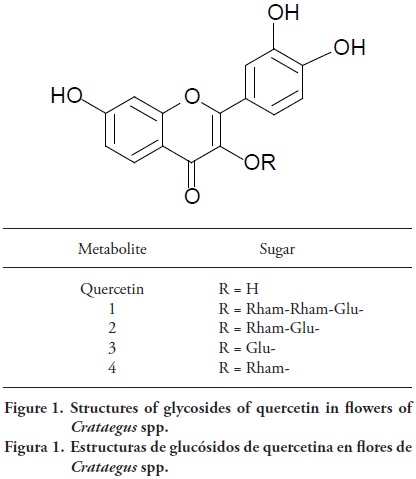
<body><![CDATA[<p align="justify"><font face="verdana" size="2"><b>RESULTS AND DISCUSSION</b></font></p>     <p align="justify"><font face="verdana" size="2"><b>Quantification of phenols and flavonoids</b></font></p>     <p align="justify"><font face="verdana" size="2">Content of phenols was higher that flavonoids (<a href="/img/revistas/agro/v46n7/a2t1.jpg" target="_blank">Table 1</a>). Bahorum <i>et al. </i>(1994) observed the same behavior in extracts of <i>C. monogyna. </i>Content of phenolic compounds was not statistically different within accessions (p&gt;0.05) (<a href="/img/revistas/agro/v46n7/a2t1.jpg" target="_blank">Table 1</a>). Results (7.7714.87 mg g<sup>&#150;1</sup> dry weight) were similar to that in flowers of seven species from Europe and Asia (0.45 &#150; 10.14 mg g<sup>&#150;1</sup> dry weight) (Edwards <i>et al., </i>2012).</font></p>     <p align="justify"><font face="verdana" size="2">The flavonoid content (2.85&#150;7.23 mg g<sup>&#150;1</sup> dry weight) was lower than in 12 European species (3.18 &#150; 19.4 mg g<sup>&#150;1</sup> dry weight) (Edwards <i>et al., </i>2012). A tendency of the flavonoids content was not observed within origin and type of accession.  Edwards <i>et al. </i>(2012) pointed out the wide variability of flavonoid content on hawthorn within and between species. Flavonoid content was highest in accessions 48 and 77 and lowest in accession 11 (<a href="/img/revistas/agro/v46n7/a2t1.jpg" target="_blank">Table 1</a>). The difference in flavonoid content is possibly due to the presence of procyanidins or other phenolic acids as described by Cui <i>et al. </i>(2006) and Liu <i>et al. </i>(2011) for fruits of <i>C. pinnatifida </i>containing procyanidins (19.7 %), phenols (1.27 % chlorogenic acid) and flavonoids (0.48 %). Bignami <i>et al. </i>(2003) report similar results of total flavonoids and phenols content in five accessions of <i>C. azarolus </i>L. flowers. The environmental factors do not seem to influence the phenolic compounds content among species and accessions analyzed, and the variations of the metabolites may be of genetic origin (Bignami <i>et al., </i>2003). There is no relationship between the total phenolic content and the antioxidant activity of berry, fruit wines and liquors (Robards <i>et al., </i>1999), a fact which should be taken into account when interpreting the results of any study, because some others metabolites can contribute to this activity. Therefore, it is useful to associate individual phenolic compounds with antioxidant activity because their particular structural characteristics can easily neutralize free radicals (Bors <i>et al., </i>1990; Cotelle <i>et </i>al., 1996; Robards <i>et al., </i>1999).</font></p>     <p align="justify"><font face="verdana" size="2">In our study the highest percentage of flavonoids was 0.72 %, close to the values described by Chang <i>et al. </i>(2002) and by Melikoglu <i>et al. </i>(2004) in leaves and flowers of <i>Crataegus </i>spp. and <i>C. microphylla </i>(0.7 %). According to Chang <i>et al. </i>(2002), flavonoid content varies from 0.1 to 1.0 % in <i>Crataegus </i>sp. fruits and from 1 to 2 % in leaves and flowers, which could be due to the method of extraction and analysis. However, the variation in the content of these metabolites therein some <i>Crataegus </i>species may be related to environmental conditions. The phenolic composition of fruits is determined by genetic and environmental factors but may be modified by oxidative reactions during processing and postharvest (Robards <i>et al., </i>1999). Kirakosyan <i>et al. </i>(2003; 2004) found high levels of phenolic compounds in leaves of <i>C. laevigata </i>and <i>C. monogyna </i>grown under drought and cold stress conditions.</font></p>     <p align="justify"><font face="verdana" size="2"><b>Identification of flavonoids by HPLC&#150;MS</b></font></p>     <p align="justify"><font face="verdana" size="2">The analysis by HPLC&#150;MS allowed to tentatively identify four glycosides of quercetin (<a href="#f1">Figure 1</a>; <a href="/img/revistas/agro/v46n7/a2t2.jpg" target="_blank">Table 2</a>). Using soft ionization techniques such as electrospray with serial mass spectrometry, the molecular mass and product ion spectrum of the aglycone moiety of a flavonoid <i>O</i>&#150;glycoside can be obtained relatively easily, particularly in positive ion mode, and the aglycone spectrum can be compared with those of standards in a mass spectral library. All accessions showed the typical UV spectra of quercetin 3<i>&#150;O</i>&#150;glycosides, and serial MS analysis confirmed quercetin as the aglycone. Glycosides 1, 3 and 4 have not been reported in <i>Crataegus </i>from America. Flavonoid 2 was confirmed as rutin (quercetin 3&#150;<i>O</i>&#150;rhamnosyl&#150;(1<img src="/img/revistas/agro/v46n7/a2s1.jpg">6)&#150;glucoside) against a standard, and it was assumed that glucose was also primary glycosidic sugar in the mono hexoside 3 and the branched tri glycoside 1, quercetin&#150;triglycoside have not been reported in <i>Crataegus </i>genus (Liu <i>et al., </i>2011). The serial MS spectra of 1 matched as quercetin 3&#150;O&#150;rhamnosyl&#150;(1&reg;2)&#150;&#91;rhamnosyl(1<img src="/img/revistas/agro/v46n7/a2s1.jpg">6)&#93;&#150;glucoside in an in&#150;house spectral library. Besides the analysis of the MS/MS spectra through the Library View <sup>TM</sup> Software (from AB Sciex, Foster City CA, USA) allowed to confirm these observations. The flavonoid 4 showed the loss of 146 following MS/MS and so was assigned as quercetin 3<i>&#150;O&#150; </i>rhamnoside (quercitrin).</font></p>     <p align="center"><font face="verdana" size="2"><a name="f1"></a></font></p>     <p align="center"><font face="verdana" size="2"><img src="/img/revistas/agro/v46n7/a2f1.jpg"></font></p>     <p align="justify"><font face="verdana" size="2">Quercetin is present in the European species <i>C. microphyila, C. oxyacantha, C. sinaica </i>and <i>C. monogyna </i>(Rehwald <i>et al., </i>1994; Shahat <i>et al., </i>2002; Melikoglu <i>et al., </i>2004). Furthermore, Urbonaviciute <i>et al. </i>(2006) and Zhang <i>et al. </i>(2001) suggested that rutin is commonly detected in <i>C. monogyna. </i>Rohr <i>et al. </i>(1999) identified by HPLC (&#150;)&#150;epicatechin and several procyanidins in <i>Crataegus </i>leaves and flowers, whereas Dauguet <i>et al. </i>(1993) identified some derivatives of kaempferol and other flavonoids from bee pollen of <i>C. monogyna. </i>Vitexin&#150;2"&#150;O&#150;rhamnoside, acetylvitexin&#150;2"&#150;O&#150;rhamnoside, rutin, hyperoside, vitexin, and chlorogenic acid are found in leaves and flowers of <i>C. monogyna </i>(Rehwald <i>et al., </i>1994). Fong and Bauman (2002) point out that the composition profile of phenolics in European hawthorn species also suggest that flavonoids were the markers for the differentiation of <i>C. monogyna, C. laevigata, </i>and <i>C. pentagyna </i>from one another.</font></p>     ]]></body>
<body><![CDATA[<p align="justify"><font face="verdana" size="2">The flavonoid glycosides 1&#150;4 differed qualitatively or quantitatively between the six accessions. Accessions 2 and 6, as well as 52, had the same flavonoids but their relative abundance was different (<a href="/img/revistas/agro/v46n7/a2t3.jpg" target="_blank">Table 3</a>). Also these accessions showed four glycosides and they had greatest relative abundance of quercetin 3<i>&#150;O</i>&#150;rhamnoside and accessions 11 (58 %), 48 (54 %) and 77 (66 %) showed greatest relative abundance of rutin. These accessions showed only three glycosides (1, 2, and 3), and its flavonoids profile was different to those of Europe and Asia (Rehwald <i>et al, </i>1994; Kirakosyan <i>et al, </i>2003; Cui <i>et al, </i>2006).</font></p>     <p align="justify"><font face="verdana" size="2">Glycoside 4 was the most abundant in the accessions 2 (58 %) and 6 (88 %) probably due to the fact that they belong to the same specie <i>(C. stipulosa) </i>and have the same origin (Chiapas). Glycoside 2 was found in higher proportion in the accessions 11 (58 %) and 48 (54 %) of <i>C. mexicana, </i>from Puebla. In the accessions 52 and 77 of <i>C. nelsoni </i>the glycosides 4 and 2 were the most abundant (62 and 66 %) and they come from Chiapas. These differences could be due to a genetic factors (similar within species) and not to their origin (Bignami <i>et al, </i>2003). Edwards <i>et al. </i>(2012) point out that this discrepancy indicate the need for a long&#150;term phytochemical study performed using a validated analytical method, and involves looking at the chemistry of a single species collected from multiple locations over a number of years. Such study may answer the question of whether previously reported concentration values vary as a result of species, location, seasonality, or research methodology. It would also allow for quantitative determination of chemotaxonomic differences between the species.</font></p>     <p align="justify"><font face="verdana" size="2"><b>Antioxidant activity</b></font></p>     <p align="justify"><font face="verdana" size="2">The antioxidant activity of extracts is due, in part, to the quercetin, but the presence of flavones and procyanidins, not studied in the present work, also might contribute to this activity (Robards <i>et al.,</i> 1999; Harborne and Williams 2000; Chang <i>et al., </i>2002). To this respect, the antioxidant activity of flavonols and the flavones is associated with their chemical structure. Those molecules with hydroxyl groups in 3' and 4' positions of the B ring and OH in C&#150;3 permit stable and efficient structures to capture free radicals, a requirement for the maximum antioxidant capacity (Bors <i>et al., </i>1990; Cotelle <i>et al., </i>1996; Robards <i>et al., </i>1999,). In this case, quercetin having a 3,5,7,3',4'&#150;pentahydroxy group showed stronger DPPH radical scavenging activity than kaempferol; this has 3,5,7,4'&#150;tetrahydroxy group, in the B&#150;ring of flavonol skeleton, which might enhance DPPH radical reducing activity (Rice&#150;Evans <i>et al, </i>1996; Okawa <i>et al., </i>2001). It is important to mention that some of the glycoside derivatives present lower antioxidant activity than the aglycones, since the hydroxy group at C&#150;3 in 3&#150;<i>O</i>&#150;glycoside may not contribute to scavenge the DPPH radical (Okawa <i>et al., </i>2001). This information explains the moderate antioxidant activity found in relation to the glycosides structure in the present study.</font></p>     <p align="justify"><font face="verdana" size="2">Pharmacokinetic studies indicate that the sugar fraction in the quercetin is important because retards its absorption due to the fact that the flavonol is absorbed well in the small intestine, whereas rutin is absorbed in the colon, after intestinal bacteria hydrolysis (Harborne and Williams, 2000).</font></p>     <p align="justify"><font face="verdana" size="2">Other studies indicate properties of the glycosides of quercetin; for instance higher spasmolytic activity than of quercetin has been demonstrated, due to its effect on the relaxation of the skeletal muscle. Additionally, numerous physiological effects beneficial to human health are attributed to the flavonoids as anticancer agents. Their action <i>in vitro </i>with low density lipoproteins inhibits the development of vascular diseases when they are consumed in a diet of fruits and vegetables (Rice&#150;Evans <i>et al., </i>1996; Okawa <i>et al., </i>2001; Schramm and German, 1998).</font></p>     <p align="justify"><font face="verdana" size="2">In this study were analyzed the type of flavonoids present in species of <i>Crataegus </i>found in Mexico. Furthermore, the profile and the abundance of the flavonoids detected in six accessions of the Germplasm Bank of the Universidad Aut&oacute;noma Chapingo, Mexico, will contribute to the chemistry of the 92 accessions morphologically characterized. Analysis of more accessions of the different plant species would be necessary to determine whether these differences were species specific or due to inter&#150;individual variation (Edwards <i>et al., </i>2012).</font></p>     <p align="justify"><font face="verdana" size="2">&nbsp;</font></p>     <p align="justify"><font face="verdana" size="2"><b>CONCLUSIONS</b></font></p>     <p align="justify"><font face="verdana" size="2">There are not differences in the content of total phenolics within accessions; it was not observed a tendency of the content of flavonoids within the origin and the type of accession neither. The content of total phenolics was similar to those of the flowers on seven species from Europe and Asia. Four flavonol glycosides were detected in flowers of Mexican species of <i>Crataegus </i>and provide evidence of the antioxidant activity of the extracts of flowers. The flowers of one accession presented the higher antioxidant activity and contrasts to the other accessions. This is the first report of composition and content of phenolic compounds and profile of flavonoids in the flowers of <i>Crataegus </i>spp. from Mexico.</font></p>     ]]></body>
<body><![CDATA[<p align="justify"><font face="verdana" size="2">&nbsp;</font></p>     <p align="justify"><font face="verdana" size="2"><b>LITERATURE CITED</b></font></p>     <!-- ref --><p align="justify"><font face="verdana" size="2">Amico, V., R. Chillemi, S. Mangiafico, C. Spatafora, and C. Tringali. 2008. Polyphenol&#150;enriched fractions from Sicilian grape pomace: HPLC&#150;DAD analysis and antioxidant activity. Bioresour. Technol. 99: 5960&#150;5966.    &nbsp;&nbsp;&nbsp;&nbsp;&nbsp;&nbsp;&nbsp;&nbsp;[&#160;<a href="javascript:void(0);" onclick="javascript: window.open('/scielo.php?script=sci_nlinks&ref=570240&pid=S1405-3195201200070000200001&lng=','','width=640,height=500,resizable=yes,scrollbars=1,menubar=yes,');">Links</a>&#160;]<!-- end-ref --></font></p>     <!-- ref --><p align="justify"><font face="verdana" size="2">Bahorum T., F. Trotin, J. Pommery, J. Vasseur, and M. Pinkas. 1994. Antioxidant activities of <i>Crataegus monogyna </i>extracts. Planta Med. 60: 323&#150;328.    &nbsp;&nbsp;&nbsp;&nbsp;&nbsp;&nbsp;&nbsp;&nbsp;[&#160;<a href="javascript:void(0);" onclick="javascript: window.open('/scielo.php?script=sci_nlinks&ref=570242&pid=S1405-3195201200070000200002&lng=','','width=640,height=500,resizable=yes,scrollbars=1,menubar=yes,');">Links</a>&#160;]<!-- end-ref --></font></p>     <!-- ref --><p align="justify"><font face="verdana" size="2">Bignami, C., M. Paolocci, A. Scossa, and G. Bertazza. 2003. Preliminary evaluation of nutritional and medicinal components of <i>Crataegus azarolus </i>fruits. Acta Hort. 597:95&#150;100.    &nbsp;&nbsp;&nbsp;&nbsp;&nbsp;&nbsp;&nbsp;&nbsp;[&#160;<a href="javascript:void(0);" onclick="javascript: window.open('/scielo.php?script=sci_nlinks&ref=570244&pid=S1405-3195201200070000200003&lng=','','width=640,height=500,resizable=yes,scrollbars=1,menubar=yes,');">Links</a>&#160;]<!-- end-ref --></font></p>     <!-- ref --><p align="justify"><font face="verdana" size="2">Bors, W., W. Heller, C. Michel, and S. Manfred. 1990. Flavonoids as antioxidants: determination of radical&#150;scavenging efficiencies. Methods Enzymol. 186: 343&#150;355.    &nbsp;&nbsp;&nbsp;&nbsp;&nbsp;&nbsp;&nbsp;&nbsp;[&#160;<a href="javascript:void(0);" onclick="javascript: window.open('/scielo.php?script=sci_nlinks&ref=570246&pid=S1405-3195201200070000200004&lng=','','width=640,height=500,resizable=yes,scrollbars=1,menubar=yes,');">Links</a>&#160;]<!-- end-ref --></font></p>     ]]></body>
<body><![CDATA[<!-- ref --><p align="justify"><font face="verdana" size="2">Chang, C., M. Yang, H. Wen, and J. Chern. 2002. Estimation of total flavonoids content in propolis by two complementary colorimetric methods. J. Food Drug Anal. 10: 176&#150;182.    &nbsp;&nbsp;&nbsp;&nbsp;&nbsp;&nbsp;&nbsp;&nbsp;[&#160;<a href="javascript:void(0);" onclick="javascript: window.open('/scielo.php?script=sci_nlinks&ref=570248&pid=S1405-3195201200070000200005&lng=','','width=640,height=500,resizable=yes,scrollbars=1,menubar=yes,');">Links</a>&#160;]<!-- end-ref --></font></p>     <!-- ref --><p align="justify"><font face="verdana" size="2">Chang, Q., Z. Zuo, F. Harrison, and M. S. Chow. 2002. Hawthorn. J. Clin. Pharmacol. 42: 605&#150;612.    &nbsp;&nbsp;&nbsp;&nbsp;&nbsp;&nbsp;&nbsp;&nbsp;[&#160;<a href="javascript:void(0);" onclick="javascript: window.open('/scielo.php?script=sci_nlinks&ref=570250&pid=S1405-3195201200070000200006&lng=','','width=640,height=500,resizable=yes,scrollbars=1,menubar=yes,');">Links</a>&#160;]<!-- end-ref --></font></p>     <!-- ref --><p align="justify"><font face="verdana" size="2">Cotelle, N., J. Bernier, J. Catteau, J. Pommery, J. Wallet, and E. M. Gaydou. 1996. Antioxidant properties of hydroxy&#150;flavones. Free Radical Bio. Med. 20: 35&#150;43.    &nbsp;&nbsp;&nbsp;&nbsp;&nbsp;&nbsp;&nbsp;&nbsp;[&#160;<a href="javascript:void(0);" onclick="javascript: window.open('/scielo.php?script=sci_nlinks&ref=570252&pid=S1405-3195201200070000200007&lng=','','width=640,height=500,resizable=yes,scrollbars=1,menubar=yes,');">Links</a>&#160;]<!-- end-ref --></font></p>     <!-- ref --><p align="justify"><font face="verdana" size="2">Craig, W. J. 1999. Health&#150;promoting properties of common herbs. Am. J. Clin. Nutr. 70 (Suppl.): 491S&#150;499S.    &nbsp;&nbsp;&nbsp;&nbsp;&nbsp;&nbsp;&nbsp;&nbsp;[&#160;<a href="javascript:void(0);" onclick="javascript: window.open('/scielo.php?script=sci_nlinks&ref=570254&pid=S1405-3195201200070000200008&lng=','','width=640,height=500,resizable=yes,scrollbars=1,menubar=yes,');">Links</a>&#160;]<!-- end-ref --></font></p>     <!-- ref --><p align="justify"><font face="verdana" size="2">Cui N., K. Nakamura, S. Tian, H. Kayahara, and Y. Tian. 2006. Polyphenolic content and physiological activities of Chinese Hawthorn extracts. Biosci. Biotech. Biochem. 70: 2948&#150;2956.    &nbsp;&nbsp;&nbsp;&nbsp;&nbsp;&nbsp;&nbsp;&nbsp;[&#160;<a href="javascript:void(0);" onclick="javascript: window.open('/scielo.php?script=sci_nlinks&ref=570256&pid=S1405-3195201200070000200009&lng=','','width=640,height=500,resizable=yes,scrollbars=1,menubar=yes,');">Links</a>&#160;]<!-- end-ref --></font></p>     ]]></body>
<body><![CDATA[<!-- ref --><p align="justify"><font face="verdana" size="2">Cuychens, F., and M. Claeys. 2004. Mass spectra in the structure analysis of flavonoids. J. Mass Spectrom. 39: 1&#150;15.    &nbsp;&nbsp;&nbsp;&nbsp;&nbsp;&nbsp;&nbsp;&nbsp;[&#160;<a href="javascript:void(0);" onclick="javascript: window.open('/scielo.php?script=sci_nlinks&ref=570258&pid=S1405-3195201200070000200010&lng=','','width=640,height=500,resizable=yes,scrollbars=1,menubar=yes,');">Links</a>&#160;]<!-- end-ref --></font></p>     <!-- ref --><p align="justify"><font face="verdana" size="2">Dauguet, J. C., M. Bert, J. Dolley, A. Bekaert, and G. Lewin. 1993. 8&#150;methoxykaempferol, 3&#150;neohesperidoside and other flavonoids from pollen of <i>Crataegus monogyna. </i>Phytochemistry 33: 1503&#150;1505.    &nbsp;&nbsp;&nbsp;&nbsp;&nbsp;&nbsp;&nbsp;&nbsp;[&#160;<a href="javascript:void(0);" onclick="javascript: window.open('/scielo.php?script=sci_nlinks&ref=570260&pid=S1405-3195201200070000200011&lng=','','width=640,height=500,resizable=yes,scrollbars=1,menubar=yes,');">Links</a>&#160;]<!-- end-ref --></font></p>     <!-- ref --><p align="justify"><font face="verdana" size="2">Edwards, J. E., P. N. Brown, N. Talent, T. A. Dickinson and P. R. Shipley. 2012. A review of the chemistry of the genus Crataegus. Phytochemistry 79: 5&#150;26.    &nbsp;&nbsp;&nbsp;&nbsp;&nbsp;&nbsp;&nbsp;&nbsp;[&#160;<a href="javascript:void(0);" onclick="javascript: window.open('/scielo.php?script=sci_nlinks&ref=570262&pid=S1405-3195201200070000200012&lng=','','width=640,height=500,resizable=yes,scrollbars=1,menubar=yes,');">Links</a>&#160;]<!-- end-ref --> </font></p>     <!-- ref --><p align="justify"><font face="verdana" size="2">Fong, H. H. S., and J. L Bauman. 2002. Hawthorn. J. Cardiovasc. Nurs.16: 1&#150;8.    &nbsp;&nbsp;&nbsp;&nbsp;&nbsp;&nbsp;&nbsp;&nbsp;[&#160;<a href="javascript:void(0);" onclick="javascript: window.open('/scielo.php?script=sci_nlinks&ref=570264&pid=S1405-3195201200070000200013&lng=','','width=640,height=500,resizable=yes,scrollbars=1,menubar=yes,');">Links</a>&#160;]<!-- end-ref --></font></p>     <!-- ref --><p align="justify"><font face="verdana" size="2">Garc&iacute;a, E. 1988. Modificaciones al Sistema de Clasificaci&oacute;n Clim&aacute;tica de K&oacute;pen. Editorial UNAM. M&eacute;xico, D. F., M&eacute;xico. 246 p.    &nbsp;&nbsp;&nbsp;&nbsp;&nbsp;&nbsp;&nbsp;&nbsp;[&#160;<a href="javascript:void(0);" onclick="javascript: window.open('/scielo.php?script=sci_nlinks&ref=570266&pid=S1405-3195201200070000200014&lng=','','width=640,height=500,resizable=yes,scrollbars=1,menubar=yes,');">Links</a>&#160;]<!-- end-ref --></font></p>     ]]></body>
<body><![CDATA[<!-- ref --><p align="justify"><font face="verdana" size="2">Harborne, J. B., and C. A. Williams. 2000. Review advances in flavonoid research since 1992. Phytochemistry 55: 481&#150;504.    &nbsp;&nbsp;&nbsp;&nbsp;&nbsp;&nbsp;&nbsp;&nbsp;[&#160;<a href="javascript:void(0);" onclick="javascript: window.open('/scielo.php?script=sci_nlinks&ref=570268&pid=S1405-3195201200070000200015&lng=','','width=640,height=500,resizable=yes,scrollbars=1,menubar=yes,');">Links</a>&#160;]<!-- end-ref --></font></p>     <!-- ref --><p align="justify"><font face="verdana" size="2">Iwashina, T. 2000. The structure and distribution of the flavonoids in plants. J. Plant Res. 113: 287&#150;299.    &nbsp;&nbsp;&nbsp;&nbsp;&nbsp;&nbsp;&nbsp;&nbsp;[&#160;<a href="javascript:void(0);" onclick="javascript: window.open('/scielo.php?script=sci_nlinks&ref=570270&pid=S1405-3195201200070000200016&lng=','','width=640,height=500,resizable=yes,scrollbars=1,menubar=yes,');">Links</a>&#160;]<!-- end-ref --></font></p>     <!-- ref --><p align="justify"><font face="verdana" size="2">Kirakosyan, A., P. Kaufman, S. Warbe, S. Zick, K. Aaronson, S. Bolling, and S. Ch. Chang. 2004. Applied environmental stresses to enhance the levels of polyphenolics in leaves of hawthorn plants. Physiol. Plantarum 121: 182&#150;186.    &nbsp;&nbsp;&nbsp;&nbsp;&nbsp;&nbsp;&nbsp;&nbsp;[&#160;<a href="javascript:void(0);" onclick="javascript: window.open('/scielo.php?script=sci_nlinks&ref=570272&pid=S1405-3195201200070000200017&lng=','','width=640,height=500,resizable=yes,scrollbars=1,menubar=yes,');">Links</a>&#160;]<!-- end-ref --></font></p>     <!-- ref --><p align="justify"><font face="verdana" size="2">Kirakosyan, A., E. Seymour, P. B. Kaufman, S. Warber, S. Bolling, and S. Ch. Chang. 2003. Antioxidant capacity of polyphenolic extracts from leaves of <i>Crataegus laevigata </i>and <i>Crataegus monogyna </i>(Hawthorn) subjected to drought and cold stress. J. Agr. Food Chem. 51: 3973&#150; 3976.    &nbsp;&nbsp;&nbsp;&nbsp;&nbsp;&nbsp;&nbsp;&nbsp;[&#160;<a href="javascript:void(0);" onclick="javascript: window.open('/scielo.php?script=sci_nlinks&ref=570274&pid=S1405-3195201200070000200018&lng=','','width=640,height=500,resizable=yes,scrollbars=1,menubar=yes,');">Links</a>&#160;]<!-- end-ref --></font></p>     <!-- ref --><p align="justify"><font face="verdana" size="2">Liu, P., H. Kallio, and B. Yang. 2011. Phenolic compounds in hawthorn <i>(Crataegus grayana) </i>fruits and leaves and changes during fruits ripening. J. Agric. Food Chem. 59: 11141&#150;11149.    &nbsp;&nbsp;&nbsp;&nbsp;&nbsp;&nbsp;&nbsp;&nbsp;[&#160;<a href="javascript:void(0);" onclick="javascript: window.open('/scielo.php?script=sci_nlinks&ref=570276&pid=S1405-3195201200070000200019&lng=','','width=640,height=500,resizable=yes,scrollbars=1,menubar=yes,');">Links</a>&#160;]<!-- end-ref --></font></p>     ]]></body>
<body><![CDATA[<!-- ref --><p align="justify"><font face="verdana" size="2">Mart&iacute;nez, M. 1979. Cat&aacute;logo de Nombres Vulgares y Cient&iacute;ficos de  Plantas Mexicanas.  Fondo  de  Cultura Econ&oacute;mica. M&eacute;xico, D. F., M&eacute;xico. 1247 p.    &nbsp;&nbsp;&nbsp;&nbsp;&nbsp;&nbsp;&nbsp;&nbsp;[&#160;<a href="javascript:void(0);" onclick="javascript: window.open('/scielo.php?script=sci_nlinks&ref=570278&pid=S1405-3195201200070000200020&lng=','','width=640,height=500,resizable=yes,scrollbars=1,menubar=yes,');">Links</a>&#160;]<!-- end-ref --> </font></p>     <!-- ref --><p align="justify"><font face="verdana" size="2">Melikoglu, G., L. Bitis, and A. H. Mericli. 2004. Flavonoids of <i>Crataegus microphylla. </i>Nat. Prod. Res. 18: 211&#150;213.    &nbsp;&nbsp;&nbsp;&nbsp;&nbsp;&nbsp;&nbsp;&nbsp;[&#160;<a href="javascript:void(0);" onclick="javascript: window.open('/scielo.php?script=sci_nlinks&ref=570280&pid=S1405-3195201200070000200021&lng=','','width=640,height=500,resizable=yes,scrollbars=1,menubar=yes,');">Links</a>&#160;]<!-- end-ref --> </font></p>     <!-- ref --><p align="justify"><font face="verdana" size="2">Nieto&#150;&Aacute;ngel, R. 2007. Colecci&oacute;n, conservaci&oacute;n y caracterizaci&oacute;n del tejocote <i>(Crataegus </i>spp.). <i>In: </i>Nieto&#150;Angel, R. (ed). Frutales Nativos, un Recurso Fitogen&eacute;tico de M&eacute;xico. Universidad Aut&oacute;noma  Chapingo.   Estado  de M&eacute;xico, M&eacute;xico. pp: 25&#150;107.    &nbsp;&nbsp;&nbsp;&nbsp;&nbsp;&nbsp;&nbsp;&nbsp;[&#160;<a href="javascript:void(0);" onclick="javascript: window.open('/scielo.php?script=sci_nlinks&ref=570282&pid=S1405-3195201200070000200022&lng=','','width=640,height=500,resizable=yes,scrollbars=1,menubar=yes,');">Links</a>&#160;]<!-- end-ref --> </font></p>     <!-- ref --><p align="justify"><font face="verdana" size="2">Nieto&#150;&Aacute;ngel, R., S. A. P&eacute;rez&#150;Ortega, C. A. Nu&ntilde;ez&#150;Col&iacute;n, J. Mart&iacute;nez&#150;Sol&iacute;s, and F. Gonz&aacute;lez&#150;Andr&eacute;s. 2009. Seed and endocarp traits as markers of the biodiversity of regional sources of germoplasm of tejocote <i>(Crataegus </i>spp.) from Central and Southern M&eacute;xico. Scientia Horticulturae 121 (2): 166&#150;170.    &nbsp;&nbsp;&nbsp;&nbsp;&nbsp;&nbsp;&nbsp;&nbsp;[&#160;<a href="javascript:void(0);" onclick="javascript: window.open('/scielo.php?script=sci_nlinks&ref=570284&pid=S1405-3195201200070000200023&lng=','','width=640,height=500,resizable=yes,scrollbars=1,menubar=yes,');">Links</a>&#160;]<!-- end-ref --></font></p>     <!-- ref --><p align="justify"><font face="verdana" size="2">N&uacute;&ntilde;ez&#150;Col&iacute;n, C. A., R. Nieto&#150;&Aacute;ngel, A. F. Barientos&#150;Priego, S. Segura, J. Sahag&uacute;n&#150;Castellanos, y C. Gonz&aacute;lez&#150;Andr&eacute;s. 2008. Distribuci&oacute;n y caracterizaci&oacute;n eco&#150;clim&aacute;tica del g&eacute;nero <i>Crataegus </i>L. (Rosaceae, Subfam. Meloideae) en M&eacute;xico. Rev. Chapingo Serie Hort. 14: 177&#150;184.    &nbsp;&nbsp;&nbsp;&nbsp;&nbsp;&nbsp;&nbsp;&nbsp;[&#160;<a href="javascript:void(0);" onclick="javascript: window.open('/scielo.php?script=sci_nlinks&ref=570286&pid=S1405-3195201200070000200024&lng=','','width=640,height=500,resizable=yes,scrollbars=1,menubar=yes,');">Links</a>&#160;]<!-- end-ref --></font></p>     ]]></body>
<body><![CDATA[<!-- ref --><p align="justify"><font face="verdana" size="2">Ody, P. 1993. The Herb Society's Complete Medicinal Herb. Dorling Kindersley Publishing. New York, USA. 192 p.    &nbsp;&nbsp;&nbsp;&nbsp;&nbsp;&nbsp;&nbsp;&nbsp;[&#160;<a href="javascript:void(0);" onclick="javascript: window.open('/scielo.php?script=sci_nlinks&ref=570288&pid=S1405-3195201200070000200025&lng=','','width=640,height=500,resizable=yes,scrollbars=1,menubar=yes,');">Links</a>&#160;]<!-- end-ref --></font></p>     <!-- ref --><p align="justify"><font face="verdana" size="2">Okawa, M., J. Kinjo, T. Nohara, and M. Ono. 2001. DPPH (1,1&#150;diphenyl&#150;2&#150;picrylhydrazyl) radical scavenging activity of flavonoids obtained from some medicinal plants. Biol. Pharm. Bull. 24: 1202&#150;1205.    &nbsp;&nbsp;&nbsp;&nbsp;&nbsp;&nbsp;&nbsp;&nbsp;[&#160;<a href="javascript:void(0);" onclick="javascript: window.open('/scielo.php?script=sci_nlinks&ref=570290&pid=S1405-3195201200070000200026&lng=','','width=640,height=500,resizable=yes,scrollbars=1,menubar=yes,');">Links</a>&#160;]<!-- end-ref --></font></p>     <!-- ref --><p align="justify"><font face="verdana" size="2">P&eacute;rez&#150;Ortega, S. A., C. A. N&uacute;&ntilde;ez&#150;Col&iacute;n, R. Nieto&#150;&Aacute;ngel, A. F. Barrientos&#150;Priego, y S. Segura. 2004. Los recursos gen&eacute;ticos de tejocote <i>(Crataegus spp.) </i>en M&eacute;xico. Variaci&oacute;n eco&#150;clim&aacute;tica. Proc. Interamer. Soc. Trop. Hort. 48: 149&#150;151.    &nbsp;&nbsp;&nbsp;&nbsp;&nbsp;&nbsp;&nbsp;&nbsp;[&#160;<a href="javascript:void(0);" onclick="javascript: window.open('/scielo.php?script=sci_nlinks&ref=570292&pid=S1405-3195201200070000200027&lng=','','width=640,height=500,resizable=yes,scrollbars=1,menubar=yes,');">Links</a>&#160;]<!-- end-ref --></font></p>     <!-- ref --><p align="justify"><font face="verdana" size="2">Phipps, J. B. 1997. Monograph of Northern Mexican Crataegus (Rosaceae, Subfam. Maloideae). Sida Botanical Miscelany No. 15. Botanical Research Institute of Texas, Inc. USA. 94 p.    &nbsp;&nbsp;&nbsp;&nbsp;&nbsp;&nbsp;&nbsp;&nbsp;[&#160;<a href="javascript:void(0);" onclick="javascript: window.open('/scielo.php?script=sci_nlinks&ref=570294&pid=S1405-3195201200070000200028&lng=','','width=640,height=500,resizable=yes,scrollbars=1,menubar=yes,');">Links</a>&#160;]<!-- end-ref --></font></p>     <!-- ref --><p align="justify"><font face="verdana" size="2">Phipps, J. B. 1998. Introduction to the red fruited hawthorns (<i>Crataegus, </i>Rosaceae) of western North America. Can. J. Bot. 76: 1863&#150;1899.    &nbsp;&nbsp;&nbsp;&nbsp;&nbsp;&nbsp;&nbsp;&nbsp;[&#160;<a href="javascript:void(0);" onclick="javascript: window.open('/scielo.php?script=sci_nlinks&ref=570296&pid=S1405-3195201200070000200029&lng=','','width=640,height=500,resizable=yes,scrollbars=1,menubar=yes,');">Links</a>&#160;]<!-- end-ref --> </font></p>     ]]></body>
<body><![CDATA[<!-- ref --><p align="justify"><font face="verdana" size="2">Phipps, J. B., R. J O'Kennon and R.W. Lance 2003. Hawthorns and Medlars. Timber Press, Inc. Portland, OR. 139 p.    &nbsp;&nbsp;&nbsp;&nbsp;&nbsp;&nbsp;&nbsp;&nbsp;[&#160;<a href="javascript:void(0);" onclick="javascript: window.open('/scielo.php?script=sci_nlinks&ref=570298&pid=S1405-3195201200070000200030&lng=','','width=640,height=500,resizable=yes,scrollbars=1,menubar=yes,');">Links</a>&#160;]<!-- end-ref --> </font></p>     <!-- ref --><p align="justify"><font face="verdana" size="2">Rehwald, A., B. Meier, and O. Sticher. 1994. Qualitative and quantitative reversed&#150;phase high&#150;perfomance liquid chromatography of flavonoids  in  <i>Crataegus </i>leaves and flowers. J. Chromatogr. A 677: 25&#150;33.    &nbsp;&nbsp;&nbsp;&nbsp;&nbsp;&nbsp;&nbsp;&nbsp;[&#160;<a href="javascript:void(0);" onclick="javascript: window.open('/scielo.php?script=sci_nlinks&ref=570300&pid=S1405-3195201200070000200031&lng=','','width=640,height=500,resizable=yes,scrollbars=1,menubar=yes,');">Links</a>&#160;]<!-- end-ref --> </font></p>     <!-- ref --><p align="justify"><font face="verdana" size="2">Rice&#150;Evans, C. A., N. J. Miller, and G. Paganga. 1996. Structure&#150;antioxidant activity relationships of flavonoids and phenolic acids. Free Radical Bio. Med. 20: 933&#150;956.    &nbsp;&nbsp;&nbsp;&nbsp;&nbsp;&nbsp;&nbsp;&nbsp;[&#160;<a href="javascript:void(0);" onclick="javascript: window.open('/scielo.php?script=sci_nlinks&ref=570302&pid=S1405-3195201200070000200032&lng=','','width=640,height=500,resizable=yes,scrollbars=1,menubar=yes,');">Links</a>&#160;]<!-- end-ref --></font></p>     <!-- ref --><p align="justify"><font face="verdana" size="2">Robards, K., P. D. Prenzler, G. Tucker, P. Swatsitang, and W. Glover. 1999. Phenolic compounds and their role in oxidative processes in fruits. Food Chem. 66: 401&#150;436.    &nbsp;&nbsp;&nbsp;&nbsp;&nbsp;&nbsp;&nbsp;&nbsp;[&#160;<a href="javascript:void(0);" onclick="javascript: window.open('/scielo.php?script=sci_nlinks&ref=570304&pid=S1405-3195201200070000200033&lng=','','width=640,height=500,resizable=yes,scrollbars=1,menubar=yes,');">Links</a>&#160;]<!-- end-ref --></font></p>     <!-- ref --><p align="justify"><font face="verdana" size="2">Rohr, G., B. Meier, and O. Sticher. 1999. Quantitative reversed&#150;phase high&#150;performance liquid chromatography of procyanidins in <i>Crataegus </i>leaves and flowers. J. Chromatogr. A 835: 59&#150;65.    &nbsp;&nbsp;&nbsp;&nbsp;&nbsp;&nbsp;&nbsp;&nbsp;[&#160;<a href="javascript:void(0);" onclick="javascript: window.open('/scielo.php?script=sci_nlinks&ref=570306&pid=S1405-3195201200070000200034&lng=','','width=640,height=500,resizable=yes,scrollbars=1,menubar=yes,');">Links</a>&#160;]<!-- end-ref --></font></p>     ]]></body>
<body><![CDATA[<!-- ref --><p align="justify"><font face="verdana" size="2">SAS (Statistical Analysis System). 1996. SAS/STAT User's Guide (Release 6.12.). SAS Institute Inc., Cary, N. C. 1028 p.    &nbsp;&nbsp;&nbsp;&nbsp;&nbsp;&nbsp;&nbsp;&nbsp;[&#160;<a href="javascript:void(0);" onclick="javascript: window.open('/scielo.php?script=sci_nlinks&ref=570308&pid=S1405-3195201200070000200035&lng=','','width=640,height=500,resizable=yes,scrollbars=1,menubar=yes,');">Links</a>&#160;]<!-- end-ref --></font></p>     <!-- ref --><p align="justify"><font face="verdana" size="2">Schramm, D. D., and J. B. German. 1998. Potential effects of flavonoids on the etiology of vascular disease. J. Nutr. Biochem. 9: 560&#150;566.    &nbsp;&nbsp;&nbsp;&nbsp;&nbsp;&nbsp;&nbsp;&nbsp;[&#160;<a href="javascript:void(0);" onclick="javascript: window.open('/scielo.php?script=sci_nlinks&ref=570310&pid=S1405-3195201200070000200036&lng=','','width=640,height=500,resizable=yes,scrollbars=1,menubar=yes,');">Links</a>&#160;]<!-- end-ref --></font></p>     <!-- ref --><p align="justify"><font face="verdana" size="2">Shahat, A., P. Cos, T. De Bruyne, S. Apers, F. M. Haammouda, S. I. Isamail, S. Azzam, M. Claeys, E. Goovaerts, L. Pieters, D. V. Berghe, and A. J. Lietinck. 2002. Antiviral and antioxidant of flavonoids and proanthocyanidins from <i>Crataegus sinaica. </i>Planta Med. 68: 539&#150;541.    &nbsp;&nbsp;&nbsp;&nbsp;&nbsp;&nbsp;&nbsp;&nbsp;[&#160;<a href="javascript:void(0);" onclick="javascript: window.open('/scielo.php?script=sci_nlinks&ref=570312&pid=S1405-3195201200070000200037&lng=','','width=640,height=500,resizable=yes,scrollbars=1,menubar=yes,');">Links</a>&#160;]<!-- end-ref --></font></p>     <!-- ref --><p align="justify"><font face="verdana" size="2">Urbonaviciute, A., V. Jakstas, O. Kornysova, V. Janulis, and A. Maruska. 2006. Capillary electrophoretic analysis of flavonoids in single&#150;styled hawthorn <i>(Crataegus monogyna </i>Jacq.) ethanolic extracts. J. Chromatogr. A 1112: 339&#150;344.    &nbsp;&nbsp;&nbsp;&nbsp;&nbsp;&nbsp;&nbsp;&nbsp;[&#160;<a href="javascript:void(0);" onclick="javascript: window.open('/scielo.php?script=sci_nlinks&ref=570314&pid=S1405-3195201200070000200038&lng=','','width=640,height=500,resizable=yes,scrollbars=1,menubar=yes,');">Links</a>&#160;]<!-- end-ref --></font></p>     <!-- ref --><p align="justify"><font face="verdana" size="2">Van Sumere, C. F., L. De Colman L, E. Everaert, D. De Keukeleire, and K. Vande Casteele. 1993. Phenolic markers in chemotaxonomy and plant cultivar recognition. <i>In: </i>Scarlbert, A. (ed). Polyphenolic Phenomena INRA Editions. Paris, France. pp: 257&#150;266.    &nbsp;&nbsp;&nbsp;&nbsp;&nbsp;&nbsp;&nbsp;&nbsp;[&#160;<a href="javascript:void(0);" onclick="javascript: window.open('/scielo.php?script=sci_nlinks&ref=570316&pid=S1405-3195201200070000200039&lng=','','width=640,height=500,resizable=yes,scrollbars=1,menubar=yes,');">Links</a>&#160;]<!-- end-ref --> .</font></p>     ]]></body>
<body><![CDATA[<!-- ref --><p align="justify"><font face="verdana" size="2">Waterman, P. G., and S. Mole. 1994. Analysis of Phenolic Plant Metabolites. Methods in Ecology. Blackwell Scientific Publications. Oxford, UK. 238 p.    &nbsp;&nbsp;&nbsp;&nbsp;&nbsp;&nbsp;&nbsp;&nbsp;[&#160;<a href="javascript:void(0);" onclick="javascript: window.open('/scielo.php?script=sci_nlinks&ref=570318&pid=S1405-3195201200070000200040&lng=','','width=640,height=500,resizable=yes,scrollbars=1,menubar=yes,');">Links</a>&#160;]<!-- end-ref --></font></p>     <!-- ref --><p align="justify"><font face="verdana" size="2">Zhang, Z., Qi Chang, M. Zhu, Y. Huang, W. K. K. Ho, and Z. Y. Chen. 2001. Characterization of antioxidants present in hawthorn fruits. J. Nutr. Biochem. 12: 144&#150;152.    &nbsp;&nbsp;&nbsp;&nbsp;&nbsp;&nbsp;&nbsp;&nbsp;[&#160;<a href="javascript:void(0);" onclick="javascript: window.open('/scielo.php?script=sci_nlinks&ref=570320&pid=S1405-3195201200070000200041&lng=','','width=640,height=500,resizable=yes,scrollbars=1,menubar=yes,');">Links</a>&#160;]<!-- end-ref --></font></p>     <!-- ref --><p align="justify"><font face="verdana" size="2">Zhang, Z., W. K. K. Ho, Y. Huang, A. E. Jame, L. W. Lam, and Z. Y. Chen. 2002. Hawthorn fruit is hypolipidemic in rabbits fed a high cholesterol diet. J. Nutr. 132: 5&#150;10.    &nbsp;&nbsp;&nbsp;&nbsp;&nbsp;&nbsp;&nbsp;&nbsp;[&#160;<a href="javascript:void(0);" onclick="javascript: window.open('/scielo.php?script=sci_nlinks&ref=570322&pid=S1405-3195201200070000200042&lng=','','width=640,height=500,resizable=yes,scrollbars=1,menubar=yes,');">Links</a>&#160;]<!-- end-ref --></font></p>      ]]></body><back>
<ref-list>
<ref id="B1">
<nlm-citation citation-type="journal">
<person-group person-group-type="author">
<name>
<surname><![CDATA[Amico]]></surname>
<given-names><![CDATA[V.]]></given-names>
</name>
<name>
<surname><![CDATA[Chillemi]]></surname>
<given-names><![CDATA[R.]]></given-names>
</name>
<name>
<surname><![CDATA[Mangiafico]]></surname>
<given-names><![CDATA[S.]]></given-names>
</name>
<name>
<surname><![CDATA[Spatafora]]></surname>
<given-names><![CDATA[C.]]></given-names>
</name>
<name>
<surname><![CDATA[Tringali]]></surname>
<given-names><![CDATA[C.]]></given-names>
</name>
</person-group>
<article-title xml:lang="en"><![CDATA[Polyphenol-enriched fractions from Sicilian grape pomace: HPLC-DAD analysis and antioxidant activity]]></article-title>
<source><![CDATA[Bioresour. Technol.]]></source>
<year>2008</year>
<volume>99</volume>
<page-range>5960-5966</page-range></nlm-citation>
</ref>
<ref id="B2">
<nlm-citation citation-type="journal">
<person-group person-group-type="author">
<name>
<surname><![CDATA[Bahorum]]></surname>
<given-names><![CDATA[T.]]></given-names>
</name>
<name>
<surname><![CDATA[Trotin]]></surname>
<given-names><![CDATA[F.]]></given-names>
</name>
<name>
<surname><![CDATA[Pommery]]></surname>
<given-names><![CDATA[J.]]></given-names>
</name>
<name>
<surname><![CDATA[Vasseur]]></surname>
<given-names><![CDATA[J.]]></given-names>
</name>
<name>
<surname><![CDATA[Pinkas]]></surname>
<given-names><![CDATA[M.]]></given-names>
</name>
</person-group>
<article-title xml:lang="en"><![CDATA[Antioxidant activities of Crataegus monogyna extracts]]></article-title>
<source><![CDATA[Planta Med.]]></source>
<year>1994</year>
<volume>60</volume>
<page-range>323-328</page-range></nlm-citation>
</ref>
<ref id="B3">
<nlm-citation citation-type="journal">
<person-group person-group-type="author">
<name>
<surname><![CDATA[Bignami]]></surname>
<given-names><![CDATA[C.]]></given-names>
</name>
<name>
<surname><![CDATA[Paolocci]]></surname>
<given-names><![CDATA[M.]]></given-names>
</name>
<name>
<surname><![CDATA[Scossa]]></surname>
<given-names><![CDATA[A.]]></given-names>
</name>
<name>
<surname><![CDATA[Bertazza]]></surname>
<given-names><![CDATA[G.]]></given-names>
</name>
</person-group>
<article-title xml:lang="en"><![CDATA[Preliminary evaluation of nutritional and medicinal components of Crataegus azarolus fruits]]></article-title>
<source><![CDATA[Acta Hort.]]></source>
<year>2003</year>
<volume>597</volume>
<page-range>95-100</page-range></nlm-citation>
</ref>
<ref id="B4">
<nlm-citation citation-type="journal">
<person-group person-group-type="author">
<name>
<surname><![CDATA[Bors]]></surname>
<given-names><![CDATA[W.]]></given-names>
</name>
<name>
<surname><![CDATA[Heller]]></surname>
<given-names><![CDATA[W.]]></given-names>
</name>
<name>
<surname><![CDATA[Michel]]></surname>
<given-names><![CDATA[C.]]></given-names>
</name>
<name>
<surname><![CDATA[Manfred]]></surname>
<given-names><![CDATA[S.]]></given-names>
</name>
</person-group>
<article-title xml:lang="en"><![CDATA[Flavonoids as antioxidants: determination of radical-scavenging efficiencies]]></article-title>
<source><![CDATA[Methods Enzymol.]]></source>
<year>1990</year>
<volume>186</volume>
<page-range>343-355</page-range></nlm-citation>
</ref>
<ref id="B5">
<nlm-citation citation-type="journal">
<person-group person-group-type="author">
<name>
<surname><![CDATA[Chang]]></surname>
<given-names><![CDATA[C.]]></given-names>
</name>
<name>
<surname><![CDATA[Yang]]></surname>
<given-names><![CDATA[M.]]></given-names>
</name>
<name>
<surname><![CDATA[Wen]]></surname>
<given-names><![CDATA[H.]]></given-names>
</name>
<name>
<surname><![CDATA[Chern]]></surname>
<given-names><![CDATA[J.]]></given-names>
</name>
</person-group>
<article-title xml:lang="en"><![CDATA[Estimation of total flavonoids content in propolis by two complementary colorimetric methods]]></article-title>
<source><![CDATA[J. Food Drug Anal.]]></source>
<year>2002</year>
<volume>10</volume>
<page-range>176-182</page-range></nlm-citation>
</ref>
<ref id="B6">
<nlm-citation citation-type="journal">
<person-group person-group-type="author">
<name>
<surname><![CDATA[Chang]]></surname>
<given-names><![CDATA[Q.]]></given-names>
</name>
<name>
<surname><![CDATA[Zuo]]></surname>
<given-names><![CDATA[Z.]]></given-names>
</name>
<name>
<surname><![CDATA[Harrison]]></surname>
<given-names><![CDATA[F.]]></given-names>
</name>
<name>
<surname><![CDATA[Chow]]></surname>
<given-names><![CDATA[M. S.]]></given-names>
</name>
</person-group>
<article-title xml:lang="en"><![CDATA[Hawthorn]]></article-title>
<source><![CDATA[J. Clin. Pharmacol.]]></source>
<year>2002</year>
<volume>42</volume>
<page-range>605-612</page-range></nlm-citation>
</ref>
<ref id="B7">
<nlm-citation citation-type="journal">
<person-group person-group-type="author">
<name>
<surname><![CDATA[Cotelle]]></surname>
<given-names><![CDATA[N.]]></given-names>
</name>
<name>
<surname><![CDATA[Bernier]]></surname>
<given-names><![CDATA[J.]]></given-names>
</name>
<name>
<surname><![CDATA[Catteau]]></surname>
<given-names><![CDATA[J.]]></given-names>
</name>
<name>
<surname><![CDATA[Pommery]]></surname>
<given-names><![CDATA[J.]]></given-names>
</name>
<name>
<surname><![CDATA[Wallet]]></surname>
<given-names><![CDATA[J.]]></given-names>
</name>
<name>
<surname><![CDATA[Gaydou]]></surname>
<given-names><![CDATA[E. M.]]></given-names>
</name>
</person-group>
<article-title xml:lang="en"><![CDATA[Antioxidant properties of hydroxy-flavones]]></article-title>
<source><![CDATA[Free Radical Bio. Med.]]></source>
<year>1996</year>
<volume>20</volume>
<page-range>35-43</page-range></nlm-citation>
</ref>
<ref id="B8">
<nlm-citation citation-type="journal">
<person-group person-group-type="author">
<name>
<surname><![CDATA[Craig]]></surname>
<given-names><![CDATA[W. J.]]></given-names>
</name>
</person-group>
<article-title xml:lang="en"><![CDATA[Health-promoting properties of common herbs]]></article-title>
<source><![CDATA[Am. J. Clin. Nutr.]]></source>
<year>1999</year>
<volume>70</volume>
<numero>^sSuppl.</numero>
<issue>^sSuppl.</issue>
<supplement>Suppl.</supplement>
<page-range>491S-499S</page-range></nlm-citation>
</ref>
<ref id="B9">
<nlm-citation citation-type="journal">
<person-group person-group-type="author">
<name>
<surname><![CDATA[Cui]]></surname>
<given-names><![CDATA[N.]]></given-names>
</name>
<name>
<surname><![CDATA[Nakamura]]></surname>
<given-names><![CDATA[K.]]></given-names>
</name>
<name>
<surname><![CDATA[Tian]]></surname>
<given-names><![CDATA[S.]]></given-names>
</name>
<name>
<surname><![CDATA[Kayahara]]></surname>
<given-names><![CDATA[H.]]></given-names>
</name>
<name>
<surname><![CDATA[Tian]]></surname>
<given-names><![CDATA[Y.]]></given-names>
</name>
</person-group>
<article-title xml:lang="en"><![CDATA[Polyphenolic content and physiological activities of Chinese Hawthorn extracts]]></article-title>
<source><![CDATA[Biosci. Biotech. Biochem.]]></source>
<year>2006</year>
<volume>70</volume>
<page-range>2948-2956</page-range></nlm-citation>
</ref>
<ref id="B10">
<nlm-citation citation-type="journal">
<person-group person-group-type="author">
<name>
<surname><![CDATA[Cuychens]]></surname>
<given-names><![CDATA[F.]]></given-names>
</name>
<name>
<surname><![CDATA[Claeys]]></surname>
<given-names><![CDATA[M.]]></given-names>
</name>
</person-group>
<article-title xml:lang="en"><![CDATA[Mass spectra in the structure analysis of flavonoids]]></article-title>
<source><![CDATA[J. Mass Spectrom.]]></source>
<year>2004</year>
<volume>39</volume>
<page-range>1-15</page-range></nlm-citation>
</ref>
<ref id="B11">
<nlm-citation citation-type="journal">
<person-group person-group-type="author">
<name>
<surname><![CDATA[Dauguet]]></surname>
<given-names><![CDATA[J. C.]]></given-names>
</name>
<name>
<surname><![CDATA[Bert]]></surname>
<given-names><![CDATA[M.]]></given-names>
</name>
<name>
<surname><![CDATA[Dolley]]></surname>
<given-names><![CDATA[J.]]></given-names>
</name>
<name>
<surname><![CDATA[Bekaert]]></surname>
<given-names><![CDATA[A.]]></given-names>
</name>
<name>
<surname><![CDATA[Lewin]]></surname>
<given-names><![CDATA[G.]]></given-names>
</name>
</person-group>
<article-title xml:lang="en"><![CDATA[8-methoxykaempferol, 3-neohesperidoside and other flavonoids from pollen of Crataegus monogyna]]></article-title>
<source><![CDATA[Phytochemistry]]></source>
<year>1993</year>
<volume>33</volume>
<page-range>1503-1505</page-range></nlm-citation>
</ref>
<ref id="B12">
<nlm-citation citation-type="journal">
<person-group person-group-type="author">
<name>
<surname><![CDATA[Edwards]]></surname>
<given-names><![CDATA[J. E.]]></given-names>
</name>
<name>
<surname><![CDATA[Brown]]></surname>
<given-names><![CDATA[P. N.]]></given-names>
</name>
<name>
<surname><![CDATA[Talent]]></surname>
<given-names><![CDATA[N.]]></given-names>
</name>
<name>
<surname><![CDATA[Dickinson]]></surname>
<given-names><![CDATA[T. A.]]></given-names>
</name>
<name>
<surname><![CDATA[Shipley]]></surname>
<given-names><![CDATA[P. R.]]></given-names>
</name>
</person-group>
<article-title xml:lang="en"><![CDATA[A review of the chemistry of the genus Crataegus]]></article-title>
<source><![CDATA[Phytochemistry]]></source>
<year>2012</year>
<volume>79</volume>
<page-range>5-26</page-range></nlm-citation>
</ref>
<ref id="B13">
<nlm-citation citation-type="journal">
<person-group person-group-type="author">
<name>
<surname><![CDATA[Fong]]></surname>
<given-names><![CDATA[H. H. S.]]></given-names>
</name>
<name>
<surname><![CDATA[Bauman]]></surname>
<given-names><![CDATA[J. L]]></given-names>
</name>
</person-group>
<article-title xml:lang="en"><![CDATA[Hawthorn]]></article-title>
<source><![CDATA[J. Cardiovasc. Nurs.]]></source>
<year>2002</year>
<volume>16</volume>
<page-range>1-8</page-range></nlm-citation>
</ref>
<ref id="B14">
<nlm-citation citation-type="book">
<person-group person-group-type="author">
<name>
<surname><![CDATA[García]]></surname>
<given-names><![CDATA[E]]></given-names>
</name>
</person-group>
<source><![CDATA[Modificaciones al Sistema de Clasificación Climática de Kópen]]></source>
<year>1988</year>
<page-range>246</page-range><publisher-loc><![CDATA[México, D. F. ]]></publisher-loc>
<publisher-name><![CDATA[UNAM]]></publisher-name>
</nlm-citation>
</ref>
<ref id="B15">
<nlm-citation citation-type="journal">
<person-group person-group-type="author">
<name>
<surname><![CDATA[Harborne]]></surname>
<given-names><![CDATA[J. B.]]></given-names>
</name>
<name>
<surname><![CDATA[Williams]]></surname>
<given-names><![CDATA[C. A.]]></given-names>
</name>
</person-group>
<article-title xml:lang="en"><![CDATA[Review advances in flavonoid research since 1992]]></article-title>
<source><![CDATA[Phytochemistry]]></source>
<year>2000</year>
<volume>55</volume>
<page-range>481-504</page-range></nlm-citation>
</ref>
<ref id="B16">
<nlm-citation citation-type="journal">
<person-group person-group-type="author">
<name>
<surname><![CDATA[Iwashina]]></surname>
<given-names><![CDATA[T]]></given-names>
</name>
</person-group>
<article-title xml:lang="en"><![CDATA[The structure and distribution of the flavonoids in plants]]></article-title>
<source><![CDATA[J. Plant Res.]]></source>
<year>2000</year>
<volume>113</volume>
<page-range>287-299</page-range></nlm-citation>
</ref>
<ref id="B17">
<nlm-citation citation-type="journal">
<person-group person-group-type="author">
<name>
<surname><![CDATA[Kirakosyan]]></surname>
<given-names><![CDATA[A.]]></given-names>
</name>
<name>
<surname><![CDATA[Kaufman]]></surname>
<given-names><![CDATA[P.]]></given-names>
</name>
<name>
<surname><![CDATA[Warbe]]></surname>
<given-names><![CDATA[S.]]></given-names>
</name>
<name>
<surname><![CDATA[Zick]]></surname>
<given-names><![CDATA[S.]]></given-names>
</name>
<name>
<surname><![CDATA[Aaronson]]></surname>
<given-names><![CDATA[K.]]></given-names>
</name>
<name>
<surname><![CDATA[Bolling]]></surname>
<given-names><![CDATA[S.]]></given-names>
</name>
<name>
<surname><![CDATA[Chang]]></surname>
<given-names><![CDATA[S. Ch.]]></given-names>
</name>
</person-group>
<article-title xml:lang="en"><![CDATA[Applied environmental stresses to enhance the levels of polyphenolics in leaves of hawthorn plants]]></article-title>
<source><![CDATA[Physiol. Plantarum]]></source>
<year>2004</year>
<volume>121</volume>
<page-range>182-186</page-range></nlm-citation>
</ref>
<ref id="B18">
<nlm-citation citation-type="journal">
<person-group person-group-type="author">
<name>
<surname><![CDATA[Kirakosyan]]></surname>
<given-names><![CDATA[A.]]></given-names>
</name>
<name>
<surname><![CDATA[Seymour]]></surname>
<given-names><![CDATA[E.]]></given-names>
</name>
<name>
<surname><![CDATA[Kaufman]]></surname>
<given-names><![CDATA[P. B.]]></given-names>
</name>
<name>
<surname><![CDATA[Warber]]></surname>
<given-names><![CDATA[S.]]></given-names>
</name>
<name>
<surname><![CDATA[Bolling]]></surname>
<given-names><![CDATA[S.]]></given-names>
</name>
<name>
<surname><![CDATA[Chang]]></surname>
<given-names><![CDATA[S. Ch.]]></given-names>
</name>
</person-group>
<article-title xml:lang="en"><![CDATA[Antioxidant capacity of polyphenolic extracts from leaves of Crataegus laevigata and Crataegus monogyna (Hawthorn) subjected to drought and cold stress]]></article-title>
<source><![CDATA[J. Agr. Food Chem.]]></source>
<year>2003</year>
<volume>51</volume>
<page-range>3973- 3976</page-range></nlm-citation>
</ref>
<ref id="B19">
<nlm-citation citation-type="journal">
<person-group person-group-type="author">
<name>
<surname><![CDATA[Liu]]></surname>
<given-names><![CDATA[P.]]></given-names>
</name>
<name>
<surname><![CDATA[Kallio]]></surname>
<given-names><![CDATA[H.]]></given-names>
</name>
<name>
<surname><![CDATA[Yang]]></surname>
<given-names><![CDATA[B.]]></given-names>
</name>
</person-group>
<article-title xml:lang="en"><![CDATA[Phenolic compounds in hawthorn (Crataegus grayana) fruits and leaves and changes during fruits ripening]]></article-title>
<source><![CDATA[J. Agric. Food Chem.]]></source>
<year>2011</year>
<volume>59</volume>
<page-range>11141-11149</page-range></nlm-citation>
</ref>
<ref id="B20">
<nlm-citation citation-type="book">
<person-group person-group-type="author">
<name>
<surname><![CDATA[Martínez]]></surname>
<given-names><![CDATA[M.]]></given-names>
</name>
</person-group>
<source><![CDATA[Catálogo de Nombres Vulgares y Científicos de Plantas Mexicanas]]></source>
<year>1979</year>
<page-range>1247</page-range><publisher-loc><![CDATA[México^eD. F. D. F.]]></publisher-loc>
<publisher-name><![CDATA[Fondo de Cultura Económica]]></publisher-name>
</nlm-citation>
</ref>
<ref id="B21">
<nlm-citation citation-type="journal">
<person-group person-group-type="author">
<name>
<surname><![CDATA[Melikoglu]]></surname>
<given-names><![CDATA[G.]]></given-names>
</name>
<name>
<surname><![CDATA[Bitis]]></surname>
<given-names><![CDATA[L.]]></given-names>
</name>
<name>
<surname><![CDATA[Mericli]]></surname>
<given-names><![CDATA[A. H.]]></given-names>
</name>
</person-group>
<article-title xml:lang="en"><![CDATA[Flavonoids of Crataegus microphylla]]></article-title>
<source><![CDATA[Nat. Prod. Res.]]></source>
<year>2004</year>
<volume>18</volume>
<page-range>211-213</page-range></nlm-citation>
</ref>
<ref id="B22">
<nlm-citation citation-type="book">
<person-group person-group-type="author">
<name>
<surname><![CDATA[Nieto-Ángel]]></surname>
<given-names><![CDATA[R.]]></given-names>
</name>
</person-group>
<article-title xml:lang="es"><![CDATA[Colección, conservación y caracterización del tejocote (Crataegus spp.)]]></article-title>
<person-group person-group-type="editor">
<name>
<surname><![CDATA[Nieto-Angel]]></surname>
<given-names><![CDATA[R.]]></given-names>
</name>
</person-group>
<source><![CDATA[Frutales Nativos, un Recurso Fitogenético de México]]></source>
<year>2007</year>
<page-range>25-107</page-range><publisher-loc><![CDATA[^eEstado de México Estado de México]]></publisher-loc>
<publisher-name><![CDATA[Universidad Autónoma Chapingo]]></publisher-name>
</nlm-citation>
</ref>
<ref id="B23">
<nlm-citation citation-type="journal">
<person-group person-group-type="author">
<name>
<surname><![CDATA[Nieto-Ángel]]></surname>
<given-names><![CDATA[R.]]></given-names>
</name>
<name>
<surname><![CDATA[Pérez-Ortega]]></surname>
<given-names><![CDATA[S. A.]]></given-names>
</name>
<name>
<surname><![CDATA[Nuñez-Colín]]></surname>
<given-names><![CDATA[C. A.]]></given-names>
</name>
<name>
<surname><![CDATA[Martínez-Solís]]></surname>
<given-names><![CDATA[J.]]></given-names>
</name>
<name>
<surname><![CDATA[González-Andrés]]></surname>
<given-names><![CDATA[F.]]></given-names>
</name>
</person-group>
<article-title xml:lang="en"><![CDATA[Seed and endocarp traits as markers of the biodiversity of regional sources of germoplasm of tejocote (Crataegus spp.) from Central and Southern México]]></article-title>
<source><![CDATA[Scientia Horticulturae]]></source>
<year>2009</year>
<volume>121</volume>
<numero>2</numero>
<issue>2</issue>
<page-range>166-170</page-range></nlm-citation>
</ref>
<ref id="B24">
<nlm-citation citation-type="journal">
<person-group person-group-type="author">
<name>
<surname><![CDATA[Núñez-Colín]]></surname>
<given-names><![CDATA[C. A.]]></given-names>
</name>
<name>
<surname><![CDATA[Nieto-Ángel]]></surname>
<given-names><![CDATA[R.]]></given-names>
</name>
<name>
<surname><![CDATA[Barientos-Priego]]></surname>
<given-names><![CDATA[A. F.]]></given-names>
</name>
<name>
<surname><![CDATA[Segura]]></surname>
<given-names><![CDATA[S.]]></given-names>
</name>
<name>
<surname><![CDATA[Sahagún-Castellanos]]></surname>
<given-names><![CDATA[J.]]></given-names>
</name>
<name>
<surname><![CDATA[González-Andrés]]></surname>
<given-names><![CDATA[C.]]></given-names>
</name>
</person-group>
<article-title xml:lang="es"><![CDATA[Distribución y caracterización eco-climática del género Crataegus L. (Rosaceae, Subfam. Meloideae) en México.]]></article-title>
<source><![CDATA[Rev. Chapingo Serie Hort.]]></source>
<year>2008</year>
<volume>14</volume>
<page-range>177-184</page-range></nlm-citation>
</ref>
<ref id="B25">
<nlm-citation citation-type="book">
<person-group person-group-type="author">
<name>
<surname><![CDATA[Ody]]></surname>
<given-names><![CDATA[P]]></given-names>
</name>
</person-group>
<source><![CDATA[The Herb Society's Complete Medicinal Herb]]></source>
<year>1993</year>
<page-range>192</page-range><publisher-loc><![CDATA[New York ]]></publisher-loc>
<publisher-name><![CDATA[Dorling Kindersley Publishing]]></publisher-name>
</nlm-citation>
</ref>
<ref id="B26">
<nlm-citation citation-type="journal">
<person-group person-group-type="author">
<name>
<surname><![CDATA[Okawa]]></surname>
<given-names><![CDATA[M.]]></given-names>
</name>
<name>
<surname><![CDATA[Kinjo]]></surname>
<given-names><![CDATA[J.]]></given-names>
</name>
<name>
<surname><![CDATA[Nohara]]></surname>
<given-names><![CDATA[T.]]></given-names>
</name>
<name>
<surname><![CDATA[Ono]]></surname>
<given-names><![CDATA[M.]]></given-names>
</name>
</person-group>
<article-title xml:lang="en"><![CDATA[DPPH (1,1-diphenyl-2-picrylhydrazyl) radical scavenging activity of flavonoids obtained from some medicinal plants]]></article-title>
<source><![CDATA[Biol. Pharm. Bull.]]></source>
<year>2001</year>
<volume>24</volume>
<page-range>1202-1205</page-range></nlm-citation>
</ref>
<ref id="B27">
<nlm-citation citation-type="journal">
<person-group person-group-type="author">
<name>
<surname><![CDATA[Pérez-Ortega]]></surname>
<given-names><![CDATA[S. A.]]></given-names>
</name>
<name>
<surname><![CDATA[Núñez-Colín]]></surname>
<given-names><![CDATA[C. A.]]></given-names>
</name>
<name>
<surname><![CDATA[Nieto-Ángel]]></surname>
<given-names><![CDATA[R.]]></given-names>
</name>
<name>
<surname><![CDATA[Barrientos-Priego]]></surname>
<given-names><![CDATA[A. F.]]></given-names>
</name>
<name>
<surname><![CDATA[Segura]]></surname>
<given-names><![CDATA[S.]]></given-names>
</name>
</person-group>
<article-title xml:lang="en"><![CDATA[Los recursos genéticos de tejocote (Crataegus spp.) en México. Variación eco-climática.]]></article-title>
<source><![CDATA[Proc. Interamer. Soc. Trop. Hort.]]></source>
<year>2004</year>
<volume>48</volume>
<page-range>149-151</page-range></nlm-citation>
</ref>
<ref id="B28">
<nlm-citation citation-type="journal">
<person-group person-group-type="author">
<name>
<surname><![CDATA[Phipps]]></surname>
<given-names><![CDATA[J. B.]]></given-names>
</name>
</person-group>
<article-title xml:lang="en"><![CDATA[Monograph of Northern Mexican Crataegus (Rosaceae, Subfam. Maloideae)]]></article-title>
<source><![CDATA[Sida Botanical Miscelany]]></source>
<year>1997</year>
<numero>15</numero>
<issue>15</issue>
<page-range>94</page-range><publisher-name><![CDATA[Botanical Research Institute of Texas, Inc.]]></publisher-name>
</nlm-citation>
</ref>
<ref id="B29">
<nlm-citation citation-type="journal">
<person-group person-group-type="author">
<name>
<surname><![CDATA[Phipps]]></surname>
<given-names><![CDATA[J. B]]></given-names>
</name>
</person-group>
<article-title xml:lang="en"><![CDATA[Introduction to the red fruited hawthorns (Crataegus, Rosaceae) of western North America]]></article-title>
<source><![CDATA[Can. J. Bot.]]></source>
<year>1998</year>
<volume>76</volume>
<page-range>1863-1899</page-range></nlm-citation>
</ref>
<ref id="B30">
<nlm-citation citation-type="book">
<person-group person-group-type="author">
<name>
<surname><![CDATA[Phipps]]></surname>
<given-names><![CDATA[J. B.]]></given-names>
</name>
<name>
<surname><![CDATA[O'Kennon]]></surname>
<given-names><![CDATA[R. J]]></given-names>
</name>
<name>
<surname><![CDATA[Lance]]></surname>
<given-names><![CDATA[R.W.]]></given-names>
</name>
</person-group>
<source><![CDATA[Hawthorns and Medlars]]></source>
<year>2003</year>
<page-range>139</page-range><publisher-loc><![CDATA[Portland^eOR OR]]></publisher-loc>
<publisher-name><![CDATA[Timber Press, Inc.]]></publisher-name>
</nlm-citation>
</ref>
<ref id="B31">
<nlm-citation citation-type="journal">
<person-group person-group-type="author">
<name>
<surname><![CDATA[Rehwald]]></surname>
<given-names><![CDATA[A.]]></given-names>
</name>
<name>
<surname><![CDATA[Meier]]></surname>
<given-names><![CDATA[B.]]></given-names>
</name>
<name>
<surname><![CDATA[Sticher]]></surname>
<given-names><![CDATA[O.]]></given-names>
</name>
</person-group>
<article-title xml:lang="en"><![CDATA[Qualitative and quantitative reversed-phase high-perfomance liquid chromatography of flavonoids in Crataegus leaves and flowers]]></article-title>
<source><![CDATA[J. Chromatogr. A]]></source>
<year>1994</year>
<volume>677</volume>
<page-range>25-33</page-range></nlm-citation>
</ref>
<ref id="B32">
<nlm-citation citation-type="journal">
<person-group person-group-type="author">
<name>
<surname><![CDATA[Rice-Evans]]></surname>
<given-names><![CDATA[C. A.]]></given-names>
</name>
<name>
<surname><![CDATA[Miller]]></surname>
<given-names><![CDATA[N. J.]]></given-names>
</name>
<name>
<surname><![CDATA[Paganga]]></surname>
<given-names><![CDATA[G.]]></given-names>
</name>
</person-group>
<article-title xml:lang="en"><![CDATA[Structure-antioxidant activity relationships of flavonoids and phenolic acids]]></article-title>
<source><![CDATA[Free Radical Bio. Med.]]></source>
<year>1996</year>
<volume>20</volume>
<page-range>933-956</page-range></nlm-citation>
</ref>
<ref id="B33">
<nlm-citation citation-type="journal">
<person-group person-group-type="author">
<name>
<surname><![CDATA[Robards]]></surname>
<given-names><![CDATA[K.]]></given-names>
</name>
<name>
<surname><![CDATA[Prenzler]]></surname>
<given-names><![CDATA[P. D.]]></given-names>
</name>
<name>
<surname><![CDATA[Tucker]]></surname>
<given-names><![CDATA[G.]]></given-names>
</name>
<name>
<surname><![CDATA[Swatsitang]]></surname>
<given-names><![CDATA[P.]]></given-names>
</name>
<name>
<surname><![CDATA[Glover]]></surname>
<given-names><![CDATA[W.]]></given-names>
</name>
</person-group>
<article-title xml:lang="en"><![CDATA[Phenolic compounds and their role in oxidative processes in fruits]]></article-title>
<source><![CDATA[Food Chem.]]></source>
<year>1999</year>
<volume>66</volume>
<page-range>401-436</page-range></nlm-citation>
</ref>
<ref id="B34">
<nlm-citation citation-type="journal">
<person-group person-group-type="author">
<name>
<surname><![CDATA[Rohr]]></surname>
<given-names><![CDATA[G.]]></given-names>
</name>
<name>
<surname><![CDATA[Meier]]></surname>
<given-names><![CDATA[B.]]></given-names>
</name>
<name>
<surname><![CDATA[Sticher]]></surname>
<given-names><![CDATA[O.]]></given-names>
</name>
</person-group>
<article-title xml:lang="en"><![CDATA[Quantitative reversed-phase high-performance liquid chromatography of procyanidins in Crataegus leaves and flowers]]></article-title>
<source><![CDATA[J. Chromatogr. A]]></source>
<year>1999</year>
<volume>835</volume>
<page-range>59-65</page-range></nlm-citation>
</ref>
<ref id="B35">
<nlm-citation citation-type="book">
<collab>SAS (Statistical Analysis System)</collab>
<source><![CDATA[SAS/STAT User's Guide (Release 6.12.)]]></source>
<year>1996</year>
<page-range>1028</page-range><publisher-loc><![CDATA[Cary^eN. C. N. C.]]></publisher-loc>
<publisher-name><![CDATA[SAS Institute Inc.]]></publisher-name>
</nlm-citation>
</ref>
<ref id="B36">
<nlm-citation citation-type="journal">
<person-group person-group-type="author">
<name>
<surname><![CDATA[Schramm]]></surname>
<given-names><![CDATA[D. D.]]></given-names>
</name>
<name>
<surname><![CDATA[German]]></surname>
<given-names><![CDATA[J. B.]]></given-names>
</name>
</person-group>
<article-title xml:lang="en"><![CDATA[Potential effects of flavonoids on the etiology of vascular disease]]></article-title>
<source><![CDATA[J. Nutr. Biochem.]]></source>
<year>1998</year>
<volume>9</volume>
<page-range>560-566</page-range></nlm-citation>
</ref>
<ref id="B37">
<nlm-citation citation-type="journal">
<person-group person-group-type="author">
<name>
<surname><![CDATA[Shahat]]></surname>
<given-names><![CDATA[A.]]></given-names>
</name>
<name>
<surname><![CDATA[Cos]]></surname>
<given-names><![CDATA[P.]]></given-names>
</name>
<name>
<surname><![CDATA[De Bruyne]]></surname>
<given-names><![CDATA[T.]]></given-names>
</name>
<name>
<surname><![CDATA[Apers]]></surname>
<given-names><![CDATA[S.]]></given-names>
</name>
<name>
<surname><![CDATA[Haammouda]]></surname>
<given-names><![CDATA[F. M.]]></given-names>
</name>
<name>
<surname><![CDATA[Isamail]]></surname>
<given-names><![CDATA[S. I.]]></given-names>
</name>
<name>
<surname><![CDATA[Azzam]]></surname>
<given-names><![CDATA[S.]]></given-names>
</name>
<name>
<surname><![CDATA[Claeys]]></surname>
<given-names><![CDATA[M.]]></given-names>
</name>
<name>
<surname><![CDATA[Goovaerts]]></surname>
<given-names><![CDATA[E.]]></given-names>
</name>
<name>
<surname><![CDATA[Pieters]]></surname>
<given-names><![CDATA[L.]]></given-names>
</name>
<name>
<surname><![CDATA[Berghe]]></surname>
<given-names><![CDATA[D. V.]]></given-names>
</name>
<name>
<surname><![CDATA[Lietinck]]></surname>
<given-names><![CDATA[A. J.]]></given-names>
</name>
</person-group>
<article-title xml:lang="en"><![CDATA[Antiviral and antioxidant of flavonoids and proanthocyanidins from Crataegus sinaica]]></article-title>
<source><![CDATA[Planta Med.]]></source>
<year>2002</year>
<volume>68</volume>
<page-range>539-541</page-range></nlm-citation>
</ref>
<ref id="B38">
<nlm-citation citation-type="journal">
<person-group person-group-type="author">
<name>
<surname><![CDATA[Urbonaviciute]]></surname>
<given-names><![CDATA[A.]]></given-names>
</name>
<name>
<surname><![CDATA[Jakstas]]></surname>
<given-names><![CDATA[V.]]></given-names>
</name>
<name>
<surname><![CDATA[Kornysova]]></surname>
<given-names><![CDATA[O.]]></given-names>
</name>
<name>
<surname><![CDATA[Janulis]]></surname>
<given-names><![CDATA[V.]]></given-names>
</name>
<name>
<surname><![CDATA[Maruska]]></surname>
<given-names><![CDATA[A.]]></given-names>
</name>
</person-group>
<article-title xml:lang="en"><![CDATA[Capillary electrophoretic analysis of flavonoids in single-styled hawthorn (Crataegus monogyna Jacq.) ethanolic extracts]]></article-title>
<source><![CDATA[J. Chromatogr. A]]></source>
<year>2006</year>
<volume>1112</volume>
<page-range>339-344</page-range></nlm-citation>
</ref>
<ref id="B39">
<nlm-citation citation-type="">
<person-group person-group-type="author">
<name>
<surname><![CDATA[Van Sumere]]></surname>
<given-names><![CDATA[C. F.]]></given-names>
</name>
<name>
<surname><![CDATA[L. De Colman]]></surname>
<given-names><![CDATA[L]]></given-names>
</name>
<name>
<surname><![CDATA[Everaert]]></surname>
<given-names><![CDATA[E.]]></given-names>
</name>
<name>
<surname><![CDATA[De Keukeleire]]></surname>
<given-names><![CDATA[D.]]></given-names>
</name>
<name>
<surname><![CDATA[Vande Casteele]]></surname>
<given-names><![CDATA[K.]]></given-names>
</name>
</person-group>
<article-title xml:lang="en"><![CDATA[Phenolic markers in chemotaxonomy and plant cultivar recognition]]></article-title>
<person-group person-group-type="editor">
<name>
<surname><![CDATA[Scarlbert]]></surname>
<given-names><![CDATA[A.]]></given-names>
</name>
</person-group>
<source><![CDATA[Polyphenolic Phenomena INRA Editions]]></source>
<year>1993</year>
<page-range>257-266.</page-range><publisher-loc><![CDATA[Paris ]]></publisher-loc>
</nlm-citation>
</ref>
<ref id="B40">
<nlm-citation citation-type="book">
<person-group person-group-type="author">
<name>
<surname><![CDATA[Waterman]]></surname>
<given-names><![CDATA[P. G.]]></given-names>
</name>
<name>
<surname><![CDATA[Mole]]></surname>
<given-names><![CDATA[S.]]></given-names>
</name>
</person-group>
<source><![CDATA[Analysis of Phenolic Plant Metabolites. Methods in Ecology]]></source>
<year>1994</year>
<page-range>238</page-range><publisher-loc><![CDATA[Oxford ]]></publisher-loc>
<publisher-name><![CDATA[Blackwell Scientific Publications]]></publisher-name>
</nlm-citation>
</ref>
<ref id="B41">
<nlm-citation citation-type="journal">
<person-group person-group-type="author">
<name>
<surname><![CDATA[Zhang]]></surname>
<given-names><![CDATA[Z.]]></given-names>
</name>
<name>
<surname><![CDATA[Chang]]></surname>
<given-names><![CDATA[Qi]]></given-names>
</name>
<name>
<surname><![CDATA[Zhu]]></surname>
<given-names><![CDATA[M.]]></given-names>
</name>
<name>
<surname><![CDATA[Huang]]></surname>
<given-names><![CDATA[Y.]]></given-names>
</name>
<name>
<surname><![CDATA[Ho]]></surname>
<given-names><![CDATA[W. K. K.]]></given-names>
</name>
<name>
<surname><![CDATA[Chen]]></surname>
<given-names><![CDATA[Z. Y.]]></given-names>
</name>
</person-group>
<article-title xml:lang="en"><![CDATA[Characterization of antioxidants present in hawthorn fruits]]></article-title>
<source><![CDATA[J. Nutr. Biochem.]]></source>
<year>2001</year>
<volume>12</volume>
<page-range>144-152</page-range></nlm-citation>
</ref>
<ref id="B42">
<nlm-citation citation-type="journal">
<person-group person-group-type="author">
<name>
<surname><![CDATA[Zhang]]></surname>
<given-names><![CDATA[Z.]]></given-names>
</name>
<name>
<surname><![CDATA[Ho]]></surname>
<given-names><![CDATA[W. K. K.]]></given-names>
</name>
<name>
<surname><![CDATA[Huang]]></surname>
<given-names><![CDATA[Y.]]></given-names>
</name>
<name>
<surname><![CDATA[Jame]]></surname>
<given-names><![CDATA[A. E.]]></given-names>
</name>
<name>
<surname><![CDATA[Lam]]></surname>
<given-names><![CDATA[L. W.]]></given-names>
</name>
<name>
<surname><![CDATA[Chen]]></surname>
<given-names><![CDATA[Z. Y.]]></given-names>
</name>
</person-group>
<article-title xml:lang="en"><![CDATA[Hawthorn fruit is hypolipidemic in rabbits fed a high cholesterol diet]]></article-title>
<source><![CDATA[J. Nutr.]]></source>
<year>2002</year>
<volume>132</volume>
<page-range>5-10</page-range></nlm-citation>
</ref>
</ref-list>
</back>
</article>