<?xml version="1.0" encoding="ISO-8859-1"?><article xmlns:mml="http://www.w3.org/1998/Math/MathML" xmlns:xlink="http://www.w3.org/1999/xlink" xmlns:xsi="http://www.w3.org/2001/XMLSchema-instance">
<front>
<journal-meta>
<journal-id>1026-8774</journal-id>
<journal-title><![CDATA[Revista mexicana de ciencias geológicas]]></journal-title>
<abbrev-journal-title><![CDATA[Rev. mex. cienc. geol]]></abbrev-journal-title>
<issn>1026-8774</issn>
<publisher>
<publisher-name><![CDATA[Universidad Nacional Autónoma de México, Instituto de Geología]]></publisher-name>
</publisher>
</journal-meta>
<article-meta>
<article-id>S1026-87742009000100008</article-id>
<title-group>
<article-title xml:lang="en"><![CDATA[Morphology, taxonomy and distribution of the Early Cretaceous coral genus Holocoenia (Scleractinia) and its first record in the Caribbean]]></article-title>
<article-title xml:lang="es"><![CDATA[Morfología, taxonomía y distribución del género de coral Holocoenia (Scleractinia) del Cretácico Temprano y su primer registro en el Caribe]]></article-title>
</title-group>
<contrib-group>
<contrib contrib-type="author">
<name>
<surname><![CDATA[Löser]]></surname>
<given-names><![CDATA[Hannes]]></given-names>
</name>
<xref ref-type="aff" rid="A01"/>
</contrib>
</contrib-group>
<aff id="A01">
<institution><![CDATA[,Universidad Nacional Autónoma de México Instituto de Geología ]]></institution>
<addr-line><![CDATA[ ]]></addr-line>
</aff>
<pub-date pub-type="pub">
<day>00</day>
<month>04</month>
<year>2009</year>
</pub-date>
<pub-date pub-type="epub">
<day>00</day>
<month>04</month>
<year>2009</year>
</pub-date>
<volume>26</volume>
<numero>1</numero>
<fpage>93</fpage>
<lpage>103</lpage>
<copyright-statement/>
<copyright-year/>
<self-uri xlink:href="http://www.scielo.org.mx/scielo.php?script=sci_arttext&amp;pid=S1026-87742009000100008&amp;lng=en&amp;nrm=iso"></self-uri><self-uri xlink:href="http://www.scielo.org.mx/scielo.php?script=sci_abstract&amp;pid=S1026-87742009000100008&amp;lng=en&amp;nrm=iso"></self-uri><self-uri xlink:href="http://www.scielo.org.mx/scielo.php?script=sci_pdf&amp;pid=S1026-87742009000100008&amp;lng=en&amp;nrm=iso"></self-uri><abstract abstract-type="short" xml:lang="en"><p><![CDATA[Although ten species are currently assigned to the Early Cretaceous coral genus Holocoenia, its characteristics are poorly known. Using material from the type locality of the type species Astrea micrantha along with described and undescribed material from France, Mexico, Poland and Spain, the genus is revised. It has a cerioid form with small calices, compact septa, a styliform columella, and an incomplete septothecal to synapticulothecal wall. Provisionally, it is assigned to the family Thamnasteriidae, being closely related to Mesomorpha and Thamnasteria. The genera Stereocaenia and Paretallonia are considered junior synonyms of Holocoenia. According to the present revision the genus contains only two species, which range from the Valanginian to the Aptian. Holocoenia micrantha is restricted to the central Tethys whereas Holocoenia jaccardi extends geographically from South America (Aptian of Argentina) and southern North America (Aptian of Puebla, Mexico) to the eastern Tethys (Hauterivian of Georgia). The indication of the genus in the San Juan Raya area in Puebla is the first indication in Central America. While the genus has been indicated in only eleven outcrop areas, making it rather rare, in many of these localities samples of Holocoenia are common.]]></p></abstract>
<abstract abstract-type="short" xml:lang="es"><p><![CDATA[Aunque actualmente existen diez especies asignadas al género de coral Holocoenia, poco sabemos sobre sus características. En este trabajo se revisa este género usando muestras de la localidad tipo de la especie Astrea micrantha, así como material nuevo de Francia, Polonia y España. Este género es cerioide con cálices pequeños, septos compactos, una columnila estiliforme y una pared incompleta de septotecal a sinapticulotecal. De manera provisional, el género está asignado a la familia Thamnasteriidae, muy cercano a Mesomorpha y Thamnasteria. Los géneros Stereocaenia y Paretallonia se consideran como sinónimos de Holocoenia. Según la revisión presente, el género tiene solamente dos especies, que tienen un rango desde el Valanginiano hasta el Aptiano. Holocoenia micrantha está restringido al mar de Tethys central, mientras que Holocoenia jaccardi muestra una distribución más amplia desde Sudamérica (Aptiano de Argentina) y América central (Aptiano de Puebla) hasta el mar de Tethys oriental (Hauteriviano de Georgia). Las evidencias del género en el área de San Juan Raya en Puebla, representan los primeros registros para América central. Aunque el género ha sido registrado solamente en once localidades y por tanto se considera raro, en muchas de estas localidades las muestras de Holocoenia son abundantes.]]></p></abstract>
<kwd-group>
<kwd lng="en"><![CDATA[corals]]></kwd>
<kwd lng="en"><![CDATA[Scleractinia]]></kwd>
<kwd lng="en"><![CDATA[Holocoenia]]></kwd>
<kwd lng="en"><![CDATA[Early Cretaceous]]></kwd>
<kwd lng="es"><![CDATA[corales]]></kwd>
<kwd lng="es"><![CDATA[Scleractinia]]></kwd>
<kwd lng="es"><![CDATA[Holocoenia]]></kwd>
<kwd lng="es"><![CDATA[Cretácico Temprano]]></kwd>
</kwd-group>
</article-meta>
</front><body><![CDATA[  	    <p align="center"><font face="verdana" size="4"><b>Morphology, taxonomy and distribution of the Early Cretaceous coral genus <i>Holocoenia</i> (Scleractinia) and its first record in the Caribbean</b></font></p> 	    <p align="center"><font face="verdana" size="2">&nbsp;</font></p> 	    <p align="center"><font face="verdana" size="3"><b>Morfolog&iacute;a, taxonom&iacute;a y distribuci&oacute;n del g&eacute;nero de coral <i>Holocoenia</i> (Scleractinia) del Cret&aacute;cico Temprano y su primer registro en el Caribe</b></font></p> 	    <p align="center"><font face="verdana" size="2">&nbsp;</font></p> 	    <p align="center"><font face="verdana" size="2"><b>Hannes L&ouml;ser</b></font></p> 	    <p align="justify"><font face="verdana" size="2">&nbsp;</font></p> 	    <p align="justify"><font face="verdana" size="2"><i>Estaci&oacute;n Regional del Noroeste, Instituto de Geolog&iacute;a, Universidad Nacional Aut&oacute;noma de M&eacute;xico, Blvd. Luis Donaldo Colosio S/N y Madrid, 83250 Hermosillo, Sonora, Mexico.</i> <a href="mailto:loeser@paleotax.de">loeser@paleotax.de</a></font></p> 	    <p align="justify"><font face="verdana" size="2">&nbsp;</font></p> 	    <p align="justify"><font face="verdana" size="2">Manuscript received: April 14, 2008    ]]></body>
<body><![CDATA[<br>     Corrected manuscript received: September 17, 2008    <br>     Manuscript accepted: September 19, 2008</font></p> 	    <p align="justify"><font face="verdana" size="2">&nbsp;</font></p> 	    <p align="justify"><font face="verdana" size="2"><b>ABSTRACT</b></font></p> 	    <p align="justify"><font face="verdana" size="2">Although ten species are currently assigned to the Early Cretaceous coral genus <i>Holocoenia</i>, its characteristics are poorly known. Using material from the type locality of the type species <i>Astrea micrantha</i> along with described and undescribed material from France, Mexico, Poland and Spain, the genus is revised. It has a cerioid form with small calices, compact septa, a styliform columella, and an incomplete septothecal to synapticulothecal wall. Provisionally, it is assigned to the family Thamnasteriidae, being closely related to Mesomorpha and Thamnasteria. The genera Stereocaenia and Paretallonia are considered junior synonyms of <i>Holocoenia</i>. According to the present revision the genus contains only two species, which range from the Valanginian to the Aptian. <i>Holocoenia</i> micrantha is restricted to the central Tethys whereas <i>Holocoenia</i> jaccardi extends geographically from South America (Aptian of Argentina) and southern North America (Aptian of Puebla, Mexico) to the eastern Tethys (Hauterivian of Georgia). The indication of the genus in the San Juan Raya area in Puebla is the first indication in Central America. While the genus has been indicated in only eleven outcrop areas, making it rather rare, in many of these localities samples of <i>Holocoenia</i> are common.</font></p> 	    <p align="justify"><font face="verdana" size="2"><b>Key words:</b> corals, Scleractinia, <i>Holocoenia</i>, Early Cretaceous.</font></p> 	    <p align="justify"><font face="verdana" size="2">&nbsp;</font></p> 	    <p align="justify"><font face="verdana" size="2"><b>RESUMEN</b></font></p> 	    <p align="justify"><font face="verdana" size="2">Aunque actualmente existen diez especies asignadas al g&eacute;nero de coral <i>Holocoenia</i>, poco sabemos sobre sus caracter&iacute;sticas. En este trabajo se revisa este g&eacute;nero usando muestras de la localidad tipo de la especie <i>Astrea micrantha</i>, as&iacute; como material nuevo de Francia, Polonia y Espa&ntilde;a. Este g&eacute;nero es cerioide con c&aacute;lices peque&ntilde;os, septos compactos, una columnila estiliforme y una pared incompleta de septotecal a sinapticulotecal. De manera provisional, el g&eacute;nero est&aacute; asignado a la familia Thamnasteriidae, muy cercano a Mesomorpha y Thamnasteria. Los g&eacute;neros Stereocaenia y Paretallonia se consideran como sin&oacute;nimos de <i>Holocoenia</i>. Seg&uacute;n la revisi&oacute;n presente, el g&eacute;nero tiene solamente dos especies, que tienen un rango desde el Valanginiano hasta el Aptiano. <i>Holocoenia</i> micrantha est&aacute; restringido al mar de Tethys central, mientras que <i>Holocoenia</i> jaccardi muestra una distribuci&oacute;n m&aacute;s amplia desde Sudam&eacute;rica (Aptiano de Argentina) y Am&eacute;rica central (Aptiano de Puebla) hasta el mar de Tethys oriental (Hauteriviano de Georgia). Las evidencias del g&eacute;nero en el &aacute;rea de San Juan Raya en Puebla, representan los primeros registros para Am&eacute;rica central. Aunque el g&eacute;nero ha sido registrado solamente en once localidades y por tanto se considera raro, en muchas de estas localidades las muestras de <i>Holocoenia</i> son abundantes.</font></p> 	    <p align="justify"><font face="verdana" size="2"><b>Palabras clave:</b> corales, Scleractinia, <i>Holocoenia</i>, Cret&aacute;cico Temprano.</font></p> 	    ]]></body>
<body><![CDATA[<p align="justify"><font face="verdana" size="2">&nbsp;</font></p> 	    <p align="justify"><font face="verdana" size="2"><b>INTRODUCTION</b></font></p> 	    <p align="justify"><font face="verdana" size="2">The early Cretaceous coral genus <i>Holocoenia</i> is poorly known and interpreted by various authors in different ways. Even though the genus is rare, its species are distributed over a wide area and are punctually abundant. Because the genus was never properly revised, the species are distributed among three synonymous genera. The systematic study of multiple coral collections and the sampling of various outcrops have brought together a considerable amount of material allowing the present revision at the generic and species level.</font></p> 	    <p align="justify"><font face="verdana" size="2">The genus <i>Holocoenia</i> was first established by Milne&#150;Edwards and Haime (1851: 99) on the basis of the species <i>Astrea micrantha</i> Roemer, 1841. The type species was designated by Milne&#150;Edwards and Haime (1851) and the genus was monospecific when created. <i>Astrea micrantha</i> derives from the Hils conglomerates, a shallow marine, siliciclastic transgressional sediment which cropped out in Lower Saxon (Germany). These sediments were formed during the transgression of the very Late Valanginian to very Early Hauterivian (late Paucinodum / early Amblygonium zone; Michael 1974). The type locality of <i>Astrea micrantha</i> is Berklingen, a small village a few kilometers southeast of Braunschweig. The outcrop, probably a sand or clay pit, does not exist anymore. The description of the new genus by Milne&#150;Edwards and Haime (1851) is brief and more a differentiating diagnosis: in comparison to <i>Thamnasteria</i> the genus <i>Holocoenia</i> is characterised by having a prominent styliform columella and septa with "entire edges" (a smooth distal margin).</font></p> 	    <p align="justify"><font face="verdana" size="2">D'Orbigny (1850a) established about 300 new species, all with very brief descriptions and lacking illustrations. Among many others, he created a species <i>Centrastrea collinaria</i> with the type locality Fontenoy in the Yonne department (France). The small village Fontenoy is practically surrounded by fields where the Calcaire &agrave; Spatangus, brownish&#150;yellow oolithic marls, crops out. These sediments are extremely rich in fossils and contain a very diverse coral fauna (L&ouml;ser, 2001). They belong to the basal Hauterivian (zone of <i>Acanthodiscus radiatus</i>) and represent remains of the same transgressions that formed the Hils conglomerates. The holotype of <i>Centrastrea collinaria</i> (MNHN, Coll. d'Orbigny B14279, old number 5292) could not be found (but recorded in the online catalogue of the MNHN).</font></p> 	    <p align="justify"><font face="verdana" size="2">The first illustration of <i>Centrastrea collinaria</i> was provided by de Fromentel (1857). He assigned the species to <i>Holocoenia</i> and discussed also the synonymy of the three species (<i>C. collinaria, C. excavata, C. microphyllia</i>) established by d'Orbigny (1850a). De Fromentel (1857) also mentioned <i>Holocoenia</i> micrantha providing a quoted description. Both species, <i>H. collinaria</i> and <i>H. micrantha</i> have the same calicular dimensions and the same number of septa, but de Fromentel (1857) did not discuss the synonymy of these species, probably because of the absence of correct data on <i>H. micrantha</i>.</font></p> 	    <p align="justify"><font face="verdana" size="2">B&ouml;lsche (1866) revised the corals from the Hils conglomerates and gave a detailed description, but no illustration of <i>Holocoenia micrantha</i>. He did, however, mention that <i>Centrastrea collinaria</i> and <i>Holocoenia micrantha</i> are the same species.</font></p> 	    <p align="justify"><font face="verdana" size="2">De Fromentel (1883) described and illustrated both species again, but he gave no calicular diameter for <i>Centrastrea collinaria</i> (but did for <i>H. micrantha</i>). In the following years, <i>Centrastrea collinaria</i> was quoted with Centrastrea or <i>Holocoenia</i> as the genus name, whereas <i>Holocoenia micrantha</i> always retained the same genus name. Both species were mentioned occasionally in the literature, but they were almost always from the Late Valanginian / Early Hauterivian of Lower Saxon or from the Early Hauterivian of the Paris basin.</font></p> 	    <p align="justify"><font face="verdana" size="2">Through the years, various species were attributed to <i>Holocoenia</i>, such as <i>Holocoenia indica</i> Stoliczka, 1873, <i>Holocoenia ramosa</i> Stoliczka, 1873, <i>Holocoenia jaccardi</i> Koby, 1897, <i>Holocoenia chelussii</i> Prever, 1909, <i>Holocoenia formai</i> Prever, 1909, and <i>Holocoenia polymorpha</i> Prever, 1909.</font></p> 	    <p align="justify"><font face="verdana" size="2">Alloiteau (1952: 629) mentioned that <i>Holocaenia</i> (sic) is a genus with a poorly known structure, differing from <i>Thamnasteria</i> by the compactness of septa, which are always in a low number. Practically en <i>passant</i> Alloiteau (1952) established the genus <i>Stereocaenia</i>. As the type species, Alloiteau designated <i>Holocaenia collinaria</i> de Fromentel. However, de Fromentel never established such a species and therefore Alloiteau will say, that de Fromentel had misidentified his material: it did not belong to <i>Centrastrea collinaria</i> d'Orbigny, 1850 sensu stricto but to another species for which Alloiteau (1952) created a new genus. According to the ICZN (1999, article 11.10) <i>Stereocaenia collinaria</i> therefore becomes available as the type species with Alloiteau (1952) as its author. The type is represented by the sample depicted by de Fromentel (1857), kept at the MNHN under the number M03564. The description of the new genus is short: "differs from the previous &#91;= <i>Holocoenia</i>&#93; by the lateral fusion of rudimentary septa with the numerous septa of the first and second cycle and the presence of numerous scattered calcification centres". The illustration (Alloiteau 1952, fig. 112) is poor. The "fusion of rudimentary septa" are interpreted herein as the septa of the second generation which are connected by synapticulae to the septa of the first generation. The microstructural interpretation is suspect because in material from the Hauterivian of the Paris basin, microstructures are rarely preserved. As can easily be counted in this illustration, the total number of septa is eighteen, with little difference from <i>Holocoenia micrantha</i>, and there is no trace of septa connected to each other.</font></p> 	    ]]></body>
<body><![CDATA[<p align="justify"><font face="verdana" size="2">Alloiteau (1957) provided a detailed description of <i>Holocoenia</i> based on material from the Hauterivian of the Paris basin which Alloiteau (1957: 205) believed to belong to <i>Holocoenia micrantha</i> &#91;"sp&eacute;cimens &hellip; que nous avons d&eacute;termin&eacute;s d'apr&egrave;s les descriptions et figurations originales (celle&#150;ci tr&egrave;s mauvaises)"; "we have determined them after the original descriptions and illustrations (which are very poor)"&#93;. Thus it is questionable how Alloiteau managed to determine material using poor descriptions and illustrations. The original description and depiction are indeed poor, and the differentiating diagnosis given by Milne&#150;Edwards and Haime (1851) does not provide much additional information. Only the description provided by B&ouml;lsche (1866) gives precise information. He was the only researcher who studied material from the type locality of the type species of <i>Holocoenia</i> despite of Roemer. However, Alloiteau (1957) provided a diagnosis different from that of B&ouml;lsche (1866), suggesting that Alloiteau most likely had material different from <i>Holocoenia micrantha</i> in hand, and with this material it was easy to separate <i>Holocoenia</i> from <i>Stereocaenia</i>. B&ouml;lsche (1866) had already mentioned that one could easily become confused because <i>Holocoenia micrantha</i> looks like <i>Actinastrea</i> (<i>e.g., Actinastrea cornueliana</i> d'Orbigny, 1850, has the same appearance and dimensions as <i>Holocoenia micrantha</i>), and it is likely that Alloiteau (1957) examined a species of this genus. Since he did not give an illustration of his material, it remains uncertain what Alloiteau considered <i>Holocoenia</i>.</font></p> 	    <p align="justify"><font face="verdana" size="2">Alloiteau (1957) gave also a detailed description of <i>Centrastrea collinaria</i> d'Orbigny, 1850, and assigned it as type species to the genus <i>Stereocaenia</i>. Since he had previously assigned (Alloiteau, 1952) <i>Centrastrea collinaria</i> d'Orbigny, 1850 sensu de Fromentel, 1857 as type species, this second designation is invalid. It is confusing that the illustrations of <i>Stereocaenia collinaria</i> in Alloiteau (1957) are all labeled as "Stereocaenia (Holocoenia) collinaria de From. sp.", indicating a possible synonymy of both genera. The distinction between Stereocaenia and <i>Holocoenia</i> as proposed by Alloiteau (1957: 207) is not based on any type material but only on the imagination which had Alloiteau about both genera.</font></p> 	    <p align="justify"><font face="verdana" size="2">After Alloiteau (1957), <i>Holocoenia</i> was not generally accepted by coral taxonomists. Instead of using <i>Holocoenia</i>, the genus name <i>Stereocaenia</i> was applied. <i>Holocoenia</i> species were attributed to <i>Stereocaenia</i>, such as <i>Centrastrea collinaria</i> d'Orbigny 1850 (by Fricot <i>et al.</i>, 1995) or <i>Astrocoenia triboleti</i> Koby, 1897 (by Morycowa, 1964). To increase the confusion, Sikharulidze (1972) established the genus <i>Paretallonia</i> with the type species <i>P. bendukidzeae</i> from the Hauterivian of Georgia, which fits perfectly into the concept of <i>Holocoenia</i>. After Sikharulidze (1972), true <i>Holocoenia</i> material was assigned to <i>Paretallonia</i> (<i>e.g.</i>, by Baron&#150;Szabo 1997) making the confusion complete.</font></p> 	    <p align="justify"><font face="verdana" size="2">The diagnosis given by Baron&#150;Szabo (2002) for <i>Holocoenia</i> is based on <i>Holocoenia polymorpha</i> Prever, 1909. She assigned the genus to the Actinastraeidae family. It is correct that all syntypes of <i>Holocoenia polymorpha</i> belong to the genus Actinastrea, but <i>H. polymorpha</i> is not the type species of <i>Holocoenia</i> and can therefore not be used to provide an updated diagnosis or to redefine the systematic position of <i>Holocoenia</i>.</font></p> 	    <p align="justify"><font face="verdana" size="2">&nbsp;</font></p> 	    <p align="justify"><font face="verdana" size="2"><b>MATERIAL</b></font></p> 	    <p align="justify"><font face="verdana" size="2">Unpublished material mentioned under occurrences in the systematic part comes from the following localities:</font></p> 	    <p align="justify"><font face="verdana" size="2">1. Berklingen (Lower Saxon, Germany). Hils conglomerates. Late Valanginian to earliest Hauterivian (late Paucinodum / early Amblygonium zone. For details see Michael (1974).</font></p> 	    <p align="justify"><font face="verdana" size="2">2. Fields east of the Fontenoy village (Yonne, France). Calcaire &agrave; Spatangus. Basal Hauterivian (Radiatus zone). For details see Corroy (1925).</font></p> 	    <p align="justify"><font face="verdana" size="2">3. San Juan Area (Puebla, Mexico). San Juan Raya Formation. Aptian. For details see Calder&oacute;n&#150;Garc&iacute;a (1956) and Reyeros&#150;Navarro (1963). The stratigraphy is only an approximation; a (Late) Barremian to Early Aptian instead of Aptian age is also possible. Detailed investigation on the stratigraphy of the San Juan Raya Formation is under progress.</font></p> 	    ]]></body>
<body><![CDATA[<p align="justify"><font face="verdana" size="2">&nbsp;</font></p> 	    <p align="justify"><font face="verdana" size="2"><b>SYSTEMATIC PALAEONTOLOGY</b></font></p> 	    <p align="justify"><font face="verdana" size="2">The following institutional abbreviations are used: FGUB: Facultad de Geologia de la Universitad de Barcelona, Spain; BSP: Bayerische Staatssammlung f&uuml;r Pal&auml;ontologie und Geologie M&uuml;nchen, Germany; GIN: Geologicheskij Institut, Tbilisi, Georgia; IGM: Colecci&oacute;n Nacional de Paleontolog&iacute;a, Instituto de Geolog&iacute;a, UNAM, Ciudad de M&eacute;xico, Mexico; MB: Naturkundemuseum der Humboldt&#150;Universit&auml;t Berlin, Germany; MGSB: Museo Geol&oacute;gico del Seminario de Barcelona, Spain; MHNG: Mus&eacute;um d'histoire naturelle de la Ville de Gen&egrave;ve, Switzerland; MNHN: Mus&eacute;um National d'Histoire Naturelle, Paris, France. The following abbreviations are applied in dimensions of the corals: c: calicular diameter; ccd: distance of calicular centres; cm: calices per 25 mm2; s: number of septa; sd: density of septa. The abbreviations used in the synonymy lists follow Matthews (1973): *: earliest valid publication of the species name; ?: the assignation of this description to the species is doubtful (so marked quotations are not reflected in the stratigraphic and palaeobiogeographic distribution); non: the described material does not belong to the species concerned; p: the described material belongs only in part to the species concerned; v: the specimen was observed by the author. A year in italics indicates that the quotation is provided with neither a description nor an illustration.</font></p> 	    <p align="center"><font face="verdana" size="2">Order Scleractinia Bourne, 1900</font></p> 	    <p align="justify"><font face="verdana" size="2">Herein the classification system proposed by Alloiteau (1952) is applied, and not that of Vaughan and Wells (1943) because the latter is much more dedicated to Tertiary corals than to those of the Cretaceous. The family Thamnasteriidae belongs to the suborder Fungiina because of the presence of synapticulae and pores in the septal blades.</font></p> 	    <p align="center"><font face="verdana" size="2">Suborder Fungiina Verrill, 1868&#150;70    <br>     Family Thamnasteriidae Reuss, 1864</font></p> 	    <p align="center"><font face="verdana" size="2"><i><b>Holocoenia</b></i> <b>Milne&#150;Edwards and Haime, 1851 emend. de Fromentel, 1857</b></font></p> 	    <p align="justify"><font face="verdana" size="2"><b>Type species.</b> <i>Astrea micrantha</i> Roemer, 1841, original designation by Milne&#150;Edwards and Haime (1851).</font></p> 	    <p align="justify"><font face="verdana" size="2"><b>Synonyms.</b> <i>Stereocaenia</i> Alloiteau, 1952; <i>Paretallonia</i> Sihkarulidze, 1972.</font></p> 	    ]]></body>
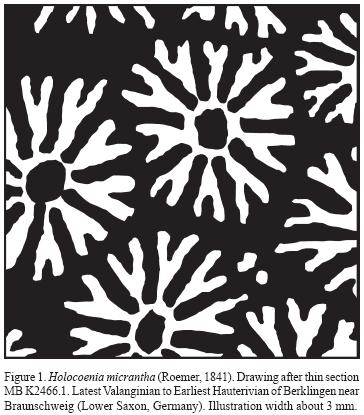
<body><![CDATA[<p align="justify"><font face="verdana" size="2"><b>Diagnosis.</b> Cerioid colony with small calices. Septa compact, in radial symmetry and always two generations. Septal face with few granules. Wall incomplete, made of synapticulae and septa. Columella styliform. Endotheca present, made of thin dissepiments. Budding extracalicinal. Septal microstructure unknown.</font></p> 	    <p align="justify"><font face="verdana" size="2"><b>Remarks</b>. <i>Holocoenia</i> forms small to medium large colonies, circular or with an irregular shape. In siliciclastic environments flat and laterally extended, often with pillar like elevations indicating a certain sediment stress. In carbonatic environments the colonies have a massive growth form. Colonies often with a wrinkled holotheca. The outer appearance of the colony might be cerioid or thamnasterioid. The colony is cerioid with well separated polygonal to circular calices. The calices are slightly depressed, the walls slightly elevated with costae running over the wall. The septa are compact and thick. They are almost always free and rarely connected to each other as in <i>Thamnasteria</i> or <i>Mesomorpha</i>. The Septa always appear in two size orders, one long which reach the columella and one shorter which reach about half or less of those of the first order. There exists no clear symmetry. Though it is radial, calices with eight, nine, ten or even eleven septa of the first order can be found in the same colony. Septal number in all <i>Holocoenia</i> species is always between 16 and 22, but 20 septa are most common. Septa and costae cannot be clearly distinguished; obviously septa are biseptal blades where the external part of one septum forms a septum of another calice. The columella is styliform, clearly visible, slightly elevated and large compared to the small diameter of the calices. Septa of the first order can be attached to it. The wall is septothecal with many synapticulae. It is not compact as it can be seen in longitudinal sections. Synapticulae are only found in the wall. The endotheca consists of few thin dissepiments. &#150; The genus was originally described as <i>Holocaenia</i>, but the name was later changed by de Fromentel (1857) to <i>Holocoenia</i>, a change of spelling which was later generally accepted and which is therefore valid.</font></p> 	    <p align="justify"><font face="verdana" size="2"><b>Comparison.</b> <i>Mesomorpha</i> and <i>Thamnasteria</i> are closely related genera, and both form astreoid to thamnasterioid colonies without a well&#150;defined wall. Moreover, septa are often (<i>Mesomorpha</i>) or sometimes (<i>Thamnasteria</i>) attached to other septa. Both genera have no clear septal size orders as in <i>Holocoenia</i>. <i>Actinastrea</i> is very similar but differs by the mostly compact wall, the absence of synapticulae, the presence of fine thorns at the lateral septal faces, and septal swellings.</font></p> 	    <p align="justify"><font face="verdana" size="2"><b>Systematic position.</b> The systematic position is preliminary. The genus also shares many characteristics with the suborder Archeocaeniina (Astrocoeniina p.p.). It is closely related to <i>Etallonasteria</i> Roniewicz, 1987, a Jurassic coral genus very similar to <i>Holocoenia</i> but without columella.</font></p> 	    <p align="justify"><font face="verdana" size="2"><b>Species.</b> Only two species are accepted here: <i>Holocoenia micrantha</i> (Roemer, 1841) and <i>Holocoenia jaccardi</i>, Koby, 1897. Both species are morphologically identical, and differ only in their calicular diameter. Though both species co&#150;occur at some localities or in some regions, species can be clearly distinguished by their calicular dimensions. Other species assigned to <i>Holocoenia</i> or its synonymous genera belong to one of these two species or other genera. Species originally assigned to other genera but belonging to <i>Holocoenia</i>, are synonymous with one of the two species. In <a href="/img/revistas/rmcg/v26n1/a8t1.jpg" target="_blank">Table 1</a> the dimensions and some statistical values of the examined material are provided.</font></p> 	    <p align="justify"><font face="verdana" size="2"><b>Distribution range.</b> Valanginian to Early Aptian. Late Aptian is questionable.</font></p> 	    <p align="center"><font face="verdana" size="2"><i><b>Holocoenia</b></i> <b>micrantha (Roemer, 1841)</b> <a href="#f1">Figures 1</a>, <a href="/img/revistas/rmcg/v26n1/a8f2.jpg" target="_blank">2a&#150;c</a></font></p> 	    <p align="center"><font face="verdana" size="2"><a name="f1"></a></font></p> 	    <p align="center"><font face="verdana" size="2"><img src="/img/revistas/rmcg/v26n1/a8f1.jpg"></font></p> 	    <p align="justify"><font face="verdana" size="2">* 1841 <i>Astraea micrantha</i> Roemer, p. 113, pl. 16: 27</font></p> 	    ]]></body>
<body><![CDATA[<p align="justify"><font face="verdana" size="2">1849 <i>Thamnastrea micrantha</i> &#150; Milne&#150;Edwards and Haime, p. 158</font></p> 				    <p align="justify"><font face="verdana" size="2">1850a <i>Centrastraea collinaria</i> d'Orbigny, (2), p. 93</font></p> 				    <p align="justify"><font face="verdana" size="2">1850a <i>Synastrea micrantha</i> &#150; d'Orbigny, (2), p. 94</font></p> 				    <p align="justify"><font face="verdana" size="2">1850b <i>Centrastrea collinaria</i> &#150; d'Orbigny, p. 177</font></p> 				    <p align="justify"><font face="verdana" size="2">1850b <i>Synastrea micrantha</i> &#150; d'Orbigny, p. 178</font></p> 				    <p align="justify"><font face="verdana" size="2">1851 <i>Astrea micrantha</i> Roemer &#150; Milne&#150;Edwards and Haime, p. 99</font></p> 				    <p align="justify"><font face="verdana" size="2">1851 <i>Thamnastrea ? collinaria</i> &#150; Milne&#150;Edwards and Haime, p. 112</font></p> 				    <p align="justify"><font face="verdana" size="2">1851 <i>Thamnastrea ? micrantha</i> &#150; Milne&#150;Edwards and Haime, p. 111</font></p> 				    <p align="justify"><font face="verdana" size="2">1857 <i>Holocoenia micrantha</i> &#150; de Fromentel, p. 53</font></p> 				    <p align="justify"><font face="verdana" size="2">v 1857 <i>Holocoenia collinaria</i> &#150; de Fromentel, p. 54, pl. 7: 9, 10</font></p> 				    ]]></body>
<body><![CDATA[<p align="justify"><font face="verdana" size="2">1857 <i>Holocoenia micrantha</i> &#150; Milne&#150;Edwards, (2), p. 250</font></p> 				    <p align="justify"><font face="verdana" size="2">1857 <i>Thamnastraea ? collinaria</i> &#150; Milne&#150;Edwards, (2), p. 583</font></p> 				    <p align="justify"><font face="verdana" size="2">1861 <i>Holocoenia collinaria</i> &#150; de Fromentel, p. 200</font></p> 				    <p align="justify"><font face="verdana" size="2">1861 <i>Holocoenia micrantha</i> &#150; de Fromentel, p. 200</font></p> 				    <p align="justify"><font face="verdana" size="2">1862 <i>Holocoenia collinaria</i> de Fromentel &#150; de Fromentel, p. 410</font></p> 				    <p align="justify"><font face="verdana" size="2">1866 <i>Holocoenia micrantha</i> &#150; B&ouml;lsche, p. 476</font></p> 				    <p align="justify"><font face="verdana" size="2">1867 <i>Holocoenia micrantha</i> Roem. sp. &#150; B&ouml;lsche, p. 40</font></p> 				    <p align="justify"><font face="verdana" size="2">1868 <i>Holocaenia collinaria</i> (D'Orb.) E. de Fromentel &#150; de Fromentel, p. 86, pl. 8: 3</font></p> 				    <p align="justify"><font face="verdana" size="2">1881 <i>Holocoenia micrantha</i> &#150; Quenstedt, p. 996, pl. 182: 3</font></p> 				    <p align="justify"><font face="verdana" size="2">1883 <i>Holocoenia collinaria</i> &#150; de Fromentel, p. 516, pl. 138: 1, pl. 139: 2</font></p> 				    ]]></body>
<body><![CDATA[<p align="justify"><font face="verdana" size="2">1883 <i>Holocoenia micrantha</i> &#150; de Fromentel, p. 517</font></p> 				    <p align="justify"><font face="verdana" size="2">? 1887 <i>Centrastraea collinaria</i> &#150; Mallada, p. 170, pl. 62: 4</font></p> 				    <p align="justify"><font face="verdana" size="2">non v 1909 <i>Holocoenia micrantha</i> &#150; Prever, p. 128, pl. 14: 8 &#91;= Stylina sp.&#93;</font></p> 				    <p align="justify"><font face="verdana" size="2">? 1937 <i>Centrastraea collinaria</i> d'Orbigny, 1849 &#150; Bataller, p. 201 </font></p> 				    <p align="justify"><font face="verdana" size="2">1952 <i>Holocaenia collinaria </i>de Fromentel &#150; Alloiteau, p. 659, fig. 112</font></p> 				    <p align="justify"><font face="verdana" size="2">1956 <i>Holocoenia collinaria</i> Fromentel, 1867 &#150; Wells, p. 372, fig. 263.2</font></p> 				    <p align="justify"><font face="verdana" size="2">1957 <i>Centrastrea collinaria</i> d'Orb. 1850 &#150; Alloiteau, p. 206</font></p> 				    <p align="justify"><font face="verdana" size="2">p 1957 <i>Stereocaenia collinaria</i> de From. sp. &#150; Alloiteau, fig. 272&#150;274, pl. 19: 4, non pl. 1: 10 &#91;= <i>Mesomorpha</i> or <i>Thamnasteria</i> sp.&#93;</font></p> 				    <p align="justify"><font face="verdana" size="2">? <i>1978</i> cf. <i>Holocoenia micrantha</i> (Roemer) &#150; Wingfield, Evans and Deegan, p. 30</font></p> 				    <p align="justify"><font face="verdana" size="2">non 1980 <i>Stereocoenia collinaria</i> (Fromentel, 1857) &#150; Kuzmicheva, p. 100, pl. 37: 2 &#91;= <i>Mesomorpha</i> sp.&#93;</font></p> 				    ]]></body>
<body><![CDATA[<p align="justify"><font face="verdana" size="2">non 1983 <i>Stereocaenia collinaria</i> (Fromentel, 1857) &#150; Kuzmicheva, p. 34, pl. 3: 4 &#91;not pl. 2: 4 as indicated&#93; &#91;= <i>Mesomorpha</i> or <i>Thamnasteria</i> sp.&#93;</font></p> 				    <p align="justify"><font face="verdana" size="2">non 1987 <i>Stereocoenia collinaria</i> (d'Orbigny, 1850) &#150; Kuzmicheva, p. 246, pl. 5: 3 &#91;= <i>Mesomorpha</i> sp.&#93;</font></p> 				    <p align="justify"><font face="verdana" size="2">non 1988 <i>Stereocoenia collinaria</i> (Fromentel, 1857) &#150; Kuzmicheva and Aliev, p. 168, pl. 5: 3 &#91;= <i>Mesomorpha</i> sp.&#93;</font></p> 				    <p align="justify"><font face="verdana" size="2">v 1995 <i>Stereocaenia</i> (= <i>Holocoenia</i>) <i>collinaria</i> d'Orbigny &#150; Fricot, Collet&eacute; and Brossard, p. 32, text&#150;fig. 35</font></p> 				    <p align="justify"><font face="verdana" size="2">v 1997 <i>Paretallonia bendukidzeae</i> Sikharulidze, 1972 &#150; Baron&#150;Szabo, p. 76, pl. 11: 1, 3, 4</font></p> 				    <p align="justify"><font face="verdana" size="2">v 2001 <i>Holocoenia jaccardi</i> Koby, 1897 &#150; L&ouml;ser, p. 45, pl. 2: 7</font></p> 				    <p align="justify"><font face="verdana" size="2">2002 <i>Holocoenia micrantha</i> (Roemer, 1841) &#150; L&ouml;ser <i>et al.</i> p. 347 &#91;detailed synonymy here&#93;</font></p> 				    <p align="justify"><font face="verdana" size="2">2002 <i>Stereocaenia collinaria</i> (d'Orbigny, 1850) &#150; L&ouml;ser <i>et al.</i>, p. 616 &#91;detailed synonymy here&#93;</font></p> 				    <p align="justify"><font face="verdana" size="2">2002 <i>Stereocaenia collinaria</i> Alloiteau 1952 &#150; L&ouml;ser <i>et al.</i>, p. 616 &#91;detailed synonymy here&#93;</font></p> 				    <p align="justify"><font face="verdana" size="2">v p 2006 <i>Holocoenia jaccardi</i> Koby 1897 &#150; L&ouml;ser and Ferry, p. 483, fig. 5.4 &#91;not fig. 5 = <i>Holocoenia jaccardi</i>&#93;</font></p> 				    ]]></body>
<body><![CDATA[<p align="justify"><font face="verdana" size="2"><b>Types.</b> The type of <i>Astrea micrantha</i> is presumably lost. It was sought but not found in the following institutions: the Hildesheim Museum dedicated to F.A. Roemer, in the collections of the Naturkundemuseum Berlin, the collections of the Geologische Bundesanstalt (Berlin), the Geowissenschaftliche Sammlung of the University Bremen, the University collection of G&ouml;ttingen, and the Staatlichen Naturhistorischen Museum Braunschweig, all in Germany. Topotypical material was sought in the same collections and only one small sample was found in the Naturkundemuseum Berlin, which is used here as a reference sample (MB K2466.1). The holotype of <i>Centrastrea collinaria</i> d'Orbigny, 1850 is probably not lost (according to written communication by E. Morycowa, Krak&oacute;w), but it is not available. The holotype of Stereocaenia collinaria Alloiteau, 1952 (MNHN M03564) was available for study but there was no opportunity to make a polished section to clearly prove its systematic position. Thin sections made by Alloiteau were not available for study. The holotype of Paretallonia bendukidzeae Sikharulidze, 1972 is deposited in the Tbilisi Geological Institute (GIN) under the number 36/77, but was not available for study.</font></p> 				    <p align="justify"><font face="verdana" size="2"><b>Synonyms.</b> <i>Centrastraea collinaria</i> d'Orbigny, 1850; <i>Stereocaenia collinaria</i> Alloiteau, 1952.</font></p> 				    <p align="justify"><font face="verdana" size="2"><b>Dimensions.</b> c: (1.0) 1.4&#150;1.5 (1.7) mm, ccd: (1.2) 1.5&#150;1.6 (2.0) mm, cm: 10&#150;11, s: 18&#150;20, sd: 4&#150;5 / 1 mm.</font></p> 				    <p align="justify"><font face="verdana" size="2"><b>Remarks.</b> <i>Holocoenia collinaria</i> d'Orbigny, 1850 was unified by de Fromentel (1857) with <i>Centrastrea microphyllia</i> d'Orbigny, 1850 and <i>Centrastrea excavata</i> d'Orbigny, 1850. <i>Centrastrea microphyllia</i> remains an unknown species. Its type is not available. The illustration provided by de Fromentel (1887) is poor and the description is incomplete since it starts on the very last page of the 16<sup>th</sup> (and last) instalment of the revision of the Cretaceous corals within the Pal&eacute;ontologie fran&ccedil;aise, which is also the last page of the whole publication that was not completed. <i>Centrastrea excavata</i> d'Orbigny, 1850 is considered a species different from <i>Holocoenia</i> and was in recent literature assigned to <i>Mesomorpha</i>. The species is not revised: its type (MNHN 5291) is a small unsectioned sample that may belong to <i>Mesomorpha</i> or <i>Thamnasteria</i>. The material mentioned by Bataller (1937; probably only in reference to Mallada 1887) was sought in the MGSB (Barcelona), but not found. It is not registered in the files and according to Sebastian Calzada (Barcelona, pers. comm. June 2007) this is a sure indication that the material is not held in the collection. The age of the La Avell&agrave; outcrop is also questionable. It was originally published as Hauterivian (G&ouml;tz <i>et al.</i>, 2005), but new material kindly provided by S. Tom&aacute;s (Barcelona) included a <i>Felixigyra</i> species, a genus which is absent in the Hauterivian elsewhere.</font></p> 				    <p align="justify"><font face="verdana" size="2"><b>Occurrence.</b> <i>Astrea micrantha</i> Roemer, 1841: Early Valanginian of Arzier, La Violette quarries (Vaud, Switzerland); Latest Valanginian to Earliest Hauterivian (late Paucinodum / early Amblygonium zone) of Apelnstedt and Berklingen near Braunschweig (Lower Saxon, Germany); Early Hauterivian (Radiatus zone) of the various outcrops near the villages Fontenoy, Gy&#150;l'Ev&ecirc;que, and Les Saints (Yonne, France) and near Valli&egrave;res and Marolles (Aube, France); Hauterivian (?Barremian) of the La Avell&agrave; section near Cat&iacute; (Valencia, Castell&oacute;n, Spain; FGUB AV&#150;C&#150;6); Late Barremian of Pont de Laval near St.Rem&egrave;ze (Ard&egrave;che, France); Latest Barremian to Early Aptian (Weissi zone) of the outcrops Mahdtal, Mitteleck, Obere Gottesackerw&auml;nde, Seealpe in the Allg&auml;u Mountain range (Bavaria, Germany). &#150; Additional occurrences indicated for <i>Centrastrea collinaria</i> d'Orbigny, 1850: Early Hauterivian (Radiatus zone) of Morancourt and Saint Dizier (Haute&#150;Marne, France) and outcrops near the villages Chenay, Leugny, Saint&#150;Sauveur and Venoy (Yonne, France).</font></p> 				    <p align="justify"><font face="verdana" size="2"><b>Range.</b> Valanginian to Early Aptian (Weissi zone).</font></p> 				    <p align="center"><font face="verdana" size="2"><b>Holocoenia jaccardi Koby, 1897 </b><a href="/img/revistas/rmcg/v26n1/a8f2.jpg" target="_blank">Figures 2d&#150;f</a></font></p> 				    <p align="justify"><font face="verdana" size="2">v p 1850a <i>Astrocoenia Cornueliana</i> d'Orbigny, p. 92</font></p> 				    <p align="justify"><font face="verdana" size="2">*1897 <i>Holocoenia Jaccardi </i>Koby, p. 35, pl. 4: 4, 5</font></p> 				    <p align="justify"><font face="verdana" size="2">v 1897 <i>Astrocoenia Triboleti </i>Koby, p. 62, pl. 14: 6&#150;8</font></p> 				    ]]></body>
<body><![CDATA[<p align="justify"><font face="verdana" size="2">1928 <i>Astrocoenia</i> cf. <i>Triboleti</i> Koby &#150; Gerth, p. 7</font></p> 				    <p align="justify"><font face="verdana" size="2">v p 1935 <i>Astrocoenia Cornueliana</i> d'Orb. &#150; Cottreau, pl. 74: 7 &#91;non fig. 6&#93;</font></p> 				    <p align="justify"><font face="verdana" size="2">v non 1936 <i>Holocoenia</i> ex. aff. <i>jaccardi</i> Koby, 1898 &#150; Hackemesser, p. 21</font></p> 				    <p align="justify"><font face="verdana" size="2">? 1959 <i>Holoccenia</i> &#91;sic&#93; <i>Jaccardi</i> Koby &#150; Bonev, p. 478, pl. 2: 1</font></p> 				    <p align="justify"><font face="verdana" size="2">v 1964 <i>Stereocaenia triboleti</i> (Koby, 1896) &#150; Morycowa, p. 77, pl. 23: 1&#150;3</font></p> 				    <p align="justify"><font face="verdana" size="2">v 1970 <i>Stereocaenia triboleti</i> (Koby) &#150; Czerminski, p. 129</font></p> 				    <p align="justify"><font face="verdana" size="2">1972 <i>Paretallonia bendukidzeae</i> Sikharulidze, p. 643, text&#150;fig. 1, 2</font></p> 				    <p align="justify"><font face="verdana" size="2">1985 <i>Paretallonia Bendukidzeae</i> Sikh., 1972 &#150; Sikharulidze, p. 62, pl. 28: 2</font></p> 				    <p align="justify"><font face="verdana" size="2">v 1989<i> Stereocaenia triboleti</i> (Koby, 1896) &#150; Morycowa, p. 65, pl. 27: 1, 2</font></p> 				    <p align="justify"><font face="verdana" size="2">non 1996 <i>Paretallonia bendukidzeae</i> Sikharulidze, 1972 &#150; Cs&aacute;sz&aacute;r and Turnsek, p. 434, fig. 4 &#91;= <i>Cryptocoenia</i> sp.&#93;</font></p> 				    ]]></body>
<body><![CDATA[<p align="justify"><font face="verdana" size="2">v non 1996 <i>Paretallonia bendukidzeae</i> Sikharulidze &#150; Wilmsen, p. 360, pl. 3: 3 a, b, 4 &#91;= <i>Actinastrea</i> sp.&#93;</font></p> 				    <p align="justify"><font face="verdana" size="2">v non 1997 <i>Paretallonia</i> cf. <i>bendukidzeae</i> Sikharulidze &#150; Wilmsen, pl. 32: 3, 4 &#91;= <i>Actinastrea</i> sp.&#93;</font></p> 				    <p align="justify"><font face="verdana" size="2"><i>2002 Holocoenia micrantha</i> (Roemer, 1841) &#150; L&ouml;ser <i>et al.</i> p. 347 &#91;detailed synonymy here&#93;</font></p> 				    <p align="justify"><font face="verdana" size="2"><i>2002 Paretallonia bendukidzeae</i> Sikharulidze, 1972 &#150; L&ouml;ser <i>et al.</i>, p. 498 &#91;detailed synonymy here&#93;</font></p> 				    <p align="justify"><font face="verdana" size="2"><i>2002 Stereocaenia triboleti</i> (Koby, 1896) &#150; L&ouml;ser <i>et al.</i>, p. 617 &#91;detailed synonymy here&#93;</font></p> 				    <p align="justify"><font face="verdana" size="2">v 2005 <i>Holocoenia jaccardi</i> Koby, 1897 &#150; G&ouml;tz, L&ouml;ser and Schmid, p. 876, fig. 8C </font></p> 				    <p align="justify"><font face="verdana" size="2">v p 2006 <i>Holocoenia jaccardi</i> Koby, 1897 &#150; L&ouml;ser and Ferry, p. 483, fig. 5.5 &#91;not fig. 4 = <i>Holocoenia micrantha</i>&#93;</font></p> 				    <p align="justify"><font face="verdana" size="2"><b>Holotype.</b> The holotype of <i>Holocoenia jaccardi</i> is officially not available. The specimen of the collection of the Mus&eacute;um d'Histoire naturelle de Neuch&acirc;tel (No. 26735) is suspected to be the holotype, even though it is not marked as such and its identity with the sample figured by Koby cannot be assured. Syntypes of <i>Astrocoenia Triboleti</i> are available at the Mus&eacute;um d'Histoire naturelle de la Ville de Gen&egrave;ve (MHNG 4852), but they are poorly preserved.</font></p> 				    <p align="justify"><font face="verdana" size="2"><b>Synonyms.</b> <i>Astrocoenia triboleti</i> Koby, 1897; <i>Paretallonia bendukidzeae</i> Sikharulidze, 1972.</font></p> 				    <p align="justify"><font face="verdana" size="2"><b>Dimensions.</b> c: (0.8) 0.9&#150;1.2 (1.3) mm, ccd: (0.9) 1.0&#150;1.4 (2.0) mm, cm: 12&#150;14, s: (16) 18&#150;20, sd: 5&#150;6 / 1 mm.</font></p> 				    ]]></body>
<body><![CDATA[<p align="justify"><font face="verdana" size="2"><b>Remarks.</b> <i>Holocoenia</i> jaccardi and <i>Holocoenia triboleti</i> were described by the same author in the same year. Priority is given to the first species not only because of page precedence but because it has been assigned by Koby to <i>Holocoenia</i>, whereas the other species to <i>Astrocoenia</i>. Moreover, the (? type) material available of <i>Holocoenia jaccardi</i> is much better preserved than those of <i>Holocoenia triboleti</i>. The material described by d'Orbigny as <i>Astrocoenia Cornueliana</i> consists of various syntypes of which one (MNHN R09357 = Coll. d'Orbigny 5284A) belongs to <i>Holocoenia</i>. Specimen MNHN A24821 was selected as lectotype of <i>Astrocoenia Cornueliana</i> according to the collection database of the MNHN without giving a reference, which makes this designation according to the ICZN (1999; Art. 72.4.7) invalid. The material described by Gerth is kept at the Nationaal Natuurhistorisch Museum (Leiden, The Netherlands; RGM.143057). With the kind help of Jacob Leloux (Leiden) photographs of the sample and thin sections were made available to the author.</font></p> 				    <p align="justify"><font face="verdana" size="2"><b>Occurrence.</b> Early Hauterivian (Radiatus zone) of the outcrops near the village Gy&#150;l'Ev&ecirc;que (Yonne, France); Hauterivian of Shkmeri (Racha, Georgia), Kvemo&#150;Chalovani and Sachkhere (Imereti, Georgia), Wieliczka, Buk&oacute;w (Malopolskie, Wieliczka, Poland). Hauterivian (?Barremian) of the La Avell&agrave; section near Cat&iacute; (Valencia, Castell&oacute;n, Spain); Barremian of Morteau (Doubs, France); Early Barremian of the section NW Archiane in the Vercors Mountain range (Dr&ocirc;me, France); Late Barremian of outcrops at Pont de Laval, Belv&eacute;d&egrave;re du Serre&#150;de&#150;Tourre and Belv&eacute;d&egrave;re du Gaud near St.Rem&egrave;ze (Ard&egrave;che, France), Trzemesna near Tarn&oacute;w (Malopolskie, Tarn&oacute;w, Poland); Early Aptian of Jastrzebia near Lanckorona (Malopolskie, Wadowice, Poland); Aptian (? Late Barremian) of the San Juan Raya area (Puebla, Mexio; IGM 9253); Aptian of Sierra Vaca Muerta (Neuqu&eacute;n, Argentina).</font></p> 				    <p align="justify"><font face="verdana" size="2"><b>Range.</b> Hauterivian to Aptian (range into the Late Aptian is questionable).</font></p> 				    <p align="justify"><font face="verdana" size="2">&nbsp;</font></p> 				    <p align="justify"><font face="verdana" size="2"><b>OTHER SPECIES</b></font></p> 				    <p align="justify"><font face="verdana" size="2">Species originally or currently assigned to <i>Holocoenia</i>, but not being synonymous with one of the above described species and which do not belong to <i>Holocoenia</i> (all Cretaceous material was available to the author):</font></p> 				    <p align="justify"><font face="verdana" size="2"><i>Holocoenia chelussii</i> Prever, 1909 &#150; both syntypes belong to <i>Columnocoenia</i>.</font></p> 				    <p align="justify"><font face="verdana" size="2"><i>Holocoenia indica</i> Stoliczka, 1873 &#150; the species belongs very probably to <i>Astreopora</i>.</font></p> 				    <p align="justify"><font face="verdana" size="2"><i>Holocoenia polymorpha</i> Prever, 1909 &#150; all five syntypes belong to <i>Actinastrea</i>.</font></p> 				    <p align="justify"><font face="verdana" size="2"><i>Holocoenia ramosa</i> Stoliczka, 1873 &#150; both syntypes belong the same <i>Columnocoenia</i> species.</font></p> 				    ]]></body>
<body><![CDATA[<p align="justify"><font face="verdana" size="2">It is very probably that the genus does not occur in the Jurassic. The three species established by de Fromentel (1856) without illustration do not fit well into the concept of the genus. <i>Holocoenia cesaredensis</i> Koby, 1904 was assigned by Geyer (1955) to the genus <i>Convexastrea. Thamnastrea scita</i> Milne&#150;Edwards and Haime, 1851 was assigned by Beauvais (1966) to <i>Stereocaenia. Thamnastrea</i> scita belongs to <i>Thamnasteria</i> (for instance see Pandey and F&uuml;rsich 2003). The material described by Beauvais (1966) does not belong to <i>Thamnasteria scita</i>, but to <i>Thamnasteria mettensis</i> (according to Lathuili&egrave;re 2000).</font></p> 				    <p align="justify"><font face="verdana" size="2"><b>Stratigraphic and palaeobiogeographic distribution</b></font></p> 				    <p align="justify"><font face="verdana" size="2">Though both species are restricted to a few outcrops, they are not rare in those outcrops. <i>Holocoenia</i> micrantha is common in the Early Hauterivian of the Paris basin. It is abundant in the recently investigated faunas of Ard&egrave;che and Dr&ocirc;me (Barremian, France) and Cat&iacute; (Hauterivian, probably Barremian; Spain). <i>Holocoenia jaccardi</i> is abundant in the San Juan Raya area.</font></p> 				    <p align="justify"><font face="verdana" size="2">The genus was up to now only indicated in the Boreal (France and Germany) and the central (southern France, southern Germany, Poland, Spain, Switzerland) to eastern Tethys (Georgia); the indication of <i>Holocoenia jaccardi</i> in the Aptian (probably Late Barremian to Early Aptian) of Puebla (Mexico) is the first indication of the genus <i>Holocoenia</i> in the Caribbean realm at all (<a href="/img/revistas/rmcg/v26n1/a8f3.jpg" target="_blank">Figure 3</a>). Both species differ in their distribution. Whereas <i>Holocoenia micranth</i>a shows a very limited geographical distribution occurring only in the Boreal and central Tethys, <i>Holocoenia jaccardi</i> shows a wider distribution and was found between South and southern North America and the eastern Tethys.</font></p> 				    <p align="justify"><font face="verdana" size="2">The genus occurs in outcrops with a siliciclastic facies (such as in the Boreal in northern France and northern Germany, in the northern Tethys in France and Poland, in the Caribbean in Mexico) and in carbonate ramps or platforms (such as in northern margin of the central Tethys in southern France, southern Germany, and Switzerland). It has not been indicated in the coral rich sediments of the centrals Tethys (such as the Early Aptian of Greece, the Hauterivian to Aptian of Spain).</font></p> 				    <p align="justify"><font face="verdana" size="2">Both species almost co&#150;occur in time (<a href="/img/revistas/rmcg/v26n1/a8f4.jpg" target="_blank">Figure 4</a>) with the exception that <i>H. micrantha</i> was already indicated in the Valanginian, whereas <i>H. jaccardi </i>might reach into the Late Aptian. But this is not certain as the whole outcrop area around San Juan Raya (Puebla, Mexico) needs revision of its stratigraphy and the outcrops in Argentina are imprecisely dated. Both species are most widely distributed in the Hauterivian, but also appear with a considerable distribution during the Late Barremian to Early Aptian.</font></p> 				    <p align="justify"><font face="verdana" size="2">&nbsp;</font></p> 				    <p align="justify"><font face="verdana" size="2"><b>CONCLUSIONS</b></font></p> 				    <p align="justify"><font face="verdana" size="2">The long story of this genus clearly demonstrates the importance of proper description and illustration to prevent confusion and the assignment of the same species to multiple genera. Above all, clear illustration is essential, since although the concepts of interpreting certain morphological elements may change through time, the fossil itself, and hence illustration, remains the same. After <i>Holocoenia</i> was established, it was twice created under different names (<i>Stereocaenia, Paretallonia</i>) due to insufficient knowledge of type material or misunderstandings of the literature. Unfortunately, this type of situation is not an exception and is very common in the study of Cretaceous corals.</font></p> 				    <p align="justify"><font face="verdana" size="2">&nbsp;</font></p> 				    ]]></body>
<body><![CDATA[<p align="justify"><font face="verdana" size="2"><b>ACKNOWLDGEMENTS</b></font></p> 				    <p align="justify"><font face="verdana" size="2">It is a pleasure to thank Jacques Ayer and Jean&#150;Paul Haenni (Neuch&acirc;tel), Sebastian Calzada (Barcelona), Danielle Decrouez (Gen&egrave;ve), G. Haldar (Calcutta), Peter Jung and Ren&eacute; Panchaud (B&acirc;le), Dieter Korn (Berlin), Jacob Leloux (Leiden), Christine Perrin (Paris), Elzbieta Morycowa (Krak&oacute;w), Daniele Ormezzano (Torino), Carmen Perrilliat (Mexico City), Sara Tom&aacute;s (Barcelona), and Winfried Werner (M&uuml;nchen) who allowed me to study material of their respective museum or institute collections, which made this study possible. Juliane Fenner (Hannover), Fritz Kr&uuml;ger (Braunschweig), Mike Reich (G&ouml;ttingen), and J&uuml;rgen Vespermann (Hildesheim) searched their collections for type or topotypical material of <i>Astrea micrantha</i> for which I am grateful. The quality of the paper was enhanced by reviews by Jacob Leloux (Leiden) and an anonymous reviewer. For grammatical correction I would like to thank Kimberly Franklin (Tucson, Arizona).</font></p> 				    <p align="justify"><font face="verdana" size="2">Field work in France and preparation of thin sections was covered by DFG project FL 42/73. Examination of the Mexican material was realised within the framework of CONACyT project 52442&#150;Q. The ability to use the Jurassic Coral Database compiled by Bernard Lathuili&egrave;re (Nancy) is greatly appreciated.</font></p> 				    <p align="justify"><font face="verdana" size="2">&nbsp;</font></p> 				    <p align="justify"><font face="verdana" size="2"><b>REFERENCES</b></font></p> 				    <!-- ref --><p align="justify"><font face="verdana" size="2">Alloiteau, J., 1952, Embranchement des coelent&eacute;r&eacute;s, <i>in</i> Piveteau, J. (ed.), Trait&eacute; de Pal&eacute;ontologie (1): Paris, Masson, 376&#150;684.</font>&nbsp;&nbsp;&nbsp;&nbsp;&nbsp;&nbsp;&nbsp;&nbsp;[&#160;<a href="javascript:void(0);" onclick="javascript: window.open('/scielo.php?script=sci_nlinks&ref=8034945&pid=S1026-8774200900010000800001&lng=','','width=640,height=500,resizable=yes,scrollbars=1,menubar=yes,');">Links</a>&#160;]<!-- end-ref --> 				    <!-- ref --><p align="justify"><font face="verdana" size="2">Alloiteau, J., 1957, Contribution &agrave; la syst&eacute;matique des Madr&eacute;poraires fossiles: Paris, Centre National de la Recherche Scientifique, 462 p.</font>&nbsp;&nbsp;&nbsp;&nbsp;&nbsp;&nbsp;&nbsp;&nbsp;[&#160;<a href="javascript:void(0);" onclick="javascript: window.open('/scielo.php?script=sci_nlinks&ref=8034947&pid=S1026-8774200900010000800002&lng=','','width=640,height=500,resizable=yes,scrollbars=1,menubar=yes,');">Links</a>&#160;]<!-- end-ref --> 				    <!-- ref --><p align="justify"><font face="verdana" size="2">Baron&#150;Szabo, R.C., 1997, Die Korallenfazies der ostalpinen Kreide (Helvetikum: Allg&auml;uer Schrattenkalk; N&ouml;rdliche Kalkalpen: Brandenberger Gosau), Taxonomie, Pal&ouml;kologie: Zitteliana, 21, 3&#150;97.</font>&nbsp;&nbsp;&nbsp;&nbsp;&nbsp;&nbsp;&nbsp;&nbsp;[&#160;<a href="javascript:void(0);" onclick="javascript: window.open('/scielo.php?script=sci_nlinks&ref=8034949&pid=S1026-8774200900010000800003&lng=','','width=640,height=500,resizable=yes,scrollbars=1,menubar=yes,');">Links</a>&#160;]<!-- end-ref --> 				    <!-- ref --><p align="justify"><font face="verdana" size="2">Baron&#150;Szabo, R.C., 2002, Scleractinian corals of the Cretaceous: Knoxville, Tenn., privately published, 538 p.</font>&nbsp;&nbsp;&nbsp;&nbsp;&nbsp;&nbsp;&nbsp;&nbsp;[&#160;<a href="javascript:void(0);" onclick="javascript: window.open('/scielo.php?script=sci_nlinks&ref=8034951&pid=S1026-8774200900010000800004&lng=','','width=640,height=500,resizable=yes,scrollbars=1,menubar=yes,');">Links</a>&#160;]<!-- end-ref --> 				    <!-- ref --><p align="justify"><font face="verdana" size="2">Bataller, J., 1937, La fauna coral&middot;lina del Cret&agrave;cic de Catalunya i regions lim&iacute;trofes: Arxius de l'escola superior d'agricultura, (N.S.) 3(1), 1&#150;299.</font>&nbsp;&nbsp;&nbsp;&nbsp;&nbsp;&nbsp;&nbsp;&nbsp;[&#160;<a href="javascript:void(0);" onclick="javascript: window.open('/scielo.php?script=sci_nlinks&ref=8034953&pid=S1026-8774200900010000800005&lng=','','width=640,height=500,resizable=yes,scrollbars=1,menubar=yes,');">Links</a>&#160;]<!-- end-ref --> 				    <!-- ref --><p align="justify"><font face="verdana" size="2">Beauvais, L., 1966, R&eacute;vision des madr&eacute;poraires du Dogger de la collection Koby: Eclogae Geologicae Helvetiae, 59(2), 989&#150;1024.</font>&nbsp;&nbsp;&nbsp;&nbsp;&nbsp;&nbsp;&nbsp;&nbsp;[&#160;<a href="javascript:void(0);" onclick="javascript: window.open('/scielo.php?script=sci_nlinks&ref=8034955&pid=S1026-8774200900010000800006&lng=','','width=640,height=500,resizable=yes,scrollbars=1,menubar=yes,');">Links</a>&#160;]<!-- end-ref --> 				    <!-- ref --><p align="justify"><font face="verdana" size="2">B&ouml;lsche, W., 1866, Die Korallen des norddeutschen Jura&#150; und Kreide&#150;Gebirges: Zeitschrift der Deutschen Geologischen Gesellschaft, 18, 439&#150;486.</font>&nbsp;&nbsp;&nbsp;&nbsp;&nbsp;&nbsp;&nbsp;&nbsp;[&#160;<a href="javascript:void(0);" onclick="javascript: window.open('/scielo.php?script=sci_nlinks&ref=8034957&pid=S1026-8774200900010000800007&lng=','','width=640,height=500,resizable=yes,scrollbars=1,menubar=yes,');">Links</a>&#160;]<!-- end-ref --> 				    <!-- ref --><p align="justify"><font face="verdana" size="2">B&ouml;lsche, W., 1867, Die Korallen des norddeutschen Jura&#150; und Kreidegebirges: Berlin, J.F. Starcke, 50 p.</font>&nbsp;&nbsp;&nbsp;&nbsp;&nbsp;&nbsp;&nbsp;&nbsp;[&#160;<a href="javascript:void(0);" onclick="javascript: window.open('/scielo.php?script=sci_nlinks&ref=8034959&pid=S1026-8774200900010000800008&lng=','','width=640,height=500,resizable=yes,scrollbars=1,menubar=yes,');">Links</a>&#160;]<!-- end-ref --> 				    <!-- ref --><p align="justify"><font face="verdana" size="2">Bonev, E.S., 1959, &#91;Aptian fauna from the Predshansk anticline in the region of east Stara Planina.&#93;: Nauchni trudove Vissh selskostopanski institut, 6, 463&#150;504.</font>&nbsp;&nbsp;&nbsp;&nbsp;&nbsp;&nbsp;&nbsp;&nbsp;[&#160;<a href="javascript:void(0);" onclick="javascript: window.open('/scielo.php?script=sci_nlinks&ref=8034961&pid=S1026-8774200900010000800009&lng=','','width=640,height=500,resizable=yes,scrollbars=1,menubar=yes,');">Links</a>&#160;]<!-- end-ref --> 				    <!-- ref --><p align="justify"><font face="verdana" size="2">Bourne, G.C., 1900, The Anthozoa, <i>in</i> Lankester, R. (ed.), Treatise on Zoology, 2. Porifera and Coelenterata: London, A. &amp; C. Black, 59&#150;79.</font>&nbsp;&nbsp;&nbsp;&nbsp;&nbsp;&nbsp;&nbsp;&nbsp;[&#160;<a href="javascript:void(0);" onclick="javascript: window.open('/scielo.php?script=sci_nlinks&ref=8034963&pid=S1026-8774200900010000800010&lng=','','width=640,height=500,resizable=yes,scrollbars=1,menubar=yes,');">Links</a>&#160;]<!-- end-ref --> 				    <!-- ref --><p align="justify"><font face="verdana" size="2">Calder&oacute;n&#150;Garc&iacute;a, A., 1956, Bosquejo geol&oacute;gico del a regi&oacute;n de San Juan Raya. Gu&iacute;a de campo, <i>in</i> Maldonado&#150;Koerdell, M. <i>et al.</i> (eds.) Estratigraf&iacute;a del Mesozoico y Tect&oacute;nica del sur del Estado de Puebla; Presa de Valsequillo, Sif&oacute;n de Huexotitlanapa y problemas hidrol&oacute;gicos de Puebla: Congreso Geol&oacute;gico International, Excursion A&#150;11, 7&#150;91.</font>&nbsp;&nbsp;&nbsp;&nbsp;&nbsp;&nbsp;&nbsp;&nbsp;[&#160;<a href="javascript:void(0);" onclick="javascript: window.open('/scielo.php?script=sci_nlinks&ref=8034965&pid=S1026-8774200900010000800011&lng=','','width=640,height=500,resizable=yes,scrollbars=1,menubar=yes,');">Links</a>&#160;]<!-- end-ref --> 				    <!-- ref --><p align="justify"><font face="verdana" size="2">Corroy, G., 1925, Le N&eacute;ocomien de la bordure orientale du Bassin de Paris: Bulletin de la Soci&eacute;t&eacute; des Sciences Naturelles de Nancy, 2(4), 171&#150;506.</font>&nbsp;&nbsp;&nbsp;&nbsp;&nbsp;&nbsp;&nbsp;&nbsp;[&#160;<a href="javascript:void(0);" onclick="javascript: window.open('/scielo.php?script=sci_nlinks&ref=8034967&pid=S1026-8774200900010000800012&lng=','','width=640,height=500,resizable=yes,scrollbars=1,menubar=yes,');">Links</a>&#160;]<!-- end-ref --> 				    <!-- ref --><p align="justify"><font face="verdana" size="2">Cottreau, J., 1935, Types du prodrome de pal&eacute;ontologie stratigraphique universelle (11): Annales de Pal&eacute;ontologie, 24, 37&#150;52.</font>&nbsp;&nbsp;&nbsp;&nbsp;&nbsp;&nbsp;&nbsp;&nbsp;[&#160;<a href="javascript:void(0);" onclick="javascript: window.open('/scielo.php?script=sci_nlinks&ref=8034969&pid=S1026-8774200900010000800013&lng=','','width=640,height=500,resizable=yes,scrollbars=1,menubar=yes,');">Links</a>&#160;]<!-- end-ref --> 				    <!-- ref --><p align="justify"><font face="verdana" size="2">Cs&aacute;sz&aacute;r, G., Turnsek, D., 1996, Vestiges of atoll&#150;like formations in the Lower Cretaceous of the Mecsek Mountains, Hungary: Cretaceous Research, 17, 419&#150;442.</font>&nbsp;&nbsp;&nbsp;&nbsp;&nbsp;&nbsp;&nbsp;&nbsp;[&#160;<a href="javascript:void(0);" onclick="javascript: window.open('/scielo.php?script=sci_nlinks&ref=8034971&pid=S1026-8774200900010000800014&lng=','','width=640,height=500,resizable=yes,scrollbars=1,menubar=yes,');">Links</a>&#160;]<!-- end-ref --> 				    <!-- ref --><p align="justify"><font face="verdana" size="2">Czerminski, J.E., 1970, Geology of Poland, 2. Catalogue of fossils, 2. Mesozoic: Warszawa, Wydawnictwa Geologiczne, 1&#150;254.</font>&nbsp;&nbsp;&nbsp;&nbsp;&nbsp;&nbsp;&nbsp;&nbsp;[&#160;<a href="javascript:void(0);" onclick="javascript: window.open('/scielo.php?script=sci_nlinks&ref=8034973&pid=S1026-8774200900010000800015&lng=','','width=640,height=500,resizable=yes,scrollbars=1,menubar=yes,');">Links</a>&#160;]<!-- end-ref --> 				    <!-- ref --><p align="justify"><font face="verdana" size="2">d'Orbigny, A., 1850a, Prodr&ocirc;me de Pal&eacute;ontologie stratigraphique universelle des animaux mollusques et rayonn&eacute;s (v. 1&#150;2): Paris, Masson, 1&#150;394, 1&#150;428.</font>&nbsp;&nbsp;&nbsp;&nbsp;&nbsp;&nbsp;&nbsp;&nbsp;[&#160;<a href="javascript:void(0);" onclick="javascript: window.open('/scielo.php?script=sci_nlinks&ref=8034975&pid=S1026-8774200900010000800016&lng=','','width=640,height=500,resizable=yes,scrollbars=1,menubar=yes,');">Links</a>&#160;]<!-- end-ref --> 				    <!-- ref --><p align="justify"><font face="verdana" size="2">d'Orbigny, A., 1850b, Catalogue des esp&egrave;ces fossiles de mollusques, bryozoaires, de polypiers et d'amorphozoaires de l'&eacute;tage n&eacute;ocomien: Revue et Magasin de Zoologie, Pure et Appliqu&eacute;es, s&eacute;r. 2, 2, 170&#150;181.</font>&nbsp;&nbsp;&nbsp;&nbsp;&nbsp;&nbsp;&nbsp;&nbsp;[&#160;<a href="javascript:void(0);" onclick="javascript: window.open('/scielo.php?script=sci_nlinks&ref=8034977&pid=S1026-8774200900010000800017&lng=','','width=640,height=500,resizable=yes,scrollbars=1,menubar=yes,');">Links</a>&#160;]<!-- end-ref --> 				    <!-- ref --><p align="justify"><font face="verdana" size="2">Fricot, C., Collet&eacute;, C., Brossard, C., 1995, L'Hauterivien, <i>in</i> Collet&eacute;, C. Fricot, C., Matrion, M., Toucasson, R., Treffot, G. (eds.), La g&eacute;ologie du d&eacute;partement de l'Aube: Troyes, Association G&eacute;ologique auboise, 31&#150;38.</font>&nbsp;&nbsp;&nbsp;&nbsp;&nbsp;&nbsp;&nbsp;&nbsp;[&#160;<a href="javascript:void(0);" onclick="javascript: window.open('/scielo.php?script=sci_nlinks&ref=8034979&pid=S1026-8774200900010000800018&lng=','','width=640,height=500,resizable=yes,scrollbars=1,menubar=yes,');">Links</a>&#160;]<!-- end-ref --> 				    <!-- ref --><p align="justify"><font face="verdana" size="2">Fromentel, E. de, 1856, Note sur les polypiers fossiles de l'&eacute;tage portlandien de la Haute&#150;Sa&ocirc;ne: Bulletin de la Soci&eacute;t&eacute; G&eacute;ologique de France, s&eacute;r. 2, 13, 851&#150;865.</font>&nbsp;&nbsp;&nbsp;&nbsp;&nbsp;&nbsp;&nbsp;&nbsp;[&#160;<a href="javascript:void(0);" onclick="javascript: window.open('/scielo.php?script=sci_nlinks&ref=8034981&pid=S1026-8774200900010000800019&lng=','','width=640,height=500,resizable=yes,scrollbars=1,menubar=yes,');">Links</a>&#160;]<!-- end-ref --> 				    <!-- ref --><p align="justify"><font face="verdana" size="2">Fromentel, E. de, 1857, Description des polypiers fossiles de l'&eacute;tage N&eacute;ocomien: Bulletin de la Soci&eacute;t&eacute; des Sciences Historiques et Naturelles de l'Yonne, 1&#150;78.</font>&nbsp;&nbsp;&nbsp;&nbsp;&nbsp;&nbsp;&nbsp;&nbsp;[&#160;<a href="javascript:void(0);" onclick="javascript: window.open('/scielo.php?script=sci_nlinks&ref=8034983&pid=S1026-8774200900010000800020&lng=','','width=640,height=500,resizable=yes,scrollbars=1,menubar=yes,');">Links</a>&#160;]<!-- end-ref --> 				    <!-- ref --><p align="justify"><font face="verdana" size="2">Fromentel, E. de, 1861, Introduction &agrave; l'&eacute;tude des polypiers fossiles: M&eacute;moires de la Soci&eacute;t&eacute; d'&eacute;mulation du Doubs, 3e ser., 5, 1&#150;357.</font>&nbsp;&nbsp;&nbsp;&nbsp;&nbsp;&nbsp;&nbsp;&nbsp;[&#160;<a href="javascript:void(0);" onclick="javascript: window.open('/scielo.php?script=sci_nlinks&ref=8034985&pid=S1026-8774200900010000800021&lng=','','width=640,height=500,resizable=yes,scrollbars=1,menubar=yes,');">Links</a>&#160;]<!-- end-ref --> 				    <!-- ref --><p align="justify"><font face="verdana" size="2">Fromentel, E. de, 1862, Polypiers, <i>in</i> Gras, S. (ed.), Description g&eacute;ologique du d&eacute;partement de Vaucluse: Paris, F. Savy, 429&#150;431.</font>&nbsp;&nbsp;&nbsp;&nbsp;&nbsp;&nbsp;&nbsp;&nbsp;[&#160;<a href="javascript:void(0);" onclick="javascript: window.open('/scielo.php?script=sci_nlinks&ref=8034987&pid=S1026-8774200900010000800022&lng=','','width=640,height=500,resizable=yes,scrollbars=1,menubar=yes,');">Links</a>&#160;]<!-- end-ref --> 				    <!-- ref --><p align="justify"><font face="verdana" size="2">Fromentel, E. de, 1868, Polypiers, <i>in</i> Loriol, P. de (ed.), Monographie des couches de l'&eacute;tage Valangien des carri&egrave;res d'Arzier (canton de Vaud): Gen&egrave;ve, H. Georg, Mat&eacute;riaux pour la pal&eacute;ontologie suisse ou recueil des monographies sur les fossiles du Jura et des Alpes, 4 (2), 85&#150;88.</font>&nbsp;&nbsp;&nbsp;&nbsp;&nbsp;&nbsp;&nbsp;&nbsp;[&#160;<a href="javascript:void(0);" onclick="javascript: window.open('/scielo.php?script=sci_nlinks&ref=8034989&pid=S1026-8774200900010000800023&lng=','','width=640,height=500,resizable=yes,scrollbars=1,menubar=yes,');">Links</a>&#160;]<!-- end-ref --> 				    <!-- ref --><p align="justify"><font face="verdana" size="2">Fromentel, E. de, 1883, Zoophytes, terrain cr&eacute;tac&eacute; (12): Pal&eacute;ontologie fran&ccedil;aise, 8, 513&#150;528.</font>&nbsp;&nbsp;&nbsp;&nbsp;&nbsp;&nbsp;&nbsp;&nbsp;[&#160;<a href="javascript:void(0);" onclick="javascript: window.open('/scielo.php?script=sci_nlinks&ref=8034991&pid=S1026-8774200900010000800024&lng=','','width=640,height=500,resizable=yes,scrollbars=1,menubar=yes,');">Links</a>&#160;]<!-- end-ref --> 				    <!-- ref --><p align="justify"><font face="verdana" size="2">Fromentel, E. de, 1887, Zoophytes, terrain cr&eacute;tac&eacute; (16): Pal&eacute;ontologie Fran&ccedil;aise, 8, 609&#150;624.</font>&nbsp;&nbsp;&nbsp;&nbsp;&nbsp;&nbsp;&nbsp;&nbsp;[&#160;<a href="javascript:void(0);" onclick="javascript: window.open('/scielo.php?script=sci_nlinks&ref=8034993&pid=S1026-8774200900010000800025&lng=','','width=640,height=500,resizable=yes,scrollbars=1,menubar=yes,');">Links</a>&#160;]<!-- end-ref --> 				    <!-- ref --><p align="justify"><font face="verdana" size="2">Gerth, H., 1928, Beitr&auml;ge zur Kenntniss der mesozoischen Korallenfaunen von S&uuml;damerika: Leidse Geologische Mededelingen, 3(1), 1&#150;15.</font>&nbsp;&nbsp;&nbsp;&nbsp;&nbsp;&nbsp;&nbsp;&nbsp;[&#160;<a href="javascript:void(0);" onclick="javascript: window.open('/scielo.php?script=sci_nlinks&ref=8034995&pid=S1026-8774200900010000800026&lng=','','width=640,height=500,resizable=yes,scrollbars=1,menubar=yes,');">Links</a>&#160;]<!-- end-ref --> 				    <!-- ref --><p align="justify"><font face="verdana" size="2">Geyer, O.F., 1955, Korallen&#150;Faunen aus dem Oberen Jura von Portugal: Senckenbergiana Lethaea, 35 (5&#150;6), 317&#150;356.</font>&nbsp;&nbsp;&nbsp;&nbsp;&nbsp;&nbsp;&nbsp;&nbsp;[&#160;<a href="javascript:void(0);" onclick="javascript: window.open('/scielo.php?script=sci_nlinks&ref=8034997&pid=S1026-8774200900010000800027&lng=','','width=640,height=500,resizable=yes,scrollbars=1,menubar=yes,');">Links</a>&#160;]<!-- end-ref --> 				    <!-- ref --><p align="justify"><font face="verdana" size="2">G&ouml;tz, S., L&ouml;ser, H., Schmid, D.U., 2005, Reef development on a deepening platform: two Early Cretaceous coralgal patch reefs (Cat&iacute;, Ll&agrave;cova Formation, eastern Spain) compared: Cretaceous Research, 26, 864&#150;881.</font>&nbsp;&nbsp;&nbsp;&nbsp;&nbsp;&nbsp;&nbsp;&nbsp;[&#160;<a href="javascript:void(0);" onclick="javascript: window.open('/scielo.php?script=sci_nlinks&ref=8034999&pid=S1026-8774200900010000800028&lng=','','width=640,height=500,resizable=yes,scrollbars=1,menubar=yes,');">Links</a>&#160;]<!-- end-ref --> 				    <!-- ref --><p align="justify"><font face="verdana" size="2">Hackemesser, M., 1936, Eine kretazische Korallenfauna aus Mittel&#150;Griechenland und ihre pal&auml;obiologischen Beziehungen: Palaeontographica, Abteilung A, 84, 1&#150;97.</font>&nbsp;&nbsp;&nbsp;&nbsp;&nbsp;&nbsp;&nbsp;&nbsp;[&#160;<a href="javascript:void(0);" onclick="javascript: window.open('/scielo.php?script=sci_nlinks&ref=8035001&pid=S1026-8774200900010000800029&lng=','','width=640,height=500,resizable=yes,scrollbars=1,menubar=yes,');">Links</a>&#160;]<!-- end-ref --> 				    <!-- ref --><p align="justify"><font face="verdana" size="2">International Commission on Zoological Nomenclature (ICZN), 1999, International Code of Zoological Nomenclature: The International Trust for Zoological Nomenclature, &lt;<a href="http://www.iczn.org/iczn/index.jsp" target="_blank">http://www.iczn.org/iczn/index.jsp</a>&gt;</font>&nbsp;&nbsp;&nbsp;&nbsp;&nbsp;&nbsp;&nbsp;&nbsp;[&#160;<a href="javascript:void(0);" onclick="javascript: window.open('/scielo.php?script=sci_nlinks&ref=8035003&pid=S1026-8774200900010000800030&lng=','','width=640,height=500,resizable=yes,scrollbars=1,menubar=yes,');">Links</a>&#160;]<!-- end-ref --> 				    <!-- ref --><p align="justify"><font face="verdana" size="2">Koby, F., 1897, Monographie des polypiers cr&eacute;tac&eacute;s de la Suisse, 2&egrave;me partie: Abhandlungen der Schweizerischen Pal&auml;ontologischen Gesellschaft, 23, 29&#150;62.</font>&nbsp;&nbsp;&nbsp;&nbsp;&nbsp;&nbsp;&nbsp;&nbsp;[&#160;<a href="javascript:void(0);" onclick="javascript: window.open('/scielo.php?script=sci_nlinks&ref=8035005&pid=S1026-8774200900010000800031&lng=','','width=640,height=500,resizable=yes,scrollbars=1,menubar=yes,');">Links</a>&#160;]<!-- end-ref --> 				    <!-- ref --><p align="justify"><font face="verdana" size="2">Koby, F., 1904, Description de la faune jurassique du Portugal, polypiers du Jurassique sup&eacute;rieur: Communicacoes da Commissao do Servico Geol&oacute;gico de Portugal, 1&#150;167.</font>&nbsp;&nbsp;&nbsp;&nbsp;&nbsp;&nbsp;&nbsp;&nbsp;[&#160;<a href="javascript:void(0);" onclick="javascript: window.open('/scielo.php?script=sci_nlinks&ref=8035007&pid=S1026-8774200900010000800032&lng=','','width=640,height=500,resizable=yes,scrollbars=1,menubar=yes,');">Links</a>&#160;]<!-- end-ref --> 				    <!-- ref --><p align="justify"><font face="verdana" size="2">Kuzmicheva, E.I., 1980, &#91;Corals&#93;, <i>in</i> Chernov, V.G. <i>et al.</i> (eds.), &#91;Urgonian sediments of the Soviet Carpathes.&#93;: Moskva, Nauka, 90&#150;108.</font>&nbsp;&nbsp;&nbsp;&nbsp;&nbsp;&nbsp;&nbsp;&nbsp;[&#160;<a href="javascript:void(0);" onclick="javascript: window.open('/scielo.php?script=sci_nlinks&ref=8035009&pid=S1026-8774200900010000800033&lng=','','width=640,height=500,resizable=yes,scrollbars=1,menubar=yes,');">Links</a>&#160;]<!-- end-ref --> 				    <!-- ref --><p align="justify"><font face="verdana" size="2">Kuzmicheva, E.I., 1983, &#91;Phylum Coelenterata&#93;, <i>in</i> Aliev, M.M. (ed.), &#91;The Valangian of Mangyshlak.&#93;: Moskva, Nauka, 28&#150;34.</font>&nbsp;&nbsp;&nbsp;&nbsp;&nbsp;&nbsp;&nbsp;&nbsp;[&#160;<a href="javascript:void(0);" onclick="javascript: window.open('/scielo.php?script=sci_nlinks&ref=8035011&pid=S1026-8774200900010000800034&lng=','','width=640,height=500,resizable=yes,scrollbars=1,menubar=yes,');">Links</a>&#160;]<!-- end-ref --> 				    <!-- ref --><p align="justify"><font face="verdana" size="2">Kuzmicheva, E.I., 1987, &#91;Corals from Lower Barremian organogenous buildups in the Malyy Balkhan and Tuarkyr&#93;, <i>in</i> Amanniyazov, K.N. (ed.), Geologicheskoe stroenie Turkmenistana: Aschabad, Ylum, 217&#150;262.</font>&nbsp;&nbsp;&nbsp;&nbsp;&nbsp;&nbsp;&nbsp;&nbsp;[&#160;<a href="javascript:void(0);" onclick="javascript: window.open('/scielo.php?script=sci_nlinks&ref=8035013&pid=S1026-8774200900010000800035&lng=','','width=640,height=500,resizable=yes,scrollbars=1,menubar=yes,');">Links</a>&#160;]<!-- end-ref --> 				    <!-- ref --><p align="justify"><font face="verdana" size="2">Kuzmicheva, E.I., Aliev, O.B., 1988, Corals, <i>in</i> Ali&#150;Zade, A.A., Aliev, G.A., Aliev, M.M. (eds.), Cretaceous fauna of Azerbaijan: Baku, Elm, 153&#150;184.</font>&nbsp;&nbsp;&nbsp;&nbsp;&nbsp;&nbsp;&nbsp;&nbsp;[&#160;<a href="javascript:void(0);" onclick="javascript: window.open('/scielo.php?script=sci_nlinks&ref=8035015&pid=S1026-8774200900010000800036&lng=','','width=640,height=500,resizable=yes,scrollbars=1,menubar=yes,');">Links</a>&#160;]<!-- end-ref --> 				    <!-- ref --><p align="justify"><font face="verdana" size="2">Lathuili&egrave;re, B., 2000, Coraux constructeurs du Bajocien inf&eacute;rieur de France. 2&egrave;me partie: Geobios, 33 (2), 153&#150;181.</font>&nbsp;&nbsp;&nbsp;&nbsp;&nbsp;&nbsp;&nbsp;&nbsp;[&#160;<a href="javascript:void(0);" onclick="javascript: window.open('/scielo.php?script=sci_nlinks&ref=8035017&pid=S1026-8774200900010000800037&lng=','','width=640,height=500,resizable=yes,scrollbars=1,menubar=yes,');">Links</a>&#160;]<!-- end-ref --> 				    <!-- ref --><p align="justify"><font face="verdana" size="2">L&ouml;ser, H., 2001, Le site de Valli&egrave;res (d&eacute;partement de l'Aube, France) : r&eacute;sultats pr&eacute;liminaires sur des coraux de l'Hauterivien inf&eacute;rieur (Cr&eacute;tac&eacute;): Bulletin Annuel de l'Association G&eacute;ologique de l'Aube, 22: 39&#150;53.</font>&nbsp;&nbsp;&nbsp;&nbsp;&nbsp;&nbsp;&nbsp;&nbsp;[&#160;<a href="javascript:void(0);" onclick="javascript: window.open('/scielo.php?script=sci_nlinks&ref=8035019&pid=S1026-8774200900010000800038&lng=','','width=640,height=500,resizable=yes,scrollbars=1,menubar=yes,');">Links</a>&#160;]<!-- end-ref --> 				    <!-- ref --><p align="justify"><font face="verdana" size="2">L&ouml;ser, H. and 25 co&#150;authors, 2002, Catalogue of Cretaceous Corals, 2. List of Citations: Desden, CPress, 784 p.</font>&nbsp;&nbsp;&nbsp;&nbsp;&nbsp;&nbsp;&nbsp;&nbsp;[&#160;<a href="javascript:void(0);" onclick="javascript: window.open('/scielo.php?script=sci_nlinks&ref=8035021&pid=S1026-8774200900010000800039&lng=','','width=640,height=500,resizable=yes,scrollbars=1,menubar=yes,');">Links</a>&#160;]<!-- end-ref --> 				    <!-- ref --><p align="justify"><font face="verdana" size="2">L&ouml;ser, H., Ferry, S., 2006, Coraux du Barr&eacute;mien du Sud de la France (Ard&egrave;che et Dr&ocirc;me): Geobios, 39(4), 469&#150;489.</font>&nbsp;&nbsp;&nbsp;&nbsp;&nbsp;&nbsp;&nbsp;&nbsp;[&#160;<a href="javascript:void(0);" onclick="javascript: window.open('/scielo.php?script=sci_nlinks&ref=8035023&pid=S1026-8774200900010000800040&lng=','','width=640,height=500,resizable=yes,scrollbars=1,menubar=yes,');">Links</a>&#160;]<!-- end-ref --> 				    <!-- ref --><p align="justify"><font face="verdana" size="2">Mallada, L., 1887, Sinopsis de las especies f&oacute;siles que se han encontrado en Espa&ntilde;a. Sistema Cret&aacute;ceo inferior: Bolet&iacute;n de la Comisi&oacute;n del Mapa geol&oacute;gico de Espa&ntilde;a, 14, 1&#150;172.</font>&nbsp;&nbsp;&nbsp;&nbsp;&nbsp;&nbsp;&nbsp;&nbsp;[&#160;<a href="javascript:void(0);" onclick="javascript: window.open('/scielo.php?script=sci_nlinks&ref=8035025&pid=S1026-8774200900010000800041&lng=','','width=640,height=500,resizable=yes,scrollbars=1,menubar=yes,');">Links</a>&#160;]<!-- end-ref --> 				    <!-- ref --><p align="justify"><font face="verdana" size="2">Matthews, S.C., 1973, Notes on open nomenclature and on synonymy lists: Palaeontology, 16 (4), 713&#150;719.</font>&nbsp;&nbsp;&nbsp;&nbsp;&nbsp;&nbsp;&nbsp;&nbsp;[&#160;<a href="javascript:void(0);" onclick="javascript: window.open('/scielo.php?script=sci_nlinks&ref=8035027&pid=S1026-8774200900010000800042&lng=','','width=640,height=500,resizable=yes,scrollbars=1,menubar=yes,');">Links</a>&#160;]<!-- end-ref --> 				    <!-- ref --><p align="justify"><font face="verdana" size="2">Michael, E., 1974, Zur Pal&auml;o&ouml;kologie und Faunenf&uuml;hrung im westlichen Bereich des norddeutschen Unterkreide&#150;Meeres: Geologisches Jahrbuch, (A: Allgemeine und regionale Geologie), 19, 1&#150;67.</font>&nbsp;&nbsp;&nbsp;&nbsp;&nbsp;&nbsp;&nbsp;&nbsp;[&#160;<a href="javascript:void(0);" onclick="javascript: window.open('/scielo.php?script=sci_nlinks&ref=8035029&pid=S1026-8774200900010000800043&lng=','','width=640,height=500,resizable=yes,scrollbars=1,menubar=yes,');">Links</a>&#160;]<!-- end-ref --> 				    <!-- ref --><p align="justify"><font face="verdana" size="2">Milne&#150;Edwards, H., 1857, Histoire naturelle des coralliaires ou polypes proprement dits (v. 1+2): Paris, Librairie encyclop&eacute;dique de Roret, 1&#150;326, 1&#150;633.</font>&nbsp;&nbsp;&nbsp;&nbsp;&nbsp;&nbsp;&nbsp;&nbsp;[&#160;<a href="javascript:void(0);" onclick="javascript: window.open('/scielo.php?script=sci_nlinks&ref=8035031&pid=S1026-8774200900010000800044&lng=','','width=640,height=500,resizable=yes,scrollbars=1,menubar=yes,');">Links</a>&#160;]<!-- end-ref --> 				    <!-- ref --><p align="justify"><font face="verdana" size="2">Milne&#150;Edwards, H., Haime, J., 1849, Recherches sur les polypiers, 4. Monographie des Astreides, 2. Astr&eacute;ens,4&#150;5. Appendice: Annales de Sciences naturelles, s&eacute;r. 3, 12, 95&#150;197.</font>&nbsp;&nbsp;&nbsp;&nbsp;&nbsp;&nbsp;&nbsp;&nbsp;[&#160;<a href="javascript:void(0);" onclick="javascript: window.open('/scielo.php?script=sci_nlinks&ref=8035033&pid=S1026-8774200900010000800045&lng=','','width=640,height=500,resizable=yes,scrollbars=1,menubar=yes,');">Links</a>&#160;]<!-- end-ref --> 				    <!-- ref --><p align="justify"><font face="verdana" size="2">Milne&#150;Edwards, H., Haime, J., 1851, A monograph of the British fossil corals, 2. Corals from the oolitic formations: Palaeontographical Society Monographs, 5, 74&#150;146.</font>&nbsp;&nbsp;&nbsp;&nbsp;&nbsp;&nbsp;&nbsp;&nbsp;[&#160;<a href="javascript:void(0);" onclick="javascript: window.open('/scielo.php?script=sci_nlinks&ref=8035035&pid=S1026-8774200900010000800046&lng=','','width=640,height=500,resizable=yes,scrollbars=1,menubar=yes,');">Links</a>&#160;]<!-- end-ref --> 				    <!-- ref --><p align="justify"><font face="verdana" size="2">Morycowa, E., 1964, Hexacoralla des couches de Grodziszcze (N&eacute;ocomien Carpathes): Acta Palaeontologica Polonica, 9(1), 1&#150;114.</font>&nbsp;&nbsp;&nbsp;&nbsp;&nbsp;&nbsp;&nbsp;&nbsp;[&#160;<a href="javascript:void(0);" onclick="javascript: window.open('/scielo.php?script=sci_nlinks&ref=8035037&pid=S1026-8774200900010000800047&lng=','','width=640,height=500,resizable=yes,scrollbars=1,menubar=yes,');">Links</a>&#160;]<!-- end-ref --> 				    <!-- ref --><p align="justify"><font face="verdana" size="2">Morycowa, E., 1989, Class Anthozoa Ehrenberg, 1834, in Malinowski, L. (ed.), Geology of Poland, 3. Atlas of guide and characteristic fossils, 2c. Mesozoic, Cretaceous: Warszawa, Wydawnictwa Geologiczne, 58&#150;67.</font>&nbsp;&nbsp;&nbsp;&nbsp;&nbsp;&nbsp;&nbsp;&nbsp;[&#160;<a href="javascript:void(0);" onclick="javascript: window.open('/scielo.php?script=sci_nlinks&ref=8035039&pid=S1026-8774200900010000800048&lng=','','width=640,height=500,resizable=yes,scrollbars=1,menubar=yes,');">Links</a>&#160;]<!-- end-ref --> 				    <!-- ref --><p align="justify"><font face="verdana" size="2">Pandey, D.K., F&uuml;rsich, F.T., 2003, Jurassic corals of east&#150;central Iran: Beringeria, 32, 3&#150;138.</font>&nbsp;&nbsp;&nbsp;&nbsp;&nbsp;&nbsp;&nbsp;&nbsp;[&#160;<a href="javascript:void(0);" onclick="javascript: window.open('/scielo.php?script=sci_nlinks&ref=8035041&pid=S1026-8774200900010000800049&lng=','','width=640,height=500,resizable=yes,scrollbars=1,menubar=yes,');">Links</a>&#160;]<!-- end-ref --> 				    <!-- ref --><p align="justify"><font face="verdana" size="2">Prever, P.L., 1909, Anthozoa, <i>in</i> Parona, C.F. (ed.), La fauna coralligena del Cretaceo dei Monti d'Ocre nell'Abbruzzo Aquilano: Memorie descrittive della carta geologica d'Italia, 5(1), 51&#150;147.</font>&nbsp;&nbsp;&nbsp;&nbsp;&nbsp;&nbsp;&nbsp;&nbsp;[&#160;<a href="javascript:void(0);" onclick="javascript: window.open('/scielo.php?script=sci_nlinks&ref=8035043&pid=S1026-8774200900010000800050&lng=','','width=640,height=500,resizable=yes,scrollbars=1,menubar=yes,');">Links</a>&#160;]<!-- end-ref --> 				    <!-- ref --><p align="justify"><font face="verdana" size="2">Quenstedt, F.A., 1881, Petrefactenkunde Deutschlands, 6. R&ouml;hren&#150; und Sternkorallen: Leipzig, Fues Verlag, 1&#150;1094.</font>&nbsp;&nbsp;&nbsp;&nbsp;&nbsp;&nbsp;&nbsp;&nbsp;[&#160;<a href="javascript:void(0);" onclick="javascript: window.open('/scielo.php?script=sci_nlinks&ref=8035045&pid=S1026-8774200900010000800051&lng=','','width=640,height=500,resizable=yes,scrollbars=1,menubar=yes,');">Links</a>&#160;]<!-- end-ref --> 				    <!-- ref --><p align="justify"><font face="verdana" size="2">Reuss, A.E., 1864, Die fossilen Foraminiferen, Anthozoen und Bryozoen von Oberburg in Steiermark: Denkschriften der Akademie der Wissenschaften, Mathemathisch&#150;naturwissenschaftliche Klasse, 23, 1&#150;38.</font>&nbsp;&nbsp;&nbsp;&nbsp;&nbsp;&nbsp;&nbsp;&nbsp;[&#160;<a href="javascript:void(0);" onclick="javascript: window.open('/scielo.php?script=sci_nlinks&ref=8035047&pid=S1026-8774200900010000800052&lng=','','width=640,height=500,resizable=yes,scrollbars=1,menubar=yes,');">Links</a>&#160;]<!-- end-ref --> 				    <!-- ref --><p align="justify"><font face="verdana" size="2">Reyeros&#150;Navarro, M.M., 1963, Corales del Cret&aacute;cico inferior de San Juan Raya, Estado de Puebla: Paleontolog&iacute;a Mexicana, 17, 1&#150;21.</font>&nbsp;&nbsp;&nbsp;&nbsp;&nbsp;&nbsp;&nbsp;&nbsp;[&#160;<a href="javascript:void(0);" onclick="javascript: window.open('/scielo.php?script=sci_nlinks&ref=8035049&pid=S1026-8774200900010000800053&lng=','','width=640,height=500,resizable=yes,scrollbars=1,menubar=yes,');">Links</a>&#160;]<!-- end-ref --> 				    <!-- ref --><p align="justify"><font face="verdana" size="2">Roemer, F.A., 1841, Die Versteinerungen des norddeutschen Kreidegebirges: Hannover, Hahn'schen Hofbuchhandlung, 145 p.</font>&nbsp;&nbsp;&nbsp;&nbsp;&nbsp;&nbsp;&nbsp;&nbsp;[&#160;<a href="javascript:void(0);" onclick="javascript: window.open('/scielo.php?script=sci_nlinks&ref=8035051&pid=S1026-8774200900010000800054&lng=','','width=640,height=500,resizable=yes,scrollbars=1,menubar=yes,');">Links</a>&#160;]<!-- end-ref --> 				    <!-- ref --><p align="justify"><font face="verdana" size="2">Roniewicz, E., 1987, Correction of homonymy of the generic name Etallonia Roniewicz, 1966 into Etallonasteria nom.n.: Acta Palaeontologica Polonica, 32, 152.</font>&nbsp;&nbsp;&nbsp;&nbsp;&nbsp;&nbsp;&nbsp;&nbsp;[&#160;<a href="javascript:void(0);" onclick="javascript: window.open('/scielo.php?script=sci_nlinks&ref=8035053&pid=S1026-8774200900010000800055&lng=','','width=640,height=500,resizable=yes,scrollbars=1,menubar=yes,');">Links</a>&#160;]<!-- end-ref --> 				    <!-- ref --><p align="justify"><font face="verdana" size="2">Sikharulidze, G.Ya., 1972, &#91;The new genus Paretallonia (Hexacorallia) from Lower Cretaceous sediments in western Georgia&#93;: Soobshcheniya Akademii Nauk Gruzinskoj SSR, 68(3), 641&#150;644.</font>&nbsp;&nbsp;&nbsp;&nbsp;&nbsp;&nbsp;&nbsp;&nbsp;[&#160;<a href="javascript:void(0);" onclick="javascript: window.open('/scielo.php?script=sci_nlinks&ref=8035055&pid=S1026-8774200900010000800056&lng=','','width=640,height=500,resizable=yes,scrollbars=1,menubar=yes,');">Links</a>&#160;]<!-- end-ref --> 				    <!-- ref --><p align="justify"><font face="verdana" size="2">Sikharulidze, G.Ya., 1985, &#91;Hexacorals from the Urgonian facies of the Dzirul Massif and its northern frame&#93;: Trudy Akademija Nauk Gruzinskoj SSR, Geologiceskij Institut, 59, 1&#150;110.</font>&nbsp;&nbsp;&nbsp;&nbsp;&nbsp;&nbsp;&nbsp;&nbsp;[&#160;<a href="javascript:void(0);" onclick="javascript: window.open('/scielo.php?script=sci_nlinks&ref=8035057&pid=S1026-8774200900010000800057&lng=','','width=640,height=500,resizable=yes,scrollbars=1,menubar=yes,');">Links</a>&#160;]<!-- end-ref --> 				    <!-- ref --><p align="justify"><font face="verdana" size="2">Stoliczka, F., 1873, The corals or Anthozoa from the Cretaceous rocks of South India: Memoirs of the Geological Survey of India, Palaeontologia Indica, 8(4/5), 130&#150;202.</font>&nbsp;&nbsp;&nbsp;&nbsp;&nbsp;&nbsp;&nbsp;&nbsp;[&#160;<a href="javascript:void(0);" onclick="javascript: window.open('/scielo.php?script=sci_nlinks&ref=8035059&pid=S1026-8774200900010000800058&lng=','','width=640,height=500,resizable=yes,scrollbars=1,menubar=yes,');">Links</a>&#160;]<!-- end-ref --> 				    <!-- ref --><p align="justify"><font face="verdana" size="2">Vaughan, T.W., Wells, J.W., 1943, Revision of the suborders, families and genera of scleractinia: Geological Society of America, Special Paper 44, 1&#150;363.</font>&nbsp;&nbsp;&nbsp;&nbsp;&nbsp;&nbsp;&nbsp;&nbsp;[&#160;<a href="javascript:void(0);" onclick="javascript: window.open('/scielo.php?script=sci_nlinks&ref=8035061&pid=S1026-8774200900010000800059&lng=','','width=640,height=500,resizable=yes,scrollbars=1,menubar=yes,');">Links</a>&#160;]<!-- end-ref --> 				    <!-- ref --><p align="justify"><font face="verdana" size="2">Verrill, A.E., 1868&#150;70, Notes on the Radiata in the museum of Yale College, with descriptions of new genera and species. No. 6. Review of the corals and polyps of the West Coast of America: Transactions of the Connecticut Academy of Arts and Sciences, 1(2), 377&#150;567.</font>&nbsp;&nbsp;&nbsp;&nbsp;&nbsp;&nbsp;&nbsp;&nbsp;[&#160;<a href="javascript:void(0);" onclick="javascript: window.open('/scielo.php?script=sci_nlinks&ref=8035063&pid=S1026-8774200900010000800060&lng=','','width=640,height=500,resizable=yes,scrollbars=1,menubar=yes,');">Links</a>&#160;]<!-- end-ref --> 				    <!-- ref --><p align="justify"><font face="verdana" size="2">Wells, J.W., 1956, Scleractinia, <i>in</i> Moore, R.C. (ed.), Treatise on Invertebrate Paleontology: University Press of Kansas, F, 328&#150;444.</font>&nbsp;&nbsp;&nbsp;&nbsp;&nbsp;&nbsp;&nbsp;&nbsp;[&#160;<a href="javascript:void(0);" onclick="javascript: window.open('/scielo.php?script=sci_nlinks&ref=8035065&pid=S1026-8774200900010000800061&lng=','','width=640,height=500,resizable=yes,scrollbars=1,menubar=yes,');">Links</a>&#160;]<!-- end-ref --> 				    <!-- ref --><p align="justify"><font face="verdana" size="2">Wilmsen, M., 1996, Flecken&#150;Riffe in den Kalken der "Formaci&oacute;n Altamira" (Cenoman, Cobreces/To&ntilde;anes&#150;Gebiet, Prov. Kantabrien, Nord&#150;Spanien): Stratigraphische Position, fazielle Rahmenbedingungen und Sequenzstratigraphie: Berliner geowissenschaftliche Abhandlungen (E), 18, 353&#150;373.</font>&nbsp;&nbsp;&nbsp;&nbsp;&nbsp;&nbsp;&nbsp;&nbsp;[&#160;<a href="javascript:void(0);" onclick="javascript: window.open('/scielo.php?script=sci_nlinks&ref=8035067&pid=S1026-8774200900010000800062&lng=','','width=640,height=500,resizable=yes,scrollbars=1,menubar=yes,');">Links</a>&#160;]<!-- end-ref --> 				    <!-- ref --><p align="justify"><font face="verdana" size="2">Wilmsen, M., 1997, Das Oberalb und Cenoman im Nordkantabrischen Becken (Provinz Kantabrien, Nordspanien): Faziesentwicklung, Bio&#150; und Sequenzstratigraphie: Berliner geowissenschaftliche Abhandlungen (E), 23, 1&#150;167.</font>&nbsp;&nbsp;&nbsp;&nbsp;&nbsp;&nbsp;&nbsp;&nbsp;[&#160;<a href="javascript:void(0);" onclick="javascript: window.open('/scielo.php?script=sci_nlinks&ref=8035069&pid=S1026-8774200900010000800063&lng=','','width=640,height=500,resizable=yes,scrollbars=1,menubar=yes,');">Links</a>&#160;]<!-- end-ref --> 				    <!-- ref --><p align="justify"><font face="verdana" size="2">Wingfield, R.T.W., Evans, C.D.R., Deegan, S.E., 1978, Geological and geophysical survey of the Wash: Report of the Institute of Geological Science, 78(18), 1&#150;32.</font>&nbsp;&nbsp;&nbsp;&nbsp;&nbsp;&nbsp;&nbsp;&nbsp;[&#160;<a href="javascript:void(0);" onclick="javascript: window.open('/scielo.php?script=sci_nlinks&ref=8035071&pid=S1026-8774200900010000800064&lng=','','width=640,height=500,resizable=yes,scrollbars=1,menubar=yes,');">Links</a>&#160;]<!-- end-ref --> ]]></body><back>
<ref-list>
<ref id="B1">
<nlm-citation citation-type="book">
<person-group person-group-type="author">
<name>
<surname><![CDATA[Alloiteau]]></surname>
<given-names><![CDATA[J.]]></given-names>
</name>
</person-group>
<article-title xml:lang="fr"><![CDATA[Embranchement des coelentérés]]></article-title>
<person-group person-group-type="editor">
<name>
<surname><![CDATA[Piveteau]]></surname>
<given-names><![CDATA[J.]]></given-names>
</name>
</person-group>
<source><![CDATA[Traité de Paléontologie]]></source>
<year>1952</year>
<page-range>376-684</page-range><publisher-loc><![CDATA[Paris ]]></publisher-loc>
<publisher-name><![CDATA[Masson]]></publisher-name>
</nlm-citation>
</ref>
<ref id="B2">
<nlm-citation citation-type="book">
<person-group person-group-type="author">
<name>
<surname><![CDATA[Alloiteau]]></surname>
<given-names><![CDATA[J.]]></given-names>
</name>
</person-group>
<source><![CDATA[Contribution à la systématique des Madréporaires fossiles]]></source>
<year>1957</year>
<page-range>462</page-range><publisher-loc><![CDATA[Paris ]]></publisher-loc>
<publisher-name><![CDATA[Centre National de la Recherche Scientifique]]></publisher-name>
</nlm-citation>
</ref>
<ref id="B3">
<nlm-citation citation-type="journal">
<person-group person-group-type="author">
<name>
<surname><![CDATA[Baron-Szabo]]></surname>
<given-names><![CDATA[R.C.]]></given-names>
</name>
</person-group>
<article-title xml:lang="de"><![CDATA[Die Korallenfazies der ostalpinen Kreide (Helvetikum: Allgäuer Schrattenkalk; Nördliche Kalkalpen: Brandenberger Gosau), Taxonomie, Palökologie]]></article-title>
<source><![CDATA[Zitteliana]]></source>
<year>1997</year>
<volume>21</volume>
<page-range>3-97</page-range></nlm-citation>
</ref>
<ref id="B4">
<nlm-citation citation-type="">
<person-group person-group-type="author">
<name>
<surname><![CDATA[Baron-Szabo]]></surname>
<given-names><![CDATA[R.C]]></given-names>
</name>
</person-group>
<source><![CDATA[Scleractinian corals of the Cretaceous]]></source>
<year>2002</year>
<page-range>538</page-range><publisher-loc><![CDATA[Knoxville^eTenn. Tenn.]]></publisher-loc>
</nlm-citation>
</ref>
<ref id="B5">
<nlm-citation citation-type="journal">
<person-group person-group-type="author">
<name>
<surname><![CDATA[Bataller]]></surname>
<given-names><![CDATA[J.]]></given-names>
</name>
</person-group>
<article-title xml:lang="en"><![CDATA[La fauna coral·lina del Cretàcic de Catalunya i regions limítrofes]]></article-title>
<source><![CDATA[Arxius de l'escola superior d'agricultura]]></source>
<year>1937</year>
<volume>3</volume>
<numero>1</numero>
<issue>1</issue>
<page-range>1-299</page-range></nlm-citation>
</ref>
<ref id="B6">
<nlm-citation citation-type="journal">
<person-group person-group-type="author">
<name>
<surname><![CDATA[Beauvais]]></surname>
<given-names><![CDATA[L]]></given-names>
</name>
</person-group>
<article-title xml:lang="en"><![CDATA[Révision des madréporaires du Dogger de la collection Koby]]></article-title>
<source><![CDATA[Eclogae Geologicae Helvetiae]]></source>
<year>1966</year>
<volume>59</volume>
<numero>2</numero>
<issue>2</issue>
<page-range>989-1024</page-range></nlm-citation>
</ref>
<ref id="B7">
<nlm-citation citation-type="journal">
<person-group person-group-type="author">
<name>
<surname><![CDATA[Bölsche]]></surname>
<given-names><![CDATA[W]]></given-names>
</name>
</person-group>
<article-title xml:lang="de"><![CDATA[Die Korallen des norddeutschen Jura- und Kreide-Gebirges]]></article-title>
<source><![CDATA[Zeitschrift der Deutschen Geologischen Gesellschaft]]></source>
<year>1866</year>
<volume>18</volume>
<page-range>439-486</page-range></nlm-citation>
</ref>
<ref id="B8">
<nlm-citation citation-type="book">
<person-group person-group-type="author">
<name>
<surname><![CDATA[Bölsche]]></surname>
<given-names><![CDATA[W.]]></given-names>
</name>
</person-group>
<source><![CDATA[Die Korallen des norddeutschen Jura- und Kreidegebirges]]></source>
<year>1867</year>
<page-range>50</page-range><publisher-loc><![CDATA[Berlin ]]></publisher-loc>
<publisher-name><![CDATA[J.F. Starcke]]></publisher-name>
</nlm-citation>
</ref>
<ref id="B9">
<nlm-citation citation-type="journal">
<person-group person-group-type="author">
<name>
<surname><![CDATA[Bonev]]></surname>
<given-names><![CDATA[E.S.]]></given-names>
</name>
</person-group>
<article-title xml:lang="en"><![CDATA[Aptian fauna from the Predshansk anticline in the region of east Stara Planin]]></article-title>
<source><![CDATA[Nauchni trudove Vissh selskostopanski institut]]></source>
<year>1959</year>
<volume>6</volume>
<page-range>463-504</page-range></nlm-citation>
</ref>
<ref id="B10">
<nlm-citation citation-type="book">
<person-group person-group-type="author">
<name>
<surname><![CDATA[Bourne]]></surname>
<given-names><![CDATA[G.C.]]></given-names>
</name>
</person-group>
<article-title xml:lang="en"><![CDATA[The Anthozoa]]></article-title>
<person-group person-group-type="editor">
<name>
<surname><![CDATA[Lankester]]></surname>
<given-names><![CDATA[R.]]></given-names>
</name>
</person-group>
<source><![CDATA[Treatise on Zoology, 2: Porifera and Coelenterata]]></source>
<year>1900</year>
<page-range>59-79</page-range><publisher-loc><![CDATA[London ]]></publisher-loc>
<publisher-name><![CDATA[A. & C. Black]]></publisher-name>
</nlm-citation>
</ref>
<ref id="B11">
<nlm-citation citation-type="">
<person-group person-group-type="author">
<name>
<surname><![CDATA[Calderón-García]]></surname>
<given-names><![CDATA[A.]]></given-names>
</name>
</person-group>
<article-title xml:lang="en"><![CDATA[Bosquejo geológico del a región de San Juan Raya. Guía de campo]]></article-title>
<person-group person-group-type="editor">
<name>
<surname><![CDATA[Maldonado-Koerdell]]></surname>
<given-names><![CDATA[M.]]></given-names>
</name>
</person-group>
<source><![CDATA[Estratigrafía del Mesozoico y Tectónica del sur del Estado de Puebla; Presa de Valsequillo, Sifón de Huexotitlanapa y problemas hidrológicos de Puebla: Congreso Geológico International, Excursion A-11]]></source>
<year>1956</year>
<page-range>7-91</page-range></nlm-citation>
</ref>
<ref id="B12">
<nlm-citation citation-type="journal">
<person-group person-group-type="author">
<name>
<surname><![CDATA[Corroy]]></surname>
<given-names><![CDATA[G]]></given-names>
</name>
</person-group>
<article-title xml:lang="fr"><![CDATA[Le Néocomien de la bordure orientale du Bassin de Paris]]></article-title>
<source><![CDATA[Bulletin de la Société des Sciences Naturelles de Nancy]]></source>
<year>1925</year>
<volume>2</volume>
<numero>4</numero>
<issue>4</issue>
<page-range>171-506</page-range></nlm-citation>
</ref>
<ref id="B13">
<nlm-citation citation-type="journal">
<person-group person-group-type="author">
<name>
<surname><![CDATA[Cottreau]]></surname>
<given-names><![CDATA[J]]></given-names>
</name>
</person-group>
<article-title xml:lang="fr"><![CDATA[Types du prodrome de paléontologie stratigraphique universelle (11)]]></article-title>
<source><![CDATA[Annales de Paléontologie]]></source>
<year>1935</year>
<volume>24</volume>
<page-range>37-52</page-range></nlm-citation>
</ref>
<ref id="B14">
<nlm-citation citation-type="journal">
<person-group person-group-type="author">
<name>
<surname><![CDATA[Császár]]></surname>
<given-names><![CDATA[G]]></given-names>
</name>
<name>
<surname><![CDATA[Turnsek]]></surname>
<given-names><![CDATA[D]]></given-names>
</name>
</person-group>
<article-title xml:lang="en"><![CDATA[Vestiges of atoll-like formations in the Lower Cretaceous of the Mecsek Mountains, Hungary]]></article-title>
<source><![CDATA[Cretaceous Research]]></source>
<year>1996</year>
<volume>17</volume>
<page-range>419-442</page-range></nlm-citation>
</ref>
<ref id="B15">
<nlm-citation citation-type="book">
<person-group person-group-type="author">
<name>
<surname><![CDATA[Czerminski]]></surname>
<given-names><![CDATA[J.E.]]></given-names>
</name>
</person-group>
<source><![CDATA[Geology of Poland, 2. Catalogue of fossils, 2. Mesozoic]]></source>
<year>1970</year>
<page-range>1-254</page-range><publisher-loc><![CDATA[Warszawa ]]></publisher-loc>
<publisher-name><![CDATA[Wydawnictwa Geologiczne]]></publisher-name>
</nlm-citation>
</ref>
<ref id="B16">
<nlm-citation citation-type="book">
<person-group person-group-type="author">
<name>
<surname><![CDATA[d'Orbigny]]></surname>
<given-names><![CDATA[A.]]></given-names>
</name>
</person-group>
<source><![CDATA[Prodrôme de Paléontologie stratigraphique universelle des animaux mollusques et rayonnés]]></source>
<year>1850</year>
<page-range>1-394, 1-428</page-range><publisher-loc><![CDATA[Paris ]]></publisher-loc>
<publisher-name><![CDATA[Masson]]></publisher-name>
</nlm-citation>
</ref>
<ref id="B17">
<nlm-citation citation-type="journal">
<person-group person-group-type="author">
<name>
<surname><![CDATA[d'Orbigny]]></surname>
<given-names><![CDATA[A.]]></given-names>
</name>
</person-group>
<article-title xml:lang="fr"><![CDATA[Catalogue des espèces fossiles de mollusques, bryozoaires, de polypiers et d'amorphozoaires de l'étage néocomien]]></article-title>
<source><![CDATA[Revue et Magasin de Zoologie, Pure et Appliquées, sér]]></source>
<year>1850</year>
<volume>2</volume>
<page-range>170-181</page-range></nlm-citation>
</ref>
<ref id="B18">
<nlm-citation citation-type="book">
<person-group person-group-type="author">
<name>
<surname><![CDATA[Fricot]]></surname>
<given-names><![CDATA[C.]]></given-names>
</name>
<name>
<surname><![CDATA[Colleté]]></surname>
<given-names><![CDATA[C.]]></given-names>
</name>
<name>
<surname><![CDATA[Brossard]]></surname>
<given-names><![CDATA[C]]></given-names>
</name>
</person-group>
<article-title xml:lang="fr"><![CDATA[L'Hauterivien]]></article-title>
<person-group person-group-type="editor">
<name>
<surname><![CDATA[Colleté]]></surname>
<given-names><![CDATA[C.]]></given-names>
</name>
<name>
<surname><![CDATA[Fricot]]></surname>
<given-names><![CDATA[C.]]></given-names>
</name>
<name>
<surname><![CDATA[Matrion]]></surname>
<given-names><![CDATA[M.]]></given-names>
</name>
<name>
<surname><![CDATA[Toucasson]]></surname>
<given-names><![CDATA[R.]]></given-names>
</name>
<name>
<surname><![CDATA[Treffot]]></surname>
<given-names><![CDATA[G.]]></given-names>
</name>
</person-group>
<source><![CDATA[La géologie du département de l'Aube]]></source>
<year>1995</year>
<page-range>31-38</page-range><publisher-loc><![CDATA[Troyes ]]></publisher-loc>
<publisher-name><![CDATA[Association Géologique auboise]]></publisher-name>
</nlm-citation>
</ref>
<ref id="B19">
<nlm-citation citation-type="journal">
<person-group person-group-type="author">
<name>
<surname><![CDATA[Fromentel]]></surname>
<given-names><![CDATA[E. de]]></given-names>
</name>
</person-group>
<article-title xml:lang="fr"><![CDATA[Note sur les polypiers fossiles de l'étage portlandien de la Haute-Saône]]></article-title>
<source><![CDATA[Bulletin de la Société Géologique de France]]></source>
<year>1856</year>
<volume>13</volume>
<page-range>851-865</page-range></nlm-citation>
</ref>
<ref id="B20">
<nlm-citation citation-type="journal">
<person-group person-group-type="author">
<name>
<surname><![CDATA[Fromentel]]></surname>
<given-names><![CDATA[E. de]]></given-names>
</name>
</person-group>
<article-title xml:lang="fr"><![CDATA[Description des polypiers fossiles de l'étage Néocomien]]></article-title>
<source><![CDATA[Bulletin de la Société des Sciences Historiques et Naturelles de l'Yonne]]></source>
<year>1857</year>
<page-range>1-78</page-range></nlm-citation>
</ref>
<ref id="B21">
<nlm-citation citation-type="journal">
<person-group person-group-type="author">
<name>
<surname><![CDATA[Fromentel]]></surname>
<given-names><![CDATA[E. de]]></given-names>
</name>
</person-group>
<article-title xml:lang="fr"><![CDATA[Introduction à l'étude des polypiers fossiles]]></article-title>
<source><![CDATA[Mémoires de la Société d'émulation du Doubs]]></source>
<year>1861</year>
<volume>5</volume>
<page-range>1-357</page-range></nlm-citation>
</ref>
<ref id="B22">
<nlm-citation citation-type="book">
<person-group person-group-type="author">
<name>
<surname><![CDATA[Fromentel]]></surname>
<given-names><![CDATA[E. de]]></given-names>
</name>
</person-group>
<article-title xml:lang="fr"><![CDATA[Polypiers]]></article-title>
<person-group person-group-type="editor">
<name>
<surname><![CDATA[Gras]]></surname>
<given-names><![CDATA[S.]]></given-names>
</name>
</person-group>
<source><![CDATA[Description géologique du département de Vaucluse]]></source>
<year>1862</year>
<page-range>429-431</page-range><publisher-loc><![CDATA[Paris ]]></publisher-loc>
<publisher-name><![CDATA[F. Savy]]></publisher-name>
</nlm-citation>
</ref>
<ref id="B23">
<nlm-citation citation-type="journal">
<person-group person-group-type="author">
<name>
<surname><![CDATA[Fromentel]]></surname>
<given-names><![CDATA[E. de]]></given-names>
</name>
</person-group>
<article-title xml:lang="fr"><![CDATA[Polypiers]]></article-title>
<person-group person-group-type="editor">
<name>
<surname><![CDATA[Loriol]]></surname>
<given-names><![CDATA[P. de]]></given-names>
</name>
</person-group>
<source><![CDATA[Matériaux pour la paléontologie suisse ou recueil des monographies sur les fossiles du Jura et des AlpesMonographie des couches de l'étage Valangien des carrières d'Arzier (canton de Vaud)]]></source>
<year>1868</year>
<volume>4</volume>
<numero>2</numero>
<issue>2</issue>
<page-range>85-88</page-range><publisher-loc><![CDATA[Genève ]]></publisher-loc>
</nlm-citation>
</ref>
<ref id="B24">
<nlm-citation citation-type="journal">
<person-group person-group-type="author">
<name>
<surname><![CDATA[Fromentel]]></surname>
<given-names><![CDATA[E. de]]></given-names>
</name>
</person-group>
<article-title xml:lang="fr"><![CDATA[Zoophytes, terrain crétacé (12)]]></article-title>
<source><![CDATA[Paléontologie française]]></source>
<year>1883</year>
<volume>8</volume>
<page-range>513-528</page-range></nlm-citation>
</ref>
<ref id="B25">
<nlm-citation citation-type="journal">
<person-group person-group-type="author">
<name>
<surname><![CDATA[Fromentel]]></surname>
<given-names><![CDATA[E. de]]></given-names>
</name>
</person-group>
<article-title xml:lang="fr"><![CDATA[Zoophytes, terrain crétacé (16)]]></article-title>
<source><![CDATA[Paléontologie Française]]></source>
<year>1887</year>
<volume>8</volume>
<page-range>609-624</page-range></nlm-citation>
</ref>
<ref id="B26">
<nlm-citation citation-type="journal">
<person-group person-group-type="author">
<name>
<surname><![CDATA[Gerth]]></surname>
<given-names><![CDATA[H]]></given-names>
</name>
</person-group>
<article-title xml:lang="de"><![CDATA[Beiträge zur Kenntniss der mesozoischen Korallenfaunen von Südamerika]]></article-title>
<source><![CDATA[Leidse Geologische Mededelingen]]></source>
<year>1928</year>
<volume>3</volume>
<numero>1</numero>
<issue>1</issue>
<page-range>1-15</page-range></nlm-citation>
</ref>
<ref id="B27">
<nlm-citation citation-type="journal">
<person-group person-group-type="author">
<name>
<surname><![CDATA[Geyer]]></surname>
<given-names><![CDATA[O.F]]></given-names>
</name>
</person-group>
<article-title xml:lang="de"><![CDATA[Korallen-Faunen aus dem Oberen Jura von Portugal]]></article-title>
<source><![CDATA[Senckenbergiana Lethaea]]></source>
<year>1955</year>
<volume>35</volume>
<numero>5-6</numero>
<issue>5-6</issue>
<page-range>317-356</page-range></nlm-citation>
</ref>
<ref id="B28">
<nlm-citation citation-type="journal">
<person-group person-group-type="author">
<name>
<surname><![CDATA[Götz]]></surname>
<given-names><![CDATA[S.]]></given-names>
</name>
<name>
<surname><![CDATA[Löser]]></surname>
<given-names><![CDATA[H.]]></given-names>
</name>
<name>
<surname><![CDATA[Schmid]]></surname>
<given-names><![CDATA[D.U.]]></given-names>
</name>
</person-group>
<article-title xml:lang="en"><![CDATA[Reef development on a deepening platform: two Early Cretaceous coralgal patch reefs (Catí, Llàcova Formation, eastern Spain) compared]]></article-title>
<source><![CDATA[Cretaceous Research]]></source>
<year>2005</year>
<volume>26</volume>
<page-range>864-881</page-range></nlm-citation>
</ref>
<ref id="B29">
<nlm-citation citation-type="">
<person-group person-group-type="author">
<name>
<surname><![CDATA[Hackemesser]]></surname>
<given-names><![CDATA[M.]]></given-names>
</name>
</person-group>
<source><![CDATA[Eine kretazische Korallenfauna aus Mittel-Griechenland und ihre paläobiologischen Beziehungen: Palaeontographica]]></source>
<year>1936</year>
<volume>84</volume>
<page-range>1-97</page-range></nlm-citation>
</ref>
<ref id="B30">
<nlm-citation citation-type="">
<collab>International Commission on Zoological Nomenclature (ICZN)</collab>
<source><![CDATA[International Code of Zoological Nomenclature: The International Trust for Zoological Nomenclature]]></source>
<year>1999</year>
</nlm-citation>
</ref>
<ref id="B31">
<nlm-citation citation-type="journal">
<person-group person-group-type="author">
<name>
<surname><![CDATA[Koby]]></surname>
<given-names><![CDATA[F]]></given-names>
</name>
</person-group>
<article-title xml:lang="fr"><![CDATA[Monographie des polypiers crétacés de la Suisse, 2ème partie]]></article-title>
<source><![CDATA[Abhandlungen der Schweizerischen Paläontologischen Gesellschaft]]></source>
<year>1897</year>
<volume>23</volume>
<page-range>29-62</page-range></nlm-citation>
</ref>
<ref id="B32">
<nlm-citation citation-type="">
<person-group person-group-type="author">
<name>
<surname><![CDATA[Koby]]></surname>
<given-names><![CDATA[F.]]></given-names>
</name>
</person-group>
<source><![CDATA[Description de la faune jurassique du Portugal, polypiers du Jurassique supérieur]]></source>
<year>1904</year>
<page-range>1-167</page-range></nlm-citation>
</ref>
<ref id="B33">
<nlm-citation citation-type="book">
<person-group person-group-type="author">
<name>
<surname><![CDATA[Kuzmicheva]]></surname>
<given-names><![CDATA[E.I.]]></given-names>
</name>
</person-group>
<article-title xml:lang="en"><![CDATA[Corals]]></article-title>
<person-group person-group-type="editor">
<name>
<surname><![CDATA[Chernov]]></surname>
<given-names><![CDATA[V.G.]]></given-names>
</name>
</person-group>
<source><![CDATA[Urgonian sediments of the Soviet Carpathes]]></source>
<year>1980</year>
<page-range>90-108</page-range><publisher-loc><![CDATA[Moskva ]]></publisher-loc>
<publisher-name><![CDATA[Nauka]]></publisher-name>
</nlm-citation>
</ref>
<ref id="B34">
<nlm-citation citation-type="book">
<person-group person-group-type="author">
<name>
<surname><![CDATA[Kuzmicheva]]></surname>
<given-names><![CDATA[E.I.]]></given-names>
</name>
</person-group>
<article-title xml:lang="en"><![CDATA[Phylum Coelenterata]]></article-title>
<person-group person-group-type="editor">
<name>
<surname><![CDATA[Aliev]]></surname>
<given-names><![CDATA[M.M.]]></given-names>
</name>
</person-group>
<source><![CDATA[The Valangian of Mangyshlak]]></source>
<year>1983</year>
<page-range>28-34</page-range><publisher-loc><![CDATA[Moskva ]]></publisher-loc>
<publisher-name><![CDATA[Nauka]]></publisher-name>
</nlm-citation>
</ref>
<ref id="B35">
<nlm-citation citation-type="book">
<person-group person-group-type="author">
<name>
<surname><![CDATA[Kuzmicheva]]></surname>
<given-names><![CDATA[E.I.]]></given-names>
</name>
</person-group>
<article-title xml:lang="en"><![CDATA[Corals from Lower Barremian organogenous buildups in the Malyy Balkhan and Tuarkyr]]></article-title>
<person-group person-group-type="editor">
<name>
<surname><![CDATA[Amanniyazov]]></surname>
<given-names><![CDATA[K.N.]]></given-names>
</name>
</person-group>
<source><![CDATA[Geologicheskoe stroenie Turkmenistana]]></source>
<year>1987</year>
<page-range>217-262</page-range><publisher-loc><![CDATA[Aschabad ]]></publisher-loc>
<publisher-name><![CDATA[Ylum]]></publisher-name>
</nlm-citation>
</ref>
<ref id="B36">
<nlm-citation citation-type="book">
<person-group person-group-type="author">
<name>
<surname><![CDATA[Kuzmicheva]]></surname>
<given-names><![CDATA[E.I.]]></given-names>
</name>
<name>
<surname><![CDATA[Aliev]]></surname>
<given-names><![CDATA[O.B.]]></given-names>
</name>
</person-group>
<article-title xml:lang="en"><![CDATA[Corals]]></article-title>
<person-group person-group-type="editor">
<name>
<surname><![CDATA[Ali-Zade]]></surname>
<given-names><![CDATA[A.A.]]></given-names>
</name>
<name>
<surname><![CDATA[Aliev]]></surname>
<given-names><![CDATA[G.A.]]></given-names>
</name>
<name>
<surname><![CDATA[Aliev]]></surname>
<given-names><![CDATA[M.M.]]></given-names>
</name>
</person-group>
<source><![CDATA[Cretaceous fauna of Azerbaijan]]></source>
<year>1988</year>
<page-range>153-184</page-range><publisher-loc><![CDATA[Baku ]]></publisher-loc>
<publisher-name><![CDATA[Elm]]></publisher-name>
</nlm-citation>
</ref>
<ref id="B37">
<nlm-citation citation-type="journal">
<person-group person-group-type="author">
<name>
<surname><![CDATA[Lathuilière]]></surname>
<given-names><![CDATA[B]]></given-names>
</name>
</person-group>
<article-title xml:lang="fr"><![CDATA[Coraux constructeurs du Bajocien inférieur de France. 2ème partie]]></article-title>
<source><![CDATA[Geobios]]></source>
<year>2000</year>
<volume>33</volume>
<numero>2</numero>
<issue>2</issue>
<page-range>153-181</page-range></nlm-citation>
</ref>
<ref id="B38">
<nlm-citation citation-type="journal">
<person-group person-group-type="author">
<name>
<surname><![CDATA[Löser]]></surname>
<given-names><![CDATA[H.]]></given-names>
</name>
</person-group>
<article-title xml:lang="fr"><![CDATA[Le site de Vallières (département de l'Aube, France): résultats préliminaires sur des coraux de l'Hauterivien inférieur (Crétacé)]]></article-title>
<source><![CDATA[Bulletin Annuel de l'Association Géologique de l'Aube]]></source>
<year>2001</year>
<volume>22</volume>
<page-range>39-53</page-range></nlm-citation>
</ref>
<ref id="B39">
<nlm-citation citation-type="book">
<person-group person-group-type="author">
<name>
<surname><![CDATA[Löser]]></surname>
<given-names><![CDATA[H.]]></given-names>
</name>
</person-group>
<source><![CDATA[Catalogue of Cretaceous Corals, 2: List of Citations]]></source>
<year>2002</year>
<page-range>784</page-range><publisher-loc><![CDATA[Desden ]]></publisher-loc>
<publisher-name><![CDATA[CPress]]></publisher-name>
</nlm-citation>
</ref>
<ref id="B40">
<nlm-citation citation-type="journal">
<person-group person-group-type="author">
<name>
<surname><![CDATA[Löser]]></surname>
<given-names><![CDATA[H.]]></given-names>
</name>
<name>
<surname><![CDATA[Ferry]]></surname>
<given-names><![CDATA[S.]]></given-names>
</name>
</person-group>
<article-title xml:lang="fr"><![CDATA[Coraux du Barrémien du Sud de la France (Ardèche et Drôme)]]></article-title>
<source><![CDATA[Geobios]]></source>
<year>2006</year>
<volume>39</volume>
<numero>4</numero>
<issue>4</issue>
<page-range>469-489</page-range></nlm-citation>
</ref>
<ref id="B41">
<nlm-citation citation-type="journal">
<person-group person-group-type="author">
<name>
<surname><![CDATA[Mallada]]></surname>
<given-names><![CDATA[L]]></given-names>
</name>
</person-group>
<article-title xml:lang="es"><![CDATA[Sinopsis de las especies fósiles que se han encontrado en España. Sistema Cretáceo inferior]]></article-title>
<source><![CDATA[Boletín de la Comisión del Mapa geológico de España]]></source>
<year>1887</year>
<volume>14</volume>
<page-range>1-172</page-range></nlm-citation>
</ref>
<ref id="B42">
<nlm-citation citation-type="journal">
<person-group person-group-type="author">
<name>
<surname><![CDATA[Matthews]]></surname>
<given-names><![CDATA[S.C]]></given-names>
</name>
</person-group>
<article-title xml:lang="en"><![CDATA[Notes on open nomenclature and on synonymy lists]]></article-title>
<source><![CDATA[Palaeontology]]></source>
<year>1973</year>
<volume>16</volume>
<numero>4</numero>
<issue>4</issue>
<page-range>713-719</page-range></nlm-citation>
</ref>
<ref id="B43">
<nlm-citation citation-type="journal">
<person-group person-group-type="author">
<name>
<surname><![CDATA[Michael]]></surname>
<given-names><![CDATA[E.]]></given-names>
</name>
</person-group>
<article-title xml:lang="de"><![CDATA[Zur Paläoökologie und Faunenführung im westlichen Bereich des norddeutschen Unterkreide-Meeres]]></article-title>
<source><![CDATA[Geologisches Jahrbuch, (A: Allgemeine und regionale Geologie)]]></source>
<year>1974</year>
<volume>19</volume>
<page-range>1-67</page-range></nlm-citation>
</ref>
<ref id="B44">
<nlm-citation citation-type="book">
<person-group person-group-type="author">
<name>
<surname><![CDATA[Milne-Edwards]]></surname>
<given-names><![CDATA[H.]]></given-names>
</name>
</person-group>
<source><![CDATA[Histoire naturelle des coralliaires ou polypes proprement dits (v. 1+2)]]></source>
<year>1857</year>
<page-range>1-326, 1-633</page-range><publisher-loc><![CDATA[Paris ]]></publisher-loc>
<publisher-name><![CDATA[Librairie encyclopédique de Roret]]></publisher-name>
</nlm-citation>
</ref>
<ref id="B45">
<nlm-citation citation-type="journal">
<person-group person-group-type="author">
<name>
<surname><![CDATA[Milne-Edwards]]></surname>
<given-names><![CDATA[H.]]></given-names>
</name>
<name>
<surname><![CDATA[Haime]]></surname>
<given-names><![CDATA[J.]]></given-names>
</name>
</person-group>
<article-title xml:lang="fr"><![CDATA[Recherches sur les polypiers, 4. Monographie des Astreides, 2. Astréens,4-5. Appendice]]></article-title>
<source><![CDATA[Annales de Sciences naturelles, sér. 3]]></source>
<year>1849</year>
<volume>12</volume>
<page-range>95-197</page-range></nlm-citation>
</ref>
<ref id="B46">
<nlm-citation citation-type="journal">
<person-group person-group-type="author">
<name>
<surname><![CDATA[Milne-Edwards]]></surname>
<given-names><![CDATA[H]]></given-names>
</name>
<name>
<surname><![CDATA[Haime]]></surname>
<given-names><![CDATA[J]]></given-names>
</name>
</person-group>
<article-title xml:lang="en"><![CDATA[A monograph of the British fossil corals, 2. Corals from the oolitic formations]]></article-title>
<source><![CDATA[Palaeontographical Society Monographs]]></source>
<year>1851</year>
<volume>5</volume>
<page-range>74-146</page-range></nlm-citation>
</ref>
<ref id="B47">
<nlm-citation citation-type="journal">
<person-group person-group-type="author">
<name>
<surname><![CDATA[Morycowa]]></surname>
<given-names><![CDATA[E.]]></given-names>
</name>
</person-group>
<article-title xml:lang="pl"><![CDATA[Hexacoralla des couches de Grodziszcze (Néocomien Carpathes)]]></article-title>
<source><![CDATA[Acta Palaeontologica Polonica]]></source>
<year>1964</year>
<volume>9</volume>
<numero>1</numero>
<issue>1</issue>
<page-range>1-114</page-range></nlm-citation>
</ref>
<ref id="B48">
<nlm-citation citation-type="book">
<person-group person-group-type="author">
<name>
<surname><![CDATA[Morycowa]]></surname>
<given-names><![CDATA[E.]]></given-names>
</name>
</person-group>
<article-title xml:lang="pl"><![CDATA[Class Anthozoa Ehrenberg, 1834]]></article-title>
<person-group person-group-type="editor">
<name>
<surname><![CDATA[Malinowski]]></surname>
<given-names><![CDATA[L.]]></given-names>
</name>
</person-group>
<source><![CDATA[Geology of Poland, 3. Atlas of guide and characteristic fossils, 2c. Mesozoic, Cretaceous]]></source>
<year>1989</year>
<page-range>58-67</page-range><publisher-loc><![CDATA[Warszawa ]]></publisher-loc>
<publisher-name><![CDATA[Wydawnictwa Geologiczne]]></publisher-name>
</nlm-citation>
</ref>
<ref id="B49">
<nlm-citation citation-type="journal">
<person-group person-group-type="author">
<name>
<surname><![CDATA[Pandey]]></surname>
<given-names><![CDATA[D.K]]></given-names>
</name>
<name>
<surname><![CDATA[Fürsich]]></surname>
<given-names><![CDATA[F.T]]></given-names>
</name>
</person-group>
<article-title xml:lang="en"><![CDATA[Jurassic corals of east-central Iran]]></article-title>
<source><![CDATA[Beringeria]]></source>
<year>2003</year>
<volume>32</volume>
<page-range>3-138</page-range></nlm-citation>
</ref>
<ref id="B50">
<nlm-citation citation-type="journal">
<person-group person-group-type="author">
<name>
<surname><![CDATA[Prever]]></surname>
<given-names><![CDATA[P.L.]]></given-names>
</name>
</person-group>
<article-title xml:lang="en"><![CDATA[Anthozoa]]></article-title>
<person-group person-group-type="editor">
<name>
<surname><![CDATA[Parona]]></surname>
<given-names><![CDATA[C.F.]]></given-names>
</name>
</person-group>
<source><![CDATA[Memorie descrittive della carta geologica d'ItaliaLa fauna coralligena del Cretaceo dei Monti d'Ocre nell'Abbruzzo Aquilano]]></source>
<year>1909</year>
<volume>5</volume>
<numero>1</numero>
<issue>1</issue>
<page-range>51-147</page-range></nlm-citation>
</ref>
<ref id="B51">
<nlm-citation citation-type="book">
<person-group person-group-type="author">
<name>
<surname><![CDATA[Quenstedt]]></surname>
<given-names><![CDATA[F.A.]]></given-names>
</name>
</person-group>
<source><![CDATA[Petrefactenkunde Deutschlands, 6. Röhren- und Sternkorallen]]></source>
<year>1881</year>
<page-range>1-1094</page-range><publisher-loc><![CDATA[Leipzig ]]></publisher-loc>
<publisher-name><![CDATA[Fues Verlag]]></publisher-name>
</nlm-citation>
</ref>
<ref id="B52">
<nlm-citation citation-type="journal">
<person-group person-group-type="author">
<name>
<surname><![CDATA[Reuss]]></surname>
<given-names><![CDATA[A.E.]]></given-names>
</name>
</person-group>
<article-title xml:lang="de"><![CDATA[Die fossilen Foraminiferen, Anthozoen und Bryozoen von Oberburg in Steiermark]]></article-title>
<source><![CDATA[Denkschriften der Akademie der Wissenschaften, Mathemathisch-naturwissenschaftliche Klasse]]></source>
<year>1864</year>
<volume>23</volume>
<page-range>1-38</page-range></nlm-citation>
</ref>
<ref id="B53">
<nlm-citation citation-type="journal">
<person-group person-group-type="author">
<name>
<surname><![CDATA[Reyeros-Navarro]]></surname>
<given-names><![CDATA[M.M]]></given-names>
</name>
</person-group>
<article-title xml:lang="es"><![CDATA[Corales del Cretácico inferior de San Juan Raya, Estado de Puebla]]></article-title>
<source><![CDATA[Paleontología Mexicana]]></source>
<year>1963</year>
<volume>17</volume>
<page-range>1-21</page-range></nlm-citation>
</ref>
<ref id="B54">
<nlm-citation citation-type="book">
<person-group person-group-type="author">
<name>
<surname><![CDATA[Roemer]]></surname>
<given-names><![CDATA[F.A.]]></given-names>
</name>
</person-group>
<source><![CDATA[Die Versteinerungen des norddeutschen Kreidegebirges]]></source>
<year>1841</year>
<page-range>145</page-range><publisher-loc><![CDATA[Hannover ]]></publisher-loc>
<publisher-name><![CDATA[Hahn'schen Hofbuchhandlung]]></publisher-name>
</nlm-citation>
</ref>
<ref id="B55">
<nlm-citation citation-type="journal">
<person-group person-group-type="author">
<name>
<surname><![CDATA[Roniewicz]]></surname>
<given-names><![CDATA[E]]></given-names>
</name>
</person-group>
<article-title xml:lang="en"><![CDATA[Correction of homonymy of the generic name Etallonia Roniewicz, 1966 into Etallonasteria nom.n.]]></article-title>
<source><![CDATA[Acta Palaeontologica Polonica]]></source>
<year>1987</year>
<volume>32</volume>
<page-range>152</page-range></nlm-citation>
</ref>
<ref id="B56">
<nlm-citation citation-type="journal">
<person-group person-group-type="author">
<name>
<surname><![CDATA[Sikharulidze]]></surname>
<given-names><![CDATA[G.Ya]]></given-names>
</name>
</person-group>
<article-title xml:lang="en"><![CDATA[[The new genus Paretallonia (Hexacorallia) from Lower Cretaceous sediments in western Georgia]]]></article-title>
<source><![CDATA[Soobshcheniya Akademii Nauk Gruzinskoj SSR]]></source>
<year>1972</year>
<volume>68</volume>
<numero>3</numero>
<issue>3</issue>
<page-range>641-644</page-range></nlm-citation>
</ref>
<ref id="B57">
<nlm-citation citation-type="journal">
<person-group person-group-type="author">
<name>
<surname><![CDATA[Sikharulidze]]></surname>
<given-names><![CDATA[G.Ya]]></given-names>
</name>
</person-group>
<article-title xml:lang="en"><![CDATA[Hexacorals from the Urgonian facies of the Dzirul Massif and its northern frame]]></article-title>
<source><![CDATA[Trudy Akademija Nauk Gruzinskoj SSR]]></source>
<year>1985</year>
<volume>59</volume>
<page-range>1-110</page-range><publisher-name><![CDATA[Geologiceskij Institut]]></publisher-name>
</nlm-citation>
</ref>
<ref id="B58">
<nlm-citation citation-type="journal">
<person-group person-group-type="author">
<name>
<surname><![CDATA[Stoliczka]]></surname>
<given-names><![CDATA[F]]></given-names>
</name>
</person-group>
<article-title xml:lang="en"><![CDATA[The corals or Anthozoa from the Cretaceous rocks of South India]]></article-title>
<source><![CDATA[Memoirs of the Geological Survey of India]]></source>
<year>1873</year>
<volume>Palaeontologia Indica, 8</volume>
<numero>4/5</numero>
<issue>4/5</issue>
<page-range>130-202</page-range></nlm-citation>
</ref>
<ref id="B59">
<nlm-citation citation-type="journal">
<person-group person-group-type="author">
<name>
<surname><![CDATA[Vaughan]]></surname>
<given-names><![CDATA[T.W]]></given-names>
</name>
<name>
<surname><![CDATA[Wells]]></surname>
<given-names><![CDATA[J.W]]></given-names>
</name>
</person-group>
<article-title xml:lang="en"><![CDATA[Revision of the suborders, families and genera of scleractinia]]></article-title>
<source><![CDATA[Geological Society of America]]></source>
<year>1943</year>
<volume>Special Paper 44</volume>
<page-range>1-363</page-range></nlm-citation>
</ref>
<ref id="B60">
<nlm-citation citation-type="journal">
<person-group person-group-type="author">
<name>
<surname><![CDATA[Verrill]]></surname>
<given-names><![CDATA[A.E]]></given-names>
</name>
</person-group>
<article-title xml:lang="en"><![CDATA[Notes on the Radiata in the museum of Yale College, with descriptions of new genera and species. No. 6. Review of the corals and polyps of the West Coast of America]]></article-title>
<source><![CDATA[Transactions of the Connecticut Academy of Arts and Sciences]]></source>
<year>1868</year>
<month>-7</month>
<day>0</day>
<volume>1</volume>
<numero>2</numero>
<issue>2</issue>
<page-range>377-567</page-range></nlm-citation>
</ref>
<ref id="B61">
<nlm-citation citation-type="book">
<person-group person-group-type="author">
<name>
<surname><![CDATA[Wells]]></surname>
<given-names><![CDATA[J.W.]]></given-names>
</name>
</person-group>
<article-title xml:lang="en"><![CDATA[Scleractinia]]></article-title>
<person-group person-group-type="editor">
<name>
<surname><![CDATA[Moore]]></surname>
<given-names><![CDATA[R.C.]]></given-names>
</name>
</person-group>
<source><![CDATA[Treatise on Invertebrate Paleontology]]></source>
<year>1956</year>
<page-range>328-444</page-range><publisher-name><![CDATA[University Press of Kansas]]></publisher-name>
</nlm-citation>
</ref>
<ref id="B62">
<nlm-citation citation-type="journal">
<person-group person-group-type="author">
<name>
<surname><![CDATA[Wilmsen]]></surname>
<given-names><![CDATA[M.]]></given-names>
</name>
</person-group>
<article-title xml:lang="de"><![CDATA[Flecken-Riffe in den Kalken der "Formación Altamira" (Cenoman, Cobreces/Toñanes-Gebiet, Prov. Kantabrien, Nord-Spanien): Stratigraphische Position, fazielle Rahmenbedingungen und Sequenzstratigraphie]]></article-title>
<source><![CDATA[Berliner geowissenschaftliche Abhandlungen]]></source>
<year>1996</year>
<volume>18</volume>
<page-range>353-373</page-range></nlm-citation>
</ref>
<ref id="B63">
<nlm-citation citation-type="journal">
<person-group person-group-type="author">
<name>
<surname><![CDATA[Wilmsen]]></surname>
<given-names><![CDATA[M.]]></given-names>
</name>
</person-group>
<article-title xml:lang="de"><![CDATA[Das Oberalb und Cenoman im Nordkantabrischen Becken (Provinz Kantabrien, Nordspanien): Faziesentwicklung, Bio- und Sequenzstratigraphie]]></article-title>
<source><![CDATA[Berliner geowissenschaftliche Abhandlungen]]></source>
<year>1997</year>
<volume>23</volume>
<page-range>1-167</page-range></nlm-citation>
</ref>
<ref id="B64">
<nlm-citation citation-type="journal">
<person-group person-group-type="author">
<name>
<surname><![CDATA[Wingfield]]></surname>
<given-names><![CDATA[R.T.W]]></given-names>
</name>
<name>
<surname><![CDATA[Evans]]></surname>
<given-names><![CDATA[C.D.R]]></given-names>
</name>
<name>
<surname><![CDATA[Deegan]]></surname>
<given-names><![CDATA[S.E]]></given-names>
</name>
</person-group>
<article-title xml:lang="en"><![CDATA[Geological and geophysical survey of the Wash]]></article-title>
<source><![CDATA[Report of the Institute of Geological Science]]></source>
<year>1978</year>
<volume>78</volume>
<numero>18</numero>
<issue>18</issue>
<page-range>1-32</page-range></nlm-citation>
</ref>
</ref-list>
</back>
</article>
