<?xml version="1.0" encoding="ISO-8859-1"?><article xmlns:mml="http://www.w3.org/1998/Math/MathML" xmlns:xlink="http://www.w3.org/1999/xlink" xmlns:xsi="http://www.w3.org/2001/XMLSchema-instance">
<front>
<journal-meta>
<journal-id>1026-8774</journal-id>
<journal-title><![CDATA[Revista mexicana de ciencias geológicas]]></journal-title>
<abbrev-journal-title><![CDATA[Rev. mex. cienc. geol]]></abbrev-journal-title>
<issn>1026-8774</issn>
<publisher>
<publisher-name><![CDATA[Universidad Nacional Autónoma de México, Instituto de Geología]]></publisher-name>
</publisher>
</journal-meta>
<article-meta>
<article-id>S1026-87742006000100003</article-id>
<title-group>
<article-title xml:lang="en"><![CDATA[Re-Os molybdenite and LA-ICPMS-MC U-Pb zircon geochronology for the Milpillas porphyry copper deposit: insights for the timing of mineralization in the Cananea District, Sonora, Mexico]]></article-title>
<article-title xml:lang="es"><![CDATA[Geocronología de Re-Os en molibdenita y LA-ICPMS-MC U-Pb en circón para el pórfido cuprífero de Milpillas: aportaciones para esclarecer la evolución temporal de la mineralización en el Distrito de Cananea, Sonora, México]]></article-title>
</title-group>
<contrib-group>
<contrib contrib-type="author">
<name>
<surname><![CDATA[Valencia]]></surname>
<given-names><![CDATA[Victor A.]]></given-names>
</name>
<xref ref-type="aff" rid="A01"/>
</contrib>
<contrib contrib-type="author">
<name>
<surname><![CDATA[Noguez-Alcántara]]></surname>
<given-names><![CDATA[Benito]]></given-names>
</name>
<xref ref-type="aff" rid="A03"/>
</contrib>
<contrib contrib-type="author">
<name>
<surname><![CDATA[Barra]]></surname>
<given-names><![CDATA[Fernando]]></given-names>
</name>
<xref ref-type="aff" rid="A04"/>
</contrib>
<contrib contrib-type="author">
<name>
<surname><![CDATA[Ruiz]]></surname>
<given-names><![CDATA[Joaquín]]></given-names>
</name>
<xref ref-type="aff" rid="A01"/>
</contrib>
<contrib contrib-type="author">
<name>
<surname><![CDATA[Gehrels]]></surname>
<given-names><![CDATA[George]]></given-names>
</name>
<xref ref-type="aff" rid="A01"/>
</contrib>
<contrib contrib-type="author">
<name>
<surname><![CDATA[Quintanar]]></surname>
<given-names><![CDATA[Francisco]]></given-names>
</name>
<xref ref-type="aff" rid="A02"/>
</contrib>
<contrib contrib-type="author">
<name>
<surname><![CDATA[Valencia-Moreno]]></surname>
<given-names><![CDATA[Martín]]></given-names>
</name>
<xref ref-type="aff" rid="A03"/>
</contrib>
</contrib-group>
<aff id="A01">
<institution><![CDATA[,University of Arizona Department of Geosciences ]]></institution>
<addr-line><![CDATA[Tucson Arizona]]></addr-line>
</aff>
<aff id="A02">
<institution><![CDATA[,Servicios Industriales Peñoles  ]]></institution>
<addr-line><![CDATA[Hermosillo Sonora]]></addr-line>
</aff>
<aff id="A03">
<institution><![CDATA[,Universidad Nacional Autónoma de México Instituto de Geología Estación Regional del Noroeste]]></institution>
<addr-line><![CDATA[Hermosillo Sonora]]></addr-line>
<country>México</country>
</aff>
<aff id="A04">
<institution><![CDATA[,Universidad de Concepción Instituto de Geología Económica Aplicada ]]></institution>
<addr-line><![CDATA[ ]]></addr-line>
<country>Chile</country>
</aff>
<pub-date pub-type="pub">
<day>00</day>
<month>00</month>
<year>2006</year>
</pub-date>
<pub-date pub-type="epub">
<day>00</day>
<month>00</month>
<year>2006</year>
</pub-date>
<volume>23</volume>
<numero>1</numero>
<fpage>39</fpage>
<lpage>53</lpage>
<copyright-statement/>
<copyright-year/>
<self-uri xlink:href="http://www.scielo.org.mx/scielo.php?script=sci_arttext&amp;pid=S1026-87742006000100003&amp;lng=en&amp;nrm=iso"></self-uri><self-uri xlink:href="http://www.scielo.org.mx/scielo.php?script=sci_abstract&amp;pid=S1026-87742006000100003&amp;lng=en&amp;nrm=iso"></self-uri><self-uri xlink:href="http://www.scielo.org.mx/scielo.php?script=sci_pdf&amp;pid=S1026-87742006000100003&amp;lng=en&amp;nrm=iso"></self-uri><abstract abstract-type="short" xml:lang="en"><p><![CDATA[New geochronological data presented here improves the understanding of the temporal evolution of the Cananea Mining District, and particularly of the Milpillas porphyry copper deposit (northeastern Sonora, Mexico). Uranium-lead zircon analyses, using laser ablation ICP-MS multi-collector, from the quartz monzonite porphyry unit that host the mineralization at the Milpillas deposit, yielded a crystallization age of 63.9 ± 1.3 Ma (2-sigma). Re-Os molybdenite ages from two drill core samples from more than 500 m depth yielded an identical age of 63.1 ±0.4 Ma (2-sigma), suggesting a restricted period of mineralization. These ages indicate that the Milpillas deposit is the oldest Laramide porphyry copper deposit recognized so far in the Cananea District. Our new Re-Os data in addition to previous Re-Os data, suggest that mineralization -within the district, occurred within a <img border=0 src="../../../../../img/revistas/rmcg/v23n1/a3s1.jpg">4 m.y. period in three discrete pulses at <img border=0 src="../../../../../img/revistas/rmcg/v23n1/a3s1.jpg">59 Ma, <img border=0 src="../../../../../img/revistas/rmcg/v23n1/a3s1.jpg">61 Ma and <img border=0 src="../../../../../img/revistas/rmcg/v23n1/a3s1.jpg">63 Ma. This is in contrast to the previous model in which mineralization at the Cananea District was the result of a continuous hydrothermal system that started at <img border=0 src="../../../../../img/revistas/rmcg/v23n1/a3s1.jpg">62 Ma and ended at <img border=0 src="../../../../../img/revistas/rmcg/v23n1/a3s1.jpg">52 Ma.]]></p></abstract>
<abstract abstract-type="short" xml:lang="es"><p><![CDATA[Nuevos datos geocronológicos permiten un mejor entendimiento de la evolución temporal del Distrito Minero de Cananea y en particular del depósito de tipo pórfido cuprífero de Milpillas (noreste Sonora, México). Análisis de uranio-plomo en zircones, usando ICP-MS con multicolector y ablación por láser, del pórfido cuarzomonzonítico hospedante de la mineralización en el yacimiento de Milpillas, arroja una edad de 63.9 ±1.3 Ma (2 sigma). Edades de Re-Os en molibdenita de dos muestras de núcleos de barrenación de más de 500 m de profundidad producen una edad idéntica de 63.1 ± 0.4 Ma (2 sigma). Esto sugiere un periodo de mineralización restringido. Estas edades indican que el depósito de Milpillas es el depósito Laramídico de tipo pórfido cuprífero más antiguo reconocido hasta el momento en el distrito de Cananea. Nuestros datos de Re-Os en conjunto con datos previos de Re-Os sugieren que la mineralización del distrito ocurre durante un periodo de <img border=0 src="../../../../../img/revistas/rmcg/v23n1/a3s1.jpg">4 m.y. en tres pulsos discretos a <img border=0 src="../../../../../img/revistas/rmcg/v23n1/a3s1.jpg">59 Ma, <img border=0 src="../../../../../img/revistas/rmcg/v23n1/a3s1.jpg">61 Ma y <img border=0 src="../../../../../img/revistas/rmcg/v23n1/a3s1.jpg">63 Ma. Esto contrasta con el modelo previo en el cual la mineralización en el distrito de Cananea es el resultado de un proceso de hidrotermalismo continuo que comenzó a <img border=0 src="../../../../../img/revistas/rmcg/v23n1/a3s1.jpg">62 May finalizó a <img border=0 src="../../../../../img/revistas/rmcg/v23n1/a3s1.jpg">52 Ma.]]></p></abstract>
<kwd-group>
<kwd lng="en"><![CDATA[U-Pb, Re-Os]]></kwd>
<kwd lng="en"><![CDATA[geochronology]]></kwd>
<kwd lng="en"><![CDATA[porphyry copper deposit]]></kwd>
<kwd lng="en"><![CDATA[Laramide magmatism]]></kwd>
<kwd lng="en"><![CDATA[Milpillas]]></kwd>
<kwd lng="en"><![CDATA[Cananea]]></kwd>
<kwd lng="en"><![CDATA[Mexico]]></kwd>
<kwd lng="es"><![CDATA[U-Pb, Re-Os]]></kwd>
<kwd lng="es"><![CDATA[geocronología]]></kwd>
<kwd lng="es"><![CDATA[pórfido cuprífero]]></kwd>
<kwd lng="es"><![CDATA[magmatismo Laramide]]></kwd>
<kwd lng="es"><![CDATA[Milpillas]]></kwd>
<kwd lng="es"><![CDATA[Cananea]]></kwd>
<kwd lng="es"><![CDATA[México]]></kwd>
</kwd-group>
</article-meta>
</front><body><![CDATA[ <p align="center"><font face="verdana" size="4"> <b> Re&#150;Os molybdenite and LA&#150;ICPMS&#150;MC U&#150;Pb zircon geochronology for the Milpillas porphyry copper deposit: insights for the timing of mineralization in the Cananea District, Sonora, Mexico</b></font></p>      <p align="center"><font face="verdana" size="2"> &nbsp;</font></p>      <p align="center"><font face="verdana" size="3"> <b> Geocronolog&iacute;a de Re&#150;Os en molibdenita y LA&#150;ICPMS&#150;MC U&#150;Pb en circ&oacute;n para el p&oacute;rfido cupr&iacute;fero de Milpillas: aportaciones para esclarecer la evoluci&oacute;n temporal de la mineralizaci&oacute;n en el Distrito de Cananea, Sonora, M&eacute;xico </b></font></p>      <p align="center"><font face="verdana" size="2"> &nbsp;</font></p>      <p align="center"><font face="verdana" size="2"> <b> Victor A. Valencia<sup>1,</sup>*, Benito Noguez&#150;Alc&aacute;ntara<sup>2,3</sup>, Fernando Barra<sup>1,4</sup>, Joaqu&iacute;n Ruiz<sup>1</sup>, George Gehrels<sup>1</sup>, Francisco Quintanar<sup>2</sup>, and Mart&iacute;n Valencia&#150;Moreno<sup>3</sup></b></font></p>      <p align="justify"><font face="verdana" size="2">&nbsp;</font></p>      <p align="justify"><font face="verdana" size="2"><i><sup>1</sup> Department of Geosciences, University of Arizona, Gould&#150;Simpson Building </i><i>1040 East Fourth St., Tucson, Arizona 85721&#150;0077.</i></font></p>      <p align="justify"><font face="verdana" size="2"><i><sup>2</sup> Servicios Industriales Pe&ntilde;oles, Blvd. Navarrete 2778, 83200, Hermosillo, Sonora.</i></font></p>      <p align="justify"><font face="verdana" size="2"><i> <sup>3 </sup>Estaci&oacute;n Regional del Noroeste, Instituto de Geolog&iacute;a, Universidad Nacional Aut&oacute;noma de M&eacute;xico, </i><i>Apartado Postal 1039, 83000 Hermosillo Sonora, M&eacute;xico.</i></font></p>      <p align="justify"><font face="verdana" size="2"><i><sup>4 </sup>Instituto de Geolog&iacute;a Econ&oacute;mica Aplicada, Universidad de Concepci&oacute;n, Chile. </i>* <i><a href="mailto:victorv@geo.arizona.edu">victorv@geo.arizona.edu</a></i></font></p>      ]]></body>
<body><![CDATA[<p align="justify"><font face="verdana" size="2">&nbsp;</font></p>      <p align="justify"><font face="verdana" size="2">Manuscript received: January 20, 2005     <br> Corrected manuscript received: October 11, 2005     <br> Manuscript accepted: October 26, 2005</font></p>      <p align="justify"><font face="verdana" size="2">&nbsp;</font></p>      <p align="justify"><font face="verdana" size="2"><b>ABSTRACT</b></font></p>      <p align="justify"><font face="verdana" size="2">New geochronological data presented here improves the understanding of the temporal evolution of the Cananea Mining District, and particularly of the Milpillas porphyry copper deposit (northeastern Sonora, Mexico). Uranium&#150;lead zircon analyses, using laser ablation ICP&#150;MS multi&#150;collector, from the quartz monzonite porphyry unit that host the mineralization at the Milpillas deposit, yielded a crystallization age of 63.9 &plusmn; 1.3 Ma (2&#150;sigma). Re&#150;Os molybdenite ages from two drill core samples from more than 500 m depth yielded an identical age of 63.1 &plusmn;0.4 Ma (2&#150;sigma), suggesting a restricted period of mineralization. These ages indicate that the Milpillas deposit is the oldest Laramide porphyry copper deposit recognized so far in the Cananea District.</font></p>      <p align="justify"><font face="verdana" size="2">Our new Re&#150;Os data in addition to previous Re&#150;Os data, suggest that mineralization &#150;within the district, occurred within a <img src="/img/revistas/rmcg/v23n1/a3s1.jpg">4 m.y. period in three discrete pulses at <img src="/img/revistas/rmcg/v23n1/a3s1.jpg">59 Ma, <img src="/img/revistas/rmcg/v23n1/a3s1.jpg">61 Ma and <img src="/img/revistas/rmcg/v23n1/a3s1.jpg">63 Ma. This is in contrast to the previous model in which mineralization at the Cananea District was the result of a continuous hydrothermal system that started at <img src="/img/revistas/rmcg/v23n1/a3s1.jpg">62 Ma and ended at <img src="/img/revistas/rmcg/v23n1/a3s1.jpg">52 Ma.</font></p>      <p align="justify"><font face="verdana" size="2"><b> Key words:</b> U&#150;Pb, Re&#150;Os, geochronology, porphyry copper deposit, Laramide magmatism, Milpillas, Cananea, Mexico.</font></p>      <p align="justify"><font face="verdana" size="2">&nbsp;</font></p>      ]]></body>
<body><![CDATA[<p align="justify"><font face="verdana" size="2"><b>RESUMEN</b></font></p>      <p align="justify"><font face="verdana" size="2">Nuevos datos geocronol&oacute;gicos permiten un mejor entendimiento de la evoluci&oacute;n temporal del Distrito Minero de Cananea y en particular del dep&oacute;sito de tipo p&oacute;rfido cupr&iacute;fero de Milpillas (noreste Sonora, M&eacute;xico). An&aacute;lisis de uranio&#150;plomo en zircones, usando ICP&#150;MS con multicolector y ablaci&oacute;n por l&aacute;ser, del p&oacute;rfido cuarzomonzon&iacute;tico hospedante de la mineralizaci&oacute;n en el yacimiento de Milpillas, arroja una edad de 63.9 &plusmn;1.3 Ma (2 sigma). Edades de Re&#150;Os en molibdenita de dos muestras de n&uacute;cleos de barrenaci&oacute;n de m&aacute;s de 500 m de profundidad producen una edad id&eacute;ntica de 63.1 &plusmn; 0.4 Ma (2 sigma). Esto sugiere un periodo de mineralizaci&oacute;n restringido. Estas edades indican que el dep&oacute;sito de Milpillas es el dep&oacute;sito Laram&iacute;dico de tipo p&oacute;rfido cupr&iacute;fero m&aacute;s antiguo reconocido hasta el momento en el distrito de Cananea.</font></p>      <p align="justify"><font face="verdana" size="2">Nuestros datos de Re&#150;Os en conjunto con datos previos de Re&#150;Os sugieren que la mineralizaci&oacute;n del distrito ocurre durante un periodo de <img src="/img/revistas/rmcg/v23n1/a3s1.jpg">4 m.y. en tres pulsos discretos a <img src="/img/revistas/rmcg/v23n1/a3s1.jpg">59 Ma, <img src="/img/revistas/rmcg/v23n1/a3s1.jpg">61 Ma y <img src="/img/revistas/rmcg/v23n1/a3s1.jpg">63 Ma. Esto contrasta con el modelo previo en el cual la mineralizaci&oacute;n en el distrito de Cananea es el resultado de un proceso de hidrotermalismo continuo que comenz&oacute; a <img src="/img/revistas/rmcg/v23n1/a3s1.jpg">62 May finaliz&oacute; a <img src="/img/revistas/rmcg/v23n1/a3s1.jpg">52 Ma.</font></p>      <p align="justify"><font face="verdana" size="2"><b> Palabras clave:</b> U&#150;Pb, Re&#150;Os, geocronolog&iacute;a, p&oacute;rfido cupr&iacute;fero, magmatismo Laramide, Milpillas, Cananea, M&eacute;xico.</font></p>      <p align="justify"><font face="verdana" size="2">&nbsp;</font></p>      <p align="justify"><font face="verdana" size="2"><b>INTRODUCTION</b></font></p>      <p align="justify"><font face="verdana" size="2">The Southwest North America is one of the most important mineralized regions in the world. This metallogenic province is notable for copper, molybdenum, gold, silver and platinum resources (Titley, 1995). It contains more than 50 deposits, some of which are considered giant ore deposits; among them Morenci in the US, and Cananea and La Caridad in Mexico.</font></p>      <p align="justify"><font face="verdana" size="2">The first attempt to determine the timing of mineralization and magmatism of Mexican porphyry copper deposits (PCDs) was by Damon <i>et al. </i>(1983). Later, McCandless and Ruiz (1993) provided the first Re&#150;Os molybdenite ages for PCDs in the US Southwest and northern Sonora, Mexico, and concluded that there were two periods of regional mineralization, at <img src="/img/revistas/rmcg/v23n1/a3s1.jpg">74&#150;70 Ma and at 60&#150;55 Ma. More recently, Barra <i>et al, </i>(in press) provided new Re&#150;Os molybdenite ages for ten porphyry copper deposits from northern Mexico. Their data expands the Laramide mineralization event to 50 Ma, and suggests the idea that porphyry mineralization could also have occurred at <img src="/img/revistas/rmcg/v23n1/a3s1.jpg">64 Ma. The older period of mineralization (74&#150;70 Ma) has not yet been recognized in Mexico.</font></p>      <p align="justify"><font face="verdana" size="2">In recent years, and with the advancement of geochronological analytical techniques, new studies have been performed in order to determine the timing of mineralization and the duration of hydrothermal systems in different porphyry copper provinces of the world, particularly in the Chilean province (Marsh <i>et al., </i>1997; Ossandoneet al.., 2001; Bertens <i>et al, </i>2003, Padilla&#150;Garza, 2003; Masterman <i>et al, </i>2004; Maksaev <i>et al, </i>2004). In the North American Southwest porphyry copper province advances have been made in only a few deposits <i>(i.e., </i>Sierrita, Jensen, 1998; Herrmann, 2001; Morenci, Enders, 2000; Bagdad, Barra <i>et al, </i>2003; La Caridad, Valencia <i>et al, </i>2005). However, at the district level the timing of the different deposits is generally not well constrained <i>(i.e., </i>Cananea District in Sonora, Mexico and Pima District in Arizona, USA).</font></p>      <p align="justify"><font face="verdana" size="2">The Cananea District, located in northeast Sonora, Mexico (<a href="/img/revistas/rmcg/v23n1/a3f1.jpg" target="_blank">Figure 1</a>), has produced more than 3.5 million tons of copper (P&eacute;rez&#150;Segura, 2001; written communication). This district is characterized by a cluster of deposits that includes the world class porphyry copper deposit of Cananea, Lucy and Maria mines, Milpillas and Mariquita projects and Los Alisos, El Toro, El Alacr&aacute;n and La Piedra prospects (<a href="/img/revistas/rmcg/v23n1/a3f2.jpg" target="_blank">Figure 2</a>). These deposits have reserves of over 11 million tons of copper (Long, 1995).</font></p>      ]]></body>
<body><![CDATA[<p align="justify"><font face="verdana" size="2">In spite of the economic importance of the Cananea District, limited geochronological work has been done on the timing of mineralization and magmatism (Anderson and Silver, 1977; Damon <i>et al, </i>1983; McCandless and Ruiz, 1993; Wodzicki, 1995; Carre&oacute;n&#150;Pallares, 2002). An important remaining question is whether the multiple centers of mineralization in the district are the result of one episode or multiple short&#150;lived episodes.</font></p>      <p align="justify"><font face="verdana" size="2">In this paper, we report data from the Milpillas deposit, which is the prime example of a hidden deposit in Mexico, and specifically in the Cananea porphyry copper district, which ranks among the three largest known porphyry copper districts in North America. Here we use U&#150;Pb in zircons and Re&#150;Os in molybdenite to constrain the timing of magmatism and molybdenite mineralization in the Milpillas deposit. We also compare the new data with previous Re&#150;Os molybdenite ages from ore deposits in the same district (McCandless and Ruiz, 1993; Barra <i>et al, </i>in press). The question of the number of mineralization episodes in the district is relevant both to the metallogeny of the Southwest North America and to provide guidelines for the development of exploration programs.</font></p>      <p align="justify"><font face="verdana" size="2">&nbsp;</font></p>      <p align="justify"><font face="verdana" size="2"><b>REGIONAL GEOLOGICAL SETTING</b></font></p>      <p align="justify"><font face="verdana" size="2">The Cananea District lies on the southwestern edge of the North American craton (Campa and Coney, 1983; Sedlockeet al.., 1993) (<a href="/img/revistas/rmcg/v23n1/a3f1.jpg" target="_blank">Figure 1</a>). The basement of the terrane is the PrecambrianPinal Schist (1.68 Ga), intruded by 1.41&#151; 1.48 Ga anorogenic granites (Silver <i>et al, </i>1977; Anderson and Silver, 1981; Anderson and Bender, 1989). Paleozoic sedimentary rocks in Northeast Sonora (Gonz&aacute;lez&#150;Le&oacute;n, 1986; Stewart <i>et al, </i>1990; Gehrels and Stewart, 1998; Blodgett <i>et al., </i>2002) represent the southern extension of the Cordilleran miogeocline and platform sequences (Rangin, 1978; Campa and Coney, 1983; Stewart, 1988) and these rocks are represented in the district by the Bolsa (Cambrian), Abrigo (Cambrian), Martin (Devonian) and Escabrosa (Mississippian) Formations, and part of the Permian Naco Group (Meinert, 1982; Wodzicki, 1995, 2001).</font></p>      <p align="justify"><font face="verdana" size="2">Precambrian and Paleozoic rocks are overlain by Triassic&#150;Jurassic volcanic rocks (in the Cananea District are the Elenita and Henrietta Formations; Valentine, 1936), which are intruded by Jurassic plutonic rocks. These rocks are part of a continental magmatic arc that extends from California, USA to Durango, Mexico (Anderson and Silver, 1978; Tosdal <i>et al., </i>1989; Jones <i>et al., </i>1995). The Bisbee Group of Late Jurassic&#150;Early Cretaceous age crops out northeast of the area, but it is absent in the Cananea region, suggesting that this area was a topographic high during the Mesozoic (McKee and Anderson, 1998). Plutonic and volcanic rocks of Late Cretaceous&#150;Eocene age are widespread throughout southern Arizona, New Mexico and northern Sonora and were emplaced during the Laramide orogeny. Most of the porphyry copper deposits in southwest North America are associated with the Laramide orogeny (75&#150;50 Ma, Shafiqullaheet al.., 1980). The geologic setting of these deposits has been discussed in detail by Titley (1981,1982), Titley and Beane (1981), Titley and Anthony (1989), and Titley (2001).</font></p>      <p align="justify"><font face="verdana" size="2">After a period of quiescence of about <img src="/img/revistas/rmcg/v23n1/a3s1.jpg">20 m.y., caused by the westward migration of the magmatic arc (Coney and Reynolds, 1977; Damon <i>et al., </i>1981; Damon <i>et al., </i>1983), intensive magmatism occurred and is represented by extensive volcanic sequences of Oligocene age (30&#150;25 Ma)(Shafiqullahe <i> et al.</i> , 1980; Damon <i>et al., </i>1981; Roldan&#150;Quintana, 1981). During the Miocene, mid&#150;crustal extension and core&#150;complex formation occurred in Sonora between 27&#150;12 Ma (Gans, 1997) causing disruption and rotation of the Cananea District (Carre&oacute;n&#150;Pallares, 2002).</font></p>      <p align="justify"><font face="verdana" size="2">&nbsp;</font></p>      <p align="justify"><font face="verdana" size="2"><b>LOCAL GEOLOGY</b></font></p>      <p align="justify"><font face="verdana" size="2">Numerous authors have described the geology of the Cananea District since the early 20th century (<i> i.e.</i> , Emmons, 1910; Valentine, 1936). More recently, studies have focused on the geology of individual deposits that form part of the district (<i>i.e., </i>Perry, 1961; Ochoa&#150;Landin and Echavarri, 1978; Meinert, 1982; Bushnell, 1988; Wodzicki, 1995; 2001; Carre&oacute;n&#150;Pallares 2002). de la Garza <i>et al. </i>(2003) performed the first descriptive work on Milpillas. This ore deposit is located in a zone of extension, common in the Basin and Range province, which is referred as the Cuitaca Graben (<a href="/img/revistas/rmcg/v23n1/a3f2.jpg" target="_blank">Figure 2</a>).</font></p>      ]]></body>
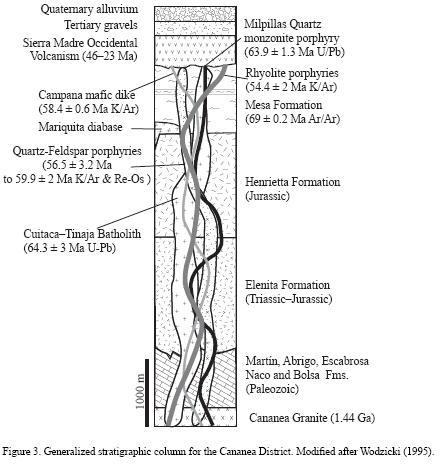
<body><![CDATA[<p align="justify"><font face="verdana" size="2">The Milpillas deposit located in the northern part of the Cananea District, is included within the down&#150;dropped block 7 km wide Cuitaca Graben, which cuts the Cananea region from north to south (<a href="/img/revistas/rmcg/v23n1/a3f2.jpg" target="_blank">Figure 2</a>). The eastern portion of the graben is at a shallower level than the western portion and is dominated by Tertiary gravels, Quaternary alluvium, and erratic outcrops of Laramide volcanic units. The deeper western part of the Cuitaca Graben is dominated by Quaternary alluvium. Close to the eastern boundary of the Cuitaca Graben, a small horst is present where scarce altered and oxidized outcropping reveals the existence of the Milpillas ore deposit (<a href="/img/revistas/rmcg/v23n1/a3f2.jpg" target="_blank">Figure 2</a>).</font></p>      <p align="justify"><font face="verdana" size="2">The oldest rock unit that crops out in the Cananea District is the Precambrian Cananea Granite (<a href="/img/revistas/rmcg/v23n1/a3f2.jpg" target="_blank">Figure 2</a> and <a href="#f3">3</a>). This unit represents the basement for the region and has been dated at 1440 &plusmn;15 Ma by U&#150;Pb in zircon (Anderson and Silver, 1977). The Cananea Granite is overlain by a Lower Paleozoic platform sequence (<a href="#f3">Figure 3</a>), mostly quartzite and carbonatos, succeeded by the conformably overlying Upper Paleozoic carbonatos of the Naco Group (Meinert, 1982). All these rock units crop out extensively at the Cananea mine area and its vicinity; however, neither units have been recognized in the Milpillas area (<a href="/img/revistas/rmcg/v23n1/a3f4.jpg" target="_blank">Figure 4</a>), but may well be present at a greater depth than the current drill&#150;core exploration program.</font></p>      <p align="center"><font face="verdana" size="2"> <a name="f3"></a></font></p>      <p align="center"><font face="verdana" size="2"> <img src="/img/revistas/rmcg/v23n1/a3f3.jpg"></font></p>      <p align="justify"><font face="verdana" size="2">The lowermost unit from the volcanic stratigraphy that crop out in the Cananea District (<a href="#f3">Figure 3</a>) is the Late Triassic &#150; Early Jurassic Elenita Formation (Valentine, 1936), which consists of a sequence of volcaniclastic and sedimentary rocks that include rhyolitic flows and tuffs, interbedded with andesites, sandstones, quartzites and conglomerates. This unit can be correlated with the Mount Wrightson and Fresnal Canyon Formations from southern Arizona, which have been dated between 220 and 192 Ma (Tosdale <i> et al.</i> , 1989).</font></p>      <p align="justify"><font face="verdana" size="2">In the Milpillas area, one the main volcaniclastic host rock units is the Laramide Mesa Formation (Valentine, 1936), which unconformably overlies the Henrietta Formation (<a href="/img/revistas/rmcg/v23n1/a3f5.jpg" target="_blank">Figure 5</a>). The Mesa Formation is a calc&#150;alkaline volcaniclastic unit that has an average thickness of&#150;1500 m, and extensively outcrops throughout the Cananea District where it has been dated at <img src="/img/revistas/rmcg/v23n1/a3s1.jpg">69 Ma (Wodzicki, 1995). These volcanic rocks have a medium to high potassium content and consist of trachybasaltic to andesitic agglomerates, flows and tuffs, including dacite and trachydacite, with andesitic composition being dominant throughout the sequence. In the Cananea District, this unit commonly includes significant thicknesses of interbedded volcanic sandstones and agglomerates, as well as a unit of basaltic flows, synvolcanic diabase sills and domes, locally known as the Mariquita Formation (Valentine, 1936). The oldest volcanic unit that crops out at Milpillas belongs to the Jurassic Henrietta Formation (Valentine, 1936). This is a volcaniclastic sequence, which consists of calc&#150;alkaline dacitic and rhyolitic flows and tuffs, interbedded with agglomerates, latites and andesites (Wodzicki, 2001). In the Cananea region, this unit overlies the Elenita Formation (<a href="#f3">Figure 3</a>). The Henrietta Formation has been correlated with the Artesa sequence from southern Arizona (Tosdal <i>et al., </i>1989). Although none of these units have been isotopically dated, a Mid&#150; to Late Jurassic age (&#150;165 to 150 Ma) has been assigned to them (Wodzicki, 2001).</font></p>      <p align="justify"><font face="verdana" size="2">Small porphyry stocks that vary in composition from quartz monzonite to monzonite intruded the Henrietta and Mesa Formations (<a href="#f3">Figure 3</a> and <a href="/img/revistas/rmcg/v23n1/a3f5.jpg" target="_blank">5</a>). The porphyry stocks consist of 2&#150;5 mm quartz, feldspar and biotite phenocry sts in a matrix of aphanitic&#150;fine quartz and orthoclase. The porphyry stocks are typically overprinted by strong sericitic alteration and are the main host to the Cu mineralization, but this Cu mineralization also extends into the immediate intruded volcaniclastic rocks. These porphyry stocks are spatially and could be genetically related to the late stages of the Laramide batholitic pluton complex locally known as the Cuitaca&#150;Tinajabatholith. This plutonic unit outcrops extensively throughout the Cananea Mining District. The Cuitaca&#150;Tinaja batolith is a granodiorite that contains biotite and hornblende as the main accessories, with minor magnetite and sphene. This pluton has been dated at 64 &plusmn; 3.0 Ma, using U&#150;Pb in zircon (Anderson and Silver, 1977). No porphyry units crop out at the surface in the Milpillas area (<a href="/img/revistas/rmcg/v23n1/a3f5.jpg" target="_blank">Figure 5</a>), however, there are some isolated outcrops of altered and leached volcanic host rocks. The ore body is completely covered by a sequence of post mineralization conglomerates and syn&#150;tectonic gravels (<a href="/img/revistas/rmcg/v23n1/a3f2.jpg" target="_blank">Figures 2</a>, <a href="/img/revistas/rmcg/v23n1/a3f4.jpg" target="_blank">4</a>, <a href="/img/revistas/rmcg/v23n1/a3f5.jpg" target="_blank">5</a>).</font></p>      <p align="justify"><font face="verdana" size="2">&nbsp;</font></p>     <p align="justify"><font face="verdana" size="2"><b>Structural geology</b></font></p>     <p align="justify"><font face="verdana" size="2">The structural control of PCDs emplacement in southwestern North America is consistent, at a district scale, with the dominant tectonic stresses that existed at their particular time of formation. These stresses vary from compressional to tensional (Titley, 2001). However, the tectonic evolution of this region has continued after ore deposit formation. During the relaxation of confining stresses at the North American&#150;Pacific plate margin due to changes in plate motions and/or plate margin configuration in the mid&#150; to late Tertiary (Gans and Miller, 1993; Basin and Range Province event), the region has been intensely faulted, extended and rotated, resulting in a significant disruption and rotation of deposits (<i>e.g., </i>San Manuel&#150;Kalamazoo, Ajo, and Cananea). The magnitude of rotation varies from moderate (30&deg; to 60&deg;) to severe (60&deg; to 90&deg;) (Wilkins and Heidrick, 1995).</font></p>      ]]></body>
<body><![CDATA[<p align="justify"><font face="verdana" size="2">In the Milpillas area, three main lineaments have been described: a pre&#150;mineral N&#150;S trend, a syn&#150;mineral NE trend, and a post&#150;mineral NW trend (de la Garza <i>et al., </i>2003). However, a detailed structural study of the Milpillas deposit from quartz veins and mineralized structures performed by Carre&oacute;n&#150;Pallares (2002) shows a flat radial and concentric structural pattern with preferential dips to the NE, E and SE. These dip trends are the same primary main orientations reported for Laramide stocks throughout Arizona (Rehrig andHeidrick, 1972; Heidrick and Titley, 1982), whereas the concentric pattern has been recognized in Sierrita, Arizona (Titley, 1982).</font></p>      <p align="justify"><font face="verdana" size="2">&nbsp;</font></p>     <p align="justify"><font face="verdana" size="2"><b>Mineralization and alteration</b></font></p>     <p align="justify"><font face="verdana" size="2">The hypogene mineralization in PCDs from the district is mainly present as breccias, stockwork and/or disseminated sulfide minerals. Where pre&#150;Laramide sedimentary host rocks are present, skarn mineralization developed. High&#150;grade, but low tonnage ore bodies, are found in skarn zones, as for example in the Cananea mine, where mineralization of Cu&#150;Zn&#150;Pb was developed by replacement of Paleozoic carbonate rocks interbedded with quartzites (Meinert, 1982). In some deposits, high grade mineralization was developed in breccias pipes, such as in the Cananea mine (Brecha La Colorada, Bushnell, 1988) or in Maria mine (Wodzicki, 1995). At the Milpillas deposit, scarce and low&#150;grade hypogene or primary mineralization is recognized (0.15&#150;0.20 % Cu) and because of these low grades, the exploration program focused on areas of supergene enrichment.</font></p>      <p align="justify"><font face="verdana" size="2">Most of the porphyry copper deposits in the Cananea District have been dated by K&#150;Ar dating techniques, yielding ages from <img src="/img/revistas/rmcg/v23n1/a3s1.jpg">60 &plusmn; 4 Ma to <img src="/img/revistas/rmcg/v23n1/a3s1.jpg">54 &plusmn; 2 Ma (Damon and Mauger, 1966; Damon <i>et al., </i>1983; Wodzicki, 1995).</font></p>      <p align="justify"><font face="verdana" size="2">The Milpillas deposit is a secondary enriched porphyry copper deposit that consists of high&#150;grade chalcocite blankets that are entirely covered by Tertiary&#150;Quaternary alluvial sediments commonly 50&#150;250 meters thick (de la Garza <i>et al.</i>, 2003). Milpillas was discovered and developed after intensive exploration programs and more than 100,000 meters of drilling, initially by Minera Cuicuilco in 1975 and continued up to feasibility in 1998 by Industrias Pe&ntilde;oles mining company.</font></p>      <p align="justify"><font face="verdana" size="2">The supergene enrichment zone presents a vertical zoning with an upper leach cap and oxide level typical of porphyry copper systems. The secondary enriched zones (<a href="/img/revistas/rmcg/v23n1/a3f5.jpg" target="_blank">Figure 5</a>) comprise the most important ore bodies in the deposit. These bodies can reach copper grades that range from &gt;1% to more than 10%.</font></p>      <p align="justify"><font face="verdana" size="2">Descriptions of supergene mineralization are scarce or non&#150;existing for Mexican PCDs. Seagart <i>et al. </i>(1974) provided the only known description of this type of mineralization in La Caridad. In the Milpillas ore body, the high grades of Cu are found in sub&#150;horizontal bodies or blankets (<a href="/img/revistas/rmcg/v23n1/a3f5.jpg" target="_blank">Figure 5</a>). At least three cycles of secondary enrichment are recognized in the deposit (see Anderson, 1982; Titley and Marozas, 1995; and Gilmour, 1995 for review of leach capping processes and supergene copper enrichment), which resulted in at least six 'blankets' that occur at a depth of 150 to 750 meters below the surface. The upper three blankets contain oxide mineralization and have a complex mineralogical assemblage consisting of: &quot;green Cu&#150;oxides&#150;carbonatos&quot; (antlerite, brochantite, malachite, azurite and chrysocolla); &quot;red Cu&#150;oxides&quot; (cuprite, native copper, delafossite, and minor &quot;pitch&quot; limonite); and &quot;black Cu&#150;oxides&quot; (neotocite, melaconite, tenorite, and minor &quot;Cu&#150;wad&quot;) (de la Garza <i>et al.</i>, 2003). Below these three blankets is an intermediate horizon that contains a mixture of oxides and sulfides. The two deepest blankets contain dominantly secondary sulfide minerals (mainly chalcocite and minor covellite; de la Garza <i>et al., </i>2003). Total copper resources for these blankets are 30 million tons at 2.5% Cu.</font></p>      <p align="justify"><font face="verdana" size="2">&nbsp;</font></p>      <p align="justify"><font face="verdana" size="2"><b>ANALYTICAL PROCEDURES </b></font></p>      ]]></body>
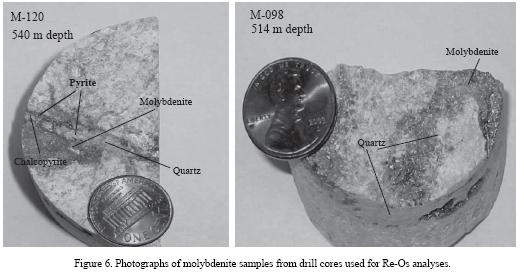
<body><![CDATA[<p align="justify"><font face="verdana" size="2"><b>Zircon U&#150;Pb dating</b></font></p>      <p align="justify"><font face="verdana" size="2">A sample was collected from drill hole M&#150;120 at a depth of <img src="/img/revistas/rmcg/v23n1/a3s1.jpg">540 m (<a href="/img/revistas/rmcg/v23n1/a3f5.jpg" target="_blank">Figure 5</a>). The sample was crushed and milled. Heavy mineral concentrates of the &lt;350 microns fraction were separated magnetically. Inclusion&#150;free zircons from the non&#150;magnetic fraction were handpicked under a binocular microscope. Zircons were mounted in epoxy and polished for laser ablation analysis.</font></p>      <p align="justify"><font face="verdana" size="2">Single zircon crystals were analyzed in polished sections with a Micromass Isoprobe ICP&#150;MS multi&#150;collector equipped with nine Faraday collectors, an axial Daly detector, and four ion&#150;counting channels (Dickinson and Gehrels, 2003). The Isoprobe is equipped with an ArF Excimer laser, which has an emission wavelength of 193 nm. The analyses were conducted on 50&#150;35 micron spots with output energy of <img src="/img/revistas/rmcg/v23n1/a3s1.jpg">32 mJ and a repetition rate of 10 Hz. Each analysis consisted of a background measurement (one 20&#150;second integration on peaks with no laser firing) and twenty I&#150;second integrations on peaks with the laser firing. Any Hg contribution to the <sup>204</sup>Pb mass is accordingly removed by subtracting the backgrounds values. The depth of each ablation pit was <img src="/img/revistas/rmcg/v23n1/a3s1.jpg">20 microns. Total measurement time was <img src="/img/revistas/rmcg/v23n1/a3s1.jpg">90 s per analysis.</font></p>      <p align="justify"><font face="verdana" size="2">The collectors were configured for simultaneous measurement of <sup>204</sup>Pb in an ion&#150;counting channel and <sup>206</sup>Pb<sup>206</sup>,Pb<sup>208</sup>Pb<sup>232</sup>Th and <sup>238</sup>U in Faraday detectors. All analyses were conducted in static mode. Inter&#150;element fractionation was monitored by analyzing fragments of SL&#150;1, a large concordant zircon crystal from Sri Lanka with a known (ID&#150;TIMS) age of 564 &plusmn; 4 Ma (2&sigma;) (Gehrels, unpublished data). The reported ages for zircon grains are based entirely on the <sup>206</sup>Pb/<sup>238</sup>U ratios because errors of the <sup>207</sup>Pb/<sup>235</sup>U and <sup>206</sup>Pb/<sup>207</sup>Pb ratios are significantly greater. The larger errors are the result of the low intensity (commonly &lt;0.5 mV) of the <sup>207</sup>Pb signal from these young, low&#150;U grains. <sup>207</sup>Pb/<sup>235</sup>U and <sup>206</sup>Pb/<sup>207</sup>Pb ratios and ages are accordingly not reported.</font></p>      <p align="justify"><font face="verdana" size="2">The <sup>206</sup>Pb/<sup>238</sup>U ratios are corrected for common Pb by using the measured <sup>206</sup>Pb/<sup>204</sup>Pb, a common Pb composition from Stacey and Kramers (1975), and an uncertainty of 1.0 unit on the common <sup>206</sup>Pb/<sup>204</sup>Pb.</font></p>      <p align="justify"><font face="verdana" size="2">The weighted mean of 16 individual analyses was calculated according to Ludwig (2003). The mean considers only the measurement or random errors (errors in <sup>206</sup>Pb/<sup>238</sup>U and <sup>206</sup>Pb/<sup>204</sup>Pb of each unknown). For this sample the random error is 0.6 Ma (2&sigma;), and represents <img src="/img/revistas/rmcg/v23n1/a3s1.jpg">1%. Age of standard, calibration correction from standard, composition of common Pb, decay constant uncertainty are the other sources that contributed to the error in the final age determination. These uncertainties are grouped and are known as the systematic error. For this sample the systematic error is <img src="/img/revistas/rmcg/v23n1/a3s1.jpg">1.8%. The error in the age of the sample is calculated by adding quadratically the two components (random or measurement error and systematic error), which for this sample is <img src="/img/revistas/rmcg/v23n1/a3s1.jpg">2.1 % (<i>i.e., </i>1.3 Ma). All age uncertainties are reported at the 2&#150;sigma level (2&sigma;).</font></p>      <p align="justify"><font face="verdana" size="2">&nbsp;</font></p>     <p align="justify"><font face="verdana" size="2"><b>Molybdenite Re&#150;Os dating</b></font></p>     <p align="justify"><font face="verdana" size="2">Molybdenum mineralization at Milpillas occurs frequently intergrown with primary copper sulfides. In order to determine the timing of hydrothermal mineralization, two molybdenite samples where selected from two different drill holes M&#150;120 (at <img src="/img/revistas/rmcg/v23n1/a3s1.jpg">540 m depth) and M&#150;098 (at <img src="/img/revistas/rmcg/v23n1/a3s1.jpg">514 m depth) (<a href="/img/revistas/rmcg/v23n1/a3f5.jpg" target="_blank">Figure 5</a>). Molybdenite sample M&#150;120 was collected from a 4&#150;mm&#150;thick vein that has an assemblage of quartz&#150;sericite&#150;molybdenite and sample M&#150;98 was collected from a 5&#150;mm&#150;thick vein with an assemblage of quartz&#150;sericite&#150;molybdenite&#150;chalcopyrite&#150;pyrite (<a href="#f6">Figure 6</a>). Both samples are from the quartz monzonite porphyry unit, with a medium to strong quartz&#150;sericite alteration (<a href="/img/revistas/rmcg/v23n1/a3f4.jpg" target="_blank">Figure 4</a>) that overprints and partially replaces the original rock&#150;forming silicates and their pre&#150;existing alteration products (<i>e.g.</i>, biotite and K&#150;feldspar) (Beane, 1982).</font></p>      <p align="center"><font face="verdana" size="2"> <a name="f6"></a></font></p>      ]]></body>
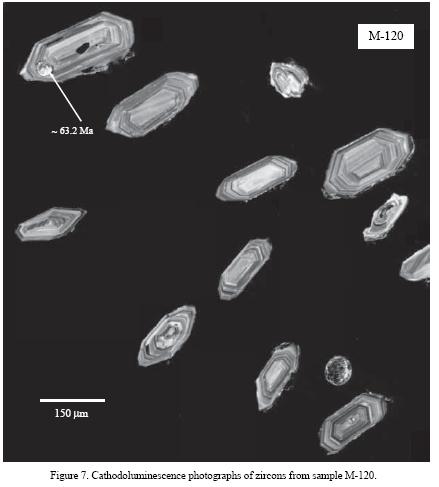
<body><![CDATA[<p align="center"><font face="verdana" size="2"> <img src="/img/revistas/rmcg/v23n1/a3f6.jpg"></font></p>      <p align="justify"><font face="verdana" size="2">The Re&#150;Os system applied to molybdenite is an important tool in determining the timing of mineralization since ore minerals (molybdenite) are dated directly. Other dating techniques, such as K&#150;Ar and Ar&#150;Ar are applied to associated silicates and hence provide indirect age determinations. Furthermore, the very low errors obtained with the Re&#150;Os technique (between 0.33% to &lt;1% of age determination) allow us to constrain or identify different pulses of mineralization that may occur in very short periods of time (<i>e.g., </i>Maksaev <i>et al.</i>, 2004). However, there is a continuous debate regarding the possible open&#150;system behavior of Re and Os in molybdenite (see McCandless <i>et al., </i>1993; Stein <i>et al., </i>2001; Barra <i>et al, </i>2003 for discussions).</font></p>      <p align="justify"><font face="verdana" size="2">Approximately 0.05 g of hand&#150;picked molybdenite and spikes were loaded in a Carius tube with 8 mL frozen reverse aqua regia. While the reagents, sample and spikes were frozen, the Carius tube was sealed and left to thaw at room temperature (Shirley and Walker, 1995). The tube was placed in an oven and heated to 240 &deg;C for 12 hours. Osmium was separated from the solution in a two&#150;stage distillation process (Nagler and Frei, 1997). Osmium was further purified using micro&#150;distillation technique (Birck <i>et al., </i>1997) and loaded on platinum filaments with Ba(OH)<sub>2 </sub>for thermal ionization mass spectrometer (TIMS). After osmium separation, the remaining acid solution was dried and re&#150;dissolved in 0.1 HNO<sub>3</sub>. Rhenium was extracted and purified through a two&#150;stage separation column using AG1 &#150;X8 (100&#150;200 mesh) resin and loaded on nickel filaments with Ba(NO<sub>3</sub>)<sub>2</sub> for TIMS measurements.</font></p>      <p align="justify"><font face="verdana" size="2">Samples were analyzed by negative thermal ion mass spectrometry (NTIMS) (Creaser <i>et al., </i>1991) on a VG 54 mass spectrometer. Molybdenite ages were calculated using a <sup>187</sup>Re decay constant of 1.666<img src="/img/revistas/rmcg/v23n1/a3s2.jpg">10<sup>&#150;11</sup> year<sup>&#150;1</sup>(Smoliar <i>et al, </i>1996). Ages are reported with a conservative total error of 0.5 % (<img src="/img/revistas/rmcg/v23n1/a3s1.jpg">2 sigma), which is a conservative approach that considers uncertainties from instrumental counting statistics, uncertainties in spike calibrations and in the <sup>187</sup>Re decay constant (0.31%). Blank levels are less than 7 ppt Os and 15 ppt Re.</font></p>      <p align="justify"><font face="verdana" size="2">&nbsp;</font></p>     <p align="justify"><font face="verdana" size="2"><b>Zircon U&#150;Pb results</b></font></p>     <p align="justify"><font face="verdana" size="2">Sixteen zircon grains were measured from sample M&#150;120. Results are reported in <a href="#t1">Table 1</a> and each line represents a spot analysis. All reported ages in <a href="#t1">Table 1</a> have uncertainties at the one&#150;sigma level (1&sigma;), which only includes the measurement error.</font></p>      <p align="center"><font face="verdana" size="2"> <a name="t1"></a></font></p>      <p align="center"><font face="verdana" size="2"> <img src="/img/revistas/rmcg/v23n1/a3t1.jpg"></font></p>      <p align="justify"><font face="verdana" size="2">Zircons analyzed are clear pinkish in color and range from 80 to 250 &micro;m in size. They are doubly&#150;terminated prisms dominated by the &#91;100&#93; face with a 2.5&#150;3:1 length to width ratio, which are typical morphologies of zircons in igneous rocks (<a href="#f7">Figure 7</a>) Cathodoluminescence (CL) images show that the zircons have narrow zoning (<a href="#f7">Figure 7</a>), which is characteristic of evolved magmas (Corfu <i>et al.</i>, 2003). Measurements were made at the center and tips of zircon crystals.</font></p>      ]]></body>
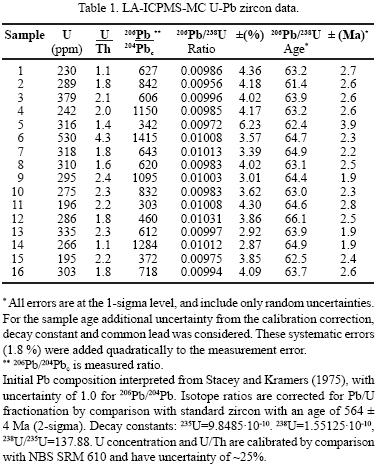
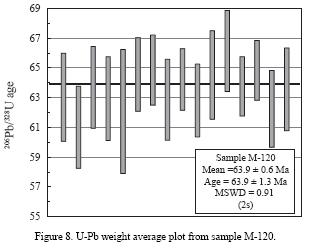
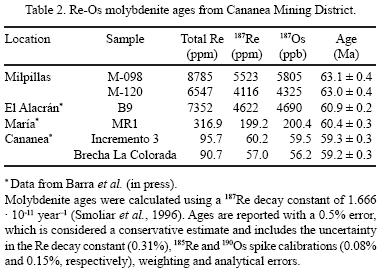
<body><![CDATA[<p align="center"><font face="verdana" size="2"> <a name="f7"></a></font></p>      <p align="center"><font face="verdana" size="2"> <img src="/img/revistas/rmcg/v23n1/a3f7.jpg"></font></p>      <p align="justify"><font face="verdana" size="2">Zircons from sample M&#150;120 have U and Th concentrations that vary from 530&#150;195 ppm and 240&#150;88 ppm, yielding U/Th ratios of <img src="/img/revistas/rmcg/v23n1/a3s1.jpg">2, characteristic of igneous zircons (Rubatto, 2002). These zircons yielded a weighted average <sup>206</sup>Pb/<sup>238</sup>U age of 63.9 &plusmn; 1.3 Ma (n=16, MSWD=0.91; <a href="#f8">Figure 8</a>). In the sixteen grains analyzed, no older component was detected.</font></p>      <p align="center"><font face="verdana" size="2"> <a name="f8"></a></font></p>      <p align="center"><font face="verdana" size="2"> <img src="/img/revistas/rmcg/v23n1/a3f8.jpg"></font></p>      <p align="justify"><font face="verdana" size="2">&nbsp;</font></p>     <p align="justify"><font face="verdana" size="2"><b>Molybdenite Re&#150;Os results</b></font></p>     <p align="justify"><font face="verdana" size="2">Re&#150;Os age determinations for two molybdenite samples are shown in <a href="#t2">Table 2</a>. This table also includes previous data from the district reported by Barra <i>et al. </i>(in press). Sample locations are shown in <a href="/img/revistas/rmcg/v23n1/a3f4.jpg" target="_blank">Figure 4</a> and <a href="/img/revistas/rmcg/v23n1/a3f5.jpg" target="_blank">5</a>. Total rhenium and <sup>187</sup>Os concentration range from 6547&#150;8785 ppm and 4325&#150;5805 ppb, respectively. Sample M&#150;120 yielded an age of 63.0 &plusmn; 0.4 Ma (<img src="/img/revistas/rmcg/v23n1/a3s1.jpg">0.5% error) and sample M&#150;098, 63.1 &plusmn; 0.4 Ma (<img src="/img/revistas/rmcg/v23n1/a3s1.jpg">0.5% error).</font></p>      <p align="center"><font face="verdana" size="2"> <a name="t2"></a></font></p>      <p align="center"><font face="verdana" size="2"> <img src="/img/revistas/rmcg/v23n1/a3t2.jpg"></font></p>      ]]></body>
<body><![CDATA[<p align="justify"><font face="verdana" size="2">&nbsp;</font></p>      <p align="justify"><font face="verdana" size="2"><b>DISCUSSION</b></font></p>      <p align="justify"><font face="verdana" size="2"><b>Age of mineralization</b></font></p>      <p align="justify"><font face="verdana" size="2">The <sup>206</sup>Pb/<sup>238</sup>U zircon age of 63.9 &plusmn; 1.3 Ma (<a href="#f8">Figure 8</a>) for the mineralized quartz monzonite porphyry unit is the only crystallization age reported so far for a productive intrusion in the Cananea District. This age is similar to the Cuitaca Granodiorite (64 &plusmn; 3 Ma) that crops out in the western border of the Cuitaca Graben. However, this unit has not been identified in any of the several drill holes from the Milpillas area.</font></p>      <p align="justify"><font face="verdana" size="2">Molybdenite samples of two different mineral assemblages from two deep drill holes (separated about 100 m from each other), have identical Re&#150;Os ages, suggesting that the molybdenite mineralization of Milpillas porphyry copper deposit occurred within a very short period of time (weighted average age of 63.1 &plusmn; 0.3 Ma).</font></p>      <p align="justify"><font face="verdana" size="2">Our U&#150;Pb and Re&#150;Os ages indicate a temporal relationship between the magmatism and hy drothermal activity, and identify the Milpillas porphyry copper deposit as the oldest Laramide porphyry in the Cananea District. Furthermore, the limited data presented suggests that the duration of magmatic&#150;hydrothermal activity in Milpillas was brief and that the hypogene mineralization was the product of a low&#150;grade single complex intrusion as proposed by Gustafson (2000).</font></p>      <p align="justify"><font face="verdana" size="2">&nbsp;</font></p>     <p align="justify"><font face="verdana" size="2"><b>Long&#150;lived or short&#150;lived multiple mineralization centers</b></font></p>     <p align="justify"><font face="verdana" size="2">It is evident that knowledge of the age and duration of geologic events that result in the formation of important concentrations of ore minerals in the earth's crust is fundamental to our understanding of the evolution and origin of ore deposits. For porphyry copper deposits, the long&#150;lived magmatic&#150;hydrothermal model versus the shortlived model, with several discrete pulses, and its role in the formation of large or giant ore deposits has become the focus of numerous recent studies (<i>e.g.</i> , Arribas <i>et al., </i>1995; Cornejo <i>et al, </i>1997; Marsh <i>et al.</i>, 1997; Clark <i>et al,</i> 1998; Hedenquist <i>et al, </i>1998; Reynolds <i>et al, </i>1998; Selby and Creaser, 2001; Barra <i>et al, </i>2003; Mastermanneet al.., 2004; Maksaev <i>et al, </i>2004). Consequently, the determination of the lifespan of porphyry copper systems and its relation with the size of the deposit (i.e., the amount of copper contained) is critical in the development of genetic models of PCDs at the deposit level and probably more relevant at the district level were porphyries tend to occur in clusters. Obviously, timing information is relevant in the construction of regional metallogenic models.</font></p>      <p align="justify"><font face="verdana" size="2">The pioneering work of Damon <i>et al. </i>(1983) remained for many years the only geochronological source on Mexican PCDs. This work reported several K&#150;Ar ages of different K&#150;rich minerals (<i> i.e.</i> , hornblende, biotite, K&#150;feld&#150;spar) for host rocks and mineralized porphyries. However, more recent age determinations using other techniques have shown that some of the K&#150;Ar ages of Damon <i>et al. </i>(1983) do not represent the main hydrothermal&#150;mineralization or magmatic episodes (<i>i.e., </i>El Arco Baja California, Mexico, K&#150;Ar of <img src="/img/revistas/rmcg/v23n1/a3s1.jpg">98&#150;106 Ma (Barthelmy, 1975) versus U&#150;Pb and Re&#150;Os of <img src="/img/revistas/rmcg/v23n1/a3s1.jpg">164 Ma (Valencia&#150;G&oacute;mez, 2005); Cumobabi K&#150;Ar of <img src="/img/revistas/rmcg/v23n1/a3s1.jpg">40 Ma compared to K&#150;Ar of <img src="/img/revistas/rmcg/v23n1/a3s1.jpg">55.6&#150;63.1 Ma (Scherkenbach <i>et al, </i>1985) and Re&#150;Os of <img src="/img/revistas/rmcg/v23n1/a3s1.jpg">59 Ma (Barra <i>et al.</i>, in press). These K&#150;Ar ages apparently record cooling rather than magmatic or hy drothermal events, and therefore led to erroneous metallogenetic models of the region.</font></p>      ]]></body>
<body><![CDATA[<p align="justify"><font face="verdana" size="2">Porphyry copper deposits in the NorthAmerica southwest did not form during temporally random or isolated events, but rather during the maturation of complex magmatic centers that progressed through a long&#150;lived sequence of igneous episodes (Lang, 1991). The Cananea cluster, the largest porphyry Cu&#150;Mo district in Mexico, is interpreted to be the result of long&#150;lived magmatic&#150;hydrothermal system, spanning from <img src="/img/revistas/rmcg/v23n1/a3s1.jpg">64 Ma to <img src="/img/revistas/rmcg/v23n1/a3s1.jpg">52 Ma (<a href="/img/revistas/rmcg/v23n1/a3f9.jpg" target="_blank">Figure 9</a>, Meinert, 1982; Wodzicki, 1995). This statement was supported by the early less precise K&#150;Ar and a Re&#150;Os molybdenite age (ICP&#150;MS; MaCandless <i>et al, </i>1993), scarce U&#150;Pb ages and limited Ar&#150;Ar geochronological data from different geological units from various deposits in the district. However, it is clear that the large span of time (&gt; 10 Ma) in the magmatic&#150;hydrothermal system might be a function of disturbed Ar or a less precise Re&#150;Os age.</font></p>      <p align="justify"><font face="verdana" size="2">Barra <i>et al. </i>(in press) dated several porphyry copper centers from Arizona, Sonora and Sinaloa. The new Re&#150;Os molybdenite ages were obtained from different centers of mineralization in the Cananea District, including El Alacr&aacute;n prospect, former Maria mine and former breccia La Colorada and Incremento 3 at Cananea mines (<a href="/img/revistas/rmcg/v23n1/a3f2.jpg" target="_blank">Figure 2</a> and <a href="#t2">Table 2</a>). This data, in addition to the new data from Milpillas indicate that mineralization within the district occurred in at least three discrete episodes, at <img src="/img/revistas/rmcg/v23n1/a3s1.jpg">59 Ma, <img src="/img/revistas/rmcg/v23n1/a3s1.jpg">61 Ma and <img src="/img/revistas/rmcg/v23n1/a3s1.jpg">63 Ma (<a href="/img/revistas/rmcg/v23n1/a3f9.jpg" target="_blank">Figure 9</a>), suggesting a model of multiple centers of mineralization produced during short&#150;lived discrete periods of time.</font></p>      <p align="justify"><font face="verdana" size="2">Furthermore, it is possible that the large volume of metal in the Cananea mine is the result of overprinting of multiple discrete hydrothermal&#150;mineralization events, in constrastto single mineralization events in Maria, Milpillas and El Alacr&aacute;n. The limited geochronological data for Cananea does not allow us to test this hypothesis, however, several examples from Chilean porphyry copper deposits (<i>i.e., </i>Chuquicamata, Reynolds <i>et al, </i>1998; Ballard <i>et al, </i>2001; Ossandon <i>et al.</i>, 2001; Los Pelambres, Bertens <i>et al.</i>, 2003, La Escondida, Padilla&#150;Garza <i>et al.</i>, 2004; El Teniente, Maksaev <i>et al.</i>, 2004) suggest that large deposits are the result of multiple overlapping of discrete mineralization episodes.</font></p>     <p align="justify"><font face="verdana" size="2">&nbsp;</font></p>     <p align="justify"><font face="verdana" size="2"><b>Timing of mineralization in Northwest Mexico</b></font></p>     <p align="justify"><font face="verdana" size="2">Porphyry copper mineralization in Northwest Mexico is Laramide in age (Damon <i>et al.</i>, 1983), with the exception of El Arco in Baja California, which has an older Middle Jurassic age (164 Ma, Valencia&#150;G&oacute;mez, 2005).</font></p>      <p align="justify"><font face="verdana" size="2">The Laramide orogeny is characterized in the North American southwest by a compressional regime with basement uplift and thrust fault deformation, and widespread igneous activity, which produced extensive cale&#150;alkaline magmatism in southern Arizona, New Mexico, and Sonora ranging from 80 Ma to 40 Ma (Damon <i>et al.</i>, 1964; Damon andMauger, 1966; Coney, 1976; Shafiqullah <i>et al.</i>, 1980; Damon <i>et al, </i>1983). McCandless and Ruiz (1993) determined two distinct intervals of porphyry copper mineralization in the southwestern region (including northern Mexico), one from 74&#150;70 Ma and the other from 60&#150;55 Ma, based on Re&#150;Os systematics. However, in spite of this important and pioneering contribution, these ages were determined using less precise ICP&#150;MS technique, and ages were calculated with the old Re&#150;Os decay constant (1.64<img src="/img/revistas/rmcg/v23n1/a3s2.jpg">10<sup>&#150;1</sup> 1  a<sup>&#150;1</sup>, Lindner <i>et al.</i>, 1986), yielding results with high errors and slightly older ages. For example, the Re&#150;Os molybdenite age of Maria mine calculated at 57.4 &plusmn;1.6 Ma (1 sigma) is recalculated to 56.5 &plusmn; 3.2 Ma (2 sigma) using the latest Re&#150;Os decay constant of 1.666<img src="/img/revistas/rmcg/v23n1/a3s2.jpg">10<sup>&#150;11</sup> a<sup>&#150;1</sup>(Smoliar <i>et al, </i>1996). This age is very close to the new Re&#150;Os age determination from a sample from the same deposit using the more precise TIMS technique, which yielded an age of 60.4 &plusmn; 0.3 Ma (Barra <i>et al, </i>in press). This new determination and the small associated error, allow us to better constrain the relative timing of the different deposits in this important province. Re&#150;Os ages from a number of porphyry copper deposits in northwest Mexico: La Caridad (Valencia <i>et al, </i>2005), El Crest&oacute;n, Cananea, El Alacr&aacute;n, Suaqui Verde, Maria, and Cuatro Hermanos (Barra <i>et al.</i>, in press), and Milpillas (this study), suggests that the two largest districts in northwest Mexico occurred in two intervals; at 63&#150;59 Ma (Cananea District), and at 55&#150;53 Ma (La Caridad District). Although mineralization in these districts formed in two different episodes, magmatism seems to have occurred over a much more extensive period, overlapping in space and time. This is illustrated in La Caridad, where 63.5 Ma volcanic rocks host the 54 Ma porphyry copper mineralization (Valencia <i>et al., </i>2005). Similar examples of this have been recognized in other PCDs in the Atizonan province.</font></p>      <p align="justify"><font face="verdana" size="2">Finally, the <img src="/img/revistas/rmcg/v23n1/a3s1.jpg">70 Ma porphyry mineralization recognized in northern Arizona (<i>e.g.</i>, Mineral Park, Titley, 1982; Bagdad, McCandless and Ruiz, 1993; Barra <i>et al.</i>, 2003) has not yet been recognized in northwestern Mexico.</font></p>      <p align="justify"><font face="verdana" size="2">&nbsp;</font></p>      <p align="justify"><font face="verdana" size="2"><b>CONCLUSIONS</b></font></p>      ]]></body>
<body><![CDATA[<p align="justify"><font face="verdana" size="2">U&#150;Pb zircon analyses from the mineralized quartz monzonite porphyry at the Milpillas deposit yielded a <sup>206</sup>Pb/<sup>238</sup>U age of 63.9 &plusmn; 1.3 Ma. This age coupled with molybdenite ages from two deep drill holes which have identical Re&#150;Os ages (weighted average age of 63.1 &plusmn; 0.3 Ma), suggests that the mineralization of Milpillas porphyry copper deposit occurred within a short period of time.</font></p>      <p align="justify"><font face="verdana" size="2">Mineralization within the Cananea District occurred in at least three discrete periods, at <img src="/img/revistas/rmcg/v23n1/a3s1.jpg">59 Ma, &#150;61 Ma and <img src="/img/revistas/rmcg/v23n1/a3s1.jpg">63 Ma, supporting the model of multiple centers of mineralization produced by the short lived discrete periods rather than a long lived period of mineralization.</font></p>      <p align="justify"><font face="verdana" size="2">We suggest that the large volume of metal in the Cananea mine could result from the overprinting of multiple discrete periods of hydrothermal mineralization, contrasting with single mineralization event as in Maria, Milpillas and El Alacr&aacute;n.</font></p>      <p align="justify"><font face="verdana" size="2">The largest mineralized districts in northwest Mexico occur in two main intervals, one at 59&#150;63 Ma (Cananea), and the other at 53&#150;55 Ma (La Caridad District), where associated magmatism overlaps in space and time.</font></p>      <p align="justify"><font face="verdana" size="2">&nbsp;</font></p>      <p align="justify"><font face="verdana" size="2"><b>ACKNOWLEDGMENTS</b></font></p>      <p align="justify"><font face="verdana" size="2">This work has been supported NSF grants EAR&#150;9725833, EAR&#150;9708361, EAR&#150;9814891 and EAR&#150;0125773 to Joaquin Ruiz, and a Terrones Student Research grant of the Society of Economic Geologists to Victor A. Valencia. Valencia was supported by 87199 CONACyT scholarship. The work was undertaken at the University of Arizona in the W. C. Keck Laboratory. Special thanks to Alex and Jenn Pullen and Mark Baker for their technical support. We are most grateful to Industrias Pe&ntilde;oles mining company. This work has benefited from comments of Donald F. Hammer, Lewis W. Gustafson, Erich U. Petersen, Ryan Mathur, W. Caddey and Juan C. Marquardt. We thank Luigi Solari, Luca Ferrari and an anonymous reviewer for their comments, which allowed us to improve the manuscript. Analytical support provided by NSF (EAR&#150;0443387)</font></p>      <p align="justify"><font face="verdana" size="2">&nbsp;</font></p>      <p align="justify"><font face="verdana" size="2"><b>REFERENCES</b></font></p>      <!-- ref --><p align="justify"><font face="verdana" size="2">Anderson, J.A., 1982, Characteristics of leached capping and techniques of appraisal, <i>in </i>Titley, S.R. (ed.), Advances in Geology of the Porphyry Copper Deposits, Southwestern North America: Tucson, University of Arizona Press, 275&#150;296. </font>&nbsp;&nbsp;&nbsp;&nbsp;&nbsp;&nbsp;&nbsp;&nbsp;[&#160;<a href="javascript:void(0);" onclick="javascript: window.open('/scielo.php?script=sci_nlinks&ref=8007816&pid=S1026-8774200600010000300001&lng=','','width=640,height=500,resizable=yes,scrollbars=1,menubar=yes,');">Links</a>&#160;]<!-- end-ref --><!-- ref --><p align="justify"><font face="verdana" size="2">Anderson, J.L., Bender, E., 1989, Nature and origin of Proterozoic A&#150;type granitic magmatism in the southwestern United States of America: Lithos, 23, 19&#150;52. </font>&nbsp;&nbsp;&nbsp;&nbsp;&nbsp;&nbsp;&nbsp;&nbsp;[&#160;<a href="javascript:void(0);" onclick="javascript: window.open('/scielo.php?script=sci_nlinks&ref=8007817&pid=S1026-8774200600010000300002&lng=','','width=640,height=500,resizable=yes,scrollbars=1,menubar=yes,');">Links</a>&#160;]<!-- end-ref --><!-- ref --><p align="justify"><font face="verdana" size="2">Anderson, T.H., Silver, L.T., 1977, Isotope ages of Granitic plutons, Cananea, Sonora: Economic Geology, 72, 827&#150;836. </font>&nbsp;&nbsp;&nbsp;&nbsp;&nbsp;&nbsp;&nbsp;&nbsp;[&#160;<a href="javascript:void(0);" onclick="javascript: window.open('/scielo.php?script=sci_nlinks&ref=8007818&pid=S1026-8774200600010000300003&lng=','','width=640,height=500,resizable=yes,scrollbars=1,menubar=yes,');">Links</a>&#160;]<!-- end-ref --><!-- ref --><p align="justify"><font face="verdana" size="2">Anderson, T.H., Silver, L.T., 1978, Jurassic magmatism in Sonora, Mexico, <i>in </i>Geological Society of America, Annual Meeting: Geological Society of America, Abstracts with Programs, 10, p. 359. </font>&nbsp;&nbsp;&nbsp;&nbsp;&nbsp;&nbsp;&nbsp;&nbsp;[&#160;<a href="javascript:void(0);" onclick="javascript: window.open('/scielo.php?script=sci_nlinks&ref=8007819&pid=S1026-8774200600010000300004&lng=','','width=640,height=500,resizable=yes,scrollbars=1,menubar=yes,');">Links</a>&#160;]<!-- end-ref --><!-- ref --><p align="justify"><font face="verdana" size="2">Anderson, T.H., Silver, L.T., 1981, An overview of Precambrian rocks in Sonora: Universidad Nacional Aut&oacute;noma de M&eacute;xico, Revista del Instituto de Geolog&iacute;a, 5, 131&#150;139. </font>&nbsp;&nbsp;&nbsp;&nbsp;&nbsp;&nbsp;&nbsp;&nbsp;[&#160;<a href="javascript:void(0);" onclick="javascript: window.open('/scielo.php?script=sci_nlinks&ref=8007820&pid=S1026-8774200600010000300005&lng=','','width=640,height=500,resizable=yes,scrollbars=1,menubar=yes,');">Links</a>&#160;]<!-- end-ref --><!-- ref --><p align="justify"><font face="verdana" size="2">Arribas, A.J., Hedenquist, J.W., Itaya, T., Okeda, T., Concepci&oacute;n, R.A., Garcia, J.S., Jr., 1995, Contemporaneous formation of adjacent porphyry and epithermal Cu&#150;Au deposit over 300 ka in northern Luzon, Philippines: Geology, 23, 337&#150;340. </font>&nbsp;&nbsp;&nbsp;&nbsp;&nbsp;&nbsp;&nbsp;&nbsp;[&#160;<a href="javascript:void(0);" onclick="javascript: window.open('/scielo.php?script=sci_nlinks&ref=8007821&pid=S1026-8774200600010000300006&lng=','','width=640,height=500,resizable=yes,scrollbars=1,menubar=yes,');">Links</a>&#160;]<!-- end-ref --><!-- ref --><p align="justify"><font face="verdana" size="2">Ballard, J.R., Palin, J.M., William, I.S., Campbell, I.H., Faunes, A., 2001, Two ages of porphyry intrusions resolved for the supergiant Chuquicamata copper deposit of northern Chile by ELA&#150;ICP&#150;MS and SHRIMP: Geology, 29, 383&#150;386. </font>&nbsp;&nbsp;&nbsp;&nbsp;&nbsp;&nbsp;&nbsp;&nbsp;[&#160;<a href="javascript:void(0);" onclick="javascript: window.open('/scielo.php?script=sci_nlinks&ref=8007822&pid=S1026-8774200600010000300007&lng=','','width=640,height=500,resizable=yes,scrollbars=1,menubar=yes,');">Links</a>&#160;]<!-- end-ref --><!-- ref --><p align="justify"><font face="verdana" size="2">Barra, F., Ruiz, J., Mathur, R., Titley, S., Schmitz, C., 2003, A Re&#150;Os study on sulfide minerals from the Bagdad porphyry Cu&#150;Mo deposit, northern Arizona, USA: Mineralium Deposita, 38, 585&#150;596.</font>&nbsp;&nbsp;&nbsp;&nbsp;&nbsp;&nbsp;&nbsp;&nbsp;[&#160;<a href="javascript:void(0);" onclick="javascript: window.open('/scielo.php?script=sci_nlinks&ref=8007823&pid=S1026-8774200600010000300008&lng=','','width=640,height=500,resizable=yes,scrollbars=1,menubar=yes,');">Links</a>&#160;]<!-- end-ref --><!-- ref --><p align="justify"><font face="verdana" size="2">Barra, F., Ruiz, J., Valencia, V.A., Ochoa&#150;Land&iacute;n, L., Chesley, J.T., Zurcher, L., in press, Laramide porphyry Cu&#150;Mo mineralization in northern Mexico: Age constraints from Re&#150;Os geochronology in molybdenites: Economic Geology, 100(8).</font>&nbsp;&nbsp;&nbsp;&nbsp;&nbsp;&nbsp;&nbsp;&nbsp;[&#160;<a href="javascript:void(0);" onclick="javascript: window.open('/scielo.php?script=sci_nlinks&ref=8007824&pid=S1026-8774200600010000300009&lng=','','width=640,height=500,resizable=yes,scrollbars=1,menubar=yes,');">Links</a>&#160;]<!-- end-ref --><!-- ref --><p align="justify"><font face="verdana" size="2">Barthelmy, D.A., 1975, Geology of the El Arco&#150;Calmalli area, Baja California, Mexico: San Diego, CA, San Diego State University, MS thesis, 130 p.</font>&nbsp;&nbsp;&nbsp;&nbsp;&nbsp;&nbsp;&nbsp;&nbsp;[&#160;<a href="javascript:void(0);" onclick="javascript: window.open('/scielo.php?script=sci_nlinks&ref=8007825&pid=S1026-8774200600010000300010&lng=','','width=640,height=500,resizable=yes,scrollbars=1,menubar=yes,');">Links</a>&#160;]<!-- end-ref --><!-- ref --><p align="justify"><font face="verdana" size="2">Beane, R., 1982, Hydrothermal alteration in silicate rocks, <i>in </i>Titley, S. (ed.), Advances in the Geology of the Porphyry Copper Deposits Southwestern North America: Tucson, The University of Arizona Press, 117&#150;137.</font>&nbsp;&nbsp;&nbsp;&nbsp;&nbsp;&nbsp;&nbsp;&nbsp;[&#160;<a href="javascript:void(0);" onclick="javascript: window.open('/scielo.php?script=sci_nlinks&ref=8007826&pid=S1026-8774200600010000300011&lng=','','width=640,height=500,resizable=yes,scrollbars=1,menubar=yes,');">Links</a>&#160;]<!-- end-ref --><!-- ref --><p align="justify"><font face="verdana" size="2">Bertens, A., Deckart, K., Gonzalez, A., 2003, Geocronologia U&#150;Pb, Re&#150;Os y Ar&#150;Ar del p&oacute;rfido Cu&#150;Mo Los Pelambres, Chile Central, <i>in </i>X Congreso Geol&oacute;gico Chileno, Abstracts (CD&#150;ROM): Concepci&oacute;n, Chile, Sociedad Geol&oacute;gica de Chile, 5 p.</font>&nbsp;&nbsp;&nbsp;&nbsp;&nbsp;&nbsp;&nbsp;&nbsp;[&#160;<a href="javascript:void(0);" onclick="javascript: window.open('/scielo.php?script=sci_nlinks&ref=8007827&pid=S1026-8774200600010000300012&lng=','','width=640,height=500,resizable=yes,scrollbars=1,menubar=yes,');">Links</a>&#160;]<!-- end-ref --><!-- ref --><p align="justify"><font face="verdana" size="2">Birck, J.L., Roy&#150;Barman, M., Campas, F., 1997, Re&#150;Os measurements at the femtomole level in natural samples: Geostandar Newsletter, 20, 19&#150;27.</font>&nbsp;&nbsp;&nbsp;&nbsp;&nbsp;&nbsp;&nbsp;&nbsp;[&#160;<a href="javascript:void(0);" onclick="javascript: window.open('/scielo.php?script=sci_nlinks&ref=8007828&pid=S1026-8774200600010000300013&lng=','','width=640,height=500,resizable=yes,scrollbars=1,menubar=yes,');">Links</a>&#160;]<!-- end-ref --><!-- ref --><p align="justify"><font face="verdana" size="2">Blodgett, R., Moore, T., Gray, F., 2002, Stratigraphy and paleontology of Lower Permian Rocks north of Cananea, northern Sonora, Mexico: Journal of South American Earth Sciences, 15, 481&#150;495.</font>&nbsp;&nbsp;&nbsp;&nbsp;&nbsp;&nbsp;&nbsp;&nbsp;[&#160;<a href="javascript:void(0);" onclick="javascript: window.open('/scielo.php?script=sci_nlinks&ref=8007829&pid=S1026-8774200600010000300014&lng=','','width=640,height=500,resizable=yes,scrollbars=1,menubar=yes,');">Links</a>&#160;]<!-- end-ref --><!-- ref --><p align="justify"><font face="verdana" size="2">Bushnell, S.E., 1988, Mineralization at Cananea, Sonora, Mexico, and the paragenesis and zoning of breccia pipes in quartz&#150;feldespathic rocks: Economic Geology, 83, 1760&#150;1981.</font>&nbsp;&nbsp;&nbsp;&nbsp;&nbsp;&nbsp;&nbsp;&nbsp;[&#160;<a href="javascript:void(0);" onclick="javascript: window.open('/scielo.php?script=sci_nlinks&ref=8007830&pid=S1026-8774200600010000300015&lng=','','width=640,height=500,resizable=yes,scrollbars=1,menubar=yes,');">Links</a>&#160;]<!-- end-ref --><!-- ref --><p align="justify"><font face="verdana" size="2">Campa, M., Coney, P.J., 1983, Tectono&#150;stratigraphic terranes and mineral resource distribution in Mexico: Canadian Journal of Earth Sciences, 20, 1040&#150;1051.</font>&nbsp;&nbsp;&nbsp;&nbsp;&nbsp;&nbsp;&nbsp;&nbsp;[&#160;<a href="javascript:void(0);" onclick="javascript: window.open('/scielo.php?script=sci_nlinks&ref=8007831&pid=S1026-8774200600010000300016&lng=','','width=640,height=500,resizable=yes,scrollbars=1,menubar=yes,');">Links</a>&#160;]<!-- end-ref --><!-- ref --><p align="justify"><font face="verdana" size="2">Carre&oacute;n&#150;Pallares, J.N., 2002, Structure and tectonic history of the Milpillas porphyry copper district, Sonora, Mexico: Salt Lake City, University of Utah, M.S. thesis, 72 p.</font>&nbsp;&nbsp;&nbsp;&nbsp;&nbsp;&nbsp;&nbsp;&nbsp;[&#160;<a href="javascript:void(0);" onclick="javascript: window.open('/scielo.php?script=sci_nlinks&ref=8007832&pid=S1026-8774200600010000300017&lng=','','width=640,height=500,resizable=yes,scrollbars=1,menubar=yes,');">Links</a>&#160;]<!-- end-ref --><!-- ref --><p align="justify"><font face="verdana" size="2">Clark, A.H., Archibald, D.A., Lee, A.W., Farrar, E., Hodgson, C.J., 1998, Laser probe <sup>40</sup>Ar/<sup>39</sup>Ar ages of early&#150; and late&#150; stage alteration assemblages, Rosario porphyry copper&#150;molybdenum deposit, Collahuasi district, I region, Chile: Economic Geology, 93, 326&#150;337.</font>&nbsp;&nbsp;&nbsp;&nbsp;&nbsp;&nbsp;&nbsp;&nbsp;[&#160;<a href="javascript:void(0);" onclick="javascript: window.open('/scielo.php?script=sci_nlinks&ref=8007833&pid=S1026-8774200600010000300018&lng=','','width=640,height=500,resizable=yes,scrollbars=1,menubar=yes,');">Links</a>&#160;]<!-- end-ref --><!-- ref --><p align="justify"><font face="verdana" size="2">Coney, P.J., 1976, Plate tectonics and the Laramide orogeny: Socorro, NM, New Mexico Geological Society, Special Publication, 6, 5&#150;10.</font>&nbsp;&nbsp;&nbsp;&nbsp;&nbsp;&nbsp;&nbsp;&nbsp;[&#160;<a href="javascript:void(0);" onclick="javascript: window.open('/scielo.php?script=sci_nlinks&ref=8007834&pid=S1026-8774200600010000300019&lng=','','width=640,height=500,resizable=yes,scrollbars=1,menubar=yes,');">Links</a>&#160;]<!-- end-ref --><!-- ref --><p align="justify"><font face="verdana" size="2">Coney, P.J., Reynolds, S. J., 1977, Cordilleran Benioff zones: Nature, 270, 403&#150;406.</font>&nbsp;&nbsp;&nbsp;&nbsp;&nbsp;&nbsp;&nbsp;&nbsp;[&#160;<a href="javascript:void(0);" onclick="javascript: window.open('/scielo.php?script=sci_nlinks&ref=8007835&pid=S1026-8774200600010000300020&lng=','','width=640,height=500,resizable=yes,scrollbars=1,menubar=yes,');">Links</a>&#160;]<!-- end-ref --><!-- ref --><p align="justify"><font face="verdana" size="2">Corfu, F., Hanchar, J.M., Hoskin, P.W.O., Kinny, P.D., 2003, Atlas of zircon textures, <i>in </i>Hanchar, J.M., Hoskin, P.W.O. (eds.), Zircon: Reviews in Mineralogy and Geochemistry, 53, 469&#150;500.</font>&nbsp;&nbsp;&nbsp;&nbsp;&nbsp;&nbsp;&nbsp;&nbsp;[&#160;<a href="javascript:void(0);" onclick="javascript: window.open('/scielo.php?script=sci_nlinks&ref=8007836&pid=S1026-8774200600010000300021&lng=','','width=640,height=500,resizable=yes,scrollbars=1,menubar=yes,');">Links</a>&#160;]<!-- end-ref --><!-- ref --><p align="justify"><font face="verdana" size="2">Cornejo, P., Tosdal, R.M., Mpodozis, C., Tomlinson, A.J., Rivera, O., Fanning, M., 1997, El Salvador, Chile porphyry copper deposit revisited; Geologic and geochronologic framework: International Geology Reviews, 39, 22&#150;54.</font>&nbsp;&nbsp;&nbsp;&nbsp;&nbsp;&nbsp;&nbsp;&nbsp;[&#160;<a href="javascript:void(0);" onclick="javascript: window.open('/scielo.php?script=sci_nlinks&ref=8007837&pid=S1026-8774200600010000300022&lng=','','width=640,height=500,resizable=yes,scrollbars=1,menubar=yes,');">Links</a>&#160;]<!-- end-ref --><!-- ref --><p align="justify"><font face="verdana" size="2">Creaser, R.A., Papanastassiou, D.A., Wasserburg, G., 1991, Negative thermal ion mass spectrometer of Os, Re and Ir: Geochimica et Cosmochimica Acta, 55, 397&#150;401.</font>&nbsp;&nbsp;&nbsp;&nbsp;&nbsp;&nbsp;&nbsp;&nbsp;[&#160;<a href="javascript:void(0);" onclick="javascript: window.open('/scielo.php?script=sci_nlinks&ref=8007838&pid=S1026-8774200600010000300023&lng=','','width=640,height=500,resizable=yes,scrollbars=1,menubar=yes,');">Links</a>&#160;]<!-- end-ref --><!-- ref --><p align="justify"><font face="verdana" size="2">Damon, P., Mauger, R.L., 1966, Epeirogeny&#150;orogeny viewed from the Basin and Range province: Transactions of the Society of Mining Engineers of American Institute of Mining, Metallurgical and Petroleum Engineers (AIME), 235, 99&#150;112.</font>&nbsp;&nbsp;&nbsp;&nbsp;&nbsp;&nbsp;&nbsp;&nbsp;[&#160;<a href="javascript:void(0);" onclick="javascript: window.open('/scielo.php?script=sci_nlinks&ref=8007839&pid=S1026-8774200600010000300024&lng=','','width=640,height=500,resizable=yes,scrollbars=1,menubar=yes,');">Links</a>&#160;]<!-- end-ref --><!-- ref --><p align="justify"><font face="verdana" size="2">Damon, P., Mauger, R.L., Bikerman, M., 1964, K&#150;Ar dating of Laramide plutonic and volcanic rocks within the Basin Province of Arizona and Sonora, <i>in </i>22th International Geological Congress, Proceedings: New Delhi, India, 45&#150;55.</font>&nbsp;&nbsp;&nbsp;&nbsp;&nbsp;&nbsp;&nbsp;&nbsp;[&#160;<a href="javascript:void(0);" onclick="javascript: window.open('/scielo.php?script=sci_nlinks&ref=8007840&pid=S1026-8774200600010000300025&lng=','','width=640,height=500,resizable=yes,scrollbars=1,menubar=yes,');">Links</a>&#160;]<!-- end-ref --><!-- ref --><p align="justify"><font face="verdana" size="2">Damon, P., Shafiqullah, M., Clark, K., 1981, Evoluci&oacute;n de los arcos magm&aacute;ticos en M&eacute;xico y su relaci&oacute;n con la metalog&eacute;nesis: Universidad Nacional Aut&oacute;noma de M&eacute;xico, Revista del Instituto de Geolog&iacute;a, 5, 223&#150;228.</font>&nbsp;&nbsp;&nbsp;&nbsp;&nbsp;&nbsp;&nbsp;&nbsp;[&#160;<a href="javascript:void(0);" onclick="javascript: window.open('/scielo.php?script=sci_nlinks&ref=8007841&pid=S1026-8774200600010000300026&lng=','','width=640,height=500,resizable=yes,scrollbars=1,menubar=yes,');">Links</a>&#160;]<!-- end-ref --><!-- ref --><p align="justify"><font face="verdana" size="2">Damon, P., Shafiqullah, M., Clark, K., 1983, Geochronology of the porphyry copper deposits and related mineralization of Mexico: Canadian Journal of Earth Sciences, 20, 1052&#150;1071.</font>&nbsp;&nbsp;&nbsp;&nbsp;&nbsp;&nbsp;&nbsp;&nbsp;[&#160;<a href="javascript:void(0);" onclick="javascript: window.open('/scielo.php?script=sci_nlinks&ref=8007842&pid=S1026-8774200600010000300027&lng=','','width=640,height=500,resizable=yes,scrollbars=1,menubar=yes,');">Links</a>&#160;]<!-- end-ref --><!-- ref --><p align="justify"><font face="verdana" size="2">de la Garza, V., Noguez, B., Carre&oacute;n&#150;Pallares, N., 2003, Geology, mineralization and emplacement of the Milpillas secondary&#150;enriched porphyry copper deposit, Sonora, Mexico, <i>in </i>XX Convenci&oacute;n Internacional de Miner&iacute;a, Acapulco, Guerrero, v. I: Mexico, Asociaci&oacute;n de Ingenieros de Minas, Metalurgistas y Ge&oacute;logos de M&eacute;xico (AIMMGM).</font>&nbsp;&nbsp;&nbsp;&nbsp;&nbsp;&nbsp;&nbsp;&nbsp;[&#160;<a href="javascript:void(0);" onclick="javascript: window.open('/scielo.php?script=sci_nlinks&ref=8007843&pid=S1026-8774200600010000300028&lng=','','width=640,height=500,resizable=yes,scrollbars=1,menubar=yes,');">Links</a>&#160;]<!-- end-ref --><!-- ref --><p align="justify"><font face="verdana" size="2">Dickinson, W.R., Gehrels, G.E., 2003, U&#150;Pb ages of detrital zircons from Permian and Jurassic eolian sandstones of the Colorado Plateau, USA; paleogeographic implications: Sedimentary Geology, 163, 29&#150;66.</font>&nbsp;&nbsp;&nbsp;&nbsp;&nbsp;&nbsp;&nbsp;&nbsp;[&#160;<a href="javascript:void(0);" onclick="javascript: window.open('/scielo.php?script=sci_nlinks&ref=8007844&pid=S1026-8774200600010000300029&lng=','','width=640,height=500,resizable=yes,scrollbars=1,menubar=yes,');">Links</a>&#160;]<!-- end-ref --><!-- ref --><p align="justify"><font face="verdana" size="2">Emmons, S.F., 1910, Cananeamining district of Sonora, Mexico: Economic Geology, 5, 312&#150;356.</font>&nbsp;&nbsp;&nbsp;&nbsp;&nbsp;&nbsp;&nbsp;&nbsp;[&#160;<a href="javascript:void(0);" onclick="javascript: window.open('/scielo.php?script=sci_nlinks&ref=8007845&pid=S1026-8774200600010000300030&lng=','','width=640,height=500,resizable=yes,scrollbars=1,menubar=yes,');">Links</a>&#160;]<!-- end-ref --><!-- ref --><p align="justify"><font face="verdana" size="2">Enders, M.S., 2000, Evolution of supergene enrichment in the Morenci porphyry copper deposit, Greenle County, Arizona: Tucson, University of Arizona, Ph. D. thesis, 517 p.</font>&nbsp;&nbsp;&nbsp;&nbsp;&nbsp;&nbsp;&nbsp;&nbsp;[&#160;<a href="javascript:void(0);" onclick="javascript: window.open('/scielo.php?script=sci_nlinks&ref=8007846&pid=S1026-8774200600010000300031&lng=','','width=640,height=500,resizable=yes,scrollbars=1,menubar=yes,');">Links</a>&#160;]<!-- end-ref --><!-- ref --><p align="justify"><font face="verdana" size="2">Gans, P.B., 1997, Large&#150;magnitude Oligo&#150;Miocene extension in southern Sonora; Implications for the tectonic evolution of northwest Mexico: Tectonics, 16, 388&#150;408.</font>&nbsp;&nbsp;&nbsp;&nbsp;&nbsp;&nbsp;&nbsp;&nbsp;[&#160;<a href="javascript:void(0);" onclick="javascript: window.open('/scielo.php?script=sci_nlinks&ref=8007847&pid=S1026-8774200600010000300032&lng=','','width=640,height=500,resizable=yes,scrollbars=1,menubar=yes,');">Links</a>&#160;]<!-- end-ref --><!-- ref --><p align="justify"><font face="verdana" size="2">Gans, P.B., Miller, E.L., 1993, Extension in the Basin and Range Province; Late orogenic collapse or something else? (abstract), <i>in </i>International Conference on Late Orogenic Extension in Mountain Belts, Proceedings: Montpellier, France, Bureau de Recherches Geologiques et Minieres (BRGM).</font>&nbsp;&nbsp;&nbsp;&nbsp;&nbsp;&nbsp;&nbsp;&nbsp;[&#160;<a href="javascript:void(0);" onclick="javascript: window.open('/scielo.php?script=sci_nlinks&ref=8007848&pid=S1026-8774200600010000300033&lng=','','width=640,height=500,resizable=yes,scrollbars=1,menubar=yes,');">Links</a>&#160;]<!-- end-ref --><!-- ref --><p align="justify"><font face="verdana" size="2">Gehrels, G.E., Stewart, J.H., 1998, Detrital zircon U&#150;Pb geochronology of Cambriam to Triassic miogeoclinal and eugeoclinal strata of Sonora, Mexico: Journal of Geophysical Reseach, 103, 2471&#150;2487.</font>&nbsp;&nbsp;&nbsp;&nbsp;&nbsp;&nbsp;&nbsp;&nbsp;[&#160;<a href="javascript:void(0);" onclick="javascript: window.open('/scielo.php?script=sci_nlinks&ref=8007849&pid=S1026-8774200600010000300034&lng=','','width=640,height=500,resizable=yes,scrollbars=1,menubar=yes,');">Links</a>&#160;]<!-- end-ref --><!-- ref --><p align="justify"><font face="verdana" size="2">Gilmour, P., 1995, A Field guide to leached capping interpretation, in Southwestern North America, <i>in </i>Pierce, F.W., Bolm, J.G. (eds.), The Porphyry Copper Deposits of the American Cordillera: Tucson, Arizona Geological Society Digest, 20, 169&#150;179.</font>&nbsp;&nbsp;&nbsp;&nbsp;&nbsp;&nbsp;&nbsp;&nbsp;[&#160;<a href="javascript:void(0);" onclick="javascript: window.open('/scielo.php?script=sci_nlinks&ref=8007850&pid=S1026-8774200600010000300035&lng=','','width=640,height=500,resizable=yes,scrollbars=1,menubar=yes,');">Links</a>&#160;]<!-- end-ref --><!-- ref --><p align="justify"><font face="verdana" size="2">Gonz&aacute;lez&#150;Le&oacute;n, 1986, Estratigraf&iacute;a del Paleozoico de la Sierra del Tule, noreste de Sonora: Revista Mexicana de Ciencias Geol&oacute;gicas, 6, 117&#150;135.</font>&nbsp;&nbsp;&nbsp;&nbsp;&nbsp;&nbsp;&nbsp;&nbsp;[&#160;<a href="javascript:void(0);" onclick="javascript: window.open('/scielo.php?script=sci_nlinks&ref=8007851&pid=S1026-8774200600010000300036&lng=','','width=640,height=500,resizable=yes,scrollbars=1,menubar=yes,');">Links</a>&#160;]<!-- end-ref --><!-- ref --><p align="justify"><font face="verdana" size="2">Gustafson, L.B., 2000, Milpillas Geologic Mode: Servicios Industriales Pe&ntilde;oles, S.A. de C.V., internal report.</font>&nbsp;&nbsp;&nbsp;&nbsp;&nbsp;&nbsp;&nbsp;&nbsp;[&#160;<a href="javascript:void(0);" onclick="javascript: window.open('/scielo.php?script=sci_nlinks&ref=8007852&pid=S1026-8774200600010000300037&lng=','','width=640,height=500,resizable=yes,scrollbars=1,menubar=yes,');">Links</a>&#160;]<!-- end-ref --><!-- ref --><p align="justify"><font face="verdana" size="2">Hedenquist, J.W., Arribas, A.J., Reynolds, J.R., 1998, Evolution of an intrusion&#150;centered hydrothermal system: Far Southeast&#150;Lepanto porphyry and epithermal Cu&#150;Au deposits, Philippines: Economic Geology, 93, 373&#150;404.</font>&nbsp;&nbsp;&nbsp;&nbsp;&nbsp;&nbsp;&nbsp;&nbsp;[&#160;<a href="javascript:void(0);" onclick="javascript: window.open('/scielo.php?script=sci_nlinks&ref=8007853&pid=S1026-8774200600010000300038&lng=','','width=640,height=500,resizable=yes,scrollbars=1,menubar=yes,');">Links</a>&#160;]<!-- end-ref --><!-- ref --><p align="justify"><font face="verdana" size="2">Heidrick, T.L., Titley S, R., 1982, Fracture and dike pattern in Laramide plutons and their structural and tectonics implications, <i>in </i>Titley, S.R. (ed.), Advances in Geology of the Porphyry Copper Deposits, southwestern North America: Tucson, University of Arizona Press, 73&#150;92.</font>&nbsp;&nbsp;&nbsp;&nbsp;&nbsp;&nbsp;&nbsp;&nbsp;[&#160;<a href="javascript:void(0);" onclick="javascript: window.open('/scielo.php?script=sci_nlinks&ref=8007854&pid=S1026-8774200600010000300039&lng=','','width=640,height=500,resizable=yes,scrollbars=1,menubar=yes,');">Links</a>&#160;]<!-- end-ref --><!-- ref --><p align="justify"><font face="verdana" size="2">Herrmann, M.A., 2001, Episodic magmatism and hydrothermal activity, Pima mining district, Arizona: Tucson, University of Arizona, M.S. thesis, 44 p.</font>&nbsp;&nbsp;&nbsp;&nbsp;&nbsp;&nbsp;&nbsp;&nbsp;[&#160;<a href="javascript:void(0);" onclick="javascript: window.open('/scielo.php?script=sci_nlinks&ref=8007855&pid=S1026-8774200600010000300040&lng=','','width=640,height=500,resizable=yes,scrollbars=1,menubar=yes,');">Links</a>&#160;]<!-- end-ref --><!-- ref --><p align="justify"><font face="verdana" size="2">Jensen, P.W., 1998, A structural and geochemical study of the Sierrita porphyry copper system, Pima County, Arizona: Tucson, University of Arizona, M.S. thesis, 136 p.</font>&nbsp;&nbsp;&nbsp;&nbsp;&nbsp;&nbsp;&nbsp;&nbsp;[&#160;<a href="javascript:void(0);" onclick="javascript: window.open('/scielo.php?script=sci_nlinks&ref=8007856&pid=S1026-8774200600010000300041&lng=','','width=640,height=500,resizable=yes,scrollbars=1,menubar=yes,');">Links</a>&#160;]<!-- end-ref --><!-- ref --><p align="justify"><font face="verdana" size="2">Jones, N.W., Mc Kee, J.W., Anderson, T.H., Silver, L.T., 1995, Jurassic volcanic rocks in northeastern Mexico; A possible remnant of a Cordilleran magmatic arc, <i>in </i>Jacques&#150;Ayala, C., Gonz&aacute;lez&#150;Le&oacute;n, C., Rold&aacute;n&#150;Quintana, J. (eds.), Studies on the Mesozoic of Sonora and adjacent areas: Geological Society of America, Special Paper, 301, 179&#150;190.</font>&nbsp;&nbsp;&nbsp;&nbsp;&nbsp;&nbsp;&nbsp;&nbsp;[&#160;<a href="javascript:void(0);" onclick="javascript: window.open('/scielo.php?script=sci_nlinks&ref=8007857&pid=S1026-8774200600010000300042&lng=','','width=640,height=500,resizable=yes,scrollbars=1,menubar=yes,');">Links</a>&#160;]<!-- end-ref --><!-- ref --><p align="justify"><font face="verdana" size="2">Lang, J.R., 1991, Isotopic and geochemical characteristics of Laramide igneous rocks in Arizona: Tucson, University of Arizona, Ph.D. thesis, 201 p.</font>&nbsp;&nbsp;&nbsp;&nbsp;&nbsp;&nbsp;&nbsp;&nbsp;[&#160;<a href="javascript:void(0);" onclick="javascript: window.open('/scielo.php?script=sci_nlinks&ref=8007858&pid=S1026-8774200600010000300043&lng=','','width=640,height=500,resizable=yes,scrollbars=1,menubar=yes,');">Links</a>&#160;]<!-- end-ref --><!-- ref --><p align="justify"><font face="verdana" size="2">Lindner, M., Leich, D.A., Borg, R.J., Russ, G.P., Bazan, J.M., Simons, D.S., Date, A.R., 1986, Direct laboratory determination of the <sup>187</sup>Re half&#150;life: Nature, 320, 246&#150;248.</font>&nbsp;&nbsp;&nbsp;&nbsp;&nbsp;&nbsp;&nbsp;&nbsp;[&#160;<a href="javascript:void(0);" onclick="javascript: window.open('/scielo.php?script=sci_nlinks&ref=8007859&pid=S1026-8774200600010000300044&lng=','','width=640,height=500,resizable=yes,scrollbars=1,menubar=yes,');">Links</a>&#160;]<!-- end-ref --><!-- ref --><p align="justify"><font face="verdana" size="2">Long, K.R., 1995, Production and reserves of cordilleran (Alaska to Chile) porphyry copper deposits, <i>in </i>Pierce, F.W., Bolm, J.G. (eds.) Porphyry Copper Deposits of the American Cordillera: Tucson, Arizona Geological Society Digest, 20, 35&#150;68.</font>&nbsp;&nbsp;&nbsp;&nbsp;&nbsp;&nbsp;&nbsp;&nbsp;[&#160;<a href="javascript:void(0);" onclick="javascript: window.open('/scielo.php?script=sci_nlinks&ref=8007860&pid=S1026-8774200600010000300045&lng=','','width=640,height=500,resizable=yes,scrollbars=1,menubar=yes,');">Links</a>&#160;]<!-- end-ref --><!-- ref --><p align="justify"><font face="verdana" size="2">Ludwig, K.J., 2003, Isoplot 3.00: Berkeley Geochronology Center, Special Publication, 4, 70 p.</font>&nbsp;&nbsp;&nbsp;&nbsp;&nbsp;&nbsp;&nbsp;&nbsp;[&#160;<a href="javascript:void(0);" onclick="javascript: window.open('/scielo.php?script=sci_nlinks&ref=8007861&pid=S1026-8774200600010000300046&lng=','','width=640,height=500,resizable=yes,scrollbars=1,menubar=yes,');">Links</a>&#160;]<!-- end-ref --><!-- ref --><p align="justify"><font face="verdana" size="2">Maksaev, V., Munizaga, F., McWilliams, M., Fanning, M., Mathur, R., Ruiz, J., Zentilli, M., 2004, New chronology for El Teniente, Chilean Andes, from U&#150;Pb, <sup>40</sup>Ar/<sup>39</sup>Ar, Re&#150;Os, and fission track dating; implications for the evolution of a supergiant porphyry Cu&#150;Mo deposit, <i>in </i>Sillitoe, R.H., Perello, J., Vidal, CE. (eds.), Andean Metallogeny; New Discoveries, Concepts and Updates: Boulder, Society of Economic Geologists, Special Publication, 11, 15&#150;54.</font>&nbsp;&nbsp;&nbsp;&nbsp;&nbsp;&nbsp;&nbsp;&nbsp;[&#160;<a href="javascript:void(0);" onclick="javascript: window.open('/scielo.php?script=sci_nlinks&ref=8007862&pid=S1026-8774200600010000300047&lng=','','width=640,height=500,resizable=yes,scrollbars=1,menubar=yes,');">Links</a>&#160;]<!-- end-ref --><!-- ref --><p align="justify"><font face="verdana" size="2">Marsh, T.M., Einaudi, M.T., McWilliams, M., 1997, <sup>40</sup>Ar/<sup>39</sup>Ar geochronology of Cu&#150;Au and Au&#150;Ag mineralization in the Potrerillos district, Chile: Economic Geology, 92, 784&#150;806.</font>&nbsp;&nbsp;&nbsp;&nbsp;&nbsp;&nbsp;&nbsp;&nbsp;[&#160;<a href="javascript:void(0);" onclick="javascript: window.open('/scielo.php?script=sci_nlinks&ref=8007863&pid=S1026-8774200600010000300048&lng=','','width=640,height=500,resizable=yes,scrollbars=1,menubar=yes,');">Links</a>&#160;]<!-- end-ref --><!-- ref --><p align="justify"><font face="verdana" size="2">Masterman, G.J., Cooke, D.R., Berry, R.F., Clark, A.H., Archibald, D.A., Mathur, R., Walshe, J.L., Duran, M., 2004,<sup>40</sup>Ar/<sup>39</sup> and Re&#150;Os geochronology of porphyry copper&#150;molybdenum deposits and related copper&#150;silver veins in the Collahuasi district, Northern Chile: Economic Geology, 99, 673&#150;690.</font>&nbsp;&nbsp;&nbsp;&nbsp;&nbsp;&nbsp;&nbsp;&nbsp;[&#160;<a href="javascript:void(0);" onclick="javascript: window.open('/scielo.php?script=sci_nlinks&ref=8007864&pid=S1026-8774200600010000300049&lng=','','width=640,height=500,resizable=yes,scrollbars=1,menubar=yes,');">Links</a>&#160;]<!-- end-ref --><!-- ref --><p align="justify"><font face="verdana" size="2">McCandless, T.E., Ruiz, J., 1993, Rhenium&#150;osmium evidence for regional mineralization in southwestern North America: Science, 261, 1282&#150;1286.</font>&nbsp;&nbsp;&nbsp;&nbsp;&nbsp;&nbsp;&nbsp;&nbsp;[&#160;<a href="javascript:void(0);" onclick="javascript: window.open('/scielo.php?script=sci_nlinks&ref=8007865&pid=S1026-8774200600010000300050&lng=','','width=640,height=500,resizable=yes,scrollbars=1,menubar=yes,');">Links</a>&#160;]<!-- end-ref --><!-- ref --><p align="justify"><font face="verdana" size="2">McCandless, T.E., Ruiz, J., Campbell, A.R., 1993, Re distribution in molybdenite from hypogene and supergene environments; implications for Re&#150;Os geochronometry: Geochimica et Cosmochimica Acta, 57, 889&#150;905.</font>&nbsp;&nbsp;&nbsp;&nbsp;&nbsp;&nbsp;&nbsp;&nbsp;[&#160;<a href="javascript:void(0);" onclick="javascript: window.open('/scielo.php?script=sci_nlinks&ref=8007866&pid=S1026-8774200600010000300051&lng=','','width=640,height=500,resizable=yes,scrollbars=1,menubar=yes,');">Links</a>&#160;]<!-- end-ref --><!-- ref --><p align="justify"><font face="verdana" size="2">McKee, M.B., Anderson, T.H., 1998, Mass&#150;gravity deposits and structures in the Lower Cretaceous of Sonora, Mexico: Geological Society of America Bulletin, 110, 1516&#150;1529.</font>&nbsp;&nbsp;&nbsp;&nbsp;&nbsp;&nbsp;&nbsp;&nbsp;[&#160;<a href="javascript:void(0);" onclick="javascript: window.open('/scielo.php?script=sci_nlinks&ref=8007867&pid=S1026-8774200600010000300052&lng=','','width=640,height=500,resizable=yes,scrollbars=1,menubar=yes,');">Links</a>&#160;]<!-- end-ref --><!-- ref --><p align="justify"><font face="verdana" size="2">Meinert, L.D., 1982, Skarn, manto, and breccia pipe formation in sedimentary rocks of the Cananea mining district, Sonora, Mexico: Economic Geology, 77, 919&#150;949.</font>&nbsp;&nbsp;&nbsp;&nbsp;&nbsp;&nbsp;&nbsp;&nbsp;[&#160;<a href="javascript:void(0);" onclick="javascript: window.open('/scielo.php?script=sci_nlinks&ref=8007868&pid=S1026-8774200600010000300053&lng=','','width=640,height=500,resizable=yes,scrollbars=1,menubar=yes,');">Links</a>&#160;]<!-- end-ref --><!-- ref --><p align="justify"><font face="verdana" size="2">Nagler, T.F., Frei, R., 1997, Plug in plug osmium distillation: Schweizerische Mineralogische und Petrographische Mitteilungen, 77, 123&#150;127.</font>&nbsp;&nbsp;&nbsp;&nbsp;&nbsp;&nbsp;&nbsp;&nbsp;[&#160;<a href="javascript:void(0);" onclick="javascript: window.open('/scielo.php?script=sci_nlinks&ref=8007869&pid=S1026-8774200600010000300054&lng=','','width=640,height=500,resizable=yes,scrollbars=1,menubar=yes,');">Links</a>&#160;]<!-- end-ref --><!-- ref --><p align="justify"><font face="verdana" size="2">Ochoa&#150;Land&iacute;n, L., Echavarri, A., 1978, Observaciones preliminares sobre la secuencia de las intrusiones hipabisales en el Tajo Colorada&#150;veta del distrito minero de Cananea: Hermosillo, M&eacute;xico, Universidad de Sonora, Bolet&iacute;n del Departamento de Geolog&iacute;a, 1, 57&#150;60.</font>&nbsp;&nbsp;&nbsp;&nbsp;&nbsp;&nbsp;&nbsp;&nbsp;[&#160;<a href="javascript:void(0);" onclick="javascript: window.open('/scielo.php?script=sci_nlinks&ref=8007870&pid=S1026-8774200600010000300055&lng=','','width=640,height=500,resizable=yes,scrollbars=1,menubar=yes,');">Links</a>&#160;]<!-- end-ref --><!-- ref --><p align="justify"><font face="verdana" size="2">Ossandon, G., Freraut, R., Gustafson, L.B., Lindsay, D.D., Zentilli, M., 2001, Geology of the Chuquicamata mine; A progress report: Economic Geology, 96, 249&#150;270.</font>&nbsp;&nbsp;&nbsp;&nbsp;&nbsp;&nbsp;&nbsp;&nbsp;[&#160;<a href="javascript:void(0);" onclick="javascript: window.open('/scielo.php?script=sci_nlinks&ref=8007871&pid=S1026-8774200600010000300056&lng=','','width=640,height=500,resizable=yes,scrollbars=1,menubar=yes,');">Links</a>&#160;]<!-- end-ref --><!-- ref --><p align="justify"><font face="verdana" size="2">Padilla&#150;Garza, R.A., 2003, Description and evolution of the Escondida porphyry copper deposit, Antofagasta region, northern Chile: Tucson, University of Arizona, Ph.D. Thesis, 216 p.</font>&nbsp;&nbsp;&nbsp;&nbsp;&nbsp;&nbsp;&nbsp;&nbsp;[&#160;<a href="javascript:void(0);" onclick="javascript: window.open('/scielo.php?script=sci_nlinks&ref=8007872&pid=S1026-8774200600010000300057&lng=','','width=640,height=500,resizable=yes,scrollbars=1,menubar=yes,');">Links</a>&#160;]<!-- end-ref --><!-- ref --><p align="justify"><font face="verdana" size="2">Padilla&#150;Garza, R.A., Titley S, R., Eastoe, C., 2004, Hypogene evolution of the Escondida porphyry copper deposit, Chile, <i>in </i>Sillitoe, R.H., Perello, I, Vidal, C.E. (eds.), Andean Metallogeny; New Discoveries, Concepts, and Updates: Boulder, Society of Economic Geologists, Special Publication 11, 141&#150;166.</font>&nbsp;&nbsp;&nbsp;&nbsp;&nbsp;&nbsp;&nbsp;&nbsp;[&#160;<a href="javascript:void(0);" onclick="javascript: window.open('/scielo.php?script=sci_nlinks&ref=8007873&pid=S1026-8774200600010000300058&lng=','','width=640,height=500,resizable=yes,scrollbars=1,menubar=yes,');">Links</a>&#160;]<!-- end-ref --><!-- ref --><p align="justify"><font face="verdana" size="2">Perry, V.D., 1961, The significance of mineralized breccia pipes: Mining Engineering, 13, 367&#150;376.</font>&nbsp;&nbsp;&nbsp;&nbsp;&nbsp;&nbsp;&nbsp;&nbsp;[&#160;<a href="javascript:void(0);" onclick="javascript: window.open('/scielo.php?script=sci_nlinks&ref=8007874&pid=S1026-8774200600010000300059&lng=','','width=640,height=500,resizable=yes,scrollbars=1,menubar=yes,');">Links</a>&#160;]<!-- end-ref --><!-- ref --><p align="justify"><font face="verdana" size="2">Rangin, C., 1978, Consideraciones sobre la evoluci&oacute;n geol&oacute;gica de la parte septentrional del Estado de Sonora, <i>in </i> 1er Simposio sobre la Geolog&iacute;a y Potencial Minero del Estado de Sonora, Libreto gu&iacute;a: Hermosillo, Universidad Nacional Aut&oacute;noma de M&eacute;xico, Instituto de Geolog&iacute;a, 35&#150;36.</font>&nbsp;&nbsp;&nbsp;&nbsp;&nbsp;&nbsp;&nbsp;&nbsp;[&#160;<a href="javascript:void(0);" onclick="javascript: window.open('/scielo.php?script=sci_nlinks&ref=8007875&pid=S1026-8774200600010000300060&lng=','','width=640,height=500,resizable=yes,scrollbars=1,menubar=yes,');">Links</a>&#160;]<!-- end-ref --><!-- ref --><p align="justify"><font face="verdana" size="2">Rehrig, W.A., Heidrick, T.L., 1972, Regional fracturing in Laramide stocks of Arizona and its relationship to porphyry copper mineralization: Economic Geology, 67, 198&#150;213.</font>&nbsp;&nbsp;&nbsp;&nbsp;&nbsp;&nbsp;&nbsp;&nbsp;[&#160;<a href="javascript:void(0);" onclick="javascript: window.open('/scielo.php?script=sci_nlinks&ref=8007876&pid=S1026-8774200600010000300061&lng=','','width=640,height=500,resizable=yes,scrollbars=1,menubar=yes,');">Links</a>&#160;]<!-- end-ref --><!-- ref --><p align="justify"><font face="verdana" size="2">Reynolds, P., Revenhurst, C., Zentilli, M., Lindsay, D.D., 1998, High&#150;precision <sup>40</sup>Ar/<sup>39</sup>Ar dating of two consecutive hydrotermal events in the Chuquicamata porphyry copper system, Chile: Chemical Geology, 148, 45&#150;60.</font>&nbsp;&nbsp;&nbsp;&nbsp;&nbsp;&nbsp;&nbsp;&nbsp;[&#160;<a href="javascript:void(0);" onclick="javascript: window.open('/scielo.php?script=sci_nlinks&ref=8007877&pid=S1026-8774200600010000300062&lng=','','width=640,height=500,resizable=yes,scrollbars=1,menubar=yes,');">Links</a>&#160;]<!-- end-ref --><!-- ref --><p align="justify"><font face="verdana" size="2">Rold&aacute;n&#150;Quintana, J., 1981, Evoluci&oacute;n tect&oacute;nica del Estado de Sonora: Universidad Nacional Aut&oacute;noma de M&eacute;xico, Revista del Instituto de Geolog&iacute;a, 5, 178&#150;185.</font>&nbsp;&nbsp;&nbsp;&nbsp;&nbsp;&nbsp;&nbsp;&nbsp;[&#160;<a href="javascript:void(0);" onclick="javascript: window.open('/scielo.php?script=sci_nlinks&ref=8007878&pid=S1026-8774200600010000300063&lng=','','width=640,height=500,resizable=yes,scrollbars=1,menubar=yes,');">Links</a>&#160;]<!-- end-ref --><!-- ref --><p align="justify"><font face="verdana" size="2">Rubatto, D., 2002, Zircon trace element geochemistry; partitioning with garnet and the link between U&#150;Pb ages and metamorphism: Chemical Geology, 184, 123&#150;138.</font>&nbsp;&nbsp;&nbsp;&nbsp;&nbsp;&nbsp;&nbsp;&nbsp;[&#160;<a href="javascript:void(0);" onclick="javascript: window.open('/scielo.php?script=sci_nlinks&ref=8007879&pid=S1026-8774200600010000300064&lng=','','width=640,height=500,resizable=yes,scrollbars=1,menubar=yes,');">Links</a>&#160;]<!-- end-ref --><!-- ref --><p align="justify"><font face="verdana" size="2">Scherkenback, D.A., Sawkins, F.J., Seyfried, W.E., 1985, Geologic, fluid inclusions, and geochemical studies of the mineralized breccias at Cumobabi, Sonora, Mexico: Economic Geology, 80, 1566&#150;1592.</font>&nbsp;&nbsp;&nbsp;&nbsp;&nbsp;&nbsp;&nbsp;&nbsp;[&#160;<a href="javascript:void(0);" onclick="javascript: window.open('/scielo.php?script=sci_nlinks&ref=8007880&pid=S1026-8774200600010000300065&lng=','','width=640,height=500,resizable=yes,scrollbars=1,menubar=yes,');">Links</a>&#160;]<!-- end-ref --><!-- ref --><p align="justify"><font face="verdana" size="2">Seagart, W., Sell, J., Kilpatrick, B., 1974, Geology and mineralization of La Caridad porphyry copper deposit, Sonora, Mexico: Economic Geology, 69, 1060&#150;1077.</font>&nbsp;&nbsp;&nbsp;&nbsp;&nbsp;&nbsp;&nbsp;&nbsp;[&#160;<a href="javascript:void(0);" onclick="javascript: window.open('/scielo.php?script=sci_nlinks&ref=8007881&pid=S1026-8774200600010000300066&lng=','','width=640,height=500,resizable=yes,scrollbars=1,menubar=yes,');">Links</a>&#160;]<!-- end-ref --><!-- ref --><p align="justify"><font face="verdana" size="2">Sedlock, R., Ortega&#150;Guti&eacute;rrez, F., Speed, R.C., 1993, Tectonoestratigraphic terranes and tectonic evolution of Mexico: Geological Society of America, Special Paper, 278, 153 p.</font>&nbsp;&nbsp;&nbsp;&nbsp;&nbsp;&nbsp;&nbsp;&nbsp;[&#160;<a href="javascript:void(0);" onclick="javascript: window.open('/scielo.php?script=sci_nlinks&ref=8007882&pid=S1026-8774200600010000300067&lng=','','width=640,height=500,resizable=yes,scrollbars=1,menubar=yes,');">Links</a>&#160;]<!-- end-ref --><!-- ref --><p align="justify"><font face="verdana" size="2">Selby, D., Creaser, R.A., 2001, Re&#150;Os geochronology and systematics in molybdenite from the Endako porphyry molybdenum deposit, British Columbia, Canada: Economic Geology, 96, 197&#150;204.</font>&nbsp;&nbsp;&nbsp;&nbsp;&nbsp;&nbsp;&nbsp;&nbsp;[&#160;<a href="javascript:void(0);" onclick="javascript: window.open('/scielo.php?script=sci_nlinks&ref=8007883&pid=S1026-8774200600010000300068&lng=','','width=640,height=500,resizable=yes,scrollbars=1,menubar=yes,');">Links</a>&#160;]<!-- end-ref --><!-- ref --><p align="justify"><font face="verdana" size="2">Shafiqullah, M., Damon, P., Lynch, D., Reynolds, S.J., Rehigh, W., Raymond, R., 1980, K&#150;Ar geochronology and geologic history of southwestern Arizona and adjacent areas, <i>in </i>Jenney, J.P., Stone, C. (eds.), Studies in western Arizona: Tucson, Arizona Geological Society Digest, 12, 201&#150;260.</font>&nbsp;&nbsp;&nbsp;&nbsp;&nbsp;&nbsp;&nbsp;&nbsp;[&#160;<a href="javascript:void(0);" onclick="javascript: window.open('/scielo.php?script=sci_nlinks&ref=8007884&pid=S1026-8774200600010000300069&lng=','','width=640,height=500,resizable=yes,scrollbars=1,menubar=yes,');">Links</a>&#160;]<!-- end-ref --><!-- ref --><p align="justify"><font face="verdana" size="2">Shirley, S., Walker, R., 1995, Carius tube digestion for low&#150;blank rhenium&#150;osmium analysis: Analytical Chemistry, 67, 2136&#150;2141.</font>&nbsp;&nbsp;&nbsp;&nbsp;&nbsp;&nbsp;&nbsp;&nbsp;[&#160;<a href="javascript:void(0);" onclick="javascript: window.open('/scielo.php?script=sci_nlinks&ref=8007885&pid=S1026-8774200600010000300070&lng=','','width=640,height=500,resizable=yes,scrollbars=1,menubar=yes,');">Links</a>&#160;]<!-- end-ref --><!-- ref --><p align="justify"><font face="verdana" size="2">Silver, L.T., Blickford, M.E., Van Schmus, W.R., Anderson, J.L., Anderson, T.H., 1977, The 1.4&#150;1.5 B.Y. transcontinental anorogenic plutonic perforation of North America, <i>in </i>Geological Society of America, Annual Meeting, Seattle: Geological Society of America, Abstracts with Programs, 1176&#150;1177.</font>&nbsp;&nbsp;&nbsp;&nbsp;&nbsp;&nbsp;&nbsp;&nbsp;[&#160;<a href="javascript:void(0);" onclick="javascript: window.open('/scielo.php?script=sci_nlinks&ref=8007886&pid=S1026-8774200600010000300071&lng=','','width=640,height=500,resizable=yes,scrollbars=1,menubar=yes,');">Links</a>&#160;]<!-- end-ref --><!-- ref --><p align="justify"><font face="verdana" size="2">Smoliar, M., Walker, R., Morgan, J., 1996, Re&#150;Os of group IIA, IIIA, IVA and IVB iron meteorites: Science, 271, 1099&#150;1102.</font>&nbsp;&nbsp;&nbsp;&nbsp;&nbsp;&nbsp;&nbsp;&nbsp;[&#160;<a href="javascript:void(0);" onclick="javascript: window.open('/scielo.php?script=sci_nlinks&ref=8007887&pid=S1026-8774200600010000300072&lng=','','width=640,height=500,resizable=yes,scrollbars=1,menubar=yes,');">Links</a>&#160;]<!-- end-ref --><!-- ref --><p align="justify"><font face="verdana" size="2">Stacey, J.S.K., Kramers, J.D., 1975, Approximation of terrestrial lead isotope evolution by a two&#150;stage model: Earth and Planetary Science Letters, 26, 207&#150;221.</font>&nbsp;&nbsp;&nbsp;&nbsp;&nbsp;&nbsp;&nbsp;&nbsp;[&#160;<a href="javascript:void(0);" onclick="javascript: window.open('/scielo.php?script=sci_nlinks&ref=8007888&pid=S1026-8774200600010000300073&lng=','','width=640,height=500,resizable=yes,scrollbars=1,menubar=yes,');">Links</a>&#160;]<!-- end-ref --><!-- ref --><p align="justify"><font face="verdana" size="2">Stein, H.J., Markey, R.J., Morgan, J.W., Hannah, J.L., Scherst&eacute;n, A., 2001, The remarkable Re&#150;Os chronometer in molybdenite; how and why it works: Terra Nova, 13(6), 479&#150;486.</font>&nbsp;&nbsp;&nbsp;&nbsp;&nbsp;&nbsp;&nbsp;&nbsp;[&#160;<a href="javascript:void(0);" onclick="javascript: window.open('/scielo.php?script=sci_nlinks&ref=8007889&pid=S1026-8774200600010000300074&lng=','','width=640,height=500,resizable=yes,scrollbars=1,menubar=yes,');">Links</a>&#160;]<!-- end-ref --><!-- ref --><p align="justify"><font face="verdana" size="2">Stewart, J., 1988, Latest Proterozoic and Paleozoic southern margin of North America and the accretion of Mexico: Geology, 16, 186&#150;189.</font>&nbsp;&nbsp;&nbsp;&nbsp;&nbsp;&nbsp;&nbsp;&nbsp;[&#160;<a href="javascript:void(0);" onclick="javascript: window.open('/scielo.php?script=sci_nlinks&ref=8007890&pid=S1026-8774200600010000300075&lng=','','width=640,height=500,resizable=yes,scrollbars=1,menubar=yes,');">Links</a>&#160;]<!-- end-ref --><!-- ref --><p align="justify"><font face="verdana" size="2">Stewart, J., Poole, F.G., Ketner, K.B., Madrid, R.J., Rold&aacute;n&#150;Quintana, J., Amaya&#150;Mart&iacute;nez, R., 1990, Tectonics and stratigraphy of the Paleozoic and Triassic southern margin of North America, Sonora, Mexico, <i>in </i>Gehrels, G.E., Spencer, J. (eds.), Geologic excursions through the Sonoran Desert region, Arizona and Sonora: Tucson, Arizona Geological Survey, Special Paper 7, 183&#150;202.</font>&nbsp;&nbsp;&nbsp;&nbsp;&nbsp;&nbsp;&nbsp;&nbsp;[&#160;<a href="javascript:void(0);" onclick="javascript: window.open('/scielo.php?script=sci_nlinks&ref=8007891&pid=S1026-8774200600010000300076&lng=','','width=640,height=500,resizable=yes,scrollbars=1,menubar=yes,');">Links</a>&#160;]<!-- end-ref --><!-- ref --><p align="justify"><font face="verdana" size="2">Titley, S.R., 1981, Geologic and tectonic setting of porphyry copper deposits in the southern cordillera, <i>in </i>Dickinson, W.R., Payne, W.P. (ed.), Relations of tectonics to ore deposits in the southern Cordillera, Arizona Geological Society, Digest, 14, 79&#150;98.</font>&nbsp;&nbsp;&nbsp;&nbsp;&nbsp;&nbsp;&nbsp;&nbsp;[&#160;<a href="javascript:void(0);" onclick="javascript: window.open('/scielo.php?script=sci_nlinks&ref=8007892&pid=S1026-8774200600010000300077&lng=','','width=640,height=500,resizable=yes,scrollbars=1,menubar=yes,');">Links</a>&#160;]<!-- end-ref --><!-- ref --><p align="justify"><font face="verdana" size="2">Titley, S.R., 1982, Geologic setting of porphyry copper deposits, southeastern Arizona, <i>in </i>Titley, S.R. (ed.), Advances in Geology of the Porphyry Copper Deposits, Southwestern North America: Tucson, University of Arizona Press, 37&#150;58.</font>&nbsp;&nbsp;&nbsp;&nbsp;&nbsp;&nbsp;&nbsp;&nbsp;[&#160;<a href="javascript:void(0);" onclick="javascript: window.open('/scielo.php?script=sci_nlinks&ref=8007893&pid=S1026-8774200600010000300078&lng=','','width=640,height=500,resizable=yes,scrollbars=1,menubar=yes,');">Links</a>&#160;]<!-- end-ref --><!-- ref --><p align="justify"><font face="verdana" size="2">Titley, S.R., 1995, Geological summary and perspective of porphyry copper deposits in Southwestern North America, <i>in </i>Pierce, F.W., Bolm, J.G. (eds.), Porphyry copper deposits of the American Cordillera: Tucson, Arizona Geological Society Digest, 20, 6&#150;20.</font>&nbsp;&nbsp;&nbsp;&nbsp;&nbsp;&nbsp;&nbsp;&nbsp;[&#160;<a href="javascript:void(0);" onclick="javascript: window.open('/scielo.php?script=sci_nlinks&ref=8007894&pid=S1026-8774200600010000300079&lng=','','width=640,height=500,resizable=yes,scrollbars=1,menubar=yes,');">Links</a>&#160;]<!-- end-ref --><!-- ref --><p align="justify"><font face="verdana" size="2">Titley, S.R., 2001, Crustal affinities of metallogenesis in the American Southwest: Economic Geology, 96, 1323&#150;1342.</font>&nbsp;&nbsp;&nbsp;&nbsp;&nbsp;&nbsp;&nbsp;&nbsp;[&#160;<a href="javascript:void(0);" onclick="javascript: window.open('/scielo.php?script=sci_nlinks&ref=8007895&pid=S1026-8774200600010000300080&lng=','','width=640,height=500,resizable=yes,scrollbars=1,menubar=yes,');">Links</a>&#160;]<!-- end-ref --><!-- ref --><p align="justify"><font face="verdana" size="2">Titley S.R., Anthony, E.Y., 1989, Laramide mineral deposits in Arizona, <i>in </i>Reynolds, S.R. (ed.), Geologic Evolution of Arizona: Tucson, Arizona Geological Society Digest 17, 485&#150;514.</font>&nbsp;&nbsp;&nbsp;&nbsp;&nbsp;&nbsp;&nbsp;&nbsp;[&#160;<a href="javascript:void(0);" onclick="javascript: window.open('/scielo.php?script=sci_nlinks&ref=8007896&pid=S1026-8774200600010000300081&lng=','','width=640,height=500,resizable=yes,scrollbars=1,menubar=yes,');">Links</a>&#160;]<!-- end-ref --><!-- ref --><p align="justify"><font face="verdana" size="2">Titley, S.R., Beane, R.E., 1981, Porphyry copper deposits, Part I, Geologic settings, petrology, and tectonogenesis: Economic Geology, 75th Anniversary Volume, 214&#150;235.</font>&nbsp;&nbsp;&nbsp;&nbsp;&nbsp;&nbsp;&nbsp;&nbsp;[&#160;<a href="javascript:void(0);" onclick="javascript: window.open('/scielo.php?script=sci_nlinks&ref=8007897&pid=S1026-8774200600010000300082&lng=','','width=640,height=500,resizable=yes,scrollbars=1,menubar=yes,');">Links</a>&#160;]<!-- end-ref --><!-- ref --><p align="justify"><font face="verdana" size="2">Titley, S.R., Marozas, D.C., 1995, Processes and products of super&#150;gene copper enrichment, in Southwestern North America, <i>in </i>Pierce, F.W., Bolm, J.G. (eds.), Porphyry Copper Deposits of the American Cordillera: Tucson, Arizona Geological Society Digest, 20, 156&#150;168.</font>&nbsp;&nbsp;&nbsp;&nbsp;&nbsp;&nbsp;&nbsp;&nbsp;[&#160;<a href="javascript:void(0);" onclick="javascript: window.open('/scielo.php?script=sci_nlinks&ref=8007898&pid=S1026-8774200600010000300083&lng=','','width=640,height=500,resizable=yes,scrollbars=1,menubar=yes,');">Links</a>&#160;]<!-- end-ref --><!-- ref --><p align="justify"><font face="verdana" size="2">Tosdal, R., Haxel, G., Wright, J., 1989, Jurassic geology of the Sonoran Desert region, southern Arizona; construction of a continental&#150;margin magmatic arc, <i>in </i>Jenney, J.P., Reynolds, S.R. (eds.), Geologic Evolution of Arizona: Tucson, Arizona Geological Society Digest, 17, 397&#150;434.</font>&nbsp;&nbsp;&nbsp;&nbsp;&nbsp;&nbsp;&nbsp;&nbsp;[&#160;<a href="javascript:void(0);" onclick="javascript: window.open('/scielo.php?script=sci_nlinks&ref=8007899&pid=S1026-8774200600010000300084&lng=','','width=640,height=500,resizable=yes,scrollbars=1,menubar=yes,');">Links</a>&#160;]<!-- end-ref --><!-- ref --><p align="justify"><font face="verdana" size="2">Valencia, V.A., Ruiz, J., Barra, F., Geherls, G., Ducea, M., Titley, S.R., Ochoa&#150;Land&iacute;n, L., 2005, U&#150;Pb zircon and Re&#150;Os molybdenite geochronology from La Caridad porphyry copper deposit; Insights for the duration of magmatism and mineralization in the Nacozari District, Sonora, Mexico: Mineralium Deposita, 40, 175&#150;191.</font>&nbsp;&nbsp;&nbsp;&nbsp;&nbsp;&nbsp;&nbsp;&nbsp;[&#160;<a href="javascript:void(0);" onclick="javascript: window.open('/scielo.php?script=sci_nlinks&ref=8007900&pid=S1026-8774200600010000300085&lng=','','width=640,height=500,resizable=yes,scrollbars=1,menubar=yes,');">Links</a>&#160;]<!-- end-ref --><!-- ref --><p align="justify"><font face="verdana" size="2">Valencia, V.A., Barra, F., Weber, B., Ruiz, J., Geherls, G., Chesley, J., L&oacute;pez&#150;Mart&iacute;nez, M., in press, Re&#150;Os and U&#150;Pb Geochronology of the El Arco Porphyry Copper Deposit, Baja California Mexico: Journal of South American Earth Sciences.</font>&nbsp;&nbsp;&nbsp;&nbsp;&nbsp;&nbsp;&nbsp;&nbsp;[&#160;<a href="javascript:void(0);" onclick="javascript: window.open('/scielo.php?script=sci_nlinks&ref=8007901&pid=S1026-8774200600010000300086&lng=','','width=640,height=500,resizable=yes,scrollbars=1,menubar=yes,');">Links</a>&#160;]<!-- end-ref --><!-- ref --><p align="justify"><font face="verdana" size="2">Valentine, W.G., 1936, Geology of the Cananea Mountains, Sonora, Mexico: Geological Society of America Bulletin, 47, 53&#150;86.</font>&nbsp;&nbsp;&nbsp;&nbsp;&nbsp;&nbsp;&nbsp;&nbsp;[&#160;<a href="javascript:void(0);" onclick="javascript: window.open('/scielo.php?script=sci_nlinks&ref=8007902&pid=S1026-8774200600010000300087&lng=','','width=640,height=500,resizable=yes,scrollbars=1,menubar=yes,');">Links</a>&#160;]<!-- end-ref --><!-- ref --><p align="justify"><font face="verdana" size="2">Wilkins, J., Heidrick, T.L., 1995, Post Laramide extension and rotation in porphyry copper deposits, Southwestern United States, <i>in </i>Pierce, F.W., Bolm, J.G. (eds.), Porphyry Copper Deposits of the American Cordillera: Tucson, Arizona Geological Society Digest, 20, 109&#150;127.</font>&nbsp;&nbsp;&nbsp;&nbsp;&nbsp;&nbsp;&nbsp;&nbsp;[&#160;<a href="javascript:void(0);" onclick="javascript: window.open('/scielo.php?script=sci_nlinks&ref=8007903&pid=S1026-8774200600010000300088&lng=','','width=640,height=500,resizable=yes,scrollbars=1,menubar=yes,');">Links</a>&#160;]<!-- end-ref --><!-- ref --><p align="justify"><font face="verdana" size="2">Wodzicki, W., 1995, The evolution of Laramide igneous rocks and porphyry copper mineralization in the Cananea district, Sonora, Mexico: Tucson, University of Arizona, Ph.D. Thesis, 181 p.</font>&nbsp;&nbsp;&nbsp;&nbsp;&nbsp;&nbsp;&nbsp;&nbsp;[&#160;<a href="javascript:void(0);" onclick="javascript: window.open('/scielo.php?script=sci_nlinks&ref=8007904&pid=S1026-8774200600010000300089&lng=','','width=640,height=500,resizable=yes,scrollbars=1,menubar=yes,');">Links</a>&#160;]<!-- end-ref --><!-- ref --><p align="justify"><font face="verdana" size="2">Wodzicki, W., 2001, The evolution of magmatism and mineralization in the Cananea district, Sonora, Mexico, <i>in </i>Albinson, T, Nelson, C.E. (eds.), New Mines and Discoveries in Mexico and Central America: Boulder, Society of Economic Geologists, Special Publication, 8, 243&#150;263.</font>&nbsp;&nbsp;&nbsp;&nbsp;&nbsp;&nbsp;&nbsp;&nbsp;[&#160;<a href="javascript:void(0);" onclick="javascript: window.open('/scielo.php?script=sci_nlinks&ref=8007905&pid=S1026-8774200600010000300090&lng=','','width=640,height=500,resizable=yes,scrollbars=1,menubar=yes,');">Links</a>&#160;]<!-- end-ref --> ]]></body><back>
<ref-list>
<ref id="B1">
<nlm-citation citation-type="book">
<person-group person-group-type="author">
<name>
<surname><![CDATA[Anderson]]></surname>
<given-names><![CDATA[J.A.]]></given-names>
</name>
</person-group>
<article-title xml:lang="en"><![CDATA[Characteristics of leached capping and techniques of appraisal]]></article-title>
<person-group person-group-type="editor">
<name>
<surname><![CDATA[Titley]]></surname>
<given-names><![CDATA[S.R.]]></given-names>
</name>
</person-group>
<source><![CDATA[Advances in Geology of the Porphyry Copper Deposits, Southwestern North America]]></source>
<year>1982</year>
<page-range>275-296</page-range><publisher-loc><![CDATA[Tucson ]]></publisher-loc>
<publisher-name><![CDATA[University of Arizona Press]]></publisher-name>
</nlm-citation>
</ref>
<ref id="B2">
<nlm-citation citation-type="journal">
<person-group person-group-type="author">
<name>
<surname><![CDATA[Anderson]]></surname>
<given-names><![CDATA[J.L]]></given-names>
</name>
<name>
<surname><![CDATA[Bender]]></surname>
<given-names><![CDATA[E]]></given-names>
</name>
</person-group>
<article-title xml:lang="en"><![CDATA[Nature and origin of Proterozoic A-type granitic magmatism in the southwestern United States of America]]></article-title>
<source><![CDATA[Lithos]]></source>
<year>1989</year>
<volume>23</volume>
<page-range>19-52</page-range></nlm-citation>
</ref>
<ref id="B3">
<nlm-citation citation-type="journal">
<person-group person-group-type="author">
<name>
<surname><![CDATA[Anderson]]></surname>
<given-names><![CDATA[T.H]]></given-names>
</name>
<name>
<surname><![CDATA[Silver]]></surname>
<given-names><![CDATA[L.T]]></given-names>
</name>
</person-group>
<article-title xml:lang="en"><![CDATA[Isotope ages of Granitic plutons, Cananea, Sonora]]></article-title>
<source><![CDATA[Economic Geology]]></source>
<year>1977</year>
<volume>72</volume>
<page-range>827-836</page-range></nlm-citation>
</ref>
<ref id="B4">
<nlm-citation citation-type="confpro">
<person-group person-group-type="author">
<name>
<surname><![CDATA[Anderson]]></surname>
<given-names><![CDATA[T.H.]]></given-names>
</name>
<name>
<surname><![CDATA[Silver]]></surname>
<given-names><![CDATA[L.T.]]></given-names>
</name>
</person-group>
<article-title xml:lang="en"><![CDATA[Jurassic magmatism in Sonora, Mexico]]></article-title>
<source><![CDATA[]]></source>
<year>1978</year>
<volume>10</volume>
<conf-name><![CDATA[ Geological Society of America, Annual Meeting]]></conf-name>
<conf-loc> </conf-loc>
<page-range>359</page-range></nlm-citation>
</ref>
<ref id="B5">
<nlm-citation citation-type="journal">
<person-group person-group-type="author">
<name>
<surname><![CDATA[Anderson]]></surname>
<given-names><![CDATA[T.H]]></given-names>
</name>
<name>
<surname><![CDATA[Silver]]></surname>
<given-names><![CDATA[L.T]]></given-names>
</name>
</person-group>
<article-title xml:lang="en"><![CDATA[An overview of Precambrian rocks in Sonora]]></article-title>
<source><![CDATA[Revista del Instituto de Geología]]></source>
<year>1981</year>
<volume>5</volume>
<page-range>131-139</page-range></nlm-citation>
</ref>
<ref id="B6">
<nlm-citation citation-type="journal">
<person-group person-group-type="author">
<name>
<surname><![CDATA[Arribas]]></surname>
<given-names><![CDATA[A.J]]></given-names>
</name>
<name>
<surname><![CDATA[Hedenquist]]></surname>
<given-names><![CDATA[J.W]]></given-names>
</name>
<name>
<surname><![CDATA[Itaya]]></surname>
<given-names><![CDATA[T]]></given-names>
</name>
<name>
<surname><![CDATA[Okeda]]></surname>
<given-names><![CDATA[T]]></given-names>
</name>
<name>
<surname><![CDATA[Concepción]]></surname>
<given-names><![CDATA[R.A]]></given-names>
</name>
<name>
<surname><![CDATA[Garcia]]></surname>
<given-names><![CDATA[J.S., Jr.]]></given-names>
</name>
</person-group>
<article-title xml:lang="en"><![CDATA[Contemporaneous formation of adjacent porphyry and epithermal Cu-Au deposit over 300 ka in northern Luzon, Philippines]]></article-title>
<source><![CDATA[Geology]]></source>
<year>1995</year>
<volume>23</volume>
<page-range>337-340</page-range></nlm-citation>
</ref>
<ref id="B7">
<nlm-citation citation-type="journal">
<person-group person-group-type="author">
<name>
<surname><![CDATA[Ballard]]></surname>
<given-names><![CDATA[J.R]]></given-names>
</name>
<name>
<surname><![CDATA[Palin]]></surname>
<given-names><![CDATA[J.M]]></given-names>
</name>
<name>
<surname><![CDATA[William]]></surname>
<given-names><![CDATA[I.S]]></given-names>
</name>
<name>
<surname><![CDATA[Campbell]]></surname>
<given-names><![CDATA[I.H]]></given-names>
</name>
<name>
<surname><![CDATA[Faunes]]></surname>
<given-names><![CDATA[A]]></given-names>
</name>
</person-group>
<article-title xml:lang="en"><![CDATA[Two ages of porphyry intrusions resolved for the supergiant Chuquicamata copper deposit of northern Chile by ELA-ICP-MS and SHRIMP]]></article-title>
<source><![CDATA[Geology]]></source>
<year>2001</year>
<volume>29</volume>
<page-range>383-386</page-range></nlm-citation>
</ref>
<ref id="B8">
<nlm-citation citation-type="journal">
<person-group person-group-type="author">
<name>
<surname><![CDATA[Barra]]></surname>
<given-names><![CDATA[F]]></given-names>
</name>
<name>
<surname><![CDATA[Ruiz]]></surname>
<given-names><![CDATA[J]]></given-names>
</name>
<name>
<surname><![CDATA[Mathur]]></surname>
<given-names><![CDATA[R]]></given-names>
</name>
<name>
<surname><![CDATA[Titley]]></surname>
<given-names><![CDATA[S]]></given-names>
</name>
<name>
<surname><![CDATA[Schmitz]]></surname>
<given-names><![CDATA[C]]></given-names>
</name>
</person-group>
<article-title xml:lang="en"><![CDATA[A Re-Os study on sulfide minerals from the Bagdad porphyry Cu-Mo deposit, northern Arizona, USA]]></article-title>
<source><![CDATA[Mineralium Deposita]]></source>
<year>2003</year>
<volume>38</volume>
<page-range>585-596</page-range></nlm-citation>
</ref>
<ref id="B9">
<nlm-citation citation-type="journal">
<person-group person-group-type="author">
<name>
<surname><![CDATA[Barra]]></surname>
<given-names><![CDATA[F]]></given-names>
</name>
<name>
<surname><![CDATA[Ruiz]]></surname>
<given-names><![CDATA[J]]></given-names>
</name>
<name>
<surname><![CDATA[Valencia]]></surname>
<given-names><![CDATA[V.A.]]></given-names>
</name>
<name>
<surname><![CDATA[Ochoa-Landín]]></surname>
<given-names><![CDATA[L]]></given-names>
</name>
<name>
<surname><![CDATA[Chesley]]></surname>
<given-names><![CDATA[J.T.]]></given-names>
</name>
<name>
<surname><![CDATA[Zurcher]]></surname>
<given-names><![CDATA[L]]></given-names>
</name>
</person-group>
<article-title xml:lang="en"><![CDATA[Laramide porphyry Cu-Mo mineralization in northern Mexico: Age constraints from Re-Os geochronology in molybdenites]]></article-title>
<source><![CDATA[Economic Geology]]></source>
<year></year>
<volume>100</volume>
<numero>8</numero>
<issue>8</issue>
</nlm-citation>
</ref>
<ref id="B10">
<nlm-citation citation-type="">
<person-group person-group-type="author">
<name>
<surname><![CDATA[Barthelmy]]></surname>
<given-names><![CDATA[D.A.]]></given-names>
</name>
</person-group>
<source><![CDATA[Geology of the El Arco-Calmalli area, Baja California, Mexico]]></source>
<year>1975</year>
<page-range>130</page-range></nlm-citation>
</ref>
<ref id="B11">
<nlm-citation citation-type="book">
<person-group person-group-type="author">
<name>
<surname><![CDATA[Beane]]></surname>
<given-names><![CDATA[R]]></given-names>
</name>
</person-group>
<article-title xml:lang="en"><![CDATA[Hydrothermal alteration in silicate rocks]]></article-title>
<person-group person-group-type="editor">
<name>
<surname><![CDATA[Titley]]></surname>
<given-names><![CDATA[S]]></given-names>
</name>
</person-group>
<source><![CDATA[Advances in the Geology of the Porphyry Copper Deposits Southwestern North America]]></source>
<year>1982</year>
<page-range>117-137</page-range><publisher-loc><![CDATA[Tucson ]]></publisher-loc>
<publisher-name><![CDATA[The University of Arizona Press]]></publisher-name>
</nlm-citation>
</ref>
<ref id="B12">
<nlm-citation citation-type="confpro">
<person-group person-group-type="author">
<name>
<surname><![CDATA[Bertens]]></surname>
<given-names><![CDATA[A]]></given-names>
</name>
<name>
<surname><![CDATA[Deckart]]></surname>
<given-names><![CDATA[K]]></given-names>
</name>
<name>
<surname><![CDATA[Gonzalez]]></surname>
<given-names><![CDATA[A]]></given-names>
</name>
</person-group>
<article-title xml:lang="es"><![CDATA[Geocronologia U-Pb, Re-Os y Ar-Ar del pórfido Cu-Mo Los Pelambres, Chile Central]]></article-title>
<source><![CDATA[]]></source>
<year>2003</year>
<conf-name><![CDATA[ X Congreso Geológico Chileno, Abstracts (CD-ROM)]]></conf-name>
<conf-loc>Concepción Concepción</conf-loc>
<page-range>5</page-range></nlm-citation>
</ref>
<ref id="B13">
<nlm-citation citation-type="journal">
<person-group person-group-type="author">
<name>
<surname><![CDATA[Birck]]></surname>
<given-names><![CDATA[J.L]]></given-names>
</name>
<name>
<surname><![CDATA[Roy-Barman]]></surname>
<given-names><![CDATA[M]]></given-names>
</name>
<name>
<surname><![CDATA[Campas]]></surname>
<given-names><![CDATA[F]]></given-names>
</name>
</person-group>
<article-title xml:lang="en"><![CDATA[Re-Os measurements at the femtomole level in natural samples]]></article-title>
<source><![CDATA[Geostandar Newsletter]]></source>
<year>1997</year>
<volume>20</volume>
<page-range>19-27</page-range></nlm-citation>
</ref>
<ref id="B14">
<nlm-citation citation-type="journal">
<person-group person-group-type="author">
<name>
<surname><![CDATA[Blodgett]]></surname>
<given-names><![CDATA[R]]></given-names>
</name>
<name>
<surname><![CDATA[Moore]]></surname>
<given-names><![CDATA[T]]></given-names>
</name>
<name>
<surname><![CDATA[Gray]]></surname>
<given-names><![CDATA[F]]></given-names>
</name>
</person-group>
<article-title xml:lang="en"><![CDATA[Stratigraphy and paleontology of Lower Permian Rocks north of Cananea, northern Sonora, Mexico]]></article-title>
<source><![CDATA[Journal of South American Earth Sciences]]></source>
<year>2002</year>
<volume>15</volume>
<page-range>481-495</page-range></nlm-citation>
</ref>
<ref id="B15">
<nlm-citation citation-type="journal">
<person-group person-group-type="author">
<name>
<surname><![CDATA[Bushnell]]></surname>
<given-names><![CDATA[S.E]]></given-names>
</name>
</person-group>
<article-title xml:lang="en"><![CDATA[Mineralization at Cananea, Sonora, Mexico, and the paragenesis and zoning of breccia pipes in quartz-feldespathic rocks]]></article-title>
<source><![CDATA[Economic Geology]]></source>
<year>1988</year>
<volume>83</volume>
<page-range>1760-1981</page-range></nlm-citation>
</ref>
<ref id="B16">
<nlm-citation citation-type="journal">
<person-group person-group-type="author">
<name>
<surname><![CDATA[Campa]]></surname>
<given-names><![CDATA[M]]></given-names>
</name>
<name>
<surname><![CDATA[Coney]]></surname>
<given-names><![CDATA[P.J]]></given-names>
</name>
</person-group>
<article-title xml:lang="en"><![CDATA[Tectono-stratigraphic terranes and mineral resource distribution in Mexico]]></article-title>
<source><![CDATA[Canadian Journal of Earth Sciences]]></source>
<year>1983</year>
<volume>20</volume>
<page-range>1040-1051</page-range></nlm-citation>
</ref>
<ref id="B17">
<nlm-citation citation-type="">
<person-group person-group-type="author">
<name>
<surname><![CDATA[Carreón-Pallares]]></surname>
<given-names><![CDATA[J.N.]]></given-names>
</name>
</person-group>
<source><![CDATA[Structure and tectonic history of the Milpillas porphyry copper district, Sonora, Mexico]]></source>
<year>2002</year>
<page-range>72</page-range></nlm-citation>
</ref>
<ref id="B18">
<nlm-citation citation-type="journal">
<person-group person-group-type="author">
<name>
<surname><![CDATA[Clark]]></surname>
<given-names><![CDATA[A.H]]></given-names>
</name>
<name>
<surname><![CDATA[Archibald]]></surname>
<given-names><![CDATA[D.A]]></given-names>
</name>
<name>
<surname><![CDATA[Lee]]></surname>
<given-names><![CDATA[A.W]]></given-names>
</name>
<name>
<surname><![CDATA[Farrar]]></surname>
<given-names><![CDATA[E]]></given-names>
</name>
<name>
<surname><![CDATA[Hodgson]]></surname>
<given-names><![CDATA[C.J]]></given-names>
</name>
</person-group>
<article-title xml:lang="en"><![CDATA[Laser probe 40Ar/39Ar ages of early- and late- stage alteration assemblages, Rosario porphyry copper-molybdenum deposit, Collahuasi district, I region, Chile]]></article-title>
<source><![CDATA[Economic Geology]]></source>
<year>1998</year>
<volume>93</volume>
<page-range>326-337</page-range></nlm-citation>
</ref>
<ref id="B19">
<nlm-citation citation-type="book">
<person-group person-group-type="author">
<name>
<surname><![CDATA[Coney]]></surname>
<given-names><![CDATA[P.J.]]></given-names>
</name>
</person-group>
<source><![CDATA[Plate tectonics and the Laramide orogeny]]></source>
<year>1976</year>
<volume>6</volume>
<page-range>5-10</page-range><publisher-loc><![CDATA[Socorro^eNM NM]]></publisher-loc>
<publisher-name><![CDATA[New Mexico Geological Society]]></publisher-name>
</nlm-citation>
</ref>
<ref id="B20">
<nlm-citation citation-type="journal">
<person-group person-group-type="author">
<name>
<surname><![CDATA[Coney]]></surname>
<given-names><![CDATA[P.J]]></given-names>
</name>
<name>
<surname><![CDATA[Reynolds]]></surname>
<given-names><![CDATA[S. J]]></given-names>
</name>
</person-group>
<article-title xml:lang="en"><![CDATA[Cordilleran Benioff zones]]></article-title>
<source><![CDATA[Nature]]></source>
<year>1977</year>
<volume>270</volume>
<page-range>403-406</page-range></nlm-citation>
</ref>
<ref id="B21">
<nlm-citation citation-type="journal">
<person-group person-group-type="author">
<name>
<surname><![CDATA[Corfu]]></surname>
<given-names><![CDATA[F]]></given-names>
</name>
<name>
<surname><![CDATA[Hanchar]]></surname>
<given-names><![CDATA[J.M.]]></given-names>
</name>
<name>
<surname><![CDATA[Hoskin]]></surname>
<given-names><![CDATA[P.W.O.]]></given-names>
</name>
<name>
<surname><![CDATA[Kinny]]></surname>
<given-names><![CDATA[P.D.]]></given-names>
</name>
</person-group>
<article-title xml:lang="en"><![CDATA[Atlas of zircon textures]]></article-title>
<person-group person-group-type="editor">
<name>
<surname><![CDATA[Hanchar]]></surname>
<given-names><![CDATA[J.M.]]></given-names>
</name>
<name>
<surname><![CDATA[Hoskin]]></surname>
<given-names><![CDATA[P.W.O.]]></given-names>
</name>
</person-group>
<source><![CDATA[Reviews in Mineralogy and GeochemistryZircon]]></source>
<year>2003</year>
<volume>53</volume>
<page-range>469-500</page-range></nlm-citation>
</ref>
<ref id="B22">
<nlm-citation citation-type="journal">
<person-group person-group-type="author">
<name>
<surname><![CDATA[Cornejo]]></surname>
<given-names><![CDATA[P]]></given-names>
</name>
<name>
<surname><![CDATA[Tosdal]]></surname>
<given-names><![CDATA[R.M]]></given-names>
</name>
<name>
<surname><![CDATA[Mpodozis]]></surname>
<given-names><![CDATA[C]]></given-names>
</name>
<name>
<surname><![CDATA[Tomlinson]]></surname>
<given-names><![CDATA[A.J]]></given-names>
</name>
<name>
<surname><![CDATA[Rivera]]></surname>
<given-names><![CDATA[O]]></given-names>
</name>
<name>
<surname><![CDATA[Fanning]]></surname>
<given-names><![CDATA[M]]></given-names>
</name>
</person-group>
<article-title xml:lang="en"><![CDATA[El Salvador, Chile porphyry copper deposit revisited: Geologic and geochronologic framework]]></article-title>
<source><![CDATA[International Geology Reviews]]></source>
<year>1997</year>
<volume>39</volume>
<page-range>22-54</page-range></nlm-citation>
</ref>
<ref id="B23">
<nlm-citation citation-type="journal">
<person-group person-group-type="author">
<name>
<surname><![CDATA[Creaser]]></surname>
<given-names><![CDATA[R.A]]></given-names>
</name>
<name>
<surname><![CDATA[Papanastassiou]]></surname>
<given-names><![CDATA[D.A]]></given-names>
</name>
<name>
<surname><![CDATA[Wasserburg]]></surname>
<given-names><![CDATA[G]]></given-names>
</name>
</person-group>
<article-title xml:lang="en"><![CDATA[Negative thermal ion mass spectrometer of Os, Re and Ir]]></article-title>
<source><![CDATA[Geochimica et Cosmochimica Acta]]></source>
<year>1991</year>
<volume>55</volume>
<page-range>397-401</page-range></nlm-citation>
</ref>
<ref id="B24">
<nlm-citation citation-type="book">
<person-group person-group-type="author">
<name>
<surname><![CDATA[Damon]]></surname>
<given-names><![CDATA[P]]></given-names>
</name>
<name>
<surname><![CDATA[Mauger]]></surname>
<given-names><![CDATA[R.L.]]></given-names>
</name>
</person-group>
<source><![CDATA[Epeirogeny-orogeny viewed from the Basin and Range province]]></source>
<year>1966</year>
<volume>235</volume>
<page-range>99-112</page-range><publisher-name><![CDATA[Transactions of the Society of Mining Engineers of American Institute of Mining, Metallurgical and Petroleum Engineers (AIME)]]></publisher-name>
</nlm-citation>
</ref>
<ref id="B25">
<nlm-citation citation-type="confpro">
<person-group person-group-type="author">
<name>
<surname><![CDATA[Damon]]></surname>
<given-names><![CDATA[P]]></given-names>
</name>
<name>
<surname><![CDATA[Mauger]]></surname>
<given-names><![CDATA[R.L.]]></given-names>
</name>
<name>
<surname><![CDATA[Bikerman]]></surname>
<given-names><![CDATA[M]]></given-names>
</name>
</person-group>
<article-title xml:lang="en"><![CDATA[K-Ar dating of Laramide plutonic and volcanic rocks within the Basin Province of Arizona and Sonora]]></article-title>
<source><![CDATA[]]></source>
<year>1964</year>
<conf-name><![CDATA[ 22th International Geological Congress, Proceedings]]></conf-name>
<conf-loc>New Delhi New Delhi</conf-loc>
<page-range>45-55</page-range></nlm-citation>
</ref>
<ref id="B26">
<nlm-citation citation-type="journal">
<person-group person-group-type="author">
<name>
<surname><![CDATA[Damon]]></surname>
<given-names><![CDATA[P]]></given-names>
</name>
<name>
<surname><![CDATA[Shafiqullah]]></surname>
<given-names><![CDATA[M]]></given-names>
</name>
<name>
<surname><![CDATA[Clark]]></surname>
<given-names><![CDATA[K]]></given-names>
</name>
</person-group>
<article-title xml:lang="es"><![CDATA[Evolución de los arcos magmáticos en México y su relación con la metalogénesis]]></article-title>
<source><![CDATA[Revista del Instituto de Geología]]></source>
<year>1981</year>
<volume>5</volume>
<page-range>223-228</page-range></nlm-citation>
</ref>
<ref id="B27">
<nlm-citation citation-type="journal">
<person-group person-group-type="author">
<name>
<surname><![CDATA[Damon]]></surname>
<given-names><![CDATA[P]]></given-names>
</name>
<name>
<surname><![CDATA[Shafiqullah]]></surname>
<given-names><![CDATA[M]]></given-names>
</name>
<name>
<surname><![CDATA[Clark]]></surname>
<given-names><![CDATA[K]]></given-names>
</name>
</person-group>
<article-title xml:lang="en"><![CDATA[Geochronology of the porphyry copper deposits and related mineralization of Mexico]]></article-title>
<source><![CDATA[Canadian Journal of Earth Sciences]]></source>
<year>1983</year>
<volume>20</volume>
<page-range>1052-1071</page-range></nlm-citation>
</ref>
<ref id="B28">
<nlm-citation citation-type="confpro">
<person-group person-group-type="author">
<name>
<surname><![CDATA[de la Garza]]></surname>
<given-names><![CDATA[V]]></given-names>
</name>
<name>
<surname><![CDATA[Noguez]]></surname>
<given-names><![CDATA[B]]></given-names>
</name>
<name>
<surname><![CDATA[Carreón-Pallares]]></surname>
<given-names><![CDATA[N]]></given-names>
</name>
</person-group>
<article-title xml:lang="en"><![CDATA[Geology, mineralization and emplacement of the Milpillas secondary-enriched porphyry copper deposit, Sonora, Mexico]]></article-title>
<source><![CDATA[]]></source>
<year>2003</year>
<conf-name><![CDATA[I XX Convención Internacional de Minería]]></conf-name>
<conf-loc>Acapulco Guerrero</conf-loc>
</nlm-citation>
</ref>
<ref id="B29">
<nlm-citation citation-type="journal">
<person-group person-group-type="author">
<name>
<surname><![CDATA[Dickinson]]></surname>
<given-names><![CDATA[W.R]]></given-names>
</name>
<name>
<surname><![CDATA[Gehrels]]></surname>
<given-names><![CDATA[G.E]]></given-names>
</name>
</person-group>
<article-title xml:lang="en"><![CDATA[U-Pb ages of detrital zircons from Permian and Jurassic eolian sandstones of the Colorado Plateau, USA: paleogeographic implications]]></article-title>
<source><![CDATA[Sedimentary Geology]]></source>
<year>2003</year>
<volume>163</volume>
<page-range>29-66</page-range></nlm-citation>
</ref>
<ref id="B30">
<nlm-citation citation-type="journal">
<person-group person-group-type="author">
<name>
<surname><![CDATA[Emmons]]></surname>
<given-names><![CDATA[S.F]]></given-names>
</name>
</person-group>
<article-title xml:lang="en"><![CDATA[Cananeamining district of Sonora, Mexico]]></article-title>
<source><![CDATA[Economic Geology]]></source>
<year>1910</year>
<volume>5</volume>
<page-range>312-356</page-range></nlm-citation>
</ref>
<ref id="B31">
<nlm-citation citation-type="">
<person-group person-group-type="author">
<name>
<surname><![CDATA[Enders]]></surname>
<given-names><![CDATA[M.S.]]></given-names>
</name>
</person-group>
<source><![CDATA[Evolution of supergene enrichment in the Morenci porphyry copper deposit, Greenle County, Arizona]]></source>
<year>2000</year>
<page-range>517</page-range></nlm-citation>
</ref>
<ref id="B32">
<nlm-citation citation-type="journal">
<person-group person-group-type="author">
<name>
<surname><![CDATA[Gans]]></surname>
<given-names><![CDATA[P.B]]></given-names>
</name>
</person-group>
<article-title xml:lang="en"><![CDATA[Large-magnitude Oligo-Miocene extension in southern Sonora: Implications for the tectonic evolution of northwest Mexico]]></article-title>
<source><![CDATA[Tectonics]]></source>
<year>1997</year>
<volume>16</volume>
<page-range>388-408</page-range></nlm-citation>
</ref>
<ref id="B33">
<nlm-citation citation-type="confpro">
<person-group person-group-type="author">
<name>
<surname><![CDATA[Gans]]></surname>
<given-names><![CDATA[P.B.]]></given-names>
</name>
<name>
<surname><![CDATA[Miller]]></surname>
<given-names><![CDATA[E.L.]]></given-names>
</name>
</person-group>
<article-title xml:lang="en"><![CDATA[Extension in the Basin and Range Province: Late orogenic collapse or something else? (abstract)]]></article-title>
<source><![CDATA[]]></source>
<year>1993</year>
<conf-name><![CDATA[ International Conference on Late Orogenic Extension in Mountain Belts, Proceedings]]></conf-name>
<conf-loc>Montpellier Montpellier</conf-loc>
</nlm-citation>
</ref>
<ref id="B34">
<nlm-citation citation-type="journal">
<person-group person-group-type="author">
<name>
<surname><![CDATA[Gehrels]]></surname>
<given-names><![CDATA[G.E]]></given-names>
</name>
<name>
<surname><![CDATA[Stewart]]></surname>
<given-names><![CDATA[J.H]]></given-names>
</name>
</person-group>
<article-title xml:lang="en"><![CDATA[Detrital zircon U-Pb geochronology of Cambriam to Triassic miogeoclinal and eugeoclinal strata of Sonora, Mexico]]></article-title>
<source><![CDATA[Journal of Geophysical Reseach]]></source>
<year>1998</year>
<volume>103</volume>
<page-range>2471-2487</page-range></nlm-citation>
</ref>
<ref id="B35">
<nlm-citation citation-type="book">
<person-group person-group-type="author">
<name>
<surname><![CDATA[Gilmour]]></surname>
<given-names><![CDATA[P]]></given-names>
</name>
</person-group>
<article-title xml:lang="en"><![CDATA[A Field guide to leached capping interpretation, in Southwestern North America]]></article-title>
<person-group person-group-type="editor">
<name>
<surname><![CDATA[Pierce]]></surname>
<given-names><![CDATA[F.W.]]></given-names>
</name>
<name>
<surname><![CDATA[Bolm]]></surname>
<given-names><![CDATA[J.G.]]></given-names>
</name>
</person-group>
<source><![CDATA[The Porphyry Copper Deposits of the American Cordillera]]></source>
<year>1995</year>
<volume>20</volume>
<page-range>169-179</page-range><publisher-loc><![CDATA[Tucson ]]></publisher-loc>
<publisher-name><![CDATA[Arizona Geological Society Digest,]]></publisher-name>
</nlm-citation>
</ref>
<ref id="B36">
<nlm-citation citation-type="journal">
<person-group person-group-type="author">
<name>
<surname><![CDATA[González-León]]></surname>
</name>
</person-group>
<article-title xml:lang="es"><![CDATA[Estratigrafía del Paleozoico de la Sierra del Tule, noreste de Sonora]]></article-title>
<source><![CDATA[Revista Mexicana de Ciencias Geológicas]]></source>
<year>1986</year>
<volume>6</volume>
<page-range>117-135</page-range></nlm-citation>
</ref>
<ref id="B37">
<nlm-citation citation-type="book">
<person-group person-group-type="author">
<name>
<surname><![CDATA[Gustafson]]></surname>
<given-names><![CDATA[L.B.]]></given-names>
</name>
</person-group>
<source><![CDATA[Milpillas Geologic Mode]]></source>
<year>2000</year>
<publisher-name><![CDATA[Servicios Industriales Peñoles, S.A. de C.V.]]></publisher-name>
</nlm-citation>
</ref>
<ref id="B38">
<nlm-citation citation-type="journal">
<person-group person-group-type="author">
<name>
<surname><![CDATA[Hedenquist]]></surname>
<given-names><![CDATA[J.W]]></given-names>
</name>
<name>
<surname><![CDATA[Arribas]]></surname>
<given-names><![CDATA[A.J]]></given-names>
</name>
<name>
<surname><![CDATA[Reynolds]]></surname>
<given-names><![CDATA[J.R]]></given-names>
</name>
</person-group>
<article-title xml:lang="en"><![CDATA[Evolution of an intrusion-centered hydrothermal system]]></article-title>
<source><![CDATA[Far Southeast-Lepanto porphyry and epithermal Cu-Au deposits]]></source>
<year>1998</year>
<volume>Philippines: Economic Geology</volume>
<page-range>93, 373-404</page-range></nlm-citation>
</ref>
<ref id="B39">
<nlm-citation citation-type="book">
<person-group person-group-type="author">
<name>
<surname><![CDATA[Heidrick]]></surname>
<given-names><![CDATA[T.L.]]></given-names>
</name>
<name>
<surname><![CDATA[Titley S]]></surname>
<given-names><![CDATA[R]]></given-names>
</name>
</person-group>
<article-title xml:lang="en"><![CDATA[Fracture and dike pattern in Laramide plutons and their structural and tectonics implications]]></article-title>
<person-group person-group-type="editor">
<name>
<surname><![CDATA[Titley]]></surname>
<given-names><![CDATA[S.R.]]></given-names>
</name>
</person-group>
<source><![CDATA[Advances in Geology of the Porphyry Copper Deposits, southwestern North America]]></source>
<year>1982</year>
<page-range>73-92</page-range><publisher-loc><![CDATA[Tucson ]]></publisher-loc>
<publisher-name><![CDATA[University of Arizona Press]]></publisher-name>
</nlm-citation>
</ref>
<ref id="B40">
<nlm-citation citation-type="">
<person-group person-group-type="author">
<name>
<surname><![CDATA[Herrmann]]></surname>
<given-names><![CDATA[M.A.]]></given-names>
</name>
</person-group>
<source><![CDATA[Episodic magmatism and hydrothermal activity, Pima mining district, Arizona]]></source>
<year>2001</year>
<page-range>44</page-range></nlm-citation>
</ref>
<ref id="B41">
<nlm-citation citation-type="">
<person-group person-group-type="author">
<name>
<surname><![CDATA[Jensen]]></surname>
<given-names><![CDATA[P.W.]]></given-names>
</name>
</person-group>
<source><![CDATA[A structural and geochemical study of the Sierrita porphyry copper system, Pima County, Arizona]]></source>
<year>1998</year>
<page-range>136</page-range></nlm-citation>
</ref>
<ref id="B42">
<nlm-citation citation-type="book">
<person-group person-group-type="author">
<name>
<surname><![CDATA[Jones]]></surname>
<given-names><![CDATA[N.W.]]></given-names>
</name>
<name>
<surname><![CDATA[Mc Kee]]></surname>
<given-names><![CDATA[J.W.]]></given-names>
</name>
<name>
<surname><![CDATA[Anderson]]></surname>
<given-names><![CDATA[T.H.]]></given-names>
</name>
<name>
<surname><![CDATA[Silver]]></surname>
<given-names><![CDATA[L.T.]]></given-names>
</name>
</person-group>
<article-title xml:lang="en"><![CDATA[Jurassic volcanic rocks in northeastern Mexico: A possible remnant of a Cordilleran magmatic arc]]></article-title>
<person-group person-group-type="editor">
<name>
<surname><![CDATA[Jacques-Ayala]]></surname>
<given-names><![CDATA[C]]></given-names>
</name>
<name>
<surname><![CDATA[González-León]]></surname>
<given-names><![CDATA[C]]></given-names>
</name>
<name>
<surname><![CDATA[Roldán-Quintana]]></surname>
<given-names><![CDATA[J]]></given-names>
</name>
</person-group>
<source><![CDATA[Studies on the Mesozoic of Sonora and adjacent areas]]></source>
<year>1995</year>
<volume>301</volume>
<page-range>179-190</page-range><publisher-name><![CDATA[Geological Society of America]]></publisher-name>
</nlm-citation>
</ref>
<ref id="B43">
<nlm-citation citation-type="">
<person-group person-group-type="author">
<name>
<surname><![CDATA[Lang]]></surname>
<given-names><![CDATA[J.R.]]></given-names>
</name>
</person-group>
<source><![CDATA[Isotopic and geochemical characteristics of Laramide igneous rocks in Arizona]]></source>
<year>1991</year>
<page-range>201</page-range></nlm-citation>
</ref>
<ref id="B44">
<nlm-citation citation-type="journal">
<person-group person-group-type="author">
<name>
<surname><![CDATA[Lindner]]></surname>
<given-names><![CDATA[M]]></given-names>
</name>
<name>
<surname><![CDATA[Leich]]></surname>
<given-names><![CDATA[D.A]]></given-names>
</name>
<name>
<surname><![CDATA[Borg]]></surname>
<given-names><![CDATA[R.J]]></given-names>
</name>
<name>
<surname><![CDATA[Russ]]></surname>
<given-names><![CDATA[G.P]]></given-names>
</name>
<name>
<surname><![CDATA[Bazan]]></surname>
<given-names><![CDATA[J.M]]></given-names>
</name>
<name>
<surname><![CDATA[Simons]]></surname>
<given-names><![CDATA[D.S]]></given-names>
</name>
<name>
<surname><![CDATA[Date]]></surname>
<given-names><![CDATA[A.R]]></given-names>
</name>
</person-group>
<article-title xml:lang="en"><![CDATA[Direct laboratory determination of the 187Re half-life]]></article-title>
<source><![CDATA[Nature]]></source>
<year>1986</year>
<volume>320</volume>
<page-range>246-248</page-range></nlm-citation>
</ref>
<ref id="B45">
<nlm-citation citation-type="book">
<person-group person-group-type="author">
<name>
<surname><![CDATA[Long]]></surname>
<given-names><![CDATA[K.R.]]></given-names>
</name>
</person-group>
<article-title xml:lang="en"><![CDATA[Production and reserves of cordilleran (Alaska to Chile) porphyry copper deposits]]></article-title>
<person-group person-group-type="editor">
<name>
<surname><![CDATA[Pierce]]></surname>
<given-names><![CDATA[F.W.]]></given-names>
</name>
<name>
<surname><![CDATA[Bolm]]></surname>
<given-names><![CDATA[J.G.]]></given-names>
</name>
</person-group>
<source><![CDATA[Porphyry Copper Deposits of the American Cordillera]]></source>
<year>1995</year>
<volume>20</volume>
<page-range>35-68</page-range><publisher-loc><![CDATA[Tucson ]]></publisher-loc>
<publisher-name><![CDATA[Arizona Geological Society Digest]]></publisher-name>
</nlm-citation>
</ref>
<ref id="B46">
<nlm-citation citation-type="book">
<person-group person-group-type="author">
<name>
<surname><![CDATA[Ludwig]]></surname>
<given-names><![CDATA[K.J.]]></given-names>
</name>
</person-group>
<source><![CDATA[Isoplot 3.00]]></source>
<year>2003</year>
<volume>4</volume>
<page-range>70</page-range><publisher-name><![CDATA[Berkeley Geochronology Center]]></publisher-name>
</nlm-citation>
</ref>
<ref id="B47">
<nlm-citation citation-type="book">
<person-group person-group-type="author">
<name>
<surname><![CDATA[Maksaev]]></surname>
<given-names><![CDATA[V]]></given-names>
</name>
<name>
<surname><![CDATA[Munizaga]]></surname>
<given-names><![CDATA[F]]></given-names>
</name>
<name>
<surname><![CDATA[McWilliams]]></surname>
<given-names><![CDATA[M]]></given-names>
</name>
<name>
<surname><![CDATA[Fanning]]></surname>
<given-names><![CDATA[M]]></given-names>
</name>
<name>
<surname><![CDATA[Mathur]]></surname>
<given-names><![CDATA[R]]></given-names>
</name>
<name>
<surname><![CDATA[Ruiz]]></surname>
<given-names><![CDATA[J]]></given-names>
</name>
<name>
<surname><![CDATA[Zentilli]]></surname>
<given-names><![CDATA[M]]></given-names>
</name>
</person-group>
<article-title xml:lang="en"><![CDATA[New chronology for El Teniente, Chilean Andes, from U-Pb, 40Ar/39Ar, Re-Os, and fission track dating: implications for the evolution of a supergiant porphyry Cu-Mo deposit]]></article-title>
<person-group person-group-type="editor">
<name>
<surname><![CDATA[Sillitoe]]></surname>
<given-names><![CDATA[R.H.]]></given-names>
</name>
<name>
<surname><![CDATA[Perello]]></surname>
<given-names><![CDATA[J]]></given-names>
</name>
<name>
<surname><![CDATA[Vidal]]></surname>
<given-names><![CDATA[CE]]></given-names>
</name>
</person-group>
<source><![CDATA[Andean Metallogeny: New Discoveries, Concepts and Updates]]></source>
<year>2004</year>
<volume>11</volume>
<page-range>15-54</page-range><publisher-loc><![CDATA[Boulder ]]></publisher-loc>
<publisher-name><![CDATA[Society of Economic Geologists]]></publisher-name>
</nlm-citation>
</ref>
<ref id="B48">
<nlm-citation citation-type="journal">
<person-group person-group-type="author">
<name>
<surname><![CDATA[Marsh]]></surname>
<given-names><![CDATA[T.M]]></given-names>
</name>
<name>
<surname><![CDATA[Einaudi]]></surname>
<given-names><![CDATA[M.T]]></given-names>
</name>
<name>
<surname><![CDATA[McWilliams]]></surname>
<given-names><![CDATA[M]]></given-names>
</name>
</person-group>
<article-title xml:lang="en"><![CDATA[40Ar/39Ar geochronology of Cu-Au and Au-Ag mineralization in the Potrerillos district, Chile]]></article-title>
<source><![CDATA[Economic Geology]]></source>
<year>1997</year>
<volume>92</volume>
<page-range>784-806</page-range></nlm-citation>
</ref>
<ref id="B49">
<nlm-citation citation-type="journal">
<person-group person-group-type="author">
<name>
<surname><![CDATA[Masterman]]></surname>
<given-names><![CDATA[G.J]]></given-names>
</name>
<name>
<surname><![CDATA[Cooke]]></surname>
<given-names><![CDATA[D.R]]></given-names>
</name>
<name>
<surname><![CDATA[Berry]]></surname>
<given-names><![CDATA[R.F]]></given-names>
</name>
<name>
<surname><![CDATA[Clark]]></surname>
<given-names><![CDATA[A.H]]></given-names>
</name>
<name>
<surname><![CDATA[Archibald]]></surname>
<given-names><![CDATA[D.A]]></given-names>
</name>
<name>
<surname><![CDATA[Mathur]]></surname>
<given-names><![CDATA[R]]></given-names>
</name>
<name>
<surname><![CDATA[Walshe]]></surname>
<given-names><![CDATA[J.L]]></given-names>
</name>
<name>
<surname><![CDATA[Duran]]></surname>
<given-names><![CDATA[M]]></given-names>
</name>
</person-group>
<article-title xml:lang="en"><![CDATA[40Ar/39 and Re-Os geochronology of porphyry copper-molybdenum deposits and related copper-silver veins in the Collahuasi district, Northern Chile]]></article-title>
<source><![CDATA[Economic Geology]]></source>
<year>2004</year>
<volume>99</volume>
<page-range>673-690</page-range></nlm-citation>
</ref>
<ref id="B50">
<nlm-citation citation-type="journal">
<person-group person-group-type="author">
<name>
<surname><![CDATA[McCandless]]></surname>
<given-names><![CDATA[T.E]]></given-names>
</name>
<name>
<surname><![CDATA[Ruiz]]></surname>
<given-names><![CDATA[J]]></given-names>
</name>
</person-group>
<article-title xml:lang="en"><![CDATA[Rhenium-osmium evidence for regional mineralization in southwestern North America]]></article-title>
<source><![CDATA[Science]]></source>
<year>1993</year>
<volume>261</volume>
<page-range>1282-1286</page-range></nlm-citation>
</ref>
<ref id="B51">
<nlm-citation citation-type="journal">
<person-group person-group-type="author">
<name>
<surname><![CDATA[McCandless]]></surname>
<given-names><![CDATA[T.E]]></given-names>
</name>
<name>
<surname><![CDATA[Ruiz]]></surname>
<given-names><![CDATA[J]]></given-names>
</name>
<name>
<surname><![CDATA[Campbell]]></surname>
<given-names><![CDATA[A.R]]></given-names>
</name>
</person-group>
<article-title xml:lang="en"><![CDATA[Re distribution in molybdenite from hypogene and supergene environments; implications for Re-Os geochronometry]]></article-title>
<source><![CDATA[Geochimica et Cosmochimica Acta]]></source>
<year>1993</year>
<volume>57</volume>
<page-range>889-905</page-range></nlm-citation>
</ref>
<ref id="B52">
<nlm-citation citation-type="journal">
<person-group person-group-type="author">
<name>
<surname><![CDATA[McKee]]></surname>
<given-names><![CDATA[M.B]]></given-names>
</name>
<name>
<surname><![CDATA[Anderson]]></surname>
<given-names><![CDATA[T.H]]></given-names>
</name>
</person-group>
<article-title xml:lang="en"><![CDATA[Mass-gravity deposits and structures in the Lower Cretaceous of Sonora, Mexico]]></article-title>
<source><![CDATA[Geological Society of America Bulletin]]></source>
<year>1998</year>
<volume>110</volume>
<page-range>1516-1529</page-range></nlm-citation>
</ref>
<ref id="B53">
<nlm-citation citation-type="journal">
<person-group person-group-type="author">
<name>
<surname><![CDATA[Meinert]]></surname>
<given-names><![CDATA[L.D]]></given-names>
</name>
</person-group>
<article-title xml:lang="en"><![CDATA[Skarn, manto, and breccia pipe formation in sedimentary rocks of the Cananea mining district, Sonora, Mexico]]></article-title>
<source><![CDATA[Economic Geology]]></source>
<year>1982</year>
<volume>77</volume>
<page-range>919-949</page-range></nlm-citation>
</ref>
<ref id="B54">
<nlm-citation citation-type="journal">
<person-group person-group-type="author">
<name>
<surname><![CDATA[Nagler]]></surname>
<given-names><![CDATA[T.F]]></given-names>
</name>
<name>
<surname><![CDATA[Frei]]></surname>
<given-names><![CDATA[R]]></given-names>
</name>
</person-group>
<article-title xml:lang="en"><![CDATA[Plug in plug osmium distillation]]></article-title>
<source><![CDATA[Schweizerische Mineralogische und Petrographische Mitteilungen]]></source>
<year>1997</year>
<volume>77</volume>
<page-range>123-127</page-range></nlm-citation>
</ref>
<ref id="B55">
<nlm-citation citation-type="journal">
<person-group person-group-type="author">
<name>
<surname><![CDATA[Ochoa-Landín]]></surname>
<given-names><![CDATA[L]]></given-names>
</name>
<name>
<surname><![CDATA[Echavarri]]></surname>
<given-names><![CDATA[A]]></given-names>
</name>
</person-group>
<article-title xml:lang="es"><![CDATA[Observaciones preliminares sobre la secuencia de las intrusiones hipabisales en el Tajo Colorada-veta del distrito minero de Cananea]]></article-title>
<source><![CDATA[Boletín del Departamento de Geología]]></source>
<year>1978</year>
<volume>1</volume>
<page-range>57-60</page-range></nlm-citation>
</ref>
<ref id="B56">
<nlm-citation citation-type="journal">
<person-group person-group-type="author">
<name>
<surname><![CDATA[Ossandon]]></surname>
<given-names><![CDATA[G]]></given-names>
</name>
<name>
<surname><![CDATA[Freraut]]></surname>
<given-names><![CDATA[R]]></given-names>
</name>
<name>
<surname><![CDATA[Gustafson]]></surname>
<given-names><![CDATA[L.B]]></given-names>
</name>
<name>
<surname><![CDATA[Lindsay]]></surname>
<given-names><![CDATA[D.D]]></given-names>
</name>
<name>
<surname><![CDATA[Zentilli]]></surname>
<given-names><![CDATA[M]]></given-names>
</name>
</person-group>
<article-title xml:lang="en"><![CDATA[Geology of the Chuquicamata mine: A progress report]]></article-title>
<source><![CDATA[Economic Geology]]></source>
<year>2001</year>
<volume>96</volume>
<page-range>249-270</page-range></nlm-citation>
</ref>
<ref id="B57">
<nlm-citation citation-type="">
<person-group person-group-type="author">
<name>
<surname><![CDATA[Padilla-Garza]]></surname>
<given-names><![CDATA[R.A.]]></given-names>
</name>
</person-group>
<source><![CDATA[Description and evolution of the Escondida porphyry copper deposit, Antofagasta region, northern Chile]]></source>
<year>2003</year>
<page-range>216</page-range></nlm-citation>
</ref>
<ref id="B58">
<nlm-citation citation-type="book">
<person-group person-group-type="author">
<name>
<surname><![CDATA[Padilla-Garza]]></surname>
<given-names><![CDATA[R.A.]]></given-names>
</name>
<name>
<surname><![CDATA[Titley S]]></surname>
<given-names><![CDATA[R]]></given-names>
</name>
<name>
<surname><![CDATA[Eastoe]]></surname>
<given-names><![CDATA[C]]></given-names>
</name>
</person-group>
<article-title xml:lang="en"><![CDATA[Hypogene evolution of the Escondida porphyry copper deposit, Chile]]></article-title>
<person-group person-group-type="editor">
<name>
<surname><![CDATA[Sillitoe]]></surname>
<given-names><![CDATA[R.H.]]></given-names>
</name>
<name>
<surname><![CDATA[Perello]]></surname>
<given-names><![CDATA[I]]></given-names>
</name>
<name>
<surname><![CDATA[Vidal]]></surname>
<given-names><![CDATA[C.E.]]></given-names>
</name>
</person-group>
<source><![CDATA[Andean Metallogeny: New Discoveries, Concepts, and Updates]]></source>
<year>2004</year>
<volume>11</volume>
<page-range>141-166</page-range><publisher-loc><![CDATA[Boulder ]]></publisher-loc>
<publisher-name><![CDATA[Society of Economic Geologists]]></publisher-name>
</nlm-citation>
</ref>
<ref id="B59">
<nlm-citation citation-type="journal">
<person-group person-group-type="author">
<name>
<surname><![CDATA[Perry]]></surname>
<given-names><![CDATA[V.D]]></given-names>
</name>
</person-group>
<article-title xml:lang="en"><![CDATA[The significance of mineralized breccia pipes]]></article-title>
<source><![CDATA[Mining Engineering]]></source>
<year>1961</year>
<volume>13</volume>
<page-range>367-376</page-range></nlm-citation>
</ref>
<ref id="B60">
<nlm-citation citation-type="confpro">
<person-group person-group-type="author">
<name>
<surname><![CDATA[Rangin]]></surname>
<given-names><![CDATA[C]]></given-names>
</name>
</person-group>
<article-title xml:lang="es"><![CDATA[Consideraciones sobre la evolución geológica de la parte septentrional del Estado de Sonora]]></article-title>
<source><![CDATA[]]></source>
<year>1978</year>
<conf-name><![CDATA[ 1er Simposio sobre la Geología y Potencial Minero del Estado de Sonora, Libreto guía]]></conf-name>
<conf-loc>Hermosillo </conf-loc>
<page-range>35-36</page-range></nlm-citation>
</ref>
<ref id="B61">
<nlm-citation citation-type="journal">
<person-group person-group-type="author">
<name>
<surname><![CDATA[Rehrig]]></surname>
<given-names><![CDATA[W.A]]></given-names>
</name>
<name>
<surname><![CDATA[Heidrick]]></surname>
<given-names><![CDATA[T.L]]></given-names>
</name>
</person-group>
<article-title xml:lang="en"><![CDATA[Regional fracturing in Laramide stocks of Arizona and its relationship to porphyry copper mineralization]]></article-title>
<source><![CDATA[Economic Geology]]></source>
<year>1972</year>
<volume>67</volume>
<page-range>198-213</page-range></nlm-citation>
</ref>
<ref id="B62">
<nlm-citation citation-type="journal">
<person-group person-group-type="author">
<name>
<surname><![CDATA[Reynolds]]></surname>
<given-names><![CDATA[P]]></given-names>
</name>
<name>
<surname><![CDATA[Revenhurst]]></surname>
<given-names><![CDATA[C]]></given-names>
</name>
<name>
<surname><![CDATA[Zentilli]]></surname>
<given-names><![CDATA[M]]></given-names>
</name>
<name>
<surname><![CDATA[Lindsay]]></surname>
<given-names><![CDATA[D.D]]></given-names>
</name>
</person-group>
<article-title xml:lang="en"><![CDATA[High-precision 40Ar/39Ar dating of two consecutive hydrotermal events in the Chuquicamata porphyry copper system, Chile]]></article-title>
<source><![CDATA[Chemical Geology]]></source>
<year>1998</year>
<volume>148</volume>
<page-range>45-60</page-range></nlm-citation>
</ref>
<ref id="B63">
<nlm-citation citation-type="journal">
<person-group person-group-type="author">
<name>
<surname><![CDATA[Roldán-Quintana]]></surname>
<given-names><![CDATA[J]]></given-names>
</name>
</person-group>
<article-title xml:lang="es"><![CDATA[Evolución tectónica del Estado de Sonora]]></article-title>
<source><![CDATA[Revista del Instituto de Geología]]></source>
<year>1981</year>
<volume>5</volume>
<page-range>178-185</page-range></nlm-citation>
</ref>
<ref id="B64">
<nlm-citation citation-type="journal">
<person-group person-group-type="author">
<name>
<surname><![CDATA[Rubatto]]></surname>
<given-names><![CDATA[D]]></given-names>
</name>
</person-group>
<article-title xml:lang="en"><![CDATA[Zircon trace element geochemistry: partitioning with garnet and the link between U-Pb ages and metamorphism]]></article-title>
<source><![CDATA[Chemical Geology]]></source>
<year>2002</year>
<volume>184</volume>
<page-range>123-138</page-range></nlm-citation>
</ref>
<ref id="B65">
<nlm-citation citation-type="journal">
<person-group person-group-type="author">
<name>
<surname><![CDATA[Scherkenback]]></surname>
<given-names><![CDATA[D.A]]></given-names>
</name>
<name>
<surname><![CDATA[Sawkins]]></surname>
<given-names><![CDATA[F.J]]></given-names>
</name>
<name>
<surname><![CDATA[Seyfried]]></surname>
<given-names><![CDATA[W.E]]></given-names>
</name>
</person-group>
<article-title xml:lang="en"><![CDATA[Geologic, fluid inclusions, and geochemical studies of the mineralized breccias at Cumobabi, Sonora, Mexico]]></article-title>
<source><![CDATA[Economic Geology]]></source>
<year>1985</year>
<volume>80</volume>
<page-range>1566-1592</page-range></nlm-citation>
</ref>
<ref id="B66">
<nlm-citation citation-type="journal">
<person-group person-group-type="author">
<name>
<surname><![CDATA[Seagart]]></surname>
<given-names><![CDATA[W]]></given-names>
</name>
<name>
<surname><![CDATA[Sell]]></surname>
<given-names><![CDATA[J]]></given-names>
</name>
<name>
<surname><![CDATA[Kilpatrick]]></surname>
<given-names><![CDATA[B]]></given-names>
</name>
</person-group>
<article-title xml:lang="en"><![CDATA[Geology and mineralization of La Caridad porphyry copper deposit, Sonora, Mexico]]></article-title>
<source><![CDATA[Economic Geology]]></source>
<year>1974</year>
<volume>69</volume>
<page-range>1060-1077</page-range></nlm-citation>
</ref>
<ref id="B67">
<nlm-citation citation-type="book">
<person-group person-group-type="author">
<name>
<surname><![CDATA[Sedlock]]></surname>
<given-names><![CDATA[R]]></given-names>
</name>
<name>
<surname><![CDATA[Ortega-Gutiérrez]]></surname>
<given-names><![CDATA[F]]></given-names>
</name>
<name>
<surname><![CDATA[Speed]]></surname>
<given-names><![CDATA[R.C.]]></given-names>
</name>
</person-group>
<source><![CDATA[Tectonoestratigraphic terranes and tectonic evolution of Mexico]]></source>
<year>1993</year>
<volume>278</volume>
<page-range>153</page-range><publisher-name><![CDATA[Geological Society of America]]></publisher-name>
</nlm-citation>
</ref>
<ref id="B68">
<nlm-citation citation-type="journal">
<person-group person-group-type="author">
<name>
<surname><![CDATA[Selby]]></surname>
<given-names><![CDATA[D]]></given-names>
</name>
<name>
<surname><![CDATA[Creaser]]></surname>
<given-names><![CDATA[R.A]]></given-names>
</name>
</person-group>
<article-title xml:lang="en"><![CDATA[Re-Os geochronology and systematics in molybdenite from the Endako porphyry molybdenum deposit, British Columbia, Canada]]></article-title>
<source><![CDATA[Economic Geology]]></source>
<year>2001</year>
<volume>96</volume>
<page-range>197-204</page-range></nlm-citation>
</ref>
<ref id="B69">
<nlm-citation citation-type="book">
<person-group person-group-type="author">
<name>
<surname><![CDATA[Shafiqullah]]></surname>
<given-names><![CDATA[M]]></given-names>
</name>
<name>
<surname><![CDATA[Damon]]></surname>
<given-names><![CDATA[P]]></given-names>
</name>
<name>
<surname><![CDATA[Lynch]]></surname>
<given-names><![CDATA[D]]></given-names>
</name>
<name>
<surname><![CDATA[Reynolds]]></surname>
<given-names><![CDATA[S.J.]]></given-names>
</name>
<name>
<surname><![CDATA[Rehigh]]></surname>
<given-names><![CDATA[W]]></given-names>
</name>
<name>
<surname><![CDATA[Raymond]]></surname>
<given-names><![CDATA[R]]></given-names>
</name>
</person-group>
<article-title xml:lang="en"><![CDATA[K-Ar geochronology and geologic history of southwestern Arizona and adjacent areas]]></article-title>
<person-group person-group-type="editor">
<name>
<surname><![CDATA[Jenney]]></surname>
<given-names><![CDATA[J.P.]]></given-names>
</name>
<name>
<surname><![CDATA[Stone]]></surname>
<given-names><![CDATA[C]]></given-names>
</name>
</person-group>
<source><![CDATA[Studies in western Arizona]]></source>
<year>1980</year>
<volume>12</volume>
<page-range>201-260</page-range><publisher-loc><![CDATA[Tucson ]]></publisher-loc>
<publisher-name><![CDATA[Arizona Geological Society Digest]]></publisher-name>
</nlm-citation>
</ref>
<ref id="B70">
<nlm-citation citation-type="journal">
<person-group person-group-type="author">
<name>
<surname><![CDATA[Shirley]]></surname>
<given-names><![CDATA[S]]></given-names>
</name>
<name>
<surname><![CDATA[Walker]]></surname>
<given-names><![CDATA[R]]></given-names>
</name>
</person-group>
<article-title xml:lang="en"><![CDATA[Carius tube digestion for low-blank rhenium-osmium analysis]]></article-title>
<source><![CDATA[Analytical Chemistry]]></source>
<year>1995</year>
<volume>67</volume>
<page-range>2136-2141</page-range></nlm-citation>
</ref>
<ref id="B71">
<nlm-citation citation-type="confpro">
<person-group person-group-type="author">
<name>
<surname><![CDATA[Silver]]></surname>
<given-names><![CDATA[L.T.]]></given-names>
</name>
<name>
<surname><![CDATA[Blickford]]></surname>
<given-names><![CDATA[M.E.]]></given-names>
</name>
<name>
<surname><![CDATA[Van Schmus]]></surname>
<given-names><![CDATA[W.R.]]></given-names>
</name>
<name>
<surname><![CDATA[Anderson]]></surname>
<given-names><![CDATA[J.L.]]></given-names>
</name>
<name>
<surname><![CDATA[Anderson]]></surname>
<given-names><![CDATA[T.H.]]></given-names>
</name>
</person-group>
<article-title xml:lang="en"><![CDATA[The 1.4-1.5 B.Y. transcontinental anorogenic plutonic perforation of North America]]></article-title>
<source><![CDATA[]]></source>
<year>1977</year>
<conf-name><![CDATA[ Geological Society of America, Annual Meeting]]></conf-name>
<conf-loc>Seattle </conf-loc>
<page-range>1176-1177</page-range></nlm-citation>
</ref>
<ref id="B72">
<nlm-citation citation-type="journal">
<person-group person-group-type="author">
<name>
<surname><![CDATA[Smoliar]]></surname>
<given-names><![CDATA[M]]></given-names>
</name>
<name>
<surname><![CDATA[Walker]]></surname>
<given-names><![CDATA[R]]></given-names>
</name>
<name>
<surname><![CDATA[Morgan]]></surname>
<given-names><![CDATA[J]]></given-names>
</name>
</person-group>
<article-title xml:lang="en"><![CDATA[Re-Os of group IIA, IIIA, IVA and IVB iron meteorites]]></article-title>
<source><![CDATA[Science]]></source>
<year>1996</year>
<volume>271</volume>
<page-range>1099-1102</page-range></nlm-citation>
</ref>
<ref id="B73">
<nlm-citation citation-type="journal">
<person-group person-group-type="author">
<name>
<surname><![CDATA[Stacey]]></surname>
<given-names><![CDATA[J.S.K]]></given-names>
</name>
<name>
<surname><![CDATA[Kramers]]></surname>
<given-names><![CDATA[J.D]]></given-names>
</name>
</person-group>
<article-title xml:lang="en"><![CDATA[Approximation of terrestrial lead isotope evolution by a two-stage model]]></article-title>
<source><![CDATA[Earth and Planetary Science Letters]]></source>
<year>1975</year>
<volume>26</volume>
<page-range>207-221</page-range></nlm-citation>
</ref>
<ref id="B74">
<nlm-citation citation-type="journal">
<person-group person-group-type="author">
<name>
<surname><![CDATA[Stein]]></surname>
<given-names><![CDATA[H.J]]></given-names>
</name>
<name>
<surname><![CDATA[Markey]]></surname>
<given-names><![CDATA[R.J]]></given-names>
</name>
<name>
<surname><![CDATA[Morgan]]></surname>
<given-names><![CDATA[J.W]]></given-names>
</name>
<name>
<surname><![CDATA[Hannah]]></surname>
<given-names><![CDATA[J.L]]></given-names>
</name>
<name>
<surname><![CDATA[Scherstén]]></surname>
<given-names><![CDATA[A]]></given-names>
</name>
</person-group>
<article-title xml:lang="en"><![CDATA[The remarkable Re-Os chronometer in molybdenite: how and why it works]]></article-title>
<source><![CDATA[Terra Nova]]></source>
<year>2001</year>
<volume>13</volume>
<numero>6</numero>
<issue>6</issue>
<page-range>479-486</page-range></nlm-citation>
</ref>
<ref id="B75">
<nlm-citation citation-type="journal">
<person-group person-group-type="author">
<name>
<surname><![CDATA[Stewart]]></surname>
<given-names><![CDATA[J]]></given-names>
</name>
</person-group>
<article-title xml:lang="en"><![CDATA[Latest Proterozoic and Paleozoic southern margin of North America and the accretion of Mexico]]></article-title>
<source><![CDATA[Geology]]></source>
<year>1988</year>
<volume>16</volume>
<page-range>186-189</page-range></nlm-citation>
</ref>
<ref id="B76">
<nlm-citation citation-type="book">
<person-group person-group-type="author">
<name>
<surname><![CDATA[Stewart]]></surname>
</name>
<name>
<surname><![CDATA[Poole]]></surname>
<given-names><![CDATA[F.G.]]></given-names>
</name>
<name>
<surname><![CDATA[Ketner]]></surname>
<given-names><![CDATA[K.B.]]></given-names>
</name>
<name>
<surname><![CDATA[Madrid]]></surname>
<given-names><![CDATA[R.J.]]></given-names>
</name>
<name>
<surname><![CDATA[Roldán-Quintana]]></surname>
<given-names><![CDATA[J]]></given-names>
</name>
<name>
<surname><![CDATA[Amaya-Martínez]]></surname>
<given-names><![CDATA[R]]></given-names>
</name>
</person-group>
<article-title xml:lang="en"><![CDATA[Tectonics and stratigraphy of the Paleozoic and Triassic southern margin of North America, Sonora, Mexico]]></article-title>
<person-group person-group-type="editor">
<name>
<surname><![CDATA[Gehrels]]></surname>
<given-names><![CDATA[G.E.]]></given-names>
</name>
<name>
<surname><![CDATA[Spencer]]></surname>
<given-names><![CDATA[J]]></given-names>
</name>
</person-group>
<source><![CDATA[Geologic excursions through the Sonoran Desert region, Arizona and Sonora]]></source>
<year>1990</year>
<volume>7</volume>
<page-range>183-202</page-range><publisher-loc><![CDATA[Tucson ]]></publisher-loc>
<publisher-name><![CDATA[Arizona Geological Survey]]></publisher-name>
</nlm-citation>
</ref>
<ref id="B77">
<nlm-citation citation-type="book">
<person-group person-group-type="author">
<name>
<surname><![CDATA[Titley]]></surname>
<given-names><![CDATA[S.R.]]></given-names>
</name>
</person-group>
<article-title xml:lang="en"><![CDATA[Geologic and tectonic setting of porphyry copper deposits in the southern cordillera]]></article-title>
<person-group person-group-type="editor">
<name>
<surname><![CDATA[Dickinson]]></surname>
<given-names><![CDATA[W.R.]]></given-names>
</name>
<name>
<surname><![CDATA[Payne]]></surname>
<given-names><![CDATA[W.P.]]></given-names>
</name>
</person-group>
<source><![CDATA[Relations of tectonics to ore deposits in the southern Cordillera]]></source>
<year>1981</year>
<volume>14</volume>
<page-range>79-98</page-range><publisher-name><![CDATA[Arizona Geological Society]]></publisher-name>
</nlm-citation>
</ref>
<ref id="B78">
<nlm-citation citation-type="book">
<person-group person-group-type="author">
<name>
<surname><![CDATA[Titley]]></surname>
<given-names><![CDATA[S.R.]]></given-names>
</name>
</person-group>
<article-title xml:lang="en"><![CDATA[Geologic setting of porphyry copper deposits, southeastern Arizona]]></article-title>
<person-group person-group-type="editor">
<name>
<surname><![CDATA[Titley]]></surname>
<given-names><![CDATA[S.R.]]></given-names>
</name>
</person-group>
<source><![CDATA[Advances in Geology of the Porphyry Copper Deposits, Southwestern North America]]></source>
<year>1982</year>
<page-range>37-58</page-range><publisher-loc><![CDATA[Tucson ]]></publisher-loc>
<publisher-name><![CDATA[University of Arizona Press]]></publisher-name>
</nlm-citation>
</ref>
<ref id="B79">
<nlm-citation citation-type="book">
<person-group person-group-type="author">
<name>
<surname><![CDATA[Titley]]></surname>
<given-names><![CDATA[S.R.]]></given-names>
</name>
</person-group>
<article-title xml:lang="en"><![CDATA[Geological summary and perspective of porphyry copper deposits in Southwestern North America]]></article-title>
<person-group person-group-type="editor">
<name>
<surname><![CDATA[Pierce]]></surname>
<given-names><![CDATA[F.W.]]></given-names>
</name>
<name>
<surname><![CDATA[Bolm]]></surname>
<given-names><![CDATA[J.G.]]></given-names>
</name>
</person-group>
<source><![CDATA[Porphyry copper deposits of the American Cordillera]]></source>
<year>1995</year>
<volume>20</volume>
<page-range>6-20</page-range><publisher-loc><![CDATA[Tucson ]]></publisher-loc>
<publisher-name><![CDATA[Arizona Geological Society Digest]]></publisher-name>
</nlm-citation>
</ref>
<ref id="B80">
<nlm-citation citation-type="journal">
<person-group person-group-type="author">
<name>
<surname><![CDATA[Titley]]></surname>
<given-names><![CDATA[S.R]]></given-names>
</name>
</person-group>
<article-title xml:lang="en"><![CDATA[Crustal affinities of metallogenesis in the American Southwest]]></article-title>
<source><![CDATA[Economic Geology]]></source>
<year>2001</year>
<volume>96</volume>
<page-range>1323-1342</page-range></nlm-citation>
</ref>
<ref id="B81">
<nlm-citation citation-type="book">
<person-group person-group-type="author">
<name>
<surname><![CDATA[Titley]]></surname>
<given-names><![CDATA[S.R.]]></given-names>
</name>
<name>
<surname><![CDATA[Anthony]]></surname>
<given-names><![CDATA[E.Y.]]></given-names>
</name>
</person-group>
<article-title xml:lang="en"><![CDATA[Laramide mineral deposits in Arizona]]></article-title>
<person-group person-group-type="editor">
<name>
<surname><![CDATA[Reynolds]]></surname>
<given-names><![CDATA[S.R.]]></given-names>
</name>
</person-group>
<source><![CDATA[Geologic Evolution of Arizona]]></source>
<year>1989</year>
<volume>17</volume>
<page-range>485-514</page-range><publisher-loc><![CDATA[Tucson ]]></publisher-loc>
<publisher-name><![CDATA[Arizona Geological Society Digest]]></publisher-name>
</nlm-citation>
</ref>
<ref id="B82">
<nlm-citation citation-type="journal">
<person-group person-group-type="author">
<name>
<surname><![CDATA[Titley]]></surname>
<given-names><![CDATA[S.R]]></given-names>
</name>
<name>
<surname><![CDATA[Beane]]></surname>
<given-names><![CDATA[R.E]]></given-names>
</name>
</person-group>
<article-title xml:lang="en"><![CDATA[Porphyry copper deposits, Part I, Geologic settings, petrology, and tectonogenesis]]></article-title>
<source><![CDATA[Economic Geology]]></source>
<year>1981</year>
<page-range>214-235</page-range></nlm-citation>
</ref>
<ref id="B83">
<nlm-citation citation-type="book">
<person-group person-group-type="author">
<name>
<surname><![CDATA[Titley]]></surname>
<given-names><![CDATA[S.R.]]></given-names>
</name>
<name>
<surname><![CDATA[Marozas]]></surname>
<given-names><![CDATA[D.C.]]></given-names>
</name>
</person-group>
<article-title xml:lang="en"><![CDATA[Processes and products of super-gene copper enrichment, in Southwestern North America]]></article-title>
<person-group person-group-type="editor">
<name>
<surname><![CDATA[Pierce]]></surname>
<given-names><![CDATA[F.W.]]></given-names>
</name>
<name>
<surname><![CDATA[Bolm]]></surname>
<given-names><![CDATA[J.G.]]></given-names>
</name>
</person-group>
<source><![CDATA[Porphyry Copper Deposits of the American Cordillera]]></source>
<year>1995</year>
<volume>20</volume>
<page-range>156-168</page-range><publisher-loc><![CDATA[Tucson ]]></publisher-loc>
<publisher-name><![CDATA[Arizona Geological Society Digest]]></publisher-name>
</nlm-citation>
</ref>
<ref id="B84">
<nlm-citation citation-type="book">
<person-group person-group-type="author">
<name>
<surname><![CDATA[Tosdal]]></surname>
<given-names><![CDATA[R]]></given-names>
</name>
<name>
<surname><![CDATA[Haxel]]></surname>
<given-names><![CDATA[G]]></given-names>
</name>
<name>
<surname><![CDATA[Wright]]></surname>
<given-names><![CDATA[J]]></given-names>
</name>
</person-group>
<article-title xml:lang="en"><![CDATA[Jurassic geology of the Sonoran Desert region, southern Arizona: construction of a continental-margin magmatic arc]]></article-title>
<person-group person-group-type="editor">
<name>
<surname><![CDATA[Jenney]]></surname>
<given-names><![CDATA[J.P.]]></given-names>
</name>
<name>
<surname><![CDATA[Reynolds]]></surname>
<given-names><![CDATA[S.R.]]></given-names>
</name>
</person-group>
<source><![CDATA[Geologic Evolution of Arizona]]></source>
<year>1989</year>
<volume>17</volume>
<page-range>397-434</page-range><publisher-loc><![CDATA[Tucson ]]></publisher-loc>
<publisher-name><![CDATA[Arizona Geological Society Digest]]></publisher-name>
</nlm-citation>
</ref>
<ref id="B85">
<nlm-citation citation-type="journal">
<person-group person-group-type="author">
<name>
<surname><![CDATA[Valencia]]></surname>
<given-names><![CDATA[V.A]]></given-names>
</name>
<name>
<surname><![CDATA[Ruiz]]></surname>
<given-names><![CDATA[J]]></given-names>
</name>
<name>
<surname><![CDATA[Barra]]></surname>
<given-names><![CDATA[F]]></given-names>
</name>
<name>
<surname><![CDATA[Geherls]]></surname>
<given-names><![CDATA[G]]></given-names>
</name>
<name>
<surname><![CDATA[Ducea]]></surname>
<given-names><![CDATA[M]]></given-names>
</name>
<name>
<surname><![CDATA[Titley]]></surname>
<given-names><![CDATA[S.R]]></given-names>
</name>
<name>
<surname><![CDATA[Ochoa-Landín]]></surname>
<given-names><![CDATA[L]]></given-names>
</name>
</person-group>
<article-title xml:lang="en"><![CDATA[U-Pb zircon and Re-Os molybdenite geochronology from La Caridad porphyry copper deposit: Insights for the duration of magmatism and mineralization in the Nacozari District, Sonora, Mexico]]></article-title>
<source><![CDATA[Mineralium Deposita]]></source>
<year>2005</year>
<volume>40</volume>
<page-range>175-191</page-range></nlm-citation>
</ref>
<ref id="B86">
<nlm-citation citation-type="journal">
<person-group person-group-type="author">
<name>
<surname><![CDATA[Valencia]]></surname>
<given-names><![CDATA[V.A.]]></given-names>
</name>
<name>
<surname><![CDATA[Barra]]></surname>
<given-names><![CDATA[F]]></given-names>
</name>
<name>
<surname><![CDATA[Weber]]></surname>
<given-names><![CDATA[B]]></given-names>
</name>
<name>
<surname><![CDATA[Ruiz]]></surname>
<given-names><![CDATA[J]]></given-names>
</name>
<name>
<surname><![CDATA[Geherls]]></surname>
<given-names><![CDATA[G]]></given-names>
</name>
<name>
<surname><![CDATA[Chesley]]></surname>
<given-names><![CDATA[J]]></given-names>
</name>
<name>
<surname><![CDATA[López-Martínez]]></surname>
<given-names><![CDATA[M]]></given-names>
</name>
</person-group>
<article-title xml:lang="en"><![CDATA[Re-Os and U-Pb Geochronology of the El Arco Porphyry Copper Deposit, Baja California Mexico]]></article-title>
<source><![CDATA[Journal of South American Earth Sciences]]></source>
<year></year>
</nlm-citation>
</ref>
<ref id="B87">
<nlm-citation citation-type="journal">
<person-group person-group-type="author">
<name>
<surname><![CDATA[Valentine]]></surname>
<given-names><![CDATA[W.G]]></given-names>
</name>
</person-group>
<article-title xml:lang="en"><![CDATA[Geology of the Cananea Mountains, Sonora, Mexico]]></article-title>
<source><![CDATA[Geological Society of America Bulletin]]></source>
<year>1936</year>
<volume>47</volume>
<page-range>53-86</page-range></nlm-citation>
</ref>
<ref id="B88">
<nlm-citation citation-type="book">
<person-group person-group-type="author">
<name>
<surname><![CDATA[Wilkins]]></surname>
<given-names><![CDATA[J]]></given-names>
</name>
<name>
<surname><![CDATA[Heidrick]]></surname>
<given-names><![CDATA[T.L.]]></given-names>
</name>
</person-group>
<article-title xml:lang="en"><![CDATA[Post Laramide extension and rotation in porphyry copper deposits, Southwestern United States]]></article-title>
<person-group person-group-type="editor">
<name>
<surname><![CDATA[Pierce]]></surname>
<given-names><![CDATA[F.W.]]></given-names>
</name>
<name>
<surname><![CDATA[Bolm]]></surname>
<given-names><![CDATA[J.G.]]></given-names>
</name>
</person-group>
<source><![CDATA[Porphyry Copper Deposits of the American Cordillera]]></source>
<year>1995</year>
<volume>20</volume>
<page-range>109-127</page-range><publisher-loc><![CDATA[Tucson ]]></publisher-loc>
<publisher-name><![CDATA[Arizona Geological Society Digest]]></publisher-name>
</nlm-citation>
</ref>
<ref id="B89">
<nlm-citation citation-type="">
<person-group person-group-type="author">
<name>
<surname><![CDATA[Wodzicki]]></surname>
<given-names><![CDATA[W]]></given-names>
</name>
</person-group>
<source><![CDATA[The evolution of Laramide igneous rocks and porphyry copper mineralization in the Cananea district, Sonora, Mexico]]></source>
<year>1995</year>
<page-range>181</page-range></nlm-citation>
</ref>
<ref id="B90">
<nlm-citation citation-type="book">
<person-group person-group-type="author">
<name>
<surname><![CDATA[Wodzicki]]></surname>
<given-names><![CDATA[W]]></given-names>
</name>
</person-group>
<article-title xml:lang="en"><![CDATA[The evolution of magmatism and mineralization in the Cananea district, Sonora, Mexico]]></article-title>
<person-group person-group-type="editor">
<name>
<surname><![CDATA[Albinson]]></surname>
<given-names><![CDATA[T]]></given-names>
</name>
<name>
<surname><![CDATA[Nelson]]></surname>
<given-names><![CDATA[C.E.]]></given-names>
</name>
</person-group>
<source><![CDATA[New Mines and Discoveries in Mexico and Central America]]></source>
<year>2001</year>
<volume>8</volume>
<page-range>243-263</page-range><publisher-loc><![CDATA[Boulder ]]></publisher-loc>
<publisher-name><![CDATA[Society of Economic Geologists]]></publisher-name>
</nlm-citation>
</ref>
</ref-list>
</back>
</article>