<?xml version="1.0" encoding="ISO-8859-1"?><article xmlns:mml="http://www.w3.org/1998/Math/MathML" xmlns:xlink="http://www.w3.org/1999/xlink" xmlns:xsi="http://www.w3.org/2001/XMLSchema-instance">
<front>
<journal-meta>
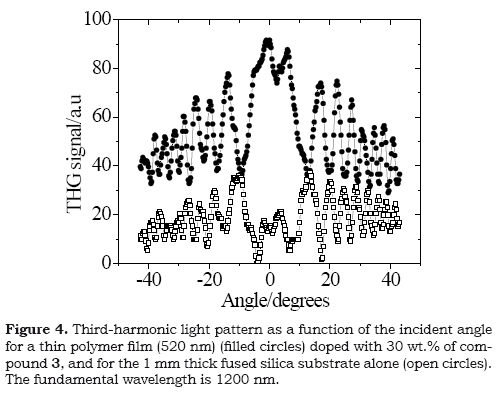
<journal-id>0370-5943</journal-id>
<journal-title><![CDATA[Revista latinoamericana de química]]></journal-title>
<abbrev-journal-title><![CDATA[Rev. latinoam. quím]]></abbrev-journal-title>
<issn>0370-5943</issn>
<publisher>
<publisher-name><![CDATA[Laboratorios Mixim S.A.]]></publisher-name>
</publisher>
</journal-meta>
<article-meta>
<article-id>S0370-59432012000300008</article-id>
<title-group>
<article-title xml:lang="en"><![CDATA[Synthesis and chemical-optical characterization of push-pull stilbenes]]></article-title>
</title-group>
<contrib-group>
<contrib contrib-type="author">
<name>
<surname><![CDATA[Muñoz-Flores]]></surname>
<given-names><![CDATA[Blanca M.]]></given-names>
</name>
<xref ref-type="aff" rid="A01"/>
</contrib>
<contrib contrib-type="author">
<name>
<surname><![CDATA[Santillán]]></surname>
<given-names><![CDATA[Rosa]]></given-names>
</name>
<xref ref-type="aff" rid="A02"/>
</contrib>
<contrib contrib-type="author">
<name>
<surname><![CDATA[Rodríguez]]></surname>
</name>
<xref ref-type="aff" rid="A03"/>
</contrib>
<contrib contrib-type="author">
<name>
<surname><![CDATA[Ramos]]></surname>
<given-names><![CDATA[Gabriel]]></given-names>
</name>
<xref ref-type="aff" rid="A03"/>
</contrib>
<contrib contrib-type="author">
<name>
<surname><![CDATA[Maldonado]]></surname>
<given-names><![CDATA[José Luis]]></given-names>
</name>
<xref ref-type="aff" rid="A03"/>
</contrib>
<contrib contrib-type="author">
<name>
<surname><![CDATA[Romero]]></surname>
<given-names><![CDATA[Margarita]]></given-names>
</name>
<xref ref-type="aff" rid="A04"/>
</contrib>
<contrib contrib-type="author">
<name>
<surname><![CDATA[Farfán]]></surname>
<given-names><![CDATA[Norberto]]></given-names>
</name>
<xref ref-type="aff" rid="A04"/>
</contrib>
</contrib-group>
<aff id="A01">
<institution><![CDATA[,Universidad Autónoma de Nuevo León Facultad de Ciencias Químicas ]]></institution>
<addr-line><![CDATA[San Nicolás de los Garza N. L.]]></addr-line>
<country>México</country>
</aff>
<aff id="A02">
<institution><![CDATA[,Instituto Politécnico Nacional Centro de Investigación y de Estudios Avanzados Departamento de Química]]></institution>
<addr-line><![CDATA[México D. F.]]></addr-line>
<country>México</country>
</aff>
<aff id="A03">
<institution><![CDATA[,Centro de Investigaciones en Óptica A.P.  ]]></institution>
<addr-line><![CDATA[León Gto.]]></addr-line>
<country>México</country>
</aff>
<aff id="A04">
<institution><![CDATA[,Universidad Nacional Autónoma de México Departamento de Química Orgánica Facultad de Química]]></institution>
<addr-line><![CDATA[México D.F.]]></addr-line>
<country>México</country>
</aff>
<pub-date pub-type="pub">
<day>00</day>
<month>00</month>
<year>2012</year>
</pub-date>
<pub-date pub-type="epub">
<day>00</day>
<month>00</month>
<year>2012</year>
</pub-date>
<volume>40</volume>
<numero>3</numero>
<fpage>178</fpage>
<lpage>186</lpage>
<copyright-statement/>
<copyright-year/>
<self-uri xlink:href="http://www.scielo.org.mx/scielo.php?script=sci_arttext&amp;pid=S0370-59432012000300008&amp;lng=en&amp;nrm=iso"></self-uri><self-uri xlink:href="http://www.scielo.org.mx/scielo.php?script=sci_abstract&amp;pid=S0370-59432012000300008&amp;lng=en&amp;nrm=iso"></self-uri><self-uri xlink:href="http://www.scielo.org.mx/scielo.php?script=sci_pdf&amp;pid=S0370-59432012000300008&amp;lng=en&amp;nrm=iso"></self-uri><abstract abstract-type="short" xml:lang="en"><p><![CDATA[In this work we report the synthesis and spectroscopic characterization of push pull stilbenes. These compounds were prepared in good yield and characterized by ¹H and 13C NMR, IR and MS. Single-crystal X-ray diffraction analysis of acids 1 and 2 evidenced the existence of intermolecular hydrogen bonding which in the case of compound 1 [(Z)-isomer] involves interaction between the acid group and a methoxy group other neighbor molecule in contrast for in (E)-isomer (2) the intermolecular hydrogen bonding is between the acid groups promoting the formation of centrosymmetric dimmers. From acids 1 and 2 was obtained the ester 3, for which was improved its solubility properties. Lineal and non linear optical characterization of ester derivative was carried out in particular the second molecular hyperpolarizability using the Maker-Fringe technique.]]></p></abstract>
<abstract abstract-type="short" xml:lang="es"><p><![CDATA[En este trabajo se describe la síntesis y la caracterización espectroscópica de nuevos compuestos estilbenos tipo donador-&#928;-aceptor (push-pull). Dichos compuestos fueron obtenidos en buenos rendimientos y caracterizados por RMN de hidrógeno y carbono, la espectrometría de masa muestra el ion molecular y para el caso de los ácidos marcados como 1 y 2, fue posible establecer su estructura mediante difracción de rayos-X. En ambos compuestos se encuentran presentes interacciones por puente de hidrógeno, para el caso del compuesto 1 (isómero Z) dicha interacción se da entre el grupo ácido y el grupo metoxilo, mientras que en el compuesto 2 (isómero E) el puente de hidrógeno intermolecular es entre los grupos ácidos. Finalmente para el éster 3, fue posible medir la segunda hiperpolarizabilidad molecular mediante la técnica Maker-Fringe.]]></p></abstract>
<kwd-group>
<kwd lng="en"><![CDATA[Stilbene]]></kwd>
<kwd lng="en"><![CDATA[push-pull]]></kwd>
<kwd lng="en"><![CDATA[nonlinear optics]]></kwd>
<kwd lng="en"><![CDATA[NLO]]></kwd>
<kwd lng="en"><![CDATA[X-ray diffraction]]></kwd>
<kwd lng="es"><![CDATA[Estilbenos]]></kwd>
<kwd lng="es"><![CDATA[donador-&#960;-aceptor (push-pull)]]></kwd>
<kwd lng="es"><![CDATA[óptica no lineal]]></kwd>
<kwd lng="es"><![CDATA[ONL]]></kwd>
<kwd lng="es"><![CDATA[difracción de rayos-X]]></kwd>
</kwd-group>
</article-meta>
</front><body><![CDATA[ <p align="center"><font face="verdana" size="4"><b>Synthesis and chemical&#45;optical characterization of <i>push&#45;pull</i> stilbenes</b></font></p>              <p align="center"><font face="verdana" size="2">&nbsp;</font></p>              <p align="center"><font face="verdana" size="2"><b>Blanca M. Mu&ntilde;oz&#45;Flores<sup>a</sup>, Rosa Santill&aacute;n<sup>b</sup>, Mario Rodr&iacute;guez<sup>c</sup>, Gabriel Ramos<sup>c</sup>, Jos&eacute; Luis Maldonado<sup>c</sup>, Margarita Romero<sup>d</sup>, Norberto Farf&aacute;n<sup>d,*</sup></b></font></p>              <p align="justify"><font face="verdana" size="2">&nbsp;</font></p>              <p align="justify"><font face="verdana" size="2"><sup>a</sup> <i>Facultad de Ciencias Qu&iacute;micas, Universidad Aut&oacute;noma de Nuevo Le&oacute;n, Av. Pedro de Alba s/n, 66451 San Nicol&aacute;s de los Garza, N. L., M&eacute;xico.</i></font></p>              <p align="justify"><font face="verdana" size="2"><sup>b</sup> <i>Departamento de Qu&iacute;mica, Centro de Investigaci&oacute;n y de Estudios Avanzados del IPN, 07000, Apdo. Postal. 14&#45;740, M&eacute;xico D. F., M&eacute;xico.</i></font></p>              <p align="justify"><font face="verdana" size="2"><sup>c</sup> <i>Centro de Investigaciones en &Oacute;ptica A.P. 1&#45;948, 37000 Le&oacute;n, Gto., M&eacute;xico.</i></font></p>              <p align="justify"><font face="verdana" size="2"><sup>d</sup> <i>Facultad de Qu&iacute;mica, Depto. de Qu&iacute;mica Org&aacute;nica, Universidad Nacional Aut&oacute;noma de M&eacute;xico, 04510, M&eacute;xico, D.F., M&eacute;xico.</i></font></p>              <p align="justify"><font face="verdana" size="2">&nbsp;</font></p>              <p align="justify"><font face="verdana" size="2">Received October 2012.    ]]></body>
<body><![CDATA[<br>     Accepted December 2012.</font></p>              <p align="justify"><font face="verdana" size="2">&nbsp;</font></p>              <p align="justify"><font face="verdana" size="2"><b>ABSTRACT</b></font></p>              <p align="justify"><font face="verdana" size="2">In this work we report the synthesis and spectroscopic characterization of <i>push pull</i> stilbenes. These compounds were prepared in good yield and characterized by <sup>1</sup>H and <sup>13</sup>C NMR, IR and MS. Single&#45;crystal X&#45;ray diffraction analysis of acids <b>1</b> and <b>2</b> evidenced the existence of intermolecular hydrogen bonding which in the case of compound <b>1</b> &#91;(Z)&#45;isomer&#93; involves interaction between the acid group and a methoxy group other neighbor molecule in contrast for in <i>(E</i>)&#45;isomer <b>(2)</b> the intermolecular hydrogen bonding is between the acid groups promoting the formation of centrosymmetric dimmers. From acids <b>1</b> and <b>2</b> was obtained the ester <b>3,</b> for which was improved its solubility properties. Lineal and non linear optical characterization of ester derivative was carried out in particular the second molecular hyperpolarizability using the Maker&#45;Fringe technique.</font></p>              <p align="justify"><font face="verdana" size="2"><b>Keywords:</b> Stilbene, push&#45;pull, nonlinear optics, NLO, X&#45;ray diffraction.</font></p>              <p align="justify"><font face="verdana" size="2">&nbsp;</font></p>              <p align="justify"><font face="verdana" size="2"><b>RESUMEN</b></font></p>              <p align="justify"><font face="verdana" size="2">En este trabajo se describe la s&iacute;ntesis y la caracterizaci&oacute;n espectrosc&oacute;pica de nuevos compuestos estilbenos tipo donador&#45;&#928;&#45;aceptor <i>(push&#45;pull).</i> Dichos compuestos fueron obtenidos en buenos rendimientos y caracterizados por RMN de hidr&oacute;geno y carbono, la espectrometr&iacute;a de masa muestra el ion molecular y para el caso de los &aacute;cidos marcados como <b>1</b> y <b>2,</b> fue posible establecer su estructura mediante difracci&oacute;n de rayos&#45;X. En ambos compuestos se encuentran presentes interacciones por puente de hidr&oacute;geno, para el caso del compuesto <b>1</b> (is&oacute;mero <i>Z)</i> dicha interacci&oacute;n se da entre el grupo &aacute;cido y el grupo metoxilo, mientras que en el compuesto <b>2</b> (is&oacute;mero <i>E)</i> el puente de hidr&oacute;geno intermolecular es entre los grupos &aacute;cidos. Finalmente para el &eacute;ster <b>3,</b> fue posible medir la segunda hiperpolarizabilidad molecular mediante la t&eacute;cnica Maker&#45;Fringe.</font></p>              <p align="justify"><font face="verdana" size="2"><b>Palabras clave:</b> Estilbenos, donador&#45;&#960;&#45;aceptor <i>(push&#45;pull),</i> &oacute;ptica no lineal, ONL, difracci&oacute;n de rayos&#45;X.</font></p>              <p align="justify"><font face="verdana" size="2">&nbsp;</font></p>              ]]></body>
<body><![CDATA[<p align="justify"><font face="verdana" size="2"><b>INTRODUCTION</b></font></p>              <p align="justify"><font face="verdana" size="2">Nonlinear optical (NLO) properties were first observed in the decade of the sixties after the discovery of the laser by Franken <i>et al.</i> (1961), and certainly inorganic compounds have been the most studied and used in the manufacture of optoelectronic devices. However, in the last two decades organic nonlinear optical materials have been greatly investigated by Goto <i>et al.</i> (1991) due to their potentially high nonlinearities and rapid response in electro&#45;optic effect compared to inorganic NLO materials. Moreover, these compounds are structurally modifiable and allow modulation of the NLO effect, in contrast to inorganic compounds where this is not possible. Also, organic compounds show other advantages over inorganic ones such as low&#45;refractive index, their polarizabilities are purely and in particular they have lower processing cost.</font></p>              <p align="justify"><font face="verdana" size="2">It is well known that organic compounds that present NLO responses must contain into their molecular structure an electron donor and an acceptor group bonded by a conjugated n electron system. For this reason, the design of <i>push&#45;pull</i> chromophores has been based on a dipolar D&#45;p&#45;A structural motif (<a href="#f1">Figure 1</a>).</font></p>              <p align="center"><font face="verdana" size="2"><a name="f1"></a></font></p>              <p align="center"><font face="verdana" size="2"><img src="/img/revistas/rlq/v40n3/a8f1.jpg"></font></p>              <p align="center"><font face="verdana" size="2">&nbsp;</font></p>              <p align="justify"><font face="verdana" size="2">In order to understand the microscopic origin of the nonlinear behavior of organic NLO materials, considerable theoretical and experimental investigations have been developed by Kerkoc <i>et al.</i> (1990) and Dimitriev <i>et al.</i> (1991). The conjugated &#928; electron system provides a pathway for the entire length of conjugation under the perturbation of an external electric field. Functionalization of both extremes of the p conjugated system with electron donor and acceptor groups could increase the asymmetric electronic distribution in the ground and excited states, thus leading to an increased optical non&#45;linearity (Prasad <i>et al.</i> 1991). In continuation with our studies, we report herein the synthesis, characterization and NLO properties of <i>(E)&#45;</i> and <i>(Z</i>)&#45;3&#45;(4&#45;methoxyphenyl)&#45;2&#45;(4&#45;nitrophenyl)&#45;acrylic acids and the corresponding <i>(E</i>)&#45;ethyl ester <b>(3)</b> (<a href="#s1">Scheme 1</a>). All compounds were fully characterized by IR, UV, NMR, MS and in the case of derivatives <b>1</b> and <b>2</b> their structures were corroborated by X&#45;ray diffraction analysis.</font></p>              <p align="center"><font face="verdana" size="2"><a name="s1"></a></font></p>              <p align="center"><font face="verdana" size="2"><img src="/img/revistas/rlq/v40n3/a8s1.jpg"></font></p>              <p align="justify"><font face="verdana" size="2">Compounds <b>1</b> and <b>2</b> were obtained by reaction of p&#45;anisaldehyde and p&#45;nitrophenylacetic in acetic anhydride and triethylamine. Both compounds were found to be poorly soluble in most organic solvents, for this reason it was difficult to study their NLO properties. In order to improve their solubility to measure NLO properties, the corresponding ethyl ester derivatives were synthesized by reaction of the acid with thionyl chloride and ethanol. It should be mentioned that when compound <b>1</b> was treated under the same reaction conditions, the product undergoes isomerization to give compound <b>3</b> (<a href="#s1">Scheme 1</a>).</font></p>              ]]></body>
<body><![CDATA[<p align="justify"><font face="verdana" size="2">&nbsp;</font></p>              <p align="justify"><font face="verdana" size="2"><b>MATERIALS AND METHODS</b></font></p>              <p align="justify"><font face="verdana" size="2"><b>Instruments</b></font></p>              <p align="justify"><font face="verdana" size="2">All starting materials were commercially available. Solvents were used without further purification. Melting points were recorded on an Electrothermal 9200 apparatus and are uncorrected. Infrared spectra were measured on a FT&#45;IR Perkin&#45;Elmer GX and Perkin Elmer 400 spectrophotometer using KBr pellets and ATR. <sup>1</sup>H, and <sup>13</sup>C NMR spectra were recorded on Jeol Eclipse &#43;400 and Varian Unity 300 spectrometers. Chemical shifts (ppm) are relative to (CH<sub>3</sub>)<sub>4</sub>Si for <sup>1</sup>H and <sup>13</sup>C. Ultraviolet spectra were obtained with a Perkin&#45;Elmer Lambda 2 spectrophotometer. Mass spectra were recorded on a Hewlett&#45;Packard 5989A spectrometer and FAB Thermo&#45;Electron Model: DFS (Double Focus Sector). Elemental analyses were carried out on a Thermo Finnigan Flash EA 1112 elemental microanalyzer.</font></p>              <p align="justify"><font face="verdana" size="2">&nbsp;</font></p>              <p align="justify"><font face="verdana" size="2"><b>X&#45;Ray data collection and structure determination</b></font></p>              <p align="justify"><font face="verdana" size="2">For acids <b>1</b> and <b>2</b> single crystals suitable for X&#45;ray structural studies were obtained by slow evaporation from mixtures of CHCl<sub>3</sub> and hexane. The crystal data were recorded on an Enraf Nonius Kappa&#45;CCD (Mo Ka=0.71073 &#197;, graphite monochromator, T=293 K CCD rotating images scan mode). The crystals were mounted on a Lindeman tube. Absorption corrections were performed using the SHELX&#45;A (Sheldrick <i>et al.</i> 1997) program. All reflection data set were corrected for Lorentz and polarization effects. The first structure solution was obtained using the SHELXS&#45;97 program and then SHELXL&#45;97 program was applied for refinement and output data (Sheldrick <i>et al.</i> 1997). All software manipulations were done under the WIN&#45;GX environment program set (Farrugia <i>et al.</i> 1999). Molecular perspectives were drawn under ORTEP3 drawing application. (Farrugia <i>et al.</i> 1997) All heavier atoms were found by Fourier map difference and refined anisotropically. Some hydrogen atoms were found by Fourier map differences and refined isotropically. The remaining hydrogen atoms were geometrically modeled and are not refined.</font></p>              <p align="justify"><font face="verdana" size="2">&nbsp;</font></p>              <p align="justify"><font face="verdana" size="2"><b>Syntheses</b></font></p>              <p align="justify"><font face="verdana" size="2">A solution of 5.44 g (0.040 mmol) of p&#45;anisaldehyde and 6.69 g (0.037 mmol) of <i>p</i>&#45;nitrophenylacetic acid in 4 ml of triethylamine and 4 ml of acetic anhydride was heated under reflux in an oil bath maintained at 150 &#176;C for 4 h. A precipitate often forms during this heating period. The reaction mixture was acidified with 8 ml of concentrated hydrochloric acid, and the organic phase was extracted with 300 ml of methylene chloride and water. This solution was washed with several 100 ml portions of water and then extracted with three 100 ml portions of 20&#37; sodium hydroxide. The combined extracts were then acidified to pH of 4.0 with about 15 ml of acetic acid. The <i>trans</i> acid was filtered from the solution containing the salt of the <i>cis</i> acid and washed with water. The <i>cis</i> isomer was precipitated by the addition of 15 ml of concentrated hydrochloric acid.</font></p>              ]]></body>
<body><![CDATA[<p align="justify"><font face="verdana" size="2">&nbsp;</font></p>              <p align="justify"><font face="verdana" size="2"><b>(</b><b><i>Z</i></b><b>)&#45;3&#45;(4&#45;methoxyphenyl)&#45;2&#45;(4&#45;nitrophenyl)&#45;acrylic acid (1) (Kertcham et al. 1963)</b></font></p>              <p align="justify"><font face="verdana" size="2">The product was obtained as an orange solid (2.25 g 7.52 mmol), yield 20&#37;, m.p. 234&#45;236 &#176;C. IR (KBr) v<sub>max</sub> (cm<sup>&#45;1</sup>): 3448 (OH), 2937, 2841, 2512, 2040, 1669 (CO), 1596, 1511, 1426, 1346, 1257, 1172, 1106, 1025, 923, 854, 831, 784, 711, 654, 551; MS <i>m/z</i> (&#37;), 300 (M<sup>&#43;</sup>&#43;1, 19), 299 (M<sup>&#43;</sup>, 100), 283 (2), 269 (3), 254 (6), 208 (13), 165 (39), 137 (54), 109 (14); <sup>1</sup>H&#45;NMR (400 MHz, DMSO&#45;&#45;d<sub>6</sub>), &#948; (ppm): 3.70 (3H, s, OCH<sub>3</sub>), 6.79 (2H, d, <i>J</i>=9.0 Hz, H&#45;3, H&#45;5), 6.99 (2H, d, <i>J</i>=9.0 Hz, H&#45;2, H&#45;6), 7.47 (2H, d, <i>J</i>=8.8 Hz, H&#45;11, H&#45;15), 7.81 (1H, s, H&#45;7), 8.24 (2H, d, J=8.8 Hz, H&#45;12, H&#45;14); <sup>13</sup>C&#45;NMR (100 MHz, DMSO&#45;d<sub>6</sub>), &#948; (ppm): 55.8 (OMe), 114.7 (C&#45;3, C&#45;5), 124.3 (C&#45;12, C&#45;14), 126.6 (C&#45;1), 129.4 (C&#45;8), 131.8 (C&#45;11, C&#45;15), 132.8 (C&#45;2, C&#45;6), 140.8 (C&#45;7), 144.9 (C&#45;10), 147.3 (C&#45;13), 160.8 (C&#45;4), 168.2 (C&#45;9); Elemental analysis calcd. for C<sub>16</sub>H<sub>13</sub>NO<sub>5</sub>: C 64.21, H 4.38, N 4.68. Found: C 64.34, H 4.13, N 4.60.</font></p>              <p align="justify"><font face="verdana" size="2">&nbsp;</font></p>              <p align="justify"><font face="verdana" size="2"><b>(</b><b><i>E</i></b><b>)&#45;3&#45;(4&#45;methoxyphenyl)&#45;2&#45;(4&#45;nitrophenyl)&#45;acrylic acid (2) (Kertcham</b> <b>et al. 1963)</b></font></p>              <p align="justify"><font face="verdana" size="2">The product was obtained as a yellow solid (0.84 g 2.80 mmol), yield 8&#37;, m.p. 193&#45;196 &#176;C. IR (KBr) v<sub>max</sub> (cm<sup>&#45;1</sup>): 3445 (OH), 2339, 1722 (CO), 1589, 1513, 1397, 1340, 1248, 1178, 1111, 1011, 850, 823, 753, 570; MS <i>m/z</i> (&#37;), 300 (M<sup>&#43;</sup>&#43;1, 18), 299 (M<sup>&#43;</sup>, 100), 283 (3), 269 (10), 254 (4), 208 (7), 165 (8), 137 (25), 109 (5); <sup>1</sup>H&#45;NMR (300 MHz, DMSO&#45;d<sub>6</sub>), &#948; (ppm): 3.80 (3H, s, OCH<sub>3</sub>), 7.01 (2H, d, J=8.8 Hz, H&#45;3, H&#45;5), 7.30 (1H, s, H&#45;7), 7.53 (2H, d, <i>J</i>=8.8 Hz, H&#45;2, H&#45;6), 7.76 (2H, d, <i>J</i>=8.9 Hz, H&#45;11, H&#45;15), 8.27 (2H, d, J=8.9 Hz, H&#45;12, H&#45;14); <sup>13</sup>C&#45;NMR (68 MHz, DMSO&#45;d<sub>6</sub>), &#948; (ppm): 55.8 (OMe), 114.7 (C&#45;3, C&#45;5), 124.6 (C&#45;12, C&#45;14), 127.2 (C&#45;11, C&#45;15), 127.8 (C&#45;1), 130.9 (C&#45;2, C&#45;6), 131.8 (C&#45;7), 132.8 (c&#45;8), 143.7 (C&#45;10), 146.9 (C&#45;13), 160.5 (C&#45;4), 170.8 (C&#45;9); Elemental analysis calcd. for C<sub>16</sub>H<sub>13</sub>NO<sub>5</sub>: C 64.21, H 4.38, N 4.68. Found: C 64.34, H 4.13, N 4.60.</font></p>              <p align="justify"><font face="verdana" size="2">&nbsp;</font></p>              <p align="justify"><font face="verdana" size="2"><b>Ethyl</b> <b><i>(E</i></b><b>)&#45;3&#45;(4&#45;methoxyphenyl)&#45;2&#45;(4&#45;nitrophenyl)&#45;acrylate (3)</b></font></p>              <p align="justify"><font face="verdana" size="2">The reaction flask was first charged with a mixture of compounds <b>1</b> and <b>2</b> (450 g, 1.5mmol) in 20 ml thionyl chloride and refluxed for 2 h under N<sub>2</sub> atmosphere, excess thionyl chloride was eliminated by distillation followed by addition of 20 ml of ethanol and the solution was stirred for 24 hr. The solvent was evaporated, and ethyl acetate was added. After drying over anhydrous Na<sub>2</sub>SO<sub>4</sub> and purification by column chromatography with a hexane:ethyl acetate mixture (9:1), the product was obtained as a yellow solid 0.45 g (91&#37; yield) mp 77&#45;79 &#176;C. IR (ATR) v<sub>max</sub> (cm<sup>&#45;1</sup>):2987, 2940, 1682 (CO), 1597, 1509, 1343, 1343,1245,1172,1029,853, 835 MS <i>m/z</i> (&#37;), 344 (M<sup>&#43;</sup>&#43;1, 42), 327 (M<sup>&#43;</sup>, 82), 282 (50), 254 (40), 254 (4), 208 (20), 165 (44), 136 (30), 73 (100); <sup>1</sup>H&#45;NMR (400 MHz, Cl<sub>3</sub>CD), &#948; (ppm): 1.29 (3H, t, J=7 Hz, CH<sub>3</sub>), 3.76 (3H, s, OCH<sub>3</sub>), 4.26 (2H, q, J=7.0 Hz, CH<sub>2</sub>), 6.97 (2H, d, <i>J</i>=8.9 Hz, H&#45;3, H&#45;5), 7.42 (2H, d, <i>J</i>=8.8 Hz, H&#45;2, H&#45;6), 7.42 (2H, d, <i>J</i>=8.9 Hz, H&#45;11, H&#45;15), 7.90 (1H, s, H&#45;7), 8.24 (2H, d, J=8.8 Hz, H&#45;12, H&#45;14); <sup>13</sup>C&#45;NMR (100 MHz, Cl<sub>3</sub>CD), &#948; ppm: 14.2 (CH<sub>3</sub>),55.3 (OMe), 61.3 (CH<sub>2</sub>) 114.0 (C&#45;3, C&#45;5), 123.8 (C&#45;12, C&#45;14), 126.2 (C&#45;1), 128.2 (C&#45;8), 131.2 (C&#45;11, C&#45;15), 132.4 (C&#45;2, C&#45;6), 141.6 (C&#45;7), 143.7 (C&#45;10), 147.2 (C&#45;13), 160.7 (C&#45;4), 166.7 (C&#45;9);</font></p>              <p align="justify"><font face="verdana" size="2">&nbsp;</font></p>              ]]></body>
<body><![CDATA[<p align="justify"><font face="verdana" size="2"><b>Third non linear optical measurements for compound 3</b></font></p>              <p align="justify"><font face="verdana" size="2">The third nonlinear response susceptibility for compound <b>3</b> was measured as macroscopic nonlinear polarizability (x<sup>(3)</sup>) by the Maker&#45;Fringe technique over polymeric film doped. The sample was prepared using the guest(molecule)&#45;host(inert polymer) approach using polystyrene. Ratios of 70:30 wt &#37; of polystyrene and chromophore <b>3</b> were dissolved in chloroform. The solid polymeric films were deposited over fused silica substrates (1 mm&#45;thick) by using the spin coating technique. The films of <b>3</b> had a thickness of 520 nm, with a good optical quality at visible and NIR wavelength. The thickness of the polymeric film was measured using a Dektak 6M profiler. The THG Maker&#45;Fringes technique consists on the comparison of the oscillations in the THG intensity produced by the substrate alone and those obtained from the active film on a substrate, as a consequence of the variations in the incident angle of the pumping laser beam. Details of this experiments and THG Maker&#45;Fringes setup can be found in the literature (Mu&ntilde;oz <i>et al.</i> 2008).</font></p>              <p align="justify"><font face="verdana" size="2">&nbsp;</font></p>              <p align="justify"><font face="verdana" size="2"><b>RESULTS AND DISCUSSION</b></font></p>              <p align="justify"><font face="verdana" size="2"><b>Spectroscopic data</b></font></p>              <p align="justify"><font face="verdana" size="2">All compounds were characterized by <sup>1</sup>H and <sup>13</sup>C NMR experiments, selected data are summarized in <a href="#t1">Table 1</a>. The singlets at 7.30, 7.81 and 7.90 ppm in the <sup>1</sup>H&#45;NMR spectra of compounds <b>1</b> , <b>2</b> and <b>3</b> correspond to the vinylic protons.</font></p>              <p align="center"><font face="verdana" size="2"><a name="t1"></a></font></p>              <p align="center"><font face="verdana" size="2"><img src="/img/revistas/rlq/v40n3/a8t1.jpg"></font></p>              <p align="justify"><font face="verdana" size="2">The <sup>1</sup>H&#45;NMR signals for the aryl rings were assigned based on their COSY spectra which allowed correlation between the protons in the ring containing the electron donor group and those of the ring with the electron acceptor group which gave two AX systems with coupling constants between 8.8 and 8.9 Hz. In the <sup>13</sup>C&#45;NMR spectra of compounds <b>1</b> , <b>2</b> and <b>3,</b> the signals for C&#45;4 and C&#45;9 are shifted to high frequencies (160.5, 160.8 and 160.7 ppm for C&#45;4 and 170.8, 168.2 and 166.7 ppm for C&#45;9). The two isomeric acids could be identified based on the characteristic chemical shift observed for the vinylic carbon (C&#45;7) which in <i>(E</i>)&#45;isomer shows a marked deshielding effect (140.8 ppm) compared to <i>(Z</i>)&#45;isomer (131.8 ppm). The same trend is observed for H&#45;7 in the proton spectra. In the IR spectra, the carbonyl band appears at 1668 and 1669 cm<sup>&#45;1</sup>for the <i>(E</i>)&#45;isomers and 1722 cm<sup>&#45;1</sup> in the <i>(Z</i>)&#45;isomer.</font></p>              <p align="justify"><font face="verdana" size="2">&nbsp;</font></p>              ]]></body>
<body><![CDATA[<p align="justify"><font face="verdana" size="2"><b>Molecular structure</b></font></p>              <p align="justify"><font face="verdana" size="2">The acids <b>1</b> and <b>2</b> were crystallized by slow evaporation of a concentrated mixture of chloroform and hexane and the molecular perspectives are shown in <a href="/img/revistas/rlq/v40n3/a8f2.jpg" target="_blank">Figure 2</a>.</font></p>              <p align="justify"><font face="verdana" size="2">The details of the crystal data and summary of the collection parameters for acids <b>1</b> and <b>2</b> are given in <a href="#t2">Table 2</a>. Selected bond distances and angles are compared in <a href="#t3">Table 3</a></font></p>              <p align="center"><font face="verdana" size="2"><a name="t2"></a></font></p>              <p align="center"><font face="verdana" size="2"><img src="/img/revistas/rlq/v40n3/a8t2.jpg"></font></p>              <p align="center"><font face="verdana" size="2"><a name="t3"></a></font></p>              <p align="center"><font face="verdana" size="2"><img src="/img/revistas/rlq/v40n3/a8t3.jpg"></font></p>              <p align="justify"><font face="verdana" size="2">One important feature that the two compounds share is the presence of intermolecular hydrogen bonding, in the case of compound <b>1</b> &#91;(Z)&#45;isomer&#93;, this interaction is between the carboxyl group and the methoxy group of a neighboring molecule with bond distance of 1.917 (2) &#197;. In contrast, in compound <b>2</b> &#91;(E)&#45;isomer&#93; this intermolecular hydrogen bonding is between the acid groups of neighbor molecules with a bond distance of 1.384 (2) &#197; forming a dimeric centrosymmetric structures (<a href="/img/revistas/rlq/v40n3/a8f3.jpg" target="_blank">Figure 3</a>).</font></p>              <p align="justify"><font face="verdana" size="2">Several differences are identified in the relative configurations of the two compounds; <a href="#t3">Table 3</a> shows selected dihedral angles and torsion angles for specific fragments of each molecule. From these data it is evident that (E)&#45;isomer <b>(2)</b> is considerably more sterically crowded, and as a consequence the two rings twist out of plane formed by H7&#45;C7&#45;C8 atoms, showing a dihedral angle of 55.7&#176; between the planes of the two rings, as well as a torsion angle of 4.3&#176; for the C6&#45;C1&#45;C7&#45;H7 fragment.</font></p>              <p align="justify"><font face="verdana" size="2">&nbsp;</font></p>              ]]></body>
<body><![CDATA[<p align="justify"><font face="verdana" size="2"><b>Lineal absorption of compound 3</b></font></p>              <p align="justify"><font face="verdana" size="2">The lineal optical characterization of compound <b>3</b> was carried out in solution using solvents with different polarities. The absorption spectrum showed a broad absorption band with a maximum peak around 291 nm. A short blue shift (6 nm) is shown for the absorption band of <b>3</b> from non polar (toluene) to polar solvents (methanol). The absorption band is due to n&#8594;&#928;* electronic transition over the &#928;&#45;backbone system, which is in agreement with the <i>push&#45;pull</i> architecture present on compound <b>3.</b> The position of the electronic transition band in the absorption spectra is affected directly for the <i>cis</i> configuration of the double bond, reducing the conjugation process over the n&#45;system (Nalwa <i>et</i> al.1997).</font></p>              <p align="justify"><font face="verdana" size="2">&nbsp;</font></p>              <p align="justify"><font face="verdana" size="2"><b>Third non linear optical properties</b></font></p>              <p align="justify"><font face="verdana" size="2">The cubic non&#45;linear (macroscopic) response of compound <b>3</b> was measured over solid film using the third harmonic generation (THG) Maker&#45;Fringes technique at the IR wavelength (1200 nm), and the typical graph for THG responses obtained in this technique is shown in <a href="#f4">Figure 4</a>. For derivatives <b>1</b> and <b>2</b> their insolubility properties in common organic solvents precluded optical characterization in solid film. The macroscopic nonlinear susceptibility x <sup>(3)</sup> was used to calculate the second hyperpolarizability &#947;, which is the molecular parameter of interest, through &#947; = x <sup>(3)</sup>/L<sup>4</sup>N<sub>s</sub> where N<sub>s</sub> is the density of molecules in the polymer film. L= (n<sup>2</sup>&#43;2)/3 is the correction factor due to local field effects and <i>n</i> is the refractive index. Assuming for the film the refractive index and density of polystyrene, and using a molecular doping level of 30&#37;, the y value for compound <b>3</b> resulted to be 763 x 10<sup>&#45;36</sup> esu, which is in the is longer than the values calculated for other derivatives of stilbene (63&#45;228 x 10<sup>&#45;36</sup> esu) (Romaniello <i>et al.</i> 2004). It has been reported that the non linear responses of organic molecules are related to the polarization of the &#960;&#45;electronic system which is dependent on structural parameters such as the length of the &#960;&#45;backbone and configuration (Bredes <i>et al.</i> 1994). The non linear response measured for derivative <b>3</b> is affected directly by the <i>E</i> configuration of the stilbene, which could be responsible for the low value.</font></p>              <p align="center"><font face="verdana" size="2"><a name="f4"></a></font></p>              <p align="center"><font face="verdana" size="2"><img src="/img/revistas/rlq/v40n3/a8f4.jpg"></font></p>              <p align="justify"><font face="verdana" size="2">&nbsp;</font></p>              <p align="justify"><font face="verdana" size="2"><b>CONCLUSIONS</b></font></p>              <p align="justify"><font face="verdana" size="2">The isomeric <i>push&#45;pull</i> acids <b>(Z)&#45;1</b> and <b>(E)&#45;2</b> were prepared and characterized. Attempts to prepare the ethyl ester derivatives in order to increase their solubility and to study their. NLO properties lead to isomerization of <b>(Z)&#45;1</b> to the (E)&#45;isomer (compound <b>3).</b> The non linear response measured for derivative <b>3</b> is affected by the <i>Z</i> configuration of the aromatic rings in the stilbene, which could be responsible for the low value observed. However, experimental second hyperpolariability obtained for compound <b>3</b> is longer than those values theoretically estimated for other stilbene derivatives.</font></p>              ]]></body>
<body><![CDATA[<p align="justify"><font face="verdana" size="2">CCDC&#45;905466 and CCDC&#45;905467 contain the supplementary crystallographic data for <b>1</b> and <b>2,</b> respectively. These data can be obtained free of charge via <a href="http://www.ccdc.cam.ac.uk/Community/Requestastructure/Pages/DataRequest.aspx?" target="_blank">www.ccdc.cam.ac.uk/conts/retrieving.html</a>, or from the Cambridge Crystallographic Data Centre 12, Union Road, Cambridge CB2 1EZ, UK; fax: (&#43;44) 1223 336033; or e.mail: <a href="mailto:deposit@%20ccdc.cam.ac.uk">deposit@ ccdc.cam.ac.uk</a>.</font></p>              <p align="justify"><font face="verdana" size="2">&nbsp;</font></p>              <p align="justify"><font face="verdana" size="2"><b>ACKNOWLEDGEMENTS</b></font></p>              <p align="justify"><font face="verdana" size="2">The authors thank UNAM (PAPIIT IN&#45;214010) and CONACyT for financial support. The author thanks Rafael Espinosa for the film thickness measurements.</font></p>              <p align="justify"><font face="verdana" size="2">&nbsp;</font></p>              <p align="justify"><font face="verdana" size="2"><b>REFERENCES</b></font></p>              <!-- ref --><p align="justify"><font face="verdana" size="2">Br&eacute;das, J.L., Adant, C., Tackx, P., Persoons, A. (1994) Third&#45;Order Nonlinear Optical Response in Organic Materials: Theoretical and Experimental Aspects. <i>Chemical Reviews.</i> <b>94:</b> 243&#45;278.    &nbsp;&nbsp;&nbsp;&nbsp;&nbsp;&nbsp;&nbsp;&nbsp;[&#160;<a href="javascript:void(0);" onclick="javascript: window.open('/scielo.php?script=sci_nlinks&ref=7370157&pid=S0370-5943201200030000800001&lng=','','width=640,height=500,resizable=yes,scrollbars=1,menubar=yes,');">Links</a>&#160;]<!-- end-ref --></font></p>              <!-- ref --><p align="justify"><font face="verdana" size="2">Dmitriev, V.G., Gurzadyan, G.G., Nikogosyan, D.N. (1991) Handbook of Nonlinear Optical Crystals. Springer, Berlin.    &nbsp;&nbsp;&nbsp;&nbsp;&nbsp;&nbsp;&nbsp;&nbsp;[&#160;<a href="javascript:void(0);" onclick="javascript: window.open('/scielo.php?script=sci_nlinks&ref=7370159&pid=S0370-5943201200030000800002&lng=','','width=640,height=500,resizable=yes,scrollbars=1,menubar=yes,');">Links</a>&#160;]<!-- end-ref --></font></p>              ]]></body>
<body><![CDATA[<!-- ref --><p align="justify"><font face="verdana" size="2">Farrugia, L.J., (1999) WinGX suite for small&#45;molecule single&#45;crystal crystallography. <i>Journal</i> <i>of Applied Crystallography</i> <b>32:</b> 837&#45;838.    &nbsp;&nbsp;&nbsp;&nbsp;&nbsp;&nbsp;&nbsp;&nbsp;[&#160;<a href="javascript:void(0);" onclick="javascript: window.open('/scielo.php?script=sci_nlinks&ref=7370161&pid=S0370-5943201200030000800003&lng=','','width=640,height=500,resizable=yes,scrollbars=1,menubar=yes,');">Links</a>&#160;]<!-- end-ref --></font></p>              <!-- ref --><p align="justify"><font face="verdana" size="2">Farrugia, L.J., (1997) <i>ORTEP&#45;3</i> for Windows &#45; a version of ORTEP&#45;III with a Graphical User Interface (GUI). <i>Journal of Applied Crystallography</i> <b>30:</b> 565.    &nbsp;&nbsp;&nbsp;&nbsp;&nbsp;&nbsp;&nbsp;&nbsp;[&#160;<a href="javascript:void(0);" onclick="javascript: window.open('/scielo.php?script=sci_nlinks&ref=7370163&pid=S0370-5943201200030000800004&lng=','','width=640,height=500,resizable=yes,scrollbars=1,menubar=yes,');">Links</a>&#160;]<!-- end-ref --></font></p>              <!-- ref --><p align="justify"><font face="verdana" size="2">Franken, P.A., Hill, A.E., Peters, C.W., Weinreich, G. (1961) Generation of Optical Harmonics. <i>Physical Review Letters</i> <b>7:</b> 118&#45;119.    &nbsp;&nbsp;&nbsp;&nbsp;&nbsp;&nbsp;&nbsp;&nbsp;[&#160;<a href="javascript:void(0);" onclick="javascript: window.open('/scielo.php?script=sci_nlinks&ref=7370165&pid=S0370-5943201200030000800005&lng=','','width=640,height=500,resizable=yes,scrollbars=1,menubar=yes,');">Links</a>&#160;]<!-- end-ref --></font></p>              <!-- ref --><p align="justify"><font face="verdana" size="2">Goto, Y., Hayashi, A., Kimura, Y. Nakayama, M. (1991). Second harmonic generation and crystal growth of substituted thienyl chalcones. <i>Journal of Crystal Growth</i> <b>108:</b> 688&#45;698.    &nbsp;&nbsp;&nbsp;&nbsp;&nbsp;&nbsp;&nbsp;&nbsp;[&#160;<a href="javascript:void(0);" onclick="javascript: window.open('/scielo.php?script=sci_nlinks&ref=7370167&pid=S0370-5943201200030000800006&lng=','','width=640,height=500,resizable=yes,scrollbars=1,menubar=yes,');">Links</a>&#160;]<!-- end-ref --></font></p>              <!-- ref --><p align="justify"><font face="verdana" size="2">Kerkoc, P., Zgonik, M., Sutter, K., Bosshard, Ch., and Gunter, P. (1990) 4&#45;(N,N&#45;Dimethylamino)&#45;3&#45;acetamidonitrobenzene single crystals for nonlinear&#45;optical applications. <i>Journal of the</i> <i>Optical Society of America B</i> <b>7</b>:313&#45;319.    &nbsp;&nbsp;&nbsp;&nbsp;&nbsp;&nbsp;&nbsp;&nbsp;[&#160;<a href="javascript:void(0);" onclick="javascript: window.open('/scielo.php?script=sci_nlinks&ref=7370169&pid=S0370-5943201200030000800007&lng=','','width=640,height=500,resizable=yes,scrollbars=1,menubar=yes,');">Links</a>&#160;]<!-- end-ref --></font></p>              ]]></body>
<body><![CDATA[<!-- ref --><p align="justify"><font face="verdana" size="2">Kertcham, R., Jambotkar, D. (1963) The Preparation of and Equilibrium between Substituted &#945;&#45;Phenyl&#45;cis&#45; and trans&#45;cinnamic Acids. <i>Journal of Organic Chemistry</i> <b>28:</b> 1034:1037.    &nbsp;&nbsp;&nbsp;&nbsp;&nbsp;&nbsp;&nbsp;&nbsp;[&#160;<a href="javascript:void(0);" onclick="javascript: window.open('/scielo.php?script=sci_nlinks&ref=7370171&pid=S0370-5943201200030000800008&lng=','','width=640,height=500,resizable=yes,scrollbars=1,menubar=yes,');">Links</a>&#160;]<!-- end-ref --></font></p>              <!-- ref --><p align="justify"><font face="verdana" size="2">Mu&ntilde;oz&#45;Flores, B., Santillan, R., Rodr&iacute;guez, M., M&eacute;ndez, J.M., Romero, M., Farf&aacute;n, N., Lacroix, P.G., Nakatani, K., Ramos&#45;Ort&iacute;z, G., Maldonado, J.L. (2008) Synthesis, crystal structure and non&#45;linear optical properties of boronates derivatives of salicylideniminophenols <i>Journal</i> <i>of Organometallic Chemistry</i> <b>693:</b> 1321&#45;1334.    &nbsp;&nbsp;&nbsp;&nbsp;&nbsp;&nbsp;&nbsp;&nbsp;[&#160;<a href="javascript:void(0);" onclick="javascript: window.open('/scielo.php?script=sci_nlinks&ref=7370173&pid=S0370-5943201200030000800009&lng=','','width=640,height=500,resizable=yes,scrollbars=1,menubar=yes,');">Links</a>&#160;]<!-- end-ref --></font></p>              <!-- ref --><p align="justify"><font face="verdana" size="2">Nalwa, H.S., Miyata, S. (1997) Nonlinear Optics of Organic Molecules and Polymers. 1<sup>st</sup> Edition. CRC Press., Boca Raton, FL.    &nbsp;&nbsp;&nbsp;&nbsp;&nbsp;&nbsp;&nbsp;&nbsp;[&#160;<a href="javascript:void(0);" onclick="javascript: window.open('/scielo.php?script=sci_nlinks&ref=7370175&pid=S0370-5943201200030000800010&lng=','','width=640,height=500,resizable=yes,scrollbars=1,menubar=yes,');">Links</a>&#160;]<!-- end-ref --></font></p>              <!-- ref --><p align="justify"><font face="verdana" size="2">Romaniello, P., Lelj, F. (2004) Effects of fluorine atoms on the optical nonlinear response of stilbene derivatives. <i>Journal of Fluorine Chemistry</i> <b>125:</b> 145&#45;149.    &nbsp;&nbsp;&nbsp;&nbsp;&nbsp;&nbsp;&nbsp;&nbsp;[&#160;<a href="javascript:void(0);" onclick="javascript: window.open('/scielo.php?script=sci_nlinks&ref=7370177&pid=S0370-5943201200030000800011&lng=','','width=640,height=500,resizable=yes,scrollbars=1,menubar=yes,');">Links</a>&#160;]<!-- end-ref --></font></p>              <!-- ref --><p align="justify"><font face="verdana" size="2">Prasad, P.N., and Williams, D.J. (1991) Introduction to nonlinear optical effects in molecules and polymers. Wiley., New York.    &nbsp;&nbsp;&nbsp;&nbsp;&nbsp;&nbsp;&nbsp;&nbsp;[&#160;<a href="javascript:void(0);" onclick="javascript: window.open('/scielo.php?script=sci_nlinks&ref=7370179&pid=S0370-5943201200030000800012&lng=','','width=640,height=500,resizable=yes,scrollbars=1,menubar=yes,');">Links</a>&#160;]<!-- end-ref --></font></p>              ]]></body>
<body><![CDATA[<!-- ref --><p align="justify"><font face="verdana" size="2">Sheldrick, G.M., (1997) SHELX97, Programs for Crystal Structure Solution and Refinement, University of Gottingen, Gottingen.    &nbsp;&nbsp;&nbsp;&nbsp;&nbsp;&nbsp;&nbsp;&nbsp;[&#160;<a href="javascript:void(0);" onclick="javascript: window.open('/scielo.php?script=sci_nlinks&ref=7370181&pid=S0370-5943201200030000800013&lng=','','width=640,height=500,resizable=yes,scrollbars=1,menubar=yes,');">Links</a>&#160;]<!-- end-ref --></font></p>              <p align="justify"><font face="verdana" size="2">&nbsp;</font></p>  	    <p align="justify"><font face="verdana" size="2"><b>Note</b></font></p>  	    <p align="justify"><font face="verdana" size="2">This paper is dedicated to Professor Pedro Joseph&#45;Nathan in recognition of his 50 years of outstanding scientific trajectory.</font></p>      ]]></body><back>
<ref-list>
<ref id="B1">
<nlm-citation citation-type="journal">
<person-group person-group-type="author">
<name>
<surname><![CDATA[Brédas]]></surname>
<given-names><![CDATA[J.L.]]></given-names>
</name>
<name>
<surname><![CDATA[Adant]]></surname>
<given-names><![CDATA[C.]]></given-names>
</name>
<name>
<surname><![CDATA[Tackx]]></surname>
<given-names><![CDATA[P.]]></given-names>
</name>
<name>
<surname><![CDATA[Persoons]]></surname>
<given-names><![CDATA[A.]]></given-names>
</name>
</person-group>
<article-title xml:lang="en"><![CDATA[Third-Order Nonlinear Optical Response in Organic Materials: Theoretical and Experimental Aspects]]></article-title>
<source><![CDATA[Chemical Reviews]]></source>
<year>1994</year>
<volume>94</volume>
<page-range>243-278</page-range></nlm-citation>
</ref>
<ref id="B2">
<nlm-citation citation-type="book">
<person-group person-group-type="author">
<name>
<surname><![CDATA[Dmitriev]]></surname>
<given-names><![CDATA[V.G.]]></given-names>
</name>
<name>
<surname><![CDATA[Gurzadyan]]></surname>
<given-names><![CDATA[G.G.]]></given-names>
</name>
<name>
<surname><![CDATA[Nikogosyan]]></surname>
<given-names><![CDATA[D.N.]]></given-names>
</name>
</person-group>
<source><![CDATA[Handbook of Nonlinear Optical Crystals]]></source>
<year>1991</year>
<publisher-loc><![CDATA[Berlin ]]></publisher-loc>
<publisher-name><![CDATA[Springer]]></publisher-name>
</nlm-citation>
</ref>
<ref id="B3">
<nlm-citation citation-type="journal">
<person-group person-group-type="author">
<name>
<surname><![CDATA[Farrugia]]></surname>
<given-names><![CDATA[L.J.]]></given-names>
</name>
</person-group>
<article-title xml:lang="en"><![CDATA[WinGX suite for small-molecule single-crystal crystallography]]></article-title>
<source><![CDATA[Journal of Applied Crystallography]]></source>
<year>1999</year>
<volume>32</volume>
<page-range>837-838</page-range></nlm-citation>
</ref>
<ref id="B4">
<nlm-citation citation-type="journal">
<person-group person-group-type="author">
<name>
<surname><![CDATA[Farrugia]]></surname>
<given-names><![CDATA[L.J.]]></given-names>
</name>
</person-group>
<article-title xml:lang="en"><![CDATA[ORTEP-3 for Windows - a version of ORTEP-III with a Graphical User Interface (GUI)]]></article-title>
<source><![CDATA[Journal of Applied Crystallography]]></source>
<year>1997</year>
<volume>30</volume>
<page-range>565</page-range></nlm-citation>
</ref>
<ref id="B5">
<nlm-citation citation-type="journal">
<person-group person-group-type="author">
<name>
<surname><![CDATA[Franken]]></surname>
<given-names><![CDATA[P.A.]]></given-names>
</name>
<name>
<surname><![CDATA[Hill]]></surname>
<given-names><![CDATA[A.E.]]></given-names>
</name>
<name>
<surname><![CDATA[Peters]]></surname>
<given-names><![CDATA[C.W.]]></given-names>
</name>
<name>
<surname><![CDATA[Weinreich]]></surname>
<given-names><![CDATA[G.]]></given-names>
</name>
</person-group>
<article-title xml:lang="en"><![CDATA[Generation of Optical Harmonics]]></article-title>
<source><![CDATA[Physical Review Letters]]></source>
<year>1961</year>
<volume>7</volume>
<page-range>118-119</page-range></nlm-citation>
</ref>
<ref id="B6">
<nlm-citation citation-type="journal">
<person-group person-group-type="author">
<name>
<surname><![CDATA[Goto]]></surname>
<given-names><![CDATA[Y.]]></given-names>
</name>
<name>
<surname><![CDATA[Hayashi]]></surname>
<given-names><![CDATA[A.]]></given-names>
</name>
<name>
<surname><![CDATA[Kimura]]></surname>
<given-names><![CDATA[Y.]]></given-names>
</name>
<name>
<surname><![CDATA[Nakayama]]></surname>
<given-names><![CDATA[M.]]></given-names>
</name>
</person-group>
<article-title xml:lang="en"><![CDATA[Second harmonic generation and crystal growth of substituted thienyl chalcones]]></article-title>
<source><![CDATA[Journal of Crystal Growth]]></source>
<year>1991</year>
<volume>108</volume>
<page-range>688-698</page-range></nlm-citation>
</ref>
<ref id="B7">
<nlm-citation citation-type="journal">
<person-group person-group-type="author">
<name>
<surname><![CDATA[Kerkoc]]></surname>
<given-names><![CDATA[P.]]></given-names>
</name>
<name>
<surname><![CDATA[Zgonik]]></surname>
<given-names><![CDATA[M.]]></given-names>
</name>
<name>
<surname><![CDATA[Sutter]]></surname>
<given-names><![CDATA[K.]]></given-names>
</name>
<name>
<surname><![CDATA[Bosshard]]></surname>
<given-names><![CDATA[Ch.]]></given-names>
</name>
<name>
<surname><![CDATA[Gunter]]></surname>
<given-names><![CDATA[P.]]></given-names>
</name>
</person-group>
<article-title xml:lang="en"><![CDATA[4-(N,N-Dimethylamino)-3-acetamidonitrobenzene single crystals for nonlinear-optical applications]]></article-title>
<source><![CDATA[Journal of the Optical Society of America B]]></source>
<year>1990</year>
<volume>7</volume>
<page-range>313-319</page-range></nlm-citation>
</ref>
<ref id="B8">
<nlm-citation citation-type="journal">
<person-group person-group-type="author">
<name>
<surname><![CDATA[Kertcham]]></surname>
<given-names><![CDATA[R.]]></given-names>
</name>
<name>
<surname><![CDATA[Jambotkar]]></surname>
<given-names><![CDATA[D.]]></given-names>
</name>
</person-group>
<article-title xml:lang="en"><![CDATA[The Preparation of and Equilibrium between Substituted &#945;-Phenyl-cis- and trans-cinnamic Acids]]></article-title>
<source><![CDATA[Journal of Organic Chemistry]]></source>
<year>1963</year>
<volume>28</volume>
<page-range>1034:1037</page-range></nlm-citation>
</ref>
<ref id="B9">
<nlm-citation citation-type="journal">
<person-group person-group-type="author">
<name>
<surname><![CDATA[Muñoz-Flores]]></surname>
<given-names><![CDATA[B.]]></given-names>
</name>
<name>
<surname><![CDATA[Santillan]]></surname>
<given-names><![CDATA[R.]]></given-names>
</name>
<name>
<surname><![CDATA[Rodríguez]]></surname>
<given-names><![CDATA[M.]]></given-names>
</name>
<name>
<surname><![CDATA[Méndez]]></surname>
<given-names><![CDATA[J.M.]]></given-names>
</name>
<name>
<surname><![CDATA[Romero]]></surname>
<given-names><![CDATA[M.]]></given-names>
</name>
<name>
<surname><![CDATA[Farfán]]></surname>
<given-names><![CDATA[N.]]></given-names>
</name>
<name>
<surname><![CDATA[Lacroix]]></surname>
<given-names><![CDATA[P.G.]]></given-names>
</name>
<name>
<surname><![CDATA[Nakatani]]></surname>
<given-names><![CDATA[K.]]></given-names>
</name>
<name>
<surname><![CDATA[Ramos-Ortíz]]></surname>
<given-names><![CDATA[G.]]></given-names>
</name>
<name>
<surname><![CDATA[Maldonado]]></surname>
<given-names><![CDATA[J.L.]]></given-names>
</name>
</person-group>
<article-title xml:lang="en"><![CDATA[Synthesis, crystal structure and non-linear optical properties of boronates derivatives of salicylideniminophenols]]></article-title>
<source><![CDATA[Journal of Organometallic Chemistry]]></source>
<year>2008</year>
<volume>693</volume>
<page-range>1321-1334</page-range></nlm-citation>
</ref>
<ref id="B10">
<nlm-citation citation-type="book">
<person-group person-group-type="author">
<name>
<surname><![CDATA[Nalwa]]></surname>
<given-names><![CDATA[H.S.]]></given-names>
</name>
<name>
<surname><![CDATA[Miyata]]></surname>
<given-names><![CDATA[S.]]></given-names>
</name>
</person-group>
<source><![CDATA[Nonlinear Optics of Organic Molecules and Polymers]]></source>
<year>1997</year>
<edition>1</edition>
<publisher-loc><![CDATA[Boca Raton^eFL FL]]></publisher-loc>
<publisher-name><![CDATA[CRC Press.]]></publisher-name>
</nlm-citation>
</ref>
<ref id="B11">
<nlm-citation citation-type="journal">
<person-group person-group-type="author">
<name>
<surname><![CDATA[Romaniello]]></surname>
<given-names><![CDATA[P.]]></given-names>
</name>
<name>
<surname><![CDATA[Lelj]]></surname>
<given-names><![CDATA[F.]]></given-names>
</name>
</person-group>
<article-title xml:lang="en"><![CDATA[Effects of fluorine atoms on the optical nonlinear response of stilbene derivatives]]></article-title>
<source><![CDATA[Journal of Fluorine Chemistry]]></source>
<year>2004</year>
<volume>125</volume>
<page-range>145-149</page-range></nlm-citation>
</ref>
<ref id="B12">
<nlm-citation citation-type="book">
<person-group person-group-type="author">
<name>
<surname><![CDATA[Prasad]]></surname>
<given-names><![CDATA[P.N.]]></given-names>
</name>
<name>
<surname><![CDATA[Williams]]></surname>
<given-names><![CDATA[D.J.]]></given-names>
</name>
</person-group>
<source><![CDATA[Introduction to nonlinear optical effects in molecules and polymers]]></source>
<year>1991</year>
<publisher-loc><![CDATA[New York ]]></publisher-loc>
<publisher-name><![CDATA[Wiley]]></publisher-name>
</nlm-citation>
</ref>
<ref id="B13">
<nlm-citation citation-type="book">
<person-group person-group-type="author">
<name>
<surname><![CDATA[Sheldrick]]></surname>
<given-names><![CDATA[G.M.]]></given-names>
</name>
</person-group>
<source><![CDATA[SHELX97, Programs for Crystal Structure Solution and Refinement]]></source>
<year>1997</year>
<publisher-loc><![CDATA[Gottingen ]]></publisher-loc>
<publisher-name><![CDATA[University of Gottingen]]></publisher-name>
</nlm-citation>
</ref>
</ref-list>
</back>
</article>