<?xml version="1.0" encoding="ISO-8859-1"?><article xmlns:mml="http://www.w3.org/1998/Math/MathML" xmlns:xlink="http://www.w3.org/1999/xlink" xmlns:xsi="http://www.w3.org/2001/XMLSchema-instance">
<front>
<journal-meta>
<journal-id>0188-8897</journal-id>
<journal-title><![CDATA[Hidrobiológica]]></journal-title>
<abbrev-journal-title><![CDATA[Hidrobiológica]]></abbrev-journal-title>
<issn>0188-8897</issn>
<publisher>
<publisher-name><![CDATA[Universidad Autónoma Metropolitana, División de Ciencias Biológicas y de la Salud]]></publisher-name>
</publisher>
</journal-meta>
<article-meta>
<article-id>S0188-88972009000300007</article-id>
<title-group>
<article-title xml:lang="en"><![CDATA[Aquatic macrophytes tolerance to domestic wastewater and their efficiency in artificial wetlands under greenhouse conditions]]></article-title>
<article-title xml:lang="es"><![CDATA[Tolerancia de macrófitas acuáticas a aguas residuales domésticas y su eficiencia en humedales artificiales en condiciones de invernadero]]></article-title>
</title-group>
<contrib-group>
<contrib contrib-type="author">
<name>
<surname><![CDATA[Pérez-López]]></surname>
<given-names><![CDATA[Ma. Elena]]></given-names>
</name>
<xref ref-type="aff" rid="A01"/>
</contrib>
<contrib contrib-type="author">
<name>
<surname><![CDATA[González-Elizondo]]></surname>
<given-names><![CDATA[Ma. del Socorro]]></given-names>
</name>
<xref ref-type="aff" rid="A01"/>
</contrib>
<contrib contrib-type="author">
<name>
<surname><![CDATA[López-González]]></surname>
<given-names><![CDATA[Celia]]></given-names>
</name>
<xref ref-type="aff" rid="A01"/>
</contrib>
<contrib contrib-type="author">
<name>
<surname><![CDATA[Martínez-Prado]]></surname>
<given-names><![CDATA[Adriana]]></given-names>
</name>
<xref ref-type="aff" rid="A02"/>
</contrib>
<contrib contrib-type="author">
<name>
<surname><![CDATA[Cuevas-Rodríguez]]></surname>
<given-names><![CDATA[Germán]]></given-names>
</name>
<xref ref-type="aff" rid="A03"/>
</contrib>
</contrib-group>
<aff id="A01">
<institution><![CDATA[,Instituto Politécnico Nacional Centro Interdisciplinario de Investigación para el Dessarrollo Integral Regional Environmental Department]]></institution>
<addr-line><![CDATA[Durango Durango]]></addr-line>
<country>México</country>
</aff>
<aff id="A02">
<institution><![CDATA[,Instituto Tecnológico de Durango Chemical Engineering Department ]]></institution>
<addr-line><![CDATA[Durango Durango]]></addr-line>
<country>México</country>
</aff>
<aff id="A03">
<institution><![CDATA[,Centro de Investigación en Materiales Avanzados Department of Water Quality ]]></institution>
<addr-line><![CDATA[Chihuahua Chihuahua]]></addr-line>
<country>México</country>
</aff>
<pub-date pub-type="pub">
<day>00</day>
<month>12</month>
<year>2009</year>
</pub-date>
<pub-date pub-type="epub">
<day>00</day>
<month>12</month>
<year>2009</year>
</pub-date>
<volume>19</volume>
<numero>3</numero>
<fpage>233</fpage>
<lpage>244</lpage>
<copyright-statement/>
<copyright-year/>
<self-uri xlink:href="http://www.scielo.org.mx/scielo.php?script=sci_arttext&amp;pid=S0188-88972009000300007&amp;lng=en&amp;nrm=iso"></self-uri><self-uri xlink:href="http://www.scielo.org.mx/scielo.php?script=sci_abstract&amp;pid=S0188-88972009000300007&amp;lng=en&amp;nrm=iso"></self-uri><self-uri xlink:href="http://www.scielo.org.mx/scielo.php?script=sci_pdf&amp;pid=S0188-88972009000300007&amp;lng=en&amp;nrm=iso"></self-uri><abstract abstract-type="short" xml:lang="en"><p><![CDATA[Aquatic and semi-aquatic plant species of three different water qualities were inventoried, two of the El Tunal river and one of one of its tributaries, considering its content of dissolved oxygen, soluble phosphates, nitrate, ammonia, fecal coliforms, total suspended solids, and measurements of pH and electrical conductivity. A MANOVA/ANOVA demonstrated significant differences among parameters and sites. Twenty-eight species were identified; from them: Schoenoplectus americanus, S. tabernaemontani and Eleocharis densa were selected. All three were grown successfully under greenhouse conditions. Adaptation to local wastewater was evaluated using 5 micro-units: one control with wastewater (WW), another with gravel (G), and three sub-surface flow wetlands, one for each of the three selected plants, in duplicate. For ammonia and phosphate concentration, the systems with gravel removed 96 - 98%, and 99 - 100%, respectively. Fecal coliforms content was reduced about the same in all systems, 98.5 - 98.7%. No significant differences were found in removal of fecal coliforms and ammonia across time or among species. Removal of ions (98% in 48 h) was due mainly to the gravel used as support, for its ionic exchange capacity. Nonetheless, the three selected species are considered as appropriate for wetland construction because they are native, abundant, tolerant to local conditions, easy to propagate and establish, and highly tolerant to wastewater in their place of origin. Its dense growing habit would represent also a refuge for wildlife, another goal for constructing a wetland in the area.]]></p></abstract>
<abstract abstract-type="short" xml:lang="es"><p><![CDATA[Se inventariaron las especies de plantas acuáticas y semi-acuáticas de tres calidades de agua: dos provenientes del río El Tunal y otra de uno de sus tributarios, considerando su contenido de oxígeno disuelto, fosfato soluble, nitrato, amoniaco, coliformes fecales, sólidos suspendidos totales y sus valores en pH y conductividad eléctrica. Un MANOVA/ ANOVA demostró diferencias significativas entre parámetros y sitios. Se identificaron veintiocho especies de plantas con diferentes tolerancias, de las cuales se seleccionaron Schoenoplectus americanus S. tabernaemontani, y Eleocharis densa. Las tres especies se propagaron satisfactoriamente bajo condiciones de invernadero. Su adaptación al agua residual de la localidad fue evaluada en 5 micro-unidades: un control con agua residual (WW), otro con grava (G) y tres humedales de flujo sub-superficial, uno para cada una de las tres especies de plantas seleccionadas, todas por duplicado. Para amoniaco y fosfatos, los sistemas con grava y plantas removieron entre 96 y 98% y entre 99 y 100%, respectivamente. Los contenidos de coliformes fecales disminuyeron uniformemente en todos los sistemas, entre 98.5 y 98.7%. El soporte (grava triturada) fue el principal responsable de la remoción de amoniaco y fosfatos (98% en 48 horas), debido a su capacidad de intercambio iónico. Se considera que las tres especies son apropiadas para la construcción de humedales porque tienen facilidad para propagarse y establecerse, son nativas, abundantes y tolerantes a las condiciones locales y al agua residual de la región. El humedal en el área representaría también un refugio para la vida silvestre.]]></p></abstract>
<kwd-group>
<kwd lng="en"><![CDATA[Artificial wetlands]]></kwd>
<kwd lng="en"><![CDATA[Eleocharis densa]]></kwd>
<kwd lng="en"><![CDATA[Schoenoplectus tabernaemontani]]></kwd>
<kwd lng="en"><![CDATA[Schoenoplectus americanus]]></kwd>
<kwd lng="es"><![CDATA[Humedales artificiales]]></kwd>
<kwd lng="es"><![CDATA[Eleocharis densa]]></kwd>
<kwd lng="es"><![CDATA[Schoenoplectus tabernaemontani]]></kwd>
<kwd lng="es"><![CDATA[Schoenoplectus americanus]]></kwd>
</kwd-group>
</article-meta>
</front><body><![CDATA[ <p align="justify"><font face="verdana" size="4">Art&iacute;culos</font></p>     <p align="justify"><font face="verdana" size="4">&nbsp;</font></p>     <p align="center"><font face="verdana" size="4"><b>Aquatic macrophytes tolerance to domestic wastewater and their efficiency in artificial wetlands under greenhouse conditions</b></font></p>     <p align="center"><font face="verdana" size="2">&nbsp;</font></p>     <p align="center"><font face="verdana" size="3"><b>Tolerancia de macr&oacute;fitas acu&aacute;ticas a aguas residuales dom&eacute;sticas y su eficiencia en humedales artificiales en condiciones de invernadero</b></font></p>     <p align="center"><font face="verdana" size="2">&nbsp;</font></p>     <p align="center"><font face="verdana" size="2"><b>Ma. Elena P&eacute;rez&#150;L&oacute;pez<sup>1*</sup>, Ma. del Socorro Gonz&aacute;lez&#150;Elizondo<sup>1</sup>, Celia L&oacute;pez&#150;Gonz&aacute;lez<sup>1</sup>, Adriana Mart&iacute;nez&#150;Prado<sup>2 </sup>and Germ&aacute;n Cuevas&#150;Rodr&iacute;guez<sup>3</sup></b></font></p>     <p align="justify"><font face="verdana" size="2">&nbsp;</font></p>     <p align="justify"><font face="verdana" size="2"><i><sup>1</sup> Environmental Department, CIIDIR&#150;IPN Unidad Durango. Instituto Polit&eacute;cnico Nacional,Sigma s/n, Fracc. 20 de Nov. II, Durango, Durango 34220, M&eacute;xico. *E&#150;mail</i>: <a href="mailto:maelena0359@yahoo.com">maelena0359@yahoo.com</a></font></p>     <p align="justify"><font face="verdana" size="2"><i><sup>2</sup> Chemical Engineering Department, Instituto Tecnol&oacute;gico de Durango, Blvd. Felipe Pescador 1830 Ote. Durango, Durango, 34080, M&eacute;xico. </i></font></p>     ]]></body>
<body><![CDATA[<p align="justify"><font face="verdana" size="2"><i><sup>3</sup> Department of Water Quality, CIMAV&#150;Chihuahua, Miguel de Cervantes Saavedra 120, Chihuahua, Chihuahua, 31109, M&eacute;xico.</i></font></p>     <p align="justify"><font face="verdana" size="2">&nbsp;</font></p>     <p align="justify"><font face="verdana" size="2">Recibido: 6 de mayo de 2008.    <br> Aceptado: 19 de octubre de 2009.</font></p>     <p align="justify"><font face="verdana" size="2">&nbsp;</font></p>     <p align="justify"><font face="verdana" size="2"><b>ABSTRACT</b></font></p>     <p align="justify"><font face="verdana" size="2">Aquatic and semi&#150;aquatic plant species of three different water qualities were inventoried, two of the El Tunal river and one of one of its tributaries, considering its content of dissolved oxygen, soluble phosphates, nitrate, ammonia, fecal coliforms, total suspended solids, and measurements of pH and electrical conductivity. A MANOVA/ANOVA demonstrated significant differences among parameters and sites. Twenty&#150;eight species were identified; from them: <i>Schoenoplectus americanus, S. tabernaemontani </i>and <i>Eleocharis densa </i>were selected. All three were grown successfully under greenhouse conditions. Adaptation to local wastewater was evaluated using 5 micro&#150;units: one control with wastewater (WW), another with gravel (G), and three sub&#150;surface flow wetlands, one for each of the three selected plants, in duplicate. For ammonia and phosphate concentration, the systems with gravel removed 96 &#150; 98%, and 99 &#150; 100%, respectively. Fecal coliforms content was reduced about the same in all systems, 98.5 &#150; 98.7%. No significant differences were found in removal of fecal coliforms and ammonia across time or among species. Removal of ions (98% in 48 h) was due mainly to the gravel used as support, for its ionic exchange capacity. Nonetheless, the three selected species are considered as appropriate for wetland construction because they are native, abundant, tolerant to local conditions, easy to propagate and establish, and highly tolerant to wastewater in their place of origin. Its dense growing habit would represent also a refuge for wildlife, another goal for constructing a wetland in the area.</font></p>     <p align="justify"><font face="verdana" size="2"><b>Key words: </b>Artificial wetlands, <i>Eleocharis densa</i>. <i>Schoenoplectus tabernaemontani, Schoenoplectus americanus.</i></font></p>     <p align="justify"><font face="verdana" size="2">&nbsp;</font></p>     <p align="justify"><font face="verdana" size="2"><b>RESUMEN</b></font></p>     ]]></body>
<body><![CDATA[<p align="justify"><font face="verdana" size="2">Se inventariaron las especies de plantas acu&aacute;ticas y semi&#150;acu&aacute;ticas de tres calidades de agua: dos provenientes del r&iacute;o El Tunal y otra de uno de sus tributarios, considerando su contenido de ox&iacute;geno disuelto, fosfato soluble, nitrato, amoniaco, coliformes fecales, s&oacute;lidos suspendidos totales y sus valores en pH y conductividad el&eacute;ctrica. Un MANOVA/ ANOVA demostr&oacute; diferencias significativas entre par&aacute;metros y sitios. Se identificaron veintiocho especies de plantas con diferentes tolerancias, de las cuales se seleccionaron <i>Schoenoplectus americanus S. tabernaemontani, </i>y <i>Eleocharis densa. </i>Las tres especies se propagaron satisfactoriamente bajo condiciones de invernadero. Su adaptaci&oacute;n al agua residual de la localidad fue evaluada en 5 micro&#150;unidades: un control con agua residual (WW), otro con grava (G) y tres humedales de flujo sub&#150;superficial, uno para cada una de las tres especies de plantas seleccionadas, todas por duplicado. Para amoniaco y fosfatos, los sistemas con grava y plantas removieron entre 96 y 98% y entre 99 y 100%, respectivamente. Los contenidos de coliformes fecales disminuyeron uniformemente en todos los sistemas, entre 98.5 y 98.7%. El soporte (grava triturada) fue el principal responsable de la remoci&oacute;n de amoniaco y fosfatos (98% en 48 horas), debido a su capacidad de intercambio i&oacute;nico. Se considera que las tres especies son apropiadas para la construcci&oacute;n de humedales porque tienen facilidad para propagarse y establecerse, son nativas, abundantes y tolerantes a las condiciones locales y al agua residual de la regi&oacute;n. El humedal en el &aacute;rea representar&iacute;a tambi&eacute;n un refugio para la vida silvestre.</font></p>     <p align="justify"><font face="verdana" size="2"><b>Palabras clave: </b>Humedales artificiales, <i>Eleocharis densa, Schoenoplectus tabernaemontani, Schoenoplectus americanus.</i></font></p>     <p align="justify"><font face="verdana" size="2">&nbsp;</font></p>     <p align="justify"><font face="verdana" size="2"><b>INTRODUCTION</b></font></p>     <p align="justify"><font face="verdana" size="2">Water quality is a relative term, referring to the degree of change in water composition as a result of the addition or removal of substances produced by natural processes and human activities. As such, it is a neutral term, water cannot be classified as good or bad without prior reference to the use for which it is destined. Thus, quality measures and standards vary according to the use to be given to the water (e.g. human consumption, recreation, agricultural or industrial use, as a measure of environmental quality, etc.; Chapman, 1992; Canter, 1998).</font></p>     <p align="justify"><font face="verdana" size="2">In Mexico, as in other parts of the world, the main source of pollution of surface water is organic wastes, generally as a result of dumping untreated or semi&#150;treated domestic wastewater into aquatic systems. In many Mexican urban areas, the users of water use do not comply with the regulations established in the environmental law (SEMARNAT, 1996). When that happens and there is not enough water to dilute the pollutants, the organic matters in the wastewater create septic areas.</font></p>     <p align="justify"><font face="verdana" size="2">Later, when mineralized, in addition to phosphorus released from laundry detergents, these areas become eutrophic, due to the excessive concentration of nutrients from the decomposing material, causing an ecological imbalance in the aquatic systems (Lee, 1973; de Jonge <i>et al.</i>, 2002; Scholten <i>et al.</i>, 2005; SEMARNAT, 2005 &amp; 2006). In addition to its organic content, untreated domestic wastewater poses a risk to the environment and human health, because of the potentially toxic and infectious agents it may contain (Metcalf &amp; Eddy, 2003; SEMARNAT, 2005).</font></p>     <p align="justify"><font face="verdana" size="2">There are low&#150;cost alternatives for water treatment, such as stabilization ponds and wetlands, either natural or artificial. Wetlands are classified into subsurface flow, free flow, or floating systems, and may be used in combinations (Mart&iacute;nez&#150;Cruz <i>et al</i>., 2006). Wetlands are systems where water treatment takes place by the combined action of plants (mono o poly&#150;culture), microorganisms, and substratum (Mitsch &amp; Gosselink, 2000). Artificial wetlands are built to remove specific contaminants and they are generally part of the secondary or tertiary treatment in wastewater treatment systems.</font></p>     <p align="justify"><font face="verdana" size="2">In Mexico, constructed wetland treatment has been used in few places, with good results as reported by Mart&iacute;nez&#150;Cruz <i>et al</i>. (2006) and Ramos&#150;Espinosa <i>et al. </i>(2007). In the state of Durango, stabilization ponds are used in some municipalities for treatment of domestic wastewaters. In these places, water is used for agricultural irrigation or is discharged back into surface water bodies (rivers or lagoons). Wetland technologies have not been used in Durango so far, mostly because there is little basic information to assess their applicability.</font></p>     <p align="justify"><font face="verdana" size="2">An important consideration when designing an artificial wetland is the selection of plants (macrophytes). The kind of macrophytes to be used depends on the type and amount of contaminants to be eliminated. Macrophytes also are sensitive to climatic changes, variations in nutrient content of the substratum (support) and to the hydroperiod under which they grow. Finally, each species has its own life history, which is strongly associated to the environment in which it lives. Thus, to build artificial wetlands it is recommended to use native rather than non&#150;native or exotic species to increase their likelihood of survival. Moreover, use of exotic plants may alter the species composition of a site, as native species are likely to be displaced by aggressive exotics, modifying the natural biodiversity of the area (NAS, 1976; Haslam, 1978; USEPA, 2000; Kelley &amp; Webb, 2000; Lehman <i>et al., </i>2002).</font></p>     ]]></body>
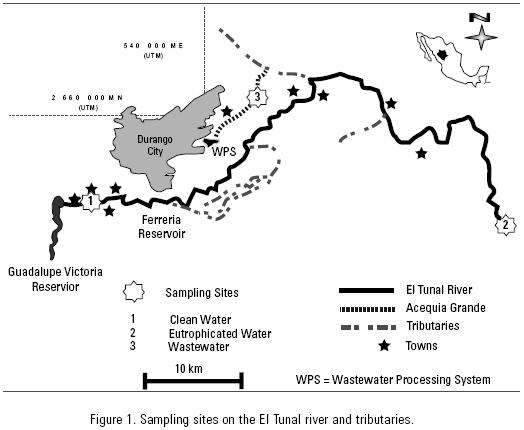
<body><![CDATA[<p align="justify"><font face="verdana" size="2">Another criterion for plant selection is the environmental quality of the area where they grow naturally. Attributes of the natural environment of a plant or plant community give an idea of their tolerance limits to various environmental conditions (Armstrong, 1975; Agami <i>et al., </i>1976; Kelly &amp; Webb, 2000), and of the physical, chemical, and microbiological processes involved in their establishment and development (Iliopoulou&#150;Georgudaki <i>et al., </i>2003). In particular, the design of wetlands for purification of domestic wastewater would require plants that are perennial, common, and abundant, with a high removal capacity, tolerant to local conditions (climate, pests, and diseases), readily propagated and established, as well as tolerant to high nutrient load, continuous flooding, and flow of wastewater (Lee, 1973; USEPA, 2000).</font></p>     <p align="justify"><font face="verdana" size="2">This research is part of a larger project focused on the design and establishment of wetlands for wastewater treatment in the metropolitan area of Durango City. The city effluent is discharged into the El Tunal river via a channel named "Acequia Grande". Currently, the domestic wastewater disposal system does not comply with the regulations indicated by the law (SEMARNAT, 1996).</font></p>     <p align="justify"><font face="verdana" size="2">Thus the objective of this work was to identify the native aquatic macrophytes, with the potential to remove nutriments and fecal coliforms in artificial wetlands under greenhouse conditions.</font></p>     <p align="justify"><font face="verdana" size="2">&nbsp;</font></p>     <p align="justify"><font face="verdana" size="2"><b>MATERIALS AND METHODS</b></font></p>     <p align="justify"><font face="verdana" size="2"><b>Study area</b>. This study was conducted at the El Tunal river and one of its tributaries. It is located in the state of Durango, Mexico, between 104&deg;45'33.11"&#150;104&deg;45'55.74" W and 23&deg;56'37.4"&#150;23&deg;56'34.02" N. Annual average stream velocity is 0.1 to 0.6 m/s depending on topography and geology of sites. The headwaters of the El Tunal river are located at the Sierra Madre Occidental of Durango State; flowing downstream across the Durango city metropolitan area, and then southwards through Durango as Rio Mezquital into the state of Nayarit, where it is called Rio San Pedro. Finally it flows into the Pacific Ocean at Laguna Brava, Nayarit. The sampling area is restricted to the vicinity of Durango City (<a href="#f1">Fig. 1</a>). Climate in the study area is semiarid, with cool winters and summer rain (winter precipitation less than 5% of annual rainfall). Average annual temperature ranges between 16 and 18&deg;C. Annual rainfall varies between 400 and 500 mm, climatic formula is BS1k (INEGI, 2005). Throughout its 74 km course, wastewater from 28% of the population in the state of Durango (approximately 0.453 million people; INEGI, 2005) is discharged to the El Tunal river. Because industrial development is low in the region, these effluents are mainly domestic wastewater. Discharges have different degrees of pollution because there are few treatment systems along the river course, and water may or may not comply with the environmental local law (SEMARNAT, 1996).</font></p>     <p align="center"><font face="verdana" size="2"><a name="f1"></a></font></p>     <p align="center"><font face="verdana" size="2"><img src="/img/revistas/hbio/v19n3/a7f1.jpg"></font></p>     <p align="justify"><font face="verdana" size="2"><b>Sampling protocol. </b>A preliminary assessment of water characteristics was carried out along the portion of the El Tunal river under study (detailed results are reported elsewhere, P&eacute;rez&#150;L&oacute;pez <i>et al., </i>2007). One microbiological and four physicochemical parameters were measured in 15 points along the river: fecal coliforms (FC), dissolved oxygen (DO), total solids (TS), pH, and electrical conductivity (EC). As a result, sites were classified in three classes of water quality, based on significant differences of univariate and multivariate statistical comparisons among categories.</font></p>     <p align="justify"><font face="verdana" size="2">For the plant inventory, three sampling sites were selected (<a href="#f1">Fig. 1</a>), one of each water quality, so that the complete spectrum of water qualities and therefore aquatic plant diversity was covered. Water quality was determined for each site based on dissolved oxygen (DO), total suspended solids (TSS), concentration of ammonia (N&#150;NH<sub>4</sub><sup>+</sup>/NH<sub>3</sub>), reactive phosphates (RP), nitrates (N&#150;NO<sub>3</sub><sup>&#150;</sup>), fecal coliforms (FC), pH, and electrical conductivity (EC).</font></p>     ]]></body>
<body><![CDATA[<p align="justify"><font face="verdana" size="2">These parameters were selected because they are directly related to water attributes that are important for the development of aquatic and semi aquatic vegetation and because they can be used to estimate a water quality index (WQI) (Pesce &amp; Wunderlin, 2000), potentially useful under the type of discharges that the river receives (mostly domestic waste). Upon examination, the WQI was estimated from these results (see <a href="/img/revistas/hbio/v19n3/a7t1.jpg" target="_blank">table 1</a>) changes were not sensitive enough to detect the differences in water quality associated to observed variation in plant composition, and therefore were disregarded.</font></p>     <p align="justify"><font face="verdana" size="2"><b>Water sampling. </b>Water samples were taken at three sites, two on the El Tunal river (upstream and downstream) and a third on the central part of the Acequia Grande channel (<a href="#f1">Fig. 1</a>). At each site, a 2 L water sample was taken from the center of the river at 30 cm of depth; samples were placed in glass bottles, stored at 4&#730;C in a cooler, and taken to the lab. Surface flow velocity was estimated by determining the average time a floating object took to move a distance of 30 m (3 measurements). Physical parameters of each site (width and depth of river) were also measured (m). Sampling was carried out at all sites 4 times; July, October, November, and December 2004.</font></p>     <p align="justify"><font face="verdana" size="2"><b>Analytical methods. </b>Water samples were filtered through Whatman<sup>TM</sup> 1.2 &#956;m fiberglass paper. From filtered samples, N&#150;NH<sub>4</sub><sup>+</sup>/NH<sub>3</sub>, N&#150;NO<sub>3</sub><sup>&#150;</sup>, and RP were estimated with the Nessler technique with a detection limit of 0.1 mg/L; salicylic acid with 2.5 mg/L as detection limit; and the ascorbic acid method, with a detection limit of 0.1 mg/L, respectively. TSS and all other analysis were carried out according to the procedures established in the Standard Methods of Analysis (Eaton <i>et al</i>., 1995).</font></p>     <p align="justify"><font face="verdana" size="2">The pH was measured with an Orion 230A pH meter; while EC was determined using an Orion 162 conductivity meter. Analytical data quality was ensured through standardization, procedural blank measurements, and duplicate samples. DO was measured at 30 cm depth in the center of the river for each sampling station using an Orion 842 detector. All other parameters were determined at the Water Analysis Laboratory, CIIDIR&#150;Durango.</font></p>     <p align="justify"><font face="verdana" size="2">All water&#150;quality parameters were expressed as mg/L, except pH and EC (&#956;mho/cm). FC (colony&#150;forming units/100 mL of water) was determined with the pour plate method, using selective culture medium Brilliant Green&#150;Bile&#150;Agar, which in previous tests demonstrated ease of use, and did not yield different results than the most probable number (MPN)/100 mL of water method, as specified in the Mexican law NMX&#150;AA&#150;042&#150;SCFI&#150;2005, (SECOFI, 2005).</font></p>     <p align="justify"><font face="verdana" size="2"><b>Plant sampling. </b>Only flowering plants found in the river or on the margins and inner banks of the three selected sites were collected and identified, and their relative importance was estimated using a line&#150;intercept method, which measures the distance occupied by a species as it intercepts a 30 m linear transect (Franco <i>et al</i>., 1985). Three 30 x 0.4 m transects were run at each site, measurements were added, and importance values were estimated for each species as relative abundance (number of plants of the species "x" /total number of plants in the 3 samples) + relative frequency (number of transects in which the plant appears/total number of transects) + relative cover (percent of transects occupied by plant "x"). Plants around each transect were also inventoried, these plants were classified as very abundant, abundant, and scarce based on visual estimation. Samples were collected, identified, and deposited at the CIIDIR Herbarium, in Durango.</font></p>     <p align="justify"><font face="verdana" size="2"><b>Evaluation of selected plants. </b>Three of 28 species sampled were selected to test their response in micro&#150;wetlands using local wastewater: <i>Schoenoplectus tabernaemontani </i>(=<i>S. lacustris </i>L. ssp. <i>glaucus </i>(Sm. ex Hartm.) Bech<i>., Scirpus tabernae&#150;montani </i>C. C. Gmelin), <i>Schoenoplectus americanus </i>(= <i>Scirpus americanus </i>Persoon) and <i>Eleocharis densa</i>. Selection of plants was done based on abundance, tolerance to local conditions, easiness of propagation and continued existence, highly tolerance to flow of wastewater in their origin place. Samples were taken and propagated in the greenhouse at CIIDIR&#150;Durango for nine months before use in the experiments.</font></p>     <p align="justify"><font face="verdana" size="2">Plants were grown in batch systems in 100 L polyethylene boxes (32.5 cm x 75 cm x 42.5 cm, of depth, length, and width, respectively) filled with 80 L of river gravel. Pebbles were flattened, with diameters of 0.6 to 0.8 cm, and 55% porosity. Gravel is a local material of igneous origin, chosen because of its low cost and abundance.</font></p>     <p align="justify"><font face="verdana" size="2">The systems used were sub&#150;surface flow wetlands (USEPA, 2000). Each batch system was considered as an experimental unit and 2 units per species were set. At the beginning of the experiment (time zero) 15 pieces of 5 cm of rhizome were placed in each unit at a depth of 5 cm inside the gravel; 45 L (30 cm high) of effluent from the Wastewater Processing System of Durango City (WPS&#150;DC) were added.</font></p>     <p align="justify"><font face="verdana" size="2">Two control batches containing only wastewater (WW) and two more with gravel and wastewater (G) were also tested, for a total of 10 experimental units. EC, pH, FC, N&#150;NO<sub>3</sub><sup>&#150;</sup>, RP and N&#150;NH<sub>4</sub><sup>+</sup>/NH<sub>3</sub> were measured every 48 hours during the first eight days. Measurements were carried out 4 times: 0, 100, 140, and 220 days after the systems were set. Concentration vs. time graphs were constructed with data gathered. System removal capacity (%) was calculated for N&#150;NH<sub>4</sub><sup>+</sup>/NH<sub>3</sub>, N&#150;NO<sub>3</sub><sup>&#150;</sup> and R P. Plant biomass (dry weight in g/m<sup>2</sup>) was measured at 0 and 140 days.</font></p>     ]]></body>
<body><![CDATA[<p align="justify"><font face="verdana" size="2"><b>Data analysis. </b>For units standardization and to support the normality of the data, values were log&#150;transformed prior to the analysis, with the exception of the FC, which were in log natural. Differences among parameters and water quality by sites were evaluated using main&#150;effects analysis of variance (MANOVA/ ANOVA).</font></p>     <p align="justify"><font face="verdana" size="2">Differences in system removal capacity of N&#150;NH<sub>4</sub><sup>+</sup>/NH<sub>3</sub>, N&#150;NO<sub>3</sub><sup>&#150;</sup> and RP were evaluated using main&#150;effects analysis of variance (ANOVA); a slope homogeneity model was used to test for differences in kinetics of FC decay. All statistical analyses were performed using STATISTICA version 7 (StatSoft, 2004), at &#945;=0.05. EC and pH variation was recorded to follow behavior of the systems.</font></p>     <p align="justify"><font face="verdana" size="2">&nbsp;</font></p>     <p align="justify"><font face="verdana" size="2"><b>RESULTS</b></font></p>     <p align="justify"><font face="verdana" size="2"><b>Water quality for each site sampled. </b><a href="/img/revistas/hbio/v19n3/a7t1.jpg" target="_blank">Table 1</a> depicts the characteristics of water quality associated with each sampling station, and the analysis of variance applied showed that differences among parameters and sites were significant. Based on this, the sites were classified as: clean water, wastewater, and eutrophicated water sites (<a href="#f1">Fig. 1</a>).</font></p>     <p align="justify"><font face="verdana" size="2">The different qualities were: clean water with little TS, low EC and other parameters were nearly undetectable. Eutrophicated water with high content of organic matter, R P, N&#150;NO<sub>3</sub><sup>&#150;</sup>, and little or no FC and N&#150;NH<sub>4</sub><sup>+</sup>/NH<sub>3</sub> (in other words it has a high content of phosphate and nitrogen but not necessarily ammonia); and Wastewater (septic) with low or nothing of OD, high content of TS, EC, ammonia and FC, but no nitrates. There is not nitrates in wastewater recently generated because they appear when the organic matter is degraded; this is one of the reasons of why they are high in eutrophicated water, another is by presence of fertilizers (de Jonge <i>et al</i>., 2002; Metcalf &amp; Eddy, 2003).</font></p>     <p align="justify"><font face="verdana" size="2"><b>Description of sites and plants sampled. </b>This paper is the first attempt to relate aquatic macrophytes composition to water quality for the Durango area. The only previous information available on aquatic plants is a state&#150;wide inventory which includes 71 aquatic and 78 facultative species (Gonz&aacute;lez&#150;Elizondo <i>et al</i>., 2003). The plants were identified based on the following papers: Gonz&aacute;lez&#150;Elizondo &amp; Peterson (1997), Gonz&aacute;lez&#150;Elizondo <i>et al</i>. (1991, 2005, 2007) and Smith <i>et al</i>. (2002).</font></p>     <p align="justify"><font face="verdana" size="2">Species composition varied widely among sites; in contrast, richness (as number of species) was similar, although ecological requirements for each species also varied widely (<a href="/img/revistas/hbio/v19n3/a7t2.jpg" target="_blank">table 2</a>). A total of 28 species of plants were recorded and identified. Twenty&#150;three species were restricted to a specific water quality: 8 to clean water, 8 to eutrophicated water, and 8 to wastewater (<a href="/img/revistas/hbio/v19n3/a7t2.jpg" target="_blank">table 2</a>). Four species were present in two sites (<a href="/img/revistas/hbio/v19n3/a7t2.jpg" target="_blank">table 2</a>), and only <i>Persicaria </i>aff. <i>mexicana </i>was found in all three, although it was more abundant at the wastewater site (relative importance value 23%). Characteristics of places and plant communities by site were as follows:</font></p>     <p align="justify"><font face="verdana" size="2"><i>Site 1, clean water. </i>This site has the best water quality of all (<a href="/img/revistas/hbio/v19n3/a7t1.jpg" target="_blank">table 1</a>) the river is 52 m wide, straight and shallow (1&#150;m depth), with a speed of 10 cm/s. The surrounding land is used as pasture grounds. Eleven species were sampled at this site, one submerged; 3 rooted floating aquatics; 3 emergent (one of them facultative); one shrub, one tree, and one creeper (<a href="/img/revistas/hbio/v19n3/a7t2.jpg" target="_blank">table 2</a>). Eight species were exclusive to this site. The plant assemblage spans almost all the life forms found along the river, from terrestrial riparian to emergent aquatics, only free&#150;floating plants were absent. The wet part of the river bank was covered by <i>Eleocharis </i>sp., followed by <i>Cynodon dactylon </i>(L.) Pers<i>., </i>a grass, at the contiguous, drier portion. Both species protect the river from erosion due to flooding. Absence of most upstream species (clean water site) downstream, where water is more polluted, suggests that they are sensitive to pollutants, and therefore good indicators of quality but poor cleansers. Two species are shared with the eutrophicated water site, <i>Ludwigia </i>sp. and <i>Eriochloa acuminata.</i></font></p>     <p align="justify"><font face="verdana" size="2"><i>Site 2, eutrophicated water. </i>This site is the farthest from the urban areas. Water is eutrophicated probably as a result of the process of self&#150;purification occurring between the sources of pollution upstream and this site (<a href="/img/revistas/hbio/v19n3/a7t1.jpg" target="_blank">table 1</a>). Here the river is sinuous and with numerous branches; width changes during the year, reaching up to 100 m during the rain season. Depth varies between 1 and 3 m, water speed was 30 cm/s. Twelve species were recorded, five free&#150;floating aquatic, one submerged, one emergent, three rooted floating aquatic, one grass, and one tree (<a href="/img/revistas/hbio/v19n3/a7t2.jpg" target="_blank">table 2</a>). Seven species were exclusive to this site, which shares two with wastewater (<i>Lemna </i>aff. <i>minuta </i>and <i>Eichhornia crassipes</i>, and two with the clean water site (<i>Eriochloa acuminata </i>and <i>Ludwigia </i>sp.1). Vegetation at the river bank is dominated by <i>Taxodium mucronatum</i>, forming a gallery forest. The surrounding land is used as a pasture.</font></p>     ]]></body>
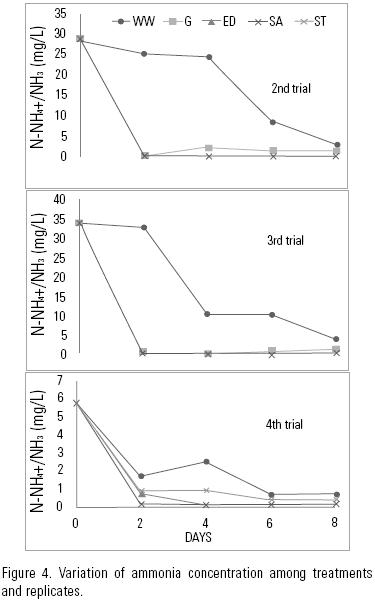
<body><![CDATA[<p align="justify"><font face="verdana" size="2"><i>Site 3, waste water. </i>At this site the effluent carried was&#150;tewaters from the open sewer system of Durango City (<a href="/img/revistas/hbio/v19n3/a7t1.jpg" target="_blank">table 1</a>). The semi&#150;treated wastewater of the city is discharged into this channel (2.5 m<sup>3</sup>/s), which is an affluent of the El Tunal river that runs across small communities where the water is used for irrigation and for the cattle to drink. The channel is 12 m wide, 1.5&#150;m deep and has a constant flow throughout the year, except in the rain season, when the water level rises over the banks of the channel, reaching a velocity up to 46 cm/s and floods the surrounding terrain. These areas are used as pasture grounds. Eleven species were collected here; eight emergent aquatic and three free&#150;floating (<a href="/img/revistas/hbio/v19n3/a7t2.jpg" target="_blank">table 2</a>); eight of them were found only at this site. Some species found in wastewater have been reported as indicators of water with high&#150;nutrient content: <i>Schoenoplectus tabernaemontani, Typha domingensis</i>, <i>Lemna </i>aff. <i>minuta, </i>and <i>Eichhornia crassipes. </i>Because of their higher growth rate, they replace the original, slower&#150;growing species typical of nutrient&#150;poor environments. This characteristic makes them the species of choice for wetland construction and pollution mitigation along river beds (Haslam, 1978; Gutenspergen <i>et al., </i>1989; USEPA, 2002; Scholz &amp; Trepel, 2004).</font></p>     <p align="justify"><font face="verdana" size="2"><b>Selected plants. </b>Under ideal circumstances the choice of plants for an artificial wetland should include those with the highest tolerance to variation in pollutant contents. From our inventory, only one specie, <i>Persicaria </i>aff. <i>mexicana</i>, occurred in all types of water; however, it was difficult for this species to grow under these specific artificial conditions, and therefore it was not considered. None of the species that occurred in two types of water (<i>Eriochloa acuminata, Eleocharis acicularis</i>, <i>Lemna </i>aff. <i>minuta </i>and <i>Ludwigia </i>sp. 1) were suitable to be grown in the artificial conditions we set, and also were discarded from further experiments. Thus, three species which occurred only in the wastewater site were chosen. All of them were abundant in the field, easy to handle under greenhouse conditions, and have potential to be used locally; two have been previously used in wetlands. Finally, because the aim of an artificial wetland for the El Tunal river region includes, in addition to water treatment, the creation of a wildlife refuge as well as an area for environmental education, it is proposed that it should include mainly emergent plants. The three species selected are perennial and reproduce by rootstocks and seeds:</font></p>     <p align="justify"><font face="verdana" size="2">1. <i>Schoenoplectus tabernaemontani </i>(<i>ST</i>), with a cosmopolitan distribution, has been used for wetland construction worldwide (Tanner <i>et al</i>., 2002).</font></p>     <p align="justify"><font face="verdana" size="2">2. <i>S. americanus (SA)</i>, distributed only in the Americas. It is used for recovery and protection of natural wetlands and in Mexico for construction of some artificial wetlands (Warman, 1988; Mart&iacute;nez&#150;Cruz <i>et al</i>., 2006; Ramos&#150;Espinosa <i>et al</i>., 2007).</font></p>     <p align="justify"><font face="verdana" size="2">3. <i>Eleocharis densa (ED) </i>distributed from Mexico to Guatemala. No technical references or any other precedent of its use in constructed wetlands was found.</font></p>     <p align="justify"><font face="verdana" size="2"><b>Evaluation of selected plants in the batch micro&#150;wetlands.</b></font></p>     <p align="justify"><font face="verdana" size="2">The domestic wastewater (WW) used in the batch micro&#150;wetlands was collected from site 3 (<a href="#f1">Fig. 1</a>), its characteristics are given in <a href="/img/revistas/hbio/v19n3/a7t1.jpg" target="_blank">table 1</a>. These characteristics are typical for a primary effluent or a septic tank effluent; the species used did not have problems adapting to it as reported by Metcalf &amp; Eddy (2003).</font></p>     <p align="justify"><font face="verdana" size="2">WW has bacterial content which provides a self&#150;treatment capacity. Also, the presence of gravel provides another removal factor because exchange of ions takes place. Two types of control were included to evaluate the performance of the plants in the systems; a system with WW and another with gravel (G); to measure the real capacity of the plants (<i>ED, SA </i>y <i>ST</i>), in the removal of FC, NH<sub>3</sub> and R P.</font></p>     <p align="justify"><font face="verdana" size="2">Efficiency results and their comparison among the different systems are summarized in <a href="/img/revistas/hbio/v19n3/a7t3.jpg" target="_blank">table 3</a>. The ANOVA for differences among time by species was not significant. Plant biomass increased after 140 days from: 28 to 2,794, 25 to 2,035, and 30 to 1,729 g/ m<sup>2</sup> for <i>Eleocharis densa (ED), Shoenoplectus americanus (SA), </i>and <i>S. tabernaemontani (ST), </i>respectively.</font></p>     <p align="justify"><font face="verdana" size="2"><a href="/img/revistas/hbio/v19n3/a7f2.jpg" target="_blank">Figures 2</a>, <a href="/img/revistas/hbio/v19n3/a7f3.jpg" target="_blank">3</a>, <a href="#f4">4</a>, and <a href="/img/revistas/hbio/v19n3/a7f5.jpg" target="_blank">5</a> show the performance of the systems for pH, EC, ammonia, RP and FC; nitrate was not found neither in the influent nor in the effluent of the systems , all parameters were determined each 48 hours, up to 8 days, 4 trials by duplicates and the average of results are shown.</font></p>     ]]></body>
<body><![CDATA[<p align="center"><font face="verdana" size="2"><a name="f4"></a></font></p>     <p align="center"><font face="verdana" size="2"><img src="/img/revistas/hbio/v19n3/a7f4.jpg"></font></p>     <p align="justify"><font face="verdana" size="2"><b>Electrical conductivity (EC): </b>The behavior of the systems was different. The ones with gravel showed differences whereas the system only with WW did not (first and second trials in <a href="/img/revistas/hbio/v19n3/a7f2.jpg" target="_blank">Fig 2</a>), indicating that the gravel had influence in the changes observed. As time went by gravel lost exchange capacity, becoming saturated, and a biofilm of microorganisms formed in the gravel surface. The systems with plants showed a different behavior as seen in third and forth trials in <a href="/img/revistas/hbio/v19n3/a7f2.jpg" target="_blank">Fig. 2</a>.</font></p>     <p align="justify"><font face="verdana" size="2">The changes of pH were similar in all systems, except for WW, which showed the highest values at day eight. The rest of the systems did not show significant changes, except for the fourth trial, where it is clearly observed that the systems with plants are separated from the others by a pH&#150;unit, see <a href="/img/revistas/hbio/v19n3/a7f3.jpg" target="_blank">Fig. 3</a>.</font></p>     <p align="justify"><font face="verdana" size="2">Efficiency of removal (RP) was 49, 97, 99, 100 and 100% for WW, G, <i>ED</i>, <i>SA</i>, and <i>ST</i>, respectively. Behavior in system with gravel was similar, showing higher % removal than in systems without it, see <a href="/img/revistas/hbio/v19n3/a7f3.jpg" target="_blank">Fig 3</a>.</font></p>     <p align="justify"><font face="verdana" size="2">The average removal of ammonia (N&#150; NH<sub>4</sub><sup>+</sup>/NH<sub>3</sub>) accounted for the 96 to 99% in the systems with gravel and 88% in the WW system. This parameter showed the same tendency as for EC, see <a href="#f4">Fig 4</a>.</font></p>     <p align="justify"><font face="verdana" size="2">The removal rate of fecal coliforms (FC) followed a first&#150;order rate, with non&#150;significant differences among systems (<a href="/img/revistas/hbio/v19n3/a7f5.jpg" target="_blank">Fig. 5</a>). Experimental results showed a reduction of an average of 6.4 logarithmic units of FC within 8 days, with a specific average decay rate of &#150;1.18, &#150;1.84, &#150;1.56, and &#150;1.55 Ln of CFU/100 mL of water per day for the control, <i>ED</i>, <i>SA</i>, and <i>ST</i>, respectively.</font></p>     <p align="justify"><font face="verdana" size="2">&nbsp;</font></p>     <p align="justify"><font face="verdana" size="2"><b>DISCUSSION</b></font></p>     <p align="justify"><font face="verdana" size="2">Twenty&#150;eight species of aquatic plants were collected in three sites of different water quality: clean, eutrophicated and wastewater; species composition varied broadly among sites, although species richness was similar among them. Only <i>Persicaria </i>aff. <i>mexicana </i>was common to all three, and four (<i>Eichhornia crassipes</i>, <i>Eriochloa acuminata</i>, <i>Lemna </i>aff. <i>minuta </i>and <i>Ludwigia </i>sp. 1) were shared between two sites.</font></p>     ]]></body>
<body><![CDATA[<p align="justify"><font face="verdana" size="2">Wastewater site (3) had the highest risk to human and environmental health in the area because of its high contents of fecal coliformes, indicating the possible presence of <i>Salmonella</i>, <i>Shigella</i>, and other pathogenic microorganisms that pose a potential human health hazard (Chapman, 1992; Metcalf &amp; Eddy, 2003). A water treatment plant should exist immediately before point 3, where most discharges from the city converge. This treatment also would significantly decrease the amount of nutrients that reaches the lower portion of the river, and effectively eliminate eutrophication downstream. Additionally, invasive plants as <i>Echinochloa colona</i>, E. <i>crusgalli </i>and <i>Eichhornia crassipes </i>were found in this place. Slow&#150;growing plants have been substituted by these fast&#150;growing species, turning a low&#150;biomass, healthy river into a high biomass, swamp&#150;like water body (USEPA, 2002). Such radical changes in water characteristics may lead to the decrease of abundance of many aquatic and semi&#150;aquatic species of plants and animals, or to their complete disappearance from the area.</font></p>     <p align="justify"><font face="verdana" size="2"><i>Schoenoplectus tabernaemontani, S. americanus </i>and <i>Eleocharis densa </i>are emergent plants that in the study area grew in wastewater only, and whose propagation in greenhouse conditions was not difficult. Because of these attributes they were selected to test their purification capacity under artificial conditions.</font></p>     <p align="justify"><font face="verdana" size="2">The pace of environmental change and the accelerated population growth in the Durango metropolitan area makes urgent the creation of low&#150;cost, easy to manage water treatment systems along the El Tunal river.</font></p>     <p align="justify"><font face="verdana" size="2">The analysis of 3 species potentially useful to create an artificial wetland in Durango showed a successful growth for all of them in all cases; moreover, their response was similar across time. Nonetheless, results indicate that for these particular systems, plants seem not to have a significant effect on removal of pollutants, since the effect was the same with plants and without them. This evidence leads to conclude that it was the gravel attributes which created the appropriate substrate and environment for microorganisms to be established and to do the removal; this is a fact recognized for many authors, such as Gutenspergen <i>et al</i>. (1989), Forbes <i>et al. </i>(2004), and Seo <i>et al</i>. (2005), among others.</font></p>     <p align="justify"><font face="verdana" size="2"><i>Eleocharis densa</i>, <i>S. americanus </i>and <i>S. tabernaemontani </i>are native species, abundant, tolerant to local conditions, easy to propagate and establish, highly tolerant to wastewater flow, and with a dense growing habit that would represent a refuge for wildlife. These characteristics make them suitable for an artificial wetland in Durango. In this scenario, an artificial wetland potentially may include either of these plant species, a combination of them, or none at all. However, because the purpose of the wetland system would not be only removal of the pollutants, but also to offer a wildlife refuge and a recreational area. <i>E. densa </i>would be the species of choice if only one were to be used. This species is a perennial native to Mexico and Guatemala, as before mentioned it is abundant and tolerant to local conditions and wastewater flow, provides adequate refuge for animals, and it may have some value as food for livestock. Additionally, based on bibliographic review, it has not been used before in treatment wetlands.</font></p>     <p align="justify"><font face="verdana" size="2">Better yet would be the use of the three selected species: <i>E. densa</i>, <i>S. americanus </i>and <i>S. tabernaemontani</i>. The possible synergies that could exist in a system including the three species together have not been explored, and are beyond the scope of this paper, but they should be addressed given that, from the ecological standpoint, a more diverse system might have a better chance of succeeding in the long term, and provide greater habitat valve.</font></p>     <p align="justify"><font face="verdana" size="2">Finally, although within the time frame involved in these experiments, plants did not have a detectable removal effect; it is possible that given the appropriate amount of time, plants may become an important component of the treatment systems. This is another avenue of research still to be addressed before a large scale system can be designed and built.</font></p>     <p align="justify"><font face="verdana" size="2">&nbsp;</font></p>     <p align="justify"><font face="verdana" size="2"><b>ACKNOWLEDGEMENTS</b></font></p>     <p align="justify"><font face="verdana" size="2">Funding for this research was granted to the first author by CONACyT (FOMIX DGO&#150;2003&#150;CO2&#150;11066) and CGPI&#150;IPN (20050728). This manuscript was elaborated under exclusivity fellowships from COFAA&#150;IPN to MEPL, SGE, and CLG. M.E. Burciaga&#150;Siqueiros, S. R. Guti&eacute;rrez&#150;Reyes and J. A. Ram&iacute;rez&#150;Mart&iacute;nez, kindly helped during fieldwork and laboratory tasks. Y. Herrera identified the grasses. P. Williamson and Z. I. Gonz&aacute;lez reviewed early versions of this manuscript.</font></p>     ]]></body>
<body><![CDATA[<p align="justify"><font face="verdana" size="2">&nbsp;</font></p>     <p align="justify"><font face="verdana" size="2"><b>REFERENCES</b></font></p>     <!-- ref --><p align="justify"><font face="verdana" size="2">Agami, M., M. Litav &amp; Y. Waisel. 1976. The effects of various components of water pollution on the behaviour of some aquatic macrophytes of the coastal rivers of Israel. <i>Aquatic Botany </i>2: 203&#150;213.</font>&nbsp;&nbsp;&nbsp;&nbsp;&nbsp;&nbsp;&nbsp;&nbsp;[&#160;<a href="javascript:void(0);" onclick="javascript: window.open('/scielo.php?script=sci_nlinks&ref=4079810&pid=S0188-8897200900030000700001&lng=','','width=640,height=500,resizable=yes,scrollbars=1,menubar=yes,');">Links</a>&#160;]<!-- end-ref --><!-- ref --><p align="justify"><font face="verdana" size="2">Armstrong, W. 1975. Waterlogged Soils. <i>In: </i>J. R. Etherington (Ed.). <i>Environment and Plant Ecology</i>. John Wiley &amp; Sons, Ltd. London, 338 p.</font>&nbsp;&nbsp;&nbsp;&nbsp;&nbsp;&nbsp;&nbsp;&nbsp;[&#160;<a href="javascript:void(0);" onclick="javascript: window.open('/scielo.php?script=sci_nlinks&ref=4079811&pid=S0188-8897200900030000700002&lng=','','width=640,height=500,resizable=yes,scrollbars=1,menubar=yes,');">Links</a>&#160;]<!-- end-ref --><!-- ref --><p align="justify"><font face="verdana" size="2">Canter, L. W. 1998. <i>Manual de Evaluaci&oacute;n de Impacto Ambiental. T&eacute;cnicas para la elaboraci&oacute;n de los estudios de impacto</i>. 2&ordf; ed. McGraw&#150;Hill/Interamericana de Espa&ntilde;a, S.A.U. 870 p.</font>&nbsp;&nbsp;&nbsp;&nbsp;&nbsp;&nbsp;&nbsp;&nbsp;[&#160;<a href="javascript:void(0);" onclick="javascript: window.open('/scielo.php?script=sci_nlinks&ref=4079812&pid=S0188-8897200900030000700003&lng=','','width=640,height=500,resizable=yes,scrollbars=1,menubar=yes,');">Links</a>&#160;]<!-- end-ref --><!-- ref --><p align="justify"><font face="verdana" size="2">Chapman, D. (Ed.). 1992. <i>Water Quality Assessments</i>. Chapman &amp; Hall, London, 656 p.</font>&nbsp;&nbsp;&nbsp;&nbsp;&nbsp;&nbsp;&nbsp;&nbsp;[&#160;<a href="javascript:void(0);" onclick="javascript: window.open('/scielo.php?script=sci_nlinks&ref=4079813&pid=S0188-8897200900030000700004&lng=','','width=640,height=500,resizable=yes,scrollbars=1,menubar=yes,');">Links</a>&#160;]<!-- end-ref --><!-- ref --><p align="justify"><font face="verdana" size="2">Eaton, A. D., L. S. Clesceri &amp; A. E. Greenberg (Eds.). 1995. <i>Standard methods for the examination of water and wastewater</i>. 19th Ed. American Public Health Associaton (APHA). Maryland. Folio variado.</font>&nbsp;&nbsp;&nbsp;&nbsp;&nbsp;&nbsp;&nbsp;&nbsp;[&#160;<a href="javascript:void(0);" onclick="javascript: window.open('/scielo.php?script=sci_nlinks&ref=4079814&pid=S0188-8897200900030000700005&lng=','','width=640,height=500,resizable=yes,scrollbars=1,menubar=yes,');">Links</a>&#160;]<!-- end-ref --><!-- ref --><p align="justify"><font face="verdana" size="2">De Jonge, V. N., M. Elliott &amp; E. Orive. 2002. Causes, historical development, effects and future challenges of a common environmental problem: eutrophication. <i>Hydrobiolog&iacute;a </i>475&#150;76: 1&#150;19.</font>&nbsp;&nbsp;&nbsp;&nbsp;&nbsp;&nbsp;&nbsp;&nbsp;[&#160;<a href="javascript:void(0);" onclick="javascript: window.open('/scielo.php?script=sci_nlinks&ref=4079815&pid=S0188-8897200900030000700006&lng=','','width=640,height=500,resizable=yes,scrollbars=1,menubar=yes,');">Links</a>&#160;]<!-- end-ref --><!-- ref --><p align="justify"><font face="verdana" size="2">Forbes, M. G., K. R. Dickson, T. D. Golden, P. Hudak &amp; R. D. Doyle. 2004. Dissolved phosphorus retention of light&#150;weight expanded shale and masonry sand used in subsurface flow treatment wetlands. <i>Environmental Science &amp; Technology </i>38 (3): 892&#150;898.</font>&nbsp;&nbsp;&nbsp;&nbsp;&nbsp;&nbsp;&nbsp;&nbsp;[&#160;<a href="javascript:void(0);" onclick="javascript: window.open('/scielo.php?script=sci_nlinks&ref=4079816&pid=S0188-8897200900030000700007&lng=','','width=640,height=500,resizable=yes,scrollbars=1,menubar=yes,');">Links</a>&#160;]<!-- end-ref --><!-- ref --><p align="justify"><font face="verdana" size="2">Franco, J., G. Aguero, A. Cruz, A. Rocha, N. Navarrete, G. Flores, E. Kato, S. S&aacute;nchez, L. Abarca, &amp; C. Bedia. 1985. <i>Manual de Ecolog&iacute;a</i>. Trillas. M&eacute;xico, 170 p</font>&nbsp;&nbsp;&nbsp;&nbsp;&nbsp;&nbsp;&nbsp;&nbsp;[&#160;<a href="javascript:void(0);" onclick="javascript: window.open('/scielo.php?script=sci_nlinks&ref=4079817&pid=S0188-8897200900030000700008&lng=','','width=640,height=500,resizable=yes,scrollbars=1,menubar=yes,');">Links</a>&#160;]<!-- end-ref --><!-- ref --><p align="justify"><font face="verdana" size="2">Gonz&aacute;lez&#150;Elizondo, M., M. S. Gonz&aacute;lez&#150;Elizondo &amp; Y. Herrera&#150;Arrieta. 1991. <i>Listados Flor&iacute;sticos de M&eacute;xico IX. Flora de Durango</i>. Instituto de Biolog&iacute;a, Universidad Nacional Aut&oacute;noma de M&eacute;xico. M&eacute;xico, D.F. 167 p.</font>&nbsp;&nbsp;&nbsp;&nbsp;&nbsp;&nbsp;&nbsp;&nbsp;[&#160;<a href="javascript:void(0);" onclick="javascript: window.open('/scielo.php?script=sci_nlinks&ref=4079818&pid=S0188-8897200900030000700009&lng=','','width=640,height=500,resizable=yes,scrollbars=1,menubar=yes,');">Links</a>&#160;]<!-- end-ref --><!-- ref --><p align="justify"><font face="verdana" size="2">Gonz&aacute;lez&#150;Elizondo, M. &amp; P. M. Peterson. 1997. A classification of and key to the supraspecific taxa in <i>Eleocharis </i>(Cyperaceae). <i>Taxon </i>46: 433&#150;449.</font>&nbsp;&nbsp;&nbsp;&nbsp;&nbsp;&nbsp;&nbsp;&nbsp;[&#160;<a href="javascript:void(0);" onclick="javascript: window.open('/scielo.php?script=sci_nlinks&ref=4079819&pid=S0188-8897200900030000700010&lng=','','width=640,height=500,resizable=yes,scrollbars=1,menubar=yes,');">Links</a>&#160;]<!-- end-ref --><!-- ref --><p align="justify"><font face="verdana" size="2">Gonz&aacute;lez&#150;Elizondo, S., L. L&oacute;pez&#150;Enr&iacute;quez, J. A. Tena&#150;Flores, M. Gonz&aacute;lez&#150;Elizondo &amp; M.A. M&aacute;rquez&#150;Linares. 2003. <i>Flora acu&aacute;tica y subacu&aacute;tica del Estado de Durango</i>. Unpublished technical report. Centro Interdisciplinario de Investigaci&oacute;n para el Desarrollo Integral Regional del Instituto Polit&eacute;cnico Nacional (CIIDIR), Durango. 70 p.</font>&nbsp;&nbsp;&nbsp;&nbsp;&nbsp;&nbsp;&nbsp;&nbsp;[&#160;<a href="javascript:void(0);" onclick="javascript: window.open('/scielo.php?script=sci_nlinks&ref=4079820&pid=S0188-8897200900030000700011&lng=','','width=640,height=500,resizable=yes,scrollbars=1,menubar=yes,');">Links</a>&#160;]<!-- end-ref --><!-- ref --><p align="justify"><font face="verdana" size="2">Gonz&aacute;lez&#150;Elizondo, M. S., J. Tena&#150;Flores, T. Alarc&oacute;n&#150;Herrera, E. Flores&#150;Taviz&oacute;n &amp; N. Barajas&#150;Acosta. 2005. An arsenic&#150;tolerant new species of <i>Eleocharis </i>(Cyperaceae) from Chihuahua, Mexico. <i>Brittonia </i>57 (2): 150&#150;154.</font>&nbsp;&nbsp;&nbsp;&nbsp;&nbsp;&nbsp;&nbsp;&nbsp;[&#160;<a href="javascript:void(0);" onclick="javascript: window.open('/scielo.php?script=sci_nlinks&ref=4079821&pid=S0188-8897200900030000700012&lng=','','width=640,height=500,resizable=yes,scrollbars=1,menubar=yes,');">Links</a>&#160;]<!-- end-ref --><!-- ref --><p align="justify"><font face="verdana" size="2">Gonz&aacute;lez&#150;Elizondo, M. S., M. Gonz&aacute;lez&#150;Elizondo, J. A. Tena&#150;Flores, I. L. L&oacute;pez&#150;Enr&iacute;quez, A. A. Reznicek &amp; N. Diego&#150;P&eacute;rez. 2007. Sinopsis de <i>Scirpus S.</i>l. (Cyperaceae) para M&eacute;xico. <i>Acta Bot&aacute;nica Mexicana </i>82: 15&#150;41.</font>&nbsp;&nbsp;&nbsp;&nbsp;&nbsp;&nbsp;&nbsp;&nbsp;[&#160;<a href="javascript:void(0);" onclick="javascript: window.open('/scielo.php?script=sci_nlinks&ref=4079822&pid=S0188-8897200900030000700013&lng=','','width=640,height=500,resizable=yes,scrollbars=1,menubar=yes,');">Links</a>&#160;]<!-- end-ref --><!-- ref --><p align="justify"><font face="verdana" size="2">Gutenspergen, G. R., F. Stearns, &amp; J. A Kadlec. 1989. Wetland vegetation, <i>In: </i>Hammer, D.A. (Ed.). <i>Constructed Wetlands for Wastewater Treatment</i>. Lewis Publishers. Michigan. 856 p.</font>&nbsp;&nbsp;&nbsp;&nbsp;&nbsp;&nbsp;&nbsp;&nbsp;[&#160;<a href="javascript:void(0);" onclick="javascript: window.open('/scielo.php?script=sci_nlinks&ref=4079823&pid=S0188-8897200900030000700014&lng=','','width=640,height=500,resizable=yes,scrollbars=1,menubar=yes,');">Links</a>&#160;]<!-- end-ref --><!-- ref --><p align="justify"><font face="verdana" size="2">Haslam, S. M. 1978. <i>River Plants</i>. Cambridge University Press, Cambridge. 396 p.</font>&nbsp;&nbsp;&nbsp;&nbsp;&nbsp;&nbsp;&nbsp;&nbsp;[&#160;<a href="javascript:void(0);" onclick="javascript: window.open('/scielo.php?script=sci_nlinks&ref=4079824&pid=S0188-8897200900030000700015&lng=','','width=640,height=500,resizable=yes,scrollbars=1,menubar=yes,');">Links</a>&#160;]<!-- end-ref --><!-- ref --><p align="justify"><font face="verdana" size="2">Iliopoulou&#150;Georgudaki, J., V. Kantzaris, P. Katharios, P. Kaspiris, T. Georgiadis, &amp; B. Montesantou. 2003. An application of different bioindicators for assessing water quality: a case study in the rivers Alfeios and Pineios (Peloponnisos, Greece). <i>Ecological Indicators </i>2 (4): 345&#150;360.</font>&nbsp;&nbsp;&nbsp;&nbsp;&nbsp;&nbsp;&nbsp;&nbsp;[&#160;<a href="javascript:void(0);" onclick="javascript: window.open('/scielo.php?script=sci_nlinks&ref=4079825&pid=S0188-8897200900030000700016&lng=','','width=640,height=500,resizable=yes,scrollbars=1,menubar=yes,');">Links</a>&#160;]<!-- end-ref --><!-- ref --><p align="justify"><font face="verdana" size="2">INEGI (Instituto Nacional de Estad&iacute;stica y Geograf&iacute;a).1996. <i>Anuario Estad&iacute;stico Durango, M&eacute;xico. </i>585 p.</font>&nbsp;&nbsp;&nbsp;&nbsp;&nbsp;&nbsp;&nbsp;&nbsp;[&#160;<a href="javascript:void(0);" onclick="javascript: window.open('/scielo.php?script=sci_nlinks&ref=4079826&pid=S0188-8897200900030000700017&lng=','','width=640,height=500,resizable=yes,scrollbars=1,menubar=yes,');">Links</a>&#160;]<!-- end-ref --><!-- ref --><p align="justify"><font face="verdana" size="2">Kelley, R. K. &amp; D. H. Webb. 2000. Guide to selecting native plants for riparian and wetland restoration. <i>In: </i>Means, J. L. &amp; R. E. Hinchee (Eds.) <i>Wetlands and Remediation</i>, <i>an International Conference. </i>Salt Lake City, Utah, 16&#150;17 Nov. 1999 Battelle Press, Columbus, Ohio. 445 p.</font>&nbsp;&nbsp;&nbsp;&nbsp;&nbsp;&nbsp;&nbsp;&nbsp;[&#160;<a href="javascript:void(0);" onclick="javascript: window.open('/scielo.php?script=sci_nlinks&ref=4079827&pid=S0188-8897200900030000700018&lng=','','width=640,height=500,resizable=yes,scrollbars=1,menubar=yes,');">Links</a>&#160;]<!-- end-ref --><!-- ref --><p align="justify"><font face="verdana" size="2">Lee, G.F. 1973. Eutrophication<i>. Transactions of the northeast fish and wildlife conference</i>. <a href="http://www.gfredlee.com/pexfert2.htm" target="_blank">http://www.gfredlee.com/pexfert2.htm</a>.</font>&nbsp;&nbsp;&nbsp;&nbsp;&nbsp;&nbsp;&nbsp;&nbsp;[&#160;<a href="javascript:void(0);" onclick="javascript: window.open('/scielo.php?script=sci_nlinks&ref=4079828&pid=S0188-8897200900030000700019&lng=','','width=640,height=500,resizable=yes,scrollbars=1,menubar=yes,');">Links</a>&#160;]<!-- end-ref --><!-- ref --><p align="justify"><font face="verdana" size="2">Lehman, R. W., J. H. Rodgers, B. Gladden, C. Murray&#150;Gulde, J.F. Bell, &amp; F. Douglas&#150;Mooney. 2002. <i>Wetlands for industrial wastewater treatment at the Savannah River site. </i>Technical Paper 0202. National Defense Industrial Association 28th Environmental &amp; Energy Symposium, Charleston, SC, March 2002. 18 p.</font>&nbsp;&nbsp;&nbsp;&nbsp;&nbsp;&nbsp;&nbsp;&nbsp;[&#160;<a href="javascript:void(0);" onclick="javascript: window.open('/scielo.php?script=sci_nlinks&ref=4079829&pid=S0188-8897200900030000700020&lng=','','width=640,height=500,resizable=yes,scrollbars=1,menubar=yes,');">Links</a>&#160;]<!-- end-ref --><!-- ref --><p align="justify"><font face="verdana" size="2">Mart&iacute;nez&#150;Cruz, P., A. Hern&aacute;ndez&#150;Mart&iacute;nez, R. Soto&#150;Castor, A. Esquivel&#150;Herrera &amp; J. Rangel&#150;Levario. 2006. Use of constructed wetlands for the treatment of water from an experimental channel at Xochimilco, Mexico. <i>Hidrobiol&oacute;gica </i>16 (3): 211&#150;218.</font>&nbsp;&nbsp;&nbsp;&nbsp;&nbsp;&nbsp;&nbsp;&nbsp;[&#160;<a href="javascript:void(0);" onclick="javascript: window.open('/scielo.php?script=sci_nlinks&ref=4079830&pid=S0188-8897200900030000700021&lng=','','width=640,height=500,resizable=yes,scrollbars=1,menubar=yes,');">Links</a>&#160;]<!-- end-ref --><!-- ref --><p align="justify"><font face="verdana" size="2">Metcalf &amp; Eddy. 2003. <i>Wastewater engineering, treatment and reuse. </i>4<sup>th </sup>ed. Revised by Tchobanoglous G., Burton F. &amp; Stensel D. McGraw&#150;Hill. 1819 p.</font>&nbsp;&nbsp;&nbsp;&nbsp;&nbsp;&nbsp;&nbsp;&nbsp;[&#160;<a href="javascript:void(0);" onclick="javascript: window.open('/scielo.php?script=sci_nlinks&ref=4079831&pid=S0188-8897200900030000700022&lng=','','width=640,height=500,resizable=yes,scrollbars=1,menubar=yes,');">Links</a>&#160;]<!-- end-ref --><!-- ref --><p align="justify"><font face="verdana" size="2">Mitsch, W. J. &amp; J. G. Gosselink. 2000. <i>Wetlands</i>. 3<sup>rd</sup> ed. Wiley, New York. 600 p.</font>&nbsp;&nbsp;&nbsp;&nbsp;&nbsp;&nbsp;&nbsp;&nbsp;[&#160;<a href="javascript:void(0);" onclick="javascript: window.open('/scielo.php?script=sci_nlinks&ref=4079832&pid=S0188-8897200900030000700023&lng=','','width=640,height=500,resizable=yes,scrollbars=1,menubar=yes,');">Links</a>&#160;]<!-- end-ref --><!-- ref --><p align="justify"><font face="verdana" size="2">NAS (National Academy of Sciences). 1976. <i>Making aquatic weeds useful: some perspectives for developing countries</i>, report of an ad&#150;hoc panel of the Advisory Committee on Technology Innovation, Washington, D.C. 174 p.</font>&nbsp;&nbsp;&nbsp;&nbsp;&nbsp;&nbsp;&nbsp;&nbsp;[&#160;<a href="javascript:void(0);" onclick="javascript: window.open('/scielo.php?script=sci_nlinks&ref=4079833&pid=S0188-8897200900030000700024&lng=','','width=640,height=500,resizable=yes,scrollbars=1,menubar=yes,');">Links</a>&#160;]<!-- end-ref --><!-- ref --><p align="justify"><font face="verdana" size="2">P&eacute;rez&#150;L&oacute;pez M. E., J. Valenzuela&#150;Figueroa, M. G. Vicencio de la Rosa, A. Mart&iacute;nez&#150;Prado &amp; G. Gonz&aacute;lez&#150;S&aacute;nchez. 2007. Uso de an&aacute;lisis de cl&uacute;ster para establecer calidad del agua superficial. <i>Memorias del VI Congreso Internacional y XII Congreso Nacional de Ciencias Ambientales (ANCA junio 2007)</i>. Universidad Aut&oacute;noma de Chihuahua, Chihuahua, M&eacute;xico. 8 p.</font>&nbsp;&nbsp;&nbsp;&nbsp;&nbsp;&nbsp;&nbsp;&nbsp;[&#160;<a href="javascript:void(0);" onclick="javascript: window.open('/scielo.php?script=sci_nlinks&ref=4079834&pid=S0188-8897200900030000700025&lng=','','width=640,height=500,resizable=yes,scrollbars=1,menubar=yes,');">Links</a>&#160;]<!-- end-ref --><!-- ref --><p align="justify"><font face="verdana" size="2">Pesce S. F. &amp; D. A Wunderlin. 2000. Use of water quality indices to verify the impact of C&oacute;rdoba City (Argentina) on Suqu&iacute;a river. <i>Water Research </i>34 (11): 2915&#150;2926.</font>&nbsp;&nbsp;&nbsp;&nbsp;&nbsp;&nbsp;&nbsp;&nbsp;[&#160;<a href="javascript:void(0);" onclick="javascript: window.open('/scielo.php?script=sci_nlinks&ref=4079835&pid=S0188-8897200900030000700026&lng=','','width=640,height=500,resizable=yes,scrollbars=1,menubar=yes,');">Links</a>&#160;]<!-- end-ref --><!-- ref --><p align="justify"><font face="verdana" size="2">Ramos&#150;Espinosa, M. G., L. M. Rodr&iacute;guez&#150;S&aacute;nchez &amp; P. Mart&iacute;nez&#150;Cruz. 2007. Uso de macrofitas acu&aacute;ticas en el tratamiento de aguas para el cultivo de ma&iacute;z y sorgo. <i>Hidrobiol&oacute;gica </i>17 (Suplemento 1): 7&#150;15.</font>&nbsp;&nbsp;&nbsp;&nbsp;&nbsp;&nbsp;&nbsp;&nbsp;[&#160;<a href="javascript:void(0);" onclick="javascript: window.open('/scielo.php?script=sci_nlinks&ref=4079836&pid=S0188-8897200900030000700027&lng=','','width=640,height=500,resizable=yes,scrollbars=1,menubar=yes,');">Links</a>&#160;]<!-- end-ref --><!-- ref --><p align="justify"><font face="verdana" size="2">Scholten, M. C. T., E. M. Foekema, H. P. Van Dokkum, N. H. B. M. Kaag &amp; R. G. Jak. 2005. <i>Eutrophication Management and Ecotoxicology. </i>Springer, New York. 122 p<i>.</i></font>&nbsp;&nbsp;&nbsp;&nbsp;&nbsp;&nbsp;&nbsp;&nbsp;[&#160;<a href="javascript:void(0);" onclick="javascript: window.open('/scielo.php?script=sci_nlinks&ref=4079837&pid=S0188-8897200900030000700028&lng=','','width=640,height=500,resizable=yes,scrollbars=1,menubar=yes,');">Links</a>&#160;]<!-- end-ref --><!-- ref --><p align="justify"><font face="verdana" size="2">Scholz, M. &amp; M. Trepel. 2004. Water quality characteristics of vegetated groundwaterfed ditches in riparian peatland. <i>Science of the Total Environment </i>322 (1&#150;3): 109&#150;122.</font>&nbsp;&nbsp;&nbsp;&nbsp;&nbsp;&nbsp;&nbsp;&nbsp;[&#160;<a href="javascript:void(0);" onclick="javascript: window.open('/scielo.php?script=sci_nlinks&ref=4079838&pid=S0188-8897200900030000700029&lng=','','width=640,height=500,resizable=yes,scrollbars=1,menubar=yes,');">Links</a>&#160;]<!-- end-ref --><!-- ref --><p align="justify"><font face="verdana" size="2">SECOFI (Secretar&iacute;a de Comercio y Fomento Industrial). 2005. NMX&#150;AA&#150;042&#150;SCFI&#150;2005. <i>Calidad del agua. Determinaci&oacute;n del n&uacute;mero m&aacute;s probable (NMP) de coliformes totales, coliformes fecales (termotolerantes) y Escherichia coli presuntiva</i>. Diario Oficial de la Federaci&oacute;n. M&eacute;xico, D.F. Noviembre 30. 6 p.</font>&nbsp;&nbsp;&nbsp;&nbsp;&nbsp;&nbsp;&nbsp;&nbsp;[&#160;<a href="javascript:void(0);" onclick="javascript: window.open('/scielo.php?script=sci_nlinks&ref=4079839&pid=S0188-8897200900030000700030&lng=','','width=640,height=500,resizable=yes,scrollbars=1,menubar=yes,');">Links</a>&#160;]<!-- end-ref --><!-- ref --><p align="justify"><font face="verdana" size="2">SEMARNAT (Secretar&iacute;a del Medio Ambiente y Recursos Naturales). 1996. <i>Norma Oficial Mexicana NOM&#150;001&#150;SEMARNAT&#150;1996. Que establece los l&iacute;mites m&aacute;ximos permisibles de contaminantes en las descargas de aguas residuales en aguas y bienes nacionales. </i>Diario Oficial de la Federaci&oacute;n. M&eacute;xico, D.F. Enero 6. 32 p.</font>&nbsp;&nbsp;&nbsp;&nbsp;&nbsp;&nbsp;&nbsp;&nbsp;[&#160;<a href="javascript:void(0);" onclick="javascript: window.open('/scielo.php?script=sci_nlinks&ref=4079840&pid=S0188-8897200900030000700031&lng=','','width=640,height=500,resizable=yes,scrollbars=1,menubar=yes,');">Links</a>&#160;]<!-- end-ref --><!-- ref --><p align="justify"><font face="verdana" size="2">SEMARNAT (Secretar&iacute;a del Medio Ambiente y Recursos Naturales). 2005. <i>Indicadores b&aacute;sicos del desempe&ntilde;o ambiental en M&eacute;xico. </i>340 p.</font>&nbsp;&nbsp;&nbsp;&nbsp;&nbsp;&nbsp;&nbsp;&nbsp;[&#160;<a href="javascript:void(0);" onclick="javascript: window.open('/scielo.php?script=sci_nlinks&ref=4079841&pid=S0188-8897200900030000700032&lng=','','width=640,height=500,resizable=yes,scrollbars=1,menubar=yes,');">Links</a>&#160;]<!-- end-ref --><!-- ref --><p align="justify"><font face="verdana" size="2">SEMARNAT (Secretar&iacute;a del Medio Ambiente y Recursos Naturales). 2006. <i>El medio ambiente en M&eacute;xico, Resumen en M&eacute;xico</i><b>. </b>468 p.</font>&nbsp;&nbsp;&nbsp;&nbsp;&nbsp;&nbsp;&nbsp;&nbsp;[&#160;<a href="javascript:void(0);" onclick="javascript: window.open('/scielo.php?script=sci_nlinks&ref=4079842&pid=S0188-8897200900030000700033&lng=','','width=640,height=500,resizable=yes,scrollbars=1,menubar=yes,');">Links</a>&#160;]<!-- end-ref --><!-- ref --><p align="justify"><font face="verdana" size="2">Seo, D. C., J. S. Cho, H. J. Lee, &amp; J. S. Heo. 2005. Phosphorus retention capacity of filter media for estimating the longevity of constructed wetland. <i>Water Research </i>39 (11): 2445&#150;2457.</font>&nbsp;&nbsp;&nbsp;&nbsp;&nbsp;&nbsp;&nbsp;&nbsp;[&#160;<a href="javascript:void(0);" onclick="javascript: window.open('/scielo.php?script=sci_nlinks&ref=4079843&pid=S0188-8897200900030000700034&lng=','','width=640,height=500,resizable=yes,scrollbars=1,menubar=yes,');">Links</a>&#160;]<!-- end-ref --><!-- ref --><p align="justify"><font face="verdana" size="2">Smith, S. G., J. J. Bruhl, M. S. Gonz&aacute;lez&#150;Elizondo &amp; F. J. Menapace. 2002. <i>Eleocharis. In</i>: Flora of North America Editorial Committee (Ed.). <i>Flora of North America: North of Mexico. </i>Volume 23: <i>Cyperaceae</i>. Oxford University Press. New York. 640 p.</font>&nbsp;&nbsp;&nbsp;&nbsp;&nbsp;&nbsp;&nbsp;&nbsp;[&#160;<a href="javascript:void(0);" onclick="javascript: window.open('/scielo.php?script=sci_nlinks&ref=4079844&pid=S0188-8897200900030000700035&lng=','','width=640,height=500,resizable=yes,scrollbars=1,menubar=yes,');">Links</a>&#160;]<!-- end-ref --><!-- ref --><p align="justify"><font face="verdana" size="2">STATISTICA<sup>&reg;</sup>. 2004. SoftwareStatSoft, Inc. (data analysis software system), version 7.</font>&nbsp;&nbsp;&nbsp;&nbsp;&nbsp;&nbsp;&nbsp;&nbsp;[&#160;<a href="javascript:void(0);" onclick="javascript: window.open('/scielo.php?script=sci_nlinks&ref=4079845&pid=S0188-8897200900030000700036&lng=','','width=640,height=500,resizable=yes,scrollbars=1,menubar=yes,');">Links</a>&#160;]<!-- end-ref --><!-- ref --><p align="justify"><font face="verdana" size="2">Tanner, C. C., R. H. Kadlec, M. M. Gibbs, J. P. S. Sukias &amp; M. Long&#150;Nguyen. 2002. Nitrogen processing gradients in subsurface&#150;flow treatment wetlands&#151;influence of wastewater characteristics. <i>Ecological Engineering </i>18 (4): 499&#150;520.</font>&nbsp;&nbsp;&nbsp;&nbsp;&nbsp;&nbsp;&nbsp;&nbsp;[&#160;<a href="javascript:void(0);" onclick="javascript: window.open('/scielo.php?script=sci_nlinks&ref=4079846&pid=S0188-8897200900030000700037&lng=','','width=640,height=500,resizable=yes,scrollbars=1,menubar=yes,');">Links</a>&#160;]<!-- end-ref --><!-- ref --><p align="justify"><font face="verdana" size="2">Usepa (United States Environmental Protection Agency). 2000. <i>Constructed wetlands treatment of municipal wastewaters</i>. EPA/625/R&#150;99/010. Cincinnati, Ohio. 166 p.</font>&nbsp;&nbsp;&nbsp;&nbsp;&nbsp;&nbsp;&nbsp;&nbsp;[&#160;<a href="javascript:void(0);" onclick="javascript: window.open('/scielo.php?script=sci_nlinks&ref=4079847&pid=S0188-8897200900030000700038&lng=','','width=640,height=500,resizable=yes,scrollbars=1,menubar=yes,');">Links</a>&#160;]<!-- end-ref --><!-- ref --><p align="justify"><font face="verdana" size="2">Usepa (United States Environmental Protection Agency). 2002. <i>Methods for evaluating wetland conditions: # 16, vegetation&#150;based indicators of wetland nutrient enrichment. </i>EPA&#150;882&#150;R&#150;02&#150;024. Washington, DC. 29 p.</font>&nbsp;&nbsp;&nbsp;&nbsp;&nbsp;&nbsp;&nbsp;&nbsp;[&#160;<a href="javascript:void(0);" onclick="javascript: window.open('/scielo.php?script=sci_nlinks&ref=4079848&pid=S0188-8897200900030000700039&lng=','','width=640,height=500,resizable=yes,scrollbars=1,menubar=yes,');">Links</a>&#160;]<!-- end-ref --><!-- ref --><p align="justify"><font face="verdana" size="2">Warman, P. R. 1988. The Gays River mine tailing revegetation study. <i>Landscape and Urban Planning </i>16 (3): 283&#150;288.</font>&nbsp;&nbsp;&nbsp;&nbsp;&nbsp;&nbsp;&nbsp;&nbsp;[&#160;<a href="javascript:void(0);" onclick="javascript: window.open('/scielo.php?script=sci_nlinks&ref=4079849&pid=S0188-8897200900030000700040&lng=','','width=640,height=500,resizable=yes,scrollbars=1,menubar=yes,');">Links</a>&#160;]<!-- end-ref --> ]]></body><back>
<ref-list>
<ref id="B1">
<nlm-citation citation-type="journal">
<person-group person-group-type="author">
<name>
<surname><![CDATA[Agami]]></surname>
<given-names><![CDATA[M.]]></given-names>
</name>
<name>
<surname><![CDATA[Litav]]></surname>
<given-names><![CDATA[M.]]></given-names>
</name>
<name>
<surname><![CDATA[Waisel]]></surname>
<given-names><![CDATA[Y.]]></given-names>
</name>
</person-group>
<article-title xml:lang="en"><![CDATA[The effects of various components of water pollution on the behaviour of some aquatic macrophytes of the coastal rivers of Israel]]></article-title>
<source><![CDATA[Aquatic Botany]]></source>
<year>1976</year>
<volume>2</volume>
<page-range>203-213</page-range></nlm-citation>
</ref>
<ref id="B2">
<nlm-citation citation-type="book">
<person-group person-group-type="author">
<name>
<surname><![CDATA[Armstrong]]></surname>
<given-names><![CDATA[W.]]></given-names>
</name>
</person-group>
<article-title xml:lang="en"><![CDATA[Waterlogged Soils]]></article-title>
<person-group person-group-type="editor">
<name>
<surname><![CDATA[Etherington]]></surname>
<given-names><![CDATA[J. R.]]></given-names>
</name>
</person-group>
<source><![CDATA[Environment and Plant Ecology]]></source>
<year>1975</year>
<page-range>338</page-range><publisher-loc><![CDATA[London ]]></publisher-loc>
<publisher-name><![CDATA[John Wiley & Sons, Ltd.]]></publisher-name>
</nlm-citation>
</ref>
<ref id="B3">
<nlm-citation citation-type="book">
<person-group person-group-type="author">
<name>
<surname><![CDATA[Canter]]></surname>
<given-names><![CDATA[L. W.]]></given-names>
</name>
</person-group>
<source><![CDATA[Manual de Evaluación de Impacto Ambiental: Técnicas para la elaboración de los estudios de impacto]]></source>
<year>1998</year>
<edition>2ª</edition>
<page-range>870</page-range><publisher-name><![CDATA[McGraw-HillInteramericana de España, S.A.U.]]></publisher-name>
</nlm-citation>
</ref>
<ref id="B4">
<nlm-citation citation-type="book">
<person-group person-group-type="author">
<name>
<surname><![CDATA[Chapman]]></surname>
<given-names><![CDATA[D.]]></given-names>
</name>
</person-group>
<source><![CDATA[Water Quality Assessments]]></source>
<year>1992</year>
<page-range>656</page-range><publisher-loc><![CDATA[London ]]></publisher-loc>
<publisher-name><![CDATA[Chapman & Hall]]></publisher-name>
</nlm-citation>
</ref>
<ref id="B5">
<nlm-citation citation-type="book">
<person-group person-group-type="author">
<name>
<surname><![CDATA[Eaton]]></surname>
<given-names><![CDATA[A. D.]]></given-names>
</name>
<name>
<surname><![CDATA[Clesceri]]></surname>
<given-names><![CDATA[L. S.]]></given-names>
</name>
<name>
<surname><![CDATA[Greenberg]]></surname>
<given-names><![CDATA[A. E.]]></given-names>
</name>
</person-group>
<source><![CDATA[Standard methods for the examination of water and wastewater]]></source>
<year>1995</year>
<edition>19th</edition>
<publisher-loc><![CDATA[^eMaryland Maryland]]></publisher-loc>
<publisher-name><![CDATA[American Public Health Associaton (APHA)]]></publisher-name>
</nlm-citation>
</ref>
<ref id="B6">
<nlm-citation citation-type="journal">
<person-group person-group-type="author">
<name>
<surname><![CDATA[De Jonge]]></surname>
<given-names><![CDATA[V. N.]]></given-names>
</name>
<name>
<surname><![CDATA[Elliott]]></surname>
<given-names><![CDATA[M.]]></given-names>
</name>
<name>
<surname><![CDATA[Orive]]></surname>
<given-names><![CDATA[E.]]></given-names>
</name>
</person-group>
<article-title xml:lang="en"><![CDATA[Causes, historical development, effects and future challenges of a common environmental problem: eutrophication]]></article-title>
<source><![CDATA[Hydrobiología]]></source>
<year>2002</year>
<volume>475-76</volume>
<page-range>1-19</page-range></nlm-citation>
</ref>
<ref id="B7">
<nlm-citation citation-type="journal">
<person-group person-group-type="author">
<name>
<surname><![CDATA[Forbes]]></surname>
<given-names><![CDATA[M. G.]]></given-names>
</name>
<name>
<surname><![CDATA[Dickson]]></surname>
<given-names><![CDATA[K. R.]]></given-names>
</name>
<name>
<surname><![CDATA[Golden]]></surname>
<given-names><![CDATA[T. D.]]></given-names>
</name>
<name>
<surname><![CDATA[Hudak]]></surname>
<given-names><![CDATA[P.]]></given-names>
</name>
<name>
<surname><![CDATA[Doyle]]></surname>
<given-names><![CDATA[R. D.]]></given-names>
</name>
</person-group>
<article-title xml:lang="en"><![CDATA[Dissolved phosphorus retention of light-weight expanded shale and masonry sand used in subsurface flow treatment wetlands]]></article-title>
<source><![CDATA[Environmental Science & Technology]]></source>
<year>2004</year>
<volume>38</volume>
<numero>3</numero>
<issue>3</issue>
<page-range>892-898</page-range></nlm-citation>
</ref>
<ref id="B8">
<nlm-citation citation-type="book">
<person-group person-group-type="author">
<name>
<surname><![CDATA[Franco]]></surname>
<given-names><![CDATA[J.]]></given-names>
</name>
<name>
<surname><![CDATA[Aguero]]></surname>
<given-names><![CDATA[G.]]></given-names>
</name>
<name>
<surname><![CDATA[Cruz]]></surname>
<given-names><![CDATA[A.]]></given-names>
</name>
<name>
<surname><![CDATA[Rocha]]></surname>
<given-names><![CDATA[A.]]></given-names>
</name>
<name>
<surname><![CDATA[Navarrete]]></surname>
<given-names><![CDATA[N.]]></given-names>
</name>
<name>
<surname><![CDATA[Flores]]></surname>
<given-names><![CDATA[G.]]></given-names>
</name>
<name>
<surname><![CDATA[Kato]]></surname>
<given-names><![CDATA[E.]]></given-names>
</name>
<name>
<surname><![CDATA[Sánchez]]></surname>
<given-names><![CDATA[S.]]></given-names>
</name>
<name>
<surname><![CDATA[Abarca]]></surname>
<given-names><![CDATA[L.]]></given-names>
</name>
<name>
<surname><![CDATA[Bedia]]></surname>
<given-names><![CDATA[C.]]></given-names>
</name>
</person-group>
<source><![CDATA[Manual de Ecología]]></source>
<year>1985</year>
<page-range>170</page-range><publisher-name><![CDATA[Trillas]]></publisher-name>
</nlm-citation>
</ref>
<ref id="B9">
<nlm-citation citation-type="book">
<person-group person-group-type="author">
<name>
<surname><![CDATA[González-Elizondo]]></surname>
<given-names><![CDATA[M.]]></given-names>
</name>
<name>
<surname><![CDATA[González-Elizondo]]></surname>
<given-names><![CDATA[M. S.]]></given-names>
</name>
<name>
<surname><![CDATA[Herrera-Arrieta]]></surname>
<given-names><![CDATA[Y.]]></given-names>
</name>
</person-group>
<source><![CDATA[Listados Florísticos de México IX: Flora de Durango]]></source>
<year>1991</year>
<page-range>167</page-range><publisher-loc><![CDATA[México^eD.F. D.F.]]></publisher-loc>
<publisher-name><![CDATA[Instituto de Biología, Universidad Nacional Autónoma de México]]></publisher-name>
</nlm-citation>
</ref>
<ref id="B10">
<nlm-citation citation-type="journal">
<person-group person-group-type="author">
<name>
<surname><![CDATA[González-Elizondo]]></surname>
<given-names><![CDATA[M.]]></given-names>
</name>
<name>
<surname><![CDATA[Peterson]]></surname>
<given-names><![CDATA[P. M.]]></given-names>
</name>
</person-group>
<article-title xml:lang="en"><![CDATA[A classification of and key to the supraspecific taxa in Eleocharis (Cyperaceae)]]></article-title>
<source><![CDATA[Taxon]]></source>
<year>1997</year>
<volume>46</volume>
<page-range>433-449</page-range></nlm-citation>
</ref>
<ref id="B11">
<nlm-citation citation-type="book">
<person-group person-group-type="author">
<name>
<surname><![CDATA[González-Elizondo]]></surname>
<given-names><![CDATA[S.]]></given-names>
</name>
<name>
<surname><![CDATA[López-Enríquez]]></surname>
<given-names><![CDATA[L.]]></given-names>
</name>
<name>
<surname><![CDATA[Tena-Flores]]></surname>
<given-names><![CDATA[J. A.]]></given-names>
</name>
<name>
<surname><![CDATA[González-Elizondo]]></surname>
<given-names><![CDATA[M.]]></given-names>
</name>
<name>
<surname><![CDATA[Márquez-Linares]]></surname>
<given-names><![CDATA[M.A.]]></given-names>
</name>
</person-group>
<source><![CDATA[Flora acuática y subacuática del Estado de Durango]]></source>
<year>2003</year>
<page-range>70</page-range><publisher-loc><![CDATA[Durango ]]></publisher-loc>
<publisher-name><![CDATA[Centro Interdisciplinario de Investigación para el Desarrollo Integral Regional del Instituto Politécnico Nacional (CIIDIR)]]></publisher-name>
</nlm-citation>
</ref>
<ref id="B12">
<nlm-citation citation-type="journal">
<person-group person-group-type="author">
<name>
<surname><![CDATA[González-Elizondo]]></surname>
<given-names><![CDATA[M. S.]]></given-names>
</name>
<name>
<surname><![CDATA[Tena-Flores]]></surname>
<given-names><![CDATA[J.]]></given-names>
</name>
<name>
<surname><![CDATA[Alarcón-Herrera]]></surname>
<given-names><![CDATA[T.]]></given-names>
</name>
<name>
<surname><![CDATA[Flores-Tavizón]]></surname>
<given-names><![CDATA[E.]]></given-names>
</name>
<name>
<surname><![CDATA[Barajas-Acosta]]></surname>
<given-names><![CDATA[N.]]></given-names>
</name>
</person-group>
<article-title xml:lang="en"><![CDATA[An arsenic-tolerant new species of Eleocharis (Cyperaceae) from Chihuahua, Mexico]]></article-title>
<source><![CDATA[Brittonia]]></source>
<year>2005</year>
<volume>57</volume>
<numero>2</numero>
<issue>2</issue>
<page-range>150-154</page-range></nlm-citation>
</ref>
<ref id="B13">
<nlm-citation citation-type="journal">
<person-group person-group-type="author">
<name>
<surname><![CDATA[González-Elizondo]]></surname>
<given-names><![CDATA[M. S.]]></given-names>
</name>
<name>
<surname><![CDATA[González-Elizondo]]></surname>
<given-names><![CDATA[M.]]></given-names>
</name>
<name>
<surname><![CDATA[Tena-Flores]]></surname>
<given-names><![CDATA[J. A.]]></given-names>
</name>
<name>
<surname><![CDATA[López-Enríquez]]></surname>
<given-names><![CDATA[I. L.]]></given-names>
</name>
<name>
<surname><![CDATA[Reznicek]]></surname>
<given-names><![CDATA[A. A.]]></given-names>
</name>
<name>
<surname><![CDATA[Diego-Pérez]]></surname>
<given-names><![CDATA[N.]]></given-names>
</name>
</person-group>
<article-title xml:lang="es"><![CDATA[Sinopsis de Scirpus S.l. (Cyperaceae) para México]]></article-title>
<source><![CDATA[Acta Botánica Mexicana]]></source>
<year>2007</year>
<volume>82</volume>
<page-range>15-41</page-range></nlm-citation>
</ref>
<ref id="B14">
<nlm-citation citation-type="book">
<person-group person-group-type="author">
<name>
<surname><![CDATA[Gutenspergen]]></surname>
<given-names><![CDATA[G. R.]]></given-names>
</name>
<name>
<surname><![CDATA[Stearns]]></surname>
<given-names><![CDATA[F.]]></given-names>
</name>
<name>
<surname><![CDATA[Kadlec]]></surname>
<given-names><![CDATA[J. A]]></given-names>
</name>
</person-group>
<person-group person-group-type="editor">
<name>
<surname><![CDATA[Hammer]]></surname>
<given-names><![CDATA[D.A.]]></given-names>
</name>
</person-group>
<source><![CDATA[Constructed Wetlands for Wastewater Treatment]]></source>
<year>1989</year>
<page-range>856</page-range><publisher-loc><![CDATA[^eMichigan Michigan]]></publisher-loc>
<publisher-name><![CDATA[Lewis Publishers]]></publisher-name>
</nlm-citation>
</ref>
<ref id="B15">
<nlm-citation citation-type="book">
<person-group person-group-type="author">
<name>
<surname><![CDATA[Haslam]]></surname>
<given-names><![CDATA[S. M.]]></given-names>
</name>
</person-group>
<source><![CDATA[River Plants]]></source>
<year>1978</year>
<page-range>396</page-range><publisher-loc><![CDATA[Cambridge ]]></publisher-loc>
<publisher-name><![CDATA[Cambridge University Press]]></publisher-name>
</nlm-citation>
</ref>
<ref id="B16">
<nlm-citation citation-type="journal">
<person-group person-group-type="author">
<name>
<surname><![CDATA[Iliopoulou-Georgudaki]]></surname>
<given-names><![CDATA[J.]]></given-names>
</name>
<name>
<surname><![CDATA[Kantzaris]]></surname>
<given-names><![CDATA[V.]]></given-names>
</name>
<name>
<surname><![CDATA[Katharios]]></surname>
<given-names><![CDATA[P.]]></given-names>
</name>
<name>
<surname><![CDATA[Kaspiris]]></surname>
<given-names><![CDATA[P.]]></given-names>
</name>
<name>
<surname><![CDATA[Georgiadis]]></surname>
<given-names><![CDATA[T.]]></given-names>
</name>
<name>
<surname><![CDATA[Montesantou]]></surname>
<given-names><![CDATA[B.]]></given-names>
</name>
</person-group>
<article-title xml:lang="en"><![CDATA[An application of different bioindicators for assessing water quality: a case study in the rivers Alfeios and Pineios (Peloponnisos, Greece)]]></article-title>
<source><![CDATA[Ecological Indicators]]></source>
<year>2003</year>
<volume>2</volume>
<numero>4</numero>
<issue>4</issue>
<page-range>345-360</page-range></nlm-citation>
</ref>
<ref id="B17">
<nlm-citation citation-type="">
<collab>INEGI (Instituto Nacional de Estadística y Geografía)</collab>
<source><![CDATA[Anuario Estadístico Durango, México]]></source>
<year>1996</year>
<page-range>585</page-range></nlm-citation>
</ref>
<ref id="B18">
<nlm-citation citation-type="confpro">
<person-group person-group-type="author">
<name>
<surname><![CDATA[Kelley]]></surname>
<given-names><![CDATA[R. K.]]></given-names>
</name>
<name>
<surname><![CDATA[Webb]]></surname>
<given-names><![CDATA[D. H.]]></given-names>
</name>
</person-group>
<article-title xml:lang="en"><![CDATA[Guide to selecting native plants for riparian and wetland restoration]]></article-title>
<person-group person-group-type="editor">
<name>
<surname><![CDATA[Means]]></surname>
<given-names><![CDATA[J. L.]]></given-names>
</name>
<name>
<surname><![CDATA[Hinchee]]></surname>
<given-names><![CDATA[R. E.]]></given-names>
</name>
</person-group>
<source><![CDATA[]]></source>
<year>2000</year>
<conf-name><![CDATA[ Wetlands and Remediation, an International Conference]]></conf-name>
<conf-date>16-17 Nov. 1999</conf-date>
<conf-loc>Salt Lake City Utah</conf-loc>
<page-range>445</page-range><publisher-loc><![CDATA[Columbus^eOhio Ohio]]></publisher-loc>
<publisher-name><![CDATA[Battelle Press]]></publisher-name>
</nlm-citation>
</ref>
<ref id="B19">
<nlm-citation citation-type="confpro">
<person-group person-group-type="author">
<name>
<surname><![CDATA[Lee]]></surname>
<given-names><![CDATA[G.F.]]></given-names>
</name>
</person-group>
<source><![CDATA[Eutrophication]]></source>
<year>1973</year>
<conf-name><![CDATA[ Transactions of the northeast fish and wildlife conference]]></conf-name>
<conf-loc> </conf-loc>
</nlm-citation>
</ref>
<ref id="B20">
<nlm-citation citation-type="confpro">
<person-group person-group-type="author">
<name>
<surname><![CDATA[Lehman]]></surname>
<given-names><![CDATA[R. W.]]></given-names>
</name>
<name>
<surname><![CDATA[Rodgers]]></surname>
<given-names><![CDATA[J. H.]]></given-names>
</name>
<name>
<surname><![CDATA[Gladden]]></surname>
<given-names><![CDATA[B.]]></given-names>
</name>
<name>
<surname><![CDATA[Murray-Gulde]]></surname>
<given-names><![CDATA[C.]]></given-names>
</name>
<name>
<surname><![CDATA[Bell]]></surname>
<given-names><![CDATA[J.F.]]></given-names>
</name>
<name>
<surname><![CDATA[Douglas-Mooney]]></surname>
<given-names><![CDATA[F.]]></given-names>
</name>
</person-group>
<source><![CDATA[Wetlands for industrial wastewater treatment at the Savannah River site]]></source>
<year>2002</year>
<volume>0202</volume>
<conf-name><![CDATA[28th Environmental & Energy Symposium]]></conf-name>
<conf-date>March 2002</conf-date>
<conf-loc>Charleston SC</conf-loc>
<page-range>18</page-range></nlm-citation>
</ref>
<ref id="B21">
<nlm-citation citation-type="journal">
<person-group person-group-type="author">
<name>
<surname><![CDATA[Martínez-Cruz]]></surname>
<given-names><![CDATA[P.]]></given-names>
</name>
<name>
<surname><![CDATA[Hernández-Martínez]]></surname>
<given-names><![CDATA[A.]]></given-names>
</name>
<name>
<surname><![CDATA[Soto-Castor]]></surname>
<given-names><![CDATA[R.]]></given-names>
</name>
<name>
<surname><![CDATA[Esquivel-Herrera]]></surname>
<given-names><![CDATA[A.]]></given-names>
</name>
<name>
<surname><![CDATA[Rangel-Levario]]></surname>
<given-names><![CDATA[J.]]></given-names>
</name>
</person-group>
<article-title xml:lang="en"><![CDATA[Use of constructed wetlands for the treatment of water from an experimental channel at Xochimilco, Mexico]]></article-title>
<source><![CDATA[Hidrobiológica]]></source>
<year>2006</year>
<volume>16</volume>
<numero>3</numero>
<issue>3</issue>
<page-range>211-218</page-range></nlm-citation>
</ref>
<ref id="B22">
<nlm-citation citation-type="book">
<person-group person-group-type="author">
<name>
<surname><![CDATA[Metcalf]]></surname>
</name>
<name>
<surname><![CDATA[Eddy]]></surname>
</name>
</person-group>
<source><![CDATA[Wastewater engineering, treatment and reuse]]></source>
<year>2003</year>
<edition>4th</edition>
<page-range>1819</page-range><publisher-name><![CDATA[McGraw-Hill]]></publisher-name>
</nlm-citation>
</ref>
<ref id="B23">
<nlm-citation citation-type="book">
<person-group person-group-type="author">
<name>
<surname><![CDATA[Mitsch]]></surname>
<given-names><![CDATA[W. J.]]></given-names>
</name>
<name>
<surname><![CDATA[Gosselink]]></surname>
<given-names><![CDATA[J. G.]]></given-names>
</name>
</person-group>
<source><![CDATA[Wetlands]]></source>
<year>2000</year>
<edition>3rd</edition>
<page-range>600</page-range><publisher-loc><![CDATA[New York ]]></publisher-loc>
<publisher-name><![CDATA[Wiley]]></publisher-name>
</nlm-citation>
</ref>
<ref id="B24">
<nlm-citation citation-type="book">
<collab>NAS (National Academy of Sciences)</collab>
<source><![CDATA[Making aquatic weeds useful: some perspectives for developing countries]]></source>
<year>1976</year>
<page-range>174</page-range><publisher-loc><![CDATA[Washington^eD.C. D.C.]]></publisher-loc>
<publisher-name><![CDATA[Advisory Committee on Technology Innovation]]></publisher-name>
</nlm-citation>
</ref>
<ref id="B25">
<nlm-citation citation-type="confpro">
<person-group person-group-type="author">
<name>
<surname><![CDATA[Pérez-López]]></surname>
<given-names><![CDATA[M. E.]]></given-names>
</name>
<name>
<surname><![CDATA[Valenzuela-Figueroa]]></surname>
<given-names><![CDATA[J.]]></given-names>
</name>
<name>
<surname><![CDATA[Vicencio de la Rosa]]></surname>
<given-names><![CDATA[M. G.]]></given-names>
</name>
<name>
<surname><![CDATA[Martínez-Prado]]></surname>
<given-names><![CDATA[A.]]></given-names>
</name>
<name>
<surname><![CDATA[González-Sánchez]]></surname>
<given-names><![CDATA[G.]]></given-names>
</name>
</person-group>
<source><![CDATA[Uso de análisis de clúster para establecer calidad del agua superficial]]></source>
<year>2007</year>
<conf-name><![CDATA[VI Congreso Internacional y XII Congreso Nacional de Ciencias Ambientales (ANCA junio 2007)]]></conf-name>
<conf-loc>Chihuahua Chihuahua</conf-loc>
<page-range>8</page-range></nlm-citation>
</ref>
<ref id="B26">
<nlm-citation citation-type="journal">
<person-group person-group-type="author">
<name>
<surname><![CDATA[Pesce]]></surname>
<given-names><![CDATA[S. F.]]></given-names>
</name>
<name>
<surname><![CDATA[Wunderlin]]></surname>
<given-names><![CDATA[D. A]]></given-names>
</name>
</person-group>
<article-title xml:lang="en"><![CDATA[Use of water quality indices to verify the impact of Córdoba City (Argentina) on Suquía river]]></article-title>
<source><![CDATA[Water Research]]></source>
<year>2000</year>
<volume>34</volume>
<numero>11</numero>
<issue>11</issue>
<page-range>2915-2926</page-range></nlm-citation>
</ref>
<ref id="B27">
<nlm-citation citation-type="journal">
<person-group person-group-type="author">
<name>
<surname><![CDATA[Ramos-Espinosa]]></surname>
<given-names><![CDATA[M. G.]]></given-names>
</name>
<name>
<surname><![CDATA[Rodríguez-Sánchez]]></surname>
<given-names><![CDATA[L. M.]]></given-names>
</name>
<name>
<surname><![CDATA[Martínez-Cruz]]></surname>
<given-names><![CDATA[P.]]></given-names>
</name>
</person-group>
<article-title xml:lang="es"><![CDATA[Uso de macrofitas acuáticas en el tratamiento de aguas para el cultivo de maíz y sorgo]]></article-title>
<source><![CDATA[Hidrobiológica]]></source>
<year>2007</year>
<volume>17</volume>
<numero>^s1</numero>
<issue>^s1</issue>
<supplement>1</supplement>
<page-range>7-15</page-range></nlm-citation>
</ref>
<ref id="B28">
<nlm-citation citation-type="book">
<person-group person-group-type="author">
<name>
<surname><![CDATA[Scholten]]></surname>
<given-names><![CDATA[M. C. T.]]></given-names>
</name>
<name>
<surname><![CDATA[Foekema]]></surname>
<given-names><![CDATA[E. M.]]></given-names>
</name>
<name>
<surname><![CDATA[Dokkum]]></surname>
<given-names><![CDATA[H. P. Van]]></given-names>
</name>
<name>
<surname><![CDATA[Kaag]]></surname>
<given-names><![CDATA[N. H. B. M.]]></given-names>
</name>
<name>
<surname><![CDATA[Jak]]></surname>
<given-names><![CDATA[R. G.]]></given-names>
</name>
</person-group>
<source><![CDATA[Eutrophication Management and Ecotoxicology]]></source>
<year>2005</year>
<page-range>122</page-range><publisher-loc><![CDATA[New York ]]></publisher-loc>
<publisher-name><![CDATA[Springer]]></publisher-name>
</nlm-citation>
</ref>
<ref id="B29">
<nlm-citation citation-type="journal">
<person-group person-group-type="author">
<name>
<surname><![CDATA[Scholz]]></surname>
<given-names><![CDATA[M.]]></given-names>
</name>
<name>
<surname><![CDATA[Trepel]]></surname>
<given-names><![CDATA[M.]]></given-names>
</name>
</person-group>
<article-title xml:lang="en"><![CDATA[Water quality characteristics of vegetated groundwaterfed ditches in riparian peatland]]></article-title>
<source><![CDATA[Science of the Total Environment]]></source>
<year>2004</year>
<volume>322</volume>
<numero>1-3</numero>
<issue>1-3</issue>
<page-range>109-122</page-range></nlm-citation>
</ref>
<ref id="B30">
<nlm-citation citation-type="journal">
<collab>SECOFI (Secretaría de Comercio y Fomento Industrial)</collab>
<article-title xml:lang="es"><![CDATA[Calidad del agua: Determinación del número más probable (NMP) de coliformes totales, coliformes fecales (termotolerantes) y Escherichia coli presuntiva]]></article-title>
<source><![CDATA[Diario Oficial de la Federación]]></source>
<year>2005</year>
<page-range>6</page-range><publisher-loc><![CDATA[México, D.F. ]]></publisher-loc>
</nlm-citation>
</ref>
<ref id="B31">
<nlm-citation citation-type="journal">
<collab>SEMARNAT (Secretaría del Medio Ambiente y Recursos Naturales)</collab>
<article-title xml:lang="es"><![CDATA[Norma Oficial Mexicana NOM-001-SEMARNAT-1996. Que establece los límites máximos permisibles de contaminantes en las descargas de aguas residuales en aguas y bienes nacionales]]></article-title>
<source><![CDATA[Diario Oficial de la Federación]]></source>
<year>1996</year>
<page-range>32</page-range><publisher-loc><![CDATA[México, D.F. ]]></publisher-loc>
</nlm-citation>
</ref>
<ref id="B32">
<nlm-citation citation-type="">
<collab>SEMARNAT (Secretaría del Medio Ambiente y Recursos Naturales)</collab>
<source><![CDATA[Indicadores básicos del desempeño ambiental en México]]></source>
<year>2005</year>
<page-range>340</page-range></nlm-citation>
</ref>
<ref id="B33">
<nlm-citation citation-type="">
<collab>SEMARNAT (Secretaría del Medio Ambiente y Recursos Naturales)</collab>
<source><![CDATA[El medio ambiente en México, Resumen en México]]></source>
<year>2006</year>
<page-range>468</page-range></nlm-citation>
</ref>
<ref id="B34">
<nlm-citation citation-type="journal">
<person-group person-group-type="author">
<name>
<surname><![CDATA[Seo]]></surname>
<given-names><![CDATA[D. C.]]></given-names>
</name>
<name>
<surname><![CDATA[Cho]]></surname>
<given-names><![CDATA[J. S.]]></given-names>
</name>
<name>
<surname><![CDATA[Lee]]></surname>
<given-names><![CDATA[H. J.]]></given-names>
</name>
<name>
<surname><![CDATA[Heo]]></surname>
<given-names><![CDATA[J. S.]]></given-names>
</name>
</person-group>
<article-title xml:lang="en"><![CDATA[Phosphorus retention capacity of filter media for estimating the longevity of constructed wetland]]></article-title>
<source><![CDATA[Water Research]]></source>
<year>2005</year>
<volume>39</volume>
<numero>11</numero>
<issue>11</issue>
<page-range>2445-2457</page-range></nlm-citation>
</ref>
<ref id="B35">
<nlm-citation citation-type="book">
<person-group person-group-type="author">
<name>
<surname><![CDATA[Smith]]></surname>
<given-names><![CDATA[S. G.]]></given-names>
</name>
<name>
<surname><![CDATA[Bruhl]]></surname>
<given-names><![CDATA[J. J.]]></given-names>
</name>
<name>
<surname><![CDATA[González-Elizondo]]></surname>
<given-names><![CDATA[M. S.]]></given-names>
</name>
<name>
<surname><![CDATA[Menapace]]></surname>
<given-names><![CDATA[F. J.]]></given-names>
</name>
</person-group>
<article-title xml:lang="en"><![CDATA[Eleocharis]]></article-title>
<collab>Flora of North America Editorial Committee</collab>
<source><![CDATA[Flora of North America: North of Mexico]]></source>
<year>2002</year>
<volume>23</volume>
<page-range>640</page-range><publisher-loc><![CDATA[New York ]]></publisher-loc>
<publisher-name><![CDATA[Oxford University Press]]></publisher-name>
</nlm-citation>
</ref>
<ref id="B36">
<nlm-citation citation-type="book">
<collab>STATISTICA®</collab>
<source><![CDATA[]]></source>
<year>2004</year>
<publisher-name><![CDATA[SoftwareStatSoft, Inc.]]></publisher-name>
</nlm-citation>
</ref>
<ref id="B37">
<nlm-citation citation-type="journal">
<person-group person-group-type="author">
<name>
<surname><![CDATA[Tanner]]></surname>
<given-names><![CDATA[C. C.]]></given-names>
</name>
<name>
<surname><![CDATA[Kadlec]]></surname>
<given-names><![CDATA[R. H.]]></given-names>
</name>
<name>
<surname><![CDATA[Gibbs]]></surname>
<given-names><![CDATA[M. M.]]></given-names>
</name>
<name>
<surname><![CDATA[Sukias]]></surname>
<given-names><![CDATA[J. P. S.]]></given-names>
</name>
<name>
<surname><![CDATA[Long-Nguyen]]></surname>
<given-names><![CDATA[M.]]></given-names>
</name>
</person-group>
<article-title xml:lang="en"><![CDATA[Nitrogen processing gradients in subsurface-flow treatment wetlands-influence of wastewater characteristics]]></article-title>
<source><![CDATA[Ecological Engineering]]></source>
<year>2002</year>
<volume>18</volume>
<numero>4</numero>
<issue>4</issue>
<page-range>499-520</page-range></nlm-citation>
</ref>
<ref id="B38">
<nlm-citation citation-type="">
<collab>Usepa (United States Environmental Protection Agency)</collab>
<source><![CDATA[Constructed wetlands treatment of municipal wastewaters]]></source>
<year>2000</year>
<page-range>166</page-range><publisher-loc><![CDATA[Cincinnati^eOhio Ohio]]></publisher-loc>
</nlm-citation>
</ref>
<ref id="B39">
<nlm-citation citation-type="">
<collab>Usepa (United States Environmental Protection Agency)</collab>
<source><![CDATA[Methods for evaluating wetland conditions: # 16, vegetation-based indicators of wetland nutrient enrichment]]></source>
<year>2002</year>
<page-range>29</page-range><publisher-loc><![CDATA[Washington^eDC DC]]></publisher-loc>
</nlm-citation>
</ref>
<ref id="B40">
<nlm-citation citation-type="journal">
<person-group person-group-type="author">
<name>
<surname><![CDATA[Warman]]></surname>
<given-names><![CDATA[P. R.]]></given-names>
</name>
</person-group>
<article-title xml:lang="en"><![CDATA[The Gays River mine tailing revegetation study]]></article-title>
<source><![CDATA[Landscape and Urban Planning]]></source>
<year>1988</year>
<volume>16</volume>
<numero>3</numero>
<issue>3</issue>
<page-range>283-288</page-range></nlm-citation>
</ref>
</ref-list>
</back>
</article>