<?xml version="1.0" encoding="ISO-8859-1"?><article xmlns:mml="http://www.w3.org/1998/Math/MathML" xmlns:xlink="http://www.w3.org/1999/xlink" xmlns:xsi="http://www.w3.org/2001/XMLSchema-instance">
<front>
<journal-meta>
<journal-id>0188-8897</journal-id>
<journal-title><![CDATA[Hidrobiológica]]></journal-title>
<abbrev-journal-title><![CDATA[Hidrobiológica]]></abbrev-journal-title>
<issn>0188-8897</issn>
<publisher>
<publisher-name><![CDATA[Universidad Autónoma Metropolitana, División de Ciencias Biológicas y de la Salud]]></publisher-name>
</publisher>
</journal-meta>
<article-meta>
<article-id>S0188-88972009000300001</article-id>
<title-group>
<article-title xml:lang="en"><![CDATA[Phytoplankton production by remote sensing in the region off Cabo Corrientes, Mexico]]></article-title>
<article-title xml:lang="es"><![CDATA[Producción fitoplanctónica por sensores remotos en la región frente a Cabo Corrientes, México]]></article-title>
</title-group>
<contrib-group>
<contrib contrib-type="author">
<name>
<surname><![CDATA[López-Sandoval]]></surname>
<given-names><![CDATA[Daffne C.]]></given-names>
</name>
<xref ref-type="aff" rid="A01"/>
</contrib>
<contrib contrib-type="author">
<name>
<surname><![CDATA[Lara-Lara]]></surname>
<given-names><![CDATA[José Rubén]]></given-names>
</name>
<xref ref-type="aff" rid="A02"/>
</contrib>
<contrib contrib-type="author">
<name>
<surname><![CDATA[Álvarez-Borrego]]></surname>
<given-names><![CDATA[Saúl]]></given-names>
</name>
<xref ref-type="aff" rid="A02"/>
</contrib>
</contrib-group>
<aff id="A01">
<institution><![CDATA[,Universidad de Vigo Departamento de Ecología y Biología Animal ]]></institution>
<addr-line><![CDATA[Vigo ]]></addr-line>
<country>España</country>
</aff>
<aff id="A02">
<institution><![CDATA[,Centro de Investigación Científica y de Educación Superior de Ensenada División de Oceanología ]]></institution>
<addr-line><![CDATA[Ensenada Baja California]]></addr-line>
<country>México</country>
</aff>
<pub-date pub-type="pub">
<day>00</day>
<month>12</month>
<year>2009</year>
</pub-date>
<pub-date pub-type="epub">
<day>00</day>
<month>12</month>
<year>2009</year>
</pub-date>
<volume>19</volume>
<numero>3</numero>
<fpage>185</fpage>
<lpage>192</lpage>
<copyright-statement/>
<copyright-year/>
<self-uri xlink:href="http://www.scielo.org.mx/scielo.php?script=sci_arttext&amp;pid=S0188-88972009000300001&amp;lng=en&amp;nrm=iso"></self-uri><self-uri xlink:href="http://www.scielo.org.mx/scielo.php?script=sci_abstract&amp;pid=S0188-88972009000300001&amp;lng=en&amp;nrm=iso"></self-uri><self-uri xlink:href="http://www.scielo.org.mx/scielo.php?script=sci_pdf&amp;pid=S0188-88972009000300001&amp;lng=en&amp;nrm=iso"></self-uri><abstract abstract-type="short" xml:lang="en"><p><![CDATA[Integrated total phytoplankton production (PPmod) (grams of carbon per square meter per day, gC m-2 d-1) was calculated for the oceanic region off Cabo Corrientes, Mexico. This was done with semi-analytic models from the literature and using chlorophyll a concentrations (Chl sat) and photosynthetically active radiation (PARsat) from monthly composites of the satellite sensor SeaWIFS, for May and November 2002, and June 2003. Average values for PPmod had a seasonal variation for the inshore (1.50 and 0.70 gC m-2 d-1 for May and June, and 0.38 for November) and the offshore (0.55 and 0.41 gC m-2 d-1 for May and June, and 0.31 for November) zones. It is interesting to note that our PPmod data are similar to the previously reported PP14C values for the Cabo Corrientes region. In general, Chl sat and PPmod support the previously reported ship data, which showed intense upwelling conditions during May, an upwelling relaxation period in June, and non-upwelling in November. Estimated PPmod values are within the range of those for other upwelling enriched ecosystems of the Pacific off Mexico.]]></p></abstract>
<abstract abstract-type="short" xml:lang="es"><p><![CDATA[Se calculó la producción integrada del fitoplancton (PPmod) (gC m-2 d-1) para la región oceánica frente a Cabo Corrientes, México. Se utilizaron modelos semi-analíticos publicados en la literatura científica, y concentraciones de clorofila a (Chl sat) y la radiación fotosinteticamente activa (PARsat) de imágenes satelitales compuestas mensuales del sensor SeaWIFS, de mayo y noviembre 2002, y junio 2003. Los valores promedios de PPmod tuvieron una variación estacional en la zona costera (1.50 y 0.70 gC m-2 d-1 para mayo y junio, y 0.38 para noviembre) y fuera de la costa (0.55 y 0.41 gC m-2 d-1 para mayo y junio, y 0.31 para noviembre). Los datos de PPmod fueron similares a los valores previamente reportados de PP14C para la región frente a Cabo Corrientes. En general, Chl sat y PPmod concuerdan con los datos publicados previamente, mostrando condiciones intensas de surgencias durante mayo, un periodo de relajamiento en junio y condiciones sin surgencia en noviembre. Los valores de PPmod están dentro del rango de los reportados para otros ecosistemas del Pacífico frente a México enriquecidos por surgencias.]]></p></abstract>
<kwd-group>
<kwd lng="en"><![CDATA[Cabo Corrientes]]></kwd>
<kwd lng="en"><![CDATA[upwelling]]></kwd>
<kwd lng="en"><![CDATA[satellite chlorophyll]]></kwd>
<kwd lng="en"><![CDATA[modeled primary productivity]]></kwd>
<kwd lng="en"><![CDATA[Eastern Tropical Pacific]]></kwd>
<kwd lng="es"><![CDATA[Cabo Corrientes]]></kwd>
<kwd lng="es"><![CDATA[surgencias]]></kwd>
<kwd lng="es"><![CDATA[clorofila satelital]]></kwd>
<kwd lng="es"><![CDATA[productividad primaria modelada]]></kwd>
<kwd lng="es"><![CDATA[Pacífico Tropical oriental]]></kwd>
</kwd-group>
</article-meta>
</front><body><![CDATA[ <p align="justify"><font face="verdana" size="4">Art&iacute;culos</font></p>     <p align="center"><font face="verdana" size="2">&nbsp;</font></p>     <p align="center"><font face="verdana" size="4"><b>Phytoplankton production by remote sensing in the region off Cabo Corrientes, Mexico</b></font></p>     <p align="center"><font face="verdana" size="2">&nbsp;</font></p>     <p align="center"><font face="verdana" size="3"><b>Producci&oacute;n fitoplanct&oacute;nica por sensores remotos en la regi&oacute;n frente a Cabo Corrientes, M&eacute;xico</b></font></p>     <p align="center"><font face="verdana" size="2">&nbsp;</font></p>     <p align="center"><font face="verdana" size="2"><b>Daffne C. L&oacute;pez&#150;Sandoval<sup>1</sup>, Jos&eacute; Rub&eacute;n Lara&#150;Lara<sup>2* </sup>and Sa&uacute;l &Aacute;lvarez&#150;Borrego<sup>2</sup></b></font></p>     <p align="justify"><font face="verdana" size="2">&nbsp;</font></p>     <p align="justify"><font face="verdana" size="2"><i><sup>1</sup> Departamento de Ecolog&iacute;a y Biolog&iacute;a Animal, Universidad de Vigo, Ctra. Colexio Universitario s/n, Vigo, Espa&ntilde;a. 36200.</i></font></p>     <p align="justify"><font face="verdana" size="2"><sup><i>2</i></sup><i> Divisi&oacute;n de Oceanolog&iacute;a, CICESE. Carretera Ensenada&#150;Tijuana No. 3918, Zona Playitas, Ensenada, Baja California, M&eacute;xico. 22860. *E&#150;mail</i>: <a href="mailto:rlara@cicese.mx">rlara@cicese.mx</a></font></p>     ]]></body>
<body><![CDATA[<p align="justify"><font face="verdana" size="2">&nbsp;</font></p>     <p align="justify"><font face="verdana" size="2">Recibido: 23 de junio de 2009.    <br> Aceptado: 24 de noviembre de 2009.</font></p>     <p align="justify"><font face="verdana" size="2">&nbsp;</font></p>     <p align="justify"><font face="verdana" size="2"><b>ABSTRACT</b></font></p>     <p align="justify"><font face="verdana" size="2">Integrated total phytoplankton production (PP<sub>mod</sub>) (grams of carbon per square meter per day, gC m<sup>&#150;2</sup> d<sup>&#150;1</sup>) was calculated for the oceanic region off Cabo Corrientes, Mexico. This was done with semi&#150;analytic models from the literature and using chlorophyll <i>a </i>concentrations (Chl<sub>sat</sub>) and photosynthetically active radiation (PAR<sub>sat</sub>) from monthly composites of the satellite sensor SeaWIFS, for May and November 2002, and June 2003. Average values for PP<sub>mod</sub> had a seasonal variation for the inshore (1.50 and 0.70 gC m<sup>&#150;2</sup> d<sup>&#150;1</sup> for May and June, and 0.38 for November) and the offshore (0.55 and 0.41 gC m<sup>&#150;2</sup> d<sup>&#150;1</sup> for May and June, and 0.31 for November) zones. It is interesting to note that our PP<sub>mod</sub> data are similar to the previously reported PP<sub>14C</sub> values for the Cabo Corrientes region. In general, Chl<sub>sat</sub> and PP<sub>mod</sub> support the previously reported ship data, which showed intense upwelling conditions during May, an upwelling relaxation period in June, and non&#150;upwelling in November. Estimated PP<sub>mod</sub> values are within the range of those for other upwelling enriched ecosystems of the Pacific off Mexico.</font></p>     <p align="justify"><font face="verdana" size="2"><b>Key words: </b>Cabo Corrientes, upwelling, satellite chlorophyll, modeled primary productivity, Eastern Tropical Pacific.</font></p>     <p align="justify"><font face="verdana" size="2">&nbsp;</font></p>     <p align="justify"><font face="verdana" size="2"><b>RESUMEN</b></font></p>     <p align="justify"><font face="verdana" size="2">Se calcul&oacute; la producci&oacute;n integrada del fitoplancton (PP<sub>mod</sub>) (gC m<sup>&#150;2</sup> d<sup>&#150;1</sup>) para la regi&oacute;n oce&aacute;nica frente a Cabo Corrientes, M&eacute;xico. Se utilizaron modelos semi&#150;anal&iacute;ticos publicados en la literatura cient&iacute;fica, y concentraciones de clorofila <i>a </i>(Chl<sub>sat</sub>) y la radiaci&oacute;n fotosinteticamente activa (PAR<sub>sat</sub>) de im&aacute;genes satelitales compuestas mensuales del sensor SeaWIFS, de mayo y noviembre 2002, y junio 2003. Los valores promedios de PP<sub>mod</sub> tuvieron una variaci&oacute;n estacional en la zona costera (1.50 y 0.70 gC m<sup>&#150;2</sup> d<sup>&#150;1</sup> para mayo y junio, y 0.38 para noviembre) y fuera de la costa (0.55 y 0.41 gC m<sup>&#150;2</sup> d<sup>&#150;1</sup> para mayo y junio, y 0.31 para noviembre). Los datos de PP<sub>mod</sub> fueron similares a los valores previamente reportados de PP<sub>14C</sub> para la regi&oacute;n frente a Cabo Corrientes. En general, Chl<sub>sat</sub> y PP<sub>mod</sub> concuerdan con los datos publicados previamente, mostrando condiciones intensas de surgencias durante mayo, un periodo de relajamiento en junio y condiciones sin surgencia en noviembre. Los valores de PP<sub>mod</sub> est&aacute;n dentro del rango de los reportados para otros ecosistemas del Pac&iacute;fico frente a M&eacute;xico enriquecidos por surgencias.</font></p>     ]]></body>
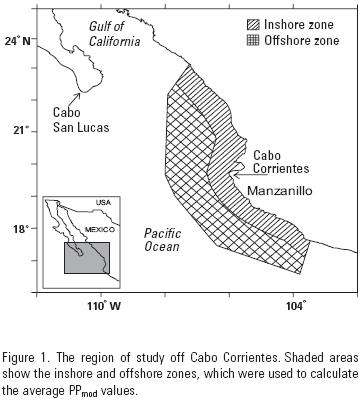
<body><![CDATA[<p align="justify"><font face="verdana" size="2"><b>Palabras clave: </b>Cabo Corrientes, surgencias, clorofila satelital, productividad primaria modelada, Pac&iacute;fico Tropical oriental.</font></p>     <p align="justify"><font face="verdana" size="2">&nbsp;</font></p>     <p align="justify"><font face="verdana" size="2"><b>INTRODUCTION</b></font></p>     <p align="justify"><font face="verdana" size="2">Marine primary production (PP) is one of the key processes in the global carbon cycle, controlling the uptake of dissolved inorganic carbon in the euphotic zone and its transfer to the organic pool in the ocean. Through the export process the carbon is transported to the ocean's interior and eventually transported back to the surface (Schneider <i>et al</i>., 2007). Total production is equal to the sum of both new and regenerated production (PP = PP<sub>new</sub> + PP<sub>r</sub>).</font></p>     <p align="justify"><font face="verdana" size="2">One of the main limitations of estimating PP by the traditional radiocarbon (<sup>14</sup>C) method is the small number of point samples generated for a particular area, and the poor temporal coverage. Thus, satellite ocean color offers an alternative to estimate the phytoplankton primary production rates in the oceans with an ample spatial&#150;temporal variability that is not possible to cover by research vessels. The early models for primary production estimation in the ocean were based on laboratory experiments to characterize the light&#150;chlorophyll relationship (Ryther, 1956). They offered the basis for models that make use of variables measured from remote sensors (e.g., pigments, irradiance, etc.) (Longhurst <i>et al</i>., 1995; Hidalgo&#150;Gonz&aacute;lez <i>et al</i>., 2005). It has been argued that instantaneous point PP values based on satellite data are very imprecise, but when the average of satellite data are used for whole oceanic regions, and for relatively large time scales, such as months or seasons, the estimated PP values can adequately represent very well the biological dynamics of those regions (Hidalgo&#150;Gonz&aacute;lez &amp; &Aacute;lvarez&#150;Borrego, 2004). The large number (n) of pixels within our region of interest (<a href="#f1">Fig. 1</a>), and for whole months, allows for very precise pigment (Chl<sub>sat</sub>) and PAR<sub>sat </sub>(Photosynthetic Active Radiation) averages with relatively small standard errors (s/n<sup>0.5</sup>).</font></p>     <p align="center"><font face="verdana" size="2"><a name="f1"></a></font></p>     <p align="center"><font face="verdana" size="2"><img src="/img/revistas/hbio/v19n3/a1f1.jpg"></font></p>     <p align="justify"><font face="verdana" size="2">Remote sensors provide information on the photosynthetic pigment concentration for the upper 22% of the euphotic zone (Kirk, 1994). To model primary production in the water column from satellite&#150;derived photosynthetic pigments, estimates of the vertical distribution of pigment concentration are required, whereas the assumption of a mixed layer with a homogeneous pigment distribution could lead to inaccurate estimates of integrated primary production (Platt <i>et al</i>., 1991). The deep chlorophyll maximum (DCM) is a consistent feature in the ocean (Cullen &amp; Eppley, 1981). Generally, accounting for its presence increases estimates of integrated production.</font></p>     <p align="justify"><font face="verdana" size="2">Radiocarbon primary production data (PP<sub>14C</sub>) for the area off Cabo Corrientes covering the whole spectrum from oligotrophic to eutrophic waters (from 0.17 up to 1.40 gC m<sup>&#150;2</sup> day<sup>&#150;1</sup>), are very scarce (Zeitzschel, 1969; Gaxiola&#150;Castro &amp; &Aacute;lvarez&#150;Borrego, 1986; Lara&#150;Lara &amp; Baz&aacute;n&#150;Guzm&aacute;n, 2005). L&oacute;pez&#150;Sandoval <i>et al. </i>(2009) applied the <sup>14</sup>C method to study the spatial and temporal variation of PP<sub>14C</sub> in this region for May and November 2002, and June 2003. However, due to the poor spatial resolution of this method, to the very few generated data, and to the ample hydrographic variability of the zone, we decided to estimate average values of PP using remote sensing based models (PP<sub>mod</sub>), and to make comparisons with average PP<sub>14C</sub> values for the same months and areas within our region of interest. Our objective was to obtain representative average primary production values for whole months and zones within the region off Cabo Corrientes, in contrast to few instantaneous point <sup>14</sup>C estimates.</font></p>     <p align="justify"><font face="verdana" size="2">&nbsp;</font></p>     ]]></body>
<body><![CDATA[<p align="justify"><font face="verdana" size="2"><b>MATERIALS AND METHODS </b></font></p>     <p align="justify"><font face="verdana" size="2">The study region off Cabo Corrientes, is located between 18&deg; and 22&deg; N, and from 104&deg; 10' to 107&deg; 25' W (<a href="#f1">Fig. 1</a>). This is the region covered by the three oceanographic cruises of L&oacute;pez&#150;Sandoval <i>et al</i>. (2009) (locations of hydro&#150;stations are shown in <a href="#f2">figure 2</a>). A line joining Cabo San Lucas and Cabo Corrientes defines the entrance to the Gulf of California. Thus, the northern part of our study area is at the southeastern portion of the entrance to the gulf. Winds are from the northwest for most of the year, with maximum speeds during winter and spring, and from the southeast during summer and autumn. The region has been characterized by the presence of mesoscale structures such as eddies, thermal fronts, and coastal upwelling events (Lav&iacute;n <i>et al.</i>, 2006; Zamudio <i>et al</i>., 2007). Upwelling conditions in this region may result with alongshore winds during winter and spring (Roden, 1972); and also as a result of the interaction between coastal currents and the physiography, mainly Cabo Corrientes, similar to the generation of cold&#150;water plumes off Point Conception, California, as described by Fiedler (1984). Coastal upwelling has an important effect on the nutrient supply to the euphotic zone and hence on chlorophyll <i>a </i>concentrations (Chl mg m<sup>&#150;3</sup>) and PP. The geostrophic currents are equatorward during winter and spring off Cabo Corrientes (thus propitious to upwelling), while during summer and autumn they are poleward (figure 7 in Keesler, 2006). This causes downwelling near the coast, and the sinking of the thermocline, with oligotro&#150;phic waters at the surface during summer and autumn.</font></p>     <p align="center"><font face="verdana" size="2"><a name="f2"></a></font></p>     <p align="center"><font face="verdana" size="2"><img src="/img/revistas/hbio/v19n3/a1f2.jpg"></font></p>     <p align="justify"><font face="verdana" size="2">To generate the PP vertical profiles (mgC m<sup>&#150;3</sup> h<sup>&#150;1</sup>, with a PP<sub>z </sub>value for each meter), we used the model proposed by Platt <i>et al. </i>(1991), and the modification proposed by Hidalgo&#150;Gonz&aacute;lez and &Aacute;lvarez&#150;Borrego (2004). Platt <i>et al.'s </i>(1991) model is a non&#150;homogenous, non&#150;spectral model, and this means that Chl is allowed to change with depth (Chl<sub>z</sub>) by means of a Gaussian curve that reproduces the DCM, but the change of the spectral distribution of PAR with depth is not taken into consideration. Hidalgo&#150;Gonz&aacute;lez and &Aacute;lvarez&#150;Borrego's (2004) modification is a non&#150;homogeneous, spectral model that allows for the change of the spectral distribution of irradiance with depth, based on the method proposed by Giles&#150;Guzm&aacute;n and &Aacute;lvarez&#150;Borrego (2000). To estimate PP<sub>mod</sub> (mgC m<sup>&#150;2</sup> d<sup>1</sup>), the region off Cabo Corrientes was separated into an inshore zone (&lt; 60 km from the coast) and an offshore zone (&gt; 60 km; <a href="#f1">Fig. 1</a>) following L&oacute;pez&#150;Sandoval (2007). PP<sub>z</sub> was generated for each hour from dawn to dusk, with a variable PAR<sub>z</sub> for different hours of the day, and a constant Chl<sub>z</sub> with time. Each PP<sub>z</sub> profile was integrated with depth from z = 0 to the bottom of the euphotic zone (Z<sub>eu</sub>) to transform from mgC m<sup>&#150;3</sup> h<sup>&#150;1</sup> to mgC m<sup>&#150;2</sup> h<sup>&#150;1</sup> (PP<sub>int</sub> = &#931;PP<sub>z</sub>, where z changes meter by meter). Z<sub>eu </sub>was considered to be the depth where PAR<sub>z</sub> = 0.01(PAR<sub>o</sub>). Then PP<sub>int</sub> values were integrated for the whole day to calculate PP<sub>mod </sub>= SPP<sub>int</sub>, with a PP<sub>int</sub> value for each hour of the day (to transform from mgC m<sup>&#150;2</sup> h<sup>&#150;1</sup> to gC m<sup>&#150;2</sup> d<sup>1</sup>). Finally, to estimate PPn<sub>ew</sub> <i>f</i>&#150;ratio values (PP<sub>new</sub>/PP<sub>mod</sub>) of 0.4 and 0.1 were applied to the PP<sub>mod </sub>values of the inshore and offshore zones, respectively, following Eppley's (1992) suggestion.</font></p>     <p align="justify"><font face="verdana" size="2">We used Platt <i>et al.</i>'s (1991) model for the inshore zone data of May 2002, which had case II waters (Chl&gt;1.5 mg m<sup>&#150;3</sup>):</font></p>     <p align="justify"><font face="verdana" size="2">PP<sub>z</sub> = &#91;P*<sub>m</sub>Chl<sub>sat(z)</sub> &#945;*<sub>PAR</sub> PAR<sub>z</sub>&#93; x &#91;(P*<sub>m</sub>)<sup>2</sup> + (PAR<sub>z</sub> &#945;*<sub>PAR</sub>)<sup>2</sup>&#93;<sup>&#150;0.5</sup> mgC m<sup>&#150;3</sup> h<sup>&#150;1</sup>,</font></p>     <p align="justify"><font face="verdana" size="2">where: the asterisk means that the value is normalized per unit of chlorophyll concentration; P*<sub>m</sub> (mgC (mg Chl)<sup>&#150;1</sup> h<sup>&#150;1</sup>) is the photosynthetic rate at optimum irradiance; Chl<sub>sat(z)</sub> is the average Chl for depth z for the chosen oceanic zone (inshore or offshore), derived from the monthly satellite composite and a model for the Chl vertical distribution; &#945;*<sub>PAR</sub> (mgC (mg Chl)<sup>&#150;1</sup> h<sup>&#150;1</sup> (&#956;mol quanta m<sup>&#150;2 </sup>s<sup>&#150;1</sup> )1) is the initial slope of the photosynthesis&#150;irradiance (P&#150;E) curve; and PAR is the scalar photosynthetically active radiation (400&#150;700 nm, &#956;mol quanta m<sup>&#150;2</sup> s<sup>&#150;1</sup> ). The photosynthetic parameters, P*<sub>m</sub> and &#945;*PAR, are derived from photosynthesis&#150;irradiance (P&#150;E) experiments in such a way that, in combination with Chl, they represent the whole photosynthetic capacity of phyto&#150;plankton, and there is no need to include the concentration of other pigments. The implicit assumption is that, although phyto&#150;plankton populations can vary in their composition, their suite of pigments does not change in such a way as to make a significant impact on photosynthetic rates.</font></p>     <p align="justify"><font face="verdana" size="2">Hidalgo&#150;Gonz&aacute;lez and Alvarez&#150;Borrego's (2004) modification was used in those cases when the chlorophyll profiles showed case I waters (Chl &lt; 1.5 mg m<sup>&#150;3</sup>). These waters correspond to the offshore zone of May 2002, and of both inshore and offshore zones of November 2002 and June 2003:</font></p>     <p align="justify"><font face="verdana" size="2">PP<sub>z</sub> = &#91;P*&#934;<sub>max</sub> Chl<sub>sat(z)</sub> a*<sub>ph(z</sub>, <sub>chl)</sub> PAR<sub>z</sub>&times; &#91;(0.02315P*<sub>m</sub>)<sup>2</sup>+ (PAR<sub>z</sub>&#934;<sub>max</sub> a*<sub>ph(z,chl)</sub>)<sup>2</sup>&#93;<sup>&#150;0.5</sup> mgC m<sup>&#150;3</sup> h<sup>&#150;1</sup>.</font></p>     ]]></body>
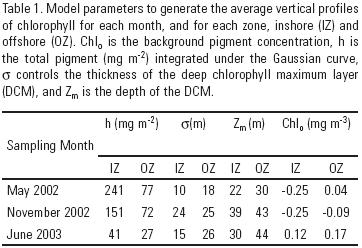
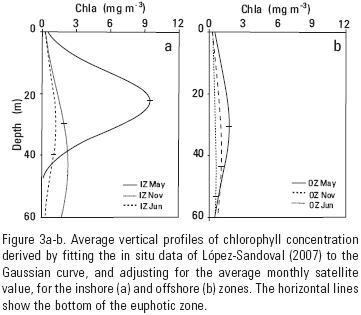
<body><![CDATA[<p align="justify"><font face="verdana" size="2">In this equation &#934;<sub>max</sub> is the maximum quantum yield (mol C (mol quanta)<sup>&#150;1</sup>), and a*<sub>ph(z,chl</sub>) (m<sup>2</sup> (mg Chl)<sup>&#150;1</sup>) is the phytoplankton specific absorption coefficient of light averaged for the spectral distribution of PAR at depth. This corrects the initial slope &#945;*PAR for the spectral distribution of the <i>in situ </i>scalar PAR. In place of &#945;<sup>*</sup><sub>PAR</sub> the product 43.2&#934;<sub>max</sub> a*<sub>ph(z,chl</sub>) was used (Giles&#150;Guzm&aacute;n &amp; &Aacute;lvarez&#150;Borrego, 2000). The factor 43.2 converts mol C to mgC, seconds to hours, and mol quanta to &#956;mol quanta. These expressions show that in order to estimate PP<sub>z</sub> not only the surface Chl value is needed, but also the vertical profiles of Chl and PAR.</font></p>     <p align="justify"><font face="verdana" size="2">Surface chlorophyll (Chl<sub>sat</sub>) and PAR (PAR<sub>sat</sub>) monthly composites were taken from the SeaWIFS sensor (Sea&#150;viewing Wide Field&#150;of&#150;view Sensor) archive data (<a href="http://oceancolor.gsfc.nasa.gov/" target="_blank">http://oceancolor.gsfc.nasa.gov/</a>). These are Chl<sub>sat</sub> maps produced with the standard algorithm of the GSFC (Goddard Space Flight Center), with a 9 km<sup>2</sup> resolution. No filter was used to smooth the original data. An average Chl<sub>sat</sub> was taken from the monthly satellite composites, for each zone within our region. For the application of both production models, an average chlorophyll profile was estimated for each month and zone (inshore and offshore) from the ship Chl<sub>(z)</sub> data in L&oacute;pez&#150;Sandoval (2007) and it was adjusted to the respective average Chl<sub>sat</sub>. Following Platt <i>et al. </i>(1988), a Gaussian distribution function was fitted to the ship Chl<sub>(z)</sub> data from each hydro&#150;station. The Gaussian equation is:</font></p>     <p align="justify"><font face="verdana" size="2">Chl<sub>z</sub> = Chl<sub>o</sub> + &#91;h/&#963;(2&#960;)<sup>0.5</sup>&#93;exp&#91;&#150;(Z &#150; Z<sub>m</sub>)<sup>2</sup>/2&#963;<sup>2</sup>&#93;,</font></p>     <p align="justify"><font face="verdana" size="2">where Chl<sub>z</sub> is the chlorophyll concentration (mg m<sup>&#150;3</sup>) at depth Z (m), Chl<sub>o</sub> is the background pigment concentration, h is the total pigment (mg m<sup>&#150;2</sup>) above the baseline Chl<sub>o</sub> (h is the area under the Gaussian curve and it is larger than the integrated Chl for the euphotic zone, Chl<sub>int</sub>), &#963;<b> </b>controls the thickness of the DCM layer, and Z<sub>m</sub> is the depth of the DCM. For each month and zone, average values of the parameters Chl<sub>o</sub>, h, &#963;, and Z<sub>m</sub> were calculated to generate a single Chl profile (<a href="#t1">table 1</a>). Then, each average chlorophyll profile was adjusted so the surface had the average value from the satellite monthly composite. To do this, Z<sub>m</sub> was adjusted following Hidalgo&#150;Gonz&aacute;lez and &Aacute;lvarez&#150;Borrego (2008). Through this adjustment Chl<sub>z</sub> was transformed to Chl<sub>sat(z)</sub>. Two deep Chl maxima were reported for the three cruises, one between 20 and 50 m, and a second generally deeper than 90 m (L&oacute;pez&#150;Sandoval, 2007). Due to the very low values of PAR<sub>z</sub> (&lt;1% of PAR<sub>o</sub>) for depths greater than 70 m, estimates of PP<sub>z</sub> for the second maximum indicate that its contribution to the integrated value (PP<sub>mod</sub>) is not significant. Thus, for the purpose of fitting the ship data to the Gaussian curve, the second deeper Chl maximum was not considered.</font></p>     <p align="center"><font face="verdana" size="2"><a name="t1"></a></font></p>     <p align="center"><font face="verdana" size="2"><img src="/img/revistas/hbio/v19n3/a1t1.jpg"></font></p>     <p align="justify"><font face="verdana" size="2">Average PAR<sub>sat</sub> values were taken from the monthly satellite composites for our study region, for each of the three studied months. The SeaWIFS algorithm provides PAR<sub>sat</sub> values corresponding to z = 0 (just below the sea&#150;surface). These are daily average values (mol quanta m<sup>&#150;2</sup> d<sup>1</sup>). The shape of the diurnal variation of incident irradiance illustrated by Kirk (1994) was used to adjust these PAR<sub>sat</sub> values to obtain average PAR<sub>o</sub>, <sub>t</sub> values (&#956;mol quanta m<sup>&#150;2</sup> s<sup>1</sup>) for each hour from dawn to dusk. This implies the assumption of uniform cloudiness throughout the average day. Sets of PAR<sub>z</sub>, <sub>t</sub> profiles were generated for each zone and month from these PAR<sub>o</sub>, <sub>t</sub> values following Giles&#150;Guzm&aacute;n and &Aacute;lvarez&#150;Borrego's (2000) method for case I waters. This method is based on the Lambert&#150;Beer law (PAR<sub>z</sub>, <sub>t</sub> = PAR<sub>o</sub>, <sub>t</sub> exp(&#150;K<sub>z</sub>Z). This law was applied meter&#150;by&#150;meter allowing for the spectral change of irradiance with depth and its effect on a variable K<sub>z</sub>. When Chl<sub>z</sub> values &gt;1.5 mg m<sup>&#150;3</sup> were found near and at the DCM, the PAR<sub>z</sub>, <sub>t</sub> values were calculated following Giles&#150;Guzm&aacute;n and &Aacute;lvarez&#150;Borrego's (2000) method for the surface and subsurface water layers (with Chl<sub>z</sub> &lt;1.5 mg m<sup>&#150;3</sup>), and a constant K<sub>z</sub> (equal to the one for Chl<sub>z</sub> = 1.5 mg m<sup>&#150;3</sup>) was used for the deep layer (with Chl<sub>z</sub> &gt;1.5 mg m<sup>&#150;3</sup>).</font></p>     <p align="justify"><font face="verdana" size="2">There are no data on the photosynthetic parameters of phytoplankton for this oceanic region. Thus, as a first approximation, we used the average values proposed by Cullen (1990) for these parameters: P*<sub>m</sub> = 4.8 mg C (mg Chl)<sup>&#150;1</sup> h<sup>&#150;1</sup> and <i>&#945;</i>*<sub>PAR(z)</sub> = 0.017 (mgC (mg Chl)<sup>&#150;1</sup> h<sup>&#150;1</sup> (&#181;mol quanta m<sup>&#150;2</sup> s<sup>&#150;1</sup> )<sup>&#150;1</sup>). The phytoplankton specific absorption coefficient (<i>&#945;</i>*<sub>ph(z,ch</sub>) (m<sup>2</sup> (mg Chl)<sup>&#150;1</sup>) was calculated following Giles&#150;Guzm&aacute;n and &Aacute;lvarez&#150;Borrego (2000).</font></p>     <p align="justify"><font face="verdana" size="2">&nbsp;</font></p>     <p align="justify"><font face="verdana" size="2"><b>RESULTS</b></font></p>     ]]></body>
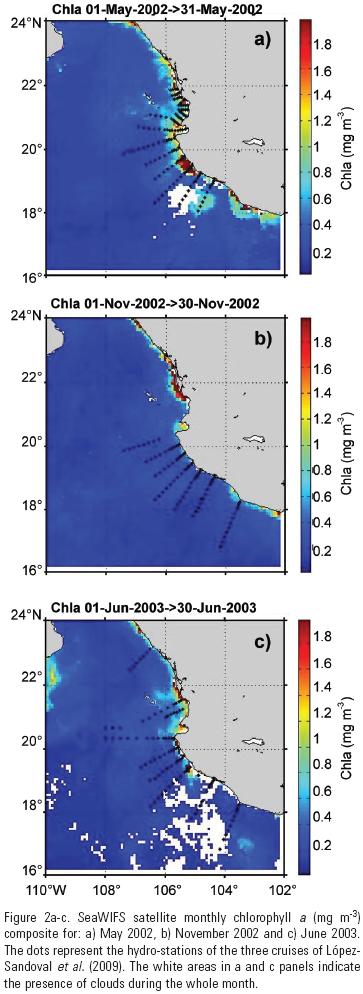
<body><![CDATA[<p align="justify"><font face="verdana" size="2">Average PAR<sub>o</sub>, <sub>t</sub> values for noon were 1670, 965, and 1490 ujmol quanta m<sup>&#150;2</sup> s<sup>&#150;1</sup> for May and November 2002, and June 2003, respectively (<a href="#f2">Fig. 2a&#150;c</a>). The largest average depth of the euphotic zone (Z<sub>eu</sub>) was 54 m and it was for the offshore zone of June 2003 while the smallest Z<sub>eu</sub> was 22 m for the inshore zone of May 2002. The May Chl<sub>sat</sub> distribution showed relatively high values south of Cabo Corrientes, with highest values in the inshore zone (<a href="#f2">Fig. 2a</a>). The June 2003 Chl<sub>sat</sub> distribution also showed relatively high values in the inshore zone, but with a much smaller spatial coverage than that of the May composite (<a href="#f2">Fig. 2c</a>). The November Chl<sub>sat</sub> distribution showed in general very low values, with few exceptions in the inshore zone north of Cabo Corrientes, outside the region covered by the oceanographic cruises of L&oacute;pez&#150;Sandoval <i>et al. </i>(2009; <a href="#f2">Fig. 2b</a>). The monthly mean Chl<sub>sat</sub> for May 2002 was 0.60 and 0.47 mg m<sup>&#150;3</sup> for the inshore and the offshore zones, respectively; for November 2002 it was 0.42 and 0.17 mg m<sup>&#150;3</sup> for the inshore and the offshore zones, respectively; and for June 2003 it was 0.27 mg m<sup>&#150;3</sup> for both zones.</font></p>     <p align="justify"><font face="verdana" size="2">The average modeled chlorophyll profile for the inshore zone of May 2002 had the largest Chl<sub>z</sub> values of all zones and months (<a href="#f3">Fig. 3a</a>). Its maximum was &#126;9.4 mg m<sup>&#150;3</sup> and it was at the bottom of the euphotic zone. The average Chl<sub>z</sub> profile with the lowest values was the one for the offshore zone of June 2003, with a Chl maximum of 0.58 mg m<sup>&#150;3</sup> at 44 m, 10 m above the bottom of the euphotic zone (not visually appreciable in <a href="#f3">figure 3b</a>). The euphotic zone integrated modeled chlorophyll (Chl<sub>int</sub>) had maximum average values for May, for both, inshore (116.6 mg m<sup>&#150;2</sup>) and offshore (38.9 mg m<sup>&#150;2</sup>) zones. November 2002 had intermediate Chl<sub>int</sub> average values with 41.4 and 30.7 mg m<sup>&#150;2</sup> for the inshore and offshore zones, respectively. June 2003 presented the lowest Chl<sub>int</sub> average values with 33.1 and 25.9 mg m<sup>&#150;2</sup>, for the inshore and offshore zones, respectively.</font></p>     <p align="center"><font face="verdana" size="2"><a name="f3"></a></font></p>     <p align="center"><font face="verdana" size="2"><img src="/img/revistas/hbio/v19n3/a1f3.jpg"></font></p>     <p align="justify"><font face="verdana" size="2">Average PP<sub>mod</sub> for the inshore zone of May 2002 was much larger (1.50 gC m<sup>&#150;2</sup> d<sup>&#150;1</sup>) than that for the offshore zone (0.55 gC m<sup>&#150;2</sup> d<sup>&#150;1</sup>). Average PP<sub>mod</sub> for both inshore and offshore zones of November 2002 were close to each other (0.38 and 0.31 gC m<sup>&#150;2 </sup>d<sup>&#150;1</sup>, respectively). Average PP<sub>mod</sub> values for June 2003 showed a clear gradient with a higher inshore value than that of the offshore zone, 0.70 and 0.41 gC m<sup>&#150;2</sup> d<sup>&#150;1</sup>, respectively (<a href="#t2">table 2</a>). In accordance with the PP<sub>mod</sub> values, average PP<sub>new</sub> value for the inshore zone of May 2002 (0.60 gC m<sup>&#150;2</sup> d<sup>&#150;1</sup>) was larger than the inshore value for June 2003, and this was higher than the one for November 2002; and a similar temporal change resulted for the offshore zone (<a href="#t2">table 2</a>).</font></p>     <p align="center"><font face="verdana" size="2"><a name="t2"></a></font></p>     <p align="center"><font face="verdana" size="2"><img src="/img/revistas/hbio/v19n3/a1t2.jpg"></font></p>     <p align="justify"><font face="verdana" size="2">&nbsp;</font></p>     <p align="justify"><font face="verdana" size="2"><b>DISCUSSION</b></font></p>     <p align="justify"><font face="verdana" size="2">Phytoplankton production calculated from remote sensed data on ocean color, which depend on parameters developed from ship observations, yield more representative estimates of the large&#150;scale average production than those calculated from ship data alone (Platt <i>et al</i>., 1991). Morel and Berthon (1989) indicated that it is unreasonable and probably superfluous to envisage the use of a light&#150;production model on a pixel&#150;by&#150;pixel basis when interpreting satellite imagery. Our objective was to obtain representative average production values for whole months and zones within the region off Cabo Corrientes.</font></p>     ]]></body>
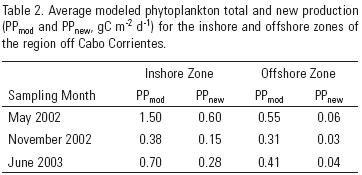
<body><![CDATA[<p align="justify"><font face="verdana" size="2">The vertical resolution of the Chl<sub>sat(z)</sub> profiles offer significant advantages when compared to models that use homogeneous Chl<sub>sat</sub> profiles, because they take into account the phytoplankton biomass and the light field vertical variability throughout the water column. Based on the hydrography, L&oacute;pez&#150;Sandoval (2007) defined the two zones within the Cabo Corrientes region, inshore and offshore.</font></p>     <p align="justify"><font face="verdana" size="2">L&oacute;pez&#150;Sandoval <i>et al</i>. (2009) reported that the upwelling index shows the beginning of the upwelling period in January, it is relatively intense from March through May, relaxing in June, and with a non&#150;upwelling period from July through December. L&oacute;pez&#150;Sandoval <i>et al</i>. (2009) also reported low values of sea surface temperature (SST) and high Chl near the coast with uplifting of the thermocline towards the coast for May 2002 and June 2003. During May and June, the enrichment of the coastal zone seems to be the result of nutrient inputs from below the euphotic zone as a result of upwelling. This was in spite of a moderate El Ni&ntilde;o reported for the years 2002 and 2003 (Durazo <i>et al</i>., 2005). This event was detected in March 2002 for the area between 5&deg; S and 5&deg; N. El Ni&ntilde;o events arrive about half a year later to the entrance region of the Gulf of California (Robles&#150;Pacheco &amp; Christensen, 1983). Thus, our May 2002 data were collected previous to the arrival of this El Ni&ntilde;o. A thorough analysis of data on sea surface temperature and sea&#150;level anomalies would be necessary to find out if the effect of this El Ni&ntilde;o was significant for our June 2003. This migth explain the relatively low values of Chl<sub>sat</sub> obtained for this month. Nevertheless, as it was mentioned above, there is evidence of upwelling in our study area during June 2003.</font></p>     <p align="justify"><font face="verdana" size="2">In general, the parameters that were used in this study to model the vertical chlorophyll profile could be considered as representatives of the two zones and the three periods that characterize the region. However, more ship Chl data are needed to better characterize the means of the Gaussian parameters and their temporal and spatial variation.</font></p>     <p align="justify"><font face="verdana" size="2">Rigorous comparison of satellite&#150;derived PP<sub>mod</sub> values with average results from <sup>14</sup>C incubations is difficult due to the very different time and space characteristics of these measurements (Hidalgo&#150;Gonz&aacute;lez &amp; &Aacute;lvarez&#150;Borrego, 2004). Nevertheless, it is interesting to compare both kinds of data. Our PP<sub>mod</sub> average values largely overestimated (they are two or threefold) the PP<sub>14C </sub>average values from L&oacute;pez&#150;Sandoval <i>et al</i>. (2009) for both inshore and offshore zones. L&oacute;pez&#150;Sandoval <i>et al</i>.'s (2009) PP<sub>14C</sub> data are very few and very scattered, with a large standard error (up to 88% of the mean). However, in agreement with the PP<sub>14C</sub> results reported by L&oacute;pez&#150;Sandoval <i>et al</i>. (2009), our PP<sub>mod</sub> values were highest for May (within the relatively intense upwelling season), they were followed by those for June (during the upwelling relaxation period), and they were lowest for November when stratification was strongest.</font></p>     <p align="justify"><font face="verdana" size="2">Gaxiola&#150;Castro and &Aacute;lvarez&#150;Borrego (1986) reported two point instantaneous PP<sub>14C</sub> values for January (within the upwe&#150;lling season) and for the offshore zone off Cabo Corrientes (0.41 and 1.40 gC m<sup>&#150;2</sup> d<sub>&#150;1</sub>), and Lara&#150;Lara and Baz&aacute;n&#150;Guzm&aacute;n (2005) reported 0.17 and 0.42 gC m<sup>&#150;2</sup> day<sup>&#150;1</sup> also for January, compared to our PP<sub>mod</sub> average value of 0.55 gC m<sup>&#150;2</sup> day<sup>&#150;1</sup> for May 2002. On the other hand, Zeitzschel (1969) reported a single instantaneous point estimate for our offshore zone and for November (0.45 gC m<sup>&#150;2</sup> day<sup>&#150;1</sup>), which is 45% larger than our PP<sub>mod</sub> average value for that month. Thus, these PP<sub>14C</sub> data suggest that phytoplankton production is very patchy in this region of the ocean and that our PP<sub>mod</sub> average values may be much more representative than instantaneous point estimates.</font></p>     <p align="justify"><font face="verdana" size="2">Possibly, part of the differences between PP<sub>mod</sub> and PP<sub>14C </sub>were due to the use of constant values for the photosynthetic parameters in a region of ample spatial and temporal environmental variability. The effect of nutrient concentration is not explicit in our primary production models because it is implicit in the Chl values. Nutrients control phytoplankton biomass but have a very weak effect on photosynthetic parameters (Cullen <i>et al</i>., 1992). It has long been known that photosynthetic parameters change with depth and time (Falkowski &amp; Owens, 1980; Vald&eacute;z&#150;Holgu&iacute;n <i>et al</i>., 1999). Also, Montecino <i>et al</i>. (2004) have shown that there are significant variations of the photosynthetic parameters during upwelling events; usually they have lower values during the intense phase of upwelling than during the relaxation period. Tonn <i>et al</i>. (2000) also reported lower values for the photosynthe&#150;tic parameters in the upwelling area of the Arabic Sea than those for the surroundings. Conditioning to a higher irradiance regime could produce higher photosynthetic parameters (Falkowski &amp; Owens, 1980). When upwelling is intense phytoplankton is conditioned to a lower irradiance regime, because water is arriving at the euphotic zone from below, and when upwelling relaxes or there is strong stratification phytoplankton cells at or near the sea surface are conditioned to a higher irradiance regime. Data on time and space variation of photosynthesis&#150;irradiance (P&#150;E) parameters are needed for this region off Cabo Corrientes.</font></p>     <p align="justify"><font face="verdana" size="2">The submarine light field (PARz) is very well characterized by the methodology reported by Giles&#150;Guzm&aacute;n &amp; Alvarez&#150;Borrego (2000). In spite of possible errors, ocean color satellite imagery are very consistent; the seasonal cycles and the spatial variation of Chl<sub>sat</sub> behave very much as expected according to physical phenomena such as currents, eddies and the occurrence of upwelling (Hidalgo&#150;Gonz&aacute;lez &amp; &Aacute;lvarez&#150;Borrego, 2004). Trees <i>et al</i>. (2000) reported that, despite the various sampling periods and numerous geographic locations, there are consistent patterns in the ratios of the log accessory pigments to log total Chl (Chl <i>a</i>, Chl <i>a </i>allomer, Chl <i>a </i>epimer, and chlorophyllide <i>a</i>), and there is a strong log&#150;linear relationship for these ratios. Trees <i>et al</i>. (2000) indicated that this log&#150;linearity largely explains the success in remotely sensed chlorophyll algorithms, even though phytoplankton populations can vary in their composition and suite of pigments. Thus, most of the uncertainties of PP<sub>mod</sub> values for this region of the ocean are mainly due to the lack of proper knowledge on the variations of the photosynthetic parameters (P<sup>*</sup><sub>m</sub> and &#945;<sup>*</sup><sub>PAR</sub>, and quantum efficiency derived from the latter as shown above). Nevertheless, even with average photosyn&#150;thetic parameters as those used in this work, a reasonable first approximation to the biological dynamics of this region has been attained. The seasonal and spatial variations of PP have been described in a similar fashion as that using the <sup>14</sup>C method, but with a greater spatial and temporal coverage.</font></p>     <p align="justify"><font face="verdana" size="2">Pennington <i>et al</i>. (2006) used satellite ocean color images to show that during spring this region off Cabo Corrientes develops high pigment concentrations, and this is mainly due to coastal upwelling events. On the other hand, during late autumn (November) the lowest Chl and PP<sub>mod</sub> were registered. This was probably due to downwelling causing a deeper and stronger thermocline. This caused the inshore and offshore zones to exhibit similar PP<sub>mod</sub> values due to very oligotrophic coastal waters. The vertical salinity distribution reported by L&oacute;pez&#150;Sandoval (2007) clearly show the low surface values inshore indicating the presence of the Surface Equatorial Water Mass, with warm and low nutrient waters. A factor causing part of the decline in PP<sub>mod</sub> for November 2002 was the relatively low PAR<sub>o</sub> average value, 965 &#956;mol quanta m<sup>&#150;2</sup> s<sup>&#150;1</sup> compared to 1670 for May 2002. This caused &#126;14% of the difference between the PP<sub>mod</sub> estimates for these two months, the rest of the difference was caused by the larger Chl<sub>sat(z) </sub>values for May. The relatively low PAR<sub>o</sub> November values were due to the seasonal cycle of irradiance and the relatively large cloud coverage during this month.</font></p>     <p align="justify"><font face="verdana" size="2">The spring PP<sub>mod</sub> values for our study area were of similar magnitude as the values reported for other productive regions off the Mexican Pacific coast. For example, Alvarez&#150;Borrego and Lara&#150;Lara (1991) reported 26 PP<sub>14C</sub> data for "winter" conditions of the central Gulf of California with an average of 1.43 gC m<sup>&#150;2</sup> d<sup>&#150;1</sup>. They reported 12 values for the big islands region of the gulf with an average of 2.1 gC m<sup>&#150;2</sup> d<sup>&#150;1</sup> , and four values for the northern gulf with an average of 1.1 gC m<sup>&#150;2</sup> d<sup>&#150;1</sup>,compared to our May value of 1.50 gC m<sup>&#150;2</sup> d<sup>&#150;1</sup> for the inshore zone. Also, our spring inshore PP<sub>mod</sub> rates are comparable to the PP<sub>14C</sub> data reported by Gaxiola&#150;Castro and &Aacute;lvarez &#150;Borrego (1986) for the entrance to the Gulf of California (for January, from 0.19 to 1.40 gC m<sup>&#150;2</sup> d<sup>&#150;1</sup>), and to the satellite&#150;derived values reported by Hidalgo&#150;Gonz&aacute;lez and &Aacute;lvarez&#150;Borrego (2004) for the upwelling season of the Gulf of California (1.16 &#150; 1.91 gC m<sup>&#150;2</sup> d<sup>&#150;1</sup>).</font></p>     <p align="justify"><font face="verdana" size="2">Our PP<sub>new</sub> values for the inshore zone are between half and &#126;150% of the values reported by Hidalgo&#150;Gonz&aacute;lez and &Aacute;lvarez&#150;Borrego (2004) for the entrance region of the Gulf of California. The value for May 2002 is between &#126;45% and &#126;85% of those reported by these latter authors for the upwelling season of the middle and northern Gulf of California.</font></p>     ]]></body>
<body><![CDATA[<p align="justify"><font face="verdana" size="2">The description of the temporal and spatial variability of PP<sub>new</sub> may give us an idea of the variability of the flux of organic matter out of the surface layer. Since the organic matter is degraded in its way down to the bottom and only the most refractive particles reach the bottom, <i>e</i>&#150;ratio values (the fraction of PP reaching the bottom) are expected to be smaller than <i>f</i>&#150;ratios. Organic particle flux has not been measured in our region of interest. Therefore, data needs to be generated on this issue for a clear understanding of its benthic ecological dynamics. In any case, the PP<sub>new</sub> seasonality in the region off Cabo Corrientes shows that this flux of organic matter is much lower during summer and autumn than during the upwelling season.</font></p>     <p align="justify"><font face="verdana" size="2">Our data show that the region off Cabo Corrientes exhibits significant seasonality in the PP<sub>mod</sub> rates. In general, seasonal cycles are weak over much of the open&#150;ocean eastern tropical Pacific, but several eutrophic coastal areas do exhibit substantial seasonality (Pennington <i>et al</i>., 2006). Our results corroborate it. Undoubtedly, this is a response to the physical and chemical environmental variability of the study area. This was caused by upwelling that enhances the rates of nutrient supply to maintain high levels of primary production, much above those of oligotrophic waters.</font></p>     <p align="justify"><font face="verdana" size="2">&nbsp;</font></p>     <p align="justify"><font face="verdana" size="2"><b>ACKNOWLEDGMENTS</b></font></p>     <p align="justify"><font face="verdana" size="2">This work was supported by CONACYT (Mexico) through contract SEP&#150;2004&#150;C01&#150;45813/A1, and through a scholarship for the first author. It was also supported by CICESE. J.M. Dominguez and F.J. Ponce did the art graphics.</font></p>     <p align="justify"><font face="verdana" size="2">&nbsp;</font></p>     <p align="justify"><font face="verdana" size="2"><b>REFERENCES</b></font></p>     <!-- ref --><p align="justify"><font face="verdana" size="2">Alvarez&#150;Borrego, S. &amp; J. R. Lara&#150;Lara. 1991. The physical environment and primary productivity of the Gulf of California. <i>In: </i>J. P. Dauphin &amp; B. Simoneit (Eds.): <i>The gulf and peninsular province of the Californias</i>. Monographs of the American Association of Petroleum Geologists 47: 555&#150;567.</font>&nbsp;&nbsp;&nbsp;&nbsp;&nbsp;&nbsp;&nbsp;&nbsp;[&#160;<a href="javascript:void(0);" onclick="javascript: window.open('/scielo.php?script=sci_nlinks&ref=4078941&pid=S0188-8897200900030000100001&lng=','','width=640,height=500,resizable=yes,scrollbars=1,menubar=yes,');">Links</a>&#160;]<!-- end-ref --><!-- ref --><p align="justify"><font face="verdana" size="2">Cullen, J. J. 1990. On models of growth and photosynthesis in phytoplankton. <i>Deep&#150;Sea Research </i>37: 667&#150;683.</font>&nbsp;&nbsp;&nbsp;&nbsp;&nbsp;&nbsp;&nbsp;&nbsp;[&#160;<a href="javascript:void(0);" onclick="javascript: window.open('/scielo.php?script=sci_nlinks&ref=4078942&pid=S0188-8897200900030000100002&lng=','','width=640,height=500,resizable=yes,scrollbars=1,menubar=yes,');">Links</a>&#160;]<!-- end-ref --><!-- ref --><p align="justify"><font face="verdana" size="2">Cullen, J. J. &amp; R. W. Eppley. 1981. Chlorophyll maximum layers of the Southern California Bight and possible mechanisms of their formation and maintenance. <i>Oceanologica Acta </i>4: 23&#150;32.</font>&nbsp;&nbsp;&nbsp;&nbsp;&nbsp;&nbsp;&nbsp;&nbsp;[&#160;<a href="javascript:void(0);" onclick="javascript: window.open('/scielo.php?script=sci_nlinks&ref=4078943&pid=S0188-8897200900030000100003&lng=','','width=640,height=500,resizable=yes,scrollbars=1,menubar=yes,');">Links</a>&#160;]<!-- end-ref --><!-- ref --><p align="justify"><font face="verdana" size="2">Cullen, J. J., X. Yang &amp; H. L. Macintyre. 1992. Nutrient limitation and marine photosynthesis. <i>In: </i>P.G. Falkowski &amp; A.D. Woodhead (Eds.). <i>Primary productivity and biogeochemical cycles in the sea</i>. Plenum, New York, 550 p.</font>&nbsp;&nbsp;&nbsp;&nbsp;&nbsp;&nbsp;&nbsp;&nbsp;[&#160;<a href="javascript:void(0);" onclick="javascript: window.open('/scielo.php?script=sci_nlinks&ref=4078944&pid=S0188-8897200900030000100004&lng=','','width=640,height=500,resizable=yes,scrollbars=1,menubar=yes,');">Links</a>&#160;]<!-- end-ref --><!-- ref --><p align="justify"><font face="verdana" size="2">Dugdale, R. C. &amp; J. J. Goering. 1967. Uptake of new and regenerated forms of nitrogen in primary productivity. <i>Limnology and Oceanography </i>12: 196&#150;206.</font>&nbsp;&nbsp;&nbsp;&nbsp;&nbsp;&nbsp;&nbsp;&nbsp;[&#160;<a href="javascript:void(0);" onclick="javascript: window.open('/scielo.php?script=sci_nlinks&ref=4078945&pid=S0188-8897200900030000100005&lng=','','width=640,height=500,resizable=yes,scrollbars=1,menubar=yes,');">Links</a>&#160;]<!-- end-ref --><!-- ref --><p align="justify"><font face="verdana" size="2">Durazo, R., G. Gaxiola&#150;Castro, B. Lavaniegos, R. Castro&#150;Valdez, J. G&oacute;mez&#150;Vald&eacute;s, &amp; A. Da S. Mascarenhas Jr. 2005. Oceanographic conditions west of the Baja California coast, 2002&#150;2003: A peak El Ni&ntilde;o and subarctic water enhancement. <i>Ciencias Marinas </i>31: 537&#150;552.</font>&nbsp;&nbsp;&nbsp;&nbsp;&nbsp;&nbsp;&nbsp;&nbsp;[&#160;<a href="javascript:void(0);" onclick="javascript: window.open('/scielo.php?script=sci_nlinks&ref=4078946&pid=S0188-8897200900030000100006&lng=','','width=640,height=500,resizable=yes,scrollbars=1,menubar=yes,');">Links</a>&#160;]<!-- end-ref --><!-- ref --><p align="justify"><font face="verdana" size="2">Eppley, R. W. 1992. Toward understanding the roles of phytoplankton in biogeochemical cycles: Personal notes. <i>In: </i>P.G. Falkowski &amp; A.D. Woodhead (Eds.). <i>Primary productivity and biogeochemical cycles in the sea</i>, Plenum, New York, 550 p.</font>&nbsp;&nbsp;&nbsp;&nbsp;&nbsp;&nbsp;&nbsp;&nbsp;[&#160;<a href="javascript:void(0);" onclick="javascript: window.open('/scielo.php?script=sci_nlinks&ref=4078947&pid=S0188-8897200900030000100007&lng=','','width=640,height=500,resizable=yes,scrollbars=1,menubar=yes,');">Links</a>&#160;]<!-- end-ref --><!-- ref --><p align="justify"><font face="verdana" size="2">Eppley, R. W. &amp; B. J. Peterson. 1979. Particulate organic matter flux and planktonic new production in the deep ocean. <i>Nature </i>282: 677&#150;680.</font>&nbsp;&nbsp;&nbsp;&nbsp;&nbsp;&nbsp;&nbsp;&nbsp;[&#160;<a href="javascript:void(0);" onclick="javascript: window.open('/scielo.php?script=sci_nlinks&ref=4078948&pid=S0188-8897200900030000100008&lng=','','width=640,height=500,resizable=yes,scrollbars=1,menubar=yes,');">Links</a>&#160;]<!-- end-ref --><!-- ref --><p align="justify"><font face="verdana" size="2">Falkowski, P. G. &amp; T. G. Owens. 1980. Light&#150;shade adaptation: two strategies in marine phytoplankton. <i>Plant Physiology </i>66: 592&#150;595.</font>&nbsp;&nbsp;&nbsp;&nbsp;&nbsp;&nbsp;&nbsp;&nbsp;[&#160;<a href="javascript:void(0);" onclick="javascript: window.open('/scielo.php?script=sci_nlinks&ref=4078949&pid=S0188-8897200900030000100009&lng=','','width=640,height=500,resizable=yes,scrollbars=1,menubar=yes,');">Links</a>&#160;]<!-- end-ref --><!-- ref --><p align="justify"><font face="verdana" size="2">Fiedler, P. C. 1984. Satellite observations of the 1982&#150;1983 El Ni&ntilde;o along the U.S. Pacific coast. <i>Science </i>224: 1251&#150;1254.</font>&nbsp;&nbsp;&nbsp;&nbsp;&nbsp;&nbsp;&nbsp;&nbsp;[&#160;<a href="javascript:void(0);" onclick="javascript: window.open('/scielo.php?script=sci_nlinks&ref=4078950&pid=S0188-8897200900030000100010&lng=','','width=640,height=500,resizable=yes,scrollbars=1,menubar=yes,');">Links</a>&#160;]<!-- end-ref --><!-- ref --><p align="justify"><font face="verdana" size="2">Gaxiola&#150;Castro, G. &amp; S. &Aacute;lvarez&#150;Borrego. 1986. Primary productivity of the Mexican Pacific. <i>Ciencias Marinas </i>12: 26&#150;33.</font>&nbsp;&nbsp;&nbsp;&nbsp;&nbsp;&nbsp;&nbsp;&nbsp;[&#160;<a href="javascript:void(0);" onclick="javascript: window.open('/scielo.php?script=sci_nlinks&ref=4078951&pid=S0188-8897200900030000100011&lng=','','width=640,height=500,resizable=yes,scrollbars=1,menubar=yes,');">Links</a>&#160;]<!-- end-ref --><!-- ref --><p align="justify"><font face="verdana" size="2">Giles&#150;Guzm&aacute;n, A. D. &amp; S. &Aacute;lvarez&#150;Borrego. 2000. Vertical attenuation coefficient of photosynthetically active radiation as a function of chlorophyll concentration and depth in case 1 waters. <i>Applied Optics </i>39: 1351&#150;1358.</font>&nbsp;&nbsp;&nbsp;&nbsp;&nbsp;&nbsp;&nbsp;&nbsp;[&#160;<a href="javascript:void(0);" onclick="javascript: window.open('/scielo.php?script=sci_nlinks&ref=4078952&pid=S0188-8897200900030000100012&lng=','','width=640,height=500,resizable=yes,scrollbars=1,menubar=yes,');">Links</a>&#160;]<!-- end-ref --><!-- ref --><p align="justify"><font face="verdana" size="2">Hidalgo&#150;Gonz&aacute;lez, R. M. &amp; S. &Aacute;lvarez&#150;Borrego. 2004. Total and new production in the Gulf of California estimated from ocean color data from the satellite sensor SeaWIFS. <i>Deep&#150;Sea Research II </i>51: 739&#150;752.</font>&nbsp;&nbsp;&nbsp;&nbsp;&nbsp;&nbsp;&nbsp;&nbsp;[&#160;<a href="javascript:void(0);" onclick="javascript: window.open('/scielo.php?script=sci_nlinks&ref=4078953&pid=S0188-8897200900030000100013&lng=','','width=640,height=500,resizable=yes,scrollbars=1,menubar=yes,');">Links</a>&#160;]<!-- end-ref --><!-- ref --><p align="justify"><font face="verdana" size="2">Hidalgo&#150;Gonz&aacute;lez, R. M. &amp; S. &Aacute;lvarez&#150;Borrego. 2008. Water column structure and phytoplankton biomass profiles in the Gulf of Mexico. <i>Ciencias Marinas </i>34: 197&#150;212.</font>&nbsp;&nbsp;&nbsp;&nbsp;&nbsp;&nbsp;&nbsp;&nbsp;[&#160;<a href="javascript:void(0);" onclick="javascript: window.open('/scielo.php?script=sci_nlinks&ref=4078954&pid=S0188-8897200900030000100014&lng=','','width=640,height=500,resizable=yes,scrollbars=1,menubar=yes,');">Links</a>&#160;]<!-- end-ref --><!-- ref --><p align="justify"><font face="verdana" size="2">Hidalgo&#150;Gonz&aacute;lez, R. M., S. &Aacute;lvarez&#150;Borrego, C. Fuentes&#150;Yaco &amp; T. Platt. 2005. Satellite&#150;derived total and new phytoplankton production in the Gulf of Mexico. <i>Indian Journal of Marine Sciences </i>34: 408&#150;417.</font>&nbsp;&nbsp;&nbsp;&nbsp;&nbsp;&nbsp;&nbsp;&nbsp;[&#160;<a href="javascript:void(0);" onclick="javascript: window.open('/scielo.php?script=sci_nlinks&ref=4078955&pid=S0188-8897200900030000100015&lng=','','width=640,height=500,resizable=yes,scrollbars=1,menubar=yes,');">Links</a>&#160;]<!-- end-ref --><!-- ref --><p align="justify"><font face="verdana" size="2">Kessler, W.S. 2006. The circulation of the eastern tropical Pacific: A review. <i>Progress in Oceanography </i>69: 181&#150;217.</font>&nbsp;&nbsp;&nbsp;&nbsp;&nbsp;&nbsp;&nbsp;&nbsp;[&#160;<a href="javascript:void(0);" onclick="javascript: window.open('/scielo.php?script=sci_nlinks&ref=4078956&pid=S0188-8897200900030000100016&lng=','','width=640,height=500,resizable=yes,scrollbars=1,menubar=yes,');">Links</a>&#160;]<!-- end-ref --><!-- ref --><p align="justify"><font face="verdana" size="2">Kirk, J. T. O. 1994. <i>Light and photosynthesis in aquatic ecosystems. </i>Cambridge University Press, New York, 509 p.</font>&nbsp;&nbsp;&nbsp;&nbsp;&nbsp;&nbsp;&nbsp;&nbsp;[&#160;<a href="javascript:void(0);" onclick="javascript: window.open('/scielo.php?script=sci_nlinks&ref=4078957&pid=S0188-8897200900030000100017&lng=','','width=640,height=500,resizable=yes,scrollbars=1,menubar=yes,');">Links</a>&#160;]<!-- end-ref --><!-- ref --><p align="justify"><font face="verdana" size="2">Lara&#150;Lara, J. R. &amp; C. Baz&aacute;n&#150;Guzm&aacute;n. 2005. Distribuci&oacute;n de clorofila y producci&oacute;n primaria por clases de tama&ntilde;o en la costa del Pac&iacute;fico mexicano. <i>Ciencias Marinas </i>31: 11&#150;21</font>&nbsp;&nbsp;&nbsp;&nbsp;&nbsp;&nbsp;&nbsp;&nbsp;[&#160;<a href="javascript:void(0);" onclick="javascript: window.open('/scielo.php?script=sci_nlinks&ref=4078958&pid=S0188-8897200900030000100018&lng=','','width=640,height=500,resizable=yes,scrollbars=1,menubar=yes,');">Links</a>&#160;]<!-- end-ref --><!-- ref --><p align="justify"><font face="verdana" size="2">Lav&iacute;n, M. F., E. Beier, J. Gom&eacute;z&#150;Vald&eacute;s, V. M. God&iacute;nez &amp; J. Garc&iacute;a. 2006. On the summer poleward coastal current off SW M&eacute;xico. <i>Geophysical Research Letters </i>33: L02601, doi:02610.01029/02005GL024686.</font>&nbsp;&nbsp;&nbsp;&nbsp;&nbsp;&nbsp;&nbsp;&nbsp;[&#160;<a href="javascript:void(0);" onclick="javascript: window.open('/scielo.php?script=sci_nlinks&ref=4078959&pid=S0188-8897200900030000100019&lng=','','width=640,height=500,resizable=yes,scrollbars=1,menubar=yes,');">Links</a>&#160;]<!-- end-ref --><!-- ref --><p align="justify"><font face="verdana" size="2">Longhurst, A., S. Sathyendranath, T. Platt, &amp; C. M. Caverhill. 1995. An estimate of global primary production in the ocean from satellite radiometer data. <i>Journal of Plankton Research </i>17: 1245&#150;1271.</font>&nbsp;&nbsp;&nbsp;&nbsp;&nbsp;&nbsp;&nbsp;&nbsp;[&#160;<a href="javascript:void(0);" onclick="javascript: window.open('/scielo.php?script=sci_nlinks&ref=4078960&pid=S0188-8897200900030000100020&lng=','','width=640,height=500,resizable=yes,scrollbars=1,menubar=yes,');">Links</a>&#160;]<!-- end-ref --><!-- ref --><p align="justify"><font face="verdana" size="2">L&oacute;pez&#150;Sandoval, D. C. 2007. <i>Variabilidad de la productividad primaria en la regi&oacute;n de Cabo Corrientes, M&eacute;xico. </i>Tesis de Maestr&iacute;a en Ciencias, Centro de Investigaci&oacute;n Cient&iacute;fica y de Educaci&oacute;n Superior de Ensenada, B.C. Ensenada, 69 p.</font>&nbsp;&nbsp;&nbsp;&nbsp;&nbsp;&nbsp;&nbsp;&nbsp;[&#160;<a href="javascript:void(0);" onclick="javascript: window.open('/scielo.php?script=sci_nlinks&ref=4078961&pid=S0188-8897200900030000100021&lng=','','width=640,height=500,resizable=yes,scrollbars=1,menubar=yes,');">Links</a>&#160;]<!-- end-ref --><!-- ref --><p align="justify"><font face="verdana" size="2">L&oacute;pez&#150;Sandoval, D. C., J. R. Lara&#150;Lara, M. Lav&iacute;n, S. &Aacute;lvarez&#150;Borrego &amp; G. Gaxiola&#150;Castro. 2009. Primary productivity in the Eastern Tropical Pacific off Cabo Corrientes, Mexico. <i>Ciencias Marinas </i>35: 169&#150;182.</font>&nbsp;&nbsp;&nbsp;&nbsp;&nbsp;&nbsp;&nbsp;&nbsp;[&#160;<a href="javascript:void(0);" onclick="javascript: window.open('/scielo.php?script=sci_nlinks&ref=4078962&pid=S0188-8897200900030000100022&lng=','','width=640,height=500,resizable=yes,scrollbars=1,menubar=yes,');">Links</a>&#160;]<!-- end-ref --><!-- ref --><p align="justify"><font face="verdana" size="2">Montecino, V., R. Astoreca, G. Alarc&oacute;n, L. Retamal &amp; G. Pizarro. 2004. Bio&#150;optical characteristics and primary productivity during upwelling and non&#150;upwelling conditions in a highly productive coastal ecosystem off central Chile (~36&ordm;S). <i>Deep&#150;Sea Research II </i>51: 2413&#150;2426.</font>&nbsp;&nbsp;&nbsp;&nbsp;&nbsp;&nbsp;&nbsp;&nbsp;[&#160;<a href="javascript:void(0);" onclick="javascript: window.open('/scielo.php?script=sci_nlinks&ref=4078963&pid=S0188-8897200900030000100023&lng=','','width=640,height=500,resizable=yes,scrollbars=1,menubar=yes,');">Links</a>&#160;]<!-- end-ref --><!-- ref --><p align="justify"><font face="verdana" size="2">Morel, A. &amp; J. F. Berthon. 1989. Surface pigment algal biomass profiles and potential production of the euphotic layer: Relationships rein&#150;vestigated in view of remote sensing applications. <i>Limnology and Oceanography </i>34: 1572&#150;1586.</font>&nbsp;&nbsp;&nbsp;&nbsp;&nbsp;&nbsp;&nbsp;&nbsp;[&#160;<a href="javascript:void(0);" onclick="javascript: window.open('/scielo.php?script=sci_nlinks&ref=4078964&pid=S0188-8897200900030000100024&lng=','','width=640,height=500,resizable=yes,scrollbars=1,menubar=yes,');">Links</a>&#160;]<!-- end-ref --><!-- ref --><p align="justify"><font face="verdana" size="2">Pennington, T. J., K. L. Mahoney, V. S. Kuwahara, D. D. Kolber, R. Calienes &amp; F. P. Chavez. 2006. Primary Production in the eastern tropical Pacific: A review. <i>Progress in Oceanography </i>69: 285&#150;317.</font>&nbsp;&nbsp;&nbsp;&nbsp;&nbsp;&nbsp;&nbsp;&nbsp;[&#160;<a href="javascript:void(0);" onclick="javascript: window.open('/scielo.php?script=sci_nlinks&ref=4078965&pid=S0188-8897200900030000100025&lng=','','width=640,height=500,resizable=yes,scrollbars=1,menubar=yes,');">Links</a>&#160;]<!-- end-ref --><!-- ref --><p align="justify"><font face="verdana" size="2">Platt, T., C. Caverhill &amp; S. Sathyendranath. 1991. Basin&#150;Scale estimates of oceanic primary production by remote sensing: The North Atlantic. <i>Journal of Geophysical Research </i>96: 15,147&#150;15,159.</font>&nbsp;&nbsp;&nbsp;&nbsp;&nbsp;&nbsp;&nbsp;&nbsp;[&#160;<a href="javascript:void(0);" onclick="javascript: window.open('/scielo.php?script=sci_nlinks&ref=4078966&pid=S0188-8897200900030000100026&lng=','','width=640,height=500,resizable=yes,scrollbars=1,menubar=yes,');">Links</a>&#160;]<!-- end-ref --><!-- ref --><p align="justify"><font face="verdana" size="2">Platt, T., S. Sathyendranath, C. M. Caverhill &amp; M. R. Lewis. 1988. Ocean primary production and available light: further algorithms for remote sensing. <i>Deep&#150;Sea Research I </i>35: 855&#150;879.</font>&nbsp;&nbsp;&nbsp;&nbsp;&nbsp;&nbsp;&nbsp;&nbsp;[&#160;<a href="javascript:void(0);" onclick="javascript: window.open('/scielo.php?script=sci_nlinks&ref=4078967&pid=S0188-8897200900030000100027&lng=','','width=640,height=500,resizable=yes,scrollbars=1,menubar=yes,');">Links</a>&#160;]<!-- end-ref --><!-- ref --><p align="justify"><font face="verdana" size="2">Robles&#150;Pacheco, J. M., &amp; N. Christensen. 1983. Effects of the 1982&#150;83 El Ni&ntilde;o on the Gulf of California. <i>EOS Transactions </i>64: 103.</font>&nbsp;&nbsp;&nbsp;&nbsp;&nbsp;&nbsp;&nbsp;&nbsp;[&#160;<a href="javascript:void(0);" onclick="javascript: window.open('/scielo.php?script=sci_nlinks&ref=4078968&pid=S0188-8897200900030000100028&lng=','','width=640,height=500,resizable=yes,scrollbars=1,menubar=yes,');">Links</a>&#160;]<!-- end-ref --><!-- ref --><p align="justify"><font face="verdana" size="2">Roden, G. 1972. Termohaline structure and baroclinic flow across the Gulf of California entrance and in the Revillagigedo Islands region. <i>Journal of Physical Oceanography </i>2: 177&#150;183.</font>&nbsp;&nbsp;&nbsp;&nbsp;&nbsp;&nbsp;&nbsp;&nbsp;[&#160;<a href="javascript:void(0);" onclick="javascript: window.open('/scielo.php?script=sci_nlinks&ref=4078969&pid=S0188-8897200900030000100029&lng=','','width=640,height=500,resizable=yes,scrollbars=1,menubar=yes,');">Links</a>&#160;]<!-- end-ref --><!-- ref --><p align="justify"><font face="verdana" size="2">Ryther, J. H. 1956. Photosynthesis in the ocean as a function of light intensity. <i>Limnology and Oceanography </i>1: 61&#150;70</font>&nbsp;&nbsp;&nbsp;&nbsp;&nbsp;&nbsp;&nbsp;&nbsp;[&#160;<a href="javascript:void(0);" onclick="javascript: window.open('/scielo.php?script=sci_nlinks&ref=4078970&pid=S0188-8897200900030000100030&lng=','','width=640,height=500,resizable=yes,scrollbars=1,menubar=yes,');">Links</a>&#160;]<!-- end-ref --><!-- ref --><p align="justify"><font face="verdana" size="2">Schneider, B., L. Boop, M. Gehlen, J. Segschneider, T. l. Frolicher, F. Joos, P. Cadule, P. Friedlingstein, S. C. Doney &amp; M. J. Behrenfeid. 2007. Spatio&#150;temporal variability of marine primary and export production in three global coupled climate carbon cycle models. <i>Biogeosciences Discuss </i>4: 1877&#150;1921.</font>&nbsp;&nbsp;&nbsp;&nbsp;&nbsp;&nbsp;&nbsp;&nbsp;[&#160;<a href="javascript:void(0);" onclick="javascript: window.open('/scielo.php?script=sci_nlinks&ref=4078971&pid=S0188-8897200900030000100031&lng=','','width=640,height=500,resizable=yes,scrollbars=1,menubar=yes,');">Links</a>&#160;]<!-- end-ref --><!-- ref --><p align="justify"><font face="verdana" size="2">Toon, R. K., S. E. Lohrenz, C. E. Rathbun, A. M. Wood, R. A. Arnone, B. H. Jones, J. C. Kindle &amp; A. D. Widemann. 2000. Photosynthesis&#150;irradiance and community structure associated with coastal filaments and adjacent waters in the northern Arabian Sea. <i>Deep&#150;Sea Research II </i>47: 1249&#150;1277.</font>&nbsp;&nbsp;&nbsp;&nbsp;&nbsp;&nbsp;&nbsp;&nbsp;[&#160;<a href="javascript:void(0);" onclick="javascript: window.open('/scielo.php?script=sci_nlinks&ref=4078972&pid=S0188-8897200900030000100032&lng=','','width=640,height=500,resizable=yes,scrollbars=1,menubar=yes,');">Links</a>&#160;]<!-- end-ref --><!-- ref --><p align="justify"><font face="verdana" size="2">Trees, C. C., D. K. Clark, R. R. Bidigare, M. E. Ondrusek &amp; J. L. Muller. 2000. Accessory pigments versus Chlorophyll <i>a </i>concentrations within the euphotic zone: A ubiquitous relationship. <i>Limnology and Oceanography </i>45: 1130&#150;1143.</font>&nbsp;&nbsp;&nbsp;&nbsp;&nbsp;&nbsp;&nbsp;&nbsp;[&#160;<a href="javascript:void(0);" onclick="javascript: window.open('/scielo.php?script=sci_nlinks&ref=4078973&pid=S0188-8897200900030000100033&lng=','','width=640,height=500,resizable=yes,scrollbars=1,menubar=yes,');">Links</a>&#160;]<!-- end-ref --><!-- ref --><p align="justify"><font face="verdana" size="2">Vald&eacute;z&#150;Holgu&iacute;n, J. E., S. &Aacute;lvarez&#150;Borrego &amp; C. C. Trees. 1999. Seasonal and spatial characterization of the Gulf of California phytoplankton photosynthetic parameters. <i>Ciencias Marinas </i>25: 445&#150;467.</font>&nbsp;&nbsp;&nbsp;&nbsp;&nbsp;&nbsp;&nbsp;&nbsp;[&#160;<a href="javascript:void(0);" onclick="javascript: window.open('/scielo.php?script=sci_nlinks&ref=4078974&pid=S0188-8897200900030000100034&lng=','','width=640,height=500,resizable=yes,scrollbars=1,menubar=yes,');">Links</a>&#160;]<!-- end-ref --><!-- ref --><p align="justify"><font face="verdana" size="2">Zamudio, L., H. E. Hurlburt, J. E. Metzger &amp; C. E. Tilburg. 2007. Tropical wave&#150;induced oceanic eddies at Cabo Corrientes and the Mar&iacute;a Islands, M&eacute;xico. <i>Journal of Geophysical Research </i>112(C05048), doi:10.1029/2006jc004018.</font>&nbsp;&nbsp;&nbsp;&nbsp;&nbsp;&nbsp;&nbsp;&nbsp;[&#160;<a href="javascript:void(0);" onclick="javascript: window.open('/scielo.php?script=sci_nlinks&ref=4078975&pid=S0188-8897200900030000100035&lng=','','width=640,height=500,resizable=yes,scrollbars=1,menubar=yes,');">Links</a>&#160;]<!-- end-ref --><!-- ref --><p align="justify"><font face="verdana" size="2">Zeitzschel, B. 1969. Primary productivity in the Gulf of California. <i>Marine Biology </i>3: 201&#150;207.</font>&nbsp;&nbsp;&nbsp;&nbsp;&nbsp;&nbsp;&nbsp;&nbsp;[&#160;<a href="javascript:void(0);" onclick="javascript: window.open('/scielo.php?script=sci_nlinks&ref=4078976&pid=S0188-8897200900030000100036&lng=','','width=640,height=500,resizable=yes,scrollbars=1,menubar=yes,');">Links</a>&#160;]<!-- end-ref --> ]]></body><back>
<ref-list>
<ref id="B1">
<nlm-citation citation-type="">
<person-group person-group-type="author">
<name>
<surname><![CDATA[Alvarez-Borrego]]></surname>
<given-names><![CDATA[S.]]></given-names>
</name>
<name>
<surname><![CDATA[Lara-Lara]]></surname>
<given-names><![CDATA[J. R.]]></given-names>
</name>
</person-group>
<article-title xml:lang="en"><![CDATA[The physical environment and primary productivity of the Gulf of California]]></article-title>
<person-group person-group-type="editor">
<name>
<surname><![CDATA[Dauphin]]></surname>
<given-names><![CDATA[J. P.]]></given-names>
</name>
<name>
<surname><![CDATA[Simoneit]]></surname>
<given-names><![CDATA[B.]]></given-names>
</name>
</person-group>
<source><![CDATA[The gulf and peninsular province of the Californias]]></source>
<year>1991</year>
<volume>47</volume>
<page-range>555-567</page-range></nlm-citation>
</ref>
<ref id="B2">
<nlm-citation citation-type="journal">
<person-group person-group-type="author">
<name>
<surname><![CDATA[Cullen]]></surname>
<given-names><![CDATA[J. J.]]></given-names>
</name>
</person-group>
<article-title xml:lang="en"><![CDATA[On models of growth and photosynthesis in phytoplankton]]></article-title>
<source><![CDATA[Deep-Sea Research]]></source>
<year>1990</year>
<volume>37</volume>
<page-range>667-683</page-range></nlm-citation>
</ref>
<ref id="B3">
<nlm-citation citation-type="journal">
<person-group person-group-type="author">
<name>
<surname><![CDATA[Cullen]]></surname>
<given-names><![CDATA[J. J.]]></given-names>
</name>
<name>
<surname><![CDATA[Eppley]]></surname>
<given-names><![CDATA[R. W.]]></given-names>
</name>
</person-group>
<article-title xml:lang="en"><![CDATA[Chlorophyll maximum layers of the Southern California Bight and possible mechanisms of their formation and maintenance]]></article-title>
<source><![CDATA[Oceanologica Acta]]></source>
<year>1981</year>
<volume>4</volume>
<page-range>23-32</page-range></nlm-citation>
</ref>
<ref id="B4">
<nlm-citation citation-type="book">
<person-group person-group-type="author">
<name>
<surname><![CDATA[Cullen]]></surname>
<given-names><![CDATA[J. J.]]></given-names>
</name>
<name>
<surname><![CDATA[Yang]]></surname>
<given-names><![CDATA[X.]]></given-names>
</name>
<name>
<surname><![CDATA[Macintyre]]></surname>
<given-names><![CDATA[H. L.]]></given-names>
</name>
</person-group>
<article-title xml:lang="en"><![CDATA[Nutrient limitation and marine photosynthesis]]></article-title>
<person-group person-group-type="editor">
<name>
<surname><![CDATA[Falkowski]]></surname>
<given-names><![CDATA[P.G.]]></given-names>
</name>
<name>
<surname><![CDATA[Woodhead]]></surname>
<given-names><![CDATA[A.D.]]></given-names>
</name>
</person-group>
<source><![CDATA[Primary productivity and biogeochemical cycles in the sea]]></source>
<year>1992</year>
<page-range>550</page-range><publisher-loc><![CDATA[New York ]]></publisher-loc>
<publisher-name><![CDATA[Plenum]]></publisher-name>
</nlm-citation>
</ref>
<ref id="B5">
<nlm-citation citation-type="journal">
<person-group person-group-type="author">
<name>
<surname><![CDATA[Dugdale]]></surname>
<given-names><![CDATA[R. C.]]></given-names>
</name>
<name>
<surname><![CDATA[Goering]]></surname>
<given-names><![CDATA[J. J.]]></given-names>
</name>
</person-group>
<article-title xml:lang="en"><![CDATA[Uptake of new and regenerated forms of nitrogen in primary productivity]]></article-title>
<source><![CDATA[Limnology and Oceanography]]></source>
<year>1967</year>
<volume>12</volume>
<page-range>196-206</page-range></nlm-citation>
</ref>
<ref id="B6">
<nlm-citation citation-type="journal">
<person-group person-group-type="author">
<name>
<surname><![CDATA[Durazo]]></surname>
<given-names><![CDATA[R.]]></given-names>
</name>
<name>
<surname><![CDATA[Gaxiola-Castro]]></surname>
<given-names><![CDATA[G.]]></given-names>
</name>
<name>
<surname><![CDATA[Lavaniegos]]></surname>
<given-names><![CDATA[B.]]></given-names>
</name>
<name>
<surname><![CDATA[Castro-Valdez]]></surname>
<given-names><![CDATA[R.]]></given-names>
</name>
<name>
<surname><![CDATA[Gómez-Valdés]]></surname>
<given-names><![CDATA[J.]]></given-names>
</name>
<name>
<surname><![CDATA[Mascarenhas]]></surname>
<given-names><![CDATA[A. Da S.]]></given-names>
</name>
</person-group>
<article-title xml:lang="en"><![CDATA[Oceanographic conditions west of the Baja California coast, 2002-2003: A peak El Niño and subarctic water enhancement]]></article-title>
<source><![CDATA[Ciencias Marinas]]></source>
<year>2005</year>
<volume>31</volume>
<page-range>537-552</page-range></nlm-citation>
</ref>
<ref id="B7">
<nlm-citation citation-type="book">
<person-group person-group-type="author">
<name>
<surname><![CDATA[Eppley]]></surname>
<given-names><![CDATA[R. W.]]></given-names>
</name>
</person-group>
<article-title xml:lang="en"><![CDATA[Toward understanding the roles of phytoplankton in biogeochemical cycles: Personal notes]]></article-title>
<person-group person-group-type="editor">
<name>
<surname><![CDATA[Falkowski]]></surname>
<given-names><![CDATA[P.G.]]></given-names>
</name>
<name>
<surname><![CDATA[Woodhead]]></surname>
<given-names><![CDATA[A.D.]]></given-names>
</name>
</person-group>
<source><![CDATA[Primary productivity and biogeochemical cycles in the sea]]></source>
<year>1992</year>
<page-range>550</page-range><publisher-loc><![CDATA[New York ]]></publisher-loc>
<publisher-name><![CDATA[Plenum]]></publisher-name>
</nlm-citation>
</ref>
<ref id="B8">
<nlm-citation citation-type="journal">
<person-group person-group-type="author">
<name>
<surname><![CDATA[Eppley]]></surname>
<given-names><![CDATA[R. W.]]></given-names>
</name>
<name>
<surname><![CDATA[Peterson]]></surname>
<given-names><![CDATA[B. J.]]></given-names>
</name>
</person-group>
<article-title xml:lang="en"><![CDATA[Particulate organic matter flux and planktonic new production in the deep ocean]]></article-title>
<source><![CDATA[Nature]]></source>
<year>1979</year>
<volume>282</volume>
<page-range>677-680</page-range></nlm-citation>
</ref>
<ref id="B9">
<nlm-citation citation-type="journal">
<person-group person-group-type="author">
<name>
<surname><![CDATA[Falkowski]]></surname>
<given-names><![CDATA[P. G.]]></given-names>
</name>
<name>
<surname><![CDATA[Owens]]></surname>
<given-names><![CDATA[T. G.]]></given-names>
</name>
</person-group>
<article-title xml:lang="en"><![CDATA[Light-shade adaptation: two strategies in marine phytoplankton]]></article-title>
<source><![CDATA[Plant Physiology]]></source>
<year>1980</year>
<volume>66</volume>
<page-range>592-595</page-range></nlm-citation>
</ref>
<ref id="B10">
<nlm-citation citation-type="journal">
<person-group person-group-type="author">
<name>
<surname><![CDATA[Fiedler]]></surname>
<given-names><![CDATA[P. C.]]></given-names>
</name>
</person-group>
<article-title xml:lang="es"><![CDATA[Satellite observations of the 1982-1983 El Niño along the U.S. Pacific coast]]></article-title>
<source><![CDATA[Science]]></source>
<year>1984</year>
<volume>224</volume>
<page-range>1251-1254</page-range></nlm-citation>
</ref>
<ref id="B11">
<nlm-citation citation-type="journal">
<person-group person-group-type="author">
<name>
<surname><![CDATA[Gaxiola-Castro]]></surname>
<given-names><![CDATA[G.]]></given-names>
</name>
<name>
<surname><![CDATA[Álvarez-Borrego]]></surname>
<given-names><![CDATA[S.]]></given-names>
</name>
</person-group>
<article-title xml:lang="en"><![CDATA[Primary productivity of the Mexican Pacific]]></article-title>
<source><![CDATA[Ciencias Marinas]]></source>
<year>1986</year>
<volume>12</volume>
<page-range>26-33</page-range></nlm-citation>
</ref>
<ref id="B12">
<nlm-citation citation-type="journal">
<person-group person-group-type="author">
<name>
<surname><![CDATA[Giles-Guzmán]]></surname>
<given-names><![CDATA[A. D.]]></given-names>
</name>
<name>
<surname><![CDATA[Álvarez-Borrego]]></surname>
<given-names><![CDATA[S.]]></given-names>
</name>
</person-group>
<article-title xml:lang="en"><![CDATA[Vertical attenuation coefficient of photosynthetically active radiation as a function of chlorophyll concentration and depth in case 1 waters]]></article-title>
<source><![CDATA[Applied Optics]]></source>
<year>2000</year>
<volume>39</volume>
<page-range>1351-1358</page-range></nlm-citation>
</ref>
<ref id="B13">
<nlm-citation citation-type="journal">
<person-group person-group-type="author">
<name>
<surname><![CDATA[Hidalgo-González]]></surname>
<given-names><![CDATA[R. M.]]></given-names>
</name>
<name>
<surname><![CDATA[Álvarez-Borrego]]></surname>
<given-names><![CDATA[S.]]></given-names>
</name>
</person-group>
<article-title xml:lang="en"><![CDATA[Total and new production in the Gulf of California estimated from ocean color data from the satellite sensor SeaWIFS]]></article-title>
<source><![CDATA[Deep-Sea Research]]></source>
<year>2004</year>
<volume>II</volume>
<numero>51</numero>
<issue>51</issue>
<page-range>739-752</page-range></nlm-citation>
</ref>
<ref id="B14">
<nlm-citation citation-type="journal">
<person-group person-group-type="author">
<name>
<surname><![CDATA[Hidalgo-González]]></surname>
<given-names><![CDATA[R. M.]]></given-names>
</name>
<name>
<surname><![CDATA[Álvarez-Borrego]]></surname>
<given-names><![CDATA[S.]]></given-names>
</name>
</person-group>
<article-title xml:lang="en"><![CDATA[Water column structure and phytoplankton biomass profiles in the Gulf of Mexico]]></article-title>
<source><![CDATA[Ciencias Marinas]]></source>
<year>2008</year>
<volume>34</volume>
<page-range>197-212</page-range></nlm-citation>
</ref>
<ref id="B15">
<nlm-citation citation-type="journal">
<person-group person-group-type="author">
<name>
<surname><![CDATA[Hidalgo-González]]></surname>
<given-names><![CDATA[R. M.]]></given-names>
</name>
<name>
<surname><![CDATA[Álvarez-Borrego]]></surname>
<given-names><![CDATA[S.]]></given-names>
</name>
<name>
<surname><![CDATA[Fuentes-Yaco]]></surname>
<given-names><![CDATA[C.]]></given-names>
</name>
<name>
<surname><![CDATA[Platt.]]></surname>
<given-names><![CDATA[T.]]></given-names>
</name>
</person-group>
<article-title xml:lang="en"><![CDATA[Satellite-derived total and new phytoplankton production in the Gulf of Mexico]]></article-title>
<source><![CDATA[Indian Journal of Marine Sciences]]></source>
<year>2005</year>
<volume>34</volume>
<page-range>408-417</page-range></nlm-citation>
</ref>
<ref id="B16">
<nlm-citation citation-type="journal">
<person-group person-group-type="author">
<name>
<surname><![CDATA[Kessler]]></surname>
<given-names><![CDATA[W.S.]]></given-names>
</name>
</person-group>
<article-title xml:lang="en"><![CDATA[The circulation of the eastern tropical Pacific: A review]]></article-title>
<source><![CDATA[Progress in Oceanography]]></source>
<year>2006</year>
<volume>69</volume>
<page-range>181-217</page-range></nlm-citation>
</ref>
<ref id="B17">
<nlm-citation citation-type="book">
<person-group person-group-type="author">
<name>
<surname><![CDATA[Kirk]]></surname>
<given-names><![CDATA[J. T. O.]]></given-names>
</name>
</person-group>
<source><![CDATA[Light and photosynthesis in aquatic ecosystems]]></source>
<year>1994</year>
<page-range>509</page-range><publisher-loc><![CDATA[New York ]]></publisher-loc>
<publisher-name><![CDATA[Cambridge University Press]]></publisher-name>
</nlm-citation>
</ref>
<ref id="B18">
<nlm-citation citation-type="journal">
<person-group person-group-type="author">
<name>
<surname><![CDATA[Lara-Lara]]></surname>
<given-names><![CDATA[J. R.]]></given-names>
</name>
<name>
<surname><![CDATA[Bazán-Guzmán]]></surname>
<given-names><![CDATA[C.]]></given-names>
</name>
</person-group>
<article-title xml:lang="es"><![CDATA[Distribución de clorofila y producción primaria por clases de tamaño en la costa del Pacífico mexicano]]></article-title>
<source><![CDATA[Ciencias Marinas]]></source>
<year>2005</year>
<volume>31</volume>
<page-range>11-21</page-range></nlm-citation>
</ref>
<ref id="B19">
<nlm-citation citation-type="journal">
<person-group person-group-type="author">
<name>
<surname><![CDATA[Lavín]]></surname>
<given-names><![CDATA[M. F.]]></given-names>
</name>
<name>
<surname><![CDATA[Beier]]></surname>
<given-names><![CDATA[E.]]></given-names>
</name>
<name>
<surname><![CDATA[Goméz-Valdés]]></surname>
<given-names><![CDATA[J.]]></given-names>
</name>
<name>
<surname><![CDATA[Godínez]]></surname>
<given-names><![CDATA[V. M.]]></given-names>
</name>
<name>
<surname><![CDATA[García]]></surname>
<given-names><![CDATA[J.]]></given-names>
</name>
</person-group>
<article-title xml:lang="en"><![CDATA[On the summer poleward coastal current off SW México]]></article-title>
<source><![CDATA[Geophysical Research Letters]]></source>
<year>2006</year>
<volume>33</volume>
</nlm-citation>
</ref>
<ref id="B20">
<nlm-citation citation-type="journal">
<person-group person-group-type="author">
<name>
<surname><![CDATA[Longhurst]]></surname>
<given-names><![CDATA[A.]]></given-names>
</name>
<name>
<surname><![CDATA[Sathyendranath]]></surname>
<given-names><![CDATA[S.]]></given-names>
</name>
<name>
<surname><![CDATA[Platt]]></surname>
<given-names><![CDATA[T.]]></given-names>
</name>
<name>
<surname><![CDATA[Caverhill]]></surname>
<given-names><![CDATA[C. M.]]></given-names>
</name>
</person-group>
<article-title xml:lang="en"><![CDATA[An estimate of global primary production in the ocean from satellite radiometer data]]></article-title>
<source><![CDATA[Journal of Plankton Research]]></source>
<year>1995</year>
<volume>17</volume>
<page-range>1245-1271</page-range></nlm-citation>
</ref>
<ref id="B21">
<nlm-citation citation-type="">
<person-group person-group-type="author">
<name>
<surname><![CDATA[López-Sandoval]]></surname>
<given-names><![CDATA[D. C.]]></given-names>
</name>
</person-group>
<source><![CDATA[Variabilidad de la productividad primaria en la región de Cabo Corrientes, México]]></source>
<year>2007</year>
<page-range>69</page-range></nlm-citation>
</ref>
<ref id="B22">
<nlm-citation citation-type="journal">
<person-group person-group-type="author">
<name>
<surname><![CDATA[López-Sandoval]]></surname>
<given-names><![CDATA[D. C.]]></given-names>
</name>
<name>
<surname><![CDATA[Lara-Lara]]></surname>
<given-names><![CDATA[J. R.]]></given-names>
</name>
<name>
<surname><![CDATA[Lavín]]></surname>
<given-names><![CDATA[M.]]></given-names>
</name>
<name>
<surname><![CDATA[Álvarez-Borrego]]></surname>
<given-names><![CDATA[S.]]></given-names>
</name>
<name>
<surname><![CDATA[Gaxiola-Castro]]></surname>
<given-names><![CDATA[G.]]></given-names>
</name>
</person-group>
<article-title xml:lang="en"><![CDATA[Primary productivity in the Eastern Tropical Pacific off Cabo Corrientes, Mexico]]></article-title>
<source><![CDATA[Ciencias Marinas]]></source>
<year>2009</year>
<volume>35</volume>
<page-range>169-182</page-range></nlm-citation>
</ref>
<ref id="B23">
<nlm-citation citation-type="journal">
<person-group person-group-type="author">
<name>
<surname><![CDATA[Montecino]]></surname>
<given-names><![CDATA[V.]]></given-names>
</name>
<name>
<surname><![CDATA[Astoreca]]></surname>
<given-names><![CDATA[R.]]></given-names>
</name>
<name>
<surname><![CDATA[Alarcón]]></surname>
<given-names><![CDATA[G.]]></given-names>
</name>
<name>
<surname><![CDATA[Retamal]]></surname>
<given-names><![CDATA[L.]]></given-names>
</name>
<name>
<surname><![CDATA[Pizarro]]></surname>
<given-names><![CDATA[G.]]></given-names>
</name>
</person-group>
<article-title xml:lang="en"><![CDATA[Bio-optical characteristics and primary productivity during upwelling and non-upwelling conditions in a highly productive coastal ecosystem off central Chile (~36ºS)]]></article-title>
<source><![CDATA[Deep-Sea Research]]></source>
<year>2004</year>
<volume>II</volume>
<numero>51</numero>
<issue>51</issue>
<page-range>2413-2426</page-range></nlm-citation>
</ref>
<ref id="B24">
<nlm-citation citation-type="journal">
<person-group person-group-type="author">
<name>
<surname><![CDATA[Morel]]></surname>
<given-names><![CDATA[A.]]></given-names>
</name>
<name>
<surname><![CDATA[Berthon]]></surname>
<given-names><![CDATA[J. F.]]></given-names>
</name>
</person-group>
<article-title xml:lang="en"><![CDATA[Surface pigment algal biomass profiles and potential production of the euphotic layer: Relationships rein-vestigated in view of remote sensing applications]]></article-title>
<source><![CDATA[Limnology and Oceanography]]></source>
<year>1989</year>
<volume>34</volume>
<page-range>1572-1586</page-range></nlm-citation>
</ref>
<ref id="B25">
<nlm-citation citation-type="journal">
<person-group person-group-type="author">
<name>
<surname><![CDATA[Pennington]]></surname>
<given-names><![CDATA[T. J.]]></given-names>
</name>
<name>
<surname><![CDATA[Mahoney]]></surname>
<given-names><![CDATA[K. L.]]></given-names>
</name>
<name>
<surname><![CDATA[Kuwahara]]></surname>
<given-names><![CDATA[V. S.]]></given-names>
</name>
<name>
<surname><![CDATA[Kolber]]></surname>
<given-names><![CDATA[D. D.]]></given-names>
</name>
<name>
<surname><![CDATA[Calienes]]></surname>
<given-names><![CDATA[R.]]></given-names>
</name>
<name>
<surname><![CDATA[Chavez]]></surname>
<given-names><![CDATA[F. P.]]></given-names>
</name>
</person-group>
<article-title xml:lang="en"><![CDATA[Primary Production in the eastern tropical Pacific: A review]]></article-title>
<source><![CDATA[Progress in Oceanography]]></source>
<year>2006</year>
<volume>69</volume>
<page-range>285-317</page-range></nlm-citation>
</ref>
<ref id="B26">
<nlm-citation citation-type="journal">
<person-group person-group-type="author">
<name>
<surname><![CDATA[Platt]]></surname>
<given-names><![CDATA[T.]]></given-names>
</name>
<name>
<surname><![CDATA[Caverhill]]></surname>
<given-names><![CDATA[C.]]></given-names>
</name>
<name>
<surname><![CDATA[Sathyendranath]]></surname>
<given-names><![CDATA[S.]]></given-names>
</name>
</person-group>
<article-title xml:lang="en"><![CDATA[Basin-Scale estimates of oceanic primary production by remote sensing: The North Atlantic]]></article-title>
<source><![CDATA[Journal of Geophysical Research]]></source>
<year>1991</year>
<volume>96</volume>
<page-range>15,147-15,159</page-range></nlm-citation>
</ref>
<ref id="B27">
<nlm-citation citation-type="journal">
<person-group person-group-type="author">
<name>
<surname><![CDATA[Platt]]></surname>
<given-names><![CDATA[T.]]></given-names>
</name>
<name>
<surname><![CDATA[Sathyendranath]]></surname>
<given-names><![CDATA[S.]]></given-names>
</name>
<name>
<surname><![CDATA[Caverhill]]></surname>
<given-names><![CDATA[C. M.]]></given-names>
</name>
<name>
<surname><![CDATA[Lewis]]></surname>
<given-names><![CDATA[M. R.]]></given-names>
</name>
</person-group>
<article-title xml:lang="en"><![CDATA[Ocean primary production and available light: further algorithms for remote sensing]]></article-title>
<source><![CDATA[Deep-Sea Research]]></source>
<year>1988</year>
<volume>I</volume>
<numero>35</numero>
<issue>35</issue>
<page-range>855-879</page-range></nlm-citation>
</ref>
<ref id="B28">
<nlm-citation citation-type="journal">
<person-group person-group-type="author">
<name>
<surname><![CDATA[Robles-Pacheco]]></surname>
<given-names><![CDATA[J. M.]]></given-names>
</name>
<name>
<surname><![CDATA[Christensen]]></surname>
<given-names><![CDATA[N.]]></given-names>
</name>
</person-group>
<article-title xml:lang="en"><![CDATA[Effects of the 1982-83 El Niño on the Gulf of California]]></article-title>
<source><![CDATA[EOS Transactions]]></source>
<year>1983</year>
<volume>64</volume>
<page-range>103</page-range></nlm-citation>
</ref>
<ref id="B29">
<nlm-citation citation-type="journal">
<person-group person-group-type="author">
<name>
<surname><![CDATA[Roden]]></surname>
<given-names><![CDATA[G.]]></given-names>
</name>
</person-group>
<article-title xml:lang="en"><![CDATA[Termohaline structure and baroclinic flow across the Gulf of California entrance and in the Revillagigedo Islands region]]></article-title>
<source><![CDATA[Journal of Physical Oceanography]]></source>
<year>1972</year>
<volume>2</volume>
<page-range>177-183</page-range></nlm-citation>
</ref>
<ref id="B30">
<nlm-citation citation-type="journal">
<person-group person-group-type="author">
<name>
<surname><![CDATA[Ryther]]></surname>
<given-names><![CDATA[J. H.]]></given-names>
</name>
</person-group>
<article-title xml:lang="en"><![CDATA[Photosynthesis in the ocean as a function of light intensity]]></article-title>
<source><![CDATA[Limnology and Oceanography]]></source>
<year>1956</year>
<volume>1</volume>
<page-range>61-70</page-range></nlm-citation>
</ref>
<ref id="B31">
<nlm-citation citation-type="journal">
<person-group person-group-type="author">
<name>
<surname><![CDATA[Schneider]]></surname>
<given-names><![CDATA[B.]]></given-names>
</name>
<name>
<surname><![CDATA[Boop]]></surname>
<given-names><![CDATA[L.]]></given-names>
</name>
<name>
<surname><![CDATA[Gehlen]]></surname>
<given-names><![CDATA[M.]]></given-names>
</name>
<name>
<surname><![CDATA[Segschneider]]></surname>
<given-names><![CDATA[J.]]></given-names>
</name>
<name>
<surname><![CDATA[Frolicher]]></surname>
<given-names><![CDATA[T. l.]]></given-names>
</name>
<name>
<surname><![CDATA[Joos]]></surname>
<given-names><![CDATA[F.]]></given-names>
</name>
<name>
<surname><![CDATA[Cadule]]></surname>
<given-names><![CDATA[P.]]></given-names>
</name>
<name>
<surname><![CDATA[Friedlingstein]]></surname>
<given-names><![CDATA[P.]]></given-names>
</name>
<name>
<surname><![CDATA[Doney]]></surname>
<given-names><![CDATA[S. C.]]></given-names>
</name>
<name>
<surname><![CDATA[Behrenfeid]]></surname>
<given-names><![CDATA[M. J.]]></given-names>
</name>
</person-group>
<article-title xml:lang="en"><![CDATA[Spatio-temporal variability of marine primary and export production in three global coupled climate carbon cycle models]]></article-title>
<source><![CDATA[Biogeosciences Discuss]]></source>
<year>2007</year>
<volume>4</volume>
<page-range>1877-1921</page-range></nlm-citation>
</ref>
<ref id="B32">
<nlm-citation citation-type="journal">
<person-group person-group-type="author">
<name>
<surname><![CDATA[Toon]]></surname>
<given-names><![CDATA[R. K.]]></given-names>
</name>
<name>
<surname><![CDATA[Lohrenz]]></surname>
<given-names><![CDATA[S. E.]]></given-names>
</name>
<name>
<surname><![CDATA[Rathbun]]></surname>
<given-names><![CDATA[C. E.]]></given-names>
</name>
<name>
<surname><![CDATA[Wood]]></surname>
<given-names><![CDATA[A. M.]]></given-names>
</name>
<name>
<surname><![CDATA[Arnone]]></surname>
<given-names><![CDATA[R. A.]]></given-names>
</name>
<name>
<surname><![CDATA[Jones]]></surname>
<given-names><![CDATA[B. H.]]></given-names>
</name>
<name>
<surname><![CDATA[Kindle]]></surname>
<given-names><![CDATA[J. C.]]></given-names>
</name>
<name>
<surname><![CDATA[Widemann]]></surname>
<given-names><![CDATA[A. D.]]></given-names>
</name>
</person-group>
<article-title xml:lang="en"><![CDATA[Photosynthesis-irradiance and community structure associated with coastal filaments and adjacent waters in the northern Arabian Sea]]></article-title>
<source><![CDATA[Deep-Sea Research]]></source>
<year>2000</year>
<volume>II</volume>
<numero>47</numero>
<issue>47</issue>
<page-range>1249-1277</page-range></nlm-citation>
</ref>
<ref id="B33">
<nlm-citation citation-type="journal">
<person-group person-group-type="author">
<name>
<surname><![CDATA[Trees]]></surname>
<given-names><![CDATA[C. C.]]></given-names>
</name>
<name>
<surname><![CDATA[Clark]]></surname>
<given-names><![CDATA[D. K.]]></given-names>
</name>
<name>
<surname><![CDATA[Bidigare]]></surname>
<given-names><![CDATA[R. R.]]></given-names>
</name>
<name>
<surname><![CDATA[Ondrusek]]></surname>
<given-names><![CDATA[M. E.]]></given-names>
</name>
<name>
<surname><![CDATA[Muller]]></surname>
<given-names><![CDATA[J. L.]]></given-names>
</name>
</person-group>
<article-title xml:lang="en"><![CDATA[Accessory pigments versus Chlorophyll a concentrations within the euphotic zone: A ubiquitous relationship]]></article-title>
<source><![CDATA[Limnology and Oceanography]]></source>
<year>2000</year>
<volume>45</volume>
<page-range>1130-1143</page-range></nlm-citation>
</ref>
<ref id="B34">
<nlm-citation citation-type="journal">
<person-group person-group-type="author">
<name>
<surname><![CDATA[Valdéz-Holguín]]></surname>
<given-names><![CDATA[J. E.]]></given-names>
</name>
<name>
<surname><![CDATA[Álvarez-Borrego]]></surname>
<given-names><![CDATA[S.]]></given-names>
</name>
<name>
<surname><![CDATA[Trees]]></surname>
<given-names><![CDATA[C. C.]]></given-names>
</name>
</person-group>
<article-title xml:lang="en"><![CDATA[Seasonal and spatial characterization of the Gulf of California phytoplankton photosynthetic parameters]]></article-title>
<source><![CDATA[Ciencias Marinas]]></source>
<year>1999</year>
<volume>25</volume>
<page-range>445-467</page-range></nlm-citation>
</ref>
<ref id="B35">
<nlm-citation citation-type="journal">
<person-group person-group-type="author">
<name>
<surname><![CDATA[Zamudio]]></surname>
<given-names><![CDATA[L.]]></given-names>
</name>
<name>
<surname><![CDATA[Hurlburt]]></surname>
<given-names><![CDATA[H. E.]]></given-names>
</name>
<name>
<surname><![CDATA[Metzger]]></surname>
<given-names><![CDATA[J. E.]]></given-names>
</name>
<name>
<surname><![CDATA[Tilburg]]></surname>
<given-names><![CDATA[C. E.]]></given-names>
</name>
</person-group>
<article-title xml:lang="en"><![CDATA[Tropical wave-induced oceanic eddies at Cabo Corrientes and the María Islands, México]]></article-title>
<source><![CDATA[Journal of Geophysical Research]]></source>
<year>2007</year>
<volume>112</volume>
</nlm-citation>
</ref>
<ref id="B36">
<nlm-citation citation-type="journal">
<person-group person-group-type="author">
<name>
<surname><![CDATA[Zeitzschel]]></surname>
<given-names><![CDATA[B.]]></given-names>
</name>
</person-group>
<article-title xml:lang="en"><![CDATA[Primary productivity in the Gulf of California]]></article-title>
<source><![CDATA[Marine Biology]]></source>
<year>1969</year>
<volume>3</volume>
<page-range>201-207</page-range></nlm-citation>
</ref>
</ref-list>
</back>
</article>