<?xml version="1.0" encoding="ISO-8859-1"?><article xmlns:mml="http://www.w3.org/1998/Math/MathML" xmlns:xlink="http://www.w3.org/1999/xlink" xmlns:xsi="http://www.w3.org/2001/XMLSchema-instance">
<front>
<journal-meta>
<journal-id>0188-8897</journal-id>
<journal-title><![CDATA[Hidrobiológica]]></journal-title>
<abbrev-journal-title><![CDATA[Hidrobiológica]]></abbrev-journal-title>
<issn>0188-8897</issn>
<publisher>
<publisher-name><![CDATA[Universidad Autónoma Metropolitana, División de Ciencias Biológicas y de la Salud]]></publisher-name>
</publisher>
</journal-meta>
<article-meta>
<article-id>S0188-88972001000100007</article-id>
<title-group>
<article-title xml:lang="en"><![CDATA[Tests of quality of shrimp postlarvae in commercial hatcheries: a case of study]]></article-title>
</title-group>
<contrib-group>
<contrib contrib-type="author">
<name>
<surname><![CDATA[Hernández]]></surname>
<given-names><![CDATA[Crisantema]]></given-names>
</name>
<xref ref-type="aff" rid="A01"/>
</contrib>
<contrib contrib-type="author">
<name>
<surname><![CDATA[Voltolina]]></surname>
<given-names><![CDATA[Domenico]]></given-names>
</name>
<xref ref-type="aff" rid="A02"/>
</contrib>
<contrib contrib-type="author">
<name>
<surname><![CDATA[Rojas]]></surname>
<given-names><![CDATA[Pablo]]></given-names>
</name>
<xref ref-type="aff" rid="A03"/>
</contrib>
<contrib contrib-type="author">
<name>
<surname><![CDATA[Nieves]]></surname>
<given-names><![CDATA[Mario]]></given-names>
</name>
<xref ref-type="aff" rid="A04"/>
</contrib>
</contrib-group>
<aff id="A01">
<institution><![CDATA[,Centro de Investigación en Alimentación y Desarrollo A.C Departamento de Nutrición y Patología ]]></institution>
<addr-line><![CDATA[Mazatlán Sinaloa]]></addr-line>
<country>México</country>
</aff>
<aff id="A02">
<institution><![CDATA[,Centro de Investigaciones Biológicas del Noroeste Laboratorio UAS-CIBNOR ]]></institution>
<addr-line><![CDATA[Mazatlán Sinaloa]]></addr-line>
<country>México</country>
</aff>
<aff id="A03">
<institution><![CDATA[,Biotac S.C  ]]></institution>
<addr-line><![CDATA[Mazatlán Sinaloa]]></addr-line>
<country>México</country>
</aff>
<aff id="A04">
<institution><![CDATA[,Universidad Autónoma de Sinaloa Facultad de Ciencias del Mar ]]></institution>
<addr-line><![CDATA[Mazatlán Sinaloa]]></addr-line>
<country>México</country>
</aff>
<pub-date pub-type="pub">
<day>00</day>
<month>00</month>
<year>2001</year>
</pub-date>
<pub-date pub-type="epub">
<day>00</day>
<month>00</month>
<year>2001</year>
</pub-date>
<volume>11</volume>
<numero>1</numero>
<fpage>69</fpage>
<lpage>74</lpage>
<copyright-statement/>
<copyright-year/>
<self-uri xlink:href="http://www.scielo.org.mx/scielo.php?script=sci_arttext&amp;pid=S0188-88972001000100007&amp;lng=en&amp;nrm=iso"></self-uri><self-uri xlink:href="http://www.scielo.org.mx/scielo.php?script=sci_abstract&amp;pid=S0188-88972001000100007&amp;lng=en&amp;nrm=iso"></self-uri><self-uri xlink:href="http://www.scielo.org.mx/scielo.php?script=sci_pdf&amp;pid=S0188-88972001000100007&amp;lng=en&amp;nrm=iso"></self-uri><abstract abstract-type="short" xml:lang="en"><p><![CDATA[Three characteristics of postlarvae of Litopenaeus vannamei Boone which are used as indicators of postlarvae quality, were evaluated and compared as tools for internal quality control at a commercial hatchery in Ecuador, using organisms of four successive ages from each of forty different larval cultures. The results indicated that Vibrio concentration and resistance to withstand osmotic stress at any given age were not related, and provided little or no information to evaluate future quality in terms of survival to the point of sale test of resistance to osmotic stress. Low size variability may be used as indicative of a probable better survival to the osmotic stress test but cannot be used quantitatively as a predictive tool.]]></p></abstract>
<abstract abstract-type="short" xml:lang="es"><p><![CDATA[Se evaluaron y compararon tres características de las postlarvas de Litopenaeus vannamei que se usan como indicadores de su calidad, utilizando organismos de cuatro edades progresivamente crecientes de cuarenta cultivos larvarios de un laboratorio comercial de Ecuador, con la finalidad de utilizar los resultados para el control interno de calidad. Se encontró que la concentración de Vibrio y la sobrevivencia a la prueba de estrés osmótico a diferentes edades no están interrelacionadas y no proporcionan información sobre el resultado de la prueba a la fecha de venta. Una menor variabilidad de talla puede ser usada como indicador de una probable buena sobrevivencia a la prueba de estrés, pero no puede ser utilizada cuantitativamente para fines predictivos.]]></p></abstract>
<kwd-group>
<kwd lng="en"><![CDATA[Litopenaeus vannamei]]></kwd>
<kwd lng="en"><![CDATA[larval quality]]></kwd>
<kwd lng="en"><![CDATA[stress test]]></kwd>
<kwd lng="en"><![CDATA[larviculture]]></kwd>
<kwd lng="en"><![CDATA[shrimp]]></kwd>
<kwd lng="es"><![CDATA[Litopenaeus vannamei]]></kwd>
<kwd lng="es"><![CDATA[calidad larval]]></kwd>
<kwd lng="es"><![CDATA[pruebas de estrés]]></kwd>
<kwd lng="es"><![CDATA[larvicultura]]></kwd>
<kwd lng="es"><![CDATA[camarón]]></kwd>
</kwd-group>
</article-meta>
</front><body><![CDATA[  	    <p align="center"><font face="verdana" size="4"><b>Tests of quality of shrimp postlarvae in commercial hatcheries: a case of study</b></font></p>  	    <p>&nbsp;</p>  	    <p align="center"><font face="verdana" size="2"><b>Crisantema Hern&aacute;ndez<sup>1</sup>, Domenico Voltolina<sup>2</sup>, Pablo Rojas<sup>3</sup> and Mario Nieves<sup>4</sup></b></font></p>  	    <p>&nbsp;</p>  	    <p align="justify"><font face="verdana" size="2"><i><sup>1 </sup>Centro de Investigaci&oacute;n en Alimentaci&oacute;n y Desarrollo, Dept. of Nutrition and Pathology, P. O. Box 711. Mazatl&aacute;n, Sin. Mexico.</i></font></p>  	    <p align="justify"><font face="verdana" size="2"><i><sup>2</sup> Centro de Investigaciones Biol&oacute;gicas del Noroeste, Laboratorio UAS&#45;CIBNOR, P. O. Box 1132, Mazatl&aacute;n, Sin. Mexico.</i></font></p>  	    <p align="justify"><font face="verdana" size="2"><i><sup>3 </sup>Biot&eacute;cnicas de Acuacultura, Biotac S. C., Circuito El Campeador #2, Mazatl&aacute;n, Sin. Mexico.</i></font></p>  	    <p align="justify"><font face="verdana" size="2"><i><sup>4</sup> Universidad Aut&oacute;noma de Sinaloa, Facultad de Ciencias del Mar, P. O. Box 610, Mazatl&aacute;n, Sin. Mexico.</i></font></p>  	    <p>&nbsp;</p>  	    ]]></body>
<body><![CDATA[<p align="justify"><font face="verdana" size="2">Recibido: 14 de junio de 2000    <br> 	Aceptado: 16 de enero de 2001</font></p>  	    <p>&nbsp;</p>  	    <p align="justify"><font face="verdana" size="2"><b>Abstracst</b></font></p>  	    <p align="justify"><font face="verdana" size="2">Three characteristics of postlarvae of <i>Litopenaeus vannamei</i> Boone which are used as indicators of postlarvae quality, were evaluated and compared as tools for internal quality control at a commercial hatchery in Ecuador, using organisms of four successive ages from each of forty different larval cultures. The results indicated that <i>Vibrio</i> concentration and resistance to withstand osmotic stress at any given age were not related, and provided little or no information to evaluate future quality in terms of survival to the point of sale test of resistance to osmotic stress. Low size variability may be used as indicative of a probable better survival to the osmotic stress test but cannot be used quantitatively as a predictive tool.</font></p>  	    <p align="justify"><font face="verdana" size="2"><b>Keywords:</b> <i>Litopenaeus vannamei</i>, larval quality, stress test, larviculture, shrimp.</font></p>  	    <p>&nbsp;</p>  	    <p align="justify"><font face="verdana" size="2"><b>Resumen</b></font></p>  	    <p align="justify"><font face="verdana" size="2">Se evaluaron y compararon tres caracter&iacute;sticas de las postlarvas de <i>Litopenaeus vannamei</i> que se usan como indicadores de su calidad, utilizando organismos de cuatro edades progresivamente crecientes de cuarenta cultivos larvarios de un laboratorio comercial de Ecuador, con la finalidad de utilizar los resultados para el control interno de calidad. Se encontr&oacute; que la concentraci&oacute;n de <i>Vibrio</i> y la sobrevivencia a la prueba de estr&eacute;s osm&oacute;tico a diferentes edades no est&aacute;n interrelacionadas y no proporcionan informaci&oacute;n sobre el resultado de la prueba a la fecha de venta. Una menor variabilidad de talla puede ser usada como indicador de una probable buena sobrevivencia a la prueba de estr&eacute;s, pero no puede ser utilizada cuantitativamente para fines predictivos.</font></p>  	    <p align="justify"><font face="verdana" size="2"><b>Palabras clave:</b> <i>Litopenaeus vannamei</i>, calidad larval, pruebas de estr&eacute;s, larvicultura, camar&oacute;n.</font></p>  	    ]]></body>
<body><![CDATA[<p>&nbsp;</p>  	    <p align="justify"><font face="verdana" size="2"><b>Introduction</b></font></p>  	    <p align="justify"><font face="verdana" size="2">In recent years the appearance of several diseases has caused severe economic losses to the Latin American penaeid shrimp aquaculture industry, which for this reason has become progressively more selective with regard to the quality of the postlarvae (PL) used for pond stocking which, at least in the leading countries in cultured shrimp production, are mostly produced in commercial hatcheries (Rosenberry, 1996; Lucien&#45;Brun, 1997; Jory <i>et al</i>., 1999). This is concern to hatchery operators, because there is no universally accepted standard to be used to negotiate an asking price, on the basis of the health conditions and hardiness of their postlarvae.</font></p>  	    <p align="justify"><font face="verdana" size="2">Since the standard test of resistance to hypoosmotic stress is not considered a safe predictive tool of initial survival in ponds, which is the aim of the test run of the day of sale, most buyers have developed their own accessory criteria some of which are not quantifiable, such as those based on general body appearance, swimming activity, presence and extent of spots, of necrotic areas or of ectoparasitic growth, because the limits of acceptability are set personally by each observer.</font></p>  	    <p align="justify"><font face="verdana" size="2">However, many buyers insists on early trials of resistance to osmotic stress or on the presence or numbers of <i>Vibrio</i> and practically all rely also on variability in size, which they tend to associate with larvae of different ages, possibly due to mixing of the survivors of several poorly performing lots.</font></p>  	    <p align="justify"><font face="verdana" size="2">This study aims to find if there is any relationship among the last three of these criteria and the outcome of the final hypoosmotic stress test, which still remains as the critical standard of larval quality at the time of sale.</font></p>  	    <p align="justify"><font face="verdana" size="2">If this were so, one or more of these tests could be used for early detection of internal problems for quality control, or possibly as a starting point to establish the rules for standards of larva quality.</font></p>  	    <p>&nbsp;</p>  	    <p align="justify"><font face="verdana" size="2"><b>Materials and methods</b></font></p>  	    <p align="justify"><font face="verdana" size="2">The observations were carried out in two commercial laboratories owned and managed by the same company (Serviacuatica Cia Ltda., Guayaquil, Ecuador). The larval cultures were run with nauplii obtained from wild&#45;caught females at different times, between April and August 1996, and observations were started in all cases when postlarvae were 15 days old (mostly PL 5) and ended at day 22, when they were put of sale as PL 12. Culture conditions were the standard ones for <i>Litopenaeus vannamei</i> Boone and were the same for the 22 and 18 batches from laboratory 1 and 2, respectively, from which our data were obtained: temperature ranged between 28 and 28.5 &deg;C, salinity was 34 ppt, pH varied between 7.9 and 8.0 and ammonia concentrations, from an initial mean value of 0.05 &plusmn; 0.02 increased to 0.09 &plusmn; 0.04 mg&middot;l<sup>&#45;1</sup>.</font></p>  	    ]]></body>
<body><![CDATA[<p align="justify"><font face="verdana" size="2">In all cases the postlarvae were fed <i>Artemia</i> nauplii, plus Zeigler's "Larva AP 100" and "Larva Z plus" artificial diets, according to the manufacturer's feeding tables.</font></p>  	    <p align="justify"><font face="verdana" size="2">Samples of between 100 and 150 organisms were taken from every culture on days 15, 18, 20 and 22 (PL 5, 8, 10 and 12, respectively), for microbiological examination, to test their survival to hipoosmotic stress and to evaluate their variability in size, which was expressed as the coefficient of variation (ratio between standard deviation and mean size &times; 100).</font></p>  	    <p align="justify"><font face="verdana" size="2">To evaluate <i>Vibrio</i> concentrations, 15 organisms were thoroughly washed with sterile, distilled water and ground with mortar and pestle to a fine paste, which was then diluted with three ml of sterile seawater: three 1 &uml;l subsamples were then plated on TCBS agar, incubated at 29&#45;30 &deg;C for 16 hours, after which the green and yellow colonies were counted to obtain the average concentration of total <i>Vibrio</i> and of the green and yellow types of C. F. U. (Carvaca, 1990; Brock and Main, 1994).</font></p>  	    <p align="justify"><font face="verdana" size="2">To evaluate survival to osmotic stress the 15 days&#45;old organisms were left for 60 min at 50 % reduced salinity (17 ppt) and the number of survivors was counted after an equal time of recuperation in full seawater. The 18, 20 and 22 days old postlarvae were transferred to distilled water for 20, 25 and 30 min, respectively, to allow for differences in resistance to stress due to their age (Samocha <i>et al</i>., 1998), and their survival was evaluated after the same time in water of the original salinity, the last treatment being the test used at the hatchery as the point of sale test for postlarvae of that stage (PL 12).</font></p>  	    <p align="justify"><font face="verdana" size="2">Size was measured according to Kitani (1986) from the base of the antennal flagellum to the telson, and the mean total length and coefficient of variation were calculated for each culture and day of sampling.</font></p>  	    <p align="justify"><font face="verdana" size="2">To find out if, in spite of pertaining to the same company and being under the same technical supervision, the two laboratories might be producing postlarvae of different quality, the results were first compared using nonparametric (Mann&#45;Whitney) tests, since in all cases the data deviated from normality or were heteroscedastic (Zar, 1996).</font></p>  	    <p align="justify"><font face="verdana" size="2">All the individual results of each culture and age were then used to obtain correlation matrices, to identify any relationship between the supposed indicators of quality and also to find out if any of these could be used to predict the quality of the postlarvae at later ages, until the date of sale. Again, the tests were nonparametric (Spearman's rank correlation), for the reason given above.</font></p>  	    <p>&nbsp;</p>  	    <p align="justify"><font face="verdana" size="2"><b>Results</b></font></p>  	    <p align="justify"><font face="verdana" size="2">The comparison between laboratories yielded no significant differences. Mean sizes of PL 5 were close to 6.6&#45;6.7 mm and the final values were between 8.35 and 9.08 mm. Survival to the stress test were close or higher than 90% in all cases and the mean numbers of colony&#45;forming units of <i>Vibrio</i>, both of the yellow and green types, though widely varying, showed also a wide overlap for all PL stages (<a href="/img/revistas/hbio/v11n1/a7c1.jpg" target="_blank">Table 1</a>). However, there was a consistent tendency to better values for the second laboratory: the organisms grown in the first had larger mean sizes at all ages, but were also more variable, which is considered a better indicator of quality than average size (Castille <i>et al</i>., 1992; Clifford, 1994). In addition, survival to the stress tests was consistently slightly higher for the PLs of the second laboratory and only in the case of the yellow colony forming units of <i>Vibrio</i> the numbers relative to PL 10 were in favour of laboratory 1, though compensated by the higher mean number of the green colonies, which are taken as an indication of the presence of more virulent species of <i>Vibrio</i> (Scura, 1995). Overall, the postlarvae of the first laboratory had a lower score than those of the second only in five out of the 24 mean values of the supposed indicators of quality: they were generally larger, but were more variable in size, had a slightly lower resistance to stress, higher numbers of total and green <i>Vibrio</i> and only at 20 days of age (PL 10), scored better in yellow CFU of <i>Vibrio</i>.</font></p>  	    ]]></body>
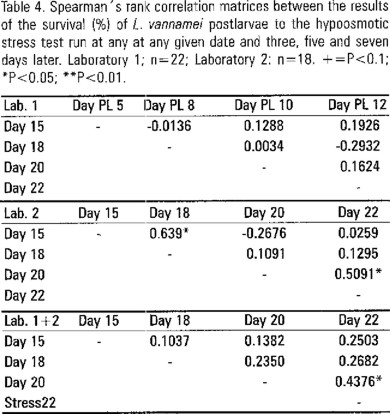
<body><![CDATA[<p align="justify"><font face="verdana" size="2">In spite of the lack of statistical evidence, we took this consistence as an indication of a better performance of the second laboratory, which is surprising when one considers that both pertain to the same company, are located in close proximity to each other and, at least when these observations were made, were under the technical supervision of the same person, who used the same routines and the same decision&#45;making criteria for both laboratories.</font></p>  	    <p align="justify"><font face="verdana" size="2">For this reason, we decided that the results had to be considered under two separate points of view. As decision&#45;taking tools for the manager, the data of each laboratory should be handled separately from those of the other, while the buyer needs an objective indicator of quality, independent from the origin of the postlarvae he is assessing on the date of the sale. Thus, in order to find out if they could be of use from both points of view, the relationships between the variables we took as indicators were calculated for each laboratory, relating the coefficient of variation of the mean size of the postlarvae to the survival (%) to the hypoosmotic stress test run on the same date in which the measurements were made, showed that in the first laboratory the variability in size was weakly (P&lt;0.1) related to stress survival only in the case of PL 12, while in the second the correlation was consistently significant for PL 8, 10 and 12 and, considering the data of both laboratories, for PL 8 and 12 only (<a href="#c2">Table 2</a>). As with the coefficient of variation, <i>Vibrio</i> concentrations were not related to the outcome of the stress test run on the day of sampling, in the case of the first laboratory. In the second, total and yellow CFU numbers were inversely related to survival only for PL 5 and 8, and in the latter case the correlation was significant also with green CFU, but not in the stress tests run with the order PL stages. Finally, considering both laboratories, <i>Vibrio</i> concentrations showed a relationship to survival to stress only in the case of PL 8 (<a href="#c3">Table 3</a>). This lack of consistent relationships between these two variables show that the concentration of <i>Vibrio</i>, at least within the values found in this study, should not be taken as an indication of a possible poor future performance of the postlarvae.</font></p>  	    <p align="center"><font face="verdana" size="2"><a name="c2"></a></font></p>  	    <p align="center"><font face="verdana" size="2"><img src="/img/revistas/hbio/v11n1/a7c2.jpg"></font></p>  	    <p align="center"><font face="verdana" size="2"><a name="c3"></a></font></p>  	    <p align="center"><font face="verdana" size="2"><img src="/img/revistas/hbio/v11n1/a7c3.jpg"></font></p>  	    <p align="justify"><font face="verdana" size="2">Finally, we looked at the possibility of using the results of the hypoosmotic stress test at any given date, as a predictive test of future resistance to the same stressor. The data obtained with the cultures of the first laboratory show that the results of one date are not related to the outcome of later tests, while in laboratory 2 stress resistance of PL 5 may be used only to predict the results with larvae three days older, PL 8 resistance in not related to that of PL 10, and a good survival of 20 days old cultures is likely to indicate a good performance of the postlarvae of that laboratory two days later, when the data of both laboratories were used to relate the same characteristics, confirm that only the coefficient of variation of the mean size shows some relation with the survival to the stress test and might be used by both parties as further proof of larval quality (<a href="#c2">Table 2</a>), although not in substitution of the hypoosmotic test. <i>Vibrio</i> concentrations, within the values we obtained during this work, should not be taken as proof of quality (<a href="#c3">Table 3</a>), while survival to the stress test two days earlier bears a relation to the results obtained on the day of sale (<a href="#c4">Table 4</a>).</font></p>  	    <p align="center"><font face="verdana" size="2"><a name="c4"></a></font></p>  	    <p align="center"><font face="verdana" size="2"><img src="/img/revistas/hbio/v11n1/a7c4.jpg"></font></p>  	    <p>&nbsp;</p>  	    ]]></body>
<body><![CDATA[<p align="justify"><font face="verdana" size="2"><b>Discussion</b></font></p>  	    <p align="justify"><font face="verdana" size="2">In the first laboratory the larvae are reared to the PL 12 stage in circular, flat bottom fiberglass tanks, while in the second they are kept in more convenctional concrete, rectangular, self&#45;cleaning tanks, which might explain the consistently better performance of these postlarvae, possibly due to better mixing and more hygienic conditions.</font></p>  	    <p align="justify"><font face="verdana" size="2">As to larval quality, this topic has been dealth with in many studies and in several revisions, such as those by Bauman and Jamandre (1990), Castille <i>et al</i>., (1992), Brock and Main (1994) and Samocha <i>et al</i>. (1998). In most cases, there seems to be a consensus that the quality of shrimp postlarvae may be measured in terms of their ability to withstand the effects of specific environmental stressors, such as an acute hypoosmotic shock, or of the combination of this and of a thermal shock (Brock and Main, 1994), or of a chemically inadequate environment (Arellano, 1990; Villal&oacute;n, 1991; Samocha <i>et al</i>., 1998). However, it has been pointed out that these tests give a measure of the hardiness of the postlarvae and that they indicate only the probability of initial survival in the environmental conditions of growout ponds, while the quality of postlarvae should be assessed also in terms of growth rate, which is of equal important for the commercial success of shrimp farmers. For this reason, Castille <i>et al</i>. (1992) suggested to consider as a further proof of quality the coefficient of variation of the postlarvae mean size which they found to be inversely related to postlarval growth, in their case due to the degree of infection with the IHHN virus of one of their test populations, but which might also be the result of other stress factors during larval rearing, to the presence of undetected diseases, or to differences in the quality of the broodstock.</font></p>  	    <p align="justify"><font face="verdana" size="2">Our main aim was to find out if there was any relationship between the results of some of the tests used to assess postlarval quality, for interanual use of the hatchery rather than as indicators of the future success of the postlarvae in growth ponds, and we found that the concentration of <i>Vibrio</i> on the surface or in the tissues of the postlarvae was not related to the survival to the standard low salinity test used in commercial laboratories in Ecuador. On the other hand, we also found that the larger postlarvae were those of the laboratory where the coefficient of variation of the mean size was higher, which does not seem to agree with the results of Castille <i>et al</i>. (1992), but that there was an inverse relationship between survival to the hypoosmotic test and variability in size, in spite of the constantly high percentages of survival to this test we obtained throughout the duration of this work. While this is probably due to the fact that we used the standard operating procedures of the commercial laboratory in which we conducted our investigation, rather than the more stringent tests of quality suggested by other investigators, this might have only changed quantitatively the percentages of survival, but would not have affected the overall results of this work, with which we showed that the variability in size of a batch of postlarvae may be used as an indicator of their hardiness and that, at least from this point of view, it may be used as an additional test of quality of the postlarvae at the moment of their sale.</font></p>  	    <p>&nbsp;</p>  	    <p align="justify"><font face="verdana" size="2"><b>Literatura citada</b></font></p>  	    <!-- ref --><p align="justify"><font face="verdana" size="2">Arellano, E., 1990. Fatty acid composition of wild and cultured <i>Penaeus vannamei</i> as a method to evaluate postlarvae quality (Abstract). Abstracts of the Conference "<i>World Aquaculture '90</i>" National Research Council Canada, Ottawa, Ont. Canada. P 50/ T8&#45;3.    &nbsp;&nbsp;&nbsp;&nbsp;&nbsp;&nbsp;&nbsp;&nbsp;[&#160;<a href="javascript:void(0);" onclick="javascript: window.open('/scielo.php?script=sci_nlinks&ref=4032604&pid=S0188-8897200100010000700001&lng=','','width=640,height=500,resizable=yes,scrollbars=1,menubar=yes,');">Links</a>&#160;]<!-- end-ref --></font></p>  	    <!-- ref --><p align="justify"><font face="verdana" size="2">Bauman, R. G. H. and D. Jamandre, 1990. A practical method for determinig quality of <i>Penaeus monodon</i> (Fabricius) fry for stocking in growout ponds. En: M. B. New, H. Saram and T. Singh. 1990 (Comps.), <i>Proceedings of the Aquatech conference on technical and economic aspects of shrimp farming</i>. Publ. INFOFISH. Kuala Lumpur, Malaysia.    &nbsp;&nbsp;&nbsp;&nbsp;&nbsp;&nbsp;&nbsp;&nbsp;[&#160;<a href="javascript:void(0);" onclick="javascript: window.open('/scielo.php?script=sci_nlinks&ref=4032606&pid=S0188-8897200100010000700002&lng=','','width=640,height=500,resizable=yes,scrollbars=1,menubar=yes,');">Links</a>&#160;]<!-- end-ref --></font></p>  	    ]]></body>
<body><![CDATA[<!-- ref --><p align="justify"><font face="verdana" size="2">Brock, J. A., and K. L. Main, 1994. <i>A guide to the common problems and diseases of cultured Penaeus vannamei</i>. The World Aquaculture Society. Baton Rouge, L. A. 242 p.    &nbsp;&nbsp;&nbsp;&nbsp;&nbsp;&nbsp;&nbsp;&nbsp;[&#160;<a href="javascript:void(0);" onclick="javascript: window.open('/scielo.php?script=sci_nlinks&ref=4032608&pid=S0188-8897200100010000700003&lng=','','width=640,height=500,resizable=yes,scrollbars=1,menubar=yes,');">Links</a>&#160;]<!-- end-ref --></font></p>  	    <!-- ref --><p align="justify"><font face="verdana" size="2">Carvaca, C. F., 1990. <i>Manual pr&aacute;ctico de bacteriolog&iacute;a marina</i>. Escuela Superior Polit&eacute;cnica del Litoral. Fac. de Ingenier&iacute;a Mar&iacute;tima y Ciencias del Mar. Guayaquil, Ecuador. 78 p.    &nbsp;&nbsp;&nbsp;&nbsp;&nbsp;&nbsp;&nbsp;&nbsp;[&#160;<a href="javascript:void(0);" onclick="javascript: window.open('/scielo.php?script=sci_nlinks&ref=4032610&pid=S0188-8897200100010000700004&lng=','','width=640,height=500,resizable=yes,scrollbars=1,menubar=yes,');">Links</a>&#160;]<!-- end-ref --></font></p>  	    <!-- ref --><p align="justify"><font face="verdana" size="2">Castille, F. L., T. M. Samocha, A. L. Lawrence, H. P. Frelier and F. Jaenike, 1992. Variability in growth and survival of early postlarval shrimp (<i>Penaeus vannamei</i> Boone 1931). <i>Aquaculture 113</i>: 65&#45;81.    &nbsp;&nbsp;&nbsp;&nbsp;&nbsp;&nbsp;&nbsp;&nbsp;[&#160;<a href="javascript:void(0);" onclick="javascript: window.open('/scielo.php?script=sci_nlinks&ref=4032612&pid=S0188-8897200100010000700005&lng=','','width=640,height=500,resizable=yes,scrollbars=1,menubar=yes,');">Links</a>&#160;]<!-- end-ref --></font></p>  	    <!-- ref --><p align="justify"><font face="verdana" size="2">Clifford, H. C., 1994. El manejo de estanques de camarones. En: <i>Memorias del Seminario Internacional de Camaronicultura en M&eacute;xico. Camar&oacute;n '94 Ralston&#45;Purina</i>. Mazat&aacute;n, Sin. M&eacute;xico.    &nbsp;&nbsp;&nbsp;&nbsp;&nbsp;&nbsp;&nbsp;&nbsp;[&#160;<a href="javascript:void(0);" onclick="javascript: window.open('/scielo.php?script=sci_nlinks&ref=4032614&pid=S0188-8897200100010000700006&lng=','','width=640,height=500,resizable=yes,scrollbars=1,menubar=yes,');">Links</a>&#160;]<!-- end-ref --></font></p>  	    <!-- ref --><p align="justify"><font face="verdana" size="2">Jory, D., T. Cabrera, B. Polanco, J. Mill&aacute;n, J. Rojas, E. Garc&iacute;a, R. S&aacute;nchez, M. Usheche, R. Agudo and C. Alceste, 1999. Aquaculture in Venezuela: Current status and perspective. <i>World Aquaculture 30</i>(3): 20:62&#45;67.    &nbsp;&nbsp;&nbsp;&nbsp;&nbsp;&nbsp;&nbsp;&nbsp;[&#160;<a href="javascript:void(0);" onclick="javascript: window.open('/scielo.php?script=sci_nlinks&ref=4032616&pid=S0188-8897200100010000700007&lng=','','width=640,height=500,resizable=yes,scrollbars=1,menubar=yes,');">Links</a>&#160;]<!-- end-ref --></font></p>  	    ]]></body>
<body><![CDATA[<!-- ref --><p align="justify"><font face="verdana" size="2">Kitani, H., 1986. Larval development of the white shrimp <i>Penaeus vannamei</i> Boone reared in the laboratory and the statistical observation of its naupliar stages. <i>Bulletin Japanese Society Science Fisheries 52</i>: 1131&#45;1139.    &nbsp;&nbsp;&nbsp;&nbsp;&nbsp;&nbsp;&nbsp;&nbsp;[&#160;<a href="javascript:void(0);" onclick="javascript: window.open('/scielo.php?script=sci_nlinks&ref=4032618&pid=S0188-8897200100010000700008&lng=','','width=640,height=500,resizable=yes,scrollbars=1,menubar=yes,');">Links</a>&#160;]<!-- end-ref --></font></p>  	    <!-- ref --><p align="justify"><font face="verdana" size="2">Lucien&#45;Brun, H., 1997. Evolution of world shrimp production. Fisheries and aquaculture. <i>World Aquaculture 28</i>(4): 21&#45;33.    &nbsp;&nbsp;&nbsp;&nbsp;&nbsp;&nbsp;&nbsp;&nbsp;[&#160;<a href="javascript:void(0);" onclick="javascript: window.open('/scielo.php?script=sci_nlinks&ref=4032620&pid=S0188-8897200100010000700009&lng=','','width=640,height=500,resizable=yes,scrollbars=1,menubar=yes,');">Links</a>&#160;]<!-- end-ref --></font></p>  	    <p align="justify"><font face="verdana" size="2">Rosemberry, B., 1996. <i>World shrimp farming</i>. Shrimp News International. Cheltehnham, U. K. 136 p.</font></p>  	    <!-- ref --><p align="justify"><font face="verdana" size="2">Samocha, T. M., H. Guajardo, A. L. Lawrence, F. L. Castille, M. Speed, D. A. McKee and K. I. Page, 1998. A simple stress test for <i>Penaeus vannamei</i> postlarvae. <i>Aquaculture 165</i>: 233&#45;242.    &nbsp;&nbsp;&nbsp;&nbsp;&nbsp;&nbsp;&nbsp;&nbsp;[&#160;<a href="javascript:void(0);" onclick="javascript: window.open('/scielo.php?script=sci_nlinks&ref=4032623&pid=S0188-8897200100010000700010&lng=','','width=640,height=500,resizable=yes,scrollbars=1,menubar=yes,');">Links</a>&#160;]<!-- end-ref --></font></p>  	    <!-- ref --><p align="justify"><font face="verdana" size="2">Scura, E. D., 1995. Dry season production problems on shrimp farms in Central America an the Caribbean region. <i>Proceedings of the Special session of shrimp farming</i>. Aquaculture '95. The World Aquaculture Society, Baton Rouge, L. A. USA.    &nbsp;&nbsp;&nbsp;&nbsp;&nbsp;&nbsp;&nbsp;&nbsp;[&#160;<a href="javascript:void(0);" onclick="javascript: window.open('/scielo.php?script=sci_nlinks&ref=4032625&pid=S0188-8897200100010000700011&lng=','','width=640,height=500,resizable=yes,scrollbars=1,menubar=yes,');">Links</a>&#160;]<!-- end-ref --></font></p>  	    <!-- ref --><p align="justify"><font face="verdana" size="2">Villal&oacute;n, J. R., 1991. <i>Practical manual for semi&#45;intensive commercial production of marine shrimp</i>. Texas A &amp; M University Sea Grant Program, Galveston, TX, U. S. A. 103 p.    &nbsp;&nbsp;&nbsp;&nbsp;&nbsp;&nbsp;&nbsp;&nbsp;[&#160;<a href="javascript:void(0);" onclick="javascript: window.open('/scielo.php?script=sci_nlinks&ref=4032627&pid=S0188-8897200100010000700012&lng=','','width=640,height=500,resizable=yes,scrollbars=1,menubar=yes,');">Links</a>&#160;]<!-- end-ref --></font></p>  	    <!-- ref --><p align="justify"><font face="verdana" size="2">Zar, H. J., 1996. <i>Biostatistical Analysis</i>. Prentice Hall, Englewood Cliffs, N. Jersey. 662 p.    &nbsp;&nbsp;&nbsp;&nbsp;&nbsp;&nbsp;&nbsp;&nbsp;[&#160;<a href="javascript:void(0);" onclick="javascript: window.open('/scielo.php?script=sci_nlinks&ref=4032629&pid=S0188-8897200100010000700013&lng=','','width=640,height=500,resizable=yes,scrollbars=1,menubar=yes,');">Links</a>&#160;]<!-- end-ref --></font></p>      ]]></body><back>
<ref-list>
<ref id="B1">
<nlm-citation citation-type="book">
<person-group person-group-type="author">
<name>
<surname><![CDATA[Arellano]]></surname>
<given-names><![CDATA[E.]]></given-names>
</name>
</person-group>
<article-title xml:lang="en"><![CDATA[Fatty acid composition of wild and cultured Penaeus vannamei as a method to evaluate postlarvae quality (Abstract)]]></article-title>
<source><![CDATA[Abstracts of the Conference "World Aquaculture '90"]]></source>
<year>1990</year>
<page-range>50/ T8-3</page-range><publisher-loc><![CDATA[Ottawa^eOnt. Ont.]]></publisher-loc>
<publisher-name><![CDATA[National Research Council Canada]]></publisher-name>
</nlm-citation>
</ref>
<ref id="B2">
<nlm-citation citation-type="book">
<person-group person-group-type="author">
<name>
<surname><![CDATA[Bauman]]></surname>
<given-names><![CDATA[R. G. H.]]></given-names>
</name>
<name>
<surname><![CDATA[Jamandre]]></surname>
<given-names><![CDATA[D.]]></given-names>
</name>
</person-group>
<article-title xml:lang="en"><![CDATA[A practical method for determinig quality of Penaeus monodon (Fabricius) fry for stocking in growout ponds]]></article-title>
<person-group person-group-type="editor">
<name>
<surname><![CDATA[New]]></surname>
<given-names><![CDATA[M. B.]]></given-names>
</name>
<name>
<surname><![CDATA[Saram]]></surname>
<given-names><![CDATA[H.]]></given-names>
</name>
<name>
<surname><![CDATA[Singh]]></surname>
<given-names><![CDATA[T.]]></given-names>
</name>
</person-group>
<source><![CDATA[Proceedings of the Aquatech conference on technical and economic aspects of shrimp farming]]></source>
<year>1990</year>
<month>19</month>
<day>90</day>
<publisher-loc><![CDATA[Kuala Lumpur ]]></publisher-loc>
<publisher-name><![CDATA[INFOFISH]]></publisher-name>
</nlm-citation>
</ref>
<ref id="B3">
<nlm-citation citation-type="book">
<person-group person-group-type="author">
<name>
<surname><![CDATA[Brock]]></surname>
<given-names><![CDATA[J. A.]]></given-names>
</name>
<name>
<surname><![CDATA[Main]]></surname>
<given-names><![CDATA[K. L.]]></given-names>
</name>
</person-group>
<source><![CDATA[A guide to the common problems and diseases of cultured Penaeus vannamei]]></source>
<year>1994</year>
<page-range>242</page-range><publisher-loc><![CDATA[Baton Rouge^eL. A. L. A.]]></publisher-loc>
<publisher-name><![CDATA[The World Aquaculture Society]]></publisher-name>
</nlm-citation>
</ref>
<ref id="B4">
<nlm-citation citation-type="book">
<person-group person-group-type="author">
<name>
<surname><![CDATA[Carvaca]]></surname>
<given-names><![CDATA[C. F.]]></given-names>
</name>
</person-group>
<source><![CDATA[Manual práctico de bacteriología marina]]></source>
<year>1990</year>
<page-range>78</page-range><publisher-loc><![CDATA[Guayaquil ]]></publisher-loc>
<publisher-name><![CDATA[Escuela Superior Politécnica del Litoral. Fac. de Ingeniería Marítima y Ciencias del Mar]]></publisher-name>
</nlm-citation>
</ref>
<ref id="B5">
<nlm-citation citation-type="journal">
<person-group person-group-type="author">
<name>
<surname><![CDATA[Castille]]></surname>
<given-names><![CDATA[F. L.]]></given-names>
</name>
<name>
<surname><![CDATA[Samocha]]></surname>
<given-names><![CDATA[T. M.]]></given-names>
</name>
<name>
<surname><![CDATA[Lawrence]]></surname>
<given-names><![CDATA[A. L.]]></given-names>
</name>
<name>
<surname><![CDATA[Frelier]]></surname>
<given-names><![CDATA[H. P.]]></given-names>
</name>
<name>
<surname><![CDATA[Jaenike]]></surname>
<given-names><![CDATA[F.]]></given-names>
</name>
</person-group>
<article-title xml:lang="en"><![CDATA[Variability in growth and survival of early postlarval shrimp (Penaeus vannamei Boone 1931)]]></article-title>
<source><![CDATA[Aquaculture]]></source>
<year>1992</year>
<volume>113</volume>
<page-range>65-81</page-range></nlm-citation>
</ref>
<ref id="B6">
<nlm-citation citation-type="">
<person-group person-group-type="author">
<name>
<surname><![CDATA[Clifford]]></surname>
<given-names><![CDATA[H. C.]]></given-names>
</name>
</person-group>
<article-title xml:lang="es"><![CDATA[El manejo de estanques de camarones]]></article-title>
<source><![CDATA[Memorias del Seminario Internacional de Camaronicultura en México. Camarón '94 Ralston-Purina]]></source>
<year>1994</year>
<publisher-loc><![CDATA[Mazatán^eSin. Sin.]]></publisher-loc>
</nlm-citation>
</ref>
<ref id="B7">
<nlm-citation citation-type="journal">
<person-group person-group-type="author">
<name>
<surname><![CDATA[Jory]]></surname>
<given-names><![CDATA[D.]]></given-names>
</name>
<name>
<surname><![CDATA[Cabrera]]></surname>
<given-names><![CDATA[T.]]></given-names>
</name>
<name>
<surname><![CDATA[Polanco]]></surname>
<given-names><![CDATA[B.]]></given-names>
</name>
<name>
<surname><![CDATA[Millán]]></surname>
<given-names><![CDATA[J.]]></given-names>
</name>
<name>
<surname><![CDATA[Rojas]]></surname>
<given-names><![CDATA[J.]]></given-names>
</name>
<name>
<surname><![CDATA[García]]></surname>
<given-names><![CDATA[E.]]></given-names>
</name>
<name>
<surname><![CDATA[Sánchez]]></surname>
<given-names><![CDATA[R.]]></given-names>
</name>
<name>
<surname><![CDATA[Usheche]]></surname>
<given-names><![CDATA[M.]]></given-names>
</name>
<name>
<surname><![CDATA[Agudo]]></surname>
<given-names><![CDATA[R.]]></given-names>
</name>
<name>
<surname><![CDATA[Alceste]]></surname>
<given-names><![CDATA[C.]]></given-names>
</name>
</person-group>
<article-title xml:lang="en"><![CDATA[Aquaculture in Venezuela: Current status and perspective]]></article-title>
<source><![CDATA[World Aquaculture]]></source>
<year>1999</year>
<volume>30</volume>
<numero>3</numero>
<issue>3</issue>
<page-range>20:62-67</page-range></nlm-citation>
</ref>
<ref id="B8">
<nlm-citation citation-type="journal">
<person-group person-group-type="author">
<name>
<surname><![CDATA[Kitani]]></surname>
<given-names><![CDATA[H.]]></given-names>
</name>
</person-group>
<article-title xml:lang="en"><![CDATA[Larval development of the white shrimp Penaeus vannamei Boone reared in the laboratory and the statistical observation of its naupliar stages]]></article-title>
<source><![CDATA[Bulletin Japanese Society Science Fisheries]]></source>
<year>1986</year>
<volume>52</volume>
<page-range>1131-1139</page-range></nlm-citation>
</ref>
<ref id="B9">
<nlm-citation citation-type="journal">
<person-group person-group-type="author">
<name>
<surname><![CDATA[Lucien-Brun]]></surname>
<given-names><![CDATA[H.]]></given-names>
</name>
</person-group>
<article-title xml:lang="en"><![CDATA[Evolution of world shrimp production. Fisheries and aquaculture]]></article-title>
<source><![CDATA[World Aquaculture]]></source>
<year>1997</year>
<volume>28</volume>
<numero>4</numero>
<issue>4</issue>
<page-range>21-33</page-range></nlm-citation>
</ref>
<ref id="B10">
<nlm-citation citation-type="journal">
<person-group person-group-type="author">
<name>
<surname><![CDATA[Samocha]]></surname>
<given-names><![CDATA[T. M.]]></given-names>
</name>
<name>
<surname><![CDATA[Guajardo]]></surname>
<given-names><![CDATA[H.]]></given-names>
</name>
<name>
<surname><![CDATA[Lawrence]]></surname>
<given-names><![CDATA[A. L.]]></given-names>
</name>
<name>
<surname><![CDATA[Castille]]></surname>
<given-names><![CDATA[F. L.]]></given-names>
</name>
<name>
<surname><![CDATA[Speed]]></surname>
<given-names><![CDATA[M.]]></given-names>
</name>
<name>
<surname><![CDATA[McKee]]></surname>
<given-names><![CDATA[D. A.]]></given-names>
</name>
<name>
<surname><![CDATA[Page]]></surname>
<given-names><![CDATA[K. I.]]></given-names>
</name>
</person-group>
<article-title xml:lang="en"><![CDATA[A simple stress test for Penaeus vannamei postlarvae]]></article-title>
<source><![CDATA[Aquaculture]]></source>
<year>1998</year>
<volume>165</volume>
<page-range>233-242</page-range></nlm-citation>
</ref>
<ref id="B11">
<nlm-citation citation-type="book">
<person-group person-group-type="author">
<name>
<surname><![CDATA[Scura]]></surname>
<given-names><![CDATA[E. D.]]></given-names>
</name>
</person-group>
<article-title xml:lang="en"><![CDATA[Dry season production problems on shrimp farms in Central America an the Caribbean region]]></article-title>
<source><![CDATA[Proceedings of the Special session of shrimp farming]]></source>
<year>1995</year>
<publisher-loc><![CDATA[Baton Rouge^eL. A. L. A.]]></publisher-loc>
<publisher-name><![CDATA[The World Aquaculture Society]]></publisher-name>
</nlm-citation>
</ref>
<ref id="B12">
<nlm-citation citation-type="book">
<person-group person-group-type="author">
<name>
<surname><![CDATA[Villalón]]></surname>
<given-names><![CDATA[J. R.]]></given-names>
</name>
</person-group>
<source><![CDATA[Practical manual for semi-intensive commercial production of marine shrimp]]></source>
<year>1991</year>
<page-range>103</page-range><publisher-loc><![CDATA[Galveston^eTX TX]]></publisher-loc>
<publisher-name><![CDATA[Texas A & M University Sea Grant Program]]></publisher-name>
</nlm-citation>
</ref>
<ref id="B13">
<nlm-citation citation-type="book">
<person-group person-group-type="author">
<name>
<surname><![CDATA[Zar]]></surname>
<given-names><![CDATA[H. J.]]></given-names>
</name>
</person-group>
<source><![CDATA[Biostatistical Analysis]]></source>
<year>1996</year>
<page-range>662</page-range><publisher-loc><![CDATA[Englewood Cliffs^eN. Jersey N. Jersey]]></publisher-loc>
<publisher-name><![CDATA[Prentice Hall]]></publisher-name>
</nlm-citation>
</ref>
</ref-list>
</back>
</article>