<?xml version="1.0" encoding="ISO-8859-1"?><article xmlns:mml="http://www.w3.org/1998/Math/MathML" xmlns:xlink="http://www.w3.org/1999/xlink" xmlns:xsi="http://www.w3.org/2001/XMLSchema-instance">
<front>
<journal-meta>
<journal-id>0188-4611</journal-id>
<journal-title><![CDATA[Investigaciones geográficas]]></journal-title>
<abbrev-journal-title><![CDATA[Invest. Geog]]></abbrev-journal-title>
<issn>0188-4611</issn>
<publisher>
<publisher-name><![CDATA[Universidad Nacional Autónoma de México, Instituto de Geografía]]></publisher-name>
</publisher>
</journal-meta>
<article-meta>
<article-id>S0188-46112009000300005</article-id>
<title-group>
<article-title xml:lang="en"><![CDATA[The heat spells of Mexico City]]></article-title>
<article-title xml:lang="es"><![CDATA[Las ondas de calor en la Ciudad de México]]></article-title>
</title-group>
<contrib-group>
<contrib contrib-type="author">
<name>
<surname><![CDATA[Jáuregui]]></surname>
<given-names><![CDATA[Ernesto]]></given-names>
</name>
<xref ref-type="aff" rid="A01"/>
</contrib>
</contrib-group>
<aff id="A01">
<institution><![CDATA[,Universidad Nacional Autónoma de México Centro de Ciencias de la Atmósfera ]]></institution>
<addr-line><![CDATA[D. F. ]]></addr-line>
<country>México</country>
</aff>
<pub-date pub-type="pub">
<day>00</day>
<month>12</month>
<year>2009</year>
</pub-date>
<pub-date pub-type="epub">
<day>00</day>
<month>12</month>
<year>2009</year>
</pub-date>
<numero>70</numero>
<fpage>71</fpage>
<lpage>76</lpage>
<copyright-statement/>
<copyright-year/>
<self-uri xlink:href="http://www.scielo.org.mx/scielo.php?script=sci_arttext&amp;pid=S0188-46112009000300005&amp;lng=en&amp;nrm=iso"></self-uri><self-uri xlink:href="http://www.scielo.org.mx/scielo.php?script=sci_abstract&amp;pid=S0188-46112009000300005&amp;lng=en&amp;nrm=iso"></self-uri><self-uri xlink:href="http://www.scielo.org.mx/scielo.php?script=sci_pdf&amp;pid=S0188-46112009000300005&amp;lng=en&amp;nrm=iso"></self-uri><abstract abstract-type="short" xml:lang="en"><p><![CDATA[The warning of urban air has been documented to increase in intensity and area as cities grow (Oke, 1982). As the cities grow the so called "heat island" tends to increase the risk of more frequent heat waves as well as their impacts (IPCC, 2001). Threshold values to define a heat wave vary geographically. For the case of Mexico City located in a high inland valley in the tropics, values above 30° C (daily maximum observed for three or more consecutive days and 25° C or more as mean temperature) have been adopted to define the phenomenon. These events occur at the end of the dry season during March to May when afternoon relative humidity is quite low (~20%) and thus reducing the stress. Maximum temperature data from the Observatory of the National Meteorological Service were used. Results show that during the second half of the XXth century the frequency of heat waves as defined above has doubled from 6 events/decade to 16/decade in the 1990s with a marked increase in the last third of the last century when population of the city grew from 8.5 to 18.5 million (CONAPO, 2000). During this time the average urban/rural contrast grew considerably from about 6° C to 10° C (Jáuregui, 1986). While these heat waves may be considered as "mild" they receive attention from the media and prompt actions by the population to relieve the heat stress. Application of heat indices based on the human energy balance (PET and PMV) result in moderate to strong heat stress during these events. Because climate change is expected to raise nighttime minimum temperatures more than daytime highs (as suggested by the IPCC, 2001) urban heat islands and their related heat waves are likely to be a significant health concern in days to come in large urban centers especially in the developing countries.]]></p></abstract>
<abstract abstract-type="short" xml:lang="es"><p><![CDATA[El calentamiento de aire urbano se ha documentado ampliamente tanto en el aspecto de su intensidad como en la extensión del fenómeno (Oke, 1982). A medida que crecen las ciudades se experimenta un aumento en la temperatura. Las ondas de calor tienden a aumentar el riesgo de una mayor morbilidad en la población urbana (IPCC, 2001). Los valores límite para definir una onda de calor varían geográficamente. Para el caso de la Ciudad de México (que se encuentra a 2 250 msnm en los trópicos) se ha adoptado 30° C como valor límite cuando se presente durante tres días consecutivos o más y una temperatura mínima de 25° C como promedio. Estos eventos ocurren al final de la estación seca durante los meses de marzo a mayo, cuando la humedad relativa alcanza un mínimo (~20%), lo cual favorece el estrés por calor. En este trabajo se han utilizado datos de temperatura máxima del Servicio Meteorológico Nacional (SMN). Los resultados muestran que durante la segunda mitad del siglo XX la frecuencia de los eventos de ondas de calor se incrementó de 6 a 16 en los años noventa, con un marcado crecimiento de la población de la capital de 8.5 a 16.5 millones de habitantes (CONAPO, 2000). Durante este tiempo el contraste promedio urbano/rural se consideraba de 6 a 10° C (Jáuregui, 1986). La aplicación de índices de calor basados en el balance energético (PET, PMV) señalan que el impacto a la población puede ser de ligero a moderado durante estos eventos. Ya que el cambio climático global va a significar un aumento en las temperaturas nocturnas (IPCC, 2001), es probable que aumente la incidencia de estos fenómenos.]]></p></abstract>
<kwd-group>
<kwd lng="en"><![CDATA[Heat waves]]></kwd>
<kwd lng="en"><![CDATA[heat island]]></kwd>
<kwd lng="en"><![CDATA[tropics]]></kwd>
<kwd lng="es"><![CDATA[Ondas de calor]]></kwd>
<kwd lng="es"><![CDATA[isla de calor]]></kwd>
<kwd lng="es"><![CDATA[trópicos]]></kwd>
</kwd-group>
</article-meta>
</front><body><![CDATA[ <p align="center"><font face="verdana" size="4"><b>The heat spells of Mexico City</b></font></p>     <p align="center"><font face="verdana" size="2">&nbsp;</font></p>     <p align="center"><font face="verdana" size="3"><b>Las ondas de calor en la Ciudad de M&eacute;xico</b></font></p>     <p align="center"><font face="verdana" size="2">&nbsp;</font></p>     <p align="center"><font face="verdana" size="2"><b>Ernesto J&aacute;uregui*</b></font></p>     <p align="justify"><font face="verdana" size="2">&nbsp;</font></p>     <p align="justify"><font face="verdana" size="2"><i>* Centro de Ciencias de la Atm&oacute;sfera, Universidad Nacional Aut&oacute;noma de M&eacute;xico, Circuito Exterior, Ciudad Universitaria, 04510, Coyoac&aacute;n, M&eacute;xico, D. F. E&#150;mail: <a href="mailto:ejos@atmosfera.unam.mx">ejos@atmosfera.unam.mx</a>.</i></font></p>     <p align="justify"><font face="verdana" size="2">&nbsp;</font></p>     <p align="justify"><font face="verdana" size="2"><b>Abstract</b></font></p>     <p align="justify"><font face="verdana" size="2">The warning of urban air has been documented to increase in intensity and area as cities grow (Oke, 1982). As the cities grow the so called "heat island" tends to increase the risk of more frequent heat waves as well as their impacts (IPCC, 2001). Threshold values to define a heat wave vary geographically. For the case of Mexico City located in a high inland valley in the tropics, values above 30&deg; C (daily maximum observed for three or more consecutive days and 25&deg; C or more as mean temperature) have been adopted to define the phenomenon. These events occur at the end of the dry season during March to May when afternoon relative humidity is quite low (~20%) and thus reducing the stress. Maximum temperature data from the Observatory of the National Meteorological Service were used. Results show that during the second half of the XXth century the frequency of heat waves as defined above has doubled from 6 events/decade to 16/decade in the 1990s with a marked increase in the last third of the last century when population of the city grew from 8.5 to 18.5 million (CONAPO, 2000). During this time the average urban/rural contrast grew considerably from about 6&deg; C to 10&deg; C (J&aacute;uregui, 1986). While these heat waves may be considered as "mild" they receive attention from the media and prompt actions by the population to relieve the heat stress. Application of heat indices based on the human energy balance (PET and PMV) result in moderate to strong heat stress during these events. Because climate change is expected to raise nighttime minimum temperatures more than daytime highs (as suggested by the IPCC, 2001) urban heat islands and their related heat waves are likely to be a significant health concern in days to come in large urban centers especially in the developing countries.</font></p>     ]]></body>
<body><![CDATA[<p align="justify"><font face="verdana" size="2"><b>Key words: </b>Heat waves, heat island, tropics.</font></p>     <p align="justify"><font face="verdana" size="2">&nbsp;</font></p>     <p align="justify"><font face="verdana" size="2"><b>Resumen</b></font></p>     <p align="justify"><font face="verdana" size="2">El calentamiento de aire urbano se ha documentado ampliamente tanto en el aspecto de su intensidad como en la extensi&oacute;n del fen&oacute;meno (Oke, 1982). A medida que crecen las ciudades se experimenta un aumento en la temperatura. Las ondas de calor tienden a aumentar el riesgo de una mayor morbilidad en la poblaci&oacute;n urbana (IPCC, 2001). Los valores l&iacute;mite para definir una onda de calor var&iacute;an geogr&aacute;ficamente. Para el caso de la Ciudad de M&eacute;xico (que se encuentra a 2 250 msnm en los tr&oacute;picos) se ha adoptado 30&deg; C como valor l&iacute;mite cuando se presente durante tres d&iacute;as consecutivos o m&aacute;s y una temperatura m&iacute;nima de 25&deg; C como promedio. Estos eventos ocurren al final de la estaci&oacute;n seca durante los meses de marzo a mayo, cuando la humedad relativa alcanza un m&iacute;nimo (~20%), lo cual favorece el estr&eacute;s por calor. En este trabajo se han utilizado datos de temperatura m&aacute;xima del Servicio Meteorol&oacute;gico Nacional (SMN). Los resultados muestran que durante la segunda mitad del siglo XX la frecuencia de los eventos de ondas de calor se increment&oacute; de 6 a 16 en los a&ntilde;os noventa, con un marcado crecimiento de la poblaci&oacute;n de la capital de 8.5 a 16.5 millones de habitantes (CONAPO, 2000). Durante este tiempo el contraste promedio urbano/rural se consideraba de 6 a 10&deg; C (J&aacute;uregui, 1986). La aplicaci&oacute;n de &iacute;ndices de calor basados en el balance energ&eacute;tico (PET, PMV) se&ntilde;alan que el impacto a la poblaci&oacute;n puede ser de ligero a moderado durante estos eventos. Ya que el cambio clim&aacute;tico global va a significar un aumento en las temperaturas nocturnas (IPCC, 2001), es probable que aumente la incidencia de estos fen&oacute;menos.</font></p>     <p align="justify"><font face="verdana" size="2"><b>Palabras clave: </b>Ondas de calor, isla de calor, tr&oacute;picos.</font></p>     <p align="justify"><font face="verdana" size="2">&nbsp;</font></p>     <p align="justify"><font face="verdana" size="2"><b>INTRODUCTION</b></font></p>     <p align="justify"><font face="verdana" size="2">The warning of the urban atmosphere is a universal phenomenon that has been shown to increase in intensity and extent as cities grow (Oke, 1982). As noted by Oke (1993) the observed changes in the thermal climate of cities (or heat island effect) have to be intimately linked to global climate change. The combined global/local climate change will have diverse impacts health &#151;most of them on the negative side&#151;. Changes in the frequency of extreme heat together with local air pollution, a common case in large cities of the developing world, would affect population health disorders. Since the impact of these events is multifactorial it is rarely correctly reported.</font></p>     <p align="justify"><font face="verdana" size="2">If heat waves increase in frequency, as is the case in this paper, the risk of death and serious illness is likely to increase mainly in older age groups and especially in the urban poor who constitute a large sector of the population in Mexico City. While the greatest increase in thermal stress is expected for mid&#150;latitude cities, thermal stress mortality in cities located in the tropics may be also significant. However, there has been little research in such populations.</font></p>     <p align="justify"><font face="verdana" size="2">In this paper, after a characterization of a heat wave is proposed, a climatology of such events occurring in a large urban area located in the tropics is made.</font></p>     ]]></body>
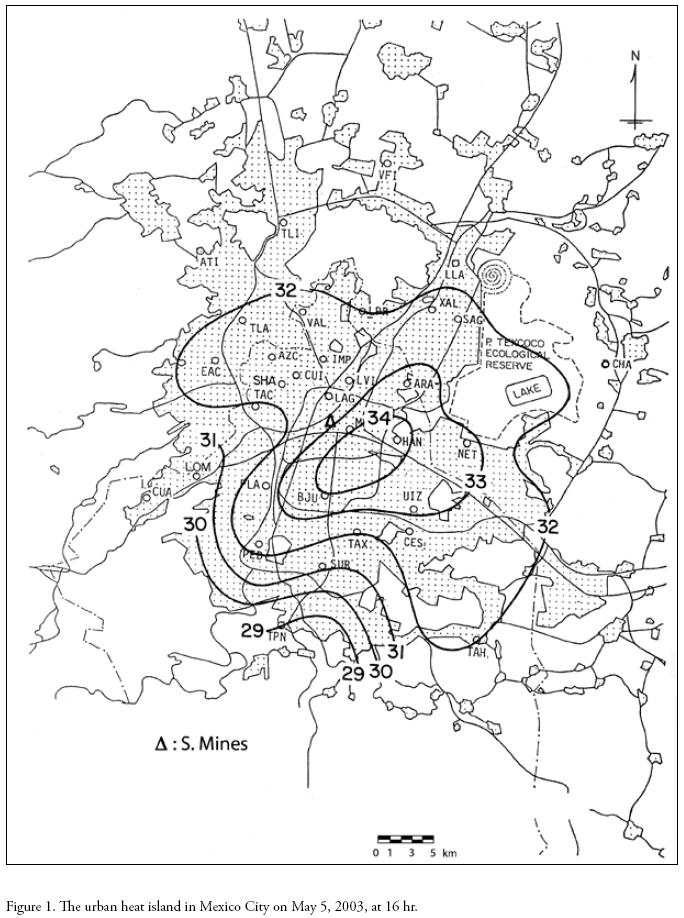
<body><![CDATA[<p align="justify"><font face="verdana" size="2">&nbsp;</font></p>     <p align="justify"><font face="verdana" size="2"><b>THE DATA</b></font></p>     <p align="justify"><font face="verdana" size="2">Daily maximum temperature series registered at the Tacubaya Observatory located to the west of downtown were used for period 1877&#150;2000. Another climatological data series from a station situated in the old central quarters (School of Mines) were used for period 1995&#150;2004 (see <a href="#f1">Figure 1</a> for location).</font></p>     <p align="center"><font face="verdana" size="2"><a name="f1"></a></font></p>     <p align="center"><font face="verdana" size="2"><img src="/img/revistas/igeo/n70/f1a5.JPG"></font></p>     <p align="justify"><font face="verdana" size="2">&nbsp;</font></p>     <p align="justify"><font face="verdana" size="2"><b>THE CLIMATE AND METHOD</b></font></p>     <p align="justify"><font face="verdana" size="2">Mexico City is located in the tropics (19&deg; 30' N) in an elevated (2 250 masl) inland valley. The climate is subhumid tropical tempered by altitude. Typical anticyclonic weather prevailing during the dry period (November to April) contributes to frequent surface inversions. Dust storms and warm temperatures characterize the climate during March to May when relative humidity is markedly low allowing relatively free perspiration.</font></p>     <p align="justify"><font face="verdana" size="2">Threshold values to define a heat wave vary geographically. The definition of a heat wave adopted by WMO is a 3&#150;or&#150;more&#150;day hot spell of 32.2&deg; C (90&deg; F) or higher. For the Mexico City case this definition was not suitable because it occurs too infrequently in the maximum temperature series. From the author's experience the population begins to take actions to relieve the heat stress when the thermometer reaches 30&deg; C. Therefore values above 30&deg; C observed for three or more days and a mean daily temperature equal or greater than 24&deg; C have been adopted to define the phenomenon.</font></p>     <p align="justify"><font face="verdana" size="2">This proposal is identical to the one adopted by the Atmospheric Environment Service for Toronto, Canada (Lewis, 1993) having both definitions the limitation of not taking directly into account the effect of humidity in determining the heat stress produced by a heat spell.</font></p>     ]]></body>
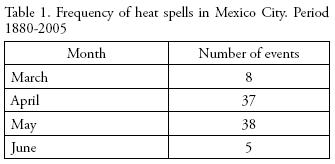
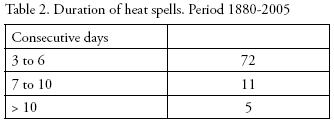
<body><![CDATA[<p align="justify"><font face="verdana" size="2">Not withstanding the above mentioned limitation, 'heat waves' so defined are likely to produce a considerable heat stress (as measured by widely applied bioclimatic comfort indices) in Mexico City, as will be illustrated in this paper.</font></p>     <p align="justify"><font face="verdana" size="2">&nbsp;</font></p>     <p align="justify"><font face="verdana" size="2"><b>RESULTS</b></font></p>     <p align="justify"><font face="verdana" size="2"><i>a) </i>Frequency and duration of heat spells.</font></p>     <p align="justify"><font face="verdana" size="2"><a href="#t1">Table 1</a> shows that heat spells are more frequent during the April&#150;May period, while they mostly lasted from 3 to 6 days (<a href="#t2">Table 2</a>).</font></p>     <p align="center"><font face="verdana" size="2"><a name="t1"></a></font></p>     <p align="center"><font face="verdana" size="2"><img src="/img/revistas/igeo/n70/t1a5.JPG"></font></p>     <p align="center"><font face="verdana" size="2"><a name="t2"></a></font></p>     <p align="center"><font face="verdana" size="2"><img src="/img/revistas/igeo/n70/t2a5.JPG"></font></p>     <p align="justify"><font face="verdana" size="2"><i>b)&nbsp;</i>Long&#150;term trend of heat waves.</font></p>     ]]></body>
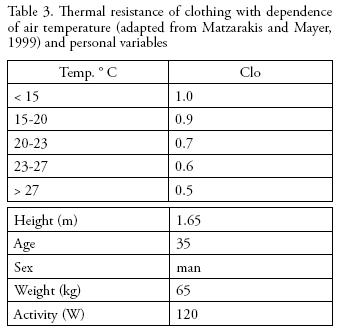
<body><![CDATA[<p align="justify"><font face="verdana" size="2"><a href="#f2">Figure 2</a> shows that the decadal frequency of heat waves in Mexico City displays a marked increase particularly during the second half of the 20<sup>th</sup> century when the capital city experienced an accelerated growth.</font></p>     <p align="center"><font face="verdana" size="2"><a name="f2"></a></font></p>     <p align="center"><font face="verdana" size="2"><img src="/img/revistas/igeo/n70/f2a5.JPG"></font></p>     <p align="justify"><font face="verdana" size="2"><i>c)&nbsp; </i>Geographical extent covered by the heat island during a heat spell.</font></p>     <p align="justify"><font face="verdana" size="2"><a href="#f1">Figure 1</a> shows the maximum temperatures observed at 4 pm during the May 5<sup>th</sup> event in year 2003. Isotherms are drawn using the air quality monitoring network operated by the city's Environmental Agency.</font></p>     <p align="justify"><font face="verdana" size="2"><i>d)&nbsp;</i>Some case studies to illustrate the characteristics and impact of heat spells on the population.</font></p>     <p align="justify"><font face="verdana" size="2">In order to evaluate the degree of stress related to hot spells in Mexico City two widely applied indices based on the human energy balance were applied: Fanger's PMV (1972) and the physiological equivalent temperature or PET proposed by Hoeppe (1999). Personal variable were adapted to local conditions as follows (<a href="#t3">Tabla 3</a>).</font></p>     <p align="center"><font face="verdana" size="2"><a name="t3"></a></font></p>     <p align="center"><font face="verdana" size="2"><img src="/img/revistas/igeo/n70/t3a5.JPG"></font></p>     <p align="justify"><font face="verdana" size="2">Medium level of activity was fixed at 120 W for a person walking in an open suburban space during around maximum temperature occurrence (around 15:00 hr local time). Clothing was adjusted according to prevailing meteorological conditions with temperature as controlling factor.</font></p>     ]]></body>
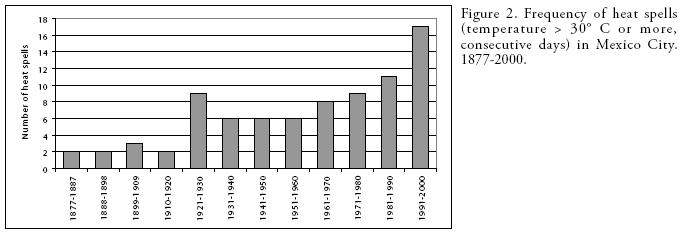
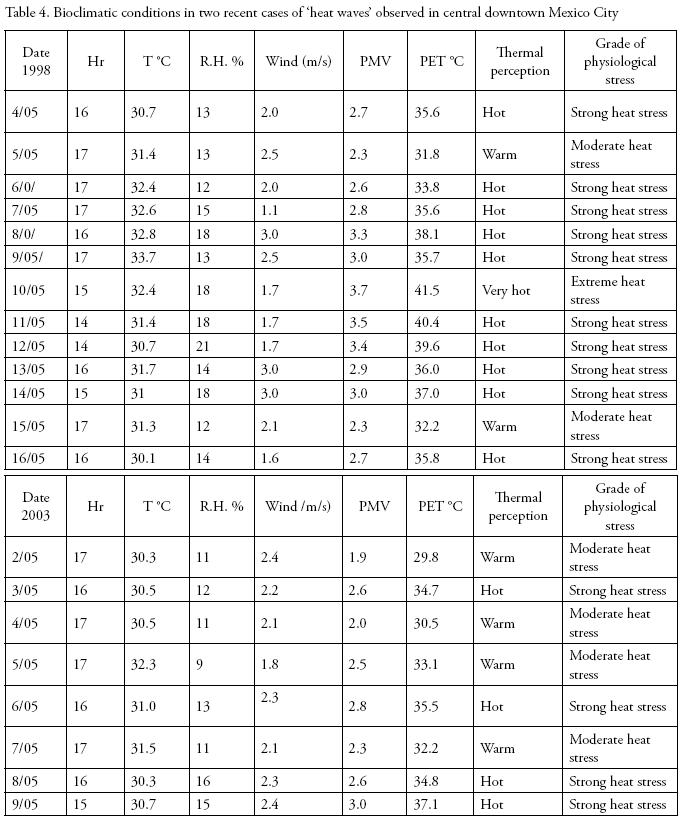
<body><![CDATA[<p align="justify"><font face="verdana" size="2"><a href="#t4">Table 4</a> describes the characteristics of two typical recent heat waves as observed from the station School of Mines located close to the heat island chore. While maximum temperatures remain around 30 to 32&deg; C, the very dry air and light wind, the thermal perception according to PET and PMV comfort indices varies from warm to hot leading to moderate to strong heat stress during most events.</font></p>     <p align="center"><font face="verdana" size="2"><a name="t4"></a></font></p>     <p align="center"><font face="verdana" size="2"><img src="/img/revistas/igeo/n70/t4a5.JPG"></font></p>     <p align="justify"><font face="verdana" size="2">&nbsp;</font></p>     <p align="justify"><font face="verdana" size="2"><b>CONCLUDING REMARKS</b></font></p>     <p align="justify"><font face="verdana" size="2">Warm weather occurs in Mexico City in the last months of the dry season. In order to characterize the heat spells, a definition of a heat wave has been adopted as a period of three or more consecutive days with a maximum temperature greater than or equal to 30&deg; C and a mean temperature &gt;24&deg; C. This definition is similar to the one developed by Lewis (1993) although applied to a location having quite a different climate. Using the above definition a considerable large number of heat spells were identified to occur in the century long temperature series available. Decadal analysis of heat spells indicate that these events increased from 6/decade in the 1950s to 16/decade in the 1990s. The longest (15 day long) heat spell event was observed in the El Ni&ntilde;o year of 1998 (<a href="#t4">Table 4</a>) which was globally the warmest year of the 1990s decade (WMO, 1999). While these events may be considered as mild (maximum temperatures do not reach beyond 35&deg; C in dry air) moderate to strong physiological heat stress, result when applying universal comfort indices (eg. PET, PMV) to the heat wave data. It is suggested that the observed change in the frequency of this heat spells is linked to increasing urbanization, the quasi&#150;periodic ENSO phenomenon and to global climate change.</font></p>     <p align="justify"><font face="verdana" size="2">&nbsp;</font></p>     <p align="justify"><font face="verdana" size="2"><b>ACKNOWLEDGMENTS</b></font></p>     <p align="justify"><font face="verdana" size="2">The authors is grateful to Elda Luyando for the calculation of thermal indices and heat wave data, Mario Casasola for data processing and Alfonso Estrada for drawing the map.</font></p>     <p align="justify"><font face="verdana" size="2">&nbsp;</font></p>     ]]></body>
<body><![CDATA[<p align="justify"><font face="verdana" size="2"><b>REFERENCES</b></font></p>     <!-- ref --><p align="justify"><font face="verdana" size="2">CONAPO (2000), Consejo Nacional de Poblaci&oacute;n, Secretar&iacute;a de Gobernaci&oacute;n, M&eacute;xico.</font>&nbsp;&nbsp;&nbsp;&nbsp;&nbsp;&nbsp;&nbsp;&nbsp;[&#160;<a href="javascript:void(0);" onclick="javascript: window.open('/scielo.php?script=sci_nlinks&ref=4692727&pid=S0188-4611200900030000500001&lng=','','width=640,height=500,resizable=yes,scrollbars=1,menubar=yes,');">Links</a>&#160;]<!-- end-ref --><!-- ref --><p align="justify"><font face="verdana" size="2">Fanger, P. O. (1972), <i>Thermal comfort, </i>Mc Graw&#150;Hill, New York.</font>&nbsp;&nbsp;&nbsp;&nbsp;&nbsp;&nbsp;&nbsp;&nbsp;[&#160;<a href="javascript:void(0);" onclick="javascript: window.open('/scielo.php?script=sci_nlinks&ref=4692728&pid=S0188-4611200900030000500002&lng=','','width=640,height=500,resizable=yes,scrollbars=1,menubar=yes,');">Links</a>&#160;]<!-- end-ref --><!-- ref --><p align="justify"><font face="verdana" size="2">Hoeppe, P. (1999),"The physiological equivalent temperature", <i>Int. J. Biommeteorology, </i>no. 43, pp. 71&#150;75.</font>&nbsp;&nbsp;&nbsp;&nbsp;&nbsp;&nbsp;&nbsp;&nbsp;[&#160;<a href="javascript:void(0);" onclick="javascript: window.open('/scielo.php?script=sci_nlinks&ref=4692729&pid=S0188-4611200900030000500003&lng=','','width=640,height=500,resizable=yes,scrollbars=1,menubar=yes,');">Links</a>&#160;]<!-- end-ref --><!-- ref --><p align="justify"><font face="verdana" size="2">IPCC (2001), <i>Climate change: impacts, adaptation and vulnerability, </i>WMO/UNEP, Cambridge, UK.</font>&nbsp;&nbsp;&nbsp;&nbsp;&nbsp;&nbsp;&nbsp;&nbsp;[&#160;<a href="javascript:void(0);" onclick="javascript: window.open('/scielo.php?script=sci_nlinks&ref=4692730&pid=S0188-4611200900030000500004&lng=','','width=640,height=500,resizable=yes,scrollbars=1,menubar=yes,');">Links</a>&#160;]<!-- end-ref --><!-- ref --><p align="justify"><font face="verdana" size="2">J&aacute;uregui, E. (1986), "The urban climate of Mexico City", <i>WMO Proceedings of Tech. Conf. on Urban Climatology and it s applications with special regard to tropical areas, </i>no. 652, pp. 63&#150;86.</font>&nbsp;&nbsp;&nbsp;&nbsp;&nbsp;&nbsp;&nbsp;&nbsp;[&#160;<a href="javascript:void(0);" onclick="javascript: window.open('/scielo.php?script=sci_nlinks&ref=4692731&pid=S0188-4611200900030000500005&lng=','','width=640,height=500,resizable=yes,scrollbars=1,menubar=yes,');">Links</a>&#160;]<!-- end-ref --><!-- ref --><p align="justify"><font face="verdana" size="2">Lewis, P. (1993), "Defining and measuring the intensity of heat waves &#151;the incorporation of the humidity factor", <i>Proceed. 13<sup>th</sup> Int. Congress Biometeorology, </i>Calgary, Canada, pp. 540&#150;553.</font>&nbsp;&nbsp;&nbsp;&nbsp;&nbsp;&nbsp;&nbsp;&nbsp;[&#160;<a href="javascript:void(0);" onclick="javascript: window.open('/scielo.php?script=sci_nlinks&ref=4692732&pid=S0188-4611200900030000500006&lng=','','width=640,height=500,resizable=yes,scrollbars=1,menubar=yes,');">Links</a>&#160;]<!-- end-ref --><!-- ref --><p align="justify"><font face="verdana" size="2">Matzarakis, A., H. Mayer and M. Iziomon (1999), "Application of a universal thermal index", <i>Int. J. Biometeorology, </i>no. 43, pp. 76&#150;84.</font>&nbsp;&nbsp;&nbsp;&nbsp;&nbsp;&nbsp;&nbsp;&nbsp;[&#160;<a href="javascript:void(0);" onclick="javascript: window.open('/scielo.php?script=sci_nlinks&ref=4692733&pid=S0188-4611200900030000500007&lng=','','width=640,height=500,resizable=yes,scrollbars=1,menubar=yes,');">Links</a>&#160;]<!-- end-ref --><!-- ref --><p align="justify"><font face="verdana" size="2">Oke, T. R. (1982), "The energetic basis of the urban heat island", <i>Quart. J. Royal Meteorol. Soc., </i>no. 10, pp. 1&#150;24.</font>&nbsp;&nbsp;&nbsp;&nbsp;&nbsp;&nbsp;&nbsp;&nbsp;[&#160;<a href="javascript:void(0);" onclick="javascript: window.open('/scielo.php?script=sci_nlinks&ref=4692734&pid=S0188-4611200900030000500008&lng=','','width=640,height=500,resizable=yes,scrollbars=1,menubar=yes,');">Links</a>&#160;]<!-- end-ref --><!-- ref --><p align="justify"><font face="verdana" size="2">Oke, T. R. (1993), "Global change and urban climates", <i>Proceed. 13<sup>th</sup> Int. Congress of Biometeorology, </i>Calgary, Canada, pp. 123&#150;124.</font>&nbsp;&nbsp;&nbsp;&nbsp;&nbsp;&nbsp;&nbsp;&nbsp;[&#160;<a href="javascript:void(0);" onclick="javascript: window.open('/scielo.php?script=sci_nlinks&ref=4692735&pid=S0188-4611200900030000500009&lng=','','width=640,height=500,resizable=yes,scrollbars=1,menubar=yes,');">Links</a>&#160;]<!-- end-ref --><!-- ref --><p align="justify"><font face="verdana" size="2">WMO (1999), <i>WMO statement on the status of the Global Climate Change in 1999, </i>WMO No. 913, Geneva.</font>&nbsp;&nbsp;&nbsp;&nbsp;&nbsp;&nbsp;&nbsp;&nbsp;[&#160;<a href="javascript:void(0);" onclick="javascript: window.open('/scielo.php?script=sci_nlinks&ref=4692736&pid=S0188-4611200900030000500010&lng=','','width=640,height=500,resizable=yes,scrollbars=1,menubar=yes,');">Links</a>&#160;]<!-- end-ref --> ]]></body><back>
<ref-list>
<ref id="B1">
<nlm-citation citation-type="book">
<collab>CONAPO</collab>
<source><![CDATA[Consejo Nacional de Población]]></source>
<year>2000</year>
<publisher-name><![CDATA[Secretaría de Gobernación]]></publisher-name>
</nlm-citation>
</ref>
<ref id="B2">
<nlm-citation citation-type="book">
<person-group person-group-type="author">
<name>
<surname><![CDATA[Fanger]]></surname>
<given-names><![CDATA[P. O.]]></given-names>
</name>
</person-group>
<source><![CDATA[Thermal comfort]]></source>
<year>1972</year>
<publisher-loc><![CDATA[New York ]]></publisher-loc>
<publisher-name><![CDATA[Mc Graw-Hill]]></publisher-name>
</nlm-citation>
</ref>
<ref id="B3">
<nlm-citation citation-type="journal">
<person-group person-group-type="author">
<name>
<surname><![CDATA[Hoeppe]]></surname>
<given-names><![CDATA[P.]]></given-names>
</name>
</person-group>
<article-title xml:lang="en"><![CDATA["The physiological equivalent temperature"]]></article-title>
<source><![CDATA[Int. J. Biommeteorology]]></source>
<year>1999</year>
<numero>43</numero>
<issue>43</issue>
<page-range>71-75</page-range></nlm-citation>
</ref>
<ref id="B4">
<nlm-citation citation-type="book">
<collab>IPCC</collab>
<source><![CDATA[Climate change: impacts, adaptation and vulnerability]]></source>
<year>2001</year>
<publisher-loc><![CDATA[Cambridge ]]></publisher-loc>
<publisher-name><![CDATA[WMOUNEP]]></publisher-name>
</nlm-citation>
</ref>
<ref id="B5">
<nlm-citation citation-type="confpro">
<person-group person-group-type="author">
<name>
<surname><![CDATA[Jáuregui]]></surname>
<given-names><![CDATA[E.]]></given-names>
</name>
</person-group>
<article-title xml:lang="en"><![CDATA["The urban climate of Mexico City"]]></article-title>
<source><![CDATA[WMO Proceedings of Tech]]></source>
<year>1986</year>
<conf-name><![CDATA[652 Urban Climatology and it s applications with special regard to tropical areas]]></conf-name>
<conf-loc> </conf-loc>
<page-range>63-86</page-range></nlm-citation>
</ref>
<ref id="B6">
<nlm-citation citation-type="confpro">
<person-group person-group-type="author">
<name>
<surname><![CDATA[Lewis]]></surname>
<given-names><![CDATA[P.]]></given-names>
</name>
</person-group>
<source><![CDATA["Defining and measuring the intensity of heat waves -the incorporation of the humidity factor"]]></source>
<year>1993</year>
<conf-name><![CDATA[13th Int. Congress Biometeorology]]></conf-name>
<conf-loc>Calgary </conf-loc>
<page-range>540-553</page-range></nlm-citation>
</ref>
<ref id="B7">
<nlm-citation citation-type="journal">
<person-group person-group-type="author">
<name>
<surname><![CDATA[Matzarakis]]></surname>
<given-names><![CDATA[A.]]></given-names>
</name>
<name>
<surname><![CDATA[Mayer]]></surname>
<given-names><![CDATA[H.]]></given-names>
</name>
<name>
<surname><![CDATA[Iziomon]]></surname>
<given-names><![CDATA[M.]]></given-names>
</name>
</person-group>
<article-title xml:lang="en"><![CDATA["Application of a universal thermal index"]]></article-title>
<source><![CDATA[Int. J. Biometeorology]]></source>
<year>1999</year>
<numero>43</numero>
<issue>43</issue>
<page-range>76-84</page-range></nlm-citation>
</ref>
<ref id="B8">
<nlm-citation citation-type="journal">
<person-group person-group-type="author">
<name>
<surname><![CDATA[Oke]]></surname>
<given-names><![CDATA[T. R.]]></given-names>
</name>
</person-group>
<article-title xml:lang="en"><![CDATA["The energetic basis of the urban heat island"]]></article-title>
<source><![CDATA[Quart. J. Royal Meteorol. Soc.]]></source>
<year>1982</year>
<numero>10</numero>
<issue>10</issue>
<page-range>1-24</page-range></nlm-citation>
</ref>
<ref id="B9">
<nlm-citation citation-type="confpro">
<person-group person-group-type="author">
<name>
<surname><![CDATA[Oke]]></surname>
<given-names><![CDATA[T. R.]]></given-names>
</name>
</person-group>
<source><![CDATA["Global change and urban climates"]]></source>
<year>1993</year>
<conf-name><![CDATA[13th Int. Congress of Biometeorology]]></conf-name>
<conf-loc>Calgary </conf-loc>
<page-range>123-124</page-range></nlm-citation>
</ref>
<ref id="B10">
<nlm-citation citation-type="journal">
<collab>WMO</collab>
<article-title xml:lang="en"><![CDATA[WMO statement on the status of the Global Climate Change in 1999]]></article-title>
<source><![CDATA[WMO]]></source>
<year></year>
<numero>913</numero>
<issue>913</issue>
<publisher-loc><![CDATA[Geneva ]]></publisher-loc>
</nlm-citation>
</ref>
</ref-list>
</back>
</article>