<?xml version="1.0" encoding="ISO-8859-1"?><article xmlns:mml="http://www.w3.org/1998/Math/MathML" xmlns:xlink="http://www.w3.org/1999/xlink" xmlns:xsi="http://www.w3.org/2001/XMLSchema-instance">
<front>
<journal-meta>
<journal-id>0187-6236</journal-id>
<journal-title><![CDATA[Atmósfera]]></journal-title>
<abbrev-journal-title><![CDATA[Atmósfera]]></abbrev-journal-title>
<issn>0187-6236</issn>
<publisher>
<publisher-name><![CDATA[Universidad Nacional Autónoma de México, Instituto de Ciencias de la Atmósfera y Cambio Climático]]></publisher-name>
</publisher>
</journal-meta>
<article-meta>
<article-id>S0187-62362012000300001</article-id>
<title-group>
<article-title xml:lang="en"><![CDATA[Oceanic influence on southernmost South American precipitation]]></article-title>
</title-group>
<contrib-group>
<contrib contrib-type="author">
<name>
<surname><![CDATA[Berman]]></surname>
<given-names><![CDATA[A. L.]]></given-names>
</name>
<xref ref-type="aff" rid="A01"/>
</contrib>
<contrib contrib-type="author">
<name>
<surname><![CDATA[Silvestri]]></surname>
<given-names><![CDATA[G.]]></given-names>
</name>
<xref ref-type="aff" rid="A02"/>
</contrib>
<contrib contrib-type="author">
<name>
<surname><![CDATA[Compagnucci]]></surname>
<given-names><![CDATA[R.]]></given-names>
</name>
<xref ref-type="aff" rid="A03"/>
</contrib>
<contrib contrib-type="author">
<name>
<surname><![CDATA[Velasco Herrera]]></surname>
<given-names><![CDATA[V.]]></given-names>
</name>
<xref ref-type="aff" rid="A04"/>
</contrib>
</contrib-group>
<aff id="A01">
<institution><![CDATA[,Universidad de Buenos Aires Facultad de Ciencias Exactas y Naturales Departamento de Ciencias de la Atmósfera y los Océanos]]></institution>
<addr-line><![CDATA[Buenos Aires ]]></addr-line>
<country>Argentina</country>
</aff>
<aff id="A02">
<institution><![CDATA[,Universidad de Buenos Aires Centro de Investigaciones del Mar y la Atmósfera ]]></institution>
<addr-line><![CDATA[Buenos Aires ]]></addr-line>
<country>Argentina</country>
</aff>
<aff id="A03">
<institution><![CDATA[,Universidad de Buenos Aires Facultad de Ciencias Exactas y Naturales ]]></institution>
<addr-line><![CDATA[Buenos Aires ]]></addr-line>
<country>Argentina</country>
</aff>
<aff id="A04">
<institution><![CDATA[,Universidad Nacional Autónoma de México Instituto de Geofísica ]]></institution>
<addr-line><![CDATA[México D. F]]></addr-line>
<country>México</country>
</aff>
<pub-date pub-type="pub">
<day>01</day>
<month>07</month>
<year>2012</year>
</pub-date>
<pub-date pub-type="epub">
<day>01</day>
<month>07</month>
<year>2012</year>
</pub-date>
<volume>25</volume>
<numero>3</numero>
<fpage>217</fpage>
<lpage>233</lpage>
<copyright-statement/>
<copyright-year/>
<self-uri xlink:href="http://www.scielo.org.mx/scielo.php?script=sci_arttext&amp;pid=S0187-62362012000300001&amp;lng=en&amp;nrm=iso"></self-uri><self-uri xlink:href="http://www.scielo.org.mx/scielo.php?script=sci_abstract&amp;pid=S0187-62362012000300001&amp;lng=en&amp;nrm=iso"></self-uri><self-uri xlink:href="http://www.scielo.org.mx/scielo.php?script=sci_pdf&amp;pid=S0187-62362012000300001&amp;lng=en&amp;nrm=iso"></self-uri><abstract abstract-type="short" xml:lang="es"><p><![CDATA[En este trabajo se analiza la posible influencia oceánica en la variabilidad de la precipitación sobre el extremo sur de Sudamérica desde 1930. El objetivo es definir características oceánicas que pueden producir condiciones de más o menos lluvia en diferentes escalas de tiempo en la mencionada región. Los resultados sugieren importantes relaciones entre los océanos y la precipitación en oscilaciones decadales e interdecadales. El este y centro del índico subtropical, el oeste del Pacífico tropical y el oeste y centro del Pacífico subtropical podrían estar influenciando la precipitación en escala decadal. Por otra parte, la región este tropical y oeste subtropical del índico, y el oeste y centro del Pacífico subtropical podrían influenciar la variabilidad de la precipitación en escala interdecadal. Si bien el estudio se enfocó en la variabilidad de la precipitación, relaciones entre diferentes regiones de los océanos Índico y Pacífico en escalas decadal e interdecadal han sido también detectadas. Por lo tanto, los resultados aquí presentados pueden también ser útiles para describir nuevos aspectos de la influencia remota de ambos océanos en el clima regional.]]></p></abstract>
<abstract abstract-type="short" xml:lang="en"><p><![CDATA[The potential oceanic influence on southernmost South American precipitation since 1930 is analyzed in this study. The aim is to define oceanic characteristics that can produce wetter or drier conditions over the mentioned region on different time scales. Results suggest important precipitation-oceanic links in decadal and interdecadal oscillations. The eastern and central subtropical Indian, western tropical Pacific and western and central subtropical Pacific could be forcing the precipitation on decadal time scale. Moreover, the eastern tropical and western subtropical Indian and western and central subtropical Pacific could be forcing the variability of precipitation on interdecadal time scale. Although the research was focused in forcing of precipitation, relations among different regions of the Indian and Pacific oceans on decadal and interdecadal time scales have also been detected. Therefore, results presented here can be useful in describing new aspects of the remote influence of both oceans on regional climate.]]></p></abstract>
<kwd-group>
<kwd lng="en"><![CDATA[Patagonia]]></kwd>
<kwd lng="en"><![CDATA[precipitation variability]]></kwd>
<kwd lng="en"><![CDATA[decadal and interdecadal oscillations]]></kwd>
<kwd lng="en"><![CDATA[precipitation-oceanic links]]></kwd>
<kwd lng="en"><![CDATA[wavelet analysis]]></kwd>
</kwd-group>
</article-meta>
</front><body><![CDATA[  	    <p align="center"><font face="verdana" size="4"><b>Oceanic influence on southernmost South American precipitation</b></font></p>     <p align="center"><font face="verdana" size="2">&nbsp;</font></p>  	    <p align="center"><font face="verdana" size="2"><b>A. L. Berman</b></font></p>  	    <p align="center"><font face="verdana" size="2"><i>Departamento de Ciencias de la Atm&oacute;sfera y los Oc&eacute;anos, Facultad de Ciencias Exactas y Naturales, Consejo Nacional de Investigaciones Cient&iacute;ficas y T&eacute;cnicas, Universidad de Buenos Aires. Int. Guiraldes 2160, Ciudad Universitaria, C1428EGA, Buenos Aires, Argentina</i> Corresponding author; e&#45;mail: <a href="mailto:alberman@at.fcen.uba.ar">alberman@at.fcen.uba.ar</a></font></p>  	    <p align="center"><font face="verdana" size="2"><b>G. Silvestri</b></font></p>  	    <p align="center"><font face="verdana" size="2"><i>Centro de Investigaciones del Mar y la Atm&oacute;sfera, Universidad de Buenos Aires Int. Guiraldes 2160, Ciudad Universitaria, C1428EGA, Buenos Aires, Argentina, Consejo Nacional de Investigaciones Cient&iacute;ficas y T&eacute;cnicas</i></font></p>  	    <p align="center"><font face="verdana" size="2"><b>R. Compagnucci</b></font></p>  	    <p align="center"><font face="verdana" size="2"><i>Departamento de Ciencias Atmosf&eacute;ricas y los Oc&eacute;anos, Facultad de Ciencias Exactas y Naturales, Consejo Nacional de Investigaciones Cient&iacute;ficas y T&eacute;cnicas, Universidad de Buenos Aires. Int. Guiraldes 2160, Ciudad Universitaria, C1428EGA, Buenos Aires, Argentina</i></font></p>  	    <p align="center"><font face="verdana" size="2"><b>V. Velasco Herrera</b></font></p>  	    ]]></body>
<body><![CDATA[<p align="center"><font face="verdana" size="2"><i>Instituto de Geof&iacute;sica, Universidad Nacional Aut&oacute;noma de M&eacute;xico, Circuito Exterior, Ciudad Universitaria s/n, M&eacute;xico D. F, 04510 M&eacute;xico</i></font></p>  	    <p align="center"><font face="verdana" size="2">&nbsp;</font></p>  	    <p align="center"><font face="verdana" size="2">Received June 3, 2011; accepted February 24, 2012</font></p>  	    <p align="justify"><font face="verdana" size="2">&nbsp;</font></p>  	    <p align="justify"><font face="verdana" size="2"><b>RESUMEN</b></font></p>  	    <p align="justify"><font face="verdana" size="2">En este trabajo se analiza la posible influencia oce&aacute;nica en la variabilidad de la precipitaci&oacute;n sobre el extremo sur de Sudam&eacute;rica desde 1930. El objetivo es definir caracter&iacute;sticas oce&aacute;nicas que pueden producir condiciones de m&aacute;s o menos lluvia en diferentes escalas de tiempo en la mencionada regi&oacute;n. Los resultados sugieren importantes relaciones entre los oc&eacute;anos y la precipitaci&oacute;n en oscilaciones decadales e interdecadales. El este y centro del &iacute;ndico subtropical, el oeste del Pac&iacute;fico tropical y el oeste y centro del Pac&iacute;fico subtropical podr&iacute;an estar influenciando la precipitaci&oacute;n en escala decadal. Por otra parte, la regi&oacute;n este tropical y oeste subtropical del &iacute;ndico, y el oeste y centro del Pac&iacute;fico subtropical podr&iacute;an influenciar la variabilidad de la precipitaci&oacute;n en escala interdecadal. Si bien el estudio se enfoc&oacute; en la variabilidad de la precipitaci&oacute;n, relaciones entre diferentes regiones de los oc&eacute;anos &Iacute;ndico y Pac&iacute;fico en escalas decadal e interdecadal han sido tambi&eacute;n detectadas. Por lo tanto, los resultados aqu&iacute; presentados pueden tambi&eacute;n ser &uacute;tiles para describir nuevos aspectos de la influencia remota de ambos oc&eacute;anos en el clima regional.</font></p>  	    <p align="justify"><font face="verdana" size="2">&nbsp;</font></p>  	    <p align="justify"><font face="verdana" size="2"><b>ABSTRACT</b></font></p>  	    <p align="justify"><font face="verdana" size="2">The potential oceanic influence on southernmost South American precipitation since 1930 is analyzed in this study. The aim is to define oceanic characteristics that can produce wetter or drier conditions over the mentioned region on different time scales. Results suggest important precipitation&#45;oceanic links in decadal and interdecadal oscillations. The eastern and central subtropical Indian, western tropical Pacific and western and central subtropical Pacific could be forcing the precipitation on decadal time scale. Moreover, the eastern tropical and western subtropical Indian and western and central subtropical Pacific could be forcing the variability of precipitation on interdecadal time scale. Although the research was focused in forcing of precipitation, relations among different regions of the Indian and Pacific oceans on decadal and interdecadal time scales have also been detected. Therefore, results presented here can be useful in describing new aspects of the remote influence of both oceans on regional climate.</font></p>  	    <p align="justify"><font face="verdana" size="2"><b>Keywords:</b> Patagonia, precipitation variability, decadal and interdecadal oscillations, precipitation&#45;oceanic links, wavelet analysis.</font></p>  	    ]]></body>
<body><![CDATA[<p align="justify"><font face="verdana" size="2">&nbsp;</font></p>  	    <p align="justify"><font face="verdana" size="2"><b>1. Introduction</b></font></p>  	    <p align="justify"><font face="verdana" size="2">The influence of the sea surface temperature (SST) of the Indian and Pacific Oceans on the variability of precipitation over the South American area to the east of the Andes and south of 20&deg; S, hereafter referred as Southern South America (SSA), has been analyzed by several authors using different methodologies. The widely documented El Ni&ntilde;o&#45;Southern Oscillation (ENSO) signal on precipitation over SSA (e.g., Ropelewski and Halpert, 1987; Aceituno, 1988; Montecinos <i>et al.,</i> 2000) has been explained not only in terms of the Rossby waves excitation in the tropical Pacific (e.g., van Loon and Shea, 1987; Karoly, 1989), but also in terms of the role that the variability of the SST in the subtropical Pacific has in favoring or obstructing the propagation of such waves to remote regions (Barros and Silvestri, 2002; Vera <i>et al.,</i> 2004).</font></p>  	    <p align="justify"><font face="verdana" size="2">Linkages between rainfall variability over South America and SST anomalies were examined by Nogu&eacute;s&#45;Paegle and Mo (2002) showing evidence of the tropical Pacific influence on the austral summer precipitation over an area covering most of northern SSA. Such influence is established via the Pacific South American 1 (PSA1) Rossby wave train (Karoly, 1989) which has been associated with the ENSO variability by different authors (e.g., Karoly, 1989; Karoly <i>et al.,</i> 1996; Mo, 2000).</font></p>  	    <p align="justify"><font face="verdana" size="2">The analysis performed by Peterson and White (1999) describes slow teleconnections linking the western subtropical South Pacific with Southern Hemisphere SST, sea level pressure and precipitable water. This study describes SST anomalies propagating around the southern oceans in tandem with atmospheric circulation and precipitation anomalies. In particular, the coupled ocean&#45;atmosphere system suggests links between the western subtropical Pacific and the precipitation over SSA.</font></p>  	    <p align="justify"><font face="verdana" size="2">Whether or not the Indian Ocean Dipole (IOD) (e.g., Saji <i>et al.,</i> 1999) can be considered as an oscillatory mode of internal atmosphere&#45;ocean dynamics in the tropical Indian Ocean is still under debate (e.g., Baquero&#45;Bernal <i>et al.,</i> 2002; Dommenget and Latif, 2002). However, evidence about the influence of the IOD on the South American precipitation during austral spring was presented by Chan <i>et al.</i> (2008). They describe a Rossby wave train generated by the IOD divergence/ convergence anomalies over the tropical Indian Ocean and propagating to the subtropical South Atlantic. The equivalent barotropic structure influences the local surface circulation affecting the precipitation over the eastern subtropical South American continent. Influence of different areas of tropical and subtropical Indian Ocean on austral spring precipitation over subtropical SSA was also shown by Barros and Silvestri (2002).</font></p>  	    <p align="justify"><font face="verdana" size="2">The analysis performed by Silvestri (2004) suggests an influence of both tropical&#45;subtropical Indian and tropical Pacific in the variability of the austral summer precipitation over subtropical areas of SSA. Specifically, Rossby waves propagating from each oceanic region generate dynamical conditions that affect the development of rainfall over the eastern subtropical part of SSA. The influence of austral summer low&#45;frequency SST variability of the Indian and western Pacific on the interannual variability of the South American precipitation via Rossby wave trains was also described by Drumond and Ambrizzi (2008). More recently, the influence of both tropical Indian and Pacific oceans in the austral winter precipitation over areas of western SSA near the Andes Cordillera was found by Gonz&aacute;lez <i>et al.</i> (2010) and Gonz&aacute;lez and Vera (2010). They show that the oceanic conditions in both tropical basins excite Rossby wave trains which extend towards South America affecting the atmospheric circulation in the western SSA region. As a result of these local atmospheric anomalies, the precipitation in the area is also affected.</font></p>  	    <p align="justify"><font face="verdana" size="2">Studies mentioned in the previous paragraphs present evidence of the influence of different regions of the Indian and Pacific oceans on the variability of precipitation over SSA. The physical processes involved in these relations are described in terms of Rossby waves propagation from specific oceanic regions to the surroundings of South America. Such atmospheric teleconnections in the Southern Hemisphere can be better understood taking into account additional descriptions provided by Karoly <i>et al.</i> (1989), Berbery <i>et al.</i> (1992), Pisciottano <i>et al.</i> (1994) and Grimm and Ambrizzi (2009), among others.</font></p>  	    <p align="justify"><font face="verdana" size="2">There is a lack in the analysis of the oceanic influence on the precipitation over southernmost SSA because the existing studies for the region have been focused on the influence of the tropical Pacific by the action of ENSO events (e.g., Aceituno, 1988; Schneider and Gies, 2004; Aravena and Luckman, 2009) without going into a description of the possible impact of other oceanic regions. To describe in detail the influence of different oceanic forcing in the climatic variability of southernmost areas of SSA is very important not only in order to know the forcings of the present climate, but also for inferences about the causes of the notable changes in the past, detected by paleoclimatic proxy data related with precipitation changes in the region.</font></p>  	    <p align="justify"><font face="verdana" size="2">The southernmost area of SSA was historically a region little inhabited where the climatic information is available in only a few stations. Therefore, it is important to take into account that the longest and reliable observed precipitation data record of the region is available from the station of R&iacute;o Gallegos (51&deg; S&#45;70&deg; W, <a href="#f1">Fig. 1</a>) of the Servicio Meteorol&oacute;gico Nacional (national meteorological service) of Argentina in the Santa Cruz Province being series without missing values during the last eighty years. Furthermore, the Laguna Potrok Aike maar lake located at roughly 90 km to the west of R&iacute;o Gallegos, is potentially the only lake in SSA holding a record that spans several glacial to interglacial cycles (Zolitschka <i>et al,</i> 2006).</font></p>  	    ]]></body>
<body><![CDATA[<p align="center"><font face="verdana" size="2"><a name="f1"></a></font></p>  	    <p align="center"><font face="verdana" size="2"><img src="/img/revistas/atm/v25n3/a1f1.jpg"></font></p>  	    <p align="justify"><font face="verdana" size="2">Haberzettl <i>et al.</i> (2005) described the hydrological characteristic of the Laguna Potrok Aike: <i>The catchment area (&gt;200 km<sup>2</sup>) reaches far south into the Chilean part of the Pali Aike Volcanic Field. However, linear runoff only occurs episodically through a few canyons and arroyos mainly after snow&#45;melt in spring. In summer 2002 the lake level was at 113 masl and the maximum water depth was approximately 100 m. Interannual lake level fluctuations are estimated to be in the range of 0&#45;7 m.</i> The water level is highly sensitive to changes in the precipitation/evaporation ratio (P/E) with a potential evaporation of 0.5&#45;10 mm per day (Borrelli and Oliva, 2001). This dependence was validated for the period 2001 to 2005 through a modeling study of the hydrological balance incorporating meteorological instruments, stable isotope data and bathymetric information (Anselmetti <i>et al.,</i> 2009). Consequently, the Laguna Potrock Aike lake level results extremely sensitive to precipitation variability.</font></p>  	    <p align="justify"><font face="verdana" size="2">Unfortunately, the available instrumental lake level register is reduced only at 2006, that was considered as reference level, and 2002, with 3.5 m lower (information from The Potrock Aike Maar Lake Sediment Archive Drilling Project (PASADO) public presentation; in <a href="http://www.pasado.uni-bremen.de" target="_blank">http://www.pasado.uni&#45;bremen.de</a>). Due to this lack in the lake level data, we consider that the best long term information available at this moment is the inference of Haberzettl <i>et al.</i> (2005) about the qualitative variability for the last 1600 years (<a href="#f2">Fig. 2</a>) with roughly annual or less resolution. On the other hand, accordingly to Hoffmann <i>et al.</i> (1997) the annual precipitation of R&iacute;o Gallegos from 1928 to 1990 had a mean value of 250 mm/year with a non&#45;significant long term change and the series show a period during the 1960s with less precipitation. This period with negative anomalies of precipitation is coincident with the minimum registered in the Laguna Potrok Aike level (<a href="#f2">Fig. 2</a>). Additionally, the large suite of geophysical data collected in Laguna Potrok Aike helps to link the subsurface of the lake and the modern lake floor morphology with the subaerially exposed deposits from previous lake level highstands. The resulting past lake level evolution is thus not only a relative record of wetter and drier periods, but also provides quantitative information because it is based on a dated subaquatic and subaerial succession of shorelines (Anselmetti <i>et al.</i>, 2009). Therefore, the aim of this analysis is to study the relation in time and frequencies between the annual precipitation in R&iacute;o Gallegos and the SST in different oceanic basins that would be potentially forcings of the observed changes. It is important to answer two specific questions: 1) Which oceanic regions were linked with the precipitation in the whole space of frequency? 2) How stationary were the relations across time? Addressing these questions can aid in the understanding of the causes of the previously mentioned climatic fluctuations in southernmost areas of SSA. Since previous results indicate a good agreement between the variability of the annual precipitation in R&iacute;o Gallegos and the lake level changes, the uniform rainfall distribution through the year in this subpolar region (Prohaska, 1976), and considering that the proxy data as the concomitant paleodata has annual or less resolution, this study is restricted to annual precipitation time series to analyze the variability at interannual scale or less frequency. The results will be an important contribution to the understanding of the present process of the fluctuation in the precipitation and past climate change reflected in the lake paleo&#45;climate archives as levels alteration, that will be available for the whole Holocene or more in the future.</font></p>  	    <p align="center"><font face="verdana" size="2"><a name="f2"></a></font></p>  	    <p align="center"><font face="verdana" size="2"><img src="/img/revistas/atm/v25n3/a1f2.jpg"></font></p>  	    <p align="justify"><font face="verdana" size="2">The paper is organized as follows. Data are described in section 2, and the methodology is detailed in section 3. Results are presented in section 4. The main conclusions are summarized in section 5.</font></p>  	    <p align="justify"><font face="verdana" size="2">&nbsp;</font></p>  	    <p align="justify"><font face="verdana" size="2"><b>2.&nbsp;Data</b></font></p>  	    <p align="justify"><font face="verdana" size="2">Monthly anomalies of SST were extracted from the Hadley Centre SST data set (HadSST2, Rayner <i>et al,</i> 2006), being anomalies with respect to the 1961&#45;1990 means. The Servicio Meteorol&oacute;gico Nacional of Argentina provided the monthly precipitation at R&iacute;o Gallegos (PP<sub>RG</sub>) for the period 1930&#45;2008. To be consistent with the SST dataset, monthly precipitation anomalies with respect to the 1961&#45;1990 means were calculated. The analysis was performed for the period 1930&#45;2008 considering annual means of monthly anomalies of both PP<sub>RG</sub> and SST.</font></p>  	    ]]></body>
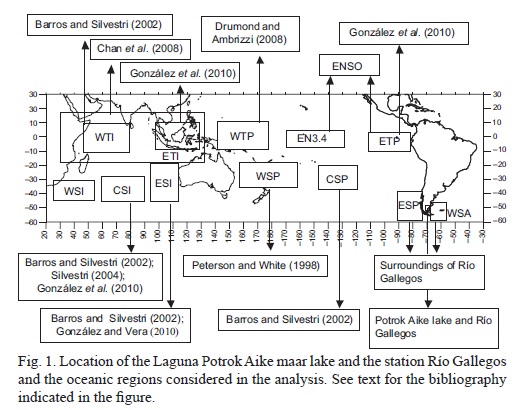
<body><![CDATA[<p align="justify"><font face="verdana" size="2">&nbsp;</font></p>  	    <p align="justify"><font face="verdana" size="2"><b>3.&nbsp;Methodology</b></font></p>  	    <p align="justify"><font face="verdana" size="2"><i>3.1 Selection of oceanic regions</i></font></p>  	    <p align="justify"><font face="verdana" size="2">The precedents listed in section 1 about the influence of the SST of the Indian and Pacific oceans on SSA precipitation variability were taken into account to select specific oceanic regions in which to focus the analysis. The regions and the corresponding references are shown in <a href="#f1">Fig. 1</a>.</font></p>  	    <p align="justify"><font face="verdana" size="2">Five regions were delimited in the Indian Ocean. The influence of the IOD on SSA precipitation described by Chan <i>et al.</i> (2008), the significant relation between western tropical Indian with the subtropical SSA precipitation showed by Barros and Silvestri (2002) and the relation between the eastern tropical Indian with the precipitation near the eastern slope of southern Andes showed by Gonzalez <i>et al.</i> (2010) were considered in order to select the two regions in the tropical ocean identified as Eastern Tropical Indian (ETI) and Western Tropical Indian (WTI). The Central Subtropical Indian (CSI) region was delimited in consideration of its relations with the precipitation over SSA showed by Barros and Silvestri (2002), Silvestri (2004) and Gonz&aacute;lez <i>et al.</i> (2010) while the results of Barros and Silvestri (2002) and Gonzalez and Vera (2010) suggest the isolation of the Eastern Subtropical Indian (ESI) region. Although there are no precedents for the possible influence of the Western Subtropical Indian (WSI) region on precipitation over SSA, it was also considered in the analysis.</font></p>  	    <p align="justify"><font face="verdana" size="2">In the tropical Pacific, the typical El Ni&ntilde;o 3.4 (EN34) region was taken into account as well as the Eastern Tropical Pacific region (ETP) around the El Ni&ntilde;o 1+2 sector for which Gonz&aacute;lez <i>et al.</i> (2010) show a relation with western SSA precipitation. The Western Tropical Pacific region (WTP) was considered following the conclusions of Drumond and Ambrizzi (2008). According to the results of Peterson and White (1999) the Western Subtropical Pacific region (WSP) was delimited as well as the Central Subtropical Pacific region (CSP) similar to that defined by Barros and Silvestri (2002).</font></p>  	    <p align="justify"><font face="verdana" size="2">Although the oceanic regions in the tropical&#45;subtropical areas of Indian and Pacific oceans were chosen based on results of previous studies performed for seasonal means, it is clear than such regions are almost uniformly distributed over each ocean. In other words, the selected regions cover the eastern, central and western areas of tropical and subtropical Indian and Pacific oceans.</font></p>  	    <p align="justify"><font face="verdana" size="2">Oceanic regions in the surrounding of the SSA were also considered in the analysis. Specifically, the regions Eastern South Pacific (ESP) and Western South Atlantic (WSA) were incorporated into the study.</font></p>  	    <p align="justify"><font face="verdana" size="2">&nbsp;</font></p>  	    <p align="justify"><font face="verdana" size="2"><i>3.2 Relations between time series</i></font></p>  	    ]]></body>
<body><![CDATA[<p align="justify"><font face="verdana" size="2">In order to analyze relations between time series at multiple periodicities, the wavelet coherence analysis (WTC) (Torrence and Compo, 1998; Torrence and Webster, 1999; Grinsted <i>et al,</i> 2004) was applied. This methodology is especially useful in highlighting the time and frequency intervals for which two time series have strong interaction. Detailed information about calculation and interpretation of WTC results can be found in Grinsted <i>et al.</i> (2004) and Velasco and Mendoza (2008), among others. To summarize, the wavelet squared coherency is a measure of the intensity of the covariance of the two series in time&#45;frequency space (Torrence and Webster, 1999). When the WTC = 1 it indicates that all frequency components of the output signal (reaction of the system) correspond to the input (action) meaning that there is synchronization between the output signal and the input signal. The synchronization can be in phase, frequency and/or amplitude (Velasco, 2010).</font></p>  	    <p align="justify"><font face="verdana" size="2">If WTC is small, then the reaction of the system is not related to action due to the presence of noise, nonlinearities and time delays in the system (Velasco, 2010). Another way to calculate the coherence of the system is through the relation signal/noise (Velasco <i>et al,</i> 2010) <i>WTC</i> <sub>s/n</sub> as:</font></p>  	    <p align="justify"><font face="verdana" size="2"><i>WTC</i> <sub>s/n</sub> = <i>WTC</i> x (1&#45;<i>WTC</i>)<sup>&#45;1</sup>. This method was used in this work because it allows the minimization of the effects of noise and to find the characteristics of each relationship.</font></p>  	    <p align="justify"><font face="verdana" size="2">If the coherence of two series is high, arrows in the coherence spectra show the phase between the phenomena. Arrows at 0&deg; (horizontal right) indicate that both phenomena are in phase, and arrows at 180&deg; (horizontal left) indicate that they are in anti&#45;phase. Arrows at other angles (vertical up and down, etcetera) indicate an out&#45;of&#45;phase relation which means that the two phenomena have a lagged time link. The statistical significance level of the wavelet coherence is estimated using Monte Carlo methods with red noise to determine the 95 % significance level (Torrence and Webster, 1999).</font></p>  	    <p align="justify"><font face="verdana" size="2">Since the wavelet transform is a band pass filter, the reconstruction of the time series or the decomposition of a signal can be obtained from the wavelet inverse (Torrence and Compo, 1998). This methodology was applied here to isolate specific oscillations in the analyzed time series. It is important to mention that the definition of wavelet coherence closely resembles the typical correlation coefficient, that can be thought of as a localized correlation coefficient in the space of time frequency (Moore <i>et al.,</i> 2006).</font></p>  	    <p align="justify"><font face="verdana" size="2">Several precedents exist for the application of this methodology in diverse areas of science including studies on oceanic and atmospheric variability (e.g., Jevrejeva <i>et al,</i> 2004; M&uuml;ller <i>et al.,</i> 2008).</font></p>  	    <p align="justify"><font face="verdana" size="2">&nbsp;</font></p>  	    <p align="justify"><font face="verdana" size="2"><b>4. Results and discussion</b></font></p>  	    <p align="justify"><font face="verdana" size="2"><i>4.1 Indian Ocean</i></font></p>  	    <p align="justify"><font face="verdana" size="2">In the tropical Indian Ocean, the wavelet coherence analysis reveals poor connections between the time series of PP<sub>RG</sub> and the SST in the region WTI (<a href="/img/revistas/atm/v25n3/a1f3.jpg" target="_blank">Fig. 3a</a>). Significant links take place only during the 1980s&#45;1990s in periodicities shorter than 5 yr being lagged time relations as are expressed by the non&#45;horizontal orientation of the corresponding phase arrows.</font></p>  	    ]]></body>
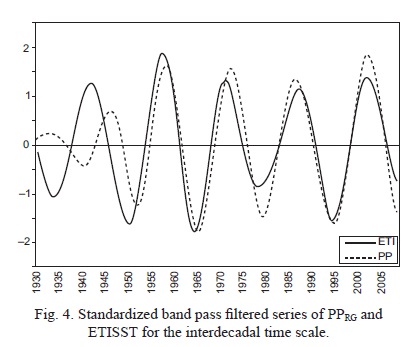
<body><![CDATA[<p align="justify"><font face="verdana" size="2">The relation between PP<sub>RG</sub> and SST in the tropical region ETI is mainly characterized by a stationary in&#45;phase relation in interdecadal time scales (bands around 15 yr) after the 1950s describing a connection of type warm (cold) ocean&#45;more (less) precipitation in this specific periodicity (<a href="/img/revistas/atm/v25n3/a1f3.jpg" target="_blank">Fig. 3b</a>). Together with these in&#45;phase links, there are relations in anti&#45;phase in waves shorter than 2 yr around 1960, in waves of around 5 yr in the 1970s and in waves of around 4 yr in the 1990s. In phase relations in periodicities around 4 yr during the 1940s and lagged connections in bands around 8 yr during 1930s&#45;1940s are also detected. These results show a relation between PP<sub>RG</sub> and ETI<sub>SST</sub> in which over the stationary in&#45;phase relation in the interdecadal band overlap other relations in phase, anti&#45;phase or time lagged during some specific decades in the shortest waves. This suggests that the eastern tropical Indian Ocean could have acted as a forcing of the PP<sub>RG</sub> in different ways depending on the band of frequency and the timeframe in question.</font></p>  	    <p align="justify"><font face="verdana" size="2">In the subtropical areas, the most prominent feature in the wavelet coherence analysis between PP<sub>RG</sub> and the SST in the region WSI is the in&#45;phase or quasi&#45;in&#45;phase connections in the interdecadal band after the 1960s suggesting a relation of the type a warm (cold) ocean&#45;more (less) precipitation (<a href="/img/revistas/atm/v25n3/a1f3.jpg" target="_blank">Fig. 3c</a>). Significant time lagged relations are also observed in the shortest periodicities during specific years.</font></p>  	    <p align="justify"><font face="verdana" size="2">The link between PP<sub>RG</sub> and SST in the region CSI is mainly characterized by a significant anti&#45;phase relation in the decadal time scale (oscillations around 8 yrs) (<a href="/img/revistas/atm/v25n3/a1f3.jpg" target="_blank">Fig. 3d</a>). The suggested connection is the type warm (cold) ocean&#45;less (more) precipitation for this band of variability but there is a clear interruption around 1980 coinciding with the 1976&#45;77 climate shift (e.g., Nitta and Yamada, 1989; Trenberth, 1990). The analysis also reveals significant time lagged relations in oscillations shorter than 4 yr 1930s&#45;1940s and 1980s&#45;1990s. Although they are not significant in the global wavelet coherence spectrum, in&#45;phase relations in the largest periodicities seem to be important after the 1960s.</font></p>  	    <p align="justify"><font face="verdana" size="2">The SST in the region ESI has significant in&#45;phase or quasi&#45;in&#45;phase relations with PP<sub>RG</sub> in the shortest oscillations before the 1960s occurring simultaneously with quasi&#45;anti&#45;phase links in oscillations of the decadal time scale (<a href="/img/revistas/atm/v25n3/a1f3.jpg" target="_blank">Fig. 3e</a>).</font></p>  	    <p align="justify"><font face="verdana" size="2">For the shortest oscillations, results here reported describe significant relations between the time variability of PP<sub>RG</sub> and the SST of the Indian Ocean, being in&#45;phase, anti&#45;phase or time lagged relations, only during specific years. Although it could be possible that atmospheric perturbations have been temporarily excited in these oceanic regions establishing relations with the precipitation, the non&#45;stationary character of such relations make it difficult to associate physical explanations for them. In contrast, the stationary or almost stationary character of the relation of the PP<sub>RG</sub> with three specific oceanic regions suggests the existence of dynamic mechanisms establishing a real physical connection between these variables. Such special cases are the relation of PP<sub>RG</sub> with the SST in CSI region in the decadal time scale and the links of PP<sub>RG</sub> with the SST in regions ETI and WSI in interdecadal oscillations. Mechanisms associated to Rossby wave propagation (see section 1) could explain these connections. The band pass filtered series was applied to confirm all mentioned significant relations. As an example, the relation between PP<sub>RG</sub> and SST in the region ETI in the interdecadal time scale is shown in <a href="#f4">Figure 4</a>. The similarity of both interdecadal time scale components after the 1950s is clear as well as the disconnection in 1930s&#45;1940s.</font></p>         <p align="center"><font face="verdana" size="2"><a name="f4"></a></font></p>      <p align="center"><font face="verdana" size="2"><img src="/img/revistas/atm/v25n3/a1f4.jpg"></font></p>  	    <p align="justify"><font face="verdana" size="2">The in&#45;phase or quasi&#45;in&#45;phase common relations between PP<sub>RG</sub>, ETI<sub>SST</sub> and WSI<sub>SST</sub> in interdecadal scales suggest at least two options: The atmospheric perturbations reaching SSA in such time scales are excited in both areas of the Indian Ocean or such perturbations originate in one of these regions and have a spurious connection with the other one. The statistical analysis here presented does not allow a distinction to be made between these options. Focusing the attention on the relations among different oceanic regions, the significant links of PP<sub>RG</sub> with both ETI<sub>SST</sub> and WSI<sub>SST</sub> in interdecadal oscillations suggest a close connection between the two SST series in this specific band of variability. In fact, significant links are observed between ETI<sub>SST</sub> and WSI<sub>SST</sub> in the shortest oscillations during some years but the most prominent feature of their relation is the stationary in&#45;phase or quasi&#45;in&#45;phase link in interdecadal periodicities (<a href="/img/revistas/atm/v25n3/a1f5.jpg" target="_blank">Fig. 5a</a>). Stationary connections only in the interdecadal time scale are also observed between both series and CSI<sub>SST</sub> (<a href="/img/revistas/atm/v25n3/a1f5.jpg" target="_blank">Figs. 5b&#45;c</a>) and between the WTI<sub>SST</sub> and CSI<sub>SST</sub>, except around 1980 (<a href="/img/revistas/atm/v25n3/a1f5.jpg" target="_blank">Fig. 5d</a>). The regions CSI and ESI have sporadic links in the shortest oscillations and stationary time lagged relations in the decadal band (figure not shown).</font></p>  	    <p align="justify"><font face="verdana" size="2">&nbsp;</font></p>  	    <p align="justify"><font face="verdana" size="2"><i>4.2 Pacific ocean</i></font></p>  	    ]]></body>
<body><![CDATA[<p align="justify"><font face="verdana" size="2">In the tropical Pacific, the PP<sub>RG</sub> has a significant lagged time relation with the SST in the region WTP in the decadal time scale from the 1930s to 1980s (<a href="/img/revistas/atm/v25n3/a1f6.jpg" target="_blank">Fig. 6a</a>). In&#45;phase or quasi&#45;in&#45;phase links in oscillations of the 4&#45;8 yrs (into the ENSO time scale) during the 1990s&#45;2000s are the most prominent feature revealed by the wavelet coherence analysis for the relations of PP<sub>RG</sub> with the SST in the regions EN34 and ETP (<a href="/img/revistas/atm/v25n3/a1f6.jpg" target="_blank">Fig. 6b&#45;c</a>). These results clearly demonstrate that the variability of precipitation over southernmost South America does not have an important connection with the central and eastern areas of the tropical Pacific.</font></p>  	    <p align="justify"><font face="verdana" size="2">In the subtropical areas, time lagged links in decadal oscillations exist between PP<sub>RG</sub> and the SST in the regions WSP and CSP before the 1980s (<a href="/img/revistas/atm/v25n3/a1f6.jpg" target="_blank">Fig. 6d&#45;e</a>). In both cases, the wavelet coherence analysis also reveals significant in&#45;phase links in the interdecadal time scale since the 1950s describing a connection of the type warm (cold) ocean&#45;more (less) precipitation over southernmost South America.</font></p>  	    <p align="justify"><font face="verdana" size="2">A complex pattern in the space of frequencies is described by the relations between PP<sub>RG</sub> and the SST in the region ESP (<a href="/img/revistas/atm/v25n3/a1f6.jpg" target="_blank">Fig. 6f</a>). Significant links occur in oscillations shorter than 15 yr in different periods of time but have, in general, an anti&#45;phase character.</font></p>  	    <p align="justify"><font face="verdana" size="2">As a consequence of the preceding analysis of statistical relations between the time series of PP<sub>RG</sub> and the SST in different areas of the Pacific Ocean, links among some oceanic regions are clearly detected. Specifically, the western tropical, western subtropical and central subtropical areas of the Pacific have a common relation with PP<sub>RG</sub> in decadal time scale before the 1980s suggesting that these three oceanic regions are interlinked in this band of variability. This characteristic comes to light with the wavelet coherence analysis performed for the mentioned SST, being easy to see the significant in&#45;phase or quasi&#45;in&#45;phase relations in the decadal band (<a href="/img/revistas/atm/v25n3/a1f7.jpg" target="_blank">Fig. 7a&#45;c</a>). The common association of the western and central regions of the subtropical Pacific with the PP<sub>RG</sub> in the interdecadal band suggests that both oceanic areas also have significant co&#45;variability in that periodicity. It is confirmed by the wavelet coherence analysis performed for the corresponding time series of SST (<a href="/img/revistas/atm/v25n3/a1f7.jpg" target="_blank">Fig. 7c</a>). The band pass filtered series isolating the interdecadal periodicities clearly shows the mentioned similarity between the variability of PP<sub>RG</sub> and the western subtropical and central subtropical Pacific after the 1960s as well as the in&#45;phase relation between both oceanic regions since 1930 (<a href="#f8">Fig. 8</a>).</font></p>  	    <p align="center"><font face="verdana" size="2"><a name="f8"></a></font></p>  	    <p align="center"><font face="verdana" size="2"><img src="/img/revistas/atm/v25n3/a1f8.jpg"></font></p>  	    <p align="justify"><font face="verdana" size="2">&nbsp;</font></p>  	    <p align="justify"><font face="verdana" size="2"><i>4.3 Indian&#45;Pacific oceans</i></font></p>  	    <p align="justify"><font face="verdana" size="2">To detect real or spurious precipitation&#45;SST links in decadal and interdecadal time scales is a very complex problem because regions of the Indian and Pacific oceans have the same relations with the southernmost South America precipitation, but they also have relations between themselves.</font></p>  	    <p align="justify"><font face="verdana" size="2">In fact, the regions ESI and CSI in the Indian Ocean and WTP, WSP and CSP in the Pacific have a common relation with PP<sub>RG</sub> in the decadal time scale (<a href="/img/revistas/atm/v25n3/a1f3.jpg" target="_blank">Figs. 3</a> and <a href="/img/revistas/atm/v25n3/a1f6.jpg" target="_blank">6</a>), but they also have significant links between them in this band of variability (see <a href="/img/revistas/atm/v25n3/a1f7.jpg" target="_blank">Fig. 7</a> for regions in the Pacific; the other figures are not shown). In the interdecadal time scale, the regions ETI and WSI in the Indian Ocean and WSP and CSP in the Pacific have in&#45;phase links with PP<sub>RG</sub> (<a href="/img/revistas/atm/v25n3/a1f3.jpg" target="_blank">Figs. 3</a> and <a href="/img/revistas/atm/v25n3/a1f6.jpg" target="_blank">6</a>), but they are also linked between themselves in each basin (<a href="/img/revistas/atm/v25n3/a1f5.jpg" target="_blank">Figs. 5a</a> and <a href="/img/revistas/atm/v25n3/a1f7.jpg" target="_blank">7c</a>) and with the regions of the other ocean (<a href="/img/revistas/atm/v25n3/a1f9.jpg" target="_blank">Fig. 9</a>). It is important to point out that the interdecadal band is the only one in which the mentioned regions of the Indian Ocean are stationary linked with the regions of the Pacific Ocean.</font></p>  	    ]]></body>
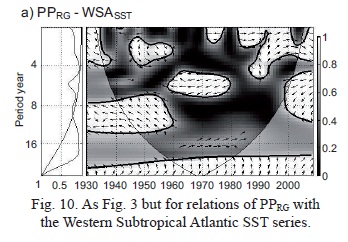
<body><![CDATA[<p align="justify"><font face="verdana" size="2">&nbsp;</font></p>  	    <p align="justify"><font face="verdana" size="2"><i>4.4 Atlantic Ocean</i></font></p>  	    <p align="justify"><font face="verdana" size="2">The wavelet coherence analysis performed between the PP<sub>RG</sub> and the SST of the surrounding Atlantic shows that these time series have significant relation only in oscillations shorter than 8 yr during some specific decades (<a href="#f10">Fig. 10</a>). In other words, the conditions leading to more or less precipitation over southernmost South America seem to be indifferent to the characteristics of the SST in the southwestern portion of the Atlantic Ocean.</font></p>  	    <p align="center"><font face="verdana" size="2"><a name="f10"></a></font></p>  	    <p align="center"><font face="verdana" size="2"><img src="/img/revistas/atm/v25n3/a1f10.jpg"></font></p>  	    <p align="justify"><font face="verdana" size="2">&nbsp;</font></p>  	    <p align="justify"><font face="verdana" size="2"><b>5. Conclusions</b></font></p>  	    <p align="justify"><font face="verdana" size="2">Southernmost South America is a region of low population in which complete and reliable climatic information is available from only a few stations. In the area to the east of the Andes Cordillera only one meteorological station has complete and highly reliable data of precipitation for the last eighty years. Analysis of this specific information provides a unique opportunity to understand not only the characteristics of the variability of precipitation over this remote region of the world but also the oceanic forcing associated to that variability during most of the last century. It is no less important to emphasize that this particular meteorological station is located a few kilometers from the Laguna Potrok Aike lake, for which the paleoclimatic reconstructions reveal notable fluctuations of the water level across time. Therefore, the analysis of the precipitation in this region is also an important first step to understand the origin of such fluctuations.</font></p>  	    <p align="justify"><font face="verdana" size="2">The study was performed with the methodology of wavelet coherence analysis which allows a description of the relations between two time series simultaneously in all the space of frequencies. In this analysis, annual means of monthly anomalies of precipitation and SST have been considered.</font></p>  	    <p align="justify"><font face="verdana" size="2">The most notable oceanic relation with the southernmost South America precipitation can be summarized as follows: i) eastern and central subtropical Indian, western tropical Pacific, western and central subtropical Pacific could be forcing the decadal time scale variability of precipitation; ii) eastern tropical and western subtropical Indian, western and central subtropical Pacific could be modulating the interdecadal time scale variability of precipitation. These relations are schematized in <a href="#f11">Figure 11</a>.</font></p>  	    ]]></body>
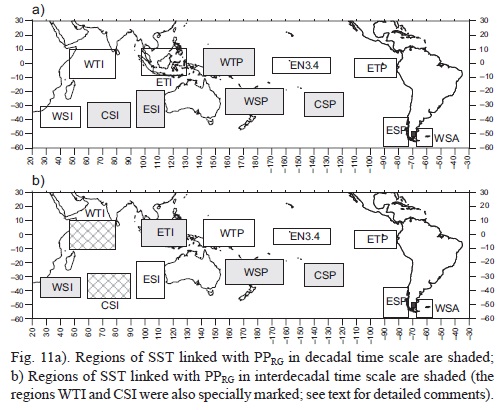
<body><![CDATA[<p align="center"><font face="verdana" size="2"><a name="f11"></a></font></p>  	    <p align="center"><font face="verdana" size="2"><img src="/img/revistas/atm/v25n3/a1f11.jpg"></font></p>  	    <p align="justify"><font face="verdana" size="2">The oceanic influence on southernmost South America precipitation could be the input to understand the causes of the changes in the level of the Potrok Aike lake. In particular, the paleoclimatic reconstructions of the lake's level describe a decrease of the level from the 1920s to the 1960s and an increment since the 1970s (<a href="#f2">Fig. 2</a>). Results shown here describe an influence of areas of the Indian and Pacific oceans in decadal time scale before the 1970s, being relations in antiphase, quasi&#45;anti&#45;phase or with a pronounced lag time (<a href="/img/revistas/atm/v25n3/a1f3.jpg" target="_blank">Figs. 3</a> and <a href="/img/revistas/atm/v25n3/a1f6.jpg" target="_blank">6</a>). But since the 1950s&#45;1960s, an in&#45;phase relation with areas of both oceans is detected in the interdecadal variability of the precipitation. This change in the characteristics of the links between the southernmost South American precipitation and the SST around the 1960s could be the key to discover the causes of the fluctuations of the lake's level across time. More investigations incorporating paleoceanography and paleoclimatic data must be done in future studies to better describe this issue.</font></p>  	    <p align="justify"><font face="verdana" size="2">Although the research was focused on the oceanic influence on the precipitation over southernmost South America, relations between the SST in different regions of the Indian and Pacific oceans has also been detected in the space of frequencies. In fact, the central and eastern areas of the subtropical Indian, the western tropical Pacific and the western and central subtropical Pacific (<a href="#f11">Fig. 11a</a>) have an in&#45;phase or quasi&#45;in&#45;phase relation in the decadal time scale. Moreover, the Indian Ocean (except the eastern subtropical area) and the western and central subtropical Pacific (<a href="#f11">Fig. 11b</a>) have an in&#45;phase or quasi&#45;in&#45;phase relation in the interdecadal time scale. The wavelet analysis shows that the mentioned oceanic regions are not statistically independent, but they are synchronized in frequency suggesting a coupled relation in those specific bands of variability.</font></p>  	    <p align="justify"><font face="verdana" size="2">The mentioned similarity in the variability of different regions of the Indian and Pacific oceans make it difficult to detect which regions have a real influence on southernmost South American precipitation. Further analysis considering methodologies based on the dynamic of the atmosphere must be done to better individualize the oceanic regions that are remote forcing of the regional climate in decadal and interdecadal time scales. Slow teleconnections like those described by Peterson and White (1999) could be the key to explain the relations here detected. However, these studies should be made considering outputs of global circulation models due to the scarce availability of meteorological information over most of the Southern Hemisphere before the 1980s. Although the reanalysis of NCEP&#45;NCAR and ECMWF provide information for the satellital period post 1979, the previous decades have no suitable information to perform the study of the possible influence of different patterns of atmospheric circulation on the climatic variability over southernmost South America.</font></p>  	    <p align="justify"><font face="verdana" size="2">&nbsp;</font></p>  	    <p align="justify"><font face="verdana" size="2"><b>Acknowledgements</b></font></p>  	    <p align="justify"><font face="verdana" size="2">Financial support was provided by grants UBACYT EX016, Agencia&#45;MINCYT PICT&#45;2007&#45;0043 8, PIP 114&#45;201001&#45;00250 and UBACYT No. 200201 00101049.</font></p>  	    <p align="justify"><font face="verdana" size="2">&nbsp;</font></p>  	    <p align="justify"><font face="verdana" size="2"><b>References</b></font></p>  	    ]]></body>
<body><![CDATA[<!-- ref --><p align="justify"><font face="verdana" size="2">Aceituno P., 1988. On the functioning of the southern oscillation in the south American sector. Part I: Surface climate. <i>Mon. Wea. Rev.</i> <b>116,</b> 505&#45;524.    &nbsp;&nbsp;&nbsp;&nbsp;&nbsp;&nbsp;&nbsp;&nbsp;[&#160;<a href="javascript:void(0);" onclick="javascript: window.open('/scielo.php?script=sci_nlinks&ref=1286435&pid=S0187-6236201200030000100001&lng=','','width=640,height=500,resizable=yes,scrollbars=1,menubar=yes,');">Links</a>&#160;]<!-- end-ref --></font></p>  	    <!-- ref --><p align="justify"><font face="verdana" size="2">Anselmetti F., D. Ariztegui, M. De Batist, A. Gebhardt, T. Haberzettl, F. Niessen, C. Ohlendorf and B. Zolitschka, 2009. Environmental history of southern Patagonia unravelled by the seismic stratigraphy of Laguna Potrok Aike. <i>Sedimentology</i> <b>56,</b> 873&#45;892.    &nbsp;&nbsp;&nbsp;&nbsp;&nbsp;&nbsp;&nbsp;&nbsp;[&#160;<a href="javascript:void(0);" onclick="javascript: window.open('/scielo.php?script=sci_nlinks&ref=1286437&pid=S0187-6236201200030000100002&lng=','','width=640,height=500,resizable=yes,scrollbars=1,menubar=yes,');">Links</a>&#160;]<!-- end-ref --></font></p>  	    <!-- ref --><p align="justify"><font face="verdana" size="2">Aravena J. and B. Luckman, 2009. Spatio&#45;temporal rainfall patterns in Southern South America. <i>Int. J. Climatol.</i> <b>29,</b> 2106&#45;2120.    &nbsp;&nbsp;&nbsp;&nbsp;&nbsp;&nbsp;&nbsp;&nbsp;[&#160;<a href="javascript:void(0);" onclick="javascript: window.open('/scielo.php?script=sci_nlinks&ref=1286439&pid=S0187-6236201200030000100003&lng=','','width=640,height=500,resizable=yes,scrollbars=1,menubar=yes,');">Links</a>&#160;]<!-- end-ref --></font></p>  	    <!-- ref --><p align="justify"><font face="verdana" size="2">Baquero&#45;Bernal A., M. Latif and S. Legutke, 2002. On dipolelike variability of sea surface temperature in the tropical Indian Ocean. <i>J. Climate</i> <b>15,</b> 1358&#45;1368.    &nbsp;&nbsp;&nbsp;&nbsp;&nbsp;&nbsp;&nbsp;&nbsp;[&#160;<a href="javascript:void(0);" onclick="javascript: window.open('/scielo.php?script=sci_nlinks&ref=1286441&pid=S0187-6236201200030000100004&lng=','','width=640,height=500,resizable=yes,scrollbars=1,menubar=yes,');">Links</a>&#160;]<!-- end-ref --></font></p>  	    <!-- ref --><p align="justify"><font face="verdana" size="2">Barros V. and G. Silvestri, 2002. The relationship between sea surface temperature at the subtropical south&#45;central Pacific and precipitation in southeastern South America. <i>J. Climate</i> <b>15,</b> 251&#45;267.    &nbsp;&nbsp;&nbsp;&nbsp;&nbsp;&nbsp;&nbsp;&nbsp;[&#160;<a href="javascript:void(0);" onclick="javascript: window.open('/scielo.php?script=sci_nlinks&ref=1286443&pid=S0187-6236201200030000100005&lng=','','width=640,height=500,resizable=yes,scrollbars=1,menubar=yes,');">Links</a>&#160;]<!-- end-ref --></font></p>  	    ]]></body>
<body><![CDATA[<!-- ref --><p align="justify"><font face="verdana" size="2">Berbery E., J. Nogues&#45;Paegle and J. Horel, 1992. Wavelike Southern Hemisphere extratropical teleconnections. <i>J. Atmos. Sci.</i> <b>49,</b> 155&#45;157.    &nbsp;&nbsp;&nbsp;&nbsp;&nbsp;&nbsp;&nbsp;&nbsp;[&#160;<a href="javascript:void(0);" onclick="javascript: window.open('/scielo.php?script=sci_nlinks&ref=1286445&pid=S0187-6236201200030000100006&lng=','','width=640,height=500,resizable=yes,scrollbars=1,menubar=yes,');">Links</a>&#160;]<!-- end-ref --></font></p>  	    <!-- ref --><p align="justify"><font face="verdana" size="2">Borrelli P. and G. Oliva G., 2001. Ganader&iacute;a ovina sustentable en la Patagonia Austral&#45;Tecnolog&iacute;a de manejo extensivo. INTA&#45;UNPA&#45;CAP, R&iacute;o Gallegos, Patagonia Sur, 270 pp.    &nbsp;&nbsp;&nbsp;&nbsp;&nbsp;&nbsp;&nbsp;&nbsp;[&#160;<a href="javascript:void(0);" onclick="javascript: window.open('/scielo.php?script=sci_nlinks&ref=1286447&pid=S0187-6236201200030000100007&lng=','','width=640,height=500,resizable=yes,scrollbars=1,menubar=yes,');">Links</a>&#160;]<!-- end-ref --></font></p>  	    <!-- ref --><p align="justify"><font face="verdana" size="2">Chan S., S. Behera and T. Yamagata, 2008. Indian Ocean dipole influence on South American rainfall. <i>Geophys. Res. Lett.</i> 35, L14S12, doi:10.1029/2008GL034204.    &nbsp;&nbsp;&nbsp;&nbsp;&nbsp;&nbsp;&nbsp;&nbsp;[&#160;<a href="javascript:void(0);" onclick="javascript: window.open('/scielo.php?script=sci_nlinks&ref=1286449&pid=S0187-6236201200030000100008&lng=','','width=640,height=500,resizable=yes,scrollbars=1,menubar=yes,');">Links</a>&#160;]<!-- end-ref --></font></p>  	    <!-- ref --><p align="justify"><font face="verdana" size="2">Dommenget D. and M. Latif, 2002. A cautionary note on the interpretation of EOFs. <i>J. Climate</i> <b>15,</b> 216&#45;225.    &nbsp;&nbsp;&nbsp;&nbsp;&nbsp;&nbsp;&nbsp;&nbsp;[&#160;<a href="javascript:void(0);" onclick="javascript: window.open('/scielo.php?script=sci_nlinks&ref=1286451&pid=S0187-6236201200030000100009&lng=','','width=640,height=500,resizable=yes,scrollbars=1,menubar=yes,');">Links</a>&#160;]<!-- end-ref --></font></p>  	    <!-- ref --><p align="justify"><font face="verdana" size="2">Drumond A. and T. Ambrizzi, 2008. The role of the South Indian and Pacific oceans in South American monsoon variability. <i>Theor. Appl. Climatol.</i> <b>94,</b> 125&#45;137.    &nbsp;&nbsp;&nbsp;&nbsp;&nbsp;&nbsp;&nbsp;&nbsp;[&#160;<a href="javascript:void(0);" onclick="javascript: window.open('/scielo.php?script=sci_nlinks&ref=1286453&pid=S0187-6236201200030000100010&lng=','','width=640,height=500,resizable=yes,scrollbars=1,menubar=yes,');">Links</a>&#160;]<!-- end-ref --></font></p>  	    ]]></body>
<body><![CDATA[<!-- ref --><p align="justify"><font face="verdana" size="2">Gonz&aacute;lez M., M. Skansi and F. Losano, 2010. A statistical study of seasonal winter rainfall prediction in the Comahue region (Argentina). <i>Atm&oacute;sfera</i> <b>23,</b> 277&#45;294.    &nbsp;&nbsp;&nbsp;&nbsp;&nbsp;&nbsp;&nbsp;&nbsp;[&#160;<a href="javascript:void(0);" onclick="javascript: window.open('/scielo.php?script=sci_nlinks&ref=1286455&pid=S0187-6236201200030000100011&lng=','','width=640,height=500,resizable=yes,scrollbars=1,menubar=yes,');">Links</a>&#160;]<!-- end-ref --></font></p>  	    <!-- ref --><p align="justify"><font face="verdana" size="2">Gonz&aacute;lez M. and C. Vera, 2010. On the interannual wintertime rainfall variability in the southern Andes. <i>Int. J. Climatol.</i> <b>30,</b> 643&#45;657.    &nbsp;&nbsp;&nbsp;&nbsp;&nbsp;&nbsp;&nbsp;&nbsp;[&#160;<a href="javascript:void(0);" onclick="javascript: window.open('/scielo.php?script=sci_nlinks&ref=1286457&pid=S0187-6236201200030000100012&lng=','','width=640,height=500,resizable=yes,scrollbars=1,menubar=yes,');">Links</a>&#160;]<!-- end-ref --></font></p>  	    <!-- ref --><p align="justify"><font face="verdana" size="2">Grimm A. and T. Ambrizzi, 2009. Teleconnections into South America from the tropics and extratropics on interannual and intraseasonal timescales. In: <i>Past Climate Variability in South America and Surrounding Regions: From the Last Glacial Maximum to the Holocene, Developments in Paleoenvironmental Research</i> (F. Vimeux, F. Sylvestre and M. Khodri, Eds.) Springer, Netherlands, DOI: 10.1007/978&#45;90&#45;481&#45;2672&#45;9, 159&#45;193.    &nbsp;&nbsp;&nbsp;&nbsp;&nbsp;&nbsp;&nbsp;&nbsp;[&#160;<a href="javascript:void(0);" onclick="javascript: window.open('/scielo.php?script=sci_nlinks&ref=1286459&pid=S0187-6236201200030000100013&lng=','','width=640,height=500,resizable=yes,scrollbars=1,menubar=yes,');">Links</a>&#160;]<!-- end-ref --></font></p>  	    <!-- ref --><p align="justify"><font face="verdana" size="2">Grinsted A., J. Moore and S. Jevrejeva, 2004. Application of the cross wavelet transform and wavelet coherence to geophysical time series. <i>Nonlinear Proc. Geoph.</i> <b>11,</b> 561&#45;566.    &nbsp;&nbsp;&nbsp;&nbsp;&nbsp;&nbsp;&nbsp;&nbsp;[&#160;<a href="javascript:void(0);" onclick="javascript: window.open('/scielo.php?script=sci_nlinks&ref=1286461&pid=S0187-6236201200030000100014&lng=','','width=640,height=500,resizable=yes,scrollbars=1,menubar=yes,');">Links</a>&#160;]<!-- end-ref --></font></p>  	    <!-- ref --><p align="justify"><font face="verdana" size="2">Haberzettl T., M. Fey, A. Lucke, N. Maidana, Ch. Mayr, Ch. Ohlendorf, F. Schabitz, G. Schleser, M. Wille and B. Zolitschka, 2005. Climatically induced lake level changes during the last two millennia as reflected in sediments of Laguna Potrok Aike, southern Patagonia (Santa Cruz, Argentina). <i>J. Paleolimnol.</i> <b>33,</b> 283&#45;302.    &nbsp;&nbsp;&nbsp;&nbsp;&nbsp;&nbsp;&nbsp;&nbsp;[&#160;<a href="javascript:void(0);" onclick="javascript: window.open('/scielo.php?script=sci_nlinks&ref=1286463&pid=S0187-6236201200030000100015&lng=','','width=640,height=500,resizable=yes,scrollbars=1,menubar=yes,');">Links</a>&#160;]<!-- end-ref --></font></p>  	    ]]></body>
<body><![CDATA[<!-- ref --><p align="justify"><font face="verdana" size="2">Hoffmann, J., S. N&uacute;&ntilde;ez and W. Vargas, 1997. Temperature, humidity and precipitation variations in Argentina and the adjacent sub&#45;Antarctic region during the present century. <i>Meteorologische Zeitschrift</i> <b>6,</b> 3&#45;11.    &nbsp;&nbsp;&nbsp;&nbsp;&nbsp;&nbsp;&nbsp;&nbsp;[&#160;<a href="javascript:void(0);" onclick="javascript: window.open('/scielo.php?script=sci_nlinks&ref=1286465&pid=S0187-6236201200030000100016&lng=','','width=640,height=500,resizable=yes,scrollbars=1,menubar=yes,');">Links</a>&#160;]<!-- end-ref --></font></p>  	    <!-- ref --><p align="justify"><font face="verdana" size="2">Jevrejeva S., J. C. Moore and A. Grinsted, 2004. Oceanic and atmospheric transport of multiyear El Ni&ntilde;o&#45;Southern Oscillation (ENSO) signatures to the polar regions. <i>Geophys. Res. Lett.</i> <b>31,</b> L24210, doi:10.1029/2004GL020871.    &nbsp;&nbsp;&nbsp;&nbsp;&nbsp;&nbsp;&nbsp;&nbsp;[&#160;<a href="javascript:void(0);" onclick="javascript: window.open('/scielo.php?script=sci_nlinks&ref=1286467&pid=S0187-6236201200030000100017&lng=','','width=640,height=500,resizable=yes,scrollbars=1,menubar=yes,');">Links</a>&#160;]<!-- end-ref --></font></p>  	    <!-- ref --><p align="justify"><font face="verdana" size="2">Karoly D., 1989. Southern Hemisphere circulation features associated with El Ni&ntilde;o&#45;Southern oscillation events. <i>J. Climate</i> <b>2,</b> 1239&#45;1252.    &nbsp;&nbsp;&nbsp;&nbsp;&nbsp;&nbsp;&nbsp;&nbsp;[&#160;<a href="javascript:void(0);" onclick="javascript: window.open('/scielo.php?script=sci_nlinks&ref=1286469&pid=S0187-6236201200030000100018&lng=','','width=640,height=500,resizable=yes,scrollbars=1,menubar=yes,');">Links</a>&#160;]<!-- end-ref --></font></p>  	    <!-- ref --><p align="justify"><font face="verdana" size="2">Karoly D., R. A. Plumb and M. Ting, 1989. Examples of the horizontal propagation of quasi&#45;stationary waves. <i>J. Atmos. Sci.</i> <b>46,</b> 2802&#45;2811.    &nbsp;&nbsp;&nbsp;&nbsp;&nbsp;&nbsp;&nbsp;&nbsp;[&#160;<a href="javascript:void(0);" onclick="javascript: window.open('/scielo.php?script=sci_nlinks&ref=1286471&pid=S0187-6236201200030000100019&lng=','','width=640,height=500,resizable=yes,scrollbars=1,menubar=yes,');">Links</a>&#160;]<!-- end-ref --></font></p>  	    <!-- ref --><p align="justify"><font face="verdana" size="2">Karoly D. J., P. Hope and P. D. Jones, 1996. Decadal variations for the Southern Hemisphere circulation. <i>Int. J. Climatol.</i> <b>16,</b> 723&#45;738.    &nbsp;&nbsp;&nbsp;&nbsp;&nbsp;&nbsp;&nbsp;&nbsp;[&#160;<a href="javascript:void(0);" onclick="javascript: window.open('/scielo.php?script=sci_nlinks&ref=1286473&pid=S0187-6236201200030000100020&lng=','','width=640,height=500,resizable=yes,scrollbars=1,menubar=yes,');">Links</a>&#160;]<!-- end-ref --></font></p>  	    ]]></body>
<body><![CDATA[<!-- ref --><p align="justify"><font face="verdana" size="2">Mo K. C., 2000. Relationships between low&#45;frequency variability in the Southern Hemisphere and sea surface temperature anomalies. <i>J. Climate</i> <b>13,</b> 3599&#45;3620.    &nbsp;&nbsp;&nbsp;&nbsp;&nbsp;&nbsp;&nbsp;&nbsp;[&#160;<a href="javascript:void(0);" onclick="javascript: window.open('/scielo.php?script=sci_nlinks&ref=1286475&pid=S0187-6236201200030000100021&lng=','','width=640,height=500,resizable=yes,scrollbars=1,menubar=yes,');">Links</a>&#160;]<!-- end-ref --></font></p>  	    <!-- ref --><p align="justify"><font face="verdana" size="2">Montecinos A., A. Diaz and P. Aceituno, 2000. Seasonal diagnostic and predictability of rainfall in subtropical South America based on tropical Pacific SST. <i>J. Climate</i> <b>13,</b> 746&#45;758.    &nbsp;&nbsp;&nbsp;&nbsp;&nbsp;&nbsp;&nbsp;&nbsp;[&#160;<a href="javascript:void(0);" onclick="javascript: window.open('/scielo.php?script=sci_nlinks&ref=1286477&pid=S0187-6236201200030000100022&lng=','','width=640,height=500,resizable=yes,scrollbars=1,menubar=yes,');">Links</a>&#160;]<!-- end-ref --></font></p>  	    <!-- ref --><p align="justify"><font face="verdana" size="2">Moore J., A. Grinsted and S. Jevrejeva, 2006. Is there evidence for sunspot forcing of climate at multi&#45;year and decadal periods? <i>Geophys. Res. Lett.</i> <b>33,</b> L17705, doi:10.1029/2006GL026501.    &nbsp;&nbsp;&nbsp;&nbsp;&nbsp;&nbsp;&nbsp;&nbsp;[&#160;<a href="javascript:void(0);" onclick="javascript: window.open('/scielo.php?script=sci_nlinks&ref=1286479&pid=S0187-6236201200030000100023&lng=','','width=640,height=500,resizable=yes,scrollbars=1,menubar=yes,');">Links</a>&#160;]<!-- end-ref --></font></p>  	    <!-- ref --><p align="justify"><font face="verdana" size="2">M&uuml;ller W., C. Frankignoul and N. Chouaib, 2008. Observed decadal tropical Pacific&#45;North Atlantic teleconnections. <i>Geophys. Res. Lett.</i> <b>35,</b> L24810, doi:10.1029/2008GL035901.    &nbsp;&nbsp;&nbsp;&nbsp;&nbsp;&nbsp;&nbsp;&nbsp;[&#160;<a href="javascript:void(0);" onclick="javascript: window.open('/scielo.php?script=sci_nlinks&ref=1286481&pid=S0187-6236201200030000100024&lng=','','width=640,height=500,resizable=yes,scrollbars=1,menubar=yes,');">Links</a>&#160;]<!-- end-ref --></font></p>  	    <!-- ref --><p align="justify"><font face="verdana" size="2">Nitta T. and S. Yamada, 1989. Recent warming of tropical sea surface temperature and its relationship to the Northern Hemisphere circulation. <i>Journal of Meteorology Society of Japan</i> <b>67,</b> 375&#45;383.    &nbsp;&nbsp;&nbsp;&nbsp;&nbsp;&nbsp;&nbsp;&nbsp;[&#160;<a href="javascript:void(0);" onclick="javascript: window.open('/scielo.php?script=sci_nlinks&ref=1286483&pid=S0187-6236201200030000100025&lng=','','width=640,height=500,resizable=yes,scrollbars=1,menubar=yes,');">Links</a>&#160;]<!-- end-ref --></font></p>  	    ]]></body>
<body><![CDATA[<!-- ref --><p align="justify"><font face="verdana" size="2">Nogu&eacute;s&#45;Paegle J. and K. C. Mo, 2002. Linkages between summer rainfall variability over South America and sea surface temperature anomalies. <i>J. Climate</i> <b>15,</b> 1389&#45;1407.    &nbsp;&nbsp;&nbsp;&nbsp;&nbsp;&nbsp;&nbsp;&nbsp;[&#160;<a href="javascript:void(0);" onclick="javascript: window.open('/scielo.php?script=sci_nlinks&ref=1286485&pid=S0187-6236201200030000100026&lng=','','width=640,height=500,resizable=yes,scrollbars=1,menubar=yes,');">Links</a>&#160;]<!-- end-ref --></font></p>  	    <!-- ref --><p align="justify"><font face="verdana" size="2">Peterson R. and W. White, 1998. Slow oceanic teleconnections linking the Antarctic Circumpolar Wave with the tropical El Ni&ntilde;o&#45;Southern Oscillation. <i>J. Geophys. Res.</i> <b>103,</b> 24573&#45;24583.    &nbsp;&nbsp;&nbsp;&nbsp;&nbsp;&nbsp;&nbsp;&nbsp;[&#160;<a href="javascript:void(0);" onclick="javascript: window.open('/scielo.php?script=sci_nlinks&ref=1286487&pid=S0187-6236201200030000100027&lng=','','width=640,height=500,resizable=yes,scrollbars=1,menubar=yes,');">Links</a>&#160;]<!-- end-ref --></font></p>  	    <!-- ref --><p align="justify"><font face="verdana" size="2">Pisciottano G., A. D&iacute;az, G. Cazes and C. Mechoso, 1994. El Ni&ntilde;o&#45;Southern Oscillation impact on rainfall in Uruguay. <i>J. Climate</i> <b>7,</b> 1286&#45;1302.    &nbsp;&nbsp;&nbsp;&nbsp;&nbsp;&nbsp;&nbsp;&nbsp;[&#160;<a href="javascript:void(0);" onclick="javascript: window.open('/scielo.php?script=sci_nlinks&ref=1286489&pid=S0187-6236201200030000100028&lng=','','width=640,height=500,resizable=yes,scrollbars=1,menubar=yes,');">Links</a>&#160;]<!-- end-ref --></font></p>  	    <!-- ref --><p align="justify"><font face="verdana" size="2">Prohaska F., 1976. Climates of Central and South America. In: <i>World Survey of Climatology</i> (W. Schwerdtfeger, Ed.) Elsevier, Amsterdam, 13&#45;72.    &nbsp;&nbsp;&nbsp;&nbsp;&nbsp;&nbsp;&nbsp;&nbsp;[&#160;<a href="javascript:void(0);" onclick="javascript: window.open('/scielo.php?script=sci_nlinks&ref=1286491&pid=S0187-6236201200030000100029&lng=','','width=640,height=500,resizable=yes,scrollbars=1,menubar=yes,');">Links</a>&#160;]<!-- end-ref --></font></p>  	    <!-- ref --><p align="justify"><font face="verdana" size="2">Rayner N. A., P. Brohan, D. E. Parker, C. K. Folland, J. J. Kennedy, M. Vanicek, T. J. Ansell and S. F. B. Tett, 2006. Improved analyses of changes and uncertainties in sea surface temperature measured in situ since the mid&#45;nineteenth century: The HadSST2 data set. <i>J. Climate</i> <b>19,</b> 446&#45;469.    &nbsp;&nbsp;&nbsp;&nbsp;&nbsp;&nbsp;&nbsp;&nbsp;[&#160;<a href="javascript:void(0);" onclick="javascript: window.open('/scielo.php?script=sci_nlinks&ref=1286493&pid=S0187-6236201200030000100030&lng=','','width=640,height=500,resizable=yes,scrollbars=1,menubar=yes,');">Links</a>&#160;]<!-- end-ref --></font></p>  	    ]]></body>
<body><![CDATA[<!-- ref --><p align="justify"><font face="verdana" size="2">Ropelewski C. and S. Halpert, 1987. Global and regional scale precipitation patterns associated with the El Ni&ntilde;o&#45;Southern Oscillation. <i>Mon. Wea. Rev.</i> <b>115,</b> 1606&#45;1626.    &nbsp;&nbsp;&nbsp;&nbsp;&nbsp;&nbsp;&nbsp;&nbsp;[&#160;<a href="javascript:void(0);" onclick="javascript: window.open('/scielo.php?script=sci_nlinks&ref=1286495&pid=S0187-6236201200030000100031&lng=','','width=640,height=500,resizable=yes,scrollbars=1,menubar=yes,');">Links</a>&#160;]<!-- end-ref --></font></p>  	    <!-- ref --><p align="justify"><font face="verdana" size="2">Saji N., B. Goswami, P. Vinayachandran and T. Yamagata, 1999. A dipole mode in the tropical Indian Ocean. <i>Nature</i> <b>401,</b> 360&#45;363.    &nbsp;&nbsp;&nbsp;&nbsp;&nbsp;&nbsp;&nbsp;&nbsp;[&#160;<a href="javascript:void(0);" onclick="javascript: window.open('/scielo.php?script=sci_nlinks&ref=1286497&pid=S0187-6236201200030000100032&lng=','','width=640,height=500,resizable=yes,scrollbars=1,menubar=yes,');">Links</a>&#160;]<!-- end-ref --></font></p>  	    <!-- ref --><p align="justify"><font face="verdana" size="2">Schneider C. and D. Gies, 2004. Effects of El Ni&ntilde;o&#45;southern oscillation on southernmost South America precipitation at 53&deg; S revealed from NCEP&#45;NCAR reanalysis and weather station data. <i>Int. J. Climatol.</i> <b>24,</b> 1057&#45;1076.    &nbsp;&nbsp;&nbsp;&nbsp;&nbsp;&nbsp;&nbsp;&nbsp;[&#160;<a href="javascript:void(0);" onclick="javascript: window.open('/scielo.php?script=sci_nlinks&ref=1286499&pid=S0187-6236201200030000100033&lng=','','width=640,height=500,resizable=yes,scrollbars=1,menubar=yes,');">Links</a>&#160;]<!-- end-ref --></font></p>  	    <!-- ref --><p align="justify"><font face="verdana" size="2">Silvestri G. E, 2004. El Ni&ntilde;o signal variability in the precipitation over southeastern South America during austral summer. <i>Geophys. Res. Lett.</i> <b>31,</b> L18206, doi:10.1029/2004GL020590.    &nbsp;&nbsp;&nbsp;&nbsp;&nbsp;&nbsp;&nbsp;&nbsp;[&#160;<a href="javascript:void(0);" onclick="javascript: window.open('/scielo.php?script=sci_nlinks&ref=1286501&pid=S0187-6236201200030000100034&lng=','','width=640,height=500,resizable=yes,scrollbars=1,menubar=yes,');">Links</a>&#160;]<!-- end-ref --></font></p>  	    <!-- ref --><p align="justify"><font face="verdana" size="2">Torrence C. and G. Compo, 1998. A practical guide to wavelet analysis. <i>B. Am. Meteor. Soc.</i> <b>79,</b> 61&#45;78.    &nbsp;&nbsp;&nbsp;&nbsp;&nbsp;&nbsp;&nbsp;&nbsp;[&#160;<a href="javascript:void(0);" onclick="javascript: window.open('/scielo.php?script=sci_nlinks&ref=1286503&pid=S0187-6236201200030000100035&lng=','','width=640,height=500,resizable=yes,scrollbars=1,menubar=yes,');">Links</a>&#160;]<!-- end-ref --></font></p>  	    ]]></body>
<body><![CDATA[<!-- ref --><p align="justify"><font face="verdana" size="2">Torrence C. and P. Webster, 1999. Interdecadal changes in the ENSO&#45;monsoon system. <i>J. Climate</i> <b>12,</b> 2679&#45;2690.    &nbsp;&nbsp;&nbsp;&nbsp;&nbsp;&nbsp;&nbsp;&nbsp;[&#160;<a href="javascript:void(0);" onclick="javascript: window.open('/scielo.php?script=sci_nlinks&ref=1286505&pid=S0187-6236201200030000100036&lng=','','width=640,height=500,resizable=yes,scrollbars=1,menubar=yes,');">Links</a>&#160;]<!-- end-ref --></font></p>  	    <!-- ref --><p align="justify"><font face="verdana" size="2">Trenberth K., 1990. Recent observed interdecadal climate changes in the Northern Hemisphere. <i>B. Am. Meteor. Soc.</i> <b>71,</b> 988&#45;993.    &nbsp;&nbsp;&nbsp;&nbsp;&nbsp;&nbsp;&nbsp;&nbsp;[&#160;<a href="javascript:void(0);" onclick="javascript: window.open('/scielo.php?script=sci_nlinks&ref=1286507&pid=S0187-6236201200030000100037&lng=','','width=640,height=500,resizable=yes,scrollbars=1,menubar=yes,');">Links</a>&#160;]<!-- end-ref --></font></p>  	    <!-- ref --><p align="justify"><font face="verdana" size="2">van Loon H. and D. Shea, 1987. The Southern Oscillation. Part IV: Anomalies of the sea level pressure on the Southern Hemisphere and of Pacific sea surface temperature during the development of a warm event. <i>Mon. Wea. Rev.</i> <b>115,</b> 370&#45;379.    &nbsp;&nbsp;&nbsp;&nbsp;&nbsp;&nbsp;&nbsp;&nbsp;[&#160;<a href="javascript:void(0);" onclick="javascript: window.open('/scielo.php?script=sci_nlinks&ref=1286509&pid=S0187-6236201200030000100038&lng=','','width=640,height=500,resizable=yes,scrollbars=1,menubar=yes,');">Links</a>&#160;]<!-- end-ref --></font></p>  	    <!-- ref --><p align="justify"><font face="verdana" size="2">Velasco V. and B. Mendoza, 2008. Assessing the relationship between solar activity and some large scale climatic phenomena. <i>Adv. Space Res.</i> <b>42,</b> 866&#45;878.    &nbsp;&nbsp;&nbsp;&nbsp;&nbsp;&nbsp;&nbsp;&nbsp;[&#160;<a href="javascript:void(0);" onclick="javascript: window.open('/scielo.php?script=sci_nlinks&ref=1286511&pid=S0187-6236201200030000100039&lng=','','width=640,height=500,resizable=yes,scrollbars=1,menubar=yes,');">Links</a>&#160;]<!-- end-ref --></font></p>  	    <!-- ref --><p align="justify"><font face="verdana" size="2">Velasco Herrera V. M., 2010. The periodicity of the prolonged sunspot minima. 38th COSPAR Scientific Assembly, Bremen, Germany, 15&#45;18, July.    &nbsp;&nbsp;&nbsp;&nbsp;&nbsp;&nbsp;&nbsp;&nbsp;[&#160;<a href="javascript:void(0);" onclick="javascript: window.open('/scielo.php?script=sci_nlinks&ref=1286513&pid=S0187-6236201200030000100040&lng=','','width=640,height=500,resizable=yes,scrollbars=1,menubar=yes,');">Links</a>&#160;]<!-- end-ref --></font></p>  	    ]]></body>
<body><![CDATA[<!-- ref --><p align="justify"><font face="verdana" size="2">Velasco V., J. P&eacute;rez&#45;Peraza, G. Velasco and L. Luna Gonz&aacute;lez, 2010. African dust influence on Atlantic hurricane activity and the peculiar behaviour of category 5 hurricanes. <a href="http://arxiv.org/abs/1003.4769" target="_blank">http://arxiv.org/abs/1003.4769</a>. Acceded on March 24, 2010.    &nbsp;&nbsp;&nbsp;&nbsp;&nbsp;&nbsp;&nbsp;&nbsp;[&#160;<a href="javascript:void(0);" onclick="javascript: window.open('/scielo.php?script=sci_nlinks&ref=1286515&pid=S0187-6236201200030000100041&lng=','','width=640,height=500,resizable=yes,scrollbars=1,menubar=yes,');">Links</a>&#160;]<!-- end-ref --></font></p>  	    <!-- ref --><p align="justify"><font face="verdana" size="2">Vera C., G. Silvestri, V. Barros and A. Carril, 2004. Differences in El Ni&ntilde;o response over the Southern Hemisphere. <i>J. Climate</i> <b>17,</b> 1741&#45;1753.    &nbsp;&nbsp;&nbsp;&nbsp;&nbsp;&nbsp;&nbsp;&nbsp;[&#160;<a href="javascript:void(0);" onclick="javascript: window.open('/scielo.php?script=sci_nlinks&ref=1286517&pid=S0187-6236201200030000100042&lng=','','width=640,height=500,resizable=yes,scrollbars=1,menubar=yes,');">Links</a>&#160;]<!-- end-ref --></font></p>  	    <!-- ref --><p align="justify"><font face="verdana" size="2">Zolitschka B., F. Schabitz, A. Lucke, H. Corbella, B. Ercolano, M. Fey, T. Haberzettl, S. Janssen, N. Maidana, C. Mayr, C. Ohlendorf, G. Oliva, M. Paez, G. Schleser, J. Soto, P. Tiberi and M. Wille, 2006. Crater lakes of the Pali Aike volcanic field as key sites for paleoclimate and paleoecological reconstruction in southern Patagonia, Argentina. <i>J. S. Am. Earth Sci.</i> <b>21,</b> 294&#45;309.    &nbsp;&nbsp;&nbsp;&nbsp;&nbsp;&nbsp;&nbsp;&nbsp;[&#160;<a href="javascript:void(0);" onclick="javascript: window.open('/scielo.php?script=sci_nlinks&ref=1286519&pid=S0187-6236201200030000100043&lng=','','width=640,height=500,resizable=yes,scrollbars=1,menubar=yes,');">Links</a>&#160;]<!-- end-ref --></font></p>      ]]></body><back>
<ref-list>
<ref id="B1">
<nlm-citation citation-type="journal">
<person-group person-group-type="author">
<name>
<surname><![CDATA[Aceituno]]></surname>
<given-names><![CDATA[P.]]></given-names>
</name>
</person-group>
<article-title xml:lang="en"><![CDATA[On the functioning of the southern oscillation in the south American sector. Part I: Surface climate]]></article-title>
<source><![CDATA[Mon. Wea. Rev.]]></source>
<year>1988</year>
<volume>116</volume>
<page-range>505-524</page-range></nlm-citation>
</ref>
<ref id="B2">
<nlm-citation citation-type="journal">
<person-group person-group-type="author">
<name>
<surname><![CDATA[Anselmetti]]></surname>
<given-names><![CDATA[F.]]></given-names>
</name>
<name>
<surname><![CDATA[Ariztegui]]></surname>
<given-names><![CDATA[D.]]></given-names>
</name>
<name>
<surname><![CDATA[De Batist]]></surname>
<given-names><![CDATA[M.]]></given-names>
</name>
<name>
<surname><![CDATA[Gebhardt]]></surname>
<given-names><![CDATA[A.]]></given-names>
</name>
<name>
<surname><![CDATA[Haberzettl]]></surname>
<given-names><![CDATA[T.]]></given-names>
</name>
<name>
<surname><![CDATA[Niessen]]></surname>
<given-names><![CDATA[F.]]></given-names>
</name>
<name>
<surname><![CDATA[Ohlendorf]]></surname>
<given-names><![CDATA[C.]]></given-names>
</name>
<name>
<surname><![CDATA[Zolitschka]]></surname>
<given-names><![CDATA[B.]]></given-names>
</name>
</person-group>
<article-title xml:lang="en"><![CDATA[Environmental history of southern Patagonia unravelled by the seismic stratigraphy of Laguna Potrok Aike]]></article-title>
<source><![CDATA[Sedimentology]]></source>
<year>2009</year>
<volume>56</volume>
<page-range>873-892</page-range></nlm-citation>
</ref>
<ref id="B3">
<nlm-citation citation-type="journal">
<person-group person-group-type="author">
<name>
<surname><![CDATA[Aravena]]></surname>
<given-names><![CDATA[J.]]></given-names>
</name>
<name>
<surname><![CDATA[Luckman]]></surname>
<given-names><![CDATA[B.]]></given-names>
</name>
</person-group>
<article-title xml:lang="en"><![CDATA[Spatio-temporal rainfall patterns in Southern South America]]></article-title>
<source><![CDATA[Int. J. Climatol.]]></source>
<year>2009</year>
<volume>29</volume>
<page-range>2106-2120</page-range></nlm-citation>
</ref>
<ref id="B4">
<nlm-citation citation-type="journal">
<person-group person-group-type="author">
<name>
<surname><![CDATA[Baquero-Bernal]]></surname>
<given-names><![CDATA[A.]]></given-names>
</name>
<name>
<surname><![CDATA[Latif]]></surname>
<given-names><![CDATA[M.]]></given-names>
</name>
<name>
<surname><![CDATA[Legutke]]></surname>
<given-names><![CDATA[S.]]></given-names>
</name>
</person-group>
<article-title xml:lang="en"><![CDATA[On dipolelike variability of sea surface temperature in the tropical Indian Ocean]]></article-title>
<source><![CDATA[J. Climate]]></source>
<year>2002</year>
<volume>15</volume>
<page-range>1358-1368</page-range></nlm-citation>
</ref>
<ref id="B5">
<nlm-citation citation-type="journal">
<person-group person-group-type="author">
<name>
<surname><![CDATA[Barros]]></surname>
<given-names><![CDATA[V.]]></given-names>
</name>
<name>
<surname><![CDATA[Silvestri]]></surname>
<given-names><![CDATA[G.]]></given-names>
</name>
</person-group>
<article-title xml:lang="en"><![CDATA[The relationship between sea surface temperature at the subtropical south-central Pacific and precipitation in southeastern South America]]></article-title>
<source><![CDATA[J. Climate]]></source>
<year>2002</year>
<volume>15</volume>
<page-range>251-267</page-range></nlm-citation>
</ref>
<ref id="B6">
<nlm-citation citation-type="journal">
<person-group person-group-type="author">
<name>
<surname><![CDATA[Berbery]]></surname>
<given-names><![CDATA[E.]]></given-names>
</name>
<name>
<surname><![CDATA[Nogues-Paegle]]></surname>
<given-names><![CDATA[J.]]></given-names>
</name>
<name>
<surname><![CDATA[Horel]]></surname>
<given-names><![CDATA[J.]]></given-names>
</name>
</person-group>
<article-title xml:lang="en"><![CDATA[Wavelike Southern Hemisphere extratropical teleconnections]]></article-title>
<source><![CDATA[J. Atmos. Sci.]]></source>
<year>1992</year>
<volume>49</volume>
<page-range>155-157</page-range></nlm-citation>
</ref>
<ref id="B7">
<nlm-citation citation-type="book">
<person-group person-group-type="author">
<name>
<surname><![CDATA[Borrelli]]></surname>
<given-names><![CDATA[P.]]></given-names>
</name>
<name>
<surname><![CDATA[Oliva G.]]></surname>
<given-names><![CDATA[G.]]></given-names>
</name>
</person-group>
<source><![CDATA[Ganadería ovina sustentable en la Patagonia Austral-Tecnología de manejo extensivo]]></source>
<year>2001</year>
<page-range>270</page-range><publisher-loc><![CDATA[Río Gallegos^ePatagonia Sur Patagonia Sur]]></publisher-loc>
<publisher-name><![CDATA[INTA-UNPA-CAP]]></publisher-name>
</nlm-citation>
</ref>
<ref id="B8">
<nlm-citation citation-type="journal">
<person-group person-group-type="author">
<name>
<surname><![CDATA[Chan]]></surname>
<given-names><![CDATA[S.]]></given-names>
</name>
<name>
<surname><![CDATA[Behera]]></surname>
<given-names><![CDATA[S.]]></given-names>
</name>
<name>
<surname><![CDATA[Yamagata]]></surname>
<given-names><![CDATA[T.]]></given-names>
</name>
</person-group>
<article-title xml:lang="en"><![CDATA[Indian Ocean dipole influence on South American rainfall]]></article-title>
<source><![CDATA[Geophys. Res. Lett.]]></source>
<year>2008</year>
<volume>35</volume>
<page-range>L14S12</page-range></nlm-citation>
</ref>
<ref id="B9">
<nlm-citation citation-type="journal">
<person-group person-group-type="author">
<name>
<surname><![CDATA[Dommenget]]></surname>
<given-names><![CDATA[D.]]></given-names>
</name>
<name>
<surname><![CDATA[Latif]]></surname>
<given-names><![CDATA[M.]]></given-names>
</name>
</person-group>
<article-title xml:lang="en"><![CDATA[A cautionary note on the interpretation of EOFs]]></article-title>
<source><![CDATA[J. Climate]]></source>
<year>2002</year>
<volume>15</volume>
<page-range>216-225</page-range></nlm-citation>
</ref>
<ref id="B10">
<nlm-citation citation-type="journal">
<person-group person-group-type="author">
<name>
<surname><![CDATA[Drumond]]></surname>
<given-names><![CDATA[A.]]></given-names>
</name>
<name>
<surname><![CDATA[Ambrizzi]]></surname>
<given-names><![CDATA[T.]]></given-names>
</name>
</person-group>
<article-title xml:lang="en"><![CDATA[The role of the South Indian and Pacific oceans in South American monsoon variability]]></article-title>
<source><![CDATA[Theor. Appl. Climatol.]]></source>
<year>2008</year>
<volume>94</volume>
<page-range>125-137</page-range></nlm-citation>
</ref>
<ref id="B11">
<nlm-citation citation-type="journal">
<person-group person-group-type="author">
<name>
<surname><![CDATA[González]]></surname>
<given-names><![CDATA[M.]]></given-names>
</name>
<name>
<surname><![CDATA[Skansi]]></surname>
<given-names><![CDATA[M.]]></given-names>
</name>
<name>
<surname><![CDATA[Losano]]></surname>
<given-names><![CDATA[F.]]></given-names>
</name>
</person-group>
<article-title xml:lang="en"><![CDATA[A statistical study of seasonal winter rainfall prediction in the Comahue region (Argentina)]]></article-title>
<source><![CDATA[Atmósfera]]></source>
<year>2010</year>
<volume>23</volume>
<page-range>277-294</page-range></nlm-citation>
</ref>
<ref id="B12">
<nlm-citation citation-type="journal">
<person-group person-group-type="author">
<name>
<surname><![CDATA[González]]></surname>
<given-names><![CDATA[M.]]></given-names>
</name>
<name>
<surname><![CDATA[Vera]]></surname>
<given-names><![CDATA[C.]]></given-names>
</name>
</person-group>
<article-title xml:lang="en"><![CDATA[On the interannual wintertime rainfall variability in the southern Andes]]></article-title>
<source><![CDATA[Int. J. Climatol.]]></source>
<year>2010</year>
<volume>30</volume>
<page-range>643-657</page-range></nlm-citation>
</ref>
<ref id="B13">
<nlm-citation citation-type="book">
<person-group person-group-type="author">
<name>
<surname><![CDATA[Grimm]]></surname>
<given-names><![CDATA[A.]]></given-names>
</name>
<name>
<surname><![CDATA[Ambrizzi]]></surname>
<given-names><![CDATA[T.]]></given-names>
</name>
</person-group>
<article-title xml:lang="en"><![CDATA[Teleconnections into South America from the tropics and extratropics on interannual and intraseasonal timescales]]></article-title>
<person-group person-group-type="editor">
<name>
<surname><![CDATA[Vimeux]]></surname>
<given-names><![CDATA[F.]]></given-names>
</name>
<name>
<surname><![CDATA[Sylvestre]]></surname>
<given-names><![CDATA[F.]]></given-names>
</name>
<name>
<surname><![CDATA[Khodri]]></surname>
<given-names><![CDATA[M.]]></given-names>
</name>
</person-group>
<source><![CDATA[Past Climate Variability in South America and Surrounding Regions: From the Last Glacial Maximum to the Holocene, Developments in Paleoenvironmental Research]]></source>
<year>2009</year>
<publisher-name><![CDATA[Springer]]></publisher-name>
</nlm-citation>
</ref>
<ref id="B14">
<nlm-citation citation-type="journal">
<person-group person-group-type="author">
<name>
<surname><![CDATA[Grinsted]]></surname>
<given-names><![CDATA[A.]]></given-names>
</name>
<name>
<surname><![CDATA[Moore]]></surname>
<given-names><![CDATA[J.]]></given-names>
</name>
<name>
<surname><![CDATA[Jevrejeva]]></surname>
<given-names><![CDATA[S.]]></given-names>
</name>
</person-group>
<article-title xml:lang="en"><![CDATA[Application of the cross wavelet transform and wavelet coherence to geophysical time series]]></article-title>
<source><![CDATA[Nonlinear Proc. Geoph.]]></source>
<year>2004</year>
<volume>11</volume>
<page-range>561-566</page-range></nlm-citation>
</ref>
<ref id="B15">
<nlm-citation citation-type="journal">
<person-group person-group-type="author">
<name>
<surname><![CDATA[Haberzettl]]></surname>
<given-names><![CDATA[T.]]></given-names>
</name>
<name>
<surname><![CDATA[Fey]]></surname>
<given-names><![CDATA[M.]]></given-names>
</name>
<name>
<surname><![CDATA[Lucke]]></surname>
<given-names><![CDATA[A.]]></given-names>
</name>
<name>
<surname><![CDATA[Maidana]]></surname>
<given-names><![CDATA[N.]]></given-names>
</name>
<name>
<surname><![CDATA[Mayr]]></surname>
<given-names><![CDATA[Ch.]]></given-names>
</name>
<name>
<surname><![CDATA[Ohlendorf]]></surname>
<given-names><![CDATA[Ch.]]></given-names>
</name>
<name>
<surname><![CDATA[Schabitz]]></surname>
<given-names><![CDATA[F.]]></given-names>
</name>
<name>
<surname><![CDATA[Schleser]]></surname>
<given-names><![CDATA[G.]]></given-names>
</name>
<name>
<surname><![CDATA[Wille]]></surname>
<given-names><![CDATA[M.]]></given-names>
</name>
<name>
<surname><![CDATA[Zolitschka]]></surname>
<given-names><![CDATA[B.]]></given-names>
</name>
</person-group>
<article-title xml:lang="en"><![CDATA[Climatically induced lake level changes during the last two millennia as reflected in sediments of Laguna Potrok Aike, southern Patagonia (Santa Cruz, Argentina)]]></article-title>
<source><![CDATA[J. Paleolimnol.]]></source>
<year>2005</year>
<volume>33</volume>
<page-range>283-302</page-range></nlm-citation>
</ref>
<ref id="B16">
<nlm-citation citation-type="journal">
<person-group person-group-type="author">
<name>
<surname><![CDATA[Hoffmann]]></surname>
<given-names><![CDATA[J.]]></given-names>
</name>
<name>
<surname><![CDATA[Núñez]]></surname>
<given-names><![CDATA[S.]]></given-names>
</name>
<name>
<surname><![CDATA[Vargas]]></surname>
<given-names><![CDATA[W.]]></given-names>
</name>
</person-group>
<article-title xml:lang="en"><![CDATA[Temperature, humidity and precipitation variations in Argentina and the adjacent sub-Antarctic region during the present century]]></article-title>
<source><![CDATA[Meteorologische Zeitschrift]]></source>
<year>1997</year>
<volume>6</volume>
<page-range>3-11</page-range></nlm-citation>
</ref>
<ref id="B17">
<nlm-citation citation-type="journal">
<person-group person-group-type="author">
<name>
<surname><![CDATA[Jevrejeva]]></surname>
<given-names><![CDATA[S.]]></given-names>
</name>
<name>
<surname><![CDATA[Moore]]></surname>
<given-names><![CDATA[J. C.]]></given-names>
</name>
<name>
<surname><![CDATA[Grinsted]]></surname>
<given-names><![CDATA[A.]]></given-names>
</name>
</person-group>
<article-title xml:lang="en"><![CDATA[Oceanic and atmospheric transport of multiyear El Niño-Southern Oscillation (ENSO) signatures to the polar regions]]></article-title>
<source><![CDATA[Geophys. Res. Lett.]]></source>
<year>2004</year>
<volume>31</volume>
<page-range>L24210</page-range></nlm-citation>
</ref>
<ref id="B18">
<nlm-citation citation-type="journal">
<person-group person-group-type="author">
<name>
<surname><![CDATA[Karoly]]></surname>
<given-names><![CDATA[D.]]></given-names>
</name>
</person-group>
<article-title xml:lang="en"><![CDATA[Southern Hemisphere circulation features associated with El Niño-Southern oscillation events]]></article-title>
<source><![CDATA[J. Climate]]></source>
<year>1989</year>
<volume>2</volume>
<page-range>1239-1252</page-range></nlm-citation>
</ref>
<ref id="B19">
<nlm-citation citation-type="journal">
<person-group person-group-type="author">
<name>
<surname><![CDATA[Karoly]]></surname>
<given-names><![CDATA[D.]]></given-names>
</name>
<name>
<surname><![CDATA[Plumb]]></surname>
<given-names><![CDATA[R. A.]]></given-names>
</name>
<name>
<surname><![CDATA[Ting]]></surname>
<given-names><![CDATA[M.]]></given-names>
</name>
</person-group>
<article-title xml:lang="en"><![CDATA[Examples of the horizontal propagation of quasi-stationary waves]]></article-title>
<source><![CDATA[J. Atmos. Sci.]]></source>
<year>1989</year>
<volume>46</volume>
<page-range>2802-2811</page-range></nlm-citation>
</ref>
<ref id="B20">
<nlm-citation citation-type="journal">
<person-group person-group-type="author">
<name>
<surname><![CDATA[Karoly]]></surname>
<given-names><![CDATA[D. J.]]></given-names>
</name>
<name>
<surname><![CDATA[Hope]]></surname>
<given-names><![CDATA[P.]]></given-names>
</name>
<name>
<surname><![CDATA[Jones]]></surname>
<given-names><![CDATA[P. D.]]></given-names>
</name>
</person-group>
<article-title xml:lang="en"><![CDATA[Decadal variations for the Southern Hemisphere circulation]]></article-title>
<source><![CDATA[Int. J. Climatol.]]></source>
<year>1996</year>
<volume>16</volume>
<page-range>723-738</page-range></nlm-citation>
</ref>
<ref id="B21">
<nlm-citation citation-type="journal">
<person-group person-group-type="author">
<name>
<surname><![CDATA[Mo]]></surname>
<given-names><![CDATA[K. C.]]></given-names>
</name>
</person-group>
<article-title xml:lang="en"><![CDATA[Relationships between low-frequency variability in the Southern Hemisphere and sea surface temperature anomalies]]></article-title>
<source><![CDATA[J. Climate]]></source>
<year>2000</year>
<volume>13</volume>
<page-range>3599-3620</page-range></nlm-citation>
</ref>
<ref id="B22">
<nlm-citation citation-type="journal">
<person-group person-group-type="author">
<name>
<surname><![CDATA[Montecinos]]></surname>
<given-names><![CDATA[A.]]></given-names>
</name>
<name>
<surname><![CDATA[Diaz]]></surname>
<given-names><![CDATA[A.]]></given-names>
</name>
<name>
<surname><![CDATA[Aceituno]]></surname>
<given-names><![CDATA[P.]]></given-names>
</name>
</person-group>
<article-title xml:lang="en"><![CDATA[Seasonal diagnostic and predictability of rainfall in subtropical South America based on tropical Pacific SST]]></article-title>
<source><![CDATA[J. Climate]]></source>
<year>2000</year>
<volume>13</volume>
<page-range>746-758</page-range></nlm-citation>
</ref>
<ref id="B23">
<nlm-citation citation-type="journal">
<person-group person-group-type="author">
<name>
<surname><![CDATA[Moore]]></surname>
<given-names><![CDATA[J.]]></given-names>
</name>
<name>
<surname><![CDATA[Grinsted]]></surname>
<given-names><![CDATA[A.]]></given-names>
</name>
<name>
<surname><![CDATA[Jevrejeva]]></surname>
<given-names><![CDATA[S.]]></given-names>
</name>
</person-group>
<article-title xml:lang="en"><![CDATA[Is there evidence for sunspot forcing of climate at multi-year and decadal periods? Geophys]]></article-title>
<source><![CDATA[Res. Lett.]]></source>
<year>2006</year>
<volume>33</volume>
<page-range>L17705</page-range></nlm-citation>
</ref>
<ref id="B24">
<nlm-citation citation-type="journal">
<person-group person-group-type="author">
<name>
<surname><![CDATA[Müller]]></surname>
<given-names><![CDATA[W.]]></given-names>
</name>
<name>
<surname><![CDATA[Frankignoul]]></surname>
<given-names><![CDATA[C.]]></given-names>
</name>
<name>
<surname><![CDATA[Chouaib]]></surname>
<given-names><![CDATA[N.]]></given-names>
</name>
</person-group>
<article-title xml:lang="en"><![CDATA[Observed decadal tropical Pacific-North Atlantic teleconnections]]></article-title>
<source><![CDATA[Geophys. Res. Lett.]]></source>
<year>2008</year>
<volume>35</volume>
<page-range>L24810</page-range></nlm-citation>
</ref>
<ref id="B25">
<nlm-citation citation-type="journal">
<person-group person-group-type="author">
<name>
<surname><![CDATA[Nitta]]></surname>
<given-names><![CDATA[T.]]></given-names>
</name>
<name>
<surname><![CDATA[Yamada]]></surname>
<given-names><![CDATA[S.]]></given-names>
</name>
</person-group>
<article-title xml:lang="en"><![CDATA[Recent warming of tropical sea surface temperature and its relationship to the Northern Hemisphere circulation]]></article-title>
<source><![CDATA[Journal of Meteorology Society of Japan]]></source>
<year>1989</year>
<volume>67</volume>
<page-range>375-383</page-range></nlm-citation>
</ref>
<ref id="B26">
<nlm-citation citation-type="journal">
<person-group person-group-type="author">
<name>
<surname><![CDATA[Nogués-Paegle]]></surname>
<given-names><![CDATA[J.]]></given-names>
</name>
<name>
<surname><![CDATA[Mo]]></surname>
<given-names><![CDATA[K. C.]]></given-names>
</name>
</person-group>
<article-title xml:lang="en"><![CDATA[Linkages between summer rainfall variability over South America and sea surface temperature anomalies]]></article-title>
<source><![CDATA[J. Climate]]></source>
<year>2002</year>
<volume>15</volume>
<page-range>1389-1407</page-range></nlm-citation>
</ref>
<ref id="B27">
<nlm-citation citation-type="journal">
<person-group person-group-type="author">
<name>
<surname><![CDATA[Peterson]]></surname>
<given-names><![CDATA[R.]]></given-names>
</name>
<name>
<surname><![CDATA[White]]></surname>
<given-names><![CDATA[W.]]></given-names>
</name>
</person-group>
<article-title xml:lang="en"><![CDATA[Slow oceanic teleconnections linking the Antarctic Circumpolar Wave with the tropical El Niño-Southern Oscillation]]></article-title>
<source><![CDATA[J. Geophys. Res.]]></source>
<year>1998</year>
<volume>103</volume>
<page-range>24573-24583</page-range></nlm-citation>
</ref>
<ref id="B28">
<nlm-citation citation-type="journal">
<person-group person-group-type="author">
<name>
<surname><![CDATA[Pisciottano]]></surname>
<given-names><![CDATA[G.]]></given-names>
</name>
<name>
<surname><![CDATA[Díaz]]></surname>
<given-names><![CDATA[A.]]></given-names>
</name>
<name>
<surname><![CDATA[Cazes]]></surname>
<given-names><![CDATA[G.]]></given-names>
</name>
<name>
<surname><![CDATA[Mechoso]]></surname>
<given-names><![CDATA[C.]]></given-names>
</name>
</person-group>
<article-title xml:lang="en"><![CDATA[El Niño-Southern Oscillation impact on rainfall in Uruguay]]></article-title>
<source><![CDATA[J. Climate]]></source>
<year>1994</year>
<volume>7</volume>
<page-range>1286-1302</page-range></nlm-citation>
</ref>
<ref id="B29">
<nlm-citation citation-type="book">
<person-group person-group-type="author">
<name>
<surname><![CDATA[Prohaska]]></surname>
<given-names><![CDATA[F.]]></given-names>
</name>
</person-group>
<article-title xml:lang="en"><![CDATA[Climates of Central and South America]]></article-title>
<person-group person-group-type="editor">
<name>
<surname><![CDATA[Schwerdtfeger]]></surname>
<given-names><![CDATA[W.]]></given-names>
</name>
</person-group>
<source><![CDATA[World Survey of Climatology]]></source>
<year>1976</year>
<page-range>13-72</page-range><publisher-loc><![CDATA[Amsterdam ]]></publisher-loc>
<publisher-name><![CDATA[Elsevier]]></publisher-name>
</nlm-citation>
</ref>
<ref id="B30">
<nlm-citation citation-type="journal">
<person-group person-group-type="author">
<name>
<surname><![CDATA[Rayner]]></surname>
<given-names><![CDATA[N. A.]]></given-names>
</name>
<name>
<surname><![CDATA[Brohan]]></surname>
<given-names><![CDATA[P.]]></given-names>
</name>
<name>
<surname><![CDATA[Parker]]></surname>
<given-names><![CDATA[D. E.]]></given-names>
</name>
<name>
<surname><![CDATA[Folland]]></surname>
<given-names><![CDATA[C. K.]]></given-names>
</name>
<name>
<surname><![CDATA[Kennedy]]></surname>
<given-names><![CDATA[J. J.]]></given-names>
</name>
<name>
<surname><![CDATA[Vanicek]]></surname>
<given-names><![CDATA[M.]]></given-names>
</name>
<name>
<surname><![CDATA[Ansell]]></surname>
<given-names><![CDATA[T. J.]]></given-names>
</name>
<name>
<surname><![CDATA[Tett]]></surname>
<given-names><![CDATA[S. F. B.]]></given-names>
</name>
</person-group>
<article-title xml:lang="en"><![CDATA[Improved analyses of changes and uncertainties in sea surface temperature measured in situ since the mid-nineteenth century: The HadSST2 data set]]></article-title>
<source><![CDATA[J. Climate]]></source>
<year>2006</year>
<volume>19</volume>
<page-range>446-469</page-range></nlm-citation>
</ref>
<ref id="B31">
<nlm-citation citation-type="journal">
<person-group person-group-type="author">
<name>
<surname><![CDATA[Ropelewski]]></surname>
<given-names><![CDATA[C.]]></given-names>
</name>
<name>
<surname><![CDATA[Halpert]]></surname>
<given-names><![CDATA[S.]]></given-names>
</name>
</person-group>
<article-title xml:lang="en"><![CDATA[Global and regional scale precipitation patterns associated with the El Niño-Southern Oscillation]]></article-title>
<source><![CDATA[Mon. Wea. Rev.]]></source>
<year>1987</year>
<volume>115</volume>
<page-range>1606-1626</page-range></nlm-citation>
</ref>
<ref id="B32">
<nlm-citation citation-type="journal">
<person-group person-group-type="author">
<name>
<surname><![CDATA[Saji]]></surname>
<given-names><![CDATA[N.]]></given-names>
</name>
<name>
<surname><![CDATA[Goswami]]></surname>
<given-names><![CDATA[B.]]></given-names>
</name>
<name>
<surname><![CDATA[Vinayachandran]]></surname>
<given-names><![CDATA[P.]]></given-names>
</name>
<name>
<surname><![CDATA[Yamagata]]></surname>
<given-names><![CDATA[T.]]></given-names>
</name>
</person-group>
<article-title xml:lang="en"><![CDATA[A dipole mode in the tropical Indian Ocean]]></article-title>
<source><![CDATA[Nature]]></source>
<year>1999</year>
<volume>401</volume>
<page-range>360-363</page-range></nlm-citation>
</ref>
<ref id="B33">
<nlm-citation citation-type="journal">
<person-group person-group-type="author">
<name>
<surname><![CDATA[Schneider]]></surname>
<given-names><![CDATA[C.]]></given-names>
</name>
<name>
<surname><![CDATA[Gies]]></surname>
<given-names><![CDATA[D.]]></given-names>
</name>
</person-group>
<article-title xml:lang="en"><![CDATA[Effects of El Niño-southern oscillation on southernmost South America precipitation at 53° S revealed from NCEP-NCAR reanalysis and weather station data]]></article-title>
<source><![CDATA[Int. J. Climatol.]]></source>
<year>2004</year>
<volume>24</volume>
<page-range>1057-1076</page-range></nlm-citation>
</ref>
<ref id="B34">
<nlm-citation citation-type="journal">
<person-group person-group-type="author">
<name>
<surname><![CDATA[Silvestri]]></surname>
<given-names><![CDATA[G. E]]></given-names>
</name>
</person-group>
<article-title xml:lang="en"><![CDATA[El Niño signal variability in the precipitation over southeastern South America during austral summer]]></article-title>
<source><![CDATA[Geophys. Res. Lett.]]></source>
<year>2004</year>
<volume>31</volume>
<page-range>L18206</page-range></nlm-citation>
</ref>
<ref id="B35">
<nlm-citation citation-type="journal">
<person-group person-group-type="author">
<name>
<surname><![CDATA[Torrence]]></surname>
<given-names><![CDATA[C.]]></given-names>
</name>
<name>
<surname><![CDATA[Compo]]></surname>
<given-names><![CDATA[G.]]></given-names>
</name>
</person-group>
<article-title xml:lang="en"><![CDATA[A practical guide to wavelet analysis]]></article-title>
<source><![CDATA[B. Am. Meteor. Soc.]]></source>
<year>1998</year>
<volume>79</volume>
<page-range>61-78</page-range></nlm-citation>
</ref>
<ref id="B36">
<nlm-citation citation-type="journal">
<person-group person-group-type="author">
<name>
<surname><![CDATA[Torrence]]></surname>
<given-names><![CDATA[C.]]></given-names>
</name>
<name>
<surname><![CDATA[Webster]]></surname>
<given-names><![CDATA[P.]]></given-names>
</name>
</person-group>
<article-title xml:lang="en"><![CDATA[Interdecadal changes in the ENSO-monsoon system]]></article-title>
<source><![CDATA[J. Climate]]></source>
<year>1999</year>
<volume>12</volume>
<page-range>2679-2690</page-range></nlm-citation>
</ref>
<ref id="B37">
<nlm-citation citation-type="journal">
<person-group person-group-type="author">
<name>
<surname><![CDATA[Trenberth]]></surname>
<given-names><![CDATA[K.]]></given-names>
</name>
</person-group>
<article-title xml:lang="en"><![CDATA[Recent observed interdecadal climate changes in the Northern Hemisphere]]></article-title>
<source><![CDATA[B. Am. Meteor. Soc.]]></source>
<year>1990</year>
<volume>71</volume>
<page-range>988-993</page-range></nlm-citation>
</ref>
<ref id="B38">
<nlm-citation citation-type="journal">
<person-group person-group-type="author">
<name>
<surname><![CDATA[van Loon]]></surname>
<given-names><![CDATA[H.]]></given-names>
</name>
<name>
<surname><![CDATA[Shea]]></surname>
<given-names><![CDATA[D.]]></given-names>
</name>
</person-group>
<article-title xml:lang="en"><![CDATA[The Southern Oscillation. Part IV: Anomalies of the sea level pressure on the Southern Hemisphere and of Pacific sea surface temperature during the development of a warm event]]></article-title>
<source><![CDATA[Mon. Wea. Rev.]]></source>
<year>1987</year>
<volume>115</volume>
<page-range>370-379</page-range></nlm-citation>
</ref>
<ref id="B39">
<nlm-citation citation-type="journal">
<person-group person-group-type="author">
<name>
<surname><![CDATA[Velasco]]></surname>
<given-names><![CDATA[V.]]></given-names>
</name>
<name>
<surname><![CDATA[Mendoza]]></surname>
<given-names><![CDATA[B.]]></given-names>
</name>
</person-group>
<article-title xml:lang="en"><![CDATA[Assessing the relationship between solar activity and some large scale climatic phenomena]]></article-title>
<source><![CDATA[Adv. Space Res.]]></source>
<year>2008</year>
<volume>42</volume>
<page-range>866-878</page-range></nlm-citation>
</ref>
<ref id="B40">
<nlm-citation citation-type="confpro">
<person-group person-group-type="author">
<name>
<surname><![CDATA[Velasco Herrera]]></surname>
<given-names><![CDATA[V. M.]]></given-names>
</name>
</person-group>
<source><![CDATA[The periodicity of the prolonged sunspot minima]]></source>
<year>2010</year>
<conf-name><![CDATA[38 COSPAR Scientific Assembly]]></conf-name>
<conf-loc>Bremen </conf-loc>
</nlm-citation>
</ref>
<ref id="B41">
<nlm-citation citation-type="">
<person-group person-group-type="author">
<name>
<surname><![CDATA[Velasco]]></surname>
<given-names><![CDATA[V.]]></given-names>
</name>
<name>
<surname><![CDATA[Pérez-Peraza]]></surname>
<given-names><![CDATA[J.]]></given-names>
</name>
<name>
<surname><![CDATA[Velasco]]></surname>
<given-names><![CDATA[G.]]></given-names>
</name>
<name>
<surname><![CDATA[Luna González]]></surname>
<given-names><![CDATA[L.]]></given-names>
</name>
</person-group>
<source><![CDATA[African dust influence on Atlantic hurricane activity and the peculiar behaviour of category 5 hurricanes]]></source>
<year>2010</year>
<page-range>2010</page-range></nlm-citation>
</ref>
<ref id="B42">
<nlm-citation citation-type="journal">
<person-group person-group-type="author">
<name>
<surname><![CDATA[Vera]]></surname>
<given-names><![CDATA[C.]]></given-names>
</name>
<name>
<surname><![CDATA[Silvestri]]></surname>
<given-names><![CDATA[G.]]></given-names>
</name>
<name>
<surname><![CDATA[Barros]]></surname>
<given-names><![CDATA[V.]]></given-names>
</name>
<name>
<surname><![CDATA[Carril]]></surname>
<given-names><![CDATA[A.]]></given-names>
</name>
</person-group>
<article-title xml:lang="en"><![CDATA[Differences in El Niño response over the Southern Hemisphere]]></article-title>
<source><![CDATA[J. Climate]]></source>
<year>2004</year>
<volume>17</volume>
<page-range>1741-1753</page-range></nlm-citation>
</ref>
<ref id="B43">
<nlm-citation citation-type="journal">
<person-group person-group-type="author">
<name>
<surname><![CDATA[Zolitschka]]></surname>
<given-names><![CDATA[B.]]></given-names>
</name>
<name>
<surname><![CDATA[Schabitz]]></surname>
<given-names><![CDATA[F.]]></given-names>
</name>
<name>
<surname><![CDATA[Lucke]]></surname>
<given-names><![CDATA[A.]]></given-names>
</name>
<name>
<surname><![CDATA[Corbella]]></surname>
<given-names><![CDATA[H.]]></given-names>
</name>
<name>
<surname><![CDATA[Ercolano]]></surname>
<given-names><![CDATA[B.]]></given-names>
</name>
<name>
<surname><![CDATA[Fey]]></surname>
<given-names><![CDATA[M.]]></given-names>
</name>
<name>
<surname><![CDATA[Haberzettl]]></surname>
<given-names><![CDATA[T.]]></given-names>
</name>
<name>
<surname><![CDATA[Janssen]]></surname>
<given-names><![CDATA[S.]]></given-names>
</name>
<name>
<surname><![CDATA[Maidana]]></surname>
<given-names><![CDATA[N.]]></given-names>
</name>
<name>
<surname><![CDATA[Mayr]]></surname>
<given-names><![CDATA[C.]]></given-names>
</name>
<name>
<surname><![CDATA[Ohlendorf]]></surname>
<given-names><![CDATA[C.]]></given-names>
</name>
<name>
<surname><![CDATA[Oliva]]></surname>
<given-names><![CDATA[G.]]></given-names>
</name>
<name>
<surname><![CDATA[Paez]]></surname>
<given-names><![CDATA[M.]]></given-names>
</name>
<name>
<surname><![CDATA[Schleser]]></surname>
<given-names><![CDATA[G.]]></given-names>
</name>
<name>
<surname><![CDATA[Soto]]></surname>
<given-names><![CDATA[J.]]></given-names>
</name>
<name>
<surname><![CDATA[Tiberi]]></surname>
<given-names><![CDATA[P.]]></given-names>
</name>
<name>
<surname><![CDATA[Wille]]></surname>
<given-names><![CDATA[M.]]></given-names>
</name>
</person-group>
<article-title xml:lang="en"><![CDATA[Crater lakes of the Pali Aike volcanic field as key sites for paleoclimate and paleoecological reconstruction in southern Patagonia, Argentina]]></article-title>
<source><![CDATA[J. S. Am. Earth Sci.]]></source>
<year>2006</year>
<volume>21</volume>
<page-range>294-309</page-range></nlm-citation>
</ref>
</ref-list>
</back>
</article>