<?xml version="1.0" encoding="ISO-8859-1"?><article xmlns:mml="http://www.w3.org/1998/Math/MathML" xmlns:xlink="http://www.w3.org/1999/xlink" xmlns:xsi="http://www.w3.org/2001/XMLSchema-instance">
<front>
<journal-meta>
<journal-id>0187-3180</journal-id>
<journal-title><![CDATA[Revista mexicana de micología]]></journal-title>
<abbrev-journal-title><![CDATA[Rev. Mex. Mic]]></abbrev-journal-title>
<issn>0187-3180</issn>
<publisher>
<publisher-name><![CDATA[Sociedad Mexicana de Micología]]></publisher-name>
</publisher>
</journal-meta>
<article-meta>
<article-id>S0187-31802008000100003</article-id>
<title-group>
<article-title xml:lang="en"><![CDATA[Tuber regimontanum, new species of truffle from Mexico]]></article-title>
<article-title xml:lang="es"><![CDATA[Tuber regimontanum, una nueva especie de trufa de México]]></article-title>
</title-group>
<contrib-group>
<contrib contrib-type="author">
<name>
<surname><![CDATA[Guevara]]></surname>
<given-names><![CDATA[Gonzalo]]></given-names>
</name>
<xref ref-type="aff" rid="A01"/>
</contrib>
<contrib contrib-type="author">
<name>
<surname><![CDATA[Bonito]]></surname>
<given-names><![CDATA[Gregory]]></given-names>
</name>
<xref ref-type="aff" rid="A02"/>
</contrib>
<contrib contrib-type="author">
<name>
<surname><![CDATA[Cázares]]></surname>
<given-names><![CDATA[Efrén]]></given-names>
</name>
<xref ref-type="aff" rid="A03"/>
</contrib>
<contrib contrib-type="author">
<name>
<surname><![CDATA[Rodríguez]]></surname>
<given-names><![CDATA[Julio]]></given-names>
</name>
<xref ref-type="aff" rid="A04"/>
</contrib>
<contrib contrib-type="author">
<name>
<surname><![CDATA[Vilgalys]]></surname>
<given-names><![CDATA[Rytas]]></given-names>
</name>
<xref ref-type="aff" rid="A02"/>
</contrib>
<contrib contrib-type="author">
<name>
<surname><![CDATA[Trappe]]></surname>
<given-names><![CDATA[James M.]]></given-names>
</name>
<xref ref-type="aff" rid="A03"/>
</contrib>
</contrib-group>
<aff id="A01">
<institution><![CDATA[,Instituto Tecnológico de Cd. Victoria  ]]></institution>
<addr-line><![CDATA[Cd. Victoria Tam]]></addr-line>
<country>México</country>
</aff>
<aff id="A02">
<institution><![CDATA[,Duke University Department of Biology ]]></institution>
<addr-line><![CDATA[Durham NC]]></addr-line>
<country>USA</country>
</aff>
<aff id="A03">
<institution><![CDATA[,Oregon State University Dept. Forest Science ]]></institution>
<addr-line><![CDATA[Corvallis Oregon]]></addr-line>
<country>USA</country>
</aff>
<aff id="A04">
<institution><![CDATA[,Universidad Autónoma de Nuevo León Facultad de Ciencias Biológicas ]]></institution>
<addr-line><![CDATA[San Nicolás de los Garza N.L.]]></addr-line>
<country>México</country>
</aff>
<pub-date pub-type="pub">
<day>00</day>
<month>06</month>
<year>2008</year>
</pub-date>
<pub-date pub-type="epub">
<day>00</day>
<month>06</month>
<year>2008</year>
</pub-date>
<volume>26</volume>
<fpage>17</fpage>
<lpage>20</lpage>
<copyright-statement/>
<copyright-year/>
<self-uri xlink:href="http://www.scielo.org.mx/scielo.php?script=sci_arttext&amp;pid=S0187-31802008000100003&amp;lng=en&amp;nrm=iso"></self-uri><self-uri xlink:href="http://www.scielo.org.mx/scielo.php?script=sci_abstract&amp;pid=S0187-31802008000100003&amp;lng=en&amp;nrm=iso"></self-uri><self-uri xlink:href="http://www.scielo.org.mx/scielo.php?script=sci_pdf&amp;pid=S0187-31802008000100003&amp;lng=en&amp;nrm=iso"></self-uri><abstract abstract-type="short" xml:lang="en"><p><![CDATA[Tuber regimontanum is described as a new species from the N of Mexico (Nuevo Leon). It is close to T. melanosporum and T. indicum but these species have smaller spores then the described species. Molecular analysis of the the ITS ribosomal has shown these threes species are significatly differents. With the new species are until now six Tuber species known from Mexico.]]></p></abstract>
<abstract abstract-type="short" xml:lang="es"><p><![CDATA[Se describe Tuber regimontanum como especie nueva del norte de México (Nuevo León). Esta especie es afín a T. melanosporum y T. indicum, pero estas dos especies presentan esporas mas pequeñas que la especie que se describe. Molecularmente y basándose en un análisis del ITS ribosomal estas tres especies difieren significativamente. Con la nueva especie son ya seis las especies de Tuber conocidas de México.]]></p></abstract>
<kwd-group>
<kwd lng="en"><![CDATA[Hypogeous fungi]]></kwd>
<kwd lng="en"><![CDATA[Quercus]]></kwd>
<kwd lng="en"><![CDATA[Tuber]]></kwd>
<kwd lng="es"><![CDATA[Hongos hipogeos]]></kwd>
<kwd lng="es"><![CDATA[Quercus]]></kwd>
<kwd lng="es"><![CDATA[Tuber]]></kwd>
</kwd-group>
</article-meta>
</front><body><![CDATA[ <p align="justify"><font face="verdana" size="4">Contribuciones</font></p>     <p align="center"><font face="verdana" size="2">&nbsp;</font></p>     <p align="center"><b><font face="verdana" size="4"> <i>Tuber regimontanum, </i>new species of truffle from Mexico</font></b></p>     <p align="center"><font face="verdana" size="2">&nbsp;</font></p>     <p align="center"><font face="verdana" size="3"><b><i>Tuber regimontanum, </i>una nueva especie de trufa de M&eacute;xico</b></font></p>     <p align="center"><font face="verdana" size="2">&nbsp;</font></p>     <p align="center"><font face="verdana" size="2"><b>Gonzalo Guevara<sup>1</sup>, Gregory Bonito<sup>2</sup>, Efr&eacute;n C&aacute;zares<sup>3</sup>, Julio Rodr&iacute;guez<sup>4</sup>, Rytas Vilgalys<sup>2</sup>, James M. Trappe<sup>3</sup></b></font></p>     <p align="justify"><font face="verdana" size="2">&nbsp;</font></p>     <p align="justify"><font face="verdana" size="2"><sup>1<i> </i></sup><i>Instituto Tecnol&oacute;gico de Cd. Victoria, Av. Portes Gil 1301 Pte. C.P. 87010, A.P. 175. Cd. Victoria, Tam., M&eacute;xico. </i></font></p>     <p align="justify"><font face="verdana" size="2"><sup>2 </sup><i>Department of Biology, Duke University Durham, NC 27708, USA.</i></font></p>     ]]></body>
<body><![CDATA[<p align="justify"><font face="verdana" size="2"><sup>3<i> </i></sup><i>Oregon State University, Dept. Forest Science, Richardson Hall 321, Corvallis, Oregon, 97331, USA. </i></font></p>     <p align="justify"><font face="verdana" size="2"><sup>4<i> </i></sup><i>Facultad de Ciencias Biol&oacute;gicas, UANL Av. Pedro de Alba s/n cruz con Av. Manuel L. Barrag&aacute;n, Ciudad Universitaria. 66450 San Nicol&aacute;s de los Garza, N.L., M&eacute;xico</i></font></p>     <p align="justify"><font face="verdana" size="2">*<i><i> Autor para correspondencia: </i></i><a href="mailto:guevaragg@hotmail.com">guevaragg@hotmail.com</a></font></p>     <p align="justify"><font face="verdana" size="2">&nbsp;</font></p>     <p align="justify"><font face="verdana" size="2">Recibido 22 de enero 2008    <br> Aceptado 18 de junio 2008</font></p>     <p align="justify"><font face="verdana" size="2">&nbsp;</font></p>     <p align="justify"><font face="verdana" size="2"><b>Abstract</b></font></p>     <p align="justify"><font face="verdana" size="2"><i>Tuber regimontanum </i>is described as a new species from the N of Mexico (Nuevo Leon). It is close to <i>T. melanosporum </i>and <i>T. indicum </i>but these species have smaller spores then the described species. Molecular analysis of the the ITS ribosomal has shown these threes species are significatly differents. With the new species are until now six <i>Tuber </i>species known from Mexico. </font></p>     <p align="justify"><font face="verdana" size="2"><b>Key words: </b>Hypogeous fungi, <i>Quercus, Tuber.</i></font></p>     ]]></body>
<body><![CDATA[<p align="justify">&nbsp;</p>     <p align="justify"><font face="verdana" size="2"><b>Resumen</b></font></p>     <p align="justify"><font face="verdana" size="2">Se describe <i>Tuber regimontanum </i>como especie nueva del norte de M&eacute;xico (Nuevo Le&oacute;n). Esta especie es af&iacute;n a <i>T. melanosporum </i>y <i>T. indicum, </i>pero estas dos especies presentan esporas mas peque&ntilde;as que la especie que se describe. Molecularmente y bas&aacute;ndose en un an&aacute;lisis del ITS ribosomal estas tres especies difieren significativamente. Con la nueva especie son ya seis las especies de <i>Tuber </i>conocidas de M&eacute;xico. </font></p>     <p align="justify"><font face="verdana" size="2"><b>Palabras clave: </b>Hongos hipogeos, <i>Quercus, Tuber.</i></font></p>     <p align="justify"><font face="verdana" size="2">&nbsp;</font></p>     <p align="justify"><font face="verdana" size="2"><b>Introduction</b></font></p>     <p align="justify"><font face="verdana" size="2">In Mexico only five species of <i>Tuber </i>are known (<a href="/img/revistas/rmm/v26/a3t1.jpg" target="_blank">Table 1</a>) and two undescribed. In August of 2007 several black truffles in the genus <i>Tuber </i>were collected in a <i>Quercus </i>forest in the region of Sierra of Picachos in Nuevo Le&oacute;n. Due to the uncertainty of its taxonomic affiliation to either <i>T melanosporum </i>or <i>T. indicum, </i>a ribosomal DNA study was performed. We conclude that this is a new species and we have described its morphological characteristics and phylogenetic placement.</font></p>     <p align="justify"><font face="verdana" size="2">&nbsp;</font></p>     <p align="justify"><font face="verdana" size="2"><b>Materials and methods</b></font></p>     <p align="justify"><font face="verdana" size="2">The methods of Gilkey (1939,1954), Castellano <i>et al. </i>(1989) and Pegler <i>et al. </i>(1993) were used for their morphological description. Hand cut sections were mounted in KOH 5% and Melzer reagent for microscopic examination. Compound microscope, stereoscope and Scanning Electron Microscope (SEM) were used for the microscopic analysis. For molecular analyses DNA was extracted with CTAB 2x buffer using the chloroform extraction technique. The ribosomal ITS and LSU regions were PCR amplified using a standard set of primers (ITS5 &amp; LR5) and thermocycle conditions (Bertini <i>et al. </i>1999; Gardes <i>et al. </i>1991; Vilgalys &amp; Hester, 1990). Four &micro;l of each PCR product was loaded into a 1.0% agarose gel buffered with TAE buffer and stained with 2&micro;l SYBR safe (Invitrogen,  Carlsbad,  CA) per 80 ml TAE buffer.  Gel electrophoresis products were viewed on a GelDoc XR imager (Bio&#150;Rad Laboratories, Inc., Hercules, CA). PCR products were cleaned using Qiagen Quick&#150;Clean columns and used for PCR sequencing reaction. Sanger sequencing was performed using Big Dye chemistry version 3.1 (Applied Biosystems, Foster City, CA) with either the primer ITS5 (forward) or LR5 (reverse). DNA sequences were determined on an ABI3700 (Applied Biosystems, Foster City, CA). Unambiguous regions were excluded from the final ITS alignment and the dataset was analyzed using unweighted parsimony methods in PAUP 4.0b 10 (Swofford, 2001), using 1000 random addition sequences and 5000 bootstrap replicates. The North American species <i>T. lyonii </i>Butters, was chosen as an outgroup based on preliminary data on phylogenetic relationships across the genus <i>Tuber. </i>The ITS and LSU sequences of <i>T. regimontanum </i>and <i>T. lyonii </i>produced in this study were deposited in the GenBank under the access number EU375838 and EU3 94704, respectively.</font></p>     ]]></body>
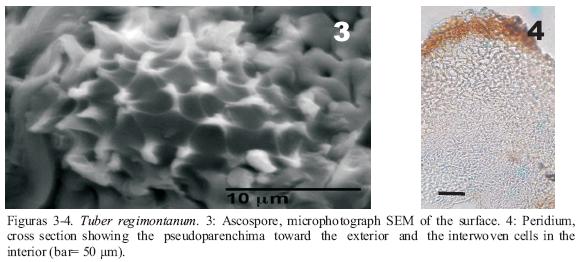
<body><![CDATA[<p align="justify"><font face="verdana" size="2">&nbsp;</font></p>     <p align="justify"><font face="verdana" size="2"><b>Results</b></font></p>     <p align="justify"><font face="verdana" size="2"><b><i>Tuber regimontanum </i></b>Guevara, Bonito &amp; Rodr&iacute;guez sp. nov Figs. 1&#150;5</font> </p>     <p align="center"><font face="verdana" size="2"><a name="f1y2" id="f1y2"></a></font></p>     <p align="center"><img src="/img/revistas/rmm/v26/a3f1-2.jpg" width="553" height="244"></p>     <p align="center"><font face="verdana" size="2">&nbsp;</font></p>     <p align="center"><font face="verdana" size="2"><a name="f3y4"></a></font></p>     <p align="center"><img src="/img/revistas/rmm/v26/a3f3-4.jpg" width="580" height="262"></p>     <p align="center"><font face="verdana" size="2">&nbsp;</font></p>     <p align="center"><font face="verdana" size="2"><a name="f5"></a></font></p>     ]]></body>
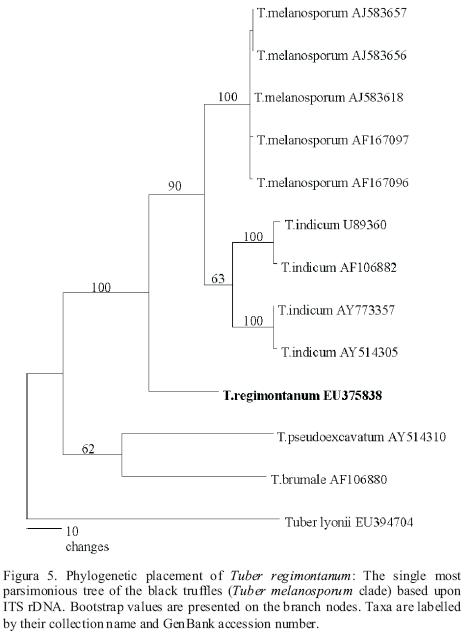
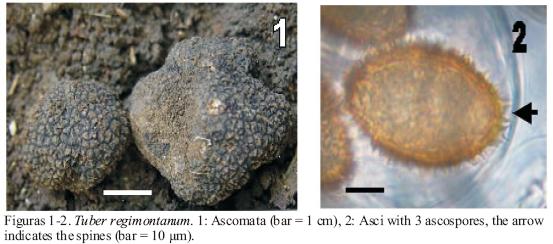
<body><![CDATA[<p align="center"><font face="verdana" size="2"><img src="/img/revistas/rmm/v26/a3f5.jpg"></font></p>     <p align="justify"><font face="verdana" size="2"><i>Ascomata 10&#150;40 x 8&#150;18 mm, globosa, subglobosa vel lobata, atrobrunnea vel nigra, verrucis pyramidalibus usque ad 2&#150;3 mm latis et 1&#150;1.5 mm altis. Gleba solida, maturitate atrobrunnea vel negra venis albis marmoratis. Peridium 100&#150;300 &micro;m crassum, epicute pseudoparenchymatisque subcute intertextis. Sporae fusiformes vel ellipsoideae, 33&#150;55 (&#150;62) x 23&#150;31 &micro;m, maturitate porphyreae, spinis 2&#150;5 x 1&#150;2 &micro;m. Asci globosi, subglobosi vel ovoidei, hyalini, acaules, sporis 1&#150;4. Species interjecta Tuber melanosporum et T. indicum. (Holotypus Guevara 909, ITCV hic designatus).</i></font></p>     <p align="justify"><font face="verdana" size="2">Ascomata 10&#150;40 x 8&#150;17 x 8&#150;18 mm, globose, subglobose to  lobulated, dark brown to black, dry surface, rough with  pyramidal verrucae 2&#150;3 mm of wide x 1&#150;1.5 mm of high, without basal mycelium or rhizomorphs. Gleba solid, white to light brown or dark, black when dried, with white veins toward the peridium, marbled. Odor fragrant and pleasant, flavor fungi&#150;like. KOH 5% and FeSO4 10% negative or lightly black after 10min. Peridium 100&#150;300 &micro;n thick. Outer layer apseudoparenchyma of 100&#150;250 &micro;m wide, hyphae 5&#150;30 &micro;m diam. angular or isodiametric, reddish brown to dark coffee, thick walled, without intracelular contents. Inner layer of 30&#150;50 &micro;m thick, difficult to distinguished from the outer layer, interwoven hyaline hyphae. Veins formed by hyaline interwoven hyphae. Ascospores 33&#150;55 (&#150;62) x 23&#150;31 &micro;m without ornamentation, reddish brown; 1 spore in an asci are 40&#150;55 (&#150;62) x 30&#150;31 &micro;n, with two 37&#150;42 x 25&#150;26 &micro;n, with three 33&#150;37 x 23&#150;26 &micro;n, with four 28&#150;35 x 18&#150;22 &micro;n, broadly fusiform to ellipsoid. Spines 2&#150;5 x 1&#150;2 &micro;m, thin, robust toward the base, hyaline in youth, straw yellow to reddish brown when mature, thick walled. Asci globose to subglobose or ovoid, without pedicel, thick walled, 2&#150;5 &micro;m thick, hyaline.</font></p>     <p align="justify"><font face="verdana" size="2">Habitat. Hypogeous, gregarious, under a <i>Quercus polymorpha </i>forest, on the side of intermittent stream, soil pH 8.</font></p>     <p align="justify"><font face="verdana" size="2">Collections examined. Nuevo Le&oacute;n, Sierra of Picachos, Mpio. de Higueras, August 23,2007, <i>Guevara 909 </i>(Holotype ITCV, isotypes OSU and DUKE).</font></p>     <p align="justify"><font face="verdana" size="2">Discussion. <i>Tuber regimontanum </i>is similar macro&#150;and microscopically to the European species <i>T. melanosporum </i>Vitt. and the Chinese species <i>T. indicum </i>Cooke &amp; Massee. <i>T. melanosporum </i>has spores 28&#150;32 x 16&#150;21 &micro;m, blackish brown, while <i>T. indicum, </i>26 x 17&micro;m, brown&#150;blackish (Montecchi &amp; Sarasini, 2000). The molecular results using the ITS nuclear ribosomal DNA, demonstrated that <i>T. regimontanum </i>is significantly different from these two species at the molecular level (<a href="#f5">Fig. 5</a>).</font></p>     <p align="center"><font face="verdana" size="2">&nbsp;</font></p>     <p align="justify"><font face="verdana" size="2">Etymology: Latin, <i>regi&#150; </i>(region) and <i>montanum </i>(mountain), from the "mountainous regions" with respect to the Cd. of Monterrey where its citizens are denominated "regimontanos".</font></p>     <p align="justify"><font face="verdana" size="2">&nbsp;</font></p>     <p align="justify"><font face="verdana" size="2"><b>Acknowledgements</b></font></p>     ]]></body>
<body><![CDATA[<p align="justify"><font face="verdana" size="2">The senior author would like to thank the DGEST (Direcci&oacute;n General de Educaci&oacute;n Superior Tecnol&oacute;gica) for their financial support. The participation of Gregory Bonito, Efren Cazares, James Trappe and Rytas Vilgalys was supported by U.S. National Science Foundation Grants DEB&#150;0641297 and DEB&#150;0710213. We also thank Rosanne Healy for assistance with scanning electron microscopy at the University of Duke and sponsored by the NSF (Grant DBI&#150;0098534).</font></p>     <p align="justify"><font face="verdana" size="2">&nbsp;</font></p>     <p align="justify"><font face="verdana" size="2"><b>References</b></font></p>     <!-- ref --><p align="justify"><font face="verdana" size="2">Bertini, L., A. Amicucci, D. Agostini, E. Polidori, L. Potenza, C. Guidi, V. Stocchi, 1999. A new pair of primers designed for amplification of the ITS region in <i>Tuber </i>species. FEMS Microbiology Letters 173:239&#150;245.</font>&nbsp;&nbsp;&nbsp;&nbsp;&nbsp;&nbsp;&nbsp;&nbsp;[&#160;<a href="javascript:void(0);" onclick="javascript: window.open('/scielo.php?script=sci_nlinks&ref=8719198&pid=S0187-3180200800010000300001&lng=','','width=640,height=500,resizable=yes,scrollbars=1,menubar=yes,');">Links</a>&#160;]<!-- end-ref --><!-- ref --><p align="justify"><font face="verdana" size="2">Castellano, M. A., J.M. Trappe, Z. Maser, C. Maser, 1989. Key to spores of the genera of hypogeous fungi of north temperate forest with special reference to animal mycophagy. Mad River Press, Eureka, California 186.</font>&nbsp;&nbsp;&nbsp;&nbsp;&nbsp;&nbsp;&nbsp;&nbsp;[&#160;<a href="javascript:void(0);" onclick="javascript: window.open('/scielo.php?script=sci_nlinks&ref=8719199&pid=S0187-3180200800010000300002&lng=','','width=640,height=500,resizable=yes,scrollbars=1,menubar=yes,');">Links</a>&#160;]<!-- end-ref --><!-- ref --><p align="justify"><font face="verdana" size="2">C&aacute;zares, E., J. Garc&iacute;a, J. Castillo, J. M. Trappe, 1992. Hypogeous fungi from northern M&eacute;xico. Mycologia 84:341&#150;359.</font>&nbsp;&nbsp;&nbsp;&nbsp;&nbsp;&nbsp;&nbsp;&nbsp;[&#160;<a href="javascript:void(0);" onclick="javascript: window.open('/scielo.php?script=sci_nlinks&ref=8719200&pid=S0187-3180200800010000300003&lng=','','width=640,height=500,resizable=yes,scrollbars=1,menubar=yes,');">Links</a>&#160;]<!-- end-ref --><!-- ref --><p align="justify"><font face="verdana" size="2">Gardes, M., T.J. White, J.A. Fortin, T.D. Bruns, J.W. White, 1991. Identification of indigenous and introduced symbiotic fungi in ectomycorrhizae by amplification of nuclear and mitochondrial ribosomal DNA. Canadian Journal of Botany 69:180&#150;190.</font>&nbsp;&nbsp;&nbsp;&nbsp;&nbsp;&nbsp;&nbsp;&nbsp;[&#160;<a href="javascript:void(0);" onclick="javascript: window.open('/scielo.php?script=sci_nlinks&ref=8719201&pid=S0187-3180200800010000300004&lng=','','width=640,height=500,resizable=yes,scrollbars=1,menubar=yes,');">Links</a>&#160;]<!-- end-ref --><!-- ref --><p align="justify"><font face="verdana" size="2">Garc&iacute;a, J., G. Guevara. 2005. Macromicetos (hongos superiores) de Tamaulipas. Biodiversidad Tamaulipeca 1:67&#150;79.</font>&nbsp;&nbsp;&nbsp;&nbsp;&nbsp;&nbsp;&nbsp;&nbsp;[&#160;<a href="javascript:void(0);" onclick="javascript: window.open('/scielo.php?script=sci_nlinks&ref=8719202&pid=S0187-3180200800010000300005&lng=','','width=640,height=500,resizable=yes,scrollbars=1,menubar=yes,');">Links</a>&#160;]<!-- end-ref --><!-- ref --><p align="justify"><font face="verdana" size="2">Garza, F., J. Garc&iacute;a, J. Castillo. 1985. Macromicetos asociados al bosque de <i>Quercus rysophylla </i>en algunas localidades del centro del Estado de Nuevo Le&oacute;n. Revista Mexicana de Micolog&iacute;a 1:423&#150;428</font>.&nbsp;&nbsp;&nbsp;&nbsp;&nbsp;&nbsp;&nbsp;&nbsp;[&#160;<a href="javascript:void(0);" onclick="javascript: window.open('/scielo.php?script=sci_nlinks&ref=8719203&pid=S0187-3180200800010000300006&lng=','','width=640,height=500,resizable=yes,scrollbars=1,menubar=yes,');">Links</a>&#160;]<!-- end-ref --><!-- ref --><p align="justify"><font face="verdana" size="2">Gilkey, H. M., 1939. Tuberales of North America. Oregon State Monograph 1: 1&#150;63.</font>&nbsp;&nbsp;&nbsp;&nbsp;&nbsp;&nbsp;&nbsp;&nbsp;[&#160;<a href="javascript:void(0);" onclick="javascript: window.open('/scielo.php?script=sci_nlinks&ref=8719204&pid=S0187-3180200800010000300007&lng=','','width=640,height=500,resizable=yes,scrollbars=1,menubar=yes,');">Links</a>&#160;]<!-- end-ref --><!-- ref --><p align="justify"><font face="verdana" size="2">Gilkey, H. M., 1954. Tuberales. North American Flora 2:1&#150;36.</font>&nbsp;&nbsp;&nbsp;&nbsp;&nbsp;&nbsp;&nbsp;&nbsp;[&#160;<a href="javascript:void(0);" onclick="javascript: window.open('/scielo.php?script=sci_nlinks&ref=8719205&pid=S0187-3180200800010000300008&lng=','','width=640,height=500,resizable=yes,scrollbars=1,menubar=yes,');">Links</a>&#160;]<!-- end-ref --><!-- ref --><p align="justify"><font face="verdana" size="2">Montecchi A., M. Sarasini. 2000 Funghi ipogei d'Europa. Associazione Micologica Bresadola, Fondazione Centro Studi Micologici. Vicenza. 714 p</font>.&nbsp;&nbsp;&nbsp;&nbsp;&nbsp;&nbsp;&nbsp;&nbsp;[&#160;<a href="javascript:void(0);" onclick="javascript: window.open('/scielo.php?script=sci_nlinks&ref=8719206&pid=S0187-3180200800010000300009&lng=','','width=640,height=500,resizable=yes,scrollbars=1,menubar=yes,');">Links</a>&#160;]<!-- end-ref --><!-- ref --><p align="justify"><font face="verdana" size="2">Pegler, D. N., B.M. Spooner, T.W.K. Young, 1993. British truffles, a revision of British hypogeous fungi. Royal Botanic Gardens, Kew. 242.</font>&nbsp;&nbsp;&nbsp;&nbsp;&nbsp;&nbsp;&nbsp;&nbsp;[&#160;<a href="javascript:void(0);" onclick="javascript: window.open('/scielo.php?script=sci_nlinks&ref=8719207&pid=S0187-3180200800010000300010&lng=','','width=640,height=500,resizable=yes,scrollbars=1,menubar=yes,');">Links</a>&#160;]<!-- end-ref --><!-- ref --><p align="justify"><font face="verdana" size="2">Swofford, D., 2001. PAUP*. Phylogenetic analysis using parsimony (*and other methods). Version 4. Sinauer Associates, Sunderland, Massachusetts.</font>&nbsp;&nbsp;&nbsp;&nbsp;&nbsp;&nbsp;&nbsp;&nbsp;[&#160;<a href="javascript:void(0);" onclick="javascript: window.open('/scielo.php?script=sci_nlinks&ref=8719208&pid=S0187-3180200800010000300011&lng=','','width=640,height=500,resizable=yes,scrollbars=1,menubar=yes,');">Links</a>&#160;]<!-- end-ref --><!-- ref --><p align="justify"><font face="verdana" size="2">Trappe, J., G. Guzm&aacute;n, 1971. Notes on some hypogeous fungi from M&eacute;xico. Mycologia 63: 317&#150;345.</font>&nbsp;&nbsp;&nbsp;&nbsp;&nbsp;&nbsp;&nbsp;&nbsp;[&#160;<a href="javascript:void(0);" onclick="javascript: window.open('/scielo.php?script=sci_nlinks&ref=8719209&pid=S0187-3180200800010000300012&lng=','','width=640,height=500,resizable=yes,scrollbars=1,menubar=yes,');">Links</a>&#160;]<!-- end-ref --><!-- ref --><p align="justify"><font face="verdana" size="2">Trappe, J.M., A.M. Jumpponen, E. C&aacute;zares, 1996. Nats truffle and truffle&#150;like fungi 5: <i>Tuber lyonii </i>(= <i>T. texensis), </i>with a key to the Spiny&#150;Spored Tuber Species Groups. Mycotaxon 60: 365&#150;372.</font>&nbsp;&nbsp;&nbsp;&nbsp;&nbsp;&nbsp;&nbsp;&nbsp;[&#160;<a href="javascript:void(0);" onclick="javascript: window.open('/scielo.php?script=sci_nlinks&ref=8719210&pid=S0187-3180200800010000300013&lng=','','width=640,height=500,resizable=yes,scrollbars=1,menubar=yes,');">Links</a>&#160;]<!-- end-ref --><!-- ref --><p align="justify"><font face="verdana" size="2">Trappe, J.M., E. C&aacute;zares, 2006. <i>Tuber guzmanii, </i>a new truffle from southern M&eacute;xico. International Journal of Medicinal Mushrooms 8: 279&#150;282.</font>&nbsp;&nbsp;&nbsp;&nbsp;&nbsp;&nbsp;&nbsp;&nbsp;[&#160;<a href="javascript:void(0);" onclick="javascript: window.open('/scielo.php?script=sci_nlinks&ref=8719211&pid=S0187-3180200800010000300014&lng=','','width=640,height=500,resizable=yes,scrollbars=1,menubar=yes,');">Links</a>&#160;]<!-- end-ref --><!-- ref --><p align="justify"><font face="verdana" size="2">Vilgalys, R., M. Hester, 1990. Rapid genetic identification and mapping of enzymatically amplified ribosomal DNA from several <i>Cryptococcus </i>species. Journal of Bacteriology 172:4238&#150;4246.</font>&nbsp;&nbsp;&nbsp;&nbsp;&nbsp;&nbsp;&nbsp;&nbsp;[&#160;<a href="javascript:void(0);" onclick="javascript: window.open('/scielo.php?script=sci_nlinks&ref=8719212&pid=S0187-3180200800010000300015&lng=','','width=640,height=500,resizable=yes,scrollbars=1,menubar=yes,');">Links</a>&#160;]<!-- end-ref --> ]]></body><back>
<ref-list>
<ref id="B1">
<nlm-citation citation-type="journal">
<person-group person-group-type="author">
<name>
<surname><![CDATA[Bertini]]></surname>
<given-names><![CDATA[L.]]></given-names>
</name>
<name>
<surname><![CDATA[Amicucci]]></surname>
<given-names><![CDATA[A.]]></given-names>
</name>
<name>
<surname><![CDATA[Agostini]]></surname>
<given-names><![CDATA[D.]]></given-names>
</name>
<name>
<surname><![CDATA[Polidori]]></surname>
<given-names><![CDATA[E.]]></given-names>
</name>
<name>
<surname><![CDATA[Potenza]]></surname>
<given-names><![CDATA[L.]]></given-names>
</name>
<name>
<surname><![CDATA[Guidi]]></surname>
<given-names><![CDATA[C.]]></given-names>
</name>
<name>
<surname><![CDATA[Stocchi]]></surname>
<given-names><![CDATA[V.]]></given-names>
</name>
</person-group>
<article-title xml:lang="en"><![CDATA[A new pair of primers designed for amplification of the ITS region in Tuber species]]></article-title>
<source><![CDATA[FEMS Microbiology Letters]]></source>
<year>1999</year>
<volume>173</volume>
<page-range>239-245</page-range></nlm-citation>
</ref>
<ref id="B2">
<nlm-citation citation-type="book">
<person-group person-group-type="author">
<name>
<surname><![CDATA[Castellano]]></surname>
<given-names><![CDATA[M. A.]]></given-names>
</name>
<name>
<surname><![CDATA[Trappe]]></surname>
<given-names><![CDATA[J.M.]]></given-names>
</name>
<name>
<surname><![CDATA[Maser]]></surname>
<given-names><![CDATA[Z.]]></given-names>
</name>
<name>
<surname><![CDATA[Maser]]></surname>
<given-names><![CDATA[C.]]></given-names>
</name>
</person-group>
<source><![CDATA[Key to spores of the genera of hypogeous fungi of north temperate forest with special reference to animal mycophagy]]></source>
<year>1989</year>
<page-range>186</page-range><publisher-loc><![CDATA[Eureka^eCalifornia California]]></publisher-loc>
<publisher-name><![CDATA[Mad River Press]]></publisher-name>
</nlm-citation>
</ref>
<ref id="B3">
<nlm-citation citation-type="journal">
<person-group person-group-type="author">
<name>
<surname><![CDATA[Cázares]]></surname>
<given-names><![CDATA[E.]]></given-names>
</name>
<name>
<surname><![CDATA[García]]></surname>
<given-names><![CDATA[J.]]></given-names>
</name>
<name>
<surname><![CDATA[Castillo]]></surname>
<given-names><![CDATA[J.]]></given-names>
</name>
<name>
<surname><![CDATA[Trappe]]></surname>
<given-names><![CDATA[J. M.]]></given-names>
</name>
</person-group>
<article-title xml:lang="en"><![CDATA[Hypogeous fungi from northern México]]></article-title>
<source><![CDATA[Mycologia]]></source>
<year>1992</year>
<volume>84</volume>
<page-range>341-359</page-range></nlm-citation>
</ref>
<ref id="B4">
<nlm-citation citation-type="journal">
<person-group person-group-type="author">
<name>
<surname><![CDATA[Gardes]]></surname>
<given-names><![CDATA[M.]]></given-names>
</name>
<name>
<surname><![CDATA[White]]></surname>
<given-names><![CDATA[T.J.]]></given-names>
</name>
<name>
<surname><![CDATA[Fortin]]></surname>
<given-names><![CDATA[J.A.]]></given-names>
</name>
<name>
<surname><![CDATA[Bruns]]></surname>
<given-names><![CDATA[T.D.]]></given-names>
</name>
<name>
<surname><![CDATA[White]]></surname>
<given-names><![CDATA[J.W.]]></given-names>
</name>
</person-group>
<article-title xml:lang="en"><![CDATA[Identification of indigenous and introduced symbiotic fungi in ectomycorrhizae by amplification of nuclear and mitochondrial ribosomal DNA]]></article-title>
<source><![CDATA[Canadian Journal of Botany]]></source>
<year>1991</year>
<volume>69</volume>
<page-range>180-190</page-range></nlm-citation>
</ref>
<ref id="B5">
<nlm-citation citation-type="journal">
<person-group person-group-type="author">
<name>
<surname><![CDATA[García]]></surname>
<given-names><![CDATA[J.]]></given-names>
</name>
<name>
<surname><![CDATA[Guevara]]></surname>
<given-names><![CDATA[G.]]></given-names>
</name>
</person-group>
<article-title xml:lang="es"><![CDATA[Macromicetos (hongos superiores) de Tamaulipas]]></article-title>
<source><![CDATA[Biodiversidad Tamaulipeca]]></source>
<year>2005</year>
<volume>1</volume>
<page-range>67-79</page-range></nlm-citation>
</ref>
<ref id="B6">
<nlm-citation citation-type="journal">
<person-group person-group-type="author">
<name>
<surname><![CDATA[Garza]]></surname>
<given-names><![CDATA[F.]]></given-names>
</name>
<name>
<surname><![CDATA[García]]></surname>
<given-names><![CDATA[J.]]></given-names>
</name>
<name>
<surname><![CDATA[Castillo]]></surname>
<given-names><![CDATA[J.]]></given-names>
</name>
</person-group>
<article-title xml:lang="es"><![CDATA[Macromicetos asociados al bosque de Quercus rysophylla en algunas localidades del centro del Estado de Nuevo León]]></article-title>
<source><![CDATA[Revista Mexicana de Micología]]></source>
<year>1985</year>
<volume>1</volume>
<page-range>423-428</page-range></nlm-citation>
</ref>
<ref id="B7">
<nlm-citation citation-type="">
<person-group person-group-type="author">
<name>
<surname><![CDATA[Gilkey]]></surname>
<given-names><![CDATA[H. M.]]></given-names>
</name>
</person-group>
<source><![CDATA[Tuberales of North America]]></source>
<year>1939</year>
<volume>1</volume>
<page-range>1-63</page-range></nlm-citation>
</ref>
<ref id="B8">
<nlm-citation citation-type="journal">
<person-group person-group-type="author">
<name>
<surname><![CDATA[Gilkey]]></surname>
<given-names><![CDATA[H. M.]]></given-names>
</name>
</person-group>
<article-title xml:lang="en"><![CDATA[Tuberales]]></article-title>
<source><![CDATA[North American Flora]]></source>
<year>1954</year>
<volume>2</volume>
<page-range>1-36</page-range></nlm-citation>
</ref>
<ref id="B9">
<nlm-citation citation-type="book">
<person-group person-group-type="author">
<name>
<surname><![CDATA[Montecchi]]></surname>
<given-names><![CDATA[A.]]></given-names>
</name>
<name>
<surname><![CDATA[Sarasini]]></surname>
<given-names><![CDATA[M.]]></given-names>
</name>
</person-group>
<source><![CDATA[Funghi ipogei d'Europa]]></source>
<year>2000</year>
<page-range>714</page-range><publisher-loc><![CDATA[Vicenza ]]></publisher-loc>
<publisher-name><![CDATA[Associazione Micologica BresadolaFondazione Centro Studi Micologici]]></publisher-name>
</nlm-citation>
</ref>
<ref id="B10">
<nlm-citation citation-type="book">
<person-group person-group-type="author">
<name>
<surname><![CDATA[Pegler]]></surname>
<given-names><![CDATA[D. N.]]></given-names>
</name>
<name>
<surname><![CDATA[Spooner]]></surname>
<given-names><![CDATA[B.M.]]></given-names>
</name>
<name>
<surname><![CDATA[Young]]></surname>
<given-names><![CDATA[T.W.K.]]></given-names>
</name>
</person-group>
<source><![CDATA[British truffles, a revision of British hypogeous fungi]]></source>
<year>1993</year>
<page-range>242</page-range><publisher-loc><![CDATA[Kew ]]></publisher-loc>
<publisher-name><![CDATA[Royal Botanic Gardens]]></publisher-name>
</nlm-citation>
</ref>
<ref id="B11">
<nlm-citation citation-type="book">
<person-group person-group-type="author">
<name>
<surname><![CDATA[Swofford]]></surname>
<given-names><![CDATA[D.]]></given-names>
</name>
</person-group>
<source><![CDATA[PAUP*. Phylogenetic analysis using parsimony (*and other methods). Version 4]]></source>
<year>2001</year>
<publisher-loc><![CDATA[Sunderland^eMassachusetts Massachusetts]]></publisher-loc>
<publisher-name><![CDATA[Sinauer Associates]]></publisher-name>
</nlm-citation>
</ref>
<ref id="B12">
<nlm-citation citation-type="journal">
<person-group person-group-type="author">
<name>
<surname><![CDATA[Trappe]]></surname>
<given-names><![CDATA[J.]]></given-names>
</name>
<name>
<surname><![CDATA[Guzmán]]></surname>
<given-names><![CDATA[G.]]></given-names>
</name>
</person-group>
<article-title xml:lang="en"><![CDATA[Notes on some hypogeous fungi from México]]></article-title>
<source><![CDATA[Mycologia]]></source>
<year>1971</year>
<volume>63</volume>
<page-range>317-345</page-range></nlm-citation>
</ref>
<ref id="B13">
<nlm-citation citation-type="journal">
<person-group person-group-type="author">
<name>
<surname><![CDATA[Trappe]]></surname>
<given-names><![CDATA[J.M.]]></given-names>
</name>
<name>
<surname><![CDATA[Jumpponen]]></surname>
<given-names><![CDATA[A.M.]]></given-names>
</name>
<name>
<surname><![CDATA[Cázares]]></surname>
<given-names><![CDATA[E.]]></given-names>
</name>
</person-group>
<article-title xml:lang="en"><![CDATA[Nats truffle and truffle-like fungi 5: Tuber lyonii (= T. texensis), with a key to the Spiny-Spored Tuber Species Groups]]></article-title>
<source><![CDATA[Mycotaxon]]></source>
<year>1996</year>
<volume>60</volume>
<page-range>365-372</page-range></nlm-citation>
</ref>
<ref id="B14">
<nlm-citation citation-type="journal">
<person-group person-group-type="author">
<name>
<surname><![CDATA[Trappe]]></surname>
<given-names><![CDATA[J.M.]]></given-names>
</name>
<name>
<surname><![CDATA[Cázares]]></surname>
<given-names><![CDATA[E.]]></given-names>
</name>
</person-group>
<article-title xml:lang="en"><![CDATA[Tuber guzmanii, a new truffle from southern México]]></article-title>
<source><![CDATA[International Journal of Medicinal Mushrooms]]></source>
<year>2006</year>
<volume>8</volume>
<page-range>279-282</page-range></nlm-citation>
</ref>
<ref id="B15">
<nlm-citation citation-type="journal">
<person-group person-group-type="author">
<name>
<surname><![CDATA[Vilgalys]]></surname>
<given-names><![CDATA[R.]]></given-names>
</name>
<name>
<surname><![CDATA[Hester]]></surname>
<given-names><![CDATA[M.]]></given-names>
</name>
</person-group>
<article-title xml:lang="en"><![CDATA[Rapid genetic identification and mapping of enzymatically amplified ribosomal DNA from several Cryptococcus species]]></article-title>
<source><![CDATA[Journal of Bacteriology]]></source>
<year>1990</year>
<volume>172</volume>
<page-range>4238-4246</page-range></nlm-citation>
</ref>
</ref-list>
</back>
</article>