<?xml version="1.0" encoding="ISO-8859-1"?><article xmlns:mml="http://www.w3.org/1998/Math/MathML" xmlns:xlink="http://www.w3.org/1999/xlink" xmlns:xsi="http://www.w3.org/2001/XMLSchema-instance">
<front>
<journal-meta>
<journal-id>0185-3880</journal-id>
<journal-title><![CDATA[Ciencias marinas]]></journal-title>
<abbrev-journal-title><![CDATA[Cienc. mar]]></abbrev-journal-title>
<issn>0185-3880</issn>
<publisher>
<publisher-name><![CDATA[Universidad Autónoma de Baja California, Instituto de Investigaciones Oceanológicas]]></publisher-name>
</publisher>
</journal-meta>
<article-meta>
<article-id>S0185-38802005000200012</article-id>
<title-group>
<article-title xml:lang="en"><![CDATA[Chemical and mineralogical characterization of the sediments from the Mira, Ílhavo and Ovar channels of Aveiro Lagoon (Portugal)]]></article-title>
<article-title xml:lang="es"><![CDATA[Caracterización química y mineralógica de los sedimentos de los canales de Mira, Ílhavo y Ovar de la Laguna de Aveiro (Portugal)]]></article-title>
</title-group>
<contrib-group>
<contrib contrib-type="author">
<name>
<surname><![CDATA[Rocha]]></surname>
<given-names><![CDATA[Fernando]]></given-names>
</name>
<xref ref-type="aff" rid="A01"/>
</contrib>
<contrib contrib-type="author">
<name>
<surname><![CDATA[Silva]]></surname>
<given-names><![CDATA[Eduardo]]></given-names>
</name>
<xref ref-type="aff" rid="A01"/>
</contrib>
<contrib contrib-type="author">
<name>
<surname><![CDATA[Bernardes]]></surname>
<given-names><![CDATA[Cristina]]></given-names>
</name>
<xref ref-type="aff" rid="A01"/>
</contrib>
<contrib contrib-type="author">
<name>
<surname><![CDATA[Vidinha]]></surname>
<given-names><![CDATA[Jesus]]></given-names>
</name>
<xref ref-type="aff" rid="A01"/>
</contrib>
<contrib contrib-type="author">
<name>
<surname><![CDATA[Patinha]]></surname>
<given-names><![CDATA[Carla]]></given-names>
</name>
<xref ref-type="aff" rid="A01"/>
</contrib>
</contrib-group>
<aff id="A01">
<institution><![CDATA[,Universidade de Aveiro  ]]></institution>
<addr-line><![CDATA[Aveiro ]]></addr-line>
<country>Portugal</country>
</aff>
<pub-date pub-type="pub">
<day>00</day>
<month>00</month>
<year>2005</year>
</pub-date>
<pub-date pub-type="epub">
<day>00</day>
<month>00</month>
<year>2005</year>
</pub-date>
<volume>31</volume>
<numero>1b</numero>
<fpage>253</fpage>
<lpage>263</lpage>
<copyright-statement/>
<copyright-year/>
<self-uri xlink:href="http://www.scielo.org.mx/scielo.php?script=sci_arttext&amp;pid=S0185-38802005000200012&amp;lng=en&amp;nrm=iso"></self-uri><self-uri xlink:href="http://www.scielo.org.mx/scielo.php?script=sci_abstract&amp;pid=S0185-38802005000200012&amp;lng=en&amp;nrm=iso"></self-uri><self-uri xlink:href="http://www.scielo.org.mx/scielo.php?script=sci_pdf&amp;pid=S0185-38802005000200012&amp;lng=en&amp;nrm=iso"></self-uri><abstract abstract-type="short" xml:lang="en"><p><![CDATA[The paleoenvironmental reconstruction of Aveiro Lagoon is being carried out based on the sedimentological, paleoecological, geochemical and mineralogical characterization of sediment samples collected systematically in the lagoon. This paper presents results concerning the changes in the chemical and mineralogical composition of the fine fraction (<63 µm) and the clay fraction (<2 µm) in sediment samples from Aveiro Lagoon, mainly collected from the lower intertidal plain and subtidal deposits located along the Mira, Ílhavo and Ovar channels. A zonography of the lagoon was established based on the parameters analyzed. The results show that the surface and near-surface sediments of Aveiro Lagoon trap relatively large quantities of trace metals, such as Cu, Pb, Co, Ni, Cd, Zn, Fe, Mn and Cr, considered to be partially adsorbed, particularly on silty and clayey particles, and co-precipitated on Fe and Mn oxyhydroxide forms precipitated in the topmost layers of sediments. Series of statistically significant relationships were established between trace metal concentrations and clay content and semi-quantitatively determined clay mineral species in the sediments.]]></p></abstract>
<abstract abstract-type="short" xml:lang="es"><p><![CDATA[La reconstrucción paleoambiental de la Laguna de Aveiro se está realizando mediante la caracterización sedimentológica, paleoecológica, geoquímica y mineralógica de muestras de sedimento recogidas sistemáticamente en la misma. Este artículo presenta resultados relativos a las variaciones en la composición química y mineralógica de las fracciones fina (<63 µm) y arcillosa (<2 µm) de las muestras de sedimento de la Laguna de Aveiro, recogidas principalmente en las planicies intermareales bajas y depósitos submareales de los canales de Mira, Ílhavo y Ovar. Estos parámetros fueron utilizados para caracterizar los sedimentos de cada uno de los canales estudiados de la Laguna de Aveiro. Los sedimentos superficiales y subsuperficiales de esta laguna retienen cantidades relativamente elevadas de elementos vestigiales como Cu, Pb, Co, Ni, Cd, Zn, Fe, Mn y Cr, los cuales se consideran principalmente adsorbidos en partículas fangosas y arcillosas y en óxidos de Fe y Mn. Con base en los parámetros analizados se puede establecer una zonografía de la laguna. Se han encontrado relaciones entre las concentraciones de elementos vestigiales y el contenido de arcilla y las especies minerales de las arcillas en los sedimentos.]]></p></abstract>
<kwd-group>
<kwd lng="en"><![CDATA[trace metals]]></kwd>
<kwd lng="en"><![CDATA[recent sediments]]></kwd>
<kwd lng="en"><![CDATA[Aveiro Lagoon]]></kwd>
<kwd lng="es"><![CDATA[elementos vestigiales]]></kwd>
<kwd lng="es"><![CDATA[sedimentos actuales]]></kwd>
<kwd lng="es"><![CDATA[Laguna de Aveiro]]></kwd>
</kwd-group>
</article-meta>
</front><body><![CDATA[  	    <p align="justify"><font face="verdana" size="4">Art&iacute;culos</font></p>  	    <p>&nbsp;</p>  	    <p align="center"><font face="verdana" size="4"><b>Chemical and mineralogical characterization of the sediments from the Mira, &Iacute;lhavo and Ovar channels of Aveiro Lagoon (Portugal)</b></font></p>  	    <p>&nbsp;</p>  	    <p align="center"><font face="verdana" size="3"><b>Caracterizaci&oacute;n qu&iacute;mica y mineral&oacute;gica de los sedimentos de los canales de Mira, &Iacute;lhavo y Ovar de la Laguna de Aveiro (Portugal)</b></font></p>  	    <p>&nbsp;</p>  	    <p align="center"><font face="verdana" size="2"><b>Fernando Rocha*, Eduardo Silva, Cristina Bernardes, Jesus Vidinha and Carla Patinha</b></font></p>  	    <p>&nbsp;</p>  	    <p align="justify"><font face="verdana" size="2"><sup><i>*</i></sup> <i>Dep. Geoci&ecirc;ncias Univ. de Aveiro 3810&#45;193 Aveiro, Portugal.</i> * <a href="mailto:frocha@geo.ua.pt">frocha@geo.ua.pt</a></font></p>  	    ]]></body>
<body><![CDATA[<p>&nbsp;</p>  	    <p align="justify"><font face="verdana" size="2">Recibido en junio de 2003;    <br> 	aceptado en mayo de 2004.</font></p>  	    <p>&nbsp;</p>  	    <p align="justify"><font face="verdana" size="2"><b>Abstract</b></font></p>  	    <p align="justify"><font face="verdana" size="2">The paleoenvironmental reconstruction of Aveiro Lagoon is being carried out based on the sedimentological, paleoecological, geochemical and mineralogical characterization of sediment samples collected systematically in the lagoon. This paper presents results concerning the changes in the chemical and mineralogical composition of the fine fraction (&lt;63 &micro;m) and the clay fraction (&lt;2 &micro;m) in sediment samples from Aveiro Lagoon, mainly collected from the lower intertidal plain and subtidal deposits located along the Mira, &Iacute;lhavo and Ovar channels. A zonography of the lagoon was established based on the parameters analyzed. The results show that the surface and near&#45;surface sediments of Aveiro Lagoon trap relatively large quantities of trace metals, such as Cu, Pb, Co, Ni, Cd, Zn, Fe, Mn and Cr, considered to be partially adsorbed, particularly on silty and clayey particles, and co&#45;precipitated on Fe and Mn oxyhydroxide forms precipitated in the topmost layers of sediments. Series of statistically significant relationships were established between trace metal concentrations and clay content and semi&#45;quantitatively determined clay mineral species in the sediments.</font></p>  	    <p align="justify"><font face="verdana" size="2"><b>Key words:</b> trace metals, recent sediments, Aveiro Lagoon.</font></p>  	    <p>&nbsp;</p>  	    <p align="justify"><font face="verdana" size="2"><b>Resumen</b></font></p>  	    <p align="justify"><font face="verdana" size="2">La reconstrucci&oacute;n paleoambiental de la Laguna de Aveiro se est&aacute; realizando mediante la caracterizaci&oacute;n sedimentol&oacute;gica, paleoecol&oacute;gica, geoqu&iacute;mica y mineral&oacute;gica de muestras de sedimento recogidas sistem&aacute;ticamente en la misma. Este art&iacute;culo presenta resultados relativos a las variaciones en la composici&oacute;n qu&iacute;mica y mineral&oacute;gica de las fracciones fina (&lt;63 &micro;m) y arcillosa (&lt;2 &micro;m) de las muestras de sedimento de la Laguna de Aveiro, recogidas principalmente en las planicies intermareales bajas y dep&oacute;sitos submareales de los canales de Mira, &Iacute;lhavo y Ovar. Estos par&aacute;metros fueron utilizados para caracterizar los sedimentos de cada uno de los canales estudiados de la Laguna de Aveiro. Los sedimentos superficiales y subsuperficiales de esta laguna retienen cantidades relativamente elevadas de elementos vestigiales como Cu, Pb, Co, Ni, Cd, Zn, Fe, Mn y Cr, los cuales se consideran principalmente adsorbidos en part&iacute;culas fangosas y arcillosas y en &oacute;xidos de Fe y Mn. Con base en los par&aacute;metros analizados se puede establecer una zonograf&iacute;a de la laguna. Se han encontrado relaciones entre las concentraciones de elementos vestigiales y el contenido de arcilla y las especies minerales de las arcillas en los sedimentos.</font></p>  	    ]]></body>
<body><![CDATA[<p align="justify"><font face="verdana" size="2"><b>Palabras clave:</b> elementos vestigiales, sedimentos actuales, Laguna de Aveiro.</font></p>  	    <p>&nbsp;</p>  	    <p align="justify"><font face="verdana" size="2"><b>Introduction</b></font></p>  	    <p align="justify"><font face="verdana" size="2">The paleoenvironmental reconstruction of Aveiro Lagoon is being carried out (Rocha and Gomes, 1991, 1992, 1994; Rocha <i>et al.,</i> 1999, 2000) based on the sedimentological, paleoecological, geochemical and mineralogical characterization of sediment samples collected systematically in the lagoon (<a href="#f1">fig. 1</a>).</font></p>  	    <p align="center"><font face="verdana" size="2"><a name="f1"></a></font></p>  	    <p align="center"><font face="verdana" size="2"><img src="/img/revistas/ciemar/v31n1b/a12f1.jpg"></font></p>  	    <p align="justify"><font face="verdana" size="2">The formation of the Aveiro coastal lagoon (the so&#45;called R&iacute;a de Aveiro) initiated less than 1000 years ago when a sandy spit developed and proceeded southwards, isolating the Vouga River estuary from the Atlantic Ocean.</font></p>  	    <p align="justify"><font face="verdana" size="2">Several publications have generated a significant amount of data on the occurrence, distribution and dispersion of contaminants in Aveiro Lagoon over the last 25 years. In general, the main sources of pollution in the lagoon are linked to land&#45;based activities: (1) location of large urban areas (with the associated problems of sewage discharge and final disposal of solid residues, land drainage, inappropriate land use, high levels of organic matter in water bodies, etc.); (2) location of large industrial parks (which can cause problems from contamination by heavy metals, synthetic chemical compounds, hydrocarbons, TCDD and/or TCDF and PCBs); and (3) large agriculture production areas (with associated fertilizer, agro&#45;chemical and pesticide loads).</font></p>  	    <p align="justify"><font face="verdana" size="2">One of the most important areas of the Portuguese chemical industry is located in the study area, more precisely in Estarreja. The most important industries produce ammonium sulphate, using sulphuric acid and ammonia, nitric acid and ammonium nitrate. Production of sodium and chlorate compounds from rock salt and several synthetic resins, mainly polyvinyl chloride (PVC), from monomer (VCM), is also well known (Batista <i>et al.,</i> 2002). According to Costa and Jesus (1999), the chemical industry has discharged large quantities of solid waste, which was stockpiled directly on soil. This solid waste contains pyrite, ash, dust and sludge, containing Hg and calcium hydroxide. Until 1975, the liquid effluents produced by this industry were also discharged directly into several streams (Vala de S. Filipe, Vala da Breja, Vala do Canedo, Vala de Veiros and Esteiro de Estarreja). Several surveys have been carried out (Ferreira da Silva, 1989; Barradas, 1992; Ferreira, 1993; Azevedo, 1999; Delgado <i>et al.,</i> 2000) in order to measure the trace metal contents in soil and surface water and estimate the most important input areas into Aveiro Lagoon.</font></p>  	    <p align="justify"><font face="verdana" size="2">Several areas with diverse industries (e.g., tanneries, metal&#45;mechanic and pulp and paper industries) also exist in &Aacute;gueda (Ferreira da Silva, 1989) and Cacia, whose effluents are discharged into the main rivers (&Aacute;gueda and Vouga) of the region.</font></p>  	    ]]></body>
<body><![CDATA[<p align="justify"><font face="verdana" size="2">These discharges, together with the disposal of urban effluents, are responsible for the pollution in the estuarine and riverine systems of the area. The surface and near&#45;surface sediments of Aveiro Lagoon trap relatively large quantities of trace metals (Delgado <i>et al.,</i> 1994, 1996, 2000), such as Cu, Pb, Co, Ni, Cd, Zn, Fe, Mn and Cr, considered to be partially adsorbed, particularly on silty and clayey particles.</font></p>  	    <p align="justify"><font face="verdana" size="2">Several studies carried out in Aveiro Lagoon have reported on the variability of the textural and sedimentological parameters (Corrochano <i>et al.,</i> 1997, 1999) and on the mineralogical composition (Delgado <i>et al.,</i> 1992; Rocha <i>et al.,</i> 2000) of the fine (&lt;63 &micro;m) and clay (&lt;2 &micro;m) fractions of sediment samples from the lagoon.</font></p>  	    <p align="justify"><font face="verdana" size="2">The objectives of this study were: (1) the overall characterization of Aveiro Lagoon to assess the environmental degradation; (2) to evaluate the changes in the chemical and mineralogical composition of the fine fraction (&lt;63 &micro;m) and the clay fraction (&lt;2 &micro;m) of sediment samples from the lagoon, collected mainly from the lower intertidal plain and subtidal deposits located along the Mira, &Iacute;lhavo and Ovar channels; (3) to investigate the zonography of the lagoon based on the parameters analyzed; and (4) to establish the relationships between the high trace metal concentrations and the clay content and clay mineral species in the sediments.</font></p>  	    <p>&nbsp;</p>  	    <p align="justify"><font face="verdana" size="2"><b>Materials and methods</b></font></p>  	    <p align="justify"><font face="verdana" size="2">Fifty underwater sediment samples weighing around 1 kg were collected using a dredge in the Aveiro Lagoon channels.</font></p>  	    <p align="justify"><font face="verdana" size="2">Mineralogical studies were based on X&#45;ray diffraction (XRD) determinations, carried out on the fine (&lt;63 &micro;m) and clay (&lt;2 &micro;m) grain size fractions of the sediments, using a Phillips PW 3040/60 diffractometer. The clay fraction was separated by sedimentation, according to Stokes' law. Oriented specimens for subsequent X&#45;ray diffraction analysis were then analyzed after drying, glycolation and heating to 300&deg;C and 500&deg;C. All samples were analyzed in the range from 2&deg; to 40&deg; 26, at 1&deg; 26/min, with Cu&#45;Ka radiation. The XRD reflections were evaluated with the Phillips X'Pert 1.2 and Profit softwares. For the semi&#45;quantitative determination of clay and non&#45;clay minerals, the relative content of each identified mineral was estimated on the basis of its characteristic peak area corrected by the corresponding reflective power recommended by Schultz (1964), Barahona (1974), Thorez (1976), Mellinger (1979) and Pevear and Mumpton (1989).</font></p>  	    <p align="justify"><font face="verdana" size="2">The dried sediment aliquots (1 g) were digested in a mixture of 3 mL HCl, 2 mL HNO<sub>3</sub> and 1 mL HF concentrated acids, and finally dissolved in 4N HNO3. The concentrations of Fe, Cu, Pb, Zn, Mn, Cd, Co, Ni and Cr in the acid solution were determined by atomic absorption spectrometry (Lecomte and Sondag, 1980).</font></p>  	    <p align="justify"><font face="verdana" size="2">To control the analytical process and check for possible batch errors, samples from one batch were included in other batches. The precision of the analytical results was estimated by replicate analysis (Garrett, 1973). Analytical precision, defined as the percent relative standard deviation at the 95% confidence level, is 6.8% for Cu, 3.7% for Pb, 5.5% for Zn, 2.1% for Fe, 7.2% for Mn, 7.5% for Co, 7.1% for Ni, 6.8% for Cr and 13% for Cd.</font></p>  	    <p align="justify"><font face="verdana" size="2">Multivariate analysis (principal components analysis) of the chemical data was carried out. The use of these statistical methods, as outlined by Imbrie and Van Andel (1964), Joreskog <i>et al.</i> (1976), Davis (1986) and Reyment and Joreskob (1993), allows a convenient characterization of the data, through the reduction of the complexity of the model and classification of the variables and samples into natural groups (Mezzadri and Saccani, 1989).</font></p>  	    ]]></body>
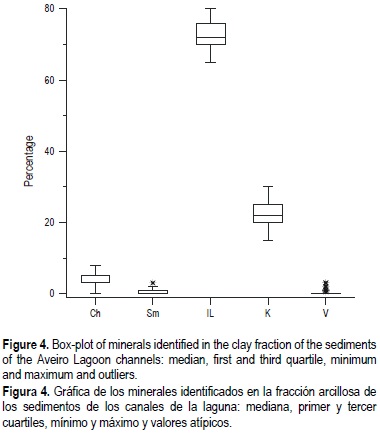
<body><![CDATA[<p>&nbsp;</p>  	    <p align="justify"><font face="verdana" size="2"><b>Results and discussion</b></font></p>  	    <p align="justify"><font face="verdana" size="2">The principal minerals of the fine fraction (&lt;63 um) of the sediments were phyllosilicates (Phyl), quartz (Qz), plagioclase (P) and K&#45;feldspar (FK). Several accessory minerals were identified: anhydrite (An), opal C/CT (Op), calcite (Ca), dolomite (Do), siderite (Sy), pyrite (Py) and zeolites (Ze) (<a href="#f2">fig. 2</a>). The finer versus coarser detrital ratio (Phyl/Qz + Fk + P) gives some indication about the hydrodynamic behaviour of the channels in Aveiro Lagoon. The higher values of this ratio correspond to low hydrodynamic levels that were favourable to higher rates of sediment deposition (<a href="#f3">fig. 3</a>).</font></p>  	    <p align="center"><font face="verdana" size="2"><a name="f2"></a></font></p>  	    <p align="center"><font face="verdana" size="2"><img src="/img/revistas/ciemar/v31n1b/a12f2.jpg"></font></p>  	    <p align="center"><font face="verdana" size="2"><a name="f3"></a></font></p>  	    <p align="center"><font face="verdana" size="2"><img src="/img/revistas/ciemar/v31n1b/a12f3.jpg"></font></p>  	    <p align="justify"><font face="verdana" size="2">Regarding the clay fraction (&lt;2 &micro;m), illite (Il) was the predominant mineral, accompanied by kaolinite (K), chlorite (C), vermiculite (V) and smectite (Sm) (<a href="#f4">fig. 4</a>). These clay minerals show, in general, low/medium crystallinity with no significant variation. Illite shows a slightly higher crystallinity, with a discrete lateral heterogeneity.</font></p>  	    <p align="center"><font face="verdana" size="2"><a name="f4"></a></font></p>  	    <p align="center"><font face="verdana" size="2"><img src="/img/revistas/ciemar/v31n1b/a12f4.jpg"></font></p>  	    ]]></body>
<body><![CDATA[<p align="justify"><font face="verdana" size="2">In the analysis of the chemical data (<a href="/img/revistas/ciemar/v31n1b/a12t1.jpg" target="_blank">table 1</a>), the nine variables (Cu, Pb, Co, Ni, Cd, Zn, Fe, Mn and Cr) were logarithmically transformed. This transformation allows a substantial decrease in the coefficient of variation, preventing subsequent estimation problems.</font></p>  	    <p align="justify"><font face="verdana" size="2">The nine principal components extracted from the correlation matrix accounted for 38.1%, 15.7%, 12.7%, 11.5%, 10.19%, 8.38%, 2.18%, 0.88% and 0.34% of the total variance. So, the first three factors represent 66.5% of the total variance. The fourth factor (11.5%) hardly explains more variance than any of the original variables alone (1/9 = 11.1%).</font></p>  	    <p align="justify"><font face="verdana" size="2">The multivariate factorial analysis (principal components analysis) of the chemical data allows the following considerations (<a href="/img/revistas/ciemar/v31n1b/a12t1.jpg" target="_blank">tables 1</a>, <a href="#t2">2</a>):</font></p>  	    <p align="center"><font face="verdana" size="2"><a name="t2"></a></font></p>  	    <p align="center"><font face="verdana" size="2"><img src="/img/revistas/ciemar/v31n1b/a12t2.jpg"></font></p>  	    <blockquote> 		    <p align="justify"><font face="verdana" size="2">&bull; The elements Cu, Co, Cd and Zn have a strong negative loading in Factor I (<a href="#t2">table 2</a>). The corresponding mapping of the factor scores (<a href="/img/revistas/ciemar/v31n1b/a12f5.jpg" target="_blank">fig. 5a</a>) shows the influence of the industrial parks located close to Ovar and Estarreja (north of Aveiro).</font></p>  		    <p align="justify"><font face="verdana" size="2">&bull; Factor II explains the Mn variable. Although the distribution pattern of Mn in the surface sediments of coastal areas is commonly defined by post&#45;mobilization processes and precipitation of Mn and Fe oxides, the mapping of these factor scores (<a href="/img/revistas/ciemar/v31n1b/a12f5.jpg" target="_blank">fig. 5b</a>) evidences co&#45;precipitation of the Mn and Fe oxides and the importance of the adsorption of trace metal from the liquid effluents of the Ovar and Estarreja chemical parks. These adsorption processes occur preferentially in more confined (therefore less hydrodynamic) channels where the bottom sediments are mainly silty/ clayey muds richer in clay minerals displaying higher specific surface areas and cation exchange capacities, such as smectite, illite&#45;smectite, vermiculite, illite&#45;vermiculite interstratifications and vermiculite&#45;Al hydroxide interlay&#45;ers (Delgado <i>et al.,</i> 1992, 1996; Gomes and Delgado, 1993; Rocha <i>et al.,</i> 2000).</font></p>  		    <p align="justify"><font face="verdana" size="2">&bull; Factor III explains the association between the Ni and Cr variables. The peculiar cartographic distribution of the factor scores (<a href="/img/revistas/ciemar/v31n1b/a12f6.jpg" target="_blank">fig. 6a</a>) suggests either a lithological/ mineralogical control (vermiculite and smectite rich muds) or some influence of different chemical parks surrounding the lagoon (Ovar, Estarreja and &Iacute;lhavo), pointing to the influence of the naval activities (port and shipyards) linked with Aveiro harbour.</font></p>  		    <p align="justify"><font face="verdana" size="2">&bull; Factor IV explains the Fe variable in opposition to the Pb variable. The positive scores of this factor show the association between Fe and harbour activities, while the mapping of negative scores points to some association of Pb with the Estarreja industrial park (<a href="/img/revistas/ciemar/v31n1b/a12f6.jpg" target="_blank">fig. 6b</a>).</font></p> 	</blockquote>  	    ]]></body>
<body><![CDATA[<p align="justify"><font face="verdana" size="2">The mapping of the different factor score values confirms, in general, the dispersion model developed by Delgado <i>et al.</i> (2000). These authors point to the Ovar region as the main source of Cu and Zn. The distribution of the Factor I scores confirms this conclusion and indicates a confinement of their dispersion, but excludes the &Iacute;lhavo region as the second main source of Zn, as reported by Delgado <i>et al.</i> (2000) (<a href="/img/revistas/ciemar/v31n1b/a12f7.jpg" target="_blank">fig. 7</a>); however, we verified that the distribution of Cr and Ni (Factor III) is in accordance with the conclusions of Delgado <i>et al.</i> (2000), whereas Pb (Factor IV) reveals a confinement and, simultaneously, a focus shift westwards (<a href="/img/revistas/ciemar/v31n1b/a12f8.jpg" target="_blank">fig. 8</a>).</font></p>  	    <p align="justify"><font face="verdana" size="2">Comparing the behaviour of the fine versus coarse detrital mineral ratio (<a href="#f3">fig. 3</a>) with the factors scores (<a href="/img/revistas/ciemar/v31n1b/a12f5.jpg" target="_blank">fig. 5</a>), the occurrence of some overlapping between the higher values of this ratio and the significant factor score areas is clear, suggesting a "hydraulic" control over the chemical dispersion of the elements in the lagoon channels. Dispersion of fine particles, which have a larger specific area, may be an important vehicle to transport anthropogenic metals from one site to another.</font></p>  	    <p align="justify"><font face="verdana" size="2">Regarding the relationship between trace metal concentrations and clay mineral distribution, it was found that higher contents of trace metals do occur in zones where the sediments are richer in clay minerals, displaying higher specific surface areas and cation exchange capacities, in relation to the existence of smectite, illite&#45;smectite, vermiculite, illite&#45;vermiculite interstratifications and vermiculite&#45;Al hydroxide interlayers (Delgado <i>et al.,</i> 1992, 1996; Gomes and Delgado, 1993; Rocha <i>et al.,</i> 2000).</font></p>  	    <p align="justify"><font face="verdana" size="2">Mapping the sediment contents of Cu, Ni, Pb, Zn and Cr from the Aveiro Lagoon channels and comparing with those obtained in the 1980s by Delgado <i>et al.</i> (2000) (<a href="/img/revistas/ciemar/v31n1b/a12f7.jpg" target="_blank">figs. 7</a>, <a href="/img/revistas/ciemar/v31n1b/a12f8.jpg" target="_blank">8</a>), we can conclude that Cu and Zn exhibit a tendency to disperse from the Ovar and Estarreja source areas and simultaneously to be more confined, with high contents in the north sector (near Ovar); Ni shows a dispersion, mainly from the Estarreja source area and from the Lower Vouga basin; Pb exhibits a slight tendency to disperse from the Estarreja source area and to a confinement in the central zone of the lagoon.</font></p>  	    <p align="justify"><font face="verdana" size="2">In summary, the well&#45;located distribution of the trace metals analyzed points to a relevant anthropogenic activity (particularly industrial) as the main factor responsible for the geochemical signature observed in the surface sediments from Aveiro Lagoon, in regards to trace metals; however, the contents of the referred metals in the same sediments also denote some hydrodynamic control due to the silting up of the lagoon channels. Evidence was found that heavy metal concentrations are higher in the more confined (therefore less hydrodynamic) channels, where the bottom sediments are richer in finer particles (silty and clayey) and display a mineralogical composition characterized by high contents of clay minerals, displaying higher specific surface areas and cation exchange capacities (such as smectite, illite&#45;smectite, vermiculite, illite&#45;vermiculite interstratifications and vermiculite&#45;Al hydroxide intergrades). There is some preferential concentration of heavy metals in sediments richer in the finest fractions; therefore, higher clay contents favour heavy metal concentrations.</font></p>  	    <p>&nbsp;</p>  	    <p align="justify"><font face="verdana" size="2"><b>Acknowledgements</b></font></p>  	    <p align="justify"><font face="verdana" size="2">The present work was supported by project PRAXIS 2/2.1/ MAR/1750/95 ("Estudo integrado da transferencia e efeitos de contaminantes em sedimentos, Ria de Aveiro").</font></p>  	    <p>&nbsp;</p>  	    <p align="justify"><font face="verdana" size="2"><b>References</b></font></p>  	    ]]></body>
<body><![CDATA[<!-- ref --><p align="justify"><font face="verdana" size="2">Azevedo, M.C.C. (1999). Contribui&ccedil;&atilde;o para a Caracteriza&ccedil;&atilde;o Ambiental da &Aacute;rea Envolvente do Complexo Qu&iacute;mico de Estarreja. M.Sc. thesis, University of Aveiro, Aveiro, Portugal.    &nbsp;&nbsp;&nbsp;&nbsp;&nbsp;&nbsp;&nbsp;&nbsp;[&#160;<a href="javascript:void(0);" onclick="javascript: window.open('/scielo.php?script=sci_nlinks&ref=1882835&pid=S0185-3880200500020001200001&lng=','','width=640,height=500,resizable=yes,scrollbars=1,menubar=yes,');">Links</a>&#160;]<!-- end-ref --></font></p>  	    <!-- ref --><p align="justify"><font face="verdana" size="2">Barahona, E. (1974). Arcillas de ladriller&iacute;a de la provincia de Granada: Evaluaci&oacute;n de algunos ensayos de materias primas. Ph.D. thesis, Granada University, Spain, 398 pp.    &nbsp;&nbsp;&nbsp;&nbsp;&nbsp;&nbsp;&nbsp;&nbsp;[&#160;<a href="javascript:void(0);" onclick="javascript: window.open('/scielo.php?script=sci_nlinks&ref=1882837&pid=S0185-3880200500020001200002&lng=','','width=640,height=500,resizable=yes,scrollbars=1,menubar=yes,');">Links</a>&#160;]<!-- end-ref --></font></p>  	    <!-- ref --><p align="justify"><font face="verdana" size="2">Barradas, J.J.M. (1992). Geoqu&iacute;mica de elementos maiores e vestigiais em amostras de solos, sedimentos de Vale e &aacute;guas subterr&acirc;neas. Contribui&ccedil;&atilde;o para a Caracteriza&ccedil;&atilde;o Ambiental da Zona Envolvente ao Complexo de Estarreja. Ph.D. Thesis, University of Aveiro, Aveiro, 204 pp.    &nbsp;&nbsp;&nbsp;&nbsp;&nbsp;&nbsp;&nbsp;&nbsp;[&#160;<a href="javascript:void(0);" onclick="javascript: window.open('/scielo.php?script=sci_nlinks&ref=1882839&pid=S0185-3880200500020001200003&lng=','','width=640,height=500,resizable=yes,scrollbars=1,menubar=yes,');">Links</a>&#160;]<!-- end-ref --></font></p>  	    <!-- ref --><p align="justify"><font face="verdana" size="2">Batista, A.C., Ferreira da Silva, E.A., Azevedo, M.C.C., Sousa, A.J. and Cardoso&#45;Fonseca, E. (2002). Soil data analysis from central Portugal by principal component analysis and geostatistical techniques. Geochemistry: Exploration, Environment, Analysis, 2: 15&#45;25.    &nbsp;&nbsp;&nbsp;&nbsp;&nbsp;&nbsp;&nbsp;&nbsp;[&#160;<a href="javascript:void(0);" onclick="javascript: window.open('/scielo.php?script=sci_nlinks&ref=1882841&pid=S0185-3880200500020001200004&lng=','','width=640,height=500,resizable=yes,scrollbars=1,menubar=yes,');">Links</a>&#160;]<!-- end-ref --></font></p>  	    <!-- ref --><p align="justify"><font face="verdana" size="2">Corrochano, A., Galera, M., Bernardes, C.A. y Barba, P. (1997). Caracter&iacute;sticas de la llanura intermareal asociada al canal de Mira (dominio interno del complejo de isla&#45;barrera de Aveiro, Portugal). Geogaceta, 22: 47&#45;50.    &nbsp;&nbsp;&nbsp;&nbsp;&nbsp;&nbsp;&nbsp;&nbsp;[&#160;<a href="javascript:void(0);" onclick="javascript: window.open('/scielo.php?script=sci_nlinks&ref=1882843&pid=S0185-3880200500020001200005&lng=','','width=640,height=500,resizable=yes,scrollbars=1,menubar=yes,');">Links</a>&#160;]<!-- end-ref --></font></p>  	    ]]></body>
<body><![CDATA[<!-- ref --><p align="justify"><font face="verdana" size="2">Corrochano, A., Galera, M., Jaen, P., Barba, P. y Bernardes, C.A. (1999). Facies y evoluci&oacute;n holocena reciente en el canal mareal de Mira (Portugal). Rev. Soc. Geol. Espa&ntilde;a, 12(1): 123&#45;135.    &nbsp;&nbsp;&nbsp;&nbsp;&nbsp;&nbsp;&nbsp;&nbsp;[&#160;<a href="javascript:void(0);" onclick="javascript: window.open('/scielo.php?script=sci_nlinks&ref=1882845&pid=S0185-3880200500020001200006&lng=','','width=640,height=500,resizable=yes,scrollbars=1,menubar=yes,');">Links</a>&#160;]<!-- end-ref --></font></p>  	    <!-- ref --><p align="justify"><font face="verdana" size="2">Costa, C. and Jesus, C. (1999). Case study of heavy&#45;metals pollution in Estarreja (Portugal). International Conference on Investigation Methods on Soil Contamination, Lisbon, 10.    &nbsp;&nbsp;&nbsp;&nbsp;&nbsp;&nbsp;&nbsp;&nbsp;[&#160;<a href="javascript:void(0);" onclick="javascript: window.open('/scielo.php?script=sci_nlinks&ref=1882847&pid=S0185-3880200500020001200007&lng=','','width=640,height=500,resizable=yes,scrollbars=1,menubar=yes,');">Links</a>&#160;]<!-- end-ref --> </font></p> 	    <!-- ref --><p align="justify"><font face="verdana" size="2">Davis, J.C. (1986). Statistics and Data Analysis in Geology. Wiley, New York, 646 pp.    &nbsp;&nbsp;&nbsp;&nbsp;&nbsp;&nbsp;&nbsp;&nbsp;[&#160;<a href="javascript:void(0);" onclick="javascript: window.open('/scielo.php?script=sci_nlinks&ref=1882849&pid=S0185-3880200500020001200008&lng=','','width=640,height=500,resizable=yes,scrollbars=1,menubar=yes,');">Links</a>&#160;]<!-- end-ref --></font></p>      <!-- ref --><p align="justify"><font face="verdana" size="2">Delgado, H., Rocha, F. and Gomes, C. (1992). Evolution of the Aveiro Lagoon during the last 500 years based on clay mineralogy. Min. Petr. Acta, Vol. XXXV&#45;A: 105&#45;110.    &nbsp;&nbsp;&nbsp;&nbsp;&nbsp;&nbsp;&nbsp;&nbsp;[&#160;<a href="javascript:void(0);" onclick="javascript: window.open('/scielo.php?script=sci_nlinks&ref=1882851&pid=S0185-3880200500020001200009&lng=','','width=640,height=500,resizable=yes,scrollbars=1,menubar=yes,');">Links</a>&#160;]<!-- end-ref --></font></p>  	    <!-- ref --><p align="justify"><font face="verdana" size="2">Delgado, H.. Rocha, F. and Gomes, C. (1994). New data on heavy metals in the sediments of the Aveiro Lagoon. Proc. Littoral 94 (Eurocoast, Lisbon), pp. 516&#45;518.    &nbsp;&nbsp;&nbsp;&nbsp;&nbsp;&nbsp;&nbsp;&nbsp;[&#160;<a href="javascript:void(0);" onclick="javascript: window.open('/scielo.php?script=sci_nlinks&ref=1882853&pid=S0185-3880200500020001200010&lng=','','width=640,height=500,resizable=yes,scrollbars=1,menubar=yes,');">Links</a>&#160;]<!-- end-ref --></font></p>  	    ]]></body>
<body><![CDATA[<!-- ref --><p align="justify"><font face="verdana" size="2">Delgado, H., Rocha, F. and Gomes, C. (1996). Statistical data analysis relating heavy metal concentrations and distribution to recent sediment nature and composition in the Aveiro Lagoon (Portugal). Proc. IVth Intern. Symp. on the Geochemistry of the Earth's Surface, Int. Assoc. Geochem. Cosmochem./Univ. Leeds, pp. 383&#45;388.    &nbsp;&nbsp;&nbsp;&nbsp;&nbsp;&nbsp;&nbsp;&nbsp;[&#160;<a href="javascript:void(0);" onclick="javascript: window.open('/scielo.php?script=sci_nlinks&ref=1882855&pid=S0185-3880200500020001200011&lng=','','width=640,height=500,resizable=yes,scrollbars=1,menubar=yes,');">Links</a>&#160;]<!-- end-ref --></font></p>  	    <!-- ref --><p align="justify"><font face="verdana" size="2">Delgado, H., Rocha, F. and Gomes, C. (2000). Modelos de dispers&atilde;o de metais pesados nos sedimentos recentes da laguna de Aveiro e sua relaf&aacute;o com a composi&ccedil;&atilde;o e textura dos sedimentos. In: A. Duarte, C. Vale and R. Prego (eds.), Estudos de Biogeoqu&iacute;mica na Zona Costeira Ib&eacute;rica (Actas IX Sem. Ib&eacute;rico Qu&iacute;m. Marinha), Univ. Aveiro, pp. 325&#45;336.    &nbsp;&nbsp;&nbsp;&nbsp;&nbsp;&nbsp;&nbsp;&nbsp;[&#160;<a href="javascript:void(0);" onclick="javascript: window.open('/scielo.php?script=sci_nlinks&ref=1882857&pid=S0185-3880200500020001200012&lng=','','width=640,height=500,resizable=yes,scrollbars=1,menubar=yes,');">Links</a>&#160;]<!-- end-ref --></font></p>  	    <!-- ref --><p align="justify"><font face="verdana" size="2">Ferreira, M.M.I. (1993). Merc&uacute;rio em Solos na &Aacute;rea do Complexo Qu&iacute;mico de Estarreja. M.Sc. thesis, University of Aveiro, Aveiro, Portugal.    &nbsp;&nbsp;&nbsp;&nbsp;&nbsp;&nbsp;&nbsp;&nbsp;[&#160;<a href="javascript:void(0);" onclick="javascript: window.open('/scielo.php?script=sci_nlinks&ref=1882859&pid=S0185-3880200500020001200013&lng=','','width=640,height=500,resizable=yes,scrollbars=1,menubar=yes,');">Links</a>&#160;]<!-- end-ref --></font></p>  	    <!-- ref --><p align="justify"><font face="verdana" size="2">Ferreira da Silva, E.A. (1989). Impacte Ambiental de Elementos Maiores e Vestigiais no Aqu&iacute;fero Superficial de Estarreja: Caracteriza&ccedil;&atilde;o da Zona Envolvente ao Complexo de Estarreja. Provas de Aptid&atilde;o Cient&iacute;fica e Capacidade Pedag&oacute;gica. Departamento de Geoci&ecirc;ncias, Universidade de Aveiro, Portugal.    &nbsp;&nbsp;&nbsp;&nbsp;&nbsp;&nbsp;&nbsp;&nbsp;[&#160;<a href="javascript:void(0);" onclick="javascript: window.open('/scielo.php?script=sci_nlinks&ref=1882861&pid=S0185-3880200500020001200014&lng=','','width=640,height=500,resizable=yes,scrollbars=1,menubar=yes,');">Links</a>&#160;]<!-- end-ref --></font></p>  	    <!-- ref --><p align="justify"><font face="verdana" size="2">Garrett, R.G. (1973). The determination of sampling and analytical errors in exploration geochemistry. Econ. Geol., 68: 282&#45;283.    &nbsp;&nbsp;&nbsp;&nbsp;&nbsp;&nbsp;&nbsp;&nbsp;[&#160;<a href="javascript:void(0);" onclick="javascript: window.open('/scielo.php?script=sci_nlinks&ref=1882863&pid=S0185-3880200500020001200015&lng=','','width=640,height=500,resizable=yes,scrollbars=1,menubar=yes,');">Links</a>&#160;]<!-- end-ref --></font></p>  	    ]]></body>
<body><![CDATA[<!-- ref --><p align="justify"><font face="verdana" size="2">Gomes, C. S. F. and Delgado, H. M. S. (1993). Heavy metals in the sediments of the Aveiro lagoon (Portugal): sources and relationships with clay minerals. Chem. Geol., 107(3&#45;4): 423&#45;426</font>&nbsp;&nbsp;&nbsp;&nbsp;&nbsp;&nbsp;&nbsp;&nbsp;[&#160;<a href="javascript:void(0);" onclick="javascript: window.open('/scielo.php?script=sci_nlinks&ref=1882865&pid=S0185-3880200500020001200016&lng=','','width=640,height=500,resizable=yes,scrollbars=1,menubar=yes,');">Links</a>&#160;]<!-- end-ref --><!-- ref --><p align="justify"><font face="verdana" size="2">Imbrie, J. and Van Andel, T.H. (1964). Vector analysis of heavy&#45;mineral data. Bull. Geol. Soc. Am., 75: 1131&#45;1156.    &nbsp;&nbsp;&nbsp;&nbsp;&nbsp;&nbsp;&nbsp;&nbsp;[&#160;<a href="javascript:void(0);" onclick="javascript: window.open('/scielo.php?script=sci_nlinks&ref=1882866&pid=S0185-3880200500020001200017&lng=','','width=640,height=500,resizable=yes,scrollbars=1,menubar=yes,');">Links</a>&#160;]<!-- end-ref --></font></p>  	    <!-- ref --><p align="justify"><font face="verdana" size="2">J&ouml;reskob, K.G., Klovan, J.E. and Reyment, R.A. (1976). Geological Factor Analysis. Elsevier, Amsterdam, 178 pp.    &nbsp;&nbsp;&nbsp;&nbsp;&nbsp;&nbsp;&nbsp;&nbsp;[&#160;<a href="javascript:void(0);" onclick="javascript: window.open('/scielo.php?script=sci_nlinks&ref=1882868&pid=S0185-3880200500020001200018&lng=','','width=640,height=500,resizable=yes,scrollbars=1,menubar=yes,');">Links</a>&#160;]<!-- end-ref --></font></p>  	    <!-- ref --><p align="justify"><font face="verdana" size="2">Lecomte, P. and Sondag, F. (1980). Regional geochemical reconnaissance in the Belgian Ardennes, secondary dispersion patterns in the stream sediments. Miner. Deposita, 15(1): 47&#45;60.    &nbsp;&nbsp;&nbsp;&nbsp;&nbsp;&nbsp;&nbsp;&nbsp;[&#160;<a href="javascript:void(0);" onclick="javascript: window.open('/scielo.php?script=sci_nlinks&ref=1882870&pid=S0185-3880200500020001200019&lng=','','width=640,height=500,resizable=yes,scrollbars=1,menubar=yes,');">Links</a>&#160;]<!-- end-ref --></font></p>  	    <!-- ref --><p align="justify"><font face="verdana" size="2">Mellinger, R.M. (1979). Quantitative X&#45;ray diffraction analysis of clay minerals. An evaluation. Saskatchewan Research Council, Canada, SRC Rep. G&#45;79: 1&#45;16</font>&nbsp;&nbsp;&nbsp;&nbsp;&nbsp;&nbsp;&nbsp;&nbsp;[&#160;<a href="javascript:void(0);" onclick="javascript: window.open('/scielo.php?script=sci_nlinks&ref=1882872&pid=S0185-3880200500020001200020&lng=','','width=640,height=500,resizable=yes,scrollbars=1,menubar=yes,');">Links</a>&#160;]<!-- end-ref --><!-- ref --><p align="justify"><font face="verdana" size="2">Mezzadri, G. and Saccani, E. (1989). Heavy mineral distribution in Late Quaternary sediments of the southern Aegean sea: Implications for provenance and sediment dispersal in sedimentary basins at active margins. J. Sediment. Petrol., 59: 412&#45;422.    &nbsp;&nbsp;&nbsp;&nbsp;&nbsp;&nbsp;&nbsp;&nbsp;[&#160;<a href="javascript:void(0);" onclick="javascript: window.open('/scielo.php?script=sci_nlinks&ref=1882873&pid=S0185-3880200500020001200021&lng=','','width=640,height=500,resizable=yes,scrollbars=1,menubar=yes,');">Links</a>&#160;]<!-- end-ref --></font></p>  	    ]]></body>
<body><![CDATA[<!-- ref --><p align="justify"><font face="verdana" size="2">Pevear, D.R. and Mumpton, F.A. (1989). Quantitative mineral analysis of clays. CMS Workshop Lectures, 1. The Clay Minerals Soc., Colorado (USA).    &nbsp;&nbsp;&nbsp;&nbsp;&nbsp;&nbsp;&nbsp;&nbsp;[&#160;<a href="javascript:void(0);" onclick="javascript: window.open('/scielo.php?script=sci_nlinks&ref=1882875&pid=S0185-3880200500020001200022&lng=','','width=640,height=500,resizable=yes,scrollbars=1,menubar=yes,');">Links</a>&#160;]<!-- end-ref --> </font></p> 	    <!-- ref --><p align="justify"><font face="verdana" size="2">Reyment, R. and Joreskob, K.G. (1993). Applied Factor Analysis in the Natural Sciences. Cambridge Univ. Press, Cambridge, 369 pp.    &nbsp;&nbsp;&nbsp;&nbsp;&nbsp;&nbsp;&nbsp;&nbsp;[&#160;<a href="javascript:void(0);" onclick="javascript: window.open('/scielo.php?script=sci_nlinks&ref=1882877&pid=S0185-3880200500020001200023&lng=','','width=640,height=500,resizable=yes,scrollbars=1,menubar=yes,');">Links</a>&#160;]<!-- end-ref --></font></p>      <!-- ref --><p align="justify"><font face="verdana" size="2">Rocha, F. and Gomes, C. (1991). Clay mineralogy used for the definition of paleosurfaces in the Tertiary and Quaternary of the Aveiro sedimentary basin. M&eacute;moires des Sciences de la Terre, Ecole des Mines de Paris, 18: 31&#45;38.    &nbsp;&nbsp;&nbsp;&nbsp;&nbsp;&nbsp;&nbsp;&nbsp;[&#160;<a href="javascript:void(0);" onclick="javascript: window.open('/scielo.php?script=sci_nlinks&ref=1882879&pid=S0185-3880200500020001200024&lng=','','width=640,height=500,resizable=yes,scrollbars=1,menubar=yes,');">Links</a>&#160;]<!-- end-ref --></font></p>  	    <!-- ref --><p align="justify"><font face="verdana" size="2">Rocha, F. and Gomes, C. (1992). Fibrous clay minerals as morpho&#45;climatic markers in the Aveiro sedimentary basin. Min. Petr. Acta, Vol. XXXV&#45;A: 217&#45;226.    &nbsp;&nbsp;&nbsp;&nbsp;&nbsp;&nbsp;&nbsp;&nbsp;[&#160;<a href="javascript:void(0);" onclick="javascript: window.open('/scielo.php?script=sci_nlinks&ref=1882881&pid=S0185-3880200500020001200025&lng=','','width=640,height=500,resizable=yes,scrollbars=1,menubar=yes,');">Links</a>&#160;]<!-- end-ref --></font></p>  	    <!-- ref --><p align="justify"><font face="verdana" size="2">Rocha, F. and Gomes, C. (1994). Discrimination of Tertiary and Quaternary lithostratigraphical units in the Aveiro region on the basis of clay minerals. Acta Univ. Carolinae Geol. (Prague), 38: 381&#45;390.    &nbsp;&nbsp;&nbsp;&nbsp;&nbsp;&nbsp;&nbsp;&nbsp;[&#160;<a href="javascript:void(0);" onclick="javascript: window.open('/scielo.php?script=sci_nlinks&ref=1882883&pid=S0185-3880200500020001200026&lng=','','width=640,height=500,resizable=yes,scrollbars=1,menubar=yes,');">Links</a>&#160;]<!-- end-ref --></font></p>  	    ]]></body>
<body><![CDATA[<!-- ref --><p align="justify"><font face="verdana" size="2">Rocha, F., Galhano, A.C. and Gomes, C. (1999). Characterization and datation of Holocene mud layers from the urban area of Aveiro (Portugal). Cuatern. Geomorfol., 13(1/2): 45&#45;52.    &nbsp;&nbsp;&nbsp;&nbsp;&nbsp;&nbsp;&nbsp;&nbsp;[&#160;<a href="javascript:void(0);" onclick="javascript: window.open('/scielo.php?script=sci_nlinks&ref=1882885&pid=S0185-3880200500020001200027&lng=','','width=640,height=500,resizable=yes,scrollbars=1,menubar=yes,');">Links</a>&#160;]<!-- end-ref --></font></p>  	    <!-- ref --><p align="justify"><font face="verdana" size="2">Rocha, F., Bernardes, C. and Delgado, H. (2000). Caracteriza&ccedil;&atilde;o textural e mineral&oacute;gica dos sedimentos da laguna de Aveiro, Portugal. Abstr. "3&deg; Simp. Margem Contin. Atlant. Ib&eacute;rica" (Univ. Algarve, Faro): 17&#45;18.    &nbsp;&nbsp;&nbsp;&nbsp;&nbsp;&nbsp;&nbsp;&nbsp;[&#160;<a href="javascript:void(0);" onclick="javascript: window.open('/scielo.php?script=sci_nlinks&ref=1882887&pid=S0185-3880200500020001200028&lng=','','width=640,height=500,resizable=yes,scrollbars=1,menubar=yes,');">Links</a>&#160;]<!-- end-ref --></font></p>  	    <!-- ref --><p align="justify"><font face="verdana" size="2">Schultz, L.G. (1964). Quantitative interpretation of mineralogical composition from X&#45;ray and chemical data for the Pierre Shale. US Geol. Surv. Prof. Paper, 391&#45;C: 1&#45;31.    &nbsp;&nbsp;&nbsp;&nbsp;&nbsp;&nbsp;&nbsp;&nbsp;[&#160;<a href="javascript:void(0);" onclick="javascript: window.open('/scielo.php?script=sci_nlinks&ref=1882889&pid=S0185-3880200500020001200029&lng=','','width=640,height=500,resizable=yes,scrollbars=1,menubar=yes,');">Links</a>&#160;]<!-- end-ref --></font></p>  	    <!-- ref --><p align="justify"><font face="verdana" size="2">Thorez, J. (1976). Practical identification of clay minerals. Ed. G. Lelotte, Belgique.    &nbsp;&nbsp;&nbsp;&nbsp;&nbsp;&nbsp;&nbsp;&nbsp;[&#160;<a href="javascript:void(0);" onclick="javascript: window.open('/scielo.php?script=sci_nlinks&ref=1882891&pid=S0185-3880200500020001200030&lng=','','width=640,height=500,resizable=yes,scrollbars=1,menubar=yes,');">Links</a>&#160;]<!-- end-ref --></font></p>      ]]></body><back>
<ref-list>
<ref id="B1">
<nlm-citation citation-type="">
<person-group person-group-type="author">
<name>
<surname><![CDATA[Azevedo]]></surname>
<given-names><![CDATA[M.C.C.]]></given-names>
</name>
</person-group>
<source><![CDATA[Contribuição para a Caracterização Ambiental da Área Envolvente do Complexo Químico de Estarreja]]></source>
<year>1999</year>
</nlm-citation>
</ref>
<ref id="B2">
<nlm-citation citation-type="">
<person-group person-group-type="author">
<name>
<surname><![CDATA[Barahona]]></surname>
<given-names><![CDATA[E.]]></given-names>
</name>
</person-group>
<source><![CDATA[Arcillas de ladrillería de la provincia de Granada: Evaluación de algunos ensayos de materias primas]]></source>
<year>1974</year>
<page-range>398</page-range></nlm-citation>
</ref>
<ref id="B3">
<nlm-citation citation-type="">
<person-group person-group-type="author">
<name>
<surname><![CDATA[Barradas]]></surname>
<given-names><![CDATA[J.J.M.]]></given-names>
</name>
</person-group>
<source><![CDATA[Geoquímica de elementos maiores e vestigiais em amostras de solos, sedimentos de Vale e águas subterrâneas. Contribuição para a Caracterização Ambiental da Zona Envolvente ao Complexo de Estarreja]]></source>
<year>1992</year>
<page-range>204</page-range></nlm-citation>
</ref>
<ref id="B4">
<nlm-citation citation-type="journal">
<person-group person-group-type="author">
<name>
<surname><![CDATA[Batista]]></surname>
<given-names><![CDATA[A.C.]]></given-names>
</name>
<name>
<surname><![CDATA[Ferreira da Silva]]></surname>
<given-names><![CDATA[E.A.]]></given-names>
</name>
<name>
<surname><![CDATA[Azevedo]]></surname>
<given-names><![CDATA[M.C.C.]]></given-names>
</name>
<name>
<surname><![CDATA[Sousa]]></surname>
<given-names><![CDATA[A.J.]]></given-names>
</name>
<name>
<surname><![CDATA[Cardoso-Fonseca]]></surname>
<given-names><![CDATA[E.]]></given-names>
</name>
</person-group>
<article-title xml:lang="en"><![CDATA[Soil data analysis from central Portugal by principal component analysis and geostatistical techniques]]></article-title>
<source><![CDATA[Geochemistry: Exploration, Environment, Analysis]]></source>
<year>2002</year>
<volume>2</volume>
<page-range>15-25</page-range></nlm-citation>
</ref>
<ref id="B5">
<nlm-citation citation-type="journal">
<person-group person-group-type="author">
<name>
<surname><![CDATA[Corrochano]]></surname>
<given-names><![CDATA[A.]]></given-names>
</name>
<name>
<surname><![CDATA[Galera]]></surname>
<given-names><![CDATA[M.]]></given-names>
</name>
<name>
<surname><![CDATA[Bernardes]]></surname>
<given-names><![CDATA[C.A.]]></given-names>
</name>
<name>
<surname><![CDATA[Barba]]></surname>
<given-names><![CDATA[P.]]></given-names>
</name>
</person-group>
<article-title xml:lang="es"><![CDATA[Características de la llanura intermareal asociada al canal de Mira (dominio interno del complejo de isla-barrera de Aveiro, Portugal)]]></article-title>
<source><![CDATA[Geogaceta]]></source>
<year>1997</year>
<volume>22</volume>
<page-range>47-50</page-range></nlm-citation>
</ref>
<ref id="B6">
<nlm-citation citation-type="journal">
<person-group person-group-type="author">
<name>
<surname><![CDATA[Corrochano]]></surname>
<given-names><![CDATA[A.]]></given-names>
</name>
<name>
<surname><![CDATA[Galera]]></surname>
<given-names><![CDATA[M.]]></given-names>
</name>
<name>
<surname><![CDATA[Jaen]]></surname>
<given-names><![CDATA[P.]]></given-names>
</name>
<name>
<surname><![CDATA[Barba]]></surname>
<given-names><![CDATA[P.]]></given-names>
</name>
<name>
<surname><![CDATA[Bernardes]]></surname>
<given-names><![CDATA[C.A.]]></given-names>
</name>
</person-group>
<article-title xml:lang="es"><![CDATA[Facies y evolución holocena reciente en el canal mareal de Mira (Portugal)]]></article-title>
<source><![CDATA[Rev. Soc. Geol. España]]></source>
<year>1999</year>
<volume>12</volume>
<numero>1</numero>
<issue>1</issue>
<page-range>123-135</page-range></nlm-citation>
</ref>
<ref id="B7">
<nlm-citation citation-type="book">
<person-group person-group-type="author">
<name>
<surname><![CDATA[Costa]]></surname>
<given-names><![CDATA[C.]]></given-names>
</name>
<name>
<surname><![CDATA[Jesus]]></surname>
<given-names><![CDATA[C.]]></given-names>
</name>
</person-group>
<source><![CDATA[Case study of heavy-metals pollution in Estarreja (Portugal)]]></source>
<year>1999</year>
<page-range>10</page-range><publisher-loc><![CDATA[Lisbon ]]></publisher-loc>
<publisher-name><![CDATA[International Conference on Investigation Methods on Soil Contamination]]></publisher-name>
</nlm-citation>
</ref>
<ref id="B8">
<nlm-citation citation-type="book">
<person-group person-group-type="author">
<name>
<surname><![CDATA[Davis]]></surname>
<given-names><![CDATA[J.C.]]></given-names>
</name>
</person-group>
<source><![CDATA[Statistics and Data Analysis in Geology]]></source>
<year>1986</year>
<page-range>646</page-range><publisher-loc><![CDATA[New York ]]></publisher-loc>
<publisher-name><![CDATA[Wiley]]></publisher-name>
</nlm-citation>
</ref>
<ref id="B9">
<nlm-citation citation-type="journal">
<person-group person-group-type="author">
<name>
<surname><![CDATA[Delgado]]></surname>
<given-names><![CDATA[H.]]></given-names>
</name>
<name>
<surname><![CDATA[Rocha]]></surname>
<given-names><![CDATA[F.]]></given-names>
</name>
<name>
<surname><![CDATA[Gomes]]></surname>
<given-names><![CDATA[C.]]></given-names>
</name>
</person-group>
<article-title xml:lang="en"><![CDATA[Evolution of the Aveiro Lagoon during the last 500 years based on clay mineralogy]]></article-title>
<source><![CDATA[Min. Petr. Acta]]></source>
<year>1992</year>
<volume>XXXV-A</volume>
<page-range>105-110</page-range></nlm-citation>
</ref>
<ref id="B10">
<nlm-citation citation-type="book">
<person-group person-group-type="author">
<name>
<surname><![CDATA[Delgado]]></surname>
<given-names><![CDATA[H.]]></given-names>
</name>
<name>
<surname><![CDATA[Rocha]]></surname>
<given-names><![CDATA[F.]]></given-names>
</name>
<name>
<surname><![CDATA[Gomes]]></surname>
</name>
</person-group>
<source><![CDATA[New data on heavy metals in the sediments of the Aveiro Lagoon]]></source>
<year>1994</year>
<page-range>516-518</page-range><publisher-loc><![CDATA[Lisbon ]]></publisher-loc>
<publisher-name><![CDATA[Eurocoast]]></publisher-name>
</nlm-citation>
</ref>
<ref id="B11">
<nlm-citation citation-type="book">
<person-group person-group-type="author">
<name>
<surname><![CDATA[Delgado]]></surname>
<given-names><![CDATA[H.]]></given-names>
</name>
<name>
<surname><![CDATA[Rocha]]></surname>
<given-names><![CDATA[F.]]></given-names>
</name>
<name>
<surname><![CDATA[Gomes]]></surname>
<given-names><![CDATA[C.]]></given-names>
</name>
</person-group>
<source><![CDATA[Statistical data analysis relating heavy metal concentrations and distribution to recent sediment nature and composition in the Aveiro Lagoon (Portugal)]]></source>
<year>1996</year>
<page-range>383-388</page-range><publisher-loc><![CDATA[Leeds ]]></publisher-loc>
<publisher-name><![CDATA[Proc. IVth Intern. Symp. on the Geochemistry of the Earth's Surface, Int. Assoc. Geochem. Cosmochem./Univ.]]></publisher-name>
</nlm-citation>
</ref>
<ref id="B12">
<nlm-citation citation-type="book">
<person-group person-group-type="author">
<name>
<surname><![CDATA[Delgado]]></surname>
<given-names><![CDATA[H.]]></given-names>
</name>
<name>
<surname><![CDATA[Rocha]]></surname>
<given-names><![CDATA[F.]]></given-names>
</name>
<name>
<surname><![CDATA[Gomes]]></surname>
<given-names><![CDATA[C.]]></given-names>
</name>
</person-group>
<article-title xml:lang="pt"><![CDATA[Modelos de dispersão de metais pesados nos sedimentos recentes da laguna de Aveiro e sua relafáo com a composição e textura dos sedimentos]]></article-title>
<person-group person-group-type="editor">
<name>
<surname><![CDATA[Duarte]]></surname>
<given-names><![CDATA[A.]]></given-names>
</name>
<name>
<surname><![CDATA[Vale]]></surname>
<given-names><![CDATA[C.]]></given-names>
</name>
<name>
<surname><![CDATA[Prego]]></surname>
<given-names><![CDATA[R.]]></given-names>
</name>
</person-group>
<source><![CDATA[Estudos de Biogeoquímica na Zona Costeira Ibérica]]></source>
<year>2000</year>
<page-range>325-336</page-range><publisher-name><![CDATA[Actas IX Sem. Ibérico Quím. MarinhaUniv. Aveiro]]></publisher-name>
</nlm-citation>
</ref>
<ref id="B13">
<nlm-citation citation-type="">
<person-group person-group-type="author">
<name>
<surname><![CDATA[Ferreira]]></surname>
<given-names><![CDATA[M.M.I.]]></given-names>
</name>
</person-group>
<source><![CDATA[Mercúrio em Solos na Área do Complexo Químico de Estarreja]]></source>
<year>1993</year>
</nlm-citation>
</ref>
<ref id="B14">
<nlm-citation citation-type="book">
<person-group person-group-type="author">
<name>
<surname><![CDATA[Ferreira da Silva]]></surname>
<given-names><![CDATA[E.A.]]></given-names>
</name>
</person-group>
<source><![CDATA[Impacte Ambiental de Elementos Maiores e Vestigiais no Aquífero Superficial de Estarreja: Caracterização da Zona Envolvente ao Complexo de Estarreja]]></source>
<year>1989</year>
<publisher-name><![CDATA[Provas de Aptidão Científica e Capacidade PedagógicaDepartamento de Geociências, Universidade de Aveiro]]></publisher-name>
</nlm-citation>
</ref>
<ref id="B15">
<nlm-citation citation-type="journal">
<person-group person-group-type="author">
<name>
<surname><![CDATA[Garrett]]></surname>
<given-names><![CDATA[R.G.]]></given-names>
</name>
</person-group>
<article-title xml:lang="en"><![CDATA[The determination of sampling and analytical errors in exploration geochemistry]]></article-title>
<source><![CDATA[Econ. Geol.]]></source>
<year>1973</year>
<volume>68</volume>
<page-range>282-283</page-range></nlm-citation>
</ref>
<ref id="B16">
<nlm-citation citation-type="journal">
<person-group person-group-type="author">
<name>
<surname><![CDATA[Gomes]]></surname>
<given-names><![CDATA[C. S. F.]]></given-names>
</name>
<name>
<surname><![CDATA[Delgado]]></surname>
<given-names><![CDATA[H. M. S.]]></given-names>
</name>
</person-group>
<article-title xml:lang="en"><![CDATA[Heavy metals in the sediments of the Aveiro lagoon (Portugal): sources and relationships with clay minerals]]></article-title>
<source><![CDATA[Chem. Geol.]]></source>
<year>1993</year>
<volume>107</volume>
<numero>3-4</numero>
<issue>3-4</issue>
<page-range>423-426</page-range></nlm-citation>
</ref>
<ref id="B17">
<nlm-citation citation-type="journal">
<person-group person-group-type="author">
<name>
<surname><![CDATA[Imbrie]]></surname>
<given-names><![CDATA[J.]]></given-names>
</name>
<name>
<surname><![CDATA[Van Andel]]></surname>
<given-names><![CDATA[T.H.]]></given-names>
</name>
</person-group>
<article-title xml:lang="en"><![CDATA[Vector analysis of heavy-mineral data]]></article-title>
<source><![CDATA[Bull. Geol. Soc. Am.]]></source>
<year>1964</year>
<volume>75</volume>
<page-range>1131-1156</page-range></nlm-citation>
</ref>
<ref id="B18">
<nlm-citation citation-type="book">
<person-group person-group-type="author">
<name>
<surname><![CDATA[Jöreskob]]></surname>
<given-names><![CDATA[K.G.]]></given-names>
</name>
<name>
<surname><![CDATA[Klovan]]></surname>
<given-names><![CDATA[J.E.]]></given-names>
</name>
<name>
<surname><![CDATA[Reyment]]></surname>
<given-names><![CDATA[R.A.]]></given-names>
</name>
</person-group>
<source><![CDATA[Geological Factor Analysis]]></source>
<year>1976</year>
<page-range>178</page-range><publisher-loc><![CDATA[Amsterdam ]]></publisher-loc>
<publisher-name><![CDATA[Elsevier]]></publisher-name>
</nlm-citation>
</ref>
<ref id="B19">
<nlm-citation citation-type="journal">
<person-group person-group-type="author">
<name>
<surname><![CDATA[Lecomte]]></surname>
<given-names><![CDATA[P.]]></given-names>
</name>
<name>
<surname><![CDATA[Sondag]]></surname>
<given-names><![CDATA[F.]]></given-names>
</name>
</person-group>
<article-title xml:lang="en"><![CDATA[Regional geochemical reconnaissance in the Belgian Ardennes, secondary dispersion patterns in the stream sediments]]></article-title>
<source><![CDATA[Miner. Deposita]]></source>
<year>1980</year>
<volume>15</volume>
<numero>1</numero>
<issue>1</issue>
<page-range>47-60</page-range></nlm-citation>
</ref>
<ref id="B20">
<nlm-citation citation-type="journal">
<person-group person-group-type="author">
<name>
<surname><![CDATA[Mellinger]]></surname>
<given-names><![CDATA[R.M.]]></given-names>
</name>
</person-group>
<article-title xml:lang="en"><![CDATA[Quantitative X-ray diffraction analysis of clay minerals. An evaluation. Saskatchewan Research Council, Canada]]></article-title>
<source><![CDATA[SRC Rep.]]></source>
<year>1979</year>
<volume>G</volume>
<numero>79</numero>
<issue>79</issue>
<page-range>1-16</page-range></nlm-citation>
</ref>
<ref id="B21">
<nlm-citation citation-type="journal">
<person-group person-group-type="author">
<name>
<surname><![CDATA[Mezzadri]]></surname>
<given-names><![CDATA[G.]]></given-names>
</name>
<name>
<surname><![CDATA[Saccani]]></surname>
<given-names><![CDATA[E.]]></given-names>
</name>
</person-group>
<article-title xml:lang="en"><![CDATA[Heavy mineral distribution in Late Quaternary sediments of the southern Aegean sea: Implications for provenance and sediment dispersal in sedimentary basins at active margins]]></article-title>
<source><![CDATA[J. Sediment. Petrol.]]></source>
<year>1989</year>
<volume>59</volume>
<page-range>412-422</page-range></nlm-citation>
</ref>
<ref id="B22">
<nlm-citation citation-type="book">
<person-group person-group-type="author">
<name>
<surname><![CDATA[Pevear]]></surname>
<given-names><![CDATA[D.R.]]></given-names>
</name>
<name>
<surname><![CDATA[Mumpton]]></surname>
<given-names><![CDATA[F.A.]]></given-names>
</name>
</person-group>
<source><![CDATA[Quantitative mineral analysis of clays]]></source>
<year>1989</year>
<publisher-loc><![CDATA[Colorado ]]></publisher-loc>
<publisher-name><![CDATA[The Clay Minerals Soc.]]></publisher-name>
</nlm-citation>
</ref>
<ref id="B23">
<nlm-citation citation-type="book">
<person-group person-group-type="author">
<name>
<surname><![CDATA[Reyment]]></surname>
<given-names><![CDATA[R.]]></given-names>
</name>
<name>
<surname><![CDATA[Joreskob]]></surname>
<given-names><![CDATA[K.G.]]></given-names>
</name>
</person-group>
<source><![CDATA[Applied Factor Analysis in the Natural Sciences]]></source>
<year>1993</year>
<page-range>369</page-range><publisher-loc><![CDATA[Cambridge ]]></publisher-loc>
<publisher-name><![CDATA[Cambridge Univ. Press]]></publisher-name>
</nlm-citation>
</ref>
<ref id="B24">
<nlm-citation citation-type="journal">
<person-group person-group-type="author">
<name>
<surname><![CDATA[Rocha]]></surname>
<given-names><![CDATA[F.]]></given-names>
</name>
<name>
<surname><![CDATA[Gomes]]></surname>
<given-names><![CDATA[C.]]></given-names>
</name>
</person-group>
<article-title xml:lang="en"><![CDATA[Clay mineralogy used for the definition of paleosurfaces in the Tertiary and Quaternary of the Aveiro sedimentary basin]]></article-title>
<source><![CDATA[Mémoires des Sciences de la Terre, Ecole des Mines de Paris]]></source>
<year>1991</year>
<volume>18</volume>
<page-range>31-38</page-range></nlm-citation>
</ref>
<ref id="B25">
<nlm-citation citation-type="journal">
<person-group person-group-type="author">
<name>
<surname><![CDATA[Rocha]]></surname>
<given-names><![CDATA[F.]]></given-names>
</name>
<name>
<surname><![CDATA[Gomes]]></surname>
<given-names><![CDATA[C.]]></given-names>
</name>
</person-group>
<article-title xml:lang="en"><![CDATA[Fibrous clay minerals as morpho-climatic markers in the Aveiro sedimentary basin]]></article-title>
<source><![CDATA[Min. Petr. Acta]]></source>
<year>1992</year>
<volume>XXXV-A</volume>
<page-range>217-226</page-range></nlm-citation>
</ref>
<ref id="B26">
<nlm-citation citation-type="journal">
<person-group person-group-type="author">
<name>
<surname><![CDATA[Rocha]]></surname>
<given-names><![CDATA[F.]]></given-names>
</name>
<name>
<surname><![CDATA[Gomes]]></surname>
<given-names><![CDATA[C.]]></given-names>
</name>
</person-group>
<article-title xml:lang="en"><![CDATA[Discrimination of Tertiary and Quaternary lithostratigraphical units in the Aveiro region on the basis of clay minerals]]></article-title>
<source><![CDATA[Acta Univ. Carolinae Geol.]]></source>
<year>1994</year>
<volume>38</volume>
<page-range>381-390</page-range><publisher-loc><![CDATA[Prague ]]></publisher-loc>
</nlm-citation>
</ref>
<ref id="B27">
<nlm-citation citation-type="journal">
<person-group person-group-type="author">
<name>
<surname><![CDATA[Rocha]]></surname>
<given-names><![CDATA[F.]]></given-names>
</name>
<name>
<surname><![CDATA[Galhano]]></surname>
<given-names><![CDATA[A.C.]]></given-names>
</name>
<name>
<surname><![CDATA[Gomes]]></surname>
<given-names><![CDATA[C.]]></given-names>
</name>
</person-group>
<article-title xml:lang="en"><![CDATA[Characterization and datation of Holocene mud layers from the urban area of Aveiro (Portugal)]]></article-title>
<source><![CDATA[Cuatern. Geomorfol.]]></source>
<year>1999</year>
<volume>13</volume>
<numero>1/2</numero>
<issue>1/2</issue>
<page-range>45-52</page-range></nlm-citation>
</ref>
<ref id="B28">
<nlm-citation citation-type="book">
<person-group person-group-type="author">
<name>
<surname><![CDATA[Rocha]]></surname>
<given-names><![CDATA[F.]]></given-names>
</name>
<name>
<surname><![CDATA[Bernardes]]></surname>
<given-names><![CDATA[C.]]></given-names>
</name>
<name>
<surname><![CDATA[Delgado]]></surname>
<given-names><![CDATA[H.]]></given-names>
</name>
</person-group>
<article-title xml:lang="pt"><![CDATA[Caracterização textural e mineralógica dos sedimentos da laguna de Aveiro, Portugal]]></article-title>
<source><![CDATA[Abstr. "3° Simp. Margem Contin. Atlant. Ibérica"]]></source>
<year>2000</year>
<page-range>17-18</page-range><publisher-loc><![CDATA[Faro ]]></publisher-loc>
<publisher-name><![CDATA[Univ. Algarve]]></publisher-name>
</nlm-citation>
</ref>
<ref id="B29">
<nlm-citation citation-type="journal">
<person-group person-group-type="author">
<name>
<surname><![CDATA[Schultz]]></surname>
<given-names><![CDATA[L.G.]]></given-names>
</name>
</person-group>
<article-title xml:lang="en"><![CDATA[Quantitative interpretation of mineralogical composition from X-ray and chemical data for the Pierre Shale]]></article-title>
<source><![CDATA[US Geol. Surv. Prof. Paper]]></source>
<year>1964</year>
<volume>391-C</volume>
<page-range>1-31</page-range></nlm-citation>
</ref>
<ref id="B30">
<nlm-citation citation-type="book">
<person-group person-group-type="author">
<name>
<surname><![CDATA[Thorez]]></surname>
<given-names><![CDATA[J.]]></given-names>
</name>
</person-group>
<source><![CDATA[Practical identification of clay minerals]]></source>
<year>1976</year>
<publisher-name><![CDATA[Ed. G. Lelotte]]></publisher-name>
</nlm-citation>
</ref>
</ref-list>
</back>
</article>