<?xml version="1.0" encoding="ISO-8859-1"?><article xmlns:mml="http://www.w3.org/1998/Math/MathML" xmlns:xlink="http://www.w3.org/1999/xlink" xmlns:xsi="http://www.w3.org/2001/XMLSchema-instance">
<front>
<journal-meta>
<journal-id>0185-2620</journal-id>
<journal-title><![CDATA[Estudios de historia moderna y contemporánea de México]]></journal-title>
<abbrev-journal-title><![CDATA[Estud. hist. mod. contemp. Mex]]></abbrev-journal-title>
<issn>0185-2620</issn>
<publisher>
<publisher-name><![CDATA[Universidad Nacional Autónoma de México, Instituto de Investigaciones Históricas]]></publisher-name>
</publisher>
</journal-meta>
<article-meta>
<article-id>S0185-26202008000100001</article-id>
<title-group>
<article-title xml:lang="en"><![CDATA[Cuauhtémoc awakened]]></article-title>
</title-group>
<contrib-group>
<contrib contrib-type="author">
<name>
<surname><![CDATA[Fulton]]></surname>
<given-names><![CDATA[Christopher]]></given-names>
</name>
<xref ref-type="aff" rid="A01"/>
</contrib>
</contrib-group>
<aff id="A01">
<institution><![CDATA[,Universidad de Louisville Hite Art Institute ]]></institution>
<addr-line><![CDATA[ Kentucky]]></addr-line>
</aff>
<pub-date pub-type="pub">
<day>00</day>
<month>06</month>
<year>2008</year>
</pub-date>
<pub-date pub-type="epub">
<day>00</day>
<month>06</month>
<year>2008</year>
</pub-date>
<numero>35</numero>
<fpage>5</fpage>
<lpage>47</lpage>
<copyright-statement/>
<copyright-year/>
<self-uri xlink:href="http://www.scielo.org.mx/scielo.php?script=sci_arttext&amp;pid=S0185-26202008000100001&amp;lng=en&amp;nrm=iso"></self-uri><self-uri xlink:href="http://www.scielo.org.mx/scielo.php?script=sci_abstract&amp;pid=S0185-26202008000100001&amp;lng=en&amp;nrm=iso"></self-uri><self-uri xlink:href="http://www.scielo.org.mx/scielo.php?script=sci_pdf&amp;pid=S0185-26202008000100001&amp;lng=en&amp;nrm=iso"></self-uri><abstract abstract-type="short" xml:lang="es"><p><![CDATA[Este artículo examina las representaciones artísticas de Cuauhtémoc en el siglo XIX y el proceso por el cual la imagen del emperador fue concebida como un símbolo nacional. Identifica la concepción liberal detrás de las imágenes artísticas y su relación con los vitales debates políticos y sociales del periodo. Muestra cómo diferentes líneas dentro del pensamiento liberal fueron conjuntadas en la imagen, creando un símbolo poderoso para una nación unificada e independiente. Asimismo, revela la manera en que las contradicciones internas dentro de esta doctrina fueron reflejadas en el símbolo, limitando su alcance y eficacia, y conduciendo a su eventual descrédito.]]></p></abstract>
<abstract abstract-type="short" xml:lang="en"><p><![CDATA[This article examines nineteenth-century artistic representations of Cuauhtémoc and the process by which the emperor's image was forged into a national symbol. It identifies the liberal conception behind the artistic imagery and its relationship to vital political and social debates of the period. The paper shows how different strands within liberal thought were brought together in the image, creating a powerful symbol for a unified and independent nation. Yet it also reveals how internal contradictions within this doctrine were reflected in the symbol, limiting its scope and effectiveness, and leading to its eventual discreditation.]]></p></abstract>
<kwd-group>
<kwd lng="es"><![CDATA[Jesús. F. Contreras]]></kwd>
<kwd lng="es"><![CDATA[Cuauhtémoc]]></kwd>
<kwd lng="es"><![CDATA[indigenismo]]></kwd>
<kwd lng="es"><![CDATA[Leandro Izaguirre]]></kwd>
<kwd lng="es"><![CDATA[liberalismo]]></kwd>
<kwd lng="es"><![CDATA[Manuel Noreña]]></kwd>
<kwd lng="es"><![CDATA[Porfirio Díaz]]></kwd>
<kwd lng="es"><![CDATA[arte]]></kwd>
<kwd lng="es"><![CDATA[escultura]]></kwd>
<kwd lng="en"><![CDATA[Jesús F. Contreras]]></kwd>
<kwd lng="en"><![CDATA[Cuauhtémoc]]></kwd>
<kwd lng="en"><![CDATA[indigenism]]></kwd>
<kwd lng="en"><![CDATA[Leandro Izaguirre]]></kwd>
<kwd lng="en"><![CDATA[liberalism]]></kwd>
<kwd lng="en"><![CDATA[Manuel Noreña]]></kwd>
<kwd lng="en"><![CDATA[Porfirio Díaz]]></kwd>
<kwd lng="en"><![CDATA[art]]></kwd>
<kwd lng="en"><![CDATA[sculpture]]></kwd>
</kwd-group>
</article-meta>
</front><body><![CDATA[ <p align="justify"><font face="verdana" size="4">Art&iacute;culos</font></p>     <p align="center"><font face="verdana" size="2">&nbsp;</font></p>     <p align="center"><font face="verdana" size="4"><b>Cuauht&eacute;moc awakened</b></font></p>     <p align="center"><font face="verdana" size="2">&nbsp;</font></p>     <p align="center"><font face="verdana" size="2"><b>Christopher Fulton*</b></font></p>     <p align="justify"><font face="verdana" size="2">&nbsp;</font></p>     <p align="justify"><font face="verdana" size="2"><i>* Es profesor asociado del Hite Art Institute de la Universidad de Louisville, Kentucky. Correo electr&oacute;nico:</i> <a href="mailto:cfulton@louisville.edu">cfulton@louisville.edu</a></font></p>     <p align="justify"><font face="verdana" size="2">&nbsp;</font></p>     <p align="justify"><font face="verdana" size="2"><b>Resumen</b></font></p>     <p align="justify"><font face="verdana" size="2">Este art&iacute;culo examina las representaciones art&iacute;sticas de Cuauht&eacute;moc en el siglo XIX y el proceso por el cual la imagen del emperador fue concebida como un s&iacute;mbolo nacional. Identifica la concepci&oacute;n liberal detr&aacute;s de las im&aacute;genes art&iacute;sticas y su relaci&oacute;n con los vitales debates pol&iacute;ticos y sociales del periodo. Muestra c&oacute;mo diferentes l&iacute;neas dentro del pensamiento liberal fueron conjuntadas en la imagen, creando un s&iacute;mbolo poderoso para una naci&oacute;n unificada e independiente. Asimismo, revela la manera en que las contradicciones internas dentro de esta doctrina fueron reflejadas en el s&iacute;mbolo, limitando su alcance y eficacia, y conduciendo a su eventual descr&eacute;dito.</font></p>     ]]></body>
<body><![CDATA[<p align="justify"><font face="verdana" size="2"><b>Palabras clave:</b> Jes&uacute;s. F. Contreras, Cuauht&eacute;moc, indigenismo, Leandro Izaguirre, liberalismo, Manuel Nore&ntilde;a, Porfirio D&iacute;az, arte, escultura.</font></p>     <p align="justify"><font face="verdana" size="2">&nbsp;</font></p>     <p align="justify"><font face="verdana" size="2"><b>Abstract</b></font></p>     <p align="justify"><font face="verdana" size="2">This article examines nineteenth&#150;century artistic representations of Cuauht&eacute;moc and the process by which the emperor's image was forged into a national symbol. It identifies the liberal conception behind the artistic imagery and its relationship to vital political and social debates of the period. The paper shows how different strands within liberal thought were brought together in the image, creating a powerful symbol for a unified and independent nation. Yet it also reveals how internal contradictions within this doctrine were reflected in the symbol, limiting its scope and effectiveness, and leading to its eventual discreditation.</font></p>     <p align="justify"><font face="verdana" size="2"><b>Key words:</b> Jes&uacute;s F. Contreras, Cuauht&eacute;moc, indigenism, Leandro Izaguirre, liberalism, Manuel Nore&ntilde;a, Porfirio D&iacute;az, art, sculpture.</font></p>     <p align="justify"><font face="verdana" size="2">&nbsp;</font></p>     <p align="justify"><font face="verdana" size="2">The heroism and sacrifice of Cuauht&eacute;moc (c. 1495&#150;1525), last of the Aztec emperors, were recorded in early accounts of the Conquest and held in high regard by chroniclers from Bernal D&iacute;az to Francisco Javier Clavijero;<sup><a href="#notas">1</a></sup> and throughout the Viceregal period, his memory was kept alive in poetry, story&#150;telling, ritual dances, and songs.<sup><a href="#notas">2</a></sup> But the emperor became a favorite subject for artistic representation only in the nineteenth century, when stories of his exploits captured the public imagination and his image became widely accepted as a national symbol. This enthusiasm crested in the 1890s, and rather quickly subsided after 1900, when few works of art were devoted to him. Then, just as suddenly, Cuauht&eacute;moc reemerged in the 1940s as a popular artistic subject and resumed his place in the pantheon of civic heroes.</font></p>     <p align="justify"><font face="verdana" size="2">This essay addresses Cuauht&eacute;moc's first stirrings after the war of Independence and his full awakening in the period 1867 to 1900, during the Liberal Era, as Mexico strove to define its political and social ideals, and build a national consensus around them. A later article will continue the inquiry by considering the hero's second revival from the 1940s to the present, when competing interests vied for control over the Cuauht&eacute;moc symbol. As shall be seen, each of these moments responded to a distinct set of historical conditions and ideas, yet both were implicated in an ongoing discourse on Mexican cultural and political identity.<sup><a href="#notas">3</a></sup></font></p>     <p align="justify"><font face="verdana" size="2">Cuauht&eacute;moc's memory was aroused in literature well before he became a subject for visual artists. Among the early literary treatments was Jos&eacute; Fern&aacute;ndez de Madrid's <i>Guatimoc &oacute; Guatimocin, </i>a theatrical work of 1825 by a renowned American patriot from Columbia, then resident in Cuba, who dedicated the piece to the "immortal Bol&iacute;var". The drama exposes the venality of Spanish rule in the Americas by depicting a test of wills between the emperor and the vainglorious Cort&eacute;s and his mischievous treasurer Juli&aacute;n de Alderete.<sup><a href="#notas">4</a></sup> Another early work, Ignacio Rodr&iacute;guez Galv&aacute;n's <i>Profec&iacute;a de Guat&iacute;moc of </i>1839, summons up the specter of the ancient king in Romantic verse.<sup><a href="#notas">5</a></sup> Written by a native Mexican, son of Indian parents and member of the Academia de Letr&aacute;n (an institution founded in 1836 to promote "national expression" in literature), the piece was formulated in the midst of political crisis, as French expeditionary forces laid siege to the Castillo de San Juan de Ul&uacute;a in Veracruz (1838), and is stridently nationalistic in tone and content. The narrative opens with the character of the author encamped at night on the wooded hill of Chapultepec, when he is confronted with a vision of Cuauht&eacute;moc, still shackled in chains and feet aflame. The apparition proceeds to deliver a prophesy of disaster for Mexico and its people under foreign domination, but near the end of the monologue, it holds out the possibility that with divine favor the nation's sufferings may be avenged with the fiery destruction of European capitals. Quite distinct from these two provocative works is the historical novel <i>Guatimoczin </i>(<a href="#f1">figure 1</a>), published in 1846 by Gertrudis G&oacute;mez de Avellaneda, a Cuban author living in Spain, who seems never to have set foot in Mexico.<sup><a href="#notas">6</a></sup> Although a prolix and maudlin account of the final throes of the Aztec empire, the book enjoyed a large circulation on both sides of the Atlantic and became an influential example of <i>costumbrismo </i>in its vivid descriptions of ancient customs and beliefs, and frequent use of N&aacute;huatl words and terminology. More than any other text it introduced Cuauht&eacute;moc to the larger public and gave him a certain currency within intellectual and literary circles.</font></p>     <p align="center"><font face="verdana" size="2"><a name="f1"></a></font></p>     ]]></body>
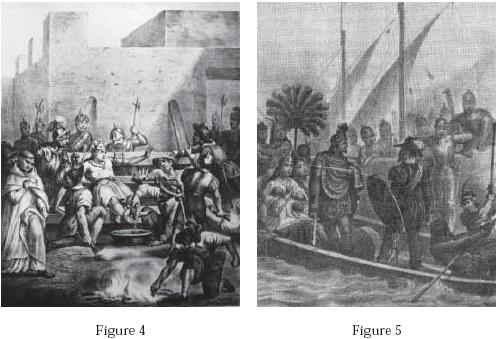
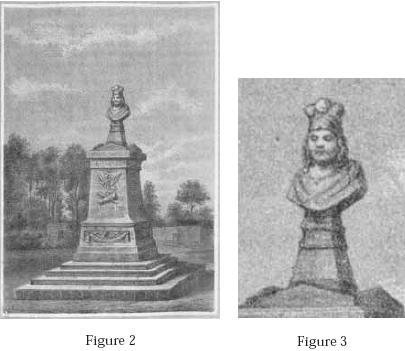
<body><![CDATA[<p align="center"><font face="verdana" size="2"><img src="/img/revistas/ehmcm/n35/a1f1.jpg"></font></p>     <p align="justify"><font face="verdana" size="2">None of these literary works presented Cuauht&eacute;moc as a personification of the Mexican nation or its political will. In Fern&aacute;ndez de Madrid's dramatic representation the emperor served as a foil for psychological portraits of Cort&eacute;s and Alderete, and the text's criticism of Spanish rule responded to the current pan&#150;American situation. Rodr&iacute;guez Galv&aacute;n cast Cuauht&eacute;moc in the role of a ghostly messenger whose experience of the Conquest makes him alert to present dangers of foreign intervention. And Avellaneda's descriptive text appealed primarily to ethnographic and linguistic interests which swept through Mexico and Latin America in the 1830s and 40s. Yet each of these works offered a flattering portrait of the Aztec king, whose estimable character was placed in contrast to the iniquity of the conquistadors, and the strong anti&#150;foreign messages of the two earlier pieces introduced Cuauht&eacute;moc into the political dialogue on Latin America's troubled relationship with the European powers.</font></p>     <p align="justify"><font face="verdana" size="2">From this same period, historical writings about the Conquest routinely described the main events from Cuauht&eacute;moc's life, in compliance with early sources, and frequently pointed to his torture and murder as evidence of Spanish cruelty.<sup><a href="#notas">7</a></sup> It was, moreover, in history books that the first modern artistic images of the emperor appeared. The Spanish translation of William H. Prescott's <i>History of the Conquest, </i>published in Mexico City in 1844&#150;1846, contained among its seventy&#150;one lithographic plates two scenes with Cuauht&eacute;moc, though neither design seems to have been invented by a Mexican artist.<sup><a href="#notas">8</a></sup> A bit later, an anonymous lithographic portrait of Cuauht&eacute;moc and image of his torture, both probably drawn by a Mexican, graced the pages of a small booklet of 1852 by Epitacio J. de los R&iacute;os.<sup><a href="#notas">9</a></sup></font></p>     <p align="justify"><font face="verdana" size="2">Occasionally Cuauht&eacute;moc's name was heard in patriotic discourses. At Independence Day celebrations, speakers mounted the rostrum to decry the Spanish domination and praise the exploits of Hidalgo, Morelos and other <i>primeros h&eacute;roes </i>of the insurrection. Cuauht&eacute;moc was inserted into these orations as a model of heroism and resistance, and as an example of the sufferings endured under Spanish rule.<sup><a href="#notas">10</a></sup> However, neither these public orations nor factual histories and literary accounts made Cuauht&eacute;moc very well known to the general public, and the hero of Tenochtitlan fell into such oblivion that around 1852, Jos&eacute; Fernando Ram&iacute;rez, director of the National Museum, was forced to admit that few Mexicans would be able recognize him at all.<sup><a href="#notas">11</a></sup></font></p>     <p align="justify"><font face="verdana" size="2">Indeed, between Independence (1821) and the Mexican&#150;American war (1846&#150;1848) intellectual discussions rarely took serious account of the indigenous population and its historical leaders.<sup><a href="#notas">12</a></sup> Although the memory of Cuauht&eacute;moc and the Aztec empire might be invoked by patriots during and immediately after the independence struggle, identifications with the Indian past were purely ideal and employed by a creole leadership to justify Mexico's political separation from its colonial overlord.<sup><a href="#notas">13</a></sup> The <i>pueblo ind&iacute;gena </i>remained the passive and inert "other" in ethnological studies and political discussions, and illustrious personalities of ancient times were rarely held in high esteem.<sup><a href="#notas">14</a></sup></font></p>     <p align="justify"><font face="verdana" size="2">This indifference toward native people was somewhat corrected after the debacle of the Mexican&#150;American war, when intellectuals from the liberal camp embarked on a broad reexamination of social and political arrangements.<sup><a href="#notas">15</a></sup> For the first time the contributions of Indians in building the republic were recognized, and praises rang out for native heroes who had sacrificed for their country. Jos&eacute; Guadalupe Perdig&oacute;n Garay, veteran of the American war and liberal advocate, composed a poetic eulogy to a fallen native soldier in the recent conflict, and shortly before 1849, a pyramid carved with the names of heroes of color was erected on the patio of the Colegio de San Gregorio in Mexico City, the first public monument specifically devoted to indigenous persons.<sup><a href="#notas">16</a></sup></font></p>     <p align="justify"><font face="verdana" size="2">The reconsideration of Indian people and their role in national affairs did not always lead to positive judgments, however, and the disdain which whites often felt for natives only deepened in response to the war of the Castes, which broke out in Yucatan in 1848, and exposed deep divisions between racial groups. Many authors described the indigenous people as a national burden and hindrance to progress. Francisco Pimentel &#151;the only nineteenth&#150;century thinker to devote a book&#150;length analysis to "the contemporary situation of the Indian race"&#151; believed that if the country were to advance, it was necessary to "desindianizar" the natives by requiring that they adopt the culture of the creoles and forsake their ancestral languages, religions and communal properties.<sup><a href="#notas">17</a></sup></font></p>     <p align="justify"><font face="verdana" size="2">The memory of Cuauht&eacute;moc became embroiled in discussions on the <i>cuesti&oacute;n ind&iacute;gena </i>and post&#150;war debates about the country's future. Conservatives, like Lucas Alam&aacute;n and Joaqu&iacute;n Garc&iacute;a Icazbalceta, who wished to maintain the institutions of the Viceregal period in modified form and safeguard the rights and privileges of the Catholic Church, upheld the historical reputation of Hern&aacute;n Cort&eacute;s while diminishing the legacy of the Aztec kings.<sup><a href="#notas">18</a></sup> They praised the Conquistador for having brought christianity and civilization to a barbarous land, and saw Cuauht&eacute;moc as a valiant but misguided defender of primitive heathenism.<sup><a href="#notas">19</a></sup> Conversely, early liberals such as Lorenzo de Zavala, Jos&eacute; Mar&iacute;a Luis Mora and Ignacio Manuel Altamirano were attracted to Cuauht&eacute;moc the unyielding guardian of a free and independent Mexico, whose torture and murder exposed the abuses of the colonial system, the remnants of which they hoped to dissolve.</font></p>     <p align="justify"><font face="verdana" size="2">Arguments about Cuauht&eacute;moc and Cort&eacute;s were contained within a larger dispute between liberals and conservatives over Mexico's national symbols, which in turn reflected divergent ideas about the country's historical legacy and future direction. The Aztec king was welcomed into the pantheon of heroes constructed by liberals, whereas conservatives envisioned their own Olympus, at the summit of which stood Hern&aacute;n Cort&eacute;s and Agust&iacute;n de Iturbide. So, when Altamirano eulogized Cuauht&eacute;moc and denounced the crimes of Cort&eacute;s, he simultaneously applauded the insurgents Hidalgo and Morelos and besmirched the memory of Iturbide.<sup><a href="#notas">20</a></sup> And, while arch conservatives made plans to erect a statue to Iturbide, the independent&#150;minded Carlos Mar&iacute;a de Bustamante, though conservative in sympathy, rejoined with a proposal for a public monument to Cuauht&eacute;moc.<sup><a href="#notas">21</a></sup></font></p>     <p align="justify"><font face="verdana" size="2">The first memorial actually built in Cuauht&eacute;moc's honor was unveiled on August 13, 1869, the anniversary of the fall of Tenochtitlan, when president Benito Ju&aacute;rez dedicated a sculpted bust and tall granite base, now destroyed, on the Paseo de la Viga (<a href="#f2">figures 2&#150;3</a>).<sup><a href="#notas">22</a></sup> The front of the base was carved in relief with the national emblem of the eagle and serpent on a nopal cactus, with a radiant sun above and a crossed quiver and Aztec war&#150;club below (from this point on the war&#150;club, or <i>macana, </i>becomes Cuauht&eacute;moc's standard attribute, adopted no doubt on the authority of Bernal D&iacute;az, who states that Cuauht&eacute;moc was armed with a <i>macana </i>at the time of his arrest). The sides of the base carried plaques in Spanish and N&aacute;huatl, which read: "To the last Aztec monarch, Cuauht&eacute;moc, heroic in defense of the nation, sublime in martyrdom" <i>(Al &uacute;ltimo </i><i>monarca azteca, &aacute; Guauctimoctzin, her&oacute;ico en la defensa de la Patria, sub</i><i>lime en el martirio). </i>The mention of the "defensa de la patria" must have reminded viewers of recent conflicts with Anglo&#150;American and European invaders, and the phrase "sublime en el martirio" paid implicit homage to fallen soldiers in these wars. Delivered in Castilian and N&aacute;huatl, these messages were addressed, at least in principle, to both creole and Indian audiences, and it seems that a desire to reach both communities and represent their common political heritage inspired the commissioners to locate the monument on Paseo de la Viga, which was a major roadway frequented by creoles, running south from city center alongside the Canal de la Viga, an important artery for transport and commerce thronged with indigenous people.</font></p>     ]]></body>
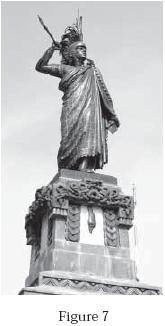
<body><![CDATA[<p align="center"><font face="verdana" size="2"><a name="f2"></a></font></p>     <p align="center"><font face="verdana" size="2"><img src="/img/revistas/ehmcm/n35/a1f2.jpg"></font></p>     <p align="justify"><font face="verdana" size="2">The symbols and inscriptions carved into the monument's base linked Cuauht&eacute;moc to the restored Republic, and indeed it was just at this time that Cuauht&eacute;moc began to be regarded as a symbol of the national will. Among the first to proclaim the emperor in these terms was Ignacio Ram&iacute;rez, whose discourse on Independence Day, 1867, lauded the monarch as "el defensor de la patria antigua" &#151;a phrase which uncannily anticipates the inscription on the Viga monument&#151; and paired him with Miguel Hidalgo, instigator of the independence struggle.<sup><a href="#notas">23</a></sup> Other thinkers of the late 1860s, such as Vicente Riva Palacio and Fernando Orozco y Berra, were similarly attracted to Cuauht&eacute;moc, who stood as a reminder of Mexican potency in the wake of foreign interventions and failed military adventures.<sup><a href="#notas">24</a></sup> For these and other writers, Cuauht&eacute;moc's undaunted courage, intelligence and commanding personality were contrasted with Moctezuma's weakness, superstition and instability, and it was alleged that as the former's patriotic zeal still ran through the veins of most Mexicans, the latter's cowardice and irresolution infected the statesmen and military leaders who had recently brought defeat and humiliation to the republic. In another conflation of distant history and current events, it was asserted that Cuauht&eacute;moc's capitulation had been redeemed by the expulsion of the French, and his murder at the hands of Cort&eacute;s vindicated by the execution in June 1867 of emperor Maximilian &#151;a descendant of Charles V, in whose name the Conquistador had acted&#151; upon the order of president Benito Ju&aacute;rez &#151;a pure&#150;blood Zapotec Indian.<sup><a href="#notas">25</a></sup></font></p>     <p align="justify"><font face="verdana" size="2">In acknowledgment of Cuauht&eacute;moc's elevation to the rank of official symbol, the Paseo de la Viga monument was inaugurated by president Ju&aacute;rez himself, accompanied by his entire cabinet as well as the mayor and council of Mexico City, and the day's festivities included discourses read by leading intellectuals Felipe S&aacute;nchez Sol&iacute;s and Antonio Carre&oacute;n, and a solemn poem recited by Guillermo Prieto which offered Cuauht&eacute;moc as an exemplar of civic virtue.<sup><a href="#notas">26</a></sup> Indeed, the Viga monument, which receives little notice from art historians, has particular salience as the first of a series of civic memorials erected by the liberal regime.<sup><a href="#notas">27</a></sup></font></p>     <p align="justify"><font face="verdana" size="2">With the reorganization of the Academy into the National School of Fine Arts in 1867, and its placement under the direction of the Secretary of Public Instruction, painters and sculptors joined their literary brethren in forging a distinctively Mexican art based on national subjects and themes, and among the topics to which they gravitated was the drama of the Conquest.<sup><a href="#notas">28</a></sup> Although Cuauht&eacute;moc was not immediately adopted by painters and sculptors, he was represented in book illustrations, including those executed by Primitivo Miranda and Joaqu&iacute;n Heredia for the <i>El libro rojo, a </i>history of Mexico written in 1869&#150;1870 by liberal intellectuals Vicente Riva Palacio, Manuel Payno and others, and those by Petronilo Monroy and Hesiquio Iriarte for Eduardo Gallo's biography of Cuauht&eacute;moc, printed in 1875 by the liberal publisher Ignacio Cumplido.</font></p>     <p align="justify"><font face="verdana" size="2">In the image of the torture (<a href="#f3">figure 4</a>) from <i>El libro rojo, </i>designed by Primitivo Miranda and executed by Hesiquio Iriarte, Cuauht&eacute;moc suffers a fate which can be likened to Mexico's recent travails.<sup><a href="#notas">29</a> </sup>By depicting the king held prisoner by armed guards and abused by the greedy Alderete and his henchmen, while a mendicant friar stands idly to the side, the print hints at the collusion of the Church, the military and exploitive business interests which had bedeviled Mexico during its first half&#150;century of Independence, and which had become exacerbated under the French occupation.</font></p>     <p align="center"><font face="verdana" size="2"><a name="f3"></a></font></p>     <p align="center"><font face="verdana" size="2"><img src="/img/revistas/ehmcm/n35/a1f3.jpg"></font></p>     <p align="justify"><font face="verdana" size="2">Cuauht&eacute;moc is featured in two illustrations for Gallo's text.<sup><a href="#notas">30</a> </sup>Iriarte's image of the <i>Capture </i>(<a href="#f3">figure 5</a>) portrays the king, with <i>macana </i>in hand, accosted on lake Texcoco while attempting to flee the fallen capital and organize resistance among other tribes. He is shown in the act of requesting, with a pointing gesture, that his wife and children be left unharmed, as described in Bernal D&iacute;az's account of the event.<sup><a href="#notas">31</a></sup> The image's close rendering of native dress and artifacts, as well as its attention to accidents of light and shadow, reflect the period's intensified interest in the pre&#150;Hispanic past and the <i>costumbrista </i>style then taking hold. Such attention to detail historicizes Cuauht&eacute;moc by recalling the particular circumstances of his life.</font></p>     <p align="justify"><font face="verdana" size="2">The lithographs for <i>El libro rojo </i>and Gallo's biography were made in the period of the Restored Republic, which also saw the birth of Mexican historiography and the introduction of the <i>historia patria </i>into all secondary school curricula.<sup><a href="#notas">32</a></sup> During the presidencies of Benito Ju&aacute;rez (1867&#150;1872) and Sebasti&aacute;n Lerdo de Tejada (1872&#150;1876), the government and intellectual community reclaimed historical figures who embodied Mexico's struggle for unity and independence, and brought them to the public's attention. Scholars such as Fernando Orozco y Berra, Francisco del Paso y Troncoso, Alfredo Chavero and Francisco Pimentel championed Cuauht&eacute;moc's memory in historical and fictional writings, as did essayists and educators like Justo Sierra and Vicente Riva Palacio. Most of these men belonged to the generation which had reached maturity under the yoke of foreign occupation, and with the regaining of independence, they were eager to vent their patriotic ardor while serving the liberal cause.</font></p>     ]]></body>
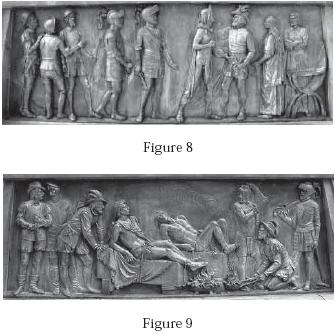
<body><![CDATA[<p align="justify"><font face="verdana" size="2">Although Cuauht&eacute;moc occasionally appeared in literary accounts and patriotic discourses of the earlier nineteenth century, he became consistently and vociferously acclaimed only after the triumph of the liberal regime over French imperialists and their conservative supporters in 1867. His awakening at this time belonged to a broader program of developing civic cults which lent legitimacy to the new government and its reform agenda.<sup><a href="#notas">33</a></sup> Yet within this program he gained special prominence as arch&#150;defender of the nation, and images of his defiance and sacrifice had particular resonance for a citizenry long beleaguered by foreign interventions.</font></p>     <p align="justify"><font face="verdana" size="2">This fascination with Cuauht&eacute;moc comes to a head when president Porfirio D&iacute;az, during his first year in office, decreed that a grand monument should be raised on Mexico City's principal avenue, the Paseo de la Reforma (<a href="#f4">figure 6</a>).<sup><a href="#notas">34</a></sup> The announcement for the project was made on August 23, 1877, and signed by D&iacute;az's minister of Development, the soldier&#150;historian Vicente Riva Palacio. However, Riva Palacio was mindful always to credit D&iacute;az with the idea, and in fact the notion that D&iacute;az himself may have initiated the scheme is not altogether implausible. Upon assuming office, the new president took up residence in Chapultepec Castle at the western end of Reforma, and almost daily as he made his way into town, he would confront a large monument to Columbus, which had been erected in May 1877 by a private citizen, then resident in Madrid, with statuary by the French sculptor Charles Cordier. One may imagine that the Mixtec blood of D&iacute;az, a staunch liberal and hero in the war of the Intervention, must have boiled at the sight of such public homage to the first European intruder, and that he wished for a rectification of this misplaced honor.<sup><a href="#notas">35</a></sup> But no matter who first came up with the idea, the Cuauht&eacute;moc Monument was conceived in response to a conservative initiative of European origin &#151;even if Riva Palacio had himself approved the Columbus Monument&#151; and on this basis its meaning became formulated and understood. It was created as a symbol of Mexico's triumph over foreign intervention and of the national unity achieved by the liberal regime under its new head of state.</font></p>     <p align="center"><font face="verdana" size="2"><a name="f4"></a></font></p>     <p align="center"><font face="verdana" size="2"><img src="/img/revistas/ehmcm/n35/a1f4.jpg"></font></p>     <p align="justify"><font face="verdana" size="2">The decree of August 1877 actually called for a series of four distinct monuments to national heroes: to Cuauht&eacute;moc and the warriors who fought against the Conquest, to Hidalgo and the <i>caudillos </i>of Independence, to Ju&aacute;rez and the protagonists of the Reform, and to Zaragoza and the heroes of the war of the Intervention, "la Segunda Independencia".<sup><a href="#notas">36</a></sup> Under this scheme each monument would glorify a leading figure accompanied by lesser compatriots, corresponding to the Columbus Monument, where the effigy of the Great Admiral was joined by statues of four religious personages. Accordingly the Cuauht&eacute;moc Monument was surmounted with a bronze statue of the Aztec king and its base inscribed with the names of four chieftains who fought and died alongside him: Cuitl&aacute;huac, brother of Moctezuma and penultimate emperor, who died of disease; Cacama, next in line to Moctezuma, garroted by order of Cort&eacute;s; Coan&aacute;coch, brother of Cacama and king of Acolhuac&aacute;n, hanged by Cort&eacute;s; and Tetlepanqu&eacute;tzal, lord of Tlacopan, hanged with Cuauht&eacute;moc on the Honduras expedition.<sup><a href="#notas">37</a></sup></font></p>     <p align="justify"><font face="verdana" size="2">As the primary element within a larger iconographical program, the Cuauht&eacute;moc Monument embodied a conception of Mexican history which had been formulated by the liberal intelligentsia in the 1870s and 1880s, a "myth of unification", in Charles Hale's words, according to which Mexico, which had submitted to foreign domination at the Conquest, truly regained its freedom only after the expulsion of the French in 1867, and finally achieved national consolidation under the D&iacute;az regime.<sup><a href="#notas">38</a></sup> To reinforce these meanings, D&iacute;az laid the first stone on Cinco de Mayo, 1878 &#151;the anniversary of Puebla, a battle in which he himself had bravely fought. And D&iacute;az again presided over the monument's unveiling ceremony on August 21, 1887, the anniversary of the likely date of Cuauht&eacute;moc's torture. On this occasion, the president appeared as a Cuauht&eacute;moc <i>redivivus, </i>seated on an elaborate throne recalling those of the ancient Aztec kings, while two notable scholars, Alfredo Chavero and Francisco del Paso y Troncoso, delivered laudatory addresses, and poems were recited in Spanish and N&aacute;huatl by Francisco Sosa, Eduardo del Valle and Amalio Jos&eacute; Cabrera, praising Cuauht&eacute;moc and his allies for their resolute defense of "la Patria", and comparing his final stand to the battles of Cuautla in 1812 and Chapultepec in 1847.<sup><a href="#notas">39</a></sup> These invocations linked Cuauht&eacute;moc's exploits of 1521 into a chain of martial conflicts leading to independence and national integration.<sup><a href="#notas">40</a></sup></font></p>     <p align="justify"><font face="verdana" size="2">In his formal address at the ceremony, Paso y Troncoso called attention to Mexico's new sense of unity. "This statue," he declared, "is a reminder of the actions of the great leader Cuauht&eacute;moc, who would not have lost his country if other citizens had not been divided; this is an object lesson that we unite and forget our ancient disputes: in the presence of this great <i>caballero </i>&#91;D&iacute;az&#93; who listens to us, we declare: We shall defend the country that is left to us by Cuauht&eacute;moc, with all our heart we shall preserve the Union, the Independence".<sup><a href="#notas">41</a></sup> This appeal had special meaning after the long period of political unrest from which the country had only recently emerged, and by asking for disengagement from "ancient disputes", Paso y Troncoso had in mind the mollification of divisions within the Mexican polity, between liberals and conservatives, and within the liberal party itself, and alluded to steps taken by the D&iacute;az administration to pave over these differences <i>en route </i>to national integration and progress.</font></p>     <p align="justify"><font face="verdana" size="2">Shortly before the monument's dedication, on July 28, the government observed the fifteenth anniversary of Benito Ju&aacute;rez's death with a similar program of festivities and speeches. This day&#150;long celebration launched a concerted effort to glorify <i>el Benem&eacute;rito </i>with the aim of drawing together the factions of the liberal party, and it was these same goals which found expression a month later at the inauguration of the Cuauht&eacute;moc monument.<sup><a href="#notas">42</a></sup> It was, moreover, no accident that the two celebrations of revered historical leaders coincided with the triumph of D&iacute;az's own political authority. The years 1884&#150;1887 witnessed the consolidation of the dictatorship, involving suppression of local bosses and curbing of the free press and dissident voices, and this process culminated in 1887, when Carlos Pacheco, minister of Development, who oversaw the final completion of the Cuauht&eacute;moc monument, submitted to Congress a proposal to amend the 1857 Constitution so as to permit D&iacute;az's reelection for another term in office (the provision was ratified on October 21, and on December 20, 1890, the government again changed the Constitution to allow indefinite reelection). In a sense, then, the Cuauht&eacute;moc Monument not only expressed an ideology of national independence and integration, but stood as a testament to Porifirian rule. The armed emperor commanding his loyal subjects portended D&iacute;az's ascent to power and the entrenchment of his regime, just as the Monarch's demonstration of virtue is was reenacted by the forceful and magnanimous president.</font></p>     <p align="justify"><font face="verdana" size="2">The base of the Cuauht&eacute;moc Monument was designed by Francisco Mar&iacute;a Jim&eacute;nez and Ram&oacute;n Agea, who incorporated motifs from several pre&#150;Hispanic sites to produce one of the earliest examples of neo&#150;Aztec architecture on a grand scale.<sup><a href="#notas">43</a></sup> The lower socle assumes the form of a sloped Aztec pyramid <i>(teocalli) </i>and is capped with Mitla&#150;inspired fretwork. It carries dedicatory inscriptions and bronze reliefs of Cuauht&eacute;moc's capture and torture. The base's mid&#150;section is also decorated with pre&#150;Columbian motifs but arranged in the order of a Greco&#150;Roman structure, with compound columns (based on archeological fragments from Tula) supporting an entablature, which is itself an odd mixture, composed of a frieze with bronze appliqu&eacute;s of Aztec shields, weapons and costumed figures, and by a cornice of bundled laurel leaves in European style. Inscribed on the sloped faces of this mid&#150;section are the names of Cuauht&eacute;moc's fellow warriors, and its niches hold bronze trophies of Aztec arms, costumes, headdresses, musical instruments and other accoutrements. The trophy on the front of the structure includes a round shield with the national emblem (derived from an image in the <i>Codex Mendoza, </i>hence shown without the snake), recalling the escutcheon on the Viga monument. Lastly, the upper section comprises a bronze statue of Cuauht&eacute;moc on a short pedestal ornamented with his hieroglyph and intertwined snakes, the latter being an attribute of Coatlicue, mother of the war god Huitzilopochtli, to whom Cuauht&eacute;moc was devoted. The pre&#150;Hispanic shapes and motifs which give the monument its distinctive character contrast sharply with the neoclassical form of the Columbus Monument, and constitute a specifically Mexican architectural style rooted in the ancient past, which was the stated aim of the designing architects.<sup><a href="#notas">44</a></sup></font></p>     <p align="justify"><font face="verdana" size="2">The bronze sculptures were made by Manuel Nore&ntilde;a, professor of sculpture at the National School of Fine Arts, and several of his talented assistants.<sup><a href="#notas">45</a></sup> The effigy (<a href="#f5">figure 7</a>), by Nore&ntilde;a himself, shows the emperor in a feathered shirt and regal mantle <i>(tilmatli)</i>, his head protected by a flamboyant helmet with eagle&#150;feathered crest. He strides proudly and determinedly forward, in Polykleitan stance, with the resolve to defend his city to the bitter end. His left hand clutches a parchment with Cort&eacute;s' final offer of peace which he rejects, and in his right hand is a spear which he brandishes in the air while raising a call to arms.<sup><a href="#notas">46</a></sup></font></p>     ]]></body>
<body><![CDATA[<p align="center"><font face="verdana" size="2"><a name="f5"></a></font></p>     <p align="center"><font face="verdana" size="2"><img src="/img/revistas/ehmcm/n35/a1f5.jpg"></font></p>     <p align="justify"><font face="verdana" size="2">The head of Cuauht&eacute;moc, whose name means descending eagle, is given aquiline features, with a beak&#150;like nose and piercing eyes, and in other respects the body is idealized, with a tall, straight muscular frame. These physical traits hearken back to Greco&#150;Roman models and scarcely reflect the typical form of an aboriginal person. Indeed, one critic praised the figure for its appealing blend of classicism and realism.<sup><a href="#notas">47</a></sup> The treatment of the body is also consistent with the testimony of Bernal D&iacute;az del Castillo, an eye&#150;witness to the Conquest, who wrote that Cuauht&eacute;moc was a sensitive and handsome individual, grave in demeanor and lighter skinned than most Indians.<sup><a href="#notas">48</a></sup> This statement was constantly quoted by nineteenth&#150;century writers in their eagerness to commend the emperor's physical qualities along with his moral attributes, and elevate him above the ordinary Indian, who in their view had fallen into a degraded condition. Nore&ntilde;a, like other artists of his era, was similarly inspired to idealize the physical appearance of the Aztec king and did so with recourse to the classical canon.</font></p>     <p align="justify"><font face="verdana" size="2">Narrative reliefs adorn two sides of the base.<sup><a href="#notas">49</a></sup> The plaque by Nore&ntilde;a (<a href="#f6">figure 8</a>) shows Cuauht&eacute;moc brought to Cort&eacute;s soon after his capture, and depicts the moment when the defeated emperor lays his hand on the Conquistador's dagger and asks to be killed since he is no longer able to defend his homeland.<sup><a href="#notas">50</a></sup> The encounter is portrayed in a solemn manner recalling ancient Roman reliefs, which the artist had studied during his residence in the Eternal City from 1870&#150;1872, though the composition also contains fine details of period costume and armor, and vivid characterizations of specific historical figures.<sup><a href="#notas">51</a></sup></font></p>     <p align="center"><font face="verdana" size="2"><a name="f6"></a></font></p>     <p align="center"><font face="verdana" size="2"><img src="/img/revistas/ehmcm/n35/a1f6.jpg"></font></p>     <p align="justify"><font face="verdana" size="2">The second relief was developed by Nore&ntilde;a's pupil Gabriel Guerra (<a href="#f6">figure 9</a>) and is more dynamic in conception. It shows the torture of Cuauht&eacute;moc and his fellow prisoner (who in the 1870s, and frequently thereafter, was erroneously thought to have been Tetlepanquetzal, Lord of Tlacopan). The victims are stretched out on stone blocks as their feet roast over open flames. Hunched over Cuauht&eacute;moc is the treasurer Juli&aacute;n de Alderete, with a lust for gold gleaming in his eye, though this figure might be easily mistaken for Cort&eacute;s, who in the other relief is seen in much the same costume. Again a specific moment is shown, when the king turns to his faltering co&#150;martyr and says reproachfully, "Do you believe that I am on bed of roses?"<sup><a href="#notas">52</a></sup> The scene is highly theatrical, and in addition to the accurately rendered costumes and armaments, it conveys psychological tension in the exchange of glances between characters. Directly or indirectly it may have been influenced by the staging of this scene in the 1871 production of <i>Guatimotz&iacute;n, </i>an operatic episode by Aniceto Ortega. This musical interpretation was performed only once, on September 13, and was commended for the historically accurate costumes and stage sets, which were contrived with advice from prominent historians and reference to illustrations in the <i>Codex mendocino.</i><a href="#notas"><sup>53</sup></a></font></p>     <p align="justify"><font face="verdana" size="2">The descriptive quality of the reliefs and their dramatic effects conform to artistic standards of the day, and have affinities in the prose style of the many liberals who chose to express their sense of the past through historical fiction.<sup><a href="#notas">54</a></sup> Indeed, even the neoclassical forms and compositional schemes of the sculptures have parallels in literary conventions, as nineteenth&#150;century accounts routinely compared Cuauht&eacute;moc and his companions with Greek and Roman heroes, and historical narratives of the Conquest were sometimes written in classical poetical form.<sup><a href="#notas">55</a></sup></font></p>     <p align="justify"><font face="verdana" size="2">The 1877 scheme for a series of four grand monuments along Reforma was never realized according to plan. Instead, soon after the dedication of the Cuauht&eacute;moc Monument, the D&iacute;az government accepted the proposal of the poet and journalist Francisco Sosa to commission numerous statues of Mexican heroes in the Independence and Reform movements, and place these on separate pedestals along either side of the avenue.<sup><a href="#notas">56</a></sup> In hope of fostering the spirit of unity, each state within the Federal Republic was asked to contribute two bronze figures. The first pair was inaugurated on February 5, 1889, and by 1899, thirty&#150;four statues had assumed their posts, creating a visual discourse on recent history and memorial to the protagonists of the liberal cause. Within this program, Cuauht&eacute;moc, perched high upon his architectural base, appeared as precursor of the modern patriots who had labored for freedom and unity.</font></p>     <p align="justify"><font face="verdana" size="2">This image of solidarity was compromised, however, by the refusal of ten of the Republic's then twenty&#150;seven states to fulfill their obligation of providing statues. By doing so they rejected the idea of centralized authority and the notion that the regional governments were mere satellites to the capital, as the statues of local heroes orbited around the Cuauht&eacute;moc Monument. Despite constant efforts since 1867 to promulgate a national iconography, many Mexicans refused to accept the symbolic codes that emanated from the metropolis, or, as this example shows, to participate in the centrally guided application and interpretation of political symbols. At a much later time, in the mid&#150;twentieth century, the unwillingness to bow to the ascendancy of the capital again affected the reception of the Cuauht&eacute;moc image, though in a surprising reversal, as shall be seen in the companion essay to this piece.</font></p>     ]]></body>
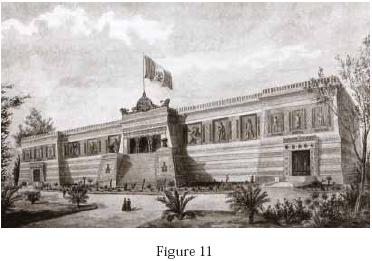
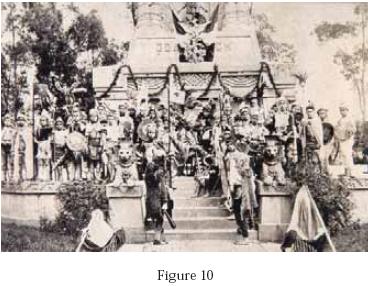
<body><![CDATA[<p align="justify"><font face="verdana" size="2">Beginning with its ceremonial inauguration, the Cuauht&eacute;moc Monument became a focal point for public festivities, speeches, pronouncements and assemblies (<a href="#f7">figure 10</a>), most of which were sponsored by the federal and city governments.<sup><a href="#notas">57</a></sup> Indeed, it seems that the broad platform encircling the monument was built with the express purpose of accommodating public gatherings.<sup><a href="#notas">58</a></sup> August 21, the date of the monument's dedication, became Cuauht&eacute;moc's civic feast day, when each year activities were planned in his honor.</font></p>     <p align="center"><font face="verdana" size="2"><a name="f7"></a></font></p>     <p align="center"><font face="verdana" size="2"><img src="/img/revistas/ehmcm/n35/a1f7.jpg"></font></p>     <p align="justify"><font face="verdana" size="2">Oratorical addresses given on these occasions found their way into print and added to the expanding literature on the Aztec king.<sup><a href="#notas">59</a> </sup>Meanwhile, the monument itself became widely known through prints and photographs, postcards and other means of reproduction, and the effigy inspired numerous imitations, as it still does today.<sup><a href="#notas">60</a></sup> The government and citizenry latched onto the monument as a symbol of the nation, in much the same way that the Statue of Liberty was promoted in the United States, and, emblematizing Mexico, copies of the effigy or the entire monument were sent to international expositions at Paris (1889), Chicago (1893) and Rio de Janeiro (1922). As a physical connector to the past, the monument constituted what Pierre Nora has termed a <i>lieu de m&eacute;moire </i>&#151;a public sanctuary and place of memory, which defines a people's historical identity and allows this identity to be reenacted in civic performance. But it was a connector which had been conceived by official decree, in a 'top down' process of ideological formation, and it trumpeted the nationalist program of an autocratic regime.<sup><a href="#notas">61</a></sup></font></p>     <p align="justify"><font face="verdana" size="2">Cuauht&eacute;moc was twice represented at the Mexican pavilion for the Paris World's Fair of 1889. A scale model of the monument was installed at the foot of the grand internal staircase, and a large bronze relief of the emperor was posted on the exterior fa&ccedil;ade. These images assumed meaning within the context of the spectacular structure, which was designed in neo&#150;Aztec style by the architect Antonio M. Anza and archeologist Antonio Pe&ntilde;afiel to express "la genuina civilizaci&oacute;n nacional" (<a href="#f8">figure 11</a>).<sup><a href="#notas">62</a></sup> Unlike Jim&eacute;nez's base for the Cuauht&eacute;moc Monument, which borrowed motifs from an assortment of pre&#150;Hispanic cultures, Anza and Pe&ntilde;afiel drew exclusively from sources in Central Mexico &#151;Tenochtitlan, Tula, Teotihuac&aacute;n and Xochicalco&#151; with the aim of localizing the country's historical roots in the Altiplano Mexicano, and according to their own testimony, to reflect the unity of the modern nation under a centralized authority.</font></p>     <p align="center"><font face="verdana" size="2"><a name="f8"></a></font></p>     <p align="center"><font face="verdana" size="2"><img src="/img/revistas/ehmcm/n35/a1f8.jpg"></font></p>     <p align="justify"><font face="verdana" size="2">The pavilion's design signaled the triumph of Mexican archeology, which the D&iacute;az administration used for propagandistic purposes and abundantly supported with new museum facilities and institutions of research. Monumental achievements of scholarship, such as Fernando Orozco y Berra's <i>Historia antigua de M&eacute;xico </i>(1880&#150;1881) and Alfredo Chavero's <i>Historia antigua y de la conquista </i>(1884), increased the understanding of ancient cultures.<sup><a href="#notas">63</a></sup> But still more consequential was the elaboration of the concept of Mexican uniqueness abetted by these activities. This widespread and influential idea was based on the premise that the country's pre&#150;Hispanic inheritance still permeated its culture and ways of life, and that due to this glorious tradition Mexico is fundamentally distinguished from the West and from the other, less richly endowed nations of Latin America. The concept of uniqueness informed Anza and Pe&ntilde;afiel's design for the Mexican pavilion, which advertised the country's historical origins and clearly set Mexico apart from the many nations represented at the fair by pavilions in neoclassical styles, and it was asserted by the two images of Cuauht&eacute;moc, defender of his people's cultural as well as political independence.<sup><a href="#notas">64</a></sup></font></p>     <p align="justify"><font face="verdana" size="2">The Cuauht&eacute;moc symbol achieved a new depth of meaning in conjunction with the idea of Mexican uniqueness. For many authors, Mexico's distinctiveness and independence from the West was emblematized in Cuauht&eacute;moc's opposition to Cort&eacute;s, and the two figures were seen as personifications of their respective cultures. As the Conquistador represented an expanding, acquisitive, universal Greco&#150;Latin civilization, the emperor stood for a pure and autonomous Mexican culture, with roots set deeply in ancient history, in the land and geography, and in a singular racial and ethnic composition. In this way, the Cuauht&eacute;moc symbol became associated with a cluster of beliefs and ideals, and came to represent not only the persistence of ancient traditions but Mexico itself: its land, people, its social institutions and culture. As the image of Benito Ju&aacute;rez was widely used to stand for the Republic, the organ which had unified the country and secured its independence, Cuauht&eacute;moc became associated with the more deeply venerated, transhistorical concept of <i>la patria mexicana, </i>and in this particular function the symbol was, and continues to be, more polyvalent than the image of Ju&aacute;rez and more susceptible to different uses and interpretations. One sees this connection between Cuauht&eacute;moc and the <i>patria </i>in the proposal of 1892 to build a garden around the Reforma monument and fill it with cactus, bisnaga, maguey and other typical flora of the country.<sup><a href="#notas">65</a></sup> And the importance of the symbol was recognized at Paris, where a model of the Cuauht&eacute;moc Monument greeted visitors as soon as they stepped foot in the Mexican pavilion.</font></p>     <p align="justify"><font face="verdana" size="2">As previously mentioned, the figure of Cuauht&eacute;moc also graced this building's fa&ccedil;ade, which was embellished with numerous bronze fixtures inspired by pre&#150;Hispanic art and commissioned from Jes&uacute;s F. Contreras, an academically trained sculptor then resident in Paris.<sup><a href="#notas">66</a> </sup>Of these sculptural adornments, the largest and most visually striking were six bronze reliefs arranged across the front of the structure: the three placed to the left of the central portico represented the founders of the Triple Alliance, which in 1428 united the cities of Tenochtitlan, Texcoco and Tlacopan to form the basis of Aztec power, and the three to the right portrayed the <i>ilustres vencidos </i>who expired in the defense of Tenochtitlan &#151;Cacama, Cuitl&aacute;huac and Cuauht&eacute;moc, the last described by Pe&ntilde;afiel as "the greatest figure of national heroism".<sup><a href="#notas">67</a></sup></font></p>     ]]></body>
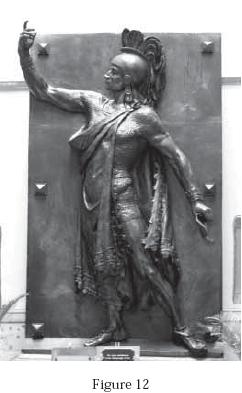
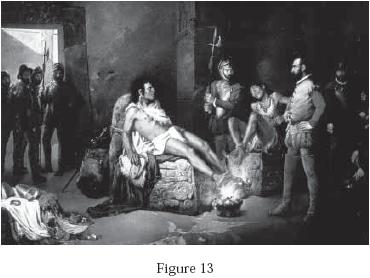
<body><![CDATA[<p align="justify"><font face="verdana" size="2">Contreras worked closely with the archeologist Pe&ntilde;afiel to depict native costumes and accoutrements in exacting detail, but chose to set the figures in poses derived from Greco&#150;Roman statuary. Cuauht&eacute;moc (<a href="#f9">figure 12</a>) is dressed in the same costume and evinces the same defiant attitude &#151;with the rejected offer of peace crumpled in his left hand&#151; as shown in the effigy on the Cuauht&eacute;moc Monument, unveiled in Mexico City only two years before, when Contreras apprenticed in Nore&ntilde;a's workshop. Yet the figure's forward movement and extended gesture recall the <i>Apollo Belvedere, </i>as Cacama's athletic movement reflects Myron's <i>Diskobolos </i>(which Contreras had studied in a graphite drawing of 1883), and Cuitl&aacute;huac's relaxed stance hearkens back to Polykleitos' <i>Doryphoros. </i>Contreras doubtless wished to ennoble his subjects with these dignified poses and may have desired to associate them with the classical past and its republican ideals, much as Nore&ntilde;a had commended Cuauht&eacute;moc by setting his statue in Polykleitan stance. But in pursuing these aims, Contreras also Westernized his subjects, incorporating them into a universalizing and colonizing language which each of the historical personages had in actuality resisted to the death.<sup><a href="#notas">68</a></sup></font></p>     <p align="center"><font face="verdana" size="2"><a name="f9"></a></font></p>     <p align="center"><font face="verdana" size="2"><img src="/img/revistas/ehmcm/n35/a1f9.jpg"></font></p>     <p align="justify"><font face="verdana" size="2">Between 1880 and 1900, representations of Cuauht&eacute;moc appeared with some frequency at annual expositions of the National School of Fine Arts, and among the works registered in the catalogues for these shows are Francisco Mar&iacute;a Jim&eacute;nez's gesso model for the Cuauht&eacute;moc Monument (1879&#150;1880) and an alternative plan submitted by Antonio Torres Torija for the same project (1879&#150;1880), Luis Coto's painting <i>Capture of Cuauht&eacute;moc </i>(1881&#150;1882), Gabriel Guerra's bronze relief <i>Torment of Cuauht&eacute;moc </i>(1886&#150;1887), Jes&uacute;s Contreras' bronze relief <i>Cuauht&eacute;moc in the Presence of Cort&eacute;s </i>and bust of the emperor (1891&#150;1892), Leandro Izaguirre's painting <i>Torment of Cuauht&eacute;moc </i>(1892&#150;1893), a cartoon for Joaqu&iacute;n Ram&iacute;rez's painting <i>Surrender of Cuauht&eacute;moc to Cortes </i>(1892&#150;1893), and Francisco de P. Mendoza's painting <i>Cuauht&eacute;moc, </i><i>or the Last Aztec emperor </i>(1898&#150;1899).<sup><a href="#notas">69</a></sup></font></p>     <p align="justify"><font face="verdana" size="2">This proliferation of Cuauht&eacute;moc imagery was of course instigated by the patriotic feelings and ideals attached to the ancient monarch. Another impetus, however, seems to have come from the enthusiasm of Freemasons for Aztec culture in general and Cuauht&eacute;moc in particular. Masons created a sectarian iconography around Aztec images and symbols, and toward the end of the century began naming their sons after Cuauht&eacute;moc and incorporated him into their calendar of saints days.<sup><a href="#notas">70</a></sup> Many leaders of the Reform movement were active in the Order, including Ju&aacute;rez, Ram&iacute;rez and Altamirano; and D&iacute;az was a devoted mason throughout his adult life (he was named Grand Master of the Grand Lodge of the Federal District of Mexico in 1883, and of the Grand Symbolic Diet of the Mexican States in 1890, which briefly united all the country's lodges). These politicians and intellectuals helped recall Cuauht&eacute;moc from oblivion by commissioning works of art and writing panegyrics to him, and the attraction of Freemasons to quasi&#150;religious beliefs and practices may also have influenced some of the ritualistic celebrations of the emperor, including the elaborate unveiling ceremony for the Reforma monument.<sup><a href="#notas">71</a></sup></font></p>     <p align="justify"><font face="verdana" size="2">Of the many paintings of Cuauht&eacute;moc from the final decades of the nineteenth century, Leandro Izaguirre's <i>Torment of Cuauht&eacute;moc </i>(<a href="#f10">figure 13</a>) became the most famous and often reproduced. This impressive work in the grand manner premiered at the National School of Fine Arts in 1892, and a year later was sent to the Chicago Exposition (where it was joined by a bronze reduction of the Reforma monument, commissioned by the commercial brewery Cervecer&iacute;a Cuauht&eacute;moc). Critics applauded the painting's consummate display of realist technique and archeological rigor.<sup><a href="#notas">72</a></sup> While showing certain affinities with Nore&ntilde;a's relief, the scene is cast in an abandoned Aztec temple rather than outdoors, which had been the pictorial convention, and within this darkened chamber are seen Cuauht&eacute;moc and his kinsman, bound hand and foot to chipped and discarded stone blocks which are carved with images of their defeated gods.<sup><a href="#notas">73</a></sup> Spanish soldiers guard the prisoners, and one kneels beside a pot of oil which has been used to drench the victims' feet. An anxious Alderete stands opposite Cuauht&eacute;moc, and in the left background, among observing soldiers, is a hatted figure who may be Crist&oacute;bal de Ojeda, the physician who would later tend to Cuauht&eacute;moc's wounds. The verisimilitude is heightened by the deep shadows and dappled light (reflecting the artist's admiration for the Baroque painter Zurbar&aacute;n), and by the concentration of rich primary hues in the center of the image.</font></p>     <p align="center"><font face="verdana" size="2"><a name="f10"></a></font></p>     <p align="center"><font face="verdana" size="2"><img src="/img/revistas/ehmcm/n35/a1f10.jpg"></font></p>     <p align="justify"><font face="verdana" size="2">Reproductive prints of the painting made the subject of the torture broadly familiar to the Mexican public, and the hero's tribulations were further recounted in many literary portrayals, as for example in Guillermo Prieto's <i>Lecciones de historia patria, </i>which was for years an almost obligatory text for teaching and learning about Mexican history. According to Prieto and other writers, Cuauht&eacute;moc's stoicism at this moment exemplified Mexico's unconquerable spirit, while the administration of the torture exposed the base cruelty of the Spaniards and other European aggressors.<sup><a href="#notas">74</a></sup> Izaguirre's <i>Torment </i>similarly presents itself as a patriotic image, and casts the emperor as a personification of Mexico, a fact reinforced by the national colors of red, white and green of his feathered headdress and cloth garment shown heaped in the lower left corner. With superhuman resolve the emperor bears the awful ordeal in the interest of preserving his people's riches from the thievery of the conquistadors, just as nineteenth&#150;century Mexico had endured extreme hardship to protect its resources from foreign expropriation.</font></p>     <p align="justify"><font face="verdana" size="2">A strong religious sentiment runs through the painting, and the image of the suffering king before his persecutors recalls the iconography of Christian saints &#151;one is reminded specifically of the martyrdom of St. Lawrence. In fact, religious undercurrents flow through many artistic representations of Cuauht&eacute;moc, who is often portrayed as a Christ&#150;like figure, and one observes a striking parallel between the scenes from Cuauht&eacute;moc's life that are most often selected as artistic subjects and episodes from the Passion of Christ; in both cases there is an arrest (on lake Texcoco/in the Garden of Gethsemane), presentation (to Cort&eacute;s/to Pontius Pilate), torment (burning of feet/scourging with whips), and climactic death (hanging form a ceibal tree/crucifixion on the cross). Of course, the theme of Christian sacrifice pervades the Mexican artistic tradition, and academic artists like Izaguirre, whose early training stressed religious subjects, were inclined to render historical figures as secular saints.<sup><a href="#notas">75</a></sup> One may also suppose that the pronounced religious element in representations of Cuauht&eacute;moc's torture contributed to making this the most popular scene from the emperor's life.</font></p>     ]]></body>
<body><![CDATA[<p align="justify"><font face="verdana" size="2">Izaguirre's painting shows a striking disparity between Cuauht&eacute;moc's steadfastness and the co&#150;martyr's weakness and vacillation, and it is upon this very relationship that the narrative turns, with the plaintive expression of the co&#150;martyr provoking Cuauht&eacute;moc's verbal rebuke and censorious stare (according to the chronicler G&oacute;mara, "Cuauht&eacute;moc looked at him with anger and reviled him as little or nothing"). In a wider sense, this contrast between the two figures reflects a common nineteenth&#150;century view about indigenous people, in which ordinary natives were seen as uninspired, lazy, lacking resolve and unpatriotic, and in which only exceptional members of the race could rise above this feeble condition to perform as forceful leaders. Artistic portrayals of Cuauht&eacute;moc frequently express this dichotomy through the contrasting representations of the Aztec king, who is shown in full possession of his senses and endowed with <i>gravitas, </i>if not actually arranged in a pose adapted from Greco&#150;Roman statuary, and Indian characters of lower status, particularly the co&#150;martyr, who are usually shown in less decorous attitudes and poses.</font></p>     <p align="justify"><font face="verdana" size="2">The fallen condition of aboriginal people is a recurrent theme in late nineteenth&#150;century discourse, and both liberals and conservatives made note of the apparent discrepancy between the dignified nature of the ancient Americans and the reduced state of their modern descendants, who seemed unable to contribute positively to Mexico's civic culture.<sup><a href="#notas">76</a></sup> On occasion, Cuauht&eacute;moc's legendary virtue was contrasted with the retrograde condition of modern natives, as for example in a discourse pronounced on August 21, 1893, by the liberal critic Luis de la Brena, who laid responsibility for the degradation of native people on the shoulders of the conquistadors and Spanish rulers, and urged a renewed public effort to redeem the indigenous race.<sup><a href="#notas">77</a></sup></font></p>     <p align="justify"><font face="verdana" size="2">Other thinkers drew quite different conclusions from these same observations, and rather than yearning for a lost golden age, perceived a clear and irreversible division between Mexico's Indian past and Hispanic present. This view was articulated by Francisco G. Cosmes, one of the influential technocrats <i>(Cient&iacute;ficos) </i>associated with the D&iacute;az administration, who, in an inflammatory article of September 1894, argued that Mexican society is exclusively the product of Spanish civilization and owes nothing to the Aztecs.<sup><a href="#notas">78</a></sup> He claimed that the country's history has been distorted by those who wish to trace its foundation to pre&#150;Hispanic times, and chided the public's respect for Cuauht&eacute;moc, writing that "the burnt feet in the torment of the last Aztec king more heavily influence our historical appreciation of the Conquest that the colossal figure of Cort&eacute;s".<sup><a href="#notas">79</a></sup> Cosmes' article ignited a firestorm in the popular press, with editorials taking sides in favor of the Aztecs or the Spanish, Cuauht&eacute;moc or Cort&eacute;s.<sup><a href="#notas">80</a></sup> While hispanophiles lent support to Cosmes' ideas, liberals like Ezequiel Ch&aacute;vez and Justo Sierra refuted his claims, and defended Mexico's ancient inheritance and the possibility of redeeming the indigenous population by pointing to Cuauht&eacute;moc's virtue.</font></p>     <p align="justify"><font face="verdana" size="2">Cosmes reopened a debate which had already surfaced fifty years before, when Alam&aacute;n and Altamirano bumped heads over the relative merits of the two protagonists of the Conquest. But the issue was now being argued by parties which both draped themselves in the flag of liberalism, and which reframed the question according to two rival conceptions of Mexican history and nationhood. Cosmes' arguments were based on the Positivist view of historical progress, according to which society passes through distinct phases of differentiation, such that the Indian past was entirely occluded by the development of Hispanic society and should therefore be relegated to the dustbin of history. Those opposing him believed in the continuity of Mexican civilization from its pre&#150;Hispanic origins to the present, and wished to celebrate the uniqueness which emanates from this unbroken tradition.<sup><a href="#notas">81</a></sup></font></p>     <p align="justify"><font face="verdana" size="2">Cuauht&eacute;moc's rising popularity in the <i>fin&#150;de&#150;si&egrave;cle </i>period reflects a concerted effort of liberals to sustain the concept of Mexico's ancient historical origins against the challenges of pan&#150;Hispanists, and until about 1905, it was this liberal position which tended to prevail. Pride in Mexico's deep history and distinctive character was retained as a central tenet of official ideology and helped stimulate an upswell of patriotic fervor.<sup><a href="#notas">82</a></sup> As part of this current, literary and visual representations of Cuauht&eacute;moc multiplied. A slew of biographical and epic poems extolled his nobility of character and glorious deeds, among them Eduardo del Valle's song of praise (prefaced by Altamirano and dedicated to Riva Palacio) and Francisco Sosa's biographical essay (portions of which were recited at the inauguration of the Reforma monument) .<sup><a href="#notas">83</a></sup> In addition to the many paintings and sculptures dedicated to him, Cuauht&eacute;moc was commonly featured in political cartoons as a personification of the Mexican state (<a href="#f11">figure 14</a>), and appeared in sundry kinds of popular imagery, including loose&#150;leaf prints, book illustrations (<a href="#f11">figure 15</a>), calendars and postcards.<sup><a href="#notas">84</a></sup></font></p>     <p align="center"><font face="verdana" size="2"><a name="f11"></a></font></p>     <p align="center"><font face="verdana" size="2"><img src="/img/revistas/ehmcm/n35/a1f11.jpg"></font></p>     <p align="justify"><font face="verdana" size="2">Educators seized on the exemplary leader for the purpose of moral instruction. Justo Sierra, before and during his term as Secretary of Education, encouraged the adulation of Cuauht&eacute;moc as a means of projecting national ideals,<sup><a href="#notas">85</a></sup> and Aurelio Oviedo proposed that schoolchildren should receive lessons on a triad of national heroes: Hidalgo, Ju&aacute;rez and Cuauht&eacute;moc, on account of their admirable "heroism, love of country and honor".<sup><a href="#notas">86</a></sup> A positive account of the emperor appeared in <i>M&eacute;xico a trav&eacute;s de los siglos </i>(1884&#150;1889), the canonical text of the country's history,<sup><a href="#notas">87</a></sup> and stories of his adventures appeared in children's books published by the brothers Maucci in 1899 (<a href="#f11">figures 16&#150;17</a>).<sup><a href="#notas">88</a></sup> In November 1890, Cervecer&iacute;a Cuauht&eacute;moc began operations, and through aggressive marketing and advertising spread Cuauht&eacute;moc's name and likeness to beer lovers in Mexico and eventually around the globe (<a href="#f12">figure 18</a>).<sup><a href="#notas">89</a></sup></font></p>     <p align="center"><font face="verdana" size="2"><a name="f12"></a></font></p>     <p align="center"><font face="verdana" size="2"><img src="/img/revistas/ehmcm/n35/a1f12.jpg"></font></p>     ]]></body>
<body><![CDATA[<p align="justify"><font face="verdana" size="2">It is perplexing that the image of Cuauht&eacute;moc, the stubborn opponent of foreign intervention, should be promoted by a transnational corporation which had been formed by a consortium of Mexican and North&#150;American entrepreneurs.<sup><a href="#notas">90</a></sup> However, the D&iacute;az administration, which sponsored the Cuauht&eacute;moc cult, was itself a principal agent for opening Mexico to external investment and allowing foreign interests to dominate the economy. As is well known, the tension between the regime's triumphalist nationalism and open&#150;door economic policy was one of the great strains under which it operated. Yet this ambiguous and ultimately fatal course of action was consistent with liberal doctrine, which called for political integration alongside rapid industrial growth.</font></p>     <p align="justify"><font face="verdana" size="2">In a large sense, too, Cuauht&eacute;moc's awakening in nineteenth&#150;century art was the product of liberal thought, and bound up with it were the same anomalies and internal contradictions that afflicted the Porfirian state and social order. Despite its appeal to all Mexicans, Cuauht&eacute;moc imagery stressed national integration at the expense of community and shared benefits; it was in conception bourgeois, urban and progressive, and tended to elide the agrarian and small&#150;town interests of <i>campesinos, </i>who made up the great majority of the population; and while it promulgated republican ideals, it also commended a style of leadership which validated the autocratic power of Mexico's presidents, and appealed to a bankrupt nationalism which in later years had deserted its liberal platform and remained incapable of articulating a coherent social policy.<sup><a href="#notas">91</a></sup> Contradictions arose on the aesthetic plane as well. Images of Cuauht&eacute;moc were designed to arouse the spirit of the nation, yet this was pursued through Realist pictorial methods inspired by European Positivism.<sup><a href="#notas">92</a></sup> Though quintessentially Mexican, the imagery was furthermore infused with classical aesthetic ideals and Christian notions of virtue, which belied a foreign penetration into Mexico's artistic culture.</font></p>     <p align="justify"><font face="verdana" size="2">Artistic portrayals of Cuauht&eacute;moc were embroiled in a political discourse emanating from Mexico City and supported by the liberal intelligentsia. The imagery reflected a vision of history which connected the modern state with the pre&#150;Hispanic empire, and the puissant monarch was eagerly adopted as a symbol of the independent nation ruled by a centralized political authority. It thrived in an era of exacerbated patriotism, in which Mexico established a canon of national heroes, calendar of civic festivals, and unifying <i>historia patria. </i>But the symbol faltered before the <i>cuesti&oacute;n ind&iacute;gena. </i>Cuauht&eacute;moc was depicted as an exceptional native leader and model for modern&#150;day heads of state (particularly Ju&aacute;rez and D&iacute;az, who were each of Indian parentage), but he did not represent the aspirations of the indigenous people as such, or of the ever&#150;growing <i>mestizo </i>population.<sup><a href="#notas">93</a></sup> The imagery was controlled and sustained by an elite of bureaucrats, businessmen, national <i>caudillos </i>and their literary and intellectual allies, and upon this structure's collapse in 1910, the figure of Cuauht&eacute;moc became largely dormant once again, only to be revived in the post&#150;revolutionary period, when the internal contradictions within the imagery would be confronted head on and proprietorship over the symbol vigorously contested. These later developments are the subject of a second article to appear in a later edition of this journal.</font></p>     <p align="justify"><font face="verdana" size="2">&nbsp;</font></p>     <p align="justify"><font face="verdana" size="2"><i><b><a name="notas"></a>Notes</b></i></font></p>     <!-- ref --><p align="justify"><font face="verdana" size="2"><sup>1</sup> Cuauht&eacute;moc's date of birth is uncertain; the date <i>c.</i> 1495 is advocated by Salvador Toscano, "Datos biogr&aacute;ficos", in <i>Cuauht&eacute;moc, </i>ed. Jaime Casta&ntilde;eda Iturbide, Mexico City, Talleres Gr&aacute;ficos de la Naci&oacute;n, 1985, p. 13&#150;43.    &nbsp;&nbsp;&nbsp;&nbsp;&nbsp;&nbsp;&nbsp;&nbsp;[&#160;<a href="javascript:void(0);" onclick="javascript: window.open('/scielo.php?script=sci_nlinks&ref=3460445&pid=S0185-2620200800010000100001&lng=','','width=640,height=500,resizable=yes,scrollbars=1,menubar=yes,');">Links</a>&#160;]<!-- end-ref --> The name Cuauht&eacute;moc is represented by the hieroglyph of a descending eagle, which often accompanies images of the king. He was the son of the formidable Ahu&iacute;zotl, eighth emperor of Mexico, and his wife Tlilalc&aacute;petl, daughter of the lord of Tlatelolco. He was both cousin and son&#150;in&#150;law of emperor Moctezuma II, having married his daughter Tecuixpo. Named lord of Tlatelolco in 1515, he was elected emperor (<i>tlatoani</i>) by the council of nobles upon the death of Cuitl&aacute;huac in late November 1520, and led the defense of Tenochtitlan until its capitulation on August 13, 1521. After his capture, he resisted torture at the hands of the Spanish treasurer Juli&aacute;n de Alderete by refusing to disclose the location of the Aztec treasure. He was baptized Fernando Cort&eacute;s Alvarado Cuauhtemotzin Huitzil&iacute;huitl, and appointed figurehead over the Indians of Tenochtitlan, but later hanged from a ceibal tree in February 1525, on the dubious charge of having plotted against Cort&eacute;s, and died, according to one early source, in a Christian manner.</font></p>     <!-- ref --><p align="justify"><font face="verdana" size="2"><sup>2</sup> Sixteenth&#150;century representations of Cuauht&eacute;moc are found in the <i>Tira de Tepexpan, </i>Biblioth&egrave;que Nationale, Paris, and the so&#150;called <i>Codex R&iacute;os, </i>ms. Mexicano Vaticano 3738, among other places. Late seventeenth&#150;century representations include an anonymous painting of the <i>Capture of Cuauht&eacute;moc, </i>from a series of eight canvases of the Conquest, now in a private collection, and several folding screens (<i>biombos</i>), including a painted screen owned by Banco Nacional de M&eacute;xico, and others treated with inlaid mother&#150;of&#150;pearl, for which see Mar&iacute;a Concepci&oacute;n Garc&iacute;a S&aacute;iz, "La conquista militar y los enconchados", in <i>Los pinceles de </i><i>la historia: el origen del reino de la Nueva Espa&ntilde;a, 1680&#150;1750, </i>Mexico City, Instituto Nacional de Bellas Artes, 1999, p. 108&#150;141.    &nbsp;&nbsp;&nbsp;&nbsp;&nbsp;&nbsp;&nbsp;&nbsp;[&#160;<a href="javascript:void(0);" onclick="javascript: window.open('/scielo.php?script=sci_nlinks&ref=3460447&pid=S0185-2620200800010000100002&lng=','','width=640,height=500,resizable=yes,scrollbars=1,menubar=yes,');">Links</a>&#160;]<!-- end-ref --><!-- ref --> One of these, today divided between the Museo Franz Meyer, Mexico City, and the Museo Nacional del Virreinato, Tepotzotl&aacute;n, contains an early depiction of the legend according to which Cuauht&eacute;moc personally hurled the stone that killed Moctezuma. The <i>Baptism of Cuauht&eacute;moc, </i>by the eighteenth&#150;century artist Jos&eacute; Vivar y Valderrama, is located in the Museo Nacional de Historia, Mexico City, and from the same period is an anonymous painting of the <i>Capture of Cuauht&eacute;moc, </i>also in the Museo Nacional de Historia. Toward the end of the Viceregal period, the emperor was featured in prints, including an image of his arrest on lake Texcoco, designed by Jos&eacute; Ximeno for Antonio de Sol&iacute;s' <i>Historia de la Conquista de M&eacute;xico, </i>Madrid, Antonio de Sancha, 1784. He was praised in Edward Jerningham's poetic account of <i>The fall of Mexico, </i>London, J. Robson, 1775, and in 1790 a play about his torture and death was staged at the New Coliseum in Mexico City, "drawing such large and vociferous houses that it had to be banned"; Jacques Lafaye, <i>Quet</i><i>zalc&oacute;atl y Guadalupe: la formaci&oacute;n de la conciencia nacional en M&eacute;xico, </i>3rd. ed., Mexico City, Fondo de Cultura Econ&oacute;mica, 1995, p. 273.</font>&nbsp;&nbsp;&nbsp;&nbsp;&nbsp;&nbsp;&nbsp;&nbsp;[&#160;<a href="javascript:void(0);" onclick="javascript: window.open('/scielo.php?script=sci_nlinks&ref=3460448&pid=S0185-2620200800010000100003&lng=','','width=640,height=500,resizable=yes,scrollbars=1,menubar=yes,');">Links</a>&#160;]<!-- end-ref --><!-- ref --><p align="justify"><font face="verdana" size="2"><sup>3</sup> For literary and visual evocations of Cuauht&eacute;moc, see Enrique Krauze, <i>La presencia del pasado, </i>Mexico City, Fondo de Cultura Econ&oacute;mica, 2004;    &nbsp;&nbsp;&nbsp;&nbsp;&nbsp;&nbsp;&nbsp;&nbsp;[&#160;<a href="javascript:void(0);" onclick="javascript: window.open('/scielo.php?script=sci_nlinks&ref=3460449&pid=S0185-2620200800010000100004&lng=','','width=640,height=500,resizable=yes,scrollbars=1,menubar=yes,');">Links</a>&#160;]<!-- end-ref --><!-- ref --> Josefina Garc&iacute;a Quintana, <i>Cuauht&eacute;moc en el siglo XIX, </i>Mexico City, Universidad Nacional Aut&oacute;noma de M&eacute;xico, Instituto de Investigaciones Hist&oacute;ricas, 1977,    &nbsp;&nbsp;&nbsp;&nbsp;&nbsp;&nbsp;&nbsp;&nbsp;[&#160;<a href="javascript:void(0);" onclick="javascript: window.open('/scielo.php?script=sci_nlinks&ref=3460450&pid=S0185-2620200800010000100005&lng=','','width=640,height=500,resizable=yes,scrollbars=1,menubar=yes,');">Links</a>&#160;]<!-- end-ref --><!-- ref --> with a compilation of poems and discourses; and, with caution, Matthew Donald Esposito, <i>From Cuauht&eacute;moc to Ju&aacute;rez: monuments, myths, and culture in Porfirian Mexico, 1876&#150;1900, </i>MA thesis, Arizona State University, 1993.</font>&nbsp;&nbsp;&nbsp;&nbsp;&nbsp;&nbsp;&nbsp;&nbsp;[&#160;<a href="javascript:void(0);" onclick="javascript: window.open('/scielo.php?script=sci_nlinks&ref=3460451&pid=S0185-2620200800010000100006&lng=','','width=640,height=500,resizable=yes,scrollbars=1,menubar=yes,');">Links</a>&#160;]<!-- end-ref --><!-- ref --><p align="justify"><font face="verdana" size="2"><sup>4</sup> Jos&eacute; Fern&aacute;ndez de Madrid, <i>Guatimoc &oacute; Guatimozin: tragedia en cinco actos, </i>Madrid, Arango, 1835.    &nbsp;&nbsp;&nbsp;&nbsp;&nbsp;&nbsp;&nbsp;&nbsp;[&#160;<a href="javascript:void(0);" onclick="javascript: window.open('/scielo.php?script=sci_nlinks&ref=3460452&pid=S0185-2620200800010000100007&lng=','','width=640,height=500,resizable=yes,scrollbars=1,menubar=yes,');">Links</a>&#160;]<!-- end-ref --><!-- ref --> The play was written and first published in 1825, during the author's prolonged stay in Havana. There he befriended the Cuban poet Jos&eacute; Mar&iacute;a Heredia, who featured Cuauht&eacute;moc in his <i>Odas a los habitantes del An&aacute;huac, </i>written in 1822, during this author's residence in Mexico. Heredia's poem has the ghosts of Cuauht&eacute;moc and Ahu&iacute;zotl terrorizing the tyrant Agust&iacute;n de Iturbide, and may have influenced Ignacio Rodr&iacute;guez Galv&aacute;n and Gertrudis G&oacute;mez de Avellaneda (both discussed below). Heredia again recalled Cuauht&eacute;moc in his <i>Las sombras, </i>of 1825, in which the emperor joins other Aztecs in urging Mexico to end the Spanish occupation of the port of Veracruz; for discussion of these poems, see Benjamin Keen, <i>The Aztec image in western thought, </i>New Brunswick (New Jersey), Rutgers University Press, 1971, p. 364&#150;366.    &nbsp;&nbsp;&nbsp;&nbsp;&nbsp;&nbsp;&nbsp;&nbsp;[&#160;<a href="javascript:void(0);" onclick="javascript: window.open('/scielo.php?script=sci_nlinks&ref=3460453&pid=S0185-2620200800010000100008&lng=','','width=640,height=500,resizable=yes,scrollbars=1,menubar=yes,');">Links</a>&#160;]<!-- end-ref --> Cuauht&eacute;moc's popularity in Cuba is further seen in an anonymous Cuban painting of the <i>Torture of Cuauht&eacute;moc, </i>which served as the model for a print in the Spanish translation of William H. Prescott's <i>History of the Conquest of Mexico </i>(discussed below).</font></p>     <!-- ref --><p align="justify"><font face="verdana" size="2"><sup>5</sup> Ignacio Rodr&iacute;guez Galv&aacute;n, "Profec&iacute;a de Guat&iacute;moc", in <i>Poemas mexicanos, </i>Mexico City, Factor&iacute;a, 1998.    &nbsp;&nbsp;&nbsp;&nbsp;&nbsp;&nbsp;&nbsp;&nbsp;[&#160;<a href="javascript:void(0);" onclick="javascript: window.open('/scielo.php?script=sci_nlinks&ref=3460455&pid=S0185-2620200800010000100009&lng=','','width=640,height=500,resizable=yes,scrollbars=1,menubar=yes,');">Links</a>&#160;]<!-- end-ref --> The author died in 1842, at the age of twenty&#150;six years.</font></p>     <!-- ref --><p align="justify"><font face="verdana" size="2"><sup>6</sup> Gertrudis G&oacute;mez de Avellaneda, <i>Guatimozin: &uacute;ltimo emperador de M&eacute;jico, novela hist&oacute;rica, </i>4 v., Madrid, D. A. Espinosa, 1846.    &nbsp;&nbsp;&nbsp;&nbsp;&nbsp;&nbsp;&nbsp;&nbsp;[&#160;<a href="javascript:void(0);" onclick="javascript: window.open('/scielo.php?script=sci_nlinks&ref=3460457&pid=S0185-2620200800010000100010&lng=','','width=640,height=500,resizable=yes,scrollbars=1,menubar=yes,');">Links</a>&#160;]<!-- end-ref --><!-- ref --> Of this book, Ignacio Manuel Altamirano, <i>La literatura nacional: revistas, ensayos, biograf&iacute;as y pr&oacute;logos, </i>ed. Jos&eacute; Luis Mart&iacute;nez, Mexico City, Porr&uacute;a, 1949, v. 1, p. 71,    &nbsp;&nbsp;&nbsp;&nbsp;&nbsp;&nbsp;&nbsp;&nbsp;[&#160;<a href="javascript:void(0);" onclick="javascript: window.open('/scielo.php?script=sci_nlinks&ref=3460458&pid=S0185-2620200800010000100011&lng=','','width=640,height=500,resizable=yes,scrollbars=1,menubar=yes,');">Links</a>&#160;]<!-- end-ref --> wrote: "poco se sabe de Moctezuma y de Guautimotzin; y si no es por la Avellaneda, que ha escrito una preciosa novelita del &uacute;ltimo imperio azteca, se sabr&iacute;a menos". The novel was translated into English in 1898 by Mrs. Wilson W. Blake.</font></p>     ]]></body>
<body><![CDATA[<!-- ref --><p align="justify"><font face="verdana" size="2"><sup>7</sup> For example, his valor and torment are recounted in Jos&eacute; Mar&iacute;a Luis Mora, <i>M&eacute;xico y sus revoluciones, </i>Mexico City, Instituto Cultural Hel&eacute;nico/Fondo de Cultura Econ&oacute;mica, 1986, v. 2 (originally published in Paris, 1836).</font>&nbsp;&nbsp;&nbsp;&nbsp;&nbsp;&nbsp;&nbsp;&nbsp;[&#160;<a href="javascript:void(0);" onclick="javascript: window.open('/scielo.php?script=sci_nlinks&ref=3460460&pid=S0185-2620200800010000100012&lng=','','width=640,height=500,resizable=yes,scrollbars=1,menubar=yes,');">Links</a>&#160;]<!-- end-ref --><!-- ref --><p align="justify"><font face="verdana" size="2"><sup>8</sup> William H. Prescott, <i>Historia de la Conquista de M&eacute;xico, </i>3 v., trans. Joaqu&iacute;n Navarro, Mexico City, I. Cumplido, 1844&#150;1846.    &nbsp;&nbsp;&nbsp;&nbsp;&nbsp;&nbsp;&nbsp;&nbsp;[&#160;<a href="javascript:void(0);" onclick="javascript: window.open('/scielo.php?script=sci_nlinks&ref=3460461&pid=S0185-2620200800010000100013&lng=','','width=640,height=500,resizable=yes,scrollbars=1,menubar=yes,');">Links</a>&#160;]<!-- end-ref --><!-- ref --> The prints showing Cuauht&eacute;moc are explicated in volume three of the publication by Isidro R. Gondra, <i>Esplicaci&oacute;n de las l&aacute;minas pertenecientes a la </i><i>historia antigua de M&eacute;xico y a la de su conquista que se han agregado a la traducci&oacute;n mexicana de la de </i><i>W. H. Prescott por Ignacio Cumplido, </i>Mexico City, I. Cumplido, 1846, p. 142&#150;143.    &nbsp;&nbsp;&nbsp;&nbsp;&nbsp;&nbsp;&nbsp;&nbsp;[&#160;<a href="javascript:void(0);" onclick="javascript: window.open('/scielo.php?script=sci_nlinks&ref=3460462&pid=S0185-2620200800010000100014&lng=','','width=640,height=500,resizable=yes,scrollbars=1,menubar=yes,');">Links</a>&#160;]<!-- end-ref --><!-- ref --> Unsigned, but probably by Joaqu&iacute;n Heredia, is an image of the torture, titled <i>Sacrifice of Cuauht&eacute;moc, </i>which was purportedly based on a painting from Havana, Cuba, and kept in the Museo Nacional of Mexico City, while the illustration of the <i>Capture of Cuauht&eacute;moc, </i>signed by Heredia, was thought to derive from a Spanish painting, also in the Museo Nacional. The painting for the latter illustration seems in fact to originate from Mexico, and is today located in the Museo Nacional de Historia, Mexico City; illustrated in <i>Los pinceles de la historia: el origen del reino de la Nueva Espa&ntilde;a, </i>Mexico City, Instituto Nacional de Bellas Artes, 1999, p. 96.    &nbsp;&nbsp;&nbsp;&nbsp;&nbsp;&nbsp;&nbsp;&nbsp;[&#160;<a href="javascript:void(0);" onclick="javascript: window.open('/scielo.php?script=sci_nlinks&ref=3460463&pid=S0185-2620200800010000100015&lng=','','width=640,height=500,resizable=yes,scrollbars=1,menubar=yes,');">Links</a>&#160;]<!-- end-ref --><!-- ref --> This same design was reproduced by an anonymous lithographer for the <i>Calendario de D&iacute;az Triujeque para 1851 arreglado al meridiano de M&eacute;xico, </i>Mexico City, 1850, plate 2; see Mar&iacute;a Jos&eacute; Esparza Liberal, "La historia de M&eacute;xico en el calendario de Ignacio D&iacute;az Triujeque de 1851 y la obra de Prescott", <i>Anales del Instituto de Investigaciones Est&eacute;ticas, </i>80, 2002, p. 163.</font>&nbsp;&nbsp;&nbsp;&nbsp;&nbsp;&nbsp;&nbsp;&nbsp;[&#160;<a href="javascript:void(0);" onclick="javascript: window.open('/scielo.php?script=sci_nlinks&ref=3460464&pid=S0185-2620200800010000100016&lng=','','width=640,height=500,resizable=yes,scrollbars=1,menubar=yes,');">Links</a>&#160;]<!-- end-ref --><!-- ref --><p align="justify"><font face="verdana" size="2"><sup>9</sup> Epitacio J. de los R&iacute;os, <i>Compendio de la historia de M&eacute;xico desde antes de la conquista hasta los tiempos presentes, </i>Mexico City, Sim&oacute;n Blanquel, 1852.</font>&nbsp;&nbsp;&nbsp;&nbsp;&nbsp;&nbsp;&nbsp;&nbsp;[&#160;<a href="javascript:void(0);" onclick="javascript: window.open('/scielo.php?script=sci_nlinks&ref=3460465&pid=S0185-2620200800010000100017&lng=','','width=640,height=500,resizable=yes,scrollbars=1,menubar=yes,');">Links</a>&#160;]<!-- end-ref --><!-- ref --><p align="justify"><font face="verdana" size="2"><sup>10</sup> References to Cuauht&eacute;moc arise in several orations reprinted in Ernesto de la Torre Villar (ed.), <i>La conciencia nacional y la formaci&oacute;n: discursos c&iacute;vicos septembrinos (1825&#150;71), </i>Mexico City, Universidad Nacional Aut&oacute;noma de M&eacute;xico, 1988.    &nbsp;&nbsp;&nbsp;&nbsp;&nbsp;&nbsp;&nbsp;&nbsp;[&#160;<a href="javascript:void(0);" onclick="javascript: window.open('/scielo.php?script=sci_nlinks&ref=3460466&pid=S0185-2620200800010000100018&lng=','','width=640,height=500,resizable=yes,scrollbars=1,menubar=yes,');">Links</a>&#160;]<!-- end-ref --><!-- ref --> His rebellious spirit was said to have been revived by Indians during the independence struggle; "Discurso pronunciado por Luis de la Rosa el 16 de septiembre de 1840", <i>op. cit., </i>p. 171; <i>cf. </i>"Discurso c&iacute;vico que pronunci&oacute;, el 15 de septiembre de 1850, el ciudadano Pantale&oacute;n Tovar", <i>op. cit., </i>p. 297, and "Discurso pronunciado en el Teatro Nacional, la noche de 15 septiembre de 1867, por Ignacio Ram&iacute;rez", <i>op. cit., </i>p. 336. As early as 1844, a street in Mexico City was named Guatemuz, located in the area where it was believed the emperor had his house; Lucas Alam&aacute;n, <i>Disertaciones sobre la historia de la Rep&uacute;blica Mexicana desde la &eacute;poca de la conquista (1844&#150;1852), </i>Mexico City, Jus, 1942, v. 1, p. 185.</font>&nbsp;&nbsp;&nbsp;&nbsp;&nbsp;&nbsp;&nbsp;&nbsp;[&#160;<a href="javascript:void(0);" onclick="javascript: window.open('/scielo.php?script=sci_nlinks&ref=3460467&pid=S0185-2620200800010000100019&lng=','','width=640,height=500,resizable=yes,scrollbars=1,menubar=yes,');">Links</a>&#160;]<!-- end-ref --><p align="justify"><font face="verdana" size="2"><sup>11</sup> Cited in Benjamin Keen, <i>op. cit., </i>p. 414.</font></p>     <!-- ref --><p align="justify"><font face="verdana" size="2"><sup>12</sup> Within the copious literature on nineteenth&#150;century <i>indigenismo </i>and the <i>cuesti&oacute;n ind&iacute;gena </i>are Manuel Gamio, <i>Consideraciones sobre el problema ind&iacute;gena, </i>Mexico City, Instituto Indigenista Interamericano, 1966;    &nbsp;&nbsp;&nbsp;&nbsp;&nbsp;&nbsp;&nbsp;&nbsp;[&#160;<a href="javascript:void(0);" onclick="javascript: window.open('/scielo.php?script=sci_nlinks&ref=3460469&pid=S0185-2620200800010000100020&lng=','','width=640,height=500,resizable=yes,scrollbars=1,menubar=yes,');">Links</a>&#160;]<!-- end-ref --><!-- ref --> Agust&iacute;n F. Basave Ben&iacute;tez, <i>M&eacute;xico mestizo: an&aacute;lisis del nacionalismo mexicano en torno a la mestizofilia de Andr&eacute;s Molina Enr&iacute;quez, </i>Mexico City, Fondo de Cultura Econ&oacute;mica, 1992;    &nbsp;&nbsp;&nbsp;&nbsp;&nbsp;&nbsp;&nbsp;&nbsp;[&#160;<a href="javascript:void(0);" onclick="javascript: window.open('/scielo.php?script=sci_nlinks&ref=3460470&pid=S0185-2620200800010000100021&lng=','','width=640,height=500,resizable=yes,scrollbars=1,menubar=yes,');">Links</a>&#160;]<!-- end-ref --><!-- ref --> and Luis Villoro, <i>Los grandes momentos del indigenismo en M&eacute;xico, </i>Mexico City, El Colegio de M&eacute;xico, 1950.    &nbsp;&nbsp;&nbsp;&nbsp;&nbsp;&nbsp;&nbsp;&nbsp;[&#160;<a href="javascript:void(0);" onclick="javascript: window.open('/scielo.php?script=sci_nlinks&ref=3460471&pid=S0185-2620200800010000100022&lng=','','width=640,height=500,resizable=yes,scrollbars=1,menubar=yes,');">Links</a>&#160;]<!-- end-ref --><!-- ref --> For <i>indigenismo </i>in the fine arts, see Ida Rodr&iacute;guez Prampolini, "La figura del indio en la pintura del siglo XIX: fondo ideol&oacute;gico", in <i>La pol&eacute;mica del arte nacional en M&eacute;xico, 1850&#150;1910, </i>ed. Daniel Sch&aacute;velzon, Mexico City, Fondo de Cultura Econ&oacute;mica, 1988, p. 202&#150;217,    &nbsp;&nbsp;&nbsp;&nbsp;&nbsp;&nbsp;&nbsp;&nbsp;[&#160;<a href="javascript:void(0);" onclick="javascript: window.open('/scielo.php?script=sci_nlinks&ref=3460472&pid=S0185-2620200800010000100023&lng=','','width=640,height=500,resizable=yes,scrollbars=1,menubar=yes,');">Links</a>&#160;]<!-- end-ref --> and for a broader context.</font></p>     <!-- ref --><p align="justify"><font face="verdana" size="2"><sup>13</sup> Jos&eacute; Mar&iacute;a Morelos evoked the name of Cuauht&eacute;moc in his opening address to the Congress of An&aacute;huac at Chilpancingo, September 14, 1813, and the patriot padre Mier, when in Philadelphia between 1816 and 1821, chose to portray himself as a direct descendant of the last emperor; fray Servando Teresa de Mier, <i>Escritos in&eacute;ditos, </i>ed. J. M. Miguel i Verg&eacute;s and Hugo D&iacute;az&#150;Thom&eacute;, Mexico City, El Colegio de M&eacute;xico, 1944, p. 39, 373.    &nbsp;&nbsp;&nbsp;&nbsp;&nbsp;&nbsp;&nbsp;&nbsp;[&#160;<a href="javascript:void(0);" onclick="javascript: window.open('/scielo.php?script=sci_nlinks&ref=3460474&pid=S0185-2620200800010000100024&lng=','','width=640,height=500,resizable=yes,scrollbars=1,menubar=yes,');">Links</a>&#160;]<!-- end-ref --><!-- ref --> Other pre&#150;Hispanic images, including the eagle and the very word Mexico, were incorporated into the national iconography soon after Independence. For the appropriation of the indigenous past by creole patriots, see Jaime del Arenal Fenochio, "Modernidad, mito y religiosidad en el nacimiento de M&eacute;xico", in <i>The Independence of Mexico and the creation of the new nation, </i>ed. Jaime E. Rodr&iacute;guez O., Los &Aacute;ngeles, University of California at Los &Aacute;ngeles, Latin American Center Publications, 1989, p. 237&#150;246;    &nbsp;&nbsp;&nbsp;&nbsp;&nbsp;&nbsp;&nbsp;&nbsp;[&#160;<a href="javascript:void(0);" onclick="javascript: window.open('/scielo.php?script=sci_nlinks&ref=3460475&pid=S0185-2620200800010000100025&lng=','','width=640,height=500,resizable=yes,scrollbars=1,menubar=yes,');">Links</a>&#160;]<!-- end-ref --><!-- ref --> David A. Brading, <i>Los or&iacute;genes del nacionalismo mexicano, </i>trans. Soledad Loaeza Grave, Mexico City, Secretar&iacute;a de Educaci&oacute;n P&uacute;blica, 1973;    &nbsp;&nbsp;&nbsp;&nbsp;&nbsp;&nbsp;&nbsp;&nbsp;[&#160;<a href="javascript:void(0);" onclick="javascript: window.open('/scielo.php?script=sci_nlinks&ref=3460476&pid=S0185-2620200800010000100026&lng=','','width=640,height=500,resizable=yes,scrollbars=1,menubar=yes,');">Links</a>&#160;]<!-- end-ref --><!-- ref --> and Luis Villoro, <i>El proceso ideol&oacute;gico de la revoluci&oacute;n de Independencia, </i>Mexico City, Universidad Nacional Aut&oacute;noma de M&eacute;xico, 1981.</font>&nbsp;&nbsp;&nbsp;&nbsp;&nbsp;&nbsp;&nbsp;&nbsp;[&#160;<a href="javascript:void(0);" onclick="javascript: window.open('/scielo.php?script=sci_nlinks&ref=3460477&pid=S0185-2620200800010000100027&lng=','','width=640,height=500,resizable=yes,scrollbars=1,menubar=yes,');">Links</a>&#160;]<!-- end-ref --><!-- ref --><p align="justify"><font face="verdana" size="2"><sup>14</sup> The writings of Rousseau and his ideal of the "noble savage" enjoyed wide currency in New Spain and exerted a strong influence on the ideology of the independence movement; see Adolfo S&aacute;nchez V&aacute;zquez, <i>Rousseau en M&eacute;xico: la filosof&iacute;a de Rousseau y la ideolog&iacute;a de la independencia, </i>Mexico City, Grijalbo, 1970.</font>&nbsp;&nbsp;&nbsp;&nbsp;&nbsp;&nbsp;&nbsp;&nbsp;[&#160;<a href="javascript:void(0);" onclick="javascript: window.open('/scielo.php?script=sci_nlinks&ref=3460478&pid=S0185-2620200800010000100028&lng=','','width=640,height=500,resizable=yes,scrollbars=1,menubar=yes,');">Links</a>&#160;]<!-- end-ref --><!-- ref --><p align="justify"><font face="verdana" size="2"><sup>15</sup> For reactions to the defeat of 1847, see Jes&uacute;s Velasco M&aacute;rquez, <i>La guerra del 47 y la opini&oacute;n p&uacute;blica (1845&#150;1848), </i>Mexico City, Secretar&iacute;a de Educaci&oacute;n P&uacute;blica, 1975.    &nbsp;&nbsp;&nbsp;&nbsp;&nbsp;&nbsp;&nbsp;&nbsp;[&#160;<a href="javascript:void(0);" onclick="javascript: window.open('/scielo.php?script=sci_nlinks&ref=3460479&pid=S0185-2620200800010000100029&lng=','','width=640,height=500,resizable=yes,scrollbars=1,menubar=yes,');">Links</a>&#160;]<!-- end-ref --> Many of the young critics of this era, from the cohort known as the "generation of 48", would eventually participate in Cuauht&eacute;moc's rehabilitation. Some were creoles, but most were mestizos, and a few, like Ju&aacute;rez and Altamirano, pure Indians.</font></p>     <!-- ref --><p align="justify"><font face="verdana" size="2"><sup>16</sup> Andr&eacute;s Lira Gonz&aacute;lez, "Los ind&iacute;genas y el nacionalismo mexicano", in <i>El nacionalismo y el arte mexicano. IX Coloquio de Historia del Arte, </i>Mexico City, Universidad Nacional Aut&oacute;noma de M&eacute;xico, 1986, p. 26.    &nbsp;&nbsp;&nbsp;&nbsp;&nbsp;&nbsp;&nbsp;&nbsp;[&#160;<a href="javascript:void(0);" onclick="javascript: window.open('/scielo.php?script=sci_nlinks&ref=3460481&pid=S0185-2620200800010000100030&lng=','','width=640,height=500,resizable=yes,scrollbars=1,menubar=yes,');">Links</a>&#160;]<!-- end-ref --><!-- ref --> Perdig&oacute;n Garay's eulogy was directed to a native hero of the battle of Chapultepec, coronel Santiago Felipe Xicot&eacute;ncatl; Jos&eacute; Guadalupe Perdig&oacute;n Garay, "A la memoria del ciudadano Santiago Felipe Xicot&eacute;ncatl, republicano cristiano, soldado valiente: el invasor s&oacute;lo despu&eacute;s de su muerte logr&oacute; penetrar en Chapultepec", <i>El Monitor Republicano, </i>October 27, 1847.    &nbsp;&nbsp;&nbsp;&nbsp;&nbsp;&nbsp;&nbsp;&nbsp;[&#160;<a href="javascript:void(0);" onclick="javascript: window.open('/scielo.php?script=sci_nlinks&ref=3460482&pid=S0185-2620200800010000100031&lng=','','width=640,height=500,resizable=yes,scrollbars=1,menubar=yes,');">Links</a>&#160;]<!-- end-ref --><!-- ref --> The monument at San Gregorio, an institution of higher education for native Americans, was installed under the rectorate of the fervent indigenist Juan de Dios Rodr&iacute;guez Puebla. It consisted of a pyramid inscribed with the names of Tlaxcaltecas, Mexicas and Texcocanos, as described in a biography of Rodr&iacute;guez Puebla published upon his death in 1849, under the title <i>El museo mexicano. </i>These tributes to Indian patriotism were preceded by Carlos Mar&iacute;a de Bustamante's encomium to native heroes of the war of Independence, <i>Martirologio de algunos de los primeros insurgentes por la libertad e independencia de la Am&eacute;rica Mexicana, </i>Mexico City, J. M. Lara, 1841.</font>&nbsp;&nbsp;&nbsp;&nbsp;&nbsp;&nbsp;&nbsp;&nbsp;[&#160;<a href="javascript:void(0);" onclick="javascript: window.open('/scielo.php?script=sci_nlinks&ref=3460483&pid=S0185-2620200800010000100032&lng=','','width=640,height=500,resizable=yes,scrollbars=1,menubar=yes,');">Links</a>&#160;]<!-- end-ref --><!-- ref --><p align="justify"><font face="verdana" size="2"><sup>17</sup> Francisco Pimentel, <i>Memoria sobre las causas que han originado la situaci&oacute;n actual de la raza ind&iacute;gena de M&eacute;xico y medios de remediarla, </i>Mexico City, Andrade y Escalante 1864, reprinted in <i>Dos obras de Francisco Pimentel, </i>Mexico City, Consejo Nacional para la Cultura y las Artes, 1995, esp. p. 234&#150;241.    &nbsp;&nbsp;&nbsp;&nbsp;&nbsp;&nbsp;&nbsp;&nbsp;[&#160;<a href="javascript:void(0);" onclick="javascript: window.open('/scielo.php?script=sci_nlinks&ref=3460484&pid=S0185-2620200800010000100033&lng=','','width=640,height=500,resizable=yes,scrollbars=1,menubar=yes,');">Links</a>&#160;]<!-- end-ref --> Pimentel recommended an increase in European immigration to whiten the Mexican population. In one section of the text, "Tormento y muerte de Guatimozin", he describes and condemns the brutality of the Conquest.</font></p>     <!-- ref --><p align="justify"><font face="verdana" size="2"><sup>18</sup> Andr&eacute;s Iduarte, "Cort&eacute;s y Cuauht&eacute;moc: hispanismo, indigenismo", in <i>El ensayo mexicano moderno, </i>ed. Jos&eacute; Luis Mart&iacute;nez, Mexico City, Fondo de Cultura Econ&oacute;mica, 1984, v. 2, p. 268&#150;280.    &nbsp;&nbsp;&nbsp;&nbsp;&nbsp;&nbsp;&nbsp;&nbsp;[&#160;<a href="javascript:void(0);" onclick="javascript: window.open('/scielo.php?script=sci_nlinks&ref=3460486&pid=S0185-2620200800010000100034&lng=','','width=640,height=500,resizable=yes,scrollbars=1,menubar=yes,');">Links</a>&#160;]<!-- end-ref --><!-- ref --> Independence Day speeches given in the 1850s by Miguel Miram&oacute;n, Epitacio de los R&iacute;os, Agust&iacute;n S&aacute;nchez de Tagle, and others revalorized the Spanish domination and justified the cruelties of the Conquest as the just price for the rehabilitation of the native people; Enrique Plasencia de la Parra, <i>Independencia y nacionalismo a la luz del discurso conmemorativo (1825&#150;1867), </i>Mexico City, Consejo Nacional para la Cultura y las Artes, 1991, p. 78&#150;79.</font>&nbsp;&nbsp;&nbsp;&nbsp;&nbsp;&nbsp;&nbsp;&nbsp;[&#160;<a href="javascript:void(0);" onclick="javascript: window.open('/scielo.php?script=sci_nlinks&ref=3460487&pid=S0185-2620200800010000100035&lng=','','width=640,height=500,resizable=yes,scrollbars=1,menubar=yes,');">Links</a>&#160;]<!-- end-ref --><!-- ref --><p align="justify"><font face="verdana" size="2"><sup>19</sup> This position is represented by Lucas Alam&aacute;n in his <i>Disertaciones sobre la historia de M&eacute;xico, </i>3 v., Mexico City, J. M. Lara, 1844&#150;1849.</font>&nbsp;&nbsp;&nbsp;&nbsp;&nbsp;&nbsp;&nbsp;&nbsp;[&#160;<a href="javascript:void(0);" onclick="javascript: window.open('/scielo.php?script=sci_nlinks&ref=3460488&pid=S0185-2620200800010000100036&lng=','','width=640,height=500,resizable=yes,scrollbars=1,menubar=yes,');">Links</a>&#160;]<!-- end-ref --><!-- ref --><p align="justify"><font face="verdana" size="2"><sup>20</sup> Ignacio Manuel Altamirano, "Independencia y Reforma", discourse delivered on September 16, 1859, in his <i>Obras completas, 1: Discursos y brindis, </i>ed. Catalina Sierra Casas&uacute;s and Jes&uacute;s Sotelo Incl&aacute;n, Mexico City, Secretar&iacute;a de Educaci&oacute;n P&uacute;blica, 1986, p. 40&#150;51.</font>&nbsp;&nbsp;&nbsp;&nbsp;&nbsp;&nbsp;&nbsp;&nbsp;[&#160;<a href="javascript:void(0);" onclick="javascript: window.open('/scielo.php?script=sci_nlinks&ref=3460489&pid=S0185-2620200800010000100037&lng=','','width=640,height=500,resizable=yes,scrollbars=1,menubar=yes,');">Links</a>&#160;]<!-- end-ref --><!-- ref --><p align="justify"><font face="verdana" size="2"><sup>21</sup> The proposal is recorded in an editor's note to W. H. Prescott, <i>Historia de la Conquista de M&eacute;xico, </i>Mexico City, I. Cumplido, 1844&#150;1846, v. 2, p. 297, note 40.    &nbsp;&nbsp;&nbsp;&nbsp;&nbsp;&nbsp;&nbsp;&nbsp;[&#160;<a href="javascript:void(0);" onclick="javascript: window.open('/scielo.php?script=sci_nlinks&ref=3460490&pid=S0185-2620200800010000100038&lng=','','width=640,height=500,resizable=yes,scrollbars=1,menubar=yes,');">Links</a>&#160;]<!-- end-ref --><!-- ref --> Carlos Mar&iacute;a de Bustamante, <i>Cuadro hist&oacute;rico de la revoluci&oacute;n mexicana, </i>Mexico City, L. M. Lara, 1823&#150;1832,    &nbsp;&nbsp;&nbsp;&nbsp;&nbsp;&nbsp;&nbsp;&nbsp;[&#160;<a href="javascript:void(0);" onclick="javascript: window.open('/scielo.php?script=sci_nlinks&ref=3460491&pid=S0185-2620200800010000100039&lng=','','width=640,height=500,resizable=yes,scrollbars=1,menubar=yes,');">Links</a>&#160;]<!-- end-ref --><!-- ref --> likened Moctezuma and Cuauht&eacute;moc to Hidalgo and Morelos, and described the insurgents as heirs of Cuauht&eacute;moc. He further extolled the Aztec king in his <i>Aparici&oacute;n de Nuestra Se&ntilde;ora de Guadalupe de M&eacute;xico, </i>Mexico City, I. Cumplido, 1840.    &nbsp;&nbsp;&nbsp;&nbsp;&nbsp;&nbsp;&nbsp;&nbsp;[&#160;<a href="javascript:void(0);" onclick="javascript: window.open('/scielo.php?script=sci_nlinks&ref=3460492&pid=S0185-2620200800010000100040&lng=','','width=640,height=500,resizable=yes,scrollbars=1,menubar=yes,');">Links</a>&#160;]<!-- end-ref --> Plans for a monument to Iturbide came to naught, except for a gesso model by Manuel Vilar, which was exhibited at the Academy of San Carlos in 1850, and is now in the Museo Nacional de Arte, Mexico City.</font></p>     <!-- ref --><p align="justify"><font face="verdana" size="2"><sup>22</sup> According to Ang&eacute;lica Vel&aacute;zquez Guadarrama, "La historia patria en el Paseo de la Reforma: la propuesta de Francisco Sosa y la consolidaci&oacute;n del Estado en el Porfiriato", in <i>Arte, historia e identidad en Am&eacute;rica: visiones comparativas, </i>ed. Gustavo Curiel, Renato Gonz&aacute;lez Mello, and Juana Guti&eacute;rrez Haces, Mexico City, Universidad Nacional Aut&oacute;noma de M&eacute;xico, Instituto de Investigaciones Est&eacute;ticas, 1994, v. 3, p. 334,    &nbsp;&nbsp;&nbsp;&nbsp;&nbsp;&nbsp;&nbsp;&nbsp;[&#160;<a href="javascript:void(0);" onclick="javascript: window.open('/scielo.php?script=sci_nlinks&ref=3460494&pid=S0185-2620200800010000100041&lng=','','width=640,height=500,resizable=yes,scrollbars=1,menubar=yes,');">Links</a>&#160;]<!-- end-ref --><!-- ref --> the monument was made by Manuel Islas, but the author gives no citation to support the claim. The only image of the structure is a lithograph published in Eduardo L. Gallo's <i>Cuauht&eacute;moc: ensayo biogr&aacute;fico, </i>Mexico City, I. Cumplido, 1875;    &nbsp;&nbsp;&nbsp;&nbsp;&nbsp;&nbsp;&nbsp;&nbsp;[&#160;<a href="javascript:void(0);" onclick="javascript: window.open('/scielo.php?script=sci_nlinks&ref=3460495&pid=S0185-2620200800010000100042&lng=','','width=640,height=500,resizable=yes,scrollbars=1,menubar=yes,');">Links</a>&#160;]<!-- end-ref --><!-- ref --> the print is signed by the lithographer Hesiquio Iriarte, who may also have done the drawing on which it is based. The monument was funded by the Ayuntamiento of Mexico City and stood across from the bridge at Jamaica. Daniel Sch&aacute;velzon, "El primer monumento a Cuauht&eacute;moc (1869)", in <i>La pol&eacute;mica del arte nacional en M&eacute;xico, 1850&#150;1910, op. </i><i>cit., </i>p. 109&#150;111, states that the bust was translated in 1922 to the atrium of Mexico cathedral, but he is no doubt confusing this sculpture with the bronze bust attributed to Jes&uacute;s F. Contreras (discussed in a later footnote). The monument was still standing in the mid&#150;1880s, when it was discussed in Manuel Rivera Cambas, <i>M&eacute;xico pintoresco: art&iacute;stico y monumental, </i>Mexico City, Editorial del Valle de M&eacute;xico, c. 1885/1887, v. 2, p. 185&#150;186.    &nbsp;&nbsp;&nbsp;&nbsp;&nbsp;&nbsp;&nbsp;&nbsp;[&#160;<a href="javascript:void(0);" onclick="javascript: window.open('/scielo.php?script=sci_nlinks&ref=3460496&pid=S0185-2620200800010000100043&lng=','','width=640,height=500,resizable=yes,scrollbars=1,menubar=yes,');">Links</a>&#160;]<!-- end-ref --> Rivera Cambas was unkind to the monument and its disproportions: "El conjunto resulta rid&iacute;culo, no por el pedestal que, aunque de ruda cantera, e hermoso, sino por el busto que es peque&ntilde;o, casi mezquino".</font></p>     <!-- ref --><p align="justify"><font face="verdana" size="2"><sup>23</sup> Ignacio Ram&iacute;rez, quoted in Ignacio Manuel Altamirano, <i>La literatura nacional: revistas, ensayos, biograf&iacute;as y pr&oacute;logos, </i>ed. Jos&eacute; Luis Mart&iacute;nez, Mexico City, Porr&uacute;a, 1949, v. 3, p. 233.</font>&nbsp;&nbsp;&nbsp;&nbsp;&nbsp;&nbsp;&nbsp;&nbsp;[&#160;<a href="javascript:void(0);" onclick="javascript: window.open('/scielo.php?script=sci_nlinks&ref=3460498&pid=S0185-2620200800010000100044&lng=','','width=640,height=500,resizable=yes,scrollbars=1,menubar=yes,');">Links</a>&#160;]<!-- end-ref --><!-- ref --><p align="justify"><font face="verdana" size="2"><sup>24</sup> Many authors called attention to Cuauht&eacute;moc's martial prowess. Eduardo L. Gallo, <i>Cuauht&eacute;moc, </i>Mexico City, I. Cumplido, 1875, p. 29&#150;30,    &nbsp;&nbsp;&nbsp;&nbsp;&nbsp;&nbsp;&nbsp;&nbsp;[&#160;<a href="javascript:void(0);" onclick="javascript: window.open('/scielo.php?script=sci_nlinks&ref=3460499&pid=S0185-2620200800010000100045&lng=','','width=640,height=500,resizable=yes,scrollbars=1,menubar=yes,');">Links</a>&#160;]<!-- end-ref --> 49, commended his leadership and compared his strategic brilliance to Napoleon's. When named emperor (<i>tlatoani</i>), Cuauht&eacute;moc was also appointed commander of all military forces (<i>tlacat&eacute;catl</i>).</font></p>     <!-- ref --><p align="justify"><font face="verdana" size="2"><sup>25</sup> For example, the pronouncement of Francisco del Paso y Troncoso, published in <i>Memorandum acerca de la solemne inauguraci&oacute;n del monumento eregido en honor de Cuauht&eacute;moc en la calzada de la Reforma en la ciudad de M&eacute;xico, </i>Mexico City, J. F. Jens, 1887, p. 39,    &nbsp;&nbsp;&nbsp;&nbsp;&nbsp;&nbsp;&nbsp;&nbsp;[&#160;<a href="javascript:void(0);" onclick="javascript: window.open('/scielo.php?script=sci_nlinks&ref=3460501&pid=S0185-2620200800010000100046&lng=','','width=640,height=500,resizable=yes,scrollbars=1,menubar=yes,');">Links</a>&#160;]<!-- end-ref --> quoted in Josefina Garc&iacute;a Quintana, <i>op. cit., </i>p. 26.</font></p>     <!-- ref --><p align="justify"><font face="verdana" size="2"><sup>26</sup> Ju&aacute;rez was himself an admirer of Cuauht&eacute;moc and extolled his memory in a public oration of 1840; <i>Discurso que &#91;...&#93; pronunci&oacute; el d&iacute;a de septiembre de 1840, </i>Oaxaca, <i>c.</i> 1840. He elsewhere spoke of his "progenitor, Cuautimoctzin"; quoted in Enrique Florescano, <i>Etnia, Estado y naci&oacute;n: ensayo sobre las identidades colectivas en M&eacute;xico, </i>Mexico City, Aguilar, 1997, p. 436.</font>&nbsp;&nbsp;&nbsp;&nbsp;&nbsp;&nbsp;&nbsp;&nbsp;[&#160;<a href="javascript:void(0);" onclick="javascript: window.open('/scielo.php?script=sci_nlinks&ref=3460503&pid=S0185-2620200800010000100047&lng=','','width=640,height=500,resizable=yes,scrollbars=1,menubar=yes,');">Links</a>&#160;]<!-- end-ref --><!-- ref --><p align="justify"><font face="verdana" size="2"><sup>27</sup> For a survey of public sculptural commissions and their use in fashioning a national iconography, see Ver&oacute;nica Z&aacute;rate Toscano, "El papel de la escultura conmemorativa en el proceso de construcci&oacute;n nacional y su reflejo en la ciudad de M&eacute;xico en el siglo XIX", <i>Historia Mexicana, </i>53, 2003, p. 417&#150;446.    &nbsp;&nbsp;&nbsp;&nbsp;&nbsp;&nbsp;&nbsp;&nbsp;[&#160;<a href="javascript:void(0);" onclick="javascript: window.open('/scielo.php?script=sci_nlinks&ref=3460504&pid=S0185-2620200800010000100048&lng=','','width=640,height=500,resizable=yes,scrollbars=1,menubar=yes,');">Links</a>&#160;]<!-- end-ref --> In 1868, Miguel Nore&ntilde;a provided the Ayuntamiento of Mexico City with a gesso statue of the insurgent leader Vicente Guerrero (presumably this was the same model that Nore&ntilde;a exhibited at the Academy in November 1865), which was cast in bronze and installed on Plaza de San Fernando, rechristened Plaza Guerrero, on January 1, 1870, only a few months after the unveiling of the Cuauht&eacute;moc monument. Under emperor Maximilian, in September 1865, a statue of Jos&eacute; Mar&iacute;a Morelos by Antonio Piatti was set on Plaza Guardiola, as illustrated in a lithograph by Casimiro Castro, and in February 1869 removed to the forecourt of the church of San Juan de Dios; today the sculpture languishes on Eje Vial 1 Oriente in colonia Morelos, Mexico City. These public commissions coincided with the development of the Pante&oacute;n de San Fernando as a memorial site for patriots in the war of Intervention, and in fact the form of the Cuauht&eacute;moc monument on Paseo de la Viga resembles some of these structures, particularly the memorial to general Ignacio Zaragoza (d. 1862), commissioned by the government in 1868, and containing a tall slanted pedestal and stone bust (the original marble portrait attributed to Epitacio Calvo was later replaced by the present bronze copy; the monument itself was perhaps designed by Francisco Gonz&aacute;lez y Cos&iacute;o, who in 1869 exhibited at the Escuela Nacional de Bellas Artes the maquette for a "Monumento en conmemoraci&oacute;n del vencedor de los franceses"). Another comparable structure is the memorial to Ignacio Comonfort (d. 1863), commissioned in 1869 from the brothers Tangassi for San Fernando, and containing a portrait medallion in relief. These monuments to national heroes were preceded by other civic representations which arose soon after the gaining of independence; for example, the Fuente de la Libertad on Paseo Bucareli, featuring a personification of Mexico in the figure of an Indian woman, executed before 1828.</font></p>     <!-- ref --><p align="justify"><font face="verdana" size="2"><sup>28</sup> Interest in the Conquest was fueled by the publication in Spanish of Francisco Javier Clavijero's <i>Historia antigua de M&eacute;jico, </i>trans. Joaqu&iacute;n de Mora, Jalapa, A. Ruiz, 1868,    &nbsp;&nbsp;&nbsp;&nbsp;&nbsp;&nbsp;&nbsp;&nbsp;[&#160;<a href="javascript:void(0);" onclick="javascript: window.open('/scielo.php?script=sci_nlinks&ref=3460506&pid=S0185-2620200800010000100049&lng=','','width=640,height=500,resizable=yes,scrollbars=1,menubar=yes,');">Links</a>&#160;]<!-- end-ref --> which had been originally issued in Italian in 1780&#150;1781, and includes a sympathetic portrait of the Aztec people and their last king.</font></p>     <!-- ref --><p align="justify"><font face="verdana" size="2"><sup>29</sup> Vicente Riva Palacio <i>et. al., El libro rojo 1520&#150;1867, </i>Mexico City, D&iacute;az de L&eacute;on y White, 1869&#150;1870.    &nbsp;&nbsp;&nbsp;&nbsp;&nbsp;&nbsp;&nbsp;&nbsp;[&#160;<a href="javascript:void(0);" onclick="javascript: window.open('/scielo.php?script=sci_nlinks&ref=3460508&pid=S0185-2620200800010000100050&lng=','','width=640,height=500,resizable=yes,scrollbars=1,menubar=yes,');">Links</a>&#160;]<!-- end-ref --> Payno, an unswerving liberal, wrote the chapter on Cuauht&eacute;moc, which portrays the monarch as an exemplary leader, both physically and morally. An image of Cuauht&eacute;moc also fills a medallion on the book's title page.</font></p>     ]]></body>
<body><![CDATA[<!-- ref --><p align="justify"><font face="verdana" size="2"><sup>30</sup> Eduardo L. Gallo, <i>Cuauht&eacute;moc: ensayo biogr&aacute;fico, </i>Mexico City, I. Cumplido 1875.    &nbsp;&nbsp;&nbsp;&nbsp;&nbsp;&nbsp;&nbsp;&nbsp;[&#160;<a href="javascript:void(0);" onclick="javascript: window.open('/scielo.php?script=sci_nlinks&ref=3460510&pid=S0185-2620200800010000100051&lng=','','width=640,height=500,resizable=yes,scrollbars=1,menubar=yes,');">Links</a>&#160;]<!-- end-ref --> The book belongs to the series <i>Hombres ilustres mexicanos, </i>and includes an honorific poem by Jos&eacute; Pe&oacute;n Contreras. Also appearing in the book is a lithograph of the <i>Torment of Cuauht&eacute;moc, </i>designed by Petronilo Monroy and executed by Hesiquio Iriarte.</font></p>     <!-- ref --><p align="justify"><font face="verdana" size="2"><sup>31</sup> Bernal D&iacute;az del Castillo, <i>Historia verdadera de la conquista de la Nueva Espa&ntilde;a, </i>Madrid, Espasa&#150;Calpe, 1955, p. 386&#150;387.</font>&nbsp;&nbsp;&nbsp;&nbsp;&nbsp;&nbsp;&nbsp;&nbsp;[&#160;<a href="javascript:void(0);" onclick="javascript: window.open('/scielo.php?script=sci_nlinks&ref=3460512&pid=S0185-2620200800010000100052&lng=','','width=640,height=500,resizable=yes,scrollbars=1,menubar=yes,');">Links</a>&#160;]<!-- end-ref --><!-- ref --><p align="justify"><font face="verdana" size="2"><sup>32</sup> Instruction in Mexican history was made obligatory by a decree of 1857, and a law of 1861 outlined which lessons in history and civics must be taught. Further reforms were instituted in 1867, which demanded instruction in moral and social ethics through the study of the lives of great men; Josefina V&aacute;zquez de Knauth, <i>Nacionalismo y educaci&oacute;n en M&eacute;xico, </i>Mexico City, El Colegio de M&eacute;xico, 1970.</font>&nbsp;&nbsp;&nbsp;&nbsp;&nbsp;&nbsp;&nbsp;&nbsp;[&#160;<a href="javascript:void(0);" onclick="javascript: window.open('/scielo.php?script=sci_nlinks&ref=3460513&pid=S0185-2620200800010000100053&lng=','','width=640,height=500,resizable=yes,scrollbars=1,menubar=yes,');">Links</a>&#160;]<!-- end-ref --><!-- ref --><p align="justify"><font face="verdana" size="2"><sup>33</sup> Stacie G. Widdifield, <i>The embodiment of the national in late nineteenth&#150;century Mexican painting, </i>Tucson, University of Arizona Press, 1996.</font>&nbsp;&nbsp;&nbsp;&nbsp;&nbsp;&nbsp;&nbsp;&nbsp;[&#160;<a href="javascript:void(0);" onclick="javascript: window.open('/scielo.php?script=sci_nlinks&ref=3460514&pid=S0185-2620200800010000100054&lng=','','width=640,height=500,resizable=yes,scrollbars=1,menubar=yes,');">Links</a>&#160;]<!-- end-ref --><p align="justify"><font face="verdana" size="2"><sup>34</sup> The boulevard was begun in 1864 under emperor Maximilian to connect Chapultepec Castle with the downtown, and renamed Paseo de la Reforma in 1872 by president Sebasti&aacute;n Lerdo de Tejada, who planned to add plants and statues of mythological figures, along the model of Paris' Champs Elys&eacute;es. In 1949, the Cuauht&eacute;moc monument was relocated to the intersection of Avenida de los Insurgentes, and in 2004, it was cleaned and restored, and returned to its original site.</font></p>     <p align="justify"><font face="verdana" size="2"><sup>35</sup> A monument to Columbus was first proposed by emperor Maximilian on the recommendation of his father&#150;in&#150;law Leopold I, king of the Belgians. The current structure was commissioned by the railroad baron Antonio Escand&oacute;n, and formally offered to the people of Mexico in September 1875, in conjunction with the inauguration of the Veracruz&#150;Mexico City railroad line. The sculptural program was directed by Escand&oacute;n's nephew, Alejandro Arango de Escand&oacute;n, who had been a loyal supporter of emperor Maximilian. Its placement on the Paseo was approved by the government of Sebasti&aacute;n Lerdo de Tejada. The bronzes were commissioned from Charles Cordier in 1874, and delivered to Veracruz in December 1875, though they were not mounted on the base designed by Eleuterio M&eacute;ndez until May 1877. The fervent Catholicism of Escand&oacute;n and his nephew was no doubt the impetus behind the placement of statues of religious leaders at the monument's four corners. Another reminder of Spanish domination already stood at the eastern end of the avenue. In 1852 the equestrian statue of king Charles IV, created in 1803 by Manuel Tols&aacute;, was installed on the open area where Reforma intersects Paseo de Bucareli.</font></p>     <!-- ref --><p align="justify"><font face="verdana" size="2"><sup>36</sup> The decree calling for a monument to Cuauht&eacute;moc, signed by Vicente Riva Palacio, begins: "El C. presidente de la Rep&uacute;blica, deseando embellecer el Paseo de la Reforma con monumentos dignos de la cultura de esta ciudad, y cuya vista recuerde el hero&iacute;smo con que la naci&oacute;n ha luchado contra la conquista en el siglo XVI y por la independencia y por la reforma en el presente, ha dispuesto que en la glorieta situada al oeste de la que ocupa la estatua de Col&oacute;n, se erija un monumento votivo a Cuauhtimotzin y a los dem&aacute;s caudillos que se distinguieron en la defensa de la patria; en la siguiente, otro a Hidalgo y dem&aacute;s h&eacute;roes de la Independencia, y en la inmediata, otro a Ju&aacute;rez y dem&aacute;s caudillos de la Reforma, y de la segunda independencia. Para dar principio a la ejecuci&oacute;n de este acuerdo, destinado a se&ntilde;alar a la gratitud de las generaciones futuras los nombres de los patriotas que por sus grandes hechos se han distinguido en las &eacute;pocas de prueba, se convoca para la elecci&oacute;n del proyecto del monumento destinado a Cuauhtimotzin y dem&aacute;s caudillos que lucharan heroicamente, contra la conquista"; <i>Memorias de Fomento, 1876&#150;1877, </i>cap. V, p. 362&#150;363, quoted in Justino Fern&aacute;ndez, <i>Arte moderno y contempor&aacute;neo de M&eacute;xico, </i>Mexico City, Universidad Nacional Aut&oacute;noma de M&eacute;xico, Instituto de Investigaciones Est&eacute;ticas, 1952, p. 238.    &nbsp;&nbsp;&nbsp;&nbsp;&nbsp;&nbsp;&nbsp;&nbsp;[&#160;<a href="javascript:void(0);" onclick="javascript: window.open('/scielo.php?script=sci_nlinks&ref=3460517&pid=S0185-2620200800010000100055&lng=','','width=640,height=500,resizable=yes,scrollbars=1,menubar=yes,');">Links</a>&#160;]<!-- end-ref --><!-- ref --> The decree does not clearly state that separate monuments were to be prepared for the heroes of the Reform and the heroes of the war of Intervention, however Daniel Sch&aacute;velzon, "El concurso del monumento a Cuauht&eacute;moc (1876&#150;1882)", in <i>La pol&eacute;mica del arte nacional en M&eacute;xico, 1850&#150;1910, op. cit., </i>p. 127, quotes another passage from the same source <i>(Memorias, </i>p. 358), according to which the fourth monument is more specifically defined as dedicated to "Zaragoza y dem&aacute;s h&eacute;roes de la segunda independencia". These complementary monuments were never carried out as planned, but in 1910 the lofty Column of Independence was raised with statues of fathers of the country, and in the same year the J&uacute;arez Hemicycle was inaugurated on Alameda park. In 1891, statues of Aztec emperors Ahu&iacute;zotl and Izc&oacute;atl, which became known as the "Indios Verdes", were sculpted by Alejandro Casar&iacute;n and installed at the eastern terminus of Paseo de la Reforma. Although commissioned by the secretary of Development in 1877, when the Cuauht&eacute;moc monument was announced, they are not mentioned in Riva Palacio's written plans for the avenue. Much ridiculed, the two statues were removed in 1901 or 1902 to the Paseo de la Viga, and taken in 1960 to the northern end of the Avenida de los Insurgentes, where they now stand near the Indios Verdes subway station. The commission for the bronze effigy and reliefs on the Cuauht&eacute;moc Monument was awarded to Miguel Nore&ntilde;a on April 10, 1882. For the history of the statues and monuments on Reforma, see Francisco Sosa, <i>Las estatuas de la Reforma, </i>Mexico City, Colecci&oacute;n Metropolitana, 1974.</font>&nbsp;&nbsp;&nbsp;&nbsp;&nbsp;&nbsp;&nbsp;&nbsp;[&#160;<a href="javascript:void(0);" onclick="javascript: window.open('/scielo.php?script=sci_nlinks&ref=3460518&pid=S0185-2620200800010000100056&lng=','','width=640,height=500,resizable=yes,scrollbars=1,menubar=yes,');">Links</a>&#160;]<!-- end-ref --><p align="justify"><font face="verdana" size="2"><sup>37</sup> The front panel of the base bears the inscription: "A la memor&iacute;a de Quauht&eacute;moc y de los guerreros que combatieron heroicamente en defensa de su patria, MDXXI".</font></p>     ]]></body>
<body><![CDATA[<!-- ref --><p align="justify"><font face="verdana" size="2"><sup>38</sup> Charles A. Hale, <i>The transformation of liberalism in late nineteenth&#150;century Mexico, </i>Princeton, Princeton University Press, 1989.</font>&nbsp;&nbsp;&nbsp;&nbsp;&nbsp;&nbsp;&nbsp;&nbsp;[&#160;<a href="javascript:void(0);" onclick="javascript: window.open('/scielo.php?script=sci_nlinks&ref=3460520&pid=S0185-2620200800010000100057&lng=','','width=640,height=500,resizable=yes,scrollbars=1,menubar=yes,');">Links</a>&#160;]<!-- end-ref --><!-- ref --><p align="justify"><font face="verdana" size="2"><sup>39</sup> <i>Memorandum acerca de la solemne inauguraci&oacute;n del monumento eregido en honor de Cuauht&eacute;moc en la calzada de la Reforma en la ciudad de M&eacute;xico, op. cit., </i>p. 28&#150;29; also <i>Solemnidad en honor de Cuauht&eacute;moc: breves apuntes acerca del imperio azteca. La conquista. El &uacute;ltimo monarca, </i>Mexico City, Murgu&iacute;a, 1887.    &nbsp;&nbsp;&nbsp;&nbsp;&nbsp;&nbsp;&nbsp;&nbsp;[&#160;<a href="javascript:void(0);" onclick="javascript: window.open('/scielo.php?script=sci_nlinks&ref=3460521&pid=S0185-2620200800010000100058&lng=','','width=640,height=500,resizable=yes,scrollbars=1,menubar=yes,');">Links</a>&#160;]<!-- end-ref --> In newspapers of 1887, Alfredo Chavero, Ireneo Paz, Julio Z&aacute;rate, Fernando Orozco y Berra, Francisco Sosa, and Jos&eacute; Mar&iacute;a Vigil all contributed to the national veneration of Cuauht&eacute;moc; Matthew Donald Esposito, <i>op. cit., </i>p. 75.</font></p>     <p align="justify"><font face="verdana" size="2"><sup>40</sup> A letter by several members of the organizing committee, including Alfredo Chavero and Francisco Sosa, proposed that the monument should be unveiled on Independence Day, September 16, 1887, in observance of the fact that Cuauht&eacute;moc's defense of Tenochtitlan foreshadowed Hidalgo's call to arms in 1810; <i>Memorandum acerca de la solemne inauguraci&oacute;n del monumento eregido en honor de Cuauht&eacute;moc en la calzada de la Reforma en la ciudad de M&eacute;xico, op. cit., </i>p. 28&#150;29.</font></p>     <!-- ref --><p align="justify"><font face="verdana" size="2"><sup>41</sup> Francisco del Paso y Troncoso, quoted in Alfonso Teja Zabre, <i>Historia de Cuauht&eacute;moc, </i>Mexico City, Botas, 1934, p. 85&#150;87:    &nbsp;&nbsp;&nbsp;&nbsp;&nbsp;&nbsp;&nbsp;&nbsp;[&#160;<a href="javascript:void(0);" onclick="javascript: window.open('/scielo.php?script=sci_nlinks&ref=3460524&pid=S0185-2620200800010000100059&lng=','','width=640,height=500,resizable=yes,scrollbars=1,menubar=yes,');">Links</a>&#160;]<!-- end-ref --> "Los buenos mexicanos que aqu&iacute; est&aacute;n levantaron esta estatua para ser un recuerdo de sus acciones del gran se&ntilde;or Cuauht&eacute;moc no perdiera su patria si los otros ciudadanos no se dividieran; esto una ense&ntilde;anza encierra, que nos unamos, y que olvidemos nuestras antiguas malquerencias: en presencia de este gran caballero (el presidente) que nos est&aacute; oyendo, declaremos: 'Defenderemos la patria que nos dej&oacute; Cuauht&eacute;moc, como &eacute;l nos ense&ntilde;&oacute;, con todo nuestro coraz&oacute;n conservaremos la uni&oacute;n, la independencia'".</font></p>     <!-- ref --><p align="justify"><font face="verdana" size="2"><sup>42</sup> Charles Weeks, <i>The Ju&aacute;rez myth in Mexico, </i>Tuscaloosa, University of Alabama Press, 1987.    &nbsp;&nbsp;&nbsp;&nbsp;&nbsp;&nbsp;&nbsp;&nbsp;[&#160;<a href="javascript:void(0);" onclick="javascript: window.open('/scielo.php?script=sci_nlinks&ref=3460526&pid=S0185-2620200800010000100060&lng=','','width=640,height=500,resizable=yes,scrollbars=1,menubar=yes,');">Links</a>&#160;]<!-- end-ref --> The two figures were celebrated in tandem on the evening of September 4, 1887, when Teatro Arbeu presented the dramas, <i>Cuauht&eacute;moc, or Los defensores de la patria, </i>and <i>Ju&aacute;rez y Maximiliano, o La independencia de M&eacute;xico.</i></font></p>     <p align="justify"><font face="verdana" size="2"><sup>43</sup> Though the monument was not unveiled until 1887, a gesso model of the base was presented at the Annual Exposition of 1879, and the structure erected in 1883. After Jim&eacute;nez's death in April 1884, the project was brought to final completion by Ram&oacute;n Agea. For neo&#150;Aztecism in architecture, see Elisa Garc&iacute;a Barrag&aacute;n, "Mexican neo&#150;indigenous architecture of the nineteenth century", <i>Jahrbuch f&uuml;r Geschichte von Staat, Wirtschaft und Gesellschaft Lateinamerikas, </i>20, 1983, p. 449&#150;458.</font></p>     <!-- ref --><p align="justify"><font face="verdana" size="2"><sup>44</sup> Francisco Mar&iacute;a Jim&eacute;nez, <i>Memoria de Fomento, </i>1887&#150;1882, v. 3, cap. V, p. 332.</font>&nbsp;&nbsp;&nbsp;&nbsp;&nbsp;&nbsp;&nbsp;&nbsp;[&#160;<a href="javascript:void(0);" onclick="javascript: window.open('/scielo.php?script=sci_nlinks&ref=3460529&pid=S0185-2620200800010000100061&lng=','','width=640,height=500,resizable=yes,scrollbars=1,menubar=yes,');">Links</a>&#160;]<!-- end-ref --><p align="justify"><font face="verdana" size="2"><sup>45</sup>Jim&eacute;nez contracted Nore&ntilde;a in 1882 to produce the effigy and reliefs, which were completed in advance of the inauguration. The effigy was cast on August 13, 1883, the anniversary of the fall of Tenochtitlan, and Gabriel Guerra's relief of the <i>Torment of Cuauht&eacute;moc, </i>presumably the gesso model, was exhibited at the Escuela Nacional de Bellas Artes in December 1886 (the gesso is now deposited at the Centro Nacional de Conservaci&oacute;n de Obras Art&iacute;sticas, Instituto Nacional de Bellas Artes, Mexico City). At the time of the commission, Nore&ntilde;a occupied the chair of sculpture at the Escuela Nacional and was the obvious candidate to lead the sculptural effort, though it is also possible that Vicente Riva Palacio may have insisted upon his selection. Previously, Nore&ntilde;a had executed the statue of Vicente Guerrero upon a government commission headed by Mariano Riva Palacio, who was married to the great patriot's daughter and named his son Vicente.</font></p>     <!-- ref --><p align="justify"><font face="verdana" size="2"><sup>46</sup> Bernal D&iacute;az del Castillo, in his account of the siege, reports that after rejecting the peace offer, Cuauht&eacute;moc launched a devastating surprise attack against the Spaniards. The image may be inspired by <i>El libro rojo, </i>which gives Cuauht&eacute;moc's words of refusal: "No, no; todos debemos perecer defendiendo nuestro honor, nuestros dioses y nuestra ciudad" (No, no, all of us must perish defending our honor, our gods and our city); Manuel Payno, "Cuauht&eacute;moc", in Vicente Riva Palacio <i>et al., El libro rojo, 1530&#150;1867, </i>Mexico City, A. Pola, 1905, p. 60.</font>&nbsp;&nbsp;&nbsp;&nbsp;&nbsp;&nbsp;&nbsp;&nbsp;[&#160;<a href="javascript:void(0);" onclick="javascript: window.open('/scielo.php?script=sci_nlinks&ref=3460531&pid=S0185-2620200800010000100062&lng=','','width=640,height=500,resizable=yes,scrollbars=1,menubar=yes,');">Links</a>&#160;]<!-- end-ref --><!-- ref --><p align="justify"><font face="verdana" size="2"><sup>47</sup> An exhaustive description of the monument and its sculptures is given in Vicente Reyes, "El monumento a Cuauht&eacute;moc", <i>Anales de la Asociaci&oacute;n de Ingenieros y Arquitectos, </i>1, 1886, p. 199&#150;214,    &nbsp;&nbsp;&nbsp;&nbsp;&nbsp;&nbsp;&nbsp;&nbsp;[&#160;<a href="javascript:void(0);" onclick="javascript: window.open('/scielo.php?script=sci_nlinks&ref=3460532&pid=S0185-2620200800010000100063&lng=','','width=640,height=500,resizable=yes,scrollbars=1,menubar=yes,');">Links</a>&#160;]<!-- end-ref --><!-- ref --> reprinted in Ida Rodr&iacute;guez Prampolini, <i>La cr&iacute;tica de arte en M&eacute;xico en el siglo XIX. Documentos III, </i>Mexico City, Universidad Nacional Aut&oacute;noma de M&eacute;xico, Instituto de Investigaciones Est&eacute;ticas, 1964, p. 199&#150;214.</font>&nbsp;&nbsp;&nbsp;&nbsp;&nbsp;&nbsp;&nbsp;&nbsp;[&#160;<a href="javascript:void(0);" onclick="javascript: window.open('/scielo.php?script=sci_nlinks&ref=3460533&pid=S0185-2620200800010000100064&lng=','','width=640,height=500,resizable=yes,scrollbars=1,menubar=yes,');">Links</a>&#160;]<!-- end-ref --><p align="justify"><font face="verdana" size="2"><sup>48</sup> Bernal D&iacute;az del Castillo, <i>op. cit., </i>p. 389: "Guatemuz era de muy gentil disposici&oacute;n, ans&iacute; de cuerpo como de faiciones <i>&#91;sic&#93;, </i>y la cara algo larga y alegre, y los ojos m&aacute;s parec&iacute;an que cuando miraba que era con gravedad que halag&uuml;e&ntilde;os, y no hab&iacute;a falta en ellos, y era de edad de veinte y un a&ntilde;os, y la color tiraba su matiz algo m&aacute;s blanco que a la color de indios morenos" (Cuauht&eacute;moc had a very refined disposition, in his figure as well as in his features, and his face was somewhat long and cheerful, and his eyes further showed that when he was looking it was with graveness rather than promise, and nothing was missed by them, and he was twenty&#150;one years of age &#91;crossed out in the original manuscript is "twenty&#150;three or twenty&#150;four years of age", which agrees with an earlier passage, p. 379), and his color tended to a shade somewhat whiter than the color of brown Indians) (assistance on this and other translations generously provided by Patricia Guardiola&#150;Bright).</font></p>     <p align="justify"><font face="verdana" size="2"><sup>49</sup> According to the architect Jim&eacute;nez's original plan, bronze reliefs were to show scenes from the lives of the four co&#150;patriots, but this scheme yielded to the two depictions of events from Cuauht&eacute;moc's life.</font></p>     <!-- ref --><p align="justify"><font face="verdana" size="2"><sup>50</sup> The scene is described by both Bernal D&iacute;az and Fernando de Alva Ixtlilx&oacute;chitl. The latter, in <i>Obras hist&oacute;ricas, </i>ed. Alfredo Chavero, Mexico City, Editora Nacional, 1965, v. 1, p. 378,    &nbsp;&nbsp;&nbsp;&nbsp;&nbsp;&nbsp;&nbsp;&nbsp;[&#160;<a href="javascript:void(0);" onclick="javascript: window.open('/scielo.php?script=sci_nlinks&ref=3460536&pid=S0185-2620200800010000100065&lng=','','width=640,height=500,resizable=yes,scrollbars=1,menubar=yes,');">Links</a>&#160;]<!-- end-ref --> gives the more moving version of Cuauht&eacute;moc's words: "Garc&iacute;a de Holgu&iacute;n lo llev&oacute; a Cort&eacute;s, el cual lo recibi&oacute; con mucha cortes&iacute;a, al fin como &aacute; rey, y &eacute;l ech&oacute; mano al pu&ntilde;al de Cort&eacute;s, y le dijo: '&iexcl;Ah, capit&aacute;n! ya yo he hecho todo mi poder para defender mi reino, y librarlo de vuestra manos; y pues no ha sido mi fortuna favorable, quitadme la vida, que ser&aacute; muy justo, y con esto acabar&eacute;is el reino mexicano, pues &aacute; mi ciudad y vasallos ten&eacute;is destru&iacute;dos y muertos' " (Garc&iacute;a de Holgu&iacute;n brought him to Cort&eacute;s, who received him with much courtesy, effectively as a king, and he took with his hand the dagger of Cort&eacute;s and said to him: "Oh, captain! I have already done everything in my power to defend my realm, and to liberate it from your hands; and since fortune has not been favorable to me, take my life, which will be very just, and with this you will end the Mexican empire, for you have destroyed my city and killed my vassals").</font></p>     <p align="justify"><font face="verdana" size="2"><sup>51</sup> Vicente Reyes, "El monumento a Cuauht&eacute;moc", <i>op. cit., </i>p. 199&#150;214, reprinted in Ida Rodr&iacute;guez Prampolini, <i>La cr&iacute;tica de arte en M&eacute;xico en el siglo XIX. Documentos III, op. cit., </i>p. 199&#150;214, states that the composition is based on an illustration in the <i>Codex Dur&aacute;n.</i></font></p>     <!-- ref --><p align="justify"><font face="verdana" size="2"><sup>52</sup> This and most other representations of the torture are based on the account of Francisco L&oacute;pez de G&oacute;mara, <i>Historia general de las Indias, </i>Barcelona, Obras Maestras, 1965, v. 2, p. 275 (originally published 1552)    &nbsp;&nbsp;&nbsp;&nbsp;&nbsp;&nbsp;&nbsp;&nbsp;[&#160;<a href="javascript:void(0);" onclick="javascript: window.open('/scielo.php?script=sci_nlinks&ref=3460539&pid=S0185-2620200800010000100066&lng=','','width=640,height=500,resizable=yes,scrollbars=1,menubar=yes,');">Links</a>&#160;]<!-- end-ref -->: "Cuando lo quemaban miraba mucho a &eacute;l, para que, habiendo compasi&oacute;n de &eacute;l, le diese licencia de manifestar lo que sab&iacute;a o lo dijese &eacute;l. Guatimozin le mir&oacute; con ira y le trat&oacute; vilis&iacute;mamente como muelle y de poco, diciendo &iquest;si estaba &eacute;l en alg&uacute;n deleite o ba&ntilde;o?" ("While they burned him, he stared much at Cuauht&eacute;moc, in order that he would have compassion for him and grant him license to reveal what he knew or would say it himself. Cuauht&eacute;moc looked at him with anger and reviled him as weak, saying: 'Am I in some delight or bath?"). At a later time, Cuauht&eacute;moc's words were reformulated into the more familiar phrase, "&iquest;Crees que yo estoy en un lecho de rosas?" (Do you believe that I am on a bed of roses?). It is almost certain that Cuauht&eacute;moc's co&#150;martyr was not Tetlepanqu&eacute;tzal. L&oacute;pez de G&oacute;mara reports that the co&#150;martyr died in the torment, whereas, according to several early sources, Tetlepanqu&eacute;tzal was killed three and a half years later on the expedition to Honduras. The confusion arises from a statement by Bernal D&iacute;az del Castillo that Cuauht&eacute;moc was tortured along with the lord of Tacuba, an unnamed individual whom the historian Fernando Orozco y Berra misidentified as Tetlepanqu&eacute;tzal, lord of Tlacopan, thus perpetuating much subsequent error. Of course, there is no way to know whether all of L&oacute;pez de G&oacute;mara's assertions are true to fact. D&iacute;az, who is highly critical of G&oacute;mara and an eye&#150;witness to the events, makes no mention of Cuauht&eacute;moc's famous utterance, and adds that under pressure both the emperor and his compatriot were forced to talk.</font></p>     <!-- ref --><p align="justify"><font face="verdana" size="2"><sup>53</sup> Ger&oacute;nimo Baqueiro Foster, <i>Historia de la m&uacute;sica en M&eacute;xico, 3: La m&uacute;sica en el periodo independiente, </i>Mexico City, Secretar&iacute;a de Educaci&oacute;n P&uacute;blica/Instituto Nacional de Bellas Artes, 1964, p. 221&#150;232.    &nbsp;&nbsp;&nbsp;&nbsp;&nbsp;&nbsp;&nbsp;&nbsp;[&#160;<a href="javascript:void(0);" onclick="javascript: window.open('/scielo.php?script=sci_nlinks&ref=3460541&pid=S0185-2620200800010000100067&lng=','','width=640,height=500,resizable=yes,scrollbars=1,menubar=yes,');">Links</a>&#160;]<!-- end-ref --> Though the opera featured the <i>Mexican Nightingale </i>&Aacute;ngela Peralta and gifted tenor Enrique Tamberlick, who played Cuauht&eacute;moc, it met with limited critical success, and is today remembered for its claim of having been the first Mexican opera dealing with a national theme.</font></p>     <p align="justify"><font face="verdana" size="2"><sup>54</sup> Ignacio Ram&iacute;rez, Jos&eacute; Mar&iacute;a Vigil and Jos&eacute; Mar&iacute;a Lafragua wrote fiction in the classical mode, Prieto penned historical romances, Altamirano composed romantic stories, Payno experimented with <i>costumbrista </i>novels, and Riva Palacio published in several genres. The greatest exponent of historical fiction was Juan A. Mateos, who idealized liberal figures such as Hidalgo and Morelos, Ju&aacute;rez and Zaragoza, and exalted their love of country.</font></p>     <!-- ref --><p align="justify"><font face="verdana" size="2"><sup>55</sup> Francisco Galindo Torres' <i>La Quauhtemoida, </i>Guadalajara, A. Rom&aacute;n e hijos, 1912 (partly published in 1892 in <i>El Mercurio Occidental), </i>    &nbsp;&nbsp;&nbsp;&nbsp;&nbsp;&nbsp;&nbsp;&nbsp;[&#160;<a href="javascript:void(0);" onclick="javascript: window.open('/scielo.php?script=sci_nlinks&ref=3460544&pid=S0185-2620200800010000100068&lng=','','width=640,height=500,resizable=yes,scrollbars=1,menubar=yes,');">Links</a>&#160;]<!-- end-ref --><!-- ref -->is an epic poem filled with anecdotal detail but selfconsciously based on European poetical models. In the introduction, the author states that his style is inspired by Tasso, Ariosto, Ercilla, and Lope de Vega. The comparison of Aztecs with Greek and Roman nobles extends back to Francisco Javier Clavijero's <i>Storia antica del Messico, </i>Cesena, G. Biasini, 1780&#150;1781 (published under the name Francesco Saverio Clavigero).    &nbsp;&nbsp;&nbsp;&nbsp;&nbsp;&nbsp;&nbsp;&nbsp;[&#160;<a href="javascript:void(0);" onclick="javascript: window.open('/scielo.php?script=sci_nlinks&ref=3460545&pid=S0185-2620200800010000100069&lng=','','width=640,height=500,resizable=yes,scrollbars=1,menubar=yes,');">Links</a>&#160;]<!-- end-ref --> Miguel Nore&ntilde;a was an exponent of neoclassical sculpture. He was introduced to the style by his instructor at the Academy of Fine Arts, Manuel Vilar, who was one of the first Mexican artists to represent indigenous subjects, yet all the while scrupulously observing the classical canon.</font></p>     <!-- ref --><p align="justify"><font face="verdana" size="2"><sup>56</sup> Sosa's proposal was put forward in an article in <i>El Partido Liberal, </i>September 2, 1887, and was officially adopted on October 19. For the project, see Sosa's <i>Las estatuas de la Reforma, </i>3 v., Mexico City, Departamento del Distrito Federal, 1974,    &nbsp;&nbsp;&nbsp;&nbsp;&nbsp;&nbsp;&nbsp;&nbsp;[&#160;<a href="javascript:void(0);" onclick="javascript: window.open('/scielo.php?script=sci_nlinks&ref=3460547&pid=S0185-2620200800010000100070&lng=','','width=640,height=500,resizable=yes,scrollbars=1,menubar=yes,');">Links</a>&#160;]<!-- end-ref --><!-- ref --> and Ang&eacute;lica Vel&aacute;zquez Guadarrama, "La historia patria en el Paseo de la Reforma: la propuesta de Francisco Sosa y la consolidaci&oacute;n del Estado en el Porfiriato", in <i>Arte, historia e identidad en Am&eacute;rica: visiones comparativas, </i>ed. Gustavo Curiel, Renato Gonz&aacute;lez Mello, and Juana Guti&eacute;rrez Haces, Mexico City, Universidad Nacional Aut&oacute;noma de M&eacute;xico, Instituto de Investigaciones Est&eacute;ticas, 1994, v. 3, p. 333&#150;344.</font>&nbsp;&nbsp;&nbsp;&nbsp;&nbsp;&nbsp;&nbsp;&nbsp;[&#160;<a href="javascript:void(0);" onclick="javascript: window.open('/scielo.php?script=sci_nlinks&ref=3460548&pid=S0185-2620200800010000100071&lng=','','width=640,height=500,resizable=yes,scrollbars=1,menubar=yes,');">Links</a>&#160;]<!-- end-ref --><!-- ref --><p align="justify"><font face="verdana" size="2"><sup>57</sup> Barbara Tenenbaum, "Streetwise history: the Paseo de la Reforma and the Porfirian State, 1876&#150;1910", in <i>Rituals of rule, rituals of resistance: public celebrations and popular culture in Mexico, </i>ed. William H. Beezley, Cheryl E. Martin, and William E. French, Wilmington, Scholarly Resources, 1994, p. 127&#150;150.</font>&nbsp;&nbsp;&nbsp;&nbsp;&nbsp;&nbsp;&nbsp;&nbsp;[&#160;<a href="javascript:void(0);" onclick="javascript: window.open('/scielo.php?script=sci_nlinks&ref=3460549&pid=S0185-2620200800010000100072&lng=','','width=640,height=500,resizable=yes,scrollbars=1,menubar=yes,');">Links</a>&#160;]<!-- end-ref --><p align="justify"><font face="verdana" size="2"><sup>58</sup> The octagonal platform is ornamented with four pairs of recumbent bronze lions (often mistaken for leopards) by the artist Epitacio Calvo. Each wears a feathered headdress and has a youthful appearance like the effigy of Cuauht&eacute;moc at the top of the structure.</font></p>     <!-- ref --><p align="justify"><font face="verdana" size="2"><sup>59</sup> The popular chaplain Jos&eacute; Pilar Sandoval regularly provided public discourses in N&aacute;huatl at the anniversary celebrations. Among the stirring orations that found their way into print was that of Jos&eacute; Cuellar, spoken in Spanish and N&aacute;huatl in 1890, and published the same year. Also in 1890, Manuel Puga y Acal pronounced and later published a laudatory poem to Cuauht&eacute;moc, which he dedicated to general D&iacute;az; see Claude Dumas, <i>Justo Sierra y el M&eacute;xico de su tiempo, 1848&#150;1912, </i>Mexico City, Universidad Nacional Aut&oacute;noma de M&eacute;xico, 1986, v. 1, p. 263.</font>&nbsp;&nbsp;&nbsp;&nbsp;&nbsp;&nbsp;&nbsp;&nbsp;[&#160;<a href="javascript:void(0);" onclick="javascript: window.open('/scielo.php?script=sci_nlinks&ref=3460551&pid=S0185-2620200800010000100073&lng=','','width=640,height=500,resizable=yes,scrollbars=1,menubar=yes,');">Links</a>&#160;]<!-- end-ref --><p align="justify"><font face="verdana" size="2"><sup>60</sup> Imitations are found, for example, atop the town hall of Cuetzalan, Puebla, in a traffic circle in the town of Cuauht&eacute;moc, Yucat&aacute;n, and on the cornice of a municipal building in Zacatecas. A fine bronze reduction is owned by the Fred R. Kline Gallery. This piece, unsigned and without foundry stamp, has a provenance to Jes&uacute;s F. Contreras, who worked as an assistant on the Cuauht&eacute;moc monument, and is possibly related to the reduction of the Cuauht&eacute;moc monument which was sent to the Chicago World's Fair of 1893.</font></p>     <!-- ref --><p align="justify"><font face="verdana" size="2"><sup>61</sup> Pierre Nora (ed.), <i>Les lieux de m&eacute;moire, </i>3 v., Paris, Gallimard, 1997.    &nbsp;&nbsp;&nbsp;&nbsp;&nbsp;&nbsp;&nbsp;&nbsp;[&#160;<a href="javascript:void(0);" onclick="javascript: window.open('/scielo.php?script=sci_nlinks&ref=3460553&pid=S0185-2620200800010000100074&lng=','','width=640,height=500,resizable=yes,scrollbars=1,menubar=yes,');">Links</a>&#160;]<!-- end-ref --><!-- ref --> Nora's concept of the <i>lieu de m&eacute;moire </i>is related to the Paseo de la Reforma by Ver&oacute;nica Z&aacute;rate Toscano, "El lenguaje de la memoria a trav&eacute;s de los monumentos hist&oacute;ricos en la ciudad de M&eacute;xico (siglo XIX)", <i>Nuevo Mundo Mundos Nuevos, </i>1, 2001 (<a href="http://nuevomundo.revues.org/index214.html" target="_blank">http://nuevomondo.revues.org/document214.html</a>).</font>&nbsp;&nbsp;&nbsp;&nbsp;&nbsp;&nbsp;&nbsp;&nbsp;[&#160;<a href="javascript:void(0);" onclick="javascript: window.open('/scielo.php?script=sci_nlinks&ref=3460554&pid=S0185-2620200800010000100075&lng=','','width=640,height=500,resizable=yes,scrollbars=1,menubar=yes,');">Links</a>&#160;]<!-- end-ref --><!-- ref --><p align="justify"><font face="verdana" size="2"><sup>62</sup> Clementina D&iacute;az de Ovando, "M&eacute;xico en la Exposici&oacute;n Universal de 1889", <i>Anales del Instituto de Investigaciones Est&eacute;ticas, </i>61, 1990, p. 109&#150;171;    &nbsp;&nbsp;&nbsp;&nbsp;&nbsp;&nbsp;&nbsp;&nbsp;[&#160;<a href="javascript:void(0);" onclick="javascript: window.open('/scielo.php?script=sci_nlinks&ref=3460555&pid=S0185-2620200800010000100076&lng=','','width=640,height=500,resizable=yes,scrollbars=1,menubar=yes,');">Links</a>&#160;]<!-- end-ref --><!-- ref --> Mauricio Tenorio Trillo, <i>Mexico at the World's Fairs, </i>Berkeley, University of California Press, 1996.</font>&nbsp;&nbsp;&nbsp;&nbsp;&nbsp;&nbsp;&nbsp;&nbsp;[&#160;<a href="javascript:void(0);" onclick="javascript: window.open('/scielo.php?script=sci_nlinks&ref=3460556&pid=S0185-2620200800010000100077&lng=','','width=640,height=500,resizable=yes,scrollbars=1,menubar=yes,');">Links</a>&#160;]<!-- end-ref --><p align="justify"><font face="verdana" size="2"><sup>63</sup> Soon after coming to power, D&iacute;az supported the expansion and reorganization of the Museo Nacional de Arqueolog&iacute;a, Etnolog&iacute;a e Historia; in 1880 the Academia Nacional de Historia Mexicana was formed to collect objects and support research; in 1882 Vicente Riva Palacio founded the Ateneo Mexicano de Ciencias y Artes, a think tank for history, science and archaeology; and 1885 saw the creation of the General Office of Archeological Monuments (Inspecci&oacute;n General de Monumentos Arqueol&oacute;gicos de la Rep&uacute;blica) to oversee the excavation and preservation of ancient ruins. In the present context, Orozco y Berra's influential book is notable for the praise it gives to Aztec art and its exaltation of Cuauht&eacute;moc.</font></p>     <p align="justify"><font face="verdana" size="2"><sup>64</sup> The pavilion also contained paintings of indigenous subjects, including Jos&eacute; Obreg&oacute;n's <i>Discovery of pulque </i>and Rodrigo Guti&eacute;rrez' <i>Senate of Tlaxcala. </i>An article by Le&oacute;n Cahun in <i>El Nacional, </i>August 6, 1889, titled, "Fuera del pa&iacute;s: el pabell&oacute;n mexicano en la Exposici&oacute;n de Par&iacute;s", opens with reflections on the structure and its contents, which lead to thoughts about Mexico's racial identity and the allegiance of Mexicans toward their ancient heroes, such as Cuauht&eacute;moc and Cuitl&aacute;huac; discussed in Clementina D&iacute;az y de Ovando, <i>op. cit., </i>p. 126&#150;130.</font></p>     <!-- ref --><p align="justify"><font face="verdana" size="2"><sup>65</sup> <i>El Monitor Republicano, </i>42:125, May 25, 1892, p. 3, cited in Ignacio Ulloa del R&iacute;o, <i>El Paseo de la Reforma: cr&oacute;nica de una &eacute;poca, </i>Mexico City, Universidad Nacional Aut&oacute;noma de M&eacute;xico, 1997, p. 51.    &nbsp;&nbsp;&nbsp;&nbsp;&nbsp;&nbsp;&nbsp;&nbsp;[&#160;<a href="javascript:void(0);" onclick="javascript: window.open('/scielo.php?script=sci_nlinks&ref=3460559&pid=S0185-2620200800010000100078&lng=','','width=640,height=500,resizable=yes,scrollbars=1,menubar=yes,');">Links</a>&#160;]<!-- end-ref --> A similar garden with native plants had been constructed around the Mexican Pavilian at the 1889 Paris World's Fair.</font></p>     <!-- ref --><p align="justify"><font face="verdana" size="2"><sup>66</sup> Contreras had been living in Paris since January 1888 on a pension from the D&iacute;az government, and worked unofficially with the architects before receiving his commission, see Humberto Valdivia Rubalcava, <i>Jes&uacute;s F. Contreras, 1866&#150;1902, </i>Aguascalientes, Direcci&oacute;n de Comunicaci&oacute;n Social y Relaciones P&uacute;blicas, 1984&#150;1986,    &nbsp;&nbsp;&nbsp;&nbsp;&nbsp;&nbsp;&nbsp;&nbsp;[&#160;<a href="javascript:void(0);" onclick="javascript: window.open('/scielo.php?script=sci_nlinks&ref=3460561&pid=S0185-2620200800010000100079&lng=','','width=640,height=500,resizable=yes,scrollbars=1,menubar=yes,');">Links</a>&#160;]<!-- end-ref --><!-- ref --> and Patricia P&eacute;rez Walters, <i>Jes&uacute;s F. Contreras, 1866&#150;1902: escultor finisecular, </i>Mexico City, Instituto Nacional de Bellas Artes, Museo Nacional de Arte, 1990.</font>&nbsp;&nbsp;&nbsp;&nbsp;&nbsp;&nbsp;&nbsp;&nbsp;[&#160;<a href="javascript:void(0);" onclick="javascript: window.open('/scielo.php?script=sci_nlinks&ref=3460562&pid=S0185-2620200800010000100080&lng=','','width=640,height=500,resizable=yes,scrollbars=1,menubar=yes,');">Links</a>&#160;]<!-- end-ref --><!-- ref --><p align="justify"><font face="verdana" size="2"><sup>67</sup>The pavilion is described in a pamphlet by Antonio Pe&ntilde;afiel, <i>Explicaci&oacute;n del edificio mexicano en la Exposici&oacute;n Internacional de Par&iacute;s, </i>Mexico City, 1889;    &nbsp;&nbsp;&nbsp;&nbsp;&nbsp;&nbsp;&nbsp;&nbsp;[&#160;<a href="javascript:void(0);" onclick="javascript: window.open('/scielo.php?script=sci_nlinks&ref=3460563&pid=S0185-2620200800010000100081&lng=','','width=640,height=500,resizable=yes,scrollbars=1,menubar=yes,');">Links</a>&#160;]<!-- end-ref --><!-- ref --> the same author's "Proyectos para el edificio mexicano en la exposici&oacute;n de Par&iacute;s de 1889", <i>Monumentos del arte mexicano an</i><i>tiguo, </i>2, 1890, p. 289&#150;292;    &nbsp;&nbsp;&nbsp;&nbsp;&nbsp;&nbsp;&nbsp;&nbsp;[&#160;<a href="javascript:void(0);" onclick="javascript: window.open('/scielo.php?script=sci_nlinks&ref=3460564&pid=S0185-2620200800010000100082&lng=','','width=640,height=500,resizable=yes,scrollbars=1,menubar=yes,');">Links</a>&#160;]<!-- end-ref --><!-- ref --> and Jos&eacute; Francisco Godoy, <i>M&eacute;xico en la Exposici&oacute;n de Par&iacute;s 1888&#150;1890, </i>Mexico City, Alonso E. L&oacute;pez y Jos&eacute; F. Godoy, 1890.    &nbsp;&nbsp;&nbsp;&nbsp;&nbsp;&nbsp;&nbsp;&nbsp;[&#160;<a href="javascript:void(0);" onclick="javascript: window.open('/scielo.php?script=sci_nlinks&ref=3460565&pid=S0185-2620200800010000100083&lng=','','width=640,height=500,resizable=yes,scrollbars=1,menubar=yes,');">Links</a>&#160;]<!-- end-ref --><!-- ref --> The Cuauht&eacute;moc relief is signed at lower right, and the hieroglyph of the descending eagle is chiseled into the bronze at upper right. The reliefs for the pavilion were cast by Thi&eacute;baut Fr&egrave;res of Paris. They were later installed in the courtyard of the Museo Nacional de Artiller&iacute;a, and four reliefs, including the one with Cuauht&eacute;moc, were incorporated in 1940 into Luis Lelo de Larrea's Monument to the Race, Mexico City. With the restoration of this monument in 2001, the four bronzes were replaced with copies and moved to the Museo del Ej&eacute;rcito; the remaining two reliefs of Aztec leaders as well as reliefs of ancient deities had already been taken in 1986 to the Casa de la Cultura in Aguascalientes. Patricia P&eacute;rez Walters ascribes to Contreras a bust of Cuauht&eacute;moc, which is probably identical with the piece shown at the XXII Annual Exposition of the National School of Fine Arts, 1891&#150;1892. A later copy of this work has been set on a plinth in the northwest corner of the Z&oacute;calo of Mexico City, and a second copy placed in the Museo Nacional de Historia, Chapultepec Castle, Mexico City. The design of the bust has been adopted for at least two Mexican banknotes, one of 1977, and another of 1980, and has served as a source for many other representations. To the same Exposition of 1891&#150;1892, Contreras submitted a high relief in bronze, titled <i>Cuauht&eacute;moc in the presence of Cort&eacute;s, </i>of which the appearance and current whereabouts are unknown. It is described, and harshly criticized, in Manuel G. Revilla, "Exposici&oacute;n XXII de la Escuela Nacional de Bellas Artes", <i>El Nacional, </i>January 13, 1892, reprinted in <i>La cr&iacute;tica de arte en M&eacute;xico en el siglo XIX. Documentos III (1879&#150;1913), op. cit., </i>p. 289&#150;290.</font>&nbsp;&nbsp;&nbsp;&nbsp;&nbsp;&nbsp;&nbsp;&nbsp;[&#160;<a href="javascript:void(0);" onclick="javascript: window.open('/scielo.php?script=sci_nlinks&ref=3460566&pid=S0185-2620200800010000100084&lng=','','width=640,height=500,resizable=yes,scrollbars=1,menubar=yes,');">Links</a>&#160;]<!-- end-ref --><!-- ref --><p align="justify"><font face="verdana" size="2"><sup>68</sup> The irony contained in the treatment of the Cuauht&eacute;moc figure extends to the Mexican pavilion as a whole. The building's neo&#150;Aztecism proclaimed uniqueness, yet many of the exhibits were intended to show that the country had joined the community of nations and modern industrial system, and was fertile ground for foreign investment; Fausto Ram&iacute;rez, "Dioses, h&eacute;roes y reyes mexicanos en Par&iacute;s, 1889", in <i>Historia, leyendas y mitos de M&eacute;xico: su </i><i>expresi&oacute;n en el arte. XI Coloquio Internacional, </i>Mexico City, Universidad Nacional Aut&oacute;noma de M&eacute;xico, Instituto de Investigaciones Est&eacute;ticas, 1988, p. 201&#150;253.</font>&nbsp;&nbsp;&nbsp;&nbsp;&nbsp;&nbsp;&nbsp;&nbsp;[&#160;<a href="javascript:void(0);" onclick="javascript: window.open('/scielo.php?script=sci_nlinks&ref=3460567&pid=S0185-2620200800010000100085&lng=','','width=640,height=500,resizable=yes,scrollbars=1,menubar=yes,');">Links</a>&#160;]<!-- end-ref --><!-- ref --><p align="justify"><font face="verdana" size="2"><sup>69</sup> Manuel Romero de Terreros (ed.), <i>Cat&aacute;logos de los exposiciones de la Antiqua Academia de San Carlos de M&eacute;xico (1850&#150;1898), </i>Mexico City, Universidad Nacional Aut&oacute;noma de M&eacute;xico, 1963.    &nbsp;&nbsp;&nbsp;&nbsp;&nbsp;&nbsp;&nbsp;&nbsp;[&#160;<a href="javascript:void(0);" onclick="javascript: window.open('/scielo.php?script=sci_nlinks&ref=3460568&pid=S0185-2620200800010000100086&lng=','','width=640,height=500,resizable=yes,scrollbars=1,menubar=yes,');">Links</a>&#160;]<!-- end-ref --> Also shown at the expositions were a painted rendition of the Cuauht&eacute;moc monument by A. L. Herrera (1891&#150;1892), an engraving of the <i>warrior Cuauht&eacute;moc </i>made after a drawing by Luis S. Campa (1891&#150;1892), and students' copies of Izaguirre's <i>Torment and </i>Ram&iacute;rez's <i>Surrender </i>(1898&#150;1899).</font></p>     ]]></body>
<body><![CDATA[<!-- ref --><p align="justify"><font face="verdana" size="2"><sup>70</sup> For this enthusiasm, see Jos&eacute; Mar&iacute;a Mateos, <i>Historia de la masoner&iacute;a en M&eacute;xico desde 1806 hasta 1884, </i>Mexico City, "La Tolerancia", 1884.    &nbsp;&nbsp;&nbsp;&nbsp;&nbsp;&nbsp;&nbsp;&nbsp;[&#160;<a href="javascript:void(0);" onclick="javascript: window.open('/scielo.php?script=sci_nlinks&ref=3460570&pid=S0185-2620200800010000100087&lng=','','width=640,height=500,resizable=yes,scrollbars=1,menubar=yes,');">Links</a>&#160;]<!-- end-ref --> In September 1890, the lodge Aztecas n&uacute;mero 2 celebrated an evening party in memory of the emperor at which commissioners of other lodges assisted; Josefina Garc&iacute;a Quintana, <i>op. cit., </i>p. 27, 29&#150;30. Among the masons who named their sons Cuauht&eacute;moc was president L&aacute;zaro C&aacute;rdenas; this child became of course a prominent political figure in his own right.</font></p>     <p align="justify"><font face="verdana" size="2"><sup>71</sup> Freemasonry's influence on civic rituals is discussed in Ang&eacute;lica Vel&aacute;zquez Guadarrama, "La historia patria en el Paseo de la Reforma: la propuesta de Francisco Sosa y la consolidaci&oacute;n del Estado en el Porfiriato", <i>op. cit., </i>v. 3, p. 340.</font></p>     <!-- ref --><p align="justify"><font face="verdana" size="2"><sup>72</sup> This opinion was later endorsed by Justino Fern&aacute;ndez, <i>Arte moderno y contempor&aacute;neo de M&eacute;xico, </i>Mexico City, Universidad Nacional Aut&oacute;noma de M&eacute;xico, Instituto de Investigaciones Est&eacute;ticas, 1952, p. 197,    &nbsp;&nbsp;&nbsp;&nbsp;&nbsp;&nbsp;&nbsp;&nbsp;[&#160;<a href="javascript:void(0);" onclick="javascript: window.open('/scielo.php?script=sci_nlinks&ref=3460573&pid=S0185-2620200800010000100088&lng=','','width=640,height=500,resizable=yes,scrollbars=1,menubar=yes,');">Links</a>&#160;]<!-- end-ref --> who further identified Izaguirre's <i>Torment as </i>the "maximum expression" of late nineteenth&#150;century indigenism. Though exhibited in December 1892, the painting is inscribed with the date 1893.</font></p>     <!-- ref --><p align="justify"><font face="verdana" size="2"><sup>73</sup> According to tradition, Cuauht&eacute;moc was imprisoned on the very site where now stands the iglesia de la Concepci&oacute;n Tequipeuhcan, Coyoac&aacute;n, known as La Conchita. Prior to 1829, a column was set up in the church with the inscription: "Pasagero. / Aqui espir&oacute; la libertad / mexicana / por los invasores castellanos, / que aprisionaron en este lugar al emperador / Quauht&eacute;moc / en doce de agosto de 1521; / &oacute;dio eterno a la memoria escecrable de quellos / bandoleros!" (Passer&#150;by. Here expired the Mexican liberty by the Castilian invaders, who imprisoned in this place the emperor Quauht&eacute;moc, on the twelfth of August 1521; eternal odium to the execrable memory of those bandits!); reported in a note by Carlos Mar&iacute;a Bustamante, to his edition of Fernando Alva de Ixtlilx&oacute;chitl, <i>Horribles crueldades de los conquistadores de M&eacute;xico..., </i>Mexico City, Alejandro Vald&eacute;s, 1829, p. 50&#150;53.    &nbsp;&nbsp;&nbsp;&nbsp;&nbsp;&nbsp;&nbsp;&nbsp;[&#160;<a href="javascript:void(0);" onclick="javascript: window.open('/scielo.php?script=sci_nlinks&ref=3460575&pid=S0185-2620200800010000100089&lng=','','width=640,height=500,resizable=yes,scrollbars=1,menubar=yes,');">Links</a>&#160;]<!-- end-ref --> It is hard to explain why the inscription gives the date of Cuauht&eacute;moc's imprisonment as August 12, when early sources clearly state that it occurred on the thirteenth.</font></p>     <!-- ref --><p align="justify"><font face="verdana" size="2"><sup>74</sup> Guillermo Prieto, <i>Lecciones de historia patria </i>(1886), in <i>Obras completas, </i>Mexico City, Consejo Nacional para la Cultura y las Artes, 1999, v. 28, p. 198&#150;199.</font>&nbsp;&nbsp;&nbsp;&nbsp;&nbsp;&nbsp;&nbsp;&nbsp;[&#160;<a href="javascript:void(0);" onclick="javascript: window.open('/scielo.php?script=sci_nlinks&ref=3460577&pid=S0185-2620200800010000100090&lng=','','width=640,height=500,resizable=yes,scrollbars=1,menubar=yes,');">Links</a>&#160;]<!-- end-ref --><p align="justify"><font face="verdana" size="2"><sup>75</sup> Izaguirre studied under F&eacute;lix Parra and Santiago Rebull. Both were specialists in the religious genre, although each also did historical paintings of the Conquest. Rebull's <i>Capture of Cuauht&eacute;moc of </i>1875, commissioned for Felipe S&aacute;nchez Sol&iacute;s' gallery of historical subjects, is the earliest major painting devoted to the Aztec emperor.</font></p>     <!-- ref --><p align="justify"><font face="verdana" size="2"><sup>76</sup> For example, Alonso Caso, "&iquest;El indio mexicano es mexicano?" (1896), in <i>El ensayo mexicano moderno, </i>ed. Jos&eacute; Luis Mart&iacute;nez, Mexico City, Fondo de Cultura Econ&oacute;mica, 1958, p. 389&#150;399,    &nbsp;&nbsp;&nbsp;&nbsp;&nbsp;&nbsp;&nbsp;&nbsp;[&#160;<a href="javascript:void(0);" onclick="javascript: window.open('/scielo.php?script=sci_nlinks&ref=3460579&pid=S0185-2620200800010000100091&lng=','','width=640,height=500,resizable=yes,scrollbars=1,menubar=yes,');">Links</a>&#160;]<!-- end-ref --> who suggests that the native people need a cultural transformation to overcome their isolation.</font></p>     <p align="justify"><font face="verdana" size="2"><sup>77</sup> Luis de la Brena, "Discorso pronunciado (...) en honor de Cuauht&eacute;moc", <i>El &Aacute;lbum de la Juventud </i>(1893), reprinted in Josefina Garc&iacute;a Quintana, <i>op. cit., </i>p. 106&#150;107. Similar sentiments were expressed by Guillermo Prieto, "Guatimoc", <i>El &Aacute;lbum de la Juventud, </i>1894, reprinted in Josefina Garc&iacute;a Quintana, <i>op. cit., </i>p. 118&#150;119, evoking "la inteligencia ind&iacute;gena encierra tesoros inexplotados y virtudes desconocidas".</font></p>     <p align="justify"><font face="verdana" size="2"><sup>78</sup> Francisco G. Cosmes, under the pseudonym <i>Observador</i>, "&iquest;A qui&eacute;n debemos tener patria?", <i>El Partido Liberal, </i>September 15, 1894.</font></p>     <!-- ref --><p align="justify"><font face="verdana" size="2"><sup>79</sup> The articles were compiled two years later in Francisco G. Cosmes, <i>La dominaci&oacute;n espa&ntilde;ola y la patria mexicana, </i>Mexico City, El Partido Liberal, 1896.    &nbsp;&nbsp;&nbsp;&nbsp;&nbsp;&nbsp;&nbsp;&nbsp;[&#160;<a href="javascript:void(0);" onclick="javascript: window.open('/scielo.php?script=sci_nlinks&ref=3460583&pid=S0185-2620200800010000100092&lng=','','width=640,height=500,resizable=yes,scrollbars=1,menubar=yes,');">Links</a>&#160;]<!-- end-ref --> On p. 5 of this book, from an article appearing in <i>La Libertad, </i>September 15, 1894, Cosmes states: "A Guatimocin se le erigen estatuas; y nadie piensa en levantar un monumento a la civilizaci&oacute;n mexicana, implantada por el inmortal conquistador &#91;...&#93;. Los pies quemados en el tormento al &uacute;ltimo rey azteca influyen m&aacute;s poderosamente en nuestras apreciaciones hist&oacute;ricas de la Conquista que esa figura colosal de Cort&eacute;s".</font></p>     <!-- ref --><p align="justify"><font face="verdana" size="2"><sup>80</sup> For the controversy over the Cosmes publications, see Rebecca Earle, <i>"Padres de la Patria </i>and the ancestral past: commemorations of Independence in nineteenth&#150;century Spanish America", <i>Journal of Latin American Studies, </i>34, 2002, p. 775&#150;805;    &nbsp;&nbsp;&nbsp;&nbsp;&nbsp;&nbsp;&nbsp;&nbsp;[&#160;<a href="javascript:void(0);" onclick="javascript: window.open('/scielo.php?script=sci_nlinks&ref=3460585&pid=S0185-2620200800010000100093&lng=','','width=640,height=500,resizable=yes,scrollbars=1,menubar=yes,');">Links</a>&#160;]<!-- end-ref --><!-- ref --> and Claude Dumas, <i>Justo Sierra y el M&eacute;xico de su tiempo, 1848&#150;1912, </i>Mexico City, Universidad Nacional Aut&oacute;noma de M&eacute;xico, 1986, v. 1, p. 332&#150;343.    &nbsp;&nbsp;&nbsp;&nbsp;&nbsp;&nbsp;&nbsp;&nbsp;[&#160;<a href="javascript:void(0);" onclick="javascript: window.open('/scielo.php?script=sci_nlinks&ref=3460586&pid=S0185-2620200800010000100094&lng=','','width=640,height=500,resizable=yes,scrollbars=1,menubar=yes,');">Links</a>&#160;]<!-- end-ref --><!-- ref --> Among the contributors to the debate was the Catalonian intellectual and republican leader Francisco Pi y Margall, who in 1899 penned the dialogue "Guatimozin y Hern&aacute;n Cort&eacute;s", which he said was specifically inspired by the erection of the Cuauht&eacute;moc monument on Reforma, and which applauded the Aztec warrior while denigrating the Spanish captain; reprinted and discussed in Salvador Bernab&eacute;u Albert, "La Conquista despu&eacute;s del desastre: Guatimoz&iacute;n y Hern&aacute;n Cort&eacute;s, Di&aacute;logo (1899), de Francisco Pi y Margall", <i>Estudios de Historia Novohispana, </i>27, 2000, p. 107&#150;144.</font>&nbsp;&nbsp;&nbsp;&nbsp;&nbsp;&nbsp;&nbsp;&nbsp;[&#160;<a href="javascript:void(0);" onclick="javascript: window.open('/scielo.php?script=sci_nlinks&ref=3460587&pid=S0185-2620200800010000100095&lng=','','width=640,height=500,resizable=yes,scrollbars=1,menubar=yes,');">Links</a>&#160;]<!-- end-ref --><!-- ref --><p align="justify"><font face="verdana" size="2"><sup>81</sup> These competing visions were outlined by Jos&eacute; Mar&iacute;a Vigil, with characteristic liberal bias, <i>El Correo Postal, </i>June 22, 1878, quoted in Josefina V&aacute;zquez de Knauth, <i>op. cit., </i>p. 63: "la escuela espa&ntilde;ola, admirador entusiasta de la naci&oacute;n que conquist&oacute; y domin&oacute; en nuestra pa&iacute;s; la otra, la mexicana, que examina los hechos bajo una luz muy distinta, haciendo recaer la condemnaci&oacute;n y el anatema sobre los hombres que por medio del hierro y del fuego obligaron al Nuevo Mundo a entrar en el regazo de la civilizaci&oacute;n cristiana", Cosmes' questioning of the liberal view of Mexico's origins anticipated the wider debate over the narrative program of official history which was ignited in 1904 by Francisco Bulnes, for which, see Rogelio Jim&eacute;nez Marce, <i>La pasi&oacute;n por la pol&eacute;mica: el debate sobre la historia en la &eacute;poca de Francisco Bulnes, </i>Mexico City, Instituto de Investigaciones Dr. Jos&eacute; Mar&iacute;a Luis Mora, 2003.    &nbsp;&nbsp;&nbsp;&nbsp;&nbsp;&nbsp;&nbsp;&nbsp;[&#160;<a href="javascript:void(0);" onclick="javascript: window.open('/scielo.php?script=sci_nlinks&ref=3460588&pid=S0185-2620200800010000100096&lng=','','width=640,height=500,resizable=yes,scrollbars=1,menubar=yes,');">Links</a>&#160;]<!-- end-ref --> Both challenges can be associated with the rising tide of pan&#150;Hispanism, which engulfed Latin America in the 1890s.</font></p>     ]]></body>
<body><![CDATA[<!-- ref --><p align="justify"><font face="verdana" size="2"><sup>82</sup> The complete exposition of this view of history is <i>M&eacute;xico a trav&eacute;s de los siglos, </i>ed. Vicente Riva Palacio, Barcelona, Espasa&#150;Calpe, 1884&#150;1889.    &nbsp;&nbsp;&nbsp;&nbsp;&nbsp;&nbsp;&nbsp;&nbsp;[&#160;<a href="javascript:void(0);" onclick="javascript: window.open('/scielo.php?script=sci_nlinks&ref=3460590&pid=S0185-2620200800010000100097&lng=','','width=640,height=500,resizable=yes,scrollbars=1,menubar=yes,');">Links</a>&#160;]<!-- end-ref --><!-- ref --> This monumental corpus, commissioned by the government, identified the roots of the nation as equally Indian and Spanish. Juan G&oacute;mez&#150;Qui&ntilde;ones, <i>Porfirio D&iacute;az: los intelectuales y la Revoluci&oacute;n, </i>Mexico City, El Caballito, 1981, p. 206&#150;208,    &nbsp;&nbsp;&nbsp;&nbsp;&nbsp;&nbsp;&nbsp;&nbsp;[&#160;<a href="javascript:void(0);" onclick="javascript: window.open('/scielo.php?script=sci_nlinks&ref=3460591&pid=S0185-2620200800010000100098&lng=','','width=640,height=500,resizable=yes,scrollbars=1,menubar=yes,');">Links</a>&#160;]<!-- end-ref --> suggests that in the 1890s, popular literature became increasingly nationalistic, and that in all fields of culture, foreign influences tended to be seen in a negative light, while indigenous themes became more highly appreciated.</font></p>     <!-- ref --><p align="justify"><font face="verdana" size="2"><sup>83</sup> Eduardo del Valle, <i>Cuauht&eacute;moc: poema en nueve cantos, </i>Mexico City, Secretar&iacute;a de Fomento, 1886;    &nbsp;&nbsp;&nbsp;&nbsp;&nbsp;&nbsp;&nbsp;&nbsp;[&#160;<a href="javascript:void(0);" onclick="javascript: window.open('/scielo.php?script=sci_nlinks&ref=3460593&pid=S0185-2620200800010000100099&lng=','','width=640,height=500,resizable=yes,scrollbars=1,menubar=yes,');">Links</a>&#160;]<!-- end-ref --><!-- ref --> Francisco Sosa, <i>Apuntamientos para la historia del monumento de Cuauht&eacute;moc, </i>Mexico City, Secretar&iacute;a de Fomento, 1887.    &nbsp;&nbsp;&nbsp;&nbsp;&nbsp;&nbsp;&nbsp;&nbsp;[&#160;<a href="javascript:void(0);" onclick="javascript: window.open('/scielo.php?script=sci_nlinks&ref=3460594&pid=S0185-2620200800010000100100&lng=','','width=640,height=500,resizable=yes,scrollbars=1,menubar=yes,');">Links</a>&#160;]<!-- end-ref --><!-- ref --> The Sociedad Literaria Cuauht&eacute;moc was established in the late nineteenth century, and included among its members F&eacute;lix Romero, president of the Supreme Court, and Manuel Romero Rubio, minister of Government. The society issued poems and discourses in honor of the last Aztec king. A poetical drama from about 1900 by Tom&aacute;s Dom&iacute;nguez Illanes (1860&#150;1907), <i>Cuauht&eacute;moc. Drama en tres actos, en verso, </i>manuscript in Biblioteca de las Artes del Consejo Nacional para la Cultura y las Artes,    &nbsp;&nbsp;&nbsp;&nbsp;&nbsp;&nbsp;&nbsp;&nbsp;[&#160;<a href="javascript:void(0);" onclick="javascript: window.open('/scielo.php?script=sci_nlinks&ref=3460595&pid=S0185-2620200800010000100101&lng=','','width=640,height=500,resizable=yes,scrollbars=1,menubar=yes,');">Links</a>&#160;]<!-- end-ref --> presents the last monarch as an implacable foe of Spanish tyranny. At his refusal of Cort&eacute;s' offer of peace, the stage directions recommend that the actor should assume the pose of Nore&ntilde;a's statue on Paseo de la Reforma. The play portrays Cort&eacute;s participating with Alderete in the torture, and the Conquistador is repeatedly condemned for his cruelty, injustice and greed. While being led to his execution, Cuauht&eacute;moc pronounces his own verdict on Cort&eacute;s: "&iexcl;Teme t&uacute; que a subir vas / al cadalso de la historia! / Tu recuerdo horror dar&aacute;, / ad&uacute;ltero, uxorcida, / falso, avaro y regicida. / &iquest;Qu&eacute; crimen te falta ya?"</font></p>     <p align="justify"><font face="verdana" size="2"><sup>84</sup> In December 1904, <i>El Comillo P&uacute;blico </i>published a cartoon which spoofs the liberal conception of history. It shows Cuauht&eacute;moc at the base of a human pyramid with Hidalgo and Ju&aacute;rez stacked at higher levels, and pokes fun at the <i>porfirista </i>Alfredo Chavero, who is seen struggling to set a bust of D&iacute;az on the pinnacle of the structure, while general Bernardo Reyes tries to cap it with a figure of Uncle Sam.</font></p>     <!-- ref --><p align="justify"><font face="verdana" size="2"><sup>85</sup> Justo Sierra, <i>M&eacute;xico social y pol&iacute;tico, </i>Mexico City, Direcci&oacute;n General de Prensa, 1960 (Memoria, Bibliotecas y Publicaciones) (originally published 1889),    &nbsp;&nbsp;&nbsp;&nbsp;&nbsp;&nbsp;&nbsp;&nbsp;[&#160;<a href="javascript:void(0);" onclick="javascript: window.open('/scielo.php?script=sci_nlinks&ref=3460598&pid=S0185-2620200800010000100102&lng=','','width=640,height=500,resizable=yes,scrollbars=1,menubar=yes,');">Links</a>&#160;]<!-- end-ref --> acclaimed Cuauht&eacute;moc as a viable symbol for the <i>indigena </i>past and <i>mestizo </i>present.</font></p>     ]]></body>
<body><![CDATA[<!-- ref --><p align="justify"><font face="verdana" size="2"><sup>86</sup> Aurelio Oviedo, <i>Ep&iacute;tome de historia antigua, media y moderna de M&eacute;xico, </i>Mexico City, 1887, p. 11,    &nbsp;&nbsp;&nbsp;&nbsp;&nbsp;&nbsp;&nbsp;&nbsp;[&#160;<a href="javascript:void(0);" onclick="javascript: window.open('/scielo.php?script=sci_nlinks&ref=3460600&pid=S0185-2620200800010000100103&lng=','','width=640,height=500,resizable=yes,scrollbars=1,menubar=yes,');">Links</a>&#160;]<!-- end-ref --> quoted in Josefina V&aacute;zquez de Knauth, <i>op. cit., </i>1970.</font></p>     <!-- ref --><p align="justify"><font face="verdana" size="2"><sup>87</sup> Alfredo Chavero, <i>M&eacute;xico a trav&eacute;s de los siglos, 1. Historia antigua, </i>Barcelona, Espasa&#150;Calpe, 1884, p. 481,    &nbsp;&nbsp;&nbsp;&nbsp;&nbsp;&nbsp;&nbsp;&nbsp;[&#160;<a href="javascript:void(0);" onclick="javascript: window.open('/scielo.php?script=sci_nlinks&ref=3460602&pid=S0185-2620200800010000100104&lng=','','width=640,height=500,resizable=yes,scrollbars=1,menubar=yes,');">Links</a>&#160;]<!-- end-ref --> posits Cuauht&eacute;moc as an instance of virtue and patriotism instilled in "the hearts of the new population".</font></p>     <!-- ref --><p align="justify"><font face="verdana" size="2"><sup>88</sup> Posada did at least five covers of Cuauht&eacute;moc for the Maucci publications. As indicated by Renato Gonz&aacute;lez Mello, in <i>M&eacute;xico en el mundo de las colecciones de arte. M&eacute;xico moderno, </i>Mexico City, Consejo Nacional para la Cultura y las Artes, 1994, p. 362,    &nbsp;&nbsp;&nbsp;&nbsp;&nbsp;&nbsp;&nbsp;&nbsp;[&#160;<a href="javascript:void(0);" onclick="javascript: window.open('/scielo.php?script=sci_nlinks&ref=3460604&pid=S0185-2620200800010000100105&lng=','','width=640,height=500,resizable=yes,scrollbars=1,menubar=yes,');">Links</a>&#160;]<!-- end-ref --> the depiction of the torment is loosely based on Izaguirre's painting of the same subject. Josefina V&aacute;zquez de Knauth, <i>op. cit., </i>states that even conservative history books and educational manuals of the 1880s began praising Cuauht&eacute;moc, along with Cort&eacute;s, and that in the final decades of the Porfiriato, the conservative and liberal conceptions of history started to converge, as compromises were made by polemicists on either side in the interest of national concord.</font></p>     <p align="justify"><font face="verdana" size="2"><sup>89</sup> The image on the Indio beer label was taken from a print, which in 1898 served as the frontispiece for the English edition of Avellaneda's biography of Cuauht&eacute;moc. Though unsigned, this print is probably to be equated with a "grabado en cobre al aqua fuerte, tomado de un dibujo original del profesor del ramo", Luis S. Campa, in the 1891&#150;1892 exposition of the Escuela Nacional de Bellas Artes. Cuauht&eacute;moc is probably the subject of an untitled copper engraving of 1889 by Emilio Valad&eacute;s; illustrated in <i>M&eacute;xico en el mundo de las colecciones de arte: M&eacute;xico moderno, op. cit., </i>p. 239.</font></p>     <p align="justify"><font face="verdana" size="2"><sup>90</sup> The company was established with the assistance from the brewer Joseph M. Schnaider of Saint Louis, Missouri, who sat on the board of directors. The first president was Isaac Garza, a prominent businessman from Monterrey, who married into the influential Sada family; Vicente J. Guijosa and Javier Hinojosa, <i>Cienta a&ntilde;os son un buen principio. Cervecer&iacute;a Cuauht&eacute;moc. Centenario, 1890&#150;1990, </i>Monterrey, Cervecer&iacute;a Cuauht&eacute;moc, 1990. The brand Cuauht&eacute;moc was released in 1893, and to market the product the company sent a reduction of the Reforma monument to the Chicago World's Fair.</font></p>     <p align="justify"><font face="verdana" size="2"><sup>91</sup> Just as the Reforma monument was being realized, luxury homes began to sprout along the avenue, built by the American&#150;owned Mexican City Improvement Company. The Paseo became the principal address for the <i>haute bourgeoisie, </i>with residences in eclectic architectural styles, and caddy&#150;corner to the Cuauht&eacute;moc monument arose in 1892 the Polo Club, haven of many North Americans, with its baseball diamond. On another corner of the <i>glorieta was </i>established, in 1899, the elite University Club.</font></p>     <!-- ref --><p align="justify"><font face="verdana" size="2"><sup>92</sup> For positivism in Mexico, see Abelardo Villegas, <i>Positivismo y porfirismo, </i>Mexico City, Secretar&iacute;a de Educaci&oacute;n P&uacute;blica, 1972.</font>&nbsp;&nbsp;&nbsp;&nbsp;&nbsp;&nbsp;&nbsp;&nbsp;[&#160;<a href="javascript:void(0);" onclick="javascript: window.open('/scielo.php?script=sci_nlinks&ref=3460609&pid=S0185-2620200800010000100106&lng=','','width=640,height=500,resizable=yes,scrollbars=1,menubar=yes,');">Links</a>&#160;]<!-- end-ref --><p align="justify"><font face="verdana" size="2"><sup>93</sup> Luis Villoro, <i>Los grandes momentos del indigenismo en M&eacute;xico, op. cit., </i>argues that symbolic appeals to the pre&#150;Hispanic past and native traditions have been used by successive governments to promote economic modernization and social integration, while contravening the local interests of indigenous communities.</font></p>     <p align="justify"><font face="verdana" size="2">&nbsp;</font></p>     <p align="justify"><font face="verdana" size="2"><i><b>Informaci&oacute;n del autor:</b></i></font></p>     <p align="justify"><font face="verdana" size="2">Christopher Fulton, estadounidense, obtuvo el doctorado en Historia del Arte en la Universidad de Columbia, en Nueva York, y es especialista en teor&iacute;a y cr&iacute;tica del arte y en arte del Renacimiento. Es profesor asociado del Hite Art Institute de la Universidad de Louisville, Kentucky. Ha escrito diferentes textos sobre el arte del Renacimiento italiano, incluyendo un libro sobre el patrocinio de Medici y art&iacute;culos acerca de Donatello, im&aacute;genes de juventud e iconograf&iacute;a savonaroliana. Recientemente ha girado su atenci&oacute;n al estudio del arte mexicano, y trabaja sobre varios proyectos dentro de este campo.</font></p>      ]]></body><back>
<ref-list>
<ref id="B1">
<nlm-citation citation-type="book">
<person-group person-group-type="author">
<name>
<surname><![CDATA[Toscano]]></surname>
<given-names><![CDATA[Salvador]]></given-names>
</name>
</person-group>
<article-title xml:lang="es"><![CDATA[Datos biográficos]]></article-title>
<person-group person-group-type="editor">
<name>
<surname><![CDATA[Castañeda Iturbide]]></surname>
<given-names><![CDATA[Jaime]]></given-names>
</name>
</person-group>
<source><![CDATA[Cuauhtémoc]]></source>
<year>1985</year>
<page-range>13-43</page-range><publisher-loc><![CDATA[Mexico City ]]></publisher-loc>
<publisher-name><![CDATA[Talleres Gráficos de la Nación]]></publisher-name>
</nlm-citation>
</ref>
<ref id="B2">
<nlm-citation citation-type="book">
<person-group person-group-type="author">
<name>
<surname><![CDATA[García Sáiz]]></surname>
<given-names><![CDATA[Concepción]]></given-names>
</name>
</person-group>
<article-title xml:lang="es"><![CDATA[La conquista militar y los enconchados]]></article-title>
<source><![CDATA[Los pinceles de la historia: el origen del reino de la Nueva España, 1680-1750]]></source>
<year>1999</year>
<page-range>108-141</page-range><publisher-loc><![CDATA[Mexico City ]]></publisher-loc>
<publisher-name><![CDATA[Instituto Nacional de Bellas Artes]]></publisher-name>
</nlm-citation>
</ref>
<ref id="B3">
<nlm-citation citation-type="book">
<person-group person-group-type="author">
<name>
<surname><![CDATA[Lafaye]]></surname>
<given-names><![CDATA[Jacques]]></given-names>
</name>
</person-group>
<source><![CDATA[Quetzalcóatl y Guadalupe: la formación de la conciencia nacional en México]]></source>
<year>1995</year>
<edition>3rd</edition>
<page-range>273</page-range><publisher-loc><![CDATA[Mexico City ]]></publisher-loc>
<publisher-name><![CDATA[Fondo de Cultura Económica]]></publisher-name>
</nlm-citation>
</ref>
<ref id="B4">
<nlm-citation citation-type="book">
<person-group person-group-type="author">
<name>
<surname><![CDATA[Krauze]]></surname>
<given-names><![CDATA[Enrique]]></given-names>
</name>
</person-group>
<source><![CDATA[La presencia del pasado]]></source>
<year>2004</year>
<publisher-loc><![CDATA[Mexico City ]]></publisher-loc>
<publisher-name><![CDATA[Fondo de Cultura Económica]]></publisher-name>
</nlm-citation>
</ref>
<ref id="B5">
<nlm-citation citation-type="book">
<person-group person-group-type="author">
<name>
<surname><![CDATA[García Quintana]]></surname>
<given-names><![CDATA[Josefina]]></given-names>
</name>
</person-group>
<source><![CDATA[Cuauhtémoc en el siglo XIX]]></source>
<year>1977</year>
<publisher-loc><![CDATA[Mexico City ]]></publisher-loc>
<publisher-name><![CDATA[Universidad Nacional Autónoma de México, Instituto de Investigaciones Históricas]]></publisher-name>
</nlm-citation>
</ref>
<ref id="B6">
<nlm-citation citation-type="">
<person-group person-group-type="author">
<name>
<surname><![CDATA[Donald Esposito]]></surname>
<given-names><![CDATA[Matthew]]></given-names>
</name>
</person-group>
<source><![CDATA[From Cuauhtémoc to Juárez: monuments, myths, and culture in Porfirian Mexico, 1876-1900]]></source>
<year></year>
</nlm-citation>
</ref>
<ref id="B7">
<nlm-citation citation-type="book">
<person-group person-group-type="author">
<name>
<surname><![CDATA[Fernández de Madrid]]></surname>
<given-names><![CDATA[José]]></given-names>
</name>
</person-group>
<source><![CDATA[Guatimoc ó Guatimozin: tragedia en cinco actos]]></source>
<year>1835</year>
<publisher-loc><![CDATA[Madrid ]]></publisher-loc>
<publisher-name><![CDATA[Arango]]></publisher-name>
</nlm-citation>
</ref>
<ref id="B8">
<nlm-citation citation-type="book">
<person-group person-group-type="author">
<name>
<surname><![CDATA[Keen]]></surname>
<given-names><![CDATA[Benjamin]]></given-names>
</name>
</person-group>
<source><![CDATA[The Aztec image in western thought]]></source>
<year>1971</year>
<page-range>364-366</page-range><publisher-loc><![CDATA[New Brunswick^eNew Jersey New Jersey]]></publisher-loc>
<publisher-name><![CDATA[Rutgers University Press]]></publisher-name>
</nlm-citation>
</ref>
<ref id="B9">
<nlm-citation citation-type="book">
<person-group person-group-type="author">
<name>
<surname><![CDATA[Rodríguez Galván]]></surname>
<given-names><![CDATA[Ignacio]]></given-names>
</name>
</person-group>
<article-title xml:lang="es"><![CDATA[Profecía de Guatímoc]]></article-title>
<source><![CDATA[Poemas mexicanos]]></source>
<year>1998</year>
<publisher-loc><![CDATA[Mexico City ]]></publisher-loc>
<publisher-name><![CDATA[Factoría]]></publisher-name>
</nlm-citation>
</ref>
<ref id="B10">
<nlm-citation citation-type="book">
<person-group person-group-type="author">
<name>
<surname><![CDATA[Gómez de Avellaneda]]></surname>
<given-names><![CDATA[Gertrudis]]></given-names>
</name>
</person-group>
<source><![CDATA[Guatimozin: último emperador de Méjico: novela histórica]]></source>
<year>1846</year>
<publisher-loc><![CDATA[Madrid ]]></publisher-loc>
<publisher-name><![CDATA[D. A. Espinosa]]></publisher-name>
</nlm-citation>
</ref>
<ref id="B11">
<nlm-citation citation-type="book">
<person-group person-group-type="author">
<name>
<surname><![CDATA[Altamirano]]></surname>
<given-names><![CDATA[Ignacio Manuel]]></given-names>
</name>
<name>
<surname><![CDATA[Martínez]]></surname>
<given-names><![CDATA[José Luis]]></given-names>
</name>
</person-group>
<source><![CDATA[La literatura nacional: revistas, ensayos, biografías y prólogos]]></source>
<year>1949</year>
<volume>1</volume>
<page-range>71</page-range><publisher-loc><![CDATA[Mexico City ]]></publisher-loc>
<publisher-name><![CDATA[Porrúa]]></publisher-name>
</nlm-citation>
</ref>
<ref id="B12">
<nlm-citation citation-type="book">
<person-group person-group-type="author">
<name>
<surname><![CDATA[Luis Mora]]></surname>
<given-names><![CDATA[José María]]></given-names>
</name>
</person-group>
<source><![CDATA[México y sus revoluciones]]></source>
<year>1986</year>
<volume>2</volume>
<publisher-loc><![CDATA[Mexico City ]]></publisher-loc>
<publisher-name><![CDATA[Instituto Cultural HelénicoFondo de Cultura Económica]]></publisher-name>
</nlm-citation>
</ref>
<ref id="B13">
<nlm-citation citation-type="book">
<person-group person-group-type="author">
<name>
<surname><![CDATA[Prescott]]></surname>
<given-names><![CDATA[William H.]]></given-names>
</name>
<name>
<surname><![CDATA[Navarro]]></surname>
<given-names><![CDATA[Joaquín]]></given-names>
</name>
</person-group>
<source><![CDATA[Historia de la Conquista de México]]></source>
<year>1844</year>
<publisher-loc><![CDATA[Mexico City ]]></publisher-loc>
<publisher-name><![CDATA[Cumplido]]></publisher-name>
</nlm-citation>
</ref>
<ref id="B14">
<nlm-citation citation-type="book">
<person-group person-group-type="author">
<name>
<surname><![CDATA[Gondra]]></surname>
<given-names><![CDATA[Isidro R.]]></given-names>
</name>
</person-group>
<source><![CDATA[Esplicación de las láminas pertenecientes a la historia antigua de México y a la de su conquista que se han agregado a la traducción mexicana de la de W. H. Prescott por Ignacio Cumplido]]></source>
<year>1846</year>
<volume>I</volume>
<page-range>142-143</page-range><publisher-loc><![CDATA[Mexico City ]]></publisher-loc>
<publisher-name><![CDATA[Cumplido]]></publisher-name>
</nlm-citation>
</ref>
<ref id="B15">
<nlm-citation citation-type="book">
<source><![CDATA[Los pinceles de la historia: el origen del reino de la Nueva España]]></source>
<year>1999</year>
<page-range>96</page-range><publisher-loc><![CDATA[Mexico City ]]></publisher-loc>
<publisher-name><![CDATA[Instituto Nacional de Bellas Artes]]></publisher-name>
</nlm-citation>
</ref>
<ref id="B16">
<nlm-citation citation-type="journal">
<person-group person-group-type="author">
<name>
<surname><![CDATA[Esparza Liberal]]></surname>
<given-names><![CDATA[María José]]></given-names>
</name>
</person-group>
<article-title xml:lang="es"><![CDATA[La historia de México en el calendario de Ignacio Díaz Triujeque de 1851 y la obra de Prescott]]></article-title>
<source><![CDATA[Anales del Instituto de Investigaciones Estéticas]]></source>
<year>2002</year>
<numero>80</numero>
<issue>80</issue>
<page-range>163</page-range></nlm-citation>
</ref>
<ref id="B17">
<nlm-citation citation-type="book">
<person-group person-group-type="author">
<name>
<surname><![CDATA[de los Ríos]]></surname>
<given-names><![CDATA[Epitacio J.]]></given-names>
</name>
</person-group>
<source><![CDATA[Compendio de la historia de México desde antes de la conquista hasta los tiempos presentes]]></source>
<year>1852</year>
<publisher-loc><![CDATA[Mexico City ]]></publisher-loc>
<publisher-name><![CDATA[Simón Blanquel]]></publisher-name>
</nlm-citation>
</ref>
<ref id="B18">
<nlm-citation citation-type="book">
<person-group person-group-type="author">
<name>
<surname><![CDATA[de la Torre Villar]]></surname>
<given-names><![CDATA[Ernesto]]></given-names>
</name>
</person-group>
<source><![CDATA[La conciencia nacional y la formación: discursos cívicos septembrinos (1825-71)]]></source>
<year>1988</year>
<publisher-loc><![CDATA[Mexico City ]]></publisher-loc>
<publisher-name><![CDATA[Universidad Nacional Autónoma de México]]></publisher-name>
</nlm-citation>
</ref>
<ref id="B19">
<nlm-citation citation-type="book">
<person-group person-group-type="author">
<name>
<surname><![CDATA[Alamán]]></surname>
<given-names><![CDATA[Lucas]]></given-names>
</name>
</person-group>
<source><![CDATA[Disertaciones sobre la historia de la República Mexicana desde la época de la conquista (1844-1852)]]></source>
<year>1942</year>
<volume>1</volume>
<page-range>185</page-range><publisher-loc><![CDATA[Mexico City ]]></publisher-loc>
<publisher-name><![CDATA[Jus]]></publisher-name>
</nlm-citation>
</ref>
<ref id="B20">
<nlm-citation citation-type="book">
<person-group person-group-type="author">
<name>
<surname><![CDATA[Gamio]]></surname>
<given-names><![CDATA[Manuel]]></given-names>
</name>
</person-group>
<source><![CDATA[Consideraciones sobre el problema indígena]]></source>
<year>1966</year>
<publisher-loc><![CDATA[Mexico City ]]></publisher-loc>
<publisher-name><![CDATA[Instituto Indigenista Interamericano]]></publisher-name>
</nlm-citation>
</ref>
<ref id="B21">
<nlm-citation citation-type="book">
<person-group person-group-type="author">
<name>
<surname><![CDATA[Basave Benítez]]></surname>
<given-names><![CDATA[Agustín F.]]></given-names>
</name>
</person-group>
<source><![CDATA[México mestizo: análisis del nacionalismo mexicano en torno a la mestizofilia de Andrés Molina Enríquez]]></source>
<year>1992</year>
<publisher-loc><![CDATA[Mexico City ]]></publisher-loc>
<publisher-name><![CDATA[Fondo de Cultura Económica]]></publisher-name>
</nlm-citation>
</ref>
<ref id="B22">
<nlm-citation citation-type="book">
<person-group person-group-type="author">
<name>
<surname><![CDATA[Villoro]]></surname>
<given-names><![CDATA[Luis]]></given-names>
</name>
</person-group>
<source><![CDATA[Los grandes momentos del indigenismo en México]]></source>
<year>1950</year>
<publisher-loc><![CDATA[Mexico City ]]></publisher-loc>
<publisher-name><![CDATA[El Colegio de México]]></publisher-name>
</nlm-citation>
</ref>
<ref id="B23">
<nlm-citation citation-type="book">
<person-group person-group-type="author">
<name>
<surname><![CDATA[Rodríguez Prampolini]]></surname>
<given-names><![CDATA[Ida]]></given-names>
</name>
</person-group>
<article-title xml:lang="es"><![CDATA[La figura del indio en la pintura del siglo XIX: fondo ideológico]]></article-title>
<person-group person-group-type="editor">
<name>
<surname><![CDATA[Schávelzon]]></surname>
<given-names><![CDATA[Daniel]]></given-names>
</name>
</person-group>
<source><![CDATA[La polémica del arte nacional en México, 1850-1910]]></source>
<year>1988</year>
<page-range>202-217</page-range><publisher-loc><![CDATA[Mexico City ]]></publisher-loc>
<publisher-name><![CDATA[Fondo de Cultura Económica]]></publisher-name>
</nlm-citation>
</ref>
<ref id="B24">
<nlm-citation citation-type="book">
<person-group person-group-type="author">
<name>
<surname><![CDATA[Teresa de Mier]]></surname>
<given-names><![CDATA[fray Servando]]></given-names>
</name>
<name>
<surname><![CDATA[Miguel i Vergés]]></surname>
<given-names><![CDATA[J. M.]]></given-names>
</name>
<name>
<surname><![CDATA[Díaz-Thomé]]></surname>
<given-names><![CDATA[Hugo]]></given-names>
</name>
</person-group>
<source><![CDATA[Escritos inéditos]]></source>
<year>1944</year>
<page-range>39, 373</page-range><publisher-loc><![CDATA[Mexico City ]]></publisher-loc>
<publisher-name><![CDATA[El Colegio de México]]></publisher-name>
</nlm-citation>
</ref>
<ref id="B25">
<nlm-citation citation-type="book">
<person-group person-group-type="author">
<name>
<surname><![CDATA[del Arenal Fenochio]]></surname>
<given-names><![CDATA[Jaime]]></given-names>
</name>
</person-group>
<article-title xml:lang="es"><![CDATA[Modernidad, mito y religiosidad en el nacimiento de México]]></article-title>
<person-group person-group-type="editor">
<name>
<surname><![CDATA[Rodríguez O.]]></surname>
<given-names><![CDATA[Jaime E.]]></given-names>
</name>
</person-group>
<source><![CDATA[The Independence of Mexico and the creation of the new nation]]></source>
<year>1989</year>
<page-range>237-246</page-range><publisher-loc><![CDATA[Los Ángeles ]]></publisher-loc>
<publisher-name><![CDATA[University of California at Los Ángeles, Latin American Center Publications]]></publisher-name>
</nlm-citation>
</ref>
<ref id="B26">
<nlm-citation citation-type="book">
<person-group person-group-type="author">
<name>
<surname><![CDATA[Brading]]></surname>
<given-names><![CDATA[David A.]]></given-names>
</name>
<name>
<surname><![CDATA[Loaeza Grave]]></surname>
<given-names><![CDATA[Soledad]]></given-names>
</name>
</person-group>
<source><![CDATA[Los orígenes del nacionalismo mexicano]]></source>
<year>1973</year>
<publisher-loc><![CDATA[Mexico City ]]></publisher-loc>
<publisher-name><![CDATA[Secretaría de Educación Pública]]></publisher-name>
</nlm-citation>
</ref>
<ref id="B27">
<nlm-citation citation-type="book">
<person-group person-group-type="author">
<name>
<surname><![CDATA[Villoro]]></surname>
<given-names><![CDATA[Luis]]></given-names>
</name>
</person-group>
<source><![CDATA[El proceso ideológico de la revolución de Independencia]]></source>
<year>1981</year>
<publisher-loc><![CDATA[Mexico City ]]></publisher-loc>
<publisher-name><![CDATA[Universidad Nacional Autónoma de México]]></publisher-name>
</nlm-citation>
</ref>
<ref id="B28">
<nlm-citation citation-type="book">
<person-group person-group-type="author">
<name>
<surname><![CDATA[Sánchez Vázquez]]></surname>
<given-names><![CDATA[Adolfo]]></given-names>
</name>
</person-group>
<source><![CDATA[Rousseau en México: la filosofía de Rousseau y la ideología de la independencia]]></source>
<year>1970</year>
<publisher-loc><![CDATA[Mexico City ]]></publisher-loc>
<publisher-name><![CDATA[Grijalbo]]></publisher-name>
</nlm-citation>
</ref>
<ref id="B29">
<nlm-citation citation-type="book">
<person-group person-group-type="author">
<name>
<surname><![CDATA[Velasco Márquez]]></surname>
<given-names><![CDATA[Jesús]]></given-names>
</name>
</person-group>
<source><![CDATA[La guerra del 47 y la opinión pública (1845-1848)]]></source>
<year>1975</year>
<publisher-loc><![CDATA[Mexico City ]]></publisher-loc>
<publisher-name><![CDATA[Secretaría de Educación Pública]]></publisher-name>
</nlm-citation>
</ref>
<ref id="B30">
<nlm-citation citation-type="book">
<person-group person-group-type="author">
<name>
<surname><![CDATA[Lira González]]></surname>
<given-names><![CDATA[Andrés]]></given-names>
</name>
</person-group>
<article-title xml:lang="es"><![CDATA[Los indígenas y el nacionalismo mexicano]]></article-title>
<source><![CDATA[El nacionalismo y el arte mexicano: IX Coloquio de Historia del Arte]]></source>
<year>1986</year>
<page-range>26</page-range><publisher-loc><![CDATA[Mexico City ]]></publisher-loc>
<publisher-name><![CDATA[Universidad Nacional Autónoma de México]]></publisher-name>
</nlm-citation>
</ref>
<ref id="B31">
<nlm-citation citation-type="journal">
<person-group person-group-type="author">
<name>
<surname><![CDATA[Perdigón Garay]]></surname>
<given-names><![CDATA[José Guadalupe]]></given-names>
</name>
</person-group>
<article-title xml:lang="es"><![CDATA[A la memoria del ciudadano Santiago Felipe Xicoténcatl, republicano cristiano, soldado valiente: el invasor sólo después de su muerte logró penetrar en Chapultepec]]></article-title>
<source><![CDATA[El Monitor Republicano]]></source>
<year>Octo</year>
<month>be</month>
<day>r </day>
</nlm-citation>
</ref>
<ref id="B32">
<nlm-citation citation-type="book">
<person-group person-group-type="author">
<name>
<surname><![CDATA[de Bustamante's]]></surname>
<given-names><![CDATA[Carlos María]]></given-names>
</name>
</person-group>
<source><![CDATA[Martirologio de algunos de los primeros insurgentes por la libertad e independencia de la América Mexicana]]></source>
<year>1841</year>
<publisher-loc><![CDATA[Mexico City ]]></publisher-loc>
<publisher-name><![CDATA[J. M. Lara]]></publisher-name>
</nlm-citation>
</ref>
<ref id="B33">
<nlm-citation citation-type="book">
<person-group person-group-type="author">
<name>
<surname><![CDATA[Pimentel]]></surname>
<given-names><![CDATA[Francisco]]></given-names>
</name>
</person-group>
<source><![CDATA[Memoria sobre las causas que han originado la situación actual de la raza indígena de México y medios de remediarla]]></source>
<year>1864</year>
<publisher-loc><![CDATA[Mexico City ]]></publisher-loc>
<publisher-name><![CDATA[Andrade y Escalante]]></publisher-name>
</nlm-citation>
</ref>
<ref id="B34">
<nlm-citation citation-type="book">
<person-group person-group-type="author">
<name>
<surname><![CDATA[Iduarte]]></surname>
<given-names><![CDATA[Andrés]]></given-names>
</name>
</person-group>
<article-title xml:lang="es"><![CDATA[Cortés y Cuauhtémoc: hispanismo, indigenismo]]></article-title>
<person-group person-group-type="editor">
<name>
<surname><![CDATA[Martínez]]></surname>
<given-names><![CDATA[José Luis]]></given-names>
</name>
</person-group>
<source><![CDATA[El ensayo mexicano moderno]]></source>
<year>1984</year>
<volume>2</volume>
<page-range>268-280</page-range><publisher-loc><![CDATA[Mexico City ]]></publisher-loc>
<publisher-name><![CDATA[Fondo de Cultura Económica]]></publisher-name>
</nlm-citation>
</ref>
<ref id="B35">
<nlm-citation citation-type="book">
<person-group person-group-type="author">
<name>
<surname><![CDATA[Plasencia de la Parra]]></surname>
<given-names><![CDATA[Enrique]]></given-names>
</name>
</person-group>
<source><![CDATA[Independencia y nacionalismo a la luz del discurso conmemorativo (1825-1867)]]></source>
<year>1991</year>
<page-range>78-79</page-range><publisher-loc><![CDATA[Mexico City ]]></publisher-loc>
<publisher-name><![CDATA[Consejo Nacional para la Cultura y las Artes]]></publisher-name>
</nlm-citation>
</ref>
<ref id="B36">
<nlm-citation citation-type="book">
<person-group person-group-type="author">
<name>
<surname><![CDATA[Alamán]]></surname>
<given-names><![CDATA[Lucas]]></given-names>
</name>
</person-group>
<source><![CDATA[Disertaciones sobre la historia de México]]></source>
<year>1844</year>
<volume>3</volume>
<publisher-loc><![CDATA[Mexico City ]]></publisher-loc>
<publisher-name><![CDATA[J. M. Lara]]></publisher-name>
</nlm-citation>
</ref>
<ref id="B37">
<nlm-citation citation-type="book">
<person-group person-group-type="author">
<name>
<surname><![CDATA[Altamirano]]></surname>
<given-names><![CDATA[Ignacio Manuel]]></given-names>
</name>
</person-group>
<article-title xml:lang="es"><![CDATA[Independencia y Reforma]]></article-title>
<person-group person-group-type="editor">
<name>
<surname><![CDATA[Sierra Casasús]]></surname>
<given-names><![CDATA[Catalina]]></given-names>
</name>
<name>
<surname><![CDATA[Sotelo Inclán]]></surname>
<given-names><![CDATA[Jesús]]></given-names>
</name>
</person-group>
<source><![CDATA[Obras completas: 1: Discursos y brindis]]></source>
<year>1986</year>
<page-range>40-51</page-range><publisher-loc><![CDATA[Mexico City ]]></publisher-loc>
<publisher-name><![CDATA[Secretaría de Educación Pública]]></publisher-name>
</nlm-citation>
</ref>
<ref id="B38">
<nlm-citation citation-type="book">
<person-group person-group-type="author">
<name>
<surname><![CDATA[Prescott]]></surname>
<given-names><![CDATA[W. H.]]></given-names>
</name>
</person-group>
<source><![CDATA[Historia de la Conquista de México]]></source>
<year>1844</year>
<volume>2</volume>
<page-range>297</page-range><publisher-loc><![CDATA[Mexico City ]]></publisher-loc>
<publisher-name><![CDATA[Cumplido]]></publisher-name>
</nlm-citation>
</ref>
<ref id="B39">
<nlm-citation citation-type="book">
<person-group person-group-type="author">
<name>
<surname><![CDATA[de Bustamante]]></surname>
<given-names><![CDATA[María]]></given-names>
</name>
</person-group>
<source><![CDATA[Cuadro histórico de la revolución mexicana]]></source>
<year>1823</year>
<publisher-loc><![CDATA[Mexico City ]]></publisher-loc>
<publisher-name><![CDATA[L. M. Lara]]></publisher-name>
</nlm-citation>
</ref>
<ref id="B40">
<nlm-citation citation-type="book">
<source><![CDATA[Aparición de Nuestra Señora de Guadalupe de México]]></source>
<year>1840</year>
<volume>I</volume>
<publisher-loc><![CDATA[Mexico City ]]></publisher-loc>
<publisher-name><![CDATA[Cumplido]]></publisher-name>
</nlm-citation>
</ref>
<ref id="B41">
<nlm-citation citation-type="book">
<person-group person-group-type="author">
<name>
<surname><![CDATA[Velázquez Guadarrama]]></surname>
<given-names><![CDATA[Angélica]]></given-names>
</name>
</person-group>
<article-title xml:lang="es"><![CDATA[La historia patria en el Paseo de la Reforma: a propuesta de Francisco Sosa y la consolidación del Estado en el Porfiriato]]></article-title>
<person-group person-group-type="editor">
<name>
<surname><![CDATA[Curiel]]></surname>
<given-names><![CDATA[Gustavo]]></given-names>
</name>
<name>
<surname><![CDATA[González Mello]]></surname>
<given-names><![CDATA[Renato]]></given-names>
</name>
<name>
<surname><![CDATA[Gutiérrez Haces]]></surname>
<given-names><![CDATA[Juana]]></given-names>
</name>
</person-group>
<source><![CDATA[Arte, historia e identidad en América: visiones comparativas]]></source>
<year>1994</year>
<volume>3</volume>
<page-range>334</page-range><publisher-loc><![CDATA[Mexico City ]]></publisher-loc>
<publisher-name><![CDATA[Universidad Nacional Autónoma de México, Instituto de Investigaciones Estéticas]]></publisher-name>
</nlm-citation>
</ref>
<ref id="B42">
<nlm-citation citation-type="book">
<person-group person-group-type="author">
<name>
<surname><![CDATA[Gallo's]]></surname>
<given-names><![CDATA[Eduardo L.]]></given-names>
</name>
</person-group>
<source><![CDATA[Cuauhtémoc: ensayo biográfico]]></source>
<year>1875</year>
<volume>I</volume>
<publisher-loc><![CDATA[Mexico City ]]></publisher-loc>
<publisher-name><![CDATA[Cumplido]]></publisher-name>
</nlm-citation>
</ref>
<ref id="B43">
<nlm-citation citation-type="book">
<person-group person-group-type="author">
<name>
<surname><![CDATA[Rivera Cambas]]></surname>
<given-names><![CDATA[Manuel]]></given-names>
</name>
</person-group>
<source><![CDATA[México pintoresco: artístico y monumental]]></source>
<year>1885</year>
<volume>2</volume>
<page-range>185-186</page-range><publisher-loc><![CDATA[Mexico City ]]></publisher-loc>
<publisher-name><![CDATA[Editorial del Valle de México]]></publisher-name>
</nlm-citation>
</ref>
<ref id="B44">
<nlm-citation citation-type="book">
<person-group person-group-type="author">
<name>
<surname><![CDATA[Altamirano]]></surname>
<given-names><![CDATA[Ignacio Manuel]]></given-names>
</name>
<name>
<surname><![CDATA[Martínez]]></surname>
<given-names><![CDATA[José Luis]]></given-names>
</name>
</person-group>
<source><![CDATA[La literatura nacional: revistas, ensayos, biografías y prólogos]]></source>
<year>1949</year>
<volume>3</volume>
<page-range>233</page-range><publisher-loc><![CDATA[Mexico City ]]></publisher-loc>
<publisher-name><![CDATA[Porrúa]]></publisher-name>
</nlm-citation>
</ref>
<ref id="B45">
<nlm-citation citation-type="book">
<person-group person-group-type="author">
<name>
<surname><![CDATA[Gallo]]></surname>
<given-names><![CDATA[Eduardo L.]]></given-names>
</name>
</person-group>
<source><![CDATA[Cuauhtémoc]]></source>
<year>1875</year>
<volume>I</volume>
<page-range>29-30</page-range><publisher-loc><![CDATA[Mexico City ]]></publisher-loc>
<publisher-name><![CDATA[Cumplido]]></publisher-name>
</nlm-citation>
</ref>
<ref id="B46">
<nlm-citation citation-type="">
<person-group person-group-type="author">
<name>
<surname><![CDATA[Jens]]></surname>
<given-names><![CDATA[J. F.]]></given-names>
</name>
</person-group>
<source><![CDATA[Memorandum acerca de la solemne inauguración del monumento eregido en honor de Cuauhtémoc en la calzada de la Reforma en la ciudad de México]]></source>
<year>1887</year>
<page-range>39</page-range><publisher-loc><![CDATA[Mexico City ]]></publisher-loc>
</nlm-citation>
</ref>
<ref id="B47">
<nlm-citation citation-type="book">
<person-group person-group-type="author">
<name>
<surname><![CDATA[Florescano]]></surname>
<given-names><![CDATA[Enrique]]></given-names>
</name>
</person-group>
<source><![CDATA[Etnia, Estado y nación: ensayo sobre las identidades colectivas en México]]></source>
<year>1997</year>
<page-range>436</page-range><publisher-loc><![CDATA[Mexico City ]]></publisher-loc>
<publisher-name><![CDATA[Aguilar]]></publisher-name>
</nlm-citation>
</ref>
<ref id="B48">
<nlm-citation citation-type="journal">
<person-group person-group-type="author">
<name>
<surname><![CDATA[Zárate Toscano]]></surname>
<given-names><![CDATA[Verónica]]></given-names>
</name>
</person-group>
<article-title xml:lang="es"><![CDATA[El papel de la escultura conmemorativa en el proceso de construcción nacional y su reflejo en la ciudad de México en el siglo XIX]]></article-title>
<source><![CDATA[Historia Mexicana]]></source>
<year>2003</year>
<numero>53</numero>
<issue>53</issue>
<page-range>417-446</page-range></nlm-citation>
</ref>
<ref id="B49">
<nlm-citation citation-type="book">
<person-group person-group-type="author">
<name>
<surname><![CDATA[Clavijero's]]></surname>
<given-names><![CDATA[Francisco Javier]]></given-names>
</name>
<name>
<surname><![CDATA[de Mora]]></surname>
<given-names><![CDATA[Joaquín]]></given-names>
</name>
</person-group>
<source><![CDATA[Historia antigua de Méjico]]></source>
<year>1868</year>
<publisher-loc><![CDATA[Jalapa ]]></publisher-loc>
<publisher-name><![CDATA[A. Ruiz]]></publisher-name>
</nlm-citation>
</ref>
<ref id="B50">
<nlm-citation citation-type="book">
<person-group person-group-type="author">
<name>
<surname><![CDATA[Riva Palacio]]></surname>
<given-names><![CDATA[Vicente]]></given-names>
</name>
</person-group>
<source><![CDATA[El libro rojo 1520-1867]]></source>
<year>1870</year>
<publisher-loc><![CDATA[Mexico City ]]></publisher-loc>
<publisher-name><![CDATA[Díaz de Léon y White]]></publisher-name>
</nlm-citation>
</ref>
<ref id="B51">
<nlm-citation citation-type="book">
<person-group person-group-type="author">
<name>
<surname><![CDATA[L. Gallo]]></surname>
<given-names><![CDATA[Eduardo]]></given-names>
</name>
</person-group>
<source><![CDATA[Cuauhtémoc: ensayo biográfico]]></source>
<year>1875</year>
<volume>I</volume>
<publisher-loc><![CDATA[Mexico City ]]></publisher-loc>
<publisher-name><![CDATA[Cumplido]]></publisher-name>
</nlm-citation>
</ref>
<ref id="B52">
<nlm-citation citation-type="book">
<person-group person-group-type="author">
<name>
<surname><![CDATA[Díaz del Castillo]]></surname>
<given-names><![CDATA[Bernal]]></given-names>
</name>
</person-group>
<source><![CDATA[Historia verdadera de la conquista de la Nueva España]]></source>
<year>1955</year>
<page-range>386-387</page-range><publisher-loc><![CDATA[Madrid ]]></publisher-loc>
<publisher-name><![CDATA[Espasa-Calpe]]></publisher-name>
</nlm-citation>
</ref>
<ref id="B53">
<nlm-citation citation-type="book">
<person-group person-group-type="author">
<name>
<surname><![CDATA[Vázquez de Knauth]]></surname>
<given-names><![CDATA[Josefina]]></given-names>
</name>
</person-group>
<source><![CDATA[Nacionalismo y educación en México]]></source>
<year>1970</year>
<publisher-loc><![CDATA[Mexico City ]]></publisher-loc>
<publisher-name><![CDATA[El Colegio de México]]></publisher-name>
</nlm-citation>
</ref>
<ref id="B54">
<nlm-citation citation-type="book">
<person-group person-group-type="author">
<name>
<surname><![CDATA[Widdifield]]></surname>
<given-names><![CDATA[Stacie G.]]></given-names>
</name>
</person-group>
<source><![CDATA[The embodiment of the national in late nineteenth-century Mexican painting]]></source>
<year>1996</year>
<publisher-loc><![CDATA[Tucson ]]></publisher-loc>
<publisher-name><![CDATA[University of Arizona Press]]></publisher-name>
</nlm-citation>
</ref>
<ref id="B55">
<nlm-citation citation-type="book">
<article-title xml:lang="es"><![CDATA[Memorias de Fomento, 1876-1877]]></article-title>
<person-group person-group-type="author">
<name>
<surname><![CDATA[Fernández]]></surname>
<given-names><![CDATA[Justino]]></given-names>
</name>
</person-group>
<source><![CDATA[Arte moderno y contemporáneo de México]]></source>
<year>1952</year>
<page-range>362-363</page-range><page-range>238</page-range><publisher-loc><![CDATA[Mexico City ]]></publisher-loc>
<publisher-name><![CDATA[Universidad Nacional Autónoma de México, Instituto de Investigaciones Estéticas]]></publisher-name>
</nlm-citation>
</ref>
<ref id="B56">
<nlm-citation citation-type="">
<person-group person-group-type="author">
<name>
<surname><![CDATA[Sosa]]></surname>
<given-names><![CDATA[Francisco]]></given-names>
</name>
</person-group>
<source><![CDATA[Las estatuas de la Reforma]]></source>
<year>1974</year>
<publisher-loc><![CDATA[Mexico City ]]></publisher-loc>
</nlm-citation>
</ref>
<ref id="B57">
<nlm-citation citation-type="book">
<person-group person-group-type="author">
<name>
<surname><![CDATA[Hale]]></surname>
<given-names><![CDATA[Charles A.]]></given-names>
</name>
</person-group>
<source><![CDATA[The transformation of liberalism in late nineteenth-century Mexico]]></source>
<year>1989</year>
<publisher-loc><![CDATA[Princeton ]]></publisher-loc>
<publisher-name><![CDATA[Princeton University Press]]></publisher-name>
</nlm-citation>
</ref>
<ref id="B58">
<nlm-citation citation-type="book">
<source><![CDATA[Solemnidad en honor de Cuauhtémoc: breves apuntes acerca del imperio azteca. La conquista. El último monarca]]></source>
<year>1887</year>
<publisher-loc><![CDATA[Mexico City ]]></publisher-loc>
<publisher-name><![CDATA[Murguía]]></publisher-name>
</nlm-citation>
</ref>
<ref id="B59">
<nlm-citation citation-type="book">
<person-group person-group-type="author">
<name>
<surname><![CDATA[Teja Zabre]]></surname>
<given-names><![CDATA[Alfonso]]></given-names>
</name>
</person-group>
<source><![CDATA[Historia de Cuauhtémoc]]></source>
<year>1934</year>
<page-range>85-87</page-range><publisher-loc><![CDATA[Mexico City ]]></publisher-loc>
<publisher-name><![CDATA[Botas]]></publisher-name>
</nlm-citation>
</ref>
<ref id="B60">
<nlm-citation citation-type="book">
<person-group person-group-type="author">
<name>
<surname><![CDATA[Weeks]]></surname>
<given-names><![CDATA[Charles]]></given-names>
</name>
</person-group>
<source><![CDATA[The Juárez myth in Mexico]]></source>
<year>1987</year>
<publisher-loc><![CDATA[Tuscaloosa ]]></publisher-loc>
<publisher-name><![CDATA[University of Alabama Press]]></publisher-name>
</nlm-citation>
</ref>
<ref id="B61">
<nlm-citation citation-type="">
<person-group person-group-type="author">
<name>
<surname><![CDATA[Jiménez]]></surname>
<given-names><![CDATA[Francisco María]]></given-names>
</name>
</person-group>
<source><![CDATA[Memoria de Fomento, 1887-1882]]></source>
<year></year>
<volume>3</volume>
<page-range>332</page-range></nlm-citation>
</ref>
<ref id="B62">
<nlm-citation citation-type="book">
<person-group person-group-type="author">
<name>
<surname><![CDATA[Payno]]></surname>
<given-names><![CDATA[Manuel]]></given-names>
</name>
</person-group>
<article-title xml:lang="es"><![CDATA[Cuauhtémoc]]></article-title>
<person-group person-group-type="editor">
<name>
<surname><![CDATA[Riva Palacio]]></surname>
<given-names><![CDATA[Vicente]]></given-names>
</name>
</person-group>
<source><![CDATA[El libro rojo, 1530-1867]]></source>
<year>1905</year>
<page-range>60</page-range><publisher-loc><![CDATA[Mexico City ]]></publisher-loc>
<publisher-name><![CDATA[A. Pola]]></publisher-name>
</nlm-citation>
</ref>
<ref id="B63">
<nlm-citation citation-type="journal">
<person-group person-group-type="author">
<name>
<surname><![CDATA[Reyes]]></surname>
<given-names><![CDATA[Vicente]]></given-names>
</name>
</person-group>
<article-title xml:lang="es"><![CDATA[El monumento a Cuauhtémoc]]></article-title>
<source><![CDATA[Anales de la Asociación de Ingenieros y Arquitectos]]></source>
<year>1886</year>
<numero>1</numero>
<issue>1</issue>
<page-range>199-214</page-range></nlm-citation>
</ref>
<ref id="B64">
<nlm-citation citation-type="book">
<person-group person-group-type="author">
<name>
<surname><![CDATA[Rodríguez Prampolini]]></surname>
<given-names><![CDATA[Ida]]></given-names>
</name>
</person-group>
<source><![CDATA[La crítica de arte en México en el siglo XIX: Documentos III]]></source>
<year>1964</year>
<page-range>199-214</page-range><publisher-loc><![CDATA[Mexico City ]]></publisher-loc>
<publisher-name><![CDATA[Universidad Nacional Autónoma de México, Instituto de Investigaciones Estéticas]]></publisher-name>
</nlm-citation>
</ref>
<ref id="B65">
<nlm-citation citation-type="book">
<person-group person-group-type="author">
<name>
<surname><![CDATA[Chavero]]></surname>
<given-names><![CDATA[Alfredo]]></given-names>
</name>
</person-group>
<source><![CDATA[Obras históricas]]></source>
<year>1965</year>
<volume>1</volume>
<page-range>378</page-range><publisher-loc><![CDATA[Mexico City ]]></publisher-loc>
<publisher-name><![CDATA[Editora Nacional]]></publisher-name>
</nlm-citation>
</ref>
<ref id="B66">
<nlm-citation citation-type="">
<person-group person-group-type="author">
<name>
<surname><![CDATA[López de Gómara]]></surname>
<given-names><![CDATA[Francisco]]></given-names>
</name>
</person-group>
<source><![CDATA[Historia general de las Indias]]></source>
<year>1965</year>
<volume>2</volume>
<page-range>275</page-range><publisher-loc><![CDATA[Barcelona ]]></publisher-loc>
</nlm-citation>
</ref>
<ref id="B67">
<nlm-citation citation-type="book">
<person-group person-group-type="author">
<name>
<surname><![CDATA[Baqueiro Foster]]></surname>
<given-names><![CDATA[Gerónimo]]></given-names>
</name>
</person-group>
<source><![CDATA[Historia de la música en México: 3: La música en el periodo independiente]]></source>
<year>1964</year>
<page-range>221-232</page-range><publisher-loc><![CDATA[Mexico City ]]></publisher-loc>
<publisher-name><![CDATA[Secretaría de Educación PúblicaInstituto Nacional de Bellas Artes]]></publisher-name>
</nlm-citation>
</ref>
<ref id="B68">
<nlm-citation citation-type="book">
<person-group person-group-type="author">
<name>
<surname><![CDATA[Galindo Torres]]></surname>
<given-names><![CDATA[Francisco]]></given-names>
</name>
</person-group>
<source><![CDATA[La Quauhtemoida]]></source>
<year>1912</year>
<publisher-name><![CDATA[Guadalajara, A. Román e hijos]]></publisher-name>
</nlm-citation>
</ref>
<ref id="B69">
<nlm-citation citation-type="book">
<person-group person-group-type="author">
<name>
<surname><![CDATA[Clavijero's]]></surname>
<given-names><![CDATA[Francisco Javier]]></given-names>
</name>
</person-group>
<source><![CDATA[Storia antica del Messico]]></source>
<year>1780</year>
<publisher-name><![CDATA[Cesena, G. Biasini]]></publisher-name>
</nlm-citation>
</ref>
<ref id="B70">
<nlm-citation citation-type="book">
<person-group person-group-type="author">
<name>
<surname><![CDATA[Sosa's]]></surname>
</name>
</person-group>
<source><![CDATA[Las estatuas de la Reforma]]></source>
<year>1974</year>
<publisher-loc><![CDATA[Mexico City ]]></publisher-loc>
<publisher-name><![CDATA[Departamento del Distrito Federal]]></publisher-name>
</nlm-citation>
</ref>
<ref id="B71">
<nlm-citation citation-type="book">
<person-group person-group-type="author">
<name>
<surname><![CDATA[Velázquez Guadarrama]]></surname>
<given-names><![CDATA[Angélica]]></given-names>
</name>
</person-group>
<article-title xml:lang="es"><![CDATA[La historia patria en el Paseo de la Reforma: la propuesta de Francisco Sosa y la consolidación del Estado en el Porfiriato]]></article-title>
<person-group person-group-type="editor">
<name>
<surname><![CDATA[Curiel]]></surname>
<given-names><![CDATA[Gustavo]]></given-names>
</name>
<name>
<surname><![CDATA[González Mello]]></surname>
<given-names><![CDATA[Renato]]></given-names>
</name>
<name>
<surname><![CDATA[Gutiérrez Haces]]></surname>
<given-names><![CDATA[Juana]]></given-names>
</name>
</person-group>
<source><![CDATA[Arte, historia e identidad en América: visiones comparativas]]></source>
<year>1994</year>
<volume>3</volume>
<page-range>333-344</page-range><publisher-loc><![CDATA[Mexico City ]]></publisher-loc>
<publisher-name><![CDATA[Universidad Nacional Autónoma de México, Instituto de Investigaciones Estéticas]]></publisher-name>
</nlm-citation>
</ref>
<ref id="B72">
<nlm-citation citation-type="book">
<person-group person-group-type="author">
<name>
<surname><![CDATA[Tenenbaum]]></surname>
<given-names><![CDATA[Barbara]]></given-names>
</name>
</person-group>
<article-title xml:lang="en"><![CDATA[Streetwise history: the Paseo de la Reforma and the Porfirian State, 1876-1910]]></article-title>
<person-group person-group-type="editor">
<name>
<surname><![CDATA[Beezley]]></surname>
<given-names><![CDATA[William H.]]></given-names>
</name>
<name>
<surname><![CDATA[Martin]]></surname>
<given-names><![CDATA[Cheryl E.]]></given-names>
</name>
<name>
<surname><![CDATA[French]]></surname>
<given-names><![CDATA[William E.]]></given-names>
</name>
</person-group>
<source><![CDATA[Rituals of rule, rituals of resistance: public celebrations and popular culture in Mexico]]></source>
<year>1994</year>
<page-range>127-150</page-range><publisher-loc><![CDATA[Wilmington ]]></publisher-loc>
<publisher-name><![CDATA[Scholarly Resources]]></publisher-name>
</nlm-citation>
</ref>
<ref id="B73">
<nlm-citation citation-type="book">
<person-group person-group-type="author">
<name>
<surname><![CDATA[Dumas]]></surname>
<given-names><![CDATA[Claude]]></given-names>
</name>
</person-group>
<source><![CDATA[Justo Sierra y el México de su tiempo, 1848-1912]]></source>
<year>1986</year>
<volume>1</volume>
<page-range>263</page-range><publisher-loc><![CDATA[Mexico City ]]></publisher-loc>
<publisher-name><![CDATA[Universidad Nacional Autónoma de México]]></publisher-name>
</nlm-citation>
</ref>
<ref id="B74">
<nlm-citation citation-type="book">
<person-group person-group-type="author">
<name>
<surname><![CDATA[Nora]]></surname>
<given-names><![CDATA[Pierre]]></given-names>
</name>
</person-group>
<source><![CDATA[Les lieux de mémoire]]></source>
<year>1997</year>
<publisher-loc><![CDATA[Paris ]]></publisher-loc>
<publisher-name><![CDATA[Gallimard]]></publisher-name>
</nlm-citation>
</ref>
<ref id="B75">
<nlm-citation citation-type="journal">
<person-group person-group-type="author">
<name>
<surname><![CDATA[Zárate Toscano]]></surname>
<given-names><![CDATA[Verónica]]></given-names>
</name>
</person-group>
<article-title xml:lang="es"><![CDATA[El lenguaje de la memoria a través de los monumentos históricos en la ciudad de México (siglo XIX)]]></article-title>
<source><![CDATA[Nuevo Mundo Mundos Nuevos]]></source>
<year>2001</year>
<numero>1</numero>
<issue>1</issue>
</nlm-citation>
</ref>
<ref id="B76">
<nlm-citation citation-type="journal">
<person-group person-group-type="author">
<name>
<surname><![CDATA[Díaz de Ovando]]></surname>
<given-names><![CDATA[Clementina]]></given-names>
</name>
</person-group>
<article-title xml:lang="es"><![CDATA[México en la Exposición Universal de 1889]]></article-title>
<source><![CDATA[Anales del Instituto de Investigaciones Estéticas]]></source>
<year>1990</year>
<numero>61</numero>
<issue>61</issue>
<page-range>109-171</page-range></nlm-citation>
</ref>
<ref id="B77">
<nlm-citation citation-type="book">
<person-group person-group-type="author">
<name>
<surname><![CDATA[Tenorio Trillo]]></surname>
<given-names><![CDATA[Mauricio]]></given-names>
</name>
</person-group>
<source><![CDATA[Mexico at the World's Fairs]]></source>
<year>1996</year>
<publisher-loc><![CDATA[Berkeley ]]></publisher-loc>
<publisher-name><![CDATA[University of California Press]]></publisher-name>
</nlm-citation>
</ref>
<ref id="B78">
<nlm-citation citation-type="book">
<person-group person-group-type="author">
<name>
<surname><![CDATA[Ulloa del Río]]></surname>
<given-names><![CDATA[Ignacio]]></given-names>
</name>
</person-group>
<source><![CDATA[El Paseo de la Reforma: crónica de una época]]></source>
<year>1997</year>
<page-range>51</page-range><publisher-loc><![CDATA[Mexico City ]]></publisher-loc>
<publisher-name><![CDATA[Universidad Nacional Autónoma de México]]></publisher-name>
</nlm-citation>
</ref>
<ref id="B79">
<nlm-citation citation-type="book">
<person-group person-group-type="author">
<name>
<surname><![CDATA[Valdivia Rubalcava]]></surname>
<given-names><![CDATA[Humberto]]></given-names>
</name>
</person-group>
<source><![CDATA[Jesús F. Contreras, 1866-1902]]></source>
<year>1984</year>
<publisher-loc><![CDATA[Aguascalientes ]]></publisher-loc>
<publisher-name><![CDATA[Dirección de Comunicación Social y Relaciones Públicas]]></publisher-name>
</nlm-citation>
</ref>
<ref id="B80">
<nlm-citation citation-type="book">
<person-group person-group-type="author">
<name>
<surname><![CDATA[Pérez Walters]]></surname>
<given-names><![CDATA[Patricia]]></given-names>
</name>
</person-group>
<source><![CDATA[Jesús F. Contreras, 1866-1902: escultor finisecular]]></source>
<year>1990</year>
<publisher-loc><![CDATA[Mexico City ]]></publisher-loc>
<publisher-name><![CDATA[Instituto Nacional de Bellas Artes, Museo Nacional de Arte]]></publisher-name>
</nlm-citation>
</ref>
<ref id="B81">
<nlm-citation citation-type="">
<person-group person-group-type="author">
<name>
<surname><![CDATA[Peñafiel]]></surname>
<given-names><![CDATA[Antonio]]></given-names>
</name>
</person-group>
<source><![CDATA[Explicación del edificio mexicano en la Exposición Internacional de París]]></source>
<year>1889</year>
<publisher-loc><![CDATA[Mexico City ]]></publisher-loc>
</nlm-citation>
</ref>
<ref id="B82">
<nlm-citation citation-type="journal">
<article-title xml:lang="es"><![CDATA[Proyectos para el edificio mexicano en la exposición de París de 1889]]></article-title>
<source><![CDATA[Monumentos del arte mexicano antiguo]]></source>
<year>1890</year>
<numero>2</numero>
<issue>2</issue>
<page-range>289-292</page-range></nlm-citation>
</ref>
<ref id="B83">
<nlm-citation citation-type="book">
<person-group person-group-type="author">
<name>
<surname><![CDATA[Godoy]]></surname>
<given-names><![CDATA[José Francisco]]></given-names>
</name>
</person-group>
<source><![CDATA[México en la Exposición de París 1888-1890]]></source>
<year>1890</year>
<publisher-loc><![CDATA[Mexico City ]]></publisher-loc>
<publisher-name><![CDATA[Alonso E. López y José F. Godoy]]></publisher-name>
</nlm-citation>
</ref>
<ref id="B84">
<nlm-citation citation-type="journal">
<person-group person-group-type="author">
<name>
<surname><![CDATA[Revilla]]></surname>
<given-names><![CDATA[Manuel G.]]></given-names>
</name>
</person-group>
<article-title xml:lang="es"><![CDATA[Exposición XXII de la Escuela Nacional de Bellas Artes]]></article-title>
<source><![CDATA[El Nacional]]></source>
<year>Janu</year>
<month>ar</month>
<day>y </day>
</nlm-citation>
</ref>
<ref id="B85">
<nlm-citation citation-type="book">
<person-group person-group-type="author">
<name>
<surname><![CDATA[Ramírez]]></surname>
<given-names><![CDATA[Fausto]]></given-names>
</name>
</person-group>
<article-title xml:lang="es"><![CDATA[Dioses, héroes y reyes mexicanos en París, 1889]]></article-title>
<source><![CDATA[Historia, leyendas y mitos de México: su expresión en el arte. XI Coloquio Internacional]]></source>
<year>1988</year>
<page-range>201-253</page-range><publisher-loc><![CDATA[Mexico City ]]></publisher-loc>
<publisher-name><![CDATA[Universidad Nacional Autónoma de México, Instituto de Investigaciones Estéticas]]></publisher-name>
</nlm-citation>
</ref>
<ref id="B86">
<nlm-citation citation-type="book">
<person-group person-group-type="author">
<name>
<surname><![CDATA[Romero de Terreros]]></surname>
<given-names><![CDATA[Manuel]]></given-names>
</name>
</person-group>
<source><![CDATA[Catálogos de los exposiciones de la Antiqua Academia de San Carlos de México (1850-1898)]]></source>
<year>1963</year>
<publisher-loc><![CDATA[Mexico City ]]></publisher-loc>
<publisher-name><![CDATA[Universidad Nacional Autónoma de México]]></publisher-name>
</nlm-citation>
</ref>
<ref id="B87">
<nlm-citation citation-type="">
<person-group person-group-type="author">
<name>
<surname><![CDATA[Mateos]]></surname>
<given-names><![CDATA[José María]]></given-names>
</name>
</person-group>
<source><![CDATA[Historia de la masonería en México desde 1806 hasta 1884]]></source>
<year>1884</year>
<publisher-loc><![CDATA[Mexico City ]]></publisher-loc>
</nlm-citation>
</ref>
<ref id="B88">
<nlm-citation citation-type="book">
<person-group person-group-type="author">
<name>
<surname><![CDATA[Fernández]]></surname>
<given-names><![CDATA[Justino]]></given-names>
</name>
</person-group>
<source><![CDATA[Arte moderno y contemporáneo de México]]></source>
<year>1952</year>
<page-range>197</page-range><publisher-loc><![CDATA[Mexico City ]]></publisher-loc>
<publisher-name><![CDATA[Universidad Nacional Autónoma de México, Instituto de Investigaciones Estéticas]]></publisher-name>
</nlm-citation>
</ref>
<ref id="B89">
<nlm-citation citation-type="book">
<person-group person-group-type="author">
<name>
<surname><![CDATA[Alva de Ixtlilxóchitl]]></surname>
<given-names><![CDATA[Fernando]]></given-names>
</name>
</person-group>
<source><![CDATA[Horribles crueldades de los conquistadores de México...]]></source>
<year>1829</year>
<page-range>50-53</page-range><publisher-loc><![CDATA[Mexico City ]]></publisher-loc>
<publisher-name><![CDATA[Alejandro Valdés]]></publisher-name>
</nlm-citation>
</ref>
<ref id="B90">
<nlm-citation citation-type="book">
<person-group person-group-type="author">
<name>
<surname><![CDATA[Prieto]]></surname>
<given-names><![CDATA[Guillermo]]></given-names>
</name>
</person-group>
<article-title xml:lang="es"><![CDATA[Lecciones de historia patria]]></article-title>
<source><![CDATA[Obras completas]]></source>
<year>1886</year>
<month>19</month>
<day>99</day>
<volume>28</volume>
<page-range>198-199</page-range><publisher-loc><![CDATA[Mexico City ]]></publisher-loc>
<publisher-name><![CDATA[Consejo Nacional para la Cultura y las Artes]]></publisher-name>
</nlm-citation>
</ref>
<ref id="B91">
<nlm-citation citation-type="book">
<person-group person-group-type="author">
<name>
<surname><![CDATA[Caso]]></surname>
<given-names><![CDATA[Alonso]]></given-names>
</name>
</person-group>
<article-title xml:lang="es"><![CDATA[¿El indio mexicano es mexicano?]]></article-title>
<person-group person-group-type="editor">
<name>
<surname><![CDATA[Martínez]]></surname>
<given-names><![CDATA[José Luis]]></given-names>
</name>
</person-group>
<source><![CDATA[El ensayo mexicano moderno]]></source>
<year>1896</year>
<month>19</month>
<day>58</day>
<page-range>389-399</page-range><publisher-loc><![CDATA[Mexico City ]]></publisher-loc>
<publisher-name><![CDATA[Fondo de Cultura Económica]]></publisher-name>
</nlm-citation>
</ref>
<ref id="B92">
<nlm-citation citation-type="book">
<person-group person-group-type="author">
<name>
<surname><![CDATA[Cosmes]]></surname>
<given-names><![CDATA[Francisco G.]]></given-names>
</name>
</person-group>
<source><![CDATA[La dominación española y la patria mexicana]]></source>
<year>1896</year>
<publisher-loc><![CDATA[Mexico City ]]></publisher-loc>
<publisher-name><![CDATA[El Partido Liberal]]></publisher-name>
</nlm-citation>
</ref>
<ref id="B93">
<nlm-citation citation-type="journal">
<person-group person-group-type="author">
<name>
<surname><![CDATA[Earle]]></surname>
<given-names><![CDATA[Rebecca]]></given-names>
</name>
</person-group>
<article-title xml:lang="en"><![CDATA[Padres de la Patria and the ancestral past: commemorations of Independence in nineteenth-century Spanish America]]></article-title>
<source><![CDATA[Journal of Latin American Studies]]></source>
<year>2002</year>
<numero>34</numero>
<issue>34</issue>
<page-range>775-805</page-range></nlm-citation>
</ref>
<ref id="B94">
<nlm-citation citation-type="book">
<person-group person-group-type="author">
<name>
<surname><![CDATA[Dumas]]></surname>
<given-names><![CDATA[Claude]]></given-names>
</name>
</person-group>
<source><![CDATA[Justo Sierra y el México de su tiempo, 1848-1912]]></source>
<year>1986</year>
<volume>1</volume>
<page-range>332-343</page-range><publisher-loc><![CDATA[Mexico City ]]></publisher-loc>
<publisher-name><![CDATA[Universidad Nacional Autónoma de México]]></publisher-name>
</nlm-citation>
</ref>
<ref id="B95">
<nlm-citation citation-type="journal">
<person-group person-group-type="author">
<name>
<surname><![CDATA[Bernabéu Albert]]></surname>
<given-names><![CDATA[Salvador]]></given-names>
</name>
</person-group>
<article-title xml:lang="es"><![CDATA[La Conquista después del desastre: Guatimozín y Hernán Cortés, Diálogo (1899), de Francisco Pi y Margall]]></article-title>
<source><![CDATA[Estudios de Historia Novohispana]]></source>
<year>2000</year>
<numero>27</numero>
<issue>27</issue>
<page-range>107-144</page-range></nlm-citation>
</ref>
<ref id="B96">
<nlm-citation citation-type="book">
<person-group person-group-type="author">
<name>
<surname><![CDATA[Jiménez Marce]]></surname>
<given-names><![CDATA[Rogelio]]></given-names>
</name>
</person-group>
<source><![CDATA[La pasión por la polémica: el debate sobre la historia en la época de Francisco Bulnes]]></source>
<year>2003</year>
<publisher-loc><![CDATA[Mexico City ]]></publisher-loc>
<publisher-name><![CDATA[Instituto de Investigaciones Dr. José María Luis Mora]]></publisher-name>
</nlm-citation>
</ref>
<ref id="B97">
<nlm-citation citation-type="book">
<person-group person-group-type="author">
<name>
<surname><![CDATA[Riva Palacio]]></surname>
<given-names><![CDATA[Vicente]]></given-names>
</name>
</person-group>
<source><![CDATA[México a través de los siglos]]></source>
<year>1884</year>
<publisher-loc><![CDATA[Barcelona ]]></publisher-loc>
<publisher-name><![CDATA[Espasa-Calpe]]></publisher-name>
</nlm-citation>
</ref>
<ref id="B98">
<nlm-citation citation-type="book">
<person-group person-group-type="author">
<name>
<surname><![CDATA[Gómez-Quiñones]]></surname>
<given-names><![CDATA[Juan]]></given-names>
</name>
</person-group>
<source><![CDATA[Porfirio Díaz: los intelectuales y la Revolución]]></source>
<year>1981</year>
<page-range>206-208</page-range><publisher-loc><![CDATA[Mexico City ]]></publisher-loc>
<publisher-name><![CDATA[El Caballito]]></publisher-name>
</nlm-citation>
</ref>
<ref id="B99">
<nlm-citation citation-type="book">
<person-group person-group-type="author">
<name>
<surname><![CDATA[del Valle]]></surname>
<given-names><![CDATA[Eduardo]]></given-names>
</name>
</person-group>
<source><![CDATA[Cuauhtémoc: poema en nueve cantos]]></source>
<year>1886</year>
<publisher-loc><![CDATA[Mexico City ]]></publisher-loc>
<publisher-name><![CDATA[Secretaría de Fomento]]></publisher-name>
</nlm-citation>
</ref>
<ref id="B100">
<nlm-citation citation-type="book">
<person-group person-group-type="author">
<name>
<surname><![CDATA[Sosa]]></surname>
<given-names><![CDATA[Francisco]]></given-names>
</name>
</person-group>
<source><![CDATA[Apuntamientos para la historia del monumento de Cuauhtémoc]]></source>
<year>1887</year>
<publisher-loc><![CDATA[Mexico City ]]></publisher-loc>
<publisher-name><![CDATA[Secretaría de Fomento]]></publisher-name>
</nlm-citation>
</ref>
<ref id="B101">
<nlm-citation citation-type="">
<person-group person-group-type="author">
<name>
<surname><![CDATA[Domínguez Illanes]]></surname>
<given-names><![CDATA[Tomás]]></given-names>
</name>
</person-group>
<source><![CDATA[Cuauhtémoc. Drama en tres actos, en verso]]></source>
<year></year>
</nlm-citation>
</ref>
<ref id="B102">
<nlm-citation citation-type="book">
<person-group person-group-type="author">
<name>
<surname><![CDATA[Sierra]]></surname>
<given-names><![CDATA[Justo]]></given-names>
</name>
</person-group>
<source><![CDATA[México social y político]]></source>
<year>1960</year>
<publisher-loc><![CDATA[Mexico City ]]></publisher-loc>
<publisher-name><![CDATA[Dirección General de Prensa]]></publisher-name>
</nlm-citation>
</ref>
<ref id="B103">
<nlm-citation citation-type="">
<person-group person-group-type="author">
<name>
<surname><![CDATA[Oviedo]]></surname>
<given-names><![CDATA[Aurelio]]></given-names>
</name>
</person-group>
<source><![CDATA[Epítome de historia antigua, media y moderna de México]]></source>
<year>1887</year>
<page-range>11</page-range><publisher-loc><![CDATA[Mexico City ]]></publisher-loc>
</nlm-citation>
</ref>
<ref id="B104">
<nlm-citation citation-type="book">
<person-group person-group-type="author">
<name>
<surname><![CDATA[Chavero]]></surname>
<given-names><![CDATA[Alfredo]]></given-names>
</name>
</person-group>
<source><![CDATA[México a través de los siglos: 1. Historia antigua]]></source>
<year>1884</year>
<page-range>481</page-range><publisher-loc><![CDATA[Barcelona ]]></publisher-loc>
<publisher-name><![CDATA[Espasa-Calpe]]></publisher-name>
</nlm-citation>
</ref>
<ref id="B105">
<nlm-citation citation-type="book">
<person-group person-group-type="author">
<name>
<surname><![CDATA[González Mello]]></surname>
<given-names><![CDATA[Renato]]></given-names>
</name>
</person-group>
<source><![CDATA[México en el mundo de las colecciones de arte: México moderno]]></source>
<year>1994</year>
<page-range>362</page-range><publisher-loc><![CDATA[Mexico City ]]></publisher-loc>
<publisher-name><![CDATA[Consejo Nacional para la Cultura y las Artes]]></publisher-name>
</nlm-citation>
</ref>
<ref id="B106">
<nlm-citation citation-type="book">
<person-group person-group-type="author">
<name>
<surname><![CDATA[Villegas]]></surname>
<given-names><![CDATA[Abelardo]]></given-names>
</name>
</person-group>
<source><![CDATA[Positivismo y porfirismo]]></source>
<year>1972</year>
<publisher-loc><![CDATA[Mexico City ]]></publisher-loc>
<publisher-name><![CDATA[Secretaría de Educación Pública]]></publisher-name>
</nlm-citation>
</ref>
</ref-list>
</back>
</article>