<?xml version="1.0" encoding="ISO-8859-1"?><article xmlns:mml="http://www.w3.org/1998/Math/MathML" xmlns:xlink="http://www.w3.org/1999/xlink" xmlns:xsi="http://www.w3.org/2001/XMLSchema-instance">
<front>
<journal-meta>
<journal-id>0065-1737</journal-id>
<journal-title><![CDATA[Acta zoológica mexicana]]></journal-title>
<abbrev-journal-title><![CDATA[Acta Zool. Mex]]></abbrev-journal-title>
<issn>0065-1737</issn>
<publisher>
<publisher-name><![CDATA[Instituto de Ecología A.C.]]></publisher-name>
</publisher>
</journal-meta>
<article-meta>
<article-id>S0065-17372009000200004</article-id>
<title-group>
<article-title xml:lang="en"><![CDATA[Distribution patterns of Charaxinae (Lepidoptera: Nymphalidae) in Yucatan Peninsula, Mexico]]></article-title>
<article-title xml:lang="es"><![CDATA[Patrones de distribución de Charaxinae (Lepidoptera: Nymphalidae) en la Península de Yucatán, México]]></article-title>
</title-group>
<contrib-group>
<contrib contrib-type="author">
<name>
<surname><![CDATA[MAYA-MARTÍNEZ]]></surname>
<given-names><![CDATA[Aixchel]]></given-names>
</name>
<xref ref-type="aff" rid="A01"/>
</contrib>
<contrib contrib-type="author">
<name>
<surname><![CDATA[POZO]]></surname>
<given-names><![CDATA[Carmen]]></given-names>
</name>
<xref ref-type="aff" rid="A02"/>
</contrib>
<contrib contrib-type="author">
<name>
<surname><![CDATA[SCHMITTER-SOTO]]></surname>
<given-names><![CDATA[Juan J.]]></given-names>
</name>
<xref ref-type="aff" rid="A02"/>
</contrib>
</contrib-group>
<aff id="A01">
<institution><![CDATA[,Instituto Nacional de Investigaciones Forestales, Agrícolas y Pecuarias (INIFAP) Campo Experimental Edzná ]]></institution>
<addr-line><![CDATA[Campeche Camp.]]></addr-line>
<country>MÉXICO</country>
</aff>
<aff id="A02">
<institution><![CDATA[,El Colegio de la Frontera Sur (ECOSUR) Unidad Chetumal ]]></institution>
<addr-line><![CDATA[Chetumal Q.R.]]></addr-line>
<country>MÉXICO</country>
</aff>
<pub-date pub-type="pub">
<day>00</day>
<month>08</month>
<year>2009</year>
</pub-date>
<pub-date pub-type="epub">
<day>00</day>
<month>08</month>
<year>2009</year>
</pub-date>
<volume>25</volume>
<numero>2</numero>
<fpage>283</fpage>
<lpage>301</lpage>
<copyright-statement/>
<copyright-year/>
<self-uri xlink:href="http://www.scielo.org.mx/scielo.php?script=sci_arttext&amp;pid=S0065-17372009000200004&amp;lng=en&amp;nrm=iso"></self-uri><self-uri xlink:href="http://www.scielo.org.mx/scielo.php?script=sci_abstract&amp;pid=S0065-17372009000200004&amp;lng=en&amp;nrm=iso"></self-uri><self-uri xlink:href="http://www.scielo.org.mx/scielo.php?script=sci_pdf&amp;pid=S0065-17372009000200004&amp;lng=en&amp;nrm=iso"></self-uri><abstract abstract-type="short" xml:lang="en"><p><![CDATA[The objectives of this work were to ascertain which environmental, anthropogenic or geographic factors influence the present distribution of Charaxinae in Yucatan Peninsula and to identify distribution patterns which might be linked to biological conservation in the region. We obtained records from collections, literature and field, and analyzed the data with DCA and CCA. We analyzed both matrices, species data (17 species, 151 sites) and environmental data (11 independent variables, 151 sites). Six environmental, physiographic and anthropic descriptors, namely latitude, distance to Caribbean coast, mean annual temperature, distance to present-day urban settlements, altitude, and humidity were statistically significant. Distribution abundance of Charaxinae was higher towards north and south and lower in mid-latitude of the Yucatan Peninsula. We discerned five distribution patterns of Charaxinae in Yucatan Peninsula; each one formed by different species and with different optima along those six variables, confirming that seven species are indicative of conserved environments. We obtained distributional limits for some species according to latitude and humidity (Anaea troglodyta aidea).]]></p></abstract>
<abstract abstract-type="short" xml:lang="es"><p><![CDATA[El objetivo de este trabajo fue reconocer qué factores ecológicos, antrópicos o geográficos determinan la distribución actual de los Charaxinae en la península de Yucatán e identificar los patrones de distribución que sean útiles para la conservación biológica del la región. Se obtuvieron registros de colecciones biológicas, literatura y campo y se analizaron los datos por medio de DCA y CCA, a partir matrices de datos de especies (17 especies por 151 sitios) y de datos ambientales (11 variables independientes por 151 sitios). Seis descriptores ecológicos, fisiográficos y antrópicos, denominados latitud, distancia a la costa del Caribe, temperatura, distancia a los centros urbanos actuales, altitud y humedad fueron estadísticamente significativos. La abundancia general de Charaxinae presentó una relación con la latitud de la Península, teniendo valores mayores hacía las latitudes extremas y una disminución hacia el centro. Se obtuvieron cinco patrones de distribución de los Charaxinae en la península de Yucatán, cada uno formado por diferentes especies y con diferentes óptimos a lo largo de las seis variables independientes seleccionadas, se confirmó que siete especies son indicadoras de ambientes conservados. Se obtuvieron límites de distribución para algunas de las especies según la latitud y la humedad, en particular para Anaea troglodyta aidea.]]></p></abstract>
<kwd-group>
<kwd lng="en"><![CDATA[Biodiversity]]></kwd>
<kwd lng="en"><![CDATA[butterflies]]></kwd>
<kwd lng="en"><![CDATA[conservation]]></kwd>
<kwd lng="en"><![CDATA[ecological biogeography]]></kwd>
<kwd lng="en"><![CDATA[humidity gradient]]></kwd>
<kwd lng="en"><![CDATA[indicator species]]></kwd>
<kwd lng="en"><![CDATA[latitude]]></kwd>
<kwd lng="en"><![CDATA[multivariate analysis]]></kwd>
<kwd lng="es"><![CDATA[Biodiversidad]]></kwd>
<kwd lng="es"><![CDATA[mariposas]]></kwd>
<kwd lng="es"><![CDATA[conservación]]></kwd>
<kwd lng="es"><![CDATA[biogeografía ecológica]]></kwd>
<kwd lng="es"><![CDATA[gradiente de humedad]]></kwd>
<kwd lng="es"><![CDATA[especies indicadoras]]></kwd>
<kwd lng="es"><![CDATA[latitud]]></kwd>
<kwd lng="es"><![CDATA[análisis multifactorial]]></kwd>
</kwd-group>
</article-meta>
</front><body><![CDATA[ <p align="justify"><font face="verdana" size="4">Art&iacute;culos originales</font></p>     <p align="justify"><font face="verdana" size="4">&nbsp;</font></p>     <p align="center"><font face="verdana" size="4"><b><b>Distribution patterns of Charaxinae (Lepidoptera: Nymphalidae) in Yucatan Peninsula, Mexico</b></b></font></p>     <p align="center"><font face="verdana" size="2">&nbsp;</font></p>     <p align="center"><font face="verdana" size="3"><b>Patrones de distribuci&oacute;n de Charaxinae (Lepidoptera: Nymphalidae) en la Pen&iacute;nsula de Yucat&aacute;n, M&eacute;xico   </b></font></p>     <p align="center"><font face="verdana" size="2">&nbsp;</font></p>     <p align="center"><font face="verdana" size="2"><b>Aixchel MAYA&#150;MART&Iacute;NEZ<sup>1</sup>, Carmen POZO<sup>2</sup> &amp; Juan J. SCHMITTER&#150;SOTO<sup>2</sup></b></font></p>     <p align="justify"><font face="verdana" size="2">&nbsp;</font></p>     <p align="justify"><font face="verdana" size="2"><i><sup>1</sup> Instituto Nacional de Investigaciones Forestales, Agr&iacute;colas y Pecuarias (INIFAP), Campo Experimental Edzn&aacute;. Km. 15.5 Carretera Campeche&#150;Pocyaxum, 24520, Campeche, Camp., M&Eacute;XICO. e&#150;mail: <a href="mailto:aixchel_maya@yahoo.com.mx">aixchel_maya@yahoo.com.mx</a>, <a href="mailto:maya.aixchel@inifap.gob.mx">maya.aixchel@inifap.gob.mx</a></i></font></p>     <p align="justify"><font face="verdana" size="2"><i><sup>2 </sup>El Colegio de la Frontera Sur (ECOSUR), Unidad Chetumal. Av. Centenario km 5.5, 77014, Chetumal, Q.R., M&Eacute;XICO. e&#150;mail: <a href="mailto:cpozo@ecosur.mx">cpozo@ecosur.mx</a>, <a href="mailto:jschmit@ecosur.mx">jschmit@ecosur.mx</a></i></font></p>     ]]></body>
<body><![CDATA[<p align="justify"><font face="verdana" size="2">&nbsp;</font></p>     <p align="justify"><font face="verdana" size="2">Recibido: 30/11/2007.    <br> Aceptado: 24/03/2009.</font></p>     <p align="justify"><font face="verdana" size="2">&nbsp;</font></p>     <p align="justify"><font face="verdana" size="2"><b>ABSTRACT</b></font></p>     <p align="justify"><font face="verdana" size="2">The objectives of this work were to ascertain which environmental, anthropogenic or geographic factors influence the present distribution of Charaxinae in Yucatan Peninsula and to identify distribution patterns which might be linked to biological conservation in the region. We obtained records from collections, literature and field, and analyzed the data with DCA and CCA. We analyzed both matrices, species data (17 species, 151 sites) and environmental data (11 independent variables, 151 sites). Six environmental, physiographic and anthropic descriptors, namely latitude, distance to Caribbean coast, mean annual temperature, distance to present&#150;day urban settlements, altitude, and humidity were statistically significant. Distribution abundance of Charaxinae was higher towards north and south and lower in mid&#150;latitude of the Yucatan Peninsula. We discerned five distribution patterns of Charaxinae in Yucatan Peninsula; each one formed by different species and with different optima along those six variables, confirming that seven species are indicative of conserved environments. We obtained distributional limits for some species according to latitude and humidity <i>(Anaea troglodyta aidea).</i></font></p>     <p align="justify"><font face="verdana" size="2"><b>Key words:</b> Biodiversity, butterflies, conservation, ecological biogeography, humidity gradient, indicator species, latitude, multivariate analysis.</font></p>     <p align="justify"><font face="verdana" size="2">&nbsp;</font></p>     <p align="justify"><font face="verdana" size="2"><b>RESUMEN</b></font></p>     <p align="justify"><font face="verdana" size="2">El objetivo de este trabajo fue reconocer qu&eacute; factores ecol&oacute;gicos, antr&oacute;picos o geogr&aacute;ficos determinan la distribuci&oacute;n actual de los Charaxinae en la pen&iacute;nsula de Yucat&aacute;n e identificar los patrones de distribuci&oacute;n que sean &uacute;tiles para la conservaci&oacute;n biol&oacute;gica del la regi&oacute;n. Se obtuvieron registros de colecciones biol&oacute;gicas, literatura y campo y se analizaron los datos por medio de DCA y CCA, a partir matrices de datos de especies (17 especies por 151 sitios) y de datos ambientales (11 variables independientes por 151 sitios). Seis descriptores ecol&oacute;gicos, fisiogr&aacute;ficos y antr&oacute;picos, denominados latitud, distancia a la costa del Caribe, temperatura, distancia a los centros urbanos actuales, altitud y humedad fueron estad&iacute;sticamente significativos. La abundancia general de Charaxinae present&oacute; una relaci&oacute;n con la latitud de la Pen&iacute;nsula, teniendo valores mayores hac&iacute;a las latitudes extremas y una disminuci&oacute;n hacia el centro. Se obtuvieron cinco patrones de distribuci&oacute;n de los Charaxinae en la pen&iacute;nsula de Yucat&aacute;n, cada uno formado por diferentes especies y con diferentes &oacute;ptimos a lo largo de las seis variables independientes seleccionadas, se confirm&oacute; que siete especies son indicadoras de ambientes conservados. Se obtuvieron l&iacute;mites de distribuci&oacute;n para algunas de las especies seg&uacute;n la latitud y la humedad, en particular para <i>Anaea troglodyta aidea.</i></font></p>     ]]></body>
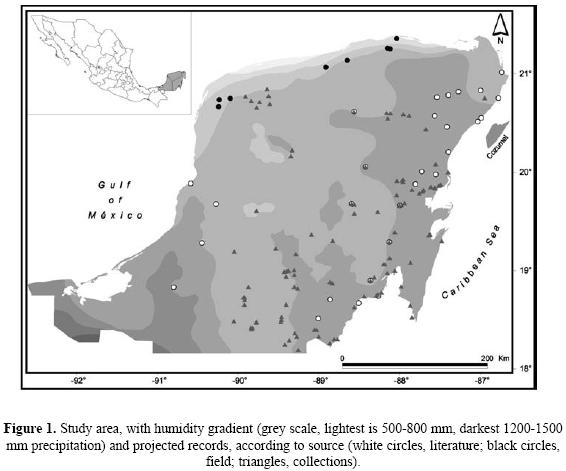
<body><![CDATA[<p align="justify"><font face="verdana" size="2"><b>Palabras clave: </b>Biodiversidad, mariposas, conservaci&oacute;n, biogeograf&iacute;a ecol&oacute;gica, gradiente de humedad, especies indicadoras, latitud, an&aacute;lisis multifactorial.</font></p>     <p align="justify"><font face="verdana" size="2">&nbsp;</font></p>     <p align="justify"><font face="verdana" size="2"><b>INTRODUCTION</b></font></p>     <p align="justify"><font face="verdana" size="2">Distribution and abundance patterns of organisms depend on several factors, either ecological&#150;environmental (recent or past), geographical, historical, or related to extinction&#150;recolonization (peninsular effect). However, biogeography studies, either ecological or historical, usually use only one kind of (potentially) explanatory variables; analyses that combine ecological and historical approaches are not very common (Simpson 1964; Lee 1980; Murray <i>et al. </i>1999; Cowley <i>et al. </i>2001a; Cowley <i>et al. </i>2001b; Espadas&#150;Manrique <i>et al. </i>2003; Matter <i>et al. </i>2003; Espadas&#150;Manrique 2004; Wiens &amp; Donoghue 2004). In this work we present a biogeography analysis with an ecological approached, in which we considered conditions of the Yucatan Peninsula (YP) that are related to the development and distribution of the butterflies; the humidity (precipitation and evapotranspiration) gradient, decreasing from south to north, is a major factor explaining the distribution of other kind of organisms (Mandujano <i>et al. </i>2008). The geological youth of the northern and eastern parts of YP (Pleistocene) is another relevant factor (Delgadillo 1984; Schmitter&#150;Soto &amp; Salazar&#150;Vallejo 1993; Pozo <i>et al. </i>2003; White &amp; Hood 2004).</font></p>     <p align="justify"><font face="verdana" size="2">We consider a series of independent variables (environmental, ecological, geographical and anthropic), to explain the distributional patterns of Charaxinae in this region, based on the hypothesis that this distribution is influenced not only by the present&#150;day conditions in YP, but also by the Mayan culture pressure and the geologic age of YP. We analyze presence&#150;absence of species, and patterns of richness and abundance, which are determined by environmental heterogeneity (Brown &amp; Opler 1990; Murray <i>et al. </i>1999; Kocher &amp; Williams 2000; Cowley <i>et al. </i>2001a; Cowley <i>et al. </i>2001b; Matter <i>et al </i>2003). Also, we will try to discard a possible peninsula effect in the distribution patterns of the Charaxinae of the PY (Simpson 1964; Seib 1980; Brown 1987; Brown &amp; Opler 1990; Martin &amp; Gurrea 1990). This study also examines topography (altitude), a factor that used to be overlooked in YP, because the relief in the YP is low, usually much below 300 m, although Cort&eacute;s&#150;Castel&aacute;n &amp; Islebe (2005) proved that topography can be relevant to explain distribution of tree species in YP.</font></p>     <p align="justify"><font face="verdana" size="2">This is the first biogeographical study concerning YP butterflies, aside from a few ones of inventory and monitory (de la Maza &amp; Gutierrez&#150;Carbonell 1992; Pozo <i>et al. </i>2003; Maya&#150;Mart&iacute;nez <i>et al. </i>2005), and previous isolated records <i>(e.g., </i>Godman &amp; Salvin 1879&#150;1901; Godman <i>et al. </i>1887&#150;1901; Hoffman 1941; Comstock 1961).</font></p>     <p align="justify"><font face="verdana" size="2">&nbsp;</font></p>     <p align="justify"><font face="verdana" size="2"><b>MATERIAL AND METHODS</b></font></p>     <p align="justify"><font face="verdana" size="2"><b>Study area. </b>The study area was defined as the portion of YP in a precipitation range of 500 to 1500 mm, which corresponds, approximately, to the Mexican portion of YP. The area has humidity and vegetation gradients (<a href="#f1">Fig. 1</a>; Miranda 1958; Miranda &amp; Hern&aacute;ndez&#150;X 1963; Mart&iacute;nez &amp; Galindo&#150;Leal 2002; Pozo <i>et al. </i>2003). Soils are shallow, recently formed, with rendzines and litosoles in the north, gleysoles towards the coasts, luvisoles in mature karstic plains and vertisoles in the south and northeast (Bautista&#150;Z&uacute;&ntilde;iga <i>et al</i><i>&nbsp;</i>. The most important vegetation types are medium semi&#150;evergreen tropical forest (especially where precipitation is 1100&#150;1400 mm); high statured semi&#150;deciduous tropical forest (1200&#150;1400 mm); low deciduous tropical forest (to the north and northeast, 500&#150;600 mm), and floodable low tropical forest (in poorly drained soils throughout YP). There are mangroves and other aquatic vegetational associations too (Carnevali <i>et al. </i>2003). Historically, YP has experienced several climates. During the last glacial, climate was dry, with savannas and juniper scrub; during the early Holocene, vegetation changed to tropical forest; towards the years 1000 and 500 BP forest cover was reduced and savanna area increased (Orellana <i>et al. </i>2003). Geologically, YP consists of two main subregions: to the north, areas of Miocene&#150;Pliocene age; to the south, Miocene tectonic uplifts, as well as Eocene hills and residual plains. The Caribbean coast is Pleistocene in age (Bautista&#150;Z&uacute;&ntilde;iga <i>et al. </i>2003).</font></p>     <p align="center"><font face="verdana" size="2"><a name="f1"></a></font></p>     ]]></body>
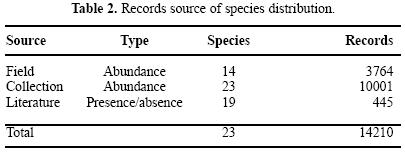
<body><![CDATA[<p align="center"><font face="verdana" size="2"><img src="/img/revistas/azm/v25n2/a4f1.jpg"></font></p>     <p align="justify"><font face="verdana" size="2"><b>Studied taxon. </b>The Charaxinae (Lepidoptera: Nymphalidae) include 19 genera and 400 species approximately, most of them live in tropical areas around the globe; in the Neotropics the majority of the species dwell in southeastern Mexico, Central America and the Amazonas (Comstock 1961; Ackery 1984; DeVries 1987; Joly 2003; Mielke <i>et al. </i>2004). The subfamily is well known taxonomically, although its phylogeny remains poorly known (Wahlberg <i>et al. </i>2003). Many Charaxinae adults prefer the canopy rather than the forest undergrowth, but all can be attracted to carrion and fermented fruit (Queiroz 2002; Mielke <i>et al. </i>2004).</font></p>     <p align="justify"><font face="verdana" size="2">The ecological and environmental interaction between vegetation and butterflies has been recognized, since the larvae eat plants and the adults are pollinators; in addition, they are an important part of the food chain to the being food of insectivores or parasitoids (Scoble 1995). Moreover, frugivorous butterflies, such as Charaxinae, have been considered excellent bioindicators of environmental quality, candidates to be included in management plans of the sites where they occur (Uehara&#150;Prado <i>et al. </i>2007). DeVries &amp; Walla (2001) and Barlow <i>et al. </i>(2007) mentioned that this group displays clear diversity patterns, with variations in temporal and space scale.</font></p>     <p align="justify"><font face="verdana" size="2"><b>Data analysis. </b>Distributional records were taken from the literature (Godman &amp; Salvin 1879&#150;1901; Godman <i>et al. </i>1887&#150;1901; Comstock 1961; de la Maza 1987; d'Abrera 1988a; d'Abrera 1988b; Vargas&#150;Fern&aacute;ndez <i>et al. </i>1991; de la Maza &amp; Guti&eacute;rrez&#150;Carbonell 1992; Vargas&#150;Fern&aacute;ndez <i>et al. </i>1996; Warren <i>et al. </i>1998; Pozo <i>et al. </i>2003; Maya&#150;Mart&iacute;nez <i>et al. </i>2005; among others), collections (Colecci&oacute;n Lepidopterol&oacute;gica del Museo de Zoolog&iacute;a "Alfonso L. Herrera" and Colecci&oacute;n Nacional de Insectos, consulted through REMIB; Colecci&oacute;n Lepidopterol&oacute;gica del Museo de Zoolog&iacute;a de ECOSUR and McGuire Center of Lepidoptera, visited) and new data from fieldwork (<a href="#f1">Fig. 1</a>). Sampling effort focused on northern YP, between 500 and 1000 mm precipitation, because literature and collection records were sparse in this area. We used standard collecting techniques (entomological net and traps: Rydon 1964; Brown 1972; Howe 1975; Llorente <i>et al. </i>1990), during 54 days in 2006&#150;07.</font></p>     <p align="justify"><font face="verdana" size="2">Every distributional record was characterized with environmental, ecological, physiographical, geological and anthropic descriptors; eleven variables were considered initially (<a href="/img/revistas/azm/v25n2/a4t1.jpg" target="_blank">Table 1</a>). Finally, the database included 14,210 records, representing 23 species from 152 sites throughout YP (<a href="#t2">Table 2</a>). To reduce the bias by the sampling effort, localities with low effort were eliminated, and also species with less than 10% occurrence. The matrix was thus reduced to 17 species (columns; <a href="/img/revistas/azm/v25n2/a4t3.jpg" target="_blank">Table 3</a>) from 151 sites (rows).</font></p>     <p align="center"><font face="verdana" size="2"><a name="t2"></a></font></p>     <p align="center"><font face="verdana" size="2"><img src="/img/revistas/azm/v25n2/a4t2.jpg"></font></p>     <p align="justify"><font face="verdana" size="2">&nbsp;</font></p>     <p align="justify"><font face="verdana" size="2">We generated two matrices: species&#150;sites and independent variables&#150;sites. Species data were transformed (square&#150;root), and environmental data were standardized of minimum&#150;maximum values from 0 to 1 (Legendre &amp; Legendre 1998; Herrando&#150;P&eacute;rez 2002). Latitude was a proxy for the possible peninsula effect, since the distal part of YP is oriented directly north.</font></p>     <p align="justify"><font face="verdana" size="2">Multivariate analyses were performed with the package Canoco ver. 4.5. A detrended correspondence analysis (DCA) was applied to the species matrix, to visualize the length of the gradient and therefore determine the type canonical analysis that would follow, that is, either a linear (length&lt;4) or a unimodal model (length&gt;4) (Leps &amp; Smilaurer 2003). Since the matrix was unimodal, a direct analysis of gradient, canonical correspondence analysis (CCA) was performed on both matrices, based on distance between species (giving extra weight to rare species) and performing a Montecarlo test with data randomization.</font></p>     ]]></body>
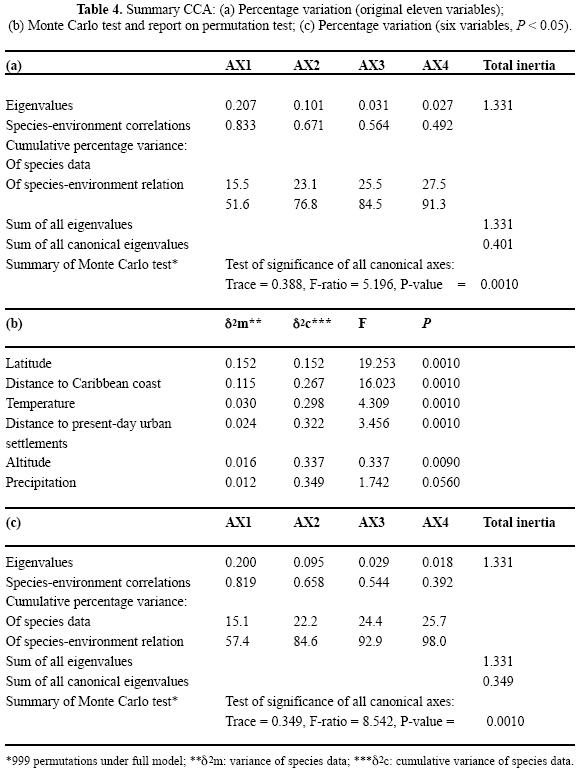
<body><![CDATA[<p align="justify"><font face="verdana" size="2">With the first CCA we selected six variables with the forward selection of environmental variables option, which avoids high correlation between explanatory variables; the six variables were latitude, distance to Caribbean coast, temperature, distance to present&#150;day urban settlements, altitude, and precipitation, that explained more than 10% of the variance (<i>P=0.0010, </i>F&#150;ratio=8.542; <a href="#t4">Table 4a, b and c</a>). Finally distribution patterns of the Charaxinae of YP were located projecting on the ordination diagram, a procedure to determine the optima of each species along the environmental variables (ter Braak 1986; Jongman <i>et al. </i>1995; Roberts &amp; Wuest 1999; Leps &amp; Smilaurer 2003).</font></p>     <p align="center"><font face="verdana" size="2"><a name="t4"></a></font></p>     <p align="center"><font face="verdana" size="2"><img src="/img/revistas/azm/v25n2/a4t4.jpg"></font></p>     <p align="justify"><font face="verdana" size="2">&nbsp;</font></p>     <p align="justify"><font face="verdana" size="2"><b>RESULTS</b></font></p>     <p align="justify"><font face="verdana" size="2">The six variables with higher explanatory power and statistical significance refer to present conditions, and are mainly environmental and geographical, including the influence of human settlements (<a href="#t4">Table 4b, c</a>). These variables were not highly correlated among themselves, except for altitude and latitude, because the highest elevations in YP are found towards the south. There is also a negative relationship between distance to the Caribbean coast and humidity (<a href="#t5">Table 5a</a>).</font></p>     <p align="center"><font face="verdana" size="2"><a name="t5"></a></font></p>     <p align="center"><font face="verdana" size="2"><img src="/img/revistas/azm/v25n2/a4t5.jpg"></font></p>     <p align="justify"><font face="verdana" size="2">The ordination graph generated by the CCA showed that the richness and abundance of the Charaxinae of the YP have a gradient of distribution defined by the latitude, topography (altitude) and humidity, observed that the greater diversity was associated to sites of the south of the YP (lowest latitudes), with pronounced topography and high humidity, with the exception of a group of sites of the north of the YP where it was observed low richness but high abundances (<a href="#t5">Table 5b</a>; <a href="/img/revistas/azm/v25n2/a4f2.jpg" target="_blank">Fig. 2a, b</a>). The distributional patterns were defined by different species with an optimal reaction for each one of the six independent variables.</font></p>     <p align="justify"><font face="verdana" size="2">The pattern I included species in the genera <i>Archaeoprepona, Prepona, </i>and <i>Consul, </i>as well as two <i>Memphis, </i>and depended on altitude and humidity (<a href="/img/revistas/azm/v25n2/a4t3.jpg" target="_blank">Table 3</a>; <a href="/img/revistas/azm/v25n2/a4f2.jpg" target="_blank">Fig. 2c</a>); thus, these species presented optima at high humidity (1000&#150;1500 mm precipitation), pronounced topography (204&#150;261 m), and highest abundances towards the south (17&deg;&#150;18&deg;N), in sites with lower temperatures (22&deg;&#150;24&deg;C), and with little influence of present urban settlements; also, most of the species that are distributed under this pattern prefer sites near the coast of the Caribbean (0&#150;237 km; <a href="/img/revistas/azm/v25n2/a4f3.jpg" target="_blank">Figs. 3</a>, <a href="/img/revistas/azm/v25n2/a4f4.jpg" target="_blank">4</a>).</font></p>     ]]></body>
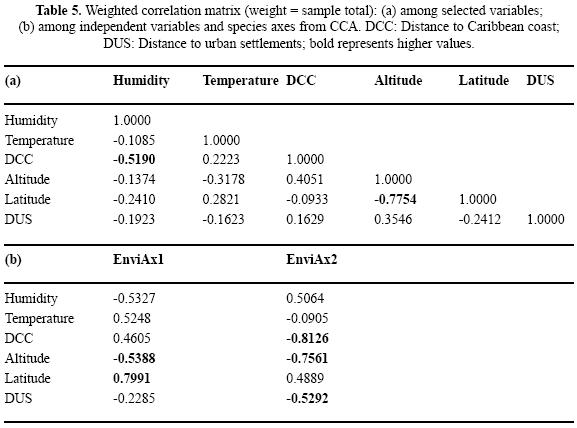
<body><![CDATA[<p align="justify"><font face="verdana" size="2">Five species followed the distribution patterns II and III, whose distribution was determined mainly by high humidity and latitude (20&deg;&#150;21&deg;N, towards the north of YP); both patterns cover sites closer to the Caribbean coast, and intermediate distances to present urban settlements (<a href="/img/revistas/azm/v25n2/a4t3.jpg" target="_blank">Table 3</a>; <a href="/img/revistas/azm/v25n2/a4f2.jpg" target="_blank">Fig. 2c</a>); however, the species that followed the distribution pattern II preferred lower temperatures (22&deg;&#150;26&deg;C, vs. 24&#150;28&deg;C for group III; <a href="/img/revistas/azm/v25n2/a4f3.jpg" target="_blank">Figs. 3</a>, <a href="/img/revistas/azm/v25n2/a4f4.jpg" target="_blank">4</a>).</font></p>     <p align="justify"><font face="verdana" size="2"><i>Anaea troglodyta aidea </i>and <i>Memphis pithyusa pithyusa </i>tracked pattern distribution IV. The most influential variable in this case was temperature (26&#150;28&deg;C; <a href="/img/revistas/azm/v25n2/a4f2.jpg" target="_blank">Fig. 2c</a>); other conditions favorable for these species were the higher latitude, greater distance to the Caribbean coast, far to the human settlements and lower humidity (<a href="/img/revistas/azm/v25n2/a4f3.jpg" target="_blank">Figs. 3</a>, <a href="/img/revistas/azm/v25n2/a4f4.jpg" target="_blank">4</a>); in general, this group distributes better in sites with tenuous or null topography, even though there is a M. <i>p. pithyusa </i>population that displayed high abundances in sites with marked topography, having 39% of the individuals (1452) of this species for the rank of the 261 m (<a href="/img/revistas/azm/v25n2/a4f3.jpg" target="_blank">Fig. 3</a>).</font></p>     <p align="justify"><font face="verdana" size="2">Under the distribution pattern V we found <i>Memphis forreri, Fountainea eurypyle confusa and </i>an undescribed species of <i>Siderone. </i>The main factor was distance to urban settlements (<a href="/img/revistas/azm/v25n2/a4f2.jpg" target="_blank">Fig. 2c</a>); in addition, the greatest abundances of these species occurred in sites away from the coast, altitude 204&#150;261 m, precipitation 800&#150;1200 mm and lower temperatures 22&#150;24&deg;C (<a href="/img/revistas/azm/v25n2/a4f3.jpg" target="_blank">Figs. 3</a>, <a href="/img/revistas/azm/v25n2/a4f4.jpg" target="_blank">4</a>); the group of species track a distribution towards the north of the YP, the species of <i>Siderone </i>and <i>F. e. confusa </i>fulfill this pattern, but <i>M. forreri </i>showed high abundances towards the both ends of the YP, with a decrease in the mid&#150;latitudes (<a href="/img/revistas/azm/v25n2/a4f3.jpg" target="_blank">Fig. 3</a>).</font></p>     <p align="justify"><font face="verdana" size="2">&nbsp;</font></p>     <p align="justify"><font face="verdana" size="2"><b>DISCUSSION</b></font></p>     <p align="justify"><font face="verdana" size="2">According to recent research in YP, the present&#150;day vegetation in the region resulted mainly from events that occurred during the Tertiary, when climate became markedly tropical (Orellana <i>et al. </i>2003). Moreover, for several taxa (Lee 1980; Espadas&#150;Manrique <i>et al. </i>2003; Pozo 2006, among others), distribution is determined by environmental heterogeneity; this is the case for the Charaxinae, since the main factors that explain their distribution are recent and related to the environment. Humidity and temperature are relevant, as are latitude, altitude, distance to the Caribbean coast (a surrogate for risk of impact by hurricanes) and distance to present urban settlements (a surrogate for direct human impact). This heterogeneous arrangement was mentioned by Barlow <i>et al. </i>(2007) who discerned that, opposite to other subfamilies, the Charaxinae species are influenced by the surrounding secondary forest and plantations, but mainly by the presence of primary forest.</font></p>     <p align="justify"><font face="verdana" size="2">On the other hand, distribution patterns of biodiversity may vary according to a geographic or environmental gradient (Murray <i>et al. </i>1999; Kocher &amp; Williams 2000). In the present case, latitude (that is, distance to the base of YP or Nuclear Central America, the putative biogeographic origin of most taxa in the region; Bussing &#91;1976&#93;) was not so relevant for richness, which is relatively homogeneous latitudinally, refuting a "peninsular effect" as such. This finding coincides with the results of Simpson (1964), Brown (1987), Brown &amp; Opler (1990), and Martin &amp; Gurrea (1990); peninsulas of Baja California, Florida and Iberian, respectively), who pointed out that distributional patterns of the neotropical lepidopterofauna are largely due to ecological and environmental conditions. The opposite happens with the nearctic lepidopterofauna in all three mentioned peninsulas, where a richness gradient along the axis of the peninsulas was demonstrated.</font></p>     <p align="justify"><font face="verdana" size="2">As for the distribution of abundance, this tended to be higher towards north and south latitudes and lower at mid&#150;latitude. This could be due to the fact that in this intermediate latitude one finds the transition between the wet and the dry subregions of YP, as mentioned by Lee (1980), who found a similar pattern for lizards and snakes. Seib (1980) observed this phenomenon in the rodents of Baja California, and suggested two patterns of peninsular distribution: a geometric pattern (peninsular effect) and a gradient, because towards the border between the southern and northern halves of that peninsula there is a mixture of habitat types, which favors a higher diversity.</font></p>     <p align="justify"><font face="verdana" size="2">Thus, distribution of Charaxinae is marked more by environmental factors, with a gradient, with higher abundance in the extreme south and north; moreover, it is important to note that personal observations of distributional maps of the plants that harbor the larvae of these butterflies follow the same pattern (Maya, in process).</font></p>     <p align="justify"><font face="verdana" size="2">The Charaxinae of YP demonstrate a distributional gradient given by the latitude, the topography and the humidity, thus an environmental gradient explains the distribution (Wet&#150;Dry: South&#150;North), established by others authors for the YP. This gradient has an important influence on the distributional patterns of the organism; for the Charaxinae the result was a richer fauna in the South of the peninsula. Even if the effect of the topography has been considered less of then in the distributional patterns of the organisms in the peninsula, because it is not very much pronounced (0&#150;300 m), it influence must be important in the distributional gradient of the organism, as it is demonstrated with the Charaxinae in this study in accordance with Cort&eacute;s&#150;Castel&aacute;n <i>et al. </i>(2005). This distributional pattern was observed by Hill (1999), who recorded that populations of Satyridae butterflies were influenced directly by humidity and not properly by vegetation structure.</font></p>     ]]></body>
<body><![CDATA[<p align="justify"><font face="verdana" size="2">On the other hand, we observed a group of localities in northern YP (24) that was low in richness (nine species out of 17, on average only three per site), with high dominance of a few species <i>(M. p. pithyusa </i>and <i>A. t. aidea; </i>94% of the total abundance in these sites), which are the only ones that display higher abundances in drier environments. This pattern of low equitability has been reported already for tropical environments, especially when productivity is rather low (Bazzaz &amp; Pickett 1980; Murray <i>et al. </i>1999; Magurran 2004), as happens in northern PY.</font></p>     <p align="justify"><font face="verdana" size="2">The environmental optima observed for species in pattern distribution I (south of YP, near to the Caribbean coast, low temperatures, far to the urban settlements, pronounced topography and high humidity) coincide in general with findings elsewhere for those species (Godman &amp; Salvin 1879&#150;1901; Godman <i>et al. </i>1887&#150;1901; Comstock 1961; DeVries 1987; DeVries &amp; Walla 2001); however below the 1000 mm precipitation, we didn't found any record of this species. We establish here a humidity limit for those species.</font></p>     <p align="justify"><font face="verdana" size="2">Under pattern distribution II and III were including species that do not occur in the south (latitude 17&deg;N). These species were more prevalent between parallels 20&deg; and 21&deg;N, but the species that followed the pattern II preferred wetter sites and those of distribution pattern III drier environments; this coincides with the division between the two biotic provinces proposed for PY, Yucatec and Peten, based on diagnostic species of reptiles, birds, fishes, plants, and others (Smith 1941; Lee 1980; Escalante <i>et al. </i>1993; Schmitter&#150;Soto &amp; Salazar&#150;Vallejo 1993; Lee 1996; Espinosa&#150;Organista <i>et al. </i>2002). <i>Memphis oenomais, Zaretis ellops </i>and Z. <i>callidryas </i>(distribution pattern II) were better distributed in the south (Peten) and <i>S. syntyche syntyche, </i>and <i>Fountainea glycerium yucatanum </i>(pattern III) in the north (Yucatec). Of those species, <i>F. g. yucatanum </i>had already been considered (Vargas&#150;Fern&aacute;ndez <i>et al. </i>2006) one of the four endemic butterflies <i>(Anthirrea philoctetes casta, F. g. yucatanum </i>and <i>Fountainea halice maya) </i>diagnostic of PY as a biogeographical province. However, this distribution pattern should be confirmed by means of a different sort of analysis <i>(e.g., </i>panbiogeographic) to determine whether these groups belong in historically coherent faunas (that is, generalized tracks; Morrone &amp; Crisci 1995).</font></p>     <p align="justify"><font face="verdana" size="2">Although species in distribution patterns IV and V presented particular environmental preferences, they are distributed throughout the peninsula; for example, <i>A. t. aidea </i>(included in pattern IV), reported to have a wide distribution, from Costa Rica to the southern United States, but we observed it to prefer drier and hotter regions. Most authors (from Godman &amp; Salvin 1879&#150;1901, to Pozo <i>et al. </i>2003, among others) mention sites where the species of these groups were collected, but omit habitat preferences. An exception is DeVries (1987), who mentioned that <i>A. t. aidea </i>is associated with deciduous forest (dry low tropical forest in YP: Mart&iacute;nez &amp; Galindo&#150;Leal 2002). In North America, Scott (1986) usually found <i>Anaea </i>at the border of forests, roads and water bodies, although it also occurs in subtropical pine&#150;palmetto scrub and wooded desert areas. Thus, we can conclude that the species in these patterns (M. <i>p. pithyusa, A. t. aidea, M. forreri, Siderone </i>sp and <i>F. e. confusa), </i>particularly <i>M. p. pithyusa </i>and <i>A. t. aidea, </i>are favored by drier environments, which limit other Charaxinae; although they are widely distributed, they take advantage of these conditions to increment their populations opportunistically.</font></p>     <p align="justify"><font face="verdana" size="2">This work could also detect and confirm (Pozo 2006; Uehara&#150;Pardo <i>et al. </i>2007) that these butterflies are good bioindicators of the conservation state of the vegetation. Therefore, they should be included in management plans: species that followed the distribution pattern I, IV and V prefer conserved sites, far from urban settlements. Hill (1999) mentions that Satyridae populations were impaired by the humidity and habitat fragmentation, being considered as well as a group indicator of conservation status.</font></p>     <p align="justify"><font face="verdana" size="2">Formerly, Pozo (2006) detected seven of these species <i>(A. t. aidea, F. e. confusa, Memphis forreri, M. moorus boisduvali, M. p. pithyusa, Archaeoprepona demophoon gulina </i>and <i>Prepona laertes octavia) </i>as useful indicators of conserved environments in low and medium tropical forests. However, <i>Consul electra electra, M. hedemanni </i>and <i>Siderone </i>sp., considered indicative of disturbed vegetation by Pozo (2006), were observed here to belong in groups whose optima correspond to conserved sites.</font></p>     <p align="justify"><font face="verdana" size="2">&nbsp;</font></p>     <p align="justify"><font face="verdana" size="2"><b>CONCLUSIONS</b></font></p>     <p align="justify"><font face="verdana" size="2">The distribution, abundance and richness of Charaxinae in YP mainly followed the latitudinal, altitudinal and humidity gradient; a group of sites in dry northern Yucatan showed an inverse correlation between abundance and richness, with dominance of two species opportunistic for drier environments <i>(A. t. aidea </i>y <i>M. p. pithyusa). </i>Five distribution patterns were identified, each with different species that tracked particular environmental preferences. Species that followed the distribution pattern I was limited by the minimum mean annual precipitation of 1000 mm. Patterns II and III were restricted to northern YP; species of the pattern II preferred wetter sites <i>(ca. </i>1350 mm) and pattern III the drier areas in the region (vary from 700 to 900 mm). Species of patterns IV and V displayed similar distribution, favored by conserved sites, that is, far from urban settlements. <i>A. t. aidea </i>is a widespread species, but it shows preference for low humidity and high temperatures, a fact previously overlooked. Seven species are confirmed bioindicators of conserved vegetation <i>(A. t. aidea, F. e. confusa, M. forreri, M. m. boisduvali, Memphis p. pithyusa, A. d. gulina, </i>and <i>P. l. octavia).</i></font></p>     <p align="justify"><font face="verdana" size="2">&nbsp;</font></p>     ]]></body>
<body><![CDATA[<p align="justify"><font face="verdana" size="2"><b>ACKNOWLEDGEMENTS</b></font></p>     <p align="justify"><font face="verdana" size="2">We thank A. Cruz&#150;Mart&iacute;nez, Y. H&eacute;naut, G. Islebe, J. Le&oacute;n, and A. Warren for their useful comments on the manuscript; D. Berdugo. E. May, and I. Salazar for their valuable collaboration during field work. J. Montero oriented us in the application of multivariate analyses and reviewed the manuscript. H. Weissenberger edited the maps and helped us with the use GIS. We are also thankful to PRONATURA&#150; Yucat&aacute;n and the biosphere reserve R&iacute;a Lagartos for the facilities at Celest&uacute;n, El Zapotal, and Pet&eacute;n Tuch&aacute;. CONACYT, ECOSUR, MZFC&#150;UNAM, and CONABIO (BJ002 and DE011) supported this investigation.</font></p>     <p align="justify"><font face="verdana" size="2">&nbsp;</font></p>     <p align="justify"><font face="verdana" size="2"><b>REFERENCES</b> </font></p>     <!-- ref --><p align="justify"><font face="verdana" size="2"><b>Ackery, P.R.</b> 1984. Systematic and faunistic studies on butterflies. Pp. 9&#150;21. <i>In: </i>R.I. Vane&#150;Wright and P.R. Ackery (eds). <i>The biology of butterflies. </i>Academic Press, London. </font>&nbsp;&nbsp;&nbsp;&nbsp;&nbsp;&nbsp;&nbsp;&nbsp;[&#160;<a href="javascript:void(0);" onclick="javascript: window.open('/scielo.php?script=sci_nlinks&ref=357767&pid=S0065-1737200900020000400001&lng=','','width=640,height=500,resizable=yes,scrollbars=1,menubar=yes,');">Links</a>&#160;]<!-- end-ref --><!-- ref --><p align="justify"><font face="verdana" size="2"><b>Barlow, J., W. Overlal, I. Araujo, T.A Gardner &amp; C.A. P&eacute;rez. </b>2007. The value of primary, secondary and plantation forests for fruit&#150;feeding butterflies in the Brazilian Amazon. <i>Journal of Applied Ecology. </i>44:1001&#150;1012.</font>&nbsp;&nbsp;&nbsp;&nbsp;&nbsp;&nbsp;&nbsp;&nbsp;[&#160;<a href="javascript:void(0);" onclick="javascript: window.open('/scielo.php?script=sci_nlinks&ref=357768&pid=S0065-1737200900020000400002&lng=','','width=640,height=500,resizable=yes,scrollbars=1,menubar=yes,');">Links</a>&#160;]<!-- end-ref --><!-- ref --><p align="justify"><font face="verdana" size="2"><b>Bautista&#150;Z&uacute;&ntilde;iga, F., E. Batllori&#150;Sampedro, M.A. Ortiz&#150;P&eacute;rez, G. Palacio&#150;Aponte &amp; M. Castillo&#150;Gonz&aacute;lez. </b>2003. Geoformas, agua y suelo en la Pen&iacute;nsula de Yucat&aacute;n. Pp. 21&#150;36. <i>In: </i>P . Colunga&#150; GarciaMar&iacute;n and A. Larqu&eacute;&#150;Saavedra (eds). <i>Naturaleza y sociedad en el &aacute;rea maya. Pasado, </i><i>presente y futuro. </i>CICY, M&eacute;rida. </font>&nbsp;&nbsp;&nbsp;&nbsp;&nbsp;&nbsp;&nbsp;&nbsp;[&#160;<a href="javascript:void(0);" onclick="javascript: window.open('/scielo.php?script=sci_nlinks&ref=357769&pid=S0065-1737200900020000400003&lng=','','width=640,height=500,resizable=yes,scrollbars=1,menubar=yes,');">Links</a>&#160;]<!-- end-ref --><!-- ref --><p align="justify"><font face="verdana" size="2"><b>Bazzaz, F.A. &amp; S.T.A. Pickett. </b>1980. Physiological ecology of tropical succession: A comparative review. <i>Annual Review of Ecology and Systematics. </i>11:287&#150;310. </font>&nbsp;&nbsp;&nbsp;&nbsp;&nbsp;&nbsp;&nbsp;&nbsp;[&#160;<a href="javascript:void(0);" onclick="javascript: window.open('/scielo.php?script=sci_nlinks&ref=357770&pid=S0065-1737200900020000400004&lng=','','width=640,height=500,resizable=yes,scrollbars=1,menubar=yes,');">Links</a>&#160;]<!-- end-ref --><!-- ref --><p align="justify"><font face="verdana" size="2"><b>Brown, J.W. </b>1987. The peninsular effect in Baja California: an entomological assessment. <i>Journal of </i><i>Biogeography. </i>14(4):359&#150;365. </font>&nbsp;&nbsp;&nbsp;&nbsp;&nbsp;&nbsp;&nbsp;&nbsp;[&#160;<a href="javascript:void(0);" onclick="javascript: window.open('/scielo.php?script=sci_nlinks&ref=357771&pid=S0065-1737200900020000400005&lng=','','width=640,height=500,resizable=yes,scrollbars=1,menubar=yes,');">Links</a>&#160;]<!-- end-ref --><!-- ref --><p align="justify"><font face="verdana" size="2"><b>Brown, J.W. &amp; P.A. Opler. </b>1990. Patterns of butterfly species density in Peninsular Florida. <i>Journal </i><i>of Biogeography. </i>7(6):615&#150;622. </font>&nbsp;&nbsp;&nbsp;&nbsp;&nbsp;&nbsp;&nbsp;&nbsp;[&#160;<a href="javascript:void(0);" onclick="javascript: window.open('/scielo.php?script=sci_nlinks&ref=357772&pid=S0065-1737200900020000400006&lng=','','width=640,height=500,resizable=yes,scrollbars=1,menubar=yes,');">Links</a>&#160;]<!-- end-ref --><!-- ref --><p align="justify"><font face="verdana" size="2"><b>Brown, K.S., Jr. </b>1972. Maximizing daily butterfly counts. <i>Journal of the Lepidopterists' Society. </i>26(3): 183&#150;196. </font>&nbsp;&nbsp;&nbsp;&nbsp;&nbsp;&nbsp;&nbsp;&nbsp;[&#160;<a href="javascript:void(0);" onclick="javascript: window.open('/scielo.php?script=sci_nlinks&ref=357773&pid=S0065-1737200900020000400007&lng=','','width=640,height=500,resizable=yes,scrollbars=1,menubar=yes,');">Links</a>&#160;]<!-- end-ref --><!-- ref --><p align="justify"><font face="verdana" size="2"><b>Bussing, W.A. </b>1976. Geographic distribution of the San Juan Ichthyofauna of Central America with remarks on its origin and ecology. Pp. 157&#150;175. <i>In: </i>T.B. Thorson (ed). <i>Investigations of the ichthyofauna of Nicaraguan lakes. </i>University of Nebraska, Lincoln. </font>&nbsp;&nbsp;&nbsp;&nbsp;&nbsp;&nbsp;&nbsp;&nbsp;[&#160;<a href="javascript:void(0);" onclick="javascript: window.open('/scielo.php?script=sci_nlinks&ref=357774&pid=S0065-1737200900020000400008&lng=','','width=640,height=500,resizable=yes,scrollbars=1,menubar=yes,');">Links</a>&#160;]<!-- end-ref --><!-- ref --><p align="justify"><font face="verdana" size="2"><b>Calder&oacute;n&#150;Mandujano, R.R., C. Galindo&#150;Leal &amp; J.R. Cede&ntilde;o&#150;V&aacute;zquez. </b>2008. Utilizaci&oacute;n de h&aacute;bitat por reptiles en estados sucesionales de selvas tropicales de Campeche, M&eacute;xico. <i>Acta Zool&oacute;gica Mexicana. </i>24(1):95&#150;114. </font>&nbsp;&nbsp;&nbsp;&nbsp;&nbsp;&nbsp;&nbsp;&nbsp;[&#160;<a href="javascript:void(0);" onclick="javascript: window.open('/scielo.php?script=sci_nlinks&ref=357775&pid=S0065-1737200900020000400009&lng=','','width=640,height=500,resizable=yes,scrollbars=1,menubar=yes,');">Links</a>&#160;]<!-- end-ref --><!-- ref --><p align="justify"><font face="verdana" size="2"><b>Carnevali, G., I.M. Ram&iacute;rez &amp; J.A. Gonz&aacute;lez&#150;Iturbe. </b>2003. Flora y vegetaci&oacute;n de la Pen&iacute;nsula de Yucat&aacute;n. Pp. 53&#150;68. <i>In: </i>P. Colunga&#150;GarciaMar&iacute;n and A. Larqu&eacute;&#150;Saavedra (eds). <i>Naturaleza y </i><i>sociedad en el &aacute;rea maya. Pasado, presente y futuro. </i>CICY, M&eacute;rida. </font>&nbsp;&nbsp;&nbsp;&nbsp;&nbsp;&nbsp;&nbsp;&nbsp;[&#160;<a href="javascript:void(0);" onclick="javascript: window.open('/scielo.php?script=sci_nlinks&ref=357776&pid=S0065-1737200900020000400010&lng=','','width=640,height=500,resizable=yes,scrollbars=1,menubar=yes,');">Links</a>&#160;]<!-- end-ref --><!-- ref --><p align="justify"><font face="verdana" size="2"><b>Comstock, W.P. </b>1961. <i>Butterflies of the American Tropics. The genus Anaea (Lepidoptera: Nympha</i><i>lidae). A study of the species heretofore included in the genera Anaea, Coenophlebia, Hypna, Poly</i><i>grapha, Protogonius, Siderone and Zaretis. </i>The American Museum of Natural History, New York. </font>&nbsp;&nbsp;&nbsp;&nbsp;&nbsp;&nbsp;&nbsp;&nbsp;[&#160;<a href="javascript:void(0);" onclick="javascript: window.open('/scielo.php?script=sci_nlinks&ref=357777&pid=S0065-1737200900020000400011&lng=','','width=640,height=500,resizable=yes,scrollbars=1,menubar=yes,');">Links</a>&#160;]<!-- end-ref --><!-- ref --><p align="justify"><font face="verdana" size="2"><b>Conservation International, United States Man and the Biosphere Program, </b>ECOSUR, <i>et al. </i>1995. <i>Evaluaci&oacute;n de la conservaci&oacute;n en la selva maya, 1:800,000. </i>ECOSUR, San Crist&oacute;bal de las Casas.</font>&nbsp;&nbsp;&nbsp;&nbsp;&nbsp;&nbsp;&nbsp;&nbsp;[&#160;<a href="javascript:void(0);" onclick="javascript: window.open('/scielo.php?script=sci_nlinks&ref=357778&pid=S0065-1737200900020000400012&lng=','','width=640,height=500,resizable=yes,scrollbars=1,menubar=yes,');">Links</a>&#160;]<!-- end-ref --><!-- ref --><p align="justify"><font face="verdana" size="2"><b>Cort&eacute;s&#150;Castel&aacute;n, J.C. &amp; G.A. Islebe. </b>2005. Influencia de factores ambientales en la distribuci&oacute;n de especies arb&oacute;reas en las selvas del sureste de M&eacute;xico. <i>Revista de Biolog&iacute;a Tropical. </i>53(1&#150;2): 115&#150;133.</font>&nbsp;&nbsp;&nbsp;&nbsp;&nbsp;&nbsp;&nbsp;&nbsp;[&#160;<a href="javascript:void(0);" onclick="javascript: window.open('/scielo.php?script=sci_nlinks&ref=357779&pid=S0065-1737200900020000400013&lng=','','width=640,height=500,resizable=yes,scrollbars=1,menubar=yes,');">Links</a>&#160;]<!-- end-ref --><!-- ref --><p align="justify"><font face="verdana" size="2"><b>Cowley, M.J.R., C.D. Thomas, D.B. Roy, R.J. Wilson, J.L. Le&oacute;n&#150;Cort&eacute;s, D. Guti&eacute;rrez, C.R. Bulman, R.M. Quinn, D. Moss &amp; K.J. Gaston </b>2001a. Density&#150;distribution relationships in British butterflies. I. The effect of mobility and spatial scale. <i>Journal of Animal Ecology.</i> 70:410&#150;425.</font>&nbsp;&nbsp;&nbsp;&nbsp;&nbsp;&nbsp;&nbsp;&nbsp;[&#160;<a href="javascript:void(0);" onclick="javascript: window.open('/scielo.php?script=sci_nlinks&ref=357780&pid=S0065-1737200900020000400014&lng=','','width=640,height=500,resizable=yes,scrollbars=1,menubar=yes,');">Links</a>&#160;]<!-- end-ref --><!-- ref --><p align="justify"><font face="verdana" size="2"><b>Cowley, M.J.R., C.D. Thomas, R.J. Wilson, J.L. Le&oacute;n&#150;Cort&eacute;s, D. Guti&eacute;rrez &amp; C.R. Bulman. </b>2001b. Density&#150;distribution relationships in British butterflies. II. An assessment of mechanisms. <i>Journal of Animal Ecology. </i>70:426&#150;141.</font>&nbsp;&nbsp;&nbsp;&nbsp;&nbsp;&nbsp;&nbsp;&nbsp;[&#160;<a href="javascript:void(0);" onclick="javascript: window.open('/scielo.php?script=sci_nlinks&ref=357781&pid=S0065-1737200900020000400015&lng=','','width=640,height=500,resizable=yes,scrollbars=1,menubar=yes,');">Links</a>&#160;]<!-- end-ref --><!-- ref --><p align="justify"><font face="verdana" size="2"><b>D'Abrera, B. </b>1988a. <i>Butterflies of the Neotropical region. Part IV. Nymphalidae (Partim). </i>Hill House, Victoria.</font>&nbsp;&nbsp;&nbsp;&nbsp;&nbsp;&nbsp;&nbsp;&nbsp;[&#160;<a href="javascript:void(0);" onclick="javascript: window.open('/scielo.php?script=sci_nlinks&ref=357782&pid=S0065-1737200900020000400016&lng=','','width=640,height=500,resizable=yes,scrollbars=1,menubar=yes,');">Links</a>&#160;]<!-- end-ref --><!-- ref --><p align="justify"><font face="verdana" size="2"><b>D'Abrera, B. </b>1988b. <i>Butterflies of the Neotropical region. Part V. Nymphalidae and Satyridae (Conc.). </i>Hill House, Victoria.</font>&nbsp;&nbsp;&nbsp;&nbsp;&nbsp;&nbsp;&nbsp;&nbsp;[&#160;<a href="javascript:void(0);" onclick="javascript: window.open('/scielo.php?script=sci_nlinks&ref=357783&pid=S0065-1737200900020000400017&lng=','','width=640,height=500,resizable=yes,scrollbars=1,menubar=yes,');">Links</a>&#160;]<!-- end-ref --><!-- ref --><p align="justify"><font face="verdana" size="2"><b>de la Maza, R.F.</b> 1987. <i>Mariposas mexicanas. </i>Fondo de Cultura Econ&oacute;mica, Mexico City.</font>&nbsp;&nbsp;&nbsp;&nbsp;&nbsp;&nbsp;&nbsp;&nbsp;[&#160;<a href="javascript:void(0);" onclick="javascript: window.open('/scielo.php?script=sci_nlinks&ref=357784&pid=S0065-1737200900020000400018&lng=','','width=640,height=500,resizable=yes,scrollbars=1,menubar=yes,');">Links</a>&#160;]<!-- end-ref --><!-- ref --><p align="justify"><font face="verdana" size="2"><b>de la Maza, R.G. &amp; D. Guti&eacute;rrez&#150;Carbonell. </b>1992. Rhopaloceros de Quintana Roo, su distribuci&oacute;n, origen y evoluci&oacute;n. <i>Revista de la Sociedad Mexicana de Lepidopterolog&iacute;a. </i>15(1):3&#150;14.</font>&nbsp;&nbsp;&nbsp;&nbsp;&nbsp;&nbsp;&nbsp;&nbsp;[&#160;<a href="javascript:void(0);" onclick="javascript: window.open('/scielo.php?script=sci_nlinks&ref=357785&pid=S0065-1737200900020000400019&lng=','','width=640,height=500,resizable=yes,scrollbars=1,menubar=yes,');">Links</a>&#160;]<!-- end-ref --><!-- ref --><p align="justify"><font face="verdana" size="2"><b>Delgadillo, C.  </b>1984. Mosses of the Yucatan Peninsula, Mexico. III Phytogeography. <i>Bryologist.</i></font>&nbsp;&nbsp;&nbsp;&nbsp;&nbsp;&nbsp;&nbsp;&nbsp;[&#160;<a href="javascript:void(0);" onclick="javascript: window.open('/scielo.php?script=sci_nlinks&ref=357786&pid=S0065-1737200900020000400020&lng=','','width=640,height=500,resizable=yes,scrollbars=1,menubar=yes,');">Links</a>&#160;]<!-- end-ref --><!-- ref --><p align="justify"><font face="verdana" size="2"><b>DeVries, P.J. </b>1987. <i>The butterflies of Costa Rica and their natural history. Papilionidae, Pieridae, Nymphalidae. </i>Princeton University Press, Princeton.</font>&nbsp;&nbsp;&nbsp;&nbsp;&nbsp;&nbsp;&nbsp;&nbsp;[&#160;<a href="javascript:void(0);" onclick="javascript: window.open('/scielo.php?script=sci_nlinks&ref=357787&pid=S0065-1737200900020000400021&lng=','','width=640,height=500,resizable=yes,scrollbars=1,menubar=yes,');">Links</a>&#160;]<!-- end-ref --><!-- ref --><p align="justify"><font face="verdana" size="2"><b>DeVries, P.J. &amp; T.R. Walla. </b>2001. Species diversity and community structure in neotropical fruit&#150;feeding butterflies. <i>Biological Journal of the Linnean Society, </i>74:1&#150;15.</font>&nbsp;&nbsp;&nbsp;&nbsp;&nbsp;&nbsp;&nbsp;&nbsp;[&#160;<a href="javascript:void(0);" onclick="javascript: window.open('/scielo.php?script=sci_nlinks&ref=357788&pid=S0065-1737200900020000400022&lng=','','width=640,height=500,resizable=yes,scrollbars=1,menubar=yes,');">Links</a>&#160;]<!-- end-ref --><!-- ref --><p align="justify"><font face="verdana" size="2"><b>Escalante, P., A. Navarro &amp; A.T. Peterson. </b>1993. A geographic, ecological, and historical analysis of land bird diversity in Mexico. Pp. 281&#150;307. <i>In: </i>P.T. Ramamoorthy, R. Bye, A. Lot and J. Fa (eds). <i>Biological diversity of Mexico: origins and distribution. </i>Oxford University Press, New York.</font>&nbsp;&nbsp;&nbsp;&nbsp;&nbsp;&nbsp;&nbsp;&nbsp;[&#160;<a href="javascript:void(0);" onclick="javascript: window.open('/scielo.php?script=sci_nlinks&ref=357789&pid=S0065-1737200900020000400023&lng=','','width=640,height=500,resizable=yes,scrollbars=1,menubar=yes,');">Links</a>&#160;]<!-- end-ref --><!-- ref --><p align="justify"><font face="verdana" size="2"><b>Espadas&#150;Manrique, C.M. </b>2004. Estudio fitogeogr&aacute;fico de las especies end&eacute;micas de la pen&iacute;nsula de Yucatan. PhD dissertation. Centro de Investigaci&oacute;n Cientifica de Yucatan A.C. M&eacute;rida, M&eacute;xico. 58 p.</font>&nbsp;&nbsp;&nbsp;&nbsp;&nbsp;&nbsp;&nbsp;&nbsp;[&#160;<a href="javascript:void(0);" onclick="javascript: window.open('/scielo.php?script=sci_nlinks&ref=357790&pid=S0065-1737200900020000400024&lng=','','width=640,height=500,resizable=yes,scrollbars=1,menubar=yes,');">Links</a>&#160;]<!-- end-ref --><!-- ref --><p align="justify"><font face="verdana" size="2"><b>Espadas&#150;Manrique, C.M., R. Dur&aacute;n &amp; J. Arg&aacute;ez. </b>2003. Phytogeographic analysis of taxa endemic to the Yucatan Peninsula using geographic information systems, the domain heuristic method and parsimony analysis of endemicity. <i>Diversity and Distribution. </i>9:313&#150;330.</font>&nbsp;&nbsp;&nbsp;&nbsp;&nbsp;&nbsp;&nbsp;&nbsp;[&#160;<a href="javascript:void(0);" onclick="javascript: window.open('/scielo.php?script=sci_nlinks&ref=357791&pid=S0065-1737200900020000400025&lng=','','width=640,height=500,resizable=yes,scrollbars=1,menubar=yes,');">Links</a>&#160;]<!-- end-ref --><!-- ref --><p align="justify"><font face="verdana" size="2"><b>Espinosa&#150;Organista, D., J.J. Morrone, J. Llorente&#150;Bousquets &amp; O. Flores&#150;Villela. </b>2002. <i>Introducci&oacute;n al an&aacute;lisis de patrones en biogeograf&iacute;a hist&oacute;rica. </i>UNAM, Mexico City.</font>&nbsp;&nbsp;&nbsp;&nbsp;&nbsp;&nbsp;&nbsp;&nbsp;[&#160;<a href="javascript:void(0);" onclick="javascript: window.open('/scielo.php?script=sci_nlinks&ref=357792&pid=S0065-1737200900020000400026&lng=','','width=640,height=500,resizable=yes,scrollbars=1,menubar=yes,');">Links</a>&#160;]<!-- end-ref --><!-- ref --><p align="justify"><font face="verdana" size="2"><b>Godman, F.D.&amp; O. Salvin. </b>1879&#150;1901. <i>Insecta. Lepidoptera&#150;Rhopalocera. </i>Volumen I. R.H. Porter ed., London.</font>&nbsp;&nbsp;&nbsp;&nbsp;&nbsp;&nbsp;&nbsp;&nbsp;[&#160;<a href="javascript:void(0);" onclick="javascript: window.open('/scielo.php?script=sci_nlinks&ref=357793&pid=S0065-1737200900020000400027&lng=','','width=640,height=500,resizable=yes,scrollbars=1,menubar=yes,');">Links</a>&#160;]<!-- end-ref --><!-- ref --><p align="justify"><font face="verdana" size="2"><b>Godman, F.D., O. Salvin &amp; S. Hubbard Scudder. </b>1887&#150;1901. <i>Insecta. Lepidoptera&#150;Rhopalocera. Volumen II. </i>R.H. Porter ed., London.</font>&nbsp;&nbsp;&nbsp;&nbsp;&nbsp;&nbsp;&nbsp;&nbsp;[&#160;<a href="javascript:void(0);" onclick="javascript: window.open('/scielo.php?script=sci_nlinks&ref=357794&pid=S0065-1737200900020000400028&lng=','','width=640,height=500,resizable=yes,scrollbars=1,menubar=yes,');">Links</a>&#160;]<!-- end-ref --><!-- ref --><p align="justify"><font face="verdana" size="2"><b>Herrando&#150;P&eacute;rez, S. </b>2002. <i>Manual de ecolog&iacute;a matem&aacute;tica. PCA, CLUSTER, MDS. </i>Torbellino Press, Spain.</font>&nbsp;&nbsp;&nbsp;&nbsp;&nbsp;&nbsp;&nbsp;&nbsp;[&#160;<a href="javascript:void(0);" onclick="javascript: window.open('/scielo.php?script=sci_nlinks&ref=357795&pid=S0065-1737200900020000400029&lng=','','width=640,height=500,resizable=yes,scrollbars=1,menubar=yes,');">Links</a>&#160;]<!-- end-ref --><!-- ref --><p align="justify"><font face="verdana" size="2"><b>Hill, J.K. </b>1999. Butterfy spatial distribution and habitat requirements in a tropical forest: impacts of selective logging. <i>Journal of Applied Ecology. </i>36:564&#150;572.</font>&nbsp;&nbsp;&nbsp;&nbsp;&nbsp;&nbsp;&nbsp;&nbsp;[&#160;<a href="javascript:void(0);" onclick="javascript: window.open('/scielo.php?script=sci_nlinks&ref=357796&pid=S0065-1737200900020000400030&lng=','','width=640,height=500,resizable=yes,scrollbars=1,menubar=yes,');">Links</a>&#160;]<!-- end-ref --><!-- ref --><p align="justify"><font face="verdana" size="2"><b>Hoffmann, C.C. </b>1941. Cat&aacute;logo sistem&aacute;tico y zoogeogr&aacute;fico de los lepid&oacute;pteros mexicanos. Primera parte. Papilionoidea. <i>Anales del Instituto de Biolog&iacute;a. </i>12(1):237&#150;294.</font>&nbsp;&nbsp;&nbsp;&nbsp;&nbsp;&nbsp;&nbsp;&nbsp;[&#160;<a href="javascript:void(0);" onclick="javascript: window.open('/scielo.php?script=sci_nlinks&ref=357797&pid=S0065-1737200900020000400031&lng=','','width=640,height=500,resizable=yes,scrollbars=1,menubar=yes,');">Links</a>&#160;]<!-- end-ref --><!-- ref --><p align="justify"><font face="verdana" size="2"><b>Howe, W.H.</b> 1975. <i>The butterflies of North America. </i>Doubleday, New York.</font>&nbsp;&nbsp;&nbsp;&nbsp;&nbsp;&nbsp;&nbsp;&nbsp;[&#160;<a href="javascript:void(0);" onclick="javascript: window.open('/scielo.php?script=sci_nlinks&ref=357798&pid=S0065-1737200900020000400032&lng=','','width=640,height=500,resizable=yes,scrollbars=1,menubar=yes,');">Links</a>&#160;]<!-- end-ref --><!-- ref --><p align="justify"><font face="verdana" size="2"><b>Joly, C. </b>2003. Contribution &agrave; l'&eacute;tude des Charaxinae du Ghana (Lepidoptera: Nymphalidae). <i>Notes fauniques of Gembloux. </i>50:27&#150;47.</font>&nbsp;&nbsp;&nbsp;&nbsp;&nbsp;&nbsp;&nbsp;&nbsp;[&#160;<a href="javascript:void(0);" onclick="javascript: window.open('/scielo.php?script=sci_nlinks&ref=357799&pid=S0065-1737200900020000400033&lng=','','width=640,height=500,resizable=yes,scrollbars=1,menubar=yes,');">Links</a>&#160;]<!-- end-ref --><!-- ref --><p align="justify"><font face="verdana" size="2"><b>Jongman, R.H.G., C.J.F. Ter Braak </b>&amp; <b>O.F.R. Van Tongeren </b>1995. <i>Data analysis in community and landscape ecology. </i>Cambridge University Press, Cambridge.</font>&nbsp;&nbsp;&nbsp;&nbsp;&nbsp;&nbsp;&nbsp;&nbsp;[&#160;<a href="javascript:void(0);" onclick="javascript: window.open('/scielo.php?script=sci_nlinks&ref=357800&pid=S0065-1737200900020000400034&lng=','','width=640,height=500,resizable=yes,scrollbars=1,menubar=yes,');">Links</a>&#160;]<!-- end-ref --><!-- ref --><p align="justify"><font face="verdana" size="2"><b>Kocher, S.D. &amp; E.H. Williams. </b>2000. The diversity and abundance of North American butterflies vary with habitat disturbance and geography. <i>Journal of Biogeography. </i>27:785&#150;794. </font>&nbsp;&nbsp;&nbsp;&nbsp;&nbsp;&nbsp;&nbsp;&nbsp;[&#160;<a href="javascript:void(0);" onclick="javascript: window.open('/scielo.php?script=sci_nlinks&ref=357801&pid=S0065-1737200900020000400035&lng=','','width=640,height=500,resizable=yes,scrollbars=1,menubar=yes,');">Links</a>&#160;]<!-- end-ref --><!-- ref --><p align="justify"><font face="verdana" size="2"><b>Kristensen, N. </b>1976. Remarks on the family&#150;level phylogeny of butterflies (Insecta, Lepidoptera, Rhopalocera). <i>Zeitung f&uuml;r Zoologische Systematik und Evolutionsforschung. </i>14:25&#150;33. </font>&nbsp;&nbsp;&nbsp;&nbsp;&nbsp;&nbsp;&nbsp;&nbsp;[&#160;<a href="javascript:void(0);" onclick="javascript: window.open('/scielo.php?script=sci_nlinks&ref=357802&pid=S0065-1737200900020000400036&lng=','','width=640,height=500,resizable=yes,scrollbars=1,menubar=yes,');">Links</a>&#160;]<!-- end-ref --><!-- ref --><p align="justify"><font face="verdana" size="2"><b>Lamas, G., M.M. Casagrande, A.L. Viloria &amp; T.W. Pyrcz. </b>2004. 101. Nymphalidae. Pp. 171&#150;274. <i>In:</i>G. Lamas (ed). <i>Atlas of neotropical Lepidoptera. Checklist: Part 4A. Hesperioidea &#150; Papilionoidea. </i>McGuire Center for Lepidoptera and Biodiversity, Gainesville. </font>&nbsp;&nbsp;&nbsp;&nbsp;&nbsp;&nbsp;&nbsp;&nbsp;[&#160;<a href="javascript:void(0);" onclick="javascript: window.open('/scielo.php?script=sci_nlinks&ref=357803&pid=S0065-1737200900020000400037&lng=','','width=640,height=500,resizable=yes,scrollbars=1,menubar=yes,');">Links</a>&#160;]<!-- end-ref --><!-- ref --><p align="justify"><font face="verdana" size="2"><b>Lee, J.C.</b> 1980. An ecogeographic analysis of the herpetofauna of the Yucatan Peninsula. <i>Miscellaneous publication, University of Kansas. Museum of Natural History. </i>67:8&#150;15, 17&#150;24. </font>&nbsp;&nbsp;&nbsp;&nbsp;&nbsp;&nbsp;&nbsp;&nbsp;[&#160;<a href="javascript:void(0);" onclick="javascript: window.open('/scielo.php?script=sci_nlinks&ref=357804&pid=S0065-1737200900020000400038&lng=','','width=640,height=500,resizable=yes,scrollbars=1,menubar=yes,');">Links</a>&#160;]<!-- end-ref --><!-- ref --><p align="justify"><font face="verdana" size="2"><b>Lee, J.C.</b> 1996. <i>The amphibians and reptiles of the Yucatan Peninsula. </i>Comstock Assoc., Ithaca and London. </font>&nbsp;&nbsp;&nbsp;&nbsp;&nbsp;&nbsp;&nbsp;&nbsp;[&#160;<a href="javascript:void(0);" onclick="javascript: window.open('/scielo.php?script=sci_nlinks&ref=357805&pid=S0065-1737200900020000400039&lng=','','width=640,height=500,resizable=yes,scrollbars=1,menubar=yes,');">Links</a>&#160;]<!-- end-ref --><!-- ref --><p align="justify"><font face="verdana" size="2"><b>Legendre, P. &amp; L. Legendre. </b>1998. <i>Numerical ecology. Developments in environmental modelling 20. </i>Elsevier, Oxford. </font>&nbsp;&nbsp;&nbsp;&nbsp;&nbsp;&nbsp;&nbsp;&nbsp;[&#160;<a href="javascript:void(0);" onclick="javascript: window.open('/scielo.php?script=sci_nlinks&ref=357806&pid=S0065-1737200900020000400040&lng=','','width=640,height=500,resizable=yes,scrollbars=1,menubar=yes,');">Links</a>&#160;]<!-- end-ref --><!-- ref --><p align="justify"><font face="verdana" size="2"><b>Leps, J. &amp; P. Smilaurer. </b>2003. <i>Multivariate analysis of ecological data using CANOCO. </i>Cambridge University Press, Oxford. </font>&nbsp;&nbsp;&nbsp;&nbsp;&nbsp;&nbsp;&nbsp;&nbsp;[&#160;<a href="javascript:void(0);" onclick="javascript: window.open('/scielo.php?script=sci_nlinks&ref=357807&pid=S0065-1737200900020000400041&lng=','','width=640,height=500,resizable=yes,scrollbars=1,menubar=yes,');">Links</a>&#160;]<!-- end-ref --><!-- ref --><p align="justify"><font face="verdana" size="2"><b>Llorente&#150;Bousquets, J., A. Garc&eacute;s, T. Pulido &amp; L Luna. </b>1990. <i>Manual de recolecci&oacute;n y preparaci&oacute;n </i><i>de animales. </i>UNAM, Mexico City.</font>&nbsp;&nbsp;&nbsp;&nbsp;&nbsp;&nbsp;&nbsp;&nbsp;[&#160;<a href="javascript:void(0);" onclick="javascript: window.open('/scielo.php?script=sci_nlinks&ref=357808&pid=S0065-1737200900020000400042&lng=','','width=640,height=500,resizable=yes,scrollbars=1,menubar=yes,');">Links</a>&#160;]<!-- end-ref --><!-- ref --><p align="justify"><font face="verdana" size="2"><b>Magurran, A.E. </b>2004. <i>Measuring biological diversity. </i>Blackwell Publishing, Oxford. </font>&nbsp;&nbsp;&nbsp;&nbsp;&nbsp;&nbsp;&nbsp;&nbsp;[&#160;<a href="javascript:void(0);" onclick="javascript: window.open('/scielo.php?script=sci_nlinks&ref=357809&pid=S0065-1737200900020000400043&lng=','','width=640,height=500,resizable=yes,scrollbars=1,menubar=yes,');">Links</a>&#160;]<!-- end-ref --><!-- ref --><p align="justify"><font face="verdana" size="2"><b>Martin, J. &amp; P. Gurrea. </b>1990. The peninsular effect in Iberian Butterflies (Lepidoptera: Papilionoidea and Hesperioidea). <i>Journal of Biogeography. </i>17:85&#150;96. </font>&nbsp;&nbsp;&nbsp;&nbsp;&nbsp;&nbsp;&nbsp;&nbsp;[&#160;<a href="javascript:void(0);" onclick="javascript: window.open('/scielo.php?script=sci_nlinks&ref=357810&pid=S0065-1737200900020000400044&lng=','','width=640,height=500,resizable=yes,scrollbars=1,menubar=yes,');">Links</a>&#160;]<!-- end-ref --><!-- ref --><p align="justify"><font face="verdana" size="2"><b>Mart&iacute;nez, E. &amp; C. Galindo&#150;Leal. </b>2002. La vegetaci&oacute;n de Calakmul, Campeche, M&eacute;xico: clasificaci&oacute;n, descripci&oacute;n y distribuci&oacute;n. <i>Bolet&iacute;n de la Sociedad Bot&aacute;nica de M&eacute;xico. </i>71:7&#150;32. </font>&nbsp;&nbsp;&nbsp;&nbsp;&nbsp;&nbsp;&nbsp;&nbsp;[&#160;<a href="javascript:void(0);" onclick="javascript: window.open('/scielo.php?script=sci_nlinks&ref=357811&pid=S0065-1737200900020000400045&lng=','','width=640,height=500,resizable=yes,scrollbars=1,menubar=yes,');">Links</a>&#160;]<!-- end-ref --><!-- ref --><p align="justify"><font face="verdana" size="2"><b>Matter, S.F., J. Roland, N. Keyghobad &amp; K. Sabourin. </b>2003. The effects of isolation, habitat area and resources on the abundance, density and movement of the butterfly <i>Parnassius smintheus. The </i><i>American midland naturalist. </i>150:26&#150;36. </font>&nbsp;&nbsp;&nbsp;&nbsp;&nbsp;&nbsp;&nbsp;&nbsp;[&#160;<a href="javascript:void(0);" onclick="javascript: window.open('/scielo.php?script=sci_nlinks&ref=357812&pid=S0065-1737200900020000400046&lng=','','width=640,height=500,resizable=yes,scrollbars=1,menubar=yes,');">Links</a>&#160;]<!-- end-ref --><!-- ref --><p align="justify"><font face="verdana" size="2"><b>Maya&#150;Mart&iacute;nez, A., C. Pozo &amp; E. May&#150;Uc. </b>2005. Las mariposas (Rhopalocera: Papilionidae, Pieridae y Nymphalidae) de la selva alta subperennifolia de la regi&oacute;n de Calakmul, M&eacute;xico, con nuevos registros. <i>Folia Entomol&oacute;gica Mexicana. </i>44(2): 123&#150;143. </font>&nbsp;&nbsp;&nbsp;&nbsp;&nbsp;&nbsp;&nbsp;&nbsp;[&#160;<a href="javascript:void(0);" onclick="javascript: window.open('/scielo.php?script=sci_nlinks&ref=357813&pid=S0065-1737200900020000400047&lng=','','width=640,height=500,resizable=yes,scrollbars=1,menubar=yes,');">Links</a>&#160;]<!-- end-ref --><!-- ref --><p align="justify"><font face="verdana" size="2"><b>Mielke, C.G.C., O.H.H. Mielke &amp; M.M. Casagrande. </b>2004. Estudio comparado da morfolog&iacute;a externa <i>of Zaretis itys itys </i>(Westwood) e <i>Agrias claudina claudina </i>(Gray) (Lepidoptera, Nymphalidae, Charaxinae) I. Cabe&ccedil;a, ap&ecirc;ndices e regl&atilde;o cervical. <i>Revista Brasileira de Zoolog&iacute;a. </i>21(2):357&#150;369. </font>&nbsp;&nbsp;&nbsp;&nbsp;&nbsp;&nbsp;&nbsp;&nbsp;[&#160;<a href="javascript:void(0);" onclick="javascript: window.open('/scielo.php?script=sci_nlinks&ref=357814&pid=S0065-1737200900020000400048&lng=','','width=640,height=500,resizable=yes,scrollbars=1,menubar=yes,');">Links</a>&#160;]<!-- end-ref --><!-- ref --><p align="justify"><font face="verdana" size="2"><b>Miranda, F. </b>1958. Estudios acerca de la vegetaci&oacute;n. Pp. 159&#150;174. <i>In: </i>E. Beltr&aacute;n (ed). <i>Los recursos naturales del sureste y su aprovechamiento. </i>INIREB, Mexico City. </font>&nbsp;&nbsp;&nbsp;&nbsp;&nbsp;&nbsp;&nbsp;&nbsp;[&#160;<a href="javascript:void(0);" onclick="javascript: window.open('/scielo.php?script=sci_nlinks&ref=357815&pid=S0065-1737200900020000400049&lng=','','width=640,height=500,resizable=yes,scrollbars=1,menubar=yes,');">Links</a>&#160;]<!-- end-ref --><!-- ref --><p align="justify"><font face="verdana" size="2"><b>Miranda &amp; Hern&aacute;ndez, X. </b>1963. Los tipos de vegetaci&oacute;n de M&eacute;xico y su clasificaci&oacute;n. <i>Bolet&iacute;n de la </i><i>Sociedad Bot&aacute;nica de M&eacute;xico. </i>28:29&#150;179. </font>&nbsp;&nbsp;&nbsp;&nbsp;&nbsp;&nbsp;&nbsp;&nbsp;[&#160;<a href="javascript:void(0);" onclick="javascript: window.open('/scielo.php?script=sci_nlinks&ref=357816&pid=S0065-1737200900020000400050&lng=','','width=640,height=500,resizable=yes,scrollbars=1,menubar=yes,');">Links</a>&#160;]<!-- end-ref --><!-- ref --><p align="justify"><font face="verdana" size="2"><b>Morrone, J.J. &amp; J.V. Crisci </b>1995. Historical biogeography: Introduction to methods. <i>Annual Review </i><i>of Ecology and Systematics. </i>26:373&#150;401 </font>&nbsp;&nbsp;&nbsp;&nbsp;&nbsp;&nbsp;&nbsp;&nbsp;[&#160;<a href="javascript:void(0);" onclick="javascript: window.open('/scielo.php?script=sci_nlinks&ref=357817&pid=S0065-1737200900020000400051&lng=','','width=640,height=500,resizable=yes,scrollbars=1,menubar=yes,');">Links</a>&#160;]<!-- end-ref --><!-- ref --><p align="justify"><font face="verdana" size="2"><b>Murray, B.R., B.L. Rice, D.A. Keith, P.J. Myerscough, J. Howell, A.G. Floyd, K. Mills &amp; M. </b><b>Estoby. </b>1999. Species in the tail of rank&#150;abundance curves. <i>Ecology. </i>80(6):1806&#150;1816. </font>&nbsp;&nbsp;&nbsp;&nbsp;&nbsp;&nbsp;&nbsp;&nbsp;[&#160;<a href="javascript:void(0);" onclick="javascript: window.open('/scielo.php?script=sci_nlinks&ref=357818&pid=S0065-1737200900020000400052&lng=','','width=640,height=500,resizable=yes,scrollbars=1,menubar=yes,');">Links</a>&#160;]<!-- end-ref --><!-- ref --><p align="justify"><font face="verdana" size="2"><b>Orellana, R., G. Islebe &amp; C. Espadas. </b>2003. Presente, pasado y futuro de los climas de la Pen&iacute;nsula of Yucatan. Pp. 37&#150;52. <i>In: </i>P. Colunga&#150;GarciaMar&iacute;n and A. Larqu&eacute;&#150;Saavedra (eds). <i>Naturaleza y </i><i>sociedad en el &aacute;rea maya. Pasado, presente y futuro. </i>CICY, Merida. </font>&nbsp;&nbsp;&nbsp;&nbsp;&nbsp;&nbsp;&nbsp;&nbsp;[&#160;<a href="javascript:void(0);" onclick="javascript: window.open('/scielo.php?script=sci_nlinks&ref=357819&pid=S0065-1737200900020000400053&lng=','','width=640,height=500,resizable=yes,scrollbars=1,menubar=yes,');">Links</a>&#160;]<!-- end-ref --><!-- ref --><p align="justify"><font face="verdana" size="2"><b>Pozo, C. </b>2006. <i>Los Rhopalocera de la regi&oacute;n de Calakmul, Campeche: m&eacute;todos de estudio, fenolog&iacute;a </i><i>y su uso como indicadores de disturbio. </i>PhD dissertation. Universidad Aut&oacute;noma de M&eacute;xico. Mexico City.</font>&nbsp;&nbsp;&nbsp;&nbsp;&nbsp;&nbsp;&nbsp;&nbsp;[&#160;<a href="javascript:void(0);" onclick="javascript: window.open('/scielo.php?script=sci_nlinks&ref=357820&pid=S0065-1737200900020000400054&lng=','','width=640,height=500,resizable=yes,scrollbars=1,menubar=yes,');">Links</a>&#160;]<!-- end-ref --><!-- ref --><p align="justify"><font face="verdana" size="2"><b>Pozo, C., A.M. Luis&#150;Mart&iacute;nez, S. Uc&#150;Tescum, N. Salas&#150;Su&aacute;rez &amp; A. Maya&#150;Mart&iacute;nez. </b>2003. Butterflies (Papilionoidea and Hesperioidea) of Calakmul, Campeche, M&eacute;xico. <i>Southwest Naturalist. </i>48(4):505&#150;525. </font>&nbsp;&nbsp;&nbsp;&nbsp;&nbsp;&nbsp;&nbsp;&nbsp;[&#160;<a href="javascript:void(0);" onclick="javascript: window.open('/scielo.php?script=sci_nlinks&ref=357821&pid=S0065-1737200900020000400055&lng=','','width=640,height=500,resizable=yes,scrollbars=1,menubar=yes,');">Links</a>&#160;]<!-- end-ref --><!-- ref --><p align="justify"><font face="verdana" size="2"><b>Queiroz, J.M. </b>2002. Host plant use among closely related <i>Anaea </i>butterfly species (Lepidoptera, Nymphalidae, Charaxinae). <i>Brazilian journal of biology. </i>62(4A):657&#150;663.</font>&nbsp;&nbsp;&nbsp;&nbsp;&nbsp;&nbsp;&nbsp;&nbsp;[&#160;<a href="javascript:void(0);" onclick="javascript: window.open('/scielo.php?script=sci_nlinks&ref=357822&pid=S0065-1737200900020000400056&lng=','','width=640,height=500,resizable=yes,scrollbars=1,menubar=yes,');">Links</a>&#160;]<!-- end-ref --><!-- ref --><p align="justify"><font face="verdana" size="2"><b>Roberts, M.R. &amp; L.J. Wuest. </b>1999. Plant Communities of New Brunswick in Relation to Environmental Variation. <i>Journal of Vegetation Science. </i>10(3):321&#150;334. </font>&nbsp;&nbsp;&nbsp;&nbsp;&nbsp;&nbsp;&nbsp;&nbsp;[&#160;<a href="javascript:void(0);" onclick="javascript: window.open('/scielo.php?script=sci_nlinks&ref=357823&pid=S0065-1737200900020000400057&lng=','','width=640,height=500,resizable=yes,scrollbars=1,menubar=yes,');">Links</a>&#160;]<!-- end-ref --><!-- ref --><p align="justify"><font face="verdana" size="2"><b>Rydon, A. </b>1964. Notes on the use of butterfly traps in East Africa. <i>Journal of the Lepidopterists' </i><i>Society. </i>18(1):51&#150;58.</font>&nbsp;&nbsp;&nbsp;&nbsp;&nbsp;&nbsp;&nbsp;&nbsp;[&#160;<a href="javascript:void(0);" onclick="javascript: window.open('/scielo.php?script=sci_nlinks&ref=357824&pid=S0065-1737200900020000400058&lng=','','width=640,height=500,resizable=yes,scrollbars=1,menubar=yes,');">Links</a>&#160;]<!-- end-ref --><!-- ref --><p align="justify"><font face="verdana" size="2"><b>Schmitter&#150;Soto, J.J. &amp; S.I. Salazar&#150;Vallejo. </b>1993. Ecosistemas acu&aacute;ticos y biogeograf&iacute;a de la Pen&iacute;nsula de Yucat&aacute;n. Pp. 81&#150;93. <i>In: </i>P. Colunga&#150;GarciaMar&iacute;n and A. Larqu&eacute;&#150;Saavedra (eds). <i>Naturaleza </i><i>y sociedad en el &aacute;rea maya. Pasado, presente y futuro. </i>CICY, M&eacute;rida. </font>&nbsp;&nbsp;&nbsp;&nbsp;&nbsp;&nbsp;&nbsp;&nbsp;[&#160;<a href="javascript:void(0);" onclick="javascript: window.open('/scielo.php?script=sci_nlinks&ref=357825&pid=S0065-1737200900020000400059&lng=','','width=640,height=500,resizable=yes,scrollbars=1,menubar=yes,');">Links</a>&#160;]<!-- end-ref --><!-- ref --><p align="justify"><font face="verdana" size="2"><b>Scoble, M.J. </b>1995. <i>The Lepidoptera: form, function and diversity. </i>2a ed. Oxford University Press, London. </font>&nbsp;&nbsp;&nbsp;&nbsp;&nbsp;&nbsp;&nbsp;&nbsp;[&#160;<a href="javascript:void(0);" onclick="javascript: window.open('/scielo.php?script=sci_nlinks&ref=357826&pid=S0065-1737200900020000400060&lng=','','width=640,height=500,resizable=yes,scrollbars=1,menubar=yes,');">Links</a>&#160;]<!-- end-ref --><!-- ref --><p align="justify"><font face="verdana" size="2"><b>Scott, J. </b>1986. <i>The butterflies of North America. A natural history and field guide. </i>Stanford University Press, California. </font>&nbsp;&nbsp;&nbsp;&nbsp;&nbsp;&nbsp;&nbsp;&nbsp;[&#160;<a href="javascript:void(0);" onclick="javascript: window.open('/scielo.php?script=sci_nlinks&ref=357827&pid=S0065-1737200900020000400061&lng=','','width=640,height=500,resizable=yes,scrollbars=1,menubar=yes,');">Links</a>&#160;]<!-- end-ref --><!-- ref --><p align="justify"><font face="verdana" size="2"><b>Seib, R.L. </b>1980. Baja California: a peninsula for rodents but not for reptiles. <i>American Naturalist. </i>115:613&#150;620. </font>&nbsp;&nbsp;&nbsp;&nbsp;&nbsp;&nbsp;&nbsp;&nbsp;[&#160;<a href="javascript:void(0);" onclick="javascript: window.open('/scielo.php?script=sci_nlinks&ref=357828&pid=S0065-1737200900020000400062&lng=','','width=640,height=500,resizable=yes,scrollbars=1,menubar=yes,');">Links</a>&#160;]<!-- end-ref --><!-- ref --><p align="justify"><font face="verdana" size="2"><b>Simpson, G.G. </b>1964. Species Density of North American Recent Mammals. <i>Systematic Zoology. </i>13(2): 57&#150;73. </font>&nbsp;&nbsp;&nbsp;&nbsp;&nbsp;&nbsp;&nbsp;&nbsp;[&#160;<a href="javascript:void(0);" onclick="javascript: window.open('/scielo.php?script=sci_nlinks&ref=357829&pid=S0065-1737200900020000400063&lng=','','width=640,height=500,resizable=yes,scrollbars=1,menubar=yes,');">Links</a>&#160;]<!-- end-ref --><!-- ref --><p align="justify"><font face="verdana" size="2"><b>Smith, H.M. </b>1941. Las provincias bi&oacute;ticas de M&eacute;xico, seg&uacute;n la distribuci&oacute;n geogr&aacute;fica de las lagartijas del g&eacute;nero <i>Sceloporus. Anales de la Escuela Nacional de Ciencias Biol&oacute;gicas. </i>2:103&#150;110. </font>&nbsp;&nbsp;&nbsp;&nbsp;&nbsp;&nbsp;&nbsp;&nbsp;[&#160;<a href="javascript:void(0);" onclick="javascript: window.open('/scielo.php?script=sci_nlinks&ref=357830&pid=S0065-1737200900020000400064&lng=','','width=640,height=500,resizable=yes,scrollbars=1,menubar=yes,');">Links</a>&#160;]<!-- end-ref --><!-- ref --><p align="justify"><font face="verdana" size="2"><b>ter Braak, C.J.F. </b>1986. Canonical correspondence analysis: A new eigenvector technique for multivariate direct gradient analysis. <i>Ecology. </i>67(5): 1167&#150;1179. </font>&nbsp;&nbsp;&nbsp;&nbsp;&nbsp;&nbsp;&nbsp;&nbsp;[&#160;<a href="javascript:void(0);" onclick="javascript: window.open('/scielo.php?script=sci_nlinks&ref=357831&pid=S0065-1737200900020000400065&lng=','','width=640,height=500,resizable=yes,scrollbars=1,menubar=yes,');">Links</a>&#160;]<!-- end-ref --><!-- ref --><p align="justify"><font face="verdana" size="2"><b>Uehara&#150;Prado, M., K.S. Brown &amp; A.V.L. Freitas. </b>2007. Species richness, composition and abundance of fruit&#150;feeding butterflies in the Brazilian Atlantic Forest: comparison between a fragmented and a continuous landscape. <i>Global Ecology and Biogeography. </i>16:43&#150;54. </font>&nbsp;&nbsp;&nbsp;&nbsp;&nbsp;&nbsp;&nbsp;&nbsp;[&#160;<a href="javascript:void(0);" onclick="javascript: window.open('/scielo.php?script=sci_nlinks&ref=357832&pid=S0065-1737200900020000400066&lng=','','width=640,height=500,resizable=yes,scrollbars=1,menubar=yes,');">Links</a>&#160;]<!-- end-ref --><!-- ref --><p align="justify"><font face="verdana" size="2"><b>Vargas&#150;Fern&aacute;ndez, I., J. Llorente&#150;Bousquets &amp; A. Luis&#150;Mart&iacute;nez. </b>1991. Lepidopterofauna de Guerrero I: Distribuci&oacute;n y Fenolog&iacute;a de los Papilionoidea de la Sierra de Atoyac. <i>Publicaciones </i><i>Especiales del Museo de Zoolog&iacute;a. </i>2:1&#150;127. </font>&nbsp;&nbsp;&nbsp;&nbsp;&nbsp;&nbsp;&nbsp;&nbsp;[&#160;<a href="javascript:void(0);" onclick="javascript: window.open('/scielo.php?script=sci_nlinks&ref=357833&pid=S0065-1737200900020000400067&lng=','','width=640,height=500,resizable=yes,scrollbars=1,menubar=yes,');">Links</a>&#160;]<!-- end-ref --><!-- ref --><p align="justify"><font face="verdana" size="2"><b>Vargas&#150;Fern&aacute;ndez, I., A. Luis&#150;Mart&iacute;nez, J. Llorente &#150;Bousquets &amp; A. D. Warren. </b>1996. Butterflies of the state of Jalisco. <i>Journal of the Lepidopterists'Society. </i>50(2):97&#150;138. </font>&nbsp;&nbsp;&nbsp;&nbsp;&nbsp;&nbsp;&nbsp;&nbsp;[&#160;<a href="javascript:void(0);" onclick="javascript: window.open('/scielo.php?script=sci_nlinks&ref=357834&pid=S0065-1737200900020000400068&lng=','','width=640,height=500,resizable=yes,scrollbars=1,menubar=yes,');">Links</a>&#160;]<!-- end-ref --><!-- ref --><p align="justify"><font face="verdana" size="2"><b>Vargas&#150;Fern&aacute;ndez, I., M. Trujano, J. Llorente&#150;Bousquets &amp; A. Luis&#150;Mart&iacute;nez. </b>2006. Patrones de distribuci&oacute;n de las subfamilias Ithomiinae, Morphinae y Charaxinae (Lepidoptera: Nymphalidae). Pp. 867&#150;944. <i>In: </i>J.J. Morrone and J. Llorente&#150;Bousquets (eds). <i>Componentes bi&oacute;ticos principales de </i><i>la entomofauna mexicana, Vol. II. </i>Las Prensas de Ciencias, UNAM, M&eacute;xico. </font>&nbsp;&nbsp;&nbsp;&nbsp;&nbsp;&nbsp;&nbsp;&nbsp;[&#160;<a href="javascript:void(0);" onclick="javascript: window.open('/scielo.php?script=sci_nlinks&ref=357835&pid=S0065-1737200900020000400069&lng=','','width=640,height=500,resizable=yes,scrollbars=1,menubar=yes,');">Links</a>&#160;]<!-- end-ref --><!-- ref --><p align="justify"><font face="verdana" size="2"><b>Wahlberg, N., E. Weingartner &amp; S. Nylin. </b>2003. Towards a better understanding of the higher systematics of Nymphalidae (Lepidoptera: Papilionoidea). <i>Molecular Phylogenetics and Evolution, </i>28:473&#150;484. </font>&nbsp;&nbsp;&nbsp;&nbsp;&nbsp;&nbsp;&nbsp;&nbsp;[&#160;<a href="javascript:void(0);" onclick="javascript: window.open('/scielo.php?script=sci_nlinks&ref=357836&pid=S0065-1737200900020000400070&lng=','','width=640,height=500,resizable=yes,scrollbars=1,menubar=yes,');">Links</a>&#160;]<!-- end-ref --><!-- ref --><p align="justify"><font face="verdana" size="2"><b>Warren, A.D., I. Vargas&#150;Fern&aacute;ndez, A. Luis&#150;Mart&iacute;nez &amp; J. Llorente&#150;Bousquets. </b>1998. Butterflies of the state of Colima, M&eacute;xico. <i>Journal of the Lepidopterists' Society. </i>52(1): 40&#150;72. </font>&nbsp;&nbsp;&nbsp;&nbsp;&nbsp;&nbsp;&nbsp;&nbsp;[&#160;<a href="javascript:void(0);" onclick="javascript: window.open('/scielo.php?script=sci_nlinks&ref=357837&pid=S0065-1737200900020000400071&lng=','','width=640,height=500,resizable=yes,scrollbars=1,menubar=yes,');">Links</a>&#160;]<!-- end-ref --><!-- ref --><p align="justify"><font face="verdana" size="2"><b>White, D.A. &amp; C.S. Hood. </b>2004. Vegetation patterns and environmental gradients in tropical dry forests of the northern Yucatan Peninsula. <i>Journal of Vegetation Science. </i>15:151&#150;160. </font>&nbsp;&nbsp;&nbsp;&nbsp;&nbsp;&nbsp;&nbsp;&nbsp;[&#160;<a href="javascript:void(0);" onclick="javascript: window.open('/scielo.php?script=sci_nlinks&ref=357838&pid=S0065-1737200900020000400072&lng=','','width=640,height=500,resizable=yes,scrollbars=1,menubar=yes,');">Links</a>&#160;]<!-- end-ref --><!-- ref --><p align="justify"><font face="verdana" size="2"><b>Wiens, J.J. &amp; M.J. Donoghue. </b>2004. Historical biogeography, ecology and species richness. <i>Tends in </i><i>Ecology and Evolution, </i>19(1g2):639&#150;644.</font>&nbsp;&nbsp;&nbsp;&nbsp;&nbsp;&nbsp;&nbsp;&nbsp;[&#160;<a href="javascript:void(0);" onclick="javascript: window.open('/scielo.php?script=sci_nlinks&ref=357839&pid=S0065-1737200900020000400073&lng=','','width=640,height=500,resizable=yes,scrollbars=1,menubar=yes,');">Links</a>&#160;]<!-- end-ref --> ]]></body><back>
<ref-list>
<ref id="B1">
<nlm-citation citation-type="book">
<person-group person-group-type="author">
<name>
<surname><![CDATA[Ackery]]></surname>
<given-names><![CDATA[P.R.]]></given-names>
</name>
</person-group>
<article-title xml:lang="en"><![CDATA[Systematic and faunistic studies on butterflies]]></article-title>
<person-group person-group-type="editor">
<name>
<surname><![CDATA[Vane-Wright]]></surname>
<given-names><![CDATA[R.I.]]></given-names>
</name>
<name>
<surname><![CDATA[Ackery]]></surname>
<given-names><![CDATA[P.R.]]></given-names>
</name>
</person-group>
<source><![CDATA[The biology of butterflies]]></source>
<year>1984</year>
<page-range>9-21</page-range><publisher-loc><![CDATA[London ]]></publisher-loc>
<publisher-name><![CDATA[Academic Press]]></publisher-name>
</nlm-citation>
</ref>
<ref id="B2">
<nlm-citation citation-type="journal">
<person-group person-group-type="author">
<name>
<surname><![CDATA[Barlow]]></surname>
<given-names><![CDATA[J.]]></given-names>
</name>
<name>
<surname><![CDATA[Overlal]]></surname>
<given-names><![CDATA[W.]]></given-names>
</name>
<name>
<surname><![CDATA[Araujo]]></surname>
<given-names><![CDATA[I.]]></given-names>
</name>
<name>
<surname><![CDATA[Gardner]]></surname>
<given-names><![CDATA[T.A]]></given-names>
</name>
<name>
<surname><![CDATA[Pérez]]></surname>
<given-names><![CDATA[C.A.]]></given-names>
</name>
</person-group>
<article-title xml:lang="en"><![CDATA[The value of primary, secondary and plantation forests for fruit-feeding butterflies in the Brazilian Amazon]]></article-title>
<source><![CDATA[Journal of Applied Ecology]]></source>
<year>2007</year>
<volume>44</volume>
<page-range>1001-1012</page-range></nlm-citation>
</ref>
<ref id="B3">
<nlm-citation citation-type="book">
<person-group person-group-type="author">
<name>
<surname><![CDATA[Bautista-Zúñiga]]></surname>
<given-names><![CDATA[F.]]></given-names>
</name>
<name>
<surname><![CDATA[Batllori-Sampedro]]></surname>
<given-names><![CDATA[E.]]></given-names>
</name>
<name>
<surname><![CDATA[Ortiz-Pérez]]></surname>
<given-names><![CDATA[M.A.]]></given-names>
</name>
<name>
<surname><![CDATA[Palacio-Aponte]]></surname>
<given-names><![CDATA[G.]]></given-names>
</name>
<name>
<surname><![CDATA[Castillo-González]]></surname>
<given-names><![CDATA[M.]]></given-names>
</name>
</person-group>
<article-title xml:lang="es"><![CDATA[Geoformas, agua y suelo en la Península de Yucatán]]></article-title>
<person-group person-group-type="editor">
<name>
<surname><![CDATA[Colunga- GarciaMarín]]></surname>
<given-names><![CDATA[P .]]></given-names>
</name>
<name>
<surname><![CDATA[Larqué-Saavedra]]></surname>
<given-names><![CDATA[A.]]></given-names>
</name>
</person-group>
<source><![CDATA[Naturaleza y sociedad en el área maya: Pasado, presente y futuro]]></source>
<year>2003</year>
<page-range>21-36</page-range><publisher-loc><![CDATA[Mérida ]]></publisher-loc>
<publisher-name><![CDATA[CICY]]></publisher-name>
</nlm-citation>
</ref>
<ref id="B4">
<nlm-citation citation-type="journal">
<person-group person-group-type="author">
<name>
<surname><![CDATA[Bazzaz]]></surname>
<given-names><![CDATA[F.A.]]></given-names>
</name>
<name>
<surname><![CDATA[Pickett]]></surname>
<given-names><![CDATA[S.T.A.]]></given-names>
</name>
</person-group>
<article-title xml:lang="en"><![CDATA[Physiological ecology of tropical succession: A comparative review]]></article-title>
<source><![CDATA[Annual Review of Ecology and Systematics]]></source>
<year>1980</year>
<volume>11</volume>
<page-range>287-310</page-range></nlm-citation>
</ref>
<ref id="B5">
<nlm-citation citation-type="journal">
<person-group person-group-type="author">
<name>
<surname><![CDATA[Brown]]></surname>
<given-names><![CDATA[J.W.]]></given-names>
</name>
</person-group>
<article-title xml:lang="en"><![CDATA[The peninsular effect in Baja California: an entomological assessment]]></article-title>
<source><![CDATA[Journal of Biogeography]]></source>
<year>1987</year>
<volume>14</volume>
<numero>4</numero>
<issue>4</issue>
<page-range>359-365</page-range></nlm-citation>
</ref>
<ref id="B6">
<nlm-citation citation-type="journal">
<person-group person-group-type="author">
<name>
<surname><![CDATA[Brown]]></surname>
<given-names><![CDATA[J.W.]]></given-names>
</name>
<name>
<surname><![CDATA[Opler]]></surname>
<given-names><![CDATA[P.A.]]></given-names>
</name>
</person-group>
<article-title xml:lang="en"><![CDATA[Patterns of butterfly species density in Peninsular Florida]]></article-title>
<source><![CDATA[Journal of Biogeography]]></source>
<year>1990</year>
<volume>7</volume>
<numero>6</numero>
<issue>6</issue>
<page-range>615-622</page-range></nlm-citation>
</ref>
<ref id="B7">
<nlm-citation citation-type="journal">
<person-group person-group-type="author">
<name>
<surname><![CDATA[Brown]]></surname>
<given-names><![CDATA[K.S.]]></given-names>
</name>
</person-group>
<article-title xml:lang="en"><![CDATA[Maximizing daily butterfly counts]]></article-title>
<source><![CDATA[Journal of the Lepidopterists' Society]]></source>
<year>1972</year>
<volume>26</volume>
<numero>3</numero>
<issue>3</issue>
<page-range>183-196</page-range></nlm-citation>
</ref>
<ref id="B8">
<nlm-citation citation-type="book">
<person-group person-group-type="author">
<name>
<surname><![CDATA[Bussing]]></surname>
<given-names><![CDATA[W.A.]]></given-names>
</name>
</person-group>
<article-title xml:lang="en"><![CDATA[Geographic distribution of the San Juan Ichthyofauna of Central America with remarks on its origin and ecology]]></article-title>
<person-group person-group-type="editor">
<name>
<surname><![CDATA[Thorson]]></surname>
<given-names><![CDATA[T.B.]]></given-names>
</name>
</person-group>
<source><![CDATA[Investigations of the ichthyofauna of Nicaraguan lakes]]></source>
<year>1976</year>
<page-range>157-175</page-range><publisher-loc><![CDATA[Lincoln ]]></publisher-loc>
<publisher-name><![CDATA[University of Nebraska]]></publisher-name>
</nlm-citation>
</ref>
<ref id="B9">
<nlm-citation citation-type="journal">
<person-group person-group-type="author">
<name>
<surname><![CDATA[Calderón-Mandujano]]></surname>
<given-names><![CDATA[R.R.]]></given-names>
</name>
<name>
<surname><![CDATA[Galindo-Leal]]></surname>
<given-names><![CDATA[C.]]></given-names>
</name>
<name>
<surname><![CDATA[Cedeño-Vázquez]]></surname>
<given-names><![CDATA[J.R.]]></given-names>
</name>
</person-group>
<article-title xml:lang="es"><![CDATA[Utilización de hábitat por reptiles en estados sucesionales de selvas tropicales de Campeche, México]]></article-title>
<source><![CDATA[Acta Zoológica Mexicana]]></source>
<year>2008</year>
<volume>24</volume>
<numero>1</numero>
<issue>1</issue>
<page-range>95-114</page-range></nlm-citation>
</ref>
<ref id="B10">
<nlm-citation citation-type="book">
<person-group person-group-type="author">
<name>
<surname><![CDATA[Carnevali]]></surname>
<given-names><![CDATA[G.]]></given-names>
</name>
<name>
<surname><![CDATA[Ramírez]]></surname>
<given-names><![CDATA[I.M.]]></given-names>
</name>
<name>
<surname><![CDATA[González-Iturbe]]></surname>
<given-names><![CDATA[J.A.]]></given-names>
</name>
</person-group>
<article-title xml:lang="es"><![CDATA[Flora y vegetación de la Península de Yucatán]]></article-title>
<person-group person-group-type="editor">
<name>
<surname><![CDATA[Colunga-GarciaMarín]]></surname>
<given-names><![CDATA[P.]]></given-names>
</name>
<name>
<surname><![CDATA[Larqué-Saavedra]]></surname>
<given-names><![CDATA[A.]]></given-names>
</name>
</person-group>
<source><![CDATA[Naturaleza y sociedad en el área maya: Pasado, presente y futuro]]></source>
<year>2003</year>
<page-range>53-68</page-range><publisher-loc><![CDATA[Mérida ]]></publisher-loc>
<publisher-name><![CDATA[CICY]]></publisher-name>
</nlm-citation>
</ref>
<ref id="B11">
<nlm-citation citation-type="book">
<person-group person-group-type="author">
<name>
<surname><![CDATA[Comstock]]></surname>
<given-names><![CDATA[W.P.]]></given-names>
</name>
</person-group>
<source><![CDATA[Butterflies of the American Tropics. The genus Anaea (Lepidoptera: Nymphalidae): A study of the species heretofore included in the genera Anaea, Coenophlebia, Hypna, Polygrapha, Protogonius, Siderone and Zaretis]]></source>
<year>1961</year>
<publisher-loc><![CDATA[New York ]]></publisher-loc>
<publisher-name><![CDATA[The American Museum of Natural History]]></publisher-name>
</nlm-citation>
</ref>
<ref id="B12">
<nlm-citation citation-type="book">
<collab>Conservation International, United States Man and the Biosphere Program^dECOSUR</collab>
<source><![CDATA[Evaluación de la conservación en la selva maya, 1:800,000]]></source>
<year>1995</year>
<publisher-loc><![CDATA[San Cristóbal de las Casas ]]></publisher-loc>
<publisher-name><![CDATA[ECOSUR]]></publisher-name>
</nlm-citation>
</ref>
<ref id="B13">
<nlm-citation citation-type="journal">
<person-group person-group-type="author">
<name>
<surname><![CDATA[Cortés-Castelán]]></surname>
<given-names><![CDATA[J.C.]]></given-names>
</name>
<name>
<surname><![CDATA[Islebe]]></surname>
<given-names><![CDATA[G.A.]]></given-names>
</name>
</person-group>
<article-title xml:lang="es"><![CDATA[Influencia de factores ambientales en la distribución de especies arbóreas en las selvas del sureste de México]]></article-title>
<source><![CDATA[Revista de Biología Tropical]]></source>
<year>2005</year>
<volume>53</volume>
<numero>1-2</numero>
<issue>1-2</issue>
<page-range>115-133</page-range></nlm-citation>
</ref>
<ref id="B14">
<nlm-citation citation-type="journal">
<person-group person-group-type="author">
<name>
<surname><![CDATA[Cowley]]></surname>
<given-names><![CDATA[M.J.R.]]></given-names>
</name>
<name>
<surname><![CDATA[Thomas]]></surname>
<given-names><![CDATA[C.D.]]></given-names>
</name>
<name>
<surname><![CDATA[Roy]]></surname>
<given-names><![CDATA[D.B.]]></given-names>
</name>
<name>
<surname><![CDATA[Wilson]]></surname>
<given-names><![CDATA[R.J.]]></given-names>
</name>
<name>
<surname><![CDATA[León-Cortés]]></surname>
<given-names><![CDATA[J.L.]]></given-names>
</name>
<name>
<surname><![CDATA[Gutiérrez]]></surname>
<given-names><![CDATA[D.]]></given-names>
</name>
<name>
<surname><![CDATA[Bulman]]></surname>
<given-names><![CDATA[C.R.]]></given-names>
</name>
<name>
<surname><![CDATA[Quinn]]></surname>
<given-names><![CDATA[R.M.]]></given-names>
</name>
<name>
<surname><![CDATA[Moss]]></surname>
<given-names><![CDATA[D.]]></given-names>
</name>
<name>
<surname><![CDATA[Gaston]]></surname>
<given-names><![CDATA[K.J.]]></given-names>
</name>
</person-group>
<article-title xml:lang="en"><![CDATA[Density-distribution relationships in British butterflies: I. The effect of mobility and spatial scale]]></article-title>
<source><![CDATA[Journal of Animal Ecology]]></source>
<year>2001</year>
<volume>70</volume>
<page-range>410-425</page-range></nlm-citation>
</ref>
<ref id="B15">
<nlm-citation citation-type="journal">
<person-group person-group-type="author">
<name>
<surname><![CDATA[Cowley]]></surname>
<given-names><![CDATA[M.J.R.]]></given-names>
</name>
<name>
<surname><![CDATA[Thomas]]></surname>
<given-names><![CDATA[C.D.]]></given-names>
</name>
<name>
<surname><![CDATA[Wilson]]></surname>
<given-names><![CDATA[R.J.]]></given-names>
</name>
<name>
<surname><![CDATA[León-Cortés]]></surname>
<given-names><![CDATA[J.L.]]></given-names>
</name>
<name>
<surname><![CDATA[Gutiérrez]]></surname>
<given-names><![CDATA[D.]]></given-names>
</name>
<name>
<surname><![CDATA[Bulman]]></surname>
<given-names><![CDATA[C.R.]]></given-names>
</name>
</person-group>
<article-title xml:lang="en"><![CDATA[Density-distribution relationships in British butterflies. II: An assessment of mechanisms]]></article-title>
<source><![CDATA[Journal of Animal Ecology]]></source>
<year>2001</year>
<volume>70</volume>
<page-range>426-141</page-range></nlm-citation>
</ref>
<ref id="B16">
<nlm-citation citation-type="book">
<person-group person-group-type="author">
<name>
<surname><![CDATA[D'Abrera]]></surname>
<given-names><![CDATA[B.]]></given-names>
</name>
</person-group>
<source><![CDATA[Butterflies of the Neotropical region: Part IV. Nymphalidae (Partim)]]></source>
<year>1988</year>
<publisher-loc><![CDATA[Victoria ]]></publisher-loc>
<publisher-name><![CDATA[Hill House]]></publisher-name>
</nlm-citation>
</ref>
<ref id="B17">
<nlm-citation citation-type="book">
<person-group person-group-type="author">
<name>
<surname><![CDATA[D'Abrera]]></surname>
<given-names><![CDATA[B.]]></given-names>
</name>
</person-group>
<source><![CDATA[Butterflies of the Neotropical region: Part V. Nymphalidae and Satyridae (Conc.)]]></source>
<year>1988</year>
<publisher-loc><![CDATA[Victoria ]]></publisher-loc>
<publisher-name><![CDATA[Hill House]]></publisher-name>
</nlm-citation>
</ref>
<ref id="B18">
<nlm-citation citation-type="book">
<person-group person-group-type="author">
<name>
<surname><![CDATA[de la Maza]]></surname>
<given-names><![CDATA[R.F.]]></given-names>
</name>
</person-group>
<source><![CDATA[Mariposas mexicanas]]></source>
<year>1987</year>
<publisher-loc><![CDATA[Mexico ]]></publisher-loc>
<publisher-name><![CDATA[Fondo de Cultura Económica]]></publisher-name>
</nlm-citation>
</ref>
<ref id="B19">
<nlm-citation citation-type="journal">
<person-group person-group-type="author">
<name>
<surname><![CDATA[de la Maza]]></surname>
<given-names><![CDATA[R.G.]]></given-names>
</name>
<name>
<surname><![CDATA[Gutiérrez-Carbonell]]></surname>
<given-names><![CDATA[D.]]></given-names>
</name>
</person-group>
<article-title xml:lang="es"><![CDATA[Rhopaloceros de Quintana Roo, su distribución, origen y evolución]]></article-title>
<source><![CDATA[Revista de la Sociedad Mexicana de Lepidopterología]]></source>
<year>1992</year>
<volume>15</volume>
<numero>1</numero>
<issue>1</issue>
<page-range>3-14</page-range></nlm-citation>
</ref>
<ref id="B20">
<nlm-citation citation-type="book">
<person-group person-group-type="author">
<name>
<surname><![CDATA[Delgadillo]]></surname>
<given-names><![CDATA[C.]]></given-names>
</name>
</person-group>
<source><![CDATA[Mosses of the Yucatan Peninsula, Mexico: III Phytogeography]]></source>
<year>1984</year>
<publisher-name><![CDATA[Bryologist]]></publisher-name>
</nlm-citation>
</ref>
<ref id="B21">
<nlm-citation citation-type="book">
<person-group person-group-type="author">
<name>
<surname><![CDATA[DeVries]]></surname>
<given-names><![CDATA[P.J.]]></given-names>
</name>
</person-group>
<source><![CDATA[The butterflies of Costa Rica and their natural history: Papilionidae, Pieridae, Nymphalidae]]></source>
<year>1987</year>
<publisher-loc><![CDATA[Princeton ]]></publisher-loc>
<publisher-name><![CDATA[Princeton University Press]]></publisher-name>
</nlm-citation>
</ref>
<ref id="B22">
<nlm-citation citation-type="journal">
<person-group person-group-type="author">
<name>
<surname><![CDATA[DeVries]]></surname>
<given-names><![CDATA[P.J.]]></given-names>
</name>
<name>
<surname><![CDATA[Walla]]></surname>
<given-names><![CDATA[T.R.]]></given-names>
</name>
</person-group>
<article-title xml:lang="en"><![CDATA[Species diversity and community structure in neotropical fruit-feeding butterflies]]></article-title>
<source><![CDATA[Biological Journal of the Linnean Society]]></source>
<year>2001</year>
<volume>74</volume>
<page-range>1-15</page-range></nlm-citation>
</ref>
<ref id="B23">
<nlm-citation citation-type="book">
<person-group person-group-type="author">
<name>
<surname><![CDATA[Escalante]]></surname>
<given-names><![CDATA[P.]]></given-names>
</name>
<name>
<surname><![CDATA[Navarro]]></surname>
<given-names><![CDATA[A.]]></given-names>
</name>
<name>
<surname><![CDATA[Peterson]]></surname>
<given-names><![CDATA[A.T.]]></given-names>
</name>
</person-group>
<article-title xml:lang="en"><![CDATA[A geographic, ecological, and historical analysis of land bird diversity in Mexico]]></article-title>
<person-group person-group-type="editor">
<name>
<surname><![CDATA[P.T.]]></surname>
<given-names><![CDATA[Ramamoorthy]]></given-names>
</name>
<name>
<surname><![CDATA[Bye]]></surname>
<given-names><![CDATA[R.]]></given-names>
</name>
<name>
<surname><![CDATA[Lot]]></surname>
<given-names><![CDATA[A.]]></given-names>
</name>
<name>
<surname><![CDATA[Fa]]></surname>
<given-names><![CDATA[J.]]></given-names>
</name>
</person-group>
<source><![CDATA[Biological diversity of Mexico: origins and distribution]]></source>
<year>1993</year>
<page-range>281-307</page-range><publisher-loc><![CDATA[New York ]]></publisher-loc>
<publisher-name><![CDATA[Oxford University Press]]></publisher-name>
</nlm-citation>
</ref>
<ref id="B24">
<nlm-citation citation-type="">
<person-group person-group-type="author">
<name>
<surname><![CDATA[Espadas-Manrique]]></surname>
<given-names><![CDATA[C.M.]]></given-names>
</name>
</person-group>
<source><![CDATA[Estudio fitogeográfico de las especies endémicas de la península de Yucatan]]></source>
<year>2004</year>
<page-range>58</page-range></nlm-citation>
</ref>
<ref id="B25">
<nlm-citation citation-type="journal">
<person-group person-group-type="author">
<name>
<surname><![CDATA[Espadas-Manrique]]></surname>
<given-names><![CDATA[C.M.]]></given-names>
</name>
<name>
<surname><![CDATA[Durán]]></surname>
<given-names><![CDATA[R.]]></given-names>
</name>
<name>
<surname><![CDATA[Argáez]]></surname>
<given-names><![CDATA[J.]]></given-names>
</name>
</person-group>
<article-title xml:lang="en"><![CDATA[Phytogeographic analysis of taxa endemic to the Yucatan Peninsula using geographic information systems, the domain heuristic method and parsimony analysis of endemicity]]></article-title>
<source><![CDATA[Diversity and Distribution]]></source>
<year>2003</year>
<volume>9</volume>
<page-range>313-330</page-range></nlm-citation>
</ref>
<ref id="B26">
<nlm-citation citation-type="book">
<person-group person-group-type="author">
<name>
<surname><![CDATA[Espinosa-Organista]]></surname>
<given-names><![CDATA[D.]]></given-names>
</name>
<name>
<surname><![CDATA[Morrone]]></surname>
<given-names><![CDATA[J.J.]]></given-names>
</name>
<name>
<surname><![CDATA[Llorente-Bousquets]]></surname>
<given-names><![CDATA[J.]]></given-names>
</name>
<name>
<surname><![CDATA[Flores-Villela]]></surname>
<given-names><![CDATA[O.]]></given-names>
</name>
</person-group>
<source><![CDATA[Introducción al análisis de patrones en biogeografía histórica]]></source>
<year>2002</year>
<publisher-name><![CDATA[UNAM]]></publisher-name>
</nlm-citation>
</ref>
<ref id="B27">
<nlm-citation citation-type="">
<person-group person-group-type="author">
<name>
<surname><![CDATA[Godman]]></surname>
<given-names><![CDATA[F.D.]]></given-names>
</name>
<name>
<surname><![CDATA[Salvin]]></surname>
<given-names><![CDATA[O.]]></given-names>
</name>
</person-group>
<source><![CDATA[Insecta. Lepidoptera-Rhopalocera. Volumen I]]></source>
<year>1879</year>
<edition>R.H. Porter</edition>
<publisher-loc><![CDATA[London ]]></publisher-loc>
</nlm-citation>
</ref>
<ref id="B28">
<nlm-citation citation-type="">
<person-group person-group-type="author">
<name>
<surname><![CDATA[Godman]]></surname>
<given-names><![CDATA[F.D.]]></given-names>
</name>
<name>
<surname><![CDATA[Salvin]]></surname>
<given-names><![CDATA[O.]]></given-names>
</name>
<name>
<surname><![CDATA[Hubbard Scudder]]></surname>
<given-names><![CDATA[S.]]></given-names>
</name>
</person-group>
<source><![CDATA[Insecta. Lepidoptera-Rhopalocera. Volumen II]]></source>
<year>1887</year>
<edition>R.H. Porter</edition>
<publisher-loc><![CDATA[London ]]></publisher-loc>
</nlm-citation>
</ref>
<ref id="B29">
<nlm-citation citation-type="book">
<person-group person-group-type="author">
<name>
<surname><![CDATA[Herrando-Pérez]]></surname>
<given-names><![CDATA[S.]]></given-names>
</name>
</person-group>
<source><![CDATA[Manual de ecología matemática: PCA, CLUSTER, MDS]]></source>
<year>2002</year>
<publisher-name><![CDATA[Torbellino Press]]></publisher-name>
</nlm-citation>
</ref>
<ref id="B30">
<nlm-citation citation-type="journal">
<person-group person-group-type="author">
<name>
<surname><![CDATA[Hill]]></surname>
<given-names><![CDATA[J.K.]]></given-names>
</name>
</person-group>
<article-title xml:lang="en"><![CDATA[Butterfy spatial distribution and habitat requirements in a tropical forest: impacts of selective logging]]></article-title>
<source><![CDATA[Journal of Applied Ecology]]></source>
<year>1999</year>
<volume>36</volume>
<page-range>564-572</page-range></nlm-citation>
</ref>
<ref id="B31">
<nlm-citation citation-type="journal">
<person-group person-group-type="author">
<name>
<surname><![CDATA[Hoffmann]]></surname>
<given-names><![CDATA[C.C.]]></given-names>
</name>
</person-group>
<article-title xml:lang="es"><![CDATA[Catálogo sistemático y zoogeográfico de los lepidópteros mexicanos: Primera parte. Papilionoidea]]></article-title>
<source><![CDATA[Anales del Instituto de Biología]]></source>
<year>1941</year>
<volume>12</volume>
<numero>1</numero>
<issue>1</issue>
<page-range>237-294</page-range></nlm-citation>
</ref>
<ref id="B32">
<nlm-citation citation-type="book">
<person-group person-group-type="author">
<name>
<surname><![CDATA[Howe]]></surname>
<given-names><![CDATA[W.H.]]></given-names>
</name>
</person-group>
<source><![CDATA[The butterflies of North America]]></source>
<year>1975</year>
<publisher-loc><![CDATA[New York ]]></publisher-loc>
<publisher-name><![CDATA[Doubleday]]></publisher-name>
</nlm-citation>
</ref>
<ref id="B33">
<nlm-citation citation-type="">
<person-group person-group-type="author">
<name>
<surname><![CDATA[Joly]]></surname>
<given-names><![CDATA[C.]]></given-names>
</name>
</person-group>
<source><![CDATA[Contribution à l'étude des Charaxinae du Ghana (Lepidoptera: Nymphalidae)]]></source>
<year>2003</year>
<volume>50</volume>
<page-range>27-47</page-range></nlm-citation>
</ref>
<ref id="B34">
<nlm-citation citation-type="book">
<person-group person-group-type="author">
<name>
<surname><![CDATA[Jongman]]></surname>
<given-names><![CDATA[R.H.G.]]></given-names>
</name>
<name>
<surname><![CDATA[Ter Braak]]></surname>
<given-names><![CDATA[C.J.F.]]></given-names>
</name>
<name>
<surname><![CDATA[Van Tongeren]]></surname>
<given-names><![CDATA[O.F.R.]]></given-names>
</name>
</person-group>
<source><![CDATA[Data analysis in community and landscape ecology]]></source>
<year>1995</year>
<publisher-loc><![CDATA[Cambridge ]]></publisher-loc>
<publisher-name><![CDATA[Cambridge University Press]]></publisher-name>
</nlm-citation>
</ref>
<ref id="B35">
<nlm-citation citation-type="journal">
<person-group person-group-type="author">
<name>
<surname><![CDATA[Kocher]]></surname>
<given-names><![CDATA[S.D.]]></given-names>
</name>
<name>
<surname><![CDATA[Williams]]></surname>
<given-names><![CDATA[E.H.]]></given-names>
</name>
</person-group>
<article-title xml:lang="en"><![CDATA[The diversity and abundance of North American butterflies vary with habitat disturbance and geography]]></article-title>
<source><![CDATA[Journal of Biogeography]]></source>
<year>2000</year>
<volume>27</volume>
<page-range>785-794</page-range></nlm-citation>
</ref>
<ref id="B36">
<nlm-citation citation-type="journal">
<person-group person-group-type="author">
<name>
<surname><![CDATA[Kristensen]]></surname>
<given-names><![CDATA[N.]]></given-names>
</name>
</person-group>
<article-title xml:lang="en"><![CDATA[Remarks on the family-level phylogeny of butterflies (Insecta, Lepidoptera, Rhopalocera)]]></article-title>
<source><![CDATA[Zeitung für Zoologische Systematik und Evolutionsforschung]]></source>
<year>1976</year>
<volume>14</volume>
<page-range>25-33</page-range></nlm-citation>
</ref>
<ref id="B37">
<nlm-citation citation-type="book">
<person-group person-group-type="author">
<name>
<surname><![CDATA[Lamas]]></surname>
<given-names><![CDATA[G.]]></given-names>
</name>
<name>
<surname><![CDATA[Casagrande]]></surname>
<given-names><![CDATA[M.M.]]></given-names>
</name>
<name>
<surname><![CDATA[Viloria]]></surname>
<given-names><![CDATA[A.L.]]></given-names>
</name>
<name>
<surname><![CDATA[Pyrcz]]></surname>
<given-names><![CDATA[T.W.]]></given-names>
</name>
</person-group>
<article-title xml:lang="en"><![CDATA[Nymphalidae]]></article-title>
<person-group person-group-type="editor">
<name>
<surname><![CDATA[Lamas]]></surname>
<given-names><![CDATA[G.]]></given-names>
</name>
</person-group>
<source><![CDATA[Atlas of neotropical Lepidoptera: Checklist: Part 4A. Hesperioidea - Papilionoidea]]></source>
<year>2004</year>
<page-range>171-274</page-range><publisher-loc><![CDATA[Gainesville ]]></publisher-loc>
<publisher-name><![CDATA[McGuire Center for Lepidoptera and Biodiversity]]></publisher-name>
</nlm-citation>
</ref>
<ref id="B38">
<nlm-citation citation-type="journal">
<person-group person-group-type="author">
<name>
<surname><![CDATA[Lee]]></surname>
<given-names><![CDATA[J.C.]]></given-names>
</name>
</person-group>
<article-title xml:lang="en"><![CDATA[An ecogeographic analysis of the herpetofauna of the Yucatan Peninsula]]></article-title>
<source><![CDATA[Miscellaneous publication]]></source>
<year>1980</year>
<volume>67</volume>
<page-range>8-15</page-range><page-range>17-24.</page-range><publisher-name><![CDATA[University of KansasMuseum of Natural History]]></publisher-name>
</nlm-citation>
</ref>
<ref id="B39">
<nlm-citation citation-type="book">
<person-group person-group-type="author">
<name>
<surname><![CDATA[Lee]]></surname>
<given-names><![CDATA[J.C.]]></given-names>
</name>
</person-group>
<source><![CDATA[The amphibians and reptiles of the Yucatan Peninsula]]></source>
<year>1996</year>
<publisher-loc><![CDATA[IthacaLondon ]]></publisher-loc>
<publisher-name><![CDATA[Comstock Assoc.]]></publisher-name>
</nlm-citation>
</ref>
<ref id="B40">
<nlm-citation citation-type="book">
<person-group person-group-type="author">
<name>
<surname><![CDATA[Legendre]]></surname>
<given-names><![CDATA[P.]]></given-names>
</name>
<name>
<surname><![CDATA[Legendre]]></surname>
<given-names><![CDATA[L.]]></given-names>
</name>
</person-group>
<source><![CDATA[Numerical ecology: Developments in environmental modelling 20]]></source>
<year>1998</year>
<publisher-loc><![CDATA[Oxford ]]></publisher-loc>
<publisher-name><![CDATA[Elsevier]]></publisher-name>
</nlm-citation>
</ref>
<ref id="B41">
<nlm-citation citation-type="book">
<person-group person-group-type="author">
<name>
<surname><![CDATA[Leps]]></surname>
<given-names><![CDATA[J.]]></given-names>
</name>
<name>
<surname><![CDATA[Smilaurer]]></surname>
<given-names><![CDATA[P.]]></given-names>
</name>
</person-group>
<source><![CDATA[Multivariate analysis of ecological data using CANOCO]]></source>
<year>2003</year>
<publisher-loc><![CDATA[Oxford ]]></publisher-loc>
<publisher-name><![CDATA[Cambridge University Press]]></publisher-name>
</nlm-citation>
</ref>
<ref id="B42">
<nlm-citation citation-type="book">
<person-group person-group-type="author">
<name>
<surname><![CDATA[Llorente-Bousquets]]></surname>
<given-names><![CDATA[J.]]></given-names>
</name>
<name>
<surname><![CDATA[Garcés]]></surname>
<given-names><![CDATA[A.]]></given-names>
</name>
<name>
<surname><![CDATA[Pulido]]></surname>
<given-names><![CDATA[T.]]></given-names>
</name>
<name>
<surname><![CDATA[Luna]]></surname>
<given-names><![CDATA[L]]></given-names>
</name>
</person-group>
<source><![CDATA[Manual de recolección y preparación de animales]]></source>
<year>1990</year>
<publisher-loc><![CDATA[Mexico ]]></publisher-loc>
<publisher-name><![CDATA[UNAM]]></publisher-name>
</nlm-citation>
</ref>
<ref id="B43">
<nlm-citation citation-type="book">
<person-group person-group-type="author">
<name>
<surname><![CDATA[Magurran]]></surname>
<given-names><![CDATA[A.E.]]></given-names>
</name>
</person-group>
<source><![CDATA[Measuring biological diversity]]></source>
<year>2004</year>
<publisher-loc><![CDATA[Oxford ]]></publisher-loc>
<publisher-name><![CDATA[Blackwell Publishing]]></publisher-name>
</nlm-citation>
</ref>
<ref id="B44">
<nlm-citation citation-type="journal">
<person-group person-group-type="author">
<name>
<surname><![CDATA[Martin]]></surname>
<given-names><![CDATA[J.]]></given-names>
</name>
<name>
<surname><![CDATA[Gurrea]]></surname>
<given-names><![CDATA[P.]]></given-names>
</name>
</person-group>
<article-title xml:lang="en"><![CDATA[The peninsular effect in Iberian Butterflies (Lepidoptera: Papilionoidea and Hesperioidea)]]></article-title>
<source><![CDATA[Journal of Biogeography]]></source>
<year>1990</year>
<volume>17</volume>
<page-range>85-96</page-range></nlm-citation>
</ref>
<ref id="B45">
<nlm-citation citation-type="journal">
<person-group person-group-type="author">
<name>
<surname><![CDATA[Martínez]]></surname>
<given-names><![CDATA[E.]]></given-names>
</name>
<name>
<surname><![CDATA[Galindo-Leal]]></surname>
<given-names><![CDATA[C.]]></given-names>
</name>
</person-group>
<article-title xml:lang="es"><![CDATA[La vegetación de Calakmul, Campeche, México: clasificación, descripción y distribución]]></article-title>
<source><![CDATA[Boletín de la Sociedad Botánica de México]]></source>
<year>2002</year>
<volume>71</volume>
<page-range>7-32</page-range></nlm-citation>
</ref>
<ref id="B46">
<nlm-citation citation-type="journal">
<person-group person-group-type="author">
<name>
<surname><![CDATA[Matter]]></surname>
<given-names><![CDATA[S.F.]]></given-names>
</name>
<name>
<surname><![CDATA[Roland]]></surname>
<given-names><![CDATA[J.]]></given-names>
</name>
<name>
<surname><![CDATA[Keyghobad]]></surname>
<given-names><![CDATA[N.]]></given-names>
</name>
<name>
<surname><![CDATA[Sabourin]]></surname>
<given-names><![CDATA[K.]]></given-names>
</name>
</person-group>
<article-title xml:lang="en"><![CDATA[The effects of isolation, habitat area and resources on the abundance, density and movement of the butterfly Parnassius smintheus]]></article-title>
<source><![CDATA[The American midland naturalist]]></source>
<year>2003</year>
<volume>150</volume>
<page-range>26-36</page-range></nlm-citation>
</ref>
<ref id="B47">
<nlm-citation citation-type="journal">
<person-group person-group-type="author">
<name>
<surname><![CDATA[Maya-Martínez]]></surname>
<given-names><![CDATA[A.]]></given-names>
</name>
<name>
<surname><![CDATA[Pozo]]></surname>
<given-names><![CDATA[C.]]></given-names>
</name>
<name>
<surname><![CDATA[May-Uc.]]></surname>
<given-names><![CDATA[E.]]></given-names>
</name>
</person-group>
<article-title xml:lang="es"><![CDATA[Las mariposas (Rhopalocera: Papilionidae, Pieridae y Nymphalidae) de la selva alta subperennifolia de la región de Calakmul, México, con nuevos registros]]></article-title>
<source><![CDATA[Folia Entomológica Mexicana]]></source>
<year>2005</year>
<volume>44</volume>
<numero>2</numero>
<issue>2</issue>
<page-range>123-143</page-range></nlm-citation>
</ref>
<ref id="B48">
<nlm-citation citation-type="journal">
<person-group person-group-type="author">
<name>
<surname><![CDATA[Mielke]]></surname>
<given-names><![CDATA[C.G.C.]]></given-names>
</name>
<name>
<surname><![CDATA[Mielke]]></surname>
<given-names><![CDATA[O.H.H.]]></given-names>
</name>
<name>
<surname><![CDATA[Casagrande]]></surname>
<given-names><![CDATA[M.M.]]></given-names>
</name>
</person-group>
<article-title xml:lang="pt"><![CDATA[Estudio comparado da morfología externa of Zaretis itys itys (Westwood) e Agrias claudina claudina (Gray) (Lepidoptera, Nymphalidae, Charaxinae) I.: Cabeça, apêndices e reglão cervical]]></article-title>
<source><![CDATA[Revista Brasileira de Zoología]]></source>
<year>2004</year>
<volume>21</volume>
<numero>2</numero>
<issue>2</issue>
<page-range>357-369</page-range></nlm-citation>
</ref>
<ref id="B49">
<nlm-citation citation-type="book">
<person-group person-group-type="author">
<name>
<surname><![CDATA[Miranda]]></surname>
<given-names><![CDATA[F.]]></given-names>
</name>
</person-group>
<article-title xml:lang="es"><![CDATA[Estudios acerca de la vegetación]]></article-title>
<person-group person-group-type="editor">
<name>
<surname><![CDATA[Beltrán]]></surname>
<given-names><![CDATA[E.]]></given-names>
</name>
</person-group>
<source><![CDATA[Los recursos naturales del sureste y su aprovechamiento]]></source>
<year>1958</year>
<page-range>159-174</page-range><publisher-loc><![CDATA[Mexico ]]></publisher-loc>
<publisher-name><![CDATA[INIREB]]></publisher-name>
</nlm-citation>
</ref>
<ref id="B50">
<nlm-citation citation-type="journal">
<person-group person-group-type="author">
<name>
<surname><![CDATA[Miranda]]></surname>
</name>
<name>
<surname><![CDATA[Hernández]]></surname>
<given-names><![CDATA[X.]]></given-names>
</name>
</person-group>
<article-title xml:lang="es"><![CDATA[Los tipos de vegetación de México y su clasificación]]></article-title>
<source><![CDATA[Boletín de la Sociedad Botánica de México]]></source>
<year>1963</year>
<volume>28</volume>
<page-range>29-179</page-range></nlm-citation>
</ref>
<ref id="B51">
<nlm-citation citation-type="journal">
<person-group person-group-type="author">
<name>
<surname><![CDATA[Morrone]]></surname>
<given-names><![CDATA[J.J.]]></given-names>
</name>
<name>
<surname><![CDATA[Crisci]]></surname>
<given-names><![CDATA[J.V.]]></given-names>
</name>
</person-group>
<article-title xml:lang="en"><![CDATA[Historical biogeography: Introduction to methods]]></article-title>
<source><![CDATA[Annual Review of Ecology and Systematics]]></source>
<year>1995</year>
<volume>26</volume>
<page-range>373-401</page-range></nlm-citation>
</ref>
<ref id="B52">
<nlm-citation citation-type="journal">
<person-group person-group-type="author">
<name>
<surname><![CDATA[Murray]]></surname>
<given-names><![CDATA[B.R.]]></given-names>
</name>
<name>
<surname><![CDATA[Rice]]></surname>
<given-names><![CDATA[B.L.]]></given-names>
</name>
<name>
<surname><![CDATA[Keith]]></surname>
<given-names><![CDATA[D.A.]]></given-names>
</name>
<name>
<surname><![CDATA[Myerscough]]></surname>
<given-names><![CDATA[P.J.]]></given-names>
</name>
<name>
<surname><![CDATA[Howell]]></surname>
<given-names><![CDATA[J.]]></given-names>
</name>
<name>
<surname><![CDATA[Floyd]]></surname>
<given-names><![CDATA[A.G.]]></given-names>
</name>
<name>
<surname><![CDATA[Mills]]></surname>
<given-names><![CDATA[K.]]></given-names>
</name>
<name>
<surname><![CDATA[Estoby]]></surname>
<given-names><![CDATA[M.]]></given-names>
</name>
</person-group>
<article-title xml:lang="en"><![CDATA[Species in the tail of rank-abundance curves]]></article-title>
<source><![CDATA[Ecology]]></source>
<year>1999</year>
<volume>80</volume>
<numero>6</numero>
<issue>6</issue>
<page-range>1806-1816</page-range></nlm-citation>
</ref>
<ref id="B53">
<nlm-citation citation-type="book">
<person-group person-group-type="author">
<name>
<surname><![CDATA[Orellana]]></surname>
<given-names><![CDATA[R.]]></given-names>
</name>
<name>
<surname><![CDATA[Islebe]]></surname>
<given-names><![CDATA[G.]]></given-names>
</name>
<name>
<surname><![CDATA[Espadas]]></surname>
<given-names><![CDATA[C.]]></given-names>
</name>
</person-group>
<article-title xml:lang="es"><![CDATA[Presente, pasado y futuro de los climas de la Península of Yucatan]]></article-title>
<person-group person-group-type="editor">
<name>
<surname><![CDATA[Colunga-GarciaMarín]]></surname>
<given-names><![CDATA[P.]]></given-names>
</name>
<name>
<surname><![CDATA[Larqué-Saavedra]]></surname>
<given-names><![CDATA[A.]]></given-names>
</name>
</person-group>
<source><![CDATA[Naturaleza y sociedad en el área maya. Pasado, presente y futuro]]></source>
<year>2003</year>
<page-range>37-52</page-range><publisher-loc><![CDATA[Merida ]]></publisher-loc>
<publisher-name><![CDATA[CICY]]></publisher-name>
</nlm-citation>
</ref>
<ref id="B54">
<nlm-citation citation-type="">
<person-group person-group-type="author">
<name>
<surname><![CDATA[Pozo]]></surname>
<given-names><![CDATA[C.]]></given-names>
</name>
</person-group>
<source><![CDATA[Los Rhopalocera de la región de Calakmul, Campeche: métodos de estudio, fenología y su uso como indicadores de disturbio]]></source>
<year>2006</year>
</nlm-citation>
</ref>
<ref id="B55">
<nlm-citation citation-type="journal">
<person-group person-group-type="author">
<name>
<surname><![CDATA[Pozo]]></surname>
<given-names><![CDATA[C.]]></given-names>
</name>
<name>
<surname><![CDATA[Luis-Martínez]]></surname>
<given-names><![CDATA[A.M.]]></given-names>
</name>
<name>
<surname><![CDATA[Uc-Tescum]]></surname>
<given-names><![CDATA[S.]]></given-names>
</name>
<name>
<surname><![CDATA[Salas-Suárez]]></surname>
<given-names><![CDATA[N.]]></given-names>
</name>
<name>
<surname><![CDATA[Maya-Martínez]]></surname>
<given-names><![CDATA[A.]]></given-names>
</name>
</person-group>
<article-title xml:lang="en"><![CDATA[Butterflies (Papilionoidea and Hesperioidea) of Calakmul, Campeche, México]]></article-title>
<source><![CDATA[Southwest Naturalist]]></source>
<year>2003</year>
<volume>48</volume>
<numero>4</numero>
<issue>4</issue>
<page-range>505-525</page-range></nlm-citation>
</ref>
<ref id="B56">
<nlm-citation citation-type="journal">
<person-group person-group-type="author">
<name>
<surname><![CDATA[Queiroz]]></surname>
<given-names><![CDATA[J.M.]]></given-names>
</name>
</person-group>
<article-title xml:lang="en"><![CDATA[Host plant use among closely related Anaea butterfly species (Lepidoptera, Nymphalidae, Charaxinae)]]></article-title>
<source><![CDATA[Brazilian journal of biology]]></source>
<year>2002</year>
<volume>62</volume>
<numero>4</numero>
<issue>4</issue>
<page-range>657-663</page-range></nlm-citation>
</ref>
<ref id="B57">
<nlm-citation citation-type="journal">
<person-group person-group-type="author">
<name>
<surname><![CDATA[Roberts]]></surname>
<given-names><![CDATA[M.R.]]></given-names>
</name>
<name>
<surname><![CDATA[Wuest]]></surname>
<given-names><![CDATA[L.J.]]></given-names>
</name>
</person-group>
<article-title xml:lang="en"><![CDATA[Plant Communities of New Brunswick in Relation to Environmental Variation]]></article-title>
<source><![CDATA[Journal of Vegetation Science]]></source>
<year>1999</year>
<volume>10</volume>
<numero>3</numero>
<issue>3</issue>
<page-range>321-334</page-range></nlm-citation>
</ref>
<ref id="B58">
<nlm-citation citation-type="journal">
<person-group person-group-type="author">
<name>
<surname><![CDATA[Rydon]]></surname>
<given-names><![CDATA[A.]]></given-names>
</name>
</person-group>
<article-title xml:lang="en"><![CDATA[Notes on the use of butterfly traps in East Africa]]></article-title>
<source><![CDATA[Journal of the Lepidopterists' Society]]></source>
<year>1964</year>
<volume>18</volume>
<numero>1</numero>
<issue>1</issue>
<page-range>51-58</page-range></nlm-citation>
</ref>
<ref id="B59">
<nlm-citation citation-type="book">
<person-group person-group-type="author">
<name>
<surname><![CDATA[Schmitter-Soto]]></surname>
<given-names><![CDATA[J.J.]]></given-names>
</name>
<name>
<surname><![CDATA[Salazar-Vallejo]]></surname>
<given-names><![CDATA[S.I.]]></given-names>
</name>
</person-group>
<article-title xml:lang="es"><![CDATA[Ecosistemas acuáticos y biogeografía de la Península de Yucatán]]></article-title>
<person-group person-group-type="editor">
<name>
<surname><![CDATA[Colunga-GarciaMarín]]></surname>
<given-names><![CDATA[P.]]></given-names>
</name>
<name>
<surname><![CDATA[Larqué-Saavedra]]></surname>
<given-names><![CDATA[A.]]></given-names>
</name>
</person-group>
<source><![CDATA[Naturaleza y sociedad en el área maya. Pasado, presente y futuro]]></source>
<year>1993</year>
<page-range>81-93</page-range><publisher-loc><![CDATA[Mérida ]]></publisher-loc>
<publisher-name><![CDATA[CICY]]></publisher-name>
</nlm-citation>
</ref>
<ref id="B60">
<nlm-citation citation-type="book">
<person-group person-group-type="author">
<name>
<surname><![CDATA[Scoble]]></surname>
<given-names><![CDATA[M.J.]]></given-names>
</name>
</person-group>
<source><![CDATA[The Lepidoptera: form, function and diversity]]></source>
<year>1995</year>
<edition>2</edition>
<publisher-loc><![CDATA[London ]]></publisher-loc>
<publisher-name><![CDATA[Oxford University Press]]></publisher-name>
</nlm-citation>
</ref>
<ref id="B61">
<nlm-citation citation-type="book">
<person-group person-group-type="author">
<name>
<surname><![CDATA[Scott]]></surname>
<given-names><![CDATA[J.]]></given-names>
</name>
</person-group>
<source><![CDATA[The butterflies of North America: A natural history and field guide]]></source>
<year>1986</year>
<publisher-loc><![CDATA[^eCalifornia California]]></publisher-loc>
<publisher-name><![CDATA[Stanford University Press]]></publisher-name>
</nlm-citation>
</ref>
<ref id="B62">
<nlm-citation citation-type="journal">
<person-group person-group-type="author">
<name>
<surname><![CDATA[Seib]]></surname>
<given-names><![CDATA[R.L.]]></given-names>
</name>
</person-group>
<article-title xml:lang="en"><![CDATA[Baja California: a peninsula for rodents but not for reptiles]]></article-title>
<source><![CDATA[American Naturalist]]></source>
<year>1980</year>
<volume>115</volume>
<page-range>613-620</page-range></nlm-citation>
</ref>
<ref id="B63">
<nlm-citation citation-type="journal">
<person-group person-group-type="author">
<name>
<surname><![CDATA[Simpson]]></surname>
<given-names><![CDATA[G.G.]]></given-names>
</name>
</person-group>
<article-title xml:lang="en"><![CDATA[Species Density of North American Recent Mammals]]></article-title>
<source><![CDATA[Systematic Zoology]]></source>
<year>1964</year>
<volume>13</volume>
<numero>2</numero>
<issue>2</issue>
<page-range>57-73</page-range></nlm-citation>
</ref>
<ref id="B64">
<nlm-citation citation-type="journal">
<person-group person-group-type="author">
<name>
<surname><![CDATA[Smith]]></surname>
<given-names><![CDATA[H.M.]]></given-names>
</name>
</person-group>
<article-title xml:lang="es"><![CDATA[Las provincias bióticas de México, según la distribución geográfica de las lagartijas del género Sceloporus]]></article-title>
<source><![CDATA[Anales de la Escuela Nacional de Ciencias Biológicas]]></source>
<year>1941</year>
<volume>2</volume>
<page-range>103-110</page-range></nlm-citation>
</ref>
<ref id="B65">
<nlm-citation citation-type="journal">
<person-group person-group-type="author">
<name>
<surname><![CDATA[ter Braak]]></surname>
<given-names><![CDATA[C.J.F.]]></given-names>
</name>
</person-group>
<article-title xml:lang="en"><![CDATA[Canonical correspondence analysis: A new eigenvector technique for multivariate direct gradient analysis]]></article-title>
<source><![CDATA[Ecology]]></source>
<year>1986</year>
<volume>67</volume>
<numero>5</numero>
<issue>5</issue>
<page-range>1167-1179</page-range></nlm-citation>
</ref>
<ref id="B66">
<nlm-citation citation-type="journal">
<person-group person-group-type="author">
<name>
<surname><![CDATA[Uehara-Prado]]></surname>
<given-names><![CDATA[M.]]></given-names>
</name>
<name>
<surname><![CDATA[Brown]]></surname>
<given-names><![CDATA[K.S.]]></given-names>
</name>
<name>
<surname><![CDATA[Freitas]]></surname>
<given-names><![CDATA[A.V.L.]]></given-names>
</name>
</person-group>
<article-title xml:lang="en"><![CDATA[Species richness, composition and abundance of fruit-feeding butterflies in the Brazilian Atlantic Forest: comparison between a fragmented and a continuous landscape]]></article-title>
<source><![CDATA[Global Ecology and Biogeography]]></source>
<year>2007</year>
<volume>16</volume>
<page-range>43-54</page-range></nlm-citation>
</ref>
<ref id="B67">
<nlm-citation citation-type="journal">
<person-group person-group-type="author">
<name>
<surname><![CDATA[Vargas-Fernández]]></surname>
<given-names><![CDATA[I.]]></given-names>
</name>
<name>
<surname><![CDATA[Llorente-Bousquets]]></surname>
<given-names><![CDATA[J.]]></given-names>
</name>
<name>
<surname><![CDATA[Luis-Martínez]]></surname>
<given-names><![CDATA[A.]]></given-names>
</name>
</person-group>
<article-title xml:lang="es"><![CDATA[Lepidopterofauna de Guerrero I: Distribución y Fenología de los Papilionoidea de la Sierra de Atoyac]]></article-title>
<source><![CDATA[Publicaciones Especiales del Museo de Zoología]]></source>
<year>1991</year>
<volume>2</volume>
<page-range>1-127</page-range></nlm-citation>
</ref>
<ref id="B68">
<nlm-citation citation-type="journal">
<person-group person-group-type="author">
<name>
<surname><![CDATA[Vargas-Fernández]]></surname>
<given-names><![CDATA[I.]]></given-names>
</name>
<name>
<surname><![CDATA[Luis-Martínez]]></surname>
<given-names><![CDATA[A.]]></given-names>
</name>
<name>
<surname><![CDATA[Llorente -Bousquets]]></surname>
<given-names><![CDATA[J.]]></given-names>
</name>
<name>
<surname><![CDATA[Warren]]></surname>
<given-names><![CDATA[A. D.]]></given-names>
</name>
</person-group>
<article-title xml:lang="en"><![CDATA[Butterflies of the state of Jalisco]]></article-title>
<source><![CDATA[Journal of the Lepidopterists'Society]]></source>
<year>1996</year>
<volume>50</volume>
<numero>2</numero>
<issue>2</issue>
<page-range>97-138</page-range></nlm-citation>
</ref>
<ref id="B69">
<nlm-citation citation-type="book">
<person-group person-group-type="author">
<name>
<surname><![CDATA[Vargas-Fernández]]></surname>
<given-names><![CDATA[I.]]></given-names>
</name>
<name>
<surname><![CDATA[Trujano]]></surname>
<given-names><![CDATA[M.]]></given-names>
</name>
<name>
<surname><![CDATA[Llorente-Bousquets]]></surname>
<given-names><![CDATA[J.]]></given-names>
</name>
<name>
<surname><![CDATA[Luis-Martínez]]></surname>
<given-names><![CDATA[A.]]></given-names>
</name>
</person-group>
<article-title xml:lang="es"><![CDATA[Patrones de distribución de las subfamilias Ithomiinae, Morphinae y Charaxinae (Lepidoptera: Nymphalidae)]]></article-title>
<person-group person-group-type="editor">
<name>
<surname><![CDATA[Morrone]]></surname>
<given-names><![CDATA[J.J.]]></given-names>
</name>
<name>
<surname><![CDATA[Llorente-Bousquets]]></surname>
<given-names><![CDATA[J.]]></given-names>
</name>
</person-group>
<source><![CDATA[Componentes bióticos principales de la entomofauna mexicana]]></source>
<year>2006</year>
<volume>II</volume>
<page-range>867-944</page-range><publisher-name><![CDATA[Las Prensas de Ciencias, UNAM]]></publisher-name>
</nlm-citation>
</ref>
<ref id="B70">
<nlm-citation citation-type="journal">
<person-group person-group-type="author">
<name>
<surname><![CDATA[Wahlberg]]></surname>
<given-names><![CDATA[N.]]></given-names>
</name>
<name>
<surname><![CDATA[Weingartner]]></surname>
<given-names><![CDATA[E.]]></given-names>
</name>
<name>
<surname><![CDATA[Nylin]]></surname>
<given-names><![CDATA[S.]]></given-names>
</name>
</person-group>
<article-title xml:lang="en"><![CDATA[Towards a better understanding of the higher systematics of Nymphalidae (Lepidoptera: Papilionoidea)]]></article-title>
<source><![CDATA[Molecular Phylogenetics and Evolution]]></source>
<year>2003</year>
<volume>28</volume>
<page-range>473-484</page-range></nlm-citation>
</ref>
<ref id="B71">
<nlm-citation citation-type="journal">
<person-group person-group-type="author">
<name>
<surname><![CDATA[Warren]]></surname>
<given-names><![CDATA[A.D.]]></given-names>
</name>
<name>
<surname><![CDATA[Vargas-Fernández]]></surname>
<given-names><![CDATA[I.]]></given-names>
</name>
<name>
<surname><![CDATA[Luis-Martínez]]></surname>
<given-names><![CDATA[A.]]></given-names>
</name>
<name>
<surname><![CDATA[Llorente-Bousquets]]></surname>
<given-names><![CDATA[J.]]></given-names>
</name>
</person-group>
<article-title xml:lang="es"><![CDATA[Butterflies of the state of Colima, México]]></article-title>
<source><![CDATA[Journal of the Lepidopterists' Society]]></source>
<year>1998</year>
<volume>52</volume>
<numero>1</numero>
<issue>1</issue>
<page-range>40-72</page-range></nlm-citation>
</ref>
<ref id="B72">
<nlm-citation citation-type="journal">
<person-group person-group-type="author">
<name>
<surname><![CDATA[White]]></surname>
<given-names><![CDATA[D.A.]]></given-names>
</name>
<name>
<surname><![CDATA[Hood.]]></surname>
<given-names><![CDATA[C.S.]]></given-names>
</name>
</person-group>
<article-title xml:lang="en"><![CDATA[Vegetation patterns and environmental gradients in tropical dry forests of the northern Yucatan Peninsula]]></article-title>
<source><![CDATA[Journal of Vegetation Science]]></source>
<year>2004</year>
<volume>15</volume>
<page-range>151-160</page-range></nlm-citation>
</ref>
<ref id="B73">
<nlm-citation citation-type="journal">
<person-group person-group-type="author">
<name>
<surname><![CDATA[Wiens]]></surname>
<given-names><![CDATA[J.J.]]></given-names>
</name>
<name>
<surname><![CDATA[Donoghue]]></surname>
<given-names><![CDATA[M.J.]]></given-names>
</name>
</person-group>
<article-title xml:lang="en"><![CDATA[Historical biogeography, ecology and species richness]]></article-title>
<source><![CDATA[Tends in Ecology and Evolution]]></source>
<year>2004</year>
<volume>19</volume>
<page-range>639-644</page-range></nlm-citation>
</ref>
</ref-list>
</back>
</article>