<?xml version="1.0" encoding="ISO-8859-1"?><article xmlns:mml="http://www.w3.org/1998/Math/MathML" xmlns:xlink="http://www.w3.org/1999/xlink" xmlns:xsi="http://www.w3.org/2001/XMLSchema-instance">
<front>
<journal-meta>
<journal-id>0065-1737</journal-id>
<journal-title><![CDATA[Acta zoológica mexicana]]></journal-title>
<abbrev-journal-title><![CDATA[Acta Zool. Mex]]></abbrev-journal-title>
<issn>0065-1737</issn>
<publisher>
<publisher-name><![CDATA[Instituto de Ecología A.C.]]></publisher-name>
</publisher>
</journal-meta>
<article-meta>
<article-id>S0065-17372008000200006</article-id>
<title-group>
<article-title xml:lang="en"><![CDATA[A new species of Acanthoscelides Schilsky, 1905 (Coleoptera: Bruchidae) from Oaxaca, Mexico, with new distribution records of Bruchidae for this state]]></article-title>
</title-group>
<contrib-group>
<contrib contrib-type="author">
<name>
<surname><![CDATA[ROMERO-NÁPOLES]]></surname>
<given-names><![CDATA[Jesús]]></given-names>
</name>
<xref ref-type="aff" rid="A01"/>
</contrib>
<contrib contrib-type="author">
<name>
<surname><![CDATA[YUS-RAMOS]]></surname>
<given-names><![CDATA[Rafael]]></given-names>
</name>
</contrib>
</contrib-group>
<aff id="A01">
<institution><![CDATA[,Colegio de Postgraduados Instituto de Fitosanidad ]]></institution>
<addr-line><![CDATA[Texcoco Estado de México]]></addr-line>
<country>México</country>
</aff>
<pub-date pub-type="pub">
<day>00</day>
<month>00</month>
<year>2008</year>
</pub-date>
<pub-date pub-type="epub">
<day>00</day>
<month>00</month>
<year>2008</year>
</pub-date>
<volume>24</volume>
<numero>2</numero>
<fpage>95</fpage>
<lpage>100</lpage>
<copyright-statement/>
<copyright-year/>
<self-uri xlink:href="http://www.scielo.org.mx/scielo.php?script=sci_arttext&amp;pid=S0065-17372008000200006&amp;lng=en&amp;nrm=iso"></self-uri><self-uri xlink:href="http://www.scielo.org.mx/scielo.php?script=sci_abstract&amp;pid=S0065-17372008000200006&amp;lng=en&amp;nrm=iso"></self-uri><self-uri xlink:href="http://www.scielo.org.mx/scielo.php?script=sci_pdf&amp;pid=S0065-17372008000200006&amp;lng=en&amp;nrm=iso"></self-uri><abstract abstract-type="short" xml:lang="en"><p><![CDATA[A new species of Acanthoscelides collected in Oaxaca, Mexico, is described and figured and new distribution records of Bruchidae for the State are given.]]></p></abstract>
<abstract abstract-type="short" xml:lang="es"><p><![CDATA[Se describe e ilustra una nueva especie de Acanthoscelides colectado en Oaxaca, México; además se proporcionan nuevos registros de distribución de Bruchidae para el estado.]]></p></abstract>
<kwd-group>
<kwd lng="en"><![CDATA[Bruchidae]]></kwd>
<kwd lng="en"><![CDATA[Acanthoscelides]]></kwd>
<kwd lng="en"><![CDATA[taxonomy]]></kwd>
<kwd lng="en"><![CDATA[neotropical bruchids]]></kwd>
<kwd lng="en"><![CDATA[seed beetles]]></kwd>
<kwd lng="es"><![CDATA[Bruchidae]]></kwd>
<kwd lng="es"><![CDATA[Acanthoscelides]]></kwd>
<kwd lng="es"><![CDATA[taxonomía]]></kwd>
<kwd lng="es"><![CDATA[bruquidos neotropicales]]></kwd>
<kwd lng="es"><![CDATA[escarabajos de las semillas]]></kwd>
</kwd-group>
</article-meta>
</front><body><![CDATA[ <p align="left"><font face="verdana" size="4">Art&iacute;culos originales</font></p>     <p align="center">&nbsp;</p>     <p align="center"><font face="verdana" size="4"><b>A new species of <em>Acanthoscelides</em>    Schilsky, 1905 (Coleoptera: Bruchidae) from Oaxaca, Mexico, with new distribution    records of Bruchidae for this state</b></font></p>     <p align="center">&nbsp;</p>     <p align="center"><font face="verdana" size="2"><b>Jes&uacute;s ROMERO&#45;N&Aacute;POLES<sup>1</sup>    and Rafael YUS&#45;RAMOS<sup>2</sup></b></font></p>     <p align="justify">&nbsp;</p>     <p align="justify"><font face="verdana" size="2"><sup><em>1</em></sup> <em>Instituto de    Fitosanidad, Colegio de Postgraduados, Texcoco, ESTADO DE M&Eacute;XICO.</em>    Email: <a href="mailto:jnapoles@colpos.mx">jnapoles@colpos.mx</a> </font></p>     <p align="justify"><font face="verdana" size="2"><sup><em>2</em></sup> <em>Urb.El Jard&iacute;n    n&ordm; 22, V&eacute;lez&#45;M&aacute;laga. 29700 (M&aacute;laga, SPAIN).</em> Email: <a href="mailto:rafayus@telefonica.net">rafayus@telefonica.net</a></font></p>     <p align="justify">&nbsp;</p>     <p align="justify"><font face="verdana" size="2">Recibido: 12 de diciembre de    2007    ]]></body>
<body><![CDATA[<br>   Aceptado: 7 de marzo de 2008</font></p>     <p align="justify">&nbsp;</p>     <p align="justify"><font face="verdana" size="2"><b>ABSTRACT</b></font></p>     <p align="justify"><font face="verdana" size="2">A new species of <i>Acanthoscelides</i>    collected in Oaxaca, Mexico, is described and figured and new distribution records    of Bruchidae for the State are given. </font></p>     <p align="justify"><font face="verdana" size="2"><b>Key words:</b> Bruchidae,    <i>Acanthoscelides</i>, taxonomy, neotropical bruchids, seed beetles.</font></p>     <p align="justify">&nbsp;</p>     <p align="justify"><font size="2" face="verdana"><b>RESUMEN</b></font></p>     <p align="justify"><font face="verdana" size="2">Se describe e ilustra una nueva    especie de <i>Acanthoscelides</i> colectado en Oaxaca, M&eacute;xico; adem&aacute;s    se proporcionan nuevos registros de distribuci&oacute;n de Bruchidae para el    estado. </font></p>     <p align="justify"><font face="verdana" size="2"><b>Palabras Clave:</b> Bruchidae,    <i>Acanthoscelides</i>, taxonom&iacute;a, bruquidos neotropicales, escarabajos    de las semillas.</font></p>     <p align="justify">&nbsp;</p>     ]]></body>
<body><![CDATA[<p align="justify"><font face="verdana" size="2"><b>INTRODUCTION</b></font></p>     <p align="justify"><font face="verdana" size="2">Johnson <i>et al</i>. (2004) estimated that there are about 1,700 named species worldwide. For Mexico, the most recent work about bruchid diversity (Romero &amp; Johnson 2004), states that there are 334 species in 23 genera, or 19.67% of the total species.</font></p>  	     <p align="justify"><font face="verdana" size="2">According to Johnson (1990) the    genus <i>Acanthoscelides</i> is the largest in the New World Bruchidae, containing    about 340 species, however, there are more than 200 species remaining to be    described. A checklist published in 2004 states that for Mexico there are 119    species of <i>Acanthoscelides</i>, 35% of the species recorded for this endemic    genus of the New World (Romero &amp; Johnson 2004); however, for the State of    Oaxaca there are only 55 species.</font></p>     <p align="justify">&nbsp;</p>     <p align="justify"><font face="verdana" size="2"><b>MATERIAL AND METHOD<b>S</b></b></font></p>     <p align="justify"><font face="verdana" size="2">For the study of the species    we used the methods described by Kingsolver (1970) and Kingsolver and Whitehead    (1974). For interpretation of genitalia we follow Romero and Johnson (1999).    We used the terminology and taxonomic characters used by Johnson (1983, 1990).</font></p>     <p align="justify">&nbsp;</p>     <p align="justify"><font face="verdana" size="2"><b>RESULTS</b></font></p>     <p align="justify"><font face="verdana" size="2"><i>Acanthoscelides alonsoi</i>    Romero and Yus, new species</font></p>  	    <p align="justify"><font face="verdana" size="2"><b>Description</b></font></p>  	     ]]></body>
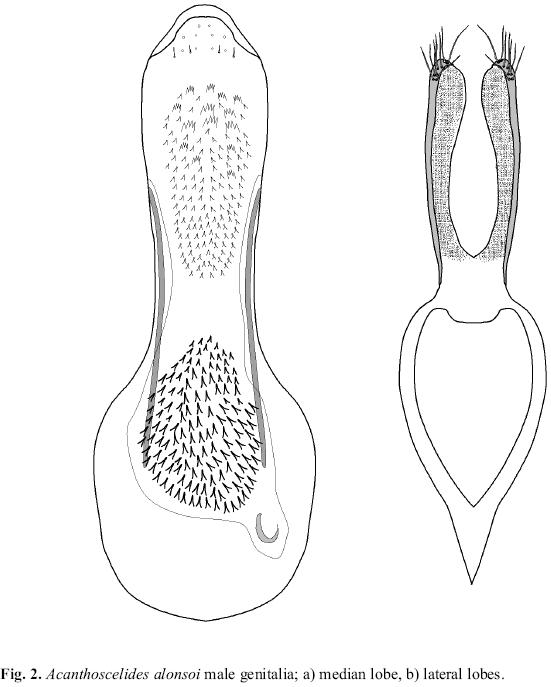
<body><![CDATA[<p align="center"><font face="verdana" size="2"><b>Male </b></font></p>     <p align="justify"><font face="verdana" size="2"><b>Measurements:</b> Length (pronotum&#45;elytra)    1.38 to 1.8 mm. Width 0.95 to 1.13 mm. Maximum thoracic depth 0.6 to 0.88 mm.</font></p>  	    <p align="justify"><font face="verdana" size="2"><b>Integumental color:</b> Head reddish brown with frons and clypeus dark brown; antennal segments reddish to dark brown; pronotum, elytron and pygidium variegate, spots may vary from reddish to dark brown; legs reddish, metacoxa dark brown, metatrochanter reddish to dark brown; rest of the body brown to dark brown.</font></p>  	     <p align="justify"><font face="verdana" size="2"><b>Vestiture:</b> With recumbent    white, golden, brown, and black hairs as follows; postocular lobe with short    white setae; postocular patch of dense white or golden hairs; remainder of head    with moderately dense white or intermixed white or golden hairs; pronotum variegated    with irregular maculations of white, golden and dark hairs, median basal lobe    with dense white pubescence (<a href="#f1">Fig. 1d</a>); elytral vestiture varied    with maculations of golden, white, brown and black hairs in a distinct pattern;    intervals between striae 1 and 2, 3 and 4, 5 and 6, 7 and 8, 9 and 10 with usually    uniform white or golden or intermixed white and golden hairs; intervals between    stria 2 and 3, 4 and 5, 6 and 7, 8 and 9 with large elongate patches of dense    white hairs interrupted by shorter patches of dark or black hairs (<a href="#f1">Fig.    1a</a>); base of metepisternum, apex of metacoxa and lateral areas of ventral    segments 2 to 5 with dense white hairs; legs with sparse white hairs; undersurfaces    with moderately dense white to golden pubescence; pygidial pubescence varying    from uniform, moderately dense white hairs to white or brown hairs with a dense    median stripe of white hairs.</font></p>     <p align="center"><a name="f1"></a></p>     <p align="center"><img src="/img/revistas/azm/v24n2/a6f1.jpg"></p>     <p align="justify"><font face="verdana" size="2"><b>Structure:</b> Head. Short    and broad, densely micropunctulate; frons with median carina; distance between    eyes 0.60 to 0.66 as wide as eye width; eye cleft to 0.58 to 0.73 its length    by ocular sinus; posterior margin of eye protruding from adjacent surfaces;    postocular lobe rounded; distance from base of antennae to apex of labrum 0.58    to 0.44 as long as distance from upper limits of eyes to apex of labrum (<a href="#f1">Fig.    1a</a>); antennal segment one submoniliform, 2, 3 moniliform to filiform, 4    subserrate, 5 to 10 serrate, 11th subacute apically; antenna extending to humerus    or slightly beyond (<a href="#f1">Figs. 1a</a>, <a href="#f1">b</a>). Prothorax.&#45;    Disk campanulate, foveolate; cervical sulcus moderately deep, extending from    near coxal cavity to about 0.56 to 0.63 distance to pronotal midline (<a href="#f1">Fig.    1d</a>); lateral prothoracic carina extending from base to </font><font face="verdana" size="2">0.44    to 0.50 distance to coxal cavity; without short median impressed line on median    basal lobe; prosternum separating procoxae for 0.70 to 0.83 their length. Mesothorax    and Metathorax.&#45; Scutellum black, quadrate, clothed with dense white hairs;    elytron about twice as long as broad; striae deep, punctate, strial intervals    punctulate; distance between striae at base subequal; striae 2, 3 and 4 with    small denticles at their bases; humerus punctulate, glabrous, shiny black (<a href="#f1">Fig.    1a</a>); undersurfaces and all of hind coxa punctulate, metepisternum coarsely    foveolate. Legs.&#45; First and second front tarsomeres similar; first medium    tarsomere 3 times as long as second (<a href="#f1">Figs. 1e</a>&#45;<a href="#f1">f</a>);    hind femur constricted basally and apically, expanded medially to slightly more    than width of coxa; femur armed with subapical acuminate spine about 1.3 to    1.4 time as long as width of tibial base and 3 acuminate spines about 0.4 to    0.5 as long as first spine; hind tibia with ventral, lateroventral, lateral    and dorsomesal glabrous longitudinal carinae; with lateroventral and lateral    carina; dorsal surface of tibia without fossa; tibial corona with 4 spinules,    mucro 0.11 to 0.18 as long as first tarsomere; without sinus at base of spine;    first hind tarsomere with ventral and lateral glabrous longitudinal carina,    it is 1.5 to 1.6 times longer than first tarsomere of mesoleg (<a href="#f1">Figs.    1e</a>&#45;<a href="#f1">g</a>). Abdomen. &#45;First sternum with median oval    depression, clothed with dense white hairs, posterior margin straight, longer    than remaining sterna; sterna 2 to 4 similar in size; fifth emarginate; pygidium    foveolate, convex in lateral view (<a href="#f1">Fig. 1j</a>).</font></p>  	     <p align="justify"><font face="verdana" size="2"><b>Genitalia:</b> Median lobe    moderate in length; in ventral view, ventral valve truncate at apex, lateral    margins slightly concave; armature of internal sac with apical spiniscent mass    mixed with dentate scales, and a basal spiniscent mass in which spinules are    bigger than the first one (<a href="#f2">Fig. 2a</a>). Lateral lobes elongate    slightly expanded at apex, cleft to about 0.11 their length (<a href="#f2">Fig.    2b</a>).</font></p>     <p align="center"><a name="f2"></a></p>     <p align="center"><img src="/img/revistas/azm/v24n2/a6f2.jpg"></p>     ]]></body>
<body><![CDATA[<p align="center"><font face="verdana" size="2"><b>Female </b></font></p>     <p align="justify"><font face="verdana" size="2"><b>Measurements:</b> Length (pronotum&#45;elytra)    1.63 to 1.88 mm. Width 1.13 to 1.25 mm. Maximum thoracic depth 0.8 to 0.95 mm.    </font></p>     <p align="justify"><font face="verdana" size="2">Similar to male except antennae    slightly shorter (<a href="#f1">Fig. 1c</a>), first sternum without median oval    depression and fifth abdominal sternum not emarginate at apex (<a href="#f1">Fig.    1i</a>).</font></p>  	    <p align="justify"><font face="verdana" size="2"><b>Host Plant. <i>Senna</i> sp.</b>: San Felipe del Agua, Oaxaca, 28/IV/2004, M. A. Alonso collector.</font></p>  	     <p align="justify"><font face="verdana" size="2"><b>Type series.</b> Holotype    male, allotype female and paratypes: San Felipe del Agua, Oaxaca, 28/IV/2004,    M. A. Alonso collector. Holotype deposited at Museo Nacional de Ciencias Naturales    (MNCN), allotype at Florida State Collection of Arthropods (FSCA), paratypes    at FSCA (1&#9794;</font><font face="verdana" size="2">) Coleccion Entomologica    del Instituto de Fitosanidad (CEAM, 2&#9794;&#45;1&#9792;), MNCN (2&#9794;&#45;    5&#9792;), Coleccion Rafael Yus (CRY, 11&#9794;&#45; y 6&#9792;).</font></p>  	     <p align="justify"><font face="verdana" size="2"><b>Distribution.</b> Mexico (Oaxaca).</font></p>     <p align="justify"><font face="verdana" size="2"><b>Etymology.</b> The specific    epithet refers to the first surname of Dr. Miguel Angel Alonso Zarazaga, entomologist    of the National Museum of Natural Sciences (Madrid, Spain), who collected all    the type series.</font></p>  	     <p align="justify"><font face="verdana" size="2"><b>Diagnosis</b>. <i>Acanthoscelides    alonsoi</i> belongs to <i>mexicanus</i> group, because it shares a mucro of    about one&#45;sixth as long as the first tarsomere, femora broader than the    hind coxa, subapical hind femora spines that equal to or 2 times as long as    the width of the tibial base, variegated elytra, and a raised globose area on    the vertex; however, the characters elytral striae 3 and 4 abbreviated at their    bases and eyes equal to or 12 times the width of the frons do not fit in this    new species. According to Johnson (1983, 1989, 1990) there are 19 species in    <i>mexicanus</i> group. All of the known host plants in this group are mimosoid    legumes except <i>A. jolyi</i>, <i>A. obrienorum</i> and <i>A. sennicola</i>,    and now the new species <i>A. alonsoi</i> which feed in seeds of <i>Senna</i>    (Caesalpinioideae). The same author states that most species in the group have    male genitalia whose ventral valve is truncate at its apex with concave sides    and two large or elongate spiniscent masses in the internal sac without sclerites.    The new species <i>A. alonsoi</i> has in the internal sac two masses of different    kind of spinules that are very distinctive for this new species.</font></p>     <p align="justify"><font face="verdana" size="2"><b>New records of Bruchidae to    Oaxaca</b></font></p>  	     <p align="justify"><font face="verdana" size="2"><i>Acanthoscelides luteus</i>    Johnson: km 28 carr. Nochixtlan&#45;Huajuapan, Sta. Mar&iacute;a Tutla, San    Andres Dinicuiti, Oaxaca; 9/X/2003; 1955 m; Romero N. J. col.; 17&deg;41'55''N,    97&deg;38'27''W. <i>Amblycerus alternatus</i> (Pic): Zicatela, Oaxaca; 4/V/2004;    S&aacute;nchez G.J.A. col. <i>Megacerus alabani</i> Teran &amp; Kingsolver:    km 2 carr. San Juan Guichicovi&#45;Zacatal, Oaxaca; 19/III/1990; 420 m; Barrera    E. &amp; A. Cadena col. <i>Megacerus contaminatus</i> (Sharp): Ca&ntilde;on    de Le&oacute;n, km 14 carr Oaxaca&#45;Tuxtepec Hwy 175, Oaxaca; 6/X/2003; 1979    m; Romero N.J. col.; 17&deg;08'22''N, 96&deg;37'43''W. <i>Sennius auricomus</i>    Johnson &amp; Kingsolver: km 28 carr. Nochixtlan&#45;Huajuapan, Sta. Mar&iacute;a    Tutla, San Andres Dinicuiti, Oaxaca; 9/X/2003; 1955 m; </font><font face="verdana" size="2">Romero    N. J. col.; 17&deg;41'55''N, 97&deg;38'27''W. <i>Sennius inanis</i>    (Sharp): El Tomatal, Oaxaca; 6/V/2004; S&aacute;nchez G.J.A. col. <i>Zabrotes    densus</i> (Horn): 2 km W El Tomatal, Santa Mar&iacute;a Colotepec, Oaxaca;    3/VII/2003; S&aacute;nchez G.J.A. col.</font></p>     ]]></body>
<body><![CDATA[<p align="justify">&nbsp;</p>     <p align="justify"><font face="verdana" size="2"><b>LITERATURE CITED</b></font></p>     <!-- ref --><p align="justify"><font face="verdana" size="2"><b>Johnson, C.D.</b> 1983. Ecosystematics    of <i>Acanthoscelides</i> (Coleoptera: Bruchidae) of Southern Mexico and Central    America. <i>Misc. Publ. Entomol. Soc. Amer</i>. 56.    &nbsp;&nbsp;&nbsp;&nbsp;&nbsp;&nbsp;&nbsp;&nbsp;[&#160;<a href="javascript:void(0);" onclick="javascript: window.open('/scielo.php?script=sci_nlinks&ref=350414&pid=S0065-1737200800020000600001&lng=','','width=640,height=500,resizable=yes,scrollbars=1,menubar=yes,');">Links</a>&#160;]<!-- end-ref --></font></p>  	     <!-- ref --><p align="justify"><font face="verdana" size="2"><b>---------- .</b> 1989. Adaptive    Radiation of <i>Acanthoscelides</i> in Seeds: Examples of Legume&#45;Bruchid    Interactions. <i>In:</i> C.H. Stirton and J.L. Zarucchi (Eds.). Advances in    Legume Biology. <i>Monogr. Syst. Bot. Missouri Bot. Gard</i>. 29:747&#45;779.    &nbsp;&nbsp;&nbsp;&nbsp;&nbsp;&nbsp;&nbsp;&nbsp;[&#160;<a href="javascript:void(0);" onclick="javascript: window.open('/scielo.php?script=sci_nlinks&ref=350416&pid=S0065-1737200800020000600002&lng=','','width=640,height=500,resizable=yes,scrollbars=1,menubar=yes,');">Links</a>&#160;]<!-- end-ref --></font></p>  	    <!-- ref --><p align="justify"><font face="verdana" size="2"><b>Johnson, C.D.</b> 1990. Systematics of the seed beetle genus <i>Acanthoscelides</i> (Bruchidae) of Northern South America. <i>Transactions of the American Entomological Society</i> 116(2): 297&#45;618.    &nbsp;&nbsp;&nbsp;&nbsp;&nbsp;&nbsp;&nbsp;&nbsp;[&#160;<a href="javascript:void(0);" onclick="javascript: window.open('/scielo.php?script=sci_nlinks&ref=350418&pid=S0065-1737200800020000600003&lng=','','width=640,height=500,resizable=yes,scrollbars=1,menubar=yes,');">Links</a>&#160;]<!-- end-ref --></font></p>  	    <!-- ref --><p align="justify"><font face="verdana" size="2"><b>Johnson, C. D., B. J. Southgate &amp; A. Delobel.</b> 2004. A Revision of the Caryedontini (Coleoptera: Bruchidae: Pachymerinae) of Africa and the Middle East. <i>Memoirs of the American Entomological Society</i> Number 44. 120 p.    &nbsp;&nbsp;&nbsp;&nbsp;&nbsp;&nbsp;&nbsp;&nbsp;[&#160;<a href="javascript:void(0);" onclick="javascript: window.open('/scielo.php?script=sci_nlinks&ref=350420&pid=S0065-1737200800020000600004&lng=','','width=640,height=500,resizable=yes,scrollbars=1,menubar=yes,');">Links</a>&#160;]<!-- end-ref --></font></p>  	    ]]></body>
<body><![CDATA[<!-- ref --><p align="justify"><font face="verdana" size="2"><b>Kingsolver, J.M.</b> 1970. A study of male genitalia in Bruchidae (Coleoptera). <i>Proc. Entomol. Soc. Wash</i>. 72:370&#45;386.    &nbsp;&nbsp;&nbsp;&nbsp;&nbsp;&nbsp;&nbsp;&nbsp;[&#160;<a href="javascript:void(0);" onclick="javascript: window.open('/scielo.php?script=sci_nlinks&ref=350422&pid=S0065-1737200800020000600005&lng=','','width=640,height=500,resizable=yes,scrollbars=1,menubar=yes,');">Links</a>&#160;]<!-- end-ref --></font></p>  	    <!-- ref --><p align="justify"><font face="verdana" size="2"><b>Kingsolver, J.M. &amp; D.R. Whitehead.</b> 1974. Classification and comparative biology of the seed beetle genus <i>Caryedes</i> Hummel (Coleoptera: Bruchidae). <i>Transactions of the American Entomological Society</i> 100: 341&#45;436.    &nbsp;&nbsp;&nbsp;&nbsp;&nbsp;&nbsp;&nbsp;&nbsp;[&#160;<a href="javascript:void(0);" onclick="javascript: window.open('/scielo.php?script=sci_nlinks&ref=350424&pid=S0065-1737200800020000600006&lng=','','width=640,height=500,resizable=yes,scrollbars=1,menubar=yes,');">Links</a>&#160;]<!-- end-ref --></font></p>  	     <!-- ref --><p align="justify"><font face="verdana" size="2"><b>Romero N., J. &amp; C.D. Johnson.</b>    2004. Checklist of the Bruchidae (Coleoptera) of Mexico. <i>The Coleopterists    Bulletin</i> 58(4):613&#45;635.    &nbsp;&nbsp;&nbsp;&nbsp;&nbsp;&nbsp;&nbsp;&nbsp;[&#160;<a href="javascript:void(0);" onclick="javascript: window.open('/scielo.php?script=sci_nlinks&ref=350426&pid=S0065-1737200800020000600007&lng=','','width=640,height=500,resizable=yes,scrollbars=1,menubar=yes,');">Links</a>&#160;]<!-- end-ref --></font></p>	      ]]></body><back>
<ref-list>
<ref id="B1">
<nlm-citation citation-type="journal">
<person-group person-group-type="author">
<name>
<surname><![CDATA[Johnson]]></surname>
<given-names><![CDATA[C.D.]]></given-names>
</name>
</person-group>
<article-title xml:lang="en"><![CDATA[Ecosystematics of Acanthoscelides (Coleoptera: Bruchidae) of Southern Mexico and Central America]]></article-title>
<source><![CDATA[Misc. Publ. Entomol. Soc. Amer.]]></source>
<year>1983</year>
<volume>56</volume>
</nlm-citation>
</ref>
<ref id="B2">
<nlm-citation citation-type="">
<person-group person-group-type="author">
<name>
<surname><![CDATA[Johnson]]></surname>
<given-names><![CDATA[C.D.]]></given-names>
</name>
</person-group>
<article-title xml:lang="en"><![CDATA[Adaptive Radiation of Acanthoscelides in Seeds: Examples of Legume-Bruchid Interactions]]></article-title>
<person-group person-group-type="editor">
<name>
<surname><![CDATA[Stirton]]></surname>
<given-names><![CDATA[C.H.]]></given-names>
</name>
<name>
<surname><![CDATA[Zarucchi]]></surname>
<given-names><![CDATA[J.L.]]></given-names>
</name>
</person-group>
<source><![CDATA[Advances in Legume Biology]]></source>
<year>1989</year>
<page-range>747-779</page-range></nlm-citation>
</ref>
<ref id="B3">
<nlm-citation citation-type="journal">
<person-group person-group-type="author">
<name>
<surname><![CDATA[Johnson]]></surname>
<given-names><![CDATA[C.D.]]></given-names>
</name>
</person-group>
<article-title xml:lang="en"><![CDATA[Systematics of the seed beetle genus Acanthoscelides (Bruchidae) of Northern South America]]></article-title>
<source><![CDATA[Transactions of the American Entomological Society]]></source>
<year>1990</year>
<volume>116</volume>
<numero>2</numero>
<issue>2</issue>
<page-range>297-618</page-range></nlm-citation>
</ref>
<ref id="B4">
<nlm-citation citation-type="journal">
<person-group person-group-type="author">
<name>
<surname><![CDATA[Johnson]]></surname>
<given-names><![CDATA[C. D.]]></given-names>
</name>
<name>
<surname><![CDATA[Southgate]]></surname>
<given-names><![CDATA[B. J.]]></given-names>
</name>
<name>
<surname><![CDATA[Delobel]]></surname>
<given-names><![CDATA[A.]]></given-names>
</name>
</person-group>
<article-title xml:lang="en"><![CDATA[A Revision of the Caryedontini (Coleoptera: Bruchidae: Pachymerinae) of Africa and the Middle East]]></article-title>
<source><![CDATA[Memoirs of the American Entomological Society]]></source>
<year>2004</year>
<numero>44</numero>
<issue>44</issue>
<page-range>120</page-range></nlm-citation>
</ref>
<ref id="B5">
<nlm-citation citation-type="journal">
<person-group person-group-type="author">
<name>
<surname><![CDATA[Kingsolver]]></surname>
<given-names><![CDATA[J.M.]]></given-names>
</name>
</person-group>
<article-title xml:lang="en"><![CDATA[A study of male genitalia in Bruchidae (Coleoptera)]]></article-title>
<source><![CDATA[Proc. Entomol. Soc. Wash.]]></source>
<year>1970</year>
<volume>72</volume>
<page-range>370-386</page-range></nlm-citation>
</ref>
<ref id="B6">
<nlm-citation citation-type="journal">
<person-group person-group-type="author">
<name>
<surname><![CDATA[Kingsolver]]></surname>
<given-names><![CDATA[J.M.]]></given-names>
</name>
<name>
<surname><![CDATA[Whitehead]]></surname>
<given-names><![CDATA[D.R.]]></given-names>
</name>
</person-group>
<article-title xml:lang="en"><![CDATA[Classification and comparative biology of the seed beetle genus Caryedes Hummel (Coleoptera: Bruchidae)]]></article-title>
<source><![CDATA[Transactions of the American Entomological Society]]></source>
<year>1974</year>
<volume>100</volume>
<page-range>341-436</page-range></nlm-citation>
</ref>
<ref id="B7">
<nlm-citation citation-type="journal">
<person-group person-group-type="author">
<name>
<surname><![CDATA[Romero N.]]></surname>
<given-names><![CDATA[J.]]></given-names>
</name>
<name>
<surname><![CDATA[Johnson]]></surname>
<given-names><![CDATA[C.D.]]></given-names>
</name>
</person-group>
<article-title xml:lang="en"><![CDATA[Checklist of the Bruchidae (Coleoptera) of Mexico]]></article-title>
<source><![CDATA[The Coleopterists Bulletin]]></source>
<year>2004</year>
<volume>58</volume>
<numero>4</numero>
<issue>4</issue>
<page-range>613-635</page-range></nlm-citation>
</ref>
</ref-list>
</back>
</article>