<?xml version="1.0" encoding="ISO-8859-1"?><article xmlns:mml="http://www.w3.org/1998/Math/MathML" xmlns:xlink="http://www.w3.org/1999/xlink" xmlns:xsi="http://www.w3.org/2001/XMLSchema-instance">
<front>
<journal-meta>
<journal-id>0036-3634</journal-id>
<journal-title><![CDATA[Salud Pública de México]]></journal-title>
<abbrev-journal-title><![CDATA[Salud pública Méx]]></abbrev-journal-title>
<issn>0036-3634</issn>
<publisher>
<publisher-name><![CDATA[Instituto Nacional de Salud Pública]]></publisher-name>
</publisher>
</journal-meta>
<article-meta>
<article-id>S0036-36342010000700003</article-id>
<title-group>
<article-title xml:lang="en"><![CDATA[Methodology for the analysis of type 2 diabetes, metabolic syndrome and cardiovascular disease risk indicators in the ENSANUT 2006]]></article-title>
<article-title xml:lang="es"><![CDATA[Metodologia para el análisis de diabetes tipo 2, síndrome metabólico e indicadores de riesgo cerdiovascular en la ENSANUT 2006]]></article-title>
</title-group>
<contrib-group>
<contrib contrib-type="author">
<name>
<surname><![CDATA[Barquera]]></surname>
<given-names><![CDATA[Simón]]></given-names>
</name>
<xref ref-type="aff" rid="A01"/>
</contrib>
<contrib contrib-type="author">
<name>
<surname><![CDATA[Campos-Nonato]]></surname>
<given-names><![CDATA[Ismael]]></given-names>
</name>
<xref ref-type="aff" rid="A01"/>
</contrib>
<contrib contrib-type="author">
<name>
<surname><![CDATA[Carrión-Rábago]]></surname>
<given-names><![CDATA[Citlali]]></given-names>
</name>
<xref ref-type="aff" rid="A01"/>
</contrib>
<contrib contrib-type="author">
<name>
<surname><![CDATA[Villalpando]]></surname>
<given-names><![CDATA[Salvador]]></given-names>
</name>
<xref ref-type="aff" rid="A01"/>
</contrib>
<contrib contrib-type="author">
<name>
<surname><![CDATA[López-Ridaura]]></surname>
<given-names><![CDATA[Ruy]]></given-names>
</name>
<xref ref-type="aff" rid="A01"/>
</contrib>
<contrib contrib-type="author">
<name>
<surname><![CDATA[Rojas]]></surname>
<given-names><![CDATA[Rosalba]]></given-names>
</name>
<xref ref-type="aff" rid="A01"/>
</contrib>
<contrib contrib-type="author">
<name>
<surname><![CDATA[Aguilar-Salinas]]></surname>
<given-names><![CDATA[Carlos A]]></given-names>
</name>
<xref ref-type="aff" rid="A02"/>
</contrib>
</contrib-group>
<aff id="A01">
<institution><![CDATA[,Instituto Nacional de Salud Pública  ]]></institution>
<addr-line><![CDATA[Cuernavaca Morelos]]></addr-line>
<country>México</country>
</aff>
<aff id="A02">
<institution><![CDATA[,Instituto Nacional de Ciencias Medicas y Nutrición Salvador Zubirán  ]]></institution>
<addr-line><![CDATA[México DF]]></addr-line>
<country>México</country>
</aff>
<pub-date pub-type="pub">
<day>00</day>
<month>00</month>
<year>2010</year>
</pub-date>
<pub-date pub-type="epub">
<day>00</day>
<month>00</month>
<year>2010</year>
</pub-date>
<volume>52</volume>
<fpage>S4</fpage>
<lpage>S10</lpage>
<copyright-statement/>
<copyright-year/>
<self-uri xlink:href="http://www.scielo.org.mx/scielo.php?script=sci_arttext&amp;pid=S0036-36342010000700003&amp;lng=en&amp;nrm=iso"></self-uri><self-uri xlink:href="http://www.scielo.org.mx/scielo.php?script=sci_abstract&amp;pid=S0036-36342010000700003&amp;lng=en&amp;nrm=iso"></self-uri><self-uri xlink:href="http://www.scielo.org.mx/scielo.php?script=sci_pdf&amp;pid=S0036-36342010000700003&amp;lng=en&amp;nrm=iso"></self-uri><abstract abstract-type="short" xml:lang="en"><p><![CDATA[OBJECTIVE: To describe: a) the methods used to quantify biochemical indicators of Type 2 Diabetes (T2D), and other cardiovascular risk indicators in the Mexican National Health and Nutrition Survey 2006 (ENSANUT 2006) and b) compare the sub-sample with the non-selected participants in diverse socio-demographic, anthropometric and health characteristics. MATERIAL AND METHODS: A sub-sample of 6 021 fasting adult participants was randomly selected from the total fasting participants (n=39 425). We compared diverse socio-demographic, anthropometric and health parameters between this sub-sample and the rest of the participants. RESULTS: No differences were found in sociodemographics characteristics, except age, between the sub-sample and from the rest of the fasting adults. In addition no difference were found between prevalences of overweight and obesity, central obesity, and previously diagnosed high blood pressure, T2D or hypertrigliceridemia. CONCLUSIONS: The randomly selected sub-sample was not essentially different from the rest of the fasting subjects. Thus, no bias is expected in the interpretation of cardiovascular risk indicators derived from these data.]]></p></abstract>
<abstract abstract-type="short" xml:lang="es"><p><![CDATA[OBJETIVO: Describir: a) los métodos usados para definir Diabetes tipo 2 (T2D), y otros indicadores de riesgo cardiovascular en la submuestra de la Encuesta Nacional de Salud y Nutrición 2006 (ENSANUT 2006) y b) comparar en características sociodemográficas, antropométricas y otros determinantes de salud a los participantes de la submuestra con los no seleccionados. MATERIAL Y MÉTODOS: Una submuestra de 6 021 adultos fue seleccionada aleatoriamente de la totalidad de participantes en ayuno (n= 39 425). Se compararon parámetros sociodemográficos, antropométricos y de salud entre la submuestra y el resto de los participantes. RESULTADOS: No se encontraron diferencias en ninguna de las variables sociodemográficas, a excepción de la edad; ni en la prevalencia de sobrepeso, obesidad abdominal, diagnóstico previo de hipertensión, T2D, hipercolestrolemia e hipertrigliceridemia entre los adultos de la submuestra y los no seleccionados. CONCLUSIONES: La submuestra no fue estadísticamente diferente del resto de los sujetos no seleccionados. Por ello, no se espera un sesgo en la interpretación de los indicadores de riesgo cardiovascular derivados del análisis de estos datos.]]></p></abstract>
<kwd-group>
<kwd lng="en"><![CDATA[obesity]]></kwd>
<kwd lng="en"><![CDATA[diabetes mellitus]]></kwd>
<kwd lng="en"><![CDATA[high blood pressure]]></kwd>
<kwd lng="en"><![CDATA[dyslipidemias]]></kwd>
<kwd lng="en"><![CDATA[national surveys]]></kwd>
<kwd lng="es"><![CDATA[obesidad]]></kwd>
<kwd lng="es"><![CDATA[diabetes mellitus]]></kwd>
<kwd lng="es"><![CDATA[hipertensión]]></kwd>
<kwd lng="es"><![CDATA[dislipidemias]]></kwd>
<kwd lng="es"><![CDATA[encuesta nacional]]></kwd>
</kwd-group>
</article-meta>
</front><body><![CDATA[ <p align="right"><font size="2" face="Verdana"><b>ART&Iacute;CULO ORIGINAL</b></font></p>     <p>&nbsp;</p>     <p><font size="4" face="Verdana"><b>Methodology for the analysis       of type 2 diabetes, metabolic syndrome and cardiovascular disease risk       indicators in the ENSANUT 2006</b></font></p>     <p>&nbsp;</p>     <p><font size="3" face="Verdana"><b>Metodologia para el an&aacute;lisis de diabetes         tipo 2, s&iacute;ndrome metab&oacute;lico e indicadores de riesgo cerdiovascular en         la ENSANUT 2006</b></font></p>     <p>&nbsp;</p>     <p>&nbsp;</p>     <p><font size="2" face="Verdana"><b>Sim&oacute;n Barquera, MD, PhD<sup>I</sup>; Ismael       Campos&#45;Nonato, MSc<sup>I</sup>; Citlali Carri&oacute;n&#45;R&aacute;bago, MSc<sup>I</sup>;       Salvador Villalpando, MD, PhD<sup>I</sup>; Ruy L&oacute;pez&#45;Ridaura, MD, PhD<sup>I</sup>;       Rosalba Rojas, MD, PhD<sup>I</sup>; Carlos A Aguilar&#45;Salinas, MD<sup>II</sup></b></font></p>     <p><font size="2" face="Verdana"><sup>I</sup>Instituto Nacional de Salud P&uacute;blica.     Cuernavaca, Morelos, M&eacute;xico     <br>   <sup>II</sup>Instituto Nacional de Ciencias   Medicas y Nutrici&oacute;n Salvador Zubir&aacute;n. M&eacute;xico DF, M&eacute;xico</font></p>     ]]></body>
<body><![CDATA[<p>&nbsp;</p>     <p>&nbsp;</p> <hr size="1" noshade>     <p><font size="2" face="Verdana"><b>ABSTRACT</b></font></p>     <p><font size="2" face="Verdana"><b>OBJECTIVE:</b> To describe: a) the methods     used to quantify biochemical indicators of Type 2 Diabetes (T2D), and other     cardiovascular risk indicators in the Mexican National Health and Nutrition     Survey 2006 (ENSANUT 2006) and b) compare the sub&#45;sample with the non&#45;selected     participants in diverse socio&#45;demographic, anthropometric and health characteristics.     <br>   <b>MATERIAL AND METHODS:</b> A sub&#45;sample of 6 021 fasting adult participants   was randomly selected from the total fasting participants (n=39 425). We compared   diverse socio&#45;demographic, anthropometric and health parameters between this   sub&#45;sample and the rest of the participants.     <br>   <b>RESULTS:</b> No differences were found in sociodemographics characteristics,   except age, between the sub&#45;sample and from the rest of the fasting adults.   In addition no difference were found between prevalences of overweight and   obesity, central obesity, and previously diagnosed high blood pressure, T2D   or hypertrigliceridemia.     <br>   <b>CONCLUSIONS:</b> The randomly selected sub&#45;sample was not essentially different   from the rest of the fasting subjects. Thus, no bias is expected in the interpretation   of cardiovascular risk indicators derived from these data.</font></p>     <p><font size="2" face="Verdana"><b>Keywords:</b> obesity; diabetes mellitus;     high blood pressure; dyslipidemias; national surveys</font></p> <hr size="1" noshade>     <p><font size="2" face="Verdana"><b>RESUMEN</b></font></p>     <p><font size="2" face="Verdana"><b>OBJETIVO:</b> Describir: a) los m&eacute;todos usados     para definir Diabetes tipo 2 (T2D), y otros indicadores de riesgo cardiovascular     en la submuestra de la Encuesta Nacional de Salud y Nutrici&oacute;n 2006 (ENSANUT     2006) y b) comparar en caracter&iacute;sticas sociodemogr&aacute;ficas, antropom&eacute;tricas     y otros determinantes de salud a los participantes de la submuestra con los     no seleccionados.    ]]></body>
<body><![CDATA[<br>   <b>MATERIAL Y M&Eacute;TODOS:</b> Una submuestra de 6 021 adultos fue seleccionada   aleatoriamente de la totalidad de participantes en ayuno (n= 39 425). Se compararon   par&aacute;metros sociodemogr&aacute;ficos, antropom&eacute;tricos y de salud entre la submuestra   y el resto de los participantes.     <br>   <b>RESULTADOS:</b> No se encontraron diferencias en ninguna de las variables   sociodemogr&aacute;ficas, a excepci&oacute;n de la edad; ni en la prevalencia de sobrepeso,   obesidad abdominal, diagn&oacute;stico previo de hipertensi&oacute;n, T2D, hipercolestrolemia   e hipertrigliceridemia entre los adultos de la submuestra y los no seleccionados.     <br>   <b>CONCLUSIONES:</b> La submuestra no fue estad&iacute;sticamente diferente del resto   de los sujetos no seleccionados. Por ello, no se espera un sesgo en la interpretaci&oacute;n   de los indicadores de riesgo cardiovascular derivados del an&aacute;lisis de estos   datos.</font></p>     <p><font size="2" face="Verdana"><b>Palabras clave:</b> obesidad; diabetes mellitus;     hipertensi&oacute;n; dislipidemias; encuesta nacional</font></p> <hr size="1" noshade>     <p>&nbsp;</p>     <p>&nbsp;</p>     <p><font size="2" face="Verdana">The prevalence of chronic diseases and obesity     in Mexico have been documented in several probabilistic surveys &#91;i.e., the     Mexican National Nutrition Surveys I and II (1988, 1999),<sup>1,2</sup> the     Mexican Chronic Diseases Survey (1994)<sup>3</sup> and the Mexican Health     Survey (2000)<sup>4</sup>&#93;. During 2005&#45;2006 the Instituto Nacional de Salud     P&uacute;blica (Mexican National Institute of Public Health) implemented a nationally     representative health and nutrition survey &#91;National Health and Nutrition     Survey 2006 (ENSANUT 2006)&#93;. The objectives of this survey was to obtain     information about the health and nutritional status of the population, and     the use of health services. The purpose of this short communication was to     describe: a) the methods used to quantify biochemical indicators of Type     2 Diabetes (T2D), and other cardiovascular disease risk indicators collected     in ENSANUT 2006 and; b) the comparison of the ENSANUT 2006 sub&#45;sample with     non&#45;selected participants (within diverse socio&#45;demographic, anthropometric     and health characteristics). Since not all subjects were at fasting state     for at least 8 hrs before the blood collection, we compared the selected     fasting sub&#45;sample to the rest of the fasting subjects as well as to the     overall participants in the survey.</font></p>     <p>&nbsp;</p>     <p><font size="3" face="Verdana"><b>Material and Methods</b></font></p>     <p><font size="2" face="Verdana">The ENSANUT 2006 was conducted between October,     2005 and May, 2006 using a probabilistic multistage stratified cluster sampling     design. The survey was aimed to update the prevalence of infectious and chronic     diseases and their associated risk factors. A total of 47 152 households     participated. From each household, a random selection was performed to interview     the following subjects: a child (under age 10), an adolescent (aged 11&#45;19     years), and an adult (aged 20 years or older). The survey has the power to     make distinctions between urban (<u>&gt;</u>2 500 inhabitants) and rural     (&lt;2 500 inhabitants) areas, and four geographic regions described below.     Population characteristics, sampling procedure, and other methodological     details can be consulted in a previous publication.<sup>5</sup> Socio&#45;demographic     and personal health questionnaires, blood pressure and anthropometric measurements     were obtained from all participants. For the fasting sub&#45;sample we randomly     selected 6 613 subjects from the adult survey. A total of 91% (n=6 021) participants     from this group were in fasting state at the time of blood collection and     were considered the valid fasting sub&#45;sample, with statistical power to detect     prevalence of T2D and dyslipidemias <u>&gt;</u> 8%, and balanced by geographic     region. </font></p>     ]]></body>
<body><![CDATA[<p><font size="2" face="Verdana"> Sample weights for each selected participant     were calculated in order to estimate nationally representative prevalences     and values. The proportion of participants who provided blood samples were     slightly younger and more likely to be female. Thus, post&#45;stratification     weights were calculated for the analytical sub&#45;sample; using the age and     sex distributions from the 2005 national population census.<sup>6</sup></font></p>     <p><font size="2" face="Verdana"><b>Geographic regions</b></font></p>     <p><font size="2" face="Verdana">The ENSANUT 2006 and this analytical sub sample     are representative of Mexico's four regions: north, central, Mexico City     and south. The four regions, with common geographic and socio&#45;economic characteristics,     were 1) north: Baja California, Southern Baja California, Coahuila, Chihuahua,     Nuevo Leon, Sonora, Sinaloa and Tamaulipas, 2) central: Distrito Federal,     Hidalgo, Estado de M&eacute;xico, Morelos, Puebla, Queretaro and Tlaxcala, 3) center/west:     Aguascalientes, Colima, Durango, Guanajuato, Jalisco, Michoacan, Nayarit,     San Luis Potosi and Zacatecas, and 4) south: Campeche, Chiapas, Guerrero,     Oaxaca, Quintana Roo, Tabasco, Veracruz and Yucatan. This regionalization     scheme has been used in diverse epidemiologic transition analysis for within     country comparisons.<sup>7,8</sup></font></p>     <p><font size="2" face="Verdana"><b>Construction of the socio&#45;economic status       index</b></font></p>     <p><font size="2" face="Verdana">A principal components analysis (PCA) was performed     to summarize individual socio&#45;economic status (SES). Entered into the PCA     were household characteristics (flooring material, ceiling, walls, water     source, sewerage, number of persons residing in the household and number     of domestic appliances). The main factor extracted explained 40.4% of the     total variance with a Kaiser&#45;Mayer&#45;Olkin (KMO) measure of sampling adequacy     equal to 0.83. This factor had large loadings for other household and community     characteristics such as sewer system, indoor plumbing, refrigerator and television.     Small loadings were observed for variables such as communal food distribution     and number of people residing in the household. The main extracted factor     was divided into tertiles and used as a proxy for low, medium and high SES.</font></p>     <p><font size="2" face="Verdana"><b>Anthropometric measurements</b></font></p>     <p><font size="2" face="Verdana">Following internationally accepted techniques,     standardized personnel measured height to the nearest 0.1 cm, using a stadiometer     and body weight using a digital scale with an error of 5 mm and 0.1kg, respectively.     Waist circumference (WC) was measured at the mid point between the highest     part of the iliac crest and the lowest part of the ribs margin of the median     axial line. Body mass index (BMI) was calculated by dividing the weight in     kilograms by height in meters squared (m<sup>2</sup>); and categorized according     to the World Health Organization (WHO) cut&#45;off points into: low weight (&lt;18.5     kg/m<sup>2</sup>), normal weight (18.5&#45;24.9 kg/m<sup>2</sup>), overweight     (25&#45;29.9 kg/m<sup>2</sup>) and obesity (<u>&gt;</u>30 kg/m<sup>2</sup>);<sup>9</sup> if     WC was <u>&gt;</u>90cm in males or <u>&gt;</u>80cm in females, subjects were     classified as having abdominal adiposity based on the International Diabetes     Federation (IDF) criteria.<sup>10</sup></font></p>     <p><font size="2" face="Verdana"><b>Blood sample procedures</b></font></p>     <p><font size="2" face="Verdana">Blood was collected from randomly selected participants.     Participants were instructed to avoid eating any solid or liquid food prior     to their blood draw. In all cases the time of the last food eaten was recorded.     The majority of participants (91.3%) declared to have fasted more than 8     hours at the time of the blood draw. Blood was drawn from an antecubital     vein and collected in tubes without anticoagulant. The blood was centrifuged     in situ. A second sample was collected in heparinized tubes from subjects     who reported to have a medical diagnosis of T2D. Serum and whole blood aliquots     were stored in cryovials, placed in liquid nitrogen and transported to the     Mexican National Institute of Public Health and stored at &#45;70 ÂºC until analyses     were performed. </font></p>     <p><font size="2" face="Verdana"><b>Biochemical measurements</b></font></p>     ]]></body>
<body><![CDATA[<p><font size="2" face="Verdana">Serum glucose concentrations were measured using     an automatized glucose oxidase method, with an overall inter&#45;assay coefficient     of variation (CV) of &lt;5%. The proportion of hemoglobin A1c (HbA1C) was     determined by an immunocolorimetric method in whole blood. Total cholesterol     was determined using enzymatic hydrolysis and oxidation. Serum triglyceride     concentrations were measured after lipase hydrolysis in an automatic analyzer     with a tungsten lamp. The inter&#45;assay CV was 3.04% for total cholesterol     and 5.7% for triglycerides. High&#45;density lipoprotein (HDL) cholesterol was     measured by an enzymatic colorimetric direct method after eliminating chylomicrons,     very&#45;low&#45;density lipoproteins (VLDL), and low&#45;density lipoproteins by enzymatic     digestion; the inter&#45;assay CV was 5.02 %. </font></p>     <p><font size="2" face="Verdana"> To assure the precision and accuracy of these     measurements, the concentrations of total cholesterol, HDL&#45;cholesterol and     triglycerides were adjusted to a standard curve constructed with the determinations     of the NIST materials 909b and 1951b, levels I and II, using both an undiluted     standard material and a 1:1 dilution, and were measured simultaneously in     a second laboratory (Lipids Laboratory, Mexican National Institute of Nutrition     &#45; INCMNSZ). </font></p>     <p><font size="2" face="Verdana"><b>Blood pressure measurement</b></font></p>     <p><font size="2" face="Verdana">Blood pressure was measured twice by a trained     nurse in the dominant arm using a mercurial sphygmomanometer on two different     visits. The first reading was carried out after at least five minutes of     seated rest. The second reading was taken five minutes apart from the first.     The first Korotkoff sound marked the systolic blood pressure and the fifth     sound the diastolic blood pressure. Hypertension was defined when systolic     blood pressure <u>&gt;</u>130 mm Hg and/or diastolic blood pressure <u>&gt;</u>85     mm Hg on the first reading, and confirmed by the second reading following     the Expert Panel on Detection, Evaluation, and Treatment of High Blood Cholesterol     in Adults (Adult Treatment Panel III) criteria.<sup>11</sup> In addition,     all patients with a previous medical diagnosis of hypertension or currently     using antihypertensive medications were defined as having hypertension regardless     of the reported systolic or diastolic pressure values. </font></p>     <p><font size="2" face="Verdana"><b>Operational definitions</b></font></p>     <p><font size="2" face="Verdana">Previously diagnosed T2D was defined by self&#45;report     of previous medical diagnosis. Newly diagnosed T2D was defined as the presence     of fasting glucose <u>&gt;</u>126 mg/dl.<sup>12</sup> Hypercholesterolemia     was defined as a fasting serum total cholesterol <u>&gt;</u>200 mg/dl. hypertriglyceridemia     when <u>&gt;</u> 150 mg/dl. High density lipoprotein cholesterol (HDL) concentration     was considered abnormal if &lt;40 mg/dL for females and &lt;50 mg/dl for     males. Mixed hyperlipidemia was defined when both cholesterol was <u>&gt;</u>200     mg/dl and triglyceride levels were <u>&gt;</u>150 mg/dl. Normotriglyceridemic     hypoalphalipoproteinemia was defined as an HDL cholesterol &lt;40 mg/dl and     triglycerides &lt;150 mg/dl. These cut points were selected based on the     National Cholesterol Education Program recommendations.<sup>11</sup></font></p>     <p><font size="2" face="Verdana"><b>Other socio&#45;demographic variables</b></font></p>     <p><font size="2" face="Verdana">Educational attainment was stratified into three     groups: 1) without education, 2) primary and middle school, 3) high school     or more. Participants living in a household in which an indigenous dialect     was spoken by the mother were considered to be indigenous.<sup>13</sup></font></p>     <p><font size="2" face="Verdana"><b>Comparability between the selected sub&#45;sample       and the overall sample of the survey</b></font></p>     <p><font size="2" face="Verdana">The mean or frequency of age, sex, area, geographic     region, SES, years of education, literacy, indigenous ethnicity, anthropometry,     waist circumference, blood pressure, previously diagnosed T2D, dyslipidemias,     alcohol consumption and tobacco smoking were compared between the ENSANUT     2006 the sub&#45;sample from which blood was drawn and the rest of the survey     participants.</font></p>     ]]></body>
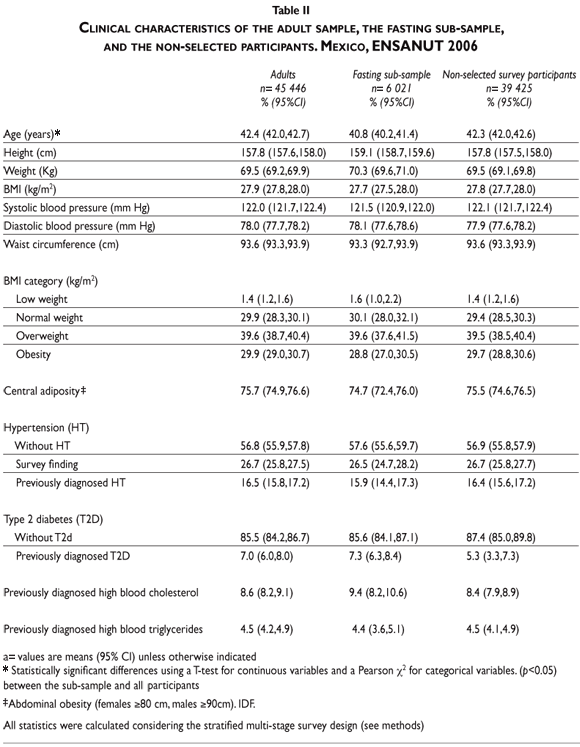
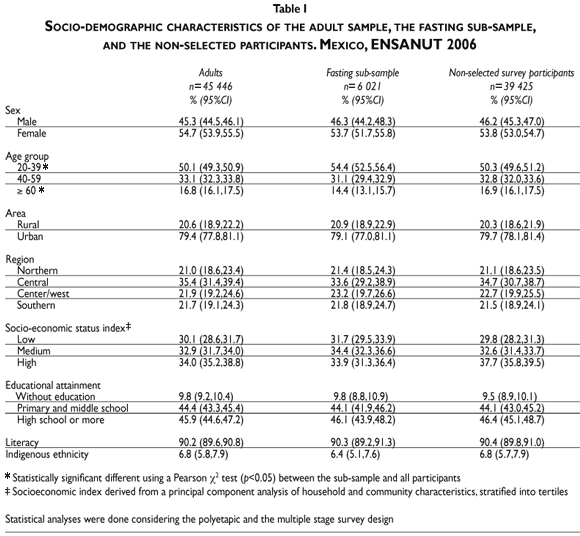
<body><![CDATA[<p><font size="2" face="Verdana"><i>Statistical Analysis</i></font></p>     <p><font size="2" face="Verdana">The analysis in the present study adjusted for     the complex multistage survey design using the "SVY" module of STATA 8.2,<a name="tx"></a><a href="#end"><sup>*</sup></a> and     by incorporating survey weights for both the total sample and the sub&#45;sample.     The differences between the randomly selected sub&#45;sample and the overall     survey sample were analyzed by comparing the prevalence and 95% Confidence     Intervals (95% CI) or means and 95% CI (depending on the type of indicator).     Statistical significance was defined as a <i>p</i>&#45;value &lt;0.05</font></p>     <p><font size="2" face="Verdana"><i>Ethical Considerations</i></font></p>     <p><font size="2" face="Verdana">After explaining the nature, objectives and     risks inherent to the study, all participants signed an informed letter of     consent. The protocol was approved by the Research, Ethics and Bio&#45;security     committees of the National Institute of Public Health. Researchers took provisions     for maintaining the due confidentiality of the data collected and to protect     the rights stipulated by the Mexican Statistical and Geographic information     law.<sup>14</sup></font></p>     <p>&nbsp;</p>     <p><font size="3" face="Verdana"><b>Results</b></font></p>     <p><font size="2" face="Verdana">For the fasting sub&#45;sample we randomly selected     6613 subjects from the adult survey. A total of 91% (n=6021) participants     from this group were in fasting state at the time of blood collection and     were considered the valid fasting sub&#45;sample. The ENSANUT 2006 adult sample     comprised a total of n= 45446 participants. The fasting sub&#45;sample was compared     to the adults overall survey and to the non&#45;selected fasting participants     (n=39425). <a href="#tab01">Table I</a> summarizes the socio&#45;demographic     characteristics of the three analytical samples. No significant differences     were found among samples by sex, area, region, SES, educational attainment,     literacy or indigenous ethnicity. <a href="#tab02">Table II</a> compares     some anthropometric characteristics and the prevalence of previously diagnosed     T2D and hypertension (HT). There were no significant group differences between     means of: height, weight, body mass index (BMI) or waist circumference (WC).     In addition no significant differences among the prevalence of overweight/obesity,     central adiposity, HBP, T2D, hypercholesterolemia or hypertrigliceridemia     were found between the sub&#45;sample and the other two groups (<a href="#tab03">Table     III</a>). </font></p>     <p><a name="tab01"></a></p>     <p>&nbsp;</p>     <p align="center"><img src="/img/revistas/spm/v52s1/a03tab01.gif"></p>     ]]></body>
<body><![CDATA[<p>&nbsp;</p>     <p><a name="tab02"></a></p>     <p>&nbsp;</p>     <p align="center"><img src="/img/revistas/spm/v52s1/a03tab02.gif"></p>     <p>&nbsp;</p>     <p><a name="tab03"></a></p>     <p>&nbsp;</p>     <p align="center"><img src="/img/revistas/spm/v52s1/a03tab03.gif"></p>     <p>&nbsp;</p>     <p><font size="3" face="Verdana"><b>Conclusions</b></font></p>     ]]></body>
<body><![CDATA[<p><font size="2" face="Verdana">In this paper we demonstrate that the survey     sub&#45;sample in which blood was drawn is not significantly different from the     rest of the adult ENSANUT 2006 survey sample or the non&#45;selected participants,     when compared for socio&#45;demographic, anthropometric and biochemical characteristics.     Thus, no selection bias is expected in the estimation of T2D prevalences     and derived cardiovascular risk indicators.</font></p>     <p>&nbsp;</p>     <p><font size="3" face="Verdana"><b>Acknowledgments</b></font></p>     <p><font size="2" face="Verdana">The authors would like to thank the support     from Sanofi&#45;Aventis for an unrestricted grant that contributed to the biochemical     analysis of this sub&#45;sample. Also we would like to thank Dr. Ricardo Robledo     and his team from the National Institute of Public Health's Nutrition Laboratory,     and to the Lipids laboratory at the National Institute of Nutrition for their     support in the determination of the samples and for the preparation of this     manuscript. In addition we would like to thank the support of Kanter R, PhD     (Johns Hopkins Bloomberg School of Public Health) for their collaboration     in the preparation of this report.</font></p>     <p>&nbsp;</p>     <p><font size="3" face="Verdana"><b>Conflicts of interest</b></font></p>     <p><font size="2" face="Verdana">We declare that we have no conflicts of interest.</font></p>     <p>&nbsp;</p>     <p><font size="3" face="Verdana"><b>References</b></font></p>     <!-- ref --><p><font size="2" face="Verdana">1. Sepulveda&#45;Amor J, Lezana M, Tapia&#45;Conyer     R, Valdespino J, Madrigal H, Kumate J. Nutritional status of pre&#45;school children     and women in Mexico: results of a probabilistic national survey. Gac Med     Mex 1990;126:207&#45;224.    &nbsp;&nbsp;&nbsp;&nbsp;&nbsp;&nbsp;&nbsp;&nbsp;[&#160;<a href="javascript:void(0);" onclick="javascript: window.open('/scielo.php?script=sci_nlinks&ref=9308426&pid=S0036-3634201000070000300001&lng=','','width=640,height=500,resizable=yes,scrollbars=1,menubar=yes,');">Links</a>&#160;]<!-- end-ref --></font></p>     <!-- ref --><p><font size="2" face="Verdana"> 2. Rivera J, Shamah T, Villalpando S, Gonzalez&#45;Cossio     T, Hernandez B, Sepulveda J. Encuesta Nacional de Nutrici&oacute;n 1999. Cuernavaca,     Morelos: INSP, 2000.    &nbsp;&nbsp;&nbsp;&nbsp;&nbsp;&nbsp;&nbsp;&nbsp;[&#160;<a href="javascript:void(0);" onclick="javascript: window.open('/scielo.php?script=sci_nlinks&ref=9308428&pid=S0036-3634201000070000300002&lng=','','width=640,height=500,resizable=yes,scrollbars=1,menubar=yes,');">Links</a>&#160;]<!-- end-ref --></font></p>     <!-- ref --><p><font size="2" face="Verdana"> 3. Aguilar&#45;Salinas CA, Olaiz G, Valles V, Torres     JM, Gomez Perez FJ, Rull JA, <i>et al.</i> High prevalence of low HDL cholesterol     concentrations and mixed hyperlipidemia in a Mexican nationwide survey. J     Lipid Res 2001;42(8):1298&#45;1307.    &nbsp;&nbsp;&nbsp;&nbsp;&nbsp;&nbsp;&nbsp;&nbsp;[&#160;<a href="javascript:void(0);" onclick="javascript: window.open('/scielo.php?script=sci_nlinks&ref=9308430&pid=S0036-3634201000070000300003&lng=','','width=640,height=500,resizable=yes,scrollbars=1,menubar=yes,');">Links</a>&#160;]<!-- end-ref --></font></p>     <!-- ref --><p><font size="2" face="Verdana"> 4. Olaiz G, Rojas R, Barquera S, Shamah T,     Aguilar C, Cravioto P, <i>et al.</i> Encuesta Nacional de Salud 2000. Cuernavaca,     Morelos, M&eacute;xico: Instituto Nacional de Salud P&uacute;blica, 2003.    &nbsp;&nbsp;&nbsp;&nbsp;&nbsp;&nbsp;&nbsp;&nbsp;[&#160;<a href="javascript:void(0);" onclick="javascript: window.open('/scielo.php?script=sci_nlinks&ref=9308432&pid=S0036-3634201000070000300004&lng=','','width=640,height=500,resizable=yes,scrollbars=1,menubar=yes,');">Links</a>&#160;]<!-- end-ref --></font></p>     <!-- ref --><p><font size="2" face="Verdana"> 5. Olaiz G, Rivera J, Shamah T, Rojas R, Villalpando     S, Hernandez A, <i>et al.</i> Encuesta Nacional de Salud y Nutrici&oacute;n 2006.     Cuernavaca, M&eacute;xico: Instituto Nacional de Salud P&uacute;blica, 2006.    &nbsp;&nbsp;&nbsp;&nbsp;&nbsp;&nbsp;&nbsp;&nbsp;[&#160;<a href="javascript:void(0);" onclick="javascript: window.open('/scielo.php?script=sci_nlinks&ref=9308434&pid=S0036-3634201000070000300005&lng=','','width=640,height=500,resizable=yes,scrollbars=1,menubar=yes,');">Links</a>&#160;]<!-- end-ref --></font></p>     <!-- ref --><p><font size="2" face="Verdana"> 6. INEGI. II Conteo de Poblaci&oacute;n y Vivienda     2005. M&eacute;xico y sus municipios. M&eacute;xico: INEGI, 2008.    &nbsp;&nbsp;&nbsp;&nbsp;&nbsp;&nbsp;&nbsp;&nbsp;[&#160;<a href="javascript:void(0);" onclick="javascript: window.open('/scielo.php?script=sci_nlinks&ref=9308436&pid=S0036-3634201000070000300006&lng=','','width=640,height=500,resizable=yes,scrollbars=1,menubar=yes,');">Links</a>&#160;]<!-- end-ref --></font></p>     <!-- ref --><p><font size="2" face="Verdana"> 7. Barquera S, Peterson K, Must A, Rogers B,     Flores M, Houser R, et al. Coexistence of maternal central adiposity and     child stunting in Mexico. Int J Obes 2007;doi:10.1038/sj.ijo.0803529.    &nbsp;&nbsp;&nbsp;&nbsp;&nbsp;&nbsp;&nbsp;&nbsp;[&#160;<a href="javascript:void(0);" onclick="javascript: window.open('/scielo.php?script=sci_nlinks&ref=9308438&pid=S0036-3634201000070000300007&lng=','','width=640,height=500,resizable=yes,scrollbars=1,menubar=yes,');">Links</a>&#160;]<!-- end-ref --></font></p>     <!-- ref --><p><font size="2" face="Verdana"> 8. Barquera S, Tovar&#45;Guzman V, Campos&#45;Nonato     I, Gonzalez&#45;Villalpando C, Rivera&#45;Dommarco J. Geography of diabetes mellitus     mortality in Mexico: an epidemiologic transition analysis. Arch Med Res 2003;34(5):407&#45;414.    &nbsp;&nbsp;&nbsp;&nbsp;&nbsp;&nbsp;&nbsp;&nbsp;[&#160;<a href="javascript:void(0);" onclick="javascript: window.open('/scielo.php?script=sci_nlinks&ref=9308440&pid=S0036-3634201000070000300008&lng=','','width=640,height=500,resizable=yes,scrollbars=1,menubar=yes,');">Links</a>&#160;]<!-- end-ref --></font></p>     <!-- ref --><p><font size="2" face="Verdana"> 9. World Health Organization. Physical status:     the use and interpretation of anthropometry. Geneva: WHO, 1995.    &nbsp;&nbsp;&nbsp;&nbsp;&nbsp;&nbsp;&nbsp;&nbsp;[&#160;<a href="javascript:void(0);" onclick="javascript: window.open('/scielo.php?script=sci_nlinks&ref=9308442&pid=S0036-3634201000070000300009&lng=','','width=640,height=500,resizable=yes,scrollbars=1,menubar=yes,');">Links</a>&#160;]<!-- end-ref --></font></p>     <!-- ref --><p><font size="2" face="Verdana"> 10. Alberti KG, Zimmet P, Shaw J. The metabolic     syndrome&#45;&#45;a new worldwide definition. Lancet 2005;366(9491):1059&#45;1062.    &nbsp;&nbsp;&nbsp;&nbsp;&nbsp;&nbsp;&nbsp;&nbsp;[&#160;<a href="javascript:void(0);" onclick="javascript: window.open('/scielo.php?script=sci_nlinks&ref=9308444&pid=S0036-3634201000070000300010&lng=','','width=640,height=500,resizable=yes,scrollbars=1,menubar=yes,');">Links</a>&#160;]<!-- end-ref --></font></p>     <!-- ref --><p><font size="2" face="Verdana"> 11. Executive Summary of The Third Report of     The National Cholesterol Education Program (NCEP) Expert Panel on Detection,     Evaluation, And Treatment of High Blood Cholesterol In Adults (Adult Treatment     Panel III). JAMA 2001;285(19):2486&#45;2497.    &nbsp;&nbsp;&nbsp;&nbsp;&nbsp;&nbsp;&nbsp;&nbsp;[&#160;<a href="javascript:void(0);" onclick="javascript: window.open('/scielo.php?script=sci_nlinks&ref=9308446&pid=S0036-3634201000070000300011&lng=','','width=640,height=500,resizable=yes,scrollbars=1,menubar=yes,');">Links</a>&#160;]<!-- end-ref --></font></p>     <!-- ref --><p><font size="2" face="Verdana"> 12. Diagnosis and classification of diabetes     mellitus. Diabetes Care 2006;29 Suppl 1:S43&#45;S48.    &nbsp;&nbsp;&nbsp;&nbsp;&nbsp;&nbsp;&nbsp;&nbsp;[&#160;<a href="javascript:void(0);" onclick="javascript: window.open('/scielo.php?script=sci_nlinks&ref=9308448&pid=S0036-3634201000070000300012&lng=','','width=640,height=500,resizable=yes,scrollbars=1,menubar=yes,');">Links</a>&#160;]<!-- end-ref --></font></p>     <!-- ref --><p><font size="2" face="Verdana">13. Valdespino J, Olaiz G, L&oacute;pez B, Palma O,     Tapia R, Sep&uacute;lveda J. Encuesta Nacional de Salud 2000. Cuernavaca, Morelos,     M&eacute;xico: INSP, 2003.    &nbsp;&nbsp;&nbsp;&nbsp;&nbsp;&nbsp;&nbsp;&nbsp;[&#160;<a href="javascript:void(0);" onclick="javascript: window.open('/scielo.php?script=sci_nlinks&ref=9308450&pid=S0036-3634201000070000300013&lng=','','width=640,height=500,resizable=yes,scrollbars=1,menubar=yes,');">Links</a>&#160;]<!-- end-ref --></font></p>     <!-- ref --><p><font size="2" face="Verdana">14. Ley de Informaci&oacute;n Estad&iacute;stica y Geogr&aacute;fica.     Diario Oficial de la Federaci&oacute;n, Estados Unidos Mexicanos. 1980.    &nbsp;&nbsp;&nbsp;&nbsp;&nbsp;&nbsp;&nbsp;&nbsp;[&#160;<a href="javascript:void(0);" onclick="javascript: window.open('/scielo.php?script=sci_nlinks&ref=9308452&pid=S0036-3634201000070000300014&lng=','','width=640,height=500,resizable=yes,scrollbars=1,menubar=yes,');">Links</a>&#160;]<!-- end-ref --> </font></p>     <p>&nbsp;</p>     <p>&nbsp;</p>     <p><font size="2" face="Verdana">Received on: December 11, 2009     ]]></body>
<body><![CDATA[<br>   Accepted on: April 9, 2010</font></p>     <p>&nbsp;</p>     <p>&nbsp;</p>     <p><font size="2" face="Verdana">Address reprint requests to: Dr. Sim&oacute;n Barquera.     Instituto Nacional de Salud P&uacute;blica. Av. Universidad No. 655. Col.     Santa Mar&iacute;a Ahuacatitl&aacute;n, 62100. Cuernavaca, Mor. M&eacute;xico. E&#45;mail: <a href="mailto:sbarquera@insp.mx">sbarquera@insp.mx</a>    <br>   <a name="end"></a><a href="#tx">*</a> STATA 10 Corp. In: STATA Reference Manual.   Release 7 ed. Texas, USA: STATA Press, College Station; 2007.</font></p>      ]]></body><back>
<ref-list>
<ref id="B1">
<label>1</label><nlm-citation citation-type="journal">
<person-group person-group-type="author">
<name>
<surname><![CDATA[Sepulveda-Amor]]></surname>
<given-names><![CDATA[J]]></given-names>
</name>
<name>
<surname><![CDATA[Lezana]]></surname>
<given-names><![CDATA[M]]></given-names>
</name>
<name>
<surname><![CDATA[Tapia-Conyer]]></surname>
<given-names><![CDATA[R]]></given-names>
</name>
<name>
<surname><![CDATA[Valdespino]]></surname>
<given-names><![CDATA[J]]></given-names>
</name>
<name>
<surname><![CDATA[Madrigal]]></surname>
<given-names><![CDATA[H]]></given-names>
</name>
<name>
<surname><![CDATA[Kumate]]></surname>
<given-names><![CDATA[J]]></given-names>
</name>
</person-group>
<article-title xml:lang="en"><![CDATA[Nutritional status of pre-school children and women in Mexico: results of a probabilistic national survey]]></article-title>
<source><![CDATA[Gac Med Mex]]></source>
<year>1990</year>
<volume>126</volume>
<page-range>207-224</page-range></nlm-citation>
</ref>
<ref id="B2">
<label>2</label><nlm-citation citation-type="book">
<person-group person-group-type="author">
<name>
<surname><![CDATA[Rivera]]></surname>
<given-names><![CDATA[J]]></given-names>
</name>
<name>
<surname><![CDATA[Shamah]]></surname>
<given-names><![CDATA[T]]></given-names>
</name>
<name>
<surname><![CDATA[Villalpando]]></surname>
<given-names><![CDATA[S]]></given-names>
</name>
<name>
<surname><![CDATA[Gonzalez-Cossio]]></surname>
<given-names><![CDATA[T]]></given-names>
</name>
<name>
<surname><![CDATA[Hernandez]]></surname>
<given-names><![CDATA[B]]></given-names>
</name>
<name>
<surname><![CDATA[Sepulveda]]></surname>
<given-names><![CDATA[J]]></given-names>
</name>
</person-group>
<source><![CDATA[Encuesta Nacional de Nutrición 1999]]></source>
<year>2000</year>
<publisher-loc><![CDATA[Cuernavaca^eMorelos Morelos]]></publisher-loc>
<publisher-name><![CDATA[INSP]]></publisher-name>
</nlm-citation>
</ref>
<ref id="B3">
<label>3</label><nlm-citation citation-type="journal">
<person-group person-group-type="author">
<name>
<surname><![CDATA[Aguilar-Salinas]]></surname>
<given-names><![CDATA[CA]]></given-names>
</name>
<name>
<surname><![CDATA[Olaiz]]></surname>
<given-names><![CDATA[G]]></given-names>
</name>
<name>
<surname><![CDATA[Valles]]></surname>
<given-names><![CDATA[V]]></given-names>
</name>
<name>
<surname><![CDATA[Torres]]></surname>
<given-names><![CDATA[JM]]></given-names>
</name>
<name>
<surname><![CDATA[Gomez Perez]]></surname>
<given-names><![CDATA[FJ]]></given-names>
</name>
<name>
<surname><![CDATA[Rull]]></surname>
<given-names><![CDATA[JA]]></given-names>
</name>
</person-group>
<article-title xml:lang="en"><![CDATA[High prevalence of low HDL cholesterol concentrations and mixed hyperlipidemia in a Mexican nationwide survey]]></article-title>
<source><![CDATA[J Lipid Res]]></source>
<year>2001</year>
<volume>42</volume>
<numero>8</numero>
<issue>8</issue>
<page-range>1298-1307</page-range></nlm-citation>
</ref>
<ref id="B4">
<label>4</label><nlm-citation citation-type="book">
<person-group person-group-type="author">
<name>
<surname><![CDATA[Olaiz]]></surname>
<given-names><![CDATA[G]]></given-names>
</name>
<name>
<surname><![CDATA[Rojas]]></surname>
<given-names><![CDATA[R]]></given-names>
</name>
<name>
<surname><![CDATA[Barquera]]></surname>
<given-names><![CDATA[S]]></given-names>
</name>
<name>
<surname><![CDATA[Shamah]]></surname>
<given-names><![CDATA[T]]></given-names>
</name>
<name>
<surname><![CDATA[Aguilar]]></surname>
<given-names><![CDATA[C]]></given-names>
</name>
<name>
<surname><![CDATA[Cravioto]]></surname>
<given-names><![CDATA[P]]></given-names>
</name>
</person-group>
<source><![CDATA[Encuesta Nacional de Salud 2000]]></source>
<year>2003</year>
<publisher-loc><![CDATA[Cuernavaca^eMorelos Morelos]]></publisher-loc>
<publisher-name><![CDATA[Instituto Nacional de Salud Pública]]></publisher-name>
</nlm-citation>
</ref>
<ref id="B5">
<label>5</label><nlm-citation citation-type="book">
<person-group person-group-type="author">
<name>
<surname><![CDATA[Olaiz]]></surname>
<given-names><![CDATA[G]]></given-names>
</name>
<name>
<surname><![CDATA[Rivera]]></surname>
<given-names><![CDATA[J]]></given-names>
</name>
<name>
<surname><![CDATA[Shamah]]></surname>
<given-names><![CDATA[T]]></given-names>
</name>
<name>
<surname><![CDATA[Rojas]]></surname>
<given-names><![CDATA[R]]></given-names>
</name>
<name>
<surname><![CDATA[Villalpando]]></surname>
<given-names><![CDATA[S]]></given-names>
</name>
<name>
<surname><![CDATA[Hernandez]]></surname>
<given-names><![CDATA[A]]></given-names>
</name>
</person-group>
<source><![CDATA[Encuesta Nacional de Salud y Nutrición 2006]]></source>
<year>2006</year>
<publisher-loc><![CDATA[Cuernavaca ]]></publisher-loc>
<publisher-name><![CDATA[Instituto Nacional de Salud Pública]]></publisher-name>
</nlm-citation>
</ref>
<ref id="B6">
<label>6</label><nlm-citation citation-type="book">
<collab>INEGI</collab>
<source><![CDATA[II Conteo de Población y Vivienda 2005.México y sus municipios]]></source>
<year>2008</year>
<publisher-name><![CDATA[INEGI]]></publisher-name>
</nlm-citation>
</ref>
<ref id="B7">
<label>7</label><nlm-citation citation-type="journal">
<person-group person-group-type="author">
<name>
<surname><![CDATA[Barquera]]></surname>
<given-names><![CDATA[S]]></given-names>
</name>
<name>
<surname><![CDATA[Peterson]]></surname>
<given-names><![CDATA[K]]></given-names>
</name>
<name>
<surname><![CDATA[Must]]></surname>
<given-names><![CDATA[A]]></given-names>
</name>
<name>
<surname><![CDATA[Rogers]]></surname>
<given-names><![CDATA[B]]></given-names>
</name>
<name>
<surname><![CDATA[Flores]]></surname>
<given-names><![CDATA[M]]></given-names>
</name>
<name>
<surname><![CDATA[Houser]]></surname>
<given-names><![CDATA[R]]></given-names>
</name>
</person-group>
<article-title xml:lang="en"><![CDATA[Coexistence of maternal central adiposity and child stunting in Mexico]]></article-title>
<source><![CDATA[Int J Obes]]></source>
<year>2007</year>
</nlm-citation>
</ref>
<ref id="B8">
<label>8</label><nlm-citation citation-type="journal">
<person-group person-group-type="author">
<name>
<surname><![CDATA[Barquera]]></surname>
<given-names><![CDATA[S]]></given-names>
</name>
<name>
<surname><![CDATA[Tovar-Guzman]]></surname>
<given-names><![CDATA[V]]></given-names>
</name>
<name>
<surname><![CDATA[Campos-Nonato]]></surname>
<given-names><![CDATA[I]]></given-names>
</name>
<name>
<surname><![CDATA[Gonzalez-Villalpando]]></surname>
<given-names><![CDATA[C]]></given-names>
</name>
<name>
<surname><![CDATA[Rivera-Dommarco]]></surname>
<given-names><![CDATA[J]]></given-names>
</name>
</person-group>
<article-title xml:lang="en"><![CDATA[Geography of diabetes mellitus mortality in Mexico: an epidemiologic transition analysis]]></article-title>
<source><![CDATA[Arch Med Res]]></source>
<year>2003</year>
<volume>34</volume>
<numero>5</numero>
<issue>5</issue>
<page-range>407-414</page-range></nlm-citation>
</ref>
<ref id="B9">
<label>9</label><nlm-citation citation-type="book">
<collab>World Health Organization</collab>
<source><![CDATA[Physical status: the use and interpretation of anthropometry]]></source>
<year>1995</year>
<publisher-loc><![CDATA[Geneva ]]></publisher-loc>
<publisher-name><![CDATA[WHO]]></publisher-name>
</nlm-citation>
</ref>
<ref id="B10">
<label>10</label><nlm-citation citation-type="journal">
<person-group person-group-type="author">
<name>
<surname><![CDATA[Alberti]]></surname>
<given-names><![CDATA[KG]]></given-names>
</name>
<name>
<surname><![CDATA[Zimmet]]></surname>
<given-names><![CDATA[P]]></given-names>
</name>
<name>
<surname><![CDATA[Shaw]]></surname>
<given-names><![CDATA[J]]></given-names>
</name>
</person-group>
<article-title xml:lang="en"><![CDATA[The metabolic syndrome--a new worldwide definition]]></article-title>
<source><![CDATA[Lancet]]></source>
<year>2005</year>
<volume>366</volume>
<numero>9491</numero>
<issue>9491</issue>
<page-range>1059-1062</page-range></nlm-citation>
</ref>
<ref id="B11">
<label>11</label><nlm-citation citation-type="journal">
<article-title xml:lang="en"><![CDATA[Executive Summary of The Third Report of The National Cholesterol Education Program (NCEP) Expert Panel on Detection, Evaluation, And Treatment of High Blood Cholesterol In Adults (Adult Treatment Panel III)]]></article-title>
<source><![CDATA[JAMA]]></source>
<year>2001</year>
<volume>285</volume>
<numero>19</numero>
<issue>19</issue>
<page-range>2486-2497</page-range></nlm-citation>
</ref>
<ref id="B12">
<label>12</label><nlm-citation citation-type="journal">
<article-title xml:lang="en"><![CDATA[Diagnosis and classification of diabetes mellitus]]></article-title>
<source><![CDATA[Diabetes Care]]></source>
<year>2006</year>
<volume>29</volume>
<numero>^s1</numero>
<issue>^s1</issue>
<supplement>1</supplement>
<page-range>S43-S48</page-range></nlm-citation>
</ref>
<ref id="B13">
<label>13</label><nlm-citation citation-type="book">
<person-group person-group-type="author">
<name>
<surname><![CDATA[Valdespino]]></surname>
<given-names><![CDATA[J]]></given-names>
</name>
<name>
<surname><![CDATA[Olaiz]]></surname>
<given-names><![CDATA[G]]></given-names>
</name>
<name>
<surname><![CDATA[López]]></surname>
<given-names><![CDATA[B]]></given-names>
</name>
<name>
<surname><![CDATA[Palma]]></surname>
<given-names><![CDATA[O]]></given-names>
</name>
<name>
<surname><![CDATA[Tapia]]></surname>
<given-names><![CDATA[R]]></given-names>
</name>
<name>
<surname><![CDATA[Sepúlveda]]></surname>
<given-names><![CDATA[J]]></given-names>
</name>
</person-group>
<source><![CDATA[Encuesta Nacional de Salud 2000]]></source>
<year>2003</year>
<publisher-loc><![CDATA[Cuernavaca^eMorelos Morelos]]></publisher-loc>
<publisher-name><![CDATA[INSP]]></publisher-name>
</nlm-citation>
</ref>
<ref id="B14">
<label>14</label><nlm-citation citation-type="journal">
<article-title xml:lang="es"><![CDATA[Ley de Información Estadística y Geográfica]]></article-title>
<source><![CDATA[Diario Oficial de la Federación]]></source>
<year>1980</year>
</nlm-citation>
</ref>
</ref-list>
</back>
</article>