<?xml version="1.0" encoding="ISO-8859-1"?><article xmlns:mml="http://www.w3.org/1998/Math/MathML" xmlns:xlink="http://www.w3.org/1999/xlink" xmlns:xsi="http://www.w3.org/2001/XMLSchema-instance">
<front>
<journal-meta>
<journal-id>0036-3634</journal-id>
<journal-title><![CDATA[Salud Pública de México]]></journal-title>
<abbrev-journal-title><![CDATA[Salud pública Méx]]></abbrev-journal-title>
<issn>0036-3634</issn>
<publisher>
<publisher-name><![CDATA[Instituto Nacional de Salud Pública]]></publisher-name>
</publisher>
</journal-meta>
<article-meta>
<article-id>S0036-36342010000300001</article-id>
<title-group>
<article-title xml:lang="en"><![CDATA[Adjunctive micronutrient supplementation for pulmonary tuberculosis]]></article-title>
<article-title xml:lang="es"><![CDATA[Suplementación con micronutrientes como tratamiento adjunto para tuberculosis pulmonar]]></article-title>
</title-group>
<contrib-group>
<contrib contrib-type="author">
<name>
<surname><![CDATA[Armijos]]></surname>
<given-names><![CDATA[Rodrigo X]]></given-names>
</name>
<xref ref-type="aff" rid="A01"/>
</contrib>
<contrib contrib-type="author">
<name>
<surname><![CDATA[Weigel]]></surname>
<given-names><![CDATA[M Margaret]]></given-names>
</name>
<xref ref-type="aff" rid="A01"/>
</contrib>
<contrib contrib-type="author">
<name>
<surname><![CDATA[Chacon]]></surname>
<given-names><![CDATA[Rocío]]></given-names>
</name>
<xref ref-type="aff" rid="A01"/>
</contrib>
<contrib contrib-type="author">
<name>
<surname><![CDATA[Flores]]></surname>
<given-names><![CDATA[Luis]]></given-names>
</name>
<xref ref-type="aff" rid="A01"/>
<xref ref-type="aff" rid="A02"/>
</contrib>
<contrib contrib-type="author">
<name>
<surname><![CDATA[Campos]]></surname>
<given-names><![CDATA[Armando]]></given-names>
</name>
<xref ref-type="aff" rid="A02"/>
</contrib>
</contrib-group>
<aff id="A01">
<institution><![CDATA[,University of Texas at El Paso College of Health Sciences ]]></institution>
<addr-line><![CDATA[ ]]></addr-line>
<country>USA</country>
</aff>
<aff id="A02">
<institution><![CDATA[,Instituto Mexicano del Seguro Social  ]]></institution>
<addr-line><![CDATA[ ]]></addr-line>
<country>Mexico</country>
</aff>
<pub-date pub-type="pub">
<day>00</day>
<month>06</month>
<year>2010</year>
</pub-date>
<pub-date pub-type="epub">
<day>00</day>
<month>06</month>
<year>2010</year>
</pub-date>
<volume>52</volume>
<numero>3</numero>
<fpage>185</fpage>
<lpage>189</lpage>
<copyright-statement/>
<copyright-year/>
<self-uri xlink:href="http://www.scielo.org.mx/scielo.php?script=sci_arttext&amp;pid=S0036-36342010000300001&amp;lng=en&amp;nrm=iso"></self-uri><self-uri xlink:href="http://www.scielo.org.mx/scielo.php?script=sci_abstract&amp;pid=S0036-36342010000300001&amp;lng=en&amp;nrm=iso"></self-uri><self-uri xlink:href="http://www.scielo.org.mx/scielo.php?script=sci_pdf&amp;pid=S0036-36342010000300001&amp;lng=en&amp;nrm=iso"></self-uri><abstract abstract-type="short" xml:lang="en"><p><![CDATA[OBJECTIVE: To assess the effect of micronutrient supplementation on tuberculosis (TB) patient outcomes. MATERIAL AND METHODS: The randomized, double-blinded, placebo-controlled study was conducted in pulmonary TB patients undergoing directly observed treatment short course/ tratamiento acortado estrictamente supervisado (TAES/ DOTS) at IMSS in Ciudad Juarez, Chihuahua, Mexico, who were recruited during August 2005-July 2006. Consecutive patients received zinc and vitamin A supplements or matched placebo for four months. Dietary intake, blood zinc and vitamin A, immune response (IFN-&#947;,TNF-&#945;, and IL-10 mRNA), and sputum smear conversion were measured. RESULTS: The proportion of micronutrient compared to placebo group subjects with a negative sputum smear by month 3 was significantly increased (p= 0.03). This occurred subsequent to increased TNF-&#945; and IFN-&#947; and decreased IL-'0 observed at month 2. Micronutrient supplementation appeared to accelerate the beneficial therapeutic effect of chemotherapy. CONCLUSIONS: The earlier elimination of bacilli from sputum was associated with improved zinc status and Th' immune response. The therapeutic effect of vitamin A was less evident.]]></p></abstract>
<abstract abstract-type="short" xml:lang="es"><p><![CDATA[OBJETIVO: Determinar el efecto de la suplementación con zinc y vitamina A o placebo en pacientes tratados por tuberculosis (TB). MATERIAL Y MÉTODOS: Se realizó un ensayo aleatorizado en pacientes tuberculosos que iniciaron el tratamiento acortado estrictamente supervisado/ directly observed treatment short course (TAES/DOTS) en las clínicas del IMSS, Ciudad Juárez, Chihuahua, México, reclutados durante agosto 2005-julio 2006. A cada paciente en forma aleatoria se le designó un código para recibir ya sea micronutrientes o placebo por cuatro meses, bajo el diseño doble ciego. Se evaluó la ingesta dietética, niveles de zinc y vitamina A en sangre, respuesta inmune (IFN-&#947;,TNF-&#945;, IL-l0 mRNA en sangre) y bacilo ácido alcohol resistente (BAAR) en esputo. RESULTADOS: Al tercer mes de la suplementación, la proporción de sujetos con BAAR negativo en el grupo de micronutrientes aumentó significativamente en relación con el grupo placebo (p= 0.03), que va asociado al previo (segundo mes) incremento de los niveles de TNF-&#945;, e IFN-&#947; y disminución de los niveles de IL-10. CONCLUSIONES: Suplementación con los micronutrientes aparentemente aceleran el efecto terapéutico de la quimioterapia. La negativización temprana del BAAR en esputo se asoció con la recuperación del estatus de zinc y la respuesta Thl. El efecto terapéutico de vitamina A es menos evidente.]]></p></abstract>
<kwd-group>
<kwd lng="en"><![CDATA[pulmonary]]></kwd>
<kwd lng="en"><![CDATA[tuberculosis]]></kwd>
<kwd lng="en"><![CDATA[zinc]]></kwd>
<kwd lng="en"><![CDATA[vitamin A]]></kwd>
<kwd lng="en"><![CDATA[cytokines]]></kwd>
<kwd lng="en"><![CDATA[Mexico]]></kwd>
<kwd lng="es"><![CDATA[tuberculosis]]></kwd>
<kwd lng="es"><![CDATA[pulmonar]]></kwd>
<kwd lng="es"><![CDATA[zinc]]></kwd>
<kwd lng="es"><![CDATA[vitamina A]]></kwd>
<kwd lng="es"><![CDATA[citokinas]]></kwd>
<kwd lng="es"><![CDATA[México]]></kwd>
</kwd-group>
</article-meta>
</front><body><![CDATA[ <p align="right"><font size="2" face="Verdana"><b>ARTICULO    ORIGINAL</b></font></p>     <p>&nbsp;</p>     <p><font face="Verdana" size="4"><b><a name="top"></a>Adjunctive    micronutrient supplementation for pulmonary tuberculosis</b></font></p>     <p>&nbsp;</p>     <p><font face="Verdana" size="3"><b>Suplementaci&oacute;n    con micronutrientes como tratamiento adjunto para tuberculosis pulmonar</b></font></p>     <p>&nbsp;</p>     <p>&nbsp;</p>     <p><font face="Verdana" size="2"><b>Rodrigo X Armijos,    MD, ScD,<sup>I</sup>; M Margaret Weigel, PhD,<sup>I</sup>; Roc&iacute;o Chacon,    MD,<sup>I</sup>; Luis Flores, RN, DPH,<sup>I, II</sup>; Armando Campos, MD.<sup>II</sup></b></font></p>     <p><font face="Verdana" size="2"><sup>I</sup>College    of Health Sciences, University of Texas at El Paso, USA    <br>   <sup>II</sup>Instituto Mexicano del Seguro Social. Cd. Ju&aacute;rez, Mexico</font></p>     ]]></body>
<body><![CDATA[<p><font size="2" face="Verdana"><a href="#back">Address    reprint requests to</a></font></p>     <p>&nbsp;</p>     <p>&nbsp;</p> <hr size="1" noshade>     <p><font face="Verdana" size="2"><b>ABSTRACT</b></font></p>     <p><font face="Verdana" size="2"><b>OBJECTIVE:</b>    To assess the effect of micronutrient supplementation on tuberculosis (TB) patient    outcomes.    <br>   <b>MATERIAL AND METHODS:</b> The randomized, double-blinded, placebo-controlled    study was conducted in pulmonary TB patients undergoing directly observed treatment    short course/ tratamiento acortado estrictamente supervisado (TAES/ DOTS) at    IMSS in Ciudad Juarez, Chihuahua, Mexico, who were recruited during August 2005-July    2006. Consecutive patients received zinc and vitamin A supplements or matched    placebo for four months. Dietary intake, blood zinc and vitamin A, immune response    (IFN-</font><font size="2">&#947;</font><font face="Verdana" size="2">,TNF-</font><font size="2">&#945;</font><font face="Verdana" size="2">,    and IL-10 mRNA), and sputum smear conversion were measured.    <br>   <b>RESULTS:</b> The proportion of micronutrient compared to placebo group subjects    with a negative sputum smear by month 3 was significantly increased (p= 0.03).    This occurred subsequent to increased TNF-</font><font size="2">&#945;</font><font face="Verdana" size="2">    and IFN-</font><font size="2">&#947;</font><font face="Verdana" size="2">    and decreased IL-'0 observed at month 2. Micronutrient supplementation appeared    to accelerate the beneficial therapeutic effect of chemotherapy.    <br>   <b>CONCLUSIONS:</b> The earlier elimination of bacilli from sputum was associated    with improved zinc status and Th' immune response. The therapeutic effect of    vitamin A was less evident.</font></p>     <p><font face="Verdana" size="2"><b>Key words:</b>    pulmonary; tuberculosis; zinc; vitamin A; cytokines; Mexico</font></p> <hr size="1" noshade>     <p><font face="Verdana" size="2"><b>RESUMEN</b></font></p>     ]]></body>
<body><![CDATA[<p><font face="Verdana" size="2"><b>OBJETIVO:</b>    Determinar el efecto de la suplementaci&oacute;n con zinc y vitamina A o placebo    en pacientes tratados por tuberculosis (TB).    <br>   <b>MATERIAL Y M&Eacute;TODOS:</b> Se realiz&oacute; un ensayo aleatorizado en    pacientes tuberculosos que iniciaron el tratamiento acortado estrictamente supervisado/    directly observed treatment short course (TAES/DOTS) en las cl&iacute;nicas    del IMSS, Ciudad Ju&aacute;rez, Chihuahua, M&eacute;xico, reclutados durante    agosto 2005-julio 2006. A cada paciente en forma aleatoria se le design&oacute;    un c&oacute;digo para recibir ya sea micronutrientes o placebo por cuatro meses,    bajo el dise&ntilde;o doble ciego. Se evalu&oacute; la ingesta diet&eacute;tica,    niveles de zinc y vitamina A en sangre, respuesta inmune (IFN-</font><font size="2">&#947;</font><font face="Verdana" size="2">,TNF-</font><font size="2">&#945;</font><font face="Verdana" size="2">,    IL-l0 mRNA en sangre) y bacilo &aacute;cido alcohol resistente (BAAR) en esputo.        <br>   <b>RESULTADOS:</b> Al tercer mes de la suplementaci&oacute;n, la proporci&oacute;n    de sujetos con BAAR negativo en el grupo de micronutrientes aument&oacute; significativamente    en relaci&oacute;n con el grupo placebo (p= 0.03), que va asociado al previo    (segundo mes) incremento de los niveles de TNF-</font><font size="2">&#945;</font><font face="Verdana" size="2">,    e IFN-</font><font size="2">&#947;</font><font face="Verdana" size="2">    y disminuci&oacute;n de los niveles de IL-10.     <br>   <b>CONCLUSIONES:</b> Suplementaci&oacute;n con los micronutrientes aparentemente    aceleran el efecto terap&eacute;utico de la quimioterapia. La negativizaci&oacute;n    temprana del BAAR en esputo se asoci&oacute; con la recuperaci&oacute;n del    estatus de zinc y la respuesta Thl. El efecto terap&eacute;utico de vitamina    A es menos evidente.</font></p>     <p><font face="Verdana" size="2"><b>Palabras claves:    </b> tuberculosis; pulmonar; zinc; vitamina A; citokinas; M&eacute;xico</font></p> <hr size="1" noshade>     <p>&nbsp;</p>     <p>&nbsp;</p>     <p><font face="Verdana" size="2">Vitamin A and zinc    deficiencies are common features of pulmonary tuberculosis (TB).<sup>1-3</sup>    Deficiencies of both micronutrients can reduce host defenses and immune response.<sup>3,4</sup>    This can potentially affect host response to anti-TB chemotherapy and patient    outcome. Regulatory T cells (Treg) and Th2 type immune response appear to predominate    in the early clinical evolution of TB and becomes more pronounced as the disease    worsens.<sup>5-7</sup> However, successful chemotherapy causes a return back    towards a Th1 state. Thus, improving the micronutrient status of treated pulmonary    TB patients may accelerate bacterial clearance and clinical healing ostensibly    through improvement of immune response.<sup>8</sup></font></p>     <p><font face="Verdana" size="2">The evidence from    prior studies is inconsistent regarding the potential therapeutic effects of    vitamin A or zinc supplementation given alone or combined with other micronutrients.<sup>9-11</sup>    In addition, the putative effects of adjunctive vitamin A and zinc supplementation    on the immune response TB patients has not been investigated. The randomized,    placebo-controlled, double-blind pilot study was conducted to assess the effectiveness    of adjunctive vitamin A and zinc supplementation on the nutritional status,    immune response, and sputum smear conversion of patients being treated for pulmonary    TB. It was hypothesized that supplementation would accelerate sputum smear conversion    by improving Th1 immune response leading to macrophage activation and <i>Mycobacteria</i>    killing.</font></p>     <p>&nbsp;</p>     ]]></body>
<body><![CDATA[<p><font face="Verdana" size="3"><b>Material and    Methods</b></font></p>     <p><font face="Verdana" size="2">Newly diagnosed    pulmonary TB patients attending the Instituto Mexicano del Seguro Social (IMSS)    outpatient services in Ciudad Ju&aacute;rez, Chihuahua State, Mexico, were recruited    between August 2005-July 2006. Consecutive patients with a positive sputum smear,    without prior history of TB or treatment, and who were aged 18-65 years were    eligible for participation unless they were pregnant, breastfeeding, used corticosteroids,    or had HIV, diabetes, or another serious co-morbidity. All subjects gave their    written informed consent. The protocol was approved by the IMSS, Universidad    Autonoma de Ciudad Ju&aacute;rez, and University of Texas at El Paso institutional    review boards.</font></p>     <p><font face="Verdana" size="2">Subjects were randomized    to the micronutrient or placebo groups. Micronutrient group subjects received    four months of supplementation with 5000 IU/ day of vitamin A as retinyl acetate    and 50 mg/day elemental zinc as zinc chelate; placebo group subjects received    organoleptically identical, matched placebos. A co-investigator not involved    in data collection or analysis maintained the study codes and allocated the    supplements. Subject codes remained sealed until after completion of data analysis.    All subjects received short-course, directly observed antibiotic therapy per    IMSS guidelines: intensive 60-day treatment with isoniazid (300 mg/ day), rifampicin    (600 mg/day), pyrazinamide (1,600 mg/day) and ethambutol (1200 mg/day) followed    by a sustained 45-dose therapeutic phase with isonizid (800 mg/dose) and rifampicin    (600 mg/dose). Compliance with antibiotic and nutritional therapy was assessed    on site at IMSS and during unscheduled home visits.</font></p>     <p><font face="Verdana" size="2">Face-to-face interviews    and medical records were used to collect data on subject sociodemographic and    clinical characteristics. Repeated 24-hour recalls, conducted at baseline and    study months 1-4 and 6, estimated subject intakes of energy, zinc, vitamin A    and other nutrients from food, supplements and other sources. The data were    analyzed with the Food Processor diet analysis software. Subject BMI was calculated    from observed weight and height data at baseline and months 1-4 and 6.</font></p>     <p><font face="Verdana" size="2">Ten mL blood samples    were collected between 8-10:00 am for the nutritional and immunological analyses    at baseline and months 2 and 6. Plasma zinc (inductively coupled plasma/optical    emission spectroscopy) and serum retinol (HPLC) were analyzed. IFN-</font><font size="2">&#947;</font><font face="Verdana" size="2">,    TNF-</font><font size="2">&#945;</font><font face="Verdana" size="2">,    and IL-10 mRNA cytokine analyses were performed at the UTEP Human Immunology    and Nutrition Research Laboratory using quantitative RT-PCR (Applied Biosystems).    Direct microscopy conducted at the IMSS clinical laboratory detected <i>Mycobacteria</i>    present in sputum smears collected at baseline and months 1-6. Sputum cultures    were analyzed for <i>Mycobacteria</i> complex/species (PCR) and antibiotic sensitivity    (Middlebrook 7H11 + OADC) at the El Paso City-County Health Department Tillman    Laboratory.</font></p>     <p><font face="Verdana" size="2">Subject baseline    data were analyzed to verify random assignment of subjects. The intent-to-treat    principal was used to examine treatment effect. Mantel-Haenzel X<sup>2</sup>    or Fisher's exact test analyzed differences between proportions and Students'    independent and paired t-test for mean between- and within-group differences.    The multivariate analyses employed ANCOVA.</font></p>     <p>&nbsp;</p>     <p><font face="Verdana" size="3"><b>Results</b></font></p>     <p><font face="Verdana" size="2">Thirty-nine subjects    with confirmed pulmonary TB and antibiotic drug sensitivity were randomized    to the micronutrient (n=20) or placebo groups (n=19). Of these, two subjects    in the micronutrient group were lost to follow-up due to moving out of the city    and one for non-compliance. One placebo group subject died and two others were    lost either due to non-compliance or pregnancy. As <a href="#t1">Tables I-II</a>    indicate, no statistically significant between-group differences were identified    in the baseline characteristics of the remaining subjects in the micronutrient    (n=17) and placebo (n=16) groups.</font></p>     <p><a name="t1"></a></p>     ]]></body>
<body><![CDATA[<p>&nbsp;</p>     <p align="center"><img src="/img/revistas/spm/v52n3/01t01.gif"></p>     <p>&nbsp;</p>     <p><a name="t2"></a></p>     <p>&nbsp;</p>     <p align="center"><img src="/img/revistas/spm/v52n3/01t02.gif"></p>     <p>&nbsp;</p>     <p><font face="Verdana" size="2"><a href="#t2">Table    II</a> reveals that the mean dietary zinc intakes of the micronutrient but not    placebo group showed</font></p>     <p><font face="Verdana" size="2">significant increases    over baseline during all four supplementation months. The micronutrient group    also had significantly higher mean zinc intakes compared to the placebo group    during study months 1-4. However, significant between-group differences in mean    vitamin A intake were identified only during months 2-3. A review of the 24-hour    dietary data suggested that large intra-subject variations in the consumption    of vitamin A-rich food sources were responsible (e.g., beef, liver, eggs). The    two groups had comparable baseline and monthly mean intakes of energy, protein    (<a href="#t2">Table II</a>) and vitamin D, cholesterol and other major nutrients    (data not shown) .</font></p>     <p><font face="Verdana" size="2">The micronutrient    but not the placebo group showed a significant rise in mean plasma zinc levels    at study month 2 compared to baseline (<a href="#t2">Table II</a>). At month    2, the mean plasma zinc of the micronutrient group also was significantly higher    compared to the placebo group. Although mean serum retinol levels steadily increased    over baseline value as the study progressed, no significant between-group differences    were recorded. This was most likely due to the previously noted subject intra-variation    in vitamin A foods.</font></p>     ]]></body>
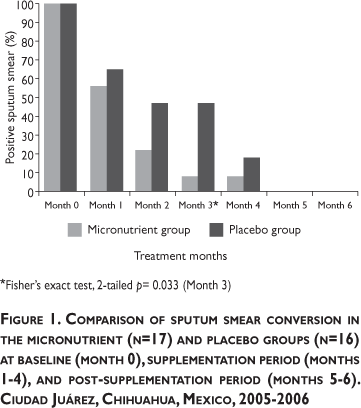
<body><![CDATA[<p><font face="Verdana" size="2"><a href="#f1">Figure    1</a> displays the proportion of subjects in the two study groups with a positive    sputum smear from baseline through study month 6. The proportion of positive    smears in both groups decreased over time until by the fifth month, none remained    positive. The rate of decline was more pronounced in the micronutrient group    but these differences only became statistically significant at month 3.</font></p>     <p><a name="f1"></a></p>     <p>&nbsp;</p>     <p align="center"><img src="/img/revistas/spm/v52n3/01f01.gif"></p>     <p>&nbsp;</p>     <p><font face="Verdana" size="2">As <a href="#f2">Figure    2</a> shows, both subject groups exhibited a decreased Th1 immune response (i.e.,    low mRNA IFN-</font><font size="2">&#947;</font><font face="Verdana" size="2">)    and an elevated T regulatory (Treg) cytokine (mRNA IL-10) profile at baseline    characteristic of untreated pulmonary TB.<sup>7,12</sup> Increases in IL-10    and suppression of Th1 response have an adverse effect on IFN-</font><font size="2">&#947;</font><font face="Verdana" size="2">    availability. In addition, low TNF-</font><font size="2">&#945;</font><font face="Verdana" size="2">    levels such as those seen at baseline may result from inadequate macrophage    response. Progression of untreated <i>Mycobacterium</i> infection results in    impairments in both innate and adaptive immune response leading to bacterial    replication and disease chronicity (<a href="#f2">Figure 2</a>).</font></p>     <p><a name="f2"></a></p>     <p>&nbsp;</p>     <p align="center"><img src="/img/revistas/spm/v52n3/01f02.gif"></p>     <p>&nbsp;</p>     ]]></body>
<body><![CDATA[<p><font face="Verdana" size="3"><b>Discussion</b></font></p>     <p><font face="Verdana" size="2">Similar to other    reports,<sup>7</sup> with chemotherapy, subject cytokine profiles began to shift    more towards a Th1 immune response as indicated by increasing mRNA IFN-</font><font size="2">&#947;</font><font face="Verdana" size="2">.    The increasing mRNA TNF-</font><font size="2">&#945;</font><font face="Verdana" size="2">    levels were also notable. The status of those two cytokines correlated with    decreasing Treg cells activity (i.e., lower mRNA IL-10) in the present study.    Although the between-group differences did not achieve statistical significance    in this small pilot study, nonetheless, the observed trends in cytokine activity    suggest that adjunctive micronutrient therapy acted to enhance bacterial elimination    in the supplemented group (<a href="#f1">Figure 1</a>).</font></p>     <p><font face="Verdana" size="2">The elevated IFN-</font><font size="2">&#947;</font><font face="Verdana" size="2">    and TNF-</font><font size="2">&#945;</font><font face="Verdana" size="2">    mRNA levels identified for the micronutrient group at study month 2 is consistent    with the observed acceleration in their sputum smear conversion rate signaling    increased bacterial clearance. Although the TNF-</font><font size="2">&#945;</font><font face="Verdana" size="2">    mRNA of the placebo group also increased over time, it did so more slowly, consistent    with the longer time required for conversion to a negative smear. The post hoc    analyses identified a significant positive correlation between plasma zinc and    TNF-</font><font size="2">&#945;</font><font face="Verdana" size="2">    mRNA levels at month 2 (r =0.47, p=0.03). The available evidence suggests that    standard antibiotic TB treatment is associated with the upregulation of Th1    response, bacterial clearance and clinical improve-ment.<sup>13</sup> In our    study, adjunctive zinc supplementation appeared to accelerate this process.    The effect of vitamin A supplementation was less evident.</font></p>     <p><font face="Verdana" size="2">The results of    this initial study suggest that adjunctive micronutrient supplementation accelerated    the beneficial therapeutic effect of TB chemotherapy by improving zinc status    and Th1 immune response. Larger clinical studies are required to verify these    initial results. If confirmed, adjunctive therapy could be used to shorten the    amount of time that TB patients are contagious, thereby reducing the potential    for disease spread and allowing them a faster return to work and society.</font></p>     <p>&nbsp;</p>     <p><font face="Verdana" size="3"><b>Acknowledgements</b></font></p>     <p><font face="Verdana" size="2">This project was    supported by the Center for Border Health Research, an initiative of the Paso    del Norte Health Foundation and the UTEP-UTSPH Hispanic Health Disparities Research    Center. The authors also gratefully acknowledge the excellent technical assistance    of Dr. Enrique Bravo, Dr. Carlos Porras, Dr. Julia Alvarez, Dr. Guadalupe Romero,    Dr. Juana Trejo, Dr. Adriana Dominquez, Dr. Alberto Martinez, Febe Huitron,    Genoveva Cordero, Marcela Gonzalez and Alma Lorena Rodriguez.</font></p>     <p>&nbsp;</p>     <p><font face="Verdana" size="3"><b>References</b></font></p>     <!-- ref --><p><font face="Verdana" size="2">1. Karyadi    E, Schultink W, Nelwan RHH, Gross R, Amin Z, Dolmans WMV, <i>et al.</i> Poor    Micronutrient Status of Active Pulmonary Tuberculosis Patients in Indonesia.    J Nutr 2002;130:2953-2958.    &nbsp;&nbsp;&nbsp;&nbsp;&nbsp;&nbsp;&nbsp;&nbsp;[&#160;<a href="javascript:void(0);" onclick="javascript: window.open('/scielo.php?script=sci_nlinks&ref=9299996&pid=S0036-3634201000030000100001&lng=','','width=640,height=500,resizable=yes,scrollbars=1,menubar=yes,');">Links</a>&#160;]<!-- end-ref --></font></p>     <!-- ref --><p><font face="Verdana" size="2">2. van Lettow    M,West CE, van der Meer JW,Wieringa FT, Semba RD. Low plasma selenium concentrations,    high plasma human immunodeficiency virus load and high interleukin-6 concentrations    are risk factors associated with anemia in adults presenting with pulmonary    tuberculosis in Zomba district, Malawi. Eur J Clin Nutr 2005; 59(4):526-532.    &nbsp;&nbsp;&nbsp;&nbsp;&nbsp;&nbsp;&nbsp;&nbsp;[&#160;<a href="javascript:void(0);" onclick="javascript: window.open('/scielo.php?script=sci_nlinks&ref=9299998&pid=S0036-3634201000030000100002&lng=','','width=640,height=500,resizable=yes,scrollbars=1,menubar=yes,');">Links</a>&#160;]<!-- end-ref --></font></p>     <!-- ref --><p><font face="Verdana" size="2">3. McMurray    DN, Bartow RA, Mintzer CL, Hernandez-Frontera E. Micronutrient status and immune    function in tuberculosis. Ann N Y Acad Sci 1990;587:59-69.    &nbsp;&nbsp;&nbsp;&nbsp;&nbsp;&nbsp;&nbsp;&nbsp;[&#160;<a href="javascript:void(0);" onclick="javascript: window.open('/scielo.php?script=sci_nlinks&ref=9300000&pid=S0036-3634201000030000100003&lng=','','width=640,height=500,resizable=yes,scrollbars=1,menubar=yes,');">Links</a>&#160;]<!-- end-ref --></font></p>     <!-- ref --><p><font face="Verdana" size="2">4. Karyadi    E,West CE, Schultink W, Nelwan WH, Gross R, Amin Z, <i>et al.</i> A double-blind,    placebo-controlled study of vitamin A and zinc supplementation in persons with    tuberculosis in Indonesia: effects on clinical response and nutritional status.    Am J Clin Nutr 2002;75(4):720-727.    &nbsp;&nbsp;&nbsp;&nbsp;&nbsp;&nbsp;&nbsp;&nbsp;[&#160;<a href="javascript:void(0);" onclick="javascript: window.open('/scielo.php?script=sci_nlinks&ref=9300002&pid=S0036-3634201000030000100004&lng=','','width=640,height=500,resizable=yes,scrollbars=1,menubar=yes,');">Links</a>&#160;]<!-- end-ref --></font></p>     <!-- ref --><p><font face="Verdana" size="2">5. Flynn    J,Chan J. Immunology of tuberculosis. Ann Rev Immunol 200';19:93-129.    &nbsp;&nbsp;&nbsp;&nbsp;&nbsp;&nbsp;&nbsp;&nbsp;[&#160;<a href="javascript:void(0);" onclick="javascript: window.open('/scielo.php?script=sci_nlinks&ref=9300004&pid=S0036-3634201000030000100005&lng=','','width=640,height=500,resizable=yes,scrollbars=1,menubar=yes,');">Links</a>&#160;]<!-- end-ref --></font></p>     <!-- ref --><p><font face="Verdana" size="2">6. Boussiotis    VA, Tsai EY,Yumis EJ, Thim S, Delgado JC, Dascher CC, <i>et al.</i> IL-10 producing    T cells suppress immune response in anergic tuberculosis patients. J Clin Invest    2000;105:1317-1325.    &nbsp;&nbsp;&nbsp;&nbsp;&nbsp;&nbsp;&nbsp;&nbsp;[&#160;<a href="javascript:void(0);" onclick="javascript: window.open('/scielo.php?script=sci_nlinks&ref=9300006&pid=S0036-3634201000030000100006&lng=','','width=640,height=500,resizable=yes,scrollbars=1,menubar=yes,');">Links</a>&#160;]<!-- end-ref --></font></p>     <!-- ref --><p><font face="Verdana" size="2">7. Geffner    L,Yokobori N, Basile J, Schierloh P, Balboa L, Romero M, <i>et al.</i> Patients    with multidrug tuberculosis display impaired Thl responses and enhanced regulatory    T-cell levels in response to an outbreak of multidrugresistant <i>Mycobacterium    tuberculosis</i> M and Ra strains. Infection and Immunity 2009;77:5025-5034.    &nbsp;&nbsp;&nbsp;&nbsp;&nbsp;&nbsp;&nbsp;&nbsp;[&#160;<a href="javascript:void(0);" onclick="javascript: window.open('/scielo.php?script=sci_nlinks&ref=9300008&pid=S0036-3634201000030000100007&lng=','','width=640,height=500,resizable=yes,scrollbars=1,menubar=yes,');">Links</a>&#160;]<!-- end-ref --></font></p>     <!-- ref --><p><font face="Verdana" size="2">8. Karyadi    E, Dolmans WM, West CE,Van Crevel R, Nelwan RH, Amin Z, <i>et al.</i> Cytokines    related to nutritional status in patients with untreated pulmonary tuberculosis    in Indonesia. Asia Pac J Clin Nutr 2007;16(2):218-226.    &nbsp;&nbsp;&nbsp;&nbsp;&nbsp;&nbsp;&nbsp;&nbsp;[&#160;<a href="javascript:void(0);" onclick="javascript: window.open('/scielo.php?script=sci_nlinks&ref=9300010&pid=S0036-3634201000030000100008&lng=','','width=640,height=500,resizable=yes,scrollbars=1,menubar=yes,');">Links</a>&#160;]<!-- end-ref --></font></p>     <!-- ref --><p><font face="Verdana" size="2">9. Range    N,Andersen AB, Magnussen P, Mugomela A, Friis H. The effect of micronutrient    supplementation on treatment outcome in patients with pulmonary tuberculosis:    a randomized controlled trial in Mwanza, Tanzania. Trop Med Int Health 2005;10(9):826-32.    &nbsp;&nbsp;&nbsp;&nbsp;&nbsp;&nbsp;&nbsp;&nbsp;[&#160;<a href="javascript:void(0);" onclick="javascript: window.open('/scielo.php?script=sci_nlinks&ref=9300012&pid=S0036-3634201000030000100009&lng=','','width=640,height=500,resizable=yes,scrollbars=1,menubar=yes,');">Links</a>&#160;]<!-- end-ref --></font></p>     <!-- ref --><p><font face="Verdana" size="2">10. Chandra    RK. Nutrient supplementation as adjunct therapy in pulmonary tuberculosis. Int    J Vitam Nutr Res 2004;74(2):144-146.    &nbsp;&nbsp;&nbsp;&nbsp;&nbsp;&nbsp;&nbsp;&nbsp;[&#160;<a href="javascript:void(0);" onclick="javascript: window.open('/scielo.php?script=sci_nlinks&ref=9300014&pid=S0036-3634201000030000100010&lng=','','width=640,height=500,resizable=yes,scrollbars=1,menubar=yes,');">Links</a>&#160;]<!-- end-ref --></font></p>     <!-- ref --><p><font face="Verdana" size="2">11. Mathur    M. Role of vitamin A supplementation in the treatment of tuberculosis. Nat Med    J India 2007;20: 16-21.    &nbsp;&nbsp;&nbsp;&nbsp;&nbsp;&nbsp;&nbsp;&nbsp;[&#160;<a href="javascript:void(0);" onclick="javascript: window.open('/scielo.php?script=sci_nlinks&ref=9300016&pid=S0036-3634201000030000100011&lng=','','width=640,height=500,resizable=yes,scrollbars=1,menubar=yes,');">Links</a>&#160;]<!-- end-ref --></font></p>     <!-- ref --><p><font face="Verdana" size="2">12. Hernandez-Pando    R, Orosco H, Aguilar D. Factors that deregulate the protective immune response    in tuberculosis. Arch Immunol Ther Exp 2009;57:355-367.    &nbsp;&nbsp;&nbsp;&nbsp;&nbsp;&nbsp;&nbsp;&nbsp;[&#160;<a href="javascript:void(0);" onclick="javascript: window.open('/scielo.php?script=sci_nlinks&ref=9300018&pid=S0036-3634201000030000100012&lng=','','width=640,height=500,resizable=yes,scrollbars=1,menubar=yes,');">Links</a>&#160;]<!-- end-ref --></font></p>     <!-- ref --><p><font face="Verdana" size="2">13. Hirsch    C, Toossi Z, Othieno C, Johnson J, Schwander S, Robertson S <i>et al.</i> Depressed    T-Cell Interferon-g Responses in Pulmonary Tuberculosis: Analysis of Underlying    Mechanisms and Modulation with Therapy. J Infect Dis 1999;180:2069-2073.    &nbsp;&nbsp;&nbsp;&nbsp;&nbsp;&nbsp;&nbsp;&nbsp;[&#160;<a href="javascript:void(0);" onclick="javascript: window.open('/scielo.php?script=sci_nlinks&ref=9300020&pid=S0036-3634201000030000100013&lng=','','width=640,height=500,resizable=yes,scrollbars=1,menubar=yes,');">Links</a>&#160;]<!-- end-ref --></font></p>     <p>&nbsp;</p>     <p>&nbsp;</p>     <p><font face="Verdana" size="2"><b><a name="back"></a><a href="#top"><img src="/img/revistas/spm/v52n3/seta.gif" border="0"></a>    Address reprint requests to:    <br>   </b> Dr. RX Armijos    <br>   Human Immunology and Nutrition Research Laboratory    ]]></body>
<body><![CDATA[<br>   Department of Health Promotion/MPH Program    <br>   College of Health Sciences    <br>   University of Texas at El Paso    <br>   Stanton Professional Building Suite 700    <br>   1100 North Stanton Street. 79902-058    <br>   El Paso, Texas, USA    <br>   E-mail: <a href="mailto:rxarmijos@utep.edu">rxarmijos@utep.edu</a></font></p>     <p><font face="Verdana" size="2">Received on: May    7, 2009    <br>   Accepted on: February 16, 2010</font></p>      ]]></body><back>
<ref-list>
<ref id="B1">
<label>1</label><nlm-citation citation-type="journal">
<person-group person-group-type="author">
<name>
<surname><![CDATA[Karyadi]]></surname>
<given-names><![CDATA[E]]></given-names>
</name>
<name>
<surname><![CDATA[Schultink]]></surname>
<given-names><![CDATA[W]]></given-names>
</name>
<name>
<surname><![CDATA[Nelwan]]></surname>
<given-names><![CDATA[RHH]]></given-names>
</name>
<name>
<surname><![CDATA[Gross]]></surname>
<given-names><![CDATA[R]]></given-names>
</name>
<name>
<surname><![CDATA[Amin]]></surname>
<given-names><![CDATA[Z]]></given-names>
</name>
<name>
<surname><![CDATA[Dolmans]]></surname>
<given-names><![CDATA[WMV]]></given-names>
</name>
</person-group>
<article-title xml:lang="en"><![CDATA[Poor Micronutrient Status of Active Pulmonary Tuberculosis Patients in Indonesia]]></article-title>
<source><![CDATA[J Nutr]]></source>
<year>2002</year>
<volume>130</volume>
<page-range>2953-2958</page-range></nlm-citation>
</ref>
<ref id="B2">
<label>2</label><nlm-citation citation-type="journal">
<person-group person-group-type="author">
<name>
<surname><![CDATA[van Lettow]]></surname>
<given-names><![CDATA[M]]></given-names>
</name>
<name>
<surname><![CDATA[West]]></surname>
<given-names><![CDATA[CE]]></given-names>
</name>
<name>
<surname><![CDATA[JW]]></surname>
<given-names><![CDATA[van der Meer]]></given-names>
</name>
<name>
<surname><![CDATA[Wieringa]]></surname>
<given-names><![CDATA[FT]]></given-names>
</name>
<name>
<surname><![CDATA[Semba]]></surname>
<given-names><![CDATA[RD]]></given-names>
</name>
</person-group>
<article-title xml:lang="en"><![CDATA[Low plasma selenium concentrations, high plasma human immunodeficiency virus load and high interleukin-6 concentrations are risk factors associated with anemia in adults presenting with pulmonary tuberculosis in Zomba district, Malawi]]></article-title>
<source><![CDATA[Eur J Clin Nutr]]></source>
<year>2005</year>
<volume>59</volume>
<numero>4</numero>
<issue>4</issue>
<page-range>526-532</page-range></nlm-citation>
</ref>
<ref id="B3">
<label>3</label><nlm-citation citation-type="journal">
<person-group person-group-type="author">
<name>
<surname><![CDATA[McMurray]]></surname>
<given-names><![CDATA[DN]]></given-names>
</name>
<name>
<surname><![CDATA[Bartow]]></surname>
<given-names><![CDATA[RA]]></given-names>
</name>
<name>
<surname><![CDATA[Mintzer]]></surname>
<given-names><![CDATA[CL]]></given-names>
</name>
<name>
<surname><![CDATA[Hernandez-Frontera]]></surname>
<given-names><![CDATA[E]]></given-names>
</name>
</person-group>
<article-title xml:lang="en"><![CDATA[Micronutrient status and immune function in tuberculosis]]></article-title>
<source><![CDATA[Ann N Y Acad Sci]]></source>
<year>1990</year>
<volume>587</volume>
<page-range>59-69</page-range></nlm-citation>
</ref>
<ref id="B4">
<label>4</label><nlm-citation citation-type="journal">
<person-group person-group-type="author">
<name>
<surname><![CDATA[Karyadi]]></surname>
<given-names><![CDATA[E]]></given-names>
</name>
<name>
<surname><![CDATA[West]]></surname>
<given-names><![CDATA[CE]]></given-names>
</name>
<name>
<surname><![CDATA[Schultink]]></surname>
<given-names><![CDATA[W]]></given-names>
</name>
<name>
<surname><![CDATA[Nelwan]]></surname>
<given-names><![CDATA[WH]]></given-names>
</name>
<name>
<surname><![CDATA[Gross]]></surname>
<given-names><![CDATA[R]]></given-names>
</name>
<name>
<surname><![CDATA[Amin]]></surname>
<given-names><![CDATA[Z]]></given-names>
</name>
</person-group>
<article-title xml:lang="en"><![CDATA[A double-blind, placebo-controlled study of vitamin A and zinc supplementation in persons with tuberculosis in Indonesia: effects on clinical response and nutritional status]]></article-title>
<source><![CDATA[Am J Clin Nutr]]></source>
<year>2002</year>
<volume>75</volume>
<numero>4</numero>
<issue>4</issue>
<page-range>720-727</page-range></nlm-citation>
</ref>
<ref id="B5">
<label>5</label><nlm-citation citation-type="journal">
<person-group person-group-type="author">
<name>
<surname><![CDATA[Flynn]]></surname>
<given-names><![CDATA[J]]></given-names>
</name>
<name>
<surname><![CDATA[Chan]]></surname>
<given-names><![CDATA[J.]]></given-names>
</name>
</person-group>
<article-title xml:lang="en"><![CDATA[Immunology of tuberculosis]]></article-title>
<source><![CDATA[Ann Rev Immunol]]></source>
<year></year>
<volume>200</volume>
<numero>19</numero>
<issue>19</issue>
<page-range>93-129</page-range></nlm-citation>
</ref>
<ref id="B6">
<label>6</label><nlm-citation citation-type="journal">
<person-group person-group-type="author">
<name>
<surname><![CDATA[Boussiotis]]></surname>
<given-names><![CDATA[VA]]></given-names>
</name>
<name>
<surname><![CDATA[Tsai]]></surname>
<given-names><![CDATA[EY]]></given-names>
</name>
<name>
<surname><![CDATA[Yumis]]></surname>
<given-names><![CDATA[EJ]]></given-names>
</name>
<name>
<surname><![CDATA[Thim]]></surname>
<given-names><![CDATA[S]]></given-names>
</name>
<name>
<surname><![CDATA[Delgado]]></surname>
<given-names><![CDATA[JC]]></given-names>
</name>
<name>
<surname><![CDATA[Dascher]]></surname>
<given-names><![CDATA[CC]]></given-names>
</name>
</person-group>
<article-title xml:lang="en"><![CDATA[IL-10 producing T cells suppress immune response in anergic tuberculosis patients]]></article-title>
<source><![CDATA[J Clin Invest]]></source>
<year>2000</year>
<volume>105</volume>
<page-range>1317-1325</page-range></nlm-citation>
</ref>
<ref id="B7">
<label>7</label><nlm-citation citation-type="journal">
<person-group person-group-type="author">
<name>
<surname><![CDATA[Geffner]]></surname>
<given-names><![CDATA[L]]></given-names>
</name>
<name>
<surname><![CDATA[Yokobori]]></surname>
<given-names><![CDATA[N]]></given-names>
</name>
<name>
<surname><![CDATA[Basile]]></surname>
<given-names><![CDATA[J]]></given-names>
</name>
<name>
<surname><![CDATA[Schierloh]]></surname>
<given-names><![CDATA[P]]></given-names>
</name>
<name>
<surname><![CDATA[Balboa]]></surname>
<given-names><![CDATA[L]]></given-names>
</name>
<name>
<surname><![CDATA[Romero]]></surname>
<given-names><![CDATA[M]]></given-names>
</name>
</person-group>
<article-title xml:lang="en"><![CDATA[Patients with multidrug tuberculosis display impaired Thl responses and enhanced regulatory T-cell levels in response to an outbreak of multidrugresistant Mycobacterium tuberculosis M and Ra strains]]></article-title>
<source><![CDATA[Infection and Immunity]]></source>
<year>2009</year>
<volume>77</volume>
<page-range>5025-5034</page-range></nlm-citation>
</ref>
<ref id="B8">
<label>8</label><nlm-citation citation-type="journal">
<person-group person-group-type="author">
<name>
<surname><![CDATA[Karyadi]]></surname>
<given-names><![CDATA[E]]></given-names>
</name>
<name>
<surname><![CDATA[Dolmans]]></surname>
<given-names><![CDATA[WM]]></given-names>
</name>
<name>
<surname><![CDATA[West]]></surname>
<given-names><![CDATA[CE]]></given-names>
</name>
<name>
<surname><![CDATA[Van Crevel]]></surname>
<given-names><![CDATA[R]]></given-names>
</name>
<name>
<surname><![CDATA[Nelwan]]></surname>
<given-names><![CDATA[RH]]></given-names>
</name>
<name>
<surname><![CDATA[Amin]]></surname>
<given-names><![CDATA[Z]]></given-names>
</name>
</person-group>
<article-title xml:lang="en"><![CDATA[Cytokines related to nutritional status in patients with untreated pulmonary tuberculosis in Indonesia]]></article-title>
<source><![CDATA[Asia Pac J Clin Nutr]]></source>
<year>2007</year>
<volume>16</volume>
<numero>2</numero>
<issue>2</issue>
<page-range>218-226</page-range></nlm-citation>
</ref>
<ref id="B9">
<label>9</label><nlm-citation citation-type="journal">
<person-group person-group-type="author">
<name>
<surname><![CDATA[Range]]></surname>
<given-names><![CDATA[N]]></given-names>
</name>
<name>
<surname><![CDATA[Andersen]]></surname>
<given-names><![CDATA[AB]]></given-names>
</name>
<name>
<surname><![CDATA[Magnussen]]></surname>
<given-names><![CDATA[P]]></given-names>
</name>
<name>
<surname><![CDATA[Mugomela]]></surname>
<given-names><![CDATA[A]]></given-names>
</name>
<name>
<surname><![CDATA[Friis]]></surname>
<given-names><![CDATA[H]]></given-names>
</name>
</person-group>
<article-title xml:lang="en"><![CDATA[The effect of micronutrient supplementation on treatment outcome in patients with pulmonary tuberculosis: a randomized controlled trial in Mwanza, Tanzania]]></article-title>
<source><![CDATA[Trop Med Int Health]]></source>
<year>2005</year>
<volume>10</volume>
<numero>9</numero>
<issue>9</issue>
<page-range>826-32</page-range></nlm-citation>
</ref>
<ref id="B10">
<label>10</label><nlm-citation citation-type="journal">
<person-group person-group-type="author">
<name>
<surname><![CDATA[Chandra]]></surname>
<given-names><![CDATA[RK]]></given-names>
</name>
</person-group>
<article-title xml:lang="en"><![CDATA[Nutrient supplementation as adjunct therapy in pulmonary tuberculosis]]></article-title>
<source><![CDATA[Int J Vitam Nutr Res]]></source>
<year>2004</year>
<volume>74</volume>
<numero>2</numero>
<issue>2</issue>
<page-range>144-146</page-range></nlm-citation>
</ref>
<ref id="B11">
<label>11</label><nlm-citation citation-type="journal">
<person-group person-group-type="author">
<name>
<surname><![CDATA[Mathur]]></surname>
<given-names><![CDATA[M.]]></given-names>
</name>
</person-group>
<article-title xml:lang="en"><![CDATA[Role of vitamin A supplementation in the treatment of tuberculosis]]></article-title>
<source><![CDATA[Nat Med J India]]></source>
<year>2007</year>
<volume>20</volume>
<page-range>16-21</page-range></nlm-citation>
</ref>
<ref id="B12">
<label>12</label><nlm-citation citation-type="journal">
<person-group person-group-type="author">
<name>
<surname><![CDATA[Hernandez-Pando]]></surname>
<given-names><![CDATA[R]]></given-names>
</name>
<name>
<surname><![CDATA[Orosco]]></surname>
<given-names><![CDATA[H]]></given-names>
</name>
<name>
<surname><![CDATA[Aguilar]]></surname>
<given-names><![CDATA[D]]></given-names>
</name>
</person-group>
<article-title xml:lang="en"><![CDATA[Factors that deregulate the protective immune response in tuberculosis]]></article-title>
<source><![CDATA[Arch Immunol Ther Exp]]></source>
<year>2009</year>
<volume>57</volume>
<page-range>355-367</page-range></nlm-citation>
</ref>
<ref id="B13">
<label>13</label><nlm-citation citation-type="journal">
<person-group person-group-type="author">
<name>
<surname><![CDATA[Hirsch]]></surname>
<given-names><![CDATA[C]]></given-names>
</name>
<name>
<surname><![CDATA[Toossi]]></surname>
<given-names><![CDATA[Z]]></given-names>
</name>
<name>
<surname><![CDATA[Othieno]]></surname>
<given-names><![CDATA[C]]></given-names>
</name>
<name>
<surname><![CDATA[Johnson]]></surname>
<given-names><![CDATA[J]]></given-names>
</name>
<name>
<surname><![CDATA[Schwander]]></surname>
<given-names><![CDATA[S]]></given-names>
</name>
<name>
<surname><![CDATA[Robertson]]></surname>
<given-names><![CDATA[S]]></given-names>
</name>
</person-group>
<article-title xml:lang="en"><![CDATA[Depressed T-Cell Interferon-g Responses in Pulmonary Tuberculosis: Analysis of Underlying Mechanisms and Modulation with Therapy]]></article-title>
<source><![CDATA[J Infect Dis]]></source>
<year>1999</year>
<volume>180</volume>
<page-range>2069-2073</page-range></nlm-citation>
</ref>
</ref-list>
</back>
</article>