<?xml version="1.0" encoding="ISO-8859-1"?><article xmlns:mml="http://www.w3.org/1998/Math/MathML" xmlns:xlink="http://www.w3.org/1999/xlink" xmlns:xsi="http://www.w3.org/2001/XMLSchema-instance">
<front>
<journal-meta>
<journal-id>0036-3634</journal-id>
<journal-title><![CDATA[Salud Pública de México]]></journal-title>
<abbrev-journal-title><![CDATA[Salud pública Méx]]></abbrev-journal-title>
<issn>0036-3634</issn>
<publisher>
<publisher-name><![CDATA[Instituto Nacional de Salud Pública]]></publisher-name>
</publisher>
</journal-meta>
<article-meta>
<article-id>S0036-36342009000300012</article-id>
<title-group>
<article-title xml:lang="en"><![CDATA[Sexual maturation and metabolic profile among adolescents and children of the Health Worker Cohort Study in Mexico]]></article-title>
<article-title xml:lang="es"><![CDATA[Madurez sexual y perfil metabólico de los adolescentes y niños del estudio de cohorte de trabajadores de la salud en México]]></article-title>
</title-group>
<contrib-group>
<contrib contrib-type="author">
<name>
<surname><![CDATA[Katon]]></surname>
<given-names><![CDATA[Jodie G]]></given-names>
</name>
<xref ref-type="aff" rid="A01"/>
<xref ref-type="aff" rid="A02"/>
</contrib>
<contrib contrib-type="author">
<name>
<surname><![CDATA[Flores]]></surname>
<given-names><![CDATA[Yvonne N]]></given-names>
</name>
<xref ref-type="aff" rid="A02"/>
<xref ref-type="aff" rid="A03"/>
</contrib>
<contrib contrib-type="author">
<name>
<surname><![CDATA[Salmerón]]></surname>
<given-names><![CDATA[Jorge]]></given-names>
</name>
<xref ref-type="aff" rid="A02"/>
</contrib>
</contrib-group>
<aff id="A01">
<institution><![CDATA[,University of California, Los Angeles Department of Epidemiology ]]></institution>
<addr-line><![CDATA[Los Angeles CA]]></addr-line>
<country>USA</country>
</aff>
<aff id="A02">
<institution><![CDATA[,IMSS Epidemiology and Health Services Research Unit  ]]></institution>
<addr-line><![CDATA[Morelos ]]></addr-line>
<country>Mexico</country>
</aff>
<aff id="A03">
<institution><![CDATA[,UCLA Department of Health Services School of Public Health]]></institution>
<addr-line><![CDATA[Los Angeles CA]]></addr-line>
<country>USA</country>
</aff>
<pub-date pub-type="pub">
<day>00</day>
<month>06</month>
<year>2009</year>
</pub-date>
<pub-date pub-type="epub">
<day>00</day>
<month>06</month>
<year>2009</year>
</pub-date>
<volume>51</volume>
<numero>3</numero>
<fpage>219</fpage>
<lpage>226</lpage>
<copyright-statement/>
<copyright-year/>
<self-uri xlink:href="http://www.scielo.org.mx/scielo.php?script=sci_arttext&amp;pid=S0036-36342009000300012&amp;lng=en&amp;nrm=iso"></self-uri><self-uri xlink:href="http://www.scielo.org.mx/scielo.php?script=sci_abstract&amp;pid=S0036-36342009000300012&amp;lng=en&amp;nrm=iso"></self-uri><self-uri xlink:href="http://www.scielo.org.mx/scielo.php?script=sci_pdf&amp;pid=S0036-36342009000300012&amp;lng=en&amp;nrm=iso"></self-uri><abstract abstract-type="short" xml:lang="en"><p><![CDATA[OBJECTIVE:Our objective was to investigate the associations between level and timing of sexual development with metabolic profile in a cohort of Mexican adolescents in central Mexico. MATERIAL AND METHODS:Baseline data from children between the ages of 7 and 17 years (n= 582) who participated in the Health Worker Cohort Study, was used. The study participants included children of workers at the Mexican Institute of Social Security (IMSS) and the National Institute of Public Health, both located in Cuernavaca, in addition to children of workers at the Universidad Autónoma del Estado de México in Toluca who were enrolled between March 2004 and April 2006. Multiple linear regressions with robust estimates of variance, were used adjusting for specific covariates. RESULTS:Both pubertal boys and girls, compared to their pre-pubertal counterparts, had higher body mass index (girls: 4.59 kg/m², p<0.0001; boys: 1.12 kg/m², p= 0.05) and percent body fat (girls: 3.61, p<0.0001; boys: 1.48, p= 0.0001). A significant difference in level of insulin resistance (homeostasis model assessment, HOMA) was detectable among girls (0.92, p<0.0001). CONCLUSIONS:Timing and levels of sexual development were significantly associated with adverse differences in several critical anthropometric and metabolic parameters.]]></p></abstract>
<abstract abstract-type="short" xml:lang="es"><p><![CDATA[OBJETIVO:Investigar las asociaciones entre etapa y momento de inicio del desarrollo sexual y perfil metabólico en una cohorte de adolescentes mexicanos. MATERIAL Y MÉTODOS:Se usó la información basal de los jóvenes entre 7 y 17 años de edad (n= 582), que participaron en el Estudio de cohorte de trabajadores de la salud. Los participantes del estudio fueron los hijos e hijas de los trabajadores del Instituto Mexicano del Seguro Social (IMSS) y del Instituto Nacional de Salud Pública en Cuernavaca, Morelos, así como los hijos e hijas de los trabajadores de la Universidad Autónoma del Estado de México en Toluca. Se realizaron regresiones lineales múltiples con estimadores de varianza robustos, ajustando por covariables específicas. RESULTADOS:Se encontró un índice de masa corporal mayor en los niños y niñas en la etapa de pubertad, comparado con los de pre-pubertad (niñas: 4.59 kg/m², p<0.0001; niños: 1.12 kg/m², p= 0.05) y un mayor porcentaje de grasa corporal (niñas: 3.61, p<0.0001; niños: 1.48, p= 0.0001). Se encontró una diferencia significativa en el indicador de resistencia a la insulina (HOMA, por sus siglas en inglés) en las niñas (0.92, p<0.0001). CONCLUSIONES:La etapa y el momento de inicio del desarrollo sexual se asociaron significativamente con diferencias adversas en varios parámetros metabólicos y antropométricos críticos.]]></p></abstract>
<kwd-group>
<kwd lng="en"><![CDATA[sexual maturation]]></kwd>
<kwd lng="en"><![CDATA[metabolism]]></kwd>
<kwd lng="en"><![CDATA[adolescents]]></kwd>
<kwd lng="en"><![CDATA[Mexico]]></kwd>
<kwd lng="es"><![CDATA[madurez sexual]]></kwd>
<kwd lng="es"><![CDATA[metabolismo]]></kwd>
<kwd lng="es"><![CDATA[adolescentes]]></kwd>
<kwd lng="es"><![CDATA[México]]></kwd>
</kwd-group>
</article-meta>
</front><body><![CDATA[ <p align="right"><font face="Verdana, Arial, Helvetica, sans-serif" size="2"><b>ART&Iacute;CULO    ORIGINAL</b></font></p>     <p>&nbsp;</p>     <p><font face="Verdana, Arial, Helvetica, sans-serif" size="4"><b>Sexual maturation    and metabolic profile among adolescents and children of the Health Worker Cohort    Study in Mexico</b></font></p>     <p>&nbsp;</p>     <p><font face="Verdana, Arial, Helvetica, sans-serif" size="3"><b>Madurez sexual    y perfil metab&oacute;lico de los adolescentes y ni&ntilde;os del estudio de    cohorte de trabajadores de la salud en M&eacute;xico</b></font></p>     <p>&nbsp;</p>     <p>&nbsp;</p>     <p><font face="Verdana, Arial, Helvetica, sans-serif" size="2"><b>Jodie G Katon,    MS<sup>I, II</sup>; Yvonne N Flores, PhD<sup>II, III</sup>; Jorge Salmer&oacute;n,    MD, DrSc<sup>II</sup></b></font></p>     <p><font face="Verdana, Arial, Helvetica, sans-serif" size="2"><sup>I</sup>University    of California, Los Angeles (UCLA) Department of Epidemiology, Los Angeles, CA,    USA    <br>   <sup>II</sup>IMSS Epidemiology and Health Services Research Unit, Morelos, Mexico    ]]></body>
<body><![CDATA[<br>   <sup>III</sup>UCLA Department of Health Services, School of Public Health and    Jonsson Comprehensive Cancer Center, Los Angeles, CA, USA</font></p>     <p>&nbsp;</p>     <p>&nbsp;</p> <hr size="1" noshade>     <p><font face="Verdana, Arial, Helvetica, sans-serif" size="2"><b>ABSTRACT</b></font></p>     <p><font face="Verdana, Arial, Helvetica, sans-serif" size="2"><b>OBJECTIVE:</b>Our    objective was to investigate the associations between level and timing of sexual    development with metabolic profile in a cohort of Mexican adolescents in central    Mexico.    <br>   <b>MATERIAL AND METHODS:</b>Baseline data from children between the ages of    7 and 17 years (n= 582) who participated in the Health Worker Cohort Study,    was used. The study participants included children of workers at the Mexican    Institute of Social Security (IMSS) and the National Institute of Public Health,    both located in Cuernavaca, in addition to children of workers at the Universidad    Aut&oacute;noma del Estado de M&eacute;xico in Toluca who were enrolled between    March 2004 and April 2006. Multiple linear regressions with robust estimates    of variance, were used adjusting for specific covariates.    <br>   <b>RESULTS:</b>Both pubertal boys and girls, compared to their pre-pubertal    counterparts, had higher body mass index (girls: 4.59 kg/m<sup>2</sup>, <i>p</i>&lt;0.0001;    boys: 1.12 kg/m<sup>2</sup>, <i>p</i>= 0.05) and percent body fat (girls: 3.61,    <i>p</i>&lt;0.0001; boys: 1.48, <i>p</i>= 0.0001). A significant difference    in level of insulin resistance (homeostasis model assessment, HOMA) was detectable    among girls (0.92, <i>p</i>&lt;0.0001).     <br>   <b>CONCLUSIONS:</b>Timing and levels of sexual development were significantly    associated with adverse differences in several critical anthropometric and metabolic    parameters.</font></p>     <p><font face="Verdana, Arial, Helvetica, sans-serif" size="2"><b>Key words:</b>    sexual maturation; metabolism; adolescents; Mexico</font></p> <hr size="1" noshade>     <p><font face="Verdana, Arial, Helvetica, sans-serif" size="2"><b>RESUMEN</b></font></p>     ]]></body>
<body><![CDATA[<p><font face="Verdana, Arial, Helvetica, sans-serif" size="2"><b>OBJETIVO:</b>Investigar    las asociaciones entre etapa y momento de inicio del desarrollo sexual y perfil    metab&oacute;lico en una cohorte de adolescentes mexicanos.     <br>   <b>MATERIAL Y M&Eacute;TODOS:</b>Se us&oacute; la informaci&oacute;n basal de    los j&oacute;venes entre 7 y 17 a&ntilde;os de edad (n= 582), que participaron    en el Estudio de cohorte de trabajadores de la salud. Los participantes del    estudio fueron los hijos e hijas de los trabajadores del Instituto Mexicano    del Seguro Social (IMSS) y del Instituto Nacional de Salud P&uacute;blica en    Cuernavaca, Morelos, as&iacute; como los hijos e hijas de los trabajadores de    la Universidad Aut&oacute;noma del Estado de M&eacute;xico en Toluca. Se realizaron    regresiones lineales m&uacute;ltiples con estimadores de varianza robustos,    ajustando por covariables espec&iacute;ficas.    <br>   <b>RESULTADOS:</b>Se encontr&oacute; un &iacute;ndice de masa corporal mayor    en los ni&ntilde;os y ni&ntilde;as en la etapa de pubertad, comparado con los    de pre-pubertad (ni&ntilde;as: 4.59 kg/m<sup>2</sup>, <i>p</i>&lt;0.0001; ni&ntilde;os:    1.12 kg/m<sup>2</sup>, <i>p</i>= 0.05) y un mayor porcentaje de grasa corporal    (ni&ntilde;as: 3.61, <i>p</i>&lt;0.0001; ni&ntilde;os: 1.48, <i>p</i>= 0.0001).    Se encontr&oacute; una diferencia significativa en el indicador de resistencia    a la insulina (HOMA, por sus siglas en ingl&eacute;s) en las ni&ntilde;as (0.92,    <i>p</i>&lt;0.0001).    <br>   <b>CONCLUSIONES:</b>La etapa y el momento de inicio del desarrollo sexual se    asociaron significativamente con diferencias adversas en varios par&aacute;metros    metab&oacute;licos y antropom&eacute;tricos cr&iacute;ticos.</font></p>     <p><font face="Verdana, Arial, Helvetica, sans-serif" size="2"><b>Palabras clave:    </b>madurez sexual; metabolismo; adolescentes; M&eacute;xico</font></p> <hr size="1" noshade>     <p>&nbsp;</p>     <p>&nbsp;</p>     <p><font face="Verdana, Arial, Helvetica, sans-serif" size="2">Puberty is a stage    of rapid physiologic changes that may impact metabolic outcomes later in life.    During adolescence, over the course of pubertal development, various metabolic    and physiologic changes occur in parameters such as insulin sensitivity<sup>1,2</sup>    and lipid levels.<sup>3</sup> In a recent euglycemic clamp study of 357 children,    it was found that insulin sensitivity decreased with the onset of puberty (Tanner    stage II), reached a nadir at Tanner stage III, and returned to near pre-pubertal    levels by Tanner stage V.<sup>1</sup></font></p>     <p><font face="Verdana, Arial, Helvetica, sans-serif" size="2">Mexican-Americans    have higher rates of obesity<sup>4</sup> and metabolic syndrome (MS),<sup>5</sup>    which are predictive of type 2 diabetes and poor cardiovascular health in adulthood.<sup>6</sup>    Adolescents in Mexico experience a similarly high prevalence of obesity and    metabolic syndrome. A recent study reported a prevalence of MS from 10.6% to    19.6% among a group of Mexican adolescents depending on the definition used.<sup>7</sup>    Further, compared to Caucasian children, Hispanic children have lower insulin    sensitivity and higher insulin secretion throughout childhood and adolescence.<sup>8</sup>    The elevated prevalence of obesity in this population, combined with lower insulin    sensitivity and the high prevalence of low high density lipoprotein (HDL) and    high triglycerides puts Mexican adolescents at a higher risk for metabolic syndrome.    The exact mechanism responsible for the pubertal drop in insulin sensitivity    remains unknown. Moreover, the impact these changes in insulin sensitivity might    have on the risk of developing metabolic syndrome is also not known.</font></p>     <p><font face="Verdana, Arial, Helvetica, sans-serif" size="2">Timing of sexual    maturation is another important factor when assessing metabolic parameters in    pubertal children. Mexican-American adolescents generally experience earlier    sexual maturation than their Caucasian peers.<sup>9</sup> Multiple studies have    found that early sexual maturation is associated with a higher risk of obesity    and MS.<sup>10-13</sup> This association may convey additional risk of developing    metabolic disorders among Mexican-American and Mexican adolescents who experience    earlier sexual maturation,<sup>9</sup> and have lower insulin sensitivity,<sup>8</sup>    a higher prevalence of obesity,<sup>4</sup> lower HDL, and higher triglycerides<sup>10</sup>    than their Caucasian peers.</font></p>     ]]></body>
<body><![CDATA[<p><font face="Verdana, Arial, Helvetica, sans-serif" size="2">Thus, it is important    to examine both timing of sexual development and pubertal stage when studying    differences in metabolic parameters among adolescent populations, particularly    those at high risk of developing diabetes and MS. To the best of the authors'    knowledge no such study has been reported in a large cohort of Mexican or Mexican-American    adolescents. To provide such information, our objective was to measure a comprehensive    panel of metabolic parameters and assess their associations with timing of sexual    development and pubertal stage among 551 participants enrolled in a large cohort    study of Mexican adolescents.</font></p>     <p>&nbsp;</p>     <p><font face="Verdana, Arial, Helvetica, sans-serif" size="3"><b>Materials and    Methods</b></font></p>     <p><font face="Verdana, Arial, Helvetica, sans-serif" size="2"><b>Study population</b></font></p>     <p><font face="Verdana, Arial, Helvetica, sans-serif" size="2">The study population    consisted of a sample of children and adolescents who participated, along with    their parents, in the Health Worker cohort study. The study participants included    children of workers at the Mexican Institute of Social Security (IMSS, per its    abbreviation in Spanish) and the National Institute of Public Health, both located    in Cuernavaca, in addition to children of workers at the Universidad Autonoma    del Estado de Mexico in Toluca, the capital of the neighboring state. All participants    are being followed in an on going cohort study of life style and health and    were enrolled between March 2004 and April 2006. The specifics regarding the    study design, methodology and baseline characteristics of participants have    been detailed elsewhere,<sup>7</sup> and the ethical committees of all participating    institutions approved the study protocol and consent forms for the cohort study.</font></p>     <p><font face="Verdana, Arial, Helvetica, sans-serif" size="2">A total of 1349    children and adolescents aged 7-17 years old were enrolled in the Health Worker    cohort study. In order to examine the differences in metabolic profile by level    of sexual development, we restricted our analysis to participants aged 7-17    who reported being in Tanner stages I-IV (n=1000). Those in Tanner stage V were    excluded from this analysis since sexual development ends during Tanner V and    we wished to eliminate children from our sample who had completed development    prior to our study. Most participants had complete clinical data at the time    of this analysis; however, only 551 of these participants had fasting insulin    and glucose data in addition to percent body fat. To examine the differences    in metabolic profile associated with timing of sexual maturation we expanded    our sexual development criteria to include those in Tanner stages I-V, but further    restricted the age range to those 7-14. The age restriction was done in order    to eliminate children who had already completed sexual development at the time    of enrollment, for whom we could not determine the timing of their development.    Sexual development is completed during Tanner stage V. According to Sun et.    al. the median age at entry to Tanner stage V,<sup>5</sup> for Mexican-American    girls was 14.70. Therefore, excluding those 14 and older was a conservative    approach that ensured that we only included those in our analysis for whom timing    of puberty could be established with some confidence. Of these participants,    425 met these inclusion criteria and had complete glucose and insulin data.</font></p>     <p><font face="Verdana, Arial, Helvetica, sans-serif" size="2"><b>Assessment of    pubertal stage and metabolic parameters</b></font></p>     <p><font face="Verdana, Arial, Helvetica, sans-serif" size="2">We classified pubertal    stage based on Tanner staging. Tanner staging uses the appearance of secondary    sexual characteristics that include four separate indexes: breast development    and pubic hair for girls and testicular development and pubic hair for boys.<sup>14</sup>    Participants were shown sex-specific pictures of adolescents in each stage and    asked to identify which picture most accurately matched their current stage    of sexual development. Breast stage for girls and testicular development stage    for boys were used in this analysis. For both sexes, those in Tanner I were    classified as pre-pubertal, those in Tanner II-IV were classified as pubertal,    and those in Tanner V were classified as post-pubertal.</font></p>     <p><font face="Verdana, Arial, Helvetica, sans-serif" size="2">We defined early    maturation as being below the lower limit of the 95% confidence interval of    the mean age for a given Tanner stage and sex as indicated by the Third National    Health and Nutrition Examination Survey (NHANES III) for Mexican-Americans.<sup>9</sup>    We used the mean age in a Tanner stage and the standard error reported by Sun    <i>et al</i>.<sup>9</sup> to calculate the lower limits of the 95% confidence    intervals for the mean age in a stage. This was a modification of the method    used by Wang, who classified children who were below the median age for a given    gender and stage.<sup>13</sup> Rather than simply defining half of our population    as early maturers we used the lower limit of the 95% confidence interval for    the mean age in a stage in order to give the definition of early maturer more    physiologic and clinical meaning. Specifically, the lower limits we calculated    for girls were: 8 years old (Tanner I), 10.29 years old (Tanner II), 12.22 years    old (Tanner III), 13.50 years old (Tanner IV), and 15.97 years old (Tanner V).    The lower limits for boys were: 9 years old (Tanner I), 10.76 years old (Tanner    II), 12.42 years old (Tanner III), 15.01 years old (Tanner IV), and 16.60 years    old (Tanner V).</font></p>     <p><font face="Verdana, Arial, Helvetica, sans-serif" size="2">Insulin sensitivity    was measured using the homeostasis model assessment (HOMA).<sup>15</sup> HOMA    was calculated from the fasting insulin and glucose measurements using the standard    formula: (glucose (mmol/L) x insulin (</font><font size="2">&#956;</font><font face="Verdana, Arial, Helvetica, sans-serif" size="2">U/mL))/22.5.    Similarly, HOMA-B was used as a measure of beta-cell function and calculated    using the standard formula: (20 x insulin (</font><font size="2">&#956;</font><font face="Verdana, Arial, Helvetica, sans-serif" size="2">U/mL))/(    glucose (mmol/L)-3.5).<sup>16</sup> Serum glucose concentration was determined    by the oxidize glucose method; insulin was measured in serum by solid phase    RIA (Coat-A-Count, Diagnostic Products, Los Angeles, CA, USA).<sup>17</sup>    To remain consistent with previous analyses among adolescents from the National    Health and Nutrition Examination Survey (NHANES)<sup>18-21</sup> and other Health    Worker cohort studies,<sup>7</sup> a fasting time of eight hours or greater    was used for all assays. Serum triglyceride concentrations were analyzed with    a colorimetric method after enzymatic hydrolysis with lipases. HDL/LDL was analyzed    by the elimination of chylomicron and VLDL-C, LDL/HDL-C by cholesterol esterase,    cholesterol oxidize, and subsequently catalase, respectively.<sup>7</sup></font></p>     ]]></body>
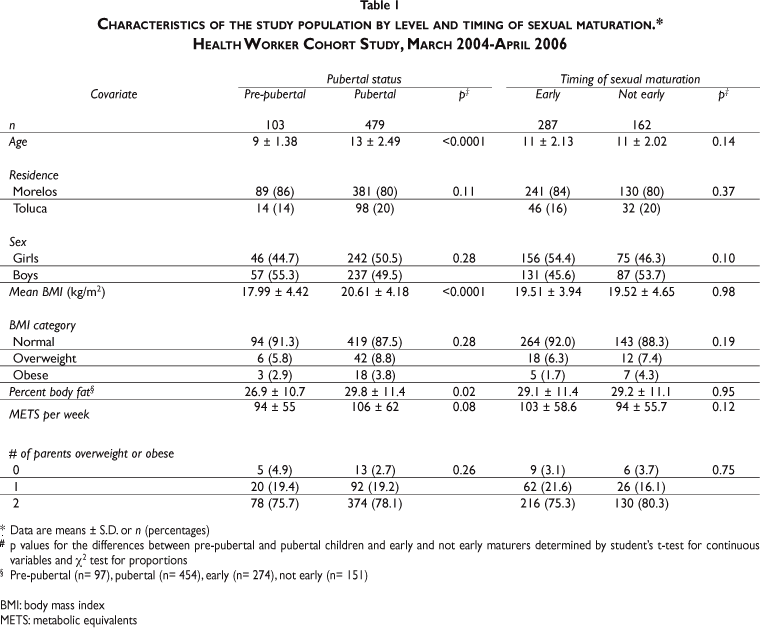
<body><![CDATA[<p><font face="Verdana, Arial, Helvetica, sans-serif" size="2">Waist circumference    was measured to the nearest 0.1 cm at the high point of the iliac crest at the    end of normal expiration, with a steel measuring tape, which was placed under    any clothing, directly touching the participant's skin. Weight was assessed    with participants wearing minimal clothing by an electronic TANITA scale, which    was previously calibrated. Height was measured using a conventional stadiometer.    Overweight and obesity classifications were based on the Centers for Disease    Control and Prevention (CDC) Growth Charts for the U.S. population. Obesity    was defined as being <u>&gt;</u> the 95<sup>th</sup> percentile BMI for age    and gender. Overweight was defined as being <u>&gt;</u>the 85<sup>th</sup> percentile    &lt; 95<sup>th</sup> percentile BMI for age and gender. Normal weight was defined    as being &lt; the 85<sup>th</sup> percentile BMI for age and gender.<sup>4</sup>    Percent body fat was measured by dual-energy X-ray absorptiometry (DEXA) using    a Lunar DPX-GE (model: DPX-NT 73735, series: 638405U77).</font></p>     <p><font face="Verdana, Arial, Helvetica, sans-serif" size="2">Physical activity    was assessed using the International Physical Activity Questionnaire (IPAQ)    instrument<sup>22,23</sup> which was adapted for the Mexican population. Participants    were asked about their leisure activity, recreational activity, daily activity,    and any physical labor associated with employment. The IPAQ section on leisure    time activity included 16 items on the amounts of time spent weekly performing    exercises such as walking, running and cycling. Each activity was given a value    in metabolic equivalents (MET) and total METS per week were calculated. Three    categories were defined: <u>&lt;</u>21 METS per week, &gt; 21 METS per week    and &lt; 110 METS per week, and <u>&gt;</u>110 METS per week.</font></p>     <p><font face="Verdana, Arial, Helvetica, sans-serif" size="2">Participants were    shown a series of graded silhouettes, numbered 1-9, of men and women and asked    to mark the body type that best described their mother's and father's current    physical appearance. The use of this scale was previously validated for use    within this population.<sup>24</sup> A selection of an image numbered four or    greater was interpreted as a parent being overweight or obese. Participants    were categorized as having one, two, or no overweight or obese parents.</font></p>     <p><font face="Verdana, Arial, Helvetica, sans-serif" size="2"><b>Statistical    analysis</b></font></p>     <p><font face="Verdana, Arial, Helvetica, sans-serif" size="2">Multiple regression    models with robust variance estimates were used to determine the means and 95%    confidence intervals for BMI, waist circumference, percent body fat, insulin,    glucose, HOMA, HOMA-B, HDL, triglycerides, and low density lipoprotein (LDL)    (treated as dependent variables) according to levels of sexual maturation for    girls and boys, adjusting for age, percent body fat (except where percent body    fat was the dependent variable), physical activity and number of obese or overweight    parents. The association of being pubertal versus pre-pubertal with differences    in metabolic parameters was allowed to vary by age. Student's t-tests were used    to identify differences between pre-pubertal versus pubertal status.</font></p>     <p><font face="Verdana, Arial, Helvetica, sans-serif" size="2">Analyses of the    association between early sexual maturation and differences in metabolic components    and anthropometric parameters were carried out in a similar fashion. These analyses    were restricted to participants aged 7-14 years in order to exclude individuals    who could not be identified conclusively as early-maturers. The cut-point of    age 14 was chosen based on the average age of entry into Tanner stage V for    Mexican-American adolescent girls reported by Sun <i>et al</i>. (mean age at    entry for Tanner V for Mexican-American girls: 14.70).<sup>9</sup> While this    was a conservative estimate, using this cut point gave us confidence that we    were excluding from our analysis those children who had completed puberty before    enrolling in the cohort and for whom we could not adequately establish timing    of sexual development. To evaluate the association of early sexual maturation    and the change in the metabolic components of interest we used our definitions    of early versus not early. All analyses were adjusted for age, percent body    fat (except where percent body fat was the dependent variable), physical activity    and parental obesity or overweight. Student's t-tests were used to identify    differences between early and not early maturers. Analyses were conducted using    STATA 9 software.<a name="top"></a><a href="#back"><sup>*</sup></a></font></p>     <p>&nbsp;</p>     <p><font face="Verdana, Arial, Helvetica, sans-serif" size="3"><b>Results</b></font></p>     <p><font face="Verdana, Arial, Helvetica, sans-serif" size="2">The characteristics    of the sample covariates are shown in <a href="/img/revistas/spm/v51n3/12t1.gif">Table    I</a> by level of sexual maturation and timing of sexual maturation. The pre-pubertal    children differed significantly from the pubertal children in age, mean BMI,    and percent body fat. The early maturing children did not differ significantly    from the non-early maturers in any of the covariates.</font></p>     <p><font face="Verdana, Arial, Helvetica, sans-serif" size="2">Being pubertal    versus pre-pubertal among girls was associated with higher BMI (4.59 kg/m<sup>2</sup>,    <i>p</i>&lt;0.0001), waist circumference (15.26 cm, <i>p</i>&lt;0.0001), percent    body fat (3.61%, <i>p</i>&lt;0.0001), glucose (0.45 mg/dL, <i>p</i>=0.01), insulin    (4.47 </font><font size="2">&#956;</font><font face="Verdana, Arial, Helvetica, sans-serif" size="2">U/mL, <i>p</i>&lt;0.0001), HOMA (0.92, <i>p</i>&lt;0.0001),    HOMA-B (67.57, <i>p</i>&lt;0.0001), and triglycerides (10.43 mg/dL, <i>p</i>&lt;0.0001),    as well as lower HDL (-3.25 mg/dL, <i>p</i>&lt;0.0001) and LDL (-3.94 mg/dL,    <i>p</i>&lt;0.0001). Among boys, being pubertal versus pre-pubertal was associated    with higher BMI (1.12 kg/m<sup>2</sup>, <i>p</i>= 0.05), waist circumference    (4.74 cm, <i>p</i>= 0.01), and percent body fat (1.48%, <i>p</i>=0.0001), as    well as lower HDL (-0.95 mg/dL, <i>p</i>= 0.03), triglycerides (-6.99 mg/dL,    <i>p</i>=0.01) and LDL (-11.20 mg/dL, <i>p</i>&lt;0.0001) (<a href="/img/revistas/spm/v51n3/12t2.gif">Table    II</a>).</font></p>     ]]></body>
<body><![CDATA[<p><font face="Verdana, Arial, Helvetica, sans-serif" size="2">Among girls, early    versus not early sexual maturation was associated with higher BMI (1.89 kg/m<sup>2</sup>,    <i>p</i>=0.00), waist circumference (4.70 cm, <i>p</i>= 0.00), glucose (0.89    mg/dL, <i>p</i>&lt;0.0001), insulin (2.78 </font><font size="2">&#956;</font><font face="Verdana, Arial, Helvetica, sans-serif" size="2">U/mL,    <i>p</i>&lt;0.0001), HOMA (0.57, <i>p</i>&lt;0.0001) and HOMA-B (50.85, <i>p</i>&lt;0.0001),    in addition to lower LDL (-4.343, <i>p</i>&lt;0.0001) (<a href="/img/revistas/spm/v51n3/12t3.gif">Table    III</a>). For boys, early sexual maturation versus not early was associated    with higher glucose (0.75 mg/dL, <i>p</i>&lt;0.0001) and HDL (2.32 mg/dL, <i>p</i>&lt;0.0001)    as well as lower BMI (-1.28 kg/m<sup>2</sup>, <i>p</i>= 0.01), waist circumference    (-4.72 cm, <i>p</i>= 0.01), percent body fat (-0.78%, <i>p</i>= 0.003), triglycerides    (-11.68 mg/dL, <i>p</i>&lt;0.0001) and LDL (-8.04 mg/dL, <i>p</i>&lt;0.0001)    (<a href="/img/revistas/spm/v51n3/12t3.gif">Table III</a>).</font></p>     <p>&nbsp;</p>     <p><font face="Verdana, Arial, Helvetica, sans-serif" size="3"><b>Discussion</b></font></p>     <p><font face="Verdana, Arial, Helvetica, sans-serif" size="2">In this cross-sectional    survey of 582 Mexican adolescents in Cuernavaca and Toluca, Mexico we observed    significant differences in metabolic profiles according to levels of sexual    development. Among girls, being pubertal (as opposed to pre-pubertal) was associated    with unfavorable levels of BMI, waist circumference, percent body fat, fasting    insulin, fasting glucose, HOMA, HDL, and triglycerides. Among boys, being pubertal    (as compared to pre-pubertal) appeared to be associated with adverse levels    of BMI, waist circumference, percent body fat and HDL. Early versus not early    sexual maturation was associated with higher levels of BMI, waist circumference,    HOMA, HOMA-B, fasting insulin, and fasting glucose among girls, in addition    to lower LDL. For boys, early versus not early sexual maturation was associated    with lower levels of BMI, waist circumference, percent body fat, fasting glucose,    triglycerides, and LDL, in addition to higher HDL.</font></p>     <p><font face="Verdana, Arial, Helvetica, sans-serif" size="2">These findings    indicated differences by sex in the associations between the measured metabolic    parameters and level of sexual maturation. In general, the differences in metabolic    components associated with increasing levels of sexual maturation were smaller    among boys than among girls. A difference in the average fasting glucose, fasting    insulin, HOMA, and HOMA-B for pre-pubertal versus pubertal girls was detected;    however, no differences were detected for boys. Our inability to detect differences    in HOMA by pubertal level in boys may corroborate Ball's finding that among    overweight Hispanic children with a family history of type 2 diabetes the pubertal    drop in insulin sensitivity is not detectable.<sup>25</sup> While only a small    percentage of the children in our study were overweight, roughly 90% of our    entire cohort reported having at least one parent who was obese or overweight.    Since obesity is the main determinant of insulin resistance, then our findings    suggest that it is the shared genetic and obesogenic environment rather than    the obesity of the child which may be instrumental in masking or eliminating    the pubertal drop in insulin sensitivity in our population. Both genetic predisposition    and the environment may be impacting insulin sensitivity before either puberty    or obesity can occur. This finding is largely unprecedented in the literature    and warrants further investigation. In particular, longitudinal data with more    exact information regarding timing of sexual maturation is needed to verify    these findings and explore possible mechanisms.</font></p>     <p><font face="Verdana, Arial, Helvetica, sans-serif" size="2">The observed decrease    in HDL between pubertal and pre-pubertal children has been previously described.    Morrison <i>et al</i>. reported that the observed drop in total cholesterol    across adolescence is due to reductions in HDL.<sup>3</sup> While the expected    drop in HDL was observed in both boys and girls, a rise in triglycerides was    not uniformly observed for both sexes. Boys displayed a decrease in triglycerides    while girls displayed the expected increase in triglycerides. This is a new    finding that indicates that the changes in lipid profile associated with puberty    are different than those associated with age and that they vary by sex.</font></p>     <p><font face="Verdana, Arial, Helvetica, sans-serif" size="2">The differences    in anthropometric parameters for both boys and girls, observed in this study    appear to reflect the normal reported patterns of growth.<sup>13</sup> BMI,    waist circumference and percent body fat were lower, on average, for boys and    girls who were pre-pubertal versus pubertal. Since this data was cross-sectional    it was not possible to interpret this finding as implying either that increased    BMI is necessary for sexual maturation or that sexual maturation causes increased    BMI. However, the association between increased BMI and puberty was consistent    with the existing literature, particularly regarding girls.<sup>13</sup></font></p>     <p><font face="Verdana, Arial, Helvetica, sans-serif" size="2">The greater magnitude    of the differences in BMI, waist circumference, and percent body fat by level    of sexual maturation among girls was most likely due to differences in growth    patterns between the sexes. On average, girls experience greater increases in    fat mass relative to lean mass during adolescence, and boys experience greater    increases in lean mass relative to fat mass.<sup>13</sup> This is probably part    of the mechanism underlying the fact that, on average, adult women have 22%    body fat compared to adult men who, on average, have only 15% body fat.<sup>26</sup>    Although in our study, percent body fat was, on average, lower for girls who    were pre-pubertal versus pubertal, this cannot be interpreted as implying a    causal relationship or being supportive of a particular direction of causality.    However, this observation was consistent with the existing literature.<sup>26</sup></font></p>     <p><font face="Verdana, Arial, Helvetica, sans-serif" size="2">The association    of early sexual maturity with obesity and metabolic syndrome is fairly well    established for girls.<sup>10-12</sup> Therefore, it is not surprising that    our findings show that higher BMI, waist circumference, fasting insulin, fasting    glucose, HOMA, and HOMA-B are associated with early sexual maturation among    girls. Wang reported that early sexual maturation was inversely associated with    BMI for boys and our results are consistent with this;<sup>13</sup> however;    our study is, to the best of our knowledge, the first to examine insulin sensitivity    with respect to timing of sexual maturation among boys. Among the boys in our    study population, early versus not early sexual maturation was associated with    lower BMI, waist circumference, and percent body fat. In our study population,    lower HOMA was associated with early versus not early sexual maturation among    boys, but this decrease was not detectable at the 0.05 significance level. Early    sexual maturation has been reported to be associated with adverse changes in    serum lipids,<sup>12</sup> but our results indicate that early maturation is    associated with lower LDL for girls and boys.</font></p>     <p><font face="Verdana, Arial, Helvetica, sans-serif" size="2">The cross-sectional    design of this study makes it difficult to examine a potential causal relation    of sexual maturation and early sexual maturation with metabolic outcomes such    as insulin resistance and/or lipid profile, as temporality of events cannot    be established using this type of data. The follow-up data on this cohort should    shed more light on whether the differences that we have reported between early    and not early maturers do impart excess risk for type 2 diabetes or the metabolic    syndrome. Also, this cohort was drawn from the children and adolescent relatives    of working, seemingly healthy individuals. While these children cannot be considered    representative of the Mexican population as a whole, they may be considered    representative of middle to low income adolescents residing in the urban areas    of central Mexico.</font></p>     ]]></body>
<body><![CDATA[<p><font face="Verdana, Arial, Helvetica, sans-serif" size="2">These limitations    not withstanding, our results provide important information about the association    between level of sexual development and early sexual maturation and differences    in metabolic profile in a population at high risk for obesity, metabolic syndrome,    and diabetes. Our results may corroborate the hypothesis that among Hispanic    children with a family history of type 2 diabetes the pubertal drop in insulin    sensitivity is not detectable. Furthermore, this is the first study of this    type to be conducted among such a large group of Mexican adolescents. We also    report for the first time on the differences in a comprehensive panel of metabolic    parameters between early versus not early maturing boys. The follow-up analysis    may further support and strengthen the argument that early intervention is important    in reducing the risks for obesity, metabolic syndrome, and type 2 diabetes for    Mexican children and adolescents who exhibit early sexual development.</font></p>     <p><font face="Verdana, Arial, Helvetica, sans-serif" size="2"><b>Acknowledgements</b></font></p>     <p><font face="Verdana, Arial, Helvetica, sans-serif" size="2">Financial support    for this study was provided by the Instituto Mexicano del Seguro Social (IMSS)    and the Consejo Nacional para la Ciencia y Tecnolog&iacute;a (CONACYT) grant    #26267M. The authors would like to thank Dr. Simin Liu, Dr. Leo Morales, and    Dr. Anna Haddal for their insight and suggestions and the investigators at IMSS    for the use of their data. We would also like to acknowledge the Program on    Genomics and Nutrition, Department of Epidemiology UCLA. Finally, the authors    wish to thank the Neuman-Drabkin and Monica Salinas Funds for their generous    financial support for Ms. Katon.</font></p>     <p>&nbsp;</p>     <p><font face="Verdana, Arial, Helvetica, sans-serif" size="3"><b>References</b></font></p>     <p><font face="Verdana, Arial, Helvetica, sans-serif" size="2">1. Moran A, Jacobs    DR Jr, Steinberger J, Hong CP, Prineas R, Luepker R, <i>et al</i>. Insulin resistance    during puberty: results from clamp studies in 357 children. Diabetes 1999;48:2039-2044.</font></p>     <!-- ref --><p><font face="Verdana, Arial, Helvetica, sans-serif" size="2">2. Goran MI, Gower    BA. Longitudinal study on pubertal insulin resistance. Diabetes 2001;50:2444-2449.</font>&nbsp;&nbsp;&nbsp;&nbsp;&nbsp;&nbsp;&nbsp;&nbsp;[&#160;<a href="javascript:void(0);" onclick="javascript: window.open('/scielo.php?script=sci_nlinks&ref=9274592&pid=S0036-3634200900030001200002&lng=','','width=640,height=500,resizable=yes,scrollbars=1,menubar=yes,');">Links</a>&#160;]<!-- end-ref --><!-- ref --><p><font face="Verdana, Arial, Helvetica, sans-serif" size="2">3. Morrison JA,    deGroot I, Edwards BK, Kelly KA, Mellies MJ, Khoury P, <i>et al</i>. Lipids    and Lipoproteins in 927 School Children, Ages 6-17 Years. Pediatrics 1978;62:990-995.</font>&nbsp;&nbsp;&nbsp;&nbsp;&nbsp;&nbsp;&nbsp;&nbsp;[&#160;<a href="javascript:void(0);" onclick="javascript: window.open('/scielo.php?script=sci_nlinks&ref=9274593&pid=S0036-3634200900030001200003&lng=','','width=640,height=500,resizable=yes,scrollbars=1,menubar=yes,');">Links</a>&#160;]<!-- end-ref --><!-- ref --><p><font face="Verdana, Arial, Helvetica, sans-serif" size="2">4. Ogden CL, Flegal    KM, Carroll MD, Johson CL. Prevalence and trends in overweight among US children    and adolescents, 1999-2000. JAMA 2002;288:1728-1732.</font>&nbsp;&nbsp;&nbsp;&nbsp;&nbsp;&nbsp;&nbsp;&nbsp;[&#160;<a href="javascript:void(0);" onclick="javascript: window.open('/scielo.php?script=sci_nlinks&ref=9274594&pid=S0036-3634200900030001200004&lng=','','width=640,height=500,resizable=yes,scrollbars=1,menubar=yes,');">Links</a>&#160;]<!-- end-ref --><!-- ref --><p><font face="Verdana, Arial, Helvetica, sans-serif" size="2">5. Ford ES, Giles    WH, Dietz WH. Prevalence of the metabolic syndrome among US adults: Findings    from the Third National Health and Nutrition Examination Survey. JAMA 2002;287:356-359.</font>&nbsp;&nbsp;&nbsp;&nbsp;&nbsp;&nbsp;&nbsp;&nbsp;[&#160;<a href="javascript:void(0);" onclick="javascript: window.open('/scielo.php?script=sci_nlinks&ref=9274595&pid=S0036-3634200900030001200005&lng=','','width=640,height=500,resizable=yes,scrollbars=1,menubar=yes,');">Links</a>&#160;]<!-- end-ref --><!-- ref --><p><font face="Verdana, Arial, Helvetica, sans-serif" size="2">6. National Institutes    of Health. 2001. The Third Report of the National Cholesterol Education Program    Expert Panel on Detection, Evaluation, and Treatment of High Blood Cholesterol    in Adults (Adult Treatment Panel III). Bethesda (MD): National Institutes of    Health. NIH Publication 01-3670.</font>&nbsp;&nbsp;&nbsp;&nbsp;&nbsp;&nbsp;&nbsp;&nbsp;[&#160;<a href="javascript:void(0);" onclick="javascript: window.open('/scielo.php?script=sci_nlinks&ref=9274596&pid=S0036-3634200900030001200006&lng=','','width=640,height=500,resizable=yes,scrollbars=1,menubar=yes,');">Links</a>&#160;]<!-- end-ref --><!-- ref --><p><font face="Verdana, Arial, Helvetica, sans-serif" size="2">7. Halley Castillo    E, Borges G, Talavera JO, Orozco R, Vargas-Alem&aacute;n C, Huitr&oacute;n-Bravo    G, <i>et al</i>. Body mass index and the prevalence of metabolic syndrome among    children and adolescents in two Mexican populations. J Adolesc Health 2007;40(6):521-526.</font>&nbsp;&nbsp;&nbsp;&nbsp;&nbsp;&nbsp;&nbsp;&nbsp;[&#160;<a href="javascript:void(0);" onclick="javascript: window.open('/scielo.php?script=sci_nlinks&ref=9274597&pid=S0036-3634200900030001200007&lng=','','width=640,height=500,resizable=yes,scrollbars=1,menubar=yes,');">Links</a>&#160;]<!-- end-ref --><!-- ref --><p><font face="Verdana, Arial, Helvetica, sans-serif" size="2">8. Goran MI, Bergman    RN, Cruz ML, Watanabe R. Insulin resistance and associated compensatory responses    in African-American and Hispanic children. Diabetes Care 2002;25:2184-2190.</font>&nbsp;&nbsp;&nbsp;&nbsp;&nbsp;&nbsp;&nbsp;&nbsp;[&#160;<a href="javascript:void(0);" onclick="javascript: window.open('/scielo.php?script=sci_nlinks&ref=9274598&pid=S0036-3634200900030001200008&lng=','','width=640,height=500,resizable=yes,scrollbars=1,menubar=yes,');">Links</a>&#160;]<!-- end-ref --><!-- ref --><p><font face="Verdana, Arial, Helvetica, sans-serif" size="2">9. Sun SS, Schubert    CM, Chumlea WC, Roche AF, Kulin HE, Lee PA, <i>et al</i>. National estimates    of the timing of sexual maturation and racial differences among US children.    Pediatrics 2002;110:911-919.</font>&nbsp;&nbsp;&nbsp;&nbsp;&nbsp;&nbsp;&nbsp;&nbsp;[&#160;<a href="javascript:void(0);" onclick="javascript: window.open('/scielo.php?script=sci_nlinks&ref=9274599&pid=S0036-3634200900030001200009&lng=','','width=640,height=500,resizable=yes,scrollbars=1,menubar=yes,');">Links</a>&#160;]<!-- end-ref --><!-- ref --><p><font face="Verdana, Arial, Helvetica, sans-serif" size="2">10. Frontini MG,    Srinivasan SR, Berenson GS. Longitudinal changes in risk variables underlying    metabolic syndrome X from childhood to young adulthood in female subjects with    a history of early menarche: The Bogalusa Heart Study. Int J Obes 2003;27:1398-404.</font>&nbsp;&nbsp;&nbsp;&nbsp;&nbsp;&nbsp;&nbsp;&nbsp;[&#160;<a href="javascript:void(0);" onclick="javascript: window.open('/scielo.php?script=sci_nlinks&ref=9274600&pid=S0036-3634200900030001200010&lng=','','width=640,height=500,resizable=yes,scrollbars=1,menubar=yes,');">Links</a>&#160;]<!-- end-ref --><!-- ref --><p><font face="Verdana, Arial, Helvetica, sans-serif" size="2">11. Himes JH. Examining    the evidence for recent secular changes in the timing of puberty in US children    in light of increases in the prevalence of obesity. Mol Cell Endocrinol 2006;254-255:13-21.</font>&nbsp;&nbsp;&nbsp;&nbsp;&nbsp;&nbsp;&nbsp;&nbsp;[&#160;<a href="javascript:void(0);" onclick="javascript: window.open('/scielo.php?script=sci_nlinks&ref=9274601&pid=S0036-3634200900030001200011&lng=','','width=640,height=500,resizable=yes,scrollbars=1,menubar=yes,');">Links</a>&#160;]<!-- end-ref --><!-- ref --><p><font face="Verdana, Arial, Helvetica, sans-serif" size="2">12. Ibanez L, Potau    N, Chacon P, Pascual C, Carrascosa A. Hyperinsulinaemia, dyslipaemia and cardiovascular    risk in girls with a history of premature pubarche. Diabetologia 1998;41:1057-1063.</font>&nbsp;&nbsp;&nbsp;&nbsp;&nbsp;&nbsp;&nbsp;&nbsp;[&#160;<a href="javascript:void(0);" onclick="javascript: window.open('/scielo.php?script=sci_nlinks&ref=9274602&pid=S0036-3634200900030001200012&lng=','','width=640,height=500,resizable=yes,scrollbars=1,menubar=yes,');">Links</a>&#160;]<!-- end-ref --><!-- ref --><p><font face="Verdana, Arial, Helvetica, sans-serif" size="2">13. Wang Y. Is    obesity associated with early sexual maturation? A comparison of the association    in American boys versus American girls. Pediatrics 2002;110:903-910.</font>&nbsp;&nbsp;&nbsp;&nbsp;&nbsp;&nbsp;&nbsp;&nbsp;[&#160;<a href="javascript:void(0);" onclick="javascript: window.open('/scielo.php?script=sci_nlinks&ref=9274603&pid=S0036-3634200900030001200013&lng=','','width=640,height=500,resizable=yes,scrollbars=1,menubar=yes,');">Links</a>&#160;]<!-- end-ref --><!-- ref --><p><font face="Verdana, Arial, Helvetica, sans-serif" size="2">14. Tanner JM.    Normal growth and techniques of growth assessment. Clin Endocrinol Metab 1986;15(3):411-451.</font>&nbsp;&nbsp;&nbsp;&nbsp;&nbsp;&nbsp;&nbsp;&nbsp;[&#160;<a href="javascript:void(0);" onclick="javascript: window.open('/scielo.php?script=sci_nlinks&ref=9274604&pid=S0036-3634200900030001200014&lng=','','width=640,height=500,resizable=yes,scrollbars=1,menubar=yes,');">Links</a>&#160;]<!-- end-ref --><!-- ref --><p><font face="Verdana, Arial, Helvetica, sans-serif" size="2">15. Keskin M, Kurtoglu    S, Kendirci M, Atabek ME, Yazici C.. Homeostasis model assesment is more reliable    than the fasting glucose/insulin ratio and quantitative insulin sensitivity    check index for assessing insulin resistance among obese children and adolescents.    Pediatrics 2005;115:e500-e503.</font>&nbsp;&nbsp;&nbsp;&nbsp;&nbsp;&nbsp;&nbsp;&nbsp;[&#160;<a href="javascript:void(0);" onclick="javascript: window.open('/scielo.php?script=sci_nlinks&ref=9274605&pid=S0036-3634200900030001200015&lng=','','width=640,height=500,resizable=yes,scrollbars=1,menubar=yes,');">Links</a>&#160;]<!-- end-ref --><!-- ref --><p><font face="Verdana, Arial, Helvetica, sans-serif" size="2">16. Matthews DR,    Hosker JP, Rudenski AS, Naylor BA, Treacher DF, Turner RC. Homeostasis model    assessment: insulin resistance and b-cell function from fasting plasma glucose    and insulin concentrations in man. Diabetologia 1985;28:412-419.</font>&nbsp;&nbsp;&nbsp;&nbsp;&nbsp;&nbsp;&nbsp;&nbsp;[&#160;<a href="javascript:void(0);" onclick="javascript: window.open('/scielo.php?script=sci_nlinks&ref=9274606&pid=S0036-3634200900030001200016&lng=','','width=640,height=500,resizable=yes,scrollbars=1,menubar=yes,');">Links</a>&#160;]<!-- end-ref --><!-- ref --><p><font face="Verdana, Arial, Helvetica, sans-serif" size="2">17. Saucedo R,    Basurto L, Zarate A, Mart&iacute;nez C, Hernandez M, Galv&aacute;n R. Effect    of estrogen therapy on insulin resistance and plasminogen activator inhibitor    type 1 concentrations in postmenopausal women. Gynecol Obstet Invest 2007;64(2):61-64.</font>&nbsp;&nbsp;&nbsp;&nbsp;&nbsp;&nbsp;&nbsp;&nbsp;[&#160;<a href="javascript:void(0);" onclick="javascript: window.open('/scielo.php?script=sci_nlinks&ref=9274607&pid=S0036-3634200900030001200017&lng=','','width=640,height=500,resizable=yes,scrollbars=1,menubar=yes,');">Links</a>&#160;]<!-- end-ref --><!-- ref --><p><font face="Verdana, Arial, Helvetica, sans-serif" size="2">18. Weiss R, Dziura    J, Burgert TS, Tamborlane WV, Taksali SE, Yeckel CW, <i>et al</i>. Obesity and    the metabolic syndrome in children and adolescents. N Engl J Med 2004;350:2362-2374.</font>&nbsp;&nbsp;&nbsp;&nbsp;&nbsp;&nbsp;&nbsp;&nbsp;[&#160;<a href="javascript:void(0);" onclick="javascript: window.open('/scielo.php?script=sci_nlinks&ref=9274608&pid=S0036-3634200900030001200018&lng=','','width=640,height=500,resizable=yes,scrollbars=1,menubar=yes,');">Links</a>&#160;]<!-- end-ref --><!-- ref --><p><font face="Verdana, Arial, Helvetica, sans-serif" size="2">19. Glen ED, Sierra    ML, Xiao-Hua Z. Prevalence and trends of a metabolic syndrome phenotype among    U.S. adolescents, 1999-2000. Diabetes Care 2004;2:2438-2443.</font>&nbsp;&nbsp;&nbsp;&nbsp;&nbsp;&nbsp;&nbsp;&nbsp;[&#160;<a href="javascript:void(0);" onclick="javascript: window.open('/scielo.php?script=sci_nlinks&ref=9274609&pid=S0036-3634200900030001200019&lng=','','width=640,height=500,resizable=yes,scrollbars=1,menubar=yes,');">Links</a>&#160;]<!-- end-ref --><!-- ref --><p><font face="Verdana, Arial, Helvetica, sans-serif" size="2">20. Ferranti SD,    Gauvreau K, Ludwig DS, Neufeld EJ, Newburger JW, Rifai N. Prevalence of the    metabolic syndrome in American adolescents. Findings from the Third National    Health and Nutrition Examination Survey. Circulation 2004;110:2494 -2497.</font>&nbsp;&nbsp;&nbsp;&nbsp;&nbsp;&nbsp;&nbsp;&nbsp;[&#160;<a href="javascript:void(0);" onclick="javascript: window.open('/scielo.php?script=sci_nlinks&ref=9274610&pid=S0036-3634200900030001200020&lng=','','width=640,height=500,resizable=yes,scrollbars=1,menubar=yes,');">Links</a>&#160;]<!-- end-ref --><!-- ref --><p><font face="Verdana, Arial, Helvetica, sans-serif" size="2">21. Da Silva RCQ,    Miranda W, Chacra AR, Dib SA. Metabolic syndrome and insulin resistance in normal    glucose tolerant Brazilian adolescents with family history of type 2 diabetes.    Diabetes Care 2005;28;716-718.</font>&nbsp;&nbsp;&nbsp;&nbsp;&nbsp;&nbsp;&nbsp;&nbsp;[&#160;<a href="javascript:void(0);" onclick="javascript: window.open('/scielo.php?script=sci_nlinks&ref=9274611&pid=S0036-3634200900030001200021&lng=','','width=640,height=500,resizable=yes,scrollbars=1,menubar=yes,');">Links</a>&#160;]<!-- end-ref --><!-- ref --><p><font face="Verdana, Arial, Helvetica, sans-serif" size="2">22. The International    Physical Activity Questionnaire 2005. Available: <a href="http://www.ipaq.ki.se" target="_blank">http://www.ipaq.ki.se</a></font>&nbsp;&nbsp;&nbsp;&nbsp;&nbsp;&nbsp;&nbsp;&nbsp;[&#160;<a href="javascript:void(0);" onclick="javascript: window.open('/scielo.php?script=sci_nlinks&ref=9274612&pid=S0036-3634200900030001200022&lng=','','width=640,height=500,resizable=yes,scrollbars=1,menubar=yes,');">Links</a>&#160;]<!-- end-ref --><!-- ref --><p><font face="Verdana, Arial, Helvetica, sans-serif" size="2">23. Craig CL, Marshall    AL, Sj&ouml;str&ouml;m M, Bauman AE, Booth ML, Ainsworth BE, <i>et al</i>. International    physical activity questionnaire: 12-country reliability and validity. Med Sci    Sports Exerc 2003;35:1381-1395.</font>&nbsp;&nbsp;&nbsp;&nbsp;&nbsp;&nbsp;&nbsp;&nbsp;[&#160;<a href="javascript:void(0);" onclick="javascript: window.open('/scielo.php?script=sci_nlinks&ref=9274613&pid=S0036-3634200900030001200023&lng=','','width=640,height=500,resizable=yes,scrollbars=1,menubar=yes,');">Links</a>&#160;]<!-- end-ref --><!-- ref --><p><font face="Verdana, Arial, Helvetica, sans-serif" size="2">24. Osuna-Ram&iacute;rez    I, Hern&aacute;ndez-Prado B, Campuzano JC, Salmer&oacute;n J. Body mass index    and body image perception in a Mexican adult population: the accuracy of self-reporting.    Salud Publica Mex 2006;48(2):94-103.</font>&nbsp;&nbsp;&nbsp;&nbsp;&nbsp;&nbsp;&nbsp;&nbsp;[&#160;<a href="javascript:void(0);" onclick="javascript: window.open('/scielo.php?script=sci_nlinks&ref=9274614&pid=S0036-3634200900030001200024&lng=','','width=640,height=500,resizable=yes,scrollbars=1,menubar=yes,');">Links</a>&#160;]<!-- end-ref --><!-- ref --><p><font face="Verdana, Arial, Helvetica, sans-serif" size="2">25. Ball G, Weigensberg    MJ, Cruz ML, Shaibi GQ, Kobaissi H, Goran MI. Insulin sensitivity, insulin secretion    and b-cell function during puberty in overweight Hispanic children with a family    history of type 2 diabetes. Int J Obes 2005;29:1471-1477.</font>&nbsp;&nbsp;&nbsp;&nbsp;&nbsp;&nbsp;&nbsp;&nbsp;[&#160;<a href="javascript:void(0);" onclick="javascript: window.open('/scielo.php?script=sci_nlinks&ref=9274615&pid=S0036-3634200900030001200025&lng=','','width=640,height=500,resizable=yes,scrollbars=1,menubar=yes,');">Links</a>&#160;]<!-- end-ref --><!-- ref --><p><font face="Verdana, Arial, Helvetica, sans-serif" size="2">26. Mahan LK, Escott-Stump    S. Krause's food, nutrition, and diet therapy. 9<sup>th</sup> ed. Philadelphia    (PA): WB Saunders, 1996.</font>&nbsp;&nbsp;&nbsp;&nbsp;&nbsp;&nbsp;&nbsp;&nbsp;[&#160;<a href="javascript:void(0);" onclick="javascript: window.open('/scielo.php?script=sci_nlinks&ref=9274616&pid=S0036-3634200900030001200026&lng=','','width=640,height=500,resizable=yes,scrollbars=1,menubar=yes,');">Links</a>&#160;]<!-- end-ref --><p>&nbsp;</p>     <p>&nbsp;</p>     <p><font face="Verdana, Arial, Helvetica, sans-serif" size="2">Received on: August    19, 2008    <br>   Accepted on: February 27, 2009</font></p>     <p>&nbsp;</p>     <p>&nbsp;</p>     <p><font face="Verdana, Arial, Helvetica, sans-serif" size="2">Address reprint    requests to: Dra. Yvonne Flores. Unidad de Investigaci&oacute;n Epidemiol&oacute;gica    y en Servicios de Salud. Instituto Mexicano del Seguro Social (IMSS). Av. Plan    de Ayala Esq. Calle Central S/N col. Chapultepec. 62450 Cuernavaca, Morelos,    M&eacute;xico. E-mail: <a href="mailto:ynflores@ucla.edu">ynflores@ucla.edu</a>    <br>   <a name="back"></a><a href="#top">*</a> StataCorp. Stata Statistical Software:    Release 9. College Station (TX, USA): Statacorp LP, 2005.</font></p>      ]]></body><back>
<ref-list>
<ref id="B1">
<label>1</label><nlm-citation citation-type="journal">
<person-group person-group-type="author">
<name>
<surname><![CDATA[Moran]]></surname>
<given-names><![CDATA[A]]></given-names>
</name>
<name>
<surname><![CDATA[Jacobs Jr]]></surname>
<given-names><![CDATA[DR]]></given-names>
</name>
<name>
<surname><![CDATA[Steinberger]]></surname>
<given-names><![CDATA[J]]></given-names>
</name>
<name>
<surname><![CDATA[Hong]]></surname>
<given-names><![CDATA[CP]]></given-names>
</name>
<name>
<surname><![CDATA[Prineas]]></surname>
<given-names><![CDATA[R]]></given-names>
</name>
<name>
<surname><![CDATA[Luepker]]></surname>
<given-names><![CDATA[R]]></given-names>
</name>
</person-group>
<article-title xml:lang="en"><![CDATA[Insulin resistance during puberty: results from clamp studies in 357 children]]></article-title>
<source><![CDATA[Diabetes]]></source>
<year>1999</year>
<volume>48</volume>
<page-range>2039-2044</page-range></nlm-citation>
</ref>
<ref id="B2">
<label>2</label><nlm-citation citation-type="journal">
<person-group person-group-type="author">
<name>
<surname><![CDATA[Goran]]></surname>
<given-names><![CDATA[MI]]></given-names>
</name>
<name>
<surname><![CDATA[Gower]]></surname>
<given-names><![CDATA[BA]]></given-names>
</name>
</person-group>
<article-title xml:lang="en"><![CDATA[Longitudinal study on pubertal insulin resistance]]></article-title>
<source><![CDATA[Diabetes]]></source>
<year>2001</year>
<volume>50</volume>
<page-range>2444-2449</page-range></nlm-citation>
</ref>
<ref id="B3">
<label>3</label><nlm-citation citation-type="journal">
<person-group person-group-type="author">
<name>
<surname><![CDATA[Morrison]]></surname>
<given-names><![CDATA[JA]]></given-names>
</name>
<name>
<surname><![CDATA[deGroot]]></surname>
<given-names><![CDATA[I]]></given-names>
</name>
<name>
<surname><![CDATA[Edwards]]></surname>
<given-names><![CDATA[BK]]></given-names>
</name>
<name>
<surname><![CDATA[Kelly]]></surname>
<given-names><![CDATA[KA]]></given-names>
</name>
<name>
<surname><![CDATA[Mellies]]></surname>
<given-names><![CDATA[MJ]]></given-names>
</name>
<name>
<surname><![CDATA[Khoury]]></surname>
<given-names><![CDATA[P]]></given-names>
</name>
</person-group>
<article-title xml:lang="en"><![CDATA[Lipids and Lipoproteins in 927 School Children, Ages 6-17 Years]]></article-title>
<source><![CDATA[Pediatrics]]></source>
<year>1978</year>
<volume>62</volume>
<page-range>990-995</page-range></nlm-citation>
</ref>
<ref id="B4">
<label>4</label><nlm-citation citation-type="journal">
<person-group person-group-type="author">
<name>
<surname><![CDATA[Ogden]]></surname>
<given-names><![CDATA[CL]]></given-names>
</name>
<name>
<surname><![CDATA[Flegal]]></surname>
<given-names><![CDATA[KM]]></given-names>
</name>
<name>
<surname><![CDATA[Carroll]]></surname>
<given-names><![CDATA[MD]]></given-names>
</name>
<name>
<surname><![CDATA[Johson]]></surname>
<given-names><![CDATA[CL]]></given-names>
</name>
</person-group>
<article-title xml:lang="en"><![CDATA[Prevalence and trends in overweight among US children and adolescents, 1999-2000]]></article-title>
<source><![CDATA[JAMA]]></source>
<year>2002</year>
<volume>288</volume>
<page-range>1728-1732</page-range></nlm-citation>
</ref>
<ref id="B5">
<label>5</label><nlm-citation citation-type="journal">
<person-group person-group-type="author">
<name>
<surname><![CDATA[Ford]]></surname>
<given-names><![CDATA[ES]]></given-names>
</name>
<name>
<surname><![CDATA[Giles]]></surname>
<given-names><![CDATA[WH]]></given-names>
</name>
<name>
<surname><![CDATA[Dietz]]></surname>
<given-names><![CDATA[WH]]></given-names>
</name>
</person-group>
<article-title xml:lang="en"><![CDATA[Prevalence of the metabolic syndrome among US adults: Findings from the Third National Health and Nutrition Examination Survey]]></article-title>
<source><![CDATA[JAMA]]></source>
<year>2002</year>
<volume>287</volume>
<page-range>356-359</page-range></nlm-citation>
</ref>
<ref id="B6">
<label>6</label><nlm-citation citation-type="book">
<collab>National Institutes of Health</collab>
<source><![CDATA[The Third Report of the National Cholesterol Education Program Expert Panel on Detection, Evaluation, and Treatment of High Blood Cholesterol in Adults (Adult Treatment Panel III)]]></source>
<year>2001</year>
<publisher-loc><![CDATA[Bethesda^eMD MD]]></publisher-loc>
<publisher-name><![CDATA[National Institutes of Health. NIH Publication]]></publisher-name>
</nlm-citation>
</ref>
<ref id="B7">
<label>7</label><nlm-citation citation-type="journal">
<person-group person-group-type="author">
<name>
<surname><![CDATA[Halley Castillo]]></surname>
<given-names><![CDATA[E]]></given-names>
</name>
<name>
<surname><![CDATA[Borges]]></surname>
<given-names><![CDATA[G]]></given-names>
</name>
<name>
<surname><![CDATA[Talavera]]></surname>
<given-names><![CDATA[JO]]></given-names>
</name>
<name>
<surname><![CDATA[Orozco]]></surname>
<given-names><![CDATA[R]]></given-names>
</name>
<name>
<surname><![CDATA[Vargas-Alemán]]></surname>
<given-names><![CDATA[C]]></given-names>
</name>
<name>
<surname><![CDATA[Huitrón-Bravo]]></surname>
<given-names><![CDATA[G]]></given-names>
</name>
</person-group>
<article-title xml:lang="en"><![CDATA[Body mass index and the prevalence of metabolic syndrome among children and adolescents in two Mexican populations]]></article-title>
<source><![CDATA[J Adolesc Health]]></source>
<year>2007</year>
<volume>40</volume>
<numero>6</numero>
<issue>6</issue>
<page-range>521-526</page-range></nlm-citation>
</ref>
<ref id="B8">
<label>8</label><nlm-citation citation-type="journal">
<person-group person-group-type="author">
<name>
<surname><![CDATA[Goran]]></surname>
<given-names><![CDATA[MI]]></given-names>
</name>
<name>
<surname><![CDATA[Bergman]]></surname>
<given-names><![CDATA[RN]]></given-names>
</name>
<name>
<surname><![CDATA[Cruz]]></surname>
<given-names><![CDATA[ML]]></given-names>
</name>
<name>
<surname><![CDATA[Watanabe]]></surname>
<given-names><![CDATA[R]]></given-names>
</name>
</person-group>
<article-title xml:lang="en"><![CDATA[Insulin resistance and associated compensatory responses in African-American and Hispanic children]]></article-title>
<source><![CDATA[Diabetes Care]]></source>
<year>2002</year>
<volume>25</volume>
<page-range>2184-2190</page-range></nlm-citation>
</ref>
<ref id="B9">
<label>9</label><nlm-citation citation-type="journal">
<person-group person-group-type="author">
<name>
<surname><![CDATA[Sun]]></surname>
<given-names><![CDATA[SS]]></given-names>
</name>
<name>
<surname><![CDATA[Schubert]]></surname>
<given-names><![CDATA[CM]]></given-names>
</name>
<name>
<surname><![CDATA[Chumlea]]></surname>
<given-names><![CDATA[WC]]></given-names>
</name>
<name>
<surname><![CDATA[Roche]]></surname>
<given-names><![CDATA[AF]]></given-names>
</name>
<name>
<surname><![CDATA[Kulin]]></surname>
<given-names><![CDATA[HE]]></given-names>
</name>
<name>
<surname><![CDATA[Lee]]></surname>
<given-names><![CDATA[PA]]></given-names>
</name>
</person-group>
<article-title xml:lang="en"><![CDATA[National estimates of the timing of sexual maturation and racial differences among US children]]></article-title>
<source><![CDATA[Pediatrics]]></source>
<year>2002</year>
<volume>110</volume>
<page-range>911-919</page-range></nlm-citation>
</ref>
<ref id="B10">
<label>10</label><nlm-citation citation-type="journal">
<person-group person-group-type="author">
<name>
<surname><![CDATA[Frontini]]></surname>
<given-names><![CDATA[MG]]></given-names>
</name>
<name>
<surname><![CDATA[Srinivasan]]></surname>
<given-names><![CDATA[SR]]></given-names>
</name>
<name>
<surname><![CDATA[Berenson]]></surname>
<given-names><![CDATA[GS]]></given-names>
</name>
</person-group>
<article-title xml:lang="en"><![CDATA[Longitudinal changes in risk variables underlying metabolic syndrome X from childhood to young adulthood in female subjects with a history of early menarche: The Bogalusa Heart Study]]></article-title>
<source><![CDATA[Int J Obes]]></source>
<year>2003</year>
<volume>27</volume>
<page-range>1398-404</page-range></nlm-citation>
</ref>
<ref id="B11">
<label>11</label><nlm-citation citation-type="journal">
<person-group person-group-type="author">
<name>
<surname><![CDATA[Himes]]></surname>
<given-names><![CDATA[JH]]></given-names>
</name>
</person-group>
<article-title xml:lang="en"><![CDATA[Examining the evidence for recent secular changes in the timing of puberty in US children in light of increases in the prevalence of obesity]]></article-title>
<source><![CDATA[Mol Cell Endocrinol]]></source>
<year>2006</year>
<page-range>254-255</page-range><page-range>13-21</page-range></nlm-citation>
</ref>
<ref id="B12">
<label>12</label><nlm-citation citation-type="journal">
<person-group person-group-type="author">
<name>
<surname><![CDATA[Ibanez]]></surname>
<given-names><![CDATA[L]]></given-names>
</name>
<name>
<surname><![CDATA[Potau]]></surname>
<given-names><![CDATA[N]]></given-names>
</name>
<name>
<surname><![CDATA[Chacon]]></surname>
<given-names><![CDATA[P]]></given-names>
</name>
<name>
<surname><![CDATA[Pascual]]></surname>
<given-names><![CDATA[C]]></given-names>
</name>
<name>
<surname><![CDATA[Carrascosa]]></surname>
<given-names><![CDATA[A]]></given-names>
</name>
</person-group>
<article-title xml:lang="en"><![CDATA[Hyperinsulinaemia, dyslipaemia and cardiovascular risk in girls with a history of premature pubarche]]></article-title>
<source><![CDATA[Diabetologia]]></source>
<year>1998</year>
<volume>41</volume>
<page-range>1057-1063</page-range></nlm-citation>
</ref>
<ref id="B13">
<label>13</label><nlm-citation citation-type="journal">
<person-group person-group-type="author">
<name>
<surname><![CDATA[Wang]]></surname>
<given-names><![CDATA[Y]]></given-names>
</name>
</person-group>
<article-title xml:lang="en"><![CDATA[Is obesity associated with early sexual maturation? A comparison of the association in American boys versus American girls]]></article-title>
<source><![CDATA[Pediatrics]]></source>
<year>2002</year>
<volume>110</volume>
<page-range>903-910</page-range></nlm-citation>
</ref>
<ref id="B14">
<label>14</label><nlm-citation citation-type="journal">
<person-group person-group-type="author">
<name>
<surname><![CDATA[Tanner]]></surname>
<given-names><![CDATA[JM]]></given-names>
</name>
</person-group>
<article-title xml:lang="en"><![CDATA[Normal growth and techniques of growth assessment]]></article-title>
<source><![CDATA[Clin Endocrinol Metab]]></source>
<year>1986</year>
<volume>15</volume>
<numero>3</numero>
<issue>3</issue>
<page-range>411-451</page-range></nlm-citation>
</ref>
<ref id="B15">
<label>15</label><nlm-citation citation-type="journal">
<person-group person-group-type="author">
<name>
<surname><![CDATA[Keskin]]></surname>
<given-names><![CDATA[M]]></given-names>
</name>
<name>
<surname><![CDATA[Kurtoglu]]></surname>
<given-names><![CDATA[S]]></given-names>
</name>
<name>
<surname><![CDATA[Kendirci]]></surname>
<given-names><![CDATA[M]]></given-names>
</name>
<name>
<surname><![CDATA[Atabek]]></surname>
<given-names><![CDATA[ME]]></given-names>
</name>
<name>
<surname><![CDATA[Yazici]]></surname>
<given-names><![CDATA[C]]></given-names>
</name>
</person-group>
<article-title xml:lang="en"><![CDATA[Homeostasis model assesment is more reliable than the fasting glucose/insulin ratio and quantitative insulin sensitivity check index for assessing insulin resistance among obese children and adolescents]]></article-title>
<source><![CDATA[Pediatrics]]></source>
<year>2005</year>
<volume>115</volume>
<page-range>e500-e503</page-range></nlm-citation>
</ref>
<ref id="B16">
<label>16</label><nlm-citation citation-type="journal">
<person-group person-group-type="author">
<name>
<surname><![CDATA[Matthews]]></surname>
<given-names><![CDATA[DR]]></given-names>
</name>
<name>
<surname><![CDATA[Hosker]]></surname>
<given-names><![CDATA[JP]]></given-names>
</name>
<name>
<surname><![CDATA[Rudenski]]></surname>
<given-names><![CDATA[AS]]></given-names>
</name>
<name>
<surname><![CDATA[Naylor]]></surname>
<given-names><![CDATA[BA]]></given-names>
</name>
<name>
<surname><![CDATA[Treacher]]></surname>
<given-names><![CDATA[DF]]></given-names>
</name>
<name>
<surname><![CDATA[Turner]]></surname>
<given-names><![CDATA[RC]]></given-names>
</name>
</person-group>
<article-title xml:lang="en"><![CDATA[Homeostasis model assessment: insulin resistance and b-cell function from fasting plasma glucose and insulin concentrations in man]]></article-title>
<source><![CDATA[Diabetologia]]></source>
<year>1985</year>
<volume>28</volume>
<page-range>412-419</page-range></nlm-citation>
</ref>
<ref id="B17">
<label>17</label><nlm-citation citation-type="journal">
<person-group person-group-type="author">
<name>
<surname><![CDATA[Saucedo]]></surname>
<given-names><![CDATA[R]]></given-names>
</name>
<name>
<surname><![CDATA[Basurto]]></surname>
<given-names><![CDATA[L]]></given-names>
</name>
<name>
<surname><![CDATA[Zarate]]></surname>
<given-names><![CDATA[A]]></given-names>
</name>
<name>
<surname><![CDATA[Martínez]]></surname>
<given-names><![CDATA[C]]></given-names>
</name>
<name>
<surname><![CDATA[Hernandez]]></surname>
<given-names><![CDATA[M]]></given-names>
</name>
<name>
<surname><![CDATA[Galván]]></surname>
<given-names><![CDATA[R]]></given-names>
</name>
</person-group>
<article-title xml:lang="en"><![CDATA[Effect of estrogen therapy on insulin resistance and plasminogen activator inhibitor type 1 concentrations in postmenopausal women]]></article-title>
<source><![CDATA[Gynecol Obstet Invest]]></source>
<year>2007</year>
<volume>64</volume>
<numero>2</numero>
<issue>2</issue>
<page-range>61-64</page-range></nlm-citation>
</ref>
<ref id="B18">
<label>18</label><nlm-citation citation-type="journal">
<person-group person-group-type="author">
<name>
<surname><![CDATA[Weiss]]></surname>
<given-names><![CDATA[R]]></given-names>
</name>
<name>
<surname><![CDATA[Dziura]]></surname>
<given-names><![CDATA[J]]></given-names>
</name>
<name>
<surname><![CDATA[Burgert]]></surname>
<given-names><![CDATA[TS]]></given-names>
</name>
<name>
<surname><![CDATA[Tamborlane]]></surname>
<given-names><![CDATA[WV]]></given-names>
</name>
<name>
<surname><![CDATA[Taksali]]></surname>
<given-names><![CDATA[SE]]></given-names>
</name>
<name>
<surname><![CDATA[Yeckel]]></surname>
<given-names><![CDATA[CW]]></given-names>
</name>
</person-group>
<article-title xml:lang="en"><![CDATA[Obesity and the metabolic syndrome in children and adolescents]]></article-title>
<source><![CDATA[N Engl J Med]]></source>
<year>2004</year>
<volume>350</volume>
<page-range>2362-2374</page-range></nlm-citation>
</ref>
<ref id="B19">
<label>19</label><nlm-citation citation-type="journal">
<person-group person-group-type="author">
<name>
<surname><![CDATA[Glen]]></surname>
<given-names><![CDATA[ED]]></given-names>
</name>
<name>
<surname><![CDATA[Sierra]]></surname>
<given-names><![CDATA[ML]]></given-names>
</name>
<name>
<surname><![CDATA[Xiao-Hua]]></surname>
<given-names><![CDATA[Z]]></given-names>
</name>
</person-group>
<article-title xml:lang="en"><![CDATA[Prevalence and trends of a metabolic syndrome phenotype among U.S. adolescents, 1999-2000]]></article-title>
<source><![CDATA[Diabetes Care]]></source>
<year>2004</year>
<volume>2</volume>
<page-range>2438-2443</page-range></nlm-citation>
</ref>
<ref id="B20">
<label>20</label><nlm-citation citation-type="journal">
<person-group person-group-type="author">
<name>
<surname><![CDATA[Ferranti]]></surname>
<given-names><![CDATA[SD]]></given-names>
</name>
<name>
<surname><![CDATA[Gauvreau]]></surname>
<given-names><![CDATA[K]]></given-names>
</name>
<name>
<surname><![CDATA[Ludwig]]></surname>
<given-names><![CDATA[DS]]></given-names>
</name>
<name>
<surname><![CDATA[Neufeld]]></surname>
<given-names><![CDATA[EJ]]></given-names>
</name>
<name>
<surname><![CDATA[Newburger]]></surname>
<given-names><![CDATA[JW]]></given-names>
</name>
<name>
<surname><![CDATA[Rifai]]></surname>
<given-names><![CDATA[N]]></given-names>
</name>
</person-group>
<article-title xml:lang="en"><![CDATA[Prevalence of the metabolic syndrome in American adolescents. Findings from the Third National Health and Nutrition Examination Survey]]></article-title>
<source><![CDATA[Circulation]]></source>
<year>2004</year>
<volume>110</volume>
<page-range>2494-2497</page-range></nlm-citation>
</ref>
<ref id="B21">
<label>21</label><nlm-citation citation-type="journal">
<person-group person-group-type="author">
<name>
<surname><![CDATA[Da Silva]]></surname>
<given-names><![CDATA[RCQ]]></given-names>
</name>
<name>
<surname><![CDATA[Miranda]]></surname>
<given-names><![CDATA[W]]></given-names>
</name>
<name>
<surname><![CDATA[Chacra]]></surname>
<given-names><![CDATA[AR]]></given-names>
</name>
<name>
<surname><![CDATA[Dib]]></surname>
<given-names><![CDATA[SA]]></given-names>
</name>
</person-group>
<article-title xml:lang="en"><![CDATA[Metabolic syndrome and insulin resistance in normal glucose tolerant Brazilian adolescents with family history of type 2 diabetes]]></article-title>
<source><![CDATA[Diabetes Care]]></source>
<year>2005</year>
<volume>28</volume>
<page-range>716-718</page-range></nlm-citation>
</ref>
<ref id="B22">
<label>22</label><nlm-citation citation-type="">
<source><![CDATA[The International Physical Activity Questionnaire 2005]]></source>
<year></year>
</nlm-citation>
</ref>
<ref id="B23">
<label>23</label><nlm-citation citation-type="journal">
<person-group person-group-type="author">
<name>
<surname><![CDATA[Craig]]></surname>
<given-names><![CDATA[CL]]></given-names>
</name>
<name>
<surname><![CDATA[Marshall]]></surname>
<given-names><![CDATA[AL]]></given-names>
</name>
<name>
<surname><![CDATA[Sjöström]]></surname>
<given-names><![CDATA[M]]></given-names>
</name>
<name>
<surname><![CDATA[Bauman]]></surname>
<given-names><![CDATA[AE]]></given-names>
</name>
<name>
<surname><![CDATA[Booth]]></surname>
<given-names><![CDATA[ML]]></given-names>
</name>
<name>
<surname><![CDATA[Ainsworth]]></surname>
<given-names><![CDATA[BE]]></given-names>
</name>
</person-group>
<article-title xml:lang="en"><![CDATA[International physical activity questionnaire: 12-country reliability and validity]]></article-title>
<source><![CDATA[Med Sci Sports Exerc]]></source>
<year>2003</year>
<volume>35</volume>
<page-range>1381-1395</page-range></nlm-citation>
</ref>
<ref id="B24">
<label>24</label><nlm-citation citation-type="journal">
<person-group person-group-type="author">
<name>
<surname><![CDATA[Osuna-Ramírez]]></surname>
<given-names><![CDATA[I]]></given-names>
</name>
<name>
<surname><![CDATA[Hernández-Prado]]></surname>
<given-names><![CDATA[B]]></given-names>
</name>
<name>
<surname><![CDATA[Campuzano]]></surname>
<given-names><![CDATA[JC]]></given-names>
</name>
<name>
<surname><![CDATA[Salmerón]]></surname>
<given-names><![CDATA[J]]></given-names>
</name>
</person-group>
<article-title xml:lang="en"><![CDATA[Body mass index and body image perception in a Mexican adult population: the accuracy of self-reporting]]></article-title>
<source><![CDATA[Salud Publica Mex]]></source>
<year>2006</year>
<volume>48</volume>
<numero>2</numero>
<issue>2</issue>
<page-range>94-103</page-range></nlm-citation>
</ref>
<ref id="B25">
<label>25</label><nlm-citation citation-type="journal">
<person-group person-group-type="author">
<name>
<surname><![CDATA[Ball]]></surname>
<given-names><![CDATA[G]]></given-names>
</name>
<name>
<surname><![CDATA[Weigensberg]]></surname>
<given-names><![CDATA[MJ]]></given-names>
</name>
<name>
<surname><![CDATA[Cruz]]></surname>
<given-names><![CDATA[ML]]></given-names>
</name>
<name>
<surname><![CDATA[Shaibi]]></surname>
<given-names><![CDATA[GQ]]></given-names>
</name>
<name>
<surname><![CDATA[Kobaissi]]></surname>
<given-names><![CDATA[H]]></given-names>
</name>
<name>
<surname><![CDATA[Goran]]></surname>
<given-names><![CDATA[MI]]></given-names>
</name>
</person-group>
<article-title xml:lang="en"><![CDATA[Insulin sensitivity, insulin secretion and b-cell function during puberty in overweight Hispanic children with a family history of type 2 diabetes]]></article-title>
<source><![CDATA[Int J Obes]]></source>
<year>2005</year>
<volume>29</volume>
<page-range>1471-1477</page-range></nlm-citation>
</ref>
<ref id="B26">
<label>26</label><nlm-citation citation-type="book">
<person-group person-group-type="author">
<name>
<surname><![CDATA[Mahan]]></surname>
<given-names><![CDATA[LK]]></given-names>
</name>
<name>
<surname><![CDATA[Escott-Stump]]></surname>
<given-names><![CDATA[S]]></given-names>
</name>
</person-group>
<source><![CDATA[Krause's food, nutrition, and diet therapy]]></source>
<year>1996</year>
<edition>9</edition>
<publisher-loc><![CDATA[Philadelphia^ePA PA]]></publisher-loc>
<publisher-name><![CDATA[WB Saunders]]></publisher-name>
</nlm-citation>
</ref>
</ref-list>
</back>
</article>