<?xml version="1.0" encoding="ISO-8859-1"?><article xmlns:mml="http://www.w3.org/1998/Math/MathML" xmlns:xlink="http://www.w3.org/1999/xlink" xmlns:xsi="http://www.w3.org/2001/XMLSchema-instance">
<front>
<journal-meta>
<journal-id>0036-3634</journal-id>
<journal-title><![CDATA[Salud Pública de México]]></journal-title>
<abbrev-journal-title><![CDATA[Salud pública Méx]]></abbrev-journal-title>
<issn>0036-3634</issn>
<publisher>
<publisher-name><![CDATA[Instituto Nacional de Salud Pública]]></publisher-name>
</publisher>
</journal-meta>
<article-meta>
<article-id>S0036-36342009000100008</article-id>
<title-group>
<article-title xml:lang="en"><![CDATA[Rapid response to a case of mumps: implications for preventing transmission at a medical research facility]]></article-title>
<article-title xml:lang="es"><![CDATA[Respuesta rápida a un caso de paperas: implicaciones para la prevención del contagio en una instalación de investigación biomédica]]></article-title>
</title-group>
<contrib-group>
<contrib contrib-type="author">
<name>
<surname><![CDATA[Salmón-Mulanovich]]></surname>
<given-names><![CDATA[Gabriela]]></given-names>
</name>
<xref ref-type="aff" rid="A01"/>
</contrib>
<contrib contrib-type="author">
<name>
<surname><![CDATA[Utz]]></surname>
<given-names><![CDATA[Gregory]]></given-names>
</name>
<xref ref-type="aff" rid="A01"/>
<xref ref-type="aff" rid="A02"/>
</contrib>
<contrib contrib-type="author">
<name>
<surname><![CDATA[Lescano]]></surname>
<given-names><![CDATA[Andrés G]]></given-names>
</name>
<xref ref-type="aff" rid="A01"/>
</contrib>
<contrib contrib-type="author">
<name>
<surname><![CDATA[Bentzel]]></surname>
<given-names><![CDATA[David E]]></given-names>
</name>
<xref ref-type="aff" rid="A01"/>
</contrib>
<contrib contrib-type="author">
<name>
<surname><![CDATA[Blazes]]></surname>
<given-names><![CDATA[David L]]></given-names>
</name>
<xref ref-type="aff" rid="A01"/>
</contrib>
</contrib-group>
<aff id="A01">
<institution><![CDATA[,Naval Medical Research Center Detachment  ]]></institution>
<addr-line><![CDATA[ ]]></addr-line>
<country>Peru</country>
</aff>
<aff id="A02">
<institution><![CDATA[,Naval Medical Center HIV Clinic ]]></institution>
<addr-line><![CDATA[San Diego ]]></addr-line>
<country>California</country>
</aff>
<pub-date pub-type="pub">
<day>00</day>
<month>02</month>
<year>2009</year>
</pub-date>
<pub-date pub-type="epub">
<day>00</day>
<month>02</month>
<year>2009</year>
</pub-date>
<volume>51</volume>
<numero>1</numero>
<fpage>34</fpage>
<lpage>38</lpage>
<copyright-statement/>
<copyright-year/>
<self-uri xlink:href="http://www.scielo.org.mx/scielo.php?script=sci_arttext&amp;pid=S0036-36342009000100008&amp;lng=en&amp;nrm=iso"></self-uri><self-uri xlink:href="http://www.scielo.org.mx/scielo.php?script=sci_abstract&amp;pid=S0036-36342009000100008&amp;lng=en&amp;nrm=iso"></self-uri><self-uri xlink:href="http://www.scielo.org.mx/scielo.php?script=sci_pdf&amp;pid=S0036-36342009000100008&amp;lng=en&amp;nrm=iso"></self-uri><abstract abstract-type="short" xml:lang="en"><p><![CDATA[OBJECTIVE: To prevent transmission among the staff and potentially among the non-human primate (NHP) colony at the U.S. Naval Medical Research Center Detachment in Peru, where an active case of mumps was discovered in a senior laboratory technician in Sep 03, 2007. MATERIAL AND METHODS: Subjects at the research facility were interviewed and potentially susceptible contacts were tested for mumps IgG. RESULTS: In total, 81 out of 106 staff members (76%) had close contact with the case. Only 6/81 (7%) had MMR, 33 (41%) reported having had mumps, and 8 of 45 (18%) of the potentially susceptible individuals did not have immunity (IgG > 20.0). All the susceptible, exposed individuals received MMR vaccine. There were no secondary cases and access to the NHP colony was restricted. DISCUSSION: Immediate and thorough investigation and occupational health response were imperative in preventing secondary cases of mumps among humans and NHP.]]></p></abstract>
<abstract abstract-type="short" xml:lang="es"><p><![CDATA[OBJETIVO: Prevenir el contagio de parotiditis al personal y potencialmente a la colonia de primates no humanos (PNH), tras detectarse un caso en el personal técnico de laboratorio en el Centro de Investigación de Enfermedades de la Marina de los EUA (NMRCD). MATERIAL Y MÉTODOS: El personal fue entrevistado y se hizo una prueba de IgG para parotiditis a los contactos potencialmente susceptibles. RESULTADOS: En total, 81 de 106 miembros del personal tuvo contacto cercano con el caso. Sólo 6/81 (7%) tenían vacuna y 33 (41%) reportaron haber tenido parotiditis, y 8 de 45 (18%) de los susceptibles potenciales no tenían inmunidad (IgG > 20.0). Todos los susceptibles expuestos fueron vacunados y no hubo casos secundarios. Se restringió el acceso a la colonia de PNH. CONCLUSIÓN: La investigación inmediata y la respuesta de salud ocupacional fue imperativa para prevenir casos secundarios de parotiditis en el personal y los NHP.]]></p></abstract>
<kwd-group>
<kwd lng="en"><![CDATA[mumps]]></kwd>
<kwd lng="en"><![CDATA[epidemiology]]></kwd>
<kwd lng="en"><![CDATA[primates]]></kwd>
<kwd lng="es"><![CDATA[parotiditis]]></kwd>
<kwd lng="es"><![CDATA[epidemiología]]></kwd>
<kwd lng="es"><![CDATA[primates]]></kwd>
</kwd-group>
</article-meta>
</front><body><![CDATA[ <p align="right"><font size="2" face="Verdana, Arial, Helvetica, sans-serif"><b>ART&Iacute;CULO    ORIGINAL</b></font></p>     <p>&nbsp;</p>     <p><a name="top"></a><font face="Verdana, Arial, Helvetica, sans-serif" size="4"><b>Rapid    response to a case of mumps: implications for preventing transmission at a medical    research facility</b> </font></p>     <p>&nbsp;</p>     <p><font face="Verdana, Arial, Helvetica, sans-serif" size="3"><b>Respuesta r&aacute;pida    a un caso de paperas: implicaciones para la prevenci&oacute;n del contagio en    una instalaci&oacute;n de investigaci&oacute;n biom&eacute;dica</b></font></p>     <p>&nbsp;</p>     <p>&nbsp;</p>     <p><font face="Verdana, Arial, Helvetica, sans-serif" size="2"><b>Gabriela Salm&oacute;n-Mulanovich,    BSc<sup>I</sup>; Gregory Utz, MD<sup>I, II</sup>; Andr&eacute;s G Lescano, MHS,    PhD<sup>I</sup>; David E Bentzel, VDM, MPH, DACLAM<sup>I</sup>; David L Blazes,    MD, MPH<sup>I</sup></b></font></p>     <p><font face="Verdana, Arial, Helvetica, sans-serif" size="2"><sup>I</sup>Naval    Medical Research Center Detachment. Peru    <br>   <sup>II</sup>Infectious Diseases / HIV Clinic, Naval Medical Center. San Diego,    California</font></p>     ]]></body>
<body><![CDATA[<p>&nbsp;</p>     <p>&nbsp;</p> <hr size="1" noshade>     <p><font face="Verdana, Arial, Helvetica, sans-serif" size="2"><b>ABSTRACT</b></font></p>     <p><font face="Verdana, Arial, Helvetica, sans-serif" size="2"><b>OBJECTIVE:</b>    To prevent transmission among the staff and potentially among the non-human    primate (NHP) colony at the U.S. Naval Medical Research Center Detachment in    Peru, where an active case of mumps was discovered in a senior laboratory technician    in Sep 03, 2007.    <br>   <b>MATERIAL AND METHODS:</b> Subjects at the research facility were interviewed    and potentially susceptible contacts were tested for mumps IgG.    <br>   <b>RESULTS:</b> In total, 81 out of 106 staff members (76%) had close contact    with the case. Only 6/81 (7%) had MMR, 33 (41%) reported having had mumps, and    8 of 45 (18%) of the potentially susceptible individuals did not have immunity    (IgG &gt; 20.0). All the susceptible, exposed individuals received MMR vaccine.    There were no secondary cases and access to the NHP colony was restricted.    <br>   <b>DISCUSSION:</b> Immediate and thorough investigation and occupational health    response were imperative in preventing secondary cases of mumps among humans    and NHP.</font></p>     <p><font face="Verdana, Arial, Helvetica, sans-serif" size="2"><b>Key words:</b>    mumps; epidemiology; primates</font></p> <hr size="1" noshade>     <p><font face="Verdana, Arial, Helvetica, sans-serif" size="2"><b>RESUMEN</b></font></p>     <p><font face="Verdana, Arial, Helvetica, sans-serif" size="2"><b>OBJETIVO:</b>    Prevenir el contagio de parotiditis al personal y potencialmente a la colonia    de primates no humanos (PNH), tras detectarse un caso en el personal t&eacute;cnico    de laboratorio en el Centro de Investigaci&oacute;n de Enfermedades de la Marina    de los EUA (NMRCD).    ]]></body>
<body><![CDATA[<br>   <b>MATERIAL Y M&Eacute;TODOS:</b> El personal fue entrevistado y se hizo una    prueba de IgG para parotiditis a los contactos potencialmente susceptibles.        <br>   <b>RESULTADOS:</b> En total, 81 de 106 miembros del personal tuvo contacto cercano    con el caso. S&oacute;lo 6/81 (7%) ten&iacute;an vacuna y 33 (41%) reportaron    haber tenido parotiditis, y 8 de 45 (18%) de los susceptibles potenciales no    ten&iacute;an inmunidad (IgG &gt; 20.0). Todos los susceptibles expuestos fueron    vacunados y no hubo casos secundarios. Se restringi&oacute; el acceso a la colonia    de PNH.    <br>   <b>CONCLUSI&Oacute;N:</b> La investigaci&oacute;n inmediata y la respuesta de    salud ocupacional fue imperativa para prevenir casos secundarios de parotiditis    en el personal y los NHP.</font></p>     <p><font face="Verdana, Arial, Helvetica, sans-serif" size="2"><b>Palabras clave:    </b> parotiditis; epidemiolog&iacute;a; primates</font></p> <hr size="1" noshade>     <p>&nbsp;</p>     <p>&nbsp;</p>     <p><font face="Verdana, Arial, Helvetica, sans-serif" size="2">Mumps is a disease    caused by a paramyxovirus that is transmitted through direct contact with saliva    droplets. Mumps became part of the mandatory childhood vaccination scheme in    Peru in 2003 and is now provided as part of the measles-mumps-rubella vaccine,    but there is likely a sizable proportion of the population that is non-immune,    not unlike some localities in the United States where vaccination has been eschewed.</font></p>     <p><font face="Verdana, Arial, Helvetica, sans-serif" size="2">In September 2003,    a case of mumps was discovered in a senior laboratory technician at the Naval    Medical Research Center Detachment (NMRCD) in Lima, Peru. Infection control    measures and an investigation were promptly conducted to minimize transmission    to non-immune personnel and prevent infection of NMRCD's colony of non-human    primates (NHP), <i>Aotus nancymae</i>. Although the natural host for this virus    is the human, there are reports in the literature that non-human primates (marmosets)    are susceptible to mumps.<sup>1</sup> In 1934, Johnson showed that mumps could    be transmitted from infected patients to rhesus monkeys.<sup>2</sup> Likewise,    rhesus monkeys experimentally infected with mumps virus display clinical signs    similar to humans, including parotid gland enlargement and edema of the surrounding    tissues, although usually in the absence of fever.<sup>2-5</sup> This raised    some concern that the NHP colony of <i>Aotus nancymae</i> might become affected.    Hence, the objective of the study was to prevent transmission among the staff    and potentially the non-human primate (NHP) colony at NMRCD.</font></p>     <p>&nbsp;</p>     <p><font face="Verdana, Arial, Helvetica, sans-serif" size="3"><b>Materials and    methods</b></font></p>     ]]></body>
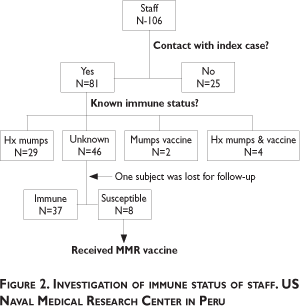
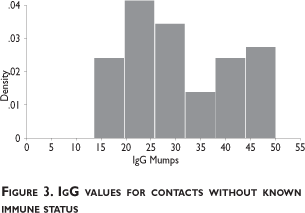
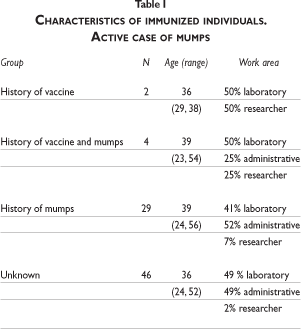
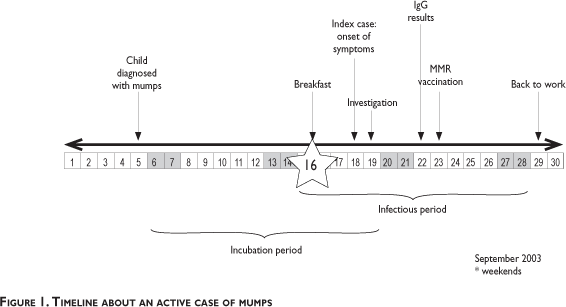
<body><![CDATA[<p><font face="Verdana, Arial, Helvetica, sans-serif" size="2">A retrospective    cohort study was conducted. All the staff completed a questionnaire regarding    their exposure to the index case through the entire contagious period. The period    of transmission was calculated to be from September 15<sup>th</sup>-28<sup>th</sup>,    from three days before symptoms appeared to approximately nine days after. Personnel    that were identified as contacts of the index case were asked about their prior    history of clinical mumps. Ten cc of whole blood was collected from the contacts    that had not received prior vaccination against mumps or lacked a history of    parotitis, after acquiring their verbal consent. The serum was tested for IgG    using EIAgen Mumps IgG, Biochem Immunosystems, Italy. The cut-off point was    set at titers &gt; 20.0 U/mL.</font></p>     <p><font face="Verdana, Arial, Helvetica, sans-serif" size="2">The Naval Medical    Research Center Institutional Review Board determined that the investigation    (PJT-24) did not meet the definition of human subject research, since it was    framed as an outbreak investigation. Nonetheless, staff provided their verbal    consent before having blood drawn and answering the questionnaire.</font></p>     <p>&nbsp;</p>     <p><font face="Verdana, Arial, Helvetica, sans-serif" size="3"><b>Results</b></font></p>     <p><font face="Verdana, Arial, Helvetica, sans-serif" size="2">The index case    was identified and confirmed by the occupational health physician at the facility.    The case had right-sided parotitis and reported having fever and malaise the    previous day (September 18<sup>th</sup>). She apparently acquired the disease    from her son who was clinically diagnosed with mumps 14 days earlier (September    5<sup>th</sup>). To prevent secondary transmission, the technician was dismissed    from work until September 29<sup>th</sup>. All the staff present at NMRCD (n=106)    were asked if they had had contact with the case from September 15<sup>th</sup>    to the day of the investigation, September 19<sup>th</sup>. Eighty-one staff    members (77%) had contact with the index case during a fund raising breakfast    on September 16<sup>th</sup>, including two pregnant women. The index case had    served food during the breakfast. The timeline for these events is shown in    <a href="#fig1">figure 1</a>.</font></p>     <p><a name="fig1"></a></p>     <p>&nbsp;</p>     <p align="center"><img src="/img/revistas/spm/v51n1/08f1.gif"></p>     <p>&nbsp;</p>     <p><font face="Verdana, Arial, Helvetica, sans-serif" size="2">Among the contacts    of the index case, 46 did not have a history of the disease or of receiving    the vaccine (see <a href="#fig2">figure 2</a>). With the exception of one subject    who was lost for follow-up, forty-five potentially susceptible staff members    were tested for immunity via IgG antibody titers. Thirty-eight contacts had    titers over 20.0 U/mL, confirming previous infection and immunity. This group    with unknown pre-existing immunity included one pregnant subject; the other    pregnant woman had a previous history of mumps. Thus, within the contact group,    a total of 72/81 (89%) were probably immune and 8/81 (10%) na&iuml;ve. The characteristics    for the group of immunized individuals, personnel with a history of mumps and    people of unknown immune status are shown in <a href="#tab1">table I</a>.</font></p>     ]]></body>
<body><![CDATA[<p><a name="fig2"></a></p>     <p>&nbsp;</p>     <p align="center"><img src="/img/revistas/spm/v51n1/08f2.gif"></p>     <p>&nbsp;</p>     <p>&nbsp;</p>     <p align="center"><img src="/img/revistas/spm/v51n1/08f3.gif"></p>     <p>&nbsp;</p>     <p><a name="tab1"></a></p>     <p>&nbsp;</p>     <p align="center"><img src="/img/revistas/spm/v51n1/08t1.gif"></p>     ]]></body>
<body><![CDATA[<p>&nbsp;</p>     <p><font face="Verdana, Arial, Helvetica, sans-serif" size="2">The na&iuml;ve    group was mostly women (5/8, 63%), and mostly from administrative positions    (6/8, 75%); all were offered MMR vaccine on September 23<sup>rd</sup>, after    receiving counseling from NMRCD's occupational health physician.</font></p>     <p><font face="Verdana, Arial, Helvetica, sans-serif" size="2">No secondary cases    of mumps were observed in NMRCD personnel and the NHP colony of <i>Aotus nancymae</i>    was not affected.</font></p>     <p>&nbsp;</p>     <p><font face="Verdana, Arial, Helvetica, sans-serif" size="3"><b>Discussion</b></font></p>     <p><font face="Verdana, Arial, Helvetica, sans-serif" size="2">The occurrence    of this mumps case acquires more relevance because in the past few years, numerous    outbreaks of mumps have been reported in the literature, even among supposedly    well immunized populations.<sup>6,7</sup> The reason for these outbreaks is    likely multi-factorial, including waning immunity, vaccine failure and most    importantly, decreasing vaccine coverage of susceptible populations. Although    the benefits and safety of the MMR vaccine have been well documented, recently    there has been a movement among certain segments of the lay public to refuse    to vaccinate their children for fear of them developing autism.<sup>8-10</sup>    This supposition has been soundly refuted in the medical literature, but the    belief persists among certain segments of the population and has led to at least    one well documented outbreak in Iowa, USA.<sup>11</sup></font></p>     <p><font face="Verdana, Arial, Helvetica, sans-serif" size="2">In the case at    hand, the effect of the control measures cannot be definitively confirmed. The    literature reports that approximately a third of all cases of mumps are asymptomatic.<sup>12</sup>    Therefore, the lack of secondary cases may be due to the interventions, lower    transmission to secondary cases, subclinical infections that were undetected    or a large cohort of personnel with high levels of pre-existing immunity. Applying    the herd immunity concept to such a small population has limitations, but 88%    of the exposed population (71/80) were found to be immune, which is similar    to the calculated threshold for herd immunity for mumps ranging from 86-92%.<sup>12,    13</sup> Additionally, the effectiveness of one dose of vaccine reported during    outbreaks in other settings has been calculated to be between 65 and 87.8%.    <sup>7, 13, 14</sup></font></p>     <p><font face="Verdana, Arial, Helvetica, sans-serif" size="2">The uncertainty    surrounding the immune status of laboratory personnel generated much personal    concern, missed work and expense. The value of worry is impossible to calculate,    but as a rough estimate, the actual costs of having personnel on sick leave,    of undertaking the investigation (occupational health personnel, testing, specimen    handling, etc.) and of the control measures (vaccination) totaled US$ 2421.    If the animal facility had been affected, the costs would have increased to    US$ 142,429, just to replace the NHP colony, with additional costs of animal    disposal and the priceless months of research lost. On the other hand, the cost    of vaccinating every person at the laboratory when they were first hired would    have been less than US$6 for each individual, for a total of US$ 624 for the    whole 106 staff members. Finally, because this was not (and still is not) a    reportable disease in Peru, it was not possible to elucidate the situation in    the community.</font></p>     <p><font face="Verdana, Arial, Helvetica, sans-serif" size="2">The World Health    Organization (WHO) recommends mumps immunization in countries with well established    vaccination programs which can maintain a high level of vaccination coverage.    In the research facility, vaccinating all the personnel (n=106) would have cost    US$ 624 plus the expenses of application and follow up. This approach, although    initially less expensive, was not chosen, as it would require close follow up    of all the staff and continued state of alert and concern among the personnel.    Additionally, it would not help determine if the laboratory animals were being    exposed to further risk by allowing potentially infectious individuals in the    facility, since immunity could not be ensured through immunization in a potential    incubation period.</font></p>     <p><font face="Verdana, Arial, Helvetica, sans-serif" size="2">Very limited data    are available regarding the impact of an outbreak of mumps in the developing    world, let alone a research facility located there. It can be concluded that    the case study presented herein uses this setting to underscore the potential    hazards of decreasing vaccine coverage in the United States or other developed    countries. In addition, mumps and other vaccine preventable diseases should    be high priorities for populations where vaccine coverage is low and there is    potential for outbreaks with significant morbidity among humans and possibly    non-human primates.</font></p>     ]]></body>
<body><![CDATA[<p><font face="Verdana, Arial, Helvetica, sans-serif" size="2">Disclaimer: The    views expressed in this article are those of the authors and do not necessarily    reflect the official policy or position of the Department of the Navy, Department    of Defense, nor the U.S. Government.</font></p>     <p><font face="Verdana, Arial, Helvetica, sans-serif" size="2">Source of support:    This work was funded by DoD-GEIS and supported by work unit number 847705 82000    25GB B0016.</font></p>     <p><font face="Verdana, Arial, Helvetica, sans-serif" size="2">IRB statement:    The Naval Medical Research Center Institutional Review Board determined the    investigation (PJT-24) did not meet the definition of human subject research.</font></p>     <p><font face="Verdana, Arial, Helvetica, sans-serif" size="2">Copyright statement:    The authors are military service members and employees of the U.S. Government.    This work was prepared as part of their official duties. Title 17 U.S.C. &sect;105    provides that "Copyright protection under this title is not available for any    work of the United States Government." Title 17 U.S.C. &sect;101 defines U.S.    Government work as a work prepared by a military service member or employee    of the U.S. Government as part of that person's official duties.</font></p>     <p><font face="Verdana, Arial, Helvetica, sans-serif" size="2">Conflict of interest:    the authors declare no conflict of interest or significant financial interest    to disclose/ related to the entity funding the project or any other institution    involved with the investigation</font></p>     <p><font face="Verdana, Arial, Helvetica, sans-serif" size="2"><b>Acknowledgements</b></font></p>     <p><font face="Verdana, Arial, Helvetica, sans-serif" size="2">The authors would    like to thank the personnel from NMRCD who patiently participated in this investigation,    especially the index case and her family.</font></p>     <p>&nbsp;</p>     <p><font face="Verdana, Arial, Helvetica, sans-serif" size="3"><b>References</b></font></p>     <!-- ref --><p><font face="Verdana, Arial, Helvetica, sans-serif" size="2">1. Saika S, Kidokoro    M, Ohkawa T, Aoki A, Suzuki, K. Pathogenicity of mumps virus in the marmoset.    J Med Virol 2002; 66(1): 115-122.</font>&nbsp;&nbsp;&nbsp;&nbsp;&nbsp;&nbsp;&nbsp;&nbsp;[&#160;<a href="javascript:void(0);" onclick="javascript: window.open('/scielo.php?script=sci_nlinks&ref=9271367&pid=S0036-3634200900010000800001&lng=','','width=640,height=500,resizable=yes,scrollbars=1,menubar=yes,');">Links</a>&#160;]<!-- end-ref --><!-- ref --><p><font face="Verdana, Arial, Helvetica, sans-serif" size="2">2. Johnson CD,    Goodpasture EW. Experimental immunity to the virus of mumps in monkeys. Am J    Epidemiol 1936; 23(2):329-339.</font>&nbsp;&nbsp;&nbsp;&nbsp;&nbsp;&nbsp;&nbsp;&nbsp;[&#160;<a href="javascript:void(0);" onclick="javascript: window.open('/scielo.php?script=sci_nlinks&ref=9271368&pid=S0036-3634200900010000800002&lng=','','width=640,height=500,resizable=yes,scrollbars=1,menubar=yes,');">Links</a>&#160;]<!-- end-ref --><!-- ref --><p><font face="Verdana, Arial, Helvetica, sans-serif" size="2">3. Findlay GM,    Clarke LP. Experimental production of mumps in monkeys. Brit J Exp Pathol 1934;    15:309-313.</font>&nbsp;&nbsp;&nbsp;&nbsp;&nbsp;&nbsp;&nbsp;&nbsp;[&#160;<a href="javascript:void(0);" onclick="javascript: window.open('/scielo.php?script=sci_nlinks&ref=9271369&pid=S0036-3634200900010000800003&lng=','','width=640,height=500,resizable=yes,scrollbars=1,menubar=yes,');">Links</a>&#160;]<!-- end-ref --><!-- ref --><p><font face="Verdana, Arial, Helvetica, sans-serif" size="2">4. Enders JF, Kane    LW, Cohen S, Levens J. Immunity in mumps: I. Experiments with monkeys (Macacus    mulatta). The development of complement-fixing antibody following infection    and experiments on immunization by means of inactivated virus and convalescent    human serum. J Exp Med 1945; 81(1): 93-117.</font>&nbsp;&nbsp;&nbsp;&nbsp;&nbsp;&nbsp;&nbsp;&nbsp;[&#160;<a href="javascript:void(0);" onclick="javascript: window.open('/scielo.php?script=sci_nlinks&ref=9271370&pid=S0036-3634200900010000800004&lng=','','width=640,height=500,resizable=yes,scrollbars=1,menubar=yes,');">Links</a>&#160;]<!-- end-ref --><!-- ref --><p><font face="Verdana, Arial, Helvetica, sans-serif" size="2">5. Flanagan TD,    Andrada JA, Barron AL, Witebsky E. Response to experimental infection with mumps    virus in rhesus monkeys. Infect Immun 1971; 3(5):642-647.</font>&nbsp;&nbsp;&nbsp;&nbsp;&nbsp;&nbsp;&nbsp;&nbsp;[&#160;<a href="javascript:void(0);" onclick="javascript: window.open('/scielo.php?script=sci_nlinks&ref=9271371&pid=S0036-3634200900010000800005&lng=','','width=640,height=500,resizable=yes,scrollbars=1,menubar=yes,');">Links</a>&#160;]<!-- end-ref --><!-- ref --><p><font face="Verdana, Arial, Helvetica, sans-serif" size="2">6. Center for Disease    Control and Prevention. Mumps outbreak at a summer camp&#151;New York, 2005.    MMWR Morb Mortal Wkly Rep 2006; 55(7): 175-177.</font>&nbsp;&nbsp;&nbsp;&nbsp;&nbsp;&nbsp;&nbsp;&nbsp;[&#160;<a href="javascript:void(0);" onclick="javascript: window.open('/scielo.php?script=sci_nlinks&ref=9271372&pid=S0036-3634200900010000800006&lng=','','width=640,height=500,resizable=yes,scrollbars=1,menubar=yes,');">Links</a>&#160;]<!-- end-ref --><!-- ref --><p><font face="Verdana, Arial, Helvetica, sans-serif" size="2">7. Sartorius B,    Penttinen P, Nilsson J, Johansen K, Jonsson K, Arneborn M, <i>et al</i>. An    outbreak of mumps in Sweden, February-April 2004. Euro Surveill 2005; 10(9):    191-193.</font>&nbsp;&nbsp;&nbsp;&nbsp;&nbsp;&nbsp;&nbsp;&nbsp;[&#160;<a href="javascript:void(0);" onclick="javascript: window.open('/scielo.php?script=sci_nlinks&ref=9271373&pid=S0036-3634200900010000800007&lng=','','width=640,height=500,resizable=yes,scrollbars=1,menubar=yes,');">Links</a>&#160;]<!-- end-ref --><!-- ref --><p><font face="Verdana, Arial, Helvetica, sans-serif" size="2">8. Caplan CE. Mumps    in the era of vaccines. CMAJ 1999; 160(6):865-866.</font>&nbsp;&nbsp;&nbsp;&nbsp;&nbsp;&nbsp;&nbsp;&nbsp;[&#160;<a href="javascript:void(0);" onclick="javascript: window.open('/scielo.php?script=sci_nlinks&ref=9271374&pid=S0036-3634200900010000800008&lng=','','width=640,height=500,resizable=yes,scrollbars=1,menubar=yes,');">Links</a>&#160;]<!-- end-ref --><!-- ref --><p><font face="Verdana, Arial, Helvetica, sans-serif" size="2">9. Wilson TR, Fishbein    D B, Ellis P A, Edlavitch S A. The impact of a school entry law on adolescent    immunization rates. J Adolesc Health 2005; 37(6):511-516.</font>&nbsp;&nbsp;&nbsp;&nbsp;&nbsp;&nbsp;&nbsp;&nbsp;[&#160;<a href="javascript:void(0);" onclick="javascript: window.open('/scielo.php?script=sci_nlinks&ref=9271375&pid=S0036-3634200900010000800009&lng=','','width=640,height=500,resizable=yes,scrollbars=1,menubar=yes,');">Links</a>&#160;]<!-- end-ref --><!-- ref --><p><font face="Verdana, Arial, Helvetica, sans-serif" size="2">10. Clements C,    Ratzan S. Misled and confused? Telling the public about MMR vaccine safety.    Measles, mumps, and rubella. J Med Ethics 2003; 29(1): 22-26.</font>&nbsp;&nbsp;&nbsp;&nbsp;&nbsp;&nbsp;&nbsp;&nbsp;[&#160;<a href="javascript:void(0);" onclick="javascript: window.open('/scielo.php?script=sci_nlinks&ref=9271376&pid=S0036-3634200900010000800010&lng=','','width=640,height=500,resizable=yes,scrollbars=1,menubar=yes,');">Links</a>&#160;]<!-- end-ref --><!-- ref --><p><font face="Verdana, Arial, Helvetica, sans-serif" size="2">11. Center for    Disease Control and Prevention. Mumps epidemic&#151;Iowa, 2006. MMWR Morb Mortal    Wkly Rep 2006; 55(13): 366-368.</font>&nbsp;&nbsp;&nbsp;&nbsp;&nbsp;&nbsp;&nbsp;&nbsp;[&#160;<a href="javascript:void(0);" onclick="javascript: window.open('/scielo.php?script=sci_nlinks&ref=9271377&pid=S0036-3634200900010000800011&lng=','','width=640,height=500,resizable=yes,scrollbars=1,menubar=yes,');">Links</a>&#160;]<!-- end-ref --><!-- ref --><p><font face="Verdana, Arial, Helvetica, sans-serif" size="2">12. Anderson RM,    Crombie JA, Grenfell BT. The epidemiology of mumps in the UK: a preliminary    study of virus transmission, herd immunity and the potential impact of immunization.    Epidemiol Infect 1987; 99(1): 65-84.</font>&nbsp;&nbsp;&nbsp;&nbsp;&nbsp;&nbsp;&nbsp;&nbsp;[&#160;<a href="javascript:void(0);" onclick="javascript: window.open('/scielo.php?script=sci_nlinks&ref=9271378&pid=S0036-3634200900010000800012&lng=','','width=640,height=500,resizable=yes,scrollbars=1,menubar=yes,');">Links</a>&#160;]<!-- end-ref --><!-- ref --><p><font face="Verdana, Arial, Helvetica, sans-serif" size="2">13. Cohen CWJ,    Savage EJ, Glynn JR, Choi Y, Andrews N, <i>et al</i>. Vaccine effectiveness    estimates, 2004-2005 mumps outbreak, England. Emerg Infect Dis 2007; 13(1).    Available from <a href="http://www.cdc.gov/ncidod/EID/13/1/12.htm" target="_blank">http://www.cdc.gov/ncidod/EID/13/1/12.htm</a></font>&nbsp;&nbsp;&nbsp;&nbsp;&nbsp;&nbsp;&nbsp;&nbsp;[&#160;<a href="javascript:void(0);" onclick="javascript: window.open('/scielo.php?script=sci_nlinks&ref=9271379&pid=S0036-3634200900010000800013&lng=','','width=640,height=500,resizable=yes,scrollbars=1,menubar=yes,');">Links</a>&#160;]<!-- end-ref --><!-- ref --><p><font face="Verdana, Arial, Helvetica, sans-serif" size="2">14. Fernandez-de    la Hoz-Zeitler K, Garcia-Colmenero C, Puchades-Belenguer M J, Verde-Lopez C,    Carpintero-Redondo J L, Alcazar-Casanova F. Mumps epidemic in the health area    of Toledo with immunization intervention. Estimation of vaccine effectiveness.    Med Clin (Barc) 1997; 108(5): 175-179.</font>&nbsp;&nbsp;&nbsp;&nbsp;&nbsp;&nbsp;&nbsp;&nbsp;[&#160;<a href="javascript:void(0);" onclick="javascript: window.open('/scielo.php?script=sci_nlinks&ref=9271380&pid=S0036-3634200900010000800014&lng=','','width=640,height=500,resizable=yes,scrollbars=1,menubar=yes,');">Links</a>&#160;]<!-- end-ref --><p>&nbsp;</p>     <p>&nbsp;</p>     <p><font face="Verdana, Arial, Helvetica, sans-serif" size="2">Received on: November    22, 2007    <br>   Accepted on: August 25, 2008</font></p>     <p>&nbsp;</p>     <p>&nbsp;</p>     <p><font face="Verdana, Arial, Helvetica, sans-serif" size="2">Address reprint    requests to: BSC Gabriela Salm&oacute;n Mulanovich. Centro M&eacute;dico Naval-NMRCD.    Av. Venezuela cdra. 36 s/n, Bellavista, Callao 2. Per&uacute;.    ]]></body>
<body><![CDATA[<br>   E-mail: <a href="mailto:gabriela.salmon@med.navy.mil">gabriela.salmon@med.navy.mil</a></font></p>      ]]></body><back>
<ref-list>
<ref id="B1">
<label>1</label><nlm-citation citation-type="journal">
<person-group person-group-type="author">
<name>
<surname><![CDATA[Saika]]></surname>
<given-names><![CDATA[S]]></given-names>
</name>
<name>
<surname><![CDATA[Kidokoro]]></surname>
<given-names><![CDATA[M]]></given-names>
</name>
<name>
<surname><![CDATA[Ohkawa]]></surname>
<given-names><![CDATA[T]]></given-names>
</name>
<name>
<surname><![CDATA[Aoki]]></surname>
<given-names><![CDATA[A]]></given-names>
</name>
<name>
<surname><![CDATA[Suzuki]]></surname>
<given-names><![CDATA[K.]]></given-names>
</name>
</person-group>
<article-title xml:lang="en"><![CDATA[Pathogenicity of mumps virus in the marmoset]]></article-title>
<source><![CDATA[J Med Virol]]></source>
<year>2002</year>
<volume>66</volume>
<numero>1</numero>
<issue>1</issue>
<page-range>115-122</page-range></nlm-citation>
</ref>
<ref id="B2">
<label>2</label><nlm-citation citation-type="journal">
<person-group person-group-type="author">
<name>
<surname><![CDATA[Johnson]]></surname>
<given-names><![CDATA[CD]]></given-names>
</name>
<name>
<surname><![CDATA[Goodpasture]]></surname>
<given-names><![CDATA[EW]]></given-names>
</name>
</person-group>
<article-title xml:lang="en"><![CDATA[Experimental immunity to the virus of mumps in monkeys]]></article-title>
<source><![CDATA[Am J Epidemiol]]></source>
<year>1936</year>
<volume>23</volume>
<numero>2</numero>
<issue>2</issue>
<page-range>329-339</page-range></nlm-citation>
</ref>
<ref id="B3">
<label>3</label><nlm-citation citation-type="journal">
<person-group person-group-type="author">
<name>
<surname><![CDATA[Findlay]]></surname>
<given-names><![CDATA[GM]]></given-names>
</name>
<name>
<surname><![CDATA[Clarke]]></surname>
<given-names><![CDATA[LP]]></given-names>
</name>
</person-group>
<article-title xml:lang="en"><![CDATA[Experimental production of mumps in monkeys]]></article-title>
<source><![CDATA[Brit J Exp Pathol]]></source>
<year>1934</year>
<volume>15</volume>
<page-range>309-313</page-range></nlm-citation>
</ref>
<ref id="B4">
<label>4</label><nlm-citation citation-type="journal">
<person-group person-group-type="author">
<name>
<surname><![CDATA[Enders]]></surname>
<given-names><![CDATA[JF]]></given-names>
</name>
<name>
<surname><![CDATA[Kane]]></surname>
<given-names><![CDATA[LW]]></given-names>
</name>
<name>
<surname><![CDATA[Cohen]]></surname>
<given-names><![CDATA[S]]></given-names>
</name>
<name>
<surname><![CDATA[Levens]]></surname>
<given-names><![CDATA[J]]></given-names>
</name>
</person-group>
<article-title xml:lang="en"><![CDATA[Immunity in mumps: I. Experiments with monkeys (Macacus mulatta). The development of complement-fixing antibody following infection and experiments on immunization by means of inactivated virus and convalescent human serum]]></article-title>
<source><![CDATA[J Exp Med]]></source>
<year>1945</year>
<volume>81</volume>
<numero>1</numero>
<issue>1</issue>
<page-range>93-117</page-range></nlm-citation>
</ref>
<ref id="B5">
<label>5</label><nlm-citation citation-type="journal">
<person-group person-group-type="author">
<name>
<surname><![CDATA[Flanagan]]></surname>
<given-names><![CDATA[TD]]></given-names>
</name>
<name>
<surname><![CDATA[Andrada]]></surname>
<given-names><![CDATA[JA]]></given-names>
</name>
<name>
<surname><![CDATA[Barron]]></surname>
<given-names><![CDATA[AL]]></given-names>
</name>
<name>
<surname><![CDATA[Witebsky]]></surname>
<given-names><![CDATA[E]]></given-names>
</name>
</person-group>
<article-title xml:lang="en"><![CDATA[Response to experimental infection with mumps virus in rhesus monkeys]]></article-title>
<source><![CDATA[Infect Immun]]></source>
<year>1971</year>
<volume>3</volume>
<numero>5</numero>
<issue>5</issue>
<page-range>642-647</page-range></nlm-citation>
</ref>
<ref id="B6">
<label>6</label><nlm-citation citation-type="journal">
<collab>Center for Disease Control and Prevention</collab>
<article-title xml:lang="en"><![CDATA[Mumps outbreak at a summer camp-New York, 2005]]></article-title>
<source><![CDATA[MMWR Morb Mortal Wkly Rep]]></source>
<year>2006</year>
<volume>55</volume>
<numero>7</numero>
<issue>7</issue>
<page-range>175-177</page-range></nlm-citation>
</ref>
<ref id="B7">
<label>7</label><nlm-citation citation-type="journal">
<person-group person-group-type="author">
<name>
<surname><![CDATA[Sartorius]]></surname>
<given-names><![CDATA[B]]></given-names>
</name>
<name>
<surname><![CDATA[Penttinen]]></surname>
<given-names><![CDATA[P]]></given-names>
</name>
<name>
<surname><![CDATA[Nilsson]]></surname>
<given-names><![CDATA[J]]></given-names>
</name>
<name>
<surname><![CDATA[Johansen]]></surname>
<given-names><![CDATA[K]]></given-names>
</name>
<name>
<surname><![CDATA[Jonsson]]></surname>
<given-names><![CDATA[K]]></given-names>
</name>
<name>
<surname><![CDATA[Arneborn]]></surname>
<given-names><![CDATA[M]]></given-names>
</name>
</person-group>
<article-title xml:lang="en"><![CDATA[An outbreak of mumps in Sweden, February-April 2004]]></article-title>
<source><![CDATA[Euro Surveill]]></source>
<year>2005</year>
<volume>10</volume>
<numero>9</numero>
<issue>9</issue>
<page-range>191-193</page-range></nlm-citation>
</ref>
<ref id="B8">
<label>8</label><nlm-citation citation-type="journal">
<person-group person-group-type="author">
<name>
<surname><![CDATA[Caplan]]></surname>
<given-names><![CDATA[CE]]></given-names>
</name>
</person-group>
<article-title xml:lang="en"><![CDATA[Mumps in the era of vaccines]]></article-title>
<source><![CDATA[CMAJ]]></source>
<year>1999</year>
<volume>160</volume>
<numero>6</numero>
<issue>6</issue>
<page-range>865-866</page-range></nlm-citation>
</ref>
<ref id="B9">
<label>9</label><nlm-citation citation-type="journal">
<person-group person-group-type="author">
<name>
<surname><![CDATA[Wilson]]></surname>
<given-names><![CDATA[TR]]></given-names>
</name>
<name>
<surname><![CDATA[Fishbein D]]></surname>
<given-names><![CDATA[B]]></given-names>
</name>
<name>
<surname><![CDATA[Ellis P]]></surname>
<given-names><![CDATA[A]]></given-names>
</name>
<name>
<surname><![CDATA[Edlavitch S]]></surname>
<given-names><![CDATA[A]]></given-names>
</name>
</person-group>
<article-title xml:lang="en"><![CDATA[The impact of a school entry law on adolescent immunization rates]]></article-title>
<source><![CDATA[J Adolesc Health]]></source>
<year>2005</year>
<volume>37</volume>
<numero>6</numero>
<issue>6</issue>
<page-range>511-516</page-range></nlm-citation>
</ref>
<ref id="B10">
<label>10</label><nlm-citation citation-type="journal">
<person-group person-group-type="author">
<name>
<surname><![CDATA[Clements]]></surname>
<given-names><![CDATA[C]]></given-names>
</name>
<name>
<surname><![CDATA[Ratzan]]></surname>
<given-names><![CDATA[S]]></given-names>
</name>
</person-group>
<article-title xml:lang="en"><![CDATA[Misled and confused?: Telling the public about MMR vaccine safety. Measles, mumps, and rubella]]></article-title>
<source><![CDATA[J Med Ethics]]></source>
<year>2003</year>
<volume>29</volume>
<numero>1</numero>
<issue>1</issue>
<page-range>22-26</page-range></nlm-citation>
</ref>
<ref id="B11">
<label>11</label><nlm-citation citation-type="journal">
<collab>Center for Disease Control and Prevention</collab>
<article-title xml:lang="en"><![CDATA[Mumps epidemic-Iowa, 2006]]></article-title>
<source><![CDATA[MMWR Morb Mortal Wkly Rep]]></source>
<year>2006</year>
<volume>55</volume>
<numero>13</numero>
<issue>13</issue>
<page-range>366-368</page-range></nlm-citation>
</ref>
<ref id="B12">
<label>12</label><nlm-citation citation-type="journal">
<person-group person-group-type="author">
<name>
<surname><![CDATA[Anderson]]></surname>
<given-names><![CDATA[RM]]></given-names>
</name>
<name>
<surname><![CDATA[Crombie]]></surname>
<given-names><![CDATA[JA]]></given-names>
</name>
<name>
<surname><![CDATA[Grenfell]]></surname>
<given-names><![CDATA[BT]]></given-names>
</name>
</person-group>
<article-title xml:lang="en"><![CDATA[The epidemiology of mumps in the UK: a preliminary study of virus transmission, herd immunity and the potential impact of immunization]]></article-title>
<source><![CDATA[Epidemiol Infect]]></source>
<year>1987</year>
<volume>99</volume>
<numero>1</numero>
<issue>1</issue>
<page-range>65-84</page-range></nlm-citation>
</ref>
<ref id="B13">
<label>13</label><nlm-citation citation-type="journal">
<person-group person-group-type="author">
<name>
<surname><![CDATA[Cohen]]></surname>
<given-names><![CDATA[CWJ]]></given-names>
</name>
<name>
<surname><![CDATA[Savage]]></surname>
<given-names><![CDATA[EJ]]></given-names>
</name>
<name>
<surname><![CDATA[Glynn]]></surname>
<given-names><![CDATA[JR]]></given-names>
</name>
<name>
<surname><![CDATA[Choi]]></surname>
<given-names><![CDATA[Y]]></given-names>
</name>
<name>
<surname><![CDATA[Andrews]]></surname>
<given-names><![CDATA[N]]></given-names>
</name>
</person-group>
<article-title xml:lang="en"><![CDATA[Vaccine effectiveness estimates, 2004-2005 mumps outbreak, England]]></article-title>
<source><![CDATA[Emerg Infect Dis]]></source>
<year>2007</year>
<volume>13</volume>
<numero>1</numero>
<issue>1</issue>
</nlm-citation>
</ref>
<ref id="B14">
<label>14</label><nlm-citation citation-type="journal">
<person-group person-group-type="author">
<name>
<surname><![CDATA[Fernandez-de la Hoz-Zeitler]]></surname>
<given-names><![CDATA[K.]]></given-names>
</name>
<name>
<surname><![CDATA[Garcia-Colmenero]]></surname>
<given-names><![CDATA[C.]]></given-names>
</name>
<name>
<surname><![CDATA[Puchades-Belenguer]]></surname>
<given-names><![CDATA[M J.]]></given-names>
</name>
<name>
<surname><![CDATA[Verde-Lopez]]></surname>
<given-names><![CDATA[C.]]></given-names>
</name>
<name>
<surname><![CDATA[Carpintero-Redondo]]></surname>
<given-names><![CDATA[J L.]]></given-names>
</name>
<name>
<surname><![CDATA[lcazar-Casanova]]></surname>
<given-names><![CDATA[F.]]></given-names>
</name>
</person-group>
<article-title xml:lang="en"><![CDATA[Mumps epidemic in the health area of Toledo with immunization intervention: Estimation of vaccine effectiveness]]></article-title>
<source><![CDATA[Med Clin (Barc)]]></source>
<year>1997</year>
<volume>108</volume>
<numero>5</numero>
<issue>5</issue>
<page-range>175-179</page-range></nlm-citation>
</ref>
</ref-list>
</back>
</article>