<?xml version="1.0" encoding="ISO-8859-1"?><article xmlns:mml="http://www.w3.org/1998/Math/MathML" xmlns:xlink="http://www.w3.org/1999/xlink" xmlns:xsi="http://www.w3.org/2001/XMLSchema-instance">
<front>
<journal-meta>
<journal-id>0036-3634</journal-id>
<journal-title><![CDATA[Salud Pública de México]]></journal-title>
<abbrev-journal-title><![CDATA[Salud pública Méx]]></abbrev-journal-title>
<issn>0036-3634</issn>
<publisher>
<publisher-name><![CDATA[Instituto Nacional de Salud Pública]]></publisher-name>
</publisher>
</journal-meta>
<article-meta>
<article-id>S0036-36342008000700008</article-id>
<title-group>
<article-title xml:lang="en"><![CDATA[Traffic related deaths in Nuevo Leon, Mexico: causes and associated factors]]></article-title>
<article-title xml:lang="es"><![CDATA[Muertes relacionadas con accidentes viales en Nuevo León, México: causas y factores asociados]]></article-title>
</title-group>
<contrib-group>
<contrib contrib-type="author">
<name>
<surname><![CDATA[Arreola-Rissa]]></surname>
<given-names><![CDATA[Carlos]]></given-names>
</name>
<xref ref-type="aff" rid="A01"/>
</contrib>
<contrib contrib-type="author">
<name>
<surname><![CDATA[Santos-Guzmán]]></surname>
<given-names><![CDATA[Jesús]]></given-names>
</name>
<xref ref-type="aff" rid="A01"/>
</contrib>
<contrib contrib-type="author">
<name>
<surname><![CDATA[Esquivel-Guzmán]]></surname>
<given-names><![CDATA[Adol]]></given-names>
</name>
<xref ref-type="aff" rid="A01"/>
</contrib>
<contrib contrib-type="author">
<name>
<surname><![CDATA[Mock]]></surname>
<given-names><![CDATA[Charles N]]></given-names>
</name>
<xref ref-type="aff" rid="A01"/>
</contrib>
</contrib-group>
<aff id="A01">
<institution><![CDATA[,Escuela de Medicina Instituto Tecnológico y de Estudios Superiores de Monterrey ]]></institution>
<addr-line><![CDATA[Nuevo León ]]></addr-line>
<country>México</country>
</aff>
<aff id="A02">
<institution><![CDATA[,University of Washington  ]]></institution>
<addr-line><![CDATA[Seattle WA]]></addr-line>
<country>EUA</country>
</aff>
<pub-date pub-type="pub">
<day>00</day>
<month>00</month>
<year>2008</year>
</pub-date>
<pub-date pub-type="epub">
<day>00</day>
<month>00</month>
<year>2008</year>
</pub-date>
<volume>50</volume>
<fpage>s48</fpage>
<lpage>s54</lpage>
<copyright-statement/>
<copyright-year/>
<self-uri xlink:href="http://www.scielo.org.mx/scielo.php?script=sci_arttext&amp;pid=S0036-36342008000700008&amp;lng=en&amp;nrm=iso"></self-uri><self-uri xlink:href="http://www.scielo.org.mx/scielo.php?script=sci_abstract&amp;pid=S0036-36342008000700008&amp;lng=en&amp;nrm=iso"></self-uri><self-uri xlink:href="http://www.scielo.org.mx/scielo.php?script=sci_pdf&amp;pid=S0036-36342008000700008&amp;lng=en&amp;nrm=iso"></self-uri><abstract abstract-type="short" xml:lang="en"><p><![CDATA[OBJECTIVE: The effects of alcohol on mortality due to motor vehicle accidents was studied. MATERIAL AND METHODS: During the first semester of 2003, a sample of 243 fatality victims of traffic-related accidents and their blood alcohol levels were analyzed in the state of Nuevo Leon, Mexico. The age-adjusted mortality rate for traffic accidents was 8.9/100000 pop. (13.2 for males and 3.21 for females, per 100000). Fatal accidents were more common in the Metropolitan Area (MA). RESULTS: Fatalities were four times greater in males and the mean age was 34.7±18.2 years. Blood alcohol was detected in almost half of the victims who were drivers of the vehicles; the other cases of fatalities may be associated with road/car condition, weather and other factors. CONCLUSIONS: Alcohol intoxication levels were primarily associated with male drivers ages 16 to 45 (p=0.029); levels increased with age. In females, alcohol played a lesser role, affecting mostly ages 31 to 45 y (p=0.055).]]></p></abstract>
<abstract abstract-type="short" xml:lang="es"><p><![CDATA[OBJETIVO:Durante seis meses de 2003 se estudió el efecto del alcohol en 243 víctimas fatales relacionadas con accidentes viales del estado de Nuevo León, México. MATERIAL Y MÉTODOS: Se realizó autopsia en todos los casos y se determinó el nivel de alcohol en sangre. La tasa de mortalidad ajustada por edad para accidentes viales fue 8.9/100000 hab. (13.2 para hombres y 3.21 para mujeres, por 100000). Accidentes fatales fueron comunes en el Área Metropolitana. RESULTADOS: Las fatalidades fueron cuatro veces mayores en hombres y la edad promedio fue de 34.7±18.2 años. Se detectaron niveles de alcohol en sangre en casi la mitad de los conductores que fueron víctimas; los otros casos de fatalidad fueron asociados con las condiciones del camino, el auto, factores meteorológicos, entre otros. CONCLUSIONES: Los niveles de intoxicación alcohólica fueron básicamente con conductores masculinos, de 16-45 años (p=0.029), aumentando con la edad. Entre las mujeres, el alcohol jugó un papel menos preponderante, afectando mayormente las de 31-45 años (p=0.055).]]></p></abstract>
<kwd-group>
<kwd lng="en"><![CDATA[alcohol drinking]]></kwd>
<kwd lng="en"><![CDATA[accidents traffic]]></kwd>
<kwd lng="en"><![CDATA[mortality]]></kwd>
<kwd lng="en"><![CDATA[Mexico]]></kwd>
<kwd lng="es"><![CDATA[consumo de bebidas alcohólicas]]></kwd>
<kwd lng="es"><![CDATA[accidentes de tránsito]]></kwd>
<kwd lng="es"><![CDATA[mortalidad]]></kwd>
<kwd lng="es"><![CDATA[México]]></kwd>
</kwd-group>
</article-meta>
</front><body><![CDATA[ <p align="right"><font face="Verdana" size="2"><b>ART&Iacute;CULO ORIGINAL</b></font></P>     <p>&nbsp;</P>     <p><font face="Verdana" size="4"><b>Traffic related deaths in Nuevo Leon, Mexico:    causes and associated factors</b></font></P>     <p>&nbsp;</P>     <p><font face="Verdana" size="3"><b>Muertes relacionadas con accidentes viales    en Nuevo Le&oacute;n, M&eacute;xico: causas y factores asociados</b></font></P>     <p>&nbsp;</P>     <p>&nbsp;</P>     <p><font face="Verdana" size="2"><b>Carlos Arreola-Rissa, MD<SUP>I</SUP>; Jes&uacute;s    Santos-Guzm&aacute;n, MD, MS<SUP>I</sup>; Adol Esquivel-Guzm&aacute;n, MD<SUP>I</SUP>;    Charles N Mock, MD<SUP>II</sup></b></font></P>     <p><font face="Verdana" size="2"><sup>I</sup>Escuela de Medicina, Instituto Tecnol&oacute;gico    y de Estudios Superiores de Monterrey. Nuevo Le&oacute;n, M&eacute;xico    <br>   <sup>II</sup>University of Washington,    Seattle, WA, EUA</font></P>     ]]></body>
<body><![CDATA[<p>&nbsp;</P>     <p>&nbsp;</P> <HR SIZE="1" NOSHADE>     <p><font face="Verdana" size="2"><b>ABSTRACT </b></font></P>     <p><font face="Verdana" size="2"><B>OBJECTIVE:</b> The effects of alcohol on mortality    due to motor vehicle accidents was studied.    <br>   <B>MATERIAL AND METHODS:</b> During the first semester of 2003, a sample of    243 fatality victims of traffic-related accidents and their blood alcohol levels    were analyzed in the state of Nuevo Leon, Mexico. The age-adjusted mortality    rate for traffic accidents was 8.9/100000 pop. (13.2 for males and 3.21 for    females, per 100000). Fatal accidents were more common in the Metropolitan Area    (MA).    <br>   <B>RESULTS:</b> Fatalities were four times greater in males and the mean age    was 34.7±18.2 years. Blood alcohol was detected in almost half of the victims    who were drivers of the vehicles; the other cases of fatalities may be associated    with road/car condition, weather and other factors.    <br>   <B>CONCLUSIONS:</B> Alcohol intoxication levels were primarily associated with    male drivers ages 16 to 45 (<I>p</I>=0.029); levels increased with age. In females,    alcohol played a lesser role, affecting mostly ages 31 to 45 y (<I>p</I>=0.055).    </font></P>     <p><font face="Verdana" size="2"><b>Key words: </b>alcohol drinking; accidents    traffic; mortality; Mexico</font></P> <hr size="1" NOSHADE>     <p><font face="Verdana" size="2"><b>RESUMEN</b></font></P>     <p><font face="Verdana" size="2"><B>OBJETIVO:</b>Durante seis meses de 2003 se    estudi&oacute; el efecto del alcohol en 243 v&iacute;ctimas fatales relacionadas    con accidentes viales del estado de Nuevo Le&oacute;n, M&eacute;xico.    ]]></body>
<body><![CDATA[<br>   <B>MATERIAL Y M&Eacute;TODOS: </b>Se realiz&oacute; autopsia en todos los casos    y se determin&oacute; el nivel de alcohol en sangre. La tasa de mortalidad ajustada    por edad para accidentes viales fue 8.9/100000 hab. (13.2 para hombres y 3.21    para mujeres, por 100000). Accidentes fatales fueron comunes en el &Aacute;rea    Metropolitana.    <br>   <B>RESULTADOS:</b> Las fatalidades fueron cuatro veces mayores en hombres y    la edad promedio fue de 34.7±18.2 a&ntilde;os. Se detectaron niveles de alcohol    en sangre en casi la mitad de los conductores que fueron v&iacute;ctimas; los    otros casos de fatalidad fueron asociados con las condiciones del camino, el    auto, factores meteorol&oacute;gicos, entre otros.    <br>   <B>CONCLUSIONES: </b>Los niveles de intoxicaci&oacute;n alcoh&oacute;lica fueron    b&aacute;sicamente con conductores masculinos, de 16-45 a&ntilde;os (<I>p=</I>0.029),    aumentando con la edad. Entre las mujeres, el alcohol jug&oacute; un papel menos    preponderante, afectando mayormente las de 31-45 a&ntilde;os (<I>p=</I>0.055).</font></P>     <p><font face="Verdana" size="2"><b>Palabras clave: </b>consumo de bebidas alcoh&oacute;licas;    accidentes de tr&aacute;nsito; mortalidad; M&eacute;xico</font></P> <hr size="1" NOSHADE>     <p>&nbsp;</P>     <p>&nbsp;</P>     <p><font face="Verdana" size="2">In 2002, road traffic accidents accounted for    1 203 000 deaths, representing 2.2% of total deaths worldwide, with Disability    Adjusted Life Years (DALY) of 38 061 000, which represents 2.6% of total DALYs.<SUP>1,2    </SUP>Traffic accidents represent one of the top 10 causes of death and disability    worldwide.<SUP>3</SUP> They are more common in developing countries, where 85%    of traffic-related fatalities in the general population and 96% of children    fatalities occur.<SUP>1</SUP> In 1999, injuries related to road traffic represented    23% of deaths by external causes worldwide and 26.6% in Mexico.<SUP>4</SUP>    In a report of traffic accidents in American countries, Mexico was situated    in a moderate-problem group, along with Argentina, Chile, Costa Rica, Ecuador,    Uruguay and other countries with a mortality rate between 10 and 14.9. In Mexico    during the previous three years, the number of cases had remained constant.    Figure 1 shows the number of deaths related to traffic accidents in Mexico (urban    and suburban areas only), Nuevo Leon State and Monterrey County.<SUP>5</SUP>    In 1998, the national Mexican age-standardized mortality rate per 100 000 pop.    due to transportation accidents was 26.9 for males and 7.1 for females, and    during 1999 it was 27.9 for males and 7.24 for females.<SUP>6</SUP> During 1993,    Veracruz, Chiapas and Nuevo Leon were the states with fewer traffic accidents.<SUP>7</SUP>    </font></P>     <p><font face="Verdana" size="2"> Some of the factors associated with the higher    incidence of deaths due to traffic accidents in Mexico and other developing    nations are poor road conditions, not enough traffic-related law enforcement,    weak drivers education, inadequate pre-hospitalization care, and in many instances    there are a wide variety of factors related to access to quality emergency care.    In many developing countries, including Mexico, much effort had been directed    to the solution of more urgent health problems, such as infectious/hygiene related    disease and nutritional problems, but with progress and time a shift in the    balance between hygiene-related deaths to other diseases (chronic, metabolic,    technology-related deaths) is expected. The objective of the present study is    to review the incidence of traffic-related deaths in Nuevo Leon and to analyze    the role of alcohol as a main risk factor for traffic deaths.</font></P>     <p>&nbsp;</P>     <p><font face="Verdana" size="3"><b>Material and Methods</b></font></P>     ]]></body>
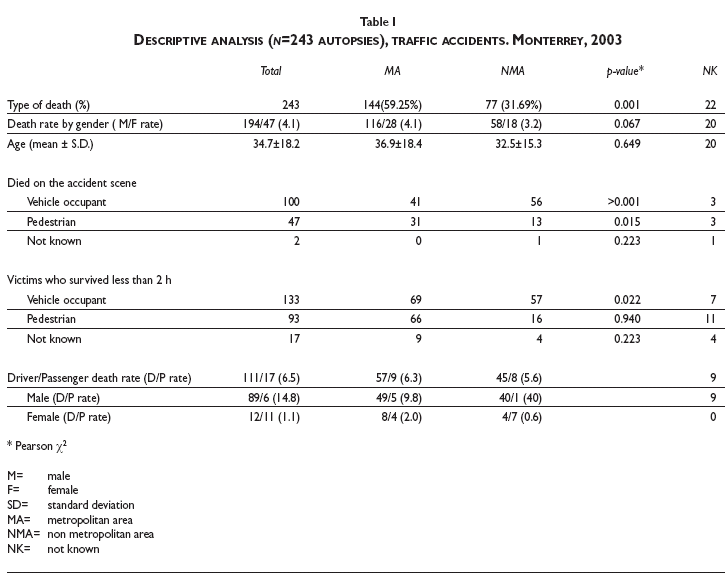
<body><![CDATA[<p><font face="Verdana" size="2">The present study was approved by the Research    and Ethics Committee at the TEC of Monterrey's School of Medicine and the San    Jose de Monterrey Hospital, ITESM. The study includes information on 243 deaths    associated with traffic accidents in the state of Nuevo Leon between February    1, 2003 and July 30, 2003. In order to gather more complete information about    the causes of mortality and the mechanisms of injuries, accident information    was collected and cross-matched from different public and private sources: police    accident reports, death certificates and autopsy reports, ambulance reports    and medical reports from hospitals and clinics. The study was divided into deaths    occurring in the metropolitan area (MA) and those occurring in the non-metropolitan    area (NMA). The city of Monterrey MA (state capital) represented seven counties:    Monterrey, San Nicolas de los Garza, Apodaca, Guadalupe, San Pedro Garza Garcia,    Santa Catarina and General Escobedo. The NMA area represented the rest of the    state and the federal highways. The mechanism for the accidents was classified    according to five categories: collision (frontal, side, and rear end), roll-over,    impact crashes, mixed-mechanism or unknown.</font></P>     <p><font face="Verdana" size="2"> The information collected included the victim's    name, age, gender and birth date, the accident date, time and place, the injury    mechanism and specific data about the accident (type of vehicle, vehicle occupant    location). The autopsy information included the anatomic description of the    injuries and the alcohol blood level. The injuries were classified using the    Injury Severity Score (ISS).<SUP>8</SUP> This score uses a seven-body region    score (skin and soft tissue, head, neck, thorax, abdomen and pelvis, vertebral    spine and extremities) that ranges from 0 to 6 (with number 1 representing a    minor injury and number 6, a fatal lesion). Only the three highest scores were    selected, each value was squared and the sum of the values resulted in the final    score. The final score range was from 3 to 75. The exception to the above procedure    occurred whenever any individual region of the body received a score of 6 (a    fatal lesion), in which case the final score is automatically 75. The alcohol    level in blood samples was measured in the Forensic Medicine Department/ Procuraduria    General Judicial Lab using an analytical spectrometer with a packed column containing    the enzyme alcohol dehydrogenase.</font></P>     <p>&nbsp;</P>     <p><font face="Verdana" size="3"><b>Results</b></font></P>     <p><font face="Verdana" size="2">The specific semiannual mortality rate (February-July    2003) with respect to traffic accidents was 8.9/100 000 pop. (13.2 for males    and 3.21 for females, per 100 000).<SUP>9</SUP> Of the 243 accidents, 144 (59.2%)    occurred in the MA and 77 (31.7%) in the NMA. Almost two-thirds of the deaths,    141 (58%), were vehicle occupants and 99 (40.7%) were pedestrians. The male-to-female    rate (M/F rate) was 4.1 and the mean age of the victims was 34.7±18.2 years.    Most of the victims, 228 (94%), were found dead on the scene or survived less    than two hours once reaching the hospital. Only 14 (5.8%) survived more than    two hours. It was more common to die on the accident scene in non-metropolitan    areas (NMA) compared with metropolitan areas (MA) (<I>p&gt;</I>0.001) (<a href="/img/revistas/spm/v50s1/a08tab01.gif">table    I</a>). The driver-to-passenger ratio was 6.5 for both genders and death was    more common among male drivers; female passengers died more often in the NMA    (<a href="/img/revistas/spm/v50s1/a08tab01.gif">table I</a>).</font></P>     <p><font face="Verdana" size="2"> Of the 243 cases, 149 (61.3%) died at the accident    scene and 94 (38.7%) were transported by ambulance to the hospital. Of the 94    patients that survived, 48.4% were transported to the Instituto Mexicano del    Seguro Social (IMSS) (clinics 4, 8, 17 and 21), 39.8% to the University Hospital    of the Universidad Aut&oacute;noma de Nuevo Leon (UANL), 7.5% to institutional    or public facilities (ISSSTE, PEMEX, Metropolitan Hospital and Green Cross Clinic    in Guadalupe County) and 4.3% to private hospitals.</font></P>     <p><font face="Verdana" size="2"> Of the cases that were transported to the hospital,    83 (88.3%) died in the first three hours, eight died in the first 24 hours after    the accident and only three survived more than 24 hours, but died soon after.    Only three patients survived more than one day, but died before the first week    of convalescence. A legal autopsy was required for all the fatality victims    and most of them were performed at the University Hospital (UANL) or clinic    21(IMSS). The most common vehicle accident mechanism was frontal, side and rear    crashes (47%), followed by roll-overs (22%), impacts (15%) and mixed-mechanisms    (14%) (<a href="#tab02">table II</a>).</font></P>     <p><a name="tab02"></a></P>     <p>&nbsp;</P>     <p align="center"><img src="/img/revistas/spm/v50s1/a08tab02.gif"></P>     ]]></body>
<body><![CDATA[<p>&nbsp;</p>     <p><font face="Verdana" size="2"> The mean ISS score in all locations was 35.2    ±16.2, in MA it was 34.4 ±14.6, and in the NMA, 38.3 ± 18.7, with no significant    differences (<I>p=</I>0.088). The ISS for vehicle occupant fatalities was 34.4    ±16.7 and 36.3 ±15.4 for pedestrian fatalities related with vehicles, with no    significant difference (<I>p=</I>0.349). In the NMA, 71% of the cases occurred    in March, May and June (24, 17 and 14, respectively) and in the MA 63% in June,    July and April (35, 30 and 26 cases, respectively). In both the MA and the NMA,    June was the month with more fatalities, accounting for 49 cases (20.2%). Almost    two-thirds (59.6%) of vehicle occupant fatalities occurred during March, May,    June and July (30, 26, 18, and 28 cases, respectively) and 75.8% of pedestrian    fatalities occurred in February, April, May and June (19, 16, 16 and 24 cases,    respectively). The single day with the most fatalities was Monday (17.2%, 43    fatalities), followed by Sunday (16.1%, 39 fatalities). In the NMA more fatalities    occurred on Sundays, with 12 cases (15.6%), and Mondays, 13 cases (16.9%). In    the MA, 26 fatalities (18.1%) occurred on Sundays and 28 (19.4%) on Mondays.    Vehicle occupant deaths were more common on Mondays and Thursdays, with 26 cases    (18.4%) each, and the pedestrian fatalities were more common on Sundays (19.2%,    19 cases), Saturdays (18.2%, 18 cases) and Mondays (16.2%, 16 cases). The classification    of fatalities according to time period, in order of frequency, is: 74 cases    from 12 noon to 5:59pm, 54 cases from 6:00 pm to 11:59 pm, 50 cases from midnight    to 5:59 am and 35 cases form 6:00am to 11:59am. The distribution of cases by    geographic area (MA or NMA) and type of accident (vehicle occupants or pedestrians)    is as follows: in the MA, the time period with more vehicle occupant fatalities    was midnight to 5:59am, with 27 cases (36.9%), followed by 17 cases (23.3%)    in each of two time periods (noon to 5:59pm and 6:00pm to 11:59pm); from 6:00am    to 11:59am there were eight cases (10.9%). In the NMA, the period with more    vehicle occupant fatalities was noon to 5:59pm, with 25 cases (42.4%), followed    by 15 cases (25.4%) from 6:00pm to 11:59pm, 11 cases (18.6%) from 6:00am to    11:59am and six cases (10.3%) from midnight to 5:59am. In pedestrian fatalities,    the time period with more cases was noon to 5:59pm, with six cases (35.3%) in    the NMA and 26 cases (37.1%) in the MA, followed by the time period 6:00pm to    11:59pm (five cases (29.4%) in the NMA and 17 (24.3%) in the MA). In the period    midnight to 5:50am, there were 15 cases (21.4%) in the MA and two cases (11.8%)    in the NMA. In the 6:00am to 11:59am period there were 12 (17.1%) cases in the    MA and four (23.5%) in the NMA.</font></P>     <p><font face="Verdana" size="2"> <a href="#tab03">Table III</a> shows the injury    mechanisms. Craneoencephalic trauma (CET) (single and combined diagnosis) was    the more common cause of death and was found more commonly among vehicle occupants    as compared with pedestrians fatalities (<I>p=</I>0.0329). CET was reported    more often in MA victims compared with NMA victims, but it was not statistically    significative (<I>p=</I>0.0695). The other diagnoses, in order of frequency    are: hemorrhage, thoracic trauma and abdominal trauma. </font></P>     <p><a name="tab03"></a></P>     <p>&nbsp;</P>     <p align="center"><img src="/img/revistas/spm/v50s1/a08tab03.gif"></P>     <p>&nbsp;</p>     <p><font face="Verdana" size="2"> Alcohol levels were determined from blood samples    of all of the victims (vehicle occupants and pedestrians), and it was detected    in 77 cases (31.68%). The mean alcohol level was 170± 71.7. Seven cases were    reported under alcohol influence (blood alcohol level 80 mg/dl or less), 34    were classified as partial intoxication (blood alcohol concentration between    81 and 180 mg/dl) and 36 cases were complete intoxication (blood alcohol concentration    of 181 mg/dl or more). In 104 cases, the victim was the driver and almost half    of these (54 cases, 49%) were reported as having some level of blood alcohol.    Of these 54 cases, four were under the influence of alcohol and the remaining    50 had intoxication levels over 80 mg/dl. <a href="/img/revistas/spm/v50s1/a08tab04.gif">Table    IV</a> shows the variables associated with alcohol levels. In the MA, there    was a difference in alcohol levels between vehicle occupants and pedestrian    fatalities (<I>p&gt;</I>0.001). More than half of vehicle victims (57%) had    intoxication levels &gt;180 mg/dl (<a href="/img/revistas/spm/v50s1/a08tab04.gif">table IV</a>).</font></P>     <p><font face="Verdana" size="2"> In the MA, collision and roll-over mechanisms    were associated with alcohol intoxication levels and only a few pedestrian victims    showed intoxication levels (<I>p&gt;</I>0.001). In the NMA, one-quarter of the    male victims had alcohol intoxication levels. The alcohol intoxication levels    were associated with females ages 31 to 45 (27.3%) and were roughly 50% in males    ages 16 to 45 (<a href="/img/revistas/spm/v50s1/a08tab04.gif">table IV</a>). The month, day of    the week and time of day show no significant difference between alcohol consumption    and number of victims (data not shown in tables).</font></P>     <p>&nbsp;</P>     ]]></body>
<body><![CDATA[<p><font face="Verdana" size="3"><b>Discussion</b></font></P>     <p><font face="Verdana" size="2">During 2002 in the state of Nuevo Leon, the mortality    rate associated with traffic accidents was 4.5/100 000 pop., compared with the    national estimate of 13.85/100 000 pop.<SUP>10,11</SUP> In the present study,    the specific semiannual mortality rate (February-July 2003) related with traffic    accidents was 8.9/100 000 pop. The differences between 2002 and 2003 in the    Nuevo Leon mortality rate attributable to traffic accidents can be explained    by more detailed information collected by the present study and by the different    classification system used by the Secretary of Health. Alcohol was an important    factor that was associated more with males ages 16 to 45. The prevalence of    alcohol consumption in Mexico during 1998 was 58.1% (77% males and 44.6% females).    More than two-thirds of the males and almost half of the females reported alcohol    consumption.<SUP>12</SUP> Alcohol consumption increases the risk of traffic    accidents, lowers the drivers' response time, impedes the critical decision-making    process and decreases the ability to follow traffic signs and regulations. In    Acapulco (a tourist city in southern Mexico), drinking moderate amounts of alcohol    (10 to 99 mg/100 dl) produced an odds ratio of 8.96 (95% <I>CI</I>) for traffic    related accidents. In this study, blood alcohol was present in 37% of the victims,    with a gender distribution of 28.8% in males and 2.9% in females, but only seven    victims were reported as having blood alcohol levels in the range of 10-99 mg/dl.    In a study of a city highway in Cuernavaca, alcohol consumption produced an    odds ratio of 6.1 for risk of being in an accident and for severity of the event.    In regard to this important problem, the state of Nuevo Leon had implemented    several programs to prevent alcohol-related accidents and mortality. Random    breath tests in selected streets during the nights or weekend days in non-fixed    sites ("Operativos antialcoholicos", "Operacion Carrrusel",    "Operacion Blanca Navidad", "Conductor designado", night    schedules for alcohol-related expenditure, proposals for raising the legal age    for drinking and purchasing alcohol, etc) has accomplished low to moderate results    in reducing alcohol-related morbidity/mortality. A law was proposed to prohibit    the selling of alcohol and probably one of the most effective measures that    has been seen recently in the state is the toughening of alcohol–related laws    and imposing higher monetary fines (from a few dollars to a few hundred dollars).    This last measure, together with better police control and less corruption,    has produced a community change with respect to drinking alcohol and driving.    Slowly but steadily a change in community values towards alcohol is expected.    One challenge is to teach younger drivers good habits, but the bigger challenge    will be to change the values of adult drivers who have a chronic habit of drinking    and driving. </font></P>     <p><font face="Verdana" size="2"> Other factors that increase the risk of accidents    and their severity were age 54 or older <I>OR</I>=6 (95%) and night schedule    <I>OR</I>=2.6 (95%).<SUP>13</SUP> In the present study, there were more accidents    during the night schedule but the amount of accidents was not significantly    different from those that occurred during other time periods. In the analysis    of fatal pedestrian injuries in Mexico City from 1994 to 1997, 57% of traffic    accidents were pedestrian injuries caused by vehicles. For males the mortality    rate was 10.6/100000 and for females, 4.0/100000.<SUP>14</SUP> In 1997 in the    US, the proportion of pedestrian deaths due to traffic accidents was 12.6%,<SUP>15</SUP>    as compared with the Mexico City mortality rate for pedestrians of 57%. Much    of the difference was attributed to lack of road safety knowledge and road safety    practices (lack of marked crosswalks, jaywalking, crossing the street without    watching for vehicle traffic and lack of formal traffic education).<SUP>16,17</SUP>    In the present study pedestrian victims represented 40.7% of traffic-related    accidents and the mortality rate was 5.4/100000 for males and 1.4/100 000 for    females. Pedestrian deaths and vehicle occupant deaths were similar in the MA    (70 and 73 deaths, respectively), and in the NMA vehicle occupant deaths were    more than three times pedestrian deaths (59 and 17, respectively). Both vehicle    occupant and pedestrian deaths occurred predominately in the MA. In another    study, the mean prevalence of alcoholism was 12.8% (12.5-13.2 95%<I>CI</I>)    in different clinics nationwide at the Instituto Mexicano del Seguro Social    (IMSS) and male alcoholism was higher than female (22.2% and 3.4%, respectively)    and was more common in the productive adult population; males ages 30 to 34    showed the highest "hazardous alcohol consumption" (20.2%) and the    highest harmful alcohol consumption (6.6%) was in males 45 to 49 years of age.    In females, the highest prevalence of hazardous alcohol consumption was among    12 to 19 year-olds, followed by 45 to 49 year-olds (3.7% and 3.4%, respectively).<SUP>18</SUP>    In the present study, male victims with the highest alcohol levels were in their    mid-productive-ages, 35 to 45 and 46 to 60 years old (46.8 and 48.3%, respectively);    among female victims, only the 30-to-45-year-old age group was associated with    alcohol levels of more than 180 mg/dl (27.3%). Alcohol was a factor in one-third    of the victims. Seven victims between the ages of 16 and 21 had blood alcohol    levels and five were intoxicated (levels of 80 mg/dl or more). In a study in    Taiwan, alcohol intoxication levels and the severity of lesions were not associated    with ISS, but rather, with morbidity after injury.<SUP>19</SUP> In the present    study, morbidity was not measured because the outcome was death, but the ISS    did not vary significantly between alcohol levels, accident mechanism, vehicle    occupant location, gender or age. </font></P>      <P><font face="Verdana" size="2"><b>Conclusions</b></font></P>      <p><font face="Verdana" size="2">Alcohol was present in almost half of the vehicle    occupant victims, predominately in male drivers. Frontal, side, and rear-end    crashes were the main accident mechanisms, and roll-over had a higher injury    severity score. In seven victims, the ages were between 16 and 21 years. New    legislative proposals would raise the legal age for consuming and purchasing    alcohol to 21 years. For the other two-thirds of the victims, a major emphasis    should be placed on improving road conditions, signaling, traffic law enforcement,    and especially, road safety education and prevention programs for the general    population in the state. Only joint citizen and governmental efforts will result    in lowering the loss of life as a consequence of traffic-related injuries.</font></P>     <p><font face="Verdana" size="2"><b>Acknowledgments</b></font></P>      <p><font face="Verdana" size="2">Special gratitude to the state governor, Lic.    Fernando Elizondo Barrag&aacute;n, Mrs. Jacoba Niembro de Lobo, State Accident    Prevention Comission and Dr. Jes&uacute;s Zacar&iacute;as, state minister of    health for their support and to all the state agencies related with the study,    and to Dr. Christian M. Garrigoux and his biostatistics master students.</font></P>     <p>&nbsp;</P> <B>     <P><font face="Verdana" size="3">References</font></P> </B>      <!-- ref --><P><font face="Verdana" size="2">1. Mathers CD, Stein C, Ma Fat D, Rao C, Inoue    M, Tomijima N, <I>et al. </I>Global Burden of Disease 2000: Version 2 methods    and results. Global Programme on Evidence for Health Policy Discussion Paper    Series: No. 50. World Health Organization.</font>&nbsp;&nbsp;&nbsp;&nbsp;&nbsp;&nbsp;&nbsp;&nbsp;[&#160;<a href="javascript:void(0);" onclick="javascript: window.open('/scielo.php?script=sci_nlinks&ref=9260969&pid=S0036-3634200800070000800001&lng=','','width=640,height=500,resizable=yes,scrollbars=1,menubar=yes,');">Links</a>&#160;]<!-- end-ref --><!-- ref --><P><font face="Verdana" size="2">2. WHO Burden of disease project: mortality and    DALYs. Geneva, World Health Organization. Available at: <a href="http://www.who.int/whosis" target="_blank">www.who.int/whosis</a>.</font>&nbsp;&nbsp;&nbsp;&nbsp;&nbsp;&nbsp;&nbsp;&nbsp;[&#160;<a href="javascript:void(0);" onclick="javascript: window.open('/scielo.php?script=sci_nlinks&ref=9260970&pid=S0036-3634200800070000800002&lng=','','width=640,height=500,resizable=yes,scrollbars=1,menubar=yes,');">Links</a>&#160;]<!-- end-ref --><!-- ref --><P><font face="Verdana" size="2">3. Nantulya VM, Reich MR, <I>et al</I>. Report    of the Road Traffic Injuries and Health Equity Conference. Cambridge: Harvard    Center for Population and Development Studies, 2002</font>&nbsp;&nbsp;&nbsp;&nbsp;&nbsp;&nbsp;&nbsp;&nbsp;[&#160;<a href="javascript:void(0);" onclick="javascript: window.open('/scielo.php?script=sci_nlinks&ref=9260971&pid=S0036-3634200800070000800003&lng=','','width=640,height=500,resizable=yes,scrollbars=1,menubar=yes,');">Links</a>&#160;]<!-- end-ref --><!-- ref --><P><font face="Verdana" size="2">4. WHO Technical Information System (TIS), Statistics    on Homicides, Suicides, Accidents, Injuries, &amp; Attitudes towards Violence.    <a href="http://www.paho.org/English/AD/DPC/NC/violence-graphs.htm" target="_blank">http://www.paho.org/English/AD/DPC/NC/violence-graphs.htm</a></font>&nbsp;&nbsp;&nbsp;&nbsp;&nbsp;&nbsp;&nbsp;&nbsp;[&#160;<a href="javascript:void(0);" onclick="javascript: window.open('/scielo.php?script=sci_nlinks&ref=9260972&pid=S0036-3634200800070000800004&lng=','','width=640,height=500,resizable=yes,scrollbars=1,menubar=yes,');">Links</a>&#160;]<!-- end-ref --><!-- ref --><P><font face="Verdana" size="2">5. State judicial police and transit police,    Nuevo Leon.</font>&nbsp;&nbsp;&nbsp;&nbsp;&nbsp;&nbsp;&nbsp;&nbsp;[&#160;<a href="javascript:void(0);" onclick="javascript: window.open('/scielo.php?script=sci_nlinks&ref=9260973&pid=S0036-3634200800070000800005&lng=','','width=640,height=500,resizable=yes,scrollbars=1,menubar=yes,');">Links</a>&#160;]<!-- end-ref --><!-- ref --><P><font face="Verdana" size="2">6. PAHO/SHA, Technical Information System (TIS).    Calculation for Age-Standardized Mortality Rate (ASMR) for Selected Countries    in Latin America and the Caribbean. <a href="http://www.paho.org/english/hcp/hcn/ipm/svn-asmr-tables.htm" target="_blank">http://www.paho.org/english/hcp/hcn/ipm/svn-asmr-tables.htm</a></font>&nbsp;&nbsp;&nbsp;&nbsp;&nbsp;&nbsp;&nbsp;&nbsp;[&#160;<a href="javascript:void(0);" onclick="javascript: window.open('/scielo.php?script=sci_nlinks&ref=9260974&pid=S0036-3634200800070000800006&lng=','','width=640,height=500,resizable=yes,scrollbars=1,menubar=yes,');">Links</a>&#160;]<!-- end-ref --><!-- ref --><P><font face="Verdana" size="2">7. Secretar&iacute;a de Salud. Salud M&eacute;xico    2003. Informaci&oacute;n para rendici&oacute;n de cuentas. M&eacute;xico: Secretar&iacute;a    de Salud, 2004</font>&nbsp;&nbsp;&nbsp;&nbsp;&nbsp;&nbsp;&nbsp;&nbsp;[&#160;<a href="javascript:void(0);" onclick="javascript: window.open('/scielo.php?script=sci_nlinks&ref=9260975&pid=S0036-3634200800070000800007&lng=','','width=640,height=500,resizable=yes,scrollbars=1,menubar=yes,');">Links</a>&#160;]<!-- end-ref --><!-- ref --><P><font face="Verdana" size="2">8. Greenspan L, McLellan BA, Greig H. Abbreviated    Injury Scale and Injury Severity Score: A Scoring Chart. J Trauma 1985;25(1):60-64.</font>&nbsp;&nbsp;&nbsp;&nbsp;&nbsp;&nbsp;&nbsp;&nbsp;[&#160;<a href="javascript:void(0);" onclick="javascript: window.open('/scielo.php?script=sci_nlinks&ref=9260976&pid=S0036-3634200800070000800008&lng=','','width=640,height=500,resizable=yes,scrollbars=1,menubar=yes,');">Links</a>&#160;]<!-- end-ref --><!-- ref --><P><font face="Verdana" size="2">9. CONAPO. Proyecciones de la Poblaci&oacute;n    de M&eacute;xico, 2000-2030. M&eacute;xico, DF, 2002.    &nbsp;&nbsp;&nbsp;&nbsp;&nbsp;&nbsp;&nbsp;&nbsp;[&#160;<a href="javascript:void(0);" onclick="javascript: window.open('/scielo.php?script=sci_nlinks&ref=9260977&pid=S0036-3634200800070000800009&lng=','','width=640,height=500,resizable=yes,scrollbars=1,menubar=yes,');">Links</a>&#160;]<!-- end-ref --> Database: UNIDOS. The    population distribution population comes from the Census 2000 information. M&eacute;xico:    CONAPO, 2002.</font></P>     <!-- ref --><P><font face="Verdana" size="2">10. Pedestrian traffic injuries in Mexico: a    country update. Hijar M, Vazquez-Vela E, Arreola-Risa C. Inj Control Saf Promot    2003;10(1-2):37-43. </font>&nbsp;&nbsp;&nbsp;&nbsp;&nbsp;&nbsp;&nbsp;&nbsp;[&#160;<a href="javascript:void(0);" onclick="javascript: window.open('/scielo.php?script=sci_nlinks&ref=9260979&pid=S0036-3634200800070000800010&lng=','','width=640,height=500,resizable=yes,scrollbars=1,menubar=yes,');">Links</a>&#160;]<!-- end-ref --><!-- ref --><P><font face="Verdana" size="2">11. CONAPO. Proyecciones de la Poblaci&oacute;n    de M&eacute;xico, 2000 - 2050. Elaborado a partir de la base de datos de defunciones    INEGI/Secretar&iacute;a de Salud. Direcci&oacute;n General de Informaci&oacute;n    en Salud. M&eacute;xico: CONAPO, 2002.</font>&nbsp;&nbsp;&nbsp;&nbsp;&nbsp;&nbsp;&nbsp;&nbsp;[&#160;<a href="javascript:void(0);" onclick="javascript: window.open('/scielo.php?script=sci_nlinks&ref=9260980&pid=S0036-3634200800070000800011&lng=','','width=640,height=500,resizable=yes,scrollbars=1,menubar=yes,');">Links</a>&#160;]<!-- end-ref --><!-- ref --><P><font face="Verdana" size="2">12. Secretar&iacute;a de Salud. Encuesta Nacional    de Adicciones. M&eacute;xico: Secretar&iacute;a de Salud 1998.</font>&nbsp;&nbsp;&nbsp;&nbsp;&nbsp;&nbsp;&nbsp;&nbsp;[&#160;<a href="javascript:void(0);" onclick="javascript: window.open('/scielo.php?script=sci_nlinks&ref=9260981&pid=S0036-3634200800070000800012&lng=','','width=640,height=500,resizable=yes,scrollbars=1,menubar=yes,');">Links</a>&#160;]<!-- end-ref --><!-- ref --><P><font face="Verdana" size="2">13. Garcia G, Borges G.&#8239;Alcohol and the    risk of injuries in 3 emergency services in Acapulco, Mexico.Bol Oficina Sanit    Panam&#8239;1991;111(3):231-239.</font>&nbsp;&nbsp;&nbsp;&nbsp;&nbsp;&nbsp;&nbsp;&nbsp;[&#160;<a href="javascript:void(0);" onclick="javascript: window.open('/scielo.php?script=sci_nlinks&ref=9260982&pid=S0036-3634200800070000800013&lng=','','width=640,height=500,resizable=yes,scrollbars=1,menubar=yes,');">Links</a>&#160;]<!-- end-ref --><!-- ref --><P><font face="Verdana" size="2">14. Hijar MC, Kraus JF, Tovar V, Carrillo C.    Analysis of fatal pedestrian injuries in Mexico City, 1994-1997. Injury 2001;32(4):279-284.</font>&nbsp;&nbsp;&nbsp;&nbsp;&nbsp;&nbsp;&nbsp;&nbsp;[&#160;<a href="javascript:void(0);" onclick="javascript: window.open('/scielo.php?script=sci_nlinks&ref=9260983&pid=S0036-3634200800070000800014&lng=','','width=640,height=500,resizable=yes,scrollbars=1,menubar=yes,');">Links</a>&#160;]<!-- end-ref --><!-- ref --><P><font face="Verdana" size="2">15. National Highway Traffic Safety Administration.    Traffic Safety Facts 1997: A Compilation of Motor Vehicle Crash Data from the    Fatality Analysis Reporting System and the General Estimates System. DOT HS    808 806. Washington DC: US Department of Transportation, 1998.</font>&nbsp;&nbsp;&nbsp;&nbsp;&nbsp;&nbsp;&nbsp;&nbsp;[&#160;<a href="javascript:void(0);" onclick="javascript: window.open('/scielo.php?script=sci_nlinks&ref=9260984&pid=S0036-3634200800070000800015&lng=','','width=640,height=500,resizable=yes,scrollbars=1,menubar=yes,');">Links</a>&#160;]<!-- end-ref --><!-- ref --><P><font face="Verdana" size="2">16. Hijar M, Chu LC, Kraus JF. Cross-national    comparison of injury mortality: Los Angeles County, California and Mexico City,    Mexico. Int J Epidemiol 2000;29(4):715.</font>&nbsp;&nbsp;&nbsp;&nbsp;&nbsp;&nbsp;&nbsp;&nbsp;[&#160;<a href="javascript:void(0);" onclick="javascript: window.open('/scielo.php?script=sci_nlinks&ref=9260985&pid=S0036-3634200800070000800016&lng=','','width=640,height=500,resizable=yes,scrollbars=1,menubar=yes,');">Links</a>&#160;]<!-- end-ref --><!-- ref --><P><font face="Verdana" size="2">17. Hijar M,&#8239;Flores M,&#8239;L&oacute;pez    MV,&#8239;Rosovsky H.&#8239;Alcohol intake and severity of injuries on highways    in Mexico: A comparative analysis. Addiction 1998;93(10):1543.</font>&nbsp;&nbsp;&nbsp;&nbsp;&nbsp;&nbsp;&nbsp;&nbsp;[&#160;<a href="javascript:void(0);" onclick="javascript: window.open('/scielo.php?script=sci_nlinks&ref=9260986&pid=S0036-3634200800070000800017&lng=','','width=640,height=500,resizable=yes,scrollbars=1,menubar=yes,');">Links</a>&#160;]<!-- end-ref --><!-- ref --><P><font face="Verdana" size="2">18. Morales-Garc&iacute;a JIC, Fern&aacute;ndez-G&aacute;rate    IH, Tud&oacute;n-Garc&eacute;s H, Escobedo-de la Pe&ntilde;a J, Z&aacute;rate-Aguilar    A, Madrazo-Navarro M. Prevalencia de consumo riesgoso y da&ntilde;ino de alcohol    en derechohabientes del Instituto Mexicano del Seguro Social. Salud Publica    Mex 2002;44(2):113-121.</font>&nbsp;&nbsp;&nbsp;&nbsp;&nbsp;&nbsp;&nbsp;&nbsp;[&#160;<a href="javascript:void(0);" onclick="javascript: window.open('/scielo.php?script=sci_nlinks&ref=9260987&pid=S0036-3634200800070000800018&lng=','','width=640,height=500,resizable=yes,scrollbars=1,menubar=yes,');">Links</a>&#160;]<!-- end-ref --><!-- ref --><P><font face="Verdana" size="2">19. Shih HC, Hu SC, Yang CC, Ko TJ, Wu JK, Lee    CH. Alcohol intoxication increases morbidity in drivers involved in motor vehicle    accidents. Am J Emerg Med 2003;21(2):91-94.</font>&nbsp;&nbsp;&nbsp;&nbsp;&nbsp;&nbsp;&nbsp;&nbsp;[&#160;<a href="javascript:void(0);" onclick="javascript: window.open('/scielo.php?script=sci_nlinks&ref=9260988&pid=S0036-3634200800070000800019&lng=','','width=640,height=500,resizable=yes,scrollbars=1,menubar=yes,');">Links</a>&#160;]<!-- end-ref --><P>&nbsp;</P>     ]]></body>
<body><![CDATA[<P>&nbsp;</P>     <P><font face="Verdana" size="2">Received on: April 28, 2007    <br>   Accepted on: October 3, 2007</font></P>     <P>&nbsp;</P>     <P>&nbsp;</P>     <p><font face="Verdana" size="2">Address reprint requests to: Carlos Arreola-Rissa.    ITESM. Escuela de Medicina. Av. Morones Prieto 3000 Pte., col. Los Doctores.    64710 Monterrey, Nuevo Le&oacute;n, M&eacute;xico. E-mail: <a href="mailto:car@itesm.mx">car@itesm.mx</a></font></p>      ]]></body><back>
<ref-list>
<ref id="B1">
<label>1</label><nlm-citation citation-type="book">
<person-group person-group-type="author">
<name>
<surname><![CDATA[Mathers]]></surname>
<given-names><![CDATA[CD]]></given-names>
</name>
<name>
<surname><![CDATA[Stein]]></surname>
<given-names><![CDATA[C]]></given-names>
</name>
<name>
<surname><![CDATA[Ma Fat]]></surname>
<given-names><![CDATA[D]]></given-names>
</name>
<name>
<surname><![CDATA[Rao]]></surname>
<given-names><![CDATA[C]]></given-names>
</name>
<name>
<surname><![CDATA[Inoue]]></surname>
<given-names><![CDATA[M]]></given-names>
</name>
<name>
<surname><![CDATA[Tomijima]]></surname>
<given-names><![CDATA[N]]></given-names>
</name>
</person-group>
<source><![CDATA[Global Burden of Disease 2000: Version 2 methods and results. Global Programme on Evidence for Health Policy Discussion Paper Series: No. 50]]></source>
<year></year>
<publisher-name><![CDATA[World Health Organization]]></publisher-name>
</nlm-citation>
</ref>
<ref id="B2">
<label>2</label><nlm-citation citation-type="book">
<source><![CDATA[WHO Burden of disease project: mortality and DALYs]]></source>
<year></year>
<publisher-loc><![CDATA[Geneva ]]></publisher-loc>
<publisher-name><![CDATA[World Health Organization]]></publisher-name>
</nlm-citation>
</ref>
<ref id="B3">
<label>3</label><nlm-citation citation-type="book">
<person-group person-group-type="author">
<name>
<surname><![CDATA[Nantulya]]></surname>
<given-names><![CDATA[VM]]></given-names>
</name>
<name>
<surname><![CDATA[Reich]]></surname>
<given-names><![CDATA[MR]]></given-names>
</name>
</person-group>
<source><![CDATA[Report of the Road Traffic Injuries and Health Equity Conference]]></source>
<year>2002</year>
<publisher-loc><![CDATA[Cambridge ]]></publisher-loc>
<publisher-name><![CDATA[Harvard Center for Population and Development Studies]]></publisher-name>
</nlm-citation>
</ref>
<ref id="B4">
<label>4</label><nlm-citation citation-type="">
<source><![CDATA[WHO Technical Information System (TIS), Statistics on Homicides, Suicides, Accidents, Injuries, & Attitudes towards Violence]]></source>
<year></year>
</nlm-citation>
</ref>
<ref id="B5">
<label>5</label><nlm-citation citation-type="">
<source><![CDATA[State judicial police and transit police]]></source>
<year></year>
<publisher-loc><![CDATA[Nuevo Leon ]]></publisher-loc>
</nlm-citation>
</ref>
<ref id="B6">
<label>6</label><nlm-citation citation-type="">
<collab>PAHO/SHA^dTechnical Information System</collab>
<source><![CDATA[Calculation for Age-Standardized Mortality Rate (ASMR) for Selected Countries in Latin America and the Caribbean]]></source>
<year></year>
</nlm-citation>
</ref>
<ref id="B7">
<label>7</label><nlm-citation citation-type="book">
<collab>Secretaría de Salud</collab>
<source><![CDATA[Salud México 2003: Información para rendición de cuentas]]></source>
<year>2004</year>
<publisher-loc><![CDATA[México ]]></publisher-loc>
<publisher-name><![CDATA[Secretaría de Salud]]></publisher-name>
</nlm-citation>
</ref>
<ref id="B8">
<label>8</label><nlm-citation citation-type="journal">
<person-group person-group-type="author">
<name>
<surname><![CDATA[Greenspan]]></surname>
<given-names><![CDATA[L]]></given-names>
</name>
<name>
<surname><![CDATA[McLellan]]></surname>
<given-names><![CDATA[BA]]></given-names>
</name>
<name>
<surname><![CDATA[Greig]]></surname>
<given-names><![CDATA[H]]></given-names>
</name>
</person-group>
<article-title xml:lang="en"><![CDATA[Abbreviated Injury Scale and Injury Severity Score: A Scoring Chart]]></article-title>
<source><![CDATA[J Trauma]]></source>
<year>1985</year>
<volume>25</volume>
<numero>1</numero>
<issue>1</issue>
<page-range>60-64</page-range></nlm-citation>
</ref>
<ref id="B9">
<label>9</label><nlm-citation citation-type="book">
<person-group person-group-type="author">
<name>
<surname><![CDATA[CONAPO]]></surname>
</name>
</person-group>
<source><![CDATA[Proyecciones de la Población de México, 2000-2030]]></source>
<year>2002</year>
<publisher-loc><![CDATA[México ]]></publisher-loc>
<publisher-name><![CDATA[DF]]></publisher-name>
</nlm-citation>
</ref>
<ref id="B10">
<label>10</label><nlm-citation citation-type="journal">
<person-group person-group-type="author">
<name>
<surname><![CDATA[Hijar]]></surname>
<given-names><![CDATA[M]]></given-names>
</name>
<name>
<surname><![CDATA[Vazquez-Vela]]></surname>
<given-names><![CDATA[E]]></given-names>
</name>
<name>
<surname><![CDATA[Arreola-Risa]]></surname>
<given-names><![CDATA[C]]></given-names>
</name>
</person-group>
<source><![CDATA[Inj Control Saf Promot]]></source>
<year>2003</year>
<volume>10</volume>
<numero>1-2</numero>
<issue>1-2</issue>
<page-range>37-43</page-range></nlm-citation>
</ref>
<ref id="B11">
<label>11</label><nlm-citation citation-type="book">
<person-group person-group-type="author">
<name>
<surname><![CDATA[CONAPO]]></surname>
</name>
</person-group>
<source><![CDATA[Proyecciones de la Población de México, 2000 - 2050: Elaborado a partir de la base de datos de defunciones INEGI/Secretaría de Salud. Dirección General de Información en Salud]]></source>
<year>2002</year>
<publisher-loc><![CDATA[México ]]></publisher-loc>
<publisher-name><![CDATA[CONAPO]]></publisher-name>
</nlm-citation>
</ref>
<ref id="B12">
<label>12</label><nlm-citation citation-type="book">
<collab>Secretaría de Salud</collab>
<source><![CDATA[Encuesta Nacional de Adicciones]]></source>
<year>1998</year>
<publisher-loc><![CDATA[México ]]></publisher-loc>
<publisher-name><![CDATA[Secretaría de Salud]]></publisher-name>
</nlm-citation>
</ref>
<ref id="B13">
<label>13</label><nlm-citation citation-type="journal">
<person-group person-group-type="author">
<name>
<surname><![CDATA[Garcia]]></surname>
<given-names><![CDATA[G]]></given-names>
</name>
</person-group>
<article-title xml:lang="es"><![CDATA[Borges G?Alcohol and the risk of injuries in 3 emergency services in Acapulco.Mexico]]></article-title>
<source><![CDATA[Bol Oficina Sanit. Panam?]]></source>
<year>1991</year>
<volume>111</volume>
<numero>3</numero>
<issue>3</issue>
<page-range>231-239</page-range></nlm-citation>
</ref>
<ref id="B14">
<label>14</label><nlm-citation citation-type="journal">
<person-group person-group-type="author">
<name>
<surname><![CDATA[Hijar]]></surname>
<given-names><![CDATA[MC]]></given-names>
</name>
<name>
<surname><![CDATA[Kraus]]></surname>
<given-names><![CDATA[JF]]></given-names>
</name>
<name>
<surname><![CDATA[Tovar]]></surname>
<given-names><![CDATA[V]]></given-names>
</name>
<name>
<surname><![CDATA[Carrillo]]></surname>
<given-names><![CDATA[C]]></given-names>
</name>
</person-group>
<article-title xml:lang="en"><![CDATA[Analysis of fatal pedestrian injuries in Mexico City, 1994-1997]]></article-title>
<source><![CDATA[Injury]]></source>
<year>2001</year>
<volume>32</volume>
<numero>4</numero>
<issue>4</issue>
<page-range>279-284</page-range></nlm-citation>
</ref>
<ref id="B15">
<label>15</label><nlm-citation citation-type="book">
<collab>National Highway Traffic Safety Administration</collab>
<source><![CDATA[Traffic Safety Facts 1997:A Compilation of Motor Vehicle Crash Data from the Fatality Analysis Reporting System and the General Estimates System. DOT HS 808 806]]></source>
<year>1998</year>
<publisher-loc><![CDATA[Washington DC ]]></publisher-loc>
<publisher-name><![CDATA[US Department of Transportation]]></publisher-name>
</nlm-citation>
</ref>
<ref id="B16">
<label>16</label><nlm-citation citation-type="journal">
<person-group person-group-type="author">
<name>
<surname><![CDATA[Hijar]]></surname>
<given-names><![CDATA[M]]></given-names>
</name>
<name>
<surname><![CDATA[Chu]]></surname>
<given-names><![CDATA[LC]]></given-names>
</name>
<name>
<surname><![CDATA[Kraus]]></surname>
<given-names><![CDATA[JF]]></given-names>
</name>
</person-group>
<article-title xml:lang="en"><![CDATA[Cross-national comparison of injury mortality: Los Angeles County, California and Mexico City, Mexico]]></article-title>
<source><![CDATA[Int J Epidemiol]]></source>
<year>2000</year>
<volume>29</volume>
<numero>4</numero>
<issue>4</issue>
<page-range>715</page-range></nlm-citation>
</ref>
<ref id="B17">
<label>17</label><nlm-citation citation-type="">
<person-group person-group-type="author">
<name>
<surname><![CDATA[Hijar]]></surname>
<given-names><![CDATA[M,]]></given-names>
</name>
<name>
<surname><![CDATA[Flores]]></surname>
<given-names><![CDATA[M,]]></given-names>
</name>
<name>
<surname><![CDATA[López]]></surname>
<given-names><![CDATA[MV]]></given-names>
</name>
<name>
<surname><![CDATA[Rosovsky]]></surname>
<given-names><![CDATA[H.]]></given-names>
</name>
</person-group>
<article-title xml:lang="en"><![CDATA[Alcohol intake and severity of injuries on highways in Mexico: A comparative analysis]]></article-title>
<source><![CDATA[]]></source>
<year></year>
</nlm-citation>
</ref>
<ref id="B18">
<label>18</label><nlm-citation citation-type="journal">
<person-group person-group-type="author">
<name>
<surname><![CDATA[Morales-García]]></surname>
<given-names><![CDATA[JIC]]></given-names>
</name>
<name>
<surname><![CDATA[Fernández-Gárate]]></surname>
<given-names><![CDATA[IH]]></given-names>
</name>
<name>
<surname><![CDATA[Tudón-Garcés]]></surname>
<given-names><![CDATA[H]]></given-names>
</name>
</person-group>
<collab>Escobedo-de la Peña J.Zárate-Aguilar A.Madrazo-Navarro M</collab>
<article-title xml:lang="es"><![CDATA[Prevalencia de consumo riesgoso y dañino de alcohol en derechohabientes del Instituto Mexicano del Seguro Social]]></article-title>
<source><![CDATA[Salud Publica Mex]]></source>
<year>2002</year>
<volume>44</volume>
<numero>2</numero>
<issue>2</issue>
<page-range>113-121</page-range></nlm-citation>
</ref>
<ref id="B19">
<label>19</label><nlm-citation citation-type="journal">
<person-group person-group-type="author">
<name>
<surname><![CDATA[Shih]]></surname>
<given-names><![CDATA[HC]]></given-names>
</name>
<name>
<surname><![CDATA[Hu]]></surname>
<given-names><![CDATA[SC]]></given-names>
</name>
<name>
<surname><![CDATA[Yang]]></surname>
<given-names><![CDATA[CC]]></given-names>
</name>
<name>
<surname><![CDATA[Ko]]></surname>
<given-names><![CDATA[TJ]]></given-names>
</name>
<name>
<surname><![CDATA[Wu]]></surname>
<given-names><![CDATA[JK]]></given-names>
</name>
<name>
<surname><![CDATA[Lee]]></surname>
<given-names><![CDATA[CH]]></given-names>
</name>
</person-group>
<article-title xml:lang="en"><![CDATA[Alcohol intoxication increases morbidity in drivers involved in motor vehicle accidents]]></article-title>
<source><![CDATA[Am J Emerg Med]]></source>
<year>2003</year>
<volume>21</volume>
<numero>2</numero>
<issue>2</issue>
<page-range>91-94</page-range></nlm-citation>
</ref>
</ref-list>
</back>
</article>
