<?xml version="1.0" encoding="ISO-8859-1"?><article xmlns:mml="http://www.w3.org/1998/Math/MathML" xmlns:xlink="http://www.w3.org/1999/xlink" xmlns:xsi="http://www.w3.org/2001/XMLSchema-instance">
<front>
<journal-meta>
<journal-id>0036-3634</journal-id>
<journal-title><![CDATA[Salud Pública de México]]></journal-title>
<abbrev-journal-title><![CDATA[Salud pública Méx]]></abbrev-journal-title>
<issn>0036-3634</issn>
<publisher>
<publisher-name><![CDATA[Instituto Nacional de Salud Pública]]></publisher-name>
</publisher>
</journal-meta>
<article-meta>
<article-id>S0036-36342008000700003</article-id>
<title-group>
<article-title xml:lang="en"><![CDATA[Alcohol and violence in the emergency department: a regional report from the WHO collaborative study on alcohol and injuries]]></article-title>
<article-title xml:lang="es"><![CDATA[Consumo de alcohol y violencia en los servicios de urgencia]]></article-title>
<article-title xml:lang="es"><![CDATA[resultados regionales del Estudio Colaborativo de Alcohol y Accidentes de la Organización Mundial de la Salud]]></article-title>
</title-group>
<contrib-group>
<contrib contrib-type="author">
<name>
<surname><![CDATA[Borges]]></surname>
<given-names><![CDATA[Guilherme]]></given-names>
</name>
<xref ref-type="aff" rid="A01"/>
<xref ref-type="aff" rid="A02"/>
</contrib>
<contrib contrib-type="author">
<name>
<surname><![CDATA[Orozco]]></surname>
<given-names><![CDATA[Ricardo]]></given-names>
</name>
<xref ref-type="aff" rid="A02"/>
</contrib>
<contrib contrib-type="author">
<name>
<surname><![CDATA[Cremonte]]></surname>
<given-names><![CDATA[Mariana]]></given-names>
</name>
<xref ref-type="aff" rid="A03"/>
</contrib>
<contrib contrib-type="author">
<name>
<surname><![CDATA[Buzi-Figlie]]></surname>
<given-names><![CDATA[Neliana]]></given-names>
</name>
<xref ref-type="aff" rid="A04"/>
</contrib>
<contrib contrib-type="author">
<name>
<surname><![CDATA[Cherpitel]]></surname>
<given-names><![CDATA[Cheryl]]></given-names>
</name>
<xref ref-type="aff" rid="A05"/>
</contrib>
<contrib contrib-type="author">
<name>
<surname><![CDATA[Poznyak]]></surname>
<given-names><![CDATA[Vladimir]]></given-names>
</name>
<xref ref-type="aff" rid="A06"/>
</contrib>
</contrib-group>
<aff id="A01">
<institution><![CDATA[,Universidad Autónoma Metropolitana  ]]></institution>
<addr-line><![CDATA[Mexico City ]]></addr-line>
<country>Mexico</country>
</aff>
<aff id="A02">
<institution><![CDATA[,Instituto Nacional de Psiquiatría  ]]></institution>
<addr-line><![CDATA[Mexico City ]]></addr-line>
<country>Mexico</country>
</aff>
<aff id="A03">
<institution><![CDATA[,Universidad Nacional de Mar del Plata  ]]></institution>
<addr-line><![CDATA[Mar del Plata ]]></addr-line>
<country>Argentina</country>
</aff>
<aff id="A04">
<institution><![CDATA[,Universidade Federal de São Paulo Alcohol and Drug Research Unit ]]></institution>
<addr-line><![CDATA[ ]]></addr-line>
<country>Brazil</country>
</aff>
<aff id="A05">
<institution><![CDATA[,Public Health Institute  ]]></institution>
<addr-line><![CDATA[Berkeley CA]]></addr-line>
<country>USA</country>
</aff>
<aff id="A06">
<institution><![CDATA[,WHO Department of Mental Health and Substance Dependence ]]></institution>
<addr-line><![CDATA[Geneva ]]></addr-line>
<country>Switzerland</country>
</aff>
<pub-date pub-type="pub">
<day>00</day>
<month>00</month>
<year>2008</year>
</pub-date>
<pub-date pub-type="epub">
<day>00</day>
<month>00</month>
<year>2008</year>
</pub-date>
<volume>50</volume>
<fpage>s6</fpage>
<lpage>s11</lpage>
<copyright-statement/>
<copyright-year/>
<self-uri xlink:href="http://www.scielo.org.mx/scielo.php?script=sci_arttext&amp;pid=S0036-36342008000700003&amp;lng=en&amp;nrm=iso"></self-uri><self-uri xlink:href="http://www.scielo.org.mx/scielo.php?script=sci_abstract&amp;pid=S0036-36342008000700003&amp;lng=en&amp;nrm=iso"></self-uri><self-uri xlink:href="http://www.scielo.org.mx/scielo.php?script=sci_pdf&amp;pid=S0036-36342008000700003&amp;lng=en&amp;nrm=iso"></self-uri><abstract abstract-type="short" xml:lang="en"><p><![CDATA[OBJECTIVE: To determine the relative risk (RR) of non-fatal unintentional and violence-related injury associated with alcohol consumption in three emergency departments in Latin America (2001-2002). MATERIAL AND METHODS: Pair-matched case-crossover was used to obtain RR estimates for alcohol in non-fatal injuries among 447 patients in Argentina (A), 489 in Brazil (B) and 455 in Mexico (M). Intentional (violence) or unintentional (non-violence) injury status were the main outcomes. RESULTS: About 46% of violence-related cases involved alcohol (versus 11.5% for non-violence related cases). The risk of violence-related injury increased with drinking and had an OR= 15.0 (95% confidence interval (CI), 5.8-39.1), with an OR= 4.2 (CI= 2.7-6.5) for unintentional injuries. CONCLUSIONS: Increasing amounts of drinking may have pronounced consequences on the risk of triggering an injury, especially for a violence-related injury. The RR estimates provided here can be useful for new estimates on alcohol and the burden of disease.]]></p></abstract>
<abstract abstract-type="short" xml:lang="es"><p><![CDATA[OBJETIVO: Determinar el riesgo relativo (RR) de lesiones no intencionales y relacionadas con la violencia, asociadas al consumo de alcohol en tres Servicios de Urgencia de América Latina (2001-2002). MATERIAL Y MÉTODOS: Se usó un diseño case-crossover en 447 pacientes de Argentina (A), 489 de Brasil (B) y 455 de México (M). RESULTADOS: El 46% de los casos relacionados a la violencia consumieron alcohol (vs. 11.5% de los no-violentos). El riesgo de una lesión relacionada con la violencia se incrementó con el consumo, y tuvo una RM= 15.0, intervalo de confianza al 95% (IC= 5.8-39.1), pero correspondió a 4.2 (IC= 2.7-6.5) para las lesiones no-intencionales. CONCLUSIONES: Mayores cantidades de alcohol tienen consecuencias en el riesgo de desencadenar una lesión, especialmente en lesiones relacionadas con la violencia. Los estimadores del RR que se presentan pueden ser usados como nuevas fuentes para estimadores de la carga de la enfermedad asociada al consumo de alcohol.]]></p></abstract>
<kwd-group>
<kwd lng="en"><![CDATA[alcohol intoxication]]></kwd>
<kwd lng="en"><![CDATA[epidemiology]]></kwd>
<kwd lng="en"><![CDATA[methods]]></kwd>
<kwd lng="en"><![CDATA[Latin America]]></kwd>
<kwd lng="en"><![CDATA[emergency service]]></kwd>
<kwd lng="es"><![CDATA[intoxicación alcohólica]]></kwd>
<kwd lng="es"><![CDATA[epidemiología]]></kwd>
<kwd lng="es"><![CDATA[métodos]]></kwd>
<kwd lng="es"><![CDATA[América Latina]]></kwd>
<kwd lng="es"><![CDATA[servicio de urgencia]]></kwd>
</kwd-group>
</article-meta>
</front><body><![CDATA[ <p align="right"><font face="Verdana" size="2"><b>ART&Iacute;CULO ORIGINAL</b></font></P>     <p>&nbsp;</P>     <p><font face="Verdana" size="4"><b>Alcohol and violence in the emergency department:    a regional report from the WHO collaborative study on alcohol and injuries</b></font></P>     <p>&nbsp;</P>     <p><font face="Verdana" size="3"><b>Consumo de alcohol y violencia en los servicios    de urgencia: resultados regionales del Estudio Colaborativo de Alcohol y Accidentes    de la Organizaci&oacute;n Mundial de la Salud</b></font></P>     <p>&nbsp;</P>     <p>&nbsp;</P>     <p><font face="Verdana" size="2"><b>Guilherme Borges, ScD<SUP>I,II</SUP>; Ricardo    Orozco, MSc<SUP>II</SUP>; Mariana Cremonte, PhD<SUP>III</SUP>; Neliana Buzi-Figlie,    PhD<SUP>IV</sup>; Cheryl Cherpitel, PhD<SUP>V</SUP>; Vladimir Poznyak, MD<SUP>VI</sup></b></font></P>     <p><font face="Verdana" size="2"><SUP>I</sup>Universidad Aut&oacute;noma Metropolitana.    Mexico City, Mexico    <br>   <sup>II</sup>Instituto Nacional de Psiquiatr&iacute;a. Mexico City, Mexico    ]]></body>
<body><![CDATA[<br>   <sup>III</sup>Universidad Nacional de Mar del Plata. Mar del Plata, Argentina    <br>   <sup>IV</sup>Alcohol and Drug Research Unit - Universidade Federal de S&atilde;o    Paulo. Brazil    <br>   <sup>V</sup>Alcohol Research Group, Public Health Institute. Berkeley CA, USA    <br>   <sup>VI</sup>Department of Mental Health and Substance Dependence, WHO. Geneva,    Switzerland</font></P>     <p>&nbsp;</p>     <p>&nbsp;</p> <hr size="1" noshade>     <P><font face="Verdana" size="2"><b>ABSTRACT</b></font></P>     <p><font face="Verdana" size="2"><B>OBJECTIVE:</b> To determine the relative risk    (RR) of non-fatal unintentional and violence-related injury associated with    alcohol consumption in three emergency departments in Latin America (2001-2002).    <br>   <B>MATERIAL AND METHODS:</B> Pair-matched case-crossover was used to obtain    RR estimates for alcohol in non-fatal injuries among 447 patients in Argentina    (A), 489 in Brazil (B) and 455 in Mexico (M). Intentional (violence) or unintentional    (non-violence) injury status were the main outcomes.    <br>   <B>RESULTS:</B> About 46% of violence-related cases involved alcohol (versus    11.5% for non-violence related cases). The risk of violence-related injury increased    with drinking and had an OR= 15.0 (95% confidence interval (CI), 5.8-39.1),    with an OR= 4.2 (CI= 2.7-6.5) for unintentional injuries.    ]]></body>
<body><![CDATA[<br>   <B>CONCLUSIONS:</B> Increasing amounts of drinking may have pronounced consequences    on the risk of triggering an injury, especially for a violence-related injury.    The RR estimates provided here can be useful for new estimates on alcohol and    the burden of disease.</font></P>     <p><font face="Verdana" size="2"><b>Key words: </b>alcohol intoxication; epidemiology;    methods; Latin America; emergency service</font></P> <hr size="1" noshade>     <p><font face="Verdana" size="2"><b>RESUMEN</b></font></P>     <p><font face="Verdana" size="2"><B>OBJETIVO:</b> Determinar el riesgo relativo    (RR) de lesiones no intencionales y relacionadas con la violencia, asociadas    al consumo de alcohol en tres Servicios de Urgencia de Am&eacute;rica Latina    (2001-2002).    <br>   <b>MATERIAL Y M&Eacute;TODOS:</b> Se us&oacute; un dise&ntilde;o <I>case-crossover</I>    en 447 pacientes de Argentina (A), 489 de Brasil (B) y 455 de M&eacute;xico    (M).    <br>   <B>RESULTADOS:</b> El 46% de los casos relacionados a la violencia consumieron    alcohol (vs. 11.5% de los no-violentos). El riesgo de una lesi&oacute;n relacionada    con la violencia se increment&oacute; con el consumo, y tuvo una RM= 15.0, intervalo    de confianza al 95% (IC= 5.8-39.1), pero correspondi&oacute; a 4.2 (IC= 2.7-6.5)    para las lesiones no-intencionales.    <br>   <B>CONCLUSIONES:</b> Mayores cantidades de alcohol tienen consecuencias en el    riesgo de desencadenar una lesi&oacute;n, especialmente en lesiones relacionadas    con la violencia. Los estimadores del RR que se presentan pueden ser usados    como nuevas fuentes para estimadores de la carga de la enfermedad asociada al    consumo de alcohol.</font></P>     <p><font face="Verdana" size="2"><b>Palabras clave: </b>intoxicaci&oacute;n alcoh&oacute;lica;    epidemiolog&iacute;a; m&eacute;todos; Am&eacute;rica Latina; servicio de urgencia</font></P> <hr size="1" noshade>     <p>&nbsp;</P>     <p>&nbsp;</P>     ]]></body>
<body><![CDATA[<p><font face="Verdana" size="2">Injuries, especially violence-related injuries,    are a key component of the burden of disease in the Latin American region;<SUP>1-3</SUP>    alcohol was associated with 33% of intentional accidents and 26% of non-intentional    accidents. It was also estimated that 24% of homicides, 11% of suicides and    20% of traffic accidents in the area were associated with alcohol.<SUP>4</sup></font></P>     <p><font face="Verdana" size="2"> Although it is well-accepted that alcohol use    is related to injury and violence, the mechanisms for this relationship remains    largely uncertain.<SUP>5,6</SUP> Some studies have provided evidence that drinking    prior to the event seems to be more important than habitual alcohol consumption,<SUP>7,8</SUP>    but most studies have not tried to differentiate the risk of injury associated    with long-term habitual alcohol consumption from the risk of short, acute and    intermittent alcohol use. This difference may be crucial for targeting the at-risk    population. Another limitation of prior studies is that non-violent injuries    are sometimes used as a comparison group for the violence-related injuries,    precluding a direct comparison of relative risks across type of injuries.</font></P>     <p><font face="Verdana" size="2"> New methodological approaches have been proposed.    For example, an association between emergency department usage due to violence-related    injuries and both habitual alcohol consumption and drinking prior to the event    has been reported by simultaneously using case-control and case-crossover analyses.<SUP>9</SUP>    The case-crossover design provides estimates of intermittent alcohol use over    and above the baseline risk associated with long-term alcohol consumption and    is especially relevant for differentiating between the role of chronic and acute    alcohol use. The case-crossover also seems especially appropriate for studying    differences in risk across mode of injury (violent vs. non-violent). The goal    of this research was to determine the relative risk (RR) of non-fatal unintentional    and violence-related injury associated with alcohol consumption in three emergency    departments (EDs) in Latin America during the period 2001 to 2002.</font></P>     <p>&nbsp;</P>     <p><font face="Verdana" size="3"><b>Material and Methods</b></font></P>     <p><font face="Verdana" size="2">Data from the WHO Collaborative Study on Alcohol    and Injuries were collected from 2001 to 2002 from emergency rooms in Argentina,    Brazil, Belarus, Canada, China, Czech Republic, India, Mexico, Mozambique, New    Zealand, South Africa, and Sweden. Study methodology across sites was similar    to that used previously in ED studies in a number of countries.<SUP>8,10</SUP>    Probability samples of patients admitted for an injury within six hours of the    event at each of the ED sites were drawn (with equal representation of each    shift for each day of the week), with a target sample size of about 500 patients    from each site. Patients were approached as soon as possible with informed consent    to participate in the study. Ethics committee approval from each country was    secured for the study, and all procedures were monitored centrally by the WHO    to guarantee ethical standards across study sites. The total sample across all    sites of those 18 years and older was 5 243 patients, and represented a 91%    completion rate. For this report, data was used from the three Latin- American    countries that participated in the project, which included 1 391 injured patients    admitted to three EDs: 447 patients in Argentina, 489 in Brazil and 455 in Mexico.    Patients were given a 25-minute interviewer-administered standard questionnaire.    A group of interviewers in each setting were trained and supervised by study    collaborators in their respective locations. Further details on the sample have    been presented elsewhere.<SUP>11</sup></font></P> <B>     <P><font face="Verdana" size="2">Patient Interview</font></P> </B>      <p><font face="Verdana" size="2">The interviewer schedule was translated and back-translated    in each language and included, among other items, whether the patient reported    drinking within six hours prior to injury, alcohol use during the same six hour    period the week prior and the number of drinks consumed in each time period.    </font></P>     <p><font face="Verdana" size="2"> Mode of injury was assessed with a single question.    In this paper, this variable was categorized as either unintentional injury    (non-violent) or intentional self-inflicted and intentional by someone else    (violence related injury).</font></P> <B>     <P><font face="Verdana" size="2">Data Analysis </font></P> </B>      ]]></body>
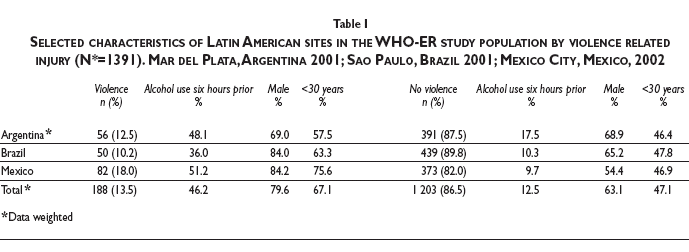
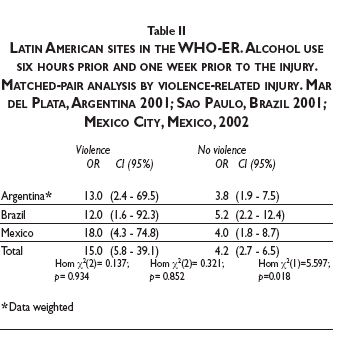
<body><![CDATA[<p><font face="Verdana" size="2">Following a prior report by our group,<SUP>12</SUP>    a pair-matched analysis was performed. For each patient, he or she reported    their use of alcohol during the six hours prior to injury, during the same time    period on the day prior to injury, on the same day of the previous week, and    on the same day of the previous month. For alcohol use during the six hours    prior to injury, the question posed was: "In the six hours before and up    to your having your injury/accident, did you have any alcohol to drink, even    one drink?" (yes/no). Information on alcohol use at the same time during    the previous week was elicited as follows: "In this next section, I am    going to ask you about what you were doing exactly one week ago. Think about    the time you had your accident (today) and remember the same time a week ago.    Last week at the same time, did you have any alcohol to drink in the six hours    leading up to this time?" (yes/no). The volume of alcohol consumed during    each six-hour period was analyzed by converting the number and size of drinks    to pure ethanol, using a standard drink of 16ml as a common volume measure across    beverages and analyzed as a categorical variable. Conditional logistic regression    was used to calculate the matched-pair odds ratio (OR) and 95% confidence intervals    (CIs).<SUP>13,14</SUP> Variation in the magnitude of the OR across study sites    and mode of injury was examined using the chi-square test for homogeneity (Hom).<SUP>14</SUP>    </font></P>     <p>&nbsp;</P>     <p><font face="Verdana" size="3"><b>Results</b></font></P>     <p><font face="Verdana" size="2"><a href="/img/revistas/spm/v50s1/a03tab01.gif">Table I</a> shows    the distribution of the samples according to violence and non-violence related    injuries. Prevalence of a violence-related injury in the ED was 13.5% for the    total sample (Argentina= 12.5%, Brazil= 10.2%, Mexico= 18.0%). About 46% of    violence-related cases used alcohol (versus 12.5 non-violence), 80% were males    (versus 63% females), and 67% were under 30 years of age (versus 47%). In additional    descriptive data (not shown) for the total sample and for both types of injuries,    most injuries occurred on the street or highway, while the patients were commuting,    traveling or walking. In all EDs, non-violent injuries were predominantly due    to a falling/tripping event. For violent injury, about 60% of the patients in    the three EDs reported that the perpetrator was an unknown person and about    33% reported that this person was "definitively intoxicated."</font></P>     <p><font face="Verdana" size="2"> <a href="#tab02">Table II</a> shows the results    for the matched-pair analyses. The risk of a violence-related injury was found    to increase with drinking &#91;(15.0- (5.8-39.1)&#93;, ranging from 12.0 in Brazil to    18.0 in Mexico. On the other hand, patients with unintentional injury had a    lower OR &#91;(4.2- (2.7-6.5)&#93;, ranging from 3.8 in Argentina to 5.2 in Brazil.    The test for homogeneity of these OR estimates suggests that the OR is homogenous    across countries for both violence (Hom <font face="Symbol">c</font><SUP>2</SUP>(2)= 0.137; <I>p</I>= 0.934)    and non-violence (Hom <font face="Symbol">c</font><SUP>2</SUP>(2)=0.321; <I>p</I>= 0.852); that is, alcohol    is equally related to violent and non-violent injuries among all sites. The    homogeneity test for the total sample also shows that there are differences    across mode of injury, and the OR for violence is larger than that for non-violence    (Hom <font face="Symbol">c</font><SUP>2</SUP>(1)= 5.597; <I>p</I>= 0.018). </font></P>     <p><a name="tab02"></a></P>     <p>&nbsp;</P>     <p align="center"><img src="/img/revistas/spm/v50s1/a03tab02.gif"></P>     <p>&nbsp;</p>     <p><font face="Verdana" size="2"> A dose-response analysis was also performed    by mode of injury for the total sample (<a href="/img/revistas/spm/v50s1/a03tab03.gif">Table    III</a>). As is evident from this table, the risk of a violence-related injury    increased sharply with increasing amounts of alcohol consumed. The increase    was not as steep for a non-violence related injury, but in both cases a statistical    trend of increased OR with increased amounts consumed was found. The homogeneity    tests suggest that the risk is of equal magnitude for violent and non-violent    injury at low levels of consumption, i.e. 1-3 drinks, (Hom <font face="Symbol">c</font><SUP>2</SUP>(1)=2.229;    <I>p</I>= 0.135) but at high levels of consumption the OR is larger for violent    than for non-violent injuries (Hom <font face="Symbol">c</font><SUP>2</SUP>(1)=5.270;    <I>p</I>= 0.022).</font></P>     ]]></body>
<body><![CDATA[<p>&nbsp;</P>     <p><font face="Verdana" size="3"><b>Discussion</b></font></P>     <p><font face="Verdana" size="2">In this sample of non-fatal injury patients admitted    to three EDs across Latin America, it was found that the risk of a violence-related    injury increased with drinking and that patients with unintentional injury also    showed a lower but also significant OR. A dose-response relationship for the    number of drinks and risk for both violence and non-violence related injuries    was evident, with increased risks even at low levels of alcohol use (1-3 drinks).    Higher levels of drinking were associated with a much higher elevation in the    OR for violence-related injuries than for non-violent injuries. If subjects    decided to drink, increased amounts may have pronounced consequences in their    risk for triggering an injury, specially a violence-related injury.</font></P>     <p><font face="Verdana" size="2"> This work confirms prior reports in Argentina,<SUP>15,16</SUP>    Brazil<SUP>17-21</SUP> and Mexico<SUP>7,12,22</SUP> showing the impact of alcohol    consumption on violence. Alcohol was present in almost 50% of all patients with    a violence-related injury, substantiating a common view in EDs across the region    that alcohol consumption is a main problem among these patients. Furthermore,    our data on the relationship between alcohol and unintentional injury is important    given the impact of injuries in these nations<SUP>23</SUP> and current research    showing the high prevalence of drinking and driving among youths in these countries.    <SUP>24-27</SUP> Large differences were found between acute alcohol use and    intentional and unintentional injuries, with larger risks found for intentional    injuries. Interestingly, no differences were found in OR estimates across countries,    suggesting that even if these countries differ in their alcohol consumption    patterns, with Argentina showing a more "Mediterranean-like" consumption,    alcohol has a similar impact on injuries seen in EDs. Strong evidence was found    for a dose-response relationship between the amount of alcohol and the increase    in the OR for both types of injury. Nevertheless, with larger amounts of drinking,    the OR increased more sharply for intentional than for non-intentional injury.    The stronger relationship found between alcohol and violence compared to other    modes of injury is suggestive that additional mechanisms than simply reduced    psychomotor capabilities might explain the elevated RR found. One possible causal    explanation is that alcohol reduces inhibitions and increases the sense of power    for some people.<SUP>28</SUP> Another possible non-causal explanation is that    people who drink are more likely to be aggressive, while drinking and aggression    helps to explain the elevated risks found. Alternatively, people tend to drink    in social situations, and such situations might increase the possibility of    violence. More research is needed to better understand competing hypotheses    for the relationship between acute alcohol consumption and violence. </font></P>     <p><font face="Verdana" size="2"> This study is limited to non-fatal injury cases    that are presented in ED facilities and although the study design provides a    representative sample of patients from this facility, patients may not be representative    of other ED facilities in the city or the country that participated. As is common    with other emergency department studies, cases also cannot be assumed to be    representative of those with injuries who do not seek medical attention. All    analyses reported here are based on the patient's self-reported alcohol consumption    for differing time frames, and it is possible that patients were more likely    to better recall their consumption immediately prior to an injury event than    for any previous period. Differential recall may lead to an overestimate of    the association between alcohol and injury if patients are more likely to remember    and report alcohol on a short-term basis. Prior case-crossover research on alcohol    and injury has used other control periods<SUP>29-32</SUP> that ranged from a    day to a year, suggesting that the findings reported here are nevertheless robust.    Legal or other issues, however, may prompt patients to minimize drinking prior    to an injury event, such as a traffic accident. On the other hand, it is also    possible that patients may overestimate their drinking prior to an injury event;    for example, those with violence-related injuries may over-report alcohol use    as an excuse for otherwise socially unacceptable behavioral.<SUP>33</SUP> Clearly,    more research on the validity of methods for eliciting alcohol use for case-crossover    analyses is needed. Finally, despite the fact that case–crossover studies are    well-suited for controlling for between-person confounders, they do not remove    the possibility that within-person confounders exist. For example, in the present    study it is possible that a patient may have been suffering from a transient    depressive episode that gave rise to an increase in alcohol consumption. This    co-occurrence of depression and alcohol use, or any other psychiatric disorder    or substance use, could confound odds ratios estimates. Because measurements    for other acute variables that vary over time are lacking as well as those that    could be considered possible confounders of the relationship between acute alcohol    use and injury, this bias cannot be quantified and the results cannot be adjusted    accordingly.</font></P>     <p><font face="Verdana" size="2"><b>Acknowledgments</b></font></P>     <p><font face="Verdana" size="2">*This paper is based on the data and experience    obtained during the participation of the authors in the WHO Collaborative Study    on Alcohol and Injuries, sponsored by the World Health Organization and implemented    by the WHO Collaborative Study Group on Alcohol and Injuries that includes:    V. Benegal (Bangalore, India); G. Borges (Mexico City, Mexico); S. Casswell    (Auckland, New Zealand); C. Cherpitel (Berkeley, USA); M. Cremonte (Mar del    Plata, Argentina); R. Evsegneev (Minsk, Belarus); N. Figlie (S&atilde;o Paulo,    Brazil); N. Giesbrecht (Ontario, Canada); W. Hao (Hunan, China); G. Humphrey    (Auckland, New Zealand); R. Larajeira (S&atilde;o Paulo, Brazil); S. Macdonald    (Ontario, Canada); S. Larsson (Malm&ouml;, Sweden); S. Marais (Cape Town, South    Africa); O. Neves (Maputo, Mozambique); M. Peden (WHO, Geneva, Switzerland);    V. Poznyak (WHO, Geneva, Switzerland); J. Rehm (Zurich, Switzerland); R. Room    (Stockholm, Sweden); H. Sovinova (Prague, Czech Republic); M. Stafstrom (Malm&ouml;,    Sweden). A list of other staff contributing to the project can be found in the    Main Report of the Collaborative Study on Alcohol and Injuries, WHO, Geneva.</font></P>     <p><font face="Verdana" size="2"> This study was supported by National Alcohol    Research Center grant AA 05595-12 from the U.S. National Institute on Alcohol    Abuse and Alcoholism, the World Health Organization (Geneva), the National Institute    of Psychiatry (4275P) (Mexico), and the Consejo Nacional de Ciencia y Tecnolog&iacute;a    (CONACyT, M&eacute;xico) (39607-H).</font></P>     <p>&nbsp;</P>      <P><font face="Verdana" size="3"><b>References</b></font></P>      ]]></body>
<body><![CDATA[<P><font face="Verdana" size="2">1. Pan American Health Organization (PAHO). Pan    American Health Organization: Health in the Americas. Washington: PAHO, 2002.</font></P>     <!-- ref --><P><font face="Verdana" size="2">2. Briceno-Leon R. Urban violence and public    health in Latin America: a sociological explanatory framework. Cad Saude Publica    2005;21:1629-1648.</font>&nbsp;&nbsp;&nbsp;&nbsp;&nbsp;&nbsp;&nbsp;&nbsp;[&#160;<a href="javascript:void(0);" onclick="javascript: window.open('/scielo.php?script=sci_nlinks&ref=9260113&pid=S0036-3634200800070000300002&lng=','','width=640,height=500,resizable=yes,scrollbars=1,menubar=yes,');">Links</a>&#160;]<!-- end-ref --><!-- ref --><P><font face="Verdana" size="2">3. Soares RR. The welfare cost of violence across    countries. J Health Econ 2005;25:821-846.</font>&nbsp;&nbsp;&nbsp;&nbsp;&nbsp;&nbsp;&nbsp;&nbsp;[&#160;<a href="javascript:void(0);" onclick="javascript: window.open('/scielo.php?script=sci_nlinks&ref=9260114&pid=S0036-3634200800070000300003&lng=','','width=640,height=500,resizable=yes,scrollbars=1,menubar=yes,');">Links</a>&#160;]<!-- end-ref --><!-- ref --><P><font face="Verdana" size="2">4. Room R, Babor T, Rehm J. Alcohol and public    health. Lancet 2005;365:519-530.</font>&nbsp;&nbsp;&nbsp;&nbsp;&nbsp;&nbsp;&nbsp;&nbsp;[&#160;<a href="javascript:void(0);" onclick="javascript: window.open('/scielo.php?script=sci_nlinks&ref=9260115&pid=S0036-3634200800070000300004&lng=','','width=640,height=500,resizable=yes,scrollbars=1,menubar=yes,');">Links</a>&#160;]<!-- end-ref --><!-- ref --><P><font face="Verdana" size="2">5. Cherpitel CJ. Alcohol and violence-related    injuries in the emergency room. Recent Dev Alcohol 1997;13:105-118.</font>&nbsp;&nbsp;&nbsp;&nbsp;&nbsp;&nbsp;&nbsp;&nbsp;[&#160;<a href="javascript:void(0);" onclick="javascript: window.open('/scielo.php?script=sci_nlinks&ref=9260116&pid=S0036-3634200800070000300005&lng=','','width=640,height=500,resizable=yes,scrollbars=1,menubar=yes,');">Links</a>&#160;]<!-- end-ref --><!-- ref --><P><font face="Verdana" size="2">6. Ogden EJ, Moskowitz H. Effects of alcohol    and other drugs on driver performance. Traffic Inj Prev 2004;5:185-198.</font>&nbsp;&nbsp;&nbsp;&nbsp;&nbsp;&nbsp;&nbsp;&nbsp;[&#160;<a href="javascript:void(0);" onclick="javascript: window.open('/scielo.php?script=sci_nlinks&ref=9260117&pid=S0036-3634200800070000300006&lng=','','width=640,height=500,resizable=yes,scrollbars=1,menubar=yes,');">Links</a>&#160;]<!-- end-ref --><!-- ref --><P><font face="Verdana" size="2">7. Borges G, Cherpitel CJ, Rosovsky H. Male drinking    and violence-related injury in the emergency room. Addiction 1998;93:103-112.</font>&nbsp;&nbsp;&nbsp;&nbsp;&nbsp;&nbsp;&nbsp;&nbsp;[&#160;<a href="javascript:void(0);" onclick="javascript: window.open('/scielo.php?script=sci_nlinks&ref=9260118&pid=S0036-3634200800070000300007&lng=','','width=640,height=500,resizable=yes,scrollbars=1,menubar=yes,');">Links</a>&#160;]<!-- end-ref --><!-- ref --><P><font face="Verdana" size="2">8. Cherpitel CJ. Drinking patterns and problems    associated with injury status in emergency room admissions. Alcohol Clin Exp    Res 1988;12:105-110.</font>&nbsp;&nbsp;&nbsp;&nbsp;&nbsp;&nbsp;&nbsp;&nbsp;[&#160;<a href="javascript:void(0);" onclick="javascript: window.open('/scielo.php?script=sci_nlinks&ref=9260119&pid=S0036-3634200800070000300008&lng=','','width=640,height=500,resizable=yes,scrollbars=1,menubar=yes,');">Links</a>&#160;]<!-- end-ref --><!-- ref --><P><font face="Verdana" size="2">9. Vinson DC, Borges G, Cherpitel CJ. The risk    of intentional injury with acute and chronic alcohol exposures: a case-control    and case-crossover study. J Stud Alcohol 2003;64:350-357.</font>&nbsp;&nbsp;&nbsp;&nbsp;&nbsp;&nbsp;&nbsp;&nbsp;[&#160;<a href="javascript:void(0);" onclick="javascript: window.open('/scielo.php?script=sci_nlinks&ref=9260120&pid=S0036-3634200800070000300009&lng=','','width=640,height=500,resizable=yes,scrollbars=1,menubar=yes,');">Links</a>&#160;]<!-- end-ref --><!-- ref --><P><font face="Verdana" size="2">10. Cherpitel CJ, Bond J, Ye Y, Borges G, Macdonald    S, Giesbrecht N. A cross-national meta-analysis of alcohol and injury: data    from the Emergency Room Collaborative Alcohol Analysis Project (ERCAAP). Addiction    2003;98:1277-1286.</font>&nbsp;&nbsp;&nbsp;&nbsp;&nbsp;&nbsp;&nbsp;&nbsp;[&#160;<a href="javascript:void(0);" onclick="javascript: window.open('/scielo.php?script=sci_nlinks&ref=9260121&pid=S0036-3634200800070000300010&lng=','','width=640,height=500,resizable=yes,scrollbars=1,menubar=yes,');">Links</a>&#160;]<!-- end-ref --><!-- ref --><P><font face="Verdana" size="2">11. Cherpitel CJ, Bond J, Ye Y, Room R, Poznyak    V, Rehm J, <I>et al</I>. Clinical assessment compared to breathalyzer readings    in the ER: Concordance of ICD-10 Y90 and Y91 codes. Emerg Med J 2005;22:689-695.</font>&nbsp;&nbsp;&nbsp;&nbsp;&nbsp;&nbsp;&nbsp;&nbsp;[&#160;<a href="javascript:void(0);" onclick="javascript: window.open('/scielo.php?script=sci_nlinks&ref=9260122&pid=S0036-3634200800070000300011&lng=','','width=640,height=500,resizable=yes,scrollbars=1,menubar=yes,');">Links</a>&#160;]<!-- end-ref --><!-- ref --><P><font face="Verdana" size="2">12. Borges G, Cherpitel CJ, Medina-Mora ME, Mondragon    L. Violence related injuries in the emergency room: alcohol, depression, and    conduct problems. Subst Use Misuse 2004;39:911-930.</font>&nbsp;&nbsp;&nbsp;&nbsp;&nbsp;&nbsp;&nbsp;&nbsp;[&#160;<a href="javascript:void(0);" onclick="javascript: window.open('/scielo.php?script=sci_nlinks&ref=9260123&pid=S0036-3634200800070000300012&lng=','','width=640,height=500,resizable=yes,scrollbars=1,menubar=yes,');">Links</a>&#160;]<!-- end-ref --><!-- ref --><P><font face="Verdana" size="2">13. Maclure M. The case-crossover design: a method    for studying transient effects on the risk of acute events. Am J Epidemiol 1991;133:144-153.</font>&nbsp;&nbsp;&nbsp;&nbsp;&nbsp;&nbsp;&nbsp;&nbsp;[&#160;<a href="javascript:void(0);" onclick="javascript: window.open('/scielo.php?script=sci_nlinks&ref=9260124&pid=S0036-3634200800070000300013&lng=','','width=640,height=500,resizable=yes,scrollbars=1,menubar=yes,');">Links</a>&#160;]<!-- end-ref --><!-- ref --><P><font face="Verdana" size="2">14. Rothman KJ, Greenland S. Modern epidemiology.    2a. edici&oacute;n. Philadelphia, PA: Lippincott-Raven Publishers, 1998.</font>&nbsp;&nbsp;&nbsp;&nbsp;&nbsp;&nbsp;&nbsp;&nbsp;[&#160;<a href="javascript:void(0);" onclick="javascript: window.open('/scielo.php?script=sci_nlinks&ref=9260125&pid=S0036-3634200800070000300014&lng=','','width=640,height=500,resizable=yes,scrollbars=1,menubar=yes,');">Links</a>&#160;]<!-- end-ref --><!-- ref --><P><font face="Verdana" size="2">15. Gioino G, Hansen C, Pacchioni A, Rocca F,    Barrios SM, Brocca E, <I>et al</I>. Use of high-performance liquid chromatography    with diode-array detection after a primary drug screening in patients admitted    to the emergency department. Ther Drug Monit 2003;25:99-106.</font>&nbsp;&nbsp;&nbsp;&nbsp;&nbsp;&nbsp;&nbsp;&nbsp;[&#160;<a href="javascript:void(0);" onclick="javascript: window.open('/scielo.php?script=sci_nlinks&ref=9260126&pid=S0036-3634200800070000300015&lng=','','width=640,height=500,resizable=yes,scrollbars=1,menubar=yes,');">Links</a>&#160;]<!-- end-ref --><!-- ref --><P><font face="Verdana" size="2">16. M&iacute;guez H. Epidemiolog&iacute;a de    la alcoholizaci&oacute;n juvenil en Argentina. Acta Psiquiatr Psicol Am Lat    2004;50:43-47.</font>&nbsp;&nbsp;&nbsp;&nbsp;&nbsp;&nbsp;&nbsp;&nbsp;[&#160;<a href="javascript:void(0);" onclick="javascript: window.open('/scielo.php?script=sci_nlinks&ref=9260127&pid=S0036-3634200800070000300016&lng=','','width=640,height=500,resizable=yes,scrollbars=1,menubar=yes,');">Links</a>&#160;]<!-- end-ref --><!-- ref --><P><font face="Verdana" size="2">17. Adeodato VG, Carvalho RR, de Siqueira VR,    de Matos, Souza FG. Quality of life and depression in women abused by their    partners. Rev Saude Publica 2005;39:108-113.</font>&nbsp;&nbsp;&nbsp;&nbsp;&nbsp;&nbsp;&nbsp;&nbsp;[&#160;<a href="javascript:void(0);" onclick="javascript: window.open('/scielo.php?script=sci_nlinks&ref=9260128&pid=S0036-3634200800070000300017&lng=','','width=640,height=500,resizable=yes,scrollbars=1,menubar=yes,');">Links</a>&#160;]<!-- end-ref --><!-- ref --><P><font face="Verdana" size="2">18. Carvalho CG, Cotrim BC, Silva AO, Sauaia    N. Blood alcohol content prevalence among trauma patients seen at a level 1    trauma center. Rev Saude Publica 2002;36:47-54.</font>&nbsp;&nbsp;&nbsp;&nbsp;&nbsp;&nbsp;&nbsp;&nbsp;[&#160;<a href="javascript:void(0);" onclick="javascript: window.open('/scielo.php?script=sci_nlinks&ref=9260129&pid=S0036-3634200800070000300018&lng=','','width=640,height=500,resizable=yes,scrollbars=1,menubar=yes,');">Links</a>&#160;]<!-- end-ref --><!-- ref --><P><font face="Verdana" size="2">19. Galduroz JC, Caetano R. Epidemiology of alcohol    use in Brazil. Rev Bras Psiquiatr 2004;26 Suppl 1:S3-S6.</font>&nbsp;&nbsp;&nbsp;&nbsp;&nbsp;&nbsp;&nbsp;&nbsp;[&#160;<a href="javascript:void(0);" onclick="javascript: window.open('/scielo.php?script=sci_nlinks&ref=9260130&pid=S0036-3634200800070000300019&lng=','','width=640,height=500,resizable=yes,scrollbars=1,menubar=yes,');">Links</a>&#160;]<!-- end-ref --><!-- ref --><P><font face="Verdana" size="2">20. Laranjeira R, Hinkly D. Evaluation of alcohol    outlet density and its relation with violence. Rev Saude Publica 2002;36:455-461.</font>&nbsp;&nbsp;&nbsp;&nbsp;&nbsp;&nbsp;&nbsp;&nbsp;[&#160;<a href="javascript:void(0);" onclick="javascript: window.open('/scielo.php?script=sci_nlinks&ref=9260131&pid=S0036-3634200800070000300020&lng=','','width=640,height=500,resizable=yes,scrollbars=1,menubar=yes,');">Links</a>&#160;]<!-- end-ref --><!-- ref --><P><font face="Verdana" size="2">21. Zilberman ML, Blume SB. Domestic violence,    alcohol and substance abuse. Rev Bras Psiquiatr 2005;27 Suppl 2:S51-S55.</font>&nbsp;&nbsp;&nbsp;&nbsp;&nbsp;&nbsp;&nbsp;&nbsp;[&#160;<a href="javascript:void(0);" onclick="javascript: window.open('/scielo.php?script=sci_nlinks&ref=9260132&pid=S0036-3634200800070000300021&lng=','','width=640,height=500,resizable=yes,scrollbars=1,menubar=yes,');">Links</a>&#160;]<!-- end-ref --><!-- ref --><P><font face="Verdana" size="2">22. Caballero MA, Ramos L. Violencia: una revisi&oacute;n    del tema dentro del marco de trabajo de investigaci&oacute;n en el Instituto    Nacional de Psiquiatr&iacute;a. Salud Mental 2004;27:21-30.</font>&nbsp;&nbsp;&nbsp;&nbsp;&nbsp;&nbsp;&nbsp;&nbsp;[&#160;<a href="javascript:void(0);" onclick="javascript: window.open('/scielo.php?script=sci_nlinks&ref=9260133&pid=S0036-3634200800070000300022&lng=','','width=640,height=500,resizable=yes,scrollbars=1,menubar=yes,');">Links</a>&#160;]<!-- end-ref --><!-- ref --><P><font face="Verdana" size="2">23. Smith GS, Barss P. Unintentional injuries    in developing countries: the epidemiology of a neglected problem. Epidemiol    Rev 1991;13:228-266.</font>&nbsp;&nbsp;&nbsp;&nbsp;&nbsp;&nbsp;&nbsp;&nbsp;[&#160;<a href="javascript:void(0);" onclick="javascript: window.open('/scielo.php?script=sci_nlinks&ref=9260134&pid=S0036-3634200800070000300023&lng=','','width=640,height=500,resizable=yes,scrollbars=1,menubar=yes,');">Links</a>&#160;]<!-- end-ref --><!-- ref --><P><font face="Verdana" size="2">24. Hijar M, Carrillo C, Flores M, Anaya R, Lopez    V. Risk factors in highway traffic accidents: a case control study. Accid Anal    Prev 2000;32:703-709.</font>&nbsp;&nbsp;&nbsp;&nbsp;&nbsp;&nbsp;&nbsp;&nbsp;[&#160;<a href="javascript:void(0);" onclick="javascript: window.open('/scielo.php?script=sci_nlinks&ref=9260135&pid=S0036-3634200800070000300024&lng=','','width=640,height=500,resizable=yes,scrollbars=1,menubar=yes,');">Links</a>&#160;]<!-- end-ref --><!-- ref --><P><font face="Verdana" size="2">25. Marin-Leon L, Vizzotto MM. Driving-related    behavior: an epidemiologic study of undergraduate students. Cad Saude Publica    2003;19:515-523.</font>&nbsp;&nbsp;&nbsp;&nbsp;&nbsp;&nbsp;&nbsp;&nbsp;[&#160;<a href="javascript:void(0);" onclick="javascript: window.open('/scielo.php?script=sci_nlinks&ref=9260136&pid=S0036-3634200800070000300025&lng=','','width=640,height=500,resizable=yes,scrollbars=1,menubar=yes,');">Links</a>&#160;]<!-- end-ref --><!-- ref --><P><font face="Verdana" size="2">26. Liberatti CL, Andrade SM, Soares DA. The    new Brazilian traffic code and some characteristics of victims in southern Brazil.    Inj Prev 2001;7:190-193.</font>&nbsp;&nbsp;&nbsp;&nbsp;&nbsp;&nbsp;&nbsp;&nbsp;[&#160;<a href="javascript:void(0);" onclick="javascript: window.open('/scielo.php?script=sci_nlinks&ref=9260137&pid=S0036-3634200800070000300026&lng=','','width=640,height=500,resizable=yes,scrollbars=1,menubar=yes,');">Links</a>&#160;]<!-- end-ref --><!-- ref --><P><font face="Verdana" size="2">27. Pinsky I, Labouvie E, Laranjeira R. Willingness    and alternatives to drunk driving among young people from Sao Paulo city, Brazil.    Rev Bras Psiquiatr 2004;26:234-241.</font>&nbsp;&nbsp;&nbsp;&nbsp;&nbsp;&nbsp;&nbsp;&nbsp;[&#160;<a href="javascript:void(0);" onclick="javascript: window.open('/scielo.php?script=sci_nlinks&ref=9260138&pid=S0036-3634200800070000300027&lng=','','width=640,height=500,resizable=yes,scrollbars=1,menubar=yes,');">Links</a>&#160;]<!-- end-ref --><!-- ref --><P><font face="Verdana" size="2">28. Hoaken PN, Stewart SH. Drugs of abuse and    the elicitation of human aggressive behavior. Addict Behav 2003;28:1533-1554.</font>&nbsp;&nbsp;&nbsp;&nbsp;&nbsp;&nbsp;&nbsp;&nbsp;[&#160;<a href="javascript:void(0);" onclick="javascript: window.open('/scielo.php?script=sci_nlinks&ref=9260139&pid=S0036-3634200800070000300028&lng=','','width=640,height=500,resizable=yes,scrollbars=1,menubar=yes,');">Links</a>&#160;]<!-- end-ref --><!-- ref --><P><font face="Verdana" size="2">29. Borges G, Cherpitel CJ, Mondrag&oacute;n    L, Poznyak V, Peden M, Guti&eacute;rrez I. Episodic alcohol use and risk of    nonfatal injury. Am J Epidemiol 2004;159:565-571.</font>&nbsp;&nbsp;&nbsp;&nbsp;&nbsp;&nbsp;&nbsp;&nbsp;[&#160;<a href="javascript:void(0);" onclick="javascript: window.open('/scielo.php?script=sci_nlinks&ref=9260140&pid=S0036-3634200800070000300029&lng=','','width=640,height=500,resizable=yes,scrollbars=1,menubar=yes,');">Links</a>&#160;]<!-- end-ref --><!-- ref --><P><font face="Verdana" size="2">30. Borges G, Cherpitel C, Mittleman M. Risk    of injury after alcohol consumption: a case-crossover study in the emergency    department. Soc Sci Med 2004;58:1191-1200.</font>&nbsp;&nbsp;&nbsp;&nbsp;&nbsp;&nbsp;&nbsp;&nbsp;[&#160;<a href="javascript:void(0);" onclick="javascript: window.open('/scielo.php?script=sci_nlinks&ref=9260141&pid=S0036-3634200800070000300030&lng=','','width=640,height=500,resizable=yes,scrollbars=1,menubar=yes,');">Links</a>&#160;]<!-- end-ref --><!-- ref --><P><font face="Verdana" size="2">31. Vinson DC, Mabe N, Leonard LL, Alexander    J, Becker J, Boyer J, <I>et al</I>. Alcohol and injury. A case-crossover study.    Arch Fam Med 1995;4:505-511.</font>&nbsp;&nbsp;&nbsp;&nbsp;&nbsp;&nbsp;&nbsp;&nbsp;[&#160;<a href="javascript:void(0);" onclick="javascript: window.open('/scielo.php?script=sci_nlinks&ref=9260142&pid=S0036-3634200800070000300031&lng=','','width=640,height=500,resizable=yes,scrollbars=1,menubar=yes,');">Links</a>&#160;]<!-- end-ref --><!-- ref --><P><font face="Verdana" size="2">32. Vinson DC, Maclure M, Reidinger C, Smith    GS. A population-based case-crossover and case-control study of alcohol and    the risk of injury. J Stud Alcohol 2003;64:358-366.</font>&nbsp;&nbsp;&nbsp;&nbsp;&nbsp;&nbsp;&nbsp;&nbsp;[&#160;<a href="javascript:void(0);" onclick="javascript: window.open('/scielo.php?script=sci_nlinks&ref=9260143&pid=S0036-3634200800070000300032&lng=','','width=640,height=500,resizable=yes,scrollbars=1,menubar=yes,');">Links</a>&#160;]<!-- end-ref --><!-- ref --><P><font face="Verdana" size="2">33. MacAndrew C, Edgerton RB. Drunken comportment:    A social explanation. Chicago: Aldine Publishing Co., 1969.</font>&nbsp;&nbsp;&nbsp;&nbsp;&nbsp;&nbsp;&nbsp;&nbsp;[&#160;<a href="javascript:void(0);" onclick="javascript: window.open('/scielo.php?script=sci_nlinks&ref=9260144&pid=S0036-3634200800070000300033&lng=','','width=640,height=500,resizable=yes,scrollbars=1,menubar=yes,');">Links</a>&#160;]<!-- end-ref --><P>&nbsp;</P>     <P>&nbsp;</P>     <P><font face="Verdana" size="2">Received on: April 26, 2007    <br>   Accepted on: September 26, 2007</font></P>     <P>&nbsp;</P>     <P>&nbsp;</P>     <p><font face="Verdana" size="2">Correspondence to: Dr.Guilherme Luiz Guimaraes    Borges. Instituto Nacional de Psiquiatria &amp; Universidad Aut&oacute;noma    Metropolitana-Xochimilco. Calzada Mexico Xochimilco 101, Col. San Lorenzo Huipulco.    14370 Mexico D.F., Mexico. e-mail: <a href="mailto:guibor@imp.edu.mx">guibor@imp.edu.mx</a>,    <a href="mailto:guilhermelgborges@yahoo.com">guilhermelgborges@yahoo.com</a></font></p>     ]]></body>
<body><![CDATA[ ]]></body><back>
<ref-list>
<ref id="B1">
<label>1</label><nlm-citation citation-type="book">
<collab>Pan American Health Organization</collab>
<source><![CDATA[Pan American Health Organization: Health in the Americas]]></source>
<year>2002</year>
<publisher-loc><![CDATA[Washington ]]></publisher-loc>
<publisher-name><![CDATA[PAHO]]></publisher-name>
</nlm-citation>
</ref>
<ref id="B2">
<label>2</label><nlm-citation citation-type="journal">
<person-group person-group-type="author">
<name>
<surname><![CDATA[Briceno-Leon]]></surname>
<given-names><![CDATA[R]]></given-names>
</name>
</person-group>
<article-title xml:lang="en"><![CDATA[Urban violence and public health in Latin America: a sociological explanatory framework]]></article-title>
<source><![CDATA[Cad Saude Publica]]></source>
<year>2005</year>
<volume>21</volume>
<page-range>1629-1648</page-range></nlm-citation>
</ref>
<ref id="B3">
<label>3</label><nlm-citation citation-type="journal">
<person-group person-group-type="author">
<name>
<surname><![CDATA[Soares]]></surname>
<given-names><![CDATA[RR]]></given-names>
</name>
</person-group>
<article-title xml:lang="en"><![CDATA[The welfare cost of violence across countries]]></article-title>
<source><![CDATA[J Health Econ]]></source>
<year>2005</year>
<volume>25</volume>
<page-range>821-846</page-range></nlm-citation>
</ref>
<ref id="B4">
<label>4</label><nlm-citation citation-type="journal">
<person-group person-group-type="author">
<name>
<surname><![CDATA[Room]]></surname>
<given-names><![CDATA[R]]></given-names>
</name>
<name>
<surname><![CDATA[Babor]]></surname>
<given-names><![CDATA[T]]></given-names>
</name>
<name>
<surname><![CDATA[Rehm]]></surname>
<given-names><![CDATA[J]]></given-names>
</name>
</person-group>
<article-title xml:lang="en"><![CDATA[Alcohol and public health]]></article-title>
<source><![CDATA[Lancet]]></source>
<year>2005</year>
<volume>365</volume>
<page-range>519-530</page-range></nlm-citation>
</ref>
<ref id="B5">
<label>5</label><nlm-citation citation-type="journal">
<person-group person-group-type="author">
<name>
<surname><![CDATA[Cherpitel]]></surname>
<given-names><![CDATA[CJ]]></given-names>
</name>
</person-group>
<article-title xml:lang="en"><![CDATA[Alcohol and violence-related injuries in the emergency room]]></article-title>
<source><![CDATA[Recent Dev Alcohol]]></source>
<year>1997</year>
<volume>13</volume>
<page-range>105-118</page-range></nlm-citation>
</ref>
<ref id="B6">
<label>6</label><nlm-citation citation-type="journal">
<person-group person-group-type="author">
<name>
<surname><![CDATA[Ogden]]></surname>
<given-names><![CDATA[EJ]]></given-names>
</name>
<name>
<surname><![CDATA[Moskowitz]]></surname>
<given-names><![CDATA[H]]></given-names>
</name>
</person-group>
<article-title xml:lang="en"><![CDATA[Effects of alcohol and other drugs on driver performance]]></article-title>
<source><![CDATA[Traffic Inj Prev]]></source>
<year>2004</year>
<volume>5</volume>
<page-range>185-198</page-range></nlm-citation>
</ref>
<ref id="B7">
<label>7</label><nlm-citation citation-type="journal">
<person-group person-group-type="author">
<name>
<surname><![CDATA[Borges]]></surname>
<given-names><![CDATA[G]]></given-names>
</name>
<name>
<surname><![CDATA[Cherpitel]]></surname>
<given-names><![CDATA[CJ]]></given-names>
</name>
<name>
<surname><![CDATA[Rosovsky]]></surname>
<given-names><![CDATA[H]]></given-names>
</name>
</person-group>
<article-title xml:lang="en"><![CDATA[Male drinking and violence-related injury in the emergency room]]></article-title>
<source><![CDATA[Addiction]]></source>
<year>1998</year>
<volume>93</volume>
<page-range>103-112</page-range></nlm-citation>
</ref>
<ref id="B8">
<label>8</label><nlm-citation citation-type="journal">
<person-group person-group-type="author">
<name>
<surname><![CDATA[Cherpitel]]></surname>
<given-names><![CDATA[CJ]]></given-names>
</name>
</person-group>
<article-title xml:lang="en"><![CDATA[Drinking patterns and problems associated with injury status in emergency room admissions]]></article-title>
<source><![CDATA[Alcohol Clin Exp Res]]></source>
<year>1988</year>
<volume>12</volume>
<page-range>105-110</page-range></nlm-citation>
</ref>
<ref id="B9">
<label>9</label><nlm-citation citation-type="journal">
<person-group person-group-type="author">
<name>
<surname><![CDATA[Vinson]]></surname>
<given-names><![CDATA[DC]]></given-names>
</name>
<name>
<surname><![CDATA[Borges]]></surname>
<given-names><![CDATA[G]]></given-names>
</name>
<name>
<surname><![CDATA[Cherpitel]]></surname>
<given-names><![CDATA[CJ]]></given-names>
</name>
</person-group>
<article-title xml:lang="en"><![CDATA[The risk of intentional injury with acute and chronic alcohol exposures: case-control and case-crossover study]]></article-title>
<source><![CDATA[J Stud Alcohol]]></source>
<year>2003</year>
<volume>64</volume>
<page-range>350-357</page-range></nlm-citation>
</ref>
<ref id="B10">
<label>10</label><nlm-citation citation-type="journal">
<person-group person-group-type="author">
<name>
<surname><![CDATA[Cherpitel]]></surname>
<given-names><![CDATA[CJ]]></given-names>
</name>
<name>
<surname><![CDATA[Bond]]></surname>
<given-names><![CDATA[J]]></given-names>
</name>
<name>
<surname><![CDATA[Ye]]></surname>
<given-names><![CDATA[Y]]></given-names>
</name>
<name>
<surname><![CDATA[Borges]]></surname>
<given-names><![CDATA[G]]></given-names>
</name>
<name>
<surname><![CDATA[Macdonald]]></surname>
<given-names><![CDATA[S]]></given-names>
</name>
<name>
<surname><![CDATA[Giesbrecht]]></surname>
<given-names><![CDATA[N]]></given-names>
</name>
</person-group>
<article-title xml:lang="en"><![CDATA[A cross-national meta-analysis of alcohol and injury: data from the Emergency Room Collaborative Alcohol Analysis Project (ERCAAP)]]></article-title>
<source><![CDATA[Addiction]]></source>
<year>2003</year>
<volume>98</volume>
<page-range>1277-1286</page-range></nlm-citation>
</ref>
<ref id="B11">
<label>11</label><nlm-citation citation-type="journal">
<person-group person-group-type="author">
<name>
<surname><![CDATA[Cherpitel]]></surname>
<given-names><![CDATA[CJ]]></given-names>
</name>
<name>
<surname><![CDATA[Bond]]></surname>
<given-names><![CDATA[J]]></given-names>
</name>
<name>
<surname><![CDATA[Ye]]></surname>
<given-names><![CDATA[Y]]></given-names>
</name>
<name>
<surname><![CDATA[Room]]></surname>
<given-names><![CDATA[R]]></given-names>
</name>
<name>
<surname><![CDATA[Poznyak]]></surname>
<given-names><![CDATA[V]]></given-names>
</name>
<name>
<surname><![CDATA[Rehm]]></surname>
<given-names><![CDATA[J]]></given-names>
</name>
</person-group>
<article-title xml:lang="en"><![CDATA[Clinical assessment compared to breathalyzer readings in the ER: Concordance of ICD-10 Y90 and Y91 codes]]></article-title>
<source><![CDATA[Emerg Med J]]></source>
<year>2005</year>
<volume>22</volume>
<page-range>689-695</page-range></nlm-citation>
</ref>
<ref id="B12">
<label>12</label><nlm-citation citation-type="journal">
<person-group person-group-type="author">
<name>
<surname><![CDATA[Borges]]></surname>
<given-names><![CDATA[G]]></given-names>
</name>
<name>
<surname><![CDATA[Cherpitel]]></surname>
<given-names><![CDATA[CJ]]></given-names>
</name>
<name>
<surname><![CDATA[Medina-Mora]]></surname>
<given-names><![CDATA[ME]]></given-names>
</name>
<name>
<surname><![CDATA[Mondragon]]></surname>
<given-names><![CDATA[L]]></given-names>
</name>
</person-group>
<article-title xml:lang="en"><![CDATA[Violence related injuries in the emergency room: alcohol, depression, and conduct problems]]></article-title>
<source><![CDATA[Subst Use Misuse]]></source>
<year>2004</year>
<volume>39</volume>
<page-range>911-930</page-range></nlm-citation>
</ref>
<ref id="B13">
<label>13</label><nlm-citation citation-type="journal">
<person-group person-group-type="author">
<name>
<surname><![CDATA[Maclure]]></surname>
<given-names><![CDATA[M]]></given-names>
</name>
</person-group>
<article-title xml:lang="en"><![CDATA[The case-crossover design: a method for studying transient effects on the risk of acute events]]></article-title>
<source><![CDATA[Am J Epidemiol]]></source>
<year>1991</year>
<volume>133</volume>
<page-range>144-153</page-range></nlm-citation>
</ref>
<ref id="B14">
<label>14</label><nlm-citation citation-type="book">
<person-group person-group-type="author">
<name>
<surname><![CDATA[Rothman]]></surname>
<given-names><![CDATA[KJ]]></given-names>
</name>
<name>
<surname><![CDATA[Greenland]]></surname>
<given-names><![CDATA[S]]></given-names>
</name>
</person-group>
<source><![CDATA[Modern epidemiology]]></source>
<year>1998</year>
<edition>2</edition>
<publisher-loc><![CDATA[Philadelphia^ePA PA]]></publisher-loc>
<publisher-name><![CDATA[Lippincott-Raven Publishers]]></publisher-name>
</nlm-citation>
</ref>
<ref id="B15">
<label>15</label><nlm-citation citation-type="journal">
<person-group person-group-type="author">
<name>
<surname><![CDATA[Gioino]]></surname>
<given-names><![CDATA[G]]></given-names>
</name>
<name>
<surname><![CDATA[Hansen]]></surname>
<given-names><![CDATA[C]]></given-names>
</name>
<name>
<surname><![CDATA[Pacchioni]]></surname>
<given-names><![CDATA[A]]></given-names>
</name>
<name>
<surname><![CDATA[Rocca]]></surname>
<given-names><![CDATA[F]]></given-names>
</name>
<name>
<surname><![CDATA[Barrios]]></surname>
<given-names><![CDATA[SM]]></given-names>
</name>
<name>
<surname><![CDATA[Brocca]]></surname>
<given-names><![CDATA[E]]></given-names>
</name>
</person-group>
<article-title xml:lang="en"><![CDATA[Use of high-performance liquid chromatography with diode-array detection after a primary drug screening in patients admitted to the emergency department]]></article-title>
<source><![CDATA[Ther Drug Monit]]></source>
<year>2003</year>
<volume>25</volume>
<page-range>99-106</page-range></nlm-citation>
</ref>
<ref id="B16">
<label>16</label><nlm-citation citation-type="journal">
<person-group person-group-type="author">
<name>
<surname><![CDATA[Míguez]]></surname>
<given-names><![CDATA[H]]></given-names>
</name>
</person-group>
<article-title xml:lang="es"><![CDATA[Epidemiología de la alcoholización juvenil en Argentina]]></article-title>
<source><![CDATA[Acta Psiquiatr Psicol Am Lat]]></source>
<year>2004</year>
<volume>50</volume>
<page-range>43-47</page-range></nlm-citation>
</ref>
<ref id="B17">
<label>17</label><nlm-citation citation-type="journal">
<person-group person-group-type="author">
<name>
<surname><![CDATA[Adeodato]]></surname>
<given-names><![CDATA[VG]]></given-names>
</name>
<name>
<surname><![CDATA[Carvalho]]></surname>
<given-names><![CDATA[RR]]></given-names>
</name>
<name>
<surname><![CDATA[de Siqueira]]></surname>
<given-names><![CDATA[VR]]></given-names>
</name>
<name>
<surname><![CDATA[de Matos]]></surname>
</name>
<name>
<surname><![CDATA[Souza]]></surname>
<given-names><![CDATA[FG]]></given-names>
</name>
</person-group>
<article-title xml:lang="en"><![CDATA[Quality of life and depression in women abused by their partners]]></article-title>
<source><![CDATA[Rev Saude Publica]]></source>
<year>2005</year>
<volume>39</volume>
<page-range>108-113</page-range></nlm-citation>
</ref>
<ref id="B18">
<label>18</label><nlm-citation citation-type="journal">
<person-group person-group-type="author">
<name>
<surname><![CDATA[Carvalho]]></surname>
<given-names><![CDATA[CG]]></given-names>
</name>
<name>
<surname><![CDATA[Cotrim]]></surname>
<given-names><![CDATA[BC]]></given-names>
</name>
<name>
<surname><![CDATA[Silva]]></surname>
<given-names><![CDATA[AO]]></given-names>
</name>
<name>
<surname><![CDATA[Sauaia]]></surname>
<given-names><![CDATA[N]]></given-names>
</name>
</person-group>
<article-title xml:lang="en"><![CDATA[Blood alcohol content prevalence among trauma patients seen at a level 1 trauma center]]></article-title>
<source><![CDATA[Rev Saude Publica]]></source>
<year>2002</year>
<volume>36</volume>
<page-range>47-54</page-range></nlm-citation>
</ref>
<ref id="B19">
<label>19</label><nlm-citation citation-type="journal">
<person-group person-group-type="author">
<name>
<surname><![CDATA[Galduroz]]></surname>
<given-names><![CDATA[JC]]></given-names>
</name>
<name>
<surname><![CDATA[Caetano]]></surname>
<given-names><![CDATA[R]]></given-names>
</name>
</person-group>
<article-title xml:lang="en"><![CDATA[Epidemiology of alcohol use in Brazil]]></article-title>
<source><![CDATA[Rev Bras Psiquiatr]]></source>
<year>2004</year>
<volume>26</volume>
<numero>^sSuppl 1</numero>
<issue>^sSuppl 1</issue>
<supplement>Suppl 1</supplement>
<page-range>S3-S6</page-range></nlm-citation>
</ref>
<ref id="B20">
<label>20</label><nlm-citation citation-type="journal">
<person-group person-group-type="author">
<name>
<surname><![CDATA[Laranjeira]]></surname>
<given-names><![CDATA[R]]></given-names>
</name>
<name>
<surname><![CDATA[Hinkly]]></surname>
<given-names><![CDATA[D]]></given-names>
</name>
</person-group>
<article-title xml:lang="en"><![CDATA[Evaluation of alcohol outlet density and its relation with violence]]></article-title>
<source><![CDATA[Rev Saude Publica]]></source>
<year>2002</year>
<volume>36</volume>
<page-range>455-461</page-range></nlm-citation>
</ref>
<ref id="B21">
<label>21</label><nlm-citation citation-type="journal">
<person-group person-group-type="author">
<name>
<surname><![CDATA[Zilberman]]></surname>
<given-names><![CDATA[ML]]></given-names>
</name>
<name>
<surname><![CDATA[Blume]]></surname>
<given-names><![CDATA[SB]]></given-names>
</name>
</person-group>
<article-title xml:lang="en"><![CDATA[Domestic violence, alcohol and substance abuse]]></article-title>
<source><![CDATA[Rev Bras Psiquiatr]]></source>
<year>2005</year>
<volume>27</volume>
<numero>^sSuppl 2</numero>
<issue>^sSuppl 2</issue>
<supplement>Suppl 2</supplement>
<page-range>S51-S55</page-range></nlm-citation>
</ref>
<ref id="B22">
<label>22</label><nlm-citation citation-type="journal">
<person-group person-group-type="author">
<name>
<surname><![CDATA[Caballero]]></surname>
<given-names><![CDATA[MA]]></given-names>
</name>
<name>
<surname><![CDATA[Ramos]]></surname>
<given-names><![CDATA[L]]></given-names>
</name>
</person-group>
<article-title xml:lang="es"><![CDATA[Violencia: una revisión del tema dentro del marco de trabajo de investigación en el Instituto Nacional de Psiquiatría]]></article-title>
<source><![CDATA[Salud Mental]]></source>
<year>2004</year>
<volume>27</volume>
<page-range>21-30</page-range></nlm-citation>
</ref>
<ref id="B23">
<label>23</label><nlm-citation citation-type="journal">
<person-group person-group-type="author">
<name>
<surname><![CDATA[Smith]]></surname>
<given-names><![CDATA[GS]]></given-names>
</name>
<name>
<surname><![CDATA[Barss]]></surname>
<given-names><![CDATA[P]]></given-names>
</name>
</person-group>
<article-title xml:lang="en"><![CDATA[Unintentional injuries in developing countries: the epidemiology of a neglected problem]]></article-title>
<source><![CDATA[Epidemiol Rev]]></source>
<year>1991</year>
<volume>13</volume>
<page-range>228-266</page-range></nlm-citation>
</ref>
<ref id="B24">
<label>24</label><nlm-citation citation-type="journal">
<person-group person-group-type="author">
<name>
<surname><![CDATA[Hijar]]></surname>
<given-names><![CDATA[M]]></given-names>
</name>
<name>
<surname><![CDATA[Carrillo]]></surname>
<given-names><![CDATA[C]]></given-names>
</name>
<name>
<surname><![CDATA[Flores]]></surname>
<given-names><![CDATA[M]]></given-names>
</name>
<name>
<surname><![CDATA[Anaya]]></surname>
<given-names><![CDATA[R]]></given-names>
</name>
<name>
<surname><![CDATA[Lopez]]></surname>
<given-names><![CDATA[V]]></given-names>
</name>
</person-group>
<article-title xml:lang="en"><![CDATA[Risk factors in highway traffic accidents: a case control study]]></article-title>
<source><![CDATA[Accid Anal Prev]]></source>
<year>2000</year>
<volume>32</volume>
<page-range>703-709</page-range></nlm-citation>
</ref>
<ref id="B25">
<label>25</label><nlm-citation citation-type="journal">
<person-group person-group-type="author">
<name>
<surname><![CDATA[Marin-Leon]]></surname>
<given-names><![CDATA[L]]></given-names>
</name>
<name>
<surname><![CDATA[Vizzotto]]></surname>
<given-names><![CDATA[MM]]></given-names>
</name>
</person-group>
<article-title xml:lang="en"><![CDATA[Driving-related behavior: an epidemiologic study of undergraduate students]]></article-title>
<source><![CDATA[Cad Saude Publica]]></source>
<year>2003</year>
<volume>19</volume>
<page-range>515-523</page-range></nlm-citation>
</ref>
<ref id="B26">
<label>26</label><nlm-citation citation-type="journal">
<person-group person-group-type="author">
<name>
<surname><![CDATA[Liberatti]]></surname>
<given-names><![CDATA[CL]]></given-names>
</name>
<name>
<surname><![CDATA[Andrade]]></surname>
<given-names><![CDATA[SM]]></given-names>
</name>
<name>
<surname><![CDATA[Soares]]></surname>
<given-names><![CDATA[DA]]></given-names>
</name>
</person-group>
<article-title xml:lang="en"><![CDATA[The new Brazilian traffic code and some characteristics of victims in southern Brazil]]></article-title>
<source><![CDATA[Inj Prev]]></source>
<year>2001</year>
<volume>7</volume>
<page-range>190-193</page-range></nlm-citation>
</ref>
<ref id="B27">
<label>27</label><nlm-citation citation-type="journal">
<person-group person-group-type="author">
<name>
<surname><![CDATA[Pinsky]]></surname>
<given-names><![CDATA[I]]></given-names>
</name>
<name>
<surname><![CDATA[Labouvie]]></surname>
<given-names><![CDATA[E]]></given-names>
</name>
<name>
<surname><![CDATA[Laranjeira]]></surname>
<given-names><![CDATA[R]]></given-names>
</name>
</person-group>
<article-title xml:lang="en"><![CDATA[Willingness and alternatives to drunk driving among young people from Sao Paulo city, Brazil]]></article-title>
<source><![CDATA[Rev Bras Psiquiatr]]></source>
<year>2004</year>
<volume>26</volume>
<page-range>234-241</page-range></nlm-citation>
</ref>
<ref id="B28">
<label>28</label><nlm-citation citation-type="journal">
<person-group person-group-type="author">
<name>
<surname><![CDATA[Hoaken]]></surname>
<given-names><![CDATA[PN]]></given-names>
</name>
<name>
<surname><![CDATA[Stewart]]></surname>
<given-names><![CDATA[SH]]></given-names>
</name>
</person-group>
<article-title xml:lang="en"><![CDATA[Drugs of abuse and the elicitation of human aggressive behavior]]></article-title>
<source><![CDATA[Addict Behav]]></source>
<year>2003</year>
<volume>28</volume>
<page-range>1533-1554</page-range></nlm-citation>
</ref>
<ref id="B29">
<label>29</label><nlm-citation citation-type="journal">
<person-group person-group-type="author">
<name>
<surname><![CDATA[Borges]]></surname>
<given-names><![CDATA[G]]></given-names>
</name>
<name>
<surname><![CDATA[Cherpitel]]></surname>
<given-names><![CDATA[CJ]]></given-names>
</name>
<name>
<surname><![CDATA[Mondragón]]></surname>
<given-names><![CDATA[L]]></given-names>
</name>
<name>
<surname><![CDATA[Poznyak]]></surname>
<given-names><![CDATA[V]]></given-names>
</name>
<name>
<surname><![CDATA[Peden]]></surname>
<given-names><![CDATA[M]]></given-names>
</name>
<name>
<surname><![CDATA[Gutiérrez]]></surname>
<given-names><![CDATA[I]]></given-names>
</name>
</person-group>
<article-title xml:lang="en"><![CDATA[Episodic alcohol use and risk of nonfatal injury]]></article-title>
<source><![CDATA[Am J Epidemiol]]></source>
<year>2004</year>
<volume>159</volume>
<page-range>565-571</page-range></nlm-citation>
</ref>
<ref id="B30">
<label>30</label><nlm-citation citation-type="journal">
<person-group person-group-type="author">
<name>
<surname><![CDATA[Borges]]></surname>
<given-names><![CDATA[G]]></given-names>
</name>
<name>
<surname><![CDATA[Cherpitel]]></surname>
<given-names><![CDATA[C]]></given-names>
</name>
<name>
<surname><![CDATA[Mittleman]]></surname>
<given-names><![CDATA[M]]></given-names>
</name>
</person-group>
<article-title xml:lang="en"><![CDATA[Risk of injury after alcohol consumption: a case-crossover study in the emergency department]]></article-title>
<source><![CDATA[Soc Sci Med]]></source>
<year>2004</year>
<volume>58</volume>
<page-range>1191-1200</page-range></nlm-citation>
</ref>
<ref id="B31">
<label>31</label><nlm-citation citation-type="journal">
<person-group person-group-type="author">
<name>
<surname><![CDATA[Vinson]]></surname>
<given-names><![CDATA[DC]]></given-names>
</name>
<name>
<surname><![CDATA[Mabe]]></surname>
<given-names><![CDATA[N]]></given-names>
</name>
<name>
<surname><![CDATA[Leonard]]></surname>
<given-names><![CDATA[LL]]></given-names>
</name>
<name>
<surname><![CDATA[Alexander]]></surname>
<given-names><![CDATA[J]]></given-names>
</name>
<name>
<surname><![CDATA[Becker]]></surname>
<given-names><![CDATA[J]]></given-names>
</name>
<name>
<surname><![CDATA[Boyer]]></surname>
<given-names><![CDATA[J]]></given-names>
</name>
</person-group>
<article-title xml:lang="en"><![CDATA[Alcohol and injury: A case-crossover study]]></article-title>
<source><![CDATA[Arch Fam Med]]></source>
<year>1995</year>
<volume>4</volume>
<page-range>505-511</page-range></nlm-citation>
</ref>
<ref id="B32">
<label>32</label><nlm-citation citation-type="journal">
<person-group person-group-type="author">
<name>
<surname><![CDATA[Vinson]]></surname>
<given-names><![CDATA[DC]]></given-names>
</name>
<name>
<surname><![CDATA[Maclure]]></surname>
<given-names><![CDATA[M]]></given-names>
</name>
<name>
<surname><![CDATA[Reidinger]]></surname>
<given-names><![CDATA[C]]></given-names>
</name>
<name>
<surname><![CDATA[Smith]]></surname>
<given-names><![CDATA[GS]]></given-names>
</name>
</person-group>
<article-title xml:lang="en"><![CDATA[A population-based case-crossover and case-control study of alcohol and the risk of injury]]></article-title>
<source><![CDATA[J Stud Alcohol]]></source>
<year>2003</year>
<volume>64</volume>
<page-range>358-366</page-range></nlm-citation>
</ref>
<ref id="B33">
<label>33</label><nlm-citation citation-type="book">
<person-group person-group-type="author">
<name>
<surname><![CDATA[MacAndrew]]></surname>
<given-names><![CDATA[C]]></given-names>
</name>
<name>
<surname><![CDATA[Edgerton]]></surname>
<given-names><![CDATA[RB]]></given-names>
</name>
</person-group>
<source><![CDATA[Drunken comportment: A social explanation]]></source>
<year>1969</year>
<publisher-loc><![CDATA[Chicago ]]></publisher-loc>
<publisher-name><![CDATA[Aldine Publishing Co.]]></publisher-name>
</nlm-citation>
</ref>
</ref-list>
</back>
</article>
