<?xml version="1.0" encoding="ISO-8859-1"?><article xmlns:mml="http://www.w3.org/1998/Math/MathML" xmlns:xlink="http://www.w3.org/1999/xlink" xmlns:xsi="http://www.w3.org/2001/XMLSchema-instance">
<front>
<journal-meta>
<journal-id>0036-3634</journal-id>
<journal-title><![CDATA[Salud Pública de México]]></journal-title>
<abbrev-journal-title><![CDATA[Salud pública Méx]]></abbrev-journal-title>
<issn>0036-3634</issn>
<publisher>
<publisher-name><![CDATA[Instituto Nacional de Salud Pública]]></publisher-name>
</publisher>
</journal-meta>
<article-meta>
<article-id>S0036-36342008000600006</article-id>
<title-group>
<article-title xml:lang="en"><![CDATA[Development and validation of an instrument to measure family physicians' clinical aptitude in metabolic syndrome in Mexico]]></article-title>
<article-title xml:lang="es"><![CDATA[Desarrollo y validación de un instrumento para medir la aptitud clínica de médicos familiares en síndrome metabólico en México]]></article-title>
</title-group>
<contrib-group>
<contrib contrib-type="author">
<name>
<surname><![CDATA[Cabrera-Pivaral]]></surname>
<given-names><![CDATA[Carlos E]]></given-names>
</name>
<xref ref-type="aff" rid="A01"/>
<xref ref-type="aff" rid="A02"/>
</contrib>
<contrib contrib-type="author">
<name>
<surname><![CDATA[Gutiérrez-Ruvalcaba]]></surname>
<given-names><![CDATA[Clara Luz]]></given-names>
</name>
<xref ref-type="aff" rid="A03"/>
</contrib>
<contrib contrib-type="author">
<name>
<surname><![CDATA[Peralta-Heredia]]></surname>
<given-names><![CDATA[Irma Concepción]]></given-names>
</name>
<xref ref-type="aff" rid="A04"/>
</contrib>
<contrib contrib-type="author">
<name>
<surname><![CDATA[Alonso-Reynoso]]></surname>
<given-names><![CDATA[Carlos]]></given-names>
</name>
<xref ref-type="aff" rid="A01"/>
</contrib>
</contrib-group>
<aff id="A01">
<institution><![CDATA[,Instituto Mexicano del Seguro Social Centro Médico Nacional de Occidente Hospital de Especialidades]]></institution>
<addr-line><![CDATA[Guadalajara ]]></addr-line>
<country>México</country>
</aff>
<aff id="A02">
<institution><![CDATA[,Universidad de Guadalajara Centro Universitario de Ciencias de la Salud Departamento de Ciencias Sociales]]></institution>
<addr-line><![CDATA[Guadalajara ]]></addr-line>
<country>México</country>
</aff>
<aff id="A03">
<institution><![CDATA[,Instituto Mexicano del Seguro Social Coordinación Delegacional de Educación en Salud ]]></institution>
<addr-line><![CDATA[Guadalajara ]]></addr-line>
<country>México</country>
</aff>
<aff id="A04">
<institution><![CDATA[,Centro de Investigación educativa y formación docente  ]]></institution>
<addr-line><![CDATA[ ]]></addr-line>
</aff>
<pub-date pub-type="pub">
<day>00</day>
<month>12</month>
<year>2008</year>
</pub-date>
<pub-date pub-type="epub">
<day>00</day>
<month>12</month>
<year>2008</year>
</pub-date>
<volume>50</volume>
<numero>6</numero>
<fpage>457</fpage>
<lpage>462</lpage>
<copyright-statement/>
<copyright-year/>
<self-uri xlink:href="http://www.scielo.org.mx/scielo.php?script=sci_arttext&amp;pid=S0036-36342008000600006&amp;lng=en&amp;nrm=iso"></self-uri><self-uri xlink:href="http://www.scielo.org.mx/scielo.php?script=sci_abstract&amp;pid=S0036-36342008000600006&amp;lng=en&amp;nrm=iso"></self-uri><self-uri xlink:href="http://www.scielo.org.mx/scielo.php?script=sci_pdf&amp;pid=S0036-36342008000600006&amp;lng=en&amp;nrm=iso"></self-uri><abstract abstract-type="short" xml:lang="en"><p><![CDATA[OBJECTIVE: The purpose of this work was to measure family physicians' clinical aptitude for the diagnosis and treatment of metabolic syndrome in a representative sample from six Family Medicine Units (UMF) at the Mexican Institute for Social Security (IMSS), in Guadalajara, Jalisco, México. MATERIAL AND METHODS: This is a cross-sectional study. A validated and structured instrument was used, with a confidence coefficient (Kuder-Richardson) of 0.95, that was applied to a representative sample of 90 family physicians throughout six UMFs in Guadalajara, between 2003 and 2004. Mann-Whitney's U and Kruskal-Wallis' tests were used to compare two or more groups, and the Perez-Viniegra Test was used to define aptitude development levels. RESULTS: No statistically significant differences were found in aptitude development between the six family medicine units groups and other comparative groups. CONCLUSIONS: The generally low level of clinical aptitude, and its indicators, reflects limitations on the part of family physicians at the IMSS in Jalisco to identify and manage metabolic syndrome.]]></p></abstract>
<abstract abstract-type="short" xml:lang="es"><p><![CDATA[OBJETIVO: El propósito de este estudio fue medir la aptitud clínica de los médicos familiares de una muestra representativa de seis Unidades de Medicina Familiar (UMF) del Instituto Mexicano del Seguro Social (IMSS), en Guadalajara, Jalisco, México, en el diagnóstico y tratamiento del síndrome metabólico. MATERIAL Y MÉTODOS: Es un estudio observacional, prospectivo y comparativo. Se diseñó y validó un instrumento estructurado con un coeficiente de confianza (Kuder-Richardson) de 0.95, aplicado a una muestra representativa de 90 médicos familiares de seis UMF en Guadalajara, entre 2003 y 2004. Se utilizaron los tests de Mann-Whitney U y Kruskal-Wallis para comparar dos o más grupos, y el test de Pérez-Viniegra se utilizó para definir los niveles de desarrollo de aptitud. RESULTADOS: No se observaron diferencias significativas en el desarrollo de aptitud entre las seis UMF. CONCLUSIONES: El bajo nivel general de aptitud clínica refleja las limitaciones para identificar y manejar el síndrome metabólico por parte de los médicos familiares.]]></p></abstract>
<kwd-group>
<kwd lng="en"><![CDATA[aptitude]]></kwd>
<kwd lng="en"><![CDATA[metabolic X syndrome]]></kwd>
<kwd lng="en"><![CDATA[education]]></kwd>
<kwd lng="en"><![CDATA[Mexico]]></kwd>
<kwd lng="es"><![CDATA[aptitud]]></kwd>
<kwd lng="es"><![CDATA[síndrome X metabólico]]></kwd>
<kwd lng="es"><![CDATA[educación]]></kwd>
<kwd lng="es"><![CDATA[México]]></kwd>
</kwd-group>
</article-meta>
</front><body><![CDATA[ <p align="right"><font face="Verdana, Arial, Helvetica, sans-serif" size="2"><b>ART&Iacute;CULO    ORIGINAL</b></font></p>     <p>&nbsp;</p>     <p><a name="top"></a><font face="Verdana, Arial, Helvetica, sans-serif" size="4"><b>Development    and validation of an instrument to measure family physicians' clinical aptitude    in metabolic syndrome in Mexico</b> </font></p>     <p>&nbsp;</p>     <p><font face="Verdana, Arial, Helvetica, sans-serif" size="3"><b>Desarrollo y    validaci&oacute;n de un instrumento para medir la aptitud cl&iacute;nica de    m&eacute;dicos familiares en s&iacute;ndrome metab&oacute;lico en M&eacute;xico</b></font></p>     <p>&nbsp;</p>     <p>&nbsp;</p>     <p><font face="Verdana, Arial, Helvetica, sans-serif" size="2"><b>Carlos E Cabrera-Pivaral,    MD PhD<sup>I, II</sup>; Clara Luz Guti&eacute;rrez-Ruvalcaba, MD<SUP>III</sup>;    Irma Concepci&oacute;n Peralta-Heredia, Psy<SUP>IV</sup>; Carlos Alonso-Reynoso,    MD<SUP>I</sup></b></font></p>     <p><font face="Verdana, Arial, Helvetica, sans-serif" size="2"><SUP>I</sup>Unidad    de Investigaci&oacute;n en Epidemiolog&iacute;a Cl&iacute;nica, Hospital de    Especialidades, Centro M&eacute;dico Nacional de Occidente, Instituto Mexicano    del Seguro Social, Guadalajara, M&eacute;xico    <br>   <SUP>II</sup>Centro de estudios en salud, poblaci&oacute;n y desarrollo humano,    Departamento de Ciencias Sociales, Centro Universitario de Ciencias de la Salud,    Universidad de Guadalajara, Guadalajara, M&eacute;xico    ]]></body>
<body><![CDATA[<br>   <SUP>III</sup>Coordinaci&oacute;n Delegacional de Educaci&oacute;n en Salud.    Instituto Mexicano del Seguro Social, Guadalajara, M&eacute;xico    <br>   <SUP>IV</sup>Centro de Investigaci&oacute;n educativa y formaci&oacute;n docente    (CIEF), delegaci&oacute;n Jalisco</font></p>     <p>&nbsp;</p>     <p>&nbsp;</p> <hr size="1" noshade>     <p><font face="Verdana, Arial, Helvetica, sans-serif" size="2"><b>ABSTRACT</b></font></p>     <p><font face="Verdana, Arial, Helvetica, sans-serif" size="2"><b>OBJECTIVE:</b>    The purpose of this work was to measure family physicians' clinical aptitude    for the diagnosis and treatment of metabolic syndrome in a representative sample    from six Family Medicine Units (UMF) at the Mexican Institute for Social Security    (IMSS), in Guadalajara, Jalisco, M&eacute;xico.     <br>   <b>MATERIAL AND METHODS:</b> This is a cross-sectional study. A validated and    structured instrument was used, with a confidence coefficient (Kuder-Richardson)    of 0.95, that was applied to a representative sample of 90 family physicians    throughout six UMFs in Guadalajara, between 2003 and 2004. Mann-Whitney's U    and Kruskal-Wallis' tests were used to compare two or more groups, and the Perez-Viniegra    Test was used to define aptitude development levels.    <br>   <b>RESULTS:</b> No statistically significant differences were found in aptitude    development between the six family medicine units groups and other comparative    groups.     <br>   <b>CONCLUSIONS:</b> The generally low level of clinical aptitude, and its indicators,    reflects limitations on the part of family physicians at the IMSS in Jalisco    to identify and manage metabolic syndrome.</font></p>     <p><font face="Verdana, Arial, Helvetica, sans-serif" size="2"><b>Key words:</b>    aptitude, metabolic X syndrome, education, Mexico</font></p> <hr size="1" noshade>     ]]></body>
<body><![CDATA[<p><font face="Verdana, Arial, Helvetica, sans-serif" size="2"><b>RESUMEN</b></font></p>     <p><font face="Verdana, Arial, Helvetica, sans-serif" size="2"><b>OBJETIVO:</b>    El prop&oacute;sito de este estudio fue medir la aptitud cl&iacute;nica de los    m&eacute;dicos familiares de una muestra representativa de seis Unidades de    Medicina Familiar (UMF) del Instituto Mexicano del Seguro Social (IMSS), en    Guadalajara, Jalisco, M&eacute;xico, en el diagn&oacute;stico y tratamiento    del s&iacute;ndrome metab&oacute;lico.    <br>   <b>MATERIAL Y M&Eacute;TODOS:</b> Es un estudio observacional, prospectivo y    comparativo. Se dise&ntilde;&oacute; y valid&oacute; un instrumento estructurado    con un coeficiente de confianza (Kuder-Richardson) de 0.95, aplicado a una muestra    representativa de 90 m&eacute;dicos familiares de seis UMF en Guadalajara, entre    2003 y 2004. Se utilizaron los tests de Mann-Whitney U y Kruskal-Wallis para    comparar dos o m&aacute;s grupos, y el test de P&eacute;rez-Viniegra se utiliz&oacute;    para definir los niveles de desarrollo de aptitud.    <br>   <b>RESULTADOS:</b> No se observaron diferencias significativas en el desarrollo    de aptitud entre las seis UMF.    <br>   <b>CONCLUSIONES:</b> El bajo nivel general de aptitud cl&iacute;nica refleja    las limitaciones para identificar y manejar el s&iacute;ndrome metab&oacute;lico    por parte de los m&eacute;dicos familiares.</font></p>     <p><font face="Verdana, Arial, Helvetica, sans-serif" size="2"><b>Palabras clave:    </b> aptitud, s&iacute;ndrome X metab&oacute;lico, educaci&oacute;n, M&eacute;xico</font></p> <hr size="1" noshade>     <p>&nbsp;</p>     <p>&nbsp;</p>     <p><font face="Verdana, Arial, Helvetica, sans-serif" size="2">Metabolic Syndrome    (MS) has been called the 21st century epidemic. This is due to the fact that    in the past 10 years different countries have described an increase in the incidence    of this syndrome in pediatric and teenage patients.<sup>1</sup> This syndrome    has been recognized in medical literature since the last century. The combination    of metabolic disorders now known as MS was first described by Kylin in the 1920s    as the clustering of hypertension, hyperglycaemia, and gout. Since then, it    has received different names, such as Syndrome X or insulin resistance syndrome.<sup>2</sup></font></p>     <p><font face="Verdana, Arial, Helvetica, sans-serif" size="2">The definition    of metabolic syndrome depends on which group of experts is doing the defining.    All groups agree on the core components of MS: obesity, insulin resistance,    dyslipidaemia, and hypertension. However, they provide different clinical criteria    to identify such a cluster. Guidelines from the 2001 National Cholesterol Education    Program Adult Treatment Panel (ATP III) define MS as any three of the following    characteristics in the same individual:</font></p> <ol>   <font face="Verdana, Arial, Helvetica, sans-serif" size="2">        ]]></body>
<body><![CDATA[<li> Abdominal obesity: waist circumference over 102 cm (40 in) in men and over      88 cm (35 in) in women.</li>       <li> Fasting blood glucose of 110 mg/dl or above.</li>       <li> Serum triglycerides 150 mg/dl or above.</li>       <li> HDL cholesterol 40mg/dl or lower in men and 50mg/dl or lower in women.</li>       <li> Blood pressure of 130/85 or above.<sup>3</sup></li>   </font>      </ol>     <p><font face="Verdana, Arial, Helvetica, sans-serif" size="2">However, the World    Health Organization (WHO) has slightly different criteria for metabolic syndrome:</font></p> <ol>   <font face="Verdana, Arial, Helvetica, sans-serif" size="2">        <li> High insulin levels, an elevated fasting blood glucose, or an elevated      post meal glucose only with at least two of the following criteria:</li>   </font>        <p><font face="Verdana, Arial, Helvetica, sans-serif" size="2">a) Abdominal      obesity as defined by a waist to hip ratio of greater than 0.9,</font></p>       <p><font face="Verdana, Arial, Helvetica, sans-serif" size="2">b) a body mass      index of at least 30 kg/m<sup>2</sup> or</font></p>       ]]></body>
<body><![CDATA[<p><font face="Verdana, Arial, Helvetica, sans-serif" size="2">c) a waist measurement      over 37 inches.</font></p>   <font face="Verdana, Arial, Helvetica, sans-serif" size="2">        <li> Cholesterol panel showing a triglyceride level of at least 150 mg/dl or      HDL cholesterol lower than 35 mg/dl.</li>       <li> Blood pressure of 140/90 or above (or receiving treatment for high blood      pressure).<sup>3</sup></li>   </font>      </ol>     <p><font face="Verdana, Arial, Helvetica, sans-serif" size="2">In Mexico, MS prevalence    among adults is high (greater than that for the Caucasian population).<sup>4</sup>    If we apply the criteria given by the World Health Organization (WHO), more    than six million Mexicans suffer from it, and more than 14 million if we apply    the criteria from the National Cholesterol Education Program (ATP III).<sup>5</sup></font></p>     <p><font face="Verdana, Arial, Helvetica, sans-serif" size="2">MS is a group of    health problems that appear simultaneously or sequentially in the patient and    lead to a larger risk of presenting type 2 diabetes mellitus and cardiovascular    diseases, two of the main causes of morbidity and mortality worldwide.<sup>6</sup></font></p>     <p><font face="Verdana, Arial, Helvetica, sans-serif" size="2">The main components    of MS are abdominal obesity, arterial hypertension, glucose intolerance, and    dyslipidemia (high plasma triglycerides and low HDL cholesterol). In addition,    it has been proven that inadequate alimentation and the absence of physical    activity favor the development of insulin resistance (a parameter for the diagnosis    of MS proposed by WHO).<sup>5</sup> It has also been proven that weight loss    is the only intervention that improves all the risk factors for MS.<sup>7,8</sup></font></p>     <p><font face="Verdana, Arial, Helvetica, sans-serif" size="2">This pathology    requires the family physician's timely identification and integrative clinical    management of the syndrome. Clinical aptitude is defined by the ability to know    risk factors and develop diagnostic integration and management strategies.<sup>9,10</sup></font></p>     <p><font face="Verdana, Arial, Helvetica, sans-serif" size="2">The development    of clinical aptitude involves the identification of the signs and symptoms of    MS, the integration and use of diagnostic and therapeutic resources, and observation    of Iatrogenic effects (by commission and omission).<sup>11</sup></font></p>     <p><font face="Verdana, Arial, Helvetica, sans-serif" size="2">Our findings on    family physicians' clinical aptitude is based on a validated instrument developed    from actual case reviews of Family Medicine Units charts in order to identify    and evaluate the physicians' clinical practices.<sup>12</sup></font></p>     ]]></body>
<body><![CDATA[<p>&nbsp;</p>     <p><font face="Verdana, Arial, Helvetica, sans-serif" size="3"><b>Material and    Methods</b></font></p>     <p><font face="Verdana, Arial, Helvetica, sans-serif" size="2">This is a cross-sectional    study that included a total of 450 family physicians from the Family Medicine    Units at the Mexican Institute of Social Security (IMSS, in Spanish) in the    city of Guadalajara. The sample was obtained by performing a random sample of    conglomerates. In the first stage, a random sample to select 6 of the 23 (26%)    Family Medicine Units was performed using simple random sampling. In the second    stage, 90 family physicians from the previously selected Units were evaluated    by census. Inclusion criteria were being an attending physician or replacement    physician, working the day shift, either gender, and verbally agreeing to participate    in the study by answering the total number of questions. Exclusion criteria    were family physicians from the emergency room, working the night shift, being    on vacation, having the day off, or being a resident at the moment at which    the instrument was administered. Elimination criteria were answering less than    90% of the questions.<sup>13</sup></font></p>     <p><font face="Verdana, Arial, Helvetica, sans-serif" size="2">The main study    variable was clinical aptitude for MS, defined as the group of abilities expressed    by the identification of signs, indicators for the use of integrated diagnostics,    and the use of resources for diagnosis and treatment. Aptitude was rated using    five indicators: 1) Risk factor identification: the identification of the condition,    characteristics, or attributes that relate to a major probability of presenting    MS, 2) Clinical and paraclinical recognition of MS: the identification of signs    as well as laboratory tests suggesting MS, 3) Integrated diagnosis: the gathering    of clinical and paraclinical data that determine MS, 4) Global use of diagnostic    resources: the ability to use and interpret laboratory and imaging tests that    contribute to a better interpretation of MS, 5) Global use of therapeutic resources:    the ability to use pharmacological and non-pharmacological means to improve    a patient's condition, cure MS, or diminish the probabilities of major damage.</font></p>     <p><font face="Verdana, Arial, Helvetica, sans-serif" size="2">Other study variables    were: a) sociodemographic characteristics such as age and sex, b) working conditions    such as specialty, shift, years of service, contract type, and department and    c) continuous education; that is, previous courses in MS.</font></p>     <p><font face="Verdana, Arial, Helvetica, sans-serif" size="2"><i>Instruments:</i>    The instrument was developed and conceptualized by the two authors of this report    using case report reviews, based on a participative education perspective that    integrates theory and practice, with abilities related to the analysis, synthesis,    and critique of clinical situations. The clinical case reports are real, condensed    and fragmented in order to reproduce, as faithful as possible, the clinical    reality. The questions had three answer options: true, false, and I don't know.</font></p>     <p><font face="Verdana, Arial, Helvetica, sans-serif" size="2">The final version    was developed after a validation process by expert family medicine opinions,    established by a coincidence of four or five out of five. The instrument had    158 questions distributed by their theoretic values: 27 for risk factor identification,    30 for clinical and paraclinical recognition of MS, 32 for Integrated diagnosis,    28 for global use of diagnostic resources, and 41 for global use of therapeutic    resources. Questions were balanced in a 50% to 50% ratio between true or false.    For qualification purposes each right answer added one point, each wrong answer    reduced one point, and the "I don't know" answer had a 0 point value. The result    was obtained by the arithmetical addition of right and wrong answers with a    maximum theoretical qualification of 158. In order to avoid bias due to a high    probability to guess the right answer (50%) in this type of instrument, the    chance-corrected qualifications were calculated, then the following levels of    clinical aptitude were established: chance-corrected (&lt;24), very low (25-50),    low (51-77), intermediate (78-104), high (105-131), and very high (132-158).</font></p>     <p><font face="Verdana, Arial, Helvetica, sans-serif" size="2"><i>Statistical    analysis:</i> Kuder-Richardson was used to obtain reliability.</font></p>     <p align="center"><font face="Verdana, Arial, Helvetica, sans-serif" size="2"><i><sub><img src="/img/revistas/spm/v50n6/06x1.gif"></sub></i></font></p>     <p><font face="Verdana, Arial, Helvetica, sans-serif" size="2">Descriptive statistics    were used with medians, frequency, and percentages. Finally, inferential non-parametric    statistics were used with Mann-Whitney's U test for two unrelated groups and    Kruskal-Wallis test was applied to compare more than two unrelated groups. Data    was analyzed with EPI-Info 2002 and SPSS 12.</font></p>     ]]></body>
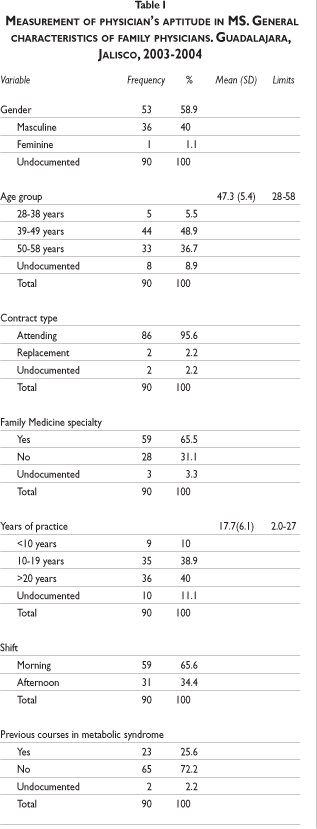
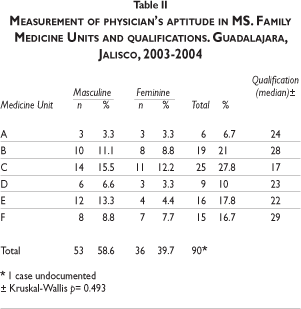
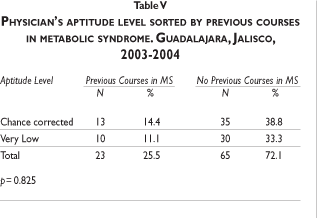
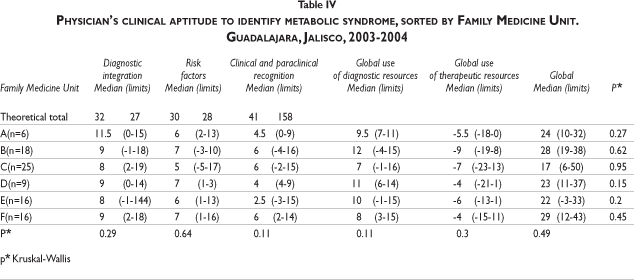
<body><![CDATA[<p><font face="Verdana, Arial, Helvetica, sans-serif" size="2"><i>Ethical considerations:</i>    In Mexican law, according to the "Ley General de Salud en Materia de Investigaci&oacute;n    para la Salud"<sup>14</sup> the present work is considered to be research without    risk (Article 12). Verbal informed consent from each participant was requested    (Article 13).</font></p>     <p>&nbsp;</p>     <p><font face="Verdana, Arial, Helvetica, sans-serif" size="3"><b>Results</b></font></p>     <p><font face="Verdana, Arial, Helvetica, sans-serif" size="2">The instrument's    confidence coefficient (Kuder-Richardson) was 0.95. General characteristics    of the sample are described in <a href="#tab1">Table I</a>, and the number of    Family Medicine Units as well as distribution by sex are in <a href="#tab2">Table    II</a>. Results sorted by medians for the six Family Medicine Units are also    described in <a href="#tab2">Table II</a>; there are no statistically significant    differences between groups (<i>p</i>=0.493). <a href="/img/revistas/spm/v50n6/06t3.gif">Table    III</a> shows the clinical aptitude level sorted by Family Medicine Unit, showing    that 54.4% were due to chance and the remaining 45.6% had a very low level.    Global results showed a mean of 23 points in a range of -3 to 50. Only units    B and F obtained a very low level, compared with the answers obtained by chance    from the other units (<i>p</i>=0.376). In <a href="/img/revistas/spm/v50n6/06t4.gif">Table    IV</a>, clinical aptitude is sorted by Family Medicine Unit. <a href="#tab5">Table    V</a> shows the clinical aptitude level sorted by those who had previous courses    in MS and those who did not. Comparing medians between units (A, B, C, D, E,    F) and clinical aptitude indicators, no statistically significant differences    were found (KW: Non significant). Using the theoretical total for each indicator,    no statistically significant difference was found (<i>p</i>&gt;0.05).</font></p>     <p><a name="tab1"></a></p>     <p>&nbsp;</p>     <p align="center"><img src="/img/revistas/spm/v50n6/06t1.gif"></p>     <p>&nbsp;</p>     <p><a name="tab2"></a></p>     <p>&nbsp;</p>     ]]></body>
<body><![CDATA[<p align="center"><img src="/img/revistas/spm/v50n6/06t2.gif"></p>     <p>&nbsp;</p>     <p><a name="tab5"></a></p>     <p>&nbsp;</p>     <p align="center"><img src="/img/revistas/spm/v50n6/06t5.gif"></p>     <p>&nbsp;</p>     <p><font face="Verdana, Arial, Helvetica, sans-serif" size="2">When we related    clinical aptitude for the identification of MS with sex (U: <i>p</i>=0.858),    years of service (KW, <i>p</i>=0.664 and p=0.875), family medicine specialty    (U: <i>p</i>=0.101) and shift (U: <i>p</i>=0.619 and 0.897), no statistically    significant differences appeared.</font></p>     <p>&nbsp;</p>     <p><font face="Verdana, Arial, Helvetica, sans-serif" size="3"><b>Discussion</b></font></p>     <p><font face="Verdana, Arial, Helvetica, sans-serif" size="2">MS impacts individual,    familial, and institutional health. Costs associated with treatment and complications    represent a serious burden on health services and patients. This is the reason    why family physicians, being the first level in health care, should act with    efficacy and in a timely manner. Research into the development of clinical aptitude    of family physicians in MS should be mandatory.</font></p>     ]]></body>
<body><![CDATA[<p><font face="Verdana, Arial, Helvetica, sans-serif" size="2">The measurement    of clinical aptitude with instruments like the one we have used is generally    used to identify clinical aptitude and the degree of transition between novice    and expert. This is done with the objective of promoting educational processes    that lead to increasing expertise as a result of intentional educational processes.<sup>15</sup></font></p>     <p><font face="Verdana, Arial, Helvetica, sans-serif" size="2">Education for family    medicine specialists seeks to provide theoretical and methodological tools for    physicians<sup>16</sup> to offer health care to the population, the identification    and treatment of MS being one of these tools; however, the results of our study    indicate that there is no relation between the tools provided and the ability    of physicians to diagnose the syndrome, given the low aptitude level found in    the total sample. Results sorted by curricular differences suggest a slight    advantage, but is not significant.</font></p>     <p><font face="Verdana, Arial, Helvetica, sans-serif" size="2">In addition, years    of practice in family medicine should give the physician vast experience in    situations and conditions in the health care of the population. Physicians with    more than 20 years in practice showed a slight non-statistically significant    advantage in clinical aptitude for MS, in contrast with the other groups. This    fact should motivate the creation of spaces and opportunities for continuous    medical education and specialist training.<sup>17,18</sup></font></p>     <p><font face="Verdana, Arial, Helvetica, sans-serif" size="2">In the matter of    working shifts, there were no significant differences in the development of    aptitude, although when compared with the afternoon shift, morning shift physicians    showed an advantage. This could be related to the fact that most of the continuous    educational activities as well as other institutional activities take place    during the morning shift, which may have influenced the results. However, this    insignificant advantage is also explained by the general tendency of educational    processes to follow a traditional model.<sup>9,13</sup></font></p>     <p><font face="Verdana, Arial, Helvetica, sans-serif" size="2">From the theoretical    perspective of our study it would be most convenient to restructure the family    physician and general physician's curricula over the medium term.<sup>19</sup>    It would also be of interest that this be done by higher education institutions    that train family medicine professionals.<sup>20</sup></font></p>     <p><font face="Verdana, Arial, Helvetica, sans-serif" size="2">The development    of clinical aptitude requires environments that foster reflection on the part    of the physician; a revision of educational curriculum; and the development    of personal knowledge. The results suggest that these conditions are lacking,    since a very low clinical aptitude reflects a clear inability to investigate    and interpret MS.</font></p>     <p><font face="Verdana, Arial, Helvetica, sans-serif" size="2">The identification    of risk factors for MS shows that 20% of physicians had the capacity to investigate    them by the development of a diagnostic hypothesis.</font></p>     <p><font face="Verdana, Arial, Helvetica, sans-serif" size="2">The pertinent global    use of diagnostic resources was shown in 39% of family physicians, most of all    in the management of clinical tests.</font></p>     <p><font face="Verdana, Arial, Helvetica, sans-serif" size="2">The ability to    orientate and propose requires the capacity to judge the pertinence of decisions    made in the clinical case reviews, as presented in the instrument, and propose    alternative actions.<sup>20-22</sup> The use of therapeutic resources, implying    the ability to give an integrative management of MS, was achieved only by 14.5%    of family physicians.</font></p>     <p><font face="Verdana, Arial, Helvetica, sans-serif" size="2">The advantage of    contract type couldn't be evaluated, given that attending physicians represented    95.6% of the sample. There is a slight advantage for family physicians in a    specialty working the morning shift with more than 20 years in practice. However,    the global clinical aptitude results were very low for family physicians (45.6%),    reflecting a limited capacity to deal with MS.</font></p>     ]]></body>
<body><![CDATA[<p>&nbsp;</p>     <p><font face="Verdana, Arial, Helvetica, sans-serif" size="3"><b>References</b></font></p>     <!-- ref --><p><font face="Verdana, Arial, Helvetica, sans-serif" size="2">1. Lara E, Carrillo    T, Carrasco M. Nutrici&oacute;n en el S&iacute;ndrome Metab&oacute;lico. In:    Annual Review del Colegio de Medicina Interna de M&eacute;xico; Mexico: Intersistemas;    2005.</font>&nbsp;&nbsp;&nbsp;&nbsp;&nbsp;&nbsp;&nbsp;&nbsp;[&#160;<a href="javascript:void(0);" onclick="javascript: window.open('/scielo.php?script=sci_nlinks&ref=9259913&pid=S0036-3634200800060000600001&lng=','','width=640,height=500,resizable=yes,scrollbars=1,menubar=yes,');">Links</a>&#160;]<!-- end-ref --><!-- ref --><p><font face="Verdana, Arial, Helvetica, sans-serif" size="2">2. Alberti KG,    Zimmet P, Shaw J. Metabolic syndrome&#151;a new world-wide definition. A Consensus    Statement from the International Diabetes Federation. Diabetic Medicine 2006;23(5):469-480.</font>&nbsp;&nbsp;&nbsp;&nbsp;&nbsp;&nbsp;&nbsp;&nbsp;[&#160;<a href="javascript:void(0);" onclick="javascript: window.open('/scielo.php?script=sci_nlinks&ref=9259914&pid=S0036-3634200800060000600002&lng=','','width=640,height=500,resizable=yes,scrollbars=1,menubar=yes,');">Links</a>&#160;]<!-- end-ref --><!-- ref --><p><font face="Verdana, Arial, Helvetica, sans-serif" size="2">3. Lorenzo C, Williams    K, Hunt KJ, Haffner SM. The National Cholesterol Education Program - Adult Treatment    Panel III, International Diabetes Federation, and World Health Organization    definitions of the metabolic syndrome as predictors of incident cardiovascular    disease and diabetes. Diabetes Care 2007;30(1):8-13. </font>&nbsp;&nbsp;&nbsp;&nbsp;&nbsp;&nbsp;&nbsp;&nbsp;[&#160;<a href="javascript:void(0);" onclick="javascript: window.open('/scielo.php?script=sci_nlinks&ref=9259915&pid=S0036-3634200800060000600003&lng=','','width=640,height=500,resizable=yes,scrollbars=1,menubar=yes,');">Links</a>&#160;]<!-- end-ref --><!-- ref --><p><font face="Verdana, Arial, Helvetica, sans-serif" size="2">4. Lerman G, Aguilar-Salinas    C, G&oacute;mez-P&eacute;rez F, Reza A, Hern&aacute;ndez J, V&aacute;zquez CC.    El s&iacute;ndrome metab&oacute;lico, posici&oacute;n de la sociedad Mexicana    de nutrici&oacute;n y endocrinolog&iacute;a, sobre la definici&oacute;n, fisiopatolog&iacute;a    y diagn&oacute;stico. Caracter&iacute;sticas del s&iacute;ndrome metab&oacute;lico    en M&eacute;xico. Revista de Endocrinolog&iacute;a y Nutrici&oacute;n 2004;12(3):    109-122.</font>&nbsp;&nbsp;&nbsp;&nbsp;&nbsp;&nbsp;&nbsp;&nbsp;[&#160;<a href="javascript:void(0);" onclick="javascript: window.open('/scielo.php?script=sci_nlinks&ref=9259916&pid=S0036-3634200800060000600004&lng=','','width=640,height=500,resizable=yes,scrollbars=1,menubar=yes,');">Links</a>&#160;]<!-- end-ref --><!-- ref --><p><font face="Verdana, Arial, Helvetica, sans-serif" size="2">5. Gonzalez C,    S&aacute;nchez Z, Elizondo A, Malanco H. Inflamaci&oacute;n y resistencia a    la insulina, su papel en el desarrollo del s&iacute;ndrome metab&oacute;lico.    In: Annual Review del Colegio de Medicina Interna de M&eacute;xico. Mexico:    Intersistemas, 2005.</font>&nbsp;&nbsp;&nbsp;&nbsp;&nbsp;&nbsp;&nbsp;&nbsp;[&#160;<a href="javascript:void(0);" onclick="javascript: window.open('/scielo.php?script=sci_nlinks&ref=9259917&pid=S0036-3634200800060000600005&lng=','','width=640,height=500,resizable=yes,scrollbars=1,menubar=yes,');">Links</a>&#160;]<!-- end-ref --><!-- ref --><p><font face="Verdana, Arial, Helvetica, sans-serif" size="2">6. Skilton P, Moulin    A, S&eacute;rusclat A, Nony P, Bonnet F. A comparison of the NCEP-ATPIII, IDF    and AHA/NHLBI metabolic syndrome definitions with relation to early carotid    atherosclerosis in subjects with hypercholesterolemia or at risk of CVD: Evidence    for sex-specific differences. Atherosclerosis 2007; 190(2):416-422.</font>&nbsp;&nbsp;&nbsp;&nbsp;&nbsp;&nbsp;&nbsp;&nbsp;[&#160;<a href="javascript:void(0);" onclick="javascript: window.open('/scielo.php?script=sci_nlinks&ref=9259918&pid=S0036-3634200800060000600006&lng=','','width=640,height=500,resizable=yes,scrollbars=1,menubar=yes,');">Links</a>&#160;]<!-- end-ref --><!-- ref --><p><font face="Verdana, Arial, Helvetica, sans-serif" size="2">7. Rodr&iacute;guez    P, S&aacute;nchez L, Mart&iacute;nez V. S&iacute;ndrome metab&oacute;lico. Rev    Cub Endocrinol 2002;13(3):238-252.</font>&nbsp;&nbsp;&nbsp;&nbsp;&nbsp;&nbsp;&nbsp;&nbsp;[&#160;<a href="javascript:void(0);" onclick="javascript: window.open('/scielo.php?script=sci_nlinks&ref=9259919&pid=S0036-3634200800060000600007&lng=','','width=640,height=500,resizable=yes,scrollbars=1,menubar=yes,');">Links</a>&#160;]<!-- end-ref --><!-- ref --><p><font face="Verdana, Arial, Helvetica, sans-serif" size="2">8. Dekker J, Girmain    C, Rhodes T, Nipjels G, Stehouwer CD, Bouter LM. Metabolic Syndrome and 10 year    cardiovascular disease risk in the Hoorn study. Circulation 2005;112:666-673.</font>&nbsp;&nbsp;&nbsp;&nbsp;&nbsp;&nbsp;&nbsp;&nbsp;[&#160;<a href="javascript:void(0);" onclick="javascript: window.open('/scielo.php?script=sci_nlinks&ref=9259920&pid=S0036-3634200800060000600008&lng=','','width=640,height=500,resizable=yes,scrollbars=1,menubar=yes,');">Links</a>&#160;]<!-- end-ref --><!-- ref --><p><font face="Verdana, Arial, Helvetica, sans-serif" size="2">9. Chavez V, Aguilar    M. Aptitud cl&iacute;nica en el manejo de la familia, en residentes de Medicina    Familiar. Rev Med IMSS 2002;40(6):477-481.</font>&nbsp;&nbsp;&nbsp;&nbsp;&nbsp;&nbsp;&nbsp;&nbsp;[&#160;<a href="javascript:void(0);" onclick="javascript: window.open('/scielo.php?script=sci_nlinks&ref=9259921&pid=S0036-3634200800060000600009&lng=','','width=640,height=500,resizable=yes,scrollbars=1,menubar=yes,');">Links</a>&#160;]<!-- end-ref --><!-- ref --><p><font face="Verdana, Arial, Helvetica, sans-serif" size="2">10. Garfias G,    Aguilar M, Viniegra V. C&oacute;mo explorar las aptitudes de los m&eacute;dicos    residentes de traumatolog&iacute;a y ortopedia en traumatismo cr&aacute;neoencef&aacute;lico.    Rev Med IMSS 1997;(35):233-237.</font>&nbsp;&nbsp;&nbsp;&nbsp;&nbsp;&nbsp;&nbsp;&nbsp;[&#160;<a href="javascript:void(0);" onclick="javascript: window.open('/scielo.php?script=sci_nlinks&ref=9259922&pid=S0036-3634200800060000600010&lng=','','width=640,height=500,resizable=yes,scrollbars=1,menubar=yes,');">Links</a>&#160;]<!-- end-ref --><!-- ref --><p><font face="Verdana, Arial, Helvetica, sans-serif" size="2">11. Cobos AH, Insfr&aacute;n    SMD, P&eacute;rez CP, Elizaldi LNE, Hern&aacute;ndez DE, Barerra MJ. Aptitud    cl&iacute;nica durante el internado de pregrado en hospitales generales. Rev    Med IMSS 2004;42(6):469-476.</font>&nbsp;&nbsp;&nbsp;&nbsp;&nbsp;&nbsp;&nbsp;&nbsp;[&#160;<a href="javascript:void(0);" onclick="javascript: window.open('/scielo.php?script=sci_nlinks&ref=9259923&pid=S0036-3634200800060000600011&lng=','','width=640,height=500,resizable=yes,scrollbars=1,menubar=yes,');">Links</a>&#160;]<!-- end-ref --><!-- ref --><p><font face="Verdana, Arial, Helvetica, sans-serif" size="2">12. Sabido S, Viniegra    V. Competencia y desempe&ntilde;o en la evaluaci&oacute;n del m&eacute;dico:    estudio con pacientes diab&eacute;ticos en el primer nivel de atenci&oacute;n.    In: Viniegra L. La investigaci&oacute;n en la educaci&oacute;n: papel de la    teor&iacute;a y la observaci&oacute;n. Mexico: IMSS, 2000.</font>&nbsp;&nbsp;&nbsp;&nbsp;&nbsp;&nbsp;&nbsp;&nbsp;[&#160;<a href="javascript:void(0);" onclick="javascript: window.open('/scielo.php?script=sci_nlinks&ref=9259924&pid=S0036-3634200800060000600012&lng=','','width=640,height=500,resizable=yes,scrollbars=1,menubar=yes,');">Links</a>&#160;]<!-- end-ref --><!-- ref --><p><font face="Verdana, Arial, Helvetica, sans-serif" size="2">13. Guti&eacute;rrez    G, Aguilar M, Viniegra V. Validaci&oacute;n de un instrumento para evaluar la    competencia cl&iacute;nica del m&eacute;dico familiar. Rev Med IMSS 2001;37:201-210.</font>&nbsp;&nbsp;&nbsp;&nbsp;&nbsp;&nbsp;&nbsp;&nbsp;[&#160;<a href="javascript:void(0);" onclick="javascript: window.open('/scielo.php?script=sci_nlinks&ref=9259925&pid=S0036-3634200800060000600013&lng=','','width=640,height=500,resizable=yes,scrollbars=1,menubar=yes,');">Links</a>&#160;]<!-- end-ref --><!-- ref --><p><font face="Verdana, Arial, Helvetica, sans-serif" size="2">14. Secretaria    de Salud: Reglamento de la Ley General de Salud en materia de investigaci&oacute;n    para la salud. Mexico DF: SSA, 1990.</font>&nbsp;&nbsp;&nbsp;&nbsp;&nbsp;&nbsp;&nbsp;&nbsp;[&#160;<a href="javascript:void(0);" onclick="javascript: window.open('/scielo.php?script=sci_nlinks&ref=9259926&pid=S0036-3634200800060000600014&lng=','','width=640,height=500,resizable=yes,scrollbars=1,menubar=yes,');">Links</a>&#160;]<!-- end-ref --><!-- ref --><p><font face="Verdana, Arial, Helvetica, sans-serif" size="2">15. Rothman A,    Blackmore D, Cohen R, Reznic R. The consistency and uncertainty in examiners'    definitions of pass/fail performance on OSCE stations. Ev Health Prof 1996;16:322-332.</font>&nbsp;&nbsp;&nbsp;&nbsp;&nbsp;&nbsp;&nbsp;&nbsp;[&#160;<a href="javascript:void(0);" onclick="javascript: window.open('/scielo.php?script=sci_nlinks&ref=9259927&pid=S0036-3634200800060000600015&lng=','','width=640,height=500,resizable=yes,scrollbars=1,menubar=yes,');">Links</a>&#160;]<!-- end-ref --><!-- ref --><p><font face="Verdana, Arial, Helvetica, sans-serif" size="2">16. Searle J. Defining    competency-the role of standard setting. Med Educ 2000; 34:363-366.</font>&nbsp;&nbsp;&nbsp;&nbsp;&nbsp;&nbsp;&nbsp;&nbsp;[&#160;<a href="javascript:void(0);" onclick="javascript: window.open('/scielo.php?script=sci_nlinks&ref=9259928&pid=S0036-3634200800060000600016&lng=','','width=640,height=500,resizable=yes,scrollbars=1,menubar=yes,');">Links</a>&#160;]<!-- end-ref --><!-- ref --><p><font face="Verdana, Arial, Helvetica, sans-serif" size="2">17. Satir V. Psicoterapia    familiar conjunta. Mexico City: Prensa Medica, 1986: 86-88.</font>&nbsp;&nbsp;&nbsp;&nbsp;&nbsp;&nbsp;&nbsp;&nbsp;[&#160;<a href="javascript:void(0);" onclick="javascript: window.open('/scielo.php?script=sci_nlinks&ref=9259929&pid=S0036-3634200800060000600017&lng=','','width=640,height=500,resizable=yes,scrollbars=1,menubar=yes,');">Links</a>&#160;]<!-- end-ref --><!-- ref --><p><font face="Verdana, Arial, Helvetica, sans-serif" size="2">18. Minuchin S.    Familias y terapia familiar. Madrid: Gedisa, 1977.</font>&nbsp;&nbsp;&nbsp;&nbsp;&nbsp;&nbsp;&nbsp;&nbsp;[&#160;<a href="javascript:void(0);" onclick="javascript: window.open('/scielo.php?script=sci_nlinks&ref=9259930&pid=S0036-3634200800060000600018&lng=','','width=640,height=500,resizable=yes,scrollbars=1,menubar=yes,');">Links</a>&#160;]<!-- end-ref --><!-- ref --><p><font face="Verdana, Arial, Helvetica, sans-serif" size="2">19. Larios M, Trejo    M, Cort&eacute;s G. Evaluaci&oacute;n de la competencia cl&iacute;nica. Rev    Med IMSS 1998;(36):77-82</font>&nbsp;&nbsp;&nbsp;&nbsp;&nbsp;&nbsp;&nbsp;&nbsp;[&#160;<a href="javascript:void(0);" onclick="javascript: window.open('/scielo.php?script=sci_nlinks&ref=9259931&pid=S0036-3634200800060000600019&lng=','','width=640,height=500,resizable=yes,scrollbars=1,menubar=yes,');">Links</a>&#160;]<!-- end-ref --><!-- ref --><p><font face="Verdana, Arial, Helvetica, sans-serif" size="2">20. Gardner W,    Nutting PA, Kelleher KJ, Does the family Apgar effectively measure family functioning?    Aten Primaria 1996;17:338-341.</font>&nbsp;&nbsp;&nbsp;&nbsp;&nbsp;&nbsp;&nbsp;&nbsp;[&#160;<a href="javascript:void(0);" onclick="javascript: window.open('/scielo.php?script=sci_nlinks&ref=9259932&pid=S0036-3634200800060000600020&lng=','','width=640,height=500,resizable=yes,scrollbars=1,menubar=yes,');">Links</a>&#160;]<!-- end-ref --><!-- ref --><p><font face="Verdana, Arial, Helvetica, sans-serif" size="2">21. S&aacute;nchez    T, P&eacute;rez C, Navarro L, Kumazagua I, V&aacute;squez Garibay E. Din&aacute;mica    Familiar: metodolog&iacute;a para su evaluaci&oacute;n. Am J Dis 1994;7:48-52.</font>&nbsp;&nbsp;&nbsp;&nbsp;&nbsp;&nbsp;&nbsp;&nbsp;[&#160;<a href="javascript:void(0);" onclick="javascript: window.open('/scielo.php?script=sci_nlinks&ref=9259933&pid=S0036-3634200800060000600021&lng=','','width=640,height=500,resizable=yes,scrollbars=1,menubar=yes,');">Links</a>&#160;]<!-- end-ref --><!-- ref --><p><font face="Verdana, Arial, Helvetica, sans-serif" size="2">22. Vazquez E,    S&aacute;nchez T, Navarro L, Romero V, P&eacute;rez C, Kumazagua I. Instrumento    de Medici&oacute;n de la din&aacute;mica de la familia nuclear mexicana. Un    enfoque cuantitativo. Bol Med Hosp Infant Mex 2003;60:33-52.</font>&nbsp;&nbsp;&nbsp;&nbsp;&nbsp;&nbsp;&nbsp;&nbsp;[&#160;<a href="javascript:void(0);" onclick="javascript: window.open('/scielo.php?script=sci_nlinks&ref=9259934&pid=S0036-3634200800060000600022&lng=','','width=640,height=500,resizable=yes,scrollbars=1,menubar=yes,');">Links</a>&#160;]<!-- end-ref --><p>&nbsp;</p>     <p>&nbsp;</p>     <p><font face="Verdana, Arial, Helvetica, sans-serif" size="2">Received on: January    9, 2008    <br>   Accepted on: July 1, 2008</font></p>     <p>&nbsp;</p>     <p>&nbsp;</p>     ]]></body>
<body><![CDATA[<p><font face="Verdana, Arial, Helvetica, sans-serif" size="2">Address reprint    request to: PhD Carlos Cabrera P. San Juan Bosco 3782, Col Chapalita, Guadalajara,    Jalisco, M&eacute;xico.    <br>   E-mail: <a href="mailto:carlos.cabrera@imss.gob.mx">carlos.cabrera@imss.gob.mx</a></font></p>      ]]></body><back>
<ref-list>
<ref id="B1">
<label>1</label><nlm-citation citation-type="book">
<person-group person-group-type="author">
<name>
<surname><![CDATA[Lara]]></surname>
<given-names><![CDATA[E]]></given-names>
</name>
<name>
<surname><![CDATA[Carrillo]]></surname>
<given-names><![CDATA[T]]></given-names>
</name>
<name>
<surname><![CDATA[Carrasco]]></surname>
<given-names><![CDATA[M.]]></given-names>
</name>
</person-group>
<article-title xml:lang="es"><![CDATA[Nutrición en el Síndrome Metabólico]]></article-title>
<source><![CDATA[Annual Review del Colegio de Medicina Interna de México]]></source>
<year>2005</year>
<publisher-loc><![CDATA[Mexico ]]></publisher-loc>
<publisher-name><![CDATA[Intersistemas]]></publisher-name>
</nlm-citation>
</ref>
<ref id="B2">
<label>2</label><nlm-citation citation-type="journal">
<person-group person-group-type="author">
<name>
<surname><![CDATA[Alberti]]></surname>
<given-names><![CDATA[KG]]></given-names>
</name>
<name>
<surname><![CDATA[Zimmet]]></surname>
<given-names><![CDATA[P]]></given-names>
</name>
<name>
<surname><![CDATA[Shaw]]></surname>
<given-names><![CDATA[J]]></given-names>
</name>
</person-group>
<article-title xml:lang="en"><![CDATA[Metabolic syndrome-a new world-wide definition: A Consensus Statement from the International Diabetes Federation]]></article-title>
<source><![CDATA[Diabetic Medicine]]></source>
<year>2006</year>
<volume>23</volume>
<numero>5</numero>
<issue>5</issue>
<page-range>469-480</page-range></nlm-citation>
</ref>
<ref id="B3">
<label>3</label><nlm-citation citation-type="journal">
<person-group person-group-type="author">
<name>
<surname><![CDATA[Lorenzo]]></surname>
<given-names><![CDATA[C]]></given-names>
</name>
<name>
<surname><![CDATA[Williams]]></surname>
<given-names><![CDATA[K]]></given-names>
</name>
<name>
<surname><![CDATA[Hunt]]></surname>
<given-names><![CDATA[KJ]]></given-names>
</name>
<name>
<surname><![CDATA[Haffner]]></surname>
<given-names><![CDATA[SM.]]></given-names>
</name>
</person-group>
<article-title xml:lang="en"><![CDATA[The National Cholesterol Education Program: Adult Treatment Panel III, International Diabetes Federation, and World Health Organization definitions of the metabolic syndrome as predictors of incident cardiovascular disease and diabetes]]></article-title>
<source><![CDATA[Diabetes Care]]></source>
<year>2007</year>
<volume>30</volume>
<numero>1</numero>
<issue>1</issue>
<page-range>8-13</page-range></nlm-citation>
</ref>
<ref id="B4">
<label>4</label><nlm-citation citation-type="journal">
<person-group person-group-type="author">
<name>
<surname><![CDATA[Lerman]]></surname>
<given-names><![CDATA[G]]></given-names>
</name>
<name>
<surname><![CDATA[Aguilar-Salinas]]></surname>
<given-names><![CDATA[C]]></given-names>
</name>
<name>
<surname><![CDATA[Gómez-Pérez]]></surname>
<given-names><![CDATA[F]]></given-names>
</name>
<name>
<surname><![CDATA[Reza]]></surname>
<given-names><![CDATA[A]]></given-names>
</name>
<name>
<surname><![CDATA[Hernández]]></surname>
<given-names><![CDATA[J]]></given-names>
</name>
<name>
<surname><![CDATA[Vázquez]]></surname>
<given-names><![CDATA[CC.]]></given-names>
</name>
</person-group>
<article-title xml:lang="en"><![CDATA[El síndrome metabólico, posición de la sociedad Mexicana de nutrición y endocrinología, sobre la definición, fisiopatología y diagnóstico: Características del síndrome metabólico en México]]></article-title>
<source><![CDATA[Revista de Endocrinología y Nutrición]]></source>
<year>2004</year>
<volume>12</volume>
<numero>3</numero>
<issue>3</issue>
<page-range>109-122</page-range></nlm-citation>
</ref>
<ref id="B5">
<label>5</label><nlm-citation citation-type="book">
<person-group person-group-type="author">
<name>
<surname><![CDATA[Gonzalez]]></surname>
<given-names><![CDATA[C]]></given-names>
</name>
<name>
<surname><![CDATA[Sánchez]]></surname>
<given-names><![CDATA[Z]]></given-names>
</name>
<name>
<surname><![CDATA[Elizondo]]></surname>
<given-names><![CDATA[A]]></given-names>
</name>
<name>
<surname><![CDATA[Malanco]]></surname>
<given-names><![CDATA[H.]]></given-names>
</name>
</person-group>
<article-title xml:lang="en"><![CDATA[Inflamación y resistencia a la insulina, su papel en el desarrollo del síndrome metabólico]]></article-title>
<source><![CDATA[Annual Review del Colegio de Medicina Interna de México]]></source>
<year>2005</year>
<publisher-loc><![CDATA[Mexico ]]></publisher-loc>
<publisher-name><![CDATA[Intersistemas]]></publisher-name>
</nlm-citation>
</ref>
<ref id="B6">
<label>6</label><nlm-citation citation-type="journal">
<person-group person-group-type="author">
<name>
<surname><![CDATA[Skilton]]></surname>
<given-names><![CDATA[P]]></given-names>
</name>
<name>
<surname><![CDATA[Moulin]]></surname>
<given-names><![CDATA[A]]></given-names>
</name>
<name>
<surname><![CDATA[Sérusclat]]></surname>
<given-names><![CDATA[A]]></given-names>
</name>
<name>
<surname><![CDATA[Nony]]></surname>
<given-names><![CDATA[P]]></given-names>
</name>
<name>
<surname><![CDATA[Bonnet]]></surname>
<given-names><![CDATA[F]]></given-names>
</name>
</person-group>
<article-title xml:lang="en"><![CDATA[A comparison of the NCEP-ATPIII, IDF and AHA/NHLBI metabolic syndrome definitions with relation to early carotid atherosclerosis in subjects with hypercholesterolemia or at risk of CVD: Evidence for sex-specific differences]]></article-title>
<source><![CDATA[Atherosclerosis]]></source>
<year>2007</year>
<volume>190</volume>
<numero>2</numero>
<issue>2</issue>
<page-range>416-422</page-range></nlm-citation>
</ref>
<ref id="B7">
<label>7</label><nlm-citation citation-type="journal">
<person-group person-group-type="author">
<name>
<surname><![CDATA[Rodríguez]]></surname>
<given-names><![CDATA[P]]></given-names>
</name>
<name>
<surname><![CDATA[Sánchez]]></surname>
<given-names><![CDATA[L]]></given-names>
</name>
<name>
<surname><![CDATA[Martínez]]></surname>
<given-names><![CDATA[V]]></given-names>
</name>
</person-group>
<article-title xml:lang="es"><![CDATA[Síndrome metabólico]]></article-title>
<source><![CDATA[Rev Cub Endocrinol]]></source>
<year>2002</year>
<volume>13</volume>
<numero>3</numero>
<issue>3</issue>
<page-range>238-252</page-range></nlm-citation>
</ref>
<ref id="B8">
<label>8</label><nlm-citation citation-type="journal">
<person-group person-group-type="author">
<name>
<surname><![CDATA[Dekker]]></surname>
<given-names><![CDATA[J]]></given-names>
</name>
<name>
<surname><![CDATA[Girmain]]></surname>
<given-names><![CDATA[C]]></given-names>
</name>
<name>
<surname><![CDATA[Rhodes]]></surname>
<given-names><![CDATA[T]]></given-names>
</name>
<name>
<surname><![CDATA[Nipjels]]></surname>
<given-names><![CDATA[G]]></given-names>
</name>
<name>
<surname><![CDATA[Stehouwer]]></surname>
<given-names><![CDATA[CD]]></given-names>
</name>
<name>
<surname><![CDATA[Bouter]]></surname>
<given-names><![CDATA[LM]]></given-names>
</name>
</person-group>
<article-title xml:lang="en"><![CDATA[Metabolic Syndrome and 10 year cardiovascular disease risk in the Hoorn study]]></article-title>
<source><![CDATA[Circulation]]></source>
<year>2005</year>
<volume>112</volume>
<page-range>666-673</page-range></nlm-citation>
</ref>
<ref id="B9">
<label>9</label><nlm-citation citation-type="journal">
<person-group person-group-type="author">
<name>
<surname><![CDATA[Chavez]]></surname>
<given-names><![CDATA[V]]></given-names>
</name>
<name>
<surname><![CDATA[Aguilar]]></surname>
<given-names><![CDATA[M]]></given-names>
</name>
</person-group>
<article-title xml:lang="es"><![CDATA[Aptitud clínica en el manejo de la familia, en residentes de Medicina Familiar]]></article-title>
<source><![CDATA[Rev Med IMSS]]></source>
<year>2002</year>
<volume>40</volume>
<numero>6</numero>
<issue>6</issue>
<page-range>477-481</page-range></nlm-citation>
</ref>
<ref id="B10">
<label>10</label><nlm-citation citation-type="journal">
<person-group person-group-type="author">
<name>
<surname><![CDATA[Garfias]]></surname>
<given-names><![CDATA[G]]></given-names>
</name>
<name>
<surname><![CDATA[Aguilar]]></surname>
<given-names><![CDATA[M]]></given-names>
</name>
<name>
<surname><![CDATA[Viniegra]]></surname>
<given-names><![CDATA[V]]></given-names>
</name>
</person-group>
<article-title xml:lang="es"><![CDATA[Cómo explorar las aptitudes de los médicos residentes de traumatología y ortopedia en traumatismo cráneoencefálico]]></article-title>
<source><![CDATA[Rev Med IMSS]]></source>
<year>1997</year>
<numero>35</numero>
<issue>35</issue>
<page-range>233-237</page-range></nlm-citation>
</ref>
<ref id="B11">
<label>11</label><nlm-citation citation-type="journal">
<person-group person-group-type="author">
<name>
<surname><![CDATA[Cobos]]></surname>
<given-names><![CDATA[AH]]></given-names>
</name>
<name>
<surname><![CDATA[Insfrán]]></surname>
<given-names><![CDATA[SMD]]></given-names>
</name>
<name>
<surname><![CDATA[Pérez]]></surname>
<given-names><![CDATA[CP]]></given-names>
</name>
<name>
<surname><![CDATA[Elizaldi]]></surname>
<given-names><![CDATA[LNE]]></given-names>
</name>
<name>
<surname><![CDATA[Hernández]]></surname>
<given-names><![CDATA[DE]]></given-names>
</name>
<name>
<surname><![CDATA[Barerra]]></surname>
<given-names><![CDATA[MJ]]></given-names>
</name>
</person-group>
<article-title xml:lang="pt"><![CDATA[Aptitud clínica durante el internado de pregrado en hospitales generales]]></article-title>
<source><![CDATA[Rev Med IMSS]]></source>
<year>2004</year>
<volume>42</volume>
<numero>6</numero>
<issue>6</issue>
<page-range>469-476</page-range></nlm-citation>
</ref>
<ref id="B12">
<label>12</label><nlm-citation citation-type="book">
<person-group person-group-type="author">
<name>
<surname><![CDATA[Sabido]]></surname>
<given-names><![CDATA[S]]></given-names>
</name>
<name>
<surname><![CDATA[Viniegra]]></surname>
<given-names><![CDATA[V.]]></given-names>
</name>
</person-group>
<article-title xml:lang="es"><![CDATA[Competencia y desempeño en la evaluación del médico: estudio con pacientes diabéticos en el primer nivel de atención]]></article-title>
<person-group person-group-type="editor">
<name>
<surname><![CDATA[Viniegra]]></surname>
<given-names><![CDATA[L.]]></given-names>
</name>
</person-group>
<source><![CDATA[La investigación en la educación: papel de la teoría y la observación]]></source>
<year>2000</year>
<publisher-loc><![CDATA[Mexico ]]></publisher-loc>
<publisher-name><![CDATA[IMSS]]></publisher-name>
</nlm-citation>
</ref>
<ref id="B13">
<label>13</label><nlm-citation citation-type="journal">
<person-group person-group-type="author">
<name>
<surname><![CDATA[Gutiérrez]]></surname>
<given-names><![CDATA[G]]></given-names>
</name>
<name>
<surname><![CDATA[Aguilar]]></surname>
<given-names><![CDATA[M]]></given-names>
</name>
<name>
<surname><![CDATA[Viniegra]]></surname>
<given-names><![CDATA[V]]></given-names>
</name>
</person-group>
<article-title xml:lang="es"><![CDATA[Validación de un instrumento para evaluar la competencia clínica del médico familiar]]></article-title>
<source><![CDATA[Rev Med IMSS]]></source>
<year>2001</year>
<volume>37</volume>
<page-range>201-210</page-range></nlm-citation>
</ref>
<ref id="B14">
<label>14</label><nlm-citation citation-type="book">
<collab>Secretaria de Salud</collab>
<source><![CDATA[Reglamento de la Ley General de Salud en materia de investigación para la salud]]></source>
<year>1990</year>
<publisher-loc><![CDATA[Mexico DF ]]></publisher-loc>
<publisher-name><![CDATA[SSA]]></publisher-name>
</nlm-citation>
</ref>
<ref id="B15">
<label>15</label><nlm-citation citation-type="journal">
<person-group person-group-type="author">
<name>
<surname><![CDATA[Rothman]]></surname>
<given-names><![CDATA[A]]></given-names>
</name>
<name>
<surname><![CDATA[Blackmore]]></surname>
<given-names><![CDATA[D]]></given-names>
</name>
<name>
<surname><![CDATA[Cohen]]></surname>
<given-names><![CDATA[R]]></given-names>
</name>
<name>
<surname><![CDATA[Reznic]]></surname>
<given-names><![CDATA[R]]></given-names>
</name>
</person-group>
<article-title xml:lang="en"><![CDATA[The consistency and uncertainty in examiners' definitions of pass/fail performance on OSCE stations]]></article-title>
<source><![CDATA[Ev Health Prof]]></source>
<year>1996</year>
<volume>16</volume>
<page-range>322-332</page-range></nlm-citation>
</ref>
<ref id="B16">
<label>16</label><nlm-citation citation-type="journal">
<person-group person-group-type="author">
<name>
<surname><![CDATA[Searle]]></surname>
<given-names><![CDATA[J]]></given-names>
</name>
</person-group>
<article-title xml:lang="en"><![CDATA[Defining competency-the role of standard setting]]></article-title>
<source><![CDATA[Med Educ]]></source>
<year>2000</year>
<volume>34</volume>
<page-range>363-366</page-range></nlm-citation>
</ref>
<ref id="B17">
<label>17</label><nlm-citation citation-type="book">
<person-group person-group-type="author">
<name>
<surname><![CDATA[Satir]]></surname>
<given-names><![CDATA[V.]]></given-names>
</name>
</person-group>
<source><![CDATA[Psicoterapia familiar conjunta]]></source>
<year>1986</year>
<page-range>86-88</page-range><publisher-loc><![CDATA[Mexico City ]]></publisher-loc>
<publisher-name><![CDATA[Prensa Medica]]></publisher-name>
</nlm-citation>
</ref>
<ref id="B18">
<label>18</label><nlm-citation citation-type="book">
<person-group person-group-type="author">
<name>
<surname><![CDATA[Minuchin]]></surname>
<given-names><![CDATA[S]]></given-names>
</name>
</person-group>
<source><![CDATA[Familias y terapia familiar]]></source>
<year>1977</year>
<publisher-loc><![CDATA[Madrid ]]></publisher-loc>
<publisher-name><![CDATA[Gedisa]]></publisher-name>
</nlm-citation>
</ref>
<ref id="B19">
<label>19</label><nlm-citation citation-type="journal">
<person-group person-group-type="author">
<name>
<surname><![CDATA[Larios]]></surname>
<given-names><![CDATA[M]]></given-names>
</name>
<name>
<surname><![CDATA[Trejo]]></surname>
<given-names><![CDATA[M]]></given-names>
</name>
<name>
<surname><![CDATA[Cortés]]></surname>
<given-names><![CDATA[G]]></given-names>
</name>
</person-group>
<article-title xml:lang="es"><![CDATA[Evaluación de la competencia clínica]]></article-title>
<source><![CDATA[Rev Med IMSS]]></source>
<year>1998</year>
<numero>36</numero>
<issue>36</issue>
<page-range>77-82</page-range></nlm-citation>
</ref>
<ref id="B20">
<label>20</label><nlm-citation citation-type="journal">
<person-group person-group-type="author">
<name>
<surname><![CDATA[Gardner]]></surname>
<given-names><![CDATA[W]]></given-names>
</name>
<name>
<surname><![CDATA[Nutting]]></surname>
<given-names><![CDATA[PA]]></given-names>
</name>
<name>
<surname><![CDATA[Kelleher]]></surname>
<given-names><![CDATA[KJ]]></given-names>
</name>
</person-group>
<article-title xml:lang="en"><![CDATA[Does the family Apgar effectively measure family functioning?]]></article-title>
<source><![CDATA[Aten Primaria]]></source>
<year>1996</year>
<volume>17</volume>
<page-range>338-341</page-range></nlm-citation>
</ref>
<ref id="B21">
<label>21</label><nlm-citation citation-type="journal">
<person-group person-group-type="author">
<name>
<surname><![CDATA[Sánchez]]></surname>
<given-names><![CDATA[T]]></given-names>
</name>
<name>
<surname><![CDATA[Pérez]]></surname>
<given-names><![CDATA[C]]></given-names>
</name>
<name>
<surname><![CDATA[Navarro]]></surname>
<given-names><![CDATA[L]]></given-names>
</name>
<name>
<surname><![CDATA[Kumazagua]]></surname>
<given-names><![CDATA[I]]></given-names>
</name>
<name>
<surname><![CDATA[Vásquez Garibay]]></surname>
<given-names><![CDATA[E]]></given-names>
</name>
</person-group>
<article-title xml:lang="pt"><![CDATA[Dinámica Familiar: metodología para su evaluación]]></article-title>
<source><![CDATA[Am J Dis]]></source>
<year>1994</year>
<volume>7</volume>
<page-range>48-52</page-range></nlm-citation>
</ref>
<ref id="B22">
<label>22</label><nlm-citation citation-type="journal">
<person-group person-group-type="author">
<name>
<surname><![CDATA[Vazquez]]></surname>
<given-names><![CDATA[E]]></given-names>
</name>
<name>
<surname><![CDATA[Sánchez]]></surname>
<given-names><![CDATA[T]]></given-names>
</name>
<name>
<surname><![CDATA[Navarro]]></surname>
<given-names><![CDATA[L]]></given-names>
</name>
<name>
<surname><![CDATA[Romero]]></surname>
<given-names><![CDATA[V]]></given-names>
</name>
<name>
<surname><![CDATA[Pérez]]></surname>
<given-names><![CDATA[C]]></given-names>
</name>
<name>
<surname><![CDATA[Kumazagua]]></surname>
<given-names><![CDATA[I]]></given-names>
</name>
</person-group>
<article-title xml:lang="pt"><![CDATA[Instrumento de Medición de la dinámica de la familia nuclear mexicana: Un enfoque cuantitativo]]></article-title>
<source><![CDATA[Bol Med Hosp Infant Mex]]></source>
<year>2003</year>
<volume>60</volume>
<page-range>33-52</page-range></nlm-citation>
</ref>
</ref-list>
</back>
</article>