<?xml version="1.0" encoding="ISO-8859-1"?><article xmlns:mml="http://www.w3.org/1998/Math/MathML" xmlns:xlink="http://www.w3.org/1999/xlink" xmlns:xsi="http://www.w3.org/2001/XMLSchema-instance">
<front>
<journal-meta>
<journal-id>0036-3634</journal-id>
<journal-title><![CDATA[Salud Pública de México]]></journal-title>
<abbrev-journal-title><![CDATA[Salud pública Méx]]></abbrev-journal-title>
<issn>0036-3634</issn>
<publisher>
<publisher-name><![CDATA[Instituto Nacional de Salud Pública]]></publisher-name>
</publisher>
</journal-meta>
<article-meta>
<article-id>S0036-36342004000200005</article-id>
<title-group>
<article-title xml:lang="en"><![CDATA[Prevalence and determinants of male partner violence against Mexican women: a population-based study]]></article-title>
<article-title xml:lang="es"><![CDATA[Prevalencia y determinantes de violencia de pareja masculina en contra de mujeres mexicanas: un estudio con base poblacional]]></article-title>
</title-group>
<contrib-group>
<contrib contrib-type="author">
<name>
<surname><![CDATA[Rivera-Rivera]]></surname>
<given-names><![CDATA[Leonor]]></given-names>
</name>
<xref ref-type="aff" rid="A01"/>
</contrib>
<contrib contrib-type="author">
<name>
<surname><![CDATA[Lazcano-Ponce]]></surname>
<given-names><![CDATA[Eduardo]]></given-names>
</name>
<xref ref-type="aff" rid="A01"/>
</contrib>
<contrib contrib-type="author">
<name>
<surname><![CDATA[Salmerón-Castro]]></surname>
<given-names><![CDATA[Jorge]]></given-names>
</name>
<xref ref-type="aff" rid="A02"/>
</contrib>
<contrib contrib-type="author">
<name>
<surname><![CDATA[Salazar-Martínez]]></surname>
<given-names><![CDATA[Eduardo]]></given-names>
</name>
<xref ref-type="aff" rid="A01"/>
</contrib>
<contrib contrib-type="author">
<name>
<surname><![CDATA[Castro]]></surname>
<given-names><![CDATA[Roberto]]></given-names>
</name>
<xref ref-type="aff" rid="A03"/>
</contrib>
<contrib contrib-type="author">
<name>
<surname><![CDATA[Hernández-Avila]]></surname>
<given-names><![CDATA[Mauricio]]></given-names>
</name>
<xref ref-type="aff" rid="A01"/>
</contrib>
</contrib-group>
<aff id="A01">
<institution><![CDATA[,Instituto Nacional de Salud Pública Centro de Investigación en Salud Poblacional ]]></institution>
<addr-line><![CDATA[Cuernavaca Morelos]]></addr-line>
<country>México</country>
</aff>
<aff id="A02">
<institution><![CDATA[,Instituto Mexicano del Seguro Social  ]]></institution>
<addr-line><![CDATA[Cuernavaca Morelos]]></addr-line>
<country>México</country>
</aff>
<aff id="A03">
<institution><![CDATA[,Universidad Nacional Autónoma de México Centro Regional de Investigación Multidisciplinaria ]]></institution>
<addr-line><![CDATA[Cuernavaca Morelos]]></addr-line>
<country>México</country>
</aff>
<pub-date pub-type="pub">
<day>00</day>
<month>04</month>
<year>2004</year>
</pub-date>
<pub-date pub-type="epub">
<day>00</day>
<month>04</month>
<year>2004</year>
</pub-date>
<volume>46</volume>
<numero>2</numero>
<fpage>113</fpage>
<lpage>122</lpage>
<copyright-statement/>
<copyright-year/>
<self-uri xlink:href="http://www.scielo.org.mx/scielo.php?script=sci_arttext&amp;pid=S0036-36342004000200005&amp;lng=en&amp;nrm=iso"></self-uri><self-uri xlink:href="http://www.scielo.org.mx/scielo.php?script=sci_abstract&amp;pid=S0036-36342004000200005&amp;lng=en&amp;nrm=iso"></self-uri><self-uri xlink:href="http://www.scielo.org.mx/scielo.php?script=sci_pdf&amp;pid=S0036-36342004000200005&amp;lng=en&amp;nrm=iso"></self-uri><abstract abstract-type="short" xml:lang="en"><p><![CDATA[OBJECTIVE: To determine the prevalence of and risk factors for violence against women, inflicted by their male partners, in a representative sample of women residing in the metropolitan area of Cuernavaca Morelos, Mexico. MATERIAL AND METHODS: A population-based study was conducted from June to September 1998, among 1 535 women aged 15 to 49 years. Principal components analysis was used to determine the domains of violence that served as the dependent variable. Polynomial logistic regression models were used to estimate odds ratios (OR), with 95% confidence intervals (CI). RESULTS: Prevalence of low-moderate level violence was 35.8%, while prevalence of severe violence was 9.5%. The lifetime prevalence of reported rape was 5.9%. The main factors associated with violence were socio-economic status (OR=0.57; 95% CI=0.34-0.95); education level, both of the women studied (test for trend p=0.01) and of the male partner (test for trend p=0.002); number of years living with partner (OR=2.63; 95% CI=1.55-4.45), alcohol use (OR=2.56; 95% CI=2.02-3.25), illegal drug use by partner (OR=6.17; 95% CI=2.37-16.03); violence during childhood (OR=3.40; 95% CI=2.23-5.18), and a history of rape (OR=5.89; 95% CI=2.78-12.5). CONCLUSIONS: Study findings confirm that violence against women is a prevalent phenomenon in Mexico. Awareness-raising campaigns about male partner violence should bring this important issue to the front of public discussion. Such efforts will help assure that future generations do not experience partner violence to the extent that contemporary Mexican women do.]]></p></abstract>
<abstract abstract-type="short" xml:lang="es"><p><![CDATA[OBJETIVO: Determinar la prevalencia y los factores de riesgo en violencia contra mujeres por parte de sus parejas, en una muestra representativa de aquéllas residentes en el área metropolitana de Cuernavaca, Morelos, México. MATERIAL Y MÉTODOS: De junio a septiembre de 1998 se realizó un estudio con base poblacional en 1 535 mujeres, de 15 a 49 años de edad. Para construir la variable dependiente se realizó análisis de componentes principales y, adicionalmente, análisis de regresión logística politómica, de lo cual se obtuvieron estimadores de razón de momios (RM), con intervalos de confianza (IC 95%). RESULTADOS: La prevalencia de violencia leve-moderada fue de 35.8%, y de severa 9.5%. La prevalencia de violación fue de 5.9%. Los principales factores asociados con violencia fueron los siguientes: nivel socioeconómico (RM= 0.57; IC 95%= 0.34-0.95); nivel educativo en ambas mujeres (prueba de tendencia p=0.01) y sus parejas (prueba de tendencia p= 0.002); años de convivir con la pareja (RM= 2.63; IC 95%= 1.55-4.45), uso de alcohol y drogas ilegales (RM= 2.56; IC 95%= 2.02-3.25, RM= 6.17; IC 95%= 2.37-16.03, respectivamente); violencia durante la niñez (RM= 3.40; IC 95%= 2.23-5.18) e historia de violación (RM= 5.89; IC 95%= 2.78-12.5). CONCLUSIONES: Este estudio confirma cómo la violencia en contra de las mujeres es un fenómeno prevalente en México. Las campañas de concienciación sobre violencia masculina se deben llevar a discusión pública. Los esfuerzos ayudarán a asegurar que las futuras generaciones de mujeres no experimenten violencia de pareja.]]></p></abstract>
<kwd-group>
<kwd lng="en"><![CDATA[partner violence]]></kwd>
<kwd lng="en"><![CDATA[gender]]></kwd>
<kwd lng="en"><![CDATA[women]]></kwd>
<kwd lng="en"><![CDATA[prevalence]]></kwd>
<kwd lng="en"><![CDATA[Mexico]]></kwd>
<kwd lng="es"><![CDATA[violencia de pareja]]></kwd>
<kwd lng="es"><![CDATA[genero]]></kwd>
<kwd lng="es"><![CDATA[mujeres]]></kwd>
<kwd lng="es"><![CDATA[prevalencia]]></kwd>
<kwd lng="es"><![CDATA[México]]></kwd>
</kwd-group>
</article-meta>
</front><body><![CDATA[ <p align="right"><font size="2" face="Verdana"><b>ART&Iacute;CULO ORIGINAL</b></font></p>     <p>&nbsp;</p>     <p><font size="4" face="verdana"><b>Prevalence and determinants of male partner    violence against Mexican women: a population-based study </b></font></p>     <p>&nbsp;</p>     <p><font size="3" face="verdana"><b>Prevalencia y determinantes de violencia de    pareja masculina en contra de mujeres mexicanas: un estudio con base poblacional</b></font></p>     <p>&nbsp;</p>     <p>&nbsp;</p>     <p><font size="2" face="Verdana"><b>Leonor Rivera-Rivera, MD, MSc<SUP>I</SUP>;    Eduardo Lazcano-Ponce, MD, MSc, Dr Sc<SUP>I</SUP>; Jorge Salmer&oacute;n-Castro,    MD, MSc, Dr Sc<SUP>II</SUP>; Eduardo Salazar-Mart&iacute;nez, MD,    MSc, Dr Sc<SUP>I</SUP>; Roberto Castro, MA, PhD<SUP>III</SUP>; Mauricio Hern&aacute;ndez-Avila,    MD, MSc, Dr Sc<SUP>I</SUP></b></font></p>     <p><font size="2" face="Verdana"><sup>I</sup>Centro de Investigaci&oacute;n en    Salud Poblacional, Instituto Nacional de Salud P&uacute;blica. Cuernavaca, Morelos,    M&eacute;xico    <br>   <sup> II</sup>Instituto Mexicano del Seguro Social, Cuernavaca, Morelos, M&eacute;xico    ]]></body>
<body><![CDATA[<br>   <sup> III</sup>Centro Regional de Investigaci&oacute;n Multidisciplinaria, Universidad    Nacional Aut&oacute;noma de M&eacute;xico. Cuernavaca, Morelos, M&eacute;xico</font></p>     <p>&nbsp;</p>     <p>&nbsp;</p> <hr size="1" noshade>     <p><font size="2" face="Verdana"><b>ABSTRACT</b></font></p>     <p><font size="2" face="Verdana"><b>OBJECTIVE:</b> To determine the prevalence    of and risk factors for violence against women, inflicted by their male partners,    in a representative sample of women residing in the metropolitan area of Cuernavaca    Morelos, Mexico.    <br>   <B>MATERIAL AND METHODS:</B> A population-based study was conducted from June    to September 1998, among 1 535 women aged 15 to 49 years. Principal components    analysis was used to determine the domains of violence that served as the dependent    variable. Polynomial logistic regression models were used to estimate odds ratios    (OR), with 95% confidence intervals (CI).    <br>   <B>RESULTS:</B> Prevalence of low-moderate level violence was 35.8%, while prevalence    of severe violence was 9.5%. The lifetime prevalence of reported rape was 5.9%.    The main factors associated with violence were socio-economic status (OR=0.57;    95% CI=0.34-0.95); education level, both of the women studied (test for trend    <I>p</I>=0.01) and of the male partner (test for trend <I>p</I>=0.002); number    of years living with partner (OR=2.63; 95% CI=1.55-4.45), alcohol use (OR=2.56;    95% CI=2.02-3.25), illegal drug use by partner (OR=6.17; 95% CI=2.37-16.03);    violence during childhood (OR=3.40; 95% CI=2.23-5.18), and a history of rape    (OR=5.89; 95% CI=2.78-12.5).     <br>   <b>CONCLUSIONS:</b> Study findings confirm that violence against women is a    prevalent phenomenon in Mexico. Awareness-raising campaigns about male partner    violence should bring this important issue to the front of public discussion.    Such efforts will help assure that future generations do not experience partner    violence to the extent that contemporary Mexican women do. The English version    of this paper is available too at: <a href="http://www.insp.mx/salud/index.html" target="_blank">http://www.insp.mx/salud/index.html</a></font></p>     <p><font size="2" face="Verdana"><b>Key words:</b> partner violence, gender, women,    prevalence; Mexico</font></p> <hr size="1" noshade>     <p><font size="2" face="Verdana"><b>RESUMEM</b></font></p>     ]]></body>
<body><![CDATA[<p><font size="2" face="Verdana"><B>OBJETIVO:</B> Determinar la prevalencia y    los factores de riesgo en violencia contra mujeres por parte de sus parejas,    en una muestra representativa de aqu&eacute;llas residentes en el &aacute;rea    metropolitana de Cuernavaca, Morelos, M&eacute;xico.    <br>   <B>MATERIAL Y M&Eacute;TODOS:</B> De junio a septiembre de 1998 se realiz&oacute;    un estudio con base poblacional en 1 535 mujeres, de 15 a 49 a&ntilde;os de    edad. Para construir la variable dependiente se realiz&oacute; an&aacute;lisis    de componentes principales y, adicionalmente, an&aacute;lisis de regresi&oacute;n    log&iacute;stica polit&oacute;mica, de lo cual se obtuvieron estimadores de    raz&oacute;n de momios (RM), con intervalos de confianza (IC 95%).    <br>   <B>RESULTADOS: </B>La prevalencia de violencia leve-moderada fue de 35.8%, y    de severa 9.5%. La prevalencia de violaci&oacute;n fue de 5.9%. Los principales    factores asociados con violencia fueron los siguientes: nivel socioecon&oacute;mico    (RM= 0.57; IC 95%= 0.34-0.95); nivel educativo en ambas mujeres (prueba de tendencia    <I>p</I>=0.01) y sus parejas (prueba de tendencia <I>p</I>= 0.002); a&ntilde;os    de convivir con la pareja (RM= 2.63; IC 95%= 1.55-4.45), uso de alcohol y drogas    ilegales (RM= 2.56; IC 95%= 2.02-3.25, RM= 6.17; IC 95%= 2.37-16.03, respectivamente);    violencia durante la ni&ntilde;ez (RM= 3.40; IC 95%= 2.23-5.18) e historia de    violaci&oacute;n (RM= 5.89; IC 95%= 2.78-12.5).    <br>   <B>CONCLUSIONES: </B>Este estudio confirma c&oacute;mo la violencia en contra    de las mujeres es un fen&oacute;meno prevalente    en M&eacute;xico. Las campa&ntilde;as de concienciaci&oacute;n sobre violencia    masculina se deben llevar a discusi&oacute;n p&uacute;blica. Los esfuerzos ayudar&aacute;n    a asegurar que las futuras generaciones de mujeres no experimenten violencia    de pareja. El texto completo en ingl&eacute;s de este art&iacute;culo tambi&eacute;n    est&aacute; disponible en: <a href="http://www.insp.mx/salud/index.html " target="_blank">http://www.insp.mx/salud/index.html    </a></font></p>     <p><font size="2" face="Verdana"><b>Palabras clave:</b> violencia de pareja; genero;    mujeres; prevalencia; M&eacute;xico</font></p> <hr size="1" noshade>     <p>&nbsp;</p>     <p>&nbsp;</p>     <p><font size="2" face="Verdana">Violence against women is a serious public health    problem throughout the world.<SUP>1</SUP> Studies carried out in a number of    countries indicate that 25% to 50% of women have suffered physical abuse from    a current or past partner.<SUP>2</SUP> In spite of the scarcity of information    about partner violence in Mexico, existing data suggest that violence against    women violates their human rights and seriously endangers their health and wellbeing.    Some studies have estimated that between 30% and 60% of Mexican women have suffered    some type of violence from their partner.<SUP>3-6</SUP> </font></p>     <p><font size="2" face="Verdana"> One of the major challenges encountered in the    epidemiologic study of violence is variable measurement. Different ways of measuring    violence have been proposed and it is often difficult to decide which measurement    scale is best. The Conflict Tactics Scale (CTS), designed by Straus<SUP>7</SUP>    is among the scales most frequently used. Another scale, proposed by Hudson,<SUP>8</SUP>    measures the severity or magnitude of physical and non physical violence. </font></p>     <p><font size="2" face="Verdana"> Violence against women by their male partners    is a complex phenomenon determined by many factors.<SUP>2,9,10</SUP> For example,    victimization during childhood on the part of both the victim and the perpetrator    of violence increases the probability of being part of violent acts during adulthood.<SUP>11-14</SUP>    Other studies have demonstrated that alcohol and illegal drug use by the perpetrator    are associated with abusive behavior.<SUP>15,16-18 </SUP>Nevertheless, little    is known about the determinants of partner violence in Mexico. The present study    used data from a representative sample of the population of the city of Cuernavaca,    Morelos, Mexico, to estimate the prevalence of male partner violence against    women of reproductive age and to explore its determinants. </font></p>     ]]></body>
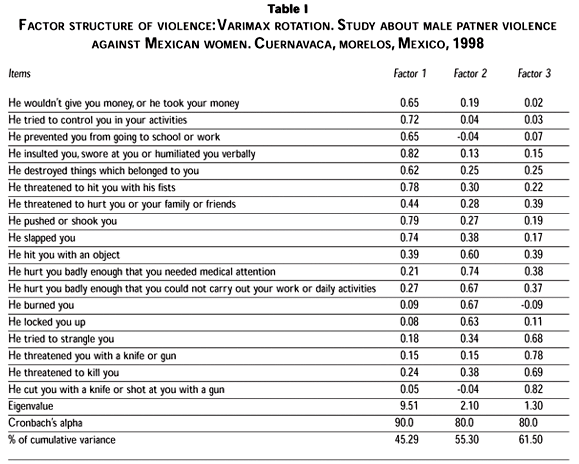
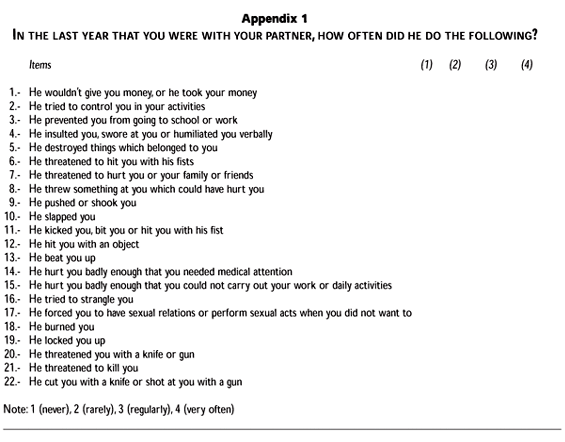
<body><![CDATA[<p>&nbsp;</p>     <p><font size="3" face="Verdana"><b>Material and Methods</b></font></p>     <p><font size="2" face="Verdana">From June to September 1998 a population-based    study was carried out using a probabilistic sample of reproductive age women    (15-49 years) living in the met ropolitan area of Cuernavaca. The population    was selected using a household sampling frame that included all houses in Cuernavaca,    according to the 1995 census. All 1 641 women in the random sample who had a    male partner either at the time of the study or previously were invited to participate    in the study. Of these women, 1 535 (93.5%) agreed to participate and signed    informed consent forms after the study was explained for them. </font></p>     <p><font size="2" face="Verdana"> The women who participated were interviewed    in private, when no family member was present. Usually, the interview took place    in their own home or in any other place where they felt comfortable. The questionnaires    were applied by a female field worker trained in survey administration, as well    as in providing emotional support and referrals for health care and legal protection    to violence victims. All women interviewed received both counseling and information    about the existing service centers for violence victims, including a pamphlet    with contact information for these centers. </font></p>     <p><font size="2" face="Verdana"> The questionnaires addressed three general categories.    First, participants were asked about sociodemographic characteristics (i.e.,    age, education, number of family members, marital status); housing characteristics    (i.e., construction materials, availability of drinking water); and ownership    of household appliances (i.e., television, video cassette player, stove, refrigerator,    heater, automobile). As has been done in other population-based studies in Mexico,<SUP>19-20</SUP>    we used several of these variables to construct an indicator of socioeconomic    status (i.e., being a home owner, number of household inhabitants, number of    bedrooms, gas-powered water heater, availability of drinking water and sewer    system, education level of head of the family and having a TV, a VCR, and a    car). </font></p>     <p><font size="2" face="Verdana"> Second, participants were asked about their    gynecologic and obstetric health and life factors (i.e., age at time of first    sexual intercourse, number of pregnancies, number of births) and about their    current or most recent male partner (i.e., time living with partner, alcohol    and illegal drug use). </font></p>     <p><font size="2" face="Verdana"> Finally, information was collected about the    type of partner violence experienced in the previous year of her relationship    with her most recent partner, the frequency of such violence, the circumstances    surrounding any acts of violence, and any protective measures taken by the women    to prevent future violence. Study participants were asked 22 questions about    the frequency with which each act of violence occurred during the last year    of cohabitation (<a href="#apx01">Appendix 1</a>). Based on findings from exploratory    studies in this population, the most relevant questions about violence from    the CTS<SUP>7</SUP> were included, as well as from the Index of Spousal Abuse    (ISA);<SUP>8</SUP> however, to capture all relevant features of this phenomenon,    some other questions not included in these scales were also used. </font></p>     <p><font size="2" face="Verdana"> Outcome variables that expressed degrees of    partner violence were derived using three different methods. In the first phase,    factor analysis was carried out on 22 frequency of violence questions, using    the principal components analysis method to determine the number of dimensions    that characterize experiences of violent acts. Orthogonal varimax rotation was    used because it is an efficient procedure for maximizing the variance of loading    for each factor. The conventional standard of eigenvalues &gt; 1 was used to    determine the number of components that should be retained. Afterwards, these    results were confirmed by means of a Greigen plot (where Eigenvalues approached    zero after orthogonal variance rotation). The results of these analyses suggest    that the experience of male partner violence primarily falls into three domains.    The first component represented low-level acts of emotional and physical violence    (e.g., control of activities, not allowing women to have a job, insults, and    face slaps); it accounted for 45.2% of the total common variance. Items loading    onto the second component were indicators of more serious physical violence,    including having been struck with an object, burned, or locked up. This component    accounted for 10% of the total item variance. Finally, the items that loaded    onto the third component represented extremely serious physical or emotional    violence, such as strangling attempts and threats with a knife or gun. This    component accounted for 6% of the total item variance. The overall percentage    of variance accounted for by these three factors was 61.5%. The factor loadings    corresponding to each violence category were strong, and there is little evidence    of cross-loading of items onto more than one factor (<a href="#tab01">Table    I</a>). Moreover, inter-item reliability of the factors was high: 0.90 for the    first factor and 0.80 for  both the second    and the third factor, as indicated using Cronbach's alpha. Hence, these analyses    indicate that these three factors are mutually exclusive and merit study as    separate outcomes. </font></p>     <p><a name="tab01"></a></p>     <p>&nbsp;</p>     ]]></body>
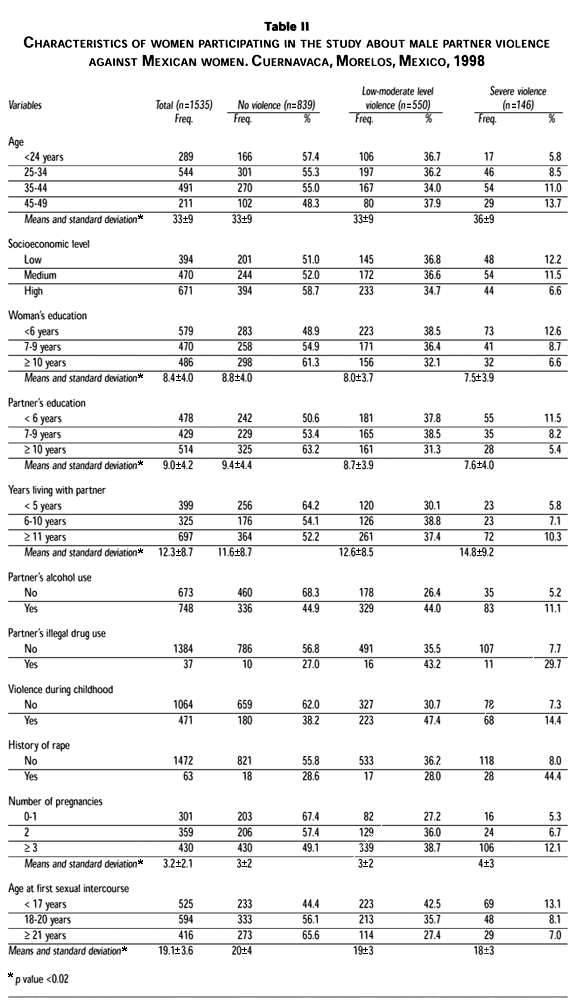
<body><![CDATA[<p align="center"><img src="/img/revistas/spm/v46n2/a04tab01.gif"></p>     <p>&nbsp;</p>     <p><font size="2" face="Verdana">In the second phase, variables for use in determining    the prevalence of violence were constructed. Women who reported experiencing    any low or moderate acts of violence were considered prevalent cases of low-level    violence. Women reporting high-level acts of violence were considered prevalent    cases of severe violence. </font></p>     <p><font size="2" face="Verdana"> In the third phase, scores were combined across    the three levels of violence to create an ordered categorical variable. Women    who reported experiencing no partner violence served as the reference group    in further analyses. Women reporting low or moderate, but not severe violence    were classified in the low-violence group, and women who reported severe violence    were classified into other groups (i.e., 0=no violence, 1=low-moderate levels    of violence, 2=severe violence). </font></p>     <p><font size="2" face="Verdana"> The question about forced sexual relations with    a partner was not included in the principal components analysis; nonetheless,    11% of the women in the study reported having experienced rape. This event was    explored independently. </font></p>     <p><font size="2" face="Verdana"> Univariate analyses were run to determine the    distribution of the variables of interest, as well as the prevalence of experiencing    partner violence. Next, multivariate models were run using polynomial logistic    regression to obtain age-adjusted odds ratios (OR) and 95% confidence intervals    (CI) which indicated associations between potential risk factors and each of    the three categories of violence. Finally, multiple polynomial logistic regression    models controlled for confounding variables. </font></p>     <p>&nbsp;</p>     <p><font size="3" face="Verdana"><b>Results</b></font></p>     <p><font size="2" face="Verdana">A total of 1 535 women participated, all of whom    had a history of having lived with a male partner. The average age of study    women was 33.5 years (standard deviation, SD=8.7). </font></p>     <p><font size="2" face="Verdana"> Prevalence of low/moderate-level violence was    35.8% (95% CI=33.4-38.2), while prevalence of severe violence was 9.5% (95%    CI=8.1-11.1). Self-reported lifetime prevalence of rape perpetrated by someone    who was not a partner was 5.9% (95% CI=4.7-7.2). Across groups of women who    experienced different levels of partner violence, statistically significant    differences were found in age, education, years of cohabitation with the male    partner, number of pregnancies, and age at time of first sexual intercourse    (<a href="#tab02">Table II</a>). </font></p>     ]]></body>
<body><![CDATA[<p><a name="tab02"></a></p>     <p>&nbsp;</p>     <p align="center"><img src="/img/revistas/spm/v46n2/a04tab02.gif"></p>     <p>&nbsp;</p>     <p><font size="2" face="verdana">The multivariate model adjusted for age, alcohol    and illegal drug use by the male partner, history of violence during childhood,    and history of sexual violence. Socioeconomic status was inversely proportional    to violence (test for trend <i>p</i>=0.002), principally when comparing women    who had not experienced partner violence with those who had experienced severe    violence (OR=0.57; 95% CI=0.34-0.95). A similar inverse relationship was found    when examining education level, both for study women (test for trend <i>p</i>=0.01)    and their male partners (test for trend <i>p</i>=0.002) (Table III). The number    of cohabitation years was positively associated with having been subject to    violence (test for trend <i>p</i>=0.007 and <i>p</i>&lt;0.001). A marked increase    in the odds of having experienced violence was found for women cohabitating    for 11 years or more, principally in terms of experiencing severe violence (OR=2.63;    95% CI=1.55-4.45). Models to determine the male partner variables that were    associated with violence were adjusted for age, socioeconomic status, history    of violence during childhood and a history of rape. Statistically significant    male partner variables included alcohol use, in relation to both low and severe-level    violence (OR=2.56, 95% CI=2.02-3.25; and OR=3.47; 95% CI=2.23-5.40, respectively),    and drug use, in relation to severe violence (OR=6.17; 95%CI=2.37-16.03).</font></p>     <p><font size="2" face="Verdana">Women who reported having been victims of violence    by a family member during childhood were more likely to have been victims of    violence from their partner during their adult life, as compared with women    who had not experienced violence during their childhood. This held true both    for low-moderate level violence (OR=2.61; 95% CI=2.03-3.36) and for severe violence    (OR=3.40; 95% CI=2.23-5.18). </font></p>     <p><font size="2" face="Verdana"> The women who reported a history of rape by    someone other than their male partner - an unknown aggressor being the most    common - were more likely to be victims of violence from their partners, specifically    in the severe violence category (OR=5.89; 95% CI=2.78-12.5) (<a href="#tab03">Table    III</a>). This analysis was adjusted for age, socioeconomic status, alcohol    and drug use, history of violence during childhood, and history of rape. </font></p>     <p><a name="tab03"></a></p>     <p>&nbsp;</p>     <p align="center"><img src="/img/revistas/spm/v46n2/a04tab03.gif"></p>     ]]></body>
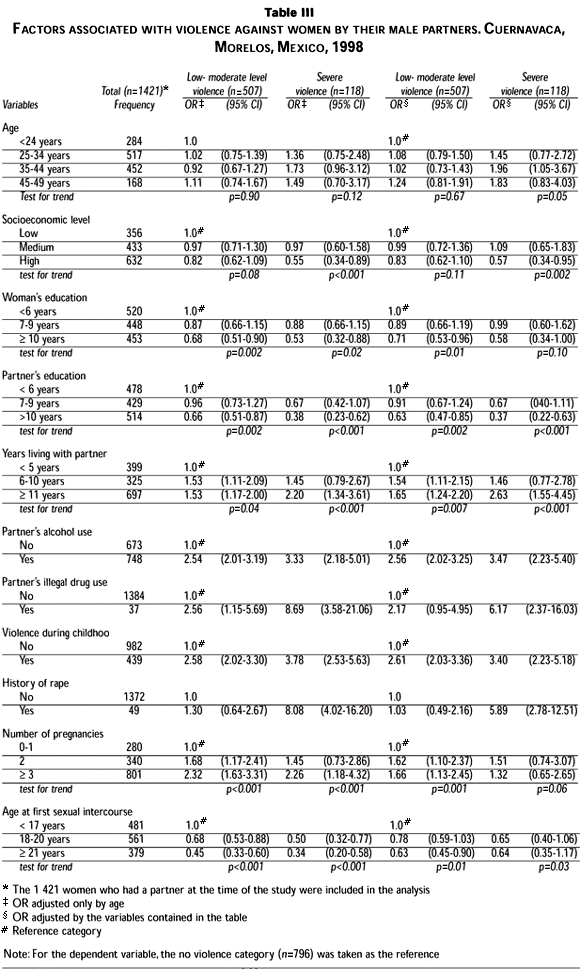
<body><![CDATA[<p>&nbsp;</p>     <p><font size="2" face="Verdana">Among the reproductive factors associated with    violence was the number of pregnancies, with a greater number of pregnancies    associated with experiencing a higher frequency of violence (test for trend    <I>p</I>=0.001). We also observed an inverse trend between violence and age    at first sexual intercourse; that is, when first intercourse occurred at older    ages, violence was significantly lower (respectively, test for trend <I>p</I>=0.01    and test for trend <I>p</I>=0.03) (<a href="#tab03">Table III</a>). This analysis    was adjusted for age, socioeconomic status, alcohol and drug use, history of    violence during childhood, and history of rape. </font></p>     <p><font size="2" face="Verdana"> The majority of the women who had been attacked    by their partner fought back against these aggressions (63%). Of those women    who had communicated with others about the violence they experienced (<I>n</I>=391),    67% did so with their families, 24% with friends, and the rest with another    person. In terms of protective measures taken by women who are victims of violence,    the largest number responded that they tried to solve the problem with their    partner (44%). A significant percentage of women responded that they had not    taken any steps because they thought they would not experience violence from    their partner again (34%), while only 2% sought professional help. </font></p>     <p>&nbsp;</p>     <p><font size="3" face="Verdana"><b>Discussion</b></font></p>     <p><font size="2" face="Verdana">The present results suggest that male partner    violence against women is a prevalent phenomenon in Mexico. The prevalence found    in our study is similar to that reported by other studies carried out in Mexico    and Latin America, in general, where prevalence estimates vary from 30% to 60%.<SUP>3-6,15,21,22    </SUP>Nevertheless, comparative analysis of violence against women is not easy,    since a wide variety of definitions and methodologies have been used to study    it. Furthermore, socio-cultural factors that influence this phenomenon may differ    across social and cultural groups. In this study, the authors decided to analyze    violence primarily at two levels of severity (low and severe). Although this    measure is admittedly imperfect, variation in the strength of the risk factors    across levels of violence severity support the validity of our measures. Moreover,    the validity of our measures is supported by similar results reported by other    authors who measure violence differently. </font></p>     <p><font size="2" face="Verdana"> It is significant that the prevalence registered    in our study is almost two-fold higher than that of studies carried out in developed    countries.<SUP>9,14,16,23,24 </SUP>Future research should determine the factors    accounting for such variation. At present we can only hypothesize about which    factors might contribute to this problem. One factor could be that violence    against women has become a subject of public concern and discussion in Mexico    only recently, while in developed countries it has been the object of research    and intervention efforts for a number of years. Also, in Mexico, and specifically    in the state of Morelos, where this study was carried out, laws penalizing violence    against women have only recently been passed (in 1999), while equivalent legislation    has existed for much longer in many developed countries. This is not to imply    that legislation is suffi cient, in and of itself, to solve the problem of gender    violence. It is likely, however, that the existence and implementation of related    laws is accompanied by the development of a greater awareness of the problem    in society as a whole. Such laws may facilitate the wider reach of campaigns    that empower women in this aspect of their lives, a kind of empowerment that,    to a great extent, is still lacking in Mexico.<SUP>25,26</SUP> The results of    this study, especially the finding that very few battered women sought legal    and professional help (only 2.2%), support the notion that recently passed legislative    efforts to combat gender violence in Mexico have not had a significant impact.</font></p>     <p><font size="2" face="Verdana"> This study also found that 5.9% of the women    reported having been raped by a non-partner and 11% reported being forced to    have sexual intercourse with their partner against their will. The fact that    27% to 62% of US women report rape by a non-partner<SUP>2,27</SUP> leads to    wondering whether the women in our sample underreported their experience. Reporting    could be influenced by the fact that victims tend to fear taking their aggressors    to court, in spite of the existence of laws penalizing rape in Mexico; this    is understandable because some of the victims are threatened or stigmatized.<SUP>27</SUP>    Moreover, although Mexico is among the relatively few countries with legislation    against marital rape, sexual abuse or rape by a partner is often not perceived    as a crime by the woman herself.<SUP>9</SUP> This is a complex issue that must    be analyzed in terms of gender inequalities in each society.<SUP>28-29</SUP></font></p>     <p><font size="2" face="Verdana"> The findings of our study are consistent with    those of studies that have found associations between violence and low socioeconomic    status.<SUP>6,10,11,17</SUP> However, this finding may be due to people with    higher socioeconomic status, whether they are the aggressor or the victim, having    more access to privacy.<SUP>10-18</SUP> Nevertheless, in spite of important    differences between socioeconomic status groups, it is important to recognize    that violence also occurs in groups with higher educational and economic resources.    One very general explanation is that in spite of women's impressive but relatively    recent access to education and paid employment, enormous gender inequalities    persist in relation to many aspects of women's lives, which contributes to the    continuing problem of gender violence.<SUP>2</SUP> </font></p>     <p><font size="2" face="Verdana"> Our results also concur with those from studies    that have shown that alcohol and drug use by the male partner are important    risk factors for violence against women.<SUP>10,12-13,15,17,23</SUP> However,    we agree with the idea, often repeated in the literature, that alcohol and drug    use weakens the individual's inhibitions and can contribute to the manifestation    of violence, but is not the root cause of it. Nevertheless, an important strategy   for lowering the level of gender violence is to strengthen and extend programs    for preventing or treating alcohol and drug use. </font> </p>     ]]></body>
<body><![CDATA[<p><font size="2" face="Verdana"> Other studies have shown that frequently, both    men who batter their partners and women who undergo gender violence have been    the victims or witnesses of violence in their families of origin.<SUP>12-14</SUP>    Our study only analyzed a history of violence among the women (not among men,    who were not interviewed), but it did find an important correlation between    such a history and current violence by the male partner (OR=3.40). </font></p>     <p><font size="2" face="Verdana"> Some researchers have found that women who were    victims of sexual abuse during childhood have a greater risk of violence during    their adult relationships, as compared with women with no such childhood history.<SUP>2-11</SUP>    We also found an important association between women who were victims of sexual    abuse during childhood and those whose partners inflicted severe violence on    them (OR=5.89). One hypothesis is that victims of early sexual abuse are left    with fewer skills for protecting themselves, perhaps feel less sure of their    self-worth, and have a less clear definition of their personal limits, and therefore    are more vulnerable to victimization. These could be among the factors that    increase the possibilities of future victimization.<SUP>30</SUP> </font></p>     <p>&nbsp;</p>     <p><font size="3" face="Verdana"><b>Limitations</b></font></p>     <p><font size="2" face="Verdana">One limitation of this study is that it had a    cross-sectional design, thus causality cannot be established. However, with    the results obtained we can generate hypotheses. In addition, the results only    represent women 15 to 49 years of age who have had male partners. Finally, it    is likely that partner alcohol and illegal drug prevalence in this study is    underestimated, given that the partners themselves were not questioned. Nevertheless,    this error would have been random since the question was asked in the same way    for the whole study population. </font></p>     <p>&nbsp;</p>     <p><font size="3" face="Verdana"><b>Conclusions</b></font></p>     <p><font size="2" face="Verdana">This study contributes to the literature on gender    violence, providing further evidence that it is a complex phenomenon, deeply    rooted in power relations related to gender, sexuality, personal identity, and    social institutions. The results indicating relatively high levels of violence    and low levels of service utilization suggest that raising awareness in the    general population may be necessary to bring gender violence to the forefront    of public discussion as an important issue. Efforts must be made to warrant    that future generations of Mexican women do not experience this level and intensity    of gender violence. Given that violence is more frequent among women whose partners    abuse alcohol and drugs, prevention programs for these addictions should be    reinforced and extended, especially for young people, so as to lower violence    levels in future partnerships. Campaigns should teach young women and girls    to protect themselves from aggressors and rapists, while promoting the laws    that protect people from sexual or physical violence. Finally, future studies    about violence should include men as participants. Research on men who perpetrate    violence is needed to formulate truly effective strategies for reducing gender    violence. </font></p>     <p>&nbsp;</p>     <p><font size="3" face="Verdana"><b>Acknowledgements</b></font></p>     ]]></body>
<body><![CDATA[<p><font size="2" face="Verdana">This study was made possible by the support of    the National Institute of Public Health, in Cuernavaca, Morelos, Mexico. </font></p>     <p>&nbsp;</p>     <p><font size="3" face="Verdana"><b>References</b></font></p>     <!-- ref --><p><font size="2" face="Verdana">1. World Health Organization. Violence against    women: Legislation. Geneva: WHO; 2000:5. </font>&nbsp;&nbsp;&nbsp;&nbsp;&nbsp;&nbsp;&nbsp;&nbsp;[&#160;<a href="javascript:void(0);" onclick="javascript: window.open('/scielo.php?script=sci_nlinks&ref=9193260&pid=S0036-3634200400020000500001&lng=','','width=640,height=500,resizable=yes,scrollbars=1,menubar=yes,');">Links</a>&#160;]<!-- end-ref --><!-- ref --><p><font size="2" face="Verdana">2. Heise L, Pitanguy J, Germain A. Violence against    women: The hidden health burden. Washington, DC: World Bank; 1994. (Discussion    Paper No. 255). </font>&nbsp;&nbsp;&nbsp;&nbsp;&nbsp;&nbsp;&nbsp;&nbsp;[&#160;<a href="javascript:void(0);" onclick="javascript: window.open('/scielo.php?script=sci_nlinks&ref=9193261&pid=S0036-3634200400020000500002&lng=','','width=640,height=500,resizable=yes,scrollbars=1,menubar=yes,');">Links</a>&#160;]<!-- end-ref --><!-- ref --><p><font size="2" face="Verdana">3. Ram&iacute;rez-Rodr&iacute;guez JC, Vargas-Becerra    PN. Una espada de doble filo: la salud reproductiva y la violencia dom&eacute;stica    contra la mujer. &#91;A double-edged sword: Reproductive health and domestic violence    against women&#93;. Proceedings of the Seminar "Salud Reproductiva en Am&eacute;rica    Latina y el Caribe: Temas y Problemas"; Caxamb&uacute;, MG, Brasil; 1996:24.</font>&nbsp;&nbsp;&nbsp;&nbsp;&nbsp;&nbsp;&nbsp;&nbsp;[&#160;<a href="javascript:void(0);" onclick="javascript: window.open('/scielo.php?script=sci_nlinks&ref=9193262&pid=S0036-3634200400020000500003&lng=','','width=640,height=500,resizable=yes,scrollbars=1,menubar=yes,');">Links</a>&#160;]<!-- end-ref --><!-- ref --><p><font size="2" face="Verdana">4. Valdez R, San&iacute;n L. La violencia dom&eacute;stica    durante el embarazo y su relaci&oacute;n con el bajo peso al nacer. Salud Publica    Mex 1996;38:352-362. </font>&nbsp;&nbsp;&nbsp;&nbsp;&nbsp;&nbsp;&nbsp;&nbsp;[&#160;<a href="javascript:void(0);" onclick="javascript: window.open('/scielo.php?script=sci_nlinks&ref=9193263&pid=S0036-3634200400020000500004&lng=','','width=640,height=500,resizable=yes,scrollbars=1,menubar=yes,');">Links</a>&#160;]<!-- end-ref --><!-- ref --><p><font size="2" face="Verdana">5. Centro de Investigaci&oacute;n y Lucha contra    la Violencia Dom&eacute;stica. A&uacute;n la luna tiene miedo. Una aproximaci&oacute;n    a la violencia dom&eacute;stica en M&eacute;xico. M&eacute;xico, DF: CECOVID;    1992. </font>&nbsp;&nbsp;&nbsp;&nbsp;&nbsp;&nbsp;&nbsp;&nbsp;[&#160;<a href="javascript:void(0);" onclick="javascript: window.open('/scielo.php?script=sci_nlinks&ref=9193264&pid=S0036-3634200400020000500005&lng=','','width=640,height=500,resizable=yes,scrollbars=1,menubar=yes,');">Links</a>&#160;]<!-- end-ref --><!-- ref --><p><font size="2" face="Verdana">6. Olivarrieta C, Sotelo J. Domestic violence    in Mexico. JAMA 1996;275:1937-1941. </font>&nbsp;&nbsp;&nbsp;&nbsp;&nbsp;&nbsp;&nbsp;&nbsp;[&#160;<a href="javascript:void(0);" onclick="javascript: window.open('/scielo.php?script=sci_nlinks&ref=9193265&pid=S0036-3634200400020000500006&lng=','','width=640,height=500,resizable=yes,scrollbars=1,menubar=yes,');">Links</a>&#160;]<!-- end-ref --><!-- ref --><p><font size="2" face="Verdana">7. Hudson W, McIntosh S. The assessment of spouse    abuse: Two quantifiable dimensions. J Marr Fam 1981;43:873-885. </font>&nbsp;&nbsp;&nbsp;&nbsp;&nbsp;&nbsp;&nbsp;&nbsp;[&#160;<a href="javascript:void(0);" onclick="javascript: window.open('/scielo.php?script=sci_nlinks&ref=9193266&pid=S0036-3634200400020000500007&lng=','','width=640,height=500,resizable=yes,scrollbars=1,menubar=yes,');">Links</a>&#160;]<!-- end-ref --><!-- ref --><p><font size="2" face="Verdana">8. Straus M, Hamby S, Mc Coy S, Sugarman D. The    revised conflict tactics scales (CTS2). J Fam Issues 1996;17:283-316. </font>&nbsp;&nbsp;&nbsp;&nbsp;&nbsp;&nbsp;&nbsp;&nbsp;[&#160;<a href="javascript:void(0);" onclick="javascript: window.open('/scielo.php?script=sci_nlinks&ref=9193267&pid=S0036-3634200400020000500008&lng=','','width=640,height=500,resizable=yes,scrollbars=1,menubar=yes,');">Links</a>&#160;]<!-- end-ref --><!-- ref --><p><font size="2" face="Verdana">9. UNICEF. Domestic violence against women and    girls. Preliminary edition; UNICEF Innocenti Research Center No. 6; Roma: UNICEF;    2000. </font>&nbsp;&nbsp;&nbsp;&nbsp;&nbsp;&nbsp;&nbsp;&nbsp;[&#160;<a href="javascript:void(0);" onclick="javascript: window.open('/scielo.php?script=sci_nlinks&ref=9193268&pid=S0036-3634200400020000500009&lng=','','width=640,height=500,resizable=yes,scrollbars=1,menubar=yes,');">Links</a>&#160;]<!-- end-ref --><!-- ref --><p><font size="2" face="Verdana">10. Buvinic M, Morrison A, Shifter M. La violencia    en las Am&eacute;ricas: marco de acci&oacute;n. En: Morrison A, Loreto M, ed.    El costo del silencio. Violencia dom&eacute;stica en las Am&eacute;ricas. Washington,    DC: Banco Interamericano de Desarrollo; 1999:3-34. </font>&nbsp;&nbsp;&nbsp;&nbsp;&nbsp;&nbsp;&nbsp;&nbsp;[&#160;<a href="javascript:void(0);" onclick="javascript: window.open('/scielo.php?script=sci_nlinks&ref=9193269&pid=S0036-3634200400020000500010&lng=','','width=640,height=500,resizable=yes,scrollbars=1,menubar=yes,');">Links</a>&#160;]<!-- end-ref --><!-- ref --><p><font size="2" face="Verdana">11. Stark E, Flitcraft H. Spouse abuse. En: Violence    in America: A public health approach. New York (NY): Oxford University Press;    1991. </font>&nbsp;&nbsp;&nbsp;&nbsp;&nbsp;&nbsp;&nbsp;&nbsp;[&#160;<a href="javascript:void(0);" onclick="javascript: window.open('/scielo.php?script=sci_nlinks&ref=9193270&pid=S0036-3634200400020000500011&lng=','','width=640,height=500,resizable=yes,scrollbars=1,menubar=yes,');">Links</a>&#160;]<!-- end-ref --><!-- ref --><p><font size="2" face="Verdana">12. Aldarondo E, Sugarman D. Risk marker analysis    of the cessation and persistence of wife assault. J Consult Clin Psychol 1996;64:1010-1019.</font>&nbsp;&nbsp;&nbsp;&nbsp;&nbsp;&nbsp;&nbsp;&nbsp;[&#160;<a href="javascript:void(0);" onclick="javascript: window.open('/scielo.php?script=sci_nlinks&ref=9193271&pid=S0036-3634200400020000500012&lng=','','width=640,height=500,resizable=yes,scrollbars=1,menubar=yes,');">Links</a>&#160;]<!-- end-ref --><!-- ref --><p><font size="2" face="Verdana">13. Mullen PE, Martin JL, Anderson JC, Romans    SE, Herbison GP. The long-term impact of the physical, emotional and sexual    abuse of children: A community study. Child Abuse Neglect 1996;20:7-21.</font>&nbsp;&nbsp;&nbsp;&nbsp;&nbsp;&nbsp;&nbsp;&nbsp;[&#160;<a href="javascript:void(0);" onclick="javascript: window.open('/scielo.php?script=sci_nlinks&ref=9193272&pid=S0036-3634200400020000500013&lng=','','width=640,height=500,resizable=yes,scrollbars=1,menubar=yes,');">Links</a>&#160;]<!-- end-ref --><!-- ref --><p><font size="2" face="Verdana"> 14. Plichta SB, Abraham C. Violence and gynecologic    health in women &lt;50 years old. Am J Obstet Gynecol 1996;174:903-907. </font>&nbsp;&nbsp;&nbsp;&nbsp;&nbsp;&nbsp;&nbsp;&nbsp;[&#160;<a href="javascript:void(0);" onclick="javascript: window.open('/scielo.php?script=sci_nlinks&ref=9193273&pid=S0036-3634200400020000500014&lng=','','width=640,height=500,resizable=yes,scrollbars=1,menubar=yes,');">Links</a>&#160;]<!-- end-ref --><!-- ref --><p><font size="2" face="Verdana">15. Ellsberg M, Pe&ntilde;a R, Herrera A, Liljestrand    J, Winkvist A. Wife abuse among women of childbearing age in Nicaragua. Am J    Public Health 1999;89:241-244. </font>&nbsp;&nbsp;&nbsp;&nbsp;&nbsp;&nbsp;&nbsp;&nbsp;[&#160;<a href="javascript:void(0);" onclick="javascript: window.open('/scielo.php?script=sci_nlinks&ref=9193274&pid=S0036-3634200400020000500015&lng=','','width=640,height=500,resizable=yes,scrollbars=1,menubar=yes,');">Links</a>&#160;]<!-- end-ref --><!-- ref --><p><font size="2" face="Verdana">16. McCauley J, Kern D, Kolodner K, Dill L, Schroeder    A, De Chant H <I>et al</I>. The "Battering Syndrome": Prevalence and    clinical characteristics of domestic violence in primary care internal medicine    practice. Ann Intern Med 1995;123:737-746. </font>&nbsp;&nbsp;&nbsp;&nbsp;&nbsp;&nbsp;&nbsp;&nbsp;[&#160;<a href="javascript:void(0);" onclick="javascript: window.open('/scielo.php?script=sci_nlinks&ref=9193275&pid=S0036-3634200400020000500016&lng=','','width=640,height=500,resizable=yes,scrollbars=1,menubar=yes,');">Links</a>&#160;]<!-- end-ref --><!-- ref --><p><font size="2" face="Verdana">17. O'Campo P, Gielen A, Faden R, Xue X, Kass    N, Wang MC. Violence by male partners against women during the childbearing    year: A contextual analysis. Am J Public Health 1995; 85:1092-1097. </font>&nbsp;&nbsp;&nbsp;&nbsp;&nbsp;&nbsp;&nbsp;&nbsp;[&#160;<a href="javascript:void(0);" onclick="javascript: window.open('/scielo.php?script=sci_nlinks&ref=9193276&pid=S0036-3634200400020000500017&lng=','','width=640,height=500,resizable=yes,scrollbars=1,menubar=yes,');">Links</a>&#160;]<!-- end-ref --><!-- ref --><p><font size="2" face="Verdana">18. Kyriacou D, McCabe F, Anglin D, Lapesarde    K, Winer MR. Emergency department-based study of risk factors for acute injury    from domestic violence against women. Ann Emerg Med 1998; 31:502-506. </font>&nbsp;&nbsp;&nbsp;&nbsp;&nbsp;&nbsp;&nbsp;&nbsp;[&#160;<a href="javascript:void(0);" onclick="javascript: window.open('/scielo.php?script=sci_nlinks&ref=9193277&pid=S0036-3634200400020000500018&lng=','','width=640,height=500,resizable=yes,scrollbars=1,menubar=yes,');">Links</a>&#160;]<!-- end-ref --><!-- ref --><p><font size="2" face="Verdana">19. Lazcano P, Moss S, Cruz A, Alonso P, Casares    S, Mart&iacute;nez J <I>et al</I>. Factores que determinan la participaci&oacute;n    en el tamizaje de c&aacute;ncer cervical en el estado de Morelos. Salud Publica    Mex 1999;41:278-285. </font>&nbsp;&nbsp;&nbsp;&nbsp;&nbsp;&nbsp;&nbsp;&nbsp;[&#160;<a href="javascript:void(0);" onclick="javascript: window.open('/scielo.php?script=sci_nlinks&ref=9193278&pid=S0036-3634200400020000500019&lng=','','width=640,height=500,resizable=yes,scrollbars=1,menubar=yes,');">Links</a>&#160;]<!-- end-ref --><!-- ref --><p><font size="2" face="Verdana">20. Lazcano P, Herrero R, Mu&ntilde;oz N, Cruz    A, Shah KV, Alonso P. Epidemiology of HPV infection among Mexican women with    normal cervical cytology. Int J Cancer 2001;91:412-420. </font>&nbsp;&nbsp;&nbsp;&nbsp;&nbsp;&nbsp;&nbsp;&nbsp;[&#160;<a href="javascript:void(0);" onclick="javascript: window.open('/scielo.php?script=sci_nlinks&ref=9193279&pid=S0036-3634200400020000500020&lng=','','width=640,height=500,resizable=yes,scrollbars=1,menubar=yes,');">Links</a>&#160;]<!-- end-ref --><!-- ref --><p><font size="2" face="Verdana">21. Saucedo I. Violencia dom&eacute;stica y salud:    avances y limitaciones para la investigaci&oacute;n y atenci&oacute;n. En: IV    Congreso Latinoamericano de Ciencias Sociales y Medicina; 1997 junio 2-6; Cocoyoc,    Morelos, M&eacute;xico. </font>&nbsp;&nbsp;&nbsp;&nbsp;&nbsp;&nbsp;&nbsp;&nbsp;[&#160;<a href="javascript:void(0);" onclick="javascript: window.open('/scielo.php?script=sci_nlinks&ref=9193280&pid=S0036-3634200400020000500021&lng=','','width=640,height=500,resizable=yes,scrollbars=1,menubar=yes,');">Links</a>&#160;]<!-- end-ref --><!-- ref --><p><font size="2" face="Verdana">22. Venguer T, Fawcett G, Vernon R, Pick S. Violencia    dom&eacute;stica: un marco conceptual para la capacitaci&oacute;n del personal    de salud. M&eacute;xico, DF: Population Council, INOPAL III: 1998;24:7-52. </font>&nbsp;&nbsp;&nbsp;&nbsp;&nbsp;&nbsp;&nbsp;&nbsp;[&#160;<a href="javascript:void(0);" onclick="javascript: window.open('/scielo.php?script=sci_nlinks&ref=9193281&pid=S0036-3634200400020000500022&lng=','','width=640,height=500,resizable=yes,scrollbars=1,menubar=yes,');">Links</a>&#160;]<!-- end-ref --><!-- ref --><p><font size="2" face="Verdana">23. Oriel K, Fleming M. Screening men for partner    violence in a primary care setting. A new strategy for detecting domestic violence.    J Fam Pract 1998;46:493-498. </font>&nbsp;&nbsp;&nbsp;&nbsp;&nbsp;&nbsp;&nbsp;&nbsp;[&#160;<a href="javascript:void(0);" onclick="javascript: window.open('/scielo.php?script=sci_nlinks&ref=9193282&pid=S0036-3634200400020000500023&lng=','','width=640,height=500,resizable=yes,scrollbars=1,menubar=yes,');">Links</a>&#160;]<!-- end-ref --><!-- ref --><p><font size="2" face="Verdana">24. Ratner P. The incidence of wife abuse and    mental health status in abused wives in Edmonton, Alberta. Rev Can Sant&eacute;    Publique 1993;84:246-249. </font>&nbsp;&nbsp;&nbsp;&nbsp;&nbsp;&nbsp;&nbsp;&nbsp;[&#160;<a href="javascript:void(0);" onclick="javascript: window.open('/scielo.php?script=sci_nlinks&ref=9193283&pid=S0036-3634200400020000500024&lng=','','width=640,height=500,resizable=yes,scrollbars=1,menubar=yes,');">Links</a>&#160;]<!-- end-ref --><!-- ref --><p><font size="2" face="Verdana">25. Comisi&oacute;n Nacional de Derechos Humanos.    La violencia intrafamiliar en M&eacute;xico. Aporte en favor de una soluci&oacute;n    legislativa. M&eacute;xico, DF: Comisi&oacute;n Nacional de Derechos Humanos;    1996. </font>&nbsp;&nbsp;&nbsp;&nbsp;&nbsp;&nbsp;&nbsp;&nbsp;[&#160;<a href="javascript:void(0);" onclick="javascript: window.open('/scielo.php?script=sci_nlinks&ref=9193284&pid=S0036-3634200400020000500025&lng=','','width=640,height=500,resizable=yes,scrollbars=1,menubar=yes,');">Links</a>&#160;]<!-- end-ref --><!-- ref --><p><font size="2" face="Verdana">26. Ley de Prevenci&oacute;n y Asistencia de    la Violencia Intrafamiliar para el Estado de Morelos, 1999. </font>&nbsp;&nbsp;&nbsp;&nbsp;&nbsp;&nbsp;&nbsp;&nbsp;[&#160;<a href="javascript:void(0);" onclick="javascript: window.open('/scielo.php?script=sci_nlinks&ref=9193285&pid=S0036-3634200400020000500026&lng=','','width=640,height=500,resizable=yes,scrollbars=1,menubar=yes,');">Links</a>&#160;]<!-- end-ref --><!-- ref --><p><font size="2" face="Verdana">27. Figueroa J, Rivera G. Algunas reflexiones    sobre la representaci&oacute;n social de la sexualidad femenina. En: Mujeres    y relaciones de g&eacute;nero en la antropolog&iacute;a latinoam&eacute;rica.    M&eacute;xico, DF: El Colegio de M&eacute;xico; 1993:141-167. </font>&nbsp;&nbsp;&nbsp;&nbsp;&nbsp;&nbsp;&nbsp;&nbsp;[&#160;<a href="javascript:void(0);" onclick="javascript: window.open('/scielo.php?script=sci_nlinks&ref=9193286&pid=S0036-3634200400020000500027&lng=','','width=640,height=500,resizable=yes,scrollbars=1,menubar=yes,');">Links</a>&#160;]<!-- end-ref --><!-- ref --><p><font size="2" face="Verdana">28. Batliwala S. El significado del empoderamiento    de las mujeres: nuevos conceptos desde la acci&oacute;n. En: Le&oacute;n M,    ed. Poder y empoderamiento de las mujeres. Santa Fe de Bogot&aacute;: Facultad    de Ciencias Humanas; 1997:187-211. </font>&nbsp;&nbsp;&nbsp;&nbsp;&nbsp;&nbsp;&nbsp;&nbsp;[&#160;<a href="javascript:void(0);" onclick="javascript: window.open('/scielo.php?script=sci_nlinks&ref=9193287&pid=S0036-3634200400020000500028&lng=','','width=640,height=500,resizable=yes,scrollbars=1,menubar=yes,');">Links</a>&#160;]<!-- end-ref --><!-- ref --><p><font size="2" face="Verdana">29. Sayavedra G, Flores E. Algunas reflexiones    te&oacute;ricas. En: Sayavedra G, Flores E, ed. Ser mujer: ¿un riesgo para    la salud? Del malestar y enfermar, al poder&iacute;o y la salud. M&eacute;xico:    Red de Mujeres; 1997:62-91. </font>&nbsp;&nbsp;&nbsp;&nbsp;&nbsp;&nbsp;&nbsp;&nbsp;[&#160;<a href="javascript:void(0);" onclick="javascript: window.open('/scielo.php?script=sci_nlinks&ref=9193288&pid=S0036-3634200400020000500029&lng=','','width=640,height=500,resizable=yes,scrollbars=1,menubar=yes,');">Links</a>&#160;]<!-- end-ref --><!-- ref --><p><font size="2" face="Verdana">30. Koss M. The women's mental health research    agenda: Violence against women. Am Psychol 1990;45:374-380. </font>&nbsp;&nbsp;&nbsp;&nbsp;&nbsp;&nbsp;&nbsp;&nbsp;[&#160;<a href="javascript:void(0);" onclick="javascript: window.open('/scielo.php?script=sci_nlinks&ref=9193289&pid=S0036-3634200400020000500030&lng=','','width=640,height=500,resizable=yes,scrollbars=1,menubar=yes,');">Links</a>&#160;]<!-- end-ref --><p>&nbsp;</p>     <p>&nbsp;</p>     <p><font size="2" face="Verdana"><b>Address reprint requests to</b>    <br>   Leonor Rivera Rivera    <br>   Centro de Investigaci&oacute;n en Salud Poblacional    <br>   Instituto Nacional de Salud P&uacute;blica    <br>   Avenida Universidad 655, colonia Santa Mar&iacute;a Ahuacatitl&aacute;n    ]]></body>
<body><![CDATA[<br>   62508 Cuernavaca, Morelos, M&eacute;xico    <br>   E-mail: <a href="mailto:lrivera@correo.insp.mx">lrivera@correo.insp.mx</a></font></p>     <p><font size="2" face="Verdana">Received on: February 19, 2003    <br>   Accepted on: September 30, 2003 </font></p>     <p>&nbsp;</p>     <p><a name="apx01"></a></p>     <p>&nbsp;</p>     <p align="center"><img src="/img/revistas/spm/v46n2/a04apx01.gif"></p>      ]]></body><back>
<ref-list>
<ref id="B1">
<label>1</label><nlm-citation citation-type="book">
<collab>World Health Organization</collab>
<source><![CDATA[Violence against women: Legislation]]></source>
<year>2000</year>
<page-range>5</page-range><publisher-loc><![CDATA[Geneva ]]></publisher-loc>
<publisher-name><![CDATA[WHO]]></publisher-name>
</nlm-citation>
</ref>
<ref id="B2">
<label>2</label><nlm-citation citation-type="book">
<person-group person-group-type="author">
<name>
<surname><![CDATA[Heise]]></surname>
<given-names><![CDATA[L]]></given-names>
</name>
<name>
<surname><![CDATA[Pitanguy]]></surname>
<given-names><![CDATA[J]]></given-names>
</name>
<name>
<surname><![CDATA[Germain]]></surname>
<given-names><![CDATA[A]]></given-names>
</name>
</person-group>
<source><![CDATA[Violence against women: The hidden health burden]]></source>
<year>1994</year>
<publisher-loc><![CDATA[Washington^eDC DC]]></publisher-loc>
<publisher-name><![CDATA[World Bank]]></publisher-name>
</nlm-citation>
</ref>
<ref id="B3">
<label>3</label><nlm-citation citation-type="confpro">
<person-group person-group-type="author">
<name>
<surname><![CDATA[Ramírez-Rodríguez]]></surname>
<given-names><![CDATA[JC]]></given-names>
</name>
<name>
<surname><![CDATA[Vargas-Becerra]]></surname>
<given-names><![CDATA[PN]]></given-names>
</name>
</person-group>
<source><![CDATA[Una espada de doble filo: la salud reproductiva y la violencia doméstica contra la mujer: [A double-edged sword: Reproductive health and domestic violence against women]]]></source>
<year>1996</year>
<conf-name><![CDATA[ Seminar "Salud Reproductiva en América Latina y el Caribe: Temas y Problemas"]]></conf-name>
<conf-loc>Caxambú MG</conf-loc>
<page-range>24</page-range></nlm-citation>
</ref>
<ref id="B4">
<label>4</label><nlm-citation citation-type="journal">
<person-group person-group-type="author">
<name>
<surname><![CDATA[Valdez]]></surname>
<given-names><![CDATA[R]]></given-names>
</name>
<name>
<surname><![CDATA[Sanín]]></surname>
<given-names><![CDATA[L]]></given-names>
</name>
</person-group>
<article-title xml:lang="es"><![CDATA[La violencia doméstica durante el embarazo y su relación con el bajo peso al nacer]]></article-title>
<source><![CDATA[Salud Publica Mex]]></source>
<year>1996</year>
<volume>38</volume>
<page-range>352-362</page-range></nlm-citation>
</ref>
<ref id="B5">
<label>5</label><nlm-citation citation-type="book">
<collab>Centro de Investigación y Lucha contra la Violencia Doméstica</collab>
<source><![CDATA[Aún la luna tiene miedo: Una aproximación a la violencia doméstica en México]]></source>
<year>1992</year>
<publisher-loc><![CDATA[México^eDF DF]]></publisher-loc>
<publisher-name><![CDATA[CECOVID]]></publisher-name>
</nlm-citation>
</ref>
<ref id="B6">
<label>6</label><nlm-citation citation-type="journal">
<person-group person-group-type="author">
<name>
<surname><![CDATA[Olivarrieta]]></surname>
<given-names><![CDATA[C]]></given-names>
</name>
<name>
<surname><![CDATA[Sotelo]]></surname>
<given-names><![CDATA[J]]></given-names>
</name>
</person-group>
<article-title xml:lang="en"><![CDATA[Domestic violence in Mexico]]></article-title>
<source><![CDATA[JAMA]]></source>
<year>1996</year>
<volume>275</volume>
<page-range>1937-1941</page-range></nlm-citation>
</ref>
<ref id="B7">
<label>7</label><nlm-citation citation-type="journal">
<person-group person-group-type="author">
<name>
<surname><![CDATA[Hudson]]></surname>
<given-names><![CDATA[W]]></given-names>
</name>
<name>
<surname><![CDATA[McIntosh]]></surname>
<given-names><![CDATA[S]]></given-names>
</name>
</person-group>
<article-title xml:lang="en"><![CDATA[The assessment of spouse abuse: Two quantifiable dimensions]]></article-title>
<source><![CDATA[J Marr Fam]]></source>
<year>1981</year>
<volume>43</volume>
<page-range>873-885</page-range></nlm-citation>
</ref>
<ref id="B8">
<label>8</label><nlm-citation citation-type="journal">
<person-group person-group-type="author">
<name>
<surname><![CDATA[Straus]]></surname>
<given-names><![CDATA[M]]></given-names>
</name>
<name>
<surname><![CDATA[Hamby]]></surname>
<given-names><![CDATA[S]]></given-names>
</name>
<name>
<surname><![CDATA[Mc]]></surname>
<given-names><![CDATA[Coy S]]></given-names>
</name>
<name>
<surname><![CDATA[Sugarman]]></surname>
<given-names><![CDATA[D]]></given-names>
</name>
</person-group>
<article-title xml:lang="en"><![CDATA[The revised conflict tactics scales (CTS2)]]></article-title>
<source><![CDATA[J Fam Issues]]></source>
<year>1996</year>
<volume>17</volume>
<page-range>283-316</page-range></nlm-citation>
</ref>
<ref id="B9">
<label>9</label><nlm-citation citation-type="book">
<collab>UNICEF</collab>
<source><![CDATA[Domestic violence against women and girls]]></source>
<year>2000</year>
<publisher-loc><![CDATA[Roma ]]></publisher-loc>
<publisher-name><![CDATA[UNICEF]]></publisher-name>
</nlm-citation>
</ref>
<ref id="B10">
<label>10</label><nlm-citation citation-type="book">
<person-group person-group-type="author">
<name>
<surname><![CDATA[Buvinic]]></surname>
<given-names><![CDATA[M]]></given-names>
</name>
<name>
<surname><![CDATA[Morrison]]></surname>
<given-names><![CDATA[A]]></given-names>
</name>
<name>
<surname><![CDATA[Shifter]]></surname>
<given-names><![CDATA[M.]]></given-names>
</name>
</person-group>
<article-title xml:lang="en"><![CDATA[La violencia en las Américas: marco de acción]]></article-title>
<person-group person-group-type="editor">
<name>
<surname><![CDATA[Morrison]]></surname>
<given-names><![CDATA[A]]></given-names>
</name>
<name>
<surname><![CDATA[Loreto]]></surname>
<given-names><![CDATA[M]]></given-names>
</name>
</person-group>
<source><![CDATA[El costo del silencio: Violencia doméstica en las Américas]]></source>
<year>1999</year>
<page-range>3-34</page-range><publisher-loc><![CDATA[Washington^eDC DC]]></publisher-loc>
<publisher-name><![CDATA[Banco Interamericano de Desarrollo]]></publisher-name>
</nlm-citation>
</ref>
<ref id="B11">
<label>11</label><nlm-citation citation-type="book">
<person-group person-group-type="author">
<name>
<surname><![CDATA[Stark]]></surname>
<given-names><![CDATA[E]]></given-names>
</name>
<name>
<surname><![CDATA[Flitcraft]]></surname>
<given-names><![CDATA[H]]></given-names>
</name>
</person-group>
<article-title xml:lang="en"><![CDATA[Spouse abuse]]></article-title>
<source><![CDATA[Violence in America: A public health approach]]></source>
<year>1991</year>
<publisher-loc><![CDATA[New York^eNY NY]]></publisher-loc>
<publisher-name><![CDATA[Oxford University Press]]></publisher-name>
</nlm-citation>
</ref>
<ref id="B12">
<label>12</label><nlm-citation citation-type="journal">
<person-group person-group-type="author">
<name>
<surname><![CDATA[Aldarondo]]></surname>
<given-names><![CDATA[E]]></given-names>
</name>
<name>
<surname><![CDATA[Sugarman]]></surname>
<given-names><![CDATA[D]]></given-names>
</name>
</person-group>
<article-title xml:lang="en"><![CDATA[Risk marker analysis of the cessation and persistence of wife assault]]></article-title>
<source><![CDATA[J Consult Clin Psychol]]></source>
<year>1996</year>
<volume>64</volume>
<page-range>1010-1019</page-range></nlm-citation>
</ref>
<ref id="B13">
<label>13</label><nlm-citation citation-type="journal">
<person-group person-group-type="author">
<name>
<surname><![CDATA[Mullen]]></surname>
<given-names><![CDATA[PE]]></given-names>
</name>
<name>
<surname><![CDATA[Martin]]></surname>
<given-names><![CDATA[JL]]></given-names>
</name>
<name>
<surname><![CDATA[Anderson]]></surname>
<given-names><![CDATA[JC]]></given-names>
</name>
<name>
<surname><![CDATA[Romans]]></surname>
<given-names><![CDATA[SE]]></given-names>
</name>
<name>
<surname><![CDATA[Herbison]]></surname>
<given-names><![CDATA[GP]]></given-names>
</name>
</person-group>
<article-title xml:lang="en"><![CDATA[The long-term impact of the physical, emotional and sexual abuse of children: A community study]]></article-title>
<source><![CDATA[Child Abuse Neglect]]></source>
<year>1996</year>
<volume>20</volume>
<page-range>7-21</page-range></nlm-citation>
</ref>
<ref id="B14">
<label>14</label><nlm-citation citation-type="journal">
<person-group person-group-type="author">
<name>
<surname><![CDATA[Plichta]]></surname>
<given-names><![CDATA[SB]]></given-names>
</name>
<name>
<surname><![CDATA[Abraham]]></surname>
<given-names><![CDATA[C]]></given-names>
</name>
</person-group>
<article-title xml:lang="en"><![CDATA[Violence and gynecologic health in women <50 years old]]></article-title>
<source><![CDATA[Am J Obstet Gynecol]]></source>
<year>1996</year>
<volume>174</volume>
<page-range>903-907</page-range></nlm-citation>
</ref>
<ref id="B15">
<label>15</label><nlm-citation citation-type="journal">
<person-group person-group-type="author">
<name>
<surname><![CDATA[Ellsberg]]></surname>
<given-names><![CDATA[M]]></given-names>
</name>
<name>
<surname><![CDATA[Peña]]></surname>
<given-names><![CDATA[R]]></given-names>
</name>
<name>
<surname><![CDATA[Herrera]]></surname>
<given-names><![CDATA[A]]></given-names>
</name>
<name>
<surname><![CDATA[Liljestrand]]></surname>
<given-names><![CDATA[J]]></given-names>
</name>
<name>
<surname><![CDATA[Winkvist]]></surname>
<given-names><![CDATA[A]]></given-names>
</name>
</person-group>
<article-title xml:lang="en"><![CDATA[Wife abuse among women of childbearing age in Nicaragua]]></article-title>
<source><![CDATA[Am J Public Health]]></source>
<year>1999</year>
<volume>89</volume>
<page-range>241-244</page-range></nlm-citation>
</ref>
<ref id="B16">
<label>16</label><nlm-citation citation-type="journal">
<person-group person-group-type="author">
<name>
<surname><![CDATA[McCauley]]></surname>
<given-names><![CDATA[J]]></given-names>
</name>
<name>
<surname><![CDATA[Kern]]></surname>
<given-names><![CDATA[D]]></given-names>
</name>
<name>
<surname><![CDATA[Kolodner]]></surname>
<given-names><![CDATA[K]]></given-names>
</name>
<name>
<surname><![CDATA[Dill]]></surname>
<given-names><![CDATA[L]]></given-names>
</name>
<name>
<surname><![CDATA[Schroeder]]></surname>
<given-names><![CDATA[A]]></given-names>
</name>
<name>
<surname><![CDATA[De Chant]]></surname>
<given-names><![CDATA[H]]></given-names>
</name>
</person-group>
<article-title xml:lang="en"><![CDATA[The "Battering Syndrome": Prevalence and clinical characteristics of domestic violence in primary care internal medicine practice]]></article-title>
<source><![CDATA[Ann Intern Med]]></source>
<year>1995</year>
<volume>123</volume>
<page-range>737-746</page-range></nlm-citation>
</ref>
<ref id="B17">
<label>17</label><nlm-citation citation-type="journal">
<person-group person-group-type="author">
<name>
<surname><![CDATA[O'Campo]]></surname>
<given-names><![CDATA[P]]></given-names>
</name>
<name>
<surname><![CDATA[Gielen]]></surname>
<given-names><![CDATA[A]]></given-names>
</name>
<name>
<surname><![CDATA[Faden]]></surname>
<given-names><![CDATA[R]]></given-names>
</name>
<name>
<surname><![CDATA[Xue]]></surname>
<given-names><![CDATA[X]]></given-names>
</name>
<name>
<surname><![CDATA[Kass]]></surname>
<given-names><![CDATA[N]]></given-names>
</name>
<name>
<surname><![CDATA[Wang]]></surname>
<given-names><![CDATA[MC]]></given-names>
</name>
</person-group>
<article-title xml:lang="en"><![CDATA[Violence by male partners against women during the childbearing year: A contextual analysis]]></article-title>
<source><![CDATA[Am J Public Health]]></source>
<year>1995</year>
<volume>85</volume>
<page-range>1092-1097</page-range></nlm-citation>
</ref>
<ref id="B18">
<label>18</label><nlm-citation citation-type="journal">
<person-group person-group-type="author">
<name>
<surname><![CDATA[Kyriacou]]></surname>
<given-names><![CDATA[D]]></given-names>
</name>
<name>
<surname><![CDATA[McCabe]]></surname>
<given-names><![CDATA[F]]></given-names>
</name>
<name>
<surname><![CDATA[Anglin]]></surname>
<given-names><![CDATA[D]]></given-names>
</name>
<name>
<surname><![CDATA[Lapesarde]]></surname>
<given-names><![CDATA[K]]></given-names>
</name>
<name>
<surname><![CDATA[Winer]]></surname>
<given-names><![CDATA[MR]]></given-names>
</name>
</person-group>
<article-title xml:lang="en"><![CDATA[Emergency department-based study of risk factors for acute injury from domestic violence against women]]></article-title>
<source><![CDATA[Ann Emerg Med]]></source>
<year>1998</year>
<volume>31</volume>
<page-range>502-506</page-range></nlm-citation>
</ref>
<ref id="B19">
<label>19</label><nlm-citation citation-type="journal">
<person-group person-group-type="author">
<name>
<surname><![CDATA[Lazcano]]></surname>
<given-names><![CDATA[P]]></given-names>
</name>
<name>
<surname><![CDATA[Moss]]></surname>
<given-names><![CDATA[S]]></given-names>
</name>
<name>
<surname><![CDATA[Cruz]]></surname>
<given-names><![CDATA[A]]></given-names>
</name>
<name>
<surname><![CDATA[Alonso]]></surname>
<given-names><![CDATA[P]]></given-names>
</name>
<name>
<surname><![CDATA[Casares]]></surname>
<given-names><![CDATA[S]]></given-names>
</name>
<name>
<surname><![CDATA[Martínez]]></surname>
<given-names><![CDATA[J]]></given-names>
</name>
</person-group>
<article-title xml:lang="es"><![CDATA[Factores que determinan la participación en el tamizaje de cáncer cervical en el estado de Morelos]]></article-title>
<source><![CDATA[Salud Publica Mex]]></source>
<year>1999</year>
<volume>41</volume>
<page-range>278-285</page-range></nlm-citation>
</ref>
<ref id="B20">
<label>20</label><nlm-citation citation-type="journal">
<person-group person-group-type="author">
<name>
<surname><![CDATA[Lazcano]]></surname>
<given-names><![CDATA[P]]></given-names>
</name>
<name>
<surname><![CDATA[Herrero]]></surname>
<given-names><![CDATA[R]]></given-names>
</name>
<name>
<surname><![CDATA[Muñoz]]></surname>
<given-names><![CDATA[N]]></given-names>
</name>
<name>
<surname><![CDATA[Cruz]]></surname>
<given-names><![CDATA[A]]></given-names>
</name>
<name>
<surname><![CDATA[Shah]]></surname>
<given-names><![CDATA[KV]]></given-names>
</name>
<name>
<surname><![CDATA[Alonso]]></surname>
<given-names><![CDATA[P]]></given-names>
</name>
</person-group>
<article-title xml:lang="en"><![CDATA[Epidemiology of HPV infection among Mexican women with normal cervical cytology]]></article-title>
<source><![CDATA[Int J Cancer]]></source>
<year>2001</year>
<volume>91</volume>
<page-range>412-420</page-range></nlm-citation>
</ref>
<ref id="B21">
<label>21</label><nlm-citation citation-type="confpro">
<person-group person-group-type="author">
<name>
<surname><![CDATA[Saucedo]]></surname>
<given-names><![CDATA[I]]></given-names>
</name>
</person-group>
<article-title xml:lang="es"><![CDATA[Violencia doméstica y salud: avances y limitaciones para la investigación y atención]]></article-title>
<source><![CDATA[]]></source>
<year></year>
<conf-name><![CDATA[IV Congreso Latinoamericano de Ciencias Sociales y Medicina]]></conf-name>
<conf-date>1997 junio 2-6</conf-date>
<conf-loc> </conf-loc>
<publisher-loc><![CDATA[Cocoyoc^eMorelos Morelos]]></publisher-loc>
</nlm-citation>
</ref>
<ref id="B22">
<label>22</label><nlm-citation citation-type="book">
<person-group person-group-type="author">
<name>
<surname><![CDATA[Venguer]]></surname>
<given-names><![CDATA[T]]></given-names>
</name>
<name>
<surname><![CDATA[Fawcett]]></surname>
<given-names><![CDATA[G]]></given-names>
</name>
<name>
<surname><![CDATA[Vernon]]></surname>
<given-names><![CDATA[R]]></given-names>
</name>
<name>
<surname><![CDATA[Pick]]></surname>
<given-names><![CDATA[S]]></given-names>
</name>
</person-group>
<source><![CDATA[Violencia doméstica: un marco conceptual para la capacitación del personal de salud]]></source>
<year>1998</year>
<page-range>7-52</page-range><publisher-loc><![CDATA[México^eDF DF]]></publisher-loc>
<publisher-name><![CDATA[Population Council, INOPAL III]]></publisher-name>
</nlm-citation>
</ref>
<ref id="B23">
<label>23</label><nlm-citation citation-type="journal">
<person-group person-group-type="author">
<name>
<surname><![CDATA[Oriel]]></surname>
<given-names><![CDATA[K]]></given-names>
</name>
<name>
<surname><![CDATA[Fleming]]></surname>
<given-names><![CDATA[M.]]></given-names>
</name>
</person-group>
<article-title xml:lang="en"><![CDATA[Screening men for partner violence in a primary care setting: A new strategy for detecting domestic violence]]></article-title>
<source><![CDATA[J Fam Pract]]></source>
<year>1998</year>
<volume>46</volume>
<page-range>493-498</page-range></nlm-citation>
</ref>
<ref id="B24">
<label>24</label><nlm-citation citation-type="journal">
<person-group person-group-type="author">
<name>
<surname><![CDATA[Ratner]]></surname>
<given-names><![CDATA[P]]></given-names>
</name>
</person-group>
<article-title xml:lang="en"><![CDATA[The incidence of wife abuse and mental health status in abused wives in Edmonton, Alberta]]></article-title>
<source><![CDATA[Rev Can Santé Publique]]></source>
<year>1993</year>
<volume>84</volume>
<page-range>246-249</page-range></nlm-citation>
</ref>
<ref id="B25">
<label>25</label><nlm-citation citation-type="book">
<collab>Comisión Nacional de Derechos Humanos</collab>
<source><![CDATA[La violencia intrafamiliar en México: Aporte en favor de una solución legislativa]]></source>
<year>1996</year>
<publisher-loc><![CDATA[México^eDF DF]]></publisher-loc>
<publisher-name><![CDATA[Comisión Nacional de Derechos Humanos]]></publisher-name>
</nlm-citation>
</ref>
<ref id="B26">
<label>26</label><nlm-citation citation-type="">
<source><![CDATA[Ley de Prevención y Asistencia de la Violencia Intrafamiliar para el Estado de Morelos]]></source>
<year>1999</year>
</nlm-citation>
</ref>
<ref id="B27">
<label>27</label><nlm-citation citation-type="book">
<person-group person-group-type="author">
<name>
<surname><![CDATA[Figueroa]]></surname>
<given-names><![CDATA[J]]></given-names>
</name>
<name>
<surname><![CDATA[Rivera]]></surname>
<given-names><![CDATA[G.]]></given-names>
</name>
</person-group>
<article-title xml:lang="es"><![CDATA[Algunas reflexiones sobre la representación social de la sexualidad femenina]]></article-title>
<source><![CDATA[Mujeres y relaciones de género en la antropología latinoamérica]]></source>
<year>1993</year>
<page-range>141-167</page-range><publisher-loc><![CDATA[México^eDF DF]]></publisher-loc>
<publisher-name><![CDATA[El Colegio de México]]></publisher-name>
</nlm-citation>
</ref>
<ref id="B28">
<label>28</label><nlm-citation citation-type="book">
<person-group person-group-type="author">
<name>
<surname><![CDATA[Batliwala]]></surname>
<given-names><![CDATA[S.]]></given-names>
</name>
</person-group>
<article-title xml:lang="es"><![CDATA[El significado del empoderamiento de las mujeres: nuevos conceptos desde la acción]]></article-title>
<person-group person-group-type="editor">
<name>
<surname><![CDATA[León]]></surname>
<given-names><![CDATA[M]]></given-names>
</name>
</person-group>
<source><![CDATA[Poder y empoderamiento de las mujeres]]></source>
<year>1997</year>
<page-range>187-211</page-range><publisher-loc><![CDATA[Santa Fe de Bogotá ]]></publisher-loc>
<publisher-name><![CDATA[Facultad de Ciencias Humanas]]></publisher-name>
</nlm-citation>
</ref>
<ref id="B29">
<label>29</label><nlm-citation citation-type="book">
<person-group person-group-type="author">
<name>
<surname><![CDATA[Sayavedra]]></surname>
<given-names><![CDATA[G]]></given-names>
</name>
<name>
<surname><![CDATA[Flores]]></surname>
<given-names><![CDATA[E]]></given-names>
</name>
</person-group>
<article-title xml:lang="es"><![CDATA[Algunas reflexiones teóricas]]></article-title>
<person-group person-group-type="editor">
<name>
<surname><![CDATA[Sayavedra]]></surname>
<given-names><![CDATA[G]]></given-names>
</name>
<name>
<surname><![CDATA[Flores]]></surname>
<given-names><![CDATA[E]]></given-names>
</name>
</person-group>
<source><![CDATA[Ser mujer: ¿un riesgo para la salud? Del malestar y enfermar, al poderío y la salud]]></source>
<year>1997</year>
<page-range>62-91</page-range><publisher-loc><![CDATA[México ]]></publisher-loc>
<publisher-name><![CDATA[Red de Mujeres]]></publisher-name>
</nlm-citation>
</ref>
<ref id="B30">
<label>30</label><nlm-citation citation-type="journal">
<person-group person-group-type="author">
<name>
<surname><![CDATA[Koss]]></surname>
<given-names><![CDATA[M]]></given-names>
</name>
</person-group>
<article-title xml:lang="en"><![CDATA[The women's mental health research agenda: Violence against women]]></article-title>
<source><![CDATA[Am Psychol]]></source>
<year>1990</year>
<volume>45</volume>
<page-range>374-380</page-range></nlm-citation>
</ref>
</ref-list>
</back>
</article>