<?xml version="1.0" encoding="ISO-8859-1"?><article xmlns:mml="http://www.w3.org/1998/Math/MathML" xmlns:xlink="http://www.w3.org/1999/xlink" xmlns:xsi="http://www.w3.org/2001/XMLSchema-instance">
<front>
<journal-meta>
<journal-id>0036-3634</journal-id>
<journal-title><![CDATA[Salud Pública de México]]></journal-title>
<abbrev-journal-title><![CDATA[Salud pública Méx]]></abbrev-journal-title>
<issn>0036-3634</issn>
<publisher>
<publisher-name><![CDATA[Instituto Nacional de Salud Pública]]></publisher-name>
</publisher>
</journal-meta>
<article-meta>
<article-id>S0036-36342003001000010</article-id>
<title-group>
<article-title xml:lang="en"><![CDATA[Energy and nutrient intake in preschool and school age Mexican children: National Nutrition Survey 1999]]></article-title>
<article-title xml:lang="es"><![CDATA[Consumo de energía y nutrimentos en niños mexicanos prescolares y escolares: encuesta Nacional de Nutrición 1999]]></article-title>
</title-group>
<contrib-group>
<contrib contrib-type="author">
<name>
<surname><![CDATA[Barquera]]></surname>
<given-names><![CDATA[Simón]]></given-names>
</name>
<xref ref-type="aff" rid="A01"/>
</contrib>
<contrib contrib-type="author">
<name>
<surname><![CDATA[Rivera]]></surname>
<given-names><![CDATA[Juan A]]></given-names>
</name>
<xref ref-type="aff" rid="A01"/>
</contrib>
<contrib contrib-type="author">
<name>
<surname><![CDATA[Safdie]]></surname>
<given-names><![CDATA[Margarita]]></given-names>
</name>
<xref ref-type="aff" rid="A01"/>
</contrib>
<contrib contrib-type="author">
<name>
<surname><![CDATA[Flores]]></surname>
<given-names><![CDATA[Mario]]></given-names>
</name>
<xref ref-type="aff" rid="A01"/>
</contrib>
<contrib contrib-type="author">
<name>
<surname><![CDATA[Campos-Nonato]]></surname>
<given-names><![CDATA[Ismael]]></given-names>
</name>
<xref ref-type="aff" rid="A01"/>
</contrib>
<contrib contrib-type="author">
<name>
<surname><![CDATA[Campirano]]></surname>
<given-names><![CDATA[Fabricio]]></given-names>
</name>
<xref ref-type="aff" rid="A01"/>
</contrib>
</contrib-group>
<aff id="A01">
<institution><![CDATA[,Instituto Nacional de Salud Pública Centro de Investigación en Nutrición y Salud ]]></institution>
<addr-line><![CDATA[Cuernavaca Morelos]]></addr-line>
<country>México</country>
</aff>
<pub-date pub-type="pub">
<day>00</day>
<month>00</month>
<year>2003</year>
</pub-date>
<pub-date pub-type="epub">
<day>00</day>
<month>00</month>
<year>2003</year>
</pub-date>
<volume>45</volume>
<fpage>540</fpage>
<lpage>550</lpage>
<copyright-statement/>
<copyright-year/>
<self-uri xlink:href="http://www.scielo.org.mx/scielo.php?script=sci_arttext&amp;pid=S0036-36342003001000010&amp;lng=en&amp;nrm=iso"></self-uri><self-uri xlink:href="http://www.scielo.org.mx/scielo.php?script=sci_abstract&amp;pid=S0036-36342003001000010&amp;lng=en&amp;nrm=iso"></self-uri><self-uri xlink:href="http://www.scielo.org.mx/scielo.php?script=sci_pdf&amp;pid=S0036-36342003001000010&amp;lng=en&amp;nrm=iso"></self-uri><abstract abstract-type="short" xml:lang="en"><p><![CDATA[OBJECTIVE: To estimate energy and nutrient intake and adequacy in preschool and school age Mexican children, using the National Nutrition Survey 1999 (NNS-1999). MATERIAL AND METHODS: Twenty four-h dietary recalls from pre-school (n=1 309) and school (n=2 611) children obtained from a representative sub-sample of the NNS-1999 were analyzed. Intakes and adequacies were estimated and compared across four regions, socio-economic strata, and between urban and rural areas, and indigenous vs. non-indigenous children. RESULTS: Median energy intake in pre-school children was 949 kcal and in school children 1 377 kcal, with adequacies <70% for both groups. Protein adequacy was >150% in both age groups. The North and Mexico City regions had the highest fat intake and the lowest fiber intake. Children in the South region, indigenous children, and those in the lowest socio-economic stratum had higher fiber and carbohydrate intakes and the lowest fat intake. These children also showed the highest risks of inadequacies for vitamin A, vitamin C, folate, iron, zinc and calcium. CONCLUSIONS: Mexico is experiencing a nutrition transition with internal inequalities across regions and socio-economic strata. Food policy must account for these differences in order to optimize resources directed at social programs.]]></p></abstract>
<abstract abstract-type="short" xml:lang="es"><p><![CDATA[OBJETIVO: Estimar el consumo de energía y nutrimentos y su adecuación en niños prescolares y escolares mexicanos, usando datos de la Encuesta Nacional de Nutrición 1999 (ENN-1999). MATERIAL Y MÉTODOS: Se analizaron datos de recordatorio de dieta de 24 horas de 1 309 niños prescolares y 2 611 escolares en una sub-muestra representativa de la ENN-1999. Se calcularon la ingesta y la adecuación de energía y nutrimentos, y se hicieron comparaciones por región, área urbana y rural, estado socioeconómico e indigenismo. RESULTADOS: La mediana de ingestión de energía fue de 949 kcal en prescolares y de 1 377 kcal en escolares, con adecuaciones <70% para ambos grupos de edad. La adecuación de proteína fue >150%. Las regiones norte y Ciudad de México tuvieron la mayor ingesta de grasa y la menor ingesta de fibra. Los niños de la región sur, los de familias indígenas y los del estrato socioeconómico más pobre tuvieron la mayor ingesta de carbohidratos y fibra y la menor ingesta de grasa. Estos mismos niños tuvieron los mayores riesgos de deficiencias de vitaminas A, C y folato, así como de hierro, cinc y calcio. CONCLUSIONES: México está experimentando una transición nutricional con polarización interna entre regiones y estratos socioeconómicos. Las políticas alimentarias deben tomar estas diferencias en consideración para optimizar los recursos dirigidos a programas sociales.]]></p></abstract>
<kwd-group>
<kwd lng="en"><![CDATA[micronutrient deficiencies]]></kwd>
<kwd lng="en"><![CDATA[diet]]></kwd>
<kwd lng="en"><![CDATA[malnutrition]]></kwd>
<kwd lng="en"><![CDATA[dietary reference intakes]]></kwd>
<kwd lng="en"><![CDATA[nutrient adequacy]]></kwd>
<kwd lng="en"><![CDATA[national nutrition survey]]></kwd>
<kwd lng="en"><![CDATA[Mexico]]></kwd>
<kwd lng="es"><![CDATA[deficiencias de micronutrientes]]></kwd>
<kwd lng="es"><![CDATA[dieta]]></kwd>
<kwd lng="es"><![CDATA[mala nutrición]]></kwd>
<kwd lng="es"><![CDATA[ingestas dietéticas recomendadas]]></kwd>
<kwd lng="es"><![CDATA[adecuación nutricional]]></kwd>
<kwd lng="es"><![CDATA[encuesta nacional de nutrición]]></kwd>
<kwd lng="es"><![CDATA[México]]></kwd>
</kwd-group>
</article-meta>
</front><body><![CDATA[ <p align="right"><font size="2" face="Verdana"> <b>ORIGINAL ARTICLE</b></font></p>     <p>&nbsp;</p>     <p><font size="4" face="Verdana"><b>Energy and nutrient intake in preschool and    school age Mexican children: National Nutrition Survey 1999 </b></font></p>     <p>&nbsp;</p>     <p><b><font size="3" face="Verdana">Consumo de energ&iacute;a y nutrimentos en    ni&ntilde;os mexicanos prescolares y escolares: Encuesta Nacional de Nutrici&oacute;n    1999</font></b></p>     <p>&nbsp;</p>     <p>&nbsp;</p>     <p><font size="2" face="Verdana"><b>Sim&oacute;n Barquera, MD, MSc; Juan A Rivera,    MS, PhD; Margarita Safdie, MSc; Mario Flores, MD, MSc; Ismael Campos-Nonato,    MD; Fabricio Campirano, MSc</b></font></p>     <p><font size="2" face="Verdana">Centro de Investigaci&oacute;n en Nutrici&oacute;n    y Salud, Instituto Nacional de Salud P&uacute;blica. Cuernavaca, Morelos, M&eacute;xico</font></p>     <p>&nbsp;</p>     ]]></body>
<body><![CDATA[<p>&nbsp;</p> <hr size="1" noshade>     <p><font size="2" face="Verdana"><b>ABSTRACT</b></font></p>     <p><font size="2" face="Verdana"><B>OBJECTIVE:</B> To estimate energy and nutrient    intake and adequacy in preschool and school age Mexican children, using the    National Nutrition Survey 1999 (NNS-1999). <B>    <br>   </B><B>MATERIAL AND METHODS:</B> Twenty four-h dietary recalls from pre-school    (<I>n</I>=1 309) and school (<I>n</I>=2 611) children obtained from a representative    sub-sample of the NNS-1999 were analyzed. Intakes and adequacies were estimated    and compared across four regions, socio-economic strata, and between urban and    rural areas, and indigenous <I>vs</I>. non-indigenous children.    <br>   <B>RESULTS:</B> Median energy intake in pre-school children was 949 kcal and    in school children 1 377 kcal, with adequacies &lt;70% for both groups. Protein    adequacy was &gt;150% in both age groups. The North and Mexico City regions    had the highest fat intake and the lowest fiber intake. Children in the South    region, indigenous children, and those in the lowest socio-economic stratum    had higher fiber and carbohydrate intakes and the lowest fat intake. These children    also showed the highest risks of inadequacies for vitamin A, vitamin C, folate,    iron, zinc and calcium.    <br>   <B>CONCLUSIONS:</B> Mexico is experiencing a nutrition transition with internal    inequalities across regions and socio-economic strata. Food policy must account    for these differences in order to optimize resources directed at social programs.    The English version of this paper is available too at: <a href="http://www.insp.mx/salud/index.html">http://www.insp.mx/salud/index.html</a></font></p>     <p><font size="2" face="Verdana"><b>Key words:</b> micronutrient deficiencies;    diet; malnutrition; dietary reference intakes; nutrient adequacy; national nutrition    survey; Mexico</font></p> <hr size="1" noshade>     <p><font size="2" face="Verdana"> <b>RESUMEN</b></font></p>     <p><font size="2" face="Verdana"><B>OBJETIVO:</B> Estimar el consumo de energ&iacute;a    y nutrimentos y su adecuaci&oacute;n en ni&ntilde;os prescolares y escolares    mexicanos, usando datos de la Encuesta Nacional de Nutrici&oacute;n 1999 (ENN-1999).    <B>    <br>   </B><B>MATERIAL Y M&Eacute;TODOS:</B> Se analizaron datos de recordatorio de    dieta de 24 horas de 1 309 ni&ntilde;os prescolares y 2 611 escolares en una    sub-muestra representativa de la ENN-1999. Se calcularon la ingesta y la adecuaci&oacute;n    de energ&iacute;a y nutrimentos, y se hicieron comparaciones por regi&oacute;n,    &aacute;rea urbana y rural, estado socioecon&oacute;mico e indigenismo.    ]]></body>
<body><![CDATA[<br>   <B>RESULTADOS:</B> La mediana de ingesti&oacute;n de energ&iacute;a fue de 949    kcal en prescolares y de 1 377 kcal en escolares, con adecuaciones &lt;70% para    ambos grupos de edad. La adecuaci&oacute;n de prote&iacute;na fue &gt;150%.    Las regiones norte y Ciudad de M&eacute;xico tuvieron la mayor ingesta de grasa    y la menor ingesta de fibra. Los ni&ntilde;os de la regi&oacute;n sur, los de    familias ind&iacute;genas y los del estrato socioecon&oacute;mico m&aacute;s    pobre tuvieron la mayor ingesta de carbohidratos y fibra y la menor ingesta    de grasa. Estos mismos ni&ntilde;os tuvieron los mayores riesgos de deficiencias    de vitaminas A, C y folato, as&iacute; como de hierro, cinc y calcio. <B>    <br>   </B><B>CONCLUSIONES:</B> M&eacute;xico est&aacute; experimentando una transici&oacute;n    nutricional con polarizaci&oacute;n interna entre regiones y estratos socioecon&oacute;micos.    Las pol&iacute;ticas alimentarias deben tomar estas diferencias en consideraci&oacute;n    para optimizar los recursos dirigidos a programas sociales. El texto completo    en ingl&eacute;s de este art&iacute;culo tambi&eacute;n est&aacute; disponible    en: http://www.insp.mx/salud/index.html </font></p>     <p><font size="2" face="Verdana"><b>Palabras clave:</b> deficiencias de micronutrientes;    dieta; mala nutrici&oacute;n; ingestas diet&eacute;ticas recomendadas; adecuaci&oacute;n    nutricional; encuesta nacional de nutrici&oacute;n; M&eacute;xico</font></p> <hr size="1" noshade>     <p>&nbsp;</p>     <p>&nbsp;</p>     <p><font size="2" face="Verdana">Mexico is experiencing an epidemiological transition    with important reductions in the prevalence of infections and undernourishment,    as chronic diseases and overnourishment, increase dramatically.<SUP>1, 2</SUP>    This profile, similar to the one observed in other countries of Latin America,    has been called &quot;delayed polarized model of transition&quot;, in which    there is a lack of resolution of the transition process characterized by: a)    a mixed morbi-mortality (i.e. malnutrition and infections still present, together    with an increasing prevalence of obesity and chronic diseases), and b) polarization    of the patterns of disease among geographical regions and socio-economic strata.<SUP>3</SUP>    </font> </p>     <p><font size="2" face="Verdana"> This transition has been linked to changes in    diet, physical activity and other environmental factors.<SUP>3-5</SUP> Estimate    of child energy and nutrient intakes in national surveys are useful to analyze    these trends and to identify public health problems and possible interventions.<SUP>6,7</SUP>    </font></p>     <p><font size="2" face="Verdana"> Using information obtained from two National    Nutrition Surveys (NNS) carried out in 1988 <SUP>8</SUP> and in 1999,<SUP>9,10</SUP>    it was possible to document a decrease in the prevalence of acute malnutrition    in the last decade. However micronutrient deficiencies are still a major public    health problem with direct consequences in child health status.<SUP>11 </SUP>Micronutrient    deficiencies during infancy have been strongly associated with growth retardation,    diminished psychomotor development, decreased learning capacity<SUP>12,13</SUP>    and with increased risk of morbidity and mortality.<SUP>14-16</SUP> In addition,    early underourishment has been associated with the development of chronic diseases    in adult hood.<SUP>17,18</SUP> </font></p>     <p><font size="2" face="Verdana"> A previous analysis of the reported dietary    intake from the NNS-1988<SUP>19,20</SUP> as well as work by other researchers<SUP>21</SUP>    has identified low intakes of iron, zinc, vitamin A, folic acid, vitamin C,    and calcium in the Mexican diet. The prevalence of anemia in school children    from the NNS-1999 was 19.5%. It was also shown that at least 1 in five children    from 5 to 11 years of age his overweight or obese. Thus, evidence of the delayed    polarized model of transition is present and the analysis of child energy and    nutrient intakes could be useful to understand this epidemiological profile    and its determinants. </font></p>     <p><font size="2" face="Verdana"> The objective of this paper is to analyze the    estimated energy and nutrient intakes and adequacies in preschool age and school    Mexican children, using data from the NNS-1999. </font></p>     ]]></body>
<body><![CDATA[<p>&nbsp;</p>     <p><font size="3" face="Verdana"><b>Material and methods </b></font></p>     <p><font size="2" face="Verdana"><b>The National Nutrition Survey 1999 </b></font></p>     <p><font size="2" face="Verdana">We analyzed data from the National Nutrition    Survey 1999 (NNS-1999), a nation-wide, representative, probabilistic survey    with sampling power great enough to disaggregate by region and urban-rural areas.    A detailed description of the survey sampling procedures and methods has been    published elsewhere.<SUP>22</SUP> This survey was designed to be comparable    with the NNS-1988, carried out 11 years before.<SUP>8 </SUP>The NNS-1999 was    carried out between October 1998 and March 1999. </font></p>     <p><font size="2" face="Verdana"> For the analysis of polarization in the NNS    1999, the following four regions were compared: <I>North</I> (Baja California,    Baja California Sur, Coahuila, Chihuahua, Durango, Nuevo Le&oacute;n, Sonora,    Tamaulipas); <I>Center</I> (Aguascalientes, Colima, Estado de M&eacute;xico,    Guanajuato, Jalisco, Michoac&aacute;n, Morelos, Nayarit, Quer&eacute;taro, San    Luis Potos&iacute;, Sinaloa, Zacatecas); <I>Mexico City,</I> and <I>South</I>    (Campeche, Chiapas, Guerrero, Hidalgo, Oaxaca, Puebla, Quintana Roo, Tabasco,    Tlaxcala, Veracruz, Yucat&aacute;n). Locations with more than 2 499 inhabitants    were classified as urban, and locations with less than 2 500 inhabitants as    rural. </font></p>     <p><font size="2" face="Verdana"> The NNS-1999 obtained socio-economic information    such as household conditions, basic services infrastructure (i.e. water source    and disposal) and possession of domestic appliances (i.e. radio, television    and refrigerator). A principal components factor analysis was carried out using    this information to extract a main factor which explained 56% of the socio-economic    information variability.<SUP>23,24</SUP> This factor was divided into tertiles    and used as a relative measure of Socio-Economic Status (SES). Children from    households where a native language was spoken by at least one woman 14-49 years    of age were considered to have an indigenous background. </font></p>     <p><font size="2" face="Verdana"> A total of 8 011 preschool children (1 to 4    years of age) and 11 415 school children (5 to 11 years of age) from the selected    households participated in the survey. </font></p>     <p><font size="2" face="Verdana"><I>Dietary information</I> </font></p>     <p><font size="2" face="Verdana">A previously validated 24-hour Dietary Recall    (24HDR) was administered to the mothers to obtain dietary information of a randomly    selected sub-sample of 1 309 preschool children and 2 611 school children. Some    cases were excluded from the analysis due to missing information on age and/or    diet. After data cleaning, the sample analyzed for this study included a total    of 1 072 preschool children and 2 449 school children. Standardized personnel    applied the questionnaires and converted each reported consumption into grams    or milliliters of food items. Aberrant food consumptions were reviewed by hand    and updated when a clear mistake was detected or eliminated if the value was    not biologically plausible. Energy and nutrient intakes were then estimated    for foods using a comprehensive nutrient    composition database compiled from diverse sources.<SUP>25-30</SUP> </font></p>     <p><font size="2" face="Verdana"><I>Data analysis</I> </font></p>     ]]></body>
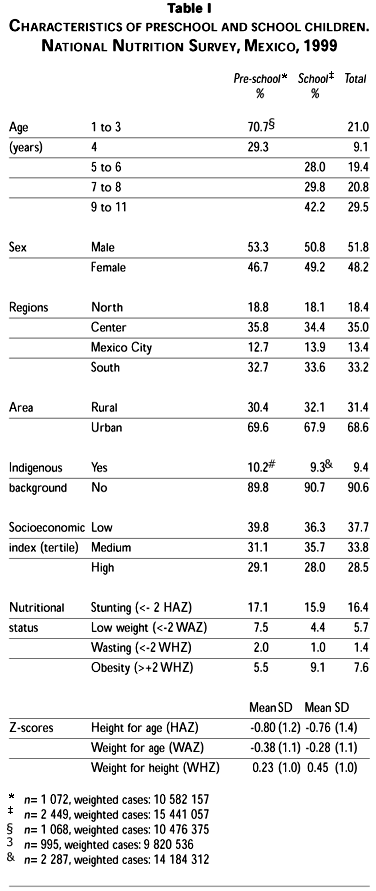
<body><![CDATA[<p><font size="2" face="Verdana">Energy and nutrient intakes were calculated for    all children and stratified according to the following factors: age, sex, region    (North, Center, Mexico City and South), area (urban or rural), SES tertile and    indigenous background. Energy, carbohydrate, protein and fat intakes exceeding    five standard deviations from their respective means were excluded from the    analysis (less than 1% of the sample). Due the skewed distributions of nutrient    intakes, data are presented as medians with interquartile ranges. Nutrient adequacies    were calculated using as a reference the Estimated Average Requirements (EARs)    from the Dietary Reference Intakes (DRIs).<SUP>31</SUP> Total energy, carbohydrate    and fat adequacies were estimated relative to the Recommended Dietary Allowances    (RDAs).<SUP>32</SUP> Iron, zinc, vitamin A, vitamin C, and folate adequacies    were calculated using the Estimated Average Requirements (EARs).<SUP>31,33,34</SUP>    For calcium, the Adequate Intake values (AIs) were used.<SUP>35</SUP> Protein    adequacy was estimated using as a reference the RDA value minus 25%, to approximate    the estimated average requirement.<SUP>32 </SUP>To test for statistical differences    in nutrient intakes and adequacies across the factors, we used an ANOVA of the    log-transformed intake and adequacy of each nutrient of interest.<SUP>23,36</SUP>    To evaluate the risk of inadequate intake, the proportion of children in this    study who did not reach their correspondent EAR was calculated. In a normal    population it is expected that 50% of the cases will be below the requirement,    thus the percentage above this number reflects the excess prevalence at risk.<SUP>31</SUP>    All calculations were weighted by expansion factors to adjust for sampling effects.    Statistical analysis was carried-out using SPSS version <a name="tx"></a>10.<a href="#nt"><sup>*</sup></a>    </font></p>     <p>&nbsp;</p>     <p><font size="3" face="Verdana"><b>Results </b></font></p>     <p><font size="2" face="Verdana">Data are presented for 1 072 pre-school children    (ages 1 to 4 years) and 2 449 school children (ages 5 to 11 years). Socio-demographic    and anthropometric characteristics of children are shown on <a href="#tab01">Table    I</a>. The proportion of pre-school and school age males was 53.3% and 50.8%,    respectively. Less than 33% were living in rural areas and the proportion of    children with indigenous background was under 11 %. The mean height for age    Z score (HAZ) was –0.8 (SD: 1.2) for pre-school children and -0.76 (SD: 1.4)    in school children. Prevalences of stunting were 17% and 16% for preschool and    school children, respectively. Prevalences of obesity were 5.5% and 9 % for    preschool and school children, respectively. </font></p>     <p><a name="tab01"></a></p>     <p>&nbsp;</p>     <p align="center"><img src="/img/revistas/spm/v45s4/a10tab01.gif"></p>     <p>&nbsp;</p>     <p><font size="2" face="Verdana"> Children with dietary information did not differ    from children without dietary information regarding sex, region, area, indigenous    background, SES index and anthropometric Z scores. However, children with dietary    data were on average three months older than children without it. </font></p>     <p><font size="2" face="Verdana"><b>Energy and macronutrients </b></font></p>     ]]></body>
<body><![CDATA[<p><font size="2" face="Verdana">Nutritional intakes and percent adequacy of energy    and nutrients are shown in <a href="/img/revistas/spm/v45s4/a10tab02.gif">Table II</a> for pre-school    children and in <a href="/img/revistas/spm/v45s4/a10tab03.gif">Table III</a> for school children,    by region and area of residency. The estimated median energy intake in pre-school    children was 949 kcal (percent adequacy (PA)=67.4). Protein intake was 32.4    g (PA=180.5) and carbohydrate intake was 120.4 g (PA= 63.6). The median fat    intake was 34.5 g (PA=74.9), and the fiber intake was 8.2 g . The highest energy    and protein adequacies were reported in Mexico City and the highest fat intake    was reported in the North region. Carbohydrate intake was higher in the Center    and South regions. The lowest energy, protein and fat intakes were observed    in the South region. Energy, protein, carbohydrate, and fat intakes were higher    in the urban compared to rural areas. Only fiber intake in grams was higher    in rural areas. </font></p>     <p><font size="2" face="Verdana"> In school children, the median energy intake    was 1377 kcal (PA=69.4). The median protein intake was 44.7 g (PA=155.5). Carbohydrate    intake was 187.2 g (PA=68.6), and this was the only macronutrient in which the    estimated adequacy was higher in school children compared to pre-school children.    The median fat intake was 47.9 g (PA=72.8), and the fiber intake was 13.8 g.    By region, the highest energy and fat adequacies were reported in the North,    while protein adequacy was higher in Mexico City. The highest carbohydrate intake,    and the lowest protein and fat intakes were observed in the South. </font></p>     <p><font size="2" face="Verdana"><b>Micronutrients </b></font></p>     <p><font size="2" face="Verdana">Micronutrient intake and adequacy are shown in    <a href="/img/revistas/spm/v45s4/a10tab02.gif">Table II</a> for pre-school and <a href="/img/revistas/spm/v45s4/a10tab03.gif">Table    III</a> for school children. In pre-school children, the estimated national    median intakes were: 265.1 mcgRE for vitamin A (PA=61.9), 22.3 mg for vitamin    C (PA=135.0), 131.8 mcg for folate (PA=81.1) and 571.5 mg (PA=94.2) for calcium.    Median iron intake was 4.5mg (PA=45.2) and zinc intake was 3.8mg (PA=129.2).    The highest vitamin A and calcium intakes were reported in Mexico City. Vitamin    C, folate, iron and zinc intakes were higher in the North compared to other    regions. The lowest vitamin A, vitamin C, zinc and calcium intakes were observed    in the South and in rural areas. Intakes for energy and all nutrients studied    were higher in urban compared to rural areas. Total fiber intake was higher    in rural areas. </font></p>     <p><font size="2" face="Verdana"> In school children, the estimated national median    intakes were: 303.5 mcgRE for vitamin A (PA=46.7), 29 mg for vitamin C (PA=95),    200.2 mcg for folate (PA=83.9), 7.1 mg for iron (PA=69.4), 5.4 mg for zinc (PA=52.2)    and 677.8 mg for calcium (PA=67.7). By region, the highest adequacies of vitamin    A and C, calcium and zinc and the lowest adequacies of iron were reported in    Mexico City. The lowest folate intake was observed in Mexico City. The highest    iron and folate intakes were observed in the North region. The lowest vitamin    A and vitamin C intakes were reported in the South. Energy and nutrient adequacies    were higher in urban compared to rural areas. Total fiber intake was higher    in rural compared to urban areas. </font></p>     <p><font size="2" face="Verdana"><b>Evaluation of risk for inadequate energy and    nutrient intake </b></font></p>     <p><font size="2" face="Verdana">The prevalence of cases below the requirement    for energy and each particular nutrient in pre-school and school children are    presented in <a href="#tab04">Table IV</a> by age, sex, region, area, indigenous    background, and socio-economic status. For energy and most nutrients, the proportion    of cases at risk of inadequacy in pre-school children was substantially higher    in rural areas (except for iron which was almost equal), and in children from    indigenous backgrounds and low socio-economic status. By region, the highest    proportion of inadequacy was observed in the South with the exception of folate    and iron, which had a higher risk of inadequacy in Mexico City. </font></p>     <p><a name="tab04"></a></p>     <p>&nbsp;</p>     <p align="center"><img src="/img/revistas/spm/v45s4/a10tab04.gif"></p>     ]]></body>
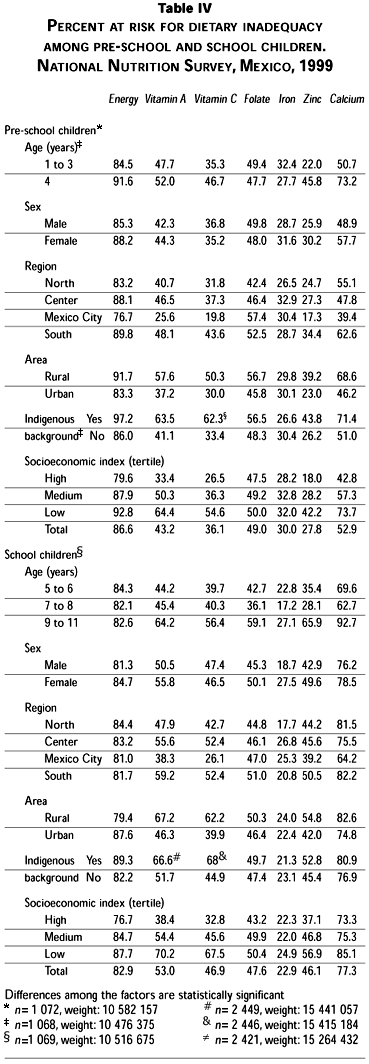
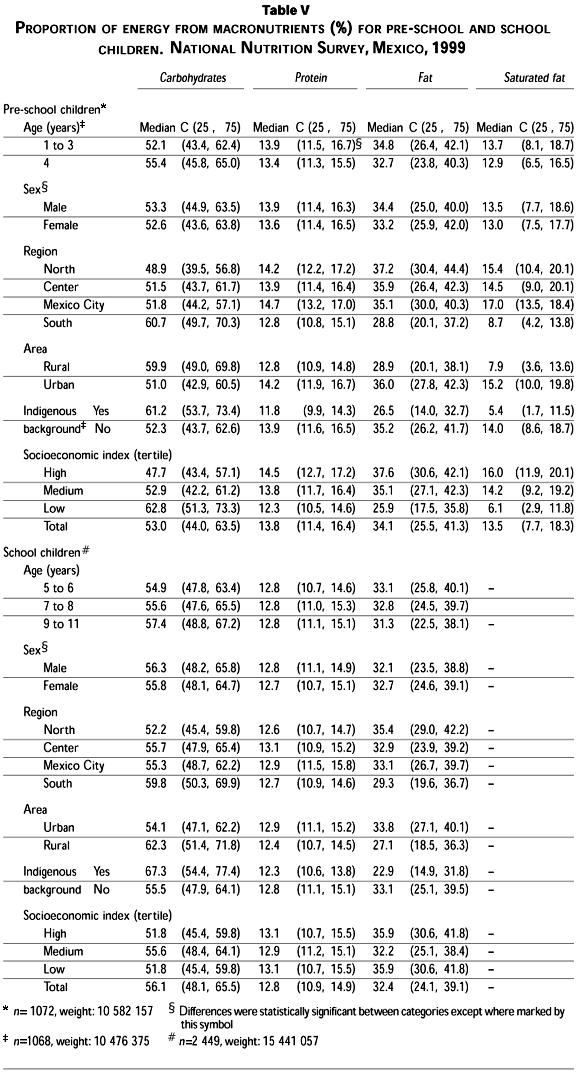
<body><![CDATA[<p>&nbsp;</p>     <p><font size="2" face="Verdana"> School children had a higher proportion of risk    of inadequacy compared to pre-school children for energy and all nutrients but    folate and iron. Similar to preschool children, a higher proportion of cases    at risk of inadequacy was observed in school age children with an indigenous    background, the lowest socio-economic status, and in the South Region. The exceptions    were folate (higher in Mexico City) and iron (higher in the Center). In addition,    a higher proportion of female pre-school and school children at risk for inadequacy    of iron and zinc was observed, in comparison to male children. </font></p>     <p><font size="2" face="Verdana"><b>Macronutrient composition </b></font></p>     <p><font size="2" face="Verdana">The macronutrient composition of diet, in terms    of percent contribution to total energy intake, is shown on <a href="#tab05">Table    V</a>. In preschool children, carbohydrates accounted for 53% of energy intake,    protein contributed with 13.8%, and fat provided 34.1%. The proportion of energy    from carbohydrate was higher in the South compared to other regions, and highest    in rural areas compared to urban. Proportion of energy from protein and fat    was lower in the South and in rural areas. Indigenous children had the higher    proportion of energy from carbohydrate and the lowest proportion of energy from    other macronutrients. The same trends were observed in school children. In school    children, carbohydrates accounted for 56.1% of total energy intake, while protein    provided 12.8%, and fat accounted for 32.4%. </font></p>     <p><a name="tab05"></a></p>     <p>&nbsp;</p>     <p align="center"><font size="2" face="Verdana"><img src="/img/revistas/spm/v45s4/a10tab05.gif"></font></p>     <p>&nbsp;</p>     <p><font size="3" face="Verdana"><b>Discussion </b></font></p>     <p><font size="2" face="Verdana">This is the first time in 10 years that dietary    information is obtained from pre-school children, and the first time ever that    this information is collected from school age children in Mexico by a nationally    representative survey. </font></p>     ]]></body>
<body><![CDATA[<p><font size="2" face="Verdana"> Children in the South region, indigenous children,    and those in the lowest socio-economic stratum, had higher fiber and carbohydrate    intake with lower fat intake. These children also showed the higher risks of    inadequacies for vitamins A, C and folate, and for iron, zinc and calcium. Deficiencies    were more marked in rural areas, compared to urban. Energy and carbohydrate    adequacies were below 70% for both pre-school and school children. </font></p>     <p><font size="2" face="Verdana"> The 24-hour dietary recall is the most widely    used method to assess dietary intake and has been extensively used in national    and population-based surveys.<SUP>37</SUP> However, it should be noted that    the 24-hour dietary recall tends to under-report energy and nutrient intake.<SUP>37,38</SUP>    One could confirm –and roughly quantify the magnitude of this under-report    by looking at the median percent adequacy of energy in children in the higher    socio-economic group, which was 75% for preschool and 80% for school children.    Since in this socio-economic stratum one could expect that the percent adequacy    of energy would be at least 100%, the magnitude of energy and nutrient under-reporting    would be at least around 20 to 25%. As a consequence, the proportion of children    at risk of nutrient inadequacies could be overestimated in the present study.    Moreover, we do not know if this dietary under-reporting differs by SES status,    maternal schooling or literacy, or the child's nutritional status in the present    study. Thus, caution is advised, and more studies are needed to clarify this    issue. </font></p>     <p><font size="2" face="Verdana"> Clearly, the energy and macronutrient consumption    follows a geographical pattern associated with     morbidity and mortality, explaining some characteristics of the epidemiologic    and nutrition transition. The North region, which has the highest prevalence    of obesity at the national level, has higher energy and fat percent adequacies.    Likewise, urban areas, higher socio-economic status and children without indigenous    background showed higher levels of energy and fat consumption with a lower consumption    of fiber and carbohydrates. These patterns were observed previously by our group    analyzing the Mexican National Household Income and Expenditure Surveys from    1984 to 1998.<SUP>1</SUP> This suggests that Mexico is still in a different    stage of the epidemiological and nutrition transition, as compared to more developed    countries in which the more educated groups adopt healthier lifestyles.<SUP>39,40</SUP>    </font></p>     <p><font size="2" face="Verdana"> On the other hand, micronutrient information    suggests important risks for deficiencies in preschool and school children.    Children with higher risks of inadequacies were those living in rural areas,    in the South region of the country and those with an indigenous background.    These results agree with previous reviews on micronutrient deficiencies in Mexico    and Latin America, related to the importance of inadequacy risks for calcium,    vitamin A, vitamin C, zinc and iron in disadvantaged populations.<SUP>21,41</SUP>    </font></p>     <p><font size="2" face="Verdana"> The EAR is the median usual intake value that    is estimated to meet the requirement of half the healthy individuals in a life    stage and gender group.<SUP>31</SUP> At this level of intake, the other half    of the individuals would not have met their needs. However, due to the methodological    procedures involved in the estimation of intake it is necessary to consider    with caution this information due to the following considerations: </font></p>     <p><font size="2" face="Verdana"> In the case of calcium, an EAR has not been    established. Therefore we used the AI as a reference. The AI reflects the mean    intake of a healthy population within a specific gender and age group; thus,    the proportion of children under the AI does not necessarily reflect inadequate    intakes. </font></p>     <p><font size="2" face="Verdana"> The 24-hour dietary recall questionnaire did    not considered the vitamin A mega-dose supplementation program, a nation-wide    strategy carried out by the Ministry of Health in order to prevent vitamin A    deficiency in children. Thus, reported vitamin A intakes could be underestimated.    This would lead to an overestimation of the risk of vitamin A inadequacy. The    risk of inadequacy for iron did not consider dietary sources of the element,    neither its biochemical form (heme vs. non-heme). This is important, since the    Mexican diet contains high quantities of fiber, phytates, phosphates and tannins    which are among the most powerful depressants of iron bio-availability. Therefore,    the risk of iron deficiency could be higher than that reported in this study    if the non-heme form of iron is an important source of the mineral. Our results    are consistent with other studies that have identified zinc deficiency as a    major nutritional problem in Mexican children.<SUP>11</SUP> Moreover, similar    to iron, zinc faces bio-availability problems related to the presence of dietary    inhibitors such as fiber, phytates and so on. Thus, interventions aimed at improving    zinc intake in children should be encouraged. Vitamin C risk of inadequacy was    higher than could be expected considering that Mexico produces large quantities    of citrus and tropical fruits, which are excellent sources of the vitamin. Thus,    consumption of these foods by children should be encouraged to improve their    vitamin C intake. Folate intakes were lower in the urban areas and in the North    and Mexico City regions, compared to the South and rural areas. This suggests    different dietary patterns among strata, particularly in relation to the consumption    of green leafy vegetables. </font></p>     <p><font size="2" face="Verdana"> The data showed important risks of inadequacies    for various micronutrients, which are essential for normal child health and    development. This can pose a risk for their health and nutrition status, and    actions are needed to address this problem. Micronutrient supplementation has    proved to be a very effective, low-cost strategy to control nutrient deficiencies    in developing countries, and thus, it should be encouraged.<SUP>15,16</SUP>    </font></p>     <p><font size="2" face="Verdana"> However, while some interventions, such as multiple    micronutrient supplementation in young children are useful for resolving micronutrient    deficiencies in the short term, it is worthwhile to consider long term interventions    such as food fortification and diet diversification. This would have particular    importance in school-age children, because dietary habits are acquired during    this period of life. Moreover, diverse studies have shown that people who consume    a diversity of foods (i.e. fruits, vegetables and fiber) have a reduced risk    of obesity and chronic diseases.<SUP>42-47</SUP> The prevalence of overweight    or obesity has been reported to be between 13 and 26% for school-age children    in this survey.<SUP>10</SUP> Thus, together with micronutrient deficiencies,    a call for major actions aimed to prevent these health problems starting at    early ages is necessary.<SUP>48-52</SUP> There is increasing evidence that the    risk of cardiovascular diseases, which represent the first cause of mortality    in the country, begins in childhood.<SUP>53</SUP> A careful exploration of nutrition    education in children must be carried out, aiming to improve the quality of    their diet and increase physical activity to reduce the prevalence of coronary    heart disease and other non-communicable chronic diseases in later life.<SUP>39,49,54,55</SUP>    Finally, it is important for health planners to review the country is food and    nutrition program targeting, and to evaluate    the impact of nutrition interventions, in order to optimize resources and to    guarantee the effectiveness of these actions. </font></p>     <p><font size="2" face="Verdana"> Our data showed important differences in nutrient    intakes and inadequacies between rural and urban areas, children from indigenous    and non-indigenous backgrounds and national regions. Policy should direct resources    to the most vulnerable groups in order to improve the nutritional status of    children. </font></p>     ]]></body>
<body><![CDATA[<p><font size="2" face="Verdana"><b>Acknowledgments </b></font></p>     <p><font size="2" face="Verdana">We would like to acknowledge the collaboration    of Eric Monterrubio, BS, and Noem&iacute; Figueroa, BS, a for the database management;    Ivonne Ram&iacute;rez, BS, and Alejandra Gasca, MD for database cleaning and    Maribel Porcayo, BS, in the compilation of the nutrient composition database.    </font></p>     <p>&nbsp;</p>     <p><font size="3" face="Verdana"><b>References </b></font></p>     <!-- ref --><p><font size="2" face="Verdana">1. Rivera J, Barquera S, Campirano F, Campos    I, Safdie M, Tovar V. Epidemiological and nutritional transition in Mexico:    Rapid increase of non-communicable chronic diseases and obesity. Public Health    Nutr 2002;14:113-122. </font>&nbsp;&nbsp;&nbsp;&nbsp;&nbsp;&nbsp;&nbsp;&nbsp;[&#160;<a href="javascript:void(0);" onclick="javascript: window.open('/scielo.php?script=sci_nlinks&ref=9187280&pid=S0036-3634200300100001000001&lng=','','width=640,height=500,resizable=yes,scrollbars=1,menubar=yes,');">Links</a>&#160;]<!-- end-ref --><!-- ref --><p><font size="2" face="Verdana">2. Bobadilla J, Frenk J, Lozano R, Frejka T,    Stern C. The epidemiologic transition and health priorities. In: Jamison D,    Ed. Disease control priorities in developing countries. New York (NY): Oxford    University Press, 1993. </font>&nbsp;&nbsp;&nbsp;&nbsp;&nbsp;&nbsp;&nbsp;&nbsp;[&#160;<a href="javascript:void(0);" onclick="javascript: window.open('/scielo.php?script=sci_nlinks&ref=9187281&pid=S0036-3634200300100001000002&lng=','','width=640,height=500,resizable=yes,scrollbars=1,menubar=yes,');">Links</a>&#160;]<!-- end-ref --><!-- ref --><p><font size="2" face="Verdana">3. Frenk J, Frejka T, Bobadilla JL, Stern C,    Sep&uacute;lveda J, Jos&eacute; MV. The epidemiologic transition in Latin America.    Bol Oficina Sanit Panam 1991;111:485-496. </font>&nbsp;&nbsp;&nbsp;&nbsp;&nbsp;&nbsp;&nbsp;&nbsp;[&#160;<a href="javascript:void(0);" onclick="javascript: window.open('/scielo.php?script=sci_nlinks&ref=9187282&pid=S0036-3634200300100001000003&lng=','','width=640,height=500,resizable=yes,scrollbars=1,menubar=yes,');">Links</a>&#160;]<!-- end-ref --><!-- ref --><p><font size="2" face="Verdana">4. Popkin BM. The nutrition transition in low-income    countries: An emerging crisis. Nutr Rev 1994;52:285-298. </font>&nbsp;&nbsp;&nbsp;&nbsp;&nbsp;&nbsp;&nbsp;&nbsp;[&#160;<a href="javascript:void(0);" onclick="javascript: window.open('/scielo.php?script=sci_nlinks&ref=9187283&pid=S0036-3634200300100001000004&lng=','','width=640,height=500,resizable=yes,scrollbars=1,menubar=yes,');">Links</a>&#160;]<!-- end-ref --><!-- ref --><p><font size="2" face="Verdana">5. Drewnowski A, Popkin BM. The nutrition transition:    New trends in the global diet. Nutr Rev 1997;55:31-43. </font>&nbsp;&nbsp;&nbsp;&nbsp;&nbsp;&nbsp;&nbsp;&nbsp;[&#160;<a href="javascript:void(0);" onclick="javascript: window.open('/scielo.php?script=sci_nlinks&ref=9187284&pid=S0036-3634200300100001000005&lng=','','width=640,height=500,resizable=yes,scrollbars=1,menubar=yes,');">Links</a>&#160;]<!-- end-ref --><!-- ref --><p><font size="2" face="Verdana">6. Romieu I, Hern&aacute;ndez-Avila M, Rivera    JA, Ruel MT, Parra S. Dietary studies in countries experiencing a health transition:    Mexico and Central America. Am J Clin Nutr 1997;65:1159S-1165S. </font>&nbsp;&nbsp;&nbsp;&nbsp;&nbsp;&nbsp;&nbsp;&nbsp;[&#160;<a href="javascript:void(0);" onclick="javascript: window.open('/scielo.php?script=sci_nlinks&ref=9187285&pid=S0036-3634200300100001000006&lng=','','width=640,height=500,resizable=yes,scrollbars=1,menubar=yes,');">Links</a>&#160;]<!-- end-ref --><!-- ref --><p><font size="2" face="Verdana">7. Barquera S, Rivera J, Gasca-Garc&iacute;a    A. Pol&iacute;ticas y programas de alimentaci&oacute;n y nutrici&oacute;n en    M&eacute;xico. Salud Publica Mex 2001;43:1-14. </font>&nbsp;&nbsp;&nbsp;&nbsp;&nbsp;&nbsp;&nbsp;&nbsp;[&#160;<a href="javascript:void(0);" onclick="javascript: window.open('/scielo.php?script=sci_nlinks&ref=9187286&pid=S0036-3634200300100001000007&lng=','','width=640,height=500,resizable=yes,scrollbars=1,menubar=yes,');">Links</a>&#160;]<!-- end-ref --><!-- ref --><p><font size="2" face="Verdana">8. Sep&uacute;lveda-Amor J, Lezana MA, Tapia-Conyer    R, Valdespino JL, Madrigal H, Kumate J. Nutritional status of pre-school children    and women in M&eacute;xico: Results of a probabilistic national survey. Gac    Med Mex 1990;126:207-224. </font>&nbsp;&nbsp;&nbsp;&nbsp;&nbsp;&nbsp;&nbsp;&nbsp;[&#160;<a href="javascript:void(0);" onclick="javascript: window.open('/scielo.php?script=sci_nlinks&ref=9187287&pid=S0036-3634200300100001000008&lng=','','width=640,height=500,resizable=yes,scrollbars=1,menubar=yes,');">Links</a>&#160;]<!-- end-ref --><!-- ref --><p><font size="2" face="Verdana">9. Rivera-Dommarco J, Shamah-Levy T, Villalpando-Hern&aacute;ndez    S, Gonz&aacute;lez-Coss&iacute;o T, Hern&aacute;ndez-Prado B, Sep&uacute;lveda-Amor    J. Cap&iacute;tulo 2: Preescolares. In: Rivera-Dommarco J, Shamah-Levy T, Villalpando    S <I>et al</I>, ed. Encuesta Nacional de Nutrici&oacute;n 1999. Estado Nutricio    de Ni&ntilde;os y Mujeres de M&eacute;xico. Vol. ISBN 968-6502-54-8. Cuernavaca,    Morelos: Instituto Nacional de Salud P&uacute;blica, 2000:29-61. </font>&nbsp;&nbsp;&nbsp;&nbsp;&nbsp;&nbsp;&nbsp;&nbsp;[&#160;<a href="javascript:void(0);" onclick="javascript: window.open('/scielo.php?script=sci_nlinks&ref=9187288&pid=S0036-3634200300100001000009&lng=','','width=640,height=500,resizable=yes,scrollbars=1,menubar=yes,');">Links</a>&#160;]<!-- end-ref --><!-- ref --><p><font size="2" face="Verdana">10. Hern&aacute;ndez-Prado B, Rivera-Dommarco    J, Shamah-Levy T, Gonz&aacute;lez-Coss&iacute;o T, Hern&aacute;ndez-Prado B,    Sep&uacute;lveda-Amor J. Escolares. En: Rivera-Dommarco J, Shamah-Levy T, Villalpando    S, Gonz&aacute;lez-Coss&iacute;o T, Hern&aacute;ndez-Prado B, Sep&uacute;lveda-Amor    J, ed. Encuesta Nacional de Nutrici&oacute;n 1999. Estado Nutricio de Ni&ntilde;os    y Mujeres de M&eacute;xico. Cuernavaca, Morelos: Instituto Nacional de Salud    P&uacute;blica, 2000:69-99. </font>&nbsp;&nbsp;&nbsp;&nbsp;&nbsp;&nbsp;&nbsp;&nbsp;[&#160;<a href="javascript:void(0);" onclick="javascript: window.open('/scielo.php?script=sci_nlinks&ref=9187289&pid=S0036-3634200300100001000010&lng=','','width=640,height=500,resizable=yes,scrollbars=1,menubar=yes,');">Links</a>&#160;]<!-- end-ref --><!-- ref --><p><font size="2" face="Verdana">11. Villalpando S, Rivera-Dommarco J, Shamah-Levy    T, Gonz&aacute;lez-Coss&iacute;o T, Hern&aacute;ndez-Prado B, Sep&uacute;lveda-Amor    J. Micronutrimentos. In: Rivera-Dommarco J, Shamah-Levy T, Villalpando S, Gonz&aacute;lez-Coss&iacute;o    T, Hern&aacute;ndez-Prado B, Sep&uacute;lveda-Amor J, Ed. Encuesta Nacional    de Nutrici&oacute;n 1999. Estado Nutricio de Ni&ntilde;os y Mujeres de M&eacute;xico.    Cuernavaca, Morelos: Instituto Nacional de Salud P&uacute;blica, 2000:179-238.    </font>&nbsp;&nbsp;&nbsp;&nbsp;&nbsp;&nbsp;&nbsp;&nbsp;[&#160;<a href="javascript:void(0);" onclick="javascript: window.open('/scielo.php?script=sci_nlinks&ref=9187290&pid=S0036-3634200300100001000011&lng=','','width=640,height=500,resizable=yes,scrollbars=1,menubar=yes,');">Links</a>&#160;]<!-- end-ref --><!-- ref --><p><font size="2" face="Verdana">12. Allen LH. The nutrition CRSP: What is marginal    malnutrition, and does it affect human function? Nutr Rev 1993;51:255-267. </font>&nbsp;&nbsp;&nbsp;&nbsp;&nbsp;&nbsp;&nbsp;&nbsp;[&#160;<a href="javascript:void(0);" onclick="javascript: window.open('/scielo.php?script=sci_nlinks&ref=9187291&pid=S0036-3634200300100001000012&lng=','','width=640,height=500,resizable=yes,scrollbars=1,menubar=yes,');">Links</a>&#160;]<!-- end-ref --><!-- ref --><p><font size="2" face="Verdana">13. Pollitt E, Saco-Pollit C, Jahari A, Husaini    M, Huang J. Effects of an energy and micronutrient supplement on mental development    and behavior under natural conditions in undernourished children in Indonesia.    Eur J Clin Nutr 2000;54:80-90. </font>&nbsp;&nbsp;&nbsp;&nbsp;&nbsp;&nbsp;&nbsp;&nbsp;[&#160;<a href="javascript:void(0);" onclick="javascript: window.open('/scielo.php?script=sci_nlinks&ref=9187292&pid=S0036-3634200300100001000013&lng=','','width=640,height=500,resizable=yes,scrollbars=1,menubar=yes,');">Links</a>&#160;]<!-- end-ref --><!-- ref --><p><font size="2" face="Verdana">14. Pelletier D, Frongillo E, Habitcht J P. Epidemiologyc    evidence for a potentiation effect of malnutrition on child mortality. Am J    Public Health 1993;83:1130-1133. </font>&nbsp;&nbsp;&nbsp;&nbsp;&nbsp;&nbsp;&nbsp;&nbsp;[&#160;<a href="javascript:void(0);" onclick="javascript: window.open('/scielo.php?script=sci_nlinks&ref=9187293&pid=S0036-3634200300100001000014&lng=','','width=640,height=500,resizable=yes,scrollbars=1,menubar=yes,');">Links</a>&#160;]<!-- end-ref --><!-- ref --><p><font size="2" face="Verdana">15. Beaton G, Martorell R, Aronson K, Edmonston    A, McCabe G, Ross A. Effectiveness of vitamin A supplementation in the control    of young child mortality in developing countries. Nutrition Policy Discussion    Paper No. 13 ACC/SCN 1993. New York. United Nations Press. </font>&nbsp;&nbsp;&nbsp;&nbsp;&nbsp;&nbsp;&nbsp;&nbsp;[&#160;<a href="javascript:void(0);" onclick="javascript: window.open('/scielo.php?script=sci_nlinks&ref=9187294&pid=S0036-3634200300100001000015&lng=','','width=640,height=500,resizable=yes,scrollbars=1,menubar=yes,');">Links</a>&#160;]<!-- end-ref --><!-- ref --><p><font size="2" face="Verdana">16. Black R, Sazawal S. Zinc and childhood infectious    disease morbidity and mortality. Br J Nutr 2001;85:S125-S129. </font>&nbsp;&nbsp;&nbsp;&nbsp;&nbsp;&nbsp;&nbsp;&nbsp;[&#160;<a href="javascript:void(0);" onclick="javascript: window.open('/scielo.php?script=sci_nlinks&ref=9187295&pid=S0036-3634200300100001000016&lng=','','width=640,height=500,resizable=yes,scrollbars=1,menubar=yes,');">Links</a>&#160;]<!-- end-ref --><!-- ref --><p><font size="2" face="Verdana">17. Barker DJ, Osmond C, Simmonds SJ, Wield GA.    The relation of small head circumference and thinness at birth to death from    cardiovascular disease in adult life. BMJ 1993;306:422-426. </font>&nbsp;&nbsp;&nbsp;&nbsp;&nbsp;&nbsp;&nbsp;&nbsp;[&#160;<a href="javascript:void(0);" onclick="javascript: window.open('/scielo.php?script=sci_nlinks&ref=9187296&pid=S0036-3634200300100001000017&lng=','','width=640,height=500,resizable=yes,scrollbars=1,menubar=yes,');">Links</a>&#160;]<!-- end-ref --><!-- ref --><p><font size="2" face="Verdana">18. Barker DJ, Clark PM. Fetal undernutrition    and disease in later life. Rev Reprod 1997;2:105-112. </font>&nbsp;&nbsp;&nbsp;&nbsp;&nbsp;&nbsp;&nbsp;&nbsp;[&#160;<a href="javascript:void(0);" onclick="javascript: window.open('/scielo.php?script=sci_nlinks&ref=9187297&pid=S0036-3634200300100001000018&lng=','','width=640,height=500,resizable=yes,scrollbars=1,menubar=yes,');">Links</a>&#160;]<!-- end-ref --><!-- ref --><p><font size="2" face="Verdana">19. Hern&aacute;ndez B, Peterson K, Sobol A,    Rivera J, Sep&uacute;lveda J, Lezana MA. Overweight in 12-49 year-old women    and children under 5 years of age in M&eacute;xico. Salud Publica Mex 1996;38:178-188.    </font>&nbsp;&nbsp;&nbsp;&nbsp;&nbsp;&nbsp;&nbsp;&nbsp;[&#160;<a href="javascript:void(0);" onclick="javascript: window.open('/scielo.php?script=sci_nlinks&ref=9187298&pid=S0036-3634200300100001000019&lng=','','width=640,height=500,resizable=yes,scrollbars=1,menubar=yes,');">Links</a>&#160;]<!-- end-ref --><p><font size="2" face="Verdana">20. Mart&iacute;nez-Salgado H, Parra-Cabrera    S, Rivera-Dommarco J. Personal communication: Adecuaci&oacute;n de la ingesti&oacute;n    diet&eacute;tica de energ&iacute;a y micronutrimentos en ni&ntilde;os de 1 a    5 a&ntilde;os de edad: resultados de una encuesta probabil&iacute;stica nacional.    Instituto Nacional de Salud P&uacute;blica, Cuernavaca, Morelos, 1998. </font></p>     <!-- ref --><p><font size="2" face="Verdana">21. Rosado J, Bourges H, Saint-Mart&iacute;n    B. Deficiencia de vitaminas y minerales en M&eacute;xico. Una revisi&oacute;n    cr&iacute;tica del estado de la informaci&oacute;n: deficiencia de vitaminas.    Salud Publica Mex 1995;37:452-461. </font>&nbsp;&nbsp;&nbsp;&nbsp;&nbsp;&nbsp;&nbsp;&nbsp;[&#160;<a href="javascript:void(0);" onclick="javascript: window.open('/scielo.php?script=sci_nlinks&ref=9187300&pid=S0036-3634200300100001000020&lng=','','width=640,height=500,resizable=yes,scrollbars=1,menubar=yes,');">Links</a>&#160;]<!-- end-ref --><!-- ref --><p><font size="2" face="Verdana">22. Resano-P&eacute;rez E, Vicencio-Acevedo C,    Landeros-D&iacute;az A, Shamah-Levy T, Rivera-Dommarco J. Metodolog&iacute;a.    In: Rivera-Dommarco J, Shamah-Levy T, Villalpando-Hern&aacute;ndez S, Gonz&aacute;lez-Coss&iacute;o    T, Hern&aacute;ndez-Prado B, Sep&uacute;lveda-Amor J, Ed. Encuesta Nacional    de Nutrici&oacute;n II: Estado Nutricio de Ni&ntilde;os y Mujeres en M&eacute;xico.    Cuernavaca, Morelos: Instituto Nacional de Salud P&uacute;blica, 2000:21-28.    </font>&nbsp;&nbsp;&nbsp;&nbsp;&nbsp;&nbsp;&nbsp;&nbsp;[&#160;<a href="javascript:void(0);" onclick="javascript: window.open('/scielo.php?script=sci_nlinks&ref=9187301&pid=S0036-3634200300100001000021&lng=','','width=640,height=500,resizable=yes,scrollbars=1,menubar=yes,');">Links</a>&#160;]<!-- end-ref --><!-- ref --><p><font size="2" face="Verdana">23. Kleinbaum D, Kupper L, Muller K, Nizam A.    Applied regression analysis and other multivariable methods. In: Kugushev A,    Ed. Pacific Grove, California: Brooks/Cole Publishing Company, 1998:798. </font>&nbsp;&nbsp;&nbsp;&nbsp;&nbsp;&nbsp;&nbsp;&nbsp;[&#160;<a href="javascript:void(0);" onclick="javascript: window.open('/scielo.php?script=sci_nlinks&ref=9187302&pid=S0036-3634200300100001000022&lng=','','width=640,height=500,resizable=yes,scrollbars=1,menubar=yes,');">Links</a>&#160;]<!-- end-ref --><!-- ref --><p><font size="2" face="Verdana">24. Reyment R, J&ouml;reskog K. Applied factor    analysis in the natural sciences. Cambridge, UK: Cambridge University Press,    1996:371. </font>&nbsp;&nbsp;&nbsp;&nbsp;&nbsp;&nbsp;&nbsp;&nbsp;[&#160;<a href="javascript:void(0);" onclick="javascript: window.open('/scielo.php?script=sci_nlinks&ref=9187303&pid=S0036-3634200300100001000023&lng=','','width=640,height=500,resizable=yes,scrollbars=1,menubar=yes,');">Links</a>&#160;]<!-- end-ref --><!-- ref --><p><font size="2" face="Verdana">25. US Department of Agriculture, Agricultural    Research Service. USDA Nutrient Database for Standard Reference, Release 13.    Nutrient Data Laboratory, 1999. </font>&nbsp;&nbsp;&nbsp;&nbsp;&nbsp;&nbsp;&nbsp;&nbsp;[&#160;<a href="javascript:void(0);" onclick="javascript: window.open('/scielo.php?script=sci_nlinks&ref=9187304&pid=S0036-3634200300100001000024&lng=','','width=640,height=500,resizable=yes,scrollbars=1,menubar=yes,');">Links</a>&#160;]<!-- end-ref --><!-- ref --><p><font size="2" face="Verdana">26. Food composition database. Davis, (CA): University    of California - Davis, 1998. </font>&nbsp;&nbsp;&nbsp;&nbsp;&nbsp;&nbsp;&nbsp;&nbsp;[&#160;<a href="javascript:void(0);" onclick="javascript: window.open('/scielo.php?script=sci_nlinks&ref=9187305&pid=S0036-3634200300100001000025&lng=','','width=640,height=500,resizable=yes,scrollbars=1,menubar=yes,');">Links</a>&#160;]<!-- end-ref --><!-- ref --><p><font size="2" face="Verdana">27. Instituto de Nutrici&oacute;n de Centroam&eacute;rica    y Panam&aacute;. Tabla de composici&oacute;n de alimentos para uso en Am&eacute;rica    Latina. In: PAHO, INCAP, Ed. Guatemala: - ICNND, 1961:98. </font>&nbsp;&nbsp;&nbsp;&nbsp;&nbsp;&nbsp;&nbsp;&nbsp;[&#160;<a href="javascript:void(0);" onclick="javascript: window.open('/scielo.php?script=sci_nlinks&ref=9187306&pid=S0036-3634200300100001000026&lng=','','width=640,height=500,resizable=yes,scrollbars=1,menubar=yes,');">Links</a>&#160;]<!-- end-ref --><!-- ref --><p><font size="2" face="Verdana">28. Morales J, Babinsky V, Bourges H, Camacho    M. Tablas de composici&oacute;n de alimentos mexicanos del Instituto Nacional    de Ciencias M&eacute;dicas y Nutrici&oacute;n Salvador Zubir&aacute;n. M&eacute;xico,    DF: Instituto Nacional de Nutrici&oacute;n, 1999. </font>&nbsp;&nbsp;&nbsp;&nbsp;&nbsp;&nbsp;&nbsp;&nbsp;[&#160;<a href="javascript:void(0);" onclick="javascript: window.open('/scielo.php?script=sci_nlinks&ref=9187307&pid=S0036-3634200300100001000027&lng=','','width=640,height=500,resizable=yes,scrollbars=1,menubar=yes,');">Links</a>&#160;]<!-- end-ref --><!-- ref --><p><font size="2" face="Verdana">29. Mu&ntilde;oz M, Ch&aacute;vez A, P&eacute;rez-Gil    F. Tablas de valor nutritivo de los alimentos de mayor consumo en M&eacute;xico.    Mexico, DF: Editorial Pax, 1996:330.</font>&nbsp;&nbsp;&nbsp;&nbsp;&nbsp;&nbsp;&nbsp;&nbsp;[&#160;<a href="javascript:void(0);" onclick="javascript: window.open('/scielo.php?script=sci_nlinks&ref=9187308&pid=S0036-3634200300100001000028&lng=','','width=640,height=500,resizable=yes,scrollbars=1,menubar=yes,');">Links</a>&#160;]<!-- end-ref --><!-- ref --><p><font size="2" face="Verdana"> 30. Souci S, Fachmann W, Kraut H. Food composition    and nutrition tables. In: Senser HSuF, Ed. Stuttgart: Medpharm Scientific Publications:    CRC Press, 2000. </font>&nbsp;&nbsp;&nbsp;&nbsp;&nbsp;&nbsp;&nbsp;&nbsp;[&#160;<a href="javascript:void(0);" onclick="javascript: window.open('/scielo.php?script=sci_nlinks&ref=9187309&pid=S0036-3634200300100001000029&lng=','','width=640,height=500,resizable=yes,scrollbars=1,menubar=yes,');">Links</a>&#160;]<!-- end-ref --><!-- ref --><p><font size="2" face="Verdana">31. Institute of Medicine. Dietary reference    intakes: Applications in dietary assessment. Washington, DC: Institute of Medicine,    National Academy Press, 2000:285. </font>&nbsp;&nbsp;&nbsp;&nbsp;&nbsp;&nbsp;&nbsp;&nbsp;[&#160;<a href="javascript:void(0);" onclick="javascript: window.open('/scielo.php?script=sci_nlinks&ref=9187310&pid=S0036-3634200300100001000030&lng=','','width=640,height=500,resizable=yes,scrollbars=1,menubar=yes,');">Links</a>&#160;]<!-- end-ref --><!-- ref --><p><font size="2" face="Verdana">32. National Research Council. Recommended dietary    allowances. Washington, DC: National Academy Press, 1989. </font>&nbsp;&nbsp;&nbsp;&nbsp;&nbsp;&nbsp;&nbsp;&nbsp;[&#160;<a href="javascript:void(0);" onclick="javascript: window.open('/scielo.php?script=sci_nlinks&ref=9187311&pid=S0036-3634200300100001000031&lng=','','width=640,height=500,resizable=yes,scrollbars=1,menubar=yes,');">Links</a>&#160;]<!-- end-ref --><!-- ref --><p><font size="2" face="Verdana">33. Institute of Medicine. Dietary reference    intakes for: Vitamin C, vitamin E, selenium and carotenoids. Washington DC:    Institute of Medicine, National Academy Press, 2000:506. </font>&nbsp;&nbsp;&nbsp;&nbsp;&nbsp;&nbsp;&nbsp;&nbsp;[&#160;<a href="javascript:void(0);" onclick="javascript: window.open('/scielo.php?script=sci_nlinks&ref=9187312&pid=S0036-3634200300100001000032&lng=','','width=640,height=500,resizable=yes,scrollbars=1,menubar=yes,');">Links</a>&#160;]<!-- end-ref --><!-- ref --><p><font size="2" face="Verdana">34. Institute of Medicine. Dietary reference    intakes for: Vitamin A, vitamin K, arsenic, boron, chromium, copper, iodine,    iron, manganese, molybdenum, nickel, silicon, vanadium, and zinc. Washington    DC: Institute of Medicine, National Academy Press, 2001:650. </font>&nbsp;&nbsp;&nbsp;&nbsp;&nbsp;&nbsp;&nbsp;&nbsp;[&#160;<a href="javascript:void(0);" onclick="javascript: window.open('/scielo.php?script=sci_nlinks&ref=9187313&pid=S0036-3634200300100001000033&lng=','','width=640,height=500,resizable=yes,scrollbars=1,menubar=yes,');">Links</a>&#160;]<!-- end-ref --><!-- ref --><p><font size="2" face="Verdana">35. Institute of Medicine. Dietary reference    intakes for: Calcium, phosphorus, magnesium, vitamin D and fluoride. Washington    DC: Institute of Medicine, National Academy Press, Washington, DC. 2000:432.    </font>&nbsp;&nbsp;&nbsp;&nbsp;&nbsp;&nbsp;&nbsp;&nbsp;[&#160;<a href="javascript:void(0);" onclick="javascript: window.open('/scielo.php?script=sci_nlinks&ref=9187314&pid=S0036-3634200300100001000034&lng=','','width=640,height=500,resizable=yes,scrollbars=1,menubar=yes,');">Links</a>&#160;]<!-- end-ref --><!-- ref --><p><font size="2" face="Verdana">36. Millns H, Woodward M, Bolton-Smith C. Is    it necessary to transform nutrient variables prior to statistical analyses?    Am J Epidemiol 1995;141:251-262. </font>&nbsp;&nbsp;&nbsp;&nbsp;&nbsp;&nbsp;&nbsp;&nbsp;[&#160;<a href="javascript:void(0);" onclick="javascript: window.open('/scielo.php?script=sci_nlinks&ref=9187315&pid=S0036-3634200300100001000035&lng=','','width=640,height=500,resizable=yes,scrollbars=1,menubar=yes,');">Links</a>&#160;]<!-- end-ref --><!-- ref --><p><font size="2" face="Verdana">37. Willett W. Nutritional epidemiology. In:    MacMahon B, Ed. Monographs in epidemiology    and biostatistics. Vol. 15. New York: Oxford University Press, Inc., 1990:396.    </font>&nbsp;&nbsp;&nbsp;&nbsp;&nbsp;&nbsp;&nbsp;&nbsp;[&#160;<a href="javascript:void(0);" onclick="javascript: window.open('/scielo.php?script=sci_nlinks&ref=9187316&pid=S0036-3634200300100001000036&lng=','','width=640,height=500,resizable=yes,scrollbars=1,menubar=yes,');">Links</a>&#160;]<!-- end-ref --><!-- ref --><p><font size="2" face="Verdana">38. Campirano F, Barquera S, Rivera J, Hern&aacute;ndez-Prado    B, Flores M, Monterrubio E. Estimation of energy under-reporting in obese and    </font><font size="2" face="Verdana">non-obese Mexican women using different    equations: Analysis of the Mexican Nutrition Survey. Ann Nutr Metabol 2001;45:146.    </font>&nbsp;&nbsp;&nbsp;&nbsp;&nbsp;&nbsp;&nbsp;&nbsp;[&#160;<a href="javascript:void(0);" onclick="javascript: window.open('/scielo.php?script=sci_nlinks&ref=9187317&pid=S0036-3634200300100001000037&lng=','','width=640,height=500,resizable=yes,scrollbars=1,menubar=yes,');">Links</a>&#160;]<!-- end-ref --><!-- ref --><p><font size="2" face="Verdana">39. Muller MJ, Koertzinger I, Mast M, Langnase    K, Grund A, Koertringer I. Physical activity and diet in 5 to 7 years old children.    Public Health Nutr 1999;2:443-444. </font>&nbsp;&nbsp;&nbsp;&nbsp;&nbsp;&nbsp;&nbsp;&nbsp;[&#160;<a href="javascript:void(0);" onclick="javascript: window.open('/scielo.php?script=sci_nlinks&ref=9187318&pid=S0036-3634200300100001000038&lng=','','width=640,height=500,resizable=yes,scrollbars=1,menubar=yes,');">Links</a>&#160;]<!-- end-ref --><!-- ref --><p><font size="2" face="Verdana">40. Popkin BM. The shift in stages of the nutrition    transition in the developing world differs from past experiences. Public Health    Nutr 2002;5:93-103. </font>&nbsp;&nbsp;&nbsp;&nbsp;&nbsp;&nbsp;&nbsp;&nbsp;[&#160;<a href="javascript:void(0);" onclick="javascript: window.open('/scielo.php?script=sci_nlinks&ref=9187319&pid=S0036-3634200300100001000039&lng=','','width=640,height=500,resizable=yes,scrollbars=1,menubar=yes,');">Links</a>&#160;]<!-- end-ref --><!-- ref --><p><font size="2" face="Verdana">41. O'Donnell AM. The feeding of children in    Latin America. Arch Latinoamer Nutr 1988;38:685-704. </font>&nbsp;&nbsp;&nbsp;&nbsp;&nbsp;&nbsp;&nbsp;&nbsp;[&#160;<a href="javascript:void(0);" onclick="javascript: window.open('/scielo.php?script=sci_nlinks&ref=9187320&pid=S0036-3634200300100001000040&lng=','','width=640,height=500,resizable=yes,scrollbars=1,menubar=yes,');">Links</a>&#160;]<!-- end-ref --><!-- ref --><p><font size="2" face="Verdana">42. Fung TT, Willett WC, Stampfer MJ, Manson    JE, Hu FB. Dietary patterns and the risk of coronary heart disease in women.    Arch Intern Med 1857;161:1857-1862. </font>&nbsp;&nbsp;&nbsp;&nbsp;&nbsp;&nbsp;&nbsp;&nbsp;[&#160;<a href="javascript:void(0);" onclick="javascript: window.open('/scielo.php?script=sci_nlinks&ref=9187321&pid=S0036-3634200300100001000041&lng=','','width=640,height=500,resizable=yes,scrollbars=1,menubar=yes,');">Links</a>&#160;]<!-- end-ref --><!-- ref --><p><font size="2" face="Verdana">43. Hu FB, Manson JE, Stampfer MJ. Diet, lifestyle,    and the risk of type 2 diabetes mellitus in women. N Engl J Med 2001;345:790-797.    </font>&nbsp;&nbsp;&nbsp;&nbsp;&nbsp;&nbsp;&nbsp;&nbsp;[&#160;<a href="javascript:void(0);" onclick="javascript: window.open('/scielo.php?script=sci_nlinks&ref=9187322&pid=S0036-3634200300100001000042&lng=','','width=640,height=500,resizable=yes,scrollbars=1,menubar=yes,');">Links</a>&#160;]<!-- end-ref --><!-- ref --><p><font size="2" face="Verdana">44. Hu FB, Willett WC. Diet and coronary heart    disease: Findings from the Nurses' Health Study and Health Professionals' Follow-up    Study. Journal of Nutrition, Health &amp; Aging 2001;5:132-138. </font>&nbsp;&nbsp;&nbsp;&nbsp;&nbsp;&nbsp;&nbsp;&nbsp;[&#160;<a href="javascript:void(0);" onclick="javascript: window.open('/scielo.php?script=sci_nlinks&ref=9187323&pid=S0036-3634200300100001000043&lng=','','width=640,height=500,resizable=yes,scrollbars=1,menubar=yes,');">Links</a>&#160;]<!-- end-ref --><!-- ref --><p><font size="2" face="Verdana">45. Liu S, Manson JE, Lee IM, Cole SR, Hennekens    CH, Willet WC <I>et al</I>. Fruit and vegetable intake and risk of cardiovascular    disease: The Women's Health Study. Am J Clin Nutr 2000;72:922-928. </font>&nbsp;&nbsp;&nbsp;&nbsp;&nbsp;&nbsp;&nbsp;&nbsp;[&#160;<a href="javascript:void(0);" onclick="javascript: window.open('/scielo.php?script=sci_nlinks&ref=9187324&pid=S0036-3634200300100001000044&lng=','','width=640,height=500,resizable=yes,scrollbars=1,menubar=yes,');">Links</a>&#160;]<!-- end-ref --><!-- ref --><p><font size="2" face="Verdana">46. Liu S, Buring JE, Sesso HD, Rimm EB, Willett    WC, Manson JE. A prospective study of dietary fiber intake and risk of cardiovascular    disease among women. J Am Coll Cardiol 2002;39:49-56. </font>&nbsp;&nbsp;&nbsp;&nbsp;&nbsp;&nbsp;&nbsp;&nbsp;[&#160;<a href="javascript:void(0);" onclick="javascript: window.open('/scielo.php?script=sci_nlinks&ref=9187325&pid=S0036-3634200300100001000045&lng=','','width=640,height=500,resizable=yes,scrollbars=1,menubar=yes,');">Links</a>&#160;]<!-- end-ref --><!-- ref --><p><font size="2" face="Verdana">47. Tucker K, Selhub J, Wilson P, Rosenberg I.    Dietary intake pattern relates to plasma folate and homocysteine concentrations    in the Framingham Hearth Study. J Nutr 1996;126:3025-3031. </font>&nbsp;&nbsp;&nbsp;&nbsp;&nbsp;&nbsp;&nbsp;&nbsp;[&#160;<a href="javascript:void(0);" onclick="javascript: window.open('/scielo.php?script=sci_nlinks&ref=9187326&pid=S0036-3634200300100001000046&lng=','','width=640,height=500,resizable=yes,scrollbars=1,menubar=yes,');">Links</a>&#160;]<!-- end-ref --><!-- ref --><p><font size="2" face="Verdana">48. Tucker K, Spiro A, Weiss S. Variation in    food and nutrient intakes among older men: Age, and other socio-demographic    factors. Nutr Res 1995;15:161-176. </font>&nbsp;&nbsp;&nbsp;&nbsp;&nbsp;&nbsp;&nbsp;&nbsp;[&#160;<a href="javascript:void(0);" onclick="javascript: window.open('/scielo.php?script=sci_nlinks&ref=9187327&pid=S0036-3634200300100001000047&lng=','','width=640,height=500,resizable=yes,scrollbars=1,menubar=yes,');">Links</a>&#160;]<!-- end-ref --><!-- ref --><p><font size="2" face="Verdana">49. Bedinghaus J, Doughten S. Childhood nutrition:    From breastmilk to burgers. Primary Care 1994;21:655-672. </font>&nbsp;&nbsp;&nbsp;&nbsp;&nbsp;&nbsp;&nbsp;&nbsp;[&#160;<a href="javascript:void(0);" onclick="javascript: window.open('/scielo.php?script=sci_nlinks&ref=9187328&pid=S0036-3634200300100001000048&lng=','','width=640,height=500,resizable=yes,scrollbars=1,menubar=yes,');">Links</a>&#160;]<!-- end-ref --><!-- ref --><p><font size="2" face="Verdana">50. Borra ST, Schwartz NE, Spain CG, Natchipolsky    MM. Food, physical activity, and fun: Inspiring America's kids to more healthful    lifestyles. J Am Diet Assoc 1995;95:816-823. </font>&nbsp;&nbsp;&nbsp;&nbsp;&nbsp;&nbsp;&nbsp;&nbsp;[&#160;<a href="javascript:void(0);" onclick="javascript: window.open('/scielo.php?script=sci_nlinks&ref=9187329&pid=S0036-3634200300100001000049&lng=','','width=640,height=500,resizable=yes,scrollbars=1,menubar=yes,');">Links</a>&#160;]<!-- end-ref --><!-- ref --><p><font size="2" face="Verdana">51. Ernst ND, Obarzanek E. Child health and nutrition:    Obesity and high blood cholesterol. Preventive Medicine 1994;23:427-436. </font>&nbsp;&nbsp;&nbsp;&nbsp;&nbsp;&nbsp;&nbsp;&nbsp;[&#160;<a href="javascript:void(0);" onclick="javascript: window.open('/scielo.php?script=sci_nlinks&ref=9187330&pid=S0036-3634200300100001000050&lng=','','width=640,height=500,resizable=yes,scrollbars=1,menubar=yes,');">Links</a>&#160;]<!-- end-ref --><!-- ref --><p><font size="2" face="Verdana">52. Kennedy E, Goldberg J. What are American    children eating? Implications for public policy. Nutr Rev 1995;53:111-126. </font>&nbsp;&nbsp;&nbsp;&nbsp;&nbsp;&nbsp;&nbsp;&nbsp;[&#160;<a href="javascript:void(0);" onclick="javascript: window.open('/scielo.php?script=sci_nlinks&ref=9187331&pid=S0036-3634200300100001000051&lng=','','width=640,height=500,resizable=yes,scrollbars=1,menubar=yes,');">Links</a>&#160;]<!-- end-ref --><!-- ref --><p><font size="2" face="Verdana">53. Berenson GS, Srinivasan SR, Nicklas TA. Atherosclerosis:    A nutritional disease of childhood. Am J Cardiol 1998;82. </font>&nbsp;&nbsp;&nbsp;&nbsp;&nbsp;&nbsp;&nbsp;&nbsp;[&#160;<a href="javascript:void(0);" onclick="javascript: window.open('/scielo.php?script=sci_nlinks&ref=9187332&pid=S0036-3634200300100001000052&lng=','','width=640,height=500,resizable=yes,scrollbars=1,menubar=yes,');">Links</a>&#160;]<!-- end-ref --><!-- ref --><p><font size="2" face="Verdana">54. Weber JL, Cunningham-Sabo L, Skipper B. Portion-size    estimation training in second- and third-grade American Indian children. Am    J Clin Nutr 1999;69. </font>&nbsp;&nbsp;&nbsp;&nbsp;&nbsp;&nbsp;&nbsp;&nbsp;[&#160;<a href="javascript:void(0);" onclick="javascript: window.open('/scielo.php?script=sci_nlinks&ref=9187333&pid=S0036-3634200300100001000053&lng=','','width=640,height=500,resizable=yes,scrollbars=1,menubar=yes,');">Links</a>&#160;]<!-- end-ref --><!-- ref --><p><font size="2" face="Verdana">55. Sahota P, Rudolf MC, Dixey R, Hill AJ, Barth    JH, Cade J. Randomised controlled trial of primary school based intervention    to reduce risk factors for obesity. BMJ 2001;323:1029-1032.</font>&nbsp;&nbsp;&nbsp;&nbsp;&nbsp;&nbsp;&nbsp;&nbsp;[&#160;<a href="javascript:void(0);" onclick="javascript: window.open('/scielo.php?script=sci_nlinks&ref=9187334&pid=S0036-3634200300100001000054&lng=','','width=640,height=500,resizable=yes,scrollbars=1,menubar=yes,');">Links</a>&#160;]<!-- end-ref --><p>&nbsp;</p>     ]]></body>
<body><![CDATA[<p>&nbsp;</p>     <p><font size="2" face="Verdana">Address reprint requests to    <br>   Dr. Mario Flores    <br>   Centro de Investigaci&oacute;n en Nutrici&oacute;n y Salud, Instituto Nacional    de Salud P&uacute;blica    <br>   Avenida Universidad 655    <br>   colonia Santa Mar&iacute;a Ahuacatitl&aacute;n    <br>   62508 Cuernavaca, Morelos, M&eacute;xico    <br>   E-mail: <a href="mailto:mflores@correo.insp.mx">mflores@correo.insp.mx</a></font></p>     <p><font size="2" face="Verdana"><B>Received on:</B> August 20, 2002    <br>   <B>Acepted on:</B> October 2, 2003 </font></p>     ]]></body>
<body><![CDATA[<p>&nbsp;</p>     <p>&nbsp;</p>     <p><font size="2" face="Verdana"><a name="nt"></a><a href="#tx">*</a> SPSS for    Windows. Release 10.0.0. Chicago (IL): SPSS Inc, 1999.</font></p>      ]]></body><back>
<ref-list>
<ref id="B1">
<label>1</label><nlm-citation citation-type="journal">
<person-group person-group-type="author">
<name>
<surname><![CDATA[Rivera]]></surname>
<given-names><![CDATA[J]]></given-names>
</name>
<name>
<surname><![CDATA[Barquera]]></surname>
<given-names><![CDATA[S]]></given-names>
</name>
<name>
<surname><![CDATA[Campirano]]></surname>
<given-names><![CDATA[F]]></given-names>
</name>
<name>
<surname><![CDATA[Campos]]></surname>
<given-names><![CDATA[I]]></given-names>
</name>
<name>
<surname><![CDATA[Safdie]]></surname>
<given-names><![CDATA[M]]></given-names>
</name>
<name>
<surname><![CDATA[Tovar]]></surname>
<given-names><![CDATA[V]]></given-names>
</name>
</person-group>
<article-title xml:lang="en"><![CDATA[Epidemiological and nutritional transition in Mexico: Rapid increase of non-communicable chronic diseases and obesity]]></article-title>
<source><![CDATA[Public Health Nutr]]></source>
<year>2002</year>
<volume>14</volume>
<page-range>113-122</page-range></nlm-citation>
</ref>
<ref id="B2">
<label>2</label><nlm-citation citation-type="book">
<person-group person-group-type="author">
<name>
<surname><![CDATA[Bobadilla]]></surname>
<given-names><![CDATA[J]]></given-names>
</name>
<name>
<surname><![CDATA[Frenk]]></surname>
<given-names><![CDATA[J]]></given-names>
</name>
<name>
<surname><![CDATA[Lozano]]></surname>
<given-names><![CDATA[R]]></given-names>
</name>
<name>
<surname><![CDATA[Frejka]]></surname>
<given-names><![CDATA[T]]></given-names>
</name>
<name>
<surname><![CDATA[Stern]]></surname>
<given-names><![CDATA[C]]></given-names>
</name>
</person-group>
<article-title xml:lang="en"><![CDATA[The epidemiologic transition and health priorities]]></article-title>
<person-group person-group-type="editor">
<name>
<surname><![CDATA[Jamison]]></surname>
<given-names><![CDATA[D]]></given-names>
</name>
</person-group>
<source><![CDATA[Disease control priorities in developing countries]]></source>
<year>1993</year>
<publisher-loc><![CDATA[New York^eNY NY]]></publisher-loc>
<publisher-name><![CDATA[Oxford University Press]]></publisher-name>
</nlm-citation>
</ref>
<ref id="B3">
<label>3</label><nlm-citation citation-type="journal">
<person-group person-group-type="author">
<name>
<surname><![CDATA[Frenk]]></surname>
<given-names><![CDATA[J]]></given-names>
</name>
<name>
<surname><![CDATA[Frejka]]></surname>
<given-names><![CDATA[T]]></given-names>
</name>
<name>
<surname><![CDATA[Bobadilla]]></surname>
<given-names><![CDATA[JL]]></given-names>
</name>
<name>
<surname><![CDATA[Stern]]></surname>
<given-names><![CDATA[C]]></given-names>
</name>
<name>
<surname><![CDATA[Sepúlveda]]></surname>
<given-names><![CDATA[J]]></given-names>
</name>
<name>
<surname><![CDATA[José]]></surname>
<given-names><![CDATA[MV]]></given-names>
</name>
</person-group>
<article-title xml:lang="en"><![CDATA[The epidemiologic transition in Latin America]]></article-title>
<source><![CDATA[Bol Oficina Sanit Panam]]></source>
<year>1991</year>
<volume>111</volume>
<page-range>485-496</page-range></nlm-citation>
</ref>
<ref id="B4">
<label>4</label><nlm-citation citation-type="journal">
<person-group person-group-type="author">
<name>
<surname><![CDATA[Popkin]]></surname>
<given-names><![CDATA[BM]]></given-names>
</name>
</person-group>
<article-title xml:lang="en"><![CDATA[The nutrition transition in low-income countries: An emerging crisis]]></article-title>
<source><![CDATA[Nutr Rev]]></source>
<year>1994</year>
<volume>52</volume>
<page-range>285-298</page-range></nlm-citation>
</ref>
<ref id="B5">
<label>5</label><nlm-citation citation-type="journal">
<person-group person-group-type="author">
<name>
<surname><![CDATA[Drewnowski]]></surname>
<given-names><![CDATA[A]]></given-names>
</name>
<name>
<surname><![CDATA[Popkin]]></surname>
<given-names><![CDATA[BM]]></given-names>
</name>
</person-group>
<article-title xml:lang="en"><![CDATA[The nutrition transition: New trends in the global diet]]></article-title>
<source><![CDATA[Nutr Rev]]></source>
<year>1997</year>
<volume>55</volume>
<page-range>31-43</page-range></nlm-citation>
</ref>
<ref id="B6">
<label>6</label><nlm-citation citation-type="journal">
<person-group person-group-type="author">
<name>
<surname><![CDATA[Romieu]]></surname>
<given-names><![CDATA[I]]></given-names>
</name>
<name>
<surname><![CDATA[Hernández-Avila]]></surname>
<given-names><![CDATA[M]]></given-names>
</name>
<name>
<surname><![CDATA[Rivera]]></surname>
<given-names><![CDATA[JA]]></given-names>
</name>
<name>
<surname><![CDATA[Ruel]]></surname>
<given-names><![CDATA[MT]]></given-names>
</name>
<name>
<surname><![CDATA[Parra]]></surname>
<given-names><![CDATA[S]]></given-names>
</name>
</person-group>
<article-title xml:lang="en"><![CDATA[Dietary studies in countries experiencing a health transition: Mexico and Central America]]></article-title>
<source><![CDATA[Am J Clin Nutr]]></source>
<year>1997</year>
<volume>65</volume>
<page-range>1159S-1165S</page-range></nlm-citation>
</ref>
<ref id="B7">
<label>7</label><nlm-citation citation-type="journal">
<person-group person-group-type="author">
<name>
<surname><![CDATA[Barquera]]></surname>
<given-names><![CDATA[S]]></given-names>
</name>
<name>
<surname><![CDATA[Rivera]]></surname>
<given-names><![CDATA[J]]></given-names>
</name>
<name>
<surname><![CDATA[Gasca-García]]></surname>
<given-names><![CDATA[A]]></given-names>
</name>
</person-group>
<article-title xml:lang="es"><![CDATA[Políticas y programas de alimentación y nutrición en México]]></article-title>
<source><![CDATA[Salud Publica Mex]]></source>
<year>2001</year>
<volume>43</volume>
<page-range>1-14</page-range></nlm-citation>
</ref>
<ref id="B8">
<label>8</label><nlm-citation citation-type="journal">
<person-group person-group-type="author">
<name>
<surname><![CDATA[Sepúlveda-Amor]]></surname>
<given-names><![CDATA[J]]></given-names>
</name>
<name>
<surname><![CDATA[Lezana]]></surname>
<given-names><![CDATA[MA]]></given-names>
</name>
<name>
<surname><![CDATA[Tapia-Conyer]]></surname>
<given-names><![CDATA[R]]></given-names>
</name>
<name>
<surname><![CDATA[Valdespino]]></surname>
<given-names><![CDATA[JL]]></given-names>
</name>
<name>
<surname><![CDATA[Madrigal]]></surname>
<given-names><![CDATA[H]]></given-names>
</name>
<name>
<surname><![CDATA[Kumate]]></surname>
<given-names><![CDATA[J]]></given-names>
</name>
</person-group>
<article-title xml:lang="en"><![CDATA[Nutritional status of pre-school children and women in México: Results of a probabilistic national survey]]></article-title>
<source><![CDATA[Gac Med Mex]]></source>
<year>1990</year>
<volume>126</volume>
<page-range>207-224</page-range></nlm-citation>
</ref>
<ref id="B9">
<label>9</label><nlm-citation citation-type="book">
<person-group person-group-type="author">
<name>
<surname><![CDATA[Rivera-Dommarco]]></surname>
<given-names><![CDATA[J]]></given-names>
</name>
<name>
<surname><![CDATA[Shamah-Levy]]></surname>
<given-names><![CDATA[T]]></given-names>
</name>
<name>
<surname><![CDATA[Villalpando-Hernández]]></surname>
<given-names><![CDATA[S]]></given-names>
</name>
<name>
<surname><![CDATA[González-Cossío]]></surname>
<given-names><![CDATA[T]]></given-names>
</name>
<name>
<surname><![CDATA[Hernández-Prado]]></surname>
<given-names><![CDATA[B]]></given-names>
</name>
<name>
<surname><![CDATA[Sepúlveda-Amor]]></surname>
<given-names><![CDATA[J]]></given-names>
</name>
</person-group>
<article-title xml:lang="es"><![CDATA[Capítulo 2: Preescolares]]></article-title>
<person-group person-group-type="editor">
<name>
<surname><![CDATA[Rivera-Dommarco]]></surname>
<given-names><![CDATA[J]]></given-names>
</name>
<name>
<surname><![CDATA[Shamah-Levy]]></surname>
<given-names><![CDATA[T]]></given-names>
</name>
<name>
<surname><![CDATA[Villalpando]]></surname>
<given-names><![CDATA[S]]></given-names>
</name>
</person-group>
<source><![CDATA[Encuesta Nacional de Nutrición 1999: Estado Nutricio de Niños y Mujeres de México]]></source>
<year>2000</year>
<publisher-loc><![CDATA[Cuernavaca^eMorelos Morelos]]></publisher-loc>
<publisher-name><![CDATA[Instituto Nacional de Salud Pública]]></publisher-name>
</nlm-citation>
</ref>
<ref id="B10">
<label>10</label><nlm-citation citation-type="book">
<person-group person-group-type="author">
<name>
<surname><![CDATA[Hernández-Prado]]></surname>
<given-names><![CDATA[B]]></given-names>
</name>
<name>
<surname><![CDATA[Rivera-Dommarco]]></surname>
<given-names><![CDATA[J]]></given-names>
</name>
<name>
<surname><![CDATA[Shamah-Levy]]></surname>
<given-names><![CDATA[T]]></given-names>
</name>
<name>
<surname><![CDATA[González-Cossío]]></surname>
<given-names><![CDATA[T]]></given-names>
</name>
<name>
<surname><![CDATA[Hernández-Prado]]></surname>
<given-names><![CDATA[B]]></given-names>
</name>
<name>
<surname><![CDATA[Sepúlveda-Amor]]></surname>
<given-names><![CDATA[J]]></given-names>
</name>
</person-group>
<article-title xml:lang="es"><![CDATA[Escolares]]></article-title>
<person-group person-group-type="editor">
<name>
<surname><![CDATA[Rivera-Dommarco]]></surname>
<given-names><![CDATA[J]]></given-names>
</name>
<name>
<surname><![CDATA[Shamah-Levy]]></surname>
<given-names><![CDATA[T]]></given-names>
</name>
<name>
<surname><![CDATA[Villalpando]]></surname>
<given-names><![CDATA[S]]></given-names>
</name>
<name>
<surname><![CDATA[González-Cossío]]></surname>
<given-names><![CDATA[T]]></given-names>
</name>
<name>
<surname><![CDATA[Hernández-Prado]]></surname>
<given-names><![CDATA[B]]></given-names>
</name>
<name>
<surname><![CDATA[Sepúlveda-Amor]]></surname>
<given-names><![CDATA[J]]></given-names>
</name>
</person-group>
<source><![CDATA[Encuesta Nacional de Nutrición 1999: Estado Nutricio de Niños y Mujeres de México]]></source>
<year>2000</year>
<publisher-loc><![CDATA[Cuernavaca^eMorelos Morelos]]></publisher-loc>
<publisher-name><![CDATA[Instituto Nacional de Salud Pública]]></publisher-name>
</nlm-citation>
</ref>
<ref id="B11">
<label>11</label><nlm-citation citation-type="book">
<person-group person-group-type="author">
<name>
<surname><![CDATA[Villalpando]]></surname>
<given-names><![CDATA[S]]></given-names>
</name>
<name>
<surname><![CDATA[Rivera-Dommarco]]></surname>
<given-names><![CDATA[J]]></given-names>
</name>
<name>
<surname><![CDATA[Shamah-Levy]]></surname>
<given-names><![CDATA[T]]></given-names>
</name>
<name>
<surname><![CDATA[González-Cossío]]></surname>
<given-names><![CDATA[T]]></given-names>
</name>
<name>
<surname><![CDATA[Hernández-Prado]]></surname>
<given-names><![CDATA[B]]></given-names>
</name>
<name>
<surname><![CDATA[Sepúlveda-Amor]]></surname>
<given-names><![CDATA[J]]></given-names>
</name>
</person-group>
<article-title xml:lang="es"><![CDATA[Micronutrimentos]]></article-title>
<person-group person-group-type="editor">
<name>
<surname><![CDATA[J]]></surname>
<given-names><![CDATA[Rivera-Dommarco]]></given-names>
</name>
<name>
<surname><![CDATA[Shamah-Levy]]></surname>
<given-names><![CDATA[T]]></given-names>
</name>
<name>
<surname><![CDATA[Villalpando]]></surname>
<given-names><![CDATA[S]]></given-names>
</name>
<name>
<surname><![CDATA[González-Cossío]]></surname>
<given-names><![CDATA[T]]></given-names>
</name>
<name>
<surname><![CDATA[Hernández-Prado]]></surname>
<given-names><![CDATA[B]]></given-names>
</name>
<name>
<surname><![CDATA[Sepúlveda-Amor]]></surname>
<given-names><![CDATA[J]]></given-names>
</name>
</person-group>
<source><![CDATA[Encuesta Nacional de Nutrición 1999: Estado Nutricio de Niños y Mujeres de México]]></source>
<year>2000</year>
<page-range>179-238</page-range><publisher-loc><![CDATA[Cuernavaca^eMorelos Morelos]]></publisher-loc>
<publisher-name><![CDATA[Instituto Nacional de Salud Pública]]></publisher-name>
</nlm-citation>
</ref>
<ref id="B12">
<label>12</label><nlm-citation citation-type="journal">
<person-group person-group-type="author">
<name>
<surname><![CDATA[Allen]]></surname>
<given-names><![CDATA[LH]]></given-names>
</name>
</person-group>
<article-title xml:lang="en"><![CDATA[The nutrition CRSP: What is marginal malnutrition, and does it affect human function?]]></article-title>
<source><![CDATA[Nutr Rev]]></source>
<year>1993</year>
<volume>51</volume>
<page-range>255-267</page-range></nlm-citation>
</ref>
<ref id="B13">
<label>13</label><nlm-citation citation-type="journal">
<person-group person-group-type="author">
<name>
<surname><![CDATA[Pollitt]]></surname>
<given-names><![CDATA[E]]></given-names>
</name>
<name>
<surname><![CDATA[Saco-Pollit]]></surname>
<given-names><![CDATA[C]]></given-names>
</name>
<name>
<surname><![CDATA[Jahari]]></surname>
<given-names><![CDATA[A]]></given-names>
</name>
<name>
<surname><![CDATA[Husaini]]></surname>
<given-names><![CDATA[M]]></given-names>
</name>
<name>
<surname><![CDATA[Huang]]></surname>
<given-names><![CDATA[J]]></given-names>
</name>
</person-group>
<article-title xml:lang="en"><![CDATA[Effects of an energy and micronutrient supplement on mental development and behavior under natural conditions in undernourished children in Indonesia]]></article-title>
<source><![CDATA[Eur J Clin Nutr]]></source>
<year>2000</year>
<volume>54</volume>
<page-range>80-90</page-range></nlm-citation>
</ref>
<ref id="B14">
<label>14</label><nlm-citation citation-type="journal">
<person-group person-group-type="author">
<name>
<surname><![CDATA[Pelletier]]></surname>
<given-names><![CDATA[D]]></given-names>
</name>
<name>
<surname><![CDATA[Frongillo]]></surname>
<given-names><![CDATA[E]]></given-names>
</name>
<name>
<surname><![CDATA[Habitcht]]></surname>
<given-names><![CDATA[J]]></given-names>
</name>
</person-group>
<article-title xml:lang="en"><![CDATA[Epidemiologyc evidence for a potentiation effect of malnutrition on child mortality]]></article-title>
<source><![CDATA[Am J Public Health]]></source>
<year>1993</year>
<volume>83</volume>
<page-range>1130-1133</page-range></nlm-citation>
</ref>
<ref id="B15">
<label>15</label><nlm-citation citation-type="book">
<person-group person-group-type="author">
<name>
<surname><![CDATA[Beaton]]></surname>
<given-names><![CDATA[G]]></given-names>
</name>
<name>
<surname><![CDATA[Martorell]]></surname>
<given-names><![CDATA[R]]></given-names>
</name>
<name>
<surname><![CDATA[Aronson]]></surname>
<given-names><![CDATA[K]]></given-names>
</name>
<name>
<surname><![CDATA[Edmonston]]></surname>
<given-names><![CDATA[A]]></given-names>
</name>
<name>
<surname><![CDATA[McCabe]]></surname>
<given-names><![CDATA[G]]></given-names>
</name>
<name>
<surname><![CDATA[Ross]]></surname>
<given-names><![CDATA[A]]></given-names>
</name>
</person-group>
<source><![CDATA[Effectiveness of vitamin A supplementation in the control of young child mortality in developing countries: Nutrition Policy Discussion Paper No. 13 ACC/SCN 1993]]></source>
<year></year>
<publisher-loc><![CDATA[New York ]]></publisher-loc>
<publisher-name><![CDATA[United Nations Press]]></publisher-name>
</nlm-citation>
</ref>
<ref id="B16">
<label>16</label><nlm-citation citation-type="journal">
<person-group person-group-type="author">
<name>
<surname><![CDATA[Black]]></surname>
<given-names><![CDATA[R]]></given-names>
</name>
<name>
<surname><![CDATA[Sazawal]]></surname>
<given-names><![CDATA[S]]></given-names>
</name>
</person-group>
<article-title xml:lang="en"><![CDATA[Zinc and childhood infectious disease morbidity and mortality]]></article-title>
<source><![CDATA[Br J Nutr]]></source>
<year>2001</year>
<volume>85</volume>
<page-range>S125-S129</page-range></nlm-citation>
</ref>
<ref id="B17">
<label>17</label><nlm-citation citation-type="journal">
<person-group person-group-type="author">
<name>
<surname><![CDATA[Barker]]></surname>
<given-names><![CDATA[DJ]]></given-names>
</name>
<name>
<surname><![CDATA[Osmond]]></surname>
<given-names><![CDATA[C]]></given-names>
</name>
<name>
<surname><![CDATA[Simmonds]]></surname>
<given-names><![CDATA[SJ]]></given-names>
</name>
<name>
<surname><![CDATA[Wield]]></surname>
<given-names><![CDATA[GA]]></given-names>
</name>
</person-group>
<article-title xml:lang="en"><![CDATA[The relation of small head circumference and thinness at birth to death from cardiovascular disease in adult life]]></article-title>
<source><![CDATA[BMJ]]></source>
<year>1993</year>
<volume>306</volume>
<page-range>422-426</page-range></nlm-citation>
</ref>
<ref id="B18">
<label>18</label><nlm-citation citation-type="journal">
<person-group person-group-type="author">
<name>
<surname><![CDATA[Barker]]></surname>
<given-names><![CDATA[DJ]]></given-names>
</name>
<name>
<surname><![CDATA[Clark]]></surname>
<given-names><![CDATA[PM]]></given-names>
</name>
</person-group>
<article-title xml:lang="en"><![CDATA[Fetal undernutrition and disease in later life]]></article-title>
<source><![CDATA[Rev Reprod]]></source>
<year>1997</year>
<volume>2</volume>
<page-range>105-112</page-range></nlm-citation>
</ref>
<ref id="B19">
<label>19</label><nlm-citation citation-type="journal">
<person-group person-group-type="author">
<name>
<surname><![CDATA[Hernández]]></surname>
<given-names><![CDATA[B]]></given-names>
</name>
<name>
<surname><![CDATA[Peterson]]></surname>
<given-names><![CDATA[K]]></given-names>
</name>
<name>
<surname><![CDATA[Sobol]]></surname>
<given-names><![CDATA[A]]></given-names>
</name>
<name>
<surname><![CDATA[Rivera]]></surname>
<given-names><![CDATA[J]]></given-names>
</name>
<name>
<surname><![CDATA[Sepúlveda]]></surname>
<given-names><![CDATA[J]]></given-names>
</name>
<name>
<surname><![CDATA[Lezana]]></surname>
<given-names><![CDATA[MA]]></given-names>
</name>
</person-group>
<article-title xml:lang="en"><![CDATA[Overweight in 12-49 year-old women and children under 5 years of age in México]]></article-title>
<source><![CDATA[Salud Publica Mex]]></source>
<year>1996</year>
<volume>38</volume>
<page-range>178-188</page-range></nlm-citation>
</ref>
<ref id="B20">
<label>21</label><nlm-citation citation-type="journal">
<person-group person-group-type="author">
<name>
<surname><![CDATA[Rosado]]></surname>
<given-names><![CDATA[J]]></given-names>
</name>
<name>
<surname><![CDATA[Bourges]]></surname>
<given-names><![CDATA[H]]></given-names>
</name>
<name>
<surname><![CDATA[Saint-Martín]]></surname>
<given-names><![CDATA[B.]]></given-names>
</name>
</person-group>
<article-title xml:lang="es"><![CDATA[Deficiencia de vitaminas y minerales en México. Una revisión crítica del estado de la información: deficiencia de vitaminas]]></article-title>
<source><![CDATA[Salud Publica Mex]]></source>
<year>1995</year>
<volume>37</volume>
<page-range>452-461</page-range></nlm-citation>
</ref>
<ref id="B21">
<label>22</label><nlm-citation citation-type="book">
<person-group person-group-type="author">
<name>
<surname><![CDATA[Resano-Pérez]]></surname>
<given-names><![CDATA[E]]></given-names>
</name>
<name>
<surname><![CDATA[Vicencio-Acevedo]]></surname>
<given-names><![CDATA[C]]></given-names>
</name>
<name>
<surname><![CDATA[Landeros-Díaz]]></surname>
<given-names><![CDATA[A]]></given-names>
</name>
<name>
<surname><![CDATA[Shamah-Levy]]></surname>
<given-names><![CDATA[T]]></given-names>
</name>
<name>
<surname><![CDATA[Rivera-Dommarco]]></surname>
<given-names><![CDATA[J]]></given-names>
</name>
</person-group>
<article-title xml:lang="es"><![CDATA[Metodología]]></article-title>
<person-group person-group-type="editor">
<name>
<surname><![CDATA[Rivera-Dommarco]]></surname>
<given-names><![CDATA[J]]></given-names>
</name>
<name>
<surname><![CDATA[Shamah-Levy]]></surname>
<given-names><![CDATA[T]]></given-names>
</name>
<name>
<surname><![CDATA[Villalpando-Hernández]]></surname>
<given-names><![CDATA[S]]></given-names>
</name>
<name>
<surname><![CDATA[González-Cossío]]></surname>
<given-names><![CDATA[T]]></given-names>
</name>
<name>
<surname><![CDATA[Hernández-Prado]]></surname>
<given-names><![CDATA[B]]></given-names>
</name>
<name>
<surname><![CDATA[Sepúlveda-Amor]]></surname>
<given-names><![CDATA[J]]></given-names>
</name>
</person-group>
<source><![CDATA[Encuesta Nacional de Nutrición II: Estado Nutricio de Niños y Mujeres en México]]></source>
<year>2000</year>
<page-range>21-28</page-range><publisher-loc><![CDATA[Cuernavaca^eMorelos Morelos]]></publisher-loc>
<publisher-name><![CDATA[Instituto Nacional de Salud Pública]]></publisher-name>
</nlm-citation>
</ref>
<ref id="B22">
<label>23</label><nlm-citation citation-type="book">
<person-group person-group-type="author">
<name>
<surname><![CDATA[Kleinbaum]]></surname>
<given-names><![CDATA[D]]></given-names>
</name>
<name>
<surname><![CDATA[Kupper]]></surname>
<given-names><![CDATA[L]]></given-names>
</name>
<name>
<surname><![CDATA[Muller]]></surname>
<given-names><![CDATA[K]]></given-names>
</name>
<name>
<surname><![CDATA[Nizam]]></surname>
<given-names><![CDATA[A]]></given-names>
</name>
</person-group>
<article-title xml:lang="en"><![CDATA[Applied regression analysis and other multivariable methods]]></article-title>
<person-group person-group-type="editor">
<name>
<surname><![CDATA[Kugushev]]></surname>
<given-names><![CDATA[A]]></given-names>
</name>
</person-group>
<source><![CDATA[Pacific Grove]]></source>
<year>1998</year>
<publisher-loc><![CDATA[California ]]></publisher-loc>
<publisher-name><![CDATA[Brooks/Cole Publishing Company]]></publisher-name>
</nlm-citation>
</ref>
<ref id="B23">
<label>24</label><nlm-citation citation-type="book">
<person-group person-group-type="author">
<name>
<surname><![CDATA[Reyment]]></surname>
<given-names><![CDATA[R]]></given-names>
</name>
<name>
<surname><![CDATA[Jöreskog]]></surname>
<given-names><![CDATA[K]]></given-names>
</name>
</person-group>
<source><![CDATA[Applied factor analysis in the natural sciences]]></source>
<year>1996</year>
<publisher-loc><![CDATA[Cambridge^eUK UK]]></publisher-loc>
<publisher-name><![CDATA[Cambridge University Press]]></publisher-name>
</nlm-citation>
</ref>
<ref id="B24">
<label>25</label><nlm-citation citation-type="book">
<collab>US Department of Agriculture^dAgricultural Research Service</collab>
<source><![CDATA[USDA Nutrient Database for Standard Reference, Release 13]]></source>
<year>1999</year>
<publisher-name><![CDATA[Nutrient Data Laboratory]]></publisher-name>
</nlm-citation>
</ref>
<ref id="B25">
<label>26</label><nlm-citation citation-type="book">
<source><![CDATA[Food composition database]]></source>
<year>1998</year>
<publisher-loc><![CDATA[Davis^eCA CA]]></publisher-loc>
<publisher-name><![CDATA[University of California]]></publisher-name>
</nlm-citation>
</ref>
<ref id="B26">
<label>27</label><nlm-citation citation-type="book">
<collab>Instituto de Nutrición de Centroamérica y Panamá</collab>
<article-title xml:lang="pt"><![CDATA[Tabla de composición de alimentos para uso en América Latina]]></article-title>
<collab>PAHO</collab>
<collab>INCAP</collab>
<source><![CDATA[Guatemala]]></source>
<year>1961</year>
<publisher-name><![CDATA[ICNND]]></publisher-name>
</nlm-citation>
</ref>
<ref id="B27">
<label>28</label><nlm-citation citation-type="book">
<person-group person-group-type="author">
<name>
<surname><![CDATA[Morales]]></surname>
<given-names><![CDATA[J]]></given-names>
</name>
<name>
<surname><![CDATA[Babinsky]]></surname>
<given-names><![CDATA[V]]></given-names>
</name>
<name>
<surname><![CDATA[Bourges]]></surname>
<given-names><![CDATA[H]]></given-names>
</name>
<name>
<surname><![CDATA[Camacho]]></surname>
<given-names><![CDATA[M]]></given-names>
</name>
</person-group>
<source><![CDATA[Tablas de composición de alimentos mexicanos del Instituto Nacional de Ciencias Médicas y Nutrición Salvador Zubirán]]></source>
<year>1999</year>
<publisher-loc><![CDATA[México^eDF DF]]></publisher-loc>
<publisher-name><![CDATA[Instituto Nacional de Nutrición]]></publisher-name>
</nlm-citation>
</ref>
<ref id="B28">
<label>29</label><nlm-citation citation-type="">
<person-group person-group-type="author">
<name>
<surname><![CDATA[Muñoz]]></surname>
<given-names><![CDATA[M]]></given-names>
</name>
<name>
<surname><![CDATA[Chávez]]></surname>
<given-names><![CDATA[A]]></given-names>
</name>
<name>
<surname><![CDATA[Pérez-Gil]]></surname>
<given-names><![CDATA[F]]></given-names>
</name>
</person-group>
<source><![CDATA[Tablas de valor nutritivo de los alimentos de mayor consumo en México]]></source>
<year>1996</year>
<publisher-loc><![CDATA[Mexico^eDF DF]]></publisher-loc>
</nlm-citation>
</ref>
<ref id="B29">
<label>30</label><nlm-citation citation-type="book">
<person-group person-group-type="author">
<name>
<surname><![CDATA[Souci]]></surname>
<given-names><![CDATA[S]]></given-names>
</name>
<name>
<surname><![CDATA[Fachmann]]></surname>
<given-names><![CDATA[W]]></given-names>
</name>
<name>
<surname><![CDATA[Kraut]]></surname>
<given-names><![CDATA[H]]></given-names>
</name>
</person-group>
<article-title xml:lang="en"><![CDATA[Food composition and nutrition tables]]></article-title>
<person-group person-group-type="editor">
<name>
<surname><![CDATA[Senser]]></surname>
<given-names><![CDATA[HSuF]]></given-names>
</name>
</person-group>
<source><![CDATA[Stuttgart: Medpharm Scientific Publications]]></source>
<year>2000</year>
<publisher-name><![CDATA[CRC Press]]></publisher-name>
</nlm-citation>
</ref>
<ref id="B30">
<label>31</label><nlm-citation citation-type="book">
<collab>Institute of Medicine</collab>
<source><![CDATA[Dietary reference intakes: Applications in dietary assessment]]></source>
<year>2000</year>
<publisher-loc><![CDATA[Washington^eDC DC]]></publisher-loc>
<publisher-name><![CDATA[Institute of MedicineNational Academy Press]]></publisher-name>
</nlm-citation>
</ref>
<ref id="B31">
<label>32</label><nlm-citation citation-type="book">
<collab>National Research Council</collab>
<source><![CDATA[Recommended dietary allowances]]></source>
<year>1989</year>
<publisher-loc><![CDATA[Washington^eDC DC]]></publisher-loc>
<publisher-name><![CDATA[National Academy Press]]></publisher-name>
</nlm-citation>
</ref>
<ref id="B32">
<label>33</label><nlm-citation citation-type="book">
<collab>Institute of Medicine</collab>
<source><![CDATA[Dietary reference intakes for: Vitamin C, vitamin E, selenium and carotenoids]]></source>
<year>2000</year>
<publisher-loc><![CDATA[Washington^eDC DC]]></publisher-loc>
<publisher-name><![CDATA[Institute of MedicineNational Academy Press]]></publisher-name>
</nlm-citation>
</ref>
<ref id="B33">
<label>34</label><nlm-citation citation-type="book">
<collab>Institute of Medicine</collab>
<source><![CDATA[Dietary reference intakes for: Vitamin A, vitamin K, arsenic, boron, chromium, copper, iodine, iron, manganese, molybdenum, nickel, silicon, vanadium, and zinc]]></source>
<year>2001</year>
<publisher-loc><![CDATA[Washington^eDC DC]]></publisher-loc>
<publisher-name><![CDATA[Institute of MedicineNational Academy Press]]></publisher-name>
</nlm-citation>
</ref>
<ref id="B34">
<label>35</label><nlm-citation citation-type="book">
<collab>Institute of Medicine</collab>
<source><![CDATA[Dietary reference intakes for: Calcium, phosphorus, magnesium, vitamin D and fluoride]]></source>
<year>2000</year>
<publisher-loc><![CDATA[Washington^eDCWashington^eDC DCDC]]></publisher-loc>
<publisher-name><![CDATA[Institute of MedicineNational Academy Press]]></publisher-name>
</nlm-citation>
</ref>
<ref id="B35">
<label>36</label><nlm-citation citation-type="journal">
<person-group person-group-type="author">
<name>
<surname><![CDATA[Millns]]></surname>
<given-names><![CDATA[H]]></given-names>
</name>
<name>
<surname><![CDATA[Woodward]]></surname>
<given-names><![CDATA[M]]></given-names>
</name>
<name>
<surname><![CDATA[Bolton-Smith]]></surname>
<given-names><![CDATA[C]]></given-names>
</name>
</person-group>
<article-title xml:lang="en"><![CDATA[Is it necessary to transform nutrient variables prior to statistical analyses]]></article-title>
<source><![CDATA[Am J Epidemiol]]></source>
<year>1995</year>
<volume>141</volume>
<page-range>251-262</page-range></nlm-citation>
</ref>
<ref id="B36">
<label>37</label><nlm-citation citation-type="book">
<person-group person-group-type="author">
<name>
<surname><![CDATA[Willett]]></surname>
<given-names><![CDATA[W]]></given-names>
</name>
</person-group>
<article-title xml:lang="en"><![CDATA[Nutritional epidemiology]]></article-title>
<person-group person-group-type="editor">
<name>
<surname><![CDATA[MacMahon]]></surname>
<given-names><![CDATA[B]]></given-names>
</name>
</person-group>
<source><![CDATA[Monographs in epidemiology and biostatistics]]></source>
<year>1990</year>
<publisher-loc><![CDATA[New York ]]></publisher-loc>
<publisher-name><![CDATA[Oxford University Press, Inc.]]></publisher-name>
</nlm-citation>
</ref>
<ref id="B37">
<label>38</label><nlm-citation citation-type="journal">
<person-group person-group-type="author">
<name>
<surname><![CDATA[Campirano]]></surname>
<given-names><![CDATA[F]]></given-names>
</name>
<name>
<surname><![CDATA[Barquera]]></surname>
<given-names><![CDATA[S]]></given-names>
</name>
<name>
<surname><![CDATA[Rivera]]></surname>
<given-names><![CDATA[J]]></given-names>
</name>
<name>
<surname><![CDATA[Hernández-Prado]]></surname>
<given-names><![CDATA[B]]></given-names>
</name>
<name>
<surname><![CDATA[Flores]]></surname>
<given-names><![CDATA[M]]></given-names>
</name>
<name>
<surname><![CDATA[Monterrubio]]></surname>
<given-names><![CDATA[E]]></given-names>
</name>
</person-group>
<article-title xml:lang="en"><![CDATA[Estimation of energy under-reporting in obese and non-obese Mexican women using different equations: Analysis of the Mexican Nutrition Survey]]></article-title>
<source><![CDATA[Ann Nutr Metabol]]></source>
<year>2001</year>
<volume>45</volume>
<page-range>146</page-range></nlm-citation>
</ref>
<ref id="B38">
<label>39</label><nlm-citation citation-type="journal">
<person-group person-group-type="author">
<name>
<surname><![CDATA[Muller]]></surname>
<given-names><![CDATA[MJ]]></given-names>
</name>
<name>
<surname><![CDATA[Koertzinger]]></surname>
<given-names><![CDATA[I]]></given-names>
</name>
<name>
<surname><![CDATA[Mast]]></surname>
<given-names><![CDATA[M]]></given-names>
</name>
<name>
<surname><![CDATA[Langnase]]></surname>
<given-names><![CDATA[K]]></given-names>
</name>
<name>
<surname><![CDATA[Grund]]></surname>
<given-names><![CDATA[A]]></given-names>
</name>
<name>
<surname><![CDATA[Koertringer]]></surname>
<given-names><![CDATA[I]]></given-names>
</name>
</person-group>
<article-title xml:lang="en"><![CDATA[Physical activity and diet in 5 to 7 years old children]]></article-title>
<source><![CDATA[Public Health Nutr]]></source>
<year>1999</year>
<volume>2</volume>
<page-range>443-444</page-range></nlm-citation>
</ref>
<ref id="B39">
<label>40</label><nlm-citation citation-type="journal">
<person-group person-group-type="author">
<name>
<surname><![CDATA[Popkin]]></surname>
<given-names><![CDATA[BM]]></given-names>
</name>
</person-group>
<article-title xml:lang="en"><![CDATA[The shift in stages of the nutrition transition in the developing world differs from past experiences]]></article-title>
<source><![CDATA[Public Health Nutr]]></source>
<year>2002</year>
<volume>5</volume>
<page-range>93-103</page-range></nlm-citation>
</ref>
<ref id="B40">
<label>41</label><nlm-citation citation-type="journal">
<person-group person-group-type="author">
<name>
<surname><![CDATA[O'Donnell]]></surname>
<given-names><![CDATA[AM]]></given-names>
</name>
</person-group>
<article-title xml:lang="en"><![CDATA[The feeding of children in Latin America]]></article-title>
<source><![CDATA[Arch Latinoamer Nutr]]></source>
<year>1988</year>
<volume>38</volume>
<page-range>685-704</page-range></nlm-citation>
</ref>
<ref id="B41">
<label>42</label><nlm-citation citation-type="journal">
<person-group person-group-type="author">
<name>
<surname><![CDATA[Fung]]></surname>
<given-names><![CDATA[TT]]></given-names>
</name>
<name>
<surname><![CDATA[Willett]]></surname>
<given-names><![CDATA[WC]]></given-names>
</name>
<name>
<surname><![CDATA[Stampfer]]></surname>
<given-names><![CDATA[MJ]]></given-names>
</name>
<name>
<surname><![CDATA[Manson]]></surname>
<given-names><![CDATA[JE]]></given-names>
</name>
<name>
<surname><![CDATA[Hu]]></surname>
<given-names><![CDATA[FB]]></given-names>
</name>
</person-group>
<article-title xml:lang="en"><![CDATA[Dietary patterns and the risk of coronary heart disease in women]]></article-title>
<source><![CDATA[Arch Intern Med]]></source>
<year>1857</year>
<volume>161</volume>
<page-range>1857-1862</page-range></nlm-citation>
</ref>
<ref id="B42">
<label>43</label><nlm-citation citation-type="journal">
<person-group person-group-type="author">
<name>
<surname><![CDATA[Hu]]></surname>
<given-names><![CDATA[FB]]></given-names>
</name>
<name>
<surname><![CDATA[Manson]]></surname>
<given-names><![CDATA[JE]]></given-names>
</name>
<name>
<surname><![CDATA[Stampfer]]></surname>
<given-names><![CDATA[MJ]]></given-names>
</name>
</person-group>
<article-title xml:lang="en"><![CDATA[Diet, lifestyle, and the risk of type 2 diabetes mellitus in women]]></article-title>
<source><![CDATA[N Engl J Med]]></source>
<year>2001</year>
<volume>345</volume>
<page-range>790-797</page-range></nlm-citation>
</ref>
<ref id="B43">
<label>44</label><nlm-citation citation-type="journal">
<person-group person-group-type="author">
<name>
<surname><![CDATA[Hu]]></surname>
<given-names><![CDATA[FB]]></given-names>
</name>
<name>
<surname><![CDATA[Willett]]></surname>
<given-names><![CDATA[WC]]></given-names>
</name>
</person-group>
<article-title xml:lang="en"><![CDATA[Diet and coronary heart disease: Findings from the Nurses' Health Study and Health Professionals' Follow-up Study]]></article-title>
<source><![CDATA[Journal of Nutrition, Health & Aging]]></source>
<year>2001</year>
<volume>5</volume>
<page-range>132-138</page-range></nlm-citation>
</ref>
<ref id="B44">
<label>45</label><nlm-citation citation-type="journal">
<person-group person-group-type="author">
<name>
<surname><![CDATA[Liu]]></surname>
<given-names><![CDATA[S]]></given-names>
</name>
<name>
<surname><![CDATA[Manson]]></surname>
<given-names><![CDATA[JE]]></given-names>
</name>
<name>
<surname><![CDATA[Lee]]></surname>
<given-names><![CDATA[IM]]></given-names>
</name>
<name>
<surname><![CDATA[Cole]]></surname>
<given-names><![CDATA[SR]]></given-names>
</name>
<name>
<surname><![CDATA[Hennekens]]></surname>
<given-names><![CDATA[CH]]></given-names>
</name>
<name>
<surname><![CDATA[Willet]]></surname>
<given-names><![CDATA[WC]]></given-names>
</name>
</person-group>
<article-title xml:lang="en"><![CDATA[Fruit and vegetable intake and risk of cardiovascular disease: The Women's Health Study]]></article-title>
<source><![CDATA[Am J Clin Nutr]]></source>
<year>2000</year>
<volume>72</volume>
<page-range>922-928</page-range></nlm-citation>
</ref>
<ref id="B45">
<label>46</label><nlm-citation citation-type="journal">
<person-group person-group-type="author">
<name>
<surname><![CDATA[Liu]]></surname>
<given-names><![CDATA[S]]></given-names>
</name>
<name>
<surname><![CDATA[Buring]]></surname>
<given-names><![CDATA[JE]]></given-names>
</name>
<name>
<surname><![CDATA[Sesso]]></surname>
<given-names><![CDATA[HD]]></given-names>
</name>
<name>
<surname><![CDATA[Rimm]]></surname>
<given-names><![CDATA[EB]]></given-names>
</name>
<name>
<surname><![CDATA[Willett]]></surname>
<given-names><![CDATA[WC]]></given-names>
</name>
<name>
<surname><![CDATA[Manson]]></surname>
<given-names><![CDATA[JE]]></given-names>
</name>
</person-group>
<article-title xml:lang="en"><![CDATA[A prospective study of dietary fiber intake and risk of cardiovascular disease among women]]></article-title>
<source><![CDATA[J Am Coll Cardiol]]></source>
<year>2002</year>
<volume>39</volume>
<page-range>49-56</page-range></nlm-citation>
</ref>
<ref id="B46">
<label>47</label><nlm-citation citation-type="journal">
<person-group person-group-type="author">
<name>
<surname><![CDATA[Tucker]]></surname>
<given-names><![CDATA[K]]></given-names>
</name>
<name>
<surname><![CDATA[Selhub]]></surname>
<given-names><![CDATA[J]]></given-names>
</name>
<name>
<surname><![CDATA[Wilson]]></surname>
<given-names><![CDATA[P]]></given-names>
</name>
<name>
<surname><![CDATA[Rosenberg]]></surname>
<given-names><![CDATA[I]]></given-names>
</name>
</person-group>
<article-title xml:lang="en"><![CDATA[Dietary intake pattern relates to plasma folate and homocysteine concentrations in the Framingham Hearth Study]]></article-title>
<source><![CDATA[J Nutr]]></source>
<year>1996</year>
<volume>126</volume>
<page-range>3025-3031</page-range></nlm-citation>
</ref>
<ref id="B47">
<label>48</label><nlm-citation citation-type="journal">
<person-group person-group-type="author">
<name>
<surname><![CDATA[Tucker]]></surname>
<given-names><![CDATA[K]]></given-names>
</name>
<name>
<surname><![CDATA[Spiro]]></surname>
<given-names><![CDATA[A]]></given-names>
</name>
<name>
<surname><![CDATA[Weiss]]></surname>
<given-names><![CDATA[S]]></given-names>
</name>
</person-group>
<article-title xml:lang="en"><![CDATA[Variation in food and nutrient intakes among older men: Age, and other socio-demographic factors]]></article-title>
<source><![CDATA[Nutr Res]]></source>
<year>1995</year>
<volume>15</volume>
<page-range>161-176</page-range></nlm-citation>
</ref>
<ref id="B48">
<label>49</label><nlm-citation citation-type="journal">
<person-group person-group-type="author">
<name>
<surname><![CDATA[Bedinghaus]]></surname>
<given-names><![CDATA[J]]></given-names>
</name>
<name>
<surname><![CDATA[Doughten]]></surname>
<given-names><![CDATA[S]]></given-names>
</name>
</person-group>
<article-title xml:lang="en"><![CDATA[Childhood nutrition: From breastmilk to burgers]]></article-title>
<source><![CDATA[Primary Care]]></source>
<year>1994</year>
<volume>21</volume>
<page-range>655-672</page-range></nlm-citation>
</ref>
<ref id="B49">
<label>50</label><nlm-citation citation-type="journal">
<person-group person-group-type="author">
<name>
<surname><![CDATA[Borra]]></surname>
<given-names><![CDATA[ST]]></given-names>
</name>
<name>
<surname><![CDATA[Schwartz]]></surname>
<given-names><![CDATA[NE]]></given-names>
</name>
<name>
<surname><![CDATA[Spain]]></surname>
<given-names><![CDATA[CG]]></given-names>
</name>
<name>
<surname><![CDATA[Natchipolsky]]></surname>
<given-names><![CDATA[MM]]></given-names>
</name>
</person-group>
<article-title xml:lang="en"><![CDATA[Food, physical activity, and fun: Inspiring America's kids to more healthful lifestyles]]></article-title>
<source><![CDATA[J Am Diet Assoc]]></source>
<year>1995</year>
<volume>95</volume>
<page-range>816-823</page-range></nlm-citation>
</ref>
<ref id="B50">
<label>51</label><nlm-citation citation-type="journal">
<person-group person-group-type="author">
<name>
<surname><![CDATA[Ernst]]></surname>
<given-names><![CDATA[ND]]></given-names>
</name>
<name>
<surname><![CDATA[Obarzanek]]></surname>
<given-names><![CDATA[E]]></given-names>
</name>
</person-group>
<article-title xml:lang="en"><![CDATA[Child health and nutrition: Obesity and high blood cholesterol]]></article-title>
<source><![CDATA[Preventive Medicine]]></source>
<year>1994</year>
<volume>23</volume>
<page-range>427-436</page-range></nlm-citation>
</ref>
<ref id="B51">
<label>52</label><nlm-citation citation-type="journal">
<person-group person-group-type="author">
<name>
<surname><![CDATA[Kennedy]]></surname>
<given-names><![CDATA[E]]></given-names>
</name>
<name>
<surname><![CDATA[Goldberg]]></surname>
<given-names><![CDATA[J]]></given-names>
</name>
</person-group>
<article-title xml:lang="en"><![CDATA[What are American children eating? Implications for public policy]]></article-title>
<source><![CDATA[Nutr Rev]]></source>
<year>1995</year>
<volume>53</volume>
<page-range>111-126</page-range></nlm-citation>
</ref>
<ref id="B52">
<label>53</label><nlm-citation citation-type="journal">
<person-group person-group-type="author">
<name>
<surname><![CDATA[Berenson]]></surname>
<given-names><![CDATA[GS]]></given-names>
</name>
<name>
<surname><![CDATA[Srinivasan]]></surname>
<given-names><![CDATA[SR]]></given-names>
</name>
<name>
<surname><![CDATA[Nicklas]]></surname>
<given-names><![CDATA[TA]]></given-names>
</name>
</person-group>
<article-title xml:lang="en"><![CDATA[Atherosclerosis: A nutritional disease of childhood]]></article-title>
<source><![CDATA[Am J Cardiol]]></source>
<year>1998</year>
<volume>82</volume>
</nlm-citation>
</ref>
<ref id="B53">
<label>54</label><nlm-citation citation-type="journal">
<person-group person-group-type="author">
<name>
<surname><![CDATA[Weber]]></surname>
<given-names><![CDATA[JL]]></given-names>
</name>
<name>
<surname><![CDATA[Cunningham-Sabo]]></surname>
<given-names><![CDATA[L]]></given-names>
</name>
<name>
<surname><![CDATA[Skipper]]></surname>
<given-names><![CDATA[B]]></given-names>
</name>
</person-group>
<article-title xml:lang="en"><![CDATA[Portion-size estimation training in second- and third-grade American Indian children]]></article-title>
<source><![CDATA[Am J Clin Nutr]]></source>
<year>1999</year>
<volume>69</volume>
</nlm-citation>
</ref>
<ref id="B54">
<label>55</label><nlm-citation citation-type="journal">
<person-group person-group-type="author">
<name>
<surname><![CDATA[Sahota]]></surname>
<given-names><![CDATA[P]]></given-names>
</name>
<name>
<surname><![CDATA[Rudolf]]></surname>
<given-names><![CDATA[MC]]></given-names>
</name>
<name>
<surname><![CDATA[Dixey]]></surname>
<given-names><![CDATA[R]]></given-names>
</name>
<name>
<surname><![CDATA[Hill]]></surname>
<given-names><![CDATA[AJ]]></given-names>
</name>
<name>
<surname><![CDATA[Barth]]></surname>
<given-names><![CDATA[JH]]></given-names>
</name>
<name>
<surname><![CDATA[Cade]]></surname>
<given-names><![CDATA[J]]></given-names>
</name>
</person-group>
<article-title xml:lang="en"><![CDATA[Randomised controlled trial of primary school based intervention to reduce risk factors for obesity]]></article-title>
<source><![CDATA[BMJ]]></source>
<year>2001</year>
<volume>323</volume>
<page-range>1029-1032</page-range></nlm-citation>
</ref>
</ref-list>
</back>
</article>
